Saturday, 22 August, 2020 I 2 Muharram, 1441 I Rs 15.00 I Vol XI No 53 I 12 Pages I Islamabad Edition
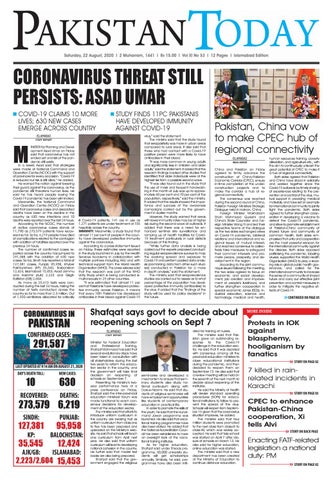
Coronavirus threat still Persists: asad uMar g
Covid-19 ClaimS 10 morE livES; 630 nEw CaSES EmErgE aCroSS Country
g
Study findS 11PC PakiStaniS havE dEvEloPEd immunity againSt Covid-19
ISLAMABAD staff report
M
iniStEr for Planning and development asad umar on friday said that coronavirus has not ended yet and risk of the pandemic still exists. in a tweet, asad said that strategies were made at national Command and operation Centre (nCoC) with the support of provinces for every occasion. “Covid-19 is reduced but risk is still alive,” he added. he warned the nation against lowering their guard against the coronavirus, as the pandemic still threatens human lives. he said he has heard people saying the Covid-19 pandemic has been eliminated. meanwhile, the national Command and operation Centre (nCoC) on friday said that coronavirus cases and associated deaths have been on the decline in the country as 630 new infections and 10 deaths were reported over the last 24 hours. according to the nCoC, the number of active coronavirus cases stands at 11,790 as 273,579 patients have recovered so far. So far, 6,219 people have died of complications related to the contagion with addition of fatalities reported over the previous 24 hours. the number of confirmed cases reported across the country has jumped to 291,588 with the addition of 630 new cases. So far, Sindh has reported a total of 127,381 cases, Punjab 95,958, khyber Pakhtunkhwa (kP) 35,545, Balochistan 12,424, islamabad 15,453, azad Jammu and kashmir (aJk) 2,223 and gilgitBaltistan (gB) 2,604. as many as 25,613 tests were conducted during the last 24 hours, taking the number of tests conducted across the country so far to more than 2.3 million. out of 1,920 ventilators allocated for critically
ill Covid-19 patients, 141 are in use as 1,271 patients are under treatment at 735 hospitals across the country. IMMUNITY: meanwhile, a study found that almost 11 per cent of people in the country have developed protective immunity against the coronavirus. according to a press statement issued on friday, these estimates were reported in the study launched in July by the health Services academy in collaboration with multiple partners including aku and with technical support from the world health organisation (who). the press release said that the research was part of the who unity Study which is being conducted simultaneously in 25 other countries. “it was estimated that almost 11 per cent of Pakistanis have developed protective immunity across Pakistan. it means that every 10th Pakistani has developed antibodies in their blood against Covid-19
Coronavirus in
Pakistan
CONFIRMED CASES:
291,587
LAST UPDATED AT 9:14 AM ON AUGUST 21, 2020 DAY'S DEATH TOLL: NEW CASES:
10
RECOVERED:
630
DEATHS:
273,579 6,219 SINDH:
127,381
PUNJAB:
95,958
KP:
BALOCHISTAN:
AJK/GB:
ISLAMABAD:
35,545
12,424
2,223/2,604 15,453
virus,” said the statement. the ministry said that the study found that seropositivity was more in urban areas compared to rural areas. it also said that those who had contact with a Covid-19 positive person were more likely to have antibodies in their blood. “it was more common in young adults and significantly less in children and older adults,” said the statement. it added that the research findings backed other studies that identified that older individuals were at the highest risk from a possible second wave. “it was also found out in the study that the use of mask and frequent handwashing in the month of July was up to approximately 60 per cent and 70 per cent of the population, respectively,” said the ministry. it added that the results showed the importance and success of the awareness campaigns carried out by the government in earlier months. however, the study warned that areas with lower immunity rates may be at higher risk during the second wave of outbreak. it added that there was a need for enhanced sentinel site surveillance and ramping up of health facilities for Covid19 treatment particularly in rural districts because of this finding. “while further data analysis is being carried out the experts proposed conducting regular seroprevalence surveys to map the evolving spread and exposure to Covid-19 and perform pooled data analysis (combining data from other such studies) conducted in Pakistan for a more in-depth analysis,” said the statement. the ministry said that seroprevalence studies are carried out to assess as to what percentage of the population has developed protective immunity (antibodies) to the virus. it added that the “findings of the study will be used for policy decisions” in the future.
Pakistan, China vow to make CPEC hub of regional connectivity ISLAMABAD Mian abrar
China and Pakistan on friday agreed to firmly advance the construction of China-Pakistan Economic Corridor (CPEC), ensure in-time completion of the underconstruction projects and to make the corridor a hub of regional connectivity. the consensus was reached during the second round of China, Pakistan foreign ministers Strategic dialogue held in hainan, China. foreign minister makhdoom Shah mahmood Qureshi and China’s State Councilor and foreign minister wang yi and led their respective teams at the dialogue as the two sides exchanged views on Covid-19 pandemic, bilateral relations and international and regional issues of mutual interest, and reached consensus to collectively take measures to safeguard their common interests and promote peace, prosperity, and development in the region. according to the joint communique issued following the meeting, the two sides agreed to focus on economic and social development, job creation and improvement of people’s livelihood, and further strengthen cooperation in special economic zones (SEZs), industrial relocation, science and technology, medical and health,
Shafqat says govt to decide about reopening schools on Sept 7 ISLAMABAD staff report
minister for federal Education and Professional training, Shafqat mahmood has said that several revolutionary steps have been taken in consultation with all stakeholders during the last two years to reform the education sector in the country, and the government will take final decision on reopening of schools on September 7. Presenting his ministry’s twoyear performance here at a press conference on friday, Shafqat said the inter-provincial education ministers’ forum was made functional to reach consensus decisions for development of the education sector. the minister said that efforts to introduce uniform curriculum in the country are bearing fruit as uniform curriculum from class one to five has been prepared and uploaded on the ministry’s website. he said that schools will teach one curriculum from april next year. he also said that uniform curriculum will lead to developing national cohesion in the country. he further said that model text books are also being prepared. Shafqat said that the government engaged the religious
seminaries and developed a mechanism to ensure that seminary students also study national curriculum along with dars-e-nizami. he said that students of religious seminaries will have employment opportunities like students of contemporary education in practical life. in order to promote the skills of the youth, he said that the hunarmand Jawan programme was launched. he also said that vocational training programmes have also been stated. he added that the national accreditation Council has been established to have an oversight look at the vocational training institutes. as for higher education, Shafqat said under Ehsaas programme, 50,000 university students will get scholarships annually. Similarly, he said, programmes have also been initi-
ated for training of nurses. the minister said that Pakistan gave an outstanding response to the Covid-19 challenge in the education sector. he said that it was decided with consensus among all the provincial education ministers to close educational institutions during the pandemic, and then decided to reopen them on September 15. he also said that a review meeting will be held on the seventh of the next month to decide about reopening of the institutes. he said the ministry of health will devise standard operating procedures (SoPs) for educational institutions to follow to prevent the spread of the virus. Schools will reopen from September 15 given that the coronavirus situation improves, he added. the minister said that four million students were promoted to the next class from class-iX to class-Xii, which was widely accepted. he said that tele school was started on april 7 after closure of schools on march 13. he also said for higher education, online education was started. the minister said that a new department has been created at the ministry of Education to continue distance education.
human resources training, poverty alleviation, and agriculture etc., with the aim to continuously unleash the great potential of CPEC to make it a hub of regional connectivity. Both sides agreed that Pakistan and China have stood in solidarity and worked together since the Covid-19 outbreak by timely sharing of experiences relating to the prevention and control of the virus, mutual support in providing medical materials, and have set an example for international community to jointly fight the pandemic. Both sides agreed to further strengthen cooperation in developing a vaccine to defeat the Covid-19 pandemic, and strive to promote establishment of Pakistan-China community of shared future and community of common health. Both sides emphasised that unity and cooperation are the most powerful weapon for the international community against the disease. Both sides opposed politicising the pandemic, labeling viruses; supported the world health organisation (who) to play a leading role in global public health governance, and called for the international community to increase the sense of a community of shared future and carry out effective joint prevention and control measures in order to mitigate the negative effects of Covid-19.
CONTINUED ON PAGE 05
more inside
Protests in IOK against blasphemy, hooliganism by fanatics STORY ON PAGE 02
7 killed in rainrelated incidents in karachi STORY ON PAGE 03
CPEC to enhance Pakistan-China cooperation, Xi tells Alvi STORY ON BACK PAGE
Enacting fatf-related legislation a national duty: Pm STORY ON PAGE 02
02
Saturday, 22 August, 2020
NEWS
DemOS IN IOK AGAINSt blASPhemy, hOOlIGANISm by fANAtICS SRINAGAR
P
TLTP
EOPLE staged forceful protest demonstrations in Srinagar and other areas of Indian Occupied Kashmir (IOK) against the blasphemous act by a BJP leader and hooliganism in the territory. Call for the demonstrations was given by the All Parties Hurriyat Conference. As soon as the Friday prayers culminated, people in large numbers took to the streets
in Srinagar, Badgam, Ganderbal, Pulwama, Islamabad, Shopian, Kulgam, Baramulla, Kupwara, Bandipora, and other areas and held demonstrations and rallies against the sacrilegious remarks of the BJP stalwart, Satpal Sharma, and thrashing of the two Muslims by RSS hooligans. They raised high-pitched pro-Islam, pro-freedom and anti-India slogans. The protesters demanded awarding of exemplary punishment to the culprit so that no one could dare indulge in such profane acts in the future. The protesters
SC asks Sindh to get illegally occupied official houses vacated ISLAMABAD
Govt achieved big success despite facing different challenges: Shahzad Waseem ISLAMABAD APP
Leader of the house in the Senate Dr Shahzad Waseem on Thursday said although there were a lot of challenges for the government yet it achieved some big success, including controlling the Covid19 pandemic, reduction in current account deficit and increasing foreign remittances. Talking to a private TV channel, he said that the international community was acknowledging the government policies against coronavirus. He said that the world’s financial institutions were praising the prudent economic policies of the country and all economic indicators were giving positive signals for strengthening of the national economy, adding that the government made hectic efforts in this regard. The leader of the house said that the government would not be blackmailed from anyone and fully committed to fulfilling all promises which were made with the people during the general elections. He said that although the government had handled coronavirus effectively, there was still a need to do a lot in the health sector. Replying to a question, he said the opposition should have to listen to the president’s joint session address because it was not an ordinary address but had great importance. He said Indian Prime Minister Narendra Modi’s policies had unveiled the face of its secularism and destroyed the image of the larger democracy. He said that India was isolated in the world now due to fascist policies of Modi’s government, adding Indian government was openly violating human rights and committing atrocities not only against unarmed Kashmiris but all the minorities which were living in India. He said that Kashmiri people had raised their flag of independence despite facing barbarism of Indian forces against them in Indian Occupied Kashmir (IOK).
of International Day of Remembrance and Tribute to the Victims of Terrorism on Monday, maintained that the people of Jammu and Kashmir are the worst victims of Indian state terrorism. On the other hand, the APHC-AJK also organised a protest demonstration outside the National Press Club, Islamabad, against the blasphemous remarks of a BJP leader in Reasi area of the Jammu region. The participants of the demonstration demanded strict action against the culprit.
Enacting FATF-related legislation a national duty: PM ISLAMABAD
STAFF REPORT
The Supreme Court (SC) on Friday directed the Sindh government to get all official residences vacated from illegal occupants within two months. An apex court bench under Chief Justice of Pakistan (CJP) Gulzar Ahmed issued the order while hearing a case pertaining to the illegal allotment of government-owned residences. During the hearing, the Additional Advocate General Sindh told the court that 229 houses in the province are illegally occupied. He said that they are being vacated, but the matter has been put on hold due to the pandemic. The bench directed the provincial government to cancel all illegal allotments and ensure that they are allotted to officials on merit. It further instructed the government to submit a compliance report in the SC at the next hearing. A Capital Development Authority (CDA) lawyer informed the bench that the Inspector General Police (IGP), Islamabad’s residence too was allotted illegally as police have grabbed the CDA’s 200 quarters. At this, the chief justice said the court would take up the issue of illegal occupation of quarters by police at the next hearing. The hearing of the case was adjourned for two months. To this, the Additional Attorney General said only four official residences in the federal capital are the subject of continuing legal disputes and all others had been repossessed. The court subsequently ordered the relevant authorities to cancel all illegal allotments and issue new allotment notifications. The SC also said that a report should be submitted after two months pertaining to the status of illegally occupied government residences.
were led by Hurriyat leaders including Umar Aadil Dar. The APHC spokesman in a statement in Srinagar strongly condemned the sacrilegious act and beating of two Muslim farmers by Hindu extremists in the Reasi district. He said that such acts by the people affiliated with communal forces are part of a well-planned strategy to provoke Muslims to retaliate and find an excuse to carry out their massacre. Meanwhile, a report released by Kashmir Media Service on the occasion
2 Indian soldiers commit suicide in IOK
STAFF REPORT
Prime Minister Imran Khan has said that the federal government considers completing the Financial Action Task Force (FATF)-related legislation as its national duty, while the opposition tried to get national reconciliation ordinance (NRO) from it. The prime minister said this while chairing a meeting, which was held to review the political, economic situation, and progress of the legislation related to the FATF action plan. He criticised that those rejected by the nation are now busy hiding their corruption. He added that the Pakistan Tehreek-e-Insaf (PTI) government faced difficulties and challenges during its two years. He further said that the federal government has put its focus on the revival of the national economy. The meeting was attended by senior leaders of the ruling political party and cabinet members to hold consultations over the current political and economic situation of the country. The premier was apprised of the progress of FATF-re-
lated legislation. Adviser to the Prime Minister on Parliamentary Affairs Dr Babar Awan gave a briefing to PM Imran regarding the government and opposition dialogues for passing the regulations. Earlier on August 13, the federal government had tabled bills pertaining to the FATF in the upper house of the parliament. According to details, the bills tabled in the upper House included Anti-Terrorism (Amendment) Bill, 2020, Limited Liability Partnership (Amendment) Bill, 2020, Control of Narcotic Substances (Amendment) Bill, 2020, and Islamabad Capital Territory Trust Bill, 2020. The bills were tabled by the Minister of State for Parliamentary Affairs Ali Muhammad Khan in the session chaired by the Senate Chairman Sadiq Sanjrani. The bills had been forwarded to the concerned standing committees for further deliberations. The National Assembly (NA) had passed FATF-related bills on August 12 that aimed at checking money laundering and terror financing after the government and the opposition evolved consensus paving the way for their smooth passage from the house.
Govt to exhaust all legal options to bring back Nawaz Sharif: Faraz ISLAMABAD STAFF REPORT
Minister for Information Shibli Faraz on Friday vowed that the government "will bring back Nawaz Sharif using all legal means that are available". Addressing a press conference in the federal capital, Faraz said that the government will approach the National Accountability Bureau (NAB) which will in turn ask the foreign ministry to put in a request to the British government for the Pakistan Muslim League-Nawaz (PML-N) supremo's extradition. "We think it has now become necessary to bring back Nawaz Sharif," the information minister said, adding that it is now the court's job to decide in the matter and that the government will facilitate necessary action. "Those who are sought by the law must be brought back and those who are answerable must appear before the court," he said. Referring to a ruling by the Islamabad High Court (IHC) earlier this week, he said that the court had declared his presence necessary if an extension in bail is sought. "The law will take its own course; we have expedited our efforts [to see him brought back]," Faraz said. The information minister said that Nawaz cares deeply about retaining his "looted wealth", which he said "will not happen". "Nawaz Sharif left under the pretext of illness. He is the master of this sort of thing," he added.
Nawaz was granted bail on humanitarian grounds by the IHC on October 29, 2019 in the Al Azizia corruption case. He also obtained bail in the Chaudhry Sugar Mills case from the Lahore High Court on October 25, 2019. Nawaz then left for London for medical treatment and has since remained there. "Forget treatment, he did not even get a single x-ray taken," Faraz said, adding that the government had repeatedly asked for reports but none were provided. He said that Nawaz has also not submitted a single deed of his property for the past five or six years. "These people (Sharifs) have done a lot of damage to the country [...] the country is steeped deep in debt," he said. "It is Nawaz Sharif's moral duty to come back and answer for his deeds," the information minister added. Meanwhile, PML-N's Rana Sanaullah challenged the government to take whatever action they please. "The government is afraid of what will happen to them if Nawaz Sharif recovers," he said. Sanaullah said that "the matter of Nawaz's x-rays and medicines is one for the doctors to decide and not the government". Separately, in a tweet, thanked the cabinet members for becoming part of the campaign to highlight the Pakistan Tehreek-e-Insaf (PTI) government’s two-year performance. He also thanked the Ministry of Information and Broadcasting as well as the media for taking the message of the performance of the government to people.
SRINAGAR: Two Indian soldiers committed suicide in Kupwara and Poonch districts of Indian Occupied Kashmir (IOK) on Friday. According to details, a soldier of Indian Border Security Force (BSF) committed suicide by shooting himself dead in Kupwara district. The deceased BSF soldier was identified as Head Constable Kundan Ram Kumar of 169 Battalion. He ended his life by shooting himself with his service rifle at Brinwari area in Kupwara district. Meanwhile, another soldier, Mohit Kumar of 39 Rashtriya Rifles, shot himself dead with his service rifle in a forward area in Mankato Sector along the Line of Control (LoC) in Poonch district of Jammu region. These incidents of suicide raised the number of such deaths among Indian troops and police personnel in IOK to 466 since January 2007. TLTP
Pakistan's image in global business community improving: Aleem LAHORE: Punjab Senior Minister Abdul Aleem Khan has claimed that Pakistan's image in the global business community is improving day by day. Aleem Khan, in a statement on Friday, said that significant increase in foreign direct investment (FDI) last month is a very welcome development, and reaching 114 million dollars in foreign investment is a great achievement of the government. He added that the data showed that investment had increased by 60 percent in July this year as compared to last year, which is a sign of confidence in Prime Minister Imran Khan's economic policies from around the world. He said that the bankrupt economy has been stabilized through best policies and in the current situation, the prime minister and his team are giving excellent results. He said that these trying times are coming to an end and that good news is on its way to every national sector. He said that the government has dealt with the emergency situation like corona in an efficient manner and Allah Almighty helped it. He expressed confidence that the next three years would be the years of full implementation of the Pakistan Tehreek-e-Insaf (PTI) manifesto and the present government under the leadership of PM Imran would fulfil all the promises made to the people to bring real progress and prosperity in the country. STAFF REPORT
Naval chief inaugurates joint maritime information coordination centre KARACHI: Chief of the Naval Staff, Admiral Zafar Mahmood Abbasi inaugurated the stateof-the-art Joint Maritime Information Coordination Centre (JMICC) here on Friday. The naval chief termed it an important milestone, which will further support Pakistan Navy’s efforts to promote maritime security in the region. He appreciated the indigenous efforts to develop such a state-of-the-art system. Joint Maritime Information Coordination Centre (JMICC) functions as a nerve centre to harmonise the efforts of all maritime-related organisations/agencies. It helps generate a coordinated response to maritime security challenges within Pakistan’s Exclusive Economic Zone (EEZ), primarily through information sharing and inter department/agency coordination. The centre was established in February 2013 and is manned round the clock by a competent team which include representatives of relevant stakeholders. The new setup of JMICC has been equipped with indigenously developed Joint Maritime Information Sharing (JMIS) software, a modern operations room and associated infrastructure. The capacity enhancement will enable JMICC to effectively knit maritime entities of Pakistan and International Information Fusion Centres (IFCs) to augment safety and security in the maritime domain. TLTP
Punjab decides to develop new tourist destinations under PPP mode LAHORE STAFF REPORT
The government of Punjab has decided to develop new tourist destinations under public-private partnership to promote tourism and provide more recreational facilities to the people across the province. The decision was taken during a meeting chaired by Chief Minister's Adviser on Tourism Asif Mehmood and Chief Sec-
retary Punjab Jawwad Rafique Malik here on Friday. The meeting reviewed the implementation of decisions regarding the promotion of tourism in the province and the adaptive reuse of government rest houses. Addressing the meeting, Asif Mehmood said that promotion of tourism and development of tourist sites are among the priorities of the government. He said that in line with the vision
of the prime minister, the Punjab government is taking practical steps for the progress of the tourism sector. The chief secretary said that the promotion of tourism would not only boost economic activities but also provide employment opportunities to the locals. He directed the secretary of tourism to complete the work of identifying new potential tourist destinations in the province as soon as possible and prepare a
comprehensive plan for the development of the tourism sector along with a timeline. He also issued instructions regarding removal of encroachments, better cleanliness and provision of facilities at the existing tourist sites. The tourism secretary informed the meeting that the Tourism Development Corporation of Punjab (TDCP) has initiated the process of leasing out 13 of its properties.
The planning and development secretary briefed the participants about the implementation of the Punjab Tourism for Economic Growth project being executed in the province with the assistance of the World Bank. The meeting was attended by additional chief secretary, additional chief secretary home, administrative secretaries of different departments including irrigation, works and communication and forest, deputy commissioner Lahore, managing director of TDCP and officers concerned whereas deputy commissioners of Rawalpindi, Chakwal, Jhelum, Sahiwal and Toba Tek Singh participated through video-link.
Saturday, 22 August, 2020
NEWS
eCC allOwS tCp tO ImpOrt 200,000 tONNeS OF wheat ISLAMABAD
t
STAFF REPORT
HE Economic Coordination Committee (ECC) has allowed the Trading Corporation of Pakistan (TCP) to place an import order of 200,000 tonnes of wheat, following the import of 500,000 tonnes of the same by the private sector. The ECC meeting, chaired by Adviser to Prime Minister on Finance and Revenue Dr Abdul Hafeez Shaikh, gave the TCP a goahead for the import of 200,000 tonnes of wheat for PASSCO after the Ministry of National Food Security and Research Secretary
COMMITTEE OBSERVES ARRIVAL OF 0.7M TONNES OF WHEAT IN NEXT TWO MONTHS WILL HELP DEFUSE PRICE VOLATILITY, DISCOURAGE HOARDING Omar Hamid Khan informed that 500,000 tonnes of wheat were also being imported by the private sector, and that the first shipment was scheduled to reach the country’s port on 26th August 2020. It was observed that the arrival of 700,000 tonnes of wheat in the next couple of months would help defuse price volatility,
7 KIlleD IN raIN-relateD INCIDeNtS IN KaraChI NEWS DESK Yet another monsoon spell brought more devastation to Karachi on Friday, claiming the lives of at least seven citizens and inundating roads in various parts of the city. According to the Met department, the highest amount of rainfall, 185.7mm, was recorded in Surjani Town. Meanwhile, 14.4mm was recorded at Karachi (MOS), 54mm at PAF Masroor Base, 22mm at PAF Faisal Base, 84mm at Gulshan-eHadeed, 106.4mm at North Karachi, 106mm at Nazimabad, 20mm at Saddar, 25mm at Landhi, 28.2mm at University Road, 20.8mm at Jinnah Terminal, 11.5mm at Kemari and 28.5mm at Saadi Town. On Thursday, the Met office had predicted that the monsoon spell in Karachi and other parts of Sindh as well as Balochistan entering on Friday could last till Monday. “Strong monsoon currents are expected to penetrate Sindh from Friday to Monday,” it said in a brief statement. “Under the influence of this system rain, winds and thundershowers, with a few moderate to isolated heavy falls, are expected in Karachi, Hyderabad, Thatta, Badin, Shaheed Benazirabad, Dadu, Tharparkar, Mirpurkhas, Umerkot, Sanghar, Sukkur, Larkana, Lasbela, Khuzdar, Barkhan, Zhob, Musa Khel, Loralai, Kohlu and Sibbi from Friday to Monday.”
Nab summons maulana Fazl's brother for questioning PESHAWAR
overcome the shortage and discourage hoarding of this essential commodity in the country. The ECC tasked the National Food Security & Research secretary and Economic Affairs Minister Makhdoom Khusro Bakhtiar to consult with the provincial governments whether they would like to purchase any amount of wheat at the rates
offered to TCP by global suppliers since global wheat prices generally remain on the lower side in the months of July and August. The government has already allowed the TCP to import 1.5 million tonnes of wheat through a transparent open international bidding process in order to meet the identified demand of 0.70 million tonnes of wheat by Punjab, 0.30 million tonnes of wheat by Khyber Pakhtunkhwa and 0.5 million tonnes required to replenish the strategic reserves of PASSCO. The commodity would be imported in a staggered manner to fetch the best price as well as to save the carrying cost and meet the shortage as and when required. It was noted that wheat stocks to the tune of 26.05 million tonnes, including 25.457 million tonnes from fresh wheat and 0.602 million from the carry forward stocks, were currently available in the country, reflecting a shortfall of 1.411 million tonnes. The availability of wheat stocks in the public sector was reported at 6.32 million tonnes compared to 7.55 million tonnes during the corresponding period last year.
PM links country’s development with promotion of science, technology ISLAMABAD STAFF REPORT
Prime Minister Imran Khan on Friday said that the country’s development was linked with the promotion of science and technology, and directed for early finalisation of the science and technology-related projects. The prime minister was chairing a meeting on new projects of Ministry of Science and Technology, here at PM Office. The meeting was attended by Minister for Science and Technology Fawad Chaudhry, Commerce Adviser Abdul Razzak Dawood, the secretary finance, the chairman of Federal Bureau of Revenue (FBR) and other senior officials. The minister for science and technology briefed the prime minister about the key projects, achievements and future plans launched during the last two years for promotion of this sector. The prime minister was briefed on the progress on the proposed University for Engineering and Emerging Technology to be set up at the PM House. The briefing also focused on the project of clean water supply and provision of relevant jobs to youth
and women across the country. The meeting approved the launch of STEM project in collaboration with universities to promote science and technology, engineering and mathematics at 400 higher secondary schools. In first phase, special laboratories for modern science, technology, engineering and mathematics will be set up at 40 schools. Around 100,000 children in 400 schools will have access to education and training in modern sciences. Fawad also presented a roadmap for increasing manufacture of medical equipment and boost its exports. The prime minister was apprised about a detailed plan to modernise the agriculture sector and enhance its production through use of modern technology. PM Imran, while appreciating the proposed scientific projects for the agriculture sector to boost the country’s exports, stressed utilising the potential of youth while carrying out the projects. He directed that obstacles to the proposed projects be removed. He appreciated the efforts of minister for science and technology and his ministry for local manufacturing of safety kits, ventilators and other equipment during coronavirus pandemic.
Parliamentarians pay tribute to Hasil Khan Bizenjo ISLAMABAD
INP
STAFF REPORT
The National Accountability Bureau (NAB), Peshawar has issued a notice to Ziaur Rehman, a grade-19 officer and Jamiat Ulema-e-Islam-Fazl (JUI-F) chief Maulana Fazlur Rehman’s brother, to appear for questioning in graft cases on Aug 25. The bureau has launched inquiries against him over his alleged involvement in illegal appointments and corruption in sale and purchase of government machinery during his appointment as Commissioner Afghan Refugees (CAR) KP. He also faces allegations of accumulating assets beyond known sources of income. Last month, the Sindh government had appointed Ziur Rehman the deputy commissioner of Karachi’s Central district, stirring controversy as opposition parties raised objections to his appointment and called for his removal at once. Soon after, a blame game started between the Pakistan People’s Party (PPP) and the federal government over how Fazl’s brother found himself at the disposal of the provincial government with the former blaming the latter for transferring him to Sindh.
Parliamentarians paid tribute to the late National Party chief Hasil Khan Bizenjo, who passed away on Thursday after battling lung cancer. Pakistan Muslim League-Nawaz (PML-N) MNA Khwaja Asif appealed to the National Assembly (NA) Speaker to obtain consent from the lower house for postponing the session in lieu of Hasil Bizenjo’s demise and paid tribute to the principled politics of the senator. PML-N’s Senator Mushahidullah Khan said that those who stick to their principles always remain alive in the hearts of the people, even after their death. “It is normally very difficult for someone whose father is such a towering personality to carve out his own legacy,” he said, adding that despite that Hasil Bizenjo had managed to mark his own identity. He added that the Bizenjo family had always voiced the truth and never thought about the price they would have to pay in return. “They did keep paying a price all their lives for telling the truth,” he said. “Did you ever see hatred in his eyes for anyone? He was kind and loving towards everyone,” said Mushahidullah. “Where do we find someone like Hasil?” Pakistan People’s Party (PPP) leader Sherry Rehman said that Bizenjo lived on his own terms as he always said he would. “People like me, women, were always provided encouragement and support by Bizenjo,” she said. “He told me to remain steadfast and not listen to people who thought I did not belong in mainstream politics,” added the PPP
LATE NATIONAL PARTY CHIEF LAID TO REST IN KHUZDAR senator. Rehman compared Bizenjo with a ray of light at a time of darkness in Pakistani politics. Pashtun Tahaffuz Movement (PTM) MNA Moshin Dawar said that it would be extremely hard for someone to replace Bizenjo and play his role in Pakistani politics. “I think this session [of the National Assembly] should be postponed to honour his memory,” he said, describing it as a huge loss for the country. “The lot of politicians that he belonged to are decreasing day by day in Pakistan,” he added. PTI MNA Ramesh Kumar said that he had known the late politician for the past 20-22 years as a friend. “Ever since I stepped into politics, I was his friend,” he said. “Even to this day, I remember the things that he talked about with me.” Kumar also paid tribute to Bizenjo, stating that those who performed good deeds, their names remain alive long after they are gone. Senator Sarfaraz Bugti said that the entire country is grieved by the loss of such a critical politician and that Balochistan had lost a great leader. “I was in very close contact with him as home minister. Where he was in favour of dialogue, he was also a believer in the establishment of the writ of the state,” added Bugti. The Balochistan home minister said that Bizenjo continued his great legacy. “The more we pay tribute to him, the less it is,” he added. BIZENJO LAID TO REST IN KHUZDAR: Bizenjo was laid to rest in his home town Khuzdar on Friday. His funeral prayer was led by Jamiat Ulema-eIslam-Fazl (JUI-F) leader Maulana Qamar-ud-Din. The late National Party chairman’s funeral prayers were attended by provincial ministers, former chief minister, MNAs, senators and MPAs. A large number of people including scholars, officials of various political parties and tribal elders also attended the funeral prayer. The senior politician was buried alongside his father.
03
Meanwhile, the ECC also took up a proposal for the import of sugar through private importers in view of the fast depleting stocks of sugar, which currently stood at 1.2 million tonnes but were likely to exhaust by early November 2020. The committee decided to reduce the levy of sales tax and other duties on the import of sugar by the private importers so as to keep the landed cost at the lowest possible level and to ensure a fair and affordable price to the consumers. According to Industry and Production Minister Hammad Azhar, the ECC has ratified the proposal to reduce and remove the incidence of taxes on sugar at the import stage. "This will facilitate private sector importers, improve domestic stocks and stabilize prices." The withholding taxes at import has reduced from 5.5pc to 0.25pc. Similarly, value-added tax at import minimized has been lowered to zero per cent from 3pc, while sales tax has been reduced from 17pc to 1pc. "The above will be time and quantity bound. The details will be notified shortly and TCP has also been asked to re-tender for sugar with modified conditions within one week," the minister stated.
Nab launches inquiry into contracts allotted during Cm buzdar's tenure LAHORE: National Accountability Bureau (NAB) on Friday launched an investigation into contracts allotted during the tenure of current Punjab Chief Minister Usman Buzdar. According to sources, the anti-graft watchdog has sought records from Lahore Development Authority (LDA), Traffic Engineering and Transport Planning Agency (TEPA), and other departments in this regard. The bureau has also directed the concerned authorities to submit details of key development projects’ contracts. Earlier, CM Buzdar had appeared before NAB Lahore office in a case of allegedly issuing a liquor license to a hotel in violation of the law. Buzdar handed over all the documents regarding the issuance of a liquor license to the anti-corruption bureau and said, “I do not know anything as I am not prepared. Give me time to think and answer these questions”. Meanwhile, former director-general (DG) Excise Akram Ashraf Gondal also recorded his statement and claimed he had informed Chief Minister Office that issuance of the liquor license will be against the policy and rules as NOCs were not complete. However, he approved the license on the request of then principal secretary to chief minister Raheel Ahmed Siddiqui. Former Excise DG Akram Ashraf Gondal had also submitted an application to become an approver in the case. INP
Court summons Shehbaz family on 27th in corruption reference LAHORE: An accountability court on Friday summoned Pakistan Muslim League-Nawaz (PML-N) President and Leader of the Opposition in the National Assembly Shehbaz Sharif in the money laundering and assets beyond means case on August 27. Admin Judge Jawadul Hassan directed jail authorities to present incarcerated Opposition Leader in Punjab Assembly Hamza Shehbaz and other accused nominated in the case on the next hearing. The court instructed the National Accountability Bureau (NAB) investigation officer to explain to it the nature of allegations levelled against Suleman Shehbaz, Nusrat Shehbaz, Rabia Imran, and Javeria Ali, who have still not been arrested. The judge further asked him to spell out why they have not been arrested yet and whether or not they have joined the national graft buster’s investigation into the case. The other accused who remain free on bail has also been directed to show up. On August 17, the national graft buster filed Rs7 billion money laundering and assets beyond means reference against the Shehbaz family, including his wife Nusrat Shehbaz, sons – Hamza Shehbaz and Suleman Shehbaz – and two daughters, Rabia Imran and Javeria Ali. Suleman is a proclaimed offender in the case. The other accused named in the reference include Nisar Ahmed, Syed Muhammad Tahir Naqvi, Ali Muhammad Khan, Qasim Qayyum, Rashid Karamat, Masroor Anwar. The bureau approved requests by Muhammad Mushtaq alias Mushtaq Cheeni, his son Yasir Mushtaq, Shahid Rafique, and Aftab to turn approvers against Shehbaz family in the case. STAFF REPORT
04
Saturday, 22 August, 2020
NEWS
CDA HAlveS ADDitioNAl StoRey CHARGeS iN MARKetS ISLAMABAD
C
STAFF REPORT
HAIRMAN Capital Development Authority Aamir Ali Ahmed has said that CDA is reducing the charges of additional storey in markets by 50 percent to give a boost to business and construction activities. The CDA chairman said this while addressing a delegation of Islamabad Chamber of Commerce and Industry (ICCI) that met him led by ICCI President Muhammad Ahmed Waheed. Amir said that development works would be carried out in various markets at
a cost of Rs.250 million and this process would start within a month including carpeting of roads and repair of footpaths. Muhammad Ahmed Waheed speaking on the occasion said that ICCI for the last many years has been discussing with CDA the same agenda of development of markets and industrial and hoped that the current chairman CDA would address these problems. He said that lease renewal is a major issue that needs to be addressed urgently. He said that in 2000, the CDA Board had extended the lease period of all industrial plots from 33 years to 99 years, but now this process has been stopped and tax @ of one percent of the value is
being demanded. He urged the chairman CDA to present the issue of lease renewal before the CDA Board as early as possible for extension of lease period up to 99 years and for abolition of one per cent tax of the value. Mohammad Ijaz Abbasi, convener of ICCI-CDA Committee, said that four years ago, the CDA Board had approved new industrial building by-laws that covered the height of industrial buildings, permission for multiple businesses and expansion of construction area, but their notification is still pending and urged for immediate issuance of notification for implementation of new bylaws. Sheikh Tariq Sadiq highlighted the
lease renewal issues and the CDA chairman issued orders to remove all obstacles in renewing leases. Mirza Muhammad Ali and Tahir Ayub stressed for the need for a truck stand in I11 sector and urged Deputy Commissioner Hamza Shafqat to personally visit and allot plot for the truck stand. They also requested for reduction of additional store charges in the I-11 fruit market on which the chairman CDA immediately announced a 50 per cent cut in charges. On the demand of Nasir M Qureshi, the chairman CDA announced to allocate an amount of Rs160 million for development works including construction of roads in Kahuta Industrial Triangle.
BHC orders DCs to scrutinise issuance of fake domiciles QUETTA TLTP
Cut in property tax to provide Rs4bn relief to construction sector: Bangash PESHAWAR STAFF REPORT
Special Assistant to the Khyber Pakhtunkhwa (KP) Chief Minister for Information and Local Government Kamran Bangash has said that the provincial government has taken important steps to reduce the property tax while the first installment of Rs500 million has been released to tehsil municipal administrations in lieu of 2 percent property tax. Bangash said that the provincial government has given more than Rs4 billion relief to the construction sector in terms of property tax. He said that Chief Minister Mehmood Khan fulfilled his promise regarding the salaries of the employees of the Local Government Department. Now, in terms of salaries and expenses, the local government department will get Rs4 billion from the exchequer in the financial year. Talking about the salaries of some tehsil municipal administration employees, Bangash said that the employees breathed a sigh of relief with the release of the first installment. The government realizes that employees should receive their wages and salaries on time. "The welfare of both the people and the employees is one of our priorities," he said. Referring to the ongoing reforms in the Local Government Department, Bangash said that development and reforms are underway in every sector including local government so that Pakistan could be made an Islamic welfare state on the pattern of Medina as per the vision of Prime Minister Imran Khan.
KP to turn 5 small dams into picnic spots to boost tourism PESHAWAR: In an effort to promote tourism in the province, the Khyber Pakhtunkhwa (KP) government has decided to transform five small dams into picnic points. According to details, Kundar Dam in Swabi, Jalozai Dam in Nowshera, Thand Dam in Kohat, Chattri Dam in Haripur and Jhangra Dam in Abbottabad are being made as picnic points. The government has begun to transform five dams into picnic points to boost the tourism industry in the country. Facilities of parking, restaurants, open cooking, solar system, spot fishing and others will be provided to the visitors at the aforementioned sites. Earlier this week, Prime Minister Imran Khan had said that the country needed to divert attention towards tourism and bring forward its real potential. “We have to improve the situation at tourist spots across the country,” he had said, adding that these places would promote the culture and traditions of the country locally and internationally. “We will be providing improved facilities to tourists at these spots,” the prime minister had said as such activity would improve economic activity and generate employment opportunities for locals. The premier had also directed the concerned authorities to properly utilise government infrastructure for promoting tourism in the country and stressed upon the need to effectively utilise historical places, governor houses and guesthouses for the purpose. TLTP
Directing all departments to demonstrate seriousness on the sensitive issue of fake domiciles, the Balochistan High Court (BHC) on Friday directed commissioners and deputy commissioners to scrutinise issuance of all suspected domiciles. A division bench of the BHC, headed by Chief Justice Jamal Khan Mandokhel and also comprising Justice Hameed Baloch, heard a petition with regard to issuance of fake domiciles of Balochistan to non-locals. Senior lawyer Sajid Tareen, who has been among several petitioners, also appeared before the court in the hearing. Chief Justice Jamal Mandokhel while hearing the petition remarked that the rights of local
people have been plundered with fake domiciles. The commissioners and deputy commissioners should thoroughly scrutinize the authenticity of domiciles, the chief justice said. The deputy commissioners of all districts should inform the advocate general with weekly review reports on the issue. The bench later adjourned the hearing until September 23. The petition was filed in the high court over complaints of issuance of fake domiciles from government offices. It is pertinent to mention here that a mass online campaign against fake domiciles and local certificates in Balochistan has been gaining momentum with the hashtag #BalochistanRejectsBogusDomiciles. “The administration should make the procedure of local and domicile is-
suance transparent,” said one post asking the government authorities to “issue these certificates only to the residents of the province.” In a notification issued by the Mastung deputy commissioner (DC), domiciles of 400 federal employees were cancelled on June 26, 2020, as they did not get back to the Mastung DC office even after four reminders. Letters were issued to their respective departments but all in vain. The notification was received with great enthusiasm by the social media campaigners. Some of the other districts have also issued the same notices in local newspapers, asking federal department, autonomous, and semi-autonomous department employees to have their domiciles verified by the respective DC offices. Failure to do so would cancel their domiciles, the notices warned.
Punjab decides to start construction of houses in 10 cities: Mahmood LAHORE STAFF REPORT
The government of Punjab has decided to start construction of houses in 10 cities of Punjab under the Naya Pakistan Housing Project. Punjab Minister for Housing and Urban Development Mian Mahmood Rashid said this on Friday. He said that various investors, developers and builders have approached the Punjab Housing and Town Planning Agency (PHATA) to join the Naya Pakistan Housing Project and the process of regulation on these applications is underway. He said it has been decided to start construction of houses in 10 cities of the province including Lahore, Rawalpindi, Faisalabad, Sialkot, Chiniot, Chishtian, Kharian, Pattoki, Hazro and Lodhran in collaboration with developers, builders and investors. The housing schemes of these builders will be approved and the construction of low-cost houses will be started in these cities as soon as possible. He said that as
per policy, the provision of subsidy of Rs300,000 to the low-income segment of the society will provide relief in constructing their houses. He further stated that according to the vision of Prime Minister Imran Khan, the government under the Naya Pakistan Housing Project has extended full cooperation with private builders and developers and housing related policies have been formulated in consultation with all the stakeholders.
Five children drown in pond in Kohat KOHAT: Five children drowned in a pond here on Friday, police said. According to details, a child while taking bath in a pond in Kiri Sheikhan area of Kohat went into deep water. In attempt to save the drowning child, four others also drowned in the pond. Bodies of the five children including a brother and four sisters aged between six to 12 years were fished out and handed over to heirs for burial. An environment of grief and sorrow prevailed in the area over death of five children of same family. INP
2 killed, three injured in Swabi incidents SWABI: At least two people were killed and three others incident in separate incidents in different localities here on Friday. A youth Meezan s/o Shahid was electrocuted while repairing ceiling fan in suburban area Batakara. Unidentified gunmen shot dead a man Nabeel Ahmad s/o Fazal Rabbi in Marghaz and sped the scene. At Swabi Jhangira Road near Kund Park, an over speeding car knocked down a motorcycle resultantly Hazrat Nabi 33, Aamir 31, and Kamran 27, were critically injured. The injured were shifted to Bacha Khan Medical Complex Shah Mansoor for treatment. INP
Fire gutted more than 30 shops in Mansehra MANSEHRA: Fire erupted at a shop in the Battal Mandi Market near Mansehra on Thursday night which spread very quickly and engulfed several other shops. Fire brigade and Rescue 1122 teams from Mansehra reached Battal Mandi Market and brought the fire under control. No causality was reported in the blaze. However, valuables worth millions of rupees were gutted due to fire. According to rescue sources, the fire destroyed more than 30 shops in the market. DSP Mansehra informed that a house was also partially damaged due to fire. He said that a spark from the ash in a blacksmith shop might have caused the fire. INP
SHC seeks record of MNAs’ salaries, allowances from AGP KARACHI: The Sindh High Court (SHC) has directed the Attorney General of Pakistan (AGP) to submit comments on a petition challenging the recent increase in salaries and privileges of the members of the National Assembly (NA). A two-judge bench of the SHC headed by Justice Nadeem Akhtar issued a notice to the attorney general to file a reply before the next hearing scheduled for September 16. The court also sought the complete record of the salaries, allowances and perks the members of the NA have been receiving before and after the impugned increase. A citizen, Syed Mahmood Akhtar Naqvi, moved the petition, stating that a bill with regard to an increase in the salaries and allowances of the members of the lower house of parliament was presented in the NA. After the amendment, he submitted, the MPs are also entitled to 25 business class air tickets in a year or demand a refund in case they are unable to use them. Their family members can also use these air tickets, he said. The petitioner said the MNAs ought not have been given the pay raise in view of the fragile and unstable economic condition of the country. He requested the court to declare the amendment in the law with regard to the increase in the salaries of the lawmakers illegal. TLTP
Cement plants must be established away from populated areas: Hashim Jawan LAHORE INP
Punjab Finance Minister Hashim Jawan Bakht on Friday instructed the industries department to ensure the establishment of cement plants away from the populated areas, transforming of brick kilns on modern zigzag technology and usage of echo friendly fuels in the industry. Further, the teams of the environment protection department are constituted to check the breaking of stones in the cement industry alongside environmental pollution. Additionally, awareness cam-
paigns were already conducted across the province by the environment protection department. This was informed in 2nd meeting chaired by the Finance Minister to review the steps taken to control smog in Punjab. Adviser to Prime Minister on Climate Change Malik Amin Aslam, Punjab Energy Minister attended the meeting through video-link while provincial environment minister Muhammad Rizwan, head of Chief Minister’s Special Monitoring Unit Fazeel Asif, Punjab additional IG and concern officials of different departments attended the meeting.
The meeting was informed that details were sought from all departments concern about the steps taken to control smog. The minister instructed that timeline for transforming the brick kilns on zigzag technology should be followed strictly while police and transport department should ensure stopping the smoke omitting and non-fitness certificates vehicles plying on the roads. Further, purchase of echo-friendly vehicles should be ensured in the purchase of cars and buses by the government institutions. The environment protection department should ensure that all departments strictly follow
the recommendations of the smog control committee. Hashim said that the province was already facing health management challenges due to covid-19 while smog can add to the challenges so timely action could avert the smog. He orders that all departments should come up with the report about the steps taken to control the smog by the respective departments. The committee should be updated what steps taken to shift the brick kilns on zigzag technology, what is progress on installation of machinery to measure environmental protection.
Saturday, 22 August, 2020
NEWS
CCoP aPProves 7PC divestment in oGdC,10PC in PPL shares ISLaMaBad
t
SHAHZAD PARACHA
HE Cabinet Committee on Privatisation (CCOP) on Friday approved the divestment of 7pc government shares in Oil and Gas Development Company (OGDCL) and 10pc in Pakistan Petroleum Limited (PPL). The CCoP meeting, chaired by Finance Adviser Abdul Hafeez Sheikh, approved the divestment of 7pc government-owned shares in OGDCL through public offerings and directed the concerned to initiate the process of appointment of a financial adviser in this re-
divestment of 20pc shares in Pakistan Reinsurance Company, House Building Finance Company Ltd and First Women Bank Ltd. In addition, it okayed the privatization of Guddu Power Plant (747MW) and gave directions to all the divisions/entities to resolve all related issues so as to expedite the privatization process. On PIA's Hotel Roosevelt, the CCoP agreed with the recommendation of the Aviation Division and directed the concerned to hold the updating of M/s Deloitte reports [on the hotel] in abeyance till the revival of the economic and business environment in Manhattan, New York.
gard. Up to 10pc government shares in PPL through public offerings were also approved in the meeting. It may be noted that the committee had initially decided to divest up to seven per cent shares of OGDCL during a meeting in August 2019. However, in February this year, the committee directed stakeholders to discuss and submit their recommendations on the proposed divestment after Prime Minister Imran Khan emphasized on the privatisation process to accelerate. Meanwhile, the CCoP also approved transaction structures for the privatization of Services International Hotel, Jinnah Convention Centre,
Liberating Kashmir Roedad Khan “Any people which has been annexed with another people”, Lenin wrote, “not by the voluntary desire of its majority but by the decision of a Tsar or government is an annexed people, a captive people. This sums up the essence of the Kashmir dispute. It reminds me of a couple who for years have suffered through a bad marriage. They separated long ago but the divorce lawyers are still working on the Divorce de ed. And the only unresolved question is: who gets the custody of the child? The Kashmir dispute basically involves three parties. Pakistan and India are the two main parties according to the UN Resolutions. Kashmiris are the third party, whose right of self-determination has been recognized in several UN Resolutions. Pakistan and India, on their own, cannot decide the future of the Kashmiris. By 1957, Indian leaders, including Nehru, began to hint that the real settlement of the Kashmir problem lay in partition, not plebiscite. What they meant was the recognition of defacto frontier along the Kashmir cease-fire line as the de jure frontier between India and Pakistan. Each side would keep what it had; and that is that. India would not be too fussy about what went on, across the cease-fire line. Today Indian attitude is characterized by a certain smugness based on the knowledge that possession is 9 points of law – however illegal and immoral the possession. Indian strategy is based on the assumption that there would, in due course, be no more talk of a plebiscite and the defacto situation would acquire, through usage, a de jure status. The Kashmir dispute would then be settled out of court. This strategy seems to be working very well indeed. Statuesque suits the Indians. It is anathema to the people of Pakistan. The UN Resolutions are still valid even though India has made many efforts to declare them ‘dead’
ARMED STRUGGLE IS THE ONLY SOLUTION NOW particularly after the signing of the Simla Agreement on July 3 1972. It gives me no pleasure to say that after 1972, I never heard the word “plebiscite in any cabinet meeting that I attended. In 1948, in a conversation with the British High Commissioner on plebiscite in Kashmir, Mr. Jinnah said: “the most urgently important matter for decision was the form of administration to be setup in Kashmir on the cessation of hostilities. He had no doubt that India intended to retain control of Kashmir and to accept no form of plebiscite unfavorable to that end. “Impartial administration of the State alter cease-fire was essential and without the guarantee of such a development, he (Mr. Jinnah) himself could not ask the Muslims in Kashmir to lay down their arms”. Mr. Jinnah did not exclude armed struggle by the people of Kashmir for liberation from India. Mr. Jinnah did not personally favor the intervention of the United Nations Organization or of any other outside authority. He still preferred the solution suggested by him to India on November 1, 1947, that the two Governors General, duly authorized by their respective Dominions, should accept responsibility for the task of setting up a neutral administration in Kashmir and organizing a plebiscite”. Little did Mr. Jinnah realize that one day Pakistan would abandon the Security Council Resolutions on Kashmir, make a major policy shift under foreign pressure and ‘set aside’ plebiscite in a statement made on Indian soil. More than 50 years after Mr. Jinnah’s death, Pakistan’s Kashmir policy was crumpling up. Imran energized it. He changed the Kashmir narrative and almost single-handedly put the Kashmiri cause on the global platform. However, we cannot look back with much
pleasure on our foreign policy and the way our elected and un-elected rulers handled the Kashmir dispute. Kashmir has suffered in every respect by her association with selfseeking, and self-centered rulers of Pakistan who had their own agenda. But for Imran, betrayed by friend and foe alike, mournful, abandoned, bleeding Kashmir would almost certainly have receded into darkness and forgotten. Imran resurrected the Kashmir dispute. He galvanized Pakistan’s Kashmir policy. Today Indian attitude is characterized by a certain smugness based on the knowledge that possession is 9 points of law – however illegal and immoral the possession. Indian strategy is based on the assumption that there would, in due course, be no more talk of a plebiscite and the defacto situation would acquire, through usage, a de jure status. In 1963, as Commissioner Karachi, I had the honor of receiving Prime Minister Chou Enlai on behalf of the Government of Pakistan. He was on his way to attend the Algiers’s conference and broke his journey in Karachi for four hours. I took full advantage of this unique opportunity and engaged him in conversation. Prime Minister Enlai very graciously encouraged me to ask any questions. We talked about the Long March, the Vietnam War and the Algerian war of independence. His words are still ringing in my ears, “all of us, Vietnamese, Algerians and Chinese had to fight for our liberation. Armed struggle was the only solution, the only way to secure liberation from imperialist powers”. Since then, next door Afghans, with no organized army, no air force, and the entire world against them, have secured their liberation from a super power through armed struggle lasting for about for 20 years. Why should Kashmir be an exception? Non-violent, passive resistance by Kashmiris over a period of 70 years has been a failure, although very costly. Statuesque remains unchanged. Kashmir has been swallowed up and is now part of the Indian union. Today Indian government is not prepared to give up Kashmir. No responsible section of Indian opinion is prepared to consider any settlement of the Kashmir dispute which entails giving up the whole or any part of Kashmir. The West is insensitive to the suffering of the Kashmiris and is disinclined to take any effective action against the Indian usurper. The Security Council Resolutions remain unimplemented. Kashmiris have exhausted all legal and political options during the last 70 years. It is high time Kashmiris took up arms to take back their country. Armed struggle is the only option.
Court acquits Atiqa Odho in liquor case RAWALPINDI: A local court acquitted actress Atiqa Odho in a nine-year-old case related to possession of liquor bottles on Friday. A civil court heard the case of liquor possession against Odho. During the hearing, the court acquitted the actress after nine years, two months, and 14 days. Judge Yasir Chaudhry ruled on the basis of merit, remarking that there was no evidence against the actress, therefore, she was acquitted. Commenting on the verdict, Odho said, “Justice was served, albeit belated.” It is to be noted that Odho was accused of carrying two bottles of liquor in her bag while travelling from Islamabad to Karachi. Former chief justice of Pakistan Iftikhar Chaudhry had taken a suo motu notice, following which a case had been registered against Odho at the Airport police station on June 7, 2011. The course of the case saw 210 appearances, while 16 judges were changed. TLTP
CMYK
05
Pakistan, China vow to make CPEC hub of regional connectivity continued on page 01 Both sides reiterated that the enduring pakistan-china all-weather strategic cooperative partnership is beneficial to international and regional peace and stability, and serves the mutual security and development interests of both countries as well as of international community and regional countries. Both sides were committed to firmly implementing the consensus reached between the two leaders, enhancing mutual strategic trust, strengthening all-round cooperation, maintaining momentum of high-level exchanges, further advancing construction of Belt and Road initiative (BRi), promoting bilateral relationship to a higher level, and delivering greater benefits to both countries and the two peoples. the two sides agreed on continuing their firm support on issues concerning each other’s core national interests. the chinese side reiterated that pakistan and china are iron brothers and pakistan remains china’s staunchest partner in the region and that china firmly supports pakistan in safeguarding its territorial integrity, sovereignty and independence, independently choosing a development path based on its national conditions, striving for a better external security environment and playing a more constructive role on international and regional affairs. the pakistani side appreciated china for standing together with pakistan in safeguarding its national security and sovereignty, and reaffirmed its firm support to china on affairs concerning china’s core interests and issues of major concern, such as those related to taiwan, Xinjiang, tibet and Hong Kong. Both sides underscored that cpec has entered the new phase of high-quality development, and has played and will continue to play an important role in supporting pakistan to overcome the impact of covid-19 and achieve greater development. Both sides expressed satisfaction on agreements reached on recent mega energy projects and look forward to convening the 10th Jcc meeting at the earliest possible date to promote cpec to make positive contributions to the highquality construction of BRi. Both sides reaffirmed the principle of wide consultation, joint contribution and shared benefits in building cpec, and welcomed the international community to join in
the cpec construction on the basis of consensus to achieve shared development. Both sides expressed satisfaction over cooperation on regional and international issues at multilateral fora such as the united nations (un), Shanghai cooperation organisation (Sco) and aSean Regional Forum, and agreed to deepen coordination and cooperation to safeguard mutual interests and uphold principles of fairness and justice. Both sides reaffirmed their commitment to the purposes and principles of the un charter, and support for multilateralism, free trade and win-win cooperation, and opposition to unilateralism, protectionism and coercive practices. the two sides underlined that a peaceful, stable, cooperative and prosperous South asia was in common interest of all parties. parties need to settle disputes and issues in the region through dialogue on the basis of equality and mutual respect. the pakistani side briefed the chinese side on the situation in Jammu & Kashmir, including its concerns, position and current urgent issues. the chinese side reiterated that the Kashmir issue is a dispute left over from history between india and pakistan, which is an objective fact, and that the dispute should be resolved peacefully and properly through the un charter, relevant united nations Security council (unSc) resolutions and bilateral agreements. china opposes any unilateral actions that complicate the situation. china and pakistan agreed to strengthen cooperation on the afghan issue and appreciated the efforts made by afghan government and the taliban to initiate the intra-afghan negotiations. they emphasized the importance of an inclusive, broad-based and comprehensive negotiated agreement for future political settlement in afghanistan. While reaffirming their commitment to an afghan-led and afghan-owned peace process, both sides encouraged relevant parties in afghanistan to seize this historic opportunity and commence the intra-afghan negotiations at the earliest leading to durable peace and stability in afghanistan. china appreciated pakistan’s positive contribution to the afghan peace process and efforts for promoting peace and stability in region and beyond.
Saturday, 22 August, 2020
06 COMMENT President Alvi’s rose-tinted glasses
Future of Kashmir
Simply, the stand won’t wash
India’s action last year set the whole region in tumoil
A
S Article 41 puts it, the President is the head of State and represents the unity of the Federation. This requires that once elected he is to stay above the political fray. Generally those elected Presidents in democratic dispensations are nominated by the majority party which ensures that its loyalists get the top slot. In order to command the respect of the opposition, the President has to maintain a minimum vestige of impartiality. The address by President Arif Alvi was an unabashed panegyric by a confirmed partisan. he even praised the PTI government for actions taken by previous governments, like fighting terrorism and providing shelter to Afghan refugees. he sought credit for something the PTI needs to apologise for, which is allowing taraweeh prayers despite important Muslim countries having restricted these in public. Within weeks, the price of the Ramzan-cum-eid relaxation had become starkly clear: cases of the coronavirus soared, hospitals were overwhelmed and by June, infections reached 6,000 per day, and some days saw nearly 150 deaths. The President is critical of the media for not highlighting “positive news”. he advances an odd argument. “If I have children, I will encourage them, let them know they have done a good job and that they can do better instead of telling them they have done this or that wrong.” Were PTI’s media/social media activists told to follow this policy when the PML(n) was in power? The President conveniently overlooks the recordbreaking unemployment in the country and skyrocketing prices of food items. The debacles, like India annexing Kashmir or making an entry in the Middle east at Pakistan’s expense, that happened during the PTI rule, do not matter to the President. Interestingly, he has no advice for the Foreign Office which takes a strong position on Saudi Arabia and the OIC, only to reverse it within days. There were at least two embarrassing howlers in the President’s address. he maintained that the current account deficit was $8.5 billion, only to be corrected by the PM who said it was only $3 billion. While thanking the PM, President Alvi made the government culpable by maintaining that he was given the figure he had quoted. Again while complimenting friendly countries he forgot to mention Iran, till reminded by the national Assembly Speaker through a chit.
Dr Zeeshan Khan
W
hen we look at the history of Indian Subcontinent, it has always remained womb of many disputes and battles, being a gateway of many conquerors since the beginning, as it attracted almost everyone due to the fertility of its soil and being a place of paramount economic as well as social opportunities, now with now over 1.8 billion people in 1.7 million square miles of South Asia. The magnitude of disputes in past was not too dangerous because of the limited availability of modern weapons. however, now the things have changed so largely that presence of nuclear powers in the region has made the situation too risky in case of any non-resolving conflict between these nuclear powers. At present, the Kashmir issue is one such dispute from last the seven decades between India and Pakistan, and since last year on August 5, with the Indian revocation Of Articles 370 and 35A Of the Indian Constitution with its implementation of an unprecedented curfew in Indian Occupied Kashmir violated not only 11 United nations Security Council resolutions but also transgressed the United nations human Rights Charter, two Un human Rights Reports, the Simla Accord between both countries and basic human rights Of over eight million Kashmiris. Indian Occupied Kashmir is still under unending siege for the last one year. The seriousness of the problem cannot be imagined until one suffers the very state of affairs. Additionally, the Indian Government is not apologetic at all and the inauguration of the construction of a Ram Mandir at the site of the demolished Babri Mosque just added fuel to the fire by its clear exhibition of hatred against Muslims. Moreover, the international community has adopted a criminal silence over the extreme infringement of human rights, maybe considering Kashmiris
Debt trap gets worse The PTI has seen matters get worse
Value-education is also important noor Fatimah
W
hen we trace the history of mass education, it can be seen that it was the by-product of the Industrial Revolution. Assembly-line manufacturing needed skilled, educated workers that could be trained in a ‘standardized’ fashion to obediently repeat identical steps. Since industries required citizens to turn into a steady supply of easily available labour that copied repetitive steps accurately, it was in the state’s interest to invest in mass education as a means of economic development. Therefore, schools were typically structured along assembly lines where instruction was transferred from the teacher to the students. Obedience to the rules and instructions was of paramount importance and rewards were mostly linked to reproducing information correctly. With globalization and the technological boom, the educational landscape shifted. The burst of technology has made information readily available for consumption. hence, in the 21st century, we need students who are problem solvers, not experts at reproducing information. The global coronavirus pandemic has been testament to the fact that schools need to concentrate on providing a value-based education that focuses on capacity building and character building such that students are capable of dealing with crisis, unpredictability and change. What is needed now is for students to practice skills that help them make sense of information, make connections to their own contexts and use this information in smart ways to find solutions. education in Pakistan has failed to keep up with the needs of the time. It is unfortunate that most of our assessments and formal examinations are still aligned with memory retention and reproduction of information. Additionally, most of the learning in our classrooms still happens in a teacher-centred setting where students are passive recipients and knowledge is transferred one-way from the teacher. All of this translates into a disconnect between our education system and the future needs of our generations. Pakistan’s education policy is fixated upon increasing enrolment and improving results, but the questions that arise are: What future awaits
Dedicated to the legacy of the late Hameed Nizami
Arif Nizami Editor Umar Aziz
Asher John
Joint Editor
Executive Editor
Deputy Editor
Lahore – Ph: 042-36300938, 042-36375965
in Indian Occupied Kashmir even before August 5. Kashmiris have not accepted the injustice and the denial of their right to self-determination. events over the last year have proved that Pakistan’s warnings to the international community about Kashmir Siege being the opening gambit in BJP’s implementation of its RSS inspired extremist racialist hindutva agenda were well-founded. The Kashmiri cauldron could trigger explosions, destroy regional peace , rip apart the fabric of political geography and spark wider conflagrations. The USA and the international community must assert its moral authority and use its influence to extinguish the fires now burning in Kashmir. On 6 August 2020, the UnSC again for the second time expressed concerns over the human rights situation in the Indian Occupied Kashmir after India imposed curfew, which has been on its agenda for over 70 years. The UnSC, under the Un Charter, not only has the responsibility for maintaining international peace and security but also of ensuring implementation of its resolutions. Pakistan at United nations has underscored the need for the world community to end India’s human rights violations in Indian Occupied Kashmir and move to resolve the Kashmir dispute in accordance with the Un resolutions. Pakistan must first and foremost, rely on Muslim World Leaders to uphold the right to self-determination of the Kashmiri people. India increased its troop strength in Kashmir to 900,000 – one soldier for every eight Kashmiris, and it imposed a military siege, a 24 hour curfew, and all political leaders and prominent Kashmiris are incarcerated. India has opened the door to demographic transformation and more than 400,000 thousand Indian military and civilian officials and their families have already obtained residency rights in Kashmir. Demographic flooding of an occupied territory violates Security Council resolutions, the Fourth Geneva Convention and the Genocide Convention. In the end, economic might is the real power in today’s world but India must think about humanity and must lift the curfew as freedom is Kashmiris’ basic human right. Peace must be given a chance otherwise radicalisation would have serious repercussions, because conflicts and wars never benefitted any nation but only destruction is achieved as the end product. Dr Zeeshan Khan tweets @DrZeeshanKhanA1 and can be reached at dr.zeeshan.alias.ghazikhan@gmail.com
Our world needs better humans
T
he PTI came to power deriding the previous governments, particularly its immediate predecessor, the PML(n), for miring the country in debt, to no avail, except to enrich corrupt politicians. The PTI had a simple solution: plug corruption, and use the money saved on the welfare of the people. Between the cup and lip, something slipped. The result has been the ballooning of public debt from Rs 24.95 trillion to Rs 36.3 trillion over the two years it has been in office. The cost of borrowing has been brought down from 5.3 percent to 1.2 percent, but the increase in debt from 72.5 percent of GDP to 87 percent. Some of the blame goes to the extraordinary expenditures of the covid-19 crisis, and some, as the Prime Minister says, to the rising pensions bill, but basically either the PTI has failed, or it had the wrong end of the stick. The Prime Minister is haring after pensions now that corruption, mafias, or any other excuse has not served to remove the problem, but while it is true that the salary bill of serving employees is Rs 500 billion, the pensions bill is Rs 470 billion. It should be noted that of this, Rs 369 billion go to retired military personnel. The problem is that, unless the government reneges on commitments which may have been made several decades ago, when today’s nonagenarian pensioner was recruited in his 20s, the bill will not go down until recruits on the new terms reach pensionable age, about 35 years from now. The essential problem is one of governance. The Federal Board of Revenue has been repeatedly missing its targets. The IMF is airily giving revenue targets that cannot be met, and which it knows will be missed. expanding the tax net and austerity were planks on which the PTI ran. Unfortunately, efforts to expend the tax net are blocked by the special interests which have the PM’s ear, while austerity very quickly dissolved in a series of photo-ops more wasteful than the original extravagance. The PTI will never admit it, but the problem increasingly looks like plain, old-fashioned, incompetence.
Aziz-ud-Din Ahmad
the children of a lesser God. On 5 August 2020, Pakistan protested vehemently at completion of one year of siege in Indian Occupied Kashmir and also issued a new political map including it in Pakistan marked as disputed region. now, steps ought to be followed include; the Kashmiri diaspora abroad, in particular europe and north America, the people of Azad Jammu and Kashmir(AJK) and Indian Occupied Kashmir are needed to be included in the process of the struggle for the freedom of Kashmir. On the diplomatic front, from last two years Kashmir issue has been highlighted eloquently but before this era, the Kashmir conflict was put on the backburner long ago. Diplomacy regarding the Kashmir conflict remained absent in the past. So, things did not work out properly as diplomacy is not an event but a process and the process was missing. Aggressive diplomacy is needed to address the conflict especially after the imposing of an inhuman curfew in Indian Occupied Kashmir for the last one year. There should be a sole representative for the people of Kashmir, who must lead the Kashmir cause clearly, as Prime Minister Imran Khan and Foreign Minister Shah Mahmood Qureshi are too busy with their limited time, and they cannot properly propagate the issue as special envoy can, although Imran Khan highlighted it strongly on international stage. Therefore, a Special envoy on Kashmir is the need of the hour. Pakistan must also nominate a plebiscite advisor to prepare people of Kashmir and overseas Kashmiris to aggregate the support in case of a referendum. As the world knows now, Kashmir is not India’s internal matter. It is an international dispute. India’s actions on 5 August 2019 were a violation of UnSC Resolutions and international law, and its own leaders’ commitments. The world must pay attention to the catastrophic humanitarian tragedy unfolding in Indian Occupied Kashmir, which has all the hallmarks of a genocide. India has tried to erase the Kashmiris’ identity. The bleakest year in the history of Indian Occupied Kashmir as Kashmiris mark one year of arbitrary arrests, killings, torture, rapes, hatred against minorities and, following India’s colonial domicile laws, land grab. Instead of loosening its stranglehold on the Kashmiri people, India has used covid-19 to double down on its oppression in Kashmir. There are even more arrests, more extrajudicial killings. 30,000 young Kashmiri boys have been disappeared forcefully. India has itself paid the ultimate tribute to the Kashmiris’ spirit and resistance by imposing curfew
I
Karachi – Ph: 021-35381208-9
I
our graduates? Are the current skills that these stu- and their skills are not outdated, the conversations we dents learn even relevant for the employers? Are should be having must reflect the development trathese students cramming and replicating information jectory of the current world we live in. For me, meaningful change in society means that when the world needs innovators? Policy makers in Pakistan should focus their immediate attention to- individuals are positive contributors to society. To be wards rethinking the goals and objectives of our ed- active members of Pakistani society, it is important that students develop the skills to aspire to be the best ucation system. I founded noorGah, a non-profit school for un- version of themselves and actively work towards rederprivileged children in Lahore with a dream of alizing that goal. In order to facilitate this self-development in students at bringing a small but noorGah, I focus on meaningful change to sohelping them develop ciety. Like most smallskill sets that set them scale schools; noorGah Instead of focusing on cramming apart and make them follows the Punjab Texthuman. I have introduced book Board Curriculum. information and reproducing an add-on class on charhowever, I realized that acter building. I thought: the learning objectives learning materials, our education what is the one thing that and goals delineated in should be value-based and should sets us apart from mathe curriculum are chines? empathy. The mostly memory-based facilitate students in their journey basic essence of what it and do not have the meant to be human. scope to push students to towards becoming thinkers and Schools in Finland and be critical thinkers. I innovators. With global warming, other Scandinavian counasked myself: what was tries have integrated the purpose of providing climate emergencies, the refugee value-education as part of education to these chiltheir curriculum. Policydren? The purpose was to crisis and ongoing economic and makers abroad believe help them break the that the best way to prechain of poverty and impolitical turmoil, the world needs pare children for an unprove their economic children who think beyond borders predictable and uncertain conditions through eduworld is by instilling in cation. I wondered how I and are problem solvers them the values needed expected them to secure to make a better tomora better future for themrow for themselves and selves when their educaothers. tion was teaching then to For Pakistan, what is needed now is a reimaginabe passive receivers of knowledge and tests were tion of our education system. Currently our education mostly based on memory retention. On my quest to find answers for noorGah, I system rewards behaviours that are outdated, and thus came across a book titled 21 Lessons for the 21st not commensurate with the needs of the world marCentury written by the famous historian Yuval noah ket. Instead of focusing on cramming information and harari. The book outlined the challenges that came reproducing learning materials, our education should with the digital age and access to instant information. be value-based and should facilitate students in their Digitization has made data collection and structuring journey towards becoming thinkers and innovators. so easy, that most jobs of the current times will be re- With global warming, climate emergencies, the dundant as humans become increasingly replaceable refugee crisis and ongoing economic and political turwith machines. The author talks about the children of moil, the world needs children who think beyond borour generation and highlights that the jobs that they ders and are problem solvers. will be required to do, don’t exist in the world right Noor Fatimah is a freelance columnist now. Thus, to ensure that our children, their education
Islamabad – Ph: 051-2204545
I
Web: www.pakistantoday.com.pk
I
Email: editorial@pakistantoday.com.pk
Saturday, 22 August, 2020
COMMENT 07 Editor’s mail Send your letters to: Letters to Editor, Pakistan Today, 4-Shaarey Fatima Jinnah, Lahore, Pakistan. E-mail: letters@pakistantoday.com.pk Letters should be addressed to Pakistan Today exclusively
Beauty standards The obession over the white complexion in our society exists from a long period of time. It is really disheartening to hear that someone got rejected due to his/her skin color, not being white enough or being too dark. The craze for having a white skin is so much that there are specific injections to convert the skin whiter. Many use home remedies for glowing skin. We can see the advertisements for promoting fairness creams which show that a girl or boy with fair skin can easily achieve anything without any judgment. The concept of white being beautiful has its root in history, and till today, we calling ourselves educated still believes the same old senseless ethic. Despite being Muslims, we easily discriminate others due to dark skin tone when our religion clears that everyone is equal. People are more than their skin colors. hazrat Ali (R.A) said,“ Your souls are precious, and can only be equal to the price of paradise, so do not sell them for anything else”. These words by Imam Ali (R.A) clearly shows that actual beauty lies in our soul that is worth paradise. Fiza NaSir TurbaT
Gender problems
Dimensions of social media use in pandemics It both entertains and raises awareness Dr. rajKumar singh
M
eAnS of social media are more in use than in normal days. Its uses and values are considered justified for nations which are the hot spots of Covid-19 and where mental health managements are on demand due to strict guidelines of governments and health ministries to check and control the ongoing pandemic. Although social media, both print and electronic, remain in use by the general population, celebrities, world leaders, and professionals to spread information, get humour and to have a wide canvas of knowledge, its increased use is only due to the pandemic as people are remaining at home generally to obey the dictum of social distancing and they are bound to turn to social media to maintain their traditional relationships, along with making new ones to pass their time and live at ease. There is no guarantee that this forced life style will continue for long however, it suffices in the form in which it exists today. During the pandemic there has been a sudden increase in the use of multiple media websites because of people’s staying at home. Messaging media, WhatsApp groups, Messenger, Zoom, TikTok, Quarantine Chat, Twitter, Facebook, and YouTube are frequently used in this emergency period. According to an analytics department report survey by Facebook, WhatsApp has reported a growth of 40 percent in its use with a noticeable increase in the use of Zoom and downloads of TikTok in March 2020, in comparison to February. A life of loneliness and social distancing has directly affected the mental wellbeing of humans at large and enhanced the risk of anxiety and depression. Researches done in psychology have proved that connectivity with a lot of people helps manage mental health and reduces the risk of further illness. Keeping in view the requirements of the pandemic in countries where the virus hit hardest, services of this type got an increased demand. For example, the health staff of China, where the virus entered first, used social media programmes like WeChat, Weibo, and TikTok. In many countries the government has allocated separate funds for the purpose and support the mental health schemes. The current situation is a disaster for offline businesses as people are locked in their homes and their shops are also shutdown due to lockdowns, it however, is an opportune moment for online businesses which registered a significant growth in the pandemic. Today is the age of Internet and there is a lot of fun and entertainment. In the pandemic, several applications have been created which gave clear space to the young generation and other needy people of the world. The famous Facebook company has created a separate group, predominantly Generation Z, to share memes created on the pandemic The group is called “Zoom Memes for Self Quaranteens”which had over 500,000 members in April 2020. In the phase of pandemic this group entertains the hundreds of thousands of people who are forced to
relinquish their schools, colleges, and offices social media and their general accounts thereon due to the long lockdowns and closures of edu- for status updates and to give the people further cational institutions all over the world. To use information about the disease. They have made the platform better several videos and YouTube use of their hashtags, zoom calls, YouTube, posts with pandemic songs, photos with wearing Twitter and Instagram accounts for messaging. masks and washing hands were uploaded, not For example, US President Donald Trump only for entertainment but also for lessons to be tweeted the #AmericaWorksTogether hashtag to learnt. As a result of these, thousands of such promote companies that are providing employment in the period of pandemic and also praised videos are available on the internet. Right or wrong, today social media is a the workers who are arranging food and other medium of spreading information and misinfor- supplies for frontline care workers. he also enmation. Mostly, the right information about the couraged the people to use the hashtag for postpandemic is given by the government agencies, ing about Americans doing for other covid-19 the CDC, the WhO, medical journals and victims. Likewise, Queen elizabeth second, healthcare organisations. They update the people Prince William and Catherine Middleton and through Facebook, Google Scholar, TikTok and others used Instagram for responding to coronTwitter. In addition, the hospital staff and medi- avirus victims. During the period of the pandemic there are cine physicians also use their social media accounts to give the people right information about reports that some have misused the social media covid-19. There are several such groups on for propagation of rumours, and in that connection more than 400 Facebook like, the people were arrested PMG Covid-19 in Turkey who Subgroup, Physiposted provocative cian Moms Group, In this age of technological messages about the which have mempandemic on social bers worldwide who advancement and fast Internet media. In the meanco-operate with there are dozens of sources from time, the Chinese each other and share social media nettheir knowledge and where we can get a variety of works had also cenexperiences on the sored WeChat since virus. however, information. Especially, in the 31 December 2019. with the right inforphase of pandemic it is essential The doctors in mation also came China have also misinformation or to deliver the truths about the been told by the rumours which local authorities to carry no scientific disease but it is very difficult to delete the posts reor social truth, and it know the fact because much news lated to appeald for was the misuse of donations of medsocial media platis motivated socially and ical supplies. The forms. Most ruworld opinion in mours focus on the politically. And so, we collect not general and netemergence of the blocks, a civil socipandemic, its all news but only truths in them ety group working sources, vaccines that can help us fight the virus in for digital rights, cyand treatments that bersecurity, and Inare going on. ways more than one. It would be ternet governance in The coming of particular, are not the pandemic has helpful for the humanity and the satisfied with the distanced the countries’ worst affected working of Wuhan, celebrities from China. There was their fans and they also a significant dechoose the social cline in the Internet media as their medium of contacting them in times of emer- in Iran during the pandemic. In this age of technological advancement gency. In this period, they interact with their fans and attempt to console them through posts, acts and fast Internet there are dozens of sources of kindness, or trends. As it was done by the from where we can get a variety of information. celebrities of the world, some of them are criti- especially, in the phase of pandemic it is essencized and condemned by the public for their tial to deliver the truths about the disease but it posts. Some world-famous actors used the plat- is very difficult to know the fact because much form to let the public know about their status, news is motivated socially and politically. And whether or not they had the coronavirus, with so, we collect not all news but only truths in their positive or negative reports. It was also them that can help us fight the virus in ways used by the celebrities to raise awareness regard- more than one. It would be helpful for the huing coronavirus precautions and most of them manity and the countries’ worst affected. have donated in the respective funds made for Dr. Rajkumar Singh is head of the political help. They lost no time to appeal to the public to donate liberally in funds created for covid-19 science department of the B.N.Mandal University, Madhepura, Bihar, India and can be helpers in India and beyond. The global leaders, at large, have used the reached at rajkumarsinghpg@gmail.com
PROBLeMS surrounding gender have always been present in our society. From Pakistan ranking the third last country on the human Rights index, to the failure of exercising gender based laws. however as most of us think gender inequality is not just limited to men and women, but transgenders too; a large portion of our population which is largely stigmatised, and mostly ignored. This was further highlighted when a transgender woman Julie, who happens to be an activist, was imprisoned based on a false allegation, and unlawfully kept in men’s jail despite her identifying as a woman. her suspicious arrest took the social media by storm, since Julie had earned her self quite a rapport with social media activists for her ardour to blatantly state the truths about our society. Which were otherwise shunned into silence; issues like sectarian unrest, sexual exploitation of transgenders, and the prevalent class culture. The rage of her supporters resulted in her release after 7 days. however in the past even when she was not a social media sensation Julie had faught for injustices against her gender, which are far too many to state. The question is how long will we, as a nation, continue to opress the voices of truth and justice into silence, rather than addressing the issue at hand. It is high time that the order of law should be implemented and hold accountable even the keepers of law (police), if they’re caught missusing. There needs to be further revision in law which cater to minorities whether gender based, race based or religion based. SakiNa rizvi karachi
Karachi rains FOR the fifth time in around a month, Karachi lay in chaos in the aftermath of another spell of monsoon rains on Friday. Flooded roads, power breakdowns, toppled trees, roads choked with traffic, damaged structures and authorities’ negligence and hollow promises – nothing was out of the ordinary for the city’s residents as heavy downpours lashed the metropolis. For the earlier part of the day, the city sizzled as temperature soared past 39 degrees Celsius and sea breezes remained suspended. With humidity levels rising from 79 per cent to 89 per cent later in the day, the port city’s residents languished, anticipating that the predicted rainfall would add to their misery. Their fears began unfolding at around 2pm, when the first smattering of raindrops hit the city. From a drizzle, it soon transformed into a torrential shower, accompanied by thunder and lightning, that continued to batter the city for as long as two hours, while some areas continued to experience intermittent showers after the initial heavy downpour. Multiple roads, including Sakhi hassan Chowrangi , Surjani Town , Waterpump , People’s Chowrangi,which disrupted traffic on thoroughfares in the apparent absence of Pre-emptive measures. other localities worst affected on Friday included Orangi Town, north nazimabad, Garden, Saddar, Burnes Road, , new Karachi, , Gulshan-eIqbal and others. Queues of vehicles stretching up to 10 kilometres were witnessed in many areas, leaving commuters frustrated while several vehicles ran out of fuel, adding to the predicament. Meanwhile, the city’s electricity infrastructure crumbled under heavy showers once again as reports of over 600 feeders tripping, transformers malfunctioning and cables breaking surfaced, telling the tale of Kelectric’s (Ke) failure. Areas particularly affected by prolonged electricity suspension included Gulshan-e-Iqbal, Liaquatabad, Saddar, PIB Colony, Landhi, Malir,Surjani, new Karachi Korangi and Shah Faisal Colony, among others. Residents continued to struggle in the midst of heavy downpour, subsequent flooding and darkness, as electricity supply to most neighbourhoods remained suspended late into the night. Ke, however, claimed that it was necessary to shut down power due to water-logging in certain areas, adding that this created a risk of electrocution. arSlaN khaN karachi
Concerning situation he challenge for India and Pakistan is how to make certain that they manage their relation in a way that annihilate all points of contention, the convergence between the two countries remain dominant and the pessimistic aspects are manageable. The gap between the two is also expanding. There is growing distrust on the terms between the two countries and the challenge for Pakistan is how it manages that distrust and begins to shrink that distrust. As far as the US is concerned, US is aspiring super power but its aspirational ambitions are built on great deal of insecurity, the way it perceives Pakistan’s relations with the China it is being hemmed in by close understanding cordiality between Pakistan and China so lets not discount the insecurity on the US side. ShaFi ahmEd khowaja jaTi Sujawal
Saturday, 22 August, 2020
08 WORLD VIEW
AmericA’s new debt bomb LIKE IN WORLD WAR II, THE UNITED STATES IS PILING ON DEBT TO CONFRONT A WHOLE-OFSOCIETY CRISIS, RAISING THE QUESTION OF WHO WILL FOOT THE BILL IN THE LONG TERM. BUT, UNLIKE THE POST-WAR ERA, THE UNDERLYING CONDITIONS FOR ROBUST ECONOMIC RECOVERY TODAY ARE LESS THAN FAVOURABLE, PLACING AN EVEN GREATER ONUS ON WISE POLICYMAKING ProjeCt syndiCate
t
tODD G BUcHHOLZ
HE United States today not only looks ill, but dead broke. To offset the pandemic-induced “Great Cessation,” the US Federal Reserve and Congress have marshaled staggering sums of stimulus spending out of fear that the economy would otherwise plunge to 1930s soup-kitchen levels. The 2020 federal budget deficit will be around 18% of GDP, and the US debt-to-GDP ratio will soon hurdle over the 100% mark. Such figures have not been seen since Harry Truman sent B29s to Japan to end World War II. Assuming that America eventually defeats COVID-19 and does not devolve into a Terminator-like dystopia, how will it avoid the approaching fiscal cliff and national bankruptcy? To answer such questions, we should reflect on the lessons of WWII, which did not bankrupt the US, even though debt soared to 119% of GDP. By the time of the Vietnam War in the 1960s, that ratio had fallen to just above 40%.
WWII was financed with a combination of roughly 40% taxes and 60% debt. Buyers of that debt received measly returns, with the Fed keeping the yield on one-year Treasuries at around 0.375% – compared to the prevailing 2-4% peacetime rates. Ten-year notes, meanwhile, yielded just 2%, which actually sounds high nowadays. These US bonds, most with a nominal value of $25 or less, were bought predominantly by American citizens out of a sense of patriotic duty. Fed employees also got in on the act, holding competitions to see whose office could buy more bonds. In April 1943, New York Fed employees snapped up more than $87,000 worth of paper and were told that their purchases enabled the Army to buy a 105-millimeter howitzer and a Mustang fighter-bomber. Patriotism aside, many Americans purchased Treasury bonds out of a sheer lack of other good choices. Until the deregulation of the 1980s, federal laws prevented banks from offering high rates to savers. Moreover, the thought of swapping US dollars for higher-yielding foreign assets seemed ludicrous, and doing so might have brought J. Edgar Hoover’s FBI to your door. While US equity markets were open to
investors (the Dow Jones Industrial Average actually rallied after 1942), brokers’ commissions were hefty, and only about 2% of American families owned stocks. Investing in the stock market seemed best-suited for Park Avenue swells, or for amnesiacs who forgot the 1929 crash. By contrast, a majority of American households own equities today. In any case, US household savings during WWII were up – and largely in bonds. But Treasury paper bore a paltry yield, a distant maturity, and the stern-looking image of a former president. How, then, was the monumental war debt resolved? Three factors stand out. First, the US economy grew fast. From the late 1940s to the late 1950s, annual US growth averaged around 3.75%, funneling massive revenues to the Treasury. Moreover, US manufacturers faced few international competitors. British, German, and Japanese factories had been pounded to rubble in the war, and China’s primitive foundries were far from turning out automobiles and home appliances. Second, inflation took off after the war as the government rolled back price controls. From March 1946 to March 1947, prices jumped 20% as they returned to reflecting the true costs of doing business. But, because
government bonds paid so much less than the 76% rise in prices between 1941 and 1951, government debt obligations fell sharply in real terms. Third, the US benefited from borrowing rates being locked in for a long time. The average duration of debt in 1947 was more than ten years, which is about twice today’s average duration. Owing to these three factors, US debt had fallen to about 50% of GDP by the end of Dwight Eisenhower’s administration in 1961. So, what’s the lesson for today? For starters, the US Treasury should give tomorrow’s children a break by issuing 50- and 100-year bonds, locking in today’s puny rates for a lifetime. To those who would counter that the government might not even be around in 50 or 100 years, it is worth noting that many corporations have already successfully auctioned long-term bonds of this kind. When Disney issued 100-year “Sleeping Beauty” bonds in 1993, the market scooped them up. Norfolk Southern enjoyed a similar reception when it issued 100-year bonds in 2010. (Imagine, buying century bonds from a railroad.) And Coca-Cola, IBM, Ford, and dozens of other companies have issued 100-year debt. Notwithstanding the fact that many in-
stitutions of learning have been compromised by the pandemic, the University of Pennsylvania, Ohio State University, and Yale University also have issued 100-year bonds. And in 2010, buyers even grabbed Mexico’s 100-year bonds, despite a history of devaluations stretching back to 1827. More recently, Ireland, Austria, and Belgium all issued 100-year bonds. Finally, what about the post-war experience with inflation? Should we try to launch prices into the stratosphere in order to shrink the debt? I advise against that. Investors are no longer the captive audience that they were in the 1940s. “Bond vigilantes” would sniff out a devaluation scheme in advance, driving interest rates higher and undercutting the value of the dollar (and Americans’ buying power with it). Any effort to inflate away the debt would result in a boom for holders and hoarders of gold and cryptocurrencies. Unlike military campaigns, the war against COVID-19 will not end with a bombing raid, a treaty, or celebrations in Times Square. Rather, the image we should bear in mind is of a ticking time bomb of debt. We can defuse it, but only if we can win the battle against policy inertia and stupidity. This war won’t end with a bang, but it very well could end in a bankruptcy. Todd G. Buchholz, a former White House director of economic policy under President George H.W. Bush and managing director of the Tiger Management hedge fund, was awarded the Allyn Young Teaching Prize by the Harvard Department of Economics. He is the author of New Ideas from Dead Economists and The Price of Prosperity.
Huawei, Tik Tok, WeChat & other handy targets WASHINGTON IS NOW COMMITTED TO PREVENTING ANY NON–WESTERN NATIONS THAT DO NOT CONFORM TO THE NEOLIBERAL ORDER FROM RISING IN ANY FIELD WHEREIN THEY THREATEN TO BEST US COMPANIES
Consortium news Patrick Lawrence
The Trump regime is taking Huawei, Tik Tok and WeChat, three accomplished Chinese technology and social media companies, straight to the wall now, either banning them from the U.S. market or, in the TikTok case, forcing its owner to sell its U.S. assets to an American company. On Saturday President Donald Trump announced that there’s more of this coming. “We’re looking at other things. Yes, we are,” he said during a White House encounter with reporters. These other things reportedly may include Alibaba, China’s topperforming e-commerce company. There is always more coming as we follow the exploits of Mad Mike Pompeo, our faux–Christian secretary of state, who is full tilt these days in his persecutory campaigns against the various Beelzebubs that obsess him, China, Iran, Russia, and Venezuela highest among them. Why is the regime so busy these days on the foreign policy side? The president, being a man of business, prefers to escalate economic and trade tensions as best he can. Pompeo, whose understanding of anything other than “end times” warfare is limited, can manage no more than his inhumane efforts to starve and threaten those on his list of Satanic evildoers. What is the running theme? It is time to connect various dots. In the connections we find our answer. Look at the list: China, Iran, and Russia are all emergent non–Western nations whose steady rise to prominence is already altering the U.S.–led global order, if order is our word; in time they will inevitably play leading roles as it is replaced with what can be properly named a new order. Venezuela is not so far along as these others developmentally, but it belongs on the list nonetheless. JUSTIFICATIONS ABOUND We are treated to all sorts of justifications for American policy against these nations. The Chinese technology companies are threats to national security. The Iranians are state sponsors of terrorism. The Russians are aggressors. The Venezuelans repress their people and the leadership deals in drugs. Nonsense straight across the board. There is no evidence whatsoever of the Chinese tech companies colluding with Beijing to compromise the U.S. The U.S., not Iran,
has sponsored more terrorist groups in the Middle East than you’ve had hot dinners. The U.S. presses hard against Russia’s western flank and calls the Russians aggressive for defending it. The Venezuelan government offers its people a benignly mild iteration of socialism and they welcome it. Utter contempt for the American press, the government-supervised New York Times in the lead per usual, for sustaining these disgraceful, damaging cases of disinformation. My conclusion: We are entering upon an era when the U.S. (supported in many cases by the more spineless of its Western allies) is actively attempting to suppress non–Western nations that do not bow to U.S. primacy in any field wherein they make themselves genuinely competitive. If we accept that parity between West and non–West is the No. 1 imperative of our century, as your columnist has severally asserted, confining these nations to the lower rungs on the development ladder has to be judged a losing proposition. It is also dangerous. We can also conclude that the policy cliques in Washington either (1) do not understand the historic turn that is upon us, or (2) they understand this perfectly well but are determined to preserve Western hegemony for a final few decades before a more equitable world order sends it into the history books. Is it too much to view this as a world war of another kind? I don’t think so. And the implications of this term, if one accepts it, bear serious consideration. AFTER 2001 In the interim immediately following the 2001 attacks in New York and Washington, the U.S. had a choice and a chance to accept, imaginatively and creatively, the emergence of a new global order and the West’s relative decline in it after a period of exploitative superiority extending back half a millennium. But our leaders swiftly decided no, we’ll do this as messily and violently as we can. In other words, the war we wage against China is the same war we wage against Iran and against Russia and against Venezuela. They may look different, but they are of a piece. There is no indication that this war will prove anything other than protracted and vicious. All of these nations are self-consciously non–Western but in no wise anti–Western. Their sins are the same, too: They all stand for self-determination, against anti-democratic Western hegemony, and for a global order in effect based on the five principles Zhou Enlai articulated at the 1955 Bandung
Conference of non–aligned nations. Think about these famous principles: Mutual respect for territorial integrity and sovereignty, non-aggression, non-interference in others’ internal affairs, equality, and peaceful co-existence. Name one of these the U.S. observes. Name one that any of the nations on our list violates, and spare us the rubbish about Russia’s re-annexation of Crimea after the U.S. recklessly lunged for the Black Sea naval base at Sevastopol via the coup it cultivated in Ukraine six years ago. The nations on our list all display strengths, we must also note. These strengths translate into power of one or another magnitude. In this, these nations stand for the emergent power of the non–West. I am happy to call this the power of self-possession. VARIANT OF POSTWAR JAPAN It is obvious by now that China has achieved a level of technological advancement that will propel it into global leadership in various significant fields. It is a variant of the postwar Japan story: They started out making ceramic ashtrays and transistor radios and went on to dominate in industries such as cars, shipbuilding, steel, robotics, high-end medical gear and so on. For the sake of proportion, Japan had a population of 92 million in 1960; China’s now is 1.4 billion. Iran is destined to play a leading role in its region in the political and security dimensions regardless of anyone else’s preferences — a positive role given its objective to bring stability to a region the U.S. has set ablaze. It has the world’s fourth-largest petroleum
reserves and is a locus of various emergent alliances with other powers, China and Russia notable among them. Venezuela has the world’s largest oil reserves, of course, and with the election of Hugo Chávez in 1999 it began to make itself that most dreaded of entities from Washington’s perspective, a working social democracy in Latin America that serves its people. These are sources of power. It is because of both that the U.S. is so intent on bringing down the government of Nicolás Maduro, who succeeded Chávez on the latter’s death in 2013. Vladimir Putin’s great transgression was insisting on nothing more nor less than parity after the U.S. brought the Russian Federation to its knees during the tragic presidency of the supine, ever-inebriated Boris Yeltsin. Since his noted speech at the Munich security conference in 2007, the Russian president has been consistently clear he welcomes extensive, cooperative relations with the West, but only if these are based on an equal partnership. One need not change a syllable of Putin’s often-stated position to recognize this as precisely the position of all of America’s designated adversaries. But the coming of equality among nations is the single most fundamental reason the U.S. now wages the world war I describe. It is always an excellent thing for U.S. foreign policy to fail when directed against non–Western powers with minds of their own, especially if it is crafted by the inimitable (thank goodness) Pompeo. Last Friday
gave us two back-to-back flops. Wunderbar on both counts. At the United Nations, the Security Council voted down Pompeo’s long-running effort to extend an arms embargo against Iran as provided for in the 2015 accord governing the Islamic Republic’s nuclear programs. This was embarrassment No.1 for the irrational Pompeo. And you have to love this: Pompeo now proposes to invoke a “snapback” clause that provides for sanctions to be restored if Iran violates the agreement’s terms —never mind, he says, that the Trump administration repudiated the pact two years ago. When this is rejected, as it is certain to be, it will be embarrassment No. 2. The Trump regime concurrently announced that it had seized more than a million barrels of Iranian fuels en route to Venezuela. This was supposed to be a bold, chest-out assertion of American power and control of the high seas and its fearless stance against Iran. Here’s the thing: Iran sold the oil, freighton-board, well before four Greek-owned tankers set sail with it. Tehran thenceforth had nothing to do with the transaction. It now emerges that the Greek ship owner, George Gialozoglou, had been in talks with Washington for weeks to organize the seizure. I suspect he purchased the fuel precisely to provide the occasion for the U.S. to commandeer it. When a first cargo of Iranian fuels sailed in late May, Iranian vessels carried it and the U.S. left it alone. The incident last Friday was almost certainly staged for appearances, in sum — embarrassment No. 3 by my count. Mohammad Javad Zarif, Iran’s foreign minister, confirmed this judgment on social media numerous times over the weekend. I believe Trump when he says there is more coming in his wars without weapons against China. The U.S. is now committed to preventing non–Western nations that do not conform to the neoliberal order from rising in any field wherein they threaten to best U.S. companies. If you can think of a clearer measure of American weakness, please let me know. When Pompeo was defeated in the Security Council last Friday, Kelly Craft, the regime’s U.N. ambassador, used an interesting phrase. The U.S. will “stop at nothing” to re-impose the embargo against Iran, even if it does so unilaterally, as is likely to prove the case. I believe Craft, too. We should all find those three words fearful as we gaze into the future. The ship seizure last week was sheer farce, but by way of it the U.S. effectively claims the right to piracy at sea. I do not use “world war” as a figure of speech. Patrick Lawrence, a correspondent abroad for many years, chiefly for the International Herald Tribune, is a columnist, essayist, author and lecturer.
Saturday, 22 August, 2020
BUSINESS 09
CORPORATE CORNER Standard Chartered Saadiq offers Halal cross-border trade solutions to clients KARACHI: Standard Chartered Saadiq Pakistan is the only international bank in Pakistan that offers Halal Cross border trade solutions to its clients. With its strong network, Standard Chartered offers world class ‘Halal360’ solutions to support local businesses thrive within the global halal ecosystem. Announced through a virtual client webinar, “HALAL360: Connecting halal businesses with Islamic Finance”, which was jointly hosted by Standard Chartered Malaysia and Standard Chartered Pakistan, the bank aims at promoting Bilateral trade and exploring investment opportunities between the two Muslim countries of Pakistan and Malaysia. Press release
KARACHI: BlueEX has introduced Aramex’s revolutionary ‘Shop & Ship’ International Online Shopping Solution in Pakistan that delivers products from around the world to your doorstep. Press release
VeHiCleS StRanded at toRkHam to be CleaRed witHin 10 daYS: SaPm PESHAWAR
S
aZIZ BUNerI
PECIAL Assistant to Prime Minister Shahzad Arbab informed on Thursday that as many as 3,300 vehicles loaded with goods had been left stranded on Peshawar-Torkham Highway owing to the corona-led closure of the Torkham border. Addressing a press conference following a meeting with the provincial high ups, the SAPM said that the relevant departments have been tasked to clear all stranded vehicles within the next 10 days, adding that till Tuesday, 700 to 800 stranded vehicles would be cleared, while parking areas were being specified to accommodate these vehicles. He said that Hamza Baba Complex
OVER 3,000 VEHICLES CARRYING GOODS HAD BEEN STUCK ON PESHAWAR-TORKHAM HIGHWAY OWING TO CORONA-LED CLOSURE OF THE BORDER in Landi Kotal has already been handed over to the Customs dept, while more space would be provided near Torkham in the next two to three days. Similarly, in Mattni (Peshawar) and Karak, more parking lots were being specified for stranded vehicles. Arbab said that around 200 vehicles would be cleared from Kharlachi border on a daily basis, while Ghulam Khan border would also be activated by next week after bilateral agreements. He maintained that Islamabad wanted to strengthen its trade ties with
NPMC seeks plan to end anti-market practices in sugar, poultry sectors ISLAMABAD sTaFF rePOrT
LAHORE: Carrefour, operated by Majid Al Futtaim in Pakistan, has opened a new store at Lahore’s Amanah Mall, in a move to expand the retail leader’s footprint in the country, while simultaneously supporting the city’s economic revival. Press release
KARACHI: The National Institute of Cardiovascular Diseases (NICVD), in collaboration with the Sindh government, has established the new building of NICVD at Qasimabad, Wadhu Wah Road, Hyderabad, to provide free cardiology services to the population of Sindh at their doorsteps. Press release
Shell Pakistan posts Rs3.54bn loss for 2QCY20 BUSINESS DESK: The Board of Directors of Shell Pakistan Limited (SPL) met on Friday to discuss the company’s performance and announce its financial results for the second quarter of 2020. The company posted an after-tax loss of Rs3,540 million for the period under review, as compared to the loss of Rs1,704 million posted in the corresponding period of last year. "The second quarter was a challenging one for the industry, as Covid-19 lockdowns had severely impacted the sales volume," said a statement issued by the SPL. "Although the lockdown measures have been recently eased by the government, oil marketing companies in Pakistan still experienced a reduction in oil consumption." Pakistan's motor gasoline volumes fell by 7pc while high-speed diesel volumes fell by 9pc during the quarter under review, as compared to the same period last year.
Kabul by increasing the existing bilateral trade volume to $3 billion in the near future. Referring to the Angor Adda border, he said that the border had remained closed in the past due to the absence of Customs staff. "However, the government has decided to deploy the staff at the border point so as to make it operational." He said Karak, Angor Adda, Mattni, Ghulam Khan and Hamza Baba were backward areas and business activities in these areas would provide employ-
The National Price Monitoring Committee (NPMC), which met with Finance Secretary Naveed Kamran Baloch in the chair on Friday, has sought an action plan from the Competition Commission of Pakistan (CCP) to check the anti-market practices in sugar and poultry sectors. During the meeting, the CCP gave a detailed presentation on the structure of the sugar and poultry industry and their existing price mechanism. The chair directed CCP to provide an action plan with concrete recommendations to check the antimarket practices in these sectors. The Ministry of National Food Security & Research was asked to consult the provinces and remain vigilant to control wheat/flour and sugar prices, and take immediate necessary measures to ensure the provision of these items at affordable prices. The NPMC meeting also called for the provincial governments to provide support to market committees in collaboration with district administration. and play a proactive role in removing the price disparity among provinces. The meeting also discussed the price trend of essential food items. It was informed that CPI inflation year-on-year was recorded at 9.3pc in July 2020. However, it was noted that Sensitive Price Indicator (SPI), which monitors the price movement
of 51 essential items on a weekly basis, recorded a decline of 0.22pc for the week ended on 13th August 2020. This was the second consecutive decline in SPI during the month of August 2020, which augurs well to tame down inflationary pressure in the country, the chair stated. During the week, 11 items recorded a decline in their prices while 22 items remain stable. The provincial governments and ICT informed the meeting that they are regularly monitoring the prices and taking strict action against hoarding and profiteering. The committee also discussed the price movement of essential items among the provinces/ICT and observed variations in the price level. It was decided that all provincial governments and ICT administration will take proactive measures to control the undue hike in prices of essential items. The Utility Store Corporation (USC) informed that it was procuring stock of commodities (pulses/rice) through open competitive bidding. The tender committee at the time of opening of bids/tenders examines the samples thoroughly so as to ensure the selection of good quality products as per prescribed specifications. Hence, the commodities procured were strictly monitored and checked randomly to ensure the provision of quality items. The chair directed USC to further strengthen the quality control mechanism of essential items.
‘Samsung actively considering setting up assembly plant in Pakistan’ BUSINESS DESK Smartphone manufacturer Samsung is keen to set up its assembly plant in Pakistan, Federal Minister for Industries and Production Hammad Azhar announced through a tweet on Friday. The minister tweeted this after his meeting with the Samsung Pakistan MD and CEO. He said that the smartphone production in Pakistan is increasing exponentially following the Pakistan Telecommunication Authority (PTA) implementation
of Device Identification, Registration and Blocking System (DIRBS), and Mobile Policy launched recently. Samsung officials appreciated both policies and are now actively considering setting up a smartphone assembly plant in Pakistan, he wrote. Earlier this year, the Economic Coordination Committee (ECC) had approved Pakistan’s first Mobile Device Manufacturing Policy in principle. After a detailed briefing on various aspects of the policy, the
ECC also directed the Ministry of Industries and Production to further fine-tune its various features and incentives for promoting localization and research and development leading to export of mobile phones. The Ministry of Industries and Production initiated Mobile Device Manufacturing Policy in January 2019 by designating Engineering Development Board (EDB) as a secretariat for policy formulation through consultation with public and private sector stakeholders.
ment opportunities to the local youth. "Peace in Pakistan is linked with peace in Afghanistan... if peace and development is restored in Kabul, it would pave the way for Pakistan to access Central Asian markets, which could usher a new era of prosperity and development in the region." Arbab said Prime Minister Imran Khan was committed to utilising all the available resources to strengthen the country’s trade ties with all neighbouring countries. Earlier, KP Additional Chief Secretary Shakil Qadir, Deputy Commissioner Mehmood Aslam, Industry Secretary Javed Marwat, customs collector, police high ups and other representatives of line departments had briefed the PM's aide on the potential as well as hurdles in the way of PakAfghan trade.
MARKET DAILY
Stocks extend overnight losses; index down 216 points KARACHI sTaFF rePOrT
In line with the recent trend, the Pakistan Stock Exchange (PSX) witnessed yet another turbulent session on Friday, with benchmark index shedding over 600 points intraday before winning back some territory towards the end. Global equity markets also remained in the negative zone, while crude oil prices continued with its declining trend; WTI crude price falling 1.40pc to $42.22 while Brent crude price dropping 1.47pc to $44.24. On the economic front, the State Bank of Pakistan stated on Thursday the country's liquid foreign exchange reserves increased $93 million to $19,656 million as on August 13, 2020. The reserves stood at $19,518 million in the previous week. Meanwhile, as per the data published by Pakistan Bureau of Statistics, Pakistan's Sensitive Price Indicator (SPI)-based weekly inflation recorded an increase of 0.96pc over last week. This increase was mainly due to a rise in prices of food items. The yearon-year inflation trend depicts an increase of 8.50pc. MARKET SUMMARY: The benchmark KSE-100 Index remained in the red zone throughout the day, registering its intraday low at 39,240.07 after losing 628.48 points. It settled lower by 246.96 points at 39,621.59. Among other indices, the KMI-30 Index plunged 677.11 points or 1.05pc to end at 63,724.77, while the KSE All Share Index dropped 216.38 point, closing at 27,858.64. The overall market volumes increased from 394.62 million shares in the previous session to 400.43 million shares. Worldcall Telecom (WTL -4.72pc), Azgard Nine Ltd (ANL +1.23pc) and TPL Corp Ltd (TPL -3.25pc) led the volume chart, exchanging 23.98 million, 21.79 million and 19.58 million shares, respectively. Sectors that dragged the benchmark index south included oil & gas marketing (-85.49 points), power generation & distribution (42.02 points) and cement (-33.85 points). Among the companies, Pak Petroleum Ltd (PPL -50.23 points), Oil and Gas Development Company (OGDC -38.05 points) and Hub Power Company Ltd (HUBC -35.73 points) dented the index the most. Shedding 2.38pc from its total market capitalization, the refinery sector ended as the session's top loser, with Byco Petroleum Pakistan Ltd (BYCO -1.30pc), Attock Refinery Ltd (ATRL -2.74pc), Pakistan Refinery Ltd (PRL -3.99pc) and National Refinery Ltd (NRL -3.77pc) closing in the negative.
Tech competition to offer $15,000 cash prize, investment opportunities to women-led startups LAHORE TaIMOOr HassaN
She Loves Tech, a women-centric global technology startup competition, is coming to Pakistan for the fourth time, offering women-led startups a chance to compete for $15,000 equity-free cash prize, investment opportunities and other benefits. Startups that are in the early stages seeking seed, angel or A round funding (under $5 million) and have a viable product beyond a conceptual stage are eligible to apply. Startups applying should be solving key problems affecting women, with the end product targeting female users. The 2020 edition of She Loves Tech will take place at more than 30 locations including China, Germany, Singapore, Hong Kong
etc. In Pakistan, it is being hosted by CIRCLE Women Association, a leading social enterprise that aims to build and develop the entrepreneurial and leadership capacity of women in Pakistan. The competition will be hosted in 10 cities, including Azad Kashmir, Sukkur, Multan and Faisalabad -- while working with different NGOs, academic institutes, incubators and ecosystem partners across the country. CIRCLE will be hosting 10 local rounds that will all happen virtually making it possible for women anywhere in Pakistan to join from home. For 2020, the competition is looking for startups from following verticals: fintech, enterprise solutions, health and wellbeing, education, cleantech and sustainability, consumer and retail, food and agritech, women’s issues and smart cities. As many as 20 start-
ups from the local rounds will pitch in the semifinals and then the country’s top 10 will compete in the final round. Prior to the final, top mentors will be assigned to the finalists who will be able to hold office hours with the mentors on topics ranging from marketing, business planning, fundraising etc. The competition is not restricted to females only. Male entrepreneurs can also apply if their technology startup is impacting women positively or technology startups that have at least one woman entrepreneur in the founding team. Furthermore, the goal is to reach 10,000 young women and girls through the startup competition, the pitches, panels, inspiring talks, digital boot camps and workshops specially designed for women. CIRCLE Founder Sadaffe Abid said, “This year we aim to impact 10,000 young women
CMYK
and girls through She Loves Tech Pakistan which will include pitches, digital boot camps, workshops and more. Investing in women is smart economics. Pakistan must build policies and ecosystems to support women.” The successful startup will be able to win the equity-free cash prize, special media feature, mentorship session with top VC partner, pass to THK forum, customised boot camps and lots of investment opportunities. Last year, CIRCLE team of six women embarked on a journey using trains, buses and public transport to promote She Loves Tech and encourage women to believe in themselves. The team was received with enthusiasm, reinforcing the fact that the roads do belong to women. Yishel Khan of DOT Mind Unlocked had won the 'Pakistan She Loves Tech National
Competition' in 2019 and travelled to China to represent the country and compete with 20 startups at the global finals in Beijing. “We at DOT use a data-driven approach. We have developed a wearable headset that reads brainwave activities and uses artificial intelligence to predict different mental health conditions and provide therapy through games,” Yishel had said. She Loves Tech provided networks, exposure and capacity building workshops to Yishel. She is now in the midst of a conversation with manufacturers in China for their headsets leading to a launch in the market. The DOT team has been spreading awareness on Covid-19, and released an app called Breathe. This app will help people cope with stress and anxiety during these unprecedented times.
Saturday, 22 August, 2020
10 FOREIGN NEWS Security forces kill 10 militants in Somalia MOGADISHU TLTP
Somali security forces on Thursday evening killed 10 al-Shabab extremists in a fierce fight on the outskirts of Bosaso town in the northern region of Bari, an official said Friday. Abdul Rahman Mohamed Jama, commander of police forces of the semi-autonomous state of Puntland in charge of operations said the fierce fight erupted at Galgala Mountains as the army was making operations. "The fight lasted for several hours, our forces inflicted severe casualties on the militants during the confrontation, killing 10 of them and capturing another fighter alive," Jama said. He added that two soldiers were killed and another one injured in the gun battle. Galgala mountains is a strategic area of Bari region where al-Shabab and socalled Islamic State fighters have been using as hideouts for several years to launch attacks on Puntland forces. The latest operation came barely four days after Somali security forces killed five al-Shabab militants in another operation in the Gof Gadud Burey town in the southern region of Bay.
Turkish police detain 6 Iraqi suspects over links to IS ISTANBUL TLTP
Turkish police detained six Iraqi nationals in the northern province of Samsun over their suspected links to the Islamic State (IS) militant group, local media reported on Friday. Police launched operations simultaneously in seven different locations across the city to capture the suspects, who were believed to carry out activities on behalf of the IS, the Ihlas news agency said. During the raids, police seized several digital materials, and the operations are continuing to find another suspect who is at large, it added. The IS was blamed for a spate of deadly attacks over the years in Turkey, in which more than 300 people were killed.
6 bodies recovered from Indian power plant after fire TELANGANA TLTP
Rescuers on Friday recovered bodies of six people who were trapped inside a hydroelectric power plant that caught fire in India's southern state of Telangana. The fire broke out Thursday night in its under-tunnel powerhouse of the Srisailam hydroelectric power plant, which is near Telangana's border with Andhra Pradesh. Following the fire, nine people were trapped inside the power plant. "Six bodies have been recovered by the rescue teams," an official said. "The three bodies have been identified to be of assistant engineers Sundar Naik, Mohan Kumar and Fathima." Meanwhile, Telangana Chief Minister K Chandrasekhar Rao has expressed grief over the deaths and sympathy with the bereaved families. Rao also ordered a comprehensive enquiry by the Crime Investigation Department (CID) into the cause of fire inside the power plant. Reports said there were 30 employees of Telangana State Power Generation Corporation (TSGenco) inside the powerhouse at the time of the fire. Of them, six people were rescued and brought out of the tunnel, while 15 others managed to come out through an emergency exit route. Officials said thick smoke engulfed the tunnel, making it difficult for the rescuers to reach the trapped ones. Authorities have sent a team of the National Disaster Response Force (NDRF) who were trying to evacuate the trapped. An official said the damage to the power plant would be assessed only after the fire was doused and smoke subsided.
US HAS nO rIgHT TO demAnd reSTOrATIOn Of SAnCTIOnS: IrAn TEHRAN
T
TLTP
HE United States has no right to demand the restoration of United Nations sanctions against Iran, the Iranian foreign minister said. In a letter to the UN Security Council (UNSC), Mohammad Javad Zarif said the US lost the right to make demands in 2018 when it withdrew from the landmark nuclear deal between Iran and major world powers. Zarif also said the unilateral pullout by Washington violated a UN resolution that required signatories to avoid any damage to the deal. "It is clear that the US has no right to the 'reapplication of the provisions of terminated resolutions' against Iran," wrote Zarif.
"The Trump administration has never acted in good faith - an inseparable part of international relations ... The Iranian people expect the UN Security Council to bring the US to account for the irreparable harm inflicted on the entire Iranian nation merely for reasons of personal aggrandizement or domestic political expediency." US Secretary of State Mike Pompeo on Thursday officially informed the UN it is demanding the restoration of all UN sanctions on Iran, but allies and opponents declared the American move illegal and doomed to failure. Pompeo insisted the US has the legal right to "snap back" UN sanctions even though President Donald Trump pulled out of the historic 2015 nuclear deal between Iran and six major powers that was endorsed by the UNSC. He said UN sanctions will continue the
arms embargo on Iran, set to expire on October 18, as well as prohibit ballistic missile testing and nuclear enrichment that could lead to a nuclear weapons programme which Tehran insists it is not pursuing. The US insistence on snapping back international sanctions against Iran sets the stage for a contentious dispute on Friday when the UN Security Council meets. The US's demand could be ignored by other UN members - calling into question the council's ability to enforce its own legally binding decisions. Zarif said the term "snapback" was never mentioned in the deal or in the UN resolution that supported the deal. "The US intentionally has applied the word to suggest speed and [an] automatic" return of sanctions, he said. The Trump administration wants to reimpose all international sanctions that had been eased under the nuclear deal.
UK, France, Germany refuse to support Iran arms ban extension LONDON TLTP
The Trump administration’s efforts to extend the international arms embargo on Iran suffered a humiliating setback after Britain, France and Germany refused to support its efforts. In a joint statement Europe’s three biggest economies said the American move to restore total sanctions on Tehran was incompatible with efforts to support the Iran nuclear deal. The United States has pressured Britain into backing sanctions after its UN ambassador suggested that failing to do so would allow the “world’s largest state sponsor of terrorism to buy and sell weapons”. Mike Pompeo, the US secretary of state, has requested the UN Security Council trigger a “snapback” mechanism contained in the Joint Comprehensive Plan of Action (JCPOA) nuclear deal to seek the reimposition of sanctions lifted in 2015. It cites Tehran’s breach of the agreement by its continued attempts to enrich uranium.
But America withdrew from the JCPOA two years ago, which European leaders say makes its “snapback” attempt invalid. “The US ceased to be a participant in the JCPOA following their withdrawal from the deal on May, 8 2018. We cannot, therefore, support this action, which is incompatible with our current efforts to support the JCPOA,” the countries, known as the E3 – European Three – said in a statement. In what appeared to be a rebuke to the Trump government’s diplomatic efforts, the statement added: “We call on all UN Security Council members to refrain from any action that would only deepen divisions in the Security Council or that would have serious adverse consequences on its work.” Washington has become increasingly concerned that the UN vote in October on whether to continue the arms ban will not be supported by other major countries. If the embargo is lifted Iran will be able to buy advanced military technology from states such as China
and Russia, which could sell it sophisticated surface-to-air missiles, jets and submarines. Reiterating that they remained committed to the JCPOA despite the significant challenges caused by the American withdrawal, the E3 said the priority was to “address the current issue of systematic Iranian non-compliance with JCPOA”. To preserve the agreement, they urged Iran “to reverse all measures inconsistent with its nuclear commitments and return to full compliance without delay.” The E3 also pledged to continue to work with the Security Council to continue further diplomatic resolution. “Our efforts will be guided by the need to uphold the authority and integrity of the UN Security Council and to advance regional security and stability.” The accord, originally signed by the US, Britain, France, Germany, China and Russia, was a key diplomatic achievement for former president Barack Obama, limiting Iran’s nuclear research in return for ending crippling economic sanctions.
US urged to stop suppressing Chinese enterprises BEIJING TLTP
China's Ministry of Commerce has urged the United States to stop suppressing Chinese enterprises and do more things that are conducive to economic and trade cooperation between the two countries and the well-being of the two peoples. Gao Feng, spokesperson for the ministry, made the remarks at a press conference while commenting on the US ban on Chinese video-sharing app TikTok. For some time, the United States has been frequently using so-called "national security" and "national state of emergency" as excuses to restrict or prohibit Chinese companies from carrying out normal investment and business activities in the country, imposing trade ban on Chinese companies on trumped-up charges with no factual or legal
basis, Gao said. These actions seriously damaged the legitimate rights and interests of the enterprises and severely violated the basic principles of market economy, according to the spokesperson. The US sanctions and suppression will surely undermine investors' confidence in the country, he said. China urges the United States to stop its wrongdoing and groundless suppression of Chinese enterprises, and do more to benefit the economic and trade cooperation between the two countries and the well-being of the two peoples, Gao added. China firmly opposes using national security reviews targeting investment as a political tool, and generalizing and abuse of security reviews, Gao said. The Chinese government is determined to safeguard the legitimate rights and interests of Chinese enterprises, Gao added.
Chinese Nio ready to challenge Tesla in EV markets BEIJING TLTP
One of China’s largest electric car marques, Nio, is pressing ahead with plans to expand to Europe and beyond. Shares of Nio, which is considered by many as the ‘Tesla of China’, are up by almost 250 percent so far this year. “We hope in the second half of next year we can begin making some preliminary attempts in some countries that are more welcome to electric vehicles,” said William Li, founder and chairman of Nio. “We hope to begin with Europe,” he added. Li did not name specific countries, but said preparations are already underway for Nio’s plan to enter major global markets by 2023-2024.
The Chinese start-up listed on the New York Stock Exchange nearly two years ago. Since its public offering, several executives, including one of its founders and the leaders of Nio in both the UK and the US, have left, and there have been many layoffs. As its financial troubles mounted, shares in the company plunged by more than 80 percent from their highs last year. The Covid-19 pandemic has hit a Chinese auto market already struggling from a months-long slump in sales. According to the Ministry of Industry and Information Technology, automobile sales in the first seven months of the year dropped 12.7 percent from a year ago, with those of new-energy vehicles falling 32.8 percent. New-energy vehicles, which include pure electric and also hybrid cars, posted their first sales increase for the year in July, grow-
ing by 19.3 percent. Nio has managed to acquire a lifeline of seven billion yuan ($1 billion) from investors, among them state-backed entities, as a result of funding talks with the government of the city of Hefei in southeastern China. The company said vehicle deliveries hit a record 3,740 in June and topped 10,000 for the second quarter overall. On Thursday, it announced the launch of its new battery service, which will allow drivers to buy an EV at a lower price by subscribing to the battery pack separately. The funding talks with Hefei were part of the new Chinese policy to support the auto and electric vehicle industries in the country. China, which is the largest automobile market in the world, has national ambitions to become a global leader in new-energy vehicles.
Other nations claim the US has no standing to make the demand because the Trump administration pulled the US out of the deal. Under the agreement, Tehran received sanctions relief in exchange for curbs on its nuclear programme. The "snapback" mechanism was created in the event Tehran was proven to be in violation of the accord. The US imposed unilateral sanctions on Iran and sent the country's economy into free fall following its pullout from the deal. A Russian official condemned the US effort to reimpose sanctions on Iran. Three European nations - France, Germany and the United Kingdom - also rejected the move and stressed their continuing support for the nuclear accord, also known as the Joint Comprehensive Plan of Action (JCPOA).
Lebanon reimposes lockdown amid coronavirus surge BEIRUT TLTP
Lebanon has reimposed a partial lockdown and an overnight curfew to rein in a spike in coronavirus infections, as hospitals struggle to cope in the aftermath of the devastating Beirut port explosion earlier this month. The new measures, announced by the interior ministry, come into effect on Friday and will last for two weeks. The restrictions would not affect the clean-up and aid effort following the deadly blast in the capital that killed at least 180 people and pushed the government to resign. All markets, malls, gyms and pools among other private businesses - have been ordered shut during the lockdown, the ministry said on Tuesday. Restaurants are restricted to delivery with curtailed operating hours. Social gatherings are also banned. The curfew will extend from 15:00 GMT to 03:00 GMT, exempting workers in the medical and food sectors, as well as the army, diplomats and journalists. The airport will remain open with travellers having to take a polymerase chain reaction (PCR) test before boarding. Lebanon was already seeing rising cases of the novel coronavirus before the August 4 blast but has reported a string of record tallies in recent weeks. The country recorded 605 new cases and four deaths on Thursday, taking its total caseload to 10,952 with 113 related deaths.
WHO urges safe reopening of Africa schools amid Covid-19 risks NAIROBI TLTP
The World Health Organization (WHO) has urged African countries to put solid Covid-19 prevention measures in place before embarking on reopening of learning institutions. The WHO said in a statement released in Nairobi that reopening of schools in the Sub-Saharan African region should be accompanied by strict adherence to protocols and guidelines meant to contain the spread of coronavirus. "Just as countries are opening businesses safely, we can reopen schools," said Matshidiso Moeti, WHO Regional Director for Africa. This decision must be guided by a thorough risk analysis to ensure the safety of children, teachers and parents and with key measures like physical distancing put in place, she added. A recent survey conducted by WHO in 39 Sub-Saharan African countries indicated that schools were open fully in six countries, closed in 14 and partially open in 19 to enable students to do examinations. More than 10 African countries are planning to resume in-person learning in September, which marks the beginning of the academic year. Moeti acknowledged that reopening of schools is key to boosting physical, mental and emotional health of children, adding that adequate safeguards should be in place to minimize the risk of contracting Covid-19.
Saturday, 22 August, 2020
SPORTS 11
ZAk CrAwLey’s MAideN TesT CeNTUry PUTs eNgLANd iN driviNg seAT AgAiNsT PAkisTAN SOuThamPTOn
Z
AGENCIES
AK Crawley’s imposing maiden Test hundred put England into the driving seat on the first day of the third and final Test of their series against Pakistan at the Ageas Bowl. Crawley, the 22-year-old Kent batsman, became the first England No. 3 to score a Test hundred at home since Joe Root in 2016, as he put on an unbroken 205-run partnership with Jos Buttler to give them every chance of posting a first-innings total that will wipe out any chance of Pakistan securing a series-levelling win in the final Test. Despite him possessing a middling record in first-class cricket and never winning England Under-19 recognition, Crawley has been tipped as a long-term option at the top of their batting order for several years, and looked the part as he drove, swept and flicked his way to three figures from first drop. Powering England forwards with the ruthless Buttler for company, he pressed on past the 150 mark, and has every chance of becoming England’s youngest double-centurion since David Gower on the second morning. Despite a delayed toss, cloud cover and strong winds, it was no surprise that Joe Root opted to bat first on a wicket that both captains said looked relatively dry. Despite
the early loss of Rory Burns - who has averaged 5.00 in this series - England scored at quite a lick in the first hour, rocketing along at four runs per over. Crawley had demonstrated his positive intent early on, clipping a half-volley for four off his first ball and dispatching anything loose from Naseem Shah. Dom Sibley scored uncharacteristically quickly himself, using his feet in an attempt to throw Yasir Shah off his length after his early introduction, but it proved his undoing. Skipping down to a length ball, Sibley tried to work Yasir to leg but was surprised by the turn, the ball skidding into his pad as Michael Gough raised his finger. Sibley reviewed, but DRS showed that it would have gone onto smash into middle. There followed a tricky passage before lunch, in which Root and Crawley had to cling on; despite both flirting at balls in the off-stump channel, they just about managed to do so. Pakistan came out energised and refreshed after the interval, and Naseem soon accounted for Root with a ball that nipped away viciously. Root groped at it but was undone by the seam movement, edging through to Mohammad Rizwan, and Pakistan sensed an opening. Three overs later, Yasir slid through a quicker ball on a length, which Ollie Pope rocked back to, leaving a gap between bat and pad and seeing the ball skid through
onto the top of the stumps. That left England 127 for 4, and in desperate need of a partnership with only allrounders and bowlers left to come. But Crawley looked utterly unfazed, with Buttler providing the support from the other end. He did provide a couple of halfchances, edging the relentlessly accurate Mohammad Abbas short of slip and pulling Shaheen Shah Afridi uppishly towards midwicket, but moved into the tea interval unbeaten on 97 after ticking over fluently and comfortably with a series of flicks and drives. Buttler, meanwhile, survived an optimistic review, playing and missing outside the off stump off Afridi. He brought up three fingers with a punch through the covers off Abbas, bursting into a Cheshire cat grin and kissing the England badge on his helmet as the balcony applauded. He batted with authority before the second new ball, cover-driving Afridi for four and bringing out some deft flicks and reverse-sweeps off Yasir and part-timer Fawad Alam. Buttler, meanwhile, looked completely assured, spanking Yasir for two sixes and a four shortly before the drinks break in the evening session and reaching his half-century with a nudge through square leg. Afridi was profligate when the new ball did arrive, overstepping three times and going for a boundary and four leg byes, but
quickly adjusted and had Crawley flashing outside his off stump twice in two overs, while Abbas threatened Buttler with the nipbacker. And yet England continued to rocket along, putting away anything wide as Buttler eased towards what would be only his second Test hundred. His assault on Yasir notwithstanding, Buttler was generally
Paris Saint-Germain looks to upset European football's established order with victory over Bayern Munich SPORTS DESK Few people will have bigger headaches going into this weekend than Bayern Munich and Paris Saint-Germain's defenders. How do you stop Robert Lewandowski -- or "LewanGOALski," as Thomas Mueller referred to him when cracking his best dad joke -- and Serge Gnabry? How do you stop Neymar, Kylian Mbappe, Mauro Icardi and Angel Di Maria? They are questions that no team in the Champions League has found an answer to so far this season. Polish striker Lewandowski is having one of the greatest individual seasons in the competition's history and sits just two goals behind Cristiano Ronaldo's record haul of 17 in a single campaign. Alongside him is Gnabry, who has developed from Arsenal and West Brom outcast into one of the finest attacking talents in Europe. The duo are now the most prolific in a single season in Champions League history. Two more goals for Gnabry and another for Lewandowski in the 3-0 semifinal win over Lyon took their combined total to 24
for this season's competition, surpassing the previous record of 23 set by Real Madrid pair Ronaldo and Gareth Bale in 2013-14. For all of Bayern's domestic dominance in Germany -- it has now won eight consecutive Bundesliga titles -success in Europe has been hard to come by since its last Champions League triumph in 2013. Making it past the last four had b e c o m e something of a hoodoo for Bayern Munich; heading into its match against Lyon, the Germans had lost in each of its last four Champions League semifinals. At the final whistle on Wednesday you
could see what reaching the final meant to this group of players, many of whom have experienced seven years of Champions League disappointment together. "It's something special that we have achieved again today," goalkeeper Manuel Neuer said after the semifinal win against Lyon. "You could see that we had to put everything into it. Now we're looking forward to the final against PSG. We've fought and worked for it for so long and we want to win this final." Fortunately for PSG, it is one of the few clubs in Europe that can match -- or arguably even surpass -- Bayern Munich's attacking talent. Since Qatar Sports Investments bought the Parisian club in 2011, winning the
Champions League has become nothing short of an obsession. More than one billion dollars has been spent on the playing squad, with the ambition of propelling PSG to a place among the continent's elite clubs. But now here it is, 90 minutes away from the trophy its Qatari owners crave the most. "We're here to make history, we've already taken a big step and there's one left," Marquinhos, who scored crucial goals in the quarterfinals and semifinals, told the PSG website. "It was an incredible performance [against RB Leipzig], we controlled from start to finish. Now, we have to do it again in the final." The Brazilian defender has become a cornerstone in PSG's change in fortunes since that nightmare evening against Barcelona. Coach Thomas Tuchel deserves credit, too, and has transformed this mentally fragile team into the most defensively sound in the Champions League this season. Victory against Bayern Munich, going for its sixth European Cup and undoubtedly among Europe's established elite, would finally provide the validation that PSG and its owners have been looking for.
Premier League 2020-21 season fixtures released SPORTS DESK The countdown to the 2020-21 Premier League season has begun, with the publication of the fixture list enabling clubs and supporters to pinpoint whether they have a tough start, when they will face their biggest rivals and which teams stand in the way of success or failure in the run-in. Liverpool can now plot their title defence, and promoted teams Leeds United, West Bromwich Albion and Fulham will be able to work out how and when they might bank enough points to avoid an immediate return to the Championship. With sport still facing major disruption because of the COVID-19 pandemic, the new season will begin with games played behind closed doors and the delayed start, kicking off a month later than usual, will see a packed fixture list from September through to May 23. Here are the clubs that have the easiest starts or toughest run-ins. WHO HAS THE EASIEST/TOUGHEST START? Liverpool will fear no team, having finally ended their 30-year title drought last season, but they probably would have hoped for an easier start. Klopp's team face Leeds, Chelsea and
Arsenal in their first three games, so they will have to be ready for action from day one, despite having their summer break cut short by their involvement in the Community Shield (vs. FA Cup winners Arsenal on Aug. 29). None of the Big Six has an easy start, with each facing at least one game against another major rival in its opening six, but Spurs have perhaps the most favourable start. Mourinho's side face Everton, Southampton and Newcastle in September before starting October with games against
Manchester United, West Ham and Burnley, but even if that is an easier start than most, it will be complicated by their involvement in the Europa League qualifiers in the first three midweeks. They will also have to submit a squad for the Carabao Cup third and fourth rounds at the same time as playing European fixtures. WHO HAS THE EASIEST/TOUGHEST RUN-IN? Arsenal face just one of the Big Six, Chelsea (at Stamford Bridge), in the final month of the season, so if Arteta's team are in contention for any of
CMYK
the key places, they will be boosted by their closing schedule. Liverpool have a similar run, with only the trip to Manchester United on May 1 likely to cause headaches for Klopp's team. But in terms of a tough run to the finishing line, United have it worse than the rest, with Solskjaer's team travelling to Leeds and Wolves in their final six games, as well as facing home games against Liverpool and Leicester. WHEN WILL FANS BE BACK IN STADIUMS? The Premier League has said it is "committed to getting fans back into full stadia as soon as possible, with safety always being the priority," and the earliest possible date even a small percentage of fans can return by government regulations is Oct. 1. Clubs are working on the prospect of stadiums being able to operate at up to 30% of capacity at the initial stage, but that will depend on the outcome of test events and the COVID-19 infection rate in the country over the coming weeks and months. Sources have told ESPN, though, that there is an acceptance within the Premier League that normality might not return until the 2021-22 season.
measured in his aggression and orthodox in his approach, driving effortlessly through the covers and scoring the vast majority of his runs in front of square. Crawley walked off with a career-best first-class score to his name - no doubt with every intention of turning his unbeaten 171 into a maiden doublehundred on Saturday morning.
Man Utd captain Harry Maguire 'fully cooperating' with police after incident SPORTS DESK Manchester United captain Harry Maguire is "fully co-operating" with Greek police, the English Premier League club said Friday, after three Britons allegedly threatened police officers and attacked one of them. The defender, 27, has been holidaying on the island of Mykonos and was reportedly involved in an incident on Friday morning. Manchester United said in a statement that it was aware of the incident involving Maguire. "Contact has been made with Harry [Maguire], and he is fully co-operating with the Greek authorities. At this time we will be making no further comment," it read. A spokesperson for the South Aegean Police Directorate confirmed three arrests, including a footballer, had taken place but could not provide names. They said three British nationals used abusive language to threaten police officers and attacked one of them. They are now set to appear before the Public Prosecutor in the nearby island of Syros where they will face charges. Maguire joined the Old Trafford club from Leicester in 2019 for over $100 million and helped guide the team to a third-place finish in the Premier League this season. He recently played in United's Europa League semifinal defeat to Sevilla on Sunday.
NBA play-offs: LA Lakers victory levels series with Portland Trail Blazers SPORTS DESK The Los Angeles Lakers beat the Portland Trail Blazers 111-88 to level their Western Conference play-off series at 1-1 in Orlando, Florida. Anthony Davis top-scored for the Lakers with 31 points in their first post-season win since the 2012 semi-finals. Portland's star player Damian Lillard dislocated his finger during the loss but is expected to play in game three. In the Eastern Conference play-offs, the Milwaukee Bucks beat the Orlando Magic 111-96 to make that series 1-1. Last season's MVP Giannis Antetokounmpo scored 28 points and made a game-high 20 rebounds for the Bucks. The Miami Heat overcame the the Indiana Pacers 109-100 in the other Eastern Conference play-off round-one series to take a 2-0 lead in the best-of-seven contest. In the Western Conference, James Harden led the Houston Rockets to a 111-98 win over the Oklahoma City Thunder for their second win of the series.
Saturday, 22 August, 2020
PRAyER TIMINGS
NEWS
FAJR SUNRISE
ZUHR
ASR MAGHRIB ISHA
4:06 A
12:11
4:52
5:35
6:46
8:14
cPec to enhance PakIStan-chIna cooPeratIon, XI tellS alvI ISLAMABAD
c
MIAN ABRAR
HINA’S President and General Secretary of the Communist Party of China Xi Jinping on Friday said that the China-Pakistan Economic Corridor (CPEC) is a landmark project of the Belt and Road Initiative (BRI) and is of great significance to the further development of the PakistanChina all weather strategic cooperative partnership and the building of a closer community of shared future. In a special letter written to President Dr Arif Alvi, Chinese President Xi said that Pakistan and China are
CHINESE PRESIDENT EXPRESSES WILLINGNESS TO WORK WITH PAKISTAN TO BUILD A COMMUNITY OF SHARED FUTURE good brothers and partners with special friendship. He also expressed appreciation for President Alvi’s special letter of congratulations on the second conference of the CPEC Political Parties Joint Consultation Mechanism. Xi said that it fully demonstrated the great importance Pakistan attached and support rendered to Pakistan-China relations and the CPEC.
Referring to the second conference of the CPEC Political Parties Joint Consultation Mechanism (JCM) held on Thursday, President Xi said that the political parties of China and Pakistan have carried out friendly consultations on a regular basis, which have consolidated our political consensus on vigorously promoting the steady and long term development of the CPEC and high quality Belt and Road Initiative (BRI) cooperation. Commenting on the joint fight against the Covid-19 pandemic, Chinese President Xi said that since the outbreak of coronavirus, the global fight against the disease has fully proved that mutual support, solidarity and co-
operation are the only way to defeat the pandemic. “China is ready to work with Pakistan to deepen the building of Pakistan-China community of shared future, jointly promote unity and cooperation among countries in the region and maintain the sound momentum of peace and development in the region,” he concluded.
Several Arab states on path to normalise relations with Israel: UAE FM ABU DHABI TLTP
More Arab nations are on a path to normalising ties with Israel, UAE Minister of State for Foreign Affairs Dr Anwar Gargash said, a week after the UAE agreed to a peace accord with Israel. Dr Gargash said a normalised relationship with Israel under the Abraham Accord would be warm, compared with the two other Arab nations that have ties with the country. “Unlike Jordan and unlike Egypt, we have not fought a war with Israel,” he said. US President Donald Trump announced the peace accord between the UAE and Israel on August 13. “The decision to normalise ties with Israel was coming sooner or later,” Dr Gargash told an Atlantic Council session by video link. When asked about Palestinian opposition to the accord, he said the UAE was committed to a two-state solution. Dr Gargash said the UAE had not discussed the accord with any friends before it was agreed to, including the Palestinians. He referred to the accord as a risk but said other risky endeavors to drive the UAE forward, such as the Pope’s visit in 2019, had paid off. “This is a bold and courageous step that Sheikh Mohamed bin Zayed took,” Dr Gargash said. “He understands the strategic landscape but this is one of the strategic decisions that have to be made and they will open up the region further.” Dr Gargash said the UAE saw an opportunity because it has always been urged by Palestinians and other Arab countries to assist in halting the annexation. “By linking the agreement to the suspension of annexation, we came up with a good deal,” he said. The UAE would benefit from the “technological prowess of Israelis in certain areas, and they will benefit from the dynamic nature of the UAE economy”, Dr Gargash said.
He said the accord with Israel did not represent a departure from support for the Palestinian cause or a two-state solution with East Jerusalem as the capital of a future Palestinian state. Dr Gargash said the UAE had wanted to reaffirm its global position in terms of business, finance, and logistics. “We can’t do this while we maintain an exclusive view of the world,” he said. “This is one of the bold and strategic decisions that we made. It will open up the region further. “We are very touched by the universal support for the decision from some capitals.” Dr Gargash said that any UAE em-
bassy in Israel would be in Tel Aviv, not Jerusalem. Trump shifted the American embassy from Tel Aviv to Jerusalem in 2018 in a move that was opposed by many Arab states. Dr Gargash said the deal with Israel showed a firm commitment by the Israeli government to suspend annexation, giving space for the two-state solution to emerge. “If you look at the Arab Peace Initiative, it is about a two-state solution,” he said. Dr Gargash said the peace accord with Israel should remove any hurdle to the US selling F-35 fighter jets to the UAE. “We have legitimate requests that are there,” he
said. “We ought to get them. The whole idea of a state of belligerency or war with Israel no longer exists.” Washington has sold the F-35 to allies but sales to the Gulf require a deeper review because of US policy for Israel to maintain a military advantage in the Middle East. Dr Gargash also spoke about engaging with Iran to resolve outstanding issues. “Iran is a neighbor and it is important for us to say that we have serious issues with Iran and we want to resolve these through negotiations,” he said. “Our objective is to have a much better relationship with Iran in the future.”
SaudI PrIce for tIeS wIth ISrael IS PaleStInIan State: PrInce turkI Saudi Arabia’s price for normalising relations with Israel is the creation of a sovereign Palestinian state with Jerusalem as its capital, a senior member of the Saudi royal family reaffirmed on Friday. Prince Turki Al-Faisal was apparently responding to US President Donald Trump who said on Wednesday he expected Saudi Arabia to join a deal announced last week by Israel and the United Arab Emirates to normalise diplomatic ties. The UAE is only the third Arab state in more than 70 years to forge full relations with Israel. Under the US-brokered deal, Israel shelved plans to annex settlements in the occupied West Bank, which Palestinians seek as part of a future state. Israeli Prime Minister Benjamin Netanyahu, however, has said he agreed to “delay annexation” as part of a normalisation deal with the UAE but the plans remain “on the table”. The UAE said Israel’s commitment had kept alive the possibility of a two-state solution to the Israeli-Palestinian conflict. Israel hitherto had no formal ties with Gulf Arab states but shared concerns with the UAE about Iran’s regional influence and actions, along with the UAE’s role as a regional business hub, led to a limited thaw and discreet contacts in recent years. The deal raised speculation that other US-backed Gulf Arab countries might follow. But Prince Turki said Saudi Arabia, the
biggest Gulf Arab power which has traditionally guided policy towards Israel, expected a higher return from Israel. “Any Arab state that is considering following the UAE should demand in return a price, and it should be an expensive price,” he wrote in the Saudi newspaper Asharq Al-Awsat. “The Kingdom of Saudi Arabia has set a price for concluding peace between Israel and the Arabs — it is the creation of a sovereign Palestinian state with Jerusalem as capital, as provided for by the initiative of the late King Abdullah.” That 2002 Arab League plan offered Israel normalised ties in return for Israeli withdrawal from all territories — the West Bank, Gaza, and East Jerusalem — captured in the 1967 Middle East war, and a Palestinian state there. But Prince Turki also voiced understanding for the UAE’s decision, noting that Riyadh’s close ally had secured a key condition — a halt to Israeli annexation plans. In the first Saudi reaction to the UAE-Israeli deal, Foreign Minister Faisal bin Farhan said on Wednesday that Riyadh remained committed to the Arab peace initiative, adding “peace must be achieved with the Palestinians”. Prince Turki, a former ambassador to Washington and ex-intelligence chief, holds no government office now but remains influential as the current chairman of the King Faisal Center for Research and Islamic Studies.AGENCIES
New Zealand mosque shooter to face survivors at sentencing WELLINGTON APP
The Australian white supremacist who murdered 51 Muslim worshippers in last year’s New Zealand mosque shootings will face survivors of his rampage during a sentencing hearing next week that is likely to see him jailed for life. Far-right extremist Brenton Tarrant was convicted in March of 51 murder charges, 40 of attempted murder and one of terrorism, after dropping his previous not guilty plea. Tarrant is expected to be present at the Christchurch courthouse for the four-day sentencing hearing that begins Monday amid tight security and unprecedented reporting restrictions for media. Some of the survivors and the families of his victims will be allowed in the courtroom for their first encounter with him since the shootings on March 15, 2019. He has previously been screened into court via video link from a maximum security prison in Auckland, other than a brief appearance in the dock of a closed court the day after the shootings. With wounds still raw from an atrocity that shocked New Zealand, presiding High Court judge Cameron Mander said
the sentencing was an important milestone for victims. “Finality and closure is considered by some as the best means of bringing relief to the Muslim community,” he said in the lead-up to the hearing. Many of the 60-plus people who will give victim impact statements have travelled from overseas for the sentencing, undergoing two weeks of quarantine so they can participate. Due to coronavirus-related restrictions, hundreds more will have to observe social distancing as they view via live feeds to seven courtrooms in Christchurch, while others have been granted permission to monitor it online. Prime Minister Jacinda Ardern said it would be a difficult week for many. “I don’t think there’s anything I can say that is going to ease how traumatic that period is going to be,” she told reporters Friday. “The whole process is likely to take some time, that’s as it should be, people need to be heard.” Police will step up patrols around the courthouse and victim support workers will be present, with local mental health specialists on standby for referrals. It is part of a massive logistical exercise that includes live translation of proceedings into eight languages to
accommodate New Zealand’s diverse Muslim community. NO TERROR PLATFORM: Authorities are also intent on preventing Tarrant, who is representing himself after sacking his lawyers last month, from using the hearing to promote extremism. He has tried sending coded messages previously, flashing an “OK” hand gesture used to signal white power during his first court appearance. Mander has imposed extraordinary restrictions on media to ensure that even if the 29-year-old spouts neoNazi propaganda from the dock it does not gain publicity. Providing live updates — a common practice for media covering court cases — has been banned. Instead, Mander will inform media after each court session what can and cannot be reported, with any breaches likely to result in a contempt of court charge. “The court has a duty, particularly in the context of offending against the Terrorism Suppression Act, to ensure it is not used as a platform… (and) to prevent it being used as a vehicle for further harm,” he said. After the massacre, Ardern vowed to deny the shooter any notoriety by never saying his name. The court restrictions highlight the sensitivity surrounding the worst mass
shooting in modern New Zealand history, which prompted the government to tighten gun laws and step up efforts to curb online extremism. Tarrant, a former gym instructor from the Australian country town of Grafton, arrived in New Zealand in 2017. A loner and internet obsessive who frequented extremist online chatrooms, he lived by himself in Dunedin while gathering a cache of weapons and planning his killing spree, choosing the South Island city of Christchurch as his target. Armed with an arsenal of semi-automatic weapons, he attacked the Al Noor mosque first, before moving on to the Linwood prayer centre, livestreaming the killings as he went. His victims were all Muslim and included children, women and the elderly. New Zealand does not have the death penalty but Tarrant faces the prospect of spending the rest of his life behind bars. The terror and murder charges all carry life sentences, setting a minimum non-parole period of 17 years but giving the judge power to imprison without the possibility of release. If Mander exercises that power it will make Tarrant the first person in New Zealand to be sentenced to jail for the term of their natural life.
Published by Arif Nizami at Plot # 7, Al-Baber Centre, F/8 Markaz, Islamabad. Ph: 051-2204545. Email: newsroom@pakistantoday.com.pk
Israeli planes hit Gaza as mediators seek to end flare-up GAZA: Israeli planes launched raids against Gaza late Thursday in response to rocket fire, as mediators sought to broker an end to the latest flare-up. Rockets were fired at Israel but crashed inside the Palestinian enclave, according to witnesses and Gaza security sources. Palestinian sources reported light damage but no casualties after the raid in Khan Yunis, southern Gaza. The latest exchanges followed anti-tank fire by the Israeli army in the morning against Hamas, a militant group that controls the Gaza Strip. The Israel Defense Forces confirmed the air strikes on Twitter. “Our Air Force just struck a Hamas military compound used for rocket ammunition manufacturing in Gaza in response,” the IDF wrote. Israel has bombed Gaza almost every night since August 6 in retaliation for the balloons or, less frequently, rocket fire, from across the border. It has also tightened its 13-year blockade of Gaza’s two million inhabitants. It has banned Gaza fishermen from going to sea and closed its goods crossing with the territory, prompting the closure of Gaza’s sole power plant because of a lack of fuel. “Explosive and arson balloons were launched from the Gaza Strip into Israel,” a military statement said early Thursday. “In response… tanks targeted military posts belonging to the Hamas terror organisation in the Gaza Strip.” Gaza security officials said the fire hit Hamas observation posts near Al-Maghazi and Al-Bureij refugee camps and the town of Khan Yunis, without causing casualties. Since the exchanges erupted two weeks ago, Israeli reprisals had mainly involved warplanes, and Gaza security sources said the switch to tanks could be an attempt to de-escalate. LIST OF DEMANDS: The reprisals came after an Egyptian delegation shuttled between the two sides, trying to broker a return to an informal truce. One of just two Arab countries to have signed a peace treaty with Israel, Egypt has acted to calm repeated flare-ups in recent years to prevent any repetition of the three wars they have fought since 2008. The latest ceasefire, which has already been renewed several times, is bolstered by millions of dollars in financial aid from Qatar to Gaza. But complaints from Hamas that Israel has failed to live up to its side of the bargain have been accompanied by sporadic flare-ups on the border. The truce provided for permits for Gazans to work in Israel and financing for Gaza development projects, both measures that would provide some economic relief in an impoverished territory where unemployment exceeds 50 percent. APP
Pakistan sanctions 88 individuals linked with terrorist groups ISLAMABAD: In a major step against terrorism, Pakistan on Friday imposed sanctions on more than 88 individuals associated with different terrorist groups, including Daesh, alQaeda and Tehreek-e-Taliban Pakistan (TTP). According to details, the government has also seized the bank accounts and properties of the individuals in the country. They have also been banned from travelling abroad. It is pertinent to mention here that the 88 individuals were included in the terrorists’ list issued by the United Nations a few days back. In a statement, the Foreign Office (FO) had said: “The sanctions are being implemented by Pakistan in compliance with the relevant UNSC resolutions and we hope that other countries will also follow suit.” Earlier on Friday, Prime Minister Imran Khan had chaired a meeting for reviewing the political, economic situation and progress of the legislations related to the Financial Action Task Force (FATF) action plan. STAFF REPORT