CMYK
Friday, 24 January, 2020 I 28 Jamadi-ul-Awwal, 1441 I Rs 19.00 I Vol X No 205 I 16 Pages I Islamabad Edition
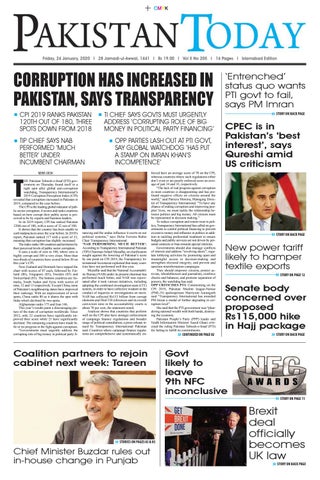
Corruption has inCreased in pakistan, says transparenCy g
g
CPi 2019 ranKs PaKistan 120th OUt Of 180, three sPOts dOwn frOM 2018 tiP Chief says naB PerfOrMed ‘MUCh Better’ Under inCUMBent ChairMan
t
g
ti Chief says gOvts MUst Urgently address ‘COrrUPting rOle Of Big MOney in POlitiCal Party finanCing’ g
OPP Parties lash OUt at Pti gOvt, say glOBal watChdOg ‘has PUt a staMP On iMran Khan’s inCOMPetenCe’
news desk
he Pakistan Tehreek-e-Insaf (PTI) government on Thursday found itself in a tight spot after global anti-corruption watchdog, Transparency International’s 2019 Corruption Perception Index (CPI) revealed that corruption increased in Pakistan in 2019, compared to the year before. The CPI is the leading global indicator of public sector corruption. It scores and ranks countries based on how corrupt their public sector is perceived to be by experts and business leaders. In its 2019 report, CPI has ranked Pakistan 120th out of 180, with a score of 32 out of 100. It shows that the country has been unable to curb malpractices since the year before. In 2018’s report, Pakistan ranked 117 with a score of 33, meaning that corruption has slightly increased. The index ranks 180 countries and territories by their perceived levels of public sector corruption. It uses a scale of zero to 100, where zero is highly corrupt and 100 is very clean. More than two-thirds of countries have scored below 50 on this year’s CPI. New Zealand and Denmark have topped the chart with scores of 87 each, followed by Finland (86), Singapore (85), Sweden (85) and Switzerland (85). The bottom countries are Somalia, South Sudan and Syria with scores of nine, 12 and 13 respectively. except China, none of Pakistan’s neighbouring states have improved their rankings. With an improvement of seven spots, China ranks 80 as it shares the spot with India which declined by two spots. Afghanistan ranks 173 and Iran 146. This year’s results paint a discouraging picture of the state of corruption worldwide. Since 2012, only 22 countries have significantly improved their score while 21 have significantly declined. The remaining countries have made little or no progress in the fight against corruption. “Governments must urgently address the corrupting role of big money in political party fi-
nancing and the undue influence it exerts on our political systems,” says Delia Ferreira Rubio Chair Transparency International. ‘NAB PERFORMING MUCH BETTER’: According to Transparency International Pakistan (TIP) Chairman Sohail Muzaffar, on clarification sought against the lowering of Pakistan’s score by one point on CPI 2019, the Transparency International Secretariat explained that many countries have not performed well this year. Muzaffar said that the National Accountability Bureau (NAB) under its present chairman has performed much better, and NAB was rejuvenated after it took various initiatives, including adopting the combined investigation team (CIT) system, in order to have collective wisdom in the conduct of inquiries or investigations on merit. NAB has collected Rs153 billion from corrupt elements and filed 530 references and its overall conviction ratio in the accountability courts is about 70 per cent, the statement noted. Analysis shows that countries that perform well on the CPI also have stronger enforcement of campaign finance regulations and broader range of political consultation, a press release issued by Transparency International Pakistan said. Countries where campaign finance regulations are comprehensive and systematically en-
forced have an average score of 70 on the CPI, whereas countries where such regulations either don’t exist or are poorly enforced score an average of just 34 and 35, respectively. “The lack of real progress against corruption in most countries is disappointing and has profound negative effects on citizens around the world,” said Patricia Moreira, Managing Director of Transparency International. “To have any chance of ending corruption and improving peoples’ lives, we must tackle the relationship between politics and big money. All citizens must be represented in decision making.” To reduce corruption and restore trust in politics, Transparency International has called on governments to control political financing to prevent excessive money and influence in politics in addition to tackling preferential treatment to ensure budgets and public services are not driven by personal connects or bias towards special interests. Governments should also manage conflicts of interest and address “revolving doors”; regulate lobbying activities by promoting open and meaningful access to decision-making and strengthen electoral integrity; and prevent and sanction misinformation campaigns. They should empower citizens, protect activists, whistleblowers and journalists, reinforce checks and balances, and promote separation of powers, the watchdog has said. OPP CRITICISES PTI: Commenting on the CPI 2019, Pakistan Muslim league-Nawaz (PML-N) spokesperson Marriyum Aurangzeb said “Transparency International has awarded PM Imran a medal of further degrading in corruption level”. She said that the PTI government was “plundering national wealth with both hands, destroying the economy. Pakistan People’s Party (PPP) leader and Sindh Information Minister Saeed Ghani criticised the ruling Pakistan Tehreek-e-Insaf (PTI) for failing to fulfill its commitments.
Coalition partners to rejoin cabinet next week: Tareen
‘entrenched’ status quo wants Pti govt to fail, says PM imran STORY ON BACK PAGE
CPEC is in Pakistan’s ‘best interest’, says Qureshi amid US criticism
STORY ON BACK PAGE
new power tariff likely to hamper textile exports STORY ON PAGE 12
Senate body concerned over proposed Rs115,000 hike in Hajj package
CONTINUED ON PAGE 02
STORY ON BACK PAGE
Govt likely to leave 9th NFC inconclusive STORY ON PAGE 11
STORIES ON PAGES 03 & 05
Chief Minister Buzdar rules out in-house change in Punjab
Brexit deal officially becomes UK law STORY ON BACK PAGE
Friday, 24 January, 2020
02 NEWS
Kaleem Imam ‘weaKeSt IGP’ I’ve ever Seen: SIndh Cm KaraCHi
S
STAFF REPORT
INDH Chief Minister Murad Ali Shah on Thursday said Sindh Inspector General of Police (IGP) Dr Syed Kaleem Imam was a failed police officer and that he was the weakest official he had ever seen. He added that he had discussed the issue with Prime Minister Imran Khan, who had assured him of his support in removing the incumbent IGP. “The officer who works according to the people’s representative’s policy can stay in the province and our policy isn’t wrong as the people have elected us,” Shah said while speaking on the floor of Sindh Assembly. Speaking about the IGP’s failures, he said the official was in contact with political parties and had asked them to dig out dirt on other politicians. “He broke the law after he contacted the opposition, as the law clearly states that a police officer cannot contact a political personality for help, he said. “He had also asked [politicians] to dig out dirt on others as he wanted to do more cases. He’s a weak man because, when he was questioned about his performance, he
MURAD ALI SHAH SAYS PM IMRAN HAD ASSURED HIM SUPPORT IN REMOVING INCUMBENT POLICE CHIEF OF SINDH
transferred blame to his subordinates. “The law says you cannot seek political help, a rule that he broke, the conduct also informs that you cannot go on media, he spoke to the media, violating” yet another law publicly, Shah said. “When the media asked him about
Journalist unpaid for 10 months dies of heart attack, colleagues demand justice ISLAMABAD: Journalists on Thursday staged a protest in front of the Ministry of Information against the death of a colleague, who had died of a heart attack and not been paid for 10 months. “This is our final warning to the government and media channel owners as we have suffered long enough and will not tolerate this repression any more,” the protesting journalists said, adding that they would file a case against the TV channel for not giving their colleague his due salary. “Why hasn’t the government paid its dues? Why don’t journalists receive their salaries on time? “Who is responsible for the financial death of media workers and their families?” they asked during the protest. “To stifle the voice of truth, the government is putting restrictions on the media,” ýPakistan People’s Party (PPP) leader Farhatullah Babar said. “Political parties are standing with journalists in their time of distress,” Pakistan Muslim LeagueNawaz (PML-N) leader Zahid Khan said during the protest. The protesting journalists said they would continue their struggle until the government and media owners showed responsibility. STAFF REPORT
the increasing crime rate in the province he said, ‘Although, I am the captain but when I direct someone to be placed on the slip, he is ordered to go and stand at the mid-on.’ “The IG while talking to some opposition members said that he will do
Ijaz Mazhar takes charge as acting PIA CEO KaraCHi STAFF REPORT
Pakistan International Airlines (PIA) Chief Operating Officer (COO) Syed Ijaz Mazhar on Thursday assumed charge as the acting chief executive officer (CEO) of the national flag carrier. After assuming the office, Mazhar received a complete briefing
from the board of directors and other officials regarding the current working mechanism of the airline. Earlier on Tuesday, the Supreme Court had rejected former PIA CEO Air Marshal Arshad Malik’s appeal to remain on the post while also raising suspicions on “increased fares” and appointment of ten officers of the Pakistan Air Force (PAF) in the airline.
Pakistan conducts successful training launch of Ghaznavi missile
everything these guys say, if the opposition refutes these claims then they are questioning our intelligence agencies,” Shah said. “People should not play cricket, but do their job i.e. policing,” Shah said. “I can’t disclose everything about him here [on the floor of the assembly],” Shah said, when some of the members asked him to further express his grievances. ‘The CM also informed the assembly that he had had a talk with Prime Minister Imran Khan, who assured him of his support in the incumbent IG’s removal. “Proper consultations have been done, if my PM says that ‘I don’t know about the matter, please send us the names,’ we have facilitated them.” Shah said. “I have had face-to-face and telephonic consultations with Prime Minister Imran Khan, I have told him that problems in the provincial police have risen; we have to remove this IG,” he said. “People ask us because we are the provincial government [but] the PM said he was also asked about the matter … the PM also felt it,” Shah noted. “Consultations with the leader of the opposition is not the law. I have to consult with the government, not opposition,” he adde. The appeal was made against a Sindh High Court (SHC) order, restraining Malik from carrying out any function as the chief executive till Jan 22 on a petition challenging his appointment. Following the apex court verdict, a key meeting of PIA’s board of directors was held in Karachi on Wednesday. The meeting had decided to appoint a three-member body to run the administrative affairs. The body included the governing board members Naveed Malik, Tariq Kirmani and Atif Bajwa. The board had appointed Mazhar for a supervisory role aimed at running the day-to-day affairs of the airline.
RAWALPINDI: Pakistan on Thursday conducted a successful training launch of the surface-to-surface ballistic missile, Ghaznavi, said a press release from InterServices Public Relations (ISPR). According to the press release, this launch was carried out as part of a training exercise of Army Strategic Forces Command “aimed at rehearsing operational readiness procedures during day and night.” Strategic Plans Division Director General Lt Gen Nadeem Zaki Manj appreciated the operational preparedness of the Army Strategic Forces Command. He commended them for displaying a very high standard of proficiency in handling and operating the weapon system. “Troops displayed full confidence in the robust strategic command and control system,” said Director General Strategic Plans Division, was quoted as saying by ISPR. The president, prime minister, chairman joint chiefs of staff committee and services chiefs have congratulated the nation on this landmark achievement. STAFF REPORT
Federal govt announces financial package for Balochistan weather victims QUETTA: Special Assistant to the Prime Minister on Information and Broadcasting Dr Firdous Ashiq Awan on Thursday announced that the federal government would provide financial assistance of Rs 500,000 to the family of each deceased and Rs 50,000 to every injured in the recent incidents of rain and heavy snowfall in Balochistan. Addressing a press conference at Quetta Press Club, she said Rs 50,000 would be given to every person whose house had been destroyed in the recent rains and snowfall in the province. The SAMP said 20 people were killed and 23 injured while 173 houses were destroyed in the rain and snow related incidents in Balochistan. She said the federal government would continue to support the provincial government in provision of assistance to the people affected by rains and snowfall. APP
Corruption has increased in Pakistan, says Transparency Continued from page 01 “PTI’s claims and slogans have proven to be false and the international body has put a stamp on Imran Khan’s incompetence and ineptness,” he said, adding that the country’s rank has dropped after a period of 10 years. “The report is a proof that this year corruption increased in Pakistan and inflation and unemployment has unleashed miserable consequences for the public.” The PPP leader further claimed that the report
Pakistan urges UN to play role in resolving Palestine issue neW YorK APP
Pakistan has called on the United Nations to respond to the challenges posed by the unilateral moves to change the status of Jerusalem and the illegitimate settlements in the occupied Palestinian territory that have undermined the prospect of peace in the region. “The United Nations, including the Security Council, have a central role in responding to these challenges,” Ambassador Munir Akram, permanent representative of Pakistan to the UN, told the 15member Council on Wednesday. Speaking in a debate on the Middle East situation, Akram said the “tragedy of Palestine, at the heart of the turmoil in the region, shows no signs of ending amid Israel’s settlement expansion”. “As illegal Israeli settlements expand into the occupied Palestinian territory, the vision of a twostate solution is being systematically reduced into a one-state reality,” he said. The principle of land for peace and implementation of Security Council resolutions 242 (1967) and 338 (1973), the Madrid Terms of Reference and
the Arab Peace Initiative of 2000 are well-known elements for a comprehensive settlement in the Middle East, he said. “The international community must continue to promote the aim of creating ‘a viable, democratic sovereign and a contiguous Palestinian state living side-by-side with Israel in peace and security’,” the Pakistani envoy added. Emphasizing that the situation in the Middle East posed a grave threat to international peace and security, Akram said even as old conflicts fester, new threats have emerged. Pakistan, he said, has sought to defuse tensions between the United States and Iran. On the personal initiative of Prime Minister Imran Khan, Foreign Minister Shah Mahmood Qureshi recently visited Tehran, Riyadh and Washington, underscoring the need for mutual restraint, including recourse to dialogue. The positive reaction from all sides is encouraging — and perhaps comprises a first step towards broad regional engagement. “Pakistan will continue to be a partner for peace in the region,” Ambassador Akram told delegates from around the world.
was prove that the country reversed in all sectors, and also pointed to the state’s lowered position in a report concerning the rule of law. “In a year, Pakistan has also lagged behind in democratic values. In a year, attacks on the media and judiciary increased and Pakistan’s rank also lowered in violation of human rights,” he said. Reacting to the Transparency report, Jamaat-e-Islami chief Senator Sirajul Haq said that reports of the international institutions on corruption and state of democracy in Pakistan have exposed the PTI regime.
Addressing the Ulema Convention at Mansoora, Haq said the reports must be an eye opener for the prime minister who had made tall claims to start a ruthless and across-the-board accountability drive during his election campaign and introduce reforms in governance. He asked how the objective of “Clean Pakistan” could be achieved when the government ministers were involved in wrongdoings and they were openly blaming each other of making money through corruption.
AJK president wants UN officials to visit calamity-hit areas iSLamaBad APP
Azad Jammu and Kashmir President Sardar Masood Khan has proposed to invite United Nations Under-Secretary-General for Humanitarian Affairs to visit AJK and also organise an international conference to review the adverse effects of climate change in the Himalayan region. He made the proposal while meeting with National Disaster Management Authority (NDMA) Chairman Lt-Gen Mohammad Afzal who called on him at the Kashmir House in Islamabad on Thursday. During the meeting, a number of issues including loss of life and property caused by the recent avalanche in Neelum Valley, and rehabilitation of earthquake victims of Mirpur were discussed in detail. President Masood said that in the proposed conference, officials of AJK and the federal government’s Ministry of Climate Change as well as international experts should be invited to prepare practicable recommendations. He also stressed the need of immediate relief
CMYK
and rehabilitation of the avalanche victims in Seri Surgan and Surgan Bakwali villages as well as payment of compensation of the destruction of their cultivatable lands and crops. “Survey of Neelum Valley, Leepa Valley and other calamity-prone parts of Azad Kashmir should be comprehensively carried out, precautionary measures adopted, and side-by-side with creating awareness among the local people about the safety measures, emergency steps should be taken to shift the affected people to safer places,” he said. The AJK president went on to say that due to unchecked deforestation and since the 2005 earthquake, the ecosystem including the soil composition of the valley has become fragile, and the population living in the foothills of mountains remains under threat of floods, landslides and avalanches, while lack of proper communication system in these areas further adds to danger faced by the local population. While appreciating the NDMA chief’s commitment and untiring efforts, the president expressed the hope that the authority would become a strong national organisation in the coming years.
Friday, 24 January, 2020
NEWS
PaKIStan to launCh roBuSt CamPaIGn aGaInSt IndIa’S deCeItFul narratIve FM QURESHI SAYS PM IMRAN WILL SPEARHEAD EIGHT-DAY INFORMATION CAMPAIGN TO EXPRESS SOLIDARITY WITH KASHMIRIS iSLamaBad
P
STAFF REPORT
AKISTAN has decided to launch a robust campaign to counter India’s deceitful narrative over the humanitarian situation in occupied Kashmir. Foreign Minister Shah Mahmood Qureshi made the announcement in a press conference on Thursday. Briefing the media about the government’s decision, the foreign minister said that the campaign will be launched on January 25 and will be spearheaded by Prime Minister Imran Khan himself. “India is currently acting deceitfully and is trying to create a false impression in the world by suggesting that things have normalised in the disputed territory and Pakistan is exaggerating facts,” he said. “They put up and act or two whereby they arranged a visit for the members of the European Parliament and took 14-15 envoys to certain areas of Srinagar while denying them complete access to the leadership or a chance to interact with the detained Kashmiri leadership,” he added. Highlighting the government’s stance, he said that PM Imran has a very
clear policy about truthfully highlighting the plight of the innocent Kashmiris. “We will continue to raise the issue politically, morally and diplomatically until the Kashmiris are granted their just right to self-determination,” he added. Keeping this in mind, he further said, the premier has decided to launch a robust information campaign and has tasked various ministers, including Minister for Communications and Postal Services Murad Saeed and Special Assistant to Prime Minister on Information and Broadcasting Dr Firdous Ashiq Awan, with the responsibility of spreading awareness about the issue among the people, especially the country’s youth. Speaking about the agenda of the campaign, he said that it will span eight days. “On January 25, we will launch a campaign across print, electronic and social mediums. On January 27, a cultural show will be held in Islamabad at the National Council of Arts (NCA). On January 28, photo exhibitions will be held at major art galleries across the nation as well as in foreign missions depicting the struggle of the Kashmiris. On January 30, a seminar will be held in Islamabad chaired by the Special Committee on Kashmir Chairman Syed
Islamabad bar suspends notification asking lawyers to submit faith affidavits ISLAMABAD: The Islamabad Bar Council (IBC) has suspended the Islamabad District Bar’s notification asking its members to submit affidavits declaring their faith on the Finality of Prophet Muhammad (PBUH) by the end of January. “Failing which would lead to suspension of their membership from the lawyers’ group,” the notification stated. However, on Thursday, the bar council suspended operation of the district bar’s notification. It also directed representatives of Islamabad District Bar to submit a reply over the issuance of the notification within 15 days. Earlier, a notification was issued by Islamabad Bar Association President Malik Zafar Khokhar and Secretary Mirza Nabeel asking all members to submit affidavits declaring their faith in the Finality of Prophet Muhammad (PBUH) to fulfill the requirement under the bar’s Amended Rules 2019. STAFF REPORT
Fakhar Imam. On January 31, a press conference on Kashmir will be held by Chairman Imam. On February 3, a function will be held at the Islamabad Convention Centre for youth and activists and ration will be distributed at Azad Jammu and Kashmir (AJK) refugee camps. On February 4, a Kashmir Day ceremony will be held at Aiwan-e-Sadr in the presence of the entire diplomatic corps where documentaries will be played. On February 5, various activities, including a human chain in AJK and Kashmir solidarity rallies in all provincial capitals will be held and PM Imran will also address the legislative assembly in Muzaffarabad as well as a public rally in Mirpur,” he added. FM Qureshi said that as per the Simla Agreement, Pakistan and India were supposed to hold bilateral talks on Kashmir. “However, as you have seen, their focus is more towards unilateralism than bilateral talks,” he said. “India’s recent steps, including the one which was taken on August 5, reflect their [India’s] unilateralism,” he added. He said that Pakistan was successful in its efforts to highlight the issue of occupied Kashmir at the United Nations Security Council (UNSC) despite In-
dian efforts to ensure otherwise. “Two briefings on the Kashmir issue were held [at the Security Council] and their summary was that whatever Pakistan was saying [about Indian atrocities] carries weight,” he said. The foreign minister said PM that Imran had told President Trump during their meeting at Davos about the adverse effects of a confrontation between two nuclear powers. He said that the prime minister had informed the US president about the “complexities” of the Kashmir issue and urged Trump and the UN to intervene for a solution. The prime minister was very clear, he did not mince any words,” he said, referring to PM Imran’s meeting with Trump in which the two global leaders discussed the Kashmir issue. “PM Imran informed him about the dangers that the world faced if two nuclear powers confronted each other,” he added. Qureshi reminded the media that 175 days have lapsed since the region has been under lockdown by Indian authorities. “This message (campaign) is not just for Pakistanis but for those across the Line of Control (LoC) who continue to remain under a communication lockdown,” he added. “Despite the Supreme Court of India’s decision, they have illegally suspended internet services,” he said. He further said that Pakistan wishes to let Kashmiris know that the people of the country continue to stand by them.
Coalition partners to rejoin cabinet next week, says Tareen SaHiWaL STAFF REPORT
Pakistan Tehreek-e-Insaf (PTI) central leader Jehangir Tareen on Thursday said that the coalition partners of the federal government will rejoin the cabinet next week as talks with them have been successful. Talking to the media, Tareen said that the impression of a weak government was only restricted to media houses where channels were seen predicting the departure of the present government while broadcasting different shows in primetime. The politician clarified that the government has been successful in convincing its allied political parties and the coalition partners will rejoin the federal cabinet next week. He said that the government is not facing any danger from its coalition
partners. He further predicted that Pakistan Muslim League Nawaz (PML-N) supreme leader Nawaz Sharif will not return to the country. He added that the local government election will be held in 2020. Responding to a question, Tareen said that the recent wave of inflation hit the country as an outcome of the wrongdoing of the past governments. He added that the price of sugar was increased following the increase in the price of sugarcane. On January 17, the Pakistan Tehreek-e-Insaf (PTI) had managed to persuade the Pakistan Muslim League-Quaid (PML-Q) and Balochistan National Party-Mengal (BNP-M) to stay part of the government while hoping to convince the Muttahida Qaumi Movement-Pakistan (MQM-P) in the next couple of
days. The MQM-P continued to ramp up pressure on the government, as the resignation letter written to Prime Minister Imran Khan by its chief, Khalid Maqbool Siddiqui, was mysteriously leaked to the media and no one from the MQM-P wanted to talk about it. On January 12, Siddiqui had announced that he was resigning as the federal minister for information technology citing the government’s nonserious attitude towards resolving the issues facing Karachi. “In view of my decision not to continue as a member of the federal cabinet, I hereby tender my resignation as federal minister for information technology and telecommunication w.e.f 12th January 2020. It is requested that my resignation may be accepted accordingly,” the resignation letter had stated.
03
transparency report exposes Imran govt, says Shehbaz PML-N PRESIDENT TO RETURN TO PAKISTAN IN FEBRUARY neWS deSK Opposition leader in the National Assembly and Pakistan Muslim LeagueNawaz (PML-N) President Shehbaz Sharif on Thursday said that the Transparency International’s report about Pakistan’s descend in the corruption index had exposed the Prime Minister Imran Khan-led Pakistan Tehreek-e-Insaf (PTI) government. Talking to reporters in London, Shehbaz said that according to the new global report, corruption has soared in the country whereas things were moving towards progress in former premier Nawaz Sharif’s rule. The PML-N president said that the previous government was better in terms of transparency as despite undertaking projects worth trillions of rupees not one corruption allegation had been made against it. He asserted how the current rulers will respond to this revelation now. He went on to say that after failing on every front, the PTI government had now started to deprive bread from the people. He emphasized on tracing the culprits and getting rid of the current rulers as soon as possible. PML-N PRESIDENT TO RETURN TO PAKISTAN IN FEBRUARY: Reportedly, the PML-N president has decided to return to Pakistan from London in February. The PML-N leadership has planned to focus on the Punjab government’s performance, where the ruling party is struggling to establish its authority in the administrative affairs, instead of the federation. Sources further said that all the opposition parties are likely to gather on one platform in March. Shehbaz went to London along with brother, former prime minister Nawaz Sharif, for the latter’s medical treatment.
Former Sindh Bank president gets bail in fake bank accounts case iSLamaBad INP
The Islamabad High Court (IHC) on Thursday granted bail to former president of Sindh Bank Bilal Shiekh in fake bank accounts case. A division bench of IHC headed by Justice Amir Farooq was hearing the case. The court accepted Sheikh’s bail plea and directed him to submitted surety bonds of Rs10 million. Bilal Sheikh was arrested providing loan to accused in connection with fake bank accounts and mega-money.
Government to fill 129,301 vacant posts within four months 35,000 PENDING CASES OF GOVERNMENT EMPLOYEES TO BE RESOLVED WITHIN THE SAME PERIOD iSLamaBad AHMAD AHMADANI
The federal government has decided to fill 129,301 vacant positions in different ministries, divisions and subordinate organisations within the next two to four
months and also aims to resolve approximately 35,000 pending cases of government employees pertaining to delays in promotions, pending seniorities and delayed inquiries within the same period. It has decided that the all concerned ministries, divisions and departments
shall frame recruitment rules for the posts at all levels within 60 working days. Similarly, the process of re-designation or deletion of the posts, except those which had been advertised or are likely to be restructured, will be completed within 45 working days. Likewise, all pending seniorities will be notified within 60 working days except those which have been disputed in courts and tribunals. Furthermore, the promotion cases of all eligible officers will be disposed of within 60 working days. It has also decided that all
vacant positions within the recruitment ambit of FPSC will be referred to the commission within 30 working days and it may exclude positions which are likely to be restructured. Last week, the Prime Minister’s Office had informed the federal cabinet about the complaints that were received on the Pakistan Citizen Portal. Among these complaints were the grievances of government employees. Adviser to prime minister on institutional reforms and austerity pointed out that the problem had been analysed and pre-
sented before the cabinet earlier as well, however, a similar briefing will be presented before the cabinet in a few weeks. It is pertinent to mention here that it was suggested that the Reform Implementation Committee constituted by the cabinet should oversee the implementation of the directions of the cabinet. Most members, however, felt that heads of ministries should themselves be responsible for completing tasks within the timelines and any difficulties in implementation may be brought before the implementation committee.
04 ISLAMABAD
Friday, 24 January 2020
WEATHER UPDATES FRIDAY
160C 060C
SATURDAY
180C 050C
SUNDAY
190C 020C
CM direCtS tiMely ConStruCtion of Water CourSeS in GZd CoMMand area PESHAWAR
K
APP
HyBER Pakhtunkhwa Chief Minister, Mahmood Khan Thursday directed authorities to ensure construction of water courses in Gomal Zam Dam (GZD) command area within stipulated time limit. He was presiding over a progress review meeting regarding command area development program of Gomal Zam Dam Project here at Chief Minister Secretariat Peshawar. The meeting was also attended by Minister Environment, Ishtiaq Urmar, Advisor to CM on Energy Hamayatullah, Principal Secretary to CM Shahab Ali Shah, Secretary Agriculture Muhammad Israr, Secretary Irrigation, Chief Engineer Irrigation, Project Director Gomal Zam Dam Muhammad Zubair and others. CM also directed plantation along canal sites to prevent soil erosion in adjoining areas. He said that with completion of 462 water courses of command area would add nearly
200,000 acre of agriculture land besides significantly increase agriculture production in regions of Tank, Kulachi and D.I.Khan districts. He further stated that after completion of GZD project, the province would be self-sufficient in wheat production. The Chief Minister appreciated the concerned authorities over completion of 105 water courses under the com-
mand area development program of Gomal Zam Dam project. He said that no stone would be left unturned for early completion of Gomal Zam Dam project adding all possible resources and support would be provided according to revised PC-1 on priority basis. The meeting was briefed in detail about command area development program and the progress made so far. The
meeting was informed that total cost of the project is Rs.3337.6 million out of which foreign assistance is Rs.2200.8 million while share of the provincial government is 489.51 million in cash and 221.4 million in kind. Similarly, the share of farmers is 462.48 million. It was further told that the project would save Rs 80 million annually by reducing flood losses while GZD has the capacity to generate 17.4 MW of electricity. Participants were informed that GZD has been established in Kajuri Kach area of South Wazirstan and River Gomal and Zoab are main sources of the project. The height of the dam is 437 feet while the main canal is 60 Km long and length of all the distributaries is 369 Km. The storage capacity of the dam is around 11, 40, 000 acre feet. The meeting was informed that in the revise PC-1, the number of water courses has been increased to 462 out of which 105 water courses have already been completed while 75 percent of construction work on the remaining has been done.
PHC orders removal of mobile phone towers near hospitals, schools PESHAWAR
Court cancels interim bail of private housing society owner RAWALPINDI APP
The Lahore High Court (LHC) Rawalpindi Bench on Thursday cancelled interim bail of a private housing society owner involved in violating land rules. According to Rawalpindi Development Authority (RDA) spokesman, earlier the Authority has registered an FIR against the owner of Faisal Hills housing society Malik Rafaqat Zaman for carrying out development work without approval. The owner filed a petition in the LHC against the FIR filed by RDA and pleaded to dismiss the FIR as it was baseless. The LHC Justice Anwar Ul Haq Pannu while hearing the arguments from both sides cancelled the interim bail of the accused and dismissed the petition.
STAFF REPORT
The Peshawar High Court (PHC) on Thursday ordered to remove mobile towers set up near educational institutions and health facilities. A bench of the Peshawar High Court (PHC) comprising Justice Qaiser Rasheed Khan and Justice Abdul Shakoor Khan heard the case against mobile phone base transceiver stations (BTS), commonly called mobile phone towers, set up near educational institutions and hospitals. Justice Qaiser Rasheed earlier remarked that the radiations emitting from the cellular phone towers cause life threatening diseases adding that nothing is precious than
human lives. The representatives of the cellular network companies and officials of Khyber Pakhtunkhwa Environmental Protection Agency were present during the court hearing. The officials assured the PHC that a list of the cellular towers near the schools and hospitals will be prepared for removal and submitted to the court soon. In an earlier hearing the court had sought a detailed report from the KP Environmental Protection Agency to submit a detailed report over the matter and also inform the PHC about the adverse effects of the said BTS on human health. The bench was hearing a writ petition filed by a citizen Muam-
mad Naeem who has claimed that setting up of BTS has adverse effects on the human health. The counsel of the petitioner claimed that these towers were posing health hazards as these emitted microwaves at frequency of 1,900 MHz (megahertz), which affected every biological organism within one square kilometre. The counsel claimed that different researches on the subject showed that there might be several health hazards of microwaves emanating from BTS, including headache, cardiovascular stress, memory loss, miscarriages, cancer, disturbance of the nervous system, etc. The mobile phone towers being seen on rooftops of plazas and at other places across the country.
‘Shut zoo if animals are not safe’: PHC reprimands authorities over cheetah’s death PESHAWAR STAFF REPORT
The Peshawar High Court (PHC) on Thursday came down hard on the authorities concerned over the death of a cheetah at the Peshawar zoo. The PHC bench directed the provincial law officer to appear in person to explain the situation. Over the course of the hearing, Justice Qaiser Rasheed questioned what have officials of the wildlife department been doing. “The wildlife conservators had apprised the court of better facilities ensured at the zoo,” he recalled. “If the zoo is not a safe place for animals, then shut it,” he snarled, asking if animals are brought from abroad to leave them to die here. The judge directed the advocate general to turn up before the Peshawar High Court (PHC) and apprise it of the situation.
MUZAFFARABAD: A majestic view of snow-covered mountains in Wadi Lapa. ONlINE
MONDAY
210C 010C
KP govt fails to expand health card programme due to funds shortage PESHAWAR: The Khyber Pakhtunkhwa government is unable to expand the Sehat Insaf Card scheme despite its claims as the government is dealing with an acute shortage of funds, an official said on Thursday. According to details, the government had announced to provide free medical treatment facility to six million families across the province but the facility has been given to only 2.2 million families as of yet. The officials said that the present cost of the scheme is Rs6 billion which will surge close to Rs18-20 billion when the cards will be provided to all families. The provincial government has also announced to provide medical facilities over the national identity card. INP
Woman gives birth to baby in hospital’s washroom RAWALPINDI: Due to prolong delay in shifting to labour room, a woman gave birth to a baby in washroom of gyae OPD of Benazir Bhutto General Hospital, Rawalpindi, on Thursday. According to details, 22-year-old woman was shifted to Benazir Bhutto General Hospital for delivery. However, the hospital staff used delaying tactics in admitting the patient due to which her condition deteriorated after which she went to washroom of gynae OPD where she gave birth to a baby. Later, the baby and mother were shifted to a ward where the gynecology staff took an undertaking in written form from the woman that she had received her baby alive and in good condition. Meanwhile the, administration of the hospital, taking notice off the occurrence, directed the gynecology department to avoid delay in shifting the women with delivery cases to labour room in future. STAFF REPORT
SC disposes of Polyclinic infrastructure suomotu notice case ISLAMABAD: The Supreme Court (SC) Thursday disposed of Polyclinic Hospital infrastructure suo motu notice case. A threemember bench of the court headed by Chief Justice Gulzar Ahmed heard the case. During the course of proceedings, the court observed that neither federal government nor polyclinic administration did not challenged the Islamabad High Court verdict. The Chief Justice remarked that it seemed that the polyclinic administration had no objection to the High Court decision. The Additional Attorney General said that the Polyclinic administration was happy with the High Court decision. The Chief Justice asked did the polyclinic administration not wanted the hospital to expand. The Deputy Executive Director Poliyclinic said that if the Capital Development Authority allowed construction, the hospital administration would start construction on the park site. He said that this issue had been hanging around for many years, so polyclinic hospital administration suggested constructing a building place somewhere else. Justice Ijaz Ul Ahsan asked the Deputy Executive Director that whether he wanted that half building of the hospital should be located at existed place and other half building located in another sector. He said that the Supreme Court took suo moto notice so that the construction of the hospital would be resolved. APP
Policemen donning body cameras posted in Islamabad ISLAMABAD STAFF REPORT
The Islamabad Police on Thursday formally installed body cameras in uniforms of personnel performing duties at different check posts to promote friendly policing in the city. Body worn cameras, or body cams, are a part of policing equipment in many developed countries. They are used to record events involving police or law enforcement officials, worn on the torso of the body of the official’s uniform.
Of the total 10-night vision cameras purchased by the department, five were installed in personnel’s uniforms after training, while the remaining will be installed over the next two days, said Inspector General of Police (IG) Islamabad Muhammad Aamir Zulfiqar, while briefing Interior Minister Ijaz Shah. The initiative is hoped to not only help tackle complaints of corruption in the department but also restore public confidence in the force, IG Zulfiqar added. The cameras, he said, would capture images of law enforcement personnel’s encounters with mem-
CMYK
bers of the public, including suspects, witnesses and passers-by. The recordings would help keep all parties honest and allow them to gain some confidence in one another, knowing that anything anyone says about the interaction can later be verified, said the IG. He further said that the cameras would be connected with the Safe City Project, while in this way several complaints about policemen, especially serving at police pickets, would be automatically resolved. In the second phase, cameras would be provided to cops serving at patrolling and police stations, he said.
Friday, 24 January, 2020
NEWS
ChIeF MInIsTer BuzDAr rules ouT In-house ChAnGe In PunjAB PUNJAB INFO MINISTER CHOHAN SAYS HE CAN ‘ONLY LAMENT’ FAWAD CHAUDRY’S CRITICISM OF BUZDAR’S GOVERNANCE LAHORE
P
STAFF REPORT
UNJAB Chief Minister Usman Buzdar on Thursday categorically ruled out in-house change in Punjab, saying those conspiring against him were spreading rumours about ‘change’ in Punjab government to mislead the masses. Talking to journalists, Buzdar said all the stakeholders of the provincial government were on the same page. He added that there was no forward bloc or pressure
group in the ranks of the ruling Pakistan Tehreek-e-Insaf (PTI). Responding to a question, the chief minister ruled out the impression of any shortage of wheat flour in the province. Earlier on January 20, underscoring the need of structural reforms in Punjab government, Federal Minister for Science and Technology Fawad Chaudhry had urged Chief Minister Usman Buzdar to step aside. Talking in a TV show, Fawad Chaudhry had said that the chief minister’s failure was not the fault of the prime
FIA grills PTI MPA Dua Bhutto in fake social media accounts inquiry The Federal Investigation Agency (FIA) on Thursday questioned Pakistan Tehreek-e-Insaf (PTI) Member of the Sindh Assembly Dua Bhutto with regard to 20 different accounts active under her name on social media platforms. FIA officials questioned the PTI lawmaker in the opposition lobby of the Sindh Assembly. The agency had received complaints of propaganda from these accounts. Bhutto was flanked by party lawmakers Haleem Adil Sheikh and Jamal Siddiqui. The PTI lawmaker distanced herself from these accounts, saying that she had nothing to do with them. She urged the officials to take action against the ones running these accounts. Bhutto became a member of the Sindh Assembly on a seat reserved for women in 2018. NEWS DESK
Chancellor Merkel invites PM Imran to Germany German Chancellor Angela Merkel on Thursday extended an invitation to Prime Minister Imran Khan to visit the central European country. The development came as the two leaders met on the sidelines of the World Economic Forum in Davos. The premier is leading Pakistan’s delegation at the annual event alongside Foreign Minister Shah Mahmood Qureshi, Adviser to the PM on Finance Dr Abdul Hafeez Sheikh, Adviser to the PM on Commerce Abdul Razzak Dawood and Adviser at Large on Investment Ali Jahangir Siddiqui. During his visit, PM Imran has met a number of world leaders including United States President Donald Trump and his Singaporean counterpart Lee Hsien Loong. NEWS DESK
minister. He had maintained that CM Buzdar himself was responsible for his performance. Responding to a question, Fawad Chaudhry had said that the federal government could not deliver effectively without the support of the provinces. Talking to reporters on Thursday, Punjab Information Minister Fayyaz ul Hasan Chohan said he could “only lament” Fawad Chaudry’s criticism of Chief Minister Buzdar’s governance. Chohan said he had had almost a 35year experience in politics but Chaudhry was “keeping himself above discipline [in his] attitude and behaviour”, which was “very destructive to any party, institution, group or family” Highlighting how the science minister had criticised the Punjab government,
CM Buzdar, and other issues five or six times in the past, he said “every month, he [Chaudhry] tries to be a hero”. “He’s my brother, my friend, and he’s very competent in some aspects but I believe that he has crossed a boundary in terms of violating [party] discipline. “One should should think of the benefit of the boat one is in,” the provincial information minister said, adding that it was neither Chaudhry’s authority or prerogative to form an opinion on the chief minister that he should step down or should be retained. “The chief minister comes under the prime minister of Pakistan, as the chief executive of Pakistan, [who] is 100 percent on [Buzdar’s] side, the entire provincial cabinet is on his side, the MPAs from
05
treasury benches are on his side. “I ask him, ‘Brother, what’s your problem?’ My constraint is that he’s my friend and he belongs to my treasury bench and my group, my party. Otherwise, I would have dealt with him in my signature way, my beautiful typical way. “I can answer him in a very good manner but I’m bound because I have a disciplined attitude. That’s why I will not — categorically — retort to Fawad Chaudhry,” Chohan said.
Nankana Sikh teen tells LHC she wants to live with Muslim in-laws LAHORE STAFF REPORT
Jagjit Kaur, a Sikh girl from Nankana Sahib who reportedly converted after marrying a Muslim youth, on Thursday told the Lahore High Court (LHC) that she wants to live with her in-laws. The parents of the 19-year-old have claimed that their daughter was forcibly converted by the Muslim youth after which he married her. The teenager, on the other hand, told the police that she chose to marry her husband. Justice Sayyed Mazhar Ali Akbar Naqvi asked the authorities if the young woman had met her parents. Jagjit Kaur, who has now named herself Ayesha, told the court that she has met her parents but wants to live with her in-laws. Her brother, Manmohan Singh, claimed that the man’s family members have been threatening them. They took my sister first and then attacked the gurdwara, he remarked. “They have been try-
ing to scare us. Is this how you want to treat us? Then send us somewhere else.” Justice Naqvi said that the young woman is independent and the court can’t send her anywhere without her permission. On the threats, the judge said that the situation is quite critical in Nankana Sahib and the man’s family shouldn’t have sent threats. If there have been any threats, then they will be dealt with under the cybercrime laws, he said. The court has summoned the FIA director and Nankana Sahib DPO on the next hearing and the teenager has been sent to the Darul Aman shelter. The case was highlighted after a few people had surrounded the gurdwara on January 3 to protest against a police raid on the house of a Muslim resident of Nankana Sahib.
Bail denied to journalist accused of making ‘anti-state’ remarks on social media LAHORE STAFF REPORT
A judicial magistrate on Thursday denied bail to journalist Azharul Haq, who has been accused of making ‘anti-state’ remarks and criticising former military strongman General (r) Pervez Musharraf on the social media. Presenting his arguments, Haq’s lawyer told Judicial Magistrate Amir Raza that the Federal Investigation Agency (FIA) has leveled a baseless allegation against his client. The Constitution allows freedom of expression, he said, adding that the journalist has just been arrested to spread fear among members of the media. The FIA, on the other hand, presented evidence against the journalist. On January 17, Haq was remanded into the FIA custody for defaming state institutions. An FIR has been registered against
Wahid under sections 11 (hate speech) and 20 (harming the reputation or privacy of a natural person) of the Prevention of Electronic Crime Act 2016, and Section 505 (statements conducing to public mischief) of the Pakistan Penal Code. A person can be imprisoned for up to seven years or fined under Section 11. Section 20 is punishable by a jail term of three and/or a fine of Rs1 million, while the maximum sentence under Section 505 is seven years.
PPP MPA goes on hunger strike against wheat shortage LAHORE: Pakistan People’s Party (PPP) Member of Punjab Assembly Hassan Murtaza on Thursday began a hunger strike against the recent wheat flour crisis in the country. According to details, the politician was seen sitting on the stairs of the Punjab Assembly observing a hunger strike where he was later joined by PPP Punjab President Qamar Zaman Kaira. Other members from the opposition benches also sat alongside the politicians as a show of solidarity. Murtaza maintained that he will observe the hunger strike till the crisis is resolved and those responsible for the shortfall are punished. STAFF REPORT
CMYK
The young Sikh woman’s family had accused the man of forcibly converting her to Islam and then marrying her. They had also filed an FIR against him and five others for kidnapping the woman on August 28. The man’s family had also accused the police of mistreating them during the raid. The protest was called off after local officials intervened and promised to investigate the raid.
Friday, 24 January, 2020
06 WORLD VIEW
IndIa’s democracy may not have much tIme left THE ATTACK ON JAWAHARLAL NEHRU UNIVERSITY SHOWS THAT THE IDEOLOGICAL CIVIL WAR IN INDIA HAS TAKEN A NEW VIOLENT TURN
Al JAzeerA
o
Priyamvada GoPal
n a cold January evening, a gang of masked intruders armed with sticks and iron rods entered the ruggedly beautiful and usually well-guarded campus of one of India’s best-known educational institutions, Jawaharlal nehru University. They proceeded towards a venue where faculty members and students were peacefully discussing a rise in hostel accommodation charges and attacked those gathered there. The mob, who JnU students have alleged were members of the Akhil Bharatiya Vidyarthi Parishad (ABVP), a student organisation linked to the ruling Bharatiya Janta Party (BJP), then proceeded to vandalise student residences, apparently also targeting Dalit, Muslim and Kashmiri students. Remarkably, Delhi’s police, already amassed outside the campus, did not answer the victims’ calls for help as they were waiting for Vice-Chancellor, M Jagadesh Kumar, to give them permission to enter the campus. Close to 30 people were wounded, including Aishe Ghosh, the head of the JnU Students Union, who sustained a head wound.
The incident elicited international media attention, including stinging editorials, and widespread condemnation from academics across the world, a testimony to JnU’s profile rather than to the violence itself. For the fact is that violent attacks upon university campuses have become routine in India today. Before the JnU incident, two historically Muslim universities, the Jamia Millia Islamia in Delhi and Aligarh Muslim University in Uttar Pradesh, had both been targeted, not by mobs, but by police, who beat student protesters. In a context where religious minorities are being singled out for discrimination and violence, the targeting of JnU, a public relations disaster, has puzzled some India watchers. What happened has to be understood as the opening of one more battlefront in what is fast becoming an ideological civil war. This is an India where not just minorities but any person or institution pushing back against the onslaught of state-sponsored bigotry faces the threat of punitive violence, whether directly from the state or from mobs it apparently protects. As of this date, in a Kafkaesque move that appears to be the new normal in India, charges have been filed against the victims of the JnU violence, including Ghosh, rather than those right-wing activists caught on camera perpetrating it. This civil war, which has been quietly in the making for several years, has come to a flashpoint around the new Citizenship Amendment Act (CAA), which has been pithily but accurately described by the Office of the Un High Commissioner for Human Rights as “fundamentally discrim-
inatory in nature” in making religion a criterion for offering refuge and citizenship. Combined with the planned national Register of Citizens (nRC) and national Population Register (nPR), it will render several communities, most prominently and significantly, Muslims - long demonised by the governing party - vulnerable to the removal of citizenship followed by detention and possible deportation. In this context, the growing protests against the CAA, in which university students have been playing a major role, are significant and heartening. Many who have kept quiet for a long time are now standing up and refusing to be part of a fundamentally discriminatory national entity. In all the protests I attended over the past few weeks, in more than one city, there have been repeated invocations of the Indian constitution’s spirit of plurality and collective recitations of its famous Preamble. It has been moving to watch people from different religious backgrounds recommit themselves to a vision of a nation that aspires to be just, equal and plural. It has also been impressive to watch Indian Muslims standing up in large numbers to lay claim to the nation, to their rights under the constitution and to their religious and cultural identities simultaneously. There is no doubt that these protests are tremendously heartening to those great many of us whose hearts have been growing heavier with each passing day over the last six years in which narendra Modi’s hardline Hindutva version of nationalism has made significant strides towards the achievement of an exclusionary and extremist “Hindu nation”.
Equally, what has become clear in the violence exercised on campuses and upon protesters and other dissidents is that this is a regime that is prepared to unleash not just the full force of the law and security forces but also to enable vigilante groups such as the mob that attacked JnU. Peaceful protesters against the CAA have been subjected to colonial-era legislation preventing large gatherings and detained in their hundreds when they have persisted in protesting. Some, like former civil service officer Kannan Gopinathan and activist Sadaf Jafar, have been detained. Jafar has said she was beaten while in police custody in Uttar Pradesh. The Dalit leader Chandrashekhar Azad was also detained for several days after protesting against the CAA. Dissent in India today is a risky activity. The JnU attacks were above all a message that the current government is happy for the battle to no longer be simply ideological but to escalate into street violence. This is why it was important to break up a peaceful meeting of academics and students: discussion and debate are off the table in favour of the language of iron rods, stones and tear gas. While state violence has been endured by the people of Indian held Kashmir for an unconscionably long time, the message now being conveyed across India, six months after the unilateral abrogation of Article 370 which gave that region a historically necessary special status, is that no form of dissent will be tolerated in India either. JnU has been in the sights of this government before, not least because the ques-
tion of Indian held Kashmir was up for debate and discussion - as it must be in any accountable democracy - on that campus. This brought colonial-era legislation against “sedition” upon the heads of JnU students. In the past few days, new Delhi’s police commissioner has been given emergency powers under the draconian national Security Act, for the next three months. As one dissident journalist noted, the message that is now being signalled loud and clear is that Indian democracy may not have much time left. Those currently in power are part of a political dispensation that may not be planning, in the long term, to put itself to a democratic mandate in the first place, still less accountability. The world must worry. What happens in India happens to nearly one-fifth of the world’s population. And particularly in the context of the global rise of authoritarian ethnonationalism, the undermining and eventual abrogation of democracy in India will not be contained within the borders of that nation-state. With a few exceptions, Western and other governments have been shamefully silent on the ongoing assault on democracy and constitutional rights in India. It may suit them to keep quiet but across the world, we must now form people’s alliances to resist what will almost certainly become a global assault on the very idea of democracy itself. Speak up for India, for you speak up for yourself. Priyamvada Gopal teaches in the Faculty of English at Cambridge University.
The problematic academic discipline of ‘jihadism’ LI’S RESEARCH TAKES HIM ACROSS THE WORLD TO MEET FORMER MUJAHIDS: FROM COFFEE SHOPS AND OFFICES IN SAUDI ARABIA AND THE UNITED KINGDOM TO REMOTE DETENTION CENTRES
Intercept murtaza Hussain
As long as there have been wars, there have been people volunteering from distant lands to join them. Over most of the 20th century, the typical volunteer foreign fighter was a left-wing activist fighting for the cause of international socialism. During the Spanish Civil War, tens of thousands of foreign volunteers took up arms on the side of the republicans, among them a young George Orwell. A romantic image of the idealistic foreign rebel became a familiar archetype in popular culture, celebrated in literature and film. By the 1990s, the picture had shifted. The Cold War was over and left-wing internationalist movements were in terminal decline. To be sure, the world was still wracked with crises and injustice which were crying out for remedy. Yet the ideologies people used to mobilize to address them began to change. Into the void created by the decline of the left stepped a new language of political solidarity: one based on identity and religion. This change has had the most serious consequences in Muslim-majority countries, many of which are still grappling with the traumas of dictatorship, military occupation, and economic injustice. As once-powerful leftist movements in these countries faltered, they were replaced with political movements drawing solidarity from religious identity. There has also been the emergence of a new type of volunteer foreign fighter: the mujahid, a Muslim fighter engaged in a religious struggle — or militant jihad. This controversial figure is the focus of a new book, “The Universal Enemy: Jihad, Empire, and the Challenge of Solidarity,” by Darryl Li, an assistant professor of anthropology and social sciences at the University of Chicago. The book is an anthropological study of a group of veteran foreign fighters who volunteered in Bosnia in the war of the early 1990s. Li’s research takes him across the world to meet former mujahids: from coffee shops and offices in Saudi Arabia and the United Kingdom to remote detention
centers where many of them found themselves trapped amid the U.S.-led global war on terrorism. All of them can be said to have been involved in a collective political project — in this case, the defense of Bosnian Muslims facing genocide — as opposed to the atomized mass shooters and truck attackers often seen in recent years. Li reconstructs the motives and experiences of these volunteer fighters with a diligence often missing in other accounts. But his book also stingingly criticizes the field of “jihadism” as an academic discipline connected to the national security state. “Jihadism is simply not a useful term for understanding political violence,” Li told me when we spoke about the book recently. “Believers will debate in the terms of their tradition whether something is properly considered a jihad. But separately anyone can see that Muslims use this term for vastly different kinds of struggle they deem religiously justified — which could range from an inner personal struggle to a violent political one. Even when we’re talking about jihad as an armed conflict, there are such different types.” “The heart of the problem is the refusal to recognize the participants in these conflicts as political actors,” Li said. “We just suck all the politics out, latch on a word like ‘jihadism,’ and then place it into a category of evil existing outside of space and time.” The study of jihadism generally takes for granted that organizations like Hezbollah, Hamas, the Islamic State, al-Shabab, the Afghan Taliban, and various Iraqi Shia militias should be grouped under one category. This grand category also happens to include solitary individuals engaged in acts of violence not directed by any organization. Huge disparities of geography, language, sect, and politics are more or less ignored in favor of a narrative understandable through the single term of “jihadism.” “Consider for a moment three different things: the Irish Republican Army, the Republican Party in the United States, and Plato’s Republic,” Li told me, by way of analogy. “All of these employ the term ‘republic,’ and all of them somehow have a connection with violence. If you lumped them together and claimed they represent an ideology called ‘republicanism,’ that obviously wouldn’t make any sense. Yet that’s what the category of ‘jihadism’ essentially does.” The jihadism field has also suffered from some personnel issues. A massive influx of money and resources in the years after the September 11 attacks helped create a new class of self-styled terrorism expert. Some of these individuals were driven by strong ideological motives; many could be frankly described as charlatans. Over the past decade, however, the quality of the average analyst in this field has no-
tably improved. Many of those studying militant violence today do so with a level of nuance and academic rigor rarely seen in earlier years. Generally speaking, it is no longer widely acceptable for terrorism experts to be openly racist. Despite these welcome improvements, some problems remain. new knowledge inevitably tends to build on what already exists. Thus, bad ideas carried over from previous generations of experts still exert an influence. One already-discussed example is the dubious academic category of jihadism itself. Another is the resilient assumption that militant violence can be understood as a kind of personal pathology, rather than as a political phenomenon. “The discourse on jihadism has a misguided focus on individuals, particularly the idea that a meaningful understanding of political violence can be found by getting inside their heads,” Li said. “If you took a random sample of the motivations of U.S. military service members, you would probably find that some believed in their mission, some just needed a job, and some were sadists who wanted to kill people. But you couldn’t go directly from analyzing the mindsets of individual soldiers to understanding the political goals or causes of the U.S. wars in Iraq and Afghanistan.” “The Universal Enemy” focuses on a particular period during the early 1990s war and genocide in Bosnia, when foreign fighters began arriving in the country. Several hundred volunteers came to fight on the side of the predominantly Muslim Bosniaks, while a comparable number joined the Bosnian Serb forces. But the biggest contingent of armed foreigners in Bosnia by far came in the form of a large United nations peacekeeping deployment that arrived early in the conflict. In a way, the U.n. peacekeepers came to Bosnia for reasons not so different from the foreign volunteers who called their cause a “jihad.” Acting on behalf of a supposed “international community,” the peacekeepers bore arms under the banner of values that they proclaimed as universal and applicable to all of humanity. Many also happened to be Muslims. Some of the veteran peacekeepers that Li met in Islamabad, years after the Bosnian war, demonstrate that they saw no conflict with upholding two universal ideas at the same time: the defense of liberal values and their duty to aid oppressed coreligionists. Throughout the book, Li lets his subjects speak for themselves and casts few judgments. The picture that emerges is a morally complex one. It is clear that some volunteer foreign fighters do act nobly, making great personal sacrifices to relieve the burdens of suffering people. At the same time, others act like adventure seekers, colonialists, or simply sadists seeking opportunities for violence. Most mujahid for-
eign fighters today also happen to be enamored with a retrograde vision of politics and religion. Their project offers little to non-Muslims, while generally excluding women from meaningful roles. Some fighters, as Li’s book documents, have committed war crimes or been accused of sexual exploitation. Despite this, the perception of foreign fighters as radically evil by default — something like modern equivalents of pirates or highwaymen — tends to exaggerate differences between them and other combatants. “People who invoke jihad are not necessarily any less brutal, callous, or hypocritical than other violent actors, and there is no shortage of things they can be condemned for. But there’s a world of difference between criticism and dismissal,” Li said. “Criticism requires spelling out some criteria and accepting that those criteria should apply to others too, including oneself. Dismissal is a refusal to think, it’s condemnation that doesn’t submit itself to standards or scrutiny.” The question of how to judge nonstate armed actors is likely to become more urgent in the coming years. Three decades after the fall of the Berlin Wall, the world is entering a period of uncertainty and instability not seen since the era leading up to World War II. It is now easy to imagine a future in which the need for collective self-defense becomes a pressing issue for millions around the world, of all backgrounds, who lack control over powerful states and access to institutions. In the future, there might be something to learn from movements of all stripes that, despite deep flaws, have succeeded in drawing people into solidarity across racial, linguistic, and geographic boundaries — even to the extent of taking up arms and risking their lives on others’ behalf.
Friday, 24 January, 2020
FOREIGN NEWS 07
World Court orders MyanMar to take steps to proteCt rohingya YANGON
t
AGENCIES
HE International Court of Justice on Thursday ordered Myanmar to take urgent measures to protect its Muslim Rohingya population from persecution and atrocities, and preserve evidence of alleged crimes against them. Mostly Muslim Gambia launched a lawsuit in November at the United Nations’ highest body for disputes between states, accusing Myanmar of genocide against Rohingya in violation of a 1948 convention. Thursday’s ruling dealt only with Gambia’s request for so-called preliminary measures, the equivalent of a restraining order for states. While the court’s final decision could take years to reach, the 17 judge panel made clear in a unanimous ruling that the court believes the Rohingya are in danger now, and steps must be taken to protect them.
The Rohingya remain “at serious risk of genocide,” presiding Judge Abdulqawi Yusuf said, reading a summary the decision. Myanmar shall “take all measures within its power to prevent all acts” prohibited under the 1948 Genocide Convention, the ruling said. Myanmar must report back within four months. It ordered the government of Myanmar to exercise influence over its military and other armed groups to prevent “killing members of the group, causing serious bodily or mental harm to the members of the group, deliberately inflicting on the group conditions of life intended to bring about its physical destruction in whole or in part.” More than 730,000 Rohingya fled Myanmar after a military-led crackdown in 2017, and were forced into squalid camps across the border in Bangladesh. U.N. investigators concluded that the military campaign had been executed with “genocidal intent”. Moments before the court in The
Hague began reading its ruling, the Financial Times published an article by Myanmar’s civilian leader Aung San Suu Kyi in which she said war crimes may have been committed against Rohingya Muslims but that refugees had exaggerated the abuses against them.
Rape trial told Weinstein a 'seasoned' predator NEW YORK: Harvey Weinstein was a “seasoned” sexual predator and rapist who abused his power as a movie-producing titan to prey on vulnerable aspiring actresses, prosecutors said Wednesday as his trial heard from its first witness. Weinstein, wearing a dark suit, shook his head as New York Assistant District Attorney Meghan Hast painted a picture of a 300pound (140 kilogram) bully who violently raped, humiliated and manipulated several women, leaving them traumatized for years. His defense team hit back by saying the fallen film producer engaged in consensual relationships with his accusers, including a “loving one” in which the woman called Weinstein “her casual boyfriend.” That woman, who says Weinstein raped her in a New York hotel room in 2013, was identified for the first time in court as actress Jessica Mann, having until now remained anonymous. AGENCIES
Democrats urge Republican 'courage' at Trump impeachment trial WASHINGTON AGENCIES
Democrats on Wednesday accused Donald Trump at his historic Senate impeachment trial of seeking to cheat to ensure re-election in November, and called for “courage” by the president’s fellow Republicans while considering the case against him. Adam Schiff, head of the House of Representatives’ prosecution team, took to the Senate floor to deliver hours of methodical arguments to a hushed chamber hearing only the third-ever impeachment trial of a US president. The Democratic lawmaker described how Trump solicited foreign interference in domestic elections, “abusing the powers of his office to seek help from abroad to improve his re-election prospects at home.” “And when he was caught, he used the powers of that office to obstruct the investigation
into his own misconduct,” said Schiff, who headed the probe that led to Trump’s December 18 impeachment by the Democraticcontrolled House. Schiff shrugged off Republican arguments that American voters, and not the Senate, should decide whether Trump remains in the White House. “The president’s misconduct cannot be decided at the ballot box for we cannot be assured that the vote will be fairly won,” Schiff said. Trump stands accused of withholding military aid from Ukraine to pressure his Ukrainian counterpart to announce an investigation into Democrat and potential election rival Joe Biden. “President Trump withheld hundreds of millions of dollars in military aid to a strategic partner at war with Russia to secure foreign help with his re-election,” Schiff said at the nationally televised proceedings. “In other words, to cheat. If this conduct is not impeachable, then nothing is.”
China locks down two cities to curb virus outbreak BEIJING: China put millions of people on lock down on Thursday in two cities at the epicenter of a coronavirus outbreak that has killed 17 people and infected more than 630, as authorities around the world worked to prevent a global pandemic. Health officials fear the transmission rate will accelerate as hundreds of millions of Chinese travel at home and abroad during week-long holidays for the Lunar New Year, which begins on Saturday. The previously unknown virus strain is believed to have emerged late last year from illegally traded wildlife at an animal market in the central Chinese city of Wuhan. Most transport in Wuhan, a city of 11 million people, was suspended on Thursday and people were told not to leave. Hours later, neighbouring Huanggang, a city of about 7 million people, announced a similar lockdown. “The lockdown of 11 million people is unprecedented in public health history,” Gauden Galea, the World Health Organization’s (WHO) representative in Beijing, said. Other cities were also taking steps to restrict movement and contact. Nearby Ezhou shut train stations. China’s Education Ministry said schools should not hold large events or exams. The capital cancelled major public events, including two Lunar New Year temple fairs, the state-run Beijing News said. AGENCIES
During a week of hearings last month, Suu Kyi, winner of the Nobel Peace Prize in 1991, had asked the judges to drop the case. The World Court’s rulings are final and without appeal, although it has no real way of enforcing them.
EXTREMELY VULNERABLE: “The court is of the opinion that the Rohingya in Myanmar remain extremely vulnerable,” said Yusuf, the presiding judge. “Moreover, the court is of the opinion that the steps which [Myanmar] claimed to have taken to facilitate the return of Rohingya refugees present in Bangladesh, to promote ethnic reconciliation, peace and stability in Rakhine State, and to make its military accountable for violations of international humanitarian and human rights law, do not appear sufficient.” More than 100 Myanmar civil society groups published a statement saying they hoped international justice efforts would “bring forth the truth” and end impunity. “Political and military policies have always been imposed with violent force and intimidation upon the people of Myanmar, systematically and institutionally, on the basis of their political and religious beliefs and ethnic identities and continue until the present,” the statement said.
Friday, 24 January, 2020
08 COMMENT
Are things falling apart?
On a wing and a prayer Promise of economic revival in 2020
W
hILe delivering a speech at Davos prime Minister Imran Khan maintained that his government had achieved an upward trajectory of the stock market, stabilisation of the value of the rupee and an increase in the country’s foreign reserves. What he failed to mention is that despite the stabilisation there is still no growth and therefore the promise of improvement in the common man’s life and creation of jobs is likely to remain a dream in 2020. Few would disagree with Mr Khan that to put its economy on rails pakistan needs peace in the region. Further that the country has suffered immensely by becoming a part of the Usa’s anti-soviet war in afghanistan and needs to shun any alliance for waging war. also that it is in pakistan’s interest to have peace in afghanistan to tap the benefits of energy-rich Central asia. similarly normalisation of relations with India is required for development and prosperity in south asia. What the pM fails to realise is that a conducive external environment alone cannot bring a country out of poverty. The principal role has to be played by internal factors. Foremost among these are a stable government enjoying the support of the vast majority, a consensus on the basics of the economic policy hammered out jointly by the government and the opposition, an independent bureaucracy, an exuberant parliament that precludes the need on the part of the opposition to take differences to the streets, and a free media that points out mistakes, thus helping the government to correct its course on time. efforts made by the opposition soon after the elections to put life into parliament and reach a consensus on economic policy were spurned by the pM. The opposition is now debating whether it should go for an in-house change, or formation of a national government or to demand fresh elections. Terrorised by NaB and constantly pressurised by the government, the bureaucracy is thoroughly demoralized. The media has been squeezed as never before. Under notice from its allies and facing dissensions in the ruling party, the government has lost in prestige. Unable to control prices of flour and sugar, many wonder how it will bring the country out of the economic doldrums.
Zindagi Tamasha Who decides whether a film can be shown?
T
he punjab and sindh governments have decided that the film Zindagi Tamasha cannot be released, even though their Censor Boards had cleared the film. The Central Censor Board has put off a decision until the Council of Islamic Ideology reviews the movie. The reason for this excessive interest in the film is the Tehreek-e-Labbaik pakistan (TLp), which has threatened dire consequences if the movie is screened. Who decides whether the movie is blasphemous or not? The Censor Boards? The CII? Or the TLp? and within the TLp, who? Its head, Maulana Khadim hussain rizvi alone, or some group? Does the TLp feel comfortable with condemning a movie which none of its leaders could have viewed? There seem to be three issues involved. The first is whether a potential law and order situation is good enough reason for judging a film by? The second is who is to judge what constitutes blasphemy? The third is whether the state’s decision on these matters, by a duly constituted body, is to be accepted, or is open to being second-guessed by anyone who so decides. previously having confined itself to deciding on whether or not someone was a blasphemer, or a non-Muslim, the TLp is now in danger of making aesthetic judgements. It almost seems as if it is engaged in expanding its space. From having a federal minister resign over allegations that he was non-Muslim, it seems the TLp has now turned to film criticism. From blasphemy against the holy prophet (peace be upon him), there seems a more generalised desire to protect Islam. are art exhibitions and poetic symposia next? It is surprising that there has been no discussion of the censors who approved the movie after a few cuts. That is the proper place to vet a movie for matter that may damage the moral fibre of the viewers, or provoke them to violence. If they are properly constituted, their judgement should be accepted. They are fallible, and if they make a mistake, their appointing authority should take the matter up with them. Threatening the film is like setting fire to the cinema because one thinks it was a bomb. The government must not treaty this as a routine lawand-order issue. It must protect the freedom of expression, and repel the attack that the TLp has launched on it.
Dedicated to the legacy of the late Hameed Nizami
Arif Nizami Editor Aziz-ud-Din Ahmad
Umar Aziz
Asher John
Joint Editor
Executive Editor
Deputy Editor
Lahore – Ph: 042-36300938, 042-36375965
I
The extension of the Army Chief’s tenure has had unexpected results At Penpoint
P
M.A. NIAZI
erhaps the worst thing Water resources Minister Faisal Vawda could have done was take a boot to a TV show. he probably thought all he was doing was taunting the other guests on the programme, stalwarts of the pML(N) and ppp, but he managed to taunt the armed forces too. In a way, it symbolised how his party, the pTI, is now so rocky that doubts are being expressed about its survival. The political parties have shown that if needed, they can come together, but only if the military says so, not the pTI. The pTI is not shouldering the political responsibility for the present system. It is also proving feckless at governing. It has not been able to get a handle on the economy, even after the induction of an IMF-approved team. Virtually the last card up its sleeve is the FaTF blacklisting. If that blacklisting occurs, the pTI will find sponsors wondering why they tolerate it. Tolerating it also means Vawda and his shenanigans. Worse, it means tolerating the whole culture of the pTI, which is fast-and-loose rather than spit-and-polish. The passing of the service act amendments had significant political ramifications. The most obvious was the desire of the opposition parties not just for relief for their leaders, but for a turn at the high table. The opposition may have posed as champions of civilian supremacy, but their track record shows that they have never learned from their experience in opposition. For example, both the ppp and the pML(N) have loudly proclaimed their desire for more freedom, for the press, the judiciary– you name it, they want it free. While in the opposition. Bring them to office, and then they exert all possible measures to get a favourable press. all measures. The parties are not going to insist on civilian supremacy so long as the establishment is willing to prop them in power as it is doing the pTI. One reason the pTI is being persisted with is because the establishment has painted itself into a corner. There is so much invested in the pTI, and perhaps more importantly into the distaste for the parties, that turning towards them might merely
mean shaking the faith of national institutions into their leaderships. That raises the question of where do those institutions derive their strength from. It should be remembered that India has got national institutions, but they have never tried to take over, even though India has a tradition of military rule. (The raj, it should not be forgotten, was essentially a military regime, as were earlier native dynasties) One reason has been that it is assumed that the civil servants of the governments wouldn’t obey. It is an assumption that has never been tested. On the other hand, it has been tested four times in pakistan. each time, the civil administration has obeyed without a murmur. Indeed, there has been approval. That approval has been based on the disappearance of the need to obey uncouth and unpolished politicians, and their replacement by civilised and cultured officers. But why are civil servants so ready to obey? They will obey any authority. They see their raison d’être the prevention of chaos. They therefore look to their seniors, to the heads of their profession. Unlike in India, in pakistan the seniors in 1958 were relatively young and inexperienced. Then, as Chief Justice Munir pointed out in his monumental judgement in the Dosso case, in which he enunciated the Doctrine of Necessity, the choice was to obey or go home. This was supposed to be a choice for judges, but it applied also to other civil servants. To a man, all chose to obey. In the three episodes of martial law after that, a precedent existed. Indeed, the Musharraf martial law was almost smothered by precedent. people are ready to obey. some are even ready to celebrate, which is why martial laws are greeted by the distribution of sweets. That can be arranged, but what cannot be arranged is the feeling among a wide class of politicians that they have been pushed to the wall. ppp opponents welcomed the 1977 Martial Law; ppp supporters welcomed that of 1999. In short, the military needs civilian political allies. some become permanent, like the pML(Q), the ruling party of the Musharraf Martial Law, now apparently fallen on hard times. Its punjab chief minister, Ch pervez elahi, is now punjab assembly speaker, and could once again become CM, such is the balance in the punjab assembly. If the establishment was to smile on the pML(N), and if Ch pervez was to be made CM once again, the position of 1993 could be
replicated, when then speaker Manzoor Wattoo became CM, with his pML(J) a minority in a coalition that included the ppp. Ch parvez, interestingly enough, was Deputy Opposition Leader, and ended up carrying much of the burden of leading it, after Leader of the Opposition shahbaz sharif went abroad for medical treatment. Back then, it was his own, not his brother’s. however, to expect Ch pervez to move without a signal would be as unrealistic as to expect the MQM (p) to ditch the pTI on its own. all of those minor parties which had joined the coalition were following instructions, and would not desert it without further instructions. That the pML(Q)’s problems with the pTI have included punjab CM Usman Buzdar indicates two things: first, Buzdar has not enabled the pML(Q) to get what it wants: obedient police and district administrations in certain key districts. second, the establishment has given it the go-ahead to gun for Buzdar. Of course, the pML(Q) has an obvious motive, in Ch pervez, but the fact is that Buzdar has been a disaster. If the pTI loses the next election, Buzdar will get the most blame. probably worse, even if it wins, it will be said that this was despite him. The emergence of a Forward Bloc in the pTI is intriguing. It may be ironic that it has emerged mostly among south punjab Mpas, Buzdar’s own area, but it also is among those south punjab members who had merged with the pTI just before the 2018 election. They are probably enough to make the pML(N) not need the pML(Q), and thus seem as aimed at Ch parvez as Buzdar. One problem has been that the establishment is more like Western political parties than existing parties. Western parties are not hereditary possessions, but meritocratic institutions that are controlled by persons who have risen to their top on their own merits. however, while institutions are headed by men who have come up the ladder, the public decides which party to support. Chief Justices of pakistan, for example, are not succeeded by children; the ppp is in its third generation. another factor has been the devotion shown by the military to the 1973 Constitution, which it has restored after the 1977 and 1999 takeovers. That is essentially the same as the 1956 Constitution, which was abrogated in favour of a presidential constitution, promulgated in 1962, and thrown away in 1969. Therefore, the parliamentary model is favoured. It leaves the possibility of in-house change. But it means that those now out of favour, will always be trying to get back in. The establishment thus causes the very instability it decries. M.A. Niazi is a member of the staff.
Positive schooling and child development Our education system needs reform direly HAfsA MAHtAb
C
hILDreN are not things to be molded, but people to be unfolded. schooling plays an important role in producing responsible and potentially productive adults. a positive climate in a school– where a student feels safe, included and supported– motivates him to perform well and realize his potential. But the reality is very different. students confront different difficulties in schools like core curriculum, wellbeing issues, absence of inclusive approaches, non-accessibility of educators, incapable instructing methods, inhumanity towards students’ issues, poor assessment techniques, and unsafe disciplinary measures. positive schooling at primary level will lead towards a bright future because children’s learning is impaired when they are frightful or distressed, whereas they learn when they feel safe, supported and encouraged. Children needs both keen abilities and supportive environment to manage stress. Thus schools must give a positive learning condition that enables students to learn social-passionate aptitudes with scholarly substance. education not only implies teaching book content, but also traditional skills and happiness. also a definitive goal is bestowing information, upgrading students’ adapting abilities, help building their character, and, generating capable citizens for nation building. Character development is more important than good grades. Thus, schools perform a significant job in accomplishing the goal of education and moulding children’s future. presently in pakistan, most schools are not fulfilling their responsibility, as schools are run as businesses. These schools just aim at students’ academic potential and thus lack the attributes of positive education. There is need to focus on positive schooling, as most parents want their children to be happy, confident and healthy but schools focus on academic skills, achievement and discipline. These are obviously significant, yet so are certain psychological wellbeing outcomes. Our schools were intended to create the workforce required by 19th-century factories,
Karachi – Ph: 021-35381208-9
I
where the desideratum was laborers who sat quietly at their seats all day, behaving alike to create indistinguishable items, ready to accept the penalty for not achieving the desired standards. Critical thinking and coordinated effort were exactly what owners wished to discourage, as schools are now doing with students. Children are rarely permitted to be children. play is restricted, students are packed into a classroom and educated in an institutionalized manner. Creativity is limited. They aren’t permitted to exploit their curious personalities. In analytic minds, questioning things is a key to societal advancement, but assumes a lower priority in relation to assessments. Tests’ nature usually relies on memorization, repetition and do not harness the analytical personality. They train students to know the appropriate responses. Yet, they don’t prepare them on the best way to discover the answers. Thus, the key to create free and individual minds is critical thinking. Today’s problem is that students are taught how to sit a test. It is irrelevant whether or not the information makes sense as long as it is correct. That’s at a cost. schools are teaching students what to think, as opposed to teaching thinking. Critical skills are important, that are not taught. Do students really question what they read or blindly accept any claim? The current system fails because it delivers the wrong kind of education. We need individual minds to create, not senseless zombies. every child is special in his or her own right. each has a different personality and a preferred learning method. every child is bundled under a standardized umbrella under the current system. The classroom is the last place to be for students who learn best by being involved. It’s no wonder that there are always a couple of people who are disengaged regularly. such people are often sporty, and they have high energy levels. The conventional captain of football who is struggling to maintain his position on the course, may spring to mind. We are putting millions at a disadvantage by sticking with this centralized form of schooling. The new classroom system is obviously obsolete. positive schooling can only be possible if teachers are happy, as happy teachers will lead to happy students. Often teachers feel burdened if they are asked to focus on both the academic and emo-
Islamabad – Ph: 051-2204545
I
Web: www.pakistantoday.com.pk
I
tional needs of the students. so in order to have a happy environment of the school, steps must be taken by the school administration to make ensure teachers’ happiness over their increase in workload. Beginning “formal” schooling at age seven would be one potential solution for learning. There are advantages that formal education will start later. It relates to the importance of interactive interactions in the development of children as students and the implications of beginning structured education at the age of four to five. Moreover there is a need to reduce the level of assessments. We have developed a system where educators have a strong incentive to teach in order to assess. rather than learning how to think, it is about memorizing as much information as possible. The evaluation environment also puts a strain on the mental health of both teachers and students. Many teachers are already leaving the profession for that reason. reforming this practice of testing would not only reduce the stress of teachers and students, but also reduce the turnover of educators. Child development is key for his bright future. parental involvement along with teacher efforts is also equally needed in the personality development of the children. side by side with the academic curriculum, children should be taught moral values. Creative activities should be increased because children love learning when they are permitted to apply their natural creativity and curiosity. Only then they enjoy to learn, to talk, and to play. But todays schooling overpowers their ability by sitting them down, and by forcibly feeding them with inert facts. There is need to develop a positive schooling climate to attract children, to make them feel encouraged where their ideas or creativity is not undermined or degraded by the teachers. every single children needs special attention for its morality building and personality development, which is only possible when considerably amount of effort is done by the instructors. Grade gaining should not be the aim of education, rather children should be taught in a way that broadens their concepts and vision along with knowledge gains. Thus the future of every nation is very much in the hands of teachers. The gaps in our schooling systems need to be filled for production of valuable citizens of the nation. a teacher should not be only a teacher to teach children but also an awakener to make them think about things. Hafsa Mahtab is a freelance columnist.
Email: editorial@pakistantoday.com.pk
Friday, 24 January, 2020
COMMENT 09 Editor’s mail
Send your letters to: Letters to Editor, pakistan Today, 4-Shaarey Fatima Jinnah, Lahore, Pakistan. E-mail: letters@pakistantoday.com.pk Letters should be addressed to pakistan Today exclusively
Kerfuffle about Simlaaccord ‘bilateralism’
Trolling Pakistan and its Army The PTM attack on a checkpost exposed it
sultAN M HAlI
T
he Tehreek-e-Taliban pakistan (TTp) has been inimical to pakistan and has waged war against it, causing a loss of nearly 70,000 people. In the near past, the pashtun Tahaffuz Movement (pTM) appears to have cloned the TTp. It is ironic that two pTM adherents gained access to the parliament as MNas in the 2018 general elections but have not given up trolling pakistan and its army. In a recent video circulating on social media, MNa ali Wazir is being seen addressing a crowd in Bannu, where he said that “we will cut down the barbed wires and fences which pak army has erected on pak-afghan border and use them to hang soldiers.” such statements were frequently made by TTp representatives. They had even targeted the army public school (aps) in peshawar on 16 December 2014 in a dastardly attack in which 142 innocent children were martyred. The state of pakistan got its act together after the watershed moment of the aps attack. Military Operation Zarb-e-Azb took care of the TTp, who were routed and scattered. Their leadership beat a hasty retreat to afghanistan, but some were hunted down and eliminated. The pTM, formerly known as the Mehsud Tah-afuz Movement, was started in May 2014 by eight students at Gomal University as an initiative for removing landmines from Waziristan (especially Mehsud territory) and other parts of the former Federally administered Tribal areas (FaTa), affected by the war in North-West pakistan. The brutal slaying of Naqeebullah Mehsud morphed the organization into pTM, which organized protest rallies in most of the major cities including Quetta, peshawar, Lahore, swat, Karachi, Dera Ismail Khan, swabi and Bannu. The pTM rallies were aimed at launching protests to highlight the plight of the pashtun community, the second largest ethnic group in pakistan, comprising nearly 15.42 percent of the population. around this time, forces hostile to pakistan, appear to have started sponsoring pTM as it began chanting slogans of Yeh jo dehshatgardi hai, iss ke peechhay wardi hai (‘Behind this terrorism is the uniformed army’). pTM also picked up the cudgel for the recovery of missing persons and reiterated their demands, which included the removal of the draconian
Frontier Crimes regulation (FCr), the release tively respond to the attack and those who conof missing persons, stopping the humiliation of duct the assault can be tried by the military courts. hours after the deadly clash between pTM pashtuns at security checkpoints, and removal of landmines in the Federally administered supporters and the security forces, the army spokesperson vowed not to allow anyone to Tribal areas (FaTa). an important aspect is that Manzoor pash- ‘undo the gains of decades-long national strugteen did not even condemn violence against gle and sacrifices of brave pakistani tribesmen’. afghans by Us- and Indian-sponsored IsIs. It “Innocent pTM supporters/workers need care. is no coincidence that as soon as India began Only few are inciting and using them against experiencing protests all across, the likes of the state institutions for vested agenda.” after the clash, visuals of the protest and pTM have been pushed by their foreign sponensuing violence started circulating on social sors to instigate violence in pakistan. a mob led by pTM leaders and MNas media, including the afghan media group pajhMohsin Javed Dawar and ali Wazir assaulted wok. however, later it turned out that all the viKharqamar check-post in Boyya area of North suals were fake. In a statement, pakistan Bar Council Vice Waziristan tribal district on 26 May 2019, causing injuries to five soldiers of the pakistan army. Chairman syed amjad shah expressed the view according to Ispr, “Due to firing of the that any demand of an individual or a group group, five army soldiers got injured. In ex- which is within the Constitution must be fulchange of fire, three individuals who attacked filled by the government. “But, a few members the post lost their lives and 10 got injured. all of pTM are inciting people for separation and are demonizing the state injured have been evacuinstitutions through an ated to army hospital for empty rhetoric which treatment.” The Ispr comes in the ambit of added that ali Wazir along with eight individResponding to the attack by treason,” he said, and called upon the governuals has been arrested, a mob led by Ali Wazir and ment to take strict legal while Mohsin Dawar was action against all such elat large after inciting the Mohsin Dawar on the ements. crowd. Later both were special assistant to arrested and presented security forces, [Dr Firdous prime Minister on Inforbefore an anti-terrorism Ashiq Awan] said Prime mation Firdous ashiq court. however, being awan said the attack on parliamentarians, they Minister Imran Khan had the army checkpost was were released on bail due done a lot for the tribal condemnable and that the to pressure from their government would act accolleagues in the Napeople. She said the cording to the law. retional assembly. sponding to the attack by The DG Ispr opined process of progress of led by ali Wazir that the aim of the attack at tribal areas was going on, aandmob Mohsin Dawar on the the checkpost was to exert pressure for the release of but some miscreants were security forces, she said prime Minister Imran a suspected facilitator of trying to stop it Khan had done a lot for terrorists arrested earlier. the tribal people. she said pTM leader Gulalai Ismail the process of progress of had tried to instigate public tribal areas was going on, opinion in the garb of exbut some miscreants were pressing solidarity for the slain child Farishta in the Federal Capital. she trying to stop it. “These miscreants are playing tried to defame the government as well as the in the foreign hands. These people have chalarmed Forces of pakistan. On May 6, a first in- lenged the writ of the state and an action will be formation report (FIr) had been registered against taken against them according to the law,” she members of the pTM central committee, including said, and vowed that no one would be allowed MNa ali Wazir in North Waziristan, for inciting to play with the country’s national interests. a petition has already been filed in the Islamabad people to revolt against the state. according to sources, a clearance operation high Court (IhC) against the pTM for speaking was conducted on 24 May 2019 in Doga area against the state institutions, including the pakof North Waziristan as part of the sanitization istan army. The application, filed by Colonel campaign. Troops deployed on one of the (rtd) Javed Iqbal, was heard by Justice amir Fablocking positions received fire from Doga vil- rooq of the IhC. It is high time that enemies of pakistan, be lage and a soldier received a bullet injury in his belly. Following the incident, two suspects were they members of the parliament, should be taken into custody on 25 May. a day after the taken to task legally and set exemplary punisharrests, MNas Mohsin Dawar and ali Wazir on ments under the law of the land. 26 May incited the people to launch an assault Sultan M Hali is a retired Group Captain on the army checkpost. It is worth mentioning here that under the and author of the book Defence & Diplomacy. pakistan army act, if an army check-post is as- Currently he is a columnist, analyst and TV saulted, the troops are legally covered to effec- talk show host.
BOTh India and pakistan say they won at the UNsC. India’s contention is that under article 1 (ii) of the simla accord ‘the two countries are resolved to settle their differences by peaceful means through bilateral negotiations’. But this clause also stipulates that ‘pending the final settlement of any of the problems between the two countries, neither side shall unilaterally alter the situation’. Was revocation of the special status of Kashmir not a bid to ‘unilaterally alter the situation’? What about the words ‘pending the final settlement’, signifying Kashmir dispute was still unsettled? What about article 1 (i) which states that ‘the principles and purposes of the Charter of the United Nations shall govern the relations between the two countries’? It appears that India regards the LoC as International Boundary, in accordance with an unsubstantiated ‘secret understanding’ (pN Dhar, ‘Kashmir: The simla solution’, The Times of India april 4, 1995). Dhar said, ‘Bhutto agreed not only to change the ceasefire line into a line of control … but also agreed that the line would be gradually endowed with the characteristics of an international border’. I think avtar singh Bhasin’s book, based on Nehru papers, India pakistan: Neighbours at Odds should set all controversies about simla accord at rest. Bhasin clarifies (page 256), ‘It may also be added in parentheses that soon after pN Dhār’s article was published in the Times of India, pakistan’s Foreign Office spokesman rejected any suggestion that there was any secret understanding at simla.’ (Bhasin Document No. 1348 in India-pakistan relations 1947-2007) ‘at the end, Bhutto the “dramatist” carried the day at simla. having said that, India once again faltered to ask the UN to withdraw its team from Kashmir, or to withdraw its (India’s) own recognition to it and its privileges (Document No. 0712 in Bhasin’s India-pakistan relations 1947-207). Bhasin says (p.257-259), ‘The pakistan radio broadcasts and… commentators however took special pains to highlight …the fact: (i) that India has accepted Kashmir to be a disputed territory and pakistan a party to the dispute; (ii) that the UNsC resolutions had not been nullified; (iii) Kashmir remained the core issue between the two countries and that there could not be permanent peace without a just solution based on the principle of self-determination for the people of Kashmir. and pakistan was right in its assessment. It lost the war won the peace. at the end India was left askance at its own wisdom. AJ MALik Rawalpindi
National Holidays in Pakistan eVerY country has some worthy dates for celebration every year which are known to every person in the country. pakistan also has some special dates like 5 February, 23 March, 14 august, 9 November, and 25 December. These dates are very special for us because something special occurred on these dates. But, unfortunately, many of us do not know about the importance of these dates. The reason is that our teachers instead of lecturing the students on these days, are off on a holiday. I request the teachers and headmasters of schools to not give holidays on such days. Instead, a lecture about the significance of that day should be arranged. By this, our youth will know something about that day. SAMEER MAYAR UMRANi karachi
A prevailing social evil The money, goods, or estate that the bride or her family pays to the groom in marriage is dowry. The dowry system is the oldest social malady in Indian subcontinent. Now, dowry has become a serious disorder in society which is being deeply ingrained in the blood of people. Dowry is one of the social evils which has become a barrier to lead a normal life for women. Dowry system has become a social norm and it is a great problem for society and also for women. The evil is always evil. The dowry system is the evil which killed and crippled many helpless women and also many women committed suicide. Due to dowry system, neither the poor people get married their daughters nor they cease them at their home. In addition their age is passing bit by bit. To avoid the misfortune and grief, they suicide themselves. In pakistan 2,000 cases of dowry deaths are counted per year, which are 2.45 per 10,000. In the neighbouring country India, dowry related violence is very high in comparison with that of h and pakistan. In the last three year around 24,771 women were killed or committed suicide in India due to dowry related violence. I appeal the incumbent Government to pass act against dowry to end up the deleterious violence against women. AbU bAkR kHAN Rawalpindi
Price hike sINCe several days, the citizens of the country have been facing the price hike of vegetables at the hands of relevant authorities, which has prompted them into launching the protests against the authorities. Indigent people are unable to buy any vegetables due to price escalation. This reinforces the fact of Government not being aware of the situation. I am requesting to the higher authorities to please look into the matter and take strict action against relevant department. ZAMiR AHMAD MEMoN Shikarpur
Friday, 24 January, 2020
10 FOREIGN NEWS
FranCe, us agree to push global 'digital tax' talks ForWard DAVOS
F
AGENCIES
RANCE and the United States agreed on Thursday how to press ahead with a global rewrite of cross-border tax rules for the digital era, French Finance Minister Bruno Le Maire said. Le Maire said he and US Treasury Secretary Steven Mnuchin had set aside a bilateral dispute over France’s digital tax on big tech companies to focus on securing a broader global deal this year that would include a minimal corporate tax rate. The two hammered out a series of written proposals for the first redrafting of international tax rules since the 1920s that will be put to 137 governments when discussions start next week at the Organisation for Economic Cooperation and Development. “We had long talks this morning with the US Treasury Secretary and the OECD
Secretary General, and I am happy to announce to you that we have found an agreement between France and the United States, providing the basis for work on digital taxation at the OECD,” Le Maire said at the World Economic Forum in the Swiss resort of Davos. “It’s good news, because it reduces the risk of American sanctions and opens up the prospect of an international solution on digital taxation,” he added. Preparations led in part by France and the United States to launch the OECD talks had been eclipsed by their bilateral row with Washington threatening retaliatory tariffs against Paris’ own national tax on big tech companies that book outsized profits on French income, despite a minimal physical presence. US President Donald Trump and French President Emmanuel Macron had discussed the issue in a phone call on Sunday. OECD Secretary-General Angel Gurria has been working for years on finding
ways to create a level playing field on digital taxation. Those efforts are now being accelerated to see if an agreement
can be reached by December. Speaking on a panel at Davos with Le Maire, Gurria said he was hopeful of se-
curing a draft framework by July. “We have no Plan B — we just have to get it done,” he said. Other countries including Italy and Britain are also pursuing or imposing their own national digital-tax regimes. Le Maire said it was preferable to have an international framework rather than a proliferation of national digital taxes. France has said it will scrap its own tax if an international accord can be reached. “So we have to build something different and that’s exactly what we want to do during 2020.” France’s existing digital tax is based on turnover. But Le Maire admitted that was not optimal from an economic point of view, saying the OECD’s plan to tax profits was more sound. There will be intense discussion over what level of profit would be taxed and how it would be collected. After meeting Mnuchin, Le Maire said a US proposal that any deal be optional for companies was no longer on the table.
Lebanon to seek up to $5bn in soft loans, prime minister rallies support BEIRUT AGENCIES
Lebanon’s new government must reassure international donors it is serious about reforms to tackle a financial crisis as it looks initially to secure up to $5 billion in soft loans for basic goods, its finance minister said on Thursday. The government that took office on Tuesday faces an emergency in which banks have imposed controls, the Lebanese pound has weakened and protesters have turned to violence which a senior U.N. official described as “politically manipulated”. “The entire international community has its eye on what this government will do,” Finance Minister Ghazi Wazni said in televised comments. “What is its programme, what are the reform steps, is it ready for support or no?” Lebanon is looking to secure $4 billion to $5 billion in soft loans from international donors to finance purchases of wheat, fuel and medicines, The Daily Star newspaper had earlier quoted the minister as saying. “This injection will cover the country’s needs for one year,” said Wazni. Bank restrictions on access to cash, inflation and job losses have hit people hard. Increasingly violent though more limited protests have replaced jubilant demonstrations against a political elite blamed for
driving Lebanon towards collapse. Interior minister Mohammed Fahmi said the state would not tolerate attacks on security forces who he said would protect people’s rights, including freedom of expression. On Wednesday, protesters broke stone slabs off buildings in a luxury commercial district of Beirut to hurl at barricades guarded by security forces blocking paths to parliament. “This looks more like a political manipulation to provoke the security forces, to undermine civil peace, to fan up sectarian strife,” Jan Kubis, U.N. special coordinator for Lebanon, wrote on Twitter, mentioning attacks on security forces and vandalism of state institutions and private property. The new government was set up with backing from the powerful Iran-backed group Hezbollah and its political allies. Major political parties that have Western backing, including that of former premier Saad al-Hariri, are not part of the cabinet. Analysts say the influence of Hezbollah over the cabinet may complicate its attempt to secure foreign funding, particularly from Gulf Arab states that have provided aid in the past but see Hezbollah as a threat. RESCUE PLAN: Hezbollah’s parliamentary bloc urged the government to hasten its rescue programme. The cabinet has formed a committee to draft a policy statement to be presented to parliament.
For Pennsylvania workers, a changing economy and politics PHILADELPHIA AGENCIES
White plumes of smoke billow into the frigid air above the rolling hills of western Pennsylvania, as scorching ovens bake the coal that rolls in by the trainload along the Monongahela River. Built more than a century ago, Clairton is the largest plant in the United States to manufacture coke, a key component in steel — the longtime bedrock of a region now in economic and political flux. As the US election season opens, a team of AFP journalists is seeking a closer look at the national mood by driving from Washington to Iowa, which on February 3 holds the first contest to select presidential candidates. Donald Trump in 2016 won historic Democratic stronghold Pennsylvania by fewer than 45,000 votes, one of several wins that stunned Washington political veterans and propelled the mogul to the White House. Walking over the icy parking lot of the Clairton plant, 30 kilometers (18 miles) south of Pittsburgh, union leader Don Furko acknowledged he had a delicate task in representing his 1,200 workers. The United Steelworkers went all in for
Trump’s rival Hillary Clinton, but there was so much dissent in the ranks that the union has promised to poll its members this time. “Trump spoke to a lot of our members,” Furko said. “He was speaking directly to them, is what it seemed like.” “I don’t think that it’s changed here. I don’t know about other mills, but I know in my membership, the majority of them are still behind Trump,” he said. WORKING CLASS IDENTITY: Support for Trump is far from universal among the blue-collar workers, many of whom questioned how a billionaire could understand their lives. “We’ve got the worst president ever in Donald Trump. He’s got more money than China has rice,” said Dennis Melvin, a 75-year-old retired glass factory worker who bemoaned how young people no longer have the same career opportunities. With another coke factory in Erie, Pennsylvania, shutting down at the end of last year, union leaders at the US Steel plant in Clairton voice confidence in protections under their contract. Trump has curtailed the collective rights of federal workers and has harshly criticized national unions, urging them to lower their dues and blaming them for plant closings.
Friday, 24 January, 2020
BUSINESS 11
PM IMran InvItes Facebook to Invest In PakIstan’s tech startuPs
CORPORATE CORNER
TELENOR CHAIRMAN REITERATES COMPANY’S COMMITMENT TO PAKISTAN’S IT SECTOR DAVOS
DAVOS: Prime Minister Imran Khan meets Telenor Group’s Board Chairman Gunn Waersted and Telenor President & CEO Sigve Brekke at the World Economic Forum Annual Meeting 2020. P R E S S R E l E A S E
Govt mulls seeking army’s help to protect crops from locusts
AGENCIES
P
RIMe Minister Imran Khan on Thursday invited social media giant Facebook to invest in tech incubators in Pakistan and to help the country with digital literacy initiatives. Meeting Facebook Chief Operating Officer (COO) Sheryl Sandberg on the sidelines of the WeF annual meeting, Prime Minister Imran said that social media platforms should establish third party fact checking services for more responsible digital journalism. The Facebook COO extended invitation to PM Imran Khan to visit the Facebook headquarters. SAPM Syed Zulfiqar Bukhari, Ambassador at Large on Investments Ali Jehangir Siddiqui, State Bank of Pakistan Governor Raza Baqir and Head of Digital Pakistan Tania Aidrus were also present. Prime Minister Imran Khan also held a meeting with eU Parliament President David Sassoli and discussed issues related to GSP plus for Pakistan. ‘DIGITAL PUSH’: earlier, Prime Minister Imran met with renowned global mobile operator GSMA’s Director General Mats Granyrd. GSMA’s cooperation in realising the vision of Digital Pakistan was discussed during the meeting keeping in view the government’s programme to accelerate growth of information technology sector. The GSMA represents the interests of mobile operators worldwide, uniting over 750 operators with 400 companies in mobile ecosystem, including handset and device makers, software companies, equipment providers and internet companies. ‘SKILL DEVELOPMENT’: Meanwhile, Telenor Chairperson Gunn Waersted and Chief executive Officer Sigve Brekke also called on
Coca-Cola Company CEO and Chairman James Quincey calls Prime Minister Imran Khan on the sidelines of WEF Annual Meeting in Davos.
Prime Minister Imran Khan. The premier appreciated Telenor’s confidence in Pakistan due to its presence in the country since 2005 with an investment of around $3.5 billion. He also emphasized the government’s focus on investment in the training and development of youth for skills enhancement. Discussions were held on enhancing application of digital solutions for good governance, poverty alleviation thorough use of connectivity and increased economic transactions through mobile. Telenor reiterated its strong commitment to Pakistan’s IT sector and shared their ideas on developing the sector in Pakistan. While speaking to prominent business personalities at the Pakistan Breakfast Meet in Davos, Prime Minister Imran said his vision was to turn Pakistan into a welfare state and ensure development as envisioned by the founding fathers.
He expressed confidence that good times were ahead for Pakistan as the country had been put on the right economic track with a particular emphasis on industrialisation. He said the present government was spending money to revive industries by encouraging and giving them incentives. “We want to promote industrialization so that wealth is created, and the money is spent on the poor segments of the society.” The premier informed the audience that his government had launched the country's largest and most comprehensive poverty alleviation program ‘ehsaas’ with allocation of Rs190 billion. Referring to the challenges including corruption, high debt and degeneration of institutions the county faces currently, the prime minister said his first year in power had remained remarkable despite those challenges.
ISLAMABAD SHAHZAD PARACHA
The Ministry of National Food Security & Research (MNFS&R) is weighing the option to seek the army's help to protect and safeguard crops from locust attack. According to sources, the MNFS&R officials recently held a number of meetings with concerned stakeholders to chalk out ways to protect crops from Indian locusts, as a number of them came to Pakistan from India. "Recently, the locusts severely damaged the crops in 13 districts of India. We fear that they [locusts] can damage our lands spreading over the 300,000sq.km," a ministry insider told this scribe. "The ministry will not only request the army to spray protect the crops, but also to help train the pilots of the plant protection department so that active surveillance could be insured in the coming months." Locusts survive due to the lack of air spray. In addition, they attack crops in winters and summers as there is excessive rain in these months. According to sources, special skills are required to conduct an efficient air spray and if the pilots do not perform the activity properly, then the chances of losing the crops get dangerously high. The ministry had earlier written three letters to provinces to ascertain the losses caused by the locusts in the recent months. However, it did not receive any reply in this regard. The ministry had also asked the provincial governments to take precautionary measures to protect wheat crops from locusts. According to sources, the ministry has now decided to conduct a consultation session under the supervision of the prime minister in which all the stakeholders would be invited and the ministry would brief them about the threats of crops from locust. Sources said the ministry would also brief the PM about the short and long-term plans to save crops from locust attacks. "Under the short-term plan, the ministry will suggest renting an aircraft on rent. We have also written to the Chinese government in this regard, but they haven’t replied so far," he said. "Under the long-term plan, the ministry will suggest the PM to purchase eight aircraft for spraying purposes. Presently, we have three aircraft, one is out of order while two are working."
PRA collection registers 24pc growth in first half FY20 LAHORE SHAHAB OMER
The Punjab Revenue Authority (PRA) has collected Rs53.2 billion during the first six months of the current fiscal (2019-20), posting an increase of 24.26 per cent when compared with the corresponding period of 2018-19. The authority’s revenue under the telecommunication sector, however, dropped 1pc to Rs5,852 million during July-Dec 2019 from Rs5,900 million collected in the same period of last year. In the banking and insurance sector, the revenue collection remained at Rs6,323 million during the period under review. An amount of Rs3,758 million was collected from the franchise sector, which was 4pc more than Rs3,611 million collected during July-Dec 2018. Meanwhile, in the contractual sector, the PRA collected Rs1,998 in July-Dec 2019 as compared to Rs1,558 million last year, posting a 28pc increase. The authority's revenue from the courier sector also jumped 28pc, from Rs1,183 million in the first six months of FY19 to
Rs1,511 in the corresponding period of FY20. Similarly, the authority collected Rs1,346 million from the manpower recruitment sector, which was 8pc more than the collection of Rs1,249 last year. In the construction sector, the authority collected Rs1,278 million in the period under review, compared with the collection of Rs982 million in the same period of FY19, showing an increase of 30pc. In the IT-enabled services category, the authority collected Rs860 million during the first six months of FY20, whereas it had collected Rs568 million in the same period of last fiscal. The property developer sector witnessed 4pc increase, as Rs312 million were collected during JulyDec FY20 as compared to Rs299 million collected in the corresponding period of last fiscal year. PRA Chairman Zainul Abideen said the annual revenue collection target of Rs166 billion would be achieved during the ongoing fiscal year, adding the authority was taking prudent measures to achieve the fiscal target.
‘Four-year tariff policy to stir industrial growth, attract investments’ ISLAMABAD: The new Tariff Policy 2020-24 will stimulate industrial growth, attract foreign investment and increase employment opportunities in the country. “The National Tariff Commission (NTC), under the new tariff policy, is looking for long term policy goals and gradual improvement in achieving the export target,” said NTC Chairperson Robina Ather while addressing a seminar on ‘National Tariff Policy 2020-24’ on Thursday. Robina Athar said, “We are following the best international practices for analyzing the market pattern before implementing the tariff policy. In this regard, the modern method of Global Trade Analysis Projects (GTAP) will also be used for proper implementation of local tariff policy.” She told the audience that the commission was consulting all stakeholders, including the Federal Board of Revenue (FBR), to observe the market competitive tariff strategy with the reduction in production cost for promoting the manufacturing sector. Rubina said NTC wanted to improve comparativeness by accessing raw material, lessening distortion in price structure and improving consumer welfare. Increasing employment opportunities by attracting investments through a transparent regime was also major objective of the country’s foreign policy, she maintained. The commission’s chairperson said tariff simplification by reducing exemptions and concessions and tariffs as a trade policy instrument was the major principles of the country’s tariff policy. She said to provide safeguards to the local industries, the strategic protection to domestic industry during infancy and competitive import substitution were also the part of the new policy. The Tariff Policy Centre had a major role for implementing the tariff policy and had mandate to carry out the examination of the proposals for levy and amendment to removal of tariffs, Robina added. “We have identified five major sectors including 20 others for tariff concession and protection including the poultry sector,” she concluded. STAF REPORT
Govt likely to leave 9th NFC inconclusive ISLAMABAD GHUlAM ABBAS
Despite its tall claims of presenting the National Finance Commission (NFC) Award on time as per its constitutional obligation, the Pakistan Tehreek-e-Insaf (PTI) government is likely to leave the 9th commission inconclusive. The NFC is supposed to make the distribution between the federation and the provinces of the net proceeds of the taxes; and making of grants-in-aid by the federal government to the provincial governments. The taxes in question are col-
lected by the federal government and a part of these is distributed among provinces according to a mutually agreed upon formula. Reliable sources in the Ministry of Finance informed Pakistan Today that since the five-year period of the NFC ends in April 2020, the government is likely to reconstitute the commission to resume negotiations with the provinces. Sources said there is a possibility that the Ministry of Finance would suggest the reconstitution of the commission for another five years and if the proposal is accepted the 8th and 9th NFC would be
left inconclusive, extending the revenue distribution mechanism set under the 7th NFC Award given by the Pakistan People’s Party (PPP) in 2010 since the centre and provinces could not reach a consensus after that. According to sources, the purpose of leaving the 9th NFC inconclusive is to restart the consultation process in a fresh manner. The government would try to reassure the provinces who fear losing their share to the federal government. The provinces are also wary of the likely change in their respective shares due to demographic fluctuations identified in the
latest population census. However, the constitution disapproves of reduction in the share of provinces in the NFC award. As per the Article 160 (3A), the share of the provinces in each award of NFC shall not be less than the share given to the provinces in the previous award. An official in the Finance Division told Pakistan Today that there is a possibility that Adviser to Prime Minister on Finance Dr Hafeez Shaikh will be made a member of the commission and since he is a senior member, he will be able to chair the meeting, however, any decision made in the meeting could be
ratified by the prime minister, who is the minister in-charge. It is worth mentioning here that soon after becoming the finance minister, Asad Umar had directed the finance secretary to initiate the new NFC Award. Later, President Dr Arif Alvi reconstituted the 9th NFC in January 2019 and the then-finance minister Umar started negotiations with the provinces. However, after his resignation as the finance minister, the process of consultation came to a halt as the newly-appointed adviser on finance could not chair the NFC meetings due to legal reasons.
Friday, 24 January, 2020
12 BUSINESS MARket DAilY
new Power tarIFF lIkely to haMPer textIle exPorts LAHORE
stock market remains volatile, closes in red KARACHI STAFF REPORT
The Pakistan Stock exchange (PSX) failed to sustain gains accumulated earlier in the day, as the indices kept changing directions before closing in the red. Foreign investors remained net sellers in the previous session (Wednesday), with a net outflow of $1.34 million. On the economic front, the Financial Action Task Force (FATF) has shown satisfaction over Pakistan's compliance report. Pakistan now requires mustering up diplomatic support for its efforts to come out from grey list and land into the white as Islamabad needs 12 votes out of total 39. The benchmark KSe-100 Index recorded its intraday high at 42,906.14 after accumulating 344.87 points. However, the index failed to maintain its position and stumbled to its intraday low at 42,439.68 (-121.59 points) later in the day. It settled lower by 54.32 points at 42,506.95. The KMI-30 Index declined by 147.87 points to close at 68,657.12, while the KSe All Share Index lost 105.11 points, ending at 29,456.52. Sectors that drove the KSe 100 index south included tobacco (-31.61 points), power generation and distribution (-13.73 points) and automobile assembling (-13.51 points). The overall market volumes improved from 177.98 million in the previous session to 230.83 million shares. Maple Leaf Cement Factory Limited (MLCF +3.01pc), Worldcall Telecom (WTL +2.44pc) and Fauji Cement Company Limited (FCCL +0.55pc) led the volume chart, exchanging 27.58 million, 16.50 million and 13.62 million shares, respectively. On the market front, Honda Atlas Cars (Pakistan) Limited (HCAR 5.49pc) reported a loss for the third quarter of FY20. The company’s sales saw a massive dip of 54pc YoY to Rs9.86 billion. It's cumulative earnings per share now stand at Rs4.97. The company’s market share has declined from 13.53pc in April 2019 to 8.85pc in Dec 2019.
Gold imports increase 4.78pc in six months
F
HASSAN NAQVI
OLLOWING the imposition of new electricity surcharges, the export-oriented textile mills may avoid booking new orders fearing “their products would not be able to compete with regional competitors”. A few millers had approached the Ministry of Commerce, Senate and National Assembly’s standing committees on commerce and textile for the reversal of the new tariff regime, but their pleas remained rejected. The industry has now taken the matter to the court where a case in this regard has been fixed for hearing on January 30. To millers, export orders will become a liability under the current power tariff regime. "No one wants to lose export orders but we will have to," said a worried miller. "We are reluctant to take any new export order because textile is an energy-intensive sector wherein energy share has become more than 40pc of total conversion cost in basic textile." Requesting anonymity, a miller from central Punjab explained his case with figures. “The imposition of these tariffs and charges in addition to the base tariff of 7.5 cents/kWh has exorbitantly increased cost of electricity by 46pc, from Rs11.918/kWh to Rs17.41/kWh. The hike will result in a 19pc increase to the operational cost of the sector, which will render our products uncompetitive in the international markets.” Due to the imposition of multiple surcharges on electricity, tariff in Pakistan has become the highest in the region. According to figures available with this scribe, Pakistan is providing electricity at 11.5 cents/kWh (Rs18/kWh), while China is providing the same to its exports sector at 7.5
APP
Gold imports into the country increased by 4.78pc during the first half of the current financial year (2019-20) as compared to the corresponding period of last year. Pakistan imported gold worth $9.168 million during July-December FY20 as compared to the imports of $8.750 million during July-December FY19, according to data released by the Pakistan Bureau of Statistics (PBS). However, there was no change in imports in quantitive terms, as the country imported 223 kilogrammes of gold during the period under review, as compared to the same amount of imports last year. On a year-on-year basis, gold imports into the country during December 2019 witnessed an increase of 85.28pc, from 0.931 million in Dec 2018 to $1.725 million. But on a month-on-month basis, gold imports in December 2019 witnessed a decline of 3.95pc ($1.1976 million in November 2019). It is pertinent to mention that the country's merchandise trade deficit plunged by 33.67pc during the first six months of the current fiscal year. Trade deficit during July-December FY20 was recorded at $ 11.628 billion, as against the deficit of $16.771 billion during July-December FY19. The exports during the period increased by 3.17pc, whereas imports declined by 17.13pc.
cents/kWh (Rs11.8/kWh), Vietnam at 8 cents/KWh (Rs12.6/kWh), Bangladesh at 9 cents/kWh (Rs14.1/kWh) and India at 8 cent/kWh (Rs12.6/kWh). Textile exporters maintained that they cannot compete with regional competitors under the current circumstances. "In the month of December, we received bills at 11.5 cents/kWh. How can we produce export goods at such an exorbitant rate and compete with our regional competitors like China, Bangladesh, India and Vietnam?" asked APTMA Senior Vice Chairman Abdul Rahim Nasir. He said that the country's exports are the only sustainable solution to cater to the rising current account deficit. Nasir urged the govt to take urgent measures for the revival of the export industry and ensure the implementation of 7.5 cents/kWh tariff in letter and spirit without any add-ons in the name of quarterly adjustments etc. Talking to Profit, a textile exporter, who did not wish to be named, opined that withdrawal of regionally competitive electricity package would be disastrous for the industry, particularly at a time when the sector had started investing in the Balancing, Modernization and Replacement (BMR) and value addition after decade-long stagnancy. "The industry had booked export orders
based on the costing of regionally competitive electricity tariff of 7.5 cents/kWh," he said. "Regional competitors are getting electricity at much lower rates on account of consistent long-term subsidy packages provided by their federal and provincial governments." Sources said that with this alarming hike in electricity prices, many textile units in the country are at the risk of closure, resulting in incessant bleeding of the economy coupled with rampant unemployment. In the last five years, 30-35pc of the production capacity, worth $4.1 billion, had remained impaired, resulting in the country's drop in global market share from 2.2pc to 1.65pc. Realising the gravity of the issue, the PTI government took radical measures after coming to power and notified regionally competitive electricity tariff of 7.5 cents/kWh for the industry in its notification dated 1st January 2019. After the issuance of the said notification, the Power Division on 8th February 2019 categorically confirmed that "zero-rated industry would be charged at 7.5 cent/kWh tariff only" and all other elements including Neelam Jhelum Surcharge (NJ), fixed charges, positive fuel adjustment, and taxes would not be charged to the industry. Sources said that adjustments in electricity and gas tariffs had provided a breathing space to the textile industry with garments exports witnessing a 32pc increase in quantitative terms in FY19. However, against the government's "desire" to boost industrial activity in the country, an additional tariff of Rs1.80/kWh in the name of Quarterly Tariff Adjustment (QTA) was levied in July 2019, followed by QTA2 at Rs0.63/kWh levied in October 2019 and QTA3 at Rs0.26 imposed in December 2019. Besides, Additional Distribution Margin (ADMC) at Rs0.20/kWh was also charged in October 2019.
‘early warning system’ being developed to counter food inflation: minister ISLAMABAD STAFF REPORT
ISLAMABAD
DUE TO THE IMPOSITION OF MULTIPLE SURCHARGES, ELECTRICITY TARIFF FOR PAKISTAN’S EXPORT SECTOR HAS BECOME HIGHEST IN REGION
National Food Security and Research Minister Makhdoom Khusro Bakhtiar said on Thursday that the government was focused on curbing food inflation and that a robust “early warning system” would be developed in this regard. He said that Pakistan, being an agrarian economy, was largely a food secured country, but the challenge of food inflation emerged recurrently due to gaps in demand and supply management system. The minister was talking to World Bank Country Director Illango Patchamuthu and Regional Director John Roome. Bakhtiar said the government was looking to vertically promote the growth of cotton with high-quality seed and pest management. He hoped that the government and the bank would enhance their agricultural cooperation to achieve short-term and long-term growth agendas. “Short-term collaboration may include designing a model of early Warning System (eWS) for
management of food inflation; eWS will save the interests of both farmers and consumers. Longterm collaboration may be worked out in other common areas of interest like water management, fisheries, and climate-smart agriculture.” The minister further shared that the government was also committed to rationalizing agricultural subsidies to ensure the diffusion of their benefit to the farming community. Speaking on the occasion, Illango Patchamuthu apprised that the bank was in process of hiring an agriculture expert for Pakistan. Furthermore, he added, a team of experts on agriculture was likely to visit Pakistan in a couple of weeks. The minister appreciated the bank’s commitment for collaboration with the government for agricultural development in the country. The two sides agreed to continue further discussions to develop future roadmap for agricultural cooperation. Patchamuthu said the WB would like to work in close collaboration with the government on the commonalities like climate-smart agriculture, highvalue crops, and water management.
sbP reserves up $146m to $11.7bn BUSINESS DESK The foreign exchange reserves held by the State Bank of Pakistan increased 1.26pc on a weekly basis, according to data released by the central bank on Thursday. On January 17, the foreign currency reserves held by the state bank were recorded at $11,731.5 million, up $146 million compared with $11,586 million in the previous week. The central bank cited no reason for the increase in reserves. The overall liquid foreign currency reserves held by the country, including net reserves held by banks other than the SBP, stood at $18,271 million. Net reserves held by banks amounted to $6,539.5 million.
int’l payment platform ‘Payoneer’ expands services in Pakistan ISLAMABAD SyEDA MASOOMA
Freelancing is gaining traction all over the globe and Pakistan is no different. However, a lack of payment gateways for foreign remittances continues to pose a challenge for freelancers in Pakistan. So far, the common options available in the country are express Withdrawal and Wire Transfers that allow payments directly into bank accounts. Another international payment gateway, Payoneer, is also available in Pakistan through its linkages with ATMs of MCB, Standard Chartered and Faysal Bank. In a move to expand its service, Payoneer has decided that it “will now be available for mobile wallets as well”. Telecom operator Jazz has partnered
with financial services company Payoneer, providing users with the option of having up to Rs1.5 million in their mobile wallets and linking them with Payoneer. The process will work through JazzCash mobile account, where anyone wishing to receive payment from foreign resources may get the money transferred directly to their mobile account. Majority of online money transfers in Pakistan are happening through the formal banking channels that necessitate comprehensive documentation and a certain time delay. With mobile wallets, the initial provision of information and its confirmation will ease the process for further transactions benefitting freelancers in the country. JazzCash’s official site writes, “The funds from Payoneer can be received in-
stantly into the Freelancer’s Mobile Account. Once received, the funds can be utilized to pay utility bills, transfer funds, purchase Mobile top-ups and make online payments etc. Additionally, the funds can be withdrawn conveniently by visiting any of 85,000+ JazzCash agents or by visiting the nearest ATM.” Funds from Payoneer can be transferred instantly with the minimum withdrawal limit of $1, or approximately Rs155. However, as per JazzCash’s rules, the minimum payment is $15 (Rs2,319 approximately) for prepaid Sim holders and $25 (Rs3,865 approximately) for postpaid Sim holders. Jazz also promises to provide Rs2 airtime per dollar with Payoneer transactions. Different daily credit and debit limits are applicable on different account
levels, as given below: JazzCash will not charge any fee on withdrawals, while Payoneer’s standard charges of 2pc will begin to be deducted from the third transaction. Two free withdrawals are provided by Payoneer within the first calendar month from the time payment is received in the account. If the users possess a Proceeds Realization Certificate (PRC), any payments received from foreign resources as remittances will be exempt from taxes as per Income Tax Ordinance of Pakistan. To obtain PRC, transaction date and time, amount, customer name, mobile number, and email address will be required. 'MOST AFFORDABLE SMARTPHONE': In another development, Jazz also partnered with KaiOS Technologies
and released 'Jazz Digit 4G Mobile' on Thursday. The new phone comes with a Jazz Super 4G SIM that powers WhatsApp, Facebook, YouTube, Google Maps, Google Voice, and Jazz TV as part of the 200 and more apps they can access at the KaiStore since the device runs on KaiOS, the third-largest mobile operating system worldwide. The company claims that Jazz Digit 4G is the "most affordable smart feature phone in the global market", at a down payment of just Rs1,800 ($11). The customer is required to sign up for a one-year service with Jazz at an extremely affordable Rs300 per month which includes 1,000 minutes, 1000MB data, free SMS and free calling to doctors along with unlimited Facebook and WhatsApp for the first three months.
Born To Be A DirecTor By KauKaB Jahan Pakistani drama has always been the strongest medium in arts/genre of acting. Besides a muster of versatile actors we have produced, there is a lot of talented directors working behind the scenes of every successful drama. Pakistani drama has always been bifurcated in different eras like the founding era, the middle one and the modern or we can say the era of private production, which stared from mid 1990s and continues till now. The mushroom growth of TV channels in the advent of this century also gave a boost to these productions and provided more opportunities for talent in every
section of drama. Pakistani drama also shifted a bit in its content because the new lot of writers and directors always wanted to experiment new things considering
1
How did you decide to become a director? It was all self-assessments. I started with modelling in commercials but during shoot, I realized that I was a better visualizer than a model, so there I decided to go behind the camera and became director. So sometimes, you decide it yourself what you should be while at times, your seniors guide you to the right path. I feel myself lucky in this sense.
2
When did you start it? My first project in the field was in November 1993. Actually I had started working before completing my studies. I assisted in dramas just after my matriculation exams in 1994 and became a director before my graduation. Then, I did my Masters in Mass Communication from University of Karachi and a short course in film making from New York Film Academy. Besides, I did workshops from CNN and BBC. Now I teach at Arena Multi Media.
3
HOLLYWOOD BOLLYWOOD
Which dram gave you a real recognition? The drama which gave me a breakthrough was Titliyan on Indus Vision, the first ever soap of Pakistan that completed more than 100 episodes. In that period, other directors had done three to four dramas but I was content that I was making the history of doing the longest serial of Pakistan. In those days, PTV did not believe in soaps or long serial. They even didn’t consider it a drama. But I was the one, who directed first soap of more than 100 episodes with Eveready Pictures for PTV named Jeans.
4
How do you select story and cast of a drama? In any production, ultimate decision is of director. These days there are too many other departments are also involved like content department and production development. We also get an opinion from writer being the master of the brainchild but director is the captain of the ship and responsible for the outcome of produc. Generally, when there is a hit, its credit first goes to actors, DOP, writers and in the end to the director but when it is a flop, the director is solely responsible.
5
Do you always read the script first? I thoroughly go through the script before accepting it. I think, it is our responsibility to also educate public through our production, so I can never accept any script which I think can send any negative or wrong message.
6
Who is your favourite writer? To me it is more it is more important what is said than who is saying it. We are blessed with many good writers in Pakistan like Misbah Nausheen (Daasi), Sameera Fazal, Faiza Iftikhar, Umaira Ahmed, Zafar Meraj, Saji Gul, Bee Gul, Mustafa Afridi, Khalil ur Rehman Qamar and most of all Ashfaque Ahmed. I did his Tota Kahani. I also like the writing of famous actor Imran Ashraf. He has a very different point of view of narrating a story. It all depends on what type of story you want do and who has written that at the moment.
the vast venue opened before them. One of those talented and versatile directors is Mohsin Talat, who has been in the field of media for last 26 years. Since then, he has worked a lot, competed with all over the world and made our Pakistani drama proud. His recent notable work includes serials like Tere Mere Beech (2015), Ghar Titli Ka Par in (2018), Ki Jaana Mein Kaun (2018), Jaal (2019) and Daasi (2019). He is currently shooting a serial with Momal Production, Jaug starring Sonya Hussain and Sami Khan in lead roles. Here is a detailed talk with this bornto-be a kind of director and a very down to earth person at same time with Daily Paperazzi.
At the Humane Society of Missouri, kid volunteers comfort anxious shelter dogs by reading to them.
7
What do you keep in mind when start a new project I always try to keep my every new project different from my previous one. Usually directors work on the looks of actors to make their work different but I emphasize mostly on the novelty of different issue and stories for my each production.
8
Who is your favourite actor? It again depends on how the story and its characters are developing, which actor can act better on any specific character. We have a very few actors, who can adapt to any character. So, we have to choose the best one available for specific character. I have been lucky in the sense that I get successful to have a new and best team for my every project. Actually a director mostly loves those actors, who surprise them and can’t be predicted for their next action. For me one of those actors is Uzma Gilani. I always enjoy working with her. She is like my mother. I have learned a lot from her. Not always in technical terms, but from her wisdom and approach to life.
9
What about doing a film on future? I hope I will do a film probably with my Daasi actor Adeel Hussain.
Captain Marvel 2 Gets New Writer And Director
Flashpoint: Reverse Flash Rumored To Be Female
Captain Marvel 2 gets a new writer with WandaVision scribe Megan McDonnell to write the script with it further reported the sequel will have a new director on board. Details include that Captain Marvel 2 will be set in the present day, while the first movie was set back in the '90s. Regarding the new director, it's reported that original Captain Marvel directors Anna Boden and Ryan Fleck, who also co-wrote the first movie, won't be returning, but may stay involved with the MCU on a Disney Plus series, with Marvel Studios and Kevin Feige seeking a female director for Captain Marvel 2. Brie Larson will, of course, be back as Carol Danvers for the sequel who recently appeared in The Avengers: Endgame; she starred in the first flick which was sandwiched between Infinity War and Endgame that went on to make over $1.1 billion at the box office. We can guess that Disney, Kevin Feige, and Marvel don't want to happen to the MCU that which happened to Disney Star Wars, especially with The Last Jedi.
The Flashpoint movie may have found its villain in the form of a gender-swapped Reverse Flash, aka Eobard Thawne, possibly played by Jessica Chastain. The 4Chan post further says that filming with start in November and will film in London, England, and Atlanta, Georgia, with Ezra Miller playing Barry Allen / The Flash, with Jessica Chastain in talks for the role of Eobard Thawne, aka Reverse Flash. According to the post, producers on Flashpoint are said to include Michael Disco, Barbara Muschietti, director Andy Muschietti, Charles Roven, and Peter Safran. It's already known the script is from Bumblebee scribe Christina Hodson who wrote Birds of Prey and is also writing the Batgirl movie for WB. Obviously take the info with a grain of salt, but genderswapping the villain of The Flash movie wouldn't be unheard of, especially this day and age in Hollywood. Jessica Chastain recently played the villain of the X-Men Dark Phoenix movie, and the adult Beverly Marsh for Muschietti in IT: Chapter Two.
CMYK
In The Empire Strikes Back, an extra can be seen running with what appears to be an ice cream maker. The character became legendary among fans, and was eventually given a name (Willrow Hood) and a backstory.
Salvador Dali avoided paying restaurant tabs by using checks. He would draw on the back as the waiter watched, knowing no one would ever cash the art.
Street Dancer 3D vs Panga box office prediction: Varun Dhawan-Shraddha film to open at Rs 15 cr, Kangana’s Panga at Rs 5 cr Street Dancer 3D, starring Varun Dhawan, Shraddha Kapoor and Nora Fatehi, is all set to clash with Kangana Ranaut’s Panga this Friday ahead of the Republic Day. The two films can, however, face competition from Ajay Devgn’s Tanhaji The Unsung Warrior, which is still going strong after two weeks at the ticket windows. Film trade feels Street Dancer 3D, which releases on around 3000 screens, will dominate the ticket counters on day 1 and should open at around Rs 15 crore. Predicting a good opening for the Remo D’Souza directorial, film trade analyst Girish Johar told Hindustan Times, “Both the films look good. The audience loved the trailer and songs of Street Dancer 3D trailer. It is a mass entertainer and specifically targets the youth. It is a typical masala popcorn film loved by the moviegoers and has a stylish feel to it.”
Friday, 24 January, 2020
14 SPORTS
Nadal, Kyrgios through as freaK weather hits australiaN opeN r Melbourne Agencies
AFAEl Nadal and Nick Kyrgios reached the Australian Open third round on Thursday after the weather-disrupted tournament faced a new challenge: dirty rain which left courts muddy and unplayable. After a day of clean-up operations and delays, Australia's Kyrgios fought his way past Frenchman Gilles Simon in four sets and Wimbledon champion Simona Halep stamped her class with a win over Britain's Harriet Dart. Nadal, a 6-3, 7-6 (7/4), 6-1 winner over Argentina's Federico Delbonis, miscued a shot that hit a ballgirl in the head, but he melted hearts when he apologised and gave her a kiss on the cheek. "I was so scared for her, honestly," the 19-time Grand Slam winner said. "The ball was quick and straight on the head. She's a very brave girl." Kyrgios, increasingly popular with home fans after his fundraising efforts for
Australia's bushfire crisis, was cruising at two sets up when he dropped the third set and with it, his composure. But just when it looked like he would suffer one of his trademark implosions, he rallied for a 6-2, 6-4, 4-6, 7-5 victory. "I definitely lost my way a little bit... but I decided to refocus," Kyrgios said of his mini-meltdown in the third set. "I could have gone to a very dark place in the fourth set but I put it away." Kyrgios and Nadal stay on course for a fourth-round clash and the next instalment in their grudge match after the Aussie hit back at criticism from the "super salty" Spaniard last year. Their victories followed a day of upheaval caused by the dirty rain, the latest weather problem at a tournament which has contended with bushfire smoke, heavy downpours and strong wind. Rain mixed with a dust storm coated the Melbourne Park facilities in a fine layer of mud which took hours to clean and made many outside courts temporarily unusable. I WAS FREAKING OUT: As action re-
sumed Alexander Zverev, another man who has a running feud with Kyrgios, showed signs of a return to form as he downed Egor Gerasimov 7-6 (7/5), 6-4, 7-5. The German seventh seed has been practising up to seven hours a day after a
winless ATP Cup and the hard work paid off as he safely reached the third round. "Definitely much better than the ATP Cup. Now in the third round, I'm very happy about that," said the 22-year-old, who beat Italy's Marco Cecchinato in
round one. However, fifth seed Dominic Thiem had a scare as he was taken to five sets by Australia's 140th-ranked Alex Bolt before recovering his composure to win 6-2, 57, 6-7 (5/7), 6-1, 6-2. "It was all of a sudden a really tight third set that shouldn't happen. That's why I was freaking out inside and also outside today," said the two-time French Open finalist. A nosebleed was one of Daniil Medvedev's biggest challenges in his win over Spanish qualifier Pedro Martinez, while Gael Monfils, who injured his racquet hand playing computer games before the tournament, downed Ivo Karlovic. In the women's draw Halep beat Dart 6-2, 6-4, while Belinda Bencic knocked out former French Open champion Jelena Ostapenko -- she was playing despite the sudden death of her father this month. Two-time Major winner Garbine Muguruza, who scaled Mount Kilimanjaro in the off-season as she searches for a return to form, dispatched home hope Ajla Tomljanovic 6-3, 3-6, 6-3.
Mud stops play as Australian Open faces new challenge
Wozniacki calls out Dayana Yastremska for gamesmanship
Solskjaer in firing line but Man Utd malaise runs deep
MELBOURNE: An Australian Open hit by weather extremes faced a new challenge on Thursday: dirty rain, as overnight downpours left courts muddy and unplayable. Workers armed with squeegees and high-pressure hoses rushed to clean the surfaces, delaying some matches for several hours. The dirty rain, the result of dust storms becoming caught up in a cold front, coated cars with orange mud, forced public pools to close and turned Melbourne's Yarra River brown. It also plastered Melbourne Park, the tennis venue on the banks of the Yarra, further disrupting a tournament that has already weathered bushfire smoke, torrential rain and wind. "Due to the rain and dust overnight the outside courts need high-pressure cleaning," organisers tweeted. "Our team is working across Melbourne Park to prepare the outside courts for play." Further rain set back Thursday's action yet more, with some courts out of action five hours after the scheduled start on day four. Weather conditions have been a major talking point at the Australian Open after smog from deadly wildfires hit hazardous levels during qualifying last week, leaving players with coughing fits and breathing problems. Agencies
MELBOURNE: Dayana Yastremska's coach Sascha Bajin blasted her critics Thursday, saying he wanted to "shut some people up" after former world number one Caroline Wozniacki accused the Ukrainian of faking an injury. The 19-year-old was one game away from defeat against the former world number one at the Australian Open on Wednesday when she called for a medical timeout, and a trainer came on court to strap her left thigh. She managed to save a handful of match points on resumption before the Dane wrapped up a tough 7-5, 7-5 victory. Asked about the timeout in her post-match press conference, Wozniacki replied: "Obviously she tried to break my rhythm. And at 5-4 I don't think there is anything wrong. She was running just fine. "So that's a trick that she's done before, and I knew that it was coming," she added. Bajin, who used to coach two-time Grand Slam winner Naomi Osaka, fired back. "Just to shut some people up and end this useless convo," he wrote on Twitter. "Dayana was really struggling since days with her leg, but since y'all are all doctors and coaches you know better than she herself or our whole team who's working with her. #focusOnYourself " Agencies
MANchESTER: Manchester United played out the final stages of Wednesday's humiliating 2-0 defeat to Burnley in front of banks of empty seats, raising fresh questions over how long beleaguered boss Ole Gunnar Solskjaer will survive. The United teams that Solskjaer played in during the glory years of Alex Ferguson were famed for their great escapes but his young, jaded players are struggling to live up to the club's swashbuckling traditions. Solskjaer has now lost more Premier league games than he has won since being handed the job on a permanent basis in March after an exhilarating three-month stint as caretaker boss. His appointment increasingly looks a rash and misjudged decision by the club's executive vice-chairman Ed Woodward, who is blamed by large sections of United's support for the club's malaise. Those who stayed to the bitter end of Burnley's first win at Old Trafford since 1962 did so to make their thoughts on Woodward and the club's American owners, the Glazer family, clear as the atmosphere at Old Trafford turned toxic. Former United defender Rio Ferdinand, a Premier league and Champions league winner with the club, called on the Glazers to take action to stop the rot. Agencies
Future of women's tennis on display in Coco v Osaka part II Melbourne Agencies
Two of the most exciting young talents in tennis take centre stage at the Australian Open on Friday when 15-year-old American Coco Gauff takes on reigning champion Naomi Osaka. It will be just the second instalment of a budding rivalry that could light up tennis for the next decade or more, having met for the first time at the US Open last year. The 38-year-old Serena Williams still reigns over the women's game but Osaka, 22, has been touted as a possible successor in the short term, and Gauff as the longer-term heir apparent. They have a long way to go to get anywhere near Williams's success and stature, but can press their claims when they meet in the third round in Melbourne. Williams, chasing a record-equalling 24th Grand Slam title, could await in the quarter-finals. Williams was hugely impressed by
what she saw in Gauff at a pre-season training camp, saying that she was "nowhere near her level at 15 either on the court or off the court, not even close". Gauff stunned Williams's older sister Venus in the first round on her Grand Slam debut at Wimbledon last year, then pulled off the same trick earlier this week in Melbourne. She is making her debut at the Australian Open and is the youngest player in the draw. Japan's two-time Grand Slam champion Osaka, the third seed, will be expected to win because she taught the teenager a harsh lesson nearly five months ago in New York. On that occasion, the Japanese crushed a tearful and overawed Gauff 63, 6-0 in a little over an hour, also in the third round. But after coming back from a set and 3-0 down to defeat Romania's Sorana Cirstea on Wednesday, Gauff vowed things would be different this time. "I think I'll be less nervous this time," she told the world's media, displaying remarkable poise for one so young.
"She plays really aggressive. This time coming in I'm going to be more aggressive. "I think I'm more confident this time around," Gauff added. GAUFF WILL BE NO.1: Despite that
CMYK
meek defeat last time Gauff still has good memories of playing Osaka, who was defending champion at Flushing Meadows. Osaka, number one in the world at the time, consoled an emotional Gauff with a hug afterwards.
That was followed by tearful on-court interviews, Osaka asking the teenager to join her with the microphone. Gauff has not forgotten those gestures and hopes it can inspire the generation even younger than her. "It was definitely a good moment I think for both of us, especially me," she said. "But I think more just for the people watching, the little girls watching and little boys who can kind of see what sportsmanship is really. "I think that's something if I had a child or something, that's something I would want my child to see. It just shows what being a competitor really is," said Gauff. Justine Henin, the former world number one and a seven-time Grand Slam champion, says that Osaka is the favourite because of her form and experience on the biggest stage. But the retired Belgian also told Eurosport: "Coco Gauff is one of the players we are going to talk a lot about in the future. "She has the potential to be world number one, that's for sure."
Friday, 24 January, 2020
SPORTS 15
paKistaN to host Kabbadi world Cup from feb 9
laHore
p
APP
AKISTAN will host a 10-country Kabaddi World Cup in lahore from February 9. Former international Kabaddi player Syed Sultan Shah told reporters
on Thursday that teams from Iran, Canada, Australia, United States, Sierra leone, and Kenya have qualified for the event so far. India is amongst the other nations showing willingness to be part of the event. "Our neighbour has begun visa process for players," said Secretary of Asian Kabaddi
Federation Mohammad Sarwar. The Pakistan Kabaddi Federation (PKF) will host the eight-day event carrying Rs 10 million cash prize for the winner, Rs 7.5 million for runner-up team and Rs 5 million for third position holder. The matches would be held in lahore, Faisalabad, Kartarpur and Nankana Sahib, he said adding the final will be held in lahore. Sarwar lauded the efforts of the chief of the PKF Chaudhry Shujaat Hussain and Secretary General Rana Sarwar for their efforts in bringing the international Kabaddi event to Pakistan. He urged PTI lawmaker Muhammad Atif Khan to talk to PKF management for holding some of the matches at Qayyum Sports Complex in Peshawar. The matches will be played in the circle style format. Up till now, India has hosted all six circle style world cups — with the last one taking place in 2016. The ten nations will be bracketed in two groups with the leading two sides from each pool qualifying for the semifinals.
ICC suspends Oman's Balushi for alleged corruption Muscat Agencies
The ICC's anti-corruption unit (ACU) has suspended Oman's Yousef Abdulrahim Al Balushi with immediate effect for allegedly indulging in corrupt practice during the 2019 T20 World Cup Qualifier, played in the UAE. The ACU filed the charges on Thursday against Al Balushi, who is also know as Yousuf Mahmood, finding him guilty on four counts including matchfixing. Al Balushi has two weeks to respond to the charges. Al Balushi has not been an active player for Oman for a few years after being named among the reserves for the 2016 T20 World Cup. ESPNcricinfo understands Al Balushi, who was not even part of the national squad, was attempting to influence players in the Oman squad during the 2019 T20 World Cup Qualifier and was stopped by the ACU. It is understood that Al Balushi was allegedly involved with more than one corruptor who was attempting to carry out betting-related activity on the matches in the T20 World Cup Qualifier. Oman, who finished second in Group B, qualified for the
first round of the T20 World Cup which will be played later this year in Australia. The ACU has charged Al Balushi for breaching its code on the following four counts: Article 2.1.1: Being party to an agreement or effort to fix or contrive in any way the result, progress, conduct or any other aspect of matches in the ICC World T20 Qualifiers 2019. Article 2.1.4: Attempting to solicit, induce, entice, persuade, encourage or intentionally facilitate a Participant to breach Article 2.1. Article 2.4.4: Failing to report the approaches or invitations that you received from three different individuals to be a party to an agreement or effort to fix matches in the ICC World T20 Qualifiers 2019. Article 2.4.7: Obstructing or delaying an investigation carried out by the ACU in relation to possible Corrupt Conduct under the Code, including by concealing or tampering with information that may be relevant to that investigation and/or that may be evidence of or lead to the discovery of evidence of Corrupt Conduct under the Code.
Zimbabwe battle to save Test after Lakmal strikes early Harare Agencies
An unbeaten fourth wicket partnership of 79 between Brendan Taylor and Sean Williams rescued Zimbabwe on the final morning of the first Test in Harare on Thursday after Suranga lakmal threatened to win the match for Sri lanka. The 32-year-old pace bowler rocked the home side with three wickets in his first three overs as Zimbabwe, needing 157 to make Sri lanka bat again, crumbled to 41 for three. Taylor and Williams, however, battled back, batting positively on a surface that remains largely benign in spite of the occasional ball keeping low. At lunch they had taken Zimbabwe to 120 for three, still 37 short of making Sri lanka chase in the fourth innings. Zimbabwe captain Williams struck three fours in one over off lasith Embuldeniya but was then was dropped off the left-arm spinner on 25 at short midwicket, going to reach 39 at the break. Taylor hit five fours and clubbed Embuldeniya for six over square leg to reach 38. It was a distant cry from the early stages of the session when Zimbabwe, playing their first Test since November 2018, appeared to
be sliding to defeat as lakmal plucked out the top three, all lefthanders. In his first over, the second of the day, with Zimbabwe resuming on 30 without loss, lakmal found some extra bounce to find the edge of Prince Masvaure's bat which carried through to wicketkeeper Niroshan Dickwella. In his next over lakmal accounted for the other opener Brian Mudzinganyama, who had been drafted into the team as a concussion substitute for Kevin Kasuza who was hit a fierce blow on the head while fielding at short leg on Tuesday. Playing in his first Test, Mudzinganyama made the mistake of not playing a shot to a ball that struck him on the back leg and was adjudged to be leg before. lakmal followed up with the prize wicket of Craig Ervine in his next over. The 34-year-old, who made an assured 85 in the first innings, survived a confident lbw shout off his second ball and had made just seven when, in the next over, he flicked uppishly at a lakmal inswinger, clipping the ball straight to Dimuth Karunaratne at short leg. Three wickets had fallen for eight runs and Zimbabwe were sinking before Williams and Taylor steadied the ship.
De Kock names South Africa ODI captain JoHannesburg Agencies
Quinton de Kock has been named as standin captain of South Africa's ODI squad to play England, which is without regular skipper Faf du Plessis and frontline seamer Kagiso Rabada, who are both being rested. The squad includes lungi Ngidi, subject to a fitness test after he missed out on the Tests through injury, as well as Temba Bavuma, who is also back in Test contention after a first-class best of 180 last week, and five uncapped players. Fast-bowler lutho Sipamla, deathbowling specialist Sisanda Magala, leftarm spinner Bjorn Fortuin, opening batsmen Janneman Malan and wicketkeeper-batsman Kyle Verreynne are all in line to earn their first ODI caps. The presence of so many new and returning faces, including that of a new captain, is part of South Africa's efforts to plan for the impending retirement of all-format captain du Plessis, who will assess his future after the T20 World Cup in November. "We need to create leaders," linda Zondi, CSA's independent selector told ESPNcricinfo. "Faf is still the captain and he is not out of the picture at all. This is part of our succession plan. Quinny is one of the guys we have identified for the future." However, South Africa have (and doubtless, will) also consider other options. Aiden Markram, who could not be considered for this series as he continues his rehabilitation on a broken finger, was trialled for a series against India in 2018. South Africa lost the series 1-5 and Markram's form dipped in the aftermath, across formats. Another candidate is Bavuma, the Test vice-captain who has been at the cen-
tre of a social media storm after du Plessis called for him to earn his recall with "weight of runs" after recovering from a hip injury that forced him out of the first Test. In essence, Bavuma, South Africa's only black African batsman, was dropped after averaging 19.84 in 2019. At the time, South Africa's leadership core indicated Bavuma would be given opportunities in other formats, especially after finishing in the top 10 in the MSl. Bavuma has two ODI caps to his name, played 13 months apart. He scored a century on debut against Ireland and 48 against Bangladesh more than a year later. Now, Zondi has indicated Bavuma will be given a decent run in the squad. "With Temba, when we played him before in some ODIs it was because of injury or resting senior players but now we have said to him that this is a big opportunity for him. And we want to see him make use of the opportunity," Zondi said. Similarly, there are other players who will see the chance to nail down regular spots in the 50-over side which will be completely rebuilt in the aftermath of a disastrous 2019 World Cup campaign. South Africa lost five of their nine group stage matches and were the first team to be eliminated, an embarrassment that saw the entire coaching staff sacked and the retirements of Hashim Amla, JP Duminy and Imran Tahir. The survivors from that campaign are de Kock, Rassie van der Dussen, David Miller, Andile Phehlukwayo, Tabraiz Shamsi, Ngidi and Beuran Hendricks (who was a late replacement) with no room for Chris Morris or Dwaine Pretorius in this squad. Instead, Phehlukwayo is the lone seam-bowling allrounder with the focus on specialists.
Lahore welcomes Bangladesh as Pakistan look to end T20I rut laHore Agencies
The sight of Bangladesh players walking down from their chartered aircraft at the Allama Iqbal Airport in lahore, late on Wednesday evening, was an assuring sign for cricket lovers from both countries. Not too long ago, the tour was nearly called off after the BCB stuck to their position of only playing T20Is, while Pakistan sent a fresh proposal of only Tests. But it all changed dramatically when, over the course of a meeting in Dubai last week in the presence of ICC chairman Shashank Manohar, the two parties reached a deal. Bangladesh are on the first of three legs of touring Pakistan over the next three months, this time to only play the T20Is. Bangladesh will be without Mushfiqur Rahim, who opted out of the tour due to his family's concerns, while five members of the coaching staff have also been excluded from the travelling party. It has unquestionably made Bangladesh a lesser side, with added responsibility on Tamim Iqbal and captain Mahmudullah. Bangladesh have an experienced pace attack to call upon, but lack a genuine spinner. The batting line-up has form, but needs careful organising and reshuffling. Bangladesh performed admirably in the T20Is in India in November, where only a sensational Deepak Chahar spell stood between them and a famous series win. The same cannot be said about Pakistan, however. They have lost eight of their last ten T20Is, including a series defeat to Sri lanka at home
CMYK
in October last year. In the need to improve their record, the coach and chief selector Misbah-ul-Haq has included some newcomers like Amad Butt, Ahsan Ali and Haris Rauf, as well as veterans Mohammad Hafeez and Shoaib Malik to beef up the batting line-up. Sixteen wickets at a strike-rate of exactly ten, economy rate of 6.89 and 11.56 bowling average in the BBl has not only landed Haris Rauf a place in the Pakistan T20I side, but his tape-ball to BBl story has made fans quite excited to see him bowl at home. Mohammad Naim's 81 against India in Bangladesh's last T20I made heads turn, and he followed it up with an impressive BPl campaign for Rangpur Rangers. Naim, too, is a vir-
tual unknown in Bangladesh cricket, but fans have noticed the youngster's unassuming strokeplay. Pakistan are going with a whole host of changes from the side that last played a T20I. Mohammad Hafeez, Shoaib Malik and Shaheen Afridi are likely to return while Ahsan Ali and Haris Rauf are set to be handed T20I debuts. Three places would obviously open up in the absence of Imam-ul-Haq, Mohammad Amir and Haris Sohail who don't feature in the squad. PITch AND cONDITIONS: The brownish wicket is projected to be a belter, giving the chasing side enough of an advantage to go after even a 200-plus total. The weather forecast seems perfect, with a high of 17 degrees.
Friday, 24 January, 2020
NEWS
‘EntREncHEd’ StatUS qUo wantS PtI govt to faIl, SayS PM IMRan SAYS PAKISTAN’S STATE INSTITUTIONS ARE DETERIORATING, PAKISTAN’S CURRENT ACCOUNT DEFICIT HAS DECREASED REFORMING ‘SICK’ ECONOMY IS A PAINFUL PROCESS BY 75 PER CENT IN PTI GOVT’S FIRST YEAR IN POWER DAVOS
P
AGENCIES
RIME MINISTER Imran Khan on Thursday said that his government is up against an “entrenched corrupt status quo that ruled Pakistan for 30 years” and does not want the PTI government to succeed out of its “fear of ending up in jails”. The prime minister, who is currently in Davos to attend the World Economic Forum (WEF), made these remarks while referring to a blog by his Malaysian counterpart Mahathir Mohamad. While speaking at the Pakistan Breakfast Meet, he said that when he read the blog he discovered that there were a lot of similarities between the challenges the two countries face. “He [Mahathir] had said that the biggest challenge for Malaysia [when Mahathir assumed office] was an entrenched corrupt status quo, the same is with us. We are up against a corrupt status quo that ruled Pakistan for 30 years,” the premier said. “They do not want us to succeed because the government succeeding means they will be out of power and end up in jail.”
Continuing, the prime minister said that Pakistan’s state institutions were deteriorating. “The first thing that the corrupt do is destroy state institutions because that’s the only way they can make money. That is another big problem we face. But, we are slowly trying to restore them, institution by institution. “Another problem the country faces is the accumulation of huge debts by the previous government. How do you fund health and education after you are left with a small amount [after paying your debts]? “But the biggest challenge is perhaps the energy sector, we have this huge, huge circular debt in electricity.
We have decided to get together with stakeholders [to find a solution] because we cannot put more burden on the consumers,” the prime minister said. Prime Minister Imran further said that reforming an economy that is “sick” is a painful process, adding that his government had done remarkably well during its first year in office. According to the prime minister: “In the first year we reduced our current account deficit by 75 percent, which I think is a great achievement, and this is reflected in the stabilisation of the rupee, the stock market and in foreign investment.
CPEC is in Pakistan’s ‘best interest’, says Qureshi amid US criticism FM SAYS PTI GOVT WILL CONTINUE TO DO ‘WHAT IS BENEFICIAL FOR PAKISTAN’
FO SPOKESPERSON SAYS CPEC DEBT AMOUNTS TO $4.9BN ‘WHICH IS NOT EVEN 10 PER CENT OF COUNTRY’S TOTAL DEBT’
ISLAMABAD STAFF REPORT
Days after US diplomat Alice Wells renewed criticism on the flagship China-Pakistan Economic Corridor (CPEC), Foreign Minister Shah Mahmood Qureshi on Thursday categorically cleared that when it comes to CPEC, Pakistan has to look out for “its best interests”. According to a statement issued by the Ministry of Foreign Affairs (MoFA), the foreign minister said that the “government will continue to do what is beneficial to Pakistan”. The statement comes a day after China issued a strongly-worded statement in response to allegations leveled by Wells, who claimed there was “no transparency in CPEC projects” and that Pakistan’s debt burden was growing due to the Chinese financing. “Chinese money is not assistance. By getting Chinese financing for the projects, Pakistan is buying expensive loans and as a buyer, it needed to be aware of what it was doing as this would take a heavy toll on its already struggling economy,” Alice Wells had said. She also alleged that companies blacklisted by the
World Bank had got contracts in the mega project. During the weekly media briefing on Thursday, Foreign Office Spokesperson Aisha Farooqui sought to set the record straight about a growing impression that Pakistan’s economy is under tremendous burden from Chinese debt. “The CPEC debt amounts to $4.9bn which is not even 10 per cent of the country’s total debt,” she explained. Farooqui said that the 7,000MW CPEC power projects worth $12.4bn “have reached completion” and that the completion of all other CPEC projects were the government’s top priority. The spokesperson reminded the media that the CPEC “has helped Pakistan to address development gaps in energy, infrastructure, industrialisation and job creation”. She stressed that it should be viewed in terms of “enormous economic benefits for the people of Pakistan and social economic development”. She also highlighted its benefits for “regional connectivity and prosperity”. The Ministry of Planning also issued a response to Wells’ remarks. According to a statement by the ministry’s spokesperson, “the projects completed so far in
“We are headed in the right direction, but struggle lies ahead. However, I am an optimist and I see good times ahead for Pakistan.” Commenting on the shortcomings of previous governments, the prime minister said that in the past, the country neglected its most important asset – its people. “We need to return to making Pakistan an inclusive state [with] inclusive development. Our whole idea is to now become the second government since the 60s to spend money on industrialisation. “We are focusing on promoting industrialisation so that we can create wealth which can then be spent on [uplifting] the bottom tier of society,” he said. Referring to his government’s social welfare measure known as the Ehsaas Programme, Imran said: “We have the most ambitious poverty alleviation program and, in very difficult times, have allocated Rs190 billion for this endeavor. “My belief is that if we can concentrate on the bottom section of our society, facilitate investors and industrialists while making it easy for them to do business, and improve our governance system, we can release the [untapped] potential of Pakistan.”
Phase-1 have already brought relief and started yielding dividends and tangible socio-economic benefits”. The statement said that the CPEC projects will accelerate development in the country, boosting its economic growth and ushering in prosperity for the people. “Pakistan being a sovereign state exercises the right to chose economic partners from around the globe on mutually beneficial basis,” read the press release. According to the statement, “all related projects are being pursued as per laws and regulations of Pakistan and through an institutional mechanism wherein transparency is a priority consideration”. “Necessary due diligence with all financial implications is being undertaken before finalisation of any projects,” the statement added. It highlighted that the country’s “debt sustainability strategy has an endorsement of International financial institutions”. CHINA WARNS US: Taking strong exception to the senior US diplomat’s remarks, the Chinese Embassy in Pakistan had on Tuesday emphatically warned the US against meddling in Pak-China ties and the CPEC. “We would be more than glad to see the US develop its relationship with Pakistan, but we strongly oppose the US interference in China-Pakistan relations and the CPEC.… we have to make our position clear and reject the negative propaganda by the US. We must not let the truth be distorted and the lies run wild,” the embassy had said in a statement. “The comments hold nothing new,” the embassy had said and reminded that both China and Pakistan have repeatedly rejected similar insinuations in the past. “However, the US side still ignores the facts and is obsessed with the story it made for the CPEC,” it had added. Noting that China “puts Pakistani people’s interests first” in CPEC projects, the embassy had underscored that China and Pakistan staunchly adhere to “principles of mutual consultation and cooperation” for shared benefits.
Senate body concerned over proposed Rs115,000 hike in Hajj package ISLAMABAD: The Senate Standing Committee on Religious Affairs and Interfaith Harmony on Thursday expressed reservations over the proposed increase of Rs115,000 in the government Hajj scheme package for 2020. The meeting chaired by Jamiat Ulema-e-Islam-Fazl’s (JUI-F) Maulana Abdul Ghafoor Haideri directed the religious affairs ministry to justify the cost hike in the next meeting to avoid its rejection. Senator Haideri said that the ministry was increasing the cost of the Hajj package every year, making it difficult for the poor to perform the religious obligation. In a briefing to the committee, Ministry of Religious Affairs and Interfaith Harmony Secretary Mian Mushtaq Ahmed Borana earlier said that this year 179,000 Pakistanis will perform Hajj and the government package’s cost will be increased by Rs115,000 per person. The package for the northern region will cost Rs550,000 while it will amount to Rs545,000 for the southern region per intending pilgrim, he added. He said that the main reason for the increase was the depreciation of the rupee against the dollar, in addition to an increase in airlines’ fares, etc. The secretary told lawmakers that the ministry had returned Rs5 billion to the pilgrims who performed Hajj through the government programme last year. Each pilgrim was returned between Rs37,000 and Rs60,000, he said. The committee expressed its dismay over the absence of Minister for Religious Affairs and Interfaith Harmony Noorul Haq Qadri at the meeting and issued directions for him to be present in the next meeting, scheduled for next week. Borana informed the body that the minister was in Karachi to attend a meeting of the Ulema and Mashaikh Council. APP
Brexit deal officially becomes UK law LONDON: Queen Elizabeth II gave her formal assent on Thursday for Britain to end its decades-long involvement in the European Union and seek a more independent but uncertain future at the end of the month. The head of state’s ceremonial approval of the withdrawal legislation allows Britain to leave its closest neighbours and trading partners after years of bickering and three delays. Two top EU officials in Brussels are expected to sign the separation treaty on Friday and Prime Minister Boris Johnson — the pro-Brexit figurehead of Britain’s seismic 2016 referendum — will put his name on it in the coming days. “At times it felt like we would never cross the Brexit finish line, but we’ve done it,” Johnson said after both houses of the British parliament ratified the withdrawal bill on Wednesday. “Now we can put the rancour and division of the past three years behind us and focus on delivering a bright, exciting future.” The January 31 split caps a remarkable political comeback for Johnson at one of the most difficult points in Britain’s post-war history. He quit former prime minister Theresa May’s government in 2018 in protest at what he viewed as her pro-European separation terms. Johnson returned as May’s successor in July last year and has since managed to negotiate his own deal with Brussels and regain the government’s control of parliament in a risky early election last month. AGENCIES
Pakistan starts screening at four major airports after China virus outbreak ISLAMABAD APP
A day after the Health Ministry directed authorities concerned to remain alert following the possible spread of coronavirus from China, Pakistan on Thursday started screening at four major airports all passengers arriving from the neighbouring country. The spread of the pathogen – known by its technical name 2019 Novel Coronavirus (2019-nCoV) – can cause respiratory diseases in animals, birds and humans. A SARS-like virus has claimed 17 lives since emerging on December 31 in a market in the Chinese city of Wuhan. As of Thursday, more than 570 people have been infected across China. “In view of the current outbreak of
coronavirus in China, Pakistan’s Civil Aviation Authority has introduced new screening measures to prevent the virus from entering the country through air travellers,” a CAA press release said. The authority said measures focused on screening all the passengers coming in from China to Islamabad through 17 weekly flights “for possible symptoms that the deadly virus causes.” As per the preventive measures at Islamabad International Airport, “every passenger from a Chinese flight” would have to pass through health counters set up by the CAA at international arrivals level 2. At the facility, a doctor and two paramedics from the government health department would screen the passengers through thermal body scanning machines and thermometers, simultaneously.
In case someone is identified as the virus-carrier, he/she would be kept in isolation rooms designated by the CAA for such passengers till their shifting to the Pakistan Institute of Medical Sciences (Pims) hospital to keep the patient in quarantine. Moreover, at the Jinnah International Airport, Karachi; Allama Iqbal International Airport, Lahore; and Bacha Khan International Airport, Peshawar, the CAA has also installed state-of-the-art thermal scanner at arrivals for immediate identification of the infected passengers by health officials. A quarantine room has already been provided to health department for tackling such cases as per international standards. According to the National Disaster Management Authority (NDMA) tweet, the authority’s chief is vigilant about the spread of coronavirus across Asia.
Published by Arif Nizami at Plot # 7, Al-Baber Centre, F/8 Markaz, Islamabad. Ph: 051-2204545. Email: newsroom@pakistantoday.com.pk
CMYK