

![]()


By
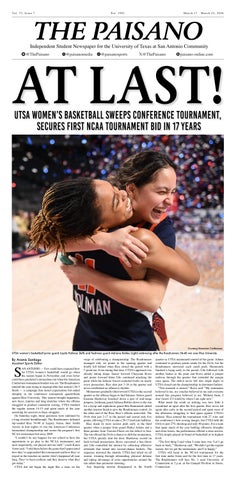
SAN ANTONIO — Few could have expected how far UTSA women’s basketball would go when the season began in November, and even fewer could have predicted a miraculous run when the American Conference tournament bracket was set. The Roadrunners entered the year trying to regroup after last season’s 26-5 fnish — a campaign that raised expectations but ended abruptly in the conference tournament quarterfnals against Rice University. This season brought departures, new faces, injuries and long stretches where the offense struggled to produce consistent scoring. UTSA fnished the regular season 14-15 and spent much of the year searching for answers to these struggles.
On Saturday night, those questions were sidelined by a long-awaited breakthrough. The Roadrunners defeated top-seeded Rice 54-40 at Legacy Arena, their fourth victory in four nights, to win the American Conference tournament championship and secure the program’s frst NCAA tournament bid since 2009.
“I couldn’t be any happier for our school to have the opportunity to go play in the NCAA tournament, and most importantly, our players and our staff,” coach Karen Aston said. “I told them before the game that I appreciated how they’ve approached this tournament and how they’ve stayed in the trenches no matter what’s happened all year long. They’ve been resilient, and they deserve what they got today.”
UTSA did not begin the night like a team on the
verge of celebrating a championship. The Roadrunners managed only six points in the opening quarter and briefy fell behind when Rice closed the period with a 7-point run. Even during that time, UTSA’s approach was already taking shape. Senior forward Cheyenne Rowe and junior forward Idara Udo continued attacking the paint while the defense forced contested looks on nearly every possession. Rice shot just 3-14 in the quarter and never established an offensive rhythm.
Momentum gradually tilted toward UTSA in the second quarter as the offense began to fnd balance. Senior guard Ereauna Hardaway knocked down a pair of mid-range jumpers, freshman guard Adriana Robles drove to the rim for a layup and sophomore guard Mia Hammonds added another interior fnish to give the Roadrunners control. At the other end of the foor, Rice’s offense unraveled. The Owls shot just 2-17 in the period and scored only fve points, allowing UTSA to take a 20-13 lead into halftime.
Rice made its most serious push early in the third quarter when a jumper from guard Hailey Adams and a three-pointer from Victoria Flores cut the defcit to four. The run offered the Owls a chance to shift the momentum, but UTSA quickly shut the door. Hardaway scored on back-to-back possessions, Rowe converted a free throw and Udo controlled the interior by collecting offensive rebounds that turned into second-chance baskets. The sequence mirrored the identity UTSA had relied on all season: winning through rebounding, physical defense and taking advantage of extra opportunities around the rim rather than perimeter shooting.
Any lingering tension disappeared in the fourth
Courtesy/American Conference
quarter as UTSA maintained control of the game. Adams continued to produce points inside for the Owls, but the Roadrunners answered each small push. Hammonds fnished a layup early in the period, Udo followed with another basket in the paint and Rowe added a jumper midway through the quarter that extended the margin once again. The defcit never fell into single digits as UTSA closed out the championship in dominant fashion.
“This moment is surreal,” Rowe said. “My teammates believed in me, my coaches believed in me and everyone around this program believed in me. Without them, I don’t know if I would be where I am right now.”
What made the result so striking was how little it resembled an upset after the frst quarter. Rice never led again after early in the second period and spent most of the afternoon struggling to fnd space against UTSA’s defense. Rice entered the tournament with 27 wins and the conference’s best scoring margin, but UTSA held the Owls to just 27% shooting and only 40 points. For a team that spent much of the year battling offensive droughts and close losses, the performance offered a clear answer. UTSA simply played its brand of basketball at its highest level.
“The frst thing I said when I came here was ‘Let’s go back-to-back,’” Hardaway said. “We didn’t get the regular season, but we got the tournament, and I’m happy.”
UTSA will head to the NCAA tournament for the frst time under Aston and for the frst time in 17 years.
The Roadrunners will face No. 1 seed University of Connecticut at 2 p.m. at the Gampel Pavilion in Storrs, Connecticut.


By Marisela Cruz News Editor
Ateam of four engineering students from the Klesse College of Engineering and Integrated Design visited the Ethics in Engineering Case Competition hosted by Lockheed Martin in Bethesda, Maryland. Despite UT San Antonio not participating in the competition for the past six years, junior biomedical engineering major Christian Unogu, senior mechanical engineering major Lexi Seals, junior mechanical engineering major Michael Shova and senior computer and electrical engineering major Aiden Tijerina believed the competition to be a worthwhile experience.
The team underwent six rounds of ethics-based scenarios to fnd a solution to win over their opponents. During the competition, the four engineers were offered cases involving two competing teams, Alpha and Bravo. Team Alpha focused on a human centered solution, while Team Bravo concentrated on an
solution– would be debated among the four engineers once they returned from the competition. At the Ethics in Engineering Case Competition, AI and human-based dilemmas grew more diffcult as the competition progressed, according to the team of engineering students.
Shova explained how the distinction of which is easier to consider ethically was clearer and more deliberate on the technical side.
“It’s defnitely a little more diffcult considering human emotion versus just computers,” Shova said.
Shova and Seals mentioned that they did not have much experience with computerbased systems, which was an obstacle they had to overcome during the competition, compared to computer and electrical engineering major Tijerina, who felt that he had the advantage of being familiar with AI.
Unogu detailedexplained how his education in biomedical engineering aided in his strategy of navigating the ethical dilemmas.
“Being a biomedical engineer, our
“We describe ethical engineering as being conscious of the effect of our product in society, in our environment and in the midst of other people.”
artifcial intelligence approach. The team part of the scenario worked for the same company, contending for a government contract. Seals and Shova were a team, while Unogu and Tijerina were a team. Both pairs competed as an Alpha and Bravo team. The objective of the competition was to work with the opposing team toward a unifed solution.
When describing what ethical engineering is, Unogu spoke on behalf of the group.
“We describe ethical engineering as being conscious of the effect of our product in society, in our environment and in the midst of other people. When you create a product, your product is given to a consumer,” Unogu explained.
“That’s your main target. It’s being conscious of the quality of the product, the sustainability of the product and the reliability of the product. As engineers, that is something we must always be conscious of, especially when it comes to how we design products and how we try to process our products.”
Deciphering the challenges of navigating an ethical solution for inhouse hardware compared to cloud-based technology, Seals brought up how ethics is simply ethics.
“Ethics is ethics, no matter the large scale topic, even when humans are the main designator of the project or the decision making, you want to be ethical,” Seals emphasized. “You want to follow the main ethical principles. You want to be traceable, governable, non-biased and ultimately nutrient.”
The teams competed for both Alpha and Bravo twice; the decision on which is a easier –technical or human based
engineering principles are based on the application of the human body,” Unogu explained. “So in all honesty, Aiden was the technical guru in the case study. I was more like the ethical side.”
Seals interned at and now has a co-op with United Airlines, and she brought up how her experience from her job provided an analytical perspective when navigating the ethics competition.
“During my co-op on an airline, we were also made very aware of the ethics of what we’re doing when repairing airplanes,” Seals described. “Recently, a United Airlines plane engine actually caught fre, so we’re very strict on what we’re doing affects people’s lives. And it was the same case that we’re doing at Lockheed, what we were creating will ultimately affect other people.”
After succeeding through three out of the six rounds at the competition, the UT San Antonio team learned valuable lessons from the real life scenarios they embarked on. Students at UT San Antonio are only allowed to compete in this competition one time. Unogu underlined the team’s objective upon their return from the competition.
“Now it’s our mission, our task, our duty, to train and model the next set of students to do, of course, better than we did to motivate them, to inspire them, to give them great advice— the ins and outs and how to better advance themselves in the competition,” Unogu emphasized.
Chemical engineering Professor of Practice Steve Skarke, one of the faculty mentors to the team, mentioned that he hopes to have UT San Antonio engineering students compete again during the spring 2027 semester.
By Amanda Fuentes Assistant News Editor
If passed, the Safeguard American Voter Eligibility Act would require individuals to provide documentary proof of citizenship when registering to vote in federal elections. Additionally, states would be required to take further steps to ensure that only U.S. citizens are registered to vote — including the establishment of a program that would identify individuals who are not U.S. citizens.
President Donald Trump supports the passage of this act.
“It supersedes everything else. MUST GO TO THE FRONT OF THE LINE. I, as President, will not sign other Bills until this is passed, AND NOT THE WATERED DOWN VERSION — GO FOR THE GOLD: MUST SHOW VOTER I.D. & PROOF OF CITIZENSHIP: NO MAILIN BALLOTS EXCEPT FOR MILITARY
— ILLNESS, DISABILITY, TRAVEL,”
Trump stated on Truth Social.
Data from the U.S. Citizenship and Immigration Services’ Systematic Alien Verifcation for Entitlements program recognized 0.04% of voters to be noncitizens. A Utah citizenship review found that out of its entire voter registration list of 2,069,640, only one registered voter — who had never cast a vote — was not an American citizen.
In addition, concerns about voting registration for married women who have changed their last name have been raised regarding this act.
There has been debate that women whose last names do not match that of their birth certifcates may not be able to easily prove their citizenship. Legal experts say that this challenge can be overcome with secondary documents, such as a legal decree of a name change or a marriage certifcate, but they warn that obtaining a
marriage certifcate may be diffcult for those who have been married for a long time.
At a City Hall press conference on Feb. 27, Mayor Gina Ortiz Jones addressed these apprehensions and explained what she has done to combat this act and how she will continue to do so through the Mayor’s Commission on Voting.
“I am proud to announce the Mayor’s Commission on Voting. This nonpartisan commission will be solely focused on increasing voter engagement across our state. Later this summer, we will celebrate our nation’s 250th birthday,” Jones said. “At the birth of our nation, women and people of color were not allowed to vote. Voting is the mark of a citizen. It is a cherished right, and it is a right that is under attack. Earlier this week, I sent a letter to our senators, encouraging them to reject the SAVE Act, a bill that would make it harder for most Americans to vote,
but particularly for married women.” Jones’ proposed commission follows her victory in the City Council’s approval to move San Antonio’s municipal elections to November of odd-numbered years.
“I am proud of our efforts, in large part to many of the folks back here, to move the municipal election from May to November, a move that will save our city money and increase [voter] turnout,” Jones said.
The mayor’s commission would consist of three mayoral appointees and one appointee from each of the 10 council districts. The commission is pending approval with a goal of being in place by April 3.
“The responsibility to achieve a more perfect union does not fall on the shoulders of a few, but on the collective conscience of us all,” Jones continued. The SAVE Act has passed in the House and is currently pending in the Senate.
By Cameron Carter
Copyediting Coordinator
The VIA Metropolitan Transit Board of Trustees unanimously rejected a proposal to test a six month fare-free bus pilot program requested by Mayor Gina Ortiz Jones. Jones’ requested fare-free implementation for the top fve most used routes in the San Antonio area, which represents 25% of ridership.
During a board meeting on Feb. 24, the trustees and multiple community members discussed the current fnancial situation of VIA, results of customer surveys, current operational effciency and discount options for riders to inform the public about the fare-free proposal.
VIA Senior Vice President of Marketing and Communications Teri Treviño presented the results from VIA customer surveys, indicating an 87% overall satisfaction over the past fve years. Topics that were customer-identifed as being most satisfactory were ease of purchase, trip planning, bus stop access and fare cost. Customers-identifed issues included weather protection at bus stops, weekend frequency and information about unexpected transit delays.
Supporters of the proposal, such as City Council members Jalen McKeeRodrigues, Ric Galvan and Edward Mungia, argued that the initiative would make transit more accessible to workingclass families and remove barriers for employment, education and services.
However, VIA offcials warned in their meeting that the change could harm the agency’s fnances and operations. Fares account for 5% of VIA’s budget; removing them could impact up to $18 million in
revenues. Offcials also cautioned that federal grants supporting transit projects could be jeopardized due to fnancial instability.
President of Amalgamated Transit Union Local 694 Robert Garza brought up safety issues that could be caused by farefree transit.
“By opening the doors to everyone, without exception, we lose the ability to protect our passengers from those who aren’t there to travel, but only there to cause trouble,” Garza argued. “You can’t put a price on safety, but you certainly shouldn’t trade it away for a political talking point.”
VIA Trustee Louis Cooper introduced the motion to decline the initiative.
“We should direct VIA management to not further pursue or analyze a [fare-free] proposal,” Cooper said. “I move that VIA Metropolitan Transit Board of Trustees, having reviewed the [analyses] presented by management and having considered the legal, fnancial, regulatory, safety and operational implications of fare-free transit model hereby determines that pursuing a fare free pilot or system wide fare free program is not in the best interest of VIA Metropolitan Transit.
“Further, I move the board direct VIA staff to discontinue any further analysis, development or pursuit of farefree proposals under VIA’s operating authority, and instead to continue focus on organizational resources, on delivering the voter approved and board adopted system improvements, including enhanced frequency, reliability safety and implementation of transformative capital investments that beneft the entire community.”
Despite the rejection, fare-free
By Itzy Ruiz Sepulveda Contributor
The U.S. Department of Homeland Security has been partially shut down since Feb. 14 because of lawmakers’ disagreement on a reformation bill. The disagreement regards U.S. Immigration and Customs Enforcement and U.S. Customs and Border Protection reforms. The reforms were proposed because of the recent fatal shootings by ICE agents in January. In a 51 to 46 vote, the Senate failed to move forward with the reforms.
Although 51 lawmakers were in favor, 60 votes were required for the bill to pass the Senate. This shortcoming caused some DHS agencies to experience a partial shutdown.
All but one Democrat — Sen. John Fetterman of Pennsylvania — voted no. Democrats have opposed funding DHS without reform due to the shootings involving Alex Pretti and Renee Good by federal agents earlier this year. According to CNBC, Democrats’ main arguments involve changes to ICE, such as requiring agents to wear body cameras, prohibiting agents from wearing masks and requiring judicial warrants to search homes. Republicans have pushed back on banning masks and requiring warrants.
blocking each other’s offers, and nothing is advancing.
“We all know that we do not have agreement on how to deal with ICE,” Senate Minority Leader Chuck Schumer said. “We don’t have to tie that disagreement up and use people at the airports and American citizens as hostages.”

Republicans proposed an offer to the Democrats, who have not publicly responded yet.
“Democrats need to make a move to end the shutdown before more Americans are harmed by a lack of funding for critical services like disaster relief,” a White House offcial told Politico.
Both sides are currently trying to pass measures to fund the affected DHS departments. However, the parties keep
State of the City Week of 03/17
By Paige Dewlen Contributor
While both parties keep going back and forth, federal DHS workers have not received pay due to the shutdown; this includes the Transportation Security Administration workers, who are considered essential workers. With the shutdown lasting almost a month, there is a high amount of staff shortages. departments that are being affected by the shutdown include the Federal Emergency Management Agency, the U.S. Coast Guard, Cybersecurity and Infrastructure Security Agency, ICE and CBP. The Coast Guard and CISA have both halted most of their missions and are working in a reduced state. According to NPR, ICE Acting Director Todd Lyons said immigration operations are unlikely to feel repercussions from the shutdown.
Last summer, Congress passed the One Big Beautiful Bill Act, which left ICE and CBP about $85 billion.
Lawmakers from both parties say that the DHS shutdown negotiations are nowhere near a breakthrough. Several proposals have been introduced to the Senate in recent weeks, although none have received enough votes to move forward. Until a funding bill receives enough votes to pass the Senate, agencies will continue operating under limited funding, and some employees will work without pay.
initiatives may not disappear entirely.
VIA’s upcoming Silver Line route is expected to offer free rides during its frst year in 2029 through funding approved by
Not subscribed to local news but still want to stay up-to-date on the happenings around town? Look no further.
Highlighting notable stories from external San Antonio news sources, State of the City summarizes the most captivating news headlines of the week. This week’s topics range from a proposed city council meeting rotation to a police chase.
Councilwoman proposes rotating city council meetings
District 5 Councilwoman Teri Castillo proposed that city council meetings rotate locations. Currently, all city council meetings are held at City Hall, which has caused complaints from constituents about a lack of available parking and diffculty attending. The City Hall to All program was proposed to resolve these issues. Castillo pointed to the annual Budget Town Halls, which are held in every city’s district. Senior centers and community centers have been proposed to hold these meetings.
Bexar County commissioners. Current UT San Antonio students will not be affected by this decision, as the U-Pass program will not be impacted.

By Hallie Lott Web Editor
The Republican Senate primary race will go to a runoff election between Texas Attorney General Ken Paxton and incumbent Sen. John Cornyn, since both candidates failed to retain more than 50% of the vote.
Polling from the Texas Politics Project at the University of Texas at Austin showed that early voting turnout for the 2026 primary election was close to double the number of voters from the 2022 primary election. Democrats had a record-breaking turnout at the polls, with more than 2.3 million votes cast in the U.S. Senate Democratic primary race. State Rep. James Talarico faced off against U.S. House Rep. Jasmine Crockett and Ahmad Hassan in a competitive primary. Talarico won, garnering 52.4% of the vote, while Crockett took 46.2% and Hassan 1.3% of the vote.
Almost 2.2 million Texans voted in the Republican U.S. Senate primary. Cornyn faced a packed race to retain his seat, competing with Paxton and U.S. House Rep. Wesley Hunt. Paxton received 40.7%, and Cornyn received 41.9% of the votes. The winner of the runoff will face Talarico in the November general election.
The gubernatorial election featured Republican Incumbent Gov. Greg Abbott and Democrat State Sen. Gina Hinojosa. Abbott received 82% of the vote, securing the Republican vote. As for Democrats, Hinojosa received 59% of the votes, moving forward to face Abbott in the November 2026 general election.
Former Mayor of San Antonio Ron
Teenager drives stolen car into patrol car during chase
An unidentifed 15-year-old male stole a car and attempted to drive through Northwest San Antonio on March 11. According to the San Antonio Police Department, there were multiple failed attempts to pull the defendant over. After the fnal attempt, the defendant sped up and struck two additional SAPD patrol cars before crashing into trees that were in the front yard of a home in Laurel Hills. The unidentifed male attempted to escape on foot, but was apprehended. This investigation is ongoing.
Nirenberg ran against incumbent Judge Peter Sakai for Bexar County Judge, taking 62% of the vote to Sakai’s 38%. He will face Patrick Van Dohlen, the unopposed Republican candidate, in November for Bexar County Judge.
U.S. House District 23 featured incumbent Rep. Tony Gonzalez, closely challenged by far-right pro-gun YouTuber Brandon Herrera. The race went to a runoff; however, Gonzalez dropped out of the primary runoff on March 6 after admitting to an affair with a former aide of his who later committed suicide. Herrera will run against Democrat Katy Padilla Stout in November.
The Dallas County and Williamson County Republican Parties removed centralized polling locations this election, turning to assigned polling locations for voters instead. Dallas County extended election day voting hours to 9 p.m. in response to many voters being turned away at polling locations because they went to the wrong location. Williamson County also extended its voting hours at two locations until 10 p.m. because of a similar issue.
The Texas Supreme Court ordered Dallas and Williamson counties to separate votes placed by individuals who were not in line before 7 p.m., after the Texas Attorney General’s offce appealed a district court ruling allowing polling hours to be extended.
The primary runoff election will be held on May 26, with early voting open from May 18 to May 22.


New park planned for San Antonio’s Southeast side
San Antonio is planning to build a large park on the Southeast side, a recent fling with the Texas Department of Licensing and Registration revealed. At a size of nearly 400,000 square feet and costing $5 million, this park is being planned by developer Lennar Homes. The city is hopeful that construction will start at the beginning of June and conclude near the end of 2027. This park is planned to contain walkways, sports facilities and water features.
Big men, boasting even bigger egos, cannot help but whimper as reality bulldozes through their overconfdent aspirations. When UT San Antonio President Taylor Eighmy was sworn in eight years ago, he came quick to the draw. Eighmy envisioned UT San Antonio as a “university of the future in the city of the future,” and developed bold plans to expand the university. His vision was commendable on its own, but it means nothing if Eighmy is complacent when pushed around and his dreams are nothing more than quotes on a website.
The UT Board of Regents named Eighmy as UT San Antonio’s President in 2017, and he was inaugurated on March 20, 2018. After being sworn in, Eighmy hit the ground running, fnalizing the UT San Antonio Master Plan, an award-winning proposal that laid out how the university will expand each campus to accommodate a student body of over 45,000. He further recognized the university’s promising position in an ever-expanding metropolis and its importance as a Hispanic-Serving Institution. He also aptly noted the importance of staying
Commentary
in touch with the students and faculty he would serve. Eight years later, however, those wishes have fallen fat. While his initial proposals took in feedback from the UT San Antonio community, it appears that his offce has since closed its doors. The relationship the average student has with Eighmy is akin to an ex-romantic partner

who wants to get back together — he will email during holidays or tragedies as a reminder he still exists. For someone who “can’t emphasize how important it is that [he has] a lot of touch points in the community,” Eighmy sure is absent from the student experience.
What speaks louder than Eighmy’s Christmas wishes is his developmental inaction and community betrayal. As students celebrate Women’s History Month, Eighmy oversees the dismantling of the Race, Ethnicity, Gender and Sexual Studies Department, likely to court the approval of bigots in the federal and state governments. Moreover, under his watch, the Offce of Inclusive Excellence and its planned replacement shut down after a series of state laws. With so much of the university being stripped away, students can only wonder when their president will consider an issue trouncing their rights important enough to fght against.
While the UT San Antonio-UT Health merger was a beaming success, Eighmy’s woefully crippling complacency and inability to protect his students earned his term a C- so far. Roadrunners can only hope Eighmy will prioritize them over state-enforced prejudice.
By Nalani Cox
Contributor
The primary election took place on March 3, with early voting occurring from Feb. 17-27. This Democratic primary election had a higher turnout than any other midterm election.
Although Texas has remained a red state for over 30 years, the rise of Democratic participation should not go unrecognized. While the primary turnout does not guarantee a Democratic win in the midterm election, the increase in engagement refects people’s concern and a need for change, which could signal a shift in political dynamics.
The fear surrounding the 2024 presidential election increased the stakes for Democrats in the midterms.
The strategy of choosing a strong candidate to run against the Republican Party applied when selecting potential governor candidates. Gina Hinojosa won the primary with a majority vote. Hinojosa will compete against Gov. Greg Abbott, who is running for his fourth term. Abbott is the second governor in Texas to maintain three consecutive four-year terms, but Hinojosa has shown she is a strong contender to defeat Abbott, appealing to the Hispanic community.
Democrats are ready for a change, and she embodies it. Hinojosa’s outspoken speeches on improving education and strengthening human rights are clear indicators that she is ready to fght for the people of Texas. If she wins, she would be the frst Democratic governor since 1990.
In a speech given Tuesday night after her win, Gina Hinojosa stated, “Guess what, I’ve never been afraid of Greg Abbott, and I’m certainly not afraid of him now.”
There was a lot of controversy surrounding this year’s Senate primary, involving Democratic candidates Jasmine Crockett and James Talarico. Crockett has endured numerous critiques throughout the campaign for not standing a chance in the midterm election against Republican candidates. The criticism of Crockett created a divide within Democratic voters. In contrast, Talarico has received high praise for his ability to run against a Republican candidate.
In a red state, it is important to remember that electing just any Democratic candidate will not be easy. Talarico comes off as charismatic with little controversy surrounding his name, meaning candidates did a good job analyzing who could stand a chance against the winning Republican candidate.
On Election Day, there was confusion at polling places in Dallas and Williamson Counties. Citizens were previously informed that they could vote at any polling location. Despite the previous rule, hundreds of individuals were turned away
Commentary By Joby Albritton Assistant Business Manager
In this cycle of the Texas primary election, Bexar County voters set a trend — one that kept incumbent Republicans in their offces. This trend offers no new blood in the game and keeps career politicians in offce. The Grand Old Party seems to have started its geriatric pursuit of Texas politics.

and told to go to their assigned polling place. An extension was granted to allow voting until 10 p.m. in Williamson and 9 p.m. in Dallas, but the Texas Supreme Court asked that votes cast during the extension be discarded. It is unclear how many voters there were or whether those votes were counted. Despite the polls’ mistake, Crockett congratulated Talarico on his win.
The 2026 Primary Democratic Election has shown signs that voters are ready for a change and are fghting to make Texas blue. This year’s candidates presented themselves as strong contenders to challenge established Republicans.
Republican candidates, such as John Cornyn, who ran for U.S. Senator; Greg Abbott, who ran for Governor; and Dan Patrick, who ran for Lieutenant Governor, have been in Texas politics for nearly half of their lives. These politicians leave no room for younger voices and minds to enter politics when they are needed most. Abbot, specifcally, has been in Texas politics for over 30 years, far exceeding the time for him to know what the next generation of Americans believes and want.
Abbott had already been in politics for 13 years before newly registered voters in 2026 had the right to vote, showing
that he, along with his other geriatric Republican colleagues, has had a long run in Texas politics. 68-year-old Abbott, 74-year-old Cornyn and 75-year-old Patrick might have been in the game for a while, but that game has changed, and they are still dribbling around the same old court. In the 2026 primary, Bexar County Republicans favored older politicians. While these career politicians have gained the favor of county residents, there is still some hope for the younger generation of politicians. Brandon Herrera, a 30-yearold social media personality and political candidate, is one of the youngest on the polls. Running for U.S. Representative, District 23, he was supposed to compete in a runoff election against Tony Gonzalez, who has since dropped out. Herrera’s nominationsignals a win for the younger generations of Texas.
Another Republican candidate who lost his party nomination by the geriatric old pursuit was Wesley Hunt. This 44-year-old ran for U.S. Senator and lost to incumbent Cornyn and Texas Attorney General Ken Paxton. Hunt studied Industrial and Labor Relations at Cornell University and is a former U.S. Army offcer, which would have made him a prime candidate to replace his older competition. He currently serves as a U.S. Rep. for Texas’s 38th congressional District, providing his expertise and guidance as one of the youngest representatives.
The world has changed so much from when these politicians were frst elected, and they have done virtually nothing to sympathize with younger generations. While offces have historically been held by those with more experience in politics, it is important to remember that change is a good thing. Republican voters in Bexar County have supported these career politicians in keeping offce and abiding by their outdated policy. Many offces had younger and new faces on the polls for the primary election, but the geriatric old pursuit has overshadowed them, offering no hope for change in Texas policy.
Commentary
By Jasmine Williams Editor-in-Chief
A UT San Antonio freshman, brighteyed and bushy-tailed, approaches the H-E-B Student Union on March 3. It is Election Day, and after their classes, studying for midterms, attending offce hours and meeting with peers for group projects, the student is fnally free to cast their ballot. Upon entering the building near the frst-foor ballroom, they are faced with a line. No matter, they will go to the back and wait for their turn. However, the line seems to grow longer the deeper the student ventures into the building. It stretches to the opposite end of the frst foor. The wait time is three hours. If time was money, the freshman would have gone bankrupt. The cost of civic engagement should never be this steep.
Young voters, aged 18-29, already face
numerous challenges when casting their ballot. Voter ID laws make it diffcult for young people without a driver’s license to supply valid identifcation. Students attending universities outside of their home state, city or county run into trouble registering to vote and fguring out where they are eligible to vote. Over 25% of 1829 year-olds who did not vote in 2024 cited time constraints and a lack of information as their reason for not voting, shedding light on the burdens they face.
UT San Antonio students are fortunate not to have to worry about commuting to a polling site since one is available at Main Campus, but the wait time on Election Day negates the beneft for many students.
Seeing as around 40% of full-time students and 74% of part-time students are employed, the three-hour wait time on election day that follows hours of researching who and what is on the ballot may be the last straw that stops them from
casting their vote.
According to 2024 Texas Statutes Election Code Title 8, the number of voting machines installed at each polling place is based on how many votes were cast at that location in previous elections, the number of registered voters in the area and the number of machines that are available.
The UT San Antonio polling site desperately needs more voting machines to accommodate the large volume of voters on Main Campus. The Bexar County Election Board is responsible for procuring election supplies, including machines.

Commentary

By Sam Rencher Staff Writer
President Donald Trump’s administration recently decided that the Constitution means absolutely nothing. No, that statement is not being made in reference to the way U.S. Immigration and Customs Enforcement has been managed, to the way Congress has been ignored or to any other slew of things that may strike a reader’s mind. Instead, it is in reference to the fact that the cowards in Trump’s administration have decided that the roughly 2,200 transgender individuals in federal prisons should be forced to undergo conversion therapy in an attempt to prove that gender dysphoria can be cured.
The program statement that the aforementioned cowards came up with lays out how the federal prison system will forcefully impose conversion therapy on all of its transgender inhabitants. It is well documented that gender dysphoria should be addressed through social and medical affrmations. But the program, guided by Trump’s executive order, “Defending Women from Gender Ideology Extremism and Restoring Biological Truth to the Federal Government,” aims to remove all possible affrmations and, instead, force trans people to live in line with their “biological truth.”
Social transition is the easiest thing to allow trans people, people just call them their preferred name and let them wear what they want. Unfortunately, even something this simple is too much to provide, as inmates will “not receive social accommodations,” and if they already have any, the prison will “remove
or confscate the social accommodations.” Obviously, if social affrmations are off the table, medical care is not even a question.
They want to treat gender dysphoria by, frst and foremost, not treating gender dysphoria. The paper states, “Identifed medical and psychiatric comorbidities should be addressed before treatment for GD proceeds,” and that the comorbidities— that is, the other mental health conditions a patient may have, like depression or anxiety— must be “ruled out as the potential cause of GD” before direct treatment for gender dysphoria can take place. There has never been a documented
depression cured by ignoring the gender dysphoria.
If someone is determined to deserve treatment for their gender dysphoria, it is made clear that the federal government will not follow any recommended or proven treatment regimen. It is stated that inmates will not be given hormones and will be tapered off if they already have any; and inmates will not receive surgeries but will receive maintenance care if any surgeries have already happened. Treatment will instead prioritize psychotherapy with the goal of “managing the psychological distress/dysphoria.” But if the inmates are not allowed social transitions, there is only one possible way for it to be “managed”: if they are being told to just accept their birth sex and grow past the dysphoria. is conversion therapy. therapy is proven to cause Post Traumatic Stress Disorder and drastically increase suicidality, and it has been named a kind of torture by a United Nations expert.

Disturbingly, this whole idea of “torture prisoners until they stop saying they belong to a disliked minority” goes completely against the Nuremberg Code. This inhumane experiment being done by the sub-humans of Trump’s administration inarguably violates rules one, three, four, fve, seven, nine and ten of the Nuremberg Code. It is cruel. It is hate-driven. It is done without consent. It laughs in the face of science. And it only goes to show that Trump is nothing more than a loser who will do anything he can to make minorities suffer to feel more powerful. is proven every single day that the fght for human rights is a fght against Trump.
By Emma Cavanaugh Distribution Manager
Saying “voter interference” near a Republican is akin to saying “treat” around an 80-pound, wacky, doofus dog. Republicans necessitated separate primary voting stations in Dallas and Williamson County, forcing specifc precinct polling locations. After years of countywide voting, many voters could no longer cast ballots at their previous polling locations, creating mass confusion.
Republicans in Dallas and Williamson County refused joint primary elections, which forced out the routine countywide voting system, disorienting voters.
Qualifed voters in Dallas County on March 3 were turned away and forced to fnd voting sites in the last hours of election day.
Dallas County should have never allowed Republicans to create specifc precinct voting sites. Creating unnecessary obstacles for voters is suppression.
Voters should not have had to rush to
specifc sites just to be rejected. According to Dallas County Judge Clay Jenkins, some polling locations refused as many as 90% of voters. In Dallas County, there were only four locations to vote during early voting, and then on election day, there were only 14 locations.
In Williamson County, there were partyspecifc voting locations. On election day, there were 61 locations for Republicans and 42 locations for Democrats to vote. Republicans tried to make it as hard as possible for Democrats to cast their votes.
In an attempt to band-aid a fasco of an election day, Dallas County Judge Staci Williams ruled for a two-hour extension of Democratic primary voting hours, closing the polls at 9 p.m. instead of the normal 7 p.m. Williams’ effort to protect voters did not serve anyone, as the Texas Supreme Court swiftly blocked her ruling.
Chaos only furthered after the Texas Supreme Court released an order stating, “voting should occur only as permitted by Texas Election Code Section 41.032. Votes cast by voters who were not in line to vote at 7 p.m. should be separated.”

By Richard Lujan Contributor
Editorial Board
Jasmine Williams | Editor-in-Chief Editor@paisano-online.com
Cruz Delgado | Managing Editor Manager@paisano-online.com
Marisela Cruz | News Editor News@paisano-online.com
Henry Holmes | Opinion Editor Opinion@paisano-online.com
Audrey Villar | Arts & Life Editor Arts@paisano-online.com
Rylan Renteria | Sports & Photo Editor Sports@paisano-online.com Photo@paisano-online.com
Hallie Lott | Web Editor Web@paisano-online.com
Sarah Quintanilla | Graphic Editor Graphic@paisano-online.com
Regan Williams | Multimedia Editor Multimedia@paisano-online.com
Valentina Quintanilla | Magazine Editor Magazine@paisano-online.com
Karis Vickers | Social Media Editor Socialmedia@paisano-online.com
Jaclyn Banda | Business Manager Business@paisano-online.com
Emma Cavanaugh | Distribution Manager Distribution@paisano-online.com
Johnpaul Bawule | Marketing Manager Marketing@paisano-online.com
Cameron Carter | Copyediting Coordinator Copyediting@paisano-online.com
Staff
This ruling meant those ballots were not cast — the voters’ voices were silenced. According to Jenkins, 2,450 votes were void because of the ruling. After failing to create accessible voting, Texas should have supported voters in the last hours, not shut them out. Except, this is seemingly exactly what Republicans wanted — for Democrats to be turned around so many times their heads ought to fall off and their votes lost.
With mass voters attempting to fnd unfamiliar polling sites, the Dallas County Election Department website crashed, and the Texas Secretary of State’s website displayed incorrect polling information. The county’s lousy attempt to implement the old practice of precinct-specifc polling failed and left voters disenfranchised.
Inconveniencing, confusing and long waiting times for voters are suppression tactics. Dallas County neglecting their election process is not just a mishap; it is a failure to protect voters and an attempt to disenfranchise its citizens.
More voters were led astray after election clerks’ failure to ask for voters’ party affliation when navigating individuals to their correct polling location. Poll workers also reportedly tried revoking a voter’s ballot.
Elections Administrator Paul Adams said the non-joint-party setup put a massive strain on the elections department; offcials were unable to perform their duties because of the Republican disruption.
“The problem was there wasn’t enough time,” Adams said. “This election was incredibly challenging, not just for me but for everyone in the elections department.”
Voting should be an easy, safe process, not the chaos-flled failure that was Dallas County elections. Dallas and Williamson County disenfranchised and failed their citizens on March 3. Texans must not allow further suppression in elections, no matter the roadblocks; do not let the ballot be ripped from Texans’ hands — go vote.

By Hallie Lott Web Editor
March is Women’s History Month, and The Paisano is highlighting upcoming events for UT San Antonio female-focused clubs and organizations this spring.
Women of Honor
Women of Honor is dedicated to uniting the female student body at UT San Antonio and eliminating sexist stereotypes through community service. Providing support, Women of Honor creates projects across Main Campus to improve the experiences of female students attending the university and in the surrounding community. Their Instagram is @utsawoh. They are hosting a Spring Pool Party in coordination with Men of Honor and UTSA ABPsi on March 20 at 5 p.m. at 14333 Babcock Rd.
Texas Angels
pillars: scholastic, service, spirit and social; Texas Angels makes a heavenly community for women. They can be found on Instagram at @utsatxangels, and they host general meetings every Monday. Their next meeting will be on March 23 at 6:30 p.m. in the McKinney Humanities Building 2.01.24.
Women in STEM
Women in STEM works to inspire collegiate women in science, technology, engineering and math majors by offering networking, service and leadership opportunities to assist them in felds often dominated by men. The organization’s community building is based upon collaboration, creating a space where women can thrive while pursuing undergraduate degrees in STEM. Their Instagram is @wis.utsa. Women in STEM hosts general meetings every Thursday. They will gather next on March 19 at 5:30 p.m. in the North Paseo Building 1.114. More information can be found on their linktree.
professional events on campus, the organization wants to help its members reach their full potential. They are open to all majors, genders and backgrounds, aiming to support members throughout their time at UT San Antonio. The Society of Women Engineers is hosting a leadership luncheon on March 19 at 2 p.m. in BSE Multipurpose Room 2.102. Their Instagram is @swe_utsa, and students can join their GroupMe for communication.
Sweet Sisterhood UTSA
Women of all majors are welcome in Sweet Sisterhood to bond through baking and volunteering in San Antonio. Hosting donation drives, offering volunteer work and community outreach, this organization offers UT San Antonio female students the opportunity to explore their baking skills while making a meaningful difference in the community. Their Instagram is @sweetsisterhoodutsa, and the organization is hosting their second general meeting of the semester on March 18 at 6 p.m, where they

By Noor-E-Saher Ahmed Graphic Artist
As UT San Antonio students return to campus after the too-short spring break, they are determined to fnish the semester off strong. Roadrunners were ready to share insight on topics, including Gracie Abrams, campus water fountains and, most importantly, meowls.
This week on Bird on the Street, The Paisano interviewed freshman biology major Nina Kurinij, junior accounting major Zachary Flores, junior criminology major Ela Hernandez and junior computer science major Elijah Britt.
If a divine revelation told you to block Gracie Abrams, would you do it and how long would it take you to fulfll this prophecy?
Flores provided a simple yet powerful answer. “I don’t know who that is,” he stated.
For those more chronically online, the response was unanimous. Hernandez spared no time making up her mind. “Yes. Automatically. I don’t need a divine revelation to tell me that,” Hernandez replied. Kurinij agreed on blocking her “immediately,” and Britt, fulflling the prophecy even before it was bestowed upon him, already had her blocked.
What are your opinions on the campus water fountains?
It seems that the campus water fountains are unpopular among Roadrunners. Both Kurinij and Hernandez replied that they do not use them. Britt expressed his dislike, noting that “half of them are broken.” Flores responded similarly, albeit regarding the nondrinkable fountains. “I think they’re dirty,” he said. “I’ve seen some people jump in there before.”
Would you rather be in ‘Adventure Time’ or ‘Regular Show’?
Students had more split answers for this question. For these childhood staple shows, the decision was diffcult and required some introspection. Flores and Kurinij went with “Adventure Time,” while Hernandez and Britt chose

If meowls were real, would you have are beautiful, ethereal creatures that touch the souls of everyone who has laid eyes upon them. All of the students interviewed expressed their unbridled would have a whole sanctuary,” Britt said. “I would have thousands — like, a whole enclosure. I love meowls.” and Kurinij expressed the same sentiments, both declaring, Kurinij went on to explain that “I love both cats and owls. A friend of mine told me if I were an animal, I would be a barn owl. I never forgot that.” It seems that meowls deeply resonate with ‘Runners. Flores had no doubt in his mind either, replying with a frm “100%.” a question and want it answered by UT San Antonio students? Submit at
By Jasmine Williams Editor-in-Chief
It is inconspicuous at frst glance — the squat building labeled “SOAP” at 900 Oblate Dr. But as the sliding glass doors split its window-clad façade, a modern and vibrant laundromat unlike any other in the city is unveiled: Soap Laundry Lounge.
An even more unexpected sight is the business owner: award-winning country music star Emily Strayer of The Chicks, who detailed the lounge’s origins.
“I did not think in a million years I would be doing something like this,” Strayer revealed. “As with most things in my life, they’ve just kind of presented themselves at different times, and this was a project that was inspired initially from just the want to do some commercial real estate with my husband, since we both travel for work a lot and we’re both in the music industry.”
“We like to experiment. We like to be seasonal.”
Soap Laundry Lounge boasts a sleek, modern interior full of soft, pale grays and machinery of brushed and polished silver. Contrasting beautifully is a bright orange tiled cafe with spherical light fxtures above. Warm, deep green hanging lights and potted plants dot the laundromat, adding a cozy touch.
“I knew I wanted the interiors to set our business apart from other laundromats,” she shared. “I partnered with Föda, who are a design team in Austin, initially just to do the branding, but then I found out they had an interior team as well. So we just put our heads together, and this is what came of it.”
The design is not only what distinguishes Soap Laundry Lounge; its cafe menu does as well. While it features the typical coffees and teas, the selection is
popular,” Strayer explained. “We like to experiment. We like to be seasonal, and we like to have something new every time someone comes in.
“When we have team meetings, we pick everybody’s brain, we want everyone to put their two cents worth in and come up with ideas of their own.”
The laundromat works with Scratch Kitchen to supply its cafe with an array of delicious pastries. Its collaboration with fellow businesses does not end there, as its laundry powder is made in alliance with an outside company, and its cleaning supplies are sourced from a community member.
“I happen to know Catherine Hicks at Organic Chicks, who does a ton of wonderful green products. We use her counter spray and her spot cleaner for the laundry side of things,” Strayer mentioned. “I think shopping local and having collabs with local vendors and other businesses is important to us, for sure.”
As Strayer and her team develop fruitful relationships outside the laundromat, inside, they cultivate a wonderfully pleasant place for San Antonians to do a mundane chore. Despite the rows and walls of washing machines and dryers, they are never louder than a light hum. Music plays at a similarly quiet level. While the patrons’ clothes tumble away, they can browse a book or magazine lying about, watch one of the many fat screen televisions lining the walls or play one of the many board games stacked in the built-in shelves of the back wall.
“I had no idea it would be such a community hub that it’s become, and we have regulars, we have people who come in and are looking for certain team members or have a rapport with them, people walking in from their homes all over the neighborhood just to get their morning coffee,” Strayer noted. “It’s the community aspect of it that it doesn’t feel like we’re at work all that much. We’re just kind of doing our job, and the hangout is pretty nice.”
Costs can add up quickly at Soap Laundry Lounge between washing, drying, treats from the cafe and the vending machine of laundry paraphernalia. Thankfully, Strayer is offering discounts and deals to UT San Antonio students who stop by.
Students who sign up for the frst time can get $5 added


By Armin Suljovic Contributor
With no introduction needed, director Steven Spielberg took to the stage at South by Southwest, greeting the audience by dubbing the capital city as “Awesome Austin.” He was joined on stage and interviewed by Sean Fennessey, the head of content at The Ringer. During the hour-long panel, Spielberg touched on a variety of topics from movies, alien-life and his own work on upcoming flms.
Spielberg’s anticipated blockbuster “Disclosure Day,” a movie with alien-life at the center of the plotline, will release in theaters this summer. This is not Spielberg’s frst sci-f as “Close Encounters of the Third Kind”, “E.T. the Extra-Terrestrial” and “War of the Worlds” all experiment with other-wordly life. On June 12, audiences can watch Disclosure Day, the newest sci-f piece that centers on the general public’s reaction to the confrmation of alien existence.
“I don’t know any more than any of you do, but I have a very strong suspicion that we are not alone here on Earth right now — and I made a movie about that,” the famous director said.
Spielberg also addressed former U.S. President Barack Obama making headlines after saying aliens were “real” on a podcast.

By Sarah Quintanilla Graphic Editor

“The Damned Son and the Witch’s Necklace” came from the genius and dedication of UT San Antonio senior fne arts student Cris Dixon. The story follows Alan Goode, who travels from Austin, Texas to Salem, Massachusetts after his dad’s passing. Goode moves in with his mom, head of the witch’s council, to study in a
earlier this month. Dixon dreams of continuing the saga with a three or four book series.
“I was watching a bunch of old 90s witchy movies like ‘The Craft,’ and realized I wanted to capture that vibe in a book,” Dixon shared. “I love spooky. I love mythology, and I love researching mythology before putting it into my book.”
Taking inspiration from works like the “Percy Jackson and the Olympians” series by San Antonio native Rick Riordian and “Macbeth” by Shakespeare, which shaped
dive into this magical world and following adventures of Goode and company, written from the mind of Dixon who modeled the characters from his own friends.
“It’s kind of like letting people read your diary a little bit. This is so personal,” Dixon said. The book is sold in Barnes and Noble and online on Amazon for paperback, and an e-book version is purchasable via a link in Dixon’s Instagram with the handle @theghostlywriter.

By Logan Martinez Assistant Sports Editor
guard is a lot different than being one in high school. The speed and physicality were defnitely different. Luckily, my coaches helped me a lot in my transition, so it wasn’t as diffcult as maybe for others.”
Hayes’ quick turnaround allowed him to skyrocket into one of the most dependable players on the roster. He routinely performed down the stretch for the ‘Runners, knocking down big shots and consistently making winning plays.
Though his play throughout the season is enough to give fans some hope for the future, it is Hayes’ maturity, poise and confdence that will help build a winning culture for the Roadrunners’ future. The guard was one of the locker room’s leading voices despite being one of the youngest players on the roster. Amid UTSA’s 16-game losing streak midway through the season, Hayes remained a positive force for the team, offering encouragement and keeping his head up high.
always like to look at situations with a positive mindset,” Hayes said. “If I go into games or practices with a negative mindset, it isn’t going to do me any good and we aren’t going to get any better. We didn’t really have time to focus on injuries or other excuses, so it’s always just been a ‘next-man-up mentality’ anyway.”
While injuries did play a major role in UTSA’s season outcome, they allowed other young players to gel and showcase their potential. The core comprising Hayes, sophomore forward Baboucarr Njie, freshman forward Kaidon Rayfeld and freshman forward Matheo Coff proved to be elite despite what the team record showed. Each displayed brilliant individual performances throughout the season and played complementary basketball with one another. While there are questions about whether Claunch and his staff can keep the core together, the group certainly possesses a tremendously high ceiling. all get along really well together, and I think there is defnitely a lot of potential there,” Hayes claimed. “When you can play with people you get along with and have a bond with, it just increases your chances of being really good together.”
While the season did not turn out the way he hoped, Hayes maintained a positive outlook as he refected on the year. He remained hopeful for the future and even set goals for himself and the team headed into next season. think I wasn’t too bad for a freshman, but I know I’m pretty hard on myself,” he said. “I think that I, and we, could have defnitely done a lot better. I want to be a better ball handler, better defender and all-around better player next year. A key role in improving is gaining experience, and that’s exactly what we’ve done this year.” UTSA is to build a winning culture in the near future, Hayes will certainly be one of the key pillars in the rebuild. The guard is young but experienced and possesses leadership qualities that can elevate the program to new heights in the coming seasons. Keeping Hayes and the young core intact will be pivotal for Claunch headed into the summer.
By Sarah Quintanilla Graphics Editor
University with a 15-3 win on Saturday and a 10-4 win on Sunday at the Ice & Golf Center at Northwoods.
The frst period started off with a goal by graduate left wing forward Travis Sorce assisted by senior forward Jonathan Blum. Tulane scored in minute seven, and Sorce scored a top-shelf insurance goal shortly after. The period ended with two other goals by junior forward Jaylen Mendez in the last fve minutes.
Mendez, graduate defenseman Jordan Nolan and freshman defenseman Justin Trevino scored during the second period. Tulane managed to pass UTSA’s defense and scored its third goal, but after stealing the puck back and forth, freshman forward Caden Wong shot the tenth goal assisted by junior forward Owen Reel.
Junior left defenseman Camila Rohde played for the frst time in a competition since 2024, becoming the team’s assists leader in the match with three points per game.
“Cami was awesome,” head coach Zac Swank shared. “We knew that she grew up playing hockey in El Paso, so I expected her to be solid, and she showed up and performed very well. She was the player of the game for us for sure.”
Sophomore forward Jackson Stubblefeld opened the third period’s scoreboard on minute three followed by Blum shortly after. Many bodychecks and battles for the puck led to an accidental knee-to-knee injury for Mendez, who was escorted out by the team’s trainer.
Blum and freshman defenseman Thad Bielanski scored in the last fve minutes, followed by Sorce who scored the 15th and winning goal during a 4-on-5 UTSA power play.
“I was a little nervous ‘cause it’s been a while, but I had a lot of fun. I wish it was a little more competitive,” Rohde shared. “It was more of a fun game than a heated one.” Game Two
The frst period started with a 4-on-4 for holding. Tulane opened the scoring in the middle of the period, yet Mendez was quick to score two minutes later. Wong buried two goals back-to-back in the last fve minutes,
minutes in. Mendez and a Tulane defender got dragged to the penalty box for roughing, leading to a 4-on-4. Stubblefeld scored in the middle of the game followed by a 5-on-4 Tulane power play. Scrums along the boards switched the power play to a 5-on-4 favoring UTSA. Three minutes before the buzzer blared, Mendez scored unassisted, followed by Nolan and Blum with 41 seconds remaining.
“I thought it was a special game for our seniors,” Swank shared. “You see guys like Chicken Joe [Konner Wilson] getting assists and guys who didn’t get points all year fnally getting on the board, and it’s a full circle on the season. Joe, our goalie, played out, had a breakaway at the end, almost scored. There’s a lot of positive moments to take from the skim.”
The third period was the most action-packed of the game. Stubblefeld scored during minute 17. Multiple visits to the penalty box due to roughing and slashing made Tulane 5-on-4’s consistent throughout the period. Grainer shot the 10th and last goal of the season, followed by Trevino getting expelled of the game triumphantly for fghting and causing one last 5-on-4 power play.
“It’s emotional to see how far we’ve grown, and obviously, when you put so much time into something, it slowly starts becoming your identity, something you’re beyond proud of,”

senior forward Joshua Lecomte shared. built this program with my friends, and we didn’t really think this was gonna be as big as it is today. It’s just amazing,” Blum commented.
UTSA hockey fnished the spring with an 8-4 record, including wins over the University of Houston and Louisiana State University. The Roadrunners will return this fall.