
THE PAISANO


STUDENTS DISPARaGE SB 8 COMPLIANCE AT GUaDALUPE HALL

By Joby Albritton
UT San Antonio’s Guadalupe Hall student dorm underwent bathroom redesignations in compliance with Senate Bill 8. The bill requires state agencies and universities to guarantee that multipleoccupancy private spaces — such as restrooms, showers and changing rooms — are designated for use by people of a homogeneous biological sex. SB 8 went into effect soon before winter break for residents at Guadalupe Hall.
The students residing in the dorm received an email in November about UT San Antonio complying with SB 8.
“To meet the new state requirements, restrooms in Guadalupe Hall will be redesignated over the coming weeks to align with single-gender use. Access permissions will be updated so that restroom entry corresponds with the designated gender for each facility,” the UT San Antonio Housing and Residence Life email stated on Nov. 17.
Students from Guadalupe Hall discussed their reactions to the recent changes made to the dorm.
“I don’t think it’s necessary, especially when I don’t believe universities were ever forcing students to be a part of the program,” freshman double major in physics and flm and media studies Emily Rivera stated. “I guess
Former
By Johnpaul Buwule Staff Writer
After Senate Bill 37’s passage, the University of Texas System Board of Regents authorized campus presidents to dissolve university faculty senates and replace them with less independent bodies.
Gov. Greg Abbott signed SB 37, which gave university presidents the power to appoint half of the faculty senate and mandated these governing bodies cap their faculty senate members to 60, into law on June 22, 2025. Universities’ governing bodies were required to decide by Sept. 1, 2025, on whether to dissolve or keep campus faculty senates.
The bill also ordered that the UT System Board of Regents conduct a comprehensive review of the general education curriculum at least once every fve years. Additionally, the bill creates the Texas Higher Education Coordinating Board Offce of the Ombudsman to investigate complaints about universities’ noncompliance with state laws.
The Paisano reached out to three former UT San Antonio Faculty Senate members for more information on the senate’s function, but only one former member agreed to be interviewed anonymously.
The former senate member clarifed the extent to which the senate could shape decisions and how its dissolution harms departments.
“At best, we can just write a memo and send it to the provost or president or both, and hope that they listen or take our concerns seriously,” the former senate member noted. “The loss of [the] faculty senate has put a damper on that interdepartmental communication, in ways that make it harder to run the university just on a day-to-day basis.”
SB 37 expands university presidential power by allowing the president to appoint one member from the department and having the faculty of that department elect another. This appointment method differed from how the faculty senate attained its members before its dissolution.
“You were elected by your department, and your job was to represent your department’s interests to the university as a whole,” the former faculty senate member explained. “[A faculty senate member] is somebody who is not administrative in any way. So in that sense, it was a real voice coming from [the] sort of rank and fle faculty.”
to be implemented?”
A resident assistant from Guadalupe Hall shared their thoughts on the structure and mechanics of the mixed gender housing option.
“Guadalupe Hall is a very mixed gender housing, and it’s specifed as that in the beginning of the year before residents sign their contracts. So everyone understands what they’re getting into, what is going to happen,” sophomore criminal justice major Julissa Ferreira said.
Another student living in Guadalupe Hall voiced her thoughts on the bill in relation to the contract signed at the beginning of the year.
“I think it was kinda pointless,” freshman double major in business marketing and information systems Akiela Williams stated regarding the bill’s necessity. “Everyone had the choice whether they were comfortable with the co-ed living space or not. You had the option to opt in or opt out.”
The recent changes in Guadalupe Hall have also brought on skepticism regarding the bill’s importance on college campuses.
“I think there’s so many other issues in regards to safety on college campuses,” freshman pre-nursing student Alexa Garza mentioned.
In a statement sent to The
“This is a direct assault on the personal liberty of every student; no one should be forced to perform a stateapproved version of gender to avoid harassment,” SSA’s statement read, giving feedback on the impact the changes made by SB 8 has on campus.
“This bill effectively enforces gender conformity and makes something as banal as going to the bathroom diffcult,” SSA President Zach Shedd mentioned, raising concerns of diffculty for students.
SSA also refected on the students living in Guadalupe Hall and gave their thoughts on SB 8 oversights.
“We have seen consenting adult students in co-ed housing forced to relocate in the middle of fnals week simply because they shared bathrooms that did not meet the bill’s strict binary requirements,” SSA stated. “The enforcement of SB 8, carrying fnes of $25,000 for the frst violation and $125,000 for subsequent violations, acts as a fscal ransom held against UTSA.”
Updates have been made in the Resident Handbook and Community Policies documents at Guadalupe Hall’s Housing and Residence Life website. These documents are available to review on the Housing Residence Life website.
The faculty senate was an advisory body composed of professors across UT San Antonio. It approved hiring and evaluation of faculty, curriculum design and academic policies. The UT System Board of Regents and administration considered the senate’s advice when making decisions. Now, UT System presidents have the power of appointment.
“If you have a president choosing an advisory board nowadays, they’re probably going to pick from leadership already. They’re not going to necessarily pick from a newly minted associate professor who’s just doing their job in the corner of whatever little department, who’s willing to serve,” the former faculty senate member said.
Under the board’s mandate and SB 37, the university established three advisory boards to continue advising on curricular formulation: the Faculty Advisory Council, the Undergraduate Curriculum Committee and the Graduate Faculty Committee.
Additionally, The Paisano sat down with former UT San Antonio mathematics professor Sandy Norman, whose views are independent of UT San Antonio.
“Those advisory groups are appointed by the president, controlled by the president and, in some respects, I’m sure, expected to do the president’s bidding, or at least provide advice that mirrors what the president wants to hear,” Norman stated. “Simply turning a faculty senate into a bunch of people appointed by the president to
Quintanilla/The Paisano
give him advice that he wants to hear is not good for the [university], not good for the community. It’s not good for the faculty or the students.”
When asked about the creation of the new advisory boards, the former faculty senate member was critical of the makeup and representation of these advisory boards.
“No one asked our department to provide anyone for any of these committees, so where is our voice?” the former faculty senate member questioned. “If [the advisory boards] are scaling back what they need from our departments, at the end of the day, we start fring people because we cannot afford to employ everybody that we have employed.
“This means our students, and not just our department students, but all students who have to take any classes with us have a much lower quality of instruction as a result.”
Norman explained his worries regarding the implementation of SB 37 creating an advisory with limited diversity in thought. He also emphasized the impact of the makeup of academics at UT San Antonio.
“[SB 37] is disenfranchising those people who would question,” Norman stated. “It’s trying to build a monoculture. A monoculture is only going to be as successful or as good as those people in it. You learn from getting pushback, from having other perspectives to look at, from having to question your own.”

Contributor
the biggest question was ‘Why?’ and also ‘Who was it initially affecting? Was it affecting people enough for this
Paisano, the Student Secular Alliance at UT San Antonio commented on SB 8 compliance.
Carlos Craig/The Paisano
Sarah
By Elisabed Babuadze Contributor
Early voting indicates strong turnout Alumnus becomes congressman
Primary elections will take place on March 3, with early voting beginning on Feb. 17 and ending on Feb. 27. Despite historically low voting rates in primaries across Texas, this year’s early voting turnout is higher than in previous primaries. Early vote counts show more than 26,000 ballots were cast in the frst two days of early voting: 67.5% of which were Democrat and 33% Republican.
Historically, Bexar County has been predominantly Democratic. The same trends continue now, with approximately 63,963 votes for the Democrats and 28,973 for Republicans, as of Feb. 23.
Incumbent Gov. Greg Abbott and the Republican Party remain dominant in popularity in Texas. Bexar County demographics show 71.6% of the population is white, 60.5% Hispanic, 7.6% African American, 3% Asian and other races make up around 10.1% of the population. The Hispanic population has leaned Democratic, but in recent years, it has become a swing demographic.
While the reason for the early voting spike has not been reported, several issue spots are listed on the ballot. Republicans have presented 10 propositions related to property taxes, prohibition of healthcare denial based on vaccination history, education, term limits, public service limitation, restrictions
on leadership positions to Democrats, the government budget and Sharia Law.
Democrats have put forward 13 propositions regarding social services, ethical immigration policies, reproductive rights, the housing crisis, education funding, biodiversity, legalization of cannabis, racial gerrymandering, salary raises, tax relief, frearm regulation and accessible public transportation.
The University of Houston conducted a recent poll on current trends among likely voters. The results show current Texas Attorney General Ken Paxton leading among the Republican candidates at 38%, with incumbent Senator John Cornyn following with 31% and U.S. House Rep. Wesley Hunt having 17% and 12% unsure. The remaining 2% is spread among fve other candidates.
Democrats show 47% support for U.S. House Representative Jasmine Crockett, 39% for Texas Senator James Talarcio and 12% unsure, with an insignifcant amount for Ahmad Hassan.
The University of Houston also reports an even split with 47% of voters who believe that Texas is heading in the right direction and 47% who believe change is needed.
UT San Antonio is holding primary polling at the H-E-B Student Union in the Bexar Room, with short-term parking available in the Northern section of Ximenes. Other nearby locations include Igo Branch Library, Maverick Branch Library, Leon Valley Conference Center, Cody Branch Library and Shavano Park City Mall.

Outrage against ICE detention center addressed during town hall
By Marisela Cruz News Editor
At the largest town hall meeting hosted by Mayor Gina Ortiz Jones and District 2 Councilman Jalen McKeeRodriguez, citizens continued questioning U.S. Immigration and Customs Enforcement’s presence in San Antonio. Both Jones and McKee-Rodriguez described their distress about the 640,000-square-foot warehouse in District 2 that ICE bought. Nearly 100 attendees were present at Wheatley Heights Sports Complex for Jones’ second town hall meeting in February.
The Eastside warehouse at 542 SE Loop 410, now owned by ICE, is a six-minute drive from the Wheatley Heights Sports Complex.
“Every day when I’m driving home after picking my daughter up from daycare, I drive past this enormous warehouse,” McKee-Rodriguez said. “I found out at the same time, as many of you, that ICE was looking at this warehouse as a part of its efforts to expand their presence nationwide.”
McKee-Rodriguez pointed out that when he discovered that ICE would be purchasing the facility, he led a campaign to stop the sale. Despite his efforts, the purchase of the facility was completed by the federal government for $66 million.
“Oakmont Industrial Group, remember their name because they’re the ones who sold their facility to ICE,” McKeeRodriguez explained. “Oakmont Industrial Group received 13,000 emails, calls, messages [and] their business was halted for quite some time,” McKee-Rodriguez explained.
The San Antonio Express-News reported that the city has no zoning authority over federal government property under state and federal law. Jones followed after McKee-Rodriguez’s opening statement at the town hall meeting.
“I want to start off by highlighting, unfortunately, the ICE detention facility. I drive by that every Sunday. My church is on Rigsby, right on the other side of Lakeside. I drive by that 640,000 square feet facility, the largest industrial complex in our city that is now going to be used for a processing facility of 1,500 people,” Jones explained. “We all know what we’re living through is because of an election. We don’t have to be here.”

Early voting for the Texas primary election is currently underway, which led to voting being
By Jasmine Williams Editor-in-Chief
brought up repeatedly throughout the meeting.
“We can have something different, and that’s why it’s really important, as some of you know, because our state is so gerrymandered. Whoever wins March 3 is going to be your person,” Jones said.
She proceeded to discuss the agenda that was covered during the last meeting. The meeting concluded within 30 minutes as Jones wanted to provide time to the citizens in attendance to ask questions.
Eastside Neighborhood Association President Sylvia Alaniz explained how she is the closest resident to the warehouse bought by ICE. Alaniz addressed the paranoia felt by the residents around her regarding the ICE facility.
“I don’t know what’s going to happen to our neighborhood with this new facility. As I was seeing it built, I saw lots of decks, not a lot of parking,” Alaniz explained. “Our neighborhood is not good for nothing else, but just a neighborhood, but it can be for parking too. Maybe later on, they’re going to want to buy us out. I don’t know, but this is a very scary time.”
Jones responded, saying that she emailed the ICE director twice. She felt that the director’s responses to her emails were less than satisfactory.
Jackie Spencer, who resides in District 2, followed Alaniz to share her observation on how her community and herself feel with the ICE facility’s presence.
“We don’t really feel safe in our own communities,” Spencer emphasized. “I want to say to the community, to the people, do what they say. If they say, ‘lay down.’ You lay down. They say, ‘put your hands up.’ Put your hands up. Do not give them a reason to be aggressive.”
McKee-Rodriguez responded to the District 2 resident and the community that was in attendance.
“I think we, the community, know that we have to do everything in our power to keep ourselves safe. But I also don’t want to let it be forgotten that you have rights, and that you shouldn’t be expected to act outside of your rights,”
McKee-Rodriguez stated.
Towards the end of the meeting, District 2 resident Oscar Bicks spoke on the location of the newly bought ICE facility being so close to the District 2 neighborhoods.
“Look how big Texas is, you can put one of those centers anywhere, not in somebody’s backyard,” Bicks emphasized.
Jones explained during the meeting that she will be traveling to Taiwan during the frst few weeks of March. No town hall meeting has been announced for next month due to Jones being away.
Brick at Bluestar faces lockout due to unpaid rent
Elizabeth Ciarfeo, owner of Brick at Bluestar, received a lockout notice from her landlord on Feb. 9. Last month, a group of former employees claimed Ciarfeo owed them $7,000 in unpaid wages and called for the business to be boycotted. Ciarfeo has since paid the group in full, but she disputes their proposed fgure according to a recent article by the San Antonio Current. Ciarfeo owes over $18,000 in unpaid taxes. The 12-year-old venue may close without a takeover.
By Marisela Cruz News Editor
UT San Antonio alumnus — class of 2010 — Christian Menefee became a member of the U.S. House of Representatives from Texas’ 18th District. Previously serving as the County Attorney for Harris County, Menefee beat Amanda Edwards during the special election for Congress on Jan. 31 by 37%. He flled the congressional position vacancy created by the death of Sylvester Turner in 2025.
In an interview with The Paisano, Menefee discussed how his time at UT San Antonio prepared him for success after graduating.
“The Summer Law School Preparatory Academy was helpful in teaching me about how to get into law school, how to conduct myself in law school and how to succeed in law school,” he explained. “It was so impactful in my life that I ended up recreating it during my time as a Harris County Attorney with a program I called the Summer Law School Academy.
“The Student Government Association allowed me the opportunity to advocate for issues that were important to address when I was on campus.”
As a business administration student, Menefee took on leadership roles such as becoming the president of the Alpha Delta Lambda chapter at the Omega South African Incorporated group.
“I always tell people, ‘If you can lead a group of 19 to 20-year-old boys, then you can lead anybody at any Fortune 500 company,’” he said.
While refecting on his ambition to run for Congress, Menefee explained his mission and goals regarding the role of Congressman for District 18.
“I just knew that we needed a fght up in Washington, D.C., seeing [President Donald Trump’s] administration restricting people’s rights, allowing federal police forces terrorize folks,” Menefee detailed. “I kept hearing from the communities that I served that they wanted someone to go up and take a real fght to the Trump administration and to Republicans in Congress.
“The good news is, during my time as county attorney, I gained experience and built my brand. Taking on the important fghts in the courtroom and winning against the Trump administration, Governor [Greg] Abbott, Attorney General [Ken] Paxton. I was interested in taking that same fght to D.C.” Menefee won the special election last year, guaranteeing his term as congressman to last throughout 2026. He recollected on how government assistance programs motivated him to run for Congress.
Continue reading online at Paisano-online.com


Accessibility renovations underway at Magik Theatre
Hemisfair’s Magik Theatre closed for renovations to improve its accessibility and is slated to reopen on June 6, according to an article by Texas Public Radio. An entrance from the lobby into the auditorium and additional seating for people with disabilities are included in the renovations. Funding for the theater’s remodel comes courtesy of the 2022 bond project. Until construction is complete, Magik Theatre will carry out its Magik on the Road tours throughout the city. Program combats pet overpopulation The Pet Care Connect program went door to door in the city’s Westside on Feb. 20 to provide residents with scheduling for free spay, neuter and microchip services along with free pet care supplies — like leashes, collars, doghouses and pet food. The program stems from a collaboration between District 5 Councilmember Teri Castillo and San Antonio Animal Care Services to address the high number of free-roaming dogs in the area. PCC will continue to deliver pet resources and services.
Rylan Renteria/The Paisano
Sylvia Alaniz (right) addresses city offcials hosting the Feb. 19 town hall meeting about her concerns on ICE in her neighborhood.
Courtesy/Christian Menefee

OPINION
Student Government $hould care
The UT San Antonio Student Government Association apparently takes pride in serving the student body — a fact that students would not know if the SGA did not insist on it. A representative government must act in its constituents’ interests and be transparent in the process. The SGA has failed the two metrics, being both inaccessible to students looking for involvement and ineffective in accomplishing its goals. If the SGA is supposed to be the “sole voice of student interests,” that voice is not much more than a squeak.
In prior years, the SGA posted its annual budget. Although their 2019-2020 budget contained several selfindulgent expenditures — $8,750 for offcer stipends and $9,871.67 for a “summit” — a report was at least posted; students had a source to keep their government in check. Today, the association has closed its doors, with the last viewable budget coming out in 2023. The Paisano reached out to acquire a copy of the SGA’s most recent budget but received no reply.
Students pay $18.51 per semester credit hour to fund the student government, among other entities and services. The SGA Constitution enshrines minimum offcer hours and stipends for high-ranking offcers. Using those minimums, SGA pays its president up to $46.88 an hour, with other roles receiving between $15.63 and $39.01 per hour — wholly unjustifable appropriations for a do-
nothing student association.
In addition to concealing its budget, the SGA makes it diffcult to know what it actually does. Its website is horribly outdated, as updates for information such as past election results ended in 2022. Furthermore, its “major

Stand against AI data centers
Commentary
By Hallie Lott Web Editor
The San Marcos City Council voted to reject a land use change on Feb. 18, which would have allowed a data center to be constructed southwest of the downtown area.
Hundreds of demonstrators gathered outside to protest the potential construction, and many lined up to speak in the citizen comment section and public hearing portion.
Texas currently hosts 407 data centers, with 52 in the San Antonio area. Data centers demand large amounts of energy, fresh water and land, creating problems for the communities around them. San Marcos, which neighbors San Antonio, denied a data center based on outspoken community voices. San Antonians have the power to block future data centers, but they must use their voices and spirit to advocate against these humanless endeavors.
District 6 City Council Rep. Ric Galvan called for a detailed review of these rapidly expanding centers and their effects. In late 2025, the Governance Committee approved the Council Consideration Request, and the Development Services Department will work with the San Antonio Water System and CPS Energy to begin evaluating the effects San Antonians endure from nearby data centers.
Members of San Antonio leadership recognize the potential harm of data centers and advocate to increase regulation and better their understanding of data centers’ effects. Now, San Antonians must stand alongside their representatives and demand more transparency and greater solutions to data centers.
The San Marcos City Council was asked to rezone the construction site to allow for
the building of the center. The city effectively shut down the project by blocking the plan, introducing a potential option for San Antonio: zoning available land to not allow construction of these data centers.
Data centers in Texas generate copious amounts of money for their construction, with the San Antonio area centers garnering over $1 billion in investments. Companies, such as Microsoft, Cyrus One, Cloud HQ and QTS, have snatched any available land to build these — with no signs of stopping. Vantage Data Center is another company lining up to use San Antonio land for these projects, expanding into the San Antonio Westside. Any available land risks being bought out by big-bank corporations and converted into data centers designed to supplement companies’ AI use, unless the city council changes the zoning.
With all these corporations making their mark across the San Antonio horizon, one must wonder whether San Antonio residents’ voices are heard in all of this.
These companies do not need citizens or the City Council’s approval for the construction of these centers, as private land is used to house these AI powerhouses. Companies can just buy up land, start construction, move in and steal resources from the surrounding areas. These corporations do not care about the community around these data centers. They prioritize proft.

Marcos demonstrated to Texans all over the state, who are lacking resources, that speaking up for oneself accomplishes something. It sounds corny, but communities can halt this AI takeover by using their voices to protest the expansion of data centers. With no action, the community will be left parched, looking out at a horizon lined with data centers.

initiatives” are vague at best, with little documentation proving progress is being made. SGA claims to take on issues like “improving campus dining” and making “more sustainable campus waste management,” but no records are available to measure what its initiatives have accomplished.
Even with these unceasing issues, the SGA still scratchs its head as to why students do not participate in its organization. In a university of over 38,000, it is truly an impressively pathetic feat that a student government’s public GroupMe — where it shares meeting information — only has 100 members and that its voter participation in elections barely scrapes 2%. While it might be easy to say that students are unmotivated or disengaged, the presence of over 300 active student organizations and frequent campus protests say otherwise. Students clearly do not see the SGA as a place where they can make a difference.
The worst part is that the SGA knows all of this. The association has been called out over and over again, yet nothing improves. Whether it be ignorance or incompetence, the lack of progress is truly startling.
Students deserve a voice that shouts for their needs, not one that mumbles to itself in a corner of the Student Union. If SGA cannot follow through with its mission purpose, the middleman should be cut. Students should not pay a heightened fee for services the university can do itself.
Dodging blame
Commentary
By Richard Lujan Contributor
On Monday, text messages were obtained from the phone of the late Regina Santos-Aviles, a former regional director for the Republican Congressman Tony Gonzales. Santos-Aviles committed suicide in September 2024 following an alleged affair with Gonzales. The text messages show Santos-Aviles stating, “This is going too far, boss.”
The Offce of Congressional Conduct recently closed an investigation into the 23rd House Republican congressman for his alleged affair with the former regional director, but the offce cannot transmit its report to the House Ethics Committee within a 60-day window of an election. Gonzales’ actions are a disgrace to Texans and his constituents, and he must be held accountable.
In November, the congressman had previously denied any affair with Santos-Aviles stating, “The rumors are completely untruthful.” Furthermore, on Veterans Day, he dodged questions by KSAT News regarding the affair. Gonzales stayed silent on the issue in past months.
This silence was broken Thursday morning when the Republican congressman posted to X, “I WILL NOT BE BLACKMAILED. Disgusting to see people proft politically and fnancially off a tragic death.”
In this X post, Gonzales seems to be referring to the husband of the late Santos-Aviles, Adrian Aviles. Bobby Barrera, Aviles’s attorney, requested $300,000 for a nondisclosure agreement. This was not the frst instance of Aviles speaking out, as he told Express News that Gonzales “abused his power as a congressman.”
“Clearly, Regina taking her life is a result of the collateral consequences of the discovery of that affair,” Barrera stated.
Barrera further claims that Gonzales manipulated Santos-Aviles.
“After the discovery of the affair, she began to receive different treatment at work. All of that was because Tony Gonzales encouraged, manipulated [and] induced her into this sexual affair as her employer,” Barrera stated.
“[Gonzales] should have held himself to a higher standard as a congressional leader,” Aviles scorned.
Congressional representatives cannot engage in a sexual relationship with any employee of the House.
Trump deregulates law, advances global warming
Commentary
By Amanda Fuentes Assistant News Editor
The Environmental Protection Agency has repealed its 2009 endangerment fnding — a scientifc and legal conclusion stating that greenhouse gases warm the planet and threaten health. This fnding, which was backed by nearly two decades of scientifc research, allowed the agency to regulate greenhouse gas emissions under the Clean Air Act.
the past three years have been the hottest yet. Additionally, Trump has also targeted the Mercury and Air Toxics Standards for power plants, an amendment that enforced limits on emissions of hazardous air pollutants from power plants.
MATS has been especially effective at controlling mercury emissions, with a 86% decrease in mercury emissions caused by the power sector within its frst six years. Mercury is a neurotoxin that can have negative effects on the nervous system, digestive system, immune
various health and environmental groups are suing the EPA for its unlawful recension.
San Antonio residents will be affected, especially those who are near its coal-fueled power plants. Being an inland city, San Antonio will not see certain effects of global warming, such as rising sea levels, but other effects will certainly be present.
San Antonio is expected to be hotter and drier by the end of this century. Last year, ten out of twelve months were reported with above-average temperatures. The

OPINION
SAVE Act attacks Texan voters
Commentary
By Kassandra Jaime Contributor
Republicans call for the Safeguard American Voter Eligibility Act to infringe voting processes for thousands of U.S. citizens in hopes of preventing “rigged” elections. This Trump-backed bill enforces restrictive voting guidelines across states, especially in Texas. Passed with a 220 to 208 vote, the SAVE Act transgresses voting integrity, introduces criminal penalties for election offcials and requires sometimes inaccessible documentary proof of U.S. citizenship.
Before this bill, voting eligibility has always been clear: the voter must be 18, meet their state’s residency requirements and, most importantly, be a U.S. citizen. The SAVE Act prohibits states from registering individuals unless they provide documentary proof of U.S. citizenship.
Used as a facade to pass this bill, voting integrity is the acts’ last priority. Texas Sen. John Cornyn proposed the SAVE Act after blaming former President Joe Biden for endorsing open-border policies. Non-citizen voters are a rare threat to elections since even permanent legal residents, who are not naturalized U.S. citizens, cannot vote. For the Texas Legislature and Gov. Greg Abbott, this bill was necessary to eliminate an alleged “6,500 noncitizen voters,” a number that the Texas Tribune
offcials are also being targeted. The legislative bill does not provide election offcials with clear instructions for online voting processing, yet criminal penalties are set to be imposed on offcials who fail to register only those who show viable documentation. If integrity was the purpose behind this bill, then perhaps Republicans should accept when electoral results are not in their favor.
The SAVE Act also stifes voting effciency for Texans, including married women, young voters and elderly citizens. The SAVE Act requires citizens to present documents, such as birth certifcates, at polling sites. For married individuals, their current Texas ID may not correlate with their last name at birth. In addition, college students also must decide to vote under their new college address or their home address, which in some cases may not match their documentation.
Elderly people hold a large voice in elections, meaning that the 14.1% of elderly survey respondents who lack access to old documentation are at risk of losing voting access. Voting is a right that extends Americans’ voice to the government. Upholding such a rigorous voting process only lessens Texas’ voting rates.
As Texans make their way to their nearest voting sites for this upcoming primary election, it is important to continue vocalizing the desire to evolve from narrow-minded legislatures. Exercising the constitutional right to vote is not a crime but an opportunity to hold the government accountable for encroaching bills such as the SAVE Act.

By Selbi Ernepesova Contributor
The Texas Department of Transportation has been working on the Loop 1604 North Expansion to alleviate congestion for San Antonio commuters. The agency confrmed $1.4 billion in funding to expand 23 miles of roadway from four
Equal time rule blatantly censors
Commentary By Blue Mize Contributor
James Talarico, a Democratic candidate for the Texas Senate, was recently interviewed on “The Late Show with Stephen Colbert.” Talarico discussed his policies on fghting Christian nationalism, Texas turning blue, misinformation spreading, strange legislation he has seen as a representative and the censorship of free speech. This interview was prohibited from being aired on broadcast television under Section 315 of the Communications Act of 1934, colloquially known as the equal time rule. Despite being a useful rule implemented with fairness and equality in mind, it has recently been enforced by the Federal Communications Commission Chairman Brendan Carr under President Donald Trump’s administration with a blatant and disgusting abuse of authority.
President George W. Bush, issued a ruling that exempted late-night talk shows from the rule. This exemption had been properly maintained — until Talarico’s interview.

The equal time rule should serve as an opportunity for citizens to view candidates in a neutral environment, as opposed to charged events like political rallies. Late-night shows allow candidates to express what they believe in a calmer and controlled environment. This gives viewers the ability to critically think about their interests and whether they align with that candidate.
The Paisano
Editorial Board
Jasmine Williams | Editor-in-Chief Editor@paisano-online.com
Cruz Delgado | Managing Editor Manager@paisano-online.com
Marisela Cruz | News Editor News@paisano-online.com
Henry Holmes | Opinion Editor Opinion@paisano-online.com
Audrey Villar | Arts & Life Editor Arts@paisano-online.com
Rylan Renteria | Sports & Photo Editor Sports@paisano-online.com Photo@paisano-online.com
Hallie Lott | Web Editor Web@paisano-online.com
Sarah Quintanilla | Graphic Editor Graphic@paisano-online.com
Regan Williams | Multimedia Editor Multimedia@paisano-online.com
Valentina Quintanilla | Magazine Editor Magazine@paisano-online.com
Karis Vickers | Social Media Editor Socialmedia@paisano-online.com
Jaclyn Banda | Buisness Manager Buisness@paisano-online.com
Emma Cavanaugh | Distribution Manager Distribution@paisano-online.com
If requested by an unfeatured opposing candidate, this rule requires that broadcast stations provide equal airtime opportunity to all candidates in an election. The equal time rule was put in place as a way to prevent broadcasters from openly favoring one party or one candidate.
The rule has a history of being improperly enforced and changed over the years, with leeway given to latenight shows. In October 2006, Arnold Schwarzenegger, while seeking re-election as governor of California, appeared on “The Tonight Show with Jay Leno.” Democratic opponent Phil Angelides protested Schwarzenegger’s appearance and demanded comparable airtime, claiming that NBC had neglected the equal time rule. The FCC, under former
continues to ignore the fact that building more lanes consistently creates more traffc.
The famous Katy Freeway in Houston serves as a prime example of lane expansion failures. That highway was widened to 26 lanes, costing $2.8 billion. However, commute times actually increased by 30% in the morning and 50% in the evening within a few years because the new capacity simply invited more drivers. This failure is caused by a phenomenon known as induced demand, which explains that adding more lanes does not relieve congestion, but instead increases demand over time and ultimately makes traffc worse. Texas and San Antonio should learn from this evidence and stop implementing plans that are doomed to disappoint their drivers.

Beyond traffc concerns, highway expansion has serious environmental ramifcations. San Antonio is already one of the hottest cities in Texas. Adding massive stretches of black asphalt absorbs sunlight and raises the local temperature of surrounding neighborhoods. This infrastructure contradicts the city’s goal of reducing the Urban Heat Island effect. The city is working to cool down neighborhoods by treating local streets to refect heat, whereas the state is paving over the North Side with massive blacktop highways.
Ultimately, the equal time rule was implemented for fairness and equality as well as to limit abundant partisan bias. However, when the rule is being frequently molded to align with the political agenda of a certain administration, the apparent malleability of the rule undermines any authority it had. When the rule is only used to stife voices that counter Christian nationalism, the rise of conservatism or Trump’s policies, it becomes fuzzy on who the alleged “fairness and equality” is really intended for.
The equal time rule is an infringement on free speech that specifcally targets Democratic and left-leaning candidates, such as Talarico, in elections.
The Trump administration is unfairly enforcing the rule as a way to restrict opinions that misalign with the right’s political ideologies and to ensure that citizens only receive news that supports the administration or avoids the topic overall. It is a disgusting abuse of authority and a misuse of power. If this censorship continues, “free speech” will turn into governmentsponsored propaganda.
The state essentially cancels out the city’s green initiatives of keeping San Antonio from getting hotter.
Moreover, the Loop 1604 North Expansion includes sections over and near the Edwards Aquifer recharge zone where rainwater and runoff enter and replenish the aquifer that supplies drinking water to more than 1.7 million people. The Edwards Aquifer is the primary source of water for San Antonio and surrounding communities.
The expansion would add 198 acres of impervious surface to the recharge zone. Impervious surfaces, such as roads and highways, prevent rainwater from naturally infltrating the ground, and funnel it as runoff across paved surfaces where it collects oil, heavy metals and other pollutants before entering the aquifer. Highway expansion over recharge zones risks contaminating the water source. Despite this, the expansion moves forward, prioritizing highway capacity over the region’s primary drinking water supply.
While billions of dollars are spent on asphalt, the city’s public transit system remains chronically underfunded. The real solution lies in giving people alternatives to driving through frequent, affordable and reliable public transit. San Antonio and Texas should invest more in public transportation, such as bus rapid transit, and expanded bike infrastructure that is already underway. These alternatives would be a more effective use of resources and help reduce car dependency compared to building double-decker highways that only move the traffc jam a few miles down the road.
Staff
Te Paisano is published by the Paisano Educational Trust, a non-proft, tax exempt, educational organization. Te Paisano is operated by members of the Student Newspaper Association, a registered student organization. Te Paisano is NOT sponsored, fnanced or endorsed by UT San Antonio. New issues are published every Tuesday during the fall and spring semesters, excluding holidays and exam periods. Te Paisano is distributed on the UT San Antonio Main Campus. Additionally, Paisano publications are distributed at a variety of of-campus locations, including Tri-point and a variety of apartment complexes near the UT San Antonio Main Campus. All revenues are generated through advertising and donations. Advertising inquiries and donations should be directed to: 14526 Roadrunner Way Suite 101 San Antonio, TX 78249 Phone: (210) 690-9301 © 2026 Te Paisano Te University of Texas at San Antonio’s Handbook of Operating Procedures states in 5.03 that: Te University of Texas at San Antonio (UTSA) will not exercise control over the format or content of Student Publications, but will regulate distribution on campus. Student Publications will be free of censorship and advance approval of copy, and their editors and managers are solely responsible for editorial and content policies and decisions. Editors and managers of Student Publications will not be subject to arbitrary suspension/ expulsion or removal from their positions within a Registered or Sponsored Student Organization (Student Organization) by the University because of student, faculty,
SarahCampos /ThePaisano
Amie Schneider /The Paisano
ARTS & LIFE beat down at boxing
By Jaydon Dirig Contributor
As the crashing of water from the Sombrilla fountain grew, people gathered and conversed around tables, waiting to get a small taste of what the brand-new UT San Antonio Boxing Club had to offer. Club-goers were anxious to see if they have what it takes. The meeting was led by President Cameron Rankin and Instructor Brando Serrato, San Antonio College’s Boxing Team’s fnest. They have brought their talents and
ready to work out?” With the energy rising, they led the group to the feld next to the library. Instructors did not hesitate to direct the group into stretches and a light jog to assess where the group was ftness-wise.
“I am a frm believer that boxing saves lives; it saved mine,” Rankin explained. “There’s a certain type of person who wants to fght and that person needs structure and discipline. That’s how I found boxing at San Antonio College. Now I’m bringing the same thing here.”

Midterms, free time, scrolling
By C.L. Cotter Staff Writer
With almost six weeks into the second semester, UT San Antonio students are starting to fall back into a routine, daydreaming about ditching over spring break. In between midterms, baseball season and keeping up with socials, The Paisano asked students their thoughts as they begin to settle into the spring semester.
This week on Bird on the Street, The Paisano interviewed freshman digital media major Aldrete Aldrete, sophomore English major Chaya Johnson, freshman pre-nursing major Isabella Pineda and freshman psychology major Mich Gutierrez.
How are you preparing for midterms?
Aldrete has been studying with friends and trying out new learning methods. Gutierrez has also taken a collaborative route by working in groups but mentions a lack of focus, saying, “It’s hard because not everyone’s engaged with it.” Johnson describes her method for this midterm as “just going for it,” reviewing past quizzes and looking back at previous courses. While Pineda takes a more streamlined approach, saying she is “studying, going over all the information for my classes and trying to stay on top

What are you most excited for this cannot wait for their much-needed spring break, looking forward to it weeks in advance. Gutierrez, Johnson and Aldrete were excited to head home to spend time with families and loved ones. “I wanna see my mom and my cat,” Johnson explained. Aldrete looks forward to spending time with friends outdoors, as “there’s just a bunch of around, so I just wanna go swimming.” Pineda looks forward to spending time with friends and attending
you think social media is purposefully addictive?
Media is the bane of many students’ existence, with the destructive habit of doomscrolling being rampant among Roadrunners. Pineda, Gutierrez and Johnson agreed that social media is designed to be addictive, with Johnson citing the pandemic as a possible cause. “We relied on the internet to keep us connected to each other and the rest of the world. I really do think it’s purposefully addictive,” she noted. Gonzalo took a different stance. “I don’t think it’s purposefully addictive,” he explained.
Do you keep up with UTSA sports?
None of the students interviewed actively kept up with UTSA sports — what a shame. “I’ve never been a sporty person,” Johnson said. “If I hear something I might look into it a little bit.” Gutierrez, however, would like to change this. “I would want to be more involved because I hear home games are free for students,” Gutierrez commented.
Have a question and want it answered by UT San Antonio students? Submit at http://bit.ly/4pdDfIP.
As the group fnished warm-ups, they gathered around to hear the instructors discuss the fundamentals of striking, footwork and defense. The lesson started with three different strikes — jab, cross and lead hook — before moving onto defensive work, slipping and rolling to dodge punches. As the group took direction, both instructors observed, correcting members’ form or offering guidance on using their bodies more effectively. As time went on, the members became more comfortable and fuid in their movements.
Although the group currently does not have all the facilities it needs to get the most out of training sessions, the instructors have made the best of what was available, using the feld to host their training sessions. don’t need much from [UT San Antonio] other than a space and to allow contact, but we are not sure if they’ll allow that.” Rankin said.
the club was founded this semester, many factors remain up in the air. Yet this does not discourage Rankin and Serrato’s motivation to build the club, as they want to use this as a stepping stone for

Entomology ensnares
By Amanda Fuentes Assistant News Editor
Insect lovers and their beloved pets gathered on Friday in the Flawn Science Building for the Entomology Club general meeting. Most members of the club have pet insects, and before the meeting began, those who brought their creatures played with them and conversed with those who left their crawly companions at home.
The meeting began with a presentation that showed pictures of members’ pets, which included insects, reptiles and mammals. After the pet appreciation, club president Amelia Dolder went on to talk about the importance of respecting insects and their owners while handling them. presentation was over, everyone bathroom to wash their hands in for insect handling. Members to the room, which now had three different stations, to begin learning about and playing with various creatures.
frst station belonged to a boba-eyed jumping spider named Penelope, and in the second station, Dolder showed off her mini ecosystem that housed isopods, snails and plants. She shared her knowledge with the group, warning that certain types of corks in a habitat may attract gnats.
everyone had a good look at the isopods and their habitat, she pulled out her whip scorpion. Dolder also brought along mealworms, allowing meeting attendees to get a good look at the feeding process.
She explained that the best way to prepare mealworms for whip scorpions is to slightly squeeze their head so that they will not run as much. A collective “Aw” could be heard from the other insect stations across the room.
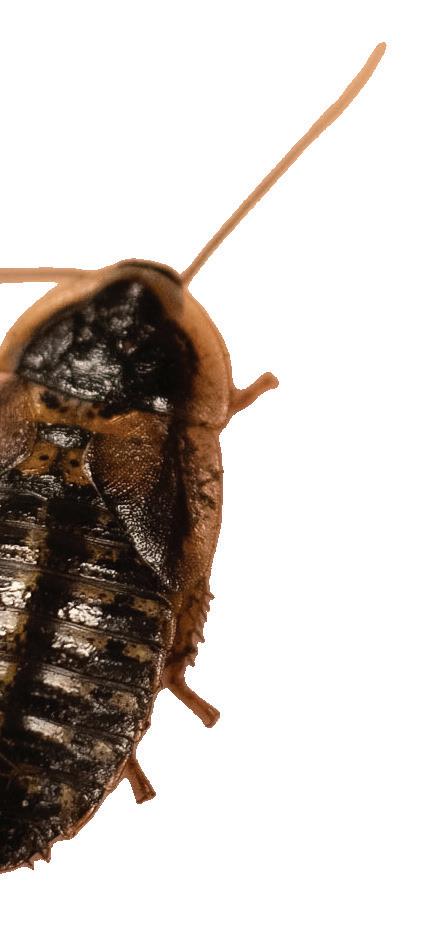
Next, the group shifted to a table with two dubia roaches. The roaches snacked on oats and rice, as their owner shared facts about their anatomy — telling the club-goers that although the males have fully developed
wings, they are fightless.
Members of the group expressed that, despite enjoying the company of most insects, they feel squeamish around roaches. One member hypothesized that it could be from watching others cower in the presence of the insect, instilling fear from an early age.

Entomology Club allows students, who entered the room as strangers, to connect with people over their shared love of insects.
“As an English major, the Entomology Club is an awesome place to explore my interest and learn about insects and other creatures. And the people are really cool,” club member Michaela Cobb said.
Entomology Club has become more than just a group to discuss bugs — for many, it has become a safe space where they feel they can be themselves.
“Even beyond the bugs, the people who come here are usually people who appreciate similar things,” Dolder noted, going on to explain that most group members enjoy all aspects of nature, not just bugs, and that they share one common value: kindness.
Although entomology focuses on the insect branch of zoology, many members of the club share a fascination for other terrarium pets such as reptiles. Fortunately for them, the club president brought out a ball python in the latter half of the meeting.
As the snake casually rested on the president’s shoulders, a group discussion about plans for adopting an insect in a sort of “class pet style” commenced. They tossed around ideas for terrariums, weighing the pros and cons for things such as death beetles, isopods, jumping spiders and tarantulas. The group plans to start on the terrarium soon.
The group will meet again this Friday, Feb. 27, in Flawn Building room 3.02.07 at 4:30 p.m. to build bug hotels.
Students rowdy up for Fat Tuesday
By C.L. Cotter Staff Writer
Students flled the Main Campus’ Student Union lawn as the 13th annual Rowdy Gras kicked off on Feb. 17. Rowdy Gras is UT San Antonio’s Mardi Gras festival; Mardi Gras is the fnal day of the Carnival season, a day of parade and feasting before the Christian fast of Lent begins. Despite its religious roots, people from all backgrounds celebrate “Fat Tuesday” for its delicious food, music and traditions.
On the Student Union lawn, several booths were set up for the students to enjoy. Near the front was a caricature artist, face painting and airbrush tattoos. Long lines of students anxious for their turn to receive their custom masterpieces quickly formed.
Rowdy Gras was MC’d by this year’s Spirit of The Road Runner recipients Abigail Navarro and Diamond Gomez. “My favorite event has always been Rowdy Gras, because it celebrates everybody,” junior biology major Navarro commented on the celebration. Navarro and Gomez crowned the 2026 Rowdy Gras royalty: UT San Antonio’s Senior Vice President for Advancement and Alumni Engagement Karl Miller-Lugo.
A photobooth had also been set up, with props of feathers and comically large sunglasses available as accessories. Despite challenges with wif, the photo fun did not cease. Other booths offered Cajun food and the holiday’s famous king cake, a change from the seafood


UT San Antonio to take
Aidan Moreno/ The Paisano
Carlos Craig/The Paisano
Ana Garces/The Paisano
ARTS & LIFE
‘Pillion’ exacts revenge on so-called love stories
By Cruz Delgado Managing Editor
As the pegasus takes its hero soaring into new heights, the motorcycle blesses its rider with the power to occupy spaces otherwise unattainable by humans, so long as the rider obliges to the bike’s terms of bondage: a helmet, a padded leather bodysuit, gloves and riding boots. In director Harry Lighton’s feature-length debut, “Pillion,” Alexander Skarsgård as Ray and Harry Melling as Colin embark on a journey of knee-quaking, world-gyrating BDSM carnality that brings audiences a love story built on power dynamics and forbidden romance.
Colin performs in a barbershop quartet with his father while his dying mother sets him up on blind dates; Ray tames the grim reaper every day as he embarks on his two-wheeled motor horse every morning. They come from two separate worlds, yet their souls are cut from the same cloth. Their compatibility becomes the driving force of a self-destroying, sub-dom relationship.
The pair do not display typical characteristics of affection — at least not to all other characters in the flm. At one point, Colin’s mom, Peggy, played by Lesley Sharp, voices her disapproval; she fails to understand why Ray thinks it is okay to talk to Colin the way he does.
However, the audience understands the love that comes
about from Colin’s servitude. In a montage wrestling scene set to Tiffany’s “I Think We’re Alone Now,” the couple laughs, smiles and indulges. In another scene, the pair shares a bed at night — atypical to the sleeping arrangement of Colin on the foor and Ray in the bed.
These moments offer a tenderness that tricks the audience into believing happiness may be on the horizon for Colin, yet the camera does not allow viewers comfort. Always angled from below or towards a corner of the room, the camera never provides a complete frame — Colin and Ray rarely share the screen except in the sparse moments of emotional intimacy.
Uneasiness crescendos when a romantically neglected, stiff-backed Colin steals Ray’s crotch rocket and skids out of the driveway, nearly ending his ride against a line of parked cars. A cut to a closeup shows the wind in Colin’s hair. The cuts continue, contrasting the typically shown elongated shots of Colin’s palm on Ray’s bikesuit. Colin rides without his confdence, Ray; the camera has lost its confdence. The two are soul-bound.
Eventually “Pillion” runs out of gas. The insightful visual storytelling and playful performances give way to the tired tropes of queer romance stories. Unfortunately for audiences, Ray’s timidness in intimacy may be Lighton projecting.
The restraint of “Pillion” keeps the audience outside
Letters from Urbino: ‘Do as the Romans do’
By Edmond Cartagena Staff Writer
Salve, UT San Antonio!
This week has been an exciting and adventurous one for UT San Antonio’s College of Liberal and Fine Arts’ students abroad. Trekking outside of Urbino, the class made their way to the heart of Italy: Rome. This Roman adventure allowed students to experience wonders of the ancient world, such as the Pantheon. Students have embraced this lively city by adopting the famous saying: “When in Rome, do as the Romans do.”
The busy city streets do not take away from Rome’s old-world culture at all. In fact, the boisterous nature of the busy city only makes the history more enthralling. Stepping inside the Vatican Museums proves that the passing of time only increases the lively city’s beauty. These museums house major works of art such as “The School of Athens” by Rafaello Sanzio and “The Creation of Adam” by Michelangelo Buonarroti; it also has accumulated artifacts from the Ancient
through the ancient Roman Forum makes one feel as if the once infamous empire never fell. Despite a history washed in blood, being within the walls of this “world wonder” serves as a place of refection for many. Standing in the center of the massive structure brings to mind the many lives lost for entertainment’s sake.
In contrast, the Roman Forum showcases the elegant lives of the ancient people. Their architecture was grand, and their lives artistically infuenced. It is apparent that this civilization valued nature and lived in tandem with the land, regardless of how grand their palaces and temples were. Although most ancient Roman buildings within the forum are nothing but ruins now, it is clear to see their values based on what they left behind.
All in all, Roman culture prevails within the beloved city through the food, culture and architecture. COLFA students were able to dive into history to make one very important observation: power does not mean longevity. What was once the Roman Empire is now a piece of the beloved country known as Italy. The history of Rome allows everyone to heed the warnings of what overexpansion and greed causes — why those attributes should be avoided in any nation, empire or kingdom. Rome stands as a warning that power can always be replaced. week, COLFA will be studying the city of Perugia. Tag along again next week and learn more about the beloved country of Italy! Follow @ lettersfromurbino on Instagram to check out exclusive pictures of COLFA’s adventures abroad.

Arrivederci studentesse!
of Ray’s psychology and only offers clues into Colin’s. The relationship remains a mystery, like Ray’s backstory, devoting audience members to rewatches and discussions about misconstruing love with sex and happiness. Through a heartwarming script and seductive visual techniques, Lighton delivers a bittersweet romance for the ages.

Unifying through music
By Johnpaul Buwule Staff Writer
The University Band, a group of student musicians at UT San Antonio, presented their latest recital: “Unity.” They stepped onto the stage from a door constructed to blend into the backstage walls. Forming a V-formation when walking up, the band circled the chairs and stands laid out across the stage. Some warmed up their instruments or adjusted their stands, and some waved to excited families in the audience. As students settled in, UT San Antonio Associate Professors of Music John Zarco and Ronald Ellis introduced the special guests: the John Paul Stevens High School and William H. Taft High School bands.
The University Band prepared to play the frst piece: “Nitro” by Frank Ticheli. Vacant spots flled the spaces between performers, creating an incomplete ensemble. A cascade of chaos ensued as the band incongruently warmed up. UT San Antonio Assistant Director of Athletic Bands and University Band Hector Garcia took to the stage, his presence commanding a silence from the band. With a seamless wave of his baton, the futes began the piece with a rushed, rhythmic tune as the tuba’s deep, giant-like thumps followed along. The arrangement heavily focused on the wind instruments. The brass and wind instruments engaged in a moment of dialogue before fnally coming together to end the piece.
Stevens High School conductor Ryan Williams stepped onto the podium to direct “Prelude, Siciliano, and Rondo” arranged by John Paynter. The Stevens students entered the stage, flling the vacant spot that encompassed the performers. Brass was the stand-out instrument here, permeating the room with their powerful blasts. The brass and wind again conversed, softly dancing among their notes, mimicking each other’s tune. The music casted a spell on the audience, capturing their gaze and
ears. The audience attentively listened to their methodical play. The music ended, and the high school students were met with thunderous applause as they stepped off the stage.
Without the Stevens students flling the seats, the gaps between the University Band students reappeared. Despite the incomplete feel, the band’s talent and skill resounded. Taft High School’s conductor Greg Nelson led “The Sun Just Touched the Morning” by Patrick J. Burns. The futes’ solo caused their melody to suffuse through the room, and the xylophone colored it. The song’s tune resonated with hope — the bittersweet ending of a story.
Parts of the band trailed off stage, and Stevens High School Conductor Emily Williams directed the piece “Kalos Eidos” by Carol Brittin Chambers. The song’s vibrancy brought to mind imagery of a rainbow kaleidoscope. The piece’s fast-paced yet calm nature mimicked the quickly changing color scheme of the hueshifting apparatus. A tone shift, signifed by the percussion’s river stream-like sound, introduced an instrumental melody that was calm but slower than before. The audience was even more reeled into the band, with some bopping their head to the rhythm.
The University Band, led by Garcia, took center stage for the fnale. They performed “Legacy” by Richard L. Saucedo. The piccolos were more prominent in this song, with their quick, high notes; the percussion set the tempo. Meanwhile, the band played around the star instruments.
The bands offered a solid, intriguing and entertaining performance. Even with small mishaps, the recital delivered emotions such as joy and hope. At the concert’s end, the college and high school students rose, the conductors stood at the left of the podium and the audience roared at the grandeur of the bands, while performers and conductors took in the praise.
WILLOW emerges from shadow: ‘petal rock black’
By Jaydon Dirig Contributor
WILLOW returns with “petal rock black,” her seventh studio album. Released on Feb. 16, “petal rock black” is fully self-produced by WILLOW and features a raw sound that transports listeners into her dark yet luminous world of refection.
This album stays true to WILLOW’s genre-bending tendencies. Featuring collaborations with George Clinton, Kamsai Washington and Tune-Yards, it takes listeners on a journey through the sounds of jazz-fusion, experimental pop and soul, with her controlled vocal delivery and inclusion of various instruments.
The album begins with “petal black rock,” as George Clinton recites an abstract poem flled with odd language: “Storm-smeared picture / Rust be the delirious scream” and “Through her luscious ache / Dreams a symphony we all soar on.” His voice, flled with grit and age, leaves listeners in search of meaning as WILLOW does throughout this album.
The sound of this 12-track album immerses listeners in WILLOW’s persistent solitude. The thin arrangements creep in with a spiritual-jazz sound that wrestles with a feeling she can not describe, as her vocals rarely peak but keep a steady tone.
WILLOW spent close to two years in isolation creating this album, composing every corner with distorted guitars,
vocal layering and live drums to develop a meditative soundscape that takes precedence over lyrics.
WILLOW’s vocal performance is indicative of the album’s tone, using her voice as a guide through a shadowy realm of seclusion. Her quiet yet controlled vocals at times blend seamlessly into a layered mix of the instruments. Her voice rarely dominates, letting instruments do the heavy lifting as if she moves with the instrumentals like the wind. WILLOW’s vocals show how contemplative this record really is.
Though some listeners may appreciate WILLOW’s commitment to the album’s sonic exploration, it may underwhelm. With the majority of the songs lasting only around two minutes and the album totaling 26 minutes, “petal rock black” fies by when listeners are casually listening. Some songs blend, with two or three songs able to go by sounding as if they are one. Yet this restraint seems deliberate, showing her confdence and maturity without letting quantity take over her art’s quality.
In the fourth track, “not a fantasy,” the arrangements can be heard meshing to make a track leaning into themes of acceptance and realization. The lyrics, “It’s not a fantasy to be who you are / It’s not a fantasy to live like the water does,” highlight WILLOW’s focus on authenticity and adaptability. A few lyrics that reinforce the album’s introspective tone encourage listeners not only to embrace themselves but also life’s natural course.
“Petal black rock” confrms WILLOW’s willingness
to explore different sounds and fnd independence as an artist without relying on one style. Its dark, spiritual vibe and jazz-leaning textures show growth and an overall confdence in her music, even when some tracks feel feeting or underwhelming. The album still succeeds in offering listeners a moody, intentional listen, delivering a thought-provoking, self-assured and sonically emotional experience.

Catherine Salonga/The Paisano


UTSA softball jumps out to 2-0 start in Roadrunner Classic
By Brad Millwater Contributor
SAN ANTONIO — UTSA softball beat the University of Massachusetts Lowell 4-3 then followed it up with a 4-3 comeback win against the University of Northern Colorado on Friday at Roadrunner Field.
Game One
UTSA freshman pitcher Arlette Hernandez struck out eight batters in four innings of relief, and the Roadrunners hit two solo home runs to defeat Massachusetts Lowell. Junior pitcher Meredith Schmitt started the game off well, but a Massachusetts Lowell rally in the fourth inning brought in Hernandez. With the game tied 3-3 in the sixth inning, freshman catcher Brookelynn Meador launched a ball over the left feld fence to score the winning run. Hernandez struck out the side in the seventh inning, giving the Roadrunners a clutch victory in their tournament opener.
“[Hernandez] is a star, a very well-put-together pitcher,” coach Vann Stuedeman said after the game. “I don’t think anyone, when she’s out there, doubts her for one minute.” Hernandez came into a tough fourth inning with the bases loaded. She helped the ‘Runners escape with three strikeouts, only giving up one run. In the ffth inning, with two outs and a runner on third base, sophomore infelder Makayla Madrid singled to bring home freshman outfelder Demiree Stafford and tied the contest with her second RBI of the game. Meador’s lead-taking home run and Hernandez’s pitching in the sixth and seventh innings ensured the Roadrunners’ victory. Hernandez’s performance on Friday continues her impressive start to the season, with 31 strikeouts in 32 innings pitched.

“I’ve been mainly taking care of my body, and I feel
amazing because I get to surround myself with an amazing group of people,” Hernandez said Friday night.
UTSA outhit Massachusetts Lowell 8-7. The ‘Runners’ pitchers had ten strikeouts, while the River Hawks only had four. Madrid led the team with two RBIs, and senior infelder Madison Hornback and Meador each had one.
Game Two
Down to its fnal out of the game in the seventh inning, UTSA had not yet scored a run against Northern Colorado. The Roadrunners mounted an improbable three-run comeback, with Stafford hitting an RBI single up the gap to tie the game and send it to extra innings. Freshman pitcher Aubrey Flores kept the game tied in the top of the eighth inning, and junior outfelder Taryn Madlock walked it off. Madlock singled and brought home junior outfelder Samantha Mundine from second base to score the winning run.
“I knew [the opposing pitcher] was going to come at me, and I just kept fouling off until I got my pitch,” Madlock said after the game.
The Roadrunners had been shut out all game. Three hits in the bottom of the seventh inning, from sophomore outfelder Skylar Rucker, Hornback and Stafford, tore the game from the Bears’ grasp.
“One of the things we’ve really been focused on this year is maintaining composure and confdence throughout the game,” coach Stuedeman said. “They felt it. They felt good about it and felt like we had a chance — a lot of hope.”
UTSA outhit Northern Colorado 8-7, and Roadrunners’ pitchers had six strikeouts to the Bears’ three. Rucker, Stafford and Madlock led the team with one RBI each.

roadrunner classic day two
By Aidan Moreno Contributor

Preview: Roadrunners head to San Marcos for duel with Bobcats
By Rylan Renteria Sports Editor
After sweeping Dallas Baptist University over the weekend, UTSA baseball is off to its best start in program history. Meanwhile, in San Marcos, Texas, Texas State University is off to a hot start of its own. The Bobcats are 5-2 after sweeping Niagara University, securing a rubber match series win over Gonzaga University and dropping a midweek game to Baylor University.
Rivalry games are always diffcult to predict. Whether one team is elite and the other is sub -.500, it doesn’t really matter. The only thing that matters when both teams hit the diamond is who hates the other side more. This is especially apparent when reviewing the last 10 meetings between UTSA and Texas State. The Roadrunners are averaging 10.3 runs per game to the Bobcats’ 9. In eight of the last 10 games, at least one side has scored doubledigit runs, and in six of those games, both teams have scored at least eight runs.
UTSA coach Pat Hallmark is 5-4 against Texas State since taking the lead job in June of 2019 and 3-0 in the past two years. Hallmark knows Texas State all too well, and he knows the environment his team is going to play in on Tuesday. Still, he maintains his team is up to the challenge.
“We’ll be ready. They’ll be ready too,” Pat Hallmark said. “They’re 5-2, so they’re off to a good start. They got some new personnel, a lot of new people. We’ve already started looking at them. They’ve got a big kid named [Manny] Salas in the middle of their lineup that’s really hitting the ball, and they’ve got one of [senior infelder Cade] Sadler’s old teammates hitting the ball a lot too.
“They can swing it. They’ll probably throw a lot of people, I hope. If they don’t, it means we’re not hitting them, but that’s typically how it goes over there. Both teams generally use a lot of arms.”
Much of the Bobcats’ success at the plate comes from their infeld. Salas, Texas State’s frst baseman, leads the team in hits (9) and batting average (.429). Shortstop Dawson Park and third baseman Chase Mora are the top two on the team in RBIs with eight and seven, respectively. Texas State is expected to start right-handed pitcher
Sam Hall on Tuesday. Hall got crushed by Baylor University last Tuesday, allowing four hits and a walk in fve batters faced. Considering the Roadrunners’ success at the plate against superior opponents, fans shouldn’t expect to see Hall for long.
UTSA will start senior pitcher Christian Okerholm, who through three appearances, has allowed one run and two hits while dishing four strikeouts.
Sophomore infelder Josh Arquette and sophomore outfelder Christian Hallmark lead the Roadrunners in RBIs after two weekends, with the latter selected as the American Conference Player of the Week for his efforts against the University of Illinois Chicago and Dallas Baptist. Fellow newcomer, junior outfelder Lane Haworth, leads the team in hits with 13. A large reason UTSA did not enter the season nationally ranked is that outlets were unsure how the Roadrunners would replace stars such as Mason Lytle, James Taussig, Zach Royse, etc. It’s still early, but Pat Hallmark attributes a majority of his team’s success to the play of frst-time Roadrunners and even some to those who don’t see the diamond.
“[They’re] important. It’s a part of the 7-0 start,” Pat Hallmark explained. “There’s guys on the bench that are good players, and I feel for those guys. When you’re 7-0, it looks like you’re doing everything right, but they’re on my mind, [players like] [senior outfelder] Garrett Gruell, Sadler, [senior outfelder Brandon] Bishop and [freshman infelder Aidan] Eschelman.
“Our bench has a lot of energy, and people don’t always realize it, but those same guys always providing the energy, they want to play. There’s some angst to play within them but they’re so mature and so selfess to bring the energy they bring. We’re grateful for those guys.”
There’s a lot to factor in for Tuesday. Winds are expected to blow out at speeds of 19 mph. Texas State will serve as the Roadrunners’ frst road test of the season. The matchup is sandwiched between an emotional series against Dallas Baptist and the Bruce Bolt College Classic, which might be a recipe for an upset. Still, at least on paper, there is little to suggest UTSA will lose on Tuesday.
Paisano Pick: UTSA 13, Texas State 10
UTSA softball infelder Katia Reyes (left) and catcher Makayla Madrid (right) versus UMass Lowell.
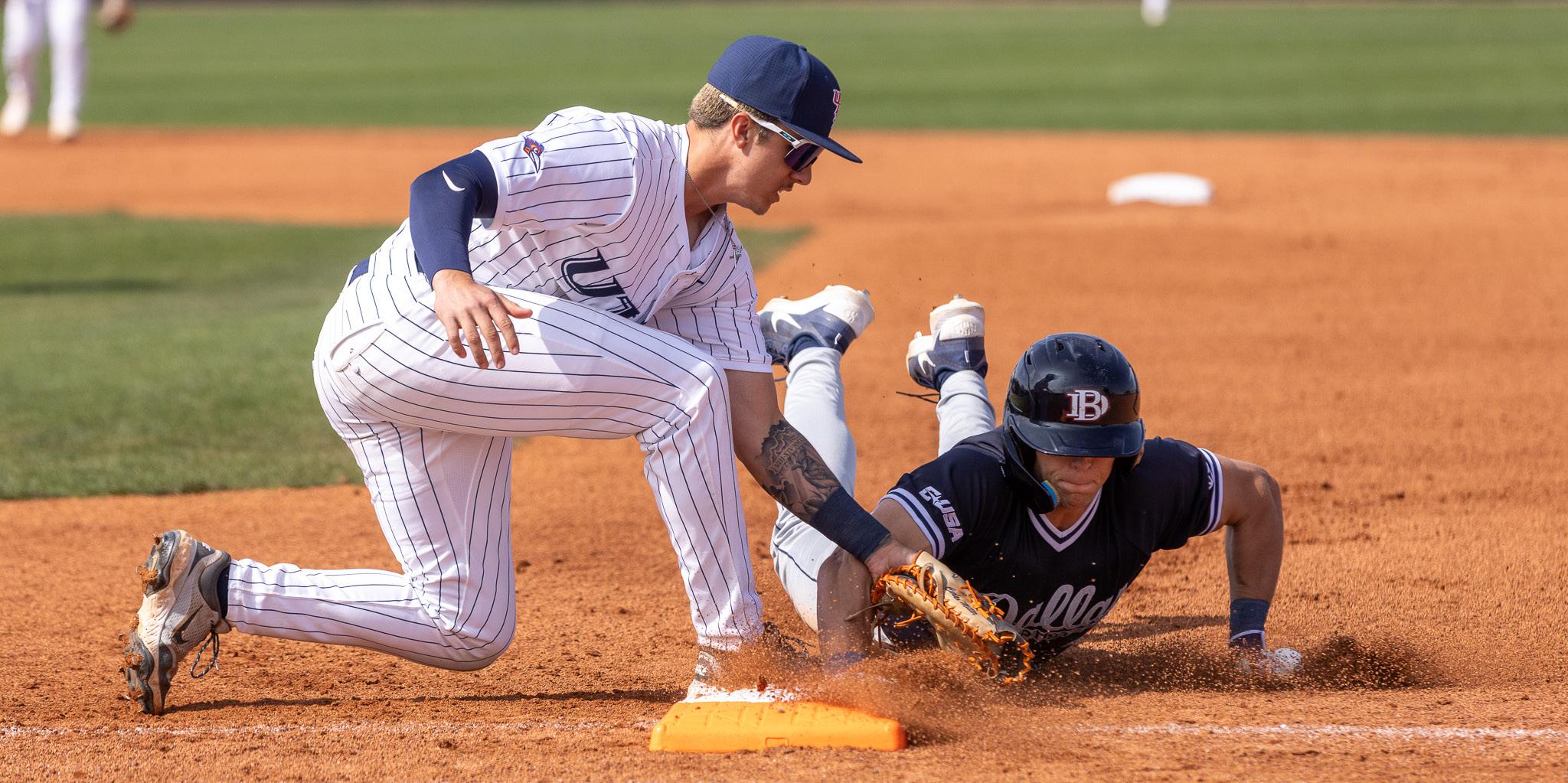
Ty Hodge and Jordan Ballin versus Texas State in 2025.
By Blue Mize Contributor
Ana Sofa Corral/The Paisano
Rylan Renteria/The Paisano
Ana Sofa Corral/The Paisano
utsa sweeps dallas baptist
By Aramis Santiago Assistant Sports Editor
UTSA baseball entered 2026 carrying the weight of expectation. A 47-15 campaign and a Super Regional run last spring raised the standard inside Roadrunner Field. The roster returned impact bats, added depth on the mound and looked built to contend again. Through seven games, however, the Roadrunners have not just met those expectations, but surged past them. UTSA is opening at 7-0 for the frst time in program history, and doing so by sweeping a Dallas Baptist University program that has made 11 straight NCAA tournaments and won 41 games a year ago.
Dallas Baptist did not arrive in San Antonio as a rebuilding team. The Patriots came in 4-0, armed with a lineup that featured catcher Adam Berghult, designated hitter Jake Bennett, infelder Chayton Krauss and a recent history of punishing UTSA. Sunday afternoon, however, they were left swept, outplayed in key moments and forced to watch a Roadrunner club that looked deeper and tougher than even its preseason believers imagined.
Game one
The opener set the tone quickly. UTSA erupted for six runs in the frst inning, forcing Dallas Baptist to play from behind immediately. Sophomore infelder Josh Arquette’s three-run triple ignited the crowd, and junior infelder Diego Diaz followed with a two-run home run that solidifed UTSA’s lead before many fans had settled into their seats.
When the Patriots clawed back within one, senior right-handed pitcher Sam Simmons steadied the game. He delivered 4.2 innings of one-run relief, attacking with a fastball inside that Dallas Baptist struggled to handle. With junior pitcher Robert Orloski sidelined after leaving Opening Day with a shoulder injury, someone had to handle the game’s most tense moments. Simmons did, limiting free passes and preserving a 12-8 win.
Game two
In windy conditions, the Roadrunners fell behind 7-4 entering the bottom of the eighth after a three-run frame

from Dallas Baptist. The Patriots had seized momentum, and with Orloski unavailable, UTSA was navigating another bullpen-heavy game.

The answer was immediate, as bases were stolen by runners following a foul out to move UTSA into scoring position. Sophomore outfelder Christian Hallmark worked a walk to load the bases, and sophomore utility Jacob Silva delivered a single to shallow center that scored one. Diaz was then hit by a pitch to bring in another run, tying the game, before freshman outfelder Nathan Johnson lifted a sacrifce fy to right to push the
Late game blunder holds Roadrunners in check at home
By Logan Martinez Assistant Sports Editor
SAN ANTONIO — Late-game defensive miscues stalled UTSA men’s basketball in its 6052 loss to Florida Atlantic University on Wednesday at the Convocation Center.
A 21-point performance from sophomore guard Baboucarr Njie was
nullifed by an inability to create consistent stops on the defensive end down the stretch. Trailing by six points with four minutes left in the second half, UTSA (5-21, 1-13 AC) failed to limit the Owls’(15-12, 7-7 AC) offensive output. A 6-0 Florida Atlantic scoring run effectively ended the

game in the last minutes, as UTSA never brought the game within striking distance. Njie desperately tried to will his team to victory, scoring 11 points in the second period. His efforts, while heroic, proved futile in the game’s conclusion. Though their defensive performance as a whole was respectable, the Roadrunners’ inability to produce stops in the later minutes held them back from earning their second conference win of the season.
“They’re a hard team to play catch-up with,” coach Austin Claunch said. “You can’t really speed them up. I thought we did the best we could down the stretch.”
The ‘Runners were only outscored 9-7 in the last four minutes. The team looked poised on the
offensive end, but a brief empty possession led to an Owl 6-0 scoring run late. The run put UTSA in a hole it failed to climb out of. Florida Atlantic’s backcourt duo of guards
Josiah Parker and Kanaan Carlyle held the ‘Runners in check down the stretch, scoring nine combined points in the process. The duo kept UTSA at bay, negating any points the Roadrunners worked for. The Convocation Center grew eager with each UTSA bucket, yet a brief blunder severely handicapped the team.
“I thought we got up good shots late,” Njie said. “The shots I made, and just the all-around offense, I think we got a lot of good looks. Like coach said, that 6-0 run really hurt us.” Njie was the only Roadrunner to break
‘Runners ahead. Sophomore utility Caden Miller would then draw a bases-loaded walk to extend the lead, before senior outfelder Drew Detlefsen capped the rally with a two-run single through the left side.
Rather than swinging for a miracle, UTSA forced Dallas Baptist’s relievers into deep counts, capitalized on walks and executed with runners in scoring position. The 10-8 win secured the series and pushed the program to its frst ever 6-0 start.
Game three
Sunday was controlled by junior right-handed pitcher Kendall Dove. Dove worked fve steady innings, staying ahead in counts and limiting a Dallas Baptist lineup that entered the weekend hitting .353 as a team.
Detlefsen set the tone with an infeld single and moved into scoring position on a wild pitch before back-to-back walks loaded the bases. Arquette shot a two-run single up the middle, and Hallmark followed with an RBI single through the right side to make it 3-0. Later, sophomore infelder Jordan Ballin ripped an RBI down the right feld line, as the Roadrunners consistently forced Dallas Baptist pitchers to execute with runners on base all afternoon. Late in the game, the Patriots brought the tying run to the plate, but senior right-handed pitcher Gunnar Brown closed it out to seal a 6-3 victory and the sweep. Seven games do not defne a season, and the schedule will stiffen quickly. The Astros Foundation College Classic awaits with matchups against Ohio State University, No. 6 Coastal Carolina University and Baylor University. Those contests will offer another measuring stick, but for now, UTSA has answered every early question. The lineup has shown balance, the bullpen has handled adversity and the team has demonstrated it can win slugfests and tight games alike. Expectations were high going into February, but a 7-0 start capped by a sweep of a national mainstay has raised the bar even further. The Roadrunners look like a club that understands who they are at the plate and on the mound. Through one week and a statement weekend, UTSA has looked every bit like a team intent on returning to the NCAA tournament.
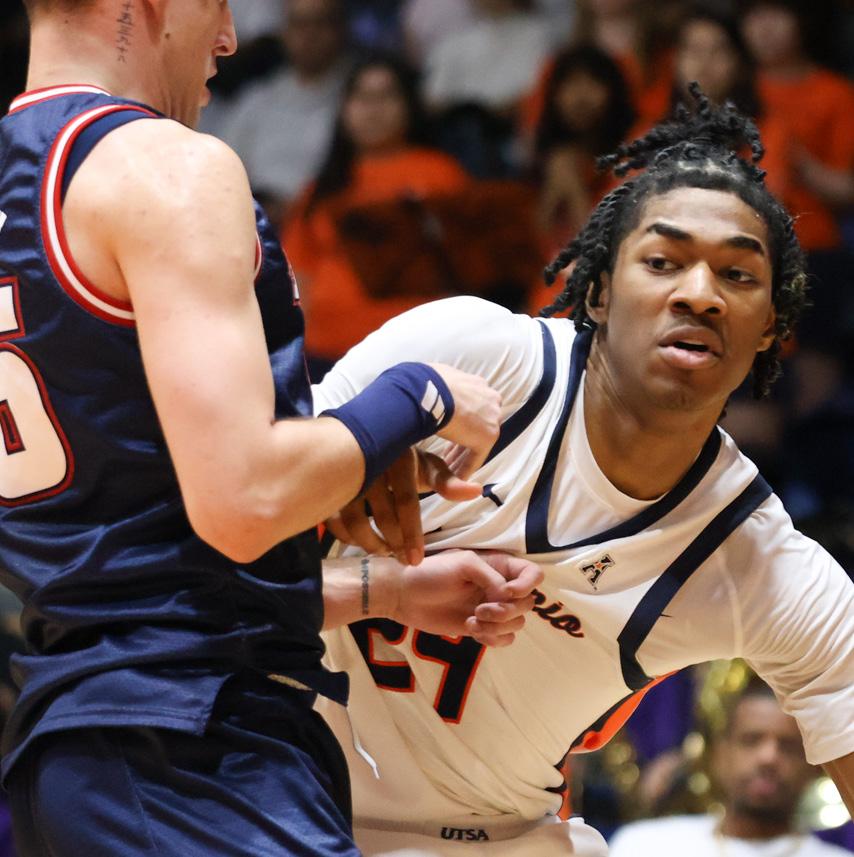
double-digits in the contest. The next highest scorer was senior guard Jamir Simpson, who put up nine points on 18 shot attempts. UTSA nearly beat out Florida in every statistical category, including rebounds 47-43 and bench points 29-2. The game’s opening half was a defensive slugfest. Both teams shot 30% from the feld and struggled to consistently score. The ‘Runners came out with a strong defensive intensity, limiting the Owls’ offensive output and creating fve turnovers in the period. On the boards, UTSA outrebounded its opponent 27-23. Njie led the team with 10 points, attacking the rim and getting teammates open. Putting together a small scoring run near the end of the half, UTSA headed into the break leading 2826.
UTSA baseball frst baseman sophomore Caden Miller tags out a Dallas Baptist base runner in the Roadrunners 10-8 win over the Patriots on Saturday at Roadrunner Field.
Rylan Renteria/The Paisano
Rylan Renteria/The Paisano
Sam Simmons versus Dallas Baptist on Friday.
UTSA guard Brent Moss versus Florida Atlantic.
UTSA forward Baboucarr Njie versus Florida Atlantic.
Jordan Gibreal/The Paisano
Ana Sofa Corral/The Paisano