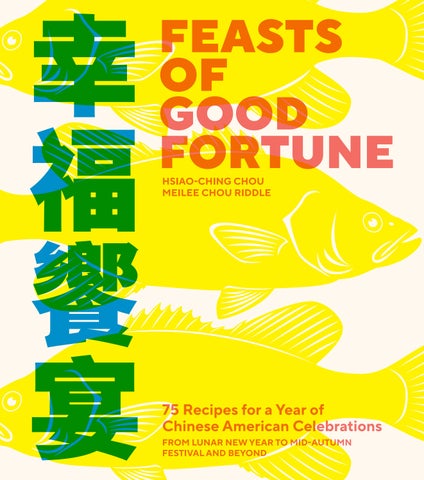
FEASTS OF GOOD FORTUNE
75 Recipes for a Year of Chinese American Celebrations, from Lunar New Year to Mid-Autumn Festival and Beyond
By HSIAO-CHING CHOU & MEILEE CHOU RIDDLE
Copyright © 2024 by Hsiao-Ching Chou and
Meilee Chou Riddle
All rights reserved. No portion of this book may be reproduced or utilized in any form, or by any electronic, mechanical, or other means, without the prior written permission of the publisher.
Printed in South Korea
SASQUATCH BOOKS with colophon is a registered trademark of Penguin Random House LLC
28 27 26 25 24 9 8 7 6 5 4 3 2 1
Editor: Jill Saginario
Production editor: Peggy Gannon
Designer: Tony Ong
Photographer: Clare Barboza
(Page 124 dragon boat photo © kingrobert/adobe.com)
(Page 159 winter photo © Francisco Little/adobe.com)
(Page 224 hot pot photo: Scott Eklund)
Styling: Clare Barboza and Hsiao-Ching Chou
Library of Congress Cataloging-in-Publication Data
Names: Chou, Hsiao-Ching, 1972- author. | Riddle, Meilee Chou, author. | Barboza, Clare, photographer. Title: Feasts of good fortune : 75 recipes for a year of Chinese American celebrations, from Lunar New Year to MidAutumn Festival and beyond. Hsiao-Ching Chou, Meilee Chou Riddle; photography by Clare Barboza. Description: Seattle, WA : Sasquatch Books, [2024] | Includes bibliographical references and index.
Identifiers: LCCN 2024009794 | ISBN 9781632175182 (paperback) | ISBN 9781632175199 (ebook) Subjects: LCSH: Cooking, Chinese. | LCGFT: Cookbooks. Classification: LCC TX724.5.C5 C57192 2024 | DDC 641.5951–dc23/eng/20240312.
LC record available at https://lccn.loc.gov/2024009794
The recipes contained in this book have been created for the ingredients and techniques indicated. Neither publisher nor author is responsible for your specific health or allergy needs that may require supervision. Nor are publisher and author responsible for any adverse reactions you may have to the recipes contained in the book, whether you follow them as written or modify them to suit your personal dietary needs or tastes.
ISBN: 978-1-63217-518-2
Sasquatch Books
1325 Fourth Avenue, Suite 1025 Seattle, WA 98101
SasquatchBooks.com
For Meilee: May this experience anchor you to our love for you.
—
HSIAO
-CHING CHOU
To my cousins, my built-in companions, whose presence has made life’s journey all the more laughter-filled and meaningful.
MEILEE RIDDLE

Connecting with Chinese Traditions
44 Lunar New Year
55 Crispy Spring Rolls VEGETARIAN
57 Pork and Chinese Cabbage Dumplings
60 Vegetable Potstickers VEGAN
63 Scallion Pancakes VEGAN
64 Lucky Mixed Vegetables VEGAN
65 Stir-Fried Rice Cake with Chicken and Vegetables
66 Stir-Fried Romaine VEGAN
68 Rice-Cooker Sticky Rice with Chicken and Chinese Sausage
69 Garlic Shrimp with Gai Lan
73 Meilee’s Stir-Fried Chicken
75 Steamed Ginger-Scallion Branzino
77 Winter Melon Soup VEGETARIAN
79 Hoisin Beef with Snow Peas
80 Lantern Festival 86 Tang Yuan Dough VEGAN
87 Red Bean Tang Yuan VEGAN
88 Black Sesame Tang Yuan VEGETARIAN
Chicken and Mushroom Tang Yuan
Pork and Chinese Chives Tang Yuan
Qingming Festival
Fruit Platter VEGAN
Scallion Pancake Rolls with Chinese Barbecue Duck
Steamed Spinach Dumplings VEGAN
Braised Tofu with Vegetables
Stir-Fried Asparagus with Shiitake Mushrooms VEGAN
Rice Vermicelli with Vegetables VEGAN
Mini Lion’s Head Meatballs 112 Stir-Fried Edamame with Shrimp
Easy Salt-and-Pepper Shrimp
Everything Fried Rice
West Lake Beef Soup
Stir-Fried Fish Balls and Vegetables
Boat Festival
Plain Zongzi VEGAN
Bean Zongzi VEGAN
Vegetable Zongzi VEGAN
and Chinese Sausage Zongzi
Red-Braised Pork Belly Zongzi
Flaky Red Bean Mooncakes
Chicken with Carrots and Mushrooms
Asian Pear and Pomelo Salad with Chili Crisp Vinaigrette VEGETARIAN
Barbecue Duck Soup with Pickled Mustard Greens
Beef with Pickled Jalapeños and Spiced Tofu
Sweet Potato Fritters VEGAN
Clams with Aromatics and Chinese Black Beans
Savory Dungeness Crab
Egg Drop Soup with Dungeness Crab
and Leek Dumplings
Gingery Chicken Wonton Soup
Celebrating Our Mixed Culture
168
Birthdays and Party Bites: Long-Life Noodles or Chocolate Cake?
174 Stir-Fried Long-Life Noodles with Chicken and Vegetables
176 Long-Life Noodles in Broth
178 Tofu Poppers with Chili Crisp VEGETARIAN
179 Wok-Charred Garlic Broccoli VEGAN
181 Super-Garlicky Baby Bok Choy VEGETARIAN
183 Sweet-and-Sour Baby Back Ribs
184 Popcorn Chicken
186 Saucy Chicken Wings
187 Cream Cheese Wontons with Crab
191 Pork and Shrimp Fried Wontons
193 Chinese-Bakery-Inspired Cupcakes with Fruit VEGETARIAN
196 Stir-Fries Make Great Holiday Side Dishes
200 Dry-Fried Okra with Chilies and Goji VEGAN
202 Dry-Fried Green Beans VEGAN
203 Chinese Chives with Mushrooms VEGAN
205 Wok-Charred Brussels Sprouts with Smoked Soy Sauce VEGAN
206 Garlic Eggplant VEGAN
209 Braised Chinese Cabbage
210 Braised Daikon VEGAN
213
Stir-Fried Escarole with Shiitake VEGAN
214 Stir-Fried Kale with Dried Cranberries VEGAN
216 Hot-and-Sour Taiwanese Cabbage VEGAN
218 Stir-Fried Shoestring Potatoes VEGAN
220 Hot Pot Is a Melting Pot
225 Vegetarian Hot Pot VEGAN
226 Chinese-Style Chicken Broth
227 Spicy Broth
230 Mushroom-Tomato Broth VEGAN
231 Yin-Yang Hot Pot
232 Meat Lover’s Hot Pot
233 Seafood Hot Pot

Why This Book
MOM SAYS
“When can we get together with the cousins again?” My daughter’s voice was flled with longing for a family dinner we wouldn’t be able to host for an unknowable period of time. Lunar New Year, birthdays, Thanksgiving, Christmas, all the celebrations that mark the passing of the year suddenly changed shape when a virus shut down the world. What we valued about the togetherness of a shared meal sharpened when the ability to gather evaporated.
As a parent, I never know what practices and traditions stick with my two kids and their fve cousins. Teenagers are especially inscrutable. So Meilee’s wish for dinner with our extended family broke my heart because I didn’t know how long the pandemic would restrict our lives. And it also signaled that all the past dinners had imprinted their memories in her consciousness. In a painful moment, I found hope—and the seed for this book. I can share recipes and their stories through the recipe headnotes. But passing on traditions requires someone to receive them with intention. It’s also the responsibility of the bearer to invite the next generation into the narrative, to make space for the perspectives of those who will carry on our histories.
Conversations with Meilee taught me that she and her Asian peers constantly grapple with bias in subtle and blatant ways, struggle with
their mixed-race identities, and are fguring out their social justice voices. In the midst of the fght, food is where they meet to fnd joy and deliciousness. Co-creating this book with Meilee means she can fnd herself in the story and explore future evolutions of herself without fear of losing her way. Meilee, her brother, Shen, and all their cousins are mixed-race. The experiences of this generation of young people and how they bond through food are important to how we talk about celebrations.
The phrase in Mandarin, 團圓, or “tuan yuan” (tuan = together and yuan = round or circle), signifes the act of coming together for a family meal, especially around the holidays. Feasts of Good Fortune is about tuan yuan meals and the roundness they bring to families and friends. I’ve featured Lunar New Year menus in both Chinese Soul Food and Vegetarian Chinese Soul Food but haven’t gone beyond that to share the symbolic foods and traditions of other holidays. If my frst two books were “on-ramps” to everyday Chinese home cooking, this book on celebrations completes the story.
We also want to acknowledge that how we honor traditional holidays is very much infuenced by where we live. I was born in Taipei, Taiwan, but I grew up in the United States in the Midwest, and I’ve now lived more than twenty years in Seattle, Washington. Meilee was born in Seattle and has grown up in this place
known for wild salmon, Dungeness crab, and roadside blackberry brambles. She can dispatch a Dungeness crab with stunning swiftness! Our culture and family are forever hyphenated and so are many of the ingredients we use to make the foods we like.
The older I get, the farther away I feel from the place where I was born. That distance morphed my relationship to traditions my parents used to practice when my brothers and I were kids. I have to reach deep into my memory banks to connect with moments where
MEILEE’S PERSPECTIVE: A YEAR IN THE LIFE OF MY FAMILY
In our Chinese American family, every year holds countless celebrations big and small. These celebrations aren’t just dates on a calendar; they’re the moments that will stick with us forever. No matter the time of year, our home is filled with the flavors, sights, and sounds of both Chinese and American traditions. I’d like to tell you about a year in our house and just a few of our celebrations, from Lunar New Year’s vibrant red lanterns to Thanksgiving’s huge feast.
We begin every January ringing in the new year with our latest goals and resolutions, trying to start it of on the right track. My dad cleans up the house and makes sure we start things organized while my brother and I grasp to our last few days of from school. Lunar New Year typically falls between midJanuary and mid-February. Lunar New Year is probably one of the biggest celebrations of the year. Preparation begins at least a week in advance. My mom begins planning a menu, making sure she hits everyone’s favorites. Then she and my grandma head to the local Asian market. To paint a picture for those who are unfamiliar, imagine grocery stores around Thanksgiving or Christmas. It’s intense. Lots of the elderly Asian people are up bright and early to stock up on everything from meats to vegetables to red envelopes and decorations. Everyone is on their own mission to create a feast to start the new year of right. My mom starts cooking a few days in advance.
March and April mark the changing seasons. We celebrate the beauty of the Pacific Northwest as it transitions. I am very lucky to live in an area surrounded by nature. I can look out my window every day and see the trees changing, hear birds chirping, and smell the salty bay.
In our extended family, we have at least three birthdays in May. My mom always marks her birthday with a classic chocolate cake. Whether I make it for her or we order it from a fancy bakery, she is content regardless. My brother likes to spend his birthday with his friends. Each year, the celebration gets more and more high-tech. He evolves with technology. The last birthday in May is my cousin Lucie’s. For most birthdays on my mom’s side of the family, we default to a night out at Din Tai Fung. Our buzzing group of thirteen fills the restaurant to the brim with love, laughter, and memories.
June is the end of school! My brother and I are always excited and ready to embrace summertime and the freedom that comes along with it. On top of that, my lau lau’s (“lau lau” describes the maternal grandmother) birthday falls on a diferent day every year depending on the lunar calendar. I admire how she lives her life simply: wake up, garden, take photos of plants, write her blog, watch Asian dramas on YouTube, sleep, repeat. She doesn’t mind the simplicity after a long life full of beautiful chaos.
we honored our ancestors or picked through our favorite mooncake favors. Lunar New Year has always been the main holiday, flled with pomp. Without intention, holidays can become afterthoughts, and I don’t want that to be the case. So here we are. I hope Feasts of Good
Fortune is a reminder of the moments we have throughout the year to come together. And that it bridges the nostalgia with the futures that live in my kids and their peers.
—HSIAO-CHING CHOU
Each Fourth of July, my dad’s side of the family comes together at my aunt Julene’s cozy Camano Island cabin. My uncle Joe, who’s married to Julene, guides us as we embark on our crabbing expedition to catch our feast for the night. We look out onto the waters, trying to find the buoys until, finally, the vibrant green and orange stripes catch our eye. After pulling on the rope for what feels like ages, our bounty of crab emerges. We boil the freshly caught crabs and serve them alongside sizzling steaks and plenty of sides. The meal sets the stage for a memorable Fourth of July tradition, complete with neighborhood fireworks to light up the night.
September is a busy month. My brother and I go back to school, which is always chaos. We are bombarded with back-to-school forms and the ache of getting up early in the morning. My parents celebrate their anniversary, and shortly after is my dad’s birthday (he hates getting older). September also marks the Mid-Autumn Festival. My mom and grandma will bring home mooncakes from our local Asian grocery store. We don’t eat a ton of them or celebrate too extravagantly for that matter. But we do have our mooncakes and recognize being together and being thankful for the things we have brought into our lives.
October is the beginning of the American holiday season. My birthday is October 3, so it is always nice to celebrate my day. In my family we pick a restaurant to go to for birthday dinners and
I typically pick Asian or Italian food. Halloween is always a fun celebration. No matter how old I am, I have a lot of fun dressing up and creating costumes. It’s something I have loved to do my whole life—not to mention having candy all night, which is a treat for anyone.
November is known as a month to be thankful. Around Thanksgiving, my family and I head up to Whistler to meet with family friends. We aren’t big skiers, but playing in the snow is an infrequent activity in Seattle, so we do like to take advantage of Whistler’s slopes. For Thanksgiving dinner, each family brings their favorite dishes, and we all cram into the Woodman family’s hotel room for the potluck. We never stick to a specific kind of food: the past few years, it has been a mix of turkey and sides; or bo ssam (Korean-style pork shoulder), rice, and lettuce wraps. Not exactly traditional, but delicious.
The final celebrations wrap up in December. Christmas also happens to be my yeh yeh’s (grandpa Claude Riddle’s) birthday. He’s my dad’s dad, and he has lived a very long and full life. On Christmas 2023, he turned 100. Soon after Christmas comes New Year’s Eve. It’s a time to reflect on the past year. I love being able to look back at all the memories I have made over the years. Celebrations big and small, they’re all meaningful for me.

Introduction
Welcome and hello! Let’s ground ourselves frst. Yes, Feasts of Good Fortune is about the holidays and events we celebrate in our Chinese American home, and we’ve categorized recipes accordingly. But you can make these dishes when you feel like it and in whatever combination you’d like. We’re not going to be precious about it. The Stir-Fried Romaine (page 66) or Garlic Shrimp with Gai Lan (page 69), for example, are great anytime. In fact, 95 percent of the dishes in this book might appear on our table on a given weeknight. So feel free to use this as an everyday cookbook as much as a reference for a few major Chinese holidays.
Why are we starting here? Because we’re human. We all sometimes feel like we need permission to stray from generations of cultural practice—or the printed word. We’re forgiving of ourselves for not following traditions to the letter and, by whatever power our position grants us, we extend to you the same consideration. We want joy and deliciousness in the kitchen, not baggage and guilt.
At the end of the day, what’s most important about any celebration is the act of getting together to honor the moment and the people present—or those who have passed—and to share a bite. There are any number of factors that can affect how you celebrate: maybe it’s a lean year and you don’t have a lot of resources to afford an extravagant feast; maybe you can’t travel to be with your people and you have to raise a toast from afar; perhaps schedules don’t align and you
have to postpone your gathering. Whatever the circumstances, there’s a way to mark the day without putting the pressure on you and yours to make it “perfect.” This is most defnitely not that kind of book. If you have the capacity to make it all, go for it! If you use this book as nothing more than a guide and end up buying all the foods from a nearby Chinese restaurant, you will get no judgment from us. You do you.
For this book, we want to be clear that our perspective is a kaleidoscope. Turn it one way, you get our family’s Chinese roots. Turn it again, you’ll taste Taiwan. A few more degrees around the scope, and the Pacifc Northwest shows up. Freedom threads itself throughout our recipes— to experiment, to be resourceful, to be true to your circumstances. Dare we say that the instinct to do as we wish is very much American? We’ve always believed in making it easier for people to connect with our culture. Wade into some of the traditions with us, and if you want to go deeper, there are many excellent books that will guide you into the thousands of years of cuisines and culture of China, Taiwan, and the diaspora.
THE CALENDAR
To situate yourself around the ebb and fow of the holidays we talk about in this book, you’ll need to have a basic understanding of the lunisolar calendar. This is different from the “regular” or Gregorian calendar that we’re all
used to. It’s a common mistake to describe the Chinese calendar as a lunar calendar— we’ve referred to the lunar calendar for as long as we can remember. It’s technically the lunisolar calendar, which follows the moon phases and the time of the solar year. The lunisolar calendar consists of twelve to thirteen months, with a leap month every several years to keep it from falling too far behind the Gregorian calendar. Strictly following the lunar cycles would eventually create too much of a discrepancy with the Gregorian calendar.
According to the famous Theodora Lau in her classic The Handbook of Chinese Horoscopes, the lunisolar calendar originated in 2637 BCE during the reign of Emperor Huangdi—the Yellow Emperor—who was known for uniting many warring tribes and ushering in a new age of civilization.

In 2023, there was a leap month and the lunar second month repeated. (In 2020, the fourth month repeated and Lau Lau—Meilee’s grandma—got to celebrate her seventy-eighth birthday twice!) Each month begins when the moon lines up with the earth and the sun. There are twenty-nine or thirty days in each month. Historically, this calendar was like an almanac
and helped to guide farmers on when to plant their crops. It was also used to help set wedding dates and other milestones, such as when to start a new project or when to travel. As a result, all the festivals and holidays follow the lunisolar calendar. To know when a holiday takes place, you need to know how to read a Chinese calendar. Or do what we do and search online for the date of a given holiday.