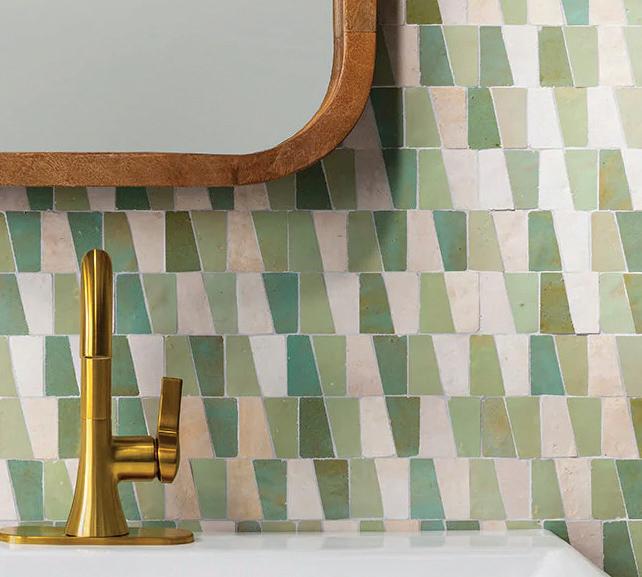
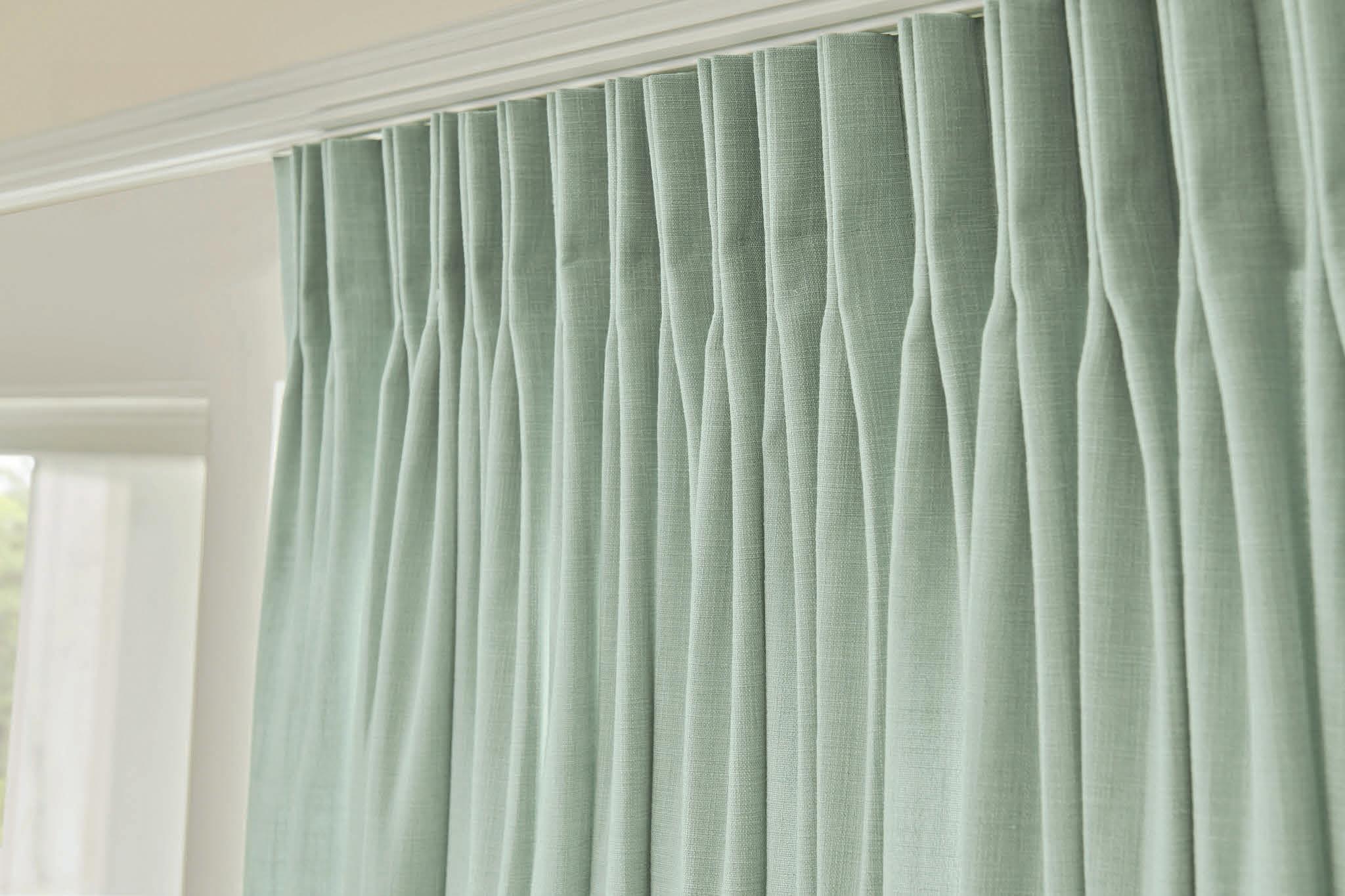
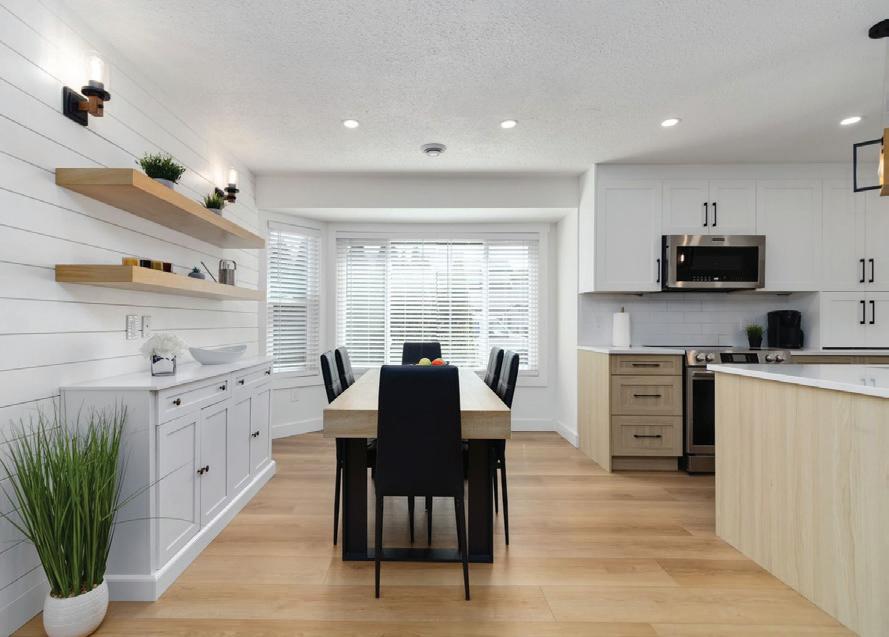
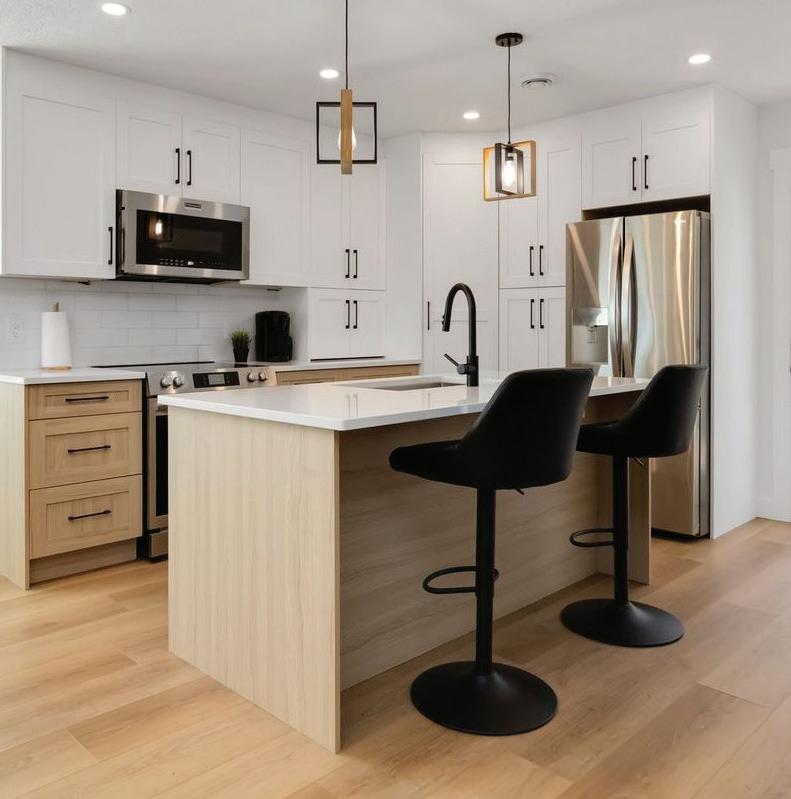
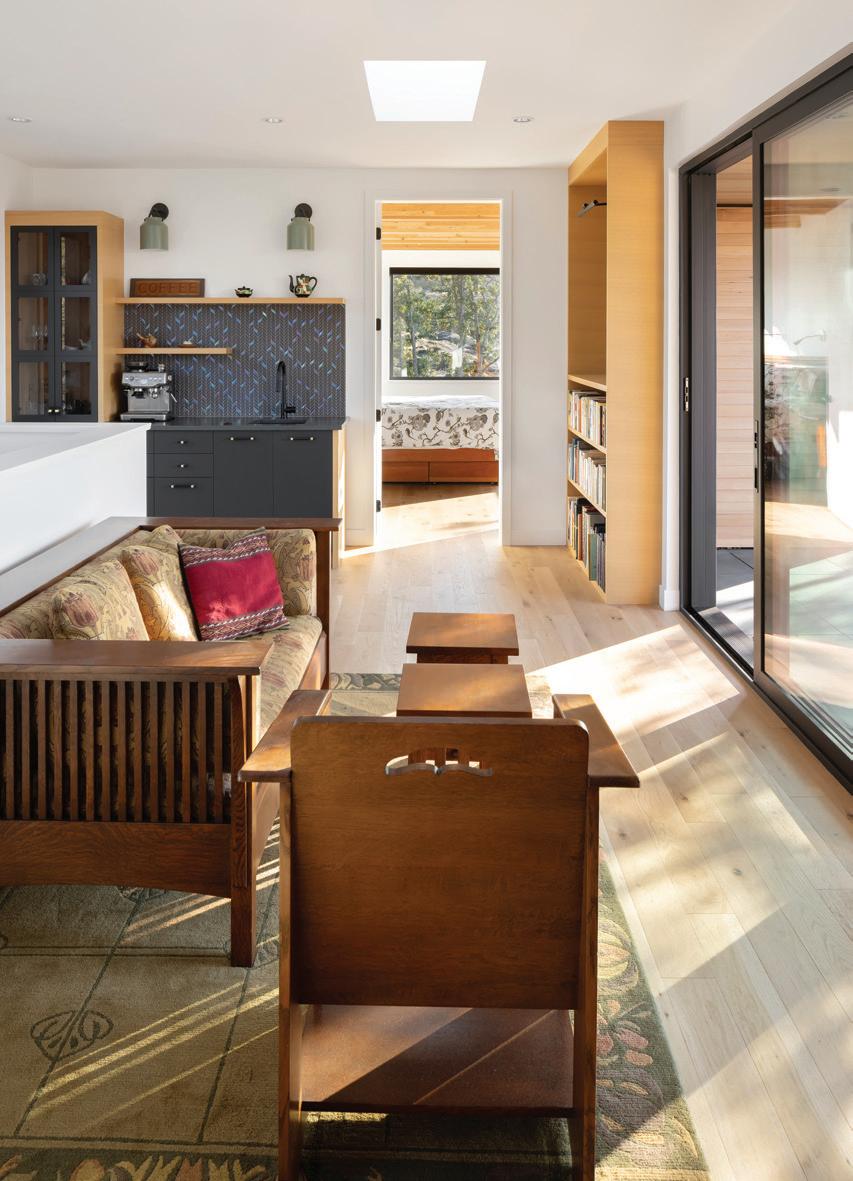
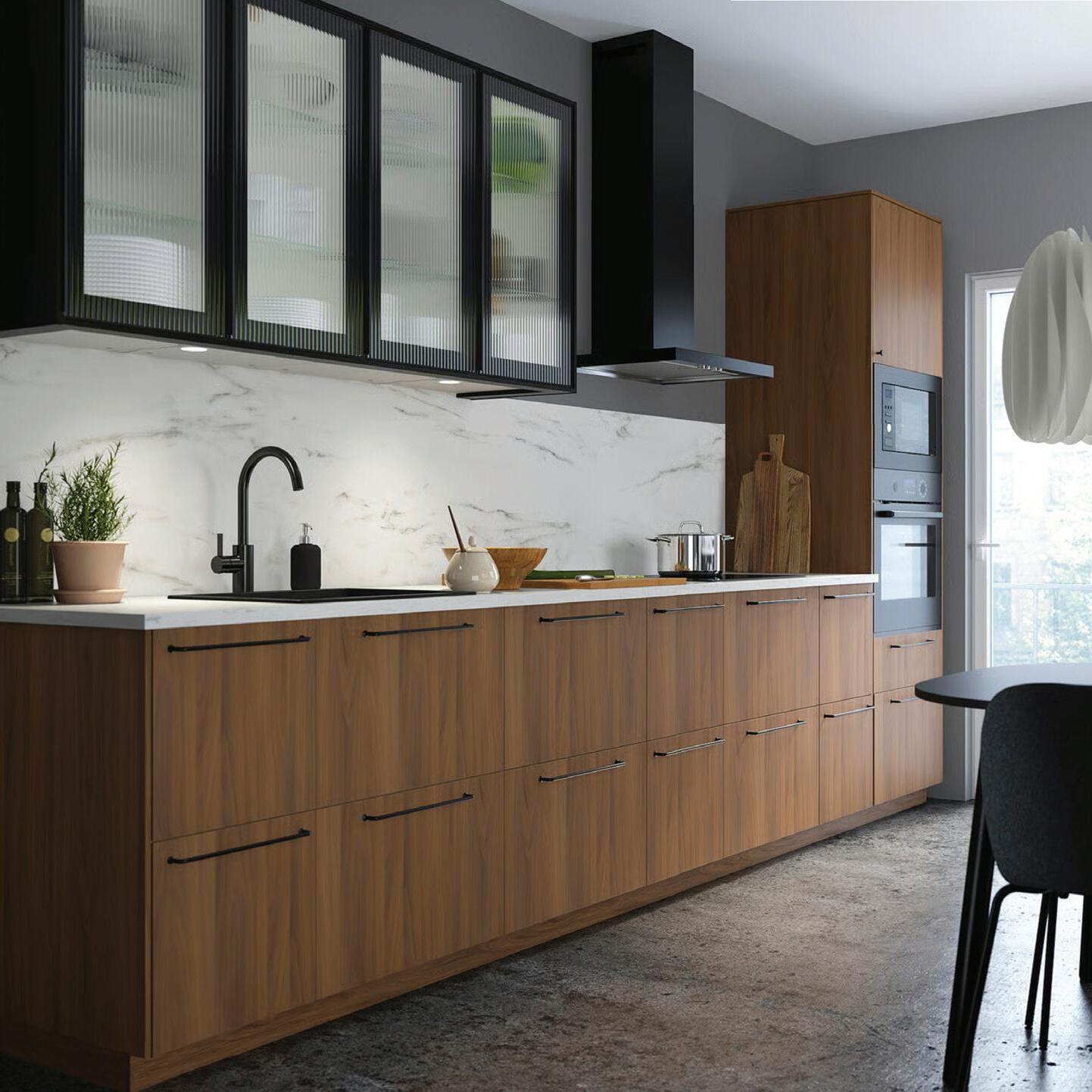
Bored with white subway tiles? Replace them with colour, texture and exciting new shapes. BY JULIEN JOHNSTON-BREW
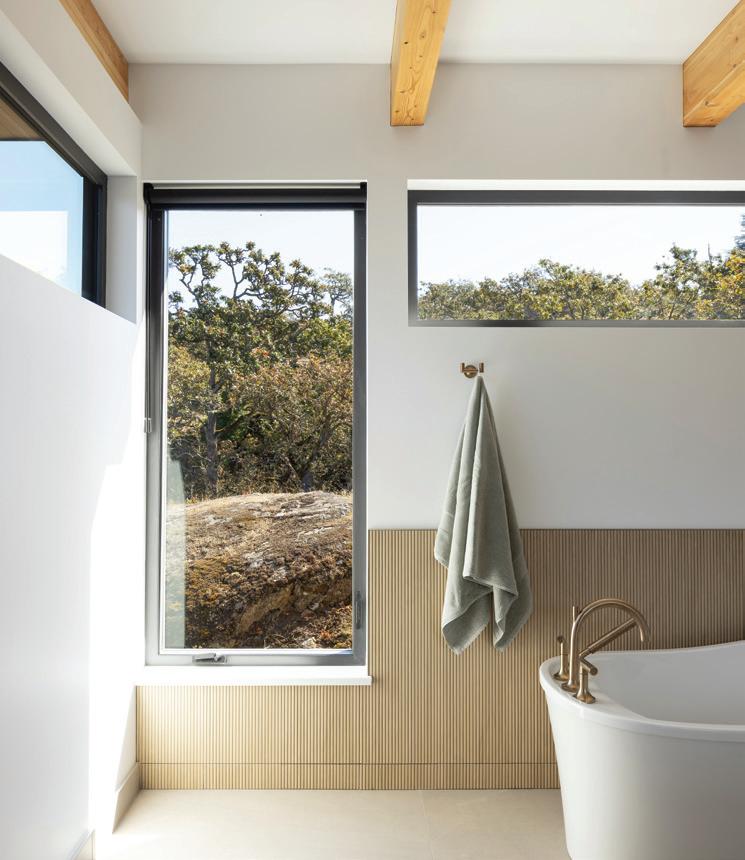
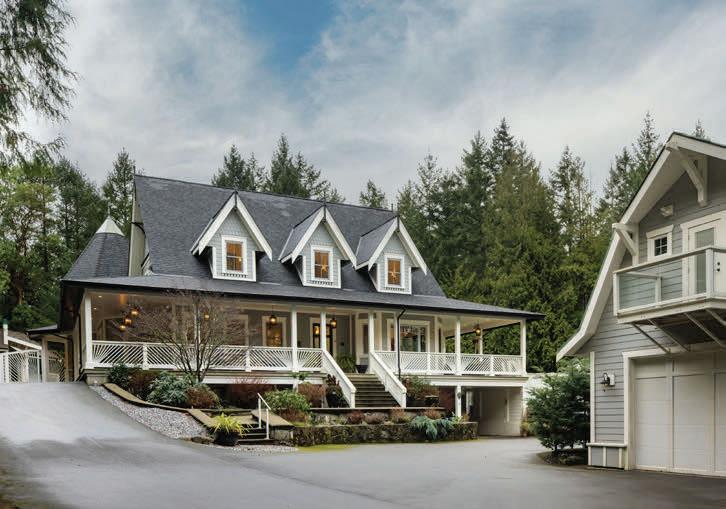
From its aerie atop Mount Tolmie, this stunning new build makes the most of its rocky location — and one incredible view.
BY JULIEN JOHNSTON-BREW
BEST LAID PLANS
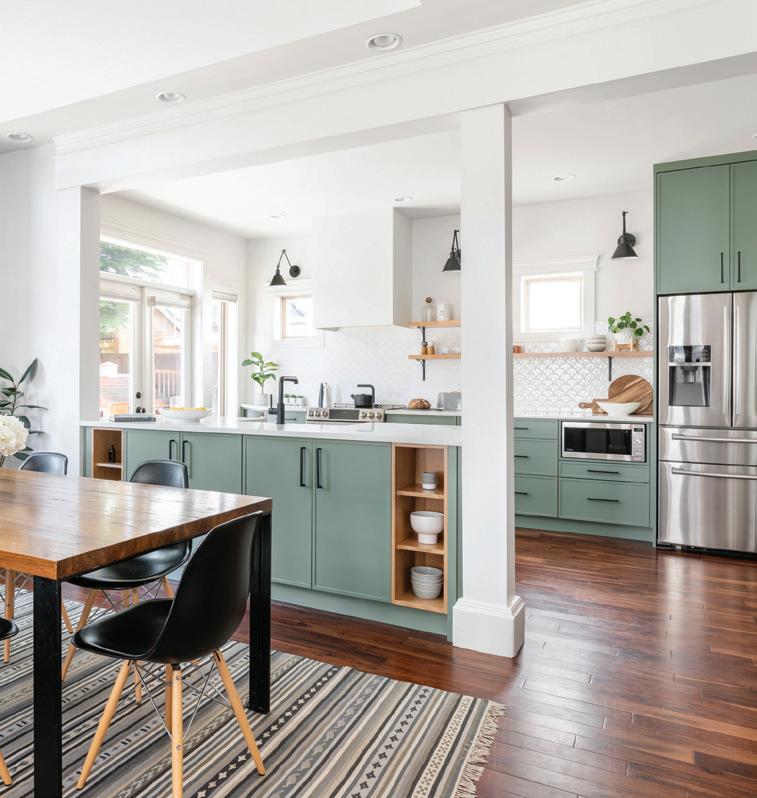
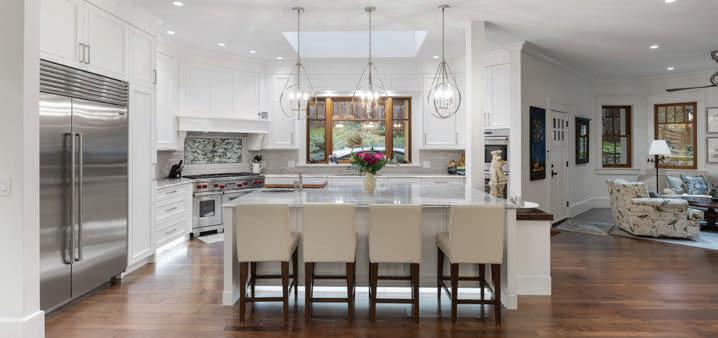
Before you start your kitchen reno, discover which of these seven floor plans works best for you. BY JOANNE SASVARI
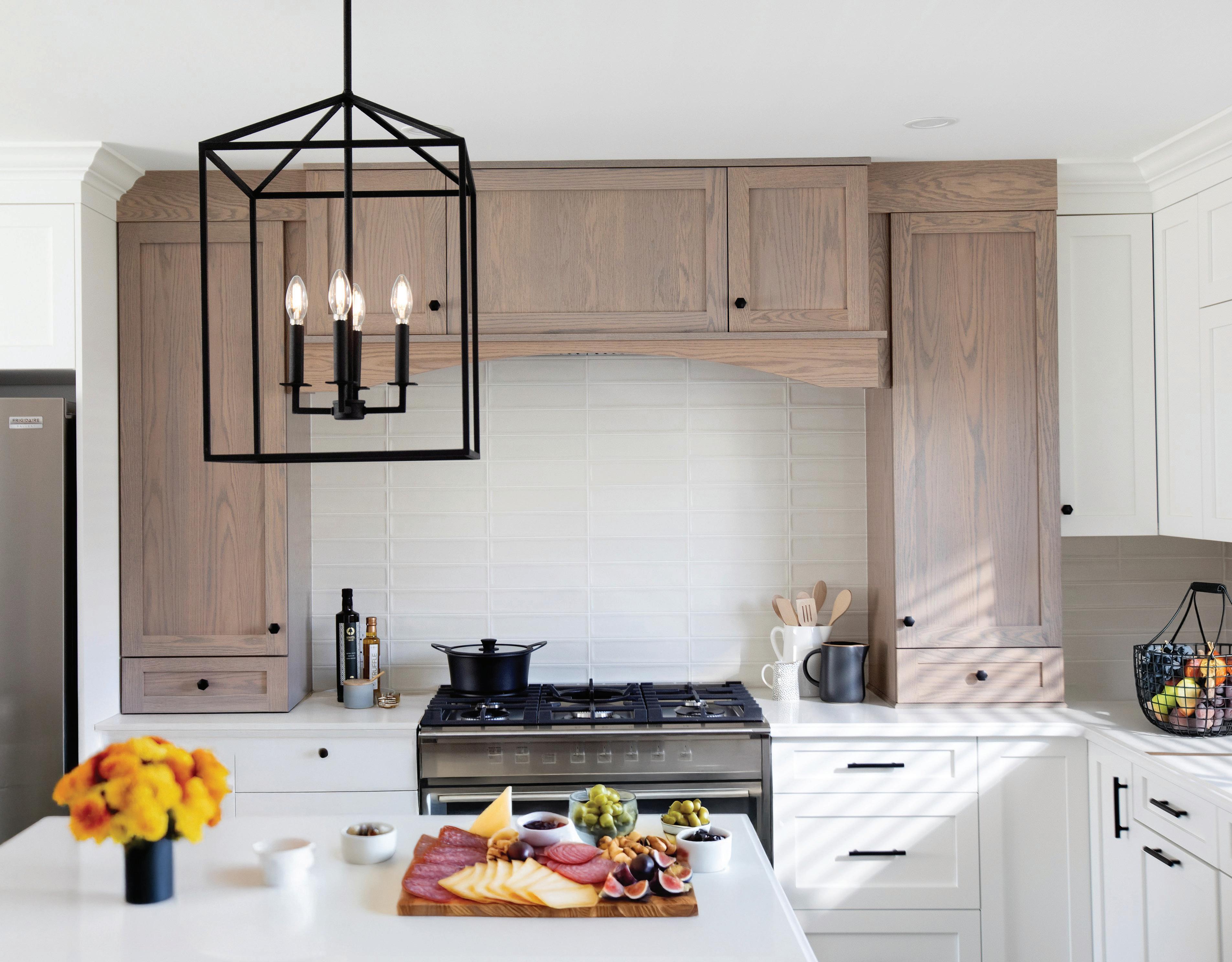
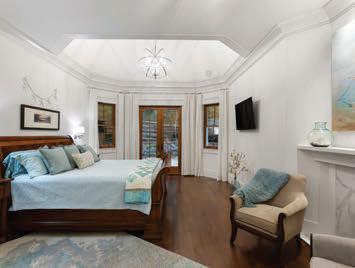
A thoughtful condo renovation makes the most of every inch in this serene space.
BY JOANNE SASVARI
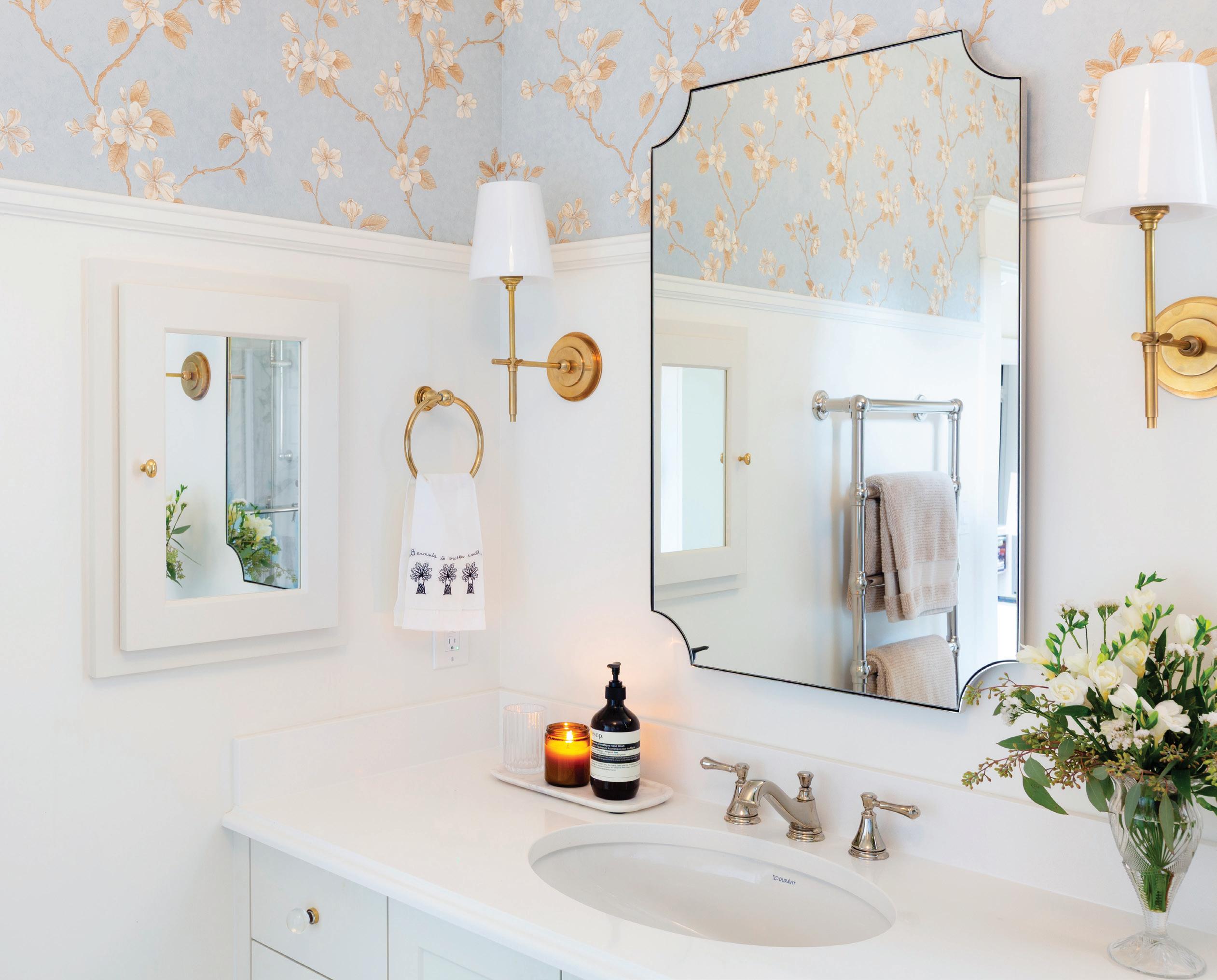
An Oak Bay bathroom’s new look has charming vintage appeal. BY JULIEN JOHNSTON-BREW
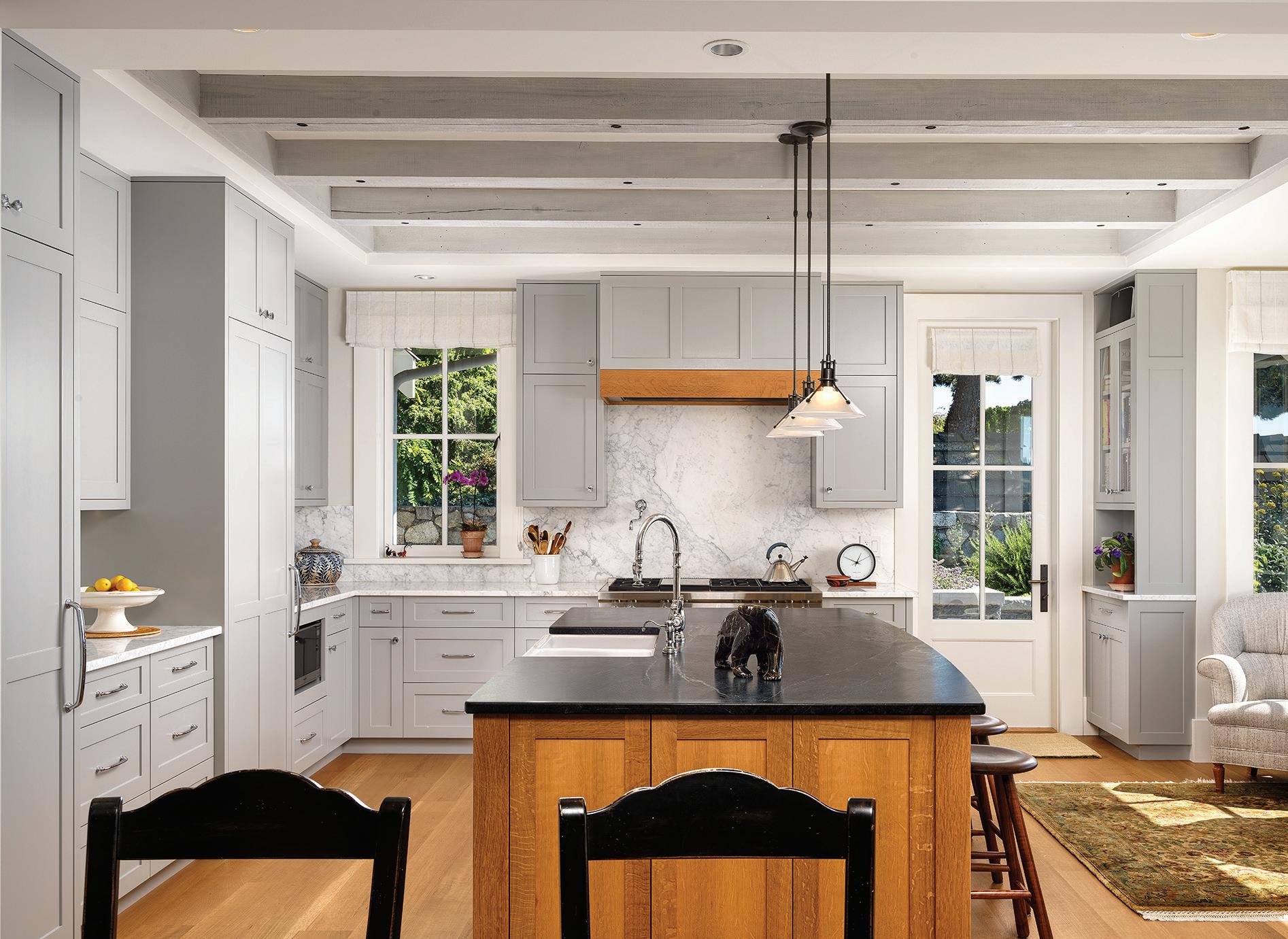
A chic powder room in velvety black; Sooke’s master of marquetry; pendant perfection; a blushing new neutral; why sheen matters; a cooktop to consider; Reading Nook; why you should take a second look at your doorbell cam.
14 DESIGN INSPO
Yearning for Paris in springtime? Here’s how to bring it to your backyard. BY SPRUCE STAFF
50
Install your own baseboards — if you have the courage and the tools to do it right.
BY CAROLYN CAMILLERI 52
It’s the conversation no one wants to have. Why you should talk to your senior parents about their housing. BY SHANNON MONEO
How to start seedlings inside now for garden bounty later. BY CAROLYN CAMILLERI 56
We ask Ugly Duckling chef Corbin Mathany for advice on creating multi-course meals. BY JOANNE SASVARI
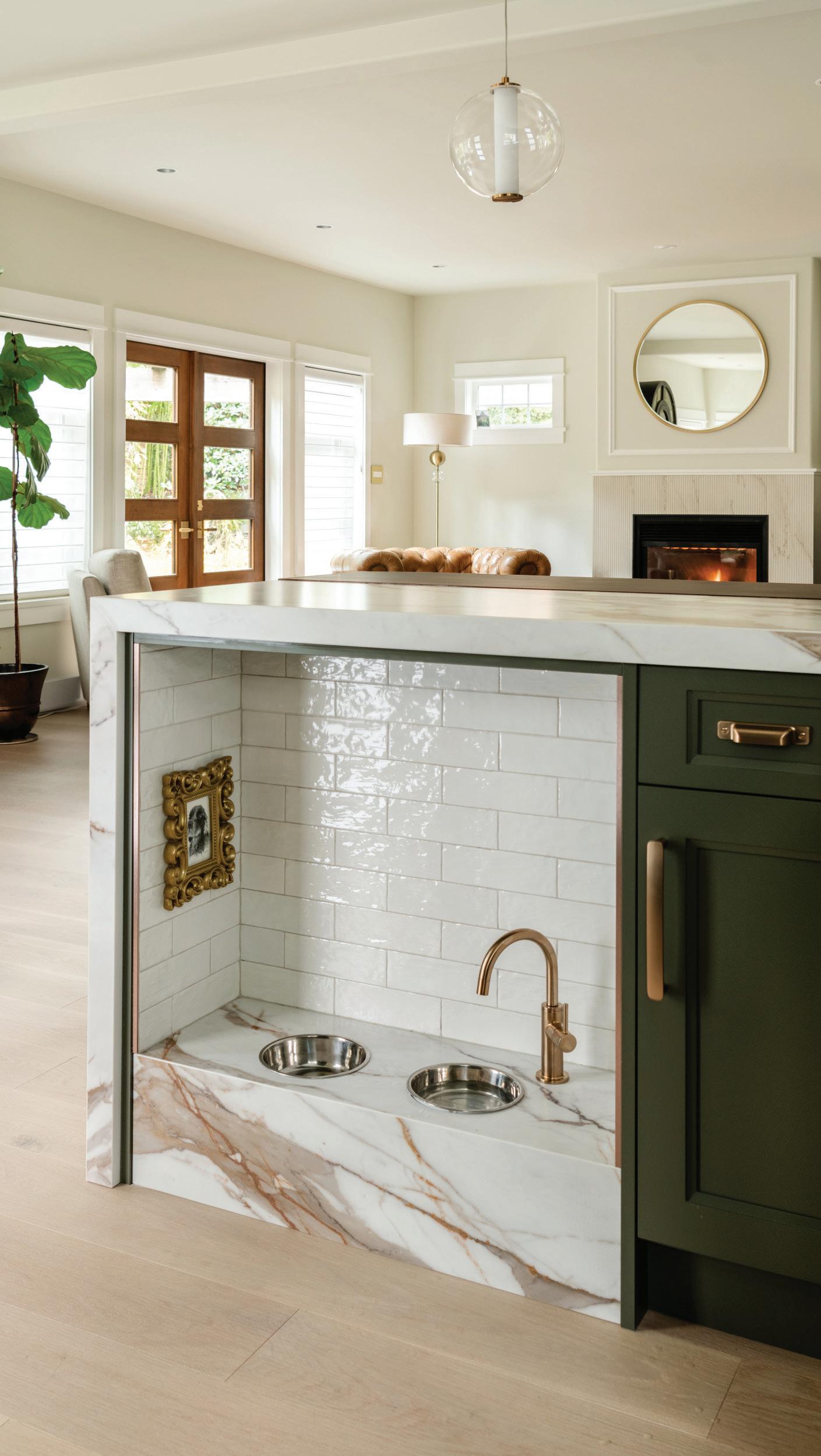
A feeding station for your pet that isn’t a dog’s breakfast.
MARKETING, MOVING RESULTS, & PERSONAL ATTENTION
AWARD WINNING
TheWildmanGroupguidedus throughboththesellingand purchaseofourhomewitha knowledgeable,attentiveandfriendly team.We felt confident we were in theverybestofhandsthroughout theentireprocess.”
– S. Taylor
Make Yours a Lookie-Loo
There was a time, and it wasn’t really all that long ago, when having only one bathroom in your home was the norm. That bathroom was also probably pretty small and its fixtures stuck in the era when the home was built. Think: 1930s penny tile, 1950s bubblegum-pink bathtubs or ’70s avocado green sinks.
These days, the bathroom is second only to the kitchen in its importance to your home’s value and to the role it plays in your daily life. It is no longer just a functional space to get yourself ready for the day. The bathroom is a place of refuge and relaxation, with soothing décor and luxe, spa-like features such as steam showers, warming racks for your towels, ambient lighting and smart toilets.
Make that bathrooms, plural, because pretty much any home built from the 1980s onward has more than one.
But here in Victoria we have lots of older homes, and many still only have one loo. That’s the situation I’ve been dealing with and if you’re like me, you’re probably pondering the same question. Do I add a second bathroom? Or do I invest in zhuzhing up the one I already have?
The answer, it turns out, is: It depends. Adding a second bathroom is generally better for long-term value, resale potential and daily convenience. But fixing up a dated or dysfunctional one immediately makes your life better and offers a high rate of investment, 75 to 100 per cent.
Any bathroom reno can be a disruptive experience, but adding a second one might also mean building an addition to your home. (It’s nice to think you can transform an old closet into a powder room, but those old homes were also short on closet space.) Once you start knocking down walls, things can get complicated quickly — after all, who knows what you’ll find behind that old drywall?
The good news is that even if you have a small, terrible bathroom (or two!), you can instantly make it better with thick towels, potted plants and luxurious body products. A thorough decluttering helps a lot, as does adding handy storage like baskets for towels or toilet paper rolls.
At some point, though, you’ll likely want to get serious about replacing your crummy old vanity and decrepit tub-shower … and that’s when the fun really begins.
At least you’ll be able to recover afterwards in your soothing, new spa-like bathroom.
Design Victoria Returns
Now in its fourth year, the Design Victoria festival has become one of the best ways to discover who’s who in the city’s vibrant creative community — and to learn about their visions for the city’s future. Check them out from April 30 to May 3, when the festival returns with more than 50 events, including open studios, walking tours, exhibitions, talks, workshops and social gatherings.
Among the highlights: tours of local architects’ homes, a look at the Indigenous Law wing at UVic and
Joanne Sasvari, Editor-in-Chief
a glimpse of the plans for the new Arts, Industry and Innovation District.
“There are some sky-is-the-limit projects, but then there are some exciting things where people are working with budget constraints,” says Carla Sorrell, the festival’s director and cofounder.
As in previous years, The Rotunda at 1515 Douglas Street will be the festival hub, a good place to check in to see what’s happening each day of the fest. For tickets and information, visit designvictoria.ca.
We are proud to offer cabinetry from Merit Kitchens, manufactured in BC for over 50 years with excellent craftsmanship and an outstanding warranty.
Visit our well-stocked showroom or book a complimentary in-home consultation today.
Lighthouse guided me through the design, solved every unexpected kitchen-renovation hiccup, and handled the installation flawlessly. The cabinets look beautiful and the team left the space spotless — you’d never know they’d been there. It’s the little things that count, and Lighthouse nailed every one of them.”
— Julie R.
PUBLISHERS Lise Gyorkos Georgina Camilleri
EDITOR-IN-CHIEF Joanne Sasvari
DIRECTOR OF PHOTOGRAPHY Jeffrey Bosdet
LEAD GRAPHIC DESIGNER Janice Hildybrant
ASSOCIATE
GRAPHIC DESIGNER Kelly Hamilton
ADVERTISING CONSULTANTS Deana Brown Jennifer Dean Van Tol Cynthia Hanischuk Brenda Knapik
CONTRIBUTING AGENCIES Getty Images p. 50, 51, 52, 54, 55; Stocksy p. 14
GENERAL INQUIRIES info@sprucemagazine.ca
LETTERS TO THE EDITOR editor@sprucemagazine.ca
SUBSCRIBE TO SPRUCE subscriptions@sprucemagazine.ca
ADVERTISING INQUIRIES sales@sprucemagazine.ca
ONLINE sprucemagazine.ca
INSTAGRAM @sprucemagazinevictoria
FACEBOOK sprucevictoria
ON THE COVER
Best Laid Plans: The Spruce Guide to the Seven Essential Kitchen Layouts, p. 32 Photo by Dasha Armstrong
Spruce magazine is published by Page One Publishing 580 Ardersier Road, Victoria, BC V8Z 1C7 T 250-595-7243 info@pageonepublishing.ca pageonepublishing.ca
ADVERTISE IN SPRUCE MAGAZINE
Spruce is Victoria’s home and design magazine. For advertising info, please call us at 250-595-7243 or email marketinginfo@sprucemagazine.ca
Printed in Canada by Mitchell Press.
Ideas and opinions expressed in this publication do not necessarily reflect the views of Page One Publishing Inc. or its affiliates; no official endorsement should be inferred. The publisher does not assume any responsibility for the contents of any advertisement and any and all representations or warranties made in such advertising are those of the advertiser and not the publisher. No part of this magazine may be reproduced, in all or part, in any form — printed or electronic — without the express permission of the publisher. The publisher cannot be held responsible for unsolicited manuscripts and photographs.
Canadian Publications Mail Product Sales Agreement 41295544
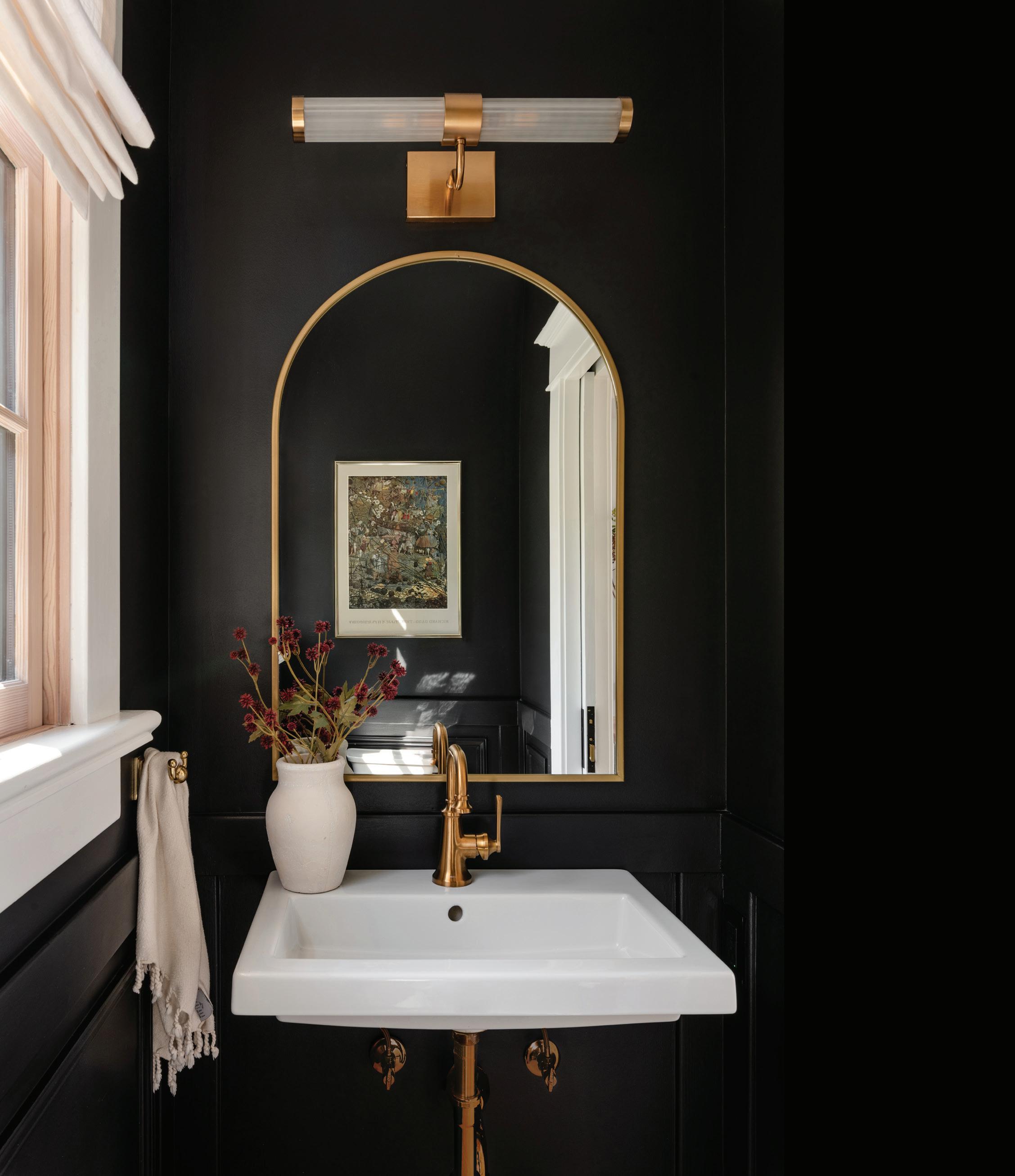
We Like it Darker
Conventional wisdom has it that you should paint small spaces in light colours to make them look bigger. This gorgeous powder room by Rothschild West Design + Planning puts the lie to that theory.
Painted in Benjamin Moore Black Beauty 2128-10, a warm, saturated black, it is chic and stylish and makes a powerful design statement. Painting the ceiling and moulding the same colour only adds to the impact. Meanwhile, the new wood window and linen roman shade introduce a natural softness that bridges the gap of contrast between the dark walls and white trim. And brass details in the faucet, sconce and mirror frame suggest warmth and opulence.
The result? A timeless space that is perfectly contemporary, but with a vintage vibe — one that will make you never want to go back to boring white walls again.
SPRUCE IT UP
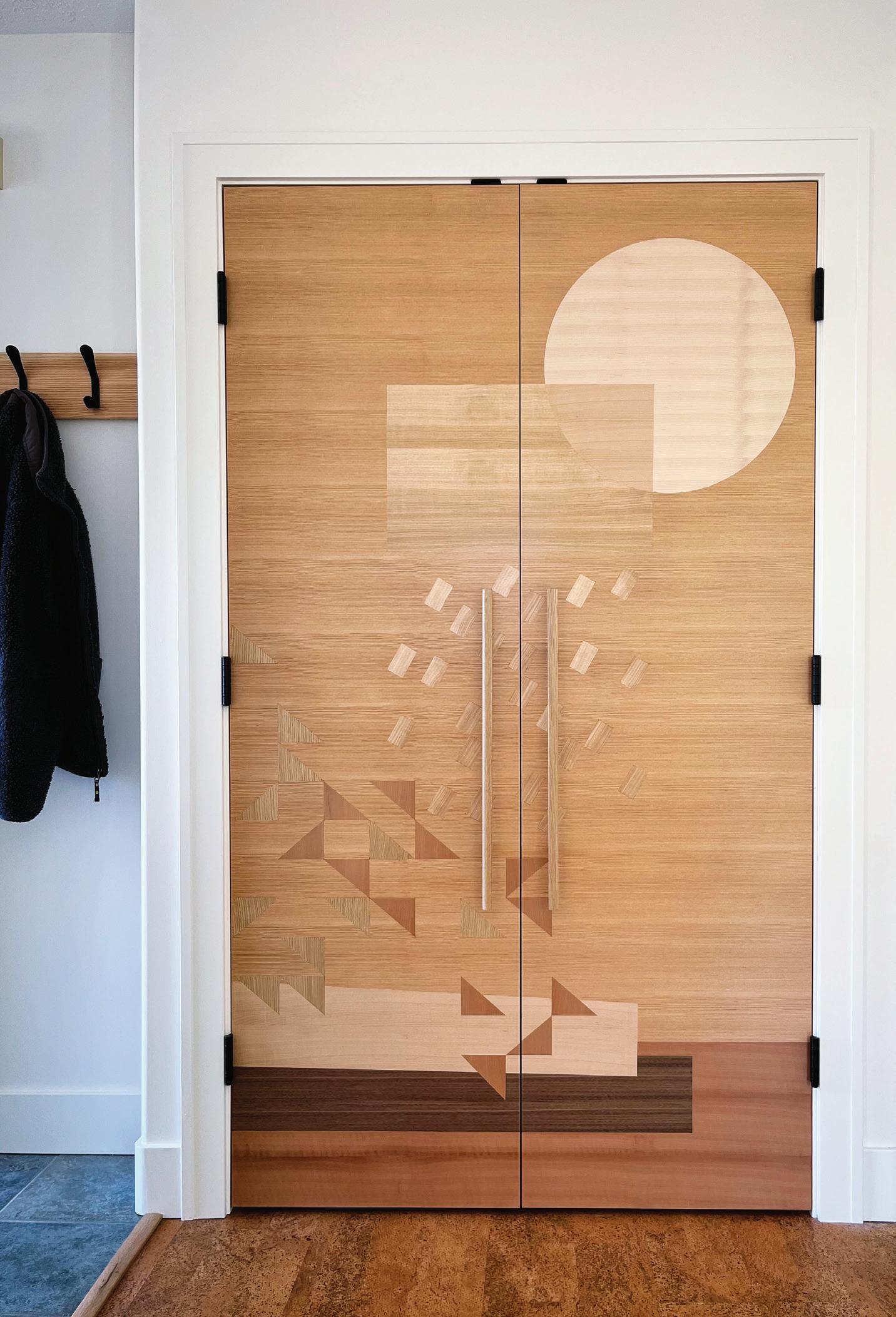
MASTERFUL MARQUETRY
This Sooke artisan transforms wood into functional art pieces.
Think closet doors and — well, actually, you probably don’t give them much thought at all. But Oliver Scott does. He’s the artisan behind Sooke-based Caledonia Silva, a woodworker and builder who crafts everything from bespoke pieces of furniture to handmade kitchens, and is best known for meticulous marquetry work. Take this hall closet, which features fine inlays of various hardwoods, including Douglas fir and arbutus, “designed to reflect the West Coast landscape and our ever-changing weather,” Scott says. “All the marquetry is cut by hand, with custom handles in white oak.” It’s a stunning statement for any home — but open the doors, and it is also as functional a space as can be. caledoniasilva.ca
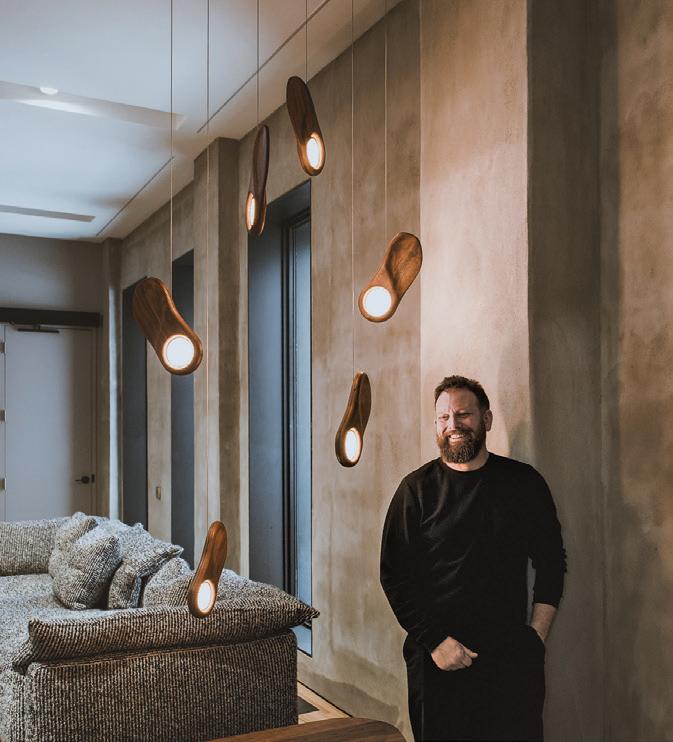
PERFECT PENDANTS
Give your kitchen a groovy glow-up with architectural lights in natural materials.
In the Aurelia pendant by Leucos, French designer Patrick Jouin combines tradition, modernity and sophisticated technology all under one beautiful, mouth-blown glass shade. Available in varying colours and sizes at Gabriel Ross. grshop.com
For his latest innovation, Victoria lighting designer Mike Randall was inspired by the falling maple seeds known as whirlybirds, keys or, officially, samaras. Samara pendants are available in a variety of sizes and wood finishes at mikerandalldesign.ca.
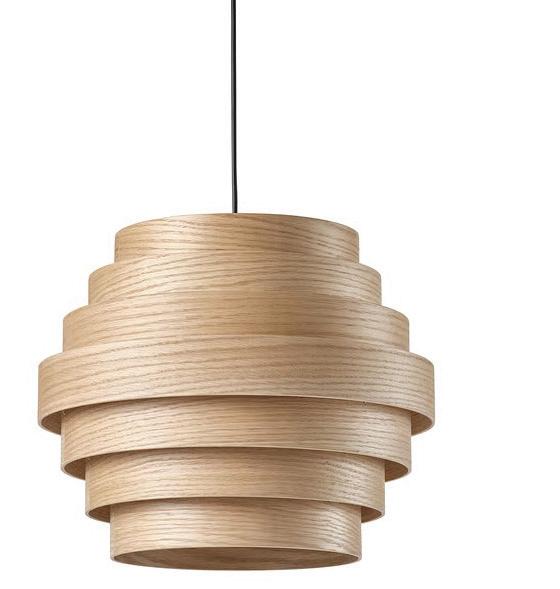
Originally known as Tivoli when it made its 1964 debut, IKEA’s Dykarklocka pendant has been given new life with more rings and glare-free white oak veneer. It’s both timeless and trendy, just like the other pieces in the Nytillverkad collection. ikea.com/ca
PHOTO: RICHÈRE TRUDEAU FOR MONTAUK SOFA
SPRING’S NEW NEUTRAL
This time, pink is all grown up and ready to become your new favourite base colour.
It’s been a full decade since millennial pink was chosen as Pantone’s 2016 Colour of the Year (technically, Rose Quartz 13-1520), and you might think we’re over the blushing hue that drenched everything in those pre-COVID years. Well, think again, because pink is back. This time it’s no peachy trend of the moment, but something altogether more timeless, sophisticated and perfect for spring, a muted, grey- or violet-toned dusty pink that makes a terrific neutral. Here are just a few ways to bring dusty pink into your home right now.
On Your Walls
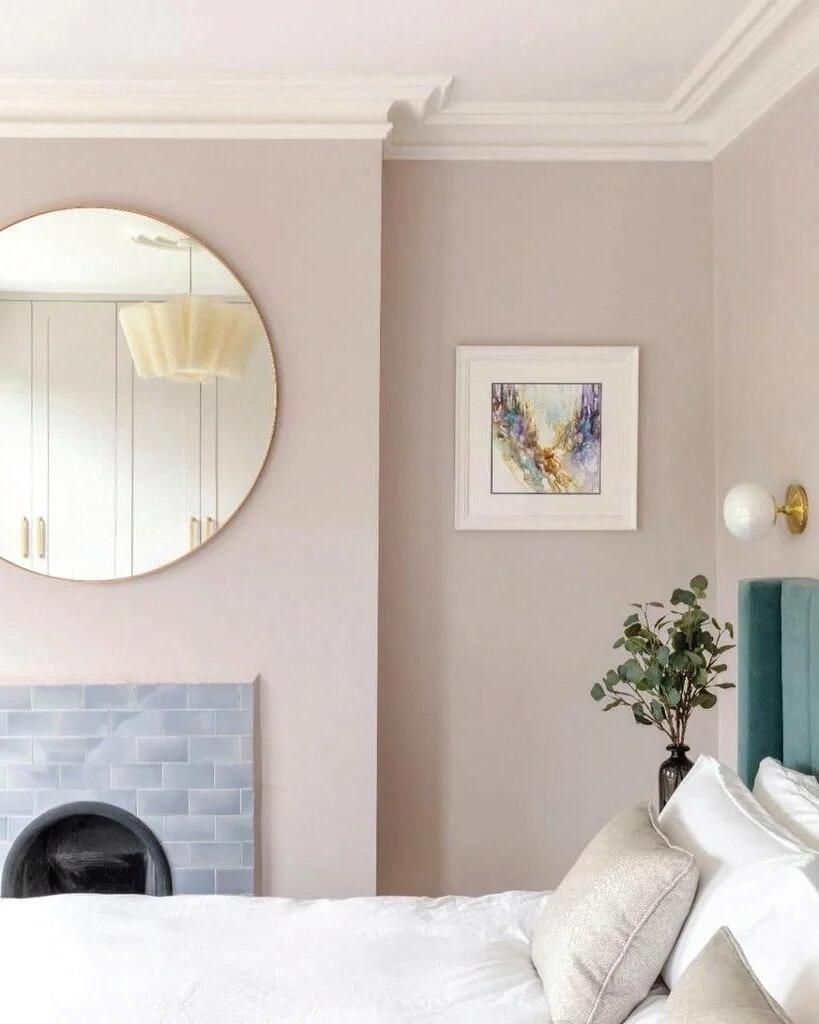
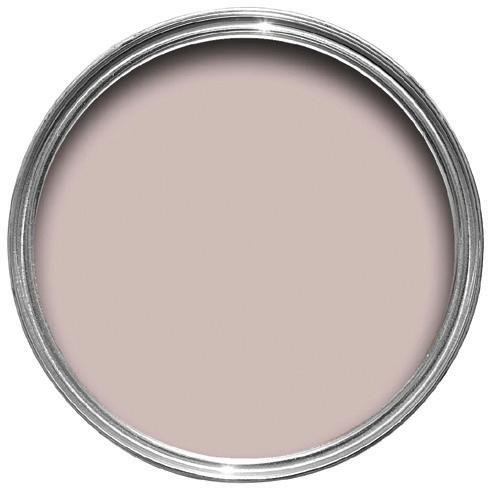
Its pale grey undertones make dusty pink a terrific neutral for your walls. Try Benjamin Moore Morristown Cream (BM 1241) or Farrow & Ball’s Peignoir (No. 286), soft, romantic colours that are also versatile enough to work in both new and old homes.
At Night
Have the sweetest of dreams when you snuggle up in soft, lightly crinkled, organic cotton percale sheets in Praline Chambray by Coyuchi. They’re breathable, comfortable and designed to wash and wear well over time. Available at Resthouse Sleep. resthousesleep.com
In the Kitchen
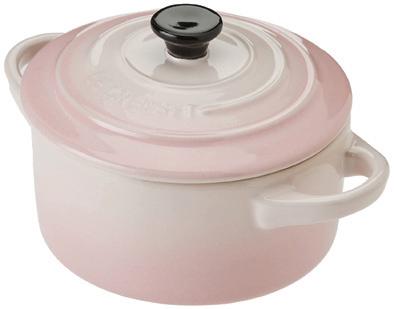
How adorable are the mini round cocottes by Le Creuset, especially when they come in pretty Shell Pink? But these lidded stoneware baking dishes are practical, too, designed for smaller meals, individual servings and, of course, presenting food in style. lecreuset.ca
In the Loo
There’s nothing like stepping out of the shower and wrapping yourself in the softest, fluffiest, thickest towel. The Super Pile bath towels by Abyss Habidecor are made with a hefty 700 grams of plush Egyptian cotton. They are luxe, and in Rosette (No. 515), a pretty addition to your bathroom, too. Available by special order from Gabriel Ross. grshop.com
To Cozy Up With
Who doesn’t love a generously curved swivel chair to curl up in, with a book or the latest instalment of Bridgerton? The Cozy Swivel Chair is even better when it’s upholstered in comfy but stylish distressed velvet in of-the-moment mauve. westelm.ca
Benjamin Moore’s Morristown Cream
Farrow & Ball’s Peignoir
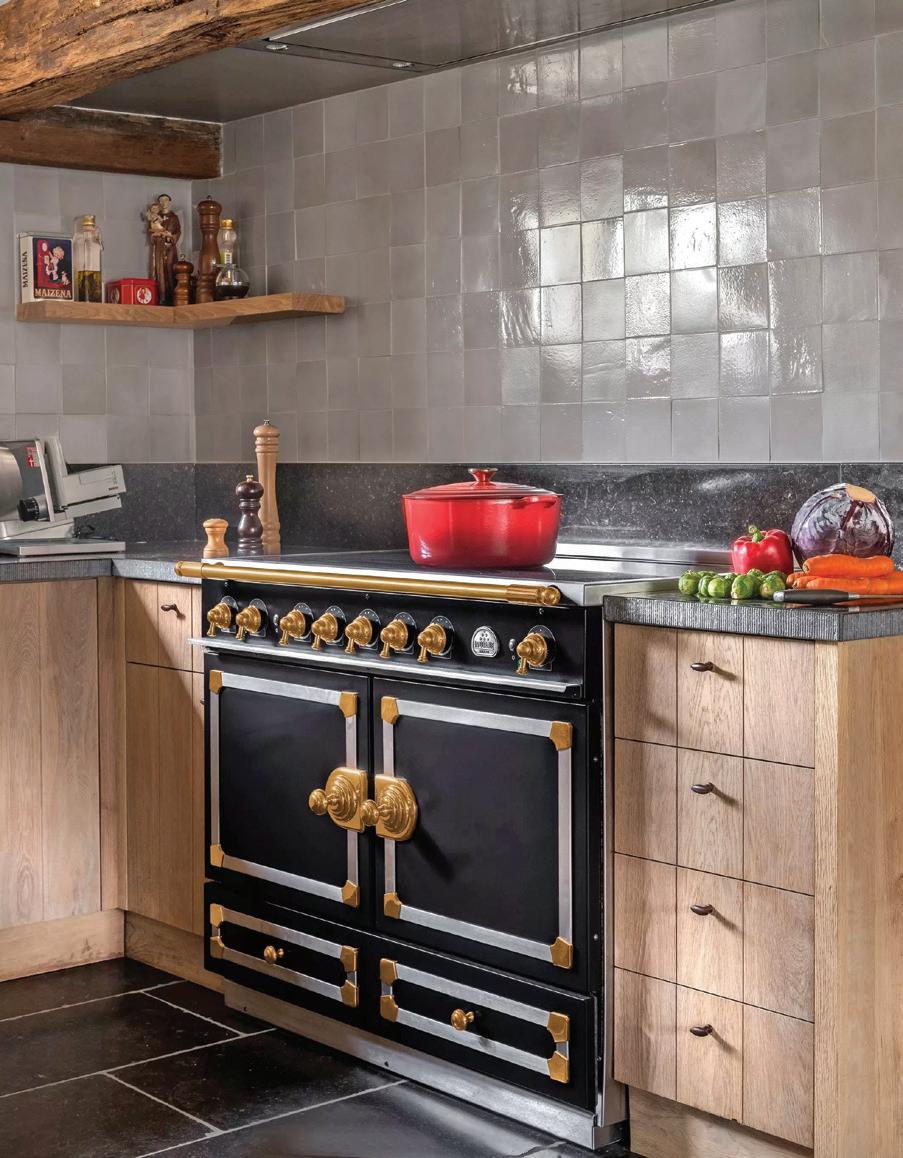
The elegant La Cornue range combines classic styling with a futuristic induction cooktop.
Matte, Gloss or Eggshell?
Colour is cool, but sheen can add surprising depth to interior spaces.
By Julien Johnston-Brew
When it comes to paint, sheen is usually a runner-up consideration after colour, but no less important when slapping a fresh new coat on walls, trim or furniture.
“Sheen” refers to the amount of light that reflects off a dried paint surface, which determines how shiny or dull the finish looks. Many brands’ paint cans come with recommendations on where to use which sheen — but what effects do these sheens have?
“There are a few things to consider when selecting and playing with different sheens,” says Sharon Grech, a colour and design expert at Benjamin Moore.
“Reflective surfaces tend to draw attention and allow light to bounce off, so higher sheens are great for more dynamic spaces.”
Lower-sheen paints (flat or matte) are
generally better for hiding flaws, while higher-sheen ones (satin or gloss) tend to be more durable and washable. Eggshell is a versatile midway option that is durable and washable, with a subtle, matte-like sheen that hides scuffs and stains better than glossier paints.
Sheen is all about light reflectivity, and while darker colours absorb more light, when they are high sheen, they tend to be more reflective and make flaws more apparent than lighter hues. Making sure the surface is uniform prior to painting will prevent blemishes from standing out — or use a low-sheen or lighter colour paint to camouflage such imperfections.
“Matte finishes tend to feel more ‘cozy’ and higher sheens more ‘lively,’ ” adds Grech. “The base colour will also
A BETTER STOVETOP
The future of the kitchen is electric. All the latest trend reports suggest that, within the next three years, induction stovetops will become the most popular cooking surfaces, and for good reason.
These cooktops, which use electromagnetic fields to directly heat iron-based pots and pans, are cleaner, safer and easier to clean than gas, and are hotter and more precise than traditional electric.
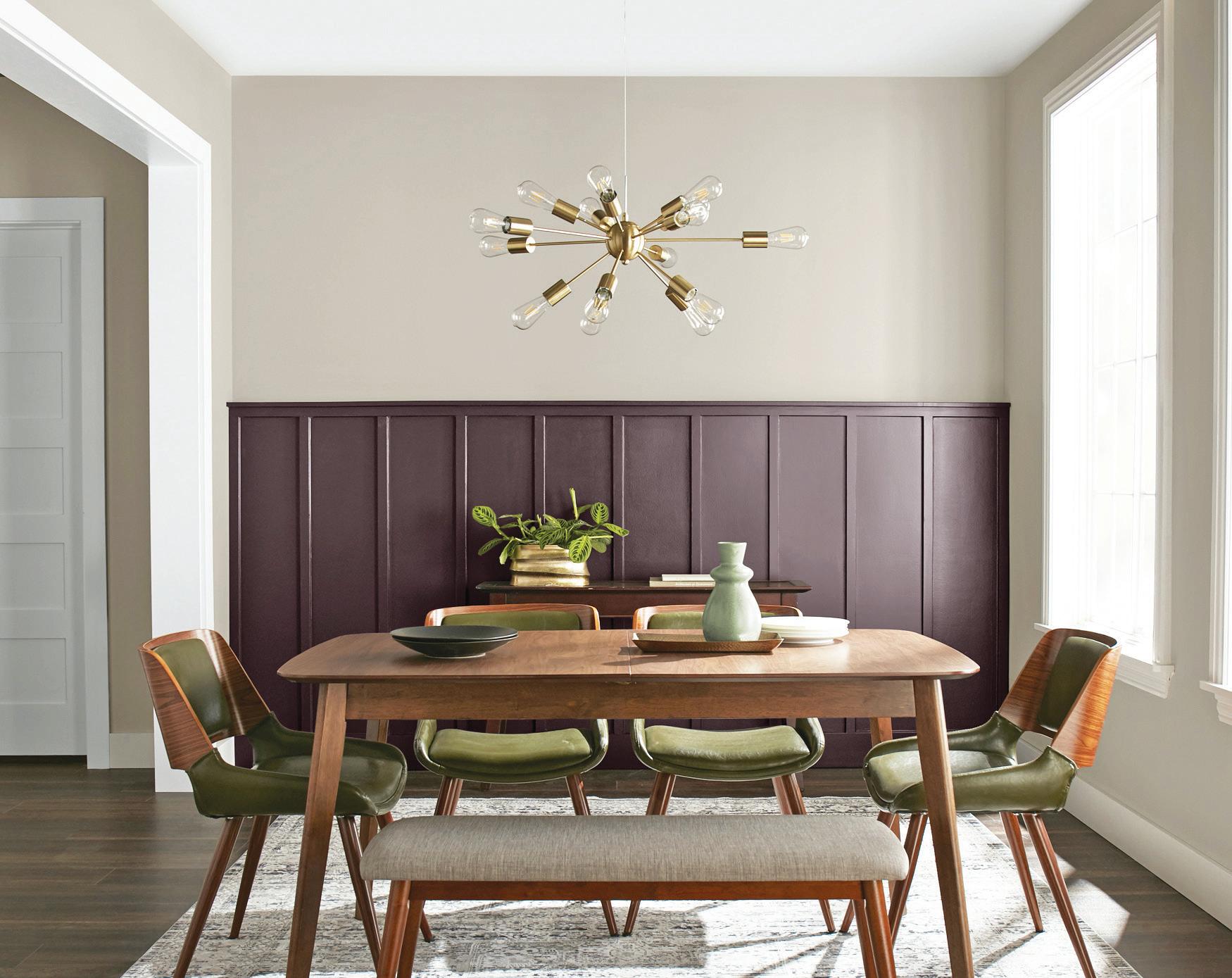
Above: In this dining room, a matte upper wall in Behr’s Perfect Taupe PPU18-13 is contrasted against the glossier Aubergine N100-7 below. The higher-sheen paint highlights the architectural detailing and deep colour of the chair rail and panelling. (Trim and ceiling are in Behr’s Blank Canvas DC-003.)
influence the mood.”
And if you’ve ever hit the dilemma of finding single-colour walls too basic, but wallpaper patterns too busy, layering contrasting paint sheens may be the style for you, and is especially effective for adding dimension when colourdrenching a room. When light hits the high-gloss sections at just the right angle, the pattern reveals itself. “Playing with sheens is a fun way to add subtle contrast to a wall,” says Grech.
Still in doubt? Even such classic range makers as Aga and La Cornue now offer induction options on their most popular models.
READING NOOK
For Your Happy Place
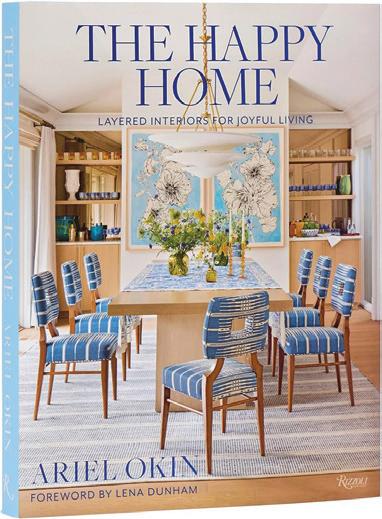
Seeking design inspiration? The Happy Home: Layered Interiors for Joyful Living by Ariel Okin (Rizzoli) might be just what you’re looking for. This lovely new book is both beautiful and useful, packed with good — and actually doable — advice from a well-respected interior designer who is also a design journalist. And the foreword by Lena Dunham makes for engaging reading.
Ring Ring — Who’s Really There?
What you need to know about doorbell cams and privacy.
If you have a doorbell camera such as Ring, Google Nest or Eufy, you probably appreciate the peace of mind it offers when you’re worried about who’s at the front door or whether a parcel has gone missing from your porch.
But lately, concerns have been raised about invasions of privacy, how much information these cameras gather and what can be done with it. For instance, a Ring ad that ran in the U.S. during the Super Bowl, in which neighbours’ doorbell cams tracked a young girl as she ran through the streets searching for her lost dog, quite frankly freaked people out.
In British Columbia, residential doorbell cameras are legal as long as they do not unreasonably invade the privacy of others. Here’s what else you need to know.
• Cameras should aim at your own property and should not monitor common, neighbouring or private rental property. They should definitely not point at your neighbours’ windows.
• Strata owners require council approval to install cameras as they are considered an alteration of common property as well as a potential violation of other residents’ privacy.
• Owners should post visible signs indicating that the area is under video surveillance.
• Cameras must not record audio. In Canada, at least one party to a conversation must consent to recording, making continuous audio surveillance of public areas problematic.
• Data stored on cloud servers may be subject to foreign laws, and police may request this footage.
• Homeowners are not legally required to hand over footage upon a simple request from police, but if they don’t, police can obtain a warrant to compel its release. If the footage is stored on a manufacturer’s server (such as Ring Cloud), police can serve a warrant directly to the company, even if the owner refuses.
• In rare situations, such as an active emergency, police may be able to access footage without a warrant.
BRING SPRING TO YOUR TABLE
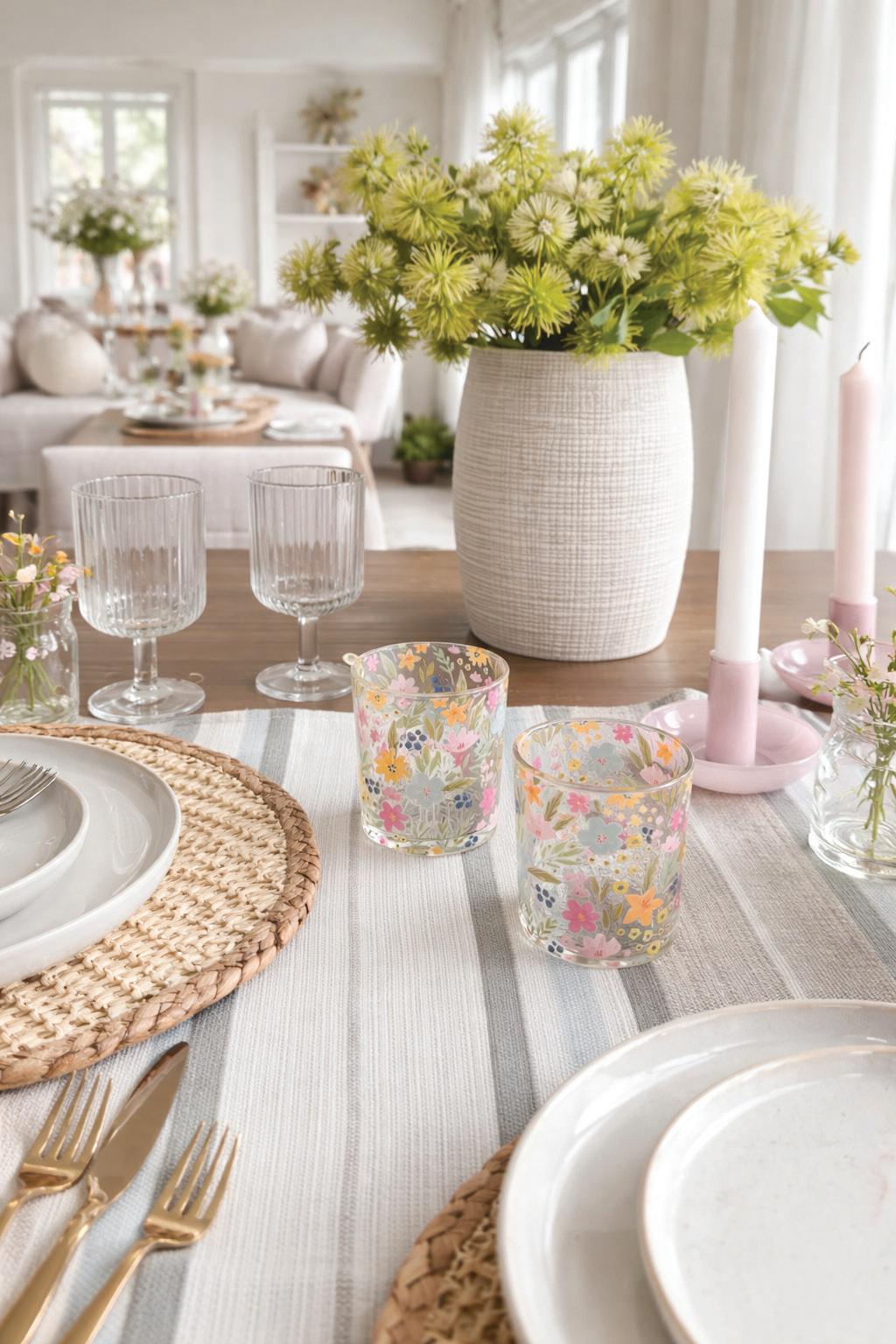
Dream up your next tablescape in our Housewares department, where every detail delights. From artisan dishes to glassware that sparkles with charm, it’s a great place to find inspiration.
Experience you can trust. Fewer projects, greater attention, and a building process defined by communication and transparency.
out our portfolio at oakbayconstruction.com info@oakbayconstruction.com | 778-426-1287
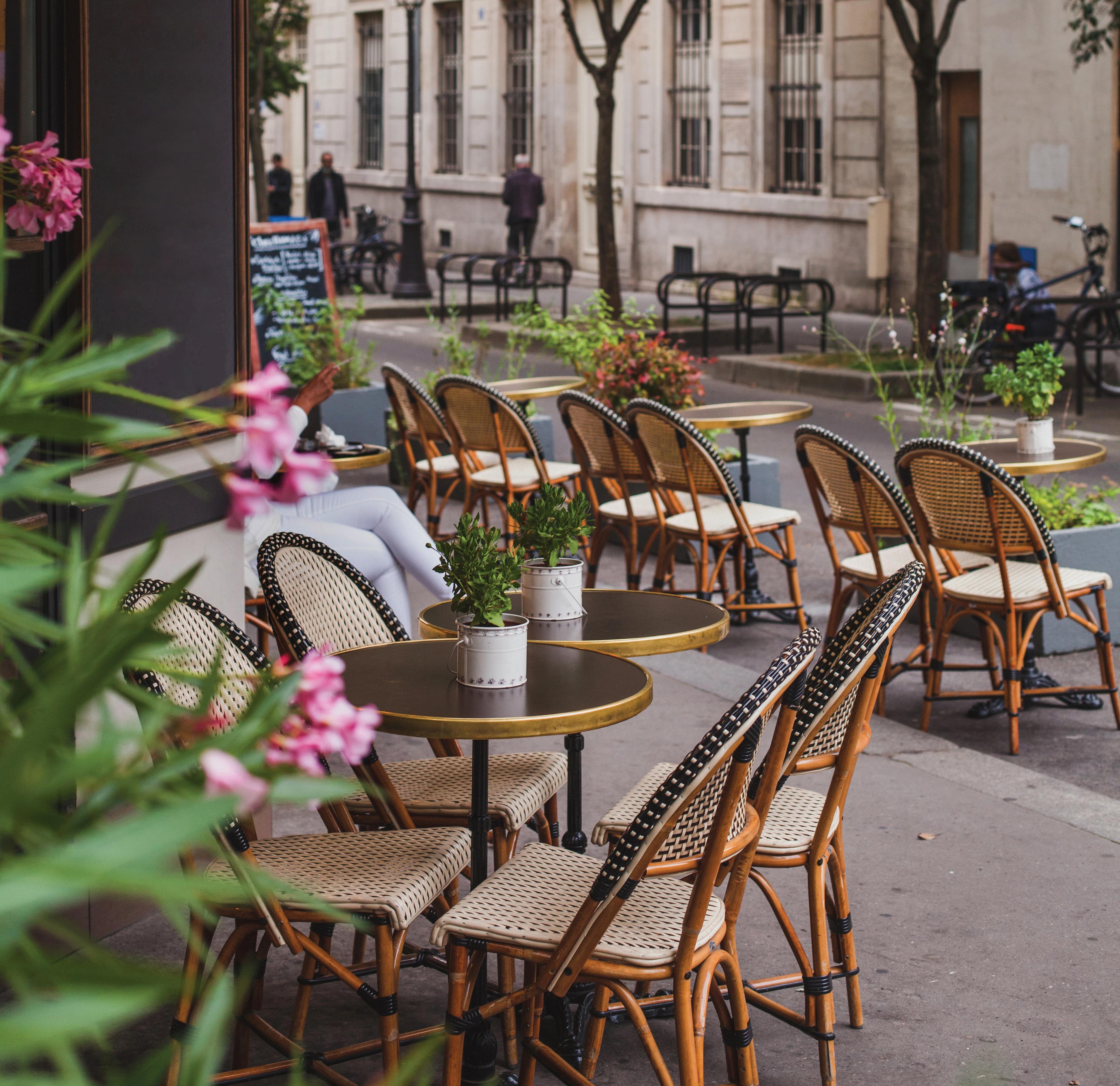
THE PARISIAN PATIO
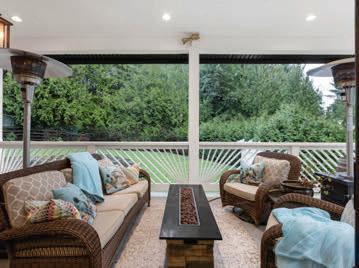
Add a French accent to your outdoor space this spring.
BY SPRUCE STAFF
There’s nothing like Paris in the springtime, when the cherry trees blossom, the sun reappears after a drizzly winter and everyone moves outside to les terraces to enjoy un apéro while watching the world meander by.
But you don’t need to hop a flight to CDG to enjoy the timelessly romantic charm of a Parisian patio. You can recreate one in your own space, in your own way, by following some simple tips and techniques.
The key is to create a cozy ambience within
a disciplined colour palette, using symmetrical design and some vintage-looking pieces of furniture and décor.
Start with a palette of soft neutrals — white, grey, beige and the dustier shades of pale green, pink or blue — or, occasionally, a classic bold accent hue like black, red or French blue. Opt for solids or classic patterns such as stripes, checks or toile and natural fabrics like linen or cotton.
Design your space with symmetry in mind. Cover any pathways or open spaces with
pea gravel. Dot the area with zinc or stone containers filled with lush greenery such as boxwood topiaries, small trees or trailing flowers.
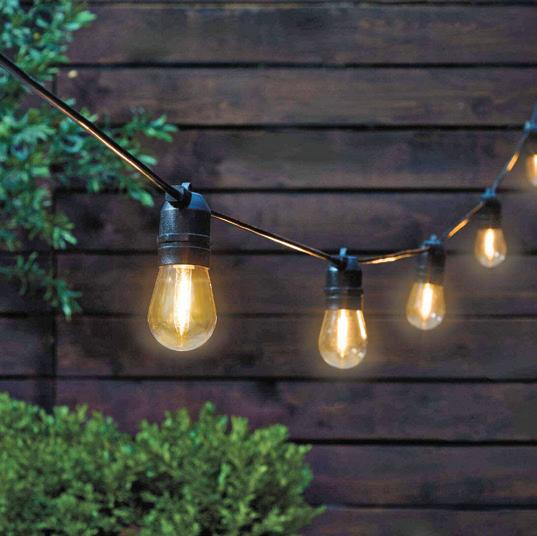
Add wrought iron or rattan bistro furniture, as well as some simple dishware and linens and maybe a few striped cushions or a soft linen throw. Finally, hang string lights over everything to create a warm and inviting glow.
C’est ça! Now all you need is a bottle of wine and someone to share it with — along with these essential pieces.
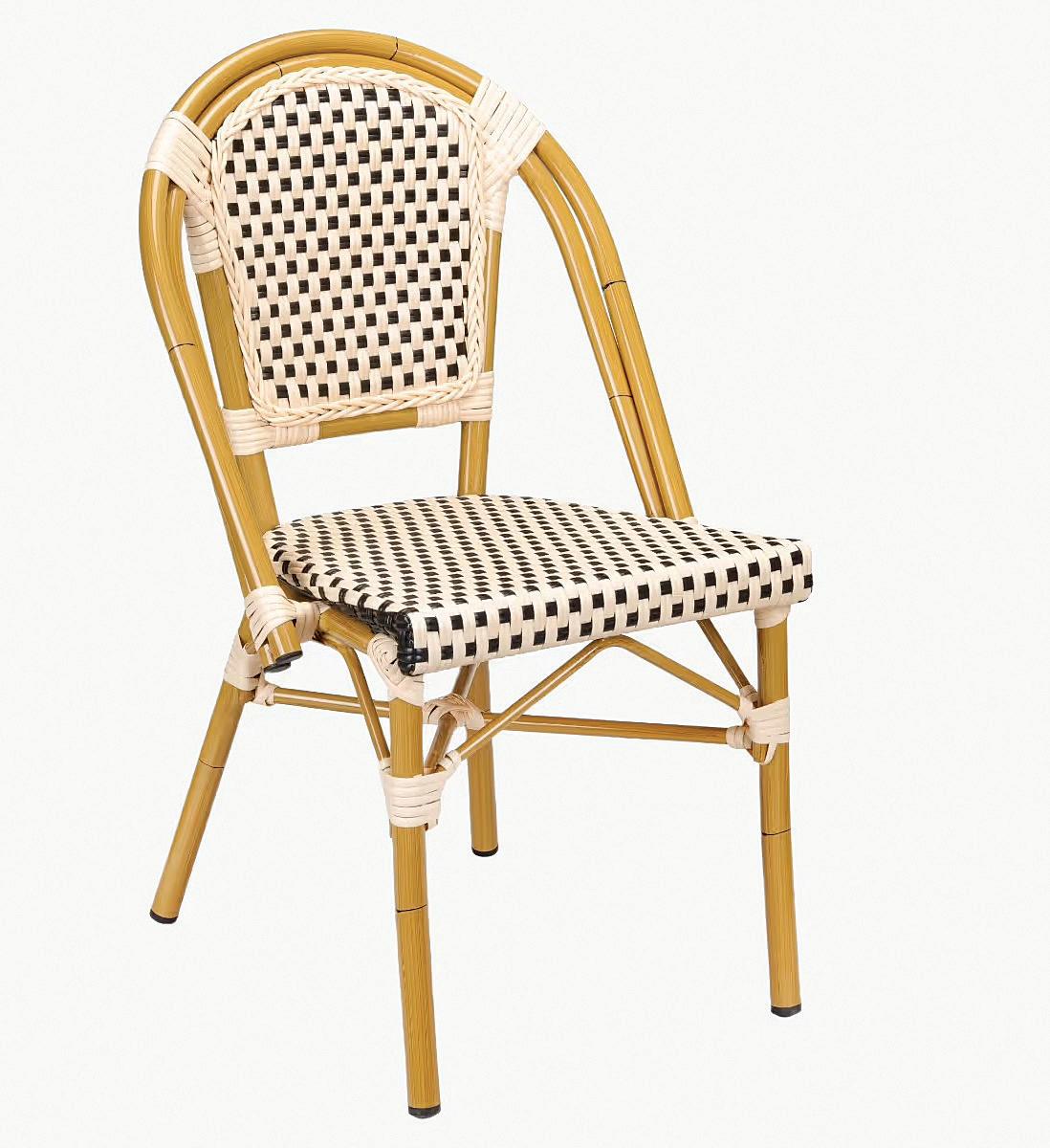
Bistro Chairs
For the most authentic-looking but durable Parisian patio chairs, look for ones with an aluminum frame designed to look like bamboo and woven faux rattan seats. Stackable, lightweight, functional and so perfectly French you’ll imagine you’re sipping a café crème at Café de Flore. restaurant-furniture.ca
Bistro Table
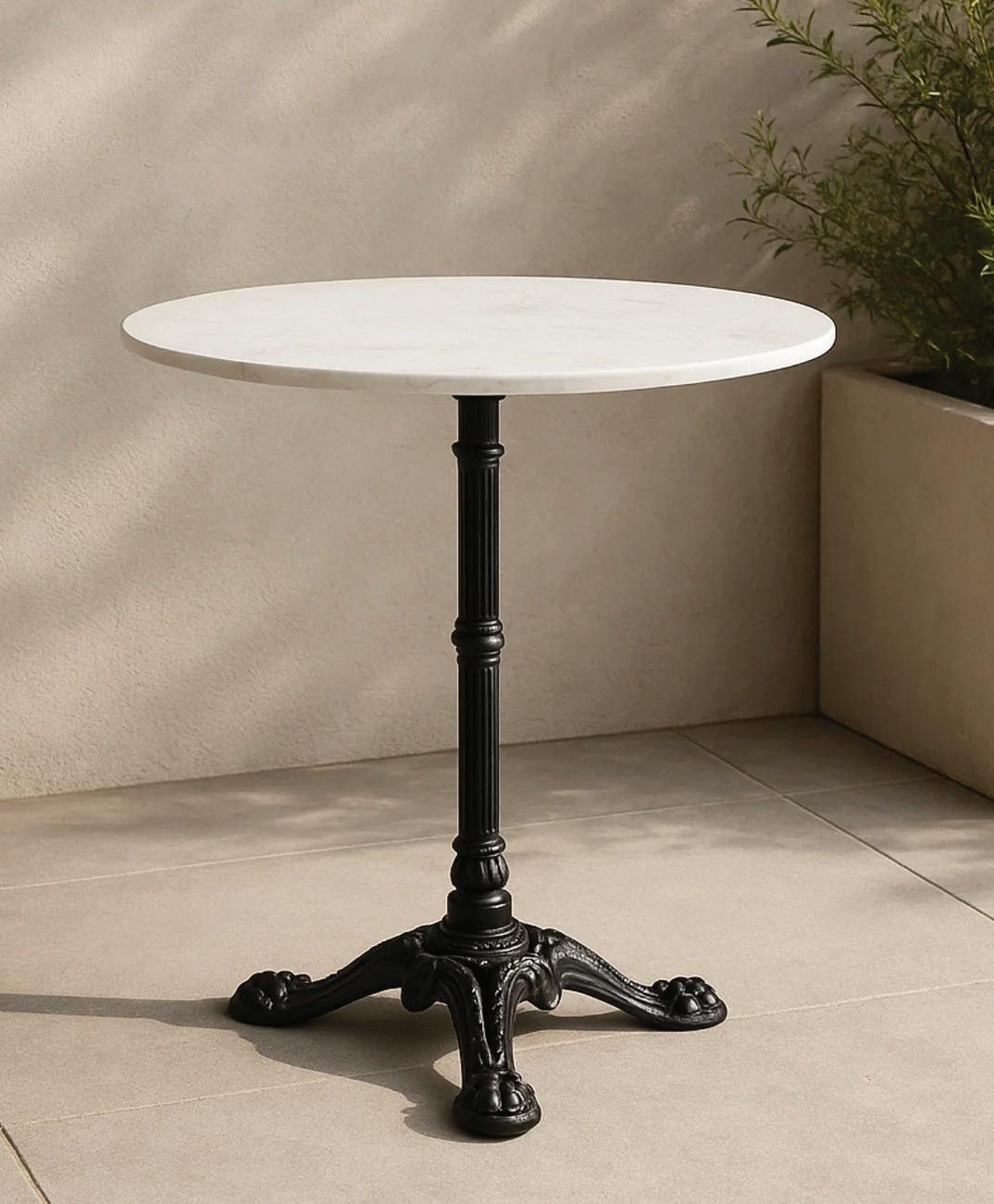
Compact, elegant, tough and très chic! This French bistro table features a faux marble top and ornate black cast iron pedestal base, perfect for enjoying déjeuner à deux in both indoor and outdoor spaces. Available through Canadian-owned and operated hauserstores.com
Perfect Picardie
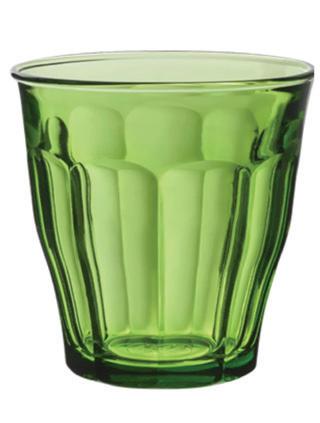
Since they were introduced in 1954, Duralex’s Picardie glasses have been France’s quintessential patio drinkware. Made from tough tempered glass, with their signature nine facets, beveled profile and bold lines, these stubby glasses are almost impossible to break, making them ideal for sipping al fresco. duralexcanada.ca
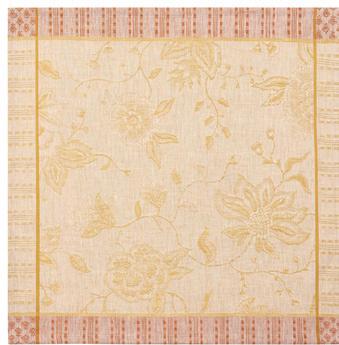
Jacquard Napkins
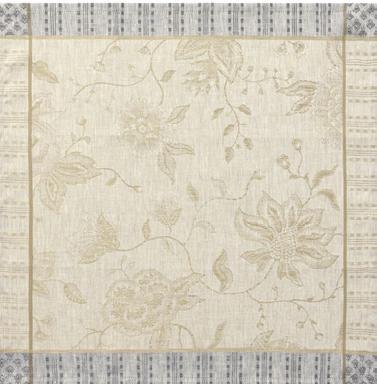
Add a romantic touch to your table with pretty, intricately woven napkins and tablecloths in traditional jacquard fabric. Look for the ones from Le Jacquard Français, which come in a variety of colours and patterns, at Irish Linen. irishlinenvictoria.com
Market Basket
There’s nothing quite so charming as a woven Provence-style market basket for storing throws and table linens, or for lugging dishware, bottles of wine and armfuls of fleurs from indoors to out and vice versa. Check out the selection at InsideOut Home Store or order from provenceencouleur.com
Potted Topiary
Surround your patio with a few stone, terracotta or zinc containers filled with plants. Lavender is a classic and small trees, trailing flowers or white roses are all lovely, but nothing is quite as effective as a perfectly groomed boxwood topiary. Look for faux topiary options like these at Chintz & Company, or live ones at nurseries such as Gardenworks. gardenworks.ca
Bistro Lights
Add the finishing touch by hanging strings of retrolooking string lights over your patio. These warm white, solar-powered, outdoor LED filament lights by NOMA create an inviting atmosphere, and are kind to the environment, too. Available at Canadian Tire. canadiantire.ca
A Chic Chair (or two)
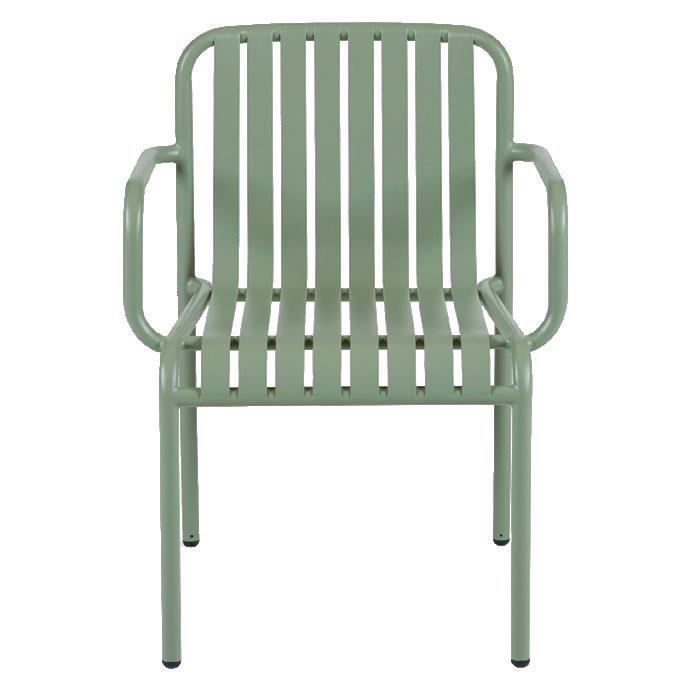
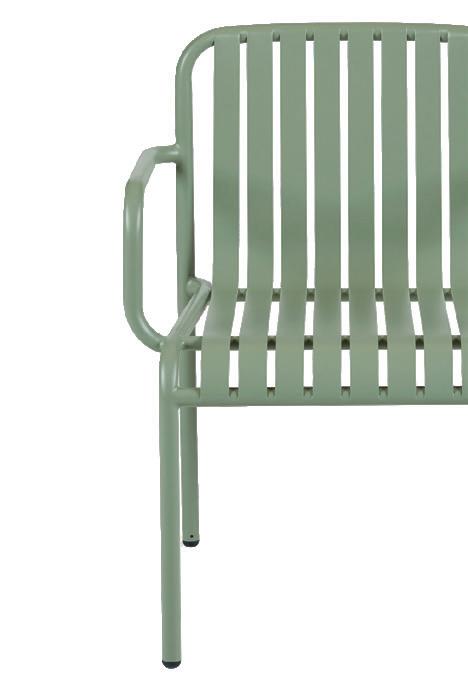
If you’ve ever visited the beautiful Luxembourg Gardens in Paris, you are familiar with the dozens of simple green metal chairs that offer muchappreciated respite for weary wanderers. Now you can get a similar chair for your own garden from Vancouver’s Article: the khaki green Sarek outdoor stackable dining chair (with or without arms). article.com
YES, IT’S TIME TO UPGRADE THAT OLD SUBWAY TILE. HERE ARE THE MOST UP-TO-THE-MINUTE LOOKS TO CONSIDER INSTEAD.
Tiles are a versatile surfacing option that’s used widely throughout the home — on floors, walls, countertops, backsplashes, outdoor spaces and even, sometimes, on pieces of furniture. Tiles never really go out of style, but they are definitely having a moment right now.
Durable and hard-wearing, tiles are usually made from materials such as ceramic, stone or glass. That dense composition makes them resistant to water, and that in turn makes them especially popular for the damper areas of the house, notably your kitchen, bath and laundry room.
According to Yelp’s 2026 “Home, Beauty & Lifestyle Trends” survey, North American searches for tile contractors have surged 351 per cent over the last year or so. At the same time, people are moving away from smooth, cool, neutral tiles and toward tiles with artisanal texture and vibrant colour, especially earth tones like terracotta, green and brown. All those warm hues and handcrafted finishes are a far cry from the stark white subway tile and slabs of marble-look porcelain that were all the rage just a few short years ago.
That means you have a lot of different shapes, sizes and styles to choose from. If you’re planning a kitchen or bathroom refresh in the near future, here are some of the top tiling trends to consider.
Tangible Textures
As we spend more and more time on sleek, high-tech screens, we crave the sensory satisfactions of texture. In tiling, that means rustic imperfections, raised reliefs, fluted grooves and rippled finishes that create depth and character. It can also mean an unexpected finish, like the contrast of matte and glossy glaze. But whether the texture you choose is subtle and nuanced or bold and expressive, it’s all about the human touch.
BY JULIEN JOHNSTON-BREW
8 1 Top Tile Trends
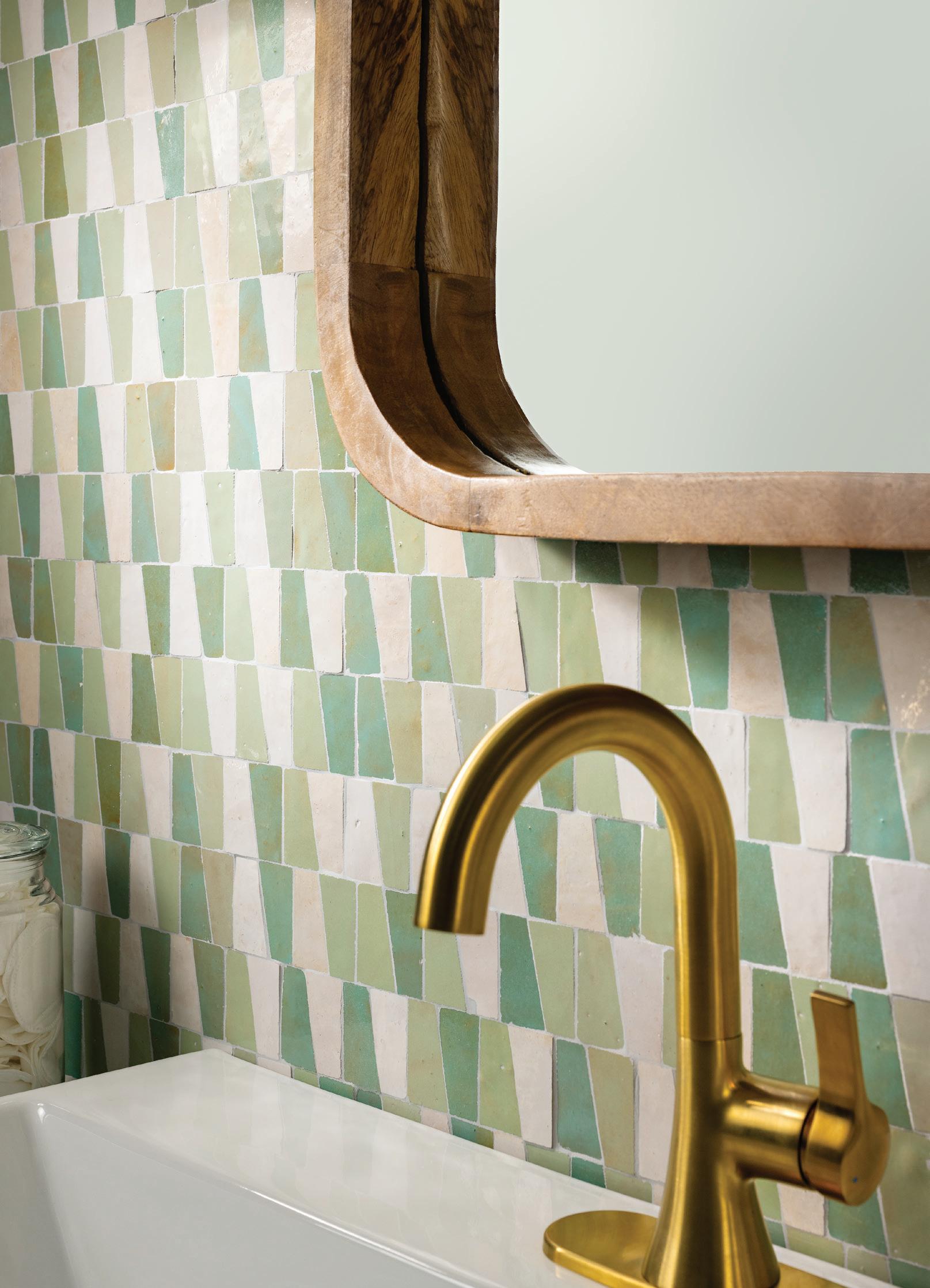
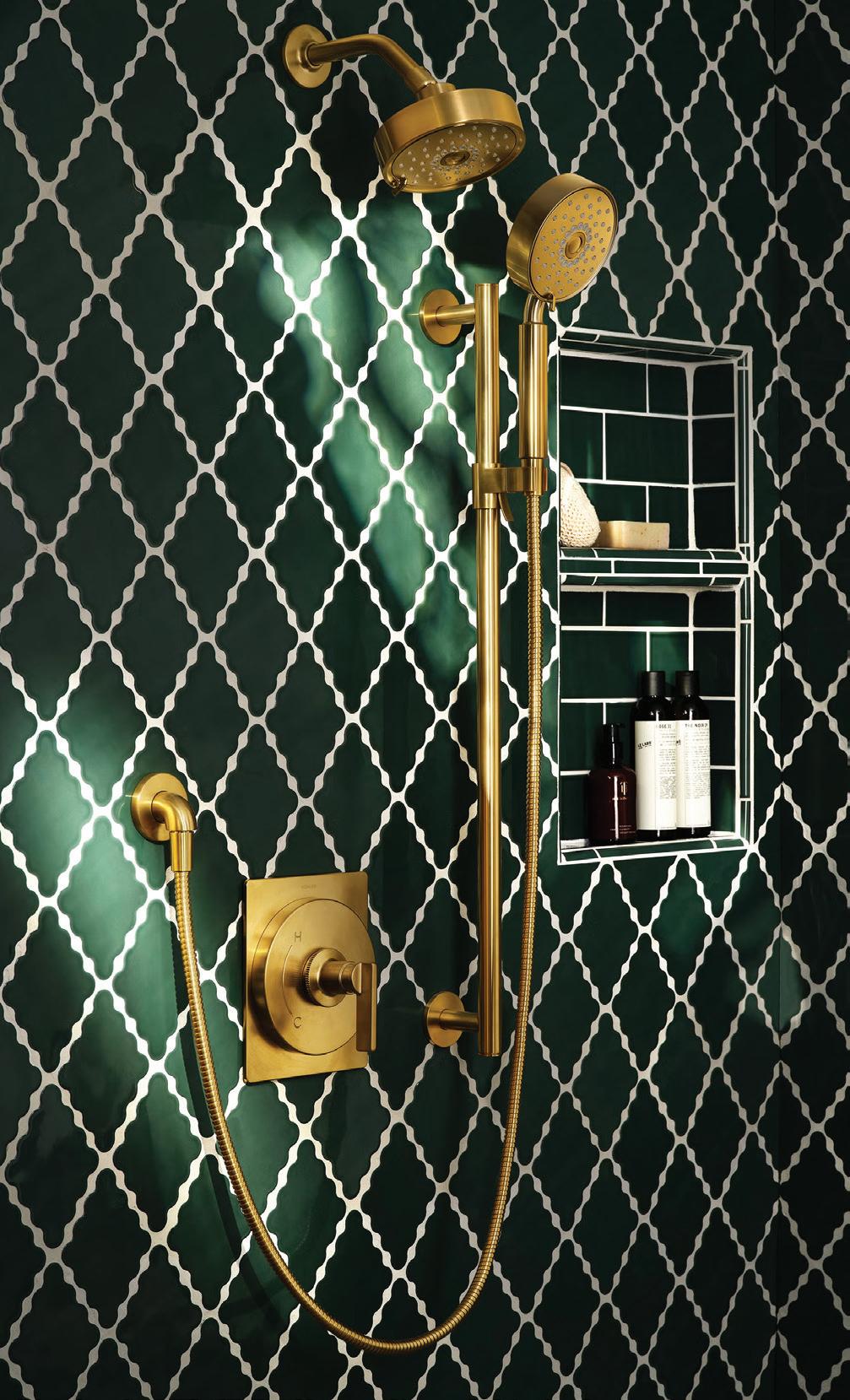
Right: Mistral Trapezium Zellige-style tiles capture many of the current trends, from colour to texture to shape. lunadabaytile.com
Shape Shifters
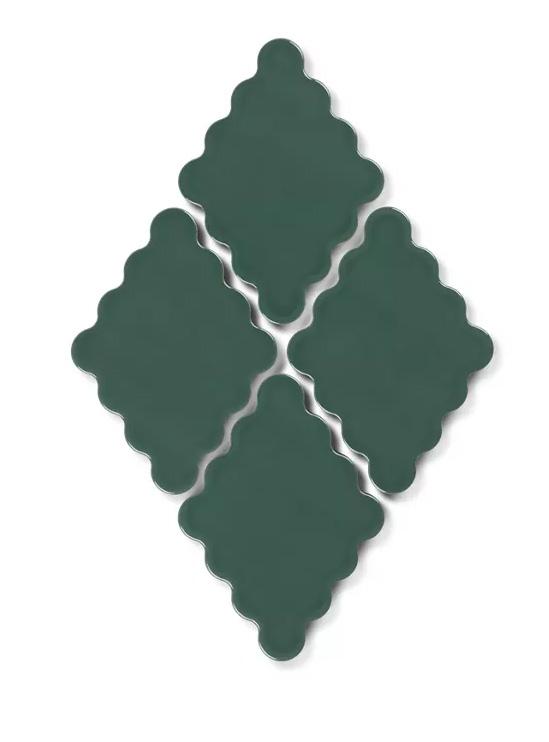
Traditional squares and rectangles are fine, but we’re also seeing a trend to more interesting tile shapes: geometric forms that create hypnotizing patterns, interconnected lines that invite the eye to flow along edges and unconventional shapes that add intrigue to any surface. Notably, the curvy furniture silhouettes that have been trending of late are now being seen in tiles, too, adding a romantic note with scalloped or ribbon-like borders. In other words: This is a good time to think outside the box.
Right: Scalloped edges add sophistication and whimsy to these diamond tiles from Ashton Meadows by Studio McGee. annsacks.kohler.com
Nature Inspired
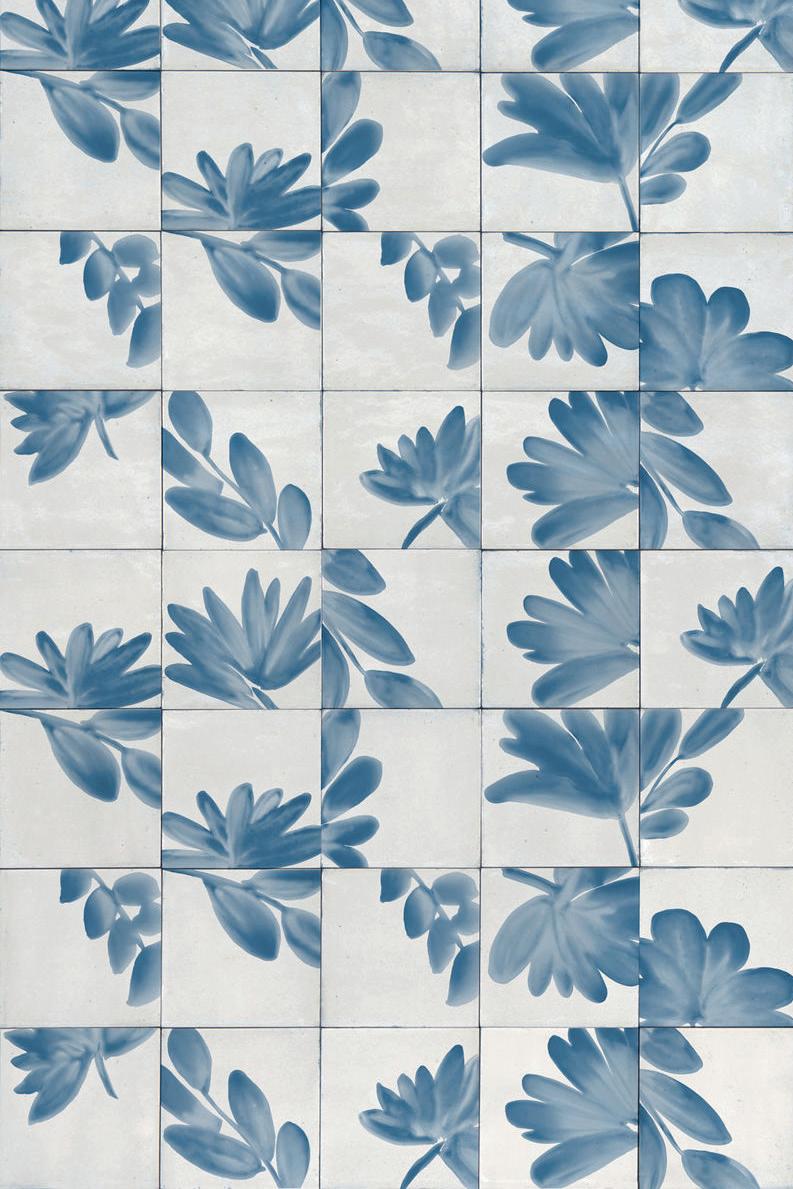
Biophiliac design has made its way to tiles, bringing the outdoors into your kitchen or bath in everything from motifs and colour to texture and materials. That could mean nature-inspired hues of green (sage, olive, forest) or brown (clay, walnut, espresso) as well as natural materials such as stone (marble, travertine) or terracotta. Look for tactile textures and softer edges that feel handmade and a little rustic. And remember: Eco-conscious choices are always on trend, and recycled materials are a great way to blend sustainability with style.
The Classic
Checkerboard patterns are a versatile favourite that fit into contemporary, traditional and more eclectic décors. Glossy black and white make for a bold and sophisticated perennial, but a more modern approach is to use textured tiles or ones in the muted pastels of vintage bathrooms. To make it your own, choose colours that are a little warmer than the mid-20th century’s icy pastels, such as blush, clay, mauve, dusty blue and soft green, and consider taking a twist on tradition with checkerboard variations or square tiles in different patterns.
Below: Update a classic checkerboard pattern with new colours like Stone Tile’s Reve tiles in Rose Gris. stone-tile.com
Patterned Pennies
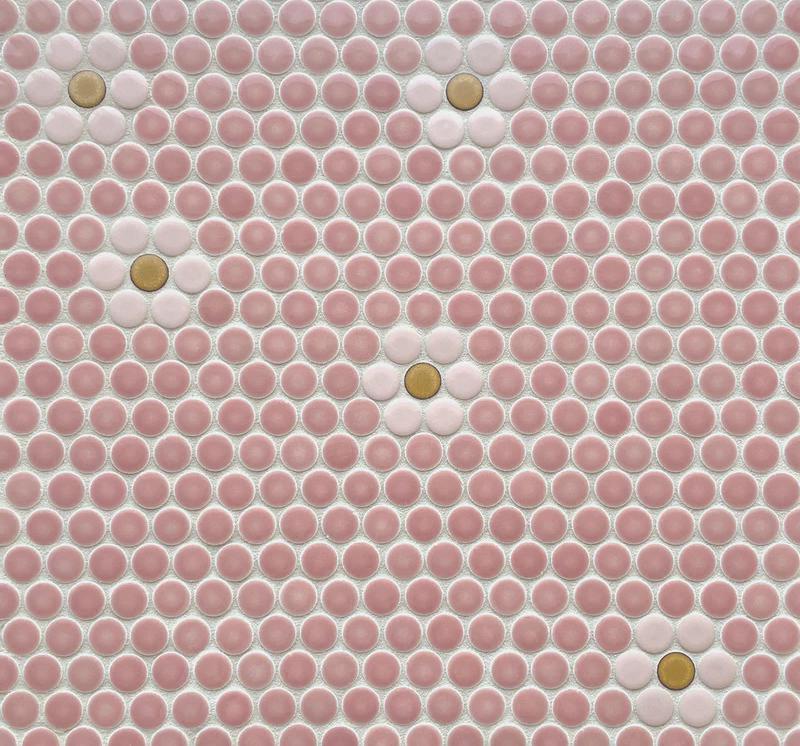
Penny tiles — small, circular mosaic tiles, typically an inch or so in diameter — and small hexagon tiles became popular as part of the hygienic design movement of the 1910s and ’20s. Today they bring a vintage vibe to contemporary spaces, either in traditional black and white or in brighter, trendier colours. Use them to create simple designs such as borders or geometric patterns, and keep the look contemporary with lighter-hued grout.
Above: Make it a prettier penny with Daisy Patch mosaics by Geon Tile. geontile.com
Above: Bring on the biophilia with natureinspired tiles like these Bianco Deco Blossom tiles in the Rice series by Marazzi. marazziusa.com
Artful
Mosaic
Similar to penny tiles, but with much more creative scope, mosaic tiles are small, decorative pieces of stone, glass, ceramic or metal arranged to create ornate patterns or images. They’ve gone in and out of fashion since they were first introduced 5,000 years ago in Mesopotamia, but right now they are making a comeback in deeply textural, vividly colourful and nostalgic ways. Consider them an artisanal backlash against our overtly technological lives.
Stacked Up
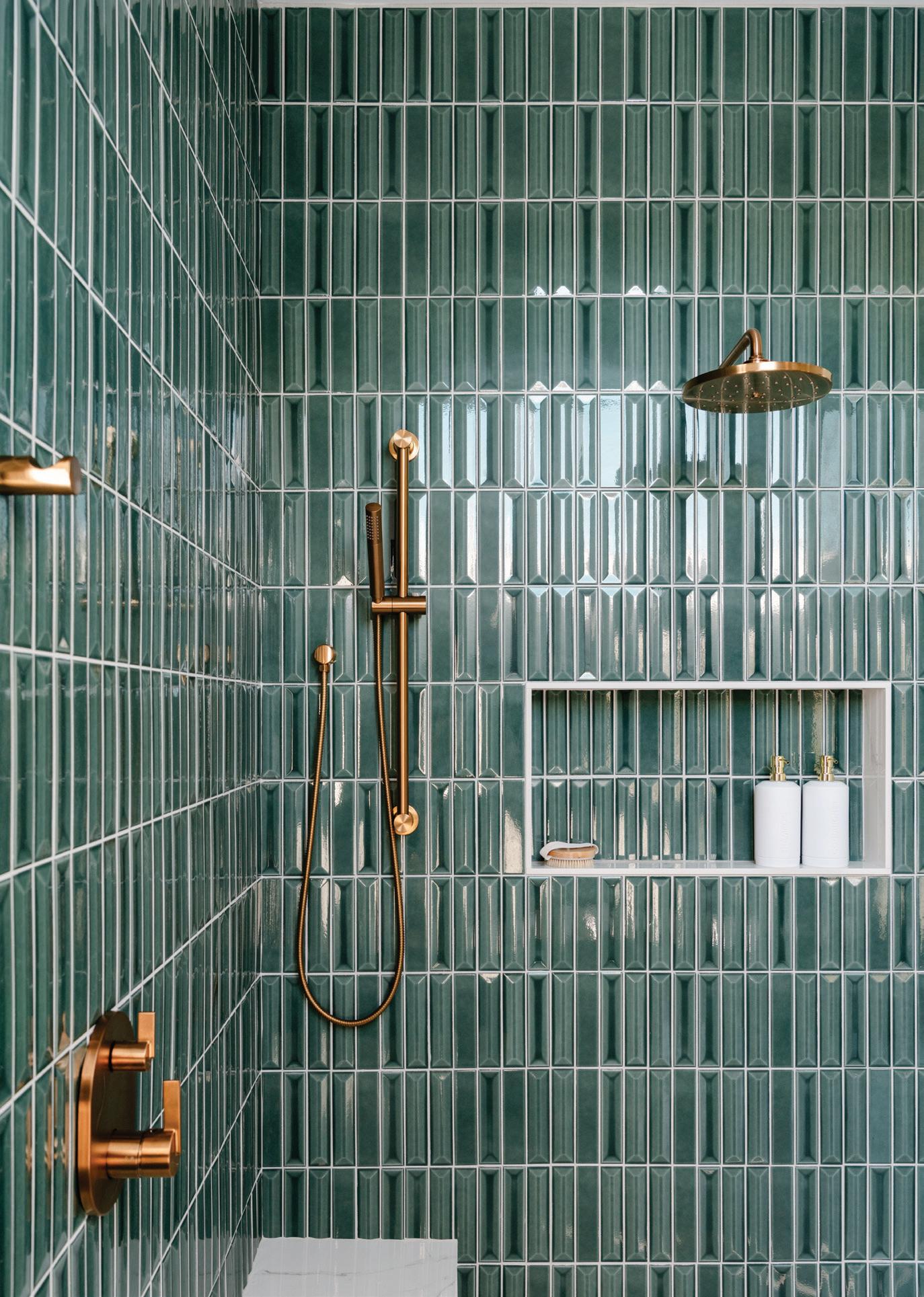
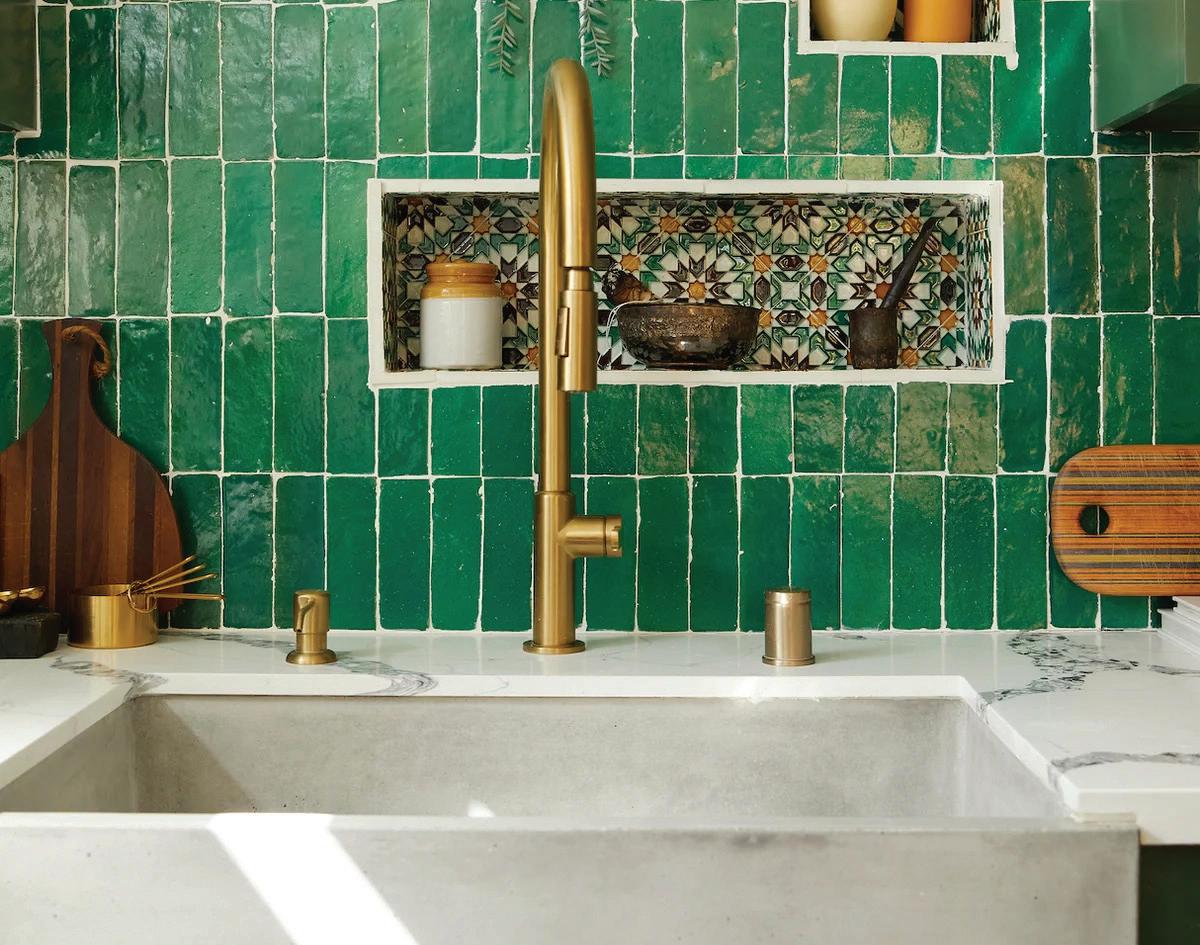
One popular look we’re seeing more and more these days features narrow, rectangular tiles arranged in vertical stacks that add visual intrigue to a space. Rectangular tiles in general are very much on trend, whether stacked horizontally, vertically or in a herringbone pattern. We especially love the glossy, handcrafted Zellige tiles from Morocco (or their commercial lookalikes), which come in both square and rectangular formats. These rustic glazed terracotta tiles have been made since the 10th century and have subtle variations in shape, colour and finish. Plus they come in gorgeously intense colours like rose, aqua, jade green and dark grey. Above: Zia Tile’s jade-green Zellige tiles have a charming rustic texture. ziatile.com
Colour Theory
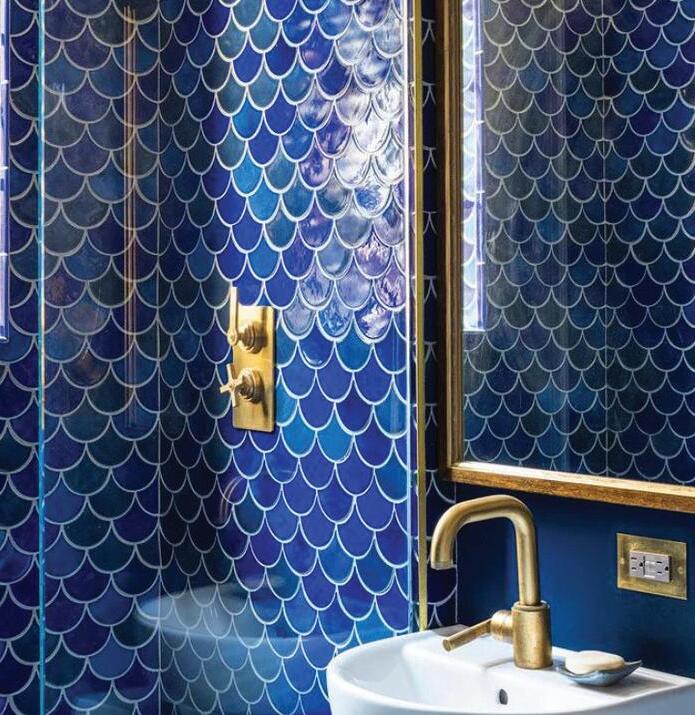
After what seems like decades of all-white spaces, working with colour may feel intimidating. One smart and highly effective way to bring colour into your décor is to layer variations of a single hue. For instance, you could use fish-scale tiles in differing shades of greeny blues or pinkish browns. The colour variations create depth, texture, an illusion of movement. Look to Mexican and Moroccan design for colourful ideas.
Create undulating waves of
of
up a space with a
and hues as
Narrow, glossy and deeply colourful. The vertically stacked Flauti tiles by Julian Tile in this shower designed and built by MAC Reno Design Build take a serious style detour from traditional subway tiles. macreno.com
Above:
colour like these fish scale tiles by Mercury Mosaics in Deep Sea Blend blues. mercurymosaics.com
Left: Brighten
multitude
shapes
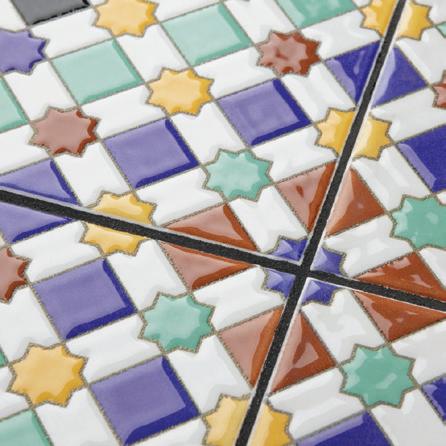
in this Sevillano Giralda ceramic wall tile by Merola Tile. merolatile.com
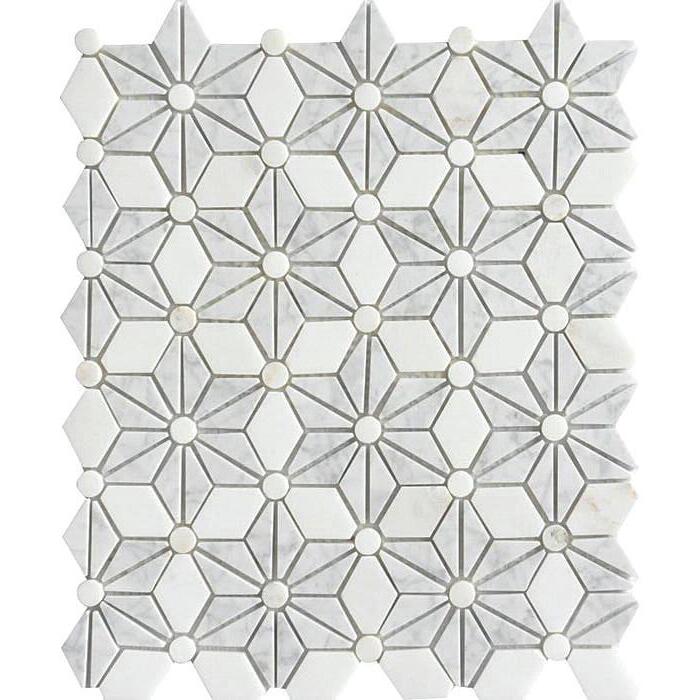
Above: Mosaics are artful but finicky to install — unless you use pre-designed mosaic sheets like this Bianco Carrara star motif marble by GL Stone & Tile. glstonetile.com DASHA
More information or to donate: victoria.ca | flowercount.com Corporate sponsorship opportunities: astrid.chang@tourismvictoria.com
Hanging Basket Donation Program
Victoria’s iconic hanging baskets have welcomed spring and summer for generations, adding colour and charm to downtown streets and public spaces. The Hanging Basket Donation Program invites residents, businesses and community groups to help keep this beloved tradition thriving. Your support helps the City of Victoria grow, install and maintain the baskets that define our city’s vibrant streetscape. Join us in keeping Victoria in full bloom.
Learn more or donate today at www.victoria.ca or www.flowercount.com.
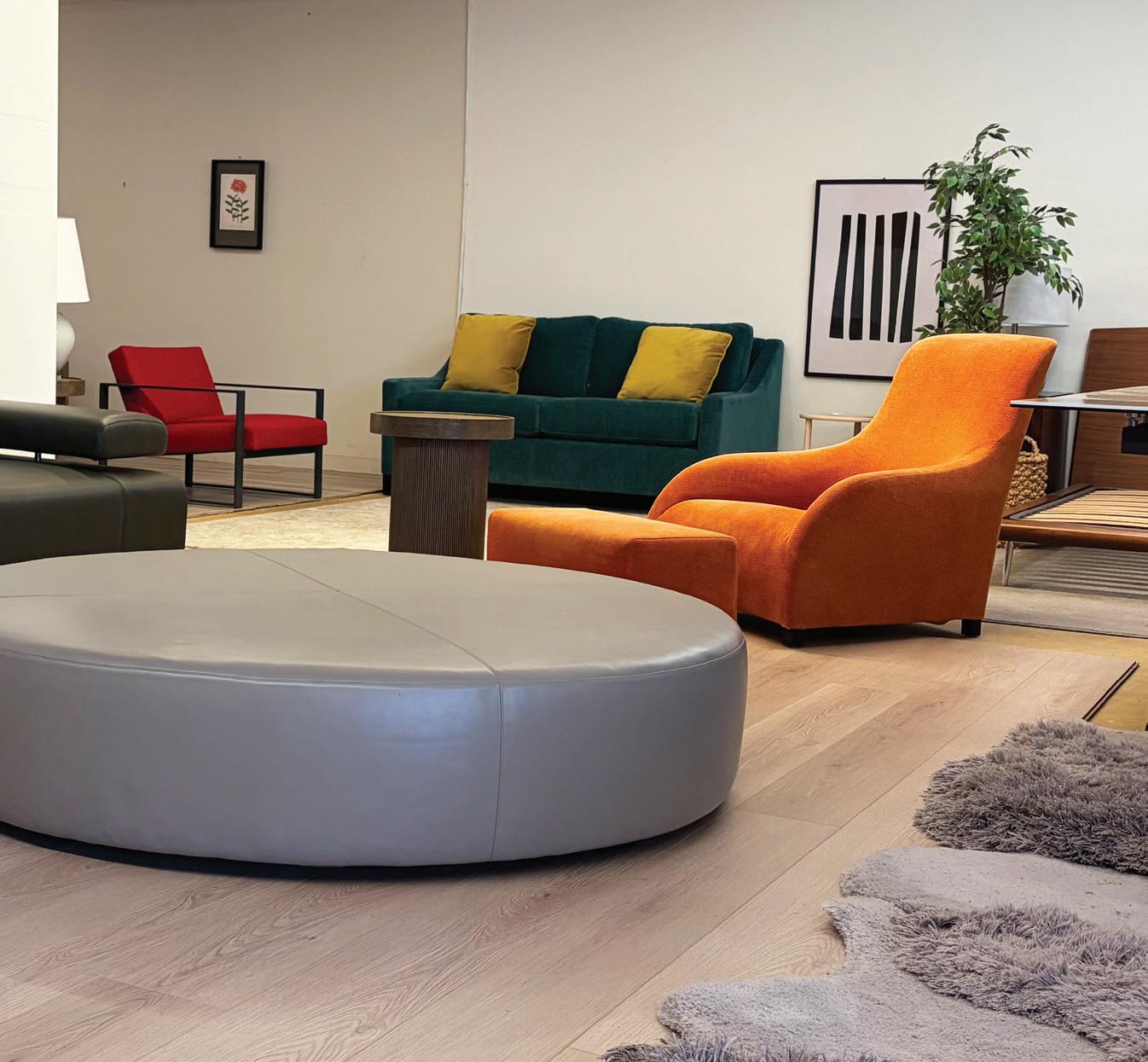
Recertified Furniture was born out of a simple mission: do business that does well by people and the planet. What do they do? They make it quick, easy and risk-free to buy and sell upscale used furniture. Every piece they take in is selected for quality and style, then inspected and rehabbed as needed.
Check out their website or visit the store for an exciting, ever-changing selection of quality preowned furniture.
Looking to sell? Fill out the form on the website and have your furniture gone in as little as 48 hours.
BUILT INTO SOLID ROCK
A challenging rebuild with a payoff of stunning views.
BY JULIEN JOHNSTON-BREW |
PHOTOS BY JODY BECK
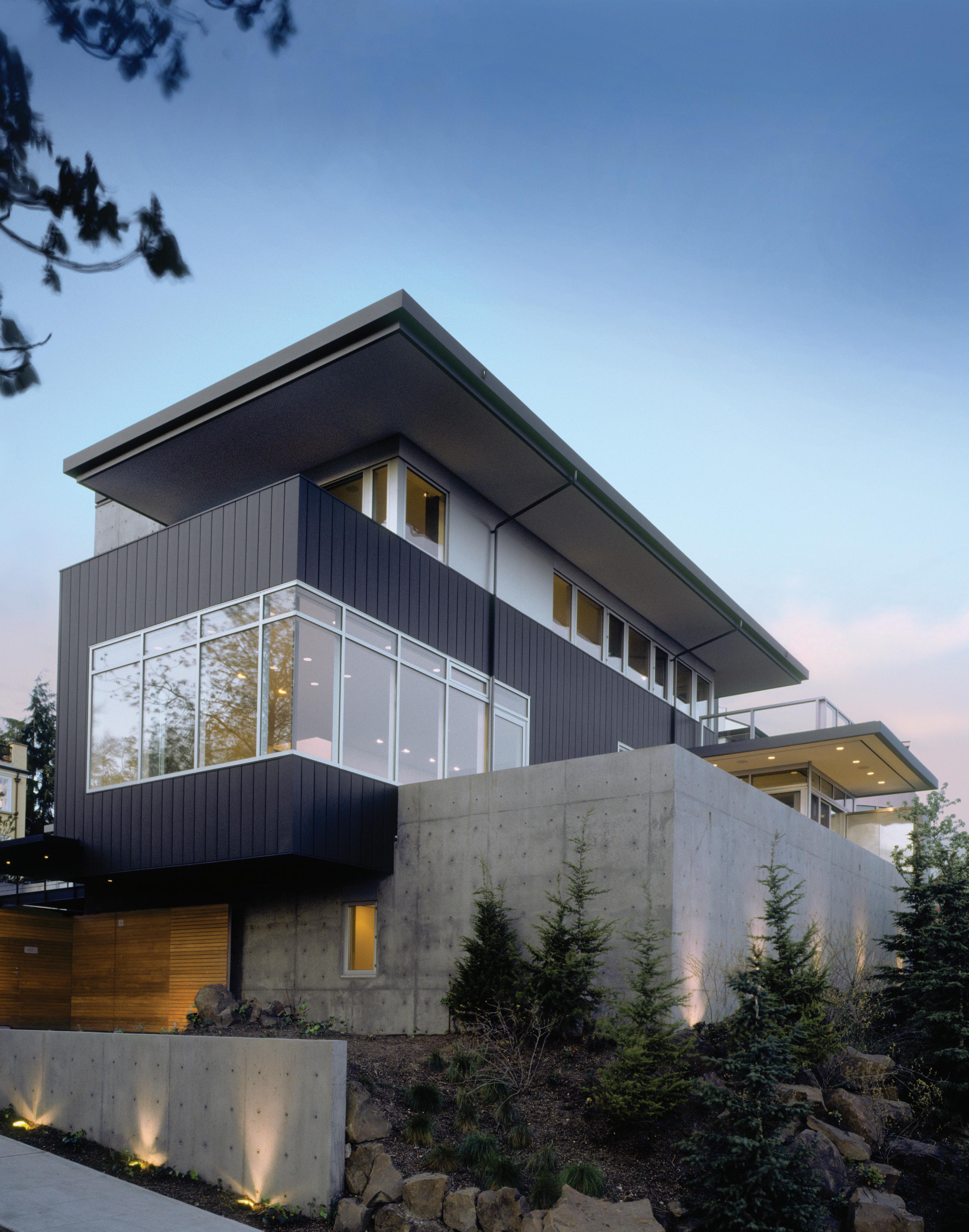
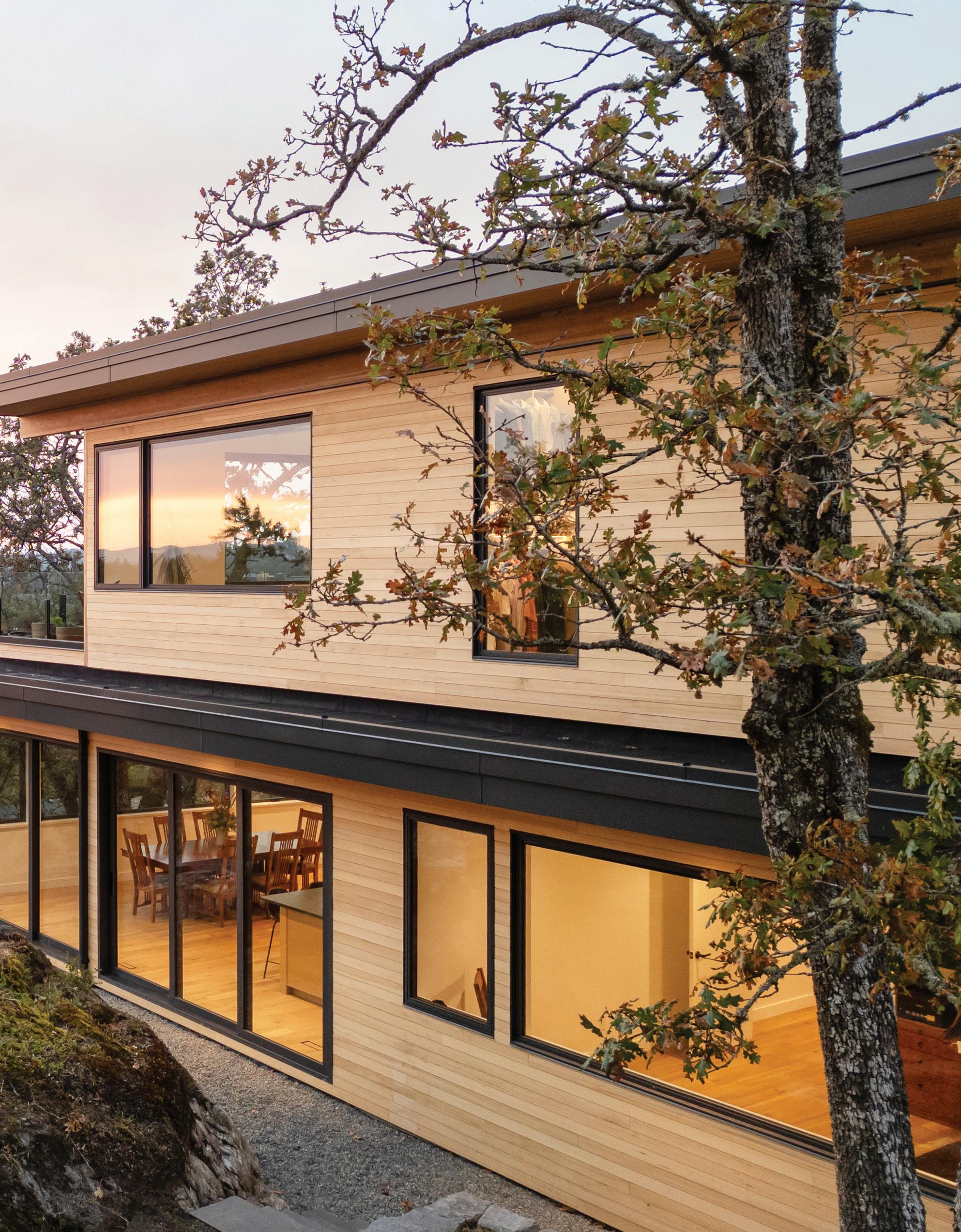
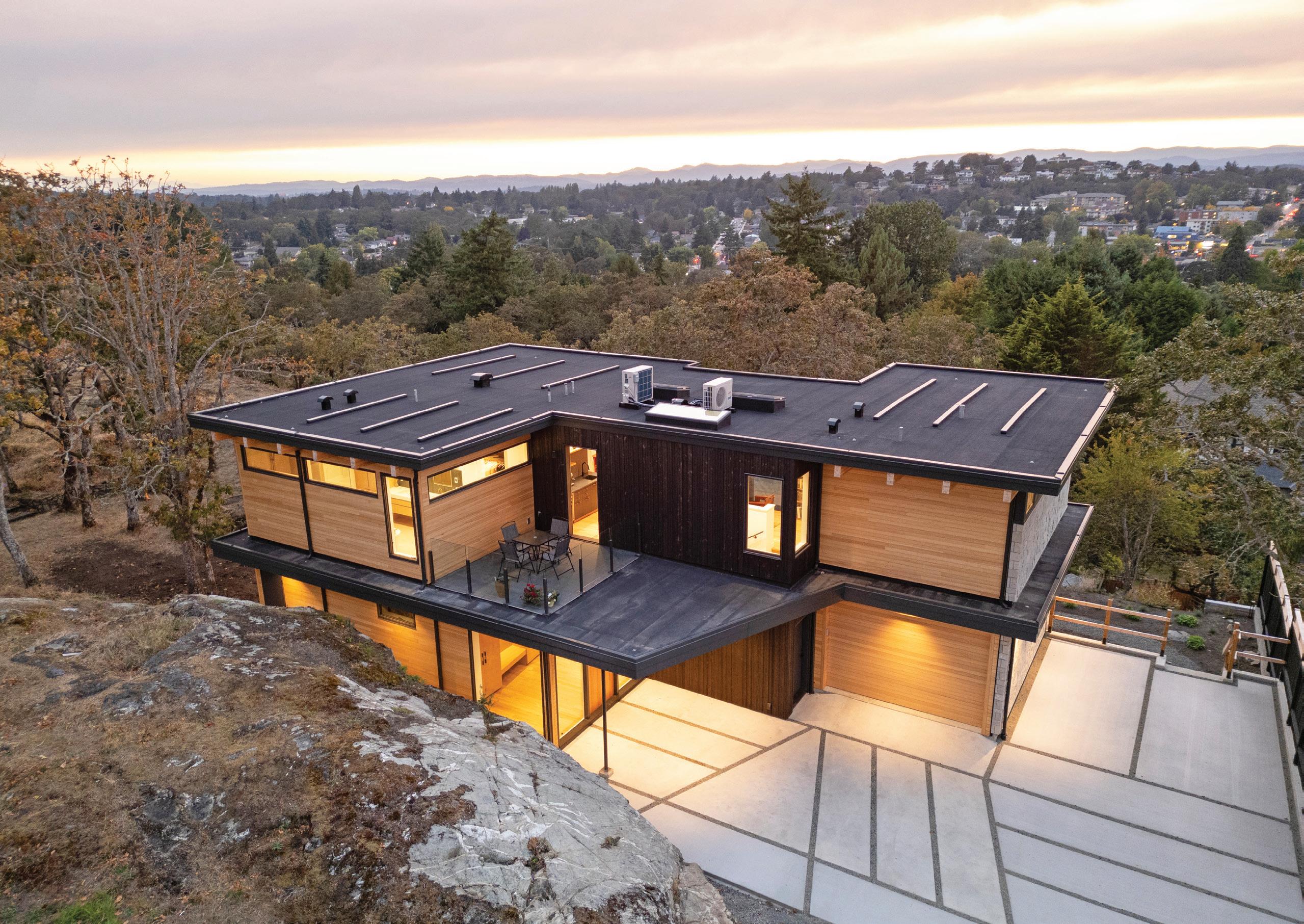
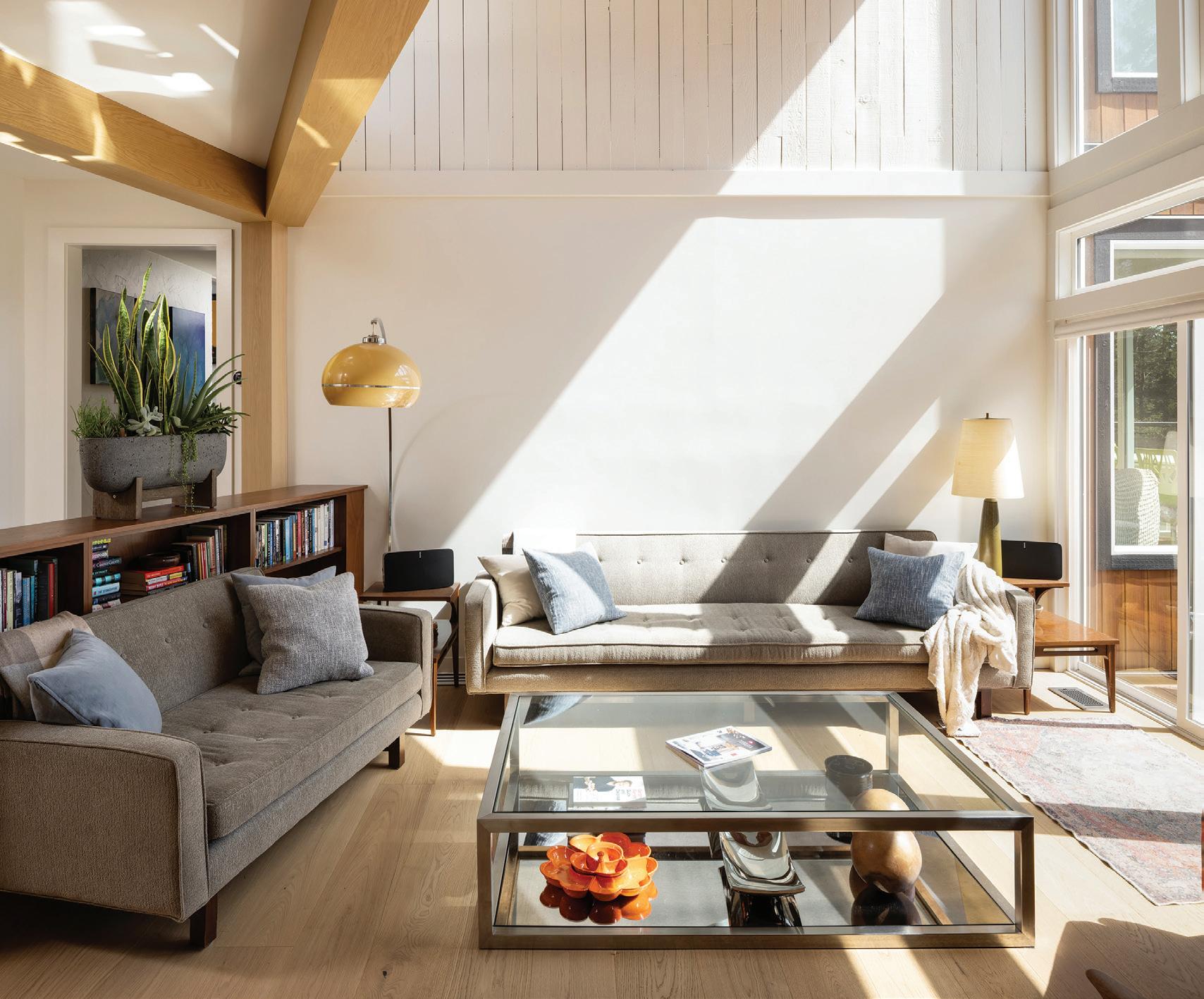
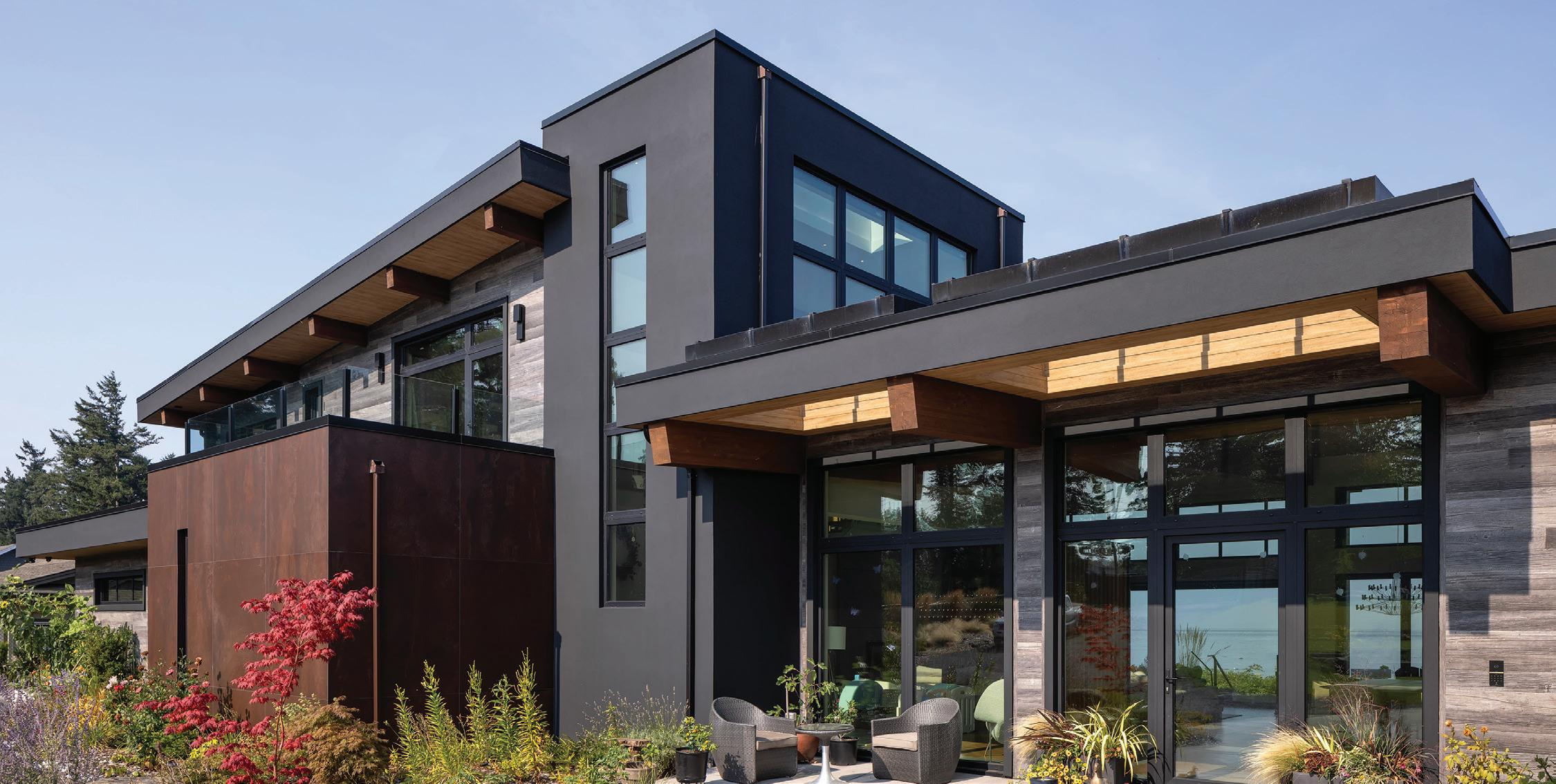
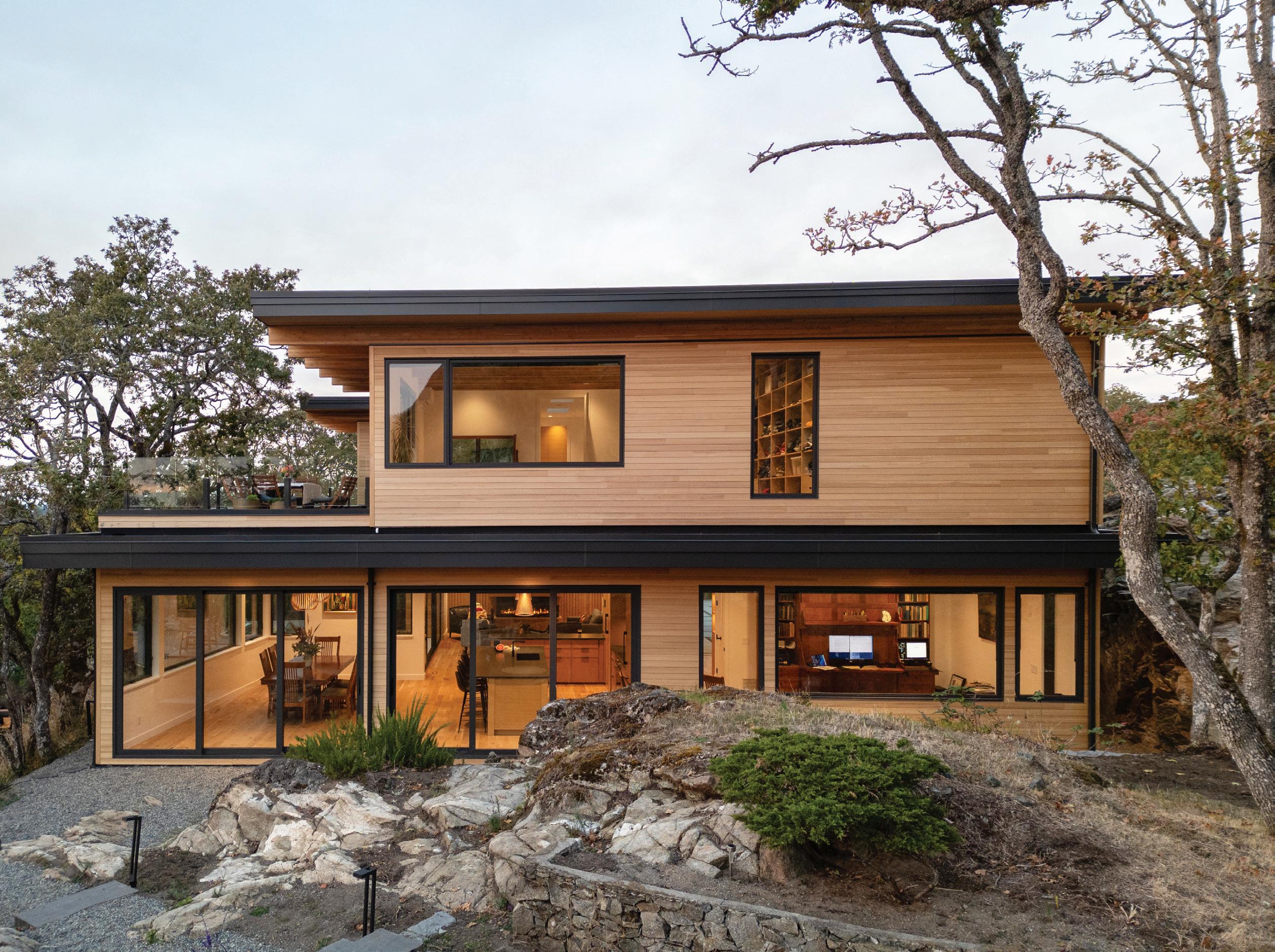
Mount Tolmie attracts many a sightseer looking to capture the breathtaking full-circle view of the South Island and beyond. For one couple, a property nestled amid Tolmie’s Garry oaks promised a unique opportunity for a house that takes advantage of the mountaintop sightlines while enclosed within a canopy of privacy. The resulting ground-up project incorporates plenty of natural materials with modern sensibilities for a stylish yet thoroughly functional home.
The homeowners purchased the property in 2018 and rented the existing house out for a few years prior to starting any work. The resulting 3,600 square feet of space, from the decks to bedrooms to living areas, has been perfect for the couple to host visiting family and regular dinner parties. With stunning landscape views and Garry oaks all around, the homeowners feel like they’re “living in a tree house.”
BEDROCK BOTTOM
The homeowners had briefly entertained renovating the original house, but remediation logistics and a “crummy configuration” ultimately led to the decision for a custom build — especially since every design decision could then be tailored to the owners’ needs.
For Horizon Pacific Contracting, the project’s builders, the first order of business was preparing the rocky landscape for construction. The original house had been built without altering the rock, but the new floor plans called for an improved
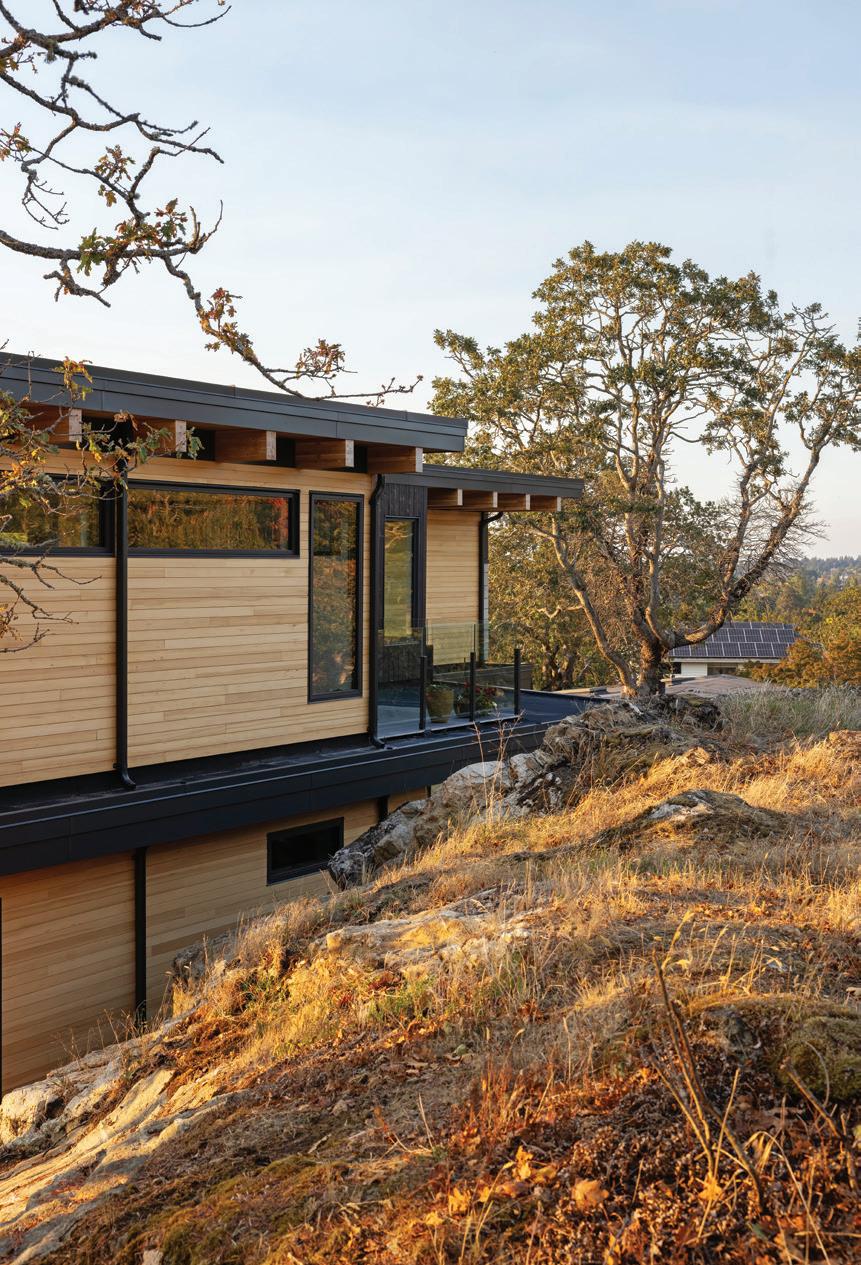
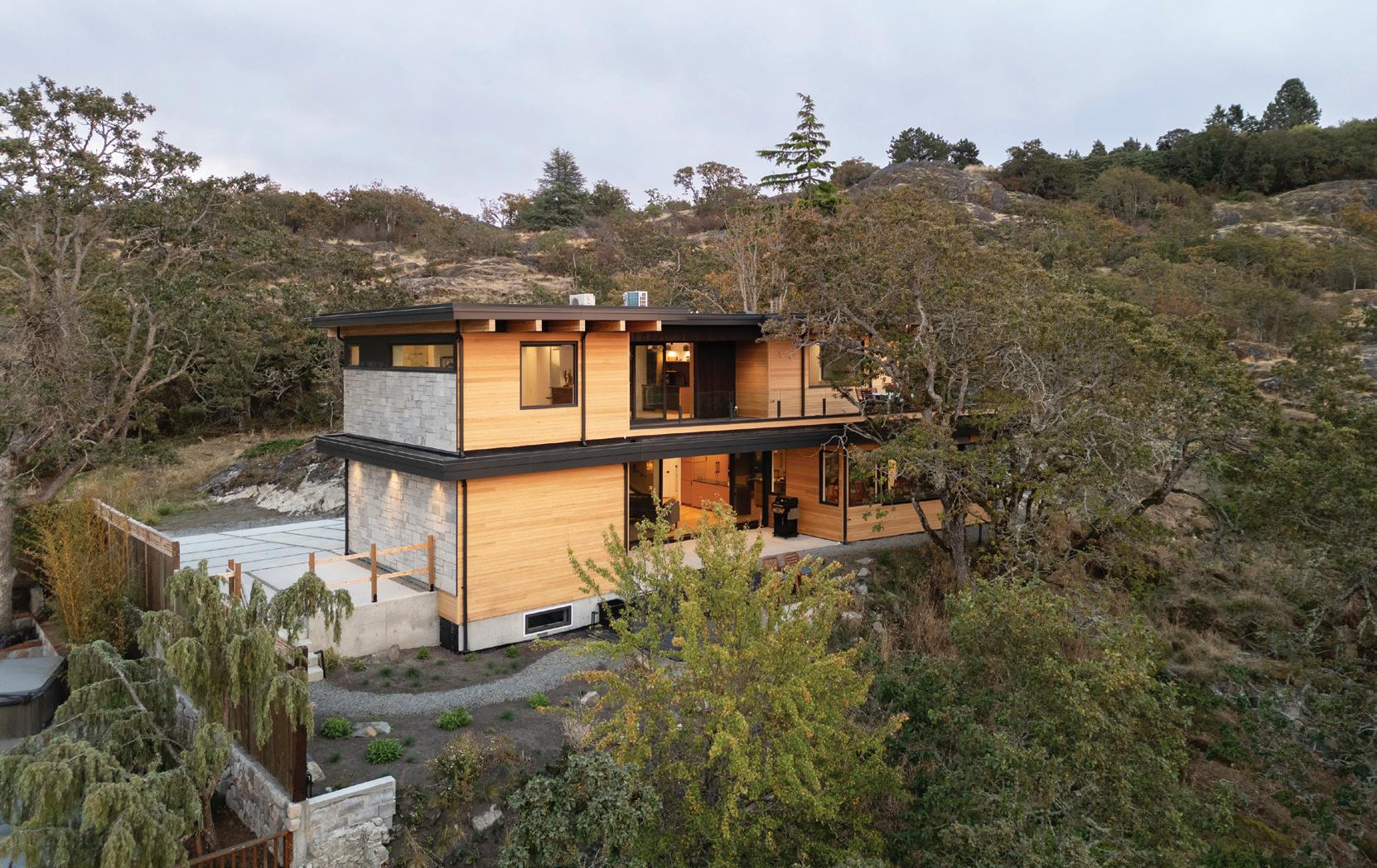
The rocky, hillside setting for this home is its greatest selling point — and its biggest challenge, too. The builders ended up blasting into the rock to construct a foundation sturdy enough to support the home. Not only does it now have one of the best views in Victoria, the surrounding rocks are now a singular design feature as well.
foundation. “We ended up bringing in a blaster,” says Dave Fallows, Horizon Pacific’s project manager. The new bottommost level was created to give the homeowners crawlspace storage since the top floors’ large windows are meant to make the most of the mountaintop location — which became the next challenge once blasting was complete.
“We had very tight setbacks with all the tree protection that the city required,” says Fallows, noting that the construction required a lot of crane work. “Then just very minimal walkways around kind of a three-foot perimeter … to get around that house.”
Fallows’s crew had to build the house starting from the far corner of the property and work toward the driveway because, as Fallows puts it, “once you got out, there was no going back in, so to speak.” This was due to the panhandle shape of the property, which has a neighbouring home to the northwest, Mount Tolmie Park to the south and a Garry oak forest to the east. The only road access point was a car-and-a-half-wide stretch of land that would later become the driveway.
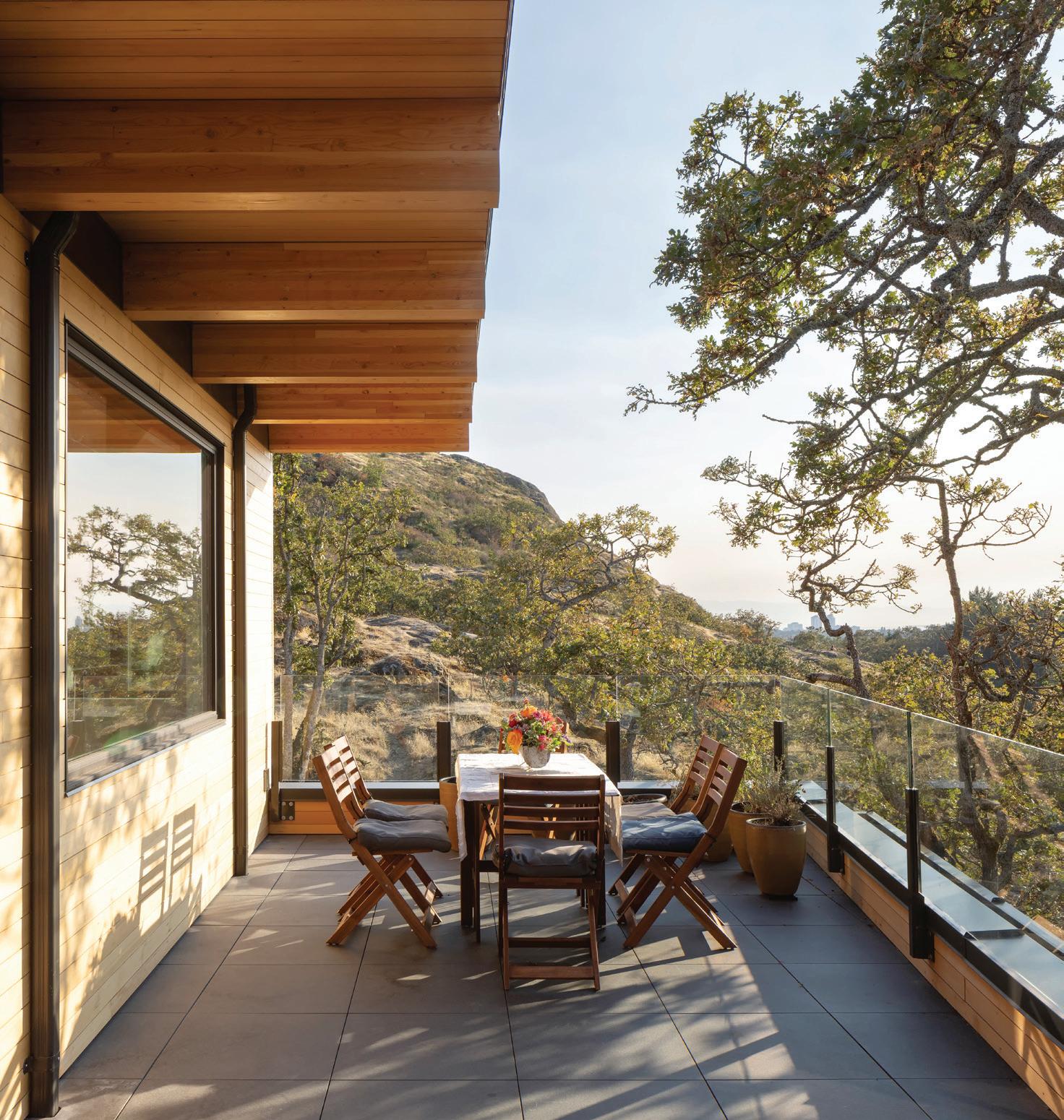
Right: In addition to its many windows, the home has patios facing east and west, designed to make the most of the view from Mount Tolmie, which includes the surrounding Garry oak meadow.
ROOMS WITH A VIEW
Perhaps the most stunning features of the home are the 180-degree views from atop Mount Tolmie — which are what convinced architect Pamela Úbeda to take on the project when the homeowners first reached out to Coast + Beam Architecture.
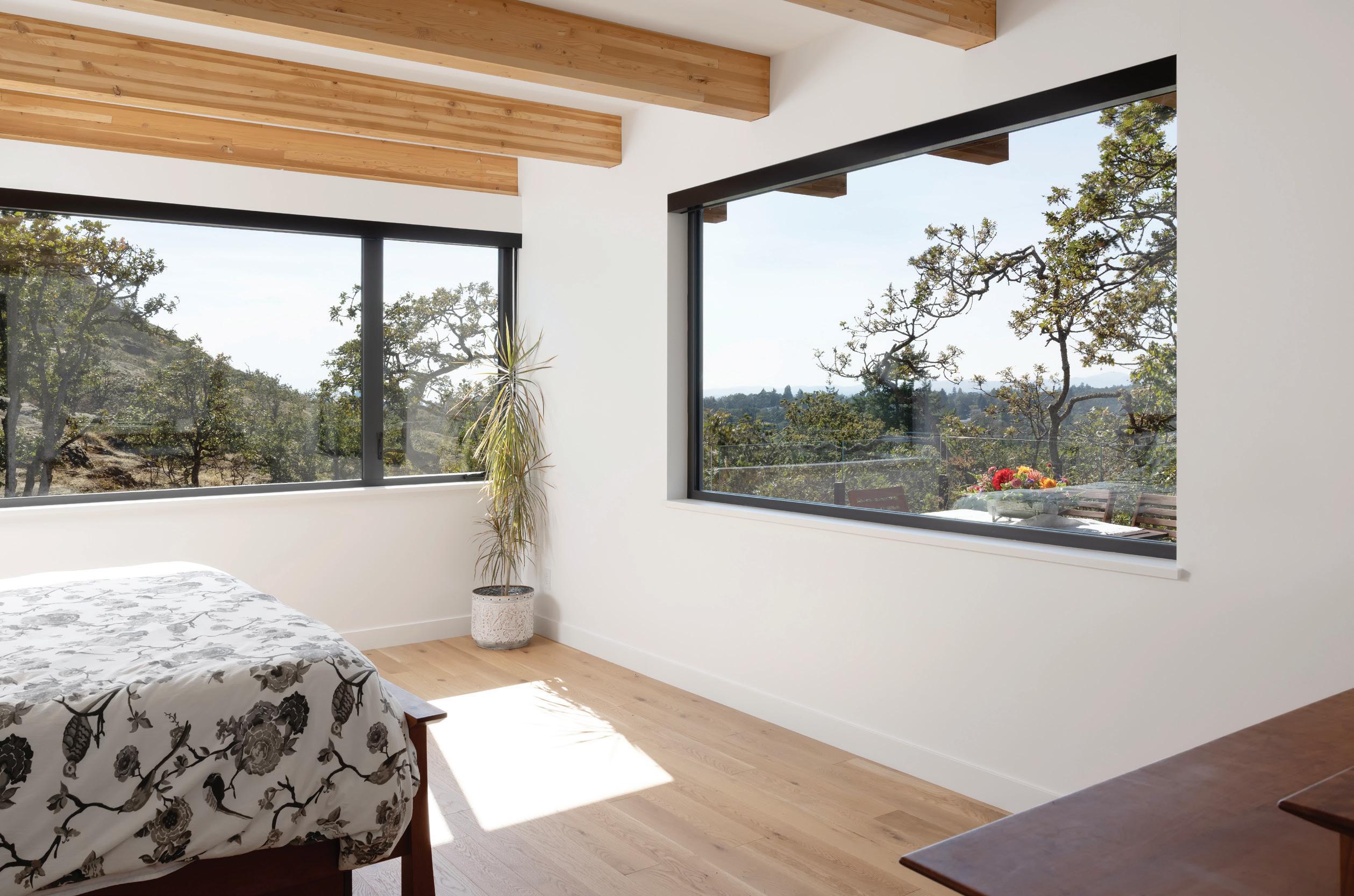
“I can’t say no to a spectacular site,” says Úbeda, who focuses on clear sight lines and incorporating natural light throughout her projects. Úbeda designed the home at a slight angle so the top floor’s west deck has a clear view of PKOLS (Mount Douglas), Observatory Hill and the sprawl of Saanich’s busy urban neighbourhoods. To the east, set above the driveway, a smaller deck is a more wind-sheltered spot to sit and enjoy the intricate canopy of the nearby Garry oak forest — a space the homeowners intend to use as a breakfast nook in the warmer months. “This allows you to sit outside, enjoy your view, but be protected,” Úbeda says, adding, “For me, always, architecture is about blurring the indoors and outdoors.”
From the top-floor primary bedroom, Mount Tolmie Park rises beyond the southmost window and the distant lights of downtown Victoria sparkle at night from behind its slope. Downstairs, in the office, yet more windows at ground level give front-row seats to passing wildlife, like the deer that rest on the grass mere metres away. With so many picture windows, the homeowners decided not to display as much artwork as they’d planned since the many views act as built-in landscape paintings.
encompasses the twinkling lights of downtown at night.
Left: From the sheltered deck, the owners can watch wildlife wander by, nearly oblivious to the presence of humans nearby.
Above: The home’s many large windows are designed to bring the outdoors in. The primary bedroom has a view that
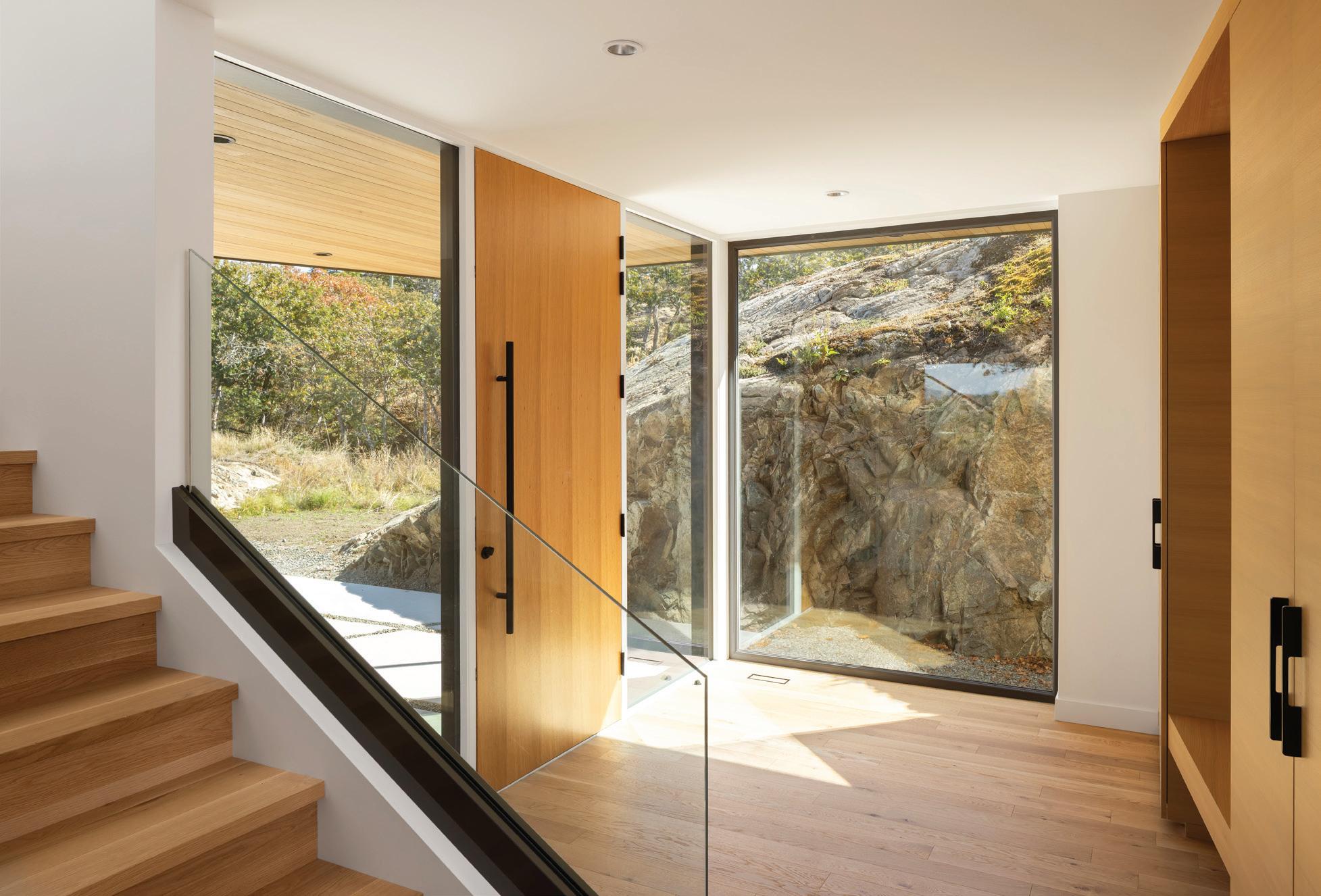
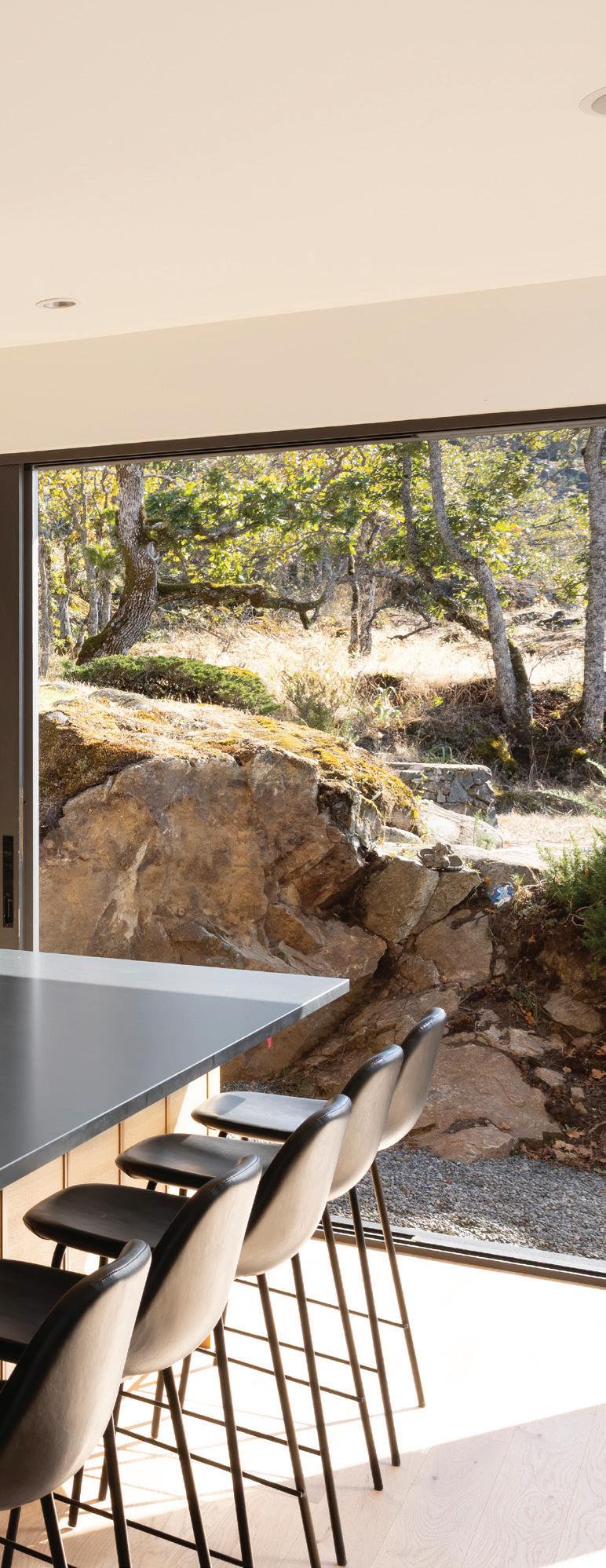
By blasting into the rock, the builders created a lower level with plenty of storage space. But the rocks, with their dramatic shapes and angles, also become sculptural works of art framed by the large windows.
GATHERING SPACES
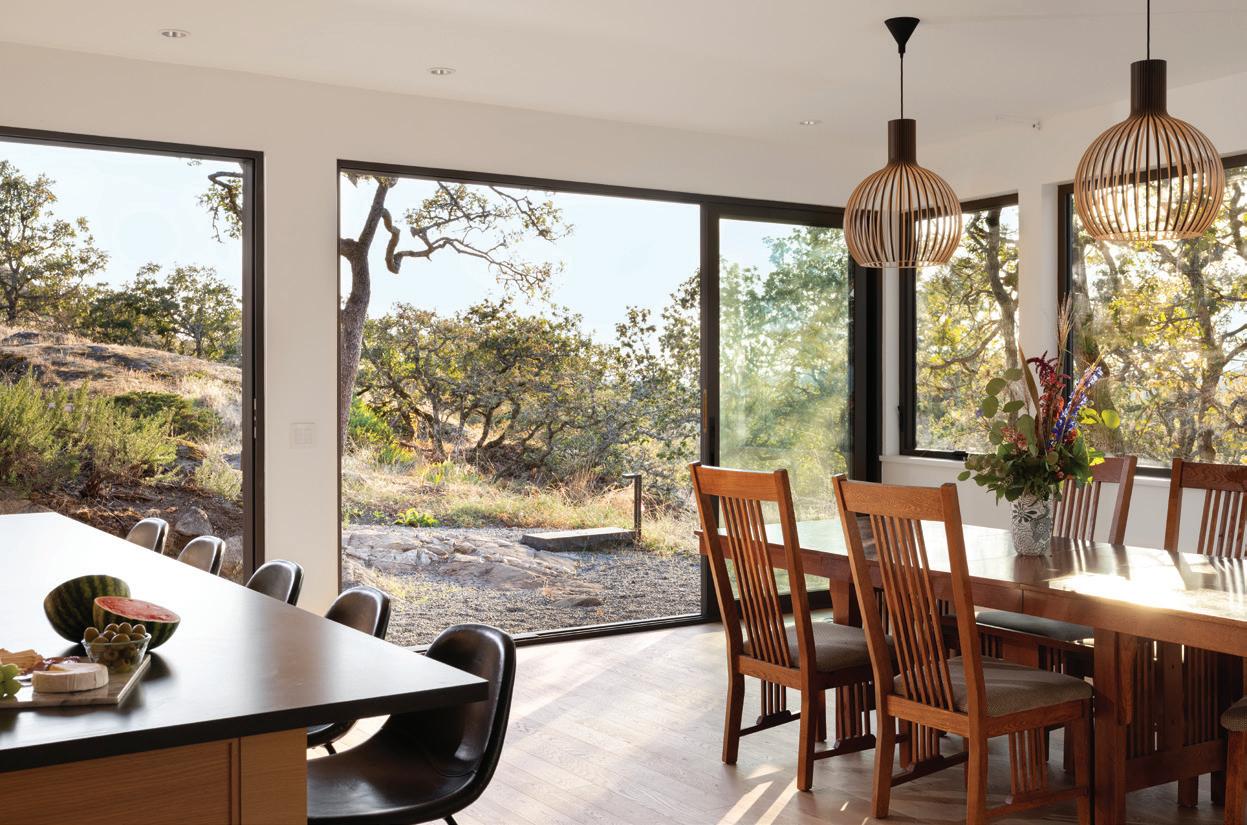
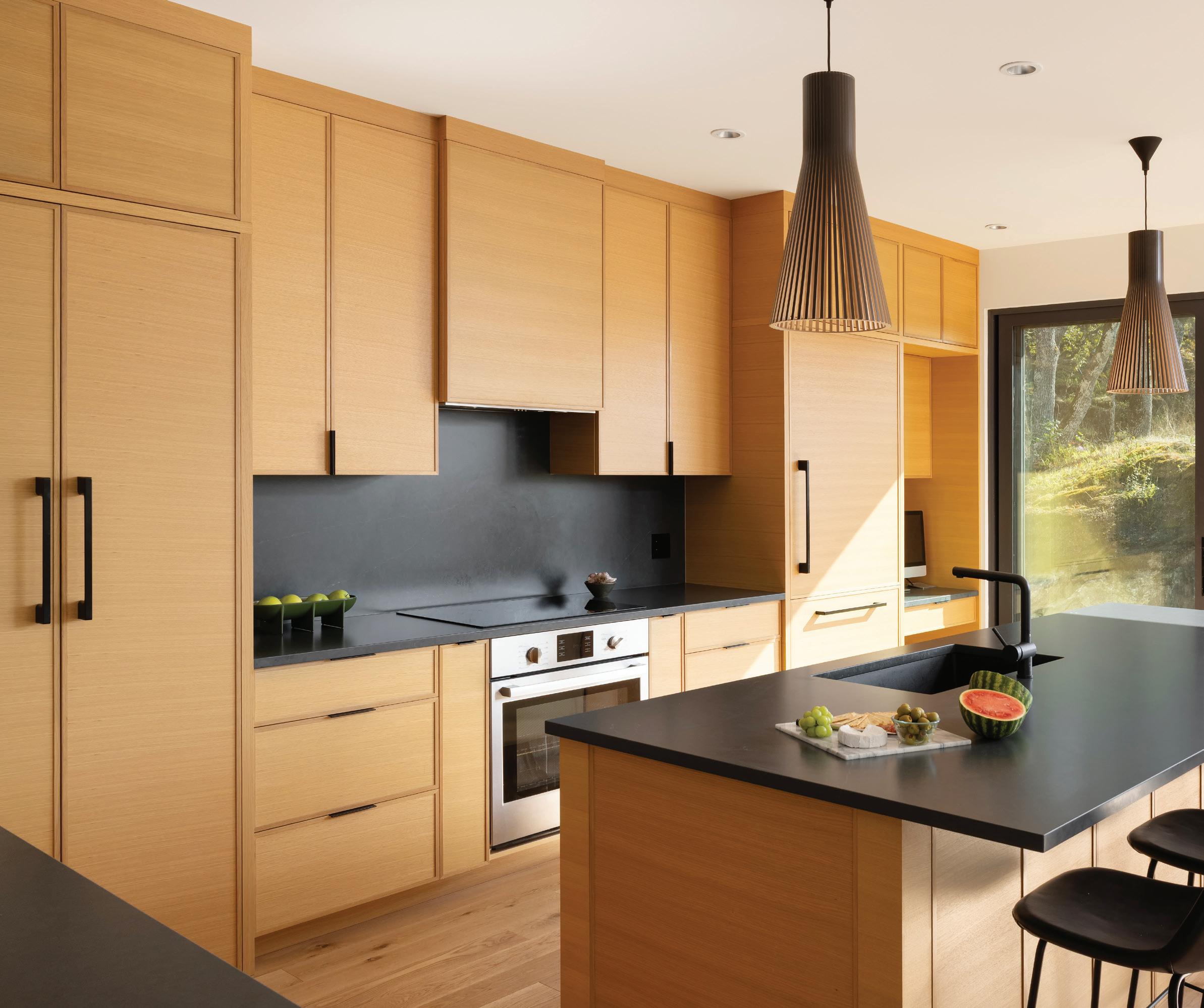
The home’s layout has an abundance of space for the owners to host friends and family. The main floor’s open-concept kitchen, dining area and living room is the perfect area to fit a crowd, and the kitchen itself was thoughtfully designed, with plenty of places to tuck away appliances and keep the counters free of clutter.
“You don’t want to just do anything cookie cutter; you really want to understand the way people live,” says Tonia D’Introno, the interior designer for the project. D’Introno considers the fine details that affect how homeowners interact with a given space — such as the couple being a tall-and-petite duo. “That makes a difference for how you want to place cabinetry and things in the home.”
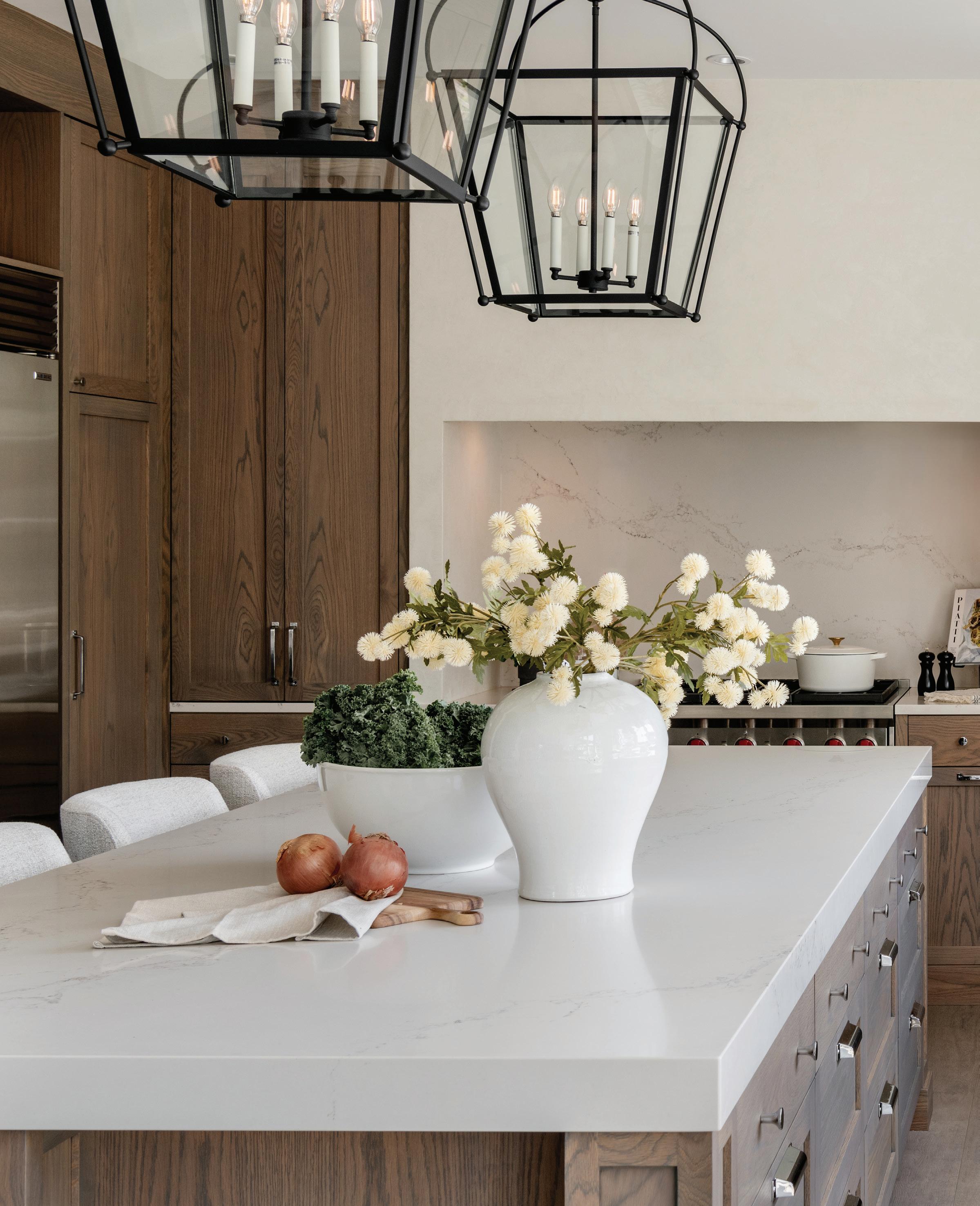
The owners love to entertain, and the home is designed with just that purpose in mind. The open-concept kitchen, dining area and living room is the perfect size for a crowd to gather. Meanwhile, the kitchen is designed as a sleek and functional space, with Silestone countertops, hidden appliances and plenty of white oak veneer cupboards to keep counters free of clutter.
DESIGNS
At 19K Design and Contracting we blend integrity, design, and craftsmanship to create spaces that feel like home. From kitchens built for gathering to seamless additions, every detail reflects your lifestyle and long-term goals.
We lead complex renovations with clear scope, documented decisions, and true accountability—delivering clarity, cost control, and confidence from first call to final walkthrough.
Once gatherings have wound down, multiple bedrooms with ensuite bathrooms allow guests to comfortably spend the night. The main floor’s office has a Murphy bed, which doubles as an agingin-place consideration if the homeowners develop difficulties navigating stairs later in life. Upstairs, a guest bedroom tucked at one end has another large window for gazing upon Saanich, PKOLS and beyond. As D’Introno was selecting finishes for flooring and millwork, she had to factor in the finishes of the furniture the homeowners brought with them from their previous home. “They originally had a home that was full of beautiful arts and crafts furniture,” says D’Introno. Because these heirloom pieces were predominantly made of cherry and redwood, she chose lighter, but complementary, tones to steer clear of overwhelming the house with darker woods.
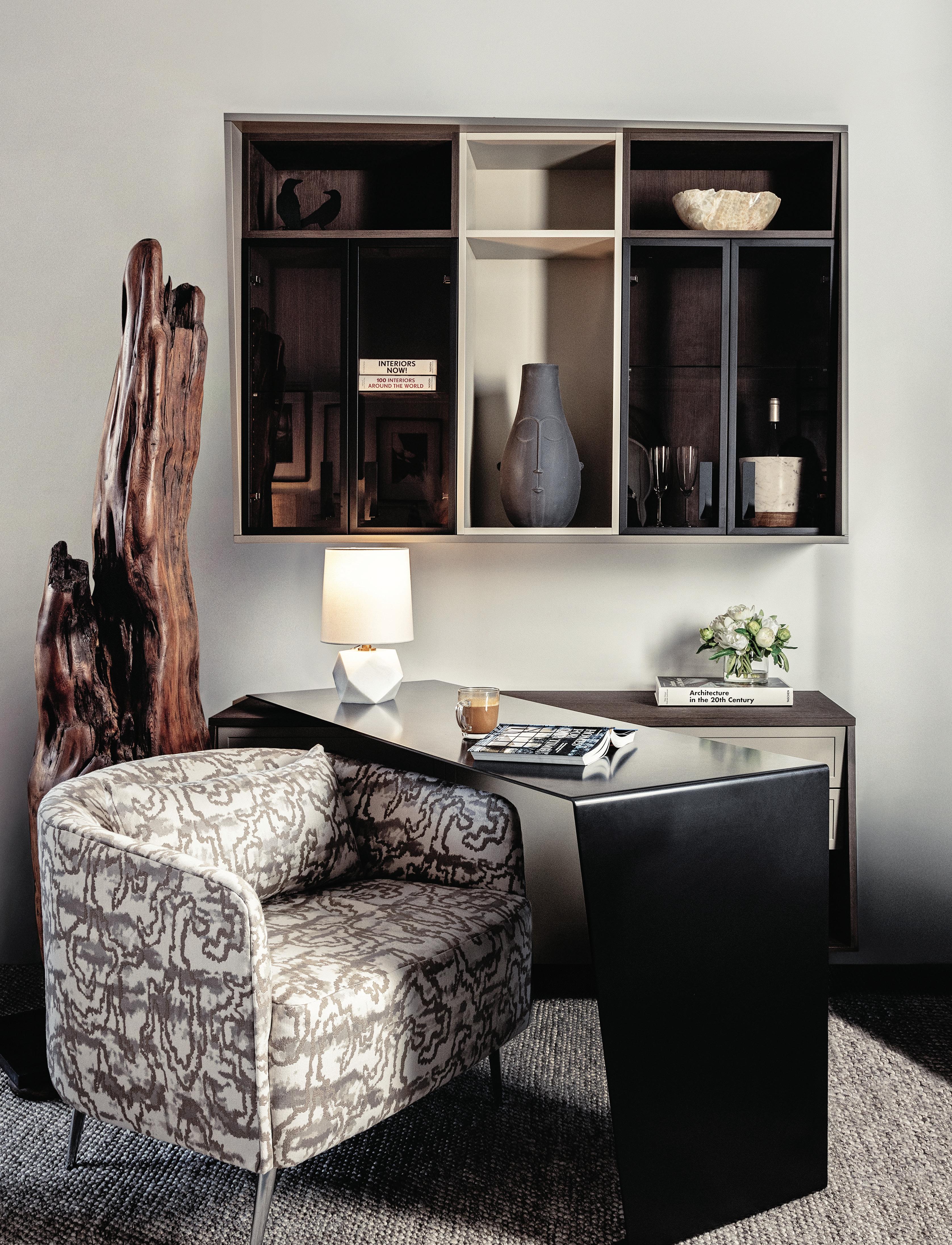
Meanwhile, one of the homeowners’ favourite features is the seating area with dedicated coffee bar that has been built into what was initially conceptualized as a hallway between the guest and primary bedrooms. It saves them the journey down to the kitchen for their morning routine.
Below: The homeowners love this coffee bar, which was built into what was originally going to be just a hallway. It also gives them a space to showcase some of their heirloom arts and crafts furniture (in the foreground); because it is made of such dark wood, designer Tonia D’Introno found herself using lighter materials to balance it.
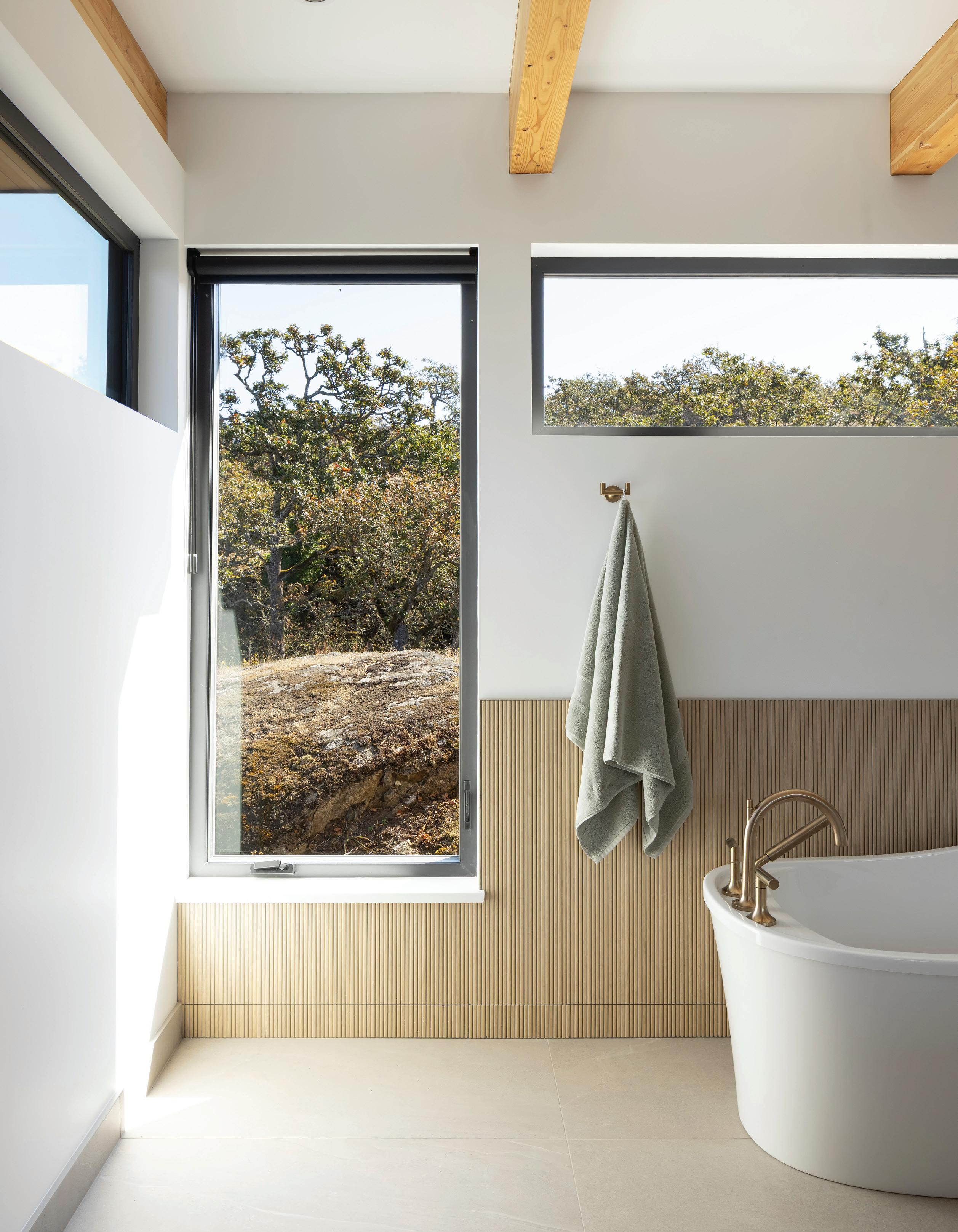
On the walls of the primary bathroom, matchstick tiles with the appearance of wood offer a natural, textural appeal that perfectly frames the Garry oaks just outside the window. It’s a mountaintop view that’s best enjoyed from the deep soaker tub, with its elegant brass fixtures.
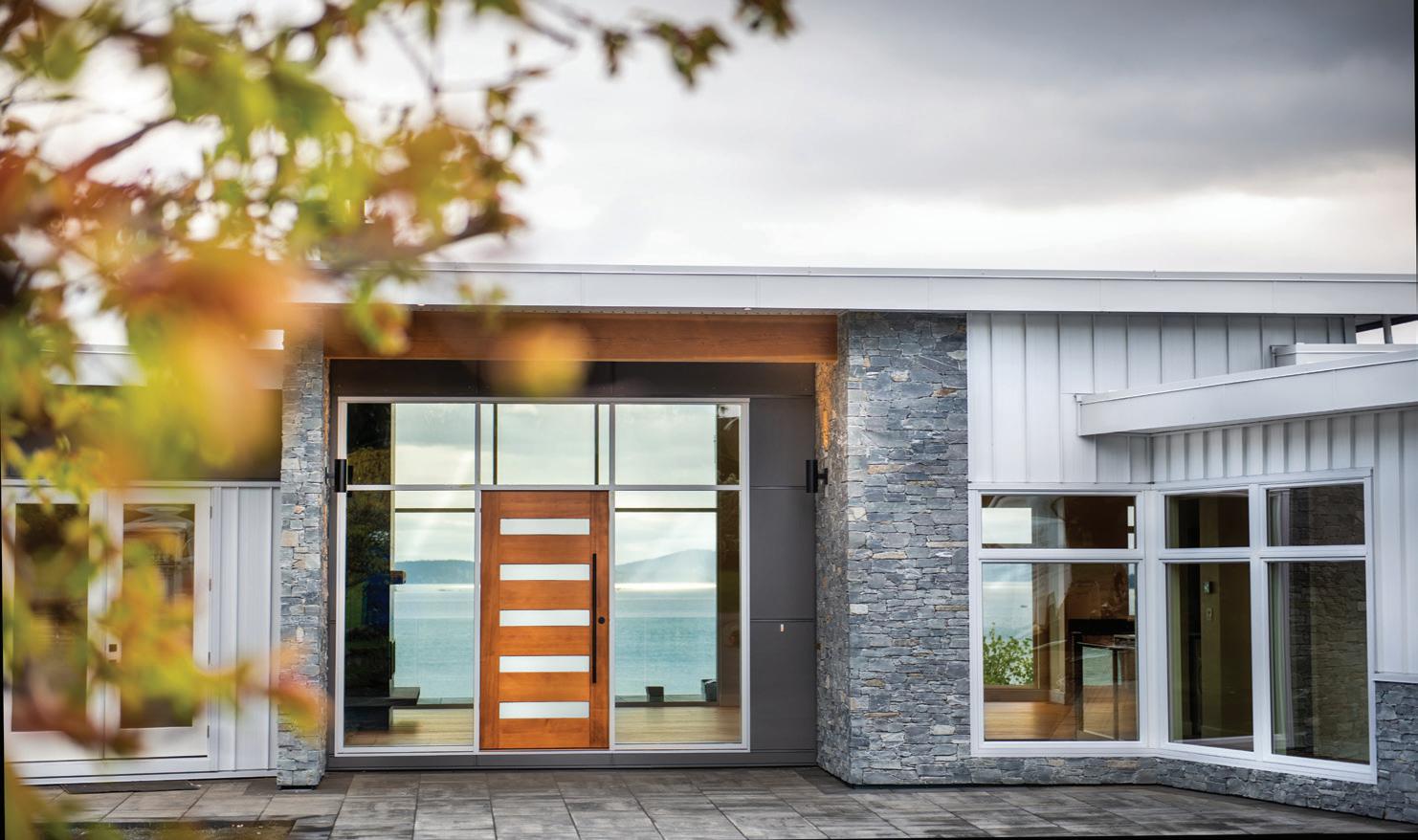
The house fits neatly into this setting thanks to its siding, which is a combination of hemlock and a charred finish in the style of shou sugi ban, a traditional Japanese technique that enhances the durability, fire resistance and pest resistance of timber.
NATURAL ESTHETICS
Naturalistic materials are used throughout the home to seamlessly integrate with the mountain environment. An exposed rock wall shelters the main entryway while exposed wood roof supports mirror the surrounding forest. “There’s all exposed glulams on the inside that also cantilever out on the outside to create the large overhangs,” says Fallows, who notes that 90 per cent of the exterior finish is hemlock. “Then a large stone veneer wall on the outside just to tie it all together.”
Inside, the ensuite primary bathroom has wood-look matchstick tiles that were originally planned for the shower alone, but the homeowners loved them so much, they had more added along the far wall as an added feature.
In terms of lighting, the bathroom incorporates a variety of sources: the double vanity’s mirrors are kitted out with rim lighting; the floating cabinet has motion-activated underlighting that automatically shuts off after a minute (a great feature for late-night wandering); and blindless east-facing windows welcome in the first rays of sunlight.
Morning or night, every angle celebrates the “tucked-into-the-mountain” feel of this perfectly modern mountaintop tree house and its extravagant views.
RESOURCES
General contracting: Horizon Pacific Contracting
Architect: Coast + Beam Architecture
Interior designer: D’Introno Interior Design
Plumbing, mechanical and heating: Martin Xtreme Plumbing
Electrical: Black Box Electric
Light fixtures: Mclaren Lighting
Plumbing fixtures: The Ensuite Bath & Kitchen
Cabinets and woodwork: Island Precision Manufacturing
Send your reader questions to readers@sprucemagazine.ca
THE SPRUCE GUIDE TO THE SEVEN ESSENTIAL KITCHEN LAYOUTS.
BEST LAID PLANS
BY JOANNE SASVARI
Whether you are renovating an existing kitchen or building a brand-new one, you need to have a plan. But looking at all that space can be overwhelming. You want to get it right — after all, a mistake can be costly in terms of both money and aggravation — but where to begin?
Well, one good place to start is to hire a designer, general contractor and/or kitchen specialist, and there are plenty of stellar ones around Greater Victoria. All are, to varying degrees, experts in designing, fitting and building kitchens.
But they are not the ones who are going to use your kitchen. You are. And that makes you the ultimate expert.
Before you reach out to the team who will turn your dream kitchen into reality, it’s a good idea to spend some time doing some research of your own so you have at least some idea of what you want and what will work in your space. While you’re at it, give some serious thought to how you will actually use your kitchen.
For instance, open shelves have been a major
THE ISLAND LAYOUT
trend in kitchens for the last few years. But even if you love them, be honest with yourself: Are you tidy enough to have all your dishes on display all the time? Patient enough to keep them beautifully arranged? And how is your dust tolerance? Maybe closed cabinets would be better for hiding all your clutter, with a couple of glass doors to showcase your most precious objects. Building a kitchen involves countless decisions, big and small, affecting your appliances, materials, flooring, lighting, plumbing, cabinetry and more. But the first, biggest and most important is your layout.
A WORKING SPACE
A kitchen is not just a pretty room. It is a working space that often has to fulfil multiple tasks: cooking, dining, entertaining, making Zoom calls, doing homework, feeding the pets. How your kitchen is laid out affects how
efficiently it functions. Does traffic flow freely or does it have awkward pinch points? Is there enough storage? Is there a good relationship between stove, sink, fridge and workspace? Does the room have enough outlets — and are they placed where you need them? And how is the lighting? Can you see what you’re working on?
Before choosing the style of layout, you need to consider the limitations of your space. In a new custom build, your only limitation may be your budget. In an older home, you may be restricted by the size of the space as well as awkwardly placed doors and windows. Other things to consider are whether your kitchen is closed — as they often are in older homes — or open to a dining/living area, and whether you plan to eat in and need to consider a breakfast nook or bar.
With all that in mind, here are some of the most popular layouts to consider.
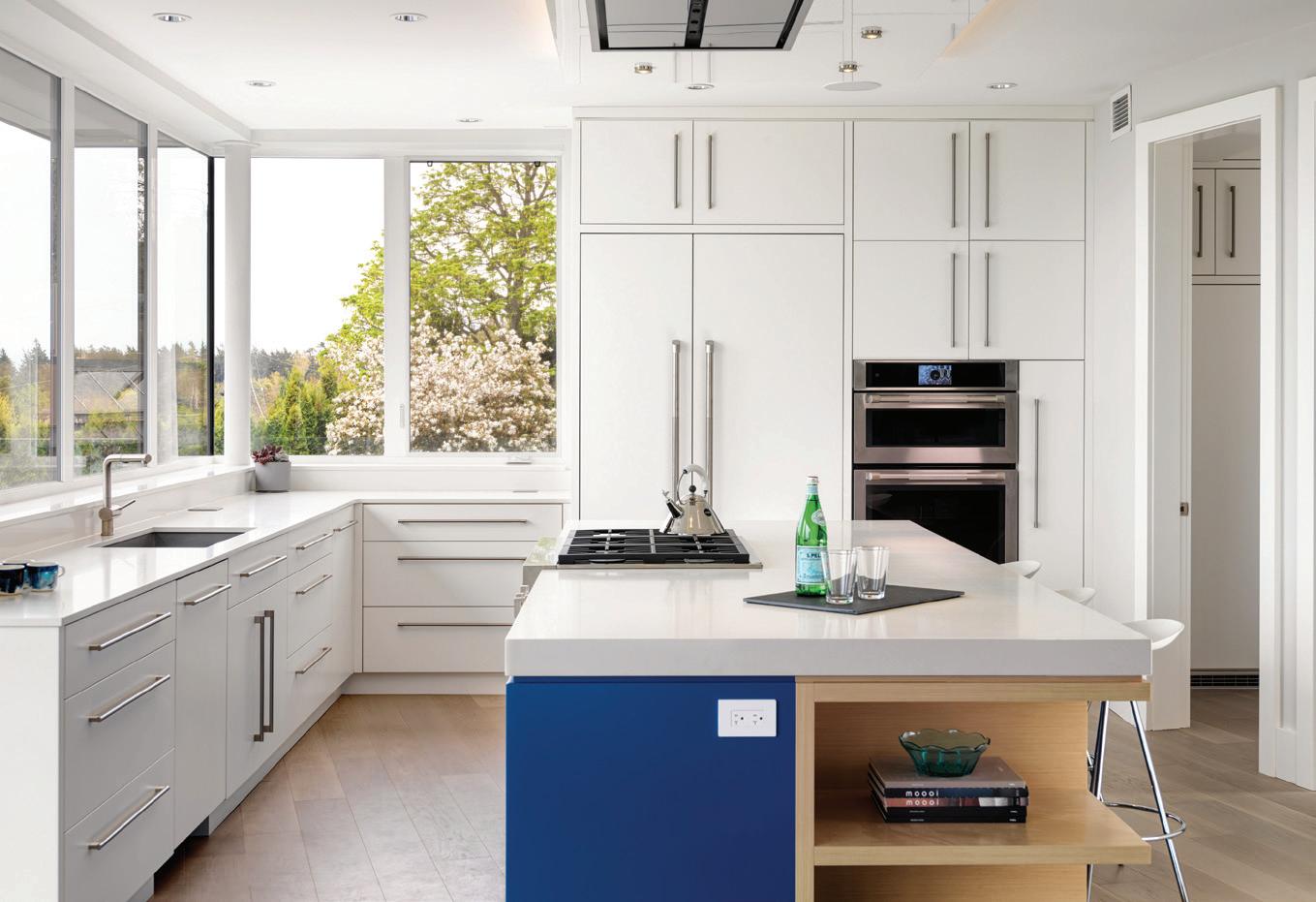
The island is a free-standing workspace in the centre of the kitchen; it is a prep area, extra storage and social magnet for parties. Add seating and it can become your family’s favourite place to dine or enjoy cocktails. Install a sink or cooktop and it becomes even harder working. It can also be a home for your cookbooks, wine fridge or additional kitchen gear. Regardless of how you use your island, it will be the visual focus of your kitchen, and one that can dramatically improve its functionality. Islands generally work better in larger kitchens, especially L-shaped, U-shaped and one-wall designs.
Ideal for: Those who love to entertain, especially in medium- to large-sized kitchens.
Pros:
• It provides extra workspace and storage.
• It is a social focal point for entertaining, especially if you add seating.
• There are many design options available.
• In a large kitchen, it can improve traffic flow.
• Creates a focal point to your kitchen.
Cons:
• It can take up a great deal of space.
• If it’s poorly placed, it can disrupt traffic flow and the work triangle.
• Can be costly to install, especially if electricals and plumbing are involved.
• Can become a magnet for clutter.
Design tips:
An island will naturally be the kitchen’s focal point, so consider using contrasting materials or colours when designing it. Add statement pendant lights above it and bar stools for seating. Depending on how you plan to use it, consider adding shelves, drawers, an under-counter beverage fridge, a cooktop or sink. Otherwise, place the refrigerator and wall ovens along the perimeter to make the work triangle more effective. If your kitchen is very large, consider adding a second island: one for prep, one for entertaining. In any case, make sure there is adequate space around your island to avoid awkward pinch points.
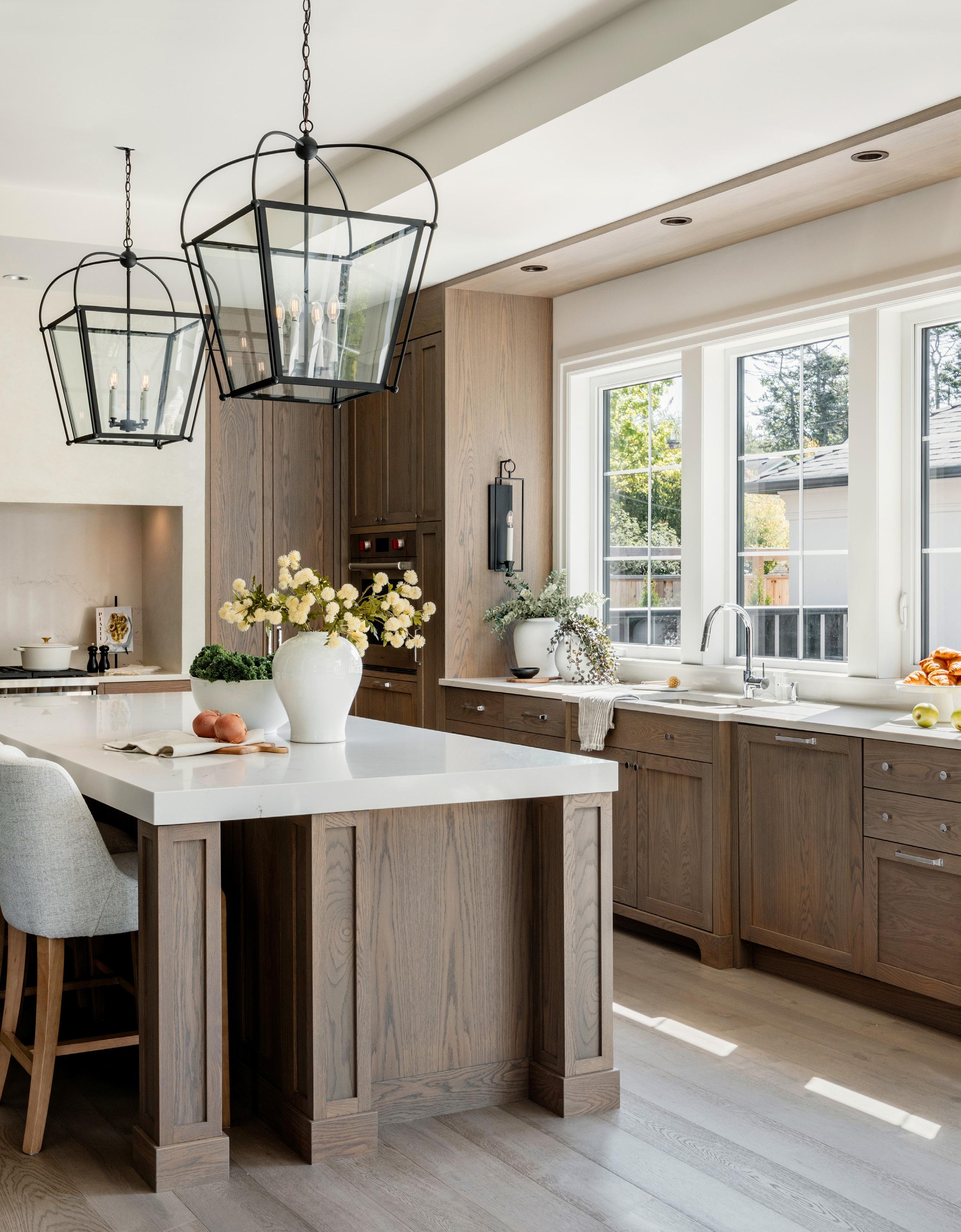
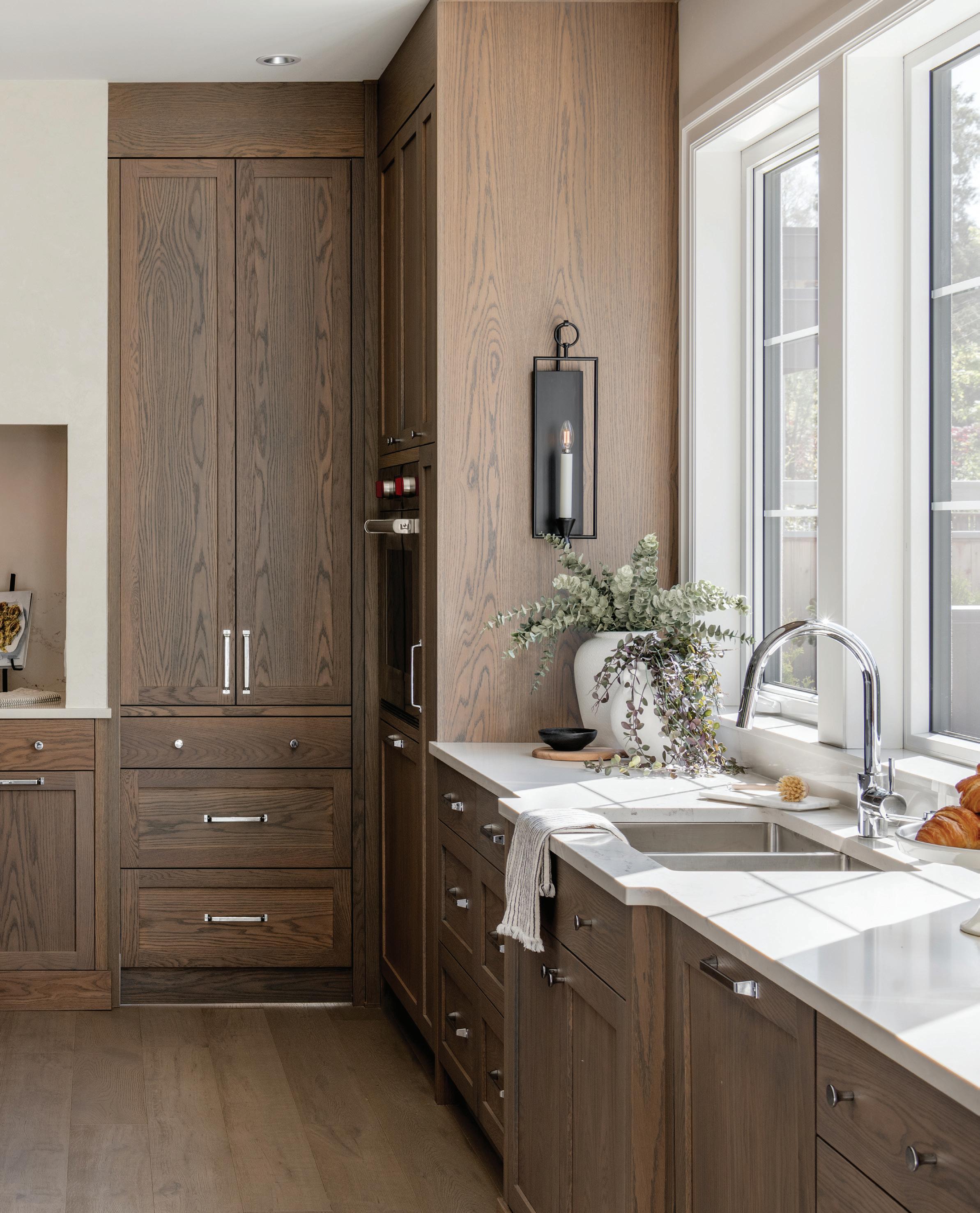
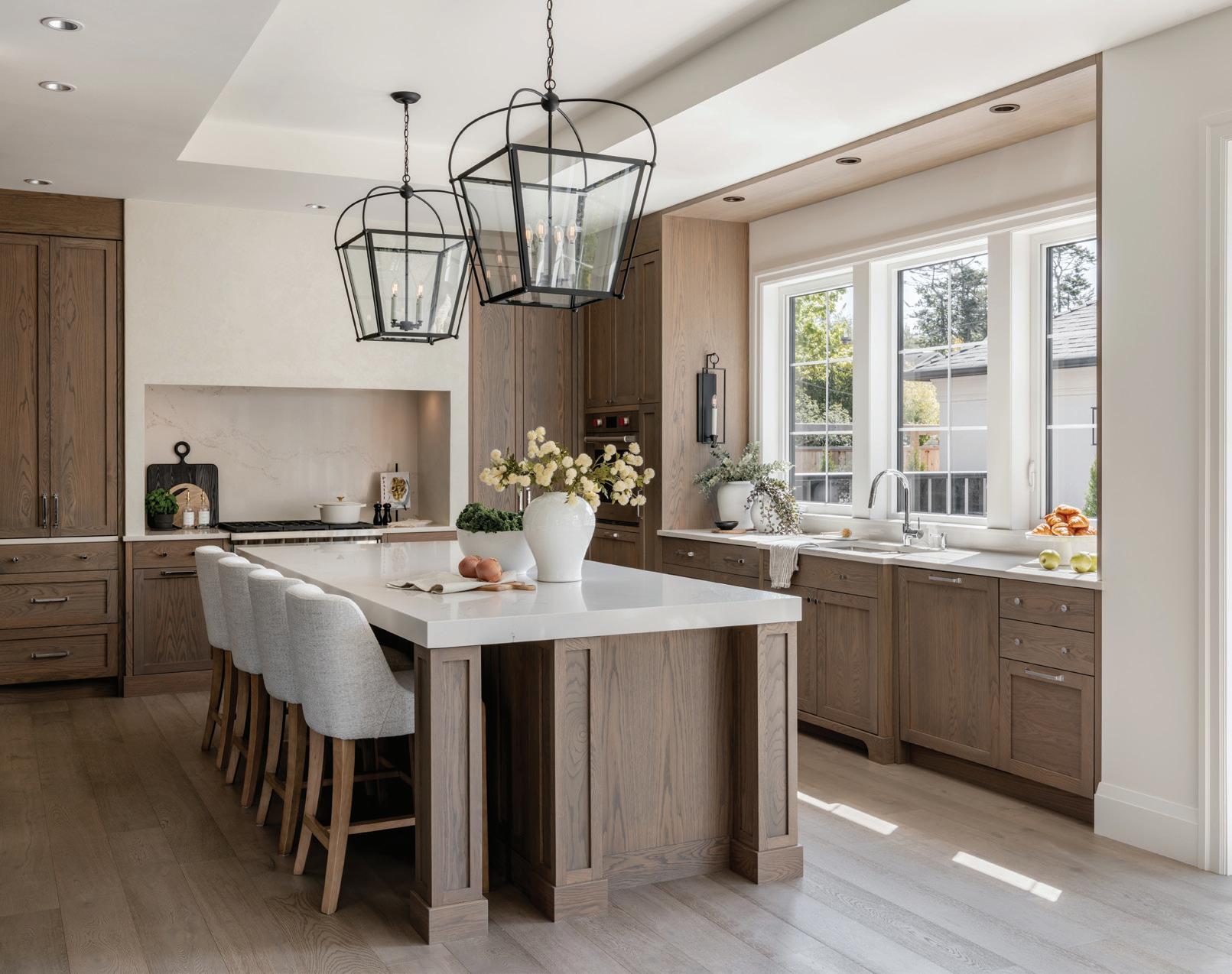
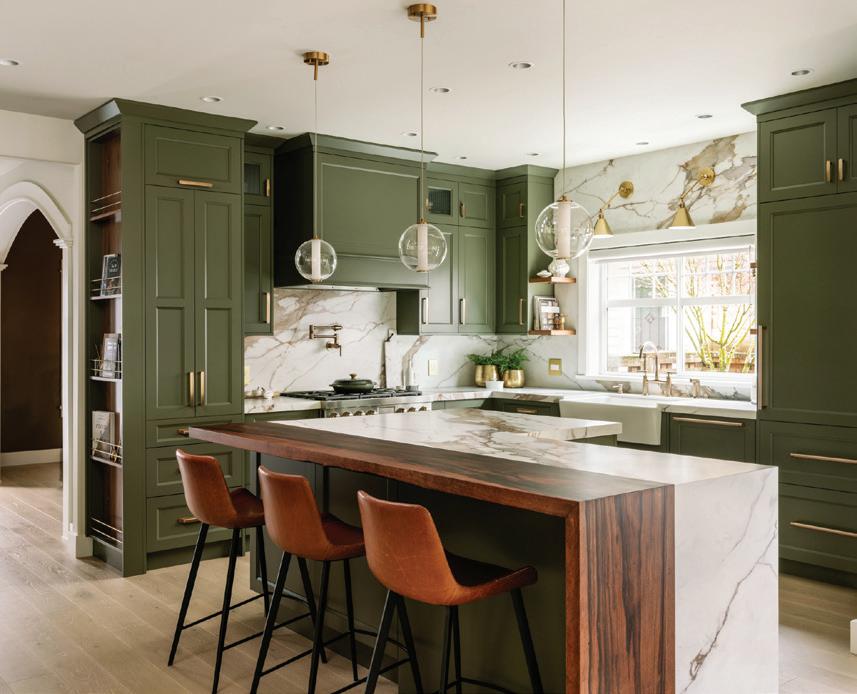
This island perfectly suits the traditional look of this elegant kitchen by Jenny Martin Design. With its furniture-like supports, the bar side is perfect for entertaining, casual dining or chatting to the chef during dinner prep. The other side is conveniently close to the sink and dishwasher, making it practical for the cook. It all works in large part because the space is big enough for good traffic flow all the way around the island.
DASHA ARMSTRONG
THE L-SHAPED LAYOUT
In this easily adaptable floor plan, the cabinets and appliances are arranged along two adjacent walls, forming an L shape that lends itself to the traditional (and functional) work triangle. It feels open, creates good traffic flow and works well in both small and large spaces. Also, you can easily use an island or kitchen cart to create additional work, storage or entertaining space.
Ideal for: Small- to medium-sized kitchens; open-concept living areas.
Pros:
• Easily adaptable to different sized kitchens.
• Open layout with good traffic flow.
Cons:
• In smaller kitchens, the counter space can be limited.
• Corner cabinets can be challenging to access.
• Storage may feel insufficient.
• The design may feel undefined, especially in larger spaces.
Design tips:
To create the most efficient work triangle, place the fridge at one end of the L, the stove at the other and the sink in the middle. To maximize prep and dining space, add an island or dining table — you could also install a cooktop and wall oven in
L-shaped kitchens like this one by Keith Baker Design feature cabinetry on two perpendicular walls and are an efficient and versatile use of space in smaller kitchens.
THE GALLEY LAYOUT
In this kitchen layout, a central walkway divides two parallel walls of cabinets and appliances that face each other. It is the quintessential urban kitchen, typically found in smaller homes or apartments, and because everything is within easy reach, can be a highly efficient and functional cooking environment.
Best for: Small- to medium-sized narrow kitchens with just one cook.
Pros:
• Everything is within easy reach for the cook.
• Efficient use of space.
• Best design for narrow spaces.
• Surprisingly generous amount of counter space.
• Clear traffic flow with no pinch points.
Cons:
• Awkward and cramped if there is more than one cook.
• Not designed for entertaining or dining in.
• Can be quite dark, with limited natural light.
• Can be difficult to make deeper appliances fit in.
Design tips:
Light colours, reflective surfaces and glass-fronted cabinetry can make this small, narrow space feel more expansive. Tall cabinets can make use of vertical storage space. If possible, opt for streamlined cabinetry and appliances with integrated handles/ closures — this not only reduces visual clutter, it lessens the likelihood of people snagging their clothes as they walk by. For the same reason, counter-depth appliances are a better choice. And, since your décor options are limited, consider statement flooring to add dynamic visual interest.
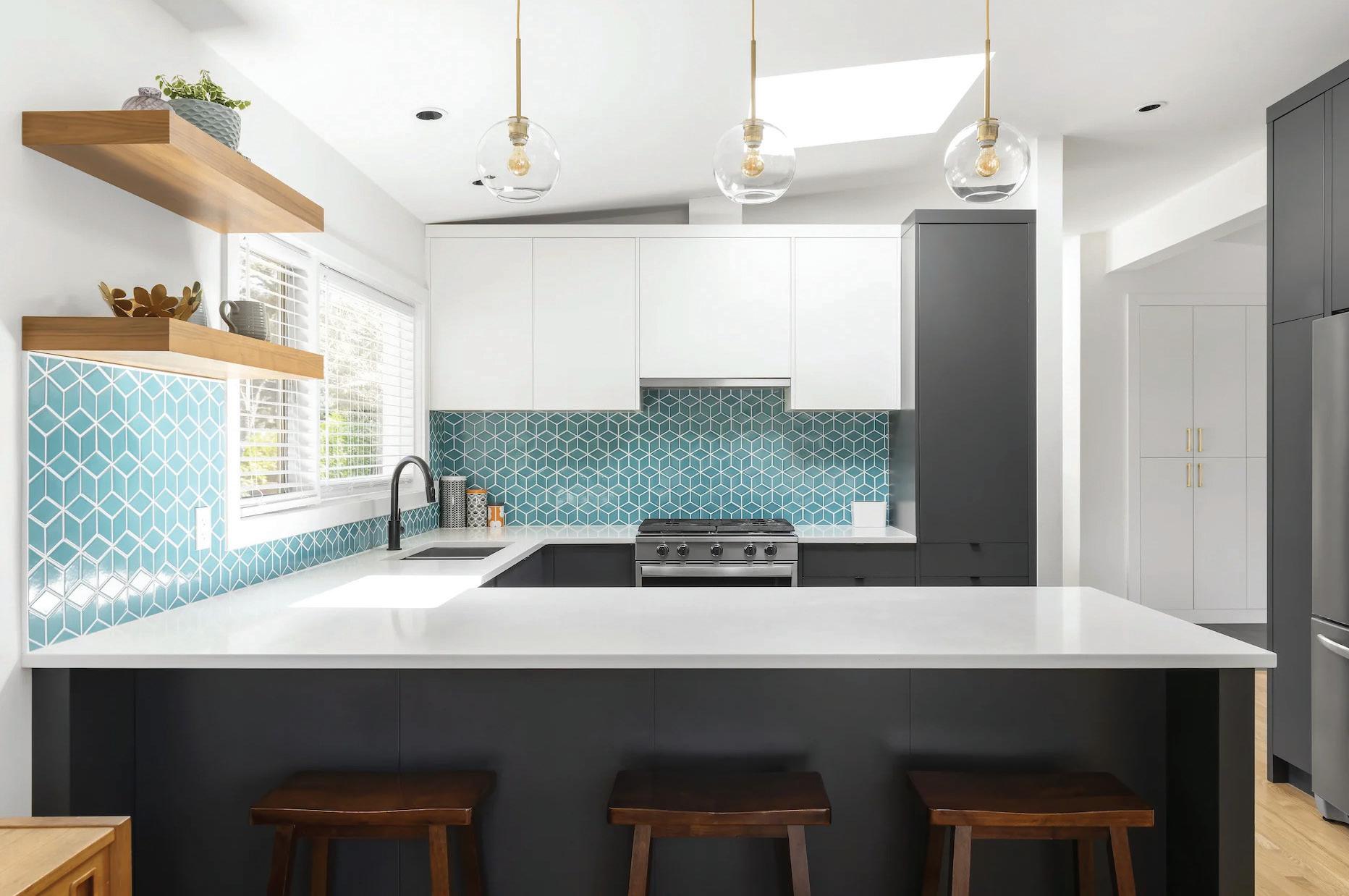
In this Cosgrave Construction renovation of a midcentury modern home, the U-shaped kitchen keeps everything within convenient reach for the cook. That makes it an efficient — and graceful — use of space.
THE U-SHAPED LAYOUT
This versatile and efficient kitchen features workspaces on three connecting walls. This creates a U shape with plenty of counter and storage space, as well as multiple work zones that the cook(s) can easily move between. The fourth wall could feature an island, be enclosed or opened up to another room, such as a dining room, creating a seamless flow between them.
Best for: Medium to large kitchens; households with multiple cooks.
Pros:
• Efficient use of space, for both storage and work.
• Convenient work triangle between fridge, sink and stove.
• Ideal for multiple cooks working together.
When Your Island is a Table
Cons:
• In smaller spaces, this style of design can feel cramped.
• In enclosed rooms, it can make socializing more difficult.
• Corner spaces can be hard to use, making them wasted space.
Design tips:
This layout is ideal for creating a classic kitchen work triangle, creating an efficient flow and reducing the number of steps between stove, fridge and sink. To do this, place the fridge and stove on opposite sides of the U with the sink and dishwasher in the middle of it. Meanwhile, reduce countertop clutter with an appliance garage for your smaller gadgets. If the room is large enough, you can add an island for entertaining; if it’s on the small side, skip it to avoid disrupting traffic flow.
The island has ruled kitchen design for decades. Introduced in the 1950s, it was popularized by TV shows like Julia Child’s The French Chef, which originally aired on PBS from 1963 to 1973, and has been a “must-have” ever since.
But over the last couple of years it has slowly been replaced by the kitchen table, a charming — and welcoming — throwback to older, more handcrafted days.
If you want a kitchen with a table instead of an island, start with one of the perimeter layouts: U-shape, L-shape, one-wall or a wider galley kitchen. Then centre the table, making sure there is plenty of clearance around it on all sides, both for flow and for seating.
And since a table, unlike an island, won’t have additional outlets or other features, keep most of the prep space on the perimeter, and use the table for things like kneading dough and serving dinner.
THE G-SHAPED LAYOUT
Take that U-shaped layout and add a peninsula or more cabinetry along the fourth wall and you have the G-shaped kitchen. All that additional storage and counter space makes this layout ideal for avid cooks and/or large families, plus it can offer a handy seating area without taking up extra space.
Ideal for: Large, roomy kitchens, large families and avid cooks who need lots of storage and workspace.
Pros:
• Offers additional counter space.
• Provides even more space for storage.
• Creates partial room division with space for casual seating.
• Although it’s most often used in large spaces, it can be a great space saver in a medium-sized kitchen, or even a small one.
Cons:
• Can create pinch points that disrupt traffic flow.
• May make a small space feel even more cramped.
• The peninsula is less flexible than an island or table.
• Corner cabinets have limited access.
Design tips:
To take advantage of all that additional counter space by establishing zones for prepping, cooking and cleaning. Put the refrigerator near the kitchen’s entrance so people can grab snacks without disrupting the work/traffic flow. Add bar stools to the peninsula to make it a place for enjoying breakfast, planning meals or socializing with the chef.
BUILT FOR LIFE
Custom Jason Good kitchens and bathrooms are built for inspired living. From initial sketch to final installation, we transform design dreams into functional masterpieces.
A peninsula is like an island layout, but attached to one wall, making this kitchen similar to an L-shaped kitchen layout or a U-shaped one with an open side. The peninsula offers additional storage and counter space, with room for seating. It can be a terrific solution for kitchens with limited space, improving both functionality and social interaction.
Ideal for: Medium-sized kitchens with limited floor space.
Pros:
• A peninsula provides additional counter and storage space.
• Creates partial room division.
• Offers practical seating options.
• Can be a clever, space-saving solution in an awkwardly shaped kitchen.
Cons:
• If not designed well, it can create pinch points and traffic flow problems.
• Can make a small space feel even more cramped.
• Less flexible than free-standing islands or tables.
• Some cabinets may have limited access.
Design tips:
A peninsula can solve any number of design challenges in an awkward space, so where you place your appliances depends on what kind of layout you follow. For instance, you could install a cooktop in the peninsula, or use it simply as a prep and entertaining space. Add bar stools to create a seating area (preferably low-profile ones that can be tucked under the counter to create more space), a pendant light for cozy atmosphere and open shelving for storage with easy access.
All Broken Up
Sometimes you have to design your kitchen around features such as windows, doors or pass-throughs. In that case, you may end up with a modified version of the classic layouts such as a broken U- or L-shaped layout. These comprise breaks in the cabinetry, opening up the space while still maintaining its traditional feel. The breaks can also allow for more natural light and incorporate features like seating areas or small islands.
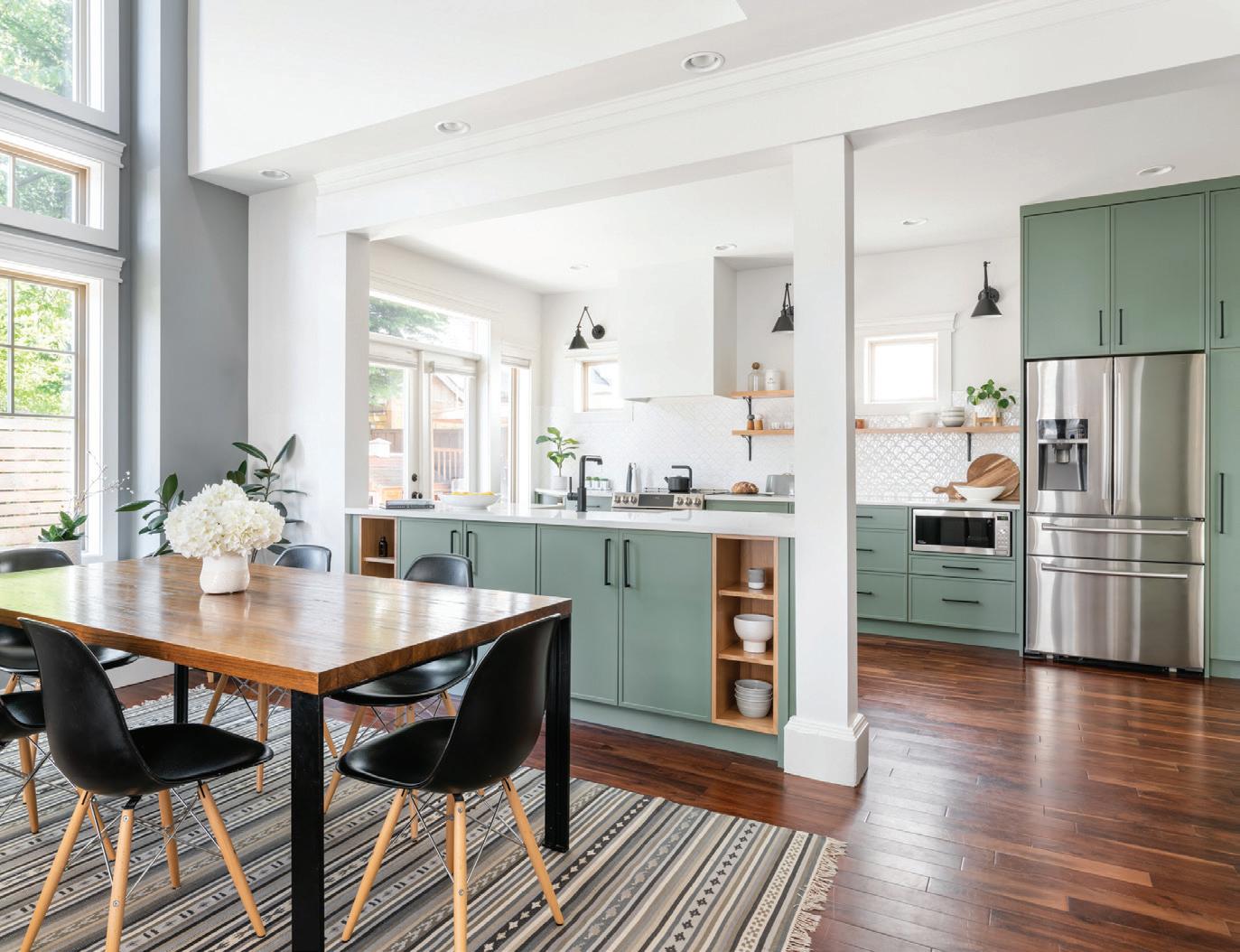
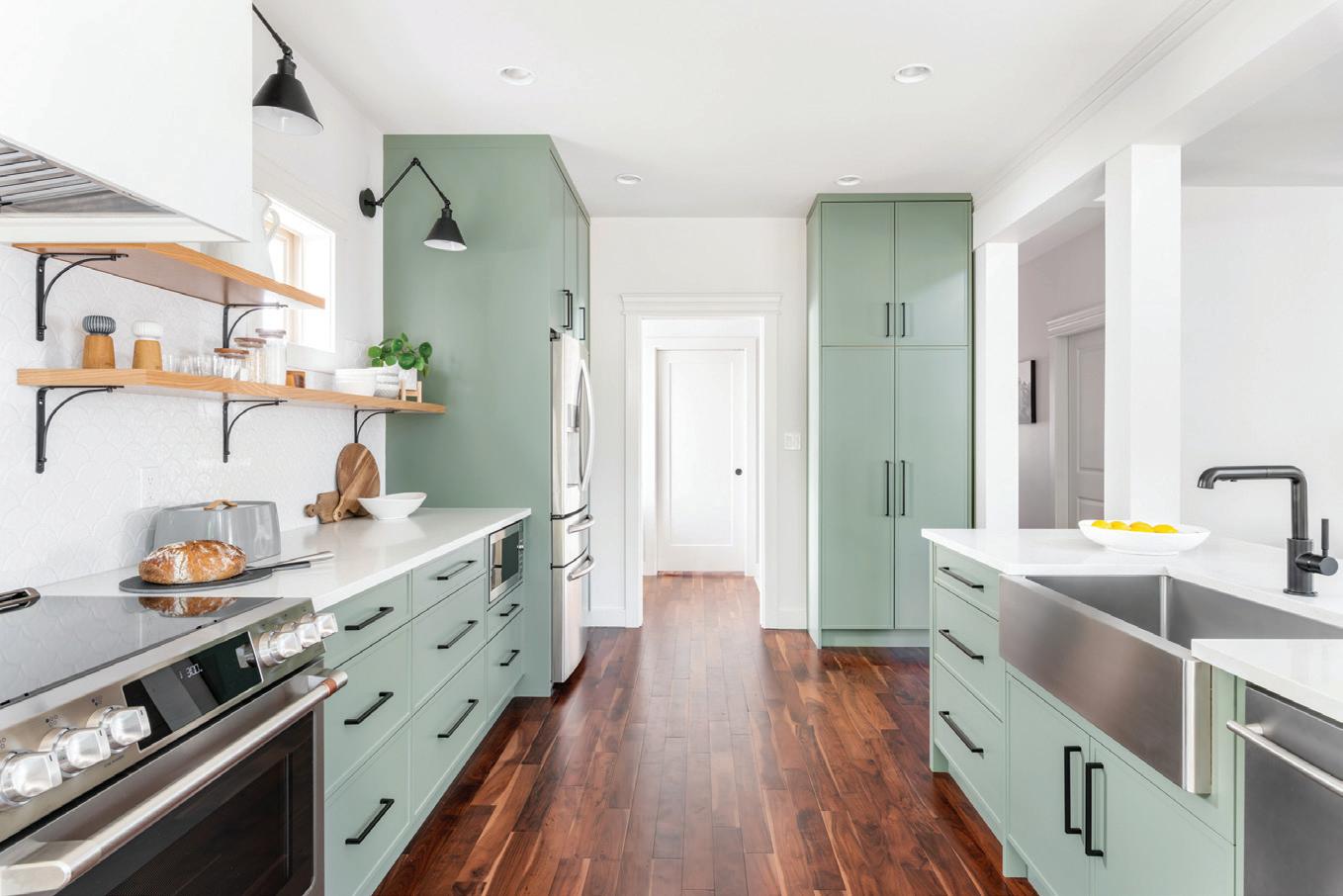
For instance, in this bright, fresh galley kitchen renovation by Mint, a dividing half-wall was removed to double the footprint of the space. In its place: cabinetry, complete with sink, for plenty of storage and workspace. At the same time, an underused spot was repurposed into a walk-in pantry that now leads into a home office where the original kitchen once stood. The end result is a space as functional as it is fun for the young family that lives here.
THE ONE-WALL LAYOUT
In this space-saving, streamlined layout, all the cabinetry, counters and appliances are arranged along a single wall. Because it only takes up about eight to 10 feet in width, you will often find it in small apartments as well as open-concept spaces. And because all the electrical, gas and water hookups are on one wall, it can also be easier and less expensive to install.
Best for: Small spaces, studio apartments or as part of a larger, open-concept room.
Pros:
• It takes up a minimal footprint.
• Installation can be easier and less expensive than other layouts.
• Creates an open, spacious feel.
• Flows easily into other living areas.
Cons:
• Counter and storage space is limited.
• Workflow is linear rather than triangular.
• The cook’s back will always be to the room.
• Options for where you place appliances will be limited.
Design tips:
To create visual interest, use a mix of open and closed storage. Taller cabinets will make the most of any vertical space, and a rolling cart or freestanding pantry will give you additional storage and/or workspace. Appliances should be arranged in the order you’re likely to use them — typically that means the fridge at one end and the stove at the other, with the sink in the middle. If your space is big enough, you can add an island or dining table in front of the wall for seating, entertaining or prep space.
KITCHEN MAKEOVER
Space Saver
A meticulous makeover transforms a dark, dated kitchen into a tranquil and functional space.
BY JOANNE SASVARI | PHOTOS BY JODY BECK
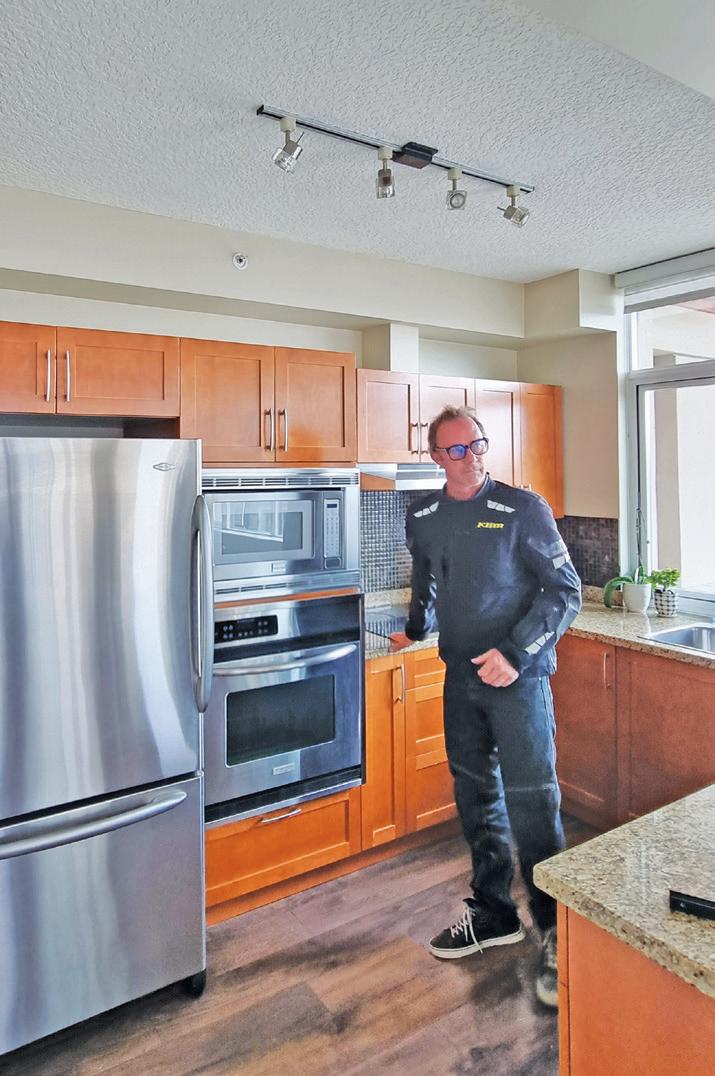
The view from the Fairfield penthouse condo was spectacular. The kitchen design? Not so much.
It was classic early 2000s, with its shiny stainless steel appliances, orange-y brown shaker-style cabinets, speckled granite countertops and dark, rustic flooring. Worse was all the wasted space, the awkward gaps between the tops of the cabinets and a protruding bulkhead, not to mention the ugly utilities panel and sprinkler head plopped right in the middle of everything.
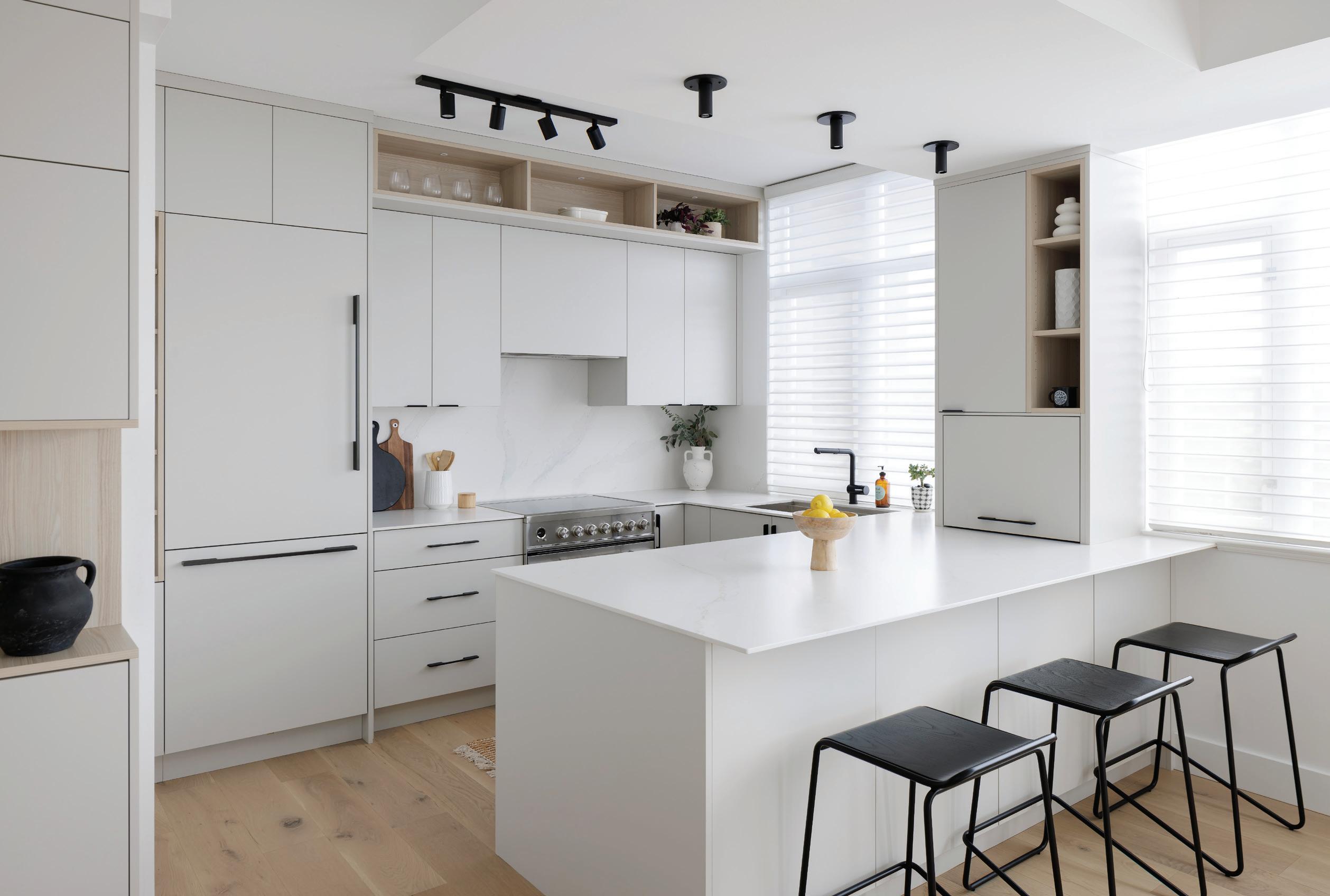
The owners called in Green Island Builders to work their magic. The result is a serene and tranquil room where every detail has been meticulously planned. It is so impressive that it won a silver medal at the Vancouver Island Care Awards for Best Contemporary Kitchen under $100,000.
The designers “figured out how to use every single inch of this room. There isn’t one bit of it that is wasted,” says Martin Scaia, principal of Green Island Builders. “I love efficient use of space and to me this is efficient. It’s simple, and it’s not ostentatious.”
Right: Green Island principal Martin Scaia surveys the original kitchen with its dated granite countertops and orange cupboards that didn’t quite fit.
NEATLY FITTED
The kitchen is part of a two-storey condo that the owners had bought as a private family refuge. When you enter on the main floor, the kitchen is right ahead, with windows that look out over Juan de Fuca Strait. Also on the main floor are the living/ dining area and a bathroom, with stairs leading up to the three bedrooms and two more baths.
“On the top floor you can walk onto an outside deck, which is rooftop, and you have those sweeping views of the Olympics and downtown,” Scaia says.
The Green Island team was brought in to freshen up the whole unit, which included reformatting the internal staircase with metal and glass railings, rearranging the primary ensuite to make the space feel brighter and adding slat walls for both openness and privacy.
But it was in the kitchen that the greatest transformations occurred.
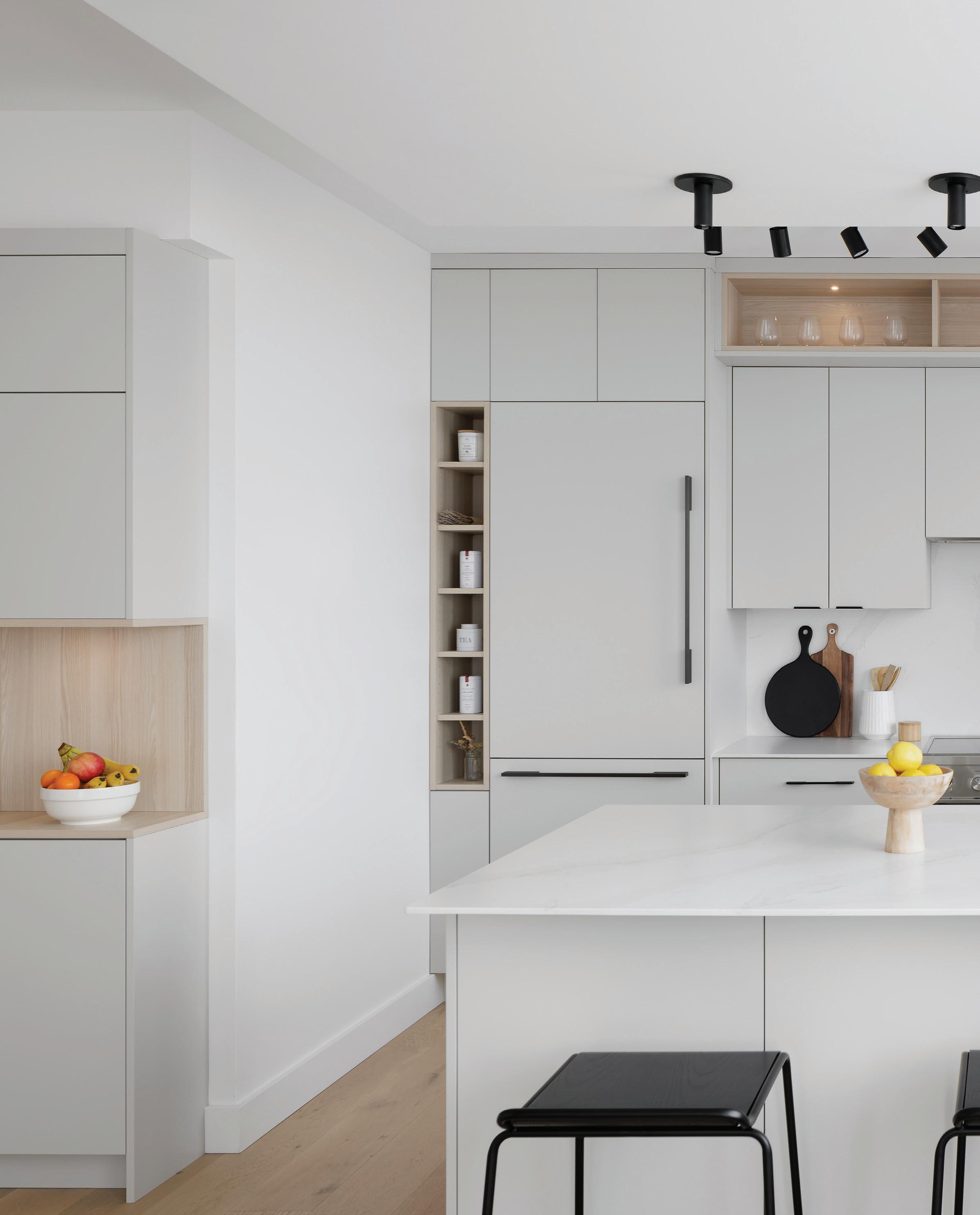
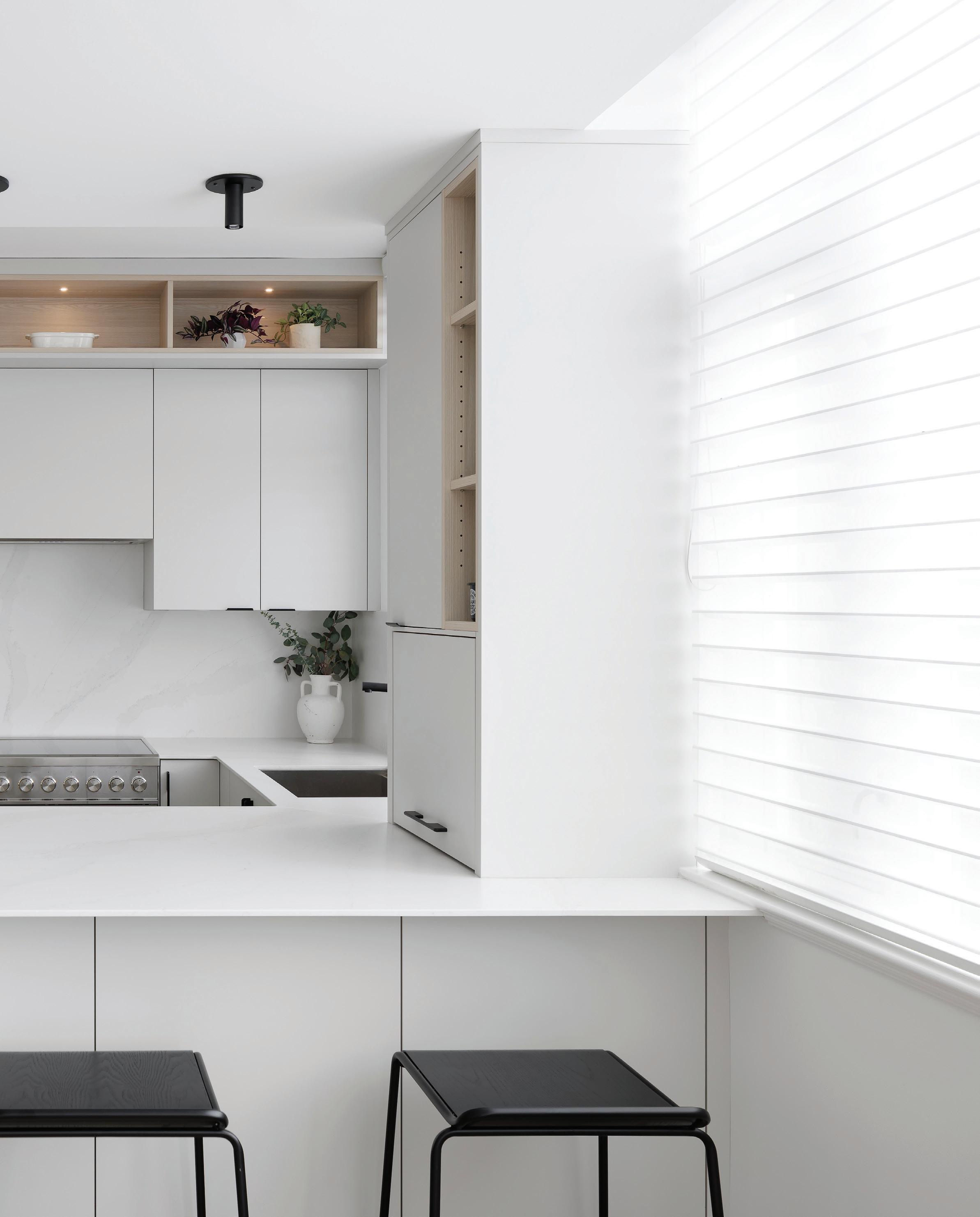
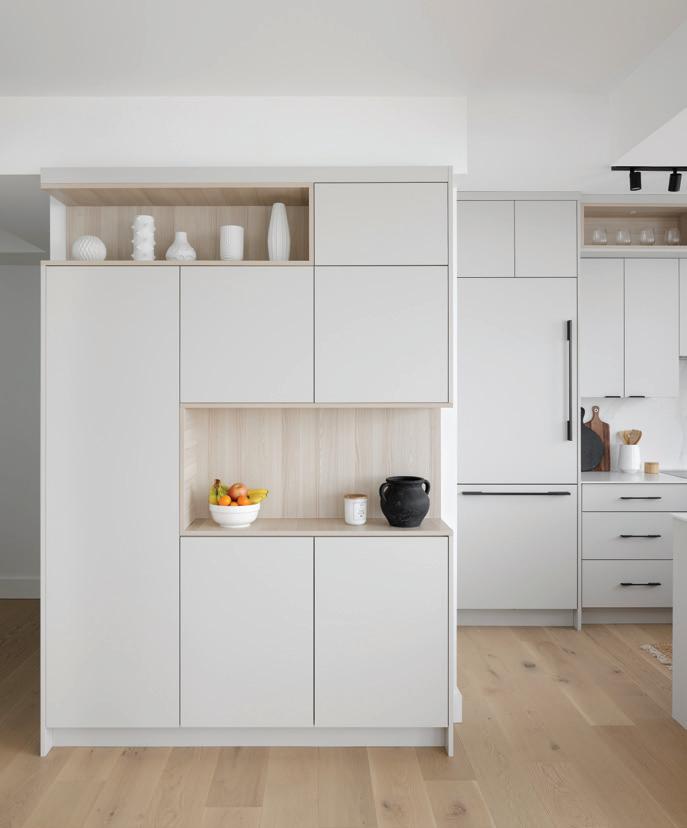
The most obvious is the new cabinetry from Thomas and Birch Kitchens + Living. Not only is it elegant and tranquil in a supermatte white finish, it now goes all the way to the bulkhead, eliminating those unattractive and space-wasting gaps. Next to the sink, a randomly floating cabinet has been replaced by one that goes from ceiling to countertop, creating space for an appliance garage at the bottom.
The bulkhead itself has been trimmed back so it is not so, well, bulky, and painted the same pale hues as the cabinets. “The colours of it flatten it out and make it disappear,” Scaia says.
STEP INSIDE VICTOR IA’S DESIGN SCENE.
Experience four days of free open studios, exhibitions, talks, tours, installations, and hands-on experiences across the city. Meet the architects, designers, and makers shaping how we live. A festival for design professionals and the design-curious.
To the left as you enter the kitchen is a sleek pantry/storage/display area. Around the corner is a closet where the electric panel has been moved from the kitchen.
DESIGNVIC TORIA .CA / @DESIGNY YJ
In some spots, shallow display shelves have been built in front of the bulkhead; in others, it’s been hidden behind panels that meld into the rest of the cabinetry. Also hidden behind panels: the refrigerator and dishwasher, which disappear into the cabinetry.
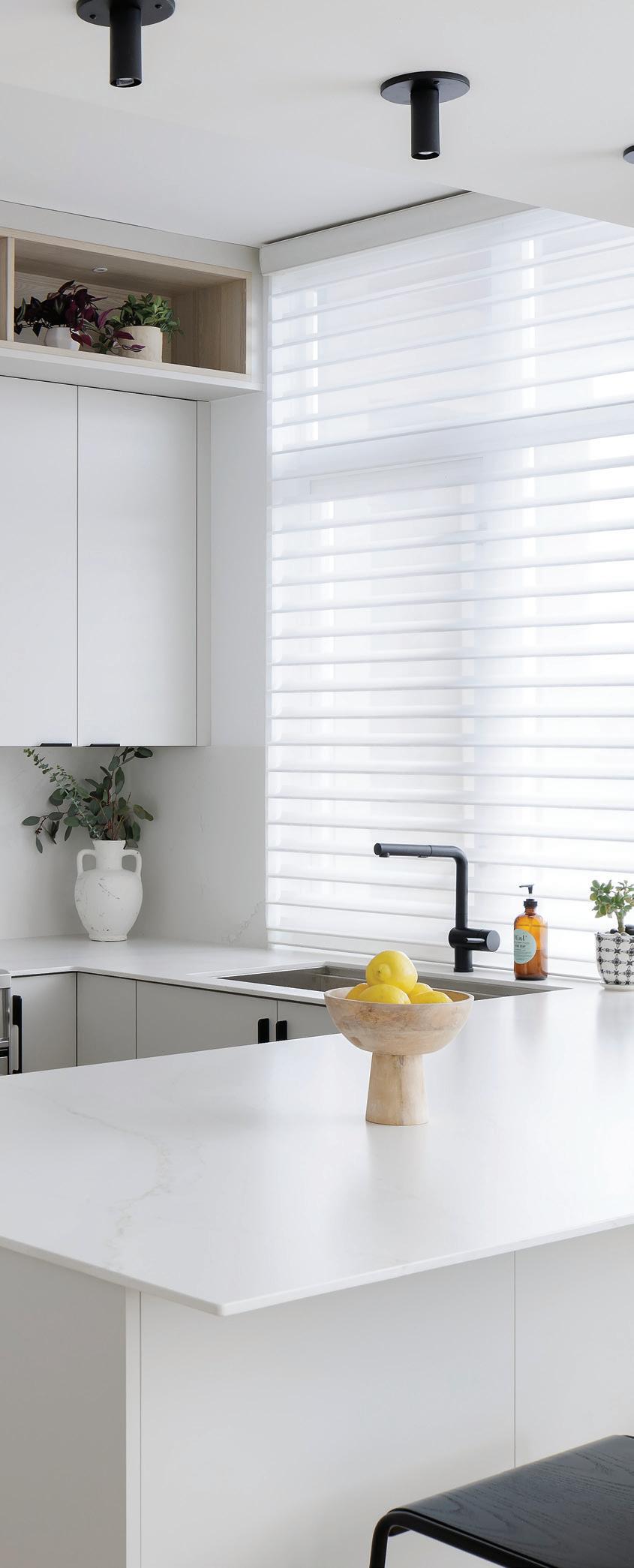
To accommodate the fridge and dishwasher doors, the peninsula had to be shifted slightly, and the speckled granite countertops replaced with Calcutta quartz in a matte finish that keeps the space free from distracting light reflections. And adding elegant punctuation to all the airy whiteness are simple black accents in the cabinet hardware, faucet and track lights.
“Now it all fits so neatly, like it was meant to be,” Scaia says.
SIMPLE AND COMPACT
The project was not without its challenges, though, starting with its location. As Scaia notes: “The challenge with any condo renovation is
modern.” In the end, the Green Island team relocated it to a closet behind the pantry.
That pantry might just be Scaia’s favourite feature of the space. It’s not just a functional storage area, but features elegant display spaces in a pale wood that echoes the shelves in front of the bulkhead and complements the new lighter, more modern flooring that flows serenely throughout the condo.
The end result is a serene — and functional — oasis.
But for Scaia, the success is even more meaningful. “What I really like is that we can take an existing space and transform it,” he says. “It makes it new again.”
RESOURCE LIST
General contractor: Green Island Builders
Designers: Megan Duffy, Wendy Taylor, Green Island Builders; Sandrine Vasilakos, Thomas and Birch Kitchens + Living
Millwork: Thomas and Birch Kitchens + Living
Corner cabinet millwork: Caledonia Silva
Electrical and wiring: VIP Electric
Plumbing and gas: Solid Plumbing & Gas
Tiling: T.I. Tiling
Drywall: Capital City Drywall & Painting
Flooring installation: Hourigans Flooring
actually working with a condo because there’s no parking and no space for the trucks.”
In addition, the fact that this particular condo building is concrete construction is great for noise control, but makes it challenging when a pipe needs to be moved or flooring replaced, as happened in this unit.
Both that unsightly electrical panel and sprinkler had to be moved as well and, as Scaia notes, “Every time you deal with fire suppression, that’s a challenge.”
The electrical panel especially was a sore point with the owners, who wanted “something that was nice and simple and compact, and
The new cabinetry goes right to the ceiling and, in this case, to the countertop. It also houses an appliance garage that helps keep countertops clutter free.
Lutron® Roller Shades
A BATH WITH VINTAGE CHARM
A much-needed makeover brings a dated bathroom into the present, with a nod to its original 1912 grace.
BY JULIEN JOHNSTON-BREW
PHOTOS BY CARLA UNGER
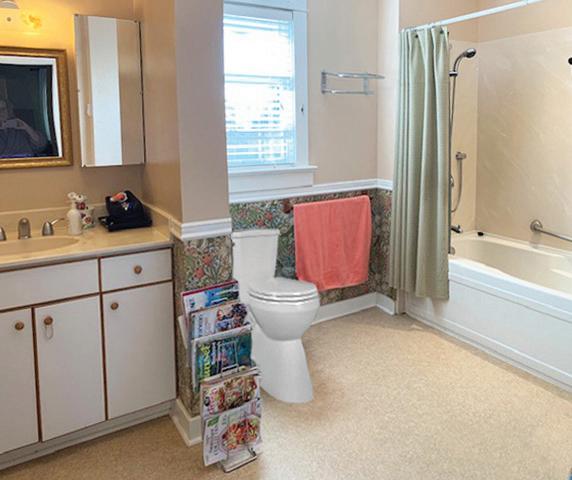
Twenty years after purchasing her 1912 Oak Bay home, the owner knew the primary bathroom needed a do-over, but other projects around the house kept forcing it down the to-do list. “The bathroom had a dated, sort of 1970s look with poor lighting, no plug-ins and aging fixtures,” says the homeowner.
Then one weekend the shower refused to turn off. “A plumber came the next day and said the shower was so old that parts weren’t made for it anymore,” she says. “That finally got us to make the decision to renovate.”
The homeowner had hired Redesign Victoria for other projects around the house, and brought its principals, the wife-andhusband duo of Shauna Makin and Nick Kerridge, back to overhaul the bathroom.
The result is a romantic yet functional spa-like space, despite the challenges that surfaced during the renovation. That wornout shower was just the first.
TRUE TO THE ERA
Over the century or so since the home had been built, there had been several previous renovations, some of which resulted in unfortunate surprises as Makin and Kerridge began their work.
“We had to also reinforce the floor joists because they’d been clearly compromised,” says Makin. “You open [the floor] up and you see that … we can’t just leave them.”
“They chopped a lot of the floor joists, like, really badly for plumbing,” adds Kerridge. “They didn’t respect the structure.”
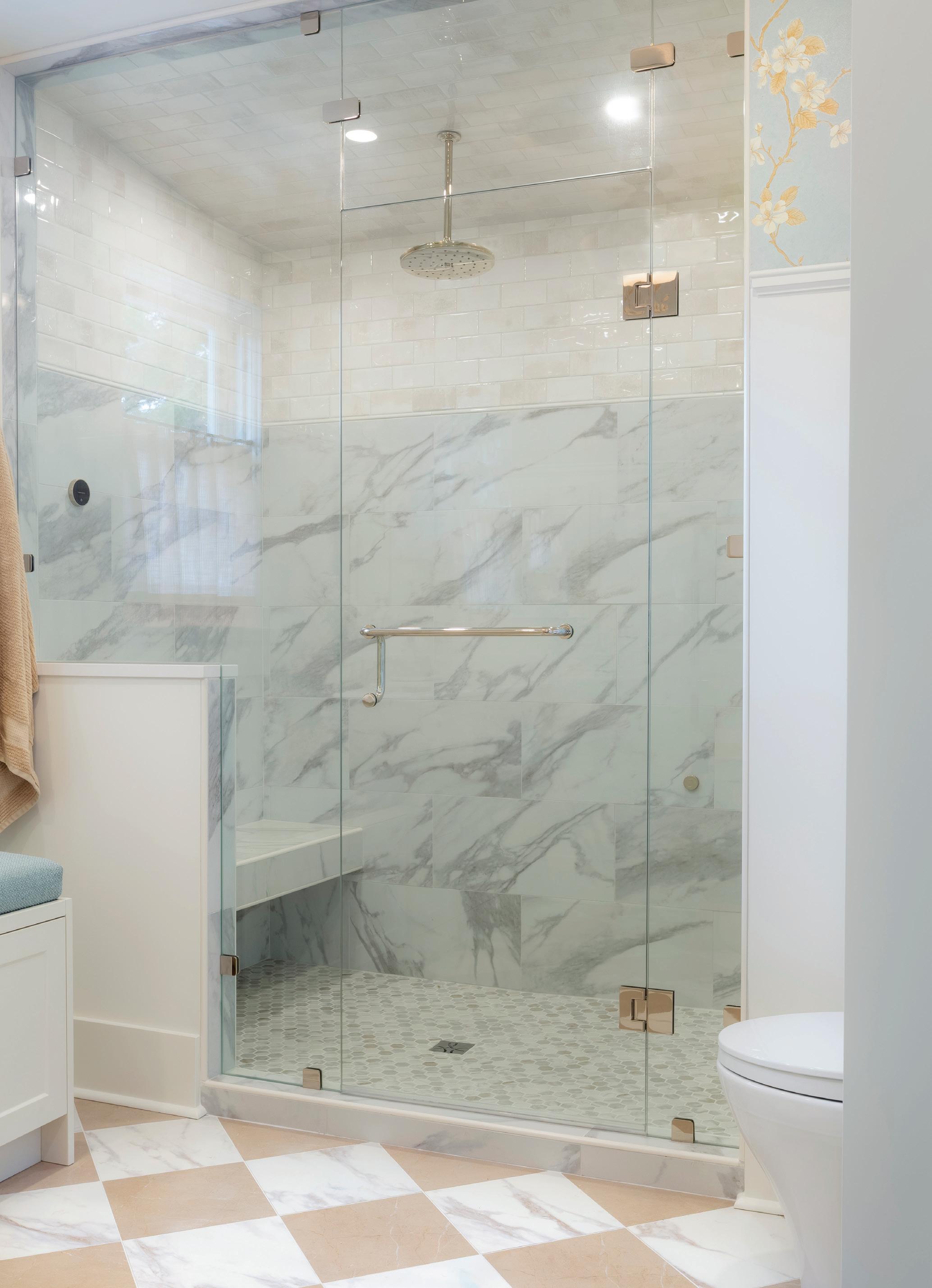
Before the renovation, the bathroom was stuck in the 1970s, with dated décor and aging fixtures. Now it’s a bright, airy space where an elegant walk-in-shower replaces the previous broken-down tubshower combination.
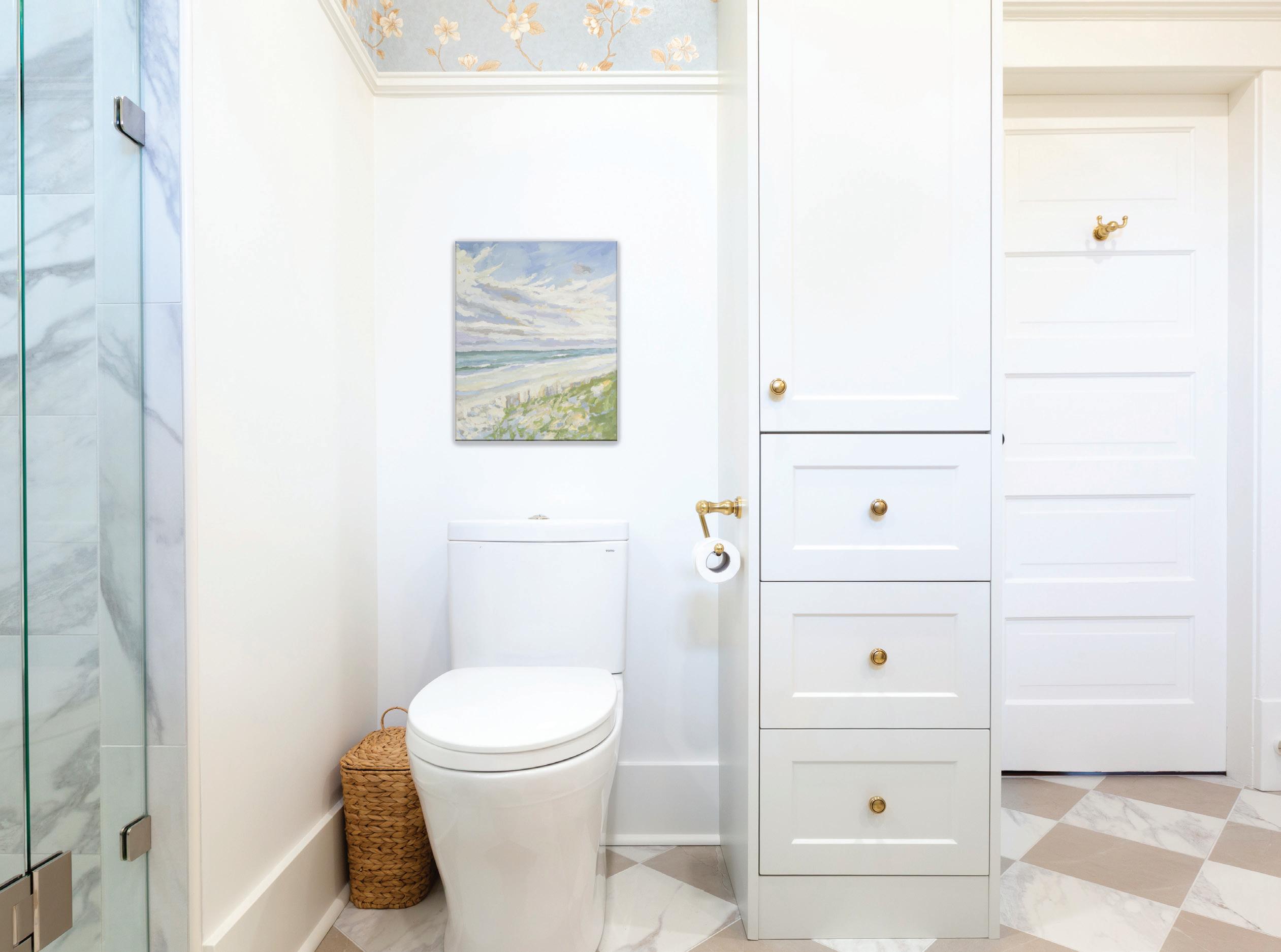
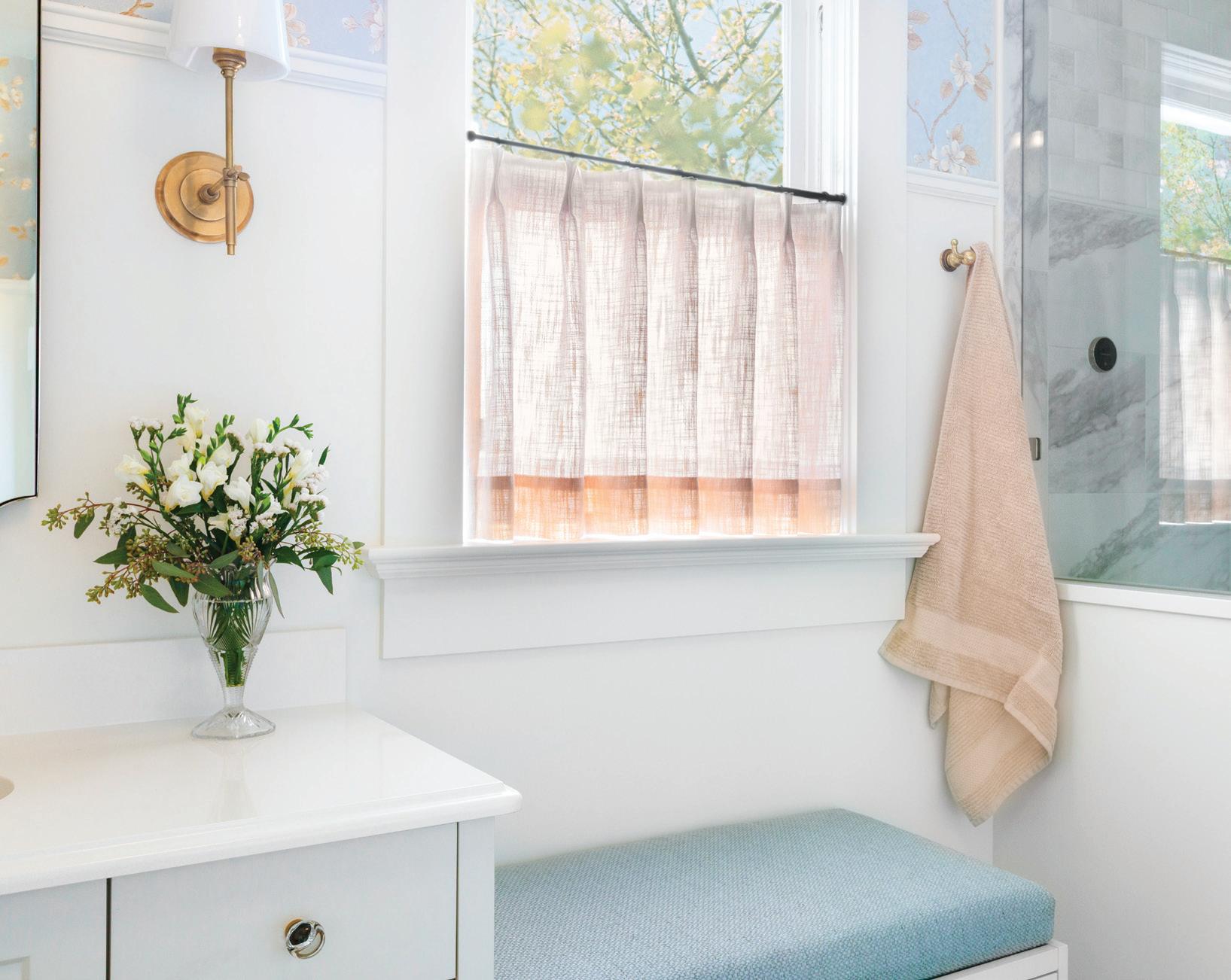
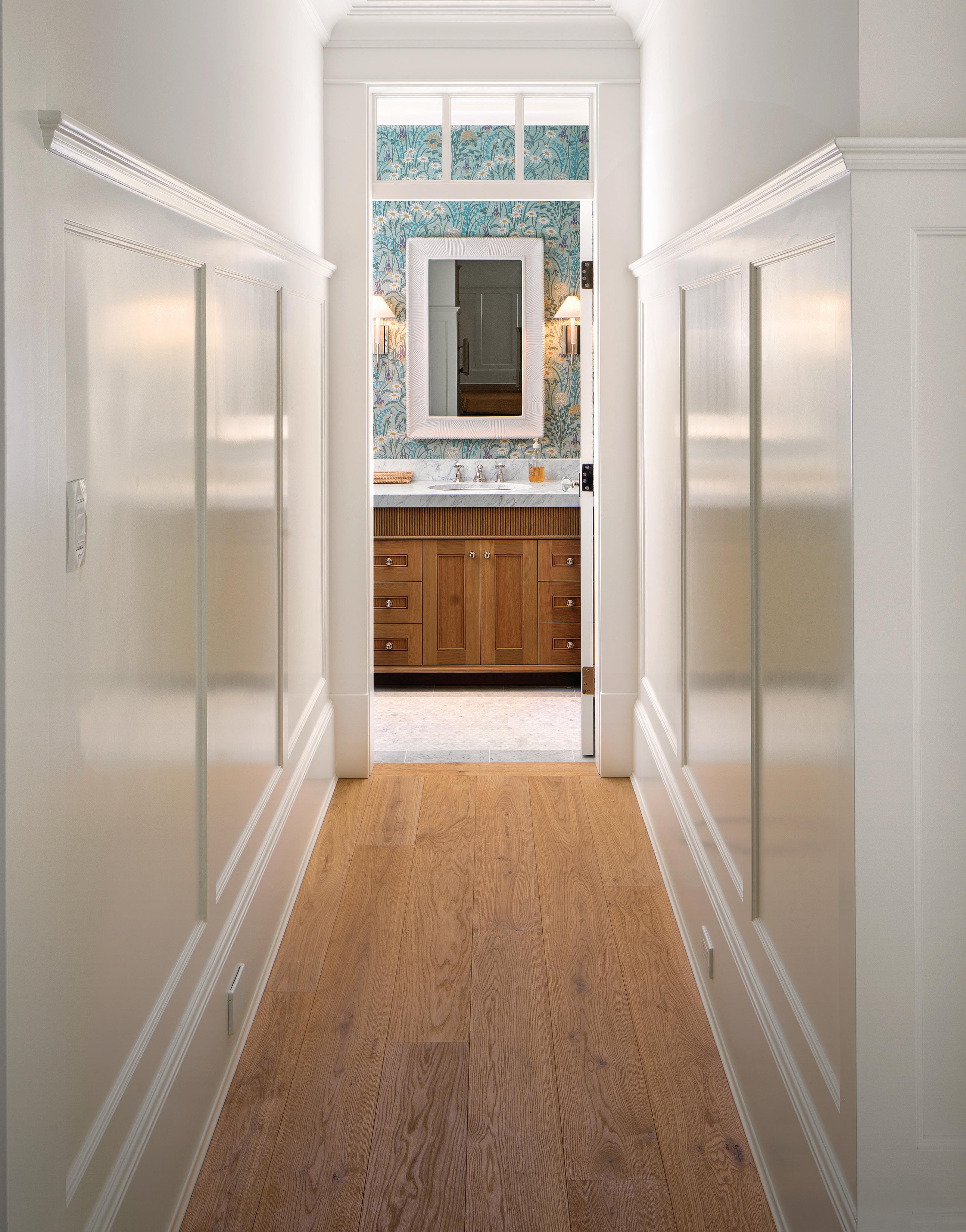
Designer Julia Wakely wove subtle vintagestyle details into the space — such as the checkerboard flooring and floral wallpaper — while still making it modern and functional, with updated fixtures and plenty of storage.
Navigating the old home’s waterlines was also a challenge, especially since Makin and Kerridge wanted to avoid interfering with the newly redone kitchen below the bathroom. To achieve this, the duo ran the plumbing outside.
“We ended up having to re-stucco a section of the house,” says Kerridge. “We found a stucco guy who was able to match the style of the stucco from over a hundred years ago.”
Makin adds: “A lot of what we try to do is look at the house and the era of the house and stay true to that. And so I think that the bathroom turned out really well — because it feels old-fashioned, but it’s new,” Kerridge says.
A LIVED-IN FEEL
Partway through the renovation, the homeowner approached interior designer Julia Wakely to help style the bathroom — though she was initially hesitant to jump in.
“I don’t love doing bathrooms,” says Wakely. “I much prefer working with fabrics and furniture.” However, having also worked with
the clients before, Wakely decided to give the project a shot, considering the bathroom’s dated esthetic. “It just needed to be done so badly.”
The bathroom was reimagined to evoke the stress-reducing atmosphere of a spa, a direction driven by the florals-on-powderblue wallpaper. The vinyl material holds up against constant exposure to humidity — an especially important feature given the brand new steam shower that replaced the old one.
Wakely chose brass and nickel hardware for the cabinet, vanity and shower, with subtle colour variations that feel harmonious without being repetitive. “I love to use many different metal finishes,” says Wakely, “so that [the room] doesn’t look like it’s been done all at one time.” The varying warm-toned materials give the bathroom an authentic, lived-in feel while adding pops of warmth against the sleek white surfaces.
For the floor tiles, Wakely decided on a subtle palette. “Instead of the typical blackand-white checkerboard, we did this kind of a taupe-y colour that’s a little bit softer.”
Though the tiles are porcelain for improved durability, the marble look provides a touch of naturalistic elegance.
Wakely is especially enthusiastic about another deluxe addition: the heated towel rack. “To always have a nice dry warm towel is terrific,” says Wakely, “especially in our damp climate.” Heated floors also help create a thoroughly warm atmosphere, making the bathroom perfect to unwind in.
The homeowner is especially appreciative to have had the bathroom completed by professionals she trusts. “We did a reno at a previous home where we didn’t have that trust and respect with the contractor,” she says. “The people you have involved really make or break the renovation experience.”
Working with a design-build team she knew and trusted gave the homeowner peace of mind, especially during such a major renovation. “They were all professional and communicative and also just so pleasant to deal with,” she adds.
Best of all, she can now enjoy her shower with confidence.
Left: One of the smartest additions to the bathroom is the charming window seat, which also doubles as hideaway for the cat’s litterbox.
RESOURCES
General contracting: Redesign Victoria
Tiling: Tartan Tile Installations
Electrical: Bernie Osborne
Electric
Plumbing: Phil Ballam Plumbing & Heating
Painting: One Shot Painting
Interior designer: Julia Wakely Interiors
Tiles: Island Floor Centre
Wallpaper application: Nicholas Alexander Painting
Wallpaper: Galerie Wallcoverings
Plumbing fixtures: House of Rohl; Splashes
Sconces: Pottery Barn
Hardware: Emtek
Window coverings: Two Pages Curtains
Banquette fabric: Serena & Lily
HOW TO
BY CAROLYN CAMILLERI
HTrim a Room
Are you up for the challenge of installing your own baseboards and crown moulding?
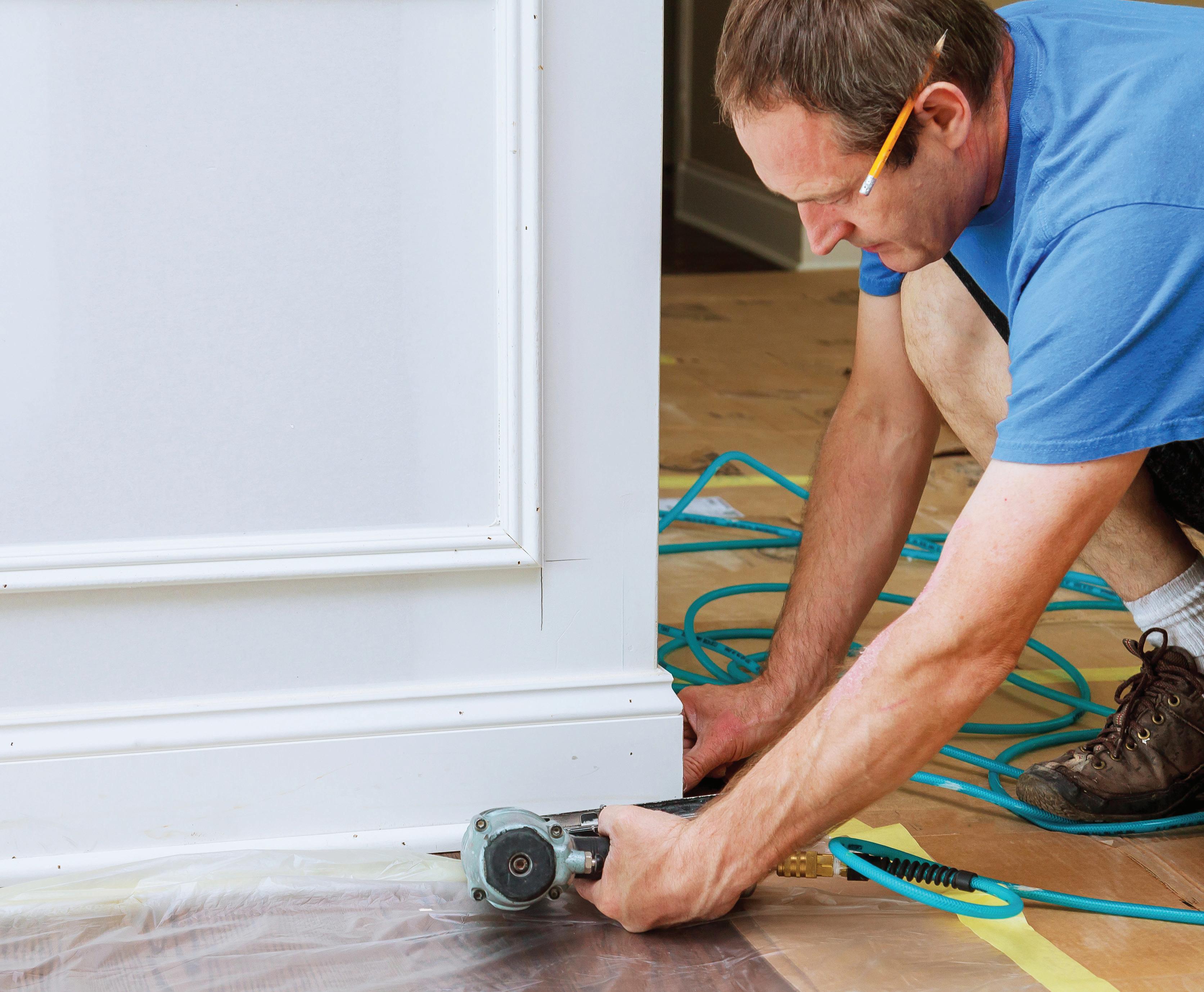
ow hard can it be?” are famous last words in so many DIY projects. Baseboards and crown moulding, an area of specialty within the broader carpentry trade, are certainly no exception. They look easy — just long strips of wood nailed to the walls — but, alas, they require a lot of measuring (math!) and attention to detail — way more than first meets the eye.
Go to a room with baseboards and look closely at the inside corners. Note how the wood is cut and seams are joined. Look at how the wood is fitted at doorways and around outside corners. Is the floor completely level? Are the walls even? Are you sure? You need a level that’s about a metre long to check.
Now, measure a section of wall. Then, measure the baseboard of that same section and note the difference, a difference you are wise to remember before cutting anything.
Next, look up and imagine working on a ladder with the pieces and angles but upside down.
I say this not to discourage you, but rather to prepare you — and send some appreciation to the highly skilled carpenters who do this fine work.
Reality check: If you want beautiful, stained, real-wood baseboards and crown moulding, call a professional trim carpenter. If you are happy with painted pine or MDF (mediumdensity fibreboard) and are willing to forgive
yourself for a mistake here and there, pick a room with not too many corners and doorways. Crown moulding can be a bit easier because you usually have fewer obstacles to fit around, but you are going to be on a ladder hammering in many tiny nails.
PRO TIP: Watch Videos
Installing baseboards and crown moulding can be tricky, finicky projects, and watching videos of the pros in action can provide useful direction. You can discover other ways to install them that may make more sense to you, learn how to use the tools properly and pick up tips for challenges like uneven floors and awkward corners.
Step by Step
Supply List
• Mitre saw for cutting angles with precision. You may want to look into renting or borrowing one. Alternatively, you can get a mitre box and a handsaw.
• Coping saw — a sharp, handy tool that can trim away thin bits of wood
• Clamps (always handy)
• Nail gun, ideally a finish gun; alternatively, a hammer and finishing nails
Process
1. Measure each wall to get the total length of boards you need (plus an extra bit so you can practise with the tools). Pine or MDF (medium-density fibreboard) is the easiest to work with. Bathrooms may need specially treated baseboards; ask at the store. Pre-primed baseboards save a step later. Note: Acclimate the baseboards in the room for at least three days.
2. Mark all the studs with a pencil.
3. Start with a long wall with an inside corner. Cut one corner end to a 45-degree angle, but keep the end of the piece that meets it straight (90 degrees). Then, using the coping saw, carefully trim the straight end to fit the 45-degree end that meets it. Alternatively, you could
CROWN MOULDING
• Level
• Stud finder
• Tape measure (the proper kind, designed for construction, not tailoring)
• Pencil
• Spackle (a.k.a. Polyfilla)
• Caulk and caulk gun (the gap hider)
• Baseboards (see Step 1)
Mitre saw
PAINTING TRIM
You’re not done yet — you still need to paint your baseboards and moulding.
Consider the finish. Semi-gloss paint is great because it is washable, durable and has just a bit of shine. Gloss is shinier and more durable, but can draw attention to flaws. Satin is the least shiny and may be not as durable, but it is washable. Ask questions at the store.
use the mitre and cut both joining ends (math again!), but because corners in a room are rarely perfect, you may still end up with a gap to caulk.
4. For walls with outside corners, you can follow the same process — leave one end straight and cut the joining piece to 45 degrees, then use the coping saw to follow the angle of the cut piece — but be careful. Gaps in outside corners are harder to fix with caulk and flaws are more visible than on inside corners.
5. If a wall is longer than a single baseboard, join two pieces by cutting both to 45-degree angles so they overlap at a wall stud and nail them both in place.
6. Doorways depend on the door frame. If luck is on your side, the straight
edge of the board will meet the door frame, nice and flush. Or you might need to fill a bit of a gap for a smoother edge or you might even want to bring the baseboard out a tiny bit on that edge, using a thin piece of wood. The more familiar you are with the tools, the more skilled you will be at adjusting.
7. Once you have all the pieces nailed into place, use spackle to touch up nail holes. Use caulk to fill any minor gaps in the seams and corners and smooth it with a damp finger.
8. Once the spackle and caulk are completely dry, sand the spackled areas smooth (not the caulk — caulking isn’t meant to be sanded). Then you are ready to paint. See sidebar on painting trim.
To install crown moulding, follow the same prep, measuring, cutting and fitting steps as baseboard — but upside down. Using a pencil and an L-gauge, mark exactly where you want to place and nail the boards. Construction adhesive is helpful for holding the boards in place while you nail them in. In addition to nailing into studs, nail at an angle into the top plate (the horizontal framing boards all the vertical studs are attached to).
The most popular paint for trim is probably latex/acrylic because it is so easy to use, cleans up with soap and water and dries fast. Some prefer alkyd/hybrid, which gives you a smooth, hard finish. Oil-based paint provides the most durable finish but is, by far, the hardest to use and clean up (think turpentine) and takes ages to dry.
For best results, use a good quality acrylic primer. This is especially important if you are painting over stain, oil paint, gloss paint or repairs. Other supplies include paintable caulk and/or spackle to repair flaws, a sanding block/sandpaper, painter’s tape, brushes (3.8 cm to 6.4 cm) and clean cloths. And follow these steps:
Repair: Little cracks, seams, nail pops and other small flaws can often be patched up with spackle (a.k.a. Polyfilla). It works well on wood or drywall, and can be sanded and painted. However, if the damage involves a gap, a joint, a larger area or a damp space such as a kitchen or bath, you may want to use caulk, which is both flexible and waterproof. Describe the damage (or show a photo) to the store staff for guidance. Let the repairs dry completely according to product instructions.
Prepare: Sand and smooth the trim, removing the gloss of the previous paint. Clean up well, using clean damp cloths (you don’t want dust anywhere, especially if you are using a gloss paint). Tape off the areas you want to protect. Apply your primer coat, letting it dry for the time indicated on the can.
Paint: Start from the top and work down — crown mouldings first, then door frames, window frames and finally baseboards. Let the paint dry according to product instructions before applying a second coat, which may not be needed if you used a good primer or are not painting over a very different colour.
REAL ESTATE
BY SHANNON MONEO
Aging Out of Their Homes
The time to talk to your senior parents about their housing is now.
It’s not a dinner party topic, but for the sandwich generation, discussion about senior parents and their future housing shouldn’t be ignored. Delaying decisions can result in hardto-stomach outcomes.
For some seniors, their home is their biggest asset. Deciding whether to stay put or shift to smaller spaces or assisted living entails much brainwork and legwork. When a home sale is involved, the deal should be handled early, says a Victoria Realtor who is also a Certified Professional Consultant on Aging. “It’s better to make decisions while you have control, and not when you’re in a crisis,” says Cheri Crause, with Royal LePage/Coast Capital Realty.
Before mobility problems, cognitive decline or serious physical ailments hamper action, senior homeowners should be discussing next moves with family members. “It will always take longer than you think to get the house ready,” Crause says. And dealing with a property after a death can add even more months.
PREPARATION IS ESSENTIAL
Lianne Macdonald has been a lawyer in Victoria for 35 years. Working at Beacon Law Centre, much of her practice centres on estate planning and real estate. Dealing with sale logistics is always demanding, but for seniors who have lived in a home for decades, selling it becomes a really big deal, Macdonald says. Having a skilled and experienced Realtor and other professionals who can be trusted is important. “A good law firm will reassure a senior and explain the process and timing,” she says.
Sometimes a “subject to” clause is necessary because the seller is on a wait list to get into a facility, Macdonald says, adding that once a sale proceeds, the process can become “rushy” for the seller. Among the things to consider: If the house is vacant after the senior relocates or dies, there may be a requirement to frequently check the home, and it’s crucial to not let home insurance expire. Items like cancelling utilities or services and managing the transaction may be overwhelming. If a seller is mentally incapable, unwell or not up to handling a sale, a power of attorney (POA) that designates a family member or agent to assist is needed. Macdonald
says that POAs need to be put in place before a person becomes incapable and that anyone who owns real estate should have a POA.
One classic example of the failure to prepare is when someone loses mental capacity and needs to sell their property and move into a care home. They can no longer make a POA, which means a public guardian or public trustee must
be appointed. That can be a lengthy process. Another possible time-eater is when seniors defer their property taxes, Crause says. Property taxes are due on July 1, so the timing of a sale is a factor. As well, the property title should be reviewed to ensure it is correct when it comes to living registered owners, mortgage status and covenants. Of late, there has been pressure
on seniors to add their children’s names to the property title. It’s a risky proposition, says Macdonald. Parents want to help their children, but much can go wrong if a child has problems (such as bankruptcy or divorce).
Another selling consideration is that it’s important to get the best price, particularly if the funds will be paying for future care. Some seniors or their agents (i.e. POA) are happy to get the assessed value for a home, but Kent McFadyen, a Seniors Real Estate Specialist (SRES), has often helped a homeowner get more. Before working for Homes of Victoria, McFadyen was a project manager so he’s aware of what can be done to elevate value. On one project, the homeowner had moved into a care home. Their house was assessed at $837,000, but had been neglected. Getting direction from the POA (daughter), he arranged repairs that cost about $25,000. Once complete, an offer for $970,000 was accepted. “I like to think I’m doing something to help people and helping them in their time of crisis,” McFadyen says.
MUCH DEPENDS ON THE WILL
When a senior passes, dealing with their property becomes contingent on the will. McFadyen recalls a deal where he met with a hospitalized client who gave him authorization to proceed with the sale of her townhouse and carry out small repairs. But while the sale was in process, the client died. “All sales cease upon death. The listing was cancelled,” McFadyen says. At this point, a will is crucial. Fortunately, the woman had a will that named a sister in Ontario as estate executor.
One classic example of the failure to prepare is when someone loses mental capacity and needs to sell their property and move into a care home. They can no longer make a POA, which means
a public guardian or public trustee must be appointed. That can be a lengthy process.
For Crause, preparing a home for sale means fixing safety issues like uneven steps, a rotting deck, wobbly rails and tripping hazards — but not renovating the whole house because the return on investment won’t materialize. “Fresh paint is the easiest thing to do,” Crause says. If a bathroom or kitchen needs to be updated, keep it to a minimum. As for the yard, the front is more important than the back given the relevance of curb appeal. Spending money on landscaping is often worth it, as is hauling away debris and anything considered “junk.”
Related to junk are hoarders, whose homes can be so cluttered they are difficult to move around in. “It’s more common than you think,” Crause says. The best way to clear out a hoarder’s premises is to remove the hoarder from the setting. Often, most goods are dumped in bins for disposal or donated — and that can include quality items, be it crystal, china, solid wood furniture or collectibles. “Remember, those things served you well. You loved them. You enjoyed them. It’s time for them to move on,” Crause advises. McFadyen adds that there are services that help to liquidate sold premises either via auctions or by ensuring the items go where needed.
When the property title states there is a sole owner on title, and that owner dies, a court order for a grant of probate is needed to continue with the sale. This can take two to three months. “It enables an executor to complete the contract,” Macdonald says. But even with the grant of probate, a property sale can be held up by an unhappy beneficiary, disinherited party or family member or tenant occupying the property who refuses to move.
Macdonald recommends that an executor should not sign a deal to sell until they are positive they can complete the sale on the promised date. Yet, selling with a “subject to obtaining the grant of probate” can be stressful and problematic. The executor cannot control when a court will issue a grant of probate or what an unhappy beneficiary or disinherited party might do. Best practice is to obtain the grant first and then list the property for sale.
As well, be aware of the province’s speculation and vacancy tax. If a home is vacant as a result of a death, a B.C. resident’s principal residence is only exempt from the tax in the year of their death plus one year after. The executor still has to file the tax form and claim the exemption.
Preparation remains key. “There are a lot of very superstitious people out there who think if they deal with it [selling their home, moving into care], that something will happen,” Crause says. “Putting your home on the market becomes a difficult conversation, but you should do it before a crisis or before decisions are being made for you.”
BOATS, E-BIKES, POWER SPORTS, 4X4, FISHING HUNTING, CAMPING, WATER SPORTS, OUTDOOR GEAR, LODGES & RESORTS, OVERLANDING, AND MORE!
RV'S, BOATS, E-BIKES, POWER SPORTS, 4X4, FISHING HUNTING, CAMPING, WATER SPORTS, OUTDOOR GEAR, LODGES & RESORTS, OVERLANDING, AND MORE!
OVERLANDING, AND MORE!
RV'S, BOATS, E-BIKES, POWER SPORTS, 4X4, FISHING HUNTING, CAMPING, WATER SPORTS, OUTDOOR GEAR, LODGES & RESORTS, OVERLANDING, AND MORE!
GARDENS
BY CAROLYN CAMILLERI
Ready, Set, Grow
Everything you need to know about starting your seedlings indoors.
Growing plants from seeds can be a rewarding, educational activity — and a lot of fun, too. It certainly adds perspective to what it takes to grow anything, whether it’s vegetables in the produce section or the flowers arranged in a vase. Growing from seeds also opens your mind to the incredible varieties of everything from beans and beets to sweet peas and sunflowers.
Some seeds, like arugula, beans, sweet peas and nasturtiums, can be sown directly into the garden. Other seeds, like asparagus, tomatoes and most flowers, are best started indoors then planted outdoors later in the season.
Here’s what you need to know to start your own plants from seeds.
Get It Together
Gather your supplies (see list in sidebar), and read — no — study the seed packages carefully. They tell you everything you need to know, including how deep to plant the seeds and how much space they need outdoors. Keep the seed packets so you can refer to them later, and note the expiry date: Some leftover seeds can be planted next year and some can be planted for a second crop later in the year
TIP: Start a notebook to keep track of what you liked most, what grew best and where, and other observations around space, water and light needs.
Turn Up the Heat
Plant your seeds as the packets instruct. Seeds need moisture and heat to germinate, usually between 21°C to 24°C. In the seedling world, “temperature” often refers to soil temperature, not air temperature. Avid seed-growers use special heat mats and heated propagation tables. Until you go pro, start with warm places like the top of a fridge or a warm room away
from drafts. Seedlings don’t need light until the next stage. Water gently so you don’t disturb the seeds and don’t let them dry out. Plastic tray covers (or loose plastic wrap) help retain heat and moisture.
TIP: Label the pots, especially if you are sprouting a variety of seeds.
Let the Light In
When you see even a bit of green popping up, remove the covers/plastic, completely and forever. Once seedlings sprout, they need light and air circulation to prevent mould and fungus. Don’t suffocate your seedlings. Move the trays to a south-facing window (or as close to south facing as you have). Rotate the trays periodically to ensure they all get as much light as they can. Avid seed growers use grow lights (put that on your “go pro” list).
Watch Them Grow
Keep them moist! Give them light! Let them grow! The first leaves are their seedling leaves. The second set are their “true leaves” and worthy of celebration. If they start getting leggy, give them more space — they are literally stretching toward the light. If the leaves start to go yellow on the edges, you may be overwatering. Don’t let the pots sit in puddles on the tray.
SUPPLIES
•Seedling starter pots with drainage holes. The 10-centimetre pots work well for most plants. If you are reusing plastic starter pots, wash them with a 10-per-cent bleach solution, rinse and air dry.
•Seedling trays. These stabilize pots and make watering and moving them easier.
Plastic tray covers. (You can cover loosely with plastic wrap in a pinch.)
•Seedling starter soil. This is NOT soil from your garden (which may contain pests, weeds and spores) and it is NOT regular potting soil (which is too heavy). Gardenworks carries an organic mix made from peat, coconut coir, peat soil and perlite with Zeolite.
•Watering can or mister. These let you water gently, so gently, and often.
•The seeds you have chosen to start indoors.
The Seed Experts
Many of the seeds you see locally are from Delta-based West Coast Seeds. Every year, they release a catalogue that is truly a wonder to behold and such an education in fruit, vegetable and herb varieties. The 2026 issue is 148 pages and can be downloaded at westcoastseeds.com
Get the Garden Ready
Prepare your garden, planters or raised beds a week or two before you plant outdoors. Make sure the soil is well dug up, loose and free of debris and rocks, so delicate roots can find their way through easily. Grab a handful of soil and squeeze — if it is moist, but still crumbles away easily, that’s good. If it stays in a clump, it is too wet and needs to dry out a bit more. Amend your soil with compost and/or fertilizer. If the soil is really loose, water the top lightly so it doesn’t blow away. Avoid walking on it. By planting day, your soil should be moist (not wet) and loose and the compost/fertilizer should be nicely integrated.
Hardening off your seedlings
To give your seedlings the best chance in the real world, gradually introduce them to the outdoors, a process called “hardening off.” On a warm, sunny day, place the trays outdoors in FULL SHADE, then bring them back inside at night. The next day, choose a spot with dappled light, then bring them back inside at night. On the third day, place the tray where they get full sun for at least part of
the day and leave them out overnight. By the fourth day, you can plant them or repeat the third step until you are ready.
Planting Your Seedlings
On planting day, recheck the seed packets for space guidelines. Using a trowel, dig holes as deep as the seedling pots — you want the soil level to be the same or just a smidgen (six millimetres) higher.
Carefully loosen the seedling pot. Depending on the material the pot is made from, gently pushing from the bottom or squeezing the sides may be enough to tip the plant upside down into your hand. If stuck, try sliding a knife along an inside edge of the pot. Do NOT pull on the stem. If the plant is root bound (you’ll know if you see roots coming out of the drainage holes), soak the pot in water for a few minutes. Once freed, very gently loosen the roots apart as much as you can.
Plant the seedling so the top of the root ball is about level with the soil. If your plant is leggy, plant it a bit deeper. Add soil and pat gently to remove air pockets, then water to settle the soil.
What About Tomatoes?
Did you know tomatoes are actually tropical plants and their fruit are berries? We take our sun- and heat-loving tomatoes for granted, but the fact that they grow here is really very special. They are also great fun started indoors from seeds, ideally in early spring. Some varieties (called indeterminate) produce fruit all summer provided you snip out the little suckers that grow from the V (a.k.a. crotch) where two leaf stems meet. Others (called determinate) don’t need their suckers snipped, but they only produce fruit for a period of time. Most tomato varieties need support — a cage, stake or trellis — or they will fall over. Keep their leaves dry and off the ground to avoid moisture-related diseases like blight, which can wipe out a whole bed of tomatoes with shocking speed.
AT THE TABLE
BY JOANNE SASVARI
One Course, Two Course, Three
Planning a menu?
Chef Corbin Mathany has some ideas for you.
So you’ve decided to host a dinner party. You have a guest list, a plan for your tablescape and maybe a dish you really want to make or a wine you’ve been saving for a special occasion.
But what about the rest? How do you choose the right appetizer to lead into your main?
What about a dessert your guests will actually eat? And how do you make it all fit together?
For advice, we checked in with Corbin Mathany, the chef-owner of Ugly Duckling Dining & Provisions, who offers only tasting menus (five to 10 courses “plus some surprises”) at his Chinatown restaurant. He is constantly creating and/or revising menus, carefully balancing flavours and textures to create a harmonious whole. If anyone knows how to make a menu work, he does.
He laughs a little. “I don’t know how much of it is conscious thought versus intuition, though,” he cautions.
So, where to start? While Mathany is always inspired by his Chinatown location, seasonality is even more important.
“Everything sort of begins from the season and what’s at its peak in this moment,” he says. In winter, that’s likely to mean sturdy root vegetables and heartier proteins like beef short rib or braised lamb; as the days get longer and warmer, look for brighter, lighter, fresher flavours instead.
Whatever your inspiration, make sure to offer a variety of flavours and textures, for instance, by following a heavy dish with a lighter one or whetting the appetite for a
“I THINK TEXTURE IS SORT OF AN UNDERRATED THING. IT REALLY CHANGES THE WAY YOU EXPERIENCE A DISH.”
creamy dish with one that is tart and fresh. If you offer nothing but a procession of rich dishes, by the time your guests are partway through the meal, nothing tastes great any more.
“You just reach a point where you don’t want to see any more food. And no matter how delicious it is, it’s kind of missing the mark,” says Mathany. “It’s nice to keep in mind what’s before, what’s after, and sort of where they’re going to be at in the meal when they get to that point.”
The key is balancing starch, protein and especially fat, which often translates as creaminess, with acid, spice and crunch.
“I think texture is sort of an underrated thing. It really changes the way you experience a dish. So you can have one course where
everything is soft and velvety, but I would say probably on the next course, you want to introduce a little more textural variety to keep things interesting.”
The ingredient that keeps palates fresh is acid, whether it’s a zingy vinaigrette, the squeeze of lemon that elevates a buttery sauce or the wine that balances the dish, keeping in mind that overly oaked or highly tannic wines are more likely to exhaust the palate.
“It’s like having too much fat or starch in a meal. If it’s just one big tannic wine after the next, it gets to feel a bit like work,” says Mathany.
And remember: “You’re kind of trying not to exhaust people’s palates before the end of the meal. You want someone to still have an appetite when they get to dessert.”
JEFFREY
Dinner Service
If you’re planning a multi-course menu, you’ll need the right accoutrements for dishing it out.
Dishy Dinnerware
If you are in need of new dinnerware, Vancouver-based Fable offers simple, sustainable and timeless pieces that are as hard-wearing as they are stylish. No wonder so many restaurants use them, too. fable.com
Serving Spoons
No matter how many serving utensils you collect, you will never have enough, which is why it’s always a good idea to add another Bugatti spoon to your table. Available at The Tuscan Kitchen. thetuscankitchen.com
Swell Serveware
We all love simplicity these days, but isn’t it nice to mix things up sometimes? So go ahead, serve your soup from a gloriously opulent tureen by Herend, the luxe Hungarian porcelain favoured by the Royal Family in patterns like Princess Diana’s beloved Rothschild Bird (below) or Princess Kate’s romantic Royal Garden. herend.ca
Cheffy Tools
To garnish with gusto, you need a pair of chef’s tweezers, whether they are straight, cranked or offset in style. While you’re at it, make sure you have some proper tongs and a tasting spoon, too. maisoncookware.com
Salad Bowl
Don’t let salad become a boring afterthought. Let it shine by serving it in a beautiful wooden bowl by a local artisan like Corin Flood, Lana Kirk (below) or Pete Hackette. They and others sell their products through Side Street Studio. sidestreetstudio.com
Vibrant Vinegar
Keep your palate fresh with VenturiSchulze balsamic vinegar from the Cowichan Valley. Made exactly the way it is in Modena, Italy, this aged balsamico is rich, luscious and delightfully tangy. venturischulze.com
3 TO TRY
Wines that are higher in acid tend to be more food friendly, which is why Ugly Duckling chef Corbin Mathany generally prefers to serve a lighter red, like Gamay or Pinot Noir, than a big, bold, tannic Bordeaux blend. Luckily, B.C. produces some exceptional Pinots, including these three.
Blue Mountain Vineyard and Cellars Reserve
Pinot Noir 2023
This Okanagan Falls winery was one of the first in B.C. to grow Pinot Noir and it’s fair to say they’ve become really good at it. This smooth, pure, complex wine comes from three blocks of estate vines, all 25 years or older, and offers dense layers of dark red cherry with hints of earth, spice and rose petal. Foodfriendly and cellar worthy.
Unsworth Vineyards Pinot Noir – Saison Vineyard 2023
The flagship red from this Cowichan Valley winery comes from a single vineyard that is becoming quite renowned here on the Island. The wine is nuanced, elegant and surprisingly intense for an Island red, with appealing and food-friendly notes of Bing cherries, brambles, violets and forest floor.
Tantalus Reserve
Pinot Noir 2022
This East Kelowna Slopes winery is famed for its terroir-driven Pinot Noir. This reserve release from a single, mid-slope block is aromatic and complex, bursting with red fruits (raspberry, plum, currant, pomegranate) and hints of spice, cedar and herbal notes. Gently made and cellar-worthy, it was a gold medallist at the 2025 National Wine Awards.
LAST LOOK
FEEDING FIDO
A pet’s food station that doesn’t look like a dog’s breakfast? Yes, please.
We love the furry, four-legged friends who share our homes, but we don’t always love their clutter — the messy food bowls, bags of kibble, trails of crumbs and splashes of water they spill all over the hardwood floor. That’s why we’re so intrigued by the bespoke “doggy diner” in this project by Victoria’s Harbour City Kitchens, just one clever detail in a space that marries a traditional feel with contemporary features like olive-green cabinetry and brass hardware.
Tucked discreetly into a nook under the kitchen counter, it features a raised ledge with built-in pockets for food and water bowls. The design not only keeps things tidy, but makes it easier for both the homeowners and their dog to access the bowls comfortably. At the same time, a faucet allows the owners to fill the water bowl without worrying about splashes. Stylish but easy-to-clean tiling makes staying on top of messes a breeze, and there’s even handy storage space for dog food in the cabinetry beside it.
Now that’s what we consider a feast for the eyes, and for your beloved pup, too.