SPOTLIGHT
KHATZUMOTO
A BECOMING-OF-ASIAN STORY
By KAREN LEE
www.alljapaneseallthetime.com
PHOTO COURTESY OF KHATZUMOTO
I
magine learning a new foreign language at the age of 21. How difficult could it be, right? Now imagine if you were determined to master that language and have the ability to converse intellectually with a native speaker. You might take a few courses at the local community college and attempt to engage with some basic reading material, but that probably wouldn’t be enough. We are well aware that taking a language class, even for a couple of years, usually does not result in fluency. At best, we can hold simple conversations consisting of “Hello, how are you?” and “Where is the restroom?” To be truly fluent in a foreign language means going beyond that initial first step. One method of doing so is by moving to that country, in order to immerse yourself in the culture and to practice listening and speaking on a regular basis. But what would this mean for your ethnic identity? Is it possible to give yourself a different identity the moment you step foot into another country? Identity is something that Khatzumoto, the creator of All Japanese All the Time, wrestles with constantly. All Japanese All the Time is a website that highlights Khatzumoto’s own experience with learning Japanese and encourages others to do the same. Khatzumoto was motivated to learn another language because he had been both curious about and interested in Japanese culture, and also because he had gradually become monolingual. “I grew up trilingual but had effectively become monolingual by the time I was 21. That bugged the heck out of me,” Khatzumoto said. While Khatzumoto’s decision to learn Japanese was not immediate, he felt that the language had a history that he could connect with. “English, whatever its present economic cachet, has a history that doesn’t make it ethically or emotionally neutral for me. I wanted access to a language I could feel whole in again,” Khatzumoto said. Khatzumoto’s approach to learning a new language is simple: by immersing himself in anything and everything Japanese, it helped put him in the mindset of learning the language. According to his website, anyone can learn a language simply by having fun and doing the things that one enjoys, such as watching movies, playing games and reading comic books. “When I look back (there were) not too many (difficulties) once I believed in myself and just started doing it,” Khatzumoto said. Khatzumoto learned Japanese in 18 months by doing just that: having fun. In June of 2004, at the age of 21, he started learning Japanese, and by September of 2005, he had learned enough to read technical material, conduct business correspondence, and conduct interviews in Japanese. He has been living in Japan for more than three years, working as a software engineer at a large company in Tokyo. His experience has been mainly positive. “I like almost everything. I don’t particularly dislike anything about Japan, because it’s a big and varied country. I find that it helps to go abroad occasionally in order to get a fresh perspective and appreciate what I have,” Khatzumoto said. Khatzumoto hopes that All Japanese All the Time will help others do the same.
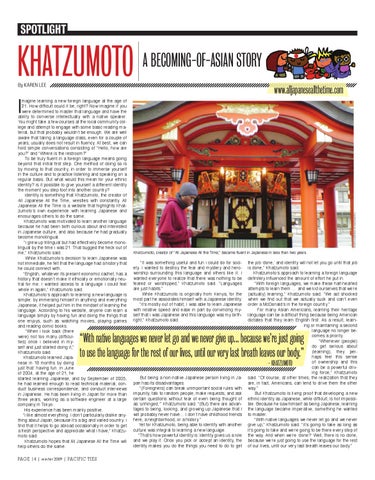
Khatzumoto, creator of “All Japanese All the Time,” became fluent in Japanese in less than two years.
“It was something useful and fun I could do for society. I wanted to destroy the fear and mystery and heroworship surrounding this language and others like it. I wanted everyone to realize that there was nothing to be feared or worshipped,” Khatzumoto said. “Languages are just habits.” While Khatzumoto is originally from Kenya, for the most part he associates himself with a Japanese identity. “It’s mostly out of habit; I was able to learn Japanese with relative speed and ease in part by convincing myself that I was Japanese and this language was my birthright,” Khatzumoto said.
the job ‘done,’ and identity will not let you go until that job is done,” Khatzumoto said. Khatzumoto’s approach to learning a foreign language definitely influenced the amount of effort he put in. “With foreign languages, we make these half-hearted attempts to learn them … and we kid ourselves that we’re (actually) learning,” Khatzumoto said. “We act shocked when we find out that we actually suck and can’t even order a McDonald’s in the foreign country.” For many Asian Americans, learning their heritage language can be a difficult thing because being American dictates that they learn English first. As a result, learning or maintaining a second language no longer becomes a priority. “Whenever (people) do get serious about (learning), they perhaps feel this sense of ownership and this can be a powerful driving force,” Khatzumoto said. “Of course, at other times, the realization that they are, in fact, Americans, can tend to drive them the other way.” But Khatzumoto is living proof that developing a new ethnic identity as Japanese, while difficult, is not impossible. Because he saw himself as being Japanese, learning the language became imperative, something he wanted to master. “With native languages we never let go and we never give up,” Khatzumoto said. “It’s going to take as long as it’s going to take and we’re going to be there every step of the way. And when we’re ‘done?’ Well, there is no done, because we’re just going to use the language for the rest of our lives, until our very last breath leaves our body.”
“With native languages we never let go and we never give up... because we’re just going to use the language for the rest of our lives, until our very last breath leaves our body.”
PAGE 14 | winter 2009 | PACIFIC TIES
- KHATZUMOTO
But being a non-native Japanese person living in Japan has its disadvantages. “(Foreigners) can break unimportant social rules with impunity, talk to random people, make requests, and ask certain questions without fear of even being thought of as ‘unhinged,’” Khatzumoto said. “(But) there are advantages to being, looking, and growing up Japanese that I will probably never have… I don’t have childhood friends here, a neighborhood, or a history.” Yet for Khatzumoto, being able to identify with another culture was integral to learning a new language. “That’s how powerful identity is: identity gives us a role and we play it. Once you pick or accept an identity, the identity makes you do the things you need to do to get