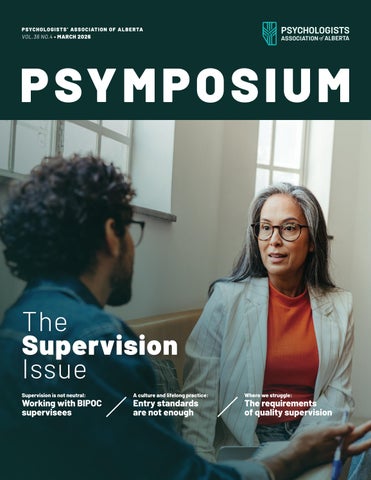
Supervision is not neutral: Working with BIPOC supervisees
A culture and lifelong practice: Entry standards are not enough
Where we struggle: The requirements of quality supervision
BOARD OF DIRECTORS
President: Dr. Quintina Bearchief-Adolpho, R. Psych
President-Elect: Stacey Steele, R. Psych
Audit Committee Chair: Chris Pawluk, R. Psych
Board Custodian: Rashmani Chakrabarty, R. Psych
Members at Large:
Tamara Austin, R. Psych
Carmen Bellows, R. Psych
Rashmani Chakrabarty, R. Psych
Dr. Sandra Dixon, R. Psych
Lisa Kaldenbach, R. Psych
Dr. Allison McNeil, R. Psych
PSYMPOSIUM
Editorial
Editors: Dr. Alana Ireland, R. Psych & Dr. Lily Le, R. Psych
March Contributing Writers:
Dr. E. Aiofe Freeman-Cruz, R. Psych
Dr. Caroline Buzanko, R. Psych
Dr. Jackie Bailey, R. Psych
Dr. Lisa Gray, R. Psych
Dr. Barbara Pickering, R. Psych
Dr. Harpreet Gill, R. Psych
Leigh-Anne Sheldon, R. Psych
Dr. Jonathan Dubue, R. Psych
Dr. Mitch Colp, R. Psych
Design and production: Jennifer Whyte
PAA Psymposium [ISSN 1193-2627] is the official newsletter of the Psychologists’ Association of Alberta. Canadian Publication Mail Product Sales Agreement #40020241.
PAA Psymposium is published four times a year (March, June, September and December) for the purpose of fostering communication amongst psychologists and supporting the goals of the Association and the profession of psychology. The newsletter is available to all members of the PAA on our website or by subscription, as well as to public subscribers and selected individuals and organizations with interests in the practice of psychology.
Except where otherwise indicated, copyright 1998 by the Psychologists’ Association of Alberta are in effect. Permission is granted to reproduce up to 10 copies of any article as it appears in PAA Psymposium, if such reproductions are distributed without profit for educational or research purposes only and properly cite Psymposium and denote PAA copyright. Permission for additional reproductions or reproduction for commercial purposes must be obtained in writing from the Editors. PAA generally welcomes requests to reprint from other professional newsletters.
Psymposium is submitted to PsycEXTRA, a database set up by the American Psychological Association, which contains newsletters, policy papers, white papers, fact sheets, reports, magazines. PsycEXTRA is a companion to the American Psychological Association’s scholarly database PsycINFO.
Photo: Shutterstock
Mission and Vision
The mission of the PAA is to advance the science-based profession of psychology and to promote the well-being and potential of all Albertans. PAA and its members are recognized leaders in enhancing the psychological health of all Albertans.
About Psymposium
Looking to advertise with us? Visit our website: paa-ab.ca.
Stay Connected
PAA STAFF
Chief Executive Officer
Dr. Bill Hanson, R. Psych
Chief Operating Officer Joanna Leung
Director of Professional Affairs
Dr. Harpreet Gill, R. Psych
Director of Career Affairs
Matthew Cairns, R. Psych
Governance Officer
Angela Sargent
Professional Guidance Officer
Annika Rorem
Member Engagement Officer
Arim Kim
Member Services Officer
Emma McGrath
Executive Assistant Jiya Juneja
Communications Officer
Jennifer Whyte
March 2026
Except where specifically
the opinions expressed in Psymposium are strictly those of the authors and do not necessarily reflect the opinions of the Psychologists’ Association of Alberta, its officers, directors, or employees. The Psychologists’ Association of Alberta reserves the right to edit all articles and submissions before publication and to decide on the suitability for publication.
Supervision as Stewardship: Shaping the Future of Psychological Practice
Dr. Alana Ireland, R. Psych & Dr. Lily Le, R. Psych
Supervision occupies a foundational role within the profession of psychology. It is one of the primary mechanisms through which professional knowledge, ethical reasoning, clinical judgement, and professional identity are transmitted across generations of practitioners. Through supervision, the profession not only supports the development of individual clinicians but also sustains the standards of practice that underpin psychological care. At its best, supervision is not simply oversight. It is a developmental and relational process that shapes how psychologists think, practice, and ultimately serve the individuals and communities who seek our care.
Across our work in the profession and in conversations with colleagues, supervisees, and supervisors alike, we are continually reminded of how profoundly supervision shapes the development of early-career psychologists. For this reason, we felt it was important to dedicate an issue of Psymposium to exploring current questions, challenges, and emerging perspectives in supervision.
The contributions in this issue highlight just how central the supervisory relationship is to the development of competent and confident practitioners. Across the perspectives presented in this edition, a consistent theme emerges: supervision is not merely a procedural requirement on the path to registration. Rather, it is a critical site of professional learning and socialization, where emerging psychologists refine their clinical judgement, deepen their ethical reasoning, and develop confidence in their professional roles.
Each author in this issue reminds us that supervision is a distinct professional competency. Being an excellent clinician does not automatically translate into being an effective supervisor. Supervisory practice requires its own set of relational, pedagogical, and evaluative skills, including the ability to facilitate reflective practice, provide constructive feedback, navigate complex power dynamics, and support the evolving professional identities of supervisees. Effective supervision requires balancing support and accountability while maintaining
If supervision is one of the primary ways our profession reproduces itself, then the quality of supervision we provide today will shape the profession we inherit tomorrow.
a clear commitment to both supervisee development and public protection.
Importantly, this issue also recognizes that conversations about supervision must include the voices of supervisees themselves. Discussions about supervision often occur among supervisors and regulatory bodies, yet the supervisory process is experienced most directly by students or those navigating the provisional period. To ensure these perspectives were represented, we invited provisional psychologists in Alberta to share their experiences through a survey exploring the realities of supervision in the current professional landscape. Thank you to the supervisees who contributed their perspectives.
For those currently engaged in supervision, or considering becoming supervisors, this issue offers an opportunity for reflection. If supervision is one of the primary ways our profession reproduces itself, then the quality of supervision we provide today will shape the profession we inherit tomorrow. As a profession, we share responsibility for cultivating strong supervisory practices. This includes supporting supervisors in developing the skills required for effective mentorship, creating structures that promote accountability and transparency, and ensuring that supervision remains accessible to those entering the field.
Ultimately, supervision is not simply about meeting regulatory requirements. It is a central mechanism through which the profession sustains its ethical standards, clinical competence, and collective responsibility to the public. The psychologists currently navigating supervision today will shape the
future of psychological practice. Ensuring that supervision reflects the highest standards of relational integrity, professional accountability, and developmental support is therefore not only a responsibility to supervisees, but to the profession and the public we serve.
Dr. Alana Ireland (she/her) is a Registered Psychologist based in Calgary, Alberta. She earned her PhD from the University of Calgary and is co-editor on Psymposium.
Dr. Lily Le (she/her) is a Registered Psychologist based in Edmonton, Alberta. She earned her PhD from the University of Alberta and is co-editor on Psymposium.
NOTES FROM THE CEO’S DESK
Clinical Supervision: A Professional Imperative for Alberta Psychologists
By Dr. William E. Hanson, R. Psych
Practice doesn’t make perfect, as the saying goes. Practice makes permanent.
Clinical supervision has been the cornerstone of my academic and professional life for three decades. I have been formally trained in it, taught graduate courses on it, and presented theoretical and empirical papers and supervision roundtables at national and international conferences. Additionally, I have chaired supervision-related dissertations and clinically supervised hundreds of graduate students as they developed into intentional, ethical, and effective psychologists. Supervision is not an “add-on” to clinical training or an afterthought. It is a signature activity of the profession and must be safe and effective.
Safe and effective supervision is grounded in informed, well-established training models rather than ad hoc case discussions or informal case management. Simply asking supervisees, “Tell me about your clients” reduces supervision to technical troubleshooting, neglecting developmental, relational, and professional identity issues. Personally, I use Stoltenberg and McNeill’s Integrative Developmental Model (IDM). It provides a structured, researchbased framework for tailoring supervision to supervisees’ evolving competencies and needs. A model-based approach, such as IDM, helps ensure supervision addresses not only client care but also supervisee development, professional identity, and reflective practice. Without such a framework, supervision can be reactive and sporadic. With it, supervision can be intentional, developmentally attuned, and aligned with broader competencies in the field.
IMPORTANCE OF SUPERVISION CONTRACTS AND MEASUREMENT-BASED CARE (MBC)
In addition to theoretical models and frameworks, high-quality supervision involves clear, thoughtful supervision contracts. Wellconstructed contracts articulate the purpose of supervision and outline its structure (e.g., frequency, format, observation procedures,
limits of confidentiality). They clarify duties and responsibilities of both supervisor and supervisee, and anchor practice in CPA’s Code of Ethics and CAP standards. And they typically require supervisees to bring process-outcome data, clinical questions, and reflective material to supervision. Contracts are not bureaucratic formalities; they are ethically sound documents that clarify expectations, mitigate risks, and create foundations for collaborative, accountable supervision.
Speaking of accountability, supervision contracts also typically require supervisors to seek feedback from supervisees on the nature, process, and overall quality of supervision. A former doctoral student of mine, Dr. Houyuan Luo, C.Psych., studied this topic for his dissertation. Given that most participants in the study practiced in Alberta, the findings highlight a locally grounded model of explicitly collaborative supervision aligned with ethical codes encouraging supervisors to seek feedback. By seeking feedback, supervisors normalize feedback-seeking as an ethical, competency-based practice that models humility and lifelong learning. Clinical supervisors may wish to include informal verbal check-ins and formal written or measure-based tools to mitigate power imbalances and enhance supervisory alliances. Because supervisors reported vulnerability and anxiety about negative feedback in the study, future Alberta-based training will address managing supervisor defensiveness and fostering psychologically safe training environments.
Another former doctoral student, Dr. Hansen Zhou, R.Psych., studied a critically important topic related to supervision; specifically, Measurement-Based Care (MBC). MBC turbocharges treatment and serves as a scaffold for supervisory dialogue, anchors case discussions and evaluations in objective process-outcome data and identifies clients at risk for deteriorating. By using MBC in practice, supervisors model how to introduce and collaboratively integrate progress data into treatment. See CAP’s spring (2025) issue for more information on MBC in clinical practice.
MOVING FORWARD TOGETHER
As CEO of PAA, improving clinical supervision and MBC are two of my top-strategic priorities. Recently, we surveyed provisional members
on their supervision experiences. Preliminary results are eye-opening. For example, only a fraction of supervisors reportedly attend to issues of assessment and diagnosis, which are profession-defining areas of practice for psychologists. At this time, Alberta requires a renewed, coordinated focus on supervision excellence. In the coming years, PAA will develop supervision bootcamps and stackable microcredentials to support psychologists’ career stages, from supervisors taking on their first supervisee to seasoned supervisors seeking advanced competencies and skill sets.
PAA welcomes feedback and dialogue on the future of clinical supervision in Alberta. Please share your thoughts with PAA’s new Director of Career Affairs, Mr. Matthew Cairns, R.Psych., at cpd@paa-ab.ca and PAA’s Director of Professional Affairs, Dr. Harpreet Gill, R.Psych., at guidance@paa-ab.ca.
In closing, I have a simple, yet poignant, reminder: Practice doesn’t make perfect, as the saying goes. Practice makes permanent. Let us ensure that we are practicing competent, ethical, theoretically grounded, and collaborative supervision.
Dr. William E. Hanson (he/him) is a Registered Psychologist based in Edmonton, AB. He earned his PhD from Arizona State University and is the CEO of the Psychologists’ Association of Alberta (PAA). He is the Chair of the Council of Professional Associations of Psychology, and a retired professor of psychology.
Supervision Is Not Neutral: Reflections on Working with BIPOC Supervisees
By Dr. E. Aiofe Freeman-Cruz, R. Psych
Part of training to be a psychologist and developing your professional identity is a necessary process of learning about who you are and how the world receives you (Barraclough, 2024). This is especially true for BIPOC therapists and trainees. Guidance to help therapists in training gain understanding of who they are and how they are situated as persons within the profession is not always provided during training, but it is an essential component of becoming a therapist in the real world (Waters, Altus, & Wilkinson, 2013). Walters et al. (2013) recognized that those supporting this process also need to recognize their own personal and professional identities as they intermingle with those they are supporting in supervision.
As a racialized psychologist with personal and professional experience in therapy practice, training, and supervision, I can confidently state that there are some key pieces of this process that often go unacknowledged and unsupported in our profession. Psychology training involves developing a position of cultural-responsivity and cultural humility to be accessible to clients of diverse backgrounds (Collins, 2018). However, this position is often taught from a white, Westernized perspective which may ignore the challenges of being a racialized person in the therapist role (Wong, 2025). Unfortunately, this does not prepare Black, Indigenous, and Person of Colour (BIPOC) psychologists to face the “isms” in clinical practice.
Early in my training, during one of my practica experiences, I had an initial session with a client who expressed confusion because I did not look the way they had expected me to look. As the client explained, my name is of Irish origin, my voice on the phone “didn’t sound black”, and I was in a graduate program which was a space that contradicted their ideas of ‘Blackness.’ I supported this client to recognize that they had biases about who “should” be a counsellor, and we collaboratively assessed if my racial identity would be a barrier to counselling. Though I had been trained to have this kind of conversation regarding other parts of my identity that may be barriers to counselling (e.g., training level), I was not prepared to address something I could not change (i.e., my race). In the end, the client requested a different therapist mostly due to their discomfort around my race. My supervisor had observed the session and was able to name
the experience for me: “That was racism.” As we debriefed, I came to acknowledge that I was taken off guard as I forgot that racism could happen anywhere – grocery stores, workplaces, and therapeutic spaces alike.
The culturally responsive position of the supervisor in such experiences is integral as supervisors have more power in the supervisory relationship. If my supervisor had not named racism, I’m not sure I would have felt comfortable labelling and expressing it, despite knowing the exchange was racially charged. My supervisor used their power and cultural responsivity in the context of supervision to create a safer space for me to effectively process the event and restore a sense of cultural safety in my practical learning environment. Essentially, I was better positioned to navigate racially charged experiences in a therapeutic space knowing that my supervisor was supportive. This fostered my sense of resilience in the field and gave me permission to explore my experience as a racialized psychologist without filter. Unfortunately, not all BIPOC psychologists have this experience in supervision.
Ebubedike and colleagues (2024) highlighted that racialized microaggressions in supervision are frequent occurrences that impact the development of early career psychologists. Supervision is intended to be a competencybuilding and growth promoting space with gatekeeping and supportive elements mixed in. If a microaggression occurs in supervision, BIPOC trainees can begin to create problematic narratives about their professional identities, particularly on how they understand themselves and their role in the profession and therapy practice. Microaggressions in supervision may not be intentional, but they are typically due to the supervisor’s unconscious biases and limited awareness of systemic oppression that may be built directly into their perspectives and approaches (Ebubedike, et al. 2024; Wong, 2025). Though there is limited training available for culturally-responsive and socially just supervision (Spowart & Robertson, 2024), it is becoming an expectation of supervisors as the field attracts more diverse practitioners. BIPOC supervisees may be experiencing training that does not wholly reflect their reality in practice, while at the same time struggling with a political climate that challenges their
own sense of safety in the profession and daily life (Wong, 2025). It is a unique experience that often goes unspoken and is misunderstood. This is evidenced by the scarcity of the existing publications in the area (Spowart & Robertson, 2024).
Supervisors need to be willing and able to talk about race and culture in support of BIPOC supervisees.
Despite the challenge of limited reliable information, I believe that creating a safer learning environment for BIPOC supervisees requires supervisors to use their power in the supervisory relationship to be curious and lead such conversations. In some cases, this can include naming and owning one’s cultural identity as it applies to them as a professional to normalize situatedness as a cultural being. It may also involve the supervisor creating space for cultural and racial conversations and understandings in the relationship by demonstrating cultural humility and bringing culture and race into the discussion purposefully. Furthermore, supervisors need to create an environment for trust, openness, and feedback, so these conversations can take place with intention (Vekaria et al., 2023). It will not be a perfect process, so supervisors can model recovery and repair from missteps due to unconscious bias (Falendar & Shafranske, 2021).
Supervisors are charged with the task of creating a safer supervisory relationship for the concerns, questions, and challenges that impact supervisees as individuals and professionals as cultural beings (Ebubedike,
et al., 2024; Vekaria et al., 2023). We want to diversify psychology as a field so it is reflective of identities beyond the dominant groups in training and practice (Wong, 2025). To do this, supervisors need to be willing and able to talk about race and culture in support of BIPOC supervisees as needed, applying the same principles of cultural-responsivity and
cultural humility to supervision. It is complex and messy, yet necessary for effective supervision with BIPOC supervisees who will eventually offer critical contributions that will ensure representation of diverse worldviews in psychology practice as fully licensed psychologists in the field.
For a complete list of references in this issue, visit psychologistsassociation.ab.ca/psymposium.
Dr. E. Aiofe Freeman-Cruz (she/her) is a Registered Psychologist in Calgary, Alberta. She earned her PhD from the University of Calgary and works in private practice at Divertue Psychology & Wellness. She specializes in intersectionality and identity construction.
Explore the New 2026 PAA Member Benefits
PAA’S NEW PAYMENT PROCESSING PARTNER. Members can choose between a free processing credit or a free payment terminal.
and records management services
Finding Our Footing: What Quality Supervision Requires and Where We Still Stumble
By Drs. Caroline Buzanko, Jackie Bailey, Lisa Gray, and Barbara Pickering
Clinical supervision, the cornerstone of counsellor education (Barnett et al., 2007; Bernard & Goodyear, 2019; Shulman, 2005), clearly links to trainee competence and client outcomes (DePue et al., 2022; Keum & Wang, 2021; Ladany & Inman, 2008). Unfortunately, supervision quality varies widely and is often treated as an afterthought rather than a specialized professional activity. This piece explores two interrelated questions: What distinguishes a high-quality supervision site, and what challenges do trainees face?
THE PILLARS OF A QUALITY SUPERVISION SITE
High-quality sites are distinguished by the intentionality of training infrastructure, with research and guidelines converging on several core elements of excellence in supervision.
The Relational Foundation
The supervisor-trainee working alliance provides the foundation for effective supervision, predicting a range of important outcomes from satisfaction with the supervisory experience, to trainee self-efficacy and overall wellbeing (Ladany et al., 1999; Morrison & Lent, 2018; Johnson et al., 2020). When trainees experience a strong working alliance, they perceive that their supervisor believes in their clinical potential, which strengthens their sense of competence. The relational 3C model for supervision, clarity (transparent roles/ feedback, contracts), containment (a secure base that normalizes anxiety), and compassion (attunement to needs and emotional impact) create the conditions for genuine professional growth (Bager-Charleson et al., 2023).
Multicultural Orientation
Competent supervision must be culturally responsive (Ozmen & Kemer, 2025), as racial, ethnic, gender, and other identity factors shape supervision dynamics (Ancis & Ladany, 2010; Inman, 2006). A Multicultural Orientation— emphasizing cultural humility, comfort, and the use of cultural opportunities—is essential (APA, 2025). Supervisor cultural humility strengthens the working alliance and reduces supervisee nondisclosure (Ertl et al., 2023). Supervisors intentionally examine how their own worldviews, values, and power shape the supervisory relationship and clinical work (Wilcox et al., 2024; Winkeljohn Black et al., 2025).
Developmentally Responsive Practice
Quality supervisors demonstrate knowledge of educational processes underlying supervision, including practices that promote self-efficacy at various developmental levels and the ability to individualize supervision based on trainee needs (Borders, 2014). Beginning counsellors benefit from structure, directive teaching, concrete guidance, and normalization of anxiety, whereas advanced trainees may need greater autonomy, collegiality, and preparation for independent practice (Stoltenberg, 1981; Stoltenberg & McNeill, 2010; Ronnestad & Skovholt, 2003).
Direct Observation
Quality supervision requires direct observation and process monitoring, since relying solely on trainee self-report is inadequate (APA, 2025; Gonsalvez & Crowe, 2014). Quality supervision uses live or recorded observation to provide behaviourally anchored feedback (Johnson, 2019), supported by clear procedures for addressing competency concerns or determining lack of fitness for practice; protections that safeguard the public and enable specific, actionable corrective guidance (APA, 2025).
NAVIGATING THE TERRAIN: CHALLENGES FACING TRAINEES
When Supervision Falls Short - Or Causes Harm
While many supervision experiences are positive, harmful supervision remains a serious concern. Consequently, it is important to distinguish inadequate supervision, which may leave trainees feeling unsupported but not harmed, from harmful supervision, which often reflects pathologizing, dysregulated, or abusive use of power (Ellis et al., 2014). Harmful supervision can leave trainees traumatized, isolated, and professionally impaired, yet gatekeeping dynamics often prevent them from speaking up, deepening mistrust and loss of confidence (Rhinehart, 2015; Hutman et al., 2023).
The Paradox of Safety and Evaluation
The hierarchical nature of a supervisory relationship is a defining feature that both enables and complicates the learning process (Bernard & Goodyear, 2019). Unexamined power imbalances can impede trainee development, contribute to role confusion, and restrict authenticity (Cook et al., 2018; Murphy & Wright, 2005). One particularly well-documented consequence is supervisee nondisclosure, the tendency for trainees to withhold relevant information such
as clinical mistakes, adverse reactions to clients, or dissatisfaction with supervision, due to fear of negative evaluation (Apostol et al., 2025; Ertl et al., 2023). When psychological safety is low, nondisclosure becomes a self-protective strategy, ultimately compromising both training outcomes and client care (Žvelc & Žvelc, 2021).
Structural Realities and Systemic Pressures
A major barrier to effective supervision is limited time and heavy workloads; when agencies prioritize productivity or frame supervision as monitoring rather than development, supervision becomes rushed, cancelled, or reduced to administrative case management (Rothwell et al., 2021). Supervisees report limited supervisor availability, scheduling conflicts, cancelled or rushed sessions, as well as psychological disengagement experienced as disorganization, preoccupation, fatigue, or disinterest (Hutman et al., 2023; Rothwell et al., 2021; Soheilian et al., 2022). Additional challenges include unclear or unreasonable expectations, supervision perceived as surveillance rather than support, poor role clarity, and misalignment between placement demands and training goals, such as overly task-focused supervision, assignments beyond trainee competence, or restricted access to evidence-based training due to supervisor preferences (Hutman et al., 2023; Rothwell et al., 2021)). Supervisees also perceive supervision as unhelpful or harmful when feedback is vague, dismissive, contradictory, or overly negative without being constructive (Hutman et al., 2023; Rothwell et al., 2021).
Telesupervision
Although telesupervision increases access to training in rural and underserved areas (Noon et al., 2025), it can simultaneously reduce contextual cues essential for assessing trainee well-being and clinical success. Challenges related to technology, communication, and the loss of informal connection (Soheilian et al., 2022), in addition to technostress and the difficulty of reading nonverbal cues through a screen, can impact the supervisory alliance in ways we are only beginning to understand (Grames et al., 2022).
Supervisor Competence
Clinical expertise does not automatically translate into supervisory competence. Supervision is a distinct professional skill set requiring specialized knowledge, training, and ongoing development, yet many supervisors rely on their
own experiences as supervisees rather than formal preparation (Bernard & Goodyear, 2019; Gazzola et al., 2014). Best practice guidelines emphasize targeted supervision training and the use of current knowledge rather than tradition or assumption (ACES, 2011; Borders, 2014). Effective supervisors demonstrate competence in supervision models, evidence-based clinical practice, clear role boundaries, and ethical selfreflection.
PRACTICAL IMPLICATIONS FOR THE PATH FORWARD
Clinical experience and formal training in supervision are essential. Supervisors must prioritize the supervisory relationship (Bernard & Goodyear, 2019). They must acknowledge the relational power imbalance, foster psychological safety, and invite honest dialogue about the relationship itself (Ellis et al., 2014). By adopting
a collaborative and culturally humble stance, supervisors should invite feedback, normalize the anxiety of learning, and reduce trainee nondisclosure (Ertl et al., 2024).
Clear expectations and criteria for feedback and evaluation should be established from the outset, with ongoing formative feedback, so that summative evaluations contain no surprises. Supervisees should be given opportunities to provide feedback on the supervisory process, including through anonymous means (Borders, 2014; ACES, 2011). A written supervision contract provides a foundation for the relationship (ASPPB, 2020) and transparency that allows trainees to focus on clinical learning rather than deciphering their supervisor’s preferences. Supervisors must understand that supervision is not one-size-fits-all and individualize their approach based on the trainee’s developmental needs. Supervisors must advocate for conditions
that make quality supervision sustainable by ensuring protected supervision time, prioritizing teaching alongside clinical productivity, and viewing training as central to supervisors’ professional role.
Supervision as Ethical Practice
Attending to supervision quality is an ethical imperative, as supervisors are responsible for continually developing their supervisory competence (CPA, 2017); high-quality supervision shapes individual practitioners and the profession’s overall capacity to serve clients well. Grounding practice in best-supported approaches strengthens this essential foundation of professional development. Supervision is too important to leave to chance, and when done well, its benefits extend outward to the clients and communities the profession serves.
For a complete list of references in this issue, visit psychologistsassociation.ab.ca/psymposium.
Dr. Caroline Buzanko (she/her) is a Registered Psychologist in Calgary, Alberta. She earned her PhD from the University of Calgary. She is an Assistant Professor at Athabasca University and works as a Psychologist and Clinical Director at Koru Family Psychology. She specializes in counselling and educational/ school psychology.
Dr. Lisa Gray (she/her) is a Registered Psychologist in Edmonton, Alberta. She earned her PhD from the University of Alberta. She is an Assistant Professor at Athabasca University and specializes in counselling psychology.
Dr. Barbara Pickering (she/her) is a Registered Psychologist in Calgary, Alberta. She earned her PhD from the University of Calgary and is the Curriculum Coordinator at Athabasca University, bringing extensive expertise to psychological education and professional practice.
Dr. Jackie Bailey (she/her) is a Registered Psychologist in Stanstead, Quebec. She earned her PhD from the University of Alberta. She is an Academic Coordinator at Athabasca University and works as a Psychologist in private practice, where she specialized in counselling psychology.
Clinical Supervision in Psychology Practice: Competency, Ethics, and Meaningful Change
By Dr. Harpreet Gill, R. Psych
Clinical supervision is one of the most influential experiences in a psychologist’s professional life. It is where clinical skill becomes grounded in practice, ethical responsibility becomes lived experience, and professional identity takes shape.
While supervision can sometimes be treated like a procedural obligation (e.g. hours to log, forms to complete, competencies to check off), its true value is far deeper. Supervision is a living practice that is relational, developmental, and, at its best, transformational.
As per the Canadian Code of Ethics for Psychologists (Canadian Psychological Association, 2017) supervision is well established as a professional requirement that protects clients, supports ethical practice, and strengthens the profession.
Supervision is more than oversight: it’s a foundation. Clinical supervision exists for a reason. In practical terms, supervision supports:
» Client welfare and safety
» Clinical skill development
» Ethical and professional accountability
» Supervisee confidence and identity formation
A distinctly Canadian contribution to this conversation comes from Chang, Mudry, and Hiseler (2020), who describe clinical practice and supervision as key to building a firm foundation for emerging professionals. Their work highlights how supervision helps earlycareer clinicians consolidate their professional identity and notes that supervision experiences can vary significantly in quality depending on context, access, and training structures. This is a vital reminder that supervision is not just a requirement to get through. It is part of what makes practice possible.
Many psychologists become supervisors because they are strong clinicians. But supervision requires additional competencies, particularly the ability to evaluate clinical work, provide structured feedback, and support development over time.
Supervision is not automatically mastered through clinical experience alone. In an article in the APA monitor by DeAngelis (2014), it is emphasized that supervision is a unique professional discipline. It is not simply an
extension of therapy or teaching, and that safe, trusting relationships and clear, timely feedback are essential for learning, ethical practice, and responsible gatekeeping.
Supervision is also ethical leadership. Supervisors model how to reason through clinical uncertainty, how to hold boundaries, and how to stay accountable to client welfare while supporting supervisee growth.
According to the College of Alberta Psychologists’ Practice Guidelines on Clinical Supervision (2025), supervision is defined as a structured, ongoing professional relationship that combines both facilitative and evaluative components with the explicit goals of enhancing a provisional psychologist’s professional competence, monitoring the quality of psychological services provided, and ensuring compliance with regulatory standards and ethical obligations. Through direct instruction, modelling, case review, observation, and feedback, supervisors play a key gatekeeping role in confirming that provisional psychologists develop the necessary skills for safe and competent independent practice, ultimately supporting public protection by ensuring client safety and well-being throughout the training period.
Moreover, supervision should be tailored to the supervisee’s developmental stage, using flexible and creative approaches that support skill growth, reflective practice, and increasing competence over time. This means that not all supervisees need the same kind of supervision. In their earlier phase, clinicians in training often need more structure, reassurance, and direct skill guidance. Later on, supervisees may benefit more from challenge, autonomy, and deeper conceptual reflection.
Bellinger and Carone (2021) highlight how creative supervision strategies can be used within a
Clinical supervision is where the future of psychology is actively shaped.
developmental framework to support supervisee learning and engagement. Creativity can make learning more memorable, more integrated, and more clinically meaningful.
Creative supervision can include:
» Role plays and rehearsal of challenging moments
» Visual case mapping and formulation tools
» Structured reflection on countertransference
» Reviewing recordings with targeted skill focus
» Metaphor and narrative methods to deepen conceptual clarity
Supervision is often discussed in terms of competence: skills, interventions, and professional standards. But there is another dimension that matters just as much and that is transformation. Watkins (2020) describes the psychotherapy supervisor as an agent of transformation, supporting supervisees not only to do therapy, but to become therapists in a deeper sense. He frames the supervisor’s role as one that helps supervisees:
» Anchor (build safety and steadiness)
» Educate and facilitate (support reflective learning and development)
» Emancipate (foster autonomy and self-trust This model aligns well with what many supervisors see in practice – i.e. supervisees do not just need answers; they need to develop professional judgment and the capacity to work ethically and effectively in uncertainty.
Another factor that contributes to effective ethical supervision is the ability to offer feedback. Feedback is where supervision succeeds or fractures. The goal of feedback is not to “correct” a supervisee, but to strengthen clinical judgment, ethical decision-making, and professional identity through clear, timely, and specific guidance.
Supervisees benefit most from feedback that is:
» Specific and behavioural (“Here’s what I observed…”)
» Timely (not saved for evaluation periods)
» Balanced (strengths and growth edges)
» Actionable (“Next session, try…”)
» Linked to competencies and ethics
Effective supervision also depends on the ability to have difficult conversations with supervisees.
Avoiding difficult feedback may feel kind in the moment, but it can undermine development and increase risk. Ethical supervision requires supervisors to be supportive and clear especially when competence concerns arise.
One simple and practical structure could be to begin with a brief check-in (about five minutes) to assess supervisee wellbeing and identify any urgent client safety concerns. Next, spend the bulk of the session (30–40 minutes) on case focus, exploring one or two cases in depth to support stronger conceptualization and clinical decision-making. Then, shift into a skills and professional identity focus (10–15 minutes) to
notice patterns, explore countertransference, and support ongoing growth as a clinician. Finally, close with clear action steps (about five minutes), outlining goals for the coming week and confirming any documentation or follow-up needs.
Clinical supervision is where the future of psychology is actively shaped, making supervisors the stewards of quality care and professional integrity. Good supervision protects clients. Great supervision builds confident, reflective, ethical clinicians. Transformational supervision does all of this, while fostering the future of the profession.
For a complete list of references in this issue, visit psychologistsassociation.ab.ca/psymposium.
Dr. Harpreet Gill (she/her) is a Registered Psychologist based in Edmonton, Alberta. She earned her PhD from Punjabi University and currently serves as PAA’s Director of Professional Affairs. In her clinical practice, she brings her commitment to professional standards and patient care through her work specializing in addictions and couples counselling.
A Snapshot of the Supervisee Experience
Dr. Alana Ireland, R. Psych & Dr. Lily Le, R. Psych
A publication dedicated to supervision would not be complete without hearing directly from provisional psychologist supervisees.
To better understand their experiences, we invited members of the PAA supervisee email list to complete an anonymous, voluntary survey reflecting on their current and primary supervisor. We are grateful to the supervisees who shared their perspectives!
Forty-five provisional psychologists responded, and their responses offer both encouraging insights and important areas for reflection. Most respondents were in the early stages of their provisional period, with nearly three quarters registered for two years or less. The majority (approximately 76%) reported practicing in private practice settings, reflecting the increasing prominence of private practice environments for early-career psychologists in Alberta. Many respondents reported having more than one supervisor during their provisional period, with over 70% indicating that they had worked with two or more supervisors. This suggests that supervision is often experienced not as a single mentorship relationship but as a series of supervisory encounters that collectively shape early professional development.
When asked about the focus of supervision, most respondents reported that their supervision centered primarily on counselling work, with fewer indicating substantial focus on assessment. This pattern likely reflects the broader history of the profession in Alberta, where many earlycareer psychologists are entering counsellingfocused roles in private practice and community settings. This may pose challenges for the evolving direction in Alberta that aims to highlight the importance of assessment in how we define a psychologist’s role.
Encouragingly, respondents reported generally positive experiences in several key areas. On average, supervisees rated the quality of their supervisory relationships relatively highly, with similarly strong ratings for psychological safety and overall supervision quality. Many respondents emphasized how valuable it was to work with supervisors who were approachable, responsive, and willing to engage in collaborative problem-solving.
Several supervisees highlighted the importance of relational qualities in their supervisory experiences. Words such as warm, supportive, available, and patient appeared repeatedly in responses describing what worked well. These reflections echo what supervision research has long demonstrated: the quality of the supervisory alliance is one of the strongest predictors of effective supervision outcomes. When supervisees feel psychologically safe and supported, they are more likely to ask questions, disclose uncertainty, and engage in deeper reflective learning.
Supervisees also identified several areas where supervision supported their professional growth most strongly, including treatment planning, case conceptualization, ethical documentation, and working with diverse populations. These domains represent core competencies for independent practice and illustrate the important role supervision plays in translating academic training into applied clinical work. At the same time, the survey responses also highlight several challenges within the current supervisory landscape in Alberta.
Respondents reported paying between
SUPERVISION SURVEY RESULTS
76%
Reported practicing in private practice settings.
70%
Over 70% having worked with more two or more supervisors.
$176 and $250 Nearly one-third per hour for supervision, with only a small proportion receiving employer-covered supervision.
of respondents reported difficulties related to alignment with supervisors in terms of expectations, working style, or learning needs.
Cost emerged as the most frequently reported barrier to securing supervision, identified by nearly half of respondents. Many provisional psychologists reported paying between $176 and $250 per hour for supervision, with only a small proportion receiving employercovered supervision. Given that supervision is a mandatory requirement for licensure, the financial burden associated with these costs raises important questions about accessibility and equity for early-career psychologists entering the profession.
Respondents also noted the scarcity of available supervisors and challenges in finding a good supervisory fit. Nearly one-third of respondents reported difficulties related to alignment with supervisors in terms of expectations, working style, or learning needs. These findings highlight the importance of thoughtful supervisor–supervisee matching processes and suggest potential value in developing more structured systems to support these connections.
Perhaps most importantly, the open-ended responses remind us that supervision is not always experienced as safe or supportive. While many respondents described highly positive supervisory relationships, others shared
experiences that were far more difficult. Some raised concerns about power imbalances, limited accountability mechanisms, and insufficient protections for provisionals when supervisory relationships become problematic.
Supervision is, at its core, a power-laden relationship. Supervisors hold significant influence over evaluation, professional progression, and access to registration. When supervisory relationships function well, this structure facilitates mentorship, learning, and professional growth. When they do not, the consequences can be significant, not only for supervisee well-being, but also for professional development and ultimately for client care. These perspectives underscore the importance of creating spaces where supervisees can safely
share their experiences, and of continuing to strengthen the structures and cultures that support accountability, transparency, and psychological safety within supervisory relationships.
While the small sample size means these results may not fully represent the experiences of all supervisees, the survey still offers valuable insight into how supervision is experienced in practice. Taken together, the survey findings reinforce a central message echoed throughout this issue: the quality of the supervisory relationship matters profoundly. It shapes not only clinical competence but also how earlycareer psychologists come to understand themselves as professionals.
INDIGENIZING PSYCHOLOGY
Supervision Through an Indigenous Lens: Moving from Linear Control to Circular Relationship
By Leigh Sheldon, R. Psych
Supervision has to look very different when it comes to psychologists (helpers) supporting Indigenous people. Supervision through an Indigenous lens highlights that guidance and accountability can take multiple forms. In Western contexts, supervision is typically framed as a structured process aimed at monitoring professional conduct, assessing competency, and ensuring measurable outcomes. Western clinical supervision practices are historically rooted in hierarchical models, systems that privilege oversight, evaluation, and risk management (Linklater, 2014). In contrast, Indigenous worldviews emphasize the significance of process, one’s journey, relationships, and the meaning embedded in how the work is carried out. These worldviews remind us that learning is lifelong, relational, and grounded in community.
Within this orientation, supervision becomes a sustained expression of cultural humility and cultural commitment. It is not a discrete activity performed at set intervals, but a continuous practice that demands ongoing reflection and engagement across the professional and personal lifespan. As contexts evolve, practitioners must remain attentive, informed, and responsive, especially when supporting Indigenous peoples, whose experiences are shaped by histories of colonization, displacement, and survival. A culture that has survived genocide and continues to adapt requires practitioners to remain open to learning, consultation, and supervision. Competence in this work demands continual growth. Regardless of expertise or years of experience, I also require, and will continue to require, supervision for as long as I serve Indigenous Peoples.
Lifelong learning, grounded in humility and awareness of personal biases, is essential for ethical and effective practice. Continuous reflection is fundamental: reflection on our helping approach, on our authority and presence in the room, on our assumptions, and on whether our actions align with relational, cultural, and professional standards. This reflective orientation allows practitioners to identify and deconstruct habits that impede their effectiveness. As Marie Battiste (2000) writes, “Eurocentric knowledge systems have been imposed as the norm through colonial education, marginalizing Indigenous ways of knowing and being.” Her reminder that we must “learn to unlearn” is essential and being with is more important than knowing. Supervision becomes
one of the key spaces where we examine our responses to cultural differences, reduce cultural blindness, and create space for ongoing reflection.
Understanding trauma within Indigenous contexts to best support Indigenous clients also requires an expanded view of healing. Complex and intergenerational trauma demand sustained, body-focused trauma training. Intergenerational trauma affects individuals at neurophysiological levels; healing therefore involves supporting nervous system regulation and resilience, as well as rebuilding cognitive resilience. Chronic stress activation disrupts the hypothalamic–pituitary–adrenal axis, demonstrating why traumainformed care must be holistic, relational, and grounded in the body rather than relying solely on top-down cognitive interventions. These approaches align with Indigenous frameworks such as the Medicine Wheel, which understands healing as the integration of emotional, physical, spiritual, and mental dimensions of wellness. Indigenous culture embodies body based healing with ceremonial and traditional practices.
REFLECTION AS A PATHWAY TO CULTURAL SAFETY
As we move to understanding supervision as a lifelong, relational practice, it becomes essential to recognize where this guidance is rooted. In Indigenous contexts, learning and accountability are never isolated from community. They are shaped and sustained through relationships with those who carry cultural memory, ceremonial understanding, and lived experience. This naturally leads to the role of Elders and Knowledge Keepers.
Meeting with Elders is not an optional enhancement to supervision; it is a core ethical component of Indigenous-informed practice. Elders provide grounding in local protocols, teachings, and responsibilities, from offering tobacco to participating in ceremonies to understanding land-based traditions. Their guidance reminds practitioners that no two nations hold the same protocols. Working responsibly therefore requires connecting with Elders from the territory where one practices, as well as, when appropriate, from other treaty areas. This ensures a broader and more respectful understanding rather than applying a single, generalized “Indigenous” template to diverse nations. Each nation and territory has its own unique needs.
Learning from Elders is also deeply experiential. Indigenous cultures teach through doing, observing, and being in relationship. These interactions help practitioners situate themselves within relational accountability and provide grounding needed for ethical engagement and reciprocity (Laws of the Circle). Elders help us understand that healing involves not only clinical techniques but personal presence, humility, and awareness of the helper’s own spirit. Healing work touches the practitioner as much as it touches the client, and ongoing supervision helps ensure that the helper remains balanced, reflective, and aligned with Indigenous principles.
TWO-EYED SEEING AND THE COMPLEXITY OF HOLDING TWO WORLDS
The concept of Two-Eyed Seeing, introduced by Elder Albert Marshall, offers a powerful framework for understanding the role of supervision in cross-cultural practice. Two-Eyed Seeing teaches us to see with the strengths of Indigenous ways of knowing from one eye and the strengths of Western knowledge from the other, and to use both eyes together for the benefit of all.
In the context of supervision from an Indigenous lens, Two-Eyed Seeing acknowledges that practitioners must learn to hold both Western and Indigenous systems simultaneously or bridging the two in sacred moments. One system is grounded in regulation, assessment, and professionalization: the other in relationality, ceremony, reciprocity, and community connection. In the Western way, we assess deficit; in the Indigenous way, we assess strengths. Effective supervision supports practitioners in navigating these tensions without becoming lost in either system or replicating harms found in colonial structures. A person is skilled in genocide trauma-informed modalities and bridges the Indigenous perspectives by resourcing key elements of the culture. For example, the practitioner may ask questions like,“As you feel this rock, where do you notice this inside?” “When you feel your ancestors, where do you sense this?” “What would your ancestors say about this or to you?” In other words, they connect ancestors and land as a somatic practice.
Dr. Renee Linklater’s (2014) work on decolonizing trauma further clarifies that supervision itself is not neutral. It is inherently relational, political, and cultural. Supervision shaped by a decolonizing lens intentionally disrupts hierarchical or
expert-heavy models and instead centers relational accountability, shared responsibility, and reciprocal learning. Linklater argues that trauma, especially for Indigenous peoples, is both historical and ongoing, embedded within colonial systems that remain present in health care, justice systems, education, and daily life. Because of this, supervision must address power, positionality, and the implicit biases that practitioners bring into therapeutic relationships.
For Indigenous practitioners in particular, supervision becomes a crucial site of support. Many navigate institutional barriers while carrying an Indigenous worldview that is often unrecognized or unsupported within Western systems. This dual navigation reinforces the necessity of ongoing, reflective supervision rooted in Indigenous principles.
Linklater also emphasizes the importance of bringing Indigenous ethics and Western ethics into ongoing dialogue. This includes understanding how land is part of the healing relationship, why language and cultural identity are essential to wellness, and why addressing the spirit is inseparable from trauma work. “If we are not healing the spirit, we are not helping” reflects a core Indigenous ethical principle. Yet working with the spirit requires care: avoiding it can create harm, and approaching it superficially can also lead to harm. Supervision creates the space for practitioners to explore how to bring these conversations into the room safely, often beginning with gentle, open invitations such as: “Can you tell me your story? What feels true for you? What do you notice as you share this? Instead of “Tell me about your culture”
As psychologists learn a client’s story, the importance of holding the story by role modelling
curiosity and kindness and not patronizing the client. Shirley Turcotte’s (2025) approach to supervision reflects this work by emphasizing the importance of not patronizing the client and maintaining respect, dignity, and accountability in our practice. Patronizing a client undermines their autonomy, lived experience, and inherent strengths. When practitioners adopt a stance that positions themselves as the “expert” over the client, it reinforces a power imbalance and replicates dynamics of control that many clients, particularly those impacted by complex or intergenerational trauma have already experienced. It can reinforce learned helplessness when a helper takes over someone’s healing journey. Linklater (2014) shares how supervision and case consultation help practitioners remain aware of how biases, assumptions, or countertransference may lead to patronizing behaviors, allowing us to practice with humility, accountability, and cultural safety. Linklater also discusses that Indigenous ethics and Western ethics are two complex systems that require ongoing dialogue, reflection and accountability (2014).
CULTURAL ACCOUNTABILITY AS ONGOING PRACTICE
Cultural humility, cultural accountability, and cultural commitment are not discrete competencies that can be checked off. Nor is asking about one’s spirituality, yet they are crucial for therapy to be effective and require it to be done in a delicate and sensitive manner. They are interconnected practices that evolve over time and require sustained supervision to uphold. We are never finished learning. In indigenous approach to supervision, our own healing influences how we support others, and relational practice requires that we continually
reflect on the impact of our presence, assumptions, and choices. Meaningful support requires understanding the full context in which a person lives. These layers must be part of supervision as well, because they shape how we understand behaviour, make sense of symptoms, and co-create ethical, culturally safe pathways.
In circular supervision, the psychologist becomes part of the relational process rather than a detached observer. The supervisor and supervisee are mutually influential, with learning occurring through reciprocal exchange. In this way, supervision is not a one-directional transfer of knowledge but a shared process in which both giving and receiving informed understanding, insight, and growth.
Leigh-Anne Sheldon (she/her) is a Registered Psychologist in St. Albert, Alberta. She earned her Master’s from City University of Seattle and is the Founder and CEO of Indigenous Psychological Services. She frequently facilitates training workshops, and specializes in complex trauma and Indigenous counselling.
For a complete list of references in this issue, visit psychologistsassociation.ab.ca/psymposium.
Entry Standards will Never be Enough: Supervision
By Dr. Jonathan Dubue,
as a Culture and Lifelong Practice
R. Psych
Clinical supervision is the heart of psychology. It is where knowledge is translated into clinical judgment, professional identity is shaped, and why we are allowed to remain peer regulated. Because much of our practice occurs behind closed doors, public trust in psychology rests not on coursework or licensing exams alone, but on the expectation that psychologists’ work is observed, evaluated, and shaped by other psychologists.
Yet, despite its centrality, clinical supervision is underutilized, inefficient, and risks significant harm to our students. What’s worse is that, once psychologists are independent, there is little expectation to engage meaningfully in supervision. If supervision is our strongest safeguard of competence and client safety, then how and when we use it deserves far more scrutiny than it currently receives.
IS SUPERVISION THAT IMPORTANT?
Among the many components of professional training, clinical supervision is consistently identified as the most impactful learning experience. A meta-synthesis of qualitative studies examining trainee therapists’ experiences found that supervision was perceived as the most important learning activity shaping both personal and professional development, surpassing lectures, readings, and assignments (Wilson et al., 2016). Earlier work suggests trainees attribute as much as 50% of their learning to supervision alone (Bent et al., 1992).
Supervision emphasizes something few other training modality can, that is, a structured relational space in which individual clinical thinking and emotional responses are openly examined and collaboratively refined (Scaife,
2019). Through this process, supervision increases clinician confidence (Scaife, 2019), reduces burnout and anxiety (Mor Barak et al., 2009), and enhances self efficacy (Gibson et al., 2009). Importantly, supervision is also directly associated with competence development (Alfonsson et al., 2020; Lambert & Arnold, 1987) with a recent meta-analysis concluding that, compared to passive controls, clinical supervision had a large effect on therapist working alliance and skill development (Schreyer et al., 2025).
SUPERVISION IS, HOWEVER, UNDERUTILIZED
Despite its importance, supervision occupies a surprisingly small portion of psychologists’ training. For example, in Alberta, the College of Alberta Psychologists (CAP) requires one hour of supervision for every 15 hours of practice during provisional registration, amounting to a minimum of 107 supervision hours across 1600 hours of supervised practice. By contrast, CAP also requires a graduate degree in psychology (or psychology-based equivalent) that has 60 (thesis) to 72 (course-based) instructional credits, with at least 36 instructional hours per course. Assuming one to two hours of work outside of class per instructional hour, trainees spent approximately 1,400-2,160 hours (1,780 average) in coursework and related academic activities. Provided we’re comfortable with napkin math, trainees complete roughly 3,487 hours becoming a psychologist, of which only 3% (107 hours) of that is in clinical supervision. As well, all this supervision could be provided by a single supervisor or, said with more fear, only one person who approved they are sufficiently competent for independence.
One-hundred and seven hours is, however, low and unlikely. Most trainees and provisional
What we can do is promote a culture of supervision that continues beyond registration. This means psychologists are routinely observed through active means, such as co-therapy, live observation, or video review.
applicants will have completed practica during their graduate degree or, in the case of doctoral applicants, accrued roughly 350 or more hours of supervision (CCPPP, 2023) prior to registration. Even still, assuming most trainees complete at least a year-long practicum with weekly supervision, it would mean, at a minimum, psychologists spend 4.5% of their training time in clinical supervision prior to independence.
MORE SUPERVISION DURING TRAINING IS NOT THE ANSWER
Of course, no one knows precisely how many hours of supervision are required to ensure competence for independent practice. It may in fact be that 3% is a magic number, but this is nearly impossible to tell. Competence cannot be determined by time alone, it is measured through observation of on-thejob performance, a measure that is almost exclusively conducted through clinical supervision.
Unfortunately, evidence suggests that a substantial portion of supervision time is not spent on the activities most strongly associated with competence development or assessment. Over 85% of supervision time is devoted to individual case consultation, despite both supervisors and supervisee’s ranking this among their least preferred supervision activities (14th and 10th, respectively) (McCarthy et al., 1988). In contrast, supervisors consistently expressed a preference for observation, live feedback, and demonstration, activities most closely associated with skill acquisition (Gonsalvez & Crowe, 2014).
Paradoxically, as trainees progress, experiential supervision tends to decrease rather than increase (Rodriguez-Menendez et al., 2017). Even within supervision sessions, only about 20% of the time is typically dedicated to clinical skills, with the remainder consumed by administrative, supportive, or non-clinical functions (Dorsey et al., 2017). Even best practice models suggest that at least half of supervision time should be explicitly devoted to competency development (see The Learning Cycle; Falender & Shafranske, 2021). Despite trainees becoming more competent with more supervision (Schreyer et al., 2025; Scior et al., 2014), and trainees wanting more supervision (Guindon et al., 2022), more
supervision, the way it is being done, is an ineffective solution.
SUPERVISION IS ALSO RISKY AND IT OFTEN HURTS
Supervision is also not a practice without its risks. No supervisor is immune to harming their students, and even the most skilled supervisors will engage in ineffective behaviors. Supervisor practices can inadvertently promote avoidance, blur boundaries, minimize feedback, or position supervisors as unchallengeable authorities (Ladany et al., 2013; Reiser & Milne, 2014). Alarmingly, 92% of trainees report experiencing inadequate supervision at some point in their training, with 52% having experienced harm and nearly a quarter experiencing it weekly (Hendricks & Cartwright, 2018; McNamara et al., 2017).
There are, of course, supervisory practices that decrease the risk of these harms (e.g., supervision agreement forms, new supervisor checklists, routine meta supervision, avoidance of dual roles), but these are ultimately up to the supervisor to implement. Except for Quebec, which requires approximately 30 hours of formal supervision training, most provinces permit psychologists to practice supervision based on years of independent practice and self-assessed competence. Yet only half of CPA-accredited programs require a supervision course, and only one quarter requires supervised supervision practice (Hadjistavropoulos et al., 2010). Among pre-doctoral residents, just 39% received formal supervision training despite 72% providing supervision (Hadjistavropoulos et al., 2010). These statistics are likely lower when examining Master’s-level coursework,
requiring supervisor hopefuls to find their training elsewhere.
The consequences are tangible. Provisional psychologists in Alberta have raised concerns about inadequate contracts, opaque billing practices, compensation issues, and harmful supervisor experiences (Chang, 2020). Given the profound power imbalance inherent in supervision (McNamara et al., 2017), it is unsurprising that supervisees often withhold negative feedback out of fear of adverse evaluation (Wilson et al., 2016).
SO, WHAT DO WE DO?
To summarize: despite supervision developing competence and supervisees wanting more of it, supervision is not very well utilized, we don’t know how much supervision to prescribe to trainees, and more supervision may cause more harm. Yet despite these limitations, clinical supervision remains the strongest performance-based tool we have to assess and develop competence in psychology.
It would be fair to call for additional supervision training or tighter supervisor credentialing. While reasonable, we face practical constraints; we already have a limited number of supervisors, continuing competence doesn’t often lead to actual practice change (Ali et al., 2025), and the evidence is not yet clear enough to inform regulatory policy (e.g., how much supervision should be done for competence). If supervision is truly our professions’ signature safeguard, then we must use it not only to train psychologists, but to sustain them.
What we can do is promote a culture of supervision that continues beyond registration. This means psychologists are routinely
observed through active means, such as co-therapy, live observation, or video review. This can be with colleagues, mentors, and, most importantly, trainees. This solves all three of our problems: (a) the fallacy of achieving competence prior to independence is appropriately replaced with competency maintenance through routine observation (b) more observation means more time focused on clinical matters, and (c) more eyes on each other, especially during supervision, reduces the risk of unintentional interpersonal harms. At the core of this culture is a commitment to helping each other grow, like deliberate practice (see Chow et al., 2015).
We may never identify the perfect number of hours required for competence, nor ensure that every supervisor is exemplary. But by inviting our peers behind our closed doors, we become intentional in our commitment to peer regulation and better serve the public we are entrusted to protect.
Dr. Jonathan Dubue (he/him) is a Registered Psychologist in Edmonton, Alberta. He earned his PhD from the University of Alberta, where he currently serves as Clinical Supervisor. He specializes in clinical supervision and suicide prevention.
For a complete list of references in this issue, visit psychologistsassociation.ab.ca/psymposium.
Assessment Authority and Supervisory Responsibility in Private Practice
By Dr. Mitch Colp, R. Psych
Psychological assessment is one of the most consequential functions within professional psychology. In private practice, supervision in assessment unfolds within a distinct set of pressures: billable time, limited access to experienced assessors, uneven graduate preparation, financial barriers to advanced training, and increasing regulatory scrutiny. These conditions create real tensions for psychologists seeking supervision and for those asked to provide it.
Supervision is often framed as oversight, with emphasis placed on accurate administration, correct scoring, and defensible documentation. Procedural accuracy is essential. Yet professional guidance consistently affirms that supervision is not merely about compliance; it is
Supervision is designed to refine competence, not replace foundational education.
a competency, requiring structured evaluation, clear expectations, and attention to public protection. In private practice, supervision must also address readiness, interpretive judgment, and the ethical weight of diagnostic authority. It is not simply quality control. It is professional stewardship.
FROM PROCEDURE TO JUDGMENT
Many supervisees enter private practice with exposure to standardized testing procedures. They understand administration and scoring. What is less consistent is training in test selection, hypothesis development, differential diagnosis, and integration of findings into a coherent formulation.
Testing produces data. Assessment requires that data to be interpreted thoughtfully within developmental, contextual, and cultural frameworks. When supervision focuses primarily on procedural fidelity, it risks
reinforcing the belief that competence lies in administration alone. In practice, the greater risks are interpretive overreach, premature diagnostic conclusions, and insufficient conceptual grounding.
Effective supervision therefore centers on reasoning. Why was this tool selected? What competing explanations were considered? How strong is the evidence supporting the conclusions? Clarifying expectations and readiness for independent practice from the outset helps ensure that supervision remains developmental rather than corrective.
UNEVEN PREPARATION IN A HIGHEXPECTATION ENVIRONMENT
Graduate preparation in assessment varies considerably. Some supervisees arrive with strong foundations in psychometrics and integrated models. Others have had limited applied exposure. This variability places supervisees at uneven starting points and increases the demands placed on supervisors.
At the same time, regulatory bodies increasingly emphasize assessment and diagnostic formulation as defining competencies of psychology. In private practice, this emphasis carries practical consequences. Assessment findings influence access to services, educational accommodations, and at times legal determinations. Errors in judgment can lead to client harm, complaints, and reputational damage.
Supervision is designed to refine competence, not replace foundational education. When core competencies are absent, supervisors must determine whether gaps can be addressed safely within supervision or whether additional formal training is required before assessment work proceeds. Establishing clear boundaries around scope and readiness protects both clients and developing psychologists.
FINANCIAL AND STRUCTURAL BARRIERS
Access to formal assessment training presents another challenge. Post-degree courses and certificate programs often require substantial financial investment. Early-career psychologists in private practice already manage supervision fees, registration costs, and variable income. For some, additional training is financially prohibitive.
This creates a structural paradox. Supervisors expect baseline competence before beginning assessment supervision, yet the pathway to acquiring that competence may be inaccessible. Supervisees can find themselves unable to secure supervision without prior training and unable to afford the training required to qualify. In private practice, the burden is largely individual. The result is a bottleneck that limits who can realistically pursue assessment work and risks widening inequities within the profession.
EVOLVING REFERRALS AND SCOPE CREEP
These structural pressures intersect with the day-to-day realities of private practice. Assessment referrals frequently evolve midprocess. An evaluation for attention concerns may expand into autism clarification. A psychoeducational request may shift toward broader diagnostic questions. Families may request additional documentation or new conclusions once testing has begun.
For supervisees, distinguishing between a legitimate expansion of referral questions and work that exceeds competence can be difficult. Supervision must therefore address boundary management. Knowing when to narrow focus, seek consultation, or refer out is as critical as interpreting scores accurately. Without this guidance, supervisees may overextend themselves to be helpful, inadvertently increasing risk.
ISOLATION AND INTERPRETIVE RISK
Private practice can also be structurally isolating. Unlike institutional settings, there may be no built-in case conferences or multidisciplinary review. Assessment supervision may occur primarily in a dyadic format, without the benefit of broader peer consultation. In this context, supervision may be the only structured space for critical reflection.
Isolation can amplify interpretive risk, particularly for developing psychologists who may not yet recognize subtle biases or blind spots. Without intentional supervisory structure, overconfidence or narrow interpretation can quietly become normalized. Effective supervision in private practice must therefore cultivate consultation, humility, and tolerance for uncertainty.
STEWARDSHIP IN PRIVATE PRACTICE
For supervisees, accessing high-quality assessment supervision in private practice can be difficult. Experienced assessors may limit supervisee numbers, particularly when substantial foundational teaching is required. Geographic constraints, availability, and cost further narrow pathways. Some postpone assessment work altogether. Others rely heavily on tools without adequate conceptual grounding. Neither outcome strengthens professional practice.
Supervision in assessment sits at the intersection of ethics, education, and enterprise. Uneven preparation, financial barriers, evolving referral
demands, and structural isolation will not disappear. Addressing these tensions requires clarity about readiness, transparency about limits, and deliberate attention to the responsibilities that accompany diagnostic authority.
Assessment is one of the defining privileges of professional psychology. It carries influence over access to services, educational opportunities, and life trajectories. In private practice, where institutional safeguards are often limited, supervision is more than developmental support. It is where competence is tested, authority is earned, and public trust is either strengthened or compromised.
Welcoming PAA’s New Director of Career Affairs, Matthew Cairns
PAA is excited to welcome Matthew Cairns to the team as the new Director of Career Affairs. In this role, Matthew will focus on expanding professional development opportunities and enhancing benefits for all PAA members.
Matthew Cairns is a Registered Psychologist with a background in nonprofit leadership and community-based mental health. Before becoming a psychologist, Matthew started his career by supporting youth and families in school, addiction treatment, and community settings. After completing his Master of Counselling degree at Athabasca University, he began practicing as a psychologist, gaining experience supporting clients impacted by intergenerational trauma and intimate partner violence through the Hinton Friendship Centre’s
Mamowichihitowin Program, as well as providing community mental health services with Recovery Alberta. Matthew also operates a small private practice based in Jasper, Alberta, where he lives.
Throughout his career, Matthew has worked at the intersection of clinical practice, leadership, and community development, where strategy and compassion meet. This work has grounded him in the realities psychologists face, including increasing client complexity, professional isolation, systemic pressures, and the ongoing challenge of balancing empathy with sustainability. His experience as a rural practitioner provides a unique understanding of both the strengths and challenges of working as a psychologist in a rural community.
Dr. Mitch Colp (he/him) is a Registered Psychologist in Airdrie, Alberta. He earned his PhD from the University of Calgary and is the CEO of Hexagon Psychology. He specializes in Psychological Assessment.
Outside of his professional work, he enjoys spending time with his family, hiking, mountain biking, and baking sourdough bread. He is excited to step into the role of Director of Career Affairs and to support PAA’s work on behalf of psychologists across Alberta.
Matthew Cairns, R. Psych Director of Professional Affairs