HOW CORPORATE POWER FUELS INEQUALITY
3. How corporate power fuels inequality
This chapter looks at four ways that an increasingly small number of increasingly powerful corporates are driving inequality: through squeezing workers while rewarding the wealthy, dodging tax, privatizing the state, and spurring climate breakdown.
3.1 Rewarding the wealthy, not the workers
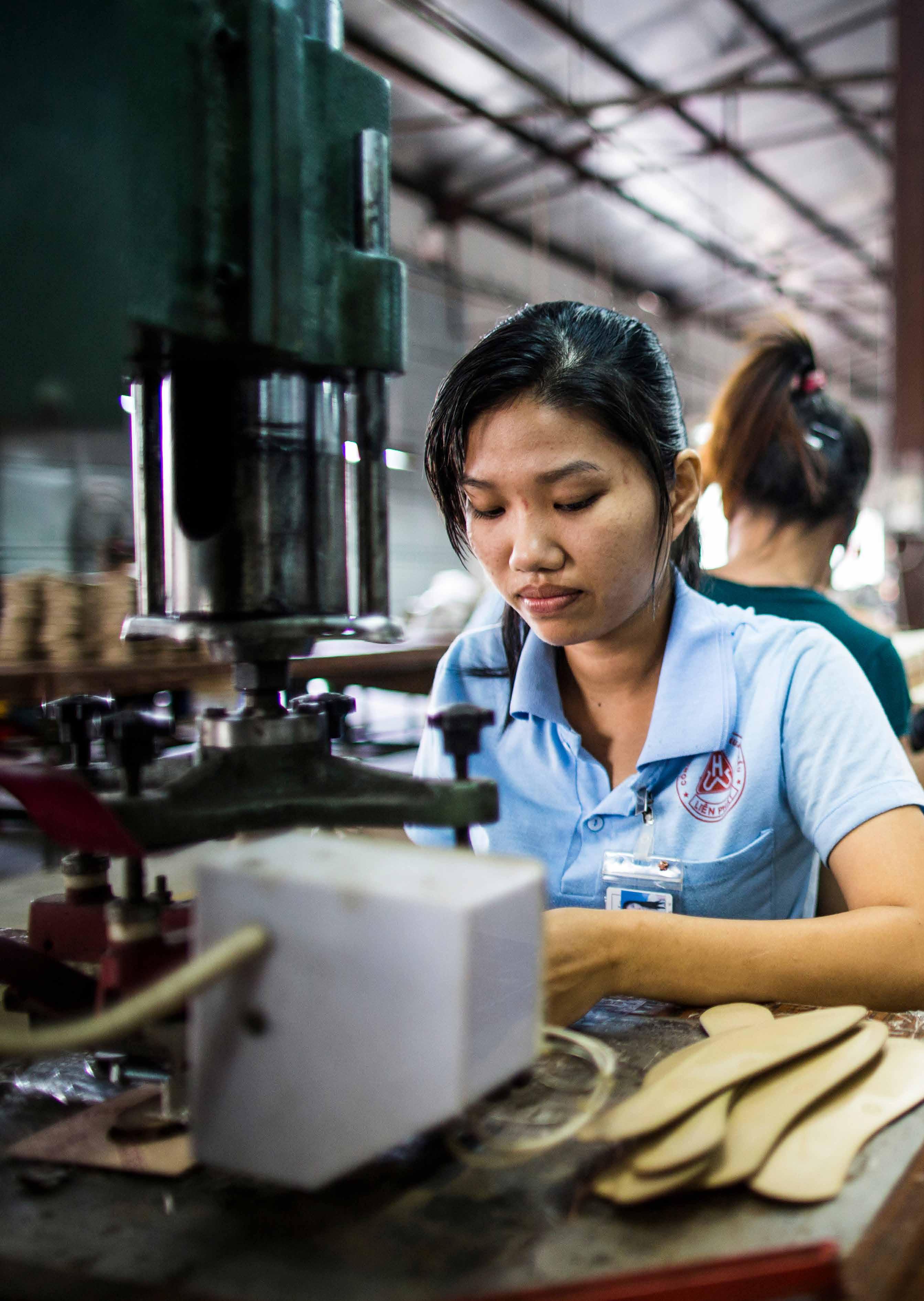
Recent decades have been brutal for many of the world’s workers. They have been characterized by a global race to the bottom and work that is too often underpaid, insecure and dangerous. This chapter describes how people in global value chains, especially women and racialized people, are paid poverty wages, face widespread violations of their rights, and endure abysmal working conditions while companies use their influence to secure corporatefriendly labour policies. These dire circumstances have generated unprecedented profits for major companies, fantastic pay for an elite class of executives and tremendous wealth for shareholders. Rather than investing in higher wages and better working conditions – such as policies that would more effectively support care responsibilities – powerful corporations have chosen to enrich their owners, a group that, as this report shows, is disproportionately ultra-rich and from the Global North.
3.1.1 A worsening situation for the world’s workers
Workers worldwide are carrying out poorly compensated, backbreaking, and often unsafe labour for the benefit of some of the world’s largest corporations. Wages are the primary means by which the benefits of productivity, and thus economic growth, reach workers – yet for decades, wage growth has fallen alarmingly behind in many countries.248 Analysis by the ILO reveals that the gap between wage growth and labour productivity in 52 countries in 2022 is at its widest since the beginning of the 21st century.249 New Oxfam analysis of the World Benchmarking Alliance’s data on over 1,600 of the largest and most influential companies worldwide shows that a mere 0.4% of companies are publicly committed to paying their workers a living wage and support payment of a living wage in their value chains.250
Low wages mean that many workers toil long hours and are trapped in poverty,251 while persistent gender wage gaps and heavy unpaid care loads (discussed in Section 3.1.4) reflect a global economy that rests on the systematic exploitation of women. Corporations have benefitted massively from circumventing the costs and obligations associated with employees by relying on non-standard forms of employment such as contracting, outsourcing, and temporary and part-time work. For workers, these types of work are often characterized by precarity and informality, lower wages, lack of access to social protection, little security, less bargaining power, and a lack of basic rights.252 In recent years, such roles have proliferated in countries where they previously did not.253
For far too many people, work is dangerous and even deadly. According to the ILO, 2.3 million workers die every year because of occupational accidents or work-related diseases,254 and 17.3 million people are in forced labour in the private sector, the majority of them working in domestic and global supply chains.255
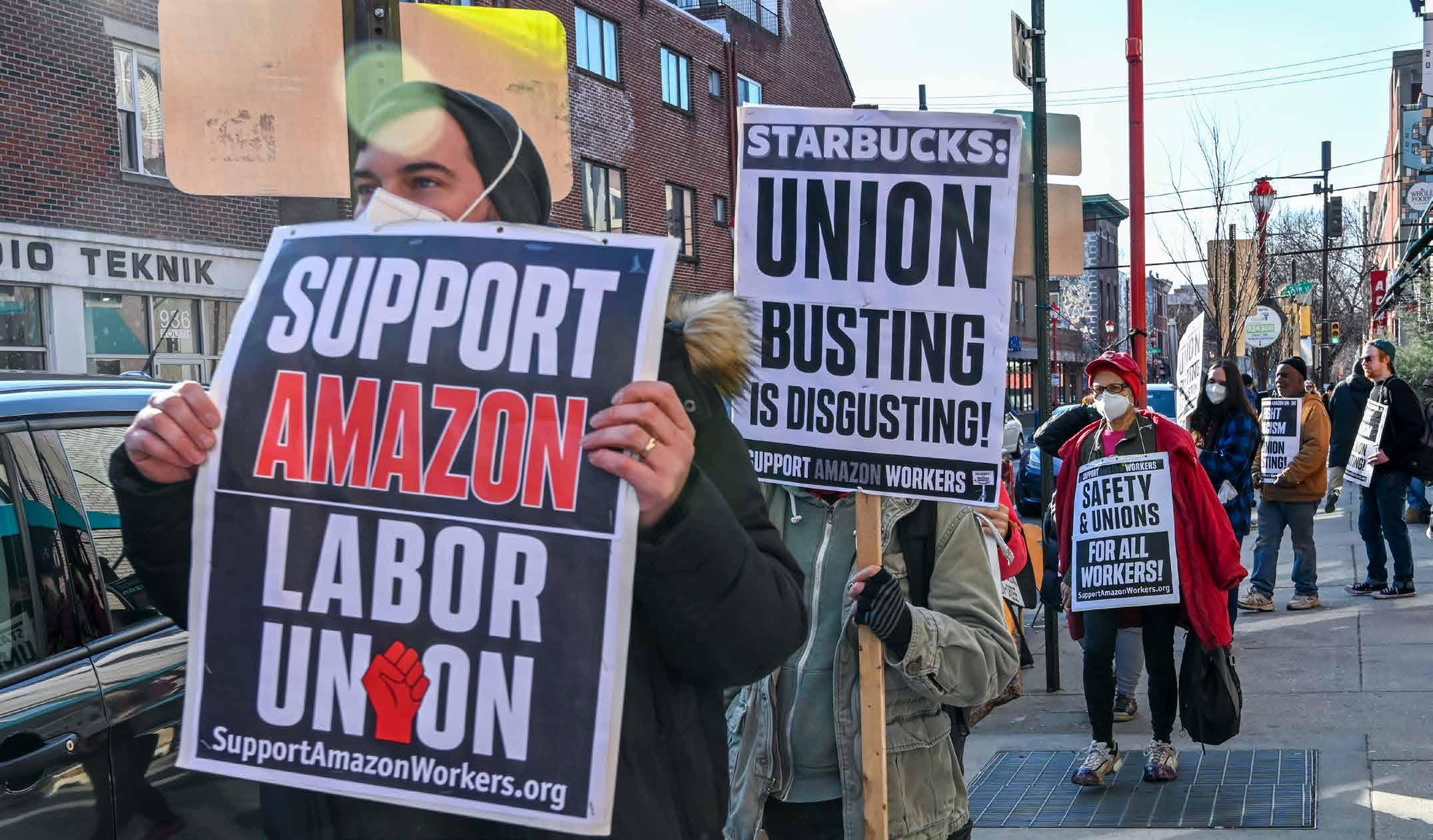
Organized labour can provide an important counterbalance to corporate power.256 Trade unions and collective bargaining have historically helped increase workers’ wages, protections and rights,257 and are associated with lower income inequality.258 However, according to the International Trade Union Confederation (ITUC) in 2023, the past 10 years have witnessed ‘a consistent increase in the violation of workers’ rights across regions’, including widespread violations of the right to collective bargaining, as well as violence against and even the murder of trade unionists and workers.259
While recent high-profile strikes and unionization efforts have rightly made news headlines and achieved wins for workers, trade union membership has fallen in the preceding decades, drastically in some countries.260 Some of the world’s richest corporations and their suppliers have allegedly used union-busting tactics in the Global South and the Global North.261 In OECD countries, 30% of workers were members of a union in 1985; that number had dropped to 17% by 2017.262 Oxfam’s analysis of the World Benchmarking Alliance’s data of over 1,600 of the world’s largest companies finds that only 0.7% fully meet a
global bar for collective bargaining, meaning they disclose collective bargaining coverage in their workforce and their approach to supporting collective bargaining through their business relationships (e.g. their suppliers).263
3.1.2 Corporate influence over labour policy and laws
Powerful corporations have also used their resources and access to seek favourable labour laws and policies that maintain an unequal status quo. For example, journalists and civil society have documented how some companies have allegedly used trade associations, ‘revolving doors’ between public policymaking and the private sector, public relations campaigns, research and lobbying in an attempt to secure or defend labour regulations that minimize their obligations to workers.264 Corporate lobbying has been linked to political restrictions on unionization,265 opposition to restrictions on forced labour,266 fighting minimum wage increases,267 rollbacks to child labour laws,268 reforms that undermine workers’ rights,269 and efforts to weaken rules that protect workers’ health and safety.270 For example, EU corporate lobbyists have reportedly sought to increase market access for pesticides in Brazil, despite clear risks to agricultural workers.271
3.1.3 Funnelling record profits to the wealthy
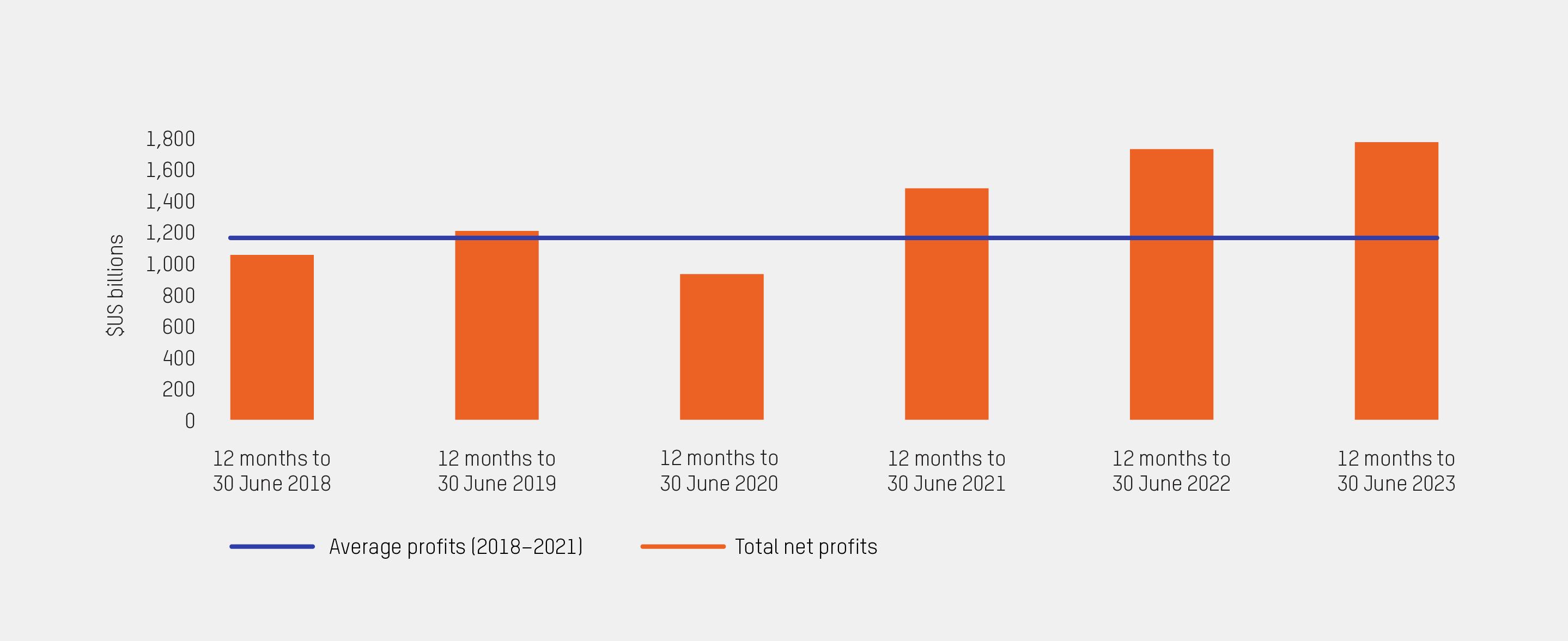
Corporate power has been a major driver of value away from the majority towards the ultra-wealthy few. As shown in Chapter 1, the world’s largest companies have enjoyed unprecedented windfall profits in recent years, many of which have been handed to their shareholders through dividends or share repurchases (i.e. buybacks). New analysis by Oxfam and ActionAid reveals the extent to which corporations have funnelled record profits to shareholders through these payouts.
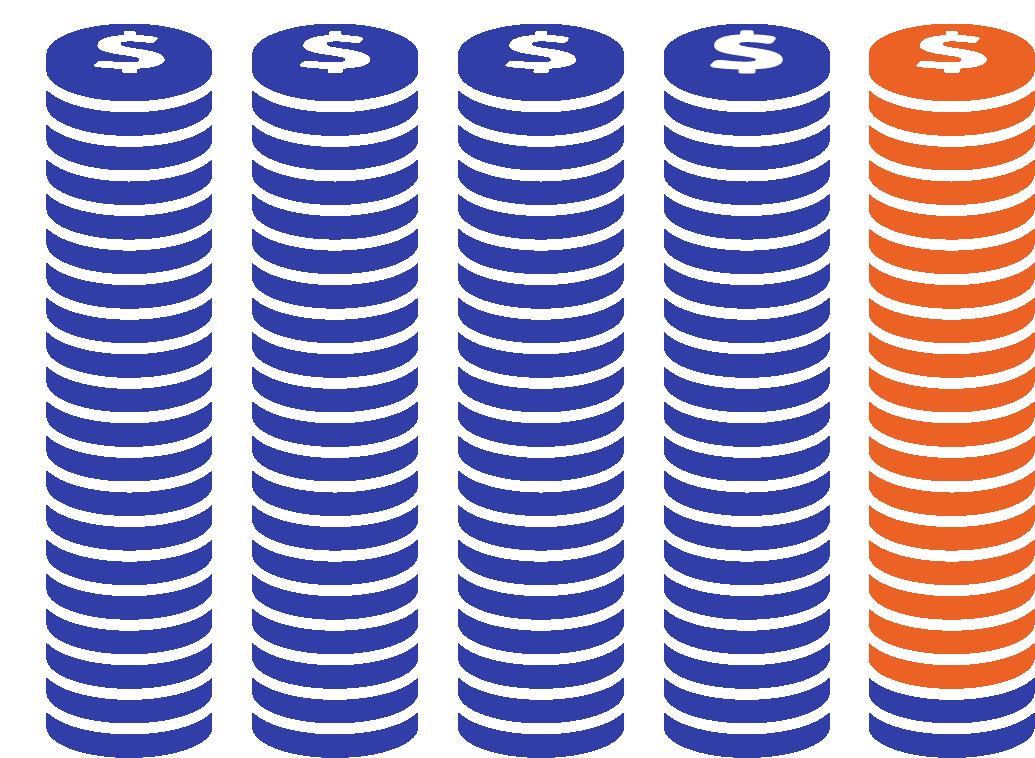
Our findings show that for every US$100 of profit generated by 96 major companies between July 2022 and June 2023, US$82 was returned to shareholders in the form of stock buybacks and dividends.272 Such massive payouts disproportionately benefit the wealthy because share ownership is highly skewed towards them. These payouts also represent resources that could otherwise have been invested in workers (e.g. by raising wages), or in new ways of operating that could reduce carbon emissions.273
For example, on the back of high oil and gas prices, Shell made US$29.2bn in profits between July 2022 and June 2023, an increase of 222% compared to its average profits from 2018– 21.274 Of those profits, 87.7% were handed back to shareholders in the form of stock buybacks and dividends. Between July 2022 and June 2023, Brazil’s Petrobras made US$30.3bn in profits – almost four times more than its average annual profits from 2019–21.275 It paid out more than 100% of these profits (118%) to shareholders in the form of dividends – more than three times what Petrobras invested in capital expenditure.276
Box 6: A choice – end poverty or enrich wealthy shareholders?
Oxfam estimates that if the amount companies spent on dividends and shareholder buybacks for the richest 10% in 2022 was redistributed to the bottom 40% of the income distribution, global income inequality as measured by the Palma ratio could decrease by 21.5% – equivalent to the actual drop in the Palma ratio observed over 41 years.277 Moreover, just half of the amount from payouts to the top 10% in 2022 could reduce global poverty (defined as US$6.85 a day, 2017 PPP), and a mere 1.6% of the payouts could eliminate extreme poverty as defined by the World Bank (US$2.15 a day, 2017 PPP).278
3.1.4 The unequal world of work
As a result of deteriorating working conditions and rights, corporate influence over labour policy, and the diversion of record profits to wealthy shareholders, instead of work serving as a path to shared prosperity, in many ways it is turbocharging inequality. According to ILO estimates, before the pandemic just over a fifth of the world’s workers were moderately or extremely poor,279 and 327 million wage earners earned just the minimum hourly wage or less.280 The situation has in many ways worsened, with the pandemic, war and inflation contributing to a global costof-living crisis.281
Declining real wages now pose an immense threat to the living standards of workers and their families, especially those who were already low-paid.282 In 2022, the ILO warned that the historic decline in real wages could increase inequality and fuel social unrest.283 Our own analysis for this report finds that 791 million workers have seen their wages fail to keep up with inflation and have lost US$1.5 trillion over the last two years, equivalent to nearly a month (25 days) of lost wages for each worker.284 In 2022, the World Inequality Lab found that the poorest half of the world’s population earned just 8.5% of global income.285 In many countries, the poorest 40% of households command just a small fraction of the overall income, for example in Mexico (5%), Namibia (2.5%), Indonesia (3.6%) and Romania (10.4%).286
Racialized peoples are often exploited by supply chains,287 while white people disproportionately benefit from corporate profits.288 In the USA, white Americans (59% of the country’s population) own 89% of corporate shares, while Black and Hispanic families (14% and 19% of the population, respectively) own 1.1% and 0.5% respectively of corporate shares.289 Other countries in both the Global South and North show a similarly skewed distribution of shareholders.290
Migrant workers in global supply chains face systematic abuse and exploitation, including discriminatory laws, vulnerability to exploitation due to immigration status, isolation, exclusion from services, and woefully inadequate enforcement of labour protections.291 Oxfam research in the food and garment sectors has demonstrated how Global North brands have been linked to and, at times, directly carried out, highly exploitative labour and environmental practices in Global South countries.292
Women are vastly overrepresented in the poorest-paid and least secure jobs,293 and face a persistently high gender pay gap.294 Gender inequality is exacerbated by supply chain strategies that undervalue much of the work done by women.295 This inequality is compounded by other forms of discrimination, such as that based on race and migration status; for example, migrant women workers in particular can be found doing jobs with low pay and very poor protection (see Box 7).296 In 2019, women earned just 51 cents for every US$1 in labour income earned by men.297 Women also
suffered harsher economic impacts from the pandemic and collectively lost US$800bn in earnings in 2020.298 Their share of estimated earnings in 2022, just 35% of total income globally, was only slightly more than the estimated 30% in 1990.299 New data on over 1,600 of the largest and most
FOR EVERY US$100 OF PROFIT GENERATED BY 96 MAJOR COMPANIES BETWEEN JULY 2022 AND JUNE 2023, US$82 WAS RETURNED TO SHAREHOLDERS IN THE FORM OF STOCK BUYBACKS AND DIVIDENDS
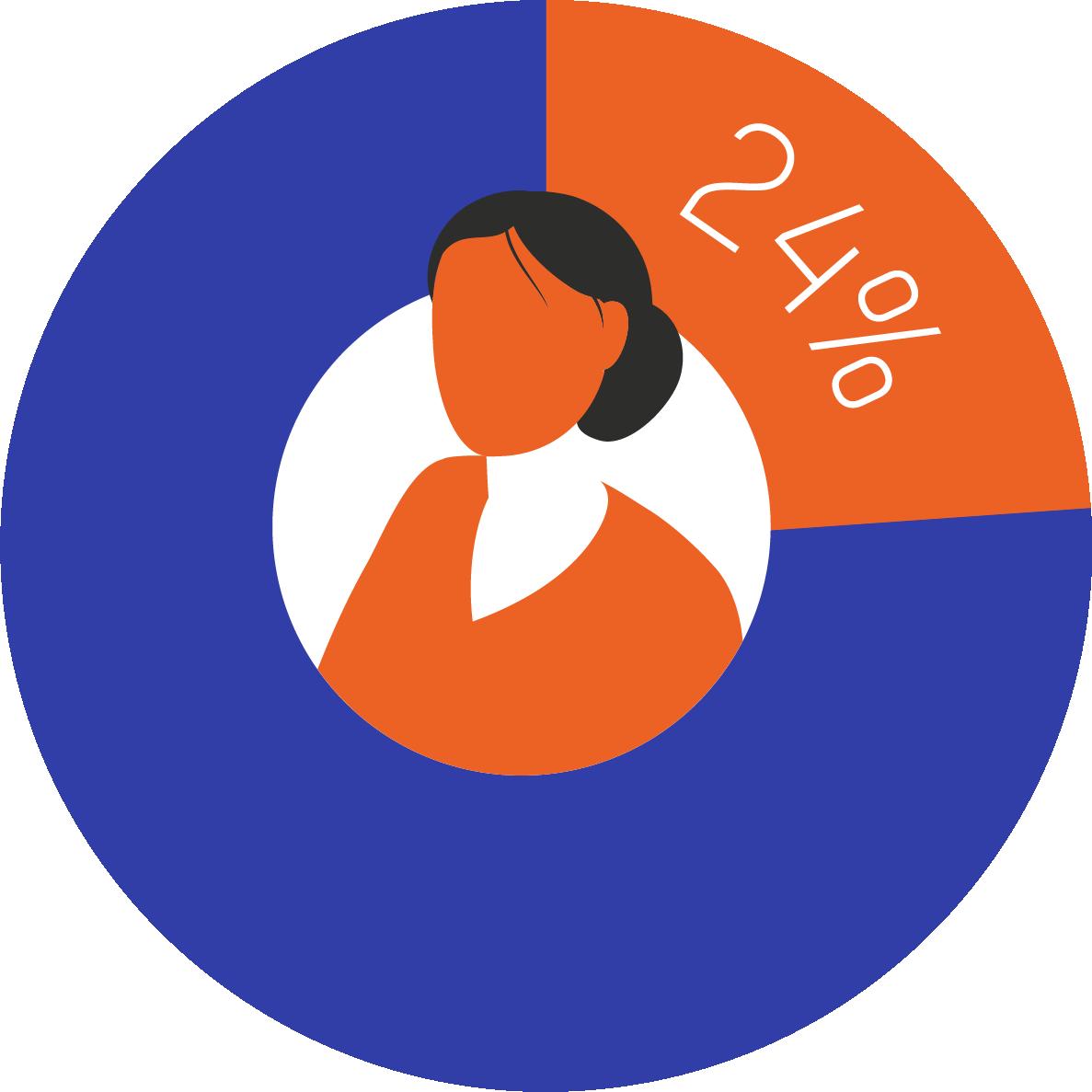
OUT OF MORE THAN 1,600 OF THE LARGEST COMPANIES IN THE WORLD, ONLY 24% HAVE A PUBLIC COMMITMENT TO GENDER EQUALITY
influential companies reveals that only 24% have a public commitment to gender equality. Just 2.6% of companies disclose information on the ratio of pay of women to men.300
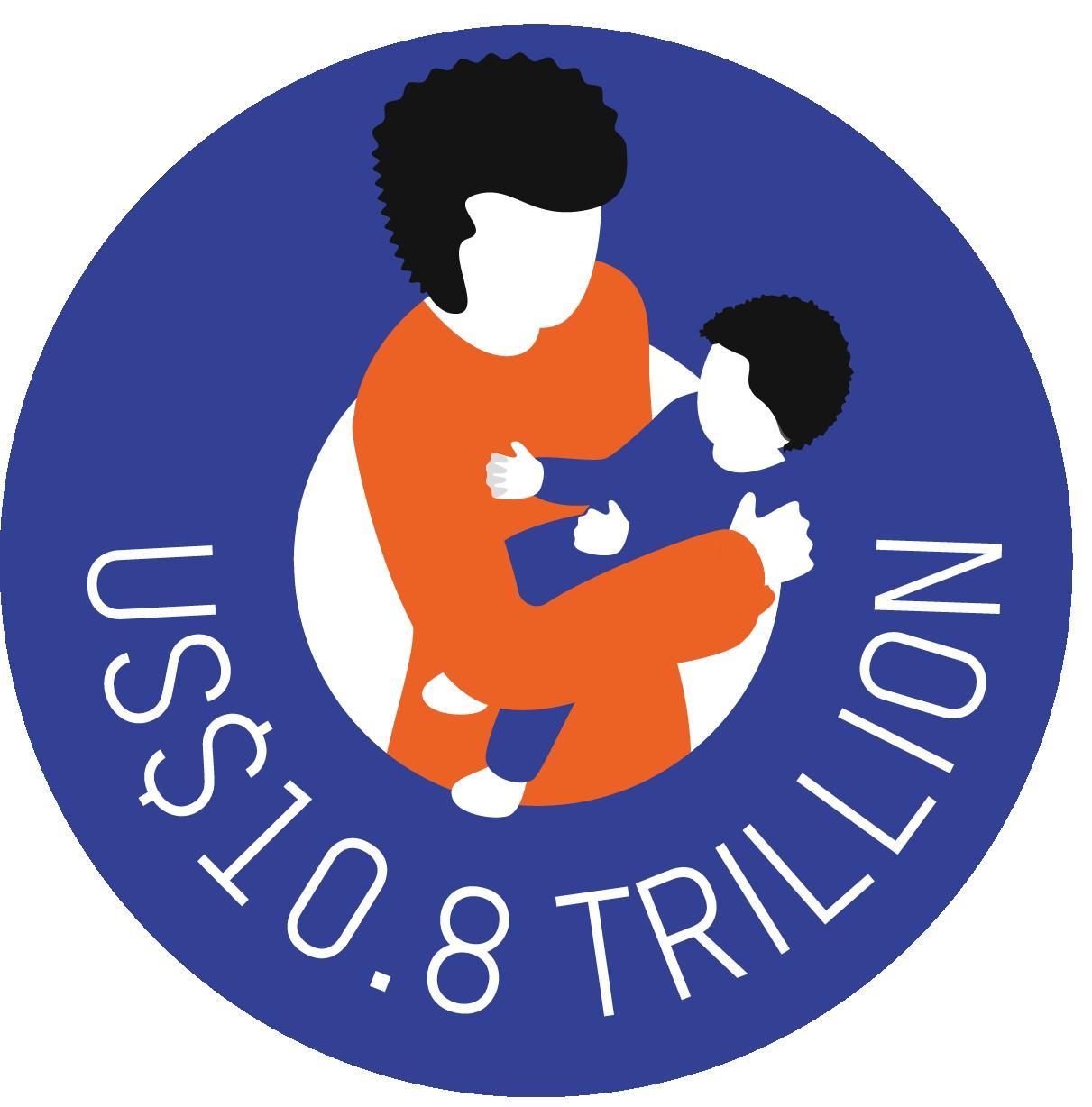
Women’s disproportionate unpaid and underpaid care and domestic work props up corporate profits, with women and girls effectively subsidizing the economy by doing more than three-quarters of the unpaid care work worldwide.301 For example, in the Middle East and North Africa (MENA) region, women spend on average 17–34 hours per week on unpaid care, compared to men’s 1–5 hours.302 In 2020, Oxfam estimated that the monetary value of unpaid care work carried out by women globally is at least US$10.8 trillion303 annually – three times the size of the global tech industry.304
WOMEN’S UNPAID CARE WORK SUBSIDIZES THE ECONOMY BY AT LEAST US$10.8 TRILLION ANNUALLY
THIS CONTRIBUTION TO THE ECONOMY IS THREE TIMES THE SIZE OF THE GLOBAL TECH INDUSTRY
Box 7: Profiting from gendered exploitation in agri-food chains
Agri-food chains worldwide are rife with violations of women’s rights and characterized by systemic exploitation and abuse with strongly gendered dimensions.305 Giant corporations with outsized control often engage in purchasing practices that place immense downward pressure on wages and contribute to insecure and informal work, while extracting much of the value from food and agricultural supply chains.306 The informal, temporary and other non-standard forms of work in these supply chains also create power differentials that contribute to gender-based violence which is widespread in the commercial agricultural sector.307
In 2021, Oxfam and partner organizations interviewed migrant women in Costa Rica and South Africa working on farms supplying fruit and wine to European supermarkets.308 They found that while the supermarkets were making record profits, the women workers faced inhumane conditions, serious rights violations and extremely low pay.
Women farm workers in South Africa received an estimated 1.2% of the sales price of a bottle of wine on average, while supermarkets received more than 50%.309 The workers interviewed, who were immigrants from other parts of the continent, described the exploitation and abuse they routinely experienced, including poor pay, exposure to pesticides, and lack of access to toilets or drinking water. The women also spoke of the precarity and discrimination they faced as immigrants with irregular legal status, at constant risk of deportation. One worker, Ruth, reported that the farm owner would shout at them: ‘If you don’t want to work, go back home.’ Another, Tarisai, recalled the challenge of being denied access to unemployment support offered only to South Africans during the height of the COVID-19 pandemic: ‘It was tough. We really suffered… We will never forget that time.’
3.2 Dodging taxes
Corporations and their wealthy owners also drive inequality by undertaking a sustained and highly effective war on taxation, enriching shareholders and depriving the public of critical resources.
3.2.1 The collapse of taxes on corporations and their owners
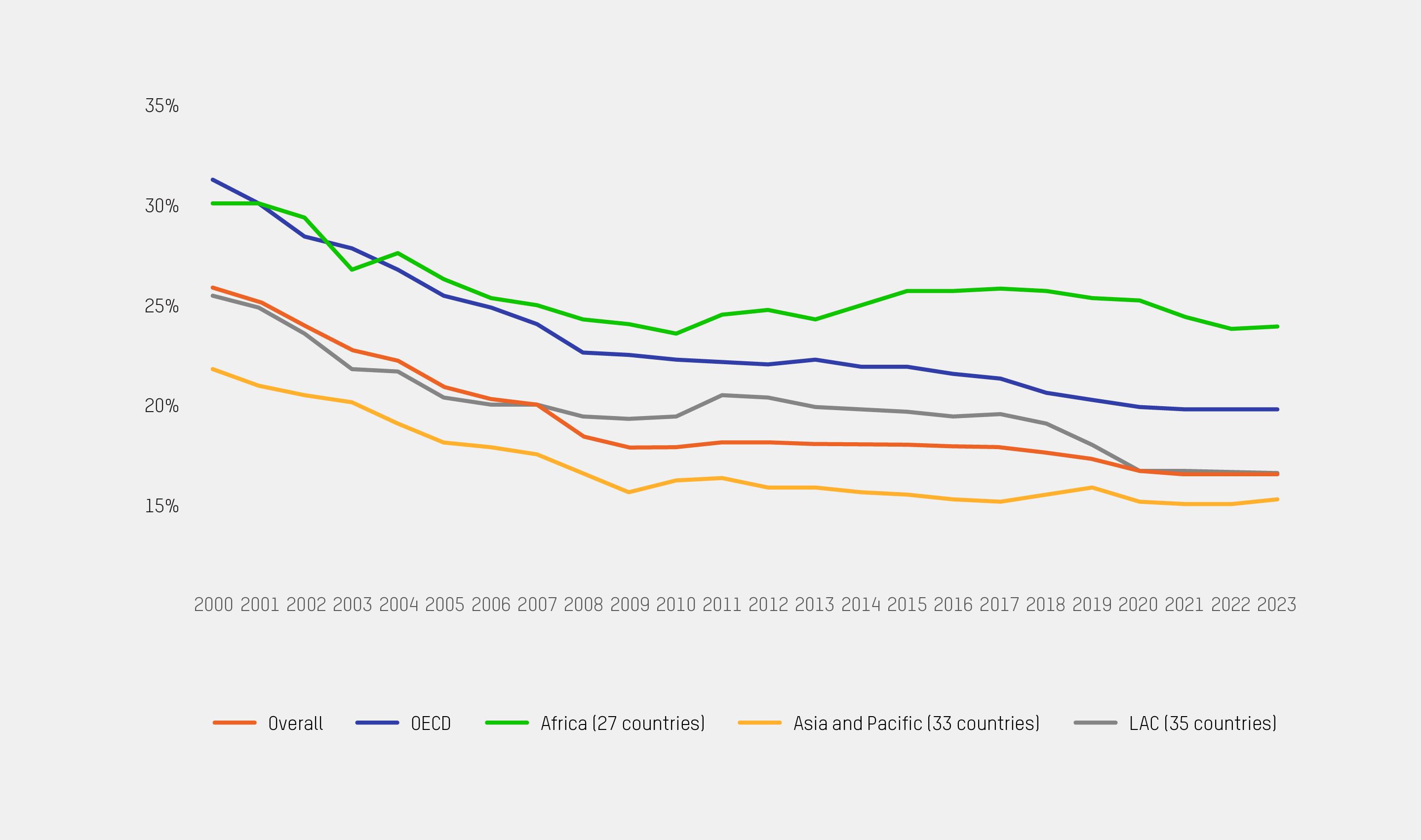
Corporate taxation has in many ways collapsed, despite sharply rising profits for many companies. Since 1980, the corporate income tax rate has more than halved in OECD countries, starting in 1980 at 48% and dropping to just 23.1% in 2022.310 This collapse has occurred across the world, with statutory corporate income tax rates falling in 111 out of 141 countries surveyed between 2020 and 2023 (see Figure 4).311
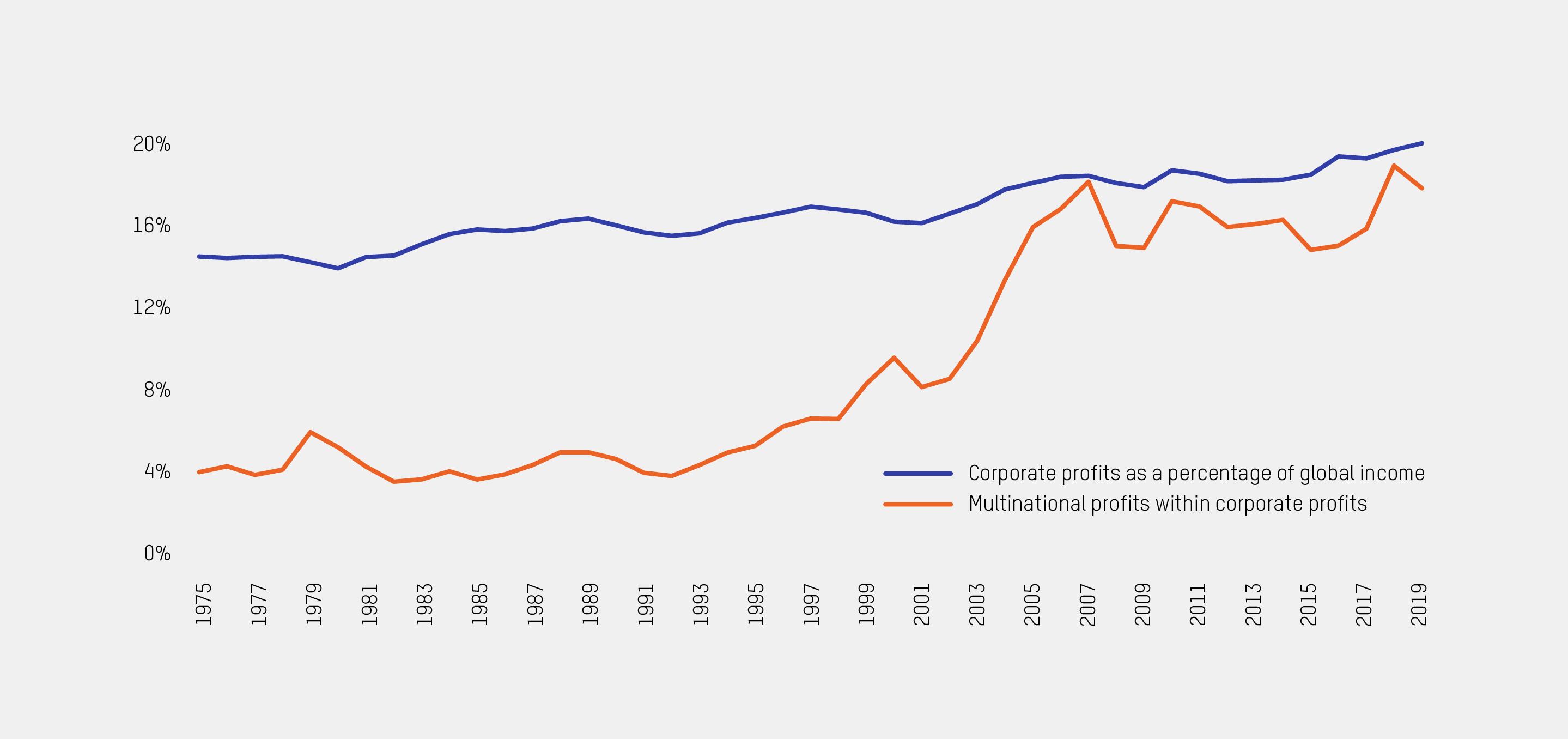
As drastic as the fall in the statutory corporate tax rate has been, it doesn’t begin to reveal the full extent of the problem, with tax havens, widespread use of wasteful tax incentives, and aggressive tax planning resulting in actual tax rates that are much lower than the statutory ones, and often closer to zero.312 Globally, the actual corporate tax rate dropped from 23% to 17% between 1975 and 2019 – a decline of roughly a third.313 During the same period, many corporations made record profits.314 According to the best available estimates, about US$1 trillion in profits – 35% of foreign profits – were shifted to tax havens in 2022.315 Just 4% of the more than 1,600 largest and most influential companies sampled worldwide fully meet the World Benchmarking Alliance’s social indicator on responsible tax, by having a public global tax strategy and publicly disclosing corporate income taxes paid in all countries of residency.316
FIGURE 4: CORPORATE TAX RATES HAVE FALLEN AROUND THE WORLD Average statutory corporate income tax rates by region 2000–2023
The collapse of taxes on corporations has occurred alongside very low taxation of the types of income corporations pay out to their shareholders. In OECD countries, the average top marginal tax rate for dividend income declined sharply since 1980, from 61% to 42%, and in some countries, such as Brazil, it is not taxed at all.318 Further, the income received from selling shares in corporations is taxed on average at just 18% across 123 countries, far lower than the top tax rates on income from labour (around 31% in the world’s largest economies). Such income, called capital gains, is the most important source of income for the top 1% in many countries, and yet in one in five countries it’s not taxed at all.
There is new momentum behind efforts to improve the global tax rules. In 2021, more than 140 countries agreed under the OECD base erosion and profit shifting (BEPS) Inclusive Framework to a two-pillar set of measures, with a global minimum effective corporate tax at 15%.319 While promoted as an effort to end the race to the bottom and profit shifting, this G20/OECD-led process has fallen well short of what is needed, with concerns about inadequate representation of Global South countries’ interests, the undermining of an already very low 15% rate by loopholes, and an approach that privileges rich countries and tax havens.320 Initiated by African countries and with the support of a broad range of civil society groups including Oxfam, in November 2023, the majority of UN member states voted to move forward with starting negotiations for an international framework tax convention at the UN –though a number of rich countries from the Global North shamefully voted against the step.321 This is an opportunity to set fair global tax rules in the future where all countries would participate on equal footing.
3.2.2 Corporate influence over tax policy
Tax cuts for corporations and their owners were never driven by popular demand.322 The collapse of taxes on corporations and their owners in recent decades is in part a result of a broader neoliberal agenda promoted by
corporations and their wealthy owners, often alongside Global North countries and international institutions such as the World Bank. Around the world, members of the private sector have relentlessly pushed for lower rates, more loopholes, less transparency, and other measures aimed at enabling companies to contribute as little as possible to public coffers.323 Corporations and corporate tax advisors are able to use their unjustifiably disproportionate influence over tax policymaking to achieve lower corporate taxes and other tax advantages.324 This approach is highly effective: one study from the USA found that a 1% increase in federal lobbying expenditure appeared to lower companies’ effective tax rates by 0.5–1.6% on average, while another found that every US$1 spent on lobbying related to a tax holiday had a return of over US$220.325
3.2.3 Corporate tax cuts are tax cuts for the rich
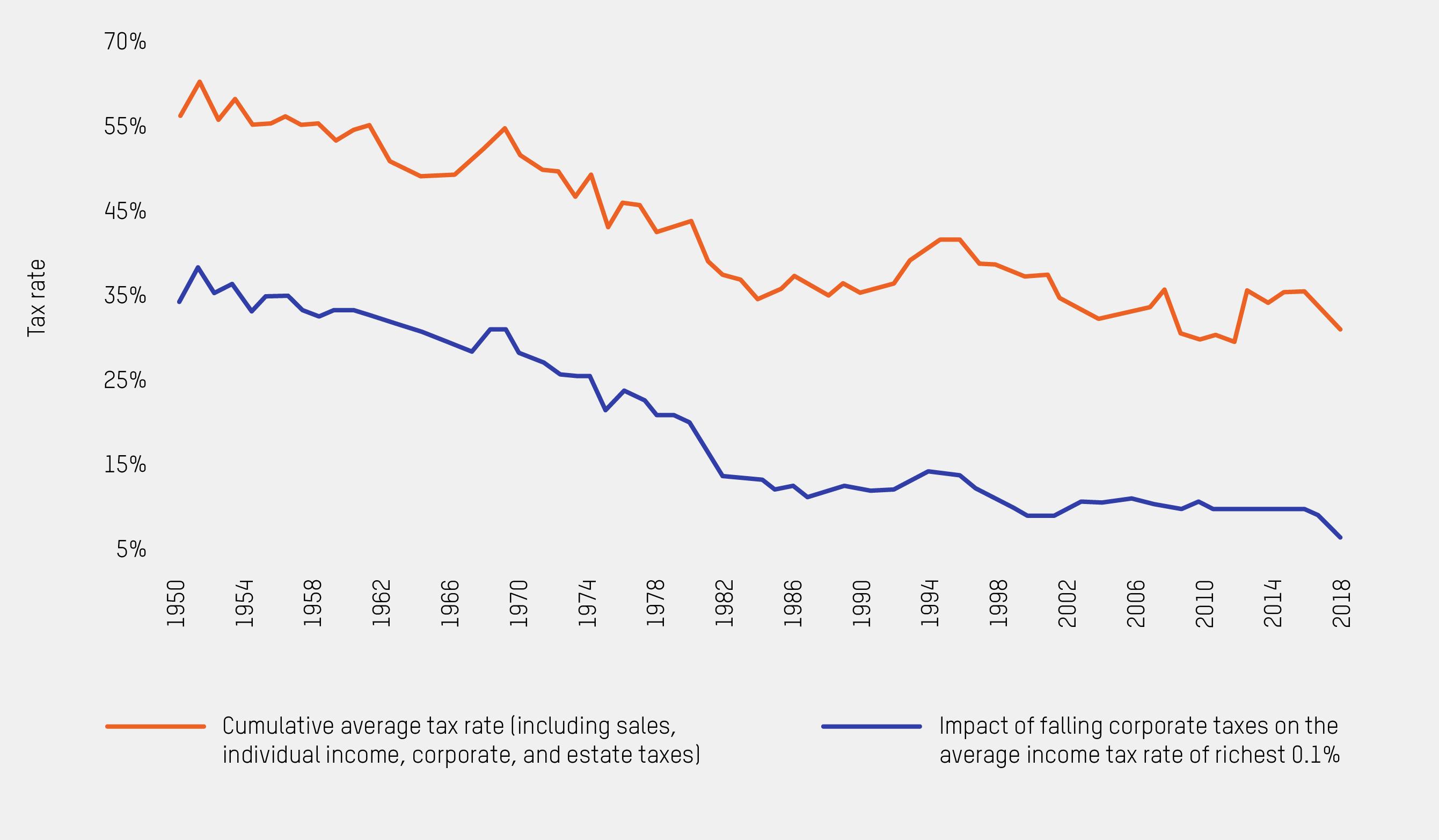
As corporate taxation has collapsed and corporate profits have soared, those at the top have done fabulously. In high-income countries, falling rates of tax on corporations have coincided with a period in which a rising share of income is going to the top 1%.326 Evidence shows that corporate taxes are progressive and they are borne disproportionately by the richest people.327 This means the collapse in corporate tax in recent decades has essentially provided another huge tax cut for the richest people in the world. The economists Emmanuel Saez and Gabriel Zucman have shown, for example, that the massive fall in tax rates by the richest individuals in the USA is significantly driven by cuts to corporate taxes (Figure 5).328
While some have argued that cuts to corporate taxes will spur investment or drive growth that will ‘trickle down,’ there is a wide range of research that refutes the notion that tax cuts for big corporations are major drivers of investment and jobs.329 The real beneficiaries of the destructive race to the bottom in corporate taxes have been corporations and their wealthy shareholders and owners.330
Average
Source: E. Saez and G. Zucman.
3.2.4 Corporate tax dodging comes at the expense of everyone else
The collapse of taxes on corporations and their wealthy owners hasn’t just lined the pockets of the ultra-wealthy – it has come at a great cost for societies. To compensate for the loss of tax revenue from corporations and their rich owners, many governments have turned to those with the least ability to pay.332 They have increasingly relied on regressive taxes on goods and services, such as valueadded tax (VAT), which falls disproportionately on lowincome households and exacerbates gender inequality.333
The loss of corporate taxes also means there is less revenue to spend on inequality-busting public services.334 For example, in Morocco, tax incentives – 43.9% of which benefit corporations – added up to more than the
entire health budget allocated for 2021.335 Women are particularly impacted: first as the primary users of public services; second as workers, given their disproportionate employment in the public sector; and third as the main providers of unpaid care work, which must increase to fill the gaps in public provision.336 Greater tax revenue could help to stave off harmful cuts to public services that often disproportionately affect women, such as in Nigeria, where despite an extremely high maternal mortality rate, the government in 2020 proposed cutting the primary health budget by over 40% to deal with the economic fallout of COVID-19.337
The collapse of corporate tax also inflicts a great global injustice. Giant corporations in the Global North extract massive amounts of wealth from the Global South, while
FIGURE 5: HOW CUTS TO CORPORATE TAXES DRIVE FALLING TAX RATES ON THE WEALTHY
tax rate of the top 0.1% (% of pre-tax income) in the USA, 1950–2019
(2020).331
often paying little to no tax.338 Drastic reductions in corporate tax have been a key feature in all regions but their effect has been especially harsh in Global South countries, which tend to be more reliant on corporate income tax revenue to fund public spending. For example, African countries are nearly twice as reliant as OECD countries on revenue from corporate income tax to fund their public spending.339 An estimated US$200bn is also lost annually due to corporate tax avoidance, with Global South countries again tending to suffer the impacts disproportionately.340
3.3 Privatizing public services
An important – if underappreciated – way in which corporate power drives inequality is via the privatization of public services. Around the world, corporate power is relentlessly pushing into the public sector, commodifying and too often segregating access to vital services including education, water and healthcare. This is often while enjoying massive, taxpayer-backed profits and gutting the ability of governments to deliver the type of high-quality, universal public services that can transform lives and reduce inequality.341
Privatization can work well for the wealthy – including economic and political elites, who may benefit financially, as well as those with enough resources to pay for expensive private services. However, a robust body of evidence demonstrates that in many instances privatization drives exclusion, impoverishment and other harmful consequences, particularly for people in poverty, women and girls, and racialized peoples.
3.3.1 Contemporary privatization
Privatization takes different forms. Although privatization is often associated with the sale of state-owned enterprises or structural adjustment programmes (SAPs) promoted by international financial institutions in the 1980s and 1990s, it remains prominent today. It still takes place through the outright sale of assets, but also often through the purposeful integration of the corporate sector into public policies and programmes, including through vouchers, outsourcing and public-private partnerships (PPPs). Corporate power is pushing to displace public services and pump profits out of essential sectors that are core to the
realization of rights. Privatization arrangements, which vary by sector, now reach a staggering array of key goods and services, from foster to elder care, schooling to prisons, and roads to parking meters. The defunding of public services can be considered a type of de facto privatization, as service users must turn to the private sector to meet their critical needs. International institutions remain closely involved in promoting contemporary forms of privatization as well as other fiscal reforms that contribute to pressures to privatize.342
3.3.2 Increasing corporate influence over public resources Privatization often entails giving corporations control over significant areas of policymaking,343 as well as access to public resources and capacity that could otherwise be dedicated to providing universal services and reducing inequality.344 Despite the promotion of privatization as a cost-saving measure, many contemporary arrangements such as PPPs and outsourcing can be highly costly to the state and require taxpayers to guarantee private sector profits.345 The fiscal risks of PPPs are particularly extreme, earning them the nickname ‘budgetary timebombs’.346
That such arrangements often place a high burden on public coffers and routinely cost more than public delivery undermines arguments that privatization is necessary because the public sector lacks sufficient resources.347
Private equity funds, hedge funds and other major institutional investors are turning to PPPs and other forms of privatized services to generate stable returns.348 Major development agencies and institutions, many of which have adopted policies that prioritize private provision of services,349 have found common ground with investors by embracing approaches that ‘de-risk’ such arrangements by shifting financial risk from the private to the public sector.350 This new ‘Wall Street Consensus’ reframes the ‘Washington Consensus’ in the language of contemporary development speak, and envisions the transformation of basic services such as education, healthcare and water into financial assets backed by public resources.351
3.3.3 Enriching billionaires, private equity funds and crony capitalists
The stakes are huge. Essential services constitute trilliondollar industries and represent immense opportunities for
generating profit and wealth for billionaires. Private equity firms are snapping up everything from water systems and healthcare providers to nursing homes, amid a litany of concerns about poor and even tragic outcomes.352 For example, despite findings from countries such as the UK that privatized public transport can be expensive, unreliable and dysfunctional, with harmful consequences for the people who rely on it,353 entire public transport systems are being targeted by companies with track records of using precarious contract labour, also posing a threat to public sector jobs.354 Private-equity-backed Via promises a new transit service ‘in weeks, not months’, and estimates the market to be worth US$450bn.355
These sectors are generating massive wealth for billionaire owners. The global hospital services market is expected to be valued at US$19 trillion by 2030,356 and in
India alone, four billionaires are invested in the private hospital and diagnostic sector.357 An analysis of PPPs in the UK health sector found rates of return of up to 60%,358 while UK private children’s homes yielded a 22.6% operating margin.359 The global water and sewage market is estimated to reach US$886bn in 2027.360
Privatization often occurs in sectors with few competitors and high barriers to entry, and sometimes even with the benefit of state-granted monopolies and taxpayerguaranteed returns. A recent analysis of 51 companies receiving public contracts in the USA found that these companies spent nearly US$160bn on stock buybacks between 2020 and 2023, meaning taxpayer money was in effect lining the pockets of rich shareholders.361
With massive amounts of public money on the line, and policymakers in a position to enrich their friends, donors
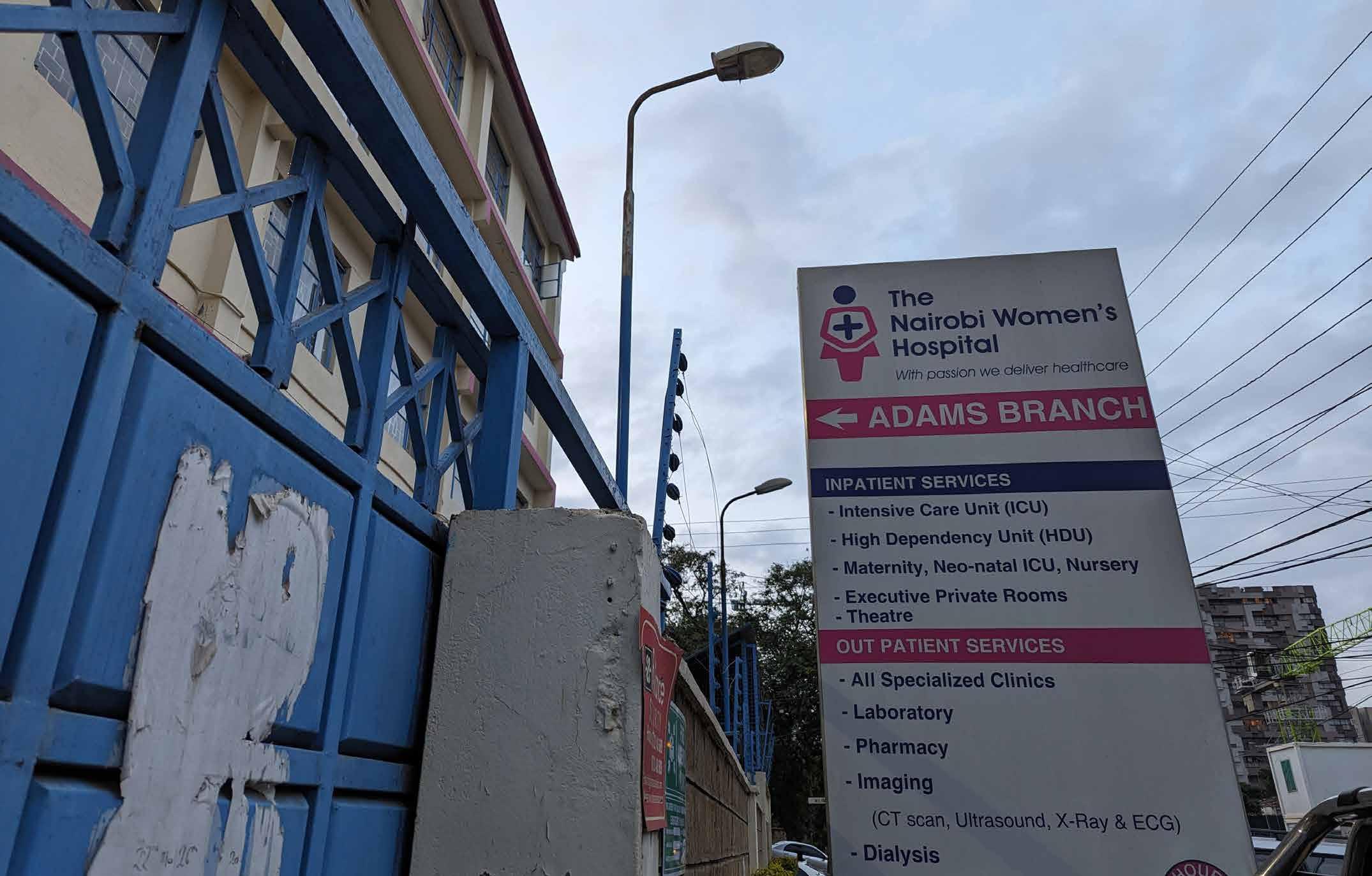
Nairobi Women’s Hospital, Kenya. Photo by Linda Oduor-Noah/Oxfam.
and other allies, privatization creates opportunities for corruption and state capture. Corporate interests can seek to shape arrangements to benefit their bottom line instead of the public interest.362 Privatization thus opens the door to cronyism – the ability of powerful private interests to manipulate public policy and enrich themselves at the public’s expense.363
3.3.4 Harming access for the many Privatization can drive and reinforce inequalities in vital public services, segregating access to the most basic public goods. For example, in healthcare, privatization can entrench and exacerbate the gap between rich and poor, and exclude and impoverish those who cannot pay for expensive private care (see Box 8).364 In education, a large body of research shows that privatization drives educational inequalities, as even low-fee private schools are likely to be unaffordable for the poorest families.365 The privatization of social protection has also been tied to increases in inequality, for example, pension reforms in Latin America and Eastern Europe in the 1980s–2000s have been linked to increasing income and gender inequality as well as rising old-age poverty.366
Individuals and communities whose needs are less profitable to meet may be excluded or receive substandard care, as has been observed in the context of people with disabilities or those in rural areas.367 And too often, programmes designed to remediate this effect and ensure universal access to privatized services, such as vouchers or insurance schemes, fail to do so.368
Privatization can also drive inequalities on the basis of race and caste. It has been employed as a tactic to maintain racial segregation; this has been seen in the USA, where critics of integrated schools sought to use vouchers to preserve segregated educational settings.369 Privatization efforts in Global South and North countries alike have been compared to contemporary forms of white elite campaigns to segregate, control and profit from school systems.370 Racialized peoples often have lower incomes and higher rates of poverty because of historical
and continued systemic discrimination and exploitation, and thus are disproportionately affected by the harms of privatization.371 Oxfam research found that Dalits in India face high and unaffordable out-of-pocket fees in the private healthcare sector,372 financial exclusion in the private education sector, and overt discrimination in both.373 Other research shows that privatization can curtail the ability of the public sector to reduce labour market inequalities by race.374
Whereas gender-responsive, universal and high-quality public services can close gender gaps and enable women and girls to realize their rights, privatization can exacerbate gender inequalities.375 Women typically earn less than men and are often employed at higher rates by the public sector. 376, 377 They are, therefore, disproportionately hurt by the withdrawal and defunding of public provision and by steps to generate profit, such as the introduction of higher prices and user fees.378 Women often have more responsibility for a range of critical tasks including water collection and care work; in situations where privatization has rendered such services less affordable or less physically accessible, women’s unpaid labour has often had to fill the gap.379
Indeed, in a broad range of sectors, privatization has been found to harm women and girls. The private sector has been linked with neglect of women’s routine healthcare needs;380 with reductions in girls’ access to schooling, as families with limited resources prioritize boys’ education (e.g. despite gender parity in Tunisia’s public primary schools, the share of girls in private schools drops to 30%),381 and with increases in labour force inequality.382 PPPs specifically have been linked to negative impacts on women’s healthcare services, livelihoods, working conditions and unpaid care work.383
Privatization can also open the door to intentional discrimination based on gender identity and sexual orientation. For example, in 2023, the UN Independent Expert on sexual orientation and gender identity raised concerns about discrimination by private groups charged with providing foster care, adoption services and education.384
Box 8: How private hospitals backed by development finance institutions cause harm
In 2023, Oxfam research revealed that patients living in poverty in the Global South were being bankrupted by for-profit healthcare corporations backed by multimillion-dollar investments from development finance institutions (DFIs) run by the UK, French, German and other rich-country governments, as well as the World Bank Group.385 Despite being promoted as a way to achieve universal health coverage, Oxfam found that private healthcare providers in India, Kenya, Nigeria, Uganda and elsewhere were pushing patients into poverty. The investigation found cases of extorting and imprisoning patients for non-payment of bills; denying treatment to those who can’t afford it – even in emergencies; failing to prevent human rights abuses, including organ trafficking by staff; and exploitative practices, such as by pressuring patients to have unnecessary and expensive medical procedures.386
In India, where the private healthcare sector is now worth US$236bn and rising rapidly, the World Bank’s private sector arm, the International Finance Corporation (IFC), has directly invested over half a billion dollars in some of the country’s largest corporate hospital chains owned by some of its richest billionaires. Yet in June 2023, Oxfam found that the IFC has not published a single evaluation of its health projects in India since these started over 25 years ago. Indian health regulators have upheld multiple complaints, including cases of hospitals overcharging, rigging prices and refusing to treat patients living in poverty for free, despite this being a condition of receiving government land for free. Furthermore, of the 144 hospitals funded, only one is located in a rural area.387
3.4.
Driving climate breakdown
Corporate power is driving climate breakdown, in turn causing great suffering and exacerbating extreme inequalities. Corporations’ pursuit of short-term profits has brought the world to the brink of climate breakdown, as fossil fuels continue to build fortunes for many of the super-rich. Yet still today, many billionaire owners and investors benefit when corporate power and influence seek to block progress on a fast and just transition, deny and spin the truth about climate change, and crush opposition.
3.4.1
Contributing to climate change
The role of corporate power, and in particular the fossil fuel industry (see Box 9), in driving and profiting from activities that cause the climate crisis is well documented.388 Despite lofty pledges to transform, the industry continues to promote new fossil fuel investments,389 while investments in low-carbon businesses represent less than 1% of oil and gas companies’ capital expenditure.390
Some of the false ‘solutions’ championed by the world’s biggest polluters and their financiers are failing to prevent climate breakdown, and instead exacerbating poverty and inequality.391 Despite the clear standards for strong corporate climate action set by the Science Based Target initiative (SBTi), the UN High-Level Expert Group on the NetZero Emissions Commitments of Non-State Entities, and others, far too many corporate ‘net-zero’ climate plans are simply greenwashing, and are not leading to the rapid and meaningful emissions reductions that are needed.392
3.4.2 Influencing climate policy and public opinion
Fossil fuel companies have known for decades that greenhouse gases could cause potentially catastrophic climate change, yet they have continually sought to defend and prolong the deadly status quo by influencing public policy and opinion.393 Corporations spend massive amounts on campaigning and lobbying, and increasingly dominate UN climate negotiations.394 Fossil fuel corporations are fighting political and PR battles, for example: backing efforts to oppose the phase-out of residential gas connections in Australia;395
weaken penalties for emitters in South Africa;396 rollback fuel efficiency standards;397 and foster opposition to environmental, social and governance (ESG) investment practices in the USA.398 These efforts are complemented by a revolving door between governments and fossil fuel companies,399 as well as the promotion of climate denialism and other fossil fuel-friendly messaging.400
3.4.3 Enriching carbon billionaires
The climate crisis has made some people incredibly rich, generating wealth that is often reinvested in fossil fuels
and used to fund the carbon-intensive lifestyles of the ultra-rich. Many of the world’s billionaires own, control, shape and financially profit from processes that emit greenhouse gases.401 Fossil fuel companies brought in record income in 2022, much of which was used to enrich shareholders through big buybacks and dividends.402 In 2022, Oxfam undertook a detailed analysis of 125 of the world’s richest billionaires and found that, on average, through their investments they emit three million tonnes of CO2 a year – over a million times more than the average emissions of someone in the bottom 90% of humanity.403
Polluting smoke rising from a coal-fired power plant. Photo by Lane V. Erickson/Shutterstock.
The fossil fuel industry has launched what amounts to an all-out legal war against those fighting to protect people and the planet, bringing cases against regulatory action, massive arbitration claims and abusive lawsuits to punish criticism.404 These include unwarranted suits against Indigenous and community leaders, activists, academics and other members of civil society.405 The growing use of these ‘strategic lawsuits against public participation’ has been condemned by the UN Working Group on Business and Human Rights.406
Using what economist Joseph Stiglitz has referred to as ‘litigation terrorism’,407 the fossil fuel industry has also brought massive arbitration claims against countries that have taken measures to curb emissions and protect the environment.408 Companies are increasingly using investor–state dispute systems to challenge government action to limit or phase out fossil fuels;409 their claims average US$1.4bn, and are estimated to have resulted in at least US$100bn in payouts.410 The vast majority of fossil fuel and mining claims are brought by companies from the Global North against countries in the Global South,411 stripping them of resources at a time when many are already debt-distressed.412
3.4.4
Inequality of impact
Climate-related displacement has already pushed tens of millions of people from their homes,413 and extreme weather is decimating agriculture and contributing to mass hunger, armed conflict and humanitarian crises.414 While rich people and rich countries are in many ways driving the climate crisis, it is people in LICs and those
living in poverty who are hit hardest, and almost anyone who faces discrimination because of their gender, race, religion, caste, class or age bears the brunt.415 Many of the countries that are least responsible for global warming – mostly in the Global South – suffer the worst consequences of today’s climate crisis and have fewer resources to help them recover.416
Vulnerabilities to the impacts of climate change increase when economic inequality intersects with inequalities of power, such as gender, ethnicity and age.417 Women, particularly those with lower socioeconomic status, tend to have less access to relief and assistance, lower survival rates following climate-related disasters, and increased care responsibilities.418 Women also face greater risks from the effects of heat stress as well as risks related to maternal and child health.419
Within countries, the effects of climate change are inflicted disproportionately on racialized peoples. For example, in the USA, racialized peoples tend to live in hotter neighbourhoods with less tree cover than white residents and are less likely to have air conditioning.420 Indigenous peoples, whose sustainable approaches to land management have long faced threats from extractive industries, are severely affected by climate change. This is due to their close relationship with the environment, and the systemic discrimination and marginalization they face that results in widespread denial of their rights.421
As discussed in Chapter 4, corporate-fuelled inequality can be reversed, including through a new era of antimonopoly action, regulations to ensure decent work and a fair share for all, and radically different ways of doing business. The collapse in corporate taxes must be addressed through a new tax paradigm characterized by strongly progressive taxes, an end to corporate tax dodging, and inclusive efforts to build a fairer global tax system. Publicly owned and controlled services are often better positioned to provide universal, affordable, genderresponsive, and high-quality essential services to all.
Box 9: The fossil fuel industry takes its fight to court
Chapter 4 TOWARDS AN ECONOMY FOR ALL
4. Towards an economy for all
In this chapter, we look at key steps that can be taken: first, to radically increase the level of equality in the world, at national and global levels; and second, to rein in corporate power and build economies for all, not economies that seek to reward only the richest.
4.1 A radical increase in equality must be humanity’s most urgent priority
Rapidly and radically reducing the gap between the richest and the rest of society is vital to ensuring a good life for all, on a planet that is flourishing, not struggling to survive.
Governments throughout the world need to develop concrete plans for inequality reduction and better capture the impact of their policies on reducing inequality. The
Brazil-led G20 and the UN Summit of the Future reform process have a critical role to play in bringing countries from the Global North and South together to make the world a more equal place by reducing inequality between and within countries.
Improving the quality of data and methods of measuring inequality is an essential first step. The UN must commit to strengthening the indicators for the reduction of withincountry inequality under Sustainable Development Goal (SDG) 10. Under Brazil’s leadership, the G20 should commit to radically reducing inequality between the Global North and the Global South.
All governments have the scope to reduce inequality within their countries – and must set national goals and develop plans to do so. This should include clear, time-
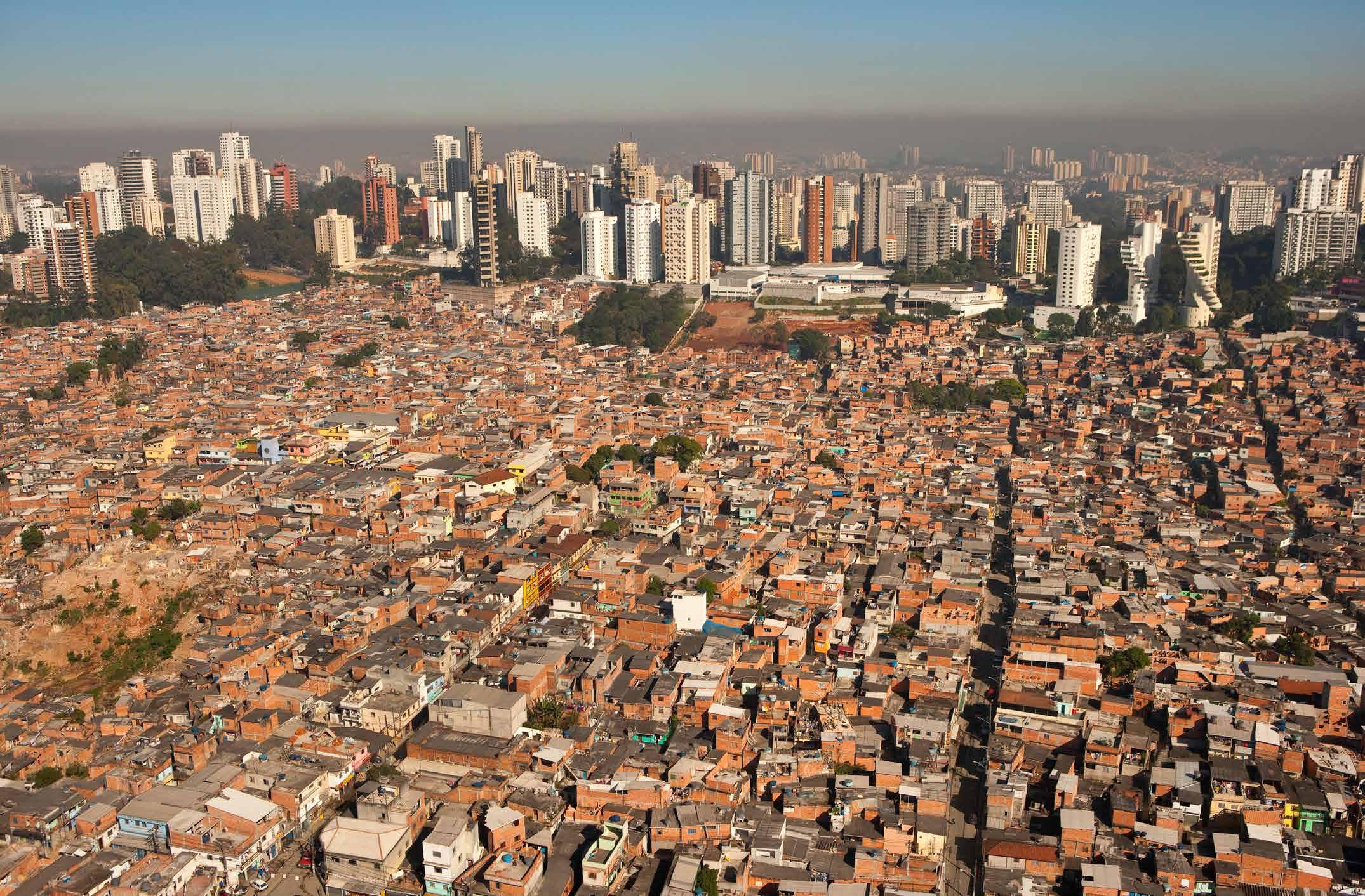
Adjacent favela and upscale neighbourhoods in São Paulo, Brazil. Photo by Danny Lehman.
bound targets to reduce economic inequality, aiming for the total income of the top 10% of the population to be no more than the total income of the bottom 40%, known as a Palma ratio of 1.
Governments must also invest in high-quality data collection on inequality in both income and wealth. The richest people should not be able to avoid being counted. This should include data disaggregated by gender, race and other dimensions of discrimination. Systematically projecting and measuring the distributional impacts of public policy and private-sector activity could enable evidence-driven policy to reduce inequality. Countries should undertake annual assessments of policy choices and their impact on improving the income, wealth and freedoms of all citizens, and on minimizing inequality.
4.2 Reining in corporate power: three practical steps Runaway corporate power and runaway extreme wealth have been contained and controlled in the past and they can be again. This report outlines three concrete, proven and practical ways to make the economy work for all of us.
1. Revitalize the state
A strong, dynamic and effective state is the best bulwark against corporate power and a remedy to correct market failures. It is also key to steering and shaping the economy towards collective goals. A strong state is the provider of public goods, the regulator of private enterprises, the lead investor for several sectors, and a maker and shaper of markets. Governments de-risk businesses and fund them through public procurement.422 They set the terms under which various players in the economy work together to build public value and knowledge, socialize rewards, and ensure accountability and transparency in the system.423
In most countries, the state is the primary agent of social services (such as healthcare, education and social security), utilities and infrastructure (such as water, energy, roads, telecommunications and post), state security (police, firefighting, justice and defence), and culture services (such as libraries, museums and public broadcasting). At the same time, governments own and operate national commercial ventures in sectors including
finance, infrastructure, manufacturing, energy and natural resources. These state-owned entities accounted for 20% of investment, 5% of employment and up to 40% of domestic output worldwide in 2018.424 Stateowned enterprises undertake 55% of total infrastructure investment in ’emerging and developing economies’.425 The power of the state to act for the collective good came to the forefront during the COVID-19 crisis.426
While determining which parts of the economy are to be publicly delivered is a choice to be made by individual countries and societies, governments must recognize their power and take a proactive role. They must:
• Guarantee inequality-busting public services such as healthcare, education and care services; deliver universal, rights-based social protection, including for those working in the informal economy; and increase public spending on these. Public goods such as education and health should be governed in the public interest, through a gender-responsive approach, and be predominantly owned and delivered by the public sector. Health and education should be free of charge paid for by progressive taxation.
• Invest in public transport, energy, housing and other public infrastructure. Support people’s right to access energy for personal and livelihood purposes, and to prepare for and protect themselves against climate impacts such as flooding, storms and extreme heat.
• Explore a public monopoly or public option in sectors that are prone to monopoly power and key to both increasing equality and driving a rapid transition away from fossil fuels. These could include public energy, public transport (where the infrastructure investment costs mean there can only be one efficient provider) and other sectors where there is a significant national benefit. It is important to recognize those public options that already exist, from public libraries to housing, and from court defenders to highways, universities, museums and postal services, and to expand them. From efforts on public banking to a public option for pharmaceuticals – in which governments provide quality-assured medicines that are universally available to all, alongside private options –there is huge scope for government action to assert public power and shape markets for the better.427
• Strengthen governance, including improving transparency, accountability and public participation and oversight of public institutions (including stateowned enterprises); ensure that these institutions are adequately funded to achieve their economic and social mandates.
• End the for-profit provision of public goods sectors such as education and health. Any delivery of public goods by private actors should be governed in the public interest and, to the extent possible, owned by the public. Private provision should not contribute to segregation in society based on family wealth, race, gender, or any other identity. It should not increase inequality, must have democratic oversight and adhere to national standards of quality. This entails strengthening, financing and staffing regulatory capacity to enforce regulations to ensure that the private sector serves the common good.
2. Regulate corporations
Powerful corporations are driving extreme inequality, all too often overpowering governments and undermining the choices and freedoms of people globally. Governments must use their power to rein in the runaway power of corporations.
Break up private monopolies and prevent corporate power from becoming too large Oxfam calls for anti-monopoly action, geared towards addressing historic levels of inequality. This involves a fundamental shift in approach, such that concentrated private power can no longer rival public power. Economic structures must be proactively reformed to prevent harmful monopolistic behaviour from taking place. It is vital that anti-monopoly efforts are not limited to action within the market; rather, the role of the state needs to be reimagined, as governments have done historically, decentralizing and nationalizing private power in the public interest.
Efforts must be guided by an anti-monopoly movement that is growing worldwide. Every country has its context, but universal principles can apply. Governments must:
• Break up private monopolies and curb extreme corporate concentration. Taking a country-specific approach, the
full potential of the law should be considered to break up existing private monopolies, block monopolistic mergers and reform merger rules to prevent monopoly power from accruing in the first place. No corporation should be able to capture enough market share to give it undue power. Governments can learn from current anti-monopoly cases, such as those against Amazon and Google in the USA and Europe.428
Many countries have created legal measures and mechanisms to curb corporate monopoly powers in recent decades.429 These include: action to pass tougher standards for mergers that reshape industries; enforcing anti-monopoly laws already on the books (noting that enforcement is weak across geographies); and new laws that overturn harmful laws and create those which are fit for the 21st century; all towards better governing markets in the public interest.430 Anti-monopoly enforcement works: past break ups have led to explosions of innovation,431, 432 and enforcement generally has been shown to reverse many of the harms of monopoly by raising wages, increasing employment and lowering prices.433
• Break up the monopoly over knowledge and democratize trade and patent rules. At national and international levels, it is necessary to overhaul trade rules allowing corporations to aggressively control intellectual property that is vital to tackling inequality,434 combatting deadly diseases435 and the climate crisis,436 and enabling Global South countries to assert their sovereignty. This includes ending the abusive use of patents when their enforcement is against the public interest; reviving antitrust restrictions on patents and patent licensing; making permanent reforms to waive patents in international trade rules in critical areas such as the pharmaceutical sector; and sharing knowledge through initiatives such as the World Health Organization’s mRNA vaccine technology transfer hub.
• Back dynamic public solutions and assert greater public control. Greater private competition is not a panacea, but a part of the solution for public regulation. Restoring greater public control is a central part of the antimonopoly toolbox. It includes delivering universal public services and utilities, as well as public options and public
involvement in the economy: actions that can curtail corporate concentration and private monopoly power. Determining which parts of the economy are to be publicly delivered is a choice to be made by individual countries and societies. However, all governments must recognize the power of public services and public provision, and take a proactive role in shaping the economy to reduce corporate power to fight inequality. As such, governments should explore a public monopoly or public option in all sectors that are subject to undue market concentration and monopoly power.437
Ensure no share dividend payments or share buybacks before living wages and climate justice Restricting payouts could act as a powerful incentive for companies to fulfil their social and environmental duties. Governments should do this by preventing companies from paying out until:
• They are paying a living wage to all employees and a strategy is in place, with time-bound and measurable objectives, to ensure that workers in supply chains receive a living wage/income.
• The company has made the investments necessary to ensure a low-carbon transition and is on a clear, timebound trajectory to achieve carbon emissions objectives aligned with the Paris Agreement.
Introduce legally binding measures on mandatory gendered human rights and environmental due diligence (mHRDD) Companies should be required to conduct due diligence to identify and manage human rights and environmental risks and impacts in their operations and supply chains. The law would hold them liable for failing to prevent abuse and responsible for remedy, as set out in the UN Guiding Principles on Business and Human Rights.438 Women are disproportionately impacted, and the law should take a gender-justice perspective as laid out by the Feminists for a Binding Treaty.439 The legislative bodies of the EU are negotiating a Corporate Sustainability Due Diligence Directive that would require EU companies and non-EU companies active on the European market to take steps to address risks for human rights and the environment.440 However, the original proposals have been watered down and the Directive is now riddled with loopholes.441
Strengthen laws for gender and racial justice Governments should introduce and ensure the full enforcement of laws relating to gender-based equity in pay and the elimination of all forms of gender-based discrimination, violence and harassment. They must:
• Require corporations to publish and implement gender and inclusion policies that would cover hiring, training, promotion, harassment and grievance reporting, and introduce care-responsibility-supporting working conditions.442 Companies should aim to achieve diversity in terms of race, educational background and expertise through a published diversity strategy with targets that are regularly reported against. They should be required to report gender and racial pay gaps. Following the introduction of mandatory gender pay gap reporting in the UK, the wage gap between women and men has closed by 19% on average,443 although this progress risks stalling if companies don’t take a comprehensive approach to closing the gap.
• Follow up on racial justice recommendations provided by the UN.444 This would involve: developing and enforcing legislation on non-discrimination; developing action plans to end racism and discrimination; promoting access to employment; and addressing barriers to employment.
• Recognize, reduce and redistribute unpaid care work by collecting better data on the provision of care; investing in physical and social infrastructure that supports care; supporting child and elderly care, paid family and medical leave, flexible working hours and paid parental leave; and challenging the social norms that delegate unpaid care work mainly to women and girls, especially those who are migrants, racialized or marginalized, leading to an unequal gendered distribution of care work.445 Equal paid parental leave, paid at 100% of prior salary, should be available to all genders for at least 18 weeks, in line with ILO recommendations.446
Support and encourage trade unions
Living wages and decent work for the world’s workers are fundamental to ending today’s inequality crisis. Legal standards should protect the rights of workers to unionize and strike; laws that restrict these rights should be rescinded. Collective bargaining agreements should be allowed and supported.
Cap CEO pay
While millions of ordinary workers remain on poverty wages, CEOs claim enormous incomes. It has previously been estimated that with just slightly more than one day of work, a CEO in the USA earns the same as an ordinary worker makes during the whole year.447 Female CEO pay is on average lower relative to male CEOs.448 Overall, men tend to earn more than women449 and racial pay gaps persist.450 It is important to limit top pay to no more than 20 times that of the average (median) worker and close gender and racial pay gaps.
Radically increase taxes on rich individuals and corporations
As this report shows, corporations and the wealthiest individuals are the primary beneficiaries of the value created by the global workforce of billions (many of whom are surviving on poverty wages), the extraction of natural resources and the unpaid care work of women. Governments should increase taxes on the income and wealth of super-rich individuals and on corporations, with the G20 championing a new international agreement on this crucial inequality-busting agenda. Governments should:
• Introduce comprehensive and permanent taxation of the wealthiest in every country. Reducing the wealth of the richest and the number of super-rich people could also reduce their dominant influence on politics and policy. Oxfam has calculated that a wealth tax on the world’s millionaires and billionaires could generate US$1.8 trillion dollars each year.451 A net wealth tax should be levied in a progressive way on the net value of all assets.
• Urgently increase taxes on dividends and capital gains. Taxes need to rise on income from stocks, shares, rent and other revenue that the rich disproportionately rely on – at rates that are at least as high as those on income from work, and preferably higher: for example, to a minimum of 60% of their income from labour and capital.
• Tax windfall profits and move towards permanent taxes on excess profits. The previous chapters have highlighted evidence of crisis profiteering by some corporations, especially within the pharmaceutical, energy and food sectors, over the last three years. A windfall tax should be applied to big companies across all sectors registering
sudden, excessive increases in profits during crisis. Of course, excess profits also occur outside crisis periods, particularly when companies hold monopolistic positions, that’s why governments and global institutions should explore permanent taxes on excess profits to curb the power of corporations and turn corporate income tax into a more progressive design.452
• Move towards a more effective taxation of large corporations, especially on their cross-border corporations. No other progressive tax has declined as fast globally as the corporate income tax, which is also undermined by tax competition and profit shifting. A more effective minimum level of taxation must be implemented in every country, at least as high as 25% (as recommended by the Independent Commission for the Reform of International Corporate taxation; ICRICT), to avoid the floor becoming the ceiling.
• Curb tax avoidance by:
› Making multinational corporations disclose their profits, revenue, number of employees and other key financial numbers in all countries where they operate, through public country-by-country tax reporting.
› Requiring companies to reveal their true owners by developing public registers of the beneficial owners of companies, foundations and trusts, and moving towards the creation of a Global Asset Registry.453
› Introducing global or regional systems to tax multinational corporations where they have real economic activities, based – for example – on their number of employees, sales and fixed capital, and ban the use of shell companies that are used to hide profit without real economic activity.
› Ultimately, a fairer, more inclusive and transparent global architecture on taxation is necessary, by supporting an ambitious framework convention on tax under the UN initiated in a historic vote in November 2023.454
3. Reinvent business
The damaging impacts of the increased concentration of wealth, the automation of industry, and climate catastrophe demand that we create a radically different way of doing business. Corporate structures are by design undemocratic, run by and in the interest of a small elite.
Injecting democratic ownership and governance into mainstream business could not only help tackle wealth inequalities; it would also drive business decisions that better reflect the issues that matter to society. This is not unthinkable: in 2018, 19% of US workers owned some share in their employer. Employee owners from racialized groups and women employee owners have a 30% and 17% higher wage income, respectively, compared to non-employee
owners, and employee owners have greater job security and lower turnover across income levels than their non-employee owner counterparts.456 Competitive and profitable businesses don’t have to be shackled by shareholder greed. The future of business lies in business structures that have dual goals of financial sustainability and social purpose. There is a diverse range of alternatives to the shareholder-first business model – worker and local cooperatives, social enterprises and fair-trade businesses – that are owned and governed in the interest of workers,
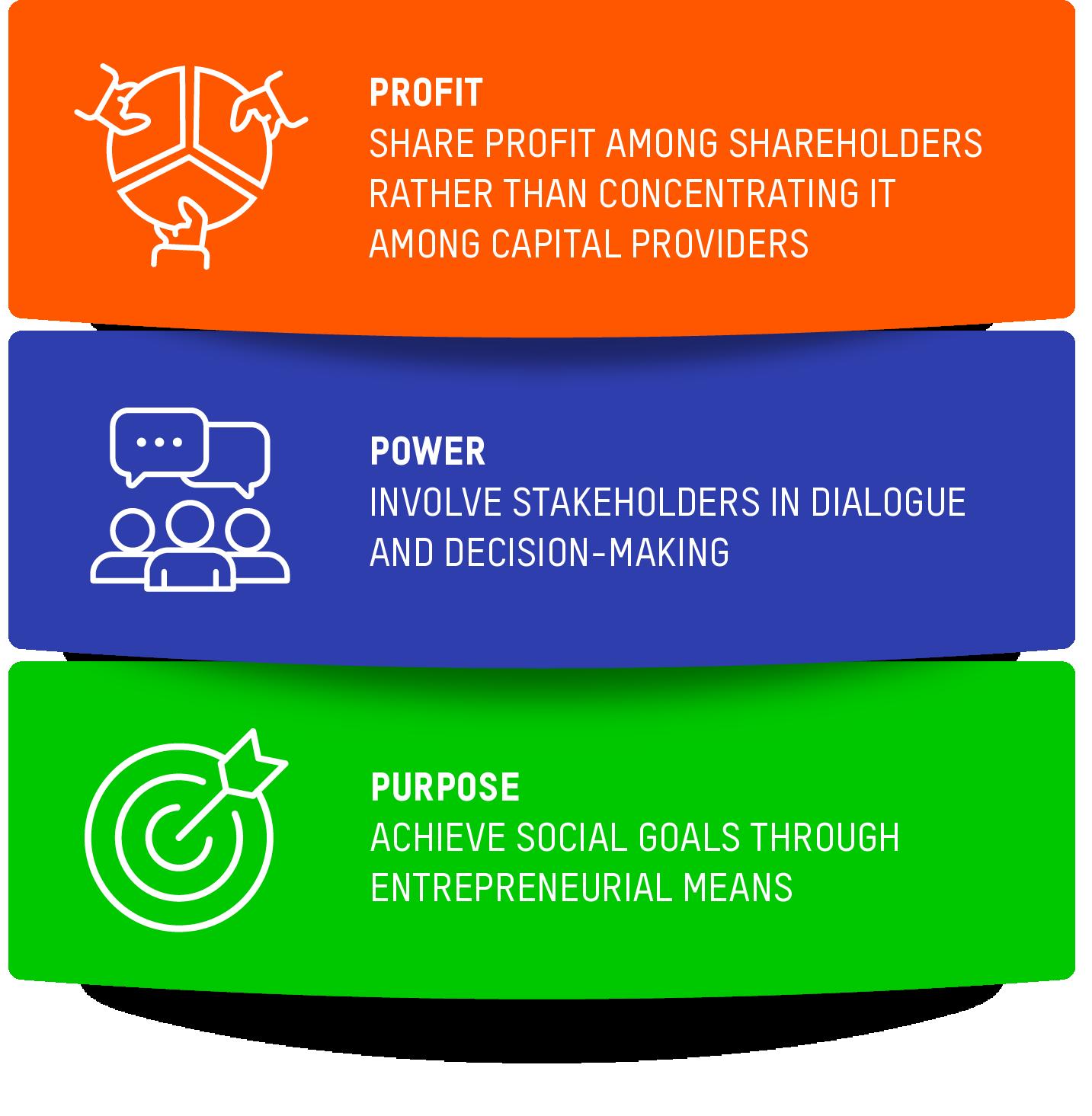
local communities and the environment. What makes these businesses different is that their governance is democratic, ownership isn’t concentrated so profit is more fairly shared, and they are driven by a social mission. These characteristics are summarized in Figure 6.457
This model needn’t be limited to direct employees of companies. There are some companies that are partially owned by cooperatives in their supply chains. For example, Cafédirect is 5% owned by the farming cooperatives that supply it.458 Farmer groups are represented on the board and get a share of any dividends paid.459
Companies don’t have to start as equitable businesses. Some are gradually transitioning by, for example, voluntarily introducing employee representation on their boards, while others are going a step further and transforming their entire ownership structure. The formerbillionaire owner of clothing company Patagonia put the company’s ownership into a trust that will benefit environmental efforts and declared that ‘Earth is our only shareholder.’460 Many companies are converting from privately owned to employee- or community-owned businesses.
Governments can support alternative business by:
• Providing financial support to employee-owned businesses, including worker cooperatives. This includes the implementation of ILO Recommendation no.193 on promoting cooperatives and relevant regional instruments.461
• Using public procurement and export incentives to give preferential treatment to sustainable and inclusive companies. Public tender processes should give overwhelmingly negative scores for large companies that are performing poorly on sustainability criteria, so that procurement isn’t driven by the lowest price, and enable more competition from more equitably structured businesses.
• Using tax and other economic instruments to prioritize equitable business models. No economic aid should be given to companies that are missing their net zero targets, paying below living wages, using tax havens, or engaging in aggressive tax planning.
FIGURE 6: CHARACTERISTICS OF HYBRID AND EQUITABLE BUSINESS MODELS
Source: A. Maitland and S. Ciencia. (2018). The Future of Business: Shaping Inclusive Growth in South-East Asia 455
Box 10: How alternative business approaches can reduce inequality
• The World Fair Trade Organization is a growing global network of social enterprises and cooperatives that put people and planet first: 462
• 52% of CEOs of its member organizations are women.463 (In the UK, you’re more likely to be called Dave or Steve than to be a female CEO.464)
• 92% of its members reinvest all profits in their social mission and 85% sacrifice profits for social or environmental goals, but are still four times less likely than traditional businesses to go bankrupt.465
• Indicatively, if just 10% of every business in the USA was employee-owned, it could double the share of wealth of the bottom 50% and the median wealth of Black households.466
• Areas with high cooperative density have lower levels of inequality. For example, Gipuzkoa, the Spanish province where Mondragon cooperative group headquarters is based, has a lower Gini index than Norway and Finland 467
4.3 Room for hope
Political leaders must call time on the economic model that puts rich shareholders above all else, and instead listen to their citizens who are demanding a fairer, more prosperous economy for all. Trying to wrench back control of the global economy from elites might seem like an impossible task but there is hope – as these examples from around the world demonstrate:
In Latin America and the Caribbean (LAC), a groundbreaking summit between governments led to the constitution of a permanent LAC Tax Platform to cooperate on tax. This is setting a new direction for more progressive taxation and for the region to raise a united voice on the international tax reform process.468
In November 2022, a new resolution presented by the African Group was agreed upon, which gives the UN a mandate to develop intergovernmental talks on tax.469 This could take control of global tax policy, away from corporate and rich-country interests, and could be a breakthrough for progressive taxation.
Civil society campaigners around the world are winning hard-fought campaigns, such as breaking monopolies on drugs to treat TB.470 Amsterdam’s Schiphol Airport, which has come under sustained pressure to reduce carbon emissions, announced a ban on private jets just months after Greenpeace and Extinction Rebellion activists blocked private jets on the runway. 471 472 Even some rich individuals have been campaigning to be taxed more.473
Ten percent of the world now works for a cooperative,474 and this share is growing. From rural social enterprises that are delivering decent work for women and marginalized groups, to huge multinational cooperatives that are lifting entire regions out of poverty, many parts of the private sector can bring us hope.
In the USA, the Federal Trade Commission recently filed a lawsuit against Amazon for anti-competitive behaviour.475 Meanwhile, the EU also ordered a mandatory divestment of part of Google’s advertising business over competition concerns.476
Ultimately, hope is a choice. The continued path is one where the dominant model is of business and politics at the service of extreme capital, enabled by monopolists and financiers. However, a clear alternative is also on offer: one in which 21st-century transformative public power repurposes our economy; in which regulated and reimagined business creates value for communities and workers as well as owners and executives; in which innovation and ingenuity are not treated as the preserve of the few but unleashed to serve the interests of the many.
This choice is one, above all, for governments to make –and for citizens across the world to come together to advocate to make this reality. This report is dedicated to those fighting for a more equal world.
Endnotes
1 See methodology note, stat 1.0.
2 K. Duggan. (20 July 2021). Everything to know about Tuesday’s Blue Origin space launch with Jeff Bezos. Fortune. Accessed 1 December 2023. https://fortune. com/2021/07/19/jeff-bezos-space-launch-blue-origin-july-20-2021-billionaires
3 D. Streitfield. (16 March 2021). How Amazon Crushes Unions New York Times. Accessed 1 December 2023. https://www.nytimes.com/2021/03/16/technology/amazonunions-virginia.html
4 Oxfam interview with Reverend Ryan Brown, 4 October 2023.
5 Oxfam America. (June 2018). US Supermarket Supply Chains: Ending the human suffering behind our food. Accessed 1 December 2023. http://dx.doi. org/10.21201/2018.1633
6 Oxfam. (n.d.). Behind the seafood in our markets: stories of human suffering. Accessed 1 December 2023. https://www.oxfam.org/en/behind-seafood-our-marketsstories-human-suffering
7 See methodology note, stat 1.0.
8 See methodology note, stat 1.0.
9 See methodology note, stat 1.6.
10 A principal shareholder is defined by the Securities and Exchange Commission in the USA. A principal shareholder’s voting shares allow the shareholder to vote on who should be the Chief Executive Officer (CEO) or who would sit on the company’s board of directors. Investopedia. (2022). Principal Shareholder: Meaning, Requirements, Primary Shareholder. Accessed 29 November 2023. https://www.investopedia.com/terms/p/principal-shareholder.asp
11 See methodology note, stat 3.0.
12 See methodology note, stat 1.4. Whilst using the term ‘men’ and ‘women’ throughout this report to describe the gender divide amongst billionaires, based largely on categorisations used in the Forbes billionaires list and other secondary data sources, we recognise that these are binary terms and may fail to capture and represent non-binary and other gender non-conforming people, for whom disaggregated data on wealth are unavailable, which prevents us from fully understanding genderbased wealth inequalities.
13 See methodology note, stat 1.8.
14 A. Khalfan et al. (2023). Climate Equality: A Planet for the 99%. Oxfam. Accessed 1 December 2023. https://policy-practice.oxfam.org/resources/climate-equality-aplanet-for-the-99-621551/
15 A. Aladangady, A.C. Chang and J. Krimmel. (2023). Greater wealth, greater uncertainty: Changes in racial inequality in the survey of consumer finances. Accessed 1 December 2023. https://www.federalreserve.gov/econres/notes/feds-notes/greater-wealth-greater-uncertainty-changes-in-racial-inequality-in-the-survey-ofconsumer-finances-20231018.html
16 Instituto Brasileiro de Geografia e Estatística. (2019). Desigualdades Sociais por Cor ou Raça no Brasil (Portuguese). Accessed 1 December 2023. https://www.ibge.gov. br/estatisticas/sociais/populacao/25844-desigualdades-sociais-por-cor-ou-raca.html
17 See methodology note, stat 2.3.
18 See methodology note, stat 1.7.
19 See methodology note, stat 1.0.
20 World Bank. (2023). 10: Reduced Inequalities: Progress and setbacks in reducing income inequalities. Atlas of Sustainable Development Goals 2023. Accessed 1 December 2023. https://datatopics.worldbank.org/sdgatlas/goal-10-reduced-inequalities?lang=en
21 See methodology note, stat 1.1.
22 A. Khalfan, et al. (2023). Climate Equality, op. cit.
23 S. Wilkin. (31 March 2022). 2022 Political Risk Survey Report. Accessed 29 November 2023. https://www.wtwco.com/en-gb/insights/2022/03/2022-political-risksurvey-report
24 Oxfam. (9 October 2023). World’s poorest countries to slash public spending by more than $220 billion in face of crushing debt. Press release. Accessed 1 December 2023. https://www.oxfam.org/en/press-releases/worlds-poorest-countries-slash-public-spending-more-220-billion-face-crushing-debt
25 D. Abed and F. Kelleher. (2022). The Assault of Austerity: How prevailing economic choices are a form of gender-based violence. Oxfam. Accessed 1 December 2023. https://policy-practice.oxfam.org/resources/the-assault-of-austerity-how-prevailing-economic-policy-choices-are-a-form-of-g-621448/
26 See methodology note, stat 1.2.
27 See methodology note, stat 1.3.
28 Oxfam. (6 July 2023). Big business’ windfall profits rocket to “obscene” $1 trillion a year amid cost-of-living crisis; Oxfam and ActionAid renew call for windfall taxes Press release. Accessed 1 December 2023.https://www.oxfam.org/en/press-releases/big-business-windfall-profits-rocket-obscene-1-trillion-year-amid-costliving-crisis
29 See methodology note, stat 2.2.
30 See methodology note, stat 1.8.
31 See methodology note, stat 3.1.
32 A principal shareholder is defined by the Securities and Exchange Commission in the USA. A principal shareholder’s voting shares allow the shareholder to vote on who should be the Chief Executive Officer (CEO) or who would sit on the company’s board of directors. Investopedia. (2022). Principal Shareholder: Meaning, Requirements, Primary Shareholder. Accessed 29 November 2023. https://www.investopedia.com/terms/p/principal-shareholder.asp
33 See methodology note, stat 3.0.
34 T. Pang et al. (2020). Study on the Impact of Mergers and Acquisitions on Innovation in the Pharmaceutical Sector. European Commission Publications Office. Accessed 1 December 2023. https://data.europa.eu/doi/10.2777/323819
35 ETC Group. (2022). Food Barons 2022. Accessed 1 December 2023. https://www.etcgroup.org/files/files/food-barons-2022-full_sectors-final_16_sept.pdf; S. Wixforth and K. Haddouti. (19 December 2022). How big companies are profiting from inflation. International Politics and Society blog. Accessed 1 December 2023. https://www. ips-journal.eu/topics/economy-and-ecology/how-big-companies-are-profiting-from-inflation-6388/
36 S. Joseph. (4 February 2022). The Rundown: Google, Meta and Amazon are on track to absorb more than 50% of all ad money in 2022. Digiday. Accessed 1 December 2023. https://digiday.com/marketing/the-rundown-google-meta-and-amazon-are-on-track-to-absorb-more-than-50-of-all-ad-money-in-2022/
37 SimilarWeb. (2023). Search Engines Market Share (June 2023). Accessed 1 December 2023. https://www.similarweb.com/engines/; D. McCabe and N. Grant. (11 September 2013). Google Goes on Trial Over Justice Dept. Claims That It Has Monopoly Power The New York Times. Accessed 1 December 2023. https://www.nytimes. com/2023/09/11/technology/google-monopoly-justice-dept-trial.html
38 S. Robert. (2023). ‘Competition, Trade, and Sustainability in Agriculture and Food Markets in Africa.’ Oxford Review of Economic Policy, 39(1), Spring 2023, 147–61. https://academic.oup.com/oxrep/article-abstract/39/1/147/7030599?redirectedFrom=fulltext
39 V. Acharya. (2023). India at 75: Replete with Contradictions, Brimming with Opportunities, Saddled with Challenges. Paper presented at a conference on the Brookings Paper on Economic Activity, 30–31 March 2023.
40 W. Chen et al. (2019). World Economic Outlook, April 2019 Growth Slowdown, Precarious Recovery. Chapter 2: The Rise of Corporate Market Power and Its Macroeconomic Effects International Monetary Fund. Accessed 1 December 2023. https://www.imf.org/en/Publications/WEO/Issues/2019/03/28/world-economic-outlook-april-2019
41 J. De Loecker, J. Eeckhout and G. Unger. (2020). ‘The Rise of Market Power and the Macroeconomic Implications*,’ The Quarterly Journal of Economics, 135(2), 561–644; J. Eeckhout. (2021) The Profit Paradox: How Thriving Firms Threaten the Future of Work, Princeton: Princeton University Press, 2021. https://doi.org/10.1515/9780691222769
42 I.M. Weber and E. Wasner. (2023). ‘Sellers’ Inflation, Profits and Conflict: Why can Large Firms Hike Prices in an Emergency?’ Economics Department Working Paper Series. 343. https://doi.org/10.7275/cbv0-gv07
43 J. Ghosh. (8 June 2023). ‘The Social Consequences of Inflation in Developing Countries.’ The Economic and Labour Relations Review, 34(2), 203–11.
44 Balanced Economy Project. (16 December 2022). How finance drives monopoly. The Counterbalance. Accessed 1 December 2023. https://thecounterbalance. substack.com/p/how-finance-drives-monopoly-power?utm_source=profile&utm_medium=reader2 https://thecounterbalance.substack.com/p/howfinance-drives-monopoly; Bain & Company. (2019). Global Private Equity Report 2019. Bain & Company, Inc. Accessed 1 December 2023. https://www.bain.com/ contentassets/875a49e26e9c4775942ec5b86084df0a/bain_report_private_equity_report_2019.pdf; Center for Economic and Policy Research. (2022). Comment Letter in Response to the FTC and DOJ’s Request for Information on Merger Enforcement. Accessed 1 December 2023. https://cepr.net/comment-letter-in-response-to-theftc-and-dojs-request-for-information-on-merger-enforcement/
45 D. Hearn et al. (2022). The roll-up economy: the business of consolidating industries with serial acquisitions. American Economic Liberties Project: Working paper series on corporate power. Accessed 1 December 2023. http://www.economicliberties.us/wp-content/uploads/2022/12/Serial-Acquisitions-Working-Paper-R4-2.pdf
46 Total assets under investment worldwide according to the Boston Consulting Group are $98 trillion in 2022, so the close to $20 trillion BlackRock, State Street and Vanguard have under management represents nearly one-fifth. Boston Consulting Group. (15 May 2023). Global Asset Management Industry Must Transform to Thrive Amidst Changing Macroeconomics. Press release. Accessed 1 December 2023. https://www.bcg.com/press/15may2023-global-asset-management-transform-tothrive
47 E. Elhauge. (2020). ‘How Horizontal Shareholding Harms Our Economy - And Why Antitrust Law Can Fix It’ Harvard Business Law Review. Accessed 1 December 2023. https://papers.ssrn.com/sol3/papers.cfm?abstract_id=3293822; D. McLaughlin and A. Massa. (9 January 2020). The hidden dangers of the great index fund takeover Bloomberg. Accessed 1 December 2023. https://www.bloomberg.com/news/features/2020-01-09/the-hidden-dangers-of-the-great-index-fund-takeover
48 R. Vazquez-Alvarez et al. (2022). Global Wage Report 2022-23: The Impact of Inflation and COVID-19 on Wages and Purchasing Power. International Labour Organization. Accessed 1 December 2023. https://researchrepository.ilo.org/esploro/outputs/report/995264896002676
49 See methodology note, stat 1.1.
50 D. Alejo Vázquez Pimentel et al. (2018). Reward Work, Not Wealth: To End the Inequality Crisis, We Must Build an Economy for Ordinary Working People, Not the Rich and Powerful. Oxfam. Accessed 1 December 2023. https://policy-practice.oxfam.org/resources/reward-work-not-wealth-to-end-the-inequality-crisis-we-must-build-aneconomy-fo-620396/
51 G. Azcona et al. (2023). Progress On the Sustainable Development Goals: The Gender Snapshot 2023. United Nations Women and United Nations Department of Economic and Social Affairs. Accessed 1 December 2023. https://www.unwomen.org/sites/default/files/2023-09/progress-on-the-sustainable-development-goals-thegender-snapshot-2023-en.pdf
52 See, e.g. Report to the Human Rights Council. 2019. Report of the Special Rapporteur on contemporary forms of racism, racial discrimination, xenophobia and related intolerance undocs.org/A/HRC/41/54; J. Brunner and G. LeBaron. (2021). Forced Labour Evidence Brief: Labour Share and Value Distribution. Re:Structure Lab. Accessed 1 December 2023. https://static1.squarespace.com/static/6055c0601c885456ba8c962a/t/61d5d81de83cf8390ca5a915/1641404446025/ReStructureLab_ LabourShareandValueDistribution_December2021.pdf
53 U. Gneiting et al. (2020). Power, Profits and the Pandemic. Oxfam. Accessed 1 December 2023. https://www.oxfam.org/en/research/power-profits-and-pandemic
54 See, e.g. D. Fahrenthold and T. Smith. (17 January 2023). How restaurant workers help pay for lobbying to keep their wages low. The New York Times. Accessed 1 December 2023. https://www.nytimes.com/2023/01/17/us/politics/restaurant-workers-wages-lobbying.html; A. Gangitano. (26 January 2021). Business groups prepare for lobbying push against $15 minimum wage The Hill. Accessed 1 December 2023. https://thehill.com/business-a-lobbying/535957-business-groupsprepare-for-lobbying-effort-against-raising-the-minimum/
55 See, e.g. The Institution of Occupational Safety and Health (IOSH). (n.d.). UN Working Group on Business and Human Rights: Call for inputs to Multi-stakeholder Consultation on “Corporate Influence in the Political and Regulatory Sphere”. Accessed 1 December 2023. https://www.ohchr.org/sites/default/files/2022-06/ institution-of-occupational-safety-and-health.pdf.
56 E. Walker and C. Rea. (2014). The Political Mobilization of Firms and Industries. Department of Sociology, University of California Accessed 1 December 2023. https:// www.annualreviews.org/doi/pdf/10.1146/annurev-soc-071913-043215
57 J. Sherer and N. Mast. (2023). Child Labor Laws Are Under Attack in States Across the Country. Economic Policy Institute. Accessed 1 December 2023. https://files.epi. org/uploads/263680.pdf
58 M. Christensen et al. (2023). Survival of the Richest Methodology Note. Oxfam International. Accessed 1 December 2023. https://oxfamilibrary.openrepository.com/ bitstream/handle/10546/621477/mn-survival-of-the-richest-methodology-160123-en.pdf; OECD. (2022). Corporate Tax Statistics: Fourth Edition. Accessed 1 December 2023. https://www.oecd.org/tax/tax-policy/corporate-tax-statistics-fourth-edition.pdf
59 M. Gardner and S. Wamhoff. (2021). 55 Corporations Paid $0 in Federal Taxes on 2020 Profits. Institute on Taxation and Economic Policy. https://itep.org/55-profitablecorporations-zero-corporate-tax/
60 World Bank. (2022). Poverty and Shared Prosperity 2022. Accessed 1 December 2023. https://openknowledge.worldbank.org/server/api/core/bitstreams/b96b361aa806-5567-8e8a-b14392e11fa0/content; E. Saez and G. Zucman. (2020). The Triumph of Injustice: How the Rich Dodge Taxes and How to Make Them Pay. New York City: W. W. Norton & Company.
61 M. Christensen et al. (2023). Survival of the Richest: How we must tax the super-rich now to fight inequality. Oxfam. Accessed 1 December 2023. https://policy-practice. oxfam.org/resources/survival-of-the-richest-how-we-must-tax-the-super-rich-now-to-fight-inequality-621477/
62 Report to the UN General Assembly. (2018). Extreme Poverty and Human Rights. Accessed 1 December 2023. https://undocs.org/A/73/396
63 R. Noble. (2018). From Rhetoric to Rights: Towards Gender-just Trade. ActionAid. Accessed 1 December 2023. https://www.actionaid.org.uk/sites/default/files/ publications/from_rhetoric_to_rights_towards_gender-just_trade_actionaid_policy_briefing.pdf
64 See, e.g. World Bank Group. (2017). Maximizing Finance for Development: Leveraging the Private Sector for Growth and Sustainable Development. Accessed 1 December 2023. https://www.devcommittee.org/content/dam/sites/devcommittee/doc/documents/mgr/DC2017-0009_Maximizing_8-19.pdf; USAID. (2018). Private Sector Engagement Policy. USAID. Accessed 1 December 2023. https://www.usaid.gov/sites/default/files/2022-05/usaid_psepolicy_final.pdf; Eurodad. (2022). History RePPPeated II: Why Public Private Partnerships are not the solution. Accessed 1 December 2023. https://assets.nationbuilder.com/eurodad/pages/3071/attachments/ original/1671445992/01_history-rePPPeated-2022-EN_19dec.pdf?1671445992
65 See, e.g. F. Schulte. (14 November 2022). Sick profit: Investigating private equity’s stealthy takeover of health care across cities and specialties. KFF Health News. Accessed 1 December 2023. https://kffhealthnews.org/news/article/private-equity-takeover-health-care-cities-specialties/; The Guardian. (21 May 2023). The Guardian view on England’s water companies: A badly broken system. The Guardian. Accessed 1 December 2023. https://www.theguardian.com/environment/ commentisfree/2023/may/21/the-guardian-view-on-englands-water-companies-a-badly-broken-system; A. Gupta et al. (2021). Owner Incentives and Performance in Healthcare: Private Equity Investment in Nursing Homes. National Bureau of Economic Research. Accessed 1 December 2023. https://www.nber.org/papers/w28474
66 M. Lawson. (2019). Public Good or Private Wealth. Oxfam. Accessed 1 December 2023. https://policy-practice.oxfam.org/resources/private-wealth-or-publicgood-620599/
67 See, e.g. M. Lawson. (2019). Public good or private wealth, op. cit.; D. Abed and F. Kelleher, (2022). The Assault of Austerity, op. cit.
68 See, e.g. G. Wilson et al. (2015). ‘Racial Income Inequality and Public Sector Privatization.’ Social Problems, 62(2), 163–185. https://academic.oup.com/socpro/article-ab stract/62/2/163/1611490?redirectedFrom=fulltext.
69 N. Jadhav and A. Taneja. (2022). The private health sector in India from the lens of Dalits and Adivasis. Oxfam India. Accessed 1 December 2023. https://www.oxfamindia. org/dalitadivasiprivatehospitals
70 A. Taneja and Noopur. (2022). Private schools in India: Experiences of Dalits and Adivasis. Oxfam India. Accessed 1 December 2023. https://www.oxfamindia.org/ privateschoolsdalitsadivasis
71 A. Khalfan et al. (2023). Climate Equality, op. cit.
72 A. Maitland et al. (2022). Carbon Billionaires: The Investment Emissions of the World’s Richest People. Oxfam. Accessed 1 December 2023. https://policy-practice.oxfam. org/resources/carbon-billionaires-the-investment-emissions-of-the-worlds-richest-people-621446/
73 See, e.g. Influence Map. (2023). Industry lobbying imbalance putting South Africa’s climate goals at risk. Accessed 1 December 2023. https://influencemap.org/site// data/000/021/2023_-_01_South_Africa_report.pdf; J.H. Cushman. (1998). Industrial group plans to battle climate treaty New York Times. Accessed 1 December 2023. https://www.nytimes.com/1998/04/26/us/industrial-group-plans-to-battle-climate-treaty.html; EarthRights International. (2022). The Fossil Fuel Industry’s use of SLAPPs and Judicial Harassment in the United States. Policy Brief. Accessed 1 December 2023. https://earthrights.org/wp-content/uploads/SLAPP-Policy-Brief-2022. pdf
74 See Forbes: https://www.forbes.com/real-time-billionaires/#4cc499f13d78
75 UBS. (2023). Global Wealth Report 2023. https://www.ubs.com/global/en/family-office-uhnw/reports/global-wealth-report-2023.html
76 F. Grigoli and A. Robles. (2017). Inequality Overhang IMF. Accessed 1 December 2023. https://www.imf.org/en/Publications/WP/Issues/2017/03/28/InequalityOverhang-44774; OCED Directorate for Employment, Labour and Social Affairs. (2014). Does income inequality hurt economic growth? Accessed 1 December 2023. https://www.oecd.org/social/Focus-Inequality-and-Growth-2014.pdf
77 The letter is available at https://equalshope.org/index.php/2023/07/17/setting-serious-goals-to-combat-inequality/
78 M. Doyle and J. Stiglitz. (2014). ‘Eliminating Extreme Inequality: A Sustainable Development Goal, 2015–2030’. Ethics & International Affairs, 28(1), 5–13. doi:10.1017/ S0892679414000021
79 This is after the impacts of taxes and social transfers. This ratio is known as the Palma ratio, and this would correspond to a Palma of 1. This equates to the level of equality found in countries such as Denmark and France. The recommendation that all countries should aim for a Palma of one was first made by Michael Doyle and Joseph Stiglitz; see M. Doyle and J. Stiglitz. (2014). ‘Eliminating Extreme Inequality: A Sustainable Development Goal, 2015–2030’. Ethics & International Affairs, 28(1), 5–13. https://www.cambridge.org/core/journals/ethics-and-international-affairs/article/abs/eliminating-extreme-inequality-a-sustainable-development-goal20152030/013C79F9BBBE4DCDFFE4A5348CEAE05F
80 World Bank Group. State-Owned Enterprises: Understanding their market effects and the need for competitive neutrality. Accessed 1 December 2023. https://pubdocs. worldbank.org/en/739371594131714315/15444-WB-SOE-WEB.pdf
81 M. Mazzucato and H.L.Li. (2020). ‘Is it time to nationalise the pharmaceutical industry?’ BMJ 2020, 368. Accessed 1 December 2023. https://doi.org/10.1136/bmj.m769
82 T. Wu. (2018). The Curse of Bigness: Antitrust in the New Gilded Age. New York City: Columbia Global Reports.
83 FTC. (26 September 2023). FTC Sues Amazon for Illegally maintaining Monopoly power. Press release. Accessed 1 December 2023. https://www.ftc.gov/news-events/ news/press-releases/2023/09/ftc-sues-amazon-illegally-maintaining-monopoly-power
84 See methodology note, stat 1.0.
85 K. Duggan. (20 July 2021). Everything to know about Tuesday’s Blue Origin space launch with Jeff Bezos, op. cit.
86 D. Streitfeld. (16 March 2021). How Amazon Crushes Unions, op. cit.
87 Oxfam interview with Reverend Ryan Brown, 4 October 2023.
88 Oxfam America. (June 2018). US Supermarket Supply Chains: Ending the human suffering behind our food, op. cit.
89 Oxfam. (n.d.). Behind the seafood in our markets: stories of human suffering, op. cit.
90 Oxfam refers to race not as a biological category but as a social construct. The term ‘racialized groups’ refers to groups that do not enjoy the privileges of white people, as a result of the socially constructed process of racialization. A racialized social system is ‘one where economic, political, social and ideological levels are partially structured by the placement of actors in categories or racial groups’. These include discrimination based on ethnicity, caste, Indigeneity or other grounds. In this report, we use the terms ‘race’, ‘racialized groups’ and ‘racialized peoples’, while recognizing the limitations of these terms.
91 N. Yonzan et al. (2023). Poverty is back to pre-COVID levels globally, but not for low-income countries. World Bank Data blog. Accessed 1 December 2023. https://blogs. worldbank.org/opendata/poverty-back-pre-covid-levels-globally-not-low-income-countries
92 See methodology note, stat 1.1,
93 In 2022, cost-of-living protests occurred in 122 countries and territories, with an estimated three million person-days dedicated to such demonstrations. Accessed 1 December 2023. https://www.insurancebusinessmag.com/uk/news/breaking-news/costofliving-crisis-inflames-political-unrest--wtw-452396.aspx; S. Wilkin. (2023). Political risk index: 2023 https://www.wtwco.com/en-ie/insights/2023/07/political-risk-index-summer-23
94 World Bank. (2023). 10: Reduced Inequalities. Progress and setbacks in reducing income inequalities, op. cit.
95 Global Gini 0.62 from World Bank (2023). 10: Reduced Inequalities. Progress and setbacks in reducing income inequalities. Atlas of Sustainable Development Goals 20123, op. cit.; South Africa Gini 0.63 from World Bank (n.d.) Databank: Metadata Glossary. Accessed 1 December 2023. https://databank.worldbank.org/metadataglossary/ jobs/series/SI.POV.GINI
96 The study shows that although between-country inequality has decreased over the past half-century, there is around 90% likelihood that global warming has slowed that decrease. See S. Diffenbaugh and M. Burke. (2019). ‘Global Warming has Increased Global Economic Inequality’. PNAS, 16(20). 9808–9813, https://www.pnas.org/ doi/10.1073/pnas.1816020116
97 See S. Diffenbaugh and M. Burke. (2019). ‘Global Warming has Increased Global Economic Inequality’, op. cit.
98 E. Seery. (2020). 50 years of Broken Promises: The $5.7 trillion debt owed to the poorest people. Accessed 1 December 2023. https://policy-practice.oxfam.org/ resources/50-years-of-broken-promises-the-57-trillion-debt-owed-to-the-poorest-people-621080/
99 Oxfam International. (2023). World’s poorest countries to slash public spending by more than $220 billion in face of crushing debt, op. cit.
100 A. Kentikelenis et al. (2023). The Middle East and North Africa Gap: prosperity for the rich, austerity for the rest. Accessed 1 December 2023. https://policy-practice. oxfam.org/resources/the-middle-east-and-north-africa-gap-prosperity-for-the-rich-austerity-for-the-621549/
101 Oxfam International. (2023). World’s poorest countries to slash public spending by more than $220 billion in face of crushing debt, op. cit; OECD. (2023). ODA levels in 2022- preliminary data: Detailed summary note.. Accessed 1 December 2023. https://www.oecd.org/dac/financing-sustainable-development/ODA-2022-summary.pdf
102 A. Dana and K. Fatimah. (2022). The Assault of Austerity: How prevailing economic policy choices are a form of gender-based violence, op. cit.
103 A. Wasike. (2023) Kenya braces for protests against rising cost of living. Accessed 1 December 2023. https://www.aa.com.tr/en/africa/kenya-braces-for-protestsagainst-rising-cost-of-living/2850175
104 A. Yeo. (2023). Amazon workers went on their “biggest ever global strike’ on Black Friday. Mashable. Accessed 1 December 2023. https://mashable.com/article/amazonblack-friday-strike-union-workers
105 WTW. (2022). 2022 Political Risk Survey Report, op. cit.
106 M. Pangilinan. (19 June 2023). Global civil unrest on the rise as cost-of-living crisis intensifies. Insurance Business. Accessed 1 December 2023. https://www. insurancebusinessmag.com/us/risk-management/news/global-civil-unrest-on-the-rise-as-costofliving-crisis-intensifies-449683.aspx
107 See methodology note, stat 1.0.
108 See methodology note, stat 1.6.
109 A principal shareholder is defined by the Securities and Exchange Commission in the USA. A principal shareholder’s voting shares allow the shareholder to vote on who should be the Chief Executive Officer (CEO) or who would sit on the company’s board of directors. Investopedia. (2022). Principal Shareholder: Meaning, Requirements, Primary Shareholder. Accessed 29 November 2023.
110 See methodology note, stat 3.0.
111 See methodology note, stat 1.4. Whilst using the term ‘men’ and ‘women’ throughout this report to describe the gender divide amongst billionaires, based largely on categorisations used in the Forbes billionaires list and other secondary data sources, we recognise that these are binary terms and may fail to capture and represent non-binary and other gender non-conforming people, for whom disaggregated data on wealth are unavailable, which prevents us from fully understanding genderbased wealth inequalities.
112 See methodology note, stat 1.8.
113 A. Khalfan et al. (2023). Climate Equality: A Planet for the 99%, op. cit.
114 A. Aladangady, A.C. Chang and J. Krimmel. (2023). Greater wealth, greater uncertainty: Changes in racial inequality in the survey of consumer finances, op. cit.
115 Instituto Brasileiro de Geografia e Estatística. (2019). Desigualdades Sociais por Cor ou Raça no Brasil (Portuguese), op. cit.
116 See methodology note, stat 2.3.
117 See methodology note, stat 1.7.
118 See methodology note, stat 1.2.
119 UBS. (2023). World Wealth Report. Accessed 1 December 2023. https://www.ubs.com/global/en/family-office-uhnw/reports/global-wealth-report-2023.html
120 See methodology note, stat 1.5.
121 See methodology note, stat 1.3.
122 A. Fleck. (11 September 2023). Where the World’s Ultra Wealthy Reside. statista. Accessed 1 December 2023. https://www.statista.com/chart/30792/number-ofpeople-with-an-ultra-high-net-worth/
123 U. Patnaik. (2017). ‘Revisiting the “Drain”, or Transfer from India to Britain in the Context of Global Diffusion of Capitalism’ in S. Chakrabarti and U. Patnaik (eds.) Agrarian and Other Histories: Essays for Binay Bhushan Chaudhuri. New Delhi: Tulika Books.
124 M. Desmond. (19 August 2014). In order to understand the brutality of American capitalism, you have to start on the plantation. The New York Times Magazine. Accessed 1 December 2023. https://www.nytimes.com/interactive/2019/08/14/magazine/slavery-capitalism.html
125 M.L.M. Fletcher. (20 October 2021). ‘Systemic Racism and the Dispossession of Indigenous Wealth in the United States’. https://papers.ssrn.com/sol3/papers. cfm?abstract_id=3946559
126 Wilkins, M. (1998). Multinational Corporations: An Historical Account. In: Kozul-Wright, R., Rowthorn, R. (eds) Transnational Corporations and the Global Economy. London: Palgrave Macmillanhttps://doi.org/10.1007/978-1-349-26523-7_4
127 See methodology note, stat 1.3.
128 See Forbes: https://www.forbes.com/real-time-billionaires/#4cc499f13d78
129 UBS. (2023). Global Wealth Report 2023. https://www.ubs.com/global/en/family-office-uhnw/reports/global-wealth-report-2023.html
130 See, e.g. F. Grigoli and A. Robles. (2017). Inequality Overhang, op. cit.; OCED Directorate for Employment, Labour and Social Affairs. (2014). Does income inequality hurt economic growth? op. cit.
131 The letter is available at https://equalshope.org/index.php/2023/07/17/setting-serious-goals-to-combat-inequality/
132 M. Doyle and J. Stiglitz. (2014). ‘Eliminating Extreme Inequality: A Sustainable Development Goal, 2015–2030’, op. cit.
133 This is after the impacts of taxes and social transfers. This ratio is known as the Palma ratio, and this would correspond to a Palma of 1. This equates to the level of equality found in countries such as Denmark and France. The recommendation that all countries should aim for a Palma of 1 was first made by Michael Doyle and Joseph Stiglitz; see: M. Doyle and J. Stiglitz. (2014). ‘Eliminating Extreme Inequality: A Sustainable Development Goal, 2015–2030’, op.cit.
134 J. Bivens and J. Kandra. (2023). CEO pay slightly declined in 2022. Economic Policy Institute. Accessed 1 December 2023. https://www.epi.org/publication/ceo-payin-2022/
135 Oxfam. (2023). Corporation windfall profits rocket to $1 trillion a year. Accessed 1 December 2023. https://www.oxfam.org.uk/media/press-releases/corporationwindfall-profits-rocket-to-1-trillion-a-year/#:~:text=Analysis%20by%20Oxfam%20and%20ActionAid,average%20(2017%2D2020)
136 For all figures in this paragraph, see methodology note, stat 2.0.
137 See methodology note, stat 2.0.
138 See methodology note, stat 2.1.
139 Exerica: https://exerica.com/
140 L. Wier and H. Reynolds. (2018). Big and “unprofitable”: How 10 per cent of multinational firms do 98 per cent of profit shifting. UNU WIDER. Accessed 1 December 2023. https://www.wider.unu.edu/publication/big-and-%E2%80%98unprofitable%E2%80%99
141 L. Angeles. (2007). Income inequality and colonialism. European Economic Review., 51(5), 1155–1176. https://www.sciencedirect.com/science/article/abs/pii/ S001429210600122X
142 DFA: Distributional Financial Accounts. (2023). Distribution of Household Wealth in the US since 1989. Accessed 1 December 2023. https://www.federalreserve. gov/releases/z1/dataviz/dfa/distribute/chart/#range:2021.4,2023.1;quarter:134;series:Corporate%20equities%20and%20mutual%20fund%20 shares;demographic:race;population:all;units:shares
143 A. Changole. (31 July 2022). Black Ownership of South African Businesses fall below 30%. Bloomberg. Accessed 1 December 2023. https://www.bloomberg.com/news/ articles/2022-07-31/black-ownership-of-south-african-businesses-falls-below-30?cmpid=socialflow-twitter-business
144 D. Halim. (2020) Women entrepreneurs needed- stat! World Bank Data Blog. Accessed 1 December 2023. https://blogs.worldbank.org/opendata/women-entrepreneursneeded-stat
145 A. Charpin et al. (2023). ‘Female corporate owners and Female CEOs’. Economics Letters, 232. https://www.sciencedirect.com/science/article/abs/pii/ S0165176523003105
146 DFA: Distributional Financial Accounts. (2023). Distribution of Household Wealth in the US since 1989. Accessed 31 December 2023. https://www.federalreserve. gov/releases/z1/dataviz/dfa/distribute/chart/#range:2021.4,2023.1;quarter:134;series:Corporate%20equities%20and%20mutual%20fund%20 shares;demographic:networth;population:all;units:shares
147 G. Reuten. (2023). ‘On the distribution of wealth and capital ownership: An empirical application to OECD Countries around 2019’. Brill https://brill.com/view/journals/ hima/aop/article-10.1163-1569206x-bja10005/article-10.1163-1569206x-bja10005.xml?language=en
148 A. Chatterjee et al. (2020). ‘Estimating the distribution of household wealth in South Africa’. UN WIDER Working paper 45/2020. https://www.wider.unu.edu/publication/ estimating-distribution-household-wealth-south-africa
149 D. Bhering and F. Avila de Castro. (2023). Wealth Inequality in Brazil. HAL open science. https://shs.hal.science/halshs-04166852/document
150 See methodology note, stat 1.9.
151 N. Lusiani and E. DiVito. (7 November 2022). Billionaire market power: How could an individual wealth tax curb corporate consolidation in the US? Tax Justice Network. Accessed 1 December 2023. https://taxjustice.net/2022/11/07/billionaire-market-power-how-could-an-individual-wealth-tax-curb-corporate-consolidation-in-the-us/
152 Ibid.
153 See methodology note, Section 3.
154 See methodology note, Section 3.
155 M. Johnston. Investopedia Company Profiles: Walmart - Top Walmart Shareholders. Accessed 1 December 2023. https://www.investopedia.com/articles/ insights/060416/top-4-walmart-shareholders-wmt.asp
156 See Bloomberg Billionaires Index: https://www.bloomberg.com/billionaires/profiles/low-t-kwong/
157 ESCR-Net. Manifestations of corporate capture. Accessed 1 December 2023. https://www.escr-net.org/corporateaccountability/corporatecapture/manifestationscorporate-capture
158 See, e.g. in healthcare: P. Milson et al. (2021). ‘Corporate power and the international trade regime preventing progressive policy action on non-communicable diseases: a realistic review’. Health policy and planning. 36(4). https://academic.oup.com/heapol/article/36/4/493/6024433
159 L. Elsässer et al. (2018). ‘Government of the people, by the elite, for the rich: Unequal responsiveness in an unlikely case’. MPIfG Discussion Paper, No. 18/5. Max Planck Institute for the Study of Societies, Cologne. https://hdl.handle.net/21.11116/0000-0001-759D-B
160 D. Krcmaric et al. (2023). ‘Billionaire Politicians: A global perspective.’ Perspective on Politics, First view, 1–15. https://www.cambridge.org/core/journals/perspectiveson-politics/article/billionaire-politicians-a-global-perspective/1AD0E0C33FE43165B14DD981533E00DD
161 M. Persoon and A. Sundell. (2023). ‘The Rich have a slight edge: Evidence from Comparative Data on Income-Based Inequality in Policy Congruence’ British Journal of Political Science, First view, 1–12. https://www.cambridge.org/core/journals/british-journal-of-political-science/article/rich-have-a-slight-edge-evidence-fromcomparative-data-on-incomebased-inequality-in-policy-congruence/A09095FC0874B162149014212872BE86
162 This new era has arisen since the 1980s. See, ’Rising Corporate Market Power: Emerging Policy Issues’, IMF Staff Discussion Notes 2021/001, International Monetary Fund. Accessed 1 December 2023. https://www.imf.org/en/Publications/Staff-Discussion-Notes/Issues/2021/03/10/Rising-Corporate-Market-Power-EmergingPolicy-Issues-48619; UNCTAD. (2017). Trade and Development Report 2017. Beyond Austerity: Towards A Global New Deal. Accessed 1 December 2023. https://unctad. org/system/files/official-document/tdr2017_en.pdf
163 Eeckhout, Jan. The Profit Paradox: How Thriving Firms Threaten the Future of Work, op. cit.
164 Z. Teachout. (2020). Break ‘em Up: Recovering Our Freedom from Big Ag, Big Tech, and Big Money. New York City: All Points Books.
165 Federal Trade Commission. Monopolization Defined. Accessed 1 December 2023. https://www.ftc.gov/advice-guidance/competition-guidance/guide-antitrust-laws/ single-firm-conduct/monopolization-defined
166 See further analysis and detail on this in ‘Taken, not earned: How monopolists drive the world’s power and wealth divide’, Balanced Economy Project, SOMO and Global Justice Now (forthcoming, January 2024).
167 W. Chen et al. (2019). World Economic Outlook, April 2019 Growth Slowdown, Precarious Recovery. Chapter 2: ‘The Rise of Corporate Market Power and Its Macroeconomic Effects’ International Monetary Fund. Accessed 1 December 2023. https://www.imf.org/-/media/Files/Publications/WEO/2019/April/English/ch2.ashx
168 L. Khan and S. Vaheesan. (2017). Market Power and Inequality: The Antitrust Counterrevolution and Its Discontents, 11 Harvard Law & Policy Review, 235 Columbia Law School Faculty Publications Scholarship Archive. https://scholarship.law.columbia.edu/faculty_scholarship/2790; See J.B. Baker and S.C. Salop. (2015). ‘Antitrust, Competition Policy, and Inequality’, Georgetown Law Journal, 104(1), 128. https://scholarship.law.georgetown.edu/facpub/1462/
169 A. Velasquez. (2023). Production Technology, Market Power, and the Decline of the Labor Share. International Monetary Fund Paper No. 23/32. Accessed 1 December 2023. https://www.imf.org/en/Publications/WP/Issues/2023/02/10/Production-Technology-Market-Power-and-the-Decline-of-the-Labor-Share-529699
170 T. Babina et al. (2023). Antitrust Enforcement Increases Economic Activity. National Bureau of Economic Research. Accessed 1 December 2023. https://www.nber.org/ papers/w31597
171 C. Decker et al. (2022). ‘Competition Law Enforcement and Household Inequality in the United Kingdom’. Journal of Competition Law & Economics, 18(4), 905–35. https:// academic.oup.com/jcle/article/18/4/905/6604438; A.Ezrachi et al. (2023). ‘The Effects of Competition Law on Inequality—An Incidental By-product or a Path for Societal Change?’. Journal of Antitrust Enforcement, 11(1), 51–73.https://academic.oup.com/antitrust/article/11/1/51/6593927
172 Amnesty International. (21 November 2019). Facebook and Google’s pervasive surveillance poses an unprecedented danger to human rights. Press release. Accessed 1 December 2023. https://www.amnesty.org/en/latest/press-release/2019/11/google-facebook-surveillance-privacy/
173 Z. Teachout. (2020). Break ‘em Up: Recovering Our Freedom from Big Ag, Big Tech, and Big Money, op.cit.
174 Ibid.; N. Abernathy et al. (2019). New Rules for the 21st Century: Corporate Power, Public Power, and the Future of the American Economy. Roosevelt Institute; A. Merelli. (28 May 2021). Big pharma wants you to think sharing vaccine patents overseas is very dangerous. Quartz. Accessed 1 December 2023. https://qz.com/2013661/ bigpharma-argues-poor-nations-cant-be-trustedto-make-vaccines; Oxfam. (2022). Inequality kills: The unparalleled action needed to combat unprecedented inequality in the wake of COVID-19. Accessed 1 December 2023. https://oxfamilibrary.openrepository.com/bitstream/handle/10546/621341/bp-inequality-kills-170122-en. pdf?sequence=9 https://rooseveltinstitute.org/wp-content/uploads/2020/07/RI_2021-Report_201904.pdf
175 Ibid.
176 M. Fox. (2023). Apple just eclipsed a $3 trillion valuation: Here are 8 things the iPhone maker is now bigger than, including France’s economy and India’s entire stock market. Business Insider India. Accessed 1 December 2023. https://www.businessinsider.in/stock-market/news/apple-just-eclipsed-a-3-trillion-valuation-here-are8-things-the-iphone-maker-is-now-bigger-than-including-frances-economy-and-indias-entire-stock-market-/articleshow/101420192.cms
177 See methodology note, stat 2.11.
178 EY. (29 December 2022). US companies are dominating stock exchanges globally. Press release. EY. https://www.ey.com/en_ch/news/2022-press-releases/12/uscompanies-are-dominating-stock-exchanges-globally
179 I.M. Weber and E. Wasner. (2023). ‘Sellers’ Inflation, Profits and Conflict: Why can Large Firms Hike Prices in an Emergency? op. cit.
180 European Central Bank. (25 August 2023). Structural Shifts in the Global Economy. Speech by Christine Lagarde, President of the ECB, at the annual Economic Policy Symposium, organized by the Federal Reserve Bank of Kansas City in Jackson Hole. Accessed 1 December 2023. https://www.ecb.europa.eu/press/key/date/2023/ html/ecb.sp230825~77711105fe.en.html; N. Hansen et al. (26 June 2023). Europe’s inflation outlook depends on how corporate profits absorb wage gains. IMF blog. Accessed 1 December 2023. https://www.imf.org/en/Blogs/Articles/2023/06/26/europes-inflation-outlook-depends-on-how-corporate-profits-absorb-wage-gains
181 J. Ghosh. (8 June 2023). ‘The Social Consequences of Inflation in Developing Countries.’ The Economic and Labour Relations Review, 34(2), 203–11. https://doi. org/10.1017/elr.2023.11
182 J. De Loecker and J. Eeckhout. (2021). Global Market Power https://www.janeeckhout.com/wp-content/uploads/Global.pdf; The Balanced Economy (2021). Europe’s monopoly problem… and the missing trillions. The Counterbalance: An anti-monopoly newsletter. https://thecounterbalance.substack.com/p/europes-monopolyproblem; J. De Loecker and J. Eeckhout. (2017). The Rise of Market Power and the Macroeconomic Implications. National Bureau Economic Research Working Paper No. w23687. https://papers.ssrn.com/sol3/papers.cfm?abstract_id=3023087#
183 L. Wier and G. Zucman. (2022). ‘Global Profit Shifting, 1975–2019’. UNU-WIDER Working Paper. Accessed 1 December 2023. https://www.wider.unu.edu/node/240777
184 Ibid. The data for the analysis can be accessed in ‘Data F3’ tab in https://www.wider.unu.edu/sites/default/files/Publications/Working-paper/wp2022-121-WZ2022data-appendix.xlsx
185 Between 1995 and 2015, the average market capitalization of the world’s top 100 firms rose from 31 times to 7,000 times that of the bottom 2,000 firms, based on a UN database of consolidated financial statements of listed non-financial companies in 56 high-income and low- and middle-income countries. UNCTAD. (2017). Trade and Development Report 2017. Beyond Austerity: Towards A Global New Deal. Accessed 1 December 2023. https://unctad.org/publication/trade-and-developmentreport-2017
186 Federal Trade Commission. (26 September 2023). FTC sues Amazon for illegally maintaining monopoly power. Press release. Accessed 1 December 2023. https://www.ftc. gov/news-events/news/press-releases/2023/09/ftc-sues-amazon-illegally-maintaining-monopoly-power
187 T. Pang et al. (2020). Study on the Impact of Mergers and Acquisitions on Innovation in the Pharmaceutical Sector. European Commission Publications Office. Accessed 1 December 2023. https://op.europa.eu/en/publication-detail/-/publication/c6540f08-a16f-11e9-9d01-01aa75ed71a1
188 ETC Group. (2022). Food Barons 2022. https://www.etcgroup.org/files/files/food-barons-2022-full_sectors-final_16_sept.pdf; S. Wixforth and K. Haddouti. (19 December 2022). How big companies are profiting from inflation. International Politics and Society blog. Accessed 1 December 2023. https://www.ips-journal.eu/topics/ economy-and-ecology/how-big-companies-are-profiting-from-inflation-6388/;
189 ETC Group. (2022). Food Barons 2022, op. cit.
190 Ibid.
191 S. Joseph. (4 February 2022). The Rundown: Google, Meta and Amazon are on track to absorb more than 50% of all ad money in 2022. Digiday. Accessed 1 December 2023. https://digiday.com/marketing/the-rundown-google-meta-and-amazon-are-on-track-to-absorb-more-than-50-of-all-ad-money-in-2022/
192 SimilarWeb. (2023). Search Engines Market Share (June 2023). Accessed 1 December 2023. https://www.similarweb.com/engines/; D. McCabe. and N. Grant. (11 September 2013). Google Goes on Trial Over Justice Dept. Claims That It Has Monopoly Power The New York Times. Accessed 1 December 2023. https://www.nytimes. com/2023/09/11/technology/google-monopoly-justice-dept-trial.html
193 International Accounting Bulletin. (4 May 2021). Accounting giants continue to dominate the market despite pandemic. Accessed 1 December 2023. https://www. internationalaccountingbulletin.com/news/accounting-giants/
194 S. Robert. (2023). ‘Competition, Trade, and Sustainability in Agriculture and Food Markets in Africa.’ Oxford Review of Economic Policy, 39(1), 147–61. https://academic. oup.com/oxrep/article-abstract/39/1/147/7030599?redirectedFrom=fulltext; V. Acharya. (2023). India at 75: Replete with Contradictions, Brimming with Opportunities, Saddled with Challenges. Paper presented at a conference on the Brookings Paper on Economic Activity, 30–31 March 2023. https://www.brookings.edu/wp-content/ uploads/2023/02/BPEA_Spring2023_EM-Panel_Acharya_unembargoed_updated.pdf
195 B. Hoffman. (2013). Behind the Brands: Food Justice and the ‘Big 10’ food and beverage companies. Oxfam. Accessed 1 December 2023. https://policy-practice.oxfam. org.uk/publications/behind-the-brands-food-justice-and-the-big-10-food-and-beverage-companies-270393; Krista Brown. (25 February 2020). Illusion of Choice American Economic Liberties Project. https://www.economicliberties.us/our-work/the-illusion-of-choice/
196 Anheuser-Busch InBev website. Accessed 1 December 2023. https://www.ab-inbev.com/our-brands/
197 J. McLeod. (7 February 2020). Inside the kill zone: Big Tech makes life miserable for some startups, but others embrace its power. Financial Post. Accessed 1 December 2023. https://financialpost.com/technology/inside-the-kill-zone-big-tech-makes-life-miserable-for-some-startups-but-others-embrace-its-power; Balanced Economy Project. (16 December 2022). How finance drives monopoly power. The Counterbalance. Accessed 1 December 2023. https://thecounterbalance.substack. com/p/how-finance-drives-monopoly-power?utm_source=profile&utm_medium=reader2
198 R. Willoughby and T. Gore. (2018). Ripe for Change: Ending Human Suffering in Supermarket Supply Chains. Oxfam International. Accessed 1 December 2023. https://oifiles-d8-prod.s3.eu-west-2.amazonaws.com/s3fs-public/file_attachments/cr-ripe-for-change-supermarket-supply-chains-210618-en.pdf
199 The Economist. (2 May 2023). The 2023 crony-capitalism index. The Economist News. Accessed 1 December 2023. https://www.economist.com/ international/2023/05/02/the-2023-crony-capitalism-index
200 M. Spencer. (13 April 2023). LVMH’s caution points to Americans’ waning lust for luxury. Reuters. Accessed 1 December 2023. https://www.reuters.com/business/retailconsumer/lvmhs-caution-points-americans-waning-lust-luxury-2023-04-13
201 G. Deeny. (12 July 2023). LVMH buys Vuitton superstore building on Champs Elysées, amid Paris real estate buying spree. Fashion Network. Accessed 1 December 2023. https://ww.fashionnetwork.com/news/Lvmh-buys-vuitton-superstore-building-on-champs-elysees-amid-paris-real-estate-buying-spree,1535528.html
202 Reuters. (22 July 2021). French antitrust body fines eyewear makers for imposing selling prices. Reuters. Accessed 1 December 2023. https://www.euronews.com/ next/2021/07/22/uk-france-antitrust-eyewear-makers
203 L. Khan. (2017). ‘Amazon’s Antitrust Paradox’. 126 YALE L.J. 710: Columbia Law School Faculty Publications Scholarship Archive. https://scholarship.law.columbia.edu/ cgi/viewcontent.cgi?article=3813&context=faculty_scholarship
204 The Economist. (2016). The 1.2 Billion Opportunity. Special Report: Business in Africa. Accessed 1 December 2023. https://www.economist.com/sites/default/ files/20160416_africa.pdf
205 C. Nwanze. (20 March 2021). Of Dangote and Near Absolute Monopolies. Premium Times, Nigeria. Accessed 1 December 2023. https://www.premiumtimesng.com/ opinion/450128-of-dangote-and-near-absolute-monopolies-by-cheta-nwanze.html; F. Fawehinmi. (11 October 2017). Africa’s richest man has a built-in advantage with Nigeria’s government. Quartz. Accessed 1 December 2023. https://qz.com/1732014/why-is-it-called-antitrust https://qz.com/africa/1098137/africas-richestman-has-a-built-in-advantage-with-nigerias-government#:~:text=Dangote%20Cement’s%2065%25%20share%20of,just%20under%2050%25%20in%202016
206 The World Bank Group (2016). Breaking Down Barriers: Unlocking Africa’s Potential through Vigorous Competition Policy. Accessed 1 December 2023. https://www. worldbank.org/en/news/feature/2016/07/27/africa-competition
207 A. Kingsley Jeremiah. (4 June 2023). Grappling with challenges, monopoly fears, others posed by Dangote Refinery The Guardian, Nigeria. Accessed 1 December 2023. https://guardian.ng/features/grappling-with-challenges-monopoly-fears-others-posed-by-dangote-refinery/
208 B. Schmidt and J. Attwood. (23 June 2022). Lithium king’s $3.5 billion fortune now facing government threat. Bloomberg. Accessed 1 December 2023. https://www. bloomberg.com/news/features/2022-06-23/lithium-king-crowned-in-dictatorship-sees-3-5-billion-fortune-at-risk
209 K. Bryan and M. Stott. (2023). Chile’s president moves to bring lithium under state control. Financial Times. Accessed 1 December 2023. https://www.ft.com/content/ ebd48bbc-1390-4679-99fe-682975bbdba8
210 L. Lopez. (10 November 2019). Softbank is getting exactly what it deserves, and it’s thanks to something way bigger than WeWork Insider. Accessed 1 December 2023. https://www.businessinsider.com/softbank-crashing-investments-uber-wework-monopoly-failure-2019-11; Open Markets. (28 June 2018). Fighting against monopoly: SoftBank’s market power machine — AT&T moves to manipulate. The Corner Newsletter. Accessed 1 December 2023. https://www.openmarketsinstitute.org/ publications/corner-newsletter-june-28-2018-fighting-monopoly-softbanks-market-power-machine-att-moves-manipulate; T. Bradshaw et al. (2023). SoftBank’s Arm unveils plans for biggest US IPO in nearly 2 years Financial Times. Accessed 1 December 2023. https://www.ft.com/content/36bc706f-66a1-48e3-8c20-ab4966cb0fce
211 F. Ledley et al. (2 September 2020). US tax dollars funded every new pharmaceutical in the last decade. Institute for New Economic Thinking. Accessed 1 December 2023. https://www.ineteconomics.org/perspectives/blog/us-tax-dollars-funded-every-new-pharmaceutical-in-the-last-decade
212 R.E. Barenie et al. (2021). ‘Public funding for transformative drugs: the case of sofosbuvir’. Drug Discovery Today. 26(1), 273–281. doi: 10.1016/j.drudis.2020.09.024.
213 R. Pearl. (31 January 2023). Pharma companies: A conglomerate of monopolies. Forbes. Accessed 1 December 2023. https://www.forbes.com/sites/ robertpearl/2023/01/31/pharma-companies-a-conglomerate-of-monopolies/?sh=7cdd83201ce1
214 S. Moore et al.. (2022) ‘Retrospectively modeling the effects of increased global vaccine sharing on the COVID-19 pandemic’. Nat Med. 28, 2416–2423. https://doi. org/10.1038/s41591-022-02064-y
215 R. Malpani and A. Maitland. (2021). Dose of Reality: How Rich Countries and Pharmaceutical Corporations Are Breaking Their Vaccine Promises. The People’s Vaccine. Accessed 1 December 2023. https://webassets.oxfamamerica.org/media/documents/A_Dose_of_Reality-Briefing_Note_kOW1yUs.pdf
216 B. Braun. (2021). Exit, Control, and Politics: The Structural Power of Finance Under Asset Manager Capitalism. SocArXiv. Accessed 1 December 2023. https://osf.io/ preprints/socarxiv/4uesc; J. Coates. (20 September 2018). The Future of Corporate Governance Part I: The Problem of Twelve. Harvard Public Law Working Paper No. 19–07. Accessed 1 December 2023. https://papers.ssrn.com/sol3/papers.cfm?abstract_id=3247337; Gabor, D. (2021). ‘The Wall Street Consensus’. Development and Change, 52: 429–459. https://doi.org/10.1111/dech.12645
217 D. Hearn et al. (2022). The Roll-Up Economy: The Business of Consolidating Industries with Serial Acquisitions. American Economic Liberties Project, op. cit ; Balanced Economy Project. (19 November 2021). How finance drives monopoly. The Counterbalance. Accessed 1 December 2023; Bain & Company. (2019). Global Private Equity Report 2019. Bain & Company, Inc. Accessed 1 December 2023. https://www.bain.com/contentassets/875a49e26e9c4775942ec5b86084df0a/bain_report_private_ equity_report_2019.pdf; Center for Economic and Policy Research (2022). Comment Letter in Response to the FTC and DOJ’s Request for Information on Merger Enforcement. Accessed 1 December 2023. https://cepr.net/comment-letter-in-response-to-the-ftc-and-dojs-request-for-information-on-merger-enforcement/
218 R. Kerber. (2023). Blackrock to expand proxy voting choice to retail ETF investors. Reuters. Accessed 28 November 2023. https://www.reuters.com/sustainability/ blackrock-expand-proxy-voting-choice-retail-etf-investors-2023-07-17/
219 E. Elhauge. (9 April 2020). ‘How Horizontal Shareholding Harms Our Economy - And Why Antitrust Law Can Fix It’. Harvard Business Law Review. Accessed 1 December 2023. https://papers.ssrn.com/sol3/papers.cfm?abstract_id=3293822; D. McLaughlin and A. Massa. (9 January 2020). The hidden dangers of the great index fund takeover. Bloomberg. Accessed 1 December 2023. https://www.bloomberg.com/news/features/2020-01-09/the-hidden-dangers-of-the-great-index-fund-takeover
220 Total assets under management $98 trillion as of May 2023. See BCG press releases (15 May 2023). Global Asset Management Industry Must Transform to Thrive Amidst Changing Macroeconomics. Accessed 1 December 2023. https://www.bcg.com/press/15may2023-global-asset-management-transform-to-thrive
221 J. Azar, M.C. Schmalz and I. Tecu. (2018). ‘Anti-Competitive Effects of Common Ownership’. Journal of Finance, 73(4). https://onlinelibrary.wiley.com/doi/abs/10.1111/ jofi.12698; M. Antón et al. (2023). ‘Common Ownership, Competition, and Top Management Incentives’, Journal of Political Economy, 131(5), 1294–1355. https://www. nber.org/papers/w30785
222 J. Coates. (2018). ‘The Future of Corporate Governance Part I, op. cit.; J. Bogle. (29 November 2018). https://papers.ssrn.com/sol3/papers.cfm?abstract_id=3247337; J.C. Bogle. (29 November 2018) Bogle Sounds a Warning on Index Funds Wall Street Journal. Accessed 1 December 2023. www.wsj.com/articles/bogle-sounds-a-warningon-index-funds-1543504551. Accessed 2023.
223 United Nations, Inter-agency Task Force on Financing for Development. (2023) Financing for Sustainable Development Report 2023: Financing Sustainable Transformations. Accessed 1 December 2023. https://desapublications.un.org/publications/financing-sustainable-development-report-2023.
224 A. Fisher. (11 May 2021). The rising financialization of the U.S. economy harms workers and their families, threatening a strong recovery. Washington Center for Equitable Growth. https://equitablegrowth.org/the-rising-financialization-of-the-u-s-economy-harms-workers-and-their-families-threatening-a-strong-recovery/
225 K. Tretina. (11 January 2023). How to Invest in Hedge Funds Forbes Advisor. Accessed 1 December 2023. https://www.forbes.com/advisor/investing/how-to-invest-inhedge-funds/
226 M.R. DesJardine, E. Marti and R. Durand. (2021). ‘Why Activist Hedge Funds Target Socially Responsible Firms: The Reaction Costs of Signaling Corporate Social Responsibility’. Academy of Management Journal, 64(3), 851–872, https://doi.org/10.5465/amj.2019.0238
227 ‘Buy, strip and flip’ is a phrase used to describe the practice of private equity firms buying undervalued companies, stripping them down and then selling off the restructured entity a short time later in an initial public offering (IPO). D. Liberto. (2021). Buy, Strip and Flip. What It Is, How It Works. Investopedia. Accessed 4 December 2023. https://www.investopedia.com/terms/b/bsf.asp#:~:text=Buy%2C%20strip%20and%20flip%20is,initial%20public%20offering%20(IPO)
228 A. Edgecliffe-Johnson. (2018). Unilever chief admits Kraft Heinz bid forced compromises Financial Times [online]. Accessed 4 December 2023. https://www.ft.com/ content/ea0218ce-1be0-11e8-aaca-4574d7dabfb6
229 S. Aramonte and F. Avalos. (2021). ‘The rise of private markets’. BIS Quarterly review. Accessed 1 December 2023. https://www.bis.org/publ/qtrpdf/r_qt2112e.htm
230 N. Lee and A. Sami. (2019). ‘Trends in Private Capital Flows to Low-Income Countries; Good and Not-so-good news’. CGD Policy Paper 151. Accessed 1 December 2023. https://www.cgdev.org/sites/default/files/trends-private-capital-flows-low-income-countries-good-and-not-so-good-news.pdf
231 L. Fox, D. Kritzberg and M. Nicholson. (2022). ‘Are private equity investments financing the SDGs in Sub-Saharan Africa?’ Africa Growth Initiative at Brookings report. Accessed 1 December 2023. https://www.brookings.edu/wp-content/uploads/2023/10/Fox-Kritzberg-Nicholson-2023.pdf
232 M. Soener. (2022). ‘Financialization goes South: Foreign capital flows and financial accumulation in emerging markets’. International Journal of Comparative Sociology, 64(4). Accessed 1 December 2023. https://journals.sagepub.com/doi/10.1177/00207152221133058?icid=int.sj-abstract.citing-articles.4
233 W.L. Makler and W.L. Ness. (2002). ‘How financial intermediation challenges national sovereignty in emerging markets’. Economics & Finance, 42(5), 827–851. Accessed 1 December 2023. https://www.sciencedirect.com/science/article/abs/pii/S1062976902001412
234 D. Roos. (23 October 2020). How the East India Company became the world’s most powerful monopoly. History. Accessed 1 December 2023. https://www.history.com/ news/east-india-company-england-trade
235 T. Wu. (2018). ‘The Curse of Bigness: Antitrust in the New Gilded Age’. New York City: Columbia Global Reports.
236 A. Griswold. (11 November 2019). Why is it called antitrust? Quartz. Accessed 1 December 2023. https://qz.com/1732014/why-is-it-called-antitrust; E. Goldschein. (19 December 2011). The incredible story of how De Beers created and lost the most powerful monopoly ever. Insider. Accessed 1 December 2023. https://www. businessinsider.com/history-of-de-beers-2011-12
237 M. Meagher. (14 July 2020). ‘Corporate Law, Antitrust, and the History of Democratic Control of the Balance of Power’ in Nowag and Corradi (eds.). The Intersections between Competition Law and Corporate Law and Finance. Cambridge, UK: Cambridge University Press, 2021. http://dx.doi.org/10.2139/ssrn.3622266
238 N. Glynn and N. Dearden. (2023). Monopoly Capitalism: What is it and how do we fight it? Global Justice Now. Accessed 1 December 2023. https://www.globaljustice.org. uk/wp-content/uploads/2023/03/Monopoly-capitalism-primer-WEB-FINAL.pdf; ‘The new generation of monopolies: time to break them up?’, Balanced Economy Project (forthcoming); Secretariat of the United Nations Conference on Trade and Development. (2017). Trade and Development Report 2017. UN. Accessed 2023. https://unctad. org/publication/trade-and-development-report-2017; S. Welton. (2021). ‘Revamping Public Energy’ in G. Sitaraman & A. Alstott (eds.), Politics, Policy, and Public Options (134–152). Cambridge: Cambridge University Press. doi:10.1017/9781108767552.009 https://www.cambridge.org/core/books/politics-policy-and-public-options/ revamping-public-energy/2FA2D637C64A2B19915F2DF83617B166
239 M. Meagher. (2020). Competition is Killing Us: How Big Business is Harming Our Society and Planet – and What To Do About It. London: Penguin.
240 T. Brennan. (2015). ‘Kwoka, John E.: Mergers, merger control, and remedies: a retrospective analysis of U.S. policy’. CHOICE: Current Reviews for Academic Libraries, 52(12), 2065+. Gale Academic OneFile Select. Accessed 12 October 2023. link.gale.com/apps/doc/A424530551/EAIM?u=anon~c65b6250&sid=sitemap&xid=2688957f
241 M. Stoller. (2020). Goliath: The 100-Year War Between Monopoly Power and Democracy. New York City: Simon & Schuster.
242 J. Hickel et al. (2022). ‘Imperialist appropriation in the world economy: Drain from the global South through unequal exchange, 1990–2015’. Global Environmental Change, 73:102467. https://doi.org/10.1016/j.gloenvcha.2022.102467
243 Z. Teachout. (2020). Break ‘Em Up, op. cit.
244 M. Meagher. (2020). Competition is Killing Us, op. cit. p.54:‘Too Big to Regulate’.
245 F. D. Roosevelt. (1938). Message to Congress on Curbing Monopolies. The American Presidency Project. UC Santa Barbara. Accessed 1 December 2023. https://www. presidency.ucsb.edu/documents/message-congress-curbing-monopolies
246 S. Allende. (2022) ‘Enough — no more dependence!’ Transcript of President Allende speech at the United Nations General Assembly on the eve of 4 December 1972. Progressive International. Accessed 1 December 2023. https://progressive.international/blueprint/4243ea84-7ec0-464b-a0c2-ec677e79a456-salvador-allendeenough--no-more-dependence/en
247 D. Kilpatrick. (2018). The Facebook Defect Time. Accessed 1 December 2023. https://time.com/5237458/the-facebook-defect/
248 OECD. (2021). OECD Compendium of Productivity Indicators 2023. Organisation for Economic Co-operation and Development. Accessed 1 December 2023. https://read. oecd-ilibrary.org/industry-and-services/oecd-compendium-of-productivity-indicators-2023_74623e5b-en#page54
249 International Labour Organization. (2023). Global Wage Report 2022–2023: The impact of inflation and COVID-19 on wages and purchasing power. Accessed 1 December 2023. https://researchrepository.ilo.org/esploro/outputs/report/995264896002676
250 See methodology note, stat 2.3.
251 United Nations General Assembly. (2023). Extreme Poverty and Human Rights. Accessed 1 December 2023. Undocs.org/A/78/175
252 D. Alejo Vázquez Pimentel et al. (2018). Reward Work, Not Wealth, op. cit.
253 International Labour Organization. (2016). Non-standard Employment Around the World: Understanding Challenges, Shaping Prospects. Accessed 1 December 2023. https://ilo.org/global/publications/books/WCMS_534326/lang--en/index.htm
254 International Labour Organization. (n.d.). Occupational safety and health: World Statistic. Accessed 6 September 2023. https://www.ilo.org/moscow/areas-of-work/ occupational-safety-and-health/WCMS_249278/lang--en/index.htm#:~:text=The%20ILO%20estimates%20that%20some,of%20work%2Drelated%20illnesses%20 annually
255 International Labour Organization, Walk Free and International Organization for Migration. (2022). Global Estimates of Modern Slavery: Forced Labour and Forced Marriage. Accessed 1 December 2023. https://www.ilo.org/wcmsp5/groups/public/---ed_norm/---ipec/documents/publication/wcms_854733.pdf
256 A. Ezrachi et al. (2022). ‘The Effects of Competition Law on Inequality’, op. cit.
257 D. Alejo Vázquez Pimentel et al. (2018). Reward Work, Not Wealth, op. cit.
258 Z. Darvas. (2023). Collective bargaining is associated with lower income inequality. bruegel. Accessed 1 December 2023. https://www.bruegel.org/analysis/collectivebargaining-associated-lower-income-inequality
259 International Trade Union Confederation. (2023). 2023 ITUC Global Rights Index. Accessed 1 December 2023. https://www.ituc-csi.org/IMG/pdf/2023_ituc_global_rights_ index_en.pdf
260 Organisation for Economic Co-operation and Development (n.d.). Trade unions, employer organisations, and collective bargaining in OECD countries. Accessed 1 December 2023. https://www.oecd.org/els/emp/Flyer-Collective%20bargaining.pdf.; International Labour Organization. (2022). Social Dialogue Report 2022: Collective bargaining for an inclusive, sustainable and resilient recovery. Accessed 1 December 2023. https://www.ilo.org/wcmsp5/groups/public/---dgreports/---dcomm/--publ/documents/publication/wcms_842807.pdf
261 Reuters. (20 March 2023). Content moderators sue Meta over alleged ‘union-busting’ in Kenya. Reuters. Accessed 1 December 2023. https://www.reuters.com/ technology/content-moderators-sue-meta-over-alleged-union-busting-kenya-2023-03-20/; Business and Human Rights Resource Centre. (14 July 2020). Bangladesh: H&M and Inditex supplier accused of union busting amid COVID-19 after dismissal of 3,000 garment workers; Incl. company responses. Business and Human Rights Resource Centre. Accessed 1 December 2023. https://www.business-humanrights.org/en/latest-news/bangladesh-hm-and-inditex-supplier-accused-of-unionbusting-amid-covid-19-after-dismissal-of-3000-garment-workers-incl-company-responses/; S. Greenhouse. (26 February 2023). Old-school union busting’: how US corporations are quashing the new wave of organizing. The Guardian. Accessed 1 December 2023. https://www.theguardian.com/us-news/2023/feb/26/amazontrader-joes-starbucks-anti-union measures#:~:text=US%20corporations%20have%20mounted%20a,significantly%20drain%20the%20momentum%20behind; L. Fang. (7 June 2022). The evolution of union-busting. The Intercept. Accessed 1 December 2023. https://theintercept.com/2022/06/07/union-busting-tactics-diversity/
262 Organisation for Economic Co-operation and Development, Trade Unions, op. cit.
263 See methodology note, stat 2.4.
264 I. Karbal. (21 August 2020). Uber and Lyft boost lobbying power as they threaten to pull out of California. Open Secrets. Accessed 1 December 2023. https://www. opensecrets.org/news/2020/08/uber-lyft-boost-lobby-california/; B. Medina and N. Sadek. (2 August 2022). Highlights from Uber Files reporting around the globe. International Consortium of Investigative Journalists. Accessed 1 December 2023. https://www.icij.org/investigations/uber-files/highlights-from-uber-files-reportingaround-the-globe/
265 E. Walker and C. Rea. (2014). The Political Mobilization, op. cit.
266 J. Tapper. (30 November 2020). NYT: Nike, Coca-Cola accused of lobbying against anti-forced labor bill. CNN. Accessed 1 December 2023. https://www.cnn.com/videos/ tv/2020/11/30/lead-nike-coke-forced-labor-live-jake-tapper.cnn
267 D. Fahrenthold and T. Smith. (17 January 2023). How Restaurant Workers, op. cit.; A. Gangitano. (26 January 2021). Business groups prepare for lobbying push against $15 minimum wage The Hill. Accessed 1 December 2023. https://thehill.com/business-a-lobbying/535957-business-groups-prepare-for-lobbying-effort-against-raisingthe-minimum/
268 J. Sherer and N. Mast. (2023). Child Labor Laws, op. cit.
269 S. Puspa. (13 October 2020). Jokowi and the oligarchs: Indonesia’s elite set to win from Omnibus Bill. GLOBE. Accessed 1 December. https://southeastasiaglobe.com/ omnibus-bill-oligarchs-indonesia; Amnesty International. (5 October 2020). ‘Catastrophic’ Omnibus Bill on Job Creation Passed into Law. Accessed 1 December 2023. https://www.amnesty.id/catastrophic-omnibus-bill-on-job-creation-passed-into-law/; Institution of Occupational Safety and Health (IOSH). (n.d.). UN Working Group, op. cit.
270 M. Sainato. (31 July 2023). Big business lobbies, op. cit.
271 L. Bombardi and A. Changoe. (2022). Toxic Trading. Friends of the Earth. Accessed 1 December 2023. https://friendsoftheearth.eu/wp-content/uploads/2022/04/ToxicTrading-EN.pdf; United Nations. (22 June 2022). Brazil: “Poison package” draft bill on pesticides will undermine rights protection say UN experts. Press release. Accessed 1 December 2023. https://www.ohchr.org/en/press-releases/2022/06/brazil-poison-package-draft-bill-pesticides-will-undermine-rights-protection
272 See methodology note, stat 2.2.
273 U. Gneiting et al. (2020). Power, Profits and the Pandemic, op. cit.
274 See methodology note, stat 2.7.
275 See methodology note, stat 2.8.
276 See methodology note, stat 2.8.
277 See methodology note, stat 2.9.
278 PPP (purchasing power parities) are a way to equalize the purchasing power of currencies. See methodology note, stat 2.10.
279 R. Gammarano. (2019). The Working Poor: Or How a Job Is No Guarantee of Decent Living Conditions. International Labour Organization. Accessed 1 December 2023. https://ilo.org/wcmsp5/groups/public/---dgreports/---stat/documents/publication/wcms_696387.pdf
280 R. Vazquez-Alvarez et al. (2022). Global Wage Report 2022–23, op. cit.
281 Organisation for Economic Co-operation and Development. (11 July 2023). OECD job markets remain tight though inflation is hitting real wages. Press release. Accessed 1 December 2023. https://www.oecd.org/newsroom/oecd-job-markets-remain-tight-though-inflation-is-hitting-real-wages.htm#:~:text=Real%20hourly%20wages%20 have%20fallen,an%20average%20decline%20of%203.8%25
282 See methodology note, stat 1.1.
283 R. Vazquez-Alvarez et al. (2022). Global Wage Report 2022–23, op. cit.
284 See methodology note, stat. 1.1
285 L. Chancel et al. (2021). World Inequality Report 2022. World Inequality Lab. Accessed 1 December 2023. https://wir2022.wid.world/www-site/uploads/2023/03/D_ FINAL_WIL_RIM_RAPPORT_2303.pdf
286 The World Bank Data. Accessed 1 December 2023. https://data.worldbank.org/indicator/SI.SPR.PC40?locations=ID-NA-RO-MX
287 See, e.g. ‘Report to the Human Rights Council. 2019. Report of the Special Rapporteur on contemporary forms of racism’, op. cit.; J. Brunner and G. LeBaron. (2021). Forced Labour Evidence Brief, op. cit.
288 U. Gneiting et al. (2020). Power, Profits and the Pandemic, op. cit.
289 Board of Governors of the Federal Reserve System. Distribution of Household Wealth in the U.S. since 1989. Q2 2023 Data at: https://www.federalreserve.gov/releases/ z1/dataviz/dfa/distribute/chart/#quarter:135;series:Corporate%20equities%20and%20mutual%20fund%20shares;demographic:race;population:1,3,5,7;units:shares; U.S. Census Bureau. Quick Facts. Accessed 1 December 2023. https://www.census.gov/quickfacts/fact/table/US
290 U. Gneiting et al. (2020). Power, Profits and the Pandemic, op. cit.
291 United Nations General Assembly. (2020). Visit to Malaysia. Accessed 1 December 2023. Undocs.org/A/HRC/44/40/Add.1; E. Mellino et al. (27 March 2023). ‘They treat you like an animal’: How British farms run on exploitation. The Bureau of Investigative Journalism. Accessed 1 December 2023. https://www.thebureauinvestigates.com/ stories/2023-03-27/they-treat-you-like-an-animal-how-british-farms-run-on-exploitation
292 S. Emran et al. (2019). Made In Poverty: The True Price of Fashion. Oxfam Australia. Accessed 1 December 2023. https://www.oxfam.org.au/wp-content/ uploads/2021/11/Made-in-Poverty-the-True-Price-of-Fashion-Oxfam-.pdf; https://ousweb-prodv2-shared-media.s3.us-east-2.amazonaws.com/media/documents/ bn-workers-rights-supermarket-supply-chains-101019-en.pdf; T. Zahn et al. (2022). No Limits to Exploitation. Oxfam Deutschland. Accessed 1 December 2023. https:// media.business-humanrights.org/media/documents/2022_oxfam_no_limits_to_exploitation_en.pdf
293 D. Alejo Vázquez Pimentel et al. (2018). Reward Work, Not Wealth, op. cit.
294 R. Vazquez-Alvarez et al. (2022). Global Wage Report 2022–23, op. cit.
295 D. Alejo Vázquez Pimentel et al. (2018). Reward Work, Not Wealth, op. cit.
296 Ibid. H. Stewart. (30 July 2023). Exploitation of care workers in England is ‘appalling’, says government adviser. The Guardian. Accessed 1 December 2023. https://www. theguardian.com/society/2023/jul/30/exploitation-of-care-workers-in-england-is-appalling-says-government-adviser
297 G. Azcona et al. (2023). Progress, op. cit.
298 Oxfam. (2021). COVID-19 cost women globally over $800 billion in lost income in one year. Press release. Accessed 1 December 2023. https://www.oxfam.org/en/pressreleases/Covid-19-cost-women-globally-over-800-billion-lost-income-one-year
299 L. Chancel et al. (2022). World Inequality Report 2022, op. cit.
300 See methodology note, stat 2.5.
301 C. Coffey et al. (2020). Time To Care: Unpaid and underpaid care work and the global inequality crisis. Oxfam Accessed 1 December 2023. https://policy-practice.oxfam. org/resources/time-to-care-unpaid-and-underpaid-care-work-and-the-global-inequality-crisis-620928/
302 Kentikelenis et al. (2023). The Middle East and North Africa Gap. Oxfam International. Accessed 1 December 2023. https://policy-practice.oxfam.org/resources/themiddle-east-and-north-africa-gap-prosperity-for-the-rich-austerity-for-the-621549/
303 This figure is an estimate based on wages alone. We recognize that the true, full value of unpaid care and social reproductive work cannot be captured in monetary terms.
304 Oxfam International. (n.d.). Not all gaps are created equal: the true value of care work. Accessed 1 December 2023. https://www.oxfam.org/en/not-all-gaps-arecreated-equal-true-value-care-work#:~:text=A%20heavy%20and%20unequal%20responsibility,unpaid%20care%20work%20every%20day
305 R. Wilshaw and R. Willoughby. (2019). Workers’ Rights in Supermarket Supply Chains. Oxfam International. Accessed 1 December 2023. https://oxfamilibrary. openrepository.com/bitstream/handle/10546/620877/bn-workers-rights-supermarket-supply-chains-101019-en.pdf
306 R. Wilshaw and R. Willoughby. (2019). Workers’ Rights, op. cit.; J. Gardner et al. (2022). Engendering Informality Statistics: Gaps and Opportunities. International Labour Organization. Accessed 1 December 2023. https://www.ilo.org/static/english/intserv/working-papers/wp084/index.html#:~:text=Regional%20data%20reveal%20 that%20informality,compared%20to%2083%25%20of%20men; ILO. (2017). Purchasing practices and working conditions in global supply chains: Global Survey results Accessed 1 December 2023. https://www.ilo.org/wcmsp5/groups/public/---ed_protect/---protrav/---travail/documents/publication/wcms_556336.pdf
307 C. Henry and J. Adams. (2018). Spotlight on Sexual Violence and Harassment in Commercial Agriculture: Lower and Middle Income Countries. International Labour Office. Accessed 1 December 2023. https://www.ilo.org/wcmsp5/groups/public/---dgreports/-inst/documents/publication/wcms_630672.pdf
308 S. Emran et al. (2019). Made In Poverty, op. cit.
309 Ibid.
310 M. Christensen, et al. (2023). Survival of the Richest Methodology Note, op. cit.; OECD. (2022). Corporate Tax Statistics, op. cit.
311 OECD. (2023). Corporate Tax Statistics 2023. Accessed 1 December 2023. https://www.oecd-ilibrary.org/taxation/corporate-tax-statistics-2023_f1f07219-en
312 M. Gardner and S. Wamhoff. (2021). 55 Corporations, op. cit.
313 L. Wier and G. Zucman. (2022). Global Profit Shifting, 1975–2019. UNU-WIDER Working Paper. Accessed 1 December 2023. https://www.wider.unu.edu/node/240777
314 Ibid.
315 EU Tax Observatory. (2023). ‘Global Tax Evasion: Report 2024’. EU Tax Observatory. Accessed 1 December 2023. https://www.taxobservatory.eu/www-site/ uploads/2023/10/global_tax_evasion_report_24.pdf
316 See methodology note, stat 2.6. The standard should be understood as a minimum threshold that does capture the full range of practices that would constitute responsible corporate tax behavior. See, e.g. T. Boerriled. (2015). Getting to Good: Towards responsible corporate tax behavior. Christian Aid, Oxfam International, Action Aid. Accessed 1 December 2023. https://www.oxfam.org/en/research/getting-good-towards-responsible-corporate-tax-behavior
317 OECD. (2023) Corporate Tax Statistics 2023. Accessed on 20 November 2023. https://www.oecd-ilibrary.org/taxation/corporate-tax-statistics-2023_f1f07219-en. Data available at: https://stat.link/xzwamc
318 IMF. (2021). Fiscal Monitor April 2021. Data, Figure 2.12. https://www.imf.org/en/Publications/FM/Issues/2021/03/29/fiscal-monitor-april-2021; M. Christensen, et al. (2023) Survival of the Richest, op. cit.
319 OECD. (2021). International community strikes a ground-breaking tax deal for the digital age. Accessed 1 December 2023. https://web-archive.oecd.org/2021-1020/612898-international-community-strikes-a-ground-breaking-tax-deal-for-the-digital-age.htm
320 Global Alliance for Tax Justice. (2021). The ‘deal of the rich’ will not benefit developing countries. Accessed 1 December 2023. https://globaltaxjustice.org/wp-content/ uploads/2022/08/2021-10-08-Read-GATJs-statement-EN-PDF.pdf; EU Tax Observatory. (2023). ‘Global Tax Evasion: Report 2024’. EU Tax Observatory. Accessed 1 December 2023. https://www.taxobservatory.eu/www-site/uploads/2023/10/global_tax_evasion_report_24.pdf
321 Eurodad. (2023). More than 200 organisations and trade unions call for the adoption of the Africa Group resolution on a UN Tax Convention. https://www.eurodad.org/ more_than_200_civil_society_organisations_support_the_draft_resolution_on_promotion_of_inclusive_and_effective_international_tax_cooperation_at_the_un; Tax Justice Network. (2023). UN adopts plans for historic tax reform. Accessed 1 December 2023. https://taxjustice.net/press/un-adopts-plans-for-historic-tax-reform/
322 M. Christensen et al. (2023). Survival of the Richest, op. cit.
323 See, e.g. E. Berkhout. (12 December 2016). Tax battles, op. cit.; M. Meinzer and C. Trautvetter. (2018). Accounting (f)or Tax: The Global Battle for Corporate Transparency Tax Justice Network. Accessed 1 December 2023. https://www.taxjustice.net/wp-content/uploads/2018/04/MeinzerTrautvetter2018-AccountingTaxCBCR.pdf; Oxfam International. (2014). Business Among Friends: Why Corporate Tax Dodgers Are Not Yet Losing Sleep Over Global Tax Reform. Accessed 1 December 2023. https:// oxfamilibrary.openrepository.com/bitstream/handle/10546/316405/bp185-business-among-friends-corporate-tax-reform-120514-en.pdf?sequence=10
324 E. Berkhout. (12 December 2016). Tax battles, op. cit.
325 B. Richter et al. (2008). ‘Lobbying and Taxes.’ American Journal of Political Science, 53(4), 893–909. https://papers.ssrn.com/sol3/papers.cfm?abstract_id=1082146; Alexander et al. (2009). ‘Measuring Rates of Return for Lobbying Expenditures: An Empirical Case Study of Tax Breaks for Multinational Corporations’. Journal of Law and Politics, 25(401). Accessed 1 December 2023. https://papers.ssrn.com/sol3/papers.cfm?abstract_id=1375082
326 M. Christensen et al. (2023). Survival of the Richest, op. cit.
327 World Bank. (2022). Poverty and Shared Prosperity, op. cit. ‘CIT collects between 2 percent and 3 percent of GDP, and incidence is likely to be progressive. The exact incidence is subject to debate, but studies in OECD economies show that shareholders tend to bear more than half of the burden, the rest borne by workers or consumers. That shareholders often belong to the top of the income distribution suggests that CIT is progressive, especially in poorer economies where the workers of large firms are themselves well-off.’
328 E. Saez and G. Zucman. (2020). The Triumph of Injustice, op. cit.
329 M. Christensen et al. (2023). Survival of the Richest, op. cit.; E. Berkhout. (12 December 2016). Tax battles, op. cit.; M. Keen et al. (2023). International Tax Spillovers and Tangible Investment, with Implications for the Global Minimum Tax. International Monetary Fund. Accessed 1 December 2023. https://www.imf.org/en/Publications/ WP/Issues/2023/08/04/International-Tax-Spillovers-and-Tangible-Investment-with-Implications-for-the-Global-536796 ; S. Stausholm. (2017). Rise of Ineffective Incentives: New Empirical Evidence on Tax Holidays in Developing Countries. SorArXiv Papers. Accessed 1 December 2023. https://osf.io/preprints/socarxiv/4sn3k/; H. Kronfol and V. Steenbergen. (2020). Evaluating the Costs and Benefits of Corporate Tax Incentives. The World Bank Group. Accessed 1 December 2023. https:// openknowledge.worldbank.org/server/api/core/bitstreams/47e1b4ea-ae81-5eb4-8cd4-70e354f433f1/content.; S. Gechert and P. Heimberger. (2022). Do Corporate Tax Cuts Boost Economic Growth? European Economic Review. Accessed 1 December 2023. https://www.sciencedirect.com/science/article/pii/S0014292122000885
330 E. Berkhout. (12 December 2016). Tax battles, op. cit.
331 E. Saez and G. Zucman. (2020). The Triumph of Injustice, op. cit.
332 M. Christensen et al. (2023). Survival of the Richest, op. cit.
333 Global Alliance for Tax Justice et al. (2021). Framing Feminist Taxation. Accessed 1 December 2023. https://globaltaxjustice.org/wp-content/uploads/2022/08/202106-02-Download-the-guide-in-English-EN-PDF.pdf; M. Christensen et al. (2023). Survival of the Richest, op. cit.
334 M. Christensen et al. (2023). Survival of the Richest, op. cit.
335 A. Kentikelenis et al. (2023). The Middle East and North Africa Gap, op. cit.
336 Global Alliance for Tax Justice et al. (2021). Framing Feminist Taxation, op. cit.; R. Noble. (2018). From Rhetoric to Rights, op. cit.
337 E. Akinwuto, (10 June 2020). Nigeria to cut healthcare spending by 40% despite coronavirus cases climbing. The Guardian. Accessed 1 December 2023. https://www. theguardian.com/global-development/2020/jun/10/nigeria-to-cut-healthcare-spending-by-40-despite-coronavirus-cases-climbing; WHO and Integrated African Health Observatory. (2023). Maternal mortality: The urgency of a systemic and multisectoral approach in mitigating maternal deaths in Africa. Accessed 1 December 2023. https://files.aho.afro.who.int/afahobckpcontainer/production/files/iAHO_Maternal_Mortality_Regional_Factsheet.pdf
338 E. Berkhout. (12 December 2016). Tax battles, op. cit.
339 OECD. (2022). Corporate Tax Statistics: Fourth Edition, op. cit.
340 Missing Profits. Accessed 1 December 2023. https://missingprofits.world. L. Wier and G. Zucman. (2022). Global Profit Shifting, 1975–2019. WIDER Working Paper 2022/121. Accessed 1 December 2023. https://www.wider.unu.edu/node/240777; Tax Justice Network Team. (2023). State of Tax Justice 2023. Tax Justice Network. Accessed 1 December 2023. https://taxjustice.net/reports/the-state-of-tax-justice-2023/
341 Report to the UN General Assembly. (2018). Extreme Poverty and Human Rights, op. cit.; R. Noble. (2018). From Rhetoric to Rights, op. cit.
342 See, e.g. the box on p. 39 of Ortiz and Cummings. (2022). ‘END AUSTERITY: A Global Report on Budget Cuts and Harmful Social Reforms in 2022–25. Accessed 1 December 2023. https://reliefweb.int/report/world/end-austerity-global-report-budget-cuts-and-harmful-social-reforms-2022-25
343 See, e.g. Corporate Accountability International. (2014). Public Water Works: The Case for Prioritizing Our Most Essential Public Services. Accessed 2023. https://www. corporateaccountability.org/wp-content/uploads/2019/05/Public-Water-Works-2014.pdf; and D. Cohen and A. Mikaelian. (2021). The Privatization of Everything. New York City: The New Press.
344 Oxfam. (7 April 2014). A Dangerous Diversion. Policy Papers. Accessed 1 December 2023. https://www.oxfam.org/en/research/dangerous-diversion; A. Marriott and A. Maitland (2021). The Great Vaccine Robbery. The People’s Vaccine Alliance. Accessed 1 December 2023. https://oi-files-cng-v2-prod.s3.eu-west-2.amazonaws.com/ uganda.oxfam.org/s3fs-public/file_attachments/The%20Great%20Vaccine%20Robbery%20Policy%20Brief%20final.pdf
345 M. Romero. (2018). History RePPPeated – How Public-private Partnerships Are Failing. Eurodad. Accessed 1 December 2023. https://www.eurodad.org/historyrepppeated; K. Bayliss et al. (2021). ‘Uneven Outcomes from Private Infrastructure Finance: Evidence from Two Case Studies’. Development in Practice, 31(7), 934–45.
346 N. Sylla and D. Gabor. (14 January 2021). Planting budgetary time bombs in Africa: the Macron Doctrine En Marche. Committee for the Abolition of Illegitimate Debt. Accessed 1 December 2023. https://www.cadtm.org/Planting-budgetary-time-bombs-in-Africa-the-Macron-Doctrine-En-Marche; K. Bayliss and E. Waeyenberge. (2017). ‘Unpacking the Public Private Partnership Revival’. The Journal of Development Studies. 54(4), 577–93; Transnational Institute. (2020). The Future is Public. TNI. Accessed 1 December 2023. https://www.tni.org/files/publication-downloads/futureispublic_online_def.pdf; K. Bayliss et al. (2021). ‘Uneven Outcomes from Private Infrastructure Finance’, op. cit.
347 A. Cepparulo, G. Eusepi and L. Giuriato. (2019). ‘Public Private Partnership and Fiscal Illusion: A Systematic Review’. Journal of Infrastructure Policy and Development, 3(2), 288–89. http://dx.doi.org/10.24294/jipd.v3i2.1157; Ontario Auditor General, Annual Report 2014, p. 7. https://www.auditor.on.ca/en/content/annualreports/arreports/ en14/2014AR_en_web.pdf; ITPI (2021). Issues and considerations for value for money analyses. Accessed 1 December 2023. https://www.inthepublicinterest.org/wpcontent/uploads/ITPI_Value_for_Money_Memo_Oct2021.pdf; K.S. Jomo et al. (2016). Public-Private Partnerships and the 2030 Agenda for Sustainable Development: Fit for purpose? DESA Working Paper No. 148. UN Department of Economic and Social Affairs, p. 15. https://www.un.org/esa/desa/papers/2016/wp148_2016.pdf; National Audit Office (2018). PFI and PF2, p. 15. https://www.nao.org.uk/wp-content/uploads/2018/01/PFI-and-PF2.pdf
348 K. Bayliss and E. Waeyenberge. (2017). ‘Unpacking the Public Private Partnership Revival’, op. cit.
349 World Bank Group. (2017). Maximizing Finance for Development, op cit; USAID. (2018). Private Sector Engagement Policy, op. cit.
350 K. Bayliss et al. (2020). The Use of Development Funds for De-risking Private Investment: How Effective is it in Delivering Development Results? European Department. Policy Department. Accessed 1 December 2023. https://www.europarl.europa.eu/RegData/etudes/STUD/2020/603486/EXPO_STU(2020)603486_EN.pdf; K. Bayliss and E. Waeyenberge. (2017). ‘Unpacking the Public Private Partnership Revival’, op. cit.
351 D. Gabor. (2021). ‘The Wall Street Consensus’. Development and Change, 52(3), 429–59.
352 F. Schulte. (14 November 2022). Sick profit, op. cit.; The Guardian. (21 May 2023). The Guardian view on England’s water companies, op. cit.; A. Gupta et al. (2021). Owner Incentives and Performance in Healthcare, op. cit..; A. Borsa, et al. (2023). Evaluating trends in private equity ownership and impacts on health outcomes, costs, and quality: systematic review. BMJ. Accessed 1 December 2023. https://doi.org/10.1136/bmj-2023-075244
353 B. Khawaja et al. (2021). Public Transport, Private Profit. Center for Human Rights and Global Justice. Accessed 1 December 2023. https://chrgj.org/wp-content/ uploads/2021/07/Report-Public-Transport-Private-Profit.pdf
354 T. Kim. (30 May 2019). How Uber Hopes to Profit From Public Transit The New York Times. Accessed 1 December 2023. https://www.nytimes.com/2019/05/30/opinion/ uber-stock.html; J. DeManuelle-Hall. (8 March 2022). Texas union activists fight ‘microtransit’ privatization. Labor Notes. Accessed 1 December 2023. https://labornotes. org/blogs/2022/03/texas-union-activists-fight-microtransit-privatization.
355 Via. 6 steps to launch a microtransit service in weeks, not months. Accessed 1 December 2023. https://info.ridewithvia.com/guide/neoride?utm_source=ride&utm_ medium=alert-banner&utm_campaign=neoride_guide&utm_content=neoride_guide; Via. (13 February 2023). Via closes financing round at $3.5B valuation, raising $110M to expand TransitTech portfolio. Accessed 1 December 2023. https://www.prnewswire.com/news-releases/via-closes-financing-round-at-3-5b-valuationraising-110m-to-expand-transittech-portfolio-301745145.html
356 Precedence Research. https://www.precedenceresearch.com/hospital-services-market. Accessed 13 December 2023.
357 A. Taneja and A. Sarkar. (2023). First, Do No Harm. Oxfam International. Accessed 1 December 2023. https://oi-files-d8-prod.s3.eu-west-2.amazonaws.com/s3fspublic/2023-06/Do%20no%20harm%20-%20English%20Report.pdf
358 J. Leigland. (2018). ‘Public-Private Partnerships in Developing Countries: The Emerging Evidence-based Critique’. Research Observer, 33(1), 103–34.
359 UK Competitions & Markets Authority. (2022). Children’s social care market study final report. Accessed 1 December 2023. https://www.gov.uk/government/ publications/childrens-social-care-market-study-final-report/final-report#summary
360 The Business Research Company. (2023). Water and Sewage Global Market Report. Accessed 1 December 2023. https://www.thebusinessresearchcompany.com/report/ water-and-sewage-global-market-report
361 S. Anderson. (2023). Executive Excess 2023. Institute for Policy Studies. Accessed 1 December 2023. https://ips-dc.org/wp-content/uploads/2023/08/EE23-FINALaug-23-23.pdf
362 See, e.g. R. Schomaker. (2020). ‘Conceptualizing Corruption in Public Private Partnerships’. Public Organization Review 20(4), 807–20. Accessed 1 December 2023. https://doi.org/10.1007/s11115-020-00473-6; and C. Cordelli, The Privatized State, Princeton University Press, p. 284. Accessed 1 December 2023. https://doi. org/10.2307/j.ctv125jsgx
363 D. Alejo Vázquez Pimentel et al. (2018). Reward Work, Not Wealth, op. cit.
364 A. Taneja and A. Sarkar. (2023). First, Do No Harm, op. cit.; A. Marriott. (2023). Sick Development. Oxfam International. Accessed 1 December 2023. https://oxfamilibrary. openrepository.com/bitstream/handle/10546/621529/bp-sick-development-funding-for-profit-private-hospitals-260623-en.pdf?sequence=14
365 J. Walker et al. (2019). The Power of Education to Fight Inequality. Oxfam International. Accessed 1 December 2023. https://www.oxfam.org/en/research/powereducation-fight-inequality
366 I. Ortiz et al. (2018). Reversing Pension Privatizations. International Labour Organisation. Accessed 1 December 2023. https://www.ilo.org/wcmsp5/groups/public/--ed_protect/---soc_sec/documents/publication/wcms_648574.pdf
367 Independent Evaluation Group. (8 June 2022). An Evaluation of International Finance Corporation Investments in K–12 Private Schools. World Bank Group. Accessed 1 December 2023. https://ieg.worldbankgroup.org/evaluations/evaluation-international-finance-corporation-investments-k-12-private-schools; A. Marriott. (2023). Sick Development, op. cit.
368 A. Marriott. (2023). Sick Development, op. cit.
369 D. Cohen and A. Mikaelian. (2021). The Privatization of Everything, op. cit, p. 209.
370 J. LaFleur. (2020). ‘Centering Race in Contemporary Educational Privatization Policies: The Genealogy Of U.S. ‘Private School Choice’ and its Implications for Research’. Race Ethnicity and Education, 26 (2), 205–225. Accessed 1 December 2023. https://doi.org/10.1080/13613324.2020.1798384; D.N. Thompson Dorsey and G.D. Roulhac. (2019). ‘From Desegregation to Privatization: A Critical Race Policy Analysis of School Choice and Educational Opportunity in North Carolina’. Peabody Journal of Education, 94(4). Accessed 1 December 2023. https://doi.org/10.1080/0161956X.2019.1648953; M. Offutt-Chaney. (2022). ‘‘Black Crisis’ and the ‘Likely’ Privatization of Public Education in New Orleans and Liberia’. Critical Studies in Education, 63(2), 180–195. Accessed 1 December 2023. https://doi.org/10.1080/17508487.2019.1662464
371 UNGA. (2013). ‘Contemporary forms of racism, racial discrimination, xenophobia and related intolerance’. A/68/333. Accessed 1 December. https://documents-dds-ny. un.org/doc/UNDOC/GEN/N13/431/33/PDF/N1343133.pdf?OpenElement; UNGA. (2022). ‘Racism, racial discrimination and the right to development: Thematic study by the Expert Mechanism on the Right to Development’. A/HRC/51/37. Accessed 1 December 2023. https://documents-dds-ny.un.org/doc/UNDOC/GEN/G22/387/64/PDF/ G2238764.pdf?OpenElement
372 N. Jadhav and A. Taneja. (2022) The private health sector in India, op. cit.
373 A. Taneja and Noopur. (2022) Private schools in India, op. cit.
374 H. Mandel and M. Semyonov. (2021). ‘The gender-race intersection and the “sheltering-effect” of public-sector employment’ Research in Social Stratification and Mobility, 71, 100581. https://www.sciencedirect.com/science/article/pii/S0276562421000019?via%3Dihub; G. Wilson, et al. (2015) Racial Income Inequality, op. cit.
375 M. Lawson. (2019) Public good or private wealth, op. cit.; D. Abed and F. Kelleher, (2022). The Assault of Austerity, op. cit.; Report to the General Assembly. (2018). The Independent Expert on the effects of foreign debt and other related financial obligations of States on the full enjoyment of all human rights, particularly economic, social and cultural rights. Accessed 1 December 2023. https://undocs.org/A/73/179
376 ILO. (2022). Pay transparency can address the gender pay gap. Geneva. Accessed 1 December 2023. https://www.ilo.org/global/about-the-ilo/newsroom/news/ WCMS_856203/lang--en/index.htm
377 T. Mukhtarova, F.A. Baig and Z. Hasnain. (2021). Five facts on gender equity in the public sector. Governance for Development World Bank Blog. Accessed 1 December 2023. https://blogs.worldbank.org/governance/five-facts-gender-equity-public-sector
378 Gender & Development Network. (2019). How social protection, public services and infrastructure impact women’s rights. GADN Briefing. Accessed 1 December 2023. https://static1.squarespace.com/static/536c4ee8e4b0b60bc6ca7c74/t/5c34c34cb8a04568549dc77d/1546961742579/ How+social+protection%2C+public+services%2C+infrastructure+impact+women%27s+rights.pdf; The National Network on Environments and Women’s Health. (2009). The significance of privatization and commercialization trends for women’s health: Submission to the Office of the High Commissioner for Human Rights for the Independent Expert on the issue of human rights obligations related to access to safe drinking water and sanitation. Accessed 1 December 2023. https://www.ohchr. org/sites/default/files/Documents/Issues/Water/ContributionsPSP/Council_of_Canadians.pdf
379 D. Abed and F. Kelleher. (2022). The Assault of Austerity, op. cit.; Brown, Rebecca. (2010). ‘Unequal burden: water privatisation and women’s human rights in Tanzania’. Gender & Development, 18(1), 59–67. Accessed 1 December 2023. https://policy-practice.oxfam.org/resources/unequal-burden-water-privatisation-and-womenshuman-rights-in-tanzania-131723/
380 A. Taneja and N. Jadhav. (2022). Experiences of women while availing services in the Private healthcare System in India. Oxfam India. Accessed 1 December 2023. https:// www.oxfamindia.org/genderprivatisationhealth;J. Kaufman and F. Jing. (2002). ‘Privatisation of Health Services and the Reproductive Health of Rural Chinese Women’. Health Sector Reforms: Implications for Sexual and Reproductive Health Services, , 10 (20), 108-116, 2 December 2023. https://www.jstor.org/stable/3776331; R. Riddell et al. (2021). Wrong Prescription: The Impact of Privatizing Healthcare in Kenya. The Economic and Social Rights Centre – Hakijamii and the Center for Human Rights and Global Justice. Accessed 1 December 2023. https://chrgj.org/wp-content/uploads/2021/11/Report_Wrong-Prescription_Eng_.pdf.
381 E. Iversen and A. Begue. (2017). The effects of privatisation on girls’ access to free, quality public education in Nepal: Country Report. Accessed 1 December 2023. https://actionaid.org/sites/default/files/publications/nepal_country_report.pdf; A. Kentikelenis et al. (2023). The Middle East and North Africa Gap: Prosperity for the rich, austerity for the rest, op. cit.
382 J. Stinson. (2004). ‘Why Privatization Is a Women’s Issue’. Canadian Woman Studies, 23(3-4), 18–22 (paras. 80-81). Accessed 1 December 2023. https://cws.journals. yorku.ca/index.php/cws/article/view/6232/5420; UNGA. (18 July 2018). Accessed 1 December 2023. https://undocs.org/A/73/179; D.F. Haynes. (2010). ‘Lessons From Bosnia’s Arizona Market: Harm To Women In A Neoliberalized Postconflict Reconstruction Process’. University of Pennsylvania Law Review, 158(6), 1779–829. Accessed 1 December 2023. https://www.law.upenn.edu/live/files/29-haynes158upalrev17792010pdf; L.A. Khalfalla. (2011). Socio-economic Impacts of Privatisation on Women Made Redundant from Sudan’s Banking and Manufacturing Sectors. Thesis submitted to the University of Nottingham. Accessed 1 December 2023. http://eprints. nottingham.ac.uk/30668/1/580176.pdf
383 C.R. Enriquez and M.L.Blanco. (2021). Introduction: Public private partnerships & women’s human rights: An exploration in the Global South. Dawn Informs. Accessed 2023. https://dawnnet.org/wp-content/uploads/2021/03/DAWN_Informs_on_PPPs_March2021.pdf
384 Report to the Human Rights Council. (2023). ‘The Independent Expert on protection against violence and discrimination based on sexual orientation and gender identity’. Accessed 1 December 2023. https://www.ohchr.org/en/documents/thematic-reports/ahrc5337-report-independent-expert-protection-against-violence-and
385 Oxfam International. (26 June 2023). Poor people being bypassed or bankrupted as rich countries pour development billions into private healthcare. Press release. Accessed 1 December 2023. https://www.oxfam.org/en/press-releases/poor-people-being-bypassed-or-bankrupted-rich-countries-pour-development-billions
386 Ibid.
387 A. Taneja and A. Sarkar. (2023). First, Do No harm: Examining the impact of the IFC’s support to private healthcare in India. Oxfam. Accessed 1 December 2023. https:// www.oxfam.org/en/research/first-do-no-harm-examining-impact-ifcs-support-private-healthcare-india
388 A. Khalfan et al. (2023). Climate Equality, op. cit.
389 See, e.g. Influence Map. (2023). The Oil and Gas Industry’s Policy Advocacy in Africa and Europe. Accessed 1 December 2023. https://influencemap.org/report/TheEuropean-Oil-Gas-Industry-in-Europe-Africa-22693
390 Oxfam. (2023). Climate Equality, op. cit.; IEA Analysis. (2020). The Oil and Gas Industry in Energy Transitions. Accessed 1 December 2023. https://www.iea.org/reports/ the-oil-and-gas-industry-in-energy-transitions
391 C. Krauss. (18 January 2022). Exxon sets a 2050 goal for net-zero greenhouse gas emissions. The New York Times. Accessed 1 December 2023. https://www.nytimes. com/2022/01/18/business/exxon-net-zero-emissions.html; UN Environment Programme. (n.d.) Net-Zero Banking Alliance. Accessed 1 December 2023. https://www. unepfi.org/net-zero-banking/; Oxfam. (2023). Climate Equality, op. cit.
392 A. Sen and D. Nafkote. (2021). Tightening the Net: Net Zero Climate Targets – Implications for Land and Food Equity. Oxfam. Accessed 1 December 2023. https://policypractice.oxfam.org/resources/tightening-the-net-net-zero-climate-targets-implications-for-land-and-food-equ-621205/
393 See, e.g. Climatefiles. (n.d.). 1996 API to White House on Greenhouse Emissions. Accessed 1 December 2023. www.climatefiles.com/trade-group/american-petroleuminstitute/1996-api-white-house-greenhouse; J.H. Cushman (1998) Industrial group plans to battle climate treaty, op. cit.; J.H. Cushman. (1997). Intense Lobbying against Global Warming Treaty New York Times. Accessed 1 December 2023. https://www.nytimes.com/1997/12/07/us/intense-lobbying-against-global-warmingtreaty.html; H. Tabuchi. (2021). Oil producers used Facebook to counter President Biden’s clean message, a study shows New York Times. Accessed 1 December 2023. https://www.nytimes.com/2021/08/05/climate/oil-facebook-ads-biden.html
394 For example, in the USA, according to one database, in 2022, the oil and gas lobby spent more than US$125m on lobbying the national government (two-thirds of the lobbyists were former government officials). Open Secrets. (2022). Industry Profile: Oil & Gas. Accessed 1 December 2023. https://www.opensecrets.org/federallobbying/industries/summary?cycle=2022&id=E01; Global Witness. (10 November 2022). 636 fossil fuel lobbyists granted access to COP27. Accessed 1 December 2023. https://www.globalwitness.org/en/campaigns/fossil-gas/636-fossil-fuel-lobbyists-granted-access-cop27/; Oxfam. (2023). Climate Equality, op. cit.
395 Influence Map. (2023). Fossil Fuels Climate Lobbying Update #11. Accessed 1 December 2023. https://influencemap.org/site/data/000/023/Fossil_Fuels_Climate_ Lobbying_Update_July_2023.pdf
396 Influence Map. (2023). Industry lobbying imbalance, op. cit.
397 Influence Map. (2018). How the US Auto Industry is Dismantling the World’s Most Successful Climate Policy. Accessed 1 December 2023. https://lobbymap.org/report/ How-the-US-auto-industry-is-dismantling-the-US-s-most-successful-climate-change-policy-5c079bd28ca4e219519afa0ae462db08
398 Influence Map. (2023). Anti-ESG and the Fossil Fuel Sector. Accessed 1 December 2023. https://lobbymap.org/report/Anti-ESG-and-the-Fossil-Fuel-Sector-21873
399 Oxfam. (2023). Climate Equality, op. cit., Corporate Europe Observatory (2021). Stop the revolving door: fossil fuel policy influencers. Accessed 1 December 2023. https:// corporateeurope.org/en/stop-revolving-door
400 G. Supran and N. Oreskes. (18 November 2021). The forgotten oil ads that told us climate change was nothing. The Guardian. Accessed 1 December 2023. https://www. theguardian.com/environment/2021/nov/18/the-forgotten-oil-ads-that-told-us-climate-change-was-nothing
401 A. Maitland et al. (2022). Carbon Billionaires, op. cit.
402 Rainforest Action Network et al. (2023). Banking on Climate Chaos: Fossil Fuel Finance Report 2023, op. cit.
403 A. Maitland et al. (2022). Carbon Billionaires, op. cit.
404 J. Setzer and C. Higham. (2022). Global Trends in Climate Change Litigation: 2022 Snapshot. Grantham Research Institute. Accessed 1 December 2023. https://www.lse. ac.uk/granthaminstitute/wp-content/uploads/2022/08/Global-trends-in-climate-change-litigation-2022-snapshot.pdf
405 EarthRights International. (2022). Silencing Indigenous Communities: The case of a Lignite Coal Mine in Omkoi District, Thailand. Accessed 1 December 2023. https:// earthrights.org/wp-content/uploads/Omkoi-Case-Study-2022.pdf; EarthRights International (2022); The Fossil Fuel Industry’s use of SLAPPs, op cit.; Greenpeace International. (2023). Greenpeace Italy and ReCommon hit with “SLAPP” lawsuit by fossil fuel company ENI. Italy. Accessed 1 December 2023. https://www.greenpeace. org/international/press-release/60969/eni-slapp-lawsuit-fossil-fuel-climate-greenpeace-italy-recommon/; Business & Human Rights Resource Centre (2019). Silencing the Critics - How big polluters try to paralyse environmental and human rights advocacy through the courts. Guidance Note. Accessed 1 December 2023. https://media.business-humanrights.org/media/documents/files/Big_Polluters_and_SLAPPs_Briefing_FINAL.pdf
406 United Nations General Assembly. (2022). Corporate Influence in the Political and Regulatory Sphere. Accessed 1 December 2023. Undocs.org/A/77/201; United Nations General Assembly. (2021). The Guiding Principles on Business and Human Rights: Guidance on Ensuring Respect for Human Rights Defenders. Accessed 1 December 2023. Undocs.org/A/HRC/47/39/Add.2
407 S. Malo. (28 May 2019U.N. reform needed to stop companies fighting climate rules: Nobel laureate Stiglitz. Reuters. Accessed 1 December 2023. https://www.reuters. com/article/us-climatechange-trade-stiglitz/u-n-reform-needed-to-stop-companies-fighting-climate-rules-nobel-laureate-stiglitz-idUSKCN1SZ04Y
408 United Nations General Assembly. (2023). Paying Polluters. Accessed 1 December 2023. https://undocs.org/A/78/168
409 Ibid.
410 Ibid.
411 Ibid.
412 M. Colodenco et al. (2023). Southern Debt Report: Characteristics and Challenges. Latindadd and Afrodad. Accessed 1 December 2023. https://globaltaxjustice.org/ libraries/latindadd-afrodad-southern-debt-report-characteristics-and-challenges/
413 Oxfam. (2019). Forced From Home: Climate Fuelled Displacement. Oxfam media briefing. Accessed 1 December 2023. https://oxfamilibrary.openrepository.com/ bitstream/handle/10546/620914/mb-climate-displacement-cop25-021219-en.pdf; United Nations. (23 June 2022). “Intolerable tide” of people displaced by climate change: UN expert. Press release. Accessed 1 December 2023. https://www.ohchr.org/en/press-releases/2022/06/intolerable-tide-people-displaced-climatechange-unexpert#:~:text=The%20expert%20said%20that%20of,displacement%20due%20to%20armed%20conflict
414 Oxfam. (2022). Hunger In a Heating World. Oxfam media briefing. Accessed 1 December 2023. https://oi-files-d8-prod.s3.eu-west-2.amazonaws.com/s3fspublic/2022-09/ENG%20Climate%20Hunger%20BRIEF_16%20Sept%2022_0.pdf
415 Oxfam. (2023). Climate Equality, op. cit.
416 United Nations General Assembly. (2019). Climate Change and Poverty. Accessed 1 December 2023. Undocs.org/A/HRC/41/39
417 Oxfam. (2023). Climate Equality, op. cit.
418 Ibid.; M. Chiponda and A. Songole. (2021). A Feminist Analysis of the Triple Crisis: Climate Change, Debt, and COVID-19 in Zimbabwe and Kenya. Feminist Action Nexus. Accessed 1 December 2023. https://wedo.org/wp-content/uploads/2023/07/ActionNexus_TripleCrisisBrief_EN.pdf;%20; UN Women. (28 February 2022). Explainer: How gender inequality and climate change are interconnected. UN Women News. Accessed 1 December 2023. https://www.unwomen.org/en/news-stories/ explainer/2022/02/explainer-how-gender-inequality-and-climate-change-are-interconnected
419 Oxfam. (2023). Climate Equality, op. cit.
420 Ibid.
421 Oxfam. (2023). Climate Equality, op. cit.; Rainforest Action Network (2023). p. 5 of ‘Banking on Climate Chaos: Fossil Fuel Finance report 2023’. Accessed 1 December 2023. https://www.bankingonclimatechaos.org/wp-content/uploads/2023/08/BOCC_2023_vF.pdf
422 M. Mazzucato and H.L Li. (2020). ‘The Entrepreneurial State and public options: socialising risks and rewards’. UCL Institute for Innovation and Public Purpose Working Paper 2020–20, Accessed 1 December 2023. https://www.ucl.ac.uk/bartlett/public-purpose/sites/public-purpose/files/final_the_entrepreneurial_state_and_public_ options.pdf
423 M. Mazzucato. (2023). ‘Governing the economics of the common good: from correcting market failures to shaping collective goals’. UCL Institute for Innovation and Public Purpose, Working Paper Series (IIPP WP 2023-08). Forthcoming in Journal of Economic Policy Reform. Accessed 1 December 2023. https://www.ucl.ac.uk/bartlett/ public-purpose/wp2023-08
424 World Bank Group. State-Owned Enterprises: Understanding their market effects and the need for competitive neutrality. Accessed 1 December 2023. https://pubdocs. worldbank.org/en/739371594131714315/15444-WB-SOE-WEB.pdf
425 V. Gaspar, P. Medas and J. Ralyea. (2020). State-Owned Enterprises in the Time of COVID-19. IMF Blog. Accessed 1 December 2023. https://www.imf.org/en/Blogs/ Articles/2020/05/07/blog-state-owned-enterprises-in-the-time-of-covid-19
426 J. Stiglitz. (2021). ‘The proper role of government in the market economy: the case of the post-COVID recovery’. Journal of Government and Economy, 1. Accessed 1 December 2023. https://doi.org/10.1016/j.jge.2021.100004
427 M. Mazzucato and H.L. Li. (2020). ‘Is it time to nationalise the pharmaceutical industry?’ op.cit.
428 Federal Trade Commission. (2023). FTC Sues Amazon for Illegally Maintaining Monopoly power. Accessed 1 December 2023. https://www.ftc.gov/news-events/news/ press-releases/2023/09/ftc-sues-amazon-illegally-maintaining-monopoly-power; European Commission. (14 June 2023). Antitrust: Commission sends Statement of Objections to Google over abusive practices in online advertising technology. Press release. Brussels. Accessed 1 December 2023. https://ec.europa.eu/commission/ presscorner/detail/en/ip_23_3207
429 Scott Morton, FM (2016) “How Do You Enforce Antitrust Law in a Global Marketplace?” Yale Insights: Ideas from the Yale School of Management, Accessed 2 December 2023, insights.som.yale.edu/insights/how-do-you-enforce-antitrust-law-in-global-marketplace; UNDP (2021). Regional Human Development Report 2021. Trapped: High Inequality and Low growth in Latin America and the Caribbean. Chapter 3. Accessed 1 December 2023. https://www.undp.org/sites/g/files/zskgke326/files/ migration/latinamerica/undp-rblac-RHDR-UNDP_C03-EN.pdf
430 D. Hearn and M. Meagher. (2022). Stakeholder Capitalism’s Next Frontier: Pro- or Anti-monopoly? American Economic Liberties Project. Accessed 1 December 2023. https://www.economicliberties.us/our-work/stakeholder-capitalisms-next-frontier/; M. Meagher. (24 March 2021). Adaptive Antitrust. ABA Spring Meeting 2021 Course Materials, Available at SSRN: https://ssrn.com/abstract=3816662
431 M. Watzinger and M. Schnitzer. (2022). ‘The Breakup of the Bell System and its Impact on US Innovation’. Accessed 1 December 2023. https://www.monika-schnitzer. com/uploads/4/9/4/1/49415675/watzinger_schnitzer_breakup_of_bell.pdf
432 F. Poege. (2022). ‘Competition and Innovation: The Breakup of I Farben.’ Boston University School of Law Research paper No # 22-24. Accessed 1 December 2023. https://papers.ssrn.com/sol3/papers.cfm?abstract_id=4199672
433 T. Babina et al. (2023). ‘Antitrust Enforcement Increases Economic Activity’, op. cit.
434 D. Baker. “PATENTS, COPYRIGHTS, AND INEQUALITY”. The Great Polarization: How Ideas, Power, and Policies Drive Inequality. R. von Arnim and J.E. Stiglitz (eds.). New York Chichester, West Sussex: Columbia University Press, 2022, 275–296. https://doi.org/10.7312/arni19926-011
435 For example, in access to vaccines during the COVID-19 pandemic. Oxfam. (5 February 2021). Monopolies causing “artificial rationing” in COVID-19 crisis in three biggest global vaccine giants sit on sidelines. Press release. Oxfam. Accessed 1 December 2023. https://www.oxfam.org/en/press-releases/monopolies-causing-artificialrationing-covid-19-crisis-3-biggest-global-vaccine
436 E. Perot. (2023). ‘Technology transfer, climate change and the developing countries: the difficulties posed by green patents’. Journal of Intellectual Property Law and Practice, 18(5), 397–406. https://academic.oup.com/jiplp/article-abstract/18/5/397/7160514?redirectedFrom=fulltext 437 N. Abernathy and K.Bozarth. (2019). Reviving Public Power through Public Options. Roosevelt Institute Blog. Accessed 1 December 2023. https://rooseveltinstitute. org/2019/04/29/reviving-public-power-through-public-options/ 438 OHCHR. (2012). Guiding Principles on Business and Human Rights: Implementing the United Nations “Protect, Respect and Remedy” Framework. Accessed 1 December 2023, https://www.ohchr.org/en/publications/reference-publications/guiding-principles-business-and-human-rights 439 Actionaid. (2021). Feminists for a binding treaty: Key Recommendations on the third revised draft dated 17 August 2021 of the legally binding instrument to regulate, in international human rights law, the activities of transnational corporations and other business enterprises. Accessed 1 December 2023. https://actionaid.nl/wpcontent/uploads/2021/10/Formatted-Final-F4BT-key-recommendations-2021-3rd-treaty-draft-ENGLISH.docx-2-1.pdf
440 European Commission. (23 February 2022). Just and sustainable economy: Commission lays down rules for companies to respect human rights and environment in global value chains. Press release. Brussels. Accessed 1 December 2023. https://ec.europa.eu/commission/presscorner/detail/en/ip_22_1145 441 Oxfam International. (2023). Closing the loopholes: Recommendations for an EU corporate sustainability law which works for rights holders. Accessed 1 December 2023. https://www.amnesty.org/en/documents/ior60/6539/2023/en/
442 R. Mhlanga et al. (2023). Valuing Women’s Work: A framework for business on gender equality and decent work. Accessed 1 December 2023. https://policy-practice. oxfam.org/resources/valuing-womens-work-a-framework-for-business-on-gender-equality-and-decent-work-621552/
443 J. Blundell. (2021). ‘Wage responses to gender pay gap reporting requirements’. Centre for Economic Performance Discussion paper no 1750. Accessed 1 December 2023. https://cep.lse.ac.uk/pubs/download/dp1750.pdf
444 For example, the Committee on the Elimination of Racial Discrimination.
445 F. Rhodes. (2016). Women and the 1%: How extreme economic inequality and gender inequality must be tackled together. Oxfam International. Accessed 1 December 2023. https://www.oxfam.org/en/research/women-and-1
446 A. Addati, U. Cattaneo and E. Pozzan. (2022). Care for work: Investing in care leave and services for a more gender equal world of work. ILO. Accessed 1 December 2023. https://www.ilo.org/wcmsp5/groups/public/---dgreports/---dcomm/documents/publication/wcms_838653.pdf
447 J. Bivens and J. Kandra. (2023). CEO pay slightly declined in 2022. Economic Policy Institute. Accessed 1 December 2023. https://www.epi.org/publication/ceo-pay-in2022/#full-report
448 X. Chen, W. Torsin and A. Tsang. (2021). International differences in the CEO gender pay gap. Corporate Governance: An international review. 30(5), 516-541, Accessed 2 December 2023. https://onlinelibrary.wiley.com/doi/abs/10.1111/corg.12421
449 K. Haan. (2023). Gender Pay Gap Statistics in 2023 Forbes. https://www.forbes.com/advisor/business/gender-pay-gap-statistics/
450 See, e.g. in the USA: W. Williams. (2023). Wage gaps by Race: its history, importance, and impact. Investopedia. Accessed 1 December 2023. https://www.investopedia. com/wage-gaps-by-race-5073258
451 See methodology note, stat 1.9.
452 S. Hebous, D. Prihardini and N. Vernor. (2022). ‘Excess Profit Taxes: Historical Perspective and Contemporary Relevance’. IMF Working paper. Accessed 1 December 2023. https://www.imf.org/en/Publications/WP/Issues/2022/09/16/Excess-Profit-Taxes-Historical-Perspective-and-Contemporary-Relevance-523550
453 Tax Justice Network. (n.d.). What is a global asset register? Accessed 4 December 2023. https://taxjustice.net/faq/what-is-a-global-asset-register/
454 Global Alliance for Tax Justice. (2023). Historic UN Tax Vote - A Tremendous Win for Africa and the Global Fight for tax Justice. Global Alliance for Tax Justice. Sao Paulo Accessed 1 December 2023. https://globaltaxjustice.org/news/historic-un-tax-vote-a-tremendous-win-for-africa-and-the-global-fight-for-tax-justice/ 455 Ibid.
456 M. Conway et al. Race and Gender Wealth Equity and the role of Employee Share Ownership. Accessed 1 December 2023. https://www.aspeninstitute.org/wp-content/ uploads/2021/03/Race-and-Gender-Wealth-Equity-and-the-Role-of-Employee-Share-Ownership.pdf
457 A. Maitland and S. Ciencia. (2018). The Future of Business: Shaping inclusive growth in South-East Asia. Oxfam. Accessed 1 December 2023. https://oi-files-cng-v2prod.s3.eu-west-2.amazonaws.com/asia.oxfam.org/s3fs-public/file_attachments/Shaping-Inclusive-Growth-in-Southeast-Asia-Full-Report.pdf
458 CafeDirect audited accounts for 2022. Accessed 1 December 2023. https://www.cafedirect.co.uk/wp-content/uploads/2023/03/FY2022-Cafedirect-plc-StatutoryAccounts-signed.pdf
459 CafeDirect. (2021). Impact Report 2021. Accessed 1 December 2023. https://www.cafedirect.co.uk/wp-content/uploads/2023/02/2021-IMPACT-REPORT.pdf
460 E. McCormick. (2022). Patagonia’s billionaire owner gives away company to fight climate crisis. The Guardian. Accessed 1 December 2023. https://www.theguardian. com/us-news/2022/sep/14/patagonias-billionaire-owner-gives-away-company-to-fight-climate-crisis-yvon-chouinard
461 S. Smith. (2014). Promoting cooperatives: an information guide to ILO Recommendation No. 193. International Labour Organization. Accessed 1 December 2023. https:// www.ilo.org/wcmsp5/groups/public/---ed_emp/---emp_ent/---coop/documents/publication/wcms_311447.pdf
462 B. Doherty et al. (2020). ‘Creating the New Economy: Business models that put people and planet first’. White Rose Research Report. Accessed 2023. https://eprints. whiterose.ac.uk/155977/1/Buisness_Model_Report_.pdf
463 H. Beardon. (2020). The World Fair Trade Organization: Scaling equitable business models. Oxfam. Accessed 1 December 2023. https://oxfamilibrary.openrepository.com/ bitstream/handle/10546/621104/cs-world-fair-trade-organization-201120-en.pdf?sequence=1
464 J. Cox. (2018). More people called David and Steve lead FTSE 100 companies than women and ethnic minorities The Independent. Accessed 1 December 2023. https:// www.independent.co.uk/news/business/news/women-ftse-100-gender-discrimination-pay-gap-board-representation-chief-executive-a8244361.html
465 B. Doherty et al. (2020). ‘Creating the New Economy: Business models that put people and planet first’, op. cit.
466 T. Dudley and E.s Rouen. (2021). The Big Benefits of Employee Ownership Harvard Business Review. Accessed 1 December 2023. https://hbr.org/2021/05/the-bigbenefits-of-employee-ownership
467 I. Albizuri. (2023). The Entrepreneurial Ecosystem Framework: Mondragon case https://social.desa.un.org/sites/default/files/inline-files/ALBIZURI_Paper_1.pdf; J. Neumann. (2022). How a Worker-Owned Business Model in Spain is Keeping Inequality in Check. Accessed 1 December 2023. https://www.bloomberg.com/news/ features/2022-06-30/worker-owned-business-model-in-spain-is-keeping-inequality-in-check
468 Oxfam Brazil. (2023). Combate às desigualdades volta com força à ONU em discurso de Lula. (Portuguese). Accessed 1 December 2023. https://www.oxfam.org.br/ noticias/combate-as-desigualdades-volta-com-forca-a-onu-em-discurso-de-lula/ 469 A. Isaac. (2022). UN agrees global tax rules resolution giving developing national greater say. The Guardian. Accessed 1 December 2023. https://www.theguardian.com/ world/2022/nov/23/un-agrees-global-tax-rules-resolution-giving-developing-nations-greater-say 470 MSF. (2023). MSF responds to groundbreaking news that Johnson & Johnson will not enforce patents on key TB drug bedaquiline in low-and middle-income countries Accessed 1 December 2023. https://msfsouthasia.org/msf-responds-to-groundbreaking-news-that-johnson-johnson-will-not-enforce-patents-on-key-tb-drugbedaquiline-in-low-and-middle-income-countries/ 471 Schiphol Airport. (2023). Schiphol to be quitter, cleaner and better: night closure, ban on private jets and people first Accessed 1 December 2023 https://news. schiphol.com/schiphol-to-be-quieter-cleaner-and-better-night-closure-ban-on-private-jets-and-people-first/ 472 Reuters. (2022). Climate activists block private jets at Amsterdam’s Schiphol Airport. Accessed 1 December 2023. https://www.reuters.com/business/cop/activistsblock-private-jet-traffic-schiphol-airport-2022-11-05/ 473 R. Neate. (2022). Millionaires call on governments worldwide to ‘tax us now’. The Guardian. Accessed 1 December 2023. https://www.theguardian.com/business/2022/ jan/19/millionaires-call-on-governments-worldwide-to-tax-us-now 474 International Cooperative Alliance. Retrieved from https://www.ica.coop/en/cooperatives/facts-and-figures 475 Aljazeera. (2023). US trade commission files anti-trust lawsuit against online retailer Amazon. Accessed 1 December 2023. https://www.aljazeera.com/ news/2023/9/26/us-trade-commission-files-anti-trust-lawsuit-against-online-retailer-amazon 476 A. Hern and L. O’Carroll. (2023). EU regulator orders Google to sell part of ad-tech business. The Guardian. Accessed 1 December 2023. https://www.theguardian.com/ technology/2023/jun/14/eu-regulator-google-sell-ad-tech-business-competition-commission
Oxfam
Oxfam is an international confederation of 21 organizations, working with its partners and allies, reaching out to millions of people around the world. Together, we tackle inequalities to end poverty and injustice, now and in the long term – for an equal future. Please write to any of the agencies for further information or visit www.oxfam.org
Oxfam America (www.oxfamamerica.org)
Oxfam Aotearoa (www.oxfam.org.nz)
Oxfam Australia (www.oxfam.org.au)
Oxfam-in-Belgium (www.oxfamsol.be)
Oxfam Brasil (www.oxfam.org.br)
Oxfam Canada (www.oxfam.ca)
Oxfam Colombia (www.oxfamcolombia.org)
Oxfam Denmark (www.oxfam.dk)
Oxfam France (www.oxfamfrance.org)
Oxfam GB (www.oxfam.org.uk)
Oxfam Germany (www.oxfam.de)
Oxfam Hong Kong (www.oxfam.org.hk)
Oxfam India (www.oxfamindia.org)
Oxfam Intermón (Spain) (www.oxfamintermon.org)
Oxfam Ireland (www.oxfamireland.org)
Oxfam Italy (www.oxfamitalia.org)
Oxfam Mexico (www.oxfammexico.org)
Oxfam Novib (Netherlands) (www.oxfamnovib.nl)
Oxfam Québec (www.oxfam.qc.ca)
Oxfam South Africa (www.oxfam.org.za)
KEDV (www.kedv.org.tr)