FINAL
countdown
Bryan Drew’s superb season on the track promises to get better yet with exciting novice Final Demand and star mare Panic Attack primed for big spring assignments at Cheltenham and Aintree
Words: EDWARD ROSENTHAL
Jump racing is something of an obsession for Bryan Drew. It is the premier races at the biggest tracks that capture his imagination and he is determined to add to his already impressive Grade 1 haul.
Headline victories with the likes of Moon Racer, Un Temps Pour Tout and Bravemansgame have made him ever more ambitious for his boutique string of racehorses.
Yet while Drew’s focus is clearly on the top end of the sport, he acknowledges a pivotal moment in his ownership journey took place at a somewhat less celebrated venue at the end of 2012, having taken a gamble on a gelding named Kings Palace, trained by David Pipe.
“It was a dreary afternoon, Monday, December 3. I took the train down to Plumpton with my son, dad and sister,” Drew recalls at his home in Market Harborough, where he has lived since the age of 12, his father having relocated the family from south London for work in the early 1970s.
“David had rung me on the Saturday and said very matter-of-factly that Tom Scudamore was injured and Conor O’Farrell was banned, so AP McCoy rides. I was very excited that he was partnering my horse first time out!
“AP came out in my colours – orange, blue star, dark blue cap – and said these races can be a bit of a dawdle so if nothing makes it, we’ll kick on. He said David had told him the horse was a three-mile chaser in the long run, so this was really a first day at school.
“On the second circuit he went on, never saw another horse and won by about 20 lengths.
When he came back in, McCoy said to me, ‘Is this your first horse? You lucky bastard! Do you want to sell him?’ I told him no, I’m in this for the experience.
“We all went back on the train, drank the train bar dry, stopped in St Pancras and had a bottle of champagne. We were euphoric – it was a phenomenal feeling. But then you want more. We have to wait three or four weeks to run again – that long?
“You’ve had that injection, you’ve had those endorphins and you want another dose of it. It does get you hooked, for sure.”
Drew had followed racing for years, with a strong preference for the jumps, becoming an avid viewer in his teens when he would be glued to the TV for the big meetings.
Having retired from what he describes as his “proper job” in the food and drink wholesale business in 2011 – he was Commercial Director at Booker Group PLC, subsequently acquired by Tesco – Drew, supported by wife Joanne, decided to buy some horses despite initial reservations. He explains: “I really fancied having a go at ownership, but it’s a minefield – where do you start? I got lots of sales brochures from Goffs and Tattersalls. Then I looked at how those sold horses had done subsequently, based on what was paid for them. I scared myself to death! I thought, ‘Forget it, this is too difficult for a small owner to do on a small scale – you’re just going to waste money and be disappointed’.
“However, I got the hankering again – you’re only here once, after all. I boiled it down to three
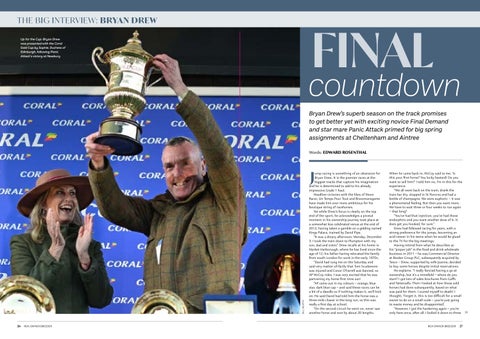
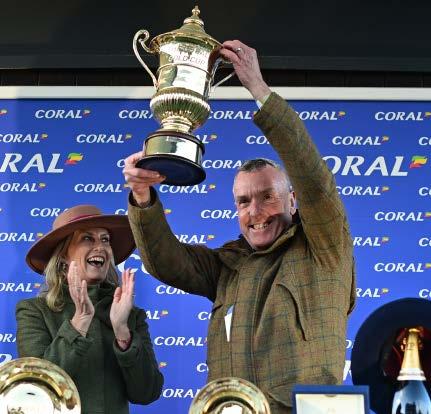
Up for the Cup: Bryan Drew was presented with the Coral Gold Cup by Sophie, Duchess of Edinburgh, following Panic Attack’s victory at Newbury
BILL SELWYN
THE BIG INTERVIEW: BRYAN DREW
‘You
should get £100k for winning a Grade 1 in Britain’
Bryan Drew has been vocal about the economics of racehorse ownership in Britain, stating that the numbers don’t add up for investors at his level.
So how would he redraw the racing map in Britain?
“There’s no magic answer or somebody would be pursuing it,” he says. “My take on it is there’s too much racing.
“I come from a retail wholesale background. If it was a business with 400 stores, we would need to shut 100 of them. There’s too much racing, it dilutes the product, it spreads things too thinly and people lose interest.
A lot of that is at the behest of the bookmakers who want as many betting events as possible.
“It’s a sport that has so many voices around the table that it’s difficult to achieve any sort of consensus of agreement. If you’re running Leicester racecourse and it’s nominated for closure, you’re not going to agree to it, are you?”
Panic Attack has been Drew’s biggest earner this season, collecting over £250,000 for her three wins in 2025/26, yet the owner feels the overall level of reward, especially in some of the better races, is unsatisfactory.
He says: “Prize-money at the top level is woefully inadequate. You look at any sport that has invested at the top level, it has achieved positive results. If you win a Grade 1 here, you should win at least £100,000. A lot of races tick that box, but some don’t.
“One season we won the Grade 1 Challow Hurdle and the [then Grade 1] Finale Juvenile Hurdle and took home £50,000 for both – it’s absolutely
things: I wanted to get a King’s Theatre gelding, I wanted a partnership with an owner that knew the game, and I wanted to find a trainer I trusted.
“Kings Palace was advertised for sale on the Pipe website. I made an appointment to visit David and I took my dad with me, because my dad was a very good judge of character.
“We had a lovely morning at David’s, saw the horse gallop – he looked nice and a little flashy, which I liked – and I
pathetic [considering] the money people put into the sport to try and achieve success.
“You should get £100,000 for a Grade 1, £60,000 minimum for a Grade 2 and £40,000 for a Grade 3 or Listed race. It would mean you would be guaranteed to get an appropriate return for success at the top level. As you come down the pecking order, the economics won’t allow for that.
“We have seen some positive developments, including the Berkshire Winter Million at Ascot and Windsor, but I think we’ve got too much poor racing and too many poor horses in the sport. If you’ve got a business with 400 stores, it’s tough to close 100 of them. But then you need to try and transfer the turnover from those 100 stores into the remaining 300.”
Drew continues: “My sense is that you need to lose around a third of fixtures to then regroup. We need to keep contributions at the same level to a reduced base in order to preserve the future.
“The BHA has tried to introduce initiatives such as the point-to-point bonus – a great idea but they’re sticking plasters, as it won’t change the fundamental flaws that exist in the business. Bookmakers won’t put more into the sport because they see it declining.
“The pitch is: we’re going to do what we need to do to preserve the business, we need your support, then we’ll grow it, at which point we’ll look to share the benefits of the growth. At present, it’s running down slowly, everyone is fighting their own corner, and we’re on a slow glide path to death.”
bought half of Kings Palace in October 2012. The other owner was David Johnson. Unfortunately, I never met David as he became ill and died in the summer of 2013.
“Kings Palace turned out to be very good and got me into this mess. If he was rubbish, I would have dropped it like a stone.”
Something of a Cheltenham specialist, Kings Palace won four times at the track, including a Grade 2, before tragically succumbing to an injury sustained at
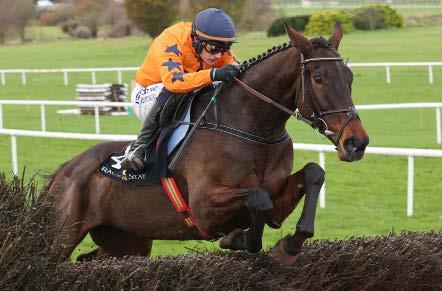
Final Demand: progressive sevenyear-old is on course for the Brown Advisory Novices’ Chase at the Cheltenham Festival
Aintree in April 2016.
In November 2013, Drew had joined forces with another of Pipe’s owners, Professor Caroline Tisdall, to pay £450,000 for classy French hurdler Un Temps Pour Tout. The Robin Des Champs gelding recorded successive strikes in the Ultima Handicap Chase at the Cheltenham Festival, the second under top weight of 11st 12lb, and claimed a Grade 1 at Auteuil, banking £500,000 in prize-money by the time his career concluded.
The owners also went in together on a once-raced bumper winner named Moon Racer, bought for £225,000 in 2014. Despite proving fragile, his ability was not in question, providing Drew and
Tisdall with a day to remember when taking the Champion Bumper at the 2015 Cheltenham Festival.
Latterly, Bravemansgame, a £370,000 purchase in 2019, recorded a trio of Grade 1 wins under the tutelage of Paul Nicholls, most notably the 2022 King George VI Chase. The Brave Mansonnien gelding was initially owned in partnership with John Dance; Drew bought out his ex-partner’s share from the administrator after Dance was charged over his role in a £64 million fraud. His trial has been set for September 2027.
To the outsider, Drew looks to have the magic touch when it comes to locating and buying young talent – after all, a hefty
price tag is no guarantee of success on the racecourse. Yet he dislikes the description of being a lucky owner.
“I’ve had lots of bad ones,” says Drew, who also owns horses in partnership with Paul Vogt and Grahame and Diana Whateley. “It’s misleading to say I’m not often wrong. Nobody talks about the mugs – I’ve owned plenty of ordinary horses. But I don’t tend to stick with them long.
“I’m in the game to try and get success at the highest level. It’s difficult for a small owner because you’re competing against big budgets and people that are very well connected, who are seeing horses in France and Ireland. It is tricky to recruit.
“Caroline and I have similar aspirations
– we want success at the top level and don’t really want to be hooked up in handicaps all the time. Partnerships can be a thorny area, but we clicked early on –we’re both very ambitious.” He continues: “My philosophy is simple – it’s a bit like business. You do your homework and get involved with the best people you can, and then you need to be lucky.
“You establish your own prejudices and preferences – stallions you like and don’t like, characteristics you like and don’t like – then you start to form a mental check list.
“I’ve learnt it’s good to spread your risk and not have all your eggs in one basket.
THE BIG INTERVIEW: BRYAN DREW
If the horses are not running well for one trainer, you’ve got the others to lean on.
“I’m less keen on the sales these days; there are too many fingers in the pie, the marketing push can be misleading, and it tends to be expensive. Nowadays I prefer to buy privately, like Final Demand.”
The Willie Mullins-trained Final Demand is the animal that Drew feels is the most talented to have carried his silks. Owned in partnership with Tisdall, he believes the Walk In The Park gelding can progress into a genuine Cheltenham Gold Cup contender.
Winner of his only point-to-point at Lingstown – a profile he shares with Bravemansgame – Final Demand won two Grade 1s over hurdles and at the time of writing was set to bid for a second Grade 1 over fences at the Dublin Racing Festival on February 1.
“He has a bit of X factor,” Drew opines. “He knows he’s good, he doesn’t waste any energy, and he’s very efficient. Final Demand doesn’t set the world alight at home and Ruby Walsh, who has ridden him, has said you wouldn’t know he’s by Walk In The Park – he takes more after his dam, Zuzka, a Flemensfirth mare.
“Bravemansgame was rated 150 at the end of his novice hurdle season – Final Demand was 158 and has a better turn of foot, which potentially will make him more versatile and enable him to achieve more. The horse has done everything you’d hope for.
“Caroline had been in the doldrums a bit having had some poor experiences and I thought this horse might be very decent. Although she’s very loyal to David [Pipe], she fancied having a horse with Willie. She came on board and I was both delighted and relieved when he won his maiden hurdle at Limerick.
“These big-ticket horses give you a chance of getting your money back. We’ve pushed the boat out together but as Caroline always says, if you divide by two and take off a nought, it doesn’t seem quite as painful!”
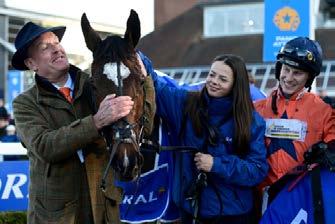
While Final Demand has been impressing across the Irish Sea, Panic Attack has gone from strength to strength at home. The Canford Cliffs mare, trained by Dan Skelton, has enjoyed the perfect season to date, taking two of the most competitive handicaps in the calendar, the Paddy Power Gold Cup at Cheltenham and Coral Gold Cup at Newbury, before sauntering to victory in a mares’ Listed prize back at Newbury.
Panic Attack’s improvement, at the age of ten, has surprised all her connections, who have agreed that her ultimate target should be the Randox Grand National, with
a possible tilt at Cheltenham’s Grade 2 mares’ chase beforehand.
“I bought her after she won a Listed bumper at Market Rasen for Willie [Mullins],” says Drew, who would like to breed from Panic Attack when her racing career is over. “He asked to keep her, but I sent her to David Pipe. She didn’t really fulfil her potential at Pond House – it looked like I’d made a mistake despite her residual value – and I was running out of ideas.
I love the challenge and the fact it’s so difficult to get success
“I moved her to Sophie Leech in France with the idea of winning some valuable mares’ chases but that didn’t work out, as Sophie was unable to make entries at the time, so I moved her again, this time to Dan. She went to him in November 2024 and since then has gone up 22lb and won £270,000, which is phenomenal.
“We agreed to train her very lightly when she first went to Dan. She’d had some leg trouble and a pelvic injury and we wanted to reignite her interest in the game. She responded well over hurdles, so Dan said we should go back over fences.
“Panic Attack won at Windsor with her
head in her chest in January last year before picking up a knock when pipped at Warwick. We drew stumps but knew she was well handicapped, so I suggested the Paddy Power Gold Cup for her first run back.
“She had a great summer and came back full of beans, fighting fit. There were no niggles and she was healthy – that’s been the key, while she loves the regime with the Skeltons.
“Panic Attack was very good at Cheltenham, but she was nothing short of magnificent at Newbury. I’ve watched that replay about 50 times. When I go the gym, one of the nicest things to do is watch your horse win a big race – it keeps you motivated. If she can do it, you can do it for another ten minutes!
“I was with my son Harry at Newbury – we said within an hour of the finish that the Grand National should be the target. Will she get the trip? Who knows. She’s an excellent jumper, a real trier with a big heart.
“In years gone by you wouldn’t have put a black-type mare in the race, but I think that’s changed – the fences aren’t what they used to be and it’s now a contest for good horses. It makes a lot of sense.”
Should Panic Attack triumph at Aintree, Drew would savour a “fantastic” success, although that isn’t the race that would mean the most to him.
He says: “The pinnacle of the sport is the Cheltenham Gold Cup. I’d love more Cheltenham Festival wins but the Gold Cup is the ultimate prize.
“Between October and April, racing is my obsession. I love the challenge and the fact it’s so difficult to get success, which is perverse in a way. When you do get a big win, it’s just so rewarding.”
Drew with his mare Panic Attack after her brilliant performance in the Coral Gold Cup