
Open Spaces (Spring 2026)

Page 1


OPEN SPACES

Quarterly Newsletter

Ojai Valley Land Conservancy

BOARD OF DIRECTORS

Stefanie Coeler President

Martha Groszewski Treasurer

Sarah Sheshunoff Secretary

Annie Nyborg

Bret Bradigan

Dave Comfort

Fiona Hutton

Jerry Maryniuk

Jim Finch

Kris Griswold

Lizzy Chouinard

Lu Setnicka

Roger Essick

Tim Rhone

STAFF

Tom Maloney Executive Director

Tania Parker Deputy Director

Brendan Taylor Director of Field Programs

Vivon Sedgwick Restoration Program Director

Adam Morrison Development Manager

Nathan Wickstrum Communications & Outreach Manager

Rhett Walker Grants Manager

Ethan Van Dusen Office Manager

Carrie Drevenstedt Development Database Coordinator

Christine Gau Land Protection Specialist

Linda Wilkin Preserve Manager

Keith Brooks Land Steward

Sophie McLean Native Plant Specialist & Nursery Manager

Claire Woolson Rewild Ojai & Volunteer Coordinator

Martin Schenker Restoration Field Crew Manager

Madison Moore Nursery Assistant

Caden Crawford Restoration Field Crew Lead

Kiandra Kormos Restoration Field Crew

Emma Gibson Restoration Field Crew

Celeste Ayala Nursery Intern

Lilac Feliciano Nursery Intern

Mission:

To protect and restore the natural landscapes of the Ojai Valley forever.

STAY CONNECTED WITH OVLC: OVLC.ORG

FIND US ON FACEBOOK & INSTAGRAM

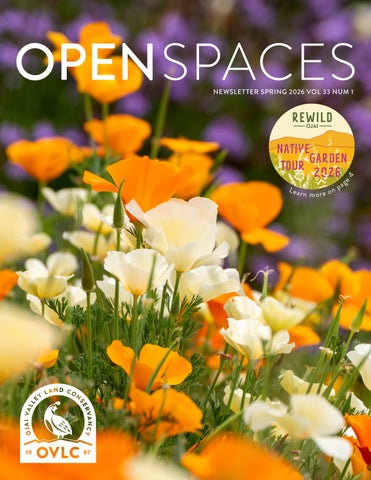
Cover photo by Nathan Wickstrum

BOARD & STAFF CHANGES

WELCOME TO BOARD MEMBER

KRIS GRISWOLD

We are pleased to welcome Kris Griswold to the OVLC Board of Directors. A recent full-time resident of Ojai, Kris first discovered the valley nearly 40 years ago and has lived in and around mountain communities throughout her life.

Kris brings more than 35 years of experience in senior finance roles across several industries, including positions with Dole Packaged Foods, THQ, Amgen, ViewSonic, Day Runner, and Deloitte & Touche. She holds an AB from Occidental College and an MBA from the UCLA Anderson School of Management.

Kris is active in the Ojai community, serving on the board of the Ojai Community Chorus, as treasurer of the Ojai Valley Garden Club, and on the grants fiscal committee for the Ojai Women’s Fund. She and her husband are passionate gardeners and enjoy creating drought-tolerant and native plant landscapes.

We are excited to welcome Kris to the board and look forward to the perspective and experience she will bring to OVLC’s work in protecting and restoring the Ojai Valley’s natural landscapes.

WELCOME BACK, BOARD MEMBER ROGER ESSICK

Many in our community already know Roger Essick—Ojai avocado and citrus farmer, longtime friend of OVLC, and one of the people who has helped guide the organization since its earliest days. Roger has served on the OVLC board many times since our founding in 1987 and has stepped up as board president more than anyone else over the years. After a short break, we’re glad to welcome Roger back to the board. We had a feeling he wouldn’t stay away for very long!

RAISED: $7.4 MILLION

GOAL: $7.5 MILLION

LAND + LEGACY Rancho Cañada Larga

We’re in the final stretch of the Land + Legacy Campaign. Thanks to this incredible community, we’ve raised more than $7.4 million toward our $7.5 million goal—and met the Holm Family’s $100,000 matching challenge. With just under $100,00 remaining, we are within reach of fully funding the protection and long-term stewardship of Rancho Cañada Larga— while strengthening OVLC’s capacity to care for a landscape that will soon more than triple in size. Your support today helps secure this legacy—forever.

NATIVE NATIVE TOUR TOUR

GAR DEN GAR DEN 2026 2026

NATIVE GARDEN TOUR

Ojai Valley residents have done an admirable job in planting drought-tolerant gardens to save one of our most precious resources, water. OVLC’s Rewild Ojai Program began as an idea to enhance those laudable efforts by bringing native habitat restoration into private yards to advance meaningful biodiversity goals while still saving water.

While each garden (and gardener!) is contributing in their own unique and inspirational way to that objective, I am thrilled to report that OVLC’s Rewild Ojai Program has now certified more than 80 acres of rewilded habitat across the community. That is an area larger than the 58-acre Ojai Meadows Preserve, created not in one place but across dozens of landscapes throughout the valley.

OVLC and Birdsong Ranch recently hosted the renowned ecologist Doug Tallamy to speak about how rewilding can help reverse the tide of species loss. Dr. Tallamy emphasized that, for the insects that are the basis of our native food chains, habitat size doesn’t matter. Each of us can make a difference in our own small way. My wife and I planted a couple of narrow-leaved

milkweeds in our yard and voilà, monarch butterflies appeared just weeks later.

Across the valley, gardeners are discovering that native plants support an extraordinary diversity of insects, birds, and other wildlife. Even small patches of habitat can provide essential food and shelter. When these gardens are spread across the community, they begin to form a network of habitat that benefits the entire landscape.

If you would like to see this effort firsthand, OVLC’s Native Garden Tour on April 18 offers a chance to visit a collection of inspiring gardens that are helping restore habitat right here in our community.

By planting native species in our own yards, each of us can help support what the great biologist E.O. Wilson called “the little things that run the world.”

EXPLORE OJAI’S MOST INSPIRING

PLANT GARDENS!

APRIL 18, 2026 I 9AM-3PM

• Visit 14 native plant gardens across the Ojai Valley

• Every attendee receives a tour book with a tour map, garden highlights, plant care tips, and so much more!

• Meet knowledgeable docents at each garden—ask questions and get tips.

• Connect with fellow gardeners and nature lovers.

• Get inspired to Rewild Ojai!

When you add native plants to your garden, you join the movement to build habitat connectivity and increase climate resilience in the Ojai Valley. Nature isn’t separate from us—it’s home. And your journey to rewilding starts right outside your door. Learn more today at ovlc.org/rewild-ojai.

WHY REWILD OJAI?

When we think about climate change and biodiversity loss, it’s easy to feel like individual actions don’t matter. Reusable bags, mending clothes, riding a bike—these are all meaningful, but their impact can feel distant and hard to see. Rewilding is different. In just one season, a garden can come back to life.

Last year, one Ojai family transformed their front yard— removing Bermuda grass and replacing it with native plants. What began as dry, lifeless soil quickly became something extraordinary. Within a single year, the garden came alive.

Yellow-faced bumble bees now drift from flower to flower. Praying mantises and leafhoppers move through the foliage. Lizards rustle through the leaf litter. Anna’s hummingbirds feed on bright California fuchsia, and a pair of acorn woodpeckers has already claimed a young oak as their granary. Even a neighborhood skunk has made the garden part of its nightly route.

This is the power of native plants. You don’t just support biodiversity—you experience it.

Each garden on this year’s tour is part of a growing mosaic of habitat across the Ojai Valley, with at least 50% native plants. These spaces show what’s possible—and how quickly change can happen.

Come see it for yourself on this year’s Rewild Ojai Native Garden Tour!

Get inspired, learn what works, and discover how you can rewild your own garden.

WEAR YOUR WILD!

Represent the Rewild movement in and out of your garden! Rewild gear will be available at Birdsong Ranch during the Garden Tour, and you can shop ahead of time at our online store at ovlc.org. Don’t miss out on your chance to show your support!

One of the most remarkable stops on this year’s tour, Birdsong Ranch offers a rare chance to step into a landscape transformed by native plants.

In just a few years, thousands of plantings have taken root, drawing in more than 140 bird species and creating a garden that feels alive in every direction.

This year, to accommodate high demand and limited parking, visits are offered through reserved entry windows. Enjoy a quieter morning for birdwatching and a more relaxed pace, or join us in the afternoon for a livelier experience—complete with cocktails by our 2026 Native Garden Tour sponsor, Wilder Gin / Ventura Spirits. Throughout the day, OVLC’s main information and merchandise tables, along with a coffee cart, will be available at Birdsong Ranch for both morning and afternoon visits.

Learn more about Birdsong Ranch at birdsongranch.com

STEWARDING THE STREAMS

RIPARIAN RESTORATION IN THE VENTURA RIVER WATERSHED

While our restoration team spends the summers in willow thickets and alluvial scrub, we dream of a watershed that is freed of the clutches of invasive species. Intentions are set as our calloused feet traverse Eocene cobbles, our dainty palms gather seed, and soft conversation is found muffled by flume. We quickly find that it is not a unique dream, rather one of unquantifiable spirits within our valley, from translucent benthic macroinvertebrates to our neighbors in the community. This realization brings a blanket of hope, of trust and power, that we all crave a nourished watershed, one well taken care of, so that in turn our ecosystem can nourish all. With fiery eyes, we set out determined.

OVLC recognizes that the efforts of ecological healing made throughout our valley are of magnitude greater when made together. We know that most of you reading this very article are engaging with your properties in creative, restorative ways.

Keep going. This movement, the re-establishment and preservation of biodiversity, relies on us all. Acting in unison and collaboration is one of the most beloved roles we have as leaders of climate resiliency in the valley. We ache for connection, for the kind moments of getting to know the folks who make this valley special. This past fall, we were grateful to engage with the community as we underwent our largest invasive species removal undertaking to date.

From September through January, we cleared invasive species from 226 acres of land. Of which, 35 acres were solely giant reed ( Arundo donax). Over 25 noxious species removal specialists were working every day, battling infestations of non-native plants on over 20 privately owned parcels in the watershed. Our work here has just begun, and we need your help to bring nature home! ARUNDO WRAP-UP & WHAT WE ACCOMPLISHED THIS YEAR

RESTORATION GOALS & WHY IT MATTERS TO REVEGETATE NATIVELY

The goal of our restoration work is to return ecosystem strength and function after domination by arundo. Most of you know by now that there are very few native species that can co-exist with arundo, plants or animals. Riparian zones, being a hub for our fine feathered friends, are usually lively and engrossed in a beautifully complicated song. Yet dense stands of arundo are often marked by an unsettling silence. Where arundo persists, nothing else exists. That said, when it is removed, all that is left is bare ground, degraded soil, and and a depleted native seed bank.. If we don’t actively revegetate after removal, the site is highly vulnerable to colonization by other invasive species.

Revegetating with native plants helps provide resilience against future disturbance. The presence of native species that have had a head start in our nursery helps resist invasives, in part, by simply taking up space. They utilize limited resources like space, sunlight, and minerals, leaving less for the non-native plants. Native roots help knit together the soil, restabilizing the flood zone. They also help rebuild the soil ecology, which in turn encourages more native recruitment. It is such a treat to watch this magic unfold in the field. When you lend nature a hand, she quickly takes hold and moves forward in leaps and bounds. Native vegetation also provides habitat and nourishment for our local fauna. For example, many native insects have mutualisms with native plants and will struggle or even cease to exist in their absence. While OVLC doesn’t conduct insect surveys, we do recognize the return of insectivorous birds in areas we have restored, which is an excellent indicator of the importance of our work. The native trees and shrubs that we return to our alluvial zones provide food and shelter for an abundance of critters beyond insects, but we’ll get more into that later. It feels a lot like a paint by numbers piece, we choose plant species and densities by studying and mimicking intact riparian woodlands nearby. Nature has already given us the outline; we are simply filling the gaps left by arundo and restoring color to the landscape.

OVLC’s restoration team planted native vegetation along the North Fork of Matilija Creek after bridges replaced old crossings at Wheeler Gorge Campground—reopening habitat for steelhead.

STEPS WE ARE ACTIVELY TAKING. WHAT IS THE FIELD CREW UP TO?

Down along San Antonio Creek and the Ventura River, our work has shifted from removal to renewal. Following invasive weed treatments, as the pressure eases, we begin restoring what belongs. Native plants are beginning to return, and we are there to give the land a helping hand.

Winter rains provide the best conditions for planting, and this season we have installed over 3,000 native plants and stakes across these sites. Much of our time is spent driving in willow and mule fat cuttings “stakes” into moist streamside soils, knowing they will root quickly and begin stitching the banks back together. Within the stream’s margins, we sow cocklebur ( Xanthium strumarium) seeds, install knotgrass (Paspalum distichum) stolons, and plant willowherb (Epilobium ciliatum).

In transition areas, we are planting a mix of grasses and shrubs, chosen to reflect the reference vegetation community. Species like California rose (Rosa californica), creeping and giant wild rye (Elymus triticoides, Elymus condensatus), mugwort ( Artemisia douglasiana), and sage (Salvia spp.), to name a few, help rebuild layers of habitat over time. Planting, however, is only the beginning.

We return again and again to buffer invasive regrowth, giving young natives the space to root deeply and claim their place along the banks. We watch closely as the landscape begins to shift, revisiting photo points to witness the transformation and conducting bird and reptile and amphibian (herp) surveys to see who has answered the call of returning habitat.

Over time, these photo comparisons allow us to track canopy development, groundcover expansion, and improved bank stability along the floodplain margins. The return of insectivorous birds and increased herp activity serve as early indicators that structural complexity within the riparian corridor is being restored.

As these plants settle in and life begins to stir around them, the creek moves steadily toward the resilient, nourished watershed we all long to see.

FUTURE LIFE. WHAT WILDLIFE AND HABITATS WILL BE RETURNING?

So, what’s next? With the arundo stands removed, it leaves critical space that biological communities desperately need to expand, and thrive. Throughout the watershed, we’ve identified various plant communities that we hope to encourage to re-establish.

During our active restorations, we’ve encountered numerous microclimates, each unique with their vegetation communities, each with their own distinctive species palette. Upstream from Camp Comfort, beautiful old-growth forests nestle along the sandy banks of San Antonio Creek, teeming with animals and fungi alike. To name a few, we discovered an incredible amount of southern California shoulderband snails (Helminthoglypta traskii ), emerging from their leafy hides during evening rainfall in search of a fungus feast. Scattered throughout this reach, we noticed fungal caps poking out of the leaf litter in various

colors, shapes, and sizes. Mushrooms are not only a treat to find, but a large mycelial network is a huge indicator of a healthy riparian woodland. These moisture-rich riparian woodlands support another elusive species that we hope to promote a thriving habitat for, the arboreal salamander ( Aneides lugubris). Arboreal salamanders are unique in their preference for nooks and calluses of old growth riparian trees, often sycamores or oaks. When we think of success in our restoration areas, we envision them everywhere. These critters, along with many other wildlife species, are insectivores, meaning they depend on a slew of insects to survive. Re-establishing our biological communities restores the food web, from the smallest biota to the resplendent species we know and love.

Recently, we’re already starting to see an increase in pollinator activity in our native willow and mulefat thicket communities

Willow and mule fat cuttings

as their buds start to swell and bloom. This was very exciting to see, not only because our keystone species pollinators help hold ecosystems together by supporting plant reproduction and plant diversity, but with an uptick in insect pollinator activity means… birds! To highlight some, we’ve observed large bouquets of Yellowrumped Warblers (Setophaga coronata), hunting throughout the willow and mulefat thickets and into the surrounding alluvial scrub, searching for a buzzing snack. Another bird species we have recognized scratching through our blossoming alluvial scrub community is the California Towhee ( Melozone crissalis). These birds are mostly ground foragers, hunting through the sandy, rocky surface for insects such as our native ant species, grasshoppers, beetles etc. These ecosystems support frugivorous birds as well, like the Cedar Waxwing (Bombycilla cedrorum), who scour through our coast live oak riparian habitat in search of our blue elderberry (Sambucus nigra ssp. caerulea), toyon (Heteromeles arbutifolia) as well as from our Pacific poison oak (Toxicodendron diversilobum), whose fragrant blooms and ripe berries are just beginning to show off.

Slightly upland, within our newly established sagebrush and chaparral plant communities, scuttle other, less-feathery animal species. Cold blooded critters such as snakes and lizards take residence in burrows and dark hide-aways among the bushy sage scrub, in search of small rodents and insects. One of the most commonly seen animals in our sage scrub and chaparral is the Pacific gopher snake (Pituophis catenifer), which feeds on gophers, mice, squirrels, and rats, including the dusky-footed woodrat (Neotoma fuscipes), an important keystone species in this ecosystem.

All of our plant communities and animal species rely heavily on the flow of the other. As a restoration team, we’re curious about every interaction in nature, and are striving to restore that flow back into the ecosystem. If you’re ever interested in spending time among our natural environments, come volunteer with us, learn with us, and help us restore what once was.

Caden Crawford, Emma Gibson, Kiandra Kormos, & Martin Schenker
Photo by GregSchechter
California Shoulderband Snail (Helminthoglypta traskii ) Arboreal Salamander ( Aneides lugubris)
Yellow-rumped Warbler (Setophaga coronata)
Pacific Gopher Snake (Pituophis catenifer)

MEET THIS YEAR’S WSP

WHAT IS WSP?

Each year, OVLC and CDFW Santa Barbara host and mentor four Watershed Stewards Program (WSP) Corpsmembers for their 10.5-month service term. WSP is a program of both the California Conservation Corps and AmeriCorps that places young professionals with mentors at placement sites across the state to gain experience in fisheries work, watershed science, environmental education, and community outreach.

This year’s WSP Corpsmembers (pictured above from left to right) are Dylan Hansen, Owen Sobel, Summer Seligmann, and Alex Dixon.

These four Corpsmembers serve with CDFW Santa Barbara to implement their coastal monitoring program. This program focuses on studying the abundance, productivity, spatial structure, and diversity of Southern California steelhead rainbow trout (O. mykiss) in the Monte Arido Highlands, Conception Coast, and Santa Monica Mountains. This includes the Ventura River Watershed and the Ojai Valley.

Fisheries activities with CDFW are focused solely on steelhead trout, as these fish are a keystone species throughout Southern California watersheds. Steelhead use the entire length of the watershed throughout their various life stages—from the estuary, where rivers meet the sea, to the furthest upstream extent of anadromy—and are therefore an indicator species for the health of the entire watershed. Surveying riparian zones in all seasons gives Corpsmembers a thorough understanding of the habitat steelhead occupy, the challenges they face, and the necessary improvements needed to help populations recover to historical levels.

Their work with OVLC includes invasive plant removal, nursery propagation, revegetation, monitoring, and other restoration activities that focus on reinforcing riparian habitat along the Ventura River Watershed. They also learn critically important skills for environmental restoration, such as plant identification, proper planting and removal techniques, and strategies for designing and completing large-scale restoration projects. Through this hands-on experience and mentorship, they gain

This year’s WSP Corpsmembers (left to right): Dylan Hansen, Owen Sobel, Summer Seligmann, and Alex Dixon.

insight into the many facets of large-scale restoration and stewardship. This combination of knowledge about steelhead trout and their habitat provides a unique, holistic perspective that further informs the Corpsmembers’ work. By drawing on restoration experience, Corpsmembers gain important context for their service with CDFW. Similarly, sharing knowledge about fish and stream health with OVLC helps illustrate the impact of restoration efforts and provides a clearer understanding of ecosystem-wide outcomes.

HOW WSP IMPACTS THE VENTURA RIVER WATERSHED

Southern California steelhead trout populations have significantly declined over the past half-century and were listed as endangered under the ESA in 1997. Until the mid-20th century, Ventura and Santa Barbara counties supported world-class steelhead fisheries, with runs of thousands of fish each year. However, from 1994–2018, only 177 observations were recorded.

These declines are due to a variety of factors, including channelization of waterways, fish passage barriers such as dams and road crossings, water pollution, and climate change. Together, these impacts have limited steelhead’s ability to spawn successfully, resulting in a dramatic population decline.

The disappearance of a keystone species in Southern California waterways has created ripple effects across riparian and upland ecosystems. Without healthy annual steelhead runs, watersheds lose a critical source of nutrients and energy. Plants, animals, insects, and birds all depend— directly or indirectly—on steelhead returning to the watershed. Without them, ecosystems are missing a vital piece of nature’s complex and interconnected web.

By preserving and restoring riparian habitat to support steelhead recovery, OVLC helps rekindle these ecological connections across trophic levels and biological communities in the Ojai Valley. The Ventura River Watershed, like many others in Southern California, requires extensive restoration to support the return of healthy steelhead populations.

Through ongoing monitoring and restoration efforts—led in part by WSP Corpsmembers—there is hope to reverse constraints on watershed function, improve climate resilience, and enhance habitat conditions to ensure survival and recovery of Southern California steelhead trout.

WSP Corpsmembers Dylan Hansen and Alex Dixon with OVLC’s restoration team at Wheeler Gorge Campground, preparing for a day of habitat restoration to improve fish passage on the North Fork of Matilija Creek.
Artwork by Tom McCormick

SHERIFF’S MOUNTED UNIT ON PATROL AT VENTURA RIVER PRESERVE

If you’ve visited the Ventura River Preserve recently, you may have seen riders on horseback patrolling the trails. Noel Aguilar, a volunteer with the Ventura County Sheriff’s Office Mounted Enforcement Unit (MEU), is helping lead a new effort to bring mounted patrols to OVLC preserves. Along with other MEU volunteers, Noel helps provide a welcoming presence for visitors—sharing trail information, encouraging responsible recreation, and keeping an eye out for potential safety concerns. OVLC’s Preserve Manager Linda Wilkin spoke with Noel about his lifelong passion for horses, his work rescuing mustangs, and how mounted patrols can help steward the Conservancy’s land.

Noel, thank you for meeting with me on this beautiful spring day, and for all the work you’ve already done helping the Conservancy steward our lands. To start, can you tell me a little bit about yourself?

I grew up in Venice Beach during what I call the golden era— artists, musicians, surfers, hippies. It reminds me a little of what Ventura was like about ten years ago.

I went to Venice High and lived there until my oldest son was five. The area had already started to change, so we decided to look for somewhere different and eventually ended up in Ventura County. Ojai has always been a special place to me. Even before moving here, I would come up just to visit. It felt calm and sacred, with a lot of open land.

I joined the Sheriff’s Mounted Volunteer Unit close to two years ago as a way to give back. I’ve been involved with horses most of my life, so it brings together two things I care about—service and horses.

After 2020, when beaches and trails were closed, a lot of people from Los Angeles started coming here because they saw it as a different kind of place. Being on the preserves and noticing that shift made me want to help protect them.

I live about two minutes from Oso Trailhead, so I’m on the preserves almost every day. I figured, if I’m here anyway, I might as well help out. If I see trash, I pick it up. If something looks dangerous, I call it in. Eventually I thought it would be great to do something more formal as part of a team to help protect these lands.

What first sparked your interest in riding horses and horsemanship?

If you ask my family, they’ll say it’s because I’m Mexican—it’s just in our blood. Growing up, we visited Mexico often, and the only thing I ever dreamed about was getting on a horse.

My mom is from Jalisco, outside Guadalajara. Her small town’s name roughly translates to “place of owls,” because there were so many different species of owls there.

Looking back, I’m surprised I didn’t get hurt. I would just jump on a horse and go—no training, no fear. But it was the freest I’ve ever felt. Then you grow up, go to school, become a parent, and life gets busy. Later, when I had more time and financial freedom, I got back into horses about 25 years ago.

One of the first things I did was start rescuing mustangs. I became really interested in wild horses in America and how they’re protected—sometimes not as well as people think. I’ve probably rescued around fifteen mustangs. They need patience and gentleness, and then I either keep them or find them new homes. It’s a lot like rescuing dogs from a shelter—just bigger.

I’ve also traveled to Spain many times for the Festival of the Spanish Horse. One of the things I love about horses is that you can study them for a lifetime and still keep learning. I consider myself a lifelong student of horsemanship.

Can you share a bit about the Mounted Enforcement Unit?

What stands out is the dedication. Everything involved in volunteering with the MEU is yours—your horse, trailer, tack, and time.

People volunteer because they want to serve, whether it’s at parades, community events, or patrols.

For me, I started thinking about how the unit could support OVLC preserves. Just having a visible presence on the trails can really help people.

Years ago, I had an experience that stuck with me. I came across a woman on the trail who was lost and in distress. She was diabetic and didn’t have her insulin. I put her on my horse and walked her back to safety. It made me realize how valuable it can be to have someone out there looking out for people.

Since then, I’ve felt that having a visible presence on the trails can make a real difference. People often say, “Oh, you guys are out here? That’s awesome.”

What motivated you to reach out to OVLC about patrolling the preserves?

Locals understand how special this place is. People who live here know how lucky we are to walk these preserves and breathe the fresh air.

Visitors sometimes don’t know the guidelines yet, and that’s okay—it’s an opportunity for education.

Sometimes I see things like littering, dogs off leash, dirt bikes, or loud speakers—things that don’t really belong on a nature preserve.

Having seen how quickly Venice Beach changed, I know how fast places can shift. I want people to enjoy the preserves while helping make sure the land stays protected.

A big part of your role involves connecting with visitors. How do you approach those conversations?

Having a horse is a great icebreaker. People naturally come over to ask about the horse or for directions.

If we see something like a dog off leash, we explain that it’s safer for the dog, other trail users, and wildlife if they keep it leashed. We also remind people about rattlesnakes or river crossings.

One time I saw a couple carrying a large basket of wildflowers. I explained that picking them means they won’t drop seeds for next year. They apologized and said they didn’t know—they had picked them for a pregnancy announcement photo.

Being on horseback makes those conversations easy. Families with kids especially love to stop and talk.

Tell us about your horse.

My main horse for patrol is named Shaman. His registered name is Wizard, but around here people call him the “Ojai Shaman.”

Noel Aguilar and his horse Shaman.

He’s about six years old and a big horse. He came from Texas and was bred by the Amish, who are known for producing calm, well-mannered horses.

He’s a draft cross—his father is Spanish and his mother is Percheron—so he has a big, regal build. He’s gray and speckled and incredibly calm, which makes him perfect for patrol work.

I also have a roan Quarter Horse from King Ranch in Texas who has more of an “I’ve seen everything” attitude. Then I have two performance Quarter Horses, Chili and Angel, who are amazing athletes but a little too high-energy for Mounted Unit work.

What kind of training does a horse go through for the MEU?

The training never really stops. Every year we have to re-qualify as a rider and as a team with our horse.

There’s desensitization training—noise, crowds, obstacles, dragging objects, riding in formation.

Last year during a training exercise I was injured and ended up with multiple fractures and a traumatic brain injury. It wasn’t anyone’s fault—it’s just the reality of working with large animals.

With horses, trust is everything. They’re prey animals, so their instinct is to run. But if they trust you, they’ll look to you for guidance.

What are some of your favorite moments out on patrol?

Honestly, interacting with people. It’s rare to meet someone who isn’t drawn to a horse.

My favorite moments are with kids. You’ll hear, “Mom, there’s a horse! Can I pet it?” Seeing that excitement reminds me of when I first saw a horse as a kid. You never forget that moment.

For readers unfamiliar with the program, what authority does the MEU operate under?

The unit operates under the Ventura County Sheriff’s Office. There are sworn deputies in the Mounted Unit, and volunteers like us support them.

When we patrol, dispatch knows we’re out there. If there’s an emergency, we call it in. Our role is mostly observational—helping visitors and reporting anything that might need attention.

Do you see the program growing in the future?

I hope so. I’ve started spreading the word and a few riders are interested in qualifying for the unit.

Right now, we need at least two riders to patrol together, but if more people qualify, we’ll be able to get out there more often.

It feels like a missing piece that can help support the Conservancy’s stewardship work.

If someone sees you out on patrol, should they say hello?

Absolutely. Being on horseback naturally invites conversation Sometimes we even carry extra dog leashes in our saddlebags. A local vet donated a stack of disposable leashes so if someone forgot one, we can hand it out and help keep dogs, wildlife, and other trail users safe. Our goal is for people to feel welcomed and safe while enjoying these special places.

I feel incredibly fortunate to live here. Every time I ride out onto the preserves, I’m reminded how special they are. The Conservancy has done tremendous work restoring and protecting this land.

Noel, I can’t thank you and the entire team of volunteers with the MEU enough. All of us at OVLC are incredibly grateful for your support and the dedication you bring to helping inspire visitors to be thoughtful stewards of the preserves.

Why We Joined Pushing Up Poppies

“By including OVLC in our estate plans, we’re giving back to the valley that has given so much to us. Joining Pushing Up Poppies was an easy and meaningful way to reflect our values without affecting our lives today—while ensuring our love for Ojai continues to protect these places for generations.”

Plant Your Legacy

By including the Ojai Valley Land Conservancy in your estate plans, you can help protect the beauty of Ojai for generations to come.

A bequest is a simple way to support OVLC in the future while retaining control of your assets during your lifetime. By making the OVLC a beneficiary of your will, trust, retirement plan, life insurance policy, or financial accounts, you ensure your values will be passed on after you.

Legacy Club Benefits

By joining OVLC’s legacy giving program, you help inspire others to make a similar commitment. As a member of the Pushing Up Poppies Legacy Giving Club, you will enjoy:

• Invitations to exclusive OVLC events

• Recognition in an OVLC newsletter — by name or anonymously

• Complimentary drinks at all OVLC events

• The satisfaction of leaving a legacy that protects the Ojai Valley beyond your lifetime

We hope that taking part in the Pushing Up Poppies Legacy Giving Club will be a rewarding experience for you and your family.

Learn more at ovlc.org/legacy-giving.

UPCOMING EVENTS

May 2

SUMMER WATERING WORKSHOP with Sophie McLean, OVLC’s Native Plant Specialist and Nursery Manager

May 15 – 17 RATTLESNAKE AVOIDANCE TRAINING FOR DOGS with High on Kennels

June (Date TBD) ALL ABOUT OJAI —WILDFIRE IN OJAI with Nicole Molinari from the US Forest Service

May 9

NATIVE FLORA WALK with Sophie McLean, OVLC’s Native Plant Specialist and Nursery Manager

June 6

NATIONAL TRAILS DAY & OVLC VOLUNTEER APPRECIATION CELEBRATION

July 18

NATIVE SEED WORKSHOP with Sophie McLean, OVLC’s Native Plant Specialist and Nursery Manager

August 11 - September 5

CALIFORNIA NATIVE PLANT LANDSCAPER CERTIFICATION COURSE

September 19 MOUNTAINFILM ON TOUR

September 18 UNDER THE OPEN SKY

November

NATIVE PLANT MONTH Celebrate the start of the planting season!

SPECIAL ACKNOWLEDGMENTS

IN MEMORY OF

Aurora Castanon & Janice (Bunny) Standel from Carol & David Castanon

Baer Hueppe from Amy & Marcus Hueppe

Betsy Vanleit from Arthur & Judy Vander, Jessica Mann, & Mark Silbernagel

Betty Andersen

I can see Mom sitting by the pond in the meadows of Ojai watching the birds and aquatic life and enjoying the breezes. from Judy Piazza

Brooks P Guyer

He loves Ojai and I thought of no better way to honor his adopted home. from Shelly Guyer

Cathy Spencer from Ronald Spencer

Christine Tarr

Donated on Winter Solstice Day. from Judy Piazza

Christopher Bates from Sandra Torres

Clint Vocke from Amy Olsen & Alan Morningstar, Frank Imbrogno, Gene & Mary Sherman, & Lynn Perry

Clint will always be dearly present in our hearts, and in nature, where he loved to be. from Helen Kamali

In memory of Clint, his legacy, and his passion for the outdoors. from Mary & John Anthony

Clint was an inspiration to us all to be better stewards of our land. from David & Cindy Anthony

We honor uncle Clint with a donation to help the land he loved so much. from Teresa Hodgkins

Dale Bard from Chuck Journey

David Kille from James & Shannon Frew

David Rowland

Thank you! from Maureen & Patrick Grace

Dick Frazier from Dave Schaar

Don Lucas

There is not a morning I don’t think of how much your Dad would love it here. I hold him so close on these trails. from Cristina Lucas

Donna Freiermuth from Eddie Beres & Jean Kilmurray MacCalla

Elisabeth Gallagher from Anna Khaja

Forest Sprague from Sanger Hedrick

Gerald Goldman

We have great memories of the great hikes the four of us enjoyed together on OVLC maintained trails during your visits to Ojai. from Bill Norris & Judith Hale Norris

Gisele from David Wappler

Gordon Onstot from Richard & Sue Yamamoto

Hugo Ekback from Linda & Boris Chaloupsky

James Ross from Karen Schmidt

Janelle Sharp

For all the moments she spent on the trails feeding her spirit. from Debora Kirkland

John Bee, DVM from Susan Bee

John Brooks

In loving memory of Johnny, for all he was and all he accomplished in his life. He loved you very much. from Judy Robertson

John Cressy from Kathleen Cressy

John G. Avildsen from Corrina Wright & Anthony Avildsen

Kay Burdick from Myrna Cambianica

Kerry Madden from Erin Smith

Martin O’Brien from Cindy & Lynn Mullins

Master Douglas McKinley Shively from Henry Lane

Michael P. Briley

He will always hold a special place in my heart. A true man of peace and a loving father figure. We will miss him dearly. from Karin & Rod Dingman & Family

Mike & Michele Briley

Their spirit lives on in the beautiful valley they loved.

from Kat & Dan Romo

Otis & JoAnn Wickenhaeuser from John Wickenhaeuser

Pamela J. Windsor from Jay Windsor

Pamela West from Brandon West

Peter K. Noone from Kate Larramendy-Wright & Roger Wright

Ralph Dorrian Finner

AP, you would love it here. from Charmian Schreiner

Richard Loring Edgcomb

In memory of my Dad, lover of nature and land conservationist! from Laurie Edgcomb

Robert Evans from Bob & Kathleen Blackmur

Sara Roxanne Schneider

In loving memory of Sara Schneider. from Carol Shore

Shed Behar from Kathy Broesamle

Siri from Mark Simonson

Stan & Marianne

from Paul & Joanna Lesley Letofsky

Stephen Kraus Dad loved to hike here! from Deb Kraus

Thomas MacCalla from Jean Kilmurray MacCalla

Tom & Dot Horton from Jean Meckauer

Tom & Becky Lowe from April Theriault & Ken Eros, Bob & Heather Sanders, & Ernie & Carly Ford

Will Reed from Nicola Bennett

IN HONOR OF

Adam Morrison from Kathy Broesamle

Alex Perry from Elizabeth Perry

Andrew Atallah

Love that you love the outdoors in Ojai! from Rikki Horne

Andrew Cornish from Shelley & David Cornish

Chris Cohen

Thank you for your support and guidance. from Meredith Cohen

Cookie Miley from Daniel Miley

Emily See & Mike Mahon Merry Merry & Thank You! from Suzi & Larry See

Joel Berkovitz

Thank you! from William & Wendi Knox

John Broesamle from June Behar

Jordana & Jack Wright from Erik Gustafson

Kathryn Paddock from Peter Adee & Kathryn Paddock

Kathy Johnson from David Johnson

Laura Shell LOVE YOU! from Skye & Mark Hoppus

Margaret Rendano

So sorry for your loss. from Pierre & Beverly Schuberth

Mother Nature

You are the ultimate provider and great mystery in one. from Eric Cowen

OVLC Staff

Thanks for all your work and a great partnership! from Ara Guzelimian

Pam Barry

Thank you for helping me appreciate nature and wild spaces! from John Horne

Rebecca Adams

In honor of your dedication to Ojai and the help you provided to our family. from Meredith Cohen

Robin Roy from Theodore Friend

Sisar Canyon Run Club from Peter Deneen

The Guests of the Wild Table Dinner

In support of the wild spaces in Ojai that we all love and are so grateful for. from Wanda Weller

The Rischar Family

In honor of your parents and all they did for the valley. from Nancy Krumpschmidt

Warren Ringer

We love you Grandpa Warren! We know how much the outdoors and hiking mean to you. from The Whites and Carothers

Xena Grossman from Jill Forman & David Young

Brian Adolph David Young

Jill Forman Lu Setnicka

Sandra Knauer

Thea Ferentinos

**Volunteer hours since 10/1/2018

Acknowledgments: 11/6/25-3/2/2026

Adobe Inc. Agilent

Boston Scientific Etsy Kaiser Permanente Logitech

Microsoft Names Family Foundation Patagonia

from 11/6/25-3/2/2026

WELCOME NEW DONORS!

Adarsh Khalsa

Alan King

Alexander Treadwell

Alison Greiner

Amanda Leone

Amy & Jeffrey Mendoza

Ana Teheran & Christian Denham

Andrea Horigan

Andrew Overton

Anja Olson

Anna Reeser

Arielle De Pinto

Ashley Tully

AugustOne Foundation

Barbara Lowenthal

Barbara Rogers & Bob Bronson

Ben Jones

Ben Perreira

Bernadette DiPietro

Beth Finney

Bim & Tessie Goddard

Bonnie Clarfield-Bylin & Stephen Bylin

Bruce Anselmo

Bruce Schoppe

Camille Holden

Carole Flowers

Carolyn Warren

Catlan Brinsley

Celester Celestino

Charlene Ashton

Cherie Baroni

Chris Connell

Christie & Kay Wright

Christine Reed

Dan Detmer

Danielle Clayton

Daniel Olsen

Darryl Shaper

Debbie & Jim Cubberley

Diane Zusman

Don & Deborah Barker

Donald Ladigin

Donna & Jeff King

Duane & Azar Storhaug

Edgar Howbert

Eliane White

Elizabeth Rodeno

Elizabeth Rose

Elizabeth Stinson

Eliza Kinrose

Emily Miles

Eric Kramer

Erin Weinger

Ernie Seidenkranz

Evelyn Courtney

Francine Smith

Gale Petrich

Gary Barsley

Gary Breece

Gautam Barua

Gerry Benson

Glenn & Natalie Reilly

Gordon Walsh

Griffin & Nicole Williamson

Griffin Davis

Henry Porter

Hillary Leffue

Hope Goodman

Ian Jackson

Ian Roberts

Irene Petroff

Isabella Ghirann

Isabelle Teraoka

James & Ashley-Renee Nye

Jamie Perigo

Janelle Park

Janet Crozier

Jasmine Graessle

Jennifer Fleischmann

Jill Wojahn

John DeYoung

John Vaughn

John Wright

Jo Marsh & Nancy Dorfman

Joseph & Shandy Newlan

Joshua Chavez

Judi Kelly

Judith & Edward Dunn

Judy & Mike Neumann

Judy & Phillip Walker

Judy Hohman

Julia & Paul Curci

Julian Juarez

Julie Perez

June Connick

Justin Arnold

Kaoru Kono

Karen & Jack Oren

Karen Richardson

Katherine Moise

Keith & Michelle Turner

Ken Evanoff

Kent Campbell

Kris Ohlenkamp & Terri Burgess

Krissell Dutter

Kristen Stewart

Kristine Herth

Kristopher Morrison

Lucy Entrekin

Lynn & Steve Norton

Lynn Julian

Maka Fouchi

Maralisia Long

Marc Ansalone

Marc Better

Maria Avila

Mark Ogonowski

Martha Meyer

Mary Kennedy

Max & Eli Park

Melody Ducusin

Merl Meach

Michael & Annette Reed

Michael Bell

Michele Dunham

Miguel Llanos

Mirta Millares

Monday Hikers & Friends

Monica & Knut Skjonberg

Ric Wiles

Robert & Christina Fortney

Robert Brown

Robyn Nason

Rocky Mann

Roswitha Reid

Ruth Johnson

Sally Terwilliger

Sasha & Dave Pickles

Sharon Lombard-Miller & Amos Miller

Shawn Skelton

Stephanie Sproul

Stephen Bellieu

Steve & Lisa Branton

Steve & Sally Simpson

Susan Bryant

Sylvi Eide

Terri Odom

Terry Germack

The Ojai Retreat

Kyle & Sokny Field

Lance Husted

Laura Jean & Dan Brignoli

Laura Sugino & John Ford

Lauren Davis

Lauren Steely

Leslie Karr

Linda Grauel & Denise Brennecke

Linda O’Neill

Lisbet Brook & Guy Roger

Liz Linde

Monique Dedinas

Nancy Loman

Nathan Cardenas

Ojai Termite & Pest Control Inc

P.L. Rogers

Phillip Hogan

Poonam Thakur

Randall Haggard

Rhonda Shank

Richard Clancy

Richard Dixon

Theresa Alford

The Wendel Family Trust

Tiernan & Deb Dolan

Todd Bennaton

Tracy Mestres

Trish Sobul

Vickie & Darren Muth

Wendy Lyons From: 11/6/25-3/2/2026

PO Box 1092 • Ojai, CA 93024

ADDRESS SERVICE REQUESTED

TICKETS

SATURDAY, APRIL 18 9AM-3PM

Join OVLC for our third annual Rewild Ojai Native Garden Tour, featuring 14 native plant gardens across the Ojai Valley. From formal gardens to wildflower meadows, see what your neighbors are planting and get inspired! Each attendee receives the Rewild Ojai book with a tour map, seasonal gardening tips, and native landscaping designs.

Turn static files into dynamic content formats.
Create a flipbook