Art Focus | Spring 2026

Page 1


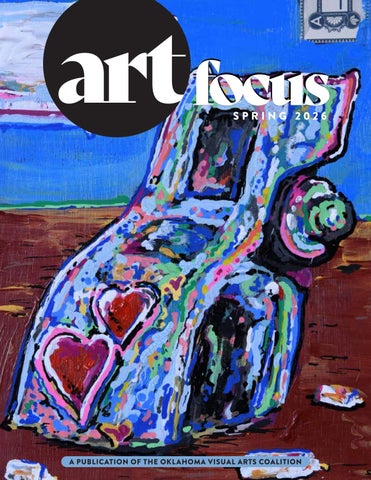
ON THE COVER // Clint Stone, Cadillac Ranch Solo Car Cigar Box, 2026, acrylic on cigar box, 6.75” x 9.25”, page 10; MIDDLE // Katie Graham and The Artist Closet | Photo by Rachel Minick, page 14; BOTTOM // Casting Castles, Sloss Furnaces, Birmingham, Alabama, 2025 | Photo by Amber Henderson, Skybama Photography, page 22.

ANNUAL SUPPORT FROM:

4 14 18

LETTER FROM THE EDITOR // ZOE ELROD

22

24

ELIZABETH J. WENGER CONTENTS // Volume 41 No. 2 // SPRING 2026

ISSN: 3069-244X

FEATURE // IN THE STUDIO : WITH MARYANN GUOLADDLE PARKER: KIOWA BEADWORKER, ARTIST, AND CURATOR

Exploring how Kiowa artist and curator MaryAnn Guoladdle Parker weaves together beadwork and cultural knowledge, bridging artistic practice and museum work to preserve and share Indigenous stories.

ANNA SMIST

FEATURE // SIGNS OF THE TIMES: PAINTING THE MOTHER ROAD

Tracing how artist Clint Stone documents Route 66 through immersive, place-based painting, capturing the present-day spirit of the Mother Road while highlighting the stories and connections that define it.

KAREN PAUL

FEATURE BUILDING THE ARTIST CLOSET // THE ART OF MUTUAL AID

Exploring how Katie Graham’s grassroots supply exchange at Mycelium Gallery has grown into a vital mutual aid resource, expanding access to creative materials while fostering community support.

KATE BATTERSHELL

FEATURE // OFF THE WALL: BEHIND OKLAHOMA’S PUBLIC ART MOVEMENT

Examining how local initiatives are reshaping Oklahoma’s cultural landscape by expanding access, elevating diverse voices, and transforming public spaces into sites of identity and connection.

ERIN SCHALK

FEATURE // FORGED IN NORMAN: BEHIND THE SCENES OF IRON POURING

Exploring how the University of Oklahoma’s revived iron pour program blends technical skill, spectacle, and collaboration, transforming molten metal into art through a dynamic creative practice.

OLIVIA DAILEY

FEATURE // QUEER ART AS SANCTUARY

Exploring how queer artists across Oklahoma create spaces of refuge, resistance, and self-expression, using art to reclaim identity and foster community amid a challenging social and political landscape.

OKLAHOMA VISUAL ARTS COALITION // PHONE: 405.879.2400

609 W. Sheridan Ave., Oklahoma City, OK 73102 Web // ovac-ok.org

Executive Director // Rebecca Kinslow, rebecca@ovac-ok.org

Editor // Zoe Elrod, zoeetravers@gmail.com

Art Director // Anne Richardson, speccreative@gmail.com

Art Focus is a quarterly publication of the Oklahoma Visual Arts Coalition dedicated to stimulating insight into and providing current information about the visual arts in Oklahoma. Mission: Growing and developing Oklahoma’s visual arts through education, promotion, connection, and funding. OVAC welcomes article submissions related to artists and art in Oklahoma. Call or email the editor for guidelines. OVAC welcomes comments. Letters addressed to Art Focus are considered for publication unless otherwise specified. Mail or email comments to the editor at the address above. Letters may be edited for clarity or space reasons. Anonymous letters won’t be published. Please include a phone number.

2024-2025 BOARD OF DIRECTORS // Douglas Sorocco, President, OKC; Jon Fisher, Vice President OKC; Matthew Anderson, Secretary, Tahlequah; Jacquelyn Knapp, Parliamentarian, Chickasha; Marjorie Atwood, Tulsa; Barbara Gabel, OKC; Farooq Karim, OKC; Kathryn Kenney, Tulsa; John Marshall, OKC; Chris Winland, OKC

OVAC champions individual artists’ voices and creative expression. The views, positions, or values shared in Art Focus do not necessarily represent those of our Board, staff, donors, or funders. Member Agency of Allied Arts and member of the Americans for the Arts. © 2026, Oklahoma Visual Arts Coalition. All rights reserved. View the online archive at Ovac-OK.org/ArtFocus.

LETTER FROM THE EDITOR

This year marks the centennial of Route 66, the Mother Road that runs 421 miles through Oklahoma. In this issue of Art Focus, our writers follow those journeys across Oklahoma. Some trace literal roads, while others unfold in studios, galleries, foundries, and community spaces.

Karen Paul begins along Route 66 with artist Clint Stone, whose work many Oklahomans may recognize from the Oklahoma City Museum of Art gift shop or the covers of Oklahoma Today Stone approaches the road through the philosophy of Heraclitus, who wrote that no one steps into the same river twice because everything is constantly changing. Rather than painting with nostalgia, he walks the towns, photographs landmarks, and speaks with the people who live there, capturing the road as it exists today.

Meanwhile, tradition and innovation meet in the work of MaryAnn Guoladdle Parker, a Kiowa beadworker and assistant curator at the First Americans Museum. In Anna Smist’s story, Parker reflects on a practice that spans beadwork, graphic design, painting, printmaking, and curating. Readers may know her from OVAC’s 25th Anniversary MOMENTUM exhibition, where she served as emerging curator. Looking back on her path, she recalls moments when she paused and realized, simply, “I think I’m doing the right thing.”

Another story leads us into the University of Oklahoma’s iron pours, where molten metal becomes sculpture. A towering student-built furnace named “Queenie” melts hundreds of pounds of recycled iron from old bathtubs, sinks, and radiators. Days of preparation lead to a single afternoon when students, artists, and community members gather to watch raw material take form. Writer Olivia Dailey brings readers into this world revived under sculptor Leticia Bajuyo, whose work many saw in Oklahoma Contemporary’s ArtNow: Materials and Boundaries, made from CDs, DVDs, cable ties, steel cable, and other materials.

Elizabeth Wenger opens her story with a question: “What does it mean to make a sanctuary?” Her answer unfolds through the work of queer artists across Oklahoma. Beginning with Allison Ward’s church-inspired installation in Tulsa, complete with pews and layered audio and video storytelling, Wenger explores how art can create spaces for healing, resistance, and visibility. Although Ward’s installation took place inside a church, the refuge it describes has no walls. As Ward says, choosing to live in queer community and create queer art is a decision to “stay visible in a place that would have preferred we disappear.”

Care and community appear in another form in Kate Battershell’s story about The Artist Closet at Mycelium Gallery.

Founded by Katie Graham, the project operates as a mutual aid hub offering free supplies and creative resources to artists of all ages.

Across the state, those connections also appear on the walls around us. Erin Schalk explores Oklahoma’s growing mural movement, from Plaza Walls to Fresh Paint and Sunny Dayz. Murals, she says, are not decoration but a “living, evolving practice,” a conversation between artists and the communities around them.

Heraclitus tells us that no one steps into the same river twice. So that makes it all the more important that we pay very close attention to these rivers as they wind through our lives: the murals we pass every day, our neighborhood galleries, local queer and Native artists, beadworkers, curators, and every artist loaning a paint brush to a friend in need.

So let’s dip our feet into this moment. What if today is the next heyday? What if this is the moment we will one day remember with nostalgia? Today’s neon may glow through iPhone screens, but artists are still carving out space in a world that moves too fast, reminding us that neighbors take care of neighbors, and no road is meant to travel alone.

With gratitude, Zoe Elrod

ZOE ELROD is an Oklahoma City-based writer and multimedia storyteller with bylines in KOSU, Make Oklahoma Weirder, Oklahoma Today, Oklahoma City Free Press, etc. Outside of work, she enjoys live music, arts festivals, trips to the movie theater, spending time with her wife and their two dogs, and exploring and uncovering Oklahoma’s iconic and unexpected sides.

Photo by Colby Ballard
TOP // MaryAnn Guoladdle Parker (Kiowa Tribe), Assistant Curator, for the special exhibition Cradleboards Crafted with Love, 2026 | Photo by Ben Winters, Courtesy of First Americans Museum; RIGHT // MaryAnn Guoladdle Parker, beaded earrings, gifted to her bridesmaids at her wedding |
Photo provided; ABOVE // MaryAnn Guoladdle Parker, horsehair earrings | Photo provided

IN THE STUDIO WITH MARYANN GUOLADDLE PARKER: KIOWA BEADWORKER, ARTIST, AND CURATOR //

MaryAnn Guoladdle Parker knows who she is. She is a member of the Kiowa Tribe, a beadworker, an artist, and a curator—in that order.

Sitting down with her at First Americans Museum (FAM) in Oklahoma City, where she serves as an assistant curator, Parker shared her path to curating and making art across a range of media including beadwork, textiles, metalwork, graphic design, and painting.

Parker lives in Yukon and earned a B.A. in American history with an emphasis in Native American history from Oklahoma City University. She later obtained an MFA in cultural administration from the Institute of American Indian Arts, with a double emphasis in arts administration and tribal museum and cultural center administration. A lifelong participant in her Kiowa community, Parker brings both lived experience and formal training to her work in museums.

“It’s hard to describe what a curator is,” Parker admits, but she credits her experience in the Kiowa Tribe’s Summer Youth Service Program for getting her started.

During the program, she interned twice at the Kiowa Tribe Museum, where her grandpa Joe Fish would pick up dark cherry sno-cones (his favorite flavor) on Fridays. Parker’s time there exposed her to the administrative side of museum work and helped prepare her for a later position at the Fort Laramie Historical Site in Wyoming. While there, she worked in every department, from maintenance to curatorial to collections.

Around the same time, Parker switched her undergraduate major from psychology to history at Oklahoma City University. Becoming a history major allowed her to work more closely with Professor Blue Clark (Muscogee Creek), who supported her in taking on independent studies, including one focused on Indigenous film. Together, these experiences helped lead Parker to her work as a curator.

“Every step I’ve taken has pushed me in this direction,” she says.

Since joining FAM, Parker co-curated Sewn Symmetry: Symbolism of Southern Plains Beadwork with assistant curator John Hamilton (Kiowa Tribe/Caddo/Cheyenne/Wichita) and curated Cradleboards Crafted with Love, on view through May 10 in the Community Gallery. The former included works on loan from the Denver Museum of Nature & Science and involved Parker and Hamilton working with the Cheyenne and Arapaho Tribes and the Kiowa Tribe during exhibition development. The latter includes cradleboards on loan from Red Earth, the Modoc Nation, and community members Parker has known since childhood, including “Mrs. Verna.”

In both instances, it was her family’s emotional reaction at the openings that affirmed this was something she could do. Parker shared that seeing her family, especially her dad, so proud of the exhibitions made her feel like “I think I’m doing the right thing.”

Parker began beadwork at an early age with her mom at home. It was her mom who did a lot of their family’s beadwork growing up as well as introduced her to all kinds of artists at the annual Red Earth Festival in Oklahoma City. One of those artists was Micah Wesley (Kiowa Tribe/ Muscogee Nation), from whom Parker eventually purchased her first piece of art.

Depicting a greaser with the words “Be Cool” on it, Parker remembers being drawn to the piece because it reminded her of all the movies she watched growing up like Grease or Cry-Baby

Wesley, and other artists like sisters Keri Ataumbi (Kiowa Tribe) and Teri Greeves (Kiowa Tribe) are huge sources of inspiration for Parker. Ataumbi and Greeves, accomplished artists in their own right, have encouraged Parker both as a curator and an artist.

“Their believing in my work has really pushed me and makes me want to pursue art a lot more,” she says.

Parker understands what it means to have someone believe in you and what you are trying to do.

Now Parker is that source of encouragement for her nieces.

“I love teaching people to bead,” she says.

In her office at home, Parker has held onto two of her nieces’ works in progress for the next time they want to pick up their beadwork again. She describes her teaching style with the sentiment: “I may not be the best, but this is what I know.”

This openness is part of what keeps Parker working across multiple media, most recently trying linocuts and printmaking with her friend, artist and printmaker Summer Zah (Diné/Choctaw). Parker is grateful to artists like Zah who are “providing tools and letting me ask questions” when attempting something new.

When asked what medium she likes working in most, Parker reflected on the virtues of each of them.

Beadwork, Parker felt, allowed her the most room to create work “coming from the heart.” Graphic design is something she can pick up and put down. Sometimes, Parker produces stickers from her designs that show her personality, speak to moments in pop culture, and still use Kiowa aesthetics “so I still have a little piece of who I am” represented.

For painting, Parker says “I like the messiness of it.” Although she hasn’t painted in a long time, Parker knows her mom has held onto her paintings all this time. Parker does sell work alongside her husband Dallas (Comanche Nation), but even today finds that “It’s shocking to me when people buy my stuff.”

Her work has reached places further than she ever thought it could go to people in places like Delaware, Alaska, or California, but she loves it when people will send her pictures with their items. Hearing how happy people are to walk around Santa Fe with one of her tote bags and get compliments or wear a pair of her horsehair earrings is “what helps keep me going.”

MaryAnn Guoladdle Parker, Oak leaves, 2024, graphic | Photo provided
LEFT // MaryAnn Guoladdle Parker, tote bags, 2025, cotton and thread | Photo provided

For curating, Parker’s perspective as an artist attunes her to “having an eye for how things should be displayed and written about.”

Parker always incorporates her cultural knowledge into her writing. When asked about other artist-curators in the field, Parker sees it as no coincidence that there are so many people who do both.

“These two worlds blend together,” she says.

Ultimately, Parker believes “they bring that to who they are and where they work” to the benefit of the exhibition.

Throughout the conversation, Parker continually connected her experiences to the people who helped her along the way. She realizes we do not get to where we are completely on our own. Her talent is matched by her humility and she lets her work speak for itself. To that end, it seems fitting to end on her own words about other Indigenous curators working today: “We’re going to take care of each other.”

You can learn more about MaryAnn Guoladdle Parker and her art at @marryguoo or @bigredcreation on Instagram.

ANNA SMIST (Sac & Fox Nation of Oklahoma, Deer Clan) works at First Americans Museum (FAM) as a curatorial assistant. She graduated from Yale College with a degree in history of art and English and is currently pursuing an MFA in cultural administration at the Institute of American Indian Arts (IAIA).

MaryAnn Guoladdle Parker, stickers, 2026, vinyl | Photo provided

SIGNS OF THE TIMES: PAINTING THE MOTHER ROAD //

For Oklahoma artist Clint Stone, Route 66 represents the love of freedom and the hopeful idea there is always something better on the horizon.

In his Route 66 body of work, Stone sees the famous American journey through the lens of Greek philosopher Heraclitus, who believed no one could step into the same river twice because everything, including both the person and the river, is constantly changing.

On Route 66, everything stretches forward in a vision of hope while also changing with the times. Every path and every town along the journey is a story in and of itself, offering multiple adventures to discover and document.

“Route 66 is a very Oklahoma experience because Cyrus Avery from Tulsa is the architect of it all,” Stone says. “I’m recording it with no sense of nostalgia, just as it exists in this present moment.”

Stone’s creative process culminates in large paintings that map individual Route 66 communities, as well as smaller works on cigar boxes and canvases focused on specific landmarks. Each piece reflects his distinct experience in that town.

His vibrantly colored paintings bring a sense of narrative and history to these towns, which, for him, are the embodiment of hard work and the beauty of community. To date, he has already documented six towns in detail — Tulsa, Oklahoma City, Stroud, El Reno, Yukon, and Weatherford — and a large number of landmarks along the journey.

“We drive more than 65 miles an hour, going past Route 66’s communities,” he says. “At that speed, we drift mentally. We see what’s going on, but don’t really process it.”

OPPOSITE PAGE // Clint Stone, Study for Tulsa Capital of Route 66, 2025, acrylic on 140 lb cold press watercolor paper, 18” x 26”; TOP // UPTOWN 23rd St. OKC (Route 66), 2024, acrylic on canvas, 60” x 40”; RIGHT // This is El RenoRoute 66, 2025, acrylic on canvas, 24” x 36” | All images provided by the artist
“I am inspired by the ethos of Keith Haring —keep the image simple and change the world.”
— Clint Stone

As part of his creative process, Stone personally walks each Route 66 town he selects from one end of the town to the other. By physically walking and documenting a community’s landmarks prior to painting, Stone establishes a direct connection to the myth of the Mother Road and the communities that have built up in service of it. Through photographs and detailed notes, he creatively moves toward what the actual place represents. In deliberately slowing down, he connects to the temporal flora, fauna, and architecture making each location unique in this exact moment in time.

“I want my artwork to be of its place and time,” Stone says. “There is a personal connection we have to the places we inhabit.”

He also talks to anyone he meets during this documentation process, including tourists from Estonia, Route 66 pilgrims in Weatherford, Stroud, and Tulsa, and members of the community.

“Sometimes, people are suspicious when I’m out with a camera and a clipboard,” Stone says. “I talk with everyone, especially those who might have a sense of skepticism when they encounter me.”

These conversations help shape his perceptions of a community and how its major landmarks come together in a memorable way.

“The only superpower I really have is authenticity,” Stone says. “I hold myself accountable to what really exists, and

ABOVE // Clint Stone, Desert Hills, acrylic on cigar box, 10.5” x 7.5”, 2025, on view at Oklahoma City Museum of Art Museum store; RIGHT // Catoosa Whale Cigar Box, acrylic on cigar box, , 5.5” x 8.5”

I don’t try to recreate what I remember. If I can’t read something on a sign, then I will place squiggles in the painting.”

He also works directly with Route 66 communities, including the Stroud Chamber of Commerce, who has commissioned a painting of their community. In Stroud, Stone’s creative process started with a community listening session. He will be creating a mock-up of the painting and then seeking their input to ensure the painting feels representative.

“It helps me get an idea of whether or not I am on the right track,” Stone says. “Then, I can make any changes and start creating the final painting.”

While this collaborative effort to get everyone involved may seem unusual to some artists, it’s a natural part of the creative process for Stone.

“I started as a muralist, so painting has never been a private thing for me,” he says. “I’ve never seen painting as a solo act in secret.”

The vibrant colors, dark outlines, and warm energy in Stone’s final works reinforce his sense of narrative in place and community, building on the stained glass church windows of his youth, memories of his grandma making quilts, and pop culture’s candy packaging and afterschool cartoons.

“I want my paintings to have a positive feel because I believe things can be both authentic and positive,” Stone says. “You get out of life what you give into life, so why not make things better?”

KAREN PAUL is a freelance writer and photographer based in Norman. She is a graduate of the University of Oklahoma’s Gaylord College of Journalism and has been writing for OVAC’s Art Focus for more than a decade. For more information, you can visit her website at karenpaulok.com.

ABOVE RIGHT // Clint Stone, Will Rogers Theatre, acrylic, 7.25” x 10.25”; RIGHT // Weatherford, OKSpace City - Route 66, acrylic on canvas, 24” x 36”

BUILDING THE ARTIST CLOSET: THE ART OF MUTUAL AID //

Tucked in the back of Mycelium Gallery in Oklahoma City is an artist’s treasure trove of papers, paints, beads, and brushes called The Artist Closet. The colorful supply hub is the work of Oklahoma artist Katie Graham, who is well known for her dynamic fiber arts and received the inaugural Emerging Artist ribbon at the 2025 Festival of the Arts. But alongside her textile practice, she has another, more philanthropic passion.

During COVID-19 lockdown, Graham found herself inspired by a warehouse-sized communal artist collective, the Broad Room, which took off in Sacramento and prompted the thenburgeoning artist to start her own.

She recalled thinking, “It’d be amazing one day to be able to have a warehouse full of art supplies to give out to the community, and I thought, well, why don’t I just start with what I have?”

Graham did just that. In 2022 she portioned off a small part of her table at pop-up art fairs with her own supplies for anyone to take, but she was quickly overwhelmed by the interest she received in both donations and utilization of the supplies. And now in 2026, her dream has grown to over 10 fully stocked shelves that span the back wall of Mycelium.

“We have people lining up when the gallery is closed to get to The Artist Closet,” Graham says. “This is obviously needed.”

Graham started this project with mutual aid in mind when she first brought her pop-up to the Mutual Aid Fair in Norman.

“There are a lot of people who come through, and without The Artist Closet, they would have no way to purchase supplies,” she says.

This matters deeply to Graham.

“It’s really important, doing mutual aid work, that you’re not just giving people things where they have to take whatever you give them,” she says. “I like giving people the option for new items. Just because it’s free doesn’t mean you have to take what you can get.”

Graham has a refreshing idealism that spills through our sometimes irony-poisoned post-post-modern way of things. And she’s not alone in that mentality. Flora Bodega in Oklahoma City’s Paseo Arts District was not far behind her in starting their own free artist closet.

“I think with the more initiatives that pop up like us, like little libraries, like the Mutual Aid Fair, the more normal it’s going to become...it should be normal,” Graham says with an exasperated laugh the way only someone slightly in over their head can. “That’s what I believe. That’s what we all believe—there is a world that exists where we can have this all the time. This can be the standard.”

Mycelium Gallery and The Artist Closet have a mutually symbiotic relationship.

“The gallery has a lot of immersive art builds going on, and they use a lot of our supplies that people donate to build these immersive pieces all around the space that they like to change out every few months,” Graham says.

Since finding a home in Mycelium, The Artist Closet has seen many uses, and some of them have been unexpected.

“I’ve had a lot of teachers come in, especially at the beginning of the school year, that have said there’s no art class at their schools and have stepped up to become an art teacher, but there’s no budget,” Graham says. “So they come here, and they’re able to get supplies for their kids which they wouldn’t have been able to do without that artist closet.”

Graham works in close partnership with Mycelium Gallery, having an artist booth there and managing The Artist Closet in their space. Mycelium itself is a nontraditional art gallery space—there are no white walls with isolated pieces of art hanging in bright examinational lighting. Instead, whole walls are covered floor-to-ceiling salon style, and shelves are rented out to artists to display their own pieces how they want. Mycelium currently rents space to 30 local artists and is the collaborative effort of Alana

TOP // The Artist Closet; MIDDLE // Katie Graham and The Artist Closet; BELOW // Alana Anderson and Barclay Howarth at Mycelium Gallery; | All photos by

Anderson, Barclay Howarth, and Gwynivere Langer.

The gallery itself started from humble beginnings from inside a dispensary where Anderson and Howarth invited their artist friends to show their own work. The first large-scale installation the group built was the gallery’s eponymous mushroom.

The spores of Mycelium Gallery are spreading— Anderson and Howarth are expanding into the building that abuts the galley to add on a media studio space in partnership with David Steele of the Rhythm & Wit podcast. It’s their way of continuing to grow the gallery while also staying true to its roots as a low barrier gathering space.

Today, The Artist Closet takes new or gently used arts and crafts supplies. More details on what they take or how to get involved can be found at threadedfablesbykatie.com/the-artist-closet .

KATE BATTERSHELL is an arts graduate from Oklahoma State University, which houses one of her fiber arts tapestries in its permanent art collection. She currently works in philanthropic giving. In her spare time, she freelances in art collection management for artists and collectors in Oklahoma and is a frequent Art Focus contributor.

Rachel Minick

OKLAHOMA, CURATED.

Oklahoma Today is the o cial magazine of our state—where stories are told with soul, artistry, and a deep sense of place. Each issue is a tribute to the bold creators, quiet wonders, and hidden corners that make Oklahoma unforgettable.

Sign up for our free newsletter and let handpicked events, secret spots, and behind-the-scenes stories nd their way to your inbox. Experience a curated journey through the heart of Oklahoma. Subscribe. Collect. Discover. Newsletter.OklahomaToday.com.

OFF THE WALL: BEHIND OKLAHOMA’S PUBLIC ART MOVEMENT //

Public art transforms everyday places. Across Oklahoma, murals are reshaping streetscapes, sparking dialogue, and strengthening community identity. Three initiatives—Plaza Walls, Fresh Paint, and Sunny Dayz—stand at the forefront of this movement, shaping how public art lives, evolves, and connects communities across the state.

Plaza Walls began in 2015, when co-founders Dylan Bradway and Kris Kanaly recognized the renovated buildings and neglected alleys of Oklahoma City’s Plaza District as opportunities for emerging and established artists to work on a monumental scale. They envisioned these walls as open-air canvases for ambitious public works to reshape the district and strengthen community connection. Soon after, the founders established the nonprofit Oklahoma Mural Syndicate to support Plaza Walls through local partnerships and grant funding.

Rooted in the belief that public art transforms everyday environments, Plaza Walls brings color, imagery, and creative dialogue to communities throughout Oklahoma. Its mission also seeks to activate public spaces, foster community engagement, and spark conversations that connect residents more deeply to their surroundings. Collaboration with local businesses and community members has been central to the organization’s success, ensuring murals reflect the places they inhabit. Equally central is artist support. Once selected, artists are granted broad creative freedom, allowing for authentic expression and risk-taking.

“We know artists genuinely want to give their best work, and freedom leads to deeper, more personal self-expression. That shines through in the final pieces and resonates with audiences,” explains President Jesse Warne.

Plaza Walls has helped increase tourism and draw national and international attention to Oklahoma City’s Plaza District. Through sustained programming and strategic partnerships, OKC has emerged as a recognized center for street art in the United States. Rooted in community engagement and

expanded opportunities for artists at diverse career stages, the project has cultivated a creative ecosystem that shapes the city’s visual culture.

Vice President Dylan Bradway explains, “By supporting and embracing public art, we are helping build [cultural] identity and inspire a future generation.”

While Plaza Walls has helped establish OKC as a destination for large-scale public art, the Fresh Paint Mural Project focuses on cultivating next generations of muralists by providing structured mentorship for artists of color ages 18 to 25 as they complete their first major public works. Established in 2020 as part of Opening Night, Arts Council Oklahoma City’s annual New Year’s Eve celebration, Fresh Paint is hosted each year by Arts Council Oklahoma City in partnership with the Oklahoma City Thunder’s Artist Group (TAG).

Central to the program’s mission is elevating underrepresented artists of color, positioning emerging muralists within one of the city’s most visible civic platforms. Selected artists work closely with established teaching artists—this year Maddie “Holatte” Sanders and Tiffany McKnight—receiving guidance from the mural’s development to completion.

Through mentorship and community collaboration, Fresh Paint gives emerging artists the rare opportunity to move from studio practice to the public sphere, completing large-scale murals while building the professional foundations needed for sustainable careers. Selected artists develop portfolios, refine professional materials, and gain hands-on experience navigating every stage of a public commission—from concept development and material planning to deadlines and public presentation. Guidance from established teaching artist mentors demystifies contracts, collaboration, and institutional partnerships.

Support from the Oklahoma City Thunder further expands the program’s reach, placing artists before audiences rarely accessible early in a career. Public voting launched during a

CLOCKWISE FROM TOP LEFT // Paige Nguyen, Fresh Paint Mural Project, 2026, acrylic, 8’ x 8’
| Photo by Bryan Mitschell, Arts Council Oklahoma City; Angela Ulloa, Grandma, Fresh Paint Mural Project, 2026, acrylic, 8’ × 8’ | Photo by Bryan Mitschell; Natalie Lash, Becca West, and Gray Blevins, Please Stand By, 2023, Tulsa, Sunny Dayz Mural Festival | Photo by Keith Oler; Bruna Petalla and Madison Roy, Feels Like Magic, 2023, Tulsa. Sunny Dayz Mural Festival |
Photo by Bethany Young Photography; Ashton Letton and Deanna Wong, Well Done, with Mustard, 2024, Ponca City, Sunny Dayz Mural Festival | Photo by Bethany Young Photography

Thunder game introduces their work to thousands, transforming the moment into one of visibility, validation, and meaningful connection between artists and community.

Angela Cozby, Executive Director of Arts Council Oklahoma City, explains, “When a mural becomes a point of conversation, you see the ripple effect: the artist gains momentum, and the community gains a shared visual landmark … What excites us most moving forward is the growing number of Oklahomans who anticipate the project each year … and see Fresh Paint as a meaningful part of the city’s cultural connectivity.”

Building on the cultural connectivity fostered through public art across Oklahoma, the annual Sunny Dayz Mural Festival brings an equity-driven vision to muralism, centering visibility, collaboration, and community exchange.

Founded in 2021, Sunny Dayz became the first festival of its kind in the state dedicated to empowering and celebrating women and gender minority artists through public art. Across five festivals, Sunny Dayz has amplified historically underrepresented voices while creating professional pathways for artists at multiple career stages, including a teen mentorship program.

Set for May 30 in Claremore, the 2026 festival invites audiences not only to experience completed murals but to witness creativity unfolding in real time through public programming and artist interaction. By prioritizing fair compensation, professional support, and sustainability, Sunny Dayz frames public art as an evolving platform where artistic practice and community identity intersect in shared public space.

Director Kristen Milburn and Founding Member Paige Powell note, “We have welcomed over 35,000 attendees, demonstrating that public art can attract a broad audience and engage communities in meaningful ways. Each mural becomes

a long-term cultural asset, transforming communities into destinations that invite exploration, storytelling, and civic pride.”

Beyond the annual event, Sunny Dayz positions each mural as the start of an ongoing professional trajectory rather than a single commission. Through partnerships with sponsors, local leaders, and fellow creatives, the festival builds relationships that often lead to future projects. At the same time, it ensures murals remain artist-driven while reflecting the character of each host community, including introducing large-scale public art to areas historically underserved by cultural investment.

As Milburn and Powell explain, “As more cities recognize the long-term value of investing in artists and public spaces, mural festivals will play an even stronger role in shaping Oklahoma’s cultural landscape.”

Taken together, Plaza Walls, Fresh Paint, and Sunny Dayz illustrate a broader shift: public art in Oklahoma is becoming a sustained cultural practice. Through festivals, mentorship, and community partnerships, these initiatives demonstrate how murals can shape place, expand opportunity, and foster connection, transforming shared spaces into living reflections of the communities that create and sustain them.

ERIN SCHALK serves as a professional writer, visual artist, voice narrator, and accessibility-centered educator. She is the recent recipient of multiple Writer’s Digest awards and the Armed Services Arts Partnership’s National Scholarship. She has also received a Best of the Net nomination. Schalk’s work has appeared in Wordgathering, Stirring Lit, Parentheses International Literary Journal, The Petigru Review, and numerous other publications. She also received her MFA from the School of the Art Institute of Chicago.

Jodie Herrera at Plaza Walls, 2025 | Photo provided by Jesse Warne

FORGED IN NORMAN: BEHIND THE SCENES OF IRON POURING //

Every once in a while, on a Saturday in Norman, you might see something strange unfolding off Boyd Street and the North Oval, on a loading dock leading up to the University of Oklahoma’s School of Visual Arts. There is a tall furnace with flames shooting from the top, molten iron a la Lord of the Rings flowing out the bottom, and a team of people in protective gear moving in sync. These are iron pours.

The iron pour program was reignited once Leticia Bajuyo joined OU in 2022 as an assistant professor of sculpture. Bajuyo’s unique skillset and connection with other professors across the state provided the support needed to get the foundry back up and running. Now, there is at least one pour per academic year, often one per semester. The next pour is scheduled for Saturday, April 18. They are open to the public and also provide an opportunity for the public to make their own art.

Bajuyo recruited a graduate student, Seph Trask, who built the first working iron furnace (also known as a cupola) that OU has had in over ten years. Trask explains the building and naming of the furnace:

“As cast iron art relies heavily on the act of recycling (old cast iron tubs, sinks, radiators, and other objects are broken up for melting), I like to center my furnace designs around existing objects. In this instance, it was an old propane tank that myself and some fellow graduate students acquired in rural Oklahoma. Naming it was easy; this furnace has the ability to produce in excess of 400 pounds of hot iron at a time, which puts it on par with some of the biggest furnaces in the university system and even some professional production facilities. The furnace is huge, produces a massive amount of metal, and is something we were very proud of, so we decided its name would be Queen [nicknamed ‘Queenie’], due to its majesty.”

Iron is an element, an essential mineral for humans, and a critical metal used to advance civilization for thousands of years. Iron is industrial. As a material, it is heavy and shows its age. Iron pours are “equal parts spectacle and serious craft,” says Bajuyo. It takes several days of preparation for one day of pouring: mold making, iron breaking, and other duties.

And now for a grotesquely generalized overview of the technicalities of iron pours:

To start, a coal-based fuel called “coke” is added to the furnace to create a combustion, heating it to over 2,000 degrees. Then alternating layers of iron, limestone (to remove impurities), and coke are stacked on top of one another, creating heat and pressure. Once the iron has melted down, a hole is “tapped” for the molten iron to flow out, which is then caught and poured into molds.

Similar to printmaking, where the carved woodblock used to make the print is not the final piece of art, but it is the artistic part, the negative space of an iron pour mold is where the artistry comes into play.

“Casting is a sculptural print,” says Bajuyo.

Most molds are made out of sand resin or ceramic shell. They can either be multiple pieces that fit together or one solid piece that you break to release the final artwork. The public can make their own art using pre-made, open-faced sand block molds that can be carved on one side. (Any letters or numbers must be written backwards on the mold.)

Unlike welding, pouring into molds allows intricate details to appear on the positive metal form. Mold making requires careful consideration when carving the negative of the resulting object; however, the medium of iron itself involves precise and sudden timing in order for the pour to effectively fill the mold. The iron begins to cool as soon as it makes contact with the mold.

Another cast iron dichotomy: it is a rare instance of art created in community instead of in isolation.

“No single person can do it alone,” says Lauren Hill, student and Co-President of OU’s Fired Up Sculpture Club.

The teamwork is on par with a pit crew. Last April, a team of students from the University of Oklahoma, East Central University, and Tulsa Community College competed at the 2025 National Conference on Contemporary Cast Iron Art and Practices Conference in Birmingham, Alabama. The team, Oklahomies, won the “School Spirit” award, a testament to

LEFT // Cierra Roberts, You’re Going to Feel a Little Pressure, performance piece, featuring a uterus carved from cedar. During the performance, molten iron is poured through the top of the form, demonstrating the pain and pressure that often go unnoticed or unspoken. As the iron cascades through the central opening, it sheds layers of wood, echoing the cyclical processes of menstruating bodies. Through this act, Roberts confronts the silence, shame, and discomfort that often surround conversations about these medical experiences; RIGHT // Oklahomies Iron Pour, February 8, 2025 | Photo by Paul Gandy, paulgandyphotography.com

the support they received from their schools and the people cheering them on during the competition.

People are passionate about iron pours. When asked about their experiences, nearly all of those involved consistently highlighted the same benefits: community, confidence, skill building, and skill sharing. The community that circles out from the pours is a feature, not a bug. In other words, the real art was the friends we made along the way.

The pours connect professors, students, and the public from outside the School of Visual Arts, the University of Oklahoma, and the City of Norman. Thomas Cornell is an assistant professor of visual art at Northwestern Oklahoma State University in Alva, Oklahoma, who supports the iron pours by bringing his students for creation and inspiration.

“I try to make something every time I go; it serves as a memento of the time I spent with good folks,” says Cornell.

The next iron pour is on Friday, May 1st at the University of Oklahoma. The event is free and open to the public. The activity will heat up in the late afternoon/evening. Individuals can create their own iron artwork using sand blocks, available to purchase for a small fee, which helps support the program. And for anyone who has an old iron bathtub lying around, the Fired Up Sculpture Club will take it off your hands: email bajuyo@ou.edu or andy.denton@ou.edu for more information.

PROJECT PROCESS

Robin Baker, art professor at Oklahoma State University, was a visiting artist at the November iron pour. He spent the week leading up to the event working with students, demonstrating his approach to multi-part mold construction. The castiron intersection pieces for his sculpture Symbiotic Potential #5 were poured in November and refined over the following month for an exhibition at Living Arts in Tulsa.

1. Resin-bonded sand material sculpted from stack-laminated insulation foam, used to make the mold for Robin Baker's sculpture Symbiotic Potential #5

2. Molds ready for Iron Pouring for Robin Baker’s “Symbiotic Potential #5. Once the sand is tightly packed into boxes built around the patterns, the patterns are removed, leaving a cavity for the iron to fill.

3. Robin Baker, final sculpture, Symbiotic Potential #5, 2025, cast iron and reclaimed wood, 7’ × 3’ × 4.5’ | Photo courtesy of the artist

OLIVIA DAILEY earned a B.A. in Journalism from the University of Oklahoma. She works as a program manager for a transportation research center in Norman and is a frequent Art Focus contributor.

QUEER ART AS SANCTUARY //

What does it mean to make a sanctuary? In Oklahoma’s stretch of the Bible Belt, anti-queer sentiments have led to anti-queer policy, creating a tense cultural and political environment for LGBTQIA2S+ individuals. Art offers one possibility of liberatory refuge.

Curator and interdisciplinary artist Allison Ward made a name for herself in the Tulsa Art Scene through music, performance, and exhibitions centered on themes of sexism, religion, and mental health. Though she is now pursuing an MFA at the Art Institute of Chicago, Ward’s most recent multimedia installation, “Silent Voices in Sacred Spaces” was exhibited at Living Arts Tulsa.

“Silent Voices in Sacred Spaces” was a daring and immersive exhibition, which featured nine screens arranged in the shape of a cross, each displaying a separate video performance; an additional pulpit video performance; two sound installations; and signs daring the visitor to “Repent Now?” all contained within a built environment that evoked a church nave.

Ward created the environment by sourcing pews from a church in Chicago which she reupholstered with red fabric. She used red, hand-dyed curtains to enclose the space, bathing everything in a striking scarlet light. Visitors were able to sit on the pews while listening to one of the two audio installations, a 40-minute sound piece that featured recordings of oral stories from women and LGBTQIA2S+ individuals about their experiences growing up in churches.

Ward herself grew up in the Church of Christ, a denomination that doesn’t allow instrumental music. This prohibition shaped Ward, who often accompanies the visual components of her art with sonic elements. In another audio installation, Ward used

children’s songs from Vacation Bible School mixed with her own vocals and archived hymnals from her childhood church in Guthrie, Oklahoma. By working with the symbols of the church both sonically and visually, Ward at once critiques religion and repurposes its imagery to sanctify that which the church condemns.

Through this queering of religion, Ward hopes to show the places where “the institution has failed (and continues to fail) the people who exist within it and sometimes reluctantly outside of it.”

Ward’s audacious installation brings to mind the philosopher Michel Foucault’s concept of “heterotopias” — or “other spaces,” which exist outside acceptable and/or normalized institutions and act almost as funhouse mirrors, allowing for radical transformation. By constructing a church within the gallery, Ward is intentionally engaging in a critical political gesture which challenges the sexual and gender norms imposed by the strictures of religion.

Ward explained: “[this] feels especially urgent right now within the political context of America, and particularly the South where the hostility isn’t abstract. It’s legislative, it’s social, and it’s deeply personal. What’s happening to women, to queer people, and especially to people of color and immigrants, it’s not background noise. It’s not a viral video or article. It’s a very harsh and brutal reality[...]Art, at its best, refuses to let that hostility be the final word. It carves out space where different possibilities can be felt, even temporarily. And to me, that is resistance.”

Art is not only an act of resistance, but also a method of healing for Ward, who started her practice after a therapist suggested art therapy.

Allison Ward, 9-Part Video Cross from Silent Voices in Sacred Spaces, 2025

RIGHT // Allison Ward, Silent Voices in Sacred Spaces, installation, 2025; BELOW // Isa-Rodriguez, Los-dos, sculpture, 2025, (left) soda-fired red and white stoneware and (right) earthenware with polychrome slip, 15” x 20” x 9”

“My therapist helped me realize that I could find sanctuary and security within my work, that the things I created could offer me both protection and understanding,” Ward explained. “That experience is really the foundation of everything I make. The sanctuary I found through making is the same sanctuary I hope people find when they encounter my work.”

Ward’s exhibition-cum-sanctuary is just one example of queer artists’ efforts to build alternative spaces for free expression and liberatory possibilities despite increasing legal and social pressures to conform. Other queer artists around Oklahoma have found ways to incorporate their identity into their work.

Isa Rodriguez is a queer, Venezuelan artist working as the Artist in Residence at Studio School at Oklahoma Contemporary Arts Center in Oklahoma City.

“To me, queerness is all about possibility,” Rodriguez said. “I’m always experimenting with who I can be and what I can create. As an artist, I have a certain amount of success and visibility, which I leverage to make space for other people to experiment too.” Rodriguez’s current ceramics work is inspired by ancient indigenous pots from Venezuela, which they explore in a contemporary context. In addition to their personal work, Rodriguez and their partner Dylan Cale Jones are co-creators of Practice Practice, an arts education project that helps artists build their creative practices.

Sydney McLeod is a charcoal and book artist whose work, which was recently supported by a grant from the Artists Creative Fund, explores the messiness of living within the body, which can be both a home and site of pain and illness.

“My work doesn’t deal with queerness directly,” McLeod explained. “But people always bring their own conceptions of gender to the work because it’s about the body. Completely separating the conversation of gender from the body doesn’t work, they’re deeply intertwined.”

McLeod observed that in their own experience, gender “isn’t a box to check or a set list of experiences, it’s an expansive way of finding a home in your body.”

McLeod’s upcoming show, Flesh & Flame, will be having its opening night on April 4 from 5-8 p.m. at Positive Space, an artist-run space for womxn creatives in Tulsa.

And in Norman, Unicorn Workers Union, a queer artist collective led by Helen Grant and Rai Fordyce, is deeply invested in making art for a community driven by, as Grant put it “creating opportunities for joy, connection, learning, and visibility.”

These are just a few names among a growing number of queer artists in Oklahoma who are using their creative practices for healing and possibility. Galleries and studios continue to offer alternative spaces for queer community. They remain vital

havens for social criticism and free expression even as the political atmosphere darkens and anti-queer discrimination worsens. Art may not be a physical utopia, but it can be a sanctuary and resistance of its own kind.

As Ward said, “There is something that happens when you’re part of a small but defiant group of people inside a widely conservative state. It fills me with a genuine sense of pride. Not despite the difficulty, but because of it. We chose to stay visible in a place that would have preferred we disappear.”

ELIZABETH J. WENGER is a writer from Tulsa. She is the winner of the Baltimore Review Winter Prize in flash nonfiction and her essay collection was selected as a finalist for the Black Lawrence Press Hudson Prose Prize. She has been covering Oklahoma arts and music for five years. Wenger earned her MFA at Iowa State University’s program for Creative Writing and Environment. Her website is wengerwrites.com.

LEFT // Sydney McLeod, Candle in the Water XV, charcoal, 19” x 26”; RIGHT // Sydney McLeod, Candle in the Water III, charcoal, 22” x 30”

OVAC MEMBERS SHOW

RECEPTION DATE: JUNE 4, 5:30 - 7:30 PM

PANEL DATE: JULY 11, 10 -11:30 AM

EXHIBIT DATES: JUNE 2 - AUGUST 1

Turn static files into dynamic content formats.

Create a flipbook