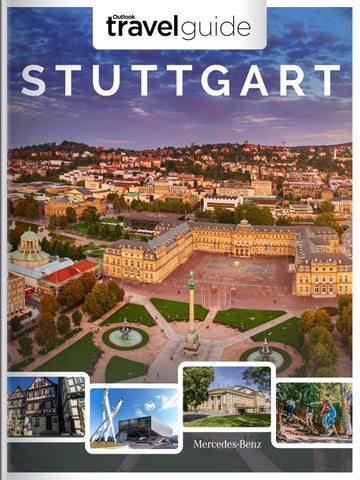
STUTTGART


Stuttgart
Known as the ‘cradle of the automobile’, Stuttgart offers a vibrant, inspiring blend of innovation, culture, nature, and unrivalled hospitality, creating a uniquely enriching experience for every visitor
WRITER: ED BUDDS | PROJECT MANAGER: MANTĖ KALINAUSKAITĖ
Stuttgart is a unique destination where world-class automotive heritage meets vibrant culture, lush green spaces, and exceptional culinary experiences.
Located on the Neckar River in the fertile valley known as the Stuttgarter Kessel, it stands as the largest city of the German state of Baden-Württemberg.
Known affectionately as the nation’s cultural capital, the city features everything from museums to world heritage, as well as a lively jazz scene and an esteemed history of opera and ballet.
From magnificent baroque palaces to modern architecture, there are captivating sights around each corner.
Stuttgart is a city of sport fans – it was even named the European capital of sport in 2007 by the European Capitals and Cities of Sport Federation.
The most popular sport is certainly football, but visitors can also enjoy watching American football, basketball, hockey, handball, and baseball around the city.
The city also hosts two prestigious tennis events – the Porsche Tennis Grand Prix and the BOSS Open.

Elsewhere, VfB Stuttgart is a sports club with many teams, proudly standing as the fifth-largest club in Germany. However, the name is synonymous with the football team who play in the Bundesliga and have won the league title five times, as well as the DFB-Pokal four times.
Playing their home games at the legendary MHP Arena – formerly the Mercedes-Benz Arena – the club has witnessed numerous famous talents wear the shirt, such as Mario Gomez, Sami Khedira, Jürgen Klinsmann, and Nick Woltemade.
Regarding its culinary offering, the exquisite delights of Swabian soul food await, with traditional regional dishes such as Zwiebelrostbraten, Kaesspaetzle, or Ofenschlupfer sure to blow your taste buds away.
With a plethora of activities and attractions for all varieties of traveller, from the Wilhelma Stuttgart zoological-botanical garden and SWR Television Tower to the Altes Schloss (Old Castle) and Kunstmuseum Stuttgart, the city promises the trip of a lifetime.

An inspiring journey through time
Stuttgart, the vibrant metropolis in the heart of BadenWürttemberg, is the cradle of the automobile and a magnet for technology enthusiasts and cultural travellers from all over the world.
Those seeking an unparalleled experience that combines history, innovation and breathtaking architecture will find the Mercedes-Benz Museum a destination that exceeds all expectations. Here, the legacy of a global brand comes alive, and the guiding principle “Heritage creates future” is not just a slogan, but a lived philosophy.
Architecture that tells stories
Even from a distance, the Mercedes-Benz Museum captivates the eye. The futuristic building, designed by the renowned UNStudio Van Berkel & Bos from Amsterdam, is an architectural masterpiece that blends into the landscape yet stands out spectacularly.
Its unique double-helix structure is not only a visual highlight but also an ingenious metaphor, symbolising the DNA of the Mercedes-Benz brand, the genetic code of 140 years of innovation history. Inside, there are no straight walls, no enclosed rooms – instead, horizontal and vertical surfaces flow gently into one another, and 1,800 triangular glass panes allow light to play in fascinating ways. Across nine levels, a world unfolds over 16,500 square metres (sqm) of exhibition space, achieving maximum spatial impact on a footprint of just 4,800 sqm.
Two paths, one fascinating story
The heart of the Museum is the permanent exhibition, which guides visitors through automotive history on two interwoven tours.
The “Legend” tour tells the story of the Mercedes-Benz brand in seven chronologically arranged rooms. Here, you will encounter the pioneers Carl Benz and Gottlieb Daimler,

who independently invented the automobile and revolutionised the world. The second tour, the “Collection” rooms, presents the diversity of the brand’s portfolio in five thematically organised exhibitions that connect vehicles and their stories across eras. You can switch between the tours at any time and create your very own personal Museum experience. The Museum houses 160 vehicles and over 1,500 exhibits that link technology, everyday life, contemporary history and popular culture.
Icons on wheels
Among the impressive exhibits are some true treasures of automotive history. Marvel at the Benz Patent-Motorwagen Number 1 from 1886, the world’s first automobile, and the Daimler Motorised Carriage, the first four-wheeled automobile.
A special highlight is the Mercedes Simplex from 1902, considered the world’s oldest Mercedes and the first modern automobile, which laid the foundation for all subsequent vehicles with its groundbreaking design.
Experience the elegance of the legendary 300 SL “Gullwing”, whose unique doors and sporty performance made it a design icon, or the futuristic shape of the C111. Another masterpiece is the 300 SLR Uhlenhaut Coupé, currently the most valuable automobile in the world.
A particular highlight is “Legend Room 7: Silver Arrows – Races and Records”, where motorsport history comes alive. Here, the legendary Silver Arrows are staged on a spectacular banked curve. Extraordinary vehicles such as Pope John Paul II’s Popemobile, the sports car of the Princess of Wales, Lady Diana, and historical vehicles of Emperor Wilhelm II and Hirohito also tell unique stories.
THE WHOLE STORY
Visit the Mercedes-Benz Museum. HERITAGE CREATES FUTURE.

Interactive experiences and art in dialogue
The Mercedes-Benz Museum is a place brimming with experiences. One of the latest attractions is the interactive “Pit Stop” station, where visitors can experience the lightningfast precision work of a Formula 1 pit stop for themselves, complete with real F1 tyres, a pit wall and a reaction wall – a tribute to teamwork, strategy and the incredible dynamism of motorsport.
Furthermore, the Museum integrates art into its permanent exhibition. Under the title “Now on View”, the Mercedes-Benz Art Collection presents significant works from over 40 years of its collection history in rotating exhibitions. This integration creates an exciting dialogue between automotive history and modern and contemporary artists, opening up an additional dimension of cultural enjoyment for visitors.
Special exhibitions and open-air events
Additionally, the Mercedes-Benz Museum regularly offers special exhibitions that highlight specific themes and vehicle categories. During the summer months, the Museum’s outdoor area transforms into a meeting point for classic car

enthusiasts. This open-brand classic car meet attracts lovers of historic vehicles, offering a relaxed atmosphere for petrol talks and admiration of rare automobiles.
A visitor magnet
With over 940,000 guests in 2025, the Mercedes-Benz Museum is Stuttgart’s most visited museum. More than 14 million international visitors have already experienced the fascinating journey through automotive history since the Museum’s opening in 2006.
Plan your unforgettable experience
The Mercedes-Benz Museum is open from Tuesday to Sunday, from 9 a.m. to 6 p.m. A day ticket costs €16 for adults, €8 reduced, and children up to 12 are free.
The Museum is fully accessible and offers special audio guides and programmes for children to introduce even the youngest visitors to automotive history. A visit to the Mercedes-Benz Museum is more than just a museum visit – it is a journey through time, a tribute to human ingenuity and a glimpse into the future of mobility. Welcome to the MercedesBenz Museum!
Registrations, reservations and the latest information: Monday to Saturday from 9 a.m. to 6 p.m. by calling +49 711 17 30000, by email to classic@mercedes-benz.com or online at www.mercedes-benz.com/museum

Stuttgart-Marketing GmbH Industry Insights
From overall strategic direction and product development to the day-to-day operations of the tourist information office, i-Punkt, in the House of Tourism, StuttgartMarketing GmbH supports the further development of the region as an attractive destination. We sit down with Managing Director, Armin Dellnitz.
Outlook Travel (OT): Which aspects of Stuttgart would you highlight to someone visiting for the first time?
Armin Dellnitz, Managing Director (AD): For first-time visitors, our two iconic car museums – the MercedesBenz Museum and the Porsche Museum – are must-sees, not only for enthusiasts but for anyone interested in design, innovation, and contemporary history.
Beyond that, Stuttgart offers an extraordinary cultural landscape, from a renowned ballet company and outstanding museums to pioneering architecture such as the SWR Television Tower – the first of its kind.
To help visitors make the most of their stay, our StuttCard offers convenient access to the most important sights, and with the Stuttgart Citytour, guests can explore
the highlights of the city comfortably and at their own pace using the triedand-tested hop-on hop-off principle.
OT: Aside from Stuttgart’s main attractions, what hidden gems are on offer for tourists to discover?
AD: I always encourage visitors to explore our charming quarters – each with its own character, cafés, and creative spirit. Another true gem is the historic Stuttgarter Stäffele – the many stairways that climb our hills and offer unique vantage points across the cityscape.
And of course, Stuttgart’s ‘Green U’ – a continuous park landscape stretching from the city centre into nature – provides an unexpected sense of openness and tranquillity right in the heart of the urban environment.


OT: When people think of Stuttgart, many think of automobiles. What role do they play in your city?
AD: The automobile is deeply rooted in Stuttgart’s identity. We are the only city in the world with two automobile museums, each telling a different part of the story of mobility, technical excellence, and innovation.
The industry continues to shape Stuttgart, the birthplace of the automobile, not only economically but also culturally – countless museums and events bear witness to the region’s automotive history.
OT: From traditional Swabian cuisine to modern Michelin-starred
masterpieces, which outstanding dishes, restaurants, or markets are a must for anyone new to the region?
AD: Stuttgart’s culinary diversity is truly remarkable – visitors can enjoy everything from cosy Besenwirtschaften – seasonal wine taverns run by local vintners – to award-winning Michelin-starred restaurants.
Traditional Swabian dishes such as Maultaschen (filled pasta) or Gaisburger Marsch (a savoury hotpot) are essential tastings for any newcomer. The historic Markthalle is another highlight, offering regional specialities, international delicacies, and a vibrant atmosphere.
“OVER THE PAST 10 YEARS, STUTTGART HAS BECOME INCREASINGLY VISITOR-FRIENDLY THROUGH THE DEVELOPMENT OF INNOVATIVE PRODUCTS THAT MAKE THE CITY EASIER AND MORE ENJOYABLE TO EXPLORE”
– ARMIN DELLNITZ, MANAGING DIRECTOR, STUTTGART-MARKETING
GMBH


“FROM PICTURESQUE VINEYARDS AND ROLLING NATURAL LANDSCAPES TO CHARMING TOWNS AND VIBRANT CULTURAL CENTRES LIKE LUDWIGSBURG AND ESSLINGEN, VISITORS WILL FIND COUNTLESS REASONS TO EXTEND THEIR STAY”
– ARMIN DELLNITZ, MANAGING DIRECTOR, STUTTGART-MARKETING GMBH
Naturally, no visit would be complete without sampling our local wines, which have shaped the landscape and culture of Stuttgart for centuries.
OT: How have you seen Stuttgart’s tourism offering evolve over the past decade?
AD: Over the past 10 years, Stuttgart has become increasingly visitorfriendly through the development of innovative products that make the city easier and more enjoyable to explore.
Our Stuttgart Citytour provides intuitive sightseeing options, and the StuttCard has grown into a comprehensive access pass for culture, mobility, and experiences.
OT: What role does sustainability play in Stuttgart’s tourism offerings?
AD: Sustainability is a core principle of our tourism strategy. We encourage our guests to leave their cars behind –Stuttgart itself is very well connected by public transportation, and many sights are within easy walking distance.
When booking a room through us at one of our numerous partner hotels, guests receive a free ticket for public transportation directly with their booking confirmation.
At our tourist information office, i-Punkt, we place great importance on regional and responsibly produced products. Starting this spring, our city tour will be operated with a fully
electric fleet, further reducing our ecological footprint.
OT: You opened the House of Tourism last year. What can visitors expect to find there?
AD: The House of Tourism brings together all the essential services a visitor might need – our tourist information, gastronomy, meeting and event spaces, and even rooftop experiences.
It also represents a unique collaboration – the city, region, and state of Baden-Württemberg are all present under one roof, making it easier than ever for guests to receive comprehensive and inspiring recommendations for their stay.
OT: In terms of the wider Stuttgart region, what would you recommend for longer stays and exploring the surrounding area?
AD: The wider Stuttgart region offers a wealth of experiences just a short journey from the city. From picturesque vineyards and rolling natural landscapes to charming towns and vibrant cultural centres like Ludwigsburg and Esslingen, visitors will find countless reasons to extend their stay.
This is also true of Schorndorf, a half-timbered town where Gottlieb Daimler was born. The combination of urban culture and regional discovery is one of our greatest strengths.
OT: What strategies do you use to ensure that Stuttgart remains attractive to travellers throughout the year?
AD: Stuttgart is an event city – there is always something happening
here. Our cultural calendar is full of traditional festivals, exhibitions, performances, and seasonal highlights.
At the same time, our extensive indoor offerings – particularly our diverse museum landscape – make Stuttgart an ideal year-round destination.
Outdoors, the parks and regional landscapes provide inviting spaces for recreation in every season. This mix ensures that travellers can always find something exciting and relevant, no matter when they visit.
OT: Are there any interesting projects in the pipeline you wish to highlight?
AD: Two major cultural milestones are coming up – the 100th anniversary of the Weissenhof Estate, a UNESCO World Heritage Site and icon of modernist architecture, and the International Building Exhibition are
both highly anticipated in 2027.
Additionally, the city’s new main railway station will shape the future of mobility and urban development in Stuttgart, making it one of the most transformative projects of the decade.
OT: Lastly, in one sentence, why do you think people should visit Stuttgart?
AD: Because Stuttgart offers an inspiring blend of innovation, culture, nature, and hospitality – creating a uniquely enriching experience for every visitor.

Tel: +49 711 2228 0 info@stuttgart-tourist.de www.stuttgart-tourist.com


In Focus AUTOMOTIVE HERITAGE
Stuttgart is known as the ‘cradle of the automobile’ and holds a proud heritage in the realm of vehicle production.
AS SUCH, IT is home to famous car museums like Porsche and Mercedes-Benz, as well as numerous auto-enthusiast magazines, which contribute to Stuttgart’s status as Germany’s ‘Autohauptstadt’ – capital of cars.
It’s also where pioneers Karl Benz and Gottlieb Daimler conducted their groundbreaking work, leading to the first gasoline-powered car.
Each facility offers a distinct yet equally captivating deep dive into its brand’s legacy, presenting a comprehensive narrative of automotive evolution and the pioneering spirit that has shaped the industry.
For anyone with even a passing interest in cars, history, or engineering, visiting both is a true pilgrimage, providing a rich tapestry of stories, technological marvels, and breathtaking design.
Motoring enthusiasts can peek behind the scenes at the Porsche Museum and Factory Tour, where the heart and soul of the brand is found at its headquarters in Stuttgart-Zuffenhausen.
In addition to viewing world-famous automobile icons such as the Porche 356, 911, or 917, visitors are invited to accompany a sports car on its way through production
and experience the perfect symbiosis of tradition and modernity.
This spectacular automobile museum tells you about the product and motorsport history of the Stuttgart sports car manufacturer and hosts more than 80 vehicles and 200 small exhibits.
To this day, the city is a major centre for automotive research, development, and production, housing major auto-related businesses and a strong engineering culture.

SINCE 1956: STUTTGART’S LANDMARK
Since its opening on February 5, 1956, the world’s first television tower has not only become a beloved landmark of Stuttgart and the surrounding region, but also an architectural model for television towers around the world.
Celebrate with us! 70 years of broadcasting history, pioneering architecture, unforgettable moments, and the best view in Stuttgart!
Open daily
10 a.m. – 10 p.m.
Closed: Dec 24

fernsehturm-stuttgart.de @ swr.fernsehturm.stuttgart
SWR Fernsehturm Stuttgart / SWR TV Tower Stuttgart Jahnstrasse 120 70597 Stuttgart
Germany

RECOMMENDS
Eat:
FOR SWABIAN CUISINE IN A UNIQUE SETTING...
The culinary delights at the Gasthaus zur Linde have long been renowned in Stuttgart and the surrounding area. Here, excellent traditional dining meets a unique ambience.
From the cosy atmosphere of the listed building to the competent and friendly service and passionately prepared dishes, no aspect of Swabian hospitality remains untouched.
FOR CLEVERLY CONSTRUCTED DISHES...
Hotel Zur Weinsteige showcases a modern brand of cooking strongly influenced by Japanese cuisine. The duo heading up the kitchens, Jörg Scherle and Holger Haag, create extremely precise dishes with skilfully integrated contrasts.
Do:
FOR STUTTGART’S TOP ATTRACTION...
Mercedes-Benz Museum celebrates the automobile invented by Carl Benz in 1886.
The museum relates the brand’s history and tells its stories, bringing both alive by placing them in the context of technology, day-to-day life, social history, and popular culture.
More than 160 vehicles of all types are the main protagonists, ranging from some of the oldest automobiles ever built to legendary racing cars and futuristic research vehicles.
Together with other exhibits, they form the
centrepiece of the permanent exhibition covering a total of 16,500 square metres across 12 rooms.
This unparalleled world can be discovered on two tours that follow a ‘Legend’ and ‘Collection’ narrative.
FOR THE WORLD’S FIRST TV TOWER...
After a construction period of 20 months, the SWR Television Tower was unveiled in February 1956. With its impressive height of 217 metres, it is the original model for television towers all over the world.
A popular Stuttgart landmark, visitors can test their head for heights and enjoy the stunning view from the tower platform and the panorama café.
FOR THE PERFECT START TO YOUR STAY...
Stuttgart Airport (STR)
Sleep:
FOR A STYLISH TIME AWAY...
Le Méridien Stuttgart is conveniently located near the city centre and is also one of the few Stuttgart hotels near the train station. Guests can enjoy elegant rooms, as well as a spacious wellness area featuring an immersive pool, sauna area, and a fully equipped gym.
FOR A BOUTIQUE CENTRAL CITY BASE...
Steigenberger Graf Zeppelin boasts an ideal location within walking distance of top attractions such as the Staatsgalerie Stuttgart, Schlossplatz Stuttgart, and various other city sights.


Landmark Attractions
Xxxxxxxx
Altes Schloss (Old Castle)
Surama is an Amerindian village (mainly inhabited by Macushi people) and the site for the first community ecotourism initiative in Guyana. The local community manages and maintains Surama Eco-Lodge, which offers tourists a chance to stay in traditional huts, try local food and explore nearby nature trails.
The Altes Schloss (Old Castle) dates back to a water fortress built in the 10th century for the protection of the stud garden, which gave Stuttgart its name. Today, the building places an emphasis on showing the history of the state from the Stone Age through the Celts, Romans, and Alamanni through to the Middle Ages, Baroque, and modern times.


Xxxxxxxx
Wilhelma Stuttgart
Surama is an Amerindian village (mainly inhabited by Macushi people) and the site for the first community ecotourism initiative in Guyana. The local community manages and maintains Surama Eco-Lodge, which offers tourists a chance to stay in traditional huts, try local food and explore nearby nature trails.
A unique combination of zoo and botany awaits you in Germany’s only zoological and botanical garden –Wilhelma Stuttgart. Here you can observe around 11,000 animals of 1,200 species. This makes Wilhelma Stuttgart one of the most species-rich zoos not only in Germany, but also worldwide. Additionally, the site hosts approximately 8,500 plant species, showcasing the lush diversity of nature.
Xxxxxxx
MHP Arena
This flat-topped mountain soars to an elevation of 2,811 metres, and lies on the border between Venezuela, Guyana and Brazil. The plateau is an otherworldly landscape of stark rock formations, often shrouded in cloud. On clear days, you can see for miles across the rugged Pakaraima Mountains.
Formerly the Mercedes-Benz Arena, this incredible venue boasts a long history dating back to 1929. Since its construction, it has undergone numerous transformations and renovations, culminating in the renewal of the stadium roof in 2017, bringing it to its current state. The arena is the proud home of VfB Stuttgart and hosts major events and concerts, boasting a capacity of 60,058 spectators.

Getting There and Around
HOSTING ITS OWN international airport, STR, Stuttgart is easy to access for the rest of Europe and indeed the world. Home to around 60 airlines, flights are available to and from 110 destinations across 33 countries.
The airport is well-connected to the city with regular transfer options. Simply take the S-2 or S-3 S-Bahn train lines, which run between two and four times an hour depending on the time of day.
Additionally, the journey between Stuttgart’s main train station and the airport is only about half an hour by public transport and requires no transfer.
The city has an extensive public transportation network that includes

buses, underground, and overground trains. Transportation runs from early in the morning until late at night, depending on your destination, and night buses run through the evening on weekends.
A further eco-friendly and more athletic way to beat traffic is taking a bicycle around town. If you don’t have your own, there are plenty of shops that will rent you one for the day.
Similarly, electric bikes and e-scooters are increasingly popular in Stuttgart and offer the perfect compromise among convenience and eco-friendliness.
Stella is a local service offering Vespa-like scooters that run on electric power through an easy-touse app.


www.outlooktravelmag.com