www.emeoutlookmag.com
LONDON
FIRE BRIGADE
Going above and beyond to protect the UK capital from growing fire risk
DATAVOLT
The next generation of data centres

![]()

www.emeoutlookmag.com
FIRE BRIGADE
Going above and beyond to protect the UK capital from growing fire risk
The next generation of data centres

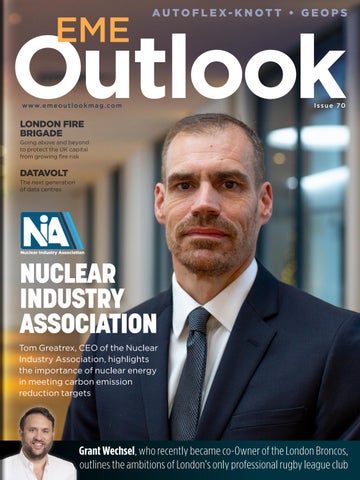
Tom Greatrex, CEO of the Nuclear Industry Association, highlights the importance of nuclear energy in meeting carbon emission reduction targets

Grant Wechsel , who recently became co-Owner of the London Broncos, outlines the ambitions of London’s only professional rugby league club


Africa Outlook, APAC Outlook, EME Outlook, North America Outlook, Mining Outlook, Healthcare Outlook, Manufacturing Outlook, Supply Chain Outlook, Food & Beverage Outlook, Construction Outlook, and Sustainability Outlook are digital publications aimed at boardroom and hands-on decision-makers, reaching an audience of more than 800,000 people around the world.
With original and exclusive content compiled by our experienced editorial team, we look to promote the latest in engaging news, industry trends, and success stories from across the globe.
Your company can join the leading industry heavyweights enjoying the free exposure we provide across our platforms with a free marketing brochure, extensive social media saturation, enhanced B2B networking opportunities, and a readymade forum to attract new investment and help you grow your business.
Visit www.outpb.com/work-with-us for details on how your company can feature for free in one of our upcoming editions.
EDITORIAL
Head of Editorial: Jack Salter jack.salter@outpb.com
Deputy Head of Editorial: Lucy Pilgrim lucy.pilgrim@outpb.com
Senior Editor: Lily Sawyer lily.sawyer@outpb.com
Editor: Ed Budds ed.budds@outpb.com
Editor: Rachel Carr rachel.carr@outpb.com
Copy Editor: Lauren Kania lauren.kania@outpb.com
PRODUCTION
Art Director: Stephen Giles steve.giles@outpb.com
Senior Designer: Devon Collins devon.collins@outpb.com
Designer: Louisa Martin louisa.martin@outpb.com
Production Manager: Alex James alex.james@outpb.com
Digital Marketing Director: Fox Tucker fox.tucker@outpb.com
Website Content Manager: Oliver Shrouder oliver.shrouder@outpb.com
Social Media Executive: Jake Crickmore jake.crickmore@outpb.com
BUSINESS
Chief Executive Officer: Ben Weaver ben.weaver@outpb.com
Managing Director: James Mitchell james.mitchell@outpb.com
Chief Technology Officer: Nick Norris nick.norris@outpb.com
Content Director: Neil Perry neil.perry@outpb.com
Global Head of Media: Lewis Hammond lewis.hammond@outpb.com
Global Media Executive: Kai Boyle-Vennard kai@outpb.com
ADMINISTRATION
Finance Director: Suzanne Welsh suzanne.welsh@outpb.com
Finance Assistant: Victoria McAllister victoria.mcallister@outpb.com
EME OUTLOOK
Norvic House, 29-33 Chapelfield Road Norwich, NR2 1RP, United Kingdom
Sales: +44 (0) 1603 804 445 Editorial: +44 (0) 1603 853 874
SUBSCRIPTIONS
Tel: +44 (0) 1603 853 874 jack.salter@outpb.com www.emeoutlookmag.com
Follow us on Linkedin: EME Outlook Magazine
Follow us on X: @OutlookPublish

Welcome to our 70th edition of EME Outlook magazine.
Tom Greatrex, CEO of the Nuclear Industry Association (NIA), heads up our latest issue.
The UK nuclear energy sector is on a journey to achieve clean electricity by 2030 and net zero emissions by 2050.
An important part of achieving this is the current government’s commitment to building more nuclear sites to strengthen national energy security.
Seeking to promote, support, and grow the sector, NIA is ushering in a new era of rapid expansion and government backing for small modular reactors (SMRs) and large-scale projects.
“We are not going to be able to meet our net zero commitments without nuclear being an integral part of the system – I think that is beyond dispute,” Greatrex affirms.
In today’s artificial intelligence (AI)-driven world, digital infrastructure requires huge amounts of computing power, energy availability, and resilient cooling systems.
For Rajit Nanda, CEO, the natural next step was to work with Vision Invest, a Saudi Arabian development and investment holding company, to create DataVolt.
“DataVolt was created by infrastructure leaders who understand energy is the real bottleneck in the digital age – we seek to bring power to the data, not the other way round,” Nanda insights.
In the UK capital, the fire service operating environment has changed at a pace London Fire Brigade (LFB) is working hard to tackle.
Some of the most serious risks LFB is grappling with – including summer wildfires and e-bike and e-scooter fires – have only recently emerged as pressing issues.
In response to this evolving threat profile, the Brigade has made significant changes, including improved training and new equipment.
“We have to adapt in response to these risks to ensure we are ready and prepared to protect Londoners,” states Jonathan Smith, Commissioner, who we previously spoke to in March 2025.
Elsewhere in this energetic edition, enjoy exclusives from Autoflex-Knott, GEOPS, and Wenzel’s The Bakers.
We hope that you enjoy your read.
Jack Salter
Head
of Editorial, Outlook Publishing


42 London Fire Brigade
Meeting Tomorrow’s Fire Service Needs Today
Above and beyond to protect the UK capital from growing fire risk

DataVolt
of

60 Autoflex-Knott
From Hungarian Roots to Global Roads: The Autoflex-Knott Expansion Story
Advanced towing operations and global growth

Drilling to the Core
A leading provider of advanced drilling solutions

FOOD & BEVERAGE
80 Wenzel’s The Bakers
Born and Bread in London
Baked to perfection

In an era where consumer trust reigns supreme, Wojtek Kokoszka, CEO at Mention Me, explores how beauty brands are shifting strategies from traditional advertising to building authentic customer connections, emphasising the importance of peer recommendations and community engagement for sustainable growth
Writer: Wojtek Kokoszka, CEO, Mention Me
When was the last time you purchased a skin care product after seeing an advert, instead of hearing about it from someone you already trust?
What’s happening now in the beauty world ties back to that question – brand strategies such as Estée Lauder’s Beauty Reimagined and Coty’s Coty.Curated is being
sold as a smart change, with fewer distractions, tighter control, and better returns.
Look more closely, however, and you’ll see there is a clear movement beneath the surface in which trust now sits between brands and consumers. One clear reason is that both groups are reacting to the same commercial pressures.
Sourcing new customers now costs more than ever before. Consumers are becoming far more sceptical of traditional influencers, and more people now trust in peer recommendation over brand-led messaging.
This isn’t something that will vanish overnight; instead, it represents a clear example of how influence is evolving, as exemplified by recent campaigns.
It’s not enough for brands to simply show up anymore; being seen means very little if nobody believes in you. People want proof, but from those that they already listen to and trust, not from flashy adverts built to have a wow factor.
Decades of beauty progress have

relied on being front and centre above other competing brands.
Big roll-outs, polished photos, and famous faces pushing products – all of these have driven strong interest over time, with power and influence flowing clearly from brand to consumer – this framework created the global icons we know and love today.
Yet the conditions that sustained it have changed over the past few years. Recent research of over 1,200 consumers reveals that over half most often receive recommendations from friends and family, and 51 percent trust those recommendations above all other sources.
These figures show that growth is increasingly tied to personal referrals rather than promotional output alone.
What makes Coty.Curated particularly compelling is not just its emphasis on sharper data and streamlined investment, but how that data helps brands get closer to buyers.
Beauty Reimagined reflects the same thinking by accelerating product development and putting more effort into marketing aimed directly at consumers to build stronger connections.
Growth happens inside communities, through private chats and trusted networks rather than just through public social media feeds.
As highlighted in Harvard Business Review, people share not only to transact, but to signal identity, strengthen social bonds, and reinforce status within their networks.
However, not everyone shares their recommendations in the same way. There are those who share because they feel emotionally connected to the brand, those who share for incentives, and a larger group of individuals who like brands but only recommend when it feels relevant and socially safe.
This final group is what brands need to focus on, and it’s also where the opportunity lies. Almost half of consumers say they won’t act on recommendations if they don’t feel relevant. This highlights the importance of building confidence and genuine brand loyalty.
Brands must focus on enabling the right customers to recommend at the right moments, in ways that feel natural and genuinely relevant to their networks.

Brands can’t unlock the next wave of growth in the beauty industry by simply tweaking their marketing campaigns.
If they want to level up, they need real systems that let actual customers speak up about what matters to them.
Technology has a massive role to play here, but it can’t replace the human voice. Let data and artificial intelligence (AI) do what they’re best at: figuring out who’s actually influencing others, tracking how that influence travels, and clearing out any barriers in the moments that count.
This has the potential to bring brands and buyers much closer together, much faster.
If you look at the bigger picture, one thing’s clear: brands in beauty and
retail can’t only rely on manufactured hype anymore.
Real growth comes when buyers have experiences they want to talk about and when brands build the systems that help those stories get told – that’s where the future is headed.
Coty and Estée Lauder aren’t just tweaking how they do business; they understand that the balance of power has changed.
These days, it’s consumers calling the shots, people choose which brands deserve to grow, and a lot of those decisions happen in conversations brands can’t steer.
Influence no longer comes from the loudest voice in the room or the one with the most followers; it comes from the most credible one.

Wojtek Kokoszka is CEO at Mention Me, the brand growth engine powered by Tru-Promoters. He leads the company’s mission to help brands harness authentic customer advocacy to drive profitable growth, putting influential customer voices at the heart of modern marketing.
A serial entrepreneur, Kokoszka previously led OpenCorporates as CEO, driving its tech transformation and US expansion. He also co-founded Zappi, scaling it into a USD$100 million consumer insights platform. Both experiences sharpened a conviction he now brings to Mention Me: that human influence, amplified by AI-powered insight, is the most powerful driver of trust, relevance and growth.


We sit down with Lisa Howkins, Sales and Marketing Director at NFU Energy, who talks us through the UK’s changing regulatory landscape, how it presents obstacles to tens of thousands of agricultural businesses, and the services the company has in place to help reduce energy costs, cut carbon emissions, and generate income from renewable sources
Writer: Lucy Pilgrim

The UK energy and utilities space is at a pivotal moment, characterised by highly impactful regulations that are sending shock waves across the industry.
Amongst the sources of this changing environment lies the recent increase in non-commodity charges – a key focus in generating income to update an outdated energy grid.
Impacting a vast range of sectors, the increase in these charges is having a significant effect on the agricultural industry, particularly
subsectors such as horticulture, dairy, and poultry, which are certainly energy intensive but not classified as such under the Energy and Trade Intensive Industries (ETII) scheme and are therefore missing out on major government support and targeted relief on electricity and gas costs.
“Other sectors classified as energy intensive – such as cement and manufacturing – receive discounted rates on non-commodity costs, but those within farming and agriculture don’t have the same luxury,” explains Lisa Howkins, Sales and Marketing Director at NFU Energy – one of the UK’s leading sustainable energy consultants who provides vital support to thousands of businesses across the agricultural industry and beyond.
“We’ve not only been providing support to help our customers understand what these noncommodity charges mean for their business, but also providing insights, data, and support to the National Farmers Union’s (NFU) lobbying efforts. They are working with the farming and agricultural sectors to ensure they receive critical pricing benefits under the ETII,” she adds.


Specialising in energy and utilities for nearly 60 years, NFU Energy has been a vital pillar in the agricultural industry’s evolving energy requirements.
NFU ENERGY’S VALUES – AT A GLANCE
INCLUSIVE – Valuing every voice
PROFESSIONAL – Acting with integrity and expertise
RESOURCEFUL – Finding smarter, practical solutions
UNITED – Working as one team with its clients and each other
“Almost a decade ago, the company was purchased outright by the NFU as part of its strategy to build a base of commercial business that could best support farming in managing its energy needs, spending, and compliance, making it more efficient,” Howkins outlines.
Today, NFU Energy supports over 22,000 farming and agricultural organisations, aiding various aspects of the energy sector.
Based in Stoneleigh, Warwickshire, on the same site as its parent company, NFU Energy’s expertise is led by 50 staff members across the energy consultancy, energy contract management, delivery, and sales and marketing spheres of the business.
The energy contract management division, for instance, supports
customers with their energy and utility contracts, covering both importing from the grid and exporting back.
“We ensure they are not only getting the best rates possible, but with the best suppliers. If there are supplier issues, we manage them directly on the client’s behalf.”
Indeed, NFU Energy can offer its customers a varied suite of contracts, working with over 30 energy suppliers to find the best solutions for its clients’ needs.
Elsewhere, the company also possesses a comprehensive energy account management team who oversee some of the largest energy consumers and generators within the farming and agricultural sectors.
“Other sectors classified as energy-intensive – such as cement and manufacturing – receive discounted rates on non-commodity costs, but those within farming and agriculture don’t have the same luxury”
– LISA HOWKINS, SALES AND MARKETING DIRECTOR, NFU ENERGY
Energy’s technical and compliance services teams, meanwhile, offer a whole host of expertise in areas including the Renewable Heat Incentive (RHI); Climate Change Agreement (CCA) scheme for horticulture, pigs, and poultry; and the Energy Savings Opportunity Scheme (ESOS), to name just a few.
Building on its foundations in agriculture, NFU Energy made the decision a few years ago to support the industry’s adjacent sectors.
“We now work with businesses across a range of areas, from food production all the way through to manufacturing and leisure, where many of our farmers diversify.
“They’re a resourceful, savvy bunch, and a lot of them go into areas like camping or glamping and golf facilities, for example, so we’ve broadened our scope,” Howkins details.
On top of this, a large number of NFU Energy’s clients are also significant energy generators themselves, with some supporting local communities and businesses with renewable energy capacity and selling excesses back to the grid.
Indeed, many farmers have recently supported notable forward-thinking projects and developments.
“We’re currently working on numerous bids and seeing lots of farmers wanting to be involved in bringing that innovation to the forefront, which is really exciting,” she reveals.
Indeed, the company is working with multiple horticulture sites to investigate innovative methods for producing the necessary heat levels to achieve continuous, year-round growth in glasshouses.
“A lot of these things rely on energy and the cost impact of that, so it’s an exciting but also challenging time in the industry.”
With the continued aim to help clients boost their renewable energy capacity and reduce reliance on the grid, NFU Energy understands that not all its customers have the funding available to invest in renewable
energy immediately.
“I’m sure all our farmers would like to look at installing solar panels, heat pumps, or wind turbines, but they don’t always have the capital expenditure to be able to do so straight away. So, we offer multiple solutions in order to make it easier,” Howkins shares.
For instance, the company has a team of trusted suppliers who can recommend the right service and product for each client before installing it.
NFU Energy also recommends clients to organisations that can provide access to funding.
For customers who want to reduce their energy spend and benefit from renewable technologies, the company also provides access to blended power purchase agreement (PPA) funders.
“We have special PPA funders who will cover the installation and maintenance costs of solar, wind, and combined heat and power systems. They will then sell the energy back to the customer at a favourable marketrate price over a period of time.

“Although it’s a longer-term contract, it gives customers the opportunity to have a reduced energy spend and know exactly where they are going to be in the long-term,” she points out.
NFU Energy also works with specialists to offer peer-to-peer modelling – matching customers who generate energy with energy consumers – thereby allowing businesses to understand exactly where their energy is coming from.
Meanwhile, for clients still considering a venture into renewable energy, the company offers fully independent feasibility studies to provide a clear understanding of what is needed and what type of energy generation best suits their


“If we want to focus on protecting food security, we’ve got to ensure the impacts of the non-commodity increases are mitigated, because fundamentally, those that will be most impacted are consumers, as farmers will have to increase their prices”
– LISA HOWKINS, SALES AND MARKETING DIRECTOR, NFU ENERGY
requirements. The studies also highlight significant costs and return on investment.
“Conducting feasibility studies and energy audits prior to renewable projects is important as it means we can reduce eventual energy consumption on-site.
“This would make a project more
efficient as it might require less solar power, for example, allowing the client to sell excess power back to the national grid.
“This also means renewable projects can generate more profit, ensuring farmers have stable enough incomes to support food security,” Howkins impassions.


The recent increase in noncommodity charges is impeding farmers’ stability, particularly affecting businesses in horticulture, dairy, poultry, and other energyintensive sectors.
Non-commodity charges, which make up around 60 to 65 percent of the total energy bill, will continue to go up as a result of a number of changes coming into force.
In fact, the Transmission Network Use of System (TNUoS) charge alone is going up by around 64 percent on average in 2026-27 and is predicted to continue to rise for the next five years, which is undoubtedly going to have a huge impact on businesses.
“The increase in non-commodity charges will affect everybody from domestic users all the way through to large, energy-intensive organisations. It could be a minimal impact in terms of a slight cost increase or raise bills by hundreds of thousands dependant on the type of user,” Howkins insights.
In response, NFU Energy recently developed a TNUoS charge impact
calculator, giving businesses a clear idea of how the rates will affect them.
NFU Energy has also been supporting the NFU in its lobbying efforts to include agricultural organisations under the ETII umbrella.
“If we want to focus on protecting food security, we’ve got to ensure the impacts of the non-commodity charge increases are mitigated, because fundamentally, those that will be most impacted are consumers, as farmers will have to increase their prices.
“If we are to continue to back British produce, then we need to support the farming sector in reducing noncommodity cost increases,” affirms Howkins.
More broadly, NFU Energy’s focus remains on educating customers to ensure they understand what the best contract or solution is for them, creating greater levels of efficiency.
This priority not only applies to the agricultural sectors, but also the broader business landscape, raising awareness of renewable solutions and the impacts of the non-commodity charge increases for
agriculture-adjacent industries.
“From a focus point of view, it’s about ensuring our customers and the wider network are educated on what is happening in the industry, how this could affect their business, and what support is available,” Howkins insights.
“Although managing energy and making the most of the opportunities available can feel like a real challenge for many businesses, with the right guidance and support, it’s very achievable to make real gains when it comes to how you use your energy, what you spend, and your environmental impact.
“There is no out-and-out fix – it’s a multi-layering of different products and services that can have an impact,” she concludes.

Tel: +44 (0) 24 7669 6512 info@nfuenergy.co.uk www.nfuenergy.co.uk

In a world of increasingly polarising narratives, Portals are technology art sculptures that allow people to connect above borders and labels and meet fellow humans from across the globe. We connect with Nicolas Klaus, Partner and Chief of Growth at Portals Organization
Writer: Jack Salter


In the age of artificial intelligence (AI), algorithms, and a constant chase for the next hit of dopamine, Portals deliver an alternative approach.”
These large-scale technology sculptures, intended as lasting monuments at notable locations in the public space, serve a pure window – without features, imposed narratives, and rules – simply showing reality as it is.
The centre screen provides a 24/7
livestream that connects to identical Portals in other countries and rotates every three minutes between all participating locations.
“Whilst the technology may seem simple, there is quite some complexity in maintaining a growing number of Portals, which are constantly active and in the public eye, located in highfootfall locations, and across diverse climatic conditions,” explains Nicolas Klaus, Partner and Chief of Growth at Portals Organization.
Based in Vilnius, Lithuania and Berlin, Germany, Portals Organization is the company behind the development, fabrication, and upkeep of the global Portals network.
The origins of Portals go back to 2016 when Founder, Benediktas Gylys, an accomplished tech entrepreneur, went through an episode of deeply questioning reality.
This led him to a mystical experience of feeling oneness with all life on Earth, and Portals became the medium through which this experience was manifested and shared.
Benediktas funded the early development through his private foundation and drew together a team of supporters in Lithuania to create the first two Portals, which opened in Vilnius and Lublin, Poland in 2021.
“Personally, I joined the project later that year. Together, with a small core team, we incorporated Portals Organization, with the purpose of growing Portals into a global artwork,” recalls Klaus.
One of the key challenges has been to align the artistic and philanthropic essence of Portals with a business model that would generate the necessary funding for its expansion and upkeep.
“We re-engineered Portals from the ground up in Berlin and secured funding from several public and private organisations who, thanks to their visionary leadership, were able to see the value of hosting Portals in their cities at a time when this still seemed like a crazy idea to many,” he tells us.
This resulted in the opening of Portals in Dublin, Ireland; New York, US; and Ipswich, UK – generating billions of online impressions and real moments of connection between people who otherwise would have never met.
“You can think of Portals in terms

“In the age of AI, algorithms, and a constant chase for the next hit of dopamine, Portals deliver an alternative approach”
– NICOLAS KLAUS, PARTNER AND CHIEF OF GROWTH, PORTALS ORGANIZATION
of multiple layers – the sculptures themselves provide the platform, but another layer emerges from people’s interactions and the thousands of moments of connection that happen every day. Many of these encounters are published to social media, where they result in millions of impressions,” Klaus highlights.
The UK’s first-ever Portal in Ipswich was recently launched in October 2025 and followed a two-year planning process, enabled through
the Towns Deal funding from the UK government.
“Many cities across the UK have these beautiful town centres, which have become much less active –especially following the COVID-19 pandemic,” notes Klaus.
In response, the UK government launched initiatives to vitalise town centres and strengthen community building in the public space.
This was an important piece of the puzzle to enable the Ipswich Portal, but it also required a lot of dedication and an open mind from key people at
HOW DO PORTALS SHARE AN INVITATION TO MEET FELLOW HUMANS ABOVE BORDERS AND PREJUDICES AND EXPERIENCE PLANET EARTH UNITED AND AS ONE?
Nicolas Klaus, Partner and Chief of Growth: “Another way to describe Portals, which I personally like a lot, is in terms of the ‘Overview Effect’ – when astronauts fly to space, and they view planet Earth through the window of their spaceship for the first time, they tend to describe the same universal experience: a deep sense of awe and empathy that arises from seeing our home planet as a single entity that is home to and shared by all life.
“We’re all together on ‘spaceship Earth’ – each happy moment, drama, discovery, poetry, and love story – it’s all connected.
“The Overview Effect is a well-studied phenomenon in psychological literature, and I find it fascinating that, whilst most people know and agree that we live on a plane called Earth, there is a fundamental difference in just ‘knowing’ and truly experiencing this reality.
“You could say that Portals seek to make the Overview Effect accessible here on Earth, so hopefully more people get to experience it even before travelling to space.”

“You can think of Portals in terms of multiple layers –the sculptures themselves provide the platform, but another layer emerges from people’s interactions and thousands of moments of connection that happen every day. Many of these encounters are published to social media, where they result in millions of impressions”
– NICOLAS KLAUS, PARTNER AND CHIEF OF GROWTH, PORTALS ORGANIZATION
Ipswich Borough Council.
“Some people have been asking, “Why Ipswich?”, and the answer is because Ipswich was ready to receive it. We rarely reach out to cities proactively, mainly because there needs to be a critical mass of ‘readiness’ to receive a Portal,” Klaus outlines.
“It’s also worth noting that Ipswich is one of the oldest towns of England with a beautiful historic city centre where the Portal is now located.”
Evidently, there needs to be an understanding of what Portals are and the value hosting one creates.
“With most of our key partners, it becomes a legacy project, and they
work with a high degree of agency and vision. It’s not easy because you tend to have layer upon layer of committees and bureaucratic red tape, which needs sufficient motivation and knowledge to break through,” emphasises Klaus.
At the same time, with each new Portal that opens, it becomes easier as processes are standardised and perceptions change – from Portals being a crazy idea to a reality that needs to happen.
Portals will be launched in four new countries this year, and Portals Organization has various technical development goals to ensure it can reliably maintain this growing network 24/7.
This means by the end of 2026, there should be a total of nine Portals on four continents, all operating with minimal downtime, facilitating tens of thousands of on-site interactions and millions of online impressions.
In January this year, the very first Asian Portal debuted in Manila, Philippines, whilst South America’s first Portal is currently being shipped and will open in spring in Piauí, Brazil.
“A third Portal is planned in another well-known Asian city – to be announced soon,” teases Klaus.
On the partnerships side, it is also looking to realise four collaborations with major brands or cultural institutions to launch memorable global experiences through Portals.
“We’re increasingly looking into partnerships to co-create events at Portals and do joint storytelling together online,” he confirms.
For example, Portals Organization recently partnered with UK-based space company SEN, who have HD cameras installed at the International Space Station and provide a live feed of planet Earth that is now occasionally visible on the Portals.
“This is a natural partnership since the essence of Portals is the insight that we are all one, inseparably connected in this world – an insight that becomes undeniable when viewing planet Earth from space.
“We also partnered with Chess. com for an international chess tournament through Portals for International Chess Day back in July, and we are in contact with many brands and organisations to create meaningful moments together,” Klaus closes.


Grant Wechsel, who recently became co-Owner of the London Broncos, outlines the ambitions of London’s only professional rugby league club and why the UK capital deserves a strong, competitive Super League presence
WRITER: JACK SALTER

London is such a great city and a sporting capital of the world, so we need to put rugby league on the map.”
In September 2025, Grant Wechsel became co-Owner of the London Broncos alongside one of the sport’s all-time greats, Darren Lockyer.
Originally formed in 1980 as Fulham Rugby League Club, they were renamed the London Broncos in 1994 following a takeover by the Brisbane Broncos – where Lockyer spent his entire professional career and became

the club’s record appearance holder.
“Given Darren’s history as a Brisbane Bronco, there was this natural association for him to be involved in the London Broncos,” Wechsel tells us.
“The opportunity kind of fell into our laps. We’ve been in business together for 15 years in various things back in Australia, mainly the mining industry. We came over and had a look, then things moved really quickly because we had to be ready for the new season – it’s quite a crazy story how it’s all come together.”
Following the takeover, there has been a big push to rebrand the club to mark the next chapter in its journey, including an eye-catching new logo and a landmark multiyear apparel partnership with Reebok.
“It’s a big turnaround story – a lot of people call us the ‘Wrexham of rugby league’,” says Wechsel.
The London Broncos are currently competing in the Championship, the second tier of rugby league, having missed out on selection for the expanded 14-team Super League in 2026.

GRANT WECHSEL, CO-OWNER: “I’m very excited about the future. We can already see from the fan engagement we’re getting that what we’re doing is working. So, we’re just going to have to keep pushing forward and creating excitement and buzz around the game in London, then let the players do their work on the field.
“As long as we’re winning, there’s no reason it shouldn’t continue to build for us this year, with

Super League teams are determined by the IMG gradings system, with Grade A clubs guaranteed a spot and Grade B clubs taking the remaining places.


Despite moving up to 16th in the IMG gradings, with a Grade B score of 11.65 out of 20 for the upcoming season, this was not enough to be selected for the top division.
“Unfortunately, we were too low down in the IMG gradings. The feedback was that if we had been put in above the other teams, we would have effectively jumped over those ahead of us in the pecking order,” Wechsel acknowledges.
However, the London Broncos remain confident in their vision and long-term ambitions, and this decision has only strengthened the club’s commitment to reaching the top division once more.
“I think we would’ve been competitive straight away, but it gives us more time to prepare and has certainly increased my determination to make sure we’re back in the Super League in 2027.
“London is such a great city and a sporting capital of the world, so we need to put rugby league on the map”
– GRANT WECHSEL, CO-OWNER, LONDON BRONCOS

“We’ve just got to do everything we can to get there and make sure our IMG gradings score is good enough to go up. We’ve recruited a great squad and coach, and we need to win the Championship this year to get our points up under the IMG gradings system to be promoted next year,” he sets out.
“We had a big win against the Widnes Vikings in our first game of the season, which showed our intent.”
The Challenge Cup, a knockout rugby league cup competition held annually since 1896, was the only opportunity the London Broncos had to face Super League clubs this season.
An emphatic, record-breaking 86-0 victory in the second round against their local rivals, the Wests Warriors, set a new benchmark for the largest competitive win in the club’s history.
Crucially, it also secured progression to the third round, where the London Broncos played against the Bradford Bulls – who were promoted to the Super League for 2026 –but ultimately lost 8-26.
London is the beating heart of the UK and the ultimate playground for rugby league fanatics that dare to be different.


“There’s an opportunity to build a significant club here; even a niche market in London is still a big market. For us, a big part of this opportunity was the location itself”
– GRANT WECHSEL, CO-OWNER, LONDON BRONCOS
The capital has a diverse mix of cultures and demographics and offers a unique stage to showcase a sports brand that’s dynamic, modern, and ready to break the mould.
The London Broncos are committed to its long-term vision for a world-class rugby league club, outlining the sport’s development and expansion throughout London and Southern England.
“You have to respect that the history of rugby league is in the north and what all the big clubs have done, but if you’re looking to grow the game, London is clearly the biggest market you could expand into,” Wechsel notes.

The Rugby Football League (RFL) have been supportive of the club’s efforts to try and build out the game in London, something that can only strengthen the competition.
“There’s an opportunity to build a significant club here; even a niche market in London is still a big market. For us, a big part of this opportunity was the location itself,” he adds.
“If you’re a rugby league fan from anywhere in the UK, a weekend in London is great to do from a travel perspective. You could base a trip around coming to watch rugby league in the capital. It’s such a fantastic city; there are so many things for people to do that they can tie in and around watching the game.

“Even though we’re in the Championship, we’ve got three very high-profile National Rugby League (NRL) players at the club, and our captain has played for Australia, so you get to watch a level of rugby league that you probably haven’t been able to in London for some time,” Wechsel highlights.
As such, the club believes London deserves a strong, competitive Super League presence and is committed to making this a reality.
“It’s all about trying to attract new fans to the game and increase the popularity of the sport in London,” he passionately concludes.
“We’re attracting new fans by having a game day experience that’s a lot better than it was before and creating an atmosphere that people want to go to for a day out.”


Sweden is the first country in the world prescribed to patients by doctors – welcome to a destination of a different nature
Across the world, doctors are increasingly prescribing time in nature or cultural activities to support both mental and physical health.
Sweden has taken this one step further, becoming the first country to be offered on prescription.
More than just a scenic escape, Sweden is ranked as a global frontrunner in quality of life and routinely named as one of the world’s happiest nations.
As such, the Scandinavian country has been shown to support measurable health outcomes and a lifestyle centred on balance and belonging.
With easy access to both nature and culture, Sweden’s unique way of

life makes it an ideal pace to reset the mind and body.
The Swedish Prescription is a global communications initiative by Visit Sweden, the official marketing company tasked by the Swedish government with promoting the country as a travel destination.
Visit Sweden has teamed up with medical professionals ready to prescribe a stay in Sweden when appropriate so patients can benefit from the country’s restorative experiences.
Together with Yvonne Forsell, a senior professor at Karolinska Institutet in Sweden, the company has identified a set of activities visiting patients can benefit from across three areas – nature, lifestyle, and culture.
It’s well known that spending time in nature has numerous health benefits, and Sweden offers space to breathe, eases stress, and boosts energy.
Nature is always close by as there are some 100,000 lakes and over 5,000 nature reserves in the country, meaning visitors are never far away from a blue space or green area – even in the cities.
There are several activities that can boost health in Swedish nature, including forest bathing, foraging, cycling, sky watching, and sleeping.
The former is a sensory escape into nature as Sweden’s vast forests offer a tranquil retreat that can reduce stress, lower blood pressure, and improve focus.

Midnight sun in Swedish Lapland .Credit: Per Lundström/imagebank.sweden.se
Far from the everyday hustle and stress, forest bathers are immersed in the calm of the Swedish woods – engaging all the senses for a truly rejuvenating experience.
There’s something instinctively calming about being surrounded by trees; the rustling leaves, chirping birds, and earthy scent of moss all tap into a sense of peace and presence.
The foraging culture in Sweden is equally strong and, come late summer, nature lovers spend days in the forests collecting berries, mushrooms, and plants.
Sweden is also an ideal destination for cycling, which is one of the best ways to discover this beautiful country and explore its long stretches of varied coastline, bustling cities, and lush countryside.
Physical activity whilst travelling promotes well-being, and regular cycling is associated with a reduced risk of cardiovascular disease and type 2 diabetes.
Sky watching, meanwhile, is linked to reduced stress and increased emotional well-being. In addition to excellent stargazing, enjoy two seasonal natural phenomena – the Midnight Sun and Northern Lights.
The Midnight Sun – incidentally the name of Swedish singer Zara Larsson’s fifth studio album released in September 2025 – occurs in summer above the Arctic Circle when the sun stays above the horizon for several weeks.
This means it remains visible even in the middle of the night, creating extended daylight hours that can feel both unusual and fascinating for firsttime visitors.
In winter, the Northern Lights put on one of nature’s most spectacular shows, and Northern Sweden is one of the best places to experience them.
From September to March, the skies above Swedish Lapland come alive in shimmering shades of green, pink, and violet.
At night, Sweden also provides all
the right conditions for restorative sleep and ‘Swede dreams’ thanks to its natural darkness, cool temperatures, clean air, and peaceful, varied nature.
Sweden consistently ranks amongst the world’s best countries for quality of life, sustainability, safety, happiness, and more.
So, what’s the secret? Whilst there’s no single answer, the Swedish lifestyle is often highlighted due to its strong emphasis on work-life balance.
There are three simple ways to embrace the Swedish way of life, the first of which is ‘fika’ – a cherished tradition and cornerstone of daily life.
‘Fika’ usually involves freshly brewed coffee served with something sweet, with cinnamon buns being the most popular choice.
Whilst ‘fika’ may seem like just a coffee and cake break, it holds much deeper cultural significance in Sweden and is a moment to pause, connect, and recharge.
Then there’s ‘lagom’, meaning ‘just the right amount’, a uniquely Swedish concept that embraces balance, moderation, and contentment.
For Swedes, ‘lagom’ isn’t about doing less – it’s about finding harmony in everyday life, doing things mindfully, and avoiding excess.
There are numerous health benefits associated with Sweden’s natural environment and way of life:
• Accessible nature – In Sweden, nature isn’t something you have to plan for –it’s all around.
• Active travel made easy – People walk and cycle as part of daily life.
• Clean air – Sweden consistently ranks amongst the top countries in Europe for air quality.
• Culture without the crowds – The country’s cultural institutions are easy to access, ranging from world-renowned modern museums to fairytale-like historic castles.
• ‘Fika’ – The daily pause for coffee and conversation is deeply embedded in Swedish culture.
• Foraging – Foraging for wild berries and mushrooms is a national pastime.
• Forest bathing – The practice of slow, mindful immersion in nature.
• ‘Lagom’ – The idea of ‘not too much, not too little’ is central to how Swedes approach life.
• Life by water – Sweden is home to some 100,000 lakes, meaning water is never far away.
• Light and dark – In the far north of Sweden, daylight stretches through the night in summer.
• Restorative sleep – Sweden’s natural environment offers ideal conditions for restorative sleep.

• Sauna culture – A way to slow down and reconnect, whether with family, friends, or yourself.
• Silence and tranquillity – Silence is part of the landscape in Sweden, found in forests, by lakes, and within city parks.
• Well-being through metal music – Music is woven into the country’s cultural fabric.


Sauna bathing is another rejuvenating Swedish ritual that has a long tradition in Scandinavia and is often combined with a refreshing dip in one of the many scenic cold bath houses along the coast.
Swedish sauna culture is relaxed and unpretentious, providing a space for quiet reflection. It also offers several health benefits, including better sleep quality and a significantly lower risk of dementia.
Cultural engagement can reduce depression, anxiety, and loneliness.

Rooted in tradition yet bursting with creativity, Swedish culture has long been recognised as a source of well-being and has been available on prescription in parts of the country for over 20 years.
Museums invite guests on a journey through time where they can step into the life of a Viking, wander through fairytale-like royal castles, or take a nostalgic trip through Swedish rail history.
Sweden is also a global player in the music world and one of the most metal-dense countries per capita with over 5,000 metal bands.
Metal music has been shown to enhance positive emotions and help regulate anger, however attending live events of any genre is linked to greater life satisfaction.
Along with musicians, many inspiring women have helped shape Swedish culture, including pioneering pilgrims, courageous activists, creative minds, and cultural icons, and the country is dotted with places that pay tribute to them.
A cultural experience in Sweden will not only leave lasting memories but also nourish the mind and soul.


As it undergoes a considerable period of renaissance, the UK’s nuclear energy landscape is moving away from an ageing fleet of traditional reactors and towards a renewed collection of large-scale plants and advanced, smaller technologies.
Having agreed upon a robust set of legally binding carbon emission reduction targets in a 2019 review of the Climate Change Act 2008, the nation is aiming for net zero greenhouse gas emissions by 2050.
An important part of achieving this goal is the current government’s commitment to building more nuclear sites to strengthen national energy security.
Currently, the country generates approximately 15 percent of its electricity from existing nuclear sites, but with the majority anticipated to come offline by 2030, an urgent call for new infrastructure has emerged.
As such, major nuclear undertakings such as the 3.2 GW Hinkley Point and Sizewell C projects underway in
Continuing its journey to achieve clean electricity by 2030 and net zero emissions by 2050, the UK’s nuclear energy sector is heralding a new age of growth, bolstered by government-backed legislation
Writer: Lily Sawyer | Project Manager: Joseph Perfitt

Somerset and Suffolk, respectively, will begin to fill this gap.
In addition, the government has implemented a radical review of the overall regulatory systems surrounding nuclear energy implementation, with the recently launched EN-7 National Policy Statement accelerating the deployment of next-generation technologies such as small modular reactors (SMRs). Elsewhere, the sector is transitioning to the
Regulated Asset Base (RAB) funding model, which allows new power plants to be funded by small, regulated contributions from consumers’ energy bills during construction.
As the UK’s energy sector continues to retire ageing capacity whilst building an advanced new nuclear fleet, it is entering a period of revival characterised by government-backed legislation and technological advancement.


Seeking to promote, support, and grow the UK nuclear sector as it moves towards its goal of producing all electricity from clean sources by 2030 and achieving net zero emissions by 2050, the Nuclear Industry Association is ushering in a new era of rapid expansion and government backing for SMRs and large-scale projects.
Tom Greatrex, CEO, highlights the importance of nuclear energy in meeting carbon emission reduction targets
EME Outlook (EO): Firstly, could you talk us through the origins and primary goals of the Nuclear Industry Association?
Tom Greatrex, CEO (TG): The Nuclear Industry Association (NIA) is a member organisation which has existed in its current format since the early 1990s, with our members making up the supply chain for the civil nuclear sector in the UK.
Its main goals are to further the interests of this sector and ensure there’s public understanding of the role nuclear plays in the energy system and more widely.
The association also seeks to maximise opportunities for companies involved in nuclear projects both nationally and internationally.
EO: What is your take on the current UK energy landscape, and how have you seen it evolve over the course of your career?
TG: The UK energy landscape is always challenging – but challenges are also opportunities in many cases.
My involvement in energy policy has spanned almost 20 years – first as an advisor in government, then as a Member of Parliament and Shadow Minister, and in the last few years as CEO of NIA.
Throughout this period, we’ve experienced various stages of the energy transition, moving broadly away from fossil fuels and towards other forms of electricity generation.
This comes with related challenges in terms of ensuring systems work properly, the grid can transmit power, and we have enough capacity to be able to maintain supply when weather conditions aren’t optimal.
All those things are happening together right now, which have made it a very exciting industry to be involved in, and nuclear is an important part of that.
EO: How important is nuclear energy in helping the UK meet legally binding carbon emission reduction targets?
TG: We are not going to be able to meet our net zero commitments without nuclear being an integral part of the system – I think that is beyond dispute.
There was a period when people said you could do it all with renewables, but the reality is, if you want a resilient, low-carbon system that provides energy security and is price predictable for households as well as businesses, nuclear needs to be an integral part of it.
Granted, nuclear won’t be the biggest single contributor to the future grid, but it is an integral and necessary part of it if we want to minimise our reliance on fossil fuels.
EO: As an association that serves as a link between government and the energy industry, how extensively is NIA involved in contributing to policy and regulatory frameworks which may affect the UK’s energy landscape?
TG: We have been involved in lots of policy development in recent years, such as the establishment of Great British Energy – Nuclear in 2023, formerly Great British Nuclear (GBN), which was the result of collaboration between NIA and others across the industry.
Through Great British Energy – Nuclear, we’re looking to secure the nuclear sites we need across the country.
Then there’s the RAB model for financing nuclear projects, which recently went through a legislative process to enable a new, cost-effective funding model.
NIA was heavily involved in explaining why this legislation was required and how it could be properly carried out.
Elsewhere, many of the changes to green financing which have now been adopted by the government are things that we’ve been pushing for over a long period of time.
Currently, perhaps the most important development is the Nuclear Regulatory Taskforce’s review of nuclear regulation, led by Taskforce Lead, John Fingleton, which has now been published.
NIA was significantly involved in making the case for some of those regulatory changes and will now be instrumental in ensuring that implementation happens as effectively as possible.
Therefore, alongside other trade bodies, NIA has played an important role in making contributions across all these areas, providing the industry with a vital voice and making decisions conscientiously by taking potential impacts into full consideration, thereby reducing the rate of unintended consequences.
I think it’s important for all concerned when dealing with energy – which is both a political and technical consideration – that decisions are well-informed. Ultimately, it’s our job to help ensure decision-makers are as informed as possible.
EO: Can you talk about your involvement in Nuclear Week in Parliament (NWiP) 2026 and what key topics were on the agenda for Parliamentarians to discuss?
TG: Over the course of 2025, several nuclear policy decisions were made by both the previous and current governments. Today, it’s about how we deliver on those policies.
As an effective advocate for the UK’s nuclear industry, becoming a member of NIA can provide businesses with a dynamic and credible platform. Benefits include:
• Networking opportunities
• Promotion to industry
• A voice to government
• Discounted events

Currently, we have a broad policy framework in place, and parliamentarians are primarily interested in how this will become a reality in their constituencies – how their supply chains might be impacted and what benefits might be afforded, for example.
We discussed decisions on major nuclear projects like Sizewell C alongside updates on the first SMR and routes to market for alternative ways of building privately-led capacity, which the government recently announced –particularly in relation to artificial intelligence (AI) and data centre requirements, but also for synthetic fuel grids in sectors like aviation and maritime.
Parliamentarians are interested in all these things because they want to see real delivery happening.
EO: How does the recent cross-party support in Parliament for SMRs at Wylfa indicate that nuclear will be central to the UK’s economic and energy future? Equally, what socioeconomic benefits will the power station’s revival afford?
TG: The benefits of Wylfa are two-pronged. Firstly, there’s what will happen at and around the site itself in Ynys Môn, North Wales, which includes the creation of thousands of jobs – around 3,000 in the community and 8,000 across the UK during peak construction.
These are long-term career opportunities, and when the announcement was first made of Wylfa being the site for the first SMR, local colleges became awash with lots of very excited young people who would benefit.
The opportunities that accompany big infrastructure projects like this are not only in nuclear engineering or
Announced on 4th February 2026, the UK’s Advanced Nuclear Framework details how the government plans to create an enabling policy environment for private sector investment in advanced civil nuclear projects.
Designed to support the development, commercialisation, and deployment of innovative nuclear projects, the framework sets out two ways in which it plans to achieve this.
1. Introduce a new government-managed UK Advanced Nuclear Pipeline, through which projects are invited to submit detailed plans across five core areas, for consideration by the Project Readiness Assessment process. Projects assessed at or above the threshold may be invited to join the pipeline, enabling those with strong plans to access early engagement and potential future support.
2. Disclose wider enablers that the government will put in place to support nuclear deployment, establishing the optimum conditions, infrastructure, and policy landscape to support the commercialisation and deployment of advanced nuclear projects.
Fifty years on and we’re just getting started.
I
TI Group has been quietly delivering technology services for critical infrastructure projects in the nuclear energy sector for over half a century. The company is trusted to work with nuclear power generation businesses, helping ensure that the technology works seamlessly with the facility in terms of control, management, cyber security, operational efficiency and, above all safety. ITI Group operates in many sectors including oil and gas, utilities and manufacturing. Its core expertise is in securely unifying critical plant assets and infrastructure through technology, allowing greater visibility of critical infrastructure and ensuring safe and optimised operations.
Nuclear power accounted for 27% of the UK’s electricity generation in the mid-1990s but is around 15% today. The Civil Nuclear: Roadmap to 2050 aims to reverse this decline with the ambition that nuclear will account for at least 25% of the country’s electricity production by 2050, as demand for electricity is expected to double by 2035 and treble by 2050.
Due to ongoing geopolitical instability increasing in recent years, the government acknowledges the crucial importance of the nuclear industry to national security, covering both energy supply and the defence nuclear enterprise.
The Civil Nuclear: Roadmap to 2050 confirms the strategic integration between civil and defence nuclear ambitions. It was this synergy and opportunity for integration that was recently highlighted in the recommendations published in November 2025 by the independent Nuclear Regulatory Review. The independent taskforce’s report details the critical need for a comprehensive overhaul of the UK’s nuclear regulatory system.
A systems integrator provides technology solutions that help keep assets operational and provide real-time data to manage and make more informed operational decisions. Buildings are essentially an ‘analogue shell’ and ITI Group works with

industrial businesses to provide the intelligence to control and monitor critical assets and ensure all the systems work in unison, whether that be machine control, cybersecurity, radiological and fire detection and safety systems. Critically, it is the data from these systems that can be monitored in real-time or analysed to provide better intelligence to optimise processes.
ITI Group currently works with EDF on both their current generation fleet and new build projects at Hinkley Point C, Sellafield and the wider NDA estate on the operational technology aspects of the sites. As an expert in digital transformation programmes, the company has established expertise in nuclear energy development projects in both operations and the design and development using simulation models and digital twins. For the SMR roadmap roll-out, design and development work will be completely digital as the initial digital simulation of the facility underpins complex decisions.
In November, ITI Group completed the acquisition of nuclear engineering services specialist Noveum. The acquisition strengthens ITI Group’s civil and defence nuclear capabilities and boosts capacity with a significant number of additional suitably qualified and experienced personnel (SQEP). Talent is fast becoming a major hurdle and the industry needs to invest in the next generation to help us achieve our nuclear ambitions.
So, with a renewed appetite for investment in nuclear, coupled with the opportunity to streamline the planning processes and align the strategically important civil nuclear and defence sectors more closely, the UK is well-placed to become one of the preeminent nuclear superpowers once more.


“WE ARE NOT GOING TO BE ABLE TO MEET OUR NET ZERO COMMITMENTS WITHOUT NUCLEAR BEING AN INTEGRAL PART OF THE SYSTEM – I THINK THAT IS BEYOND DISPUTE”
–
TOM GREATREX,
CEO, NUCLEAR INDUSTRY ASSOCIATION
construction, but across the board, meaning local talent can stay local.
Secondly, Wylfa is North Wales’ largest industrial investment in a generation, so it’s significant both locally and regionally, but it also heralds the establishment of the first SMR in the UK – Rolls-Royce SMR – which has huge export potential.
As exports from the site will increase incrementally, the supply chain for the UK-based Rolls-Royce brand is anticipated to see major growth opportunities – initially in Europe, then around the world.
In this way, Wylfa’s local economic impact will be both tangible and immediate, and its national and international influence will escalate.
EO: Finally, what are NIA’s key priorities for the future, and how do you see the UK’s energy landscape evolving in coming years?
TG: Our key priorities in the period ahead include ensuring the delivery of nuclear commitments happen unencumbered by external factors.
This includes implementation, regulatory reviews, and changes to the planning systems to ensure they dovetail with projects.
In parallel, we have opportunities to develop future technologies in the fuel and the supply chain sectors to increase energy security.
There is also lots of work happening in decommissioning and waste management, which isn’t as often talked about, but is vitally important and a significant part of the sector and again has export opportunities.
Together, these areas are our key priorities, and in some ways, they’re the same as those we’ve had for the last few years, but we’re now shifting from discussion to delivery, which is an exciting place to be.
As such, the UK’s energy landscape will continue to evolve into a low carbon, secure, and reliable mix over the next few years.
Other aspects of the energy system will be challenging, but as we move towards the 2030s and increasingly see nuclear deliver, it will help to stabilise the energy ecosystem and ensure we achieve the right mix for the future.
It’s a really exciting time to be involved in energy and nuclear.


As organisations worldwide navigate the new healthcare landscape, defined by technological innovation in the wake of the COVID-19 pandemic, now is the time to showcase the strides being taken in this critical sector.
A multi-channel brand, Healthcare Outlook brings you the positive developments driven by organisations across the healthcare industry through its various platforms. Discover exclusive content distributed through its website, online magazine, social media campaigns and digital dispatches, delivered safely to your inbox with a bi-weekly newsletter.
Through these compelling media channels, Healthcare Outlook continues to foreground the movers and shakers of the industry.
To participate as a featured company and join us in this exciting endeavour, contact one of our Project Managers today.


Now more than ever, London Fire Brigade must go above and beyond to protect the UK capital, which is witnessing fire risk levels like never before. Jonathan Smith, Commissioner, updates us on the Brigade’s plan of action to uphold the city’s safety and embrace technological advancements
Writer: Lucy Pilgrim Project Manager: Cameron Lawrence
Since speaking to London Fire Brigade (LFB) in March last year, the fire service operating environment across the city has changed at a pace the Brigade is working hard to tackle.
Some of the most serious risks LFB is grappling with – including summer wildfires and 200+ e-bike and e-scooter fires in 2025 – have only recently emerged as pressing issues.
“We have to adapt in response to these risks to ensure we are ready and prepared to protect Londoners,” attests Jonathan Smith, Commissioner.
In response to this evolving threat profile, the Brigade has made significant changes, including improved training and new equipment.
Yet, Smith anticipates this high-risk environment will remain for the next five to 10 years, emphasising how LFB must be relentless in how it continues to adapt and improve the provision of fire services across London.
COULD YOU TELL US MORE ABOUT YOUR HEADQUARTERS PROJECT AND HOW THIS WILL REGENERATE THE FIRE STATION?
Jonathan Smith, Commissioner:
“Our headquarters project is hugely significant for LFB. There is so much history in our original headquarters building on Albert Embankment, so the fact we will be returning there is a massive lift for the organisation culturally.”
“I’m personally really excited about the plans which will mean we have a quality, modern office space for our headquarters, as well as an upgraded fire station.
“I’m confident the project is going to set us up for the future and provide a symbolic base that reflects our function as a critical and historic London institution.”


In the last 18 months, LFB’s firefighters have come up against an unprecedented variety of hazards, including issues in the built environment, impacts of climate change, threats from terrorism and hostile state actors, or even the pace of technological change.
These factors all point to the fact firefighting has evolved to become a highly complex and multifaceted role.
This is compounded by the fact LFB operates in a national context with pressures on public finances, causing the Brigade to think carefully about how it can operate as efficiently as possible when responding to risk.
Promoted to the role of Commissioner in July last year, Smith is hoping to overcome such unparallelled and extensive challenges by first looking inwards.
“As Commissioner, my focus is on continuing to develop a culture of high professional standards across every part of the organisation, which will underpin how we respond to the
challenges we face,” he states.
Indeed, LFB strives to tackle these obstacles head on in a number of ways.
Firstly, the Brigade is being more intelligent about how it delivers fire services and improving how it deploys its resources towards areas of higher risk.
On top of this, the organisation is continuing to refine its training offerings to better reflect the scale of risk its staff face.
“We are also further developing our professional infrastructure to ensure we have modern systems that are effective and support staff who are delivering our service across communities.
“This has to be the priority as it is the only way we can keep pace with the complex and changing environment our firefighters operate in,” Smith urges.
LFB has worked diligently over the last two years to deliver significant, urgent change.
For instance, in March 2024, the


Comprehensive engineering, maintenance and intelligent building management that keep complex estates safe, efficient and operating at their best.
ABM delivers integrated hard services that keep complex buildings running safely and efficiently. From mechanical and electrical engineering to HVAC, plumbing, fabric and critical systems, we provide resilient, compliant support for high-demand environments.
Discover what’s possible at abm.co.uk

organisation completed the last of the recommendations from Phase 1 of the Grenfell Tower Inquiry (GTI), which transformed how the fire service sector nationwide responds to incidents in high-rise buildings.
This included changes to firefighter training, improved processes for managing major incidents, and the introduction of innovative technology.
More broadly, LFB’s progress has also been recognised by His Majesty’s Inspectorate of Constabulary and Fire & Rescue Services (HMICFRS), which found the Brigade had improved in 10 out of 11 required areas in a report published in November 2024.
“As well as identifying that we are outstanding in how we respond to major incidents, HMICFRS also acknowledged improvements across areas like our operational response and how we understand risk, prevent fires, and make best use of our resources,” Smith says.
“THERE IS STILL A HUGE AMOUNT OF TECHNOLOGICAL POTENTIAL WE ARE EXPLORING, AND WE WANT TO WORK COLLABORATIVELY WITH COLLEAGUES ACROSS THE PUBLIC SECTOR TO UNDERSTAND HOW WE CAN SAFETY MAKE USE OF AI TO DELIVER THE GREATEST OUTCOMES”
– JONATHAN SMITH, COMMISSIONER, LONDON FIRE BRIGADE
“We are committed to being a learning organisation and must maintain our focus on continuing to drive positive improvement.”
This will include completing recommendations directed towards LFB in Phase 2 of the GTI, which is expected to conclude later this year.
AND TRANSPARENCY
Maintaining
the trust of local communities across London is central
to LFB’s ability to carry out its role in serving and protecting the public.
“A huge part of what we do is trying to prevent fires and other incidents from occurring in the first place,” says Smith.
“The only way to do this is by meeting our communities where they are, understanding their concerns, and providing them with the information they need to help keep themselves safe in an accessible way.”

For over 130 years, we have been driven by a deep commitment to strengthening national resilience and ensuring that countries, communities and critical industries are prepared, protected and able to respond when it matters most. By combining proven technology, inhouse manufacturing and full lifecycle support, our advanced engineering techniques and cutting-edge technology create highperformance products & solutions tailored to meet the specific needs of the UK Fire and Rescue Service. Every day, our solutions support those on the front line of national infrastructure and public safety.


In recent years, LFB has made real strides in the way it achieves this.
For example, it created a central team equipped with specialist community engagement experience that supports the delivery of outreach initiatives across boroughs.
LFB is likewise supported by its Community Forum, which comprises local volunteers with a diverse range of backgrounds, some of which have lived experience of fires.
“They provide us with critical scrutiny and support to improve the work we do,” Smith states.
The Brigade also measures its performance through trust gained from local communities, which it tracks using polling methods.
“I am pleased to say that public trust in LFB is in a good place. However, we cannot be complacent; we must continue to improve the way in which we engage and deliver our services,” Smith acknowledges.
LFB stands at a pivotal moment as it considers how best to take advantage of technology to make its service more effective and efficient.
“Our use of artificial intelligence (AI) is part of this, and we have tracked productivity improvements in
“I AM PLEASED TO SAY THAT PUBLIC TRUST IN LFB IS IN A GOOD PLACE. HOWEVER, WE CANNOT BE COMPLACENT; WE MUST CONTINUE TO IMPROVE THE WAY IN WHICH WE ENGAGE AND DELIVER OUR SERVICES”
– JONATHAN SMITH, COMMISSIONER, LONDON FIRE BRIGADE
some areas where it is being used.
“There is still a huge amount of technological potential we are exploring, and we want to work collaboratively with colleagues across the public sector to understand how we can safely make use of AI to deliver the greatest outcomes,” Smith states.
However, improvements in technology go far beyond the realms of AI as LFB also considers what kind of kit and equipment it can introduce to best support its firefighters.
For instance, it recently rolled out a frontline drone capability which provides measurable benefits in situational awareness for incident commanders.
“That is just the start of what we might be able to use drones for in the future, and we’re continuing to explore what is currently in use by public services both in the UK and internationally.”
The Brigade is likewise reviewing the personal protective equipment (PPE) it provides to firefighters, as it strives to take advantage of the developments in protection from contaminants – a hazard which firefighters regularly face.
“The pace of technological change presents huge opportunities, and we must continuously assess what we can adopt to best equip our people to do their jobs, which will ultimately result in improved outcomes for the people of London,” Smith closes.
General enquiries and non-emergency assistance. Tel: 020 8555 1200 info@london-fire.gov.uk www.london-fire.gov.uk


Sanderson Weatherall are proud to support and advise the London Fire Commissioner, providing specialist property consultancy and professional services across a diverse and operationally critical estate for over four years. We are multi-disciplinary property consultants, delivering expert advice with commercial insight across numerous disciplines, including property management, valuation, agency, building services, rating, and

architecture; to produce measurable results. From public sector partnerships to private sector portfolios, we provide informed, accountable advice that safeguards value and supports longterm performance, out of twelve offices nationwide. Whether supporting investors, developers, lenders or occupiers, we provide strategic guidance built on market intelligence, technical expertise and trusted relationships.
Office: 4th Floor, 87-88 Bartholomew Close, London, EC1A 7BL 0800 122 3050 | enquiries@sw.co.uk | www.sw.co.uk


Established in 2003, Abaris International Ltd is a UK supplier of specialist height safety, rope access, and water rescue equipment for professionals operating in demanding environments. Providing a nationwide supply and technical support to organisations requiring reliable safety and rescue equipment, Abaris has a strong focus on the Blue Light sector, supporting Fire and Rescue Services, Police units, and
rescue
and water operations. At Abaris International Ltd, our qualified technicians are here to provide comprehensive servicing and inspections of your PPE.
To keep your gear in top condition, contact our team at info@abaris.co.uk for more details.


DataVolt was created by infrastructure leaders who understand energy is the real bottleneck in the digital age – we seek to bring power to the data, not the other way round.”
In today’s artificial intelligence (AI)driven world, digital infrastructure
requires huge amounts of computing power, energy availability, and resilient cooling systems.
For Rajit Nanda, CEO, the natural next step was to work with Vision Invest, a Saudi Arabian development and investment holding company, to create DataVolt.
“A couple of years ago, we identified a new emerging thesis in infrastructure at the intersection between power, water, and data,” explains Nanda, whose professional journey has always revolved around building and scaling transformative infrastructure.

In the era of artificial intelligence, we find out how DataVolt is pioneering the next generation of data centres with CEO, Rajit Nanda
Writer: Jack Salter | Project Manager: Ryan Gray
DataVolt was subsequently established in 2023, building and operating data centres across the Middle East and Central Asia.
The company has since expanded rapidly, with five office locations worldwide, circa 175 staff members, and multiple projects under
development across Saudi Arabia and Uzbekistan.
“Our target customers range from hyperscalers and cloud providers to governments and AI innovators who trust us to deliver infrastructure capable of supporting tomorrow’s digital demands,” Nanda outlines.
The data centre industry sits at the forefront of the world’s digital transformation and is currently enjoying unprecedented growth.
In the Middle East, recent predictions suggest the sector will be worth USD$7.7 billion by 2030, driven

by a compound annual growth rate of 19.76 percent.
“The rise of AI, especially generative AI, has accelerated computing requirements far beyond traditional projections,” insights Nanda.
At the same time, Internet of Things (IoT) proliferation and 5G adoption are driving demand for ultra-low-latency, high-density infrastructure.
This means modern data centres are no longer simple storage facilities – they are powerful, energy-intensive ecosystems that must deliver both performance and sustainability.
“What excites me most is the shift towards AI-first design principles. This is why we have in-housed our design and engineering team, giving us the flexibility to engineer our facilities to integrate new cooling and power technology as it matures,” Nanda explains.
“Everything from cooling architecture to campus layouts
“DATAVOLT WAS CREATED BY INFRASTRUCTURE LEADERS WHO UNDERSTAND ENERGY IS THE REAL BOTTLENECK IN THE DIGITAL AGE – WE SEEK TO BRING POWER TO THE DATA, NOT THE OTHER WAY ROUND”
– RAJIT NANDA, CEO, DATAVOLT
must be reimagined to support massive graphics processing unit (GPU) clusters, accelerated computing, and long-term scalability.”
DataVolt’s AI-first philosophy means it is building data centres to be AI-ready from the outset.
Indeed, all of the company’s facilities have efficient designs and next-generation cooling systems that can cater to high-performance computing and high power density deployments.
“We are also partnering with global technology leaders, such as LG Electronics, Supermicro, and Saudi
Arabia’s AI champion, HUMAIN, and leveraging the expertise of our in-house engineering team to ensure we remain at the forefront of the ever-evolving technology landscape; we are working to futureproof our facilities for the AI applications of tomorrow,” affirms Nanda.


Rajit Nanda, CEO: “The data centre industry is evolving quickly, and DataVolt stands at the forefront of this revolution.
“We are working in key emerging markets to support the government’s digital transformation agenda and democratise computing power.
“In Saudi Arabia, our home country, we are working closely with partners in government, including the Ministry of Communications and Information Technology and the Public Investment Fund (PIF)-backed HUMAIN, to support Vision 2030 and enable the Kingdom’s AI ambitions.
“We believe strongly that Saudi Arabia is well-placed to become the world’s next AI hub, which is why we are working to build AI-ready facilities that can cater to these high power density deployments in a sustainable way.
“By partnering with governments, technology pioneers, and industrial leaders, our aim is to leapfrog legacy infrastructure and adopt a greener, more resilient digital future.”

DataVolt’s flagship project is a 1.5-gigawatt (GW) AI factory campus in Oxagon, NEOM, an advanced industrial city located on the Red Sea.
Backed by an initial USD$5 billion investment, the campus is set for its first operational phase in 2028.
“We are particularly grateful to our partners at NEOM for their support
with this project, enabling us to access cost-competitive renewable energy and benefit from fast-tracked approval processes to ensure speed to market,” Nanda acknowledges.
Located on the Red Sea, the site also offers proximity to Europe, Africa, and Asia through subsea cables, enabling DataVolt to deliver lowlatency and regional connectivity to customers.
Elsewhere, the company is supporting Uzbekistan’s push towards digital modernisation with a 12-megawatt (MW) data centre in Tashkent.
Construction of the data centre is already well underway, and it is set to be ready for service at the end of this year.

“Again, we are grateful for the government support, including the Ministry for Digital Technologies, for enabling us to deliver this project at rapid pace and to international standards. We look forward to welcoming our first customers into the facility very soon,” highlights Nanda.
“By collaborating with governments, industrial leaders, and technology innovators, we are building ecosystems – not just data centres – that will shape the digital future.”
This year, DataVolt’s key focus is on progressing these projects and moving towards delivery.
DataVolt’s mission is to build the digital backbone that will power the AI era and support emerging countries to realise their digital transformation.
At the core of this mission is delivering secure, scalable, and sustainable digital infrastructure that can handle the high-performance, mission-critical computing workloads needed for the AI era.
• Sustainability by design – DataVolt prioritises environmentally responsible engineering, including renewable power integration and efficient cooling technologies tailored for hot climates.
• Integrated infrastructure ecosystem – Through its partners across Vision Invest, DataVolt can offer rapid deployment and superior operational reliability.
• AI‑first philosophy – Unlike traditional operators who adapt existing designs, DataVolt is building facilities specifically to support accelerated computing from day one. This AI-centric approach positions the company ahead of the curve as AI demand accelerates globally.


Saudi Arabia is entering a defining decade. Under Vision 2030, the Kingdom is accelerating its transformation into a diversified, knowledge-based economy. At the center of this evolution lies a powerful enabler: digital infrastructure. The rapid expansion of artificial intelligence, cloud computing, and hyperscale data centers is not only reshaping global industries it is also redefining Saudi Arabia’s position as an emerging global hub for AI and advanced technologies.
The future of data centers in the Kingdom will be driven by three imperatives: scale, speed, and sustainability. AI workloads demand unprecedented computing density, resilient power architecture, and uncompromising uptime. Hyperscale facilities require modular, prefabricated solutions that can be deployed rapidly while meeting global efficiency standards. At the same time, energy optimization and carbon reduction are no longer optional they are essential.
This is where electrification and intelligent power management become mission-critical.
As a Saudi-based electrification manufacturer and provider of prefabricated, pre-engineered solutions, Eaton Arabia JV aims to support this transformation by contributing to the Kingdom’s evolving digital infrastructure. Data centers are, at their core, power infrastructure assets. Without resilient, efficient, and digitally monitored electrical systems, AI cannot scale. Every rack, every server, and every algorithm depends on power continuity measured in milliseconds.
At Eaton Arabia JV, we align our strategy with the transformative forces of electrification and automation while firmly anchoring our commitment within Saudi Arabia. In alignment with the objectives of Saudi Vision 2030, we believe the Kingdom’s ambition to become a global hub for AI and advanced industries must be powered by infrastructure that is built locally, operated locally, and continuously supported locally.
Through disciplined portfolio choices and a lean, agile organization, we are expanding our manufacturing and engineering capabilities inside the Kingdom. This “in-the-country, for-the-country” model strengthens national industrial capacity, enhances supply chain resilience, and provides a strategic advantage in navigating geopolitical risks. By localizing expertise,


production, and lifecycle services, we are not only delivering resilient power solutions — we are helping build the sovereign, future-ready infrastructure that will enable Saudi Arabia’s digital leadership.
Our role begins long before a facility becomes operational. Through localized manufacturing and engineering, we deliver modular electrical systems, integrated power distribution solutions, and packaged UPS systems designed specifically for high-density digital environments.
Prefabrication significantly reduces deployment timelines, a decisive advantage as the Kingdom accelerates to meet the growing demand for cloud and AI capacity.
But localization is about more than speed; it is about strategic sovereignty. Building data center infrastructure locally ensures supply chain resilience, compliance with Saudi standards, and alignment with national industrial development goals. By manufacturing and assembling solutions within the Kingdom, we contribute directly to job creation, knowledge transfer, and the development of advanced technical capabilities — key pillars supporting Vision 2030’s ambition to position Saudi Arabia as a global AI hub.
As the Kingdom attracts global technology investors, hyperscale’s, and AI innovators, power infrastructure must not become a bottleneck — it must be a competitive advantage. Eaton Arabia’s JV integrated approach, combining electrification manufacturing, prefabricated engineered modular solutions, and resilient UPS packaging, supports the development of digital infrastructure that is scalable, sustainable, and future-ready.
Eaton Arabia’s JV grid-to-chip approach optimizes both white and gray space in AI data centers through intelligent power distribution systems, backup power solutions, and advanced digital technologies designed to support high levels of operational continuity while maximizing energy efficiency. Eaton Arabia JV also provides consultative services and expert guidance to customers implementing high-performance AI technologies.
The Kingdom’s ambition to become a global center for artificial intelligence requires more than advanced algorithms and world-class talent. It requires robust, intelligent, and localized power ecosystems capable of supporting exponential growth.
Electrification is not merely a supporting function of the digital economy — it is its backbone.
At Eaton Arabia JV, we recognize the magnitude of this moment. We are committed to supporting Saudi Arabia’s AI future, delivering resilient power infrastructure, accelerating localization, and supporting the realization of Vision 2030.
The future of AI in Saudi Arabia is expected to increasingly rely on localized power and infrastructure capabilities and be built to lead globally. The future is now. The future is ours.
Eaton Arabia is a joint venture between Abunayyan Holding and Eaton Global.
Haytham Kamel - President & CEO

Most significantly, DataVolt wants to do this in a way that embeds sustainability in every aspect of design – from renewable energy sourcing to water-efficient cooling systems and optimised electrical configurations – to minimise its environmental impact.
“For example, our 1.5 GW AI factory campus in Oxagon is intended to be the region’s first truly sustainable, net zero AI infrastructure ecosystem. We will work to achieve this through dedicated renewable energy supply from the grid and green hydrogen as a secondary power source, alongside innovative seawater cooling,” Nanda reveals.
Saudi Arabia is already ahead of the game, as its renewable energy
“THE RISE OF AI, ESPECIALLY GENERATIVE AI, HAS ACCELERATED COMPUTING REQUIREMENTS FAR BEYOND TRADITIONAL PROJECTIONS”
– RAJIT NANDA, CEO, DATAVOLT
capacity reached 6,551 MW in 2024.
The government’s Vision 2030, meanwhile, aims to transition the Kingdom to a sustainable future by generating 50 percent of its power from renewable sources by 2030.
hub,” affirms Nanda.
“As an operator, we also believe in the importance of building a partnership ecosystem. That means aligning with partners on green energy, technology tie-ups for liquid cooling, and advanced battery storage.
AI
infrastructure
“At DataVolt, we believe this, alongside Saudi Arabia’s land availability and good connectivity to Europe and Africa, positions it well to become a global
“We will continue to deepen our technology partnerships and further embed our sustainability

commitments to ensure we can deliver on our promise to build the next green generation of data centre capacity. As always, we will continue to listen to our customers and support them to effectively navigate the everevolving landscape of the AI era,” he sets out.
Another key challenge the data centre industry faces is around sourcing talent, with many operators struggling to attract and retain qualified staff.
In the age of AI, the data centre jobs of tomorrow may also look very different to those of today.
DataVolt is working to build the future talent pipeline by offering industry-integrated diplomas in key


skills such as electrical and heating, ventilation, and air conditioning (HVAC) engineering, as well as AI and data science.
“All our sponsored students receive guaranteed employment with DataVolt upon graduation, and our programmes incorporate hands-on, practical skills with real-world training to ensure they can hit the ground running from day one,” informs Nanda.
Crucially, the company is partnering with domestic education institutions and training local talent in the markets where it operates, ensuring the next generation directly benefits from their country’s ongoing digital transformation.
Across the Energy and Water

Academy in Saudi Arabia and Shirin Energy College in Uzbekistan, DataVolt is sponsoring a total of 120 students, with a further five in AI and data science to commence studies in the spring.
“We look forward to following their journeys as they grow into the industry’s future leaders,” Nanda proudly concludes.
Tel: +966 1122 99510
Marketing@data-volt.com
https://data‑volt.com/

As manufacturing organisations worldwide confront unprecedented change, embracing technological innovations and incorporating critical environmental sustainability agendas, now more than ever is the time to showcase the strides being taken in this dynamic sector.
A multi-channel brand, Manufacturing Outlook brings you the positive developments driven by organisations across the global manufacturing industry through its various platforms.
Discover exclusive content distributed through its website, online magazine, social media campaigns and digital dispatches, delivered straight to your inbox with a bi-weekly newsletter.
Through these compelling media channels, Manufacturing Outlook will continue to foreground the movers and shakers of the industry.
To participate as a featured company and join us in this exciting endeavour, contact one of our Project Managers today.


From its beginnings as a Hungarian manufacturer to becoming a globally recognised supplier of trailer components, Autoflex-Knott has built its success through engineering expertise, strategic partnerships, and a long-term vision for growth. By expanding beyond Europe and establishing two companies in the US, the company has strengthened its international presence and positioned itself as a key player in the global trailer technology industry, as we find out from the leadership team
Writer: Rachel Carr | Project Manager: Cameron Lawrence
Specialising in the development and production of trailer components and towing systems, Hungarian manufacturer Autoflex-Knott operates as part of the international Knott Group – a well-known, German family-owned business.
Headquartered in Kecskemét, Hungary, Autoflex-Knott supplies braking systems and trailer technologies worldwide from large production plants equipped with modern machining, assembly, and testing capabilities.
By expanding its infrastructure to include multiple production halls,
engineering and development units, logistics centres, and quality-control laboratories, the company has enabled a comprehensive production process, from design and prototyping to serial manufacturing and global distribution.
Serving trailer manufacturers and distributors across Europe and internationally, AutoflexKnott supports industries like transportation, agriculture, construction, and recreational vehicles (RV).
Originally manufacturing complete trailers and tow bars, the company has shifted its focus to components
and systems, including axles, brakes, couplings, and suspension parts, primarily for light- and medium-duty trailers.
A significant turning point in its journey was the strategic partnership and later integration with Knott Group, which strengthened the company’s technological capabilities and international reach, combining local manufacturing expertise with advanced German engineering.
Autoflex-Knott subsequently diversified into the US market, where it designs products for trailers with capacities of up to 10,000 pounds (lbs), compared to 7,000 lbs in Europe.
Since 2007, President, Anita Monti, has been instrumental in US market research and navigating the various regulatory standards for trailer components.
“Our journey in the country began in 2006 when one of our major European trailer manufacturers expanded operations in the Chicago area,” opens Anita reflectively.
“We were asked to support our client’s US operations as they lacked familiarity with local axle and trailer suppliers, which created our opportunity to enter the US market.”
Today, Autoflex-Knott is a recognised international supplier in the trailer industry, known for

its investments in automation, product development, and quality management that ensure reliability and safety.
The US division of the company, led by Owner and Executive Director, Sándor H. Szabó, expanded its customer base six months after starting operations.
“In 2008, we relocated to Wisconsin to partner with a major boat trailer manufacturer, helping them expand into Europe,” Anita reveals.
From there, Autoflex-Knott soon developed products for the US market, such as axle systems, jacks, winches, and rollers, which attracted
more trailer manufacturers and led to significant growth, including the purchase of a warehouse in Wisconsin that later tripled in size.
“With rapid growth in Florida, we recognised the need for an additional Southeast warehouse to reduce shipping costs, and developed our own fleet of trucks for faster, reliable delivery,” she adds.
The two US locations now collaborate on sales and manufacturing to support global operations, and what began as a one-person operation has since grown into a team of over 15 employees.
When Autoflex joined forces with
Anita Monti, President: “Celebrating 20 years in the country is an important milestone for Autoflex-Knott.
“Over the past two decades, the US market has become one of our most important regions and has played a significant role in the company’s international growth.
“Our US operations originally started in Fox Lake, Wisconsin, close to one of our largest partners. In the early years, Autoflex-Knott’s focus was mainly on sales and distribution. Over time, however, our activities expanded to include manufacturing and assembly.
“During these 20 years, we have built strong, long-term partnerships and successfully combined European engineering expertise with the specific needs of the American market.
“We plan to celebrate this milestone together with our customers and sister company, which is also an important supplier to our operations.
“Together, we will organise a customer event to present our newest products and review the key milestones in the company’s growth over the past two decades.”
Knott Group in 1994, it had already built a solid reputation in Hungary and Russia. However, the company sought acceptance in Western markets; therefore, it needed a strong, respected partner.
“A genuine friendship with Valentin Knott was formed, which, along with mutual respect, has accompanied us throughout our careers, and we remain trusted partners and confidants,” Sándor smiles.
“Every Sunday we share a traditional Hungarian chicken soup, virtually, of course, speaking on the phone, discussing the week’s news, and exchanging our thoughts about business and the world.”


This personal trust and the independence maintained within the partnership have played an important role in supporting global growth.
Knott Group, with over 80 years of experience, is renowned for manufacturing high-quality braking systems.
“By integrating these brakes into our axles, we can guarantee reliable, proven quality that has facilitated access to Western markets,” he states.
The collaboration has also improved Knott Group’s entry into Eastern European markets by leveraging its established presence through Autoflex-Knott.
“OUR GROWTH HAS BEEN DRIVEN BY CLOSE COOPERATION WITH TRAILER MANUFACTURERS, CONTINUOUS PRODUCT DEVELOPMENT, AND THE ABILITY TO RESPOND QUICKLY TO CUSTOMER NEEDS”
– ANITA MONTI, PRESIDENT, AUTOFLEX-KNOTT
“The Autoflex-Knott partnership has truly been mutually beneficial, built on trust, quality, and a shared long-term vision,” enthuses Sándor.
Autoflex-Knott’s identity in the US market is built on reliability, engineering quality, and long-term partnerships.
“As part of Knott Group, we bring European engineering and manufacturing expertise to the market, whilst adapting our solutions to the specific requirements of the North American trailer industry.
“Our growth has been driven by close cooperation with trailer manufacturers, continuous product development, and the ability to
respond quickly to customer needs,” Anita emphasises.
A global presence, combined with a strong European supplier base, gives Autoflex-Knott important advantages in coordinating its supply chain and staying competitive in the market.
“Being present in different regions allows us to select the best strengths from each location and integrate them into our operations,” insights Zita H. Szabó, CEO.
“For example, in Asia, we benefit from cost-effective raw materials, which is why we source many castings and metal components there. In Europe, however, we can ensure the high technical standards and strict quality requirements that are essential for our products.”
Most of Autoflex-Knott’s key manufacturing processes and final assembly take place in Europe, allowing it to maintain control over engineering quality and production standards.
“Working with reliable European suppliers maintains a high level of quality and stability in our supply chain through long-standing partnerships that encourage trust and efficient communication,” Zita outlines.
“A vertically integrated structure with multiple manufacturing subsidiaries improves production coordination, minimises reliance on external sources, and enhances
lead times and cost efficiency. This well-coordinated approach boosts our flexibility and long-term competitiveness.”
In the US, meanwhile, the company strategically positions its logistics and distribution points close to its customers, enabling faster delivery, better service, and support for its partners.
Sándor strongly believes the best strategies for a company’s long-term success not only include horizontal growth, such as establishing sales offices, but also vertical integration.

Sándor H. Szabó, Owner and Executive Director: “For me, Autoflex-Knott is more than a workplace; it’s a lifelong journey.
“When I started, it was a small operation with big ambitions. Over the years, we grew together, learning from challenges, celebrating successes, and overcoming difficulties. In many ways, the Autoflex-Knott narrative is also the story of my professional life.
“As a founder, you form a personal connection to the business. I often say I know and care about the company down to the last bolt. Every product, development, and investment carries memories of decisions, challenges, or milestones we experienced as a team.
“Autoflex-Knott has 14 subsidiaries, nine of which are manufacturing companies. Our headquarters purchases around 80 percent of raw materials and components from within the group.
“This structure enhances our control over quality, lead times, and flexibility, benefiting both original equipment manufacturers (OEMs) partners and aftermarket customers who expect quick responses and consistent performance.”
The majority of production takes place in Autoflex-Knott’s facilities, where automation plays a key strategic role.
“What motivates me most is creating tangible products, building factories, and seeing how our colleagues’ work turns into real solutions for customers globally.
“Manufacturing is demanding yet rewarding as it reflects decades of effort in the company’s strength and reputation.”
Zita H. Szabó, CEO: “Growing up, I had the unique opportunity to observe how my father built an entire company group from the ground up.
“Autoflex-Knott is more than just a business; it represents a life’s work and long-term vision that developed over decades. As the next generation, it was both an honour and a challenge.
“Whilst my father’s instincts for business and leadership came naturally to him, I had to learn and develop those skills step by step.
“My father has always been a strong role model, teaching me the values of strategic thinking and sustainable growth. His emphasis on trust, direct communication, and mutual respect in building relationships has shaped my views on leadership.
“As I became more involved in the company, my goal has been to build on the strong foundation my father created, whilst implementing systems with a data-driven approach that support continued growth and stability.
“Ultimately, my ambition is to preserve the values, culture, and relationships that built Autoflex-Knott, whilst adapting to the demands of a modern, international manufacturing environment.”
FUJIAN JINPU AUTO SUSPENSION CO., LTD. is located at Xiayang developing area, Guokeng town, Longwen Zhangzhou city, in the Fujian province. The company was established in 1993, covers 26,000 square metres, and has over 150 workers, including more than 10 senior engineers and technicians.


The company specialises in the manufacuturing of auto leaf springs, but also makes a full range of multi-leaf springs, parabolic leaf springs, and Z-type leaf spring products, which are used in heavy-duty trucks, trailers, and light vehicles. All products are exported overseas to over 30 countries, in regions including: Asia, the Middle East, Europe, and North America.


“BEING PRESENT IN DIFFERENT REGIONS ALLOWS US TO SELECT THE BEST STRENGTHS FROM EACH LOCATION AND INTEGRATE THEM INTO OUR OPERATIONS”
– ZITA H. SZABÓ, CEO,
AUTOFLEX-KNOTT
“We continuously upgrade and modernise machinery to ensure that our manufacturing processes remain fast, efficient, and competitive,” Sándor assures.
“Labour shortages are a major challenge, prompting us to focus on automation and robotics for our high-volume product lines. These advancements help maintain efficiency and the high quality our partners expect.”
Focusing on lightweight and durability improvements in its products, innovation is one of Autoflex-Knott’s core principles.
“We have an exceptional engineering team that is constantly working on developing new products and bettering our existing solutions to meet the evolving needs of customers.
“Our hydraulic actuator, developed without compromises, significantly enhances braking performance when paired with our disc brake system, surpassing many competing products,” Sándor explains.
This strong performance has helped the company become a leading supplier in the US marine trailer industry.
“Our innovation does not stop at axles and overrun braking systems. We are also developing and refining other key trailer components, including winches, jockey wheels, and fenders.
“The goal is to provide complete, reliable solutions that set us apart in the market through quality, durability, and performance,” states Sándor.
Whilst many projects are underway across Autoflex-Knott, one major completed work is the opening of the Florida facility in the US.
“For several years, we had been considering establishing a presence in Florida, as many of our customers are in that region. Logistics costs within the US can be quite high, so having a location there allows us to
optimise our distribution,” Sándor observes.
Logistics primarily drove the decision to open the facility. By bringing containers directly to Florida and distributing from there to smaller customers, the company can significantly reduce transportation costs and improve delivery efficiency.
“The project required extensive planning and preparation – we designed the facility with the future in mind. Beyond logistics, we prepared the site to accommodate assembly operations and smaller-scale manufacturing if needed.
“This gives us flexibility and brings us even closer to our customers, which is a key part of our long-term strategy in the US market,” Sándor divulges.
The market is becoming increasingly open to trailers, particularly in the RV segment, which has been growing steadily in recent years.
By combining production capabilities with a stronger market presence, Autoflex-Knott believes it can respond more effectively to local demand and support the continued growth of the trailer and RV industries in the region.
“For us, this would represent another important step in strengthening our global network whilst adapting our operations to the

specific needs and opportunities of each market,” informs Zita.
Autoflex-Knott’s key priority for the year ahead is to continue strengthening its global presence whilst maintaining a high level of quality and reliability.
The US market is highly dynamic, requiring constant innovation and fast response times, and one of the company’s main goals is to serve its customers faster and more flexibly.
“Since container shipments from Europe typically take four to five weeks to arrive in the US, it is important for us to respond quickly to local demand,” notes Anita.
“As a result, we developed a new bolt-on axle system specifically for the nation’s market. This solution allows us to supply smaller customers and special orders within one or two days.”
Additionally, Autoflex-Knott is introducing several new products in the US. Amongst them is a new universal fender, designed for easy installation, high durability, and
integrated safety features.
The company has also expanded its winch product line, which now ranges from 900 lbs to 2,500 lbs in capacity.
“We’ve introduced a versatile axle with an adjustable drop-arm design, allowing for individual arm replacement and a reduction in maintenance costs. We’ve also developed a new actuator to enhance our trailer product offerings.
“Currently, 90 percent of our US business is in the boat trailer industry, but we plan to expand into additional segments, including utility trailers, the RV market, and horse trailer applications,” details Anita.
Furthermore, Autoflex-Knott is constantly evaluating opportunities to move closer to its customers and support regional growth.
“We are focusing on improving operational efficiency across our facilities, further developing our product portfolio, and expanding our presence in strategic markets,” Zita sets out.
“One of our main goals is to optimise our global supply chain and manufacturing capability to stay
competitive and respond quickly to market demand.
“Innovation and product development will also remain central, particularly in areas where we can improve performance, durability, and efficiency.”
Following the successful opening of its Florida facility, Autoflex-Knott will continue to seek strategic locations to strengthen logistics and service capabilities and expand its long-term market presence.
“Overall, our objective is steady and sustainable growth – building on the strong foundation we have developed over the past decades whilst continuing to adapt to the changing needs of the global trailer industry,” Zita passionately concludes.

Tel: 941-479-4005
sales@autoflexknottinc.com
autoflex-knott.com

As mining organisations worldwide confront unprecedented change, embracing technological innovations and incorporating critical environmental sustainability agendas, now more than ever is the time to showcase the strides being taken in this dynamic sector.
A multi-channel brand, Mining Outlook brings you the positive developments driven by organisations across the global mining industry through its various platforms.
Discover exclusive content distributed through its website, online magazine, social media campaigns and digital dispatches, delivered straight to your inbox with a bi-weekly newsletter.
Through these compelling media channels, Mining Outlook continues to foreground the movers and shakers of the industry.
To participate as a featured company and join us in this exciting endeavour, contact one of our Project Managers today.


As a leading provider of advanced drilling solutions for mining, exploration, and geological purposes, GEOPS boasts over two decades of experience in this crucial industry. We don our hardhats and revisit the company with Hristo Kulov, Deputy Executive Director
Headquartered in Bulgaria with operations spanning Europe, GEOPS has established a reputation for providing core drilling, directional drilling, and rotary and percussive drilling services in both surface and underground environments.
Privately owned and professionally structured, the company is a leader in the fields of mining and exploration, with over 20 years of business expertise and advanced infrastructure and technological solutions.

Since last featuring GEOPS in March 2025, the company’s past year has been exceptional – not only for itself, but for the European exploration market as a whole.
“For GEOPS, 2025 was the most successful year in our history. We operated at maximum capacity, particularly in terms of our people, with the entire organisation functioning as one cohesive unit,” updates Hristo Kulov, Deputy Executive Director.
“Throughout the year, our team maintained constant focus, discipline, and efficiency. I consider this a major generator of our success.”
Similarly, this serves as a clear indication that the European market was highly active in 2025. As the continent’s leader in metres (m) drilled, GEOPS’ performance directly reflects market intensity. However, this market motion was not uniform across all countries. For example, Germany remained relatively passive for the second consecutive year, whilst other regions showed
COULD YOU TELL US ABOUT THE DRILLING MILESTONE GEOPS ACHIEVED LAST YEAR AND YOUR OUTPUT AMBITIONS FOR 2026?
Hristo Kulov, Deputy Executive Director: “Drilling 250,000 m in 2025 marked a historical milestone for GEOPS. It was the highest annual output since the company’s founding.
“For 2026, reaching or slightly exceeding this total is a logical progression – but not through aggressive expansion. Rather, I believe this increase should come from improved productivity, optimised planning, fleet modernisation, and strong team coordination.
“We are deliberately avoiding uncontrolled volume growth. The goal is efficient, controlled, and high-quality output – not expansion for the sake of numbers.”
strong exploration momentum driven by demand for critical raw materials.
Overall, the market is showing signs of being decisive, with a primary focus on copper and battery minerals. With approximately 450
professionals under its employ, GEOPS is riding this wave of success with a strategy of increasing productivity and efficiency whilst maintaining operational agility and high service quality.


SuperQ™ Coring Rods have been developed as a smarter version of the Q® system that has been trusted for decades. Engineered as a drop-in replacement, SuperQ delivers enhanced joint strength, smoother threading, and improved operator safety, while remaining 100% compatible with existing Q and MQ tooling and drill rigs.
TRUSTED AT EVERY TURN™

• Mission – To maintain reliable provision of highquality drilling services at a competitive rate and with zero harm to people or the environment.
• Vision – Although big and robust in size, the company remains adaptable to industry developments and client requirements.
• Values – People are GEOPS’ main capital and most valuable collaborators for continuous growth. The company’s clients are its partners in common success.
“OUR INDUSTRY DEMANDS COMMITMENT, DISCIPLINE, AND FLEXIBILITY. THEREFORE, QUALITY REMAINS OUR PRIORITY OVER SHEER EXPANSION IN VOLUME; I STRONGLY BELIEVE SUSTAINABLE GROWTH MUST NEVER COMPROMISE QUALITY”
– HRISTO KULOV, DEPUTY EXECUTIVE DIRECTOR, GEOPS
“We do not plan significant expansion in the near future as the European market is limited, particularly for skilled drillers and technical staff,” Kulov insights.
“Our industry demands commitment, discipline, and flexibility. Therefore, quality remains our priority over sheer expansion in volume; I strongly believe sustainable growth must never compromise quality.”
Previously, GEOPS was working on the Čukaru Peki copper-gold and Jadar lithium projects, both of which saw significant development over the course of 2025.
Specifically, at Čukaru Peki, activities have progressed further into development phases, with continued drilling support from GEOPS’ side. It remains one of the most important
Dongying Lake Petroleum Technology Co., Ltd (Lake Petro) is a leading one-stop service provider specialising in drilling and workover operations for the global energy and resources sector.


With 15 years of dedicated industry experience, we deliver integrated equipment and technical solutions that ensure efficiency, safety, and reliability across diverse field applications.
Our products and services support projects across multiple sectors, including mining, geothermal, oil and gas, and water well applications. With versatile product lines and strong manufacturing capabilities, Lake Petro meets the technical demands of complex drilling environments in both conventional and emerging energy fields.
Lake Petro serves clients across major energy markets, with a strong focus on Western Europe, including the UK, Norway, the Netherlands, Germany, and Italy. We also support projects in the Middle East, Southeast Asia, and Africa. Our products are manufactured in compliance with international standards such as API, ISO, ASME, ATEX, and AISI, ensuring reliability and performance under demanding field conditions.
Beyond equipment supply, we provide inspection, maintenance, and repair services, helping clients extend equipment lifespan, improve


operational safety, and reduce overall costs. Backed by experienced technical teams and a commitment to quality, Lake Petro continues to build long-term partnerships with energy companies worldwide.

Dongying Lake Petroleum Technology Co., Ltd
Huanghe Road, Dongying City, Shandong Province, China
Tel: 0086-546-7080020 | 0086-546-7080021
sales@lakepetro.com | www.lakepetro.com
copper-gold deposits in the region, and the company is proud to have contributed to its advancement.
The Jadar lithium project, meanwhile, remains closely tied to Europe’s ambitions for its battery supply chain. Whilst regulatory processes and public dialogue remain part of its development journey, the project’s strategic importance for the European energy transition remains undeniable.
“GEOPS has maintained its technical readiness and long-term commitment to supporting such world-class projects,” enthuses Kulov.
Additionally, the company’s plan to further strengthen its drilling rig fleet by purchasing new rigs and refreshing existing machines has progressed as planned, with the successful completion of its own in-house drilling rig model development.
The next step is the production of chassis and supporting structural components, which will allow GEOPS to assemble fully completed drilling rigs internally in the near future.
“Our target is to renew approximately 50 percent of our fleet with new-generation machines. This is not simply replacement; it is modernisation, automation, and longterm strategic positioning,” insights Kulov.

“FOR GEOPS, 2025 WAS THE MOST SUCCESSFUL YEAR IN OUR HISTORY. WE OPERATED AT MAXIMUM CAPACITY, PARTICULARLY IN TERMS OF OUR PEOPLE, WITH THE ENTIRE ORGANISATION FUNCTIONING AS ONE COHESIVE UNIT”
– HRISTO KULOV, DEPUTY EXECUTIVE DIRECTOR, GEOPS

“The new rigs are safer, more efficient, and better aligned with the evolving environmental and technical standards in Europe.”
Another initiative that GEOPS has successfully implemented across multiple projects is the mud recirculation system, which has proven to be an effective solution with various benefits.
“The positive outputs are clear: reduced water consumption, improved environmental performance, and cleaner site

management. Beyond sustainability, it enhances operational stability and efficiency in challenging geological conditions,” details Kulov.
This successful system represents a significant step towards more responsible and technologically advanced drilling operations for the entire industry.
Equally, GEOPS has continued its work on a copper shale project located in Poland, which is progressing according to planned dynamics and fully meeting investor expectations.
“Operations are going forth smoothly, without technical or safety challenges,” asserts Kulov.
“It remains one of our most technically sophisticated deep drilling engagements, demonstrating our ability to operate in demanding geological environments whilst maintaining safety and precision.”
Currently, GEOPS is participating in two new strategic projects in the Czech Republic, which further showcase its extensive skill set.
The first is a major infrastructure
project for the country, comprising geological drilling works for a new international railway tunnel between the Czech Republic and Germany.
“This is a capital project of international importance, and we are proud to hold one of the most significant operational roles within it,” expands Kulov.
The company has already completed approximately 80 percent of the project without incident or failure, emphasising strong efficiency and adherence to the planned timelines.
The second initiative is linked to the expansion of capacity at the Czech Republic’s largest nuclear power plant. This engagement further demonstrates trust in GEOPS’ technical reliability and operational discipline, particularly in highly sensitive and regulated environments.
“These projects also illustrate we are not only active in mining but also increasingly participating in strategic energy and infrastructure developments across Europe,” explains Kulov.
As GEOPS continues to look ahead towards a prosperous future within
the mining industry, its priorities for 2026 are clear.
The company is setting its sights on achieving controlled and sustainable productivity growth, completing fleet modernisation and internal rig production capabilities, maintaining a continued focus on safety and environmental responsibility, and strategically positioning itself in infrastructure and energy-related projects.
“The past year proved GEOPS has the capacity, discipline, and internal cohesion to operate at peak performance. Now, our focus is to consolidate that strength and build long-term stability – remaining Europe’s leading exploration drilling contractor whilst preserving the agility and culture that brought us here,” proudly concludes Kulov.

Tel: +359 89 3349105
office@geopsbg.com
www.geopsbg.com

As organisations worldwide confront unprecedented change, embracing technological innovations and incorporating critical environmental sustainability agendas, now more than ever is the time to showcase the strides being taken in the food and beverage sector.
A multi-channel brand, Food & Beverage Outlook serves up all the positive global developments driven by companies across the food and beverage industry. Discover exclusive content presented through its website, social media channels and dispatches, delivered straight to your inbox with a bi-weekly newsletter.
Through this compelling venture, Food & Beverage Outlook foregrounds the movers and shakers of the industry by confronting unprecedented change, showcasing technological innovations and incorporating critical environmental sustainability agendas. To participate as a featured company and join us in this exciting endeavour, contact one of our Project Managers today.


Wenzel’s
The Bakers started as one
family’s
sweet dream and has risen to be a community favourite across England. We browse the menu with COO, Karl Spinks, and hear more about how the company is perfecting its recipe for success
Writer: Ed Budds | Project Manager: Presley Smith
The UK bakery and food-to-go market remains highly dynamic and competitive, which makes it an incredibly exciting industry to be part of right now.
Consumer expectations have evolved significantly over the last few years as customers are looking for convenience, value, quality, and freshness all at the same time.
One area witnessing continued growth is the food-to-go breakfast and lunch market, with customers increasingly looking for fresh, affordable options on their commute or during the working day.
There’s also an increasing interest in premium products and indulgent bakery items, alongside a continued demand for value-driven offers.
At the same time, businesses have had to become far more strategic due to cost pressures across energy, ingredients, and labour. The companies succeeding in this space are those that balance quality, value, and operational efficiency.
One such example is Wenzel’s The Bakers (Wenzel’s), a family-founded business that has been proudly serving communities for more than 50 years.
The company started with a single bakery and has since grown into a well-established brand across London and the Southeast of England.
Today, Wenzel’s operates a large network of high street bakeries offering a wide range of freshly prepared products including breads, pastries, cakes, sandwiches, hot savouries, and barista coffee.
“Our stores are built around the idea of providing freshly baked goods and great value food-to-go for customers throughout the day,” introduces Karl Spinks, COO.
“The business employs a large team across its bakeries, production facilities, and support network, and we serve a diverse customer base ranging from commuters and local residents to offices, schools, and event clients,” he sets out.
Karl Spinks, COO: “I began my career in the industry at the age of 16, joining Wenzel’s through a vocational qualification. From the very start, I had the opportunity to develop within the business, progressing through several retail roles including Store Manager, Area Manager, and Sales Manager.
“This journey coincided with an exciting period of growth for the company. When I first joined, the business had 11 stores, and during those early years, I was fortunate to be part of the team that helped support the expansion to more than 60 locations across the region.
“Being involved in that growth gave me invaluable operational and commercial experience.
“My interest in the bakery industry is driven by two main things. Firstly, I have a genuine passion for the products themselves and the craft behind them. Secondly, what makes Wenzel’s special is its connection to the communities it serves.
“Seeing the way the business engages with and supports local communities creates a real sense of purpose and pride for everyone involved. That culture and sense of family within the organisation is something that makes it a fantastic place to work and a very rewarding industry to be part of.”
As a fast-formed classic for Northwest Londoners, Wenzel’s has now expanded to over 100 locations, spreading the sweet life all over England.
The company’s overarching mission is to offer the best of baking at reasonable prices to its batch of loyal customers.
What really differentiates Wenzel’s within such a flourishing industry is its combination of heritage, product quality, and value.
“As a family business, we bring that love to every bite, dedicating lots of pace and pounds to innovative product development and an incredible customer experience. After all, it
wouldn’t be a Wenzel’s if you didn’t leave with a smile – and a full belly.
“We’re extremely proud of our bakery roots and the fact that fresh baking remains at the heart of what we do,” expresses Spinks.
“At the same time, we’ve continued to evolve as a modern food-to-go brand – our stores offer a broad range of freshly made products, from traditional bakery favourites to hot savouries, filled baguettes, and premium coffee,” he prides.
Meanwhile, another key distinguisher is the strength of the brand within the communities it serves. Many of its customers have been visiting Wenzel’s for years, and that loyalty comes from consistency, value, and familiarity.


“From the day our first loaf turned out in 1975, we’ve loved each and every customer – and they’ve loved us back.”
One of the most exciting areas for the business at the moment is its recent franchising with Southern Coop in 2025, which has enabled dual partnership, cross-collaboration, and brand expansion.
“We’re focused on bringing the Wenzel’s brand to new communities whilst maintaining the quality and service our customers expect,” Spinks highlights.
The company is also continuing to invest in operational improvements and technology to help its teams deliver the best possible customer experience in store.
From improving supply chain efficiency to refining product ranges based on consumer demand, these initiatives help ensure Wenzel’s
“WENZEL’S’ SUCCESS IS THE RESULT OF THE DEDICATION AND HARD WORK OF HUNDREDS OF PEOPLE ACROSS THE BUSINESS, FROM OUR BAKERY TEAMS AND STORE STAFF TO OUR ENTIRE SUPPORT NETWORK”
– KARL SPINKS, COO, WENZEL’S THE BAKERS
remains competitive in a fast-moving market.
“Another area of focus has been strengthening our catering and events offering, which has seen strong demand as businesses and organisations return to in-person events and gatherings.
“It has become an increasingly important part of the business – we provide fresh platters, sandwiches, and bakery products for corporate events, meetings, and special occasions,” he passions.
Elsewhere, the company has also
recently launched a new website and loyalty application, both of which offer a diverse range of sweet and savoury catering options.
The platforms are user-friendly and designed to appeal to customers by providing a broad selection to meet a variety of needs. Additionally, the application includes a rewards programme linked to in-store purchases.
One of the challenges the company has encountered with catering is maintaining the same level of freshness, quality, and presentation


at larger volumes, but it’s also a great opportunity to introduce new customers to the brand and a challenge which Wenzel’s remains determined to rise to.
Reaching more than 50 years in business is a significant milestone for Wenzel’s and remains something the team is extremely proud of.
“It reflects the strength of the brand, the loyalty of our customers, and the dedication of the many people who have worked in the business over the years,” Spinks affirms.
In that time, Wenzel’s has built a reputation for quality bakery products and great value, and it’s this that has allowed the business to grow across generations.
Spinks believes that longevity in the bakery industry comes down to a few key factors – consistency, adaptability, and understanding your customers.

“WE’RE EXTREMELY PROUD OF OUR BAKERY ROOTS AND THE FACT THAT FRESH BAKING REMAINS AT THE HEART OF WHAT WE DO”
– KARL SPINKS, COO, WENZEL’S THE BAKERS
“We must maintain the core values that made the business successful in the first place, whilst also evolving to meet changing consumer habits. The market is always changing, whether that’s new food trends, economic pressures, or shifts in how people shop,” he outlines.
As a result, the businesses that succeed are those that remain focused on high standards and customer experience.
The people are absolutely central to the success of Wenzel’s, and the company focuses on creating an environment where team members
feel supported, valued, and able to grow.
“This includes training, development opportunities, and recognising the important role every team member plays in delivering great service to our customers,” Spinks expands.
One crucial factor he is keen to highlight is the strength of the team behind the brand.
“Wenzel’s’ success is the result of the dedication and hard work of hundreds of people across the business, from our bakery teams and store staff to our entire support network.”
The first loaf of bread turned out
• 1 of your 5 a day
• No added sugars
• 100% recyclable


@juiceburstuk @JUICEBURST @juiceburstuk hello@juiceburst.com


at Wenzel’s bakery in Northwest London in 1975, overseen by Founder, Peter Wenzel, an entrepreneur with a passion for traditional baking and community service.
Sarah Wenzel, Peter’s daughter, is the CEO, making it a family-run, local grassroots organisation.
Additionally, local community outreach has always been important to the company – as a high street brand with strong local roots, Wenzel’s believes in giving back wherever possible.
“We are dedicated to supporting local initiatives, community activities, and charitable causes where possible,” he continues.
Over the five decades since, the family-run bakery has grown into a chain of over 100 shops led by Peter’s hands-on leadership, focus on quality, and customer-first philosophy.
It is a philosophy that has shaped Wenzel’s into a beloved high-street brand known for its handcrafted

products and friendly service.
More recently, Spinks’ role has evolved into taking a holistic view of the organisation whilst helping guide the next stage of growth for the brand.
This has involved overseeing operations across logistics, bakery production, central production, and retail stores, ensuring everything runs efficiently and continues to deliver the quality and service that customers expect.
“Alongside this, I’ve been heavily involved in digital transformation across the business, helping modernise systems and processes as the company continues to grow,” he explains.
Moving forwards, Wenzel’s’ key priorities include continuing its ongoing store expansion, strengthening its franchising programme, and further improving the customer experience across all its stores.

“We’re also focused on operational improvements to ensure we continue to deliver great value and quality products in a challenging economic environment,” Spinks adds.
Franchising represents another exciting opportunity for the next stage of growth for Wenzel’s.
“It allows us to expand the brand into new areas whilst partnering with motivated entrepreneurs who share our passion for quality food and customer service.
“Our focus moving forwards is on building strong partnerships with franchisees and ensuring they receive the operational support, training, and brand guidance needed to succeed,” he concludes.


To round off each issue, we ask our contributing business leaders for their views on the same question


Karl Spinks
COO, Wenzel’s The Bakers
“The most exciting part of the role is seeing the continued growth of the business and the impact that has on both our customers and our teams.
“Opening new stores, developing new products, and watching the brand evolve whilst still staying true to its roots is incredibly rewarding.”

Rajit Nanda CEO, DataVolt
“What excites me most about my work is knowing the infrastructure we build today will power the innovations of tomorrow. At DataVolt, we don’t merely want to build a company –we want to create value for the next generation.
“Supporting artificial intelligence
(AI) growth, enabling economies, and contributing to global digital transformation is deeply rewarding – and exactly what drives DataVolt’s mission forward.”
Are you a CEO or Director with a company story to tell? Contact EME Outlook now!


Now, why not tell yours? Our bi-monthly magazine Africa Outlook is essential reading for business executives wanting to keep up with the latest in global news and trends affecting African businesses across all industries.
Reaching an audience of over 185,000 readers, your company can take advantage of exposure in Africa Outlook with a FREE article and FREE digital brochure, as well as access to further digital and print-based marketing tools that could transform your business.
To share in this unrivalled opportunity, contact one of our project managers today!

Our expertise lies in customizing zeolites for various applications, offering our customers unparalleled flexibility and the ability to optimize processes for maximum success. From catalysts in refining and petrochemical processes to sustainable applications like renewable fuels and plastic circularity, our versatile zeolite products cater to diverse industries.


An exceptional line of zeolite products curated to drive progress in the renewable fuels industry and revolutionize catalytic technologies, leaving a considerable mark on Renewable Fuels production.
A portfolio of zeolites for advanced plastic recycling applications, delivering substantial value by enabling precise control of the end products and lowering energy requirements of pyrolysis processes.
At the forefront of developing customized zeolite products across various industries. Our expertise extends to tailoring zeolite materials and catalysts to meet the specific requirements of customer processes.
Zeolyst International offers a large selection of zeolites and Catalysts tailored to Refining and Aromatics processing, Emission Control, Clean Water and Adsorption, and many more applications.