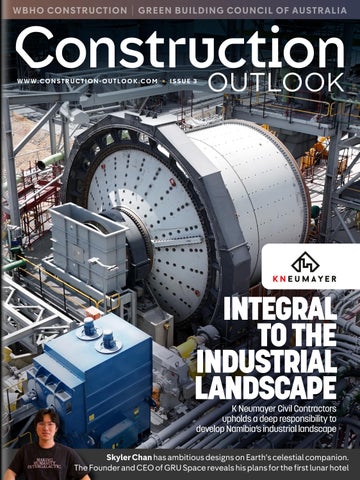
Construction Outlook - Issue-3

Page 1


Africa Outlook, APAC Outlook, EME Outlook, North America Outlook, Mining Outlook, Healthcare Outlook, Manufacturing Outlook, Supply Chain Outlook, Food & Beverage Outlook, Construction Outlook, and Sustainability Outlook are digital publications aimed at boardroom and hands-on decision-makers, reaching an audience of more than 800,000 people around the world.

With original and exclusive content compiled by our experienced editorial team, we look to promote the latest in engaging news, industry trends, and success stories from across the globe.

Your company can join the leading industry heavyweights enjoying the free exposure we provide across our platforms with a free marketing brochure, extensive social media saturation, enhanced B2B networking opportunities, and a readymade forum to attract new investment and help you grow your business.

Visit www.outpb.com/work-with-us for details on how your company can feature for free in one of our upcoming editions.

EDITORIAL

Head of Editorial: Jack Salter jack.salter@outpb.com

Deputy Head of Editorial: Lucy Pilgrim lucy.pilgrim@outpb.com

Senior Editor: Lily Sawyer lily.sawyer@outpb.com

Editor: Ed Budds ed.budds@outpb.com

Editor: Rachel Carr rachel.carr@outpb.com

Copy Editor: Lauren Kania lauren.kania@outpb.com

PRODUCTION

Art Director: Stephen Giles steve.giles@outpb.com

Senior Designer: Devon Collins devon.collins@outpb.com

Designer: Louisa Martin louisa.martin@outpb.com

Production Manager: Alex James alex.james@outpb.com

Digital Marketing Director: Fox Tucker fox.tucker@outpb.com

Website Content Manager: Oliver Shrouder oliver.shrouder@outpb.com

Social Media Executive: Jake Crickmore jake.crickmore@outpb.com

BUSINESS

CEO: Ben Weaver ben.weaver@outpb.com

Managing Director: James Mitchell james.mitchell@outpb.com

Chief Technology Officer: Nick Norris nick.norris@outpb.com

Content Director: Neil Perry neil.perry@outpb.com

Global Head of Media: Lewis Hammond lewis.hammond@outpb.com

Global Media Executive: Kai Boyle-Vennard kai@outpb.com

ADMINISTRATION

Finance Director: Suzanne Welsh suzanne.welsh@outpb.com

Finance Assistant: Victoria McAllister victoria.mcallister@outpb.com

CONTACT

Construction Outlook

Norvic House, 29-33 Chapelfield Road

Norwich, NR2 1RP, United Kingdom

Sales: +44 (0) 1603 804 445

Editorial: +44 (0) 1603 804 431

SUBSCRIPTIONS

Tel: +44 (0) 1603 804 431 jack.salter@outpb.com

www.construction-outlook.com

Follow us on Linkedin: @constructionoutlook

MULTIDISCIPLINARY DELIVERY

Welcome to our third edition of Construction Outlook magazine.

With almost three decades of experience and a proven track record in brownfield and greenfield projects, K Neumayer Civil Contractors (K Neumayer) has grown into one of Namibia’s most trusted multidisciplinary contractors.

The company, which delivers a vast range of earthworks, civil construction, and full structural, mechanical, piping, and platework (SMPP) services for mining and industrial clients, adds another string to its bow as this issue’s cover star.

K Neumayer has cemented itself as an expert in mine infrastructure, civil and structural steelwork, custom fabrication, land surveying, and plant maintenance.

“One of our differentiators is our ability to self-perform across civil, SMPP, surveying, and related services. This reduces fragmented contractor interfaces and places accountability within a single, controlled delivery structure,” acclaims John Mitchell, Managing Director.

In neighbouring South Africa, National Route 3 (N3) is one of the country’s busiest highways, connecting the financial hub of Johannesburg and the bustling port city of Durban.

A flagship project for WBHO Construction’s Roads and Earthworks (R&E) division is the N3 upgrade between Key Ridge and Hammarsdale, which is improving road safety, traffic flow, and capacity by expanding the route to five lanes.

“The roadway will ultimately be upgraded to a transformative five-lane divided dual carriageway,” informs Riaan de Necker, Group Managing Director of the R&E division.

On the road to net zero, Australia’s construction sector is increasingly embracing greener practices and data-driven approaches in response to evolving environmental expectations.

The Green Building Council of Australia was founded in 2002 by industry leaders who recognised the need for a united, consensus-driven, and science-based approach to transforming Australia’s built environment and shifting towards sustainability.

“Ultimately, our goal is to drive meaningful change whilst supporting the industry in delivering a better, more sustainable built environment,” outlines Taryn Cornell, Senior Manager – Strategy and Development.

We also deliver the latest from LŌ-GOI Group, Kajima Overseas Asia Pte Ltd, and North American Rail Solutions.

We hope that you enjoy your read.

FOCUS 24 Restoring the Cathedral of World Football Modernisation of the iconic Estadio Azteca

6 EXPERT EYE

SPOTLIGHT 28 Green Building Council of Australia

proudly Namibian multidisciplinary contractor

BUILDING CERTAINTY TO UNLOCK GROWTH IN CONSTRUCTION

With the UK construction industry feeling the impact of ongoing conflict, John Carter, CEO of STARK Building Materials UK, discusses how governmentbacked financial and educational incentives could help building and construction recover from its longest period of significant downturn

The building and construction sector faces significant pressures, from rising costs and market uncertainty to planning delays and persistent skills shortages.

Wider geopolitical tensions, including the impacts of the Middle

East conflict on supply chains and material costs, are adding to those challenges, compounding pressures already being felt across the sector. Against that backdrop, now is precisely the time the industry needs to pull together.

Government action, industry collaboration, and stronger recognition of the vital role and value builders and tradespeople bring to national and local economies will all be critical in helping the sector to get back on its feet and regain momentum.

There is also an opportunity to reinforce the essential role building and construction play in delivering the homes, infrastructure, and economic activity the country needs.

That is why the recently launched Let’s Get Britain Building – Now! petition from STARK Building Materials UK (STARK UK) matters.

At a time when confidence in the market needs rebuilding, it is intended to ensure the concerns of builders and tradespeople are heard whilst helping drive practical action around demand stimulus, planning reform, and skills.

More broadly, it reflects the need for a stronger collective voice in support of the sector at a pivotal moment.

Alongside this, three years into our transformation journey, the team at STARK UK continues to champion building and construction as central to Britain and Northern Ireland’s economic growth.

THE REALITY ON THE GROUND

Jewson’s latest Trade Trends research points to weakening confidence, with many businesses prioritising stability over growth.

Concerns around material price fluctuations have risen sharply by more than 14 percent, making it harder to quote accurately and protect margins, whilst business administration pressures are up 12 percent, highlighting a growing compliance burden.

Meanwhile, cost pressures remain significant – material costs have increased by 77 percent and price volatility, which has risen by 67 percent, remains the biggest concern alongside cashflow challenges of 41 percent, skills shortages of 35 percent, and reduced demand of 33 percent.

Rising costs for sustainable products have risen by more than nine percent, delays by more than eight percent, alongside a seven percent increase in cancelled work, pointing to a fragile pipeline.

Demand is also softening. Just 16 percent of builders report increased enquiries – down seven percent yearon-year – whilst 34 percent are seeing a decline of more than 11 percent. Looking ahead, only 12 percent expect demand to improve, with 69 percent anticipating no change, and 19 percent expecting a downturn. This is reflected in growth expectations, with just 19 percent of businesses planning to grow, whilst most expect to hold steady or contract.

THE WIDER PICTURE

Alongside STARK UK’s own research,

we know the UK faces a housing shortfall of 6.5 million homes – with 1.5 million targeted by 2029.

To close the gap by 2040, 565,000 homes must be built each year, which is more than double the current rate.

There are approximately 630,000 vacant properties across England, many presenting viable refurbishment and retrofit opportunities, yet planning delays remain costly and uncertain.

The industry is also shrinking. Since 2008, 9,000 small housebuilders have left the market, reducing vital local supply and diversity.

Whilst £600 million has been pledged to train 60,000 workers by 2029, the sector needs 225,000 more skilled tradespeople by 2027.

This is compounded by more than 35,000 vacancies, widespread shortages, and the looming retirement of 25 percent of the workforce.

Taken together with STARK UK’s insights, this paints a picture of a sector under pressure. Something needs to change.

ACTIONABLE STEPS TO FUEL GROWTH

STARK UK recently launched a petition to make sure the voices of the nation’s professional builders and tradespeople are properly heard, helping drive positive action.

We believe the solutions are not complicated, particularly if government actively involves the sector in its plans.

Through the petition, Let’s Get Britain Building – Now!, STARK UK is calling on government to focus on three priorities:

1. Provide financial incentives for people to buy or improve their homes.

2. Implement a simpler, faster, and cheaper rules-based planning consent process.

3. Incentivise careers in building and construction, accelerating workforce training and talent attraction.

With geopolitical uncertainty continuing, government can and must act to protect the sector’s foundations.

These are challenging times for everyone, but they also present a critical window for action.

The right changes now could unlock the sector’s potential and ensure it is ready to accelerate as confidence returns.

Let’s pull together and take action to get Britain and Northern Ireland building – now.

ABOUT THE EXPERT

John Carter is CEO of STARK Building Materials UK – the parent company of Jewson, JP Corry, Normans, Jewson Partnership Solutions, Jewson Major Build Solutions, Frazer, and Minster.

Drawing on more than 40 years’ experience in the UK construction industry, Carter is particularly interested in enabling the recovery of the UK building sector despite ongoing conflict and recent downturn, and is a major advocate of the Let’s Get Britain Building – Now! campaign.

Many children are captivated by the idea of adventure, and as they gaze up at the stars, they often nurture dreams of exploring the vastness of space.

However, only a select few ever transform those aspirations

Moon maven, Skyler Chan, has ambitious designs on Earth’s celestial companion. The Founder and CEO of GRU Space reveals his plans for the first lunar hotel, establishing a new era of space tourism and charting an exciting course for humanity’s continued expansion into the cosmos

into reality. One such exceptional individual is Skyler Chan, the visionary Founder and CEO of GRU Space.

With relentless determination and a pioneering spirit, Chan is pushing the boundaries of what is possible by creating the first lunar hotel, inspired

by the Greco-Roman architecture of San Francisco’s Palace of Fine Arts.

“I started GRU Space because, like many others growing up, I aspired to become an astronaut and even had the opportunity to learn to fly gliders at an Air Force base in Canada.

“OUR FIRST STEP IS TO DEVELOP TECHNOLOGY TO AUTONOMOUSLY DEPLOY AN INFLATABLE HABITAT ON THE MOON, AS TRADITIONAL CONSTRUCTION METHODS AREN’T VIABLE. WE NEED A CONOPS TO TEST IT EFFECTIVELY, AS THIS IS GROUNDBREAKING WORK”
– SKYLER CHAN, FOUNDER AND CEO, GRU SPACE

“However, I realized that rather than just going to space myself, it would be more meaningful for everyone to have the chance to experience it,” he shares passionately.

Chan became obsessed with understanding what it would take to make space travel accessible to all – this may seem impossible, but as technology progresses, it’s inevitable.

“Humanity has always explored new frontiers, and the Moon is just the next step, followed by Mars. It’s exciting to witness this new era of exploration!”

GRU’s current aim is to launch the hotel in 2032. The innovative inflatable accommodation will be built on Earth, then transported

to the lunar surface, facilitating four guests for a five-night stay.

“We envision new urban landscapes on the Moon, comparable to New York, Hong Kong, or London. Imagine what the next great city on the Moon could look like!” Chan exclaims.

“We’ve been developing a brick made from lunar regolith simulant in our lab, using a technology we plan to test during our demonstration mission on the Moon, where we will combine lunar regolith and our proprietary geopolymer mixture, which acts as a binding agent.”

Influenced by his mom’s

career as an architect and his own engineering background, Chan aims to create a lunar structure that future generations will regard as a significant landmark, similar to Stonehenge or the Pyramids.

“I want the hotel to be something that signifies an important moment in our exploration of the universe,” he contemplates.

CONSIDERATIONS FOR MOON HABITATION

Humans cannot become interplanetary without solving the problem of off-world sustainable habitation, which is essential for long-term living and crucial for transforming human history –allowing billions to thrive on the Moon and Mars.

“Successful off-world habitation hinges on overcoming several key challenges, including ensuring safe living environments amid radiation, extreme temperature fluctuations, and lunar dust hazards.

“The hotel will incorporate advanced systems for air recycling, water conservation, and radiation shielding, alongside robust safety features to protect guests from solar storms and micrometeoroids.”

To ensure survival on the Moon, several key issues must be addressed.

“Firstly, removing a spacesuit after leaving the rocket risks exposure to the vacuum of space. Secondly, temperature fluctuations are extreme because a lunar day lasts about 14 Earth days, followed by 14 days of darkness,” Chan explains.

“The third challenge is radiation from galactic cosmic rays (GCRs) and solar particle events. A warning system and radiation shielding are essential, including the installation of safe areas with thicker walls. Lastly, we must consider orbital debris.”

In addition, GRU Space is actively developing specialized materials to shield inflatable habitats from meteorite impacts, ensuring guests’ safety.

These considerations are vital for catering to adventurous early adopters.

PIONEERING LUNAR LIVING

Following the lunar hotel’s announcement, Chan was astounded by the overwhelming global interest.

“It felt uniting, bringing together various organizations and experts from architecture to science, and there are abundant collaboration opportunities, such as maintaining communication between the hotel’s inhabitants and Earth.”

DO YOU HOPE THAT GRU SPACE WILL ONE DAY BE INTEGRAL TO DISCOVERING EXTRATERRESTRIAL LIFE FORMS BEYOND OUR GALAXY, NO MATTER HOW PRIMITIVE?

Skyler Chan, Founder and CEO: “Yes! With great joy, I believe there’s much debate around this topic, and it’s a fun subject to explore.

“There’s a distinction between objective and subjective truth. It’s like a graph with an asymptote.

“Imagine that the objective truth represents what exists in the universe, while subjective truth is our perception – something we can never fully align with objective truth.

“Consider our senses – our eyes can detect only a specific wavelength of light. Evidently, we have inherent limitations as a species; we can’t measure everything with empirical evidence and scientific precision.

“In the context of extraterrestrial life, we can’t 100 percent guarantee that it doesn’t exist. We can formulate theories, but we can’t be completely certain. I tend to lean towards the idea that extraterrestrial life might not exist, although I hope it does, as that would be exciting.

“To validate the existence of extraterrestrial life, we need to explore beyond Earth.

“Humans have an inherent curiosity. Our brains are uniquely positioned for exploration, and it is that indomitable spirit of humanity that drives us.”

“WE ENVISION NEW URBAN LANDSCAPES ON THE MOON, COMPARABLE TO NEW YORK, HONG KONG, OR LONDON. IMAGINE WHAT THE NEXT GREAT CITY ON THE MOON COULD LOOK LIKE!”
– SKYLER CHAN, FOUNDER AND CEO, GRU SPACE

System power and technical details also need to be considered, and GRU Space will be selecting partners to address them.

Chan’s journey as the founder has changed his perspective on humanity’s place in the universe and he hopes to expand this passion to potential collaborators and team members.

“I feel like I’m finally doing my life’s work. I remember drawing the solar system at age five and sketching what habitats may look like on the Moon and Mars.

“I’ve always loved space, from dressing up as an astronaut for Halloween and geeking out over facts. It brings me immense fulfillment; despite the workload, I feel blessed that the universe is urging me to go all in.

“My role is to rally partners, investors, and our team around this mission. Many space companies struggle to connect with people, but I believe our approach will unite everyone in a shared part of human evolution – looking up at the Moon.

“It’s a universal experience ingrained

in our DNA, something our ancestors have appreciated for generations.”

Chan plans to visit the lunar hotel, expecting the experience to be emotional, scientific, and gratifying..

“I believe that space travel should be accessible to everyone, and I think it will become more available to a wider audience over time,” he states.

“Just as the invention of the airplane was initially for the wealthy, many new technologies today rely on funding from those with capital. However, with progression, air travel became more affordable, allowing us all to enjoy inexpensive transatlantic flights.”

GRU Space shares similar hopes for the future of space exploration, especially with In-Situ Resource Utilization (ISRU) technology, which uses local resources on the Moon to produce construction materials.

This approach can significantly reduce costs by avoiding the need to transport materials from Earth.

“Creating affordable, liveable spaces on the Moon will become increasingly feasible, making it an exciting prospect!” Chan enthuses.

A GIANT LEAP IN INNOVATION

GRU Space is utilizing and developing new technologies to enhance its operations and improve guest experiences.

“As a start-up, we focus on our end goal of building a lunar hotel. We break this down to identify the specific engineering requirements for such a venture,” outlines Chan.

“Our first step is to develop technology to autonomously deploy an inflatable habitat on the Moon, as traditional construction methods aren’t viable. We need a concept of operations (CONOPS) to test it effectively, as this is groundbreaking work.”

Another essential element of space engineering is ‘flight heritage’ – demonstrating technology in the environment where it will be used, such as creating bricks on the Moon. Achieving this supports technology maturation and fosters partnerships.

“Our initial payload minimizes extra components, using a geopolymer from Earth to produce bricks from lunar materials, as energy-intensive methods like sintering are not

practical given the Moon’s high energy costs,” he enlightens.

“There’s also growing interest among brands in being the first to have their logos on the Moon, similar to Formula 1 marketing. We’re designing our payload to incorporate these elements, generating excitement as we aim to mark a monumental step in lunar construction.”

EXPLORING STELLAR SUSTAINABILITY

Utilizing specialist resources, such as lunar regolith and ice, for building materials raises important questions about environmental sustainability.

Indeed, incorporating solar energy into the project is crucial for promoting eco-friendly practices and minimizing the Moon’s impact.

While solar is one option, nuclear power and developing orbiting systems to beam energy also present exciting possibilities.

“Feasibility is key as we assess

potential partners for power services. We need to evaluate their capabilities and track records to create closedloop systems that reuse resources. This approach is essential not only for cost savings but also for environmental sustainability.

“We aim to establish a strong presence on the Moon, similar to the Industrial Revolution in the UK. While some disruption to the lunar environment is inevitable, we strive to mitigate our impact,” Chan strategizes.

Methods for traversing the Moon’s surface, primarily for goods transportation, are also being explored, with discussions on lunar agriculture ongoing.

“We have opportunities to test various crops in the lunar

environment, which may attract scientific labs.

As a construction and development company, we can adapt our technology and build facilities such as power plants and greenhouses,” he points out.

“Our main challenge is developing pressure vessels for safe off-world habitats, which are essential for conducting Earth-like activities in space. Additionally, there is potential for space tourism by integrating scientific payloads into private astronaut missions, appealing to those interested in contributing to research.”

AN INTERGALACTIC FUTURE

The lunar hotel’s development is poised to greatly influence the future of space tourism, while GRU Space has established long-term objectives for exploration beyond this initiative.

WILL THERE BE TRAINING AND PSYCHOLOGICAL SUPPORT FOR MOON TOURISTS?

“The overview effect is incredible, witnessing an Earthrise from the Moon is astonishing and profound.

“A full Moon can appear larger during events like a supermoon, but looking back at Earth from the lunar surface makes it look at least 10 times brighter in comparison.

“The sheer scale is surreal, and while Apollo mission photos capture the moment, they don’t do justice to Earth’s beauty – the camera doesn’t fully convey it.

“On the Moon, with one-sixth of Earth’s gravity, you might find yourself hopping around, doing jumping jacks, or even playing golf. Those are all potential activities, and it’s an important factor to consider, especially when it comes to training for such missions.”

“The Moon represents the pinnacle of this exciting experience. Once the lunar hotel is built, it will truly be the flagship attraction for space tourists,” anticipates Chan.

“Visiting the Moon is a significant step up from just orbiting Earth for five minutes. The experience of walking on the lunar surface and witnessing events like the Earthrise is unlike anything else.”

Chan is enthusiastic about the future of space exploration and his company’s ambitious plan.

While some may see the venture as outrageous, he’s determined to make it a reality.

“This is just the starting point. We’re building a hotel on the Moon to demonstrate off-world habitation. Once established, we can accelerate lunar living by constructing the necessary infrastructure, like roads and warehouses, laying the foundation for a city.”

As rocket technology advances, humanity will inevitably turn its attention to Mars, drawing on the

experience gained from lunar exploration to establish the first cities on the red planet.

The discussion within the space community revolves around which should be prioritized. However, GRU Space acknowledges the unique advantages of both and aims to replicate its lunar initiatives on Mars by developing essential infrastructure.

“Long-term, we need to consider the Kardashev scale and how to utilize resources efficiently. This

involves leveraging technology to expand our capabilities.”

The Kardashev scale measures a civilization’s technological advancement based on its ability to harness energy, ranging from planetary to galactic levels. Proposed extensions of the scale even consider the hypothetical existence of multiple universes.

The ultimate goal for GRU Space is to enable resource utilization on the Moon, Mars, and beyond, facilitating a deeper journey into the solar system and, eventually, the galaxy. The strategy will be economically beneficial and promote innovative solutions that people value.

“Achieving galactic resource utilization is our ultimate goal – that’s

why our company is named after it.

“Our vision extends beyond the lunar hotel; it heralds a new era of intergalactic space travel that includes all of humanity,” Chan emphatically concludes.

FROZEN ICON

We check in for a unique Arctic stay at ICEHOTEL, the world-famous hotel and living art exhibition carved annually with ice and snow harvested from the Torne River in Northern Sweden

Writer: Jack Salter

The mighty 520-kilometre (km) Torne River is one of the last untouched waterways in Europe.

When winter arrives in Kiruna, Sweden’s northernmost city, the river freezes and becomes part of the snow-covered landscape.

Its high-quality natural ice is harvested and used to construct ICEHOTEL, a unique, world-famous

hotel and living art exhibition reborn in a new form every winter.

This magical and fleeting creation then melts back into the river when spring arrives – an eternal cycle.

The unique relationship between ICEHOTEL and the Torne River shows how nature and human creativity can coexist in harmony.

ICEHOTEL was founded in 1989

when Founder, Yngve Bergqvist, opened the doors to Arctic Hall, an art gallery built from ice and snow.

When a group of visitors needed a place to stay but all the cabins in the village were fully booked, Bergqvist suggested they sleep inside the gallery.

Equipped with warm sleeping bags and careful instructions on how to

ICEHOTEL entrance © Asaf Kilger, www.icehotel.com
Lundh, www icehotel com
ICEHOTELrestaurant
© Asa f Kilger, www icehotel com

sleep in the cold, they woke the next morning deeply fascinated by the experience.

What started as a simple idea on a cold winter night has since grown into a unique Arctic adventure, reimagined every year with new art, rooms, and experiences for over three decades.

As such, ICEHOTEL draws visitors from around the world to Jukkasjärvi

– ‘meeting place by the water’ in Northern Sámi – located 200 km north of the Arctic Circle.

This small Swedish village on the banks of the Torne River is a dream destination for many, where bustling city streets are swapped for vast mountain views, untouched rivers, and the ethereal glow of the Northern Lights.

TRIBUTE TO NATURE

Winter in Jukkasjärvi is when one of the world’s most spectacular building processes begins.

For the team behind ICEHOTEL, construction is more than just a job –it’s a tribute to nature and an exciting challenge that requires flexibility, collaboration, and harmony with the elements.

Art suite © Asaf Kilger, www.icehotel.com

ON NATURE’S TERMS

Nature is inherent to ICEHOTEL, with the clean water of the Torne River a prerequisite of its creation.

Every year, when the ice is at its thickest, around 5,000 t is harvested from the river and used to build the hotel.

When ICEHOTEL melts in the spring, everything goes back to the river, completing a natural cycle.

The hotel is built only with natural ice, and when it melts back into the river, the water is as clean as when it was harvested.

In this way, ICEHOTEL preserves the purity of the nature surrounding it for future generations.

The process begins in spring when massive blocks of ice, each weighing up to two tonnes (t), are harvested from the Torne River and stored cold during the summer, ready for the hotel’s construction in winter.

In addition to ice, ‘snice’ – a mix of snow and ice – is used to build ICEHOTEL’s floors, walls, and ceilings. Snice is not only beautiful to look at, but also durable and reliable, ideal for creating the hotel’s impressive structures.

To build ICEHOTEL, moulds are used to give the buildings their proper shape. After a few days, the ice is strong enough to stand on its own and the moulds are removed.

Building ICEHOTEL © Asaf Kilger, www.icehotel.com
ICEHOTEL melting © Martin Smedsén, www.icehotel.com

The technical skill involved in constructing the hotel is impressive; corridors and rooms are built in the same way as classic arches, which are incredibly stable.

From start to finish, construction of ICEHOTEL takes just six weeks, a remarkable achievement that combines architecture, art, and natural materials.

It’s not just a building project – it’s a living art installation reflecting nature’s transience and humanity’s ability to create beauty under challenging conditions.

Rooted in the philosophy of living close to nature, the hotel’s activities –from ice art and wilderness adventures

to extraordinary culinary experiences – are all designed in harmony with the Arctic environment.

MAGICAL EXPERIENCE

ICEHOTEL is open from December to April every year, allowing guests five months to experience its beauty before melting back into the Torne River.

The hotel houses between 15 and 20 ice rooms, as well as 12 unique art suites, all specially designed and hand-crafted by artists from across the globe.

As temperatures reach around -5 degrees Celsius (°C), the beds are equipped with thick mattresses

covered with soft reindeer hides and a sleeping bag to keep guests warm. The rooms also have curtains instead of doors, creating a secluded and inviting atmosphere.

If guests get cold feet or are simply in search of a cosy room for their visit, ICEHOTEL additionally offers warm accommodation, with a choice of traditional hotel rooms or cabins.

For the best experience, it’s recommended that guests spend one night in the cold and a couple in the warm.

Since November 2016, it has also been possible to enjoy this magical experience any time at ICEHOTEL 365, which uses solar-powered cooling to

Warmroom©Rebecca

remain frozen year-round.

With 18 art and deluxe suites, an ice bar, an experience room with screenings, and an ice gallery, ICEHOTEL 365 allows guests to enjoy the world of ice art even when they visit during the warmer months.

It therefore offers the same atmosphere and design as ICEHOTEL without melting back into the Torne River.

Instead, in the summer, ICEHOTEL 365 becomes part of the Lapland wilderness, its roof covered in green grass, blending in with the surroundings.

Art suitesketches©wwwicehotel .com
ICEHOTEL 365 Dreaming in a Dream deluxe suite © Asaf Kliger, www.icehotel.com
Art suite © Asaf Kliger, www.icehotel.com

ARTISTIC EXPRESSION

From the beginning, ICEHOTEL has been more than just a hotel – it’s a living art exhibition that changes and renews itself every year, a transient artwork where some of the world’s most creative minds tell a new story each winter, and a place where art and nature meet and interact.

All art at ICEHOTEL is original and protected under trademark law, making it one of the most unique art experiences in the world.

The Torne River’s pure, clear ice is the perfect medium for artistic expression. For many of the

artworks, light plays a crucial role in creating the final experience, adding an extra dimension that allows each sculpture to tell its own story.

ICEHOTEL’s lighting designers work side-by-side with the artists who create each hotel room, ensuring the light not only illuminates but also enhances and highlights the art in the most magical way.

It’s a symbiosis between art and light, where every beam helps create the unique feeling that makes each room its own work of art.

At the beginning of each year, ICEHOTEL opens applications for the following winter, inviting creators from all over the world to submit their ideas and concepts.

Around 15 design proposals are selected, with artists ranging from graphic designers and architects to engineers.

Diversity is important, and the jury creates a balance between gender, origin, age, and experience.

The goal is to create a dynamic mix of influences and perspectives, giving each edition of ICEHOTEL its unique character.

RESTORING CATHEDRAL FOOTBALL

The largest football stadium on the is undergoing a state-of-the-art renovation fixtures at this summer’s

RESTORING THE

OF WORLD FOOTBALL

planet, the iconic Estadio Azteca, renovation process as it gears up to host key summer’s FIFA World Cup

Budds

Located in the beating heart of Mexico City, the Estadio Azteca (Azteca) boasts an iconic footballing history and a deep connection with the beautiful game.

Since it opened in 1966, the magisterial stadium has undergone several renovations, initially after the 1986 World Cup, before being later updated in 1999, 2013, and 2016.

Now, once again, in preparation for the 2026 FIFA World Cup (World Cup), the Azteca is undergoing a major rejuvenation project as it prepares to stand as one of the premier attractions at the upcoming global gathering of football euphoria, where Mexico is one of three host nations alongside the US and Canada.

The stadium will hold several key fixtures, including the opening game of the tournament, Mexico vs South Africa.

As part of its enduring legacy, the Azteca has previously held historic World Cup matches during the 1970 and 1986 instalments.

“There’s just something very special about the Azteca,” according to Pele, who remains for many the greatest player of all time, having graced the pitch at the 1970 World Cup.

“You need to be inside it, to feel it to understand. It’s totally unique.”

The hallowed venue even holds the all-time record attendance for a football match, when a staggering 119,853 fans packed into the stadium to watch Mexico vs Brazil in 1968, before safe seating regulations were introduced to protect spectators.

The Azteca is now being modernised to meet FIFA’s latest standards ahead of the tournament, with the venue set to be ready just in time for the World Cup kick-off in June.

Despite already standing as a gigantic sanctuary of world football, seating more than 87,000, once the remodelling is completed, the Azteca is expected to have a capacity close to 90,000 by the opening match of the tournament.

Although it is officially known as Estadio Banorte after Banorte bank acquired its commercial naming rights, it will mostly be referred to by its original name, Estadio Azteca, during the World Cup due to sponsorship rules.

RESTORED AND REVAMPED

The renovation project includes structural upgrades, improved fan facilities, new VIP hospitality zones, 200 security cameras, and a revamped hybrid pitch designed to deliver a world-class matchday experience for both players and spectators.

When a decision was made to renovate in 2024, the ambitious plans included the demolition of one of the lower stands and the installation of 2,000 square metres of LED screens on the exterior of the stadium.

Other notable changes comprise the relocation of the dressing rooms, expansion of the press and hospitality areas, as well as vastly improved facilities for supporters, including restaurants, bars, and additional commercial spaces.

Meanwhile, a new roof with photovoltaic panels has already been installed, marking a significant leap towards more sustainable operations.

Fixtures at the Azteca

The Azteca will play host to seven matches during the upcoming World Cup.

• 11th June: Mexico vs South Africa (Group A)

• 17th June: Uzbekistan vs Colombia (Group K)

• 24th June: Czech Republic vs Mexico (Group A)

• 30th June: Round of 32 match

• 5th July: Round of 16 match

Externally, work on LED lighting is still ongoing, aimed at giving the venue a futuristic glow with visually stunning colourful light shows on matchdays and during future events.

Additionally, Populous and KMD Architects, the architectural firms working on the project, have installed 1,000 Wi-Fi connection points and 40,000 metres of fibre optic.

GETTING TO THE STADIUM

The Azteca is easily accessible by public transport – the most recommended option is to take the Metro and the Light Rail. The Blue Metro Line 2 takes you to Tasquena station, where you can transfer to the Xochimilco Light Rail. This line has a stop named Estadio Azteca, ideally located right in front of the stadium.

There are also bus routes that connect the Tasquena area of the city with the stadium’s surroundings.

Key roads that lead to the Azteca include Calzada de Tlalpan, Acoxpa, Periferico, and Circuito Estadio Azteca. Parking is available at the stadium, but public transit is highly recommended due to heavy traffic and the difficulty of exiting on matchdays.

AUSTRALIAN GREEN BUILT ENVIRONMENT

SPOTLIGHT

As it seeks to implement sustainability more widely, Australia’s construction sector is leveraging influential green policies and new technologies to reframe how the industry can contribute to achieving the nation’s net zero goals

Today’s Australian construction landscape is undergoing a notable shift, with sustainability, regulation, and technological innovation reshaping construction processes.

Historically characterised by traditional, carbonintensive methods, the sector is increasingly embracing greener practices and data-driven approaches in response to evolving environmental expectations.

A key catalyst for recent industry change was the introduction of the National Construction Code (NCC)

2022, which raised the minimum energy efficiency standard for new homes to a seven-star rating in line with the Trajectory for Low Energy Buildings – a government plan to achieve lower carbon structures.

The move has encouraged developers and designers to re-think building performance – from improved insulation to more efficient material choices.

At the same time, the industry is turning its attention to reducing embodied carbon – the emissions associated with the production and construction of building resources.

This growing focus is driving interest in construction materials such as sustainable timber, recycled alternatives, and low-carbon steel, whilst new policies are beginning to require large infrastructure projects to actively manage their upfront carbon.

Technological innovation is also playing a transformative role, with digital tools such as building information modelling (BIM) and artificial intelligence (AI) enabling companies to improve planning accuracy, optimise material use, and reduce waste.

Modern methods of construction, meanwhile, are helping to streamline delivery and enhance quality control, such as volumetric modular construction and precast

concrete elements.

Despite these advances, the sector continues to navigate a challenging operating environment.

Rising material costs and inflationary pressures are placing strain on residential developments, whilst a persistent shortage of skilled labour remains a continued obstacle to growth within the industry.

Nevertheless, with sustainability now firmly embedded in the nation’s long-term agenda, Australia’s construction sector is steadily laying the foundations for a more efficient, resilient, and environmentally conscious future, particularly as it seeks to achieve net zero greenhouse gas (GHG) emissions by 2050.

INTERVIEW:

GREEN BUILDING COUNCIL OF AUSTRALIA

We sit down with Taryn Cornell, Senior Manager – Strategy and Development for the Green Building Council of Australia, who discusses for the organisation’s role in advocating on behalf of its members and supporting a sustainable future for the nation’s construction sector

Construction Outlook (CO): Firstly, could you talk us through the origins and primary goals of the Green Building Council of Australia?

Taryn Cornell, Senior Manager –Strategy and Development (TC): The Green Building Council of Australia (GBCA) was founded in 2002 by industry leaders who recognised the need for a unified, consensus-driven, and sciencebased approach to transforming Australia’s built environment and shifting towards sustainability.

Our primary goal is to deliver better buildings and places to live, work, and play – by ‘better’ we mean lower-carbon, healthier, and more climate-resilient environments. These are things we’re driven to improve not just at scale, but also on a granular level.

We do that by working across a lot of different building types, from workplaces and sports facilities to schools, universities, railway stations, and retail spaces.

Our purpose is to drive ambition whilst building capability across the construction industry.

CO: What is your take on today’s Australian construction landscape, and how have you seen it evolve over the course of your career?

TC: I would say it’s both exciting and challenging. Australia has a strong track record when it comes to sustainability in the built environment.

One of the biggest shifts has been the rise of upfront carbon as a mainstream conversation. Five years ago, very few people understood it; today, governments are backing the concept and discussing its inclusion in the NCC. That represents a rapid and significant change.

We’re also seeing growing momentum around designing and building for circularity. This involves treating buildings as a ‘kit of parts’ and finding ways to extend the life of materials within our built environment, which requires a shift away from traditional construction approaches towards more modular and durable design.

Another important change is leadership across the construction supply and value chain.

Where sustainability was once seen as an optional extra, today construction companies and contractors are increasingly using it as a point of difference, and proposing ways to reduce upfront carbon, electrify buildings, connect projects with better suppliers, and rethink material choices to improve construction outcomes.

“ULTIMATELY, OUR GOAL IS TO DRIVE MEANINGFUL CHANGE WHILST SUPPORTING THE INDUSTRY IN DELIVERING A BETTER, MORE SUSTAINABLE BUILT ENVIRONMENT”

This kind of leadership evolution is particularly exciting because the construction sector has not always been seen as a driver of change.

In fact, I began my career as an interior designer, where the goal was enriching people’s lives through design.

But, at the time, sustainability rarely entered the conversation – unless there was extra budget, which seldom happened.

So, seeing these sustainability concepts scale across the industry is what drew me to GBCA – real change requires an entire industry supported by clear targets and pathways to achieve them.

Australia leads the world in rooftop solar adoption

Sentinel Australia at the forefront of Build to Rent

Sentinel Fund Manager Australia is helping shape the future of rental living in Australia –defined by quality, sustainability, long-term thinking and a better experience for residents and investors.

Established in 2010, Sentinel Australia is the local arm of Sentinel Real Estate, an independently owned US-based real estate investment manager with A$14.4 billion in institutional-quality assets under management globally.

Drawing on decades of international experience, the firm has taken a long-term view of the Australian housing market, investing early in the potential of Build to Rent and supporting the emergence of a more professionally managed rental sector.

Sentinel Australia develops, owns and operates highquality Build to Rent communities designed to meet the needs of modern renters while delivering stable, longterm returns for investors. The platform is vertically integrated, allowing oversight from development through to ongoing operations and ensuring consistency, accountability and enduring value across the portfolio.

Central to Sentinel’s Build to Rent strategy is Kinleaf, the company’s dedicated Australian Build to Rent brand and

resident platform. Kinleaf communities are purpose-built for renters, with a focus on thoughtful design, sustainability and ease of living. Each community is professionally managed by on-site teams and supported by a transparent leasing process, flexible tenancy options and carefully considered amenities that encourage connection and long-term residency.

Sustainability underpins the Kinleaf platform. Developments target strong environmental benchmarks, including carbon-neutral outcomes, high Green Star ratings and energy-efficient apartment design – reflecting Sentinel’s commitment to responsible, future-focused development.

Headquartered in Melbourne, with additional offices in Perth and Adelaide, Sentinel Australia continues to expand its national Build to Rent footprint. Through Kinleaf, the platform brings together professional management, sustainable design and a resident-first philosophy – setting a new benchmark for rental communities across Australia.

CO: How important is your Green Star rating system in helping Australia to deliver sustainable, resilient, and healthy built environments?

TC: Green Star is built by industry, for industry. We undertake extensive consultation and consensus-building to identify what leadership looks like in this regard, whilst ensuring we don’t move so far ahead that people are left behind.

The aim is not only to set leadership benchmarks but also to help raise minimum standards across the industry, as we believe sustainability shouldn’t be limited to highend developments.

Green Star provides a clear set of targets and requirements for the industry, establishing best-practice benchmarks for areas such as energy efficiency, carbon reduction, and climate resilience.

It’s a holistic rating tool that considers the broader sustainability picture rather than focusing on a single issue. Projects inevitably need to balance competing priorities, so Green Star provides a framework and shared definition of what strong sustainability outcomes look like.

Because it is a certification scheme, it also verifies claims, and any sustainability outcomes put forwards by a project must be independently audited before certification is awarded.

We now have more than 7,500 Green Star-certified projects across Australia, representing billions of square metres of space.

That scale demonstrates both industry leadership and the growing commitment to improving the built environment for all.

CO: As an association that serves as a key advocate for the construction industry, how extensively is GBCA involved in contributing to policy and regulatory frameworks which may affect Australia’s construction landscape?

TC: We play a very active role in advocacy across all levels of government.

At the local level, we work with councils on planning provisions and the ways they can influence sustainable development outcomes.

We also engage closely with state and federal governments to ensure policy frameworks support sustainable, resilient, and healthy buildings.

Our advocacy is guided by five key priorities:

1. Climate action – Ensuring buildings meet net zero targets and are resilient to future climate conditions.

2. Adaptability – Helping communities to withstand climate events and recover quickly.

3. Affordability, health, and low-carbon housing – This has become particularly prevalent as housing remains a critical national issue. However, if homes are being delivered quickly, they must also be delivered well.

4. Circular economy and resource efficiency – Key priorities in ensuring responsible material sourcing and use across the construction process.

5. The broader urban system – Not just buildings themselves but the infrastructure and connections that make cities function effectively.

The Green Star Performance-certified Sydney Opera House
The Green Star Interiors-certified Country Road store in Ballarat
Innovating today for the built environment we want tomorrow.

CSR is proud to focus on developing sustainable manufacturing processes and products that produce minimal environmental impact. As part of this commitment to sustainable building practices, we offer Environmental Product Declarations (EPDs) and other environmental certifications across a broad range of products.

Scan to view our EPDs GBCA

CO: Your 2025 federal election policy priorities saw you working with elected representatives and parties that place a strong emphasis on lowering the cost of living, enhancing efficiency, and unlocking economic opportunities. What progress have you made towards these so far?

TC: Our advocacy is anchored by a policy framework called Every Building Counts, which has been guiding our work since 2019.

We collaborate closely with organisations such as Property Council of Australia and other industry partners

GBCA OBJECTIVES

• Rate – Rating the sustainability of buildings, fitouts, and communities through Australia’s largest national, voluntary, holistic rating system –Green Star.

• Educate – Educating industry, government practitioners, and decision-makers to promote green building programmes, technologies, design practices, and operations.

• Advocate – Promoting policies and programmes that support GBCA’s vision and purpose.

• Collaborate – 650+ GBCA members are key enablers in supporting strategic objectives.

to deliver it, because progress requires collective effort. Through the framework, we work with the Australian government on initiatives such as doubling the country’s circularity rate by 2035 and establishing a wider national circular economy.

Recent developments include a built environment sector plan, which provides funding and support for programmes such as the Nationwide House Energy Rating Scheme (NatHERS) for residential energy efficiency, and updates to the Greenhouse and Energy Minimum Standards Act 2012 – initiatives which form the foundation of our broader sustainability progress.

We also work closely with the Australian Building Codes Board (ABCB), which develops the NCC. Green Star provides a recognised pathway for projects to demonstrate leadership in these instances, whilst also helping build an evidence base for stronger minimum standards.

Another key development is progress around embodied carbon. Five years ago, the concept felt too complex for many stakeholders. Through industry collaboration and funding initiatives, a National Australian Built Environment Rating System (NABERS) tool was launched in late 2024 to measure embodied carbon and provide a consistent, nationally recognised approach to reducing upfront carbon.

We are also involved in the Australian Sustainable Finance Taxonomy (ASFI), where Green Star can help link project finance with verified sustainability outcomes – the type of independent verification that is critical for ensuring credibility and transparency.

“BUILDINGS DON’T EXIST IN ISOLATION; THEY ARE PART OF A BROADER ECOSYSTEM, AND NATURE PROVIDES AN IMPORTANT CONNECTION POINT”
– TARYN CORNELL, SENIOR MANAGER – STRATEGY

OF

CO: You recently participated at TRANSFORM in Sydney – the premier event for sustainability leaders and practitioners working across the built environment. What key topics were on the agenda?

TC: TRANSFORM is a fantastic conference because it brings together a wide range of people involved in the built environment. It’s a space where big ideas are discussed, but also where practical implementation is explored.

An area I was particularly excited about this year is our work on nature, biodiversity, and regenerative design.

Buildings don’t exist in isolation; they are part of a broader ecosystem, and nature provides an important connection point.

We launched a roadmap for nature-positive buildings, which will help guide the integration of biodiversity outcomes into the built environment.

This work also intersects with our Design for Country principles, which recognise the value of Indigenous knowledge systems that have supported communities for tens of thousands of years.

Another key milestone at the conference was the launch of the Green Star Fitouts rating tool – something I’ve personally been keen to see for several years.

Fitouts operate differently from base buildings, and they offer unique sustainability opportunities – particularly around material selection and circularity.

Whilst individual fitouts may be smaller in scale, their collective impact across the built environment is significant, and launching this tool will help building owners and contractors achieve better sustainability outcomes across those projects.

CO: Finally, what are GBCA’s key priorities for the future, and how do you see Australia’s energy landscape evolving in coming years?

TC: Resilience will remain a central priority. It’s a broad concept, but the challenge lies in defining what resilience means at project level and developing consistent ways to measure and demonstrate it.

Nature and biodiversity will also continue to grow in importance, alongside circularity. These three areas – resilience, nature, and circularity – together form a powerful framework for transforming the built environment.

Carbon will remain a core focus, but we are also seeing new discussion points emerge such as data centres.

In our annual membership survey of more than 600 organisations, data centres were identified as the main topic members wanted to better understand – despite barely appearing in the survey the year prior.

Data centres’ rapid growth raises important questions about energy use, sustainability, and infrastructure.

In response, we have already hosted training courses and launched pilot programmes to explore how the sector can achieve stronger sustainability outcomes.

At the same time, we must continue advancing existing priorities such as energy efficiency and electrification, addressing how buildings interact with the grid.

These transitions can be disruptive, so collaboration between government and industry will be essential to ensuring they are implemented effectively.

Ultimately, our goal is to drive meaningful change whilst supporting the industry in delivering a better, more sustainable built environment.

Tel: 02 8239 6200 info@gbca.org.au www.gbca.au

Adding to the success of its regional titles; Africa Outlook, EME Outlook, APAC Outlook, and North America Outlook, Outlook Publishing is proud to introduce a new platform dedicated to the construction sector.

A multi-channel brand, Construction Outlook brings you the positive developments driven by organisations across the global construction industry through its various platforms.

Discover exclusive content distributed through its website, online magazine, social media campaigns and digital dispatches, delivered straight to your inbox with a bi-weekly newsletter.

Through these compelling media channels, Construction Outlook will continue to foreground the movers and shakers of the industry.

To participate as a featured company and join us in this exciting endeavour, contact one of our Project Managers today.

www.construction-outlook.com/work-with-us

INTEGRAL TO THE INDUSTRIAL LANDSCAPE

Having grown in the last 30 years to become Namibia’s leading multidisciplinary contractor, K Neumayer Civil Contractors upholds a deep responsibility to developing the nation’s industrial landscape. John Mitchell, Managing Director, tells us how

THE LANDSCAPE

The Namibian mining market is rumbling with excitement as it sits at the intersection of established production – populated by uranium, base metals, diamonds, and gold – and new growth driven by the demands of the energy transition and renewed exploration.

Uranium production in particular remains strong going into 2026 as it lifts activity across the supply chain, especially in areas such as construction, maintenance, logistics, and specialist services.

For industry players such as K Neumayer Civil Contractors (K Neumayer) – a proudly Namibian multidisciplinary contractor – the landscape is particularly fruitful due to the sheer variety on offer, including greenfield builds, brownfield upgrades, expansions, shutdowns, and infrastructure that must be delivered safely and reliably in very demanding operating environments.

“In my view, Namibia remains one of the best places in Southern Africa to be right now. It is stable, investor-friendly, and has excellent infrastructure; as a country, we have the skills to build demanding projects,” begins John Mitchell, Managing Director.

Operating across Namibia, K Neumayer delivers a vast range of earthworks, civil construction, and full structural, mechanical, piping, and platework (SMPP) services for mining and industrial clients.

It additionally offers land surveying, custom fabrication, and plant maintenance, allowing customers to reduce interfaces and simplify project execution.

Furthermore, the company’s presence spans its offices in Rosh Pinah, Swakopmund, and Karibib – all purposefully located in proximity to mining clients.

“We have a fully self-sustaining fabrication and service facility in Rosh Pinah and have just finished a new fabrication facility in Swakopmund.

This will enable us to better manage plant fabrication in-house and strengthen our control of the supply chain for mining projects,” Mitchell outlines.

DEEPENING END-TO-END VALUE

With almost three decades of experience, K Neumayer has grown into one of Namibia’s most trusted multidisciplinary contractors, with a proven track record in brownfield and greenfield projects.

The company’s growth is testament to its capabilities and commitment to excellence, with a burgeoning influence that spans the country and beyond.

Indeed, the business has cemented itself as an expert in mine infrastructure, civil and structural steelwork, custom fabrication, land surveying, and plant maintenance.

“One of our differentiators is our ability to self-perform across civil, SMPP, surveying, and related services.

DDP AGENCIES

DDP Agencies (DDP) plays an important role in supporting K Neumayer’s operational readiness through the reliable supply of personal protective equipment (PPE) and critical site consumables.

“In mining and heavy industrial environments, safety is non-negotiable, and consistent access to compliant, quality-certified PPE is essential,” Mitchell asserts.

DDP’s responsiveness and ability to maintain stock availability directly supports K Neumayer’s productivity and health, safety, and environment (HSE) performance across multiple project sites.

“PPE is not simply a procurement item for us – it’s a frontline control measure. Having a dependable supplier ensures our teams remain properly equipped, compliant, and protected at all times.”

As such, the relationship between the two businesses works because it is built on reliability, clear communication, and shared standards.

“We provide predictable demand planning and structured ordering processes, whilst DDP ensures continuity of supply and product quality. That mutual discipline contributes directly to safe, uninterrupted project execution,” he adds.

This reduces fragmented contractor interfaces and places accountability within a single, controlled delivery structure,” Mitchell attests.

As a result, K Neumayer is afforded greater programme control, reduced coordination risk, improved quality continuity, and clear responsibility from start to completion.

The company is also deeply committed to safety, precision, production, and quality, as it doesn’t just complete projects – it builds enduring partnerships and creates lasting impact.

This is emphasised by the fact most of K Neumayer’s projects are with repeat clients and engineering, procurement, and construction management (EPCM) businesses.

“OUR GOAL IS TO NOT ONLY DELIVER PROJECTS TODAY, BUT ALSO CONTRIBUTE TO BUILDING THE NEXT GENERATION OF NAMIBIAN CONSTRUCTION AND MINING PROFESSIONALS”

Equally, the company prioritises end-to-end delivery facilitated by its Namibian-based teams, which are equipped with local knowledge of operating conditions, and cuttingedge infrastructure and equipment that complies with regional rules and regulations.

PROUDLY NAMIBIAN

K Neumayer has been delivering excellence in the construction and mining industries since 1998 and is proudly Namibian in terms of ownership, leadership, and workforce composition.

“Our roots are not external or temporary – they are embedded in the towns and regions where we operate. That local grounding gives us an operational advantage that cannot be replicated by short-term or externally driven contractors,” Mitchell prides. However, for K Neumayer, being local does not mean thinking small, but rather nurturing a deep understanding of the surrounding environment.

Indeed, operating successfully across Namibia requires knowledge of regional logistics and supply chain realities, such as navigating local regulatory and compliance frameworks, managing projects in remote environments with limited redundancy, and

building long-term relationships with communities and stakeholders.

“Because we are established in regions across Namibia, we operate with contextual awareness – not assumptions. This reduces risk, improves response times, and strengthens execution certainty,” he insights.

Whilst the company possesses a national footprint, its performance standards are benchmarked against leading international mining and industrial practices.

These include structured project controls and reporting systems, strong commercial governance and cost discipline, safety systems aligned with mining best practices,

CONDRA CRANES

As a reliable crane and lifting partner, Condra Cranes directly contributes to the safe execution, schedule adherence, and reliable assembly and installation sequencing of K Neumayer’s operations.

“We value suppliers who treat lift planning, certification, and HSE compliance as nonnegotiable, because that aligns with how we run projects,” Mitchell elaborates.

Cranes & Hoists

11 Indianapolis Boulevard, Raceway Industrial Park, Gosforth Park Ext 4, Germiston, Gauteng. P O Box 752639, Gardenview, 2047, South Africa

Tel: +27 11 776-6000 | Fax: +27 86 669 2372 e-mail: sales@condra.co.za | www.condra.co.za

THESE MACHINES HAVE BEEN ENGINEERED TO ENDURE

Condra cranes and hoists are without equal in their quality, performance, reliability and overall lifetime cost. The endurance of all Condra products has been proven around the globe in highly corrosive and abrasive environments, and under wide extremes of temperature, humidity and altitude. Technical support and service are guaranteed worldwide.

portal cranes | bridge cranes | cantilever cranes | hoists |

single & double-girder

quality assurance and documentation standards suitable for major project environments, and skilled supervision and technical oversight.

“We deliberately measure ourselves against what the industry requires at a global level – not merely what is typically local,” Mitchell states.

Within this context, a long-term commitment to Namibia is central to K Neumayer’s mission.

Anything but transient, the company also places deep investment into skills development and artisan growth, witnessed in its local supplier networks, nationwide equipment and infrastructure, and local community upliftment initiatives.

“Our strategy is not to extract shortterm value from projects – it’s to build sustained capability within Namibia’s construction and mining sectors.

“We combine local depth, regional

experience, and disciplined execution systems to deliver projects at the standard expected of leading international contractors, whilst remaining deeply rooted in Namibia,” he smiles.

INTEGRATED DELIVERY AT SCALE

Underpinning the company’s enviable capabilities, the Rosh Pinah Paste Plant is a key example of integrated delivery at scale.

Executed in partnership with Viva Engineering, the facility is a major turnkey solution in SMPP scope, achieving a total output of 2,000 tonnes (t) of steelwork and platework, 1,200 t in mechanicals, and 16 kilometres (km) of piping.

As such, the plant expands K Neumayer’s proficiency in detailing, fabrication, corrosion protection, logistics, and site installation.

WEST COAST ALUMINIUM AND GLASS

West Coast Aluminium and Glass supports K Neumayer’s building operations by enabling consistent delivery of specialist building components and fit-forpurpose finishes – particularly where industrial projects need durability, safety compliance, and quick turnaround.

Strong coordination between the two site teams and specialist suppliers reduces rework and prevents installation bottlenecks.

Proudly celebrating 25 years of industry leadership and success, West Coast Aluminium and Glass is the leading glass and aluminium specialist across Namibia and Southern Africa

What began in 2001 as a small family business in the coastal heart of Swakopmund, Namibia, West Coast Aluminium and Glass has since grown into an expert in all things aluminium and glass.

West Coast Aluminium and Glass not only installs, but is a supplier and manufacturer of the following products:

• Aluminium windows and doors (customised or standard)

• Safety gates

• Sliding doors

• Garage doors

• Skylights

• Double glazing glass installation

• Flush glazing installation

• Shower frames

• Balustrades (indoor and outdoor)

• Handrails

Visit our website to learn more:

Oshana Village
“OUR ROOTS ARE NOT EXTERNAL OR TEMPORARY –THEY ARE EMBEDDED IN THE TOWNS AND REGIONS WHERE WE OPERATE. THAT LOCAL GROUNDING GIVES US AN OPERATIONAL ADVANTAGE THAT CANNOT BE REPLICATED BY SHORT-TERM OR EXTERNALLY DRIVEN CONTRACTORS”

Elsewhere, the AFS plant in partnership with NAMDEB offers a truly one-stop solution for clients.

The facility’s SMPP scope includes items like bins, chutes, conveyers, and transfer buildings, with K Neumayer covering site installation and commissioning as well as bulk earthworks and civil operations.

“This is a good example of multidisciplinary execution under

one contractor structure,” Mitchell acclaims.

Meanwhile, the Twin Hills Gold Project (Twin Hills) – led by Osino Resources – is significant for Namibian contractors because it represents a major development in investor interest.

From K Neumayer’s perspective, Twin Hills expands its capabilities in three ways.

Firstly, the execution of this large-scale project pushes programme discipline, construction methodology, and coordination across multiple adjacent workforces.

Projects such as Twin Hills also call for higher project-control maturity, encouraging stronger reporting cadence, commercial discipline, and integrated planning.

AFRISALES INVESTMENTS GROUP

Afrisales Investments Group is a trusted equipment hire partner to K Neumayer, providing reliable access platforms and telehandler’s that support demanding mining and industrial operations across Namibia. Our relationship is built on consistency, safety, and performance - ensuring K Neumayer has the right equipment available when and where it is needed.

Beyond equipment supply, Afrisales Investments Group delivers continuous technical support, preventative maintenance, and rapid response service to minimise downtime and keep operations running efficiently. Our experienced technical team works closely with K Neumayer to ensure optimal machine performance under challenging site conditions, aligning with strict operational and safety standards.

Through dependable service delivery, modern equipment solutions, and hands-on support, Afrisales Investments Group plays a key role in enhancing productivity and operational continuity for K Neumayer’s mining and construction projects.

“OUR GOAL IS TO NOT ONLY DELIVER PROJECTS TODAY, BUT ALSO CONTRIBUTE TO BUILDING THE NEXT GENERATION OF NAMIBIAN CONSTRUCTION AND MINING PROFESSIONALS”
– JOHN MITCHELL, MANAGING DIRECTOR, K NEUMAYER CIVIL CONTRACTORS

Thirdly, it encourages transferable systems, whereby the learnings developed during the construction phase translate directly into other projects and the broader industrial network.

The key to success in all these projects lies in a strong supplier network – something K Neumayer deeply values.

“The supply chain is not a

back-office function in our world – it’s a primary driver of project certainty,” Mitchell affirms.

Indeed, in the mining and industrial space, project programmes often live or die on lead times, availability of spares and consumables, fabrication throughput, transport and delivery, and capability and safety compliance – components that are dependent on

strong supplier partnerships.

“That’s why we treat key suppliers and partners as an extension of our delivery capability – aligned on safety, quality, and response time,” he tells us.

LONG-TERM INDUSTRY STRENGTH

Alongside a robust supplier network, K Neumayer firmly believes sustainable growth is built on the strength, capability, and character of its employees.

“Equipment and systems are important, but it’s ultimately our teams on the ground that deliver quality, safety, and performance. For this reason, people development is not incidental to our strategy – it’s central to it,” Mitchell reflects.

RAYLEC

RAYLEC

ELECTRICAL CC

OUR VISION

WE SEEK TO BECOME NAMIBIA’S LEADING ELECTRICAL CONTROL AND INSTRUMENTATION COMPANY, SETTING THE NATIONAL STANDARD FOR EXCELLENCE, SAFETY, AND INTEGRITY, WHILST CREATING SUSTAINABLE OPPORTUNITIES THAT UPLIFT THOUSANDS OF FAMILIES ACROSS THE NATION.

OUR VISION TO BECOME NAMIBIA’S LEADING ELECTRICAL, CONTROL & INSTRUMENTATION COMPANY, SETTING THE NATIONAL STANDARD FOR EXCELLENCE, SAFETY, AND INTEGRITY WHILE CREATING SUSTAINABLE OPPORTUNITIES THAT UPLIFT THOUSANDS OF FAMILIES.

OUR MISSION

OUR MISSION

WE DELIVER HIGH-QUALITY, RELIABLE ELECTRICAL, CONTROL, AND INSTRUMENTATION (EC&I) SOLUTIONS TO THE MINING, INDUSTRIAL, RENEWABLE, AND COMMERCIAL SECTORS.

OUR VISION TO BECOME NAMIBIA’S LEADING ELECTRICAL, CONTROL & INSTRUMENTATION COMPANY, SETTING THE NA EXCELLENCE, SA HILE CREATING SUST HAT UPLIFT THOUSA

WE DO

OUR MISSION

WE DELIVER HIGH-QUALITY, RELIABLE EC&I SOLUTIONS TO THE MINING, INDUSTRIAL, RENEWABLE, AND COMMERCIAL SECTORS.

WE TAKE PRIDE IN OUR WORKMANSHIP, HONOUR OUR COMMITMENTS, BUILD LONG-TERM PARTNERSHIPS, AND WORK HARD TO DEVELOP OUR PEOPLE.

WE TAKE PRIDE IN OUR WORKMANSHIP. WE HONOR OUR COMMITMENTS. WE BUILD LONG-TERM PARTNERSHIPS. WE DEVELOP OUR PEOPLE

OUR CORE VALUES EXCELLENCE

WE DELIVER HIGH-QUALITY, RELIABLE EC&I SOLUTIONS TO THE MINING, INDUSTRIAL, RENEWABLE, AND COMMERCIAL SECTORS WE TAKE PRIDE IN OUR WORKMANSHIP. WE HONOR OUR COMMITMENTS. WE BUILD LONG-TERM PARTNERSHIPS WE

WE DO THE JOB RIGHT THE FIRST TIME. INTEGRITY NO SHORTCUTS NO CORRUPTION NO EXCUSES SAFETY

EVERYONE

ACCOUNTABILITY

OUR CORE VALUES EXCELL WE DO ME INTEGR NO SHO NO EXCUSES SAFETY EVERYONE GOES HOME SAFE. EVERY DAY. ACCOUNTABILITY WE OWN OUR RESULTS

WE ARE BUILDING THE FUTURE OF NAMIBIA Tel: +

Comprising just over 1,000 team members, K Neumayer’s workforce spans artisans, engineers, project and construction managers, quantity surveyors, and associated support staff.

The company prioritises practical and site-based learning, which is integral given mining and civil environments are technically demanding.

Therefore, extensive competence is developed from exposure to these real-world conditions, with K Neumayer’s approach encouraging progressive responsibility and crossfunctional exposure to civil, SMPP, surveying, and plant operations.

The company also offers direct mentorship from experienced supervisors and project leaders, who set clear performance benchmarks linked to project outcomes.

“This ensures learning is measurable and aligned with operational excellence,” Mitchell tells us.

ATEMI CONSTRUCTION

Atemi Construction is a valued partner supporting K Neumayer’s Rosh Pinah operations through the reliable supply of oils and lubricants for its plant and equipment fleet.

“In heavy civil and mining environments, equipment uptime is directly linked to disciplined maintenance and the consistent availability of quality consumables,” Mitchell informs.

Therefore, Atemi Construction’s ability to provide dependable supply and maintain product availability ensures K Neumayer’s machinery operates efficiently and reduces the risk of unplanned downtime.

“Supplier continuity is critical in remote operating environments such as Rosh Pinah, and strong supplier relationships make a measurable difference to performance and productivity.”

K Neumayer also strives to develop technical and leadership capabilities across its staff base, prioritising supervisory and frontline leadership growth, accountability in programme and cost management, and exposure to planning, reporting, and commercial disciplines.

“We aim to create technically strong professionals who understand both execution and responsibility,” he sets out.

Atmei Construction provides turnkey fuel and lubricant infrastructure solutions for mining, industrial, aviation, and commercial sectors. Services include the design, fabrication, installation, and commissioning of aboveground and underground tanks, bulk storage, delivery points, container lube stations, diesel bowsers, lube service units, aviation refuelling systems, and batching systems for underground mines. Expertise extends to electrical reticulation, electronic fuel management systems, fire suppression, waste oil recovery, and environmental compliance. End-to-end capabilities also cover service station and truck stop design, civil works, safety systems, and ongoing maintenance.

+26 481 256 4491

+26 481 807 0318 justin@atmei.co.za www.atmei.co.za

Sandworx specialises in high-performance plant hire and bulk crushing and screening, delivering production-focused solutions to mining, infrastructure, and major construction projects.

Our comprehensive fleet includes dozers, graders, vibrating drum rollers, articulated dump trucks, water bowsers, mobile jaw and cone crushers with screens, track excavators with hydraulic hammers, frontend loaders, TLBs, tipper trucks, low-bed transport services, and crane trucks.

With modern equipment, skilled operators, and a strong focus on uptime and efficiency, Sandworx provides dependable, scalable solutions that keep projects moving and productivity at its peak.

Phone: +264 81 780 4394/ +264 81 156 0450 Email: dehann@chorusbro.com Facebook: Sandworx – Windhoek

Suremix Readymix Concrete delivers strength you can trust.

Based in Namibia, we serve residential, industrial, commercial, and infrastructure developments with high-quality ready-mix concrete in a wide range of strengths, including specialised mixes tailored to client requirements.

Our services also include the manufacture and delivery of construction aggregates, bulk earthworks, precast concrete products and the production and delivery of pavers and bricks. With modern plants, a dependable fleet, and strict quality control, Suremix partners with clients to deliver durable, efficient, and cost-effective construction solutions.

All these employee training elements tie into the company’s overarching goal of long-term capability building in Namibia, as it actively supports practical training pathways and collaborates with institutions such as the Namibia Institute of Mining and Technology (NIMT) to strengthen technical skills within the industry.

LEAVING A POSITIVE FOOTPRINT

Corporate social responsibility (CSR) equally stands as a cornerstone of K Neumayer’s success, as it isn’t treated

as a marketing exercise but a practical commitment to improving the communities in which it operates.

“As a Namibian company with deep roots in towns such as Rosh Pinah, Swakopmund, and the surrounding regions, we recognise our long-term success is directly linked to the wellbeing and development of these communities,” Mitchell acknowledges.

As such, K Neumayer has a steadfast approach to CSR, with the strong belief that education is the foundation of sustainable development.

The company actively supports schools in operational areas, provides

infrastructure improvements and maintenance support, donates essential materials and equipment, participates in school development initiatives, and encourages learners to pursue technical and vocational careers.

“By contributing to a better learning environment, we aim to create opportunity and aspiration for the next generation,” he emphasises.

K Neumayer equally stands by the fact that healthy communities are productive communities and therefore supports various healthfocused initiatives in the region.

This includes assisting local health campaigns and awareness programmes, making contributions to community health-related initiatives where needed, and promoting safety, wellness, and preventative awareness amongst its workforce.

“For us, CSR is about responsible participation in the communities that host our projects. We operate with the understanding that our presence must leave a positive footprint – through education support, skills development, and improved community well-being.

“This is part of our identity as

a proudly Namibian company committed to building not only infrastructure, but also stronger communities,” Mitchell highlights.

As K Neumayer continues its work into 2026, the company maintains a strong focus on the future.

Indeed, it is prioritising securing and executing strategically aligned, profitable projects, as well as strengthening project controls and delivery governance to improve upon its ISO 9000 and 45000 standards.

Elsewhere, K Neumayer aims to build upon its in-house training applications that will enable semi-skilled

workers to reach the next level of understanding and qualify as artisans.

“Our goal is to not only deliver projects today, but also contribute to building the next generation of Namibian construction and mining professionals,” Mitchell optimistically concludes.

Tel: +264 63 274 076

info@kneumayer.com kneumayer.com

BRIDGING THE CONSTRUCTION DIVIDE

WBHO Construction has meticulously established a reputation for quality, reliability, safety, and exceeding clients’ expectations. We hear more about its blueprint for prosperity with Riaan de Necker, Group Managing Director of the Roads and Earthworks division

Construction remains a cornerstone of global economic growth, supporting infrastructure and urban Construction remains a cornerstone of global economic growth, supporting infrastructure and urban development.

Increasingly, the sector is evolving through sustainability and technological innovation.

Across Africa, the construction industry continues to grow, driven by rapid urbanisation, population expansion, and demand for new infrastructure.

“In South Africa (SA), we have seen significant road and water infrastructure projects enter the market between 2023 and mid-2025, which are now being constructed,” notes Riaan de Necker, Group Managing Director of the Roads and Earthworks (R&E) division at WBHO Construction (WBHO).

“We have successfully secured a

substantial share of these contracts, even though tender activity has slowed across the continent since mid-2025.

“As such, we continue to service our traditional mining clients across Africa, delivering world-class infrastructure and tailings storage facilities,” he outlines.

WBHO’s footprint spans across Africa, with permanent offices in all major South African metros and extending to Botswana, Ghana, and Mozambique.

The R&E division supports a wide range of traditional and specialist engineering disciplines.

“Our agile teams understand the complexities of working across Africa and are supported by a modern plant fleet and experienced logistics teams, allowing us to deliver consistently high-quality service,” says de Necker.

Founded in 1970, WBHO has become one of the continent’s leading construction companies, recognised

for its scale, expertise, and longstanding industry reputation.

BUILDING THE PORTFOLIO

Since we last spoke to the company in 2024, WBHO’s R&E division has secured numerous large-scale and technically demanding projects.

“These projects have strengthened our order book and created valuable opportunities for our engineers and teams to engage with modern construction techniques and world-class equipment,” de Necker explains.

“Several previously reported projects have now been successfully completed, such as the automated coal handling and loading infrastructure at the Kusile Power Station.”

Recent contract completions also include windfarm construction in the Eastern Cape and the Beposo Tailings Storage Facility at AngloGold Ashanti’s Iduapriem Mine in Ghana.

Beposo phase

Projects such as the N2 Wild Coast Highway (Section 20 between the Msikaba and Mtentu Bridges) are progressing well and further expand the company’s growing portfolio.

The shift from mining infrastructure to road and bridge works was a natural transition rather than a planned strategic pivot.

“As a client-focused construction company, our agility enables us to adapt to changing market conditions and deliver work to our clients’ needs.

“Whilst activity in mining infrastructure declined, we were fortunate to secure significant road and bridge works, allowing us to shift our focus to new opportunities.

Mining infrastructure investment and development are cyclical, and we are confident once this market turns it will again be a significant contributor to our order book,” de Necker sets out.

ROAD REHABILITATION

A flagship project for WBHO R&E is the National Route 3 (N3) road upgrade project between Key Ridge and Hammarsdale, a critical economic corridor connecting Durban to Gauteng.

This project is one of 18 of the country’s Strategic Integrated Projects (SIPs) – a coordinated national infrastructure programme aimed at boosting economic growth

and improving public services.

The upgrade introduces four new major bridges to accommodate a five-lane divided dual carriageway, designed to improve mobility whilst preserving the surrounding environment.

This groundbreaking project features two incrementally launched method (ILM) bridges, each with a deck width of 23 metres (m) and length of 365 m, to accommodate five traffic lanes in both directions.

The project also features two spinebeam bridges, which use a central, robust longitudinal beam to support the decks, with cantilevered side wings to extend the width.

Key Ridge

Unearthing Natural Potential

Where others see obstacles, we see solutions. As an industry stalwart in the provision of quality drilling, blasting, crushing and screening services, we at Danoher are proud to be a leading specialist in the field with technical knowledge accumulated for over five decades.

Firstly, can you provide an overview of Danoher and your operations throughout Southern Africa?

We operate mainly in South Africa and Botswana, with a project in Eswatini set to begin soon. Our footprint includes 3 of our own commercial quarry operations, as well as 10 to 12 project sites at any given time.

What drilling, blasting, crushing and screening services does Danoher provide to the construction and mining industries in Africa?

Danoher serves a diverse customer base across the construction, mining and steelmaking sectors.

Our contract operations typically provide an end-to-end solution, starting with opencast mining to extract various minerals, followed by load and haul and then processing the material to meet customer requirements. The minerals we process include various hard rock types, silica, iron ore and lithium.

With technical knowledge accumulated over five decades, why is Danoher regarded as a leading specialist in its field?

It is not only the technical knowledge we have built up over five decades, but the practical, hands-on way we apply that knowledge and deploy our equipment and resources. We focus strongly on customer-driven solutions and that approach is what sets us apart.

What about Danoher’s focus on customer satisfaction through the reliable supply of quality products?

Our name and the strength of our brand are central to our value proposition. We believe in reflecting that through the way we work every day, delivering what customers expect from a trusted service provider. For us, it goes beyond satisfaction to building confidence through consistency, reliability and quality.

How is this achieved by having an end-toend process, from the first hole being drilled to the stockpiling of the finished product?

We believe in managing the controllables as well as we can. Factors outside your control affect everyone, so focusing too much on them becomes a distraction.

By managing the process end-to-end, from the first hole drilled through to the final stockpile, we are able to control more of the value chain. That gives our skilled team the best opportunity to consistently deliver a quality product and service.

What advanced equipment technology does Danoher utilise to produce construction and mining aggregates that meet clients’ specifications and needs?

We invest heavily in new and advanced equipment, supported by an extensive preventative maintenance programme.

We have largely standardised our fleet and work with trusted brands such as Metso for crushing, Volvo for earthmoving equipment and Atlas Copco for drilling. Our recently completed engineering facility has further strengthened our capability to rebuild equipment in-house and manufacture selected crushing components.

We are also investing in renewable energy, from smaller site-based solar installations to a larger solar plant that supports one of our commercial operations. A further large-scale project is currently in the planning phase.

Danoher has 600+ highly skilled and experienced staff members. How important are they to your success?

Our people are central to our success. Whilst we have centralised support and management functions, our operations are geographically

spread, which makes it essential to have a strong team in the field.

These are the people making key decisions and executing on the ground every day, ensuring that we deliver for our customers.

You can have the best equipment and opportunities, but without the right people to apply them effectively, execution will fall short.

We are fortunate to have built a team that does more than work for Danoher - they take ownership of what they do.

Finally, can you tell us more about your relationship with WBHO Construction?

Our relationship with WBHO Construction is built on trust, consistent delivery and a strong understanding of operational requirements. As with any relationship, success comes down to reliability, clear communication, and the ability to deliver safely and efficiently under demanding conditions.

We value the relationship and the opportunity to continue supporting their projects.

WHY PARTNER WITH WBHO?

As the first-choice African construction partner, WBHO offers:

• A strong culture of professionalism and respect.

• Responsive senior managers who leverage extensive industry experience.

• A conservative approach to risk-taking outside of established construction standards.

• The capability to pursue opportunities across numerous geographical areas.

• Broad technical and sector expertise.

• Proven ability to deliver both small and large-scale projects efficiently.

This impressive design facilitates rapid construction and uninterrupted traffic flow during construction.

Other works include pre-cast traffic barrier installations, gabion protection, and high-quality street lighting.

“The roadway will ultimately be upgraded to a transformative fivelane divided dual carriageway,” de Necker informs.

Historically, this stretch of road has been prone to major accidents, and the upgrade aims to significantly improve safety issues.

“Another one of our projects on the same stretch of highway involves the rehabilitation of the N3 highway

Key Ridge

Electrical Engineering Reliability for the Water Industry Since 1982

EDSE Projects (Pty) Ltd has completed multiple projects over the past 40 years with reliable expertise.

In the dynamic and essential world of water infrastructure, EDSE Projects (PTY) LTD has earned its place as a trusted turnkey engineering partner across Southern Africa. Since its establishment in 1982, EDSE has consistently delivered high-performance electrical, control, and instrumentation solutions tailored to the demanding needs of the water sector.

With a comprehensive, end-to-end service offering, EDSE manages every phase of a project-from concept and design through to manufacturing, installation, and final commissioning. This integrated approach ensures efficiency, accountability, and exceptional quality across all project stages.

As a proud Original Equipment Manufacturer (OEM) of Motor Control Centres (MCCs), EDSE combines engineering expertise with advanced manufacturing technologies. The company utilizes cutting-edge tools such as CAD design, 3D modelling, and precision laser cutting to produce MCCs that are robust, reliable, and built to exact specifications. These capabilities enable EDSE to deliver optimized, futureready solutions that meet the highest industry standards.

EDSE’s technical scope includes:

• Low and medium voltage installations

• Cable installation and management

• Small power distribution

• Telemetry and advanced instrumentation

• PLC and SCADA system integration

• Full installation and commissioning services Quality and compliance are central to EDSE’s operations. The company adheres to IEC and SANS 61439 standards, with MCCs and busbar systems fully type-tested up to a 70kA fault level-demonstrating a strong commitment to safety, durability, and performance under the most demanding conditions.

Operating throughout Southern Africa, EDSE Projects continues to support critical water infrastructure with dependable, innovative engineering solutions. Backed by decades of experience and a forward-thinking approach, EDSE remains dedicated to powering the systems that sustain communities and industries alike.

EDSE PROJECTS (PTY) LTD

TEL:(012) 665

1213/4/5/6/7

10 Einstein Avenue, Highveld Techno Park, CENTURION, 0169

between the Vaaldraai Interchange and Malanskraal, one of the busiest roads in SA,” he explains.

Elsewhere, WBHO is also involved in the significant upgrade of National Route 2 (N2) on three road contracts, between Ermelo and eMkhondo, totalling nearly 100 kilometres (km) of highway.

This section forms part of the main route between Richards Bay harbour and Mpumalanga. The current single carriageway is being upgraded to a dual carriageway with two lanes in each direction and is receiving a Continuously Reinforced Concrete Pavement (CRCP) to accommodate the high volume of heavy-axle loads encountered.

Notably, it will be the first significant stretch of CRCP to be constructed in SA since the turn of the century.

WBHO has therefore acquired two complete Wirtgen concrete paving trains, comprising the WPS 62i concrete placer, a SP 94i concrete paver, and the TCM 180i texture and curing machine.

“Our teams are excited to be involved with this technology delivering world-class infrastructure,” de Necker enthuses.

THE WAY OF WATER

In 2024, WBHO was successful in its bid submission for the design and construction of a 100 km water pipeline with associated pump stations and water storage facilities –the Lebalelo Regional Water Project in Limpopo.

“Since being named as the preferred bidder, we have worked closely with the project sponsor and implementor to get the contract to financial close,” de Necker recalls.

In December last year, the sponsor and implementor – together with the institutional and commercial sector financing partners – signed a pledge to commemorate commercial close for Stage 1 of the Olifants Management Model Programme,

“AS A CLIENT - FOCUSED CONSTRUCTION COMPANY, OUR AGILITY ENABLES US TO ADAPT TO CHANGING MARKET CONDITIONS AND DELIVER WORK TO OUR CLIENTS’ NEEDS”
– RIAAN DE NECKER, GROUP MANAGING DIRECTOR, ROADS AND EARTHWORKS, WBHO CONSTRUCTION

A Century of Steel

Established in 1924 on the West Rand but now headquartered in Wadeville, Germiston, Hall Longmore has spent a century building an unmatched legacy in large-diameter welded steel pipe manufacturing.

The company started life as an independent manufacturer supplying pipes to the booming mining industry during the first half of the 20th century. From the 1970s on, the value of the business was recognized at a more corporate level, having been a member of various groups including Barlows, Malbak, and Murray & Roberts. Since 2013, Hall Longmore has been a proud member of the Barnes Group of Companies, an entity with a specific focus on steel and steel-related products.

Today, the company proudly holds its position as the largest operation of its kind in Africa south of the Sahara, a distinction earned not through longevity alone, but also through an unwavering commitment to quality, innovation, and service excellence.

With a portfolio spanning water conveyance, gas transmission, petrochemical pipelines, mining infrastructure, and structural applications, steel pipes manufactured and supplied by Hall Longmore traverse thousands of kilometres of Southern Africa. From Cape Town, South Africa to Obajana, Nigeria, and from Mozambique’s Indian Ocean coastline to Namibia, the company’s products have become synonymous with quality infrastructure.

Built on Strong Partnerships: Working with WBHO Roads & Earthworks

World-class pipe is only as good as the hands that install it. That is why Hall Longmore’s relationships with South Africa’s leading civil contractors are central to the success of every project. Amongst these valued partnerships is the company’s ongoing collaboration with WBHO, one of South Africa’s most respected civil construction multi-disciplinaries, operating across South Africa, Botswana, and the broader continent.

Hall Longmore already had a long-established working relationship with Insitu Pipelines, a specialist pipe installation and rehabilitation business, when WBHO Roads & Earthworks – the group’s bulk earthworks, infrastructure, and roadworks division – saw obvious synergies and acquired them in 2007. Their teams operate in some of the most demanding conditions in the region, precisely the environments for which Hall Longmore’s steel pipes and protective systems are designed. The alignment of both companies’ commitment to quality, safety, and programme delivery makes for a supply chain partnership built on mutual trust and consistent results. For contractors like WBHO, having a manufacturer of Hall Longmore’s calibre as a supply partner translates directly into on-site confidence, predictable delivery schedules, guaranteed product compliance, and technical support that ensures installation proceeds without delays. It is the kind of partnership that transforms ambitious infrastructure programmes into lasting national assets.

Since Insitu’s acquisition, we have collaborated on project supplies totalling nearly ZAR200 million for end users as wide and varied as Richards Bay Minerals, Mhlatuze Water (now Umngeni Uthukela Water), City of Cape Town, and Two Rivers Platinum (a JV between ARM and Impala Platinum).

Investing in South Africa’s Infrastructure Future

Hall Longmore’s ongoing investment in research and development including the local development, of a Fusion Bonded Medium Density Polyethylene (FBMDPE) coating system “Xtalene” and the constant upgrading of plant, equipment, and materials testing technologies, underscores a philosophy that looks beyond the next contract to the longterm health of South African manufacturing and skills development. Steel pipe, when properly manufactured and protected, delivers infrastructure with a service life of 100 years or more. It is a legacy worth building.

which aims to cost-effectively deliver raw and potable water to various communities and mining houses in the delivery area.

This triggered the commencement of the first phase of the project last month, with the balance of the work likely to commence in April 2026.

“As such, in order to achieve the tight programme requirements for such a large diameter pipe project, we procured a Tesmec 1875XL EVO – the largest and most powerful chainsaw

trencher produced by Tesmec, which has been specifically engineered for large-diameter pipeline projects in the most demanding conditions,” explains de Necker.

This impressive machine is primarily used for excavating hard and abrasive rock where traditional methods often fail.

At present, there are only two other machines of this size and capability in the world, both of which are operating in Saudi Arabia.

WBHO COMPANY VALUES

TEAMWORK

• As one big team, everyone at WBHO succeeds together and looks out for their colleagues. Every team member is encouraged to participate in activities and projects that promote WBHO as a collective entity.

QUALITY

• Quality is of utmost importance to WBHO for both management and employees – it is expected at all times. Duties should be performed at the required level of skill, knowledge, experience, and judgement.

REPUTATION

• The company’s reputation is one of its greatest assets –WBHO actively works to build a reputation of reliability through excellence in its people, systems, and products.

CULTURE

• WBHO promotes a positive ‘can-do’ attitude and always tries to go the extra mile for its clients by fostering flexibility, dependability, and professionalism.

• These shared values have guided and shaped the company, and everything WBHO has achieved is a direct result of the many small acts of consideration, respect, and kindness that are shown daily. Every WBHO employee is an important part of its collective success.

Specialist Water Engineering Contractors in the field of Pumping Systems and Potable Water Treatment.

COMPANY HISTORY

Metsi Projects (Pty) Ltd evolved from Turbo Projects, a company originally specialising in the supply and installation of large pumping plant and other rotating

OUR CLIENTS

machinery, established in 1980. Metsi Projects is a well-respected mechanical engineering and contracting company which has completed numerous pumping and water purification plants over the

Our clients include public bodies such as major government water authorities, water boards, municipalities, Eskom, mining houses, and private companies. Projects have been completed throughout Southern Africa.

ENGINEERING SERVICES

Our field of expertise covers the following disciplines:

• Mechanical and electrical plants for turnkey pumping systems.

• Water purification systems for domestic water. This includes the design, manufacture and installation of filter floor systems, including false floor slabs and pipe lateral systems.

• Chemical dosing systems for chemical processes associated with potable water purification plants.

• Sourcing and supply of products and commodities related to the above disciplines.

• Refurbishments and retro-fitting of filter floors and other associated equipment.

SIGNIFICANT CURRENT PROJECTS

• Metsi Projects is currently in the process of completing a large project for Lepelle Northern Water in the Limpopo Province. The project includes the supply, installation and commissioning of a mechanical plant to replace 15 high-lift pump sets in four pump stations, including piping, valves, cranes and an ancillary plant. The variable speed pump sets deliver up to 0.347m3/s at total heads of up to 330m, with a total installed motor power of 23.1MW. The contract also includes the complete refurbishment of 10 rapid gravity sand filters, valves, actuators and chemical dosing equipment for the 60Ml/day Ebenezer water treatment plant.

• Metsi Projects is delighted to be associated with WBHO Construction as the major mechanical subcontractor for the recently awarded Olifants Management Model BWUA, EPC

past 45 years, as well as maintaining and refurbishing plants in the water treatment industry. Metsi Projects is a Level Three B-BBEE Contributor and holds a CIDB 8ME Grading.

Contract Phase 2B & 2B+, Flag Boshielo Dam to Pruissen Reservoir, bulk water transfer scheme. The mechanical works will comprise three pump stations, each housing three variable speed pump sets of 3.5MW. Each pump station will transfer water at a flow rate of 2.1m3/sec at maximum duty and at a total head of about 250m, with a total installed motor power of 31.5MW.

M E M B E R S H I P S

Metsi Projects is proudly affiliated with the following professional organisations:

• The Water Institute of Southern Africa

• The Engineering Council of South Africa

• The South African Institution of Mechanical Engineering

• The Construction Industry Development Board

LED BY PASSION

Following three consecutive years of growth, de Necker credits WBHO’s ongoing success to its dedicated team of people, who operate in various geographical areas wherever construction opportunities present themselves.

“We operate across multiple disciplines, with each of our divisions being led by management staff that possess detailed market knowledge of the region they are responsible for,” he remarks.

“It’s the quality of our people and the passion they have for what they do that has truly inspired our success to date.”

He emphasises WBHO’s commitment to ongoing training and staff development, allowing WBHO to securely and sustainably deliver the standards of quality, safety, and reliability that its name is now synonymous with.

“We operate a modern fleet of plant and equipment, which further supports our operational excellence,” de Necker states.

WBHO’s leadership in the sector is rooted in the diversity of services offered, quality, sustainability, and strong partnerships. An experienced and loyal management team sets the company apart from its competitors.

SAFETY AS A PRIORITY

As a contractor with an everexpanding international footprint operating across Africa, WBHO must maintain the very highest health and safety standards.

Safeguarding of its employees and subcontractors is essential for high morale and productivity.

Additionally, a proven safety record is imperative for securing contracts in key markets, particularly in mining and public sector projects.

The company endeavours to maintain its sound reputation for delivering high-quality projects with superior levels of safety management.

Poor safety records can negatively affect reputation, client relationships, and most importantly, the well-being of its employees.

“Safety is always our priority – we strive to ensure all our employees return home safely to their families after each workday and are obligated to meet specific safety targets every year,” says de Necker.

“Across every facet of our business, safety is a daily conversation. It is intertwined into every element of the ‘WBHO Way’ and a safe site is a productive site, with safety forming an integral part of our method of doing business.”

THE NEXT CHAPTER

WBHO remains focused on delivering its current project portfolio whilst staying aligned with its mission to provide clients with long-lasting, high-quality projects.

“We do not chase revenue growth – we choose to focus on ensuring we achieve the profitability targets we set ourselves,” says de Necker.

Furthermore, WBHO’s long-term vision is to leave a lasting legacy through the infrastructure it delivers.

“We aim to establish ourselves as the leading construction company wherever we operate, always striving to be a pleasure to do business with, delivering quality solutions in a professional and collaborative manner,” he adds.

Adaptability, strong client relationships, and operational excellence will continue to guide WBHO’s future.

“We stand firmly behind our motto of ‘rely on our ability’, and we trust that mantra to drive us forwards,” de Necker finishes with pride.

Tel: +27 11 321 7200 wbhoho@wbho.co.za wbho.co.za

INNOVATING ASIA’S INDUSTRIAL AND LOGISTICS INFRASTRUCTURE

With a strong focus on creating sustainable, essential real estate assets that drive growth across Vietnam and India, in addition to recent expansion into Europe, the LŌ-GOI Group is exceeding local expectations. Matthew Jackson, General Manager – North Vietnam, outlines the group’s remarkable progress since its entry into the Vietnam market in 2020 and recent rebranding during 2024

Once an industry primarily focused on meeting the basic capacity needs of its occupiers, Vietnam’s construction sector is now progressing towards higher-quality, more sustainable, and internationally aligned development outcomes.

Expectations from occupiers around efficiency, governance, and long-term asset performance have

risen sharply, with several shifts illustrating this evolution.

Namely, a noticeable move towards higher technical and regulatory standards have come into play, supported by Vietnam’s continued industrialisation and steady foreign investment.

“This shift to quality, which has been driven by increasingly sophisticated occupier requirements, is bringing

local standards closer to global expectations and reshaping how projects are planned and executed,” introduces Matthew Jackson, General Manager – North Vietnam at the LŌ-GOI Group (LŌ-GOI) – a fully integrated real assets development group with a strong focus on highquality construction and essential industrial and logistics infrastructure. Rising demand for sustainable

and energy efficient buildings, meanwhile, has seen Vietnam emerge as one of the fastest adopters of green industrial parks and highperformance buildings in Southeast Asia.

Meaningful improvement to national infrastructure supporting the industrial and logistics sector is also taking place, with investment in expressways, intermodal connectivity,

seaport capacity, and airport upgrade projects underway – several of which LŌ-GOI is actively involved in.

Whilst some challenges persist, they also create opportunities for disciplined and responsible developers operating within a sector that is becoming more regulated, transparent, and closely aligned with international norms.

One such organisation is LŌ-GOI,

whose thoughtful approach to design, consistent execution, and wellcoordinated stakeholder management set it apart.

“I would consider the overall direction of Vietnam’s construction market to be more sophisticated, resilient, and internationally connected which, compared to over a decade ago, is markedly more advanced and futureready,” Jackson insights.

Indeed, the country’s ambition for higher-quality development is becoming increasingly evident in policy, investor behaviour, and dayto-day construction practices, with a clearer shift towards investing in solutions that meet occupiers’ needs.

COMPREHENSIVE CAPABILITIES

corridors, particularly the northern growth belt spanning Bắc Ninh, Hải Dương, and the gateway to Hải Phòng Port, as well as strategic locations in the south with a strong focus on the greater Ho Chi Minh area.

Regionally, the group extends its presence in India and across multiple emerging and established hubs throughout Asia Pacific (APAC), supporting cross-border expansion.

LŌ-GOI is also increasing its presence in Europe and the Gulf Cooperation Council (GCC) region, allowing the group to support its broad customer base closer to their

Within Vietnam, LŌ-GOI’s core capabilities include design and construction coordination for Grade A industrial and logistics facilities, such as hybrid solutions, occupierready (ready-built and built-to-suit) warehouses and factories, solar projects, and data centres, delivering tailored solutions for its occupier customers.

The group is also involved in the comprehensive delivery of industrial and logistics estates, including full infrastructure, utilities, and compliance frameworks that meet international standards.

“We also offer comprehensive operations support, including optimal asset and client

management to ensure long-term performance, safety, and operational resilience,” Jackson explains.

Beyond construction, LŌ-GOI supports strategic planning and large-scale industrial and logistics ecosystem development, ensuring projects align with regional growth, logistics connectivity, and long-term sustainability pathways.

Its clients include multinational manufacturers, third-party logistics operators, and e-commerce fulfilment providers who require reliable, highspecification, and fully compliant facilities.

A LEAN, GREEN PROJECT

Strategically positioned in Bắc Ninh, one of Vietnam’s most established industrial provinces and part of the northern manufacturing corridor, Yên Phong is currently the group’s most representative development project, reflecting the new standards it aims to set in Vietnam’s modern industrial and logistics landscape.

The site benefits from efficient connectivity to Nội Bài International Airport, major expressways, and key logistics routes, making it wellsituated for time-sensitive, air freightdriven operations.

“This is particularly important for high-tech and high-value supply chains such as semiconductors and precision electronics,” Jackson tells us.

Developed in line with international engineering and safety benchmarks with an emphasis on modern building

“OUR UNIQUE APPROACH IS ROOTED IN A DEEP UNDERSTANDING OF LOCAL MARKETS, CULTIVATED THROUGH YEARS OF ORGANIC PLATFORM-BUILDING FROM THE GROUND UP”
– MATTHEW JACKSON, GENERAL MANAGER – NORTH VIETNAM, LŌ-GOI GROUP

systems, durability, and operational efficiency, the two-storey warehouse aligns with the increasing need for land use optimisation in Northern Vietnam’s maturing industrial zones.

Currently standing out as the greenest asset in LŌ-GOI’s growing portfolio, the introduction of fruit orchards and soft landscape zones have helped to create a cooler microenvironment, reducing heat gain from hard surfaces and contributing to on-site biodiversity.

“Fruit orchards, covered and secure motorbike parking, optimised natural lighting and ventilation, and improved washroom facilities support workplace satisfaction amongst our occupier customer team members,” he prides.

Whilst green coverage ratios vary across industrial projects, LŌ-GOI Yên Phong’s green proportion is above the common industry averages typically seen in northern industrial developments.

LŌ-GOI – A BRIEF HISTORY

Established in 2024, LŌ-GOI was born out of one of APAC’s largest vertically integrated essential real asset infrastructure specialists, LOGOS Property Group (LOGOS).

Under the leadership of co-Founder, Trent Iliffe, LOGOS quickly established itself as a leader in logistics property and data centre real estate, delivering innovative solutions across diverse industries such as solar, intermodal, and infrastructure projects.

Prior to LŌ-GOI’s establishment, LOGOS managed circa 13 million square metres of property – both owned and under development – with total assets under management (AUM) exceeding USD$32.8 billion across 40 ventures.

This foundational legacy of growth and success continue to serve as a hallmark of the group’s strong foundations.

Today, LŌ-GOI is at the forefront of essential real asset infrastructure across India and Vietnam, with a team of over 60 experienced professionals managing a portfolio of 11 prime logistics and real estate assets, serving a combined population of 1.5 billion.

This strategic blend of mature investments and developments represents approximately USD$1 billion in AUM for the group

These features support the project’s trajectory towards environmental, social, and governance (ESG)aligned and Leadership in Energy and Environmental Design (LEED)oriented development, with projects achieving LEED Gold certification on both design and construction.

STRATEGICALLY POSITIONED PORTFOLIO

Northern Vietnam’s logistics ecosystem is anchored by major public infrastructure nodes, including a deep-water seaport corridor between Hải Phòng and Quảng Ninh that can accommodate the region’s largest vessels and handles a significant share of northern cargo throughput.

Public masterplanning continues to position this coastal gateway as a long-term driver of Northern Vietnam’s manufacturing and export growth.

“To support its long-term trajectory,

“OVERALL, OUR AIM IS TO BUILD INDUSTRIAL ASSETS THAT ARE NOT ONLY TECHNICALLY ADVANCED BUT ALSO GROUNDED IN VIETNAM’S ENVIRONMENTAL REALITIES AND CULTURAL IDENTITY”
– MATTHEW JACKSON, GENERAL MANAGER – NORTH VIETNAM, LŌ-GOI GROUP

the system needs compliant, efficient, and ready-to-operate industrial space; this is where LŌ-GOI’s expertise comes in,” Jackson surmises.

LŌ-GOI’s Hưng Yên project is positioned as an inland consolidation centre, around 35 minutes to Hà Nội’s central business district (CBD), supporting inventory staging and domestic distribution with direct expressway access towards the coastal port system.

LŌ-GOI’s Yên Phong project, located in the Bac Ninh province, anchors the portfolio within Northern

Vietnam’s manufacturing core – 15 minutes to Nội Bài International Airport (HAN) and 35 minutes to Hà Nội’s CBD – with road connectivity eastward towards key coastal gateways and Quảng Ninh, supporting export-oriented logistics and supply chain flexibility.

Within this broader context, logistics and industrial developments across the Red River Delta are increasingly functioning as inland extensions of port capacity.

Efficient road connectivity enables freight to be consolidated

Smart and Reliable MEPF Solutions

Established in 2019 in HCM, Vietnam, we are a 100% Japanese FDI company, funded by Ryoki Kogyo, and specialise in designbuild MEPF systems for factories, warehouses, buildings, hotels, resorts, and cleanrooms.

Featured projects:

• East Pacific Foods Plant

• Nestlé PHIN Factory

• Logos Industrial Compound

• BW Tan Phu Trung

• Ocean Valley Hotel

• Vung Tau Pearl Condotel

• Tropical Phu Quoc Villas

• Fiore Resort

inland, reducing pressure on coastal areas whilst improving inventory management, distribution efficiency, and overall supply chain resilience.

With an experienced team and strict Japanese quality standards, Ryoki Vietnam delivers safe, efficient, and optimised MEPF solutions.

Phone: (+84) 909 247 010 Email: info@ryoki.vn.com www.ryoki.com.vn

With 50 years of experience in the construction industry, COFICO continues to evolve and innovate to meet the growing demands of the market. Building on its strong foundation in high-rise construction, COFICO has strategically shifted its focus toward industrial factories, warehouses/workshops, and logistics infrastructure, delivering optimal, efficient, and sustainable construction solutions for both domestic and international investors.

Backed by a team of experienced engineers, a professional management system, and comprehensive construction capabilities, COFICO is committed to partnering with clients from the early planning stages through

In parallel, intermodal transportation hubs are increasingly expected to reduce logistics costs and emissions by shifting a meaningful share of freight to rail, improving inventory efficiency through storage and distribution solutions, and reducing reliance on long-haul trucking by strengthening integration between port operations and inland supply chain networks.

This combination of assets supports a coordinated portfolio ecosystem, pairing inland consolidation with manufacturing-adjacent logistics and providing multiple routing options towards coastal gateways and emerging portal hubs in Quảng Ninh.

As the second phase of capacity build-out is planned, this portfolio positioning is expected to remain relevant to the region’s evolving occupier

requirements and long-term throughput growth across Northern Vietnam.

SOCIALLY RESPONSIBLE AND SUSTAINABLE

Intentionally shaped to integrate with Vietnam’s local environment and cultural context, LŌ-GOI’s

developments are adapted to reflect how communities live, work, and grow.

To respect local land use and environmental patterns, the group prioritises site layouts that retain natural drainage lines, enhance landscape buffers, and support biodiversity.

KEY PROJECTS

Within Vietnam, Yên Phong and Hưng Yên are LŌ-GOI’s most representative development projects, reflecting the new standards the group aims to set within the country’s modern industrial and logistics landscape.

Across both projects, these standards include:

SITE SPECIFICATIONS

• LEED Gold-certified

• Two-storey ready-built warehouses or factories

• Ramp-up solutions

• Floor-to-ceiling heights of at least 10.5 metres (m)

• Clear heights of at least 11 m

• National Fire Protection Association firefighting standards

STRUCTURES AND FACILITIES

• Multi-storey covered parking with cargo lifts

• Dedicated office facilities

HARDWARE COMPONENTS

• BlueScope steel

• Floor flatness that meets exacting EU standards

• Roofs designed with a high solar reflectance index of 82 percent to reduce heat

ENERGY AND SUSTAINABILITY

• Solar power system installed

• Low-emissivity glass for better insulation

• 100 percent LED lighting for energy savings

• Building management system in place to monitor and manage electricity and water consumption

PROPERTY MANAGEMENT

• Automatic access control in parking areas

• Camera surveillance system

“This ensures projects sit comfortably within Vietnam’s climate and ecological rhythms rather than disrupting them,” Jackson reflects.

LŌ-GOI’s deep respect for local customs – from traffic circulation to community interfaces – means it is able to create industrial and logistics environments that feel familiar, intuitive, and accessible to the surrounding community.

Focused on infrastructure that uplifts the wider ecosystem, it is improving connectivity, enabling supply-chain growth, and supporting local employment.

“This ensures our developments contribute to long-term socioeconomic progress in the regions where

we operate,” he assures.

“Overall, our aim is to build industrial assets that are not only technically advanced but also grounded in Vietnam’s environmental realities and cultural identity.”

Equally committed to global sustainability goals, LŌ-GOI has partnered with i-Renewable Energy Vietnam (iREV), a subsidiary of ITOCHU Corporation, to deploy renewable energy generation facilities integrated with advanced energy storage systems across its owned and managed real estate portfolio in Vietnam.

This initiative, led by LŌ-GOI’s Renewable Infrastructure division, will support the reduction and, ultimately,

elimination of LŌ-GOI’s Scope 2 emissions in line with its net zero roadmap.

“Our Renewable Infrastructure division provides renewable power generation and storage, carbon offset, and e-mobility investment solutions to ensure the transition to a genuine carbon-neutral future for our portfolio and operations,” Jackson says.

AHEAD OF THE CURVE

With ESG at the heart of LŌ-GOI’s business strategy, it is proud to be contributing to eight of the 17 UN Sustainable Development Goals (SDGs).

This year, the group spent a considerable amount of time

improving its publicly available ESG policy and setting its net zero roadmap.

Whilst its overall goal is to become carbon neutral by 2035, it believes that it can achieve this goal as early as 2033.

This is supported by brand-new developments leveraging industry and carbon efficiency best practices, alongside LŌ-GOI’s in-house Renewable Infrastructure division.

In 2026, the group will begin its green business activities which will have a positive social and environmental impact and improve the lives of thousands, with some public announcements anticipated in the coming months.

LŌ-GOI also plans to complete its corporate alignment with international sustainability reporting practices, adhering to the Global Reporting Initiative (GRI).

Elsewhere, the group will strengthen its green development standards as it continues to integrate higher environmental benchmarks across design, construction, and infrastructure.

“From energy efficiency and renewable integration to water, waste, and landscape management,

the aim is to make every new project measurable greener than the last,” Jackson reveals.

Through partnerships with the likes of iREV and its own renewable platform, LŌ-GOI is scaling renewable infrastructure across its portfolio.

“We plan to expand clean energy adoption across industrial assets, supporting tenants in meeting rising ESG expectations whilst contributing to Vietnam’s wider energy transition goals,” he adds.

GLOBAL PRESENCE

Looking ahead, LŌ-GOI plans to broaden its APAC footprint beyond Vietnam and India into key strategic markets to support its customers, as well as along key trade corridors in the Middle East and Europe.

In order to support its expansion efforts, it has recently entered into a 50:50 joint venture agreement to grow into the European market alongside France’s GROUPE IDEC –a key European developer, designer, builder, investor, and creator of energy solutions for industrial and logistics real estate projects.

The initial fund will invest up to €400 million in equity –representing up to €1.2 billion of total investment – and will be dedicated to the development of logistics and industrial projects across France.

“This will enable the creation of a large-scale French real estate portfolio jointly controlled by both partners, with a view to expand into other key European markets,” Jackson excites.

The fund will be structured around four core pillars – supporting industrial and logistics sovereignty, advancing the energy transition, promoting sustainable growth, and creating employment opportunities.

Alongside this, the two groups intend to launch a second fund focused solely on data centres, further supporting the expansion of critical digital infrastructure across France.

TRANSFORMATIVE SOLUTIONS

Having forged a reputation for excellence across Asia and beyond, the future is bright for LŌ-GOI.

“Our unique approach is rooted in a deep understanding of local markets, cultivated through years of organic platform-building from the ground up,” Jackson sets out.

By combining local expertise with regional insight, LŌ-GOI ensures seamless execution and delivers exceptional results for partners and stakeholders.

With sustainability and innovation at the core of the group’s mission, it integrates renewable energy solutions, carbon reduction strategies, and green building standards into projects.

In addition, by leveraging advancements in digital infrastructure, automation, and artificial intelligence (AI), LŌ-GOI remains ahead of the curve in a fastevolving industry landscape.

India and Vietnam remain central to the group’s strategic focus, benefitting from robust demographic and economic trends, modernisation

efforts, and increasing demand for global-standard infrastructure.

LŌ-GOI’s efforts to expand into Europe, the Middle East, and beyond, meanwhile, set the tone for the group’s global presence in the future.

“By aligning these opportunities with our expertise, we create transformative solutions that meet the needs of dynamic markets and deliver long-term value for our partners,” Jackson passionately concludes.

Tel: +84 911 949 956

vnleasing@logoigroup.com

www.lo-goigroup.com

ROOTED IN JAPAN, BUILT ACROSS ASIA

Kajima Overseas Asia Pte Ltd coordinates the regional building construction activities of one of Japan’s oldest and most respected construction and engineering firms. Sawa Hiroaki, Managing Director, discusses this central strategic role

Kajima Corporation (Kajima), the global headquarters of Kajima Overseas Asia Pte Ltd (KOA), has a rich history stretching back to 1840.

Kajima has a deep heritage as one of Japan’s leading construction, engineering, and real estate groups, with a long-standing commitment to research and technology development.

It originally started as a carpentry business in Edo, which is modern-day Tokyo, and was formally incorporated in 1930.

Over the decades, Kajima has delivered landmark projects in Japan and around the world, ranging from one of the earliest ‘Western-style’ buildings in Yokohama to major infrastructure works such as dams, railways, airports, and high-rise developments.

In terms of business, the group operates across several interconnected areas: construction and civil engineering – including commercial, industrial, and residential buildings – as well as transport infrastructure and environmental works.

Architectural design and planning are also provided, offering integrated

services from concept through to execution.

On top of that, Kajima is involved in real estate development, such as urban regeneration and mixed-use projects, and specialty engineering and consulting, which includes project management, research, and environmental solutions.

Thus, Kajima essentially combines design, engineering, and construction into comprehensive design-build solutions, allowing it to manage projects end-to-end.

Headquartered in Tokyo, the group has a strong international presence with subsidiaries and offices in a further 20+ countries across Asia, Europe, North America, and Oceania, allowing it to deliver projects locally whilst leveraging global expertise in engineering, sustainability, and project management.

Consistently recognised as a top global contractor, Kajima is known for technical innovation, detailed engineering, and large-scale project execution, with a rich history, broad footprint, and reputation for excellence in the built environment.

CENTRAL TO CONSTRUCTION

KOA plays a central strategic role as the regional headquarters for Kajima’s building construction business across South and Southeast Asia (SEA), leveraging the strong design capabilities of Kajima Design Asia (KDA) and the experience and expertise of Kajima Japan.

“What sets KOA apart in this region is that we leverage Kajima’s deep global experience, backed by more than 185 years of success in Japan combined with local market knowledge across multiple countries in SEA,” acclaims Sawa Hiroaki, Managing Director.

KOA’s history is rooted in its parent company’s long-standing presence and expansion in SEA, particularly Singapore.

Kajima’s overseas business expanded significantly from the 1950s onwards, with construction operations in Asia starting as early as the 1960s, including shipyard and industrial projects in Singapore.

To strengthen its regional presence, KOA was formally established in 1988 and is headquartered on the island, serving as the central organisation coordinating Kajima’s construction activities in SEA.

“As the SEA regional headquarters, we offer integrated engineering, design, and construction services, acting as a total solution provider across a wide range of sectors, from commercial and industrial buildings to residential and mission-critical facilities such as data centres,” outlines Hiroaki.

“This means we support projects from early feasibility and design all the way through construction and post-completion.”

Singapore isn’t just the base of KOA’s operations – it’s also where the functions of Kajima’s broader Asia Pacific headquarters are consolidated, alongside other group companies, helping to align strategy, innovation, and delivery across the region.

With an established presence in SEA and a diverse portfolio backed by Kajima’s long global track record, KOA leverages both local experience and international expertise to deliver high-quality, safe, and sustainable built environments for clients and communities.

Indeed, it has completed a wide range of projects in Singapore and the broader region.

“These include complex commercial, institutional, residential, and mixed-use developments, spanning from the late 1950s projects executed before KOA’s formal establishment to the iconic

developments of recent decades,” highlights Hiroaki.

“Lately, we have continued to evolve by incorporating digitalisation and advanced construction technologies into our operations in the 2020s, reflecting KOA’s ongoing adaptation to industry trends whilst maintaining high standards of execution in the region.”

OPEN INNOVATION PLATFORM

With a long-standing commitment to research and technology development, innovation is embedded in Kajima.

Notably, the Kajima Technical Research Institute, established in 1949, continues to shape how the group approaches technology not as an abstract exercise, but as something that must perform in real-world conditions.

In Singapore, The GEAR by Kajima (The GEAR) represents the evolution of that mindset. Established in 2023 as Kajima’s technology services business and open innovation platform, The GEAR is designed to bridge in-house research, external collaboration, and commercial deployment.

KOA leverages The GEAR, which provides a living lab environment where new technologies can be tested, validated, and deployed in real operating conditions.

Its role is twofold – commercialise Kajima’s proprietary technologies and serve as an open platform where start-ups, industry partners, research institutions, and public agencies can co-create and validate new solutions.

“A defining feature of The GEAR is its physical presence. The building functions as a living lab where technologies are deployed, tested, and refined in an operational environment,” Hiroaki showcases.

“This allows us to gather real performance data across areas such as smart building systems, sustainability solutions, digital construction technologies, robotics, and productivity tools.

For both Kajima and our partners, this shortens the path from concept to realworld application.”

Open innovation is central to how Kajima operates. Through initiatives such as The GEAR Startup CoLab Programme, the group actively engages start-ups from around the world, providing them with access to testbeds, technical expertise, and industry networks.

Rather than limiting innovation to internal development, Kajima deliberately opens its platform to external ideas that can address complex challenges in construction, real estate, and urban development.

“Whilst The GEAR is headquartered in Singapore, its outlook is global. The platform leverages Kajima’s international footprint to help scale proven technologies beyond a single market. This global connectivity is critical because the challenges we are tackling – sustainability, productivity, resilience, and wellness in the built environment – are not confined to one geography,” acknowledges Hiroaki.

“Ultimately, I see Kajima’s technology services business and The GEAR as a convergence of legacy and forward thinking. It reflects how a long-established engineering company can remain relevant by embracing collaboration, experimentation, and real-world validation, all with the goal of shaping a more sustainable and intelligent built environment.”

CONSTRUCTION OPERATIONS

As Managing Director of KOA, Hiroaki views Kajima’s presence in Asia as the result of long-term commitment, local partnerships, and the steady development of capabilities that respond to the region’s evolving needs.

“Our business here has grown over decades, shaped by the diversity of Asian markets and the importance of earning trust through consistent delivery,” he notes.

The group’s operations on the continent are coordinated through Kajima Asia Pacific Holdings Pte Ltd (KAP), the regional holding company for Kajima’s operations in Asia Pacific.

Kajima has established a strong presence in SEA through a clear regional structure. KAP sits at the top, with KOA and Kajima Development Pte Ltd (KD) operating as its subsidiaries; together, they form a complementary, end-to-end model.

Headquartered in Singapore, KAP integrates key business functions: construction (KOA), design (KDA), development (KD), and innovation platforms such as The GEAR, ensuring alignment and growth across markets.

Under KAP, KOA is the group’s construction arm and regional headquarters for building construction, whose subsidiaries across SEA are responsible for delivering complex building projects

“WHAT SETS KOA APART IN THIS REGION IS THAT WE LEVERAGE KAJIMA’S DEEP GLOBAL EXPERIENCE, BACKED BY MORE THAN 185 YEARS OF SUCCESS IN JAPAN COMBINED WITH LOCAL MARKET KNOWLEDGE ACROSS MULTIPLE COUNTRIES IN SEA”
– SAWA HIROAKI, MANAGING DIRECTOR, KAJIMA OVERSEAS ASIA PTE

across the commercial, industrial, institutional, and residential sectors.

“Their strength lies in combining Kajima’s global construction standards with deep understanding of local regulations, supply chains, and workforce conditions,” Hiroaki insights.

KOA’s design capability is provided through KDA, which provides architectural and engineering services across the region.

“By integrating design expertise early in the project lifecycle, we

improve constructability, manage risk more effectively, and enhance the long-term performance of the assets we build,” Hiroaki prides.

IN-HOUSE DESIGN CAPABILITY

KDA plays a critical role in how KOA delivers projects across SEA and is a cornerstone of Kajima’s integrated approach in Asia.

Established in 1992, KDA has evolved alongside Kajima’s longstanding presence and expansion across the region.

LTD
The GEAR
Little Tokyo, Los Angeles
The Kasumigaseki Building, Japan’s first modern office skyscraper

KOA’S MULTI-LAYERED POSITIONING IN SEA

REGIONAL COORDINATION AND LEADERSHIP – KOA drives Kajima’s construction strategy and execution in SEA, acting as the go-to hub for crossborder coordination, project delivery standards, and quality assurance.

TOTAL SOLUTION PROVIDER – KOA is not just a contractor – it delivers endto-end value from early planning through to design, construction, and beyond, drawing on advanced technology, sustainability practices, and innovative construction methods.

INNOVATION AND FUTURE READINESS – KOA is also part of broader regional efforts such as The GEAR, Kajima’s R&D and innovation facility that focuses on digitalisation, automation, smart building technology, and sustainable practices, reflecting its commitment to future-orientated built environments across Asia.

“This positioning allows KOA to bridge Kajima’s global strengths with regional opportunities, ensuring we deliver high-quality, safe, and sustainable projects that meet the diverse needs of clients and communities throughout SEA,” Hiroaki sets out.

“As our construction and development activities grew throughout Asia, it became clear that strong, in-house design capability was essential not only to support project delivery, but also to ensure consistency in quality, engineering rigor, and long-term performance,” insights Hiroaki.

Based in Singapore, KDA operates as Kajima’s regional design hub, with approximately 140 architects and engineers working across five countries to support projects throughout SEA, South Asia, and beyond.

From a services perspective, KDA provides comprehensive architectural and engineering design capabilities, including architectural planning, structural engineering, and mechanical, electrical, and plumbing

Kajima Technical Research Institute
Victoria Place, courtesy of Ward Village
Tokyo International Airport access railway shield tunnel

(MEP) design, as well as coordination across specialist disciplines.

“The team works across a broad range of asset types, including commercial offices, retail developments, industrial and manufacturing facilities, logistics and data centres, residential properties, institutional buildings, R&D facilities, and complex mixed-use projects,” Hiroaki informs.

“What differentiates KDA, in my view, is its close integration with both our construction and development teams. Design is not treated as a standalone function; instead, the team collaborates from the earliest stages of a project to ensure concepts are buildable, efficient, and aligned with lifecycle performance objectives.”

This early integration helps to manage risk, control costs, and improve construction productivity whilst maintaining high design and engineering standards.

SUSTAINABLE SOLUTIONS

KDA brings strong technical depth in areas of growing importance across Asia, particularly sustainability, energy efficiency, and resilient building design.

Guided by its latest vision –‘Sustainability for the Planet and Wellness for Humans’ – KDA has delivered a wide range of sustainable solutions, including notable work in industrial developments and wellnessfocused projects.

A recent example of this approach is the office development, which demonstrates the team’s ability to integrate wellness principles into large-scale projects.

KDA also supports projects pursuing green building certifications and applies performance-based design to respond to climate conditions, operational efficiency, and occupant well-being, drawing on close collaboration with Kajima’s global technical and research resources in Japan.

“AS OUR CONSTRUCTION AND DEVELOPMENT ACTIVITIES GREW THROUGHOUT ASIA, IT BECAME CLEAR THAT STRONG, IN-HOUSE DESIGN CAPABILITY WAS ESSENTIAL NOT ONLY TO SUPPORT PROJECT DELIVERY, BUT ALSO TO ENSURE CONSISTENCY IN QUALITY, ENGINEERING RIGOR, AND LONG-TERM PERFORMANCE”

In addition, KDA plays an important regional coordination role. The team supports local subsidiaries through technical guidance, design oversight, and knowledge transfer, whilst maintaining the flexibility required to respond to local codes, regulations, and cultural contexts.

“This balance between regional consistency and local adaptation is essential in a diverse market like Asia,” affirms Hiroaki.

“From a regional leadership perspective, I see KDA as more than a design office. It’s a strategic enabler that allows us to deliver fully integrated solutions – connecting design, construction, development and, increasingly, technology – in a way that creates long-term value for our clients and partners across the region.”

REAL ESTATE DEVELOPMENT

Kajima’s real estate development capability in Asia, meanwhile, is led by KD, which focuses on creating long-term value rather than one-off projects.

This team oversees planning, development, and asset management for offices, commercial buildings, and mixed-use developments, particularly in key urban markets where quality and sustainability are increasingly important.

KOA works closely with KD on development projects and with the Kajima Technical Research Institute Singapore (KaTRIS), the group’s

regional R&D hub.

KaTRIS develops and localises advanced construction technologies, including robotics, digital engineering, advanced materials, and sustainability solutions, embedding innovation into project delivery.

KOA’s uniqueness comes from collaborations with other Kajima business wings in Asia such as KD, KaTRIS, and The GEAR.

Like KOA, KD also operates strong local subsidiaries in markets such as Thailand, Indonesia, and Vietnam. These subsidiaries bring local insight, relationships, and talent, whilst being fully connected to Kajima’s regional and global technical resources.

“From a regional perspective, this integrated structure is a key strength. Asia is diverse, fast-moving, and increasingly complex.

“Our ability to combine local execution with regional coordination and global expertise allows us to support clients across the full lifecycle of their assets and grow sustainably alongside the communities we serve,” Hiroaki closes.

Tel: +65 63398890

koa.marketing.enquiries@kajima.com.sg www.kajima-overseas-asia.com

OVERSEAS ASIA PTE LTD

SOUTHEAST ASIA PRESENCE OF KOA GROUP

KAJIMA OVERSEAS ASIA (SINGAPORE)

Kajima Overseas Asia (Singapore) (KOAS) has strong Asian roots and has been developing Singapore for more than 65 years.

With more than 168 projects successfully completed, KOAS has a strong vision to continue being a responsible, reliable, and committed construction partner in Singapore, building sustainable, high-quality projects with an unwavering commitment to safety, environmental responsibility, and on-time delivery.

KOAS is capable and competent in projects of any nature in Singapore, including commercial, industrial, institutional, hospitality, and medical.

It is committed to providing valuable solutions in terms of quality, cost, safety, and delivery through digitalisation, automation, and innovative value engineering.

The subsidiary pursues creative progress and development founded on both rational and scientific principles, as well as a humanitarian outlook, through which KOAS strives to continually advance its business operations and contribute to society.

Tel: +65 6344 0066 koa.geninfo@kajima.com.sg koas.com.sg LinkedIn

THAI KAJIMA

Thai Kajima was established in 1985, specialising in all kinds of services for construction projects in Thailand.

The subsidiary provides professional construction and project management services to both private and public sector clients in the country.

For Thai Kajima, project success come from teamwork, with all work completed on time, within budget, and to the highest quality.

Tel: +66 2632 9300 marketing@kajima.co.th kajima.co.th LinkedIn

KAJIMA MALAYSIA

Kajima Malaysia is a leading construction and engineering company that offers innovative solutions for projects of all sizes.

With a strong commitment to quality, Kajima Malaysia works closely with clients to deliver exceptional results that meet their unique needs. Its expertise spans across a range of sectors, including warehouses, factories, data centres, industrial, and more.

Kajima Malaysia is dedicated to building a sustainable future by using cuttingedge technology, prioritising safety and environmentally friendly practices.

Tel: +603 2272 2525 enquiry@kajima.com.my kajima.com.my LinkedIn

KAJIMA VIETNAM

Kajima Vietnam’s business activities include building and interior design, general construction, and engineering and project management.

Established in 1994, Kajima Vietnam leverages decades of engineering experience, advanced construction technologies, and integrated design capabilities to bring complex projects to life.

The subsidiary is committed to quality management, environmental responsibility, and workplace safety, ensuring consistent excellence across every project phase, from planning and design through to construction and operation.

By using cutting-edge technologies and maintaining close collaboration with Kajima’s headquarters in Japan, Kajima Vietnam integrates proven global solutions into the local Vietnamese context, enhancing efficiency, precision, and sustainability.

Tel: 84-28-3521-0720 marketing@kajima.com.vn kajima.com.vn LinkedIn

KAJIMA INDONESIA

Kajima Indonesia has been delivering excellence in construction and property development since 1998. Based in Jakarta, the subsidiary provides comprehensive design and construction services, backed by advanced technical expertise and a commitment to quality, safety, and innovation. Its portfolio features landmark projects such as the Plaza Senayan complex, industrial facilities for major multinational companies, and cutting-edge data centres. Kajima Indonesia leverages international experience to meet the country’s evolving infrastructure needs. Driven by precision and sustainability, it aims to shape Indonesia’s future through world-class developments and trusted partnerships.

Tel: +62 21 572 4477 marketing@kajima.co.id kajima.co.id LinkedIn

KAJIMA PHILIPPINES

Kajima Philippines has developed local design and build services skills, as well as expertise in all types of building construction.

It takes pride in approaching every project with a commitment to prioritising clients’ requests, aiming to deliver the best possible solutions to achieve their goals.

In doing so, Kajima Philippines ensures their specific requirements are met whilst leveraging the full extent of its technological expertise and experience.

Tel: +632-8886-6818

kajima.com.ph

LinkedIn

KAJIMA INDIA

Kajima India was established in 2011 and has been involved in numerous projects throughout the country.

Its first contract was an automobile plant project in Sanand, Gujarat. Going forward, Kajima India used this project as a springboard for developing business and pursuing mandates for design and construction management, as well as construction work in projects that showcase Kajima’s technology and expertise.

Tel: +91 124 491 1450 info@kajima-india.com kajimaindia.com

LinkedIn

RAIL FAMILY

North American Rail Solutions does exactly what it says on the tin – provide turnkey rail solutions across the US and Canada

Writer: Jack Salter | Project Manager: Ben Weaver

Headquartered in Fort Worth, Texas, North American Rail Solutions (NARS) offers a comprehensive suite of railroad engineering design, inspection, construction, maintenance, rightof-way protection, and terminal operation services.

These mission-critical services ensure the safety, compliance, and operability of on-site railway assets across a wide range of industries, including manufacturing, mining, food and beverage, and much more.

NARS was formed in 2023 when US-based industry leader American Track and Canadian powerhouse Universal Rail Systems (URS) joined forces to establish a footprint with

capabilities from coast-to-coast across the US and Canada.

American Track is the leading provider of railroad infrastructure services in the US, with unparalleled experience spanning 40 years, while URS is Canada’s largest provider of track maintenance and construction services.

The two existing brands continue to operate under a consolidated umbrella, serving customers in the US and Canada, respectively.

As a team of proactive experts with unparalleled industry experience, American Track is able to deliver the largest and most trusted rail services platform in North America.

NARS BRANDS –AT A GLANCE

AMERICAN TRACK – The leading independent provider of turnkey railroad design, repair, maintenance, construction, inspection, and terminal services for critical rail infrastructure at industrial, short-line, municipal, and logistics sites in the US.

URS – Dedicated to getting and keeping Canada’s railway operators in motion – safely and sustainably. The brand proudly serves customers from coast to coast, in every railway sector, and on any size project.

NARP – Sells rail material. New, relayed, or reconditioned, it can supply everything from the ballast up. NARP assembles and manufactures complete turnouts to all standard specifications or can manufacture to a customer’s special requirements.

TRI – Brings an extensive and diverse range of experience in the execution of EPC and turnkey design-build projects. Tri’s expertise spans industrial transportation, materials handling, terminals, and facilities including tank farms and loading/unloading stations across the energy, oil and gas, agriculture, and biofuels markets.

ZA – The leading provider of railroad-related design, maintenance, repair, construction, and other support services in the US and Canada.

The NARS brand leverages both the individual companies and their combined size and suite of services to support partners and customers whenever and wherever they need it.

American Track and URS remain focused on quality service while continuing to increase their geographic reach and combining their capabilities to deliver an industry-leading suite of solutions and services in both countries.

The formation of NARS, beginning with the merger of two industryleading companies in American Track and URS, resulted in increased capabilities that are unmatched in the industry.

Their combined experience, resources, and scale enable NARS to provide its customers with the highest level of service throughout North America.

American Track and URS also share a common culture centered on customer service, quality, and responsiveness, both internally and externally.

NEW FAMILY MEMBERS

To continue to better deliver on its customers’ transportation infrastructure needs, NARS has since added another three members to its family of industry-leading brands.

Along with American Track and URS, the family now also includes North American Rail Products (NARP), Tri Innovations (Tri), and ZA Railroad Services (ZA).

Collectively, these five brands form North America’s largest and most trusted rail solutions provider.

NARP provides high-quality and seamless delivery of new, relay, and reconditioned rail products, as well as offering complete trackwork manufacturing and assembly capabilities.

Tri, meanwhile, is a leading provider of engineering, procurement, and construction (EPC) services encompassing feasibility studies, detailed design and engineering services, construction and fabrication management, commissioning, and operations support.

NARS acquired the full-discipline engineering company in June 2024.

SAFER, MORE PRODUCTIVE INDUSTRIAL RAIL NETWORK

NARS is committed to helping build a safer, more productive industrial rail network.

It works across borders and industries to help strengthen transportation infrastructure to support operational growth.

The company helps put materials and goods in the hands of every citizen and business in the US and Canada.

• SUPPORTING BUSINESS GROWTH – To deliver rail designs and services that drive operational and logistic success, NARS works to gain a holistic understanding of broader business goals. Its brands partner throughout the project and maintenance lifecycle to implement solutions that create efficiencies, saving businesses time and money.

• BEST-IN-CLASS SERVICE –NARS has the resources and experience needed to manage and execute a wide range of services, from small-scale repairs to the construction and operation of complex industrial facilities for multinational clients.

• PROACTIVE PROBLEM SOLVERS – The company is committed to helping customers proactively reduce risk, address urgent concerns, and maximize productivity through the implementation of custom rail solutions. NARS’ expertise is derived from a diverse team with decades of experience in industrial, short-line, and Class 1 railroad operations.

It is focused on the energy, transportation, agriculture, and renewable spaces, with comprehensive expertise in facilities and terminals, industrial transportation, and materials handling.

The addition of Tri has added incredible capabilities to the NARS portfolio, positioning it as one of the only major rail maintenance and construction providers in North America to offer a full suite of truly in-house services, from design-build to maintenance and operations.

Tri is a perfect fit for NARS’ culture of providing innovative solutions to customer problems and integrates well with its other operations across the US and Canada.

The brand’s shared commitment to customer-centric solutions and innovation has strengthened its ability to deliver unparalleled value to clients.

Collaborating with NARS has enabled Tri to expand its reach, enhance the services it offers, and

deliver exceptional value.

NARS plans to expand the Canadian brand into the US in 2026.

STRATEGIC COMBINATION

ZA provides outsourced rail support services to the Class I, short-line, and industrial rail sectors, offering nationwide coverage, a specialized fleet, and reliable, efficient infrastructure solutions including bridge construction.

NARS announced a strategic combination with ZA Construction (ZAC) in September 2025 to form ZA.

ZAC was originally founded in 2010 and built to offer responsive, reliable, and solution-focused service capabilities, delivered at a pace that minimizes operational disruption for customers.

With this approach, ZAC cemented itself as a leader in the outsourced rail services sector, whose critically important work keeps Class 1 and short-line railroads operating safely and efficiently.

NARS is confident that it can bring strategic direction, valuable capital, shared services, and other support to help ZA grow into the leading player.

By combining ZAC with NARS, it will allow ZA to benefit from the resources and North American reach of a much larger company.

ZA looks forward to being part of the NARS team and expanding the customer base, capabilities, and value proposition of the combined business.

UNMATCHED FOOTPRINT

Currently, NARS’ growing international footprint is unmatched in the industry and now includes more than 45 full-service and satellite locations.

Looking beyond 2026, the company sees itself doubling in size over the next three-to-five years.

NARS’ long-term goal is to be able to respond to any customers across North America within two hours.

Turn static files into dynamic content formats.

Create a flipbook