APAC Outlook - Issue 77

Page 1


Africa Outlook, APAC Outlook, EME Outlook, North America Outlook, Mining Outlook, Healthcare Outlook, Manufacturing Outlook, Supply Chain Outlook, Food & Beverage Outlook, and Construction Outlook are digital publications aimed at boardroom and hands-on decision-makers, reaching an audience of more than 800,000 people around the world.

With original and exclusive content compiled by our experienced editorial team, we look to promote the latest in engaging news, industry trends, and success stories from across the globe.

Your company can join the leading industry heavyweights enjoying the free exposure we provide across our platforms with a free marketing brochure, extensive social media saturation, enhanced B2B networking opportunities, and a readymade forum to attract new investment and help you grow your business.

Visit www.outpb.com/work-with-us for details on how your company can feature for free in one of our upcoming editions.

EDITORIAL

Head of Editorial: Jack Salter jack.salter@outpb.com

Deputy Head of Editorial: Lucy Pilgrim lucy.pilgrim@outpb.com

Senior Editor: Lily Sawyer lily.sawyer@outpb.com

Editor: Ed Budds ed.budds@outpb.com

Editor: Rachel Carr rachel.carr@outpb.com

Copy Editor: Lauren Kania lauren.kania@outpb.com

PRODUCTION

Art Director: Stephen Giles steve.giles@outpb.com

Senior Designer: Devon Collins devon.collins@outpb.com

Designer: Louisa Martin louisa.martin@outpb.com

Production Manager: Alex James alex.james@outpb.com

Digital Marketing Director: Fox Tucker fox.tucker@outpb.com

Web Content Manager: Oliver Shrouder oliver.shrouder@outpb.com

Social Media Executive: Jake Crickmore jake.crickmore@outpb.com

BUSINESS

CEO: Ben Weaver ben.weaver@outpb.com

Managing Director: James Mitchell james.mitchell@outpb.com

Chief Technology Officer: Nick Norris nick.norris@outpb.com

ADMINISTRATION

Finance Director: Suzanne Welsh suzanne.welsh@outpb.com

Finance Assistant: Victoria McAllister victoria.mcallister@outpb.com

CONTACT

APAC Outlook

Norvic House, 29-33 Chapelfield Road Norwich, NR2 1RP, United Kingdom

Sales: +44 (0) 1603 804 445

Editorial: +44 (0) 1603 804 431

SUBSCRIPTIONS

Tel: +44 (0) 1603 804 431 jack.salter@outpb.com www.apacoutlookmag.com

Follow us on LinkedIn: APAC Outlook magazine

Follow us on X: @OutlookPublish

TIME IS PRECIOUS

Welcome to our 77th edition of APAC Outlook magazine.

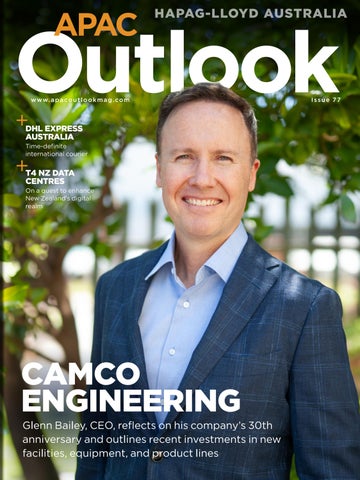
Glenn Bailey, CEO of Camco Engineering (Camco), is the face of this issue’s front cover.

Based in Western Australia, Camco is an industry leader in mechanical engineering, boasting some of the best machining and fitting capability in the country.

This year, the company is celebrating three decades of time-critical engineering solutions, a milestone reflecting decades of hard work and innovation since its founding in June 1995.

The Camco story is one of steady progress, technical expertise, and commitment to service, and demonstrates what can be achieved through longterm vision, strong leadership, and a dedicated workforce.

Bailey reflects on the company’s 30th anniversary and outlines recent investments in new facilities, equipment, and product lines.

“The organisation we have grown into is a direct result of the incredible efforts of many, many people over the years. We have committed and engaged employees and a tenured management team; you can tell our people care about what they do and about the company,” he recognises.

From Camco’s time-critical engineering solutions to DHL Express Australia’s time-definite delivery which, at its core, means that urgent international shipments reach their destination within a specified time frame.

This is what DHL Express Australia, part of DHL Group, offers through the secure door-to-door delivery of goods with full track-and-trace visibility.

“Customers are paying for the speed, reliability, and security of our network and visibility of when their shipment is going to be delivered,” outlines Phil Corcoran, Managing Director of DHL Express Australia and Papua New Guinea.

We also spend time with T4 NZ Data Centres and its CEO, Dean Addie, who sheds light on how the data centre landscape in New Zealand (NZ) is evolving to meet the challenges of sustainability, resilience, and advanced technological needs.

“Our nationwide distributed data centre model is a novel approach for NZ, and we are glad to do our part in making the country more resilient,” Addie emphasises.

You’ll have a great time reading the rest of this edition’s corporate stories from Hapag-Lloyd Australia, Fruehauf NZ, Mitel, and many others.

We hope that you enjoy your read.

Powering

124 Lightspeed Pacific

A New Age of Connectivity Building a resilient, inclusive, and futureready Pacific

Australia’s

CHEERS TO CHANGE

TO BOOST TOURISM, Thailand is temporarily relaxing its ban on afternoon alcohol sales, which was initially implemented in 1972 to prevent government employees from drinking during work hours.

The ban has long frustrated visitors to the predominantly Buddhist country known for its vibrant party scene. However, the timing of this new initiative comes just in time for the Christmas and New Year holidays – a peak tourist season.

In a six-month trial programme, the sale of alcohol will be permitted between 11:00am and midnight. This effort aims to attract more tourists and contribute to the recovery of the economy.

TAKING A SHOT AT CHLAMYDIA

IN A WORLD-FIRST, a vaccine is being introduced to treat chlamydia in Australia’s koala population. Researchers from the University of the Sunshine Coast have spent over 10 years developing a single-dose shot to protect the iconic marsupials. Chlamydia in koalas can lead to various health issues, including

urinary tract infections, fertility problems, blindness, and even death.

The disease accounts for approximately 50 percent of koala deaths in the country’s wild populations, which inhabit eucalyptus forests along the East Coast.

AEROSPACE

WINDOW OF OPPORTUNITY SEIZED

THREE CHINESE ASTRONAUTS aboard the Shenzhou 20 space mission have successfully returned to Earth after delays in their scheduled landing due to a suspected debris strike that left a crack in the spacecraft’s window.

After a nine-day wait, Chen Dong, Chen Zhongrui, and Wang Jie departed from the Tiangong space station, concluding a 204-day mission.

During their extended time in space, the crew continued to work and live alongside the newly arrived Shenzhou 21 astronauts before returning home aboard their spacecraft.

The new crew, which includes China’s youngest astronaut, 32-yearold Wu Fei, currently has no means of returning; however, Shenzhou 22 is set to launch sometime next year.

Some individual colonies are nearing extinction, resulting in these fluffy grey animals being classified as endangered, although other factors also contribute to their decline. Previously, antibiotics were used to treat the disease, but medications disrupted their ability to digest food, leading to starvation.

K-CRISIS FOR THE ELDERLY

SOUTH KOREA’S RAPIDLY increasing ageing population is finding comfort in artificial intelligence (AI)-powered plushie companions.

The huggable Hyodol robot dolls

SKY STRENGTHENS TIES

FOLLOWING THAWING TENSIONS between India and China, direct flights have resumed after a five-year hiatus.

IndiGo initiated this with a route from Kolkata to Guangzhou, followed by China Eastern’s flights from Shanghai to Delhi.

The Kolkata route reconnects

are designed to look cute and mimic the voice of a seven-year-old. They also respond to touch, play music, and provide cognitive exercises.

The country is classified as a superaged society, meaning it has more than 10 million people over the age of 65, representing around 20 percent of the population.

Additionally, there are fewer multigenerational households, leading many elders to live alone. As a result, seniors are facing isolation and loneliness, creating a market for companies like Hyodol.

The doll is connected to a mobile application and web monitoring platform that family members and caregivers can use. As well as offering emotional support, they provide practical support, including medication reminders and emergency alerts, whilst allowing social workers to log information.

RETAIL

KIA ORA, IKEA

IKEA HAS OFFICIALLY entered its 64th market by opening a store in New Zealand (NZ), marking the furthest location from its flagship store in its home country, Sweden. This expansion was first announced in 2019 and comes 50 years after the brand launched in neighbouring Australia.

NZ Prime Minister, Christopher Luxon, cut the ribbon to enthusiastic applause as eager shoppers waved Swedish flags.

The long-awaited 34,000 square metre store in Auckland has created 500 jobs and is a significant boost for NZ, which is currently grappling with the cost-of-living crisis.

NZ is one of the last developed nations to gain access to the affordable furniture titan.

wholesale markets in Southern China, which strengthens trade ties in the face of US tariff threats.

Flights were initially suspended in 2020 due to the COVID-19 pandemic and a deadly border clash, but relations have since improved.

Now, Thomas Cook India has expanded its Chinese portfolio, highlighting the country’s diverse attractions, including historical sites in Beijing and Xi’an, as well as

SHIFTING GEARS, FUELLING SALES

MANUFACTURING HYUNDAI AND GENERAL

Motors (GM) are poised to be two of the biggest beneficiaries of the US’ reduced tariffs on imports, including vehicles from South Korea.

According to GlobalData, more than 1.3 million vehicles – accounting for over eight percent of US sales this year – will be imported from South Korea. After Mexico, this positions the country as the second-largest exporter of cars sold in the US.

The new trade agreement between the US and South Korea comes months after a period of tension between the two countries, which arose after an immigration raid at a battery plant jointly owned by Hyundai and LG Energy Solution in Georgia, where over 300 South Koreans were arrested.

Building Brand Equity Across Borders

Cultivating brand trust across global hospitality markets presents itself as the latest industry evolution. Paul Wainwright, Design Director and Partner of Harrison, delves into how a thoughtfully planned brand guarantees success

Trust is an invisible currency. In hospitality, it determines whether a brand becomes part of a local culture or simply fades as another passing import.

To build trust, brands need to do more than simply enter a new market and open a flagship location. Running deeper than food safety or brand recognition, building trust requires an understanding of how people live, what they value, and how the brand

can fit naturally into their lives.

This, in turn, requires cultural respect, the ability to build emotional connection, and giving consumers the confidence that the brand will deliver on its promise consistently.

Research shows that consumers who trust a company are more likely to buy a product, stay loyal, and advocate for it. Social media is a great tool for brands to build initial hype, but early momentum built through

social media can fade fast. When the influencers disappear and the novelty wears off, only relevance will keep a brand thriving.

“Think globally, act locally” is no longer a cliché – it is a survival strategy. No brand wants a mistranslation mishap like when KFC’s “Finger Lickin’ Good” became “Eat Your Fingers Off”. Brands who win are those that hold onto their core identity whilst making customers feel the experience was built for them, in their language, and within their culture.

WHEN GLOBAL GIANTS LOSE LOCAL RELEVANCE

Even the biggest brands can falter when local competitors move faster.

For example, in the coffee sector, Starbucks’ experience in China is a

cautionary tale of how fragile global trust becomes in local markets.

For years, Starbucks symbolised aspirational coffee culture, but Luckin Coffee’s rise was meteoric. Founded in 2017, the company grew to more than 20,000 stores within a few years, surpassing Starbucks in both footprint and revenue.

Its model – app-only, low-staff, and hyper-convenient – met the needs of urban Chinese consumers perfectly. Prices were lower, promotions constant, and innovation relentless; in 2024 alone, Luckin Coffee launched 119 new drinks.

Starbucks attempted to respond with price cuts and trend-led beverages, but the speed and precision of Luckin Coffee’s local relevance left the coffee giant

exposed. Economic headwinds haven’t helped Starbucks – when confidence dips, premium global brands often lose appeal whilst local operators win with affordability, convenience, and unparalleled cultural insight.

Customers notice when a brand thinks its above needing to pay attention to its local consumer base.

GLOBAL ADVANTANGE MEETS LOCAL INSIGHT

International brands hold undeniable advantages: resources, operational expertise, and worldwide recognition. However, these strengths only translate into equal success when paired with deep local understanding and a decentralised, federated approach, allowing local teams autonomy whilst safeguarding the heart of the brand.

Starbucks’ early years in China saw stores adapted for social gatherings with larger tables, premium teas, and seasonal products like osmanthus lattes which reflected local tastes.

Elsewhere, France is – perhaps surprisingly to many – one of the biggest markets of McDonald’s, thanks to the business embracing French culinary norms rather than resisting them. Table service, bakery items, and fresh salads allowed the brand to integrate into a proud food culture which otherwise might have rejected mass-market fast-food.

KFC’s global-local balance is one of the strongest in the industry. In China, regional teams control menu innovation, resulting in congee breakfasts, szechuan chicken, and festival-themed menus. In Japan, KFC has become such a Christmas staple that demand regularly outstrips supply.

Sometimes adaptation means reframing a core strength. AustralianMexican brand Guzman y Gomez entered the US by keeping its bold tone and flavours but adjusting pricing and portion sizes to meet local norms.

BUILDING LOCAL INTO THE BRAND STORY

Supply chains, whilst rarely glamorous, are powerful tools for building trust. As someone from a farming family in Orkney, Scotland, I’ve seen how local producers can excel in supporting smaller food and beverage brands.

Domino’s Pizza Japan partnered with local dairy farms for mozzarella, tying freshness and provenance directly into its brand story. Shake Shack in the Middle East uses halalcertified regional meat suppliers not only for compliance but also to respect cultural expectations.

During the COVID-19 pandemic, Australian-Japanese chain Ōkami worked with local producers and culinary schools, forging relationships that strengthened its community standing long after lockdowns.

Local sourcing can be commercially beneficial, but its real value is emotional. Customers trust what and who they can see.

TRUST THROUGH EMOTIONAL AND CULTURAL CONNECTION

Trust is built through the head, heart, and stomach. Brands that appeal on all levels earn more than customers –they earn advocates.

COYA keeps its Peruvian art, music, and cuisine consistent worldwide but adapts its events to local calendars, from Lunar New Year celebrations in Asia to wine-led experiences in Europe.

Jollibee brings Filipino warmth to every market, offering a taste of home to diaspora communities and an introduction to joyful comfort food for new audiences.

Meanwhile, Chinese dessert brand Mixue Ice Cream & Tea now has more outlets than McDonald’s globally, building its success on affordability, accessible formats, and hyper-local franchise operators who understand their neighbourhoods intimately.

LESSONS FOR THE ASIA PACIFIC MARKET

As we watch the Asia Pacific (APAC) region evolve, a few truths stand out, and none of them simple.

First, speed and agility win, but only when matched by cultural humility. Markets here move fast; what felt right last year may feel tone-deaf today. The travellers, diners and drinkers across Southeast Asia or Greater China are no longer drawn by a global logo –they’re drawn by relevance.

Second, prestige is being redefined, and increasingly it’s being homegrown. Across Asia, there is growing appetite for luxury and premium brands that feel local. A rising majority of consumers now believe that Asian brands match Western labels in quality and design, especially in Mainland China and Southeast Asia.

This means that “luxury” no longer defaults to Western heritage. It’s no longer enough to import a global aesthetic and hope it resonates. To earn trust, we need design and experiences that speak to local stories, tastes, and expectations.

Thirdly, experience trumps signage in APAC. Heritage once meant pedigree, but now it means memory

– the way a space feels, the rhythm of service, the cues that feel native rather than imported.

The strongest hospitality with the best value will come from thoughtful, culturally fluent design and emotionally intelligent guest journeys and operations that anticipate local behaviours.

Quantity or flash won’t cut it – the future belongs to brands that move with humility, listen before they build, and deliver something meaningful not because “global says so”, but because local lives demand it.

TRUST IS THE DESIGN BRIEF

When expanding into a new market, trust should be treated as part of the design brief. It should shape menus, interiors, supply chains, staff training, and even the choice of partners.

Markets operate on history, hierarchy, and tradition. Ignore this, and friction follows; respect it, and you create flow.

The brands that succeed enter with humility, listen deeply, and use their global strengths to serve local communities. If you want to win in a new market, start by designing trust; everything else follows.

ABOUT THE EXPERT

Paul Wainwright is Design Director and Partner of Harrison, a strategic global branding, interior design, and architectural agency with offices in the UK, US, and Australia, serving Europe, Africa, the Middle East, APAC, the US, and beyond.

Wainwright also sits in-house for Viet Thai International as Design Director, leveraging his global expertise to offer a unique perspective from both sides of the relationship.

Exclusive, appetising content, delivered straight to your inbox

As organisations worldwide confront unprecedented change, embracing technological innovations and incorporating critical environmental sustainability agendas, now more than ever is the time to showcase the strides being taken in the food and beverage sector.

A multi-channel brand, Food & Beverage Outlook serves up all the positive global developments driven by companies across the food and beverage industry. Discover exclusive content presented through its website, social media channels and dispatches, delivered straight to your inbox with a bi-weekly newsletter.

Through this compelling new venture, Food & Beverage Outlook foregrounds the movers and shakers of the industry by confronting unprecedented change, showcasing technological innovations and incorporating critical environmental sustainability agendas.

To participate as a featured company and join us in this exciting endeavour, contact one of our Project Managers today.

www.foodbeverage-outlook.com/work-with-us

Harmony

In with Self

With a sincere belief that well-being begins by bringing oneself into balance, the philosophy of Santani Wellness Resort is centred around self-harmony. Vickum Nawagamuwage, Founder, passionately discusses the importance of engaging more deeply with adaptive wellness practices – such as those offered at the resort – to navigate the demands of the modern world

Santani Wellness Resort (Santani) was founded on a simple truth – that modern life in today’s digital and data-driven society moves faster than the mind and body were designed to.

Asia’s first purpose-built luxury wellness resort, Santani integrates architecture, ayurveda, mindfulness, and modern science in one seamless experience.

Set within 120 acres of former tea

estates in the Sri Lankan highlands, the resort opens onto the stunning Knuckles Mountain Range, a UNESCO World Heritage Site.

Santani focuses on healing the root cause – not just the symptoms –whether that be stress, burnout, or a deeper emotional imbalance.

“Santani is not an escape from life, but a gentle return to yourself,” introduces Founder Vickum Nawagamuwage.

Central to the resort’s vision is the ‘architecture of silence’, through which each structure, material, and view has been carefully designed to quiet the senses and reduce cognitive load.

Sustainability, meanwhile, has been built into every layer of the space –from low-impact construction and natural ventilation systems to the use of locally sourced materials and organic produce grown on-site.

By blending timeless wellness wisdom with contemporary design and science, Santani continues to redefine what sustainable luxury means — not excess, but essence.

“In the end, peace of mind is the ultimate luxury,” Nawagamuwage adds.

ADAPTIVE WELLNESS

With the pace of modern living placing unprecedented demands on people’s cognitive and emotional

systems, Santani believes that whilst biological evolution can take generations, behavioural adaptation must happen now.

“We are living through a new kind of stress and mental health crisis –one born not from external hardship, but the widening gap between what life demands and what the human system can sustain,” Nawagamuwage observes.

To close this gap, Santani thinks

our focus should be on strengthening capacity – cultivating resilience, clarity, and adaptability.

Indeed, curative healthcare has its limits; by the time illness appears, the ability to adapt is often already compromised.

As such, the resort considers the future of wellness to lie not in treatment after imbalance occurs, but in building strength before imbalance can even begin.

“Guests often describe their Santani experience not as a retreat, but as a return to themselves. Here, they slow down and learn a way of living that feels grounded and sustainable”
– V ickum Nawagamuwage, Founder, Santani Wellness Resort

Santani’s mission is to shift our perception of wellness from being an occasional treat to a lifelong practice – what it calls ‘adaptive wellness’, which places emphasis on living intelligently within the limits of our biology and demands of the modern world.

“We see wellness not as recovery, but as adaptation and prevention, helping people to strengthen their internal system before imbalance becomes illness,” he reflects.

The resort’s programmes have been created to meet the realities of modern life and adapt to the constant connectivity, mental fatigue, and rising chronic stress many of us face. Each programme integrates ayurvedic principles, functional medicine, and mindfulness training to address issues such as burnout, metabolic health, and emotional regulation.

Santani’s philosophy of adaptive wellness is a way of living that restores alignment, builds resilience, and transforms well-being into a sustainable state of balance.

THE RHYTHM OF LIFE

Guided by a philosophy of human sustainability, Santani understands that the planet cannot sustain itself unless humans first learn to sustain themselves.

Modern living has created what Nawagamuwage considers to be an evolutionary mismatch, where our environment has evolved faster than our capacity to adapt in today’s era of rapid digital transformation.

“This widening evolutionary gap has placed a question mark over our ability to survive, threatening the sustainability of humankind for the first time in history,” Nawagamuwage warns.

Santani believes the solution is to evaluate our mental fitness, spiritual awareness, and physical health.

In this context, Wellness 2.0 is Santani’s holistic and adaptive solution that provides a toolkit to make wellness a true lifestyle solution.

With each personalised ayurvedic journey offered at the resort deeply rooted in ancient therapies, Santani’s ayurvedic physicians are well versed in both ‘prakriti (one’s natural constitution) and vikriti (one’s current state of imbalance), which enables them to design tailor-made programmes.

“Each guest’s journey at Santani begins with a detailed consultation with our ayurvedic physicians, followed by a personalised plan where nutrition, therapy, movement, and rest are attuned to their individual constitution and rhythm of life,” he explains.

For some, this means a deep panchakarma detox to cleanse metabolic waste and inflammation.

For others, it might focus on stress and sleep regulation through herbal therapies, rhythmic oil treatments, yoga, and mindfulness practice.

Each journey blends traditional medicine with modern diagnostics, supported by the resort’s integrated wellness team of doctors, yoga teachers, therapists, and chefs, who work in harmony to create a holistic journey focused on restoration.

NATURE’S QUIET INTELLIGENCE

Offering immersive lifestyle retreat programmes such as hydrotherapy spa treatments and guided hikes through tea plantations, Santani seeks

to align with its core value of finding harmony in nature.

Each programme is structured around resetting internal rhythms and working with the natural cycles of the body and nature.

Days begin with a gentle sunrise yoga session overlooking the Knuckles Mountain Range, followed by personalised ayurvedic meals based on the Rasa Haya philosophy of six tastes, which balances nourishment with enjoyment.

“Guests follow a restorative routine of holistic herbal treatments, steam and sauna rituals, and sessions in our thermal saltwater pool which are designed to stimulate circulation and support detoxification,” Nawagamuwage details.

NO PAUSE MENOPAUSE

Santani’s No Pause Menopause programme has been designed to redefine how women experience menopause and reframe this season of life as a renewal and not as a decline.

Its approach is three-pronged:

1. Biological balance – Personalised nutrition and herbal formulations stabilise hormonal fluctuations, sleep, and metabolism.

2. Mental and emotional clarity – Breathwork, yoga, and guided mindfulness cultivate a sense of calm and resilience during transition.

3. Physical renewal – Targeted spa therapies, heat treatments, and restorative movement strengthen circulation and release tension.

Santani’s goal is to guide women through this chapter in their lives with awareness, comfort, and empowerment, helping them reconnect to their innate rhythm and strength.

In the afternoon, mindfulness and breathwork sessions are intended to deepen the connection between body and mind, whilst forest walks, river baths, and hikes through tea estates invite immersion within nature’s quiet intelligence.

Every element is designed to mirror nature’s balance, pairing movement with stillness and effort with ease.

“Guests often describe their Santani experience not as a retreat, but as a return to themselves. Here, they slow down and learn a way of living that feels grounded and sustainable,” he prides.

GLOBAL RECOGNITION

Looking ahead, Nawagamuwage reflects upon Santani’s key priorities for the coming year.

“Our focus now is on deepening our impact and expanding our reach,” he tells us.

Preparing to expand the Santani philosophy beyond Sri Lanka, it has upcoming properties being developed in Oman and Morocco that honour local traditions whilst preserving its core design and wellness principles.

The resort is also developing new digital wellness tools to help guests maintain their routines after they leave, turning every Santani journey into a lifelong practice.

“Alongside this, we will continue evolving our signature retreats and research-based collaborations in the ayurveda wellness space,” he adds.

Santani’s burgeoning contribution to wellness has been recognised within influential circles, with the resort having been awarded a prestigious MICHELIN Key.

“We’re one of 10 hotels and resorts in Sri Lanka to receive a MICHELIN Key and the only wellness resort in

“Each guest’s journey at Santani begins with a detailed consultation with our ayurvedic physicians, followed by a personalised plan where nutrition, therapy, movement, and rest are attuned to their individual constitution and rhythm of life”

the country to be given this global recognition,” Nawagamuwage prides.

This recognition stands as a testament to the Santani team’s quiet dedication to crafting experiences around mindful luxury and creating moments of balance and harmony for every guest.

“For us, this honour affirms that true luxury lies in peace of mindin the quiet intelligence of space,

service, and care that allows guests to return to themselves,” he passionately concludes.

Santani Wellness Resort

Tel: (+94) 76 399 1919 (Reservations) (+94) 70 366 9110 (Resort) reservations@santani.com www.santani.com

Ashes to Ashes, Business to Business

As the 2025/26 Ashes series kicks off Down Under, we unpack the business side of the iconic cricket contest between England and Australia

Fiercely contested biennially between England and Australia, the Ashes represents not only the pinnacle of cricket but also the very essence of sporting contest.

The iconic series stands proudly as cricket’s most historic and storied rivalry, with the ongoing battle for ultimate sporting glory and bragging rights dating back to 1882.

Alongside delivering jaw-dropping moments of action, the Ashes also offers unmatched commercial opportunities for both nations.

In the modern era of cricket, where the sport’s financial gravity has dramatically shifted towards the allure of a shortened format, mainly franchise Twenty20 leagues, the Ashes remains the increasingly rare long-form property that can still command sold-out stadiums and produce reliable income for the game.

As such, national governing bodies rely on the Ashes to anchor major broadcast partnerships and sponsorship deals.

This year, Australia are bidding to retain the urn, having held it in a vice-like grip since the 2017/18 series. Throughout the winter, England will go in search of a first series win Down Under in 14 agonising years.

BROADCASTING RIGHTS AND TV DEALS

In terms of this year’s Ashes, broadcasting rights lead the way regarding financial upswing.

The England and Wales Cricket Board (ECB) draws nearly 75 percent of its yearly income from TV deals alone.

In the UK, the Ashes action unfortunately remains behind a paywall as TNT Sports once again secured exclusive domestic rights for the third Ashes series in a row.

For those in the UK without a TNT subscription, fans can still enjoy free ball-by-ball radio commentary from Test Match Special on BBC Sounds, BBC Radio 5 Sports Extra, and the BBC Sport website and app, underscoring the incredible thirst for Ashes drama and detailed day-to-day coverage, even if it means getting up at two o’clock in the morning for the start of play.

In Australia, pay-TV network Foxtel and free-to-air broadcaster Seven are sharing broadcast rights this year, with both showing every ball.

The duo secured a mouth-watering AUD$1.5 billion extension to their partnership with Cricket Australia (CA) at the start of 2023, running from mid-2024 until 2031.

CITY-BY-CITY IMPACT

PERTH – Hosting its first-ever Ashes opener, Optus Stadium attracted tens of thousands of visitors, driving hotel occupancy above 80 percent and boosting local tourism.

BRISBANE – The day-night Test at ‘The Gabba’ will light up the city, with bars and restaurants gearing up for a surge in evening trade.

ADELAIDE – Hotel bookings for the December Test have spiked, reflecting strong inter-state and international demand.

MELBOURNE – The Boxing Day Test at Melbourne Cricket Ground is expected to draw more than 90,000 fans on day one alone creating a bumper week for businesses.

SYDNEY – The New Year’s Test will cap off the series, with hospitality venues preparing for a festive season rush.

SPONSORSHIP AND MERCHANDISE

NRMA Insurance is the sponsor of the 2025/26 Ashes series, whilst Australia have unveiled front-of-shirt sponsor, Westpac Bank, as their new Principal Partner on a four-year deal, reportedly worth AUD$40 million to CA.

Meanwhile, the ECB have named Toyota as its new Principal Partner and primary kit sponsor, as the International Cricket Council (ICC) began permitting front-of-shirt sponsorships for Test teams in 2020, originally as a temporary measure to help offset revenue losses during the COVID-19 pandemic.

The Australian kits are supplied and manufactured by Asics on a deal until 2028, whilst the England team have been kitted out by Castore since 2022. The latter manufacturing deal is reportedly worth £25 million over a decade-long deal.

PHOTOGRAPHY:
PHOTOGRAPHY:

The sale and continued popularity of replica kits and official merchandise for both sides also provide vast financial benefits.

FEVER PITCH

With Ashes excitement reaching fever pitch, a total of 311,066 tickets were sold on the opening day of pre-sale back in June, obliterating the previous record of 111,741 for the 2017/18 Ashes series.

This unprecedented demand represented the highest level of sales in the country “since Taylor Swift was here”, according to CA Chief Executive, Todd Greenberg, who believes the series has the potential to outstrip the pop star’s Eras Tour sales in Sydney and Melbourne in February 2024, which saw around 620,000 fans attend across seven dates.

Furthermore, the chance to visit iconic stadiums such as the Melbourne and Sydney Cricket Grounds still captivates fans and

drives hospitality revenues skyward as fans flock from far and wide.

Each iteration of the Ashes brings vast economic benefits to the host nation across a plethora of different sectors within the realm of tourism and hospitality.

For example, during the first Test of the 2025/26 Ashes series at Optus Stadium, Perth, tens of thousands of fans streamed into the city’s pubs, restaurants, and hotels, sparking a pre-Christmas spending spree that will support local jobs, strengthen small businesses, and reinforce the city’s reputation as a premier destination for world-class sport.

PHOTOGRAPHY: 2025 GARETH COPLEY - ECB

Mongolia’s Low-Carbon Future

Zula Luvsandorj, Advisor to the Deputy Prime Minister of Mongolia, is an energy strategist and infrastructure finance expert with over 15 years of global experience. We learn how she is helping to shape the country’s path to a low-carbon future

APAC Outlook (AO): Firstly, can you elaborate on your role of advising the Deputy Prime Minister of Mongolia on the clean energy transition?

Zula Luvsandorj, Advisor to the Deputy Prime Minister of Mongolia (ZL): I help guide Mongolia’s green transformation, advising on efforts to mobilise capital for large-scale renewables, accelerate clean technology deployment, and lead where beneficial, impactful partnerships can be found that are aligned with Mongolia’s net zero ambitions.

I draw on over 15 years of experience in international project finance and a record of closing major deals to help design and fund

Mongolia’s clean energy transition. My work focuses on translating national policy into projects that attract real investment.

This involves shaping our renewable energy roadmap, supporting regulatory reforms that encourage private sector participation, and working closely with development banks and investors.

I also work with government teams to integrate renewable energy into regional infrastructure plans, such as grid expansion, energy storage, and cross-border power trading.

This approach ensures renewables are not developed in isolation but as part of a wider energy system that supports both domestic and export markets.

A recent example is the signing of a €1 billion memorandum of understanding (MoU) between the European Investment Bank (EIB) and the Government of Mongolia under the European Union’s Global Gateway initiative.

I helped lead the facilitation of this agreement, which marks a major milestone in Mongolia’s clean energy journey, opening the door to new opportunities to transform our vast solar and wind potential into longterm sustainable growth.

The partnership will strengthen renewable energy development, diversify energy sources, and attract both local and international investors to participate in Mongolia’s green transformation.

AO: In what ways do you plan to foster global partnerships to support Mongolia’s clean energy transition, and how are you mobilising capital for large-scale renewables?

ZL: Mongolia is uniquely positioned for strategic global partnerships, with rich solar and wind potential that makes it an attractive partner for international investors.

We are already building strong links with partners in the United Arab Emirates (UAE) and Bahrain, whilst also exploring opportunities with Asian and European counterparts.

The Power of Siberia 2 project could further reshape regional energy dynamics and strengthen Mongolia’s position within green trade routes.

We focus on a mix of public and private funding, with blended finance structures, sovereign guarantees, and green bonds used to attract investors and reduce risk.

Mongolia is developing a more transparent and predictable investment environment to make the country a credible destination for sustainable capital.

We also work closely with multilateral partners who not only provide capital but also help improve technical and governance standards, giving investors greater confidence in the projects they fund.

Through cooperation with global financial institutions, we are developing a pipeline of renewable projects that can meet both domestic

demand and future export potential to neighbouring countries.

AO: What are the primary barriers to financing green energy projects in high-risk markets, what specific changes are needed to overcome them, and how can regulators and policymakers facilitate smoother access to funding?

ZL: The main barriers are seen as political and financial risks, unclear regulations, and a limited number of ready-to-invest projects. Many investors worry about policy instability or difficulties in securing long-term agreements – even when a market has potential, uncertainty often keeps capital away.

“Mongolia is uniquely positioned for strategic global partnerships, with rich solar and wind potential that makes it an attractive partner for international investors”

ZULA LUVSANDORJ, ADVISOR TO THE DEPUTY PRIME MINISTER OF MONGOLIA, GOVERNMENT OF MONGOLIA

To improve access to finance, governments need to provide consistency and clarity. Stable regulations, transparent permitting, and reliable power purchase agreements (PPAs) all help reduce investor concerns. Instruments such as guarantees or risk insurance can also make a big difference in the early stages.

I believe policymakers should also focus on developing local expertise. Local banks and developers need training in green finance so that projects can be structured properly from the start.

Regulators can encourage blended finance schemes, combining public funds with private investment to lower risk, and build investor confidence.

Over time, this creates a cycle where green investment becomes a standard part of market growth rather than a special case. Clear environmental and social frameworks, along with consistent enforcement, are also essential to demonstrate reliability and long-term vision.

AO: How can project finance effectively drive the development of green infrastructure and attract more investment into green projects in emerging markets?

ZL: Project finance allows large infrastructure to be built whilst keeping the financial risk off government balance sheets. It is especially useful for renewables, where private capital can be linked directly to project performance.

This structure gives investors a clear understanding of risk and return, which helps attract funding even in emerging markets.

To strengthen this model, countries need a strong pipeline of bankable projects supported by detailed studies and reliable data. Investors are more willing to commit when they have clear information and trust in local partners – early-stage funding for project preparation is vital to reach this phase.

Partnerships between development banks and private investors can also help. Development banks often take on early risk, offer concessional finance, and provide standardised documentation, which makes it easier to replicate successful projects across multiple markets.

Collaboration between governments, multilaterals, and private developers ensures that projects are not only technically feasible but also commercially sound.

One example of this collaborative model is ACWA Power’s entry into Mongolia in partnership with Sunsteppe Power.

Together, we are demonstrating how international investors and local developers can align to deliver largescale renewable projects, combining global technology and financing with local execution and stakeholder engagement. This approach is key to unlocking Mongolia’s renewable potential and attracting long-term sustainable capital.

To turn Mongolia’s renewable potential into reality, we are now working with ACWA Power, who is studying 10 gigawatts (GW) of renewable energy investments in collaboration with Sunsteppe Power.

This partnership embodies the model we aim to scale – global capital and technology joining forces with local expertise to deliver a transformative clean-energy project.

AO: How can green project finance result in real environmental impact?

ZL: For green finance to be credible, the environmental impact must be measurable and verified. Each project should have clear, specific key performance indicators (KPIs) such as reductions in emissions, improvements in energy efficiency, or added levels of renewable capacity. Independent audits and transparent reporting are essential to prove that the outcomes are genuine.

Strong governance and public disclosure give investors and communities confidence in the results. Green finance should also support long-term benefits for local people, such as job creation and skills development. When projects deliver both environmental and social value, they become truly sustainable.

In Mongolia, we are working to introduce stronger monitoring systems for renewable energy performance and environmental, social, and governance

(ESG) compliance, ensuring projects continue to meet their environmental targets over time.

AO: What were the key factors that contributed to the success of Mongolia’s largest solar photovoltaic installation in the Gobi Desert?

ZL: The Gobi Desert project succeeded because it combined careful preparation, strong partnerships, and clear risk-sharing. International expertise was matched with local ownership, and all stakeholders shared the same goal of delivering a landmark renewable energy project for Mongolia.

The project was based on solid technical studies, well-structured PPAs, and financing from a mix of international and domestic lenders. Meeting international environmental and social standards helped build trust with investors and reduce risk.

The experience proved that Mongolia can manage complex

renewable energy developments efficiently, set a new benchmark for the country’s clean energy ambitions, and encouraged more investors to view Mongolia as a serious player in the sector.

It also gave investors confidence that the country is ready to deliver complex, high-impact clean energy projects, a message that continues to resonate as we pursue new partnerships such as the EIB agreement.

AO: Finally, what are some key strategies that nations can implement to ensure green investments effectively contribute to their economic and environmental goals?

ZL: I think a clear, national strategy that links climate policy with economic planning is essential. Governments need to define how investment in renewables, grids, and clean technology supports wider economic objectives such as industrial growth, job creation, and regional development.

Consistency across ministries is also important. When energy, environment, and finance authorities coordinate their policies, investors receive clear and consistent signals, which helps avoid conflicting regulations and speeds up project delivery.

Nations should also invest in education and workforce training to develop domestic skills in clean industries. Building local expertise ensures the benefits of green investment stay within the economy.

Finally, transparency and accountability are crucial; strong monitoring and public reporting systems build trust and encourage long-term partnerships.

When countries embed sustainability into every layer of economic decision-making, green investments become a reliable engine for both growth and environmental progress.

AUSTRALIA AND NEW ZEALAND PUBLIC TRANSPORT SPOTLIGHT

Connecting communities far and wide, the evolving priorities of the public transport sector across Australia and New Zealand increasingly centre around creating a better passenger experience, emerging next-generation technologies, and moving towards net zero operations

An efficient public transport system is the lifeblood of any streamlined populous, facilitating vital connections across both metropolitan hubs and local communities.

This is particularly the case across Australia and New Zealand (ANZ), where populations are concentrated in major cities, creating high densities of people in smaller, more constrained areas.

This, in turn, makes organised and effective public transport infrastructure more important than ever, especially as ridership on trains and buses across the region continues to rise.

Correlating with the increasing levels of passengers in recent years is a greater effort towards sustainable transport and the lowering of greenhouse gas (GHG) emissions.

Given the transport sector is the third-largest emitter in Australia, accounting for 22 percent of its emissions, and is responsible for 17 percent of gross domestic emissions in New Zealand (NZ), increasing access to dependable public transport is key to reducing these levels.

Transitioning vehicle fleets and creating new transport services forms only part of what is needed. A focus on mode shift – changing the way in which people travel, and accounting for that change in carbon budgets – will also be required.

For example, 35 percent of Australian passenger kilometres are travelled in cars, which is a huge opportunity for the sector.

Governments across ANZ are already prioritising moving more sustainably as a way to future-proof the sector. Both federal jurisdictions are introducing measures to cut carbon emissions, whilst state governments are implementing individual policies in their own areas

towards this target.

For instance, the New South Wales (NSW) government introduced the Zero Emission Buses programme earlier this year, which aims to convert the state’s 8,000+ buses to zero-emissions technology, with the long-term goal of achieving net zero by 2050.

Similarly, through its emissions reduction pledges, the Victoria government has made a concerted effort to ensure that all new public transport bus purchases are zero-emissions vehicles (ZEVs).

The move to sustainable public transport infrastructure goes hand-in-hand with the adoption of next-generation technologies.

A recent notable example is the implementation of NZ’s first large-scale gantry charging system at Kinetic’s Glenfield depot in Auckland as part of a collaboration between the bus services provider and Auckland Transport.

With this development comes the roll-out of 31 new ZEVs amongst the bus fleet, further demonstrating a growing awareness of the positive impact public transport can have on carbon emissions.

The region is also seeing greater prioritisation of active mobility, shown through increased investment in walking and cycling infrastructure. For example, Transport for NSW is building a new step-free cycle route on the iconic Sydney Harbour Bridge, which already sees more than 2,000 bike trips a day – those numbers are expected to skyrocket when the cycleway opens.

The public transport system across ANZ is therefore forging a clear path for accessible and sustainable mobility using innovative technologies and a forward-thinking approach.

PUBLIC TRANSPORT ASSOCIATION AUSTRALIA

NEW ZEALAND INTERVIEW:

Heralding a 20-year legacy, Public Transport Association Australia New Zealand is the premier peak industry body for public transport and sustainable mobility solutions across ANZ. Lauren Streifer, Chief Executive, highlights how the association is prioritising net zero targets and a community-focused approach

APAC Outlook (AO): Firstly, could you outline the origins of Public Transport Association Australia New Zealand and its founding mission?

Lauren Streifer, Chief Executive (LS): Public Transport Association Australia New Zealand (PTAANZ) started more than two decades ago when all the public transport authorities across ANZ decided there should be a voice for public and active transport across the region.

They thought it was important to have a standalone body that represented the interests of our communities, and they recognised that collaboration amongst the jurisdictions was really important, as well as international collaboration.

AO: How has the realm of mass transit and sustainable mobility evolved and developed since the association’s inception?

LS: A lot has changed since PTAANZ was founded, even in the last two years since I took on the role.

If you look at the forward estimates and where investment is going, there’s been a clear shift across ANZ into public and active transport and towards the transition to net zero requirements, which has led to a huge change in where money is going across the region.

There’s also been a big uplift in attention on public and active transport, which is really exciting to see, with a lot of the projects we’ve invested in now being operationalised.

The second stage of the Sydney Metro opened last year, and Melbourne’s Metro Tunnel has just opened too. We’re also about to see Cross River Rail launch in Brisbane and City Rail Link in Auckland, alongside countless other major projects, including METRONET in Western Australia.

So, a lot of our regions are about to experience many of the things we’ve been talking about for a long time, and I’m really excited to see how citizens will live and breathe these things day-to-day and how the way they move will be transformed.

The other thing I’m really excited about is leaders who are increasingly trying to reimagine and design our cities for people, not just cars – that’s a big change for ANZ.

We have very car-dependent cities, but if you go to Sydney, for instance, they increasingly have a very public transport-first ethos. We can replicate that and do more with what we have, which often looks like active and public transport that is better for the community.

Another thing that’s really changed, particularly in the past few years, is the increasing focus on the housing crisis and how we provide more accommodation close to access and amenity, especially as populations are growing significantly – for example, Melbourne will become the size of London today within 20 years. We must have public transport investment and attention match our population increases.

With that, you need world-class transport and connectivity, which means changing the way you design, plan, and invest in your cities, then looking at how you develop your public transport network around that. It’s been a huge change and exciting to be at the epicentre of it all.

“THE OTHER THING I’M REALLY EXCITED ABOUT IS LEADERS WHO ARE INCREASINGLY TRYING TO REIMAGINE AND DESIGN OUR CITIES FOR PEOPLE, NOT JUST CARS – THAT’S A BIG CHANGE FOR ANZ”
– LAUREN STREIFER, CHIEF EXECUTIVE, PUBLIC TRANSPORT

AO: How does PTAANZ partner with its private member organisations to sustain world-class public transport and meet the needs of the local communities that it serves?

LS: Our association started with the major public transport authorities, which were supported by global and local operators. This meant we had a public service and community-focused vision, but in order to achieve that, you need a vibrant private sector delivering for communities too. Our membership consists of world-class operators from around the globe, operating in cities like New York, Paris, and London. At the same time, you also have small, mom-and-pop operators in local towns that are delivering a school bus service to make sure children don’t get left behind, which is inspiring.

So, we cover the whole gamut, from government agencies to major project builders to someone on their e-scooter, and I’m really proud of that and how we bring all modes together to deliver for local communities.

AO: How do your digitally backed solutions improve ANZ’s modes of mass transit?

LS: We’re in the middle of one of the biggest infrastructure investments ever in our history.

We’re operating in a more constrained market, so our members are increasingly looking at how to better deliver for our cities in more innovative ways.

This often comes down to technology – if you’re trying to shift more people onto public transport, it means having

ASSOCIATION AUSTRALIA NEW ZEALAND

great service. But what does that look like?

It might mean more services, but it can also include improved information management so people know where they can go, more marketing or advertising of available services and how to use them, or greater connectivity and interchange across modes. Because of that data and connectivity, your experience improves as a passenger –you know when your bus gets to the station, for instance, or when your train is about to leave.

Having more developed systems that speak to each other means a better customer experience, encouraging more people to choose public transport.

AO: What trends are developing across the sector and how are you responding to them?

LS: One of the big ones is housing and how you create precincts and regions with really good transport networks, enabling transit-orientated development and more liveable cities.

The other huge priority is climate change, and we act upon ambitious targets in Australia that will require a significant change in how we live and move.

We’re also seeing policy in ANZ increasingly used as a tool to guide behaviour. For example, NZ is looking

at amending its road user charging policies to change people’s behaviour.

Governments are also looking at things like tax incentives for companies who have their employees use public transport, so there are policy levers that we can use to develop the sector.

AO: How does the Connected Choices Action Plan combine mass transit services and next-generation mobility options to provide more choices in how people make their journeys?

LS: We realised there were a few policy areas – mode shift, customer experience, and net zero – that needed a deeper dive and more coordination amongst states, territories, and operators in the private sector in order to have the biggest impact.

Those are our three core priorities, and we’ve developed committees around them that have distinct action plans.

The Mode Shift Committee, for example, has developed something called the Mode Shift Index, which means all states across ANZ will track mode use. This means we’ll track whether people are cycling, walking, driving, using buses, or taking trains – and how this is changing – across all states and territories in ANZ.

You can look at the data and see what’s working and what’s not, and move the dial to prioritise planning and investment. Plus, you have real data in the background to back you up.

So, it’s important that we give different jurisdictions an opportunity to share their data and lessons with each other, because the data shows you what’s really happening.

It’s also special because we have all the major jurisdictions across the region, so it means everyone is at the table for these discussions, which is a huge transformation for PTAANZ and something I’m really proud of.

AO: How do you work with governments and public institutions to ensure more reliable, safe, and sustainable transport options are available across local communities?

LS: I think it’s important to start out with a strong vision – you have to decide what kind of cities and regions you want to create before you go to the table and decide what type of infrastructure or transport projects you’re going to build and the systems and networks you want to operate.

So, starting with that purpose across our region is really important, and I’m proud that we’re communityfocused and driven by that.

The other thing is if you look at the cost-benefit ratio of major projects, like delivering a school bus programme to a regional community, for example, it arguably doesn’t stack up.

Public transport has a strong equity lens, so it’s not just about economic productivity, but also people living their lives, getting to where they need to go, and integrating into society.

I met with Dorval R. Carter Jr., the former President of the Chicago Transit Authority, where they are developing a train line that will go to the south side of the city, which is one of the most underprivileged areas of the US.

I asked him, “Why are you doing that?”. Authorities don’t often give attention to these types of voters; these are the people that are often isolated or not listened to. He said to me, “Lauren, I’m building it for the kid that I was before”. That matters to me, too.

So, we have that opportunity and I’m very mindful of that in every decision we make. I take input from communities very seriously, as it makes a difference between whether or not you see your family or are socially isolated.

Not everyone has, or wants, access to a private vehicle, and we need to provide for people who don’t. Even for those who do, it’s about expanding choice to leave your car at home and take the train, bus, or ferry, or cycle to your destination.

AO: What specific initiatives and opportunities does PTAANZ support to foster collaboration amongst its members across the ANZ public transport landscape?

LS: I like to say PTAANZ is about choosing your own adventure. Regardless of what you’re into, there’s a place for you with us, whether you’re into policy, research, or action.

“PUBLIC TRANSPORT HAS A REALLY STRONG EQUITY LENS, SO IT’S NOT JUST ABOUT ECONOMIC PRODUCTIVITY, BUT ALSO PEOPLE LIVING THEIR LIVES, GETTING TO WHERE THEY NEED TO GO, AND INTEGRATING INTO SOCIETY”
– LAUREN STREIFER, CHIEF EXECUTIVE, PUBLIC TRANSPORT ASSOCIATION AUSTRALIA NEW ZEALAND

We have a strong Emerging Leaders programme supporting our young industry practitioners, and I’m also proud that we’re developing relationships with Transport for London and the American Public Transportation Association (APTA), for example, enabling a collaboration between our region and key global partners like the UK and North America.

We also have our Connected Choices strategy and committees, and a podcast called Women Who Move Nations, so regardless of what you’re interested in or which part of the sector you’re from, there’s really exciting things to get involved with when you become a member.

AO: Moving on to a focus on climate next year, how is the association harnessing the event in making transport a more effective lever for sustainable change?

LS: Australia will hold the Presidency for the COP31 climate negotiations in 2026, and PTAANZ will host the Global Transport Leaders’ Summit in November. That’s intentional - we have ambitious climate targets for our region.

Transport, unfortunately, is on track to be the biggest GHG emitter of any sector by 2030, and the move to electric vehicles (EVs) and the fact petrol cars won’t be phased out until 2050 means we have a big opportunity to leverage the power of mode shift to public and active transport to have an impact on our climate.

That’s the reason why we’re holding the Global Transport Leaders’ Summit and inviting 14 economies from around the world to share best practices about what

we can do, as well as having Andy Lord, Commissioner of Transport for London, as keynote speaker.

This is a really good opportunity to feature public and active transport as powerful levers to reduce emissions and increase community benefit.

AO: Finally, looking ahead, how will the association continue to shape the future of public transport across ANZ?

LS: I really want to strengthen where we came from –public sector connectivity and global linkages – in the future.

Therefore, you’ll see a lot more global engagement between ANZ and the rest of the world, and intergovernmental engagement between our jurisdictions to learn from what is working and where we are challenged.

You’ll also see our association having a louder, more collaborative voice that weighs in on policy discussions, particularly with federal and state governments, so we can work collaboratively together to face some pretty serious challenges.

info@ptaanz.org ptaanz.org

SPOTLIGHT ON MALAYSIAN GAS

Malaysia is naturally blessed with an abundant availability of indigenous gas, a resource that remains a strategic anchor in the nation’s ambitious and ongoing energy transition

Malaysia’s gas story is one of national transformation.

It began with the Four-Fuel Diversification Policy in 1981 and accelerated with the Peninsular Gas Utilisation (PGU) system throughout the 1980s, which unlocked offshore gas from the state of Terengganu and supplied industries across Peninsular Malaysia.

The impact was profound. Gas consumption grew from merely four million standard cubic feet per day (MMSCFD) in the early 1980s to over 2,000 MMSCFD today.

Since 1997, natural gas has been Malaysia’s dominant energy source powering industrial expansion, stabilising electricity prices, and supporting sustained economic growth.

Today the gas ecosystem contributes RM135 billion annually, supports 80,000 jobs, and is projected to add an additional RM400 billion to public finances over the next decade.

Furthermore, natural gas provides around 43 percent of Malaysia’s Total Primary Energy Supply (TPES) today and

will remain significant, contributing to around 56 percent TPES by 2050, supported by carbon capture, utilisation, and storage (CCUS), hydrogen readiness, and methane management.

As renewable energy expands, gas provides the flexible, lower-carbon baseload capacity needed to support rising demand from industry, manufacturing, and more recently, burgeoning requirements from data centres.

As such, the industry is evolving from a mere energy source supplier to an integrated decarbonisation partner.

MALAYSIAN GAS ASSOCIATION (MGA) INTERVIEW:

Promoting a vibrant and sustainable gas industry, the Malaysian Gas Association (MGA) is the lead advocate fuelling the nation’s socioeconomic growth. We chart a journey of resilience and transition with President, Abdul Aziz Othman

APAC Outlook (AO): Could you share more about your role and your perspective on representing the gas industry in today’s energy transition context?

Abdul Aziz Othman, President (AAO): As MGA approaches its 40th year, our mission remains anchored in championing natural gas as a clean, reliable, and strategic component of Malaysia’s energy system.

As President, I carry the responsibility of representing a diverse industry voice, strengthening alignment with policymakers, and ensuring gas continues to support Malaysia’s transition in a practical, sustainable, and future-ready manner.

Established in 1986, MGA has evolved into a national platform representing more than 150 member companies across the entire value chain.

This breadth positions us as the central convening body for industry dialogue, structured engagement, and coordinated policy development.

Our work spans advocacy, communication, and industry development ensuring that the gas ecosystem grows responsibly and sustainably.

Over the decades, MGA has been a trusted partner to government ministries and agencies, contributing industry perspectives to recent key national frameworks, including:

• National Energy Policy (2022 – 2040)

• National Energy Transition Roadmap (NETR)

• Long-Term Low Emissions Development Strategy

• National Biomass Action Plan 2023-2023

• National Energy Efficiency Action Plan (NEEAP)

• Hydrogen Economy and Technology Road Map (HETR)

• Carbon capture and storage (CCS) and CCUS committees

These collaborations ensure Malaysia’s transition is both ambitious and achievable, whilst grounded in real industry capabilities and energy system needs.

Our purpose has always been to grow the Malaysian gas industry responsibly and sustainably through advocacy, communication, and education.

Fast forwards to today, our role is to also ensure natural gas is recognised for what it truly is – a strategic, long-term pillar of Malaysia’s secure and sustainable energy system.

Beyond Malaysia, MGA plays an active role on the international stage as a Charter Member of the International Gas Union (IGU), representing the country and the wider region in global energy dialogues.

Today, Malaysia continues its international leadership as IGU

Abdul Aziz Othman, President

Regional Coordinator for Southeast and South Asia, strengthening regional engagement and amplifying the collective voice of the Association of Southeast Asian Nations (ASEAN) in global conversations.

Representing the region at the IGU allows Malaysia and MGA to bridge technical knowledge with policy formulation, and to bring local realities into global ambition-setting. Too often, gas is underrepresented in global debates and views of the developing economies being sidelined, which can disadvantage emerging markets.

ASEAN economies face rising energy demand, diverse development stages, and ambitious decarbonisation goals. Therefore, adopting transition models that ignore these realities is neither practical nor equitable.

Our role is to ensure developing economies are heard. That means advocating for gas as a transition enabler, calling for appropriate financing mechanisms, and encouraging more flexible,

“FOR OUR REGION, GAS IS NOT MERELY A BRIDGE BUT A FOUNDATION FOR STABILITY AND LONG-TERM RESILIENCE”
– ABDUL AZIZ OTHMAN, PRESIDENT, MALAYSIAN GAS ASSOCIATION (MGA)

context-sensitive policy pathways.

The message is clear – for ASEAN and many emerging regions, gas still matters, and it must remain part of the global energy solution.

AO: What is the outlook for the natural gas industry in the coming decades?

AAO: Malaysia’s first Natural Gas Roadmap (NGR) is a complementary extension of the NETR that was launched in August 2023.

The NGR will be a pivotal framework shaping the nation’s long-term gas supply security, competitiveness, and low-carbon readiness. As a leading voice for the gas industry, MGA actively participated in the

formulation of the NGR.

Although yet to be published, the strategic importance of the roadmap is clear – it will strengthen long-term planning, guide supply-demand balance, support infrastructure development, enhance market vibrancy and development through enhanced third party access (TPA), and accelerate a low-carbon future.

The NGR gives Malaysia a structured set of guidelines to plan and implement a secured, affordable, and future-ready gas system. As domestic production gradually declines and ASEAN becomes a net gas importer, we need clarity especially on infrastructure investment, market reform, and decarbonisation pathways and action plans.

Steps into the Top Tier of Malaysia's Power Sector

Ambition in Action:

1.5 Gigawatt (GW) Repowering Project

Kinergy Advancement Berhad ( “KAB/Kinergy” or “the Group” ) powers its progress as one of Asia’s emerging power producers.

A Maturing Energy Leader With Full-Cycle Strength: Driven by its dual strength as the Builder, owner and operator and an Independent Power Producer (IPP) , KAB/Kinergy commands the entire power-development lifecycle—from conception to construction, ownership, and long-term operations.

National-Scale Repowering: This pipeline project represents the next progression of KAB/Kinergy's full-cycle energy ambitions. Once completed, the project is expected to place the Group among Malaysia's leading IPP and anchor one of the nation's top 10 largest gas-fired generation assets.

The 2025 sector reclassification is more than a reshuffle — it’s a chance to evolve brand identity, that reflects KAB/Kinergy’s market standing and amplifies its future ambitions.

POWER PLANT [EPCC] Engineering, Procurement, Construction and Commissioning

2023: Assumed as PETRONAS's Local Technical Partner

Flagship Project

2025: Group’s Largest EPCC Contract

3rd Energy Infrastructure Project Win

Gas Engine Power Plant from the National Oil Corporation

Appointed as PETRONAS’s Local Technical Partner in 2023 Demonstrating its expanding role in Malaysia’s energy sector, KAB/Kinergy (10%) and PETRONAS Gas Berhad (90%) are equity partners in Sipitang Utilities Sdn. Bhd., jointly co-owning and co-developing a 72-megawatt (MW) gas engine power plant in Sipitang, Sabah, marking the Group's expanding presence within the nation's energy landscape.

In 2025, KAB/Kinergy won a RM646 million contract to build a 120MW gas engine power plant in Labuan, Malaysia, scheduled for completion in 1Q 2028.

4,155

HIGHLIGHTS

• 37.5-hectare coastal site with established grid & gas access.

• Direct connection to TNB’s 275 kV transmission network & PGU III pipeline.

• Strengthens northern grid reliability and supports the Northern Corridor Economic Region (NCER).

“This partnership combines two strengths — KAB/Kinergy’s broad-based engineering expertise and B.Grimm’s decades of experience in power generation.

With clear strategic direction and strong regional collaboration, we advance with purpose. Our executed projects and diversified energy assets position the Group for a stronger and more impactful future.

10,000

MALAYSIA’S GAS JOURNEY IN DECADES

1980s – FOUNDATION AND FUEL DIVERSIFICATION

• Malaysia adopts the Four-Fuel Diversification Policy in 1981.

• PGU network launched, unlocking offshore Terengganu gas.

• Malaysia starts exporting liquefied natural gas (LNG) in 1983 following the commissioning and commencement of operations for Malaysia LNG Satu (MLNG Satu) LNG liquefaction terminal.

• Gas consumption rises from four to 14 MMSCFD in 1984.

1990s – INDUSTRIALISATION ACCELERATES

• PGU expansion fuels rapid industry and power sector growth.

• Commissioning and commencement of operations for Malaysia LNG Dua in 1995.

• Consumption grows to 287 MMSCFD by 1998.

• Natural gas overtakes other fuels as Malaysia’s primary energy source.

2000s – NATIONAL BACKBONE

• Gas exceeds 50 percent of energy supply at peak.

• Powers 78 percent of electricity generation in 2000.

• Malaysia starts importing LNG in 2013.

• Malaysia’s long-term gas system growth continued with Malaysia LNG Tiga in 2003, PETRONAS Regasification Terminal Sungai Udang in 2013, PETRONAS LNG Train 9 and PETRONAS Regasification Terminal Pengerang in 2017, and PETRONAS Floating LNG Facility Satu in 2019.

2020s – TRANSITION ERA

• Gas contributes 43 percent of TPES.

• Economic impact reaches RM135 billion annually.

• Total jobs created exceed more than 80,000 across the wider ecosystem.

• Commissioning and commencement of operations for PETRONAS Floating LNG Facility Dua in 2021.

The roadmap is also expected to address long-term supply and demand balance, infrastructure and investment planning, market vibrancy and competitiveness, and low-carbon readiness.

As the industry awaits its release, MGA will intensify advocacy, unify perspectives, and strengthen gas literacy across the ecosystem.

AO: What are some of the organisation’s near-term key priorities and how is MGA strengthening cross-sectoral and cross-border collaboration?

AAO: MGA’s initiatives reflect its role as a national and regional voice and bridge for the industry.

Key programmes include:

• Gas advocacy and communication campaigns – Supporting the NGR and enhancing Malaysia’s energy transition narrative through stakeholder engagement.

• Participation in national technical committees – Representing industry perspectives in NETR, NEEAP, HETR, and related policy platforms.

• Malaysia Women in Energy (MyWiE) – Championing diversity and inclusion through sector-wide initiatives, CEO roundtables, and publications, including the ‘Women in Energy: Pioneers, Innovators, and Change Makers in Malaysia’ book.

Port Dickson Power Plant

• PRESTIGE programme –Developing future energy leaders and strengthening talent pipelines.

• Malaysian Gas Map, second edition – Providing a comprehensive view of Malaysia’s gas infrastructure and connectivity.

As IGU’s Regional Coordinator, MGA supports and facilitates the sharing of knowledge, experiences, and best practices amongst IGU members within ASEAN and South Asia through country specific or regional seminars, forums, and conferences.

“PROGRESS IS NEVER DRIVEN BY ONE INSTITUTION ALONE. IT TAKES THE WHOLE ECOSYSTEM, MOVING TOGETHER”
– ABDUL AZIZ OTHMAN, PRESIDENT, MALAYSIAN GAS ASSOCIATION (MGA)

Together, these initiatives reinforce MGA’s role as a connector, convener, and catalyst for sector-wide and regional progress.

AO: How do you see MGA’s role in the years ahead, especially approaching your 40th Anniversary?

These priorities underscore a single idea – Malaysia’s gas ecosystem must grow stronger, more connected, and more future-oriented.

AO: Any final reflections on the industry’s direction and MGA’s evolving role?

AAO: As the world accelerates toward net zero, Malaysia and ASEAN must ensure the transition remains secure, inclusive, and economically realistic. For our region, gas is not merely a bridge but a foundation for stability and long-term resilience.

I often think of a gas turbine – it only delivers power when every blade and all the relevant mechanical parts turn in unison and in synchronicity.

MGA’s role mirrors that philosophy – we align the many parts of Malaysia’s gas ecosystem into one steady, unified voice.

What we do today – strengthening clarity, securing long-term supply, and deepening regional cooperation is about safeguarding reliability for generations to come.

Progress is never driven by one institution alone. It takes the whole ecosystem, moving together.

MGA has also actively participated in regional initiatives to enhance connectivity and synchronisation of policies and action plans. Tel: +60 3-9776 1041

AAO: Our future priorities align with where the energy system is heading – securing gas competitiveness through policy clarity, low-carbon solutions, and technology adoption. We are also focused on strengthening regional energy integration and building a futureready workforce through leadership development and inclusive industry culture.

Petronas LNG Complex

A production-line of exclusive content, delivered straight to your inbox

As manufacturing organizations worldwide confront unprecedented change, embracing technological innovations and incorporating critical environmental sustainability agendas, now more than ever is the time to showcase the strides being taken in this dynamic sector.

A multi-channel brand, Manufacturing Outlook brings you the positive developments driven by organizations across the global manufacturing industry through its various platforms.

Discover exclusive content distributed through its website, online magazine, social media campaigns and digital dispatches, delivered straight to your inbox with a bi-weekly newsletter.

Through these compelling media channels, Manufacturing Outlook will continue to foreground the movers and shakers of the industry.

To participate as a featured company and join us in this exciting endeavor, contact one of our Project Managers today.

DRIVING MANUFACTURING FORWARD

Camco Engineering is celebrating three solutions. Glenn Bailey, CEO, reflects on the recent investments in new facilities,

DRIVING LOCAL MANUFACTURING FORWARD

three decades of time-critical engineering the company’s 30th anniversary and outlines facilities, equipment, and product lines

As Australia’s engineering industry continues to thrive, Glenn Bailey, CEO of Camco Engineering (Camco), is optimistic about the future of local manufacturing and the aftermarket sector.

“Governments of all persuasions are backing the industry, building capability, and developing talent to support advanced manufacturing projects,” Bailey explains.

“The speed at which we’re scaling capability and competing with alternate supply chains is tremendous. The energy transition and defence sectors now provide businesses like ours with genuine diversification opportunities – this is exciting for us

and the industry as a whole.”

Bailey joined Camco in September 2024. The company delivers innovative, time-critical engineering solutions to some of Australia’s largest mining, energy, and power generation businesses.

Based in Western Australia (WA), with major facilities in Canning Vale, Belmont, Welshpool, and Karratha, Camco is an industry leader in mechanical engineering, boasting some of the best machining and fitting capability in the country.

“Camco is all about delivering complex, time-critical engineering solutions. What it takes to keep our mine sites operating is staggering –agility is key,” Bailey says.

HOW DID YOU END UP IN YOUR CURRENT POSITION AT CAMCO?

Glenn Bailey, CEO: “My career began in finance, but my pathway since has been anything but conventional.

“After qualifying as a chartered accountant, I worked across several industries in analyst, commercial, and finance roles.

“WA’s economic landscape is shaped by several key lodestones that consistently attract capital and talent – the resources sector being one of them. So, I eventually joined Worley, where I spent the next decade working in seven different roles, which offered me a tremendous breadth of experience.

“My last three years with Worley were spent in China working as CFO for operations across China and India. I loved it there – the people, the food,

the history, and the sheer energy of the place. I still remember stepping off the plane in Beijing for the first time; the energy was palpable.”

“Eventually, Worley wanted to bring us back to Australia, but with two sons in high school, we weren’t quite ready to leave. I began looking for another opportunity and was fortunate enough to join Monadelphous – another great

“A client told me in my first week here – “If you deliver, we deliver”. This really resonated with me; everything we do is focused on what this statement embodies.”

CELEBRATING 30 YEARS OF EXCELLENCE

Camco marked its 30th anniversary this year, a milestone reflecting decades of hard work and innovation since its founding in June 1995 by Bruce Cameron, Frank Fusco, and Vic Fusco.

“Bruce, Frank, and Vic worked tirelessly to build Camco, but I don’t think even they imagined it would grow to become WA’s leading mechanical engineering business,” Bailey reflects.

Australian company – as General Manager in China, overseeing their offshore fabrication business across China, the US, and later, Vietnam.

“We returned to Australia just after the COVID-19 pandemic, and I was approached by Camco a short time later.

“I could tell immediately Camco was a hidden gem – market-leading machining and fitting capability, Tier 1 customers, facilities across WA, a consistent record of growth and diversification, and most importantly, a supportive ownership group.

“Joining Camco required major shifts in perspective on my part – from major capital projects to the aftermarket sector, and from advocating for offshore manufacturing to championing local content and jobs.

“Having worked in both Australia and overseas, it’s clear to me we need both local and offshore capability. Each can play a complementary role in supporting Australian industry as it moves forward.”

“CAMCO IS ALL ABOUT DELIVERING COMPLEX, TIME-CRITICAL ENGINEERING SOLUTIONS. WHAT IT TAKES TO KEEP OUR MINE SITES OPERATING IS STAGGERING – AGILITY IS KEY”
– GLENN BAILEY, CEO, CAMCO ENGINEERING

Frank once shared that the attributes he valued most were loyalty, hard work, and performance –qualities that defined Camco’s culture from day one and remain central today.

From humble beginnings in a small Canning Vale workshop, Camco has evolved into a major player supporting the mining, oil and gas, energy, and rail sectors and now employs over 550 people across 10 sites.

The Camco story is one of steady progress, technical expertise, and commitment to service,

and demonstrates what can be achieved through long-term vision, strong leadership, and a dedicated workforce.

“The organisation we have grown into is a direct result of the incredible efforts of many, many people over the years. We have committed and engaged employees and a tenured management team; you can tell our people care about what they do and about the company,” Bailey recognises.

“Are we listening to our customers? Are we ready to react when they need

us? Are we working with them to improve equipment performance?” he asks.

“Our competitors do similar things, but we are absolutely determined to do them better.”

THE WAY WE WORK

As the business grew, a culture of care and accountability was encouraged and then codified in ‘The Way We Work’.

Safety is the foundation of this philosophy and instilled into all leaders and workers at Camco.

DEFENCE INDUSTRY QUALIFICATION

Camco recently hosted General Dynamics Electric Boat, Newport News Shipbuilding, and H&B Defence at its Canning Vale facilities.

These companies evaluated Camco for participation in the Defence Industry Vendor Qualification (DIVQ) and Australian Submarine Supplier Qualification (AUSSQ) programmes, which are working to accelerate the qualification of Australian suppliers into the US and UK submarine and shipbuilding industrial base.

Camco is part of the first cohort of Australian businesses benchmarked through these programmes.

“These programmes have matured into a proven model for preparing companies like Camco to compete in the world’s most demanding defence supply chains,” Bailey notes.

‘The Way We Work’ aims to change people’s mindset from seeing health, safety, environment, and quality as additional rules to fundamental elements of every job.

It’s more than a priority – it’s a value that shapes every decision, project, and interaction.

“We care enough about each other to speak up when we see something that looks or feels unsafe,” says Bailey. “We work hard to keep each other safe every day.

“By embedding ‘The Way we Work’ into our culture and processes, we are empowering our people to confidently deliver excellence.”

INVESTING IN FACILITIES AND CAPABILITY

A major milestone last year was the opening of Camco’s state-of-the-art Karratha facility – the company’s first expansion outside Perth.

This purpose-built facility strengthens Camco’s regional presence, creating local jobs and delivering manufacturing and

maintenance services in the Pilbara. The site adds 2,500 square metres (sqm) of workshop space, increasing Camco’s total capacity to 26,000 sqm.

“The response from our customers has been phenomenal,” Bailey says. “A shared commitment to developing

MAILAM UPKING ENGINEERNG LIMITED

Wear protection systems and services

o Weld cladded wear plates

• Various Chemistries to suit applications

• Various thickness as per customer requirements

o Fabricators of wearing components as per Customers design/ drawings

o Wear resistant castings

o In situ reclamation services

o Drafting and FEA

o Steel Mill rolls refurbishments

MAILAM INDIA PRIVATE LIMITED

Manufacturers of High-quality Welding consumables:

• Steel Joining flux cored wires for all AWS specs

• Stainless steel flux cored wires

• Die rebuilding wires – Metal cored and Flux cored

• Hardfacing flux cored wires

• Steel mill reclamation flux cored wires

• All AWS codified Manual Metal arc welding stick electrodes

• Low temperature welding alloys

o Approvals from all leading approving agencies internationally

o Proven track record for almost 35 years

WORKS:

the communities we operate in strengthens the entire sector.

“We now have 40 people in our Pilbara Division and continue to add machining, fitting, and welding capability to meet customer needs and support regional content and decarbonisation goals.”

Camco is also breaking ground on a new industrial development in Canning Vale – a 4,000 sqm workshop equipped with 150, 50, and 20-tonne overhead cranes in the main bay.

“This facility represents a step up from the typical 90-tonne dual-lift capacity at other sites and will unlock significant opportunities in the mining sector,” Bailey notes.

Recent investments include commissioning the largest dynamic balancing machine in the Southern Hemisphere, one of Australia’s largest floor borers, and advanced multifunction milling centres.

“OUR COMPETITORS DO SIMILAR THINGS, BUT WE ARE ABSOLUTELY DETERMINED TO DO THEM BETTER”
– GLENN BAILEY, CEO, CAMCO ENGINEERING

INNOVATION AND NEW PRODUCT LINES

Camco continues to diversify, introducing nearly a dozen new product lines in recent years, including chutes, loader and reclaimer buckets, magnetic separators, salt harvesters, belt splice stations, air classifiers, and cryogenic equipment.

“We innovate with our customers, solving problems together,” Bailey explains.

“We’re always looking for the next challenge – but we know what we’re good at.”

For 2026, Camco plans to expand its R&D capability and increase

capacity to support continued growth and diversification strategy.

“In addition to wind and defence, we aim to grow beyond iron ore into copper, lithium, gold, and critical minerals,” Bailey concludes.

Tel: +61 (8) 9455 2200

general@camcoeng.com.au www.camcoeng.com.au

PROVIDING THE HIGHEST LEVEL OF RECRUITMENT AND LABOUR HIRE SERVICES

Providing exceptional personnel management on site, Fastrak, based in Western Australia, has 30 years of experience servicing the engineering, construction and mine maintenance industry with exceptional employees. Our services also include fabrication, engineering, construction and offshore work.

• Complete turnkey workshop & construction crews

• Complete turnkey FIFO roster & shutdown employees

• Complete long-term workshop rollover placements

• Complete turnkey fabrication supply chain structural steel

• Complete on-site welder qualification, fabrication & welding, inspection services

• Procedure qualification & welder qualification services

• On-site AS1796 - Cert 10 welding inspection services

Fastrak’s Supply Team

• Construction managers

• Project & site superintendents

• Supervisors & welding inspectors

• Quality & safety managers

• Shutdown employees

• Boilermaker, welder, mech fitter, electrical trades

• Riggers, machine operators & skilled trade assistants

• Office, stores & administration personnel

A TRUSTED LEADER IN THE TRANSPORT INDUSTRY

New Zealand’s most comprehensive range of truck bodies and trailers, Fruehauf NZ is dedicated to delivering innovation and outstanding service. Jeff Mear, Managing Director and Owner, tells us more

From our beginnings in the mid-20th century to our position now as a market leader, the legacy of Fruehauf NZ (Fruehauf) has been built on innovation, reliability, and a commitment to supporting the New Zealand (NZ) transport industry.”

This steadfast and dedicated sentiment, expressed by Fruehauf’s Managing Director and Owner, Jeff Mear, is evident in the company’s central role in the country’s transport and logistics ecosystem.

HOW IMPORTANT IS TEAM CULTURE TO FRUEHAUF AND MOULDING THE BUSINESS AROUND THE PEOPLE WHO MAKE UP THE COMPANY?

Jeff Mear, Managing Director

“Team culture is central to our success.

We recognise that our business is built not only on engineering and manufacturing excellence, but on the commitment, pride, and well-being of the people who bring our projects to life every day.

“For us, culture isn’t a slogan – it’s a strategic asset. Over the past several years, we have intentionally reshaped the organisation to be people-centred, ensuring our staff feel valued, supported, and equipped to grow.

“Creating this environment has transformed how our teams interact, collaborate, and take ownership of their work. It has reduced attrition, strengthened trust across departments, and built a culture where people genuinely care about their contribution and each other.

“We design our business around the understanding that great trailers are produced by great people. When our teams feel respected, supported, and empowered, the entire company performs at a higher level. Our cultural foundation is one of the key reasons Fruehauf is the largest manufacturer in the country, and it remains at the heart of how we will continue to grow.”

It formed a landmark partnership with Fruehauf USA, gaining access to world-leading designs, patents, and axle and suspension technology. Over the decades, Domett evolved, passing through several ownership structures before being acquired by Mear in

beginning of a new era, rebuilding and reshaping the organisation into a nationally recognised leader,” he

Today, Fruehauf is the country’s largest trailer manufacturer, producing a comprehensive range of linehaul

transport equipment, including curtainsider trucks and trailers, B-trains, flat decks, tippers, and livestock units.

The company’s capacity expanded significantly in 2016 when it was selected by Schmitz Cargobull (Schmitz) – Europe’s largest trailer manufacturer – to represent the company’s refrigerated product range in NZ. Fruehauf now stands as one of the largest suppliers of refrigerated trailers nationwide.

“Our commitment to supporting the transport sector goes far beyond manufacturing. We have strategically expanded our national footprint to ensure operators receive consistent,

high-quality service and aftermarket support wherever they operate,” dictates Mear.

Additionally, the company continues to invest heavily in innovation, infrastructure, and people – expanding production capabilities, introducing new technologies through its Schmitz partnership, and preparing for the next generation of sustainable transport solutions.

“Our goal is simple – to ensure Fruehauf remains a cornerstone of NZ’s transport industry, delivering the reliability, support, and innovation that keep freight moving every day across the country,” enthuses Mear.

A NATIONALLY RECOGNISED LEADER

Mear is a second-generation trailer builder. Having been inspired by his father, who helped establish Roadmaster Ltd., he was provided with the opportunity to acquire one of the most respected and globally recognised names in the transport industry – Fruehauf.

“Prior to my involvement, the company had endured multiple ownership changes and was struggling to survive. Purchasing Fruehauf marked the beginning of my journey as a selfmade owner and set the foundation for rebuilding the brand,” he reflects.

“THROUGH YEARS OF INVESTMENT, INNOVATION, AND A RELENTLESS FOCUS ON QUALITY AND SERVICE, FRUEHAUF IS NZ’S LARGEST TRAILER MANUFACTURER AND A TRUSTED LEADER IN THE TRANSPORT INDUSTRY”

“Through years of investment, innovation, and a relentless focus on quality and service, Fruehauf is NZ’s largest trailer manufacturer and a trusted leader in the transport industry.”

The company operates four sites across the country, employing 160 people.

One such site is the Auckland head office, which provides aftermarket support, refrigerated trailer construction, truck assemblies, and specialist trailer builds. Additionally, its Feilding manufacturing facility is the primary production site, soon transitioning into a 7,500 square metre (sqm) facility that will enable greater efficiency, capacity, and growth.

What serves to differentiate Fruehauf is its customer partnership

philosophy. The company works directly with operators – large and small – to understand their freight tasks, challenges, and development plans.

“Our aim isn’t just to build trailers; it’s to build long-term relationships, improve productivity, and support the evolution of NZ’s transport industry,” expands Mear.

A CORNERSTONE OF NZ TRANSPORT

Over the course of the past five years, Fruehauf has achieved the monumental task of increasing its manufacturing efficiency by 58 percent.

This has been the result of a deliberate, multi-year transformation of its production systems, leadership structure, and factory workflows.

FRUEHAUF’S SUPPLY CHAIN OPERATIONS

The COVID-19 pandemic highlighted just how critical supply chain reliability is to the transport manufacturing sector. For Fruehauf, it fundamentally reshaped how the company works with suppliers and global partners, leading to a more strategic, resilient, and collaborative operating model.

Key shifts include:

• Stronger long-term supplier partnerships

• Diversification and risk management

• Greater collaboration with Schmitz

• Improved forecasting and demand planning

• Domestic supplier engagement

• Digitalisation and information-sharing

“Overall, the pandemic strengthened – not weakened – our supply chain,” asserts Mear.

“It pushed us to build more strategic partnerships, invest in longer-term planning, and adopt a more resilient supply chain structure. Today, our supplier relationships are more mature, proactive, and collaborative than ever before, enabling Fruehauf to maintain its position as NZ’s largest trailer manufacturer despite global uncertainty.”

“Rather than relying on a single initiative, we pursued a holistic strategy that addressed people, processes, technology, and site capability,” expands Mear.

Key elements of this achievement included restructuring the company’s manufacturing leadership; standardising processes and introducing repeatable build systems;

investing in technology and plant upgrades; strengthening quality control; investing in its people and building a stronger workforce culture; improving planning and interdepartmental alignment; and expanding and optimising its national footprint.

Specifically, for the restructuring of Fruehauf’s manufacturing leadership,

the company introduced a stronger operational framework by appointing a General Manager of Manufacturing, refining supervisory roles, and establishing clear accountability at every stage of the production cycle.

“This leadership clarity has driven consistency, ownership, and day-today discipline on the factory floor,” explains Mear.

In addition to these steps taken to increase efficiency, Fruehauf is engaging in one of the most significant investments in NZ’s trailer manufacturing history – constructing a state-of-the-art, 7,500 sqm manufacturing plant at its Palmerston North site, set to open in 2027.

The plant will deliver advanced fabrication and assembly lines, robotic and automated manufacturing capabilities, dedicated paint booths and blast facilities, improved material flow and production performance, and greater energy efficiency, solar integration, and environmentally conscious design.

“This facility will dramatically increase capacity, reduce build times, and support the next generation of innovation for NZ transport operators,” prides Mear.

Alongside physical expansion, the company is actively investing in its workforce. This includes healthy living

Systems

& Components for Commercial Vehicles

reliable performance for heavy-duty transport.

and financial well-being programmes, training academies and apprenticeships, leadership development and internal promotion pathways, improved safety systems and new quality control (QC) structures, and engagement initiatives that improve communication, culture, and retention.

“Our people are the backbone of Fruehauf, and investing in them is essential to both productivity and long-term industry leadership,” asserts Mear.

GREAT TRAILERS BUILT BY GREAT PEOPLE

Corporate social responsibility (CSR) is deeply embedded in Fruehauf’s culture and strategy.

“As a key player in the transport industry, we see it as our responsibility to contribute to a cleaner, more sustainable future for NZ,” details Mear.

The company’s sustainability efforts focus on reducing environmental

ACQUISITION OF ADAMS & CURRIE

Fruehauf acquired the highly respected Christchurch transport engineering company of over 50 years, Adams & Currie, in 2024 as part of its long-term strategy to strengthen national coverage and enhance aftermarket support for its customers.

This specialisation has lifted national productivity and ensured greater efficiency across the company’s network.

The manufacturing site will ultimately complement Fruehauf’s existing manufacturing and service centre sites in Feilding and Auckland, allowing the company to build resilience in its products alongside stronger service offerings.

impact, improving energy efficiency, and supporting the country’s decarbonisation goals. Key initiatives include designing more fuel-efficient trailers, developing power-generating

axles and electrification, partnering with Schmitz for sustainable refrigeration, manufacturing upgrades for energy efficiency, adopting responsible manufacturing

practices, and engaging in community leadership and charity impact.

“Beyond environmental responsibility, we also contribute socially through major charitable

“OUR AIM ISN’T JUST TO BUILD TRAILERS; IT’S TO BUILD LONG-TERM RELATIONSHIPS, IMPROVE PRODUCTIVITY, AND SUPPORT THE EVOLUTION OF NZ’S TRANSPORT INDUSTRY”
– JEFF MEAR, MANAGING DIRECTOR AND OWNER, FRUEHAUF NZ

programmes led via the Freemasons Charity, supporting families, youth, medical research, and national community initiatives,” further describes Mear.

As the company looks ahead, 2026 is pivotal, with several strategic priorities in motion.

The first is the completion and transition to the new Palmerston North manufacturing facility, which will significantly expand production capability, support new technologies, and improve workflow efficiency. A primary focus will be on ensuring a smooth transition and optimising the

new plant from day one.

The next step will comprise strengthening national aftermarket support with the aim of further integrating and enhancing nationwide servicing capability, reducing customer downtimes, and improving lifecycle support. Furthermore, Fruehauf will focus on advancing its sustainability and innovation programmes alongside its workforce development.

Finally, the company is highlighting its push towards continued revenue growth and diversification.

“Our focus remains on lifting

production, growing refrigerated trailer market share, and exploring complementary product lines and services that strengthen our position as NZ’s leading trailer manufacturer,” proudly concludes Mear.

Tel: 027 442 8042

jeff.mear@fruehauf.co.nz

fruehauf.co.nz

THE TECHNOLOGY LEADER SHAPING GLOBAL ENERG Y

Where a century of heritage meets the technology manufacturing of tomorrow, KONČAR Group has achieved enviable prominence in the global energy transition. Gordan Kolak, President of the Management Board, tells us how its portfolio of cutting-edge solutions meets worldwide market demand and shapes a sustainable future

Aflagship of Croatian and regional industry, KONČAR Group (KONČAR) has evolved over the past century from a small workshop into the nation’s leading net exporter and a globally recognised technology leader.

Today, the company stands as a symbol of strength, quality, and reliability, with a presence in more than 130 markets worldwide.

This unique European story of excellence, dedication, and vision began on 24th January 1921 in Zagreb, the capital of Croatia, with the founding of Elektra Inc. (Elektra), a business focused on electrical and mechanical engineering.

That same year, Elektra became part of the international giant Siemens, and from 1945, operated as Rade Končar.

In 1947, the company launched its serial production of transformers, which began with voltages of up to 35 kilovolts (kV), alongside the

production of small oil-filled and dry-type instrument transformers for distribution networks and industrial facilities.

A year later, Rade Končar reached a major milestone that would shape its future – marked by technological breakthroughs and significant contributions to global engineering and science.

This milestone was the first RK generator, with a capacity of 24 megavolt-amperes (MVA), voltage of 10 kV, and weight of 220 tons, produced for the Mariborski Otok hydropower plant (HPP) in Slovenia.

After 40 years of successful operation, the generator became a museum exhibit and one of the company’s historic symbols.

Since January 1991, just a few months before Croatia declared independence in June, the company has operated as KONČAR.

Today, it is recognised as one of the most prominent examples of technical

expertise and business success in modern industry.

A TRACK RECORD OF EXCELLENCE

Over the decades, KONČAR has manufactured and revitalised more than 700 generators and successfully delivered over 400 HPP construction and refurbishment projects worldwide – either independently or in collaboration with partners.

Today, the company is best known for its expertise in power transmission and distribution, particularly in the development and production of transformers.

To date, it has manufactured and delivered nearly 500,000 transformers, including various types, voltage levels, and capacities.

With KONČAR transformers operating in almost 120 countries, they represent the most globally distributed Croatian industrial product.

Gordan Kolak, President of the Management Board

In addition to its core areas of expertise, the company stands as an undisputed regional leader in renewable energy, power engineering, urban mobility, and infrastructure, as well as digital solutions and platforms. This leadership is firmly supported by key performance indicators (KPIs). For example, last year marked KONČAR’s fifth consecutive year of record-breaking results across all key financial metrics, highlighted by major development milestones and strategic partnerships.

In 2024, the company also achieved consolidated revenue from the sale of products and services exceeding €1 billion, representing an 18.1 percent increase compared to the previous year.

An additional measure of KONČAR’s continued growth was its order book, which surpassed €2 billion as of 31st December 2024 – an increase of 43 percent compared to the beginning of the year.

Moreover, newly contracted business in the same year amounted to €1,667.4 million, up €357.3 million from 2023.

KONČAR continued its steady upward trajectory in the first half of

2025, with Q2 marking over five years of uninterrupted growth.

Compared to the same period in the previous record-setting year, the company achieved a notable increase in consolidated revenue from product and service sales, underscoring its robust market position and operational efficiency.

KONČAR’s strong global competitiveness and the synergy among its companies are best reflected in the export share, which made up a significant majority of total revenue.

Positive developments were also recorded in newly contracted business, further reinforcing the foundation for continued expansion in the coming periods.

Meanwhile, the book-to-bill ratio in the first half of 2025 stood at 1.4, driving the order book to a recordhigh value of €2.3 billion.

AMONG EUROPE’S LEADING TECHNOLOGY POWERHOUSES

In recent years, the global energy sector has entered its most intensive phase of the green transition.

This socioeconomic shift is increasingly evident in the power

industry, which is now facing unprecedented demand for hightech equipment and solutions – particularly in the power transmission and distribution segment.

Thanks to its competitive and globally recognised portfolio, KONČAR has leveraged these market opportunities to achieve historic growth rates and strengthen its position on the international stage like never before.

With top-tier, custom-made products and solutions tailored to meet even the most demanding requirements of customers worldwide, KONČAR has entered a new era of power engineering as a firmly established company among Europe’s most relevant technology manufacturers.

KONČAR’s export performance remains a clear indicator of its strong global positioning and the synergy across its companies.

In the first half of 2025, exports made up a substantial majority of total revenue from product and service sales, further reinforcing the company’s role as Croatia’s leading net exporter.

Compared to the same period in 2024, exports saw a significant yearover-year increase. The European Union (EU) contributed the most to this growth, with EU countries accounting for the dominant share of KONČAR’s total exports.

Among the most prominent export destinations are Germany, Austria, and the Netherlands, whilst notable breakthroughs have also been achieved in Scandinavian markets, particularly Sweden and Norway, where KONČAR is actively involved in strategic national energy infrastructure projects.

POWERING THE US’ SUSTAINABLE FUTURE

Despite unfavourable forecasts earlier this year related to US administration policies and proposed

tariffs, KONČAR achieved significant additional breakthroughs in the US market during the first half of 2025.

“According to financial reports for the first half of the year, KONČAR recorded substantial revenue growth from product and service sales in the US and Australian markets, more than double the same period last year. This growth was primarily driven by solutions in the power transmission and distribution segment, where KONČAR has been consistently strengthening its global competitiveness,” outlines Gordan Kolak, President of the Management Board.

“In the US market, the most notable export performance came from KONČAR – Instrument Transformers, which achieved a significant year-over-year increase, reflecting the company’s growing

presence and relevance in this strategic region. These results confirm the effectiveness of our long-term strategy and strength of our portfolio in key global markets.

“Such deliveries primarily include transformers of various types and capacities, which serve as key components in major transmission network construction projects across the US market. For example, in just the past three months, we delivered 16 transformers rated at 245 kV and 525 kV to the US, which will be installed at the Heward and Freezeout substations in Wyoming, Little Snake substation in Colorado, and Coyote substation in Utah. In addition, we supplied a larger number of transformers under two contracts with Dominion Energy, headquartered in Virginia,” he continues.

Therefore, despite current developments related to tariffs, the US market remains highly promising and strategically important for KONČAR.

As a result, the company is actively exploring further strategic partnerships and the potential for a local presence.

JACK-OF-ALL-TRADES

Hydropower is a niche in which KONČAR holds a level of experience, expertise, and references matched by very few companies worldwide, as one of the areas where the Croatian company is highly recognised and respected on the global stage.

Recently, KONČAR added two major strategic projects to its extensive portfolio – the €65 million revitalisation of the Haditha HPP in

Iraq and the €80 million revitalisation of the Vidraru HPP in Romania.

These complex and high-value projects not only mark new milestones in the hydropower segment but also reflect KONČAR’s strong global competitiveness, having been awarded them through international tenders.

The company is also recognised in the field of renewable energy for its own wind power plant, Pometeno Brdo – Croatia’s first wind farm with a capacity of 20 megawatts (MW), built 16 years ago, which generates approximately 25 million kilowatt hours (kWh) of electricity annually.

KONČAR has also built a strong track record in solar energy. In recent years, it has constructed around 10 large-scale solar power plants across Croatia for various partners

and recently signed contracts for the construction of two new solar power plants in Slovenia.

These facilities will be located near the Brežice HPP, a project in which KONČAR played a vital role.

The plant features a nominal capacity of 45 MW and a flow rate of 500 cubic metres per second, with the company having delivered three generators with a maximum continuous output of 21.5 MVA, along with excitation and monitoring systems.

In addition, KONČAR has installed integrated photovoltaic systems at nearly all its manufacturing facilities, significantly reducing the company’s carbon footprint, contributing to the decarbonisation of industry, improving energy efficiency, and –most importantly – leading the green industrial transition by example.

LEADING IN POWER TRANSMISSION AND DISTRIBUTION

Power transmission and distribution is a field in which KONČAR has long demonstrated its expertise, consistently reinforcing its reputation on the global stage – particularly within the EU.

Whilst all business segments of the company have shown growth in recent years, this segment leads the way, driven by historically high market demand.

Transformers represent the most powerful export lever within KONČAR’s production portfolio.

As some of the most sought-after products in today’s power industry, they have played a key role in its overall achievements.

KONČAR has also made notable

development strides in the transformer segment, among them the delivery of transformers featuring bluemint® Steel, a high-quality transformer core material produced with 50 percent lower carbon dioxide emissions compared to conventional manufacturing processes.

Additionally, KONČAR has developed a dedicated GREEN LINE of instrument transformers, which are shipped to customers worldwide.

The share of transformers made with environmentally friendly materials continues to grow, with the largest volumes currently delivered to Germany, Sweden, Denmark, the UK, US, and Australia – further underscoring the company’s global competitiveness.

In addition to KONČAR –Distribution and Special Transformers, KONČAR – Instrument Transformers and KONČAR – Power Transformers have also delivered outstanding results.

Elsewhere, compared to the previous year, KONČAR achieved double-digit growth in product sales revenue, with a significant portion of that generated in the US market, further confirming its strategic importance and global reach.

A key strategic milestone for KONČAR was the acquisition of Dalekovod, which created strong synergies between two experienced and capable companies actively engaged in some of the most important energy infrastructure projects across the EU.

One notable example is the construction of a new 420 kV transmission line on the Vik – Sogndal route in Norway, which includes a crossing over one of the country’s largest fjords – just one of many major projects Dalekovod is delivering in the Scandinavian market.

Thanks to its outstanding references, strong presence in demanding European markets, and the growing need for transmission network revitalisation, KONČAR –now further strengthened through strategic expansion – is poised to play a prominent role on the global stage in the years ahead.

ADVANCED TRANSFORMER MANUFACTURING

The unprecedented global demand for transformers and related equipment in the power transmission and distribution sector has introduced new challenges for the industry.

One of the key components in transformer production is the transformer tank, for which market demand continues to rise. To effectively respond to this growing need, KONČAR has once again joined forces with Siemens Energy, a global industry leader and long-standing partner.

Their successful collaboration dates back 30 years to the founding of KONČAR – Power Transformers in 1995. This joint venture (JV) between KONČAR and Siemens Energy, in which the former holds a 49 percent stake and the latter 51 percent, is now recognised as one of the world’s leading manufacturers of large power transformers.

In July 2024, KONČAR and Siemens Energy established a new joint venture, KONČAR – Transformer Tanks (KTK), with KONČAR holding a 60 percent majority stake and

Siemens Energy 40 percent.

As part of this initiative, a stateof-the-art transformer tank factory is nearing completion at KONČAR’s site in Sesvetski Kraljevec in Eastern Zagreb.

The facility will employ over 400 people, is scheduled to begin operations in early November 2025, and is projected to manufacture approximately 160 custom-made transformer tanks annually, tailored to meet the specific requirements of global markets and customers.

“It’s important to note that KONČAR has previously manufactured transformer tanks independently. However, the establishment of KTK significantly enhances our capacity and competitiveness in this segment,” Kolak emphasises.

“Strategic partnerships like the one between KONČAR and Siemens

Energy represent a major step forward in strengthening European industry, advancing technological development, and positioning Croatia on the global energy transition map.

“These collaborations allow us to expand production capacity, exchange knowledge and expertise, share risks, and improve market reach. Beyond boosting resilience and operational efficiency, such partnerships also create new jobs and open opportunities for mutual professional growth, innovation, and long-term business stability,” Kolak comments.

PIONEERING SUSTAINABLE URBAN MOBILITY

In the global race toward carbon neutrality, Croatia is making a meaningful contribution to Europe’s decarbonisation efforts – not only

through the integration of renewable energy and digital transformation but also the electrification of public transport and modernisation of rail systems with sustainable, green solutions.

At the forefront of developing advanced solutions for domestic urban mobility and infrastructure is KONČAR – Electric Vehicles (KEV), a company that leverages the knowledge and expertise of Croatian engineers.

With a rich tradition of in-house development, its high-tech products and solutions in the field of urban mobility and infrastructure have become synonymous with quality, innovation, and reliability.

A prime example is the latest generation of low-floor trains, widely regarded as Croatia’s most complex technological product. These trains embody the synergy of knowledge, capabilities, and competencies of local experts.

After unveiling its first batterypowered train and accompanying

“STRATEGIC PARTNERSHIPS LIKE THE ONE BETWEEN KONČAR AND SIEMENS

ENERGY REPRESENT A MAJOR STEP FORWARD IN STRENGTHENING EUROPEAN INDUSTRY, ADVANCING TECHNOLOGICAL DEVELOPMENT, AND POSITIONING CROATIA ON THE GLOBAL ENERGY TRANSITION MAP”

– GORDAN KOLAK, PRESIDENT OF THE MANAGEMENT BOARD, KONČAR GROUP

charging station at InnoTrans, the world’s largest transport technology fair held in Berlin in September last year, KONČAR has delivered its most anticipated innovations to Croatian railways this year – battery multiple units (BMUs) and battery electric multiple units (BEMUs), along with supporting infrastructure.

In May 2025, BEMUs – powered by a 100 percent electric drive and supplied with energy from both onboard batteries and the overhead

contact line – entered service.

Given a significant portion of Croatia’s railway network has still not been electrified, this hybrid technology offers an ideal solution for sustainable, carbon-neutral longdistance passenger transport across the country.

The debut of KONČAR’s BMU on Croatian railways this September marked a significant milestone –positioning it as the only train of its kind in commercial operation globally.

Both train types were developed under the Application of Green Technologies in Railway Passenger Transport project, funded by Croatia’s National Recovery and Resilience Plan 2021-2026.

As part of the project, six charging stations were installed at railway stations in Split, Osijek, Varaždin, Bjelovar, Virovitica, and Pula.

THE BEST OF BATTERY POWER

BEMUs offer 157 seated and 158 standing places and are designed for an average daily range of up to 480 kilometres (km) and 18 hours of operation.

They can be functionally coupled with the latest generation low-floor trains, enabling increased passenger capacity.

On non-electrified tracks, BEMUs reach a maximum speed of 160 km per hour (km/h) using battery power whilst on electrified tracks, powered via the overhead contact line. The

batteries can be charged either from the contact line or at dedicated charging stations.

On the other hand, BMUs reach a maximum speed of 120 km/h and offer 113 seated and 114 standing places. The optimal range per charge is well over 100 km, with testing showing it can reach distances exceeding 200 km on a single charge.

Like the BEMU, BMUs can be functionally coupled with the latest generation of low-floor trains, allowing for increased passenger capacity.

Both train types are equipped with ramps for wheelchair accessibility and accessible toilets, as well as dedicated bicycle spaces.

The entire passenger area is under video surveillance and features monitors for video content, visual and audio station announcements, and free onboard Wi-Fi for passengers.

“KONČAR’s new battery-powered trains, among the first of their kind globally, are a clear testament to the

SUSTAINABILITY BEYOND THE TREND

A key component of sustainable development for KONČAR is its dedication to community engagement and the well-being of people.

In its Sustainability Development Strategy for the period 2024-26, published early last year, the company placed particular emphasis on employee health and well-being, quality education through collaboration with Croatia’s academic community, gender equality, equal opportunities and dignified work for all employees, skills development, and active contributions to society through humanitarian and socially responsible initiatives.

Traditional volunteering activities also play a significant role in KONČAR’s environmental and community efforts. Each year, employees participate in reforestation campaigns across various locations in the country, leaving behind a healthier environment and a legacy of care for nature and future generations.

KONČAR is especially proud of its partnership with the Croatian Paralympic Committee, which reinforces the company’s commitment to diversity and inclusion whilst raising awareness of the challenges faced by people with disabilities.

One of the key goals of this collaboration is to foster a broader social and corporate culture defined by understanding, empathy, fairness, and equal opportunities.

fact we are not only keeping pace with much larger players but also leveraging our specialised expertise in highly focused technological niches, gaining a competitive edge. This positions us firmly among Europe’s most relevant high-tech manufacturers,” highlights Kolak.

“These two examples of our latest technological achievements –developed together with supporting infrastructure for our long-standing partner, Croatian Railways –demonstrate that we are successfully responding to the global demands of the green transition, both industrially and infrastructurally.

“Moreover, we possess all the prerequisites for a stronger presence in the European market, offering solutions for high-quality and long-term sustainable urban mobility,” he expands.

SETTING GLOBAL STANDARDS IN CYBERSECURITY

Whilst this is the fastest era of technological advancement and digital transformation in human history, it is also one of the most turbulent periods in terms of global instability, threats, and uncertainty.

From energy crises and supply chain disruptions caused by armed conflicts to macroeconomic volatility driven by shifting geopolitical dynamics, many of today’s industrial breakthroughs have emerged as direct responses to these global challenges.

Smart cities, automated industries, and advanced urban infrastructure are becoming essential, with data networks and digital systems increasingly integrated into critical infrastructure.

As a result, cybersecurity is no longer just a technological trend – it’s now a strategic imperative for all industry stakeholders.

Croatia can proudly point to KONČAR as a globally competitive representative and regional leader in technological development within this domain.

Backed by a team of top-tier experts, specialised knowledge, and a growing portfolio of references, the company is becoming increasingly recognised in this field.

Through strategic acquisitions in engineering, particularly digital solutions, KONČAR has strengthened its competencies and expanded access to new markets – positioning itself as one of the most serious IT players in the region.

Cybersecurity is one of the core specialties of KONČAR – Digital, which became the first company in the world to receive certification for cybersecurity compliance under the International Electrotechnical Commission (IEC) 62351 international standard in 2023.

This important certification was awarded by the renowned German certification body TÜV NORD, representing one of the highest recognitions of excellence and alignment with the latest global cybersecurity standards for managing critical infrastructure systems.

The first digital solution in the world to receive this certification, and one of the most representative digital products of Croatian industry, KONČAR’s PROZA Station is designed for the cybersecurity management of transformer substations and other critical infrastructure systems.

So, what exactly is PROZA Station? It is KONČAR’s next-generation supervisory control and data acquisition (SCADA) software, a field in which the company has been recognised for many years.

Indeed, PROZA Station is a flagship example of KONČAR’s capabilities, built from over 40 years of experience in developing industrial software used for monitoring, controlling, and optimising infrastructure in sectors such as power engineering, e-mobility, data centres, transportation, water supply, and other transmission, distribution, and urban infrastructure systems.

The solution can be integrated with communication and protectioncontrol devices from various manufacturers and is based on the modern PROZA HAT software platform, which supports the development of SCADA systems for real-time monitoring and control of critical infrastructure whilst also enabling rapid customisation and the creation of entirely new solutions.

A key feature of this advanced system is its ability to operate in a private cloud environment using Docker containers, which enhance efficiency in data centre deployment and maintenance and introduce additional digital redundancy to improve the resilience of critical

infrastructure systems.

PROZA Station is currently in pilot for commercial use at several transformer substations in Croatia and abroad, and KONČAR plans to launch several new digital solutions based on the PROZA HAT platform – particularly in the areas of solar power plant monitoring and control, transport infrastructure, and advanced asset management for energy systems.

HOME-GROWN TALENT, WORLD-CLASS EXPERTISE

KONČAR’s globally established reputation is built primarily on technological products and solutions that stand out for two key reasons.

First, they are developed and manufactured according to a custommade approach, tailored to meet even the most complex requirements of clients worldwide – including some of the largest power systems.

Second, and most importantly, every KONČAR product and solution is created by Croatian experts, many of whom began developing their skills within the company as early as their academic years.

With nearly 6,000 employees, KONČAR is not only one of the largest employers in the country but also one of the most desirable.

A significant portion of the workforce consists of highly educated professionals – such as electrical and mechanical engineers – including more than 50 PhDs, a competitive advantage the company is proud of.

For over six decades, KONČAR has fostered a tradition of academic excellence and close collaboration with the Croatian education system.

“WE ARE PROUD TO SAY KONČAR STANDS SHOULDER TO SHOULDER WITH BOTH DOMESTIC AND INTERNATIONAL COMPETITORS WHEN IT COMES TO THE ENGINEERING AND TECHNOLOGICAL COMPETENCIES OF OUR EMPLOYEES AND THE ACCUMULATED EXPERTISE WITHIN THE COMPANY”
– GORDAN KOLAK, PRESIDENT OF THE MANAGEMENT BOARD, KONČAR GROUP

Many employees actively contribute to higher education as lecturers, course co-organisers, and lab instructors at the nation’s leading universities.

This scientific and professional cooperation allows many promising students to engage with the company during their studies and gain hands-on experience through internships at KONČAR businesses.

A large number of these students eventually join the company, taking their first professional steps in the offices, laboratories, and production facilities of one of Croatia’s most prominent industrial manufacturers.

“We are proud to say KONČAR stands shoulder to shoulder with both domestic and international competitors when it comes to the engineering and technological

competencies of our employees and the accumulated expertise within the company,” Kolak glees.

“This is clearly reflected in the final products we deliver to markets worldwide – products that are highly complex and technologically demanding. Designing and manufacturing a train, tram, transformer, or custombuilt generator tailored to specific customer requirements, whilst remaining cost-competitive, is an exceptional achievement. Ultimately, this speaks volumes about the high level of rare and specialised technological knowledge held by the people at KONČAR,” he adds.

Systematic investment in the personal and professional development of employees has been at the core of the company’s capital investments over the past five years, and KONČAR remains committed to this mission in the years ahead.

“Supporting the growth of our

people and providing competitive working conditions to enhance employee satisfaction will be one of our top priorities in 2025 and beyond. With a strong order book and a strategic framework focused on fostering a culture of excellence, we expect continued growth across all business segments and an even stronger market presence – not only as a competitive technology manufacturer but also as one of the most attractive employers in Croatia,” Kolak closes.

PEOPLE, INNOVATION, INVESTMENT

KONČAR is entering a new era of fully equipped power engineering products thanks to timely and strategic investments in both capacity and competencies. These efforts have positioned the company as a leader in emerging technological trends.

Indeed, over the past several years, KONČAR has made significant investments in expanding its production and research capabilities, accelerating digital transformation, and supporting the continuous development of its people.

With the launch of its new business strategy – ‘People, Technologies, Investments – KONČAR 2030’ – the company is intensifying its transformation, aiming to strengthen its global presence through a modern, digitalised portfolio of products, solutions, and services across the energy, transport, and industrial sectors.

Looking ahead, KONČAR plans to continue with extensive capital investments, focusing not only on new technologies and innovation but also on R&D, modernisation of production facilities, and most importantly – people.

The strategy places a strong emphasis on attracting and retaining talent whilst enhancing market competitiveness through the development of internal resources.

Building on strong contractual

commitments, an increasingly prominent global position, and clear market trends, KONČAR has set highly ambitious goals for the period leading up to 2030.

In this time, the company aims to increase the share of total revenue of services to 15 percent, achieve 85 percent of its revenue through exports, establish three regional hubs globally, and become the first choice in the power industry across Central and Eastern Europe.

Aligned with a culture rooted in excellence and continuous technological advancement, KONČAR also plans to digitalise 80 percent of its product portfolio and further strengthen its position as the most desirable employer in Croatia’s energy transition.

In pursuit of a net zero scenario, the company is also committed to reducing Scope 1 and 2 emissions by 45 percent and developing over 500 MW of its own renewable energy sources by the end of the target period.

KONČAR is thinking broadly, globally, and ahead of the current energy industry. With extensive experience and key transformation processes already underway, the company continues to lead the regional landscape into a new era of power and energy.

Tel: +385 1 3655 555 marketing@koncar.hr www.koncar.hr/en

A MASTERCLASS IN SUSTAINABLE ENERGY

Positioned as key enablers of the increasingly prevalent energy transition, Nooter/Eriksen Milan has become an industry leader in sustainable energy management, specialising in world-class heat recovery steam generators amongst other state-of-the-art products. We delve into the company’s innovative solutions

The sustainable energy management sector continues to evolve at pace, expected to be worth over USD$111 billion by 2030.

Such rapid development is primarily driven by growing digital technologies and an industry-wide push towards electrification, which are steadily increasing demand and calling for more forward-looking energy solutions.

At the helm of this evolution is Nooter/Eriksen Milan (Nooter/ Eriksen), a leading specialist in sustainable energy management,

responsible for designing and constructing cutting-edge equipment for more efficient power plants worldwide.

Established in 1987, the company was formed from an amalgamation of two local businesses, whose combined expertise created the perfect formula for continuous growth into a vast range of energy markets.

Today, Nooter/Eriksen is proud to be part of CIC Group, a US-based industrial holding company renowned for advancing global energy infrastructure.

Nooter/Eriksen is a fundamental component in this mission as it brings value to sustainable power through long-standing process and thermal design expertise across gas-fired power plants, ensuring its customers’ facilities are as economical and environmentally friendly as possible.

More specifically, it delivers unmatched knowledge and support services to unlock efficiencies and minimise unnecessary power and heat wastage, allowing plant owners to enjoy tangible profit margins whilst also reducing their greenhouse gas (GHG) emissions.

Leveraging the financial muscle of CIC Group, Nooter/Eriksen strives to continue its vision of reducing the negative environmental impacts associated with the energy industry in collaboration with its customers, delivering cutting-edge solutions across the world to eliminate power and energy wastage.

LEADING THE WAY

Delivering mission-critical infrastructure to gas plants across the world, Nooter/Eriksen is a world leader in heat recovery system generators (HRSGs) which are key to improving plant efficiency and cutting GHG emissions.

With more than 1,000 HRSGs in operation globally, the company’s leading heat recovery technology has evolved to meet the growing needs of combustion turbines and achieve key targets in thermal performance and sound and emissions reduction.

Nooter/Eriksen’s primary offering comprises a natural circulation system with a horizontal exhaust flow and vertical tube design, both with internally insulated casing and structure. The company is also on-hand to offer alternative vertical solutions when needed.

Once-through steam generators (OTSGs), also available to clients, use two single-pass stages to evaporate and partially superheat steam flows

once through the initial stages.

Nooter/Eriksen’s leading HRSG technology is specially designed to alleviate concerns around constructability, shipping, reliability, and maintainability, whilst still meeting project requirements.

Regarding the former, the company guarantees low installation costs through tailored field construction solutions that overcome local building challenges and in-land transportation restrictions.

Indeed, design details are purposefully curated to minimise field construction hours whilst maximising the size and scope of components, which can be designed to accommodate jobsite space and crane limitations.

Elsewhere, Nooter/Eriksen designs and supplies a vast portfolio of comprehensive products which help it to meet increasing industry demand and advance customers’ plants across the world.

DYNAMIC AND DEPENDABLE

Nooter/Eriksen is distinguished in the sustainable energy management sector by its unmatched experience and adaptability, with a diversified project portfolio at each customer’s disposal.

Indeed, sustainability principles are considered from the earliest stages of engineering and product development, compounded by the company’s cutting-edge planning and implementation strategies upheld by

a project management-centric ethos.

As a result, clients can trust that each contract is executed in a timely manner and to a world-class standard, no matter its complexity.

On top of this, Nooter/Eriksen specialises in international procurement and sourcing, drawing from an extensive global supplier network that ensures the sound delivery of products.

For instance, the company depends on the expertise of steel and manufacturing suppliers across many parts of Asia, including Thailand, China, South Korea, and Vietnam, whilst acquiring many of its emission control devices and systems from vendors in the US and Europe.

Nooter/Eriksen’s international partnerships are forged in the same way it nurtures client relationships – establishing collaborations built on mutually understood goals and objectives.

NOOTER/ERIKSEN PRODUCTS - AT A GLANCE

• HRSGs

• Selective catalytic reduction and carbon monoxide catalyst systems

• Molten salt receivers to be integrated into concentrated solar power towers

• Fired boiler packages

• Grate combustion boiler packages for WtE and biomass plants

• Enhanced oil recovery steam generators

• Low-low temperature economisers

To ensure a clear set of standards are consistently met, the company puts both its suppliers and products through rigorous testing, inspection, and quality controls to guarantee sourced products meet customer expectations.

Nooter/Eriksen also works with notable engineering, procurement, and construction (EPC) companies such as Bechtel Corporation, GE Vernova, Siemens Energy, and many more.

EXPANDING HORIZONS

Nooter/Eriksen has achieved an enviable global footprint, with its Italian headquarters (HQ) supported

by offices in the US, UK, South Korea, Thailand, the United Arab Emirates, and China.

This allows the company to be in close proximity to its international customer base thanks to a further 19 remote sales representatives, enabling it to provide localised support.

In particular, Nooter/Eriksen’s Italian HQ specialises in world-class aftermarket services, having recently launched its new Waste-to-Energy (WtE) and Aftermarket Department, collating WtE and biomass expertise under one roof.

This means that clients now have an end-to-end point of contact

throughout their project lifecycle, from initial ideation through to design, engineering, manufacturing, and construction, making the company a trusted supplier of energy management services.

In addition to project execution, Nooter/Eriksen is also on hand to provide post-competition support services, including maintenance, spare parts, performance optimisation, and equipment upgrades.

Going beyond mere organisational restructuring, the creation of the WtE and Aftermarket Department signifies a step change in client support and underpins the company’s ongoing commitment to project delivery.

Your Global Strategic Partner in Steel Piping and Tubing Solutions

SINCOO METAL LIMITED

is one of the most reliable and globally active sales and marketing organisations in the steel pipe and tube industry. With over 15 years of experience, we have built a solid worldwide network and provided comprehensive steel piping and tubing solutions for a broad range of industries — including Power Generation, Oil and Gas, Chemical and Petrochemical, Automotive, Rail Transportation, Offshore, and Construction.

2023: Continued cooperation with a supply volume of 5,440 tonnes.

Our product portfolio covers stainless steel and alloy steel seamless pipes and tubes, welded pipes and tubes, fittings and flanges. Thanks to our long-term partnerships with first-class manufacturers in China, we are able to guarantee premium quality, stable supply, and cost-effective solutions for both bulk project orders and customised requirements.

In the Power Generation sector, SINCOO has built a strong reputation in the Heat Recovery Steam Generator (HRSG) field — a core component of Combined Cycle Power Plant (CCPP) projects. We specialise in supplying super-long tubes for modules and large-diameter pipes and fittings for headers, nozzles, and piping spools. With years of experience supporting global CCPP projects and profound technical experience, we provide reliable and complete solutions that meet the high technical specifications of leading project owners and EPCs.

Since 2021, SINCOO has established a strong partnership with Nooter/Eriksen (NE), a world-leading specialist in sustainable energy management. By successfully delivering complete packages in different projects with NE, SINCOO has made steady progress in the CCPP field:

2021: Partnered with NE for the Syrdarya Combined Cycle Gas Turbine (CCGT) Power Plant Project in Uzbekistan, supplying module tubes and header and nozzle pipes totalling 3,882 tonnes, officially entering NE’s supplier list.

2022: Cooperation deepened with a supply of 5,800 tonnes of tubes, pipes, and fittings for the Tuxpan CCPP, González Ortega Power Station, and San Luis Rio Colorado CCGT Power Plant Project.

2024: Supplied 7,900 tonnes of tubes and piping products for Saudi Arabia’s Taiba-2 and Qassim-2 decarbonised CCGT Projects (2 × 1,800 MW).

2025: Undertook Saudi Arabia’s Ghazlan and Hajr Projects, totalling 8,256 tonnes of supplied materials.

SINCOO believes that material quality defines project success. We maintain direct cooperation with top-tier steel mills and global manufacturers to ensure all products meet international standards and strict project specifications. For example, as the sole export agent of Jiangsu Yinhuan, a world-leading seamless stainless steel pipe and tube manufacturer, we fulfill this commitment by delivering not only high-quality products but also technical consultation, material selection advice, and project-based support.

These services extend across all our partnerships, allowing SINCOO to provide complete end-to-end solutions — from production and quality control to logistics and after-sales service — simplifying complex global procurement processes whilst helping clients reduce costs and improving competitiveness.

At SINCOO, we focus on one mission — to make our valued clients more valuable.

Nooter/Eriksen is also proud to have been recently awarded a new project in Southeast Asia, which involves three two-pressure-level HRSGs. Significantly, these are fitted with next-generation technology to ensure maximum efficiency and reliability for the project, enabling the power plant to effectively meet the needs of the oil and gas sector.

This project represents a major progression in the company’s longstanding collaboration with the client, further solidifying the partnership.

FORGING A SUSTAINABLE FUTURE

Through its operations, Nooter/ Eriksen recognises that effective energy management – and the way power is produced and transformed

– are key obstacles facing sustainable development and combatting climate change.

On a mission to bring value to sustainable energy management, environmentally friendly operations are at the heart of the business, as is Nooter/Eriksen’s dedication to collaborating with local communities in its supply chain.

The company’s principles and commitments are defined in its Code of Sustainability, which is drawn from the UN’s Sustainable Development Goals (SDGs).

Elsewhere, at the core of the company’s spirit is an ownership mentality which has carried it from strength to strength, as each staff member has a vested interest in the success of the business, leading to

NOOTER/ERIKSEN TIMELINE

• 1987 – Founded from the amalgamation of Eriksen Engineering in Tulsa, Oklahoma and Nooter Cogan Group located in St. Louis, Missouri, where the company opened its inaugural facility.

• 1992 – Awarded its first HRSG contract for a project in Medway, UK. This also marked Nooter/Eriksen’s first design with reheat systems for improved plant efficiency.

• 1993 – Became the first HRSG supplier in the US to be ISO 9001-certified and obtained an Occupational Health and Safety Assessment Series (OHSAS) 18001 certification.

• 1998 – Awarded the first HRSG used in the Westinghouse W501G gas turbine as part of the Millennium Power Plant Project in Massachusetts.

• 2006 – Worked on a project with Toshiba that meant Nooter/Eriksen was the first supplier to import a large HRSG into Japan.

• 2010 – Awarded the first H-Class HRSG for the US market.

• 2011 – Awarded the first J-Class HRSG from Mitsubishi Motors for the Yulchon Power Project in South Korea. The company was also awarded the Crescent Dunes Solar Energy Project – the first concentrated solar power plant with a central receiver tower and advanced molten salt energy storage technology.

• 2017 – Developed supercritical HRSG technology.

• 2019 – Acquired Pensotti Technology – an Italian boiler manufacturer –greatly expanding Nooter/Eriksen’s product range.

• 2020 – Signed an exclusive licensing agreement with HydroFLOW USA to combine electronic water conditioning technology with power generation, refining, and other industrial facilities.

• 2023 – Launched NEXT – a new business unit that designs and supplies cooling towers and air-cooled condensers for different industries and applications.

consistently outstanding results and steadfast project execution.

With this in mind, Nooter/Eriksen proactively creates a workplace environment where each employee feels valued and empowered to do their best work, enabling them to contribute ideas to better the business.

This is underpinned by Nooter/ Eriksen’s dedication to the provision of equal treatment, applicable to all in-house staffing decisions including recruitment, hiring, placement, development, promotion, training, scheduling, benefits, and compensation, amongst other areas.

To further value its team members, the company continually facilitates staff development opportunities to allow them to reach their full potential, including on-the-job training, in-house education initiatives, and a tuition reimbursement programme to support growth across the organisation.

Such comprehensive employment strategies correlate with Nooter/ Eriksen’s unmatched capabilities in designing and constructing stateof-the-art equipment, cementing the company’s position as the world’s leading specialist in energy management.

POWERING PROGRESS IN A GREEN REVOLUTION

In an era where digital demands are surging, Dean Addie, CEO of T4 NZ Data Centres, sheds light on how New Zealand’s data centre landscape is evolving to meet the challenges of sustainability, resilience, and advanced technological needs

ew Zealand (NZ), located in the southwestern Pacific Ocean, consists of two main landmasses – the North Island and South Island – and numerous smaller

The country is renowned for its breathtaking natural beauty and diverse landscapes, enriched by its Māori heritage, which is a vital part of

the national identity. The Indigenous name for NZ is Aotearoa, meaning ‘the land of the long white cloud’.

T4 NZ Data Centres (T4) is dedicated to preserving the country’s land and heritage through various initiatives. Indeed, the company places a strong emphasis on sustainability and environmental responsibility in its operations.

Being wholly under Kiwi control as a 100 percent New Zealandowned company, with partial Māori ownership, T4 reflects a commitment to local governance and accountability, underscoring the importance of regional and sustainable development.

In recent years, NZ has made significant progress towards

sustainability and innovation, especially within the technology industry.

Data centres are crucial to the country’s IT infrastructure, particularly as the demand for data storage and processing rises with the growth of artificial intelligence (AI), hybrid cloud computing, digital services, and online activities.

DRIVING THE FUTURE OF DATA CENTRES

Around 90 percent of NZ’s data centres are currently located in the city of Auckland.

Given Auckland boasts approximately 33 percent of NZ’s population, that may seem appropriate, however the country also enjoys a national fibre infrastructure that delivers extremely low latency nationwide.

That allows a new view of where NZ businesses can locate their computers and storage, meaning higher resilience through nationwide distributed data centres.

The T4 national data centre distribution model helps mitigate risks associated with natural disasters, protecting against data loss and downtime. (continued on page 94)

DATA CENTRE TRENDS

The demand for data centre services in NZ is changing, and various trends are anticipated to shape the industry in the near future, with emerging technologies expected to have a significant impact.

Current trends include:

• True sovereign requirements (not just residency)

• True green energy vs greenwashing

• Hybrid environments

• Non-war zones

• High power loads, including AI

Fibre infrastructure powering New Zealand’s digital future

Chorus is reshaping New Zealand’s place in the Asia-Pacific digital landscape - providing the strategic connectivity that powers data centres, cloud infrastructure, and enterprise transformation.

“The future requires more than connectivity - it demands scale and confidence. When speed, reliability, and coverage matter, Chorus is the clear choice.

We power New Zealand’s digital economy with fibre infrastructure built for tomorrow.”

- Mark Aue, CEO, Chorus

Connectivity is a competitive advantage. Today, how you’re connected matters more than ever.

As New Zealand’s largest fibre infrastructure provider, Chorus helps businesses realise value fast, with reliable performance, and architectural freedom - essentials for thriving in the AI era.

Our track record speaks volumes. Back in 2011, the New Zealand Government chose Chorus as the lead delivery partner in the UltraFast Broadband (UFB) rollout - a NZ$5.5 billion project delivered on time and on budget, setting a global benchmark for fibre deployment.

Today, 87% of New Zealand’s population is covered by fibre. Chorus operates New Zealand’s largest open-access fibre network with 72.2% uptake. And with 400Gbps optical wavelength backhaul services now available across key connectivity services, Chorus’ backbone network is built for growth, with a clear path to 800Gbps and 1.2Tbps.

For hyperscale data centres and the enterprises they serve,

Chorus delivers the fibre foundation that modern enterprises need: highperformance, carrier-neutral connectivity and colocation built for scale and resilience.

The backbone of a nation

Chorus is leading the way in providing secure, enterprisegrade network connectivity in New Zealand - enabling modern cloud, AI, and edge strategies nationwide. We have the most extensive fibre deployment across New Zealand with 180,000 km of fibre access network, 64,000 km of ducting, and 22,000 km of backhaul fibre. For CIOs and CTOs, the priority is clear: gaining reliable access to infrastructure that supports growth and can evolve with change. Chorus delivers both.

Our carrier-neutral fibre model gives enterprises the flexibility to choose the architecture and partners that fit their strategy. And with a network that spans urban and rural New Zealand, you can confidently support highcapacity, low-latency applications across the country.

Engineered for resilience

Scale and flexibility are only part of the story - reliability matters too. That’s why Chorus builds resilience into the fabric of our network, from the design of key points of interconnect to the layout of metro and inter-city routes. With exchange premises spread across the country, our national footprint helps ensure consistent, dependable connectivity.

Today, Chorus connects 77% of New Zealand data centres and we have ambitions to extend our reach even further. Behind the scenes, the network offers multiple geographically diverse paths across both the North and South islands, integrating at key coastal gateways for onward connectivity to international cable systems.

This helps reduce single points of failure and supports service continuity during network disruptions - whether caused by earthquakes, construction activity, or other unexpected events.

For enterprises building in or into New Zealand, this facilitates greater certainty. Whether synchronising data across sites, training AI models, or accessing high-volume cloud applications in real time, our network is designed to support consistent performance and helps keep business-critical services online.

“New Zealand is two islands squashed together by two tectonic plates. Resilience isn’t optional - it’s essential. Chorus is helping us connect our data centres across the country to ensure New Zealand is better served.”

Connectivity and colocation options that fit your strategy

Every enterprise’s architecture is different. Chorus offers a suite of connectivity and colocation options designed to meet your performance, control, and cost requirements:

Ethernet backhaul

Standards-based, carrier-grade connectivity for enterprise networks and cloud edge environments.

Optical transport

High-speed, dedicated wavelength services with nationwide reach.

Dark fibre

Maximum control, total flexibility. Bring your own network and build it your way. With Chorus fibre, the possibilities are yours to define.

Colocation

Secure, scalable environments for your equipment with nationwide reach and high uptime. From positions in or on Chorus buildings to poles and towers, locating gear close to the fibre backbone shortens paths, reduces latency, and simplifies rollout.

EdgeCentre colocation

Host critical systems in EdgeCentres across Auckland, Tauranga, Wellington and Christchurch. We’ll host your equipment in a Chorus rack, right next to the fibre network, with proactive support and data sovereignty built in.

These options allow businesses to tune their infrastructure to specific workloads, avoiding the limitations of one-sizefits-all solutions.

A trusted connectivity ecosystem

Chorus works alongside a range of partners in the data connectivity segment - including internet service providers, integrators, carriers, cloud specialists, and solution providers - so customers can choose the procurement and operating model that fits their strategy.

For architects designing multi-cloud or hybrid environments, Chorus provides the neutral foundation needed to de-risk complex architectures, maintain flexibility, and avoid vendor lock-in.

Express

Connect: Speed and performance when you need it

Express Connect is a data centre connectivity solution built for businesses where speed, reliability, and consistent uptime are critical. Delivering high-performance, low-latency, point-to-point connectivity, with Express Connect customers can focus on what matters without worrying about their network.

Fast activation:

Remote provisioning means connections can go live in four business hours - no technician required.

High performance:

Enterprise-grade with High Traffic Class bandwidth.

Built-in redundancy:

Dual network nodes linked to separate exchange sites via geographically diverse backhaul routes.

What this means for your business:

Chorus brings together national scale, carrier neutrality, and resilient engineering to deliver infrastructure that supports what matters most:

Predictable performance

High Traffic Class bandwidth and purpose-built engineering help keep end-user experiences consistent when accessing your private cloud services -so your business-critical applications stay responsive and reliable.

AI and edge readiness

As models, datasets and edge nodes grow, the underlay becomes strategic. Chorus’ national fibre footprint with carrier neutral access ensures interconnects scale without becoming the bottleneck.

Continuity by design

Dual network nodes and geographically diverse backhaul provide resilience so services stay online through maintenance events and incidents.

Sustainable infrastructure

Powered by Ecotricity, New Zealand’s only Toitū climate positive certified electricity retailer, Chorus’ fibre network is energy efficient, delivering low-emissions connectivity. And with an ambition to be Net Zero by 2050, Chorus offers long-term environmental value alongside enterprise-grade reliability.

Faster time-to-value

With products like Express Connect providing remote activation and four-businesshour turnup, capacity can arrive in step with deployment plans rather than trailing them.

Architectural freedom

Choose from ethernet, optical transport or dark fibre per link and per workload, aligning control and cost to business priorities instead of having to conform to a rigid blueprint.

“The real gamechanger with Express Connect is that it’s already built and deployed. Because we’ve done the heavy lifting inside data centres, customers can activate their circuits within four business hours.”

A foundation for what’s next

Chorus is more than a network provider – we’re a strategic partner for enterprises operating in New Zealand. With a focus on resilience and innovation, Chorus is helping organisations build what’s next.

“New Zealand’s digital infrastructure is entering a new phase of precision, performance and scale. Chorus is investing in the fibre foundations that deliver secure, high-capacity connectivity across New Zealand’s largest open-access, neutral network – from data centres and enterprise networks to time-sensitive applications such as AI and financial services. Our technology and operational teams focus on what matters to you as our fibre customers.”

- Martin Sharrock, CTO, Chorus

Why global investors are looking to New Zealand

New Zealand is emerging as a strategic location for digital infrastructure investment. With a stable regulatory environment, abundant renewable energy, and geographic proximity to Asia-Pacific markets, it offers a compelling proposition for global enterprises.

Chorus’ open-access fibre network and colocation footprint make it easier for international players to establish a presence in New Zealand - with confidence, speed, and scalability.

Stable regulatory environment. Green advantage and temperate climate.

Strategic location in Asia-Pacific.

Experienced digital workforce.

Strong digital momentum.

Explore how Chorus can support your data centre strategy in New Zealand

Whether you’re interconnecting facilities, standing up an edge presence, or re-platforming mission critical workloads, talk to Chorus’ enterprise solution consultants.

Contact: Chorus.Solutions@chorus.co.nz Visit: https://www.chorus.co.nz/enterprise

As businesses increasingly digitise, AI continues to grow, and hybrid cloud services expand, demand for robust data centre services is rising. Providers are investing in new facilities and technological advancements to keep pace with this growth.

Most current NZ facilities across all organisations have service level agreements (SLAs) that match Tier II and Tier III, guaranteeing specific levels of uptime and redundancy.

However, companies like T4 are working to establish their national data centre distribution model, which includes a mix of Tier II and III facilities, as well as the country’s first Tier IV facility. Tier IV facilities offer even higher availability and fault tolerance.

In light of this, the company exemplifies a commitment to sovereignty, sustainability, and national resilience, showcasing what responsible, transparent, and technically advanced data infrastructure should entail.

With a growing focus on green

“WE ARE INTEGRATING SOLAR ENERGY INTO OUR PLANS TO ENHANCE OUR GREEN POLICY FURTHER AND REDUCE RELIANCE ON THE NATIONAL GRID”
– DEAN ADDIE, CEO, T4 NZ DATA CENTRES

energy and sustainability within the NZ data centre industry, T4 is increasingly prioritising renewable energy sources to power its operations.

“We operate a nationwide network of co-location data centres, which provides our clients with hybrid solutions and true back-up and disaster recovery options. The combination of Tier II, Tier III, and Tier IV availability, direct-tochip liquid cooling, and green energy makes our offering unique in NZ,” introduces Dean Addie, CEO.

“With two geographically isolated

major hubs and growing regional spokes – various endpoints that connect to the central hub – we are on a mission to enhance the resilience of the country’s data centre infrastructure,” he continues.

REDIFINING RELIABILITY

T4 provides unmatched reliability and strength in its state-of-the-art co-location facilities.

“All our data centres are Tier II and III, and we are planning a Tier IV facility for Invercargill,” states Addie.

“We are safe, secure, and reliable.

Your partner for Contracting and Installation

In a world that never stops, data centres are the backbone of our digital economy. As demand for capacity grows, so too does the need for systems that deliver dependable operations around the clock.

Trusted Expertise in Mission-Critical Environments

As New Zealand’s largest multi-disciplinary mechanical, electrical, plumbing and fire (MEPF) and heating, ventilation, air conditioning (HVAC) project contractor, Aquaheat has a proven track record of delivering complex, high-performance environments, including data centres, film studios, laboratories, pharmaceutical facilities, and healthcare sites.

We understand the precision required for mission-critical infrastructure and deliver projects with confidence from start to finish.

Purpose-Built for Data Centre Excellence

Our teams combine in-house engineering, BIM-led design, modular prefabrication, and ISO-certified systems to deliver scalable, energy-efficient solutions. Aquaheat’s approach ensures:

• Reliability – Systems designed for Tier III and enterprise datacentres with operational continuity built in.

• Sustainability – Measurable carbon reductions, waste minimisation, and ISO-certified systems that support client ESG commitments.

• Lifecycle Assurance – Dedicated facility services teams providing 24/7 maintenance, compliance monitoring, and asset optimisation.

• National Support – Part of the Horizon Energy Group, offering long-term stability and the resources to deliver at scale.

Our Services

We deliver end-to-end MEPF and HVAC solutions, including:

• Design & Build / Early Contractor Involvement (ECI)

• Electrical Design & Installation

• Energy efficiency upgrades

• Mechanical & HVAC solutions

• Specialist cooling – liquid, air, or hybrid

• Fire protection systems (via AquaFire)

• Lifecycle servicing and asset management

Whole-of-Life Support with

Aquaheat

Facilities Services (AFSL)

Through AFSL, our commitment doesn’t end when a system goes live. We provide planned and reactive maintenance, compliance management, and asset lifecycle planning, ensuring every system continues to perform as designed. This delivers operational continuity for our clients.

Why Choose Aquaheat?

Whether delivering complex builds or supporting long-term maintenance contracts, our team brings over 75 years of combined expertise, backed by resources clients rely on for HVAC and MEPF services.

With Aquaheat, you gain a partner who understands the stakes and ensures your infrastructure performs every day, 24/7.

National Business Development ManagerZahra Al-khaleefa +64 27 322 1320 | zahra.al-khaleefa@aquaheat.nz www.aquaheat.co.nz

T4’S TIHI FACILITY

The Auckland data centre is a rare non-compromised site with key features such as:

• Tier III+ IBM design

• 30 metres above sea level

• Not on a volcanic field, flood plain, or flight path

• Two diverse fibre routes

• Two diverse power feeds

• Three diverse transport routes

• 500 contiguous spare rack capacity

• All-of-Government Department of Internal Affairs (DIA)-certified

• BS11-compliant (banking standard policy)

• ISO 9001, 14001, and 27001-certified

• 100 percent availability guaranteed

• Direct line of sight to the Sky Tower

• 100 percent Kiwi-owned with partial Māori ownership, making it a fully sovereign solution

Tihi is more than just an advanced facility; it embodies a persistent commitment to confidence, trust, and a resilient, sovereign, and sustainable digital future.

At the summit, the view is clearer. Tihi means ‘summit’, and this facility lives up to its name – the pinnacle of secure, sustainable, and sovereign data for Aotearoa.

Resilience is built into our design; T4’s facilities are connected to multiple power feeds, backed by generation systems, and engineered with no single points of failure. Our distribution network also avoids the risks associated with centralisation.”

Case in point, the Tier IV facility in Invercargill, located in the Southland region on the South Island, will be the first of its kind in NZ.

As such, unique features differentiate the company’s data centres from others in the country, firmly establishing T4 as a Tier IV co-location data centre provider.

To qualify as Tier IV, the site SLAs must adhere to 99.995 percent uptime, 2N+1 redundancy (twice the required number of systems for operation plus a back-up), be concurrently maintainable, and have

no single point of failure.

Operating on 100 percent renewable energy from hydro, wind, and solar power, whilst achieving a low power usage effectiveness (PUE), the Invercargill site will be the lowest-emission data centre in NZ.

The facility also incorporates a world-leading cooling system utilising direct water-cooling technology, thereby enhancing energy efficiency whilst minimising environmental impact.

“All our sites also have state-ofthe-art monitoring and security zones whilst providing valuable accessibility for our clients,” he elaborates.

T4’s data centres are also customised to specific requirements, placing the client experience at the core of the company’s services.

At P4G Security, we take pride in being one of New Zealand’s most respected and reliable security firms. As a nationwide provider, we deliver first-class, tailor-made security solutions for individuals and organisations across diverse industries. With a commitment to professionalism, excellence and innovation, P4G Security has earned a reputation as a trusted name in the security sector.

Our mission is simple yet powerful — to protect what matters most. Whether you require corporate security, government facility protection, or specialised services for sensitive environments such as data centres, our team of dedicated professionals is ready to meet and exceed expectations. Every member of our security team is highly trained, carefully selected and thoroughly vetted to ensure they embody the discipline, knowledge and integrity that define the P4G standard. We understand that every client’s security needs are unique. That’s why we take a consultative approach, working closely with our clients to design and implement customised strategies that align with their operational goals and risk profiles. Our comprehensive

services include static guarding, mobile patrols and advanced monitoring solutions.

As a trusted partner of T4 Group, one of New Zealand’s leading data centre companies, P4G Security provides an additional, protected layer of security that is reliable, well-known and trusted across the market This partnership highlights our expertise in protecting critical infrastructure and sensitive environments, ensuring data and operations remain secure under the highest industry standards.

As part of the SIS Enterprises Group Australasia, P4G Security operates with the strength, resources and support of an international network. This affiliation allows us to combine global best practices with deep local knowledge, ensuring our clients benefit from world-class service and dependable protection.

Operating 24 hours a day, 7 days a week, 365 days a year, P4G Security provides continuous coverage and peace of mind nationwide. Whether it’s safeguarding a corporate headquarters, protecting government assets or maintaining the integrity of critical facilities, our rapidresponse capability ensures we are always ready to act.

With a proven track record and long-standing partnerships, P4G Security continues to set the benchmark for quality, reliability and professionalism in New Zealand’s security industry. Our history reflects not only our commitment to excellence but also our ability to adapt to an ever-evolving security landscape.

When you choose P4G Security, you’re not just selecting a security provider — you’re partnering with a team dedicated to protecting people, property and reputation with integrity, precision and trust.

P4G Security – Trusted. Proven. Nationwide.

“Not all clients are the same; they have different needs. We can accommodate unusually shaped equipment, provide secure caging if necessary, and offer special security features such as cameras, sensor alarms, and biometric locks for racks.”

Multiple connectivity options ensure all clients’ needs are catered for, including dark fibre between sites and satellite connectivity.

“For example, some clients also require a line of sight to the Sky Tower in Auckland’s central business district (CBD), which we can facilitate, giving them added resilience,” details Addie.

STRATEGIC DEPLOYMENT

T4 plans to enhance its data centre infrastructure with a strong focus on sustainability and geographical growth.

In addition, strategic initiatives are in place to ensure that the expansion to the South Island aligns with the company’s vision for a greener digital future.

“The majority of NZ’s data centres are located in Auckland. Whilst latency was a concern in the past, making it logical to establish centres in the city with the largest population, this is no longer a significant issue – except for a few clients with synchronous requirements,” assures Addie.

Therefore, exploring alternative locations for data centre establishment is increasingly crucial for sustainability and reliability.

“Having most of the data centres in Auckland doesn’t make sense

anymore; the land is the most expensive in the country, there is only one source of grid power, the power supply is insufficient, and it contains the lowest mix of renewable energy options. Additionally, many of these centres, unlike ours, are built on flood plains and/or volcanic fields.

“Our nationwide distributed data centre model is a novel approach for NZ, and we are glad to do our part in making the country more resilient,” Addie emphasises.

PIONEERING GREEN POWER

NZ already benefits from some of the world’s greenest energy, particularly in the South Island, where hydroelectric generation contributes significantly to its renewable energy output.

“We are integrating solar energy into our plans to enhance our green policy further and reduce reliance on the national grid,” Addie proudly notes.

Tihi, T4’s cutting-edge facility in Auckland, exemplifies its commitment to sustainability. Built in alignment with ISO 14001 principles and fully certified, it is designed for the future – ready to embrace AI and other compute loads and support regional growth.

The Tihi data centre also boasts approximately 500 available, contiguous racks, each with 250 kilowatts of direct water cooling enabled.

As Kiwis adapt to the evolving digital landscape, Aotearoa’s data centres are becoming increasingly focused on reliability, security, and environmental considerations to meet the needs of both local and international clients.

T4 is therefore set apart by

its genuine commitment to ecofriendly operations, avoiding the greenwashing prevalent in the industry with practices that emphasise water cooling, energy efficiency, and environmentally responsible methods, thereby establishing a benchmark for doing things correctly.

“Looking ahead, our main priority for the coming year is to roll out our regional and solar initiatives,” Addie confidently concludes.

Aimed at bolstering the country’s digital resilience, T4 is also All of Government-approved and adheres to the highest national standards for security, reliability, and sovereignty, further solidifying its reputation.

With a combination of deep technical expertise, integrity, and

collaboration, the company is dedicated to high standards of sustainability and service, ensuring NZ’s digital future is both responsible and resilient.

Tel: 0800 844 7687 info@t4group.nz t4group.nz

POWERING THE WORLD’S CONNECTIONS

Pioneering connectivity for the mission-critical industries of tomorrow, Mitel’s vast portfolio of cutting-edge software platforms streamlines government and enterprises into a new age of workflow management. Terence Tutaan, Head of Region – Australia, New Zealand, and South Pacific, details the company’s expertise in business telephony

Originally known as private automatic branch exchange (PABX) in the 1970s, the business telephony industry has greatly evolved, still underpinning the foundational need for stable and reliable communications of the enterprise space whilst adapting and modernising to new technology paradigms.

Integral to the smooth running of organisations across the world, this specialised sector of the ICT industry has historically catered to a vast customer base, ranging from the small

independent business market to the government and big enterprise sector with thousands of users.

In the South Pacific, many of these public and private organisations operate Mitel systems as part of their critical infrastructure. From major hospitals, defence, and various branches of the emergency services to blue-chip companies and heavy industry, Mitel has been consistently used for mission-critical needs for decades and continues to evolve in the age of cloud and artificial intelligence (AI).

“THAT’S WHERE WE FIT REALLY STRONGLY – ACTUALLY SERVICING THE FRONTLINE WORKERS WITH OUR SOLUTIONS AND UNIFYING WITH KNOWLEDGE WORKERS VIA OUR INTEGRATION PLATFORMS”
– TERENCE TUTAAN, HEAD OF REGION – AUSTRALIA, NEW ZEALAND, AND SOUTH PACIFIC, MITEL

Continually ensuring the strength of its reputation, the company’s stateof-the-art unified communications (UC) technology and contact centre platforms are integral to streamlining enterprise and government bodies across the world.

“Since the 1970s, our industry was the core of business communications for every enterprise – large and small.

“Today, technology and market trends see the ubiquity of the mobile phone and tenanted internet telephony as the go-to for small business, but large business needs can be very different,” introduces Terence Tutaan, Head of Region – Australia, New Zealand, and South Pacific. Indeed, as cloud-based telephony has become more prevalent,

witnessed through the rise of platforms such as Microsoft Teams, it has been a disruptive force in the telecommunications (telecoms) industry, similar to many other sectors in this digital age.

Small to medium-sized enterprises (SMEs) now gravitate to such software-as-a-service (SaaS) platforms, but larger organisations still have their own unique requirements.

THE CENTRE OF CRITICAL CONNECTIVITY

Within this context, many pre-existing manufacturers in the business telephony space have been absorbed by bigger industry players including Mitel, which has spent the past few decades acquiring smaller entities.

Through the company’s delivery of hybrid mission-critical telephony infrastructure, it has been able to withstand a changing industry landscape in which cloud-only telephony has become far more prevalent in the SME market.

“In Australia and New Zealand (ANZ) in particular, when other cloudbased telephony companies began to emerge in 2018, this major tech disruption trend common in so many industries (such as taxis versus ride sharing) seemed destined to similarly impact Mitel,” Tutaan recalls.

Nevertheless, it soon became apparent that a lot of hospitals, government departments, and major

ENCOURAGEMENT THROUGH INNOVATION

In keeping with the company’s continual pursuit of innovation, Mitel prioritises valuing and developing its staff through initiatives such as the annual Innovation Day – an event where employees have the opportunity to present new ideas to senior management in a Shark Tankstyle setting.

“Our engineers and developers are very proud of Innovation Day, and we see a massive amount of new ideas and concepts feed their way into the product lifecycle and end up with customers,” Tutaan enthuses.

Indeed, Mitel Labs, an internal R&D subdivision, takes concepts from Innovation Day and trials them for commercialisation and real-world application before potentially being released into the product lifecycle.

hotel brands could not solely rely on an internet-delivered telephony service that was dependent on network availability, as it was more likely to go off air due to network and power outages.

“This would be particularly detrimental for critical areas within large enterprises, government, and emergency services agencies. Whilst internet telephony is here to stay, for whole organisations – or at least the areas within them where downtime and outages are severely disruptive, brand damaging, or even life threatening – Mitel’s fully redundant design sets it apart.

“The realisation that these organisations actually needed our style of business communications again was a lightbulb moment and really made a difference to companies like Mitel, who are once more the platform of choice in the bigger end of town,” he adds.

The company has since witnessed a significant rise in the number of large tenders and government and enterprise opportunities, experiencing more growth in the past 12 months than it has in the previous three years.

As such, although this sector represents a smaller number of businesses compared to the SME market, the dominance of frontline workers needing always-on and dependable communications services in this sizeable (by employee) government and enterprise space means Mitel is strongly relevant in these lucrative market segments.

BUILDING ON INNOVATIVE FOUNDATIONS

In ANZ and the South Pacific, Mitel predominantly focuses on five key verticals across the government and

enterprise landscape – healthcare, education, hospitality, emergency services, and heavy industry – whose increasing complexities play to the company’s strengths.

The needs of these customers for whom communications is missioncritical – whether in security, compliance, data sovereignty, or high connectivity uptime –continually drive the business’ growth.

Mitel is ideally positioned to produce foundational platform software and deployment architecture that creates an unparalleled dependable business telephony network in its UC and contact centre products.

At the core of the company’s technology is five-nine’s availability – a percentage metric of system reliability that is considerably higher than that of mobile and internet phone networks. (continued on page 108)

imei + Mitel keep your operations resilient, responsive and secure.

In high‑stakes environments, seconds matter. imei pairs local, enterprise‑grade managed services with Mitel’s mission‑critical communications to deliver continuity you can count on, across desk, frontline and remote teams.

Whether you’re coordinating a rapid response or maintaining business‑as‑usual, our hybrid approach safeguards uptime, strengthens compliance, and connects teams across sites and devices.

Reduce risk, shorten time‑to‑action, and keep essential services moving.

Shore up critical business connectivity in high-stakes environments.

When it comes to enterprise network solutions, any amount of business downtime can have serious consequences.

If your people can’t carry out operations and tasks as planned or make sure information reaches the right people at the right time because of business connectivity issues, dealing with lost productivity and missed revenue potential is just the tip of the iceberg. Not too far below the surface, there’s the whole spectre of data recovery expenses and the hit to your reputation because of customer dissatisfaction.

Far worse though, when business continuity is a matter of life or death and seconds matter more than ever, maintaining 100% availability of communications apps and networks is non negotiable. In industries from healthcare to mining, defence, transportation, and utilities, Mitel’s critical communication hardware and software solutions shore up unique and diverse front‑ end needs on a unified communication platform designed for resilience, clarity, and continuity. This includes a portfolio of offerings for business continuity and risk mitigation, dispatch and emergency communications, hospitality solutions, virtual care collaboration, beside terminal solutions, and alarming and alerting solutions.

Offering a common, hardened communication foundation, Mitel’s unified communication and collaboration solutions support a multitude of communication channels, including radio, telephony, data, and video, allowing team to respond faster, with confidence and control.

Accredited and certified

As a Mitel gold partner, imei is accredited and certified in Mitel’s UCaaS solutions. With proven specialised experience, our managed services team can configure Mitel solutions for your highimpact scenarios to make sure the right information reaches the right people at the right time.

With an imei managed service, we can tailor Mitel’s advanced critical communication systems to enhance safety, boost efficiency, and increase responsiveness based on your specific needs. With some of Australia’s most experienced Mitel UC engineers in our team, we can support your Mitel unified communications investments and in doing so, help your company:

• Avoid critical failures

• Mitigate risk

• Facilitate employer duty of care compliance, and

• Enable monitoring and proactive maintenance.

Mitigating business connectivity risks

With multiple weather warnings in place across the east coast of New South Wales one week and Queensland the next, it’s a good time to revisit your communications setup and assess its resilience to everything from extreme weather events to a massive spike in inbound customer service calls.

Mission‑critical business connectivity solutions from imei and Mitel can help you support business continuity and enable your frontline workers to deliver exceptional service.

“This means that our systems are designed to minimise downtime to mere minutes as opposed to many hours per year – as it is with other technologies. Hours-long downtime can mean significant reputational damage or even life-threatening situations,” Tutaan emphasises.

Mitel’s comprehensive offerings are the result of an extensive history of innovation that has set it apart as the longest serving in the business telephony sector.

Founded in Ontario, Canada in 1973, Mitel has long been a pioneer in its industry with many worldfirst achievements and, to this day, continues to deliver new ideas and enhancements to its niche markets.

“We now have over 2,100 patents,

so we pride ourselves on our history of innovation and leading the industry,” he smiles.

Although Mitel is officially Canadian-owned, it has amassed a vast geographical footprint due to a plethora of noteworthy acquisitions, including that of Unify in September 2023. A previous division of Siemens, the acquisition provided Mitel with a trusted base in Europe, as well as the Middle East, Asia, and the Pacific.

Nine years earlier, the company also absorbed Aastra Technologies Ltd., which had a pre-existing legacy in Ericsson Enterprise products, unlocking another strong global enterprise market footprint.

“These acquisitions have brought us a really strong presence and the most tried and true UC platforms in the world, along with a very loyal customer base, who move with us in technology cycles,” Tutaan prides.

THE BEATING HEART OF HOSPITAL COMMUNICATIONS

The COVID-19 pandemic was a particularly pertinent event for technology transformation, particularly in the healthcare space, where many organisations utilised emerging cloud-based communication technologies at a point when there was great pressure on the industry.

“These platforms are great for knowledge workers, but there are two to three times more frontline workers than there are knowledge workers in the world.

“That’s where we fit really strongly – actually servicing the frontline workers with our solutions and unifying with knowledge workers via our integration platforms,” Tutaan explains.

Looking at the nursing crisis in particular, the COVID-19 pandemic proved how stretched for time many health workers are due to an overabundance of responsibilities, leaving them with little time to answer phone calls.

Through the integration of Mitel’s software with hospitals’ patient records, nurses and front desk staff

TeleApps is one of the leading system integrators and managed services providers in ANZ region for Unified Communication, Contact Centre and Corporate Networking solutions. Our strength is our niche expertise, love for technology, custom applications and specialist integration skillset. We thrive on our passion to make solutions work for our customers and deliver positive business outcomes.

We work with vendors such as Mitel in extending our services capabilities to deliver and manage communication solutions. We also create various value-add integrations & custom applications in Healthcare and Education verticals to complement core solutions.

BE MY GUEST – MITEL HOSPITALITY BENEFITS

Alongside its use in healthcare markets, the company’s world-class API technology is also utilised by leading hospitality brands across the globe.

“Hotel staff are very busy at the front desk, but by applying that same technology, it complements the hotel’s property management system.

“Again, you get the same time saving benefits and better guest experiences and net promoter scores, ultimately leading to greater staff productivity and guest loyalty,” Tutaan highlights.

“2026 IS ABOUT EXECUTION AND SCALING WHAT WE’VE DONE IN SMALL POCKETS TO ESTABLISH OUR PREVALENT REGIONAL STRATEGY IN ANZ AND THE SOUTH PACIFIC, SEEING IT COME TO LIFE FOR OUR END CUSTOMERS AND MANY PARTNERS”
– TERENCE TUTAAN, HEAD OF REGION – AUSTRALIA, NEW ZEALAND, AND SOUTH PACIFIC, MITEL

VIRTUAL INTEGRATIONS

Mitel works closely with its healthcaremanaged service partners to deploy cutting-edge technology through myriad platforms.

A noteworthy example is the company’s patient bedside infotainment systems, the HiMed Cockpits, which are exclusively supplied to the local market from its strategic partner Siemens and implemented in many hospitals across ANZ.

can save precious time by reducing call handling time per call, allowing them to focus more on patient care.

The combined technologies, assisted by modern application programming interfaces (APIs), now make this possible.

As such, when taking a call, nurses can quickly access vital pieces of information applicable to that specific patient, or alternatively divert the call to the appropriate specialist, department, or room, thus shaving off

critical minutes and seconds per call.

“Multiply that by hundreds of calls, it gives back hours to nurses in a single ward, and there are huge productivity gains. It also has a positive impact on nurses’ well-being, which could minimise time off for work stress.

“Therefore, by utilising Mitel’s technology, our applications and modern workflow designs are offering major benefits across the healthcare market,” acclaims Tutaan.

“Patients can watch Netflix, browse YouTube, and place an order for food and drink all on one screen. Doctors can also access vitals, records, and other pieces of important information on the same platform, allowing them to have conversations with patients there and then,” Tutaan explains.

“Our integration specialist partners have combined the patient and clinician experience by linking and sharing information between the HiMed system and the hospital’s

electronic medical record (EMR) and nurse call systems.”

Complementing its UC and contact centres for its clients, Mitel is also harnessing the innovation of other leading-edge software innovators.

“When different repositories of

critical data, frontline portal tools, and interfaces can all share the same information, it significantly speeds up response times for a vast range of systems,” he elaborates.

Mitel has a long history of partnership and collaboration

with its ecosystem of specialist software partners. These leadingedge innovators provide genuine incremental gains to the needs of critical industries.

The Mitel Technology Network (MTN) is an alliance of highly complementary companies that combine with the core Mitel telecoms technology to deliver a far more integrated and expanded experience to staff and customers of client organisations.

“Imagine technology software per industry – whether it be enterprise resource planning (ERP), customer relationship management (CRM), workforce management, or EMR and practice management systems in healthcare – that expands the benefit from these tools and applications by interconnecting them with the Mitel communications tools.

“This adds more value for the end user by making daily tasks – such as

THE GO-TO REGION FOR DIGITAL ROLL-OUT

Given its small population size and stable geopolitical environment, ANZ has a comparatively high rate of digitisation and technology adoption.

“We have fast internet, a dependable national broadband network, and good mobile networks, so the region has become known as an early adopter of technology. We tend to be about three to five years ahead of many other areas across the world,” Tutaan insights.

Most regularly, once the necessary technology and supporting know-how to deliver has been sufficiently tested in the ANZ market, tech vendors’ products are then launched to the rest of Asia and beyond.

“We tend to stress test things probably harder and faster than most regions because of our customer appetite for progressiveness, and because of that, ANZ is a testbed of innovation,” he adds.

Indeed, new product release planning in Europe and the Americas typically utilises earlyuse case reports taken from ANZ to further refine products.

accessing critical information from traditionally disparate portals and tools – much simpler and faster,” Tutaan points out.

HYBRID CLOUD STRATEGY

A decade ago, early notations of the industry dictated that organisations should follow the global trend and move all of their many tools and applications into public shared data centres.

Today, however, thanks to realworld experience with cyber threat events, catastrophic network outages, compliance pressures, data sovereignty needs, and duty-of-care obligations, these past norms are increasingly challenged.

As such, there is a global movement to use the cloud in a more pragmatic and hybrid way.

For example, some of Australia’s private and public K-12 education bodies recently trialled their school sites and metropolitan administrative offices with cloudbased telephony.

Whilst the knowledge workers in the office sites were well-served by softphone clients on personal computers, the frontline workers in the classrooms much preferred traditional desk or wall phones due to their robustness, reliability, and ease of use.

Moreover, remote schools which were more prone to internet and power outages simply could not risk

downtime from cloud-only telephony.

Therefore, some schools chose a hybrid combination of on-premises and cloud telephony, whilst others stuck to on-premises only.

“This hybrid cloud design philosophy is being adopted by a major government school body in Australia’s populous east, including their remote outback campuses.

“We are a technology of choice for such critical deployments because of our platform’s ability to be completely tailored for the schools’ needs, including centrally managing all education sites as a whole whilst providing the utmost dependability of a 5x9 geo-redundant system,” Tutaan states.

Indeed, the company’s technology is deployed in such a way to ensure that every school across the region has connectivity.

This means including design principles such as carrier diversity, geographical redundancy, and automatic failover routing.

Satellite services are also included in the network mix, particularly for the remote regional sites.

“We make sure those schools in regional areas have connectivity no matter what, regardless of the unfortunately commonplace natural

disasters like bush fires or flooding expected every few years in Australia.

“Our systems and networks are responsible for ensuring all remote community schools are in contact with the outside world,” assures Tutaan.

STREAMLINING CARE

At the helm of recent technology transformations, the rise of AI is having a major impact on contact centres, which sit at the confluence of business telephony and customer experience (CX) management.

The integration of AI within contact centre technology means that organisations are better able to optimise their workflows, improve the CX of inbound callers, and increase employee productivity.

This is demonstrated by the recent launch of Mitel’s CX contact centre platform, which leverages AI to help streamline hospitality customer service.

“Making staff at the hotel front desk a lot more efficient is a role AI plays, addressing basic guest questions such as what time the pool opens.

“It answers in real time and can then pass on the call to relevant staff if that’s what the guest wants,” Tutaan explains.

Mitel is likewise leveraging AI to streamline the provision of care in hospitals.

During the early iterations of AI as a voice chatbot to speak to callers in a contact centre setting, analysts found that the average wait times, quality, perception, and overall experience on phone calls had actually not improved in the three years since its roll-out. In fact, surveyed callers said their experience was worse than before the AI bot, which prompted a diversification of thought in how this technology was used.

“Instead of AI talking and dealing with the public, it is now also pointed back at the staff receiving the

call because a lot of the feedback highlighted that callers wanted to talk to a real person.

“When you point the AI back to the people receiving the calls or making the outbound calls to customers, AI can instead provide assistance to staff – accessing information quicker, helping anticipate the direction of the live conversation, and prompting the attendant or agent with the necessary information that they would’ve otherwise had to search for manually from many different systems,” he details.

SCALE AND EXECUTION

Going into 2026, Mitel’s objective in ANZ is to solidify its brand as the best-in-class voice and pre-eminent provider of messaging technology to its five key verticals, for whom business communications is a mission-critical application.

Although the company’s relevance is to the broader large government and enterprise market, it hopes to continue aligning itself to the exacting needs of narrower industry groups within this sector. Mitel will do this by customising and tailoring its solutions to best integrate within these more specific environments.

“This is really the beginning of a new branch in our journey. In the last year, we have formulated our direction and strategy and shaped our route to market.

“2026 is about execution and scaling what we’ve done in small pockets to establish our prevalent regional strategy in ANZ and the South Pacific, seeing it come to life for our end customers and many partners,” Tutaan closes.

Mitel will achieve this goal by working closer with the complementary innovations from technology alliances and deep expertise of its integration partners.

This will further enhance its operations, ultimately cementing the company’s leadership position as a mission-critical provider of UC and contact centre technology in the ANZ region and globally.

Tel: +61 2 9023 9500 enquiries@mitelanz.com mitelanz.com

TOMORROW’S NETWORK TODAY

FibreconX is pioneering the next generation of digital infrastructure across Australia’s leading digital hubs with its state-of-the-art, purpose-built dark fibre network. We connect with Mark Rafferty, CEO, to find out more

Data centres are the engines of the internet and form the foundations of the modern technological world.

These gigantic, high-security facilities host racks of servers that store and process vast swathes of our digital data, 24 hours a day, seven days a week.

At present, there are around 300 data centres spread across Australia, with the majority concentrated along the east coast in cities like Sydney and Melbourne, where investment and expansion remain strong.

With more facilities slated for construction in the coming years, the

HOW DO YOU MOTIVATE AND EMPOWER YOUR TEAM MEMBERS TO THRIVE AT WORK?

Mark Rafferty, CEO: “At FibreconX, we create an environment that enables all our teams to perform at their best. That remains a core focus for us as the business continues to grow.

“We have always been highly selective in the people we bring into the business, taking the time to truly understand their experiences and strengths –ensuring they complement and elevate our broader team.

“We’re committed to fostering a culture where people genuinely enjoy coming to work. It’s important that every team member understands their purpose, feels valued, and is motivated to contribute to exceptional customer outcomes.”

federal government’s plans for digital infrastructure expansion continue to gain significant traction.

This will cater to the surging demand for generative artificial intelligence (AI), boost the national economy, and increase Australia’s digital sovereignty.

The transformation also represents a global shift towards storing and managing data domestically under new national laws, whilst the market evolves to incorporate more sustainable energy solutions and innovative technologies to meet the

in demand, FibreconX was created by a group of industry experts who have leveraged multiple years of technology innovation, network construction, and operations to create a dedicated high-capacity dark fibre network for Australia’s most critical digital precincts.

“At the time, Australia had a lack of wholesale service providers, so we saw the opportunity to build a brandnew network focused on delivering what legacy fibre design and architecture simply wasn’t providing,” introduces Mark Rafferty, CEO.

“We designed the best-performing fibre network and rolled out our own infrastructure everywhere –underneath front lawns, railways, harbours, and entire CBDs,” he recalls.

Rafferty leverages over 20 years’ executive experience leading some of Australia’s largest telecommunication infrastructure organisations.

Prior to FibreconX, he specialised in enterprise and wholesale operations, as well as large-scale infrastructure deployment. Today, he leads an agile and highly skilled team focused on solving one challenge – modern connectivity at data centregrade performance.

UPGRADING THE NETWORK

Outdated and underequipped, Australia’s legacy networks are no longer capable of supporting today’s demands or tomorrow’s exponential growth – and this is where FibreconX steps in.

“We’ve built a brand new, futureproof, dedicated duct and dark fibre network that connects all major data centres using the shortest paths

for performance, ultra-low latency, and the ability to scale with unlimited capacity,” Rafferty explains.

FibreconX is dedicated to delivering the highest possible network performance to match growing data centre requirements.

Through smart design and engineering, the company ensures that once the network is built, it is ready for future increases in demand. By working exclusively with dark fibre, FibreconX ensures the underlying infrastructure remains stable – built once, then left untouched.

“Because we are a dedicated wholesale fibre provider, everything we do is designed so our partners finally have access to the full capability of fibre, without incumbent limitations or retail conflict,” affirms Rafferty.

“WITH ‘PUREFIBRE’, WE’VE DELIVERED A COMPLETELY NEW NETWORK AND DIGITAL INFRASTRUCTURE THAT EMPOWERS OUR PARTNERS TO STAY AHEAD IN A FASTEVOLVING DIGITAL LANDSCAPE”
– MARK RAFFERTY, CEO, FIBRECONX

As dark fibre is its sole product, and the business is purely wholesale, FibreconX guarantees consistent, transparent pricing with the ability to scale regardless of the order size.

VAST GROWTH FOR THE INDUSTRY

When Rafferty founded the company in 2019, he didn’t anticipate the speed or scale of the industry’s growth.

“We saw the early signals that the data centre market was thriving again, and hyperscalers and cloud providers such as Microsoft, Amazon, and Google had an expanding set of requirements,” he recalls.

In response to this industry upswing, Rafferty made the decision to build a brand-new network specifically designed around how data centres connect.

The the infrastructure cloud. behind

Codecom is a family-owned fibre design and manufacturing company founded in 2006. We specialise in high-density, low-loss fibre optic connectivity solutions for network and telecommunications operators, data centres, AI companies, and integrators. Our product range includes customised fibre panels and cassettes, pre-terminated and splice solutions, MPO/MTP trunks, patch cords, and AIready high-density panels with structured cabling capabilities.

We operate from our head office in Melbourne (Brooklyn, VIC), with additional locations in Queensland (Varsity Lakes), Hong Kong and soon to be Singapore. Our client base spans telecom and carrier networks, data centres, AI facilities, enterprise, government, smart buildings and cities, mining and industrial utilities sectors.

What makes us different?

Access and accountability. You don’t get layers of account management; you talk directly to the team who will take ideas from concept to design and build your solution. Customisation and client branding are part of our major key strengths. We bring you closer to the manufacturing source, so the outcome is predictable, the documentation is clear, and the lead times are honest.

Our product philosophy focuses on keeping risk low, making long-term operation easy, and maintaining flexibility and scalability.

That’s why you’ll see details like high-quality low-loss components, no moving parts on panels, and incorporated cable management. Fibres are routed below the adaptor line, with cable runs looking tidy and more importantly, traceable.

It’s why we offer pre-term, splice and MPO/MTP solutions—and we’re happy to help you decide on the right approach.

We improve by listening.

Feedback from field teams at the hands-on operational level drives continuous updates to space utilisation, labelling, density, and workflow. These incremental improvements translate to hours saved on site and fewer surprises during live deployments. Operationally, we incorporate shuttered adaptors (eliminating the need for dust caps), bendinsensitive single-mode fibre for tight spaces, clear port labelling, and Ultra Low Loss Elite & A Grade connectors as a standard.

Designed for people, built for performance.

Our ability to merge global reach with boutique service stems from our structure and approach. We maintain a lean, directaccess model. Clients work with the same team from initial concept through to delivery, eliminating communication gaps and delays common in larger multinational organisations.

With locations in Australia and Hong Kong, we can service major markets while keeping our manufacturing close to key clients. This proximity allows for fast turnarounds and predictable lead times; even for custom requirements, whether that’s specific port layouts, co-branding, custom fibre breakouts with staggered tails and factory pre-labelling, or AI-specific configurations.

Customised designs

• Port layouts and labelling

• Co-branding options

• Custom fibre breakouts (with staggered tails and factory pre-labelling)

• AI-ready high-density panels: for structured cabling and device specific labelling and breakouts

Built for speed

• Fast turnaround times from concept to product delivery

• Predictable lead times supported by local design solutions

Ready to ship essentials

• Patch cords

• MPO/MTP trunks

• Panels and cassettes

Smarter cable management

• Front-access layouts

• Shuttered adaptors, no dust caps needed

• Integrated patch cord routing

• Modular tray and splice systems

Where this fits

• Telecom & carrier networks

• Data centres & AI factories

• Enterprise

• Smart buildings & city environments

• Industrial and utilities

“If you need drawings, we’ll send them. Need a cable assembly built to fit a rack and a plan? We’ll build it. Got to move fast? We’ll give you a real date, then hit it. Our family-owned structure allows for agility and responsiveness, without the corporate roadblocks.”

The Codecom Difference

“Our partnerships exemplify how we work collaboratively to solve complex connectivity challenges. FibreconX needed high fibre density with low operational risk, and we came onboard to design solutions around their specific requirements.”

Meeting global standards locally

Pre-terminated: Lowest loss, highest performance. Best when you want predictable loss and ease of install in critical low-latency environments.

Splice: High fibre core count runs and aggregation, keep density high with lower loss. Best for hauling long-run cables, when pathways are limited in space and challenging to access.

MPO/MTP: Modular, fast change where capacity evolves in steps and you need rapid re-patching and expansion due to ease of install and testing. Best for high density applications, structured cabling systems and breaking out high speed ports to multiple lower speed ports.

Operational details that protect performance

• Shuttered adaptors, no dust caps needed

• Minimal moving parts on panel

• Incorporated cable management that keeps each 12 & 24F segregated and routing below the adaptor line

• Bend-insensitive single mode fibre for tight spaces and shallow racks

• Clear port labelling for fewer mistakes under pressure

• Ultra Low Loss Elite & A Grade connectors “as standard”

Standards & warranty

Designed and tested to relevant industry standards (IEC/TIA/EIA/EN). 25-year product warranty.

Looking ahead:

Our key priorities centre on supporting the infrastructure demands of AI and high-density computing. As AI factories and data centres scale rapidly, the need for ultra-low-loss, high-density connectivity that can be deployed quickly and reliably becomes critical.

We’re also continuing to refine our cable management systems, ensuring that high fibre counts can be managed effectively in increasingly space-constrained environments.

Maintaining our direct-access, boutique service model as we grow is essential. We want to continue being the team that clients can call directly, who understands their specific challenges, and who can turn around custom solutions in days, not months.

Shaped around a specific need, whether that’s space, speed, or scale.

Telstra

Enhancing deployment outcomes

Codecom has supported Telstra for over seven years, providing critical connectivity solutions across data centres and major customer sites.

“Codecom consistently delivers prompt responses and swift installations, aligning with Telstra’s requirements. Moreover, Codecom exhibits great flexibility in devising customised solutions to accommodate Telstra’s new equipment deployments, demonstrating a high level of engineering compliance.”

FibreconX

High fibre density, low operational risk

Codecom came onboard to design around FibreconX’s specific requirements. This solution resulted in creating a high-performing network with customised units that reduced the install time, while also providing the ability to do it all in a small footprint, resulting in lowering capital and operational expenditure from day one through to today with continued network expansion.

“They helped us design the future of what a FibreXchange should be. It’s all got to be automated. It all has to be processed, orientated, pre-designed but the highest quality. So the partnership with Codecom was paramount. We could not have done any of these things that our customers are experiencing, without that partnership with Codecom.”

Sharon AI

Refining custom solutions

Codecom supplied critical connectivity components for major GPU deployment, including MPO fibre cabling (with MPO splitter cables), fibre optic patch cords, and copper CAT6 patch leads.

“What set Codecom apart from other vendors we engaged with, is their understanding of the unique requirements of GPU infrastructure. They provided not just products, but solutions tailored to our deployment needs. Their MPO fibre cabling has performed flawlessly in our data centre environment.”

Nathaniel Marsh,

WHERE WE OPERATE

Designed for impact, with performance you can measure.

High-quality competitively priced solutions, done right from day one. Talk to the team building the physical infrastructure behind the cloud.

codecom.com.au/contact

Melbourne (Head Office) 1/22 Buchanan Rd, Brooklyn VIC 3012 +61 3 9314 4055

sales@codecom.com.au

info@codecom.com.au

Queensland 11/53 Casua Dr, Varsity Lakes QLD 4227 +61 7 5568 0822

Hong Kong Codecom (Hong Kong) Ltd, Unit 605–08, 6/F, Wing On Centre, 111 Connaught Rd Central +852 2861 1160

codecom.com.au

“MOVING FORWARD, WE AIM TO CONTINUE BREAKING BARRIERS AND SETTING BENCHMARKS IN THE COMPETITIVE FIBRE ACCESS NETWORK INDUSTRY”
– MARK RAFFERTY, CEO, FIBRECONX

THE FIBRECONX COMMITMENT

DESIGNED FOR PERFORMANCE – FibreconX delivers high-performance dark fibre services using its purpose-built, optimised duct network – engineered to meet rapid growth and future capacity demands driven by emerging digital infrastructure markets.

GUARANTEED PRICING AND CAPACITY – The company’s automated network architecture provides predictable, high-performance dark fibre with guaranteed capacity, supported by a clear and transparent pricing structure that makes it easy for customers to plan and scale with confidence.

AUTOMATION AND SIMPLICITY – Through FusionXpress, customers gain access to real-time qualification, automated path selection, transparent pricing, on-demand provisioning, service performance data, and full visibility across the FibreconX ‘PureFibre’ network.

“These facilities can’t work as islands – if a data centre isn’t connected to another, it simply doesn’t function.”

Rafferty believes this is an incredibly exciting time to be a part of the industry and recognises that Australia is not only a geopolitically safe environment for customers to invest in, but also in need of substantial network upgrades to facilitate the customer requirements and expectations of today’s landscape.

“The country has seen astronomical growth in new data centres, and we’re fortunate to have built a metro network designed with the latest requirements. That decision has created a strong pipeline of work for our business,” Rafferty explains.

AWARD WINNERS

Earlier this year, FibreconX was awarded the CommsDay Edison

Award for ‘Best Competitive Fibre Access Network Operator’ for the second consecutive year.

“This accolade is a testament to our innovative approach of being purely wholesale with ‘PureFibre’, enabling our partners to compete in the telco sector, particularly through our FibreXchange offering,” Rafferty says.

The company has transformed how its partners connect their business customers, offering dedicated, lowlatency fibre connectivity directly to their premises and then to their own equipment - not only meeting today’s requirements, but more importantly tomorrow’s.

This innovative service meets the current demands of high-speed network access and is future-proofed to handle the rapid acceleration of AI and machine learning (ML) applications.

“With ‘PureFibre’, we’ve delivered a completely new network and digital infrastructure that empowers our partners to stay ahead in a fastevolving digital landscape,” adds Rafferty.

“Moving forward, we aim to continue breaking barriers and setting benchmarks in the competitive fibre access network industry.”

BUILT DIFFERENT

One of FibreconX’s top priorities was ensuring its ‘core’ network would only need to be built once, fully designed for the future and capable of supporting the latest advances in technology.

“We are 100 percent committed to offering dark fibre alone. However, with the emergence of AI, we’ve had to consider how customers will require the fibre to physically behave,” Rafferty expands.

One of the company’s key differentiators is its deep focus on physical design and infrastructure behaviour.

“We believe we’re the only network in Australia ready to cater for the next generation of AI-driven technologies. Whether it’s open access 6G mobile networks, outdoor advertising, tower infrastructure, or data centre deployments, we’re equipped to support these innovations,” he concludes proudly.

Tel:

About FibreconX

A NEW AGE OF CONNECTIVITY

The telecommunications (telecoms) sector in the Pacific region is currently experiencing one of the most exciting periods in its history.

“For decades, geography, isolation, and limited infrastructure shaped how we connected our islands.

“Today, with new systems and technologies in place, the region

is stepping into a new era of opportunity, resilience, and digital inclusion,” opens Janend Reddy, Country General Manager for Lightspeed Papua New Guinea and Group Head of Technology for Lightspeed Pacific.

As a provider of high-speed internet services to both enterprise and residential markets across Pacific

island nations, Lightspeed Pacific has witnessed significant digital evolution across the region.

Submarine fibre systems, multiorbit satellite capacity, and smarter wireless technologies mean that local people now live within potential reach of at least one modern, high-capacity network – whether delivered through subsea fibre backbones, satellite

With operations across Papua New Guinea, Fiji, and the wider Pacific, Lightspeed Pacific is entering an exciting new chapter of growth as it continues to enable digital inclusion across the region – characterised by innovation and a deep respect for the country’s unique geography and cultural diversity. Janend Reddy, Country General Manager of Lightspeed Papua New Guinea and Group Head of Technology, delves deeper

CONNECTIVITY

constellations, or hybrid terrestrial systems.

“This foundation is enabling governments, communities, and businesses to think differently about what connectivity can achieve,” he adds.

One of the most significant and diverse of the Pacific’s telecoms markets is Papua New Guinea (PNG),

whose size, diversity, and population distribution requires a highly adaptive and resilient connectivity model.

“This is why satellite broadband, fixed wireless, and fibre-backed solutions all play important roles in PNG’s communications landscape,” Reddy insights.

Elsewhere, Fiji is emerging as a regional digital leader with strong

investment in both subsea fibre and climate-resilient communications, with the country benefitting from multiple submarine cables landing on its shores.

“This robust international connectivity is enabling new opportunities in cloud adoption, digital business growth, and government transformation,” he outlines.

Recent years have also seen significant interest in satellite services such as Starlink, which is helping to extend reliable broadband to maritime communities and outer Fijian islands.

These solutions complement the country’s terrestrial and fibre infrastructure, creating a more resilient, multi-layered national communications ecosystem.

“The Pacific is at a turning point. The combination of new fibre projects, multi-orbit satellite capacity, and resilient power systems means that – for the first time in our history – we have the tools to deliver true digital equity across our islands,” Reddy observes.

LEADERSHIP INSIGHTS

Indeed, across Melanesia, Polynesia, and Micronesia, the Pacific is undergoing a sustained connectivity transformation driven by these growing capabilities.

“It is an energising moment to be part of the industry because every improvement in connectivity directly strengthens communities, economies, and futures across the ocean we share.”

SUSTAINING ESSENTIAL INFRASTRUCUTRE

A regional internet, managed services, and digital infrastructure provider, Lightspeed Pacific is committed to building resilient, high-quality, and culturally grounded technology

solutions for island nations in the Pacific.

“We operate with a simple philosophy: connectivity and digital capability should be accessible, reliable, and built for the realities of our islands – not adapted from somewhere else,” Reddy shares.

Lightspeed Pacific’s on-theground presence, with teams working directly in the environments it serves, enables the company to design, deploy, and support solutions that withstand conditions that are unique to the Pacific and require true local expertise.

Serving a broad and diverse client portfolio – including government and non-government organisations

We hear from Dovi Kanaimawi, Country General Manager of Lightspeed Fiji, and Richard Broadbridge, Founder and CEO of Lightspeed Pacific, who reflect on what the future holds for the company across Fiji, PNG, and the wider Pacific region.

HOW HAS LIGHTSPEED PACIFIC’S GROWING PRESENCE IN FIJI MADE A DIFFERENCE FOR COMMUNITIES SO FAR, AND HOW DO YOU PLAN TO

CONTINUE SUPPORTING LOCAL

NEEDS?

Dovi Kanaimawi, Country General Manager: “Fiji is a young but important part of the Lightspeed Pacific family, and our early achievements reflect both the trust of our customers and dedication of our growing team.

“Our work in rural connectivity, disaster preparedness, and digital inclusion is only just beginning, but we are already seeing the difference that reliable communication makes for families, schools, and businesses across the islands.

“As we continue to expand, our focus remains on building strong partnerships and delivering solutions that honour the needs of Fijian businesses and communities whilst also supporting the region’s broader digital transformation.”

LOOKING AHEAD, WHAT IS YOUR VISION FOR THE FUTURE OF LIGHTSPEED PACIFIC?

Richard Broadbridge, Founder and CEO: “As a founder, my vision for Lightspeed Pacific has always been clear – to build a company that delivers world-class innovation with a Pacific heart.

“Innovation for us is not technology for technology’s sake – it is the ability to create meaningful impact for the communities and customers we serve.

“Our growth must be both commercially strong and socially responsible. That is why we continue to invest in our people, expand our local workforce, and develop the next generation of Pacific talent.

“The future of our region is digital, and we are committed to shaping it with purpose, integrity, and an unwavering dedication to every island, business, village, and family that depends on us.”

(NGOs), the agriculture, banking, energy, logistics, and mining industries, community institutions, and tourism operators – what unites Lightspeed Pacific’s customers is their need for reliability in environments where this might be difficult to achieve.

“Our clients choose us because we offer local presence, regional expertise, and world-class capability, delivered through solutions designed

specifically for Pacific realities,” he posits.

The company’s core products and service offerings include enterprise internet and managed services across PNG and Fiji, high-availability enterprise connectivity, and satellite broadband solutions in partnership with leading satellite operators.

More than a dozen new and planned submarine cable systems are rewriting the digital map of the

“THE PACIFIC IS AT A TURNING POINT. THE COMBINATION OF NEW FIBRE PROJECTS, MULTI-ORBIT SATELLITE CAPACITY, AND RESILIENT POWER SYSTEMS MEANS THAT –FOR THE FIRST TIME IN OUR HISTORY – WE HAVE THE TOOLS TO DELIVER TRUE DIGITAL EQUITY ACROSS OUR ISLANDS”

Pacific, improving redundancy, reducing latency, and enabling more affordable international bandwidth.

“The region is moving from isolated systems to interconnected digital routes that support growth, trade, and innovation,” Reddy surmises.

Lightspeed Pacific is also proud to be Fiji’s first authorised Starlink reseller, its prime distinction when bundled with enterprise-grade managed services such as critical communications capability, roundthe-clock monitoring and support, and secure network integration and configuration.

In addition, Lightspeed Pacific’s ability to design and deploy solar-powered ICT systems that operate independently off grid enables it to ensure continuity for its clients in remote or disaster-prone communities, which has emerged as a priority following several highimpact cyclones in the region.

“Telecoms is increasingly being seen as essential infrastructure that must be sustained as it underpins education, health, commerce, and early warning systems,” he highlights.

The company’s platform-as-a-service (PaaS) and value-added services, network design, ICT and project management, and broadcasting services further set it apart.

STANDOUT SERVICES

Lightspeed Pacific is differentiated by its ability to combine customer care with strong technical capabilities, strategic partnerships, and deep local understanding.

“We are not a traditional telecoms company; as a trusted managed services provider, we have built our business around a simple principle – deliver what works, support it properly, and design it for the realities of the Pacific,” Reddy explains.

With customer care at the heart of everything it does, client relationships are not transactional – they are longterm partnerships grounded in trust, responsiveness, and respect, guided by a philosophy that technology only matters if it is well supported.

In PNG, for example, the company is one of the first internet service providers (ISPs) to establish a 24/7 in-country network operations centre for its customers, providing proactive monitoring, immediate technical response, and real-time network insights.

“This investment was made for one reason: our customers deserve

real-time support delivered by local experts who understand local conditions. This customer-centric mindset is a core part of our identity across the region,” he specifies.

As a solutions-orientated company, Lightspeed Pacific’s strength also lies in its ability to design, deploy, and manage integrated solutions.

“We don’t focus on owning

large-scale telecoms structures – we focus on making the right technology accessible, reliable, and supported,” Reddy emphasises.

With a comprehensive solutions portfolio at its disposal, what truly sets the company apart is its ability to stay with clients throughout the entire lifecycle – from design to deployment to long-term support.

Strong technology and engineering partnerships that span both regional and international markets give Lightspeed Pacific the added advantage of a local presence combined with world-class expertise, ensuring customers benefit from globally advanced services delivered with deep regional understanding.

“This allows us to provide multidisciplinary, end-to-end solutions that combine connectivity, power, infrastructure, and support under one umbrella.”

Elsewhere, a holistic, integrated approach to connectivity, power, platforms, and media – bringing together off-grid power, ICT integration, and broadcast and technical service delivery – reduces operational complexity and ensures every component works together seamlessly.

As such, Lightspeed Pacific’s differentiation is not one thing – it is the combination of customer care, technical capability, strategic partnerships, and genuine understanding of Pacific realities.

“This blend is what enables Lightspeed Pacific to deliver solutions that are reliable, resilient, and truly meaningful for the communities and businesses we serve,” Reddy prides.

STAR POWER

Being selected as Fiji’s first authorised Starlink reseller reflects the trust placed in Lightspeed Pacific as a responsible, service-driven provider with a deep understanding of the connectivity challenges faced by remote and maritime communities.

AS

THE TELECOMS INDUSTRY ACROSS THE REGION EVOLVES, HOW HAS LIGHTSPEED PACIFIC CONTINUED TO PLAY A CRUCIAL ROLE IN ENABLING DIGITAL TRANSFORMATION?

Janend Reddy, Country General Manager and Group Head of Technology: “As someone who has spent many years working across the Pacific’s unique and challenging environments, I am incredibly proud of what our teams in PNG, Fiji, and the wider region have achieved.

“At Lightspeed Pacific, technology is more than equipment and infrastructure – it is a bridge to opportunity. Every deployment, partnership, and training programme represents a step towards a more connected and resilient future for our communities.

“In PNG, I have seen firsthand how access to reliable connectivity transforms how people learn, work, communicate, and build businesses.

“Our goal is not just to deliver solutions, but to develop local capability, nurture talent, and empower the next generation of Pacific technologists.

“As Head of Technology, I remain committed to ensuring that the solutions we build are robust, innovative, and designed for the realities of our islands.

“As Country General Manager, my commitment is to our customers and communities – to deliver services with honesty, reliability, and genuine care whilst maintaining commercial viability and providing return on investments to our shareholders.

“The Pacific deserves technology partners who listen, respond, and innovate with purpose. Lightspeed Pacific is proud to be one of them and, together with our customers and partners, we are helping write the next chapter of digital transformation for our region.”

“For us, Starlink is not just a product – it is a catalyst for change. Fiji’s geography means that many villages, schools, health posts, and tourism operators sit far beyond the reach of traditional terrestrial networks.

“Starlink allows us to close that gap rapidly, reliably, and with a level of performance that was previously impossible in many of these locations,” Reddy says.

In this way, Starlink has become Lightspeed Pacific’s primary offering in Fiji, which, when paired with its managed services and enterprisegrade support, enables the company to connect, enable, and strengthen both remote communities and urban businesses.

“By combining Starlink with our existing network design, critical communications support, and 24/7 customer service, we deliver more than just equipment – we deliver a complete connectivity environment

“EVERY ISLAND AND VILLAGE DESERVES ACCESS TO OPPORTUNITY – AND THIS REMAINS CORE TO OUR MISSION”

that works long-term,” he adds.

The company’s role as an authorised reseller comes with responsibilities, such as compliance with national regulations, professional installation and configuration, appropriate use of enterprise-grade networking, ensuring reliable setup for sensitive use cases, and providing monitoring and technical support.

This is especially important in Fiji, where connectivity is a lifeline for disaster preparedness, education, and economic activity.

Partnering with Starlink has also enabled Lightspeed Pacific

to accelerate the country’s digital transformation, ensuring no island, community, or business is left behind, particularly when it comes to crisis readiness.

The company has therefore undertaken a meaningful initiative in collaboration with NGOs and communities to deliver disaster preparedness kits, which include satellite terminals for high-speed, low-latency connectivity, off-grid solar power units, enterprise-grade networking, and portable rapiddeployment mounts for emergency use.

“These systems ensure communities

BUILT ON TRUST. DRIVEN BY EXPERTISE

Since 1988, SBS has provided specialised building services throughout Papua New Guinea, operating from bases in Port Moresby and Lae. Our multidisciplinary expertise spans electrical, mechanical, data, and safety systems, enabling us to deliver truly end-to-end solutions - from consultancy and design to installation, commissioning, and ongoing maintenance.

Our work supports a diverse client base, including government agencies, multinational companies, property developers, healthcare providers, and educational institutions. We have built a reputation for technical excellence, timely delivery, and personalised client service.

These services are backed by our fleet of service vehicles, equipped with licensed tradesmen ready to perform day-to-day maintenance, emergency repairs, and breakdown services. Our commitment to quality and reliability ensures that we can meet the ongoing needs of our clients, providing rapid response and expert support.

T+675 321 1188 | info@sbs.com.pg | www.sbs.com.pg

remain connected even if towers are down, roads are blocked, or the national grid is offline, enabling them to report and communicate during outages and assume an active role in their own safety and preparedness,” Reddy explains.

Beyond hardware and satellites, these kits reflect Lightspeed Pacific’s commitment to safeguarding families, protecting livelihoods, and giving vulnerable communities the tools they need to stay safe.

Working directly with village

leaders and disaster management teams, the company ensures each system is installed correctly, understood and used confidently, supported with local training, and maintained by its teams.

“This people-first approach ensures the technology remains trusted, reliable, and genuinely useful,” he reflects.

PROLIFIC PARTERSHIPS

Lightspeed Pacific’s ongoing partnerships with global satellite operators such as Kacific Broadband Satellites Group (Kacific) have played an important role in expanding reliable connectivity across PNG, particularly in hard-to-reach rural communities.

“As a solutions-focused company, we remain technology-agnostic. We work with multiple global satellite operators and select the right orbit, platform, or technology based on the specific needs of the community,

business, or sector we are serving,” Reddy tells us.

In PNG’s unique geography, satellite communications are not a back-up, but a critical part of the national connectivity ecosystem.

Whether it’s providing last-mile access to rural communities, supporting the health and education sectors, or enabling business operations in remote districts, the company’s collaboration with satellite operators gives it the reach and reliability needed to bridge the digital divide.

Geostationary earth orbit (GEO) satellite networks, for example, have helped it to support agricultural and rural industries through reliable, flexible connectivity, whilst small to medium-sized enterprises (SMEs) and local businesses operating outside of

“ULTIMATELY, OUR VISION IS CLEAR – TO BUILD AN ORGANISATION THAT DELIVERS WORLD-CLASS SOLUTIONS WITH PACIFIC HEART, DEVELOPS LOCAL TALENT, STRENGTHENS NATIONAL RESILIENCE, EMPOWERS RURAL COMMUNITIES, AND HELPS TO SHAPE A MORE INCLUSIVE DIGITAL FUTURE FOR OUR ISLANDS”

– JANEND REDDY, COUNTRY GENERAL MANAGER, LIGHTSPEED PAPUA NEW GUINEA AND GROUP HEAD OF TECHNOLOGY, LIGHTSPEED PACIFIC

urban centres have benefitted from Lightspeed Pacific’s satellite-enabled connectivity, cloud access, and business-grade broadband.

Indeed, the delivery of healthcare and community services in PNG is supported by a well-connected satellite network, whilst bridging the rural connectivity gap – where fibre and fixed networks cannot reach – has never been easier.

“Satellite allows us to connect

A PLETHORA OF PROJECTS

Each reflecting Lightspeed Pacific’s core values of community empowerment and support, the company has myriad ongoing projects, including:

FIJI

• Improving rural and outer-island connectivity – Deploying managed satellite and wireless systems, delivering off-grid power solutions, integrating secure networks for public services, and strengthening communications in high-risk climactic zones to support Fiji’s national agenda of connecting communities regardless of geography.

• Enabling digital wallet access – Whilst not a financial institution, Lightspeed Pacific plays a vital role in enabling financial inclusion in Fiji, working with financial service providers to deliver connectivity, integration support, network reliability, and rural access points for unbanked and underbanked populations, providing greater access to essential financial services.

• Disaster preparedness, emergency communications, and spectrum monitoring –Working alongside the Telecommunications Authority of Fiji (TAF) and other partners to support disaster readiness, emergency communications, and spectrum monitoring initiatives.

• Smart agriculture and commercial farming – An emerging initiative bringing together technology, innovation, and food security to enable farms to operate more efficiently, reduce waste, improve yields, and make data-driven decisions.

PNG

• Launch of PaaS and microdata centre for local hosting and data residency – Enabling businesses and government agencies to host applications locally, maintain data residency compliance, and reduce reliance on offshore cloud environments, Lightspeed Pacific is taking a major step forward in PNG’s digital sovereignty and infrastructure maturity.

• Connectivity deployments with NGOs in rural PNG – Actively partnering with NGOs to bring connectivity to some of the most isolated parts of the country, the company supports healthcare, education, community, and disaster response capabilities.

locations far beyond fibre and microwave coverage, provide community Wi-Fi access points, equip schools and learning centres in hard-to-reach areas, and connect homes and businesses after outages or emergencies. This is one of the most impactful aspects of our work – ensuring no community is excluded because of physical distance.”

Satellite is also a critical back-up for Lightspeed Pacific’s fixed wireless access (FWA) network and will enable it to strengthen network coverage and reliability using the next phase of low Earth orbit (LEO) services such as Starlink and OneWeb once it is available in PNG.

“Once approved, LEO satellite connectivity will introduce a new layer of flexibility and performance

to the country’s digital landscape, accelerating both rural inclusion and nationwide digital transformation, opening the door to economic participation, education, and new opportunities for social development,” Reddy details.

The company’s partnerships with global satellite operators are part of its broader, integrated strategy to connect PNG’s rural communities, support SMEs, empower health services, and strengthen essential industries.

“Satellite communications – whether for backhaul or direct access – will continue to play a vital role in PNG’s digital future, especially as new technologies and regulatory approvals unlock even more possibilities for the country,” he surmises.

SOCIALLY RESPONSIBLE

For Lightspeed Pacific, community development is not an afterthought, but a core part of the company’s identity..

“As a Pacific-born organisation, we see ourselves as contributors to the socioeconomic fabric of the communities we operate in,” Reddy states.

As such, its approach to corporate social responsibility (CSR) is deeply human-centred, practical, and grounded in the belief that technology, skills, and opportunity must reach everyone.

Operating across nations where connectivity, access to education, gender inclusion, and climate resilience directly shape lives, CSR is far from a box to be ticked,

but a commitment that influences decisions, partnerships, and workforce development.

“Our approach begins with a simple philosophy – technology should improve lives,” he expresses.

This is why the company focuses on projects that directly enhance safety, education, and community empowerment, such as increasing digital access for schools and healthcare facilities, prioritising affordability and accessibility.

It also places gender equality and

inclusive employment at the heart of its workforce strategy, promoting equal hiring opportunities, female leadership pathways, respectful workplaces, and encouraging women to join STEM and ICT fields.

“Supporting gender equality in our workforce amplifies the impact of everything we do,” he underlines.

In addition, developing local talent through partnerships with higher education institutions and internship programmes helps to build the next generation of industry leaders across

PNG and Fiji, driving the region forwards.

In Fiji specifically, Lightspeed Pacific has begun work on establishing Pasivika Konnect Foundation – a dedicated platform supporting education, digital literacy, and youth development and rural access programmes.

“Whilst the foundation is beginning in Fiji, it is designed to become a group-wide initiative across the Pacific, reflecting our long-term commitment to social impact,” Reddy

anticipates.

Elsewhere, the company’s Lightspeed Productions media division creates high-quality awareness content in collaboration with NGOs and faith-based organisations, helping to shift social norms and spark meaningful conversations.

This includes work related to gender-based violence, gender equality, disability, and social inclusion (GEDSI), youth empowerment, community safety, and mental

health and well-being, telling these stories in a way that resonates with local audiences and helps influence positive change.

“CSR at Lightspeed Pacific is an ongoing commitment – to empower communities, build skills, uplift vulnerable groups, support education, and create long-term impact.

“We invest in people first, because the future of the Pacific depends on the strength, resilience, and opportunities available to its people.”

FUTURE FOCUS

As it enters an exciting new chapter guided by a clear vision from Founder and CEO, Richard Broadbridge, Lightspeed Pacific is building a resilient, inclusive, and future-ready region where no community is left behind because of geography, inequality, or lack of opportunity.

“This vision shapes every strategic decision we make – from the technologies we adopt to the communities we support and the partnerships we cultivate,” Reddy declares.

When it comes to defining its growth and impact across PNG, Fiji, and the wider Pacific, the company’s priorities going forwards include strengthening connectivity in rural and underserved areas, adding private long-term evolution to its current hybrid stack, integrating smoothly with its existing model, and bridging the gap between highcapacity enterprise needs and field operations.

It also plans to scale satellitepowered rural access solutions, strengthen backhaul networks for its FWA deployments, expand community Wi-Fi, and support digital learning to the same end.

“Every island and village deserves access to opportunity – and this remains core to our mission,” he adds.

Lightspeed Pacific also plans to scale its PaaS model across the region and introduce LEO solutions such as

Starlink, pending regulatory approval.

The company will continue to deepen its commitment to disaster preparedness and resilience as a nonnegotiable with the rise of climate risks, enabling the Pacific to be better prepared, connected, and protected.

It also intends to expand its educational and workforce development initiatives alongside its solutions-orientated ecosystem through strategic partnerships.

As demand grows, Lightspeed Pacific plans to increase its presence and capabilities across additional pacific markets, supporting island nations through its PNG hub, increasing field teams, enhancing round-theclock support, and growing its production and media services reach.

Its medium-term ambition is to be recognised as the Pacific’s most trusted solutions provider for connectivity, digital services, and media – all rooted in local expertise and relationships – and it plans to use the latter to further drive social impact awareness.

“Ultimately, our vision is clear – to build an organisation that delivers world-class solutions with Pacific heart, develops local talent, strengthens national resilience, empowers rural communities, and helps to shape a more inclusive digital future for our islands,” Reddy passionately concludes.

Fiji:

+679 7737950 / +675 2222220

sales@lightspeed.com.fj

https://lightspeed.com. fj/?v=6fac3ab603bb

PNG: +675 3236558

sales@lightspeedpng.com

https://www.lightspeedpng. com/

DHL EXPRESS DELIVERING DOWN UNDER

In the context of Australia’s unique geographical challenges and opportunities, we speak with Phil Corcoran, Managing Director of DHL Express Australia and Papua New Guinea. He shares insights on the company’s commitment to time-definite delivery, sustainable growth initiatives, and meaningful partnerships in line with DHL Group’s purpose –connecting people and improving lives

In the ever-evolving world of logistics, Phil Corcoran stands out as the Managing Director of DHL Express Australia and Papua New Guinea, bringing nearly three decades of experience to the role.

Corcoran’s journey began in the late 80s working for a large Australian manufacturing company, where he first encountered the complexities of international trade, customs clearance, and shipping logistics. His passion for the industry was ignited, but a yearning for adventure

led him to embark on a year-long journey across Africa.

During this time, he was captivated by the global presence of DHL Group (DHL), the world’s leading logistics provider, which inspired him to join the company upon his return to Australia.

Now, with a wealth of knowledge and a commitment to sustainable growth, Corcoran is at the forefront of DHL Express Australia’s initiatives, focusing on environmental responsibility, enhancing service

quality, and fostering meaningful partnerships, all whilst navigating the unique opportunities of the logistics landscape in Australia.

TIME-DEFINITE DELIVERY

At its core, time-definite delivery means that urgent international shipments reach their destination within a specified time frame.

This is what DHL Express Australia, part of DHL Group, offers through the secure door-to-door delivery of goods with full track-and-trace visibility.

“Customers are paying for the speed, reliability, and security of our network and visibility of when their shipment is going to be delivered,” outlines Corcoran.

“Their demand for accurate

“CUSTOMERS ARE PAYING FOR THE SPEED, RELIABILITY, AND SECURITY OF OUR NETWORK AND VISIBILITY OF WHEN THEIR SHIPMENT IS GOING TO BE DELIVERED”
– PHIL CORCORAN, MANAGING DIRECTOR, DHL EXPRESS

shipment information is only increasing, so relying on digital systems and up-to-date information available online and integrated with customers is really important – far more so now than it ever used to be.”

Consistently delivering on time, and with visibility, remains quite a challenge for logistics companies in Australia due to its vast geography.

“We have a physical presence in the major population centres, but there are vast areas where we rely on third-party agents to deliver or pick up shipments for us. We’re aiming to expand our physical presence; when we do that, we improve the service quality for our customers.”

Australia is not shielded from current and increasing geopolitical challenges, including the new raft of US tariffs, which have had a big impact on exporters.

For many years, DHL has surveyed the export confidence of its customers and what they see as emerging trends, opportunities, and threats.

The latest DHL Export Barometer 2025 reveals how, despite the

DHL EXPORT BAROMETER 2025 HIGHLIGHTS

• 60 percent of Australian exporters are confident in the year ahead and expect revenues to increase, tracking close to the long-term average of 63 percent.

• Half of Australian businesses saw orders increase in the past 12 months, whilst only 14 percent reported a decrease, one of the lowest figures in a decade.

• The importance of free trade agreements has risen sharply, with 84 percent of traders now viewing them as crucial to their decision-making, up from 79 percent two years ago.

• New Zealand remains the top trading partner for Australian exporters. The average number of export markets per trader has grown from 3.8 in 2021 to 5.2.

• Whilst only 19 percent of exporters currently use artificial intelligence (AI), a significant 36 percent plan to implement it in the near future for tasks like marketing and demand.

• 82 percent of businesses continue to generate orders through online channels.

uncertainty created by the US tariffs, hope remains buoyant for Australian exporters, who are navigating a shifting global landscape with confidence, diversification, and new technology.

“Because we’re predominantly a business-to-business company, we see trends develop in trade based on geopolitical decisions, tariff introductions, and any conflicts in the world,” he explains.

“We also see an immediate impact on trade flows and volumes around the world in and out of Australia and internationally, so we view ourselves as a barometer for how trade is going.”

GREEN LOGISTICS OF CHOICE

When DHL launched its Strategy 2030: Accelerate Sustainable Growth,

the group took the bold step of introducing a new bottom line for its business to be the green logistics provider of choice.

This enables DHL customers to remove carbon from their supply chain which would otherwise be incurred by shipping packages.

The vast majority of DHL’s carbon emissions comes from its 300-strong aircraft fleet, which is a huge challenge without a viable alternative to traditional jet fuel.

However, fleet modernisation and sustainable aviation fuel (SAF) are both major focuses to reduce carbon emissions.

“Every time we replace an old aircraft, we make a dramatic saving in fuel consumption and carbon emissions,” Corcoran emphasises.

“Many of our customers are keen

for us to help them inset carbon emissions, rather than offset them, by reducing the amount they generate through the shipments they send with us.

“By utilising SAF, we’re having a really positive impact as we press towards our global target of net zero by 2050,” he affirms.

DHL is also working internationally on the electrification of its massive ground fleet, reducing the reliance on fossil fuels to power its vehicles.

Electrification is one of the biggest levers in achieving net zero and involves replacing internal combustion vehicles with electric alternatives.

This is an important focus area for logistics as road freight is responsible for around 70 percent of emissions generated during overland transportation.

“WE WILL HAVE GLOBALLY ELECTRIFIED 60 PERCENT OF OUR GROUND FLEET WITHIN THE NEXT COUPLE OF YEARS – OUR GOAL WAS TO DO THAT BY 2030”

The facility is also equipped with 199 solar panels, boasts an energyefficient design, and incorporates a rainwater harvesting system.

“We will have globally electrified 60 percent of our ground fleet within the next couple of years – our goal was to do that by 2030,” Corcoran acclaims.

“It’s been a bit more challenging in Australia because as a country we haven’t invested fast enough for our fleets, not just at DHL but across the whole industry, to be able to accelerate as rapidly as other parts of the world towards electrified fleets, but we are making progress.”

SUSTAINABLE, AUTOMATED FACILTIES

New facilities are also being developed with sustainability in mind, exemplified by DHL Express Australia’s new carbon-neutral sorting facility in Adelaide, which was launched in 2024 and marked a significant step towards sustainable logistics.

The Adelaide Gateway is a stateof-the-art logistics hub that not only accelerates international shipping times for South Australian customers but also showcases the company’s commitment to environmental responsibility.

“We’ve invested in fully automated sorting equipment, carbon-neutral buildings, solar generation, and rainwater reuse to better utilise electricity and dramatically reduce our footprint – it’s all happening as we develop our new facilities,” details Corcoran.

Automation is likewise implemented into sophisticated software to improve the accuracy of the customs clearance process that DHL performs on behalf of customers.

“It’s a lot of investment to make sure we’re doing that in a seamless and automated fashion because it’s a very complex process, but also a highly repeatable one as a lot of our customers send the same things to the same places every day,” he insights.

Engineering Powering DHL’s Automation Ambitions

AGITO is a global engineering, manufacturing and integration partner specialising in intralogistics and supply chain automation across. We design, build and support high-performance systems that move products faster, safer, and with total visibility - from receipt to dispatch.

Our track record with DHL spanning a decade speaks for itself. Across DHL’s Express, Supply Chain, and eCommerce divisions, AGITO has partnered to deliver mission-critical automation that keeps pace with rapid e-commerce growth and rising service expectations. Today, we are delivering multiple active cross-belt sortation projects with DHL, reinforcing our capability to execute high-speed, high-availability systems at scale while integrating our in-house Warehouse Control System seamlessly with upstream and downstream operations.

What sets AGITO apart is our end-to-end, in-house capability. We combine local mechanical and electrical engineering, global manufacturing, turnkey site integration, and a dedicated software team under one roof. Our software platform provides real-time visibility, smart routing, and performance analytics-closing the loop between operational targets and onfloor performance. This integrated model reduces risk, accelerates deployment and simplifies long-term support.

To solve the most demanding throughput and footprint challenges, AGITO brings technology partnerships spanning:

• High-speed sortation (including crossbelt and complementary sortation technologies),

• Automated Storage & Retrieval Systems (AS/RS) for dense, scalable storage and order consolidation, and

• AGV/AMR technologies for flexible, safe, and resilient material flow.

Together, these capabilities enable holistic intralogistics solutions – from express hub and gateway operations across the region, to multi-client distribution centres for Supply Chain, to scalable eCommerce fulfilment with rapid SLAs and peak resilience. We engineer for uptime, operator safety, and lifecycle value, backed by responsive regional service and spares.

Aligned with DHL’s continued investment in infrastructure and its sustainability goals (including the shift to an electric fleet), AGITO’s solutions are designed to minimise energy use, optimise footprint and extend asset life - delivering measurable performance with a lower environmental impact.

For organisations seeking a proven automation partner, AGITO offers the credibility of delivered systems for global leaders, the agility of a regionally embedded engineering and manufacturing bases, with the confidence of a single accountable integrator from design to operations.

Let’s move your operation further, faster.

www.agitoglobal.com

GOTRADE

Global trade is a powerful driver of inclusive economic development and global connectivity.

Small to medium-sized enterprises (SMEs) form the backbone of local economies and innovation ecosystems, yet many face systemic barriers when trying to expand internationally – especially in developing countries.

GoTrade, a strategic DHL initiative, aims to address these challenges by equipping SMEs with the tools, knowledge, and infrastructure they need to participate in global trade, building capacity in areas such as cross-border e-commerce, supply chain management, and digital trade readiness.

One SME close to Corcoran’s heart is Banz Kofi, a coffee business located in the highlands of PNG that DHL has supported through GoTrade.

“Through our mentorship and connections, Banz Kofi now exports their coffee around the world. They’re a great little company with an amazing product operating in a really challenging environment,” he shares.

“We deliver Banz Kofi to their customers in countries as far afield as Estonia and other parts of our network within a few days; they’re developing a big global fan base. When they’re able to get their product directly into the hands of consumers, they make a lot more money than if they were just selling it to in-country coffee buyers, who pay the bare minimum. It puts the profits where they really need to go, rather than at the retail end of the chain.”

“If you can capture accurate data and use it effectively, you remove a lot of pain from what is traditionally quite a manual process.

“We still have multiple digitalisation opportunities that will make life easier for our customers and staff, so that will remain a focus for us as we continue to invest,” Corcoran confirms.

GROWTH INDUSTRY VERTICALS

DHL is investing in its capability to capitalise on the anticipated growth in those industries over the coming years.

“In these verticals, the customer feedback is they want more choice in terms of logistics. DHL is investing to meet growing demand,” notes Corcoran.

DHL will accelerate collaboration with sister business units, not just the Express division.

“In Australia, DHL Supply

Chain, who specialise in product warehousing, picking and packing, and distributing for customers, are heavily integrated into most of the major health companies that operate in the country,” he tells us.

“If we can collaborate more effectively with our sister business units, like DHL Supply Chain, we will accelerate our ability to offer integrated services across the group to our shared customers.”

CONNECTING PEOPLE AND IMPROVING LIVES

Over many years, DHL Express Australia has developed purposeful partnerships that align with DHL’s purpose.

Since 2003, it has partnered with Surf Life Saving Australia (SLSA), the country’s peak coastal water safety, drowning prevention, and rescue authority, contributing to its vision of zero preventable deaths in Australian waters.

A smarter way to lower your fleet emissions

Practical guidance. Achievable steps. Real results.

Every fleet’s journey is different, and FleetPartners helps you take the right steps with a clear, practical plan to reduce emissions without disrupting your operations.

We analyse your current fleet, highlight opportunities, and map out a simple five-step transition pathway tailored to your business.

Working alongside the CEFC we apply a 0.5% interest rate discount* to the monthly operating lease rental for electric vehicles.

From planning to implementation, we make your transition manageable, cost-effective and aligned to your operational needs.

Ready to take the first step? Book a call with a FleetPartners sustainability specialist.

CONTACT A SPECIALIST

“SLSA volunteers keep beaches safe, prevent drownings, and minimise injuries around the country, particularly at this time of the year as it gets warmer and everyone heads to the beach,” Corcoran highlights.

“They’re a huge part of the Aussie culture and an iconic movement. They also share the red and yellow colours of DHL and our values in terms of wanting to help communities.

“The partnership has only survived for as long as it has because we’ve got great people on both sides who bring it to life,” he acknowledges.

Another organisation DHL Express Australia has partnered with is Stepping Stone House, a Sydney-based charity that provides accommodation, life skills, and employment development support

for homeless and at-risk youth.

“Their goal is to end youth homelessness entirely, and they’ve been extremely successful in lobbying government to support vulnerable kids. I’ve personally got deeply involved in Stepping Stone House and they do amazing work,” reflects Corcoran.

Amongst many others, DHL Express Australia also works with the DV Collective, who provide urgent assistance, essential resources, and long-term solutions for women and children escaping domestic violence, as well as children’s cancer charity, Camp Quality.

Then there’s global DHL partner, ChildFund Pass It Back, an innovative sport for development programme that delivers an integrated life skills and rugby curriculum for children

and young people in disadvantaged communities across Asia.

“Historically, DHL and rugby have very close ties. We do a lot of work to support the programme in developing countries and less fortunate parts of developed countries, including Australia,” informs Corcoran.

PRIORITIES TO DELIVER

DHL Express Australia’s meaningful partnerships will continue into the future, along with several other important priorities.

“It’s about being a great place to work, the best possible logistics provider for our customers, and a sustainable organisation for future generations, whilst making sure we remain compliant in all areas of governance,” Corcoran summarises.

“There are huge risks around cybersecurity and work health and safety that we need to remain vigilant about. We also need to do things efficiently, keep an eye on costs, and invest wisely, leveraging the opportunities in new energies, life sciences, and healthcare.

“All of this – under our Strategy 2030 to accelerate sustainable growth – is what we need to focus on over the coming year,” he concludes.

Tel: 13 14 06

marcomms.au@dhl.com www.dhl.com/discover/en-au

AUSTRALIA’S TO GLOBAL

Clinton Evans, Managing Director – Oceania at Hapag-Lloyd activities in the region, with particular emphasis Gemini Cooperation, which heralds a new era of

Writer: Lily Sawyer | Project

GATEWAY

SHIPPING

Hapag-Lloyd Australia, discusses the company’s recent on its strategic partnership with Maersk to form of productivity for the global supply chain sector

Project Manager: Saxon Figg

Having grown up in Richards Bay, South Africa – where the majority of local businesses relied on its renowned port – Clinton Evans, Managing Director – Oceania at Hapag-Lloyd Australia, was exposed to the supply chain industry from a very young age.

“My first actual shipping experience was at the age of 16, when I worked over the school holidays to fit container lugs on a multi-purpose vessel.

“I vividly recall standing on top of the stack at the end of my overnight shift as the sun rose over the harbour, thinking to myself how excited I was and how interesting I found shipping and logistics, and that I wanted a career in this field,” he opens.

Evans subsequently continued to work in port environments, increasing his exposure, which eventually led to him working in various supply chain roles across Africa, the Middle East, and eventually the Asia Pacific

IN AN AGE OF INCREASED AUTOMATION AND TECHNOLOGICAL ADVANCEMENT, HOW DO YOU TREAD THE FINE LINE BETWEEN MAINTAINING A HUMAN TOUCH AND INTEGRATING ADVANCED TECHNOLOGIES?

Clinton Evans, Managing Director – Oceania: “We see technology and the human factor as complementary – not competing.

“Automation, digitalisation, and artificial intelligence (AI) greatly enhance our ability to work efficiently, process information, and deliver higher-quality outcomes for our customers.

“But transformation does not happen through technology alone. It is our people who ask the right questions, provide direction, make decisions, and ultimately bring technology to life.”

(APAC) region as his career unfolded.

Today, in his position as Managing Director, Evans has seen APAC’s supply chain sector undergo major shifts.

The COVID-19 pandemic, for example, triggered a rethinking of inventory strategies, with many companies moving away from strict just-in-time models and towards higher destination stock levels to buffer against disruption.

Geopolitical tensions across the Middle East and Ukraine, meanwhile, in addition to recent US tariff developments, have further challenged global routing and transit schedules.

“At the same time, the industry has become more agile and resilient as a result,” Evans optimistically notes.

With its parent company overseeing a fleet of 313 modern container ships and boasting a total transport capacity of 2.5 million twenty-foot equivalent units (TEUs), Hapag-Lloyd Australia is ideally equipped to lead APAC’s supply chain sector towards a new era of success, defined by resilience, agility, and sustainability.

GOOD THINGS COME IN TWOS

Having strategically aligned itself with Maersk, the world’s largest container shipping company, HapagLloyd officially launched Gemini Cooperation (Gemini) in February 2025 – a long-term operational partnership to create a joint ocean network, primarily focusing on EastWest trade routes.

Through the cooperation, HapagLloyd is aiming to achieve over 90 percent schedule reliability, enhance flexibility, and promote sustainability across the global container shipping landscape.

“The launch of Gemini has been a key enabler for us in achieving schedule reliability, restoring confidence in our supply chains, and supporting a more predictable flow of goods,” Evans insights.

The service deploys fuel-efficient vessels and enables smoother network execution, reducing the need for fuel-intensive speed-ups and supporting sustainable, dependable operations for customers.

Elsewhere, Strategy 2030 is Hapag-Lloyd’s comprehensive roadmap to retaining its status a leading global container line, guided by five key pillars, which is emerging as a key focus for the company both internationally and in Australia.

“Strategy 2030 reflects our clear ambition to be our customers’ undisputed number one for quality whilst driving sustainable, profitable growth,” he tells us.

Building on the foundations of Strategy 2023, Hapag-Lloyd has refined its strategic pillars, which now focus on strengthening its core business, market position, service quality, environmental responsibility, and operational efficiency.

“Implementation happens through

“THE LAUNCH OF GEMINI HAS BEEN A KEY ENABLER FOR US IN ACHIEVING SCHEDULE RELIABILITY, RESTORING CONFIDENCE IN OUR SUPPLY CHAINS, AND SUPPORTING A MORE PREDICTABLE FLOW OF GOODS”
– CLINTON EVANS, MANAGING DIRECTOR – OCEANIA, HAPAG-LLOYD AUSTRALIA

a strengthened set of Quality Promises, which translate our strategy into measurable customer outcomes,” Evans assures.

Earlier this month, the company introduced its newest global promise – Equipment Availability – ensuring its customers receive the equipment stated in their booking confirmation by leveraging Hapag-Lloyd’s global depot network.

With these pillars in place, the company now offers 10 global Quality Promises, including Loaded as Booked, Schedule Reliability,

Accurate Arrival Notification, Fast Booking Response, Accurate Invoicing, Effective Case Resolution, Ease of Doing Business, Always Accessible, and Swift Bill of Lading (B/L) Delivery.

“These promises are embedded in our global operations, supported by clear key performance indicators (KPIs), dashboards, and regular customer surveys.

“Together, they guide how we design our network, deploy our fleet, invest in technology, and engage with our customers – all with the goal of

delivering higher reliability, greater transparency, and the best service in the industry,” he prides.

DECARBONISING THE FUTURE

Despite geopolitical and regulatory uncertainties, Hapag-Lloyd is moving forwards with determination in terms of its decarbonisation efforts.

This is due to the company’s belief that the actions it takes today define its ability to operate sustainably and competitively in the decades ahead.

“At Hapag-Lloyd, we consider decarbonisation to be a shared responsibility, meaning we prioritise vendors and partners who share our sustainability ambitions and can support transparent, measurable emissions reductions across the entire supply chain,” Evans reflects.

Doubling down on the company’s unwavering dedication to quality, sustainability, and customer satisfaction, Strategy 2030 places decarbonisation high on HapagLloyd’s agenda.

“We have set ambitious

“WE HAVE SET AMBITIOUS DECARBONISATION TARGETS WITHIN THE STRATEGY – BY 2030, WE AIM TO REDUCE OUR ABSOLUTE FLEET EMISSIONS BY AROUND ONE THIRD COMPARED WITH 2022 AND IMPROVE OUR CARBON INTENSITY BY MORE THAN 50 PERCENT”

decarbonisation targets within the strategy – by 2030, we aim to reduce our absolute fleet emissions by around one third compared with 2022 and improve our carbon intensity by more than 50 percent,” he explains.

Looking ahead, the company is committed to becoming fully net zero by 2045 – five years ahead of the International Maritime Organisation’s 2050 goal and fully aligned with the 1.5 degrees Celsius (°C) pathway of the Paris Agreement.

“To achieve this, we are focusing on fleet efficiency, network optimisation,

and the introduction of alternative fuels” Evans details.

As such, Hapag-Lloyd’s newbuilds are already 30 to 40 percent more fuel-efficient and it is preparing for the broader use of low-carbon fuels such as liquefied natural gas (LNG) and methanol, with further potential pathways including ammonia.

Australia plays an important role in this transition, as Hapag-Lloyd Australia continues to work closely with customers and partners across the region to drive down emissions in supply chains and expand availability

Phone: +613 9315 5000

Website: www.viccm.com.au

IG: @victorian_container_Management Mon - Fri: 5am-5pm | Sat: 6am - 12pm Sun: Closed

Across the South Pacific, JPC delivers fast, expert care for every reefer brand.

As a private, independently 100% Australian-owned specialist, we offer unbiased diagnostics, warranty repairs, smarter genuine parts sourcing, and quick turnarounds that keep your cargo cold and your schedules tight.

From every port, our technicians bring deep expertise, 24/7 responsiveness, and rigorous quality to keep your cold chain moving with speed, precision, and competitive pricing. You get greater service at a cool price, backed by reliability, flexibility, and results. Choose JPC Reefer - A Better Cooler Service.

sales@jpcreefers.com | www.jpcreefers.com

Victorian Container Management P/L (VCM) has been in operation since 2001, but has over 40 years experience.

We offer storage, handling, repairs, sales and modification services to all shipping lines and leasing companies, with a fast turnaround and quality service.

BRIDGING YOUR BUSINESS NEEDS TO THE SOUTH PACIFIC

Since 2011, Hapag-Lloyd has maintained a slot partnership with Carpenters Shipping Limited, offering a weekly service connecting the Western Hemisphere with the Asia-Pacific region via Singapore. This collobaration leverages the combined operational expertise of both carriers ensuring reliability and efficiency.

The service ensures seamless westbound and eastbound cargo movement, particularly to and from Papua New Guinea. By combining the operational strengths of both carriers, the partnership delivers a reliable and efficient shipping solution.

Singapore’s role as the primary transshipment hub offers customers access to a wide range of vessel options within Hapag-Lloyd’s global fleet, seamlessly linking with Carpenters Shipping’s scheduled service to Papua New Guinea. customer.service@carpentersshipping.com | www.carpentersshipping.com

and uptake when it comes to greener fuel options.

ELIMINATING INDUSTRY PAIN POINTS

Offering integrated brown marmorated stink bug (BMSB) fumigation and inland delivery services, Hapag-Lloyd Australia is able to facilitate efficient, compliant, and high-quality containers in the region.

“Our integrated BMSB fumigation and inland delivery offering was introduced in response to two clear needs – growing customer demand for true door-to-door capabilities and the recurring challenges shippers face during Australia’s strict BMSB season,” Evans shares.

By expanding beyond port-to-port and strengthening its inland product, the company has developed a solution that provides customers with a seamless, compliant, and reliable end-to-end process.

Together with certified fumigation partners at all major ports across the country, Hapag-Lloyd Australia offers tailored fumigation and last-mile delivery for shipments that require treatment upon arrival.

“This is especially critical when fumigation cannot be performed at origin – for example, due to weather restrictions or when certificates expire in transit,” he tells us.

“Without our integrated solution, customers would often need to divert or even re-export containers for treatment, adding significant costs, delays, and operational complexities – our product eliminates these pain points,” he delights.

Containers move directly from vessel discharge into compliant fumigation, followed by on-carriage transportation to their final destination, all managed through a single point of contact.

“With fast turnaround, on-port facilities, customs coordination, and reliable inland haulage, we help

maintain supply chain continuity during the high-risk BMSB season,” Evans adds.

This is Hapag-Lloyd Australia’s first year offering the service, and customer uptake has been strong.

As such, the company will continue refining the product to add further value and make the process even easier for customers in the coming BMSB season.

WELL-BEING AT THE CENTRE

With the well-being of its teams – both off and onshore – closely aligned to Hapag-Lloyd’s enduring values and organisational culture, the company is determined to provide a positive working environment for its employees.

As such, it has implemented a global hybrid working strategy, which includes three days at the office and two days working from home, aimed at supporting staff in achieving a healthy work-life balance.

“We are also continually reviewing processes and practices as well as

incorporating technology and best practices to reduce or eliminate cumbersome and repetitive tasks to manage workload and enable our teams to focus more on interesting, value-creating tasks,” Evans reveals.

STRATEGY 2030 – FIVE CORE PILLARS

PURE PLAY PLUS – Continued investment in the company’s fleet and service network to further strengthen its core liner business, whilst expanding its terminal portfolio backed by a new Terminal and Infrastructure division.

TOP-FIVE GLOBAL CONTAINER LINE – With a focus on strategic growth initiatives, Hapag-Lloyd aims to cement its position amongst the top five global container lines and reinforce its presence in key markets, including Africa, India, Southeast Asia, and the Pacific.

UNDISPUTED NUMBER ONE FOR QUALITY – Emphasising its commitment to quality, the company is aiming for an on-time delivery rate of more than 80 percent. Hapag-Lloyd also aims to enhance the customer experience and its operational excellence, supported by Gemini.

SUSTAINABILITY DRIVER – The goal is to reduce greenhouse gas (GHG) emissions by one-third by 2030, in line with the 1.5°C target of the Paris Agreement, whilst striving for net zero fleet operations by 2045 through modernisation and alternative fuels.

TOP PERFORMING CARRIER – To achieve this pillar, Hapag-Lloyd is leveraging cutting-edge IT solutions, increasing productivity, optimising costs, developing the workforce, and attracting talent.

A clear focus on outcomes and results, which are clearly communicated, agreed, and regularly reviewed, enables the team to manage their workload and focus their time and attention on defined objectives.

In addition, the Hapag-Lloyd Australia head office has recently been relocated from Pyrmont to Sydney’s central business district (CBD), which has led to many staff seeing a major reduction in their commute time.

“Our prior location in Pyrmont added, on average, 25 minutes each way to our office employees’ already long commutes, whereas today they’re within a two-minute walk from the city’s Central Station,” he emphasises.

This not only resulted in significantly reduced commute times but also the added benefit of staff being able to do their grocery shopping before, during, or after work on days they are in the office.

“We have also introduced a fulltime work-from-home policy for our commercial and sales staff based in Brisbane and Adelaide.”

The company’s annual employee engagement surveys act as a gauge

for its overall performance in terms of organisation, location, office, team, and departmental feedback, which can be reflected on in relation to work-life balance.

“This also enables us to obtain valuable input from the team in terms of what can be done to achieve a healthy balance,” Evans adds.

FUTURE FOCUS

Looking ahead, Hapag-Lloyd Australia’s priorities will continue to be closely aligned with Strategy 2030.

“These strategic enablers will serve as a guiding light in terms of how we will successfully navigate what looks to be a challenging year ahead,” Evans reflects.

From an Oceania perspective, the priorities for 2026 will be to leverage Gemini’s service schedule reliability to further strengthen the company’s Asia-Europe presence and market share.

With a global network of 26 mainline services and 32 dedicated shuttle services, covering key trade routes across Asia, Europe, the Transatlantic, and the Middle East, Gemini’s network will be optimised in

the next 12 months.

The service also plans to deliver a schedule reliability of above 90 percent – significantly higher than the industry average – which is expected to be fully realised and maintained throughout 2026.

Elsewhere, the company will continue to focus on quality and consistent achievement of its Quality Promise targets and, as part of this, look to further improve upon the October 2025 Customer Experience Survey, with a net promoter score of more than 59.

Additionally, in the wake of steadily increasing operational costs in recent years, cost management and unit cost reduction remain top priorities.

“We will also continue to grow our inland and carrier haulage offering, including fumigation and last-mile delivery, in line with growing demand and organisational aspiration targets,” Evans concludes.

www.hapag-lloyd.com

THE FINAL WORD

To round off each issue, we ask our contributing business leaders for their views on the same question
WHAT IS THE BEST PIECE OF ADVICE YOU HAVE RECEIVED?

Glenn

“My dad always used to say, ‘Love the people’, and throughout my career I’ve always tried to treat people with respect. Loyalty is critical to success, but unless you realise it’s a two-way street, you’ll struggle to get it.”

Phil Corcoran

Managing Director, DHL Express

Australia and Papua New Guinea

“I’ve been in this role now for coming up to three years. When it was announced that I’d got the job, the CEO of DHL Express, John Pearson, gave me a call and congratulated me.

“The best piece of advice he got was from his predecessor, which he then passed on to me – you’ve got to be yourself because everybody else is taken.

“That removes a lot of pressure when you just try and inhabit the role yourself and in your own way. For me, that was quite an empowering piece of advice that I hang onto.”

Terence Tutaan

Head of Region – Australia, New Zealand, and South Pacific, Mitel “Don’t be afraid to give it a crack; as a company, we’re small and nimble enough to just give things a go.”

“The best business advice is always deliver what you said you would, in the way you said you would, in the time you said you would, for the price you said you would.

“The best personal advice is a wellknown Māori whakataukī, ‘He aha te mea nui o te ao?’, which translates as, ‘What is the most important thing in the world?’.

“If you never lie, you will never have to worry about what you’ve said. Ethics is paramount.”

Janend Reddy

Country General Manager, Lightspeed

Papua New Guinea and Group Head of Technology, Lightspeed Pacific

“The best advice I’ve ever received is simple – stay curious and committed. Curiosity pushes you to innovate, learn, and explore new possibilities, whilst commitment ensures you follow through with integrity and purpose.

“In the Pacific, where challenges and opportunities coexist, these two qualities make all the difference. They remind me that progress is built one decision, one deployment, and one community at a time.”

Jeff Mear

Managing Director and Owner, Fruehauf NZ

“Never forget where you came from. If you stay grounded, you’ll make decisions that protect your people, customers, and legacy.”

“What he meant by that was don’t try and copy the person before you or famous world leaders – you have to be authentic and do the job in your own way. Otherwise, people can see through it very, very quickly. Contact APAC

“The answer is, ‘He tangata! He tangata! He tangata!’, meaning, ‘It is people! It is people! It is people!’”

Camco Engineering has told its story.

Now, why not tell yours? Our bi-monthly magazine APAC Outlook is essential reading for business executives wanting to keep up with the latest in global news and trends affecting Asia Pacific businesses across all industries.

Reaching an audience of over 220,000 readers, your company can take advantage of exposure in APAC Outlook with a FREE article and FREE digital brochure, as well as access to further digital-based marketing tools that could transform your business.

To share in this unrivalled opportunity, contact one of our project managers today!

www.apacoutlookmag.com/work-with-us

Turn static files into dynamic content formats.

Create a flipbook
Issuu converts static files into: digital portfolios, online yearbooks, online catalogs, digital photo albums and more. Sign up and create your flipbook.