Grants Management Intelligence Quick response grants
An enterprise of:
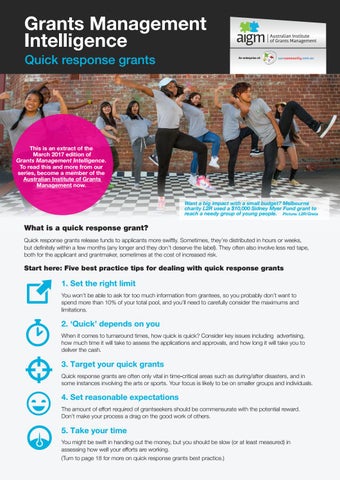
This is an extract of the March 2017 edition of Grants Management Intelligence. To read this and more from our series, become a member of the Australian Institute of Grants Management now. Want a big impact with a small budget? Melbourne charity L2R used a $10,000 Sidney Myer Fund grant to reach a needy group of young people. Picture: L2R/Greta
What is a quick response grant? Quick response grants release funds to applicants more swiftly. Sometimes, they’re distributed in hours or weeks, but definitely within a few months (any longer and they don’t deserve the label). They often also involve less red tape, both for the applicant and grantmaker, sometimes at the cost of increased risk.
Start here: Five best practice tips for dealing with quick response grants
e
T @ y 4
1. Set the right limit You won’t be able to ask for too much information from grantees, so you probably don’t want to spend more than 10% of your total pool, and you’ll need to carefully consider the maximums and limitations.
2. ‘Quick’ depends on you When it comes to turnaround times, how quick is quick? Consider key issues including advertising, how much time it will take to assess the applications and approvals, and how long it will take you to deliver the cash.
3. Target your quick grants Quick response grants are often only vital in time-critical areas such as during/after disasters, and in some instances involving the arts or sports. Your focus is likely to be on smaller groups and individuals.
4. Set reasonable expectations The amount of effort required of grantseekers should be commensurate with the potential reward. Don’t make your process a drag on the good work of others.
5. Take your time You might be swift in handing out the money, but you should be slow (or at least measured) in assessing how well your efforts are working. (Turn to page 18 for more on quick response grants best practice.)
Should we add quick response grants to our funding options? Tempted to dive into this “low doc” method of grants funding? We’ve done some of the homework for you and discovered a wide variety of methods and procedures with these types of grants. There are some definite advantages but also some serious issues to consider. We’ve spoken to leading grants practitioners about how they’ve employed quick response grants, including Regional Arts Australia, the Myer family’s philanthropy arm, the Queensland Government, and a suburban council. They’re all using swift and small-scale funding in different ways, all with the aim of generating a big impact. In this edition, we examine the ups and downs of “quick response grants”, also known as “small grants”, “responsive grants”, “emergency grants”, “minor grants”, or even just names linked to programs, like Tasmania’s ArtsBridge, which helps artists with travel costs.
No rush, give me the good oil about quick response grants Our Community’s thinker-in-residence, Chris Borthwick, mulls over a speedy response. Quick is good. Ordinary grants aren’t marketed as “slow response grants”, but they may as well be. If you’re a grantseeker approaching many funders, there are probably only two grant rounds a year, so you may have to wait six months right there. Then your application has to go through two or three rounds of assessment, which could take another month or more. By the time you get the letter, you may have forgotten what you asked for. If you’re asking for funds to catch a bird on a branch, it has probably flown away. If you were asking for a rope to get you out of quicksand ... gurgle gurgle.
Chris Borthwick casts a critical eye over quick response grants.
There is a lot to like about a quick response, and many Australian grantmakers – municipal authorities mainly – have set up quick response grants programs.
Red tape safety or a race to the finish? While being quick has significant benefits, there are some key issues to consider: do you want to be quick, thorough or fair? Pick one (they’re often mutually exclusive). Those bureaucratic hurdles are there for good reason. They were probably put in place when the old “quick and dirty” method led to a scandal, and landed the grantmaker on the front page of a tabloid. This is an extract of the March 2017 edition of Grants Management Intelligence. To read this and more from our series, become a member of the Australian Institute of Grants Management now.
Many quick response programs have replaced schemes where each councillor had their own small bag of money and gave it out as they saw fit. It was a system that was flexible, responsive to the grassroots – and very suspect. Clearly, grantmakers want their projects to further their goals: to be effective in doing what they want done. This involves dealing with applicants who have their own interests, while instituting procedures capable of discouraging bias, nepotism, or bribery. This means having transparent methods, being prepared to expose decisions to scrutiny and to demonstrate that things have been done by the book. These processes all take time.
“Perhaps the most impressive example is a Californian program where a onepage notice was sent to 6000 teachers offering $500 grants ... The teachers sent in their requests and got a response within the hour. Successful applicants got their cheque the next day.”
Quick response grant programs, by contrast, are designed to be fast, flexible, and responsive. They don’t wait for an arbitrary grant round date to roll past. They boast of their turnaround time, perhaps the most impressive example is a Californian program where a one-page notice was sent to 6000 teachers offering $500 grants for classroom resources. The teachers sent in their requests and got a response within the hour. Successful applicants got their cheque the next day.
Start small for a big impact Note, though, that the Californian program mentioned above involved a rather small cheque. Grantmakers aren’t idiots, and they’re not going to give out real money to any proposal that hasn’t run the full gauntlet. Most quick response programs offer a maximum of $3000 for an organisation and $1500 for an individual, though VicArts gives out up to $15,000 and the Shire of Clarence in Tasmania counts out a maximum of $150 (maybe in five cent pieces). A quick grants scheme can only ever be a supplement to your major efforts, providing a way to stay in touch with community needs, or at least community wants, and – yes – to provide a quick response. If you are contemplating bringing in such a scheme, you should also use it as a wake-up call. Now is a good time to review your existing programs and see whether they too could be simplified. Quick grants programs aren’t intrinsically better or worse than the old-fashioned type, but they do involve different trade-offs. Our advice? Don’t leap into them until you’ve walked through the trade-offs across your entire system, and decided on the best you can do in each area.
This is an extract of the March 2017 edition of Grants Management Intelligence. To read this and more from our series, become a member of the Australian Institute of Grants Management now.