17 . 20 ce r en s, be llig rie . e w emInte r s no ov t u N n o M e me m IG th ge fro e A h of a t an ore of t ac M r tr ts d m e ex an an mb r an f G is e is o th a m is on ad e Th ti e om i r e d To e c b
Grants Management Intelligence Vital Signs special report
Edition 4, November 2017
Vital Signs: Community reports with clout Prove it. It's the challenge that runs through every grant program. When it comes to reporting, you as a grantmaker must prove that you have allocated money well, you must prove it has been properly spent, and you must decide where you’ll spend money in future. Providing proof requires collecting and managing data effectively; building compelling, readable reports; and communicating well with stakeholders. It’s a tough business, but community foundations – 36 locally based philanthropic groups distributing $21 million in grants each year in Australia – have shown us all a way forward. That way is called Vital Signs, a reporting framework that is a focus for this edition of Grants Management Intelligence. It lets foundations assess the vitality of a community using credible data, to create reader-friendly reports about social and economic trends. What's more, those reports are used as catalysts for “Vital Conversations”, using town-hall style gatherings to identify where priorities should lie in health, welfare, sports, gender, education, housing or the arts. Talking of proof, this edition also explores how Our Community’s Innovation Lab is generating new insights in grants data, and reveals how equipping grant recipients with the right tools can boost the return on your investment. Of course, the fraught political environment means investments may not have the impact you’re hoping for, which is why we’ve featured US philanthropist Mae Hong’s views on coping with a post-Trump world. Looking further ahead, but not as far as some people think, have you considered how artificial intelligence could impact grantmaking? Our thinker-in-residence Chris Borthwick has. We hope you find this edition not just interesting, but useful. Matthew Schulz, editor
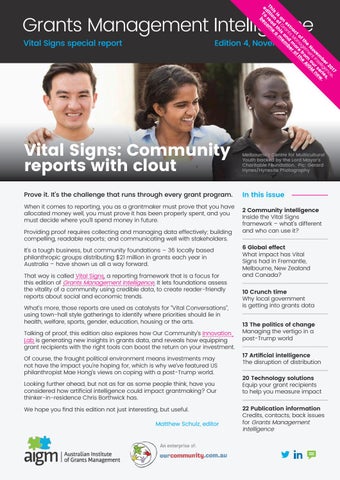
Melbourne's Centre for Multicultural Youth backed by the Lord Mayor's Charitable Foundation. Pic: Gerard Hynes/Hynesite Photography
In this issue 2 Community intelligence Inside the Vital Signs framework – what’s different and who can use it? 6 Global effect What impact has Vital Signs had in Fremantle, Melbourne, New Zealand and Canada? 10 Crunch time Why local government is getting into grants data 13 The politics of change Managing the vertigo in a post-Trump world 17 Artificial intelligence The disruption of distribution 20 Technology solutions Equip your grant recipients to help you measure impact 22 Publication information Credits, contacts, back issues for Grants Management Intelligence
The Vital Signs framework has been adopted by community foundations across the globe.
ô Community intelligence How Vital Signs is sparking new life in communities By Matthew Schulz, journalist, Our Community
First conceived in Toronto in 2001, and developed by Community Foundations Canada (CFC) in 2006 into a national program there, Vital Signs has spread to 85 Canadian communities, and communities across the world, and now it has a foothold in Australia. The reporting framework is intended for use by community foundations, but the results are also providing lessons for governments and grantmakers of all shapes and sizes. Melbourne, Ballarat and Fremantle are three Australian cities that have used Vital Signs as a community health check, but many more are looking carefully at the model. Australian Community Philanthropy supports the system for community foundations in Australia. It is licensing the use of the Vital Signs system for $500–$1000 per foundation, which goes to developing the program and resources here, but most of the tools for the service are free for anyone to use.
Executive officer Kate Buxton says Vital Signs “connects the dots of data” for “understanding, engagement and response” to create insights for grantmakers, but also the rest of the community. She says foundations are using Vital Signs to leverage their two big assets: endowments and “deep local knowledge” to improve the way they disburse funds and increase their influence. While Vital Signs is still new to many in Australia, Ms Buxton expects many more of the country’s foundations – many in rural and regional areas – will adopt the system.
What’s different about Vital Signs? One of the big selling points of Vital Signs is its target of civic engagement, creating a focus for public debate via easy-to-read reports that feed into “community conversations” about big issues such as unemployment or the environment. Those conversations take place with residents, businesses, community groups, universities, and community leaders. In turn, those conversations can generate new priorities and media coverage.
Grants Management Intelligence
November 2017
2
Community foundations place themselves at the centre of the process to: • Set strategic priorities • Inform community grants • Guide donor and community engagement • Create conversations with leaders and partners • Generate public awareness and attention. While we’ve all developed evaluation methods, Vital Signs has at its centre the concepts of sharing resources, adapting existing data, and using community knowledge. For instance, Vital Signs reports here would be expected to draw on credible data available from the ABS, universities or governments. Vital Signs uses that data to spell out the state of affairs for geographic communities with a set of measures that matter for that local community. What’s more, the method can connect local efforts with global aims. Foundations have the option to link to the UN’s 17 sustainable development goals – from ending poverty and hunger, to creating jobs and a better environment.
Does size matter when it comes to Vital Signs? Community Foundations of Canada (CFC) president Ian Bird, in Melbourne recently for the National Community Foundations Forum, says Vital Signs can benefit an entire community. He told Grants Management Intelligence that Vital Signs had worked as well in small communities as in cities, if not better, because levels of engagement were higher and getting attention can be easier without competition from the “clutter” of cities. He says communities had gotten involved for as little as $2000, supported by an “open platform” approach by CFC, backed by free webinars and other resources. Key ingredients for success with Vital Signs include: • Dedicating at least six months of concentrated effort to the project • Engaging partners, including qualified researchers and community leaders • Submitting a participation agreement in Australia • Establishing an advisory committee • Identifying key issues • Conducting consultation • Developing your communication strategy • Developing your data and indicators • Generating surveys if needed • Implementing community engagement postrelease.
Vital Signs: An introduction What is it? Vital Signs is a reporting framework that uses community knowledge to measure the vitality of communities, by first gathering credible and reliable data, then publishing readerfriendly reports on that community’s social and economic trends.
What is it used for? The reports on such issues as poverty, education, unemployment and the environment help the community foundations who’ve commissioned them to spark conversations with local authorities, and decide where to focus their resources and grants to have the biggest impact. The reports are also used to drive policy and change at local, national and global levels.
Who uses it? The Vital Signs system, developed in Canada, is primarily designed to be used by community foundations to enable them to engage with citizens and stakeholders on the big issues. Foundations encourage partnerships with governments, education institutions, funders and service providers – including in the production of reports.
Who else could use it? Any community foundation in the world can get access to the Vital Signs resources through both Australian Community Philanthropy and Community Foundations of Canada. At this stage, the Canadian originators of Vital Signs haven’t created any products for organisations that aren’t foundations, but say they are open to the possibilities. However, any place-based grantmaker – that is, any grantmaker focused on a geographic area, such as a local government grantmaker – could adopt the same broad approach as Vital Signs: that is, use reliable data to inform your funding decisions, and form partnerships to solve problems.
Grants Management Intelligence
November 2017
3
How big should your report be? The package comprises the Vital Conversation, Vital Brief, Vital Focus and Vital Signs main report. But organisations are allowed to create their own spin on those elements – for example, Momentum Waikato’s Vital Impact Programme (see pg8). Mr Bird attributes part of the success of Vital Signs in Canada to the fact that foundations had pooled resources (about $1000–2000 per foundation) to help generate data, then analysed it centrally. He says it’s a demonstration that organisations can scale the size of their study to match their budgets. For example, smaller organisations can start on a single topic, whether sport, health, or welfare. “Vital Signs provides your community with the opportunity to take the pulse, and to see together what’s really going on. What’s working, what’s not working. It breaks it down into specific issues. You can look at arts and culture, you can look at health and wellbeing, you can look at economic equality,” Mr Bird says. “It allows your community to assess and prioritise where they ought to put their resources, their time and their attention to make for a more vital community.”
Something you can read on the bus Mr Bird told the forum Vital Signs provided “streetlevel” knowledge that could shape grantmaking, development goals and strategies, yet while a report created a snapshot, its true value was “in the everyday”.
Community Foundations of Canada president Ian Bird says foundations can make an impact with a relatively small outlay. Picture: Andrea Dicks
Vital Signs users who had “flourished” had been the ones who considered how the report’s implications would “play out over the next 52 weeks”, or even over spans of two or three years. Outside the session, Mr Bird said: “In today’s busy world, you’ve got lots of activities going in all sorts of directions, but if you take on Vital Signs you get this chance for alignment … and can build a strategy to address those concerns”. Unlocking those insights was partly achieved with partnerships, he said.
The Fremantle Foundation report is typical of the easy-to-read Vital SIgns format.
Grants Management Intelligence
November 2017
4
17 . 20 ce r en s, be llig rie . e w emInte r s no ov t u N n o M e me m IG th ge fro e A h of a t an ore of t ac M r tr ts d m e ex an an mb r an f G is e is o th a m is on ad e Th iti re om e d To e c b
The Fremantle Foundation’s Vital Signs report showed a need for better inclusion, diversion and engagement for youth, and the result is a $100,000 grant for its Night Hoops program and its Saturday night basketball tournaments. Picture: Jean-Paul Horré
He gave the example of a small community in the state of Manitoba in central Canada that had chipped in $10,000 to produce the report, and created a partnership with a local college to enable a skilled researcher to get involved. Using researchers from recognised institutions – such as universities – meant that organisations would be far more able to “produce credible data”. “So much of the data is tucked away in an academic sense … you need professional help to get it out and make it freely available”. In the same way, organisations were encouraged to develop a communications plan that involved packaging information and partnering with local media to get the message out. “People should be able to read a Vital Signs report on the bus; it should make sense to them,” Mr Bird said.
What’s the role of other authorities? Asked why organisations wouldn’t just turn to local government studies or the ABS for this kind of information, Ms Buxton said Vital Signs “isn’t just about where we’re sitting, but why, and how we can respond”. “Councils may have reports and data, but what Vital Signs does is look behind the data to the story. And the way of creating the report – the whole engagement process – is just as important.”
“Even if you’ve got data coming out of your ears, Vital Signs provides something else.” That process of talking with a community – which may be very small – can help generate a much better understanding of needs than just another study, she says. Importantly, community foundations could place themselves as a “neutral broker” outside the normal politics to host those conversations, while harnessing resources that governments couldn’t – such as connections with other philanthropic supporters and donors. For instance, the Momentum Waikto project mentioned earlier generated a broad study with great community engagement, with the backing of other philanthropic partners. But Ms Buxton stresses local and other levels of government are able to take advantage of the reports, because data is in an accessible form, unlike the often “dense” official demographic studies. This had been the experience in Canada, where council equivalents were “relying heavily” on the work of foundations, she says. CFC says it is open to the evolution of Vital Signs, as interest grows from organisations that aren’t foundations. But while partnerships with media and tertiary institutions are often crucial to the success of reports, so far the focus has been on it being a philanthropic tool to better inform grantmaking and priorities.
Grants Management Intelligence
November 2017
5