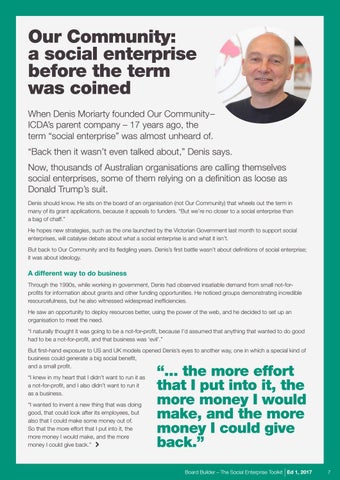
Our Community: a social enterprise before the term was coined When Denis Moriarty founded Our Community– ICDA’s parent company – 17 years ago, the term “social enterprise” was almost unheard of. “Back then it wasn’t even talked about,” Denis says. Now, thousands of Australian organisations are calling themselves social enterprises, some of them relying on a definition as loose as Donald Trump’s suit. Denis should know. He sits on the board of an organisation (not Our Community) that wheels out the term in many of its grant applications, because it appeals to funders. “But we’re no closer to a social enterprise than a bag of chaff.” He hopes new strategies, such as the one launched by the Victorian Government last month to support social enterprises, will catalyse debate about what a social enterprise is and what it isn’t. But back to Our Community and its fledgling years. Denis’s first battle wasn’t about definitions of social enterprise; it was about ideology.
A different way to do business Through the 1990s, while working in government, Denis had observed insatiable demand from small not-forprofits for information about grants and other funding opportunities. He noticed groups demonstrating incredible resourcefulness, but he also witnessed widespread inefficiencies. He saw an opportunity to deploy resources better, using the power of the web, and he decided to set up an organisation to meet the need. “I naturally thought it was going to be a not-for-profit, because I’d assumed that anything that wanted to do good had to be a not-for-profit, and that business was ‘evil’.” But first-hand exposure to US and UK models opened Denis’s eyes to another way, one in which a special kind of business could generate a big social benefit, and a small profit. “I knew in my heart that I didn’t want to run it as a not-for-profit, and I also didn’t want to run it as a business. “I wanted to invent a new thing that was doing good, that could look after its employees, but also that I could make some money out of. So that the more effort that I put into it, the more money I would make, and the more money I could give back.”
“... the more effort that I put into it, the more money I would make, and the more money I could give back.” Board Builder – The Social Enterprise Toolkit Ed 1, 2017
7
Social capitalism: the way forward The social enterprise model helped to convince investors to chip in to kick-start Our Community. “It was easier to attract investment,” Denis says.” The only difference was that they weren’t going to get the normal rate of return, if they’d invested in a mining company, say.” Seven social investors, including business identity Carol Schwartz, who is now a Reserve Bank board member, poured $1.45 million into getting Our Community off the ground.
Enterprise focus: The business imperative Denis says lack of incentive can be a hindrance to not-for-profits. “Even if you spent the rest of your life working 100 hours a week, you’re going to be stuck earning a wage, so there was no incentive to take a whole lot of risk and work your guts out like most pioneers have done.” “In our case, the business imperative was there from day one,” says Denis. “At the end of the day, we had to make a return. We couldn’t just keep on spending the money. “I see so many not-for-profits getting millions of dollars of government funding, then they run a few training courses and they think it’s going to bring in a lot of money, but it’s bugger-all return. “I guarantee that in a year’s time they’re going to fall over, because there’s just that total lack of understanding of what a commercial entity should do.” Our Community has a not-for-profit arm that provides many services for free. For example, about 95% of the help sheets on its websites are free for community groups to use. “That’s our way of giving back,” Denis says. “But it’s the revenue [from paid products and services] that allows us to do those things.” The need to raise cash, though, shouldn’t involve compromising your key values. “If you’re suddenly cutting off a whole lot of poor people off from services, and saying, ‘We’re becoming a social enterprise’, you’ll lose your constituency, you’re probably not following your values, and you’re probably not following your mission.”
New directions: Government support for social enterprise Despite a proliferation of strategy documents and government reports on social enterprise, there’s still no concrete legislation in Australia defining or regulating the sector. Denis says it’s time that changed, and he hopes the Victorian Government’s new strategy to invest in social enterprise, announced last month, could help tip the balance. For example, Australia currently has no “in between” tax status: you’re a not-for-profit or you’re a business. He’d like to see tax breaks to enable social enterprises to direct more money towards their cause. And he’d like to see Australia follow the lead of some states in the US, which recognise B Corporations as formal legal entities. (Our Community is a B Corporation certified by B Lab, which means it meets rigorous social, environmental and financial impact criteria.) “Social enterprises must be able to do good, while being realistic about returning on that investment. And if the Victorian Government – or any other – is spending taxpayers’ money, there should be a return on that investment of doing good, that doesn’t just last one year, but lasts a long time.” He notes that organisations such as the RSPCA are effectively already involved in social enterprise, even if they don’t label it that way.
“Social enterprises must be able to do good, while being realistic about returning on that investment.”
Board Builder – The Social Enterprise Toolkit Ed 1, 2017
8
“In the old days, you’d just describe it as ‘earned income’.” He also points to schools and sports groups selling equipment or uniforms to raise cash as a form of social enterprise. “They’re doing the things a social enterprise should do: earning income, and creating a revenue base to make themselves more sustainable, and to create expanded services.”
A future for not-for-profits: Keep your eyes open Denis has this advice for community directors considering the social enterprise path: “I would urge board members: don’t just trust the not-for-profits [model], but start creating a better governance structure for NFPs. “They should ask their CEOs or general managers: ‘What are the areas of earned income that we could be doing, and what are the options around social enterprise that our organisation could become?’.” Critically, any organisation making the leap must be united on revenue and purpose. “Don’t be half-hearted. If they don’t do it 100 per cent, it’s probably doomed to failure. It has to be a culture right through the organisation. You have to convince everyone that this is where we’re heading through the board level, the staff, and volunteers.”
Limited resources: Be realistic about the leap Our Community’s seed funding was a carefully cultivated and developed investment, with a strong connection between investors and the organisation’s purpose. But Denis warns there is a very limited pool of cash for genuine social entrepreneurs. “There’s lots of sharks who are purporting to invest in good social enterprises, and I know when we went years ago looking for social investors, you could count them on two hands. Legitimate social investors are “committed to the social sector” and “committed to working long term with people, not just getting a quick buck”. It’s important they’re not in it just for the money, he says, and they should be ready for a lengthy relationship. “It’s a long journey.”
Social enterprise FAQ Q: My not-for-profit wants to make money. If we do that, does it make us a social enterprise? It sounds as though what you’re really saying is that you want to make money. You can call yourself a social enterprise, a not-for-profit, or an omnipotent interplanetary collective – it’s inconsequential in many ways. What matters is identifying your specific aim, and then doing your research, honing your strategy, planning your execution, and carrying out the work. It might be a good time to take a step back and take stock of the fundamentals first. As a board member, your job in all this is weighted towards the “identifying aims” and “honing strategy” end of the business. If you’re spending your time worrying about things like whether you should sell purple widgets, orange jiggers or green gizmos, and exactly what your margin will be on each one, you’re too bogged down in detail. Take a step back and think about your role: try our board effectiveness quiz here.
Board Builder – The Social Enterprise Toolkit Ed 1, 2017
9