OSPOLY Students Decry

FRIDAY, DECEMBER 12,
FRIDAY, DECEMBER 12,
●Says Tinubu’s Cousin, Cabinet Members Made APC Lose 2022 Guber
●Accuses Screening Committee Of Forgery
●Supporters Threaten To Dump Party In Leaked Audios
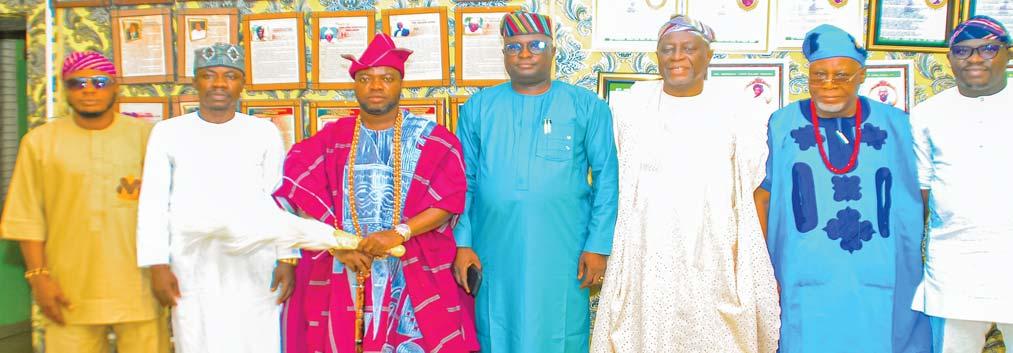
•(L-R)
DECEMBER
Yusuf Oketola Kazeem Badmus
THE immediate past Na onal Secretary of the All Progressives Congress, APC, Iyiola Omisore, said the Minister of Marine and Blue Economy, Gboyega Oyetola do not have the charisma to lead the APC to victory if the former commissioner for finance, Hon. Bola Oyebamiji eventually emerged as the consensus candidate of the party in the coming 2026 Osun Guber elec on.
According to Omisore, the Minister’s mission may lead to the downfall of the APC, saying Oyetola’s inep tude and structural failures within the party contributed to the party’s loss in the 2022 gubernatorial elec on in the state.
He made this statement on Tuesday while appearing on a na onal television’s programme where he discussed his disqualifica on from the Osun APC primary elec on alongside six others.
The Ile-Ife-born poli cian described his disqualifica on as an embarrassment not only to him but the party as a whole.
Recall that the report of the Screening Commi ee, chaired by Chief Obinna Uzoh, Esq. and concluded on December 4, 2025 in Abuja, cited failure to meet the mandatory nomina on requirements as the reason for the disqualifica on of the seven aspirants.
According to the commi ee, the affected aspirants — Sen. Iyiola Omisore, Babatunde Haketer Oralusi, Oyedotun Babayemi, Dr. Akin Ogunbiyi, Benedict Alabi, Adegoke Rasheed Okiki, and Senator Babajide Omoworare — did not provide evidence of sponsorship by at least five (5) fully registered and financially up-todate party members from each Local Government Area in Osun State, as required under Ar cles 9.3(i) and 31.2(ii) of the APC Cons tu on and Paragraph 6(c) of the party’s guidelines.
Only two aspirants were cleared to contest the primary:
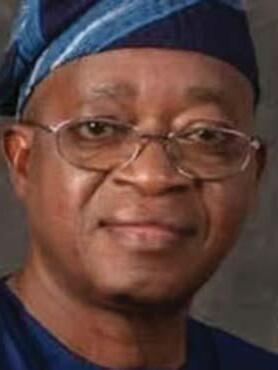

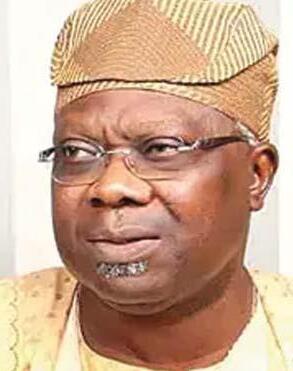
The commi ee said, “The issues raised were weighty, substan al, and germane to the integrity of the screening process. In the interest of fairness and transparency, the concerns could not be applied selec vely.
Omisore has earlier accused Oyetola of being behind the development.
Omisore said Oyetola, who is the cousin of President Bola Tinubu, pressurised the screening commi ee chairman to disqualify them for Mr Bola Oyebamiji whom he described as the former Osun State governor’s ‘poster boy’.
He described the screening commi ee’s report as the joke of 2025, no ng that disqualifying them points to doom for the party.
He said, “Well, that panel report is the jokiest report of the year. It is quite unfortunate that people have taken par sanship beyond poli cs.
“We know the panel produced mul ple reports, and the one submi ed to the secretariat was not the original. As we speak, none of us has been shown the report or told why we were disqualified.
“The chairman of the panel, on the first day, reached out to us that Mr Gboyega Oyetola called him and said that he must disqualify all of us because his poster boy, Bola Oyebamiji, is the one he wants.”
Speaking on the programme on Tuesday, Omisore said, “In Osun State, we lost the elec on in 2022. A er the loss, we did a post-mortem on how we lost the elec on led by the former Minister of Health, Isaac Adewale.
“The report was submi ed and pointed out that the thengovernor, Gboyega Oyetola, led us to lose the elec on. The report stated that three or four of his cabinet members contributed to the loss.
“So, it became a problem for the state all over. So that is why we now believe that way further, we should do a thorough primary.
Unfortunately, former governor Oyetola is now sponsoring one of those aides of the elec on losses.
“So, in a bit of a mixture and confusion about it, we want to win the elec on 2026 so we cannot go the same way, the same route we went to lose the elec on in 2022.
“I met with the appeal commi ee because the party guideline, sec on 21 (4) says any such ac on that needs to be reviewed that you have to put on an appeal committee which I did. Appeal commi ee sat for two days and up to date, they are yet to submit their report because there was confusion in between them.
“The basis of disqualifica on was not established and the appeal commi ee believed that it was poorly done and poorly
executed. That is why the appeal committee could not submit the report up ll now. The members of the appeal commi ee are in disarray, they are looking for their chairman. The secretary took away papers.
“When I say it is a huge joke of the year, you can see it is confirmed by their acons as well. Going back to the issue of disqualifica ons, the basis for disqualificaon was unfounded because we obtained forms of 1,600 nominators and we paid for these forms and if you are not a member of the party, they won’t sell forms to you to be a delegate. So, we obtained forms for 1,600 members out of financially qualified members.
“We just took 155 out of it. Going by that analysis, it is just a funny thing and an embarrassment to the public and everybody. And to my own pedigree, I am a man of systems and method, you can see that when our leader, President Ahmed Tinubu won the elec on, he said that Omisore did all compila on, he followed all through to ensure that all incompliances were done and I did that for the President, Vice President about 36 governors and many legislators. You can imagine that coming this far is not an embarrassment to me, it is an embarrassment to the party.
“The en re leadership of the state is
against his posi on to impose a candidate of the state. I want to really explain and I don’t want to drag Mr President into this ma er. He is the leader of this country, he has done well for everybody, he has been fair to all concerned.”
Speaking further, Omisore alleged that signatures of other members of the screening commi ee were forged to effect their disqualifica ons.
“The issue of having a proof or not is actually established in that regard and the chairman of that commi ee said there are pressures on him and because they wrote a report, they forged signatures of other people which I showed the appeal commi ee clearly and they saw it.
“The appeal commi ee up ll today have not submi ed their report as well. Everything is causing confusion. The issue now is Oyetola Vs the rest of the state leadership and party members. He is trying to impose a former commissioner for finance on us and doing that is impunity,” he added.
Former Deputy Governor’s Supporters Threaten To Dump Party In Leaked Audios
The development has however deepened the crisis within the Osun APC as Omisore’s supporters vows to sca er the party if he is not given the governorship cket, accusing Oyetola of favouri sm, labels him
an ingrate.
In one of the leaked audios obtained by OSUN DEFENDER, supporters of the former deputy governor advised leaders of the party to call Oyetola to order.
“My candid advice to the leaders is that they should call Isiaka Oyetola to order and warn him. If he is ready to sca er the party in Osun, we the followers are also ba le ready to sca er everything. You wanted to burn the bridge a er you have crossed the river without minding those coming from the behind. This me around, we will make sure we sink the ship of the party together if Senator Iyiola Omisore is not considered for the governorship cket, just to forget about the existence of APC in Osun State.
“It seems the leaders do not understand poli cs. They are full of wicked people, especially Gboyega Oyetola. Anyone who knows me should quote me, I do not give a fuck. Omisore has once supported you but now you are waging war against him. We have already seen your handwriting before now, no basis for pretending and if this is how Oyetola has decided to pay Omisore back, APC is completely finished in Osun. If you believe you have money and influence, we will also do everything possible to see your downfall if Omisore does not emerge as APC candidate,” one of the supporters stated.


THEAugust 2026 date set for the governorship elec on in Osun State now feels only a few weeks away, not months. With poli cal actors already jockeying for advantage, it is clear that the maneuvers will intensify in the coming months. What is at stake is enormous, and the direc on the state chooses will shape its prospects for years to come.
At present, Osun is witnessing the familiar Nigerian pa ern of mistaking internal democracy for fac onal ba les, with li le ideological clarity or coherent policy direc on on display. Par es appear more focused on internal turf wars than on offering solu ons. This does not bode well for a state that urgently needs fresh thinking and purposeful leadership.
Osun’s economy is not in a comfortable place. The state requires bold interven on, especially in boos ng Internally Generated Revenue (IGR) and redirec ng spending toward reviving physical and social infrastructure. Yet too much emphasis con nues to be placed on pres ge projects, while cri cal infrastructure such as rural roads essen al for transi oning from subsistence to commercial agriculture remains neglected.
The established poli cal forma ons have so far failed to offer anything new or inspiring. Their rhetoric remains predictable, shallow, and disconnected from the reali es of ordinary people. What is on display is the same red cycle of empty promises without credible pathways for implementa on.
Amid this landscape, the African Democra c Congress (ADC) appears to present what could become a viable and credible alterna ve. But this window of opportunity comes with a responsibility. A er concluding its internal processes and chosen a standard-
“The future of Osun also depends on reversing the quiet exodus of its skilled workforce. Many young professionals are leaving the state due to limited economic opportunities”
bearer, the party must ar culate a dis nctly pro-people agenda that addresses the pressing needs of Osun ci zens.
The ADC must focus on job crea on, revitalising the health and educa on sectors, and building a modern agricultural value chain. These are the issues capable of capturing the imagina on of voters and earning their trust. In essence, the party must posi on itself as the driving force of a broad, democra c, people-centered coalion - something Osun desperately needs.
Beyond policy proposals, the state requires a reorienta on of governance priori es. Any serious contender must commit to transparency, fiscal discipline, and an overhaul of revenue administraon. The long-standing problem of weak local governance must also be confronted, especially as Osun con nues to grapple with the implica ons of local government autonomy and the mismanagement of council resources in past administra ons.
Equally important is the need for inclusive governance. Osun’s youth popula on, women, rural dwellers, and persons with disabili es remain largely on the margins of poli cal decision-making. A candidate or party that meaningfully integrates these groups into policy development, not just campaign op cs, will gain moral and poli cal credibility.
The future of Osun also depends on reversing the quiet exodus of its skilled workforce. Many young professionals are leaving the state due to limited economic opportuni es. A forward-looking administra on must address this brain drain through targeted investments in technology, enterprise development and voca onal skills.
Ul mately, Osun requires revitalisa on - economically, poli cally and socially. The coming elec on provides an opportunity to reset the state’s trajectory, but only if the actors involved rise above old habits. The people of Osun deserve more than recycled rhetoric; they deserve leadership anchored in vision, competence, and integrity.
A new poli cal momentum is both necessary and possible. Whether the state seizes this moment will determine if Osun can finally unlock its poten al and secure a future of growth for its cizens.
THE tle chosen by a body central to defense and extension of democracy is very apt; and it mirrors the situa on we are in today. The issues pertaining to democracy, insecurity, good governance and economic prosperity are interwoven; and if there is no good synergy, democracy might begin to wane.
The mismanagement of internal security, leading to the destabiliza on of an already fragile economy, proposes an existen al threat to na onal cohesion.
Nigerians’ fourth stab at establishing and enduring democracy is, to be very candid, fragile. The very driving ethos of the Cons tu on, midwifed in 1999 under opaque condi ons, are ques onable. The Constu on is, in my opinion, hardly suitable for the development of a mul -ethnic society, which Nigeria is.
Indeed, the mindset of those that midwifed the Cons tu on is bonapar st. It reflects the way in which Napoleon Bonaparte centralized the state in France in order to end a revolu on that had become chao c. The issue has to be which revolu on were framers of the 1999 Cons tu on trying to bring to an end?
In view of what Nigeria had gone through previously, in the twists and turns following independence in 1960, it could have been more sensible to have re-adopted the Li leton Cons tu on. The Li leton Cons tu on would have been more efficacious because it was based on internal self-help.
The very pro-federal, long-serving Prime Minister of Canada, John Diefenbaker, is often quoted as succinctly describing Federalism as an opera ng system in which “you kill what you eat “.
The Li leton Cons tu on led to real development because it met Dienfenbaker’s descrip on. Had we con nued with it, we would not be in this quagmire.
Let us look at our deteriora ng internal security crisis. So far, the response, over a fi een-year period, reflects the mindset of the over-centralized state. If the internal security apparatus had been channelled through the federa ng units, the response would have been far more effec ve.
Besides, we are a emp ng to fight an asymmetrical warfare with a centralized mindset and strategy. This is ridiculous -- for gorilla warfare is basically localized and it’s fluid.
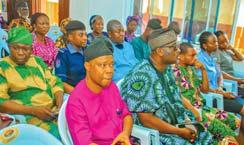
•Cross section of some of the invited guest at the 2025 Osun NUJ Induction into Hall of Fame
By not devolving the internal security crisis mechanism, we could not develop the intelligence systems. Had we done that, we would have used our rural outposts, and our local governments for intelligence gathering, crisis containment and forward planning.
So, it is u erly absurd that we are s ll quibbling over state policing, when it is obvious that that should have been done decades ago, before the insurgency manifested itself.
In contra-dis nc on, Nigeria’s former colonial power, the United Kingdom (UK), even within a unitary state, has evolved a de-centralized policing system.
The United Kingdom, for example, has fi y-three policing boards, and there is no Inspector General of Police. This means that the volt policing boards are very effec ve. If we have the volt power like they did in the United Kingdom and the United States of America, containing insurgency would have been far more effec ve.
A developed policing force would have had a be er intelligence gathering mechanism to fight the insurgents. They would have known the terrain, and most crucially, they would have been used to develop the special forces Nigeria so desperately needs.
So, what Nigeria should be looking at is not just increasing the number of personnel of the police and the military, but also interweaving the states with the development of special forces: like the United States Navy Seals and the Bri sh Special Air Services. It is only this kind of framework that can eventually crush the insurgents.
If we do not do this, we con nue to labour in vain, and the terrorists will con nue to run rings around us. A hapless na on will con nue to empower them by dishing out humongous sums for ransom.
Publisher – Moremi Publishing House Ltd.
Ransom has also now become a very veritable tool for the insurgents to build up their capital base. Every ransom paid is now used to reinvest in the war.
Asst. News Editor – Yusuf Oketola
Asst. Features Editor – Kazeem Badmus
Deputy Photo Editor – Shola Aderinto
Deputy Graphics Manager – Zainab Olalere
Produc on Controller – Petkola Taiwo Ibitowa
OSUN DEFENDER is published by Moremi Publishing House Limited, Behind Oranmiyan Building, Gbodofon, Off Gbongan Road, Osogbo, Osun State.
ISSN : 0794-8050
Telephone : 0809-301-9152
Website : www.osundefender.com/index.php
e-mail : osundefenderhq@gmail.com osundefenderbank@gmail.com
All correspondence to the above email addresses.
The sooner we realize this, evolve internal security, and develop special forces, the be er for all of us.
In addi on, the country must now realize that there is a military industrial complex at play, feeding fat on the war. The way to contain this is to have greater parliamentary oversight and to ins tute, like the American state, a performance planning budge ng system, as John F. Kennedy did, when he became president in 1960. Besides, not doing a cost-
•Continued on Page 5
FRIDAY, DECEMBER 12, 2025
FORMER Na onal
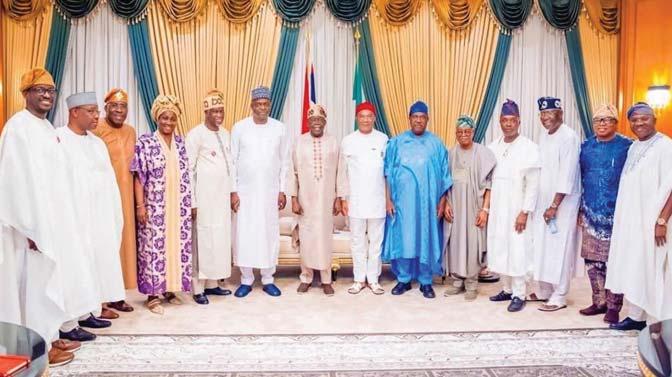
Secretary of the All Progressives Congress, Senator Iyiola Omisore was conspicuously absent as President Bola Tinubu on Monday night met with the APC governorship aspirants from Osun State at the Presiden al Villa ahead of the December 13 primary.
Pictures from the mee ng show most aspirants present, including Munirudeen Bola Oyebamiji, Babatunde Haketer Oralusi, Oyedotun Babayemi, Dr. Akin Ogunbiyi, Benedict Alabi, Adegoke Rasheed Okiki, Senator Babajide Omoworare and Mulikat Abiola Jimoh, but Iyiola Omisore is notably missing.
Omisore, a former senator and deputy governor of the state, was among seven aspirants disqualified by the party’s screening commi ee for allegedly failing to meet nomina on requirements.
They were barred from contes ng the December 13 primary a er the commi ee held, they failed to meet mandatory nomina on requirements.
A er the meeting, the two aspirants cleared to contest are Oyebamiji and Mulikat Abiola Jimoh.
Meanwhile, Omisore has described his disqualifica on as “the jokest report of the year,” claiming the screening decision was poli cally mo vated to favour Oyebamiji.
Omisore has not released any official statement explaining reasons for not attending the mee ng with the President.
But, poli cal observers in the state have a ributed his absence at the meeting to the ongoing tussle between him and the Minister of Marine and Blue Economy, Adegboyega Oyetola over who emerged as the candidate of the APC ahead of the 2026 guber elec on in Osun.
OSUN DEFENDER reliably gathered that at least seven aspirants of the APC under have stepped down a er mee ng with Tinubu.
They have all agreed to support Oyebamiji as the consensus governorship candidate in the forthcoming primary.
THE family of Omitunsin Abiola Isaac, an opera ve of the Amotekun Corps in Osun State, has pe oned the Commissioner of Police, Ibrahim Gotan, to reopen and con nue inves ga ons into his killing. He was killed on July 26, 2025 at IjedaIjesa, Oriade Local Government Area of
the state.
The pe on, filed by G. Olabode & Associates on behalf of the family and made available to journalists on Wednesday, stated that the deceased was on official duty with his team from the Second Division, Ijebu-Jesa, when he was allegedly a acked by one Private Opejobi Fiyinfoluwa, said to be
IN many African tradi ons, especially among the elders of the Yoruba, the talking s ck— whether symbolic or physical—was never just an ornament. It represented voice, authority, and responsibility. The person who held it was expected to speak with wisdom, temperance, and above all, honour. In that sacred space, words were not thrown about like dust in the wind. They were measured, purposeful, and rooted in a communal sense of jus ce and dignity. Today, we live in a world where voices
are louder, yet wisdom is scarcer. Titles are plenty, but honour is not always found. From poli cs to family, church to community, those entrusted with leadership—whether by age, appointment, or experience—must constantly be reminded: authority is not ownership, and leadership is not license to wound.
The African elder, by tradi on, doesn’t dominate. He guides. He doesn’t silence others. He invites. And when he speaks, he does so not for himself, but for the good of all. The talking s ck may change hands, but its sacred-
ness does not change. So should it be with power, voice, and influence—especially in our homes, communies, and ins tu ons.
Unfortunately, we are beginning to see cracks in this ancestral code. A father may demand honour from his children, yet fail to model humility. A community leader may speak of unity but sow seeds of division. A young person with new knowledge may forget the pa ence that raised him. In all of this, the chain of mutual respect—so vital to African society—is weakened. I once heard a proverb from a village
serving with the Nigerian Army.
According to the pe on, the Amotekun team was deployed to the community “to stem the crisis brewing in IjedaIjesa” when Private Opejobi confronted them and “claimed military superiority over the Amotekun Corps.”
The law firm noted that efforts by the

elder during a naming ceremony: “The mouth that speaks for the clan must rinse itself daily in the river of honour.” This stayed with me. It means that power must be renewed through humility, that every leader must self-check. It is not enough to hold the talking s ck—you must also carry the weight of honour it demands.
As we navigate complex mes— poli cal uncertainty, economic instability, and shi ing moral foundations—may
we not forget the meless lesson of the talking s ck. Whoever holds it—be it a president, a community elder, a parent, or a project manager—must remember: the real power is not in the s ck, but in the spirit behind the voice.
Let us raise a new genera on of leaders—at home and beyond—who speak with truth, act with dignity, and lead with the understanding that honour is the highest form of power.
opera ves to de-escalate the situa on “were met with strong violent resistance,” adding that Private Opejobi “stabbed the deceased, Omitunsin Abiola Isaac, mul ple mes,” leading to his death a er a empts to save him failed.
The pe on further stated that the suspect, described as an indigene of IjedaIjesa, fled the scene and “is now at large.”
The family said an earlier pe on had been submi ed to the Chief of Army Staff but “up ll now, there has not been any response or acon taken.”
“All evidence that supports our claim is available, and the incident is already on social media,” the pe on read, urging the Osun State Police Command to “connue the inves gaon into this heinous crime as all trails on the suspect have gone cold.”
The family asked that the killer be traced, arrested, and prosecuted, saying, “The only thing that can give the family a bit of comfort is to see jus ce done on the ma er.”
Copies of the peon were also forwarded to the Inspector-General of Police, the Chief of Army Staff, the Osun State Department of State Services, and the Amotekun Corps in Ijebu-Jesa.
Yusuf Oketola
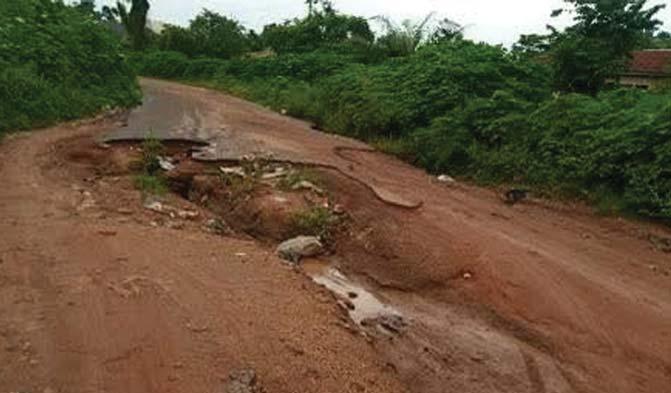
THE terrible state of Iree and Adaa
Town road, Boripe Local Government Area, Osun state has sparked state-wide outrage.
OSUN DEFENDER gathered that for the past 5years, erosion has washed off the road gradually un l the road became a death trap for motorists and other users in the area.
The situa on, according to residents of Iree and Adaa has brought great inconvenience to communies, causing trade to dwindle and even posing health and environmental hazards.
OSUN DEFENDER reports that rural dwellers in Osun State have con nued to suffer hardship and neglect due to the absence of basic ameni es in their respec ve domains.
Findings by the medium revealed that many roads in rural communi es are presently in a deplorable condi on with collapsed bridges while farmers watch their produce rot because they cannot move it. Residents in the rural areas have accused the current government of focusing exclusively on urban areas while leaving the rural popula on—who form the backbone of Osun’s economy—to fend for themselves.
Some social media users who lend their voices on the situa on blamed the state government for the poor
state of the road. Some of them also blamed former governor Adeg-
boyega who came from the cons tuency for neglec ng the road during
his administra on. Ayodele Ladipo wrote: “Funny people
this is not a state road, call your local government chairman or sena-
tor or rep or assembly. They will work with state governments to fix the road. It’s difficult to call the governor atten on on a road within your street and get responses.”
“That’s Oyetola cons tuency he suppose to construct the road before he was voted out so bi e fe bi eko Adeleke yoo se eekan si,” Lolade Abefe Okin wrote
Hon. Jimoh Abayomi, “You should blame 4yrs of Oyetola who neglected the Road, you should be conversant that the Said Road belongs to his local Government.”
Also, a Non-governmental Organisa on, Tracka has implored the Osun State Ministry of Works to to priori ze the reconstruc on of the road to ensure safety of lives in Boripe.
Kazeem Badmus
OSUN State Governor, Ademola Adeleke, has stated that he will not refrain from dancing, stressing that dancing will not affect his work.
Governor Adeleke made this statement on Wednesday when he appeared as a guest on a na onal Television programme.
Adeleke, who became the candidate of the Accord Party on Wednesday, said, “Let me tell you something. I will keep dancing because I love to dance,
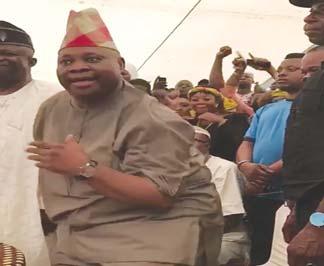
and I love to praise my God. That doesn’t change anything. You
understand what I’m saying?
“Everybody has
their way of relaxing or a hobby. My hobby is to dance and praise my God. That does not affect my work.” Adeleke’s posi on came following an incident between him and the First Lady of Nigeria, Senator Oluremi Tinubu. It would be recalled that a viral video showed Mrs Tinubu interrup ng Adeleke during the 10th corona on anniversary celebra on of the Ooni of Ife, Oba Adeyeye Enitan Ogunwusi.
In the video, OSUN
•Continued from Page 3
effec veness of every military spending is fatal. The war has become a big business, and we cannot contain it unless we develop a new budge ng system; and stop using the smokescreen of security not to discuss the military budget.
INSECURITY ECONOMY AND SOCIETY
The economic prospects of the Republic of Nigeria have taken a terrible ba ering because of the amount of economic disloca on caused by the worsening insecurity situa on, terrorism and banditry. One key element is that the country is now having con nuously increasing budget allocaons to fight the insurgency. There is an opportunity cost to this in a country already
suffering from a glaring infrastructure deficit. Money that should go into the physical and social infrastructure is now going at an alarming rate to defence. It’s bound to increase, partly because we are figh ng the wrong kind of warfare and mostly to because a military industrial complex has arisen around the effort against insurgency, and there isn’t parliamentary oversight over the expenditure.
We are also sending the wrong signals to poten al investors, not just at home but also abroad. An investor doing a risk analysis of investment in Nigeria now has to look at the cost of securing the enterprise. This puts us at a compe ve disadvantage. If the investor is considering other loca ons,
par cularly in West Africa, it means that insurance premiums for enterprises and plants set up in Nigeria will perhaps even be doubled what it ought to be.
The economic cost of the insurgency must not be underes mated in a country that needs to create millions of new jobs every year at infinitum to cope with the demographic bulge of a very young popula on.
It also has an effect on democracy. A democracy must be based on an increasing the amount of people in the middle class. The middle class has the biggest stake in a democracy, and the bigger the middle class, the more it is expanding, the more the durability as well as the sustainability of a democracy.
We ignore this at our
own peril. The fact of the ma er is that the current economic situa on is detrimental in many ways.
One: the purchasing power of the middle class is diminishing, and it is even becoming debatable as to whether they are s ll a middle class; and as to how you actually permute what the middle class represents in Nigeria today.
A good example is the falling numbers of people in private schools and private universi es. This is a key indicator because the middle class tradi onally spends a bulk of money on ensuring a very good educa on for their children and wards, in order to protect and enhance genera onal upward mobility and preserve genera onal wealth.
Since this is diminishing, it poses a problem. It means essen ally that those who have a vested stake in the preserva on of democracy, which is tradi onally the middle class, are now at risk.
It therefore means that democracy itself is imperiled. We must con nuously build up a middle class as the veritable buffer for the defence of democracy because much of civil society itself will come out of the middle class, especially in a country like Nigeria.
The trade unions today, unlike in an earlier me in the days of Michael Imoudu and Wahab Goodluck, have become not the vibrant pro-people trade unions that we once knew, but have gravitated to be
DEFENDER observed that Governor Adeleke, in his usual style, began singing a gospel song at the point where he was expected to deliver his official address. Apparently dissatisfied with the delay, the First Lady stood up, approached the governor, and urged him to proceed with his speech, reportedly giving him “five minutes.” She also threatened to take the speech document if he con nued singing instead of delivering the address.
more like an aristocracy of labour. This explains their inability to protect the working class; and to shield the dispossessed. That is why Nigeria has not developed even a rudimentary social safety nets like we have seen in other countries with more vibrant and proac ve trade unions, such as the Republic of South Africa, Brazil, Malaysia, and so forth.
The present insecurity is a direct threat to democracy, and we must never underes mate this threat. We must now look at how to contain and then defeat the insurgents because if we do not do so, the democracy of this country could head for a crash -- God forbid!
•Speech delivered by Kanmi Ademiluyi at the Osun NUJ 2025 Induction into Hall of Fame
FRIDAY, DECEMBER 12, 2025
SYusuf Oketola
TUDENTS of Osun State Polytechnics, Iree have decried the rising cost of living, par cularly hike in accommoda on by house agents and transporta on cost among others.
In an open le er to the Aree of Iree, Oba Muritala Oyelakin Oyekun III and signed by Ospolyparrot, the students sought the interven on of the monarch in addressing the issues.
They accused house agents and transport workers of exploi ng them with exorbitant prices, a situaon s fling their lives.
A copy of the le er obtained by OSUN DEFENDER on Wednesday reads: “We, the students of Osun State Polytechnic, Iree, humbly bring to your a en on a
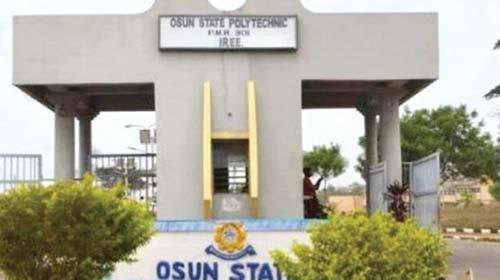
pressing concern affec ng our community. The rising cost of living, par cularly transporta on and housing has become unbearable.
Transport workers are exploi ng students with exorbitant prices, making it difficult for us to afford basic necessi es. KABIESI We implore your leadership to in-
tervene and regulate these prices.
“Your Majesty, we appeal to your benevolence to address this issue and provide relief to your subjects.
THE Independent Naonal Electoral Commission (INEC) said on Tuesday that 2,685,725 Nigerians have completed new voter registra on in the ongoing Con nuous Voter Registra on (CVR) exercise.
INEC gave the total in a post on its official X account.
The commission said 1,576,137 people finished the online pre-registra on step, while 1,109,588 completed their registra on in person at INEC centres across the country.
The figures combine
2House agents and both online and physical comple ons.
Osun State remains top among the states for new registrants, the update said.
Other states that have shown strong numbers in recent weeks include Imo and Kano, according to INEC and na onal media reports.
INEC has been running CVR in phases. The commission reminded Nigerians that the first quarter of the exercise will close soon, and urged eligible ci zens to register or complete their enrollment before the
deadline.
Elec on observers say steady CVR numbers are a good sign for par cipaon, but they also warn that registra on must be
matched by voter educaon and good logis cs to make sure people can actually vote when elec on day comes.
Civic groups con nue

Our Daddy we believe that with your guidance, we can create a more conducive environment for students to thrive.
“We are grateful for your a en on to this ma er and look forward to your posive response. Baba May Reigns be Long and Peaceful.”
Meanwhile, students have blamed ac vi es of Yahoo Guys for the sudden rise in cost of living in the community.
“Iree poly students are

also not helping the ma er, Yahoo Guys has taken over the Affairs community. Ospoly wasn’t like this before. As yahoo guys fall in like this, everything changes. They became opportunist
“It’s too scary these days with the high cost of things. Sellers don’t even have pity on us with their prices. This is actually a great move especially for freshers who are not used to it. Students are not workers; the community is ge ng very unbearable,”
Victor Fiyinfoluwa wrote.
to encourage young people and first- me voters to check their registra on details on INEC’s portal. Nigerians have called for INEC to post a full state-
by-state breakdown and to display the voter register for public checks, and certain groups have urged more people to register for the upcoming elec ons.
THE new Osun State Commander of the Na onal Drug Law Enforcement Agency (NDLEA), CN Joe Fadile has vowed to dismantle drug trafficking networks across the State through intelligence-driven operaons.
Kazeem Badmus
Aformer Governor of Osun State, Prince Olagunsoye Oyinlola, has disclosed that the security situa on in Nigeria is worsening the cases of outof-school children.
The Okuku-born prince also said the public educaonal system is no longer addressing the expecta ons of parents, urging governments to invest more in the sector.
The former governor stated this on Thursday during the second matricula on ceremony of Alolade Oyinlola College of Health Sciences and Informa on Technology, Okuku.
Oyinlola, who is the proprietor of the College, noted that un l the Nigerian government finds a way to solve the pi alls in the educa on sector, parents will con nue to prefer private ins tu ons to public ones.
Oyinlola said, “If parents are not sure that their chil-
dren will go to school and come back safely, why allow them to go? So, what the federal government must do to encourage children to go to school in the north is to banish all these prac ces of terrorism, kidnapping and the like.
“Now, to compound the situa on, we have the issues of terrorism, kidnapping and the rest, worsening the situa on of out-of-school children. So, unless and unl we are able to banish all these ills from our society, then the situa on will not improve.
“Educa on by the government does not address the expecta ons of every parent. The standards were high and inadequate. Nobody would want to go and pay high school fees for the educa on of their children. What we have today is nothing to write home about. And that’s the problem. Governments need to look at the pi alls of the educaonal system and correct them. That’s the only way out.”
Addressing the matricula ng students, Oyinlola noted that the ins tu on is commi ed to providing a na onal and globally relevant educa on in health sciences and informa on management.
The former governor urged the students to take their studies seriously, engage with their instructors and build strong friendships.
“This ins tu on is built on the core belief that quality health educa on and sound informa on management are essen al pillars for sustainable development in Nigeria.
“Our programmes are designed not only to equip you with technical knowledge and professional competence but also to ins l values of integrity, compassion, responsibility and leadership. There’s quali es are indispensable in the health and informa on sectors where people’s lives, wellbeing, and futures depend on your exper se and Character,” he added.
Fadile stated that the Command remains commi ed, professional, and proac ve in tackling drug abuse, illicit drug cul vaon, trafficking, and distribu on in Osun.
He made the assurance during a press briefing at the NDLEA State Command in Osogbo, on Wednesday.
According to the commander, Osun is one of the loca ons within Nigeria where cannabis sa va cul va on persists. But promised to make the state a safe haven for drug traffickers or distributors.
This according to him will be achieved through, Enhanced Opera onal Efficiency, Strengthened Drug Demand Reduc on, Robust Inter-Agency Coopera on and Community and Stakeholder Engagement.
A text of the press briefing made available to OSUN DEFENDER reads partly: “As I assume duty, I assure the good people of Osun State that this Command will remain commi ed, professional, and proac ve in tackling drug abuse, illicit drug culva on, trafficking, and distribu on. As we are aware, Osun State is one of the loca ons within Nigeria where cannabis sa va cul va on persists. Under my leadership, the Command will operate on the following strategic pillars:
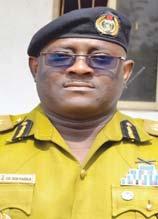
“We will intensify intelligence-driven operaons to iden fy, track, and dismantle drug trafficking networks across the State. Let me state unequivocally: Osun State will not, under my watch, become a safe haven for drug traffickers or distributors.
“Drug abuse remains a growing threat to our youth and to the social fabric of our communi es. I commend the Execu ve Governor of Osun State, His Excellency, Senator (Dr.) Ademola Jackson Nurudeen Adeleke, for his tremendous efforts in safeguarding our youths through the Imole War Against Drug Abuse (IWADA) ini a ve, coordinated by the Ministry of Federal Affairs.
“In alignment with the Agency’s na onal War Against Drug Abuse (WADA) campaign, the Command will con nue to intensify ac vi es such as:
Sensi sa on programmes in secondary schools and ter ary ins tu ons, Community outreach and awareness programmes.
“Advocacy for NYSC corps members, Engagements with tradi onal rulers and religious ins tuons, Rehabilita on and treatment support through our Drug Abuse Prevenon, Treatment and Rehabilita on (DAPTR) Unit.
“Security and public safety thrive on synergy. The Command will strengthen exis ng collabora on with sister security agencies, government ministries, and other relevant stakeholders to enhance collec ve security and drug control efforts across Osun State.
“We call upon youth groups, NGOs, market associa ons, transport unions, school administrators, community leaders, and the general public to support our renewed drive.
The fight against drug abuse cannot be won by the NDLEA alone; it requires all hands-on deck.
“I therefore appeal to members of the public to provide credible and mely informa on that will assist the Command in iden fying drug hotspots, dealers, and trafficking routes. I assure you that all informa on received will be treated with the utmost confiden ality.”
FOOTBALL en-
thusiasts across Nigeria are vehemently protesting a decision by the Confedera on of African Football (CAF) that grants European broadcasters access to all 52 Africa Cup of Na ons (AFCON) 2025 matches on free-to-air television, while African na ons are limited to just 32. With the tournament in Morocco just days away, the disparity has sparked widespread accusa ons of injus ce.
CAF’s decision means that terrestrial channels in Africa will only be able to show 32 of the 52 fixtures, a move many Nigerians deemed insufficient.
Kazeem Badmus
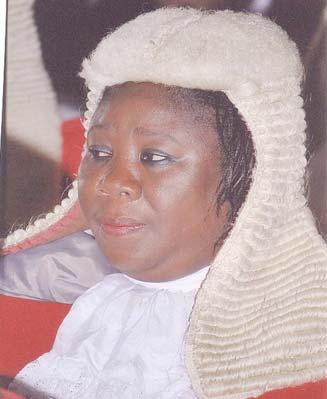
THE Osun State chapter of the Judiciary Staff Union of Nigeria, JUSUN, has announced a temporary relaxa on of its ongoing strike.
The union said the move was to allow staff of the Judicial Service Commission, JSC, a end a scheduled mee ng with commission officials.
In a statement signed by its chairman, Comrade Idris Adedayo Adeniran on Wednesday, the union said the relaxa on is subject to approval by JUSUN Congress and its na onal leadership and will last from December 11 to 24, 2025.
According to the statement, “the meeting, fixed for 11 December at the Conference Room of the High Court of Jus ce in Osogbo, will focus on JUSUN’s demands on staff promoon and welfare.”
The union confirmed that the Chief Judge of Osun State, Jus ce Adepele Bola Ojo, has agreed to reconvene discussions with the JSC to address the issues raised.
JUSUN noted that the JSC, as the body responsible for jus ce administra on in the state, is expected to consider and respond to the concerns of judiciary workers.
“We appreciate the commitment of the Honourable Chief Judge to engage with the JSC on our behalf and look forward to a posi ve out-
In stark contrast, European viewers, including those in the UK where Channel 4 will broadcast all matches across its pla orms, will enjoy total coverage.
Malik Sani, an Abuja-based football aficionado, expressed disbelief: “Will UEFA limit the number of EURO Championship matches to be shown in Europe to 32 and give Africa 52 matches? We all know Europeans will never do that.”
He highlighted the irony of limi ng African viewers, many of whom rely on terrestrial television, while offering full access to Europeans, a significant number of
whom already subscribed to pay-TV.
CAF General Secretary, Véron Mosengo-Omba, lauded the UK deal, stating it “ensures that the CAF Africa Cup of Na ons Morocco 2025 will live in every household in the UK.” This statement has further fuelled anger among Nigerian fans like Stanley Okoro from Enugu, who ques oned the priori es placed on African viewers.
The discontent isn’t isolated to Nigeria, with Francophone public broadcasters also demanding access to all 52 matches, arguing that the current arrangement contra-
dicts the principle of universal access for a compe on partly funded by governments.
Speculations were rife that CAF President Patrice Motsepe’s alleged links to French broadcaster Canal+, which recently acquired Mul Choice Group, may have influenced the decision, subtly pushing African viewers towards pay-television subscrip ons. Nigerians are urging their government and other African Heads of State to intervene and reverse the decision before the tournament commences on December 21, 2025.

come,” the union said.
JUSUN also reiterated that its demands remain legi mate, reasonable, and long overdue and emphasised that its members would con nue to push un l the issues are resolved.
The Osun JUSUN Chairman also expressed apprecia on to union members for their unwavering support, trust and loyalty during the industrial ac on.
Earlier, Governor Ademola Adeleke blamed the Chief Judge for the prolonged industrial acon embarked upon by JUSUN Adeleke in a statement by his spokesperson, Mallam Olawale Rasheed on Tuesday, while responding to a le er by the Nigerian Bar Associa on, Osun State Branch, distanced himself from the ongoing strike, no ng that the strike has persists due to the persistent refusal of the Honourable Chief Judge to convene mee ngs of the JSC and to implement the terms of the Memorandum of Agreement (MOA) signed during the last strike with members of JUSUN in the state.
The Governor alleged that the CJ has, for a con nuous period of two years, failed, neglected, and refused to convene any mee ng of the Judicial Service Commission, adding that Mrs Ojo has persistently declined to discharge this statutory duty, notwith-
standing several le ers, formal applica ons, and repeated reminders duly issued by the Honourable State A orney General and JUSUN.
A copy of the statement obtained by OSUN DEFENDER reads: “The a en on of the Governor Ademola Adeleke has been drawn to the le er dated 8th December 2025, issued by the Forum of Nigerian Bar Associa on Branches in Osun State, wherein allega ons were levelled against His Excellency, Senator Ademola Nurudeen Jackson Adeleke, and his appointees to the Judicial Service Commission (JSC).
“It has therefore
become impera ve to issue this rejoinder to correct the misrepresenta ons contained in the pe on and to reaffirm the Governor’s unwavering commitment to cons tu onal governance, the rule of law, and the effec ve funconing of the judiciary in Osun State.
“His Excellency, Governor Adeleke, is deeply concerned about the paralysis of the judiciary in Osun State. The allega ons of deliberate refusal or boyco by government-appointed members of the JSC are unfounded. The paralysis of the judiciary is not a ributable to any inac on on the
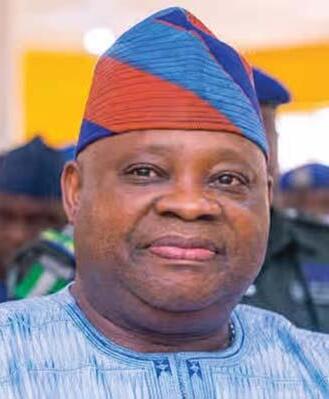
part of His Excellency’s appointees, but rather to the persistent refusal of the Honourable Chief Judge to convene mee ngs of the JSC and to implement the terms of the Memorandum of Agreement (MOA) signed during the last strike with members of JUSUN, Osun State Chapter.
“The Honourable Chief Judge has, for a con nuous period of two years, failed, neglected, and refused to convene any mee ng of the Judicial Service Commission. Since the cons tu on and appointment of the Commission, the Chief Judge has persistently
declined to discharge this statutory duty, notwithstanding several le ers, formal applica ons, and repeated reminders duly issued by the Honourable State A orney General and the Judiciary Staff Union of Nigeria (JUSUN).
“This refusal constutes a grave derelicon of duty and has effec vely hindered the proper func oning of the JSC. We challenge the Chief Judge and the NBA to produce a single le er wherein the Chief Judge either convened a mee ng of the JSC or directed the Secretary of the Commission to do so.”

FRIDAY, DECEMBER 12, 2025 VOL. 20 NO 69 www.osundefender.com, email: osundefenderbank@gmail.com
THE poli cal climate in Osun State is shi ing. A new generaon of voters—young, hungry, and deeply connected to the digital world—is demanding leaders who understand the tools shaping today’s society. From smartphones to blockchain, from online service delivery to data-driven public policy, the future of governance is digital. And for the African Democra c Congress (ADC), this growing reality should guide one clear requirement: the next gubernatorial candidate must be digitally fluent.
Digital fluency goes far beyond knowing how to use a laptop or post on social media. It is about understanding how technology can solve real problems—unemployment, insecurity, poor infrastructure, weak ins tu ons, and the frustra ng gaps in government service delivery.
Osun’s youth make up the majority of the popula on, and they live their daily lives through digital channels. They learn online, work online, socialize online, and build businesses online. They expect leadership that speaks their language and understands their world.
Poli cal campaigns are no longer won simply by rallies and posters. Ideas travel faster through data than through megaphones. A candidate who cannot read analy cs, engage ci zens on digital pla orms, or communicate policy in a way that resonates with online communi es will struggle to gain trac on. Young voters are paying a en on, and they reward leaders who show competence in technology, innova on, and forward-thinking governance.
Across the world, governments are embracing digital reforms that improve transparency and fight corrup on. Estonia uses e-governance systems that allow ci zens to access almost every government service online. Rwanda transformed its public sector through digital portals and smart programs. Even within Nigeria, Lagos and Kaduna have made strides using open data, automated tax systems, and digital iden ty ini a ves to enhance efficiency. Osun cannot be le behind, especially at a me when global development depends heavily on technology.
A digitally fluent ADC candidate would champion smart solu ons that directly impact the lives of ordinary
“The world is changing rapidly, and Osun State must change with it. For the ADC to stand out — and for Osun to take a bold step toward a better future — the party must field a candidate who can lead in a digital age, understand global trends, and bring modern solutions to local problems. A tech-driven governor is not a luxury; it is now a necessity”
By
people. Imagine an Osun where farmers receive real- me market prices on their phones, helping them sell their produce at compe ve rates. Imagine a state where students can access quality digital learning tools regardless of their loca on. Imagine a government workforce powered by e-records, reducing delays that frustrate both ci zens and civil servants. This is the kind of innova on a techsavvy leader can unlock. Security challenges also demand modern responses. Data-driven policing, surveillance technology, and digital mapping can help authori es track crime hotspots and deploy resources more efficiently. Local busi-
nesses, especially small-scale entrepreneurs, stand to benefit when government creates digital marketplaces, supports e-commerce adop on, and invests in broadband infrastructure across all local governments. These ideas are no longer futuris c—they are necessary. But digital governance is not only about introducing new tools. It is about transparency and accountability. Technology gives ci zens the power to monitor government spending, evaluate projects, and demand better performance from their leaders. A candidate who embraces this shi signals confidence, openness, and readiness to serve. Young voters trust
leaders who are willing to be scrunized, who publish data, and who use digital channels to provide consistent updates on government ac ons.
For the ADC, this moment presents a strategic opportunity. The party has the poten al to posi on itself as the voice of innova on and modern leadership in Osun poli cs. By presen ng a candidate who understands tech, the party taps into a powerful narra ve— one that speaks to progress, efficiency, and youth empowerment. This is a chance to redefine poli cal conversa on, moving it away from old structures and towards fresh thinking.
The next elec on will not be decided by the loudest campaign, but by the smartest. Osun’s youths are educated, discerning, and ready to support leaders whose ideas match their aspira ons. A digitally fluent candidate aligns perfectly with this demographic, offering hope that governance can improve through crea vity and innova on.
The world is changing rapidly, and Osun State must change with it. For the ADC to stand out—and for Osun to take a bold step toward a be er future—the party must field a candidate who can lead in a digital age, understand global trends, and bring modern solu ons to local problems. A tech-driven governor is not a luxury; it is now a necessity.
The young electorate is watching. The future belongs to leaders who know how to use the tools of the future.
Striker is not the opinion of the Columnist featured above
“ HOW e take concern me?” is one of the popular sayings of the typical Nigerian. Another prominent one, a selfish prayer, is “however much they sell it, may God just provide me with the means.” These are signs of loss of hope in social processes and tendencies towards self-help in pursuit of “happiness” largely to the detriment of others. We forget that no man is an island in the society and the consequences of individual disposi ons and ac ons, even at the family level, inevitably reverberate all around the community and the na on at large. Arriving at this nega ve, self-centred temperament did not happen in a day. In summary, government not based on taxa on but almost en rely on oil money is basically the cause. Government ought to be based on taxa on on the produc ve efforts of its empowered ci zens at the local government level, which is supposed to be the founda on of state and na onal government. Two factors, the discovery and explora on of crude oil and military rule that centralised the federa on into a unitary state, did devasta ng damages to democracy and produc vity. The civilian elite, dominated and redesigned by the military juntas, became reliant and selfsa sfied to centrally collect the oil rent money and simply distribute to selves and spend as they wish at the federal, state, and local government levels.
Whatever projects they deem fit to throw around in their “magnanimity” are seen as “government” projects: government schools, government roads, government stadia, government transformers, government houses, government this and government that; there is neither sense of ownership by the ci zens (as individuals or as community). Oil money was used to execute them and not taxes from people’s produc ve engagement. The oil money is not seen as proceeds from the explora on of our common patrimony, oil money belongs to government and not the people; and the elite sustained that false narra ve.
A er military rule, their civilian twins – along with fellow military brass now in flowing robes – ins tuted a democracy based on a cons tu on that retains all the elements of unitary and dictatorial rule in which THE PEOPLE (men oned three mes in the popular defini on of democracy) are removed from having a voice in determining government policies but reduced to mere voters in pre-manipulated elecon processes. The end result remains the same as under military rule, with only the grace of absence of naked brutality.
THE MAJORITY can be subs tuted for THE PEOPLE in defining democracy. However, the import remains the same. The majority in any society remains the
workers, students, women, children, ar sans, farmers, traders, etc – the masses in general. The elite who are the most connected, exposed, successful, educated and rich cons tute a minority whose interests also ma er BUT WHOSE INTERESTS HAVE NOW BEEN TURNED TO THE DOMINANT INTEREST against the spirit and le ers of democracy. The clear outcome is underdevelopment and na onwide distress. Democracy, however disfigured, s ll offers the best opportunity for THE PEOPLE to redress the social contract of Democracy. Of course, widespread poverty and ignorance make the goal challenging indeed. Nevertheless, organisa ons of the masses need to wake up from their slumber and take on the challenges of redefining democracy –in form and content. The wages of aliena on are increasing poverty and ignorance with consequent escala on in crime and violence to the propor on of insecurity challenges worse than even what is being witnessed today.
Only a return to true federa on (in which every federa ng state is autonomous with what it owns); ci zen produc vity on a massive scale; and taxa on for governance by a government elected truly by the majority; can restore prosperity and guarantee law and order. Only then can we say bygone to the days of ethnicity, religious bigotry and all forms of extremism and, as a genuine FEDERAL REPUBLIC OF NIGERIA, finally realise the goal of our na onal mo o: unity and faith, peace and progress.
OSUN DEFENDER is published by Moremi Publishing House Limited, Behind Oranmiyan Building, Gbodofon, Off Gbongan Road, Osogbo, Osun State. All correspondence to the Asst. News Editor, YUSUF OKETOLA, Telephone: 0809-301-9152. ISSN: 0794-8050. Website: www.osundefender.com Email: osundefenderbank@gmail.com, osundefenderhq@gmail.com