IV
GMUFOURTHESTATE.COM @IVESTATE
Maibach said via email that students and universities should continue to do what they do best. “Universities can do what they do best -- innovate, educate, and engage members of their communities. Most importantly, we need universities to focus on developing the solutions we need -- most importantly: cheap, reliable, clean energy, and better ways to store, transport and manage it,” the email read. Kinter echoed Maibach and believes that Mason being such a large research institution offered a great opportunity. He said that because Mason has the opportunity to research and learn out the effects of climate change, it has the chance to find solutions to these problems as well. Wyman-Castellano said that from her perspective, students are very concerned about environmental issues. “A lot of the students that we talk with and interact with on social media, they are extremely concerned, alarmed actually, about where things are headed [and] what decisions are global leaders making with regard to climate change policy. And [they are] vocal about it too,” Wyman-Castellano said. Wyman-Castellano said that the conversations happening among college students right now are very robust and productive and they are actually making change happen. She added that she would love to see a broader conversation that would include students from all groups and demographics. However, Wyman-Castellano noted that in her experiences, older generations seem to be remorseful about issues that younger generations are facing.
news
02.22.2016
7
George Mason Democrats conduct straw poll that focuses on Millennial vote MADISON ANTUS | STAFF WRITER
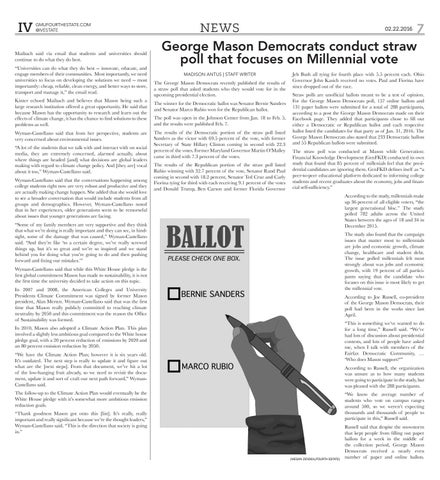
The George Mason Democrats recently published the results of a straw poll that asked students who they would vote for in the upcoming presidential election. The winner for the Democratic ballot was Senator Bernie Sanders and Senator Marco Rubio won for the Republican ballot. The poll was open in the Johnson Center from Jan. 18 to Feb. 5, and the results were published Feb. 7. The results of the Democratic portion of the straw poll listed Sanders as the victor with 69.5 percent of the vote, with former Secretary of State Hillary Clinton coming in second with 22.3 percent of the votes. Former Maryland Governor Martin O’Malley came in third with 7.3 percent of the votes. The results of the Republican portion of the straw poll listed Rubio winning with 32.7 percent of the vote, Senator Rand Paul coming in second with 18.2 percent, Senator Ted Cruz and Carly Fiorina tying for third with each receiving 9.1 percent of the votes and Donald Trump, Ben Carson and former Florida Governor
Jeb Bush all tying for fourth place with 5.5 percent each. Ohio Governor John Kasich received no votes. Paul and Fiorina have since dropped out of the race. Straw polls are unofficial ballots meant to be a test of opinion. For the George Mason Democrats poll, 157 online ballots and 131 paper ballots were submitted for a total of 288 participants, according to a post the George Mason Democrats made on their Facebook page. They added that participants chose to fill out either a Democratic or Republican ballot and each respective ballot listed the candidates for that party as of Jan. 31, 2016. The George Mason Democrats also stated that 233 Democratic ballots and 55 Republican ballots were submitted. The straw poll was conducted at Mason while Generation: Financial Knowledge Development (GenFKD) conducted its own study that found that 85 percent of millenials feel that the presidential candidates are ignoring them. GenFKD defines itself as “a peer-to-peer educational platform dedicated to informing college students and recent graduates about the economy, jobs and financial self-sufficiency.” According to the study, millennials make up 36 percent of all eligible voters, “the largest generational bloc.” The study polled 782 adults across the United States between the ages of 18 and 34 in December 2015.
“Some of my family members are very supportive and they think that what we’re doing is really important and they can see, in hindsight, some of the damage that was caused,” Wyman-Castellano said. “And they’re like ‘to a certain degree, we’ve really screwed things up, but it’s so great and we’re so inspired and we stand behind you for doing what you’re going to do and then pushing forward and fixing our mistakes.’”
The study also found that the campaign issues that matter most to millennials are jobs and economic growth, climate change, healthcare and student debt. The issue polled millennials felt most strongly about was jobs and economic growth, with 19 percent of all participants saying that the candidate who focuses on this issue is most likely to get the millennial vote.
Wyman-Castellano said that while this White House pledge is the first global commitment Mason has made to sustainability, it is not the first time the university decided to take action on this topic. In 2007 and 2008, the American Colleges and University Presidents Climate Commitment was signed by former Mason president, Alan Merten. Wyman-Castellano said that was the first time that Mason really publicly committed to reaching climate neutrality by 2050 and this commitment was the reason the Office of Sustainability was formed.
According to Joe Russell, co-president of the George Mason Democrats, their poll had been in the works since last April. “This is something we’ve wanted to do for a long time,” Russell said. “We’ve had lots of discussion about presidential contests, and lots of people have asked me, when I talk with members of the Fairfax Democratic Community, … ‘Who does Mason support?’”
In 2010, Mason also adopted a Climate Action Plan. This plan involved a slightly less ambitious goal compared to the White house pledge goal, with a 20 percent reduction of emissions by 2020 and an 80 percent emission reduction by 2050. “We have the Climate Action Plan; however it is six years old. It’s outdated. The next step is really to update it and figure out what are the [next steps]. From that document, we’ve hit a lot of the low-hanging fruit already, so we need to revisit the document, update it and sort of craft our next path forward,” WymanCastellano said.
According to Russell, the organization was unsure as to how many students were going to participate in the study, but was pleased with the 288 participants.
The follow-up to the Climate Action Plan would eventually be the White House pledge with it’s somewhat more ambitious emission reduction goals.
“We know the average number of students who vote on campus ranges around 500, so we weren’t expecting thousands and thousands of people to participate in this,” Russell said.
“Thank goodness Mason got onto this [list]. It’s really, really important and really significant because we’re the thought leaders,” Wyman-Castellano said. “This is the direction that society is going in.”
(MEGAN ZENDEK/FOURTH ESTATE)
Russell said that despite the snowstorm that kept people from filling out paper ballots for a week in the middle of the collection period, George Mason Democrats received a nearly even number of paper and online ballots.