Edited by Adnan Zillur Morshed
ACKNOWLEDGMENTS
FOREWORD
KATHLEEN JAMESCHAKRABORTY
SHAMSUL WARES: TEACHER, MENTOR, AND ARCHITECT
ADNAN ZILLUR MORSHED
1970S
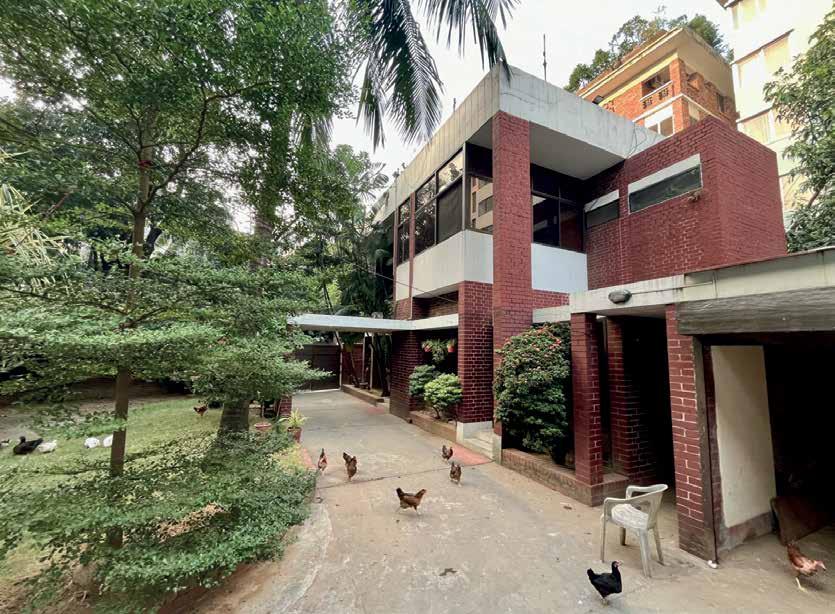
AMIN HOUSE
VC’S BUNGALOW, BUET
NATIONAL SHISHU PARK
1980S
NATIONAL BOTANICAL GARDEN
NANDINI CINEMA HALL
IBN SINA PHARMACEUTICAL COMPLEX
HANIF HOUSE
BLRI HOUSING
KAMAL RESIDENCE
SHAFIQUE HOUSE
UDAYAN UCHCHA MADHYAMIK
BIDYALAYA
DIVISIONAL MUSEUM
NAFISA CHOWDHURY RESIDENCE
WAHID HOUSE
AZIM HOUSE
KHURSHID HOUSE
AZIZ HOUSE
1990S
TAHMINA HOUSE
DEVCON PROPERTIES LTD.
ATIQUE HOUSE
BASHATI ARISTOCRATS
BASHIR HOUSE
BUNGALOW HOUSE
MOTALIB PLAZA
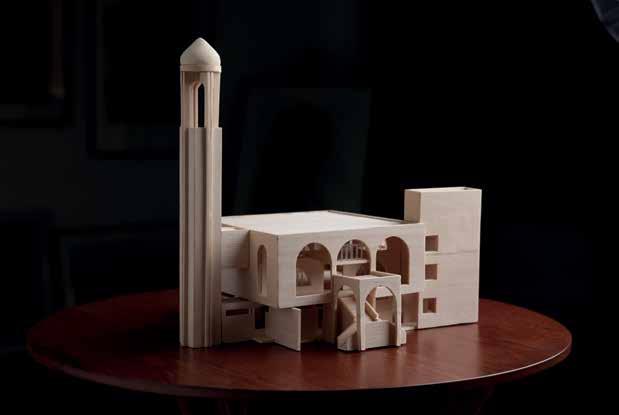
MOSQUE, DHAKA
FOOTOVER BRIDGE AT NEW MARKET
2000S
MONIPUR HIGH SCHOOL
GARMENTS FACTORY
MAHBOOB HOUSE
MIRPUR GIRLS IDEAL
LABORATORY INSTITUTE
VACATION HOUSE
MAHMUD HOUSE
BISWAS CREDENCE
CLEANER’S COLONY SADAQUAT HOUSE
Almost every architecture school has one or two exceptional teachers. They stand out because of their dedication to their students but also because of their brilliance in training them to understand how lines on a sheet of paper, or more recently digital code, can anticipate walls and enclosures that shape space and experience in ways that transcend the everyday. This book is full of such lines on paper, lines drawn by Bangladeshi architect Shamsul Wares, lines that anticipated buildings, most in the capital city of Dhaka, erected between the mid-1970s and the early twenty-first century. The buildings offer more than a hint of why Wares is such a respected architect in his own country and why his work deserves to be better known internationally. In this volume’s illustrations, I quickly recognized what anyone who has had the privilege of meeting him admires, which is his passionate belief in how carefully considered architecture can enrich the lives of those who encounter it. The twinkle in the eye, the shock of white hair, and the gift for adda, constitute charm, but those who have shared Wares’s company, even if, as I have, only for a snippet of a movie and the length of a conference, quickly sense the wisdom that underpins his disarming demeanor.
This book chronicles Wares’s oeuvre, including buildings that have unfortunately been demolished due to Dhaka’s recent rapid growth, making this careful recording of them even more important, and those that were never constructed, but are here shown in model as well as drafted form. The inclusion of so many construction drawings is also testimony to a vanishing era, one in which the muscle memory involved in drafting imbued a strong sense for the proportions of interior spaces as well as elevations. This is an architecture stripped of showy flourishes, but consistently attentive to what abstract space and careful detailing can accomplish. In these pages we find buildings lifted above the ordinary without alienating those who inhabit them from the culture
that surrounds them and the places in which they are embedded.
The spirit which this work is infused with is the same one that clearly made Wares the most charismatic and effective teacher of his generation in Bangladesh, and one whose distinguished students, who testify so enthusiastically here to how much they learned from him, would be the envy of any architecture school in the world. It is too easy to simply credit Louis Kahn, or even Muzharul Islam, with the admiration that today’s Bangladeshi architects rightly command on the world stage. Kahn achieved one of his finest buildings in Dhaka, completed, of course, only posthumously and by the government of a newly independent Bangladesh rather than the Pakistani one that had originally commissioned it. The superb quality of the National Parliament was only possible because of the encouragement he and his staff received locally for their search to find architectural solutions unique to Bengal. Although his architecture should not be labeled regional, it was a response to very specific conditions, as well as to Kahn’s concern for nurturing the potential for a democracy that had not yet been born. Islam remains a towering figure in the history of twentieth-century architecture in South Asia, but he was not nearly as engaged as a teacher as Wares, who was challenged, but by no means limited, by his exposure to both these men. Nor did Wares allow his students, even those who embraced critical regionalism, to be overwhelmed by their example. Instead, he recognized modernism’s capacity to be a nearly universal language, and certainly to speak to the experience of a newly independent Bangladesh, a country situated on terrain that the environmental historian John F. Richards recognized has since the seventeenth century been deeply embedded in a global economy. The results of this connectedness have unfortunately, due to colonialism, included impoverishment as often as technological
progress. Wares might nonetheless be the first to argue that what mattered about the modern art he taught his students to admire and learn from was not in what country it was made but its capacity to express a shared condition that could be harnessed to teach a capacity for expression, including through a finely honed sense of proportion. It is in part for this reason that, although his body of work is embedded in a specific time and a very particular place, there is so much that all of us can learn from his generosity, not only as an architect, but as an intellectual.
Finally, this book joins the increasing shelf of literature that celebrates the achievements of architects of Wares’s generation from across the Global South whose reputations have remained largely confined to their locale. This happened, not because they were less talented than their counterparts elsewhere – the successful international careers of so many of Wares’s students make clear that this was never the case – but because, with many fewer opportunities for mobility, they stayed home where they could make the biggest possible difference. A history of architecture that leaves out architects like Wares fails to explain how architectural excellence has been nurtured by those for whom the possibility of becoming a starchitect never existed. They merit our admiration as well because they might not have taken that path even had it been open to them, preferring instead to devote long nights to advising students and to take an assistant to the tile shop.
+ Kathleen James-Chakraborty Professor of Art History University College Dublin
ADNAN ZILLUR MORSHED
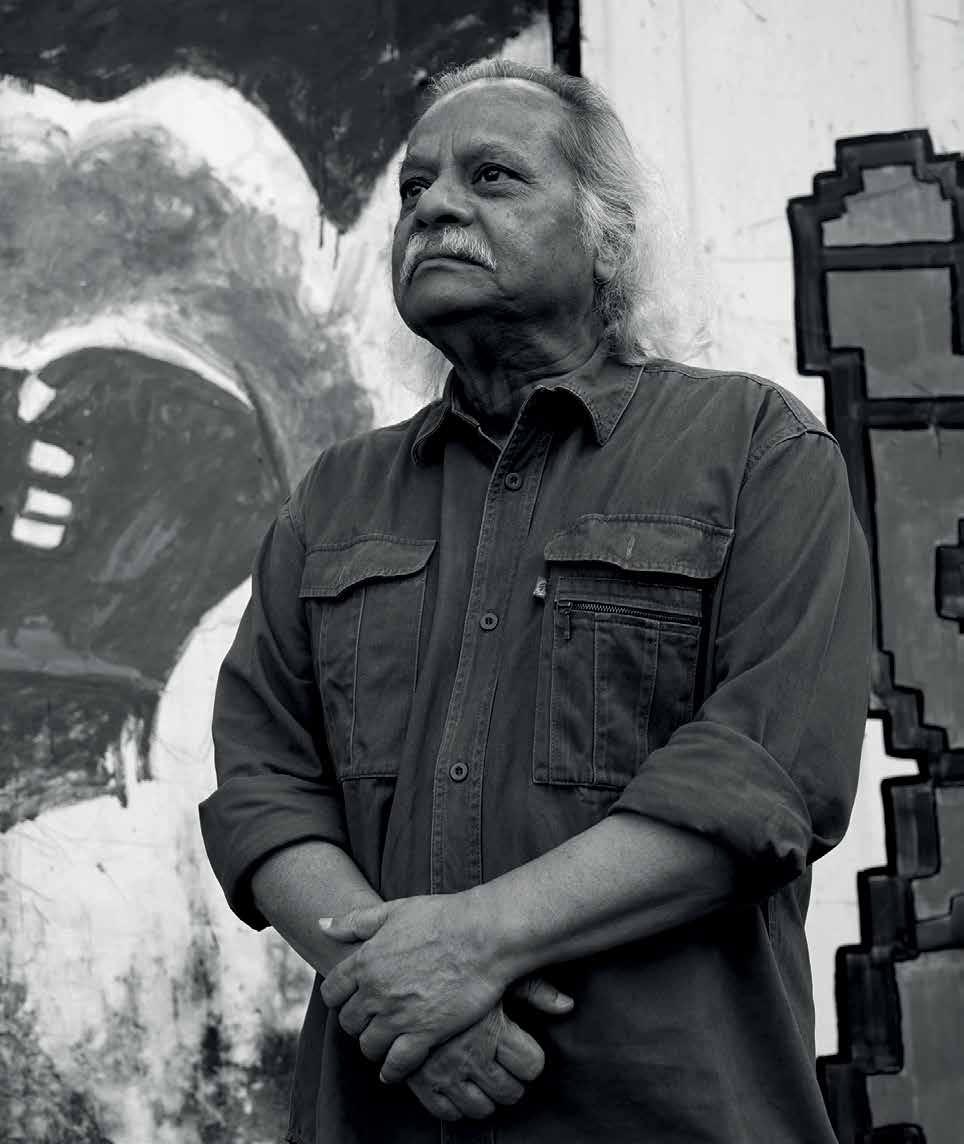
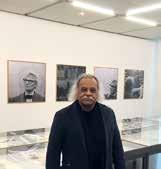
Shamsul Wares is widely known as a fiercely passionate teacher who professes architecture as a philosophy of modernism, one that views the challenges of space-making through the lens of twentieth-century modernist experiments in abstraction, Platonic clarity, and humanism (Fig. 1). In many ways, his growth as an iconic teacher in the Department of Architecture at the Bangladesh University of Engineering and Technology (BUET) for three decades—since the country’s independence in 1971—paralleled the trials and tribulations of a post-independent country and the evolution of its architecture culture.
Yet, his reputation as a great professor has ironically eclipsed his design work. He said on many occasions: “I wish I had paid more attention to my design work.” This statement appears to reveal his quiet lament for the absence of a clear public focus on his architecture. There has not been any sustained conversation about Shamsul Wares’s design work, let alone a monograph of his architectural oeuvre. Furthermore, the myth that he is mostly a designer of single-family homes has persisted over the years. The impetus behind this publication comes from a desire to bring Shamsul Wares’s wide-ranging design work to broad public view, with the premise that a critical understanding of his work since the 1970s would shed new light on the evolution of architecture in Bangladesh and its relationship to nation-building.
Shamsul Wares has produced a robust body of design work, ranging from residential houses to urban parks, from factories to institutional buildings, from cinema halls to shopping malls and apartment complexes. His architectural work, collectively, represents the enduring engagement of an architect with the development challenges of a new nation. While designing buildings of different functional categories, he taught design studios and theoretical courses at BUET, inspiring generations of architects to see architecture not just as a
career, but as a lifestyle, imbued with a modernist ethos of social commitment.
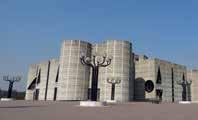
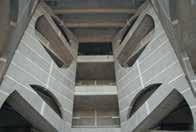
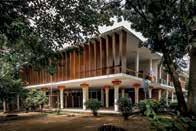
This has been our “Wares sir,” who served as a design provocateur for his students since the independence of Bangladesh. He built an intellectual bridge between the aggregate design legacy of Muzharul Islam, Louis Kahn, Constantinos Doxiadis, Paul Rudolph, and Stanley Tigerman during the Pakistan era and new generations of architects that contributed to the development of what has been called a “Bengal Stream” in architecture in post-independence Bangladesh (Fig. 2, 2a, 2b, and 2c). Wares graduated from the Department of Architecture at the East Pakistan University of Engineering and Technology (renamed as BUET after independence) in 1968 and joined the program as a lecturer in 1972, at the age of twenty-six. Through his teaching, he encouraged his students to see the profession of design as an opportunity to engage the challenges of modern life, without turning buildings into symbols of anything external to architecture. The kind of architecture he advocated in his classrooms is deliberately abstract, where overt social and historical representations are muted in favor of Platonic formal expressions. We learned from his position on aesthetic modernism, one that is cognitively powerful without having to resort to any kind of semiotic adventures, or show gratuitous associations with the power structures of history and society.
Towards the end of Nathaniel Kahn’s acclaimed documentary, My Architect: A Son’s Journey (2003), there is a perplexingly poignant moment (Fig. 3). In a review of the documentary, I reflected: “Inside the Capitol building, Nathaniel interviews Dhaka architect and popular local professor Shamsul Wares, who delivers a startling, if not the ultimate, message: that personal failings should not blind us to the genius of a great artist and that a son must seek his father not always in the father’s fulfillment of familial duties, but sometimes in the humanity of his aesthetics.”1 To describe the genius of a great artist, Shamsul
Wares likened Louis Kahn to “our Moses” who, in his view, gave Bangladesh an unmistakable symbol of democracy; a timeless Parliament building that captures the highest expression of modernism. The most dramatic part in all of this was not Wares’s “genius father” statement, but the tears that rolled down his cheeks while stating it. Nathaniel Kahn stated on several occasions that, for him, the Shamsul Wares moment in the documentary unexpectedly became his project’s intellectual epicenter. Many people agreed.
It is hard not to wonder what Shamsul Wares’s tears meant both for the documentary and the state of architecture in Bangladesh. Were they tears of gratitude? Joy? Emotion? Days after I first watched the documentary in New York City, I ran into India’s celebrated architect Charles Correa at a soiree hosted by MIT professor Stanford Anderson at his beautiful waterfront house in Boston. Upon hearing that I was from Bangladesh, Correa asked me about Shamsul Wares, particularly the reason for his tears in My Architect. Kahn’s work is great, but why cry, Correa asked. I was at a loss for words, but found myself ruminating on the question too. I tried to convince Correa that Bangladeshis become sentimental while talking about Kahn’s Parliament. There are several potential reasons for this: the edifice parallels the country’s political journey to independence; Kahn had a monumental influence on the architectural evolution of the country; or the country had found a national symbol of architectural pride in this building. This is emotional stuff, I argued with Correa, who seemed unconvinced. Years later, I told Sundaram Tagore, director of Louis Kahn’s Tiger City (2019), that weeping inside Kahn’s Parliament has not been uncommon (Fig. 4).
Shamsul Wares’s tears were an expression of neither bliss nor sadness, neither triumphalism nor melancholia. They were an unvarnished embodiment of many things, such as his commitment to what he calls “genuine architecture,” tinged with a sense of righteousness; his interpretation of Kahn’s mystical invocation of a space-light matrix as a driver of spatiality; architecture’s ability to create a good society; and the proverbial father figure who architectures civilization. Genuine architecture is a
work in progress, Wares often reasons. It bridges contradictory forces, as he wrote: “Genuine architecture inevitably finds itself in the struggle between city and country, industrialization and craft-culture, peasant values, and the indifference of the metropolis. The genuine architect needs not to be prophetic, nor romantically nostalgic but honest and true to his time and place.”2 Shamsul Wares wept perhaps because he found his aspirations for architecture examined in those of Kahn who was “honest and true to his time and place.” “There is pleasure in serving people,” Wares argues, “There is also the need for a sense of sacrifice in this profession to do good to society. Architects must be good.” Being a force for good in architecture requires devotion.
Wares was displeased that Nathaniel intended to devote only ten minutes of film—if any—to unpacking the layered meanings of Parliament’s chiaroscuro interior. The documentary was a futile, “useless” project, he indignantly told Kahn’s son, who was born out of wedlock and saw his father only a handful of times—hence his search for “my architect.” Understanding architecture, the kind represented by the Bangladesh Parliament— Wares spoke indirectly—entails contemplation, even self-purification or a type of spiritual ablution. It is in the Parliament building that Nathaniel claims to have finally found the father he had idealized since his childhood.
The story reveals Shamsul Wares’s quintessential pedagogy: architecture as a lifestyle, an abstraction of life itself. As his students, we found such teaching inspirational and contagious. In our young minds, he was our Plato, who made us conscious of praktike (doing) and gnostike (knowing) in design education. If you want to be an architect you should never do yaarki (frivolity) about it, he often told his students. In other words, be serious and committed if you want to be an architect. There has been an endearing righteousness in the way he professed architecture: that is, architecture is a modern distillation of the experiences, philosophies, contradictions, and ambiguities of life, in the end, producing an effect of “truth,” his very personal teleology of modernism’s austere aesthetic search.
25. Front view of Amin House, Banani, Dhaka, 1978.
26. Ground floor plan, Amin House, Banani, Dhaka, 1978.
27. First floor plan, Amin House, Banani, Dhaka, 1978.
Suhrawardi Uddyan Shahbagh, Dhaka 1978-1979
Type: Amusement Park
Project Status: Built, under renovation
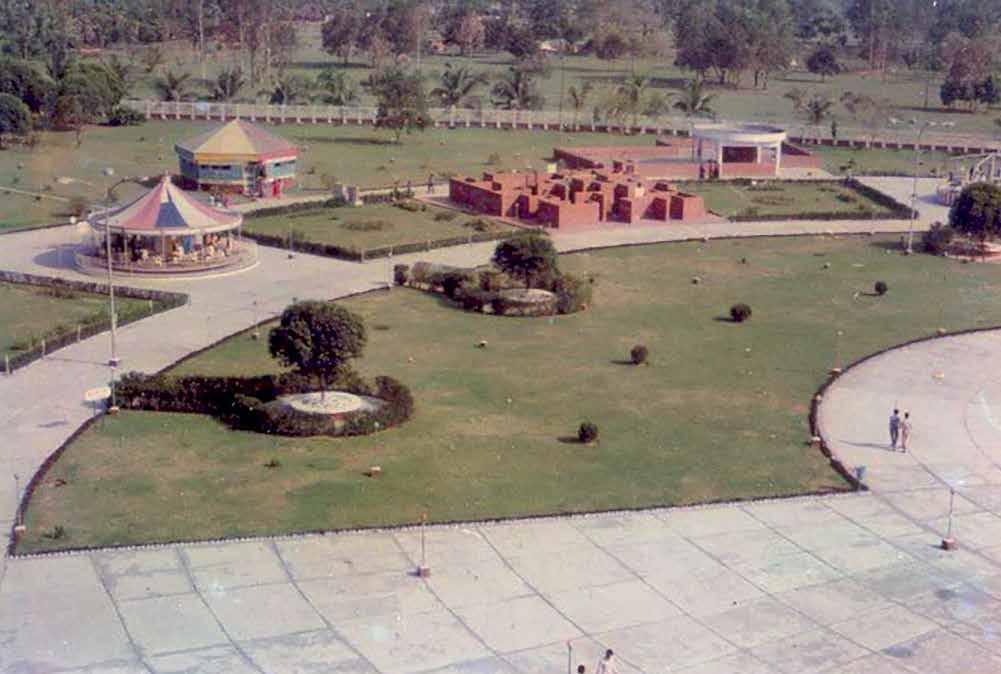
National Shishu Park, located in the bustling Shahbagh area of Dhaka, holds a special place in the city’s urban and recreational history. Established in 1979, it was Bangladesh’s first dedicated amusement park, developed by the Bangladesh Parjatan Corporation with the vision of providing a public recreational space for children of all backgrounds. Architect Shamsul Wares was commissioned in early 1978 to design such a facility. The United Nations proclaimed 1979 as the International Year of the Child, prompting then President Ziaur Rahman to align the park’s completion with this global initiative. The government sourced the rides from Japan, including a Ferris wheel, merry-go-round, children’s train, and gyro rides, based on recommendations from the architect. The designated site, carved out of Suhrawardy Udyan, presented a unique topography, with a dry, circular depression resembling a pond and an adjacent earth mound crowned by a banyan tree.
Rather than imposing a conventional layout, architect Wares embraced the site’s existing topography and designed it as an interplay of fundamental geometric forms—circles, squares, and triangles— aiming to familiarize children with pure geometry through play. The primary organizing element was a vast circle, symbolizing infinity and unbounded movement, with a fountain at its center. Around this focal point, the rides were arranged in a circular sequence, interspersed with greenery to maintain an organic rhythm. A wide concrete path encircled the fountain, forming an
inner ring for pedestrian movement, while an outer ring enclosed the park, both interconnected by radial walkways, evoking the image of a giant chariot wheel.
The park’s entry gate was conceived as a geometric composition, with four triangular walls supporting a horizontal roof. A pedestrian bridge spanning the railway track was similarly designed with triangular elements. At the periphery of the outer ring, single-story pavilions with pyramidal roofs housed facilities such as restaurants, restrooms, and indoor games like archery. The site’s natural features—the existing mound with the banyan tree and the dry pond—were intentionally left outside the rigid circular geometry, creating an element of surprise that softened the structured layout. Shaded seating areas were thoughtfully integrated under the existing trees, offering respite during Dhaka’s hot summertime. By embedding the essence of geometric abstraction within a recreational landscape, architect Wares crafted a place where children could explore, interact, and experience the harmony of form and function. National Shishu Park stands as more than just an amusement space—it is a landmark that reflects the aspirations of a city, the creativity of an architect, and the joy of generations of children. The park is undergoing major redevelopment.
+ Mustapha Khalid Palash
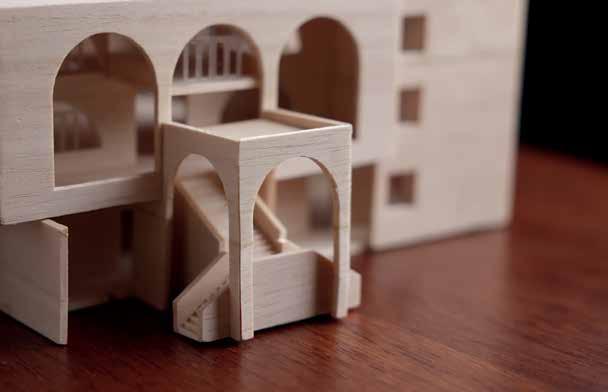
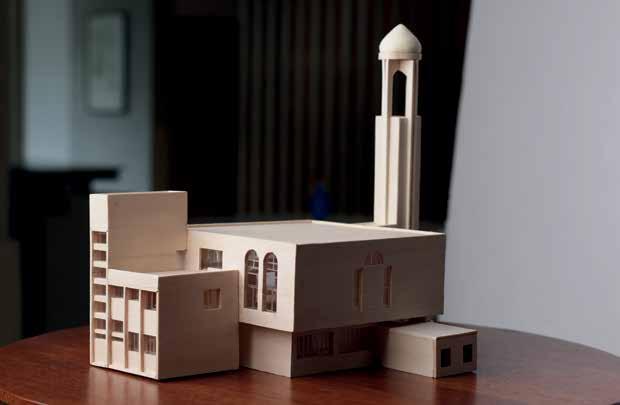
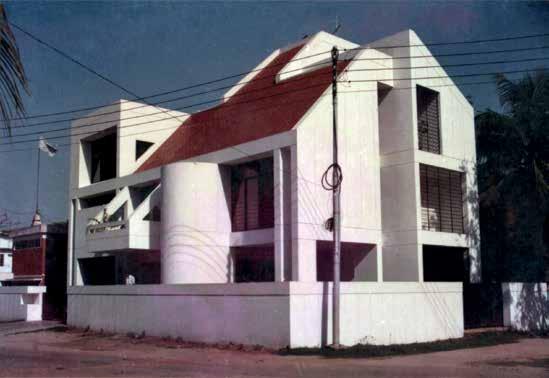
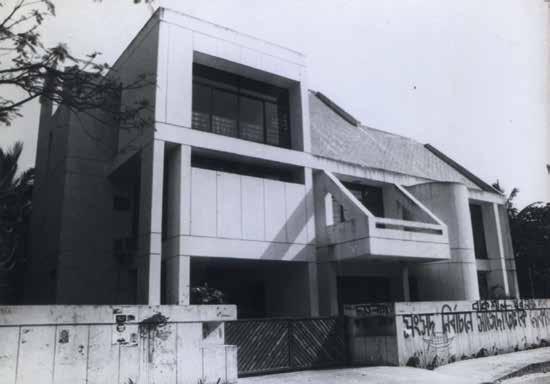
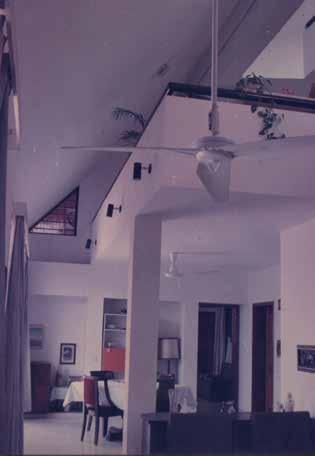
Faridpur, 1995
Type: Single-Family Residence Project Status: Unbuilt
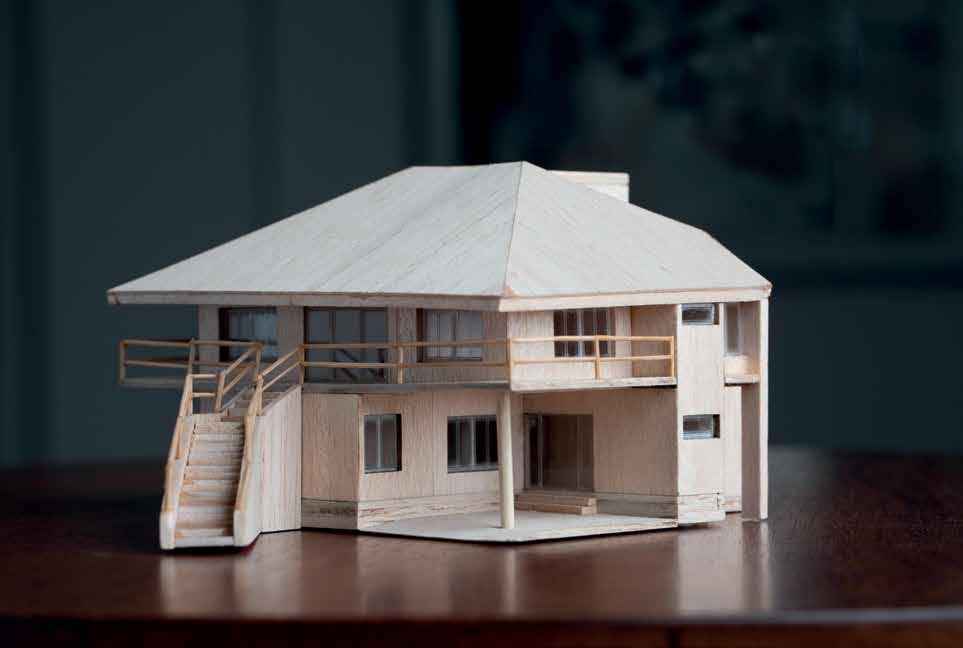
The project site is located in Faridpur, a prominent administrative and educational center in eastern Bengal during the colonial era and a major agricultural region that also serves as the client’s ancestral hometown. Historically known as Fatehabad, the district was renamed after Shah Farid, a disciple of the renowned Sufi saint Khawaja Moinuddin Chishti. In 1995, architect Shamsul Wares was commissioned to design a bungalow on this site in Faridpur—a modest yet thoughtful structure intended as a family retreat rather than a permanent residence.
The two-story rectangular house was designed to sit lightly within its environment, avoiding ostentation while reflecting a grounded architectural presence. The formal massing and scale were deliberately restrained, allowing the house to integrate harmoniously with its natural surroundings. To preserve privacy while encouraging social interaction, the bedrooms were located on the upper floor, leaving the ground level open to shared family spaces and nature.
A distinctive feature of the home is the inclusion of a salon—the French term for a living room—echoing the client’s personal connection to France and his desire to incorporate elements from their time abroad. The house is compact in scale, anchored by a low-sloping hipped roof whose angled planes create dynamic slanted walls and frame a generous veranda on the first floor. This veranda connects directly to the salon below, creating a seamless relationship between the indoor and outdoor space.
The architecture favors a cohesive, unified form, with clear attention paid to proportion and simplicity. The semi-open spaces—verandas, terraces, and shaded corners—blur the boundaries between interior and exterior, reinforcing a sense of openness and calm. Constructed with plastered walls, a reinforced concrete structure, and stiffening columns, the bungalow also uses brick as roofing material, grounding it in local building traditions while ensuring durability.
True to Shamsul Wares’ design ethos, the project balances tradition with modern technology. It is rooted in vernacular sensibilities yet made contemporary through material innovation and spatial clarity. Designed to be a quiet sanctuary away from city life, the bungalow is a space for gathering, storytelling, and creating lasting memories—where architecture gently supports the rhythm of everyday family life, in close dialogue with nature.
+ Doujita Kasfi
New Market, Dhaka 1990s
Type: Urban/Public
Project Status: Built
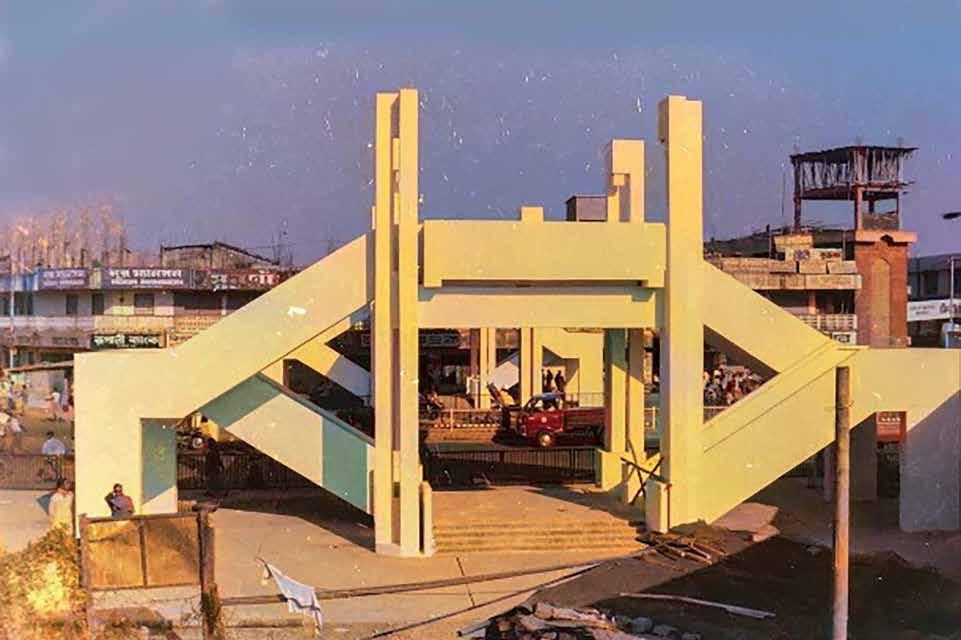
Built in 1953, Dhaka New Market marked a pivotal moment in the city’s commercial evolution, transitioning from traditional bazaars to modern shopping centers designed to serve residents more effectively. The emergence of the “Ribbon Commercial Development” concept in the 1960s further expanded commercial activity, leading to the establishment of the Dhanmondi Hawkers Market in 1965. Over time, this market extended its reach to include the bustling Chandni Chowk and Gawsia Market areas. To enhance pedestrian safety and connectivity, a footover bridge was introduced in the 1980s to link these shopping hubs. Renowned architect Shamsul Wares was commissioned to design this structure, locally known as the New Market Pakka Bridge.
Situated at one of Dhaka’s busiest intersections, the bi-directional footbridge is thoughtfully designed with a minimal span to blend seamlessly into its urban context. Shamsul Wares prioritizes accessibility, ensuring all four staircases featured lower riser heights to accommodate women, children, and others requiring easier access— reflecting an inclusive design approach. The bridge provides multiple entry and exit points: one end connected shoppers to Gawsia, Hawkers, Nurjahan Market, and Chandni Chowk, while the other leads to the New Market wholesale shopping center and Dhaka College, making it an essential pedestrian artery.
Constructed with traditional red brick and white plaster, the bridge was widened to nearly ten feet to accommodate increasing foot traffic. By the early
2000s, it had evolved beyond a mere crossing, hosting around fifty floating shops vending diverse products—from kitchenware to clothing— transforming it into a lively marketplace and a vital gateway for everyday essentials.
In April 2023, sadly, the Dhaka South City Corporation decided to demolish the bridge due to concerns about its structural integrity, with plans underway to replace it with a modern, state-ofthe-art footbridge. Despite its removal, the New Market Pakka Bridge served as an enduring landmark, remembered for serving thousands daily over four decades at one of the city’s busiest and most vibrant urban junctions.
+ Rifat Ara Mostofa
Gulshan, Dhaka 2007
Type: Single-Family Residence Project Status: Built
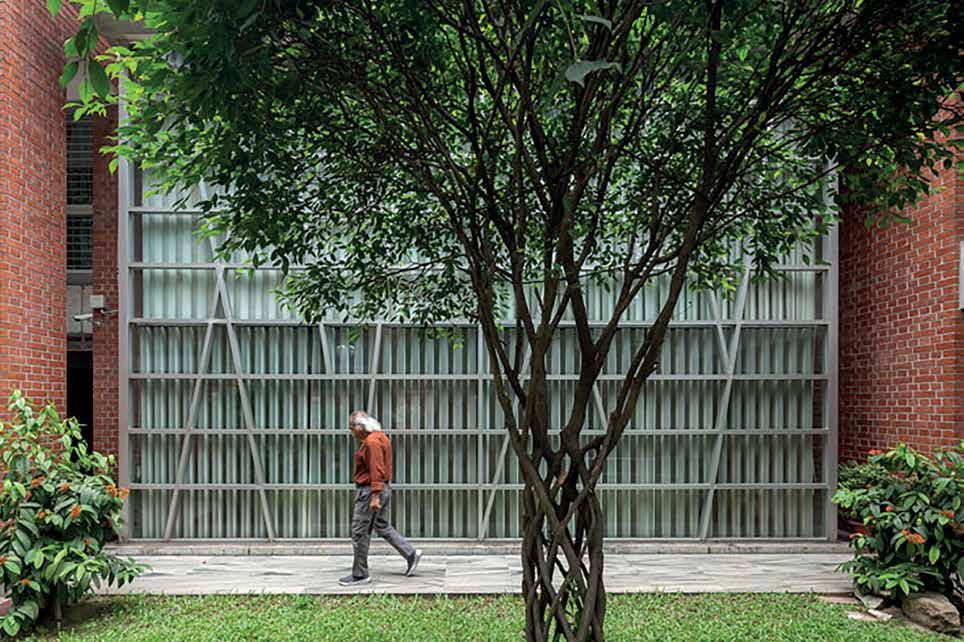
Mahboob House, designed by Shamsul Wares, is a three-story residence located in northwest Gulshan, Dhaka. Completed in 2007, for Mahboob Hassan, a director of Aristopharma, the house epitomizes Wares’s ability to create spaces that balance privacy with a connection to the surrounding environment. The design reflects the sociocultural and climate norms of the region, providing a secluded and intimate home that still engages with its surroundings.
The residence is strategically positioned on a corner plot, with its cubical form situated at the southern end of the site. The house’s layout follows a U-shape around an interior courtyard, which serves as the central hub for movement across all floors. The ground floor is dedicated to public functions, while the upper floors house more private spaces. Multiple staircases connect the different levels, ensuring that privacy is maintained without sacrificing accessibility.
A key feature of the design is the large, doubleheight formal living room, which enhances the spatial quality of the house. Adjacent to this is a sunken living area, offering a more intimate setting. The dining space, slightly elevated from the living area, connects to a shaded porch, creating a fluid indoor-outdoor experience. The first-floor features family living spaces that overlook the living room below, along with four spacious bedrooms. The master bedroom is a double-height space with a mezzanine sitting area, connecting to a large terrace with a pergola.
The material palette of Mahboob House reflects the architectural trends of the 1990s, when Wares moved away from traditional plastered forms to explore a blend of exposed brick, concrete, glass, and steel. The house’s facades feature a striking interplay of these materials, addressing climatic needs while creating a dynamic visual experience. Deep porches and pergolas offer shade and encourage social interaction, while cascading terraces and gardens enhance the connection between the house and its natural surroundings.
Mahboob House is a significant work in the evolution of domestic architecture in Bangladesh. It not only reflects the aspirations of an affluent urban class but also demonstrates Wares’s commitment to creating thoughtful, contextsensitive designs that blend modernist principles with the cultural and climatic conditions of the region.
+ Mohammad Foyez Ullah
Existing Building (No.1)
Existing Modina Mosque
Inaugurated Building (No.5)
Existing Building (No.2)
Inaugurated Building (No.7)
Proposed Buildings Inaugurated Building (No.6)
Existing Building (No.3) Existing Mosque
Proposed
Proposed Location of New Mondir
Existing Newly Constructed Building(No.4)
Existing USEP School
Existing Community Centre
Proposed Location of New Community Cnetre
Existing Club
Existing Mosque Existing Primary School
Propsed Location of New Sub-Station Proposed Buildings
Proposed Buildings
Existing Unsafe Building
Marina Tabassum is a renowned architect and educator from Bangladesh, widely recognized for her innovative and contextually rooted approach to architecture. A graduate of the Bangladesh University of Engineering and Technology (BUET), she has earned international acclaim for her contributions to the field. In 2016, Tabassum received the prestigious Aga Khan Award for Architecture for her design of the Baitur Rauf Mosque in Dhaka—a project celebrated for its spiritual depth, environmental sensitivity, and architectural clarity. Her influence continued to grow, and in 2021, she was awarded the Soane Medal, honoring her lifelong achievements and pioneering vision in architecture. Most recently, in 2024, she was named one of Time magazine’s 100 Most Influential People, a testament to her global impact and leadership in redefining the role of architecture in addressing social and environmental challenges. A monograph on her work, Marina Tabassum Architecture: My Journey, edited by Cristina Steingräber, has been published in 2023.
AZM – How would you describe Shamsul Wares as your teacher?
MT - I had professor Shamsul Wares as a design tutor twice. Once during my Design Studio 1, and again during my final year thesis studio. Our mentoring sessions, however, were never limited to studio hours. These extensive sessions went on for hours. They were rigorous to instill a meaning of “qualitative architecture” so deep within me, that I carry it with me still today.
So, what do I mean by qualitative architecture? It is the creation and flow of experiential spaces within forms. We are all taught about this process in one way or the other. But it is the method Wares taught that made the difference.
I remember profoundly the day when I visited the Parliament building of Bangladesh with Professor Wares. He had taken us out to visit this renowned architecture as a study tour. And as we stood within the ambulatory circulation of the building–realizing how Kahn had designed the play of light within the spaces he had created, experiencing how the light dims within an interior space as a cloud passes over–I understood how architecture celebrates nature. And that learning of how the built environment celebrates the place within which it resides is something that I still reflect upon today.
AZM - You are an educator today, teaching locally and globally. How has architectural education evolved over time in your view?
MT - A major difference between then and now is access to data. When we were students at BUET, our window to architectural knowledge was limited to the departmental library, Jeenat Book Store, and senior students. We only had access to outdated books.
Access to information is now limitless and, more importantly, unmonitored. The access is good. But it is the monitoring or the filtering that is questionable. Filtering out knowledge from the flood of data
available is the challenge. It is a challenge not only to students, but also to young aspiring architects and teachers.
The overabundance of information may not be a detriment. But it presents a challenge of understanding how to define the fine line which differentiates knowledge from information. And I believe it is a major factor which is misguiding the young learners and misleading them from understanding the essence of architecture.
AZM - What is the one thing that you have learned from professor Shamsul Wares which still influences your practice?
MT - I learned two things: how to design spaces using geometry and how to play with light within these spaces to enhance experience. Wares was always into geometry. Not in a regimental way, but more playfully. He always liked to play with pure geometric forms creating extraordinary spaces within them. Somehow, I have also found myself working along such a line.
The second thing that I learned is that the established practices of architecture can be challenged if one has a logical way of rethinking it. During my third-year design studio, I was assigned to design a boat club. I was studying the works of Richard Meier and the early works of Michael Graves during that time. I traced out the building plans designed by these architects to truly understand how volumetric spaces are translated from lines and drawings. It was something I was doing on my own. After an in-depth study I questioned the given program for the boat club, amending it to propose a new arrangement. Wares was there as a juror during the final presentation of my project, and he greatly appreciated my approach. This event still today is a source of inspiration for me. I now believe that trying out new things–to challenge ideas and concepts regularly practiced–is something that is also possible if one has enough logical reasoning behind the revision. I still explore how existing conventions of architecture and space making can be rethought through my practice.
AZM - You may have seen the documentary My Architect. Many people tend to think that in the film architect Wares exonerates Kahn for his personal “failings.” It has been challanged on feminist grounds. What are
your thoughts on Wares’s statement that geniuses sometimes fail to see the pains and sufferings of their close ones?
MT - I agree with Shamsul Wares on this point wholeheartedly. I find it very difficult to see Kahn as a family man. I think Kahn’s family was only there to support what he was, what he had aspired to become. When one is so intensively involved in architecture, in the way Kahn or any one of the other master architects was, I think one becomes what Kahn became. I think a person’s personal failings should not be a criterion in considering when professional achievements are being looked at. We all have our personal agendas and involvements, but when we focus on architecture completely, I think nothing else should come in the way.
AZM - Architectural practice has evolved a lot. It is now much more collaborative, inclusive, and involves the public in the deliberation of how we create space in buildings and cities. Many seek to transcend the patriarchal perception of architecture, so to speak. How do you see the profession of architecture today? As a female architect, what challenges did you face?
MT - I have never faced challenges as a woman in the field of architecture. I think what you face is highly related to how you present yourself: your attitude. It is how you eradicate this femaleness from your head and be the professional that you are. I believe this gender issue is not at all a barrier if someone knows how to serve as a professional and deliver the right services.
However, it is true that women do face some challenges when they work in Bangladesh. I think most of them do so when they visit ongoing construction sites for supervision. These sectors, still very dependent on manual labor work, are very male dominated. And when a female architect instructs a set of male contractors, engineers, and workers, who are not yet used to being instructed by their opposite gender, there may be a situation of conflict and denial. But only if the architect is not confident enough, female or otherwise. Personally, I have never faced an unpleasant situation where my ability as an architect was questioned. Therefore, I strongly believe that it is all in the attitude, in the self-confidence that one portrays when one is working on site or in any male-centric atmosphere.
What I have faced—or rather, what I still face quite recently—is peer pressure, especially when working alongside many contemporary male architects. I’ve experienced gender-related challenges from those who see me as a threat.
AZM - Do you think the Institute of Architects Bangladesh has a role to play here?
MT - I think it does. Presently, a lot of females enroll as architecture students, but they do not eventually practice the profession. I think it is the responsibility of the Institute to motivate the female students, to inspire these graduates into practice. I say this because I think, in time, architectural practice in Bangladesh will start to suffer if it does not find out a way to retain its female graduates, and to stop the number of unemployed female graduates from increasing. The Institute will have a huge work force, but not enough leaders.
SMG - In your experience at BUET, have gender dynamics ever posed any challanges? How has Professor Wares engaged with issues of diversity within architectural education, in your observation?
MT - Wares was always exceptionally candid about gender. All he focused on was the project itself, not who did the project. To him, the design itself was of the greatest importance. When it came to architectural mentoring, the doors of Wares’ house was always open. We used to go to him very late into the night to discuss projects, and he has always responded to our queries. I have not seen such dedication in a teacher since.
MT - That is my question as well, where has the passion gone? I think consumerism has infiltrated the practice and education of architecture. And this has heavily impacted the passion we saw in educators before. One might say that we have lost the Shamsul Wareses, or maybe we do not produce the Wareses anymore.
If one wants to understand where this disconnect developed from, and why we do not see passionate teachers anymore, one needs to study the time and place from where Shamsul Wares was born. I believe that the education system is not
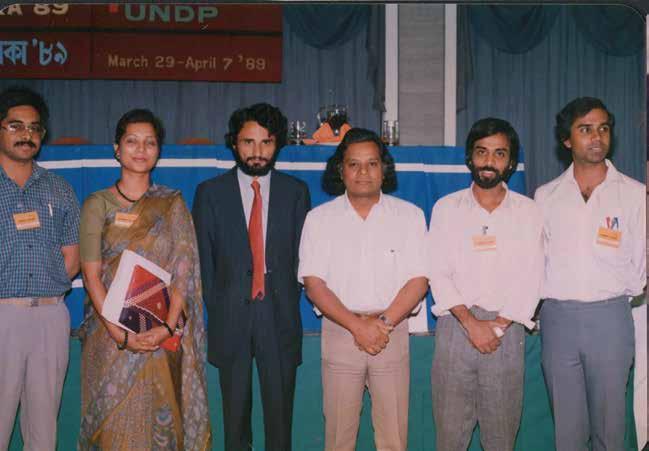
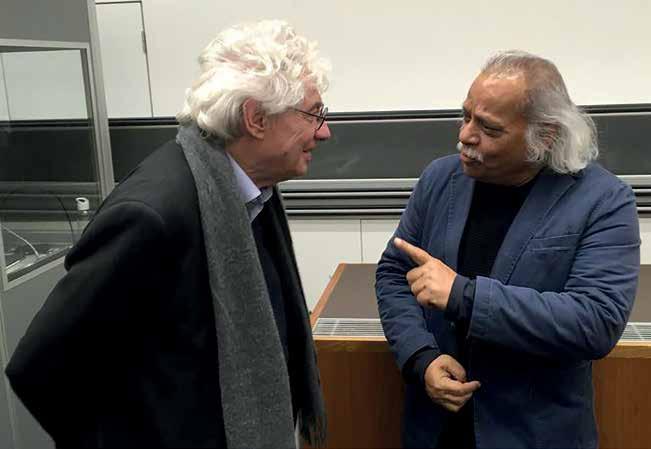
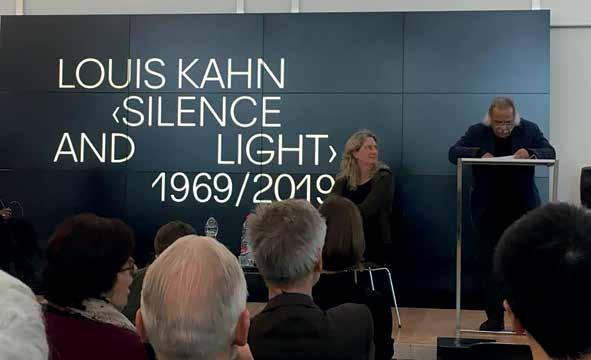
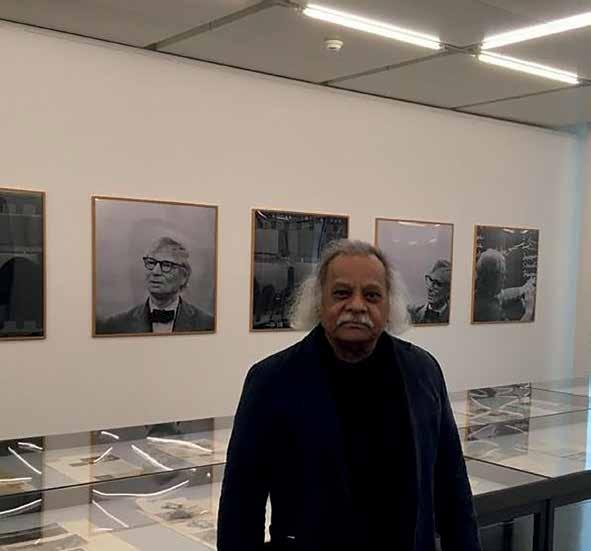
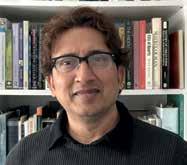
Adnan Zillur Morshed is an architect, architectural historian and critic, urban theorist, and tenured professor at the School of Architecture and Planning, Catholic University of America in Washington, DC. He received his Ph.D. and master’s in architecture from MIT and BArch from the Bangladesh University of Engineering and Technology, where he taught before coming to the USA. He has served as the Founder-Director of the Centre for Inclusive Architecture and Urbanism (Ci+AU) at BRAC University (Dhaka, Bangladesh) and a Fulbright Specialist (2021-2025). Adnan Morshed’s diverse research interests include global histories of architecture and urbanism, politics of epistemology, American urban culture in the twetieth century, urbanism in developing countries, urban poverty, histories of water, and politics of justice in the built environment. He is the author of multiple books, including Impossible Heights: Skyscrapers, Flight, and the Master Builder (University Minnesota Press, 2015), DAC: Dhaka in Twenty-Five Buildings (Altrim Publishers, 2017), and Dhaka Delirium (2023). His forthcoming edited volume, Spatial (In)justice: How Does It Manifest in the Built Environment?, examines what spatial justice means for different constituencies, and how it is experienced, theorized, and debated in a complex era marked by diverse social justice movements and wide-ranging political reactions
to them. Adnan Morshed was featured in the acclaimed documentary, Louis Kahn’s Tiger City (2019), and was a TEDx speaker at George Washington University, Wyeth Fellow at the Center for Advanced Study in the Visual Arts (National Gallery of Art, Washington, DC), and Verville Fellow at the Smithsonian Institution. He has served, among others, on the Board of Directors of the Society of Architectural Historians; MIT’s Global Architecture History Teaching Collaborative; the editorial board of the Journal of the Society of Architectural Historians; and as a juror for the National Endowment for the Humanities (USA) grants. He received research grants from, among others, the Graham Foundation, National Endowment for the Humanities, and MIT. His articles appeared in the Journal of the Society of Architectural Historians, Journal of Architectural Education, Journal of South Asian Studies, Thresholds (MIT), Constructs (Yale), New Geographies (Harvard), Architectural Design, Traditional Dwellings and Settlements Review, and Water History. A practicing architect, Adnan Morshed’s design includes, among others, eight BRAC field offices across Bangladesh and a farmhouse in North Carolina, USA. He curated an exhibition, Architecture as Freedom, based on the BRAC work, at the AIA District Architecture Center in Washington, DC, in 2023.