The Argument
In Architecture, as in all other Operative Arts, the End will direct the Operations. - The End is to Build well. - Well Building hath three Conditions; Commodity, Firmness and Delight.”
from Henry Wotton’s 1624 translation of Vitruvius’ “DE ARCHITECTURA”
We architects, by focusing excessively on providing delight, have marginalized ourselves in American society. We are aware of that and operate with an unnecessary level of insecurity as a result.
Architects need to play a more important role in the future of the United States. Architects can lead the effort to reduce the pollution created by buildings. As importantly, architects can design cities and towns that positively support human life. We need to ensure that we have these abilities and do make these contributions. Architectural education needs to provide graduates with the skills necessary to do those things and the ability to continue to learn as the world evolves.
We also need to find a way to convince Mr and Mrs America that they need our services, both for individual buildings and for community planning. We must demonstrate that we have the expertise necessary to guide them to a sustainable future, a future worth looking forward to. To do that, we must make it clear that we are the experts on the relationships between humans and the built environment. We must become those experts. That expertise will allow us to make the contributions described above.
Having achieved and established that expertise, architects can, with the help of our superb systems of design education, lead the way towards a powerful North American design economy.
We must establish that we can create built environments that nurture human life. We must then instill that skill in architecture students. This expertise will go beyond our ability to hire good engineers and specify earth friendly products and incorporate sustainable systems. If a LEED platinum building does not work for its occupants, visitors, neighbors and community, it is not sustainable.
None of this reduces the need for joy and enrichment. Architecture must always strive to fulfill its highest purposes. Buildings that do not nurture human life are not architecture. Architectural education that does not instill the desire to always fulfill Vitruvius’ values of commodity, firmness and delight, in an elegant way, is not acceptable.
We can establish ourselves as THE experts on how humans interact with built environments without compromising the most important goal of those environments: the uplifting of all who experience them.
Genesis
This book arose out of the conversation recorded below:
On December 14, 2024 Edmond G. Gauvreau, FAIA, started a discussion thread about the future of the American Institute of Architects at the online AIA College of Fellows discussion site. He was responding to the announced resignation of the AIA’s Executive Vice President. On December 19, 2024, Jack Smith, FAIA, posted the following to that discussion:
I hope the COF will take a strong position to redirect AIA to our previous standards and obligations to society and that ARCHITECTURE MUST BE RECOGNIZED ABOVE ALL AS AN ART FORM. The recent restoration of Notre Dame should tell us what sustainability is really about.
(I have all-capped the part that inspired me to respond.)
On December 24, on the same site, I posted the following:
In my office, one of the rules has been, “Everything for a Reason, Artfully Done”. Nothing I am about to say is intended to denigrate the importance of art in our practices. But it is counterproductive to declare that art is our primary concern. Except in the rarefied milieu of enlightened academic, institutional, corporate, and residential clients, art is not what our clients are seeking. In the worst case, of course, they are just seeking a building permit. But for the extreme majority of engagements, the clients are seeking built environments that work. WE SHOULD BE SELLING OURSELVES AS EXPERT IN THE WAYS THAT HUMANS INTERACT WITH BUILT ENVIRONMENTS. Only under that banner can we restore the importance of architects in society. Everything for a reason, artfully done!
On December 26, Richard L. von Luhrte, FAIA, posted the following:
Gentlemen: and I say that with great affection for my colleagues in the profession, I respectfully submit that art is fine, but the artist hangs his/her work on the wall and hopes somebody will buy, while we need clients to perform our work. . . . . . . . .As leaders in the built environment we need to realize that our calling is not opulence, or showy work but rather attacking the more relevant needs of our world-solving the carbon production of construction, finding affordable solutions for everyone, discovering new sustainability ideas that eliminate building’s carbon footprint, reducing urban sprawl and the dependence on the automobile,finding new and better ways to build cities with less resources and so forth. Is that art? By all means it can be. . . . . . ., let’s recognize our decreasing influence in the built environment, and challenge the profession to become true leaders in “building a better mouse trap”. If we do that, we will gain a seat at the table and assume a greater role in decision making- .. . . . . . . .the leadership of new ideas and better ways of doing things that are more sustainable, more affordable, practical and efficient-something that serves all of humankind, not just the wealthy. Ultimately, full circle to this discussion, the problem rests with education, the media, architectural publications and the AIA. It is high time we are rewarded not just for art, but for intelligent, purposeful and affordable architecture and sustainable city building. We get extra credit if it is beautiful as well!
And then I posted the following:
This is more than “an old guys in comfortable chairs” discussion. It is indeed most importantly about how we educate. It would be so great if we could form a group to clarify and agree on what we are trying to say and then take our case to the AIA, ACSA, NAAB and wherever else we should. This is not the Renaissance, this is the 21st century.
I think architects have much to contribute to this new world. We must change our tune if we are to play a larger role.
After that everyone sent deserved huzzahs to Jack and Richard and expressed the hope that we could all meet and make it happen.. Then it died out. I think it did so because they realized they weren’t interested in changing much. They just want all of us to be “better”.
Yessirree, but not very helpful.
On January 6, 2025 in a related College of Fellows discussion thread another colleague posted this:
Armed with data that supports the value architects deliver, we could radically change the value proposition and the position of architecture in this country. Our challenge is getting the profession to understand that.
I posted this response:
I think we do a terrible job of showing our value to clients because we aren’t sure what that value is. What is the value you want to document? What is the value you think architects are delivering? Armed with what data?”
He did not respond. I don’t believe we have a clear idea of the value we provide. I don’t believe we convey a clear idea of that value to our students. We are an insecure profession passing that insecurity on to the next generations.
“Monument to Instrument” makes the case for a set of value propositions that we can all understand and accept, a set of propositions that we can pass on to the students so that they enter the profession with much less insecurity.
Genesis building or architecture
We begin our examination of current conditions and future prospects of architecture education by recalling, once more, the two-thousand-year-old Vitruvian trinity: Firmness, Commodity, and Delight. Throughout history, what has distinguished “architecture” from the mere building of buildings is the insight and skill to blend the useful with the timeless, the technically sound, with the beautiful.
Boyer and Mittgang, “Building Community” 1996, page 26.
Is there such a thing as “the mere building of buildings”? If so, is it acceptable that some buildings are not subject to the goals of architecture? If we agreed to that proposition, what would it do to the licensing of architects? One could imagine a world in which “architecture” was required for certain facilities, public buildings, theaters, auditoria, schools, museums, galleries and so on. Individuals and private entities could decide whether they wanted “architecture” or just building. But commodity and firmness are integral to health, safety and welfare so even just buildings would be required to fulfill two of the Vitruvian requirements. Could we establish a system for licensing “Builders”, that is, designers who don’t promise delight? Do we want to allow that? Unfortunately, we are awash in designers of this sort, but we, as a profession, refuse to acknowledge their presence.
There is a way to define architecture so that it is not vulnerable to this argument. Architects must be the experts at the relationships between humans and built environments. That makes it necessary for architects to be involved with all “buildings” except those with no human occupancy. A generous understanding of the relationships between humans and the built environment includes aspects of usefulness, technical soundness and joy as essential characteristics.
Should all buildings for people be architecture? I think so. If you are going to create something as permanent and unavoidable as a building, you cannot ignore the effects it will have on the owners, the users and the community. For that reason, you should always build according to humanity’s highest art, architecture.
But is there a way to make architecture available to more than the few? Many years ago, I was comparing practices with Nova Scotia architect,Brian MacKay-Lyons. I was describing how many projects we completed in a year. He replied that he could not possibly do that, that he needed to work slowly, that a design took a year or so to develop. That works, I guess, if you have a
wealthy client who can afford the fee necessary for you to spend that much time. We were always trying to bring architecture to regular people. They could not afford for us to take our time. We worked fast, as fast as we could, and generally produced designs that people loved, designs that people understood were exceptionally appropriate to their specific circumstance.
But did we make architecture? We could rarely afford precious. We got creative with plywood and porcelain sockets instead of teak and travertine.
A couple of my colleagues in Anchorage, former employees, were heard to remark that “Mike just gives them what they want.” Well, duh!? We do give them what they want. But we don’t do fake in any way. We don’t fake materials and we don’t fake styles. We always respect the rights of the neighbors and the wider community. We also don’t feel the need to convince every client they need a flat roof or polished concrete floors (even though, sometimes, we might like to).
Our work, I believe, was always well-composed and always efficient in terms of construction, materials and space1. But it was rarely so unique as to appear to a magazine reader as architecture.
What qualifies as architecture?
1 Reality is difficult, and relative. Many of our clients and contractors would scoff at the idea that we did things efficiently. Word was, around town, that there was a “Mense mark up” added to all of our projects because we were always asking contractors to do things they hadn’t done before. But it’s all relative. Mark Ivy is a good friend and excellent architect. Over the years it seemed like he was our main competition, except that it was clearly the case that Mark got all the million dollar projects and we managed with $400,000.
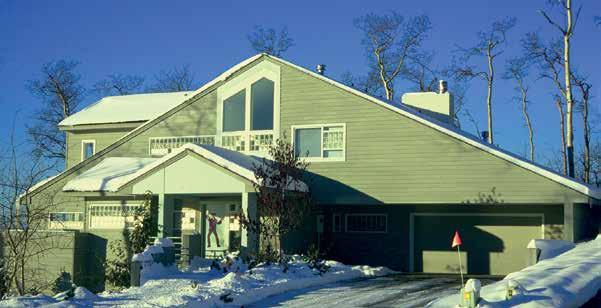
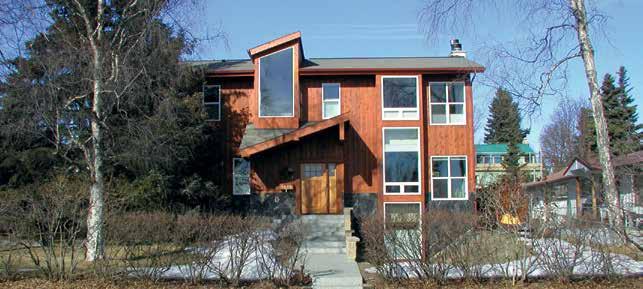
Home for Don and Kim Kerns, mmenseArchitects, Anchorage, Alaska 2006
You can push the skill limits of the regular trades people. You can find surprising and enjoyable uses for economical materials. If you follow “everything for a reason, artfully done” there is little you can’t convince your client they need. But you have to respectfully deal with their often unrealistic budget, give as much respect as you can to their desire to get it done now, and not force them to adopt someone else’s taste culture. We introduced hundreds of families to the joys of architectural design. They love their homes and they know why they love their homes. Their friends get infected too. But is it architecture?
The goal of this book is to enable architects to take on a much more important role in society. That requires that they be successfully engaged with a much larger portion of the population. It is a different kind of practice. You must work smart and fast. You have to know what you are looking for and recognize the solution when it crosses your board or screen. I think it is based on being expert at the relationships between humans and built environments. That expertise enables you to find the design solution, and, as importantly, explain it to your client.
America, and maybe humanity, is at a crossroads (assuming the climate doesn’t do us all in). Are we going back to kings and oligarchs or are we going to continue to attempt to achieve freedom and opportunity for all, that is, are we going to keep working on the democratic project. If the oligarch’s win, my version of architecture becomes irrelevant. But if democracy wins, expanding the scope of architecture is a necessary aspect of our future.
Straight Talk
During the previously described discussion at the College of Fellows site, it was suggested that we all read a new book by Anne Marie Duvall Decker. FAIA, and Roy T. Decker, FAIA, of the Jackson, Mississippi firm of Duvall Decker. The book is “Foundations” and it is wonderful. It is an extensive description of many aspects of a thoughtful architecture practice in the early 21st Century. It is written in what I will call the poetic language of architecture, full of metaphor and allusion, all of it subject to the interpretation of the reader. I respect this language and think I understand most of it, but I think that is because I have lived it, have had a practice like that of Duvall Decker. I wonder how it reads if you have not had similar experiences.
“Foundations” consists of 9 Propositions and 53 Foundations. The first Foundation is “Enigma”.
Making useful and engaging architecture is not about, or limited to, the logic of problem-solving or service. Engaging form is enigmatic, elusive, open, and hard to know fully. Only the architect who makes an enigma of the solution is involved in making art.
As an architect who has practiced thoughtfully for 45 years, I am pretty sure I understand what they are trying to say. They are careful to let the dog back in with “or limited to”. I certainly have discovered designs that were elusive. But “enigmatic, . . . . and hard to know fully”? I know there are aspects of my projects that only I am aware of. But if the design is enigmatic and hard to know fully, how do you know it’s even there? How do you know what is there? How do you know you have fulfilled your intent? I am willing to grant the value of mystery, but I don’t think I know why.
I think this is important because we are not getting our message out to our greater communities. And we are teaching our students in a mystical way, alluding to things they don’t understand, if ever, until they have completed many years of practice.
I do not raise these questions to criticize Duvall and Decker. As I said, I think their book is wonderful. I enjoyed reading it and learned a few things. It looks like, sounds like, and I have been told that, they do good work. I am just trying to make the point that they talk about architecture in a poetic, metaphoric way. As someone who has been down many of the same paths, I think it is relatively easy for me to “get” the metaphors. But students and lay people, I don’t think so.
It’s also the case that they sometimes make themselves perfectly clear. Their Foundation #53, “Best Idea Wins”, the last one, is written entirely in what I want to call prose. But, lest you think I have missed the mark in accusing them of a poetic voice, notice #52, “Public Good”, “The horizon of our work is not profit or ego, it is public good.” Yes, I agree completely, but “horizon”?
“Monument to Instrument” is in a way a similar description of an early 21st century practice. I believe that Roy and Anne Marie will recognize much of what I write about as very like what they write. But my words try to be prose, that is, straight talk. I respect the poetry. I think we can also speak in language that everyone can understand. You don’t need to figure it out. It says what it says. I hope to make the case that we needn’t give up any of our strengths to do that, most of the time.
Experiencing the Problem
Over the years, I had many experiences that made me uncomfortable about the role of architects. Some of those are described below.
All of these stories reflect the ways in which we have isolated ourselves from the rest of society. They are all stories that lead more people to hope that they only encounter architects in movies and tv shows, lovable guys as long as you don’t have to pay for them.
These are not stories about mediocre architects. These are not exceptional stories. I am sure you can tell your own. Maybe the photo below sufficiently makes the case and you don’t need to read the rest of this section.
Can we agree that we have a problem?
North Beach
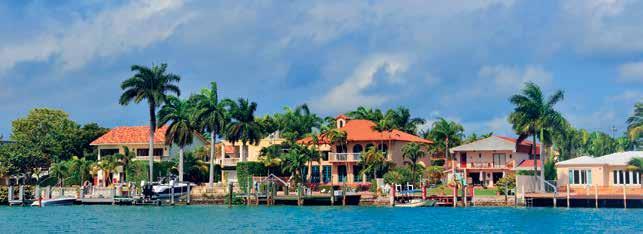
At a national AIA convention in Miami, Bonny and our daughter and I rented bikes and rode north out of South Beach. For miles and miles we could see houses across an inlet. This was high value property and there was almost nothing that we would call architecture.
What are we doing wrong that people who can afford waterfront homes in Miami Beach do not think there is value in hiring an architect?
Fata Morgana is an optical illusion that was occasionally visible from my office in Anchorage. This is an excellent photograph of it captured by Lauren Parker of Anchorage.
Fata Morgana
I was the local for a fancy Seattle design firm on a new Alaska Airlines Board Room (frequent flyers lounge) at the Anchorage Airport. The Seattle designers asked me to provide some Alaskan characteristics that might be used to inspire their design. I gave them wildlife, glaciers, tundra, native dancing, and fata morgana, an optical illusion often visible on the mountains across Cook Inlet. A few months later they unveiled the design at a meeting in Anchorage attended by probably 6 architects and 14 Alaska Airlines executives. The design was about fata morgana! I am not sure anyone else in the room even knew what it was. They all sat there respectfully. Doggone it, two things result.
First, the airline executives are not convinced that fata morgana has anything to do with their bottom line, and their bottom line is the reason they are sitting here. These executives have not been further convinced of the value of hiring architects. They are ok with the design, mostly because no one has any objections, but they are not enthused.
Second, they don’t understand the reasoning behind the design and thus over time, important details get modified or ignored. Project managers and subsequent administrators don’t care about preserving the sense of fata morgana and thus they aren’t particularly interested in making sure they know best how to use the space. This lack of understanding does damage both during the development of the design and afterwards as they don’t understand the operational advantages of the design.
Why can’t we talk about how the design takes advantage of the views, allows guests to move about without bothering each other, how the finishes and furniture will make the guests comfortable? Why don’t we talk about the budget restraints that we respected and the maintenance costs that we think we avoided?
This was, I think, a case where the architects did their job. Their design fulfilled the requirements of commodity, firmness and delight. But the only part they were confident enough to talk about was delight.
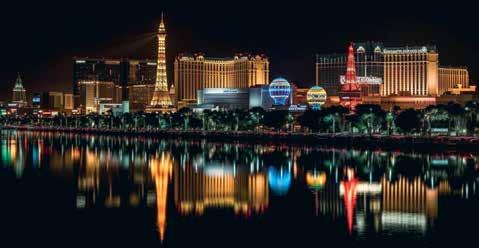
Las Vegas
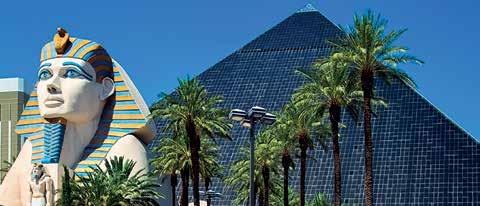
I do not understand why architects have so much trouble enjoying Las Vegas. It seems to me that it is the place in the United States, outside of Columbus, Indiana, where architecture is most celebrated. It’s set design, OK, how many architects have done set design for their local theater groups? Nothing wrong with that.
Luxor, one of the most modern of the casinos, comes off as relatively joyless. It was designed by Veldon Simpson and opened in 1993.
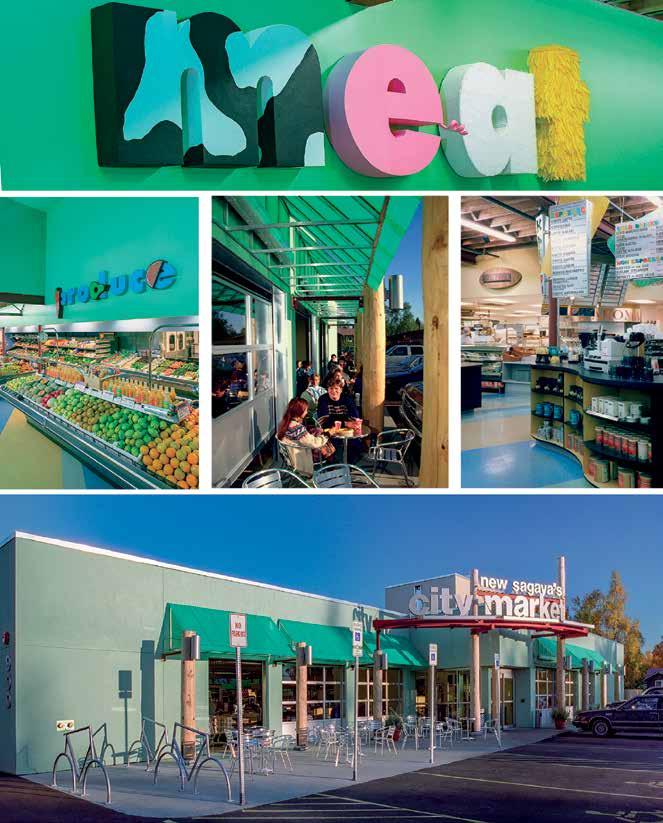
We did a grocery store in Anchorage in 1998. Thanks to an enlightened, maybe even indulgent client, Paul Reid, we created a fun house. For it, we won an AIA Western International Design Award in 2000. Juror Allen Temko, San Francisco Chronicle Architecture Critic, said about our project, “This is the way life is meant to be lived.” I think we were aiming at delight in the same way that the architects of Las Vegas do. I don’t feel the least bit dirty about it.
Egypt
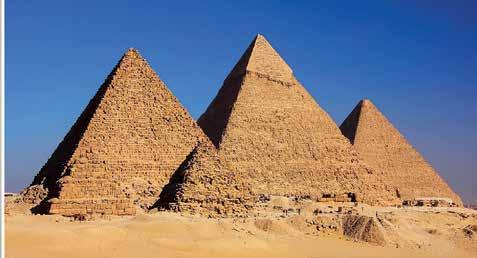
Although shelter first inspired humans to build, structure as messaging was the first role of architecture. Imhotep (shown here in a contemporaneous sculpture) and Hemiunu were architects (today we would call them engineers and construction managers) of the Egyptian pyramids. They were charged with marking territory, documenting presence and testifying to the magnificence of their clients. Carefully stacked stones send the message that the Pharaohs are superhuman, beyond the grasp of death.
Architectural design was unnecessary in the development of the pyramids. The Pharaoh says, “Build me the biggest mausoleum you can.” Piling stones in a pyramidal shape is the right answer; not a cone, not a cube, not a sphere. Humans are four-sided, front, back and two sides, lest you think it should have been a tetrahedron. In the creation of the biggest mausoleum, there is no room for design decisions. There is one right answer.
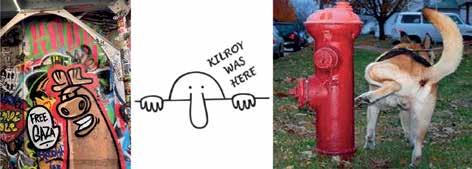
Marking territory is only a slight step up from bestiality. It continues today, both by humans and other animals.
Hemicycle, a painting by Charles Beranger completed in 1853 is a replica of a fresco at the Ecole des BeauxArts by Paul Delaroche completed in 1841. Purporting to represent the great artists of antiquity, seated in the places of honor are. at the left. the two architects credited with the Parthenon, Ictinus and Kallikrates and to the right the sculptor credited with the details at the Parthenon, Phidias.
Greece
Walls lack the requirement of intention. They just are. The first walls were sides of caves or cliffs? Or bushes and trees? Walls are so thoroughly grounded in themselves, so much a part of the background, that they are not necessarily worthy of contemplation. Walls can be architectural and later become important. But in classical Athens they were not a focus.
Viollet-le-Duc’s “First Hut” (see page 47) consists of posts with no beams. This is the bridge between shelter and architecture. Architecture started with columns (or posts) and beams, not walls. Posts and beams do not occur in nature.
Posts and beams are visibly a human construct. “I made that”, said the first architect contemplating their first post and beam. Some say that it was Imhotep who actually had this experience.
It may be that we are distracted in our readings of Greek architecture because so little remains, especially interiors, at least in my experience. It does seem that the Greeks were focused on the exterior appearance of their structures. Ding an sich, “the thing itself,” is an important concept. Some things refer to themselves and other refer to something else. Some things denote and other connote. Some represent and some present. The pyramids connoted the majesty of the Pharaohs. The Parthenon presents the Greek architect’s skill at making posts and beams that appear to be at work but also at rest.
Curiously columns and beams do not by themselves create shelter. Already architects have chosen to concentrate on something other than function, sigh. These architects, unlike those of us practicing today, were tasked with creating monuments, not functional buildings.
The Greeks had a complicated relationship to ding an sich. They realized that just putting up posts and beams didn’t necessarily result in posts and beams that effectively told the truth about themselves. Fluted columns are
Deconstructivism
One of the post-modern literary theorists’ tools is deconstruction, an attempt at a radical breaking up of a work in order to more clearly understand its meaning. It’s not the chapters, paragraphs or sentences, but the deep structures beneath. It also represents a world view in which what we see and hear is no longer precisely true. The “discovery” in physics that an observation cannot be made without changing the observed muddied the boundaries of all things.
Some architects adopted some of this and created buildings that seemed to have been deconstructed but not put entirely back together. One of the defenses of such work is that contemporary society is so transient and relativistic, with no truth available, that it is inappropriate to build in a way that implies permanence. Commodity, firmness and delight. Commodity is changing at light speed so let’s not take that too seriously. Let’s disguise firmness and get our delight from achieving that disguise.
I am not going to take this seriously until we can move entirely into virtual reality. Until then, we still need shelter. There are elegant ways to provide shelter. The costumes of deconstructivism have rarely been elegant.
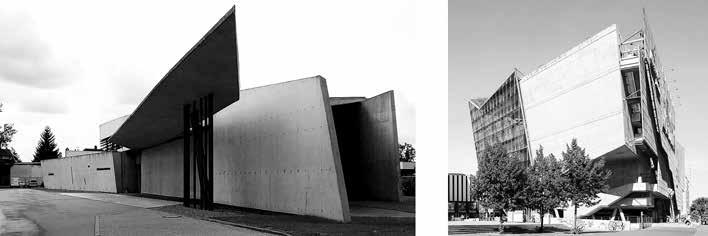
When I look at cities today, I see the effects of deconstructivism, a meaningless striving for novelty with little evident concern about elegance or firmness. It is ironic that Zaha Hadid whose career began with a socialist bent spawned the extravagant designs we see today which reflect the growing wealth discrepancies. “I can build it this way because I don’t care what it costs.”
Vitra Fire Station, Zaha Hadid, Weil am Rhein, Germany, 1993
UFA Cinema, Coop Himmelbau Dresden, Germany, 1998
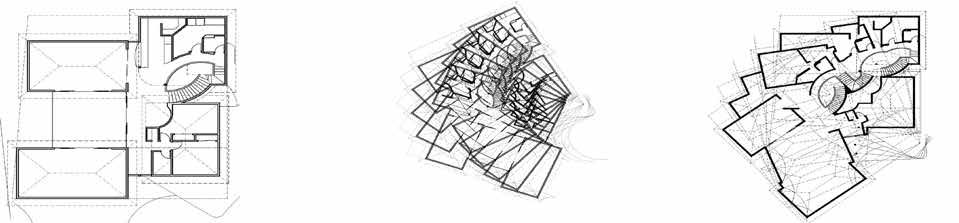
Architectural deconstructivism may have started when an early CAD adapter found their computer behaving like the sorcerer’s apprentice. Erase a line here and there and you have a plan even Jacques Derrida will love.
A Parenthesis
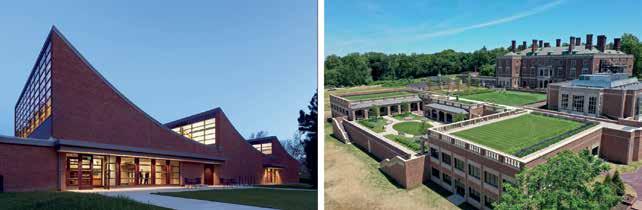
On the left Lancaster History Center, Lancaster Pennsylvania, Centerbrook Architects and Planners, Mark Simon partner-incharge, on the right Couch Academic Center, Webb Institute, Bentel & Bentel, Dr Carol Bentel, partner-incharge, Glen Cove, NY, 2019
The Lucky Ones
There is a group of firms, located mostly in the northeast, that practice in a rarefied world. Their clients are colleges, governments, corporations and other entities that wish to build architecture. These firms occupy the front room of the AIA and, intentionally or not, give the impression that all is fine with the practice of architecture.
More than 75% of the AIA’s members do not practice in that world. They live in the world described in this book, the world where for the most part clients are not interested in paying for art or even delight.
A Pestilence
There is also presently a scourge rampant in the profession. The dominance of the bottom line over everything else has come to architecture, too. Firms (work not illustrated here) are proudly bragging about having bought up this firm and that. These national, and international, firms are not about architecture. They are about making money for senior partners or other investors.
Architects have a profound responsibility to the communities in which they practice. They cannot be trusted to fulfill that responsibility if they are owned by an entity a thousand miles away.
It is hard to make a living at architecture. How much harder must it be if some remote entity is taking a cut off the top?
The AIA, in defense of the integrity of architectural practice, should advocate for licensing laws that prohibit out of state ownership of firms.
The Last Honest Buildings
Besides limiting the influence of the architect on buildings, the expanding technologies changed the nature of construction. No longer does a building consist of walls, floors, roofs, doors, windows and stairs. Now, usually buried within the walls and floors are pipes and cables of numerous kinds.
The development of steel as a primary structural material also means that the structure has to be hidden because of fireproofing requirements. It is not really possible anymore to thoroughly express commodity and firmness. This is another reason that we concentrate so much on delight.
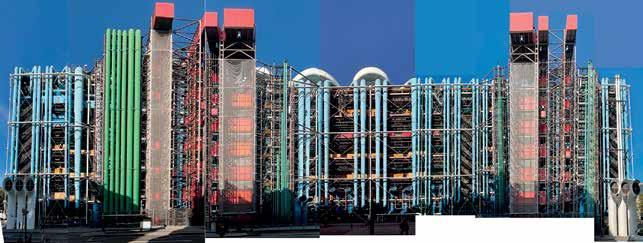
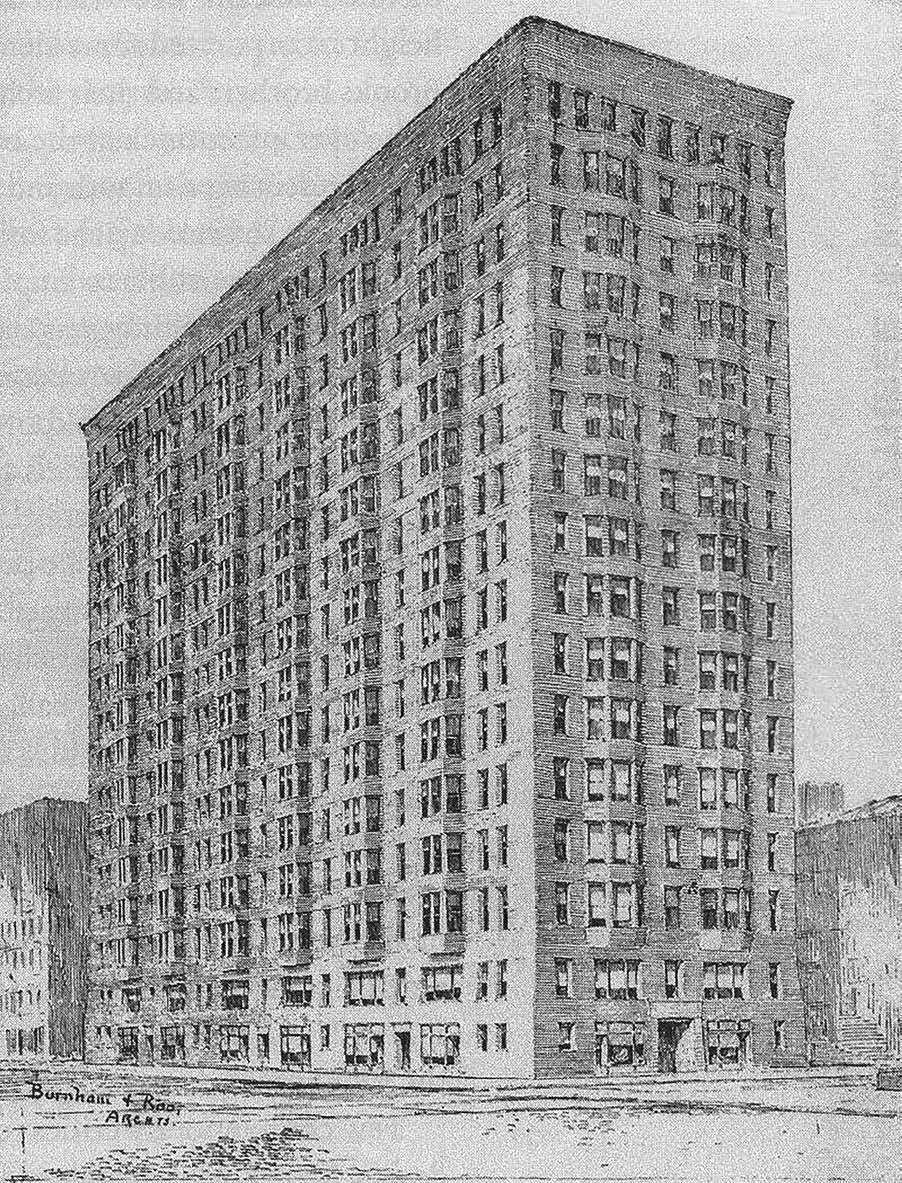
I would like to propose the buildings illustrated here as two of the last honest works of architecture.
Chicago’s Monadnock, 1893, designed by Burnham and Root is described as the last masonry bearing wall skyscraper. It is a lovely building precisely because one senses the honest expression of structure.
The Pompidou Center, designed by Richard Rogers, Su Rogers, Gianfranco Franchini and Renzo Piano with Ove Arup and Partners providing much of the engineering, both structural and mechanical, opened in Paris in 1977 and is a flamboyant expression of the mechanical systems involved in modern construction, a wonderful celebration thereof. Here the sculptors of Greek and Rococo architecture have been replaced by the mechanical and electrical engineers.
specifically for those who hire us and for everyone else in the community. AIA should be emphasizing and publicizing this role for the architect.
Is there a concern here about liability? I hope not. I hope we are not so cowed by the lawyers that we cannot tell our clients what we are trying to achieve. If we are so cowed, we need to get over it.
Let’s Be Serious
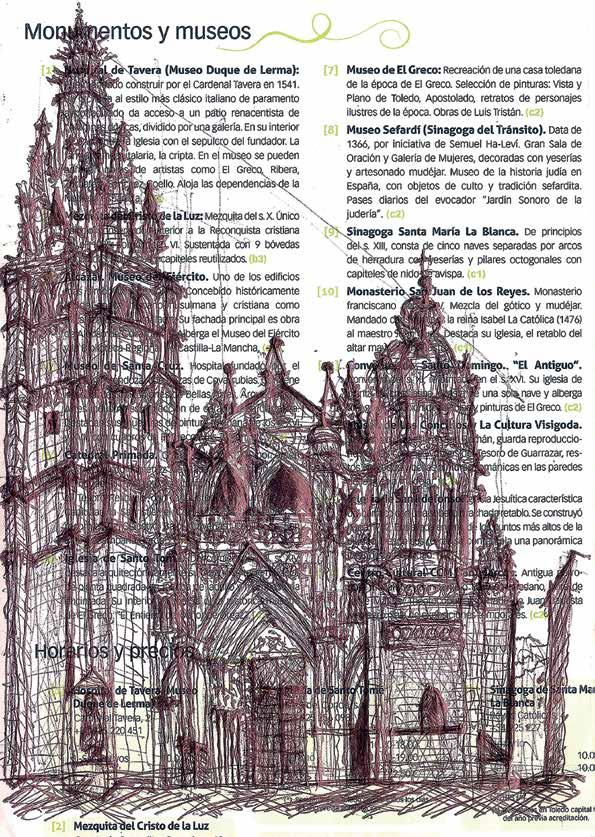
I remember the substantial fear and disgust I felt about ballpoint pens when I was in architecture school. Now, I don’t pretend to be any Picasso, but I think the drawing at the left of Toledo Cathedral is fun enough and done with a ballpoint pen.
Wonder of wonders, some of us were at the Bauhaus gift shop a few years ago and there it was, my favorite ballpoint pen on sale as a piece of craft at least, if not art. Our insecurity as architects causes us to create these markers of our craft, our own little “in crowd” to comfort us in our uncertainty.
The importance of flat roofs is pounded into us in school. Many of us can’t stomach a sloped roof. It’s deeply ingrained. When I go to a new city or town and am traveling through residential neighborhoods a flat roof, no matter how peripheral to my vision will cause me to turn around and check it out. There is nothing inherently good, or bad about a flat roof. They are “of our time”, because of the technological development of membranes and the unacceptability of draining the roof of a large building onto the street.
Form Follows Latitude
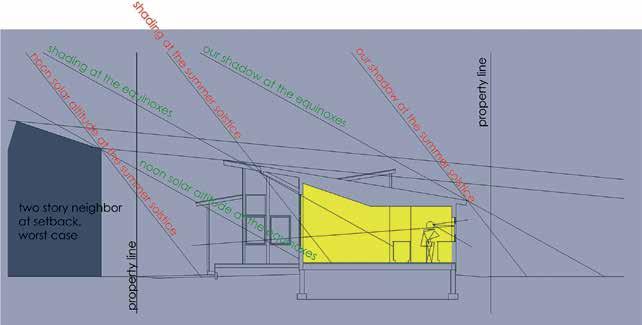
This is a set of rules that developed because we were practicing in Alaska with its unique climate and insolation. These are all rules that can be broken. It is not OK to break them without knowing you are doing so.
Expand the plan east to west instead of north to south. A square plan is extremely unlikely to be appropriate since it is symmetrical and the context is never symmetrical.
The biggest construction troubles in the north, condensation and glaciation, occur at the eaves of a roof. What roof has the greatest length of eave per roof area? A hipped roof. You have to have a huge reason to ever use a hip roof in Alaska. Though I must admit that I did quite a few before I figured this out.
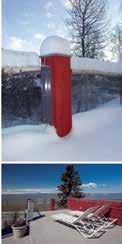
Hadley
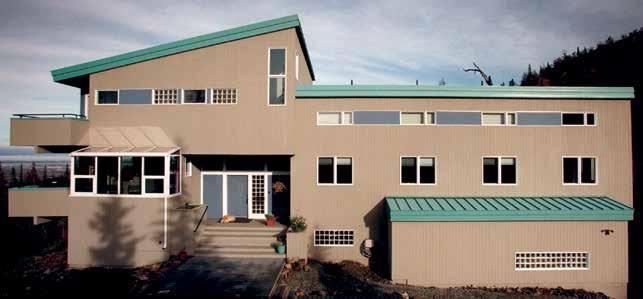
Moore House, mmenseArchitects, Anchorage, Alaska 1998
Form Follows Latitude
Cook Inlet Housing Authority Affordable Housing Competition, mmenseArchitects, Anchorage, Alaska 2005
Use a shed roof and slope it down from south to north. Make the north walls the smallest and the south walls the largest. This is about heat loss and access to the sun. Use a shed because ventilation is important and the shed form contributes to successful ventilation. Use a shed because valleys are terrible in the north. Valleys concentrate drainage which contributes to glaciation. Valleys are also impossible to adequately ventilate. Use a shed because that drains the roof to the north where you won’t be spending any time. Use this shed because that creates a big south wall which makes a larger contribution to sun doubling outside on the south.
Put cooking decks on the northwest and against a solid wall. The sun is in the northwest when it is warm enough to cook out in the evening. The solid wall allows for sun doubling, a situation where the sun warms you directly and then bounces off the wall behind you and warms you again.
Always place buildings as far north on the property as possible so that the building does not shade the outdoor areas and so that sun doubling can increase the desirability of outdoor space.
Put kitchens and breakfast areas on the east, dining and living rooms on the west.
Gutters don’t work. They contribute to glaciation and get clogged with leaves.. Arrange your roofs so you don’t need gutters. The rule that trumps this rule is the desirability of collecting and reusing rainwater and snowmelt.
Class Schedule
TUESDAY
WEEK 1
THURSDAY
Activity My Presentation Guest Speaker
Warm Up, From Monument On Design in groups to Instrument Will Bruder FAIA
(During this week, I will determine who, if anyone, is having trouble with English and make arrangements for them to have an assist on that front.)
(Warm Up is a short design exercise in groups to help the students get to know each other and help me to get to know them.)
WEEK 2
WEEK 3
Finish Warm Up Design and Food Dr. Carol Bentel FAIA
WEEK 4
A Place I Want Legitimate Bureaucracy Individuation and Design
Rick Bell FAIA
(The students will develop a program for a place they would like to have, a building, a park, a room, whatever they choose. After completing the program, I will assign each student the task of designing another student’s Wanted Place. That student will act as the student designer’s client for this exercise.)
Finish program The Blue Green Receive design Paradigm assignment
James Bowen AIA
WEEK 5
Working
Looking at Design
Writing About on design Architecture
First client review
Susan Szenasy
WEEK 6
WEEK 7
TUESDAY
THURSDAY
Activity My Presentation Guest Speaker
Working on design
Anthropology and Architecture
Vyjayanthi Rao
Adjunct Associate
Professor, Spitzer School of Architecture
WEEK 8
Finish design Presentations to clients Mid-semester Reviews off
WEEK 9
Introduce
Everything for a On Design Main Project Reason, Ar tfully Done
Borre Skodvin Professor, FRIBA Founding Partner, Jensen & Skodvin Arkitekter AS, Oslo, Norway
WEEK 10
Working Practicing in South Bronx
Majora Carter, MacAr thur Fellow
Visionary Developer, Exemplary Advocate for Environmental Justice
WEEK 11
Working
The In and Out
Gardening and Design of Design
Jim Childress FAIA and Ann Thompson MLS
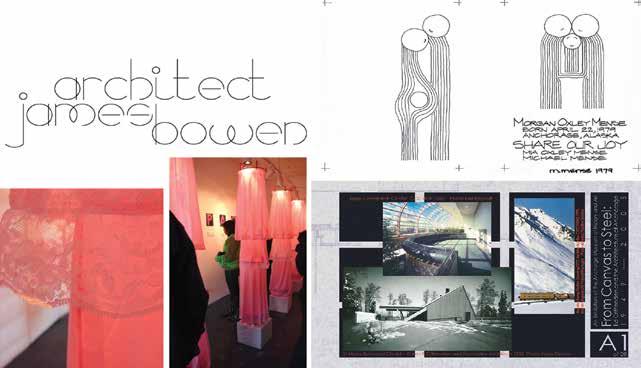
I want to design everything: fonts, birth and graduation announcements, houses, grocery stores, warehouses, communities, museum exhibitions, furniture, cat ladders, even once, a long time ago, a yellow pages ad.
Being in Alaska, with no significant architectural culture, and no school of architecture, and being too bull-headed to look at how other people did things, and then being too busy to look at how different we were from them, led us to a practice which I now believe was quite unique. We worked for a few rich people, and that was great, but mostly we worked for regular people. They were generally not particularly interested in art. They wanted spaces that worked from them and made the best use of their limited resources. They led me to the understanding that we might do better if we sold ourselves as the experts at the relationships between humans and built environments.
Nonetheless, one of our “foundations” was, and is, “Everything for a Reason, Artfully Done”. I would like to think that we not only inspired people who would not otherwise have done so, to hire architects (us, mostly, I suppose), but also to infect a greater segment of the population with the appreciation of the place of “delight” in construction, which is to say, an appreciation of architecture and a desire to make it a conscious part of their lives.
I also want to apologize to so many people whose projects I did not illustrate here. There are countless others about which I am very pleased. I do not have photos of many of those.
Clockwise from top left:
a font I designed for my friend James Bowen
the birth announcement for my son
the cover of the catalog we prepared, with Dr Julie Decker for our Museum Exhibition “From Canvas to Steel: Ed Crittenden and the Architecture of Anchorage”
drawings and an image from a gallery show I prepared after the crash of 2008 entitled “Pink Slips.”
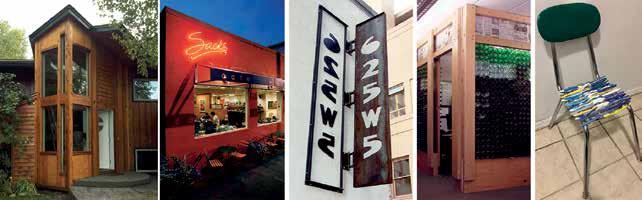
From the left:
Addition for Aaltje and DJ Smith, 2011.
Sacks Restaurant 2000 with neon design by Clark Mishler
mmenseArchitects Office signage in collaboration with sculptor Jeff Patrick, I wanted a cut out sign that would render our address as a shadow on the building behind, Jeff decided to leave the removed letters on our wall.
Katie’s Office, a recycling office at a solid waste facility — we washed, sorted and assembled hundreds of wine bottles,all in Anchorage, Alaska.
Mike Mense FAIA
The Dentist Chair —a result of my picking up thrown away items on the streets of NYC and developing them info something new— I always collect my old toothbrushes, you never know when they might be the answer.
mmensearchitect(s) since 1979, Anchorage, AK, NYC, Snohomish, WA
B.Arch with highest honors, Va Tech 1973
M. Urban Design, CCNY 2016 Chair AIA Committee on Design 2012 www.mmense.com www.1dogooder.info https://housescience.blogspot.com mensenyc on Instagram
“From Monument to Instrument” on Pinterest
“The Gallery behind the Bar in the Basement of the Brothel” on Pinterest “portfolio” on Pinterest
Author of “Micogram,” 52 urban design strategies for increasing justice in NYC