COMMEDIA DELL'ARTE Making it up as you go along by Margaret Zhang A screenwriter can spend years trying to perfect a script, but sometimes, the most memorable lines are not thought up by the writer, but rather improvised by the actor. In Titanic, for example, Leonardo DiCaprio ad-libbed, “I’m king of the world!” upon boarding the ship for the first time, a line the director loved so much he decided to keep it. And in Harry Potter and the Deathly Hallows, Part 2, Ralph Fiennes, playing Voldemort, delivered his lines a bit differently every take to keep the scenes feeling fresh. In both of these examples, of course, a preexisting story still guided the acting, but the actors could experiment fully within these limitations. Commedia dell ’arte brought scenes to life in the same way: even when costumes and scenery were simple, the actors were still able to craft an exciting atmosphere with their improvisation and quick wit. Popular in Europe during the 16th and 17th century, commedia dell ’arte was a form of Italian theater that united stereotypical structure with spontaneity. The form featured "stock" characters—servants, old men, lovers, and captains—who exhibited stereotypical traits associated with various regions of Italy and other European countries, but the actors’ improvisation made them unique and reflective of the times. Carlo Gozzi's original play version of The Love for Three Oranges, on which Prokofiev's opera is based, comes out of this tradition. However, the humor of commedia dell ’arte soon started to fall flat with foreign audiences, who didn’t understand the regional cultures and dialects that served as a foundation to the humor. If you’ve ever shared an inside joke with a friend, you know that a joke can be a complete riot to you while making no sense to anyone else. After all, the context of the joke is what makes it funny in the first place. In an effort to keep audiences entertained, commedia dell'arte performances 34
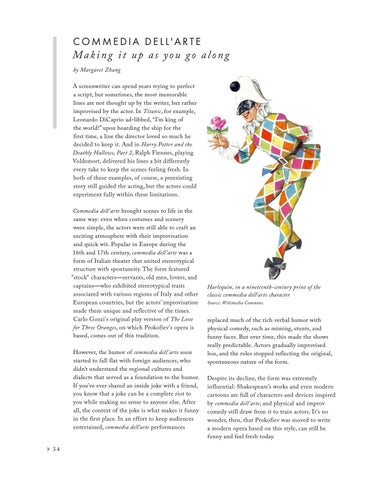
Harlequin, in a nineteenth-century print of the classic commedia dell'arte character Source: Wikimedia Commons
replaced much of the rich verbal humor with physical comedy, such as miming, stunts, and funny faces. But over time, this made the shows really predictable. Actors gradually improvised less, and the roles stopped reflecting the original, spontaneous nature of the form. Despite its decline, the form was extremely influential: Shakespeare’s works and even modern cartoons are full of characters and devices inspired by commedia dell ’arte, and physical and improv comedy still draw from it to train actors. It's no wonder, then, that Prokofiev was moved to write a modern opera based on this style, can still be funny and feel fresh today.