

High School Scope and Sequence July 2024
Overview
The OpenSciEd High School Scope and Sequence describes the three course sequence of Biology, Chemistry, and Physics with Earth and Space, designed to address the high school grade band of the Next Generation Science Standards (NGSS). Within each course, units of instruction build on prior grade bands as well as units in that course. The courses reflect a common instructional approach and can be used to progressively build students’ understanding of the three dimensions of the NGSS, science and engineering practices (SEPs), disciplinary core ideas (DCIs) and crosscutting concepts (CCCs). The three courses collectively address all of the NGSS performance expectations (PEs) for high school across the life sciences (biology), physical sciences (chemistry and physics), Earth and space science, and engineering, technology and applications of science. While the high school program was designed with the three course sequence in mind, each course can be used on its own In this document, we describe a rationale and context for:
● a three year program addressing all the NGSS PEs for the high school grade band
● a coherent set of target NGSS PEs for each course and how they were allocated
● the integration of Earth and space science into each of the biology, chemistry, physics courses
● bundling the course PEs into five to six coherent units in each course
● how each of the development of the three dimensions are progresses across courses
A Three Year Program Addressing the NGSS
In 2020, a study was conducted to better understand the landscape of K-12 science curriculum in the US (Bellwether Education Partners, 2020) Specifically, the study investigated how science education policies, requirements, and conditions vary from state to state and the implications of those variations for curriculum adoption and implementation. The findings revealed that the majority of states require three years of science with biology, chemistry and physics as the most common courses taken and that they are most commonly taken in that order. Based on the evidence from this study, the OpenSciEd Advisory Board and State Steering Committee determined that the greatest
potential nationwide impact of high school instructional materials would be from a three course sequence of biology, chemistry and physics with Earth and space science integration.
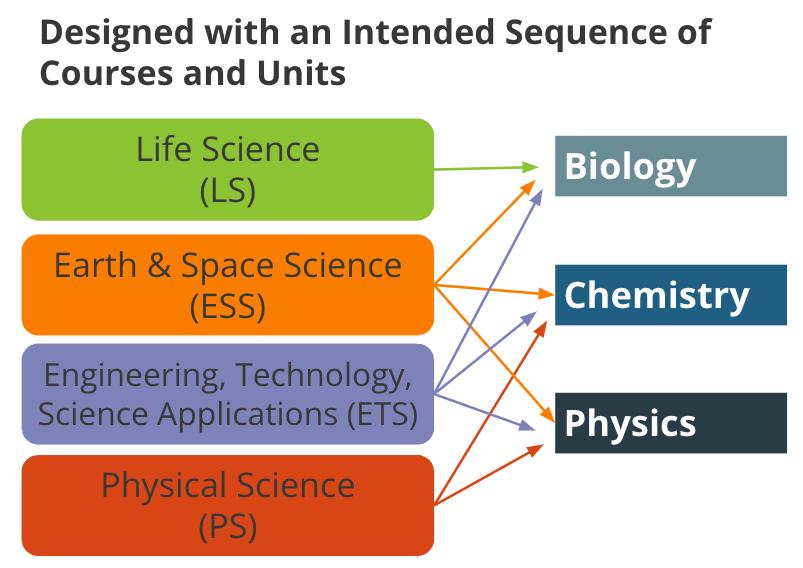
The resulting OpenSciEd High School program addresses each of the four science domains emphasized in A Framework for K-12 Science Education: the physical sciences (PS); the life sciences (LS); the Earth and space sciences (ESS); and engineering, technology, and applications of science (ETS). The biology course, which is designed to be taught first in the sequence, addresses all of the high school LS performance expectations The chemistry course, designed to be taught next, addresses some of the performance expectations of PS, and the physics course addresses the remainder of those performance expectations. All three courses address performance expectations in ESS and ETS (Figure 1).
A Coherent Set of Target PEs for Each Course
In the biology course, all LS performance expectations are addressed, but because the PS performance expectations encompass both chemistry and physics ideas, the development team allocated these into different courses. In doing so, we considered (a) which ideas were foundational for subsequent learning; (b) existing models for how states typically sequence science courses; and (c) advice from consultations with district science coordinators and high school teachers and our state steering committee. For example, the performance expectations associated with HS-PS2 are all related to forces and motion and are bundled in physics, with one exception. The performance expectation HS-PS2-4 Use mathematical representations of Newton’s Law of Gravitation and Coulomb’s Law to describe
and predict the gravitational and electrostatic forces between objects is spread across chemistry and physics, with Coulomb’s Law addressed in OpenSciEd Chemistry because it requires thinking deeply about atomic and molecular interactions, ideas related to other chemistry ideas. Ideas related to Newton’s Law of Gravitation are addressed in OpenSciEd Physics as they are closely related to other physics ideas
Integration of Earth and Space Science
The ESS PEs are integrated across multiple units in each of the Biology, Chemistry, and Physics courses. To develop the kinds of understandings called for in the NGSS, students build from and apply concepts related to physical forces and motion; chemical processes; and biochemical interactions, among others Thus, it makes sense to develop these ideas in tandem through grounded investigation in real-world phenomena, rather than in isolation. The first was to identify the associated LS and PS DCIs and CCC useful for understanding and applying a specific ESS performance expectation.
Bundling PEs into Coherent Units within Courses
Within each course, PEs were clustered or bundled together that contain a group of important science ideas. This process was informed by guidance from our state steering committee and consultation with science teachers and the science leaders.
Figure 2 shows how the NGSS performance expectations (PEs) are organized into bundles corresponding to the 16 units (5 each for biology and chemistry, 6 for physics), how these units are sequenced, and how units build on what students have figured out so far about the DCIs in these earlier units Appendix A provides the details for how each unit builds on what students have figured out about the DCIs in prior units.
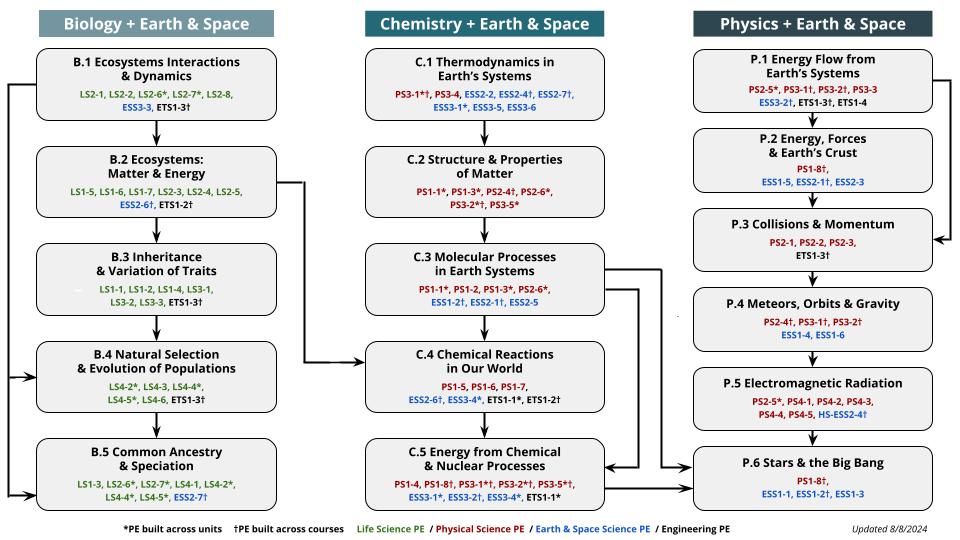
Figure 2: Scope and Sequence Map indicating PE clusters and DCI connections between units
What do the arrows mean?
Most units contain PEs from multiple science domains (PS, LS, ESS and ETS). While units build on each other in a sequential way, additional arrows show connections between non-sequential units, indicating that the later unit builds directly on what students figure out in the prior unit For example, Unit B 1 builds understandings of LS ideas related to changes in ecosystems that students later use to develop understandings of how populations of organisms adapt to such changes over time in B.4. These arrows are explained in Tables A.4-6 in Appendix A.
While the units were designed to be taught in sequence, it is possible to teach the units and courses in a different order. However, teachers may need to spend time with students building understandings of previously developed elements The Unit Overview that accompanies each unit includes guidance to help educators understand how each unit builds three-dimensional progressions across the course and program. It describes science
ideas that students should have previously developed in earlier OpenSciEd High School courses and units and in the middle school program. It also describes the focal DCIs that students will develop and use in subsequent units and courses. Guidance is also provided to support modifications if the unit is taught out of sequence.
Why are some PEs PEs marked with a “star” or a “dagger”?
Students’ learning is driven by their questions about intriguing phenomena As a result, students build understanding across multiple phenomena based units. For example, there is not a single unit about “forces and motion” (DCI PS2). While it is important for students to understand Newton’s Laws, emphasized in this DCI, models using those laws are embodied in very different kinds of phenomena and draw on very different kinds of intuitive ideas from students. Thus, we tease apart the PEs that include the forces and motion DCIs into multiple units where students work with the ideas that help them explain the phenomenon that can connect to their prior learning so they develop a coherent understanding of these science ideas
In Figure 2, the Scope and Sequence indicates that HS-PS 2-5 is addressed in both units P.1 and in P.5. PEs that are addressed across units are marked with a star in the Scope and Sequence map Appendix A explains how OpenSciEd supports students in assembling DCIs across units.
The same is true for ideas across courses When this happens, these PEs are marked with a dagger. For example, HS-PS3-1 addresses changes in energy within and between systems and is addressed in both OpenSciEd Chemistry (C.1) and Physics (P.1).
What happens if we switch the order of units?
In the past, it has been common practice to move around units in science curricula based on teacher licensure, teacher preference, or state standards However the research base summarized in the Framework that guided NGSS and other three-dimensional standards document the challenges created by this approach. The Framework emphasizes the need for coherence and the intentional building of all three dimensions as critical for equitable science education Therefore, OpensSciEd made the decision in development to make sure our materials would live up to a vision for science education that values and builds on the knowledge and experiences of all students as they progress from unit to unit and grade to grade. We believe this is critical for the future of science education and for the future of our nation
Significant changes to the unit order will disrupt the coherence and scaffolded learning of the three dimensions In making a decision to reorder the sequence, we recommend
thoughtful consideration of the resources that would be required for revision, a careful examination of priorities and policies that might be motivating such a revision, and a cost/benefit analysis that focuses on the benefits for student learning.
We know that there will be situations where the practical realities of implementation will mean that the sequence will need to be changed. With sufficient attention, it is possible to accomplish in a way that still would be effective for student learning. The sequence designed for the OpenSciEd high school program is not the only possible sequence that would be effective for student learning. There are multiple sequences that, in principle, could be effective. But to support coherence it is imperative to define a sequence in which ideas can build across years in ways that make sense to students, and to support these unit to unit connections that the sequence entails, as we have done in the development of OpenSciEd. Thus, if a school or district wants to switch the order of units recommended by OpenSciEd, some work would be needed to adapt units to support students in building complex ideas across units. The Unit Overview that accompanies each unit includes guidance to help educators understand the adaptations necessary if teaching the units out of the recommended order
Defining the Progressions Three Dimensional Elements within and Across Courses
A key innovation in the Framework and the NGSS is that, in addition to supporting students in building the DCIs coherently over the K-12 learning experience, students are also expected to build and deepen their use of SEPs and CCCs as well. To accomplish this, students learn to use the science and engineering practices along with the crosscutting concepts, in concert with disciplinary core ideas, throughout their scientific work in OpenSciEd units To ensure that these dimensions are just as important to student learning as the DCIs, each SEP and CCC is intentionally developed and then used centrally in students’ science work across each course. This leads to three cases for how a unit can treat each SEP and CCC.
SEP and CCC Elements are Intentionally Developed and Used in
Key Ways
When an SEP or CCC is used for the first time, or used in a new way, structures and supports for both teachers and students are included to make sure that students are learning how to use that element and that their use can develop overtime. When this happens, we identify that the SEP or CCC element is Intentionally Developed.
After students have developed an understanding of how to use a SEP or CCC, students encounter opportunities where to use that same CCC or SEP in later units. We call this Key Use as the use of the element is key to the sensemaking and gives students the opportunity to solidify their use of the SEP or CCC to make sense of phenomena and solve problems. Individual science and engineering practices and individual crosscutting concepts are used together as students figure out phenomena or solve problems. As described in the NGSS, “the eight practices are not separate; they intentionally overlap and interconnect” (NGSS, Appendix F, p. 3). Consequently, each unit contains many more cases where students use the SEPs and CCCs than those identified in the target PEs or in the lesson-level performance expectations. These additional uses of the SEPs and CCCs are Not a Focus of the unit learning, but students may apply these practices or concepts to accomplish the goals of their work in a lesson.
It is important to clarify that, like the DCIs, the development of SEPs and CCCs is not lumped together by “topic.” As mentioned earlier, students should not be expected to learn how to use Systems and Systems Models or Engaging in Argument from Evidence in a single unit Students will be supported in intentionally developing a particular aspect of working with systems and systems models in one unit, and then that CCC will have a key use in later units. Before, in between, and after each of these, there may be units where students use that particular SEP or CCC but it is not a focus.
Table 1 elaborates on three cases of how a SEP or CCC may be identified as intentionally developed, key use or not a focus in terms of what supports are in the unit, what teachers do, and what students do
Intentionally Develops
The unit…
…introduces new elements of the SEP or CCC or asks students to use it in a very different context. includes tasks or discussions that introduce new aspects of the SEP or CCC. contains lesson level performance expectations including this SEP or CCC.
Students…
… learn and use a new aspect of the SEP or CCC …are assessed on this SEP or CCC as part of a 3D assessment
Teachers…
…support students in tasks and discussions involving new aspects of the SEP or CCC …provide feedback on students’ performance of the SEP or CCC
Table 1. Building Science and Engineering Practices and Crosscutting Concepts What
Example
What is in the unit
…contains assessment opportunities for this SEP or CCC
What students do What teachers do
Biology, Unit B.1 intentionally develops the SEP Mathematics and Computational Thinking. The unit provides explicit instruction and scaffolds to support students in using algorithmic representations of phenomena to support claims and explanations about group behavior dynamics in ecosystems.
Chemistry Unit C.3 intentionally develops the CCC Structure and Function. The unit uses Structure and Function as a lens to make connections between atomic structure, bonding, and functions of objects at the bulk scale The unit asks students to compare various representations of atomic models to help explain how structures in atoms (valence electrons) allow for the formation of bonds. At the bulk scale, students explain polarity of molecules as a way to predict interactions of molecules.
Physics Unit P 6 intentionally develops the SEP Obtaining, Evaluating and Communicating Information. The unit introduces a scaffolded series of linked tools for doing online research, including the Obtaining Information Planning Tool, the Evaluating Information Checklist, the Obtaining Information Tool, and the Communicating Information Tool.
Key Use
The unit … includes the SEP or CCC in a central role in students’ sensemaking in the unit, and so may contain lesson level performance expectations that include it …provides opportunities for students to have more experience working with the SEP or CCC through its use in multiple lessons. But, the unit… does not introduce new elements of the SEP or CCC. does not ask students to use the SEP or CCC in a very different context from earlier units.
Students… use the SEP or CCC in ways that are not substantially different in terms of the elements they draw on or the contexts in which they used it in earlier units …reinforce their understanding of it with substantial opportunities to use it again.
Teachers… continue to provide support and feedback for students on their use of the SEP or CCC. … may fade scaffolding for it (if appropriate).
What is in the unit
What students do What teachers do
Biology Unit B 4 includes an example of a key use of the CCC Stability and Change In this unit, students use the CCC in ways that were intentionally developed in Unit B.1 to make sense of population size and genetic diversity in the context of evolution.
Example
Not a Focus
Chemistry Unit C 2 includes an example of a key use of the SEP Using Mathematics and Computational Models. Students develop mathematical models and use Coulomb’s Law to explain how the scale of or distance between charges influences how lightning forms during a storm.
Physics Unit P.2 includes an example of a key use of the CCC Systems and System Models. In this unit, students use conventions that were intentionally developed in Unit P.1 to model the transfer of energy through subsystems in Earth’s geosphere, such as through convection and volcanic eruptions, and keep track of how energy transfer impacts matter change and cycling
The unit…
…may expect students to use the SEP or CCC, but not as part of the major work students do.
… may not mention the SEP or CCC at all.
Students…
… may use the SEP or CCC but it is not central in their work,
… or may not be asked to use the SEP or CCC in this unit.
Teachers…
… do not focus instruction or scaffolding on the SEP or CCC.
Tables 2 and 3 use this three category scheme of intentionally develop, key use and not a focus to summarize the progression of the SEPs and CCCs respectively in the OpenSciEd Program.



Table 2. Summary of the Progression for the SEPs
Table
3. Summary of the Progression for the CCCs
How to Use The Scope and Sequence Appendices
This document provides guidance about how each unit in a course contributes to the development and/or draws on what students have already figured out about elements of the DCIs, CCCs, and SEPs to fully prepare students to meet the performance expectations defined by the NGSS. The figure and tables above summarize the progressions for each of the three NGSS dimensions, DCIs (Figure 1), SEPs (Table 2) and CCCs (Table 3). The appendices provide more detailed explanations of the information in the figure and tables
Teachers can use the information about what is new (and therefore supported and assessed) and what is expected based on students’ prior learning, as articulated in these appendices, to plan their teaching of the unit for their own students and differentiate where more or less support may be needed Schools or districts can use these appendices to develop their scope and sequence if they plan to customize the OpenSciEd. The Scope and Sequence identifies the important supports for building across units within a course that need to be considered in customizing the scope and sequence. It also shows links across courses that may be useful for schools and districts choosing to adopt more than one course. It is not necessary to adopt all three courses; each course does not where elements of DCIs, CCCs, and SEPs have been targeted in earlier courses.
The information in this scope and sequence is drawn from the explanations within each unit in the Teacher Background Knowledge section of the Unit Overview. The Scope and Sequence pulls the information from each unit and connects it all together to tell the story in one place of how the OpenSciEd program helps students build each dimension step by step across the units in each course in ways that make sense and are meaningful to students.
● Appendix A: DCI Progressions: This appendix explains how each unit plays a role in developing DCI elements that build over time within and across units in a course and, occasionally, across courses.. The DCI Progressions expand on the S&S map identifying how PEs are assembled across units (and occasionally across courses) and how each unit builds on prior units in terms of the DCI-based connections
● Appendix B: How OpenSciEd Units Support the Progressions of SEPs and CCCs. This appendix expands on Table 1 to define what you will see in each unit in terms of the guidance a unit provides and the expectations for prior learning when the unit Intentionally Develops or draws on Key Use of an SEP or CCC
● Appendix C: SEP Progressions describes how students build the elements of each SEP in each unit within each course, detailed in terms of NGSS elements of SEPs.
● Appendix D: CCC Progressions describes how students build the elements of each CCC within each course, detailed in terms of NGSS elements of CCCs.
● Appendix E describes the process for developing the OpenSciEd Scope and Sequence.
Additional Resources
Access the following to learn more about the OpenSciEd program and its rationale including:
The pedagogical approach in OpenSciEd High School School that this S&S supports, see the OpenSciEd Teacher Handbook: High School Science.
The development of each of the three OpenScied courses, see the OpenSciEd webinars on each of the courses at OpenSciEd.org.
An overview of the OpenSciEd High School development:
Penuel, W. R., Henson, K., Bracey, Z. B., VIck, N., & Rivet, A. E. (in press). Strategies for designing standards-aligned instructional materials that connect to students’ interests and community priorities. The Science Teacher. https://doi org/10 1080/00368555 2024 2390547
The history and overall approach of the OpenSciEd project (focused on the middle school), read this article (free download):
Edelson, D. C., Reiser, B. J., McNeill, K. L., Mohan, A., Novak, M., Mohan, L., Affolter, R., McGill, T. A. W., Bracey, Z. E. B., Noll, J. D., Kowalski, S., Novak, D., Lo, A. S., Landel, C , Krumm, A , Penuel, W R , Horne, K V , González-Howard, M , & Suárez, E (2021) Developing research-based instructional materials to support large-scale transformation of science teaching and learning: The approach of the OpenSciEd middle school program. Journal of Science Teacher Education, 32(7), 780-804. https://doi.org/10.1080/1046560X.2021.1877457
Coherence from the students’ perspective as defined by Brian Reiser and the NextGen Science Storylines group in their work on NGSS science storylines:
Reiser, B. J., Novak, M., McGill, T. A. W., & Penuel, W. A. (2021). Storyline units: An instructional model to support coherence from the students’ perspective. Journal of Science Teacher Education, 32(7), 805-829. https://doi org/10 1080/1046560X 2021 1884784
How the storylines model used in OpenSciEd reflects and builds on ideas in project-based learning and promotes relevance, read this article:
Penuel, W. R., Reiser, B. J., McGill, T. A. W., Novak, M., Van Horne, K., & Orwig, A. (2022) Connecting student interests and questions with science learning goals through project-based storylines Disciplinary and Interdisciplinary Science Education Research, 4(1), 1-27 https://doi org/10 1186/s43031-021-00040-z
Strategies OpenSciEd uses to build connections between science and engineering content and students’ interests and community priorities, read this manuscript:
Penuel, W. R., Henson, K., Buck-Bracey, Z., Vick, N., Rivet, A., & OpenSciEd High School Writing Team. (2023). Designing standards-aligned instructional materials that connect to students’ interests and community priorities. OpenSciEd High School Development Consortium.
Appendix A: DCI Progressions
In this Appendix, we expand on the scope and sequence graphic in Figure 2 to identify (a) how PEs are assembled across units and courses and (b) how each unit builds on the work of prior units in developing DCIs.
Performance expectations across units
Here we document how students incrementally build understanding of DCIs that make up the performance expectations when a PE is addressed in more than one unit (indicated with a *) or in more than one course (indicated with a † ) The PEs with DCIs that are intentionally built across units and courses are shown in Tables A.1, A.2, and A.3. In cases where a DCI element is developed across units and/or courses that element will appear with sections crossed out in the Teacher Background Knowledge section of the Unit Overview The tables below document how and when elements with portions crossed out in one unit are developed across units and/or courses.
Table A.1 Building Life Science DCIs Across Units
DCI Elements:
LS2 C: Ecosystem Dynamics, Functioning, and Resilience
● A complex set of interactions within an ecosystem can keep its numbers and types of organisms relatively constant over long periods of time under stable conditions. If a modest biological or physical disturbance to an ecosystem occurs, it may return to its more or less original status (i e , the ecosystem is resilient) [B 1], as opposed to becoming a very different ecosystem. Extreme fluctuations in conditions or the size of any population, however, can challenge the functioning of ecosystems in terms of resources and habitat availability [B.5].
Progression: In B 1, students figure out ideas about biodiversity, disturbances and ecosystem resilience through an investigation with an interactive model of the Serengeti In B.5 students figure out that in some cases, changes, such as those in the Arctic may be so extreme that bear populations may be affected in ways that impact the number of bear species and sizes of their populations.
HS-LS2-7 B.1, B.5
DCI Elements:
LS4.D: Biodiversity and Humans
● Biodiversity is increased by the formation of new species (speciation) and decreased by the loss of species (extinction) (secondary) [B 5]
● Humans depend on the living world for the resources and other benefits provided by biodiversity. But human activity is also having adverse impacts on biodiversity through overpopulation, overexploitation, habitat destruction, pollution, introduction of invasive species, and climate change Thus sustaining biodiversity so that ecosystem functioning and productivity are maintained is essential to supporting and enhancing life on Earth. Sustaining biodiversity also aids humanity by preserving landscapes of recreational or inspirational value. (secondary) (Note: This Disciplinary Core Idea is also addressed by HS-LS4-6.) [B.1]
Progression: In B 1 students investigate conservation profiles in Lesson 1 and develop models to explain how ecosystems work and why humans want to protect them In Lesson 11, they evaluate the efficacy of conservation plans in those ecosystems, including their impacts on biodiversity. In B.5 figure out how biodiversity is impacted by speciation and extinction.
DCI Elements:
LS4.C: Adaptation
HS-LS4-2 B 4, B 5
HS-LS4-5 B 4, B 5
● Evolution is a consequence of the interaction of four factors: (1) the potential for a species to increase in number, (2) the genetic variation of individuals in a species due to mutation and sexual reproduction, (3) competition for an environment’s limited supply of the resources that individuals need in order to survive and reproduce, [B.5] and (4) the ensuing proliferation of those organisms that are better able to survive and reproduce in that environment.
Progression: In B 4 students figure out a mechanism for natural selection focusing on factors (1), (2), and (4) They explore competition in the context of the examples (hawksbeard, rats and juncos) and further develop this element in B.5 as they predict changes to polar bear populations in the Arctic.
DCI Elements:
LS4 C: Adaptation
● Changes in the physical environment, whether naturally occurring or human induced, have thus contributed to the expansion of some species, the emergence of new distinct species as populations diverge under different conditions, [B 5] and the decline–and sometimes the extinction [B 5]–of some species
● Species become extinct because they can no longer survive and reproduce in their altered environment. If members cannot adjust to change that is too fast or drastic, the opportunity for the species’ evolution is lost [B.5].
Progression: In B 4 students figure out how human urbanization has affected natural selection in populations of some species resulting in decline or expansion In B 5 students build on that idea to figure out how environmental conditions over time contributed to the speciation of bears and may contribute to the expansion of, speciation or extinction of bear
LS PE Units The Progression of DCI Elements Across Units
species in the future. In the case of the polar bears, students make arguments based on evidence about what will happen to polar bears, in the future, as the Arctic changes
Table A.2 Building Physical Science DCIs Across Units
PS PE Units The Progression of DCI Elements Across Units
DCI Elements:
PS1.A: Structure and Properties of Matter
● Each atom has a charged substructure consisting of a nucleus, which is made of protons and neutrons, surrounded by electrons.
C.2, C.3
HS-PS1-3 C 2, C 3
● The periodic table orders elements horizontally by the number of protons in the atom’s nucleus and places those with similar chemical properties in columns. The repeating patterns of this table reflect patterns of outer electron states. [C 3]
Progression: In C.2 students figure out that atoms contain substructures with different charges to help explain lightning production due to polarization differences between the air and ground. They use a simplified atomic model, the paperclip model, to aid in sensemaking In C 3 students build upon atomic structure and evaluate the usefulness of multiple atomic models (e.g., Lewis Dot, electron shell, and electric cloud). Students develop the periodic table using patterns in similarities between atomic characteristics.
DCI Elements:
PS1.A: Structure and Properties of Matter
● The structure and interactions of matter at the bulk scale are determined by electrical forces within and between atoms
PS2 B: Types of Interactions
● Attraction and repulsion between electric charges at the atomic scale explain the structure, properties, and transformations of matter, as well as the contact forces between material objects. (secondary) [C 2]
Progression: In C 2 students use contact forces between material objects to explain differences in how lighting is/isn’t able to travel through different materials (e.g., wood, metal, air). In C.3 the focus of force thinking is at the atomic scale to develop explanations of atomic bonds.
HS-PS1-1
PS PE Units The Progression of DCI Elements Across Units
DCI Element:
PS1 B: Chemical Reactions
HS-PS1-4,
HS-PS1-5
HS-PS1-8
C.4, C.5
● Chemical processes, their rates [C 4], and whether or not energy is stored or released [C.5] can be understood in terms of the collisions of molecules and the rearrangements of atoms into new molecules, with consequent changes in the sum of all bond energies [C.5] in the set of molecules that are matched by changes in kinetic energy
Progression: In C 4 students figure out how rates of chemical reactions can change as a result of changes in concentration or temperature of the substances involved in the chemical reaction. In C.5 students figure out how the stability of substances, or ease of reaction, is related to bond energies of the molecules in the substance. The framing in how students engage with this DCI element over the two units, and NGSS PEs, is based upon the language of each NGSS PE and related clarification statements
DCI Elements:
PS1.C: Nuclear Processes
C.5, P.2, P.6
HS-PS2-4 C.2, P.4
● Nuclear processes, including fusion [P 6], fission [C 5], and radioactive decays [P 2] of unstable nuclei, involve release or absorption of energy. The total number of neutrons plus protons does not change in any nuclear process.
Progression: In C.5 students develop models to illustrate the changes in the composition of the nucleus and the energy released during fission In P 2 students develop models to explain radioactive decay in Earth’s interior In P 6 students develop models to explain fusion in the Sun.
DCI Elements:
PS2.B: Types of Interactions
● Newton’s law of universal gravitation [P.4] and Coulomb’s law [C.2] provide the mathematical models to describe and predict the effects of gravitational and [P 4] electrostatic [C 2] forces between distant objects
● Forces at a distance are explained by fields (gravitational [P.4], electric, and magnetic [P.4]) permeating space that can transfer energy through space. Magnets or electric currents cause magnetic fields; electric charges or changing magnetic fields cause electric fields [P 4]
Progression: In C.2 students develop a mathematical understanding using Coulomb’s Law to explain the effects of the amounts of differential charges and distances between those charges which lead to lightning (a transfer of energy through space). In P.4 students use Newton’s Law to explain energy transfer between objects and the gravitational field in an orbital system
PS PE Units The Progression of DCI Elements Across Units
DCI Elements:
PS2 B: Types of Interactions
HS-PS2-6 C 2, C 3
HS-PS3-1 C 1, C 5, P 1, P 4
● Attraction and repulsion between electric charges at the atomic scale explain the structure, properties, and transformations of matter, as well as the contact [C.3] forces between material objects.
Progression: In C.2 students use forces between material objects to explain differences in how lighting is/isn’t able to travel through different materials (e g , wood, metal, air) In C 3 students develop understanding of contact forces at the atomic scale to explain adhesion and cohesion.
DCI Elements:
PS3 A: Definitions of Energy
● Energy is a quantitative property of a system that depends on the motion and interactions of matter and radiation within that system. That there is a single quantity called energy is due to the fact that a system’s total energy is conserved, even as, within the system, energy is continually transferred from one object to another and between its various possible forms [C 1]
PS3.B: Conservation of Energy and Energy Transfer
● Conservation of energy means that the total change of energy in any system is always equal to the total energy transferred into or out of the system. [C.1, P.1]
● Mathematical expressions, which quantify how the stored energy in a system depends on its configuration [C 5] (e g relative positions of charged particles, compression of a spring) and how kinetic energy depends on mass and [P 4] speed [C.1, P.4], allow the concept of conservation of energy [C.1, C.5] to be used to predict and describe system behavior.
● The availability of energy limits what can occur in any system [P 1, P 4]
Progression: In C.1 students use energy transfers between the atmosphere, hydrosphere, and cryosphere to explain rising sea levels. Additionally, they use mathematical representations to show energy conservation as energy is transferred between the three spheres (C.1). In C.5 students quantitatively reason about energy transfer and how positions of charged particles result in a release in energy during chemical reactions In P 1 students consider energy transfers between circuit systems and the systems that provide energy for human use. In P.4 students work with energy transfer and conservation of energy between orbiting objects and the Sun and the gravitational field between them.
HS-PS3-2
C.2, C.5, P.1, P.4
DCI Elements:
PS3 A: Definitions of Energy
● Energy is a quantitative property of a system that depends on the motion and interactions of matter and radiation within that system. That there is a single quantity called energy is due to the fact that a system’s total energy is conserved, even as, within the system, energy is continually transferred from one object to another and between its various possible forms [Not addressed as part of HS-PS3-2, see HS-PS3-1 above ]
● At the macroscopic scale, energy manifests itself in multiple ways, such as in motion, sound, light, and thermal energy. [C.5, P.4]
● These relationships are better understood at the microscopic scale, at which all of the different manifestations of energy can be modeled as a combination of energy associated with the motion of particles and energy associated with the configuration (relative position of the particles). In some cases the relative position energy can be thought of as stored in fields (which mediate interactions between particles) [C.5]. This last concept includes radiation, a phenomenon in which energy stored in fields moves across space [P.5].
Progression: In C 2 students identify that energy is present when lightning strikes and represent energy transfer at the microscopic level via particle motion and fields In C 5 students trace the different ways energy is manifested during combustion reactions and examine energy relationships at a microscopic scale to build understanding of how batteries work. In P.5 students build an understanding of radiation as energy stored in fields and use that to predict interactions with matter inside the microwave oven
DCI Elements:
PS3.C: Relationship Between Energy and Forces
● When two objects interacting through a field change relative position, the energy stored in the field is changed. [C.2, C.5]
HS-PS3-5 C.2, C.5,
Progression: In C 2 students develop understanding and generalize ideas that energy is stored in electric fields which is established by forces between particles as those particles move between systems. Throughout C.5 students develop understanding and connect changes in stored energy in a field to particle movement as they work to explain chemical bonds breaking and reforming.
Table A.3 Building Earth and Space Science DCIs Across Units
ESS PE Units The Progression of DCI Elements Across Units
DCI Elements:
ESS2.D: Weather and Climate
HS-ESS2-6 B.2, C.4
● Gradual atmospheric changes were due to plants and other organisms that captured carbon dioxide and released oxygen [Not addressed as part of HS-ESS2-6, see HS-ESS2-7 below ]
HS-ESS2-7 B.5, C.1
HS-ESS2-4 C.1, P.5
DCI Elements:
ESS2 D: Weather and Climate
● Gradual atmospheric changes were due to plants and other organisms that captured carbon dioxide and released oxygen. [C 1]
Progression: In C 1 students examine how the evolution of plants and other photosynthetic organisms caused the development of our current atmosphere.
DCI Elements:
ESS1 B: Earth and the Solar System
● Cyclical changes in the shape of Earth’s orbit around the sun, together with changes in the tilt of the planet’s axis of rotation, both occurring over hundreds of thousands of years, have altered the intensity and distribution of sunlight falling on the earth. These phenomena cause a cycle of ice ages and other gradual climate changes. (secondary) [C 1]
ESS2.A: Earth Materials and Systems
● The geological record shows that changes to global and regional climate can be caused by interactions among changes in the sun’s energy output or Earth’s orbit, tectonic events, ocean circulation, volcanic activity, glaciers, vegetation, and human activities. These changes can occur on a variety of time scales from sudden (e.g., volcanic ash clouds) to intermediate (ice ages) to very long-term tectonic cycles. [C 1]
ESS2.D: Weather and Climate
● The foundation for Earth’s global climate systems is the electromagnetic [P 5] radiation from the sun, as well as its reflection, absorption, storage, and redistribution among the atmosphere, ocean, and land systems, [C.1] and this energy’s re-radiation into space.
Progression: In C.1 students examine data showing the impact of (long-term) changes in Earth’s orbit and tilt on temperature Students also consider the effects of more short-term changes such as tectonic events, ocean circulation, and volcanic activity on Earth’s temperature. In P.5 students explain how the types of EM radiation from the Sun versus those from Earth affect greenhouse gases differently and lead to different absorption rates, which influence the warming of the atmosphere at rates that are out of line with past data trends
DCI Elements:
ESS3.A: Natural Resources
● Resource availability has guided the development of human [C 5] society
ESS3.B: Natural Hazards
HS-ESS3-1 C 1, C 5,
● Natural hazards and [C 1] other geologic events [C 5] have shaped the course of human history; [they] have significantly altered the sizes of human populations and have [C.5] driven human migrations.
Progression: In C.1 students consider natural hazards’ impacts on society. In C.5 students consider how the formation of fossil fuels over millions of years helped to alter human society as they compare fossil fuels to biofuels, but they do not consider other geologic processes in this unit
HS-ESS1-2 C.3, P.6
DCI Elements:
ESS1 A: The Universe and Its Stars
● The study of stars’ light spectra and brightness is used to identify compositional elements of stars, their movements, and their distances from Earth. [P 6]
● The Big Bang theory is supported by observations of distant galaxies receding from our own, of the measured composition of stars and non-stellar gases, and of the maps of spectra of the primordial radiation (cosmic microwave background) that still fills the universe. [P.6]
● Other than the hydrogen and helium formed at the time of the Big Bang, nuclear fusion within stars produces all atomic nuclei lighter than and including iron, and the process releases electromagnetic energy. Heavier elements are produced when certain massive stars achieve a supernova stage and explode. [P.6]
PS4 B: Electromagnetic Radiation
● Atoms of each element emit [P.6] and absorb characteristic frequencies of light. These characteristics allow identification of the presence of an element, even in microscopic quantities. (secondary) [C.3]
Progression: In C 3 students use transmission light spectra (absorption) to determine the presence of specific elements on objects in space In P 6 students investigate stars that suddenly appear and disappear as well as characteristics of stars such as brightness. shape, and color. They investigate the life cycle of the sun and other stars, how the sun reaches Earth as radiation, and the production of elements during the Big Bang including fusion of elements within stars
DCI Elements:
ESS2.B: Plate Tectonics and Large-Scale System Interactions
HS-ESS2-1 C.3, P.2
C 1, C 5
● Plate tectonics is the unifying theory that explains the past and current movements of the rocks at Earth’s surface and provides a framework for understanding its geologic history. Plate movements are responsible for most continental and ocean-floor features and for the distribution of most rocks and minerals within Earth’s crust. [P 2]
Progression: Plate tectonics is beyond the scope of C 3 This element is fully addressed in P.2.
DCI Elements:
ESS3.A: Natural Resources
● Resource availability has guided the development of [C.5] human society.
ESS3 B: Natural Hazards
● Natural hazards and other [C.1] geologic events [C.5] have shaped the course of human history; [they] have significantly altered the sizes of human populations and have [C 5] driven human migrations
Progression: In C.1 students investigate human migration related to sea level rise and how changing resource availability would impact society. In C.5 they investigate resource availability in the context of fuels and consider how this has guided the development of human society and impacts on human population
HS-ESS3-1
Table A.3 Building Engineering, Technology and the Application of Science DCIs Across Units
DCI Elements:
ETS1.B: Developing Possible Solutions
HS-ETS1-3 B.1, B.3, B 4, P 1, P.3
HS-ETS1-1 C 4, C 5
When evaluating solutions, it is important to take into account a range of constraints, including cost, safety, reliability [P 3], and aesthetics, and to consider social, cultural, and environmental impacts
Progression: In multiple units in Biology, students figure out how solutions to problems such as building a road through the Serengeti, serving as a health navigator and considering nonhuman species when developing cities take into consideration a range of constraints Reliability and safety are explicitly considered in P 3 when students evaluate how to make driving safer
DCI Elements:
ETS1.A: Defining and Delimiting Engineering Problems
● Humanity faces major global challenges today, such as the need for supplies of clean water and food or for energy sources that minimize pollution [C.5], some of which can be addressed through engineering. These global challenges also may have manifestations in local communities [C.5].
Progression: In C 4 students identify how chemical engineering might be used to develop solutions to problems. In C.5 students consider how fuel choices for vehicle transportation can minimize pollution.
How does each OpenSciEd unit build on what students have figured out about the DCIs in prior units?
The section describes how each unit builds on prior work begun in earlier units. An arrow between two units means that the latter unit asks students to use ideas they developed in a prior unit to build additional understandings and extend ideas in a new context
There are additional unit-to-unit connections important to coherence that are not shown by an arrow For example, the arrow from Unit P 1 to P 3 in the S&S diagram makes it clear that Unit P.3 builds directly on Unit P.1 students build a foundation for understanding energy transfer and conservation in a that they build on in P.3 asd they focus on forces as a way to model interactions.
Thus, there are more connections than those shown just by the arrows. However, to keep the map from being more confusing, we draw arrows only from the most recent use of each model idea that students will need to draw on. This includes the relationship between the final unit of one course and the first unit of the subsequent course In B 5, the final unit of the biology course, students think about the implications of a warming Earth on bear
populations in the Arctic In C 1, the first unit of the subsequent chemistry course, students think about the impacts of a warming Earth on human populations. Students develop understanding of how feedbacks between Earth systems impact life on Earth and vice versa. In C.5, the final unit of the chemistry course, students evaluate different fuels used for transportation Students examine different sources of carbon dioxide emissions and determine most are a result of burning fossil fuels for transportation, thus leading to the focus of the unit. In P.1, the first unit of the subsequent physics course, students’ explore different energy sources for electricity to develop a plan to prevent blackouts. Ideas around energy use and storage developed in C 5 are leveraged in P 1 as students examine different energy sources used to produce electricity.
Tables A.4, A.5 and A.6 identify the ways the units in each course build on prior units and explains the arrows depicted in the image in Figure 2. Many units also build in critical ways on science ideas, practices, and concepts developed in prior grade bands. To learn about these connections please see the Teacher Background Knowledge in the Unit Overview for each individual unit.
Table A.4 How Each Biology Unit Builds on Prior Units
In B 2, students build on the ideas about ecosystems introduced in B 1 to make sense of the flow of energy and matter in the zombie fire system. This includes limiting factors, carrying capacity, biodiversity, human activities, and natural resources management. They continue to develop their understanding of the trade-offs and criteria involved in solving real world problems The practice of mathematics and computational thinking is further developed as they use mathematical representations to support their explanations.
In B 3 students build on their use of the practice developing and using models Their models include components, interactions and mechanisms at multiple scales. In B.2 student models explained the flow of energy and matter in Earth’s system at the molecular scale, in processes such as photosynthesis and cellular respiration and at the global scale as they trace matter and energy flows through Earth’s systems in Fire systems Student experiences in B 2 prepare them to explain who gets cancer and why at multiple scales
this units builds on
B 4 Natural Selection & Evolution of Populations
B.1 → B.4 B 3 → B 4
B.5 Common Ancestry & Speciation B.4 → B.5
In B.4 students use ideas that they figured out in B.1 about population dynamics, biodiversity and ecosystem resilience as they work to figure out how urbanization affects populations This includes ideas about limiting factors and changing environmental conditions. They build on ideas from B.3 about genetics, including the role of DNA in coding for traits passed to parents and offspring and the variation and distribution of traits within populations.
In this culminating unit, students use what they have figured out in all the previous units in OpenSciEd Biology to explain how Arctic bear populations might change as their environment changes. This includes ideas about organisms, populations, limiting factors and carrying capacity (B 1), the flow of energy and matter in ecosystems (B 2), inheritance of traits (B 3), and evolution by natural selection from (B.4).
C 2 Structure & Properties of Matter C.1 → C.2
In C 2 students connect particle-level thinking they developed in C 1 to consider differences in particles as they work to develop explanations for why lightning occurs and some structures are safer shelters than others during a lightning storm. Students develop and use models to explain how differences in charges of ionized air particles and the ground results in lightning traveling from the cloud to ground during a storm Students consider scale, proportion, and quantity to develop understanding of Coulomb’s Law to relate differences in strengths of charges based upon distance and magnitude of the charged particles. This unit sets the stage to fully develop atomic models and the Periodic Table in unit C.3.
C 3 Molecular Processes in Earth Systems C 2 → C 3
C 4 Chemical Reactions in Our World
→ C.4 B 2 → C 4
In C.3 students fully develop models of atoms that they began to develop in C.2. Students also connect the idea of polarization, first developed in C.2, as they work to develop and use models to explain why water dissolves substances better than other liquids Students use patterns based on bulk and atomic-scale interactions to co-construct a Periodic Table They use this to make predictions about which elements would combine to form compounds which would allow us to make the materials we need to survive off of Earth.
In C 4 students continue to use patterns of elements in the Periodic Table, such as electronegativity, developed in C.3 to fully explain atomic bonding. Students build on their use of mathematics and computational thinking through unit conversions developed in previous units (C.1) as they engage with stoichiometry to try to work
Table A.5. How Each Chemistry Unit Builds on Prior Units
Unit
C 5 Energy from Chemical & Nuclear Processes
Key connections (arrows)
P.2 Energy, Forces, & Earth's Crust
C 3 → C 5
C.4 → C.5
How this units builds on prior units
to reduce the pH of acidic ocean water to support the development of oysters, a first food for the Swinomish Tribe. In C.4 students figure out the mechanisms of many of the interactions of the components of the carbon cycle that students initially investigate in B 2
In this culminating unit, students use what they have figured out in previous OpenSciEd Chemistry units to determine which fuel our future vehicles should use to reduce human impacts on Earth systems Students revise their definition of chemical bonds developed in C.3 by adding ideas about strength of bonds. In C.3 students developed a model of the atom, including neutrons. In C.5 students examine the role of neutrons in nuclear fusion. This includes ideas about energy transfer between and within Earth systems and human activity (C 1), the relationship between energy, matter, and forces (C 2), and chemical reactions (C.4).
A.6. How Each Physics Unit Builds on Prior Units
(arrows)
P.3 Collisions & Momentum
P.1→P.2
P.2→P.3
P.1→P.3
Unit P.2 builds on student ideas about energy transfer and matter interactions from P.1 where students developed ideas about energy transfer and conservation in the context of charged particles (electrons) colliding with other electrons (electricity) to transfer energy across great distances In P 2, Earth science phenomena where the transfer of energy is different across scales of time and space motivates the need for forces to explain observations. Students establish conventions for modeling forces using free-body diagrams and think deeply about the connection between unbalanced forces, energy transfer, and motion.
P.3 builds on student ideas about forces and matter interactions that students developed in P.2. The development of the concept of forces was needed in order to explain Earth science phenomena that involve energy transfer across scales of time and space In this unit, students develop a more robust understanding of forces as vectors and use conservation of momentum and Newton’s second law to make predictions about the outcomes of collisions. Students also build on ideas around energy transfer and conservation in the context of charged particles (electrons) colliding with other electrons (electricity) to transfer energy across great distances that they figured out in P 1
Table
How this units builds on prior units
P 4 Meteors, Orbits, & Gravity
P 3→P 4
How this units builds on prior units
In P 4 students build on what they figured out about contact forces in P 3 to explain the dynamics of orbiting objects. This includes students expanding their model of forces to include forces of gravity at great distances, using ideas about fields developed in the first unit to understand the relationships between gravity and energy transfer
P.5
Electromagnetic Radiation
P 6 Stars & the Big Bang
P.4→P.5
C 3→P 6
C.5→P.6
P.5→P.6
In P.5, students build on ideas about energy transfer and forces from previous units, and apply these ideas in the context of waves and electromagnetic radiation. For example, in P.4, students expand their model of forces to include the force of gravity at great distances, using ideas about fields developed in the first unit to understand the relationships between gravity and energy transfer In this unit, students use energy transfer, electromagnetism, wave mechanics, and forces at a distance to explain how food heats up in a microwave and how this technology might be dangerous for humans (and also save lives).
In the final unit of the course, students explore cosmology and the Big Bang, applying ideas about forces and energy from P.5 and the units that precede to the scale of the universe Additionally, students build upon ideas of nuclear fusion developed in C 5 as they consider the role of nuclear fusion in stars Students also incorporate ideas around using light spectra as evidence to examine space previously developed in C.3.
Appendix B: How OpenSciEd Units Support the Progressions of SEPs
and CCCs
This Appendix expands on the definitions from Table 2 to identify the particular criteria for classifying how a unit treats an SEP or CCC. This appendix explains what supports are available in each unit that teaches (intentionality develops) new aspects of SEPs or CCCs, draws on what students are expected to have already learned about them in earlier middle school units to accomplish making sense of phenomena or solving problems (key use), or focuses on other SEPs or CCCs.
(A) The Unit Intentionally Develops the SEP or CCC
There are several criteria that reflect cases where a unit Intentionally Develops a particular SEP or CCC. These have in common that students need to extend or broaden their current ideas and ways of using an SEP or CCC to do the work of the current unit. That is, the unit contains tasks and supports for something students need to learn about the SEP or CCC.
Why is this important? The Intentionally Developed label indicates what issues to attend to in skipping or reordering OpenSciEd units. If a unit Intentionally Develops an SEP or CCC and that unit is skipped, students will miss something important about the SEP or CCC that later units and the high school grade band PEs rely on Consequently, it will be necessary to address those aspects of the SEP or CCC in some other way. Similarly, if the unit sequence is changed, teachers should check where later units assume some prior development of the SEP or CCC in this unit. Teachers would need to fill in that preparation in some way for students to succeed in later units that depend on this
A unit that Intentionally Develops a particular SEP or CCC typically includes several of the following five characteristics
1. Introduces and supports new elements: Units that Intentionally Develop an SEP or CCC may support students in working with an element of that SEP or CCC for the first time in the high school grade band. For example, students begin work with the practice Mathematics and Computational Thinking (SEP 5) in unit B.1. where they use mathematical, computational and algorithmic representations of phenomena to support claims and explanations (SEP 5 2) As this is the first time students use this element, scaffolds are built into the unit to help them develop their use of this practice. Thus, we label unit B.1 as Intentionally Developing the SEP of Mathematics and Computational Thinking.
2 Using the practice or concept in a very different context: In some cases the elements of SEPs and CCCs in NGSS Appendices F and G do not capture all the important shifts in thinking for students in learning to apply the practice or concept. The OpenSciEd progressions identify additional cases where support is needed to help broaden how students think about and use an SEP or CCC Thus, units that Intentionally Develop an SEP or CCC may support students in working with the SEP or CCC in a very different type of context. For example, OpenSciEd units involve students in Developing and Using Models (SEP 2) to explain phenomena in many units Throughout the chemistry course, students develop and use models to explain phenomena. In unit C.1 students develop and use multiple types of models to explain sea level rise due to melting glaciers, impacts of increased atmospheric carbon dioxide on Earth’s temperature, and predict the effects of mitigation strategies This unit introduces students to two elements: Develop, revise, and/or use a model based on evidence to illustrate and/or predict the relationships between components of a system (SEP 2.3) and Develop and/or use multiple types of models to provide mechanistic accounts and/or predict phenomena, and move flexibly between model types based on merits and limitations (SEP 2 4) In units C 2 and C 3, the complexity of predictions changes as students move beyond macro and microscale interactions into atomic and subatomic scale interactions. Students move between multiple components of the lightning system at multiple scales to explain relationships between matter, forces, and energy resulting in lightning formation (C.2). Students move between different subatomic models based on the merits of them to explain various atomic-level phenomena (C.3). This shift in complexity of moving between models at different scales from macro (e.g., Earth systems, bulk scale properties of materials) to subatomic demonstrates how students are supported in Intentionally Developing elements of the modeling practice rather than just providing Key Use.
3. Assessment guidance for the SEP or CCC: Units that intentionally develop an SEP or CCC typically provide assessment guidance for that SEP or CCC to help teachers assess students’ development and provide feedback. These resources can be found in assessment tasks, assessment tools, Assessment Opportunity call-outs in lessons, and in the Assessment System Overview found in the Unit Overview.
4 Use of the SEP or CCC in Lesson-Level Performance Expectations: Units that intentionally develop an SEP or CCC will typically include that SEP or CCC in multiple lesson-level performance expectations. Lesson-level Performance Expectations can
be found in each lesson in the What Students Will Do section on the first page of each lesson and in the Assessment System Overview found in the Unit Overview.
(B) The Unit Provides a Key Use of the SEP or CCC
Definition: In contrast to Intentionally Developed, units that provide a Key Use of an SEP or CCC ask students to use that SEP or CCC in ways that are not dramatically different in terms of the elements they draw on or the contexts in which they used it in earlier units However, we consider the unit to be providing a Key Use of the SEP or CCC if that practice or concept plays a central role in the work students do in the unit. Thus, the unit provides a key opportunity for students to “practice” and deepen their experience working with the SEP or CCC
Why is this important? Although SEPs and CCCs marked as Key Use in a unit are not new to students, the importance of their use in terms of student understanding of the phenomena and DCI learning should inform teacher planning These label practices and concepts that play a key role in the work students do in the unit, drawing on what students have developed in prior units. Therefore, these are areas where teachers may want to focus their support for learning in this unit based on their students’ successes and challenges in prior use of these practices or concepts In addition, if the order of the units has been changed such that the instances where this practice or concept was developed has not yet happened, these Key Use labels identify opportunities to develop that SEP or CCC for the first time. That is, since the SEP or CCC plays a key role in the work of the unit, it would be meaningful to build in whatever supports and explicit teaching about the SEP or CCC that are in the earlier unit designed to introduce and develop them.
A unit that provides a Key Use of a particular SEP or CCC includes the following characteristics that make that SEP or CCC key to the sensemaking students do in the unit:
● Centrality to making sense of phenomena or solving problems: Because the three dimensions of NGSS work together, the use of an SEP or CCC is often central in the work of developing and using DCIs. In units where an SEP or CCC is defined as Key Use, that practice or concept plays a central role in the work students do. For example, Unit C 5 provides a Key Use of the CCC Patterns In this unit, students are trying to determine which type of fuel is best to use for future vehicles that would reduce pollution. In this work, students look for patterns across multiple variables to identify which fuels can be utilized to plan a better transportation system (CCC 1.3). Additionally, students quantify evidence and use radar charts to distinguish patterns to distinguish certain solutions (CCC 1.4). Students need to draw on their understanding from prior Chemistry units about how to use Patterns in data to
develop their arguments, explanations, and model ideas In this way, the CCC is key to the sensemaking that students do in the unit. But this central use of the CCC or SEP draws on aspects of using that concept or practice that should be familiar to students.
● Familiarity: In contrast to Intentionally Developing, the Key Use SEP or CCC itself is not one of the new things students are learning. The unit does not include new elements or explicit teaching about the SEP or CCC. Instead, they are engaging with the SEP or CCC in ways similar to uses in earlier units Thus, it may be present in Lesson-Level Performance Expectations, because it is central in the task of the lesson, as in Intentionally Developed units, and the unit may contain assessment guidance on that practice or concept. But students should be familiar with rather than developing those aspects of the CCC or SEP that are called out for teachers in these ways. That distinction is important as teachers plan where their students may need more or less support in accomplishing the work of each lesson.
● Frequency: Because the SEP or CCC is central in making sense of phenomena or solving problems in the unit, it will often be drawn on in multiple lessons across the unit. (There are also a few cases where an SEP or CCC may play a very important role in the work students do in just one or two lessons )
(C) The SEP or CCC is Not a Focus in the Unit
Definition: The CCC or SEP may be used in that unit, but it is not the direct focus of instruction or assessment. In contrast to units marked as Intentionally Developed, students are not building new aspects of the CCC or SEP. In contrast to units marked as Key Use, the SEP or CCC is not a central part of the work students do in the unit to make sense of phenomena or solve problems in the unit. However, due to the overlapping and complementary nature of the practices, there may be instances where students apply a CCC or SEP, but that will not be the focus of instruction or assessment. For example, Unit B.3 focuses on the practices of Asking Questions and Identifying Problems and Developing and Using Models as students investigate, ask questions to guide their investigations, and then develop models that can explain who gets cancer and why and what we can do about it The practice Obtaining, Evaluating and Communicating Information is indicated as Not A Focus in the unit. This does not mean that the use of this practice is completely absent. There may be one or a few instances (e.g., Lesson 11 in this unit) in which students obtain information and communicate in various formats. However, the
practice is not the focus of the work students do in that lesson, and so the lesson does not provide explicit instruction or assessment related to that practice.
Appendix C: SEP Progressions - A Detailed Look
In this Appendix, we consider each SEP and describe how students build the elements of the SEP across the program. We use the SEP elements as defined in NGSS Appendix F, and for ease of reference, we have numbered them. The following tables present the elements of each SEP followed by a table showing the progression of the SEP in each course, Biology, Chemistry, and Physics
SEP1: Asking Questions and Identifying Problems
SEP1 NGSS: The Elements of Asking Questions and Identifying Problems in NGSS
SEP Description of Element of Asking Questions and Identifying Problems
1.1
1.2
1.3
1.4
Ask questions that arise from careful observation of phenomena, or unexpected results, to clarify and/or seek additional information
Ask questions that arise from examining models or a theory, to clarify and/or seek additional information and relationships.
Ask questions to determine relationships, including quantitative relationships, between independent and dependent variables
Ask questions to clarify and refine a model, an explanation, or an engineering problem.
1.5 Evaluate a question to determine if it is testable and relevant.
1.6
1.7
1.8
Ask questions that can be investigated within the scope of the school laboratory, research facilities, or field (e g , outdoor environment) with available resources and, when appropriate, frame a hypothesis based on a model or theory
Ask and/or evaluate questions that challenge the premise(s) of an argument, the interpretation of a data set, or the suitability of a design.
Define a design problem that involves the development of a process or system with interacting components and criteria and constraints that may include social, technical, and/or environmental considerations.
SEP1: Progression for Asking Questions and Identifying Problems in Biology
Unit Support for Growth in Asking Questions and Identifying Problems
B.1 Serengeti
B.2 Fires
B.3 Cancer
Key Use: Students develop questions for the Driving Question Board (DQB) after observation of phenomena in artifacts such as video, images, and text related to conservation profiles in different ecosystems (SEP 1.1).
Key Use: Students generate questions to seek information about observations of the phenomena and unclear portions of the class consensus model (1.4). Students identify some of the components of the system and the social and environmental considerations necessary to approach the design problem related to fire solutions (1 8)
Intentionally Developed: Students’ questions for the Driving Question Board develop after observation of data and text related to the incidence of cancer in humans and other animals (1.1). Students ask questions about cells that can be investigated in the classroom and questions to motivate an investigation in order to determine how environmental factors, such as exposure to UV radiation, cause mutations in genes (1 6)
B.4 Urbanization
B.5 Bears
Key Use: Students ask questions about how urbanization will affect nonhuman populations and to clarify and seek additional information about urbanization in the city of Buckeye (1.1). They ask questions to clarify how new information fits or does not fit their model for natural selection (1.4). Students build a Driving Question Board with relevant questions that can be investigated in the classroom environment arising from their initial models explaining the impact of urbanization on nonhuman populations (1 6)
Key Use: Students ask questions arising from a data exploration about the impact of climate change on Arctic ice and Arctic tundra. They also build a Driving Question Board with questions arising from their initial models of what may happen to polar bear populations in the future based on changes to the ice habitat where they live (1 1)
Progression for Asking Questions and Identifying Problems in Chemistry
C.1 Polar Ice
Intentionally Developed: Students ask questions that seek to clarify or identify additional information about relationships in their initial models (1.2). After conducting investigations, students develop new questions about the impacts of carbon dioxide on Earth’s systems (1.1). Throughout the unit, students continue to develop questions to: determine quantitative relationships (1 3), seek to refine models (1 4), and evaluate the testability, frame hypotheses, and challenge suitability of designs (1 5, 1 6, 1 7)
C.2 Lightning Not a Focus
SEP1:
C.3 Space Survival
Oysters
P.1 Electricity
Intentionally Developed: Students ask questions that arise from observing a puzzling phenomenon, oyster die-off, and hearing from communities about the impacts die-offs have on their food sources to seek clarifying information (1.2). Later in the unit, students define design problems using information from vignettes and priorities of interested parties to consider the many interactions and impacts potential solutions may have on societal, technical, and environmental levels (1 8)
Afar
P.3 Vehicle Collisions
Intentionally Developed: Students ask and answer questions to select the independent and dependent variables using a simulation and determine the relationship between variables (1.3). They ask questions to clarify and refine their model of energy production, and to refine an engineering problem about reliable energy in their communities. Students develop an interview protocol for asking questions of community members to identify a wider range of criteria and values that can help inform a plan for improving electricity infrastructure They ask questions about peers’ design solutions to help them clarify their ideas and refine their proposal (1.4). Students develop and test a hypothesis using available data to investigate trade-offs inherent in making decisions about energy (1.6). They define the design problem about how to address local and global challenges such as increased weather events, a growing population, climate change, and accelerating land use by making informed energy decisions Students make an argument for why our region’s current grid solution has associated costs and risks, in order to define a design problem and propose its solution (Q2 of the Design Challenge) (1.8).
Key Use: Students ask questions that arise from careful observations of a StoryMap, data about a crack in the Afar region of Ethiopia, and data about the ages of crustal rocks, to clarify and/or seek additional information about plate tectonics and the history and future of the Afar region (1.1). Students ask questions arising from the development of the M-E-F model to clarify (1) additional relationships related to energy transfer and storage in deformed matter and (2) the model’s application to various dynamics and interactions occurring in Earth systems. Students ask questions that arise from examining models for explaining radioactive decay, to clarify and seek additional information regarding the relationships between matter, energy, and forces. They ask questions that arise from examining models to clarify and/or seek additional information and relationships about plate tectonics and the history and future of the Afar region (1.2).
Key Use: Students ask questions about what might affect the outcome of a collision based on data over three decades. They ask questions to seek additional information regarding how
C.5 Fuels
P.2
Unit
Support for Growth in Asking Questions and Identifying Problems
various factors and features of vehicles and the vehicle system might contribute to some of the trends the class identified (1.1). Students define a design problem that is relevant to people or things they care about and then consider social, environmental, or technical considerations to identify specific criteria to focus on (1 8)
P.4 Meteors
P.5 Microwaves
Key Use: Students generate questions (a) related to careful observation of video from the Chelyabinsk meteor event, (b) from categorizing data related to observations and effects of meteors, comets, and space debris, and (c) from attempting to refine a model to explain matter changes, energy transfers, and force interactions related to what caused these events (1 1) Students record two different questions that arise from the use of the mathematical model they developed in the last lesson, and they record two different ideas for the types of data and investigations we need to make progress on those questions (1.2).
Key Use: Students ask questions that arise from examining reflective properties in microwave oven walls and doors and identify categories of unanswered questions from the Driving Question Board They examine the model of the electromagnetic spectrum to ask questions that seek additional information about the uses and interactions with matter of different types of EM radiation (1.2). Students ask questions to clarify and refine their models of how microwave radiation transfers energy to food, and why the structure of the microwave oven is designed in such a way as to affect wireless communication signals. Students ask questions to clarify and refine a model of energy transfer from the antenna to distant electrons They develop questions that arise from examining the revised class consensus model and the Driving Question Board to clarify and refine the relationships between electromagnetic radiation and matter (1.4).
P.6 Stars
Key Use: Students ask questions that arise from historical accounts of a guest star about why some stars seem to appear and then disappear in a short amount of time, after observing evidence of the composition of stable stars vs guest star remnants, and from research on fusion and from modeling the forces in stars to to clarify and seek additional information about how stars remain stable or become unstable and change. Students ask questions about phenomena and design problems that they might want to answer some day through online research, future science classes, a career in STEM, and/or a lifetime of curiosity (1 1) They ask questions to clarify and refine a model of typical stars that appear stable and ones that change to explain this phenomenon and to clarify and refine models for how stars remain stable or become unstable and change (1.4).
SEP2: Developing and Using Models
SEP2 NGSS: The Elements of the SEP Developing and Using Models in NGSS
SEP Description of Element
2.1
Evaluate merits and limitations of two different models of the same proposed tool, process, mechanism or system in order to select or revise a model that best fits the evidence or design criteria.
2.2
2.3
2.4
2.5
2.6
Design a test of a model to ascertain its reliability
Develop, revise, and/or use a model based on evidence to illustrate and/or predict the relationships between systems or between components of a system.
Develop and/or use multiple types of models to provide mechanistic accounts and/or predict phenomena, and move flexibly between model types based on merits and limitations
Develop a complex model that allows for manipulation and testing of a proposed process or system.
Develop and/or use a model (including mathematical and computational) to generate data to support explanations, predict phenomena, analyze systems, and/or solve problems.
SEP2 Progression for Developing and Using Models in Biology
B.1 Serengeti
Intentionally Developed: Students develop initial models to explain components of and interactions in the ecosystem for their conservation profile. Students construct a consensus model of how the park and surrounding protection area boundaries were determined and revised over time based evidence. They revise the consensus model after examining evidence about the wildebeest migration and the relationships between rain, food, and the migration Students use their models to predict the interactions and relationships between different human interest holders and the Serengeti ecosystem (2.3). Students co-develop and use kinesthetic and mathematical models to simulate the interactions that will help determine the mechanism that explains how food regulates the wildebeest population in the Serengeti (2.4). Students co-develop and use a complex computational model for testing how disturbances affect different components of the Serengeti ecosystem (2 5) Students use a mathematical model to generate data to support explanations about group behavior and survival (2.6).
B.2 Fires
B.3 Cancer
Intentionally Developed: Students develop a model to explain how energy and matter flow during a zombie fire based on evidence from images. Students develop a class consensus model based on evidence collected during investigations in Lesson Set 1 to explain the relationships between components and the flow of energy and matter in the zombie fire system In Lesson Set 2, students develop and revise models to explain why and how carbon sinks are burning across the planet. They create a Gotta-Have-It Checklist and develop a consensus model to explain how fires that increase carbon dioxide and thus temperature can impact the global carbon cycle and predict growth of feedback mechanisms in the cycle Students develop a model based on evidence to illustrate the flow of carbon through the biosphere, hydrosphere, and atmosphere in the Gulf of Mexico (2.3). Students use dice rolls to manipulate and keep track of carbon and energy flow through Earth’s systems using a quantitative model of the carbon cycle (2.5).
Intentionally Developed: Students develop and revise models to explain who gets cancer and why based on evidence from text, images, a tabletop game, computer simulation, a kinesthetic model, case studies, and data from their own investigations (2 3) Students use multiple models, to support a mechanistic explanation of how non-cancer cells become cancer cells Students use pedigree models and pipe cleaner models to explain the mechanism of p53 inheritance that increases risk of cancer in families with Li-Fraumeni syndrome (2.4).
Unit
Support for Growth in Developing and Using Models
B.4 Urbanization
B.5 Bears
Key Use: Students develop and revise initial models to explain the interactions between urban environments and changes in nonhuman populations impacted by increasing urbanization, how urbanization affects nonhuman populations, how we can minimize harmful effects, and evolution by natural selection in nonhuman populations living in urban areas (2.3). Students use a mathematical model to generate data to explain the impact of fragmentation on genetic diversity (2 6)
Key Use: Students develop and revise models that predict the effect of climate change on Arctic bear populations and predict what could happen to Arctic bear populations as their environment changes. Students use a model based on evidence to generate evidence to support claims about what might happen to polar bears in the future (2.3).
SEP2: Progression for Developing and Using Models in Chemistry
Unit Support for Growth in Developing and Using Models
C.1 Polar Ice
C.2 Lightning
Key Use: Students develop and revise models illustrating relationships between sea level rise, increased temperatures, and carbon dioxide changes to the atmosphere using evidence from the carbon dioxide investigation (2.3, 2.4).
Intentionally Developed: Students begin by identifying which components they need in a model to explain, What causes lightning?, and revise those models throughout the unit based on evidence from investigations and readings (2.3). Additionally, students use those models to predict relationships between components within systems, such as charged particles, forces, and energy, and generate data to support explanations (2 3, 2 6) Throughout the unit, students engage with many different types of models, including physical and simulations, to develop mechanistic explanations of phenomena (2.4). As part of their work with multiple models, students identify the merits and limitations of each and use them to evaluate the usefulness of the various models (2 1, 2 4)
C.3 Space Survival
Intentionally Developed: Students develop and use models of atomic-level representations of products and reactants to help explain why specific products form as a result of chemical reactions (2.3). They continue to develop, revise, and use predictive models, such as the Periodic Table, to explain interactions of atoms to form various compounds and subatomic particles to explain patterns in atomic radius and electronegativity (2 3) Students compare and evaluate the merits and limitations of multiple atomic and molecular models to explain atomic interactions and bulk scale properties of different elements and molecules (2.1, 2.4).
Key Use: Throughout the unit, students develop and revise a model for how increasing atmospheric carbon dioxide levels has led to increasingly acidic ocean water conditions which is impacting oyster shell production based on evidence from investigations and various sources of data (2 3) Students use multiple models, such as the pH scale, chemical equations, and other molecular models, to predict atomic and particle-level changes in systems (2 4) Students use computational and mathematical models to help test hypotheses and assumptions of neutralization reactions (2.2. 2.6).
C.4 Oysters
Unit
Support for Growth in Developing and Using Models
C.5 Fuels
Key Use: Students use evidence from various sources, such as emission data, demonstrations, and investigations, to develop and revise models to explain how different fuels provide energy from combustion reactions to move vehicles (2.3). They continue to use evidence from investigations and multiple models (e.g., physical and computer simulations) to illustrate the relationship between the amount of kinetic energy of particles in a system to the amount of energy stored in fields between bonds (2 3, 2 4) In the mid-unit transfer task, students apply these models to explain energy transfers in cold and hot packs (2 3)
SEP2: Progression for Developing and Using Models in Physics
Unit Support for Growth in Developing and Using Models
P.1 Electricity
Intentionally Developed: Students develop and use a model to illustrate how electricity gets to their community, and to predict the relationship between the systems involved. They construct and revise a model based on evidence from their investigations to illustrate the relationships between components and their connections in an electrical system (a power strip) in a building and across a neighborhood Students develop an energy transfer model based on evidence to illustrate the energy flow between components of the electric grid system showing energy transfer between the subsystems within a larger system to generate electricity at the scale of a power plant and on the scale of a small generator. In a Transfer Task, students give feedback on a model of a motor Students develop a model based on evidence showing how insufficient supply entering the system could result in buildings losing power. They develop and revise an energy transfer model to illustrate the role of a battery system in relation to other systems that are part of the electric grid. In a Transfer Task, they revise and use a model to illustrate and predict the relationships between components of the sand and mirrors system (2 3) Students use the Energy Grid Calculator (a computational model) to generate data to inform their design solutions (2 6)
Intentionally Developed: Students develop a model that predicts relationships between parts of Earth to explain how processes underground can cause motion and cracking on the surface. They use a particle-level simulation to explore relationships between the magnitude of external forces acting on a solid, the changes in matter across different scales, and the energy changes in the system Students develop and revise an individual model based upon evidence of the heterogeneity of the mantle from tomography data to predict the relationship between temperature and density differences of parcels in the mantle and their movement within the mantle system and include particle-level matter changes and force interactions between sections of matter within the mantle tank based upon the energy transferring into the system and how that energy affects the behavior of matter They explain thermal convection in the mantle from a matter, energy, and forces perspective Students develop and revise an initial model of the effects of multiple forces acting on the plate systems at the same time and predict what would happen to those forces if one of the physical properties of a plate is increased or decreased (relationship between the components of the system). They engage in an investigation and revise their models to show the relationship between mass, surface area, or texture and the force of friction on plate movement Students use quantitative force
P.2 Afar
Unit
Support for Growth in Developing and Using Models
diagrams and the Pythagorean theorem to make sense of and illustrate the relationship between the force of gravity and motion of objects on varying inclines (2.3). Students develop and use free-body diagrams (models) to predict changes in an object and the magnitude of the forces applied to it under different combinations of contact forces Students record observations about the surface features they observe in a computer simulation of convergent and divergent plate boundaries. They use their findings, consensus model and additional sources of evidence, to make predictions about the future of Afar, taking into consideration the limitations of and assumptions about the models (2 6)
P.3 Vehicle
Collisions
P.4 Meteors
Key Use: Students develop timeline models of vehicle and crash test dummy systems in a collision in order to compare the timing of the velocity changes with and without safety features (2.3). They develop a model to predict how components and interactions in a vehicle system might contribute to vehicle safety data trends over time. Students use a graphical model to explain the differences in reaction and stopping time in wet versus clear road conditions, and develop solutions to the delayed stopping that occurs in wet and rainy conditions. Students apply a mathematical model to generate data to support explanations of why the problem they chose is dangerous and/or why their solution makes it safer (2.6).
Intentionally Developed: Students use observations of space objects to create initial models that help explain the changes in matter, energy, and/or motion of orbiting objects. They develop models of elliptical orbits around the Sun to illustrate how the paths of space objects can help predict the potential for a collision Students develop and use models of the matter and energy of an orbital system that illustrate the motion and relationships between the parts of the system. Students model the forces in the orbits of the Chelyabinsk meteor and Jupiter and the forces caused by a collision between the Chelyabinsk meteor and another asteroid and use these models to predict the motion of the Chelyabinsk meteor Students develop diagrammatic representations and use mathematical models to explain the relationship between energy, matter, and force changes caused in the orbit of space objects by different deflection strategies. They use a physical model of erosion to illustrate the changes in crater features on Earth’s surface (2.3). Students use different models, including a physical model and a computer simulation, to generate data supporting an explanation about the stability and change of orbits (2 6)
Intentionally Developed: Students develop and revise a model to illustrate how energy transfers from the components of a microwave oven to the liquid/food in it. They use models and revise models of how microwave radiation interacts with parts of the microwave oven system The class develops an energy transfer model to illustrate where the energy is going in the oven in a control condition and use it to develop a new model representing energy transfer in the system and how radiation interacts with different types of matter (through absorption, reflection, and/or transmission) in one of the experimental conditions, based on the evidence collected in the whole-class investigations. Students develop a physical model of water molecules responding to changing fields, and identify the model’s limitations. They use a simulation to model several particle types (neutral polar, neutral nonpolar, negative charge) interacting with microwave radiation, and co-construct a model of molecule interactions with changing fields. Students develop and use a model based on evidence to explain the role of
P.5 Microwaves
Unit
Support for Growth in Developing and Using Models
interference and to make inferences about heat distribution in the microwave oven (2.3). Students use multiple types of models of electromagnetic radiation to provide mechanistic accounts of how electric and magnetic waves propagate through space In a Transfer Task, they use a model of matter-energy interactions in Earth’s atmosphere to provide a mechanistic explanation about the cause-and-effect relationship between the concentration of greenhouse gases in the atmosphere and the increase in global temperature (2.4). Students use a simulation to develop and test a coding system for transferring information using EM waves, and then work as a class to develop a consensus model of the system representing how information flow is mediated by changes in the motion of electrons (matter) in antennas and energy transfers through EM radiation (2.6).
Key Use: Students develop an initial model based on historical and current evidence of typical stars and guest stars to illustrate how they are different and what might be causing the differences Students develop and revise models of the feedback loops that keep stars stable and what happens when the feedback loops are disrupted In the transfer task, students develop a model based on evidence to illustrate the relationships between components of the Sun-Earth system and the Jupiter-Earth system(2.3).
SEP3: Planning & Carrying Out Investigations
SEP3 NGSS: The elements of Planning and Carrying Out Investigations in NGSS
SEP Description of Element
3.1
3.2
Plan an investigation or test a design individually and collaboratively to produce data to serve as the basis for evidence as part of building and revising models, supporting explanations for phenomena, or testing solutions to problems Consider possible confounding variables or effects and evaluate the investigation’s design to ensure variables are controlled.
Plan and conduct an investigation individually and collaboratively to produce data to serve as the basis for evidence, and in the design: decide on types, how much, and accuracy of data needed to produce reliable measurements and consider limitations on the precision of the data (e g , number of trials, cost, risk, time), and refine the design accordingly
3.3 Plan and conduct an investigation or test a design solution in a safe and ethical manner including considerations of environmental, social, and personal impacts.
3.4 Select appropriate tools to collect, record, analyze, and evaluate data.
3.5 Make directional hypotheses that specify what happens to a dependent variable when an independent variable is manipulated
3.6 Manipulate variables and collect data about a complex model of a proposed process or system to identify failure points or improve performance relative to criteria for success or other variables
P.6 Stars
SEP3: Progression for Planning and Carrying Out Investigations in Biology
Unit Support for Growth in Planning and Carrying Out
B.1 Serengeti Not a Focus.
B.2 Fires
Investigations
Intentionally Developed: Students plan and carry out an investigation individually and as a group to explain why so much energy and matter is in the peat in the zombie fire system with attention to type, amount, and accuracy of data (3 2) Students consider the ethics of gathering and burning fuel samples and plan for minimizing harmful impacts of burning peat in investigation design (3.3). They decide what tools to use to collect data as they burn fuel samples and design a data table to organize their observations (3.4). Students make and investigate a directional hypothesis that increased solar energy results in increased carbon uptake through photosynthesis Students write a directional hypothesis to specify the relationship between the dependent (atmospheric temperature) and independent variables (concentration of carbon dioxide) (3.5).
B.3 Cancer Not a Focus
B.4 Urbanization
Key Use: Students write a hypothesis about how fragmentation in urban areas could affect the proportion of feathery seeds that have the potential to survive (3 5)
B.5 Bears Not a Focus
SEP3: Progression for Planning and Carrying Out Investigations in Chemistry
Unit Support for Growth in Planning and Carrying Out Investigations
C.1 Polar Ice
Intentionally Developed: Students first dissect a pre-written investigation to identify what types of variables are present and use them to organize data in a way to support model development (3.1). After breaking down an investigation plan, students develop and evaluate other investigation plans taking into consideration variables, types and accuracy of data, personal safety, and tools for data collection and recording (3 1, 3 2, 3 3, 3 4) Students develop directional hypotheses about the relationships between dependent and independent variables as they look at relationships between carbon dioxide, temperature, and/or ice melt (3.5).
C.2 Lightning Not a Focus
C.3 Space Survival Not a Focus
C.4 Oysters
Key Use: Students plan and carry out investigations to produce data to support claims about the relationships between carbon dioxide and water pH and impacts of chemical concentration and temperature on reaction rates (3.1). Later in the unit, students annotate investigation procedures to improve the design by adding additional tools to support data collection and organization (3 4) Finally, students manipulate variables and collect data to determine the success of water neutralization reactions (3 6)
Unit
Support for Growth in Planning and Carrying Out Investigations
C.5 Fuels Not a Focus
SEP3: Progression for Planning and Carrying Out Investigations in Physics
Unit Support for Growth in Planning and Carrying Out Investigations
P.1 Electricity
P.2 Afar
Key Use: Students carry out collaborative investigations to dissect a power strip and use it to transfer energy from one source to multiple devices. They use evidence from investigations to identify and make an initial model of key components and connections in the power strip and test the effect of short circuits and broken circuits (failure points) across an electrical distribution network in a neighborhood Students agree as a class on specific design criteria for a homemade generator, then work in groups to build and test these generators Through Design Challenges focused on specific aspects or “failure points” of their generator design, they collect qualitative data about how well their generator meets design criteria (3.6).
Key Use: Students plan and conduct investigations collaboratively to produce data to serve as the basis for evidence about the contact force conditions that result in stability or changing motion in a system They decide on types (adding or removing forces), how much (magnitude of forces and number of contact forces), and accuracy of data needed to produce reliable measurements (3.2).
P.3 Vehicle Collisions Not a Focus
P.4 Meteors
P.5 Microwaves
Key Use: Students plan and carry out an investigation in small groups and as a class to generate craters, varying the mass and velocity of impactors They measure the volume of the crater to identify how the velocity and mass of the impactor affect the size of a crater (3.1).
Intentionally Developed: Students brainstorm investigations that could answer their questions about the microwave oven and related technology. They collaboratively plan investigations to produce data to serve as evidence as part of building and revising models and to support explanations of a phenomenon They consider possible confounding variables or effects and evaluate the investigations’ design to ensure variables are controlled (3.1). Students plan and conduct an investigation on how the controllable variables in the Waves on a String simulation affect other variables. They use their findings as evidence to consider how this connects to how much energy transfers through the wave (3.2). Students plan revised investigations to meet the agreed-upon safety considerations (3 3)
P.6 Stars Not a Focus
SEP4: Analyzing and Interpreting Data
SEP4 NGSS: The Elements of Analyzing and Interpreting Data in NGSS
SEP Description of Element
4.1
4.2
4.3
4.4
4.5
4.6
Analyze data using tools, technologies, and/or models (e.g., computational, mathematical) in order to make valid and reliable scientific claims or determine an optimal design solution.
Apply concepts of statistics and probability (including determining function fits to data, slope, intercept, and correlation coefficient for linear fits) to scientific and engineering questions and problems, using digital tools when feasible.
Consider limitations of data analysis (e g , measurement error, sample selection) when analyzing and interpreting data
Compare and contrast various types of data sets (e.g., self-generated, archival) to examine consistency of measurements and observations.
Evaluate the impact of new data on a working explanation and/or model of a proposed process or system
Analyze data to identify design features or characteristics of the components of a proposed process or system to optimize it relative to criteria for success.
SEP4: Progression for Analyzing and Interpreting Data in Biology
B.1 Serengeti
Key Use: Students use a computer program, CODAP, to analyze the relationship between time, location, and rain in the Serengeti to evaluate claims about the availability of food (grass) (4.1).
B.2 Fires Not a Focus
B.3 Cancer Not a Focus
B.4
Urbanization
Intentionally Developed: Students use mathematical and statistical tools (i e correlation coefficient, mean, and standard deviation) to analyze data to determine if wildlife corridors are working as intended and to determine the strength of relationships between variables (4.2). Students compare and contrast data they generation on the impact of fragmentation with experiments published by scientists as well as scientific data about the boldness of birds in different locations (4.4). Students use evidence to propose a mechanism that could explain differences in proportion of seed dispersal traits observed in plant populations in different environments (4.5).
B.5 Bears Not a Focus
C.1 Polar Ice
SEP4: Progression for Analyzing and Interpreting Data in Chemistry
Key Use: Students examine new data and use it to evaluate which portions of their model to revise (4.5). Later in the unit, students apply concepts of statistics and probability to derive density of water under different conditions and consider the limitations of such analysis while examining the line of best fit to develop the need for using significant figures when reporting investigative data (4 2, 4 3)
C.2 Lightning Not a Focus
C.3 Space Survival Not a Focus
C.4 Oysters Not a Focus
C.5 Fuels
Intentionally Developed: Students analyze data using CODAP to compare which fuels have two desired characteristics for our next generation vehicles: high energy released and lower carbon emissions (4.6). Later in the unit, students analyze hydrogen fuel and electric vehicle station locations to evaluate if they meet accessibility and slowing climate change criteria (4.6). Throughout the unit, students evaluate the impact of new data on their models of: pressure needed to combust fuel in diesel cylinders (Combined Gas Law), energy transfer in fuel combustion reactions, potential impacts on global climate due to emissions from the production of hydrogen fuel, and how nuclear fission of uranium produces energy (4.5). Additionally, students use computational tools (e.g., spreadsheets) and mathematical models (e.g., stoichiometric calculations) to support claims about carbon emissions and evaluate three different transportation options (4 1)
SEP4: Progression for Analyzing and Interpreting Data in Physics
Unit Support for Growth in Analyzing and Interpreting Data
P.1 Electricity
Intentionally Developed: Students fit a least squares line to data using digital tools (CODAP) and use the r value (correlation coefficient) to test the strength of the correlation (4.2). Students consider limitations on their analysis to motivate seeking information about patterns at a smaller grain size (4 3) Students evaluate the impact of electrical energy supply and demand in Texas during 2020 and 2021 on a working explanation of energy loss from the system as a possible cause of the crisis (4.5). Students analyze multiple types of data to identify characteristics of energy sources that increase the reliability of the energy grid (a criterion for success They analyze data from their interviews of interested parties to identify criteria for success that can inform the development of a plant to improve electricity infrastructure in their community. In a Transfer Task, students analyze data that they derive using computation to determine if a proposed design solution will be successful (4.6).
Unit
Support for Growth in Analyzing and Interpreting Data
P.2 Afar
P.3 Vehicle Collisions
Key Use: Students analyze tomography data and topographic maps using the SubMachine digital tool to make claims about a causal link between heterogeneity in Earth’s mantle and surface features. They engage in this element when they use an exponential decay law to estimate the age of a different rock sample using the relationships they discovered from their prior investigations and use the patterns in the rocks to reconstruct the geologic history of Afar over the last 700 million years when they complete the handout (4 1) Students evaluate the impact of new tomography data, obtained using a digital tool, on our working model of Earth’s interior and discuss how to revise the model in light of this data to include regional heterogeneity in the mantle (4.5).
Intentionally Developed: Students analyze videos of two drivers encountering a sudden obstacle: one who is undistracted and one who is distracted. They make a plot for each driver to show how being distracted affects the motion of the vehicle over time, and thus the outcome of a potential vehicle collision (4 1) Students use new data to evaluate their initial explanations about what could be contributing to changes in injuries, fatalities, and crashes over time (4.5). Students analyze data from simulation graphs to identify design features or characteristics of the components of a proposed process or system to optimize it relative to criteria for success They analyze force data gathered from cart collisions and compare it to the crumple zone designs and use survivability data from a simulation in which they can adjust the length and rigidity of the crumple zone design. Students analyze graphical data of velocity and force over time for a vehicle and crash test dummy to figure out how the length and rigidity design characteristics of crumple zones can be designed to increase likelihood of survival in a collision (4 6)
P.4 Meteors
Intentionally Developed: Students analyze data about crater frequency on the Moon to make valid and reliable scientific claims about the changes in crater activity on Earth (4.1). Students use the correlation coefficient to analyze the relationship between the velocity and the mass of the impactor and the size of a crater (4.2). Students use their findings to revise their explanation for the changes in matter and energy in the meteor-Earth system. In a Transfer Task, students evaluate the impact of data on a proposed hypothesis about the formation of the Moon (4 5)
Key Use: Students use slinkies from Lesson 3 to consider how amplitude and frequency could lead to increases in energy of EM radiation. Then they read through excerpts from medical literature to collect new data about how energy in high-amplitude and high-frequency EM radiation affects humans, learning that increases in frequency cause more damage than increases in amplitude This new data does not make sense, so students revise their understanding of a model to explain the process of ionization due to higher frequencies of EM radiation. They use new information about a photon model of light to better explain their evidence (4.5).
P.5 Microwaves
P.6 Stars Not a Focus
SEP
Elem
5.1
5.2
SEP5: Using Mathematics and Computational Thinking
SEP5 NGSS: The Elements of Using Mathematics and Computational Thinking in NGSS
Description of Element
Create and/or revise a computational model or simulation of a phenomenon, designed device, process, or system.
Use mathematical, computational, and/or algorithmic representations of phenomena or design solutions to describe and/or support claims and/or explanations
5.3 Apply techniques of algebra and functions to represent and solve scientific and engineering problems.
5.4
Use simple limit cases to test mathematical expressions, computer programs, algorithms, or simulations of a process or system to see if a model “makes sense” by comparing the outcomes with what is known about the real world
5.5 Apply ratios, rates, percentages, and unit conversions in the context of complicated measurement problems involving quantities with derived or compound units (such as mg/mL, kg/m3 , acre-feet, etc.).
SEP5: Using Mathematics and Computational Thinking in Biology
Unit Support for Growth in Using Mathematics and Computational Thinking
B.1 Serengeti
Intentionally Developed: Students use evidence from mathematical representations in graphs to support claims about limiting factors and their role in the wildebeest migration Students use mathematical representations, such as a graph and algorithms, to describe relationships between wildebeest and grass in the Serengeti system. They determine rates of change for wildebeest population data and how limiting factors contribute to population changes and carrying capacity Students interpret graphs and statistical ranking data to determine limiting factors to wild dog introduction and support an explanation for why the proposed reserve will or will not support the animals. Students use algorithmic representations of phenomena as evidence for explanations about group behavior and survival. Students use mathematical representations of phenomena (graphs and if/then statements) to develop a computational model of the components, interactions, and mechanisms needed for ecosystem stability in the Serengeti (5 2)
B.2 Fires
Key Use: Students develop a mathematical representation showing the proportion of matter and energy found at different levels of a food web to support explanations (including claims) of why fire management techniques reduce fire risk (5.2).
B.3 Cancer Not a Focus
B.4 Urbanization
Key Use: Students use mathematical representations to explain how fragmentation reduces the genetic diversity and fitness of a population (5 2)
B.5 Bears Not a Focus
SEP5: Using Mathematics and Computational Thinking in Chemistry
Unit Support for Growth in Using Mathematics and Computational Thinking
C.1 Polar Ice
C.2 Lightning
Intentionally Developed: Students use unit conversions and ratios to predict the impact of ice melt on sea level rise and people living in the coastal regions of the United States (5.5). Later in the unit, students use unit conversions and ratios to calculate impact of a design solution (5.5). Throughout the unit, students use both mathematical representations and computational models of design solutions and claims to evaluate the effectiveness of the solution or claim (5 2) Students engage with algebraic techniques and simple limit cases to evaluate the berm solution, as well as a computer simulation (5.3, 5.4).
Key Use: Students apply techniques of algebra and functions as they develop understanding of Coulomb’s law by: graphing relationships between force, distance, and charges, and solve for an unknown variable using the equation (5 2, 5 3) Additionally, students use algorithmic representations of phenomena to describe relationships between components of a system experiencing static interactions (5.2).
C.3 Space Survival
Key Use: Students balance chemical equations (computational models) for various reactions needed to create the products required for humans to survive off of Earth, while ensuring matter is conserved (5.1).
Intentionally Developed: Throughout the unit, students use ratios and unit conversions to determine the mass of substances needed for successful neutralization reactions through balancing chemical equations, determining molar mass of reactants and products, and scaling up small-scale systems to large-scale systems (5.2, 5.5). Students use quantitative and mathematical models as sources of information to determine amounts of substances needed for certain reactions and quantify criteria and constraints of solutions (5 2)
Key Use: Students apply ratios and unit conversions in the context of energy, costs, area, and efficiency problems involving quantities with compound units (5.2). In a Transfer Task, students apply ratios, rates, percentages, and unit conversions in the context of complicated measurement problems involving quantities with derived or compound units to determine how much energy is available for Bahrain (5 5)
C.4 Oysters
C.5 Fuels Not a Focus
SEP5: Using Mathematics and Computational Thinking in Physics
P.1 Electricity
Unit
Support for Growth in Using Mathematics and Computational Thinking
P.2 Afar
Key Use: Students analyze empirical data to reveal an anomaly in the pattern of arrival times for seismic waves when the chord the waves follow through the globe is approximately 10,000 km or more. They use a working model of Earth’s interior to make a claim about which layers P-waves and S-waves travel through, supporting their claim with evidence from mathematical representations. They sketch graphs of predicted relationships for percent of parent and daughter elements versus time and describe how those relationships would compare for different sized crystals and different parent elements when they complete the handout, and describe patterns in the graphs generated with the data they collected. Students represent the forces on plates using quantitative force diagrams to explain how the force of gravity can pull an object down an incline and how the force component down the ramp varies with the angle of the incline (5.2).
P.3 Vehicle Collisions
Intentionally Developed: Students use a mathematical model (distance = speed * time) to describe how speed affects reaction distance for vehicles in danger of collision with an obstacle. They use a graph of speed versus time and Newton’s second law to make a quantitative claim that predicts how much changing braking force will affect the time it takes a vehicle to stop. They use graphs and mathematical models to explain the movement of a cart over time as variables such as the mass and friction on the cart change Students use multiple mathematical representations (bivariate graphs, geometric models, and algebraic equations) to identify and describe patterns in the relationship between the masses and velocity changes of two vehicles in a collision. They use bivariate graphs to identify patterns. They use a geometric/area model of the masses and velocity changes. They develop and test an algebraic representation of the relationships across all three days In a Transfer Task, students use mathematical representations (graphs) of car and bus motion after a rear-end collision to support the claim that the total momentum of a system of objects is conserved when there is no net force on the system. Students analyze force versus time graphs of collisions of carts with various crumple zone designs. They use that data to conclude that the designs that reduce the peak force acting on the car also increase the amount of time of the collision Students use graphical representations of velocity and force during a collision in order to support their claims on how crumple zones can be designed to increase safety (5.2). Students apply techniques of algebra to represent relationships and solve for unknowns (force, change in velocity, starting and ending velocities, and mass) in different collision scenarios (5.3). They use simple limit cases to test whether the curve fits of their data match their real-world predictions about how changing the braking force, mass, and/or initial speed will affect the stopping time of a vehicle. They compare the reduction in the net force of the cart to a real-world scenario and compare the movement of the cart to the motion of objects in everyday life (5.4).
P.4 Meteors
Intentionally Developed: Students describe patterns in how force versus distance between two magnets compares for different-sized pairs of magnets across the class results and compare these to patterns in gravitational forces and energy stored in the field versus distance graphs for different mass objects at different distances from Earth and the Moon. Students use their mathematical representations to make sense of energy transfer between the gravitational field and the object and prove that energy is conserved in the closed Sun-asteroid system They create a mathematical model to show how energy flows as the
Unit
Support for Growth in Using Mathematics and Computational Thinking
asteroid experiences orbital motion. Students use mathematical models of Newton’s law of gravitation and Kepler’s third law to support explanations in the context of impactor deflection strategies Students use a mathematical model based on a function fit to data to predict the probability and destruction of a history altering meteor impact (5 2) Students apply techniques of algebra and functions to evaluate the relationship between the variables in the universal law of gravitation. They use it to solve for the value of one unknown variable in the equation (5.3). Students use simple limit cases to consider what happens to the force experienced by objects when their distance from Earth and the Moon is very large (5 4)
P.5 Microwaves Key Use: Students apply algebraic techniques to their data from their investigation to test their mathematical model of frequency, wave speed, and wavelength (5.3).
P.6 Stars Not a Focus
SEP6: Constructing Explanations and Designing Solutions
SEP6 NGSS: The Elements of Constructing Explanations and Designing Solutions in NGSS
6.1
6.2
6.3
6.4
6.5
Make a quantitative and/or qualitative claim regarding the relationship between dependent and independent variables
Construct and revise an explanation based on valid and reliable evidence obtained from a variety of sources (including students’ own investigations, models, theories, simulations, peer review) and the assumption that theories and laws that describe the natural world operate today as they did in the past and will continue to do so in the future
Apply scientific ideas, principles, and/or evidence to provide an explanation of phenomena and solve design problems, taking into account possible unanticipated effects.
Apply scientific reasoning, theory, and/or models to link evidence to the claims to assess the extent to which the reasoning and data support the explanation or conclusion
Design, evaluate, and/or refine a solution to a complex real-world problem, based on scientific knowledge, student-generated sources of evidence, prioritized criteria, and trade off considerations.
SEP6: Constructing Explanations and Designing Solutions in Biology
Unit Support for Growth in Constructing Explanations and Designing Solutions
B.1 Serengeti
B.2 Fires
Intentionally Developed: Students evaluate Serengeti road proposals using evidence generated and investigated throughout the unit as well as criteria and trade-off considerations. They evaluate a conservation plan with the guidance of a Conservation Evaluation Tool. Students use evidence to keep track of changes in the ecosystem as a result of the conservation plan In a Transfer Task, students evaluate conservation solutions in the American Prairie Reserve based on evidence and interest holder priorities presented in the transfer task (6 5)
Intentionally Developed: Students make claims about how changes to the Earth’s tilt could have affected the amount of energy available for plants to do photosynthesis in the Arctic (6.1). Students construct an explanation of how matter and energy in the peat/permafrost system can fuel a zombie fire under ice, using evidence from the past and present to predict the future (6 2) Students use evidence to support claims about large carbon-based molecules in peat They apply scientific reasoning to support explanations of how different approaches to management of carbon sinks prevent large wildfires (6.4) and design a fire management solution for a community they care about. They refine their fire management systems after discussing how other groups prioritized criteria and thinking about potential trade-offs (6 5)
B.3 Cancer
B.4 Urbanization
Key Use: Students construct and revise an explanation based on evidence from a computer simulation and text (6.2). They use national cancer data, studies of the impact of social determinants of health, and articles as evidence to help create interview protocols to assess experience with cancer, mitigate socio-cultural constraints, and co-construct a more equitable and effective treatment plan (6.3).
Intentionally Developed: Students construct and revise explanations based on evidence obtained from data they generate and published data about resistance to poison in rats in Tokyo. Students construct an explanation based on valid and reliable evidence from multiple sources to explain how antibiotic resistant bacteria develop through evolution by natural selection (6.2). Students use their scientific knowledge about how to help maintain stable and resilient nonhuman populations to create criteria to help in urban planning (6 3)
B.5 Bears Not a Focus
SEP6: Constructing Explanations and Designing Solutions in Chemistry
Unit Support for Growth in Constructing Explanations and Designing Solutions
C.1 Polar Ice Not a Focus
C.2 Lightning Not a Focus
C.3 Space Survival Key Use: Students construct explanations of bond stability, differences in molecular polarity, and solubility based upon evidence obtained from a variety of sources and the assumption
Unit
Support for Growth in Constructing Explanations and Designing Solutions
that laws, e.g., Periodic Table, operate today as they did in the past and will continue to do so in the future (6.2).
Key Use: Students design and refine solutions to mitigate the impacts of ocean acidification and discuss differences in how groups prioritized criteria and trade-off considerations (6 5) In the end-of-unit transfer task, students apply particle-level thinking to explain how a production strategy would impact the reaction rate of the Haber-Bosch process (6.3).
Intentionally Developed: Students use evidence from a variety of sources (e.g., demonstrations and diagrams) to construct and revise explanations to describe changes to matter, energy, and forces during chemical reactions and nuclear fission (6 2) Additionally, students consider possible unanticipated effects of nuclear fission to fuel future vehicles (6.3).
During portions of the unit, students apply models and reason how energy transfers in systems can explain other changes in those systems (6.4). In the latter portion of the unit, students propose different design solutions and evaluate them using student-generated sources of evidence, scientific knowledge, a list of prioritized criteria, and trade-offs (6 5)
SEP6: Constructing Explanations and Designing Solutions in Physics
Unit Support for Growth in Constructing Explanations and Designing Solutions
Intentionally Developed: Students use empirical data about energy supply and demand to revise the design solutions we are building in this unit about how to build a more reliable electrical system. In a Transfer Task they consider design decisions for building a motor, and then refine its design based on performance Students design a solution, evaluate peers’ solutions, and refine their solution for improving electrical grid reliability in their community based on results from a computational model, scientific knowledge we have figured out over the unit, weighted criteria, and tradeoff considerations informed by interviews with interested parties (6.5).
Intentionally Developed: Students make qualitative claims about how differences in the magnitude of forces (1) acting on different materials would result in similar effects in their structure (elastic deformation) and (2) acting on a single material would affect the amount of energy transferred into and out of it (6.1). Students co-construct an explanation for how radioactive decay provides the heat that drives mantle convection, using ideas from our previous investigations, new evidence from a set of readings, and the assumption that our past observations about the relationships between matter, forces, and energy hold true across contexts Students construct and revise an explanation about the future of Afar based on a variety of sources and the assumption that plate tectonics is the unifying theory that explains the past and current movements of the rocks at Earth’s surface and provides a framework for understanding its geologic history. Students consider past partial explanations and give evidence that was used to revise their explanations, as well as consider evidence to answer new questions (6 2)
C.4 Oysters
C.5 Fuels
P.1 Electricity
P.2 Afar
Unit
Support for Growth in Constructing Explanations and Designing Solutions
P.3 Vehicle Collisions
Intentionally Developed: Students develop quantitative claims regarding the relationship between the time it takes a vehicle to stop and the mass, braking force, and initial speed of a vehicle. Students look for patterns in force and time data to determine a possible relationship between lower peak forces and the increased duration of a collision in which safety features are used versus not used and explain how this contributes to higher survival rates (6.1). Students apply scientific ideas and evidence to provide an explanation for why two safety features together improve survivability and why survivability changes in two-vehicle collisions at different speeds with the same safety features. Students apply science ideas to explaining design solutions for making vehicles safer and consider how optimizing one design element may impact other aspects of safety or driving. They construct explanations to answer DQB questions using science ideas from across the unit (6.3). Students use what they figured out from video data and mathematical modeling to identify design features that can decrease reaction distances to prevent collisions in the event of a sudden obstacle Students design crumple zones to be attached to a cart, evaluate their designs, and create new crumple zones in order to meet the design criteria of reducing the force on collision. Students define a solution to the design problem based on scientific knowledge (physics models), evidence they generated earlier in the unit, their own prioritized criteria, and trade-off considerations, then evaluate peers’ solutions and refine their own based on this feedback (6 5)
P.4 Meteors
Key Use: Students revisit the DQB to answer questions about the motion of space objects and the evidence that helps explain Earth’s past and future cratering activity. They consider the evidence that was used to develop their explanations as well as evidence to answer new questions (6 2) Students apply scientific ideas, principles, and evidence to provide an explanation for why a smaller portion of the materials that reach Earth from space end up reaching the surface in one piece and why few leave a noticeable impact on the surface. They draw on evidence from graphs of relative frequency of meteors that reach the atmosphere, video from wind tunnel experiments, and images of meteor remnants (6.3). Students use ideas about Earth processes, including glaciation, erosion, weathering, plate tectonics, and accretion, to support an explanation about the decrease of impact craters on Earth’s surface Students use the ideas they developed during the unit to link evidence to assess the extent to which the data support a hypothesis about the formation of the Moon (6.4).
Key Use: Students make claims about how changing various wave properties affects the energy transferred by a wave (6.1). The class develops an explanatory model of energy transfer from an antenna through electromagnetic radiation (6 2)
P.5 Microwaves
P.6 Stars Not a Focus
SEP
Elem
7.1
7.2
7.3
7.4
7.5
7.6
SEP7: Engaging in Argument from Evidence
SEP7 NGSS: The Elements of Engaging in Argument from Evidence in NGSS
Description of Element
Compare and evaluate competing arguments or design solutions in light of currently accepted explanations, new evidence, limitations (e.g., trade-offs), constraints, and ethical issues.
Evaluate the claims, evidence, and/or reasoning behind currently accepted explanations or solutions to determine the merits of arguments
Respectfully provide and/or receive critiques on scientific arguments by probing reasoning and evidence, challenging ideas and conclusions, responding thoughtfully to diverse perspectives, and determining additional information required to resolve contradictions.
Construct, use, and/or present an oral and written argument or counter-arguments based on data and evidence.
Make and defend a claim based on evidence about the natural world or the effectiveness of a design solution that reflects scientific knowledge and student-generated evidence.
Evaluate competing design solutions to a real-world problem based on scientific ideas and principles, empirical evidence, and/or logical arguments regarding relevant factors (e.g. economic, societal, environmental, ethical considerations).
SEP7: Engaging in Argument from Evidence in Biology
B.5
Key Use: Students make claims about how UV radiation can cause cancer by changing the structure and function of DNA and proteins citing specific evidence from scientific texts and their own investigations to support their claims. They apply their knowledge to explain a new scenario in a transfer task (7.5).
Key Use: Students evaluate two proposed designs for the growth of Buckeye AZ, taking into consideration what they understand about gene flow and the importance of corridors to prevent fragmentation in nonhuman populations. They also consider arguments related to the economic, social, safety, and aesthetic needs of the people who live in the area (7.6).
Intentionally Developed: Students evaluate claims, evidence, and reasoning related to polar bears overheating as a possible cause for brown bears dominating in the Arctic in the future They use evidence and scientific reasoning about natural selection and extinction to evaluate claims scientists make about ways to protect bumble bee populations in a Transfer Task (7.2).
Unit Support
B.4
C.4 Oysters
Support for Growth in Engaging in Argument from Evidence
Students construct and present arguments for the speciation of polar and brown bears based on data and evidence and develop arguments based on evidence about the causes of mass extinction and huge changes in biodiversity in Earth’s past (7 4) Students make and defend claims based on evidence from scientific studies and their own investigations (7 5) They evaluate different solutions for protecting polar bears from extinction and argue for the best option based on scientific ideas, evidence, and other relevant factors (7.6).
Key Use: Students make claims about what geologic processes formed surface features on Mars and the Moon using student-generated investigation data and analysis of surface features on Earth (7.5). In later lessons, students read and evaluate arguments from different articles using their understandings of chemistry, trade-offs, and ethical issues (7.1).
Key Use: Early in the unit, students build and share competing arguments for which subproblem to address using the context of being in a chemistry classroom while reasoning around societal, ethical, and technical considerations (7.6). Later in the unit, students construct and defend oral arguments and engage in discussions with peers to receive feedback based on evidence (7.1, 7.4). In the end-of-unit transfer task, students defend a claim of how to prioritize criteria for a design solution to increase fertilizer production (7 5)
Intentionally Developed: Students start engaging in argument from evidence by evaluating arguments for and against fossil fuels and biofuels (7 2) Students then construct and compare arguments for energy transfer in an engine system using evidence and respectfully provide feedback around why energy transfers out of the engine system into the environment (7.3, 7.4). Students engage in a similar process in later lessons when they evaluate two transportation systems using information from various sources and share with their peers who ask questions to probe for reasoning around the critique of the two transportation systems (7.1, 7.3, 7.4).
SEP7: Engaging in Argument from Evidence in Physics
Unit Support for Growth in Engaging in Argument from Evidence
P.1
C.5 Fuels
Unit
Support for Growth in Engaging in Argument from Evidence
P.3 Vehicle Collisions
P.4 Meteors
Intentionally Developed: Students compare two competing arguments over the speed limits They consider evidence gained in prior investigations and how this can support either argument, the tradeoffs, constraints, and ethical issues. Students use the Argument Comparison Tool to evaluate both sides of an argument about a mass transit-related tradeoff, considering science ideas, constraints, and ethical issues. In the transfer task, compare and evaluate competing design solutions and weigh tradeoffs to argue for which is the best design solution (7 1)
Key Use: Students compare and evaluate competing arguments or design solutions in light of currently accepted explanations, new evidence, limitations (e.g., tradeoffs), constraints, and ethical issues. They engage in this practice on day 3 in their reading of Alternate Mechanisms and compare the arguments that other group members are making to their own (7.1).
P.5 Microwaves
Key Use: Students consider an analogy model for light as a wave to conclude that this model does not provide evidence for amplitude and frequency, and then they read about a photon model. They evaluate which evidence is better explained by the photon model and/or the wave model, and summarize their conclusions. They determine that though both models have merits and can explain different aspects of the behavior of waves, the photon model better fits the evidence in this circumstance, because the wave model is limited in its ability to explain the connection between high frequency and ionization (7 2) In a Transfer Task, students provide a respectful critique on a social media post by probing reasoning and evidence, challenging ideas and conclusions, responding thoughtfully to diverse perspectives, and determining additional information required to resolve contradictions (7.3). Students construct a written argument based on evidence about the relationship between the frequency and wavelength of EM radiation and its interactions with matter, and how this relationship helps explain some of the uses of EM radiation, and present it orally to a peer (7.4).
P.6 Stars
Key Use: Students make explicit connections between observations made by recent scientists and the Big Bang event nearly 14 billion years ago and explain why this evidence is convincing (7.2).
SEP8: Obtaining, Evaluating, and Communicating Information
SEP8 NGSS: The Elements of Obtaining, Evaluating, and Communicating Information in NGSS
SEP
Elem
8.1
Description of Element of Obtaining, Evaluating, and Communicating Information
Critically read scientific literature adapted for classroom use to determine the central ideas or conclusions and/or to obtain scientific and/or technical information to summarize complex evidence, concepts, processes, or information presented in a text by paraphrasing them in simpler but still accurate terms.
8.2 Compare, integrate and evaluate sources of information presented in different media or formats (e g , visually, quantitatively) as well as in words in order to address a scientific question or solve a problem
SEP
Elem Description of Element of Obtaining, Evaluating, and Communicating
Information
8.3 Gather, read, and evaluate scientific and/or technical information from multiple authoritative sources, assessing the evidence and usefulness of each source.
8.4
8.5
Evaluate the validity and reliability of and/or synthesize multiple claims, methods, and/or designs that appear in scientific and technical texts or media reports, verifying the data when possible
Communicate scientific and/or technical information or ideas (e.g. about phenomena and/or the process of development and the design and performance of a proposed process or system) in multiple formats (i e , orally, graphically, textually, mathematically)
SEP8: Obtaining, Evaluating, and Communicating Information in Biology Unit Support for Growth in Obtaining, Evaluating, and Communicating Information
B.1 Serengeti
Key Use: Students obtain information from scientific literature adapted for classroom use to summarize and communicate conservation criteria. They read and communicate information about group behavior to summarize evidence that supports the rules of the Serengeti Board Game (8 1) Students integrate information from the reading and scavenger hunt to address why people created the Serengeti National Park (8 2) Students work in groups to discuss the patterns they find from the Wildebeest Data Cards, using data tables and data displays as evidence to explain wildebeest migration (8.5).
B.2 Fires
B.3 Cancer
Key Use: Students obtain information from scientific literature adapted for classroom use into a visual inquiry and summarize complex evidence in a discussion before using it to develop initial models They obtain information from case studies compiled from scientific literature and communicate by summarizing their ideas in a set of Making Sense questions (8 1) Students prepare for and share fire management systems for communities they care about using scientific and technical information collected orally, graphically, and textually (8.5).
Key Use: Students integrate information from a kinesthetic model and informational text to address questions about structure and function in DNA and protein (8 2) They communicate scientific information about cancer treatments in written format (8 5)
B.4 Urbanization Not a Focus
B.5 Bears
Intentionally Developed: Students use DNA sequences to create a phylogenetic tree. They conduct research to find information about ways people are protecting a species from extinction using multiple sources of information They evaluate each source for a number of criteria before choosing it and then integrate new information from each source into a graphic organizer (8.2). Students read and evaluate information from Traditional Knowledge sources and a compilation of Western scientific studies from four ecoregions to find patterns in the resilience of polar bear populations. They also raise questions where the data sources are incomplete (8 3) Student groups develop and present explanations about how people are
C.3 Space Survival
protecting species from extinction including written and visual information which they explain orally (8.5).
SEP8: Obtaining, Evaluating, and Communicating Information in Chemistry
Intentionally Developed: Students compare and integrate qualitative and quantitative information from investigations, readings, and simulations to answer scientific questions and develop explanations about the relationships between structures and their functions (8.2). They critically read scientific literature to determine how charges build up in storm clouds before a lightning strike (8 1) Throughout the unit, students conduct research and evaluate the usefulness and validity of resources (8.3, 8.4). Students also communicate their findings in using multiple modalities to explain connections between matter, energy, and forces, as well as how to protect ourselves during a lightning strike (8.5).
Intentionally Developed: Throughout the unit, students compare, integrate, and evaluate various sources of information throughout the unit as they conduct investigations (quantitatively), read scientific information, watch videos, and use simulations and models to help answer scientific questions around what types of elements are found throughout the Solar System to help support humans in living and working off of Earth (8.2). Early in the unit, students work with a partner to communicate scientific information in multiple formats about properties of water (8 5) Later in the unit, students critically read scientific literature around various chemical applications to remove harmful chemicals from water, create fertilizer out of urine to enhance soil on other planets, and use sulfur concrete on Mars (8.1). Students synthesize claims from various texts and verify a source contained in those texts (8.4).
Key Use: Students read about fields and particle interactions involving electrical energy They integrate information from this reading into models they generate themselves and then compare these models to a computer simulation model. Students integrate audio/text information from the podcast with graphs and images to define some of the challenges and tradeoffs associated with a drop in energy supply (8 2)
C.1 Polar Ice Not a Focus
C.2 Lightning
C.4 Oysters Not a
C.5 Fuels
P.2 Afar Not a Focus
Support for Growth in Obtaining, Evaluating, and Communicating Information
P.3 Vehicle Collisions Not a Focus
P.4 Meteors
Key Use: Students critically read scientific literature adapted for classroom use to determine the central ideas or conclusions about Earth processes or mechanisms (plate tectonics, glaciation and weathering, erosion, and deposition on Earth’s lithosphere) and/or to obtain scientific and/or technical information to summarize the complex evidence, concepts, processes, or information presented in the text by paraphrasing them in simpler but still accurate terms Students read a summary of the findings for a scientific study and then communicate the central ideas of the text to their group and compare the concepts and processes in their text to those that their group members read related to different matter changes that occurred in the impactor and Earth when the Chicxulub crater was formed. Students also read text (non-paraphrased) from five scientific papers and one news article to identify key ideas proposed in different studies for different mechanisms that transferred energy or matter across different Earth systems after the formation of Chicxulub crater (8.1).
P.5 Microwaves
Intentionally Developed: Students critically read scientific literature adapted for classroom use to determine how X-ray technology works, what its benefits and risks are, and how to minimize those risks (8 1) Students read about a magnetron and integrate it with other sources of information to answer questions about changing electric fields Students integrate multiple sources of information from four information stations presented in different media or formats (e.g., visually, quantitatively) as well as in words to provide an answer to the question, “How are our wireless electronic devices designed to use EM waves to reliably communicate different types of information?” Students discuss answers to DQB questions, using information from prior investigations (8 2) Students evaluate the validity and reliability of multiple claims that appear in media reports, and they suggest ways to verify the claims empirically. In a Transfer Task, students evaluate two claims given in social media posts, considering reliability and validity and using the criteria they applied in earlier lessons with the checklist scaffold (8.4).
P.6 Stars
Intentionally Developed: Students compare the information about spectra of stars in a reading to observed spectra from images They integrate those sources of information to address their questions about the similarities and differences between spectra of stars and spectra from the remnants left behind from guest stars. Students compare, integrate, and evaluate sources of information presented in different online formats to address their scientific questions Students integrate and evaluate information from multiple texts, graphs, and images on the internet (8 2) Students gather, read, and evaluate information from multiple authoritative internet sources, assessing the evidence and usefulness of each source in answering our questions. Students gather information, assessing the evidence and usefulness of each source using the Evaluating Sources of Information Tool (8.3). Students will present their scientific research findings using graphics and text on posters that are presented in a gallery tour Students use the Planning for Communicating Information Tool to create a plan to communicate the information they get from their research. They communicate that information on day 3 in a timed gallery tour format, using a medium of their choice (8.5).
Appendix D: CCC progressions - A
Detailed Look
In this Appendix, we consider each CCC and describe how students build the elements of the CCC across the program We use the CCC elements as defined in NGSS Appendix G, and for ease of reference, we have numbered them. The following tables present the elements of each CCC followed by a table showing the progression of the CCC in each course, Biology, Chemistry and Physics.
CCC1: Patterns
CCC1 NGSS: The Elements of Patterns in NGSS
CCC Description of Element
1.1
1.2
1.3
Different patterns may be observed at each of the scales at which a system is studied and can provide evidence for causality in explanations of phenomena
Classifications or explanations used at one scale may fail or need revision when information from smaller or larger scales is introduced; thus requiring improved investigations and experiments
Patterns of performance of designed systems can be analyzed and interpreted to reengineer and improve the system
1.4 Mathematical representations are needed to identify some patterns.
1.5 Empirical evidence is needed to identify patterns
CCC1: Patterns in Biology
Unit Support for Growth in Patterns
B.1 Serengeti
Key Use: Students identify patterns in survival using mathematical and algorithmic representations of data (1.4). They use data from wildebeest field data cards to identify patterns as evidence in an explanation for wildebeest migration (1 5)
B.2 Fires Not a Focus
B.3 Cancer
B.4 Urbanization
Key Use: Students use patterns to investigate similarities and differences between cancer and non-cancer cells in multiple tissue types (1.1).
Key Use: Students observe how patterns at different scales (genetic, physiological, and geographic) provide evidence for poison as a selective pressure in rat populations. They recognize patterns at the scale of the banana plant as well as the scale of gene expression to explain the cause of infection in different banana plant types in a Transfer Task (1 1)
B.5 Bears
Support for Growth in Patterns
Intentionally Developed: Students use evidence to identify a pattern that explains how drastic changes in climate caused mass extinctions and changes to biodiversity in Earth’s past (1 1) Students use empirical evidence from four ecoregions to identify patterns in the stability of polar bear populations in different parts of the Arctic. They make phylogenetic trees based on DNA that show repeating patterns of descent (branching) from common ancestors and compare conclusions drawn from DNA evidence with conclusions drawn from anatomical and behavioral evidence (1 5)
CCC1: Patterns in Chemistry
Unit Support for Growth in Patterns
C.1 Polar Ice Not a Focus
C.2 Lightning
C.3 Space Survival
Intentionally Developed: Students start the unit by integrating patterns they observe at different scales as they attempt to make sense about causes of lighting (1.1). Students continue to leverage patterns thinking across scales as evidence for causality of phenomenon later in the unit to explain atomic scale interactions in lessons and during the mid-point assessment and as they develop Gotta-Have-It Checklists to build end-of-unit models (1 1) Additionally, students identify patterns through use of mathematical representations and analysis of empirical evidence as they examine interactions between objects (1.4, 1.5).
Intentionally Developed: Throughout the unit, students examine substances and structures at various scales within systems to find patterns which can be used as evidence for causality, such as periodic patterns in atomic structures or planetary surface features and small scale material interactions (1.1). Students use empirical evidence from various sources of data include, CODAP, readings, maps, investigations, and spectral analysis to identify patterns to develop understanding about properties of water and elements (1.5). Later in the unit, students use chemical equations as a mathematical representation to determine if matter is conserved during chemical reactions (1 4) In the last lesson of the unit, students move beyond chemical-scale thinking to the societal-scale as they consider if humans should try to survive off of Earth (1.2).
C.4 Oysters Not a Focus
C.5 Fuels
Key Use: Students use an online data analysis program (CODAP) to identify patterns across data as they prepare to plan for better transportation systems (1.2). Later in the unit, students use a spreadsheet to create a visual, mathematical representation of information in a decision matrix which allows for identification of patterns (1 4)
CCC1: Patterns in Physics
Unit Support for Growth in Patterns
P.1 Electricity
P.2 Afar
P.3 Vehicle Collisions
Key Use: Students interpret patterns to make suggestions to reengineer and improve our own electrical grid. They analyze patterns of data generated through a computational model and use these patterns to test various ways to improve the local grid system and to determine which best meets priorities related to global challenges that have manifestations in local communities (1 3) Students identify patterns in energy supply and demand data to suggest some of the causes of the mismatch between energy production and demand in Texas during February 2021 (1.5).
Intentionally Developed: Students make claims about a causal link between heterogeneity in Earth’s mantle and surface features using additional data at a smaller, regional scale (1.1). They problematize our working model of Earth’s mantle as regionally homogeneous and seek additional data at a regional scale They discuss in partners and as a class how to revise our model in light of this data to include regional heterogeneity in the mantle (1.2). Students use mathematical representations to identify anomalous patterns in seismic wave velocities. They reflect on how indirect empirical evidence and mathematical representations help them identify patterns and anomalies in seismic velocities to support their reasoning Students use the idea that mathematical representations (graphs) are needed to identify some patterns in the data, when they sketch graphs of predicted relationships for parent and daughter elements force versus time, describe patterns in the related graphs, and compare these to patterns predicted by an exponential decay law (1.4). Students use empirical evidence collected from crystal in rock samples collected in the Afar region to identify patterns that support interpretations about the geologic history of this area They use data about the ages of crustal rocks to identify patterns. Students use a simulation and the consensus model of plate interactions at plate boundaries to explain the patterns in the radiometric data explored in Lesson 9 (1.5).
Intentionally Developed: Students analyze patterns of performance from simulated collisions involving cars with varying crumple zone rigidities and lengths to consider how the design of the crumple zone can improve safety (1.3). Students use mathematical representations (graphs of position versus time) to identify patterns that reveal differences between the motion of a vehicle when the driver is undistracted versus distracted. Students use bivariate graphs to identify patterns related to regions of constant versus changing velocity, force symmetry, and an inversely proportional relationship between the masses of the vehicles and the changes in velocity they experience in a two-vehicle collision (1.4). They use multiple data sets to identify complex patterns related to vehicle safety that the class is unable to predict without empirical evidence (1.5).
P.4 Afar
Key Use: Students describe the patterns in the orbital changes of space objects deflected through different approaches (1 1) They use the idea that mathematical representations (graphs) are needed to identify some patterns in the data, when they sketch graphs of predicted relationships for force versus distance for gravitational forces and magnetic
Unit
Support for Growth in Patterns
forces on different objects, compare patterns in how the distance affects these forces, and compare these to patterns predicted by the universal law of gravitation. Students will use graphs of their results to compare patterns in the changes of the volume of the crater caused by changes in the mass and the velocity of the impactor (1 4), Students use multiple sources of empirical data, in the form of images of craters on multiple objects in our solar system and frequency graphs for different-size craters on the Moon, to identify patterns in cratering (1.5).
P.5 Microwaves
P.6 Stars
Key Use: Students consider how various examples of EM radiation affect skin cancer risk in humans, then look for patterns in the data to conclude that higher frequency tends to be more dangerous than higher amplitude and leads to the microscopic event of ionization. Students use mathematical reasoning and representations to identify the pattern that connects frequency, wave speed, and wavelength (1.4). Students identify different patterns in electric fields by collecting empirical data with compasses to provide evidence for causality in explanations of how electromagnetic waves propagate through space (1 5)
Key Use: Students make explicit connections between patterns of empirical observations made by recent scientists (the cosmic microwave background, galactic redshifts, elemental abundances) and the Big Bang event nearly 14 billion years ago (1.5).
CCC2: Cause and Effect
CCC Description of Element
2.1
2.2
Empirical evidence is required to differentiate between cause and correlation and make claims about specific causes and effects
Cause and effect relationships can be suggested and predicted for complex natural and human designed systems by examining what is known about smaller scale mechanisms within the system
2.3 Systems can be designed to cause a desired effect.
2.4 Changes in systems may have various causes that may not have equal effects.
CCC2: Cause and Effect in Biology
Unit Support for Growth in Cause and Effect
B.1 Serengeti Key Use: Students use empirical evidence from rainfall data to make claims about the cause of the wildebeest migration (2.1). Student questions seek to clarify the factors that
CCC2 NGSS: The Elements of Cause and Effect in NGSS
Support for Growth in Cause and Effect
caused the changes that motivated conservation and the effects of that conservation in the system (2.2).
B.2 Fires
B.3 Cancer
Key Use: Students identify potential causes and effects of zombie fires when they obtain information during a visual inquiry Students’ directional hypotheses specify that increased carbon dioxide from fires causes atmospheric temperature to increase (2 2) They design and refine ideas about how the systems they propose will balance the matter and energy in the community they care about as related to fire harm reduction (2.3).
Intentionally Developed: Students use empirical evidence from scientific sources and their own investigations to support claims about how environmental factors may cause changes to DNA and assess whether the data supports a causative or correlational relationship. Students reference and select evidence that can be used to support their claims about the cause of mutations and cancer in a Transfer Task (2.1). Students evaluate a body of evidence to develop a consensus model to explain the genetic cause of cancer by identifying mutations to the p53 gene and resulting structural and functional changes to the protein as a mechanism of cancer They also propose a cause for the prevalence of cancer in families with Li-Fraumeni syndrome by examining the process of meiosis and crossing over through inherited mutations to the p53 gene caused by Li-Fraumeni Syndrome and mutations caused by exposure from the environment as a mechanism of cancer Students predict the cause and effect of cancer treatment on the cell cycle at the scale of cancer and non-cancer cells, as well as on body systems, by examining the mechanism of cancer treatments (2.2).
B.4
Urbanization
B.5 Bears
Intentionally Developed: Students use empirical evidence to make claims about fragmentation as a cause of the difference in the proportion of seed types, to explain how some behavioral traits like junco boldness can be inherited, and to support claims about how the use of antibiotics could cause antibiotic resistance (2 1) Students describe and predict the effect of increasing urbanization on nonhuman populations over time and establish the cause and effect relationship between selective pressures and population level changes (2.2). Student questions focus on the system of the city of Buckeye and how development choices can support resilient nonhuman populations. They investigate if human-made wildlife corridors cause the desired increase in genetic diversity in fish and bear populations (2 3) Students predict the different survival rates of some nonhuman populations compared to others in a changing urban environment (2.4),
Key Use: Students predict how changes to the Arctic ecosystem may affect Arctic bear populations and interactions in initial and revised models. Students predict the effect of mating between polar and brown bears on fitness by looking at possible allele combinations of offspring (2 2) They evaluate complex solutions designed to prevent species from extinctions (2.3). Student claims include reasoning about how physical exertion causes overheating in polar bears but not brown bears (2.4).
CCC2: Cause and Effect in Chemistry
Unit Support for Growth in Cause and Effect
C.1 Polar Ice Not a Focus
C.2 Lightning
Key Use: Students use empirical evidence from an investigation to determine if the relationships they identified from data are causational or correlational (2.1). Students develop initial explanations for possible causes that result in changes to forces and energy in the water dropper system (2.4). Later in the unit, students examine small-scale system models of bodies of water and clouds to help them identify cause and effect relationships for complex natural systems (2 2)
C.3 Space Survival Not a Focus
C.4 Oysters
C.5 Fuels
P.1 Electricity
Intentionally Developed: Students conduct an investigation to produce empirical evidence they use to support cause-and-effect claims about the relationship between atmospheric CO2 levels and ocean acidification (2 1) Throughout the unit, students explore smaller-scale systems as a way to identify relationships and make predictions about natural and designed systems, this includes relationships between atmospheric CO2, ocean acidification, and solutions to reduce ocean acidification (2.2). Later in the unit, students design solutions to create more viable habitats for oysters (2.3).
Intentionally Developed:Students examine systems on a small-scale to help them identify and predict cause-and-effect relationships in human designed systems, such as diesel cylinder systems and electric vehicle (EV) battery systems (2.2). Throughout the unit, students explore how systems are designed to cause desired effects when they: consider how improving battery designs would reduce environmental and ethical implications of their use in EVs; identify implications of hydrogen fuel production; and, consider the impact of factors beyond energy transfer and carbon emissions on transportation systems design (2 3) Late in the unit students consider evidence showing the effects of two competing transportation systems (2.4).
P.2 Afar
Key Use: Students choose a variable to consider based on a potential causal mechanism, but then develop and test a correlational hypothesis, recognizing that they will not be able to make causal claims (2 1) Students investigate the influence of several variables on the transfer of electrical energy through a wire to examine how the loss of energy could have caused the Texas blackout in February 2021 (2.2).
Intentionally Developed: Students suggest cause-and-effect relationships on Earth’s surface by considering what happens beneath the surface and explicitly discussing the spatial and temporal scales at which these changes might be happening. Students use
CCC2: Cause and Effect in Physics
Unit Support for Growth in Cause and Effect
Unit
Support for Growth in Cause and Effect
data to make qualitative claims about how differences in the magnitude of forces (cause) acting on different materials would result in similar effects in their structure (elastic deformation) This data includes ratios that reference the amount of deformation at a very small scale Students explore cause-and-effect relationships between force, matter, and energy by examining the effects of external forces on particle-level interactions. Students use information about nuclear scale mechanisms to suggest a series of cause-and-effect relationships that explain the complex phenomenon of mantle convection (2.2).
P.3 Vehicle Collisions
Intentionally Developed: Students consider the distinction between correlation and causality and refrain from making claims about specific causes and effects (2 1) They suggest and predict possible cause-effect mechanisms by examining what is known about smaller-scale mechanisms in the system of their design problem to target their design solution to areas where it is likely to have real impact (2.2). Students brainstorm and model system components that are designed to prevent traffic collisions and fatalities They identify design solutions that, if implemented, could cause a decrease in reaction distances. Students analyze and develop solutions to the increased reaction and reduced stopping times in wet and rainy conditions. They develop force diagrams to illustrate where forces from two designed safety features are acting on a crash test dummy, and they explain how the characteristics of those features could be changed to improve survivability at higher speeds Students design physical crumple zones that attach to the front of a smart cart to reduce the peak force on impact in a collision. They use a simulation to adjust crumple zone length and rigidity in order to test which designs lead to the greatest chance of driver survivability in a crash. Students construct explanations about how criteria or design elements of vehicles can be designed in order to increase vehicle safety Students will answer questions on the DQB by applying cause-effect thinking, considering how the safety features we had questions about may have been designed to apply the science ideas we developed to mitigate risk. Students will also apply this element as part of a Transfer Task (2.3). Students compare arguments about speed limits, including considering how some people may be unequally benefited by changes in speed limits (2 4)
Key Use: Students consider the interactions between different parts of the system at different scales to help explain the changes in matter, energy, and/or motion of orbiting objects (2.2). Students consider how different changes in earth systems were due to a variety of causes that were triggered by the Chicxulub impactor and infer their effects on different types of organisms and ecosystems across different spatial and temporal scales (2 4)
P.5
Intentionally Developed: In a Transfer Task, students use empirical data, either provided in the assessment or from experiments we have done in class, to support their cause-and-effect explanations about the relationships between the concentration of greenhouse gases and global temperature Students examine what is known about electric field and magnetic field propagation through space to explain how energy transfers from an antenna to distant charged particles. Students identify that the charge
P.4 Afar
Microwaves
Unit Support for Growth in Cause and Effect
distribution of a particle affects how it interacts with a changing electric field. They use the interactions between changing fields and both polar and nonpolar particles to explain observed changes in temperature at a macroscopic scale Students suggest cause-and-effect relationships between wave interference and heat distribution inside the microwave oven by examining force interactions between two waves. Through learning about the photon model, students conclude that EM radiation only tends to cause ionization if each individual photon has sufficient energy to eject an electron. This explains why IR light doesn’t cause current from a solar cell and why visible light tends not to increase skin cancer risk Students answer a reflection question designed to get them thinking about how our investigations over the course of this unit help us predict macroscopic cause-and-effect relationships by examining smaller scale mechanisms within the system. They also apply this reasoning in a Transfer Task (2.2). Students explain how computers can translate binary code to and from text, audio, video, and location information, and how wireless messages are designed so that only the intended receiver can decode the information (encrypted) (2 3)
P.6 Stars Not a Focus
CCC3: Scale Proportion and Quantity
CCC3 NGSS: The Elements of Scale Proportion and Quantity in NGSS
3.1 The significance of a phenomenon is dependent on the scale, proportion, and quantity at which it occurs.
3.2
Some systems can only be studied indirectly as they are too small, too large, too fast, or too slow to observe directly.
3.3 Patterns observable at one scale may not be observable or exist at other scales.
3.4
3.5
Using the concept of orders of magnitude allows one to understand how a model at one scale relates to a model at another scale
Algebraic thinking is used to examine scientific data and predict the effect of a change in one variable on another (e g , linear growth vs exponential growth)
CCC3: Scale, Proportion, and Quantity in Biology
Unit Support for Growth in Scale, Proportion, and Quantity
B.1 Serengeti
Key Use: Students investigate rainfall as a factor that limits food availability at the scale of discrete geographic areas and the scale of the entire system. Their explanations include evidence related to carrying capacity in a population. They also explain that the impact of relocating one pack of African wild dogs must be replicated many times to increased population size in a Transfer Task (3 1)
B.2 Fires Not a Focus
B.3 Cancer Not a Focus
B.4 Urbanization Not a Focus
B.5 Bears
Intentionally Developed: Students ask questions about the scale of the impact of climate change on polar bear populations living in different regions of the Arctic and whether differences in population resilience has implications for the future survival of the species. Students predict the significance of climate change on Arctic bear populations based on where the bears live and adaptations each bear species has to environmental changes In a Transfer Task, students evaluate the significance of various threats to bumble bee populations based on rates of change over time and distance away from the threat. They also consider the cumulative effect of all changes happening at once (3.1). Students cannot observe the speciation of polar and brown bears directly and build a possible mechanism indirectly using genetic and fossil evidence along with information about cycles of glaciation from ice cores (3.2).
CCC3: Scale, Proportion, and Quantity in Chemistry
Unit Support for Growth in Scale, Proportion, and Quantity
C.1 Polar Ice
C.2 Lightning
Key Use: Early in the unit, the class uses data from indirect sources to figure out how Earth’s systems have changed in the past (3.2). Later, students use scale thinking to determine how significant the impacts of melting ice will be on sea levels (3 1)
Intentionally Developed: Students initially consider time and geographic scales in the first lesson of the unit as they explore the anchoring phenomenon (3.3). Students continue to develop ideas about the impact of scales on identifying patterns later in the unit as they compare the same phenomena at the atomic, micro-, and macroscale (3.3). Students use smaller-scale systems and orders of magnitude, such as the water dropper system and static interactions, to help them make sense of large-scale systems (3 2, 3 4) Additionally, students leverage algebraic thinking (e.g., Coulomb's law) along with scale, proportion, and quantity to determine significance of the anchoring and lesson-level phenomena (3.1, 3.5).
C.3 Space Survival Not a Focus
C.4 Oysters
C.5 Fuels
Intentionally Developed: Students begin the unit using orders of magnitude to think about how large-scale changes to Earth’s ocean are influenced by particle-level changes to H+ ion concentrations (3.4). Later in the unit, students continue using orders of magnitude to move between different scales of measurement and evaluate impacts of design solutions (3.4). Throughout the unit, students consider how scale, proportion, and quantity influence the significance of phenomena as they: identify subproblems to answer; explore pH of solutions; develop neutralization reactions in the mid-unit assessment; consider how to adjust pH on a large scale; and, determine the amount of CO2 released from the Haber Bosch process on the end-of-unit transfer task (3.1).
Key Use: Students analyze the energy released values of various carbon-based fuels using the quantity of energy needed to be transferred into the field versus the amount of energy transferred out of the field (3 1)
CCC3: Scale, Proportion, and Quantity in Physics Unit Support for Growth in Scale, Proportion, and Quantity
P.1 Electricity
P.2 Afar
Key Use: Students evaluate the feasibility of existing energy storage design solutions based on the scale of the costs and area used involved with these technologies (3.1). Students consider limitations on this analysis to motivate seeking information about patterns at a smaller grain size, because many patterns are not visible at the county-level (3 3)
Intentionally Developed: Students ask questions about geologic processes that are too large and too slow to observe directly. Students use a computer simulation and a physical model (inverter magnets) to investigate the effect of external forces on matter and energy changes at the particle level. They consider connections across disciplines by discussing other systems we have learned about that cannot be studied directly because they are too small, too large, too fast, or too slow They do this in pairs and then discuss as a class Students develop models of forces acting on components of the crust and mantle system that are too slow and large to be observed directly. Students use bottles on ramps to study and make sense of the force of gravity acting on the parts of plates, and discuss the use of a model system that is small enough and can change motion within observable timescales, because actual plate forces and motion are too slow and large to observe directly (3 2) Students consider and wonder about patterns they can only observe when zooming in and out on a map, revealing patterns that exist only at certain scales. Students use the concept of strong forces that only exist at the nuclear scale to explain patterns of mantle convection at the global scale (3.3).
Intentionally Developed: When prioritizing design problems to focus on for their Design Challenge project, students use the lens of scale, proportion, and quantity to further
Support for Growth in Scale, Proportion, and Quantity
P.3 Vehicle Collisions identify details to help narrow to a specific location, policy, or safety system (3.1). Students slow down a collision that is too fast to observe directly by using a simulation-based animation and looking at velocity data over time to revise timelines of events (3 2) They use a mathematical model (distance = speed * time) to generate data, which they then examine in order to predict the effect of one variable (speed) on another (reaction distance). Students use algebraic thinking to examine empirical data and predict the effect of the mass, braking force, and initial speed of a vehicle on the time it takes it to stop. Students use their mathematical representations to predict the effect of changing the friction force on the movement of the cart and the initial speed of the cart on its movement (3 5)
P.4 Afar
Intentionally Developed: Students consider the scale, proportion, and quantity at which a phenomenon occurs. They extend scale to include calculations of the amount of kinetic energy of each size of meteor and the relative impact over a larger timescale. Students share initial explanations of what happened to all the meteors larger than and smaller than the Cheyablinsk meteor over the 4 5-billion-year history of Earth They develop questions related to this as well as consider what sources of data and evidence we would need to answer these questions. Students explain why most objects from space lose a large fraction of matter as they pass Earth’s atmosphere. They also argue that this is what happens to most of the meteors since most are relatively small in size when they reach Earth, based on the mathematical model they developed (3 1) Students use a physical model of erosion to illustrate how water can alter craters over time (3.2). They use algebraic thinking to compare how the trend in their data compares to the trend predicted by the universal law of gravitation and to test limit cases with regard to what happens to the amount of gravitational force between any two masses approaches infinity and to explain why gravitational forces on objects appear to be constant and energy in the field appears to be linearly related to height for smaller distances above Earth’s surface. Students use algebraic thinking to explore the relationship between the distance of a planet to the Sun and its period of revolution. Students use algebraic thinking to examine what the changes in the orbit of space object say about the changes in matter, energy, and forces in the system (3 5)
P.5 Microwaves Not a Focus
P.6 Stars
Key Use: Students identify a significant difference in temperature range of stable stars vs. guest stars (scale). They expand the Scale Chart poster for the unit to include both stellar spatial scales as well as nuclear ones and discuss how the number of individual fusion reactions must be very large in order to provide all the energy of a star Students consider the significance of the change at the atomic scale (fusion) and at the stellar scale (star stability) over the span of the star's lifetime. Students also consider how the quantity of mass of a star is significant to the lifetime of a star and what happens to it when it dies. In the transfer task, students explain how the difference in scale between Jupiter and the Sun affects the significance of gravitational interactions, thus impacting whether or not the body can sustain fusion and be a star (3 1)
CCC4: Systems and Systems Models
CCC4 NGSS: The Elements of Systems and System Models in NGSS
CCC Description of Element
4.1 Systems can be designed to do specific tasks.
4.2
4.3
4.4
When investigating or describing a system, the boundaries and initial conditions of the system need to be defined and their inputs and outputs analyzed and described using models.
Models (e.g., physical, mathematical, computer mo/dels) can be used to simulate systems and interactions including energy, matter, and information flows within and between systems at different scales.
Models can be used to predict the behavior of a system, but these predictions have limited precision and reliability due to the assumptions and approximations inherent in models.
CCC4: Systems and System Models in Biology
Unit Support for Growth in Systems and System Models
B.1 Serengeti
B.2 Fires
Intentionally Developed: Students connect information about species to the rules designed to model interactions in the Serengeti Board Game (4.1). Students investigate the Serengeti system using kinesthetic and mathematical models with defined initial conditions for wildebeest and grass before analyzing the inputs and outputs of the system for wildebeest and grass for a 10- to 15-year time scale (kinesthetic model) and a 50-year time scale (mathematical model) (4 3) Students use a model designed to predict interactions between predators and prey in the Serengeti system They develop and use mathematical and computational system models to simulate interactions and the corresponding mechanisms responsible for outcomes in the Serengeti ecosystem but realize there are limitations and approximations in their model (4.4).
Intentionally Developed: Students communicate information about how to balance matter and energy to manage fire in the community they care about (4 1) They develop models to explain the zombie fire phenomenon, including components and interactions in the system and the flow of energy and matter and the flow of energy and matter within the peat/permafrost in the system at different scales. Students use a quantitative model to simulate the flow of carbon (matter) and energy within and between different Earth systems and scales, such as large as the biosphere and as small as the systems of molecules rearranging. Student models simulate the Gulf of Mexico system defined by boundaries, including water, atmosphere, and several aquatic organisms, and inputs and outputs, such as carbon dioxide and oxygen in a Transfer Task (4.3).
Unit Support for Growth in Systems and System Models
B.3 Cancer
Key Use: Students create interview protocols to support the role of health navigator to help family and community members create a more equitable treatment plan within the context of the healthcare system, which increases the likelihood of cancer survival (4 1) They identify limitations in the Cell Game model and use a scientific model to support more complete understanding. Students use a computer model to simulate the rate of cellular division and mutation rates for different cell types in various body systems based on age and height and the likelihood of cancer to result considering limitations of the model due to assumptions made about the mutation rate (4 4)
B.4 Urbanization Not a Focus
B.5 Bears Not a Focus
CCC4: Systems and System Models in Chemistry
Unit Support for Growth in Systems and System Models
C.1 Polar Ice
C.2 Lightning
Intentionally Developed: Throughout the unit, students and the class identify boundaries and initial conditions of various systems, including the water bottle system and Earth systems (e g , atmosphere, hydrosphere, cryosphere, geosphere, and biosphere) (4 2) Students use multiple models during the unit to simulate different systems and interactions to develop understanding around matter and energy flows through those systems at multiple scales (4.3). Additionally, students use models to predict the behavior of systems and consider the limitations of those predictions (4.4). Students also consider how design systems are developed to do a specific task such as reducing the rate of ice melt (4 1)
Key Use: Students use the paper-clip model to track the movement of electrons (atomic scale) between atoms and objects to explain macro-scale static interactions of those objects (4.3).
C.3 Space Survival Not a Focus
C.4 Oysters
Key Use: Students identify how the oyster tank system can be designed to do specific tasks, namely prevent oyster die-off, and they discuss criteria and constraints that will guide the selection and development of their designed solution (4.1).
C.5 Fuels Not a Focus
CCC4: Systems and System Models in Physics
Unit Support for Growth in Systems and System Models
P.1 Electricity
Intentionally Developed: Students consider how the electrical system in Texas and in their community was designed and could be redesigned to provide a reliable and equitable source of power. Students design their generator to perform a specific task: light up multiple LEDs or light up an LED for a longer period of time. They make changes to their design to accomplish the specific task by trying to get the generator shaft spinning either faster or more gradually (4 1) Students observe how a switch on a power strip can open or close circuits to change energy transfer in the system. Students see how switches can exist at larger scales, including automatic switches built for safety and use the power strips to build a physical model of a larger community including multiple buildings in order to model events that can change energy flow, such as a broken circuit and a short circuit Students develop energy transfer models to simulate the flow of energy across three systems (4.3).
P.2 Afar
P.3 Vehicle Collisions
Key Use: Students use subsystem thinking, which focuses on force interactions on a single object among multiple objects within a larger system, when they use free-body diagrams as a tool to isolate a single part from a larger system and consider only the force interactions acting upon that part from the other parts (4 2) They use a computer model to simulate the interactions between plates at different boundaries (4 3) Students use the consensus model and multiple sources of evidence gathered throughout the unit to predict the behavior of Afar and use evidence to explain their predictions (4.4).
Key Use: Students define the boundaries of a two object system and the input (initial momentum) and output (starting momentum) of that system as a conserved quantity in that system In a Transfer Task, students must consider how the way the system is defined (boundaries and initial conditions) changes the way they set up their equation (4.2). Students discuss as a class how to decide whether specific assumed or approximated values used in models are valid or reasonable given the limited precision and reliability of this application, then choose reasonable values in their own modeling (4 4)
P.4 Afar
P.5 Microwaves
Key Use: Students use a model to explain why Earth collided with the Peekskill meteor, and they consider what additional information is needed to increase the accuracy of their model to make more accurate predictions. Students discuss the limitations of a 2-body model for understanding the motion of solar system bodies. Students model the forces between the Chelyabinsk meteor and Jupiter and a collision between the Chelyabinsk meteor and another asteroid to predict the behavior of a system of the Chelyabinsk meteor (4 4)
Key Use: Students refer to specific design features of a magnetron and a microwave oven to explain how the motion of electrons in an antenna generates changing electric fields in the oven. Students use quantitative and qualitative information to identify how the properties of EM radiation can be harnessed for various applications, such as medical imaging, telecommunications, and energy production (4 1) Students use a computer model to develop and test a coding system for transferring information using EM waves.
Unit
Support for Growth in Systems and System Models
They develop a class consensus model of this system. They use a slinky spring (physical model) to simulate information transfer with digital code using frequency-key and amplitude modulated signals at one of four stations and interpret graphs that represent these two signal structures (4 3)
P.6 Stars Not a Focus
CCC5: Energy and Matter
CCC5
NGSS: The Elements of Energy and Matter in NGSS
CCC Description of Element
5.1 The total amount of energy and matter in closed systems is conserved.
5.2 Changes of energy and matter in a system can be described in terms of energy and matter flows into, out of, and within that system.
5.3 Energy cannot be created or destroyed only moves between one place and another place, between objects and/or fields, or between systems.
5.4 Energy drives the cycling of matter within and between systems
5.5 In nuclear processes, atoms are not conserved, but the total number of protons plus neutrons is conserved.
B.1 Serengeti Not a Focus
B.2 Fires
Intentionally Developed: Students ask questions about the zombie fire system and how changes in the system allow fires burning under the ice which lead to increased atmospheric carbon dioxide. They generate evidence to explain the flow of energy and matter in the zombie fire system using their own investigations with a model organism (yeast). Students make claims about how the tilt of the Earth increased solar energy in the Arctic, causing the plants to grow that eventually formed peat and investigate the differences in the conversion of light energy into stored chemical energy through photosynthesis under different conditions. Students construct an explanation from evidence to describe how changes in energy and matter happen in the peat/permafrost in the zombie fire system while making explicit connections between the past, present, and future Students identify how increased temperature, drought, and other human impacts
CCC5: Energy and Matter in Biology
Unit
Support for Growth in Energy and Matter
on an ecosystem change the amount of matter and energy found in carbon sinks in different ecosystems and model the flow of carbon and energy from those sinks into the atmosphere (5 2) Students examine how matter and energy flow through different levels of the ecosystem through cases of successful fire management and develop a mathematical representation of the fraction of carbon that cycles through different parts of an ecosystem (5.3). Students collect evidence of the flow of energy and matter from burning peat and explain how the energy from burning drives the release of carbon from the biosphere into the atmosphere as well as how energy from the Sun drives the cycling of matter between the atmosphere and biosphere (5 4)
B.3 Cancer Not a Focus
B.4 Urbanization Not a Focus
B.5 Bears Not a Focus
CCC5: Energy and Matter in Chemistry
Unit Support for Growth in Energy and Matter
C.1 Polar Ice
C.2 Lightning
C.3 Space Survival
Intentionally Developed: During the course of the unit, students model energy and matter flows into, out of, and within the Earth system and Earth’s systems (e.g., atmosphere, hydrosphere, cryosphere, geosphere, and biosphere) to develop understanding of why sea level is rising (5 2) Students identify and ensure their models of energy and matter changes within and between systems show that both energy and matter are conserved (5.1, 5.3). Later in the unit, students use energy flows to describe how matter cycles between water-glacier systems (5.4).
Key Use: Students use models to describe energy flows within systems and the effects of those energy flows on the matter within those systems and resulting changes in forces (5.2).
Key Use: After students have developed the Periodic Table and examined chemical formulas, they practice balancing chemical equations of various reactions, ensuring that matter is conserved (5.1).
C.4 Oysters
C.5 Fuels
Key Use: Students quantitatively and qualitatively track flows of matter through the systems of the Haber-Bosch process (5.2).
Intentionally Developed: Students begin the unit examining fuel data cards to think about how the chemical formulas of fuels relate to energy output and how movement of energy through the vehicle system causes it to move (5 2, 5 3) Students build on these
Unit
Support for Growth in Energy and Matter
ideas throughout the unit as they trace energy and matter flows into, out of, and within: vehicle engine systems; molecules during combustion reactions; hot and cold packs; and, Earth systems (5 2) Students ensure that matter and energy is conserved as they trace the movement of energy within and between systems and fields during chemical reactions occurring in vehicle engine systems (5.1, 5.3).
CCC5: Energy and Matter in Physics
Unit Support for Growth in Energy and Matter
P.1 Electricity
Intentionally Developed: At multiple scales, students model energy transfer into, within, and out of various systems, including a wind turbine, natural gas power plant, and homemade generator. For each system, they consider changes in matter as evidence of where and how energy might be transferring, and note this on their model However, we take care to make a distinction that energy transfer is not identical to matter transfer In a Transfer Task, students model and describe how energy transfers in the motor using language about energy flowing in and out of systems and subsystems. Students show how insufficient supply entering the system could lead to reduced energy transfer into certain communities in Texas when the temperatures dropped, resulting in buildings losing power Students define challenges and tradeoffs associated with a drop in energy supply driven by cold weather, describing changes in terms of energy flows into and out of the system (5.2). Students model energy moving between systems to show how insufficient supply entering the system could lead to reduced energy transfer into certain communities in Texas Students apply their ideas about energy flow from system to system to put the pieces together and explain what happened in Texas in February 2021 In a Transfer Task, students model and describe energy flows in and out of subsystems in the sand and mirrors system (5.3).
P.2 Afar
P.3 Vehicle Collisions
P.4 Afar
Intentionally Developed: Students discuss the results of deforming a foam panel, in the claim they write in response and in the questions they raise about what is happening in Earth systems (5 2) Students analyze video data of a fish tank of matter representing the mantle and use what they see happening with energy and matter in this investigation to develop a convection model of the matter in the mantle (5.4).
Not a focus.
Key Use: Students model the closed system of an object orbiting the Sun and show that the energy transfer between the gravitational field and the object is conserved (5 1). They revise their explanation for the changes of energy and matter in the meteor-Earth system by describing energy transfers and matter transformations. Students use ideas related to particle-level thinking to account for force interactions with the gas particles in the atmosphere and ideas related to particle-level changes to account for melting and vaporization of some of the matter that makes up the meteor They account for where the
P.5 Microwaves
Support for Growth in Energy and Matter
matter that meteors lose as they travel through Earth’s atmosphere must go. Students apply this idea to explain matter changes occurring in the crust, ejecta, and sediments, energy transfers related to tsunamis, seismic waves, and resulting volcanism, and infrared radiation emitted from debris traveling through the atmosphere As students revisit the DQB, they consider the changes of energy and matter in different systems. Students will also use this crosscutting concept to explain the changes in matter and energy of a proposed hypothesis about the formation of the Moon (5.2). Students model the system of an object orbiting the Sun that shows energy transferred between the objects and the gravitational field within the system (5 3)
Intentionally Developed: Students use the idea that energy is conserved in a model to explain why temperature changes in water in different conditions in the microwave (5.1). Students create models that describe matter changes and energy transfer in a microwave oven as it heats liquid/food, and when it affects wireless signals. Students use their data to consider how energy transfer across a wave system can be described by changes in matter in the string and changes in energy in the bonds between the string particles They use a model to represent energy transfer paths into, out of, and within various parts of the microwave oven system. In a Transfer Task, students analyze the flow of energy into Earth’s atmosphere and back out of Earth’s surface, and the energy flows within Earth’s atmosphere, to explain the increase in global temperatures over the last century They revise their initial consensus model from the anchor phenomenon to include showing how energy is transferred within the microwave oven (5.2 Students use wave interference to explore the idea that the energy transferred through electromagnetic radiation is not created or destroyed--it only moves between one place and another place inside the microwave oven (5 3)
P.6 Stars
Key Use: Students consider the energy and mass changes in stars and make connections between the changes in matter during fusion and the energy that flows out of star systems. Students ask questions about matter and energy changes within star systems. Students consider how using the crosscutting M-E-F triangle frames have helped them understand systems in space (5.2). Students obtain information from text, images, and discussion to see that the number of protons + neutrons does not change in fusion reactions(5 5)
CCC6: Structure and Function
CCC6 NGSS: The Elements of Structure and Function in NGSS
CCC
Elem Description of Element
6.1 Investigating or designing new systems or structures requires a detailed examination of the properties of different materials, the structures of different components, and connections of components to reveal its
Elem Description of Element
function and/or solve a problem
6.2
The functions and properties of natural and designed objects and systems can be inferred from their overall structure, the way their components are shaped and used, and the molecular substructures of its various materials
CCC6: Structure and Function in Biology
Unit Support for Growth in Structure and Function
B.1 Serengeti Not a Focus
B.2 Fires Not a Focus
B.3 Cancer
Intentionally Developed: Students identify properties of the components of gene expression to infer function based on structural differences (6 2)
B.4 Urbanization Not a Focus
B.5 Bears Not a Focus
CCC6: Structure and Function in Chemistry
Unit Support for Growth in Structure and Function
C.1 Polar Ice Not a Focus
C.2 Lightning
C.3 Space Survival
Key Use: Late in the unit and on the end-of-unit transfer task, students examine models of substructures of metals, nonmetals, and air to explain the function of those materials in keeping people safe from electricity (6.1).
Intentionally Developed: Students think about structures at the particle level as they compare reactants and products of chemical processes in the first lesson of the unit (6 2)
The CCC 6 2 is developed throughout the unit as students continue to examine structures of natural and designed products at the molecular and atomic-scales to infer: how different elements interact to form bonds; how the polarity of liquids impacts interactions with surface material; how chemicals can be used to remove harmful chemicals from soil; and, why not all substances can be recycled using the same techniques Additionally, students examine and consider the importance of structure of materials in determining their properties to make sense of chemical reactions and evaluate claims (6.1).
C.4 Oysters
Key Use: Students connect the observable properties of acids and bases, such as their pH, to their chemical formulas, such as hydrogen in an acid and hydroxide in a base (6.2).
Unit
Support for Growth in Structure and Function
C.5 Fuels
Key Use: Students examine current vehicle designs and the fuels they use to understand the components as a way to think about possible fuels for use in future vehicles (6.1). Students further use CCC 6 1 as they analyze structures in a nuclear reactor to explain energy transfers in that system
Unit
P.1 Electricity
P.2 Afar
P.3 Vehicle Collisions
CCC6: Structure and Function in Physics
Support for Growth in Structure and Function
Key Use: Students analyze the shapes, composition, and relationships of a battery, the wires and junction leads for multiple outlets, the ground wire, and the metal connections in a toggle switch to determine how each part functions in the system, and they represent these functions in an individual system model They identify analogous structures in an electrical system in a building and across a neighborhood (6 1)
Key Use: Students cite examples of other materials that exhibit elastic behavior, when they make an initial claim about whether rock would as well, and in the claim they write (6.2).
Key Use: Students design physical crumple zone models to have a structure that will collapse and reduce the peak force during a collision They then analyze these designs to see which best met this function (6 2)
P.4 Afar Not a Focus
P.5 Microwaves
Intentionally Developed: Students investigate the structure of a magnetron, a component of a microwave oven, to reveal its function (moving electrons in an antenna). Students read about radiography to explore how EM radiation and its interactions with different materials can be used to create and store digital information They think about how our investigations over the course of this unit help us understand how the properties of different materials and the structures of different components can affect the way a technology functions (6.1). Students consider how we can answer our questions about the structure and function of designed objects. They develop new questions to continue investigating the relationship between the structure/shape of the microwave oven and its interactions with various types of matter Students explain how the polar and nonpolar structure of molecules can account for temperature and heating differences as food is exposed to changing fields in microwave ovens. They also read about how electrons moving freely throughout aluminum can cause large electric fields to build up at the edges of metal, which can cause arcing Students investigate how the structure of the microwave oven influences energy transfer through wave interference, and use the revised class consensus model to make inferences about the role of the oven’s turntable (6.2).
P.6 Stars Not a Focus
CCC7: Stability and Change
CCC7 NGSS: The Elements of Stability and Change in NGSS
Description
7.1 Much of science deals with constructing explanations of how things change and how they remain stable
7.2 Change and rates of change can be quantified and modeled over very short or very long periods of time Some system changes are irreversible
7.3 Feedback (negative or positive) can stabilize or destabilize a system.
7.4 Systems can be designed for greater or lesser stability.
CCC7: Stability and Change in Biology
B.1 Serengeti
Intentionally Developed: Students obtain information about how human interactions have led to ecosystem changing and/or stability over time and communicate it in their initial models. Students describe how the Serengeti boundaries and adjacent protected areas changed based on human needs and as scientists learned more about which parts of the habitat were needed to protect the wildebeest population Students recognize seasonal changes in rainfall data over the course of a year as well as how the pattern of seasonal rainfall is stable over many years. They evaluate three road proposals to determine to what extent each proposal could impact the stability of the system. They evaluate the success of a conservation plan by tracking how the plan impacts ecosystem stability and resilience as well as how it impacts interest holders and explain changes in populations over time in the prairie ecosystem and the long-term impacts of those changes on the system in a Transfer Task (7.1). Students quantify the rates of change or average for wildebeest population carrying capacity using mathematical representations (such as slope or average) of secondary data over different time spans within a larger time scale (7 2) Students describe how the areas of protection in SNP were expanded to protect the full annual migration route for wildebeest herds, not just one stage of their life cycle. They use a model to test the resilience of an ecosystem in response to a disturbance (7.4).
B.2 Fires Not a Focus
B.3 Cancer Not a Focus
B.4 Urbanization
Key Use: Students explain how smaller populations lose genetic diversity due to random chance which causes instability in the population due to lost lost alleles that could improve fitness in a changing environment (7.1). Students design criteria to maintain genetic diversity in nonhuman populations to allow natural selection to occur when faced
Unit Support for Growth in Stability and Change
with selection pressures from urbanization. They debate and write an argument supporting one of two design proposals for Buckeye based on data about the needs of nonhuman populations for connectivity allowing for gene flow as well as the criteria and constraints presented by the City of Buckeye (7 4)
B.5 Bears
Key Use: Students investigate how scientists figure out ways to protect species from extinction and maintain diverse populations in the face of environmental changes that threaten their survival (7.1).
CCC7: Stability and Change in Chemistry
Unit Support for Growth in Stability and Change
C.1 Polar Ice
Key Use: Students begin to quantify change and rates of change through analysis of changing sea levels and use that analysis to make predictions about future sea level rise (7.2). Students build upon their use of CCC 7.2 later in the unit as they examine Earth climate changes across geologic time and calculate changes in energy flows over both short and long periods of time Students also consider how feedback loops affect Earth’s systems (7.3).
C.2 Lightning Not a Focus
C.3 Space Survival Not a Focus
C.4 Oysters
Intentionally Developed: Students start the unit by asking questions around how changes in atmospheric carbon dioxide can lead to changes in the hydrosphere and biosphere (7 1) Students continue to develop CCC 7 1 throughout the unit as they develop explanations of what impacts the directionality of reversible reactions and how addition of calcium carbonate in water, a possible design solution, increases the stability of the shell-building reaction in oysters (7.1, 7.4). Additionally, students quantify rates of change as they investigate different interventions to aid the shell-building process in oysters (7.2).
C.5 Fuels Not a Focus
CCC7: Stability and Change in Physics
Unit Support for Growth in Stability and Change
P.1 Electricity
Intentionally Developed: Students make two models of the electrical system: one that shows the system when it is stable, and one that shows the system when something has changed that might cause a blackout. (7.1). Students identify characteristics of energy sources that increase the reliability of the energy grid. They consider the conditions that can make a system more stable by modeling how a battery can affect the behavior of a
Unit
Support for Growth in Stability and Change
grid during a supply drop to make the system more reliable. Students develop and carry out an interview protocol to identify criteria that can help design more reliable electric infrastructure while taking into account other design criteria, such as social, cultural, and environmental impacts associated with some forms of energy production that are relevant to members of their community. Students need to make tradeoffs in the systems they design between reliability (stability) and other criteria such as environmental impacts, cost, and renewability (7.4).
P.2 Afar
P.3 Vehicle Collisions
P.4 Afar
Intentionally Developed: Students reflect on whether (and how) using thinking about stability or change over time helped them figure something out in their Students develop the M-E-F poster and the description of the foam panel system on the board as a class, for the corresponding three stable states and two intermediate state changes. They use the idea that balanced versus unbalanced forces explain stability and change in matter. Students develop the idea that forces are a causal mechanism for changes in matter, and therefore could also be a causal mechanism for energy transfer Students also use GPS motion data at Earth’s surface to make claims about what matter change they expect in a rock that was stable before it was extracted from plate material in the Afar region. Students use two physical models (foam and inverter magnets) and one simulation to show how unbalanced forces and energy transfers can explain why solids elastically deform (change) up to a point (stability), and what happens to it when it breaks (7 1) Students consider the scale of the change (spatial and temporal) in their answers, and how the related process might cause other changes over time (7.2).
Key Use: Students model change (position) and rate of change (speed) over time by making a plot for each driver to show how being distracted affects the motion of the vehicle over time, and thus the outcome of a potential vehicle collision (7.2).
Key Use: Students develop an explanation for the interactions between space objects to account for the stability and change of orbits Students write an explanation about why the Moon’s surface has remained relatively stable (unchanged) while Earth’s surface has changed in the last 4.5 billion years. They explain how the Chicxulub impactor could have led to the extinction of some species (change) but not others (stability), based on fossil evidence Students consider the matter, force, and energy interactions that help explain the stability and/or change of the motion of space objects, the frequency of meteor collisions, and Earth’s surface. They use stability and change of systems during a Transfer Task as they use their ideas to make sense of a hypothesis about the formation of the Moon (7.1).
P.5 Microwaves Not a Focus
P.6 Stars
Intentionally Developed: Students construct explanatory models about guest stars that seem to suddenly appear and then disappear in a relatively short amount of time Students ask questions about the differences in spectra of guest star remnants vs. stable stars and/or ask questions about how or why some stars change so quickly and/or why others remain stable for so long. They seek answers to questions about how stars, including our Sun, change over their life cycles Students consider how star systems
Unit Support for Growth in Stability and Change
remain stable and what happens when they become unstable and change. They also connect to the stability of other systems that suddenly become unstable. Students consider how stability and change helped them make sense of phenomena in the unit (7 1) Students figure out that feedback between gravity and pressure from fusion maintains the balance that keeps stars stable and shining. Students model feedback loops that keep stars stable and what happens when the feedback loops are disrupted, destabilizing the star system (7.3).
Appendix E: Development Process for the Scope and Sequence
Step in Process
Heuristic
1a Consult existing patterns of coursetaking, frameworks and educators to organize PEs into courses.
1b Bundle related ideas
1. Create PE Bundles
2. Establish Connections Across Units
1c Bundle PEs needed for mechanisms
2a. Build explanations of phenomena using already established mechanisms
2b Refine ideas across time
2c Combine across disciplinary strands when needed for explanation of unit phenomena or solving problems
Description
Consult data on what courses are taught when to understand typical sequences and variations on sequence Consult existing state frameworks and Achieve frameworks for bundling. Talk with chemistry and physics teachers about PE bundles in physical science.
Bundle PEs within course coherently so that students are bringing together related ideas to make sense of phenomena or solve problems. Earth and Space Science PEs integrated at this step.
Explain large scale macroscopic phenomena (ecosystem dynamics, oyster die-offs, rift zone activity) using mechanisms rather than facts and descriptions (e.g. figure out how factors affecting carrying capacity shape population dynamics in ecosystems vs just learning that ecosystems change)
Organize units so that mechanisms constructed in one unit can be used as explanatory mechanisms for subsequent units (e.g., use understanding of patterns of bonding in an earlier unit to build a sophisticated model of ocean acidification in a subsequent unit)
Support students in using explanatory ideas (particularly DCIs) from an earlier unit again in new related contexts, revising and extending the ideas to address the new contexts. Articulate connections both within and between science strands, and both within and across grades.
Do not integrate simply for the sake of integrating science strands. Combine ideas across strands when the additional disciplinary core ideas are needed to explain the mechanism at a grade-appropriate level