
12,300 – 45,300 sq ft R&D / Bio-Science Facility
Fitted Offices and Level 2/3 Laboratory space
A high level of fit out will reduce Capex for the incoming occupier
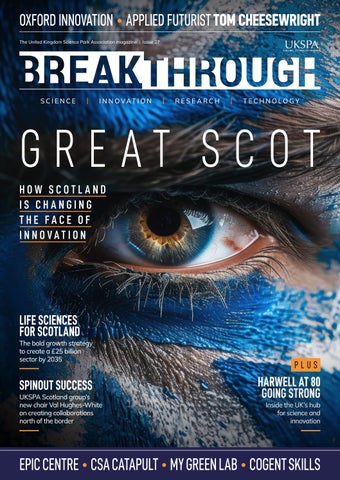
12,300 – 45,300 sq ft R&D / Bio-Science Facility
Fitted Offices and Level 2/3 Laboratory space
A high level of fit out will reduce Capex for the incoming occupier
Flexible office and lab facilities from 3,50026,000 sq ft to meet occupiers needs
Laboratory fit out ideal for food science use that will reduce Capex
Amenities including open access labs, a café and restaurant, communal breakout areas and courtyard garden
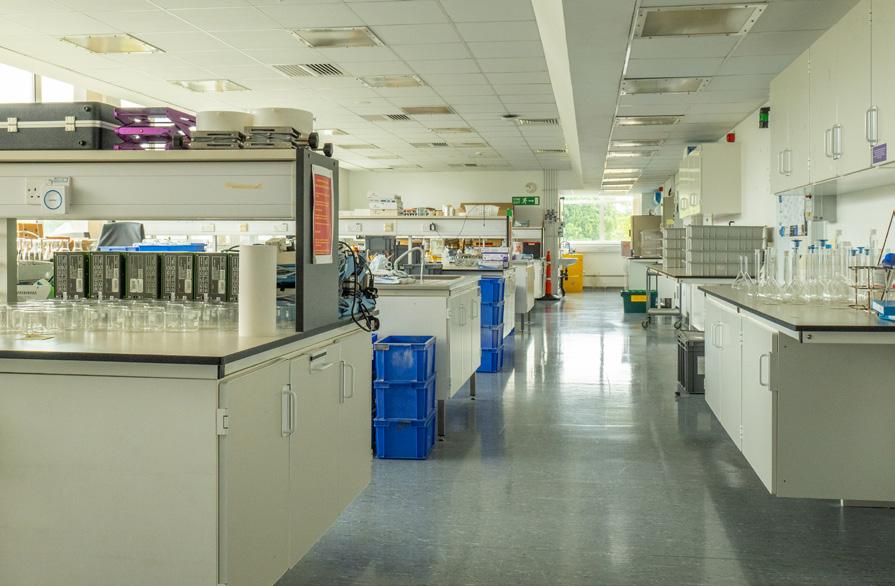
Parkland Setting - Located within a 91acre campus combining natural beauty with advanced infrastructure, creating a unique workspace.
Comprehensive Amenities - A range of park amenities including The Exchange café, a fully equipped gym, sporting facilities, collaboration spaces and an on-site nursery.
Prime Location - Strategically positioned on the Oxford-Cambridge arc, offering unrivalled access to leading universities, research centres, and science hubs.
Home to Gastronomica - operated by Pioneer Group, Gastronomica sits at the heart of our food and drink research ecosystem, centred around the Unilever Colworth R&D Hub.

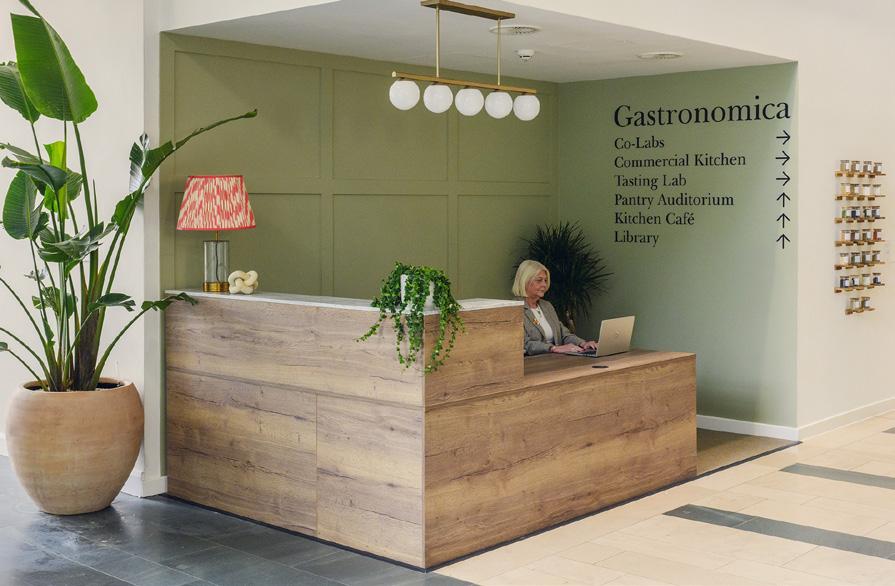
07 On the verge of EPIC growth
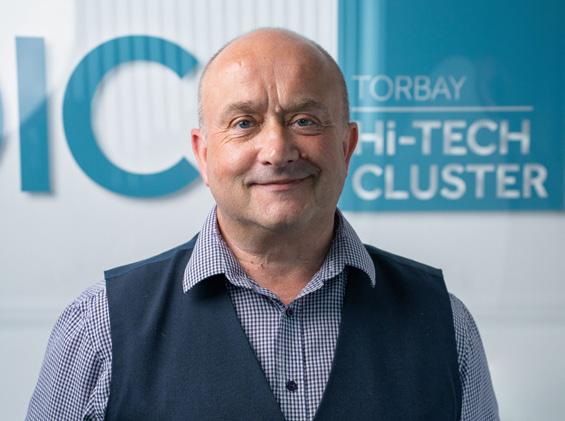
EPIC Centre’s Rich Scutt on the exciting prospects for science and technology in the South West
10 The Sidney Sussex Building Chesterford Research Park’s newest development - ready for Cambridge’s next scale-ups support
12 Scotland’s life science strategy
How the country’s cities will play a key role in creating a £25 billion sector over the next decadeand why there has never been a better moment to invest
16 Introducing... the AIM Report
Learn how I2SL’s new tool can be used to build the business case for energy saving in labs
18 80 years and going strong
Harwell’s Jim Stretton and Barbara Ghinelli explain how a unique public/private partnership underlies its status as the UK’s hub for science and innovation
24 The role in building UK semiconductor clusters
CSA Catapult’s Leonie White on how it is playing a key role in building on the UK’s lead in compound semiconductors
28 Spinout firms’ growing success
Val Hughes-White, director of Roslin Innovation Centre and new chair of UKSPA’s Scottish group, enthuses to Breakthrough about creating growth and collaboration north of the border

32 A legacy of entrepreneurship
MD Jo Stevens reflects on a 25-year journey with Oxford Innovation Space but - as she reveals - it’s not over just yet
36 STEAM power
Fiona Du Fresne from Ridge on how science parks can play a vital role in closing skills gaps
38 My Green Lab is going global
James Connelly talks aspirations and challenges at the leading lab sustainability organisation
42 From grid to growth
Savills’ Luisa Mostarda on the need for science parks to rethink their power solutions
44 Your guide to the future
Tom Cheesewright gives insight into his role as an applied futurist and helping organisations deal with an ever-changing world
48 Plugging the STEM skills gap
Specialists Cogent Skills extol the importance of early-stage recruits to filling the skills gap




Breakthrough is an Open Box Media and Communications publication produced in association with UKSPA.
u N i T ed K i N gd O m SC ie NC e p A r K
ASSOC i AT i ON ( u KS p A)
Chesterford Research Park, Garden Cottage, Saffron Walden CB10 1XL
T +44 (0) 1799 532 050 e info@ukspa.org.uk www.ukspa.org.uk
Ch A ir
Dr Sally Basker
C hief exe C u T ive
Ruth Hall
he A d O f O per AT i ONS
Adrian Sell adrian.sell@ukspa.org.uk
O pe N b O x medi A AN d CO mmu N i CAT i ONS
Premier House, 13 St Paul’s Square Birmingham B3 1RB
T +44 (0)121 200 7820 e info@ob-mc.co.uk www.ob-mc.co.uk
d ire CTO r & publi S her Stuart Walters stuart.walters@ob-mc.co.uk
d ire CTO r & publi S her Samantha Skiller sam@ob-mc.co.uk
ST udi O
Mark Lamsdale mark.lamsdale@ob-mc.co.uk
de S ig N er Matt Hood matt.hood@ob-mc.co.uk
A dver T i S i N g SA le S AN d e N quirie S Rob White rob.white@ob-mc.co.uk
edi TO r
Simon Penfold simon.penfold@breakthroughdigital.co.uk
No part of this publication may be reproduced in any form without the consent of Open Box Media and Communications.
We are committed to sustainable forest management and this publication is printed by Buxton Press who are certified to ISO14001:2015 Standards (Environmental Management System). Buxton prints only with 100% vegetable based inks and uses alcohol free printing solutions, eliminating volatile organic compounds as well as ozone damaging emissions.

ru
T h
h A ll UKSPA Chief Executive
arch marks 6 months since I joined UKSPA; a period of learning and growth. To all our members, partners, and colleagues across the sector, I hope 2026 has started well. On behalf of the team, we’re looking forward to working with you this year on a range of initiatives focused on positive, developmental change across UKSPA and our community.
The environment in which our industry operates continues to change, economically, technologically, and regulatorily. The sector is experiencing sustained and significant pressures that demand clear priorities, strong representation, and decisive action. As a membership-based, representative body, UKSPA’s agency and effectiveness are founded on the collective insight, experience, and expertise of its members. We’re actively seeking views on the issues that matter most, and the role UKSPA must play in responding to current and emerging challenges; it’s essential that


UKSPA remains focused, relevant, and effective in representing and supporting our members. The current member consultation forms part of a structured review of our strategic priorities. It is designed to ensure that our future strategy is grounded in the realities of our sector and informed by the perspectives of those we represent.
Since announcing the start of the project to develop a new strategy for UKSPA at our Autumn Conference in Lancaster, the team have completed the first phase to gather sector insights, and we’re now beginning the next phase to consult with members and stakeholders, to help shape the future direction of our Association, and interactions with our wider stakeholder network.
What’s been happening so far, and what’s next?
At the time of writing, we’ve captured insights from our Board away day, Regional Group meetings, sector reports and white papers, and our own UKSPA services and advocacy – to generate strategic themes for us to test via a sequence of member surveys and focus groups.
Next steps will involve reflecting the findings to our Board, and the Membership community at our Spring conference in Glasgow, and where we will begin to distil a shared vision, a clear, confident purpose, and strategic direction.
Start with the end in mind
The strategic framework (overleaf) provides the structure through which member needs are connected to action. It ensures the strategy is coherent, transparent, and aligned with UKSPA’s responsibilities as a member-led association.
The policy positions discussed with members so far have included a range of issues, including R&D and Innovation, Infrastructure and Planning, Skills and Talent, Business Growth and Finance, Regional and Place Policy, Sustainability, Governance and Standards, and international relations and inward investment.
As a membership-based, representative body, our strength lies in the collective experience and expertise of our members and peers. Through this process, we will be seeking views on the issues that matter most to the sector, the role UKSPA should play, and where we should concentrate our resources to deliver the greatest value. The consultation will inform decisions about our long-term direction, advocacy focus, services, and investment priorities.
We encourage all members to participate and contribute. By doing so, we can develop a strategy that is credible, forward-looking, and matched to the needs of the industry we serve.
This consultation and the wider strategy development, ensures that our future direction is firmly grounded in the realities facing the sector today and shaped by the needs and perspectives of those we represent.
The framework consists of 6 core elements including:
• Our vision, purpose and valueswhich collectively represent UKSPA’s north star.
• Strategic themes that describe UKSPA’s long-term strategic intent and reflect the scope and shape of the sector, and its most important challenges and opportunities.
• Strategic priorities that guide where UKSPA will focus its resources and advocacy effort, and clearly defined objectives.
• A Charter that defines UKSPA’s role and responsibilities:
On behalf of the team, we’re looking forward to working with you this year to build an exciting new strategy, and a range of initiatives that will bring positive benefit to our community.
Thank you for your continued support and contribution. n
• Principles for representation, advocacy, and engagement.
• Commitments to transparency and accountability.
• How decisions are made and how members are involved through our Governance Framework
• A Policy Framework that translates strategic priorities into clear policy positions - this will provide consistency across advocacy, submissions and engagement, and enable UKSPA to respond to emerging issues with clarity and confidence, and within agreed parameters. n
Below Glasgow City Innovation District will play host to UKSPA's Spring 2026 Conference
ge T i N TO u C h
If you have any thoughts or questions, please reach out to Ruth directly at ceo@ukspa.org.uk
u KS pA S pri N g 2026 CON fere NC e UKSPA's Spring 2026 Conference takes place on 5th and 6th March at Glasgow City Innovation District. Scan the code to register


Rich Scutt, centre director of EPIC in Paignton, talks to Simon Penfold about the exciting prospects for science and technology in his part of the South West.
Torbay’s EPIC centre is an object lesson in how a well-run science and innovation facility can have a major impact on the prospects of its local economy.
It is providing a platform for renewal as the area rebuilds from the devastating loss of its biggest employer two decades ago.
More than 5,000 jobs were lost when Canadian telecoms giant Nortel closed its Paignton plant over the space of barely a year in the early 2000s – part of the long drawn-out collapse of the global business that ended in bankruptcy in 2017.
The opening of the £8 million Electronics and Photonics Innovation Centre in Paignton in 2019 was part of efforts by Torbay Council to boost economic regeneration in the area – in particular supporting the local electronics, photonics and micro-electronics business community.
EPIC is also the beating heart of Torbay’s vision of ‘tech by the sea’ and is home to more than a dozen technology businesses as well as providing a headquarters for the Torbay Hi-Tech Cluster,
made up of both local and multinational companies based in the area, including QLM, Oriole, Torbay Pharma, Bowa Medical, Bay Photonics, Gooch & Housego, Superb Media, Coherent, Prior Queensgate, SageTech Medical, Spirent, Photonics Express, White Rock, iT Tracking and TWM Technology – several of which are based at EPIC.
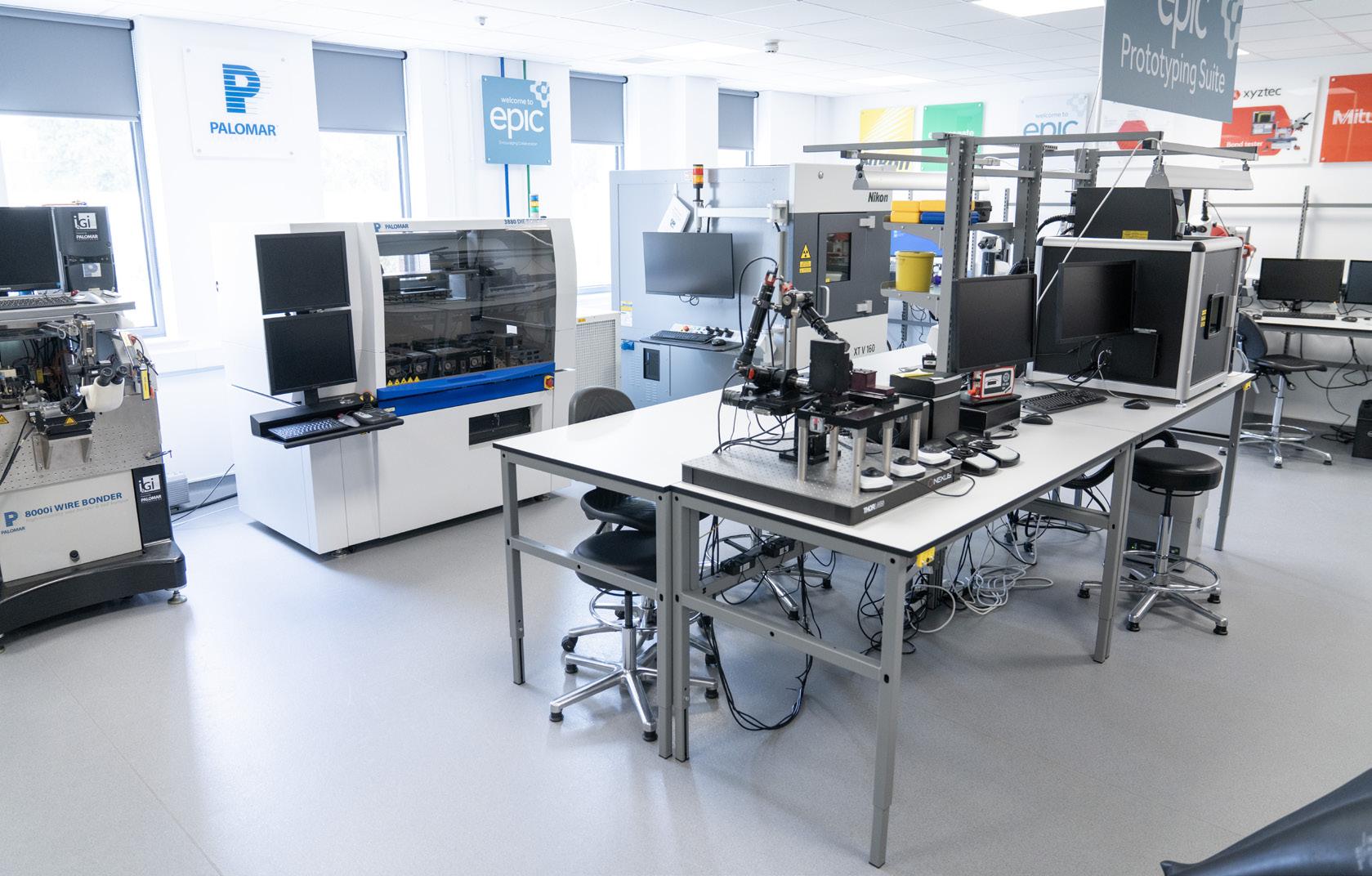
With 25,000 sq ft of lettable space, EPIC has 40 units – 27 offices and 13 dry labs, a Class 7 cleanroom and a prototyping suite, as well as the usual conference room, boardroom and collaboration room.
Rich Scutt, with a decade and a half of experience running innovation and incubation centres, took on the role of EPIC’s centre director in the summer of 2024.
Just incredible Originally from the West Midlands, he moved to the South West in 2003 and ran a series of innovation centres for Plymouth University before returning to Birmingham for five years, working at Birmingham City University on the STEAMhouse innovation centre.
But the South West was now home and the role at EPIC came up; “I had a look at this place and was amazed. The stuff going on here is just incredible, the innovation and the whole story behind it”.
“Nortel were one of the biggest telecommunications companies in the world, employing over 5,000 people here in Paignton in the mid-1990s. Unfortunately they
closed in the early 2000s and that left a lot of people with hi-tech skills. In the wake of Nortel closing a lot of smaller businesses set up here in Torbay in the fields of photonics, electronics, telecommunications, lasers, sensors and even quantum technology.
“But there was nowhere for them to go. Torbay Council secured European funding to build EPIC in 2019 and it’s been virtually full ever since – it is completely full at the moment, with 14 businesses employing 230 people.
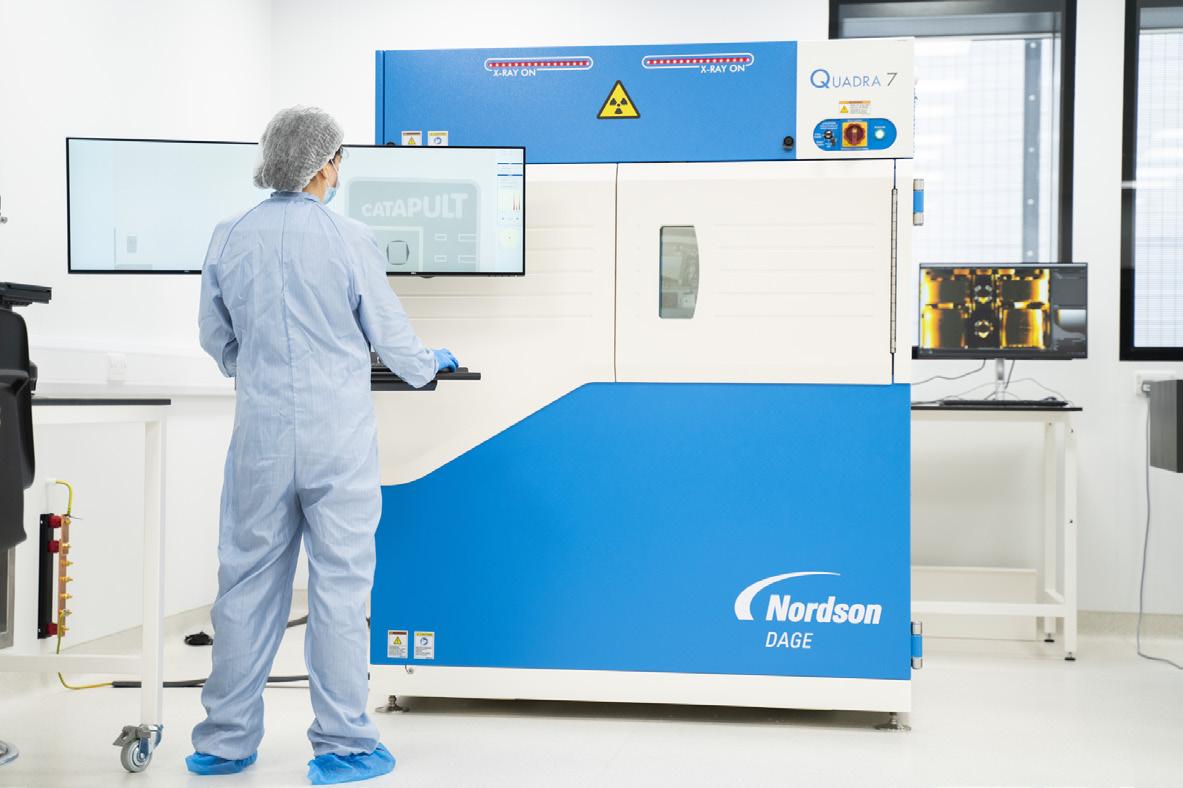
“One of the most important features at EPIC has been our prototyping centre. It has £3.5 million of equipment, including a £500,000 x-ray machine. The businesses that came here at first wouldn’t have been able to afford machines like that. But they can access to it through their inclusive monthly rental. For example Bay Photonics joined when we first opened, and they were a small company with just seven people. We gave them the capacity to use the equipment on a regular basis – die bonding, wire bonding, x-ray machine and others. And that has helped them grow to 35 people. They now have their own production facility but still continue to benefit from the prototyping suite.
“Offices and conference rooms are great, but providing the prototyping kit, the equipment and the facilities to let people take their ideas to the next level. That is probably the most important thing we do.”
take a look around
Scan the code for a virtual tour of the EPIC facility

pr OTOTY pi N g C e NT re Scan the code to learn more about EPIC's prototyping centre (below)
Hugely significant
“It’s not on the scale of some science parks in the UK but it’s hugely significant for Torbay. The tech industry is really growing here, so much so that we are just in the process of acquiring new premises, Torbay Tech Park – a further 18,000 sq ft just a stone’s throw away from EPIC, to provide much-needed grow-on space for up to four of our companies initially.
“It makes absolute sense in terms of investment by Torbay Council.
The GVA that these electronics and photonics businesses are generating is over £90,000 per capita – three times higher than the surrounding area – these are high-value, sustainable and well paid jobs.
“At the same time our Hi-Tech Cluster is gaining momentum. It’s made up of about 40 tech businesses employing over 2,000 people and many businesses with strong growth plans – that number could double within five years.”
"We are working to secure support from the likes of Innovate UK for our cluster because it is so important to the local economy.”
Another challenge facing the area is the ageing workforce. Many of those who worked at Nortel and went on to found and work for new businesses are now in their 50s and 60s.
“Out of the 230 people in this building I’d reckon at least half are ex-Nortel,” said Rich. “They all know each other and work with each other, which is a great benefit to the businesses but we need new blood. To that end, we’re working closely with South Devon College, which has over 10,000 students, as well as secondary and primary schools and the universities at Exeter and Plymouth to try and bring the next generation through.
“And we’re making the point that not all the jobs are for scientists and technicians. Every company needs HR managers, IT people, data analysis, stores people, marketing people, sales people. There will be tremendous opportunities, but we need to start getting young people on board while they can acquire the knowledge and experience of the existing people before they finally retire.
“It’s part of creating a longterm future for science and technology here in Torbay.”

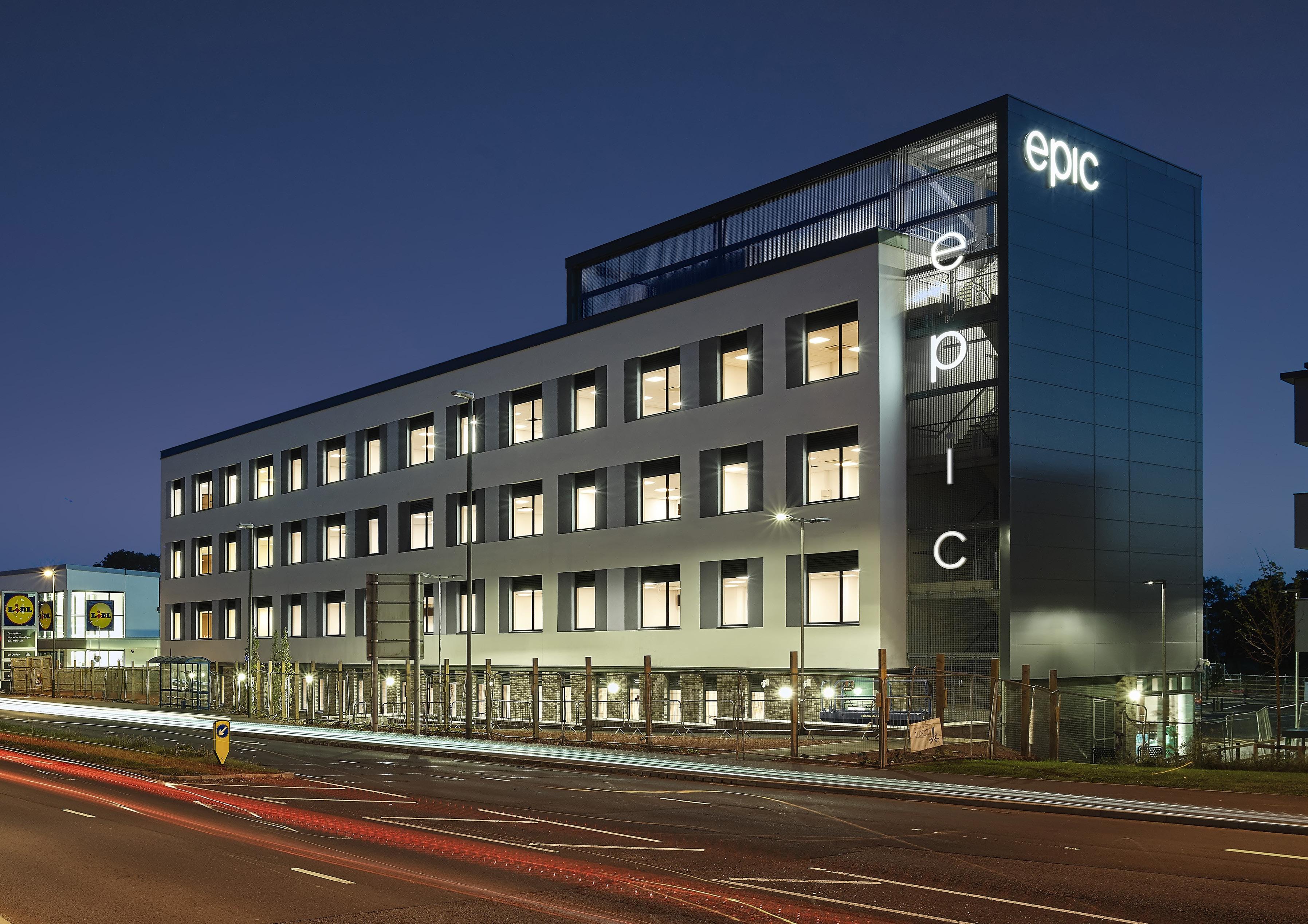
But the ambitions of the team at EPIC and the Hi-Tech Cluster faced a potential roadblock.
“Our businesses were outgrowing EPIC; we’ve got a waiting list but nowhere for firms to move to as they grow,” explained Rich. “So we have secured funding to build Torbay Tech Park, an 18,000sq ft former photonics building that we will refurbish and bring back to life.
“The new facility will support up to 4 EPIC tenants to continue their growth trajectory in Torbay. At least 100 new jobs will be created by these businesses within a year.”

“Our legal team is finalising the details and businesses will move in later this year. It will be at 75% occupancy from the day it opens.
“We will future proof the building by refurbishing the current labs, adding a state of the art cleanroom, and introducing hi-tech production space.
A special centre
Torbay Council has also purchased further land a short distance from EPIC to further expand the Tech Park, with potential of a further 40,000sq ft of grow on space.
“Rather than putting up massive buildings and hoping people will come. I think we’ve been able to do it in a more logical, economic and commercially viable way in line with demand.
“And it means that by the end of 2029, hopefully, we will have around 80,000 sq ft of space –which is getting on for a good-sized science park – and with the demand we know is there we can support the creation of between 500 and 1000 new jobs across the 3 sites.
“Rather than one business employing 5,000 people, and the vulnerability that creates, we want 50 businesses employing 100 people. It makes for a far more resilient model.
“We already have some exciting businesses. Oriole Networks is a photonic networking company that has secured serious private investment grown to 40 people in Torbay in six months with projections to be up to 100 employees by the end of this year.
“Those are well-paid jobs, and the business is attracting international visitors. It’s having a significant knock-on impact on the Torbay economy. The local hotels, for instance, are seeing rooms booked for visits, conferences and events.
“I’ve worked in a number of innovation centres over the years, but this one is special. We’ve got real innovation and R and D happening in every office. Rapid growth and scale up in exciting technological breakthroughs.
“We have more than a dozen businesses at EPIC working on cutting-edge technology, and the new facilities will enable us to support even more. It will all go towards making that vision of ‘Tech by the Bay’ a reality in the coming years.”
mAK e epi C YO ur hO me
For more information, please visit: https://epic-centre.co.uk/
Chesterford Research Park’s newest development, the Sidney Sussex Building, has completed its fit-out and will be shortly be ready to welcome its first occupiers. Created specifically for growing life science and R&D teams, it offers the rare combination of move-in-ready laboratory space, high-quality write-up areas, and the flexibility to expand without the disruption (or delay) of a major refit.
Set within the South Cambridge life science corridor, Sidney Sussex is designed to help ambitious organisations step confidently into their next chapter - supported by a connected Park community and strong sustainability credentials.
Space that works from day one
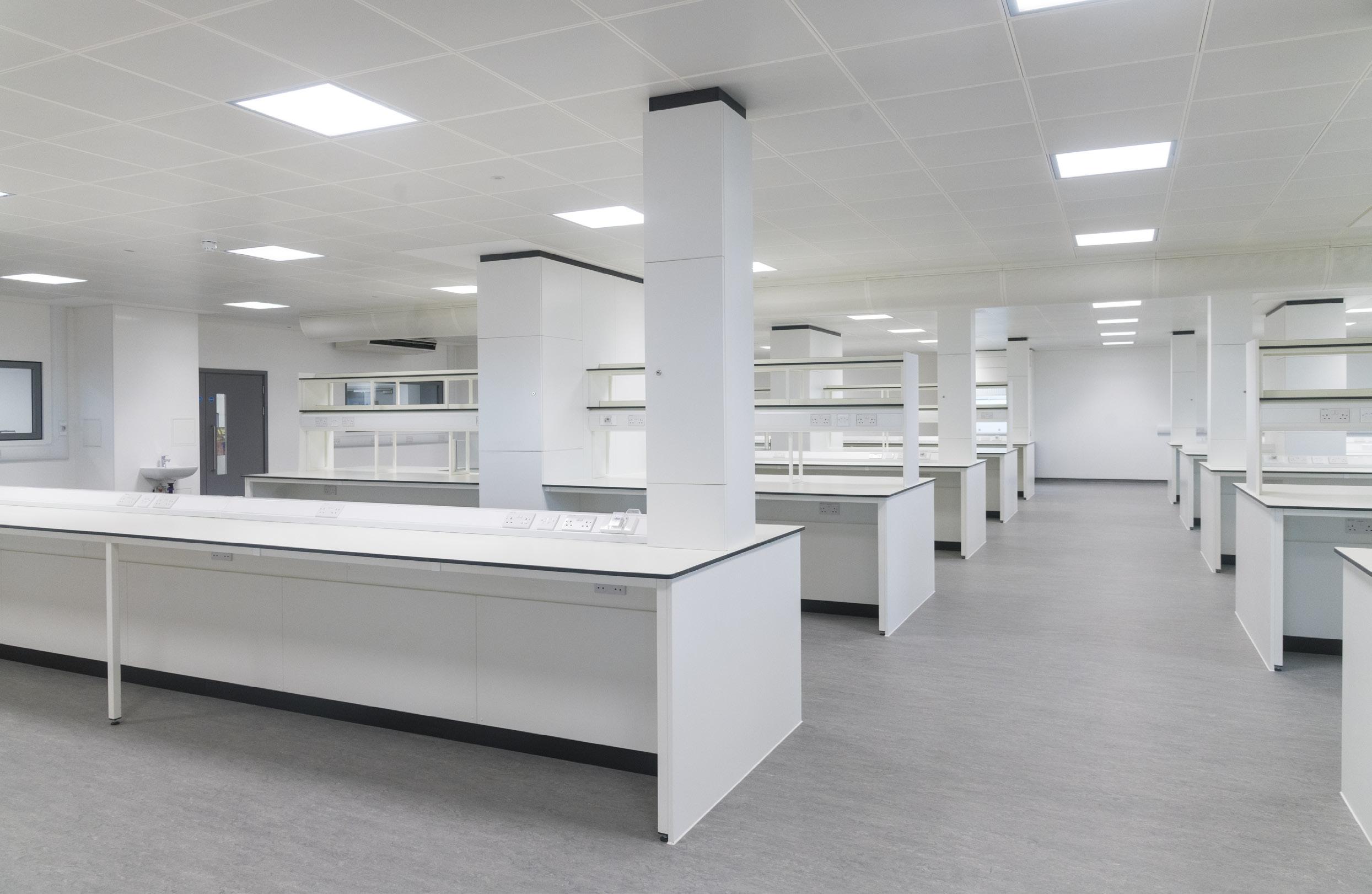
Sidney Sussex provides 56,034 sq ft of laboratory and write-up accommodation across three bright, contemporary floors. The building comprises ten R&D suites, ranging from 2,245 sq ft to 8,390 sq ft, available as self-contained units or combined to create larger footprints as teams grow.
Crucially, suites are delivered in true plug-and-play conditionso businesses can move in, install their equipment, and swiftly focus in on advancing their work.
Every suite includes:
• Professionally installed laboratory benches with integrated shelving and sinks.
• A fitted fume hood, with capacity to add more if required.
• Seamless solid-vinyl flooring for clean working and easy maintenance.
• High-quality Cat A write-up space designed for collaboration and team working.
For a more sustainable future Sidney Sussex reflects Chesterford Research Park’s long-term focus on environmental performance, targeting BREEAM ‘Excellent’ and an EPC ‘A’ rating - supporting sustainability commitments while helping reduce operational costs.
Sustainability and wellbeing features include:
• Roof-mounted solar PV arrays to offset energy demand.
• EV charging points for lowemission commuting.
• Wildlife-sensitive external lighting to protect biodiversity.
• Landscaping and ecological planting delivering 24% biodiversity net gain.
With 174 car parking spaces, including accessible bays and EV-only spaces, the building blends convenience with a lower-impact travel approach.
A Park with room to grow: From start-up to scale-up (and beyond)
One of Chesterford Research Park’s biggest advantages is the ability for companies to move through the Park as they evolve - from early-stage innovation to established HQ-scale operations.
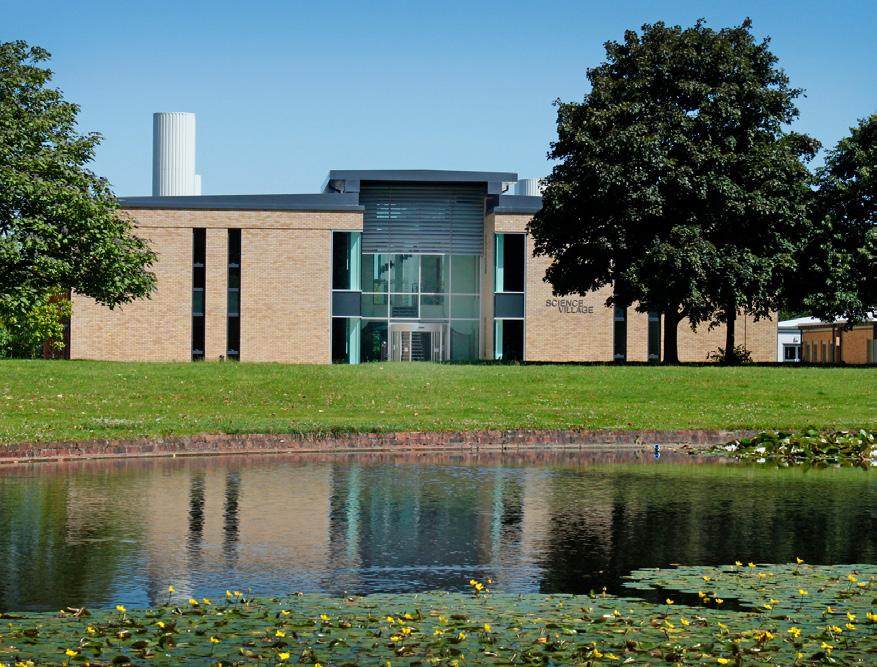
Sidney Sussex sits at the heart of that journey, offering a natural “next step” for teams leaving smaller start-up environments and needing purpose-built space to scale. Part of the Park’s wider ecosystem, Science Village provides an excellent base for both established and start-up businesses looking for prestigious, flexible, self-contained accommodation within a multi-let building, which brings the added benefit of being surrounded by other life science
An ideal HQ for both established and start-up companiesscan the code to find out why our genuine lifecycle offer
ventures for connection and possible collaboration.
Science Village: Available suites and specification
This innovative, energy-efficient building currently has four of its 16 self-contained suites available.
S id N e Y S u SS ex buildi N g
Scan the code to learn more about the park's newest development
Ranging from 1,515 sq ft to 1,993 sq ft, the suites have the added advantage of being able to combine for larger requirements - ideal for companies that want flexibility built in from the start.
Specification includes:
• Open plan write-up/admin area.
• Self-contained single office/ meeting room.
• Independent, dedicated external plant area.
• Demountable benching and two sinks.
• Two fume hoods (with space for a third).
• High speed data connectivity.
SC ie NC e vill A ge
• Cat 6 cabling and generous power points.
• Back-up generator support.
Together, the flexible multi-let Science Village and Sidney Sussex Buildings, along with the Park’s larger HQ buildings, create a genuine lifecycle offer - enabling teams to expand, attract talent, and stay within the same ecosystem as they grow.
Designed around people
Chesterford Research Park is set within 250 acres of landscaped parkland, offering a calm environment that supports focus, wellbeing and everyday enjoyment. At its heart is The Nucleus - the social and amenity hub of the Park - designed to make life easier, healthier and more enjoyable for occupiers and their teams.
“T O ge T her, T he S C ie NC e v ill A ge AN d Sid N e Y Su SS ex b uildi N g S
C re AT e A ge N ui N e life CYC le O ffer
f O r T e A m S TO STAY W i T hi N T he SA me e COSYST em AS T he Y gr OW ”
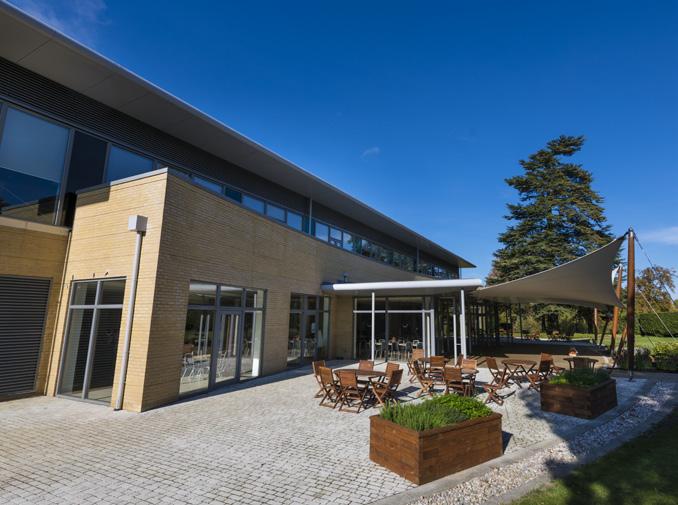
The Nucleus restaurant provides a relaxed, contemporary setting with space for over 200 diners, serving daily breakfast and lunch. Menus change regularly and feature an excellent choice of freshly prepared hot dishes, sandwiches, salads and desserts, using locally sourced ingredients wherever possible. With hot food served until 2pm and an awardwinning on-site catering team, it’s a genuine destination rather than just a workplace café.
For wellbeing beyond the working day, the Nucleus Gym is now open 24/7, seven days a week, giving members complete flexibility. The fully equipped facility includes a wide range of cardiovascular and resistance machines, an extensive freeweights area, a dedicated stretch zone and a fully air-conditioned sprung-floor studio - suitable for all levels of fitness.
Outdoors, the Park’s seven-hole par-3 golf course offers a unique opportunity to step away from the lab or desk, whether for informal networking, team bonding or simply time to reset in green surroundings.
While the setting feels peaceful and self-contained, Chesterford Research Park remains exceptionally

Top to bottom
Lab spaces in the Sidney Sussex; Atrium of the Sidney Sussex; The Nucleus terrace provides a relaxed setting; The Science Village building's suites have flexibility built in
well connected, making it easy for staff, collaborators and visitors to access by road, rail and aircombining the benefits of a tranquil Park environment with the accessibility of a prime Cambridgeedge location.
Part of a world-leading life science ecosystem
Located within the Cambridge Life Science Cluster, Chesterford Research Park places occupiers in one of the world’s most concentrated hubs of scientific talent, investment and innovation - supporting collaboration across drug discovery, diagnostics, genomics and sustainable chemistry. For science-based businesses ready to grow, it offers an environment designed for longterm expansion, wellbeing and community - without compromising on the practicalities of fit, connectivity and readiness. n
r e A d Y W he N YO u A re
With various options currently available at the Park, prospective occupiers can secure space and plan their move with confidence. To find out more, please visit: www.chesterfordresearchpark.com
On and off-site services for your business

Mark Cook talks to Simon Penfold about Scotland’s strategy to focus on growing its life sciences sector over the next decade.
cience parks and innovation centres across Scotland’s cities will play a key role as the country targets the creation of a £25 billion life sciences sector by 2035.
SLife sciences already contribute around £10.5 billion in turnover to Scotland’s economy, supporting more than 46,000 jobs.
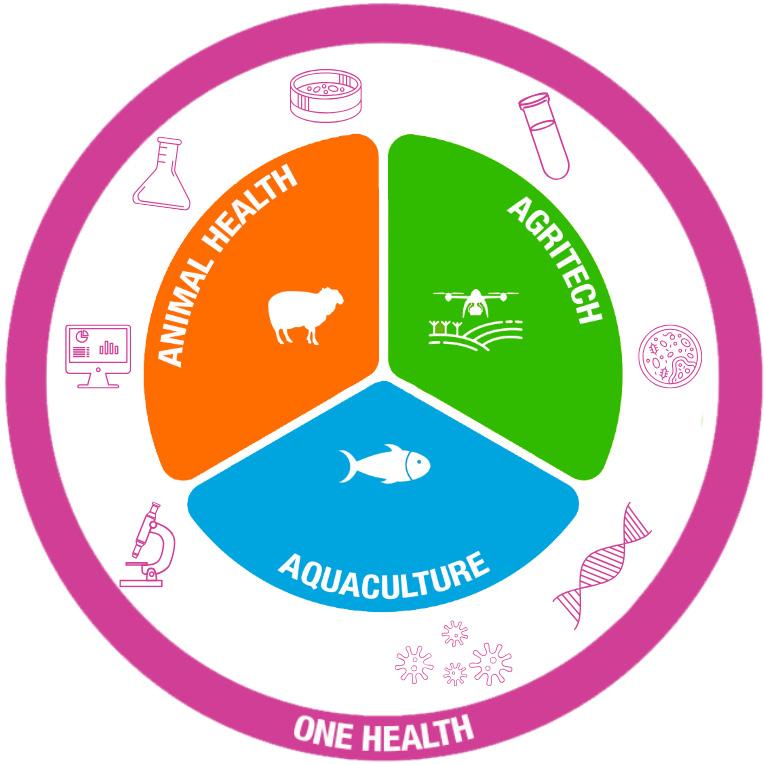
The sector covers human, animal and plant sciences, including pharmaceuticals, health tech, agritech and animal health, aquaculture and industrial biotechnology and bio-based manufacturing.
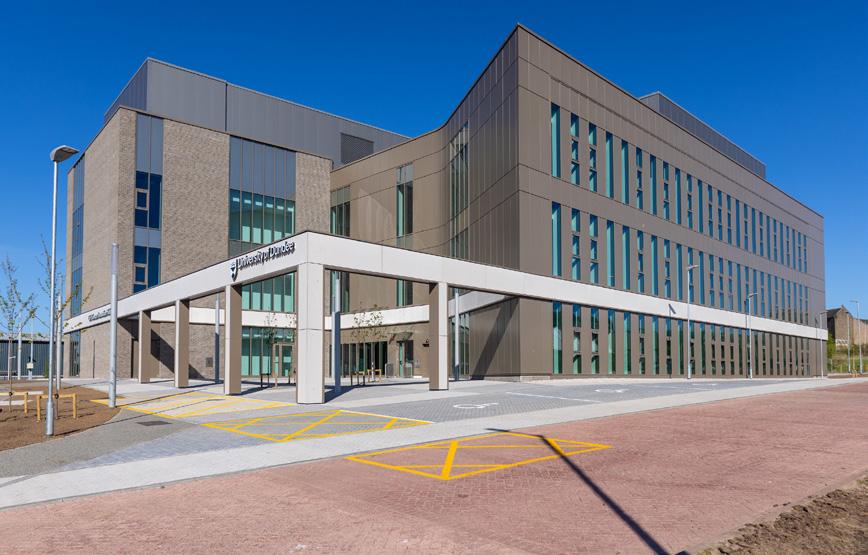
The Life Sciences Strategy for Scotland was launched in November at Dundee University’s new Life Sciences Innovation Hub - a flagship facility at the heart of the new Dundee Life Sciences Innovation District - by Holyrood’s Business Minister Richard Lochhead.
He said: “The goal of this strategy is to make Scotland’s life science sector the best in the world for developing, testing, manufacturing and commercialising life sciences innovation to benefit the health and prosperity of the nation.”
Also speaking was Mark Cook who, with Mr Lochhead, co-chairs the Life Sciences Scotland Industry Leadership Group.
Use the code to download a copy of the Life Sciences Strategy for Scotland read the strategy
Mr Cook said: “With the game-changing impact of new technologies, from genome editing to AI, the next 10 years are critical to the global expansion of the sector and we must ensure Scotland is at the forefront of that.”
Mark recently spoke on life sciences for the Scottish Cities Alliance, a partnership of eight cities in Scotland – Aberdeen, Dundee, Dunfermline, Edinburgh, Inverness. Glasgow, Perth and Stirling - and the Scottish Government, working collaboratively to attract investment and promote economic development and growth.
The new strategy builds on the success of a previous life sciences strategy launched in 2017 with the aim of creating an £8 billion sector by 2025 – it hit its target four years early.
Mark is modest about that success: “It’s just the pace of change. When that strategy was written, in 2016, it seemed a reasonable target for 2025. But of course, we had COVID, vaccines and all the things
life sciences excels at, so we grew much faster than was expected.
“The National Strategy for Economic Transformation, which picked life sciences, came out after the 2016 strategy. So we are working with a following wind. And there are things that are happening now that perhaps, couldn't reasonably be foreseen in detail back in 2016.
“For example, the sudden rise and the fantastic potential of AI and digital. The work that Scotland is leading on in quantum and photonics and what that could do for life sciences and medical diagnostics, that wasn't on the radar in 2016.
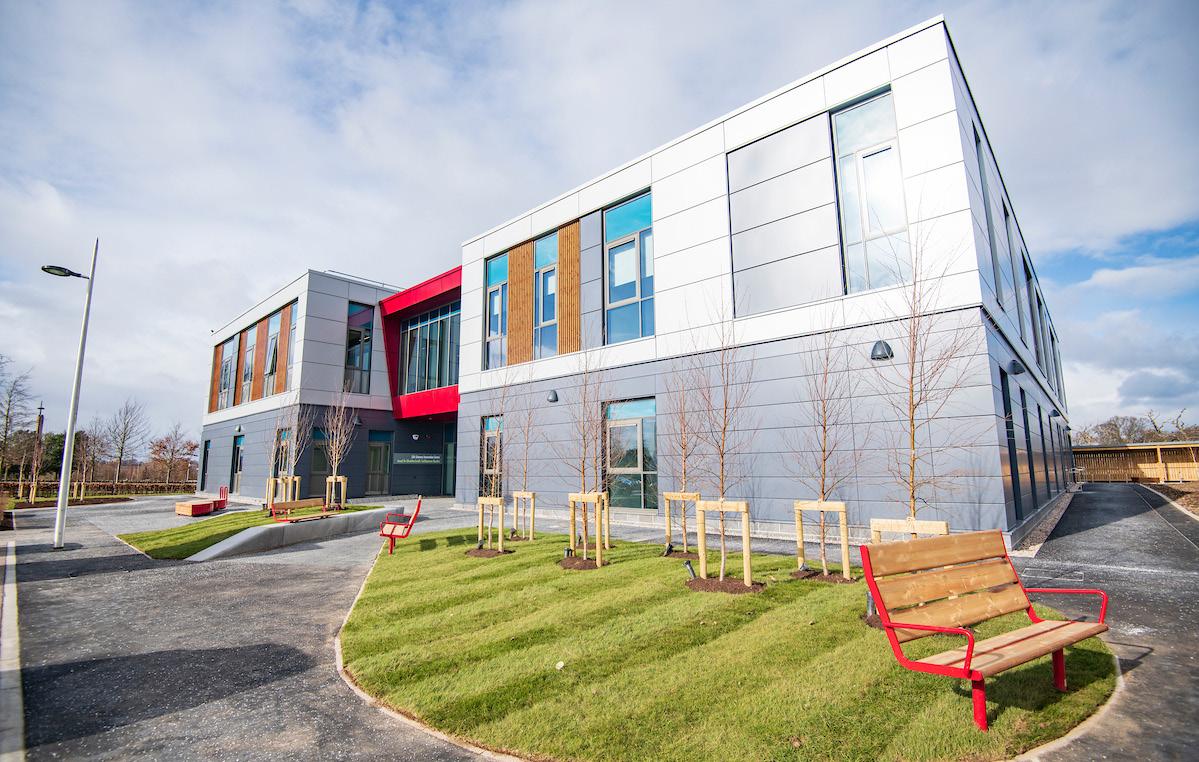
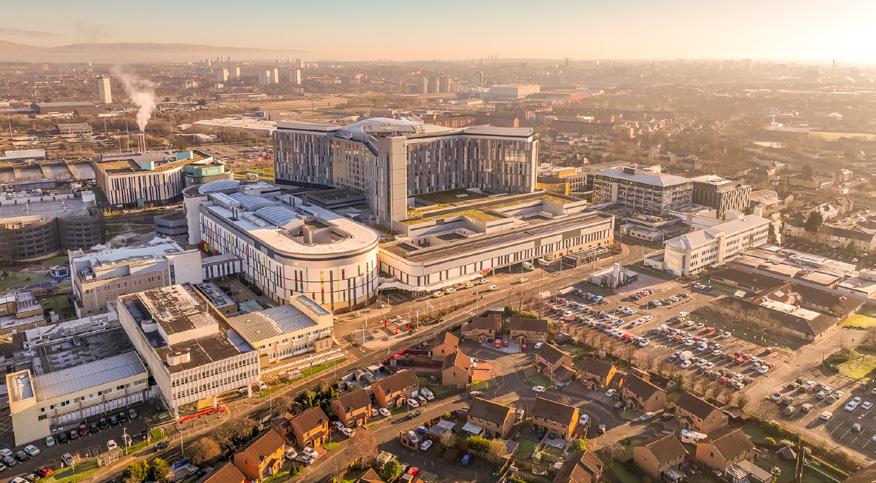
“On the back of the strategy’s success there's been quite a lot of investment in life sciences facilities, such as the BioHub in Aberdeen, the new Life Sciences Innovation Hub in Dundee and in Glasgow there’s the newly opened Health Innovation Hub strategically located beside Queen Elizabeth University Hospital.

edinburgh
“Life sciences is one of the key growth sectors that will contribute to economic growth, health and wealth within Scotland.
“When you look at it, what are we famous for? Whiskey, great; golf courses, fantastic; castles, wonderful; the NC 500 drive round the Highlands, very, very nice.
“But those sorts of jobs are seasonal, they're pretty close to minimum wage. If you look at life sciences, then an average salary is usually at least three times the Scottish national wage. And people in life sciences pay more tax. They live in Scotland, they spend their money in Scotland and they can drive economic growth.
“From the Scottish Government's perspective it also means reskilling a population.
“When we were drawing up a national strategy for innovation we were looking at some of the Nordic countries as comparators, because Scotland is not a particularly big country. And the ones that had done well had picked a sector or a few sectors and gone deep on them.
“And that's another reason we're going deep on life sciences.
“Everyone talks about the Golden Triangle for life sciences in England. We came up with the Northern Star, because there's points of shining excellence all over Scotland.”
But there are major areas of difference in the approach to life sciences north and south of the border.
“The UK Sector Plan for life sciences did not include the AAA sector - which is aquaculture, agritech and animal healthbecause they didn't regard that as a part of life sciences. Whereas it's major for Scotland.
“For instance there's some great health innovations within the Highlands and around Inverness, but there's a lot of animal health, a lot of fish farming work. We have a very diverse sector.
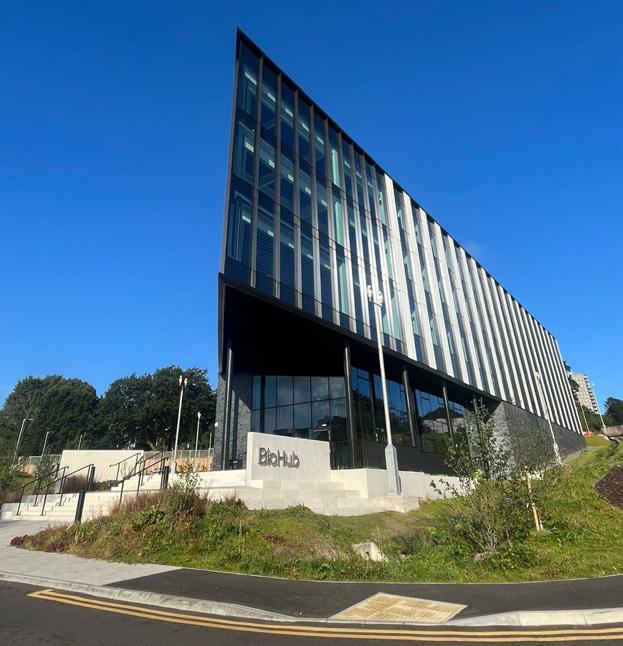
Top-bottom from above Edinburgh BioQuarter; Aberdeen's ONE BioHub; At work in Symbiosis's new site at Castle Business Park, Stirling; Inside ML Photonic's optics facility in Fife; University of Dundee Life Sciences Innovation Hub; QE University Hospital, Glasgow
“And then you’ve got the Pioneer Group operating a very good science park on the grounds of Roslin that has spinout space. People don't realize that all the pulse oximeters, their algorithms were written in a Pioneer Group spin-out space out in Roslin. Anybody who's ever had one of the one of these things clipped to their fingers to see what their oxygen saturation is, it was likely influenced by the work done in Roslin..”
“Within Scotland we have many large multinationals with premises such as WL Gore, Abbott Labs and Roche Diagnostics to name a few. The health technology and diagnostics space is quite vibrant in Scotland.
“Everybody tends to think life sciences is pharmaceuticals, but virtually all of our spin-outs are not pharma because the barriers to entry are absolutely enormous.
“Instead they come from medical technology innovation, digital innovation, diagnostics innovations. All those things spin out very well into science park space and they don't have the incredible overheads of pharmaceuticals. This is why, in our most recent set of export figures, the largest exporting sector was medical technology..”
The country is also benefiting from a nexus between the commercial, the academic, and the medical research under way at hospitals across Scotland.
“We are a small, interconnected nation,” said Mark. “Most of the key players will know each other, and that's why we've coined this phrase that you see in the Life Sciences Strategy, which is the 'triple helix’the link between industry, academia and health, whether that's via the NHS or other government agencies. People are expected to collaborate and work together. It makes the process easier.
“And because of our size, we also have a level of agility that you don't have in some other markets, which is why we think Scotland is particularly attractive - we will do things faster. We can find ways of getting things done.
“If we’re trying to attract an inward investor, say somebody's going to come and set up somewhere, you've got to make it faster to do it, cheaper to do it, or easier to do it. You've got to be able to offer one of those three things to get someone to come on site within a nation.
“Very possibly we can offer all three depending on what the project is, which is why we're quite successful.
“But all these places need space. And it's very gratifying now that we're finding people co-locating with health.
“Pioneer Group have Roslin but also BioCity on the M8 in Glasgow, which is full of spin-out space. There’s quite a diagnostics cluster operating around there now.
“That triple helix approach has been very, very successful; it’s one of our major selling points.”
At the same time Scotland has seen clusters in areas such as compound semiconductors, photonics and quantum technologies
“The potential for crossover is enormous because these things; it won't just be in life sciences.
“If you look at our quantum and photonics cluster, which is broadly across the University of Edinburgh, Heriot Watt University, Strathclyde University, they're world leading.
“We've been operating in this model in partnership with Scottish Government for a very long time, and it's worked. And the city deals for economic regeneration have played a very important part in this.
“For instance there is the combination of the Tay Cities Deal in the Dundee area, the work done by the city council, the university and the BioDundee partnership, building on Professor Sir Mike Ferguson’s vision for the centre they have built there.”
The next big thing
Sir Mike Ferguson is Regius Professor of Life Sciences at the University of Dundee and has played a leading role in the growth
of the city’s Life Sciences Hub.
“It takes cooperation between the academics, the councils, the funders, and it takes a bit of vision that economic growth will come through partnership,” said Mike.
“So now we've got science parks, we've got city deals, we've got people building these wonderful centres, which is great. But where do people go after that when they've scaled?
“Where's the next destination where you have to move out of your incubator or your science park startup building?
“That will be that will be the next big thing; we will need much bigger spaces for the successful companies to spin out of.
“And that has its own implications. I know the Institute of Directors and others have always been saying that for the next stage of growth we're going to have to work on the planning process. It's got to be easier to go out and build these bigger centres.
“There’s opportunity there. East Lothian Council, for example, and Queen Margaret University, they're in the process of opening a business incubator building because that local council also sees the opportunity for economic growth.
“Everybody's coming to the same conclusion. We are seeing the traction now that people see life sciences as a growth driver for Scotland.
“If you look at comparative figures, in the year that Scotch whisky brought £7.1 billion into the economy, Scottish life sciences brought in £10.5 billion.
“There's not very many things where everybody coalesces together, everybody all wants the same thing, and everybody

“Wi
can see a real benefit for doing it. But we are now in that space, where life sciences and science parks and government, all want the same thing at the same time.”
The economic benefits are clear to Councillor Raymond Bremner, Leader of Highland Council and Chair of the Scottish Cities Alliance. He said: “With Scotland’s refreshed Life Sciences Strategy now in place, there has never been a better moment to invest.
“New facilities in Dundee, Glasgow and Aberdeen — alongside high-demand campuses in Inverness and Stirling — showcase the scale and diversity of talent, innovation and research strength across our cities and their regions.
“Together they paint a compelling picture of a life sciences ecosystem with real depth and momentum. We encourage investors and companies exploring a move to Scotland to contact the Scottish Cities Alliance and discover the opportunities ahead.” n
W O rld Cl ASS iNNO vAT i ON –C ONN e CT ed
Learn more about Scotland’s strategy at lifesciencesscotland.com and scottishcities.org.uk

` Choose from over 50 standard designs or opt for bespoke solutions and customised packaging
` Manufactured with non-toxic high grade shatterproof Low-Density Polyethylene
` Available sterile or non-sterile to suit your application
` Low affinity surface for complete sample delivery
` No mould release agents used during manufacturing









IWords Alison Farmer, PhD; Labs2Zero Program Director and Secretary of the Board, I2SL

n late 2025, I2SL released a first-of-its-kind software tool that rapidly identifies energy-saving opportunities for lab facilities and provides quantitative, objective estimates of savings and implementation costs. In this latest article in the series from I2SL, we introduce the AIM Report and describe how it can be used to build the business case for energy efficiency in labs.
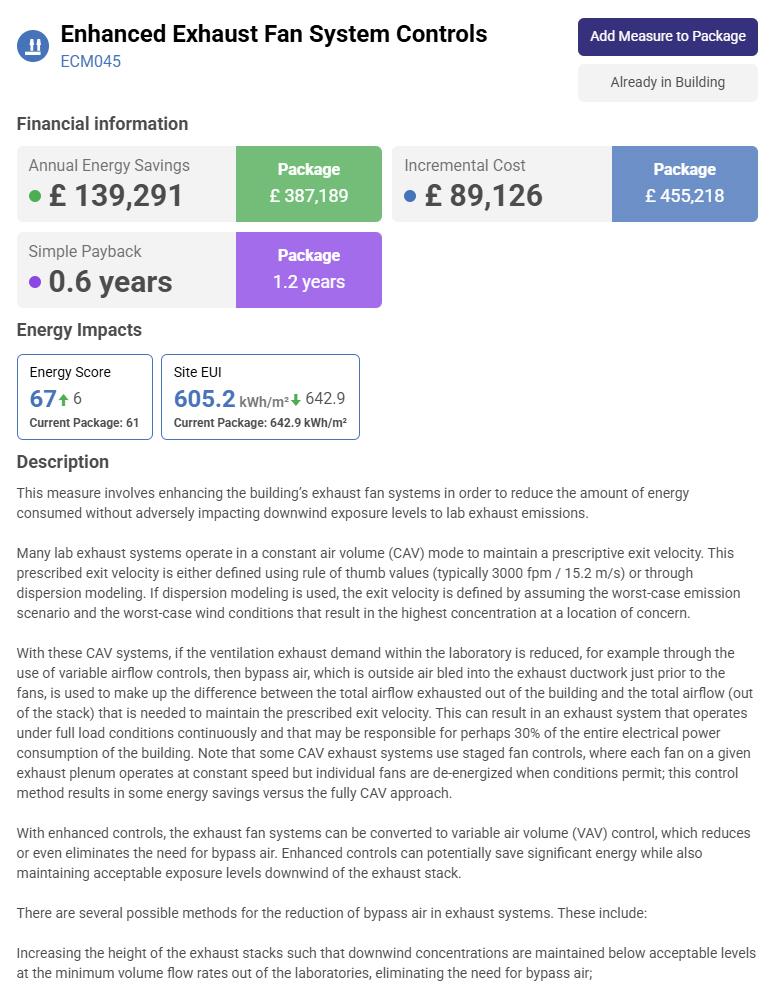
The Actionable Insights and Measures (AIM) Report is the newest component of I2SL’s flagship Labs2Zero initiative to reduce lab energy use and emissions worldwide. Building upon Labs2Zero’s benchmarking tools, the AIM Report goes beyond performance ratings to generate actionable, building-specific insights on improving lab building performance. Given limited information about a facility and its energy usage, AIM uses intelligent algorithms to identify potential savings opportunities and provide customized screening-level estimates of their energy savings, implementation costs, and return on investment. AIM also provides information on the next steps to develop these potential projects and offers relevant case studies showing the selected opportunities in action in similar facilities.
The AIM Report was designed to be used by a wide range of lab industry professionals to help assemble the business case for energy projects in lab facilities. The tool is compatible with many types of lab building, including basic research, product development, and teaching labs, in academic, commercial, and government settings.
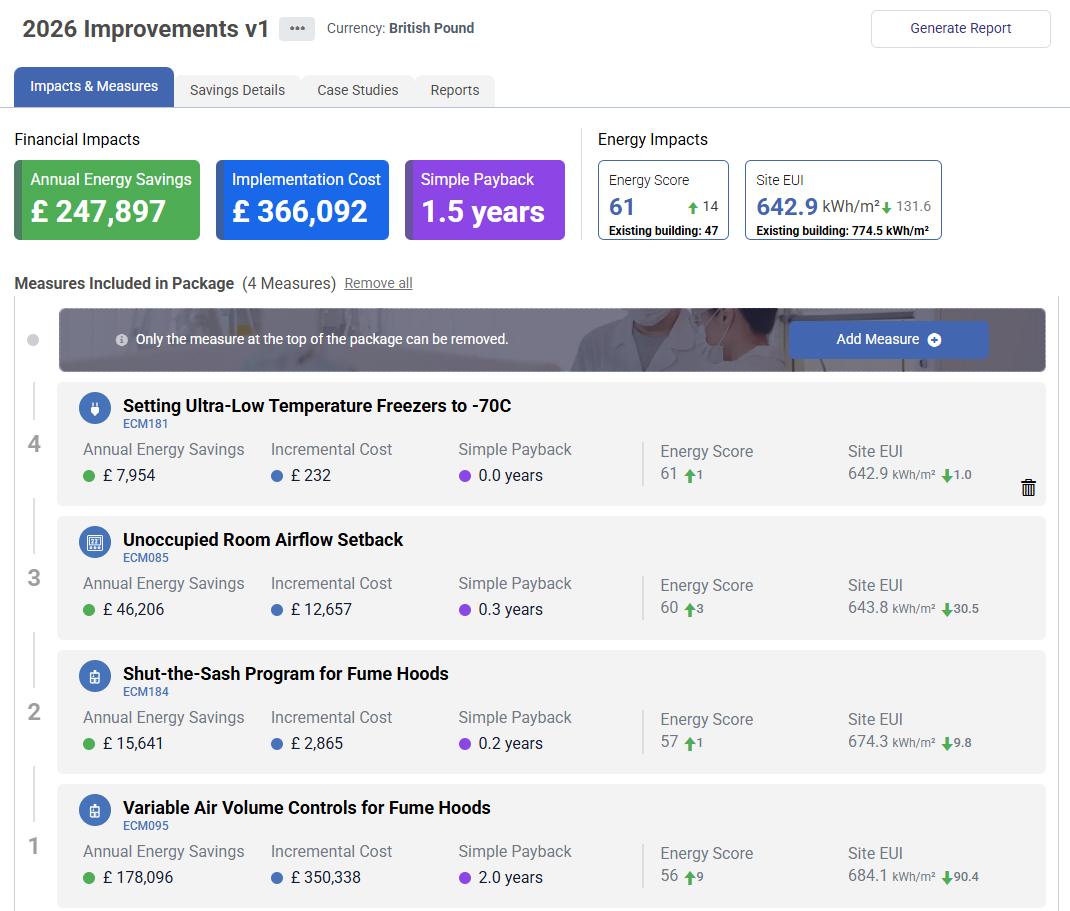
Within the AIM tool, the user builds “packages” of energyefficiency measures from a list of applicable options and the results can be exported as a PDF report to share with leadership or other decision-makers, or to compile with other assessments. The reports can be used by owners’ staff or their consultants to prioritize attention between energy projects within a building or across a portfolio of buildings, to develop campus emissions
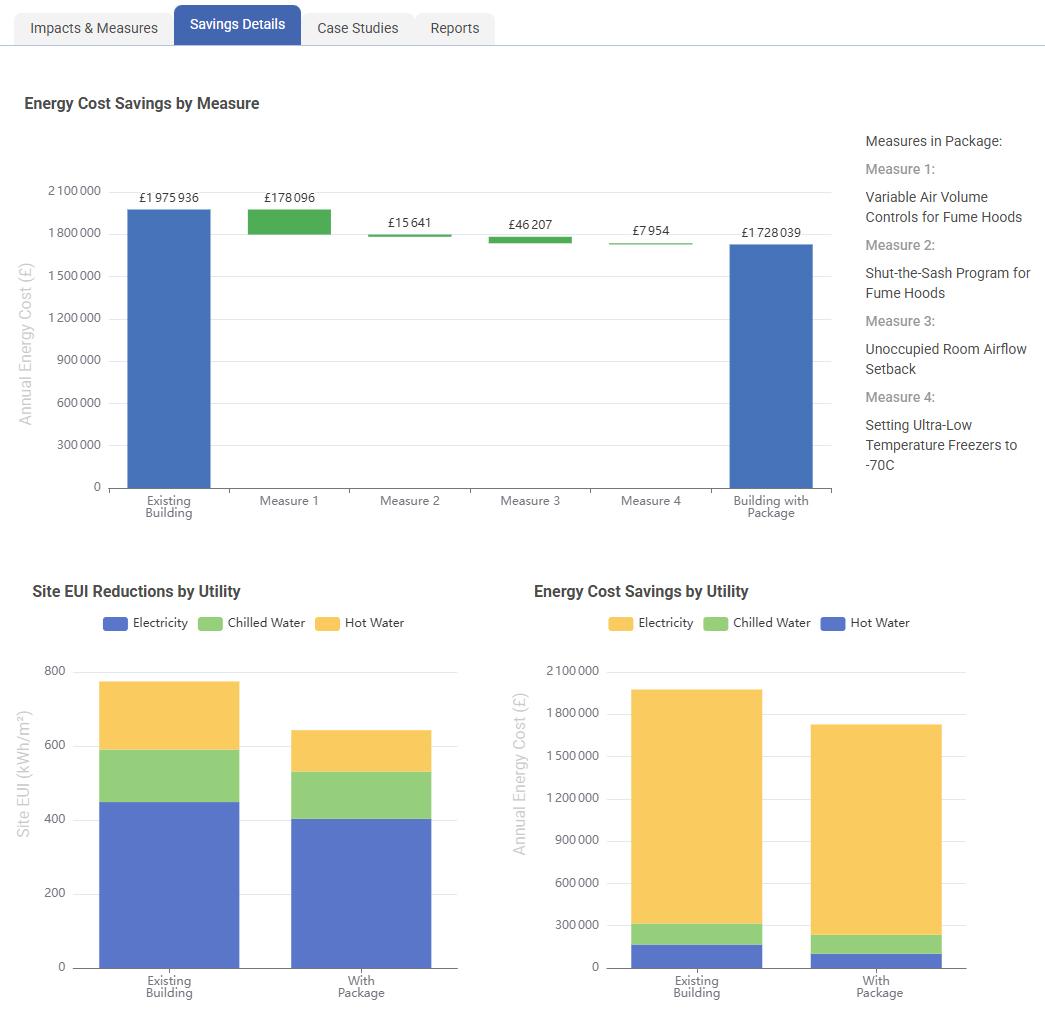
forecasts, or to prepare the economic arguments for launching a campus-wide energy programme. The new AIM software is integrated with I2SL’s existing Lab Benchmarking Tool (LBT) platform, meaning that benchmarking and measure identification can occur in quick succession. The AIM Report is a global tool, designed to be fully flexible for use around the world. The tool includes global currencies, weather data, cost factors, and utility rates, and allows users to toggle between metric and imperial units of measurement as needed.
In developing the AIM Report, I2SL was guided by several important goals. These included creating a tool that is quick and easy to use and that provides objective results. To ensure that AIM was free from individual vendor bias, I2SL assembled a set of Technical Advisory Councils (TACs), composed of subject matter experts from across the lab owner, engineering, building, equipment, and design communities. TAC volunteers helped I2SL make decisions about the AIM measures and their impacts on energy use, and about building model assumptions, costs to implement the measures, and case studies relevant to the measures included in the tool. Additionally, volunteers from the I2SL community piloted the AIM Report to test its usability and applicability prior to release.

The AIM Report is hosted on I2SL’s lab benchmarking website at lbt.i2sl.org. While the full AIM Report software is a subscription service, the site includes a free demo version that allows access to the AIM software with a limited set of measures, but all the functionality of the full subscription version.
Users with buildings already entered in the LBT can run the AIM Report on their buildings immediately. All others should begin by creating a free LBT user account and entering at least the minimum required data for one building.
Quick Start Guides on both LBT and AIM are available online and provide tips on data to gather and how to get started using the tools. n
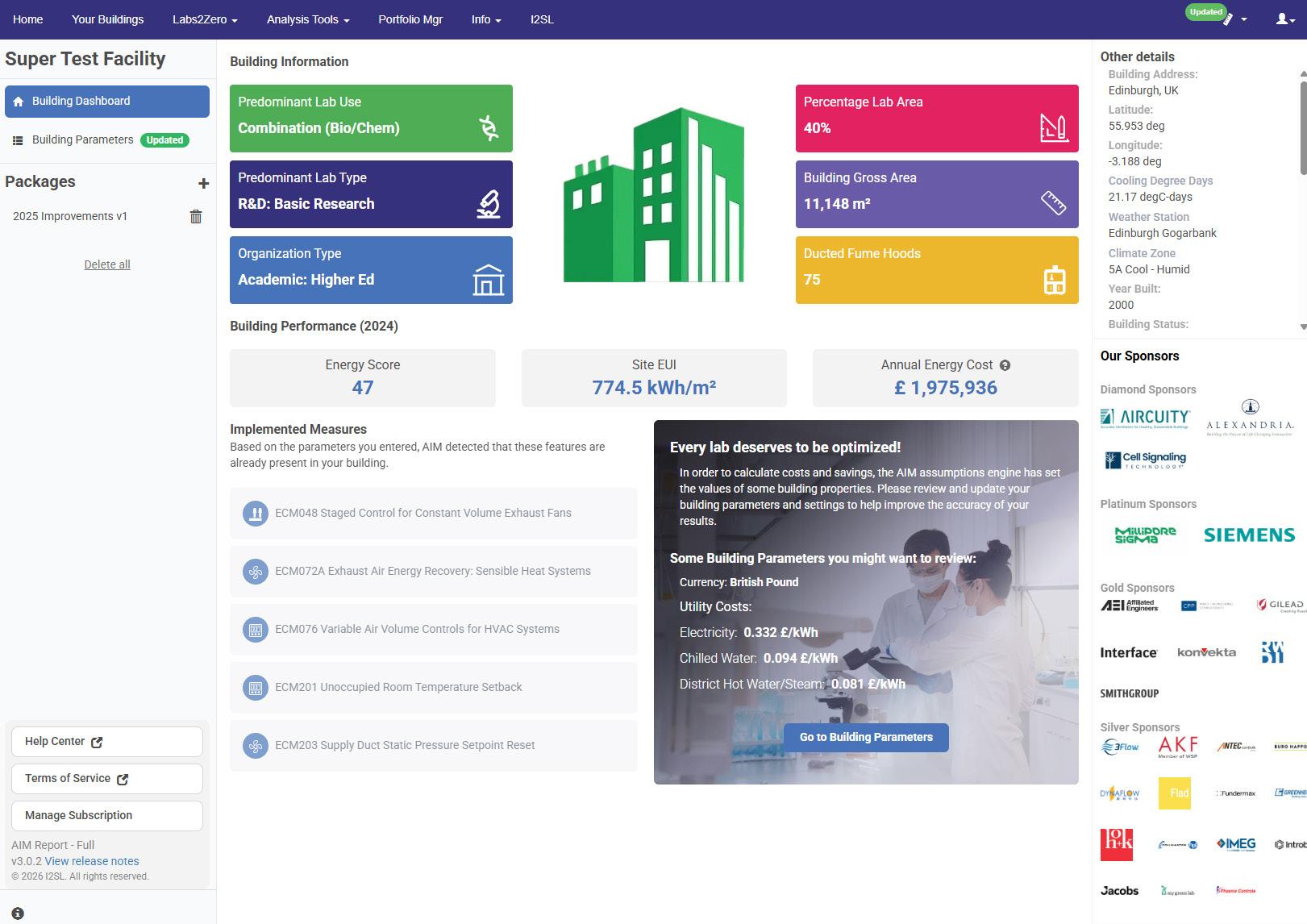
How the AIM Report Works
To perform its energy savings calculations, the AIM Report uses its own web-based calculation engine that was designed specifically to be used for lab buildings.
For each building, AIM uses a series of intelligent assumptions to assign values to any building parameters not provided by the tool user. The use of intelligent assumptions is a critical aspect of the AIM process, allowing users to quickly obtain meaningful results without the need to enter hundreds of pieces of data on each building. Users with time or additional information can override many of the assumptions to tweak the model to better reflect the conditions of their own building and improve the accuracy of the savings calculations.
AIM is equipped with a library of 26 energy-efficiency measures, including many of the most significant for lab facilities. The measures cover HVAC systems at building- and room-level, as well as fume cupboard upgrades and occupant engagement initiatives. AIM's measure implementation cost estimates are calculated for each measure based on the specific properties of each building, and costs are also adjusted based on building location using typical regional cost factors. All measure costs and savings estimates are presented incrementally within a package of measures, so savings and costs are never double-counted.
The AIM Report is available on I2SL’s Lab Benchmarking Tool website at lbt.i2sl.org/aim-report
In the coming months, new calculation features and additional energy efficiency measures will be added to the platform. Further ahead, I2SL plans to create a version of AIM that is dedicated to new construction facilities. The LBT and AIM Report will also be integral to the upcoming International Fume Cupboard Challenge program from I2SL. n
W e WANT YO ur feedb ACK
I2SL welcomes all feedback on the AIM Report and its other Labs2Zero tools. Please contact I2SL at labs2zero@i2sl.org.
Jim Stretton and Barbara Ghinelli explain to Simon Penfold how a unique public/private partnership underlies Harwell’s status as the UK’s hub for science and innovation.
On New Year’s Day “the world’s biggest birthday candle” lit up the skies across Oxfordshire, marking the 80th anniversary of Harwell Science and Innovation Campus.
The UK’s most powerful display laser shone from the centre of the site’s Diamond Light Source, creating The Beam, a vertical pillar of light in the night sky, visible to people across the region.
A striking visual celebration of the campus’ world-leading expertise in light-based science, The Beam – operated by Horizon Lasers - is 2.2 million times more powerful than a typical laser pen, yet still far less powerful than the lasers routinely used by the national research facilities operated by The Science and Technology Facilities Council (STFC) at Harwell Campus.
The Central Laser Facility is one of 15 national facilities on the campus, home to over 7,500 researchers and innovators across 250 organisations, a joint venture between the UK Government – in


the shape of UKAEA and UKRI-STFC - and Brookfield Asset Management. It is this public-private partnership that has turned Harwell into the most important site in the UK for technology, scientific research and its commercialisation. Harwell was at the forefront of atomic energy research 80 years ago, home to the first nuclear reactor in Western Europe, and today is at the forefront of breakthroughs in space, quantum technology, energy, defence and life sciences.
Jim Stretton was appointed managing director of the Harwell Campus and ARC – Advanced Research Clusters – in February last year. He had previously served as CFO and COO at the ARC Group since 2021 after a 15-year career in real estate.
“The start of the campus was back on the 1st of January 1946 when the RAF handed over just an aerodrome to the Ministry of Supply, as it was then, and from there it just grew and grew.”
“It hasn't been linear success for the campus non-stop, periods of growth and investment have been followed by more fallow times. But then there was a great deal of investment after 2006 when it was turned into a government-backed science and innovation campus.
“That what brings us into the modern phase. Harwell is about 700 acres in the middle of Oxfordshire, home to this incredible concentration of commercial organisations and national laboratories including the Diamond Light Source based by the Rutherford Appleton Laboratory, the Rosalind Franklin Institute and, since 2009, the European Space Agency.
“Together it makes Harwell an absolute centre for the UK for science and innovation, particularly focusing on the different clusters we have on the campus.”
Barbara Ghinelli, director of innovation clusters and campus for UKRI/STFC, takes up the story:
“Essentially, the first developments were the STFC large science facilities, which started a few decades ago. So we have the Central Laser Facility with one of the most powerful lasers in the world, the Diamond Light Source synchrotron, the Neutron and Muon Spallation Source, and the RAL Space facilities.”
“These large national facilities had attracted about £2 billion of investment by the time I joined the campus in 2010, There was fantastic science going on and thousands of scientists coming from all over the world to use these facilities.

“What was missing was the generation of substantial impact on the wider economy. This is why the innovation clusters began to better connect the science base to the commercial world.
“This started with space, then we moved to health, then energy, and we have developed some very key capabilities in defence and security working with the MOD. And then lately, we launched another cluster in quantum.
“These clusters of activity are bringing academia, industry and public sector organisations together, working as a collaborative platform.
“It was clear that in order to enable those businesses to thrive on our campus we needed a joint venture with the private sector to develop the real estate side of the site and the infrastructure ecosystem.
“The big turning point was when Brookfield joined that joint venture. As a private sector investor into the campus it has brought a completely different dimension in the way we actually implement our long-term vision.
“We have been developing our clusters together, and they are now recognised as a flagship innovative mechanism for boosting growth for the benefit of the UK. Harwell has been a pioneer in this and will continue that moving forward.”

Below “The world’s biggest birthday candle” lights up the skies from Harwell's Diamond Light Source
Jim Stretton continued: “The joint venture itself has existed for almost 20 years and the first 13 delivered about 400,000 sq ft of real estate.
“Since Brookfield came on board in 2020, it's really put a rocket under things; we’ve delivered getting on for 1 million sq ft in the last five years.
“It has been transformative for the campus in a short space of time.”
The enormous amount of research and development has, as planned, proved a magnet for companies involved across all those scientific fields.
Barbara Ghinelli said: “As well as the STFC, we have other UK Research & Innovation facilities. For example, the Medical Research Council is on campus with the Mary Lyons Centre. And we have facilities funded by the EPSRC - Engineering and Physical Sciences Research Council – like the Rosalind Franklin Institute.
The Faraday Institution is another UKRI initiative.
“The European Space Agency is here, and we have the Health Security Agency on site as well. It makes for a unique concentration that you probably wouldn't see anywhere else in the world.
More than 100 space organisations are based at Harwell, including, RAL Space, the Satellite
“ T here' S NO OT her pl AC e i N T he WO rld W here T here A re SO m ANY WO r K i N g i N T he field O f S pAC e”
Applications Catapult, Thales Alenia Space, Astroscale, Open Cosmos and the UK Space Agency.
“In terms of the space cluster, there is no other place in the world where there are so many businesses and organisations working in the field of space, all within walking distance of each other. That connectivity is essential to the innovation and cross-fertilisation we see here.”
An increasing focus Jim Stretton stressed the importance of the government investment underlying so much of the work at Harwell. “These are facilities that are not capable of being operated or provided by the private sector. They are science-led investments and their concentration in one area makes Harwell globally unique.”
Barbara Ghinelli said: “There’s been more than £3 billion of investment in these facilities,
primarily by the public sector, but the key is the increased focus in making them relevant for businesses, for economic growth and as an attractor of inward investment.
“We’ve got a lot of that engagement going through the clusters, through facilities directly working with businesses. It’s an increasing focus for us to make sure that what we do in the science world has both societal benefits and economic benefits across the UK. So far clusters have seen a 20% job growth per annum and have attracted £2b of inward investment to the UK.”
The concentration of research is underlined by the size of the workforce: over 7,500 scientists, engineers and innovators.
Jim Stretton said: “That number is increasing rapidly as we continue to grow the campus. We have a long-term plan to add another 4.5 million sq ft over the next couple of decades. We've delivered 580,000 sq ft in the last two years, and that feels like a pretty comfortable run rate for us.”
Each cluster at Harwell has its own incubator, placing the site at the beating heart of commercial scientific development in the UK.
Jim Stretton: “The campus has five different incubator facilities for when businesses are at their real starting points. They're able to come to Harwell and have access to the national labs as well. It gives them that great starting point from which to really start growing their business.
“And as organisations grow, we can continue to offer them different homes throughout their journey, all the way up to becoming a global multinational. Moderna is a great example of inward investment. They arrived on campus last year to do their vaccine research and development here, which was the biggest deal in our history on the joint venture side.”
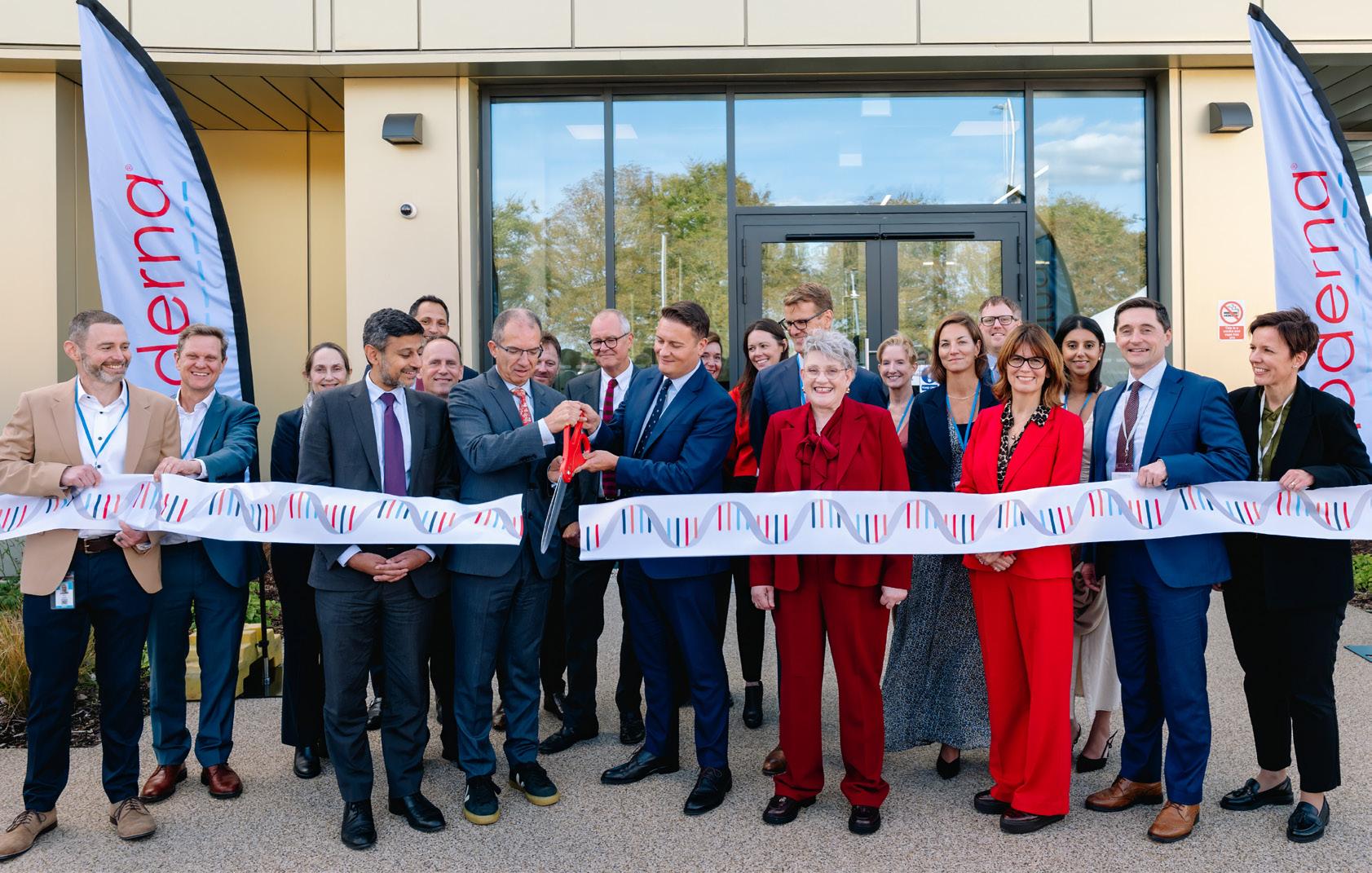
A ribbon-cutting ceremony in September last year officially opened Moderna’s £150 million vaccine facility at Harwell. The Moderna Innovation and Technology Centre (MITC) is the flagship of a 10-year, £1 billion investment in the UK by the US pharma company, with the potential to produce up to 250 million doses of mRNA vaccines per year for the UK if there is another pandemic.
Meanwhile, work on the site continues. Barbara Ghinelli said: “There are already a lot of upgrades at Harwell in terms of the national lab facilities; the Vulcan 2020 laser and Diamond 2 are clear examples of how the science is moving at pace.
“One of the things that has become clear to us is that a very big percentage of our businesses are scaling up, so we are putting in place structures, infrastructure and support for them.”
Jim Stretton added: “In terms of being ready for the next big thing, quantum is a really powerful example of that. It is not brand new but it is extremely cutting edge and the UK government has been making significant investments in quantum technology over the last ten years.
“It invested £93 million in the National Quantum Computing Centre here at Harwell; that is an example where government has been extremely prescient.
“Off the back of that, we're seeing a real increase in the level of commercialisation of Quantum research. The highlight recently was the acquisition of Oxford Ionics by IonQ from the US for $1.1 billion. That was an example of government investment driving great private sector success.”
“All the test beds from the National Quantum Computing Centre provide big opportunities for businesses to demonstrate critical technology, expand and have a place in the UK to continue their growth.
“We’re NOT T r Y i N g f O r

“We hear all the time about UK science and innovation businesses migrating to the United States, but in this instance it’s the other way around, because of that excellence and advantage that we have in quantum computing.”
“If we look at life sciences, again we’ve got some wonderful national laboratory facilities here. The Rosalind Franklin Institute is
one of the foremost sites in terms of life sciences and we have a lot of incredible member organisations, Oxford Nanopore and Moderna being probably two of the largest and best known.
“What there hasn't previously really been at Harwell is a lot of fitted laboratory space available for commercial development, and in particular, there hasn't been anything available for small businesses.
“What we are working on now is CO:LABS, providing an accelerator facility for businesses that are looking to take their next step.
“The CO:LABS development will provide serviced labs for organisations of maybe a dozen people on the verge of commercialising their science.
“It will predominantly be businesses in the life science sector, but it will be a flexible building. We’ll have a full-time lab manager there and access to some of the scientists and expertise from The Rosalind Franklin Institute other national labs and large organisation son campus to help with that commercialisation.
“It's the most exciting development we've ever done here from the joint venture side of the campus - 75,000 square foot of
lettable space and the total GDP will be over £100 million.
“We’re not trying for second best; this will be an absolute landmark facility.”
The aim is to have the doors to CO:LABS opening in September as the highlight of Harwell’s 80th birthday celebrations.
Barbara Ghinelli added: “We started looking at this type of approach as we started developing the health tech cluster, because we could see where this gap was: a facility for companies that are needing to scale up fast.
“They need that nurturing support and environment within which they can have proper conversations with investors. But this is not the type of thing public sector can deliver alone. This vision has been implemented through the joint venture, this unique ecosystem here at Harwell that can deliver this kind of facility.” n
Harwell’s world-leading facilities and teams are pioneering advances in Energy, Space, Health and Quantum Computing. Discover more at www.harwellcampus.com

Words Daniel Webster Partner and Life Sciences Lead, Gardiner & Theobald

Joining UKSPA marks an important step in strengthening our role within the UK’s science and innovation community. At G&T, we see first-hand how rapidly the sector is evolving and how critical it is that real estate keeps pace with the ambitions of researchers, clinicians and advanced manufacturers.
The UK has set clear national goals for growth in life sciences, backed by significant public investment. Turning that ambition into impact, however, requires buildings and campuses that can support the full progression from discovery to commercialisation. Too often, facilities are either overspecified or under-engineered. The most successful schemes strike a balance - science-enabled buildings with robust power, MEP capacity and structural allowances, without locking future occupiers into rigid layouts or unnecessary systems.
Sustainability is central to this challenge. Life sciences buildings are inherently energy-intensive, yet the sector is making meaningful progress through smarter operational monitoring, low-carbon design strategies and a stronger focus on the wellbeing of those who work within them. Our work at Lumen House demonstrates how inclusive design can enhance productivity and better support neurodiverse teams operating in highly technical environments, while also responding to wider ESG objectives.
Alongside sustainability, flexibility has become a defining requirement. AI, automation and new research methods are changing
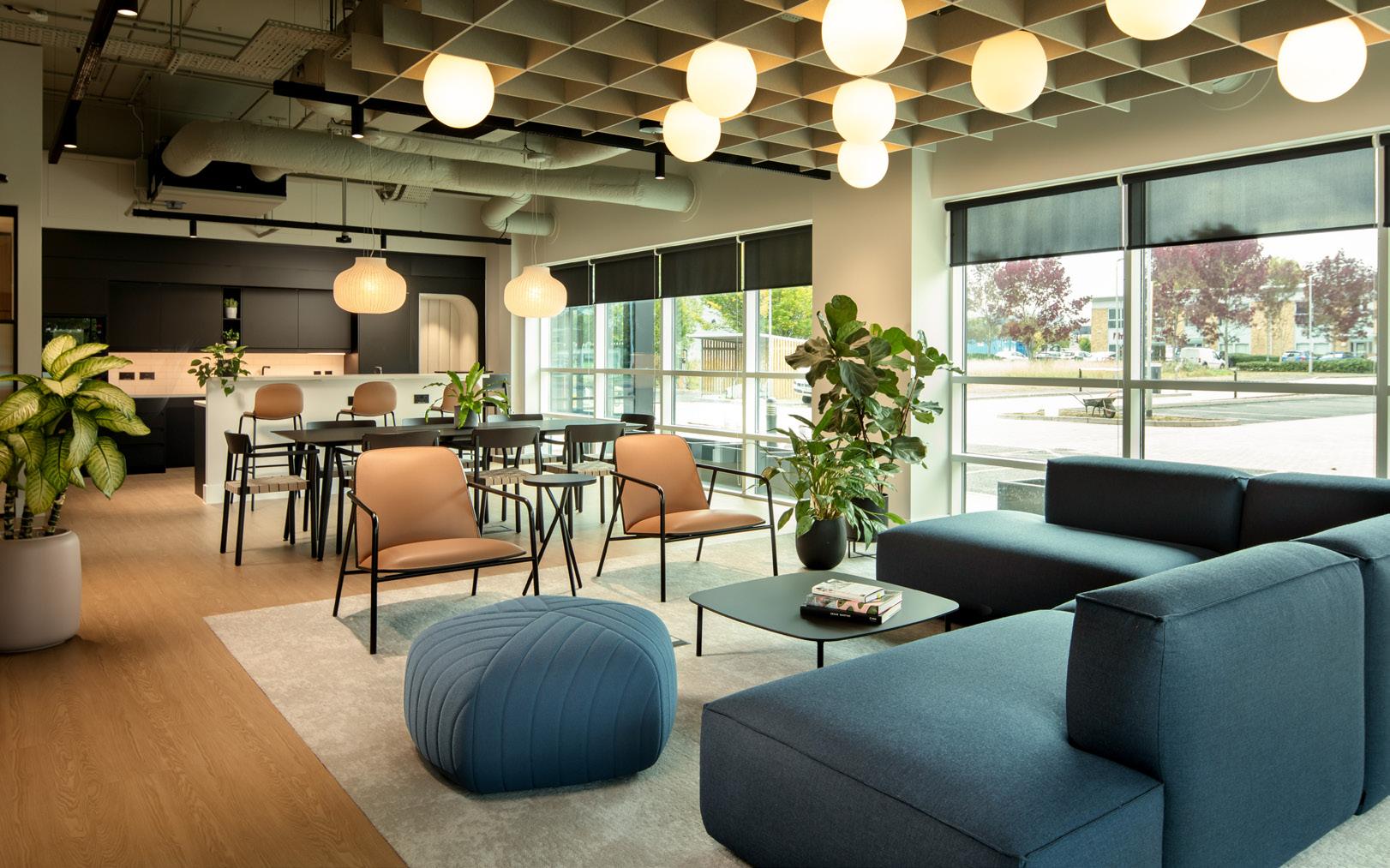
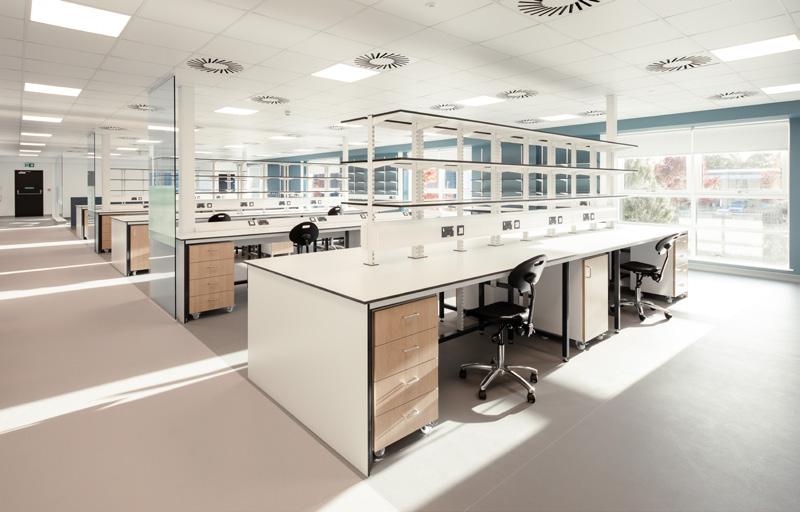
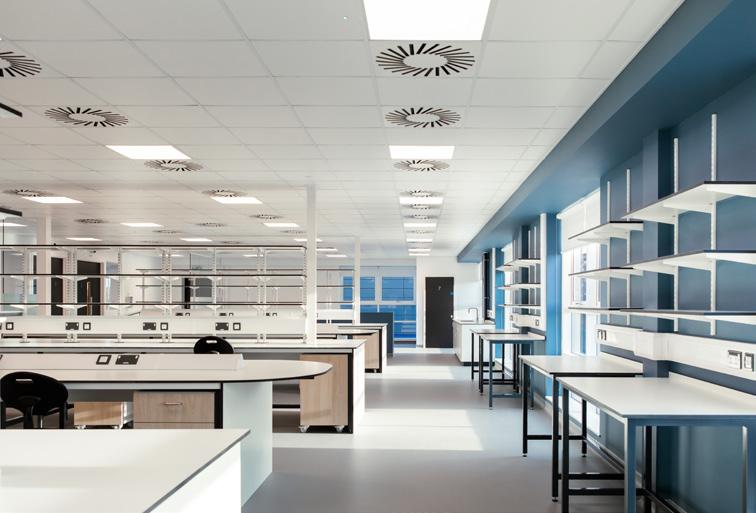
space needs faster than traditional development cycles can respond. Designing infrastructure that can adapt through larger risers, generous floor-to-floor heights and early consideration of validation pathways, is now essential to safeguarding long-term asset value and future usability.
Affordability and access to talent are also reshaping the geography of UK innovation. While the Golden Triangle remains globally significant, many organisations are increasingly drawn to regional clusters such as Manchester, Edinburgh, Bristol and the North East. Anchored by strong universities, these locations offer opportunities for incubator and
scale-up space that allow companies to grow within established research networks. Through UKSPA, I look forward to sharing lessons learned and working collaboratively to shape the next generation of science and innovation places, campuses that are flexible, commercially resilient and designed for the people who drive discovery. n
d eliveri N g fAC ili T ie S
G&T delivers complex life sciences, R&D and GMP facilities across the UK, supporting developers, investors, occupiers and research institutions. Find out more at www.gardiner.com/ sectors/life-sciences-2

s the UK positions itself as a global leader in compound semiconductors, a key role is being played by Compound Semiconductor Applications Catapult (CSA Catapult) based in in South Wales, Bristol, Scotland and Durham.
The Catapult is focused on accelerating commercialisation of developments in power electronics, photonics and radio frequency (RF), advanced packaging, supporting technology clusters across the UK f and partnerships with universities and industry.
Compound semiconductors are advanced materials composed of two or more elements, such as gallium nitride (GaN), silicon carbide (SiC) and gallium arsenide (GaAs), that offer improved efficiency, higher speed, and better power handling than traditional silicon. As a result they have become critical for advanced telecoms, electric vehicles, renewable energy, and AI data centres.
While the industry has spread across the UK, its traditional heart of manufacturing and research has been in South Wales, where universities led the field in semiconductor research in the 1960s.
Leonie White, communications director at Newport-based CSA Catapult, explained: “While the original semiconductor industry created 40 years ago has died away, there are a lot of people who had worked in that industry still around. Newport in particular was a centre of excellence for semiconductors, as was Bristol. So that industrial heritage and talent base still remained when the compound semiconductor cluster started developing in more recent years. It has since attracted people from further afield, not only from across the UK, but other countries around the world.
“The majority of electronic chips are silicon but the UK has a long track record in material science and research into compound semiconductors.
“For example, lots of silicon carbide chips are made by Clas-SiC Wafer Fab in Scotland. We’ve worked with Clas-SiC on the first complete end to end supply chain in silicon carbide power electronics in the UK, in a project called ESCAPE.
“The chips are more efficient which means they can handle more power when you go to higher voltages. And being able to deploy these advanced semiconductors in products gives the UK a competitive advantage.”
“CSA Catapult started in 2018 after Innovate UK and the Government identified that the UK had a comparative strategic advantage in compound semiconductors and their commercialisation. Which is mainly anchored through in the research institutes that exists in universities right across the UK.

“There had been a UK-wide search for a location and it was felt it would be ideal to put it the South Wales semiconductor cluster, which is known as CS Connected, because it would be surrounded by three universities - Bristol, Swansea and Cardiff - and there were other institutions that were being created at that time, such as the Institute for Compound Semiconductors at Cardiff University.
“Today, eight years later, we have the Innovation Centre in Newport, The Future Telecoms Hub at Bristol and Bath Science Park, we’re in NETpark in Durham, we’ve co-located space with the Satellite Applications Catapult at Net Park and we have also co-located with NMIS – the National Manufacturing Institute of Scotland – who are part of the High Value Manufacturing Catapult.
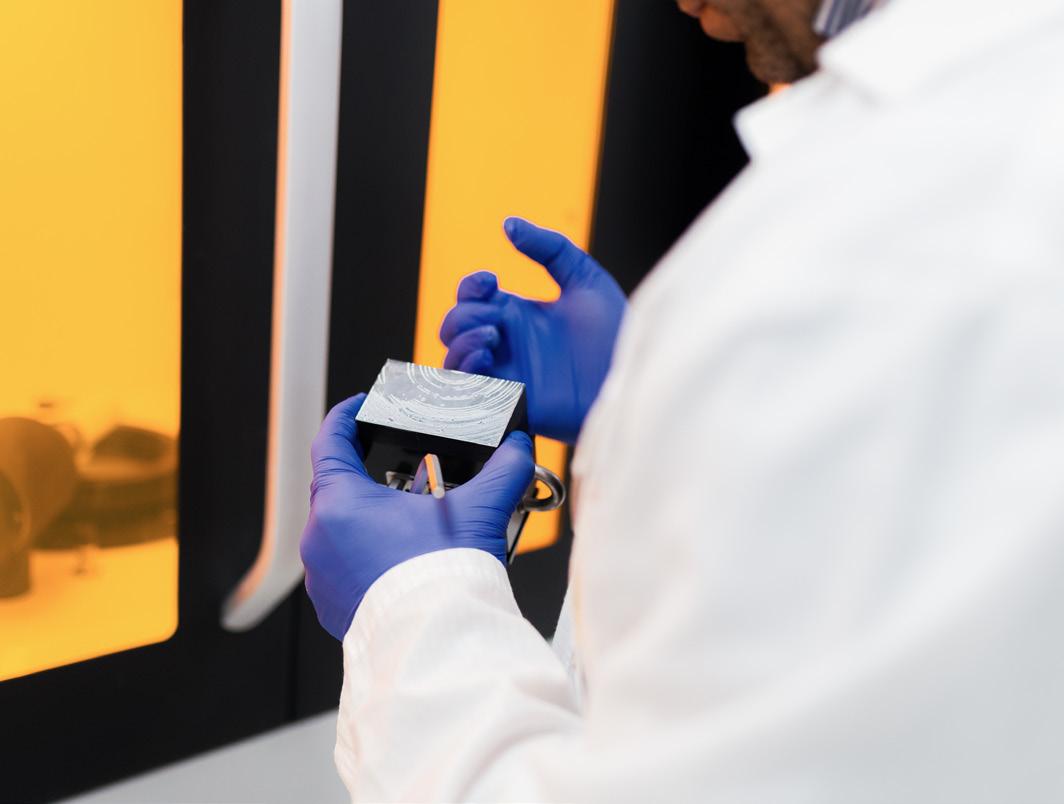
“As a result we're able to support the whole of the UK compound semiconductor sector.
“A catapult bridges the gap between academia and industry. It typically accelerates companies developing and commercializing new technology. For us in particular, we are in the TRL level 3 to 6.”
TRL, or Technology Readiness Levels, assess the transition from theoretical research to validation.
TRL 3 involves proof-of-concept, while TRL 5 covers validation in a relevant environment and TRL 6 covers technology model or prototype demonstration.
“So help companies develop their technology between TRLs 3-6 in that so-called ‘valley of death’ and we help get products to market quicker and help with commercialisation,” said Leonie. She continued: “The UK’s particular strengths are in research, design, development, IP and advanced packaging.”
‘Packaging’ refers to the critical final stage of chip fabrication in which an integrated circuit is enclosed within a protective structure that safeguards it from mechanical and environmental damage, manages heat dissipation,
“ W e've g OT A re A l CO mpe T i T ive edge AN d WO rld- C l ASS
and provides reliable electrical connections to the host circuit board.
Advanced packaging technologies being developed in the UK enable effective thermal management of these semiconductors, significantly improving heat dissipation and supporting high levels of energy efficiency.
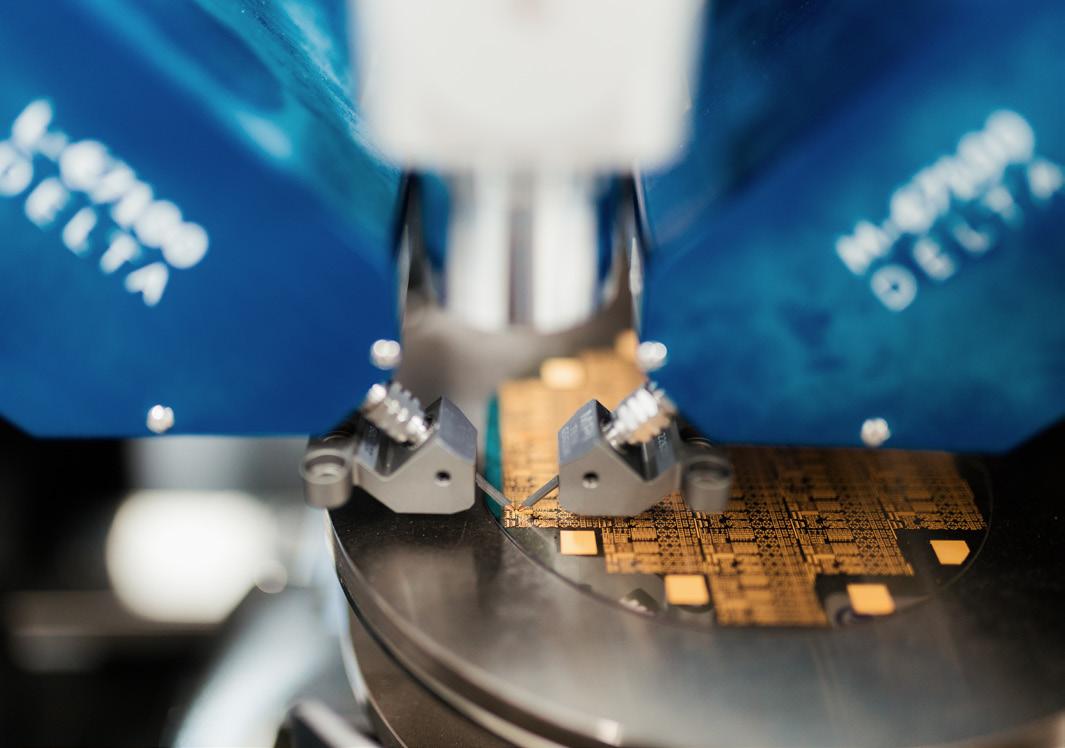
“There is also a process called hybrid integration,” explained Leonie. “The best way of describing it is the integration of multiple, separately fabricated components, often made of different materials with high precision. Imagine a thumb-sized chip and in each layer of the chip there are 300,000 micro bumps, like tiny Lego blocks that all fit together. Across the different layers of the material they work together to improve performance, power efficiency, and thermal management.
“Because we've got the packaging capability at the CSA Catapult, we've got a real competitive edge and world-class expertise.
“Partnering with NMIS presented a great opportunity. We can prototype at Newport, but with the facility in NMIS there can be a manufacturing scale-up line for power electronics and packaging.
“Also in Scotland there's a supercluster that looks at quantum and photonics. Both are key areas for us. One of the benefits of these compound semiconductors is they have greater processing ability and they have improved performance. Photonics devices, depending on their design, can either receive or emit light.
“Just one exciting aspect of technology that's going into AI data centres is called co-packaged optics. They reduce the power and communication bottlenecks when connecting AI processors with switches. And that market is set to be worth $80 billion globally by 2030.”
The UK is already the second largest photonics producer in Europe and the ninth globally. CSA Catapult is working to move the UK up that league table.
“DSIT – the Department for Science, Innovation and Technology - did the first ever semiconductor sector study in 2024 and they identified there were 623 semiconductor companies in the UK,” said Leonie.
“They're mainly in design, but compound semiconductors make up a large slice of that - 30% of the overall sector, in terms of economic output, is based in Wales.
“We’ve worked with around 300 organisations so far, usually in the early days on collaborative research projects.
“We can work with a spinout from any of the universities across the UK where they've got semiconductor technology, in those early-stage companies to do that proof-of-concept work.
“Our teams go out and talk to companies and try and help them, find out what technical problems they have, but also work out supply chains so that we can create a stronger UK industry.”
“Our Catapult has a combination of tech and collaborative knowledge. So if a UK investor comes to us wanting to help develop a new technology in, say, photonics, our team would be able to connect them right across the ecosystem to the technical experts, to the people in universities and their spinouts, making connections for UK-based companies but also international partners.
“That's what we're very good at. And we have a really good track record in building those supply chains in compound semiconductors.
“We have the interplay of four frontier technologies: advanced connectivity or telecoms, quantum, AI, and semiconductors themselves,” said Leonie.
As an organisation funded by Innovate UK , CSA Catapult is required to regularly report on its impact. The most recent report showed that employment safeguarded or created through R&D projects with CSA Catapult had contributed more than £600m of gross value added (GVA) to the UK economy.
“ we have a really good track record in building supply chains in compound semiconductors”
“When the Government’s Industrial Strategy was being developed we put together a proposal that said the UK should be positioned as a semiconductor supercluster, because we have these strategic advantages in compound semiconductors, IP and design. The whole UK needs to lock together and play to these strengths.
“For instance down in Torbay there's a photonic hub based around the EPIC Centre. In Bristol you've got quantum, telecoms and defence. Cambridge is very much a hub for design. There’s a really strong centre for telecoms at the University of Surrey. In the north east it’s very much about defence and RF. In Scotland you have quantum while in Northern Ireland you have a growing photonics cluster with Seagate, Thales, Ulster University and Queen’s University.
“And you have all of the universities, with specific areas of expertise, right across the UK.”
Backed by the Industrial Strategy, the future looks strong for the semiconductor industry.
Between 2019-23 CSA Catapult projects created or safeguarded 4,718 jobs. The Catapult supported 156 R&D projects and worked with 215 SMEs and 40 large organisations.
The report, from the Welsh Economy Research Unit at Cardiff University, found that £15m of external R&D funding received by CSA Catapult generated a longterm benefit to UK productivity of between £56m and £86m.
Leonie said: “We know that the companies that we've worked with have, between them, leveraged about £1 billion pounds worth of investment over the years.
“As an organisation, we have the technology, we've got the technical expertise and we have

the convening power to bring the supply chains together. We take public investment, we put it to good use and find ways so that many companies can benefit.
“For instance, we’ve helped create an AI design tool that really speeds up the design process from weeks to hours.
“The Government has already laid out its AI science strategy and says it wants to get more Britishdesigned chips into data centres. That is a massive opportunity for the UK to create AI hardware. Again, it’s leveraging this technological lead.
“We’re also involved in green energy with the development of the solid-state transformer. Across the UK, I think there are 570,000 transformers, but if you move to a solid-state transformer, it means that they are more energy efficient.”
“We have invested in a solid-state transformer technology demonstrator for AI infrastructure that we think is a big opportunity for the UK and beyond, because the grid will need to be balanced to provide a steady energy supply across it.”
“We know that overall there are very high growth markers for hardware. The overall AI hardware market globally is set to be about $1.5 trillion by 2030 – that’s a third of the UK’s GDP.
“In defence, we have developed a technology called RF beam forming that could be used in edge AI and drones specifically, while there is work under way on power electronics for battlefields, tanks and so on, because compound semiconductors enable the technology to be smaller and more robust.
“We have this research excellence and we're leading in commercialisation, that's why there will be more opportunities for the UK. Our continuing work in semiconductors gives us the opportunity to access the world’s biggest growth markets.” n
W O r K W i T h u S
CSA Catapult is the UK’s authority on compound semiconductor applications and commercialisation. Scan the code to find out more about what we can do for you and how we can work together

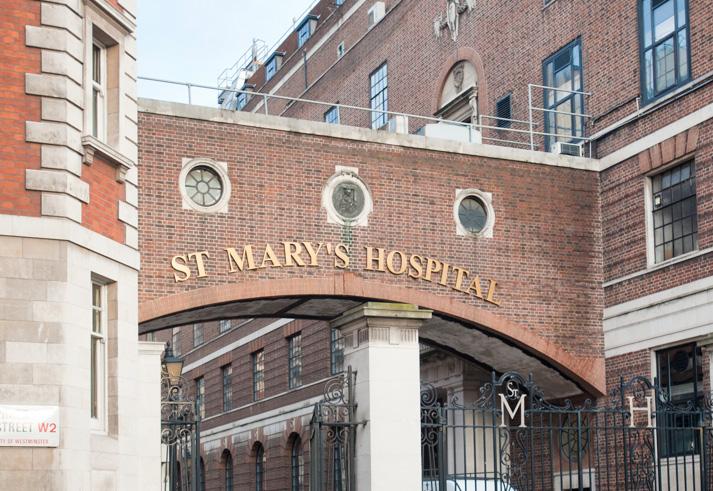
addington Life Sciences is a dynamic innovation cluster in the heart of London, centred around St Mary’s Hospital and led by Imperial College Healthcare NHS Trust. Its mission is to connect the NHS, academia, industry, and local communities to drive health improvement, economic growth, and social value. Building on Paddington’s rich legacy of discovery – from the Nobel Prize-winning breakthrough of penicillin to today’s cuttingedge research delivered in partnership with Imperial College London – Paddington Life Sciences aims to create a world-class ecosystem for life sciences. This includes plans for:
• A new, 800-840 bed hospital on the St Mary’s estate. It will be primarily one, tall building on a smaller footprint than the current facilities which are spread across the ten-acre site.
• Up to 1.5 million sq ft of flexible commercial and laboratory space to support the expansion of Paddington Life Sciences. The mixed-use commercial and lab space will be used for life sciences businesses to start, develop and grow.
• The Fleming Centre, a global hub for antimicrobial research due to open in 2028.
“ pA ddi N g TON l ife
The partnership brings together leading organisation based in Paddington, including: British Land, Brockton Everlast, Convatec, Derwent London, Imperial College Healthcare NHS Trust, Imperial College London, Ipsen, IQVIA, Microsoft, Optum, Oracle Health, Shionogi, Takeda, Vertex and Vodafone. The associate partners are: Imperial College Health Partners, Imperial Health Charity, Healthcare Central London, North West London Pathology, and The George Institute.
The partnership focuses on four strategic workstreams:
• SOCIAL VALUE
Tackling inequalities through education, employment, and digital inclusion.
• DIVERSITY IN CLINICAL TRIALS
Improving representation and trust in clinical research.
• DATA AND DIGITAL
Leveraging secure data environments and real-world evidence to transform care.
• PLACE AND SPACE
Positioning Paddington as a premier destination for life sciences businesses.
With excellent transport links, a thriving research environment, and a commitment to inclusive growth, Paddington Life Sciences offers a unique opportunity to collaborate on innovations that improve health and wellbeing locally and globally. n di SCO ver m O re ON li N e
Please visit www.imperial.nhs.uk/ paddington-life-sciences
Sharing your success, best practice, and lessons learned
Val Hughes-White (right), director of the Roslin Innovation Centre and new chair of UKSPA’s Scottish group, talks to Simon Penfold about growth and collaboration.
Roslin Innovation Centre has witnessed a string of successes among its tenant companies over the past year, under the leadership of its new innovation director.
Providing 50,000 square feet of office and Cat2 lab space on Edinburgh University’s Easter Bush Campus, the centre was established in 2017 as part of an ecosystem to foster and support commercialisation within the animal bioscience, aquaculture and agri-tech (the 3A’s) and One Health sectors across the university and the wider Midlothian Science Zone.
One Health is a specialisation of Easter Bush; a unified approach to the health of people, animals and ecosystems, managing complex health threats such as zoonotic diseases,


antimicrobial resistance (AMR), and environmental degradation.
Roslin Innovation Centre acts a gateway for entrepreneurs, companies and public-charitable bodies at the heart of the Easter Bush Campus – the only UK Research & Innovation campus in Scotland - which is also home to The Royal (Dick) School of Veterinary Studies including the world-leading Roslin Institute, and Global Agriculture and Food Systems.
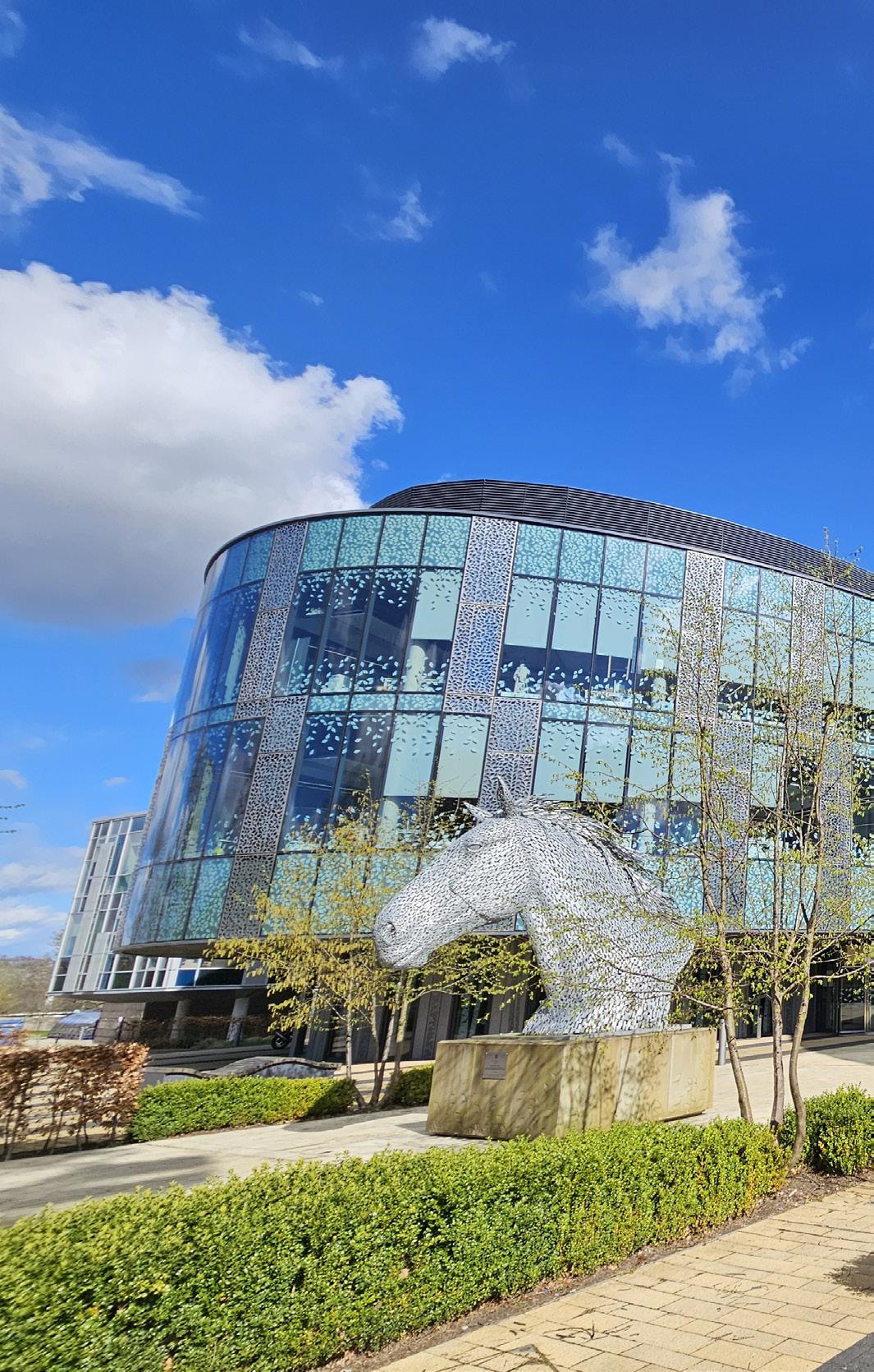
Val Hughes-White is the Roslin Innovation Centre (RIC) and Agritech Innovation Director. Formerly campus operations officer for more than a dozen years, she chose to focus on supporting fledgling innovation and research businesses, taking on the role of director of innovation 18 months ago.
“This centre is relatively new and I played a substantial part in its creation.
I wanted to go back to my day job.
“Over the past 30 years I’ve worked for research-intensive
universities such as Dundee, Oxford, Reading and now Edinburgh and I've always had a role supporting R&D in various levels.
“I've done things from clinical trial administration right the way through to helping set up incubators and innovation centres, and everything in between, helping numerous companies spin out.
“I decided I wanted to step back from the wider remit of the COO role and just to focus on one thing; going back to supporting young companies was the part I loved.”
Satisfaction in success
Since she took over the role she has had the satisfaction of seeing a number of Roslin’s tenant companies achieve major success.
Innovative biotechnology company Cytomos raised £5 million to scale up production of its unique cell analysis technology and has moved on to Edinburgh
“We
S upp O r T e NT repre N eur S helpi N g T hem f O rm CO mpAN ie S
Technopole, the nearby life science incubator operated by Pioneer, the leading Scottish campus operator.
After seven years, the Roslin centre also said goodbye to one of its first tenants. Engineering biology company Ingenza, originally a spinout from the University of Edinburgh, moved in May last year into a new multi-million pound purpose-built facility at the Technopole to allow for further expansion of their operation.
Meanwhile innovative biotech firm Roslin Technologies, working in the field of cultivated meat, has grown from leasing six desks in 2017 to becoming an ‘anchor tenant’, moving into a bespoke lab and office area last summer occupying a complete wing on the first floor of the Roslin centre
Roslin Technologies chief operating and financial officer, John Clinkenbeard, said at the time: “This move feels like a natural evolution of our footprint within the Easter Bush ecosystem. While the path for early-stage biotech businesses can at times be uncertain, our home within the Roslin Innovation Centre
community has always been a source of satisfaction and assurance.”
Val Hughes-White said: “We have a close relationship with Edinburgh Technopole; I think that's amazing to show that we can provide our tenant businesses with follow-on space so they're still kept in the Midlothian region and can keep growing.
The Roslin Innovation Centre is currently home to 36 startups, from micro businesses to SMEs, employing 300 people in total.
Val said: “We only focus on early-stage startups; we see ourselves as supporting a collaborative ecosystem to allow entrepreneurs and companies to spin out of Roslyn Institute, which is right next door, and the veterinary school.
“We support the entrepreneurs – and they can be from both the student body and the staff –helping them form companies that
are in animal bioscience, animal health, agritech or aquaculture, or what is commonly known as One Health, where we're dealing with zoonotic diseases that go from animals to humans.
“We look really to solve those challenges locally and globally.
“Of the 36 companies here within the Innovation Centre, about half have come from staff and student spin-outs. The rest are spin-ins who have chosen to come here because of the expertise and the specialist facilities on campus.
“The aim is to form a collaborative community, which enables you to have this interaction where companies can genuinely collaborate with the academics that are on their doorstep and make use of the often unique facilities on the campus that aren’t available anywhere else in the UK.
“For example, Easter Bush has a large animal research and imaging facility, which is the only one of its type in Europe.”
“We provide events, investors readiness programmes and a lot of additional support to help these companies use those pull-push drivers for innovation and help them grow and thrive.
“And if we can support them on that journey, it's of benefit to the local economy.
“As part of the City Deal for Edinburgh and South East Scotland, I support any entrepreneurs in the region who are interested in A3 and One Health. And if they are not a fit for us, I have extensive contacts across the science parks in Scotland and the wider UK to forward them somewhere else that is better suited to them.”
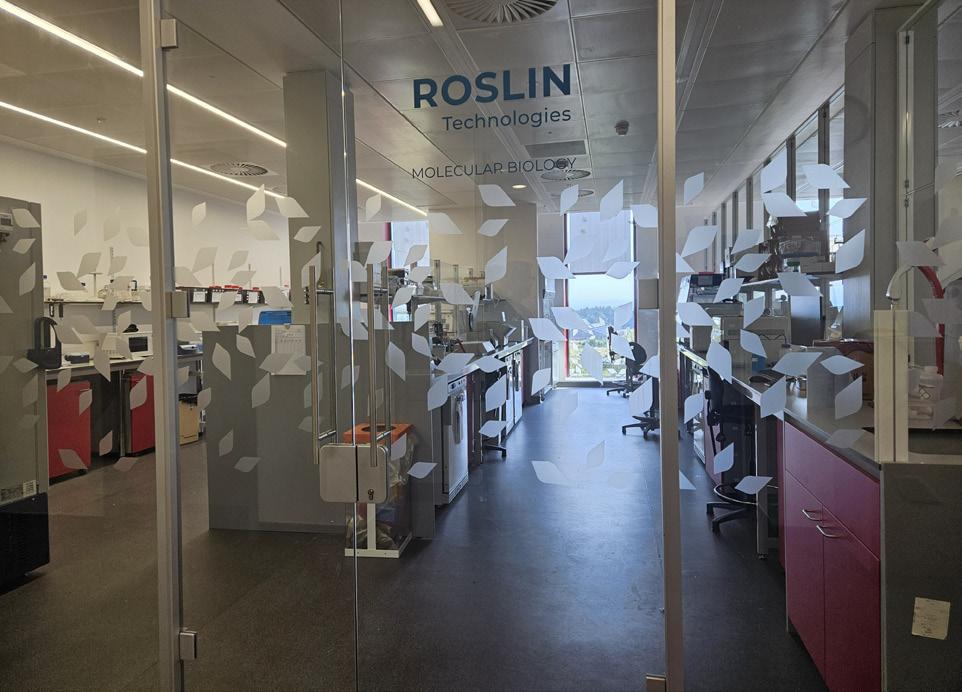
Supporting UKSPA members
Aside from her day job running the Roslin Innovation centre, Val Hughes-White is chair of UKSPA’s Scottish group.
“I started in the role at the end of last year, and we’ve been working on providing data and information that will genuinely support members. I am also using the connections I have built up in my career to try and forge closer links here in Scotland.
“Currently I’m making a point to spend at least one day a month visiting one of the Scottish science parks. So far I’ve been the European Marine Science Park at Oban, and the West of Scotland Science Park in Glasgow, the Energy Transition Zone in Aberdeen and to Dundee’s new Innovation Hub.”
The Scottish UKSPA group is aiming to build a better, more accurate, picture of the Scottish science park community.
“In February we started an exercise to gather economic data about the performance of our science parks that will enable us to influence government and other bodies. That will be provided to the group members for them all to use.
“We are collating everything from the types of public engagement activities they run to the sectors that they cover – some are very tailored to specific sectors while other science parks are a bit more general.
“Understanding those sectors and the number of companies –and the number of jobs they have
Below Val HughesWhite (fourth from left) and the UKSPA Scotland group at a recent gathering at Roslin Innovation Centre
created – will enable us to carry out a proper economic evaluation of the contribution we make to the Scottish – and UK – economy.
“We are also looking at the investment into the campuses over the past five years, and looking forward for five years into the future, to understand if there are common issues across the science parks in Scotland and how we can address them.”
An interconnected landscape
There are currently 12 full UKSPA members in Scotland, but the data exercise will be carried out across all science parks across the country to provide a full Scottish picture.
Currently UKSPA’s Scottish members include the Advanced Manufacturing Innovation District Scotland (AMIDS), BioCity Glasgow, Edinburgh BioQuarter, Edinburgh Technopole, the European Marine Science Park in Argyll on the west coast, Glasgow City Innovation District, Pentlands Science Park, Roslin Innovation Centre, Scottish Enterprise Technology Park, Stirling University Innovation Park, University of Glasgow’s Clinical Innovation Zone, and West of
Scotland Science Park.
“One of the things we are trying to do through this data collection exercise is provide the evidence that the Scottish UKSPA membership makes a significant contribution to building a high growth resilient economy that creates quality jobs for Scotland.
“And it can be a powerful tool, helping us to connect a bit more across Scotland. We're not in the thing of competing with each other, we genuinely want to collaborate.
“That is the only way that innovation is going to thrive, if there is an interconnected landscape that can be supported.
“We really want UKSPA moving forward to have a stronger influencing role, proving how the sector can contribute to the economy and how it can contribute to the Industrial Strategy for the UK in general.
“ we want ukspa moving forward to have a stronger influencing role, proving how the sector can contribute to the economy”
“To quote from Industrial Strategy, it highlights that we must have a nation of inventors, entrepreneurs and tech adopters if we want to build a resilient economy that creates quality jobs and improves living standards.
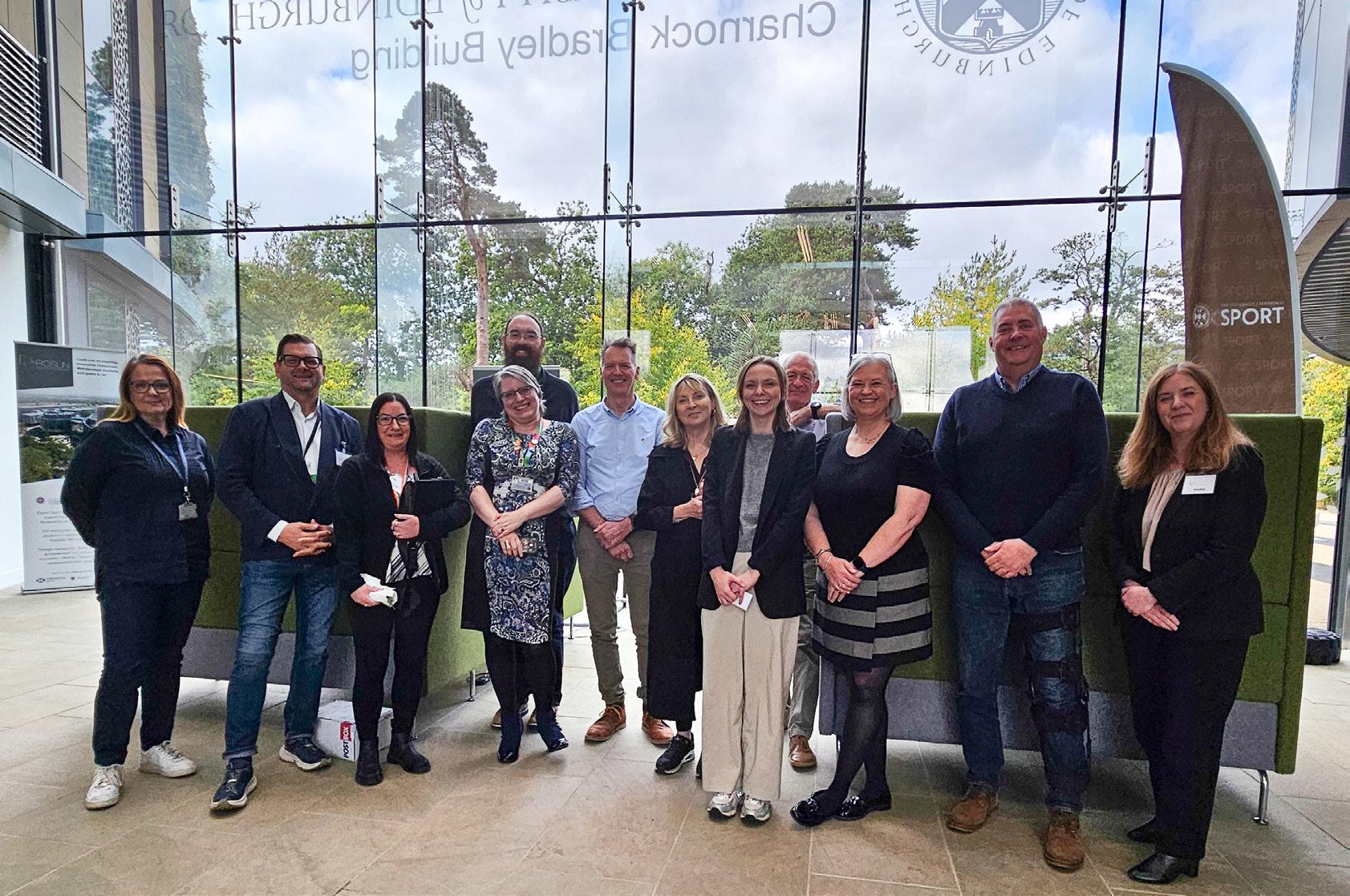
“And the only way you can do that is by helping innovation businesses become smarter and more efficient.
“I strongly believe that science parks play an integral role of providing a collaborative working environment which really helps those businesses develop and scale and grow.
“And if we can help companies develop, scale and grow and provide them with that supportive environment, we've got a key role adding to that high growth, the resilient economy that the UK Industrial Strategy is looking for.” n
l e A di N g T he WAY W i T h AAA
Discover more about how Roslin are supporting business in the A3 and One Health sectors at roslininnovationcentre.com


lasgow’s East End continues to become a leading hub for creativity, technology, and enterprise, as Clyde Gateway prepares to deliver its next major milestone – Red Tree Labs, a dynamic new space designed to accelerate innovation and collaboration.
GScheduled to break ground in Q4 2026, Red Tree Labs will be
located adjacent to the awardwinning Red Tree Magenta development and is expected to complete within an 18-month construction timeframe. Once operational, it will offer a flexible environment for start-ups, scale-ups, and established businesses working in tech, digital, and life sciences. More than just office space, Red Tree Labs will be a community where ideas thrive, supported by cuttingedge facilities, high-speed connectivity, and tailored business support.

This project forms a key part of Clyde Gateway Innovation, a strategic vision to transform the East End into a destination for knowledge-based industries. By combining world-class infrastructure with a supportive ecosystem, Clyde Gateway will continue to attract investment and talent from across Scotland and beyond. Its location – minutes from Glasgow city centre with excellent transport links – will make it an ideal choice for businesses seeking accessibility and affordability.
Martin McKay, Chief Executive of Clyde Gateway (above left), said: “Red Tree Labs will be a cornerstone of our mission to create spaces where innovation can flourish. We’re excited to deliver an environment that not only supports business growth but also fosters collaboration and creativity in Glasgow’s East End.”
As Clyde Gateway continues to deliver on its promise of regeneration and economic growth, Red Tree Labs stands as a symbol of what’s possible when innovation meets community. For entrepreneurs and businesses ready to take the next step, the East End of Glasgow is no longer just a place of potential – it’s a place of progress. n
at www.clydegatewayinnovation.com


Jo Stevens celebrates 25 years with Oxford Innovation Space she talks to Simon Penfold about the UK’s largest operator of innovation centres creating a legacy.
This spring, Oxford Innovation Space will open its latest innovation centre in Workington, which will be its 33rd site across the UK and Ireland.
This marks the latest in a string of recent milestones for the business, which has grown to become the UK’s largest operator of innovation centres and is set to celebrate its 40th anniversary next year.
“We W ere f O u N ded b Y
NT repre N eur S W h O WANT ed
me”
And it comes after a personal milestone for Oxford Innovation Space’s own managing director, Jo Stevens, who celebrated her 25th anniversary with the company in November. In that same month, Jo was named Leader of the Year at the prestigious Institute of Economic Development (iED) Annual Awards 2025, recognising her contribution to economic growth, placemaking and the UK’s innovation landscape.
On the innovation frontline Jo joined Oxford Innovation in November 2000 to establish and manage the Culham Innovation Centre and Crowthorne Enterprise Centre. It was the start of what became a steady rise through the organisation, culminating in her appointment as managing director in 2017.
“I never imagined I’d be here 25 years. I thought it would be a couple of years at most,” she says. “But the company changed so much, and the mission stayed so compelling.”
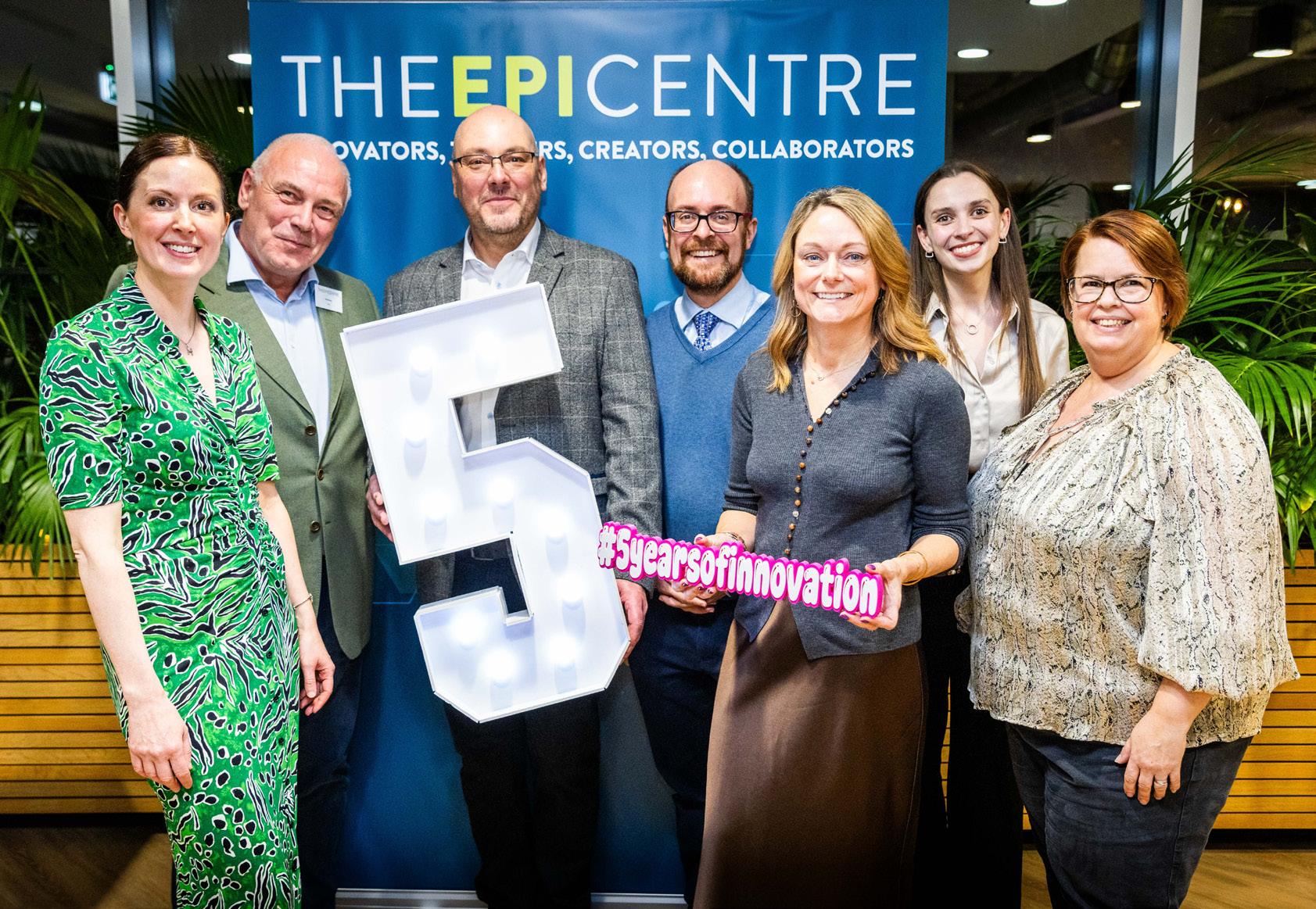
When Jo arrived, Oxford Innovation – founded in 1987 by entrepreneurs Sir Martin and Lady Audrey Wood as a subsidiary of The Oxford Trust – had around 30 employees and just a handful of centres. Today, the company supports more than 870 early stage science, technology and innovation based businesses, in nearly 1 million sq ft of space across over 30 centres. Its sites stretch from Newcastle to the Solent, and across the Irish Sea to Dublin and Belfast.
“I’m one of those rare people that walked the factory floor,” she says. “I’ve been involved in opening almost every centre. That experience grounds everything I do.”
The innovation ecosystem has changed dramatically over the last two decades, and Oxford Innovation Space has evolved with it and contributed to it.
“We didn’t have AI companies or quantum computing firms 25 years ago,” Jo reflects. “The way that technology has developed has meant the range and nature of the companies we now have in our centres has grown exponentially.”
Where centres were once predominantly office based, today they offer a mix of flexible office space, labs (private and shared), workshops, studios and co working zones. Sector specialisms vary by location, but the core mission remains constant: providing flexible space, expert business support, access to finance and a thriving community in which high potential companies can grow.
That support has measurable economic and community impact.
Last year, for example, The EpiCentre in Haverhill, Suffolk –managed by Oxford Innovation – marked its fifth anniversary with the production of an independent impact report. It revealed that The EpiCentre has supported 172 companies, helped those businesses raise £150 million in funding, delivered over 2,000 hours of one-to-one business support, helped create over 300 jobs and added £10.5m in value to the local economy since it opened in 2020.
“For us, it’s no longer just about supporting the companies in the building,” Jo explains. “It’s also about the wider place, how each centre supports a town, city or region. Our role in regeneration and local economic growth is now more central to how we measure success than perhaps it was 25 years ago.
“We think about what we are trying to achieve with a building. It can be about regenerating an area because traditional industries are in decline or commercialisation of research from a university, or a combination.”
Leading with purpose
Jo describes her career as an evolution in purpose as much as responsibility.
“I always wanted to do some good through my job. When I joined Oxford Innovation, I realised very quickly that this work wasn’t just about supporting businesses. We were impacting communities, creating jobs, working with local suppliers. I saw you could create genuine social value in a commercial organisation.”
Above The EpiCentre in Haverhill celebrates five years of delivering local economic impact
Clarity of purpose has shaped her leadership as managing director.
“When I took the role, I knew I wanted to put our mission right back at the heart of the company,” she says. “We were founded by entrepreneurs who wanted to give something back and support other entrepreneurs developing innovative technologies and solutions.
Continuing that legacy has been incredibly important to me.”
Her leadership was deeply tested during the COVID pandemic. For an organisation whose business model centres on workspace, the first lockdown created great uncertainty.
“We modelled scenarios and took decisive action. We furloughed staff temporarily, but we kept every building open. Many of the companies we support couldn’t work from home due to the nature of their business. They couldn’t run lab experiments or prototype a medical device on their kitchen table. Being on site was vital to their survival.”
Below Speaking at the Launchpad Innovation Centre in Southend
Oxford Innovation Space not only maintained strong occupancy across most centres; it also helped every eligible company apply for available government support. Senior managers voluntarily took pay cuts, being later reimbursed when the worst scenarios didn’t materialise.
“Ultimately, being decisive protected the business,” Jo says. “We bounced back faster than we feared, and the four or five years since have been some of our strongest for growth.”
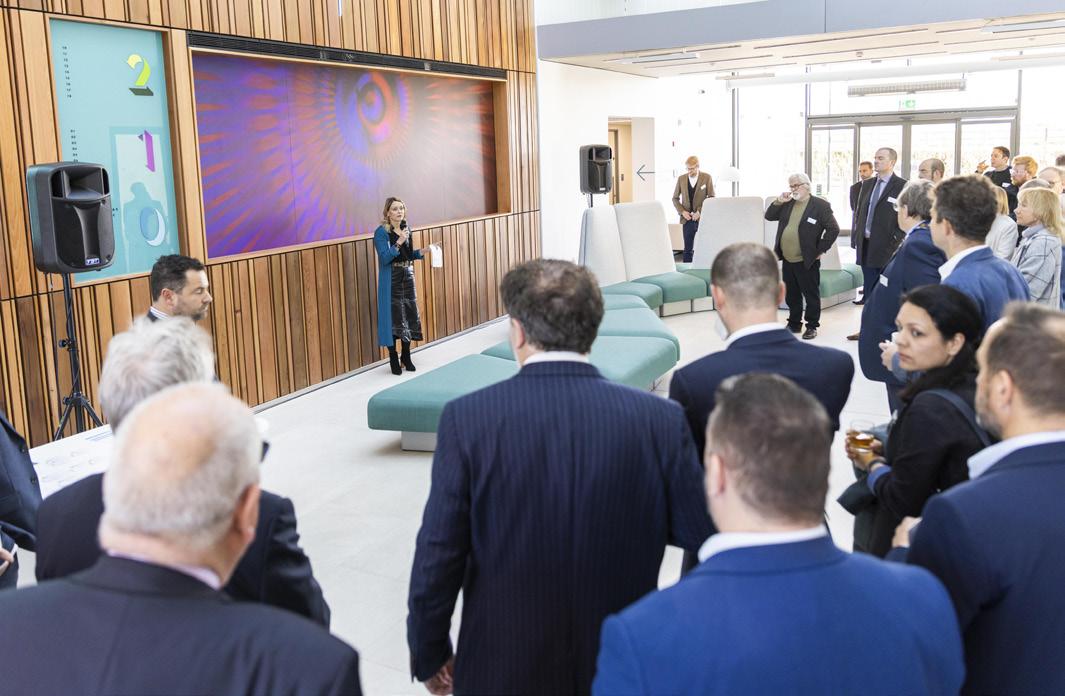
“ i ’m i NC rediblY pr O ud O f T he bu S i N e SS W e’ve gr OWN , O ur mi SS i ON , AN d T he CO mmu N i T ie S AN d CO mpAN ie S W e’ve
S upp O r T ed - iT ’ S bee N qui T e A j O ur N e Y ”
Navigating today’s challenges
Jo is candid about the current headwinds facing the sector: rising costs for employers, business rates pressures, and uncertainty in the funding landscape for early stage life science firms.
“The success of the AstraZeneca vaccine inevitably raised the interest in the life sciences sector and, certainly in Oxford, there was a surge in demand for lab space. But it’s hard to say if that level of demand will continue as many companies struggle to get follow-on funding.
“It’s difficult to predict what the next few years hold. But that’s why flexibility remains central to how we design and operate our centres. Creating spaces that can adapt to changing market conditions, sector requirements, and business lifecycles.”
Despite the uncertainties in the economy and the vagaries of the property market, Oxford Innovation is still set on a path of growth and aims to expand its network.
“Our target is 40 centres by our 40th anniversary. We’re at 32 at the moment and have a strong pipeline, so I’m confident we can get there.”
The organisation has established a robust footprint in England, has recently won a new contract in Northen Ireland and is exploring opportunities in Wales and Scotland. Meanwhile, the company has recently launched The Wire – a new digital platform to connect businesses across its entire network of 32 centres – to facilitate greater collaboration and peer-to-peer learning.
“We’re definitely investing for growth,” Jo says. “We have recently launched our new digital platform, The Wire, to further enhance our
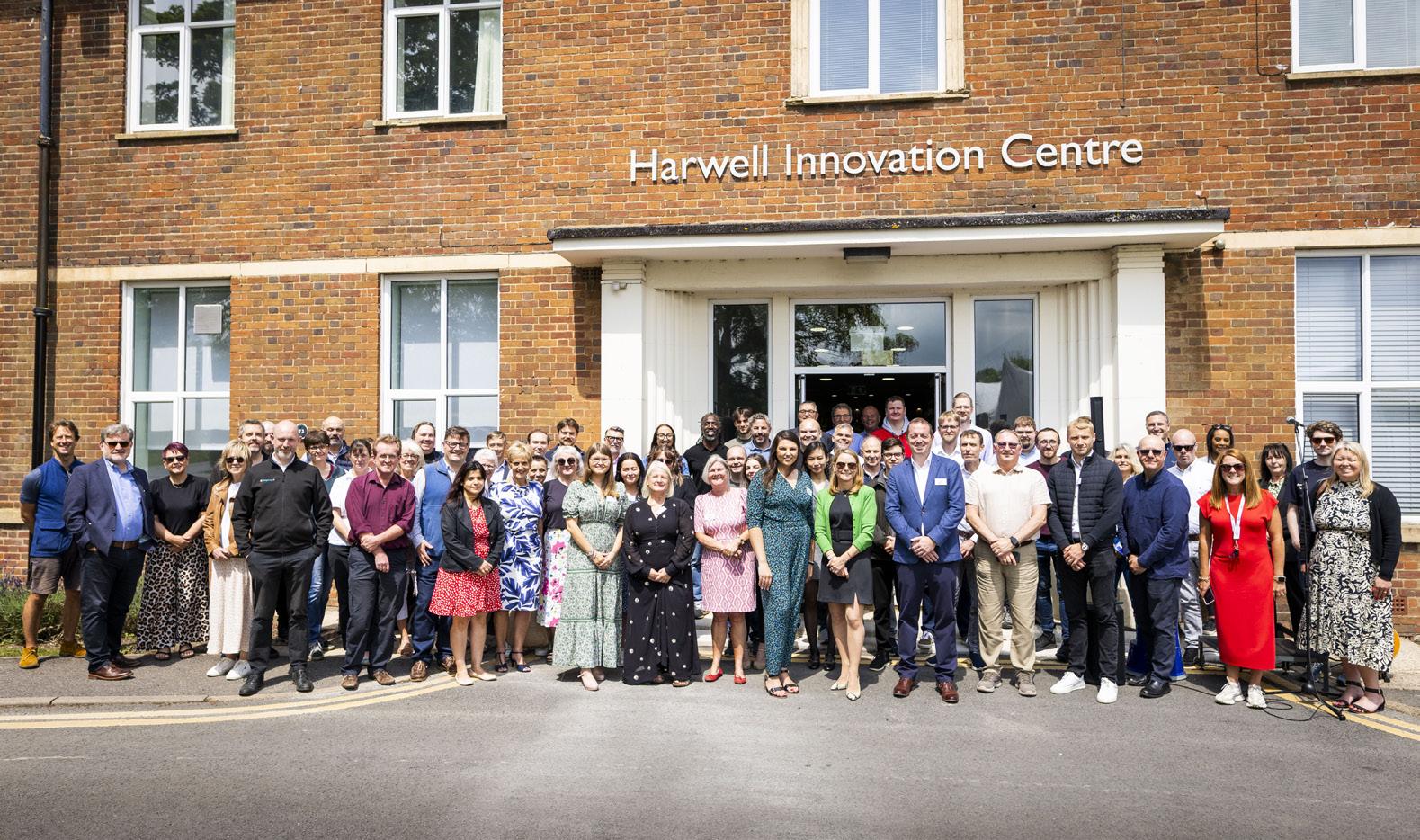
business support provision for customers. We have also invested in an integrated workplace management system to further strengthen our internal operations.”
Jo’s iED Leader of the Year accolade is a significant achievement, not just for her but also her entire team. The judges praised her “people first approach, national influence, and commitment to inclusive growth and sustainability” – values she sees as central to the company’s success.
“I will have to retire at some point,” she jokes, “but I’ve promised the team it won’t be in the next five years. We’re far too busy. I want to be around to celebrate my 30th anniversary.”
As Oxford Innovation Space looks toward its 40th anniversary in 2027, its evolution mirrors the wider innovation landscape it serves: more diverse, more place focused, more collaborative, and more ambitious than ever.
Above Jo and the team at Harwell Innovation Centre in Oxfordshire celebrating 25 years with past and present business customers
Right The Wire is a new digital platform to connect SMEs across the UK and Ireland
Below 2025 Leader of the Year at the Institute of Economic Development (iED) Awards

For Jo, the journey has been transformative.
“When I look back, I’m incredibly proud of the business we’ve grown, our mission, and the communities and companies we’ve supported. It’s been quite a journey. And it’s not over yet.” n
fO u N ded b Y e NT repre N eur S , TO S upp O r T e NT repre N eur S
Discover more about the largest network of innovation centres across the UK & Ireland with a visit to www.oxfordinnovationspace.co.uk
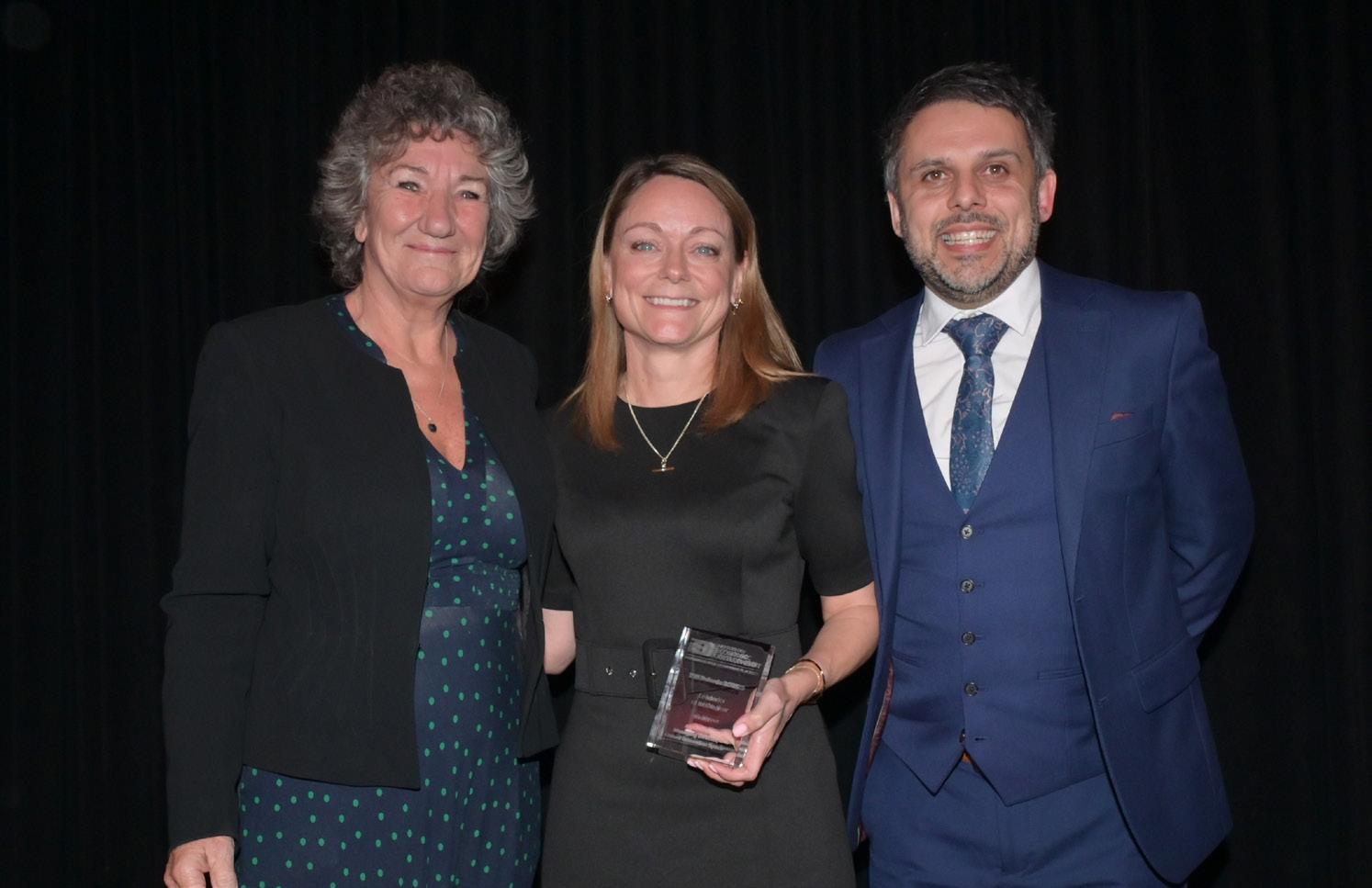
Science parks in the UK sit at the intersection of research, enterprise and real-world impact. As these environments grow more energy intensive, the role of intelligent, data-led solar infrastructure is becoming increasingly important.
UKSPA Business Affiliate member
Absolar works with science parks and innovation campuses to design, deliver and continuously optimise commercial solar systems that perform as engineered assets, not static installations. Founded by scientists and engineers from University of Southampton, the company’s approach combines advanced digital modelling with long-term performance monitoring, enabling solar to be planned with the same rigour as any other piece of critical infrastructure.
A defining capability is Absolar’s use of AI-driven remote sensing and high-resolution spatial data to assess rooftop solar potential before any physical survey takes place. Using LiDAR, satellite imagery and proprietary buildinglevel models, systems are designed around how energy is actually used in buildings. This approach is particularly valuable for science
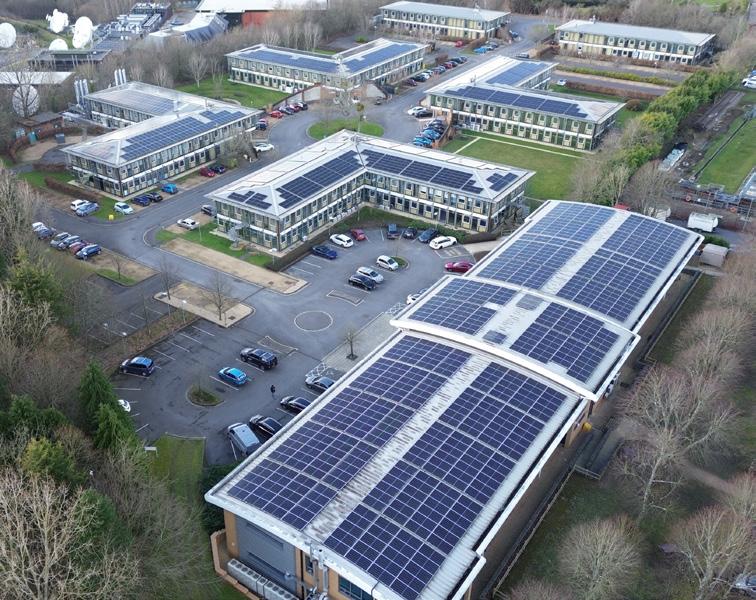

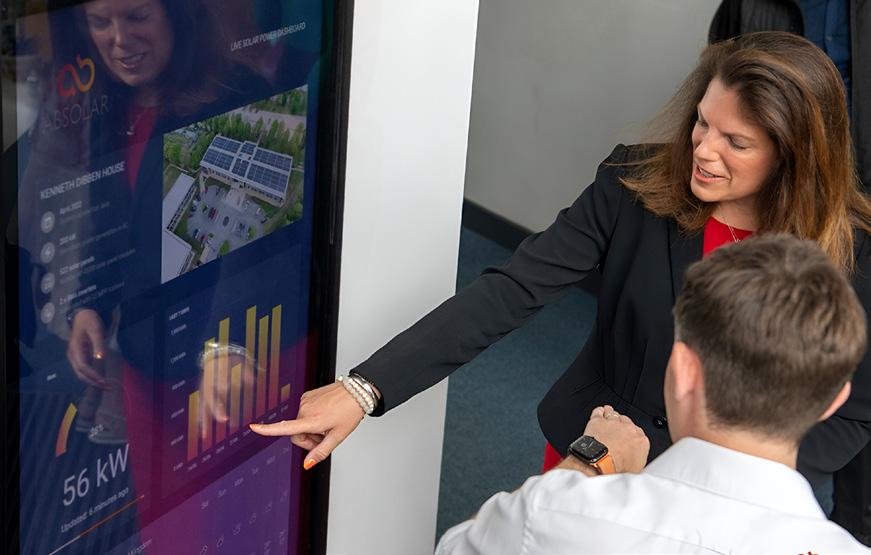
parks, where laboratories, offices, data facilities and shared amenities create complex and highly variable load profiles.
Crucially, design does not stop at installation. Absolar continuously monitors system performance, comparing real-world generation against predicted outputs and identifying opportunities for optimisation over time. This feedback loop allows clients clear visibility into their asset performance season by season, while ensuring systems continue to deliver value as buildings and usage patterns evolve.
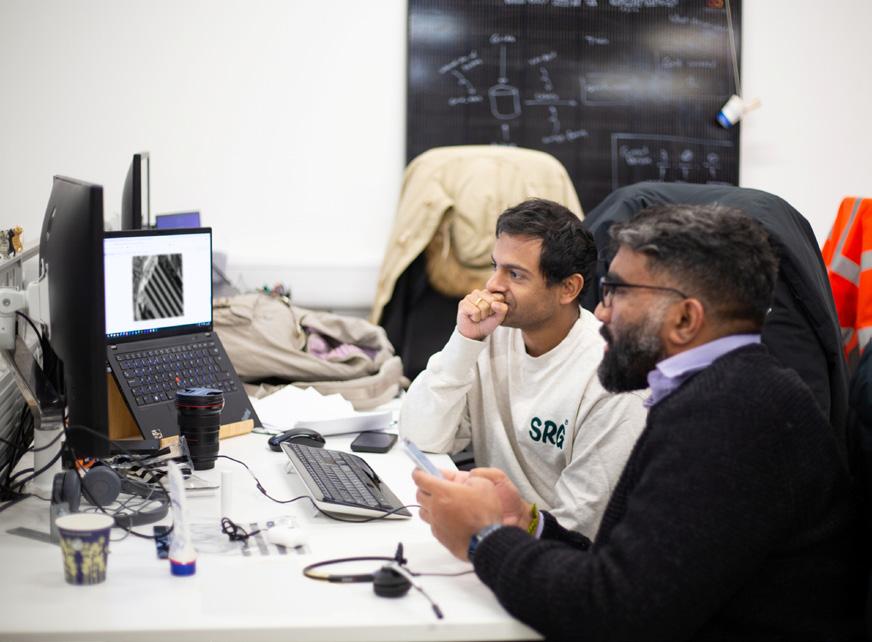
The approach is already being applied across research-led estates such as University of Southampton Science Park. There, phased solar deployments have been informed by live operational data, allowing capacity to be expanded in line with measured demand rather than assumptions. The result is that solar generation is integrated into everyday activity, from research spaces to communal facilities.
For science parks pursuing net zero strategies, the question is not whether to deploy solar, but rather how to do so intelligently. Highperformance outcomes depend on accurate modelling, careful engineering and long-term insight. As innovation districts continue to grow, solar systems designed with data at their core are becoming a fundamental part of resilient, future-ready infrastructure. Absolar’s work demonstrates how clean energy, when treated as a technology platform rather than a bolt-on, can actively support the ambitions of the UK’s science and innovation community. n
why Absolar are trusted by UK businesses to design, install, and optimise commercial solar systems at www.absolar.co.uk
Science parks’ long-term success hinges on young people choosing careers in STEAM. So why don’t we design campuses to inspire the next generation, asks Fiona Du Fresne, Associate Partner at Ridge (right).

Future talent is a critical issue in the UK.
Significant, widening skills gaps in technology, life sciences and engineering are already making recruitment harder, constraining innovation and threatening the UK’s competitiveness. This presents an existential threat to science parks, whose long-term sustainability depends on maintaining our leading position in science and research.
But it’s also an opportunity for science parks to play an active role in inspiring the next generation, through better design, placemaking and community engagement. When secondary students are asked why they don’t consider jobs in STEAM – science, technology, engineering, the arts and mathematics – it’s often because they don’t understand what they involve, or how these subjects relate to real-world careers and impacts.
Many employers already do great work in schools, but that’s not enough – we need inspiration to be embedded throughout society, and highly visible rather
than confined to the classroom. Science campuses are often mysterious places for local populations. By becoming vibrant shopwindows for careers in science and technology, they can help to secure their own success.
Build inspiration into the brief
The first step is to make inspiration part of the project’s narrative, by co-developing a client brief that foregrounds access to STEAM careers. In practice, this might involve incorporating facilities to support grassroots science, or encouraging partnerships with schools, youth centres and community groups.
Social value is already part of many schemes, but there is still enormous untapped potential, especially among consultants. Every firm should be asked to make a commitment to giving something back, not just contractors. At Ridge, we have a dedicated Social Value team who help us discover the most effective way to make a contribution, whether that’s through jobs, apprenticeships, services, support, investment or environmental improvements, and we’ve seen what a difference it can make.
Putting science on show
We can tell better STEAM stories in the way we design science parks – for example, by reducing physical barriers around and across sites, making the public realm walkable and fully accessible, with amenities that are open all week round. We can activate building frontages, including visual and data displays to turn buildings into teaching tools, inspire curiosity and bring science to life.
Many science spaces are designed to encourage accidental meetings and cross-pollination of ideas among scientists and academics –why not extend this to students? Incorporating spaces for knowledge sharing is a very powerful way to connect school students with world-class professionals and companies. Open floorplans, central atriums and shared social spaces like breakrooms and communal tables can add value for tenants as well as communities.

A “fab lab” with 3D printers, laser cutters and design software is a brilliant way to engage families, enabling them to make their own creations with equipment that isn’t available at home or in school. Outside the buildings, many science parks are already beautiful green spaces, and community access can help them thrive not only during working hours but at evenings and weekends too. We can turn them into nature labs and real-world examples of climate and biological science, with curated walks that take in bug hunts, climate-resilient plant choices and public art.
Balancing security and access
Some tenants have very specific security needs, and an open-access


park will not be the right location for them. But for the majority, we can use considered design to ensure they function securely while minimising visible boundaries. We work carefully with desire lines to create accessible routes, away from vehicles and heavy equipment, and we use landscaping and natural boundaries to protect more sensitive areas, rather than hard barriers like fences.
A glazed active ground floor level makes a big difference to how welcoming a science park feels. Some of the most successful community learning spaces have entrances separate from office receptions, so people feel invited in rather than that they don’t belong.
“ c ampuses can help to secure their own success by becoming vibrant shopwindows for steam careers”
Access controls can be pulled back as far as possible – there’s no need to shut down a whole building to keep everyone safe.
Winning community support
Community access works best when it’s landlord-led, with tenant buy-in. It does require an ongoing financial commitment to managing learning spaces, hiring dedicated teams and facilitating outreach programmes. But being able to demonstrate a tangible public benefit can help substantially to secure planning approval. Science buildings are inherently large, due to plant and servicing requirements, and mass can be a contentious issue, especially in hotpots like
Cambridge, Oxford or parts of London. We’ve found that planning authorities recognise that public benefits connected to learning and the local community can far outweigh the negative impacts. We’ve also found communities are very supportive when they can see the opportunities for themselves. Crucially, these shared facilities also help attract highquality tenants and entice top talent, who are drawn to workplaces that demonstrate social purpose, openness and long-term investment in people and place. Science buildings are not just highly functional, they can be beautiful and inspiring too. There is something inherently fascinating about science, not only for future academics and researchers, but future entrepreneurs, designers and artists alike. More and more developers see the value of opening up their campuses, and enthusing the wider community about the essential work that takes place within them, as an investment not only in their own success but the longer-term prosperity of their sector, and the UK as a whole. n
ge T i N TO u C h
Fiona Du Fresne is an Associate Partner in the Science team at Ridge, involved in masterplanning and architectural design for science parks and research hubs. Contact her at fionadufresne@ridge.co.uk
Taking care of your people, places and public perception
My Green Lab CEO James Connelly talks to Simon Penfold about aspirations and challenges at the leading lab sustainability organisation.
For decades, labs have been where the world’s biggest breakthroughs are discovered and developed. Unfortunately, they are also where a huge, often overlooked environmental footprint is created. Laboratories can consume up to 10 times the energy of a typical office space, and with life sciences, biotech, and pharma continuing rapid growth, the sector’s climate impact is on track to rise unless the way research is done changes at scale.
That’s the mission behind My Green Lab: building a global culture of sustainability in science. Now working with close to 5,000 labs in over 50 countries, My Green Lab has helped thousands of scientists and lab teams turn practical, science-based actions into measurable reductions in energy, water, waste, and cost.
“We've made significant progress since we were founded in 2013 and the organisation has changed quite a bit,” said chief executive officer James Connelly.
“We were originally founded by Allison Paradise, a neuroscientist who was frustrated with the environmental impact of research and the amount of waste - wasted energy, lack of efficiency, and the
huge amount of toxic chemicals used every day. But she recognized that these practices weren't intentional. They reflected a culture that didn't question long-standing protocols and procedures.
“She founded My Green Lab with the same mission we have now, which is to build a global culture of sustainability in science– to empower scientists to make more sustainable choices in their daily work.
“At the beginning, it was a group of interested academics trying to move the needle in their own institutions. Then we coalesced around a common standard that could be applied across academic labs as well as commercial labs.
“In 2020 Allison decided she wanted to pursue some personal passions, so she and the board brought me in as CEO. We’ve gone from three people to 35 people now in five countries, and from a couple of hundred labs to over 5,000 labs now in 54 countries. And we’re continuing to scale up exponentially.
Scaling through structure and software
“The big transition for us happened relatively recently, in 2024, when we launched a new third-party certification process for our organisation.

Scan the codes to find out more about some of My Green Lab's programmes
ready to go green? impACT l A b O r ATO rie S
“My Green Lab, which is the parent non-profit, still owns the standards and maintains their quality and integrity. But it was growing faster than the revenue model could sustain.
“So we launched a for-profit subsidiary to bring in additional resources so that we could develop high-quality enterprise scale software tools that would allow the organisation to scale beyond where we were at previously.
“That organisation is called Impact Laboratories, which acts as a third-party verification partner.
“In the certification business, that's the most common organisational structure; you have a non-profit that's responsible for stewarding the mission, maintaining the standards, and then they partner with a for-profit certification organisation that's a separate legal
m Y gree N l A b ACT e CO l A bel CON verge
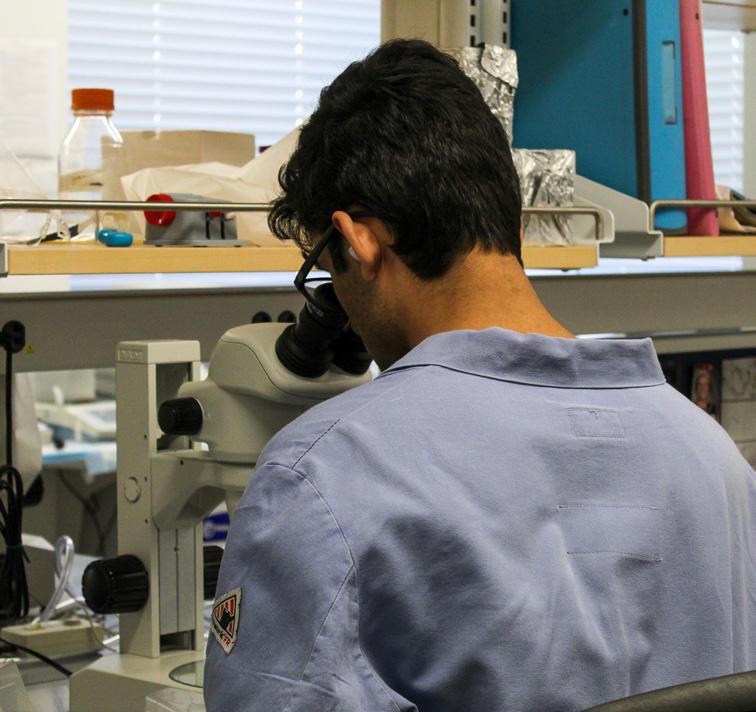
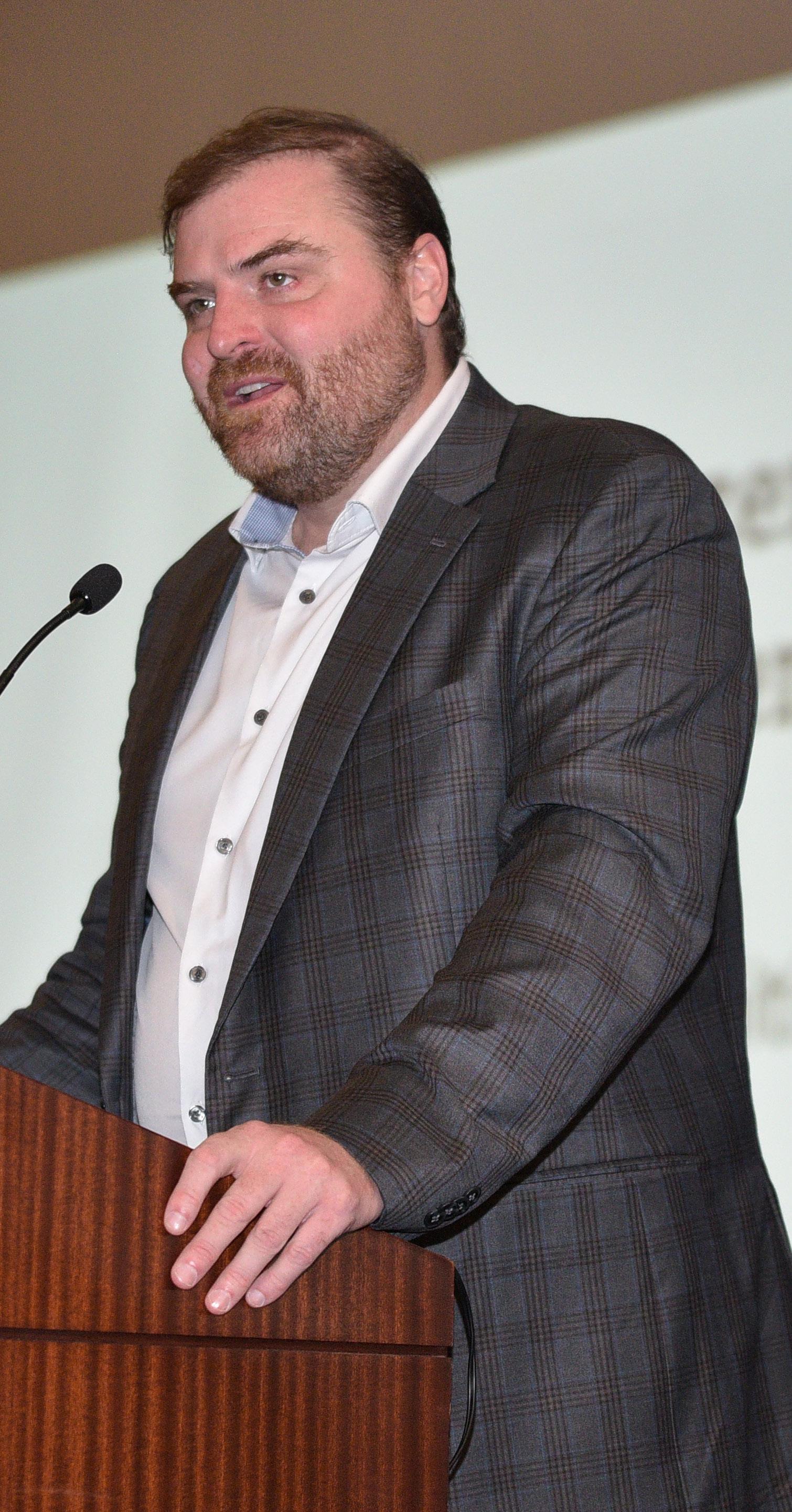
entity to make sure that you're providing really high-quality third-party certification.
“Launching Impact Laboratories allowed us to raise raise capital up front to invest in our software tools so that we can deliver the programme in a really user-friendly, highly impactful way at scale.
“The programme's delivered through a beautiful, intuitive software platform which allows us to work in 54 countries around the globe without most of us leaving our offices and our homes.

“It's a really scalable tool and I think the next step is turning it from a ‘nice to have’ to a ‘must have’, by getting the biggest players to require it in their supply chain. Our five-year projections put us getting to 5% of global labs, but there's a lot of labs in the world - over half a million between academic R&D, commercial R&D and analytical labs, we think.
“So there's a lot of headroom to grow from 5,000 labs and we're committed to making this programme the global standard. Eventually we hope for 15%-20% of all global labs.”
Certifying labs and products
“The core of My Green Lab’s programmes is the My Green Lab Certification for labs. But then we quickly learned you can't have green labs unless you can buy green lab products. We also have a certification for lab products called the My Green Lab ACT Ecolabel and we've worked with over 70 companies now and close to 2,500 lab products.”
As well as certifying energy usage, the ACT Ecolabel assesses a products complete life cycle and sustainability, from how it is made and used to where it goes at the end of its life.
My Green Lab’s certification systems and reputation have seen it embraced by many global pharma giants such as AstraZeneca.
“We work with over 500 organisations and some of the more visible examples are the large pharma companies - 42 of the top 50 biotech and pharma companies around the world, as well as over 200 research institutions.
Driving adoption through procurement power
“Getting the big players is how you drive adoption in this market. A big part of our work now with the largest pharma companies is how they address their Scope 3 impact, so the impact within their research value chains. It’s not only the lab products they are buying but their outsourced research services.
“The large pharma companies are now asking their suppliers to get My Green Lab Certification, cascading it down the supply chain. And that's how you really get to scale, because while there’s just those top 50 companies, there’s thousands – maybe even tens of thousands – of labs and service providers across a whole support ecosystem.
“That is the crucial turning point we’re getting to now.”
“We now have ten of the largest pharmas, through a programme called Converge, asking their suppliers to get My Green Lab certification. Then on the ACT Ecolabelside, actually getting a number of the world's largest healthcare systems - as well as purchasers of lab products - to add ACT Ecolabels as part of their RFP
(request for proposal) language so that we can get everybody following a common standard.
“In addition to getting the large purchasers, we're getting a lot of the scientific suppliers. We have ten of the largest scientific suppliers, including Fisher and Avantor, now adding the ACT Ecolabel as the core sustainability attribute within their catalogues.
“Once you get the big purchasers pushing from the pharma side, you get the catalogues aligned, then you can get the whole industry and it actually facilitates everything by having a common standard.”
Making sustainability practical The range of actions across the My Green Lab proposals range from major changes in energy use and waste disposal to simple things like turning off equipment when it’s not being used.
James said: “I think there's a lot of low hanging fruit, like closing fume hood sashes. A fume hood can use as much energy as three American homes. Closing it can reduce that energy consumption by a third. A freezer can use as much energy as two American homes. Chilling it up from an ultra-low temperature, say from -80C degrees to -70C degrees can save 20%-30% and actually extend the lifespan of the freezer.
“Those are not capital intensive, expensive changes. There are certainly some advanced things you can do, like automated fume hood or sash closers, or alternative waste treatment where you would need to either upgrade or buy new pieces of equipment.
“Much of the work is about engaging the lab, building a culture of sustainability, and then measuring it. Scientists are data-driven, so if they can see that they're making an impact and the savings they're able to to garner, it encourages them to do more.”
critical mass
While sustainability in the laboratory and research field may have been a hard sell back in the early days of My Green Lab, it is now widely accepted as the way forward.
“I think we’re really close, particularly in large pharma and in the university community in Europe. Part of that's driven by funders in the UK now incentivising people to use programmes like My Green Lab certification or equivalent. The Wellcome Trust and Cancer Research UK expect their grantees to follow sustainability certification - a My Green Lab certification or its equivalent.
“I'd say what slowed things down at the beginning was the idea that somehow having a green lab would be in conflict with doing the science itself. But keeping the fume hood closed isn't going to impact your experimentation efforts and the efficacy or efficiency of your lab. We’ve found tools like My Green Lab certification can actually
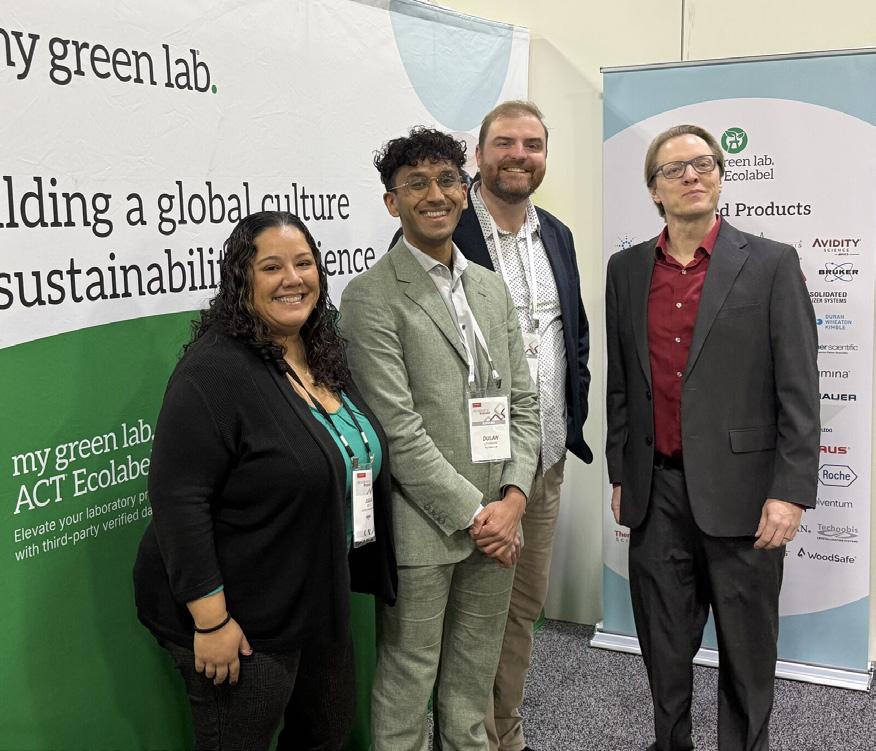
“It’s the way that research should be done, but there is still progress to be made when we get outside of the university community and Europe and the large pharma companies so that it does become an expectation and the norm.
“We're making progress year by year. Once you start getting the big players, you do hit a tipping pointsocial science research has demonstrated it's between 20% and 25%. They bring everybody else along. Then you need regulation and market drivers to bring the laggards that are never going to do anything unless they absolutely have to.
“But you have to prove the market and get those early adopters first. And I think we're almost through that early adopter phase and moving to the ‘must have’ phase.”
Navigating political headwinds
This is despite some of the more recent challenges to the whole
Above James Connelly promoting certification at the Fisher Scientific Meeting 2026 alongside (from left) Julia Wick of Fisher Scientific, and My Green Lab's Dulan Liyanage and Scott Weitze
“I think there was some hesitancy in 2025, with the political changes in the US and some broader political changes even in the EU around corporate sustainability reporting.
“But, while federal policy in the US backtracked a little bit, the private companies really stepped up to the plate, particularly the European-headquartered companies, and we are seeing growth actually accelerate pretty rapidly, even in the face of those political and economic headwinds.
“You hear a lot of noise about an ESG [Environmental, Social & Governance] backlash in the news. But if you look at the underlying data, the reality is that it's growing exponentially, because we have the biggest players and pharma thinks on 10-20 year time horizons. They don't think on four-year election cycles. So it makes sense that they're really thinking about the long-term future. And you know, the good thing about working in the science industry is that far fewer people question the science.” n
gree N YO ur l A b
Below
My Green Lab certification has vastly expanded in the past ten years
My Green Lab are igniting a global shift toward environmentally responsible scientific research by helping labs to reduce their
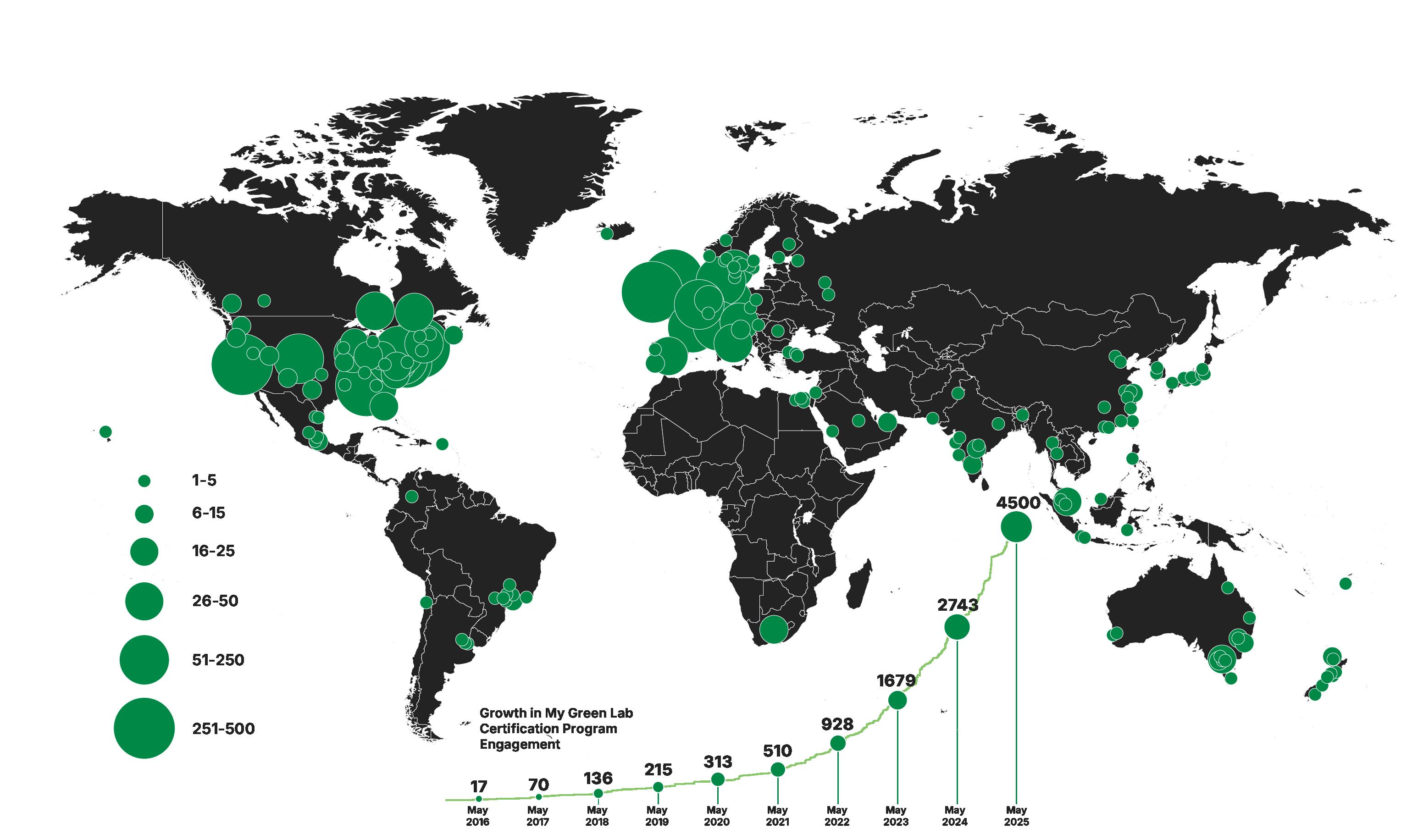









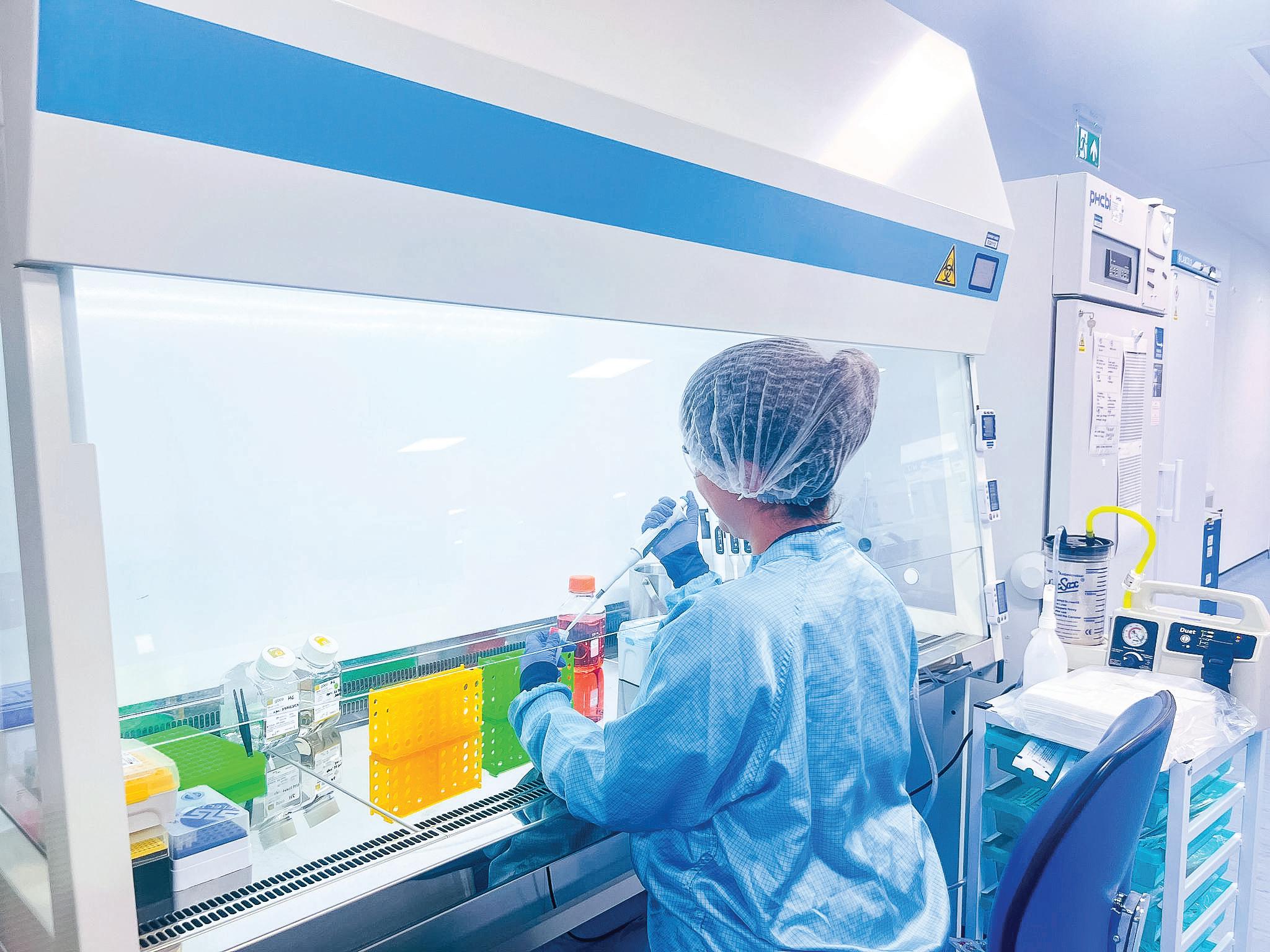

Words Luisa Mostarda, BA Hons; Associate, Energy, Renewables
Science parks are built on the idea that bringing together talent, investment, and advanced facilities will spark innovation. However, power is currently proving a major hurdle to their development. Science clusters need power for data processing, biotech labs, and the people working there, some of whom drive electric cars. As transport, heating, and industrial processes move away from fossil fuels, demand for electricity is rising just as the grid is under strain. This is a serious challenge for campuses designed to accelerate progress.
Modern science parks need a constant, reliable supply of power. With everything shifting to electric, developers also face pressure to integrate renewable energy and prove their sustainability credentials. None of this is impossible, but it clashes with a grid designed for older,
lighter demands. Capacity limits, long connection queues, and delays in upgrading infrastructure have become common obstacles. And even when upgrades are planned, commercial viability can be hard to achieve given the timelines proposed by the networks. These delays can be deal-breakers for parks trying to attract tenants or deliver projects on schedule.
Clearly, the impact on the industry is substantial. Potential tenants are likely to be reluctant to take on new sites when power supply isn’t guaranteed. Furthermore, existing occupiers find themselves delaying expansions or sticking with fossil fuel back-ups they’d rather avoid. The result is that regions that should lead in advanced industries risk losing out to areas that can offer faster, more reliable connections. A prime example is the Oxford–Cambridge Arc, where world-class research and high-energy users are competing for limited capacity.

Above right Understanding the on-site energy needs is the first step for science parks in creating a roadmap to stay ahead
Below left The three pillars of the way forward for science parks to become active energy managers

Given the current status of the grid, waiting for grid upgrades is unlikely to be an option. Science parks need to take control and move from passive consumers to active energy managers. This move starts with local generation. While rooftop solar panels, carport PV, and nearby wind turbines won’t cover all demand, they can be very effective at reducing reliance on the grid and help to cut costs.
Reliability also needs layered solutions. Batteries provide quick backup during power dips and help reduce strain during peak demand. Combined with local generation, they form microgrids—small, local energy networks that can produce and manage their own electricity and even keep running if the main grid goes down.
The smart approach is to segment energy use: identify critical systems, priority loads, and flexible activities, then match each with the right mix of generation, storage, and back-up grid power. Oversizing everything is wasteful; designing systems that restart quickly and keep essential areas running is far better.
Flexibility is the second pillar. Not every piece of equipment needs
“AS WA i T i N g f O r grid upgr A de S

constant power. Freezers and heating systems, for example, can handle short adjustments without harm. By planning carefully and working with tenants, parks can shift some energy use to off-peak times. This avoids expensive grid upgrades, keeps demand steady, and can even generate revenue by supporting the wider energy network. It also makes on-site renewables more useful by aligning consumption with generation. Smart control systems manage these shifts automatically, turning
flexibility into a real advantage. The third pillar is partnership. Energy planning can’t be left until the last minute, instead it needs to be part of the overall design and aligned with local (LAEPs) and regional energy plans (RESP). Parks should share information about expected demand and flexibility so network operators can prioritise upgrades. Just as important is being open to new delivery models. Independent network operators and private network providers can fund and build parts of the network
or local power systems under long-term agreements. For parks that grow in stages, this can unlock extra capacity years sooner than traditional methods and spread costs over time.
Digital tools tie everything together. Modern energy management systems use data like weather forecasts and building schedules to predict how much power will be needed and when. They can charge batteries ahead of busy periods, shift certain activities to times when solar power is available, and keep overall usage within agreed limits. Apps for tenants make it easy to track energy use and even earn rewards for saving power. Clear reporting on energy and emissions also helps meet sustainability goals and attract investors. All of this depends on accurate measurements and good data management. Without reliable data, the system simply can’t work effectively.
This is a practical approach. Innovation depends on steady, reliable energy, and science parks can’t afford interruptions. By combining local generation, flexible energy use, strong partnerships, and smart digital tools, they can turn energy challenges into opportunities. The results of this hard work is attracting tenants, reducing risk, meeting sustainability goals, and creating a model for future growth. There is a straightforward roadmap for science parks that want to stay ahead. The first step is understanding the on-site energy needs, then design a strategy. Incorporating renewables and storage as part of a microgrid is also key, while engaging early with local network operators. Furthermore, exploring alternative providers and implementing digital tools alongside them can unlock CAPEX and easy savings. If the on-site energy system is treated as an opportunity that grows with the campus, rather than a hurdle, the park will be truly ahead of its competition.
The choice is simple, either wait for the grid and risk delays, or take proactive steps now. For science parks built to shape the future, the answer should be obvious. n
Tom Cheesewright talks to Simon Penfold about his role as an applied futurist, helping organisations deal with our ever-changing world.
When companies and organisations want to imagine what the future may look like, they turn to Tom Cheesewright.
A self-described ‘applied futurist’, Tom is a writer, broadcaster, speaker and consultant who is frequently called in to help businesses plan for the future in the light of technological, societal or climatic changes.
He has worked with companies as varied as confectioner Mars, Pepsi, Unilever, Hyundai, BT, distribution and outsourcing group Bunzl, Google, video game company Electronic Arts and even NASA. And he has helped compile predictions and reports on everything from rural decline in Northern Ireland to train travel, holidays, shoes and even pizzas.
Futurism is defined as the study of possible, probable and plausible futures – as well as low-probability, high impact ‘wildcards’ – and has its roots in the 1940s, when the first professional consulting institutions such as RAND and SRI International became involved in long-range planning, trend watching and visioning, first for the military and wartime governments and then in the 1950s for private institutions and corporations.

Tom Cheesewright’s path to futurism followed a mechatronic engineering degree at Lancaster and then working in the field of marketing and technology. This evolved into consulting and technology communication before he embraced is role as an applied futurist in 2012, working with a growing portfolio of major global corporations and brands, government departments, industry bodies and charities. He writes, speaks, broadcasts and consultants on how technology impacts society and how our lives will change in the next 20-30 years.
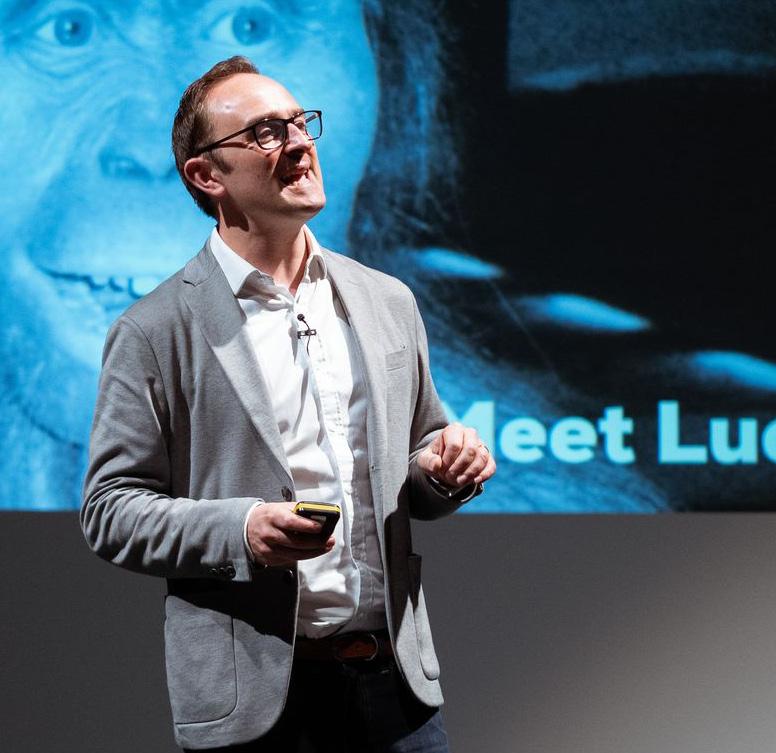

He can trace that career path back to his childhood. “I always wanted to be an engineer as a kid. I've always been obsessed with science and science fiction but as a child I came across this book that was just definitional in my life: the Usborne Book of the Future.”
“I still have my original copy, which is in many pieces now. I was born in Wolverhampton but we lived in London for the first five years of my life. I picked it up at a book fair in Ealing in 1981 just before we moved back to Wolverhampton. It really set me on a path of being obsessed with the future ever since.”
He has also written a follow-up to the book for Usborne. See Inside The Future came out in 2024.
“It's aimed at a slightly younger audience, whereas in many ways the Book of the Future was quite mature really.
“But it was also the 50th anniversary of Usborne and they were reissuing some books. They asked if I would like to write a foreword for the reissue of the book that inspired me, so you can can buy The Book of the Future and it has my photo on the front and a foreword from me.”

In November Tom was a headline speaker at UKSPA’s Autumn Conference at Lancaster University – his alma mater –talking about AI, Data and the Future of Decision Making.
“I'm a strong believer that we don't teach people to think about the future very well,” said Tom.
“So I always like to leave people with a tool they can use to think about the future.
“In this case, it was intersections; a very simple tool for thinking about the near future, based on the idea that the big moments of change come, not just from trends, but from where trends intersect with pent up demand for change.
“You're looking for where there's pent up demand, and then where trends might come in and unlock that demand. And where those two intersect is where you might see the big moments of change.”
“ W e d ON ' T T e AC h pe O ple TO T hi NK A b O u T T he fu T ure ver Y W ell - SO i A lWAYS li K e TO le Ave pe O ple W i T h
A TOO l T he Y CAN u S e TO T hi NK A b O u T i T ”

“Then I use that process to think about some particular areas of scientific research that might be particularly game-changing in the near future.
“There are areas that particularly excite me. The first - and this perhaps comes in part from living in Manchester and spending some time as the resident futurist at the National Graphene Institute - is I'm a bit obsessed with material science.
“The digital revolution changed the way the world works, but material science might change the way the world looks.
“Even if you're not an engineer, you have a sense of how thick the frame of a bike ought to be in order to support your weight, or the shape a car needs to be in order to house an engine and a fuel tank and all these things.
“Material science allows us to rewrite all of those rules and fundamentally change the shape of the world around us, and I find that fascinating.
“The second area I talked about was infrastructure. Particularly in very well-developed economies like the US and Germany, we've underinvested in infrastructure for quite a long time, and we're reaching breaking point.
“We've seen this with floods in the UK, with bridge collapses in Germany and the state of roads in America.
“I think we're going to be very strongly motivated in the near future to invest in infrastructure, partly as, in some places, it will be a sort of Keynesian mechanism for stimulating growth.
“The third topic I talked about was changes in the nature of work;
how, in many ways, the classic undergraduate degree is becoming less and less appealing, which is an odd thing to say when we're almost at a record numbers of students.
“I believe AI is likely to have the biggest impact at a graduate level in a lot of companies.
“If you look at some of the big law firms, the partners like to think that their success and their revenues come from the enormous day rates they charge for doing large complex cases. The reality is the majority of their revenue and profit comes from cubicle farms full of graduates shuffling papers and doing a lot of quite mundane work as they move up the ranks and learn their trade.
“A lot of that paper shuffling can now be done by AI. And we are seeing the first companies saying ‘OK, maybe we have to drastically cut our graduate programmes’.
“It’s a lot of the classic big graduate recruiters: consultancy firms, law firms, accountancy firms. They are the ones who are going to be most directly affected by this.
“But that opens up a future problem, which is, if you don't take people on at 21 and train them up and then start to filter for who's management material, where do your future managers come from? Where do these people get their grounding in industry and hone their skills?
“I think we might see a lot more people going straight from university into their own business. That might be some sort of micro-enterprise, it might be freelancing, it might be a venturebacked startup.
“They might do two, three years of really hard graft, making very little money but learning some very hard lessons very quickly. They will build a CV that makes them very appealing for people who aren't recruiting at the ground level, because that work's being done by AI, but need people with a couple of years’ experience. They will have demonstrated their value in terms of, not just their technical ability, but their ability to talk to people, to be self-motivated and to manage their diaries- doing all those things we think we know how to do when we start work but actually don't really learn for the first year.”
During his career Tom has learned his own hard lessons about how we cope with change and the future. “I think you have to be willing, once you do see the future, to take action.
“Probably 20 or 25 years ago now I worked with someone who was in the room when the internet and the web were presented to Yellow Pages for the first time. This was an existential threat to what they did but nobody wanted to recognise it, they just dismissed it.”
Fortunately, these days, Tom finds a more positive reception from his clients. “The point about my work is that I'm only ever brought in when someone asks me to come in; I'm never going in actively trying to shock them.
“Their motivation in calling me in is always one of three things. The first is they’ve seen something and they are really excited about it. It might be a vague idea for a new product and they want to understand what the market for it might be, or they want to create a new product to fill what they see as a demographic gap.

big one. I've done a lot of work around the future of cities, which is what led me to my greatest ever client that I don't think I can ever top, which is NASA. I can tell you there was dancing around the kitchen after that phone call.
“ t he future of science parks is good but there's lots to do to maximize their value”
“I was one of the contributors into their thought process around what do future cities look like and therefore what will be the future transport needs between cities? What should their research priorities be in terms of propulsion for future transport?
Above
Tom is a frequent presence in the media and is recognisable from TV appearances such as on Channel 4's Sunday Brunch
Moving in the right direction
So, the obvious question; what does the future hold for science parks?
“In some ways it's an interesting analogy with department stores. I think department stores have got a really strong future because lots of big brands don't want to pay for their own presence in certain places, but if they can effectively share the costs of a presence in the future while maintaining a small footprint in a smaller town or city, then it's really appealing.
“From a commercial perspective, science parks make an enormous amount of sense, not just because of that sort of shared cost, but because of the cross-fertilisation and the interdisciplinary interaction you get in a science park context.
“There's also just the underrated and spectacular asset of Britain's research capability. We all know that we could get better at the translation process between research and commercialization, but the natural home for that is obviously science parks.
“The second motivation is what you could probably call the ‘oh ****’ moment, which is: ‘We didn't see this coming, it's really hurt us. Why didn't we see this coming? Can we make sure it doesn't happen again?’
“You can at least give people the tools to be better equipped to see what's coming.
“The third motivation is that they see the future is really exciting and they want a report about the future of their industry as part of their marketing work. They want to be seen as future thinking and forward facing, working with a futurist on a campaign facing their prospects and customers generally, as well as shareholders.
“Sometimes it's a combination of all three.”
The future is universal, so Tom finds himself involved in a wide range of industries, including foods, cars and finance. “Cities is another
“Are we going to be living in big mega cities, in which case a lot of the transportation need is going to be intra-city rather than inter-city. Or are we going to be living in a much more distributed fashion, in which case actually inter-city transport becomes much more of a priority.
“I generally lean towards the idea of more distributed humanity. In part driven by technology, we don't feel the need to be as geographically close to other things as we did before. Our jobs don't require us to be necessarily in mega urban centres.”
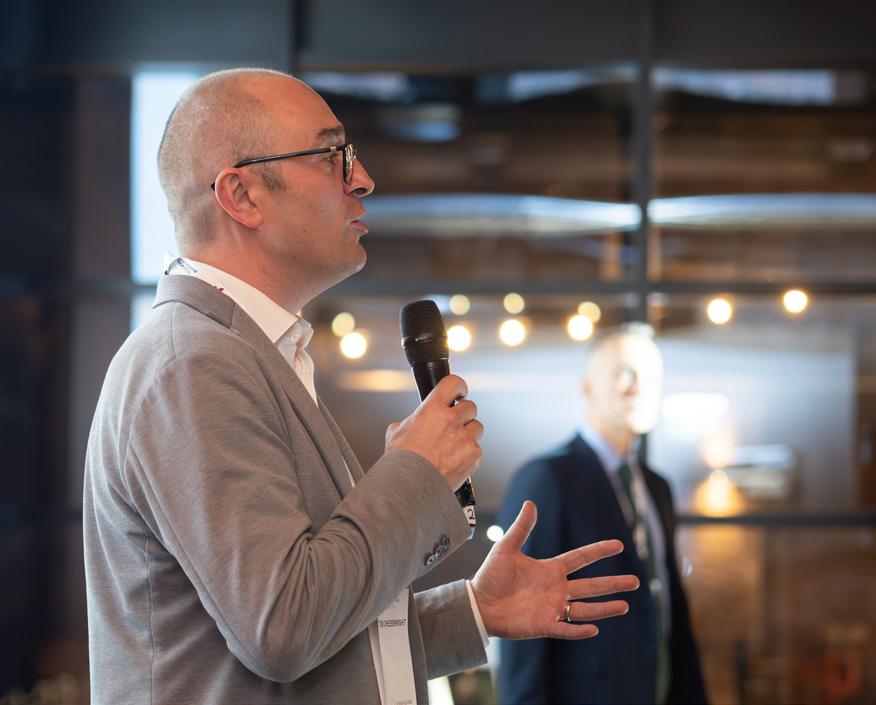
“The relationship between business and academia can still be optimized a long way; the way incentives work for each side don't necessarily always align. The business knowledge from the academic side isn't always the best. You have the example of academics whose intellectual property gets locked up in a startup, but then feel such ownership that they don't understand the value of it. They'd be much better off having 20% of something than 100% of nothing. But it’s their baby, it's their research, they want to own it.
“For all the incredible, brilliant work of lots of people, particularly in science parks, we could be an awful lot better at those relationships.
“I think the future is good but there's a lot of work to do to maximize their value still.
“Speaking at the UKSPA event at Lancaster, everyone acknowledged that, they are all moving in the right direction. But we know there's a long way to go.” n
Tom helps global brands and industries to see what's next. Find out more about how he can help you at tomcheesewright.com
MIX MANCHESTER is a transformative science, innovation, and manufacturing campus being developed in Greater Manchester, designed to become one of the UK’s largest and most strategically connected hubs for advanced industry.
The project is being delivered through a joint venture partnership that includes Manchester City Council, Greater Manchester Pension Fund (GMPF), Manchester Airports Group (MAG), and Beijing Construction Engineering Group International (BCEGI) – combining public and private investment to support long-term regional economic growth.
Located adjacent to Manchester Airport, the two million sq. ft site will leverage international transport links and Manchester’s thriving innovation ecosystem to attract and support businesses across sectors including life sciences, advanced materials, digital technology, clean tech, and more.
The masterplan for MIX MANCHESTER incorporates a mix of large- and medium-scale manufacturing spaces, research and development laboratories, office buildings, and flexible mid-tech
view the brochure
Use the code below to learn more about MIX Manchester
facilities. These sit alongside complementary uses such as amenity areas and hotels, including a brand-new Dakota hotel and the largest Premier Inn in the North.
MIX MANCHESTER is “shovel-ready”: with significant utilities and infrastructure already in place, including high-voltage power, highways, and pedestrian linkages. The site is primed for rapid occupation and development in response to business demand, intended to foster collaboration, accelerate innovation, and give companies the space and infrastructure they need to grow at scale.
“ mi X m anchester is designed to become one of the uk ’s largest and most strategically connected hubs for advanced industry”
Beyond workspace, the campus emphasises work-life balance and sustainability, with green spaces, easy access to local amenities, and a design commitment to net-zero carbon operations by 2038.
MIX MANCHESTER is expected to be a significant economic engine for the region, creating
thousands of jobs, contributing the regeneration of nearby Wythenshawe, and reinforcing Greater Manchester’s position as a centre for high-growth industry and research. The site is closely connected to Manchester’s broader innovation landscape and a skilled talent pool drawn from nearby universities and research institutions. A six-week public consultation concluded in January 2026, inviting local residents, businesses, and interested parties to review the first phase plans, which include 6,750 sqm of flexible mid-tech space across three buildings, a multi-storey car park with ground-floor commercial space, and an amenity hub to support collaboration and growth. n
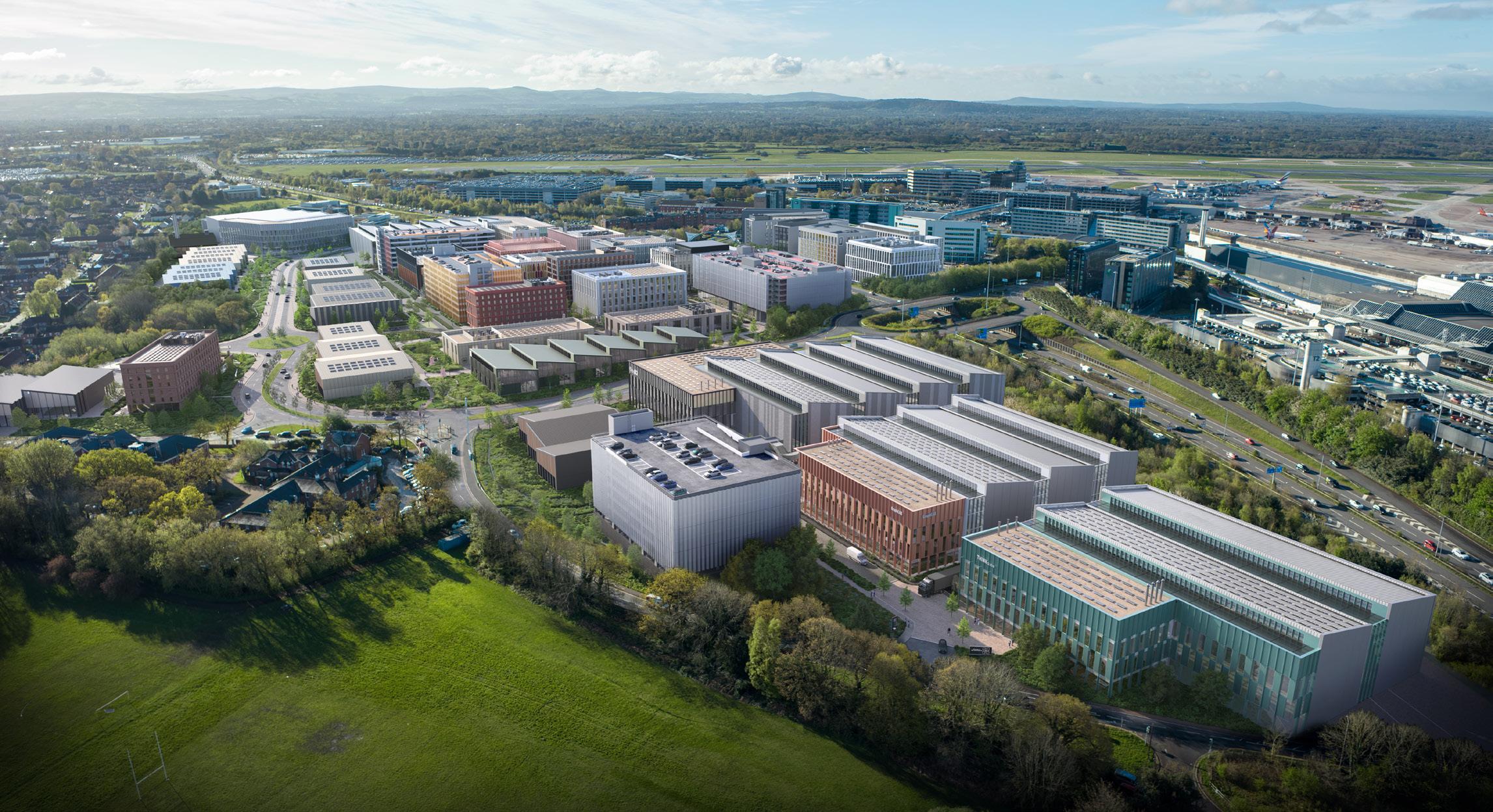
Cogent Skills’ commercial manager Stephen Foreman and business relationship manager Tom Forsyth talk to Simon Penfold about the importance of early-stage recruits to plugging the STEM skills gap.
The skills gap in the science and technology sector has been well recognised issue for nearly a decade.
Frequently quoted figures about the £1.5 billion cost to the economy from the STEM skills gap and a shortage of 173,000 workers both date back as far as 2018.
More recently in 2022 the Department for Employment found more than 40% of vacancies in the manufacturing, information and communications, and construction sectors remained unfilled due to skills shortages.
Last year the charity Cogent Skills reported that the numbers of people beginning apprenticeships (‘apprenticeship starts’) increased in the pharmaceutical (31%) and scientific research and development (38%) sectors between 2017–18 and 2021–22. However, it reported that overall apprenticeship starts in science fell by 16% in the same period, partially because of falling demand from the industrial sciences.
Other reports suggest that fewer people are pursuing apprenticeships at intermediate and advanced levels across all sectors. In 2024, the industry body Make UK reported a 42% drop in engineering and manufacturing apprenticeships since 2016–17,

stating that: “Much of this decline is accounted for by steep falls in the number of apprenticeships at Level 2 and 3, which have been routinely underfunded”.
For small and medium-sized enterprises (SMEs) apprenticeships starts in the science sector fell by 39% between 201718 and 2021-22.
A report last year revealed that the life sciences sector alone would need up to 70,000 new jobs by 2035 in order to support recent growth trends, with a further 75,000 needed to replace those leaving the workforce over that time.

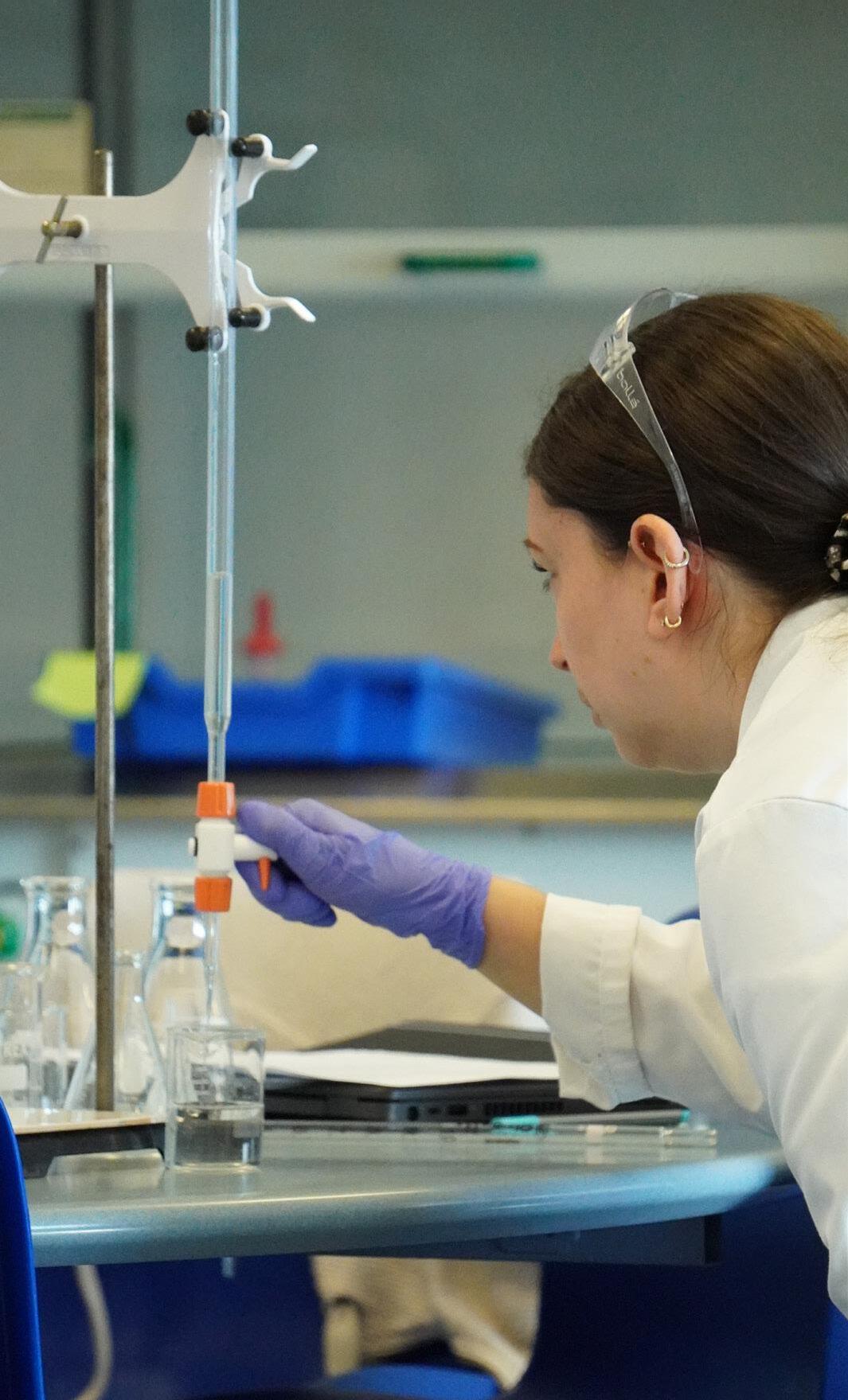
As the demand for new recruits in the science and technology sector becoming increasingly urgent, Cogent Skills is encouraging more organisations to focus on so-called ‘early talent’. This ranges from recent graduates to interns and apprentices - young people with high potential but limited real-world experience.
Cogent is the skills specialist for the UK science and technology sectors and evolved out of the sector skills councils introduced by the Labour Government in 2002.
Stephen Foreman, commercial manager at Cogent Skills, explained:
“We started out as a sector skills council, making sure employers were heard by government. After the model changed, we evolved into a not-for-profit to make sure we could continue making sure we amplified the voice of the science sector.
“Part of this helping develop the standards within science and technology, such as the apprenticeship standards that were introduced around 2020.
“We also support companies to take on apprentices, placements, students and graduates, however
they need them. And we also do a lot of outreach to develop and attract early careers talent.”
As part of that outreach Tom Forsyth has started conversations with the UK Science Park Association to spread the word about the support available to take on early talent. He also works with councils, colleges and businesses ranging from global companies to SMEs, startups and spin-outs.
Cogent also operates an apprenticeship delivery group and a short courses company that works closely with the Health & Safety Executive to provide training in process safety and NEBOSH courses.
Within the charity there is a research team and, as a membership organisation, it feeds information from industry back to government. That includes the recent Life Sciences report ‘Life Sciences 2035: Developing the Skills for Future Growth’, which was written in co-operation with Cogent’s partner organisations.
Supporting the industry
Stephen Foreman said: “Our board of directors, which represents the breadth of the science-based industries around the UK, help ensure everything we do is to support the industry – making sure new recruits have the skills they need and to build a strong pipeline of young people through apprenticeships, graduates or industrial placement students, all of whom understand the industry.
“We've found there's quite a discrepancy in what young people think of the industries we work in.
Above and below Stephen Foreman attended and gave a speaker presentation titled 'Fueling growth and innovation through early talent' at UKSPA's 2025 autumn conference
They think of life science as just people in lab coats. Our careers page is actually called Not Just Lab Coats and it explains each of the industries we work with.
“There's lots of early talent job roles on there, as well as advice on the careers that are available. It reminds people that in all these industries you also need accountants, marketers and people the commercial side, as well as all the process or operational roles.”
Tom Forsyth said: “Unfortunately, over the past 10 to 20 years skills has taken a back seat. But as we're starting to find out now, skills is a really easy way for businesses to actually maximise their fiscal potential and their growth.
“If businesses start providing opportunities a little bit earlier, it is going to prove to be very beneficial for them in terms of cost and values, by having people embedded into the culture of the business from a very early date. And they won’t have to keep reactively recruiting.
“Because of the experience we built up from our former sector skills council background, we have such experts in different areas from clean energy to nuclear to industry to life sciences to pharma. It means we’re well versed in helping businesses grow in whatever way that they so want.
“That ranges from talking to industrial organisations or communities, such as UKSPA, to supporting SMEs or large corporates.
“Businesses are seeing the benefits, especially with degree apprenticeships. The engineering industry has done it for a long time but we are seeing more in big pharma companies, partly because of the higher retention rates with apprentice graduates.
“ e nsure that the skills you're going to require in future years are already in the workforce or the talent pipeline”
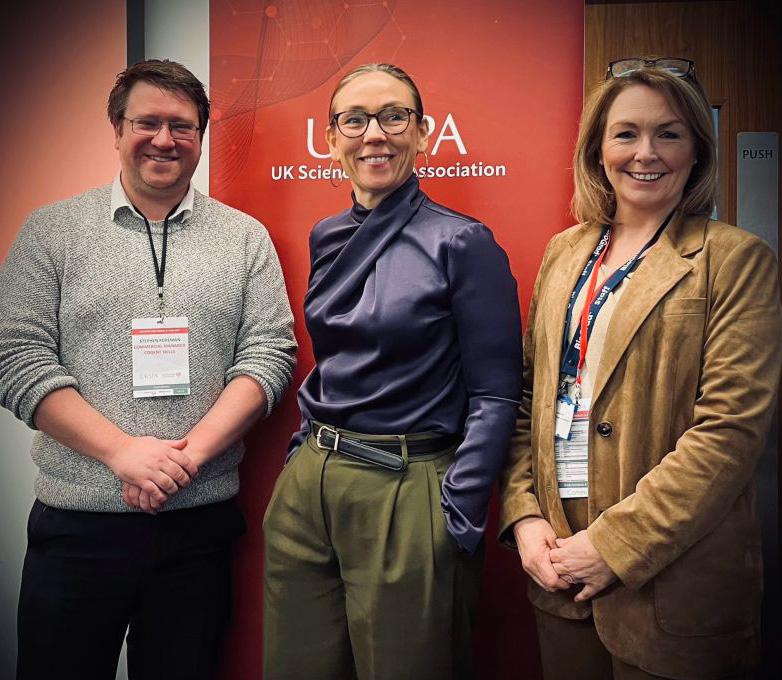
“Various factors mean skills has become quite a reactive thing for businesses or organisations: it's a case of filling roles as and when they're needed, rather than trying to future-proof the business. What they need to do is ensure that the skills they're going to require in the next three, five or more years are already in the workforce or in the talent pipeline.
“Post-COVID, skills is coming to the forefront. Businesses are trying to future-proof themselves by making sure those skills needs are met earlier. That means they’re not having to pay through the nose to get the right people in the right areas when they need to fill roles at the last minute. It also reduces attrition and increases tenure within businesses and organisations.
“But too many schools still see apprenticeships as for young people who can’t go to university. It’s for construction, or hairdressing or beauty. But there are more than 800 different apprenticeships in England, ranging from lab technicians with big pharmaceutical companies, to chemical and nuclear engineers. The number going on to do degree apprenticeships is growing every year, which is great to see.”
Taking the direct approach Cogent has taken direct approach to tackling this attitude by delivering a successful venture to support SMEs with apprenticeships. The Science Industry Apprenticeship Consortium – SIAC - brings together 23 science-based companies in the North East who have worked together to enrol 380 apprentices across 34 apprenticeship standards in recent years, from Level 2 to Level 7.
SIAC’s success lies in bringing together small and medium-sized enterprises (SMEs) to support learners in beginning careers in the science sector, helping them access high-quality training despite their size. Members of SIAC include Huntsman, SABIC UK Petrochemicals, Fujifilm Biotechnologies, ConocoPhillips, Alpek Polyester, Centre for Process Innovation (CPI), Seqens, and Venator.
Cogent’s Skills Account Manager for the project, Geoff Cox, said: “Without SIAC talented apprentices at science-based SMEs across the region would struggle to access the high-quality training they need to progress their careers and make an important contribution to their employers.
“We think this kind of model can be replicated across other areas of the UK and we’re eager to work with local partners to make this happen.”
Stephen Foreman added: “Because many of the companies are on one site, they're all very interlinked from the products that each of them make, we were able to bring them together with the local college to create a cohort or two of engineers and process operators every year.
“We were able to allow them to give it a try without the risk because of our support mechanism. And by having a group of companies who can come together to share the knowledge, share the industry, it creates a pool of skilled talent. They've got a group of young people within that industrial park, a community, even though they might be at six different companies. They all go to college together.
“That community could be replicated on other industrial parks, or on science parks. Not only is there a talent pipeline for the businesses, but some of them will go on to university or beyondwe've had degree apprentices go on to PhDs.
“And they will create the next step, become the next spinout or the next micro business, which will come back to the science park because of that community link, where they started out doing their apprenticeship.
“It can create hubs of R&D and innovation where these young people have already built a community.
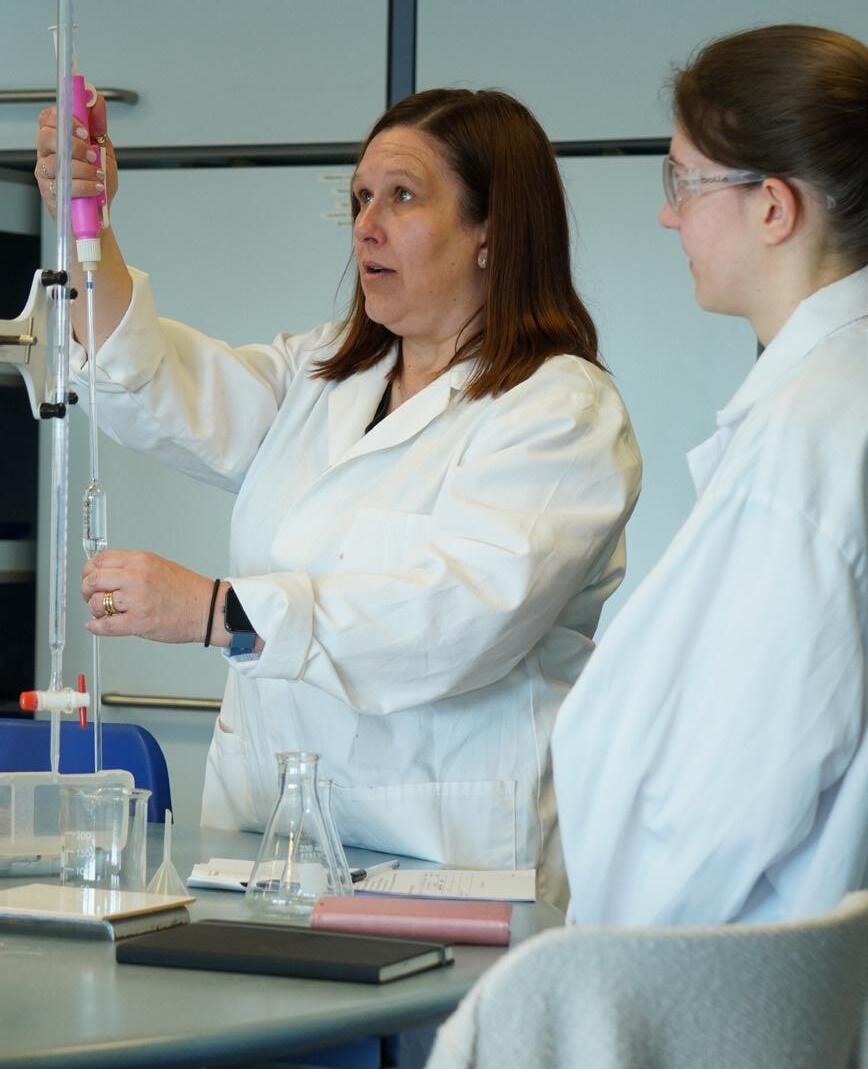
“With the pilot group in SIAC, we have a group of companies that are never going to have to worry about their workforce aging because they've got a constant supply of young people coming in, learning that knowledge from people who are moving towards retirement. So the knowledge stays within the companies as well.
“It’s a recognised problem that we have an ageing workforce, particularly in industries such as life sciences. Without bringing in new people as placements or apprentices you’re going to lose that experience and knowledge.
“But we are getting through to more and more young people, and we’re seeing applications increase. I think there's more work to be done in the SME community, especially joining the dots between the different roles and the different
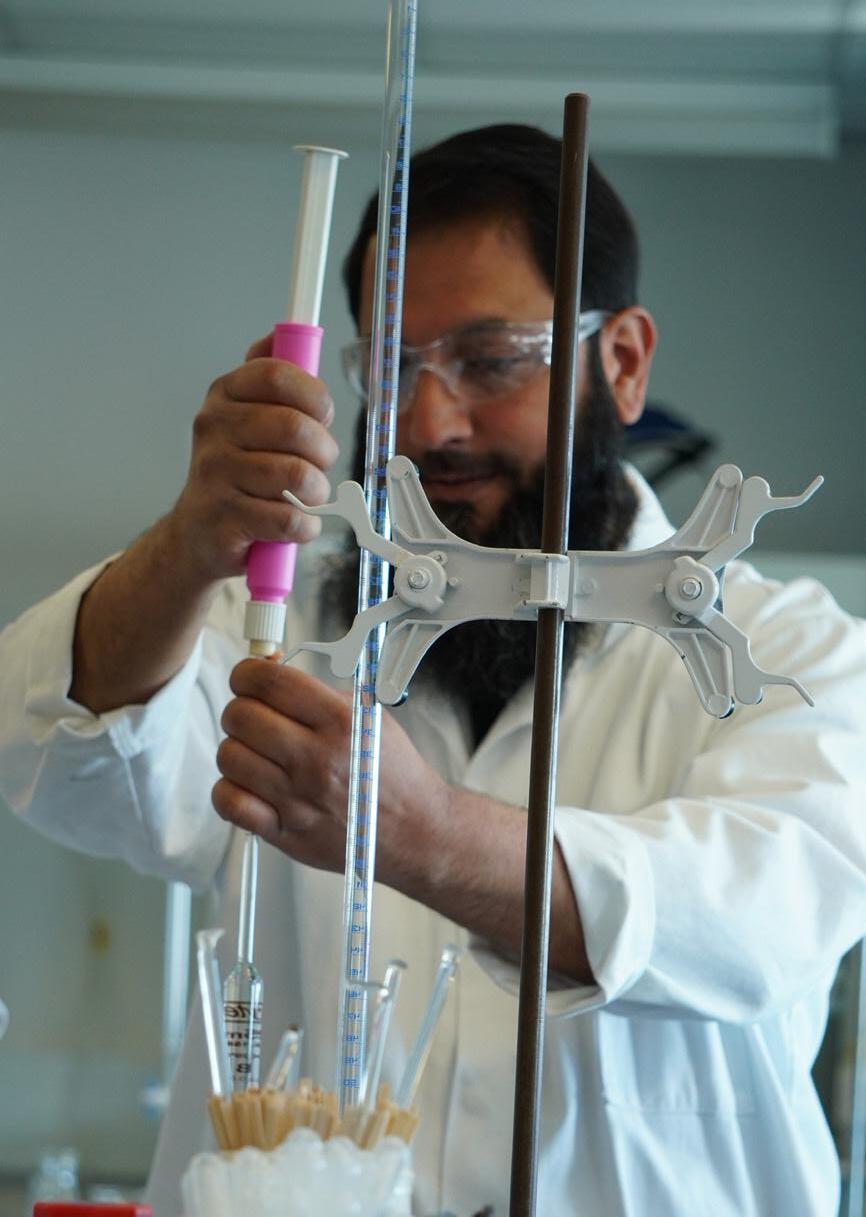
industries. It’s a case of getting the message out that there is a lot of support out there – you just need to go and ask the questions.”
Tom Forsyth added: “At the other end of the scale, you've got growing new industries like the revived nuclear industry given a fresh lease of life by these new small modular reactors being developed by Roll-Royce.
“The nuclear industry is very forward-thinking – they've already started to boost the number of apprenticeships. It’s a good example of an industry that is futureproofing itself. It’s making sure it gets the best possible skills in early. That way the industry can blossom when all those skills are going to be available at the critical time.
“And that is something that life sciences, big pharma, everybody else is starting to turn around to and realise that that's exactly what they need
“At the end of the day, there's no future without people. You can have all the digitalisation and AI you want, but you still need people in every single sector of an organisation. If you want to make sure your business is keeping going and keeping up, young people can bring a different view and the digital skills you need.
“We need to get away from this position where you have four companies fighting over six engineers who started 40 years ago. There’s this gaping hole in every industry in terms of needing new, young blood. What we need to focus on is knowledge transfer, otherwise we are going to lose all of that experience, all of that talent, because it’s not being passed over.
“In the industries we’re working in there’s such an ageing population so we need continuity. We need to focus on bringing the new people in to transfer that knowledge so we can continue to be a leader in the world. We just need to stand tall again.
“Because at the moment, the gap in terms of skilled people is anything between 60,000 and 110,000 over the next 10 years.” n


London Lab Live is where digital innovation meets physical science, and strategy meets integration, bringing together 3,000+ leaders across the laboratory ecosystem to reimagine how labs operate.
We connect senior decision-makers with the partners and technologies needed to build digital, automated, and sustainable laboratories to therefore advance science and discovery.
Hear from over 100+ expert speakers including:




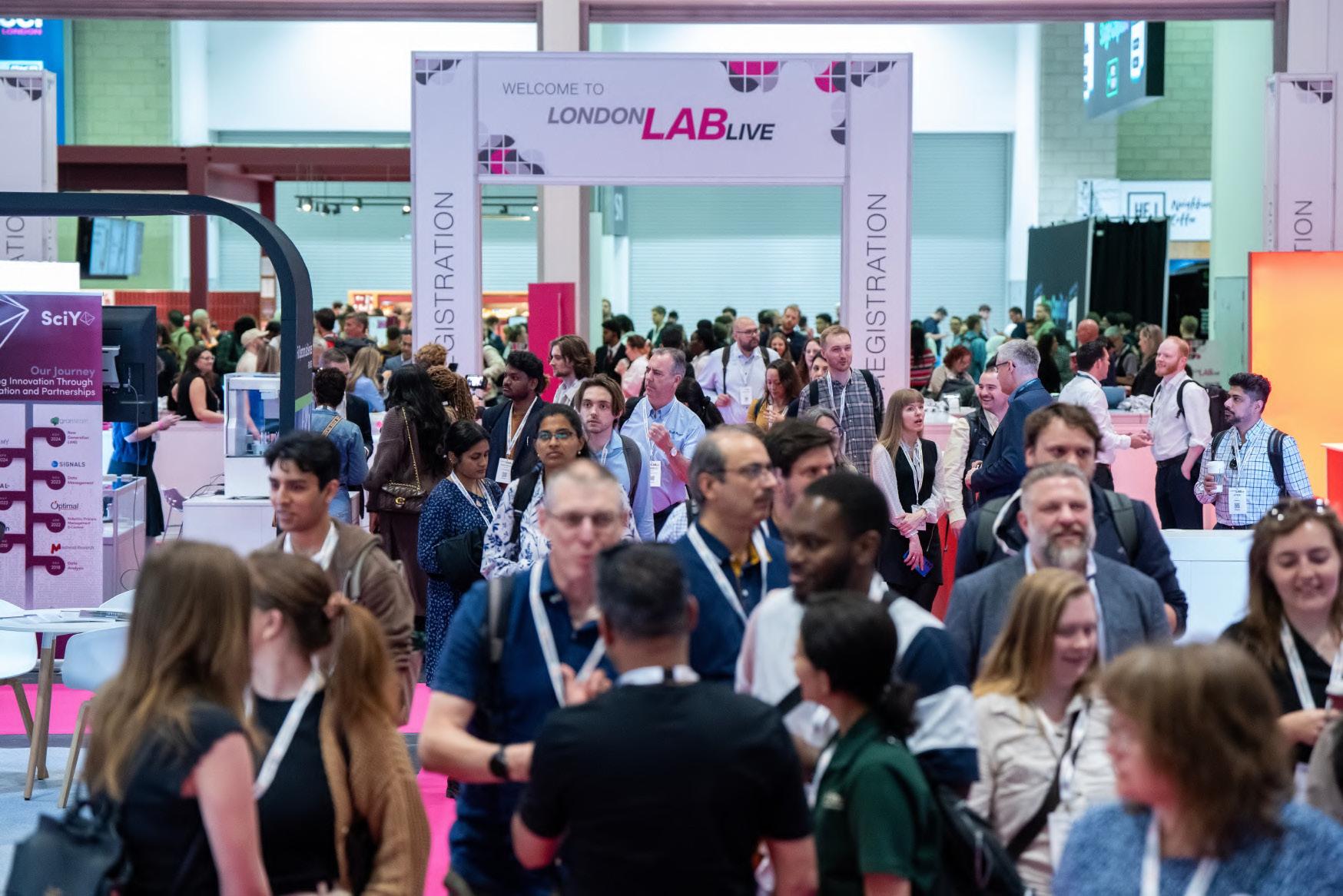


Experience unmatched reliability and efficiency with the Nexera LC-40 and the LCMS-2050. These userfriendly, versatile, and durable instruments help you save time and money by minimizing downtime. Plus, their advanced analytical intelligence streamlines your workflow enhancing productivity and boosting your confidence in every result.
Nexera LC-40
Intelligent process automation ensures ease of use and delivers superior, more efficient results.
LCMS-2050
High performance in a compact design, including Combi source (ESI + APCI) and Mass-it™ function