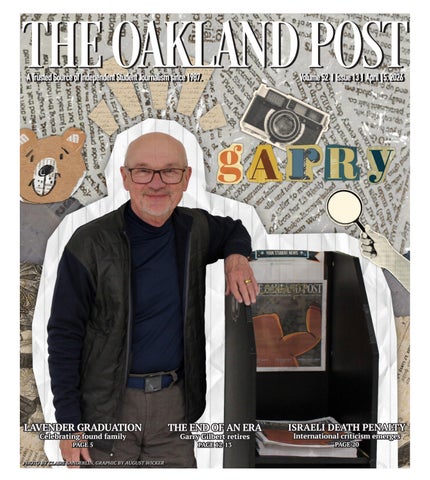
04.15.2026 Oakland Post

Page 1


LAVENDER GRADUATION Celebrating found family PAGE 5

THE END OF AN ERA Garry Gilbert retires PAGE 12-13

ISRAELI DEATH PENALTY

International criticism emerges PAGE 20

PHOTO BY CLAIRE SANDERLIN, GRAPHIC BY AUGUST WICKER

DIGITAL PRODIGIES AND TRINKET CRAFTSMANSHIP. Featuring videogames like Fallout and Deltarune, the Department of Art, Art History and Design students showcase their creations at the Maker Faire, marking the end of the semester.

PHOTO BY EVELYN APAHIDEAN

Evelyn Apahidean Photographer

Claire Sanderlin Photographer

Liliana Valenza Photographer

Matthew Vigelius Photographer

O’Hara Diamond Graphic Designer

Anna Friedrich Graphic Designer

Ava Guest Graphic Designer

REPORTERS

Sarah Bulgarelli

Alexa Dudek

Matthew Lewakowski

Maria Magnoli

Andrew May

Maryam Moss

Mike Okoronkwo

EDITORIAL BOARD

Adrian Jimenez Morales Editor-in-Chief ajimenezmorales@oakland.edu

Mallory Waligora Content Editor mallorywaligora@oakland.edu

August Wicker Managing Editor wicker@oakland.edu

EDITORS

Ava Webb Photo Editor awebb3@oakland.edu

James Elling Sports Editor jmelling@oakland.edu

Addison Koch Campus Editor aekoch@oakland.edu

Marissa Getschman Arts Editor getschman@oakland.edu

Cael Tanner Features Editor caeltanner@oakland.edu

Sophia Curran Political Editor sophiacurran@oakland.edu

MARKETING

Ruby Hernandez Marketing Director ahernandez4@oakland.edu

Maryam Somo Marketing Assistant maryamsomo@oakland.edu

Mike Okoronkwo Marketing Assistant mokoronkwo@oakland.edu

DISTRIBUTION

Erin Banes Distribution Director Niy Ivory Distribution Aza Lewis-El Distribution

REPORTERS CONT.

Maryanne Sanford

Jennifer Thomasma

Madi Turner

Sarah Wasielewski

ADVERTISING

Matilde Rabajoli

Maddie Short

Maryam Somo

Alicia Gabbard Ads Director ads@oaklandpostonline.com

248.370.4269

Capri Clark Ads Assistant

Tori Coker Marketing Director toricoker@oakland.edu

Garry Gilbert Editorial Adviser gjgilber@oakland.edu

248.370.2105

Don Ritenburgh Business Adviser ritenbur@oakland.edu

248.370.2533

Dylan Hecker Graphic Designer ADVISING

CORRECTIONS

CORNER: The Oakland Post corrects all known errors of fact. If you know of an error, please email editor@oaklandpostonline.com.

The final lecture: Celebrating Garry Gilbert’s legacy

“Students are whole people, not just bodies sitting in your classroom,” Erin Meyers, a professor in the communications, journalism and public relations (CJPR) program at Oakland University said.

Meyers said that faculty should care about students beyond the syllabus and help students work toward goals rather than expecting students to simply complete assignments.

This philosophy reflects the impact that Professor Garry Gilbert had on the Oakland University community throughout an influential teaching career.

On Friday, April 10, from 3:30 p.m to 5 p.m, the Oakland University community gathered in the Habitat to celebrate the retirement of Gilbert, a beloved OU professor and Oakland Post faculty advisor.

As the event kicked off, several speakers spoke about Gilbert, showing appreciation and sharing stories about the professor.

“Garry Gilbert is OU” illuminated the wall of the Habitat, appreciating the professor’s embodiment of the core values of Oakland University.

At the event, students, graduates and faculty alike gathered to show appreciation for Gilbert’s impactful legacy.

Senior PR major Maggie Quinn met Gilbert through the ethics in journalism course that Oakland University provides.

“His ethics in journalism class taught me so much about what I wanted to do in my own career,” Quinn said. “I’m a public relations major, and a lot of the units that he taught applied to the career field I was planning on going into.”

Meyers met Gilbert after being hired in 2011. Meyers has worked with Gilbert as colleagues and on many committees.

“He’s always so thoughtful, helpful and supportive of your ideas,” Meyers said.

Even though Quinn took Gilbert’s ethics and journalism class during the eventful 2024 election cycle, Gilbert ensured that the environment was always a safe space for everyone.

Quinn’s favorite memory with Gilbert was a conversation that occurred during this class. During Gilbert’s course, students presented on court cases involving the media.

“I was doing a presentation about a court case about a newspaper who was exposing drunk drivers and their mugshots,” Quinn said.

The presentation started a conversation with Reagan Reetz, a former employee of the Oakland Post, about Ohio requiring people convicted of drunk driving to drive with differently colored license plates.

Quinn admires Gilbert for encouraging the Oakland University community to pursue dreams. Even when students face difficulties, Gilbert maintains a positive presence on campus through constant encouragement.

“Garry helped me gain the confidence and ability to realize that I’m qualified for this, he is very encouraging,” Quinn said.

Olivia Chiappelli, former editor-in-chief for the Oakland Post, enjoyed working with Gilbert around the time of Oakland University’s March Madness run. As a major fan of the basketball teams of Oakland University, Gilbert provided the

Oakland Post staff with a surplus of information and guidance.

“Garry is obviously a big OU basketball fan, and it felt like we had a great source there,” Chiappelli said.

While many reflected on Gilbert’s teaching, others pointed to the personal and lasting impact beyond the classroom. His influence extended into mentorship, career opportunities and the way students approached the field.

Summer Weathers, a May 2025 Oakland University graduate in journalism and broadcast media studies, said Gilbert played a major role in shaping a passion for journalism.

“He made journalism feel exciting for me,” Weathers said.

Weathers said that impact extended beyond coursework, influencing confidence and long-term career direction.

“I want to carry that on by telling other students how much I really love journalism because of him,” Weathers said.

For Adrian Jimenez, a graduating journalism student and editor-in-chief of the Oakland Post, who works closely with Gilbert, that influence was more personal. Jimenez described Gilbert as someone who reshaped expectations of a professorstudent relationship.

“You can have a real, horizontal conversation with him,” Jimenez said.

Jimenez said Gilbert created an environment where students felt respected rather than intimidated, contributing to both academic and professional growth.

“He doesn’t look down on his students, and he doesn’t put anyone on a pedestal,” Jimenez said. “He’s very grounded.”

That approach allowed students to develop confidence while also refining skills beyond the classroom. Gilbert’s support extended into opportunities that helped shape future careers.

“My internship after graduation is thanks to Garry,” Jimenez said. “He basically helped build my career.”

Jimenez said Gilbert’s influence could also be seen in everyday classroom moments, where teaching style made a lasting impression.

“He has a really calm, well-paced way of teaching,” Jimenez said. “It made it easy to stay engaged and absorb the material.”

As Gilbert prepares to retire, Jimenez said the timing feels significant as graduation approaches.

“It feels like we’re both closing a chapter at the same time,” Jimenez said.

Looking ahead, Gilbert’s impact has influenced how future career paths are considered.

“I never thought about becoming a professor before, but now I actually could see myself doing that,” Jimenez said.

Experiences like these reflect a broader legacy built through mentorship, encouragement and accessibility. Students described an environment where growth was supported both inside and outside the classroom.

For many, that impact extends beyond the classroom and coursework into long-term professional development.

That sense of impact was echoed by alumni who credited Gilbert with shaping decisions long before graduation.

Lauren Reid, former content editor of the Oakland

Post from 2021 to 2022 and now an account executive at Airfoil Group, said Gilbert played a role in the decision to attend Oakland University.

“He was the reason I chose to come here,” Reid said. “He was so friendly and warm, and I could tell that he really cared about his students.”

Reid said that first impression stayed consistent throughout the experience, reinforcing Gilbert’s reputation as a professor who prioritized people over performance.

“I think there’s nobody who cares more about their students than him,” Reid said.

Moments like those reflect a broader impact that extends far beyond a single classroom or graduating class. Gilbert’s influence reaches students whose stories may never be formally documented, but who carry the same lessons forward.

For many in attendance, the retirement marked more than the end of a career. It represents the closing of a chapter defined by mentorship, honesty and a commitment to teaching the realities of the profession. Goodbyes in spaces like this are rarely simple. They are often layered with gratitude, reflection and the recognition of what cannot be replaced.

Gilbert’s work emphasized truth, accountability, and the importance of using one’s voice, values that continue to resonate beyond the university setting.

That lasting imprint is what makes the moment feel both celebratory and difficult to let go.

As the event came to a close, attendees celebrated the long-lasting impact that Gilbert had on the community.

The Oakland University community congratulates Gilbert on a well-deserved retirement as Gilbert’s remarkable teaching career comes to a close.

PHOTO BY MADI TURNER

Love respectfully at OU

Oakland University hosted its “Love Respectfully” event on April 2, giving students access to sexual and reproductive health resources while encouraging open, informed conversations about topics that are often stigmatized.

Hosted by the Graham Health Center in collaboration with Student Congress and Greek Life, the event took place from noon to 2 p.m. at the Habitat and overlook lounge. Students were offered free STI testing, immunizations, contraceptives, Plan B, pregnancy tests and refreshments, making it easy to access services in a convenient, low-pressure setting.

The event aimed to create a more open campus environment by normalizing conversations around sexual health and wellness. Organizers emphasized that bringing resources directly to students helps reduce stigma and increases participation, especially for those who may feel uncomfortable visiting a health center.

Ann Rayford, director of the Graham Health Center, said conversations surrounding sexual health and immunizations are often avoided due to discomfort or lack of awareness.

“Sexual health, I think just sometimes it’s not something that’s talked about,” Rayford said. “It can be taboo, whether it’s how we were raised, people don’t feel very comfortable.”

Rayford explained that this lack of conversation can prevent students from seeking care or asking important questions. She emphasized the importance of regular

testing, particularly for young adults navigating new relationships and increased independence.

“You don’t know unless you get a test,” Rayford said. “Really one in four young adults can have an STI and have no symptoms at all.”

In addition to testing, the event highlighted the importance of routine vaccinations. Rayford noted that many students underestimate their role in maintaining both personal and community health.

“When we are young and we’re like, ‘I’m healthy, I’m invincible,’ we just don’t always think about it,” Rayford said. “But there are some things for adolescents and young adults and things that we should get every year like flu and COVID so that we can help protect ourselves and others around us.”

A key goal of the event was to raise awareness about the services available through the Graham Health Center and encourage students to take

advantage of them.

“If people don’t come to the health center, we want to bring it outside of the health center so people know that it’s available,” she said.

Rayford also noted that collaboration across campus departments and community partners played an important role in the event’s success.

“We have a lot of partners here,” Rayford said, pointing to support from Student Affairs and the Oakland County Health Department, which provided free STI screenings.

Student Congress distributed emergency contraception and pregnancy tests, while additional resources and giveaways encouraged students to stop, learn and engage.

The initiative also included opportunities for students to connect with the Healthy Campus program, which promotes long-term wellness and healthy decision-making.

Organizers said creating an open and welcoming environment allows students to ask questions, access services and learn about their health without fear of judgment. By making these resources visible and approachable, the event encouraged students to take proactive steps toward their well-being.

The “Love Respectfully” event reflects Oakland University’s broader commitment to student wellness and preventive care.

By focusing on education, accessibility and collaboration, the university continues to support students in making informed choices about their health while fostering a more open and supportive campus community.

Detroit Red Wings share sports marketing insights

ADDISON KOCH

On Tuesday, April 7, students at Oakland University gathered in the Stinson Center in Elliott Hall for an inside look at sports marketing during the American Marketing Association (AMA) at OU speaker event, Digital Marketing Insights with Detroit Red Wings.

Michelle Sutherby, a social media content designer specializing in graphic design, and Staci Remejes, a social media manager for the Detroit Red Wings, shared insights into how their roles shape the team’s digital presence and marketing strategy.

“Social media is never really off,” Remejes said, highlighting the constant demands of the industry.

The team structures its workflow around game days, practice days, and off days.

“We kind of split our season into three silos,” Remejes explained.

Game days are especially fast-paced, with content produced within minutes.

“We’re getting that stuff out as quickly as possible to keep our fan base engaged,” Remejes said.

Practice days allow for lighter, personalitydriven content.

“That’s when we get a lot of our light, fun, personality content,” Remejes added.

The Red Wings team hires specialists in graphic design and video editing to accelerate real-time content creation.

“Obviously, we felt it was necessary to kind of bring specialists on, in these areas… Michelle will flip around

a graphic if something happens in-game,” Remejes explained, describing the rapid turnaround required during live events.

Emphasizing the importance of being prepared but flexible, Sutherby said, “There’s other times where it’s like, it happens like that, and I just have to be on top of it.”

Their work supports key business goals, from selling out games to boosting season ticket revenue.

“The main objective is to sell out every game, increase season ticket revenue,” Remejes said.

Collaboration across departments is essential.

“We work with ticket sales, communications, PR, community relations … pretty much everybody,” Remejes noted.

The team also tailors content depending on the platform.

“What we put up on TikTok is different … versus Facebook, where people just want the facts.”

Staying current with trends is another constant challenge.

“We’re just seeing stuff … and thinking like, ‘Oh, how can we do that for our brand,’” Remejes said.

“I spend a lot of time scrolling Pinterest,” Sutherby added. “To kind of set inspiration aside.”

Legal restrictions prevent the use of copyrighted music, so trends must be adapted creatively.

The team also uses artificial intelligence in subtle ways.

“It’s nice for captioning videos,” Remejes said.

While Sutherby emphasized authenticity, “I don’t really use it for anything personally … I want to be different and authentic.”

Building trust with players is another key part of the work.

“It’s all about reading a room and knowing when to do things,” Remejes explained.

For students interested in sports media, Sutherby highlighted the importance of showcasing creative work.

“I love being able to show what the process of it is,” Sutherby said. “I think it’s a really cool thing.”

The event provided a realistic look at the fast-paced, constantly evolving nature of sports marketing.

“It’s just a constant moving thing,” Remejes concluded, underscoring the dynamic challenges and opportunities in the industry.

PHOTO BY JENNIFER THOMASMA
PHOTO BY ADDISON KOCH

Celebrating LGBTQ+ voices in books

Representation in books serves as a mirror, reflecting and validating a reader’s identity and lived experiences.

It allows readers not only to see themselves in the stories they engage with, but also to better understand and connect with perspectives and realities different from their own, whether fictional or rooted in real life.

On April 7, Oakland University’s Kresge Library, in collaboration with the Educational Resource Lab (ERL), hosted a “Read with Pride: a browse-and-borrow event” as an early celebration of Pride Month, highlighting diverse LGBTQ+ voices and narratives.

Students, faculty and staff were invited to explore a curated book display featuring works by and about LGBTQ+ individuals, with titles representing a wide range of identities and experiences.

“OU celebrates Pride Month right now, as opposed to in June, because the students are here,” Erin Smith, manager of circulation services and resource sharing, said. “So that’s why we’re doing it this month and the ERL will also basically repeat this entire display in June.”

The books featured in the display were provided by and selected with the assistance of the ERL, ensuring a thoughtfully curated collection that highlighted diverse LGBTQ+ voices and experiences. The display included sections organized around different

queer identities, as well as a section for questioning students, making it accessible and welcoming to a broad audience.

In addition to the books, the event included interactive activities such as “Flags Roll and Race” and a word scramble.

Attendees could also take coloring bookmarks, buttons and stickers, adding a creative and engaging element to the experience.

“I really wanted to work there [ERL] because I’m passionate about art, but also reading and representation in books is something that I’ve cared about for a long time,” Leah Bowyer, graphic design and marketing specialist at the ERL, said. “I read a lot of LGBTQ+ books and that’s my favorite genre. The opportunity to comb through the shelves of books that we have at the ERL that I know really well was an absolute delight for me.”

The event emphasized the importance of authentic representation in books, which plays a key role in combating harmful stereotypes, fostering inclusivity and strengthening reader engagement.

“I think it’s really important for people to be able to see themselves in a book,” Melissa Kempski, director of the Educational Resources Lab, said.

Beth Wallis, associate dean of Kresge Library, elaborated on Kempski’s point.

“I mean, it’s vital. Especially in the political climate in the country today, it’s more important than ever to create safe spaces for everybody,”

Wallis said.

“I’m the mom of four kids and so since they were in their teenage years, I’ve learned a lot and have

grown myself,” Wallis said. “I just think it’s really important for people to keep growing and learning. We want allies to feel comfortable in these spaces. We want queer students to feel comfortable in these spaces. The library is always trying to find new ways to engage with students beyond providing an important space for study and providing important resources for their school work,” Wallis said.

Although this marked Kresge Library and the Educational Resource Lab’s first Pride Month book event, the groups had earlier in the year hosted a banned books fair, continuing their commitment to highlighting diverse and often underrepresented voices.

“The banned book fair in the fall was the first time that we’d hosted this kind of event,” Smith said. “This is the first Pride event, but I feel like they’ve been successful and we would want to keep doing them going on into the future.”

“I really like the collaboration between Kresge and the educational resources lab. This is the first school year that we’ve ever really collaborated and I think that has been very successful,” Kempski said.

Lavender Graduation honors LGBTQ+ students’ authentic selves

ERIN BANES

As commencement season approaches, Oakland University’s Lavender Graduation offers LGBTQIA+ students a ceremony centered on recognition, visibility and community, values that have not always been reflected in traditional graduation ceremonies.

The 13th annual Lavender Graduation took place on Thursday, April 9, from 5 to 7 p.m. in the Oakland Center’s Ballroom B.

Hosted by the Gender and Sexuality Center, the ceremony celebrates LGBTQ+ graduates and the support systems that helped them reach this milestone.

Lavender Graduation is an annual event held on college campuses across the country to honor the achievements of LGBTQ+ students and the people working beside them towards justice and equity.

The ceremony was created in 1995 by Ronni Sanlo after she was denied the opportunity to attend her children’s graduations because she openly identified as lesbian.

Oakland University hosted its first Lavender Graduation in 2013 and will celebrate its 13th class of graduates this year.

According to Blake Ilan, director of the Gender and Sexuality Center, Lavender Graduation serves a distinct and necessary role during graduation season.

“For some of our students, it’s the only chance they have during graduation season to be called by their authentic name,” Ilan said.

Lavender Graduation does not limit the number of guests graduates are allowed to invite, allowing students to celebrate alongside their chosen family, biological family or a mix of both.

Ilan said the ceremony provides LGBTQ+ students with a meaningful experience to work toward during their college careers, one that acknowledges the full scope of who they are.

“It’s incredibly important for students to be acknowledged as their whole and authentic selves,” Ilan said. “Being celebrated because of their queerness, rather than despite it, is a lifechanging paradigm.”

For Ula Tuskenyte, a psychology major with minors in German and communication and a Lavender Village resident assistant, Lavender Graduation was a milestone she had been looking forward to for years.

“This was my third year attending,” Tuskenyte said. “I used to come and watch my friends walk the stage, but I was honestly more excited for this than for the big commencement. It’s a smaller, more tight-knit community. You can feel the love in the room.”

Tuskenyte said celebrating alongside people who supported her throughout her time at OU made the ceremony especially meaningful.

“I’m grateful to have my partner here celebrating with me,” she said. “Seeing the people who showed up for me meant a lot.”

Ilan said participation in Lavender Graduation has grown over time, with increased involvement from graduate students this year, reflecting the expanding

presence of LGBTQ+ students across campus.

For Lynx Mallet, a graphic design major, hearing their name called during Lavender Graduation carried special weight.

“When it comes to the actual graduation, that name won’t be called,” Mallet said. “That name will end here, but hopefully it will live out in the world.”

Unlike traditional ceremonies, Mallet said Lavender Graduation felt more personal.

“I liked this one more because it felt more personalized,” Mallet said. “Having something read out loud that actually represents you, that’s beautiful.”

For Ilan, the purpose of the ceremony extends beyond a single evening.

“I hope everyone remembers what it feels like to be surrounded by a community that understands them and celebrates them for who they are,” Ilan said. “Anyone who participates in Lavender Graduation should never feel alone or like they are too strange for this world. You are in majestic company.”

PACE paralegal panel

JENNIFER THOMASMA &

Oakland University students gathered for a PACEhosted “lunch and learn” on Thursday, April 9, from 12 p.m. to 1 p.m. in Pawley Hall, Room 306, to explore careers in the legal field.

The event introduced students to the paralegal profession in a relaxed and accessible setting while highlighting pathways into the field for students across a variety of majors. Attendees learned about the profession, asked questions and connected with program leaders in a more personal, discussionbased environment.

Hosted by Professional and Continuing Education (PACE), the session aimed to provide students with a clearer understanding of how paralegals contribute to the legal system and what steps are needed to enter the field.

PACE, led by Oakland University faculty and administrators, offers opportunities for students to gain practical job knowledge and skills through research and hands-on application.

The program emphasizes career readiness and provides resources for students looking to build experience before entering the workforce.

The program offers flexible learning options, including evening and online classes, allowing students to gain experience while continuing their studies.

Through career-focused certificate programs, PACE aims to prepare individuals for entry-level positions or advancement within their current careers.

Carrie Sliwinski, assistant director of PACE, said the university developed its paralegal program in response to a growing demand for trained legal professionals in the region.

“Our Paralegal Program was created to meet a growing regional need for well-trained legal support professionals. As the legal field expanded and the demand for skilled paralegals increased, Oakland University saw an opportunity to offer a rigorous, ABA-approved program,” Sliwinski said.

This year marked the program’s 50th anniversary, reinforcing its long-standing presence and continued relevance in the legal community.

Over time, the program has built a strong reputation for preparing students with practical skills that can be directly applied in professional settings.

Students who complete the PACE program are met with a range of career opportunities. The curriculum is designed to provide both foundational legal knowledge and hands-on experience, helping students transition smoothly into the workforce.

“Our program includes an internship component in the final semester,” Sliwinski said. “Although it is classified as an internship, we strongly encourage and assist students in securing paid positions at law firms that often transition into full-time roles after graduation.”

Even for students who do not secure long-term positions through internships, other opportunities remain available.

“Students who do not secure a full-time internship that continues after graduation still pursue a wide range of opportunities in law firms, corporate legal departments, government agencies, courts, nonprofit organizations and compliance-driven industries,” Sliwinski said.

As the event began, Jeremy Knox delivered a presentation outlining the responsibilities of a paralegal and explaining different areas of law. His remarks helped students better understand the day-to-day tasks

associated with the profession.

“Paralegals get incident reports, figure out if there’s insurance, figure out how much insurance money there is, get a letter to the insurance adjuster and then hand it [the negotiation] off to me,” Knox said.

Knox explained that paralegals play a critical role in gathering and organizing information before attorneys take over key aspects of a case. Their work ensures that cases are prepared efficiently and accurately, making them an essential part of the legal process.

He also discussed how the legal field is evolving with the increased use of artificial intelligence, which is beginning to assist with tasks such as reviewing documents and drafting materials. As AI continues to grow in the industry, Knox emphasized the importance of understanding how to use it responsibly.

Knox said that while AI can improve efficiency, it still requires careful oversight.

“I think we still always need to oversee it, but I think there’s going to come a time where AI is going to supervise AI,” Knox said.

While AI cannot handle a trial on its own, Knox believes it will continue to play a larger role in legal work.

“With a legal profession, I don’t know if AI is going to be able to try a case,” Knox said. “In trials, there’s a lot of curveballs thrown at you, and I don’t think AI is ready to adjust and adapt to something, such as a witness saying something that wasn’t said in a deposition.”

Prashant Chaudhary, an electrical engineering major, said the discussion about artificial intelligence was one of the most memorable parts of the event.

“I learned that I can’t just give information blindly to AI,” Chaudhary said. “I need to make sure it’s safe, especially when it comes to sensitive information like medical records.”

The conversation surrounding artificial intelligence also raised concerns about privacy and ethical responsibility in the legal profession. Students were encouraged to be cautious when handling sensitive information and to understand the importance of confidentiality when working with legal documents.

The event also gave students the opportunity to ask

questions and engage directly with professionals in the field. The smaller setting allowed for more personalized conversations and gave students the chance to explore topics in greater depth.

For many attendees, the lunch and learn served as an introduction to a career path they had not previously considered. By providing accessible information and real-world insight, the event helped students better understand what working in the legal field might look like.

PACE continues to host events like the lunch and learn to connect students with professionals and provide guidance on career readiness. These sessions are designed to make career exploration more approachable and to help students feel more confident about their future plans.

“Our goal is to demystify the profession and help students understand the pathways available to them,” Sliwinski said.

While Oakland University does not offer a law major, the paralegal certificate program provides students with a direct pathway into the legal field. The program can also serve as a stepping stone, offering exposure to legal concepts and real-world applications before deciding to attend law school.

This flexibility makes the program appealing to a wide range of students, including those still exploring their career interests. As interest in legal careers continues to grow, programs like the one offered by PACE play an important role in preparing students for the workforce.

By combining academic instruction with practical experience, the program helps students transition from the classroom to professional environments. The lunch and learn served as both an informational session and a networking opportunity, allowing students to gain insight and make connections within the legal field.

Events like this continue to support Oakland University students as they explore career possibilities and prepare for life after graduation.

PHOTO BY MATTHE VIGELIUS

Opinion: The truth (post) nuked Temu

Historically, presidents known for their trysts with supermodels have a shockingly high record of averting nuclear war. This past Easter Sunday, the entire world began to hold its breath, waiting to see if history would surrender its rhyme.

It is not hard to remember a time when, on any random Tuesday, an American president might attack Russia for their military tactics, hitting the occasional bridge or power plant. Bloviating to the American people about ethical military actions that separate “the good guys and bad guys.” Occasionally, they have even used that same simple language.

“Tuesday will be Power Plant Day, and Bridge Day, all wrapped up in one, in Iran,” President Donald Trump said in an April 5 post on Truth Social. “There will be nothing like it!!! Open the f****** strait, you crazy b*******, or you’ll be living in Hell – JUST WATCH! Praise be to Allah.”

The 3:30 a.m. deadline approached in Tehran. This shift signaled not the arrival of nuclear devastation, but rather the dawn of a new economic era. The Iranian people faced a world stirred by the emergence of a rising power, its presence felt in the rumblings of transformation rather than destruction.

In the final moments of the president’s ultimatum, a last-minute, hastily thrown-together peace agreement, conjured by the Pakistani Congress, was accepted by both sides.

America awoke not to an atrocity of its design. No expanse of mountains and desert was turned into a giant sheet of glass.

They had, however, awoken to the greatest strategic defeat in modern warfare.

This marks what could soon be known as the death of modern seafaring, sending cascades of consequences rippling through global commerce.

Goods being shipped across the high seas may seem a modern affair. This could not be further from the truth.

Maritime trade dates back centuries. Consider that neither tobacco nor potatoes are native to Europe, Africa or Asia. Recall that the vast majority of North and South Americans are not native to those places.

There is evidence of ancient voyages undertaken by the Phoenicians of the Levant as far as Ireland, as well as Viking voyages to Massachusetts. The modern thinker vastly underestimates their ancestors’ ability to move over water.

What does not follow tradition in that respect is the safety of the water. Nations have not always been cooperative.

Macau, Nassau, Tortuga and the Barbary Kingdoms were once entities run by pirates.

Leaving any port was a dance with seawater, cold wind, and death. Dealing with piracy was primarily left as a cost for corporations at the time. Second Amendment defenders cite a letter from Thomas Jefferson in which he defends the right of maritime traders to use naval cannons out of sheer necessity.

It was during the Barbary Wars, the first international war of United States intervention, when the United States established a precedent to uphold peace on the water for the sake of universal profit. These standards held against centuries of rising tensions.

This shift in national priorities came with caveats: higher taxes, tighter rules on ports and stricter registration standards for vessels — but the everyman reaped the rewards. With reduced import costs, the

price of imported goods plummeted in turn.

This completely changed the way business is conducted internationally. It is much easier to ship goods to the other side of the world without fear of them exploding, being stolen, or sinking two miles deep to the bottom of the Atlantic.

The oceans have been a generally safe place to travel for such a long time that modern purchasers simply do not consider what might happen if marine cargo insurance rates were to experience a 300% increase.

This change could risk a return to the oil rationing practices of the 1970s. U.S. allies have already begun to adopt these methods.

But even choppier economic waters lie ahead.

The Strait of Hormuz is a pivotal waterway for transit.

Consider a world where the Houthis in Yemen can purchase the exact same Shahed drones used by Iran, from Iran — an Iran that could become fabulously wealthy by imposing a toll through the Strait of Hormuz.

If inexpensive mines and drones to implement tolls are now legitimate international policy, a needy country like Yemen would be remiss to let 7% of the world’s oil supply sail by without paying its share.

Oil is not the only commodity to be moved primarily by ship. Spices, rice, and cars are widely transported this way, as well as silicon and helium — two pivotal elements in digital technology.

Even dropship economy giants, as ubiquitous as Temu, are ravaged by these tensions.

Depending on the year, roughly 80-90% of global trade — by volume — must sail at least one of the seven seas.

A return to the maritime tradition of gold —which would probably be liquid now — would have deep, ugly ramifications across every economy in the world.

US allies are feeling it.

South Korea and Taiwan are running out of rare

earth elements. Only the countries that the rest of the globe depends on most tensely have them in spades. The Philippines and Australia are running out of fuel — generally speaking — and flights have been cancelled all over the world.

The catchiest part of the sea shanty is that there is no easy solution for a geopolitical situation that has become far more tense for the United States in the last month.

Public support for the war is unmanageably low.

Even the Vietnam War enjoyed a rather high support from the public before 19-year-olds from every suburb in America were forced into booby-trapped holes in the jungle.

Americans hate this war just as much, and only a few broken bodies have even had the chance to make it home in a box.

Most military analysts agree that a ground invasion could assuredly secure control of the strait. Political analysts suggest, however, that this could be a shot across the bow for an administration struggling not to seem like a sinking ship.

The only option that remains yet unexplored is literally nuclear. This is even more unpopular — potentially even apocalyptic.

America has forced itself into an entirely untenable situation. Iran is getting wealthier and has replaced their aged leader with a younger and evidently far more economically strategic one.

Billions of dollars are spent on bombing and missile runs every day. Replenishing the stockpile of missiles and bombs is projected to take from five years to a decade.

In a risky gambit, the United States wagered the political shipping infrastructure on a chance for the grandest regime change in the Middle East yet.

The results have been unfavorable.

Oakland Artists Collective presents music you can see

In Pontiac’s Little Art Theater, tucked away from the dusk’s downtown thrum, time seemed to slow. Richly varied frequencies cascaded from percussion instruments, woodwinds and brass to hang warmly in the air. Equally curious graphics and colorful, liminal imagery flickered and danced along the back wall, melding in step with the performers’ looming shadows.

This was the April 8 “Pulse + Pixels” interdisciplinary arts event, an intriguing concert that saw the intimate venue transformed into a multimedia canvas, merging electroacoustic and chamber music with visual art. The concert, directed by Oakland University music professor Justin Lamb, also marked the debut of the Oakland Artists Collective, a new initiative aimed at bridging artistic disciplines and expanding creative collaboration across metro Detroit.

“Essentially, it’s a modular group of students and faculty who have come together in this one event,” Lamb said. “Part of the mission of this project was to bring different disciplines together — In many ways, we are bringing together three disciplines: music, music technology, and art.”

Student visual artists August Wicker and Ava Guest created the majority of the visuals accompanying the musical performances through a request from OU graphic design professor Johnathan Cooper.

“The goal was to visit motifs like memory, loss, and nature to see if, after five minutes, we could transform your relationship with those ideas,” Cooper said.

The six performances cultivated a broadly apparent and close-knit dialogue between sound and image. Works by contemporary composers such as Christopher Cerrone and Eddie Farr unfolded in tandem with custom-designed projections. Each visual sequence was meticulously designed to respond to the emotional and thematic nature of the music.

Performances ranged from the reflective, percussiondriven “A Natural History of Vacant Lots” and dynamic, rhythmically urgent “Sympathy,” to the dueling saxophones of “Chatter-redux” and breezy, trumpet-accompanied narrative, “The Way Through The Woods.”

The inscrutable yet hypnotic “MonkeyWrench” merged audio and video in a manner both ominous and deeply immersive, while the breakneck live snare fills of “Deus Ex Metronome” defied any audience member’s preconceived

notion of playing to mechanical beats as an inorganic or static ordeal.

Some performances stretched near the ten-minute mark, shifting and refracting, inviting the audience to engage with the art on multiple sensory levels. Each was met with raucous applause upon conclusion.

Halfway through the performance, Cooper brought Wicker and Guest onstage to acknowledge their contributions to the project, noting their distinctively uninhibited approach to the open-ended work.

“When I invited [Wicker and Guest] to participate in assisting me in this endeavor, I gave them no details — they just said, ‘yes.’” Cooper said. “The three of us would meet weekly and throw ideas at each other, come up with little animations and things.”

Cooper’s emphasis on experimentation gave the event a brimming sense of visual unpredictability and creative risk that suited the challenge of the performances.

“Normally, in the context of a design course or an art course, there is some semblance of objectivity,” Cooper said. “In this case, I said, ‘What if there was no context? What if this was abstract and exploratory, and gives us a chance to explore themes like memory or loss through music?’”

While the April 8 performance served as the collective’s inaugural project, organizers describe it as only the beginning. Future iterations may also incorporate additional disciplines such as dance or film, further expanding the possibilities of interdisciplinary collaboration in newly partnered performance spaces.

“I think it’s really important when creativity — exploring the space between performance and making art or music — can feel radical,” Cooper said.

America’s backbone is struggling: Let’s talk about it

In the past year, agriculture has suffered significant losses, and the world continues to overlook these problems. Often referred to as the backbone of America, the agricultural industry plays a crucial role in sustaining the nation’s economy, food supply and rural communities.

Behind the rolling fields and quiet barns, there lies a reality of financial strain, global competition and systemic challenges that cannot be ignored any longer.

For decades, American farmers have worked to feed not only the country but the world. However, recent data shows that the industry is under pressure. A recent report from Investigate Midwest indicated that farmers are facing one of the largest gaps between production costs and the prices they receive in years. In fact, agricultural producers have consistently paid more to operate than they have earned, a trend that has persisted since at least 2015.

This imbalance is pushing many farms, especially small and family-owned operations, to the brink.

Rising costs are only part of the problem. Global competition has intensified, particularly in markets like soybeans. Countries such as Brazil have strengthened their position internationally, cutting into U.S. exports and creating uncertainty for American farmers.

Trade tensions and shifting global demand have made it more difficult for farmers to rely on consistent income, leaving them vulnerable to forces far beyond their control.

At the same time, farmers are dealing with challenges within the industry itself. Large agricultural corporations continue to dominate the market, limiting competition and increasing costs for producers.

Legal battles involving major companies highlight concerns about fairness and access. For example, restrictions on repairing farm equipment have forced some farmers to rely on manufacturers, leading to delays and higher expenses — particularly during the critical harvest season. These barriers can directly impact a farmer’s ability to operate efficiently and protect their livelihood.

Labor is another growing concern. Many farms rely on seasonal and migrant workers, yet workforce shortages and changes in immigration policy have made it harder to secure reliable labor. Even when workers are available, issues such as poor working conditions and wage concerns persist, adding another layer of complexity to an already strained system.

Beyond economic and labor challenges, environmental factors continue to threaten agricultural stability. Extreme weather conditions, including droughts, heat waves and unpredictable storms, are becoming more frequent.

These changes not only affect crops but also increase the risks associated with farming. In some cases, a single storm or season of poor weather can wipe out an entire year’s worth of work.

Despite these hardships, farmers continue to adapt and preserve. Many are turning to new technologies, varying their crops or seeking alternative markets to stay afloat. However, resilience alone is not enough to sustain an industry that is so critical to everyday life.

More awareness, policy changes and support systems are needed to ensure that agriculture can continue to thrive.

Agriculture is more than just an industry; it is a way of life that supports billions of people and animals worldwide. Ignoring the struggles today’s farmers face risks long-term consequences for food security, the economy and rural communities. If America’s backbone continues to suffer, the effects will be felt far beyond the fields and barns.

It is time to start paying attention.

PHOTO BY CAEL TANNER
PHOTO COURTESY OF UNSPLASH

Cassettes scream of punk rock again in Mexico

With walkmans and dumbphones returning from the grave, someone who can translate the lives of the first tapes explains how music was experienced in a galaxy not far away, at a time when globalization was but a mere murmur.

In a clash of two mythologies, it was Quetzalcoatl Street where Thorvald Pazos Haga — one of the hidden pillars of Oaxaca’s music scene — experienced live rock in Mexico for the first time in the late ‘80s.

“My first live music events I ever attended were gigs back in 1987, ‘88,” Pazos Haga, Oaxaca-born of Swedish ancestry, recalls. “Just around the corner, there was a party hall and this party hall gradually began to be utilized to host rock gigs. The metalheads, metal musicians have been the ones with the most energy, who worked the hardest to play their music, to listen to it, to share it with others and to make the movement grow.”

Since then, music consumption feels otherworldly, the lifelong music enthusiast explains. A return to physical media and a decentralised music culture thus poses an opportunity to travel in time and foster a more creative relationship with sound.

“Nowadays, young people and people in general listen to a lot of music on their phones. So I think that in doing so, they become trapped by what is dictated by the media owners,” Pazos Haga says. “So you no longer stumble upon things; instead, your personal taste begins to be steered toward whatever the media happens to be playing.”

For him, the journey with the medium began with vinyls, which were not a collector’s item but still hard enough to find in a rural city like Oaxaca in the ‘70s.

“I was lucky enough that my dad and my mom listened to different music styles and genres from jazz, rock and roll to Mexican music,” the now record shop owner says. “The first records I bought, my first vinyls, were for a birthday back in 1979. It was the Foxy album that featured the track ‘Get Off.’”

Buying a vinyl back then was not the same as driving fifteen minutes to Broadway Records. Oaxaca was not an industrialized city yet, department stores weren’t even a dream, next to the street markets that hid around a dozen record shops at the time.

“You bought [records] based on the covers, you’d buy the records that caught your eye, that you liked for the cover art and design,” Pazos Haga said. “Nowadays, when I chat with my friends who are in their fifties, we recall ‘how we used to buy records, based entirely on the covers.’ There weren’t any music magazines in the city, there were one or two in Mexico City about rock or pop music but none that made it to Oaxaca.”

More of an act of faith than true conviction, characteristic of Latin American syncretism, the lifelong bassist explains, music was a mysterious happening. It was a chat with a store owner, the exchange of an apocryphal cassette, a half-achieved recording.

“That’s how you bought [records], in between chats with classmates. School was the way to find new music, by exchanging cassettes,” Pazos Haga explains. “In my case, cassettes were used primarily for recording the things I liked or for swapping music.”

His first introduction to mixtapes in ‘84, while the Discman made its debut in Japan the same year, speaks to the history that physical media holds. Lining the walls of his record shop, cassettes stand as a testament to a time when globalization hadn’t reached music but tunes still found their way around the world.

“In the case of traditional music, there have always been new ways of making it, there is a fusion that new artists or the youth make with Oaxacan music,” Pazos Haga explains, holding titles like “Skapotecos” and “Electric sierreño.” “Traditional music is mixed with electronic music, hip-hop, rock overtones and that way traditional music also finds new color with modern mixes.”

“So I decided I liked this so much that I started mixing in 1984, turning practically into a DJ at school parties,” Pazos Haga recalls, as if foreshadowing his career as a music producer. During his tenure as a DJ, he played genres like disco and high energy while also attending rock gigs and infiltrating local scenes to understand the subcultures enriching them.

Picking up radio waves at midnight and asking relatives in Sweden and Mexico City for radio recordings, Thorvald opened his horizons while stray cassettes began insinuating electric guitars and distortion in his cobblestone streets.

“The bands that we heard of among ourselves as teens were those that called themselves ‘hard rock,’ heavy metal, that played thrash,” Pazos Haga says, naming underground fusion bands and international one-hit-wonders that only some dive bars remember. “I started getting involved in gigs myself because I began working around 1987 with local bands, handling the sound setup. I really liked that whole aspect of audio engineering and since my friends who had bands and were playing out needed a technician, I stepped in to take on that role.”

Chameleon-like in his music taste and performance, Pazos Haga collaborated with childhood idols, historic

bands and new talents in a multitude of ways — as a musician, producer and mixer. With the fervor of those who maintain ancient temples across Oaxaca, Thorvald tends to his shop and studio in a mission to preserve the physical testimonies of music.

“I never had any problem with liking rock and blues so much, later on, as I came to understand Son Cubano, tropical music, or cumbia — or even disco or High Energy — I liked those too,” Pazos Haga says, recognizing a fragmented music landscape. “Hating on other genres, it causes things to grow more slowly. Divisions exist and it’s only natural that’s bound to happen. The problem arises when, perhaps from your guitar, or your jarana, your congas, you declare that the other genre is bad or ugly.”

Surfing the new wave of analog media, Pazos Haga and his fellow unnamed heroes stand as the backbone of music culture, not industry. Offering the spaces and expertise for music to thrive, Oaxaca’s own thunder patron explains his record shop stands as a venue for local artists to take their performance from their room to the international stage. Taking on the role of those who welcomed him into the music world, Pazos Haga now stands as a crossroad between an isolated past and an expanding music scene.

“Ever since I opened the shop and the studio, I envisioned both being connected because many of the records that I sold in the early days had almost no one from Oaxaca. So I said ‘no, at least when it comes to rock, we need a store and a studio to provide a showcase to exhibit the music of Oaxaca,’” he who breathes and bleeds music says. “That is precisely what we hope to achieve: that music reaches everyone.”

PHOTO BY ADRIAN JIMENEZ MORALES

Profile on Marion Brumer: Student Advocate for Affordability

Marion Brumer, a third-year student and member of the College Democrats at Oakland University, demonstrates that “political” issues aren’t remote from the student body, but begin with campus resources and textbook costs.

Brumer, a political science major, ran on a slate for vice president to the Oakland University Student Congress with then OUSC presidential candidate Jimena Garcia. After the slate won, Brumer became vice president for the 2024-2025 term before running as a legislator for the next term.

Her leap into a spokesperson role began with attentive listening.

What initially caught her ear were the murmurs concerning affordability.

While this might evoke mounting tuition debts, Brumer’s approach always begins at the fundamental level—with smaller, more solvable issues.

“Affordability on campus isn’t just about tuition. It’s also about ‘what other things are you paying for that are making it harder to afford that tuition in the first place,’” she said. Brumer found these hidden costs to be course materials and basic goods.

To address the problem, she presented an ingenious method of delivery. This was the current vending machine in the Oakland Center—not stocked with snacks but supplies— to create an experience of accessibility and leisure.

When Brumer first joined the OUSC, she pitched the idea to her colleagues. However, it wasn’t until she became vice president that the vision materialized. Using her connections with nonprofits like Advocates for Youth and

other on-campus resources like the Graham Health Center, Brumer, in conjunction with the administration, finally debuted the machine.

Now stocked with medical resources, Bluebooks and Scantron sheets, the machine is a well- frequented monument.

Brumer called it a “hub for resources that we know students are looking for and probably paying for.”

“If we can get those to students for free, why not?” she said.

Clover DeVore, president of the College Democrats at Oakland University, shares that it isn’t just about mobilizing free resources, but making them accessible.

“We have people coming in that office [OUSC’s headquarters] all the time, coming to pick up stuff that they need … that otherwise they might be too intimidated to

get or wouldn’t have the funds to go get,” DeVore said of products like birth control pills that students might be hesitant to purchase over the counter.

Brumer’s work also focuses on uniting administration, faculty and students around affordability.

DeVore said of Brumer’s strength as an organizer: “I wouldn’t be able to get my feet off the ground without her connections…without her input on things.”

The Affordable Course Material Initiative (ACMI), which Brumer helped coordinate, is one such example.

It brands certain courses listed in the OU registration system as NCM (no-cost materials) or LCM (low-cost materials). The initiative expands affordable purchase options for curriculum materials that might otherwise be costly.

Currently, Brumer is an organizer for U.S. Army Veteran Alex Hawkins’ campaign for the Michigan House. In her role, she serves as both a communicator on behalf of campaign interests and a resource to a volunteer base.

According to DeVore, involvement starts with giving students something to care about.

When she isn’t tabling or collecting signatures, Brumer is linking volunteers to other opportunities they can get involved in—with clubs like the Rochester Area Democratic Club, nonprofits and other campaigns.

In this way, Brumer builds upon the individual volunteer’s capacity.

“You have to make engaging adaptable,” she said. She hopes these early experiences with organizing will encourage more young people to run for elected office.

Brumer’s advocacy approach understands the cosmos within the small issues. Her accomplishments as an organizer find that progressive thinking and compassion can win over students, constituents and policymakers alike.

The soft life: Students cannot afford peace

MADI TURNER

The “soft life” promises peace, ease and financial freedom. For many college students, it feels more like an illusion in real life.

Across social media, the term has come to represent a freedom from constant struggle. For students juggling tuition, rent, food and bills, the pursuit feels more aspirational than attainable.

The appeal makes sense. So does the frustration.

Deloitte’s 2025 Gen Z and Millennial Survey found that only 6% of Gen Z respondents said their main career goal was reaching a senior leadership position. The same survey said their career decisions increasingly come down to what Deloitte called a “trifecta” of money, meaning and well-being.

“Gen Zs and millennials launched their careers in the shadow of a global pandemic and a financial crisis,” said Elizabeth Faber, Deloitte Global Chief People & Purpose Officer. “These generations prioritize work/ life balance and meaningful work as they strive for financial stability.”

That tension sits at the center of the soft life fantasy. Students want peace. They cannot always pay for it.

A 2024 Pew Research Center report found that 44% of adults ages 18 to 34 said they received financial help from their parents in the past year.

The same report found that only 45% of young adults said they were completely financially independent from their parents.

The soft life is often marketed as a personal choice

— but for many students, it is not.

It is a matter of whether they can afford groceries without stress, take a day off without guilt or imagine a future that does not revolve around survival. What looks like luxury online often reflects something simpler offline.

Breathing room.

Arthur C. Evans Jr., chief executive officer of the American Psychological Association, said new employees are facing a work culture that is not adjusting smoothly to their needs.

“With more workers retiring later in life, the demographics of the workplace are changing and younger workers seem to be having the hardest time adjusting,” Evans said in the APA’s 2024 Work in America coverage.

“At the same time, with increased remote work and the use of new technologies like AI, younger and older workers alike are facing a paradigm shift around where and how we work.”

The shift is exactly why the soft life conversation resonates. Students are not just talking about luxury aesthetics, skincare and slow mornings. They are reacting to burnout before their careers have fully begun.

It is not simply wanting to be pampered. It is a matter of outrunning burnout.

Jim Harter, chief scientist for workplace management and well-being at Gallup, said younger workers are still feeling disconnected from employers even as the labor market shifts.

“Even though the labor market is tougher, people are still feeling disconnected from their employers,” Harter said in a Wall Street Journal piece.

If work feels draining, expensive and uncertain before it even begins, then peace starts to resemble rebellion.

Still, there is a hard truth underneath all of it. Peace, rest and flexibility all cost money. That is what makes the trend feel both personal and painful.

It reflects a generation that knows what kind of life it wants, but is not convinced the economy will let them have it.

The illusion is not that students want too much — it is that peace has somehow become a luxury.

PHOTO COURTESY OF OAKLAND UNIVERSITY
PHOTO COURTESY OF UNSPLASH

Golden Recommendations: Salient Sarahs

Sarah is a popular name, especially in film. With both writers sharing the name, this theme felt like a fun and perfect fit. These films highlight salient, or standout, characters named Sarah who each bring a different story to the screen and are worth the watch.

“The Terminator” (1984)

If there is one Sarah that truly defines this theme, it is Sarah Connor (Linda Hamilton) from “The Terminator.” The action and sci-fi film is a classic and remains popular with audiences for a reason. It is packed with action, moves quickly and keeps viewers on the edge of their seat the entire time.

The story follows Sarah Connor, a woman whose life is suddenly turned upside down when she is targeted by a machine sent from the future to hunt her down. At first, there is no clear explanation, but it is soon revealed that her future son will play a major role in saving humanity. Because of that, Sarah becomes the target of the Terminator, a nearly unstoppable machine.

Along the way, she meets Kyle Reese (Micheal Biehn), a soldier sent back in time to protect her. He provides information about the future and explains why she is being tracked down. Sarah is constantly running, hiding and trying to survive. No matter how far she runs, the Terminator always seems to find its way back to her.

What makes the film inspiring is Sarah’s transformation. At the beginning, she is overwhelmed and struggling to understand the situation. As the film continues, the danger forces her to adapt and grow stronger. Reactions become quicker and survival becomes the priority.

This transformation is what makes Sarah Connor such a memorable character. Strength develops through the challenges she faces throughout the film. The nonstop action and intensity add to her growth as a character.

“Jumanji” (1995)

Another film that fits the theme would be “Jumanji” featuring Sarah Whittle (Bonnie Hunt). The family and adventure film stands out for its wild storyline and the unpredictable moments it constantly brings along. Each turn of the game releases dangers into reality, adding constant action and intensity throughout the film.

The story centers around a magical junglethemed board game that brings everything to life. When two children Judy Shepherd (Kirsten Dunst) and Peter Shepherd (Bradley Pierce) begin playing the game years after it was first discovered, Alan Parrish (Robin Williams) is released after being trapped inside for decades. The only way to stop the chaos is to finish the game, which involves finding Sarah Whittle, the last person who played the game with him as a child.

Sarah’s role shows how the game continues to affect her. As a child, the experience was terrifying which led to years of disbelief. As an adult, she tries to move on, but when brought back into the game, those same fears return back to her.

Although hesitant, Sarah becomes essential to completing the game. Her return to Jumanji requires confronting the past and accepting the reality of what once seemed impossible long ago.

What makes this character stand out is the emotional growth shown throughout the film.

Strength is not only shown through constant action, but through the willingness to face past experiences and move forward. The mix of adventure and character development makes Sarah Whittle a memorable addition to the character list.

“Sarah, Plain and Tall” (1991)

Based on Patricia Machlahan’s Newbery Medalwinning novel of the same name, “Sarah, Plain and Tall” is a heartwarming film about family and second chances. Set in 1910, the film centers on Jacob Witting (Christopher Walken), a farmer whose wife passed away in childbirth some years ago. Struggling to care for his two young children, Anna and Caleb, he advertises in the newspaper for a mail-order bride.

In Maine, Sarah Wheaten (Glenn Close) sees his advertisement and agrees to travel to Kansas to meet the family and stay with them for a trial period of one month, before deciding whether she will marry Jacob. In her letter answering the advertisement, Sarah self-deprecatingly describes herself as plain and tall. Arriving in Kansas, she finds the dusty plains much different from her coastal Maine and struggles with homesickness.

Subverting the evil stepmother trope, Sarah is compassionate towards the motherless children and quickly becomes attached to them. Caleb and Anna learn to happily accept Sarah into their lives, but they also wonder whether they are enough to convince her to stay in Kansas despite her deep homesickness.

The movie also has two sequels, “Skylark” and “Sarah, Plain and Tall: Winter’s End,” that are based on the subsequent novels. While the films are lowbudget and made for television, the cinematography

of rural America is breathtaking, and the feel-good story compensates for any flaws.

“Save the Last Dance” (2001)

An early 2000s dance film, “Save the Last Dance,” focuses on the teenage character Sara (Julia Stiles). After her mother passes away in a car accident while driving to Sara’s dance audition, Sara gives up dancing completely, feeling guilty for her mother’s death and abandoning her goal of becoming a dance student at Juilliard.

Upending her entire life, Sara moves to live with her father, Roy, in Chicago’s South Side. Sara’s father has been estranged for a long time, and to add to her sense of displacement, Sara is one of the very few white students at her new high school and feels out of place among her fellow high schoolers. However, she begins a tentative friendship with Derek Reynolds (Sean Patrick Thomas), who dreams of becoming a pediatrician at Georgetown University one day.

When Derek learns that Sara used to dance, he motivates her not to give up on her dream and continue dancing. While Sara was rigorously trained in the strict dance discipline of ballet, Derek introduces her to hip hop and encourages her to let loose and regain her love of dance.

The film is undoubtedly full of early 2000s movie cliches, but Sean Patrick Thomas and Julia Stiles both do their best to bring complexity and depth to their respective characters. While seemingly predictable, the story is not tied up quite as a viewer would expect. The film also touches on important topics such as family relationships, teen parents and interracial relationships.

PHOTO COURTESY OF GETTY

Garry Gilbert, OU journalism faculty and The Oakland Post advisor, retires

Editor’s Note: This interview has been condensed for clarity

Garry Gilbert has had a whirlwind of a career and life, to put it lightly.

Gilbert smiled as he explained his coming of age in the flower power generation, pointing to the ideals of peace and love that guided him in his youth.

He then went on to work in the golden age of print journalism – when “All the President’s Men” wasn’t simply an old film aesthetic, it was breathing reality. Typewriters, cigarettes and corduroy suits may seem nostalgic now, but they were once the trademarks of the profession.

After years in journalism, Gilbert became a journalism instructor, thus shifting his career from being a journalist to teaching the next generation of journalists. For those lucky enough to have taken his classes, it’s an experience they don’t take for granted.

On March 30, The Oakland Post sat down with Gilbert to talk about his life, his experiences in journalism and the current state of media.

On a more personal note, The Post will miss him dearly. He has consoled many distressed reporters, helped young journalists manage tricky ethical situations and served as an allaround calm and supportive presence in a frequently chaotic newsroom.

Q: Let’s start from the very beginning. How did you first end up in journalism?

A: I knew very early on, when I was 12 years old, that was what I wanted to do. My father was a minister, and he expected me to follow in his footsteps, but he also brought copies of the Free Press home every day, and I couldn’t wait to see what was in the news.

I was particularly interested in sports … I wanted to be the star point guard for the men’s basketball team, but I was short and not very gifted athletically, so I figured out pretty quickly that I would be better off as the voice of the Bulldogs, not the starting point guard.

Q: Are there any fond memories, funny moments, weird interviews or funny assignments that stick out from your experience working in a newsroom?

A: Nothing that pops into my mind. I was extraordinarily fortunate to work in what I now see as sort of the end of the golden age of ink on paper and newspapers. We don’t need newspapers anymore. Technology has changed. We have the best system invented so far for the collection and delivery of news.

But working for newspapers was really fun, the camaraderie, the feeling that you would get after doing something that was an important story, and you feel like you got it right, and you sent it out to your audience, and you got positive feedback, or sometimes negative feedback. Working in a newsroom is terrific. I left newspapering in 2006 after about 35 years. And I consider myself, again, extraordinarily fortunate that I, thanks to Jane Briggs-Bunting, had an opportunity to spend the next 20 years teaching.

Both of those, newspapering and teaching, all you want out of life is a sense of purpose, right? Isn’t that the most important thing is to feel like, every morning, when you get up, you’ve got a reason, you’ve got a sense of purpose. I felt like working in a newspaper and then teaching fulfilled that need for a sense of

University? What was that transition? Are there any similarities or any differences?

A: I never thought about teaching until Jane, who was the chair of the Department of Communication and Journalism here, which is now Communication, Journalism, Public Relations and Advertising. I took her media law class as a non-traditional student in 1995, easily the most difficult class I ever took.

And after that, I developed a friendship with Jane, and she offered me an opportunity to teach an intro to journalism class as a lecturer once a semester. And that’s the first time, I thought, “Wow, this is kind of fun.” Then in 2006, the newspaper where I was working had been sold three times in the last eight years, and I was being asked, basically, that my job had become finding ways to do more with less. I never really got comfortable with letting people go. And then Jane threw me a life preserver and offered me the opportunity to go to Michigan State to teach full-time.

She said, “You’re going to have a heart attack and die, and nobody’s going to care at your newspaper.” So I went to Michigan State as a visiting instructor. A full-time position opened up here in 2007, and I was able to come here on a one-year deal, and here we are, almost 20 years later.

Q: You just talked about the transition from journalism to teaching. What originally led you into teaching or working at Oakland

Q: Journalism has changed so much, especially within the last few years. Are you hopeful for the state of journalism? What’s your opinion on what the field is going to be like?

A: It’s very easy to get discouraged about the state of the world. We have never needed quality, fact-based journalism more in our country’s history than we do right now; however, we have a situation where at least onethird of our audience doesn’t believe anything that we say is right. We’ve got a real credibility problem. There is still, I think, an audience out there that wants factual information and wants and needs journalists who can explain to them what’s going on in the world. I’m really worried about how we’re going to pay for it, though. Those of you who are thinking about careers in journalism, are you going to get paid? There’s maybe one quarter of the audience that is willing to pay for that access to that proprietary content at the very moment when we really, as in the

who don’t care to read or watch the news, they often rely on social media to receive that information more than published journalists who dedicate their lives to this work. What can journalists do to convince that one-third that quality journalism deserves their attention?

A: I’m a student of American History and a student of the media. If you look at our history, there has always been about one-third of the country that was out of step with the other twothirds. The women’s rights movement, about a third of the country opposed it. Slavery, about a third of the country was in favor of slavery. It’s very rare that our country is united on these kinds of things.

Now, there is still an audience out there that wants quality content, fair, accurate reporting. I take some consolation in that, but also there’s an audience that is of science deniers, of antiintellectualism that scares the health economy, and I don’t know how we reach that audience. There have been news organizations that are deliberately pandering to that audience by giving them the content that mirrors their worldview, because they have found a way to make money doing that that doesn’t serve the public good.

Q: As journalists, we have an obligation to report both sides, but sometimes it is difficult to do that with an abundance of misinformation. How do we balance reporting all sides, but also report the truth?

A: Good question. This is made particularly difficult with the prominence of social media today. What’s the goal of social media? To drive traffic to get more page views? You can do that by deliberately spreading disinformation. You can generate a lot of clicks, and it’s profitable. So it’s never going to stop because, I mean, we see people who are making a lot of money by deliberately misinforming people.

Q: There is a rise in social media, but also in AI. Do you think there will come a time when journalism is officially able to outpace social media and AI? Or do you think we’re essentially doomed from here?

I don’t think we’re doomed. I’m always hopeful. Holly would say I’m naive. She tends to be more realistic about this stuff than I am. 20 years ago, only a certain number of people who had access to a printing press could publish their thoughts and share them with the rest of the world. Now, anybody can, so that’s a good thing, right? Now, anybody has the ability to connect with the rest of the world. But a lot of disturbed people now can connect with other disturbed people and share their interesting thoughts with one another.

Q: A large part of journalism is the discourse that occurs between people. What do you notice about today’s discourse?

A: One of the problems we really have in culture today is the inability to listen, and I think social media may be part of the problem there. We’re always thinking about what we want to say or post to get clicks, and we’re not listening to what other people are saying.

I love social media, but social media rewards those people who are outspoken; those people who are deliberately outrageous and provocative. It doesn’t reward those people who are more thoughtful and who listen to the opinions of others.

Q: Your wife, Holly Gilbert, is also a professor here at Oakland University and also shares a deep love for journalism. How did you two meet?

A: I met Holly in 1981 at a fundraiser for Detroit Public Television. I remember it very clearly. She has no memory of it at all. It was about two years later that I finally worked up my courage to ask her out, and fortunately, at that time, she remembered it, but then, within six months, we decided to get married.

We got married in 1984, and here we are 42 years later. We’re coming up on 42 years, mostly because we share the same interests, and we have been very fortunate. I always tell people that I was wandering through life unedited before I met Holly. She gave me purpose and reason.

Q: What is the greatest lesson you have learned while being at Oakland University?

A: As far as teaching, I strongly believe that if you can persuade students that you care about whether they’re successful and that you will try to help them be successful, they will do almost anything you ask them to do in the classroom,

if they feel like you care about them. That has been what I’ve tried to do in the classroom.

As far as The Post, Holly and I both very much value the friendships that we have made, the lasting relationships that we’ve made through students at The Post. We do a lot of traveling, and it’s remarkable how many former Post students we meet, like Gayle Issa in London, Alex Cherup in Las Vegas, and AuJeneé Hirsch in San Diego. Sometimes students invite us to their weddings, and they send us pictures when they have children. That’s very rewarding.

Speed round

Q: Movies or books?

A: Books. I have probably 500 books in our house, and I know my kids are saying, “What are we going to do with Dad’s books when he dies?”

Q: Pasta or pizza?

A: Pasta

Q: Coffee or tea?

A: Coffee. I never learned to like tea.

“Project Hail Mary”: A mission to save humanity

From the moment it starts, “Project Hail Mary” pulls viewers into the story about the vast outer space. Directed by Phil Lord and Chris Miller, it is a sci-fi and adventure film that was released in theaters on March 20, 2026. Based on the novel by Andy Weir, “Project Hail Mary” follows Ryan Gosling as Ryland Grace, centered around his unpredictable journey.

Waking up alone in a spaceship with no memory of anything, Ryland Grace is forced to figure things out as he goes. As he begins to regain memory, the bigger picture starts to come together, along with the weight of the mission he has been given to accomplish.

Even though he does not feel like he can handle the mission, the other scientists clearly see something in Grace and believe he is capable of it. The task has the potential to save humanity, which adds even more pressure to completing it. As a science teacher who has no experience of being an astronaut, Grace is thrown into a situation far beyond anything he ever expected.

While the movie deals with a serious situation, it still finds ways to be funny. Gosling, who is widely known for his performance in the 2004 film, “The Notebook,” brings a lot of humor to the film as Grace, perfectly expressing the character’s personality. The casting feels like a great fit for Gosling as he did an excellent job of making the character feel relatable.

The scenery of this film is on another level. The cinematography by Greig Fraser was visually impressive and played a huge part in the experience

of the film. The outer space visuals were realistic and striking which helped draw the audience deeper into the story concept.

The isolation of being confined on a spacecraft feels very real and shows just how confusing and overwhelming the situation is. Grace not knowing which way the outcome of the trip will go adds to the anticipation.

When an unexpected friendship forms, it shifts away from hopelessness to new possibilities.

It adds something special to the story and makes it even more impactful. That connection ends up being one of the most meaningful parts of the film. What really stands out is how that bond develops in such an unusual circumstance, showing how important selflessness and teamwork are.

The film is on the longer side, running at 2 hours and 37 minutes, and some of the flashback scenes can make the story feel a little out of order. Because of that, a few parts feel like they drag on, but it does not take away from the overall message of the story.

“Project Hail Mary” is an interesting and captivating film that mixes humor, suspense and emotion in a way that works well. Gosling’s performance really stands out and helps carry the story. Even though it is a bit long at times, it is still a fun and memorable watch, especially for those who enjoy sci-fi. The visuals and scenery on the big screen make it even more worth the watch.

The art of making: AAHD students bring art to life at Maker Faire

The Department of Art, Art History and Design (AAHD) celebrated the end of the semester with the Maker Faire in Wilson Hall, highlighting studentmade artwork.

16 students studying graphic design, studio art and even dance, displayed a plethora of pieces for customers to observe. From buttons to stickers, soap, charms, stuffed animals, homemade paper, bumper stickers, car window clings and block printing art, there was a perfect selection for every art nerd’s archetype.

Digital art was a noticeably prevalent theme. Whether stickers were being made from online designs or the detail was displayed on a computer itself, the prodigious, conscious use of technology was apparent.

Jordan Smith, a senior majoring in graphic design, introduced spectators to his high-tech online portfolio created through the collaborative design platform, Figma. Smith has been asked on numerous occasions to share his captivating work at the Career and Life Design Center’s Creative Portfolio Night. After all, graphic design majors are expected to possess visually appealing portfolios.

Through the creative process, Smith ultimately decided to make his work a template for others — particularly those without a Figma subscription.

“Figma is a common graphics program, but for portfolios, it’s not necessarily that common; so you have to be interested in it a little bit, but theoretically, anyone can use it,” Smith said.

Stacia Rissell, a junior majoring in studio art, had a different approach. Homemade flowers and stars with legs made from minky fabric happily sat at her station, with block-printed buttons to complement.

“Ever since Joann Fabrics shut down, it [minky] is a really hard fabric to come by,” Rissell said. “The designs I have here today can be made with solid color material, so I don’t have to deal too much with sourcing different colors for one design. I can use one blanket to

make a bunch of them in bulk.”

Gaming held a domineering presence with creations inspired by games like Fallout and Deltarune. Stickers and other artistic media emulated characters from the games, allowing fans to choose their favorites. Chris Minor, a senior majoring in graphic design, was selling stickers of his favorite comic book character: Jeff the Land Shark. Minor crafted various caricatures of Jeff, including a sea monster Jeff and sushi Jeff.

Mikaela Weller, a junior double majoring in dance and graphic design, tried her hand at homemade papermaking. By throwing old homework, magazines and junk mail in a blender, the result was beautifully colored and textured squares — perfect for a frame.

“I’m trying to be more waste-conscious of how much stuff I’m throwing away,” Weller said. “A lot of it can be repurposed and reused. That’s something that I’m focusing on, and I try to help other people be conscious of that too.”

The students selling their work were all members of the graphic design elective, DES 3908 – Entrepreneurial Design. Professor Kimmie Parker, an OU graphics professor for nearly a decade, shared her immense pride in mentoring her students and the importance of events like the Maker Faire.

“Graphic designers develop a unique skill set that allows them to work for others and make the kinds of things that they want to see in the world,” Parker said. “We are exploring that pathway. When you don’t have a client asking you for something specific, what do you make? How do you use the skills and tools you already have for yourself?”

PHOTO COURTESY OF SONY PICTURES.
PHOTO BY EVELYN APAHIDEAN

Ugandan royal musician visits Oakland University

Opportunity knocks on Oakland University’s door, and in walks Haruna Walusimbi, a Ugandan royal musician visiting Michigan to work with the world music program. OU is one of the top universities in the state for working with world music, and much of it stems from repeat guest artists like Walusimbi.

Walusimbi was born in Lwanika village in Uganda and grew up in a family where being a musician was not considered a valuable career path. Still,

he engaged with the arts and developed a love for music throughout primary school, where he learned to play the embaire. His first instrument was a literal wooden door that he would beat percussive rhythms on.

When asked to describe who he is, Walusimbi likes to recount stories from his past, one of which takes place at a competition from his primary school years. He, one of his brothers, two step-brothers, one niece and two other girls from his village were chosen to represent their district at the headquarters of their county.

“So our father was in the audience and every time we came on stage, they could see the six or seven of us, that we were quite distinct,” Walusimbi shared. “Everything we were doing was quite unique. The school choir was really hanging on us. We are the ones holding it together.”

“Come to playing instruments, come to singing, come to dancing,” Walusimbi continued. “We are playing the heroes. So then people are making comments in the audience, saying, ” Ah, the parent of this student should be happy. Oh, wonderful! This year is so gifted. They are so talented. Oh my God, I wish I also had a child like that one.’”

Between performances, the group would head back to rehearse for the next set. At one point, Walusimbi’s father came backstage to greet his

family. The same man who believed music was not a worthy path for his children to follow.

“So as he [Walusimbi’s father] came towards us, I thought, ah, now it is a fire! He’s coming to beat us,” Walusimbi recalled. “But to my surprise, he came with a very good intention.”

Walusimbi’s father gathered his attention and praised his son for a job well done. He shared with the group all the kind words he heard echoing throughout the audience.

“Fortunately on that day, we were mighty obviously the winner and we were so happy and it was then that I realized that somehow he appreciated, because we were not tarnishing the image of his name,” Walusimbi beamed at the memory.

Such performances and excellent academics solidified Walusimbi’s entrance into being a professional musician. He earned a full-ride scholarship to study at Makerere University, where he studied sociology and percussion. He would eventually meet Mark Stone at Makerere, who now works as a professor of world music and serves as Walusimbi’s connection to OU.

Walusimbi made the most out of his time in university. He earned a number of awards and was even selected to represent Uganda at the International Curricular Festival in 1994. The festival brought him to a number of countries in Europe, including Belgium, the Netherlands, Germany, Luxembourg and Italy.

“I was deeply rooted into Ugandan music because I was exposed to all kinds of instruments, singing and dancing,” Walusimbi said. “Everything was really at my disposal.”

Walusimbi became a global youth day ambassador for Uganda in the Philippines. He founded the Nile Beat Artists and created the Senator National Cultural Festival. He even became a Grammy-

Kyabazinga [king] of Busoga. His father hails from Buganda, which was founded in the 1400’s and is rooted in tradition and ritual. His mother comes from Busoga, which is much newer and serves to combine the people of 11 different chiefdoms.

The job is one filled with challenge and sacrifice, but also great honor. Individuals chosen to be royal musicians must be deeply rooted in their culture and stand to be a good, inspirational role model for the community. He must be trustworthy and responsible above all else and must pass numerous background checks before selection.

“I am a custodian of his [the king’s] drum, the royal drum and even the sticks that he uses to play,” Walusimbi said. “And when he finishes to play the drum, he hands me the sticks and I play

the same drum.”

Only the king himself and Walusimbi can play the royal drum. When the sticks are not being used, it is up to Walusimbi to keep them safe within his care and to transport them when events are scheduled.

The job is rooted in tradition and ritual. Walusimbi shared that any time the drum is in play at an event, it needs its own security team to keep people from getting too close. Anyone other than the king or Walusimbi touching the drum is taboo. Even Walusimbi must refrain from sharing a bed with his wife for three days to be considered pure enough to go near the drum.

The drum is so important, so symbolic of the king’s foothold in both the land of the living and the land of the dead, that there would be no throne without it. That paints a clear picture as to how honorable the title of royal musician is.

Walusimbi has now visited Oakland University three times thanks to his friend and colleague, Mark Stone. His residency at Oakland University is sponsored by the Judd Family Endowed Fund.

winning percussionist, performing with Bela Fleck in the film “Throw Down Your Heart.” He also acted briefly in the Academy Award-winning film, “The Last King of Scotland.”

Walusimbi now works as a royal musician for both the Kabaka [king] of Buganda and the

To see Walusimbi in action and to hear the work put in by OU’s world music program, attend the World Music Concert at 7:30 p.m. on April 17 in Varner Recital Hall. Tickets are $10 for the public or free to Oakland University students with ID at the box office up to an hour before the show.

PHOTO COURTESY OF NILE BEAT ARTISTS
PHOTO COURTESY OF WALUSIMBI AND STONE
PHOTO COURTESY OF NILE BEAT ARTISTS

Judge dismisses majority of lawsuits in Blake Lively and Justin Baldoni dispute

April saw new developments in the lawsuit Blake Lively brought against fellow actor and “It Ends With Us” costar, Justin Baldoni, nearly two years ago.

The bad blood between the two Hollywood celebrities dates back to 2024, when they were filming the movie “It Ends With Us.” Lively starred as the main lead, while Baldoni was one of the male love interests, as well as serving as the film’s director. While the film was released to commercial success in August, rumors of a feud immediately surfaced when the two unusually did not give interviews together or pose together on the red carpet for the film’s premiere.

By December of the same year, Lively had filed a lawsuit against Baldoni, stating he had created a hostile workplace with his inappropriate comments. Rumors started flying, including one that Baldoni had hired a PR team exclusively to damage Lively’s reputation.

The highly publicized controversy involved countersuits from Baldoni alleging defamation, extortion and invasion of privacy from Lively and her husband, Ryan Reynolds. Meanwhile, Lively sought a gag order for Baldoni, claiming a smear campaign, but was denied.

As hype around the movie died down, the public moved on to newer controversies and scandals. But in early April this year, the court dismissed 10 of Lively’s 13 lawsuits, which included her sexual harassment claims against Baldoni, effectively removing him from the case. Some of the lawsuits were dismissed because

they were filed under California law, but the actions took place outside of the state, and Lively is not a resident of California.

Other lawsuits were dismissed because Lively was a producer on the film, and therefore classified as a contractor and not an employee of Baldoni. Lawsuits regarding Baldoni creating a hostile work environment and gender discrimination against Lively were also dismissed, as the judge ruled they did not meet the criteria for any crimes.

The nature of Lively’s lawsuits is highly ironic. “It Ends With Us” is a film concerned with domestic abuse and its lasting impact, with Baldoni playing the abusive husband. However, Lively came under severe criticism during the tour for her dismissive approach to the film’s heavy topics. She also timed the press release to coincide with the launch of her hair care brand, as well as using the opportunity to promote her alcohol brand.

The remaining three lawsuits are concerning aiding and abetting, breach of contract and retaliation, and are set to go to trial on May 18. While Baldoni is no longer included in the lawsuit, he has confirmed his appearance in court as a witness. Other potential witnesses include a slew of Lively’s high profile friends such as Taylor Swift, Hugh Jackman, Gigi Hadid and the author of “It Ends With Us,” Colleen Hoover.

The breakdown in the working relationship between Baldoni and Lively is sad news for fans of the book and film. While Baldoni’s production company Wayfarer Studios bought the rights for both the novel and its sequel, “It Starts With Us,” with the animosity between the stars it is unlikely that a second movie will ever be filmed.

PHOTO COURTESY OF SONY.

Michigan considers retesting for elderly driving

A new bill in Michigan could change how older drivers maintain their licenses.

Senate Bill 847, introduced by State Sen. Rosemary Bayer (D-West Bloomfield), would require drivers aged 75 to 84 to pass vision, written and driving tests every four years. Drivers 85 and older would need to complete the same tests annually.

The legislation is still in its early stages and has not yet been debated in committee.

Under current law, Michigan drivers can generally renew their licenses every four years without additional testing if they maintain a clean driving record. That means older adults could continue driving into their 80s without any formal check on their vision, knowledge or driving skills.

Supporters of the bill argue that new testing requirements could help prevent accidents and improve overall road safety. The legislation was partly inspired by a fatal 2024 crash in Wixom, Michigan, where a 94-year-old struck a car stopped in traffic and after the initial collision, accidentally ran over the pedestrian who had exited the vehicle.

The measure is also driven by Christopher Thexton, whose wife was the one killed in the accident.

“It seemed like a kind of hole in the system that older drivers were allowed to kind of drive

unchecked,” Thexton said in an interview with CBS Detroit, later describing the crash as a “completely preventable tragedy.”

Statistics show that while older drivers are not responsible for most accidents, risk factors do change with age. In 2024, drivers aged 65 and older made up roughly 26% of licensed drivers in Michigan and were involved in nearly 19% of fatal crashes. Safety research indicates that crash severity and the likelihood of fatal outcomes increase for drivers over 75, even as total accident numbers remain lower than younger age groups. Supporters of Bill 847 argue that periodic testing could identify safety issues before they lead to serious accidents.

The bill has also faced criticism. The American Association of Retired People (AARP) Michigan has expressed concern that the legislation unfairly targets drivers based solely on age rather than individual ability.

“Michigan should focus on individualized, evidence-based approaches—rather than policies that restrict independence and discriminate against older residents,” said Jason Lachowski, Associate State Director for AARP Michigan.

Reactions to the proposal on campus were mixed.

One student, Maryam Nakooj, said she supports the idea of more frequent testing for older drivers.

“I think driving tests should be retaken every 10 years or so,” said Nakooj. “Road laws are constantly changing and drivers can become too comfortable

over time, which may increase the risk of accidents. I think that’s something to consider especially with older drivers, and it could help make roads safer overall.”

Dr. Graham Cassano, a sociology professor at Oakland University, said the issue is more complex when considering its social impact.

“Retesting elderly drivers for competence will, unfortunately, have an impact upon their independence,” he said.

He pointed out that many people in Michigan rely heavily on their vehicles, adding that “many elderly Michiganders have fixed incomes,” which can make alternatives like ride services difficult to afford.

Dr. Cassano said the issue is not only about safety but also fairness. “For such testing to be ‘fair,’ we need the necessary support for our aging population,” he said, noting that those supports, including more accessible public transportation, are not always available.

If senate Bill 847 becomes law, Michigan would join a small number of states with stricter licensing rules for elderly drivers. For now, the legislation remains a proposal, and lawmakers are expected to review expert testimony, public input and safety data before deciding whether to advance the bill or not.

While the debate continues, questions remain about how to balance public safety while preserving independence for older adults. Michigan’s decision could shape how other states approach similar issues.

U.S. and NATO relations waver

Global allies of the U.S. are shifting under the Trump administration.

The latest months have brought a lot of uncertainty that has resulted in former U.S. allies to be driven away and previously stable treaties to be highly ignored.

President Donald Trump has recently criticized the U.S.’s longstanding relations with the North Atlantic Treaty Organization (NATO).

“NATO WASN’T THERE WHEN WE NEEDED THEM, AND THEY WON’T BE THERE IF WE NEED THEM AGAIN,” President Trump said via social media.

He criticized the lack of support regarding the Iran attacks that he leveraged on April 7. His previous post gathered even more attention, as President Trump threatened to strike the nation of Iran in an unforgettable way.

“A whole civilization will die tonight, never to be brought back again. I don’t want that to happen, but it probably will,” Trump warned on socials again.

After such a public outburst, the public panicked and worried the worst for the U.S. and NATO relations as it became more and more precarious from these outbursts.

Foreseeing this turn of events, the US Congress created a provisional law in 2023, under the “National Defense Authorization” section, dictating that no U.S. president would be allowed to dissolve the U.S.’s membership in the NATO organization without strict Congress approval.

Secretary General Mark Rutte cleared the air earlier this week by meeting with President Trump at the White House and discussing the surprise attack and how the organization could move forward in accordance with all its member states.

After President Trump restated again his dismay for certain Europe related executive decisions, such as the ongoing Greenland conflict.

“REMEMBER GREENLAND, THAT BIG, POORLY RUN, PIECE OF ICE!!!” Trump said regarding the conflict.

Secretary Rutte moved to contain the potential scandal of further NATO-U.S. clashes stating that “large majority of European nations has been helpful, with basing, with logistics, with overflights,” and mentioned that “widespread support [in Europe] for the fact that degrading the nuclear and the ballisticmissile capacity from Iran was really crucial, and that only the U.S. was able, at this point, to do that.”

Secretary Rutte later reassured that the treaty remained alive and well and that the lack of initial support from NATO nations was due to the surprise of President Trump’s attack.

“When it came time to provide the logistical and [other] support the United States needed in Iran, some allies were a bit slow, to say the least. In fairness, they were also a bit surprised,” Rutte said. “Each country is now looking for what they can do to make sure the strait remains open,” Rutte stressed.

Thankfully that crisis was averted, but NATO allies remain wary of the Americans goals for the Iran War. Though the enclosing of the Strait of Hormuz worries countries worldwide, the management of US allyships seems to be the most persistent issue.

The current ceasefire has aided in postponing President Trump’s large-scale bombing threat on Iran. Upcoming peace negotiations involving other NATO members, Pakistan, and the nations involved in the conflict will soon dictate the future standing for the U.S. in international affairs.

Iran and Lebanon take the center stage in global conflict

MATILDE RABAJOLI

As of mid April, Lebanon and Iran have become the center of international attention for becoming the number one targets of Israel and the U.S.’s attention.

After the U.S. first struck the nation of Iran on Feb 28 of this year, the country has repeatedly been facing airstrikes since. Regardless of this destruction and the execution of previous Iranian leader Ali Khamenei, his regime still holds a firm hand of power.

Iran has fully replaced their previous leader who had been ruling the nation for nearly 4 decades with his son, Mojtaba Khamenei. The regime remains steadfast in wanting to protect what little is left of its missile program, which the U.S. and Israel have been hyper-fixated on.

The U.S. government remains in a difficult position as President Donald Trump’s initial decision to send an allied attack with Israel was never approved, much less brought up, by the U.S. Congress.

“In Congress, we’ve heard varying objectives for dragging America into this war, and the administration has yet to articulate an the end game; and, in its hubris and arrogance, the administration is treating the American people and Congress as an afterthought,” Congresswoman Veronica Escobar (D-TX) said.

Though this feeling may be coming to fruition, the U.S. Congress voted to not remove American forces from targeting the country of Iran at the beginning of the month. The vote ended with a 53-

47 vote, having a majority in allowing the Trump administration to continue to do as it wished.

“Here at home, Americans are bracing for higher fuel costs resulting from this war, while utility costs, groceries and the general cost of living continue to escalate. Donald Trump promised he would lower

costs on ‘day one’ and prevent more endless wars. Not only has he turned his back on those promises, but he’s made the economy worse with his tariffs and cuts to healthcare, nutrition programs and more,” Escobar said.

Though new headlines share news of a tentative ceasefire between the U.S. and Iran, Israel has not received the memo in regards to their northern neighbors.

“Almost all of the various points of past contention have been agreed to between the United States and Iran, but a two-week period will allow the Agreement to be finalized and consummated,”

President Trump said on social media after a 10-point proposal was made from Iran.

“Both parties have displayed remarkable wisdom and understanding and have remained constructively engaged in furthering the cause of peace and stability,” Pakistani Prime Minister Shehbaz Sharif said on Iranian-U.S. relations.

However, the Israeli-Lebanese conflict continues. Israeli forces have been relentlessly attacking the Lebanese state and the Hezbollah force, a paramilitary force that holds some state power within the country.

Dozen of Lebanese victims recently fell to Israeli forces on April 10, and after firing a response of rockets, Hezbollah defended its actions by posting that “these attacks would continue until the IsraeliAmerican aggression against the country and the people stopped.”

On April 11, vice president JD Vance returned to the U.S. after spending 21 hours in talks with Iran. No resolution was reached.

PHOTO COURTESY OF GETTY IMAGES
COURTESY OF THE NEW YORK TIMES Rescue workers search for victims in buildings bombed by israel located in beirut, lebanon. Photo

First Lady Melania Trump denies close relationship to Epstein

On April 9, in a rare public statement, First Lady Melania Trump denied links to convicted child sex offender Jeffrey Epstein.

The statement comes after emails and images have been made public of the first lady with Epstein and his associate and close friend Ghislaine Maxwell, who also received convictions of child sex trafficking.

The public has been questioning Melania and Donald Trump’s involvement with Epstein and Maxwell for years, but with more outrage growing recently as many urge the President to fully release the Epstein Files. The files contain over 3.5 million pages of evidence regarding Epstein, Maxwells and many other accomplices who have been engaged in illegal activity revolving around child sex abuse and human trafficking.

Speculations recently have especially been growing surrounding Melania’s involvement with Epstein, specifically with allegations stating that Melania was actually introduced to Trump through Epstein himself.

The first lady took to the public to denounce the allegations, arguing that these are purely acts from “mean-spritied” individuals who are aiming to “defame” her reputation.

“I have never been friends with Epstein,” the first lady said. “Donald [Trump] and I were invited to the same parties as Epstein from time to time, since overlapping in social circles is common in New York City and Palm Beach.”

She also took the time to clarify the reasoning behind her email sent to Maxwell in 2002, calling it nothing more than “causal correspondence.”

Addressed to “G”, believed to stand for Ghislaine, the

exchanged emails involve compliments about a story in New York Magazine that featured “JE” (believed to stand for Jeffrey Epstein) with a photo of “G.”

The article also included quotes from Trump before he took the role of president. In it, he referred to Epstein as a “terrific guy” who is also “a lot of fun to be with”.

“Give me a call when you are back in NY,” the email said. “Have a great time! Love, Melania.”

The first lady continued to clear her name, arguing that she did not have any knowledge of Epstein’s abuse towards his victims, and neither had visited his private plane (dubbed the “Lolita Express”) or his private island.

“I have never been legally accused or convicted of a crime in connection with Epstein’s sex trafficking, abuse of minors and other repulsive behavior,” she said.

The first lady is continuing to take legal actions against alleged defamations, including many news publications.

She concluded her statement by urging Congress to provide a public hearing for Epstein’s victims.

“Give these victims their opportunity to testify under oath in front of Congress, with the power of sworn testimony,” she said. “Each and every woman should have her day to tell her story in public, if she wishes, and then her testimony should be permanently entered into the Congressional Record.”

“Then, and only then, will we have the truth,” she said as her final words.

Following her public statement, House Oversight and Government Reform Committee Chair Rep. James Comer (R-KY) stated that the panel will hold hearings for the victims of Epstein and will be given the chance to speak out against the sex offender.

“I agree with the first lady and appreciate what she said. We will have hearings,” Comer said in an

interview with Fox News.

While people are relieved that victims will be able to share their anecdotes, 15 survivors of Epstein’s abuse released a statement following her speech, feeling that the first lady is now “shifting the burden” onto survivors instead of putting the pressure on those in power.

One victim, Marina Lacerda, who is also identified in the 2019 indictment against Espetin as “Minor-Victim 1”, feels that the experience will “retraumatize” those who already went through this process before.

“You want to re-traumatize us and ask us to go in front of Congress and tell them our story, which we have told some of them already,” Lacerda said. “And then do absolutely nothing.”

While some victims feel that it may be a burden to speak in front of Congress, survivor Alicia Arden, who said she was assaulted by Epstein in her hotel when she was a young model, opened up to NPR and stated that she has an interest in testifying.

“If they feel like it’s a burden to them, then they don’t have to,” Arden said. “I don’t feel like it’s a burden on me. It helps me keep talking about it.”

Arden also stated that “everything has always needed to come out about the files” and that the extent of Epstein and his accomplices’ crimes needs to be accessible to the public.

While many files have been released to the public, many are still being withheld, or have had the names of individuals who are responsible for causing such pain to these victims.

In an investigation launched by NPR in February, it was revealed that documents naming the president were being withheld from the released files. Some were then later released to the public, many pages including sexual assault allegations about the now-president.

PHOTO COURTESY OF GETTY IMAGES
Image taken in 2000 shows donald trump with then-girlfriend melania knauss, standing beside jeffery epstein and ghislaine maxwell at the mar-a-lago club.

Israel passes death penalty law against Palestinian prisoners

On Monday, March 30, the Israeli Knesset passed the Death Penalty for Terrorists law with an almost exclusive application to Palestinian prisoners— attracting criticism from the international community for its positioning within a biased judiciary.

The law constitutes a breaking with precedent, considering the marginal cases of capital punishments that have been executed since Israel’s creation. While the death penalty is often applied more selectively and only to the gravest offenders, it is made a judicial norm by the current law.

Passed with the endorsement of Israel’s far-right National Security minister, Itamar Ben Gvir in a 62-48 vote, the law is the latest development in a systemic effort to deny Palestinians their rights.

Most alarming is the absence of fundamental legal guardrails, including court appeals, clemency and external oversight of proceedings.

Once issued, the sentence for a “terrorism related offense,” which mandates death by hanging, must be carried out within 90 days. There are no exceptions to execution, except for an option to substitute a prisoner’s death sentence with lifetime imprisonment. ًHowever, this amendment can be made only under “special conditions” that aren’t described in the statut — making application less likely in a judicial proceeding.

Gvir, in an interview with the Jerusalem Post, spoke of legislation for a death penalty as a preventative measure to another Oct. 7, in reference to the Hamasled attack on Israel in 2023 that killed 1,200, which in

turn initiated a more than two-year war that has killed more than 72,000 Palestinians.

Critics, NGOs and international activists, however, point out that there is limited evidence that death penalties promote deterrence at all. Instead, the state’s newly adopted law will result in more harm, as an increasing number of innocent Palestinians face the risk of being fatally sentenced in a court system that disproportionately convicts them.

The United Nations High Commissioner for Human Rights, Volker Turk, condemned the legislation, affirming that its application to Palestinians constitutes a violation of international human rights law. Other statements were released by Amnesty International, Human Rights Watch and the foreign ministers of New Zealand and several EU member states.

The “terrorism-related offenses” that the law refers to are defined in Israel’s Counter-Terrorism and Terrorism in Cyberspace Law, passed by The Knesset in 2016. Intended to prosecute incitement to terrorism, proselytization and the provision of services to terrorist organizations, the law, although pledged to prevent human rights abuses, immediately raised concerns about its implications for free speech.

Terrorism is defined as an ideological, nationalistic, religious or politically motivated act with the intent of coercing a government into compliance with an objective or inciting mass fear. Its broad definition thus makes it applicable to any group. Israel’s death penalty legislation, however, specifically defines these acts as those committed with the intent of “negating the existence of the State of Israel,” thereby excluding most Israeli offenders by language.

Deputy Middle East Director of Human Rights Watch, Adam Coogle, explained how, within Israel’s parliament, the punitive law masquerades as a national security measure.

“Israeli officials argue that imposing the death penalty is about security, but in reality, it entrenches discrimination and a two-tiered system of justice, both hallmarks of apartheid,” Coogle said.

He further emphasized that the bill’s language is designed to promote the execution of Palestinian detainees “faster and with less scrutiny.”

Palestinian defendants are automatically tried in state military courts, where they face a 96% conviction rate. The majority of these are the result of forced confessions, extracted under conditions of duress and torture during interrogations, reports Israeli human rights NGO BTselem. Those incarcerated, who range from children to older adults, are at risk for systematic violence, abuse and the denial of food and medical services within overcrowded state prisons.

On Wednesday, April 1, Palestinians across the West Bank and East Jerusalem took to the streets to protest the law after Mahmoud Abbas, president of the semigovernmental body, the Palestinian Authority (PA), and his Fatah party called for a strike.

Riman, a resident of Ramallah in attendance, voiced his fellow protestors’ grievances over the death penalty. Due to an increase in the state’s military presence in the Occupied Territories, Israel’s law creates a much greater risk for Palestinians than for other groups.

“There isn’t a single person standing here who doesn’t have a brother, a husband, a son or even a neighbor in prison, he said. “There is no Palestinian family without a prisoner.”

Oakland’s offseason hinges on fixing size, rebounding and rim protection

The atmosphere in Rochester Hills shifted the moment the final buzzer sounded on Oakland University’s heartbreaking 85-84 loss to Northern Kentucky. In the modern era of college athletics, the offseason no longer begins with a slow period of reflection; it begins with a sprint toward the transfer portal.

For the Golden Grizzlies, the speed of this year’s roster turnover has been jarring. Decisions regarding player futures were made almost immediately, and the subsequent floodgates opened for the portal. This is simply the new name of the game, a reality that the Oakland athletic department must navigate.

The college landscape now reflects a professional model, where players are essentially signed to oneor two-year deals. Even after a hypothetical standout 2026-27 campaign, the possibility remains that an entire starting lineup could enter the portal to pursue offers from high-major programs.

The NIL dilemma and the mid-major reality

While this volatility creates a constant challenge for coaching staffs, there is a positive dimension to the shift. Players are finally earning money for their own name, image and likeness (NIL), which represents a significant milestone for student-athletes.

This trend extends beyond basketball into football, track and field, and soccer, allowing athletes who were previously restricted to finally see financial returns on their labor. However, for a mid-major program like Oakland, this creates a structural disadvantage.

Lacking the donor-driven NIL budgets of institutions like Duke, Indiana, North Carolina or Michigan, Oakland cannot simply buy its way out of a roster crisis. For schools without seven-figure war chests, every season becomes a complex puzzle of filling multiple positional and structural needs while competing against programs that offer life-changing financial incentives.

Analyzing the defensive deficit: The 34.4% glass problem

The statistical reality of the 2025-26 season identifies the specific issues that need to be addressed before

the next tipoff. According to BartTorvik, Oakland’s defensive rebounding rate sat at 34.4%, ranking 324th in the country.

This means opponents were allowed to grab their own misses over a third of the time — an inability to box out effectively that became a legitimate concern. Giving up such a high volume of second-chance opportunities forces a defense to work twice as hard for every stop.

This “second-chance tax” is a burden that cannot be carried into next season if the goal is to remain at the top of the Horizon League standings.

The interior gate: Fixing the 57% two-point allowed rate

The interior defense was another significant weakness highlighted by advanced data. The two-point percentage allowed reached 57%, placing Oakland at 334th in the nation and signaling a lack of rim deterrence and defensive instincts near the basket.

These struggles were often the result of poor navigation off screens, miscommunication during rotations and a general lack of size and verticality. Without a true rim protector capable of altering shots without fouling, the paint becomes a high-efficiency zone for opposing offenses.

Consequently, there is a clear team need for bigs with elite anthropometrics — not just height, but length, frame and functional size at the four and five positions. Replacing the motor and two-way versatility of a veteran like Tuburu Naivalurua is difficult, especially when players with that skill set command six-figure deals in the open market.

Identifying functional length in the transfer portal

Given the glaring need for interior stability, the team should look for established rim protectors who can dominate the glass. Notable names have recently entered the transfer portal that fit this description, including Ben Defty and Christian Reeves.

Defty, a 7-foot center from Boston University, is coming off a monster sophomore season where he averaged 15.1 points, 6.8 rebounds and 1.7 blocks per game. His elite finishing — nearly 70% from the field — and Patriot League All-Defense honors make him an ideal anchor for a zone.

Similarly, Reeves offers a level of size rarely seen at the mid-major level. Standing 7-foot-2, the redshirt senior broke out at the College of Charleston after stints at Duke and Clemson, averaging 11.1 points, 7.8 rebounds and 1.4 blocks per game. His frame and defensive instincts would immediately elevate Oakland’s interior presence.

For a program that allowed 57% on two-point attempts, adding a player with the size of Reeves or the productivity of Defty would transform the defensive identity and solve the rebounding crisis.

Offensive explosiveness: Replacing the free throw vacuum

On the offensive end, the free throw rate is another area of necessary improvement. Last year, Oakland ranked 101st (per BartTorvik) in this category, but a large portion of those attempts came from the departing Brody Robinson.

His exit leaves a vacuum in terms of paint touches and foul generation. The solution is to recruit highenergy, explosive guards or wings who can consistently pressure the rim and draw whistles.

The TJ Nadeau sweepstakes: A case study in competition

TJ Nadeau has emerged as a primary target in the portal conversation. Oakland is among a long list of programs that have contacted the Detroit Mercy transfer, but the competition underscores the NIL arms race defining the sport.

Nadeau has reportedly been contacted by USC, South Florida, UAB, Loyola Chicago, Nevada, San Diego, Furman, Old Dominion, Toledo, Western Michigan, Ohio, Indiana State, College of Charleston and UC Santa Barbara. It’s a reminder of the uphill battle midmajors face.

Oakland offers a proven system and a legendary head coach, but it is competing against schools with significantly deeper financial resources.

The leadership bridge: Relying on the foundation five

If veteran experience cannot be sourced entirely from the portal, it must come from internal growth. Nassim Mashhour and Warren Marshall IV have now ascended to the role of program veterans — Mashhour entering his junior season and Marshall his redshirt sophomore year.

Mashhour averaged over 9 points per game and shot nearly 38% from deep last season, showing flashes of becoming a potential All-League player. Marshall has proven to be a two-way asset with the hustle and athleticism required for the defensive zone.

William Kassi possesses the length and mobility to spearhead the offense if he adds muscle. Camden Thompson remains an elite athlete with high upside, and Hamoudy Mashhour is a wild card coming off a redshirt year with anticipation surrounding his debut.

A future defined by adaptation and identity

The current era of college basketball dictates that rosters will remain in a constant state of flux. The idea that every April will feel like a total program reset is the new standard.

Success depends on the ability to fill structural needs in a market where every player is effectively a free agent every year. The goal for the upcoming season is to secure the veteran experience and interior size necessary to fix the 57% defensive gate and the 34.4% rebounding crisis.

Whether the solution comes from a high-upside JUCO player like Nate Ahner or a high-profile target like TJ Nadeau, the identity of Oakland basketball must return to physicality and discipline.

PHOTO BY LILIANA VALENZA

Back-to-back brilliance: McIlroy edges Scheffler for Masters title

The 2026 Masters Tournament delivered another dramatic chapter in golf history, as Rory McIlroy captured his second consecutive green jacket at Augusta National Golf Club.

Held from April 9–12, the year’s first major once again showcased elite competition, tense final-round drama and the tradition that makes the Masters one of the most iconic events in sports.

McIlroy entered the tournament as the defending champion and quickly proved he was once again the player to beat. After building a strong position through the opening rounds, he found himself tied for the lead heading into Sunday alongside rising contender Cameron Young.

Several top players — including Sam Burns, Justin Rose and Scottie Scheffler — remained within striking distance, setting the stage for a tightly contested final round.

Sunday at Augusta lived up to expectations. McIlroy’s final round was far from smooth, as he battled early adversity, including a costly double bogey that briefly opened the door for challengers.

But the Northern Irish star responded with composure and experience, delivering clutch birdies and critical par saves, particularly through the famed Amen Corner stretch.

Down the stretch, Scottie Scheffler emerged as McIlroy’s biggest threat. Scheffler posted a strong final round to take the clubhouse lead at 11-under par, putting pressure squarely on the defending champion.

McIlroy answered with precision on the back nine, highlighted by a pivotal birdie on the 12th hole and steady play on the closing holes to maintain his advantage.

He ultimately finished at 12-under par, securing a one-shot victory and his sixth career major championship. The win placed him among an elite group of golfers to win back-to-back Masters titles, joining Tiger Woods, Jack Nicklaus and Nick Faldo.

Behind McIlroy, the leaderboard was packed with talent. Scheffler finished runner-up at 11-under, while Justin Rose, Tyrrell Hatton, Russell Henley and

Cameron Young tied for third.

Rose, a perennial contender at Augusta, once again came close but fell short, continuing his streak of nearmisses at the Masters.

Beyond the competition, the 2026 tournament also reflected the growing financial scale of professional golf. The Masters featured a record $22.5 million purse, with McIlroy earning $4.5 million for his victory — the largest winner’s share in tournament history.

The event also highlighted the depth of modern golf. With multiple players within a few shots entering Sunday, the tournament underscored how competitive the field has become. Even experienced champions and rising stars struggled to separate themselves, making McIlroy’s ability to close out the win even more impressive.

For McIlroy, the victory further solidifies his legacy as one of the game’s all-time greats. Already a career Grand Slam winner prior to this stretch, his backto-back triumphs at Augusta elevate him into rare historical territory.

More importantly, it demonstrates his ability to handle pressure on golf’s biggest stage — something that had eluded him at times earlier in his career.

As the golf world looks ahead to the rest of the 2026 season, the Masters once again set the tone. With stars like Scheffler, Burns and Young continuing to push the game forward — and McIlroy firmly at the top — the year promises more compelling storylines.

Grit, defense and transfers: Michigan’s formula for a national championship

MARYANNE

The University of Michigan men’s basketball team cemented themselves into college basketball history on April 6, 2026, after defeating the University of Connecticut men’s basketball team 69-63 to secure the program’s second NCAA national championship in its history.

In a game defined by physicality, defense and resilience, Michigan leaned on grit rather than efficiency to outlast an unwavering UConn team. The Wolverines’ victory marks their first national title since 1989 and caps a dominant tournament run that showcased their depth, toughness and ability to adapt under pressure.

Michigan guard Elliot Cadeau delivered his second straight standout performance, scoring 19 points and earning Most Outstanding Player honors for the Final Four. Cadeau’s leadership proved crucial, especially in the second half, as the Wolverines worked to maintain control in a tightly contested game.

Despite struggling from beyond the arc throughout the contest, Michigan found consistent success inside the paint and at the free-throw line. The Wolverines compensated for their shooting struggles with aggressive drives, strong rebounding and near-perfect execution at the line, converting 25 of 28 free throws.

UConn, led by head coach Dan Hurley, entered the championship game looking to add another title to its recent run of dominance. The Huskies kept the game within reach throughout, fueled by strong

rebounding and key performances from forward Alex Karaban, who recorded a double-double with 17 points and 11 rebounds.

However, offensive struggles ultimately proved too costly for UConn. The Huskies shot just over 30% from the field and were unable to generate consistent scoring against Michigan’s physical defense. Turnovers and missed opportunities down the stretch prevented them from completing a late comeback.

The Wolverines disrupted UConn’s offensive rhythm, contested shots effectively and limited secondchance opportunities despite being out-rebounded. Their ability to control the tempo and force difficult possessions played a key role in securing the victory over the Huskies.

The win also highlights a broader shift in college basketball, as Michigan became the first national champion to start five transfer players. The Wolverines’ rebuilt roster reflects the evolving landscape of the sport, where the transfer portal and name, image and likeness opportunities have reshaped how teams are built and sustained.

Head coach Dusty May, in his first season leading the program, completed a remarkable turnaround. After inheriting a struggling team, May guided Michigan to a championship through a combination of disciplined defense, balanced scoring and a strong mentality.

For UConn, the loss ends an impressive stretch that included multiple Final Four appearances and national titles in recent years. While the Huskies fell short, their performance throughout the tournament reinforced their status as one of the premier programs in college basketball.

As the final buzzer sounded, Michigan players celebrated a long-awaited return to the sport’s pinnacle. The Wolverines’ championship run will be remembered not only for the title itself but for the resilience and determination that carried the team to game-over-game dominance.

With a new era of college basketball continuing to take shape, Michigan’s victory serves as both a culmination of a historic season and a glimpse into the future of March Madness.

PHOTO COURTESY OF THE MASTERS
PHOTO

Pistons await Play‑In opponent after 60‑win season

For the first time in 20 years, the Detroit Pistons enter the postseason as the team everyone else has to plan around.

At 60–22, owners of the East’s best record and one of the league’s most complete statistical profiles, Detroit has earned the right to sit atop the bracket and let the Play‑In Tournament sort out its opponent.

Cade Cunningham is back, healthy and playing like the All‑NBA engine he’s been all season — 24.5 points and 9.9 assists per game — and the Pistons have maintained the rhythm that carried them through the winter. Their defense remains one of the NBA’s stingiest, their depth is real and their identity is unmistakable.

The Play‑In field presents four very different possible challengers. Orlando and Philadelphia will battle for the 7‑seed, while Charlotte and Miami will fight for survival in the 9/10 game. Detroit will face one of them — and the matchups all present their own challenges.

Philadelphia 76ers

Path to the 8‑seed: Lose to Magic, beat winner of Hornets/Heat

Detroit couldn’t have asked for a cleaner matchup than Philadelphia. The Pistons didn’t just beat the Sixers this season — they swept them 4–0, and only one of the games required any late‑game heroics.

Unfortunately for the 76ers, center Joel Embiid is likely to miss the Play‑In and most or all of the first round of the playoffs while he recovers from appendix surgery.

The Sixers still have talent — Tyrese Maxey can explode, and their young supporting cast plays hard — but they lack the size, depth and defensive structure to bother Detroit over a seven‑game series.

The Pistons’ ability to switch, swarm and protect the rim has given Philadelphia problems all year, and that should be expected to continue in a playoff series.

With Embiid missing time, Jalen Duren should thrive in the paint for the Pistons, and Ausar Thompson’s opportunistic defense would likely mitigate Maxey’s production.

If Detroit could handpick an opponent from the pool, this is the one.

Charlotte Hornets

Path to the 8‑seed: Beat Heat, beat loser of Magic/76ers

Charlotte is one of the league’s most intriguing young teams — fast, confident and loaded with shot‑making. They’re not a team you sleepwalk through. But they’re also not fully formed yet, and Detroit has handled them all season.

The Pistons swept them 3–0, and while the Hornets flashed their potential, Detroit’s structure and discipline consistently won out.

LaMelo Ball, Brandon Miller and Kon Knueppel can swing a game with takeover scoring, and the team plays with youthful intensity. The Hornets are dangerous in scoring runs — the kind of team that can steal any game if you’re sloppy.

Over a seven‑game series, Detroit’s size, defense and hustle still give it a clear edge. Charlotte is coming — just not quite yet.

Miami Heat

Path to the 8‑seed: Beat Hornets, beat loser of Magic/76ers

The Heat might have the least talent in the Play‑In on paper, but they are never a comfortable draw — they’re disciplined, physical and playoff‑tested.

Detroit struggled against Miami in the regular season, winning one of three. The Heat were one of only two Eastern Conference teams that had a winning record in head‑to‑head matchups with the Pistons.

Miami’s offense can get hot, and its defensive schemes are always sharp — but this Heat team isn’t the bruising, veteran‑heavy group of years past.

The Pistons’ biggest advantage? They can match Miami’s physicality without sacrificing scoring. Cunningham has been excellent against the Heat, Duren has held his own against Bam Adebayo and Detroit’s depth can swing any matchup.

Miami is a respectable challenge — but still one Detroit should feel confident about.

Orlando Magic

Path to the 8‑seed: Lose to 76ers, beat winner of Hornets/Heat

Orlando is young, long, physical and defensively disruptive — the exact type of team that can muddy a series and drag it into uncomfortable territory. Detroit split the season series 2–2, and every game had a different flow.

Orlando’s size on the wings — Paolo Banchero, Franz Wagner and their rotating cast of long defenders — can bother teams that rely heavily on perimeter creation. The Magic rebound well, defend without fouling and force opponents into tough shots.

Detroit can beat them by playing fast, attacking early in the shot clock and letting Cunningham dictate matchups. The Pistons have to be careful of Orlando slowing the game down and turning it into a half‑court grind.

This is a matchup the Pistons can absolutely win — but it’s the one that demands the most discipline, the most physicality and the most attention to detail.

The bottom line: Detroit should feel confident against anyone

The Pistons have earned the right to feel like the favorites. They have the East’s best record, a top‑tier defense, a healthy superstar and a roster that has grown into its identity.

Philadelphia is the cleanest matchup. Charlotte is the most explosive. Miami is the most disciplined. Orlando is the most taxing.

But none of them should shake Detroit’s confidence.

The Pistons have the star power, the depth, the defense and the momentum — and for the first time in a long time, the East runs through Detroit.

If the Pistons play to their identity, it won’t matter who comes out of the Play‑In. Detroit will be ready.

PHOTO
PHOTO COURTESY OF PISTONS NEWS

Pitching depth and timely hitting fuel Oakland Baseball’s early‑season progress

The Oakland University men’s baseball team has shown steady growth as the season begins to take shape. Competing in the Horizon League, the Golden Grizzlies have faced a demanding stretch of conference and nonconference matchups, using the late‑March slate to establish identity, consistency and confidence.

The turning point of the season so far came during Oakland’s series against Northern Kentucky on March 20–21, which carried momentum into the

following week. Oakland has focused on tightening both its pitching rotation and offensive execution.

The results have been encouraging, as the team has hovered around competitive .500 baseball in conference play while remaining a tough out for opponents.

Offensively, Oakland has relied on timely hitting rather than overpowering production. The lineup has emphasized situational awareness — moving runners, capitalizing on scoring opportunities and limiting strikeouts in key moments.

Several players have stepped up in clutch situations, particularly in late innings, helping the Golden Grizzlies either secure wins or stay within reach in tight contests. While the team may not lead the conference in home runs, its ability to manufacture runs has been a defining strength.

On the mound, Oakland’s pitching staff has shown flashes of reliability, especially from its starting rotation. Starters have consistently given the team a chance to win by keeping games close through the middle innings.

The bullpen, while still developing consistency, has delivered in high‑pressure moments, preserving leads and limiting damage late in games. Control and pitch efficiency have been key areas of improvement as Oakland works to reduce walks and extend outings.

Defensively, the Golden Grizzlies have continued to sharpen their play. Early‑season miscues have gradually decreased, with the infield showing improved communication and the outfield making critical plays to prevent extra‑base hits.

Clean defense has played a major role in keeping

games competitive, particularly in low‑scoring matchups where every run matters.

One of the most notable aspects of Oakland’s season since late March has been its resilience. The team has battled through close losses and quickly regrouped to compete in subsequent games.

This mental toughness has been evident in comeback attempts and late‑inning rallies, signaling a group that continues to mature as the season progresses.

The schedule during this stretch has also tested Oakland’s depth. Facing a mix of conference rivals and regional opponents, the Golden Grizzlies have had to adjust quickly from series to series.

These matchups have provided valuable experience, especially for younger players stepping into larger roles. As a result, the roster has begun to develop a more balanced contribution across positions.

Looking ahead, Oakland’s focus will likely remain on consistency. While flashes of strong play have been evident, sustaining that level across an entire series will be crucial for climbing the Horizon League standings.

Continued development from both the pitching staff and lineup could position the Golden Grizzlies as a competitive force as conference play intensifies.

As April unfolds, the foundation built since March 22 offers reason for optimism. Oakland has demonstrated the ability to compete, adapt and grow — three qualities essential for a successful college baseball season.

If the Golden Grizzlies can build on these improvements, they have the potential to make noise in the Horizon League and push toward a strong finish in 2026.

PHOTO COURTESY OF OAKLAND ATHLETICS

Turn static files into dynamic content formats.

Create a flipbook