





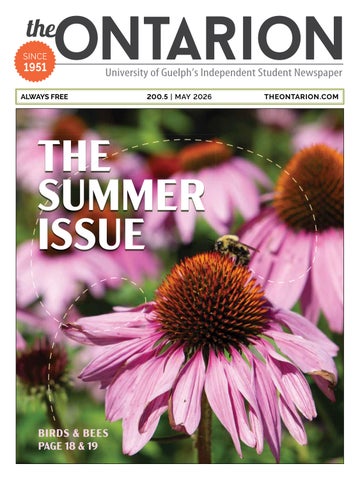

















3. Student innovation on display at annual LaunchLab Expo
4 Government of Ontario consolidating 36 conservation authorities into just nine
A look into the One Health Student Committee Education Fund
5. Guelph and District Multicultural Festival turns 40 this summer
6. This dementia ‘care farm’ is the first of its kind in Canada
Successful Artemis II mission marks humanity’s furthest journey from Earth
9. Decolonizing the city and the institution 10. Three games to play during summer break 11. MINUTIA: A band balancing greatness and humility
The Psychology Society's career conference
12. Is Canada Shore season one a total grenade?
13. Put this Toronto indie rockstar on your radar Share the love with farm shares
14. I’m Also Here: Guelph alumni featured in new comedy series
15. Gray Zone Warfare, a unique spin on the extraction shooter genre

17. What the heart-brain connection could mean for brain health and disease 18 & 19. Learning about the birds and the bees 20. Project Hail Mary was ‘amaze, amaze, amaze’ Graduating in an age of optimization 21. Twin countries, individual cultures
The Metro franchise returns, promising a much darker entry





ARTICLE BY EMILY SCOTT & PHOTOS BY ADITYA PARAMESWARAN
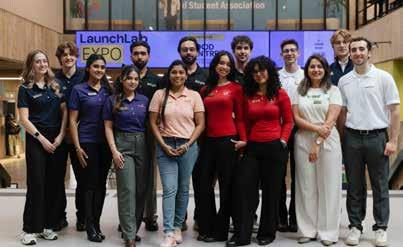
On March 31, the John F. Wood Centre hosted their annual LaunchLab Expo in the University Center Courtyard. The event highlighted 14 student entrepreneurs from the winter 2026 cohort of the Hub Incubator program, giving them a platform to present their ideas and connect with the campus community.
Businesses set up their booths in the University Courtyard at 12 p.m., ready to showcase their ventures. The founders enthusiastically answered questions, demonstrated their products and shared the core values of their businesses. Food-focused businesses offered free samples, while the John. F. Wood Center handed out free cookies to anyone who participated in the expo by casting a vote for their favourite business.
Over the course of four months, the Hub helped founders reach their innovative product goals by providing assistance to develop essential business functions. This included budgeting, marketing strategies, branding and creating a pitch deck for potential investors.
The LaunchLab spotlighted innovative ideas in a variety of industries, from personal care products to protein-focused foods.
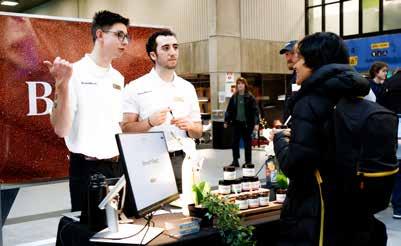
Brewed Beauty, founded by Daniel Grygorachyk and Luca Ghizzardi, is a sustainable skincare company that takes coffee grounds from the U of G campus and surrounding community and upcycles them into body scrubs. Their goal was to find a solution to the waste resulting from the 25,000 cups of coffee consumed across campus every day.
“The Hub provided more than just resources—it gave us access to mentorship that challenged our thinking and pushed us to refine both our business model and our brand,” Ghizzardi said. “What I found most valuable about LaunchLab was the community we were exposed to. Being surrounded by other student entrepreneurs and industry pro-
fessionals created an environment where ideas were constantly being tested, improved and supported.”
Meanwhile, Cultured Friends, founded by Manahil Zaid and Vanya Khanna, reimagines what a protein bar can be by using paneer to deliver 10 grams of protein while bringing a savoury option to the market.
AsLynx, founded by Afshyn Haydarpour and Risov Swagoto, is an AI-automated software that processes complex documents and delivers data in seconds, built for legal and financial firms.
Wise Protein, founded by Farzaneh Nasrollahzadeh, is a protein-rich sauce that can top everyday foods such as soups, oatmeals and vegetables to add protein to each meal. Their target market is busy professionals, parents and active adults who don’t have time to prepare meals.
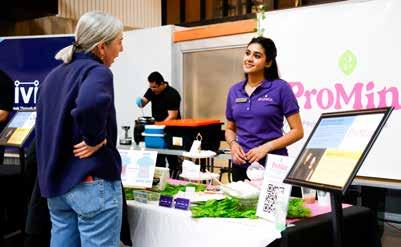
ProMint, founded by Tamana Nijjar and Nimrat Vilkhu, was originally created as a project during their masters degree. It’s a probiotic-infused mint that you can take on a daily basis as a fun way to reach your daily probiotic goals.
Glory Bakes, founded by Thanuja Fernando, offers low-sugar, portion-controlled cakes in a variety of flavours for people wanting a wellness-focused dessert option. This product was developed through extensive testing to maintain moisture, texture and taste without sugar.
“My experience in the Hub Incubator Program, especially LaunchLab, has been incredibly meaningful. As a researcher and bioinformatician, I was able to bring together my scientific background and creative passion for cake design through Glory Bakes, and the program helped me turn that into a real business,” Fernando said. “Their encouragement and mentorship made a huge difference in building my confidence and bringing Glory Bakes to life.”
Smart Jump, founded by
Grace Meyers and Gregory Thase, is revolutionizing how equestrians train by creating an attachment for existing horse jumps, allowing riders to automatically retract, raise, lower and reset jump heights. Riders no longer need to get out of the saddle as the functions are done through a mobile app.
“The Hub helped me stay focused, provided goals and gave me support throughout the journey. I was able to meet new people, talk to other students about common issues and gain insights from experts,” Meyers said. “I found the resources most helpful. Having access to the makerspace, content and mentors/experts, provided extra support throughout my journey.”
Civic AI, founded by Cole Westerveld, is an AI-powered tool that allows residents to easily understand city bylaws without having to sift through thousands of bylaws and documents.
Suli Hydration, founded by Alex Love, is a hydrogen-added sparkling water company. It’s based on research that suggests hydrogen can act as an antioxidant in the body while helping to reduce cell stress and damage.
Each venture was eligible to win the Warren & Deborah Jestin Impact Award, the Best Pitch Award, and the People's Choice Award, all determined by student and community votes during the Expo. The winter 2026 cohort winners were Brewed Beauty, Smart Jump and Glory Bakes.
The Hub Incubator runs three programs throughout the year to help develop students' business journeys: IdeaLab during the summer semester, IgniteLab during the fall semester and LaunchLab during the winter semester. Each program allows students access to the makerspace to design and prototype their idea, plus mentorship and opportunities for additional funding to help get their businesses off the ground.


While the Ford government’s plan aims to speed up housing development, opponents warn about risks to watershed management and public safety
EMMERSON
JULL
On March 10, the Government of Ontario announced they will consolidate the province’s 36 conservation authorities into nine regional authorities overseen by a single entity, the Ontario Provincial Conservation Agency.
These changes were proposed as amendments to the Conservation Authorities Act under the conservatives’ omnibus budget Bill 97, Plan to Protect Ontario Act. The bill was passed by the legislative assembly on April 23. Now the province plans to transition watershed governance from the former agencies to the new, regional authorities in early 2027.
A collection of over 74 individuals, elected officials and civil society representatives known as the Watershed Conservation Coalition has called for the province to stop this merger, citing concerns that it will undermine local, science-based watershed management.
What are conservation authorities?
The Conservation Authorities Act was established in 1946, at the request of municipalities, to enable collective management of watershed systems. Conservation authorities ensure local decision-making over natural hazards like flooding and erosion. They also regulate development on hazardous land (like floodplains) and
conduct surface water and groundwater monitoring, amongst other responsibilities.
Under the Clean Water Act, conservation authorities are designated source protection authorities and carry out the policies outlined in Ontario’s 38 source protection plans. Source protection plans are part of Ontario’s drinking water framework; they aim to monitor and ensure the safety of municipalities’ drinking water beginning at its source.
Ontario’s 36 conservation authorities own and protect a total of 150,000 hectares and 95 per cent of the province lives in a watershed managed by these bodies, according to Conservation Ontario. That makes conservation authorities the province’s second-largest landholder, with the ability to sell off surplus land, due to changes in Bill 23, the Build More Homes Faster Act, 2022.
What is the reasoning for consolidating Ontario’s conservation authorities?
By consolidating conservation authorities, the province aims to improve planning and administrative processes, thus reducing “fragmentation” and “administrative duplication,” according to a March 10 news release from the Minister of Environment, Conservation and Parks, Todd McCarthy.
With nine conservation authorities overseen by a centralized, provincial agency, the government hopes to speed housing development and planning approvals. The Ontario government claims that organizational inefficiencies are responsible for “uncertainty and delays for builders, landowners and farmers,” while also making it harder for authorities to effectively carry out their role in protecting communities from natural hazards.
According to McCarthy, centralizing leadership with independent oversight from the OPCA would “better position conservation authorities to support the building of new homes and infrastructure while continuing to protect communities from flooding and other natural hazards.”
But critics are confused as to why conservation authorities are being slated as an impediment to housing development. The provincial government’s own report—the 2022 Report of the Ontario Housing Affordability Task Force—listed 55 actionable recommendations to improve access to housing, and not a single one mentioned conservation authorities as a hindrance.
While the province hopes this overhaul will cut “red tape,” conservation authorities issued 96 per cent of planning and development permits within established timelines, according to Conservation Ontario’s 2024 annual report.
well-equipped to handle the amalgamation without any disruptions to the authority’s service delivery.
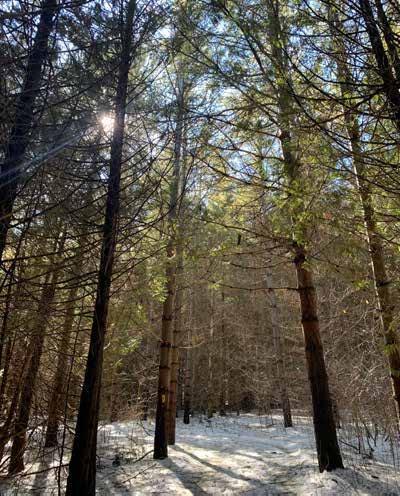
Guelph is located within the Grand River watershed, along with other major population centres Kitchener, Waterloo, Cambridge and Brantford. The Grand River Conservation Authority (GRCA) currently manages all 6,800 square kms of the Grand River watershed, including all the land drained by the Grand River and its tributaries. This watershed is also home to the Six Nations of the Grand River Territory and the Mississaugas of the Credit First Nation.
Under the proposed amendments to the Conservation Authorities Act, the GRCA would be merged with Catfish Creek Conservation Authority, Kettle Creek Conservation Authority, and Long Point Region Conservation Authority to form the new Eastern Lake Erie Regional Conservation Authority.
GRCA Chair John Challinor II is confident that the GRCA is
This year the fund came in the form of a $500
Once a year, the One Health Student Committee (OHSC) grants support to a student attending an upcoming One Health-related conference. This year it came in the form of a $500 award which went to Adebayo Akinade, a fourthyear food science PhD student.
The 2026 OHSC Education Fund was awarded to Akinade because his application most effectively communicated both the quality of his work and the value of presenting it. The award will be used to help Akinade attend the 75th Annual Conference of the Cana-
dian Society of Microbiologists in Alberta. He will present a poster on his doctoral research in antimicrobial stewardship, livestock productivity and quality dairy products.
Eden Rechtoris-McNab has been the OHSC awards executive for six years, and is responsible
for designing and developing the award. Rechtoris-McNab shared that she “built it from a genuine motivation to support students in attending conferences and sharing their research.” Rechtoris-McNab’s role also involves identifying and sharing funding opportunities for
“We believe we can make it work. We don’t believe for a minute that our constituency will be impacted, whether that’s individual residents who use our facilities, or the 38 municipalities that make up the GRCA today,” Challinor said.
However, Guelph MPP Mike Schreiner has been vocal in his opposition to these amendments.
“I think [the consolidation] is devastating to Ontario because it’s going to undermine local decision-making and the history of effective watershed management. And by doing that, it’s going to put people’s homes, property, businesses, and our community’s infrastructure at risk,” Schreiner said.
Leaders from Ontario’s conservation authorities and municipal officials expect to learn more about the consolidation in the coming weeks and months.
students interested in One Health.
When selecting their annual recipient, the OHSC looks for applications that demonstrate a connection to the key principles of One Health. They also evaluate the potential impact of the student’s research. Applicants should effectively communicate the significance of their work, their motivation for attending a particular conference or event and how the opportunity will contribute to their academic and professional development.
“Overall,” said Rechtoris-McNab, “the award is designed to be inclusive and reflective of the broad and evolving nature of One Health research.”
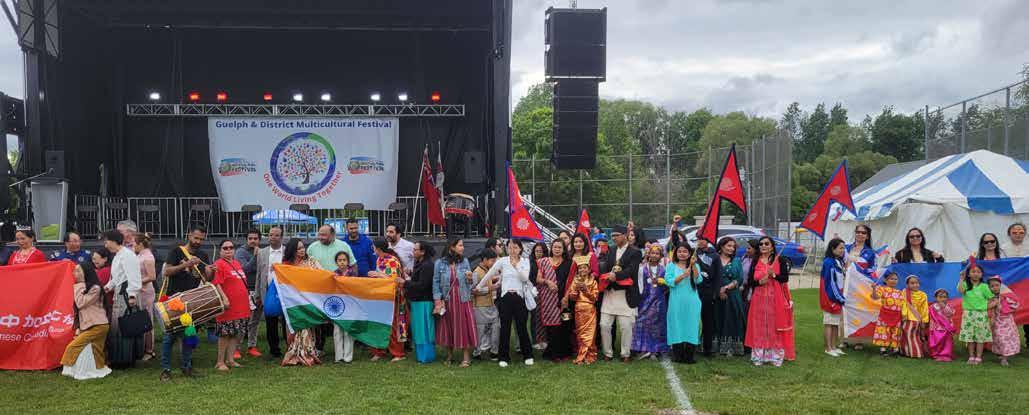
Looking for something to do this summer, but don’t want to go all the way to Toronto and Mississauga to visit multicultural environments?
Check out the Guelph and District Multicultural Festival happening this year from June 12 to 14.
Festival head Cinthuja Leon spoke with The Ontarion about why University of Guelph students should attend the festival’s 40th anniversary.
“You get to experience a lot of stuff that you wouldn’t unless you travel,” Leon said. “Nothing beats
travelling, but we do bring that experience right here.”
The festival will host around 29 food vendors each day. There will also be vendors for clothing, jewelry and arts, and live performances. Leon said that about 70 per cent of the vendors and performers are local to Guelph, while the rest come from neighbouring cities.
The festival “is extremely family friendly, which is why we want to keep it free as there are people with multiple kids that can’t afford to keep coming over and over
REMA ABDULLAH
again,” Leon added.
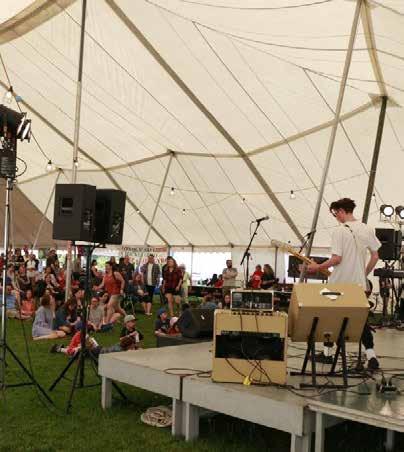
In 2022, the festival introduced a youth and family activities tent. Leon described it as an outdoor game tent that is given to a different cultural group every two hours so each can have the chance to teach their traditional games, crafts and activities.
“The Chinese cultural groups would do tai chi and mahjong, and Indian groups will get someone [to] teach you to play cricket,” Leon said. Leon encourages any diverse groups of students at U of G to con-


tact the festival’s organizers if they would like to sign up for a two-hour timeslot in the tent.
The fashion show is an older tradition and a highlight of the Guelph and District Multicultural Festival. Leon relates to people’s love for the fashion show, and said, “I’ve been in Canada only for the past 17 to 18 years, and we do crave showing our cultural customs sometimes. So when we get the chance, I’m dressing up!”
The festival’s committee is always looking for volunteers,
including U of G students, Leon said. “One time, a couple of masters degree students from the university came [to volunteer] and that was the year we got the highest donations! They were great talkers. Never in the history of our festival have we made so [many] donations,” Leon shared.
“The festival will be very reflective of the diversity of Guelph,” Leon said. “I think people locally are waiting to showcase their talent to the world and we give [them] that stage.”
Green Care Farms offers therapeutic gardening programs for seniors living with dementia
HELENA HILDEBRANDT
On April 11, Rebekah Churchyard hosted a workshop in Guelph for locals interested in learning about her business, Green Care Farms. The workshop was hosted at the 10C in Downtown Guelph.
As the CEO and founder of Green Care Farms, Churchyard credits the conversations she has had with her grandmother as her inspiration for starting the company. Churchyard said that her grandmother was the caretaker of her grandfather throughout his struggle with dementia. Throughout his struggle with dementia, his wife struggled to find care suited for
him and respite for herself.
Green Care Farm’s largest program is a five-hour session where seniors come together to maintain the half-acre sensory garden located on the farm and participate in educational and social activities. Churchyard described the approach to the program as a group of people focused on taking care of Mother Earth together. The produce harvested on the farm is taken home by seniors or donated to Food for Life, a food redistribution organization that aims to combat food insecurity and reduce food waste. Churchyard believes that individuals don’t ‘age out’ of community contribution.
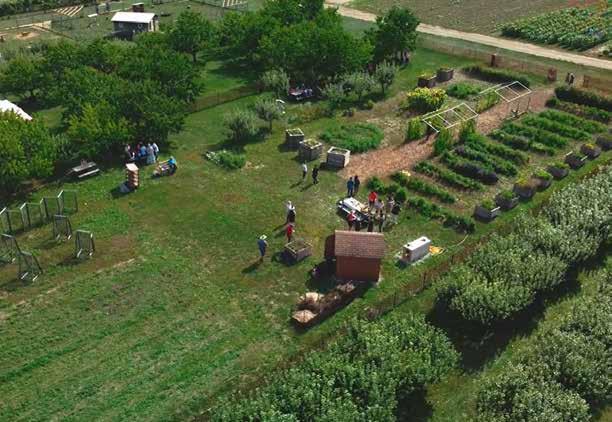
The farm is located outside of Milton and features a sensory garden, a shed and animal enclosures. The sensory garden was designed with Meredith Wilson, a master of landscape architecture student at the University of British Columbia. The garden was designed with the mobility and cognitive abilities of the participants taken into consideration. The texture of the plants, their scents and visual attributes were all taken into consideration when choosing plants for the garden. Featuring over 120 species of plants, the sensual experience of the garden was designed intentionally to not overwhelm guests with
This flyby will be followed by manned missions to leave permanent infrastructure on the Moon
ADITYA PARAMESWARAN
On April 10 at 8:07 p.m., the Orion capsule splashed down in the Pacific Ocean, ending a 10day journey that took commander Reid Wiseman, pilot Victor Glover, and mission specialists Christina Koch and Jeremy Hansen farther than any human had ever travelled before.
Their mission, known as Artemis II, will be succeeded by further launches to test SpaceX’s Starship and Blue Origin’s Blue Moon landers in low Earth orbit before future launches to test them on the moon. The missions serve NASA’s ambitions to establish a permanent
manned presence on the Moon and use the moon as a layover for future missions into deep space.
Artemis II also lays the groundwork for other NASA projects. For example, the Lunar Crater Radio Telescope on the dark side of the moon, which will provide scientists on Earth with clear radio images of space completely free of Earth-based interference for the first time. To support NASA’s infrastructure plans on the Moon, they have an ambitious launch tempo planned with several components of the Space Launch System enroute to the Kennedy Space Cen-
ter’s Vehicle Assembly Building.
Artemis II represents a number of firsts. It’s the first deep space mission since Apollo 17 in 1972, the first time a Canadian has been sent to deep space, the first time high-fidelity photos were taken of the dark side of the Moon, and it broke the distance-from-Earth record set by Apollo 13 by over 4,000 miles (approximately 6,500 km). As future Artemis launches are completed, the program is almost certain to have more firsts under its belt.
Every step of the mission, minus the 40 minutes where the
too much stimuli.
Green Care Farms is supported by extensive research. The concept has been shown to increase cognitive functioning and feelings of social connectedness and belonging. Care farms have also been shown to improve physical health, such as decreasing fall incidents and pain.
Rather than using a traditional non-profit business model, Churchyard operates with a social enterprise model. Clients and their care partners provide consent to Churchyard and her staff for any assistance they may need.
Churchyard’s care farm is
modelled after many dementia care farms throughout Europe, making Green Care Farms the first of its kind in Canada. It has been operating for five years and ran its first full year of programming at their second location in Meaford, Ont., last year.
Churchyard hopes to inspire others to create more nature-based care for people with dementia. Her company is in the process of starting a course for those that are interested in doing something similar. The success of Green Care Farms might help usher in a new kind of nature-focused dementia care approach in Canada.

capsule was on the dark side of the moon, was livestreamed to viewers on Earth, allowing the crew to take viewers on the journey to the Moon with them. This created a unique cultural touchpoint, where viewers—regardless of nationality, race or creed—were watching the livestream together and creating memes of every moment within it. Instantly viral moments included photos
of the dark side of the Earth, sent homebound in real-time, or the view of a solar eclipse from the Moon. In such a divided climate, it’s relieving to see a single event capable of rallying the world together for something positive.
The Artemis program carries the legacy of Apollo, the Space Shuttle and the world’s space programs on its shoulders.
A club’s innovations means the university doesn’t need to look far for fresh leafy greens for on-campus dining
MADISON BOUTILIER
After three years of planning, prototypes and commitment, Guelph’s Engineers for a Sustainable World (ESW) has wrapped up their fully functional, student-built hydroponics system that will provide lettuce for the University of Guelph’s Hospitality Services. Feed the Future is one of ESW’s numerous initiatives working towards a sustainable future.
Hydroponics is a technique for growing plants in a water and nutrient-based solution rather than soil; ideal for locations with limited space and for research in controlled environment agriculture.
At the U of G, ESW is a group of students using their technical skills and education to plan, construct and implement sustainability-focused projects for the community.
Members of ESW met with The Ontarion to discuss the project’s evolution and how its goals were accomplished.
“When we started thinking about hydroponics, ESW wasn’t
really a fully functioning club,” said Co-President Alexa Bates.
“It’s been really great to see how our whole team has been dedicated to this project for so many years.”
“We found out that Hospitality Services is currently trucking all of their lettuce in from [out of town],” said Co-President Henry Tait. As the ESW team searched for space to begin their project, they were connected with Rodger Tschanz, a greenhouse technician at the Bovey Greenhouse. Tschanz suggested a collaboration with ESW, the Bovey Greenhouse and Hospitality Services to start growing lettuce for on-site dining.
After experimenting with a small-scale hydroponics system, the group was determined to construct their own model. They were granted space in the Bovey Greenhouse to begin their work, which is also where they developed the foundational purpose the project serves today. Their work began with a prototype made from recycled materials that was able to grow 200 heads of lettuce, which
were donated to the Guelph Food Bank.
“That was the start of our proof of concept, showing Hospitality Services that we could actually build something, we could grow lettuce, and then go into the process of taking it up a level to [what we have today],” Tait said, while pointing to one of their five-tiered systems. The completed model can grow over 750 heads of lettuce.
Supported by greenhouse staff, university faculty and grant contributors, among others, the team built a system from scratch.
Gage Gonsalves, the hydroponics project manager, explained how observing many compounding problems in the beginning gave them insight into how precise the system really was.
“[It was] almost just like building a big Lego sculpture, where you’re putting in piece by piece and gradually building it to how it’s supposed to look,” Gonsalves said.
Adrian Nowaskey, one of
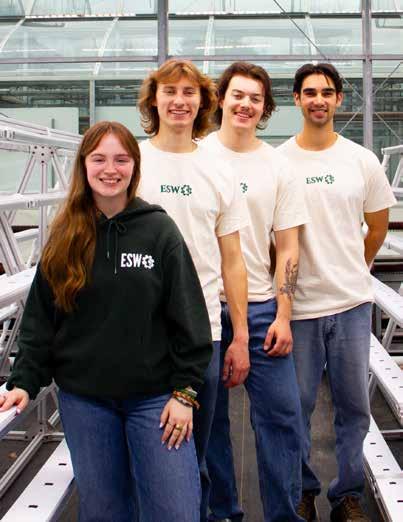
the project’s designers, noted that the two biggest milestones of the project was the completion of the frames and the addition of the plumbing system to recirculate and drain water from each layer. He emphasized how much they were able to learn about fluid mechanics from their hands-on experience during the start-up.
“With so many stages, it was the little milestones that got us through and kept us going,” Nowaskey said.
ESW reaches beyond U of G. The club originated at Cornell University and now has 50 chap-
Students stayed at the Canadian High Arctic Research Station to learn about biology, arts and space, with U of G professors
RACHEL FIORET
From April 13 to 16, a group of 20 students, community members and educators migrated north to attend STEAM Week. Hosted by Makigiaqta, Inuit Training Corporation, the event was held at the Canadian High Arctic Research Station (CHARS) in Cambridge Bay, Nunavut.
STEAM Week is an annual event hosted to improve the accessibility of science and arts learning to students in northern and rural communities in Canada.
The week consisted of different learning sessions, including
biology, wildlife management, stop motion animation, Inuit mathematics, art sessions and more. Each day began at 8 a.m. and ran until 5:30 p.m., with activities in the evening on most of the nights, too.
From our own community in Guelph, Orbax Thomas, science communicator from the Department of Physics, and Joanne O’Meara, professor at the College of Computational, Mathematical and Physical Sciences, in the Department of Physics, attended the event to offer programming and science education to the students.
“The students were amazing, really smart and engaged,” O’Meara said.
“Not only did they get a chance to study and see things that they might not have had the resources for…but they also got the opportunity to make friends and meet people,” Thomas said. “It’s a great way for them to meet other people who are facing the same challenges in their day to day life that they are.”
Thomas and O’Meara shipped a mobile planetarium to the CHARS as a part of their session. The planetarium is 16 ft high and
25 ft across and it shows films and information about outer space—on planets and magnetism and the exploration of the cosmos. Some videos shown were from the One Sky Project, an international collaboration which features and educates people about Indigenous astronomy and how we are all connected by the sky.
The mobile planetarium offered an excellent source of accessible education, as it was shipped to the CHARS on a skid. “We’re trying to do what we can to bring those opportunities to them,”
ters across Canada and the United States. The organization connects students, professionals and faculty who believe in the power of youth innovation and collaboration to combat the world’s most pressing environmental issues.
Before graduating from U of G, the members look forward to passing down their hard work and knowledge to fellow club members.
“That’s what’s rare about an ESW project, it’s not just for fun with the team, but it’s actually done with a greater purpose,” Bates said.
Thomas said.
Makigiaqta has a mandate to “enhance the preparedness of Nunavut Inuit for employment.” They offer job preparedness workshops, funding and support for learning and employment programs that are Inuit-specific.
During their week in Nunavut, Thomas and O’Meara also got the chance to connect with the members of Cambridge Bay, a community of about 2,000 people, at a community night, with about 100 people in attendance.
Reflecting on his trip, Thomas shared “it was really incredible to see these young people and to meet with them and see what ways their lives are the same as ours and what ways it’s different.”
“I learned as much, or more, from them and the staff from Makigiaqta and the partner organizations as I hope they learned from our sessions. It was truly an honour to spend time with them all and I really hope we can get back there next year to do it all again,” O’Meara said.
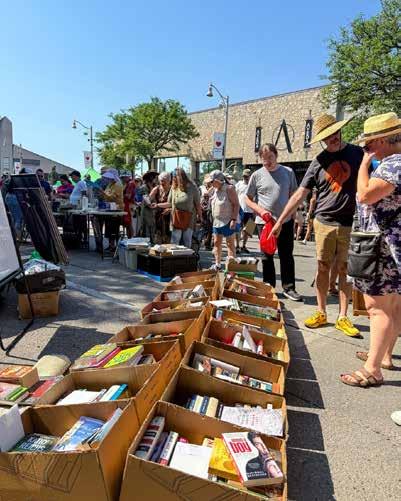
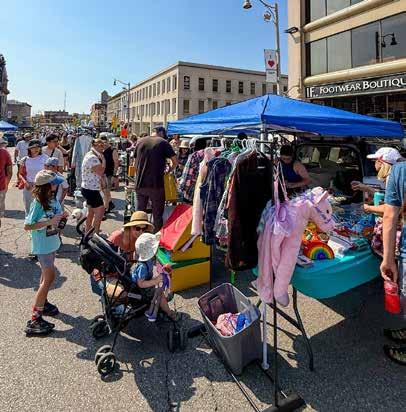
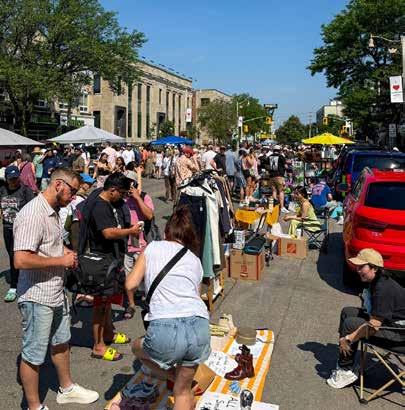
Last year, the City of Guelph debuted the Great Downtown Guelph Garage Sale. Thousands of people showed up to participate, eager for great finds and spectacular deals. Due to last year’s success, the garage sale is back this summer and has expanded to two days.
The Great Downtown Guelph Garage Sale emulates a traditional garage sale environment. Community members can sign up to sell used items out of the trunks of their vehicles, filling parking spots along MacDonell Street, which will be closed to traffic for the event.
Events Manager Sam Jewell stated that this idea was inspired by “car boot sales,” a popular weekend activity in the UK. “People gather in a field somewhere and they sell things out of the back of their cars. We knew that mayor Cam Guthrie loves garage sales, and we thought: We could run with this. People seem to like them.”
To curate an authentic garage sale atmosphere, the event prohibits the sale of new, packaged or handmade goods. According to Jewell, these rules encourage ven-
dors to sell things that have been laying around in basements for years. This could include books, decor, jewelry or vintage clothing. “Last year we had a vendor who had amazing vintage stuff. I was looking at people walking down the street with clothes they’d bought from her,” Jewell said.
Downtown Guelph encourages students to participate in the garage sale. For those with access to vehicles, this event can help with de-cluttering student houses and apartments. It also provides anopportunity to find bargains, which can help students impacted by the recent cuts to OSAP.
Jewell said the ultimate goal of the garage sale is to create a fun experience in downtown Guelph by bringing members of the community together to buy and sell among neighbours and peers. Last year’s debut had an overwhelmingly positive turnout due to the collaborative nature.
“There were neighbours that teamed up to bring stuff in one vehicle, which really maximized the space…We’re seeing that people want to do this. They’re really into
it…We should have up to 75 vehicles taking part,” Jewell said.
The fun doesn’t stop at the second-hand vendors—downtown businesses will also be participating. Many will set up racks, tables and sale items outside of their storefronts, encouraging people to explore the greater area of Downtown Guelph.
Additionally, the garage sale will highlight local musicians and entertainers. There will be many street performers throughout both sale days.
Attendees will have the opportunity to donate their second-hand items to several charities that will be on site. The Canadian Kidney Trust and the Children’s Foundation of Guelph and Wellington will both be on site for people to support. The Wyndham Street location of BioPed Foot Care will collect gently used footwear in support of Soles4Souls Canada.
Rain or shine, the 2026 Great Downtown Guelph Garage Sale will run on Saturday, May 23 and Saturday, July 11, from 10 a.m. to 4 p.m.

The Guelph Civic Museum’s latest exhibit, Maawnjidyang Maa, decolonizes the story of Guelph's founding
The Guelph Civic Museum has unveiled their newest exhibition titled “We come together here,” or in Anishinaabe, Maawnjidyang Maa. It is the work of four members of the Decolonizing Narrative Collective: Kim Anderson, faculty member in the Family and Applied Nutrition Department at the University of Guelph; Brooklyn Willcocks, the Indigenous community relations coordinator at the museum; Samantha Scott, a student in the master of arts in public issues anthropology at the University of Guelph, and Curator Dawn Owen.
The exhibit’s focus is telling the story of Guelph from the perspective of Anishinaabe and Haudenosaunee theory of knowledge with acknowledgement of colonialism’s violence. The pieces highlight the relationship between the land, its plants and those living within it, with a focus on the Eramosa River, Speed River and the Grand River Watershed.
The museum is undergoing a decolonization process as the exhib-
it seeks to correct the narrative of Guelph’s story. The exhibit’s featured pieces were by artists invited “to co-create with the curatorial team,” Owen said. It is in acknowledgement of how “a colonial museum collection was [not] likely [to] hold the objects that would carry that story well.”
This allowed for the exhibit to feature contemporary Indigenous artists that live within and around Guelph. Anishinaabe and Haudenosaunee voices were included in the planning and making of the exhibit. This inclusivity practice is one that museums are beginning to incorporate more often to heal their relationships with local Indigenous communities.
At the centre of the exhibit is a circular theatre that details the stories of three maple trees. Writings explain one maple tree that fell down from a storm, one was cut down by John Galt as a symbol of a new settlement in 1827, and the third maple tree, which is standing by the hilltop of Guelph, to the
left of the museum itself. The tree cut by Galt is featured twice for its symbolism of colonial violence, including an excerpt from one of his writings describing the incident. There’s also a photograph of the plaque commemorating Galt’s act in the centre of town.
The story was found by a team of researchers looking to add a wooden table to the Indigenous Research Centre at the University of Guelph. The maple is seen as a leader to the Anishinaabe and Haudenosaunee. The maple tree “provides nourishment (sap) when it is most needed. Here, in this exhibition and in the place we call Guelph, the Maple is both storyteller and witness, bridging past, present and future,” read the exhibit.
There are wooden poles that conceptualize a forest in a way that forces the visitor to take care as they walk around the space. The interaction represents how humans relate to plants, making visitors reflect on their relationship with the land, based on Anishinaabe and Haudenosaunee ways of knowing.
Calming music continually plays in the background featuring notes of water streams and wind, emulating the sounds of a forest.
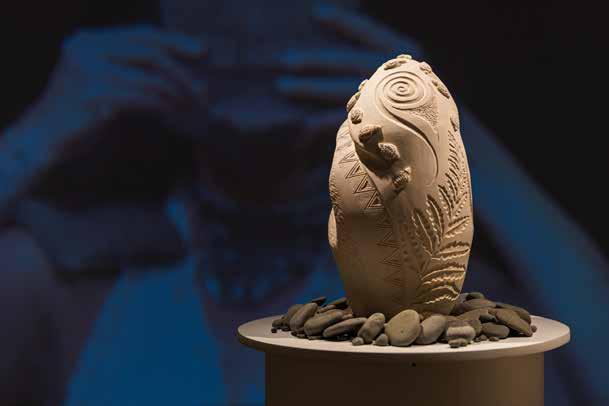
On the other side of the theatre, a projector plays the film Pathways of the Forest by Santeen Smith, the footage looping and accompanied with three clay sculptures titled Turtle Rock, Trout Rock and River Rock respectively. There is a nearby sofa to sit, view the film, examine the sculptures and reflect on the room overall. With added soft, yellow spotlights and green walls, the exhibit creates a feeling of immersion in nature, as if on a hike.
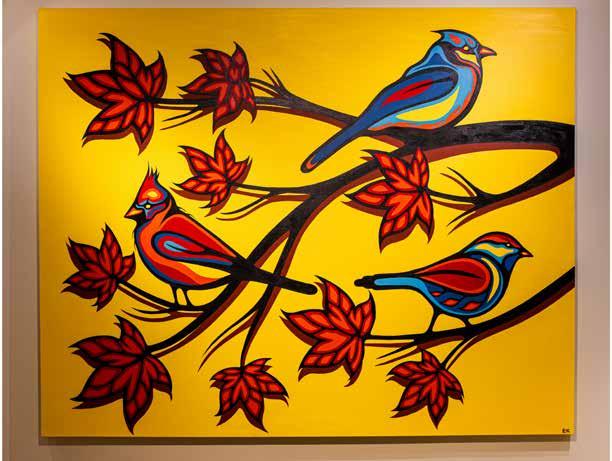
Anishinaabe artist Emily Kewageshig’s piece Between Wind and Sky features a stark yellow background with tree branches and three birds looking opposite of each other. The exhibit’s spotlights are arranged so that they cast a stark shadow on Kewageshig’s work. This is just one example of the team’s incredible light work that brings the exhibit to life. There are many other artists exhibited, including the late steampunk-inspired Rene Meshake.
The museum made sure to attract young voices, which Anderson said was to “understand their vision of Guelph as it goes to the future.” Hanging by the entrance are pieces created by six Indige-
nous high school students as part of a workshop led by Alex Jacobs Blum. The pieces highlight how the students experience their relations to the Grand River Watershed, particularly the Eramosa and Speed rivers. The personal artist statements add a breadth of life to the voices the museum includes in its exhibit. These are featured as a bundle of papers one can take from a hook to read individually.
Finally, a moon plaque is updated with the moon’s phase each lunar month. It reflects how the Anishinaabe and Haudenosaunee honour the moon phases each month for what it brings to the land; that is, its plants and occupants. This is also displayed near a digital piece featuring the Mohawk creation story.
Visitors also have a chance to be added to the exhibit. Part of the museum’s effort to challenge its colonial past is collaboration. The museum will share details in May about a workshop they’ll host for guests. Participants will reflect on their relationship with plants by looking at plants near the museum and along the Grand River. Then, participants will sketch the plant they feel the most connected to, and those pieces will be added to a cabinet near the exhibit. Owen said the idea is based on a “cabinet of curiosities,” which typically held items stolen from colonies for the scientific gaze. The piece challenges this history by asking, “What happens when the [scientific] gaze is turned the other way?” Anderson said. It further tells the story of Guelph from the perspective of the land and its non-human occupants.
HUDA SHOAIB
With summer break just around the corner, many of us are looking forward to relaxing and recharging after a stressful exam season. Announcements for several highly anticipated games have many of us excited for what’s to come this summer. Here are three cute and cozy games to get your hands on this season.
Tomodachi Life: Living the Dream
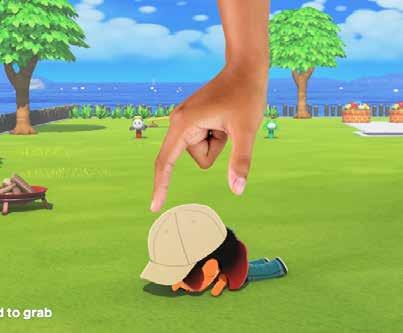
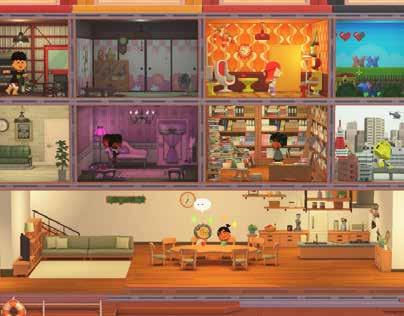
First is none other than the long awaited sequel to the beloved 2013 3DS game. Tomodachi Life: Living the Dream is a social simulation game. Like its predecessor, Living the Dream revolves around the social lives of your Mii characters as they reside on a remote tropical island.
One improvement of the sequel is the significant increase in customization options within the game. New options for the ingame Mii Maker allow for more advanced customization of hair, facial features and ears. It also allows for customization of Miis’ dating preferences.
Tomodachi Life: Living the Dream was released April 16, with the demo released a few weeks before on March 25. The demo provided free access to limited game mechanics and features, like the food and clothing shops, and restricted players to creating only three Miis. At the time of writing, the demo’s reception was extremely positive,
with fans and gaming journalists alike praising the game for its greater customizability, inclusivity and the ability to control interactions between Miis for developing relationships.
Pokémon: Pokopia
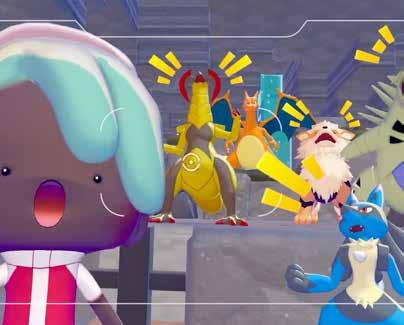
Pokémon: Pokopia is a social simulation game released by Nintendo and The Pokémon Company on March 5. The game involves players controlling a Ditto (who imitates a human being), whose main goal is to bring life to an abandoned world completely devoid of any human or Pokémon activity; they must work alongside a Tangrowth to accomplish this goal. Players are able to customize the Ditto’s appearance by altering its skin colour, hair colour and clothing.
Ditto finds an old Pokédex and meets Professor Tangrowth, who has tasked himself with solving the mystery behind the abandoned world and finding the answer to why humans and Pokémon have disappeared. As the player progresses in rebuilding the area and restoring various habitats, new Pokémon settle into the area. Ditto encounters more special Pokémon, such as a Pikachu who has lost the ability to generate electricity, a Snorlax who has been asleep for so long that moss grew over it, and many more. Along the way, as more

habitats continue to flourish and new Pokémon begin to settle down into their new homes, Ditto finds old logs left by humankind that slowly uncover the mystery behind the world that humanity left behind.
According to Metacritic, Pokémon: Pokopia is the highest-rated Pokémon game on the website, with 98 per cent of critics recommending the game. Additionally, the game currently holds a score of nine out of ten on GameSpot, with writer Steve Watts stating that it was one of the best Pokémon spinoffs of all time.
Yoshi and the Mysterious Book
Yoshi and the Mysterious Book is an upcoming platform game published by Nintendo and will be released exclusively for the Nintendo Switch 2 on May 21. The game was announced on Sept. 12, 2025, during a Nintendo Direct presentation, as part of the 40th anniversary of the original Super Mario Bros. game. On March 10, 2026, to celebrate MARIO day, a trailer was released, going further into detail about the game, including revealing further gameplay features. It also revealed the official release date for the game.
Yoshi and the Mysterious Book revolves around Yoshi as he embarks on his journey to discover interesting new creatures, exploring the pages of a living Encyclopedia called “Mr. E.” At each level of the game, Yoshi discovers several unique creatures and is able to utilize their traits and abilities to solve puzzles and travel through chapters. The game takes on a traditional stop-motion animation style to fit in with the world of the encyclopedia that Yoshi travels through. The trailer showcases a vibrant, bubbly world full of surprises and mysteries waiting to be solved, as well as light and easy background music. This game is perfect for those looking for a relaxing video game to play when you want to wind down.


The Guelph-based group reflects on winning Fan Favourite at Battle of the Bands
Typically pronounced “minoo-sha,” but currently pronounced “winners,” Guelph-based band MINUTIA won the Fan Favourite award at the Tri-City Battle of the Bands competition on March 21.
The competition was tough,
as other beloved bands Nukey Da Bomb, Amanda Braam and the Paper Cranes, Fallingbrook, Eric Folino and the Disappearing Acts, and Arayansh Thapar and the Phoenixes performed incredibly, never wasting a moment to shine. MINUTIA performed hits

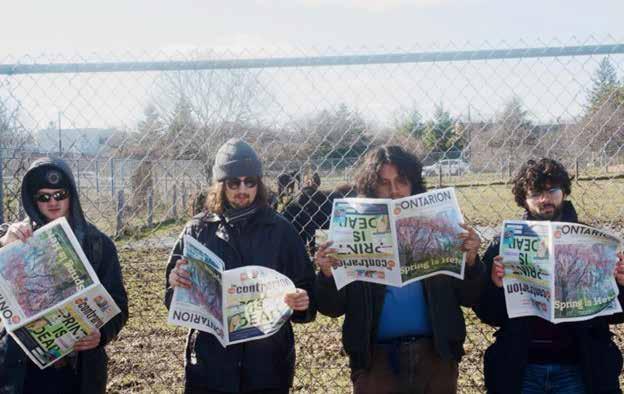
from their new self-released album MINUTIA, composed of 10 different songs and available across all streaming platforms. Adding a classic ‘90s flair to modern punk rock, MINUTIA gave the floor the groove it had been missing.
Coming together from different bands and backgrounds in music, MINUTIA’s advice to bands just starting out is to prioritize their connection between members—the music will follow. MINUTIA’s driving force is making people move.
Vocalist and guitarist Olivier Sivanadian said, “I love playing music with the guys then looking in the crowd and seeing everyone dancing and feeling the music, that’s what music is for.”
As independent artists, producing and creating music with MINUTIA looks different than the typical recording and writing process. Their vocalist and electric guitarist, Jamie Foster, took the job of producing the album, but all members credited each others’ cre-
ativity during the writing process.
When asked what song they had the most fun creating, the group immediately replied, the “storm.” The “storm” is featured in “The Garden,” and it consists of several different sounds built up and mashed together. “Feeding” the storm are drum smashes by percussionist Aaron Harvath and keys by pianist, guitarist and vocalist Ricky Summerlin, combined with a variety of vocals, to create an unexpectedly awesome background track.
After months of preparation, it was soon time for MINUTIA to hit the Tri-City Battle of the Bands stage. The members described the competition as daunting and out of their element.
“Those bands had several fans, and MINUTIA was described as some mystery band because nobody knew us,” Summerlin said.
Foster said the group felt like “frauds” after winning the Fan Favourite title. “Being in front of the judges felt like being put on
trial, especially in front of those other big bands—it was really vulnerable,” he said. “I didn’t expect us to win.”
The band’s feelings of imposter syndrome were cut short when the win sunk in and it was time to celebrate. With MINUTIA being self-funded, the prize money went directly to purchasing better instruments and sound equipment—and maybe a few beers.
What are MINUTIA’s next steps post-win? More music, more shows and more albums! Currently working on another project, the four-piece band is excited to experiment with different sounds on their up-and-coming works. They regularly perform at Downtown Guelph bar Jimmy Jazz.
To new bands, Sivanadian said, “Just start making music. There will be a lot of mistakes, but that’s what makes it good.”
MINUTIA is a one of a kind band that hopes to find success by pushing the boundaries of what music can be.
On March 20, the University of Guelph’s Psychology Society (PSYSOC) hosted a career conference in the Centennial Arboretum Centre. It was a social networking event for students in the psychology program and those interested in pursuing careers in psychology, mental health and similar paths in graduate school.
The day began with an overview of U of G societies that provide career guidance and networking opportunities for students in the social sciences. Alyssa Micheli
spoke about her mentorship society, Coffee for Degrees, which provides opportunities for students in social sciences to connect with alumni, PhD and masters students about their experiences. Coffee for Degrees aims to boost the confidence of undergraduate students who have yet to figure out the specialty they’d like to pursue. The society gives students advice about honing in on their career aspirations and working to achieve their goals. Other societies, like Women in Psychology and Starts With
Youth, joined the panel to speak about the support they offer U of G undergraduate students.
The second panel hosted past and present post-grad students to share their views on graduate school, from the application process to defending their theses. Participants spoke about the undergraduate courses that prepared them for grad school, exploring unfamiliar subjects in their research courses and leaning into other areas of study they found interesting. They placed
emphasis on exposure, recommending that students investigate the research opportunities open to them and joining as many student societies as possible. Networking and building a strong sense of community were also emphasized as valuable assets to their post-grad journeys. As a student, they said it’s valuable to build community by connecting with your peers and professors.
The final panel included industry professionals in psychology, mental health and human-
ities-based research. They spoke about misconceptions that students hear about their respective fields and the job hunt students will face. Speakers in the panel acknowledged that it feels unattainable and difficult, and that the highest ranking grades are needed to get your foot in the door.
At the end of the conference, the final message was clear: It’s important to focus on what you can do to help yourself achieve your goals in the psychology and mental health field.

For 23 years, Bob has made it his mission to serve up good food and good times to U of G students. Whether you're in need of a quick meal or a just friendly face, come say hi to Bob at his hot dog stand just east of Branion Plaza.

A critical review of Canada’s very
ABBY COUNAHAN
On Jan. 22, the first episode of MTV’s Canada Shore premiered on Paramount+, introducing 10 cast members as they embarked on their summer in Kelowna, B.C. The new reality TV show is a spin off of MTV’s infamous Jersey Shore series that ran from 2009 to 2012, and it’s set to film a second season this summer.
The cast of Canada Shore season one were Keyaira Snow, Lila Romanin, Christopher Brown, Ethan Maynard, Gizelle Fray, Ryleigh Gregory, Emmy Sharpe, Bauer Swystun, Isaiah Crawford, and Emmett Watson as members of the shore house, featuring Big Brother Canada season seven winner Dane Rupert and Jersey Shore alum Nicole “Snooki” Polizzi appearing as the bosses.
While it’s more than typical for a spin-off to fail to live up to the original, this season was even more underwhelming than one could expect. That’s not entirely the fault of the cast, but instead the mediocrity of the producers. Perhaps it’s a result of reality TV game shows that have plagued the market, namely Love Island and Too Hot to Handle. Not to say that these shows are not fine in their own respects, but I was not looking for the new-bombshell-in-the-villa-esque that I was confronted with this past season.
The “esque” in question mainly refers to two aspects of the show: the vibes in the Shore house and the couples. First, the atmosphere in the show felt aesthetically more similar to the two previously named new-era reality shows than it did to the original Jersey Shore house. The onsite outdoor gym is not only reminiscent of the one in the Love Island villa, but it also prevents the essential tradition of “gymtan-laundry” (GTL), an activity notorious to Jersey Shore fans.
The absence of GTL is a crucial production flaw because it hindered the cast's mobility. In Jersey Shore, the cast was constantly going on side quests where we watched them interact with outsiders, bond and gallivant around town. This was not only critical in the sense that it was interesting to explore the area with the cast, but it also provided a setting for relationship development between cast members. This occurred via shared experiences outside of work or the house and apart from other cast members—an element severely lacking in Canada Shore
Let’s talk about the show’s couples. The first few episodes felt like most people
in the house were “coupling up,” namely Emmy and Bauer for a brief moment before Keyaira and Bauer, Ryleigh and Emmet, and Gizelle and Isaiah—over half of the members in the house found themselves in a pairing. While everybody was entertained (and exhausted) watching Jersey Shore’s Ronnie and Sammi’s whirlwind dumpster-fire relationship, we didn’t need three lackluster versions popping off at once.
The next critical flaw was the cast’s summer jobs. Rather than having the cast all work at the same place on a schedule like in Jersey Shore, the jobs in Canada Shore were constantly changing, making it feel like randomly selected excursions rather than employment. Again, this production choice removed a cornerstone of the original. It felt like the cast was simply on vacation, rather than being broke twenty-somethings working to spend a summer partying. Not to mention that, if they were working a consistent job, Chris and Lila would have certainly followed in Snooki’s footsteps by drinking on the job in a messy attempt at balancing work and party life.
On Jersey Shore, when cast members were working, the others were usually out doing an activity like going to the boardwalk or to the beach. On Canada Shore, when people were pulled for work, the rest of the cast was often sleeping at home or lounging around the pool. It would have been far more entertaining if the cast had routine activities to do during their downtime. Perhaps another flaw in production is that the location of the house wasn’t central enough to permit activities other than “working” or mini-vacations. This also could have been a flaw with a cast too comfortable staying home and doing nothing.
Regardless of whose fault it is, the next season would be more entertaining if the cast members went out and about, interacting with the wider Kelowna party scene. The cast has shown that they are capable of bringing the drama, but they need opportunities outside of the Shore house to make it interesting.
On April 7, Paramount+ announced that Canada Shore will be returning for a second season after sparking a global interest in season one and attracting significant media attention. They are currently casting people between the ages of 19 and 26 until April 30. This raises the question: are they expanding the cast, or will certain members be replaced?
Katie Mal’s debut EP, Time Heals Most Wounds, is perfect for fans of The Beaches
Katie Mal has been writing music her entire life, but she didn’t bring her indie rock sound to the stage until two years ago.
Mal attended the Etobicoke School of the Arts before heading to Halifax for postsecondary. After graduating from Dalhousie with a bachelor of arts, Mal spent some time enjoying a snowy Whistler ski season, then traded the cold to teach English in Spain. By the end of her nine months abroad, Mal felt directionless and as far from home as ever. Her twenty-something quarter-life crisis brought her back home, to her roots in the Toronto music scene.
“Music had always been in the back of my mind,” Mal said. It was like a voice telling her, “‘you should come back to this.’”
Mal’s father immigrated to Canada from India when he was a child, living in Prince Edward Island, New Brunswick and Nova Scotia before relocating to Toronto in his early 20s. He was part of a garage band, Between the Lines, selling out shows weekly at the city’s iconic venues like Lee’s Palace and Rivoli.
It’s from her dad that Mal discovered her inclination for gritty tunes paired with romantic lyr-
icism. Mal owes much of her stylistic influence to Canadian artists, particularly Alanis Morissette; the Jagged Little Pill album is displayed prominently on her wall amidst other famous covers. On a first listen, Mal’s singles have a distinct 2000s punk vibe that could be attributed to her fondness for Avril Lavigne. She also loves The Beaches, the all-woman Toronto rock band who took home Group of the Year at this year’s Juno Awards.
It’s fitting that her emergence on the scene is bolstered by Cancon initiatives. She performed at last year’s North by Northeast music festival, where world-famous artists like The Weeknd and Daniel Caesar played early in their careers. Mal also received an artist development grant from The Foundation Assisting Canadian Talent on Recordings (FACTOR). FACTOR grants are vital to the Canadian music industry, especially for independent artists who need support to record, tour, produce and market their work. With the support of FACTOR and her experienced team, Mal has been able to navigate the release and promotion of her debut EP.
Time Heals Most Wounds is suited to restless young adults living in
A farmer-first way to feed your family this season
ASHLEY MAROZSAN
F
armers and agriculture are the backbone of every community, but what happens when farmers get left behind? In a changing food landscape, many farmers are facing new and uncertain times, unsure of how to keep their barn doors open. Farm shares might just be the way of the future, feeding local families while keeping honest and true farmers at the centre of the operation.
Farm shares, otherwise referred to as Community Support-
ed Agriculture, are a direct and up-front purchase of a portion of a farm’s produce for the growing season, rather than buying individual items like you would at a market.
On a weekly or bi-weekly basis, boxes of fresh and high quality produce are available to be picked up, filled with seasonal goodies. So, why should you sign up?
To put it simply, it’s a win-win. Investing in farms in the early parts of the growing season allows farmers to put more resources into
the gap between where they want to be and where they are. Her relatability is “almost inevitable,” she said, because “the experiences we go through in our early 20s are all so similar.”
“Can’t Say It Wasn’t Fun” is a bouncy anthem for girls looking back on their chaotic dating mistakes. The chorus, “I want your unstable / Not long lasting / Bad qualities aren’t always a bad thing,” makes the song perfect for blasting in the car with the windows down. Her favourite song from the EP, “It Just Kills Me,” puts toxic relationship woes front and centre: “Sometimes I get a sliver of hope / Pulled from the pile of the nothing / That you give me.” But “Crickets” is melancholic and earnest. She asks, “Does everything fun / Get painted over by 21 / And you become a sadder version of yourself?”
Mal thinks her next project will be less “naive” and represent the “frontal lobe development” that happens in your late 20s. Artists can’t rely on the bedroom-written lyrics and scrappy garage production that might have gotten them discovered in the 90s. Today, hard work and talent isn’t enough, as virality is the golden ticket for emerging artists. Mal said she has

to post TikToks daily because social media is “quite literally the most important part of it, which is kind of shitty.”
She’s currently working on a new EP and plans to debut the first single this May. Her lyrics are more poetic, thanks to a collaborative songwriting process that’s allowed
her to expand her creative horizons. Even if Mal matures as a songwriter, she’ll never abandon her angsty, Alanis-esque sound, nor the Stevie Nicks-style leather jackets that she bought with her teaching money in Spain. After all, the Toronto indie rocker scene will forever be imprinted in Mal’s musical DNA.
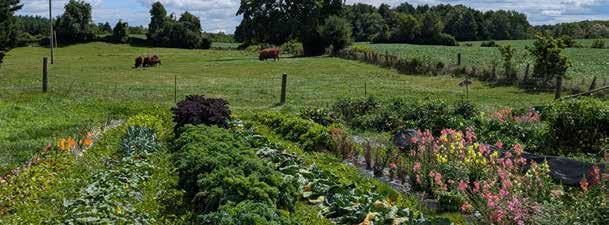
their crops, benefiting the quality and quantity of the produce yield. Plus, knowing how many people the output is intended to feed helps the planning process and minimizes waste. Unlike a market, everything produced in a week is almost guaranteed to find a home, reducing food waste and costs for the farms, thereby also reducing prices for the consumers.
Aside from cost, there are many incredible benefits to the business model. As Barclay Nap of Corwhin Herbs & Produce explained, “the
transition to farm shares allowed [him] to spend more time on the farm and sell to those who wanted a direct connection with a farmer and fresh food. [His] tag line is that it's like having a garden, but someone else does the work.”
For many, farm shares provide a more spiritual and emotionally fulfilling alternative to sourcing their food. Food can be about more than just survival, as food imbues joy into daily life and creates community. After all, the work that goes into providing
nutrients to the masses is not a nameless, faceless process—rather, it’s supported by passionate and hard-working farmers.
As a collective, everyone can learn to appreciate their food more, especially after getting a glimpse of the full picture. One of Nap’s goals for his farm share is to “have the customers come to the farm to see everything being grown. [His] focus is on variety and for some customers [he has] introduced them to crops that they weren't familiar with.”

I’m Also Here co-creator Liesl Lafferty and episode star Paloma Nuñez sat down with The Ontarion to discuss their roles




I’m Also Here is a new comedy anthology show that explores everyday life in rural Ontario. The series highlights an exclusively female and non-binary cast and crew, while showcasing the creative accomplishments of University of Guelph alumni.
Set in Kawartha Lakes, the show features six independent episodes, each set in a different town. Naomi Snieckus and Liesl Lafferty created the show with the current climate crisis in mind.
Lafferty explained to The Ontarion, “It was six episodes...but it had the through line which followed the lifespan of the plastic bag. It started off in the factory, and then you see it being used, and then in the end...your immediate image goes to a landfill site. But I wanted it to be a comedy, so it became art.”
Lafferty graduated from the University of Guelph with a bachelor’s degree in theatre studies before gaining a master's degree in creative writing from the University of British Columbia. She first developed her love of theatrics at a young age, putting on performances for her family in their living room. After a career directing performances in Vancouver, she transitioned to writing due to a sensitivity to artificial light.
“I started transitioning more to writing and as soon as I did, I could see that it was going to be my outlet,” Lafferty said. “I didn't have to wait for a whole production or somebody else's play to be written, I was going to be able to do it myself.”
Lafferty and Snieckus joined forces after they both attended the same online reading during the COVID-19 lockdown. Shortly after, Lafferty became involved in Snieckus’s project, “The Firecracker Department.” What started as a podcast quickly became a largescale network and collaborative group exclu-
sively for female and non-binary actors and comedians. Their dedication to fostering a supportive and empowering environment for their peers is evident throughout the show.
Lafferty described the experience, saying: “My favourite moment on the set of I'm Also Here was seeing an exclusively female and non-binary cast and crew. This idea that Naomi and I developed was now a canvas for all of these other folks to explore their art. There were 22 lunches made that day, [and] 22 female and nonbinary artists able to flourish.”
Among the cast is fellow University of Guelph alum, Paloma Nuñez. Nuñez starred in the Lindsay-based episode of I’m Also Here, in which she plays an indecisive brideto-be grappling with the decision of picking her maid of honour.
Nuñez graduated from Guelph with a degree in theatre studies before taking her formal training with her to Toronto, where she performed and taught with Second City. She is a recipient of a Screen Actors Guild Award for her role in the 2016 Best Picture-winning film, Spotlight.
Nuñez described her experience on the set of I’m Also Here to The Ontarion: “It was incredible. The crew was really, really game. It was a scorching hot day. I think we had one of those 30 [to] 32 degree days, and we were shooting out in a field in Lindsay for a cornhole tournament.”
She continued, "The crew works so hard. Always, in almost anything, the crew are the hardest working people…Everyone was in such a good mood.”
Nuñez can also be seen in season two of the drama Sisters, streaming on Crave, while Lafferty’s upcoming short film Does Anybody Hear?, based on the Bruce Cockburn song “If a Tree Falls,” is set for release soon.
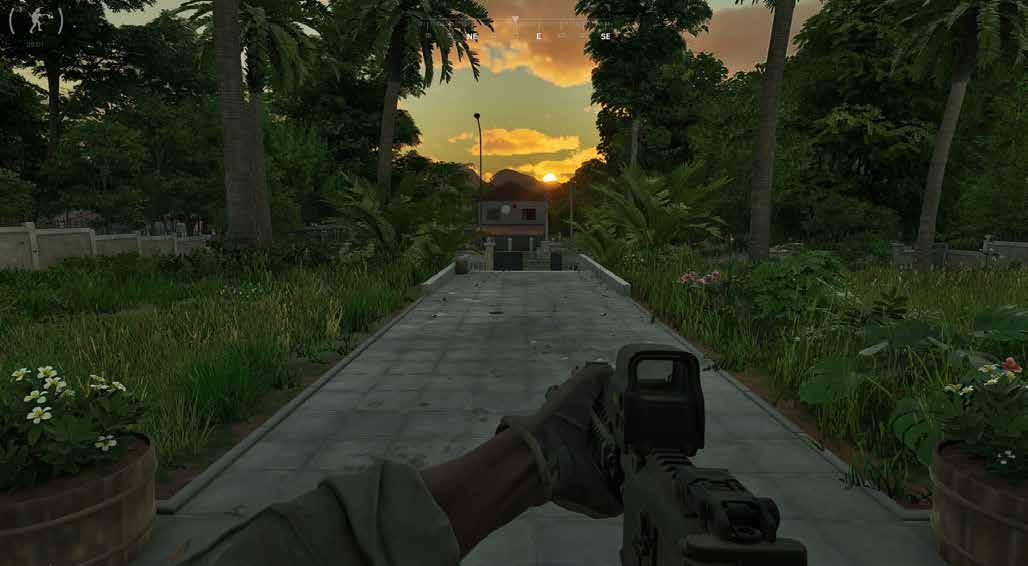
Gray Zone Warfare is a hardcore first-person shooter game which puts a spin on the extraction shooter genre. Instead of placing players into timed raids like Escape from Tarkov or Arc Raiders, Gray Zone Warfare’s map of Lamang is persistent, allowing players to seamlessly enter and exit raids, which allows the map’s state to dynamically change based on player actions. Madfinger Games have consistently updated the game based on player feedback, overhauling systems like how characters move and how enemies react to being shot.
Madfinger Games have demonstrated themselves to be excellent stewards of the game by listening to community feedback and being transparent about the game’s progress. Madfinger is clearly committed to developing the game and will stick with it for the long term.
Gray Zone Warfare takes place in the fictitious country of Lamang, which takes cues from Vietnam and Thailand. The player plays as a member of one of three Private Military Corporation
(PMC) factions which operate in the country after an unknown disaster left the region in turmoil. The factions either wish to aid in stabilizing the region, profit off the tragedy or aid the innocents affected.
In the game’s current state, the PMCs are largely similar, with the main difference being that the player can only cooperate with other players in the same faction.
Lamang is a beautifully realized map, with dense vegetation and a plethora of points of interest to discover. The terrain is set up around a central “Ground Zero,” which the game’s central mystery is built around. Helicopters conspicuously avoid it when transporting players around the map, even when a direct route through it would be considerably shorter. There are a few points of interest within Ground Zero, and the player’s character is afflicted with radiation poisoning while they spend time inside the zone. There are a diverse range of settlements surrounding the zone, like a city, resorts and villages, with
smaller points of interest scattered between them. This incentivizes the player to explore by providing hints about what happened to the region, or giving them higher tier loot as they wander off the beaten path. Lamang has plenty to offer for both the intrinsically and extrinsically motivated player.
The gameplay takes heavy inspiration from titles like S.T.A.L.K.E.R and Escape from Tarkov. The gameplay is split into two states. The first is planning to go beyond the wire, and the second is the actions the player takes in the wild. The player is forced to take every aspect of their loadout into consideration as they plan their route into Lamang. For example, higher tier enemies can carry full metal jacket or armor piercing bullets, necessitating heavier armour with better protection. Conversely, higher tier enemies also carry heavier body armour, requiring the player to consider the bullets they carry accordingly.
Gray Zone Warfare has a more in-depth medical system than other titles, using blood as a stand-in for health points. If the
player loses an extreme amount of blood, they will be rendered comatose, and if they don’t get medical attention, they will die and respawn empty-handed, requiring them to find their corpse to regain their loot.
The game also considers damage to vital organs: when these are injured, they impart status effects on players, such as vomiting, which is considered suboptimal in a firefight. When vital organs are destroyed the player is instantly killed. If the player can make immediate hits on the enemy’s vital organs, they will drop immediately. However, grazing hits will only cause the enemy to bleed and they will be able to fight until they bleed out and die, or until they’re shot again in a vital area. When gameplay gets intense, the game rewards the thoughtful preparation that the player did when they were in a safe area.
To incentivise leaving safe areas, vendors will assign the players one of three kinds of tasks, rewarding them with money and reputation points upon
completion. Main tasks further the game’s narrative as the player explores Lamang and discovers secrets. Side tasks involve the player doing favors for vendors, giving the players more insight into the vendors’ characters and motivations. Contracts are small tasks generally done for money, like transporting an object or and killing enemies in certain locations. Many of these tasks fail upon the player’s death, requiring the player to consider what tasks they want to commit to as they leave a safe area.
Gray Zone Warfare puts an interesting spin on the extraction shooter formula with its persistent world. It will appeal to players who want to get into extraction shooter games, but aren’t ready to delve into higher risk games like Escape from Tarkov. Madfinger Games have demonstrated themselves to be capable stewards, and players can expect consistent improvements in the coming years. Fans of games like S.T.A.L.K.E.R would be doing themselves a disservice if they ignored this title.
ABIGAIL MILNE
Lemon pasta
Ingredients:
• About ½ pack of Spaghettini, roughly 8 to 10 oz
• 1 tsp lemon zest
• 1 to 2 tbsp lemon juice
• 4 garlic cloves, minced
• ½ cup parmesan, shredded
• Fresh basil leaves
• 3 tbsp butter, salted or unsalted
• Salt and black pepper
Directions:
1. Bring a pot of salted water to boil and then add dry pasta. Cook according to the package directions. Make sure to reserve ½ cup of the pasta water to add to the sauce later.
2. When the noodles are almost done
ARTICLE AND PHOTOS BY ELISE FREDERIKSEN
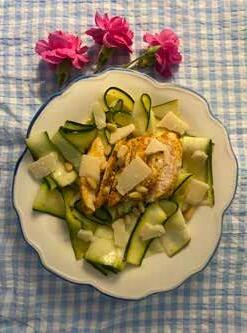
Lemon-Squeezie Chicken Zucchini Salad
Ingredients
• 3 chicken breasts
• 4 fresh zucchinis
Marinade for chicken
• Juice of 1 lemon
• Zest of ½ a lemon
• 2 cloves of fresh garlic
• Cooking oil of choice
• Salt
• Pepper
• Paprika
• Dried parsley
• Dried basil
• Oregano
• Thyme
• Rosemary
Dressing
• Zest of ½ a lemon
• 2 cloves of fresh garlic
• Olive oil
• White wine vinegar
• Salt
• Pepper
• 1 tbsp of honey
• 1 tbsp of dijon mustard
• 1 tsp of roasted sesame oil
Before Serving
• Parmesan
• Roasted pine nuts
cooking, melt the butter in a saucepan over medium heat. Add the garlic and lemon zest, stir, and cook until aromatic.
3. Add the pasta to the lemon sauce and mix until the garlic and lemon zest are evenly dispersed through the pasta.
4. Add the pasta water and parmesan into the pan, stirring to combine into a smooth sauce over the Spaghettini.
5. Finally, add the lemon juice and stir. Top with salt and pepper to taste. Serve with basil and additional parmesan for garnish.
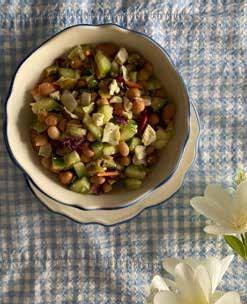
Chickpea salad
Ingredients:
• 2 cups chickpeas, drained and rinsed
• 1 cup kidney beans, drained and rinsed
Directions
1. Pre-heat oven to 400 F. Prep chicken in an oven-safe baking dish. Ensure each section is covered with marinade and let sit for 15 minutes. Bake for 20 minutes, ensuring an internal temperature of 165 F.
2. While the chicken is cooking, wash and cut the zucchini. I chose to try a ribbon-style cut using a vegetable peeler. This makes for an easy-to-eat and pretty dish!
3. Put dressing together and mix well (I chose to shake in a mason jar for convenience and future storage). Mix the zucchini with the dressing in a large bowl and let sit. The acidic dressing will work to break down the raw zucchini, making it easier to digest while allowing the bright summery flavour to soak in!
4. Quickly roast the pine nuts in a dry pan. Assemble zucchini salad with cooked chicken. Top with the pine nuts, any leftover lemon zest and fresh parmesan. Serve and enjoy.
• 1 cup grape tomatoes, halved
• ½ cucumber, diced
• ½ red onion, diced
• ½ cup fresh dill, chopped
• ¼ cup cilantro, chopped
• ¼ cup mint, chopped
• 2 tbsp extra virgin olive oil
• 2 garlic cloves, minced
• 2 tsp lemon juice
• 1 tsp Dijon mustard
• 1 tsp salt
Directions:
1. In a large bowl, combine the olive oil, lemon juice, mustard, garlic and salt. Stir.
2. To the sauce, add the chickpeas, beans, tomatoes, cucumbers and red onion. Mix until combined and evenly coated with sauce.
3. Add the fresh herbs and toss together. It’s ready to serve!
Fresh spring rolls
Ingredients:
• 3 oz dried vermicelli rice noodles
• 8 rice paper wrappers
Easy-peasy beans-on-a-budget
Ingredients
• 1 can of mixed beans
• ⅓ of a bag of pre-made salad/coleslaw mix
• 1 cucumber, chopped
• 1 block of feta cheese
• Sliced olives
Dressing
• Dash of olive oil
• Dash of white wine vinegar
• Salt
• Pepper
• Dried parsley
• Dried basil
• Oregano
• Thyme
• Rosemary
• Onion powder
• Fresh, jarred or powdered garlic
Directions
1. Chop cucumber and feta.
2. Assemble all salad ingredients.
3. Make dressing, mix and enjoy!
• 1 carrot, juliened
• ½ cucumber, julienned
• 4 oz firm tofu, drained, pressed, and cut into thin strips
• 1 mango, julienned
• 1 avocado, julienned
• Fresh basil, mint and cilantro to taste
Directions:
1. Prepare the noodles according to the package directions. Drain the water after the noodles are finished cooking.
2. Lay a damp paper towel on a plate or flat surface.
3. Fill a large bowl with warm water. One at a time, soak the rice paper wrappers for about 20 seconds each, or until translucent and pliable. Place the wrapper on the paper towel.
4. Fill each wrapper with rice noodles, tofu, the julienned toppings and fresh herbs. Carefully fold the wrapper to close (like you would fold a burrito).
5. Repeat with remaining wrappers and filling.
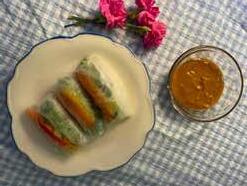
Rainbow Salad Rolls with Peanut Sauce
Ingredients
• Rice paper wraps
• Thin rice noodles
• ½ carrot
• 2 cucumbers
• Bell peppers (I used 3 mini peppers: 1 red, 1 orange, 1 yellow)
• 3 to 5 lettuce leaves
• A few mint leaves
• 1 green onion
• Optional protein: cooked chicken, cooked shrimp or tofu
Peanut sauce - Recipe from Kathryne Taylor’s Cookie + Kate website
• ⅓ cup creamy peanut butter
• 2 tbsp rice vinegar
• 2 tbsp soy sauce
• 2 tbsp honey or maple syrup
• 1 tbsp toasted sesame oil
• 2 cloves garlic, pressed or minced
• 2 to 3 tbsp water, as needed
Directions
1. Soak rice noodles in warm water.
2. Chop all veggies into thin strips, approximately 5 cm long.
3. Soak rice paper until easy to fold.
4. Assemble veggies in bottom half of wrap and fold, tucking sides in while wrapping.
5. Assemble peanut sauce and enjoy.

Do you ever feel like your heart beats faster when you’re stressed out, but then calms down when you’re well rested? Or like you’re having a stroke when you experience extreme emotional turmoil—like when your partner said they wanted to break up with you? Although not everyone will experience this in their lifetime, some could undergo broken heart syndrome, or Takotsubo cardiomyopathy, where severe emotional distress can trigger a sudden weakening in the heart muscle that’s intense enough to mimic a heart attack. It turns out, our brains and hearts are more closely connected than we may think.
In a recent seminar, University of Guelph Professor Melanie Alpaugh said that having anxiety or chronic stress can increase the risk of developing cardiovascular disease. Anxiety and chronic stress can lead to symptoms such as irregular heartbeats, increased inflammation, high blood pressure and even damaged blood vessels. This presents important questions: what does this mean for neurodegenerative diseases? How do disruptions in the brain affect the
heart and vice-versa? How might cardiovascular dysfunction shape our brain health?
Despite the long-held assumptions that the heart and brain operate as independent systems, research has increasingly shown that the two organs are in constant communication to maintain overall health. With its high metabolic demand—about 20 per cent of the body’s total oxygen consumption— the brain cannot survive without a sufficient supply of oxygenated blood from the heart. On the other hand, without brain signals, the heart would not pump properly, which leads to reduced circulation, tissue hypoxia and organ failure. This is especially relevant in neurodegenerative diseases, where the progressive loss of neurons can subtly alter cardiac function, and where cardiac dysfunction, in turn, may accelerate neural decline.
In her lab in the College of Biological Sciences, Alpaugh and her team are further investigating this crosstalk between cardiovascular and neurodegenerative disorder with a primary focus on Huntington’s and Parkinson’s diseases. In a recent systemat-
GEMMA NGOC LE
ic review, their team identified a significant overlap between cardiovascular and neuropathological progression in both human and animal models, with similar risk factors and disease complications. Common across many neurodegenerative diseases, patients with Parkinson’s and Huntington’s diseases frequently show clinical cardiovascular dysfunction such as reduced blood flow to the brain, damaged blood vessels and altered blood-brain barrier functions. Huntington’s disease mouse models also show signs of scarring and abnormal protein buildup in heart tissues. On the other hand, neurodegenerative hallmarks, including chronic inflammation, misfolded proteins and neuronal network disruption can significantly affect cardiac performance. This dynamic between the two systems helps to explain why assessing cardiovascular health is crucial for understanding the onset and progression of neurodegenerative disorders.
Building on these insights, Alpaugh’s lab is now investigating whether myocardial infarction, a type of heart failure caused by restricted blood flow in the heart
muscle, directly disrupts the bloodbrain barrier. The blood-brain barrier is a thin protective structure that regulates what enters the brain from the bloodstream. It plays a key role in blocking toxins and foreign pathogens from entering our brains and its disruption is a feature of many neurodegenerative disorders. For example, following a heart attack, progressive heart muscle cell death can lead to severe cardiovascular complications, including cardiogenic shock, a life-threatening condition where the heart cannot pump enough blood to meet the body’s demand. Using a rodent heart failure model, the team aims to discover the underlying mechanisms of the heart-brain axis, particularly whether inducing myocardial infarction would affect the integrity of the blood-brain barrier.
“If we’re seeing blood proteins in the brain that are typically restricted to the cerebral vasculature, that’s an indication that the blood-brain barrier integrity has declined,” Alpaugh said.
For decades, neurodegenerative research has focused mainly on the brain, despite cardiovascu-
lar complications being a common feature of these diseases. Alpaugh’s work sheds light on the heartbrain connection, offering deeper insights into the progression of Huntington’s and Parkinson’s diseases. In the future, the team hopes to expand their research in new directions—like using advanced imaging techniques to capture, in real time, what’s happening in the brain during normal behaviours in animal models. They also plan to investigate the role of immune cells in connecting all of these systems, given that chronic inflammation and elevated inflammatory biomarkers are hallmarks of both neurodegenerative and cardiovascular diseases.
Alpaugh believes in the potential of her team’s work. “If we are successful in identifying the mechanism and novel points of interaction, that could have a lot of value given the huge amount of clinical morbidity of both neurological and cardiovascular disease,” she said. A deeper understanding of the relationship between the heart and brain could inform better targeted therapeutic approaches for patients.
Here are the facts of life—wildlife, that is
ARTICLE BY ANDREEA BURLACU & PHOTOS BY ADITYA PARAMESWARAN
Summer invites us to spend time outdoors, paying attention to the natural world around us. The sun is shining, the birds are chirping and the bees are buzzing. For those curious about the creatures that come out in these warmer months, it’s about time you got the talk. These are two Guelph-based organizations taking care of things with wings: Wild Ontario and the Honey Bee Research Centre.
Based out of the University of Guelph, Wild Ontario is an environmental education program that teaches people about native species and conservation. They care for 12 non-releasable raptors who are either physically injured or rely on humans to survive.
Co-op student Amanda Ayres described Wild Ontario as a “final destination” for birds in need of rehabilitation.
“Usually, someone finds a bird that’s either injured, or they’re doing something that a wild bird shouldn’t be doing,
and they call their local rehabilitation centre and those people will go out and they’ll check it out,” Ayres said. “They’ll bring the bird in…if they're able to heal in a way that doesn't cause them pain, but they still have an injury that won't allow them to live out in the wild, that's when they become a candidate for our program.”
For example, the tiny northern saw-whet owl Atwood was found with a wing injury, presumed to be caused by a collision or an attack by an outdoor cat. She was unable to fly and came into Wild Ontario’s care. Now, she’s a “program star,” Ayres said.
Another reason birds come to Wild Ontario is because they are human-imprinted, like their turkey vulture Grimsby. Turkey vultures are normally nervous around people, but Grimsby was caught flying at people in their backyard.
“We think that someone was leaving food out for her, or maybe took her from the wild as a young bird,” Ayres said. “So she associates herself with humans,
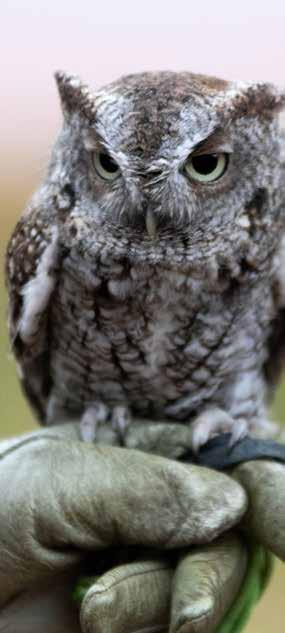
she expects to get food from humans…she doesn't know how to find food on her own.”
Wild Ontario specifically focuses on raptors, which are birds of prey that hunt with their strong talons. Ayres described that they have eight different species of falcons, owls and hawks, as well as the turkey vulture Grimsby, an “honorary raptor.”
“They eat things that are already dead, like carrion, so they don't have to hunt their food,” Ayres said.
Ayres considers turkey vultures especially interesting as their stomachs are strong enough to eat meat containing botulism, E.coli, salmonella and other dangerous pathogens, completely removing them from the environment.
Apart from these birds, Wild Ontario’s team currently consists of Ayes, program director Jenn Bock, and education coordinator Sally Cheung. With such a small staff, Wild Ontario is almost entirely run by volunteers, approximately 40 U of G students in a range of programs from wildlife
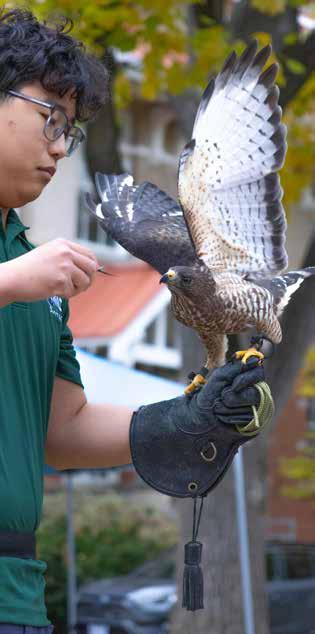
biology to zoology.
Part of Wild Ontario’s educational programming is on human-bird interaction—namely, teaching people how to prevent harm. For example, raptors like red-tailed hawks have adapted to urban spaces and hang out by taller grass near highways, where they are sometimes hit by cars.
“Roadsides are a perfect area: they have taller grass sometimes and there's a lot of garbage,” Ayres said. “Mice, voles and squirrels go to both sides, and obviously, predators follow those.”
Ayres described that as a kid, she’d throw apple cores out the car window, believing that they’d just decompose. Later, she realized that when rodents are drawn to the fruit, raptors follow them.
“We always say that they're not smart enough to look both ways, so they'll just fly right across the road,” she said. “And then they're pretty fast, so a car will just hit them, which is really unfortunate. It's really common, and usually, it's immediately fatal.”
She advised people to keep their garbage in the car and compost it when they get home.
Other ways to avoid harming raptors include using natural alternatives to rodenticide (as raptors eat rodents, over 60 per cent of raptors worldwide have tested positive for rodenticide in their system), and managing outdoor cats, who kill an estimated 2.5 billion birds every year, according to U of G’s One Health Institute.
Guelph has been certified by Nature Canada as a Bird-Friendly City, the criteria for which include restoring nature, mitigating key threats to birds, organizing events and municipal policies to protect birds and having residents actively engaged in admiring and monitoring local bird populations.
When asked how best to enjoy the company of birds, Ayres encouraged people to spend more time in nature.
“That leads into seeing other species and being more aware of what’s around you,” she said. “Get outside more, go to the local park or use the trails, and get more familiar with the birds that are in your area.”

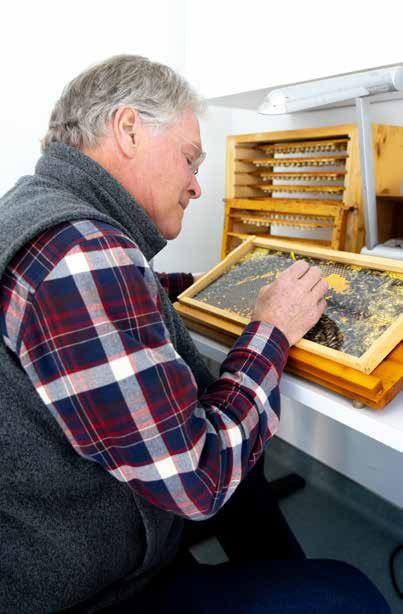
Fresh off of a move to an all-new facility, the Honey Bee Research Centre is located at 460 Stone Rd. E. Paul Kelly, the research and apiary manager, described that the centre has “a lot of things rolled into one,” including a farm, a research centre, an education centre and a retail business, as well as 300 beehives.
Roughly 800 students a year learn apiculture on campus, more than any other agricultural institute in the world. The research centre also offers public tours every day through spring, summer and early fall. For those abroad, the centre has a YouTube channel breaking beekeeping down into skills like dividing beehives or finding a queen bee.
“Our 77 videos have now been translated into 14 different languages and viewed approximately 30 million times throughout the world,” Kelly said.
As for the centre’s primary research interests, Kelly described that in the last 15 to 20 years, parasites have caused health problems for honeybees.
After they experienced much higher losses of colonies over the winter of 2007, the centre did a study tracking 413 colonies over a year and a half. They found that a parasitic mite called the Varroa destructor pokes a hole in the bees, causing a deadly virus.
“For us, it looks kind of small,
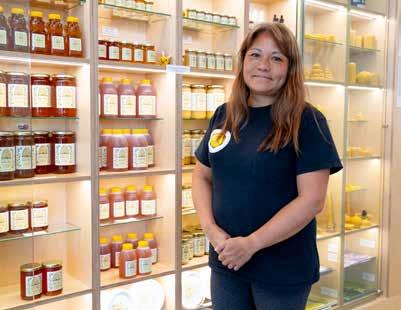

like the size of a pin. But on a bee, it’s huge,” Kelly said. “They feed on their hemolymph, which is their blood and their protein reserves, and they also prevent that hole from being healed over, which shuts down the bee’s immune system.”
The centre’s efforts to control these mites are twofold: in the short-term, finding natural chemicals to repel the Varroa destructor while protecting the honeybees, and in the long-term, breeding for resistance.
Studying and protecting bees is imperative as they are incredibly important to our diets.
“A third of the food that we eat as humans benefits from bee pollination,” Kelly said. “80 per cent of that pollination is accomplished by honeybees, which are largely a managed species.”
Honeybees are not actually native to Canada—they evolved overseas and arrived in the 1600s. They pollinate many major crops including fruit, vegetables, nuts and seeds, and forage crops like alfalfa and clover, which are used to feed livestock.
Different bees pollinate different plants. Kelly said that native bees “stick close to home,” preferring native plants like goldenrod, aster and sumac, while honeybees will “cover a foraging range of 7000 acres.”
Furthermore, after the Ontario Agricultural College invented the pollen trap, pollen collected from honeybees has been used
to feed bumblebees.
“Those bumblebees are put into greenhouses used to grow cucumbers, peppers and tomatoes,” Kelly said. “Honeybees don’t do well in greenhouses, and they can’t even pollinate a tomato plant. Bumblebees grab the tomato flower and they shake it, it’s called buzz pollinating, and that releases the pollen.”
Before that, people pollinated plants by hand, which was much less efficient.
When asked what people can do to make a bee’s life easier, Kelly mentioned several conservation efforts, including getting involved in horticultural groups. A variety
of plants is important: Pollinator gardens look nice and benefit native bees, whereas trees like maple trees bloom every year for 150 to 200 years, providing longevity balanced with low maintenance. Additionally, not spraying herbicides on lawns lets plants like clovers sprout up voluntarily.
“Our campus is just a bee paradise,” Kelly said. “We no longer spray for weeds growing in common areas.”
Kelly also encouraged people to support beekeepers by purchasing local honey. The Honey Bee Research Centre offers both raw and liquid honey (raw honey offers extra health benefits, like wound
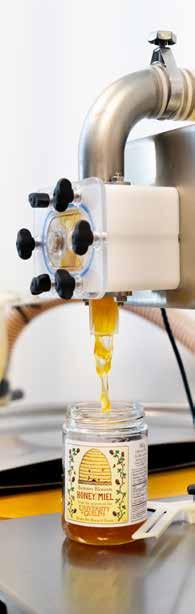
healing), as well as honeys from different places, producing different flavours depending on which plants were pollinated. They also have goods made from beeswax, like lip balms, food wraps and candles.
A tour of the new centre revealed a research lab, a packaging room, a beeswax station, incubators and a workshop to build specialized beekeeping equipment. A peek out of the large, sunny windows shows linden and maple trees, since the site is on a former tree nursery.
“The bees will work in the flowers and the trees, and a lot of them just happen to be beneficial trees for pollinators,” he said. “We got lucky.”

Ryan Gosling sold the movie with rocksolid acting
KIERA SCHARF
Ryan Gosling has had an incredible acting career, from starring in classics like The Notebook, La La Land, The Nice Guys and Barbie, to working alongside stars like Emma Stone, Bradley Cooper, Margot Robbie and Harrison Ford. Now, critics are talking about Gosling’s new film, Project Hail Mary, as one of his best performances to date. I certainly agree with that.
In 2006, 25-year-old Gosling starred as a crack-smoking middle school teacher in the low-budget drama, Half Nelson. Over a decade later, as a full-fledged movie star, he portrayed Neil Armstrong in the 2018 moon landing movie,
First Man. Now, in 2026, he’s come full circle, playing middle school teacher Ryland Grace, who eventually blasts off into space on an unbelievable but necessary mission in order to save the world. With those filmography similarities also come differences: Project Hail Mary has no drugs (besides the small vodka stash onboard), and his mission goes far beyond the moon—to a star called Tau Ceti, 11.9 light-years away.
Project Hail Mary is based on the 2021 novel by Andy Weir, who also wrote The Martian. Protagonist Ryland Grace wakes up from a coma, battling amnesia
22 & 23 | PUNK

on a spacecraft. He soon realizes that he is on a one-way mission to save Earth from a sun-eating microbe, traversing space to the only star known to have overcome the microbe, in hopes of uncovering the secret to saving Earth’s sun. Along the way, Grace makes an unlikely acquaintance with a strange alien, who we come to know as Rocky. The two of them develop an odd relationship—but a solid friendship—and work to understand each other and save the fate of their respective planets and species.
Seeing Project Hail Mary in theatres was an experience like
As a new graduate, I feel the pressure to make my life as logical as AI operating systems
ANDREEA BURLACU
As an English major, I’ve heard countless times, “What are you going to do with that after you graduate?” All through my undergrad, I shrugged off that question, pushing it off as long as I could. Now that I’ve written my last paper, moved out of my uni house, and I’m staring head-on into the future: What now?
It feels like my four years in school were reduced to a portal. You start as an awkward freshman, barely an adult and zap! There you are, degree in hand, ready to join the rat race. The push to land a perfect job immediately after graduating reflects our results-driven culture. Think about what’s trending online. We want certainty, efficiency.
We eat up “what I eat in a day”
content bite by bite, hoping to mirror those same lean muscles and toned bodies. “Run, don’t walk” influencers promise that products work, from bone broth to plumping lip glosses. Looksmaxxing content to “glow up,” aspirational day-in-my-lifes, apartment tours and hundred-dollar hauls. You can improve, the internet promises you. There’s one specific way to get better, and it’s something people should constantly seek out.
Our AI fixation is an extension of this. When life is uncertain, AI appears to know everything—or at least it confidently acts like it does.
AI works in part by using Markov chains: predicting what comes next based on the last words inputted. Think of autocomplete.
The search bar guesses at what you might look up based on existing words you’ve typed. It guesses at probabilities: input + what usually happens = what will happen. In a way, AI can predict the future. A completely optimized expectation of what’s supposed to come.
As a new graduate, I feel the pressure to make my life as logical as AI operating systems. It’s literally competing with me for jobs.
Dario Amodei, the co-founder of Anthropic (the company behind the large language model Claude), predicted that AI technology “could obliterate half of entry-level white collar jobs within five years.”
Yet, AI doesn’t see the whole picture the way a person can. Its Markov chains, according to a Medium article, “model sequenc-
no other. It was evident that I and several others fought back tears during the beautiful space shots and emotional scenes. I was left practically paralyzed as the credits rolled, staring at the screen, completely captivated and moved. I have honestly never felt this way towards a movie before. It resonated with me in so many ways. Gosling’s performance was downright hilarious, and almost every line he delivered was bound to make people laugh, despite it being a darker sci-fi film with somber themes.
The film has the perfect balance of lighthearted humour,
es where the next step depends only on where you are now—not the winding path that got you there.” That path is what makes every person unique. We can’t follow an exact, universal formula where our degree lands a dream job and there’s no challenges along the way.
Reducing university education to a straightforward pathway to a career diminishes the human value of learning. Although I strongly believe the job market should be more accessible, one’s entry-level job should not be expected to become the career they’re in for the rest of their life.
Thinking of a degree as a destination encourages exactly what educators fear—that students are using AI in lieu of learning for themselves. It also justifies Doug Ford’s thinking in cutting OSAP: “You’re picking basket-weaving courses, and there’s not too many baskets being sold out there.”
A university degree, no matter your program or GPA, provides people with people skills—communication, critical thinking, teamwork, time management, organization—as well as new experiences, new connections and new perspectives. It adds value to your life beyond employment. I appreciate my English coursework as it led me to read more as a hobby, and it has
genuine emotion, absolutely breathtaking shots and scientific concepts. The soundtrack is highly acclaimed, with many viewers finding it emotional and angelic, with those space-travel and interstellar vibes, helping perfect every scene with a wondrous score in the background. The soundtrack is a highly experimental one, focusing on more organic and tactile sounds rather than a traditional orchestra or stereotypical synth-heavy tropes. The composer, Daniel Pemberton, recorded a “leaky, squeaky” water tap on his iPhone to create a unique sound to be continuously used throughout the score. He used other distinctive sounds such as human body percussion, a glass organ and ethereal vocals to create a celestial and emotional soundscape.
Project Hail Mary is an excellent movie to see in theatres, as it complements the spectacular space shots excellently. The film has evidently claimed its place as one of this year’s best movies, and viewers are hoping to see it win many awards during the 2027 Oscars. It was an awe-inspiring watch that will leave you laughing and crying with feelings of satisfaction and wonder.
improved my poetry (which lives in my Notes app and has no employable value).
There is humanity in a degree, lessons that cannot be learned by a machine. So why should we compete with them? Especially for careers in creative fields, “optimized art” is oxymoronic. Neither ChatGPT or Claude can be a “tortured poet,” despite Claude’s obnoxious French-sounding name. It takes breaking off a Markov chain, disrupting existing patterns to create original art.
As chatbots answer almost everything and the internet floods us in a sea of confident LinkedIn status updates, new graduates are experiencing a pressure unique to our generation. By competing with both humans and machines, we have forgotten that no one has their life figured out in their twenties.
In an age of optimization, we should not scrutinize ourselves as something to always be improved upon. We have to trust our human instincts; to develop those, we need to explore and live a messy, ever-changing, meaningful life. I encourage new graduates to take that leap, try new things and make mistakes. Go where the wind takes you. What’s meant for you will be yours, no matter the journey it takes to get there.
My life is unique because I have spent most of it sharing everything—down to my birthday—with my sister. I’m a twin. While I’ve always known that my sister and I are two completely different people, our resemblance has caused others to overlook our different personalities, goals and lives.
Like twins, Canada and the U.S. are associated with each other because of their location and shared
customs, but their differences are often ignored. Recent talks from American politicians have suggested that Canada should become the 51st state. That might make sense geographically, but Canada could never become part of America—our cultures are far too different.
Canada has a rather symbiotic relationship with the U.S. The two countries are neighbours, share many customs and engage in a lot
of trade with each other. However, like my twin sister and I, there are so many differences between them.
Other nations have presumptions about what it means to be Canadian, like playing hockey, saying “sorry” and enjoying maple syrup. Canadians take pride in societal structures such as free healthcare, the parliamentary system and restrictive gun laws.
For many Canadians, the most important aspect of our country is the cultural mosaic system that exists in our society. Instead of a melting pot system where individuals are encouraged to adopt the culture of the country they live in, Canada embraces differences and celebrates many cultures. The cultural mosaic system plays a large part in recognizing and amplifying Indigenous
The long running post-apocalypse franchise returns after its seven-year hiatus
Over seven years after the release of Metro Exodus and over 16 years after the release of Metro 2033, 4A games have revealed the latest entry into the Metro franchise. Metro 2039 was teased with an Xbox First Look, returning players to the Moscow Metro after Metro Exodus brought them on a continent-spanning roadtrip. The reveal began by showcasing a stunning, mindbending trailer, introducing a new protagonist and his return to the Metro. It also introduced the antagonist—the fascist organization Novoreich—led by a character that players of Metro 2033 may recognize.
“Metro 2039 takes you to the dark heart of the Moscow Metro, where the last survivors of the nuclear apocalypse struggle to exist in the tunnels and subways of the ruined city. Hope is lost. The fu-
ture looks bleak, if there is one,” said Pavel Ulmer, co-creative director and lead audio designer for 4A games.
Metro 2039 will be the darkest entry into the series, with the Ukrainian games studio drawing from their own experiences of the ongoing Russian invasion of Ukraine. They said that the game will not shy away from the consequences of war, the cost of silence and what people will do to live another day. 4A games have stated this philosophy will bleed into every aspect of the setting, with their “Frozen Stories” concept, wherein each item in the game is placed with care to create a moment frozen in time. They hope to encourage players to use their imagination to figure out what happened in the room before the
occupants left—or died. The game’s narrative is clearly shaping up to be the darkest and most personal one yet. Despite this, fans hope that the title will maintain some of the hope that Metro Exodus left the series with.
Metro 2039 will return the player to the familiar claustrophobia of the Moscow Metro, rendered in greater detail than ever. 4A Games has spent the years since the release of Metro Exodus improving their in-house game engine—promising more graphical fidelity than ever—doubling down on the ray tracing technology that made Metro Exodus as stunning as it was. Scheduled to release this winter, Metro 2039 will be a game that cannot be missed for players who enjoy horror games and post-apocalyptic titles.
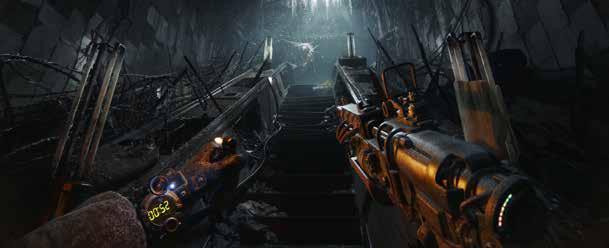
and French cultures, as well as many other cultures, which is very important to many Canadians.
If Canada were to become the 51st state, French would no longer be recognized as an official language, and Indigenous peoples could lose their treaty rights. Indigenous and French identities in particular have contributed largely to modern Canadian culture and are crucial to the history of our country. It could be argued that it would be beneficial for Canada to become the 51st state due to the elimination of tariffs and an increased military presence from the US. Realistically, this would not work. Many Canadian systems directly oppose American systems, and many Canadians are not willing to let their culture melt into
America’s melting pot.
In conclusion, Canada cannot become the 51st state. From their social structure to their institutional infrastructure, Canada and America have two very different societies. Merging them would be nearly impossible; choosing one would result in dissatisfaction. In the same way that my twin sister and I are two different people despite our similar appearances, Canada and America must remain two separate countries. They may be located on the same continent and have similar traits, but their cultures remain vastly different. So should their sovereignty.
Editor's note: this article was submitted as an Experiential Learning assignment for POLS 1150.



Shave your head instead of your legs this summer, and get ready to make waves somewhere other than the beach. Just kidding—all hair lengths are welcome in the punk community! If the idea of standing out in a crowd or being “different” scares you, maybe you’re in the right place.
Isn’t a lifetime of influencers telling you how to look and what to buy to fit the ever-changing, unattainable mold enough to make you want to flip them off and say “F- your consumerism and f- your beauty standards?” If so, a punk summer is long overdue and it’s about time that changes.
How you look is just the start. When you picture a punk, you might imagine liberty-spiked hair and a studded leather jacket, or maybe the more modern boxdyed hair and facial piercings. Here’s the secret, though: There is no one way to look or even be punk. Sure, like any subculture, the style and music are integral to the culture itself, but what’s most important is what the clothing represents. Arguably, the least punk thing you can do is dress punk without embodying any of its spirit or values. Punk is not an aesthetic—it's a warning. The whole point of being punk is to challenge authority and subvert the dominant social culture, so there’s a lot of room for individ-
ual interpretation.
The main reason to dress punk is to be a walking black flag and publicly announce who you are and where your values lie. Your clothes speak for you when you are silent. What do you want them to say? What are your principles and how do you want to visually represent them? Fashion sense varies in individuals; some people like to rock band tees, some like to sew patches on to their clothes, others like to thrift and dye pieces. Regardless, each style sends a deliberate message to onlookers. Whatever it may be, experiment with your style this summer! Try adding a pair of ripped pantyhose under your shorts, layering with a cutup flannel, or acid washing an old and stretched-out t-shirt. Whatever you decide to wear, do it with intention and with your morals acting as your guiding compass. There’s nothing more poser than buying “punk” clothes off Shein. Not to mention, putting yourself out there is a great way to find your community. Showing that you have a mutual interest in a subculture or music genre is a great way to make new friends. If anyone has ever tried to convince you that punks are mean or scary, just know they are absolutely lying or misinformed. Punks are some of the friendliest and most welcoming
people. The whole idea of community is one of the core pillars of the subculture. Historically, the punk movement was fighting back against oppressive authority and corruption, fighting for the rights and safety of marginalized communities. For decades, this community has acted as a safe space for all kinds of people, except for bootlickers and bigots. So, how do you find your community? This can be the hardest part, or it can be the easiest. A lot of times, it’s as simple as getting out there and meeting new people, even the ones you don’t have high expectations for. Finding a community of like-minded individuals, especially in rural areas, can be a daunting task. Thankfully, community-run organizations led by volunteers, such as OPIRG Guelph, exist and regularly hold community events that support the public interest. Spaces like this are a great tool that you can use to help you understand your values and develop your voice. Once you know what you believe in, speak up! Get involved in politics, be informed, go to protests and most importantly, use your power to make meaningful changes in your community. Punk always has and always will be rooted in politics and the rights of minorities and working-class people, and attempting to separate them is impossible. No effort, no
matter how small, is wasted.
Of course, remember your roots. Don't forget your current community in favour of a new one. What issues are still prevalent in your hometown (or wherever you currently call home), and what changes would you like to see made? If you have free time this summer, use some of it to collaborate with community members and be the pebble that starts the ripple of change. Wherever possible, show up for your community where it counts. Instead of wasting your energy trying to fit in or meet some impossible standard, be unapologetically yourself and use that energy to address issues head-on. Even small actions like picking up trash and helping your neighbours when they need it most reinforces a sense of community in your local area during a tumultuous time when communities are being disintegrated. Putting the power back into the hands of everyday people matters a great deal more in an era with the ever-widening wealth gap and rising political tensions. Culture wars are fueled as a distraction, when in reality, there is a class war. The 99 per cent will always be stronger than the 1 per cent working as a unit.
While living under capitalism it’s important to remember that you vote with every dollar. The top 1 per cent of people hoarding
the majority of the wealth aren’t mighty and influential because they are more intelligent, strong or savvy. Rather, a system has been perfected to direct your business in their direction, where the money gets hoarded away, with only a fraction of it returning to the workers who created that value to begin with, known as trickle-down economics. Alternatively, when money is spent within your community, much of that money will re-circulate in the community as it is being used to support daily living. Wherever possible, “punk your purchase” by shopping from small businesses and local farms. Support local infrastructure by using and advocating for publicly funded programs like public transit and libraries. This helps redirect your funds away from private pockets and promote public services.
Keeping informed and staying up-to-date on current issues, both globally and regionally, is crucial to keeping your critical thinking cap on. World issues are almost always relevant to Canadian politics in one way or another, lying somewhere in the chain of dominos. Canada’s ruling government has close and influential relationships with an array of world powers, so it is imperative to remain critical when analyzing the actions of your government and foreign governments alike. In the
same vein, it is more important than ever to critically engage with the facts you come across on the news and on social media. Misinformation is sweeping the globe like a plague, all while critical thinking skills plummet further and further into the gutter.
It’s important to investigate your sources. Is the news you’re seeing coming from a reputable source? Are these facts backed up by other sources that are grounded in reality? Does a billionaire with political motivations and affiliations happen to own this newspaper or social media site? Who is sharing this and what do they stand to gain? There are plenty of volunteer-based, community and independent journalists out in the world voicing their experiences and thoughts that you can support. You can usually find their press on independent websites and social media pages— or maybe even in a print newspaper available for free at your university.
The heart of the scene has always been its art. Punk artists, filmmakers, photographers, poets and other types of creatives continue to keep the scene alive and thriving. For the ones who aren’t able to have their boots on the ground or a physical presence in the scene, “bedroom culture” has always been a cornerstone of growing the community. Historically, young women, disabled people and those in remote communities have contributed a great deal to punk subculture from their very bedrooms. Creating zines, writing journalistic articles and driving the direction of punk fashion. All of it has shaped punk culture in a way that can never be erased.
Finally, the most iconic part of punk subculture is, without surprise, the music. Punk music became so influential to music culture in general that several genres have been created and named from it, like pop-punk, post-punk and skate-punk. To this day, punk has evolved so much that it is impossible to truly define it.
Supporting local bands is instrumental (ba-dum-tss) to stoking the fire of the local scene, uniting punks of the city to one, thrashing mosh pit. As far as punk bands go, PUP is a pretty huge name in modern music. Originally from Toronto, this band formed in 2010, with the guitarist Steve Sladkowski graduating from U of G’s College of Arts that same year. PUP has toured all over the world, played in several popular music festivals and was recently nominated for a Juno award. Despite the recent critical acclaim and success, PUP hasn’t forgotten their roots. In the summer of 2025, PUP did a sprint across Toronto, playing
their way through six of Toronto’s iconic spots for local music, from a bar’s rooftop to the reputable venue History. PUP sports a transgender pride flag at every show, often partnering with charities like The Trevor Project, and reserves some pay-what-youcan tickets on site for low-income fans. With lyrics that are raw and oftentimes the antithesis of self-righteous, backed by energetic and punchy instrumentals, PUP defines the local scene.
Small bands are also shaping the local punk scene, playing in venues like Guelph’s Jimmy Jazz. Weekend Goodbye, originating from Toronto, tours across the province, inspiring crowd surfers with spirited original songs and an attitude like no other, riling up mosh pits even in Ontario’s smallest venues. If you want to experience this for yourself, check out one of many punk shows playing at a venue in your city. Better yet, you can find a group of people and start your own punk band. You don’t have to worry about being good, either—they usually aren’t! I’m only kidding, of course.
The spirit of punk transcends the genre itself. Musicians that are punk in spirit, but not in style, can be found across a variety of genres, like hip hop, pop and reggae. In fact, early punk music borrowed a lot of inspiration from reggae music. Hip hop has its own origins, but its history is similarly drenched in politics and social justice. Many impactful bands have been born from the marriage of these two genres, like Rage Against the Machine, with hard-hitting anti-war, anti-authoritarian lyrics, like, “They don’t gotta burn the books, just remove ‘em / While arms warehouses fill as quickly as the cells.”
More recently, international bands have made big splashes across the world, bringing political injustice to light through their music. Pussy Riot, a pop group from Russia, criticizes Russian President Vladimir Putin and the country’s government in much of their art. Members of the group have been sentenced, charged and incarcerated on more than one occasion. In 2025, a Moscow court labelled them as an extremist organization. Irish rap trio Kneecap has made headlines with their music, their contribution to the revival of the Irish language and their political, humorous lyrics speaking out against British colonialism and what the band calls the apartheid “North of Ireland.” Kneecap has confronted the British government for its political and financial support of Israel in the war in Gaza, which has been widely condemned by many NGOs and scholars as a genocide. Member
Liam Óg Ó hAnnaidh, known as Mo Chara, was charged with a terrorism offense in May 2025. After the case was thrown out due to a legal timing issue, the UK government lost its appeal. The decision to charge Mo Chara has largely been criticized and there were questions over the motivation behind the charge. Both of these musical groups speak to the relevance of the modern punk movement and the power these groups wield by speaking out and literally using their voices.
No matter your preference in music genre, clothing style or hobbies, the punk community has a space for you. What matters most is that you use your voice, have empathy for others and have fun. Fighting for what you believe in and enjoying your life are two ideas that go hand-in-hand. See everyone in the mosh pit!
1. Repurpose an old piece from your wardrobe into something fun. Try using the fabric to make patches, stud metal into an unloved denim jacket or personalize a flannel with patches and hand-drawn symbols.
2. Attend an event at a local public interest group or community centre.
3. Research some bands or artists from your local area and keep experimenting until you find one you really love.
4. What is one beauty standard or expectation you feel pressured to conform to? Confront this head on by publicly going against the expectation for a short period. For example, let your body hair grow naturally or get a piercing you’ve been thinking about for a while.
5. Read a book from the perspective of someone with a different background than you. Consider what issues they face and how, or if, they can relate to experiences you or someone you know has lived. For example, you can read a book from the perspective of an Indigenous person, a recent immigrant or someone living among war.
6. Write a poem, song or draw a picture about a local or global issue you care deeply about.
7. Attend a local show at a small music venue without researching or listening to the bands playing beforehand.

Hot tips to make the most of your vacation and check off your reading goals
Iread 39 books last summer during a brief unemployment stint and a burning desire to escape my post-grad reality. So, I consider myself an expert on leveraging your four-month vacation to plunge into your reading list while making the most of the season. You may think: why do I need a guide for this? Can’t I just read a book outside? Sure, but if you love lists and optimizing your goals like I do, then read on.
Hot tip #1: Make your TBR before the season starts
By the time the temps soar, I already know which books will be coming hot off the press and straight into my hands while I
roast in my backyard, turning every 30 minutes like a rotisserie chicken. I also have books on my shelf lined up, like Homer’s The Odyssey, considering the film adaptation will be hitting theatres in July (I refuse to comment on the fact that I said I’d read this over the winter break).
Here’s a taste of my summer 2026 to-be-read (TBR) list:
• Project Hail Mary by Andy Weir
• Yesteryear by Caro Claire Burke
• Books two through five of the A Song of Ice and Fire series by George R.R. Martin
• Phoebe Berman's Gonna Lose It by Brooke Averick (Releases

May 26)
• Harvest Season by Brynne Weaver (Releases June 9)
• Agnes Lives! by Hallie Elizabeth Newton (Releases June 23)
• I Want You to Be Happy: A Novel by Jem Calder (Releases July 14)
Hot tip #2: Every activity is a reading opportunity
When I was growing up, every summer with my family meant a week-long camping trip that I prepared for by checking out a tower of books taller than I was. Now the habit is ingrained in me, so no matter where I am, I have a book ready to read.
Pool or lakeside? Hide a book under your towel, waiting for you to recline on a zero-gravity chair as you dry off. At the cottage? Wake up earlier than everyone else to indulge in a few spicy chapters—and try not to choke on your morning coffee. Up in the gym, just working on your fitness? Fergie would approve of blasting a juicy audiobook into your ears while you squat.
I would take my book for a walk. I would take my book to a dock. I would read on a boat. I would throw my book in a tote. I would read while eating an ice cream cone. I would read a book on my phone. See? You get it.
Hot tip #3: Become the most annoying and voracious reader you know
I’m not proud of the number of times I have updated my friends and family on my reading progress last summer, but what else could I brag about? There’s literally no better feeling than the superiority of finishing a book in a day, even if it was filled with pathetic yearning and thirsting. You

need to make reading a personality trait.
Picture this: Oh, what did you get up to this summer? You went to Europe? So did I. In fact, I went to Italy, Greece, Croatia and Ibiza, all from the comfort of my baggy gym shorts, sweating and slathered in sunblock with sparkling water in hand. It’s all very chic.
I’m sure you feel lost without the pressure of deadlines and word counts spiking your cortisol at 2 a.m., which is actually really simple to replicate with a book. Just plan to read a high fantasy series late into the night. Then, around the time your eyes start to droop close, your favourite character gets killed off. BAM! Now your heart is racing, and it’s between crying yourself to sleep or reading one more chapter. I suggest the latter.
Hot tip #4: Keep these necessities handy
You really only need a book in order to read, but what’s a hobby without a consumer-
ism-crazed wishlist? My non-negotiable reading accessories are as follows:
• A zero-gravity chair, which I mentioned earlier in this piece because it is critical for immersively reading sci-fi books.
• A fun drink, like a Coke Zero with lime, although I always shake the can before taking a sip to ensure a bee didn’t fly in and is waiting patiently to sting me.
• A pair of headphones for my audiobook and a towel to dry them off with, because my ears get really sweaty.
• A bottle of SPF 50, so I don’t get a bookmark-shaped tan line on my thigh.
• A library card to use at the nearest branch. I recommend you familiarize yourself with the hold system because it gets extremely cutthroat in the summer when they start the public reading challenges.
I’m literally shaking with excitement right now. I hope you are too.
Why just touch grass when you can photograph everything in it?
ARTICLE & PHOTOS BY ADITYA PARAMESWARAN
Now that the weather is finally getting better and animals are coming out, you may want to photograph them—either with your phone or a DSLR or mirrorless camera. Regardless of what you’re using to take pictures, here are some tips to ensure your shots look as good as possible.
Get on the subject’s eye level
Standing and looking down at small animals is the most common way people observe them. If you’re taking pictures from your eye level, your photos will end up looking really boring. Try to get down to the animal’s eye level so that you’re looking straight at it. This provides a view of the animal that one wouldn’t see in their everyday life. Also, from a lower perspective, the background can be farther away from the animal and leads to a pleasant, blurry background. Wear clothes that’ll keep you dry or ones that you don’t mind getting dirty if you want to get down on the ground.
Use as much zoom as you can
If you’re using a camera with a zoom lens, you can crank it farther, which allows the animal to fill the frame. Better yet, it allows you to stay farther away from the animal. That leads to capturing natural behaviour since the animal won’t be reacting to your presence. If you’re using a phone, try to use its longest lens. Zooming further than that means the camera is cropping into the image, losing pixels and detail. “Zooming with your feet” is an
option, but if you get too close, you might spook the animal.
Get as close as you can before taking photos
To make this as easy as possible, start with places where animals are more acclimated to people, such as public greenspaces, gardens, parks and birdfeeders. The animals won’t be nearly as afraid of humans compared to animals in more wild spaces. To keep yourself from startling the animal, avoid walking directly toward it. Animals naturally keep an eye out and will bolt when they notice you. Instead, you should walk in a zig-zag motion toward them. The animal will see you going side to side and not think that you’re going after them. Together, using the longest lens you can and getting close to the animal means your picture will have as much detail as possible.
Try to capture the animal’s behaviour
Taking pictures of an unmoving animal gets boring really fast. Try to capture animal behaviour, like a robin pulling a worm out of the ground. This takes a lot of patience, but once you get a shot of an animal doing something funny or silly, it’s all worth it.
Give all of these tips a “shot.” You’ll learn the most from taking a ton of photos and figuring out what images you like, from zoomed in portraits to wider shots that show off the animal’s size or habitat. In the end, wildlife photography is a creative endeavor, and any rules you hear should be taken as guidelines.


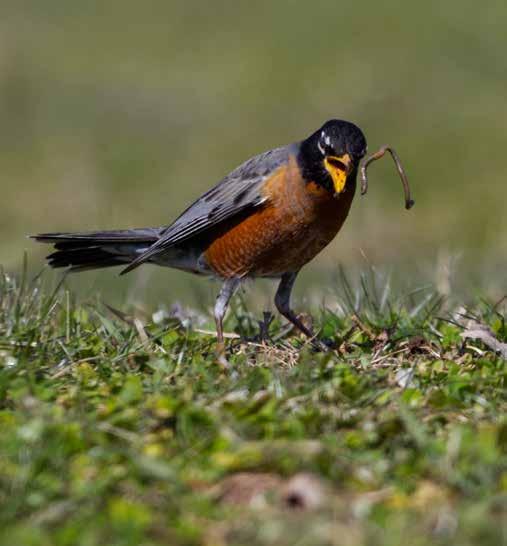

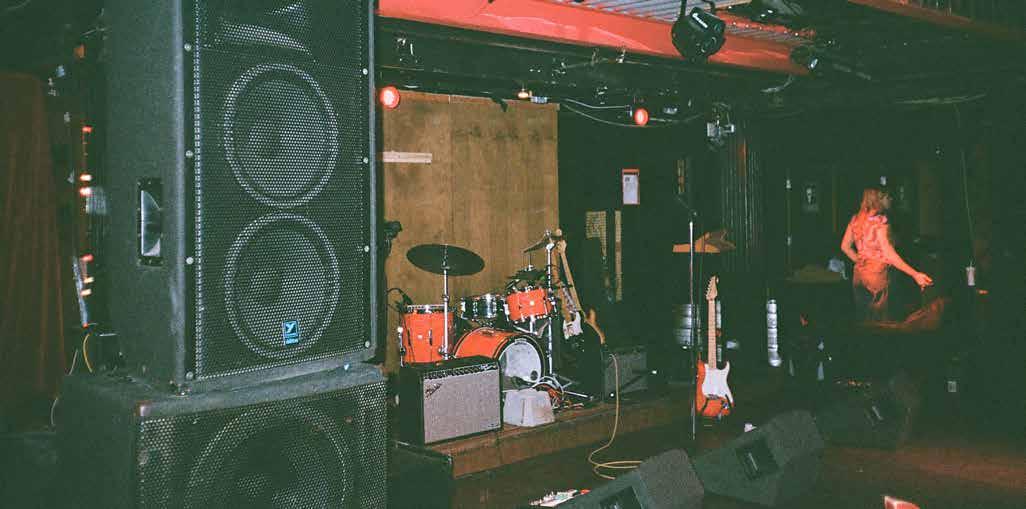
With no particular genre, here are a few song recommendations to get your summer playlist going, and this comes from someone who knows nothing about music other than that it must be one of the best products of humanity.
“Hanging by a Moment” by Lifehouse: This song always gets put on full blast as soon as the chorus kicks in. It feels recognizably 2000s right from the get-go with its intro guitar riff. The energy is ecstatic and contagious. It’s a solid, timeless song all the way around.
Favourite line: “You take all of me now.”
“Shimmer” by Fuel: This song does a great job of placing bursts of energy at the perfect points. The string instrumentals at the bridges give a growing anticipation and the guitar riff and lyricism right from the first second are the perfect hook for an increasingly good song.
Favourite line: “I never really know a killer from a savior, til I break at the bend.”
“Mr. Jones” by Counting Crows: This is a song that I feel like everyone knows. It's Counting Crows’ most popular song, and
it’s popular for a reason. The instrumentals feel so utterly summery to me that I just couldn’t leave it out. The desperation in the vocals by the end really pull the entire song together.
Favourite line: “If I knew Picasso, I would buy myself a grey guitar and play.”
“Soul Meets Body” by Death Cab for Cutie: This is definitely Death Cab’s most popular song, but gives a good entrance into their album Plans. “Crooked Teeth” and “I Will Follow You Into the Dark” are other familiar tracks on the album and possess that classic Death Cab airy, spooky vibe. The upbeat yet delicate instrumentals particularly strike me as summery and the echoey vocals match perfectly.
Favourite line: “I do believe it's true, that there are roads left in both of our shoes.”
“Logan to Government Center” by Brand New: This song is a tough first place on this energetic 2000s basement/garage emo album. Your Favorite Weapon is full of this energy, with “Secondary,” “Mixtape” and “Soco Amaretto Lime” being absolutely killer for summer vibes. The guitar pauses at minutes 1:55 and 2:00 are great composition choices for the song,
LAUREN RAND
along with the layered vocals that you can only really catch if you pay close enough attention—a classic Brand New move that I love every time.
Favourite line: “You’re a blue eyed lightning bolt, I’m a national phenomenon.”
“Are You the One” by Basement: In my opinion, this is the quintessential Basement song. Absolutely everything from the guitar, to the drums and the composition are perfect, and exactly their vibe. The instrumental intensity after the bridge is totally killer. This song always goes on full blast, and I never listen to this song less than twice in a row.
Favourite line: “Maybe we could be sweet eternity.”
“Tompkins Square Park” by Mumford and Sons: Wilder Mind is my favorite album from Mumford and Sons, and I think that this song takes first place for me, though close seconds are “The Wolf,” “Ditmas” and “Snake Eyes.” The entire album has a smoky nighttime feel with melodic electric guitar, which is especially notable in this song. Mumford's voice and lyricism are beautiful and the instrumentals
absolutely sell it. Favourite line: “One last time, just one last time.”
“With or Without You” by U2: This is U2’s most popular song for a reason. The instrumentals grow in intensity throughout the song, as do the vocals. This song is gutting—but absolutely perfect. No notes.
Favourite line: “See the stone set in your eyes, see the thorn twist in your side.”
“Closer” by Kings of Leon: This song off of their most popular album, Only By The Night, encapsulates a summer night in the first split second. “Sex on Fire” and “Use Somebody” are other popular tracks off the album that fit the same vibe. The vampiric lyrics matched with the ever-beautiful vocals is chilling. This one is definitely one of my favourites from them, and it fits a dark night perfectly.
Favourite line: “She took my heart, I think she took my soul.”
“Pyro” by Kings of Leon: This is another Kings of Leon song that I couldn’t leave out, and it’s one of their more popular songs. It has an incredibly intense ambience, and the guitar right from the start is hypnotic. This song
feels like a lonely evening right after sunset and hits all the bases for a Kings of Leon song.
Favourite line: “I won’t ever be your cornerstone.”
“Jigsaw Falling Into Place” by Radiohead: This song is very popular off of their In Rainbows album. This one is what really got me into listening to Radiohead, and to this day it’s still one of my favourites—even if it's a bit overplayed. It’s a classic example of Radiohead's ability to create a song that's progressive in intensity that works every time. Overall, it’s a solid tune with great imagery.
Favourite line: “The walls are bending shape, they got a Cheshire cat grin.”
“Title Track” by Death Cab for Cutie: The vocals in this song are utterly haunting, matched with the solemn lyrics. It's both gutting and comforting at the same time. The kick of percussion right in the middle feels like a shove in the back, a great compositional choice that I think makes the song really unique. Besides that, the drums absolutely make the song for me as they taper off into nothingness by the end.
Favourite line: “And I could taste your lipstick on the filter.”
An extensive guide on everything not to do while planning the perfect camping trip
BEN SEATON
As April rears its ugly head and the frigid months come to a much anticipated close, we once again approach summer, a season of warmth, renewal and time to reconnect with nature. One of the best things to do over the summer is to gather a group of friends, rent a canoe and spend a week detoxing from urban life. Before you dive headfirst into the bush, read this guide on what not to do when planning a camping trip.
Permits are an essential part of camping and are necessary to stay on nearly every lake in Ontario. For most adults, permits start at around $12 a night per person, while the fine for occupying a campground illegally begins at around $150. Normally, booking permits would be the first step to planning a successful trip, but in this instance, you can ignore this step. The path towards disaster is marked with the footsteps of the unprepared. You shouldn’t be roped into paying monumental campground fees just to enjoy camping on land that wasn’t ours to begin with.
Preparing a meal plan is necessary to ensure a smooth and well-organized camping experience. It’s important to remember to bring the proper equipment. Typically, a waterproof food barrel is required to maintain freshness and keep your food safe from the elements, as well as an adjustable barrel harness for carrying.
For our purposes, a cloth bag tied around the end of a stick and slung over your shoulder is all that’s needed. Don’t bother bringing non-perishable items either, as food spoilage introduces bacteria to strengthen the microbiomes in your gut. Make sure to pack food organized by day, starting with the first day at the bottom and layering on top of that. That way, when you need to get to the next day’s meal, you have to dig through every other day’s meal first.
I would also err on the side
of bringing less food, as you can always forage for mushrooms and berries or go fishing for your next meal. The added pressure of not knowing where your next meal is coming from strengthens bonds and forces the group to act on survival instincts.
Drinking lake water is unsafe and will cause what is commonly referred to as “beaver fever” and scientifically known as giardiasis. Beaver fever is certainly not for the faint of heart, as the symptoms closely align with what I could only describe as a slow and painful death by loss of fluids. Unless you are looking for a cheap alternative to Ozempic or other GLP-1 inhibitors, it is best to treat your water with purification tablets. The most common brand is Aqua Tabs, which you can acquire very cheaply online. On Amazon, you can buy enough tabs to purify 100 litres of water for around $25. I doubt anybody would ever regret buying too many Aqua Tabs, as they have a shelf life of five years and take up almost no space in your bags. You would certainly regret not bringing enough water tabs, and you would most likely have to reroute your entire trip on the fly to reach one of the few outfitter stores that carry water purification tablets (which I may or may not know from experience). Although this information is important for maintaining health and safety during your trip, you could probably ignore it. You’re different and have a gene that allows you to drink unsanitized lake water without getting sick.
Planning your trip too short or too long could be the difference between a fun getaway for the weekend and recreating an episode of Naked and Afraid by yourself. I would recommend a trip anywhere between four and six days in length. This allows you to take in the environment while still getting the proper experience of a canoe trip, without starting to feel fatigue from

how long you’ve spent in the bush. It’s also important to note that if you plan your trip from Friday to Friday, although it seems like one week, it’s actually eight days and should be accounted for as such. If you fail to take this into account, it could be disastrous for your trip. Then again, it could also just be a funny story to tell people when explaining the collective intelligence of your friend group.
It would be advantageous to check the weather forecast for the week you plan on camping and adjusting your trip from there. Harsh conditions make for excellent character-building, especially when you have to canoe 20 km and portage 3 km in the mud and rain. If the weather forecast is projected to be bad and you push through regardless, maybe consider bringing a rain jacket, a warmer sleeping bag, long pants and proper footwear—but make sure to leave it in the car.
It’s crucial that you always remember to leave the campsite in a worse condition than you found it. If somebody before you has taken the time to carve benches out of logs to sit on, you should chop them up for firewood. This trick works especially well during a province-wide fire ban. I would also recommend leaving scraps of food and garbage around the campsite to ensure that the group after you has plenty of encounters with wildlife upon arrival. It’s always been a dream of mine to stand face-to-face with a black bear because the group before me used leftover chicken as birdfeed.
Remember that any time you go travelling in a provincial park, you are entering a diverse ecosystem that houses 45 species of mammals, 50 species of fish, 30 species of reptiles, 262 species of birds and
7,000 species of insects. It’s imperative to remember that you are more important than they are! You are human, and you must do what humans do best: destroy ecosystems. If you come across a beaver dam, tear it apart with all your might. If you encounter a beehive, whack it with the blunt side of your oar. If you see a moose standing on the riverbed grazing peacefully from the cold stream, scream as loud as you can to alert all your friends that you see a moose. Fellow campers will appreciate you alerting them to the moose’s whereabouts.
If you’ve followed all of the steps up to this point, you should finish your trip sore, wet, hungry and sick. You will have more than a dozen stories to tell of your group’s harrowing efforts to survive situations of your own creation. Most importantly, you will be left with a truly unforgettable trip.
Aberfoyle Antique Market
Starting April 26 - Oct 25 / 8 a.m. - 4 p.m.
Location: Aberfoyle Antique Market / 57 Brock Rd S, Puslinch
With over 60 years in business, the Sunday Aberfoyle Antique Market hosts 100+ quality dealers selling collectibles, folk art, furniture, and more
$5 admission Sunday Market
$10 admission Saturday Special Market on June 6
MAY 1, 2 & 4
Elora Festival's Giant Book Sale
May 1 / 1 - 9 p.m.
• May 2 / 9:30 a.m. - 5 p.m.
May 4 / 9:30 a.m. - 4:00 p.m.
Location: Elora Curling Club / 27 David St W Elora
• Bring a bag and choose from 60, 000 gently read adult and children’s fiction and non-fiction books, games, DVDs, CDs and records
• This event is a fundraiser for the Elora Festival
• $5.00 adult admission on Friday Free admission on Saturday and Sunday
EVERY SUNDAY SAT MAY 2
Puslinch In Bloom Vendor Market
12 - 4 p.m.
Location: Puslinch Community Centre / 23 Brock Rd S, Puslinch
A space created to support small businesses through connection, encouragement, and community
• Expect a cozy atmosphere, a food truck on site, and multiple vendors to browse
MAY 9 & 10
Mother's Day on the Farm
May 9 / 9 a.m. - 5 p.m.
May 10 / 9 a.m.- 5 p.m.
• Location: Erin Hill Acres / 5837 3 Line, Erin
• Treat the moms in your world to a beautiful day on the farm and experience:
• Fun photo ops
• The retail shoppe with unique gifts Walks across 92 scenic acres
Tractor-drawn wagon rides through the lavender fields
Furry Highland cows, pygmy goats and celebrity donkeys, ponies, alpacas & chickens
• Farm Fresh Food
• Mom-osa Bar
General Admission ages 10 and up: $16.50, Child 5 to 9 years old: $6.50, Infants and Toddlers Ages 0-4: Free
THURS MAY 14
Plant Sale
• 10 a.m. - 3 p.m.
• Location: Outside Crop Science Vegetables, native wildflowers, and more!
Cash & debit / credit accept
• Hosted by the Plant Agriculture Graduate Student Liaison Committee
TUES MAY 19
Women Doing Cool $h!t Panel Discussion
5:30 - 8 p.m.
• Location: 10C Shared Space
Women Doing Cool $h!t is a panel series celebrating women in tech who are building, leading, and disrupting in ways that matter.
Each event brings together bold voices from across the industry for an honest, energizing conversation about their paths, their work, and what it really takes to do something worth talking about.
• Free admission
SUNDAYS
The Donkey Sanctuary of Canada
• Almost every Sunday from May 10 - July 26 / 11 a.m. - 4 p.m.
Location: Donkey Sanctuary of Canada / 6981 Conc 4, Puslinch
Relax this summer and unwind while visiting donkeys, mules and hinnies at The Donkey Sanctuary of Canada
Adult tickets: $20 Advance ($25 walk-in)
Senior (age 65+) tickets: $15 Advance ($20 walk-in)
• Student tickets: $15 Advance ($20 walk-in)
• Child (age 3-12) tickets: $10 Advance ($15 walk-in) Children age 2 and under tickets: Free Family Admission (2 adults + 3 children): $60 Advance ($80 walk-in)
SAT MAY 23
Fergus Fibre Festival
9:30 a.m. - 4:30 p.m.
• Location: Downtown Fergus (between Tower and St. David Streets) / St. Andrew Street West, Fergus Wrap yourself in the warmth and wonder of the Fergus Fibre Festival—a full day of fibre-filled fun in the heart of downtown Fergus
There will be live entertainment, food trucks, furry friends like alpacas and sheep, along with demos and displays of flax-to-linen processing, wool spinning and weaving, lace making and more
• Free admission
SUN MAY 24
Art Market
11 a.m. - 4 p.m.
Location: Guelph Farmers Market
Discover a vibrant collection of local artwork, pottery, jewelry, and handcrafted treasures
This event will also feature an art supplies swap so don’t miss this chance to support local artists and find one-of-a-kind pieces! Free admission
TUES MAY 26
Black Brilliance Conference
Each year, the Cultural Diversity team hosts more than 150 Black students from the Upper Grand District School Board to introduce them to the University of Guelph
MAY 29 & 30
Meadows Music Festival
• Location: Centre Wellington Community Sportsplex / 550 Belsyde Ave E, Fergus
Kick off summer with good tunes, drinks, food, and great company while watching your favourite artists like The Arkells, Yukon Blonde, Wild Rivers and more!
Ticket prices vary, find more info @meadowsfest. frontgatetickets.com
TUES JUNE 2
VARIOUS DATES
Yoga with Alpacas
May 10, May 30, June 7, June 13, June 21 10 a.m. - 11:30 p.m.
• Location: Brae Ridge Farm and Sanctuary / 7667 Maltby Road East, Puslinch
Under the guidance of an experienced instructor, embark on an all-levels yoga journey while alpacas peacefully roam around you, adding a touch of magic to your practice
• No experience with yoga is needed Tickets: $60 + HST
JUNE 5 - 14
Guelph Summer Pride
Guelph Summer Pride is a collaboration between a wide range of 2SLGBTQIA+ community organizations, coming together to create spaces where the many communities of Guelph can gather in celebration. Go to outontheshelf.com/pride/summer-pride for more information and updates
SAT JUNE 6
Ontario Craft Gin Festival
• 12 - 6 p.m.
Location: Elora Centre for the Arts / 75 Melville Street, Elora
• An afternoon to sip and savour a wide array of Gins with samples, limited edition sales, cocktails, music, and guest speakers on mixology, history, pairing, and blending.
Tickets: $15 - $20
JUNE 12 - 14
Multicultural Festival
• 12 - 6 p.m.
Location: Riverside Park
This year it will be Guelph’s 40th Multicultural Festival with beautiful cultural performances, a wide range of food, plenty of live music and much, much more! Free admission
SUN JUNE 14
Queer Service Provider Fair
• 12 - 5 p.m.
Location: Guelph Farmers’ Market
Queer Night Out presents their first Queer Service Provider Fair to eliminate barriers by bringing queer-operated and ally-operated businesses to you, to get rid of the guesswork, erase the fear, and just let you find the services you need
JUNE 19 & 20
Junction Craft Beer Festival June 19 / 6 - 10 p.m. & June 20 / 12 - 10 p.m.
Location: Fixed Gear Brewing Co. / 5 Edinburgh Rd S, Guelph
See Guelph transform into a vibrant hub of craft beer innovation and country music energy.
Whether you're a seasoned beer connoisseur, a dedicated country fan, or just looking for a fantastic time with friends, this festival has something for everyone! Ticket prices vary
SAT JUNE 20
Art on the Street
• 10 a.m. - 5 p.m.
Location: Quebec Street / Guelph, ON Spotlights talent within the regional arts community and offers an art experience for Guelph’s residents and visitors.
Each year, established and emerging artists showcase their works to several thousand visitors in temporary, open-air studios Free admission
• 6 - 10 p.m.
Location: Guelph Farmers’ Market
Cool off with an evening featuring local food offerings, night vendors, live music and an awesome community! Free admission
• Location: University of Guelph
Expect music, food, entertainment, obstacle courses, and a family fun zone at this Olympic style festival
• Free to attend
Learn more about registering to complete at The Good Games 2026 Guelph
Tour De Guelph
• Location: University of Guelph
An inclusive community cycling event that welcomes all ages and abilities to participate
• Register to ride, lead a team, donate, sponsor, volunteer, or simply come out to cheer! Great Lakes Medieval Tournament & Faire July 11 / 7 p.m. - 12 a.m. July 12 / 9 a.m.
• Location: Everton Scout Camp / 5286 7 Line, Guelph/Eramosa
July 11 is a 19+ event and includes a pub and night market, with two bands and an acrobatic act
July 12 is a family event taking place with local vendors selling handmade and locally sourced goods, food and drink, medieval themed groups and activities, public archery, axe throwing and Ranger Rumble
Ticket prices range, find more info @greatlakesmedievaltournamentandfaire.ca Summer Solstice Night Market
Hillside Festival
Location: Guelph Lake Island / 7743 Conservation Rd, Guelph/Eramosa
A three-day, multi-stage event with a broad artistic vision that celebrates creativity through artistic expression, community engagement, and environmental leadership
• Tickets: ranging from $155 - $230 +HST
Film Club Market
5 - 10 p.m.
Location: Guelph Farmers’ Market
• An evening market experience for movie lovers, creatives, and anyone drawn to the atmosphere of cinema The event blends a curated lineup of local vendors with film-inspired art, goods, and storytelling
• Free admission
Cheesecake & Taco Fest
July 18 / 11 a.m. - 5 p.m. AND July 19 / 11 a.m. - 4 p.m.
• Location: Centre Wellington Community Sportsplex / 550 Belsyde Ave E, Fergus
Enjoy some of the most unique and delicious cheesecake and taco flavours all in one place with a margarita bar, live music all weekend, and an artisan market Tickets: $5 admission (cash only!)
Fergus Medieval Faire
11 a.m. - 5 p.m.
• Location: Downtown Fergus Step into another century at the Fergus Medieval Faire
• Featuring knights and ladies, vikings, battles, magicians and wizards, monks, birds of prey, musicians, archery practice, and more!
Guelph Outdoor Handmade Market Summer Series
Location: Royal City Park / Guelph Stroll along the scenic paths by the Speed River, explore unique maker booths, and enjoy live music from talented local artists Free admission
Pirate Festival
• 11 a.m. - 6 p.m.
• Location: Marden Park / 7368 Wellington County Road 30, Guelph
• A full, three-day weekend of activities, including: circus shows with fire-eating, sword-fighting, acrobatics, and more!
• Kids' activities and shows, archery and axe-throwing, and over 50 of the area's best artisans selling handcrafted wares
Tickets:
Children 5 and Under - $FREE!
Children (6-16) - $12.00
Adult (17-64) - $20.00
• Senior (65+) - $12.00
Family pack: Two Adults and up to Six Children - $60.00
Tickets are only available at the Front Gate. You can pay by cash, debit, or credit card
28 - 30
Guelph Ribfest
• August 28 / 4 - 11 p.m.
• August 29 / 11 a.m. - 11 p.m.
August 30 / 11 a.m. - 8 p.m.
Location: Riverside Park / 709 Woolwich St, Guelph
• Ribs, live music, classic cars, and carnival rides, what more could you need Free admission
Follow @ontarionupdates on Instagram for information on more events in Guelph this summer!



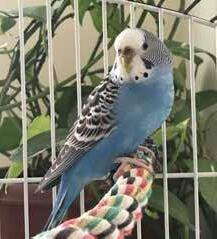
Breed: Cockapoo
Photo: Aditya Parameswaran
Age: 2
Fun Fact: Loves watching cricket on TV, and hates when I buy new cameras
BILLY! Breed: Domestic Longhair
Photo: Nikki Legault Age: 2
Fun Fact: Will do anything for a Churu treat
NYLAH!
Breed: Mini Cockapoo
Photo: Riya Vaid
Age: 6
Fun Fact: She can keep a balloon up with her snout
Breed: Budgerigar
Photo: Sarah Panchal
Age: 9
Fun Fact: Despite being born with a missing toe on her left foot, her favourite activity is climbing the vines of the plant behind her and pretending she's on an adventure


What are you most excited about this summer?
Spending time near the water
What's in your picnic basket?
Watermelon & sparkling water
Can you borrow a car for an afternoon?
Canoe or kayak down the Speed River
If you like to paddle, spend an afternoon kayaking or canoeing along the Speed River. You can launch your own boat from points off of the Royal Recreation Trail, or rentals are available from May to September from Speed River Paddling. There can be high demand for the first-come, firstserve rentals during sunny weather, so arrive early to get your name on the list. Finish off the day with a towering ice cream cone from The Boathouse!
Want to get a workout in under the sun?
Are you more creative or adventurous?
Do you have a bike?
Preservation Park is a forested oasis with boardwalks, bridges and creeks that will make you forget you’re in the city. The park’s outer loop is nearly 8km in length, but there are tons of shorter trails in the area—we recommend checking out paths on AllTrails or in the Wellington, Waterloo & Guelph edition of Loops & Lattes Hiking Guides. It’s the perfect spot to immerse yourself in nature while getting your steps in.
Swim at Rockwood Conservation Area
Less than a 15 minute drive from U of G are the stunning limestone cliffs, caves and glacial potholes at Rockwood Conservation Area. Entrance to Rockwood costs less than a movie ticket, at $9.50 per person or $19 per vehicle for a day pass. It’s even rumoured that the forest scenes in Frankenstein (2025) were shot at Rockwood! Whether you swim, explore the wooded forests or lounge on the sandy shores, you’ll enjoy what this conservation area has to offer.
Birdwatch at the Arboretum
We’ve often written about the variety of birds that can be spotted in U of G’s Arboretum, so why don’t you give birdwatching a try this summer? You don’t need any equipment to start birding, but you might benefit from borrowing a pair of binoculars to spot one of the 211 species living in the Arb. Submit a spotting through eBird or see what there is to discover with one of the Arboretum’s Biodiversity Booklets.
Mountain bike at Guelph Lake Conservation Area
Take your summer adventures off the beaten path with mountain biking. Thanks to the Guelph Off-Road
Bicycling Association (GORBA), all are welcome to explore the maze of biking trails within the Guelph Lake Conservation Area, for free! The GORBA website has a detailed map of the trail system which is colour coded according to trail difficulty levels. Remember to follow trail etiquette: do your best to maintain flow, leave no trace, and most importantly, be a good neighbour.

























1. How are you spending the summer?
a) Working my dream internship
b) At the cottage
c) On a patio
d) Fun(employment)
e) Having a "Euro summer"
2. What’s your song of the summer?
a) "House Tour" by Sabrina Carpenter
b) "Hole in the bottle" by Kelsea Ballerni
c) "Where you are" by John Summit and HAYLA
d) "Lush Life" by Zara Larson
e) "Choosin’ Texas" by Ella Langley
3. What’s your go-to summer shoe?
a) Birkenstocks
b) Cowboy boots
c) Flip flops
d) Hiking shoes
e) Wedged sandal
4. How do you spend a beach day?
a) Under the umbrella
b) Beach volleyball
c) Building a sand castle
d) Swimming
e) Tanning on a floaty
5. What’s your summer scent?
a) Floral
b) Fresh linen
c) Peaches
d) Sandalwood
e) Coconut
6. What’s your favorite iced drink?
a) Iced lemonade
b) Iced tea
c) Iced latte
d) Slushie
e) Iced matcha
7. What’s your go-to summer accessory?
a) Sunglasses
b) Fanny pack
c) Bottle of sunscreen
d) Bucket hat
e) Tote bag
8. What movie are you watching this summer?
a) The Odyssey
b) Spider-Man: Brand New Day
c) You, Me and Tuscany
d) Dune 3
e) Devil Wears Prada 2
9. What is the ice cream served in?
a) Paper cup
b) Waffle cone
c) Plain cone
d) Dipped cone
e) Waffle bowl
10. How many scoops?
a) Soft serve
b) 2
c) Kid scoop
d) 3
e) 1
The classics are beloved for a reason—like you, vanilla bean. You stick with your ice cream order just like you stick with your signature hairstyle. It’s good to be comfortable, but don’t say no to a spontaneous plan when it arises. You never know how fun it could be!
You love the best of both worlds: sweet and salty, adventure and relaxation. Your summer wouldn’t be complete without a bonfire, surrounded by friends and good tunes. Instead of a s’mores kit, may we suggest roasting a PB & J over the fire?

You’re as sweet as a peach on an August day. Your summer uniform is a sundress (or a linen button-up), which is the perfect fit for a sunny picnic. When you pack your basket, don’t forget a camera to capture your summer memories.
You’re the life of the party (and you show up on your bike). You’re also the friend on speed dial, always ready to do things for the plot. Don’t forget to slow down and enjoy a sunset as much as an action-packed afternoon.
You’re a trendsetter with impeccable taste. No summer day would be perfect without a high UV, your favourite sunglasses and a beach read—which you’ll recommend to all of your friends. Be sure to scrapbook your summer and maybe even turn it into a coffee table book!
What are graduating U of G students looking forward to this summer?

Hanging with my friends and going to the beach.
Jessie Pearson Psychology

I’m excited to go to Osheaga this summer and have fun in Montreal.
Chloe Storto-Borbely Environmental Governance

I’m just looking forward to traveling this summer. I’m graduating this year so I'm looking forward to that, having some fun and then seeing where kind of the future takes me.
Maria Carabajal Biomedical Science
Going to the cottage with my roommates.
Elsa Lebinger Psychology

Travelling with my best friend, going to concerts. We're going to study for our DAT together and hopefully apply and get in and start the next chapter of our lives.
Isabella Spinelli Biomedical Science
University Centre Room
University
6–"Rhyme Pays" rapper
7–Choir member
8–Hollywood icon Marilyn
9–Fab Four name
10–Legume
11–Coup d'___
12–Airport countdowns
13–Ballet step
22–Refluent
24–It may be acquired
26–Academy award
27–Grocery, e.g.
28–Straighten
30–RR stop
31–Official language of India
33–Copycat
34–Push rudely
35–Employ again
36–Illegal fire
47–Journalist Jacob
48–Witnessed
49–Afore
51–Sushi choice
53–Translucent, waterproof parchment
58–TV host Gibbons
of joy
18–Highest European volcano
19–Small batteries 20–Refine
21–Downpours
23–Back muscle, briefly
25–Heavenly body
26–Anthem starter
29- Tennis Hall of Famer Arthur
32–Iraqi port
37–NL cap monogram
38–Italian wine town
39–Coded message
40–At the same time
43–Sock pattern
44–Medicine
45–Brandy letters
46–“Bridget Jones” star
62–Former Hungarian premier Nagy
63–Linetti on “Brooklyn NineNine”
64–Ran in neutral
65–Alcoholic drink of fermented honey
66–Tolkien tree creatures
67–Greek marketplace
68–Elsa’s sister in “Frozen”
69–Antitoxins
70–Spanish gentleman
Down
1–Swimmer's regimen
2– Ancient civilization in modern Iran
3–Gen. Robt. ___ 4–No kidding! 5–Busybody
38–Not up
39–Bring about
41–TV's "Science Guy"
42–Prefix with angle
47–Fret
48–Heavy hammer
50–Fads
52– Biblical prophet
53–Bodement
54–Tehran's country
55–Moon of Jupiter
56–___'acte
57–Tabula ___
59–North Carolina college
60–Round number?
61–Hebrew month
62–The Monkees' "___ Believer"
For your chance to win two Bobs dog’s and two pops, just complete the crossword, snap a picture, and send it to puzzles@theontarion.com by May 28 at 3 p.m. Winners are announced in each issue and can arrange a pickup of their voucher by emailing the same address.
Last issue’s winning puzzle was submitted by Jesse Lloyd!
519-824-4120
Editorial: x 58250
Advertising: x 58267 Accounts: x 53534
EDITORIAL STAFF
Editor-in-Chief
Rachel Fioret
Associate Editor
Emmerson Jull
News Editor
Abby Counahan
Arts & Culture Editor
Andreea Burlacu
Copy Editor & Fact Checker
Carlota Sousa
Digital Editor
Alyssa Cunningham
PRODUCTION STAFF
Graphic Designer/Art Director
Paige Stampatori
Photo & Graphics Editor
Aditya Parameswaran
OFFICE STAFF
Executive Director
Patrick Sutherland
Accountant
Laurie Arnold
Marketing Coordinator
Lucca Maggiolo
BOARD OF DIRECTORS
Chair
Katelynn Huong
Vice Chair
Paula Henry-Duru
Treasurer
Denver Bakhareva
Secretary OPEN POSITION
DIRECTORS
Simran Aujla
Oliver Bullingham
Nathaniel Diamant
Mariana Erazo
Maia Galletta
Marah Husien
Huda Shoaib
CONTRIBUTORS
REMA ABDULLAH
AMIR BENKELAI
MADISON BOUTILIER
HANNAH DICKHOFF
ELISE FREDERIKSEN
MANZIL GROVER
HELENA HILDEBRANDT
AVERY HOLMES
ASHLEY MAROZSAN
ABIGAIL MILNE
GEMMA NGOC LE
AVERY NUTTLEY
LAUREN RAND
KYLE SALTER
KIERA SCHARF
EMILY SCOTT
BEN SEATON
HUDA SHOAIB
AVA VENDER