COMPETING WITH CONFIDENCE
DRIVING
THE FUTURE OF BEEF
64th Beef Farmers of Ontario Annual General Meeting
February 18-19, 2026
Delta Hotels by Marriott Toronto Airport & Conference Centre


DRIVING
64th Beef Farmers of Ontario Annual General Meeting
February 18-19, 2026
Delta Hotels by Marriott Toronto Airport & Conference Centre
Wednesday, February 18, 2026
7:00 a.m - 9:00 a.m. Registration
9:00 a.m.
Welcome and Convene – Craig McLaughlin, BFO President
Adopt and Approve Agenda and Elect Scrutineers
Approve Minutes of 2025 Annual General Meeting
President’s Address – Craig McLaughlin
Election of Directors to the 2026 BFO Board of Directors
Review of 2025 Audited Financial Statements
Canadian Cattle Association Update
10:30 a.m. Morning Break - Sponsored by Masterfeeds
10:50 a.m. Ontario Beef Market Development Program Update
11:10 a.m. Partner Spotlight: From Farm to Classroom, AgScape
11:20 a.m. Cattle Market Outlook, Steve Duff

Chief Economist, Ontario Ministry of Agriculture, Food & Agribusiness
12:15 p.m. Lunch (Plaza C)
1:15 p.m. Reconvene
Ratification of the 2026 BFO Board of Directors & Announcement of President and Vice President
Elections to the 2026 BFO Feedlot and Cow-Calf Committees
Elections to the Canadian Cattle Association Committee Reports
Vote on Proposed Constitution and By-Law No. 1 Amendments
2:30 p.m.
Afternoon Break - Sponsored by Brodie Ag & Industrial Inc.
Debate on Resolutions
Approval of 2025 Audited Financial Statements
Closing Remarks
5:30 p.m. Past Presidents Reception - Plaza Foyer
6:30 p.m. BFO ANNUAL BANQUET - Plaza ABC
The Environmental Stewardship Award - Sponsored by RBC Royal Bank
The Ontario Pasture Award - Sponsored by DLF & Ontario Forage Council Member Awards and Recognition
After-Party - Plaza Foyer

Thursday, February 19, 2026
8:00 a.m - 9:30 a.m. Registration (Plaza Foyer)
7:00 a.m. BFO Board of Directors Meeting - Ottawa Room
7:30 a.m. BFO Advisory Council Meeting and Breakfast - Toronto AB
8:00 a.m. Voting Delegate Breakfast - Plaza C
9:30 a.m. Welcome “Sustainable Livestock, Sustainable Future” Dr. Frank Mitloehner Professor and Air Quality Extension Specialist, UC Davis Sponsored by MNP
10:30 a.m. Morning Break - Sponsored by Robert’s Equipment
10:50 a.m. BFO Board of Directors Q&A Discussion
11:20 a.m. Debate on Resolutions (if required)
12:15 p.m. Lunch (Plaza C)
2026 Cow-Calf Committee Lunch Meeting - Toronto AB Room 2026 Feedlot Committee Lunch Meeting - Ottawa Room
1:15 p.m. Debate on Resolutions (if required) 3:00 p.m. Adjourn (late afternoon)
Please take the time to visit with our exhibitors in the plaza foyer and plaza A throughout the AGM, and thank them for their support.
Agricorp
AgScape
AgSights
Beef @ Guelph
Boehringer Ingelheim
Brodie Ag & Industrial Inc.
Brussels Agri Services Ltd.
Canadian Cattle Identification Agency
Canadian Speckle Park Association
Clarke Family Farms
Farm Credit Canada
Grand Valley Fortifiers
Intervet Canada Corp
Jones Feed Mills
Kane Vet Services
Masterfeeds
Metzger Veterinary Services
Ontario Angus Association
Ontario Beef Market Development Program
Ontario Charolais Association
Ontario Federation of Agriculture
Ontario Limousin Association
Ontario Shorthorn Association
Ontario Soil and Crop Improvement Association
Phibro Animal Health Corp.
Quality Seeds
Ritchie Bros. Auctioneers
Robert’s Equipment
Solvet
Technical Standards and Safety Authority
Vetoquinol Canada
Wallenstein Feed & Supply Ltd.
WeCover
Zoetis
















FEBRUARY 17, 2026
7:30 P.M. - 9:00 P.M.
DELTA HOTELS BY MARRIOTT TORONTO
AIRPORT & CONFERENCE CENTRE, PLAZA C
Join us for an evening of learning and hospitality as we kick-off our annual meeting.
Back From the Brink:
The New World Screwworm Threat to American Cattle
Dr. Bruce Kostelansky, Technical Services Veterinarian-Cattle, Zoetis
From the Lab to the Field:
Driving the Future of Beef Through Research
Moderated by Dr. Katie Wood, University of Guelph
A livestream of Cattle Academy can be viewed by visiting livecast.live/ontariobeefagm
PROUDLY PRESENTED BY
BRSV IBR virus PI3 virus & M. haemolytica BVD virus Type 1 and 2 Contact your veterinarian or Zoetis territory manager to learn more about complete calf protection or visit www.crb-solutions.ca.
Concurrent administration, comprehensive coverage
Intranasal administration of INFORCE 3 combined with One Shot BVD demonstrated protection against the most common agents that cause pneumonia in young calves.1,2
Published, peer-reviewed studies
INFORCE 3 was shown to be effective against BRSV and IBR in the face of maternal antibodies.3,4

BRSV: bovine respiratory syncytial virus; BVD: bovine viral diarrhea; IBR: infectious bovine rhinotracheitis; M. haemolytica: Mannheimia haemolytica; PI3: parainfluenza virus.
1. U.S. Department of Agriculture (USDA). Summary of Studies Supporting USDA Product Licensure. Bovi-Shield Gold One Shot. August 18, 2022. Accessed April 25, 2024. https://www.aphis.usda.gov/sites/default/files/2023-10/190-4x4120.pdf
2. Stoltenow CL, Cortese VS, Seeger JT, Stokka GS, Weigel D. Immunologic response of beef calves to concurrent application of modified-live viral vaccine (intranasal and systemic administration) and systemically administered Mannheimia haemolytica bacterin-leukotoxoid. Bovine Pract. 2011;45(2):132–138.
3. Mahan SM, Sobecki B, Johnson J, et al. Efficacy of intranasal vaccination with a multivalent vaccine containing temperature-sensitive modified-live bovine herpesvirus type 1 for protection of seronegative and seropositive calves against respiratory disease. J Am Vet Med Assoc. 2016;248(11):1280–1286.
4. Ellis JA, Gow SP, Mahan SM, Leyh R. Duration of immunity to experimental infection with bovine respiratory syncytial virus following intranasal vaccination of young passively immune calves. J Am Vet Med Assoc 2013;243(11):1602–1608.
trademarks are the property of Zoetis or its licensors.
FEBRUARY 17, 2026
5:30 P.M. - 7:30 P.M.
DELTA HOTELS BY MARRIOTT TORONTO
AIRPORT & CONFERENCE CENTRE, TORONTO AB
This casual reception is an opportunity to meet with young beef farmers from across the province, as well as BFO board and committee members and other industry stakeholders. The event is open to all producers between the ages of 18-35 who are attending the Beef Farmers of Ontario Annual General Meeting.
BFO also offered complimentary registration to BFO's AGM to all members of the OBYA
OBYA RECEPTION
PROUDLY PRESENTED BY


Grab a partner and bring your competitive spirit for a night of indoor backyard games, Olympic broadcast & hospitality! 9:30pm - 12Am hospitality

Join us for the Past Presidents Reception from 5:00 p.m. - 6:30 p.m. in the Plaza Foyer
Wednesday, February 18, 2026
6:30 p.m.
Delta Hotels by Marriott Toronto Airport & Conference Centre, Toronto
Tickets: $100/person
Includes Ontario Corn Fed Beef Dinner and BFO After-Party


Wednesday, February 18
Plaza Foyer
Immediately Following the Banquet 9 P.M. to 11 P.M.

BROUGHT TO YOU BY:

Back From the Brink: The New World Screwworm
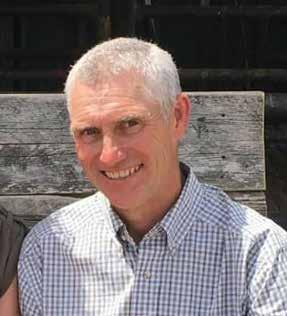
Bruce Kostelansky is currently a Technical Services Veterinarian-Cattle with Zoetis, joining them in June of 2020. Prior to this he was an owner in the Fort Macleod Veterinary Clinic in Fort Macleod, Alberta for 26 years. It was a busy mixed animal practice and Bruce dealt primarily with the large animal component of the practice. Cattle work involved a large cow-calf segment, feedlot, purebred operations and some fairy. He also enjoyed working with horses and was very involved with that portion of the practice. He enjoyed being a veterinarian, owning a practice and the many relationships he developed with clients over the years.
He is a 1989 graduate of the Western College of Veterinary Medicine. After graduating he attended Kansas State University where he completed a Food Animal Internship and worked at several practices in Southern Alberta before settling in Fort Macleod. He currently lives with his wife Valerie just outside of Fort Macleod. Bruce is involved in the cattle feeding industry and enjoys spending time outdoors hunting and fishing.
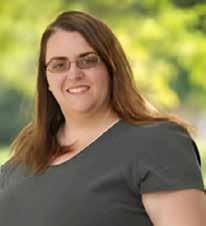
MODERATED BY DR. KATIE WOOD, UNIVERSITY OF GUELPH
Dr. Katie Wood developed a passion for animal agriculture early in life through her experiences on her family’s cow-calf operation and through her involvement in the 4-H program. After concluding her Ph.D., she completed an NSERC post-doctoral fellowship at the University of Saskatchewan. During this time her work focused on understanding gut barrier function and nutrient absorption in ruminants and their interactions with health, metabolic disease and production efficiencies. Katie returned to the University of Guelph in April 2016 as a faculty member. Outside of her research, Katie breeds, owns and shows Simmental cattle and Polled Dorset sheep.
Joining Dr. Katie Wood for this session will be Madeline McLennan, Titouan Chapelain, Adam Shea and Robert McKinlay.

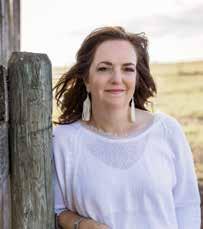
Andrea Brocklebank will become the Canadian Cattle Association’s (CCA) Chief Executive Officer in early March, 2026.
Andrea joined CCA in 2004 and held various roles with Canfax Research Services and the Beef Cattle Research Council (BCRC) before becoming Executive Director of BCRC in 2009. In her current position, she manages the delivery of research through the BCRC and Beef Science Cluster to fund research in areas of importance to the industry. She oversees the administration of funding received through the Canadian Beef Cattle Check-Off, Agriculture and Agri-Food Canada, and other sources to deliver research programming, knowledge mobilization activities, and the Verified Beef Production Plus program.
Brocklebank completed a Bachelor of Arts in agricultural studies at the University of Lethbridge and Masters of Science in agricultural economics at the University of Saskatchewan. She was raised on a farm in southern Alberta that she and her husband now manage. Prior to working with the CCA, she worked within the Canadian cattle feeding sector and in agriculture finance and lending.

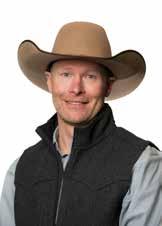
Tyler is currently President of the Canadian Cattle Association (CCA). He became involved with CCA as a natural extension of his work with the Manitoba Beef Producers.
Tyler is the third generation on his farm and together with his wife, Dorelle, and kids Evan and Mae, they own and operate Tyton Farm Ltd, just south of Birtle, Manitoba. They run about 600 cow-calf pairs and a small backgrounding lot that they use for their own calves. The herd is a commercial herd with influence from Simmental, Red and Black Angus, and Gelbvieh. They grow hay and corn for silage and winter grazing and have a small amount of grain production that integrates well with the cattle operation. The farm consists of about 5,500 acres of owned and rented land with most of this as tame and native pasture.

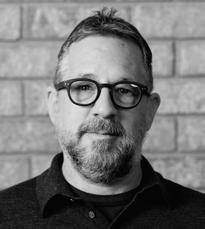
Independent retailers, restaurants, butcher shops, and further processors are key market segments for the Ontario Beef Market Development program. In 2025, the team expanded their capacity to engage more retailers, processors, and local distributors with the addition of Derek Boudreau as Marketing Manager.
Derek brings a wealth of knowledge and strong industry relationships from his background in Ontario’s meat sector. Highly respected within the industry, he offers valuable insights that strengthen our market development efforts.

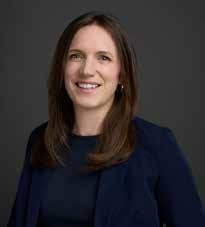
Amanda Robertson is the Executive Director of AgScape and brings a lifelong passion for agriculture and food literacy to her role. Born and raised on a dairy farm, she has always believed in helping people understand where their food comes from and why agriculture matters.
With experience as a school board trustee and in the non profit sector, Amanda values hands on, curriculum connected learning that helps young people see themselves as part of Ontario’s agriculture and food system. She holds a Master’s degree in Occupational Therapy and brings a strong focus on participation, inclusion, and meaningful connections between communities and agriculture.
In her leadership role, Amanda is focused on building strong partnerships that support AgScape’s agriculture and food literacy work, educational programs that connect students, educators, and communities to Ontario's agriculture and food sector.

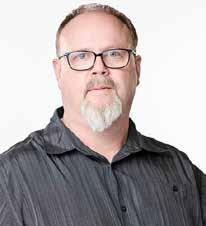
Steve has a dairy and beef background from Northumberland County. He completed a Masters in Agriculture Economics from the University of Guelph in 1996, and after a year as policy researcher for the Ontario Milk Marketing Board, Steve joined the Ontario Ministry of Agriculture, Food and Agribusiness (OMAFA) in late 1997. For 15 years, Steve was OMAFA’s lead on business risk management programs such as AgriStability and the Risk Management Program. Steve has chaired several federal-provincial-territorial committees, including BRM Policy, BRM Program Administrators, AG Trade Policy, BSE response.
In 2016, Steve was the recipient of the University of Guelph Food Agriculture, Resource Economics Distinguished Alumni Award. Steve is currently OMAFA’s Chief Economist and is also an adjunct professor at the University of Guelph and teaches fourth year ag policy analysis.
Steve and his wife Robyn operate a beef and cash crop operation near Colborne Ontario.
Sustainable Livestock, Sustainable Future: Why we need a toolkit of solutions to improve sustainability in animal agriculture
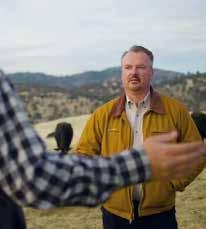
Dr. Frank Mitloehner is a professor and air quality specialist in cooperative extension in the Department of Animal Science at UC Davis in California. As such, he shares his knowledge and research, both domestically and abroad, with students, scientists, farmers and ranchers, policy makers, and the public at large.
Frank is committed to making a difference for generations to come. As part of his position with UC Davis and Cooperative Extension, he collaborates with the animal agriculture sector to create better efficiencies and mitigate pollutants. He is passionate about understanding and mitigating air emissions from livestock operations, as well as studying the implications of these emissions on the health of farm workers and neighboring communities. In addition, he is focusing on the food production challenge that will become a global issue as the world’s population grows to nearly 10 billion by 2050.
Frank received a Master of Science degree in animal science and agricultural engineering from the University of Leipzig, Germany, and a doctoral degree in animal science from Texas Tech University. Frank was recruited by UC Davis in 2002, to fill its first-ever position focusing on the relationship between livestock and air quality.
Sector/Region Current Director 202 6 Candidates Requirements
COW-CALF
(1 rep to elect, for 3-year term)
FEEDLOT
(1 rep to elect, for 3-year term)
FEEDLOT
(1 rep to elect, for 1-year term)
BACKGROUND
(1 rep to elect, for 3-year term)
EAST
(1 rep to elect, for 3-year term)
Don Hargrave
Will Briscoe (Renfrew)
Don Hargrave (Grey)
Ray Korten (Leeds)
Erin Theriault (Grenville)
Jairus Maus Jairus Maus (Bruce)
Tom Kroesbergen Lisa Pallister (Grey)
Joost van der Heiden
Craig McLaughlin
Elected by voting delegates identified as "Cow-Calf”
Elected by voting delegates identified as “Feedlot”
Elected by voting delegates identified as “Feedlot”
Joost van der Heiden (Perth)
Will Briscoe (Renfrew)
Ray Korten (Leeds)
Don Scott (Grenville)
Erin Theriault (Grenville)
Elected by voting delegates identified as “Background”
Elected by voting delegates residing in "Eastern” Ontario
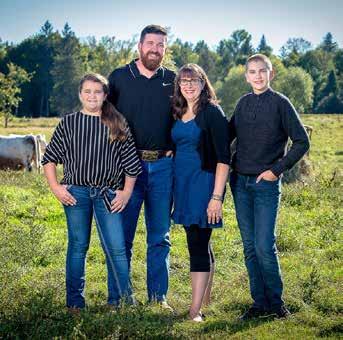

Provide details of your farm operation including experience in cattle production and knowledge of current beef sector issues. In addition, please describe your vision for Ontario’s beef sector and, in your opinion, the top three challenges the sector needs to address:
I, along with my wife Nancy and children Anthony & Lillian, own and operate Wil-B Cattle Co., a forage and pasture-based cow-calf farm between Renfrew and Douglas Ont. overlooking the beautiful Bonnechere Valley. We were very fortunate to have been able to purchase our farm from my parents Alex & Betty 19 years ago. Since then, we have been raising a mix of both pure bred Hereford, Charolais and Shorthorn cows along with some commercial animals. I try to keep abreast of many different beef sector issues whether it be by regular ag media, social media, press releases etc. I also bring some different perspectives than your average cow-calf producer. These come from my time working for Dwight Foster in North Gower for three years as his Feedlot Manager. I was able to learn a lot from him and his concerns around the feedlot.
When asked to describe my vision for Ontario's beef sector, I pause. That is a huge question. In my opinion, one of Ontario's biggest advantages is its diversity. That being said one of our disadvantages is also that same diversity. One solution will not fit all. I would like to see everyone producing beef in our province succeed in the goals they set for their own operation. I think about how I, as a BFO Board Member, could support members and staff in making our industry more profitable, sustainable & viable not just the short term but for the next generation. Some of the top challenges our sector needs to keep working on are clear communications around traceability. I also believe we need a strong voice at the table when it comes to reviewing The Code of Practice when it comes up. I think there are lots of things we can work on, especially around trucking. Thirdly, continued support and expansion of processing capacity for both federal and provincial plants. Lastly, in my home county we are on the verge of a veterinary access crisis. I suspect we are not the only ones. I would push for more advocacy and lobbying around this concern for many producers. TURN OVER TO READ MORE
Provide a summary of demonstrated leadership skills and experience planning for the future of a business or an organization (for example, strategic planning, governance, policy development, etc.):
When thinking about leadership skills and experience of planning for business and organizations, I look back at some of my previous experiences. Like many people some have been good, profitable and beneficial. Some not so much, but in those they are also learning experiences. From a young age I think I have had fantastic role models showing leadership skills be it at home, church, 4-H and other ag related organizations like Renfrew County Beef, Renfrew Fair and Soil & Crop. These people have role modeled and taught me that leadership needs many skills. Some being: respect for other people’s opinions; compassion for others, taking a difficult stand and if in the right sticking by it; when others are backing away from an issue and you are passionate about it not backing away and seeing it through. Over time I have also learned about compromise and getting creative to come to a solution. Not everyone will always be happy with the compromise, but things have to move forward. I learned from other mentors like Dwight about developing a plan and staying focused on the goals set out in the plan despite many distractions.
Outline your understanding of financial management principles (i.e. review of financial statements and budgets, prudent financial business sense, adherence to confidentiality and conflict of interest policies, etc.):
I have learned, in running our own cow-calf operation, many practical business fundamentals, be it financial reporting to banks, government or Agricorp. I have learned the hard way about cattle cycles and about financing the operation. In my experience being on the board for Hospice Renfrew, I learned more about government financing, how funding programs work and how to maximize return on the programs. In my professional career, I have had to work within many confidentiality and conflict of interest policies.
BFO’s Board of Directors work closely to set BFO’s goals and to advance BFO’s priorities through advocacy with elected officials and other stakeholders. Please outline experiences you have had working in a cohesive team and how this team worked together to advance an issue and ensure a particular outcome.
This is a topic right in my wheelhouse. I work with this daily but from the other side. As a staff member at Holstein Canada, my job is to take the goals and strategies set out by the board and managers and implement them. Then communicate with the members in a distinct, impactful and deliberate manner about what they are, where we are going and how we can help them achieve their goals. Then also return feedback from the members on programs and initiatives. I have also had experience while working in the feedlot with representing our industry in a favorable light. This would have included the time when a representative from the counterpart of the CFIA in Australia came to Canada to inspect our traceability system. I received speaking points from CCA and I practiced them with our consultants and others. We practiced points about how in our lot, we collected RFID tag numbers at intake, and our software reported them automatically. We did that voluntarily. If a tag was lost it was cross referenced and reported. We showed how it reported again automatically when we shipped cattle or had a loss. I know we were probably smaller than a small part but I was very proud when I heard on the radio nine months later that Canada was finally over 20 years later, able to ship beef again to Australia. Granted how much beef are we really going to ship to Australia? It was explained to me as a wedge that could be used to pry on other doors.
Provide details of your farm operation including experience in cattle production and knowledge of current beef sector issues. In addition, please describe your vision for Ontario’s beef sector and, in your opinion, the top three challenges the sector needs to address:
I operate a 100-cow purebred angus herd with my family for the past 50 years. I have been a Cow-Calf Director with BFO for the past six years and understand the issues of the Ontario beef industry.
The challenges are:
• Financial avenues to expand Ontario cow herds
• The availability of pasture and community pastures for cattle
• Maintaining quality risk management programs
Provide a summary of demonstrated leadership skills and experience planning for the future of a business or an organization (for example, strategic planning, governance, policy development, etc.):
As a BFO Director, I have served on governance, pasture development and been involved in the strategic planning of the board. I am also a current director with the Canadian Cattle Association and the Canadian Cattle Identification Agency.
Outline your understanding of financial management principles (i.e. review of financial statements and budgets, prudent financial business sense, adherence to confidentiality and conflict of interest policies, etc.):
Six years as director has given me the ability to understand these.
BFO’s Board of Directors work closely to set BFO’s goals and to advance BFO’s priorities through advocacy with elected officials and other stakeholders. Please outline experiences you have had working in a cohesive team and how this team worked together to advance an issue and ensure a particular outcome.
I have made involvement in pasture development a priority and helped develop a pasture committee to address issues in Ontario.

Provide details of your farm operation including experience in cattle production and knowledge of current beef sector issues. In addition, please describe your vision for Ontario’s beef sector and, in your opinion, the top three challenges the sector needs to address:
My wife Tina and I operate a 50 head cow-calf beef herd. We crop 300 acres of mostly hay with corn, soybeans, winter wheat, and oats, peas, barley mix, Our operation is called, Lost Woods Farm, in Toledo, Ontario. We have farmed and lived here for seven years, we came up to Toledo with a group of cattle from Haldimand Ontario. We raise Red Angus and Charolais, mainly red Angus.
My vision is for prices to go just a bit higher with gaining strong public support in the beef sector. VBP is a great road to get there.
Three major challenges that I see that need looking into deeply:
• A way to align with CFIA that works well with farmers too
• Better way for breeders financing to get money at weaning not just yearlings
• Getting VBP+ much stronger in the cattle herds and better rewards for those that use VBP+
Provide a summary of demonstrated leadership skills and experience planning for the future of a business or an organization (for example, strategic planning, governance, policy development, etc.):
Being the President of Leeds County Cattlemen is a start to leadership. I presently have applied to participate in BFO's BUILD Leadership program Formally Vice all on the Dunnville Fair Committee in Haldimand County.
Outline your understanding of financial management principles (i.e. review of financial statements and budgets, prudent financial business sense, adherence to confidentiality and conflict of interest policies, etc.):
Being an owner of a 50 cow-calf business and as President of Leeds County Cattlemen. I have learned every dollar coming in and out needs a paper trail. Certain things need to be hush hush till the right time and the right people are aligned.
TURN OVER TO READ MORE
BFO’s Board of Directors work closely to set BFO’s goals and to advance BFO’s priorities through advocacy with elected officials and other stakeholders. Please outline experiences you have had working in a cohesive team and how this team worked together to advance an issue and ensure a particular outcome.
Working with MPP Steven Clark and Michael Jiggins with regards to the Leeds Community Pasture. The outcome is not known yet as its still a work in progress. The end goal is to have the pasture up and full again like it was many years ago.
Provide details of your farm operation including experience in cattle production and knowledge of current beef sector issues. In addition, please describe your vision for Ontario’s beef sector and, in your opinion, the top three challenges the sector needs to address:
We finish between 3,000 and 4,000 cattle, crop 3,000 acres and operate a licensed grain elevator. We must strive to continue to improve profitability in the beef sector. Rising costs, volatile markets and trade issues continue to be on the radar.
Provide a summary of demonstrated leadership skills and experience planning for the future of a business or an organization (for example, strategic planning, governance, policy development, etc.):
I continue to be a part of the Bruce Feeder Finance Co-operative, Bruce County Beef Farmers and enjoy being a part of the National Cattle Feeders' Association on behalf of BFO. Currently, I am First Chair for the 2026 International Plowing Match and alway enjoy volunteering for local community events.
Outline your understanding of financial management principles (i.e. review of financial statements and budgets, prudent financial business sense, adherence to confidentiality and conflict of interest policies, etc.):
Operating Ellengowan Farms has educated me on many aspects of financial management principles, including but not limited to being licensed and held accountable to the Grain Farmers of Ontario and managing financials for both the cattle/farming operations, as well as the licensed grain business.
BFO’s Board of Directors work closely to set BFO’s goals and to advance BFO’s priorities through advocacy with elected officials and other stakeholders. Please outline experiences you have had working in a cohesive team and how this team worked together to advance an issue and ensure a particular outcome.
The most successful advocating process I have been involved with is BFO and its work to increase the RMP funding. I joined people from all walks of our industry to be successful in this endeavor.
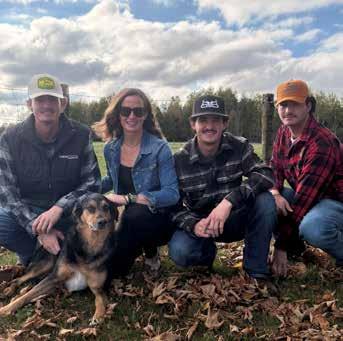
Provide details of your farm operation including experience in cattle production and knowledge of current beef sector issues. In addition, please describe your vision for Ontario’s beef sector and, in your opinion, the top three challenges the sector needs to address:
I am proud to be part of Pallister Farms Livestock Ltd. We are a seventh generation family owned and operated beef feedlot and cropping operation located in Southgate Township just outside of Dundalk.
Three challenges the sector needs to address:
1. Ongoing U.S. tariff threats under President Trump represents a significant risk to the Canadian beef sector due to the highly integrated North American cattle and beef supply chain. Situation needs to have strong advocacy, trade diversification and policies that maintain competitiveness and protects producer viability.
2. The reality of Canada still being classified as higher risk for cattle in certain international markets needs to tackled. We have world class animal health, traceability and food safety systems in place. We need to advocate to get this classification changed based on current science and verified data so that our market access improves and our sector becomes more stable.
3. Risk. Higher costs and more dollars in play directly translates to increased risk for Ontario beef farmers. Making sure our provincial risk management programs remain relevant and current to help protect family farms is key.
Provide a summary of demonstrated leadership skills and experience planning for the future of a business or an organization (for example, strategic planning, governance, policy development, etc.):
I bring a combination of practical business experience, industry knowledge and collaborative leadership that supports the success and sustainability of an organization. I approach leadership with integrity, accountability and a focus on the broader impact of decisions, ensuring the organization remains strong, relevant and well positioned for the future.
Outline your understanding of financial management principles (i.e. review of financial statements and budgets, prudent financial business sense, adherence to confidentiality and conflict of interest policies, etc.):
Within our operation, we have various corporations that require financial management on a daily basis.
1. Cash Flow Management
2. Capital Investment
3. Record Keeping and Reporting
4. Strategic Planning for the years ahead
5. Profitability Analysis.
Above are just a few examples of what comes across my desk on a daily basis to help keep data flowing and accurate and readily available to be able to help make data driven decisions to propel our business in the direction of long term growth and success.
BFO’s Board of Directors work closely to set BFO’s goals and to advance BFO’s priorities through advocacy with elected officials and other stakeholders. Please outline experiences you have had working in a cohesive team and how this team worked together to advance an issue and ensure a particular outcome.
Being part of a family agriculture business demonstrates a cohesive team because success depends on shared goals, trust and collaboration. Our family works together daily to adapt to the ever changing demands of the industry and therefore the need to step into different roles when needed to keep operations running smoothly.
Decision making is collaborative, accountability is shared and everyone understands how their role impacts the whole business. This type of environment builds strong communication, resilience and team first mindset when the focus is on long term success.
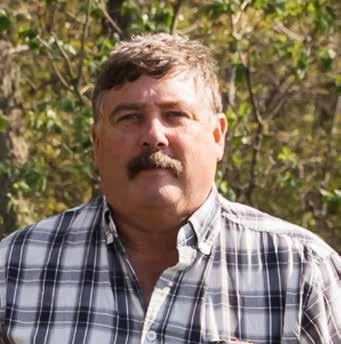
Provide details of your farm operation including experience in cattle production and knowledge of current beef sector issues. In addition, please describe your vision for Ontario’s beef sector and, in your opinion, the top three challenges the sector needs to address:
I am third generation on my family's beef and cash crop farm. I started with crossbred/commercial cattle and then transitioned into a purebred Limousin producer. With the involvement of wife and my three grown children we raise replacement females and stocker calves, along with direct farmgate beef sales and a few elite herdsire prospects. This has allowed me to see first hand a lot of the issues that currently challenge the beef producer in Ontario.
From transportation of live animals, to localized slaughter capacity, as well as rural/urban relationship concerns. I feel my own involvement with these areas has prepared me well to represent eastern Ontario at the provincial level.
Provide a summary of demonstrated leadership skills and experience planning for the future of a business or an organization (for example, strategic planning, governance, policy development, etc.):
I have been an active 4-H member at the county, regional, provincial, and national level where I attended leadership training camps and workshops. I served as a member of the provincial executive of the Junior Farmers' Association of Ontario during the development of their strategic plan for rural youth opportunities. I was also fortunate enough to participate in interprovincial and international youth in agriculture exchanges where I was able to witness a broad example of diverse agriculture undertakings.
As a local board member of OFA, I served on the steering committee for the Impact of Agriculture Study for Leeds Grenville and Frontenac. I have also participated as an assistant and head coach on several minor hockey and football teams. All of these experiences combined have helped me to develop my time management and organization capabilities, so that I can be an effective member of the board
TURN OVER TO READ MORE
Outline your understanding of financial management principles (i.e. review of financial statements and budgets, prudent financial business sense, adherence to confidentiality and conflict of interest policies, etc.):
Along with our family farm, I have also operated my own small business for the past 16 years. I operate a automotive/truck repair facility and have gone from one employee at the start to the current five that carry out service and repairs on everything from compact cars to commercial tractor trailers. In order to grow the business I have had to learn to budget and make projections and deal with financial institutions (very different than ag financing), as well as day to day with a diversified customer base with many different concerns.
BFO’s Board of Directors work closely to set BFO’s goals and to advance BFO’s priorities through advocacy with elected officials and other stakeholders. Please outline experiences you have had working in a cohesive team and how this team worked together to advance an issue and ensure a particular outcome.
During my time on the Junior Farmers' Association of Ontario Executive, I was chair of the sports committee. We decided to host Provincial summer games in eastern Ontario instead of the traditional Guelph area. This proved to be a large undertaking as everything from sports fields to motels to entertainment and security had to be planned from scratch. The event was a success and summer games began using a rotation schedule for host counties from there on. The previously mentioned Impact of agriculture study is another example of advancing the mandate that our committee was given and adhering to deadlines that involved interacting with the local municipal and county governments in the area.
Most recently, I was a member of the 2023 Canadian Junior Limousin Impact Show (Youth National Breed Show). I was involved with event logistics, sponsorship, tour co-ordination, and program planning. This show is a critical piece of youth development for the Limousin breed's junior program. Initially planned for 2020, this event and it's committee had to pivot multiple times before finally welcoming more than 65 youth from seven provinces.
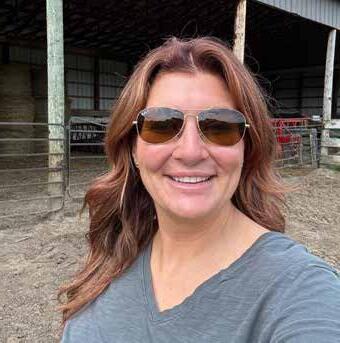
Provide details of your farm operation including experience in cattle production and knowledge of current beef sector issues. In addition, please describe your vision for Ontario’s beef sector and, in your opinion, the top three challenges the sector needs to address:
I was fortunate to be raised around many different types of livestock and farming operations. Currently, my family and I run a small Simmental cow-calf operation on 120 acres just outside of Brockville, Ontario. I am extremely proud to say I am raising a young daughter on the farm whom I hope will carry on my passion for cattle and agriculture as a whole. Additionally, I have been an Animal Care Advisor since 2023 and a Livestock Valuer with the Wildlife Damage Compensation Program since 2025.
My vision for Ontario's beef sector is a thriving industry both domestically and internationally that is able to sustain growing herd numbers, support future generations and consistently produce top quality products.
The top three challenges I believe the sector needs to address are maintaining and growing the Ontario Risk Management Program, addressing processing backlogs federally and provincially and continuing our advocacy efforts for the removal of SRM rules for OTM animals to gain access to broader global markets.
Additionally, the top challenges the east region is currently facing are the ongoing issues gaining access to the Leeds Community Pasture as well as the lack of progress made with reopening the Joyceville Abattoir.
Provide a summary of demonstrated leadership skills and experience planning for the future of a business or an organization (for example, strategic planning, governance, policy development, etc.):
During my time as a Provincial Correctional Officer, I worked in a maximum security institution. I was fortunate to hold many different titles including Admission and Discharge Officer, Operational Manager, Construction Supervisor, Training Officer and Community Outreach Officer.
As an Admission and Discharge Officer, I was responsible for all movement in and out of the institution, as well as ensuring all legal documents received from the police and courthouses were correct.
As an Operation Manager, I was responsible for the care, custody and control of all inmates housed in the institution as well as a full compliment of staff. I was responsible for resolving inmate and staffing conflicts and ensuring the safety of everyone inside the institution.
TURN OVER TO READ MORE
I am an active member of the BFO Cow-Calf Committee and act as the representative to the Governance Committee. I make every effort to attend every meeting and actively engage with my peers, asking questions and sharing my thoughts and opinions when appropriate.
I was fortunate to be selected to attend the BUILD Leadership Program in 2024. The program focused on communication styles and developing and improving leadership skills.
As a member of my local Cattlemen's Association and School Parent Council, I have both developed and updated constitutions and by-laws.
Outline your understanding of financial management principles (i.e. review of financial statements and budgets, prudent financial business sense, adherence to confidentiality and conflict of interest policies, etc.):
Prior to becoming a Correctional Officer, I worked in the institutions administrative department. There, I was responsible for all Inmate Trust Accounts. In this role, I made deposits and withdrawals from individuals trust accounts as needed, made weekly bank deposits and reconciled the accounts on a weekly basis. In this role, I was also responsible for maintaining the institutions petty cash and ensuring it was balanced on a weekly basis.
For the past six years, I have acted as Secretary-Treasurer for my County Association. I complete all banking activities, maintain a banking ledger and create yearly financials statements that are presented to the Membership.
I am also a member of several other professional organizations where financial statements are reviewed and financial decisions are made on a monthly basis.
I first completed confidentiality and conflict of interest training in 2005. I have since attended refresher training and new training opportunities on several occasions. I best demonstrate my understanding on these policies in my role as an Animal Care Advisor where sensitive and confidential information is relayed between PAWS Officers and Animal Care Advisors.
BFO’s Board of Directors work closely to set BFO’s goals and to advance BFO’s priorities through advocacy with elected officials and other stakeholders. Please outline experiences you have had working in a cohesive team and how this team worked together to advance an issue and ensure a particular outcome.
My earliest memories of working as a team goes back to my teenage years loading and unloading square bales in the summer heat. It didn't take us long to figure out that if we all worked together, the job was done sooner and we could hit the pool.
As a BFO Cow-Calf Committee Member, I am constantly working with my peers to address ongoing issues affecting the beef sector, as well as issues that beef producers have put forward through resolutions, their AC's or contact with BFO. The goal of the Committee is to work collaboratively to best represent producers and I feel we have done a good job of doing that over the last year.
As a member of Parent Council at my daughter's school, I am always actively engaged with my peers as well as the school representatives. I joined Council with the goal of being more involved in school activities and raising money to directly support the students and provide enrichment. Both goals have been met by our group and will far exceed my expectations for my first year on council.
In 2025, I identified a shortfall with my township's execution of the Wildlife Damage Compensation Program. I contacted our CAO and was able to meet with him to discuss my concerns. Mid way through 2025, I completed the required Ministry of Natural Resources training and have become a Livestock Valuer for my township. I have also engaged with Valuer's in neighbouring townships to identify common issues, compare claim numbers and provide vacation coverage as needed.

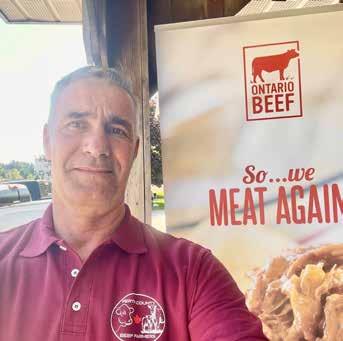
Provide details of your farm operation including experience in cattle production and knowledge of current beef sector issues. In addition, please describe your vision for Ontario’s beef sector and, in your opinion, the top three challenges the sector needs to address:
Together with my wife, Carolyn, and some help of our adult children we run a cow-calf to finish operation. We are VBP+ certified. Our herd consist of fullblood, purebred and commercial Limousin cattle. We also operate a custom farming operation with a broad range of services.
The Ontario beef sector has a lot of potential and challenges with a growing and diverse population. We need to diversify our export markets so we became less reliant on some of the current ones.
Some of our challenges to address:
• Increased processing capacity
• Declining cow numbers and lack of (community) pastures
• Improvement of government relations and support programs
Provide a summary of demonstrated leadership skills and experience planning for the future of a business or an organization (for example, strategic planning, governance, policy development, etc.):
Since joining the BFO board I have had the opportunity serve on a number of different boards representing the beef industry. This has given me a great inside look at the working and operations of different organizations.
Outline your understanding of financial management principles (i.e. review of financial statements and budgets, prudent financial business sense, adherence to confidentiality and conflict of interest policies, etc.):
Most of the boards that I serve on have a very similar structure with financial planning, strategic planning, budgeting etc., which has given me a good understanding of their priorities and business planning.
BFO’s Board of Directors work closely to set BFO’s goals and to advance BFO’s priorities through advocacy with elected officials and other stakeholders. Please outline experiences you have had working in a cohesive team and how this team worked together to advance an issue and ensure a particular outcome.
With our board being a diverse group of producers that is able to work together to represent our industry at different organizations and government levels we have been able to deal with the issues at hand, backed by an amazing and very knowledgeable staff.
On many occasions I have had the opportunity to interact with local and provincial government officials and have great discussions regarding the importance of the beef industry in Ontario and Canada.
Sector Requirements 2025 Committee Term Expiration 2026 Committee
Cow-Calf The (3) Cow-Calf Directors from the 2026 BFO Board of Directors receive automatic appointment to the committee
6 x members elected by AGM voting delegates identified as "Cow-Calf" to fulfill a 2-year term
Feedlot 1 x member appointed from the Feedlot Committee by its members to fulfill a 1-year term
Background 1 x member elected by AGM voting delegates identified as "Backgrounder" to fulfill a 2-year term
Cow-Calf Committee Candidates
Youth 1 x member elected by the Ontario Beef Youth Alliance aged 18-35 to fulfill a 2-year term as a non-voting member.
Don Badour
Don Hargrave
Jim Whitley
Scott MacDonald
Erin Theriault
Blair Williamson
Jason Desrochers
Emily McKinlay
Amy Reinhart 2028 2026 2027 2027 2027 2027 2026 2026 2026 Returning Open Returning Returning Returning Returning Open Open Open
Scott Cochrane 2026 To be appointed by Feedlot Committee
Mike Swidersky 2027 Returning
Kendyl Anderson 2026 To be elected by members of the OBYA
Sector Candidates for the 2026 Cow-Calf Committee
COW-CALF
Kendyl Anderson
Elliott Armstrong
Jason Desrochers
Glenn Dorland
Geordie Maclaren
Emily McKinlay
Amy Reinhart
Individuals who wish to let their name stand for election to the Cow-Calf Committee may have their name put forward from the floor at the AGM.
Feedlot The (3) Feedlot Directors from the 2026 BFO Board of Directors receive automatic appointment to the committee
6 x members elected by AGM voting delegates identified as "Feedlot" to fulfill a 2-year term
Cow-Calf 1 x member appointed from Cow-Calf Committee by its members to fulfill a 1-year term
Background 1 x member elected by AGM voting delegates identified as "Backgrounder" to fulfill a 2-year term
Feedlot Committee Candidates
Youth 1 x member elected by the Ontario Beef Youth Alliance aged 18-35 to fulfill a 2-year term as a non-voting member
Nick Martin Jairus Maus
Tom Kroesbergen
FEEDLOT
BACKGROUND
Gordon Dibble
David Millsap
Mitchell Taylor
Chris Pletch
Bob Bennett
Darrell Russett
Alex Wytenburg
Scott Cochrane
Gordon Dibble
David Millsap
Jairus Maus
Lisa Pallister Returning Returning Returning Open Open Open
Scott MacDonald 2026 To be appointed by Cow-Calf Committee
Chris Pletch 2026 Open
Sarah Alton 2026 To be elected by members of the OBYA
Individuals who wish to let their name stand for election to the Feedlot Committee may have their name put forward from the floor at the AGM.
Candidates were asked to provide details of their farm operation, as well as their vision for Ontario’s beef sector and, in their opinion, the top three challenges the beef sector needs to address.
KENDYl ANDERSON
Lambton County
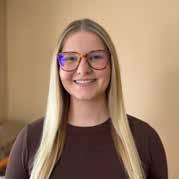
I am a sixth generation farmer and together with my husband and father, we run a 150-head cow-calf-to-finish operation in Southwestern Ontario. We run a shorthorn x Hereford cross herd and also breed Angus for our direct to consumer marketing program where we sell individual pieces and sides/quarters. We focus on food sustainability and work with local businesses to upcycle food waste (bakery waste, brewer's grain) to feed our cattle. The operation has been VBP+ certified over five years. I previously held the youth representative position on the cow-calf committee and I am a director for my county's organization.
My vision for the future of Ontario’s beef sector is one supported by policy that strengthens local production, protects farmland, and ensures long-term farm viability. I envision an industry where government programs and regulations prioritize risk management tools that reflect true production costs, and incentives for pasture-based management and land stewardship. A strong Ontario beef sector depends on protecting farmland, supporting succession planning, and investing in local infrastructure. The future of Ontario beef depends on investment in local processing capacity, transparent supply chains, and policies that recognize farmers as essential partners in environmental resilience, and rural economic development.
The top three challenges I see for the sector are:
1) Sustainability (environmental, financial, and producer health)
2) Succession for the next generation (land prices and access, shifting commodity markets, financial support)
3) Consumer education (misinformation about carbon outputs, etc.)
Haldimand County
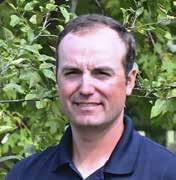
Along with my wife, I am involved with a 60-head cow-calf beef herd. Half of our females are registered Limousin that we sell as breeding bulls and females. The other cows are run as a mixed commercial herd. We also cash crop with our in-laws.
For 10 years, I have been a director with the Haldimand Cattlemen's Association and have served as Advisory Councillor for the past handful of years.
Ontario's beef sector has advantages and challenges. By producing beef in Canada's most populous province our farmers should see a premium for the high quality local food they raise. We should capitalize on the benefits beef cattle have on the environment.
Challenges for Ontario's beef sector include:
• Lack of accessible forward pricing mechanisms for small and medium producers
• Reliable crop insurance for the forages we grow
• Maximizing recognition of environmental benefits of pastures and grasslands, while minimizing redtape and regulations.
Cochrane District
I am a third generation beef farmer on our northern Ontario farm. I farm full-time on our 240 cow-calf operation. My wife and I own 1,420 acres and we rent another 1,200 from my brother. We also crop about 350 acres. I have been involved with numerous farm organizations for the last few years. I have been actively involved with BFO as the advisory councillor for the Cochrane District for the last few years.
I believe we need to focus on growing the cow herd in Ontario, increasing the availability of premium local stockers flowing to help fill our feedlots.
Top Three Challenges:
1. Breeder Finance Program
In order to maintain or expand our cow herd in Ontario, we need to develop a fully funded Breeder Finance Program that works well for all levels of farmers, including new, young, and existing successful farmers wishing to expand. We should have access to the same portion interest free for one year as the Feeder Finance Program.
2. Forage Insurance
Help develop a yield based forage insurance program that works for beef farmers as the crop insurance program has worked for crop farmers for many years.
3. Vet Access
We need to work with all levels of government, clinics and academics to address the shortage of veterinarians across our province in the large animal sector.
Northumberland County
I am multigenerational cattle farmer. I farm with my wife, children, and my parents. We run about 40 Angus commercial cows, background our calves, retaining our own replacement females, and market stockers through auction. A majority of cows and calves go to a custom grazer for the summer grazing. We also developed a direct to consumer cliental selling quarters to whole carcasses to customers. We also cash crop and provide custom planting and haying. I am actively involved on the Northumberland County Cattlemen's board, as well a past president and Past Advisory Councilor position. I stay up to date on beef industry news, markets and events via the Bull-etin Board, Ontario Beef magazine, Canfax, various news publications and social media nationally and internationally. The last few years i have attended the Cow-Calf management tours and last spring attended the Back to the Basics workshop as well.
My vision for the Ontario beef sector, is a sector that is as valued and financially viable as any other sector of Ontario agriculture. A sector with high consumer confidence and demand for Ontario beef and to have Verified Beef Producers to be adequately paid for time and efforts to be apart of the program and attract new producers.
Three major challenges I see that need to be addressed are:
• Government Overreach: i.e. CRA with taxation of farm transfers within families. CFIA with either livestock transportation regs or cattle harvesting and disposal regs. MPAC and their creative ways of increasing land values and the way they're taxed. Provincial/Municipal on new housing developments and MDS from existing and new animal buildings.
• Keeping RMP/Funding Programs: Keeping RMP adequately funded is important for when markets turn towards negative profit margins in market price waves. Funding programs are a great way for making our operations more environmental friendly, sustainable, and economical to finish the projects at hand.
• Supply Chain Challenges: The Ontario beef sector faces a few different challenges from aging producers, long term financial viability, market competition of finished and cull cows, and availability of Ontario beef on grocery store shelves
Currently, I own a 50-pair commercial black Angus herd and farm 700 acres of corn, soy/hay, and pasture. I previously managed a family's 500-head feedlot operation, 300 commercial pairs, and backgrounding operation. I have been the advisory councillor for Prescott County since 2010, also following the BFO and CCA updates.
Top three challenges the sector needs to address:
1. Continue to support and expand programs like RMP, breeder and feeder finance co-ops to help retain producers and attract younger producers in the Ontario beef industry
2. Processing capacity in Ontario both federal and provincial
3. Labour shortages - vets, processing and farm labour
EMILY MCKINLAY
Grey County
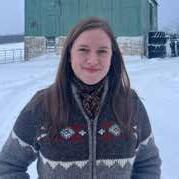
I farm alongside my husband and his family near Blue Mountain. We market Simmental and Red Angus yearling bulls and bred heifers, with a priority on calving ease and maternal traits. We also have a herd of cows on Manitoulin Island. On our operation, I have implemented new data management strategies, including recently integrating carcass data from our steer calves. I enjoy managing our pastures and finding new efficiencies with rotational grazing and managing weeds.
I have also been involved in the beef industry off the farm. From 2020 to 2022, I was a beef researcher as I completed my MSc in Beef Cow Nutrition at University of Guelph. I have been an agriculture journalist since 2022. I connect with producers across Canada to share their stories and improve access to knowledge of new management practices, research, and challenges in the industry.
During my two years on the cow-calf committee, I have valued the opportunity to represent cow-calf producers in discussions around programming that supports industry resilience and planning the summer tour. I am eager to continue representing Ontario’s cow-calf producers as part of the committee while bringing perspectives from my experience on the farm, beef research, and communications.
My vision for Ontario’s beef sector would be to see ongoing improvements in best management practices, efficiency, and competitiveness of the industry, allowing future generations to continue to thrive.
In my opinion, the top three issues faced by Ontario’s beef sector are the cost of production, accessibility for the next generation, and public perception.
Rising land, equipment, and infrastructure costs have made growth challenging for beef farmers for several years. While current cattle prices are exciting for many cow-calf producers, it adds another financial consideration for young or new producers looking to develop their herd. These issues are interconnected, making it necessary to find innovative supports for current beef producers to improve efficiency while also making it possible for the next generation of beef producers to enter the industry. As the public becomes more removed from agricultural roots, the beef industry has the opportunity to share their story of land stewardship, animal care, and top-quality food production.
Oxford County
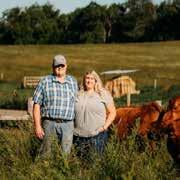
I reside in Oxford County with my husband and our two boys. As a family, we operate a primarily Red Angus cow-calf herd across two locations with differing demographics. With rising land values and limited availability, we experience both the challenges and benefits of operating near rural and urban centres. The opportunity to utilize urban exposure has supported the growth of our direct beef marketing, creating a full-circle relationship between local businesses, families, and our farm.
As the wife of a full-time beef farmer, my role varies with the season and the needs of our operation. With the beef industry directly impacting our livelihood, I find myself consistently involved and eager to share my passion for the industry. Over the past two years, I have been fully engaged as a member of the BFO Cow-Calf Committee. I have actively participated in Verified Beef Production seminars, management tours, informative meetings, and webinars - bringing new ideas and conversations back to our family operation to improve our herd and pivot when new directions are needed.
Staying informed on provincial and federal issues allows me to remain current on matters affecting our industry. I am committed to continuing my impact within my local community as a beef 4-H leader, fair board committee member, and active participant in breed-specific associations. My involvement is guided by factual, collaborative information gained through BFO, and I am motivated to continue contributing knowledge, leadership, and advocacy to the beef industry.
Working alongside my husband and family, I am continually engaged in open conversations that influence our business-whether with neighbours, fellow producers, or unexpected patrons in a variety of settings. Awareness of the changing landscape surrounding the beef industry is always top of mind. Preserving the value of our land, protecting it for future generations, and ensuring it remains financially sustainable must be a priority.
Retaining the cow herd presents ongoing challenges, with variables that fluctuate based on both market conditions, land availability and personal dynamics. Education about our industry across a wide range of platforms is essential. We must advocate for the beef industry while protecting its integrity. That responsibility starts with us as producers by educating and informing our consumers;especially our youth. Building relationships with the public education sector to bring our industry into the classroom is one meaningful way to achieve this. Through planning, continuous improvement, advocacy, and promotion, we can elevate the beef industry and secure its future.
Candidates were asked to provide details of their farm operation, as well as their vision for Ontario’s beef sector and, in their opinion, the top three challenges the beef sector needs to address.
Oxford County
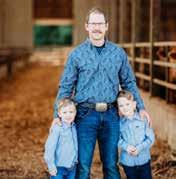
Together with my parents, my wife and our three kids we run a backgrounding/finishing operation near Ingersoll, Ontario. We have also started building up a small cow-calf herd as well. As a 4th generation farmer sustainability is an important factor to our operation.
We do our best to stay informed with any current issues affecting the beef industry. I would appreciate the opportunity to continue to represent you on this committee.
My vision for the Ontario beef sector continues to be very positive. It would be nice to continue to grow the cow herd and keep attracting young producers. If we can continue improving international market access and growth in meat sales with our strong Ontario brands for example Ontario Corn Fed. That should help stabilize our market here in Ontario. Also if we can continue to provide access to affordable capital with the feeder and breeder finance programs. Then, I think the whole beef industry in the province has what it needs to thrive.
What beef producer wouldn’t dream of a stable market and affordable capital.
Simcoe County
I operate a beef feedlot and cropping operation in Simcoe County. Our cattle are marketed into the Ontario Corn Fed program and the farm has been certified by VBP+.
Maintaining profitability in all sectors of the beef industry is important to keep our industry moving forward. I am inspired to see our newest generation of beef producers entering the industry. Providing opportunities for our younger generation to be successful is very important to me. Maintaining the consumers trust in the beef industry is also something I like to stay focused on.
MITCHELL TAYLOR
Grey County
I am a sixth generation beef farmer. We run a backgrounding operation of around 600 head of western calves
I acknowledge the struggles all producers like myself are facing with supply chain disruptions, export markets and the ever shrinking cattle heard driven by the lack of young producers or producers as a whole.
I have visions of our beef sector becoming more connected with the consumers again, showing great practices of health and care to bring trust and understanding.
I feel we need to address:
• Supply chain disruptions for critical supplies
• Misinformation amongst producers for traceability, and handled in a hands-on approach
• Incentives for young producers to get involved
• Helping with financial hurdles and uncertainty
• Affordable vet access
Bruce County
I've been family farming over 30 years and currently custom feed approximately 2,000 head. Background for grass, approximately 1,500. A long-time member of the local feeder cattle co-op, and recently apart of the Bruce County Beef Farmers committee.
1. Getting the government on board to ensure the Risk Management Program stays strong moving forward. 2. Profitability in the beef business has always been a concern, especially when it requires so much funding just to keep operating.
3. To stay involved and ahead of any free trade barriers and potential challenges to the beef market, to ensure growth in the beef market continues
The proposed amendments to BFO’s Constitution and By-Law No. 1 are administrative in nature. The first update would revise the definition of a voting delegate to include current BFO directors for the duration of the Annual General Meeting. The remaining updates would introduce clearer language outlining the voting procedures used by BFO.
Any change to the BFO constitution and by-laws, should be approved by two-thirds majority vote at the BFO AGM or special meeting of members.
Current: “Voting Delegate” means (a) an individual appointed by a Branch to vote at a Meeting of Members on behalf of the members of the Branch in accordance with Section 9(8); (b) an individual on the Advisory Council; or (c) a Director.
Proposed: “Voting Delegate” means (a) an individual appointed by a Branch to vote at a Meeting of Members on behalf of the members of the Branch in accordance with Section 9(8); (b) an individual on the Advisory Council; or (c) a Director. Each person that is a member of the Board of Directors, at the commencement of the Annual General Meeting, is a voting delegate at the Annual General Meeting
Current: Votes to Govern. All questions proposed for consideration of the Members shall be determined by a majority vote of the Voting Delegates at a Meeting of Members, unless required otherwise by the Act or the ByLaws. Every Voting Delegate shall have one (1) vote. The chair of a Meeting of Members shall be entitled, as a Member, to vote. In the case of an equality of votes, the chair of the Meeting of Members shall be entitled to cast a second, tie-breaking vote.
Proposed: Votes to Govern. All questions proposed for consideration of the Members shall be determined by a majority of votes cast by of the Voting Delegates at a Meeting of Members, unless required otherwise by the Act or the By-Laws. Every Voting Delegate shall have one (1) vote. The chair of a Meeting of Members shall be entitled, as a Member, to vote. In the case of an equality of votes, the chair of the Meeting of Members shall be entitled to cast a second, tie-breaking vote.
Current: Change in License Fee Deductions. A recommendation by the Association to make a change in the license fee deductions authorized under the BCMA shall be made only by a vote in favour thereof of at least two-thirds of the Voting Delegates at an AGM and only where notice of the proposed recommendation has been given in the notice of the AGM.
Proposed: Change in License Fee Deductions. A recommendation by the Association to make a change in the license fee deductions authorized under the BCMA shall be made only by a vote in favour thereof of at least twothirds of votes cast by the Voting Delegates at an AGM and only where notice of the proposed recommendation has been given in the notice of the AGM.
Current: By-Law and Effective Date. The Board may make, amend or repeal any by-laws that regulate the activities or affairs of the Association. Any such By-Laws, amendment or repeal shall be effective from the date of the resolution of the Board until the next Meeting of Members where it must be confirmed, rejected or amended by the Members by a majority vote. If the by-laws, amendment, or repeal is confirmed or confirmed as amended by the Members it remains effective in the form in which it was confirmed or confirmed as amended. The By-Laws, amendment or repeal ceases to have effect if it is not submitted to the Members at the next Meeting of Members or if it is rejected by the Members at the meeting.
Proposed: By-Law and Effective Date. The Board may make, amend or repeal any by-laws that regulate the activities or affairs of the Association. Any such By-Laws, amendment or repeal shall be effective from the date of the resolution of the Board until the next Meeting of Members where it must be confirmed, rejected or amended by a vote of at least two-thirds of votes cast by the Voting Delegates at an AGM and only where notice of the proposed recommendation has been given in the notice of the AGM the Members by a majority vote. If the bylaws, amendment, or repeal is confirmed or confirmed as amended by the Members it remains effective in the form in which it was confirmed or confirmed as amended. The By-Laws, amendment or repeal ceases to have effect if it is not submitted to the Members at the next Meeting of Members or if it is rejected by the Members at the meeting.
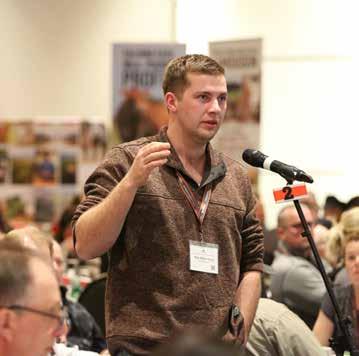
1. Robert’s Rules of Order will be used as a guide for our discussions
2. To move a resolution or speak to a motion, go to the nearest microphone; state your name and county/district.
3. Opportunity to speak will be limited to two (2) minutes per individual
4. The mover of a resolution has the right to speak first and may speak again to close the debate. All other individuals may only speak once to each resolution.
5. Amendments or substitute motions must be moved and seconded before being spoken to.
6. Each main resolution will be read, moved and seconded. In cases where resolutions presented by more than one county/district have been combined for efficiency of discussion, delegates who feel strongly that their specific issue will not be addressed by the main motion, may ask to deal with it separately before debate on the main motion begins, or they may move an amendment to the main motion.
7. The vote on any resolution will be called when:
(a) all who wish to speak have done so; or
(b) when the ‘previous question’ to close debate has been moved, seconded and passed by a 2/3 majority; or
(c) when several speakers have spoken on the same side of an issue and no one is wanting to speak to the other side of the issue
8. Delegates will vote using their own electronic devices using their voting credentials as provided by Data on the Spot
9 Independent scrutineers will be appointed and accepted by the meeting. They will observe and monitor the integrity of the voting process, which is provided by Data on the Spot.
10. Anyone in attendance may speak to a resolution, but only official Beef Farmers of Ontario AGM voting delegates may move or second resolutions, motions, or amendments, etc.
1. Main Motion
Mover, seconder 2. Amendments
Mover, seconder. Cannot change the subject but may add to, delete from, clarify
Mover, seconder. Passing a substitute motion replaces the main motion.
Mover, seconder Non-debatable, majority needed
Mover, seconder Debatable only to where referred or how long deferred; majority needed, but where deferral changes the agenda, then needs 2/3 majority
6. Previous Question to Close Debate
Mover, seconder. Non-debatable, 2/3 majority needed; if passed, then vote on amendment or main motion (not necessarily both) is taken immediately without further debate. If lost, debate continues. 7 Objection to Consider a Question
Mover, does not need a seconder. Must be made before debate begins even if another has the floor; non-debatable, 2/3 majority needed
8. Motion to Reconsider a Resolution Mover must be one who voted on the prevailing side, seconder. Needs majority vote to reconsider. If passed, reopens the main question for debate 9. Motion to Suspend or Change the Mover, seconder. 2/3 majority needed
Accepted Rules of Debate
BRUCE
MOVED BY:
Harold Zettler
SECONDED BY:
Scott MacDonald
WHEREAS the Advance Payment Program (APP) is a program that beef farmers can use to help offset escalating input costs, and
WHEREAS increasing the interest-free portion and making it permanent will allow farmers to plan ahead, invest into innovation, and stay financially sustainable, THEREFORE, BE IT RESOLVED THAT BFO lobby to make permanent the minimum interest free portion of APP of $350,000
In recognition of the significant challenges facing Canadian producers over the past number of years, the Government of Canada ensured farmers had access to cash flow to cover expenses by making changes to the interest-free limit of the Advance Payments Program (APP). This is the portion of advances on which the Government of Canada pays the interest on behalf of producers.
Following an increase to the interest-free limit made in 2022, bringing it from $100,000 to $250,000 for the 2022 and 2023 program years, it was further increased to $350,000 for the 2023 program year. For the 2024 and 2025 program years, it was set at $250,000 instead of reverting back to $100,000.
There has been no indication from the federal government that the temporary increase to the interest-free limit will continue for the 2026 program year, which means it would revert back to $100,000 starting April 1, 2026. Last September, the government temporarily increased the interest-free limit to $500,000 for canola producers for the 2025 and 2026 program years due to trade issues with China.
MOVED BY:
Mark Eddy
SECONDED BY:
Scott Cochrane
WHEREAS, the general public is becoming increasingly removed from agriculture and from an understanding of where their food comes from; and
WHEREAS, the agriculture and food sector is a major contributor to Ontario’s economy and will require a strong, skilled workforce to fill jobs across the entire value chain, from primary production through processing, distribution, research, and agri-food services; and
WHEREAS, students, educators, and guidance counsellors play a critical role in shaping career awareness and pathways, and agriculture and food careers must be top of mind when young people are exploring future employment opportunities; and
WHEREAS, building awareness of agriculture is an important first step, but the sector must move beyond awareness toward meaningful agriculture and food literacy that equips students with accurate knowledge, critical thinking skills, and an understanding of modern food production; and
WHEREAS, the Government of Ontario has included a food literacy component within the science curriculum as a result of advocacy efforts surrounding Bill 216, Food Literacy for Students Act, 2024, which advanced to second reading before the Legislature was prorogued for the provincial election; and
WHEREAS, despite the inclusion of food literacy in the curriculum, there are currently no clear, consistent guidelines or implementation supports to ensure food and agriculture education is delivered in a meaningful and standardized way across Ontario classrooms; and
WHEREAS, AgScape is Ontario’s recognized agriculture-in-the-classroom organization and has, for more than 35 years, provided accurate, balanced, and curriculum-aligned agriculture and food education programs, resources, and educator supports; and
WHEREAS, AgScape possesses the expertise, tools, and provincial reach necessary to support effective delivery of agriculture and food literacy through strengthened partnership with the Ontario Ministry of Education;
THEREFORE, BE IT RESOLVED THAT BFO, prioritize agriculture and food literacy as part of its provincial government advocacy and lobby priorities; and BE IT FURTHER RESOLVED THAT BFO, work in partnership with AgScape to identify and advance specific advocacy objectives and talking points that will support consistent, meaningful agriculture and food literacy implementation when engaging with government and industry partners.
On March 8, 2022, Education Minister Stephen Lecce and MPP Daryl Kramp announced that Ontario will introduce a new Science and Technology curriculum and de-stream Grade 9 science to emphasize critical life and job skills. The curriculum includes food literacy, which empowers students to make decisions affecting physical and mental health, understand local food production, and learn the scientific processes involved in agriculture. Currently there is no specific agricultural curriculum prescribed by the provincial government for all Ontario students.
In secondary schools in Ontario, interested students who want to focus their learning on a specific economic sector can graduate with a Specialist High Skills Major (SHSM). In some secondary schools, particularly rural high schools, students are able to do their SHSM in agriculture.
For a number of years, BFO has worked with and supported AgScape, which is an organization that promotes agriculture and food learning into Ontario classrooms. AgScape provides a number of programs and initiatives on different aspects of agriculture to teach students and educators about agriculture production in Ontario. Some of the programs and resources AgSscape provides includes: the Teacher Ambassador Program, where specially trained teachers can provide lessons in class with AgScape content; virtual farm field trips; resources on careers in agriculture, etc.
With BFO’s support, in 2021, AgScape developed an educational resource specific to beef production in Ontario called the “Exploration of Beef Farming Across Ontario”, and it is currently still active, has been translated into French, and is one of their most requested resources. AgScape has delivered multiple virtual farm tours to date and are currently developing a Rainy River virtual farm tour focused on youth-to-youth engagement. BFO has participated in ThinkAg Career Competitions, engaging students in discussions about careers in agriculture, particularly in beef farming and beef production. As part of this participation BFO uses the Guardians of Grasslands videogame to provide a broader understanding of the range of roles within the sector.
MOVED BY: Tim Rudkin
SECONDED BY: Dale Mountjoy
WHEREAS access to affordable capital is a major challenge to new and expanding beef farmers, WHEREAS maintaining or growing the cow herd base is important to the long-term viability of our industry, WHEREAS the substantial loan guarantees from the provincial government allows the feeder finance co-ops to require lower initial loan deposits or assurances from producers, THEREFORE, BE IT RESOLVED THAT BFO make a request to the Minister of Agriculture to draft an Order in Council that would implement a breeder finance program, include a provincial loan guarantee, and mirror the successful aspects of the Ontario Feeder Cattle Loan Guarantee Program.
MOVED BY: Dan Darling
SECONDED BY: Glenn Dorland
WHEREAS access to affordable capital is a major challenge to new and expanding beef farmers, WHEREAS maintaining or growing the cow herd base is important to the long-term viability of our industry, WHEREAS the substantial loan guarantees from the provincial government allows the feeder finance co-ops to require lower initial loan deposits or assurances from producers,
THEREFORE, BE IT RESOLVED THAT BFO make a request to the Minister of Agriculture to draft an Order in Council that would implement a breeder finance program, include a provincial loan guarantee, and mirror the successful aspects of the Ontario Feeder Cattle Loan Guarantee Program.
Sub-Resolution 2 VICTORIA
MOVED BY: Adam Shea
SECONDED BY: Matt Jewell
WHEREAS access to affordable capital is a major challenge to new and expanding beef farmers, WHEREAS maintaining or growing the cow herd base is important to the long-term viability of our industry, WHEREAS the substantial loan guarantees from the provincial government allows the feeder finance co-ops to require lower initial loan deposits or assurances from producers, THEREFORE, BE IT RESOLVED THAT BFO make a request to the Minister of Agriculture to draft an Order in Council that would implement a breeder finance program, include a provincial loan guarantee, and mirror the successful aspects of the Ontario Feeder Cattle Loan Guarantee Program.
Sub-Resolution 3
PETERBOROUGH
MOVED BY: Mike Fallis
SECONDED BY: Karen Paszternak
WHEREAS access to affordable capital is a major challenge to new and expanding beef farmers, WHEREAS maintaining or growing the cow herd base is important to the long-term viability of our industry, WHEREAS the substantial loan guarantees from the provincial government allows the feeder finance co-ops to require lower initial loan deposits or assurances from producers, THEREFORE, BE IT RESOLVED THAT BFO make a request to the Minister of Agriculture to draft an Order in Council that would implement a breeder finance program, include a provincial loan guarantee, and mirror the successful aspects of the Ontario Feeder Cattle Loan Guarantee Program.
26-03 BACKGROUND INFORMATION
Regarding our breeder loan program, one of BFO’s top provincial priorities has been lobbying the provincial government to establish a government-backed Breeder Loan Guarantee Program, which would build on the success of our Ontario Feeder Cattle Loan Guarantee Program. If obtained, a government-backed guarantee would help us secure competitive financing from lenders, help members purchase breeding cattle and support the expansion of Ontario’s cow herd. To support our ask, we launched a producer survey last year requesting feedback on access to financing and interest in an enhanced Breeder Loan Guarantee Program. With over 150 respondents, the results were positive, which helped to build our ask.
As a result, we submitted our formal proposal to government to support a $10 million government guarantee under the program, which would unlock up to $40 million in affordable private-sector lending. This will improve cash flow and reduce borrowing costs for Ontario farmers, reduce reliance on U.S. cattle, support young and beginning farmers under 40 who represent 40 per cent of current program participants, enable sustainable expansion of the Ontario cow herd, and drive economic activity across rural Ontario. Discussions and support have been positive, and we are hopeful that we will see movement on this file this year.
MOVED BY: Earl Reading
SECONDED BY: Jeremy Jeffrey
WHEREAS, the population of coyotes have increased and they can cause a biosecurity risks as well as the damage to animal’s health and life, and WHEREAS, not all counties and districts have a bounty on coyotes, to help promote control; and WHEREAS, the compensation for loss of life due to predation does not always cover enough of the loss, THEREFORE, IT BE RESOLVED THAT BFO lobby for more ways to control the coyote population and decrease the effect of the coyote issue on beef farmers.
Sub-Resolution 1 PERTH
MOVED BY: Dan Jeffrey
SECONDED BY: Dan Coulthard
WHEREAS, the population of coyotes has increased and they can pose biosecurity risks, as well as predation threats to livestock; and WHEREAS, not all counties and districts have a bounty on coyotes, to help promote control; and WHEREAS, the compensation for loss of life due to predation does not always cover enough of the loss, THEREFORE, IT BE RESOLVED THAT BFO lobby for more ways to control the coyote population and decrease the effect of the coyote issue on beef farmers.
Several Ontario municipalities operate targeted wolf and coyote control or compensation programs, primarily focused on addressing livestock predation rather than encouraging indiscriminate hunting. Grey County operates a Wolf and Coyote Control By-law that compensates licensed trappers and hunters for removing coyotes that have attacked livestock, with specific municipal programs in places such as Meaford and Georgian Bluffs. Dufferin County offers a Coyote Predation Program that provides compensation to authorized hunters who target specific nuisance coyotes linked to livestock losses. Central Manitoulin operates a compensation program that offers $50 per carcass and, together with neighbouring municipalities such as Burpee and Mills, Assiginack, and Gordon/Barrie Island, run similar programs. Bruce County also has an application-based process that allows hunters and trappers to receive compensation for the removal of nuisance wolves or coyotes. In addition, Perth County has launched a program designed to track the local coyote population through a public reporting tool rather than through a compensation or removal-based approach.
In Ontario producers are covered by the government if their livestock are killed by predators through the Ontario Wildlife Damage Compensation Program (OWDCP) which provides financial assistance to eligible producers whose livestock or poultry was killed or injured as a result of eligible wildlife predation.
In the 2023-2024 program year for the OWDCP there were 467 cattle compensated through the program. Of the 467 cattle killed 397 of those were deemed to be killed by coyotes, with 31 being killed by wolves and 15 killed by bears. The top three counties with predation claims were Grey County, Kawartha Lakes and Leeds & Grenville County.
26-05
CHOCRANE
MOVED BY: Chris Riach
SECONDED BY: Jason Desrochers
WHEREAS, Access to large animal veterinarians for beef producers is a challenge in many parts of Ontario. This is causing many veterinarians to expand their service area and travel much further distances. This problem leaves many parts of Ontario with minimal to no veterinary care for their cattle. THEREFORE, BE IT RESOLVED THAT BFO explores every possible avenue to ensure every county and district has 24-hour veterinary services for their cattle.
26-05 BACKGROUND INFORMATION
In 2023, Ontario launched the Veterinary Incentive Program to encourage newly licensed veterinarians who practice on food animals to practice in underserviced areas including northern communities in Ontario by providing annual grants that can total up to $50,000 per person. The Agricultural Adaptation Council is delivering the Program on behalf of the Ontario Ministry of Agriculture, Food and Agribusiness. There are currently 16 recent graduates that have taken advantage of this program to date.
The Ontario government is investing $2 million through the Northern Ontario Heritage Fund Corporation (NOHFC) to help Lakehead University build a new facility for its Collaborative DVM Program, delivered in partnership with the University of Guelph. In September, the program welcomed its first Northern Cohort—20
students from Northern Ontario—who are completing the full four-year program at the University of Guelph. Starting in 2027, once Lakehead’s new facility is complete, students will begin the program in Thunder Bay before finishing in Guelph.
The Minister of Northern Economic Development and Growth during his roundtable in July 2025 stated that they are currently conducting a review of ways to enhance the Veterinary Assistance Program (VAP). BFO is currently waiting for the ministry to release its review.
Reducing large animal veterinary shortages in the province continues to be a top priority for BFO.
MOVED BY: Calvin Anstett
SECONDED BY: Robert
Frieburger
WHEREAS, commerce is moving at a speed quicker than ever and with inputs costing more and more, interest costs are significant.
WHEREAS, only the last year and a half banks have started putting up to 7 day holds on cheques and certified cheques, causing more bounced cheques in the agricultural industry.
THEREFORE, IT BE RESOLVED THAT BFO lobby the provincial and federal government to see if they can have banks move back to the way they did business before, or at least better than what we have today.
26-06 BACKGROUND INFORMATION
There is a limit to how long a federally regulated financial institution, such as a bank, can place a hold on funds deposited by cheque. In Canada, banks may hold cheque deposits for between four and eight business days, depending on the amount of the cheque and how it was deposited. For cheques over $1,500, funds deposited in person with a bank employee have a limit of a maximum seven business days after the day of deposit, while cheques deposited through automated methods, such as an ATM, may be held for up to eight business days.
Canadian banks place holds on cheques to verify that the funds exist, prevent fraud, and ensure the cheque is not returned due to issues such as non-sufficient funds (NSF), a stop-payment request, or a closed account. These hold periods help protect both the bank and the client from potential financial losses if a cheque is later dishonoured. Holds are also part of a bank’s risk-management practices, and larger deposits or accounts with a history of overdrafts are more likely to be subject to longer holds.
In general, standard hold periods range from four to five business days for smaller cheque amounts and seven to eight business days for larger amounts. Under Canadian regulations, banks must make the first $100 of a cheque deposit available immediately, with the remaining funds released once the hold period has expired. To avoid cheque holds altogether, clients may consider alternatives such as direct deposit, wire transfers, or electronic funds transfers (EFTs).
MOVED BY: Paul Kinlin
SECONDED BY: Jim McComb
WHEREAS the Ontario Breeder Co-operative program is a valuable asset to farmers in providing capital to build herds and whereas the cost of breeding stock has significantly increased and whereas there seems to be a limit by the breeder co-op on a per animal basis. THEREFORE, BE IT RESOLVED THAT BFO ensure that the limit follow market value.
26-07 BACKGROUND INFORMATION
Currently, there is an overall lending limit for each of the seven co-operatives that operate under the Ontario
Beef Breeder Co-operative program. The overall lending limit is set through the agreement the co-ops hold with their lender. Lenders may choose to set per head limits that a co-op would have to agree to if they want to work with that lender. One of the current lenders operating under the program provides BFO with a quarterly valuation of bred cows/heifers, cow/calf pairs and open heifers, which is sent out to the presidents of the co-ops, including those not working with that lender. The valuations are not set limits however, they provide a guideline to help manage risk and many of the co-ops use them as a limit. BFO has provided feedback on the valuations but as they are only a guideline, co-ops still have the option to set limits over the values based on local market trends and the agreement with their particular lender.
Co-operative boards also set per member limits based on managing risk and growth for their co-ops. These limits can range from $50,000 up to $700,000 across the seven co-ops. Boards set limits based on assessing a number of factors relative to their co-operative, which may include status of the member (new versus existing), family members who are also active borrowers (borrowing laneways), availability of funds under the co-operative’s lending limit, restrictions outlined in their lending agreement, assessment of risk and supervisor visits.
In lobbying the provincial government to create a government guarantee for the Ontario Beef Breeder Cooperative program, similar to what is currently offered for the Ontario Feeder Cattle Loan Guarantee Program, BFO anticipates the government may set limits under the program on total loan allocations for each cooperative as well as per member limits. BFO continues to encourage government to create a program that is supportive of current limits being implemented by the co-operatives, giving flexibility to continue to operate as they are now but allowing room for growth.
MOVED BY: George Miller
SECONDED BY: Jason
Richardson
WHEREAS the Canadian cattle industry is already subject to comprehensive traceability, identification, and reporting requirements; and
WHEREAS additional traceability initiatives proposed or implemented through the Canadian Cattle Identification Agency (CCIA) may result in increased costs of production, expanded administrative obligations, and additional record-keeping requirements for cattle producers; and WHEREAS increased government intervention and regulatory complexity have the potential to negatively impact producer profitability, operational efficiency, and the long-term sustainability of cattle operations; and WHEREAS increasing regulatory costs and administrative burdens may disproportionately affect young and beginning producers, further limiting their ability to enter the industry, expand their operations, and successfully pursue a rewarding and sustainable livelihood in the cattle sector;
THEREFORE, BE IT RESOLVED THAT BFO does not support any further expansion of CCIA traceability requirements or additional government intervention that would increase costs of production, bureaucracy, or administrative burden for cattle producers; and BE IT FURTHER RESOLVED THAT BFO supports traceability systems that are practical, efficient, and producerdriven, and that do not impose undue financial or administrative impacts on the cattle industry.
26-08
For more than a decade, BFO, along with national industry partners, has been actively engaged in consultations on proposed amendments to Canada’s traceability regulations. These proposed federal changes are intended to strengthen Canada’s livestock traceability system by improving the country’s ability to respond quickly to animal disease outbreaks and food safety incidents, while also protecting access to domestic and international markets. BFO’s position is supportive of regulated traceability in principle, but conditional on cost-sharing, practicality, and producer-feasible implementation.
While BFO supports strengthened, regulated traceability in principle and specific regulatory tools (e.g., PIDs, expanded species coverage), BFO strongly objects to the assumption that industry can absorb implementation
costs (readers, reporting, labour, technology), noting costs are disproportionately high for the cattle sector and likely to be passed on to producers. BFO has repeatedly called for government funding and grants to offset infrastructure, technology, and training costs, and requests a two-year grace period to allow producers time to learn and comply with new regulatory requirements.
On January 9, 2026, BFO joined the Canadian Cattle Association and our provincial counterparts in a call for a delay in the implementation of the proposed federal traceability regulation changes, to allow outstanding industry questions and concerns to be addressed. On January 10, 2026, the Canadian Food Inspection Agency (CFIA) announced a pause on the publication of the proposed amendments to the Health of Animals Regulations Part XV Traceability until the proposed changes are more widely understood and concerns are heard and taken into consideration. Producer feedback across Canada has been heard loud and clear that more consultation, discussion and clarification is needed.
MOVED BY: John Lunn
SECONDED BY: Mike Fallis
WHEREAS the PAWS act as written calls for livestock to be adopted out if the farmer is unable to meet the requirements of an inspector or if he or she cannot pay the fees for the cattle to be taken THEREFORE, BE IT RESOLVED THAT BFO work with OFA and the other livestock associations and continue to lobby to have separate legislation written for livestock.
The Provincial Animal Welfare Services Act, 2019 (PAWS Act) came into effect on January 1, 2020, and replaced the Ontario Society for Prevention of Cruelty to Animals Act, 1990 (OSPCA Act). The PAWS Act implements a provincially-funded animal welfare enforcement model, designed to protect animals from abuse and neglect across the province. In Ontario, there is currently no formal separation between commercial livestock, companion animals, or zoo/aquatic animals, fish or birds, although sector specific standards of care are used to evaluate animal care practices across these distinct sectors.
MOVED BY: Adam Shea
SECONDED BY: Jade St Peter
WHEREAS, the Ontario Risk Management Program (RMP) is recognized as a provincially managed program through Agricorp, WHEREAS, there is a requirement for beef farmers to be enrolled in Agristability to access credit from Agricultural Credit Corp(ACC) through the Advance Payment Program (APP), WHEREAS, doesn't recognize Agricorp-administered RMP enrollment as an adequate vehicle for APP access, but does recognize the Agricrop-administered Crop Insurance enrollment for crop related APP advances, THEREFORE, BE IT RESOLVED THAT BFO that BFO lobby to have RMP enrollment recognized to satisfy requirements that allow access to APP through ACC.
26-10 BACKGROUND INFORMATION
The Advance Payments Program (APP) is a federal loan guarantee program which provides agricultural producers with easy access to low-cost cash advances. Under the program, farmers can access up to $1,000,000 in total advances based on the value of the eligible agricultural products farmers are producing or have in storage.
The APP advance must have security to access the program. The security required will depend on the type and state of the agricultural product at the time of application.
The agricultural product on which the advance is based is always required as security. However, for advances on animals or animal products, additional security is required. This includes the potential proceeds from an eligible business risk management program such as AgriInsurance, AgriStability or Farm Income Stabilization Insurance in Quebec. Currently the Ontario Risk Management Program is not approved as an eligible business risk management program to secure and access APP.
ALGOMA
MOVED BY: Kristen Taylor
SECONDED BY: Mike Tulloch
WHEREAS, the existing beef carcass supply chain does not routinely share carcass quality and value information between the different sectors.
WHEREAS, this deficiency prohibits the cow/calf sector from inputting final product quality and value metrics into their breeding decisions.
THEREFORE, IT BE RESOLVED THAT BFO research, assess and encourage the adoption of policies and regulation, at whatever levels required, to improve the sharing of carcass quality and value information between all levels so that the industry can become more efficient.
Currently, there is no formal process or program that ensures carcass information flows back through the supply chain to cow-calf producers, limiting their ability to make informed, data-driven decisions on their farms. At present, the only way cow-calf farmers can access carcass data is by knowing where their calves are sent after leaving the farm and requesting that the feedlot sector share the information.
This approach may still present challenges. It relies on feedlots tracking individual tag numbers throughout their operations. Cattle from multiple owners are often commingled, making it difficult to attribute carcass data to specific producers. As a result, consistent and reliable feedback to cow-calf producers is limited.
MUSKOKA/EAST NIPISSING/PARRY SOUND
MOVED BY: Larry Clelland
SECONDED BY: Jeremy Jeffrey
WHEREAS, the soil pH in northern Ontario is highly variable and some regions require soil amendments to neutralize the soil acidity to support healthy plant growth; and WHEREAS, northern Ontario relies heavily on imported calcium carbonate (lime) from southern Ontario; and; Whereas the reliance on long-distance, imported materials makes the northern Ontario supply chain vulnerable to increased transportation costs
THEREFORE, IT BE RESOLVED THAT BFO work with the Ontario Federation of Agriculture and Grain Farmers of Ontario to investigate the concept of a transportation subsidy to offset the trucking cost for lime - a valuable soil amendment.
26-12
Currently there is not specific program to subsidize the transportation of crop input products to northern Ontario however, there are various northern Ontario funding partners that could develop programs to subsidize their transportation.
The Northern Ontario Heritage Fund Corporation (NOHFC), an agency of the Government of Ontario, supports economic growth in Northern Ontario by providing funding to businesses, communities, and organizations. Its goal is to create jobs, improve infrastructure, and promote innovation, helping the region grow and diversify its economy.
The Federal Economic Development Agency for Northern Ontario (FedNor) is the Government of Canada's economic development organization for the region. Through its programs and services, and through its financial support of projects that lead to job creation and economic growth, FedNor works with businesses and community partners to build a stronger northern Ontario.
MOVED BY: John Lunn
SECONDED BY: Mike
Fallis
WHEREAS the CFIA mandate was for ensuring food safety and WHEREAS CFIA continues to develop regulations and enforcement and there is no one to oversee their work THEREFORE, BE IT RESOLVED THAT BFO work with CCA and other provincial cattle associations ensuring the CFIA is held accountable for the rules that are developed and enforced.
CFIA reports to the Minister of Health, works with the Minister of Agriculture and Agri-Food, and are responsible for the administration and enforcement of 10 acts and their regulations that include food safety, animal health and plant protection in Canada.
Should members have a complaint regarding CFIA, BFO is in the process of finalizing a form producers can fill out to provide more context to their complaint and concerns. The form will be accessible by our members on the BFO website. Through this form, BFO will be able to track the problem areas within the province. The form will provide BFO with areas of concern, and allow for practical solutions and items we can discuss during our meetings with them. CFIA also has a complaint process outlined on their website for individuals to follow.
MOVED BY: Louis Bujold
SECONDED BY: Scott McNabb
WHEREAS, small, and medium provincial abattoirs continue to struggle to keep their doors open across the province. MPAC tax classifications vary across the province for abattoirs and the tax bills are a very large expense for many of these small to medium sized plants. Many efforts have already been proposed to help in this area with very little response or change. THEREFORE, BE IT RESOLVED THAT BFO lobby the government for some type of tax relief program for these abattoirs in order for them to remain open and provide local food within our province.
MOVED BY: Paul Kinlin
SECONDED BY: Jim McComb
WHEREAS, provincial meat processing capacity within Ontario is limited and whereas many beef farmers rely on small provincially inspected family operated abattoirs, and whereas these abattoirs are zoned industrial by MPAC and whereas in many counties the tax rate for industrial is inflated to a rate which is not sustainable for these smaller abattoir
THEREFORE, BE IT RESOLVED THAT BFO investigate and lobby with organizations such as Meat & Poultry Ontario to come to a solution which allows these small provincially inspected abattoirs to be zoned into a tax bracket which allows their business to be sustainable.
The Municipal Property Assessment Corporation’s (MPAC) role is to assess and classify all properties in accordance with the Assessment Act and its associated regulations established by the Ontario Government. MPAC assesses properties based on several variables and classifies properties into different categories, such as
residential, multi-residential, farm, commercial, managed forest or conservation land, industrial, etc. The Industrial Property Class, as defined by regulations associated with the Assessment Act, applies to land used for or in connection with: manufacturing, producing or processing anything; research or development in connection with manufacturing, producing or processing anything; storage related to where manufacturing, producing or processing takes place; and retail sales related to where manufacturing, producing or processing takes place.
If a property is classified as Industrial, the property tax rate will be based on an industrial tax rate that is determined by the municipality. When assessing ‘industrial properties’, MPAC uses a cost approach to value most industrial properties by determining the assessed value by estimating the replacement cost of the buildings and structures, adjusting that cost for any depreciation and then adding the value of the land.
PETERBOROUGH
MOVED BY:
Mike Fallis
SECONDED BY:
John Lunn
WHEREAS as of April 2026 traceability is enforcing read out of RFID tags and WHEREAS read out tags do not affect traceability effectiveness and it can put the farmers', truckers' and handlers' lives in danger THEREFORE, BE IT RESOLVED THAT BFO have the read out of RFID tags rescinded and that RFID tags be read in only.
26-15 BACKGROUND INFORMATION
CFIA was looking to publish the proposed traceability regulations this spring in the Canada Gazette, Part II. To allow time for producer education and implementation, the regulations would not have come into force for one year.
On January 9, 2026, BFO joined the Canadian Cattle Association and our provincial counterparts in a call for a delay in the implementation of the proposed federal traceability regulation changes, to allow outstanding industry questions and concerns to be addressed. On January 10, 2026, the Canadian Food Inspection Agency (CFIA) announced a pause on the publication of the proposed amendments to the Health of Animals Regulations Part XV Traceability until the proposed changes are more widely understood and concerns are heard and taken into consideration.
The current Health of Animals Regulation Part XV Animal Identification regulations, which have been in place for a number of years, require tags to be applied before animals leave your operation (HAR 175(1)) including going to a processing plant. The one exception is if the cattle are going to a tagging site (HAR 183(1)) to be tagged, and this exception would still exist in the proposed regulations. Cattle that arrive at your site without a tag or lose a tag at your site, must be identified with a new Canadian Cattle Identification Agency (CCIA) tag as soon as reasonably possible. This is not a new requirement. Once you have applied the new tag, you would be required to report the application of this new tag within seven days. The current requirement is keeping it in records. This does not apply to cattle that were born at your farm (i.e., if you have voluntarily chosen to tag cattle born on your farm and they lose their tag, you are still only required to ensure they have a tag on before they depart and no reporting is required as the tag is already issued to your farm).
MOVED BY:
Steve Eby
SECONDED BY:
Jarius Maus
WHEREAS, as there is inconsistencies in inspection across plants within provincially inspected facilities. WHEREAS, inspectors are left to interpret observations and relay their observations to central vets to make decisions such as condemning carcasses. THEREFORE, IT BE RESOLVED THAT BFO lobby OMAFA that carcass condemnation should be black and white based on scientific testing rather than interpretation of inspectors with varying degrees of experience.
26-16 BACKGROUND INFORMATION
In Ontario, veterinary inspectors are authorized under the Food Safety and Quality Act, 2001 to make disposition decisions on livestock, carcasses, and meat products. Inspectors may condemn whole or partial carcasses deemed unsafe for human consumption.
OMAFA allows producers to request a discussion with a ministry veterinarian to better understand condemnation decisions. Requests must be made within 10 business days of Form 202 being issued. This process is not a formal appeal and does not alter the disposition. Producers must initiate the request through the meat plant operator, who coordinates with the local Meat Inspection Program Area Manager.
From 2019 to 2022, condemnation rates at provincially inspected plants averaged 6.3 per cent for cows, 0.26 per cent for fed heifers, and 0.22 per cent for fed steers, for an overall rate of 1.02 per cent of total slaughter. In comparison, federally inspected cattle in eastern Canada had an average condemnation rate of 0.45 per cent.
Carcass condemnations at provincially inspected abattoirs remain a significant and growing concern for Ontario beef producers.
MOVED BY: Jim McComb
SECONDED BY: Darrell Russett
WHEREAS the conservation authorities original mandate is to control water flow in the major water courses within Ontario and whereas farmers are being burdened by over regulations from the conservation authority. THEREFORE, BE IT RESOLVED THAT BFO work with other commodity groups to have the conservation authority return their focus closer to their original mandate and allow farmers to continue to implement best management practices to continue to produce food in Ontario.
Ontario currently has 36 conservation authorities responsible for watershed management, natural hazard protection, and issuing permits for development in floodplains, shorelines, wetlands, and other sensitive areas. However, each authority uses different policies, standards, fees, and staffing levels, leading to inconsistent approval times and uneven service quality.
On October 31, 2025, the Minister of the Environment, Conservation and Parks announced the Government’s intention to introduce legislation which, if passed, would amend the Conservation Authorities Act to create the Ontario Provincial Conservation Agency – a provincial board-governed agency – to provide centralized leadership, efficient governance, strategic direction, and oversight of Ontario’s conservation authorities.
Another key action announced by the Minister of the Environment, Conservation and Parks and the Chief Conservation Executive is the plan to consolidate the province’s 36 conservation authorities into regional conservation authorities that continue to align with watershed boundaries. Ontario’s 36 conservation authorities would be consolidated into seven regional conservation authorities. The Ministry held a consultation period seeking feedback on the proposed boundaries.
Additional resolutions may have been submitted after the printing deadline. According to BFO policy, late resolutions submitted after the deadline, but received within five business days of the AGM, will be submitted for debate at the discretion of the BFO Board of Directors.
The BFO Board of Directors gives careful consideration to all carried resolutions and will respond to all county/district associations after a final decision has been made on each resolution. A reminder that resolutions can be forwarded to BFO at any time throughout the year.
Resolution responses and archived resolution responses can be found online at www.ontariobeef.com.