



By Sachit Parekh and Brandon Yu News & Sports Editor and Staff Writer

Merely three weeks after the Los Angeles metro area celebrated the arrival of 2025, residents in Altadena and the Pacific Palisades neighborhood of Los Angeles returned to their homes to see piles of scorched rubble.
This follows the devastation brought forth by the Palisades and Eaton fires, the result of a historically powerful Santa Ana wind event on January 7, which the National Weather Service had been forecasting for a week.
Wind gusts upwards of 30 miles per hour were recorded in multiple locations across Los Angeles county on January 7, downing trees and power lines in the mountainous regions. Nearly two dozen fires across the region ignited, though most were short-lived due to the rapid response of standby emergency personnel.
At approximately 10:30 am on January 7, a wildfire that would become the Palisades fire was reported to be rapidly growing in size near the neighborhood of Pacific Palisades, northwest of Santa Monica. Fueled by strong winds, the fire rapidly expanded in size, growing to 12,000 acres within 24 hours.
30 miles to the northeast in Altadena, a rapidly-growing brush fire was first reported at around 6:30 pm the same day. Named the Eaton fire, strong winds grew the blaze to approximately 10,000 acres in 16 hours.
Other fires, mainly the Hurst fire and Kenneth Fire, threatened homes in some parts of the San Fernando valley. These fires grew rapidly, but were quickly contained, and little structural damage occurred.
Evacuation orders were immediately announced following the reports of the fires, affecting more people as the fires, specifically Palisades and Eaton fires, grew in size. Over 200,000 people were under these orders at one point, though this number has since decreased, according to NBC.
UCLA, which was less than two miles from the rapidly-growing Palisades Fire, cancelled all in-person classes until January 17. “Some of the UCLA badminton kids randomly came back because of the fire when I thought they [were] supposed to be at school,” says Kevin Zhou (12), an avid badminton player. “That’s kinda when I was like, oh, wow, this is real.”
Firefighters have been w orking around the clock to combat the blaze, fighting powerful winds and dry air. Coupled with unforgivingly powerful winds, a notable rea son why firefighters and officials couldn’t contain the Palisades Fire in time was because of the nearby 117-million gallon Santa Ynez reservoir, which was drained for mainte na nce sometime in 2024. This was incredibly difficult for the firefighters in the area, as they didn’t have a constant supply of water to supply them to put out the fires. California governor Gavin Newsom’s office is currently trying to investigate why the reservo ir was not filled at the time of the fires.
Firefighter squadrons from at least 8 west coast states, Mexico, and Canada have come to Los Angeles County to provide critical support to local CAL FIRE and LAFD teams battling the fires. In addition, countries like Ukraine, Japan, and Iran have also offered aid to the region in the form of additional firefighters or monetary donations. As of January 25, the Palisades Fire stands at 23,448 acres burned with 84% containment, and the Eaton fire has scorched 14,021 acres with 95% containment. 28 people have lost their lives in the fires, and tens of thousands of structures have been destroyed. Many are blaming climate change for the historic wind event that caused the fires. BASIS Independent Fremont Upper stu dents share a similar sentiment. “What’s more concerning to me is that these fires are happening in the winter,” says Angela C. (10). As the smoke clears on the burn scars of Altadena and the Pacific Palisades, relief efforts have expanded and continue t o do so. Numerous disaster relief funds and GoFundMe pages have been set up to aid those affected by the fires, including the Wildfire Relief Fund from the California Community foundation. Organizations like the Red Cross and the World Central Kitchen a are providing relief in the form of free healthcare and free meals, respectively. Airbnb, the vacation rental platform, is offering free temporary housing to those who have been displaced by the fires, in a partnership with 211 LA. On January 30, over two dozen artists and bands, including Lady Gaga, Olivia Rodrigo, Billie Eilish, Green Day, and Red Hot Chili Peppers will have performed at the FireAid concert in Inglewood. Members of the BIFU community are also making efforts to aid those affected by the fires.
The BIF Environmental Club is planning to host one such fundraising event very soon. “It’s a thrift market where students can come and browse through our hand-picked selection of books, trinkets, clothes, etc,” says Diya Rahul (12), the vice president of the club. “All proceeds would go to supporting LA fire relief.”
On January 22, the Hughes fire broke out in the hills north of Santa Clarita. The fire exploded to upwards of 10 thousand acres in size in under 12 hours, threatening the nearby areas of Castaic Lake and Santa Clarita. Firefighters have worked rapidly to contain the fire and have reached 90% containment as of January 25.
The Storm Prediction Cen - ter forecasts conditions to improve significantly over the next week and become unfavorable for fur - ther wildfire development, significantly aiding the efforts of firefighters and allowing the focus to shift from fighting the fires to recovering from them.
By Hemangi Ghimire
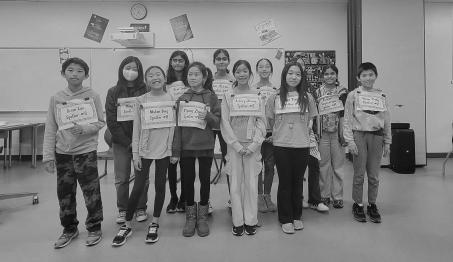
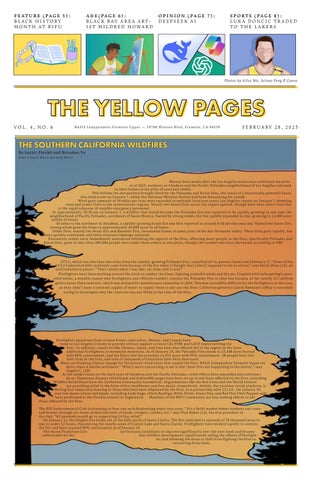
Middle schoolers of BASIS Independent Fremont Upper School entered rooms C11 and C12 as they attempted to find their name on sheets of paper that rested on chairs. As they took their seats, people helped them put sheets of paper with their names on their shirts. Now, it was time for the contestants of the spelling bee to start spelling words as they tackled with their inner feelings.
“I got really nervous before I spelled the word, but then I just went up and [my nervousness] kind of disappeared when I was actually spelling,” said student Diya Singh (7).
Singh had multiple feelings regarding this intense competition though, especially since this was her first time participating in a spelling bee.
“I haven’t actually gotten an oppor -
tunity to [compete before in a spelling bee], so that’ s partly why I was so happy and excited,” continued Singh, “I like to compete in these kinds of things.”
However, before they co uld participate in the actual spelling bee, the students i n middle school took a spelling test in their individual classes. Students who received high enough scores on the initial test progressed to the next level. Their parents received emails about their qualification, and how these students were able to participate in the next level. When they received the email, qualified students appeared to have similar feelings.
“Honestly, I was happy, but also, I was a little bit surprised because I wasn’t really expecting to qualify,” said student Olivia Hsu (7).
Hsu was the champion of the finals round for the school-wide spelling bee for grades six to eight. She will now represent our school as she advances to the regional qualifiers to compete against other schools in the area. She appears to
By Katherine He and Ailsa Wu
Editor-in-Chief and Feature Editor
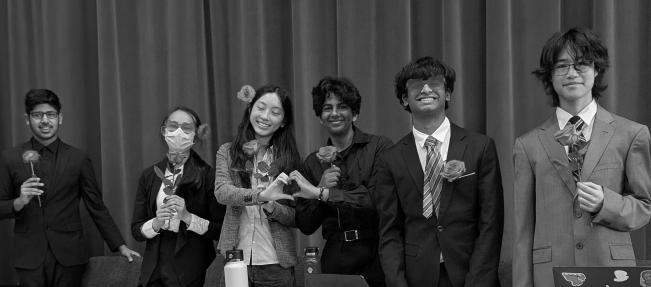
As Valentine’s Day at BASIS Independent Fremont Upper School gets closer and closer, high school students aren’t worrying about buying flowers or writing letters; they’re getting ready for the Annual Honors Chemistry Debate. The debate is a celebrated BIFU tradition happening every Valentine’s Day, where teams of six students from each Honors Chemistry class debate a topic selected by Dr. Araci. This year, the topic of the debate is “Which is more important for happiness: money or love?”.
Dr. Araci debuted the annual debates in the 2022-23 school year, the inaugural theme being “Is chocolate a friend or a foe?”. Each following year, the themes have been loosely centered around Valentine’s Day.
“I wanted to choose Valentine’s Day related topics because it’s more fun,” said Araci. However, since these topics may not cover the scientific and historical scope that she wants her students to debate about, Dr. Araci has said that the following years’ topics may not necessarily be related to the holiday.
Dr. Araci started the debates as a way to engage her students in intellectual conversations about various topics, teaching them skills in researching, formulating, and articulating an argument. Even though her students may be academically strong in certain subjects, she wants to teach them that being able to present and support a strong argument is also an important life skill.
Weeks of hard work and preparation go into the debate. From creating posters supporting each side’s argument to planning the entire debate program, Honors Chemistry students are hard at work supporting their teams and making sure the
be nervous but also excited for regionals as she has also e njoyed her experience with the final round and the whole competition so far.
“I think the spelling bee is a really fun activity. Before, I didn’t really want to do it, but then I just decided to try and actually, it’s a really good learning experience,” continued Hsu,
“It’s really helpful to broaden your vocabulary and also, I think the experience overall was pretty nice, because it wasn’t like too high pressure.”
On the other hand, some students did not participate, but they still got a great
opportunity and a unique experience in other ways.
“It was fun to see that my friends got in. It made me really excited and I was really ha ppy for them, so that was a nice process,” said stude nt Veronica Yuen (6). Overall, the students of BIFU seemed to love this idea of a spelling bee and would probably want to see more of these competitions in the future.
“I enjoyed the experience a lot. It was fun to go compete and see how other people are competing as well,” said Singh, “I also learned a lot of new words and vocabulary.”
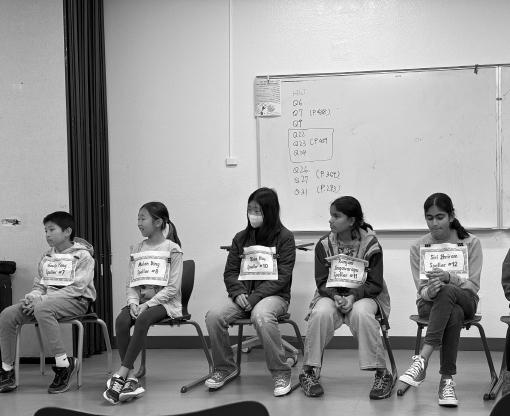
As the debate wraps up, both teams feel rewarded for their efforts in preparation and supplementary work.
debate runs smoothly. However, the most work is put in by the debate team members. After being assigned their sides of the debate, teams must start researching and creating their arguments.
“I think finding times to prepare is stressful,” says Shreyas Jay, a member of Team Love. “We’ve been doing it usually in office hours or at home late at night.”
However, the stress from debate preparation is alleviated slightly with the help and guidance of the debate team advisors – Mr. Betcher for Team Money and Mr. Dievendorf for Team Love.
“We have Mr. Betcher,” says Angela Cao, a member of Team Money. “ He’s been helping us a lot in terms of strengthening our arguments, giving us counter-arguments, and helping us support the various arguments.”
Finally, after weeks of preparation, the day approaches. The MPR is set up with rows of chairs for the audience, with a brochure and voting slip on each chair. The debate teams sit on the stage, with posters lining each of their tables, as they anxiously face the judges who are waiting to hear the arguments from both sides. The crowd cheers as the debate team members are introduced. Both teams are dressed formally, with Team Money wearing flashy gold chains and Team Love adorned with roses and heart-shaped glasses. The debate begins, and it takes up roughly an hour, composed of intense back-toback arguments and fun-filled break segments planned by the hosts, Tia Goshal (10) and Anjali Madala (11). Finally, after hearing both sides, the audience gets to vote on whether love or money is the true determinant of happiness.
“I’m very grateful for everyone that came out to watch the debate and all the judges who took time out of their day to see us,” says Jay. “It’s nice that our hard work was rewarded by the cheers of the crowd.“
While both teams were generally content with how the debate went, some debaters from each team expressed regrets and criticism for the event. Both teams mentioned feeling they didn’t fully flesh out their argu -
ments whether for rebuttals or just overall.
“For some reason, I felt like I had more time than I really did,” says Angela Cao. “So by the end of the debate, I felt like I wasn’t able to respond to some of the points that I wanted to.”
Although there may have a few mistakes here and there, the debate proved to be a huge success, as audience members left the auditorium feeling more informed concerning the topics of love, money, and happiness. After all, the goal of the Annual Honors Chemistry Debate is to have students showcase their hard work in an educational, entertaining way.
By Olivia Ma Editor-in-Chief
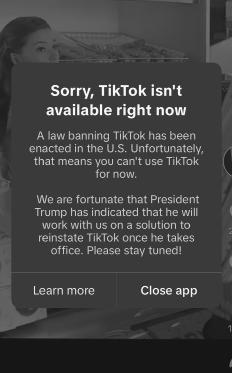
Scrolling through Instagram on the evening of January 18th, stories were filled with screenshots of a new banner on TikTok: “Sorry, TikTok isn’t available right now”. Usage of the app was blocked in the U.S. just hours before the ban was to go into effect on the 19th. Within 16 hours, TikTok was back onl ine, but the ordeal began back in 2020 when a ban was considered through an executive order by President Trump during his first term.
For Selena Peng (11), an avid TikTok user who has seen politicians try to ban TikTok over the years but fail to do so, this ban was just like any other previous attempt.
“At first I was super skeptical about it,” said Peng, in reference to the January 19th ban. “but then it surprised me that it was legit.”
Her initial disbelief was shared amongst social media users, where they shared confused updates and swapped theories about why their favorite app had suddenly disappeared.
When the app unexpectedly returned the next morning, a new announcement was sent out, thanking then president-elect Trump for bringing it b ack. Because TikTok was reinstated so quickly, rumors surfaced that President Trump reversed his position on the ban to appeal to younger voters, a demo graphic he made significant ground on in the recent 2024 election. Yet, Mr. Loero, a history and government teacher at

BIFU, said he believes there was another factor behind the ban’s timing — namely, that it was also a political maneuver by Pres ident Biden.
“I think that it’s a very savvy political move on behalf of Joe Biden,” Loero said, “because it would have denied the incoming Trump administration the opportunity to veto said legislation.”.
Government officials justified the TikTok ban by c iting concerns that the app, owned by Chinese company ByteDance, could allo w foreign entities to access U.S. user data. But Peng questioned whether TikTok was really the only platform handling data in ways that deserve scrutiny.
“I don’t think this would be a factor that limits me from using [TikTok],” Peng said. “Because I think it is important to note that my information is constantly being spread on the internet, so this specific ban is kind of hypocritical, because I believe that many apps have cases of selling data.”
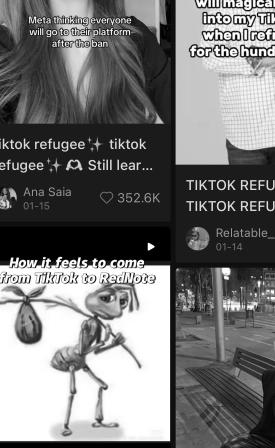
Despi te these concerns about data privacy, a significant number of TikTok users migrated to RedNote, also known as Xiaohongshu, another Chinese-owned social media app popular among Chinese audiences.
“I just found it really funny that the cultural interchange and the
By Sachit Parekh News and Sports Editor
On January 29, 2025 at 8:47 p.m. eastern, American Eagle Flight 5342, a Bombardier CRJ-700, was on final approach to Runway 33 at Reagan National Airport just south of Washington, DC, when it collided in midair with a U.S. Army UH-60 Blackhawk doing an annual night evaluation flight. Webcam video of the incident depicted a fireball erupting in the sky, as both aircraft split into pieces and plunged into the Potomac River, which had water temperatures just above freezing.
Recovery efforts confirmed the deaths of all 64 individuals on Flight 5342, and all 3 individuals on the UH-60. With a death toll of 67, January 29’s collision was the first mass casualty aviation incident on U.S. soil since 2009, where 50 people perished when a Continental Airlines Bombardier Q400 crashed into a residential neighborhood on approach to Buffalo International Airport.
Flight 5342 originated from Dwight D. Eisenhower National Airport in Wichita, Kansas—the site of a national figure skating tournament three days prior to the crash. The flight was carrying 28 individuals associated with figure skating clubs across the Eastern Seaboard—11 skaters aged 11-16, 13 parents, and 4 coaches—according to U.S. Figure Skating.
Olivia Ma (12), a figure skater, recalls the moment she found out about the crash.
“I was on Instagram when I saw a bunch of stories from my skating friends about the crash in DC”, said Ma. “It was really fresh news, so I was really confused on what had happened and what it had to do with skating.”
After more information about Flight 5342’s origins and passengers surfaced, the tight-knit figure skating community entered a state of collective mourning.
“Although I didn’t know any of the
people having really fun i nteractions and the fact that we were all part of the community, made me want to go to red note ,” said Romil Bhatt (12), another avid social media user.
As TikTok returned to normal, students breathed a collective sigh of relief, but the discussions sparked by the ban didn’t end there. For so me, like Pen g, who said she found her muscle memory attempting to access the app even when it was blocked , it was a wake-up call ab out their reliance on a single app for entertainment and news.
The short-lived ban also reignited longstanding debates about censorship and free speech within social media. Over the past few years, apps like TikTok, X (formerly Twitter), and Instagram have bee n caught in the crosshairs of cri tics who say their content moderation policies are opaque and potentially biased.
“I think every social media platform should fall under First Amendment protections. Trump was the president of the United States, making him the single most powerful person in the country and probably in the world, and Twitter banned his account”, said Mr. Loero. “If they can do that to him, what can they do to you?”
way excursion and crashed into a parked plane, killing one person.
talented skaters lost, I still felt really empty for a while, seeing so many of my fellow skaters and coaches grieving loved ones they had seen just days before”, said Ma. “No matter what level someone was—advanced or beginner— or where people were located, everyone felt the grief and the hole that was left in the community,” said Ma.
The NTSB has launched an investigation into the incident, having recovered both the flight data recorders from both aircraft.
Merely two days after the Potomac River collision on January 31, a Learjet 55 medevac plane en route to Tijuana International Airport crashed shortly after takeoff from Northeast Philadelphia Airport. Dashcam video of the incident shows the aircraft plummeting in a nosedive toward the ground, later erupting into a large fireball which destroyed four homes and ignited over 20 homes in the neighborhood the crash occurred. All six passengers aboard the Learjet, including a child under pediatric care, perished, and an additional person on the ground was pronounced dead at the scene.
On February 6, Bering Air flight 445, a Cessna 208B Grand Caravan, went missing over the Norton Sound during a flight from Unalakleet, Alaska, to Nome, Alaska. A search operation ensued, and the following day, the wreckage of the plane on a layer of sea ice was discovered. All ten people aboard the aircraft were pronounced dead. It was concluded that the plane crashed 30 miles from Nome, following a rapid loss of altitude.
The NTSB has launched investigations into both the Philadelphia crash and the Alaska crash.
Numerous other fatal small plane crashes have occurred as of late, including a collision at Scottsdale Airport in Arizona where a small jet suffered a run -
On February 17, Delta Connection flight 4819 crash-landed at Toronto Pearson International Airport. The Bombardier CRJ-900, which originated in Minneapolis, suffered a wing strike upon landing, which would flip the aircraft upside down and tear off the right wing and the tail fin from the aircraft. Miraculously, everyone in the CRJ-900 survived, though a couple of passengers suffered minor to moderate injuries.
This recent slew of fatal aviation incidents in the United States has led to intense political discussion, following the recent inauguration of President Donald Trump, the establishment of Elon Musk’s Department of Government Efficiency, and recent developments regarding FAA staffing changes. In a press conference following the Potomac River collision, Trump was quick to blame Diversity, Equity, and Inclusion (DEI) hiring policies in the FAA.
At BASIS Independent Fremont Upper, many students have been f ollowing these recent incidents. In a survey conducted by the Yellow Pages, all respondents have heard of the Potomac River collision, approximately 70% have heard of the Philadelphia crash, and approximately 45% have heard of the Alaska crash.
These events have also raised concerns about the safety of air travel, and the effectiveness of the FAA. In the survey, 36% of respondents believed that the FAA is not doing a good enough job at regulating air safety, while 18% believed the opposite. 46% were unsure.
“The high amount of incidents recently has made me doubt the effectiveness of the FAA. Something’s up with airline safety recently,” says Angela Cao (10).
In addition, BIFU students have become more wary of airline travel. 82% of respondents in the survey said that flying in an airplane “bothers them slightly.”
“I was on a plane at the same time that these crashes were occurring and it made me a little more unsafe about air travel,” says Seleema Atta-Hosni (Grade 6).
Ishaan Bhaduri (Grade 10) shares a similar sentiment. “I would feel a little uncomfortable getting on a plane right now but I would still fly,” says Bhaduri.
However, some people are not very worried by the recent incidents. “I know that these incidents are still extremely unlikely and protocols are in place,” says Ryan Li (12).
The recent incidents in U.S. aviation have generated a large amount of public attention, and many are relying on the FAA to ensure the safety of air travel in the United States.

By Seleema Atta-Hosni and Selena Peng
Staff Writer and Feature Editor

On January 31st, middle and high schoolers of BIFU Independent Fremont rushed into the MPR dressed in exquisite black, red, and white clothing, as they chatted with their friends and enjoyed
the winter formal. For years, students have looked forward to this uniting night of fun. One of the most cherished nights for many years, it serves as a break for students to unwind after a long week. Anna Liu (6), explains why she decided to attend this event.
“I would get to spend the night with my friends, and it’s (my) first school dance, so I wanted to see what it would be like,” Liu said.
The sixth graders are newcomers to our upper campus, as well as our campus traditions, so the winter formal allowed them to experience what school dances are like at the upper campus. For many younger students, this was an introduction to experiencing more highschool-styled festivities in the future.
Heart decorations filled the room as the students danced and sang along to their favorite songs. Excitement buzzed through the school and friend groups lined up to get their pictures taken at the photo booth. The Polaroid-style photos were a great way to remember the night with a special souvenir.
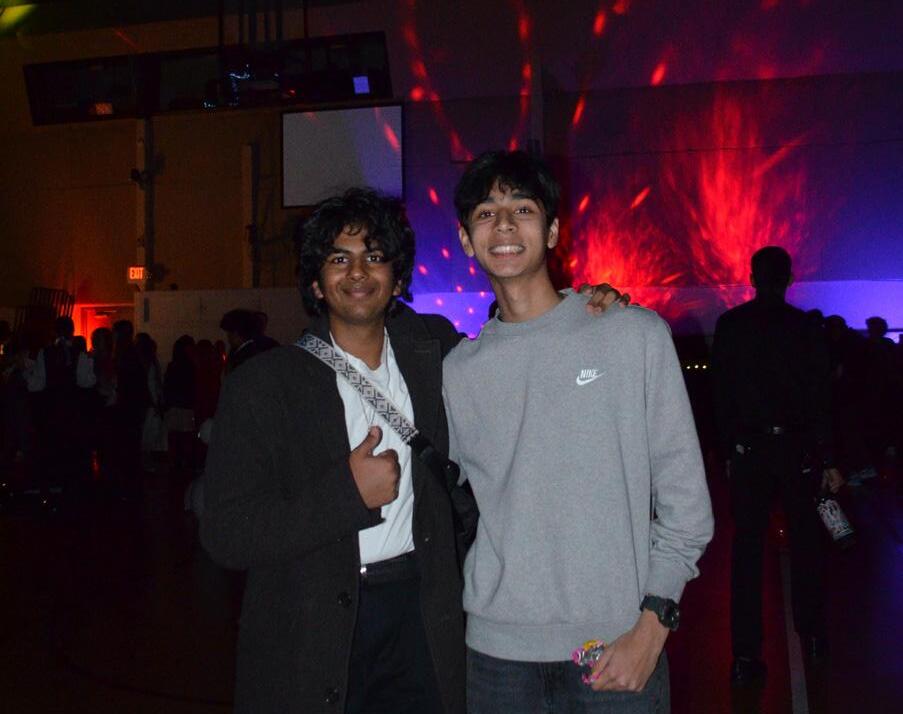
the lively atmosphere. The music boomed while bright red lights shone, balloons float ed on the dance floor, and joy filled the air. Laughter and conversation spread throughout the MPR as students danced under the glamorous decorations.
The school gym was transformed into a wonderland following the theme of this year’s dance: Queen of Hearts. BIFU students are not unfamiliar with
Students and teachers got to take adorable photos with heartshaped accessories that complemented the theme. A new addition to this event was the DJ. Operating the music plays a crucial part in setting the mood at an event like this one. Excitement filled the room as students were eager to dance to songs like the Cupid Shuffle. The playlist kept students engaged throughout the night as they danced energetically.
After a long school day and
hours of partying, the students were bound to get hungry. Middle and high schoolers lined up to get their food, eager for a delicious meal before getting back on the dance floor. The choice of cuisine was liked by many as they often reached for seconds.
“I think the food was good,” Liu said. “The Popeyes chicken sandwich was a good sandwich and there was another option, mac and cheese, which I think would have been good if I had chosen it.”
That being said, Liu also expressed her suggestion that it would have been more satisfying if there had been more snacks to go along with their meals, to make sure that they were fully refueled.
Another import ant aspect of events like the winter formal is the opportunity to meet new people. It is often rare to see students of different age levels interacting with each other daily, but when they are in the same place dancing and having fun, it sparks chances and creates opportunities for new friends. The dance floor created this opening as teachers, staff, and students from all grade levels danced together.
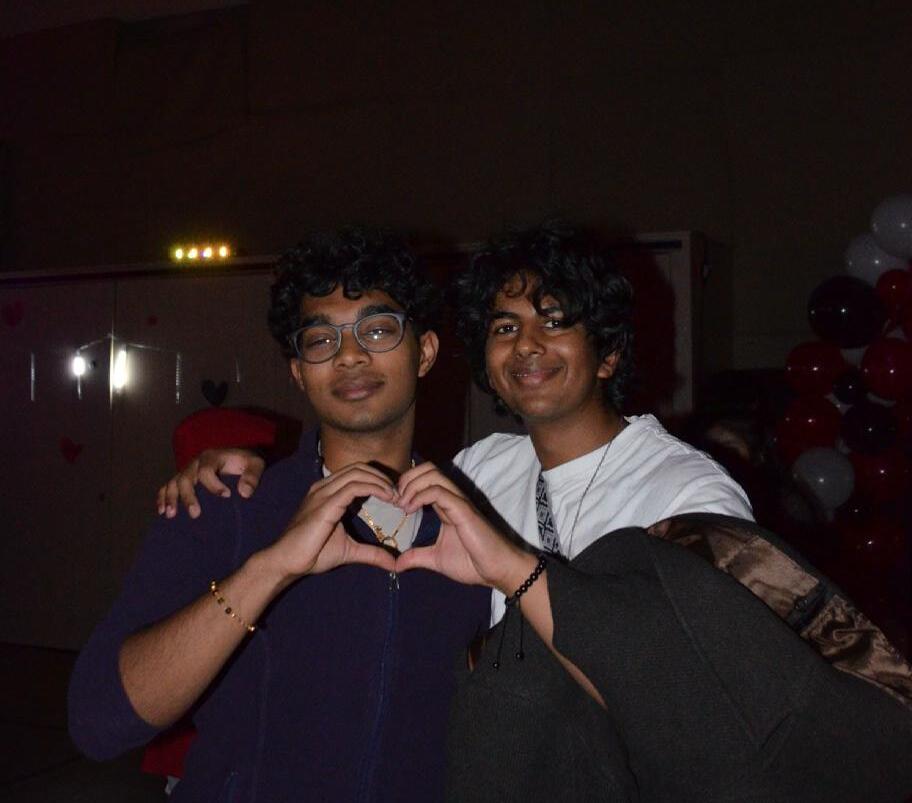
Events like these continue to grow connections that are not centered around academics at BIFU. Ultimately, the 2025 winter formal was a success, with many students attending and having a blast. Attendees would leave with sore throats from singing and achy feet from dancing, but with pictures to remember the night and smiles on their faces that showcase the fun they had. Events like the winter formal continue to build school spirit by uniting the school body and upholding traditions. Holding similar functions is an unfailing way to showcase school spirit, friendship, and inclusivity. This night will become an unforgettable memory for members of the BIFU community.

It’s hard to step out of your comfort zone and socialize with people you have never talked to, but it is crucial to understand that we are all part of the same community at school.
By Julee Jiang
Editor-In-Chief
Red hues rippled through the hallways while the scent of Chinese food filled the air on Wednesday in BASIS Independent Fremont Upper. The school’s celebrations for Lunar New Year to usher in the year of the snake began with great spirit. Students arrived in orderly fashion to the MPR, where the Lunar New Year festivities unfolded on the stage. The first performance involved three students from the band playing a traditional Chinese song on a cello, flute, and electric guitar, respective ly. The blended melodies created a harmonious tune that echoed throughout the room.

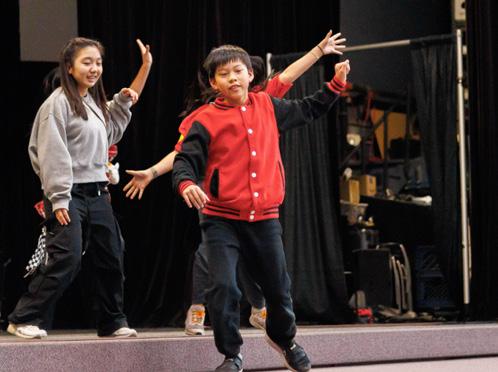
Lailai Zhang (12)’s personal choreography of a straight sword demonstration. Then, 15 seniors led by Haibin Peng (12) performed a series of traditional kung fu movements.
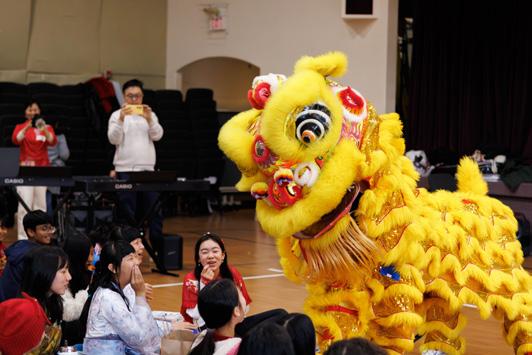
After the band performance, dancers donned in a yellow lion costume leaped onto stage to perform the traditional lion dance. The two dancers moved in perfect harmony beneath the intricately crafted costume, mimicking a lion’s movements with rolling and pouncing. They then moved off the stage and playfully engaged with the audience by moving close to sitting individuals and bobbing the lion’s head with lifelike precision. The dance concluded with the lion rearing up on its hind legs, and the audience erupted into applause. The excitement continued to build as the next act, the senior kung fu performance, took the stage. The stunning display of cultural artistry began with
After the group demonstration, James Gu (12) showcased the Shaolin 13 Spear Form. Peng then performed a solo with a three-section staff. Lastly, the seniors grouped together and ended off the performance with a fierce stance, their fists extended out. When asked why he chose to do a kung fu performance, Peng said, “I mostly wanted the seniors to shine once more like the hoco dance, and I always wanted to add my shares of culture to the community as well. I have been practicing kung fu for seven years, and it is now a lifestyle and a mindset to me.”
paired with the upbeat music brightened the entire atmosphere of the room.
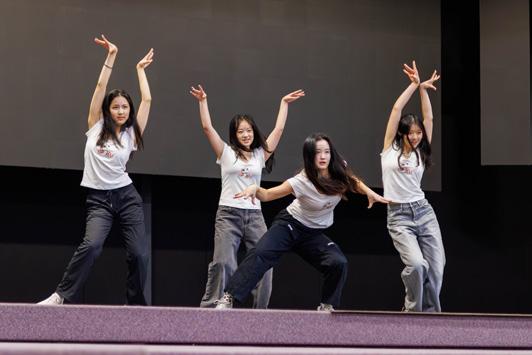
“It was fun, because we had the chance to express what our style is,” said Joshua Zhang (6), one of the lead dancers. “This performance was derived from a class, and then the choreography from the class was derived from the APT trend.”


Next, a group of sixth graders danced to APT. by ROSÉ and Bruno Mars. Their lively dance moves

pose, Helena Wang (12) stepped into the spotlight. Dressed in beautiful, flowing blue and white garments, she performed a traditional Chinese dance, captivating the audience with her graceful movements. After, Gu, Kevin Yan (12), and Kevin Zhou (12) danced to Jungkook of BTS’s song “Standing Next to You.”
Lastly, the BIFU girls group “Fantastic Four,” composed of Olivia Ma (12), Krystal Sun (12), Helena Wang (12), and Joy Wang (12), danced to “Drama” by Aespa.
Another
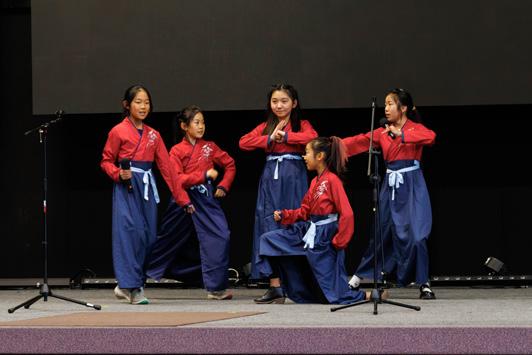
group of sixth graders then sang a tra ditional Chinese song with a guitar and piano accompaniment.
In the following act, Ms. Sun’s Manda - rin students showed off their per - formance skills in a group song and dance cover of “Manu - al of Youth” by the TF Boys, a popular Chinese boy group.
As the large group struck their last
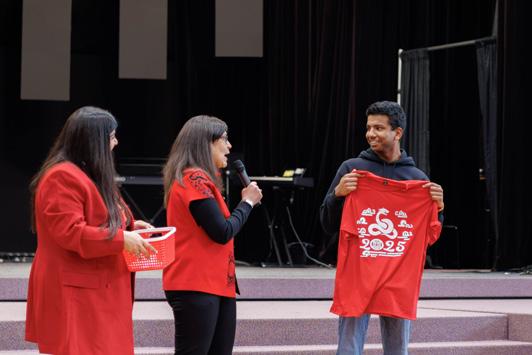
The festivities closed off with school staff drawing from a pool of names to determine the winner of a prize from each grade. Each winner received a red T-shirt with a red snake imprinted in the center. The audience was then invited to eat an assortment of Chinese dishes such as eggplant tofu, veggie spring rolls, and chow mein, creating a satisfying ending to the annual celebration.
Helena Shen, the BIFU parent who has organized the celebration since 2016, said she believes events like these are key in honoring many students’ heritage and bringing the Asian-American community together. Despite how her time as an active BIFU parent is coming to an end, she still looks forward to what the future holds for the Lunar New Year celebrations.
“My wish is whoever takes over as the leader for next year can leverage what has been set up as a tradition, and come up with new ideas”, said Shen. “I definitely want to see our community continue to grow, and have more meaningful moments come from this celebration.”
Photos by Sachit Parekh
By Thanisha Thambidurai
News Editor
Over the course of Black History Month, BASIS Independent Fremont Upper has held some notable events to commemorate Black history and culture. From photo frame-making sessions to an assembly with Oakland-born author Nikki Shannon Smith, BIFU has expanded its range of Black History Month events from previous years to highlight different daily aspects of African-American culture.
This year, Ms. Abodouma shared the process behind event planning, with initial planning for most events in the school year occurring during the summer. The auxiliary team identifies an event they want in a certain month and coordinates with other departments to determine if any other events are conflicting. As the event approaches, faculty members establish a specific date for the event and communicate with teachers and parents. Final event execution is generally completed by the Student Affairs Team.
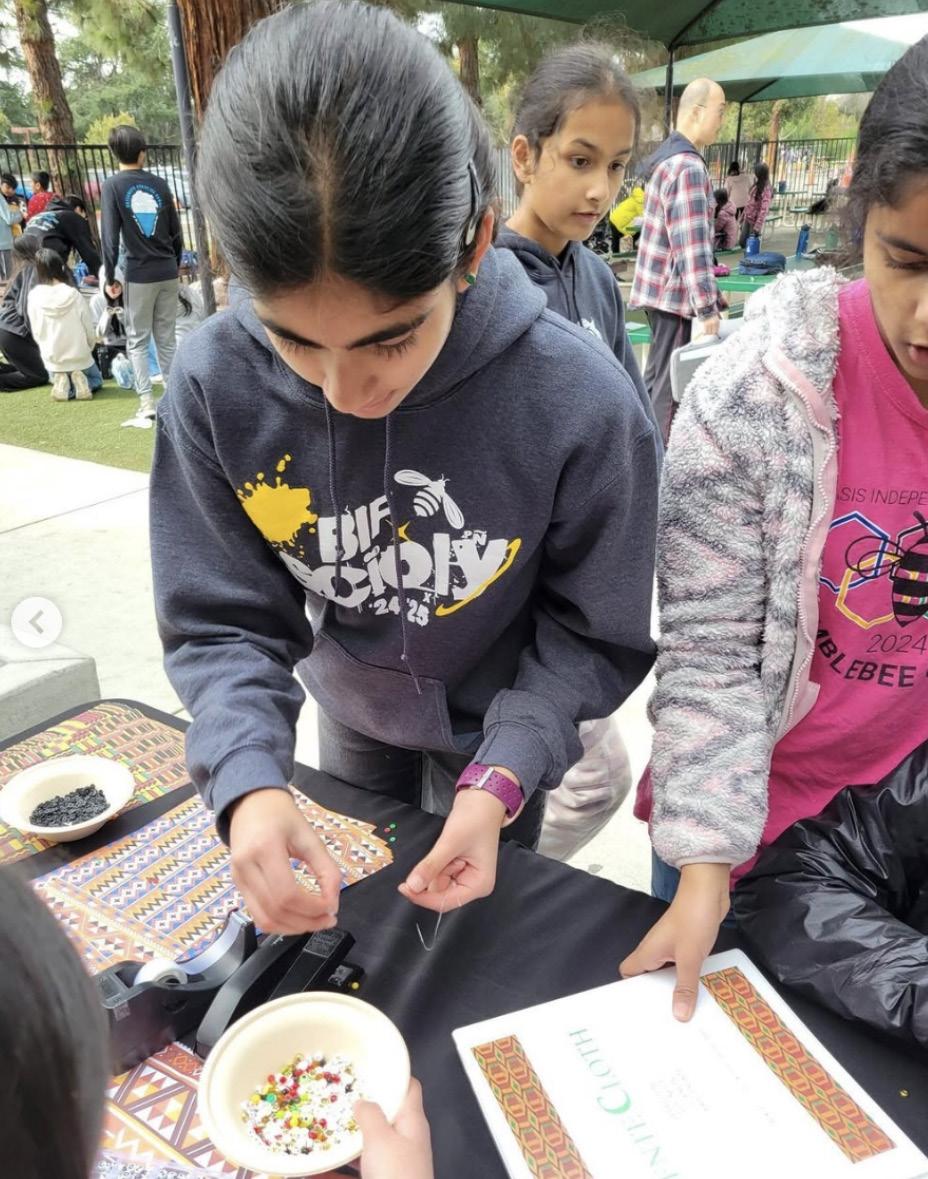
The first event, which took place
during middle and high school lunch, was a photo frame and bracelet-making event, where students were asked to bring a picture from their home. The frames were of the Kente pattern, woven geometric designs from Kente cloth, originating from Ghana. The bracelets and frames expressed appreciation for traditional African culture and brought connections between our everyday life and African history.
“The bracelets always signify that we are bonding,” said Ms. Abodouma, “or tying things together, so students could look at it different ways.”
On February 26, keynote speaker Nikki Shannon Smith from Oakland, California will present her experiences as a Black author. An author of children’s novels, Smith’s presentation is designed to inspire students. Her novels aim to authentically represent African-American children and include aspects of Black culture. Ms. Abodouma emphasized the importance of hosting Black History Month events at BIFU, stating that these events highlight Black people’s success in various fields.
“Oftentimes, we celebrate Black His -
tory Month by bringing in music-related or entertainment-related figures,” said Ms. Abodouma. “And oftentimes we forget that there are other professions in which the African American
population excels and succeeds, all professions actually.”
Furthermore, Ms. Abodouma shares the importance of remaining culturally aware, stating that many students in BIFU live a relatively sheltered life and are often uninformed about how students around the world experience life. She adds that the average high school student in Oakland may have completely different experiences than a BIFU student, and learning more about their experiences is the first step to understanding other people and the good and bad parts of their daily lives.
“If you’re going to get anywhere in the world,” said Ms. Abodouma, “you need to understand [other people’s] backgrounds and their lives and their history and their struggles and their triumphs.”
By Sarah Wu and Tycho Young Opinion Editor and Feature Editor

Since Mr. Dievendorf stepped into the packed halls of BASIS Independent Fremont, he has brought with him an enthusiasm for teaching, writing, and literature. Mr. Dievendorf is no stranger to the classroom. From tutoring during his high school years to serving as a professor at a community college, Mr. Dievendorf brings decades of teaching experience to his role.
Still, teaching high school presents its own unique challenges that Mr. Dievendorf has learned to overcome. In a candid interview, we learned how Mr. Dievendorf adapted to these challenges, discovered his love for writing, explored labyrinths — and how all of that started in his dad’s library.
At home, Mr. Dievendorf recalled his dad’s library as the happiest place of his childhood. He would often spend hours there reading, cherishing the many books on philosophy and psychology that his Dad had collected.
“I spent a lot of time in there, just having fun with the books on the shelf and seeing the possibilities of the world through the eyes of literature”, said Mr. Dievendorf.
He saw his first spark for teaching in high school, where his philosophy teacher, Mr. Lemmon, recruited him to the AVID program as an English tutor. Writing, which Mr. Dievendorf had always taken for granted, was something that he discovered to share with those around him. Under Mr. Lemmon’s guidance, he learned how to teach — beginning a lifelong journey of spreading a love of writing.
Prior to becoming a teacher, Mr. Dievendorf worked for four years as a fiction editor for Apogee, a journal of literature and art that serves as a platform for marginalized writers, where he discovered how to use writing as a means for social change. In one article, he examines how transgressive narratives in horror and comedy challenge social norms but often end up reverting back to traditional ideologies.
Continuing his efforts to use writing as a tool for social good, Mr. Dievendorf made the intentional choice to teach at a community college, a decision he
By Chen Ma Staff Writer
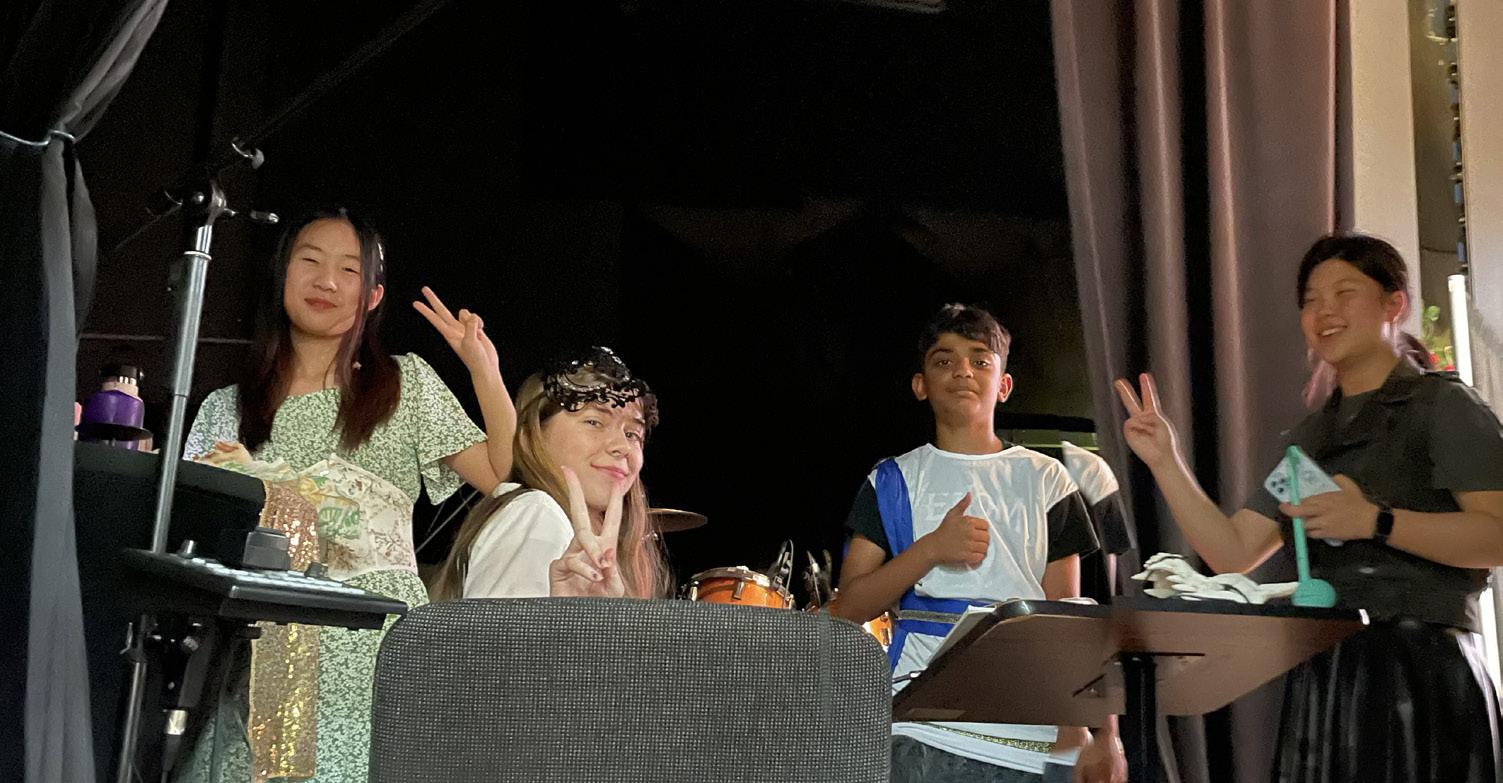
The atmosphere in the MPR is bustling like a busy market, with basketballs bouncing in the background, while students in colorful costumes run across the space. It’s tech week here at BIFU for the winter play. This year’s is a collection of five ancient Greek stories, acted out by Drama students. Mr. Acevedo’s voice carries over the lively chatter, and the students gather in a long line in front of the MPR. He an nounces the agenda for the day and the actors snap into place. Despite the looming performance and
described as an ethical one. However, when he was teaching at community college, he discovered a larger problem. College students lacked the basic writing skills that should have been taught during high school.
“I think that the way that our culture thinks about writing is, it’s not realistic. We don’t really think about it as a craft. I liken it to a musical instrument. A lot of times, it’s something that you have to learn and develop”, he said.
Determined to address this gap, Mr. Dievendorf turned to teaching high school as a means of remedying the issues he noticed, eventually joining BIFU as a subject expert teacher. What he found at BIFU came as a pleasant surprise.
“When we studied that Dave Eggers story — I’ve been teaching that story for a decade — I heard high school students say things about it that I never heard college students say”, he said.
Mr. Dievendorf was impressed by the high level of academic rigor of BASIS students, even going so far as to say that they outpace his past college students. However the transition was not without its challenges, as he found that a lot of his teaching style did not translate to a high school setting.
“I had to be much more adaptable in this context, and learn different techniques and skills, which has been very valuable.” said Mr. Dievendorf.
One of the most effective strategies Mr. Dievendorf has found is fostering a strong classroom community, where students are actively engaged with the material.
Next year, Mr. Dievendorf looks forward to approaching texts with the same unwavering passion in his upcoming capstone course, which explores how we perceive animals in literature. The course uses literature as a lens to examine what it means to be human through the analysis of animals, consciousnesses, morality, and the role of animals in society. Having taught this course at the college level, he is excit -
the nerves in the room, giggles sound.
“Tech week is chaotic, busy, and fun,” said Chloe Wang (7), the main prop maker for drama club productions. “The busiest thing is how many props there are to make.”
Going backstage is a trip into the inner workings of the play, where props are meticulously organized for the performers. From professionally crafted pieces to homemade creations, each prop reflects the dedication and effort poured into bringing the play to life.
Tech week takes place the week before a play opens, where the lighting, music and actors all come together for the first time. However, through watching their performances and seeing the scrambling, the rote practice, the memorization — it’s clear that most of the work has already been done. Even early in rehearsals, the actors showed that last year’s winter production, Myth Adventures: Five Greek Classics , was shaping up to be another successful performance.
ed to be given the freedom to continue teaching it at BIFU.
Outside of the classroom, Mr. Dievendorf enjoys exploring local places that pique his interest.
“I like to explore. This is a new place for me, so that’s really nice,” said Mr. Dievendorf, “I heard about somebody made some graffiti art over here, I’m gonna go see what that looks like. I like to walk around or just find places, unique places to go that I didn’t know about.”
In particular, Mr. Dievendorf likes to search for labyrinths, maze-like structures that often have symbolic meanings of self-reflection and mindfulness. Mr. Dievendorf’s pastime reflects his philosophy of the meaning of life — that happiness is found in the little things, the details.
For aspiring writers, Mr. Dievendorf emphasizes the importance of dedication, passion, and consistency.
“Grades are the byproduct of passion,” said Mr. Dievendorf. “The best thing you can do is just carve out time every single day to write, whether it’s 15 minutes [or three hours]. When I was younger, I would make myself write three hours every day. See how the greats do it, learn from them, and then do it every single day.”
Though teaching now leaves him with less time to write, Mr. Dievendorf is happy with his career and enjoys being able to share his love of writing with students at BASIS.
“This is my life’s work, so I want to keep teaching, I’m happy”, said Mr. Dievendorf. “In 20 years, I’ll be talking about how successful you guys are.”
“People don’t always do what they need to do,” said Mr. Acevedo. “[But I’ve] seen some actors do the best work they’ve ever done… [it] reminds me why I do this.”
The drama troupe’s enthusiasm is reflected in their performance, and on stage, the chaos turns into a seamless performance, rife with energy and passion. It is an orchestra of emotion as the actors put on the show. Throughout their months of hard work, they’ve experienced everything from the fatigue of endless practicing to the overwhelming joy of finally memorizing their lines. At the end of the performance, only pride is left behind at how much they’ve grown during their practice and at their ever improving performance skills.
“In the end when you’re standing up there taking your bows, no matter what role you got or how much struggling you did,” said Sharanya Chouhan(10), “ You are happy. Not just for yourself but for drama as a whole.”
By Sarah Wu Opinion Editor
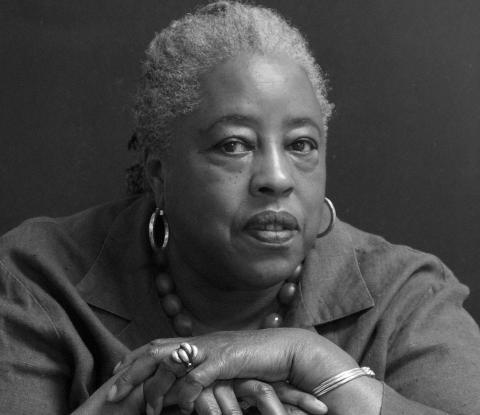
Boxing up her art supplies in her studio, Mildred Howard, a renowned African American artist known for her art installations around the Bay Area, was forced to move out of Berkeley, California, after 70 years of residence due to a sudden increase in her rent. Originally, Howard believed she would live
in the “People’s Republic of Berkeley” for all her life. However, not even her renowned status in the art and social activist community and the creation of March 29 as Mildred Howard Day could stop the hands of gentrification and the housing crisis from pulling her away from her community.
Throughout her life, Howard could not avoid involvement in political and social issues. In 1968, her mother, Mable Howard, launched a lawsuit against BART, the public transit system, to prevent them from building a new aboveground train line that would divide white communities and communities of color across its lines. Taking after her parents, Howard also became involved in protests against segregation when she was a student.
Now, Howard uses her artwork as a means of speaking out about social concerns.
“My work has evolved out of a desire to communicate and remember in a
By Natalie Luo Staff Writer
A soulful voice sings softly, a soothing but sorrowful sound — the first thing audiences hear when listening to “Nowhere”.
The song is part of the YouTube web series “Alien Stage,” which follows a singing competition set in an alternate reality where humans have been captured by aliens. In this world, humans who show talent for singing are forced to compete in “Alien Stage,” a deadly contest where two singers face off each round, with the winner decided by a popularity vote among the aliens. The winner then goes on to the next round, while the loser dies. The web series outlines the narrative of the show through animated music videos, where each video depicts a new round of the competition.
On January 9th, 2025, Alien Stage creator Vivinos released “Nowhere,” produced by Studio LICO and sung by Park Byeong Hoon, who voices Ivan, one of the contestants in the series. Ivan’s other notable songs include “Black Sorrow” and “Cure”. Unlike other performances in Alien Stage, “Nowhere” is an original composition by

Ivan and is not sung on stage. The song is about Ivan’s childhood growing up enslaved to aliens and his unattainable love for Till, another contestant on the show. The song conveys Ivan’s feelings of worthlessness, as he always feels like he’s never enough and won’t amount to anything useful. He acknowledges he loves Till, but he also accepts Till will never return this love. It’s established in the series that Till is strongly in love with Mizi, another contestant, and would place her life and happiness over Ivan’s. In addition to this, Ivan thinks he would never be enough for Till. Ivan sings that his whole life is useless and holds no value, calling himself “stained.” A recurring line in the song is “This always happens to me,” referencing the fact that his dreams are always crushed and he will never be able to get his true love, Till.
The lyrics show that Ivan has very low self-esteem, probably due to abuse from the aliens who raised him. His idea of Till as this unattainable figure is further proven by a rough translation of a specific line in the song: “My sky, shaped by the world / Doesn’t even
By Aarna Kamath and Pooja Kanthala News Editor and A&E Editor
The most anticipated music event, the 2025 Grammy Awards, was a night filled with spectacular performances, record-breaking wins, unexpected losses, and more. With a star-studded audience and emotional winning speeches, the event recognized and celebrated the best music artists of our time. Fans across the world watched their favorite artists take the stage—some breaking norms and others delivering shocking speeches that will be remembered. The 67th annual Grammys had something for everyone, from Album of the Year to Best New Artist. Here’s a look at the highlights from this iconic night and what made this year’s Grammys one for the record books.
At every Grammy awards show, the most anticipated awards category is Album of the Year. Nominees included Sabrina Carpenter for “Short n’ Sweet,” Beyoncé with “Cowboy Carter,” Billie Eilish for “Hit Me Hard and Soft,” and Taylor Swift with “The Tortured Poets Department.” While each nominee is deserving of this prestigious award, only one name was called out. On Sunday February 2nd, Beyoncé won Album of the Year with “Cowboy Carter,” an album that explores the Black roots of country music.
However, Beyoncé’s win sparked significant fan speculation and debate. Many listeners on social media platforms like TikTok argued that Billie Eilish should have taken home the award for “Hit Me Hard and Soft,” an album
world that regularly forces silence and amnesia upon large groups of people –especially people of color – in which both actors and spectators are numb to the pain of the other side,” said Howard.
Howard’s art and sculptures are displayed all across the Bay Area, generally in large scale glass exhibits. Throughout Howard’s art, glass is a common medium, especially glass bottles, which are used in various African and South American cultures to keep bad spirits away. Her work to combine science and art at the San Francisco Exploratorium has led her to pay special attention to the properties of light in her work that make the colors and shadows created by the reflections and refractions of the glass.
Using her art, she fights back against gentrification and tells the stories of those who are left out. Her public art installations include The House That Will Not Pass for Any Color Than Its Own, an interactive glass house made up of large purple glass panels. The sculpture has been continuously moved between California and New York, both places with a long history of immigra -
let me stand under it.” The sky refers to Till, an unreachable entity that is way above him, but something that he has looked up to for such a long time. However, the second part of the line reveals the sad truth that Till will never love Ivan the same way Ivan loves Till. Another portion of the song with the lyrics “At yesterday’s daydream, all torn up / Fly far, far away / Never, never come back to me / Because it’s easier to forget” tells us Ivan has a tendency to not chase after his dreams because he thinks he will never reach them. One line that stands out is a sentence regarding his appearance. In the series, Ivan is depicted with a fang resembling that of a vampire’s. He sings, “With that revolting tooth,” showing the depth of his self-hatred.
The second verse of the song is entirely devoted to Till. Regarding Till, Ivan sings, “That’s just the kind of kid he is, so laugh / Laugh, because he can’t do anything.” Till is adaptable, chill, and goes with the flow. He knows he can’t do anything about his situation, so he just laughs and shakes it off, remaining unswayed and confident. These lyrics prove the amount of admiration Ivan holds for Till, in awe of Till’s unwavering composure. In terms of musicality, this song was enjoyable and worth recommending to others. However, most of the song is in Korean, so listeners will have to search
tion.
“As an unmistakable symbol of home, the house suggests a city that is sensitive to the experiences of its diverse population and celebrates their complex history and multicolored beauty,” said Howard.
Yet she noticed the disappearance of the diverse community in her own city of Berkeley. More and more people who moved in were able to directly purchase a home while the city’s population of artists were pushed out because of increasing prices.
“There’s just so much Black culture in south Berkeley, and (now) I go there and I’m lucky to see Black people at all,” said Howard.
Despite the sadness she feels from having to move away from her home and re-establish in Oakland, Howard commemorated her past and her long history with the city she grew up in; she installed a new sculpture of a West African currency in Berkeley that she hopes can “reclaim, remember, pay homage to, the people that were an important part of Berkeley’s revolutionary history.”
up the lyric translations to understand what Park Byeong Hoon is singing about.
Three peers were interviewed for their opinions on the song, and the consensus was that the song is overall pleasant.
“I love ‘Nowhere!’” said Rachel Wu (9).
When asked about the song’s meaning, she replied that she thinks Ivan composed the song specifically for Till, noting the multiple instances throughout the song where Ivan is describing Till directly or sings about his love for Till. The song is not only about his love for Till though, and also speaks about his experiences.
“I think [“Nowhere”] describes Ivan’s point of view, how he regards life and his existence,” said Helena Huang (9).
The students were also asked if they believe Ivan harbors romantic feelings for Till. There was unanimous agreement that he does.
“I mean, the first few lyrics literally give us the answer,” said Audrey Song (9), referring to the opening lines “In love with you, when you were mine.”
Overall, the song outlines the sad reality of Ivan’s past, showcasing the trauma that he holds due to his abusive upbringing and his negative outlook on reality, along with his unrequited love for his childhood best friend Till.

during her acceptance speech.

that took her and her brother, Finneas, four years to develop.
“I feel like this album is me,” said Billie to Rolling Stone, an established and popular magazine. “It’s not a character. It feels like the ‘When We All Fall Asleep, Where Do We Go?’ version of me. It feels like my youth and who I was as a kid.”
Fans who supported Eilish’s nomination for Album of the Year appreciated the deep emotional connection she poured into her tracks. However, the debate goes both ways, as just as many fans believe Beyoncé rightfully deserved the win.
As the night unfolded, honoring various stars for their hard work, one artist stood high above the rest. Kendrick Lamar dominated the Grammy awards, taking home an astonishing number of five Grammys—all for his internationally viral diss track “Not Like Us” against Drake. The long-standing tension between Lamar and Drake is wellknown and took centerstage in 2024. Lamar’s iconic Grammy wins include Best Rap Song, Best Rap Performance, Record of the Year, and Song of the Year.
Also of much interest to viewers was Doechii’s Grammy win for Best Rap Album with “Alligator Bites Never Heal.” After first gaining recognition in 2020 on TikTok, Doechii won her first Grammy this year, making her the third woman to ever win Best Rap Album.
“Anything is possible,” said Doechii
Additionally, Doechii was nominated for Best New Artist and Best Rap Performance. However, she faced some backlash for her performance at the Grammys, with many viewers claiming that the performance was lip-synched rather than performed live. The singer retaliated, stating that her entire performance was live despite personal health issues she was facing at the time.
Among the rising stars honored at the 2025 Grammys was Chappell Roan, who took home the award for Best New Artist. In addition to her win, Roan earned nominations in several major categories, including Best Pop Vocal Album for “The Rise and Fall of a Midwest Princess,” Best Pop Solo Performance for “Good Luck, Babe!,” Song of the Year for “Good Luck, Babe!,” Album of the Year for “The Rise and Fall of a Midwest Princess,” and Record of the Year for “Good Luck, Babe!”
However, it wasn’t just Roan’s impressive list of nominations that captured attention—it was her powerful Grammy speech.
During her acceptance, the Good Luck, Babe! singer called out record labels for failing to provide aspiring artists with livable wages and healthcare, sparking controversy among both industry executives and fans. While her remarks faced criticism, many fellow artists, including Sabrina Carpenter, Charli XCX, and Noah Kahan, supported Roan’s message and even contributed to her call to action.
The Weeknd, who recently released his final album “Hurry Up Tomorrow,” made his first appearance at the Grammys since 2017. After refusing to submit his music in previous years due to
concern about unfairness in the awards process, his return to the Grammys reflects positive changes made by the recording academy.
Before his unexpected performance, Recording Academy CEO Harvey Mason Jr. commented on recent changes, stating, “Over the past few years, we’ve listened. We’ve acted. And, we’ve changed.”
Audience members and viewers of the performance were left excited with anticipation of what this monumental reappearance could mean for the Grammys in upcoming years. However, the Weeknd’s surprise performance was not the only unexpected part of the Grammys.
After Olivia Rodrigo released her song “Drivers License” addressing her breakup with actor Joshua Bassett, many rumors arose about Sabrina Carpenter being the “blonde girl” who Bassett moved on with after the breakup. Carpenter’s song “Skin” was seen by fans as a clapback to this reference. However, Rodrigo and Carpenter were seen sharing a hug at this year’s Grammys, finally shutting down rumors of their feud. Carpenter also came out of the Grammys with two awards: Best Pop Vocal Album for “Short n’ Sweet” and Best Pop Solo Performance for “Espresso.”
Overall, the 67th Grammys delivered many exciting and unexpected events with new up-and-coming artists and established artists all being celebrated for their tremendous talent in the music industry.
“I feel like this Grammys was pretty interesting,” said an anonymous junior. “I’m looking forward to seeing what happens next year.”
By Aaron Ely Staff Writer

A new challenger approaches. On January 20th, Chinese company High-Flyer released DeepSeek-R1 to the public, and it has gained quite a lot of popularity. Some say that DeepSeek is just another new chatbot like the many that have been produced before. Others say that the release of DeepSeek R1 was a Sputnik moment—the dawn of

a new age of AI. Amidst the buzz, the real question is how DeepSeek measures up against today’s leading chatbots, including ChatGPT and Copilot. Does DeepSeek truly have what it takes to outperform its competitors?
In order to test how good an AI is, it needs to be compared to other AI models, so DeepSeek is being compared against two major chatbots: GPT and Copilot. In terms of testing, there are four main categories: Problem-solving, Literature Generation, User-friendliness, and Pricing.
DeepSeek, GPT, and Copilot were all tested on various academically rigorous questions from STEM competitions such as the AMC, USACO, and many others as well. DeepSeek provided a long detailed process on the ways in which it solved the problems, something that Copilot and ChatGPT didn’t usually provide. Overall, compared to
By Eric Jiang and Nick Yin Staff Writers

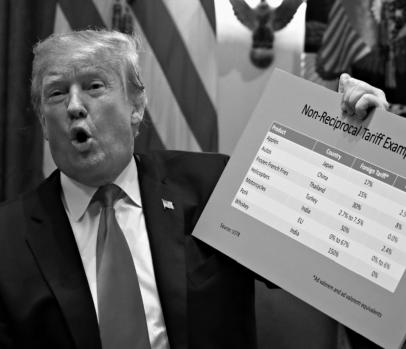
Since January 20, when President Trump was officially inaugurated, he has unleashed a series of bold policies, including tariffs on Canada, Mexico, and China. In simple terms, tariffs are a tax on imported goods imposed by a nation’s government and paid by consumers or buyers of those goods. Although these tariffs are meant to boost domestic production, they risk pushing up the prices we pay for everyday items — a cost that ultimately falls on American families and small businesses struggling to keep pace.
These price shifts will affect food, beverages, gasoline, construction materials, electronics, and more. In response to the threat of tariffs, both Canada and Mexico announced reciprocal actions by imposing similar tariffs on U.S. goods. This tit-for-tat approach shows that this trade dispute has high stakes, as major trading partners are not going to sit back and absorb the consequences, knowing that even small changes can affect the economy and hurt jobs and livelihoods.
Fortunately, these particular price increases are yet to occur because the tariffs on Mexico and Canada, announced on February 1 and set to take effect on February 4, were postponed by 30 days. The delay came after it was revealed that these tariffs were imposed due to “illegal immigration and drug trafficking,” and negotiations led both sides to promise increased border security. For example, Canada agreed to place advanced technology along with added personnel on the border and crack down on drug smuggling,
its competitors, it seemed to possess a stronger ability to explore multiple approaches and solve more complex questions.
Literature generation entails creating a piece of writing based off a user prompt. This can be split into academic/analytical writing and creative writing. In terms of analytical writing, DeepSeek provided longer and more detailed results than ChatGPT and Copilot, along with having a more academic style when asked. However, when it came to creative writing, ChatGPT took the lead. DeepSeek is geared towards its efficiency, and therefore, it lacks more on its flexibility. ChatGPT was designed for nuanced language production, meaning its creative writing is less stale.
User-friendliness is simply how well a chatbot can interpret and respond to a user’s prompt. Since DeepSeek is optimized for speed, it delivers quick and high-quality responses for short
leading to a cycle of trade barriers. They may also come into conflict with the World Trade Organization (WTO), which usually frowns upon imposing tariffs without consulting countries involved in the trade.
Looking ahead, opinions remain divided.
“It’s too soon to tell, but the United States, regardless of the administration, has a long-term interest in balancing trade deficits”, said Mr. Loero, a government and history teacher here at BIFU. “However, large, long-term trade deficits can weaken an economy. While the current tariffs are painful, they might pave the way for more balanced trade relationships in the future.”
Beyond negatively affecting consumers and the economy, the tariffs are also a hot-button issue in politics.
“Tariffs have always been politically charged. Before the income tax was introduced in 1913 under Woodrow Wilson, tariffs were the primary source of government revenue”, said Mr. Loero. “During the presidencies of John Quincy Adams and James Monroe, tariff debates were constant, as they directly affected the cost of living, especially in the South.”
Furthermore, earlier this year, when Colombia’s President Gustavo Petro re -
and specific prompts. However, if the prompt is a longer one, DeepSeek seems to mainly skim over the first sentence or two, and replies mainly based on that. In contrast, ChatGPT and Copilot are more well-rounded in terms of prompts, delivering responses that are usually pertinent to the entire prompt.
In terms of pricing, DeepSeek is free for use, just like ChatGPT and Copilot. However, unlike ChatGPT, it does not offer a premium subscription model. For usage of their model’s APIs, DeepSeek’s APIs are significantly cheaper than that of Copilot and ChatGPT, which makes DeepSeek more appealing for large tech companies.
Overall, DeepSeek, while better than other chatbots in certain areas, is not definitively the best AI. It may not be a “Sputnik moment” like people call it, but it is definitely another step in the direction of better AIs. DeepSeek has its strengths, but it has its weaknesses as well, making it better in specific scenarios and worse in others. So, if someone asks which AI they should use, the answer is not the one that is better, but the one that is better for you.
fused to allow US planes carrying deported Colombian nationals to land, President Trump instantly announced 25% tariffs and threatened to raise it to 50% if Columbia did not revise their decision within the week. Columbia quickly backed off, and the tariffs were put on hold.
These policies reflect an overly aggressive approach to rebalancing our trade relationships. They force us to confront the reality that in a global economy, no nation operates in isolation. While the goal of protecting American jobs and industries is commendable, the means of getting there are deeply flawed. The challenge will be to manage these economic disruptions while preserving the benefits of global trade—a balancing act that, if mismanaged, could reshape our political and economic landscape for the worse.
As these measures continue to evolve, businesses, consumers, and international partners remain watchful for potential economic and political ripple effects. While the full impact of these tariffs is still unfolding, one thing is certain: the debate surrounding trade policy, economic fairness, and national security will persist, shaping both domestic political discourse and global market trends in the foreseeable future.
and Mexico agreed to place 10,000 National Guard members on the border to stop drug smuggling and migrants.
However, the tariffs on China have already been put in place, with a 10% tax on all imports from China. This was imposed in response to concerns regarding China’s role in the supply chain of synthetic opioids, including fentanyl. Experts from the Consumer Technology Association (CTA) warn that the average smartphone could increase by around $213, and laptops could even increase by up to $357.This move is yet another example of a bold and somewhat aggressive move that may backfire.
Beyond raising prices, these tariffs contribute to market volatility. When investors become uncertain about the economy’s future, whether due to a decrease in the value of the Chinese Yuan, which makes Chinese exports cheaper, or because of Chinese retaliatory tariffs, the prices of stocks, currencies, and other financial assets can swing unpredictably. This uncertainty forces investors to react fast and hastily, which can trigger market movements that affect everyday Americans in unexpected and potentially negative ways.
Trump also recently announced plans for a “reciprocal tariff,” which aims to equalize tariffs that other countries impose on American goods by applying equal tariffs on them. If these tariffs are to come into effect, they might initially affect countries like Brazil, India, and Vietnam. These tariffs will likely escalate tensions between the United States and its trade partners,
By Shreyas Jay and Josh Peter Staff Writer and Opinion Editor

A trade occurring on the night of February 2nd made waves across the NBA world. As news broke out of a blockbuster trade between the Dallas Mavericks and Los Angeles Lakers involving two mega stars, Luka Dončić and Anthony Davis, fans and players alike rushed to the internet to see if this trade was real or not.
“Obviously everyone thought the trade was fake,” Memphis Grizzlies forward Jaren Jackson Jr. said in response to the news.
Dončić, drafted third overall in 2018 to the Atlanta Hawks, but immediately traded to the Dallas Mavericks, won Rookie of the Year in his first season in the NBA. Dončić has been an All-NBA first team player, an honor given to the top five best players in the NBA for a season, every season since the 2019-2020 season. Davis, drafted first overall in 2012, signed with the Lakers in 2019, and has four All-NBA first-team seasons under his belt alongside a championship with the Lakers in 2020. Both players were widely acknowledged to be key members of their respective teams and were seen as “untradeable.” Dončić, who took the Dallas Mavericks to the NBA Finals just last year and is still entering his prime, was widely re -
garded as the future of the franchise.
The Mavericks were motivated to move Dončić because of his constant conditioning concerns, sources told ESPN reporter MacMahon. There had been significant frustration within the organization about Dončić’s lack of discipline regarding his mindset and conditioning, which team sources considered a major factor in his injury issues.
The three-team trade deal involved the Los Ang eles Lakers receiving the Mavericks’ Luka Dončić, Maxi Kleber, and Markieff Morris, with Dallas obtaining Anthony Davis, Max Christie, and the Lakers’ 2029 first-round pick. The Utah Jazz received Jalen Hood-Schifino from the Lakers, the Mavericks’ 2025 second-round pick, and the Los Angeles Clippers’ other Los Angeles team, the Clippers’, 2025 second-round pick.
The Mavericks organization stated that they traded Dončić to improve the team’s defense, although leaks reported by ESPN’s Tim MacMahon also noted concerns regarding Dončić’s physical conditioning and future contract extensions. After the trade, Mavericks General Manager Nico Harrison claimed in a press con -
By Melody Zhang Staff Writer
With the first race of the season set for March 16th in Melbourne, Australia, excitement is building for what promises to be one of the most unpredictable and dramatic seasons in Formula 1 history. The 2025 season brings unprecedented changes, with driver changes, shifting team dynamics, and rivalries set to reach new heights. Unlike the stability of the movement from 2023 to the 2024 season, where all teams retained their driver lineups, only two teams have kept their pairings unchanged for 2025. The biggest shock of the offseason was Lewis Hamilton’s highly anticipated switch to Scuderia Ferrari after over a decade with Mercedes, as he chases a record-breaking eighth title.
“I’m excited that Hamilton moved to Ferrari because it will bring more competition to Red Bull,” said Vivaan Apte (7th grade). “He’s been with Mercedes for so long, but they’ve already peaked. Ferrari has momentum, and his goal is clear, to win his eighth championship and cement his legacy.”
However, Hamilton’s arrival at Ferrari creates a unique challenge for the team, as they now have two championship-caliber drivers competing for the top spot.
“I think the Lewis to Ferrari switch will be super interesting to watch with two important drivers to the team,” Katie Xu (12th grade) noted. “Like, there’s usually a driver the team prioritizes, but now for Ferrari, they have to prioritize both.”
This shift in team strategy could create internal tension between Hamilton and his new teammate, Charles Leclerc, who has long been seen as Ferrari’s future world champion. Hamilton currently shares the record for most world championships (7) with Michael Schumacher, and a title win in 2025 would make him the undisputed greatest driver in F1 history. However, the road to glory won’t be easy. The defending champion Max Verstappen, a four-time world champion, seeks to extend his dominance, while McLaren’s rising star Lando Norris, last year’s runner-up, aims to claim his first title.
“I’m so excited to see Lando Nor-
ference that “defense wins championships” and that Davis was “one of the best two-way players in the league.”
Responses to the trade have been ambivalent, with Mavericks fans expressing strong discontent and Lakers fans c elebrating the acquisition of a new young star. Mavericks fans, who viewed Dončić as the future of the organization, have reported feeling “betrayed” by this trade. Multiple protests have been staged outside the Mavericks’ home arena calling for the removal of Nico Harrison and the rescinding of the trade.
Multiple fans have also reported that the Mavericks have begun to offer refunds to fans who have canceled their season tickets following the trade. Although the prospect of a new center in Anthony Davis is exciting, parting ways with someone considered to be their “franchise player” has been a major grievance for Mavs fans.
“My first reaction was that there was no reason for this because Luka is our franchise player,” says Ryan Li (12), an avid Mavericks fan. Lakers fans, on the other hand, have celebr ated this trade. Fans were quick to make a mural of Luka and the late Laker legend Kobe Bryant, and tickets for Luka’s debut in LA quickly sold out. Although fans were sad to depart with Anthony Davis, a key part of their championship run in 2020, Lakers fans are excited for their new future with Dončić, as it is clear that
Dončić will be the key figure the team is built around after LeBron James. Players, alongside the media, showed astonishment about the unforeseen trade. “Insane. It’s crazy. Crazy. …would’ve never thought Luka Dončić would get traded. At his age, midseason, the NBA is a wild place, man. If he can get traded, then anybody is up for grabs,” said Kevin Durant of the Phoenix Suns. Dončić himself had only one word to express after his first game as a Laker. After his 24 minute performance with 14 points, five rebounds and four assists in a 132-113 win against the Utah Jazz, the new Laker told reporters the experience was “special” (NBA). In his first game as a Maverick, Anthony Davis had 26 points, 16 rebounds, 7 assists and 3 blocks in 31 minutes of playtime. Although his return was cut short in the third quarter due to a lower body injury, Davis’ memorable introduction was cemented with the legacy of being only the third Maverick since 1997 to score 20+ points, 10+ rebounds and 5+ assists in a half. Dallas held on after Davis’ injury, defeating the Houston Rockets 116-105. Although the longevity of the Mavericks is unclear, it’s clear that they are making a serious push for the championship in the near future. With a star-studded cast of Kyrie Irving, Klay Thompson, and now Anthony Davis, the Mavericks are serious title contenders.

ris fight for the world championship,” says Paisli Dave (11th grade). “He came so close last year, so this is his year!”
However, Norris’ biggest challenge may not just be Verstappen but his own teammate, Oscar Piastri, who has already secured two race wins in just two seasons. McLaren stands strong as one of only two teams to maintain its driver lineup, banking on continuity to challenge Red Bull’s reign.
While some drivers have secured seats, others have been left behind, sparking debate among fans. Daniel Ricciardo and Valtteri Bottas, both seasoned veterans with proven talent, found themselves without a spot on the 2025 grid.
“Daniel Ricciardo should still be in F1, I don’t know why he doesn’t have a seat,” said Ekam Gadh (7th grade). Another 7th grader added, “Valtteri Bottas has so much potential, he was a two-time championship runner-up. He deserved better.”
However, Bottas has taken on a role as Mercedes’ reserve driver for the 2025 season, ensuring his continued presence in F1 and keeping the door open for a potential return to the grid. One of the most controversial decisions of the offseason was Red Bull’s unexpected selection of Liam Lawson to replace Sergio “Checo” Pérez. This move shocked fans who expected the team to promote either Ricciardo or Yuki Tsunoda. Instead, the seat went to Lawson, a rookie who shows no respect towards the older drivers and has a reputation for aggressive and reckless driving. The 2025 grid will also feature a significant influx of fresh talent, with six rookies making their Formula 1 debut. Among them is 18-year-old Andrea Kimi Antonelli, widely considered one of the most promising young drivers in recent years, who joins Mercedes as George Russell’s new teammate, replacing Lewis Hamilton. Another highly anticipated debut is Zane Maloney, who replaces Kevin Magnussen at Haas after his impressive Formula 2 campaign. The remaining rookies include Isack Hadjar at Visa Cash App RB, Jack Doohan at Alpine, Liam Lawson at Red Bull, Oliver Bearman at Haas, and Gabriel Bortoleto at Kick Sauber. Another notable departure was Zhou Guanyu, the first Chinese driver in F1 history. After
racing with Alfa Romeo (now Kick Sauber) since 2022, Zhou lost his seat for 2025, a decision that deeply upset his growing fanbase, especially with one of the Grand Prix races taking place in China. However, in a recent development on February 5, 2025, Ferrari announced that Zhou would be joining the team as a reserve driver, alongside former F1 driver Antonio Giovinazzi.. With so many changes shaking up the grid, this season is set to be one of the
most thrilling in recent history. The fight for the championship will be fierce, with Hamilton’s hunger for an eighth title, Verstappen’s quest for continued dominance, and Norris’ push for his first-ever championship. As the teams prepare for the season opener in Melbourne, fans can only wait in anticipation to see how these rivalries unfold. Only one thing is certain — Formula 1 in 2025 is entering a new era, and the world will be watching.

Editors-in-Chief: Katherine He, Julee Jiang and Olivia Ma
Section Editors: Angela Cao, Aarna Kamath, Pooja Kanthala, Vera Lin, Emma Ma, Sheil Mody, Sachit Parekh, Selena Peng, Josh Peter, Thanisha Thambidurai, Ailsa Wu, Sarah Wu, Vincent Yang, and Tycho Young
Staff Writers: Seleema Atta-Hosni, Shubh Bachkethi, Angela Cao, Aaron Ely, Hemangi Ghimire, Shreyas Jay, Eric Jiang, Aarna Kamath, Pooja Kanthala, Vera Lin, Natalie Luo, Chen Ma, Emma Ma, Sheil Mody, Sachit Parekh, Selena Peng, Josh Peter, Thanisha Thambidurai, Ailsa Wu, Sarah Wu, Vincent Yang, Nick Yin, Tycho Young, Brandon Yu, and Melody Zhang
Graphic Design: Katherine He, Julee Jiang, Olivia Ma, Selena Peng and Ailsa Wu

Thank you for reading the sixth issue of the fourth volume of The Yellow Pages! We hope you enjoyed reading the issue as much as we enjoyed the process of creating it! If you have any comments, suggestions, questions, or notice any mistakes in our newspaper, please contact bifyellowpages@gmail.com . We will include corrections for any errors and typos in the following issue.