Old Gold&Black
FEBRUARY 19,

FEBRUARY 19,
SYDNEY GLENN News Editor
Wake Forest will host events throughout the month of February to celebrate Black communities and commemorate Black History Month.
“With so much going on in the world, bringing the morale of students down, we want to emphasize the parts of Black culture that can uplift those who participate in our events,” Black Student Alliance historian Esrom Ghirmay said. “We want our events during the month to serve as an escape from the news, social media and other outlets of what is going on across the nation and the world.”
In 1915, author and historian Carter G. Woodson founded what is today known as the Association for the Study of African American Life and HisWeek” in February 1926. They selected the week to coincide with the birthdays of Abraham Lincoln
Black History Week expanded to become Black History Month. The same year, President Ford issued a message urging Americans to honor the accomplishments of African Americans.
100 years after its founding, campus organizations at Wake Forest are hosting programs designed to educate, celebrate and engage the community.
“I think it is so important throughout the month this year to really take in the message and be able might be able to contribute to,” senior Kiera Blunt said.
The Intercultural Center, the African and Caribbean Student Association (AfriCasa) and the Black Student Alliance (BSA) have organized collaborative events such as the Celebrating Black Muslim Leaders Display on Feb. 2 and the Black Professionals Forum on Feb. 21.
Chase Clark, president of the Black Student Alliance, said she sees the organization’s work as contributing to a broader historical tradition.
“The Black Student Alliance follows a lineage of Black community members who acknowledge that our present is very much tied to our history; one simply cannot exist without the other,” Clark said in a statement. “Through our programming and our very existence on this campus, we hope that all students on Wake Forest's campus can
learn, grow and engage both the present impact of Black lives and the Black community on our campus and beyond, while joining us in honoring all that has come before.”
The BSA is offering programs highlighting Black joy, contribution and presence, including a Self Love Club yoga night on Feb. 12 and an event at Hanes Gallery titled “The Soul Sessions: Art as Liberation” on Feb. 26. They will conclude the
month with the second annual BSA formal on Feb. 28.
this annual formal honors the talent, resilience, heritage and leadership of Black students at Wake Forest,” Clark said.
Hellenic Council Greek organizations are also taking an active role in Black History Month celebrations. Blunt, a member of Zeta Phi Beta, said it is important to be involved in events honoring Black history on campus.
“Black History Month is a representation of Black individuals, and Greek letter organizations do immense work in the community,” Blunt said. “This month is a chance for all of us to see the work we do both inside and outside of campus and understand what we do each day has a purpose, and the work we do is important.”
What began as a single week created by Woodson became a worldwide movement that shapes education and social change. Campus organizations are
Black History Month theme, “A Century of Black History Commemorations.”
“I really hope students are able to learn from activities they participate in and how they can implement them in their everyday lives,” Ghirmay said. “Whether that is yoga poses they learn from our Self Love Club event to relieve stress, how to advance their career goals from our Black Professionals Forum or even learn a line dance or two at our Formal at the end of the month, all of our events are for students to be able to grow, learn
Throughout the month, students and campus organizations hope to create spaces where Black students feel seen, celebrated and connected.
“There is often discourse around what is needed amongst different communities, but I think there is always an opportunity for coming together and making an impact,” Jalen Shell, associate director of the Intercultural Center, said. “Being able to learn from each other, teach each other, celebrate each other and embrace each other is important.”
Shell emphasizes that students should feel a strong sense of belonging on campus, where they develop life skills and build meaningful connections and relationships. “Diversity, equity and in-stood as a method of help and not harm.”
is column represents the views of the managing editor of the Old Gold & Black, Maria Silveira
Growing up as the granddaughter of four Cuban immigrants who left a homeland where free speech is suppressed, I learned that exchanging ideas and perspectives is a privilege. When certain stories go unnoticed, our democracy is threatened and our empathy for di erences dwindles.
“On a small college campus, it is easy to nd yourself in an echo chamber of information...
is is especially true of historically
marginalized voices, whose representation in mainstream media is essential, whether that be through traditional journalism or through pop culture moments like Bad Bunny's Super Bowl halftime show.
Bad Bunny’s performance may seem insigni cant, but I found it a profound attempt to reunify a polarized country with a shared experience to uplift the Hispanic community and all Americans. e opportunity to instill a similar uni cation and understanding through writing is what made me fall in love with journalism. Stories, from those on television at the Super Bowl to within the pages of this newspaper, keep us free and uni ed.
e Old Gold & Black is constantly searching for stories that represent the
beauty and diversity of our campus. Student journalism programs are uniquely positioned to uplift our peers, professors and community members directly from the inside.
“
...but breaking out of these bubbles is the only way to truly understand each other.
On a small college campus, it is easy to nd yourself in an echo chamber of information, but breaking out of these bubbles is the only way to truly understand each other. Telling the stories that
THE STUDENT NEWSPAPER OF WAKE FOREST UNIVERSITY SINCE 1916
MATTIE STILLERMAN EDITOR-IN-CHIEF stilmk23@wfu.edu
MARIA SILVEIRA MANAGING EDITOR silvmt23@wfu.edu
>> NEWS
Sydney Glenn, glensd24@wfu.edu
Jill Yoder, yodejs24@wfu.edu
>> CITY & STATE
Nick Costantino, costnp24@wfu.edu
>> FEATURES
Taylor Riley, riletc24@wfu.edu
Bianca Reznic, reznba24@wfu.edu
>> ENVIRONMENT
Evy McEwan-Debney, mcewes25@wfu.edu
Reese Lile, lilerl24@wfu.edu
>> OPINION
Caroline Gottsman, gottca23@wfu.edu
Sara Catherine Bradshaw, bradsr26@wfu.edu
>> SPORTS
Scottie Kimmelman, kimmsd22@wfu.edu
James Lombardo, lombjp23@wfu.edu
MIRIAM FABRYCKY DEPUTY EDITOR fabrml24@wfu.edu
>> ARTS & CULTURE
Lydia Derris, derrlf23@wfu.edu
Grace Schuringa, schugh24@wfu.edu
>> PHOTO
Catherine Neely, neelc24@wfu.edu
>> VIDEO
Ben Pappas, pappbw24@wfu.edu
>> SOCIAL MEDIA
Sophie Chan, chansr23@wfu.edu
>> COPY CHIEF
Elle Yormac, yormeh24@wfu.edu
>> DESIGN CHIEF
Cate Goldman, goldcr24@wfu.edu
>> DESIGN TEAM
Chloe Han, hanc24@wfu.edu
Kathryn Bakewell, bakekr24@wfu.edu
Elizabeth Hodges, hodgeg24@wfu.edu omas Tilton, tilttd25@wfu.edu
>> ADVISER Ivan Weiss, weissij@wfu.edu
wfuogb@gmail.com
represent a diversity of voices requires our newsroom to come together, leverage our di ering experiences, put aside our biases and seek out the truth.
Learning how to report news on our campus with compassion and understanding has reinforced why my grandparents left their small island country to chase the American dream. As the product of hard-working immigrants, continuing to tell the stories that matter in our Wake Forest community is always top of mind. It is my duty as a citizen and as a student journalist to uplift marginalized voices and to lead with empathy, because representation of diverse stories strengthens democracy–now more than ever.
PIPER SAUNDERS MULTIMEDIA DIRECTOR saunpg23@wfu.edu
>> POLICIES
ANNE SHANNON BUSINESS MANAGER shanae24@wfu.edu
Our job as a newspaper is to be a platform for all voices, not just the ones we agree with. However, we reserve the right to reject advertisements that are vulgar, inaccurate, obscene or violate Wake Forest’s policies on nondiscrimination, diversity, equity, and inclusion as they pertain to student organizations. We will also reject any advertisements that promote illegal activities according to the state of North Carolina.
Not only do we hold our newspaper and its contents to a high standard, but we also expect that those who choose to use us as an outlet for their ideas, opinions and skill hold themselves and their content to a high ethical standard.
e Old Gold & Black is published ursdays during the school year, except during examinations, summer and holiday periods, by Triangle Web Printing of Durham. e views expressed in all opinion pieces and advertisements contained within this publication do not necessarily re ect the opinions of the Old Gold & Black. As part of our commitment to reporting news fairly and accurately, we will not remove any previously published content online unless it is retracted. If an error in either our online or print content is brought to our attention, we will revise the originally published article with an appended correction. In order to facilitate thoughtful and appropriate debate, profane, vulgar, or in ammatory comments on our website are not allowed and will be deleted. Comments which incite violence, target individuals in a form of cyber bullying, or which promote ideas which vilify marginalized communities will be deleted, and proper authorities may be noti ed and involved.
>> SUBMISSIONS
e OGB welcomes submissions in the form of story tips, columns and letters to the editor. Letters to the editor should be fewer than 500 words, and columns should be around 500 words. Send yours via e-mail to stilmk23@wfu.edu the Monday before publication. We reserve the right to edit all letters for length and clarity. No anonymous letters will be printed.
>> ONLINE MEDIA
Website: wfuogb.com
Facebook: facebook.com/ogb1916
X (Twitter): @wfuogb
Instagram: @wfuogb
TikTok: @wfuogb
Sports X (Twitter): @wfuogbsports
ARIC LOIACONO Staff Writer
In January, Wake Forest announced it had joined the Neuroarts Blueprint Initiative, a project that brings together artists, researchers and clinicians to study how participating in the arts affects brain health. A dance professor and a gerontology and geriatrics professor will lead a new lab researching how dance can promote cognitive well-being in older adults.
“The NeuroArts Blueprint Initiative aims to assemble the elements of an interdependent, fully operational neuroarts ecosystem,” Vice Provost for Research, Scholarly Inquiry and Creative Activity Kim McAllister said in an emailed statement. funding for evidence-based studies on dance and neurodegenerative diseases, Wake Forest earned a vital seat at the table in shaping this national ecosystem.”
from neuroscience and psychology to study how creative practices like music, dance and visual art and physical health. Researchers from Johns Hopkins University and the Aspen Institute founded the Neuroarts Blueprint Initiative in 2019 to sup -
New lab promotes cognitive well-being through dance
Professor of Dance Christina Soriano and Professor of Gerontology and Geriatrics Christina Hugenschmidt will serve as co-directors of the new neuroarts lab, drawing from their respective academic backgrounds to create a research process that is both creatively engaging and clinically rigorous.
“The lab is an exciting extension of the work Dr. Christina Hugenschmidt and I have been doing for over a decade,” Soriano said in an emailed statement. “Together, our interdisciplinary team studies the way dance and music can improve the lives of older adults living with neurodegenerative diseases like Alzheimer’s or Parkinson’s.” Hugenschmidt also expressed enthusiasm.
“The Neuroarts lab will work to be a connector both within the institution and across the state to promote high-quality research on the arts, neuroscience, and health; increase cross-disciplinary courses on the arts; increase awareness of the benthe arts in our community,” she said in an emailed statement.
She added that the university’s inclusion in the Neuroarts Blueprint Initiative enables her and her colleagues to form fruitful partnerships with other institutions.
“I am excited for new collaborations we are already forming across the state and the connections we can help others to form,” she continued. “The institutional investment in this initiative should be a catalyst that helps partnerships come together faster and allows Wake Forest to stay cutting edge
Administrators said the new initiatives support Wake Forest’s goal to bridge gaps between academic boundaries in researching brain health, as outlined in the university’s Strategic Framework.
“What makes our approach distinctive is the seamless collaboration between arts faculty and basic scientists on the Reynolda campus, and the translational neuroscientists and clinical experts at the School of Medicine,” Vice Provost McAllister said.
Jonathan H. Burdette, a professor of neuroradiology at Wake Forest, serves as a member of the Neuroart Blueprint Initiative’s working group. He is currently studying how music can affect the brain and said neuroarts research can contribute much to clinical knowledge.
“Anyone who has listened to music knows that they feel better when they’re listening to their favorite music,” Burdette said in an emailed state -
ment. “Only recently has science started to investigate the power of the arts in how we feel and in healing in medicine, and evidence-based research is now showing how arts-based interventions can prevent illness, promote health and support recovery across the lifespan.”
Researchers and administrators hope the uni-nitive well-being for the Wake Forest community and beyond.
“The Neuroarts Lab’s critical community partners continue to expand, enabling us to deliver cutting-edge interventions directly to our neighbors in Winston-Salem and Charlotte, effectively transforming research into real-world health solutions,” McAllister said. “It’s a beautiful example of Pro Humanitate in action.”
Contact Aric Loiacono at loiaat25@wfu.edu
CAROLINE KHALAF Senior Writer
In 2015, Copeland became the rst Black woman to reach the rank of principal dancer at the American Ballet eatre (ABT), the most prestigious ballet organization in the United States. After ten years in the role, Copeland retired from the ABT in 2025.
“As someone who spends a lot of their time dancing, this really feels like recognition for the arts and for dance, which isn’t something that is normally prioritized at a schoolwide event like graduation,” senior Haley Feiereisel said.
Copeland was raised in San Pedro, Calif. and famously began her ballet career at the late age of 13. She never looked back: within three months of her rst class, Copeland had progressed to en pointe, and within a year she began performing professionally. She studied at the San Francisco School of Ballet and the American Ballet eatre’s Summer Intensive Program on full scholarship.
Feiereisel, a member of the Wake Forest Dance Company, said she is thrilled to hear Copeland speak at her graduation ceremony.
“Some people are probably thinking “who is that?” but they should know who she is and the adversity she has
experienced in her life,” Feiereisel said. “She can use that adversity and success to propel us into the real world on that amazing day that we’ve all worked so hard toward.”
Beyond facing challenges as a Black dancer in a predominantly white eld, Copeland also experienced bouts of homelessness as a child. In addition, her mother and her ballet teacher fought a highly-publicized legal battle over custody of Copeland when she was a teenager. She has experienced health and body image problems as a dancer as well.
Copeland is the author of the New York Times best-selling memoir “Life in Motion,” as well as “Letters to Misty,” which includes her advice for young dancers. She also wrote the children’s books “Bunheads” and “Bunheads 2.”
Nina Lucas, chair of the Department of eatre and Dance at Wake Forest, believes all attendees will connect with Copeland’s insights.
“Her strength, courage and humanity is humbling,” Lucas said. “Our students will be able to connect with her on some level. Whatever she decides to talk about, I am con dent she will inspire our students.”
In addition to her many accomplishments, Copeland has a heart for philanthropy. She supports the Boys & Girls

Clubs of America, where she took her rst dance lessons at 13 years old. She launched the Misty Copeland Foundation in 2021, which includes the BE BOLD initiative, which works to make ballet accessible and a ordable for children of color.
“Copeland’s in uence comes from her approachability and genuine nature,”
Associate Professor of Ballet Christopher Martin said. “Her humility and perseverance inspire those around her, making her a timely role model for the graduates. I am grateful that someone with her artistic spirit will be speaking at our commencement.”
KATE HAMPTON HAYNIE Contributing Writer
e tenth annual Sleepin’ Deacon challenge, a two-week campus-wide challenge encouraging participants to track their nightly rest, began on Feb. 8. Nearly 300 participants signed up this year for the opportunity to develop greater awareness of their sleep habits.
“I want to empower students to get the amount of sleep they need so they can continue to be successful at Wake
Forest,” Assistant Director of Wellbeing Marian Trattner said. “I believe that Sleepin’ Deacon is one way to do that.”
Research consistently links quality sleep to improved academic performance, cognitive function and wellbeing. Studies show that students who regularly get su cient rest demonstrate stronger memory retention and more e ective problem-solving skills. While many students understand the bene ts that come with adequate sleep, the competitive aspect of a challenge like
Sleepin’ Deacon can make adopting these habits a little easier.
“We typically have around 200 participants each year in the challenge,” Trattner said. is year, however, the challenge boasted “nearly 300 participants, 120 of which are undergraduate students and 37 of which are graduate students.”
Participants are asked to record their daily sleep habits and sleep hygiene practices in an electronic journal.
In order to remain eligible for the challenge, participants are required to complete a survey each morning in that journal reporting the quality and quantity of sleep they received as well as their consistency with hygiene habits like exercising during the day and turning o electronics an hour before bed.
In years past, the challenge has proved successful in increasing the amount of sleep received among participants, as well as consistency of sleep hygiene. Participants report more hours of rest and practice going to bed and waking up around the same time each day. Last year, participants averaged an additional hour each night by the end of the challenge.
As the challenge progressed, participants said the O ce of Wellbeing’s recommended sleep practices slowly became habits that bene ted their productivity throughout the day. What initially required reminders and e ort slowly became second nature, becoming part of participants’ normal evening routine.
“We’ve seen from people who participate in Sleepin’ Deacon that this challenge improves their sleep routine,” Trattner said. “It also helps provide a reset for participants to prioritize sleep in their daily routine just like they would for other kinds of health behaviors.”
On March 5, participants will gather at the Sleepin’ Deacon Celebration to view the results of the data, highlighting their collective progress. Participants will also receive a pair of pajama pants as a fun and tangible reminder of the commitment they made in prioritizing their sleep.
Other ways to improve sleep besides Sleepin’ Deacon include visiting the Office of Wellbeing or ZSR’s ZieSta Room, where students are encouraged to take a quick nap in between studying.
“My energy levels have been more consistent since I started focusing on the quality of my sleep,” freshman participant Olivia Anglin said. “I struggled with having afternoon crashes. Recently, I have been more consistently able to power through the whole day.”
OLD GOLD & BLACK
Nick Costantino, costnp24@wfu.edu PAGE 5
THURSDAY, FEBRUARY 19, 2026
EVE DARKE Staff Writer
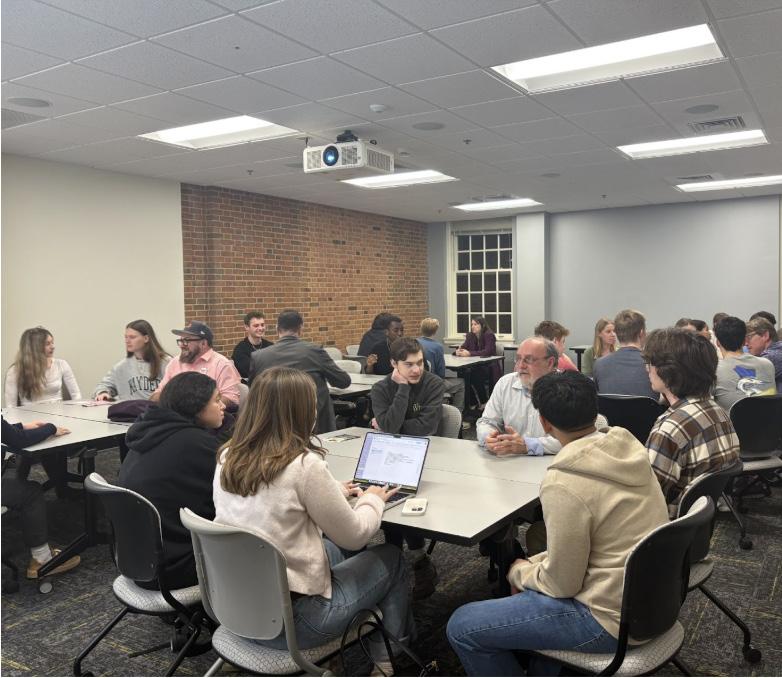
Ahead of the primary elections, the Wake Forest College Democrats hosted a “Cookies and Candidates” forum on Feb. 3 with Democratic candidates running for o ce in Forsyth County. About 25 students attended the event in Kirby 109, which featured Board of Education candidate Howard Claggett, District Attorney candidate Amara Hunter, Board of Education candidate Chenita Barber Johnson, Commissioner At-Large candidate Quamekia Shavers and District Court judge candidate Lauren Tuttle.
Rather than a traditional panel, the forum ran as a “round-robin” conversation. Students sat in groups of four to six, and candidates rotated groups every ten minutes to introduce themselves, outline their priorities and respond to questions. Organizers and participants said this setting allowed students and candidates alike to experience a more accessible and personal side of local politics.
Sophomore Katharine Whatley, communications director for the Wake Forest College Democrats, said that the forum could help demystify local politics, particularly for students who may be voting out of their home state. She noted that many voters default to party-line decisions without understanding where local candidates stand. Smaller, face-to-face conversations, Whatley said, make candidates feel more accessible and allow students to ask direct questions.
“I thought this went really well,” Whatley said. “I de nitely think a lot of people really connected with the candidates.”
Board of Education candidate Howard Claggett said he also appreciated the face-to-face format of the forum. “ is is who I am,” he said, smiling.
Howard Claggett runs for Board of Education
Howard Claggett, running to represent District 1 on the Winston-Salem/Forsyth County Schools (WS/FCS) Board of Education, highlighted his experience working with facilities and operations at over 20 schools in the district. Claggett said he’s adept at “getting things done” and recounted a time he led an initiative to build a sidewalk at a local school.
Claggett called for stronger oversight of the superintendent, more equitable personnel decisions and a rebalancing of district nances away from what he described as a “top-heavy” administration and toward classroom support and teacher retention.
“You have to ght for what you want in this district,” he said. “ e rst thing everybody else is calling is no money. ere’s plenty of money. But you just have to ght and push push push.”
Amara Hunter runs for district attorney
Amara Hunter, candidate for District Attorney, drew on her background as a former Detroit police o cer, prosecutor and public defender in Detroit. Hunter said she entered the race because she believes the criminal system too often leaves young people burdened with criminal records for low-level o enses that limit their access to college aid, employment and housing.
She advocates for expanded youth diversion programs
and alternatives to incarceration, noting poor conditions and overcrowding in N.C. jails. Hunter argued that prosecutors have the power to shape life outcomes and should use that discretion to create second chances. She summarized her campaign message bluntly: she believes the criminal system in Forsyth County must “do better.”
Chenita Barber Johnson runs for Board of Education
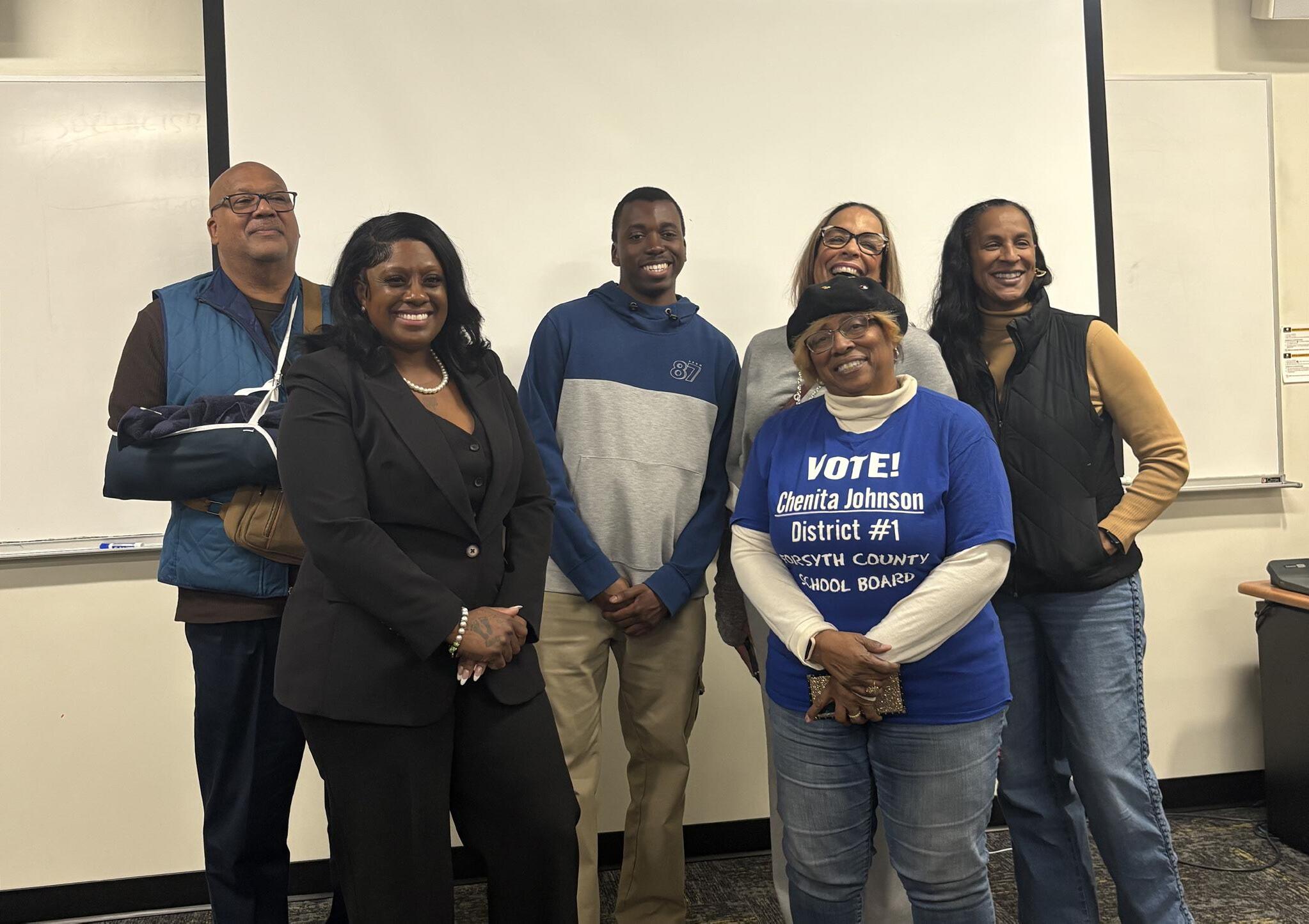
Chenita Barber Johnson, a lifelong Winston-Salem resident running to represent District 1 on the Board of Education, focuses her campaign on transparency, nancial oversight and literacy outcomes.
“Basically, my main issue is the fact that our children are not getting their education,” Johnson said.
Johnson also pointed to what she described as a disconnect between rising graduation rates and continued reading struggles among younger students. In her view, the board must improve communication with families and revisit long-standing school zoning patterns to ensure fair access to resources.
Quamekia Shavers runs for commissioner at-large
Commissioner At-Large candidate Quamekia Shavers said she is prioritizing education, civic engagement and public health and safety in her campaign. She highlighted her experience as a business owner of Shavers Lewis Realty, LLC, with a master’s degree in education from American InterContinental University. Shavers also noted that she regularly volunteers around Winston-Salem, including as a mentor for students who are at risk of dropping out of high school. Shavers described her organization and advocacy experience as providing her with “transferable skills” for public o ce.
Shavers also founded a nonpartisan initiative called “Pink Vote” that aims to expand voter turnout among people of color.
“I just wanted to encourage people that look like me to vote,” Shavers said.
Lauren Tuttle, who is running for District Court judge in the 31st Judicial District, spoke about her courtroom experience as a public defender, as well as her earlier work in private practice handling criminal and civil matters, including family law, child custody, landlord-tenant disputes and child support disputes.
“What I do means a lot to me, and justice means a lot to me,” Tuttle said. “ ere's a lot of things that don't work about our judiciary, but it's the one that we have... It's not about reinventing the wheel. It's about making it turn the most e ciently, the most equitably and the most empathetically.”
Wake Forest College Democrats will hold two additional forums this week in Kirby 109. Students can meet candidates running in the Democratic primary for N.C.’s 10th Congressional District on Feb. 10. On Feb. 11, additional primary candidates for Forsyth County o ces, including commissioner and board of education seats, will meet with students.
Contact Eve Darke at darkev23@wfu.edu
The Democratic primary will be held on March 3, 2026
CHLOE EDELMAN Contributing Writer
On Feb. 10, all six Democratic primary candidates for U.S. House District 10 visited Wake Forest for candid conversations with students at an event organized by the Wake Forest College Democrats. Each candidate spoke to small groups of students about their platforms and campaign strategies.
Ashley Bell
Ashley Bell is a Wake Forest University alum, a PA (physician assistant) and PA instructor, a public high school band director and a licensed real estate agent.
Bell said she was inspired to put her name on the ballot after the landmark U.S. Supreme Court decision of Dobbs v. Jackson Women’s Health Organization in 2022, which overturned Roe v. Wade, returning abortion rights to the discretion of the states. As the only female candidate in her primary race, Bell said she is passionate about women’s rights issues and female leadership in public service.
Bell said her legislative priorities would include laying the groundwork for “Medicare for All” by expanding subsidies for healthcare and reining in
also focuses on educational issues, including expansion of student loan forgiveness and subsidization of community college and vocational training.
West Caudle
deputy and middle school social studies teacher from Yadkin County. He currently works for a
BetterAngels, which assisted with Hurricane Helene recovery in western North Carolina in 2024.
Caudle said his platform centers on improving healthcare access through defending and expanding Medicare, strengthening public education, lowering government overreach and lowering
be to strengthen congressional accountability by overturning the Citizens United v. FEC decision, banning congressional stock trading, upholding term limits and supporting a “cool-down” period between holding elected positions and lobbying positions.
Caudle said his campaign strategy is to win the support of Republican and independent voters who want to end “Trump-era chaos.”
Harry Morley
Harry Morley is a public school teacher and specialist from Fayetteville. Morley said he started his campaign because he was concerned by President Trump’s cuts to research funding at colleges and universities.
He said his legislative agenda includes lowering prescription drug prices, improving the quality of rural education and expanding the bargaining power of Medicare and Medicaid.
Morley said he is also passionate about “reining ICE in,” including by encouraging stricter use of warrants and greater respect for due process within the enforcement agency. He said he wants
ICE to return to border areas and retreat from the U.S. interior.
Marcus Pearson
Marcus Pearson is a Winston-Salem native who attended Winston-Salem State University and is currently pursuing a master's degree in teaching history at N.C. A&T. He is a high school civics and government teacher.
Pearson said he is enthusiastic about turning District 10 blue using grassroots strategies. He said his platform includes improving the economy, lowering tariffs and encouraging greater separation between governmental departments.
If elected to Congress, Pearson said he believes he would serve well on farming, agriculture or education sub-committees.
Ralph Scott Jr.
Ralph Scott was the Democratic nominee for N.C.’s 10th district in 2024. He lost the election to incumbent Pat Harrigan.
Scott said he is concerned by Project 2025 and the against a “Trump-era devolvement into feudalism,” deterioration of constitutional rights and ICE activity in N.C.
He said his platform is pro-abortion rights, proin Congress would be to pursue the impeachment of Scott emphasized that he is the sixth great-grandson
of former President James Madison.
Forest for 13 years. In his free time, he works as a community and labor organizer in Winston-Salem, especially with local immigrants.
populations in North Carolina. He said he believes local politicians, including his fellow candidates, did not have a plan to address increased ICE activity.cist behavior” and “defending the constitution,” with secondary pillars including improving affordability, raising the N.C. minimum wage to $20 per hour and is focused on voter-candidate interactions and grassroots campaigning.
The Democratic Socialists of America (DSA) has
Wake Forest College Democrats will host additional candidate forums in Kirby 109. More information on these forums is available on the club’s Instagram. Early voting is currently underway in N.C., and the general primary will be held on March 3, 2026. Read the Old Gold & Black’s guide to primary voting here, your polling place here.
Contact Chloe Edelman at edelcs23@wfu.edu
“Good
Writer
Earlier this month, the U.S. Department of Agriculture’s Forest Service and the North Carolina Wildlife Resources Commission signed a $290 million “Good Neighbor” agreement to further assist recovery efforts from Hurricane Helene in western North Carolina.
Under the new agreement, the commission will work to “remove storm debris, repair roads and recreation areas, manage invasive species, restore damaged watersheds and improve wildlife habitat” in the Pisgah and Nantahala national forests.
Forest Service Chief Tom Schultz said that restoring these forests is vital for both the environmental recovery and economic stability of the region.
“North Carolina’s national forests are an economic powerhouse, bringing billions of dollars into local communities through world-class outdoor recreation,” Schultz said in a press release.
“Restoring access means restoring both livelihoods and the family moments that make these forests so meaningful.”
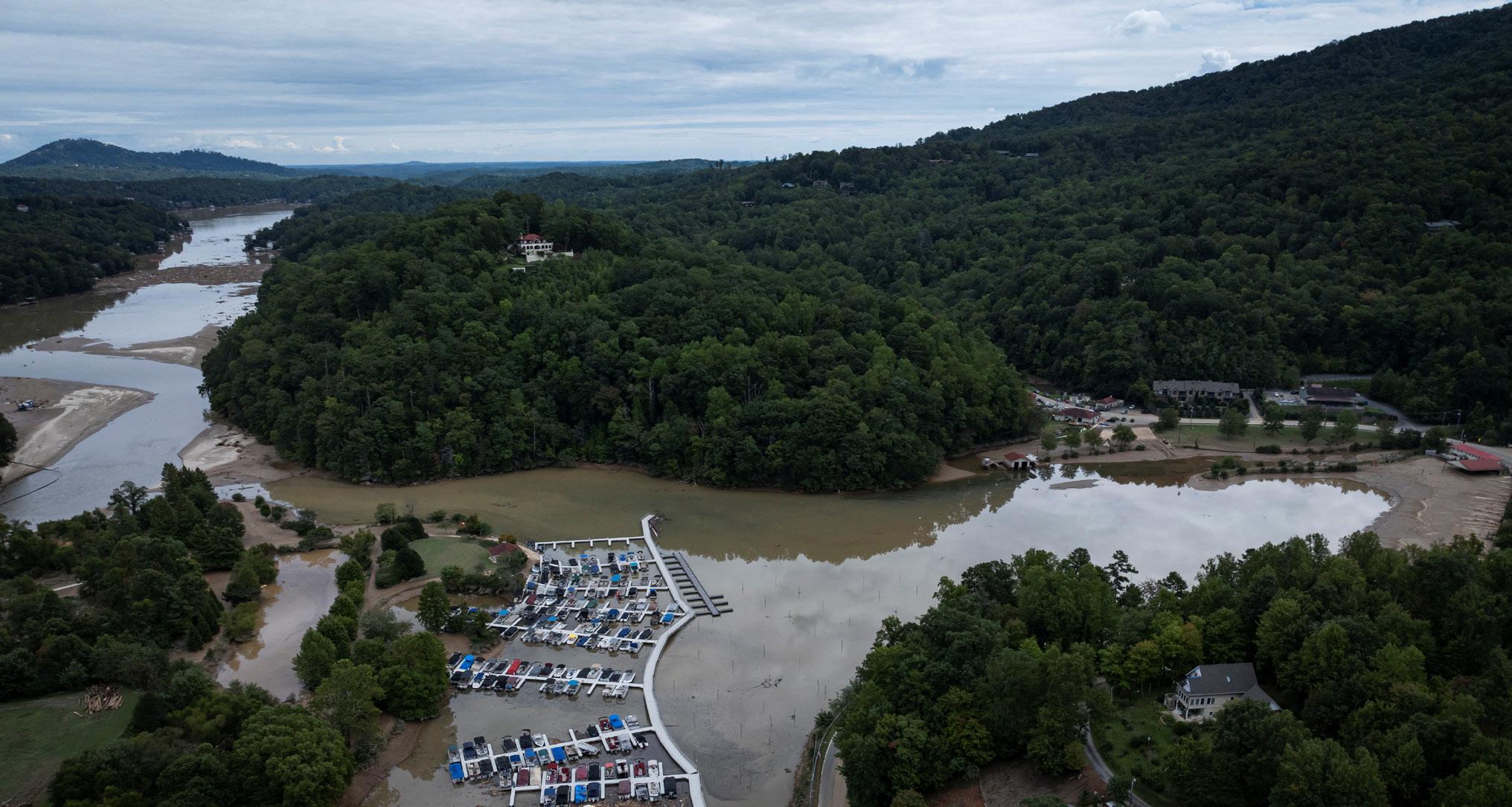
Hurricane Helene hit western North Carolina in September 2024, killing 107 and wreaking havoc on the region’s infrastructure and environment.
Within days, the U.S. Department of Agriculture’s Forest Service sprang into action to help recover damaged areas. As of September 2025, 97% of roads, 93% of trails and 85% of recreation sites have reopened, according to a Forest Service press release.
These restoration efforts would not have been possible without the help of local communities,
Purse, sent tens of thousands of volunteers to placing temporary roof coverings and removing fallen trees.
This new agreement will provide sustained funding and a state-federal partnership to continue to support the regions hit hardest by the storm at an accelerated pace.
What is the Good Neighbor Authority?
The new agreement functions under the Good Neighbor Authority, a mechanism that allows

the Forest Service to partner with state and nonfederal agencies to protect forests.
The Executive Director of the Wildlife Resources Commission, Kyle Briggs, said the Good Neighbor Authority will facilitate collaboration among different organizations working for recovery.
“No single organization or group can address all this alone. We are so grateful to the administration and the leadership of the Forest Service for their partnership and the funding they are providing to help us meet the challenges of restoring the forests and its wildlife,” Briggs said in a press release.
Beyond environmental recovery, the agreement will also help stabilize Western North Carolina’s economy by creating jobs.
“We know how important the outdoor economy is to Western North Carolina,” Dough Besler, a leader of the restoration efforts, said. “So, we want to get this work done. We want to get users back on the landscape as fast as we can.”
Wake Forest student weighs in
Senior Anna Belle Davis grew up in Charlotte, N.C., and frequently visited the national forests in western North Carolina to hike with family the destruction Hurricane Helene caused and was happy to learn of the new agreement.
“Western North Carolina has been my home away from home since I was a child and the place where I reconnect with nature and myself,” Davis said. “It is where I have grown the most, builtpreciate the beauty around me, which makes this agreement especially meaningful in the aftermath of Hurricane Helene.”
Taylor Riley, riletc24@wfu.edu
Bianca Reznic, reznba24@wfu.edu
TAYLOR RILEY Features Editor
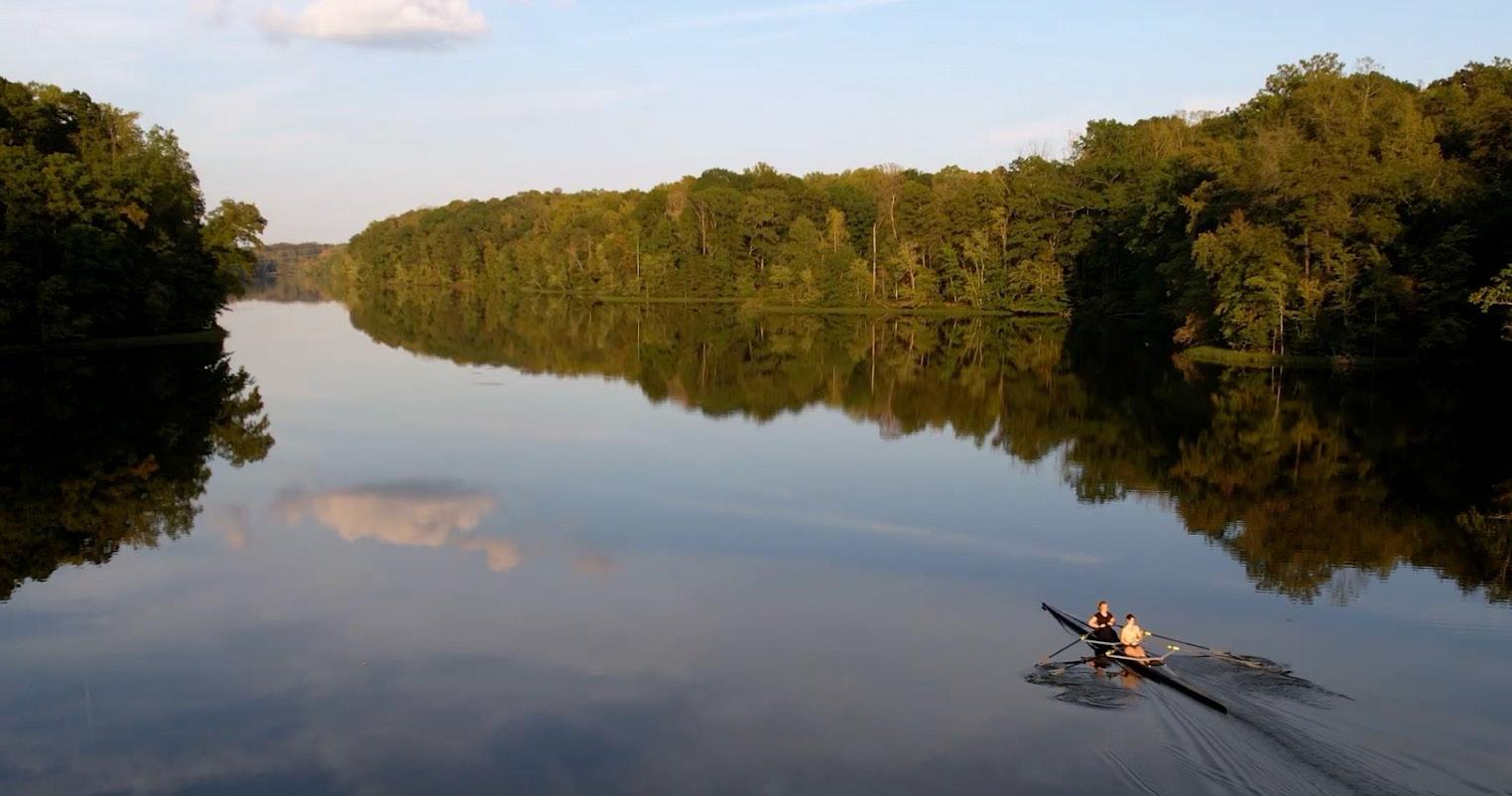
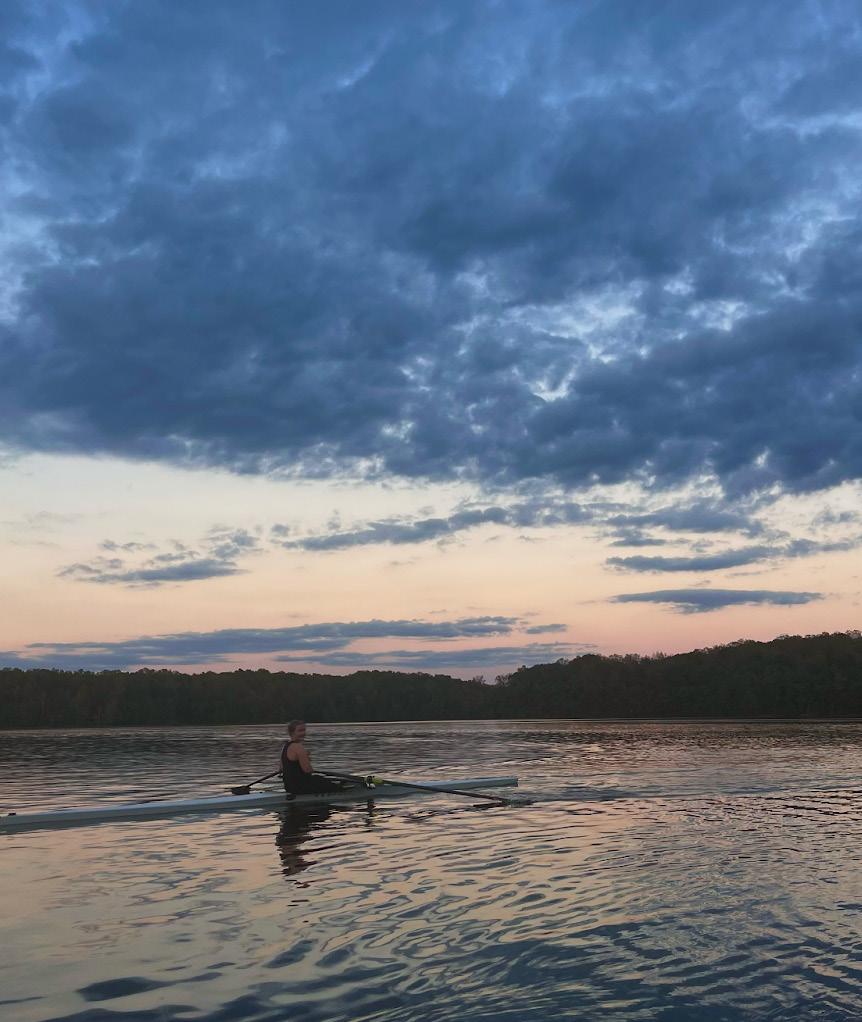
At the Atlanta Erg Sprints Competition on Feb. 7, Wake Forest’s Club Rowing Team prepared to hit the water. The team drove six hours to compete for only eight minutes and was determined to make every second count.
“You go all out for eight minutes, and then it’s over, so it’s very high stakes,” sophomore rower Grayson Gritton said.
Their perseverance was rewarded when they went home with both accolades from Atlanta Erg Sprints and national awards. Sophomore Jonathan
year’s single for the Club National Championship. He believes that resilience and dedication to the sport will help him achieve this success.
“ It’s hard to protect your equipement when it’s exposed to the elements.
provement aspect,” Evers said. “I really enjoy getting better, and it really is a sport that rewards consistency and hard work.”
The club team rows in small boats, which include teams of four, doubles and singles. Some boats also include a coxswain, who is in charge of directing the rowers.
This year, Wake Forest’s boats are in better condition due to a new boathouse.
“The new boathouse has been in the works for said. “It’s hard to protect your equipment when it’s exposed to the elements.”
As a club team, Wake Forest rowing is open to all inquiring members, whether they’ve never rowed a day in their life or if they rowed for four hours six
retains the competition and effort that she enjoyed as a high school student, but that it’s a much more positive and friendly environment than her previous team.
“I loved my high school team… but it was also Soares said. “I’ve had a much more positive experience at Wake Forest because we still take it very seriously, but it’s also casual. You’re not crying after practices or wanting to die over erg scores.”
Gritton joined the team a few months ago, and joined the team with no prior rowing experience, so his learning curve was steep, but the tight-knit, friendly nature of the team supported him throughout his development.
“First time I ever rowed, it was a lot,” Gritton said. “It’s very challenging for me to have done because it was mortifying, failing and failing over through that learning curve, it’s super rewarding.”
Gritton said he has enjoyed building friendships with his teammates and starting his days with exercise since joining the team.
like no other sport, and you can really get to know a bunch of fun people and get out in the water and start your day productively,” Gritton said. “I would
say every day that I started rowing, it’s a good day.” agreed that being on the water is an experience like no other that helps her connect with both her teammates and nature.
“When you’re in a boat, you rely on each other,”
ally unique, and it’s really relaxing too when you’re on water. You’re stressed the whole day, but when you’re on water, you don’t really think about anything but rowing, and Salem Lake is very beautiful.”
“
Nothing makes me feel more rejuvenated and happy than being on the water.
nity to spend time outdoors and recharge in nature while rowing.
more joy than touching grass. Rowing is wild, and I love it. Nothing makes me feel more rejuvenated and happy than being on the water. “
When asked what their favorite part of Club Rowing was, every interviewee reiterated that the most valuable part of their experience is the friendships they’ve made.
“I’ve gotten really close to a lot of the women on our team, especially, but you get really close with literally in the same boat.”
Contact Taylor Riley at riletc24@wfu.edu
Catered celebrations and annual traditions draw attention to different cultures
RISHI VANKA Contributing Writer
Wake Forest’s only student-run intercultural club, Culturality, has brought diverse groups together for fun cultural events for the past three years.
Senior Juan Londoño, Culturality’s co-founder and current president, explained that he started the club in 2023 because he felt students should have more opportunities to enjoy different cultures.
“Whenever there is a Wake Forest-sponsored cultural thing, a lot of it is like a lecture or reading,” Londoño said. “That’s great, but there are so many other ways to interact with cultures and learn about them. Our events give whoever wants to come options to interact with the culture, and they get to do what they want with it.”
Sophomore and treasurer David Burda believes that Culturality successfully draws students to their events by providing delicious food.
“We believe that food is a really good way to experience other cultures, and it’s a good way to bring people to our events,” Burda said. “It’s a good way for people to feel welcome.”
One popular Culturality tradition is “Trick or Treat Around the World,” an annual Halloween event that invites students to engage with other cultures. about their culture and give out cultural snacks,” Burda said. “It’s always a good time.”
In November, the club organizes a “Cults-Giving” feast, an alternative experience to Pitsgiving.
“We poll our member body and see what kind of cultural foods they want to experience,” Burda said. “We’re not competing with Pitsgiving, but it gives members an opportunity to try more foods from different cultures or their own culture that they can’t get as much access to on campus.”
Culturality celebrated Mardi Gras on Feb. 17, with food, music and mask-making on the lower quad. Local vendors BJ’s Brewhouse and Camino Bakery supplied jambalaya and king cakes for the celebration.
‘We’re not competing with Pitsgiving, but it gives members an opportunity to try more foods.’
Burda said the club chose to have a Mardi Gras event because they wanted to bring more attention to the holiday.
“We try to look for underrepresented events on campus,” Burda said. “We saw that Mardi Gras doesn’t have a lot going on during that time.”
Collaborating with other identity groups
Burda said that student engagement has been at an all-time low across campus for the past semester, so Culturality is focusing on collaborating more with other identity groups to increase attendance.
“Doing these collaborations with all these different clubs allows us to draw in a large variety of people,” Burda said. “We decided to bring together the French Club [and] Hillel [for Mardi Gras], and we’re going to have jazz music playing. We’re going to be in a wide open space, which has easy access to people. The music will draw people in, [and] the smell of the jambalaya will bring people in.”
Hillel vice president Zach Klein said that he was excited to collaborate with Culturality. The organization had gragers, or noisemakers, at the Mardi Gras event to celebrate Purim, a Jewish holiday
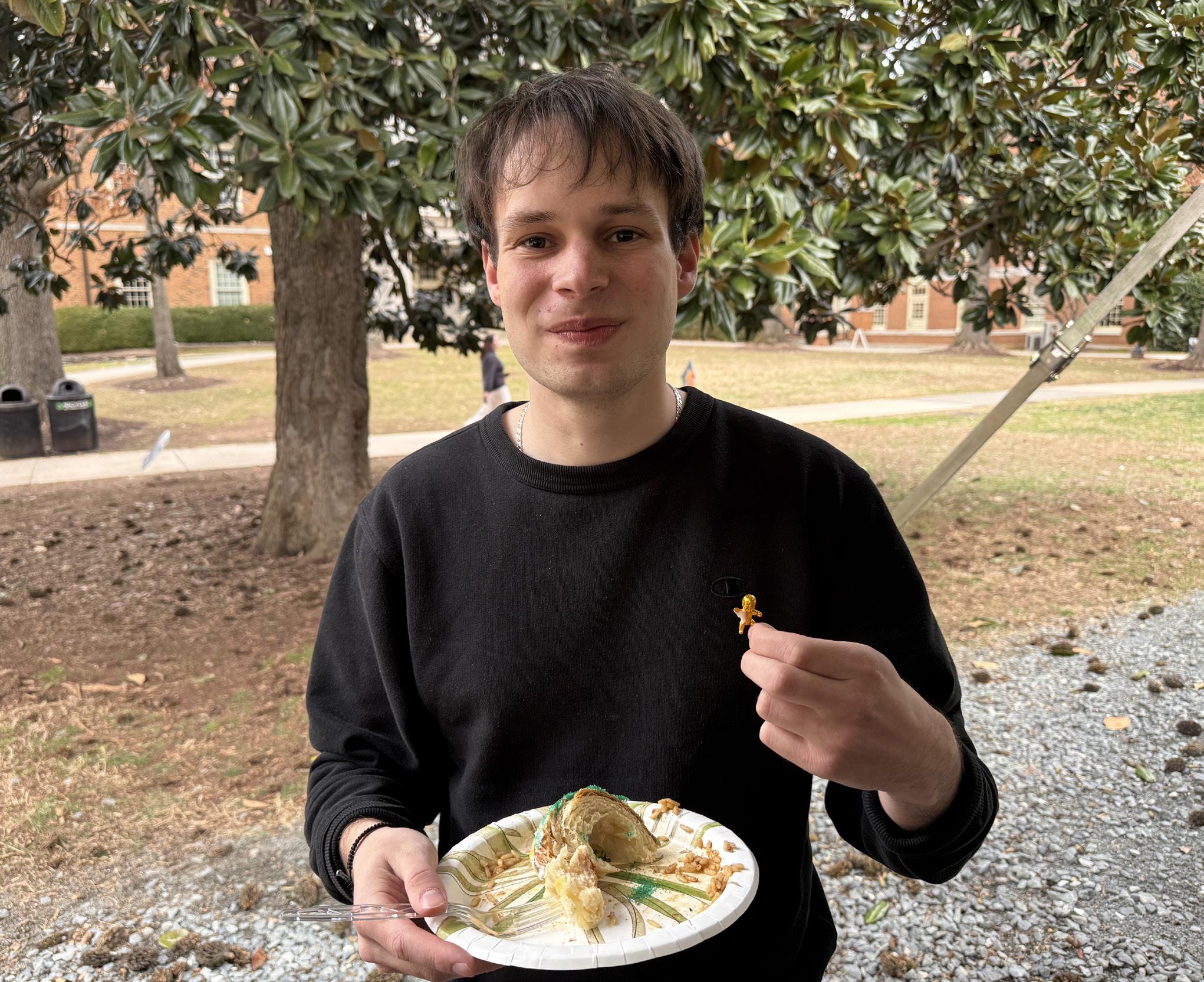

BJ’s Brewhouse supplies jambalaya for the Mardi Gras Celebration on Tuesday, February 17.
which will occur in March.
“It represents the festivity, the culture,” Klein said. “That’s what Purim’s all about.”
Klein added that Hillel hoped to increase their own student engagement by collaborating with Culturality.
Diverse celebrations are open to all Londoño said he appreciates the diversity of students that Culturality events draw.
“I think it’s a good sign that we have people from all cultures come to our events,” Londoño said. He added that Culturality events are designed to be as welcoming as possible for Wake Forest’s student population.

Wake Forest’s student-run, intercultural club, Culturality, brings diverse groups together.
“The biggest thing is that it’s open to everyone, regardless of your cultural background,” Londoño said. “Learning about cultures and interacting with them is for everybody. A lot of diversity and cultural awareness programs are under attack in a lot of places in the country, so we understand how important creating spaces for students and for different cultures is.”
Culturality announces its events on Instagram @ wfuculturality.
Contact Rishi Vanka at vankrk24@wfu.edu
HARPER RANSBURG Staff Writer
My First Year Seminar (FYS) professor, Adrian Greene, once told our suburban Gothic literature class his elementary-aged daughter wanted to dress as Carrie from Stephen King’s novel “Carrie” for Halloween. Having studied the intricacies of the horror classic, which is frightening even to adults, we all laughed, imagining their conversation.
I couldn’t have guessed how much I would learn and how many life-long friends I would make in an FYS about the deep, dark secrets of suburban neighborhoods. Rather than analyzing elements of the emotions of the characters and settings in thelife through Greene’s fascinating, funny, and frightful teachings.
From Twin Peaks to Frankenstein: emotion as motivation
I was curious to learn how Greene arrived at such an unusual academic niche. So I asked him.
“The first thing I saw that really spoke to me was ‘Twin Peaks,’” he said.
“
We can be shocking into awareness that will help us see how we're complicit in perpetuating it.
Greene watched the disturbing crime drama while in elementary school. The show’s message that places can sometimes hide their true nature resonated with him. He said the undertones of the town of Twin Peaks was like nothing he had ever Gothic literature.
“I read [“Frankenstein”] in elementary school… I was obsessed with that,” Greene said. “Victor Frankenstein has so many big emotions and is so sensitive… but you know, it was still the ‘80s.”
Greene said Victor Frankenstein’s actions spoke to him and taught him a new way to approach his feelings. Growing up in an environment where he was encouraged to suppress his emotions, he wassion of feelings. It’s that same childhood revelation that he hopes to share with his students today.
“[I want] to help students through the novels… -
Greene’s level of attention and care makes a dif-perience, class discussions flowed the entire length of the one hour and 15 minute period, and we became comfortable sharing our opinions and analyses with one another.
But I also learned that Greene begins each class hoping that his lesson plan will derail.
“The best classes I’ve had were the ones where I went in with a plan, and then we got off on a tangent, and that’s way more fruitful,” Greene said.
I’ve rarely had a class where a teacher is as dedicated to keeping their students engaged.
Between fascinating assigned readings like the amazingly weird “Wind-Up Bird Chronicle” and the dizzying “Haunting of Hill House,” along-
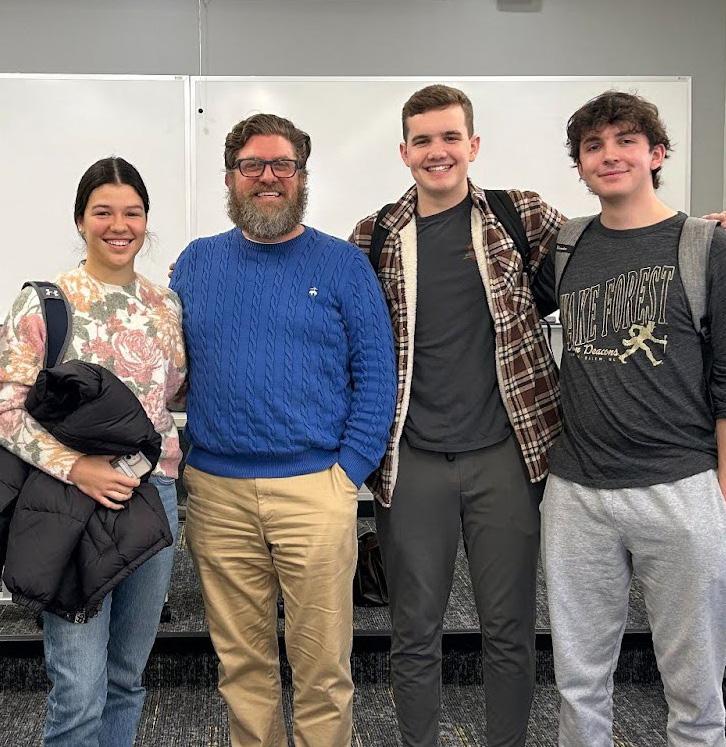
Greene’s FYS felt like a class made for students.
Greene sees himself as holding more of a supportive role than a directive one. Most of our classes started with Greene posing a single question, which would spiral into countless other topics before Greene reeled it back in at the end for a concluding message.
“
e best classes I've had were the ones where I went in with a plan, and then we got o on a tangent.
“You start the semester as a coach, but then hopefully quickly transition into more of a cheerleader where you’re encouraging the kids to do what they do,” he said.
Our class discussions frequently returned to themes of personal demons, trauma, and real-life atrocities.
“I’m so interested in ways we can shock people into remembering that this aestheticized version of historical trauma is connected to hideous and violent historical trauma,” Greene said. “We can be
shocked into awareness that will help us see how we’re complicit in perpetuating it.”
It’s this shock value that helped new understandings emerge from our conversations on the means so much more to my classmates and me after discussing “The Wind-Up Bird Chronicle.”
A semester of being forced to talk to my peers about haunting tales and what could be lurking in our own backyards led me to form bonds that will last a lifetime. I can say that the FYS was one of the best classes I’ve ever taken.
My friends and I still try to meet every semester with Greene for coffee. We eagerly anticipate each gathering, as we view his class as the “starting point” for our frien d group. I recently learned that Greene looks forward to our coffee chats just as much as we do.
“So few students stay in touch, and it’s a real bummer, because people get busy and move on with their lives…but I’m just glad we’re getting together,” he said.
So if you’re deciding which FYS, English or Communications class to take, dive headfirst into the horrors of suburbia with Greene.
And who knows – you may discover friendships and life lessons from your very own therapy session with Victor Frankenstein.
Contact Harper Ransburg at ransha24@wfu.edu
Former EPA administrator Michael S. Regan recounts his service to the nation and his roots in North Carolina
REESE LILE Environment Editor
Justice Lecture on Feb. 5, a former administrator of the U.S. Environmental Protection Agency (EPA) said that “optimism” has fueled his accomplished career in public service and called for advocates to remain hopeful as they combat ecological crises. Dean of the Wake Forest School of Divinity, Corey D. B. Walker, moderated the conversation, which is hosted each yeartice Initiative.
“I am not naive,” Michael S. Regan said to an audience of around 40 in the Kulynych Auditorium at the Porter Byrum Welcome Center. “But I am a prisoner of optimism.”
Regan served as the 16th administrator of the EPA
tion, he prioritized strengthening environmental protections for communities of color, which often suffer disproportionately from the effects of pollution, climate change and natural disasters. He established the Civil Rights, which his Trump-appointed successor, Lee Zeldin, eliminated in March 2025.
Regan has a storied career in environmental advocacy. Prior to leading the EPA, he served as secretary of the N.C. Department of Environmental Quality. During his tenure, he initiated the largest coal ash cleanup in U.S. history by negotiating a settlement with Duke Energy.
However, long before attaining these titles, Regan had a personal connection to environmental injustice. He began his speech by reminiscing about his childhood in Goldsboro, N.C. He said he enjoyed hunting
lution in his community caused him to develop acute asthma and miss out on many of these family memories.
tice at that time,” Regan said. “But even then, I knew something was wrong.”
his 2021 “Journey of Justice,” a tour of Southern communities facing pollution, natural disasters and failing infrastructure. Mapping his travels across Mississippi, Louisiana, Texas and elsewhere, Regan said he was deeply affected by observing the struggles of these communities and by learning from the work of local public servants.
“I understand walking the walk meant going out and joining hand in hand with the very community members that were currently facing those injustices,” Regan said.
dismantle environmental protections, Regan said that groups beyond the federal government should continue working to protect vulnerable communities.
“The environmental justice movement must be sustained by strong state leadership and, most importantly, strong academic and community power,” he said. There are peaks and valleys, and we are living through moment in this time that I believe truly matters. Because make no mistake, when we make it through this valley, and we will, this movement will be stronger, smarter and more durable.”
Recognizing a discouraging political climate for many environmental advocates, Regan encouraged younger members of the audience to look to the future with hope.
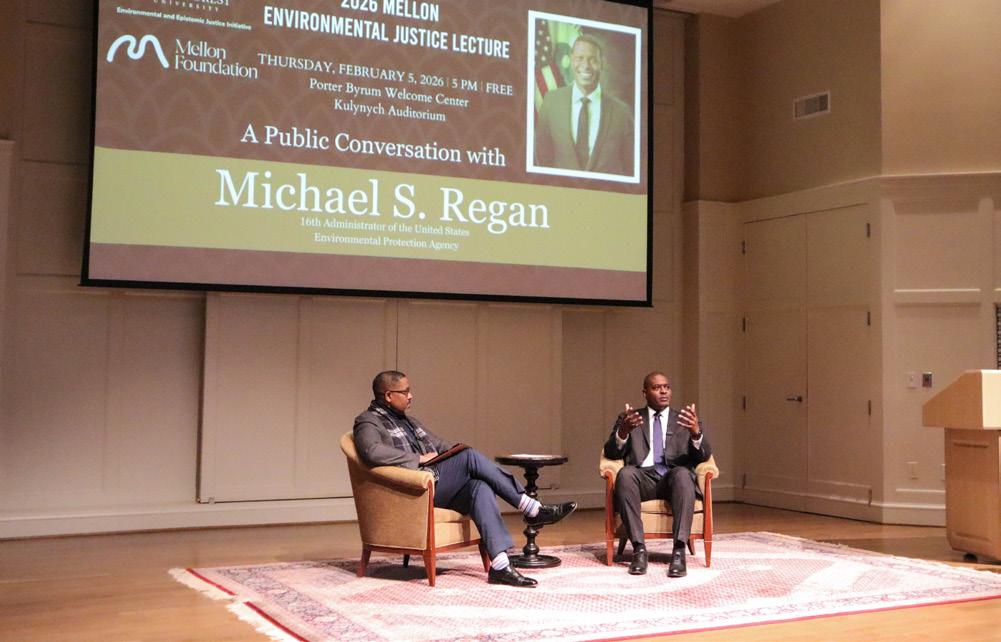
“birthplace of environmental justice” for rallying to oppose a hazardous waste dump, Regan said that past efforts hold lessons for those working to protect their communities today.
“I would plead with you to stay connected to culture, stay connected to each other, stay connected to the communities that remind us of who we are and
this movement. Warren County lit the spark, and gathbright.”
Contact Reese Lile at lilerl24@wfu.edu
REESE LILE Environment Editor
On Jan. 14, Duke Energy activated a $100 million, 50-megawatt battery at the site of a former coal-powered plant in Gaston County, N.C. Duke Energy, which holds a legal monopoly on electricity in North Carolina and six other states, said the cleaner energy.
mer coal plant community that helped power this region for decades,” North Carolina branch president Kendal Bowman said in a statement. “Repurposing existing energy infrastructure and taking advantage customers while continuing to support rapid growth across the region.”
The battery can store up to 200 megawatt-hours of energy produced by renewable sources like wind or solar. During times of high demand, such as long winters or power outages, it can power up to 50,000

homes for four hours.
Duke Energy announced that it will start construction on another 167-megawatt battery in May. Both batteries are eligible for federal investment tax credits, lowering operating costs and, in turn, con-
sumer costs.
Like the vast majority of North Carolina, Wake Forest relies heavily on Duke Energy power. The university houses a 20-megawatt transformer connection to a bidirectional transmission line owned in environmentally-conscious battery technology could decrease the cost of living for some Wake Forest students and improve overall campus sustainability.
Jimmy Nifong, the director of Utilities Operations and Energy Management at Wake Forest, said the new battery is an important step towards cleaner energy in North Carolina.
“Battery storage technology is a key component in storing renewable electricity, which will allow Duke Energy to continue to reduce carbon dioxide emissions from electricity generation,” Nifong said.
Contact Reese Lile at lilerl24@wfu.edu
PAGE 12
THURSDAY, FEBRUARY 19, 2026
Sara Catherine Bradshaw, bradsc24@wfu.edu
Caroline Gottsman, gottca23@wfu.edu
e views expressed in all opinion columns represent those of the article’s author, not the opinions of the Old Gold & Black Editorial Board
GRACE WILLIAMS Contributing Writer
Why would a leader who risked her life for democracy hand her Nobel Peace Prize to Donald Trump?
The Norwegian Nobel Committee awarded Venezuelan opposition leader María Corina Machado the Peace Prize in 2025 for her work to defend the country’s elections. Machado put herself at great risk to accept the prize in Oslo, Norway – disguising herself and sailing a dangerous route to escape Venezuela.
Last month, after the United States captured Maduro, Machado presented her Nobel Peace Prize to President Trump in recognition of his “principled and decisive action to secure a free Venezu-
Trump consistently claims legitimacy and accomplishments that others have earned.
ela.” Later, Trump unsurprisingly celebrated on Truth Social.
“María presented me with her Nobel Peace Prize for the work I have done. Such a wonderful gesture of mutual respect. Thank you María!” Trump

Courtesy of Reuters

Machado gifts her Nobel Peace Prize to President Trump -
wrote.
After reading the headlines, I found myself questioning why Machado would do such a thing. Machado – a symbol of strength, courage and resilience
ed me of the many instances in which Trump has taken credit for more than he should.
For example, the president has frequently framed himself as a champion of veterans, despite the fact that many policies he publicly claimed as personal achievements were largely the result of bipartisan legislative work that predated his involvement. Trump has also claimed responsibility for economic growth and declining unemployment, particularly amongst communities of color, even though these trends began under the Obama administration.
A neutral committee awarded the Nobel Peace Prize to Machado, not to Trump, yet he happily seized public credit and association. Trump consistently claims legitimacy and accomplishments that others have earned.
Trump’s acts are not atypical. They follow a pattern. Many members of his current cabinet once openly criticized him, only to later fall in line in exchange for political power and proximity. Durto colleagues who challenged him, always quick to
Now, Machado is the latest pawn in this framework. Rather than further engaging with Machado and the rest of the Venezuelan opposition, Trump recently praised Maduro’s second in command,
Delcy Rodriguez, claiming she is “giving us everything that we feel is necessary.” In doing so, Trump is directly offering collaboration with the very regime Machado risked her life opposing. It’s a slap in the face.
Trump has made it clear he believes that Machado “doesn’t have the support within or the respect within the country,” despite her party’s victory in the most recent presidential election. Additionally, he has made deliberately vague claims about his intentions for the future of U.S. involvement in Venezuela, remarking, “only time will tell” how long
Trump is directly o ering collaboration to the very regime Machado risked her life opposing.
American oversight of the country will endure. If Trump’s interest in Venezuela were purely humanitarian, Machado, who represents democratic legitimacy and popular support among Venezuelans, would remain central to his vision for the country’s future. Instead, Trump has sidelined her as he signals a willingness to engage with Maduro’s regime while hinting at vague strategic goals.
Contact Grace Williams at willge24@wfu.edu
WALKER NEWMAN Contributing Writer
Latin rapper and singer Bad Bunny has over 150 million monthly listeners. Last year, he was the moststreamed artist on Spotify, with 19.8 billion streams. Nee dless to say, he earned his spot as headline performer at the 2026 Super Bowl halftime show. He joined the ranks of legendary artists with a show that joyfully and elegantly celebrated Hispanic culture and American culture, succinctly represented by the football he carried throughout the show, inscribed with the words, “Together, we are America.”
However, Bad Bunny also addressed grave topwith discrimination against Latino people, including ICE’s recent surge of detentions, deportations and violence, he had to. And unsurprisingly, he faced ugly backlash.
The show opened with a man playing a guitar in a of the crop to Puerto Rico’s colonial economy, then past various vendors who evoked a typical community in the U.S. territory.
If you were paying close attention, you might’ve noticed the number 64 on Bad Bunny’s jersey. The Puerto Rican government claimed that just 64 people died on the island during 2017’s devastating Hurricane Maria, while researchers have estimated the true toll may be closer to 4,700.
Another scene featured dancers climbing on utility poles, alluding to Puerto Rico’s inconsistent power supply. Residents lose 27 hours of electricity every year due to storms, compared to just two hours on average in the mainland United States. T he countless struggles his fellow citizens face meant it was essential for Bad Bunny’s show to be about more than just music when he took one of the world’s largest stages. Some expressed discontent that Bad Bunny performed in Spanish, including President Trump.
“Nobody understands a word this guy is saying,” Trump wrote on Truth Social
But as he’s one of the most popular musicians worldwide, it would appear that Bad Bunny's listeners are perfectly happy with Spanish-language music. Additionally, over 40 million Americans speak Spanish at home, so to say that a Spanish-language Super Bowl halftime show is “un-American” is simply untrue.
Trump wasn’t Bad Bunny’s only critic, and as one might expect, the online discourse surrounding his
“Was a single word of English spoken during the Super Bowl Halftime Show?” Nick Adams, an Australian-American conservative commentator and Trump’s nominee for ambassador to Malaysia, wrote on X. “Someone needs to tell Bad Bunny he’s in America. This is an abomination.”
“If we can learn anything from Bad Bunny’s Super Bowl performance, it’s that we should be deporting even more people.” Braedan Sorbo, an actor and the son of political commentator Sam Sorbo, also posted on X.
Rep. Andy Ogles (R-Tenn.) went so far as to push for a federal investigation into the show, claiming that it included excessively “provocative” dancing and language, but it’s clear that the right’s discontent with Bad Bunny is about more than just dancing.
against Hispanic people, and even speaking Spanish in public can make one a target of federal agents, Bad Bunny’s language hit the right note at the right time.
“¿Dime esto es lo que tú quería?” Bad Bunny sang, Spanish for “tell me, is this what you wanted?”
Then Lady Gaga, a white woman born in the continental United States, sang her song “Die With a Smile,” entirely in English.
Senior Mariana Padilla, who is from Puerto Rico, said in a statement that she found Bad Bunny’s performance meaningful.
“At a time when immigration enforcement and anti-
Hispanic rhetoric feel heightened, having a Hispanic/ Latinx artist on one of the biggest stages in the country sends a clear message: we are still here,” Padilla said. “After centuries of colonization, political intervention and attempts to erase our language, culture and identity, especially in places like Puerto Rico, we
performance, when he said “God bless America,” and listed almost every country in North and South America.
Senior Juan Londoño, who is Colombian, said he found this to be the most powerful moment of the show because it “reimagined an identity that is under attack – putting South America on the same global stage as the United States.”
Padilla said that the moment “transformed the word [“America”] from a term often used exclusively to mean the United States into a celebration of the continent as a true melting pot of cultures.”ing,” Padilla said.
By emphasizing that the United States is not the only country in the Americas, Bad Bunny directly opposed the Trump administration’s stirring of animosity and division.
unapologetically and declare “Seguimos aquí” felt like a statement of resilience,” Padilla said. “It was It reminded everyone watching that Hispanic identity is not something to be marginalized or silenced; it is vibrant, enduring and woven into the fabric of this continent.”
only thing more powerful than hate is love.” Combined with the powerful political messaging, Bad Bunny’s performance was a moment of inspiration and compassion that we desperately need as a people.
Contact Walker Newman at newmwe22@wfu.edu

BEKIE SUSSMAN Contributing Writer
When was the last time you felt love? Not just romantic love, but other expressions of love – a long conversation, laughter at dinner or a peaceful moment walking home. In an era of comparison and hostility online, it's easy to forget that love is all around.
British singer Olivia Dean’s album “ e Art of Loving” reminds the listener that love is never far. e Grammy-winning Best New Artist’s breakout album is lled with songs that can change how audiences see love in our own lives. Dean suggests that love is not something we wait for. It’s something we practice.
Do you focus so much on what comes next that you stop noticing what is happening right in front of you?
“
Many of us view joy and success as things that come after an achievement or milestone.
Many of us view joy and success as things that come after an achievement or milestone. Psychologists often refer to this mindset as “the arrival fallacy” – a belief that reaching our future goals wil l
bring us lasting happiness. Yet research suggests that after reaching our goals, ful llment rarely lasts, leaving us dissatis ed even after we accomplish something we’ve worked really hard for
Dean’s music challenges the arrival fallacy by shifting our gaze from future ful llment towards what is beautiful in the present. In “ e Hardest Part” and “I’ve Seen It,” she re ects on the di culty of making her own choices and not letting high expectations dim her happiness. She presents success not as a “ nish line,” but as something ongoing and imperfect.
Her solution is to notice meaning apart from achievement in everyday moments. “I’ve seen it after school and in the park. Sat right across me on the tube,” she sings in “I’ve Seen It,” suggesting that ful llment and love are not something we reach, but something we should always be practicing.
Additionally, connection with others may be more ful lling than success from academic or career achievements. One poll reported an astonishing 92% of adults identify relationships as a “key source of meaning in their lives.” Olivia Dean again captures this signi cance in “I’ve Seen It,” singing about nding love in shared meals, laughter, quiet afternoons and ephemeral moments.
“ e more you look, the more you nd,” she concludes. “It's all around you all the time.”
So what does Dean’s motto of nding love all around really mean in practice?
It means mindfulness – being aware of the present, our feelings, thoughts, surroundings and other people. Research shows that mindfulness is linked to lower stress, improved focus and greater self-love. In other words, learning to pay attention and nd
beauty in the present, like Dean preaches, creates a sense of satisfaction and love that isn't conditional on success or inauthentic relationships.
Love is more than just romance and grand gestures. It’s existing in the present and enjoying those around you. A genuine relationship requires getting to know someone on a deeper level, not just posting them for likes.
“
A genuine relationship requires getting to know someone on a deeper level, not just posting them for likes.
For me, this means a restful Saturday. During the school week, my vision is blinded by my focus on schoolwork. But on Sundays, I get to sleep in and wake up to the sun shining on my face. I eat brunch and relax with friends. I catch up with my mom on FaceTime. I take a stroll around campus. I focus on the present moment, and when I look for the beauty in my life, I truly see it.
Dean’s music teaches us that life isn’t about milestones or shallow relationships.
Love and ful llment are practices. If we slow down and pay attention, we will see it
Contact Bekie Sussman at sussrr25@wfu.edu

Following loss to Houston on Friday, Levonas and Dallas lead Deacs over the weekend
SCOTTIE KIMMELMAN Sports Editor
After an eight-month wait, the Wake regular-season games in Ponce, Puerto Rico. With all of the excitement from start time against Houston, a wave of like a freight train.
Even though some members of the was unable to cash in with runners on.
fense a feasible chance to get back in the unattainable.
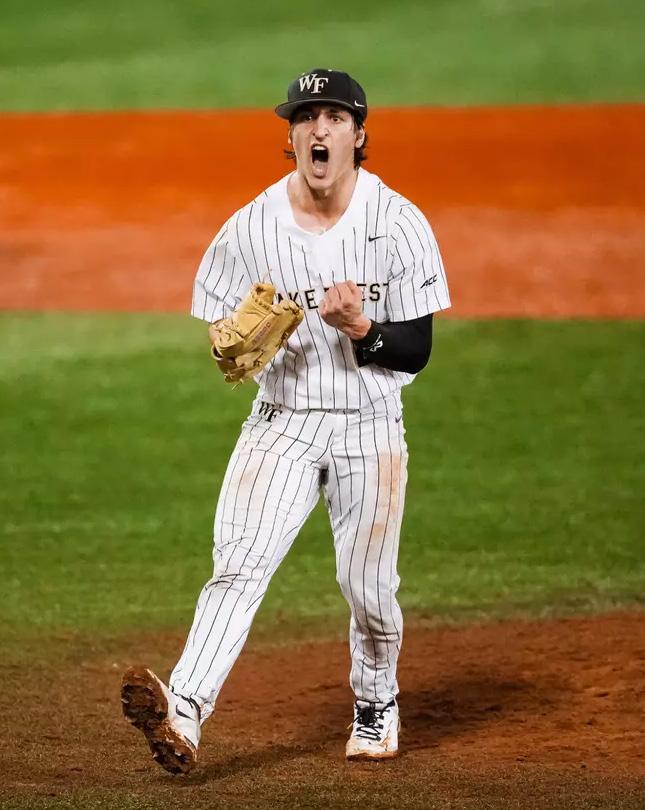
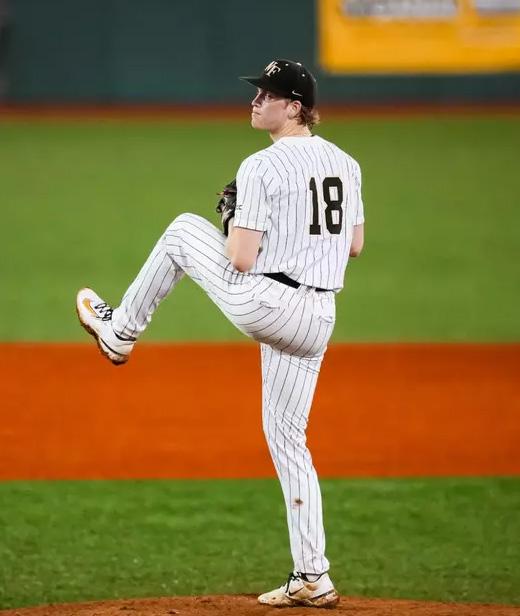
with four innings of scoreless baseball.
ing line, though, was his zero walks. Following a freshman season in
innings of work.
Puerto Rico. Even with the unfortunate
into next week.
“We've got a big game against High
ALEX GENDRON Staff Writer
In dire need of a win after a ve-game losing streak, Wake Forest Men’s Basketball traveled to McCamish Pavilion to play Georgia Tech on Feb. 11. With the Demon Deacons entering this game at 2-8 in ACC play, it was clear they
needed to start stacking wins to make the ACC tournament, let alone be competitive in it.
For most of the rst half, the game was neck-and-neck. While Wake held onto the lead, Georgia Tech stayed within striking distance. Wake took a 37-33 advantage into the break, fueled by a spark o the bench from Mekhi Mason,
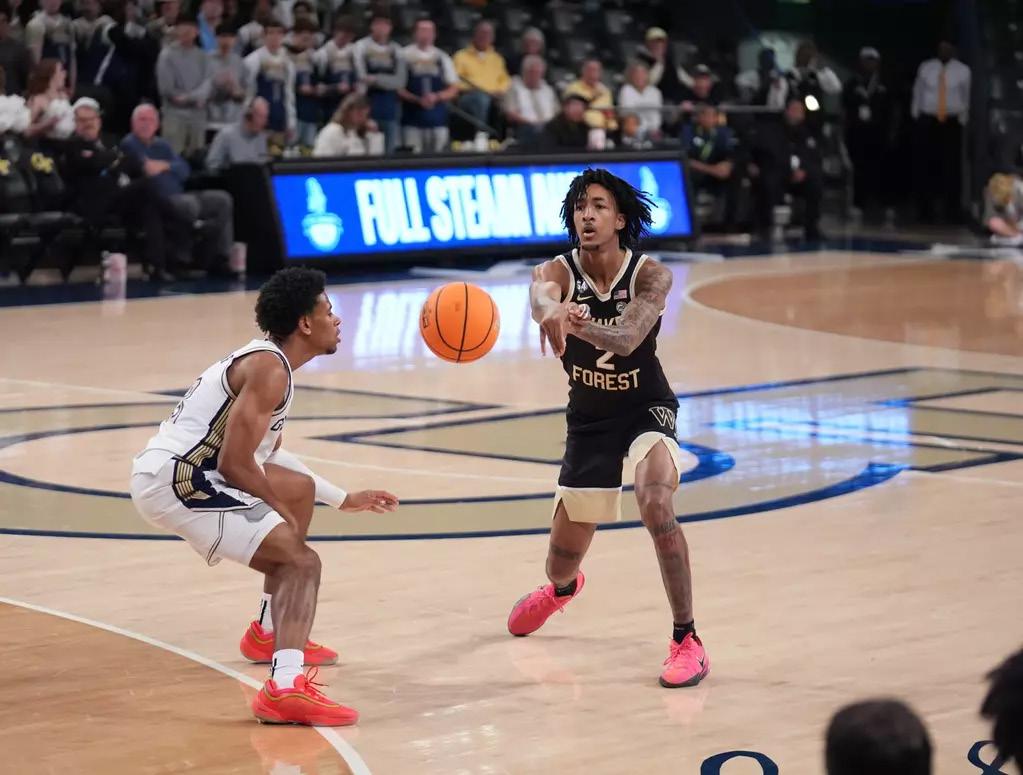
who poured in two 3-pointers. e Demon Deacons opened the second half with a drive, ring on all cylinders. An 11-0 run forced Georgia Tech Head Coach Damon Stoudamire to call an early timeout. anks to stellar play on both sides of the ball, Wake rode their momentum to a commanding win.
Star forward Juke Harris led the Deacons with 23 points and 13 rebounds, powering Wake to its rst win since mid-January. In addition to great play from Harris, contributions from Mason, Copper Schwieger and Tre’Von Spillers had the Deacons shoot better than 50% from the eld and 46% from 3-point range.
Mason in particular had a terri c day o the bench, adding 17 points and four assists to the stat sheet while shooting efciently. In addition, forwards Cooper Schwieger and Tre’Von Spillers added 13 points each, creating a much more balanced o ensive attack than in recent games. When pressure and attention are taken o of Harris, good things can happen for the Deacs o ensively.
Georgia Tech had strong e orts from forwards Kowacie Reeves Jr. and Baye Ndongo, combining for 32 of the Yellow Jackets’ 67 points. However, it was not enough to overcome the muchimproved Wake Forest defense, which totaled six steals and eight blocks on Wednesday. e Deacons also stayed out of foul trouble, totaling only 11
fouls the whole game, allowing Head Coach Steve Forbes more exibility with his substitutions.
Overall, it was a great game for the Demon Deacons, a team that needed a win more than ever. Wake was both better o ensively and defensively than their opponent, which cannot be said of many other games this season. is game was exactly what the team needed to build some momentum and enter the ACC tournament with con dence.
“We’ve been playing pretty good offense for a while here,” Forbes said following the game. “We just haven’t been able to win. We needed a win.”
Men’s basketball now ranks No. 14 in the ACC with a 3-8 record in conference play. ey are still just 1.5 games out of missing the ACC tournament, meaning they need to build on Wednesday’s win to remain in contention for the conference title. With an easier schedule ahead, Forbes will be seeking some continued success against weaker teams.
Wake’s next game is at home this Saturday, Feb. 14, against Stanford, which is led by star freshman guard Ebuka Okorie, averaging 22.4 points per game.
e Deacons will have their hands full trying to neutralize the speedy guard.
GRIFFIN LAMPHIER Staff Writer
Men’s basketball showed tremendous e ort and perseverance on Saturday evening, battling back late in the game to take
down Stanford 68-63 at the Joel.
From the get-go, this game was intense and physical. Wake Forest started strong and led at the rst media timeout, but a urry of long 3-pointers from the Cardinal put them ahead 17-9 around the 13-minute mark of the rst half. A strong stretch

from true freshman guard Isaac Carr and senior Mekhi Mason later drew the game even again.
e margin stayed close for the rest of the half with a diverse distribution of scoring from the Deacs, who got a great performance from their bench. Unfortunately, another quick sequence of fantastic 3-point shooting from the Cardinal right before the break left Wake Forest with a 39-30 halftime de cit.
e second half carried an overarching theme to it: Wake Forest’s need to get over the proverbial hump. Every time that they battled back and narrowed the gap, they were one big shot short of tying the game or taking the lead.
Stanford, aided by a fantastic performance from superstar freshman guard Ebuka Okorie, kept nding a way to bend, but not break. Okorie, who had a gamehigh 26 points, was “a lot” for the Deacon defense to handle. “He’s a lot”, was the sentiment of Wake Forest Head Coach Steve Forbes, who added, “He’s one of the best freshmen in the country, I’d imagine.”
So, at the nal media timeout with 3:34 to go, the Deacs had to put up or shut up. After a season riddled with struggles in intensity and physicality, they did well the entire game to earn an edge in that department, which made the di erence in the nal few minutes.
Free throws from Juke Harris and
Omaha Biliew brought the Deacs within one point, and a Harris bucket at 1:48 nally tied the game once again. After a missed 3-pointer and a Stanford o ensive rebound, the Deacons were able to force a turnover and regain possession. Harris then drove on the Cardinal defense, hit a euro step, and nished through contact to give Wake Forest its rst lead since 15:12 in the rst half, 63-61.
e Deacon defense got two more stops, and Harris hit a few more game-sealing free throws, as Wake Forest prevailed 6863, winning two straight for the rst time in ACC play. Harris, whose late-game heroics led the Deacs to victory, nished with 25 points and seven rebounds.
“At the end of the day, enough is enough losing at home. I’m tired of it,” said Forbes in his message to the team before the game, “Our fans deserve better … I’m really proud of my team.”
On Harris, Forbes said, “[Harris]’s got an incredible will to win … he found a way.” On Carr, who played a career-high 31 minutes, Forbes expressed his appreciation for the freshman’s maturity and intensity in the absence of star guard Nate Calmese. “I’m really proud of [him] … he’s coachable, and he doesn’t get rattled in the moment.”
ELLA MAYNARD Staff Writer
over Memphis’ Natalia Koppova and
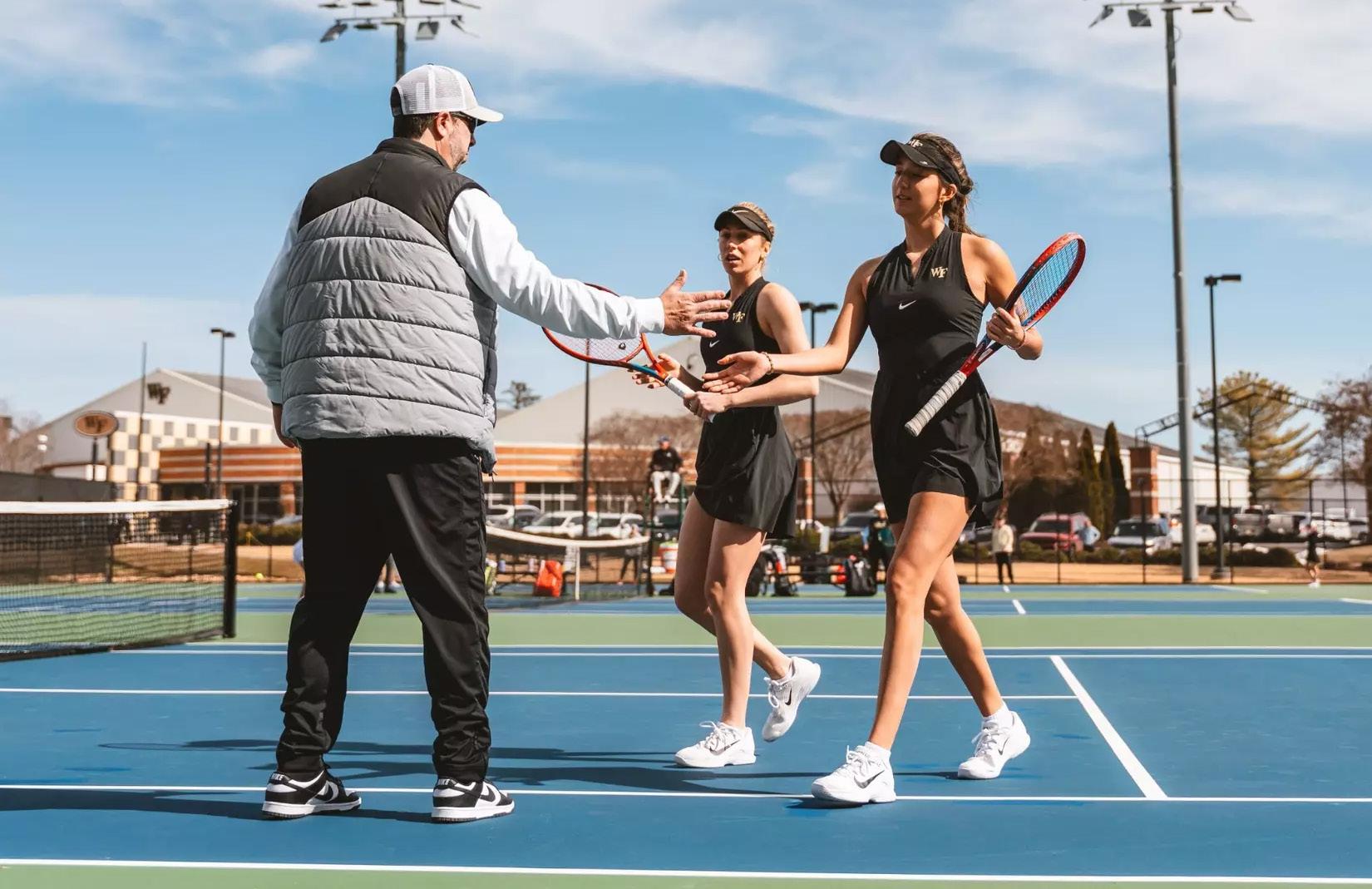
She looked to reach the milestone when
us, and we handled them fantastically
Nevena Carton earned her 100th ca-
SCOTTIE KIMMELMAN Sports Editor
Last weekend, the Wake Forest Men’s Golf team travelled down to Puerto Ricoment of the year at the Palmas Del Mar ranked within the top 100, includitself, which is located in Humacao, Puerto Rico, is played at 7,117 yards andest, with the four representatives comBoth junior Nicholas Prieto and sophoconsistency on day one in Puerto Rico,
In his second nine, he collected three
cons held a two-shot lead over Southern
aled in and completed his round without
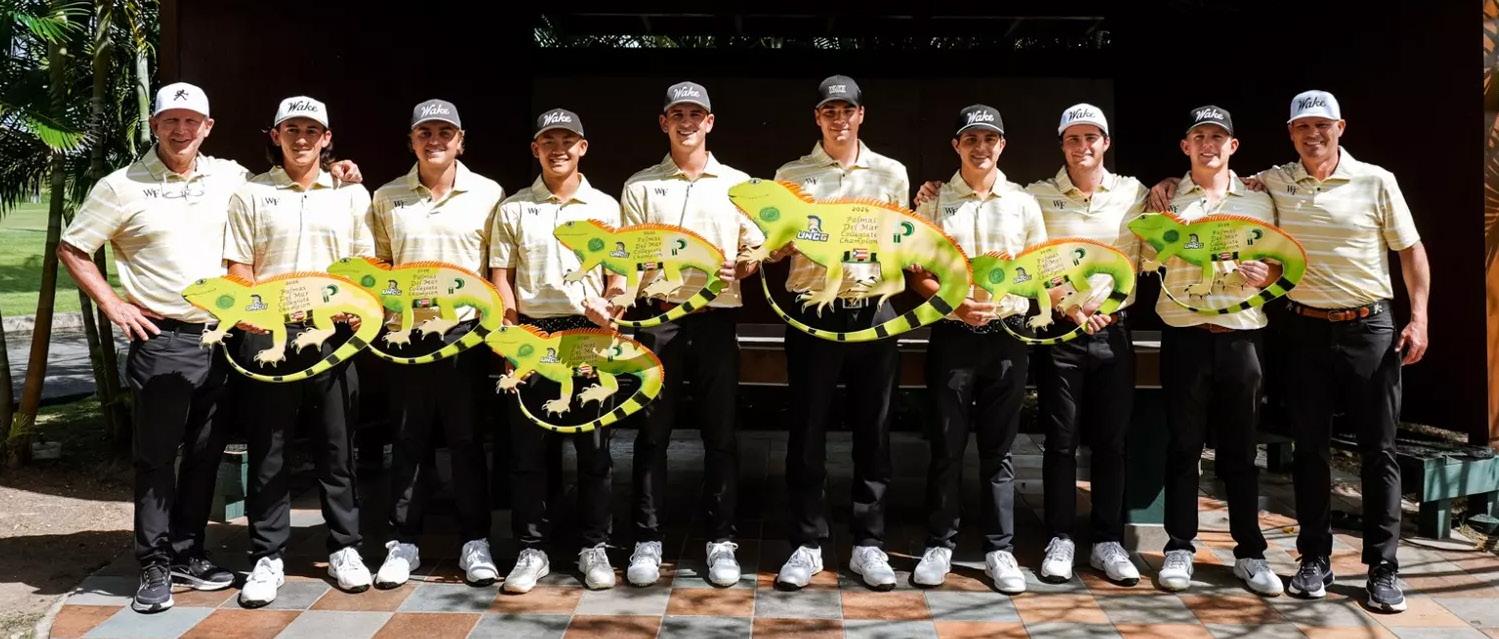
Consistency and perseverance fromen under par aided their eventual victory
out shaky the day prior, was not only
Contact Scottie Kimmelman at kimmsd22@wfu.edu
PAGE 18
THURSDAY, FEBRUARY 19, 2026
OLD GOLD & BLACK
Lydia Derris, derr 23@wfu.edu
Grace Schuringa, schugh24@wfu.edu
Jorge and Darlene Pérez lecture about the ways art contributes to self-cultivation
LYDIA DERRIS
&
Editor
this year’s Acquavella Distinguished Lecturers, Jorge and Darlene Pérez, are making strides to mitigate the inherent and historic elitism in the art world to edify generations to come.
spoke with Professor John Curley about their experience as leading contributors to the art world. They detailed imbalances in representation and access, and their roles in reducing those disparities.
Jorge Pérez is the founder and CEO of the Related Group, one of the largest real estate development companies in the United States. He said his passion for art began at 18, when he visited New York City to purchase Marino Marini and Picasso lithographs, pieces still in his collection today.
He was born in Argentina and lived in Colombia for the better part of his childhood. In Latin Ameripoor people and knew he “want[ed] to equalize the His wife, Darlene, is a registered nurse practitioner and member of the Wake Forest Universitytributions to the Miami Cancer Institute to support the center’s use of art “to improve patients’ well-

Jorge and Darlene Pérez (P ‘26) came to Wake Forest University on Feb. 12.
being.” She said that EEG scans have shown that exposure to art improves patients’ morale.
Answering questions submitted by art history students, Darlene and Jorge Pérez said that their interest lies in contemporary art that is socially conscious.
“We like contemporary art because we are in dialogue with both the artists and the strong social commitment they have in the work that they do,”
Jorge Pérez said.
LYDIA DERRIS Arts & Culture Editor
The exhibit “Timely Conversations” opened at the Hanes Gallery on Feb. 5. The artwork on display, most of which is sourced from the Mark H. Reece Collection of Student-Acquired Contemporary Art, explores the entanglement of history and time.
Works in the gallery are arranged in pairs. The result is a series of exchanges on identity, erasure and the environment which unfolds in intimate visual and conceptual dialogue across the exhibit.
Upstairs, visitors encounter a John Singleton Copley’s 1762 portrait “Mrs. Daniel Rogers (Elizabeth Gorham Rogers)” alongside Albrecht Dürer’s 1514 engraving “Melencolia I.” These centuries-old works deepen the conversation between the past and present as they sit alongside the contemporary works of the gallery.
The exhibition brings together artists who approach similar historical questions through vastly different formal languages. Robert Colescott and Glenn Ligon, for example, both reexamine race in American history. However, Colescott’s
historical narratives, while Ligon’s text-based works interrogate the instability of language and authorship. Intertextually, their works show how history can be challenged through highly variable aesthetic lenses.
“This exhibition is focused on getting works to talk to each other through meaningful visual representation and drawing connections between messaging and themes the artists may have inspired or provoked,” junior Gianna PalacioStiegele, the Hanes Gallery’s curatorial intern this semester, said.
“A big focus this year is increasing student engagement with the gallery and arts at Wake For-

They pride themselves on buying and supporting artists from diverse backgrounds, such as Cuban artist Roberto Álvarez Ríos, Ghanaian sculptor El Anatsui and South African artist William Kentridge.
“It’s powerful when young people get to see their heritage,” Jorge Pérez said. “We want them to understand their culture better.”
Darlene added that the couple believes “forming a diverse acquisition and curatorial team and strong relationships with political leaders” is vital.
Darlene and Jorge Pérez also said they value pubEl Spacio 23, is free and open to the public yearround.
The Pérezs also recently donated a Joan Mitchel triptych titled “Iva,” which used to hang in their bedroom, to the Tate Museum’s Rothko Room. Mu-
“one of the most important Tate has received.”
“We set the terms that the piece has to be there for a minimum of 15 years without being taken down, and hence be re-presented every two years in the Tate or another museum,” Jorge Pérez said.
The presence of art is healing, socially and literally, and the Pérezs are contributing to an enduring legacy by supporting and publicizing art.
Contact Lydia Derris at derrlf23@wfu.edu
est more broadly,” Palacio-Stiegele added. Elsewhere in the exhibit, Martine Gutierrez and Shahzia Sikander confront the Western art his-
complicate who is permitted visibility and authority within that tradition. Their interventions are not subtle as they destabilize inherited narratives and expand them, insisting on multiplicity where there was once rigidity.
Questions of labor and lineage surface in the works of Suchitra Mattai and Jay Lynn Gomez. Drawing from personal and familial histories, they layer materials and imagery to foreground stories often relegated to the margins. Domestic work, migration and generational memory are not treated as background details but as central, structuring forces.
Across painting, photography and mixed media, “Timely Conversations” resists chronology. Instead, it positions time as cyclical and porous,tionality in these juxtapositions does not imbue viewers with a point of view, but they make it
but rather negotiated and carried forward. And contemporary art, at its most effective, makes that negotiation visible.
Contact Lydia Derris at derrlf23@wfu.edu
HANNAH ORDAN Staff Writer
After a year and a half of waiting, the fourth season of “Bridgerton” is four episodes on Jan. 29, the period drama has captured the attention of viewers across campus.
This season, which features the romantic journey of eldest son Benedict Bridgerton (Luke Thompson), wastes no time debuting Bridgerton’s love interest, Sophie Baek (Yerin Ha). As Baek enters the Bridgerton family’s masquerade ball and her footman warns her to “just be out by midnight,” the plot of season four becomes abundantly clear: another Cinderella story. described as predictable. As expected, in accordance with the original fairy tale, Sophie spends the ball avoiding her stepmother and stepsisters and dancing with Benedict, the suitor of the night, before – of course – leaving behind an item of clothing. In this case, a silk glove. As the episodes continue, Benedict searches far and Silver,” unaware of the fact that his puzzling paramour is the illegitimate daughter of a late noble and is currently living as a maid under the employment of her stepmother.
As I watched all four episodes with weary familiarity, I couldn’t help but feel disappointed at the lack of originality in the new season’s plot. After three inventive seasons of “Bridgerton”, each with its own unique love stories, Season 4 Part 1 left other
Freshman Sonia Gulati said she was disappointed by the formulaic feel of the new season.
“I found this season of ‘Bridgerton’ so predictable,” Gulati said. “It followed the plot of Cinderella so closely and in such an obvious way that I
much as the previous ones. I’ve seen commentary online saying that past
seasons have followed storylines of other fairy tales, but I think that they weren’t nearly as apparent as this season.”
To be sure, some aspects differed from the original story of Cinderella. There was no mention of a fairy godmother or enchanted pumpkins, and a silk glove replaced the glass slipper. However, I believe that any viewer could detect the copycat plotlines.
That being said, I sincerely hope that “Bridgerton” has surprises in store for the end of the season. With Part 2 coming out on Feb. 26, I look forward to following along in the romantic journey of Benedict and Sophie, and I hope that the final four episodes can prove that Season 4 is not just another Cinderella story

HENRY
Staff Writer
The weeks between New Year’s and Valentine’s are probably the worst for movies. After the highs of the award-contending tentpoles released from October to December, January is typically left with “dumped” releases that studios didn’t know what to do with. Now that the cursed time is over, good movies are back.
Given the choice between the newring Chris Hemsworth, I selected the latter. I expected something akin to action-packed thrillers with very little to offer in terms of cerebral elements.
“Crime 101,” directed by Bart Layton, follows Hemsworth’s character as he attempts to hit “walk-away stars Halle Berry as an insurance exMark Ruffalo as a beat-down police detective, Barry Keoghan as an unhinged thief and Monica Barbaro as Hemsworth’s love interest.

While Amazon has been selling “Crime 101” as an action thriller, it follows Hemsworth’s character’s emotional arc as he questions his life
choices following an unexpected left turn for one of his jobs. What ensues its characters repair their broken lives than in seeing things explode.
That’s not at all what I expected, -
citement. I appreciated its focus on character, and found none of it boring, but I think more in the way of
“Crime 101” concerns itself with authenticity and self-improvement. Each character is forced to confront their true self and apparent shortwealth inequality (both its causes and effects), handling the topic well.
Each actor gave a worthy performance. I found Halle Berry to be the standout, but I enjoy Hemsworth and Ruffalo in everything I’ve seen them in, including “Crime 101.”
very unexpected. Unexpected in its quality, to be sure, but also far more character-focused, introspective and thoughtful than I anticipated. Don’t expect a shoot-em-up, but if you’re interested, “Crime 101” is worth a watch.
LYDIA DERRIS Arts & Culture Editor
Last Sunday, over a hundred million viewers tuned in to the Super Bowl. Many wondered how Latin rapper and singer Bad Bunny would perform at his eagerly awaited halftime show.
Would he speak against the Trump administration’s immigration crackdown, as he did in his acceptance speech for Album of the Year at the Grammys? Would he play the catchy, nostalgic “DtMF?” Would fellow stars Lady Gaga and Ricky Martin be featured?
He did all of those things, but above all else, his show celebrated origins.
Staying true to both his Puerto Rican and familial heritage, Bad Bunny walked out in an off-white football jersey labeled “OCASIO” in reference to his full name, Benito Antonio Martínez Ocasio. Mid-set, he paid homage to little Benito, awarding a Grammy to a child actor playing a younger version of himself.
With a model sugar cane field, a partial reconstruction of El Morro, the 16th-century Spanish-built stone fort on the coast of San Juan, a coco frío stand serving piragua (Puerto

Rican shaved ice), La Casita, a replica of traditional, colorful homes in Puerto Rico used in his concert residency (and slowly diminishing due to gentrification) and even an actual wedding officiated onstage, the show transcended global and cultural boundaries.
The set placed Bad Bunny’s beloved Puerto Rico at the heart of a worldwide celebration, where salsa,
bomba and plena oscillated between and were married with reggaeton and dembow. Bad Bunny invoked a vibrant Latin heritage that continues to thrive across generations, recognizing its utilitarian aspects of farmwork, cane-cutting and grid system maintenance in communion with the communities that labor supports as well as the hard-earned joys workers toil to secure.
The performance also included Lady Gaga singing a salsa-inspired version of “Die With a Smile” and Ricky Martin – arguably the originator of modern Latin pop — covering Bad Bunny’s “Lo Que le Pasó a Hawaii.”
Bad Bunny’s latest album, “Debí Tirar Más Fotos,” took the spotlight at halftime – the stage even included the iconic white plastic chairs on the album’s cover. The performers prioritized Latin rhythms and tucked in socio-political commentary with songs like “Lo Que le Pasó a Hawaii,” which suggests a wariness that, just like Hawaii, Puerto Rico’s culture could be diluted by American imperialism. Another politically conscious hit, “El Apagón” (“The Blackout”), includes double-entendres about Puerto Rico’s frequent power failures.
The lead-up to Bad Bunny’s performance was tainted by culture-war controversies. He received much criticism from conservative commentators who questioned why the Super Bowl selected a Spanish-language artist.
Contact Lydia Derris at derrlf23@wfu.edu
A student production featuring two independent castscharacter the true modern woman?
NOLA ADEPOJU Staff Writer
Directed by Cindy Gendrich, Harold Pinter’s three-person play “Old Times” ran in Scales Fine Arts Center’s Ring Theatre from Feb. 1115. The third mainstage production of the season, “Old Times,” turned memory into both subject and weapon, asking audiences to consider how recollection shapes identity and how easily it can be bent.
The plot is deceptively simple: married couple Deeley (Bennett Haara and Conner Hunt) and Kate (Gabi Velinova and Lauren Veldhuizen) host Anna (Ashlyn Collings and B.G. Cave), Kate’s friend from twenty years earlier. Over drinks and conversation, the three trade stories about their shared past, yet their memories do not align. What begins as a nostalgic recollection slowly morphs into a quiet battle over who remembers “correctly.”
“‘Old Times’ reveals how much we come to define ourselves through memory and how disorienting its distortion and weaponization can be,” Gendrich wrote in her director’s note.
That idea guided the play’s production from its earliest stages. Last semester, under Gendrich’s guidance, junior Ziqi Huang researched the mechanics of memory in preparation for the show. She studied how the brain encodes information, how recall changes over time and how
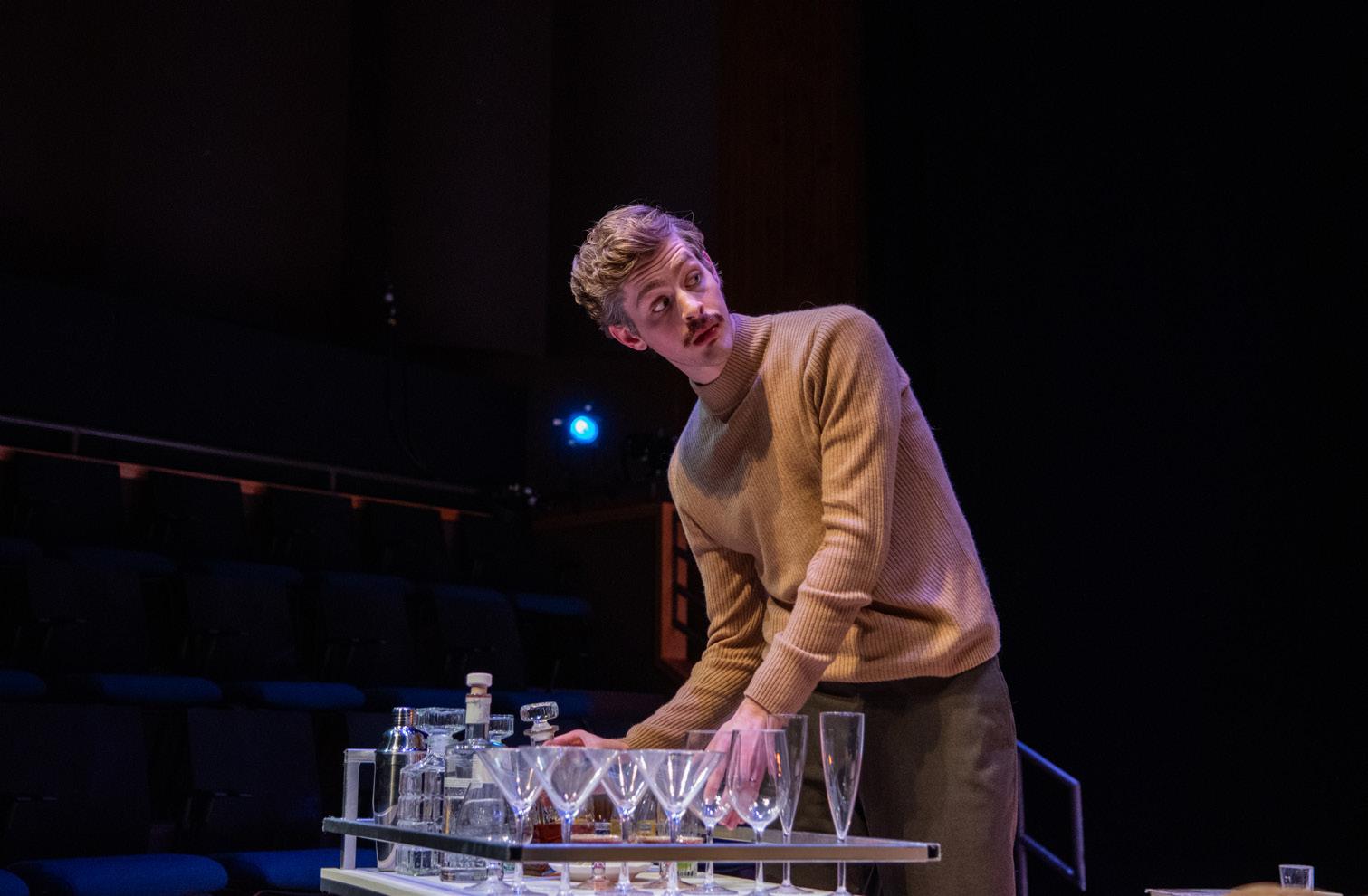
easily memories can be reshaped.
“We came to the realization that Pinter had this good intuition about the ability of memory,” Huang said. “Back when the play was written, neuroscience was not that advanced to tell us how we can change or implant the memory — yet Pinter is able to use his words to capture how memory plays a role in human connection.”
Huang’s research framed the play as a psychological process unfolding in real time. Each character’s version of the past becomes an at -
tempt to stabilize the present. If memory defines who we are, then controlling the narrative of memory becomes a way to control identity itself.
Now, Huang calls “Old Times” her favorite play.
“It has rich subtext and invites you to observe everything that is happening between the three characters,” Huang said. “It’s purposely ambiguous.”
That ambiguity extended to casting. Unlike most mainstage productions at Wake Forest, “Old Times”
featured two separate casts who alternated performance nights. After initially rotating scene partners in rehearsal, each cast developed individual dynamics after Gendrich finalized their performance arrangements.
As Huang sees it, ambiguity has the power to create different subtexts — and it certainly did in the case of “Old Times.” Though both casts spoke the same lines, their interpretations were strikingly different.
“Bennett [Haara, who was cast as Deeley in one production] and I are bringing our different lives and experiences to it and thus creating entirely different characters and different worlds,” said Hunt, the other actor playing Deeley.
In a play about perspective, the double casting emphasized the argument that no single version of events holds absolute authority. It’s a reminder that how we remember — and how we live — is never universal. Each perspective is valid in its own way.
“Memories are not necessarily what we think they are,” Hunt said. “My lived experience in this moment will differ from your lived experience, and in ten years, both of us will remember this conversation differently. And that is a fantastic thing.” In “Old Times,” that difference is not a flaw. It is the point
Contact Nola Adepoju at adepaa23@wfu.edu