SHARING SUPPLIES

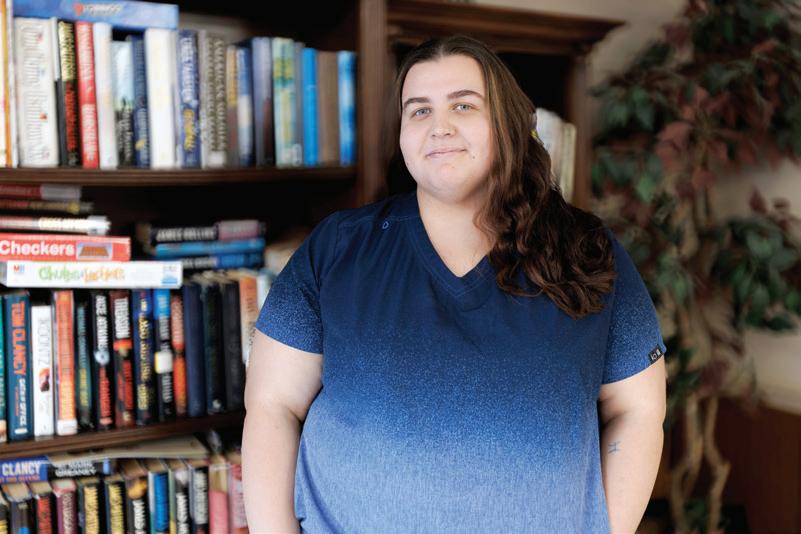
3 Opinion Katherine Pond, an 1199 CNA at Barnegat Rehabilitation and Nursing Center in New Jersey, describes her Union activism.
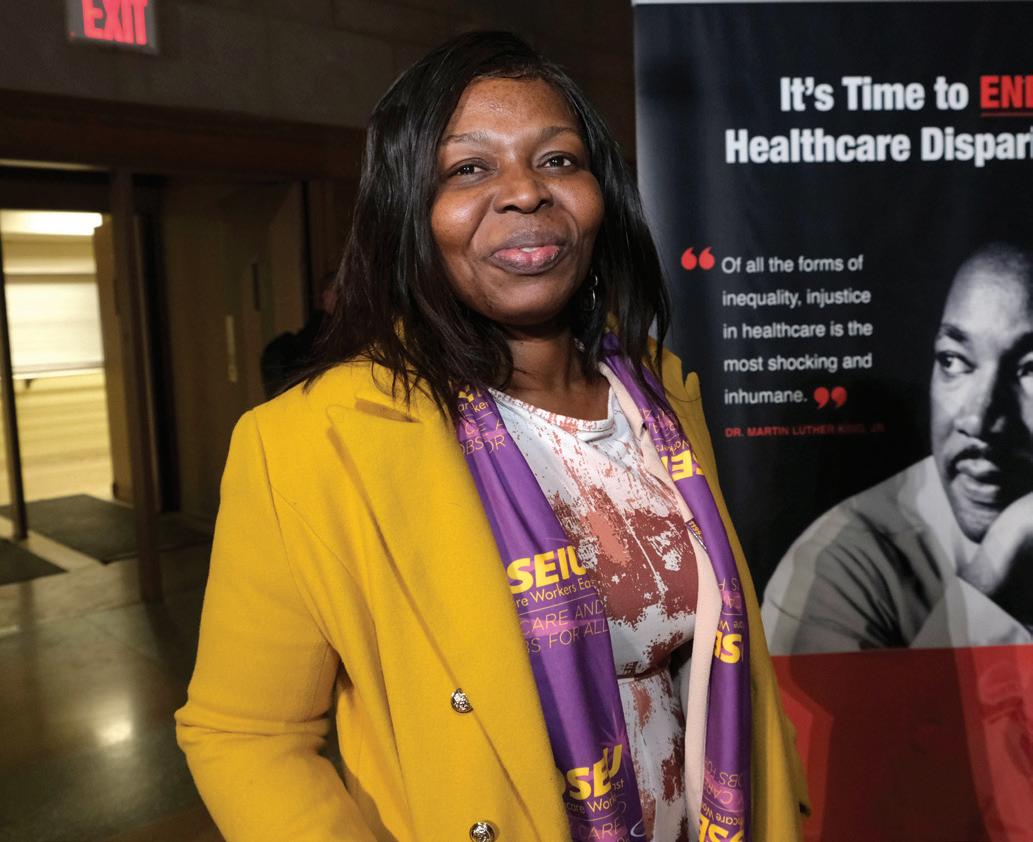
4 Dedicated to Justice Breathing new life into the annual commemoration of Martin Luther King Day, 1199 brought together modern-day activists to ignite the fight for immigrant justice.
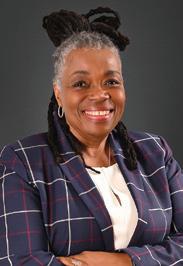
5 The President’s Column No Immigrant Member Stands Alone
6 Around the Regions Justice in Washington DC; PAC sweepstakes winners; Solidarity with Minnesota; Walking the line with NYSNA; $45 Million Settlement for Home Care Workers.
8 Farewell to Our Rosa Parks Claudette Colvin struck two mighty blows against segregation.
9 Joyful Activism In the 1199 caucus program, cultural expression and political activism go hand in hand.
9 The Work We Do Vassar Bros Medical Center in Poughkeepsie, New York.
14 Bringing Relief 1199ers travel to Jamaica with medical supplies and expertise to help the communities worst hit by Hurricane Melissa in October.
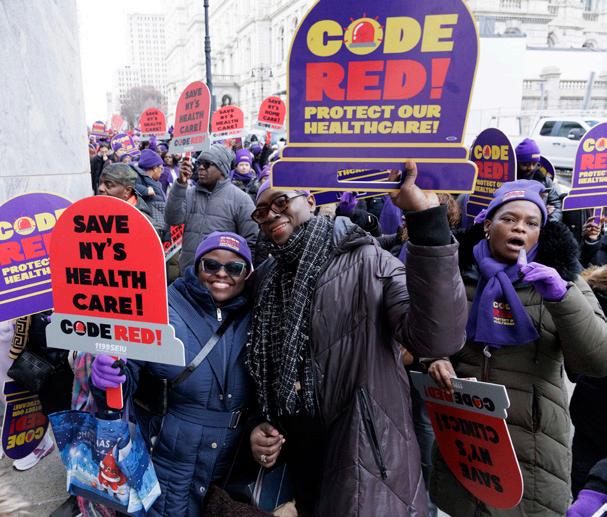
18 Code Red Members press New York State lawmakers to step up and save critical healthcare providers after Washington, DC abandoned them.
20 Delegate Profile: Peyton Humphreville A bargaining committee member at the Planned Parenthood Federation of America outlines their Union journey.
22 Our History Since its formation, the 1199 Haitian Caucus has rallied members and joined hands with other Haitians to demand justice and fairness in the face of government attacks.
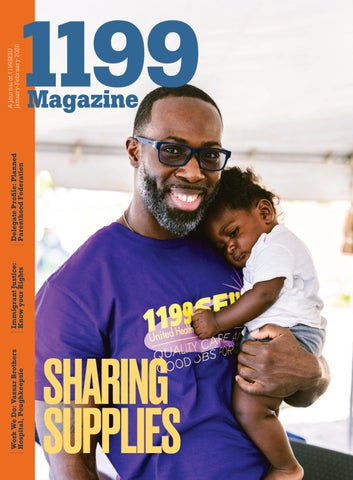
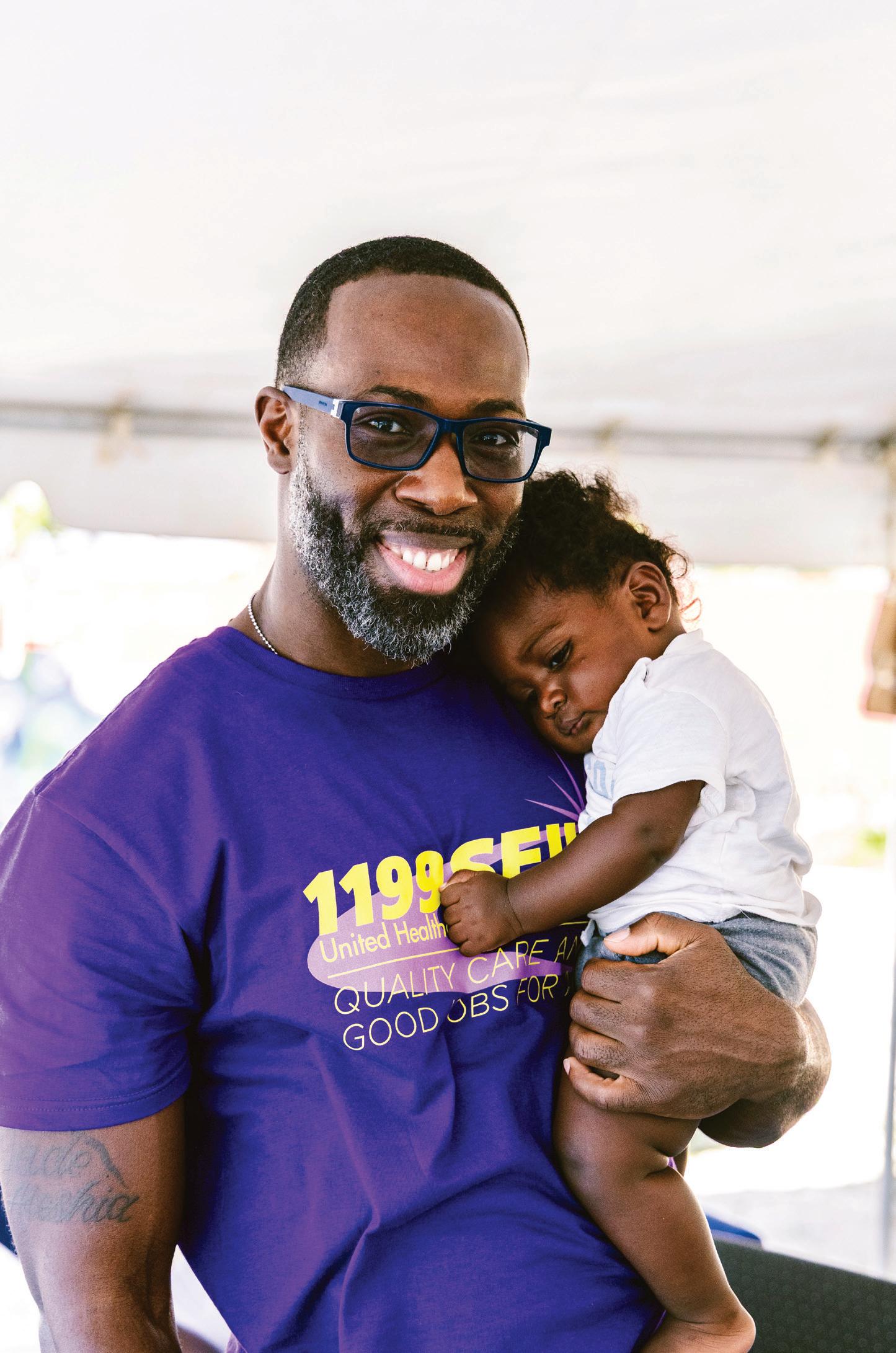
Cover: Wade Falconer, an 1199 ICU Nurse at Brookdale Hospital, Brooklyn, cradles a local child in the Black River clinic in Jamaica.
Opinion: Katherine Pond
An 1199 CNA at Barnegat Rehabilitation and Nursing Center in New Jersey describes her Union journey.
I’ve spent the last nine years caring for people at some of the most vulnerable moments of their lives. This work isn’t easy. It’s physically demanding, emotionally heavy, and often thankless, but I do it because I truly care about people. Helping others has always been part of who I am.
As nursing home workers, we take on responsibilities that many people never see. We do the job families can’t do or choose not to do. We show up for residents every day, even on holidays, even when we’re exhausted, even when we’re struggling ourselves. But too often when we need care, the system doesn’t show up for us. The health insurance offered at Barnegat is worse than what the state provides through the Affordable Care Act. After drastic changes were made at the federal level and subsidies were not extended, my premiums didn’t just increase— they became more than five times higher with copays and a large deductible on top of that. Trying to keep up with those costs while working in health care has been overwhelming. The federal government would rather give tax cuts to the richest people in our country than provide me with affordable health care.
“Like many working people I’m constantly trying to balance caring for others, staying afloat and investing in my future.”
years, and when new management took over, the previous 1199 contract was not honored. That left workers without a union contract for 13 years. Organizing our union again and bargaining our first contract has become incredibly meaningful to me. This is my first time serving on the bargaining committee. I’m proud to be there with coworkers who have given their lives to this facility, including one CNA who has dedicated more than 40 years to Barnegat and another who has given more than 20. For all that time and service, they have had no financial security to retire because there was no 401(k) in place. Seeing that has been heartbreaking, but it’s also motivating. It reminds me that it’s never too late to fight for good benefits, not just for ourselves, but for the future generations of workers coming behind us.
Sitting in bargaining has been frustrating. Corporate doesn’t know what it’s like to live paycheck to paycheck. They don’t know what it feels like to have to
choose which bill gets paid with this paycheck and which one has to wait. We’re begging for bare minimum healthcare coverage, yet those sitting across the table from us probably have the best package in the world. Now, we have only six holidays. Management gets every paid holiday, while we have to negotiate something as basic as Martin Luther King Jr. Day. The contrast couldn’t be more clear.
After nearly a year of bargaining, we’re finally close to ratifying our first contract [at press time]. The agreement on the table includes more affordable health care and a 401(k), giving workers peace of mind and a chance to plan for the future. It’s proof that when we stand together, we can make real improvements in our lives and workplaces.
Being part of the union has become a passion of mine—it’s about dignity, fairness, and taking care of one another. This work takes time, patience, and commitment, but it’s worth it. When healthcare workers stand together, we’re stronger and we can keep doing what we do best, caring for others. And with a good contract, we can take care of ourselves and our families at the same time.
1199 Magazine
January-February
2026
Vol. 44 No.1
ISSN 2474-7009
Published by 1199SEIU, United Healthcare
Workers East
498 Seventh Ave, New York, NY 10018
(212) 582-1890
www.1199seiu.org
president
Yvonne Armstrong
secretary treasurer
Veronica Turner-Biggs
senior executive vice presidents
Charles Nystrom
Nadine Williamson
executive vice presidents
Jacqueline Alleyne
Michael Ashby
Lisa Brown
Andy Cassagnol
Roger Cumberbatch
Adekemi Gray
Todd Hobler
Leigh Howard
Benson Mathew
Cari Medina
Brian Morse
Roxey Nelson
Rona Shapiro
Greg Speller
Daine Williams
editor
Sarah Wilson
art direction and design
Maiarelli Studio
director of photography
Kim Wessels
contributors
Leyla Adali
Jenna Jackson
JJ Johnson
Alongside my work as a CNA, I’m also a student working toward becoming a therapist because helping people heal physically and emotionally is something I’m deeply passionate about. Even with financial aid, school is expensive and the costs add up quickly. I work four days a week so I can focus on my studies, but that also means earning less. Like many working people I’m constantly trying to balance caring for others, staying afloat and investing in my future.
I’ve worked at Barnegat for six
1199 Magazine is published six times a year—January/ February, March/ April, May/June, July/ August, September/ October, November/ December—for $15.00 per year by 1199SEIU, United Healthcare Workers East
498 Seventh Ave, New York, NY 10018
Periodicals postage paid at New York, NY, and at additional mailing offices.
POSTMASTER: Send address changes to 1199 Magazine, 498 Seventh Ave, New York, NY 10018
Dedicated to Justice
Breathing new life into the annual commemoration of Martin Luther King Day, 1199 brought together modernday activists to ignite the fight for immigrant justice.
In honor of Dr Martin Luther King Jr.’s birthday on January 15th, 1199SEIU came together with partner organizations at Riverside Church in Manhattan to rededicate modern activism to his radical and courageous vision.
The civil rights icon would have been 97-years-old this year, had he not been assassinated in Tennessee more than five decades ago at the age of 39.
In the face of relentless attacks on immigrants, civil rights and our social safety net, it is time to ask: How would Dr King respond to this moment?
Cassandra McGuire, an 1199 nursing home member, shared her perspective as an immigrant from the Caribbean.
“I came to the US from Grenada more than 30 years ago. That was a very
different time. I was able to get citizenship here through my father,” she said.
“I used to feel safe in this country. But we know that ICE doesn’t care if you’re a citizen or not or whether you have committed any crime. I have friends who do not yet have green cards and some of them are considering self-deporting because they are afraid of being grabbed off the streets by these goons. There is a campaign of terror going on now with news of people being sent to El Salvador and other countries without any due process.”
At the nursing home where McGuire works in Brooklyn, many of her co-workers are from Haiti and have been relying on Temporary Protected Status (TPS) to maintain their legal position.*
“They don’t talk about it,” she said,
“I used to feel safe in this country. But we know that ICE doesn’t care if you’re a citizen or not or whether you have committed any crime.”
– Cassandra McGuire, 1199 nursing home member
“But you can see the fear in their eyes. I didn’t even know about TPS before. But now that I’m learning about it, I can’t see any reason why it should be taken away.
“This man in the White House is attacking everyone, if he feels like he is not getting his way. He is trying to make people believe that immigrants are taking jobs from people who were born here. The truth is that many of the jobs done by immigrants are jobs that those born here don’t want to do. We are the ones caring for the elderly, children and the disabled–the most vulnerable in society.”
1199 President Yvonne Armstrong also spoke, saying: “1199 is a proud union of immigrants. I am a proud immigrant from Jamaica, who came to this country and began my journey at 1199 as a dietary worker in New Rochelle Hospital, 50 years ago.
“My story is not unusual. Here in New York City, over half of all healthcare workers are immigrants. Three out of every four homecare workers are immigrants. Without immigrants, our healthcare system would fall apart.”
The Reverend Al Sharpton added: “The challenge of King Day is not simply to remember Dr. King, but to live his courage in the times we are in right now. If we do not change the times in which we live, then we do not have the right to honor him. Dr. King was not a statue. He confronted power, challenged injustice, and stood with working people.”
*The US government initially designated Haiti for TPS more than 15 years ago following the devastating earthquake on the island. It has been renewed ever since because conditions in Haiti have been deemed too dangerous to remove it. However, the current Republican-controlled administration has revoked TPS from several countries, including Haiti, since taking office. As this edition went to press, TPS for Haiti was due to be terminated on February 3. But on-going court battles waged by immigrant rights advocates may result in that date being postponed.
No Immigrant Member Stands Alone
An injury to one is and injury to all.
There is no way to sugarcoat it: many 1199 families are in a time of crisis, as Trump and Republican leaders ramp up their attacks against immigrant communities. We’ve all witnessed with outrage the horrifying scenes in Minneapolis, where thousands of masked ICE agents surged into the city, violently kidnapping residents (immigrants and non-immigrants alike, including children) and attacking peaceful protesters. Our hearts go out to fellow SEIU members in Minneapolis, including daycare workers from the Somali community who have been targeted for deportation by the Trump administration.
Behind the headlines coming out of Minnesota, 1199 members here on the East Coast are facing similarly harrowing circumstances. We are a proud, proud union of immigrants. In each of our states, immigrants are a pillar of our union and the entire healthcare system: immigrants represent 56 percent of the direct care workforce in New York, 47 percent in New Jersey, 40 percent in Florida, 34 percent in Massachusetts and Maryland, and 25 percent in Washington, DC. Yet, despite the crucial role we play, the federal government is forcing an end to the employment of many immigrant caregivers, including within our union.
As this edition went to press, Temporary Protective Status (TPS) for Haiti was due to be revoked on February 3, 2026. TPS is a program that allows legal residency and work permits for immigrants fleeing war or national disaster from certain countries. It had been in place for Haiti since the devastating 2010 earthquake, the impact of which the nation still hasn’t recovered from amid subsequent hurricanes, political instability, and a prolonged economic crisis. TPS has or will be expiring for many other countries, too, including Nepal, El Salvador, Venezuela, Ukraine, Yemen, and others.
How do we respond to this moment? We must exercise our rights, make contingency plans, and be voices for truth and justice:
• We must all know our constitutional rights and what to do if questioned by ICE. Scan here to download a Know Your Rights card to keep with you.

Immigration Cards: Know Your Rights: What to Do
https://digital.1199seiu.org/KYR
• Members impacted by a change in legal status should make a family preparedness plan to reduce harm and disruption should a loved one be detained or deported. The New York Immigration Coalition has put together a helpful guide on family preparedness. Scan here to access it.

Community Resources for Immigrant NYers: https://digital.1199seiu.org/ NYIC-resources
• Members who are losing their jobs or leaving the country and are vested in a retirement plan (such as the 1199 Pension Fund or an employer-provided 401k) should take steps to protect the benefits they have earned. Vested members retain the right to their accrued retirement benefits even if they can no longer continue working in the United States, so it is important to update contact information with the plan administrator and understand the rules for claiming benefits from abroad if relocation becomes necessary. No one should forfeit years of hard earned retirement benefits because of a sudden change in immigration status.
Among those impacted are 1199 members who came here many years ago, raised their families, provided quality care to their communities, and never got so much as a traffic ticket. These hardworking, law-abiding caregivers are now targets for ICE arrest.
When a person loses TPS, it means that their legal right to live and work in this country ends. Among those impacted are 1199 members who came here many years ago, raised their families, provided quality care to their communities, and never got so much as a traffic ticket. These hardworking, law-abiding caregivers are now targets for ICE arrest.
Immigrants in such situations now must make heartbreaking choices about self-deporting or living in the shadows, unable to get legal employment and facing the constant fear of ICE knocking on their door.
Those of us who have the security of citizenship or permanent residency have a particular responsibility to speak out against what is happening to our immigrant neighbors and co-workers. We must meet this moment with solidarity and allyship, using our voices to document and protest ICE abuses and demand policies that protect immigrant workers and the people we care for.
As 1199ers, we are the proud torchbearers of generations of members who were called on to lead in challenging times like today. And we will never shy away from standing firmly on the side of dignity, justice, and humanity.

• On Tuesday, February 17 and Tuesday, February 24, we are hosting virtual Immigration Information & Support Workshops to provide members with the latest guidance and updates. We will be joined by trusted legal and community partners to answer your questions. To RSVP scan the QR code or go to the link below.
Jan & Feb 2026 Immigration Information Sessions
https://digital.1199seiu.org/4sDdSlu

The President’s Column
Yvonne Armstrong
Justice in Washington DC Around the Regions
Eight years after losing their union, George Washington University Hospital (GWUH) workers in Washington DC were once again bargaining a contract after the National Labor Relations Board (NLRB) gave the go-ahead for 1199 to return to the facility in December.
It was a long road to justice, but after 1199SEIU was unlawfully removed from GWUH, workers in the housekeeping and food and nutrition departments were finally allowed to re-enter the hospital and resume bargaining.
“GW Hospital workers have waited a long time for justice, so we’re hitting the ground running bargaining and treating it with the seriousness it deserves. We’re energized and optimistic about our ability to secure a great new CBA for the members,” said Carrietta Hiers, 1199SEIU Vice President for Washington, DC and Community-Based Organizations (CBOs).
In 2018, after two years of bargaining with no contract in sight, GWUH withdrew recognition of the 150-worker unit. 1199 subsequently filed an unfair labor prac-
Game on
The winners of the Political Action Contributions (PAC) sweepstakes scored big over the holiday season.
Taquanda Shabazz, Danielle Clark, 1199 PCAs from Massachusetts won New England Patriots tickets and went to the Patriots vs. Buffalo Bills game at Gillette Stadium on December 14. Vincente Naranjo, another 1199 PCA from Tempus Boston also won tickets to the Patriots game.
Clark said: “I took my dad Ste-
tice charge with the NLRB.
An Administrative Law Judge found that GWUH had bargained in bad faith; however, in April 2021 ruled that hospital management was not in violation of federal labor law.
In July 2023, the Board vacated its 2021 decision on the basis that William Emanuel, one of three members of the NLRB who handed down the decision, had failed to disclose financial ties to Universal Health Services, the hospital’s owner and operator.
1199SEIU Executive Vice President for Maryland and Washington DC Lisa Brown called the 2023 decision a “tremendous win” at the time, stating that GW workers “deserve[d] the opportunity to secure their union without fear of retaliation.”
The following year, the NLRB officially reversed its 2021 decision, determining that GWUH had bargained in bad faith between 2016 and 2018 and ordering the hospital to bargain with the union again.
The union notched another win in July 2025 when the U.S. Court of Appeals for the DC Circuit Court upheld the NLRB’s latest decision in favor of the Union.
phen who brought me to my first game as a kid it was such a special moment for both of us!”
On December 28, Lidia Kubicar-Kunz, an Enviromental Services worker at Strong Memorial Hospital in Rochester, NY, attended a Buffalo Bills vs. Philadelphia Eagles game with a guest thanks to her PAC sweepstakes win.
The 1199SEIU Political Action Fund enables members to work to elect pro-labor leaders who stand alongside working people and their communities, crafting legislation and enacting policy changes that make a real difference to their everyday lives.
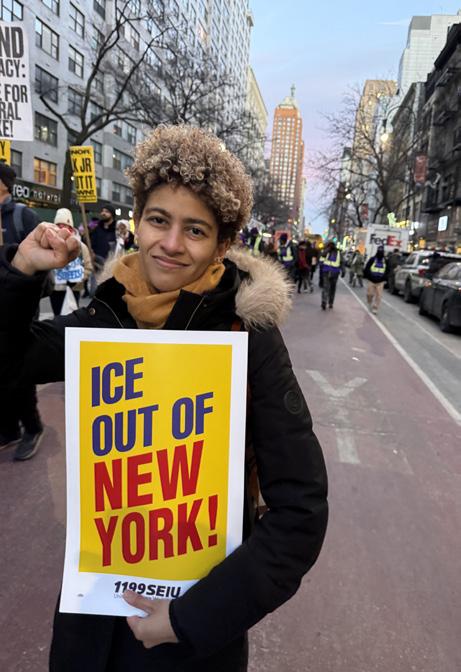
Haley Pessin, an 1199 Paralegal at the Legal Aid Society marches in NYC.
NEW YORK
Solidarity with Minnesota
Members in three 1199 regions took to the streets on January 23 to demonstrate their solidarity with the immigrants and activist allies in Minnesota who have been subjected to brutal ICE enforcement actions in recent weeks.
In the face of indiscriminate and unjustified attacks by the Federal government on immigrant communities, members took part in a Day of Truth and Freedom. 1199ers in New York City, Syracuse and Boston, Massachusetts, took to the streets in protest against the ongoing violence in Minneapolis throughout January.
“If you think it’s not coming for you, you’re wrong. It’s coming for all of us. We don’t want to see this
in
New York either.”
– Haley Pessin, 1199 Paralegal with the Legal Aid Society in NYC
Haley Pessin, an 1199 Paralegal with the Legal Aid Society in NYC, said: “I came out today because I’m outraged by what is happening in Minneapolis—the absolute denial of any kind of civil liberties, whether you’re a citizen or not. They are cracking down on children and arresting people for lawful activity. If you think it’s not coming for you, you’re wrong. It’s coming for all of us. We don’t want to see this in New York either.”
Members were united in their demand for the immediate withdrawal of ICE from our streets. Working people will not allow the federal government to violate rights, militarize the streets, or put communities in danger.
In NYC, the march turned the spotlight on corporations like Amazon, Home Depot, and Palantir, which are profiteering from ICE’s actions to rip apart our communities.
WASHINGTON DC
NEW YORK
NYSNA Solidarity
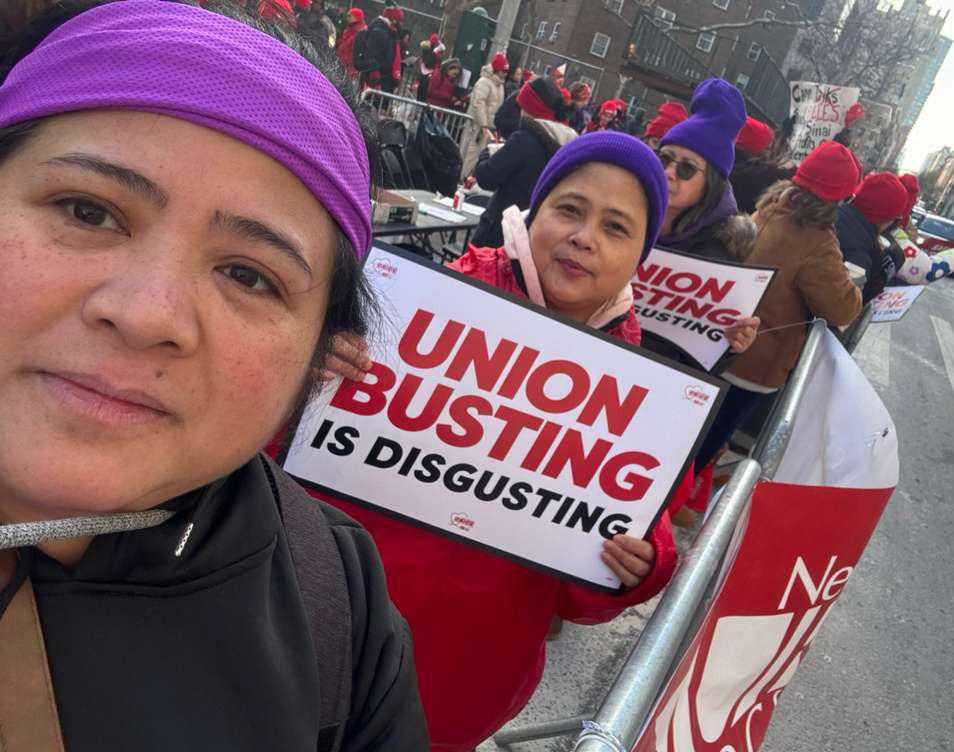
Thousands of 1199SEIU members in New York City work side-by-side with New York State Nurses Association (NYSNA) members every day. As this edition was going to press NYSNA members had been on strike for 14 days over safe staffing and fair working conditions.
Elvira Solis, an 1199 RN at Mount Sinai Queens, joined the picket line at the Mount Sinai main campus, along with fellow RNs Ludi Ramos and Judea Tan on their day off. Solis said: “It was important for us to stand in solidarity with NYSNA. No cold weather could freeze our mutual commitment to safe patient care.”
1199SEIU voted to contribute to the NYSNA strike fund on January 16 and President Yvonne Armstrong issued a public statement saying: “More than ever, we need
stability in our healthcare system, which means investing in the type of good healthcare jobs which are fundamental to the wellbeing of caregivers and the communities they serve.
“It is vital that nurses’ voices are heard so they can continue to uphold the quality care that New Yorkers depend on.”
On January 15, Adekemi Gray, 1199SEIU Executive Vice President for Mount Sinai division, walked the line in solidarity with NYSNA members at the Mount Sinai hospital main campus in East Harlem. He said: “Every single day, 1199 members who are: nursing assistants, PCAs, surgical techs, dietary workers, occupational therapists, respiratory therapists, speech therapists, housekeepers, unit clerks, medical
After 1199SEIU brought the rampant wage theft from home care workers by Americare to the attention of the New York Attorney General’s Office, an investigation was launched which resulted in a settlement of $45 million in back pay for home care workers.
The landmark settlement was announced by NYAG Leticia James on December 18. She expressed her gratitude to 1199 SEIU for its continued advocacy on behalf of home health aides working for Americare.
An investigation by the Office of the Attorney General (OAG) found that Americare failed to provide home health aides the compensation they were owed under the Wage Parity law while continuing to unlawfully seek Medicaid reimbursement.
Under the terms of the agreement, Americare will have to deliver nearly $45 million in
assistants and EMTs, we stand on the front lines. We deliver care. We save lives. And we stand shoulder to shoulder with NYSNA nurses.
“We all know the truth: the healthcare system is under attack, as Trump and Republican leaders in Washington, D.C. try to undermine bedside care and roll back workers’ rights. New York must be a firewall. We must stand against those threats.
unpaid wages to thousands of home health aides who worked for the company between 2014 and 2020 and pay an additional $10 million to New York’s Medicaid program to resolve related state and federal False Claims Act violations. The combined $55 million settlement is the largest wage parity agreement ever secured by OAG.
“Home health aides work tirelessly to care for our most vulnerable neighbors every single day,” said Attorney General James. “Americare underpaid these workers for years, violating the law and cheating taxpayers. This agreement returns nearly $55 million to the selfless individuals who earned it and to the Medicaid program they serve. My office will continue to fight for every dollar owed to New Yorkers and ensure no company profits by stealing from workers or from Medicaid.”
“Today’s agreement returns nearly $55 million to the selfless individuals who earned it and to the Medicaid program they serve.”
– Leticia James, NY Attorney General
1199 RNs from Mount Sinai Queens (left to right) Judea Tan, Elvira Solis and Ludi Ramos walking the line in solidarity at the Mount Sinai campus in Manhattan.
Farewell to Our Rosa Parks
Claudette Colvin struck two mighty blows against segregation.
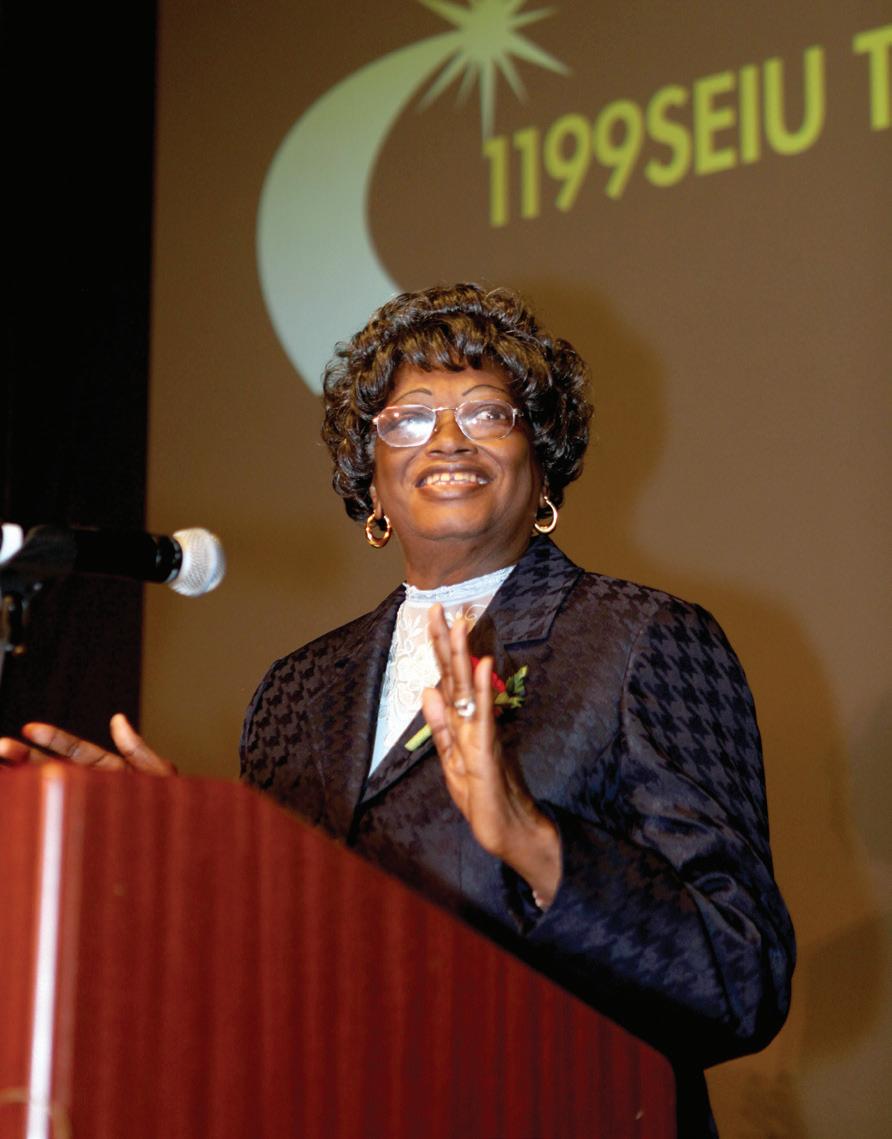
In January, 1199SEIU lost a beloved hero. Claudette Colvin, who at age 15 refused to give up her seat to a white passenger on a Montgomery, Alabama public bus, passed away on Jan. 13 in Texas at 86. Her courageous action occurred nine months before Rosa Parks’ more famous refusal to give up her bus seat. Colvin’s action led to her being convicted and placed on probation for “assaulting a police officer.”
She became an 1199er in 1986 when she joined the staff at Mary Manning Walsh Nursing Home in Manhattan. She retired in 2004 after 36 devoted years as a Nursing Assistant.
Colvin came to the attention of 1199ers and much of the nation when author Phillip Hoose won the 2009 National Book Award in the Young People’s Literature category for “Claudette Colvin: Twice
Toward Justice.”
The book’s title refers to Colvin’s double challenge to Montgomery’s segregated bus law. The first was her courageous refusal to give up her seat in 1955, and the second, her brave decision to become one of four plaintiffs in the Browder v. Gayle lawsuit that finally overturned the Jim Crow law in the following year. Hoose’s work focuses on Colvin but also recounts the historic 381-day bus boycott that ultimately made Rosa Parks a civil rights icon and helped boost the political profile of Dr Martin Luther King, Jr. in the early days.
Dr. King, Parks and their lawyer, Fred Gray came to Colvin’s defense, but a number of civil rights leaders felt that the teenager was not suited to be the public face of mass protest. Gray said, however, that her action gave moral courage
“When I was ordered to get up, I felt as if Sojourner Truth’s hand was pushing down on one shoulder and Harriet Tubman’s hand was pushing down on the other, so I refused to move.”
– Claudette Colvin
to many local activists to carry on.
Colvin was among the honored guests at a 2009 fiftieth anniversary celebration of 1199’s historic hospital organizing campaign. Interviewed at the celebration, Colvin said of her refusal, “It was an impulsive act. It was not planned.”
During a 2015 interview with 1199 Magazine, she stated, “When I was ordered to get up, I felt as if Sojourner Truth’s hand was pushing down on one shoulder and Harriet Tubman’s hand was pushing down on the other, so I refused to move.”
Fearing retribution, she maintained a low profile at Mary Manning Walsh. She said that while there, she was guided by the biblical admonition “to do unto others as you would have them do unto you.” Though not especially active, she said that she attended chapter meetings and did her stints on picket lines.
Colvin spent most of her working life in the Parkchester section of the Bronx. She moved to Corpus Christi, Texas, to be close to family.
Late in life, the city she fled celebrated her civil rights contributions. In 2017, Montgomery proclaimed March 2 Claudette Colvin Day. In 2019, a marker commemorating Colvin and the other plaintiffs in the Browder v. Gayle lawsuit was unveiled in the city. In 2021, a mural honoring her was unveiled there. Also that year, her assault conviction was expunged from her record, lifting her probation.
Colvin’s first child, Raymond, passed away in 1993. Her second son, Randy, is an assistant professor at Texas A&M University-Kingsville. He heads the Claudette Colvin Legacy Foundation along with Jennifer Colvin-Hadraoui, Colvin’s granddaughter.
Colvin said in one of her 1199 interviews that she hoped her sitting down had made it easier for youth and the rest of us to stand up for justice.
Joyful Activism
In the 1199 caucus program, cultural expression and political activism go hand in hand.
As the African American (AFRAM) caucus commemorates Black History Month during February, it will mark the 100th year of celebrating Black History in the US. With unprecedented government attacks on immigrants since the Republicans took over last January, the parallels between their struggle and the civil rights movement have become unmistakable.
AFRAM member, Janice Guzman, a PCA and Union Delegate from Massachusetts joined SEIU’s Justice Journey to Louisiana last summer. There she witnessed the horrific conditions in ICE detention centers—where people are packed into cages, being denied medical care, and in some cases, dying from neglect.
In January, Guzman joined the 1199 AFRAM table at the annual Martin Luther King Jr.
Memorial Breakfast at the Westing Copley Place Ballroom in Boston. Speakers included Massachusetts Governor Maura Healey, US Congresswoman Ayanna Presley and US Senator Ed Markey.
“I’m a Puerto Rican Afro-American and it is important to me to keep my roots alive,” said Guzman. The 1199 AFRAM chapter in Massachusetts traditionally mounts a Kwanzaa celebration in December, added Guzman, where members discuss the seven core principles known as the Nguzo Saba, which include unity, self-determination, collective work and responsibility, cooperative economics, purpose, creativity, and faith.
Another group of members who are enjoying an annual celebration soon is the Asian-Pacific Islander (AAPI) caucus. Lunar New Year
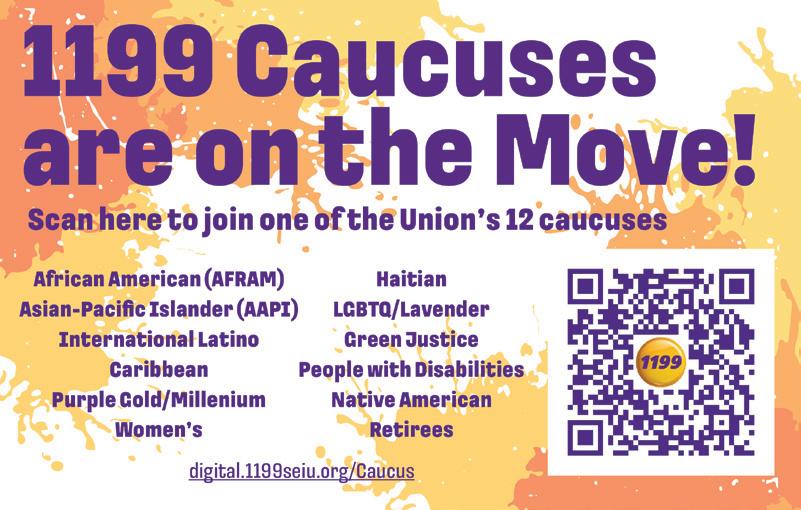
begins on February 17, which will mark the beginning of the Year of the Horse.
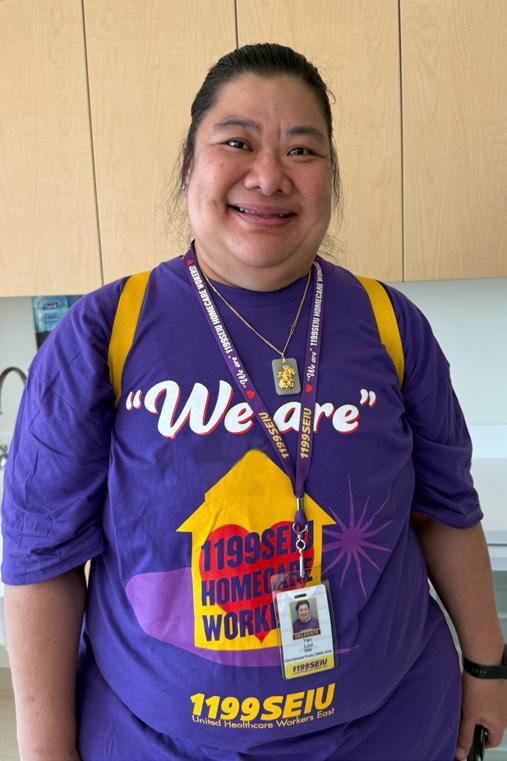
Yan Looi, an 1199 Delegate and Home Health Aide with the Chinese-American Planning Council (CPC) in New York is an active member of the AAPI caucus, traveling to cities including Las Vegas, Toronto and Washington DC to attend national events. Originally from Malaysia, Looi became an American citizen in 2010 with the help of the 1199SEIU Citizenship program. Able to speak six languages including Cantonese and Hindi, Looi helps bridge the gap between members in the AAPI caucus from a wide variety of backgrounds.
Political action also figures heavily in AAPI caucus activities. Last summer, Looi joined US Senator John Liu, US Congresswoman Grace Meng, and other community leaders in Flushing, NY, for a roundtable discussion on the harmful impact of the Republican’s “Big, Ugly Bill” on member’s communities..
Looi said: “I have been a home care worker for 10 years and my patients rely on Medicaid. But Republicans voted to cut one trillion dollars from Medicaid and the Affordable Care Act. Some of these Republicans claim that they aren’t cutting insurance from people who deserve it. That’s not true. As a healthcare worker I know everyone deserves healthcare.”
“I’m a Puerto Rican AfroAmerican and it is important to me to keep my roots alive.”
a PCA and Union Delegate from Massachusetts
Yan Looi, an NYC Home Care Delegate in Buffalo, taking part in the Upstate Listening Tour.
– Janice Guzman,
THE WORK WE DO Vassar Bros Medical Center
Members at Vassar Bros Medical Center in Poughkeepsie, New York, are celebrating one of their strongest contracts in years which they ratified last November. The settlement includes across the board wage increases of 12 percent over the life of the agreement. New minimum rates—up to $26 per hour—were agreed for ten titles and shift differentials were improved for all. The secret of their success, say 1199ers who joined the bargaining committee, was their determination to include all departments and titles in the process. This approach helped to build unity across the hospital. The 1199 Magazine recently met some of the key players.
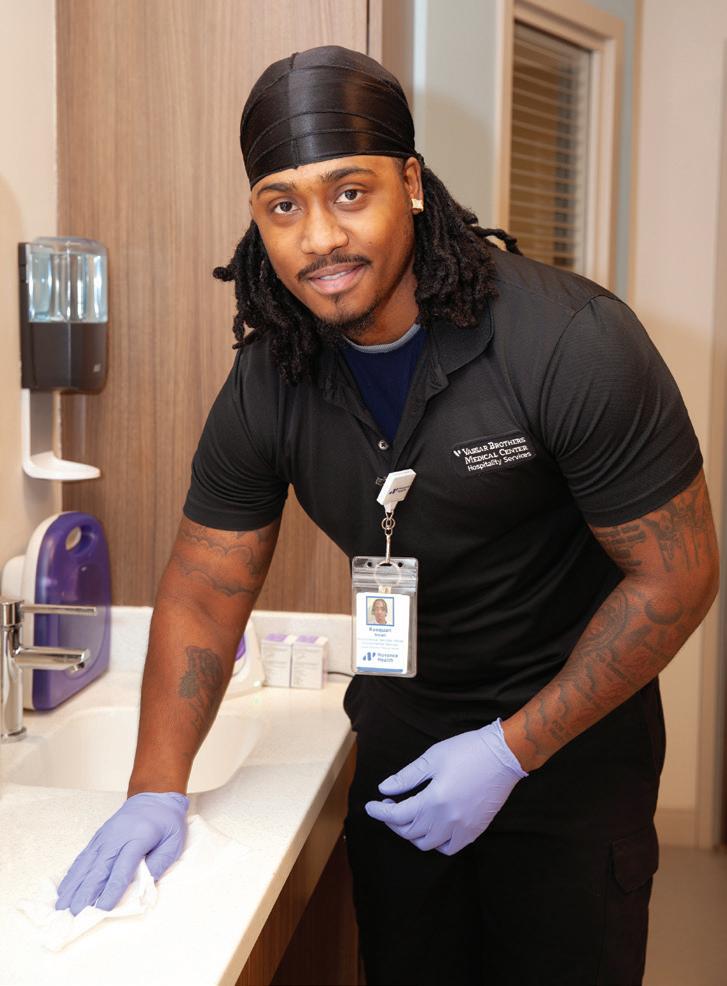
1. “I’m a floater, so I never know what to expect when I come into work. If there is a blood spillage in the ER, the medical staff clean it up and we come in afterwards to make sure everything is completely disinfected and sterile,” says Rae Quan Smalls who works in the hospital’s Environmental Services (EVS) department.
“It takes us 45 minutes after someone is discharged to adequately clean the room. We go by the motto of quality over quantity. Our boss says we should never succumb to the pressure to clean a room more quickly,” he adds.
EVS does not always get the recognition it deserves, but the patients are always appreciative, says Smalls. “There is a bad flu going around and we need to make sure that each patient comes into a sterile environment.”
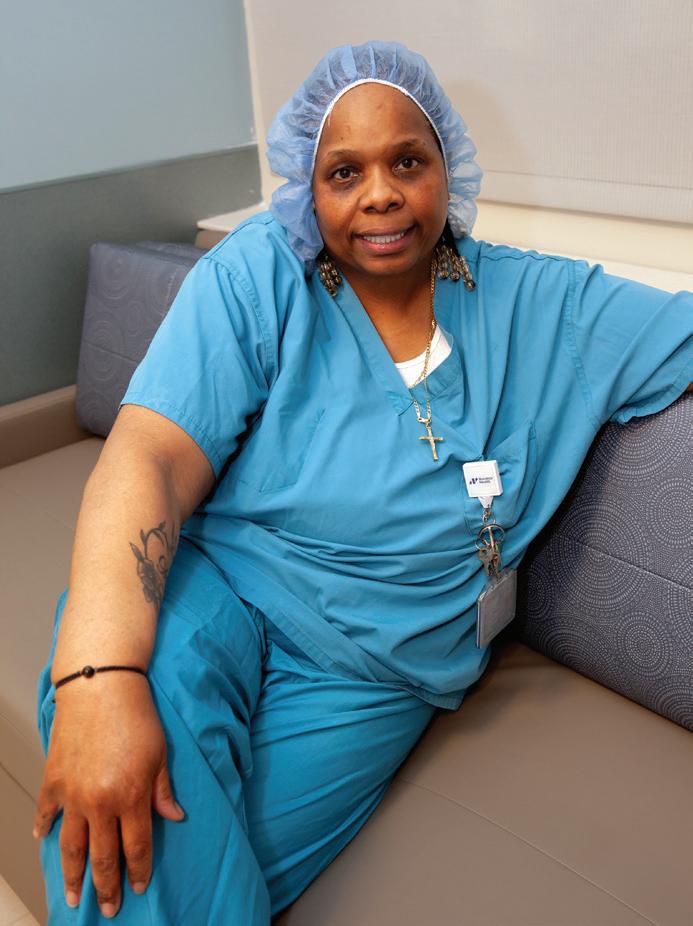
2. “My job deals with saving lives,” says 1199 Delegate Cheryl Heglar, who has been working at the hospital for 27 years. As a Lead Central Sterile Processing Technician: “We clean and sterilize the instruments for surgery. When there’s an emergency operation, my co-workers and I join together as a team to prepare the right instrument kit from central supply as quickly as possible and send it up on the elevator. Afterwards, the instruments come back down on the ‘dirty’ elevator and we decontaminate them before putting them in the washer. They usually let us know if the patients makes it through surgery and we’re happy.”
Heglar started her career at Vassar Brothers working in the kitchen and then moved to patient transport. Within a year she transferred to central sterile
where she stayed, becoming a Delegate ten years ago.
Speaking about the recent contract win, she says: “It was the best bargaining committee we’d ever had. With people joining from all the different departments, we were able to break down any logjam that came up.”
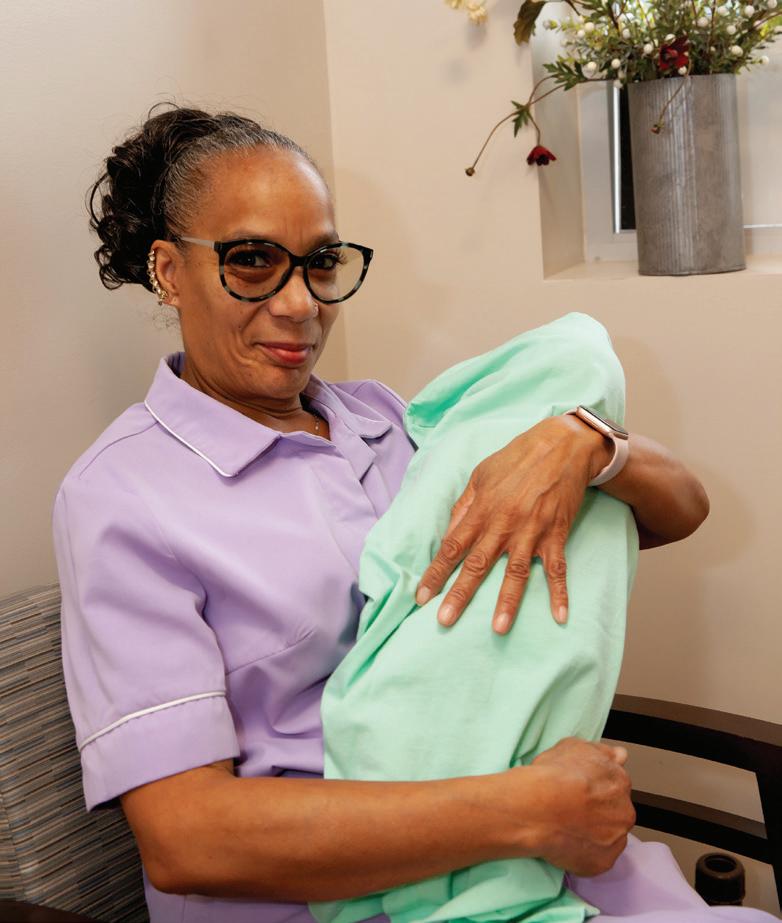
3. “I love the babies,” said Sheila Ennist, an 1199 Maternity Specialty Technician on the Labor and Delivery ward, adding: “I love seeing the look on a mom’s face after they have given birth for the first time. It’s the most amazing job in the world. It is hard to be in a bad mood when you’re surrounded by babies.”
Ennist started out on the Medical/Surgery ward 28 years ago. “When I realized I was done having children of my
own, I decided to work here,” she says. “My daughter is 40 and my son is 26 and I have six grandchildren.”
Ennist is now nearing retirement age but remains an active Delegate who was planning to get on the bus to Albany on February 10 to lobby legislators representing Hudson Valley, Capital region and Long Island districts about the crisis in Medicaid funding. With 28 years service at Vassar Brothers she understands the value of maintaining and expanding benefits during contract negotiations. Her children benefited from the 1199SEIU Child Care Fund summer camps and also plans to get her LPN license with the training fund before she retires, to give her more options for employment.
“It’s the most amazing job in the world. It is hard to be in a bad mood when you’re surrounded by babies.”
– Sheila Ennist, an 1199 Maternity Specialty Technician on the Labor and Delivery ward
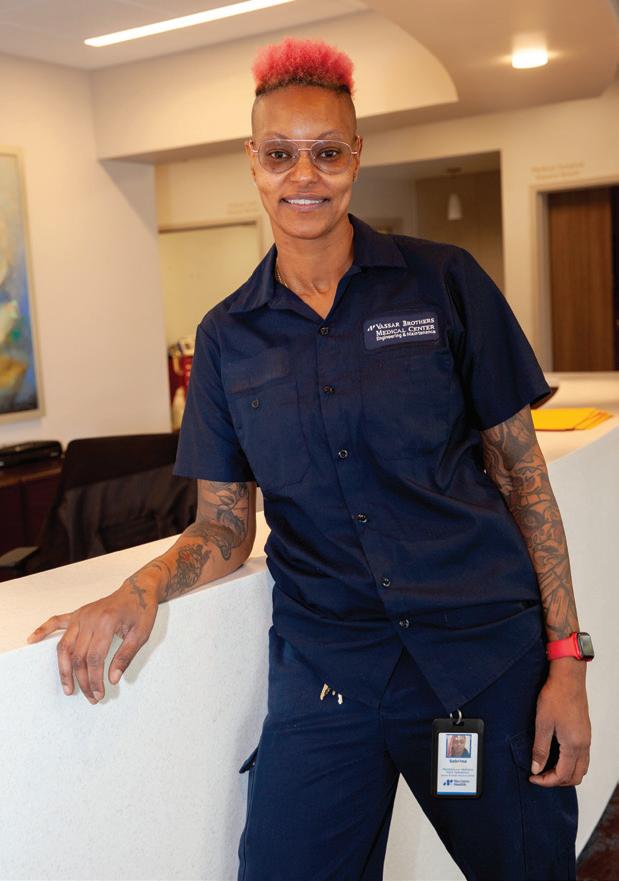
4. Sabrina James has been an 1199er for almost two decades, having started at Bronx Lebanon (now renamed BronxCare) where she worked for 15 years, before coming up to Poughkeepsie four years ago to buy a house.
“I started out in Phlebotomy, but I transferred to plant operations last year as a Maintenance Mechanic. Now I get to see everything behind the walls. I don’t like to sit in one spot. It starts to get boring and you feel like you’re not learning anything new,” says James.
What is behind the walls are a lot of old pipes that leak and frequently need to be upgraded and the ceiling tiles replaced.
“I also put furniture together,” she said. “I used to work in construction, but I didn’t like being outside in the cold. I came up to Poughkeepsie in 2021 when the interest rates were low. I took advantage of that and bought a house. With my construction background, I was able to do a lot of the work on it myself.”
THE WORK WE DO Vassar Bros Medical Center
James is working towards becoming a Union Delegate.
“Sometimes management doesn’t tell you the full truth and try to make you do something that is not really your job.”
5. Both Althea Kennedy and her 25-year-old daughter work at Vassar Brothers as PCTs.
Kennedy has been in the Oncology department for almost 18 years. Her daughter is living with her while she studies to be a Respiratory Therapist.
“It is rewarding working with cancer patients,” she says, “Some of them go home with their families. Some go into remission and sometimes they come back. We also treat patients with sickle cell here when they are in crisis.
“I take patient’s vital signs and do finger sticks to check their blood sugar levels. If they have a temperature, it is important to report it immediately to the nurse. It could be a sign of infection. Sometimes they need blood or platelets. It could mean that their chemotherapy has to be postponed.
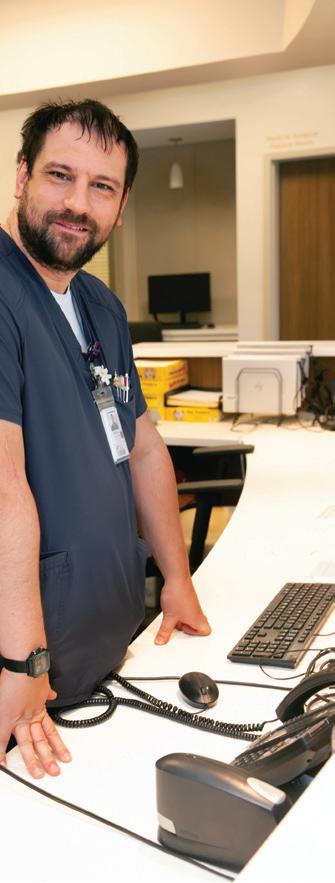
6. “If we don’t ask, we’re not going to get anything,” says Stephen Correale, an 1199 Unit Secretary on the Oncology unit. “When we showed up at the bargaining table with 30 committee members, we showed management that we were not to be messed with.”
Correale became a Delegate because, “I decided I’m worth more. So instead of complaining, I decided to step up.”
Representing his fellow members for three years now, he finds helping members with discipline and grievances rewarding. “It takes critical thinking and listening to their side of the story. There are two sides to everything,” he says.
“I started out at Vassar Brothers working in Dietary, but I was miserable there. I was in the dish room, which is the hottest place.”
The temperature in the Oncology ward is a lot more comfortable and Correale enjoys the camaraderie. As well as the general paperwork for the department, he’s responsible for compiling the complex information required to properly record the details when a patient expires. Because he works on an oncology ward, this happens about once a week, on average.
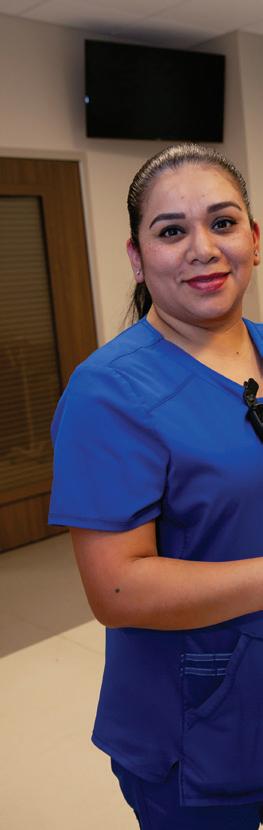
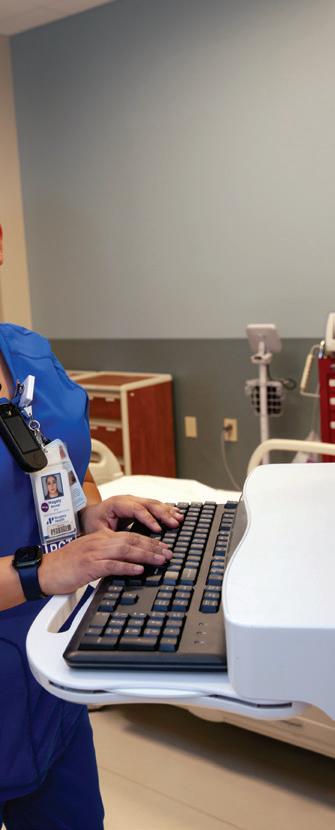
7. Magaly Bernal trained to be a Physical Therapist in her native Mexico. When she first came to the US to marry her childhood sweetheart, she got a job as a CNA at the Lutheran Care Center. Bernal joined 1199 seven years ago when she came to Vassar Brothers to work as a PCT in the Respiratory Care Unit.
“I taking all the opportunities the Union has to offer. This
country offers so many chances, but you have to work for them,” says Bernal, who is taking advantage of the 1199SEIU Training and Upgrading Fund to study to become an RN at no cost. She is due to graduate next May. She became a US citizen 18 months ago and insists on speaking English at home even though she and her husband are both native Spanish speakers. With the current attacks against immigrants, Bernal says she sometimes worries about her husband and her five year old son.
8. “I became a Delegate because I wanted to understand the contract wording for the benefit of all the members,” says Stephanie June, an 1199 PCT, “I have been working in healthcare for 20 years, both as a CNA and a home health aide. This is my first 1199 job and I’ve been here for about
“I am taking all the opportunities the Union has to offer. This country offers so many chances, but you have to work for them.” – Magaly Bernal, an 1199 PCT in the Respiratory Care Unit
18 months. She joined the bargaining committee right away because “a closed mouth don’t get fed.” June knows that members are stronger together and is motivated to improve wages and conditions for “our seniors, our patients and our children.”
“My job is all about giving the patients hands on care, whether it is recording their vital signs or assisting them with eating and bathing. I always try to give loving, compassionate care, even to the patients who want to throw me out of the window. We cannot let ourselves be punching bags, but if they want to let off a bit of steam with me, I understand.
“I have the gift of the gab, so I always try to brighten their days. I also make time to listen, give hugs and pray with them if they want me to. I want them to know I understand what they are going through and that it is hard.”
1199ers travel to Jamaica with medical supplies and expertise to help the communities worst hit by Hurricane Melissa last October.
BRINGING RELIEF
When Hurricane Melissa brought 185mph winds to Jamaica on October 28, it completely flattened homes and severely damaged healthcare facilities as well as claiming 32 lives in the immediate aftermath.
Three months later, when a delegation of 25 members, retirees and officers of 1199SEIU traveled to St. Elizabeth parish towns to provide medical supplies and basic treatment, the needs of the people on the ground were still immense.
The 1199 medical mission from January 14 – 17 was undertaken in partnership with the New York Relief Network, focused on some of the worst hit communities of Black River,
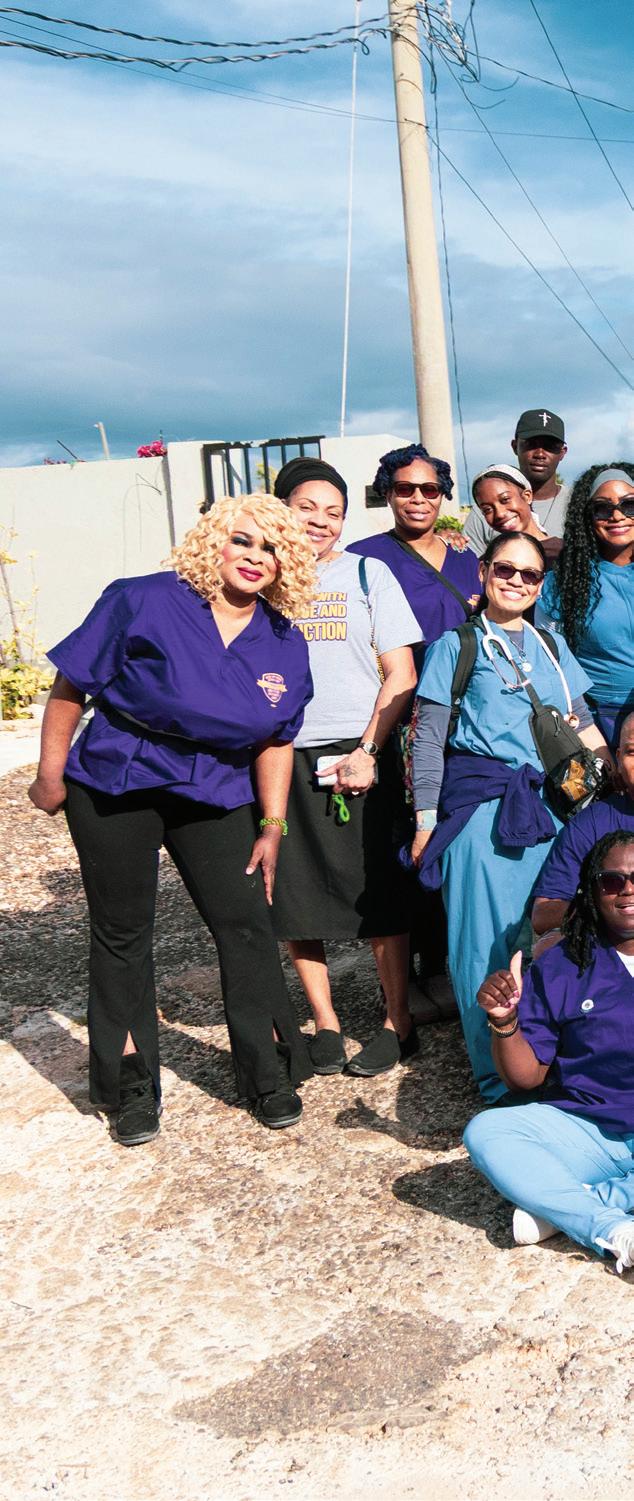
Middle Quarters, New Market, and Siloah. Members delivered roughly $5,000 worth of medicine and supplies donated by the Afya Foundation and the mission participants themselves. The deliveries including PPE, wound care materials, adult diapers, and surgical consumables for Black River Hospital and Springfield Clinic.
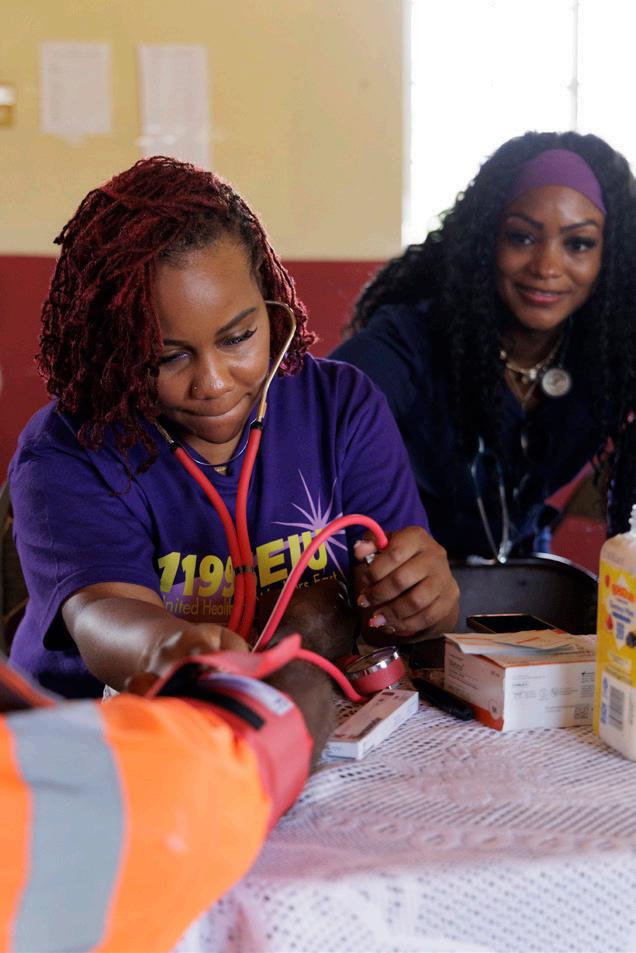
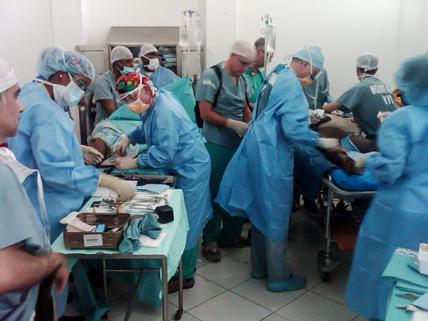
The 1199 licensed clinicians and support personnel on the disaster relief mission focused their work on providing urgent medical care and assessing ongoing clinical needs. The devastation in the Black Water region was still heartbreakingly visible. Entire communities remain without
electricity and access to running water is extremely limited. Local doctors were forced to abandon their offices and the clinical equipment and medical records they contained which had been damaged beyond repair by the storm.
Many of the members on the trip have deep personal ties to Jamaica, making the work feel especially meaningful. They are delivering 13 Afya Luggage for Life bags filled with critical supplies—including PPE, wound care materials, adult diapers, and surgical consumables—to support patient care as the hospital continues its recovery.
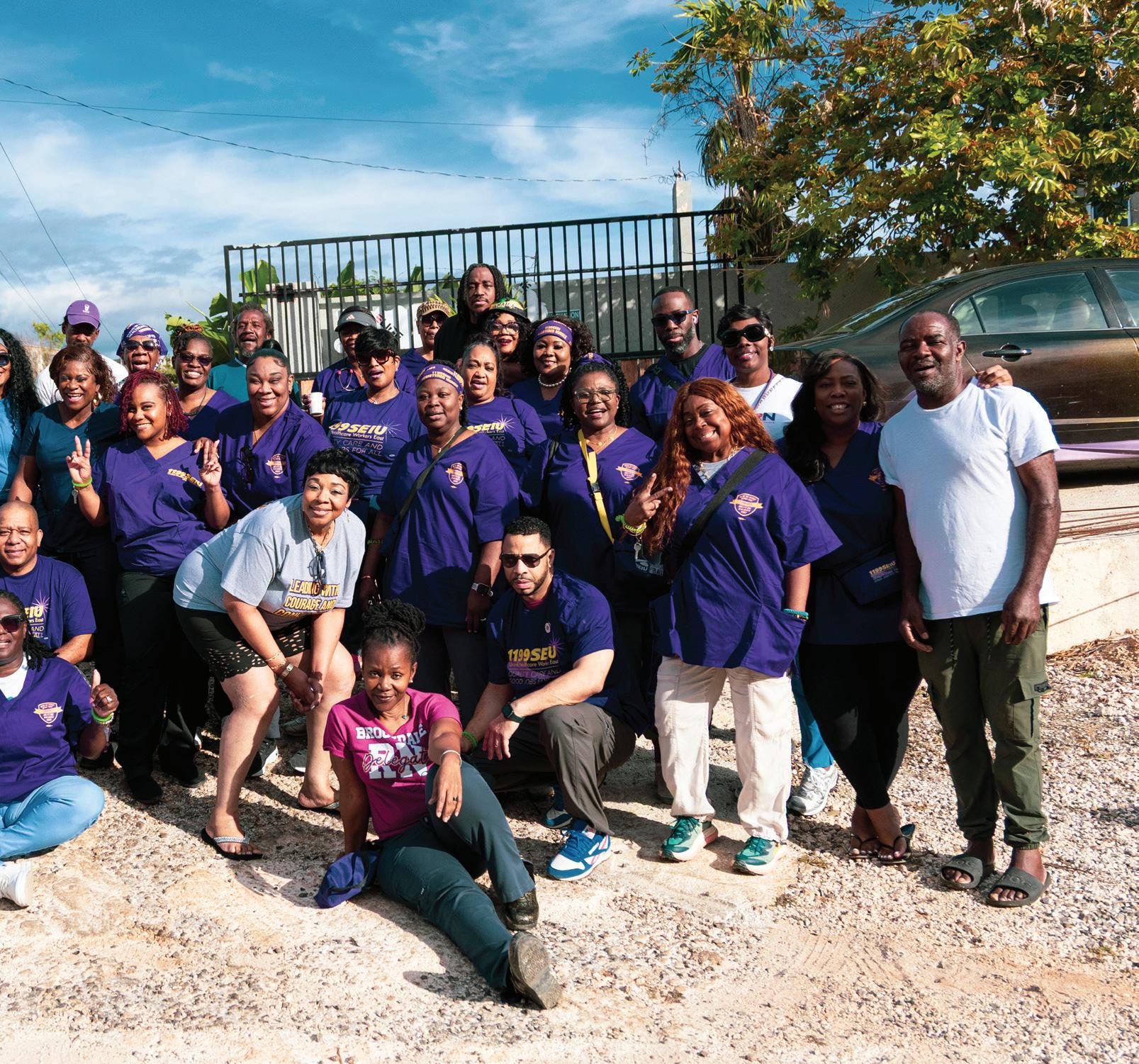
Gregory Phillips, Nurse Practitioner and Delegate, Brookdale Medical Center, Brooklyn, NY
(Picture above, crouching on the right hand side of the delegation)
“I’m [originally] a Jamaican resident, born and bred here and I see how much the people are in need. With these organizations and with 1199 we’re not only here in Jamaica but were helping those less fortunate and bringing the care that everybody needs around the world. It is about being responsible and caring for each and every individual.”
Many of the members on the trip have deep personal ties to Jamaica, making the work feel especially meaningful.
Michele Ned, In-Service Coordinator at Interfaith Medical Center in Brooklyn, NY
(Pictured left ) ”Jamaica is my country of birth, so when I saw the devastation, I had to do my part. It is the human thing to do. Black River was where the eye of the storm hit Jamaica. The children at one of the schools we visited there had not had hot meal in three months. It was a great feeling being able to provide that for them.”
Ophelia Green-Witter, Psychiatric Nurse, Brookdale Medical Center, Brooklyn, NY
(Pictured below, left ) “This is personal to me. This is my home. This is where I’m from and I made a promise to always give back and I’m so happy that I am having the opportunity to come and to serve. It has always been a wish of mine. You can see all around us that people are still suffering. We’re just here to give a helping hand and make sure that they know we’re standing with them.”
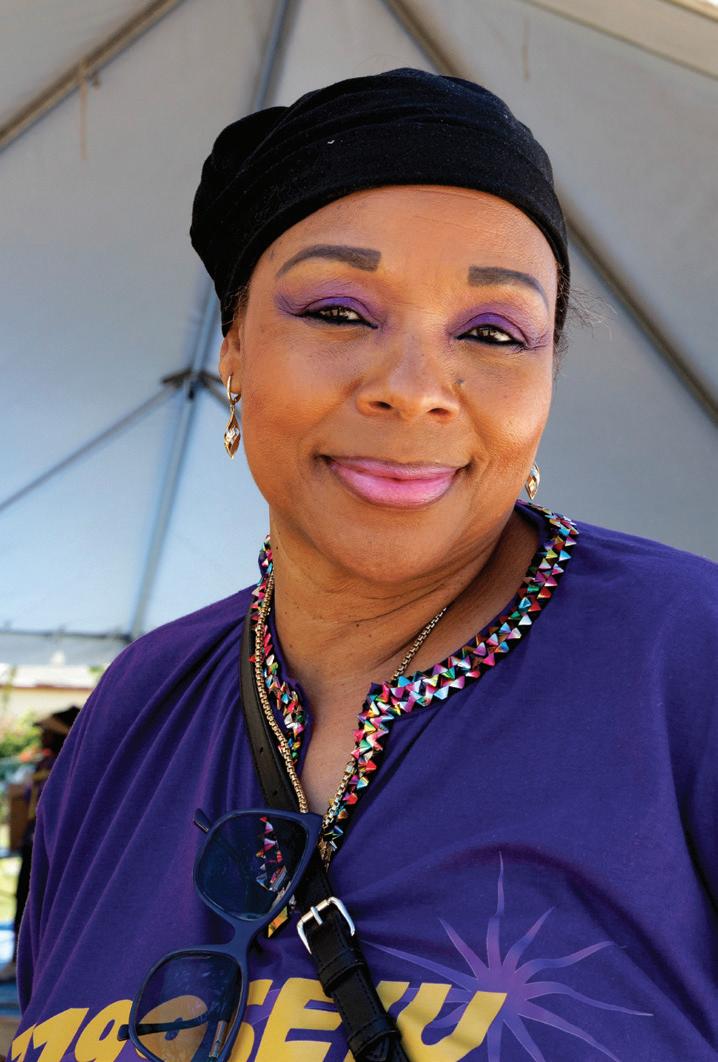

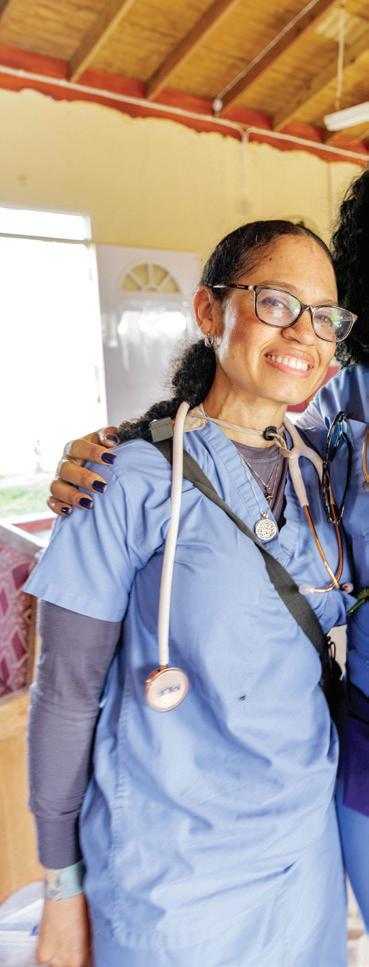
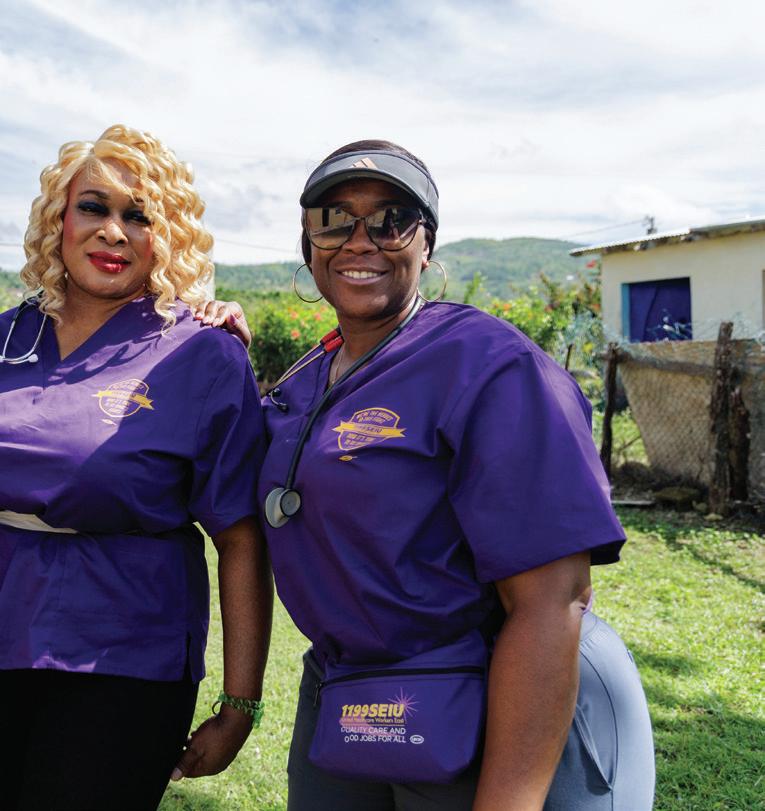

“This is personal to me. This is my home. This is where I’m from and I made a promise to always give back and I’m so happy that I am having the opportunity to come and to serve.”
– Ophelia Green-Witter, Psychiatric Nurse, Brookdale
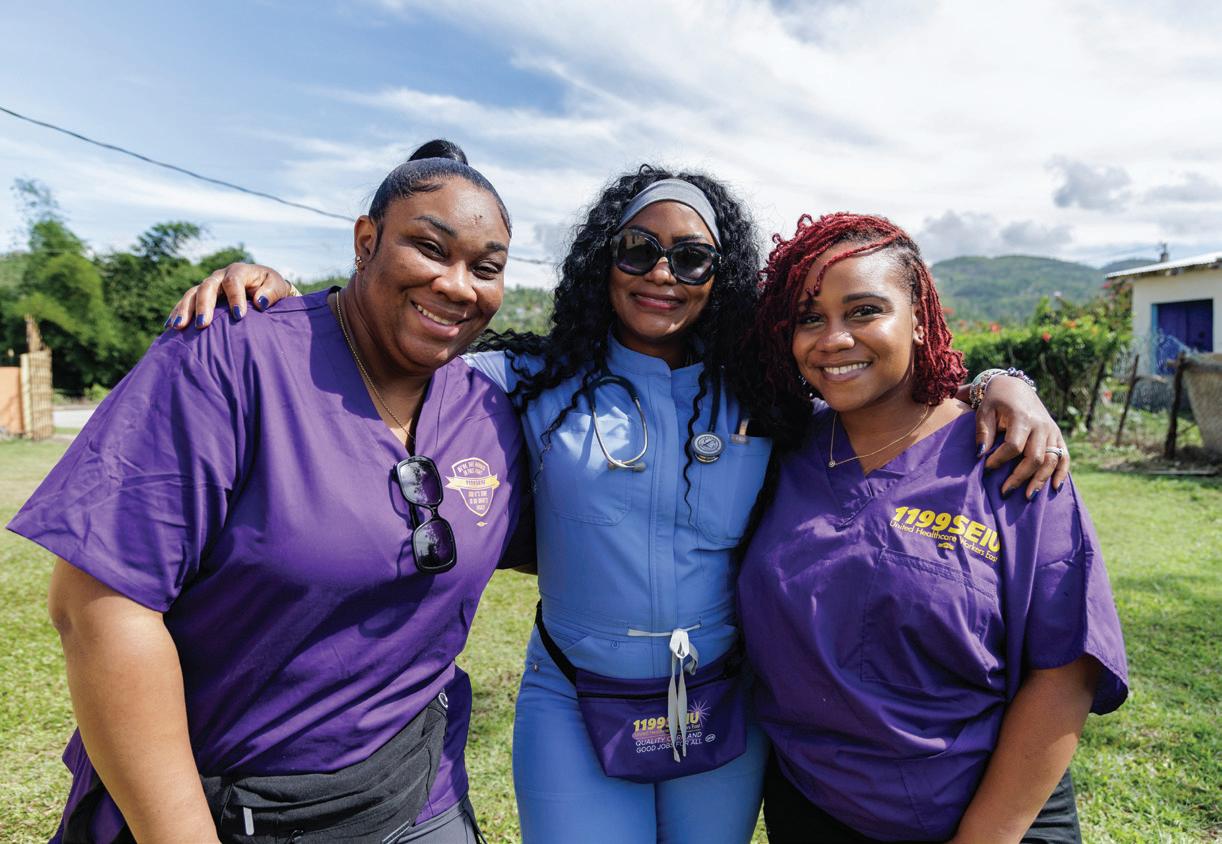
Merle Warren, Registered Nurse, Mt Sinai/Beth Israel, Manhattan, NY
(Pictured above, at left)“I’m here in St Elizabeth on the 1199/NYRN medical mission. We’re here to help the people of Jamaica who have gone through this tremendous disaster with Hurricane Melissa back in October. We’re here giving out medical supplies and healthcare advice. The people are so grateful for what we are doing. I’m so thrilled to be here helping my country people. Thank you for 1199 for sponsoring this trip.”
Winsome Williams, Registered Nurse, Brookdale Medical Center, Brooklyn, NY (Pictured above, at center) “It is a pleasure to be back in Jamaica and also to help with the relief mission in St Elizabeth which was really hard hit by Hurricane Melissa. The devastation is huge. But I see the smiles on the faces when we’re here with the people. I applaud their resilience in coming back. We’re here to offer encouragement. There are some feelings of defeat. But in general, the people don’t seem defeated.”
Virginia Kondas, Nurse Practitioner, University of Miami UHealth Towers, FL (Pictured left, at left) “It is very gratifying to be here and utilize whatever skills I can. I think people just need to be in touch with other people. We are making powerful connections as we are seeing what the people here have experienced. This mission gave me an opportunity, and I feel like I am getting back more than I could possibly give.”
Shushana Ernst, Montefiore Medical Center, Wakefield Campus, Bronx, NY (Pictured left, at right) “This is a really important journey. We’re here giving back to these people whose communities were completely devastated by this natural disaster. I’m really proud and happy to be here. We want people to know that we support them. Support is important.”
Red Code
Members press
New York State lawmakers to step up and save critical healthcare providers after Washington, DC abandoned them.
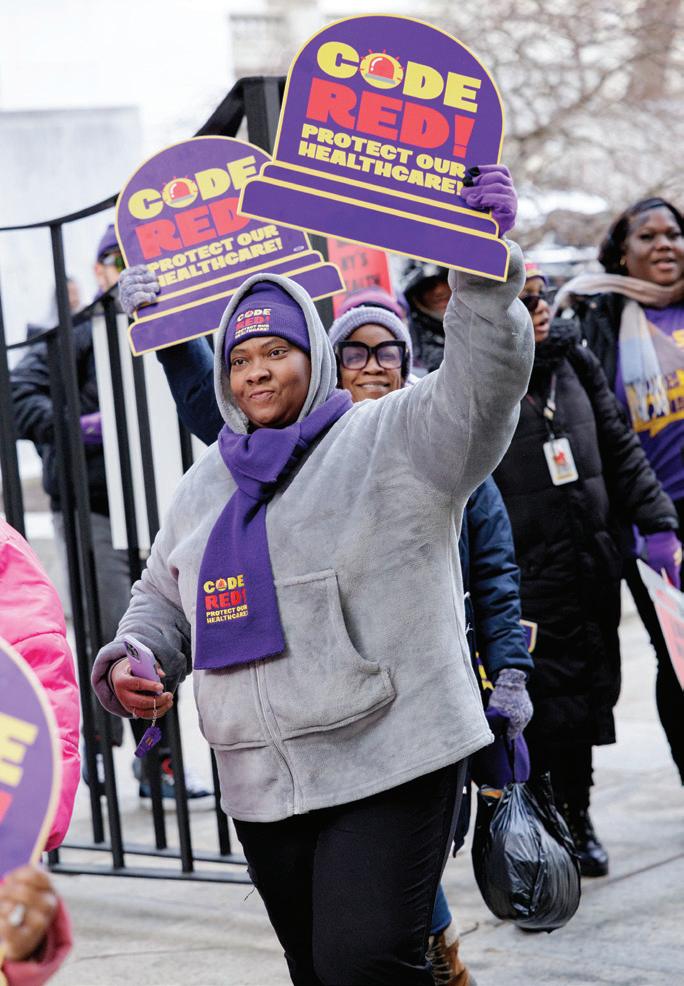
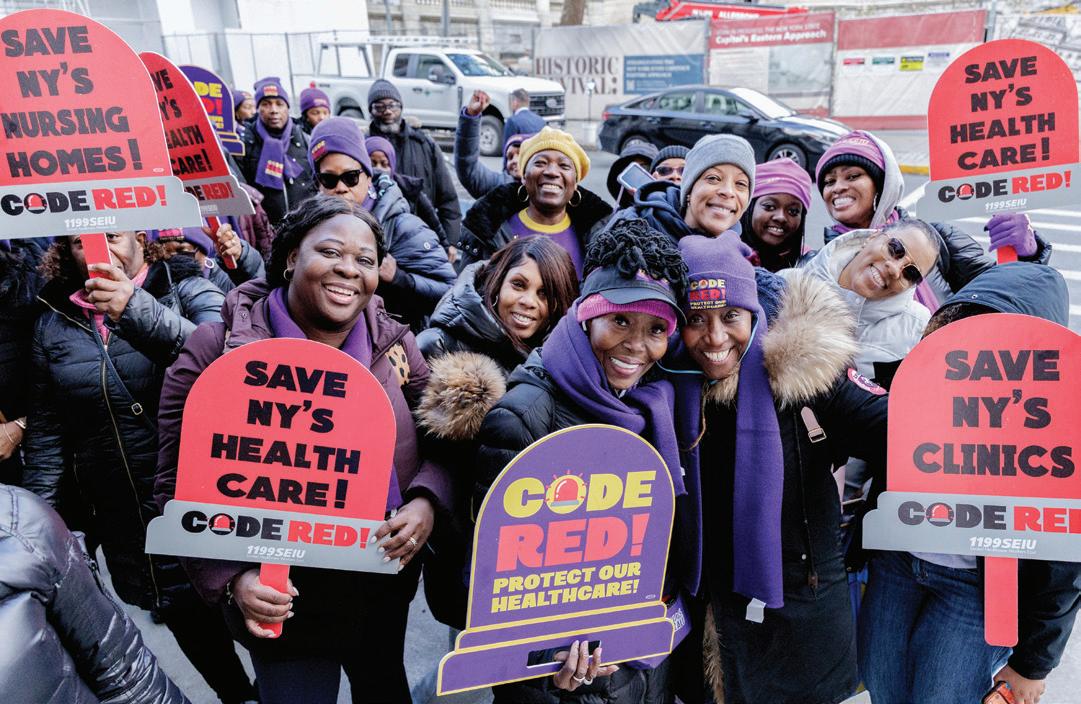
Thousands of 1199 members boarded buses from Buffalo, Plattsburgh, Long Island and everywhere in between to make their voices heard on January 12 in Albany, the New York State capital. Facing unprecedented federal healthcare cuts, members declared a “Code Red” for vital healthcare services for vulnerable New Yorkers—demanding that state lawmakers plug the gap.
One week later, on Jan 20, New York Governor, Kathy Hochul, pledged $1.325 billion in new state investments to shore up safety net hospitals, nursing homes and benefits for home care members. 1199SEIU will continue to push for the full $2 billion in additional funding that is necessary to stabilize the healthcare industry. But Governor Hochul’s budget proposal represents a strong down payment to address the crisis.
1199ers are warning their elected representatives that without significant action by NYS, the planned federal Medicaid cuts will lead to hospital shutdowns and unprecedented job losses. Rural and safety-net institutions will be hit especially hard as the cost of uncompensated care skyrockets.
“My son has sickle cell and has suffered strokes. Because of Medicaid he’s able to be independent, have his medications and treatments, see his doctors, and live on
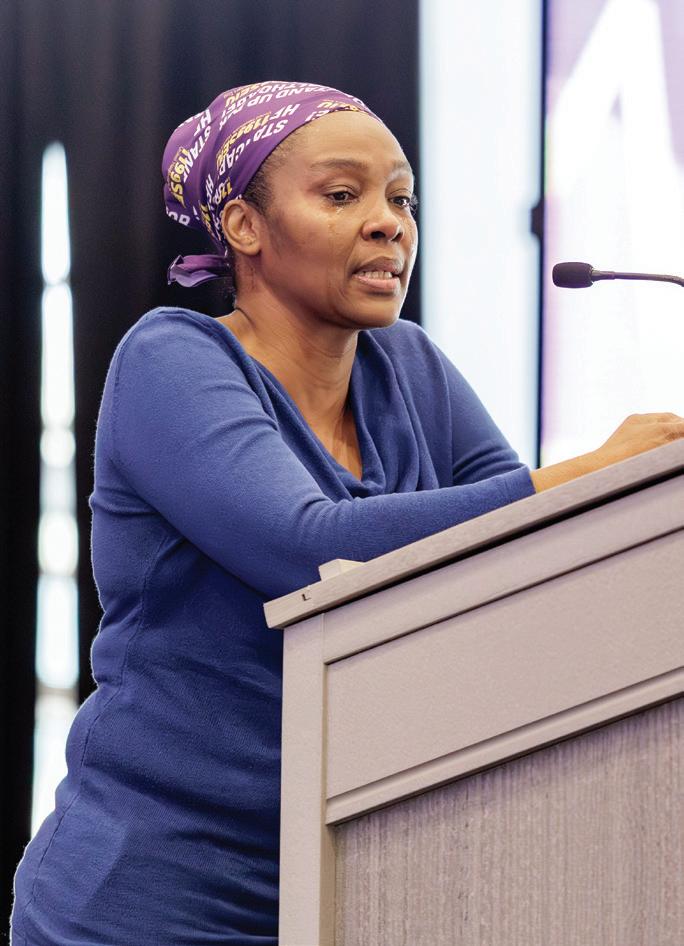
his own. If these cuts go through, he will lose his independence that he values and the health care that he needs–we wouldn’t know what to do,” said Amanta Adonis, an LPN at the Silvercrest Center for Nursing and Rehabilitation in Queens, NY. “For the politicians who voted for this Big Ugly Bill–shame on you! You’re putting people’s lives in danger.”
“We are not asking for anything extravagant. We are demanding only what is needed for us to continue delivering care to New Yorkers and prevent what will otherwise mean the shutting of healthcare services and facilities up and down the state,” said 1199SEIU President Yvonne Armstrong. “New York State has the resources to weather this storm. New York has billions of dollars in reserves kept specifically for times of crisis. And there is no crisis more urgent than the one threatening our patients, our institutions, and millions of New Yorkers.”
Delone Cuebas, a home care member with the All Metro agency in the Bronx, shared another personal story. “I have a cousin who has stage four cancer and relies on Medicaid for their treatment. They recently heard that the clinic they have been going to could close because of the cuts.
Members encircling the Capitol Building in Albany.
Amanta Adonis, an LPN from Queens, tells a very personal story.
1199ers on the move from all corners of New York State.
“I warned people not to vote for the Republicans in 2024. Because of what they have done, we need New York Governor Kathy Hochul to step up and use New York State funds to keep our healthcare system running.
“I’ve never come to Albany before with 1199. But now is the time to talk to our elected representatives and make them understand. We can’t go back.”
Maurice Myrick, a Dental Assistant at the Anthony L Jordan clinic in Rochester, NY, where he has provided care for 20 years, added: “It’s cruel to punish people for things they can’t control. You can be healthy one moment and need critical care the next, there’s no safety net to fall back on. What will people do?”
Stephanie June, who is a PCT at Vassar Brothers Medical Center in Poughkeepsie said: “We need our leaders to use every tool they have to offset federal cuts, to keep our hospitals and nursing homes open. To save mental health services in our communities and home care. This is about protecting our families.”
The Consumer Directed Personal Assistant Program (CDPAP) enables people with disabilities to remain in their homes and be cared for by people they choose and train.
“I’ve never come to Albany before with 1199. But now is the time to talk to our elected representatives and make them understand. We can’t go back.”
It too relies on Medicaid funds.
Renita Smith-Cooper, who works for this program in Buffalo, said: “As a CDPA, cutting Medicaid means cutting our jobs. That’s why it’s so important to stand together to protect Medicaid funding. There’s strength in numbers—and with the way things are going, we need that strength to make sure our family members continue to get the care they need.”
Top state elected leaders addressed the crowd, including State Senate Majority Leader Andrea Stewart-Cousins, Assembly Speaker Carl Heastie, Senate Health Committee Chair Gustavo Rivera and Assembly Health Committee Chair Amy Paulin. Albany Mayor Dorcey Applyrs also spoke movingly at the rally.
Lorraine Black has worked as a Housekeeper at Sarah Neuman Center for Rehabilitation and Nursing, Mamaroneck for 24 years.
“Every rally, I don’t miss it. We have to fight for our rights, which is wrong. I love my elders,” said Black, who is 75 years old. “We work and put in [tax] money, so why should they take Medicaid?
“They want to give to the rich,” she added, referring to the extension of the tax cuts for extremely high earners. “What about the poor? The time will come when we have nothing at all.”
– Delone Cuebas, 1199 Home Care member from the Bronx
Delegate Profile: Peyton Humphreville
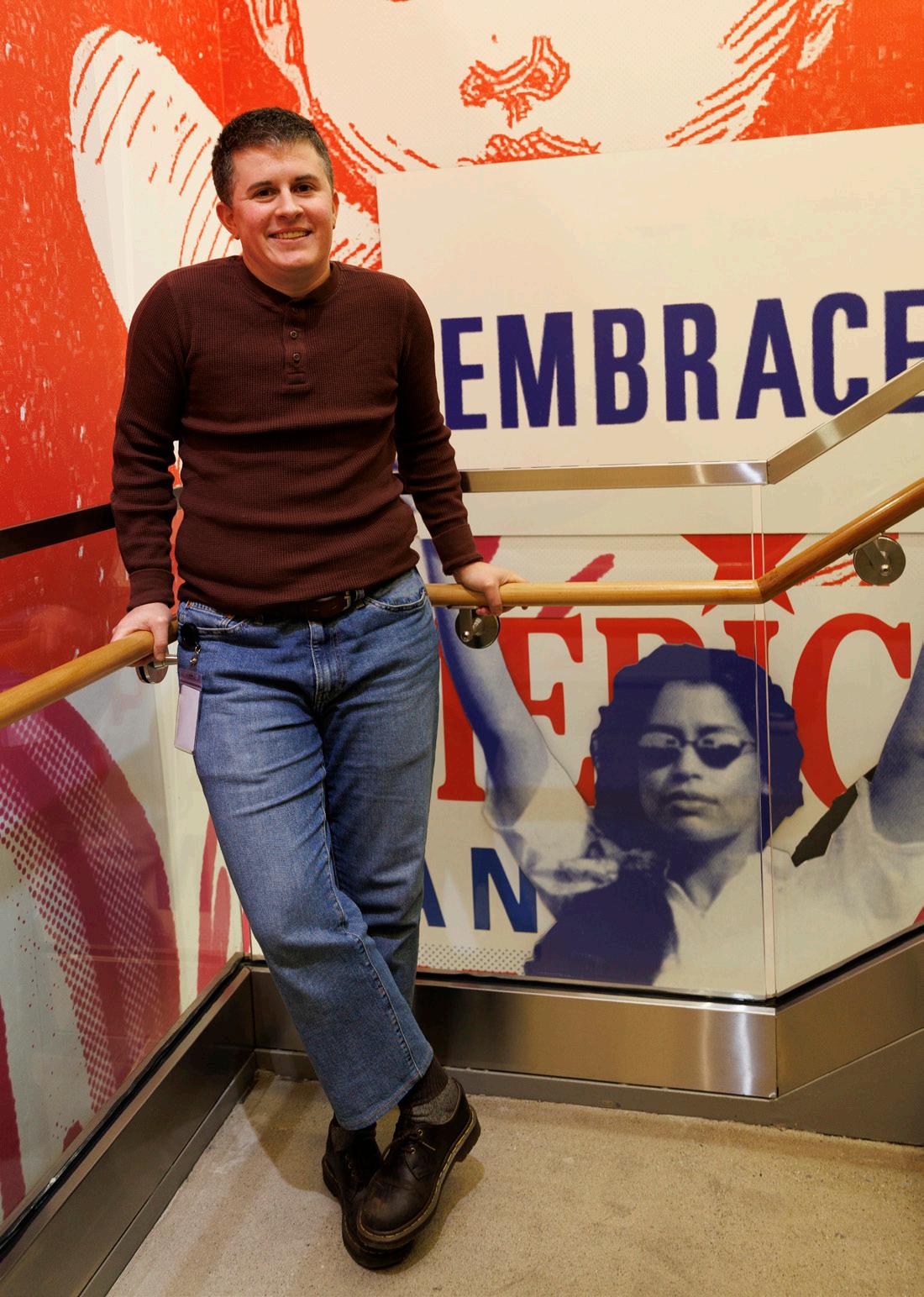
A bargaining committee member at the Planned Parenthood Federation of America outlines their Union journey.
Union work and organizing has been an important part of Peyton Humphreville’s journey—even if they didn’t grow up in a union household. “I actually grew up in a really anti-union household, my dad is very anti-union,” says Humphreville. It was not until their undergraduate years at Harvard University that they began to understand the power of organizing. “There was this big organizing effort among students to support on-campus workers. These were the financial crash years, so there were many worker layoffs. But, the unions were strong, so it was really cool to see what was happening. I wasn’t directly involved in that organizing, but it was great to see the ways students could show solidarity and that they could fight back against a wealthy and powerful university that was not treating them well,” remarks Humphreville.
As an 1199 Senior Staff Attorney for Planned Parenthood Federation of America (PPFA) in Manhattan, Humphreville represents Planned Parenthood (PP) health centers and advocates for patient access to health care.
“When people think of Planned Parenthood, they usually think of the clinics, which are regional and run by affiliates—or they think about (or are) the people who use important services, like getting an annual physical exam. In the national office, we do everything from technical web support to fundraising for the affiliates. My department is like a law firm within PPFA that represents the affiliate
health centers. We also represent PPFA, for instance when a state passes restrictive abortion laws, we go to court, sue the state and help advocate for patient access. And, we do a lot of Medicaid related work, because Planned Parenthood is frequently targeted to be excluded from Medicaid programs.”
That exclusion, along with cuts to Medicaid is something that Humphreville pays attention to.
“The cuts to Medicaid in general are scary because just over half of Planned Parenthood patients nationwide are on Medicaid. If the cuts go through, it will hugely affect our patient population. There’s also a specific provision in the Big Ugly bill that says if you’re a nonprofit abortion provider now receiving a certain amount of Medicaid funds, you will no longer be able to receive Medicaid reimbursement. It doesn’t name Planned Parenthood specifically, but can be seen as targeting it, and calls into question whether people who are enrolled in Medicaid will be able to continue to get care at Planned Parenthood health centers.”
In spite of their passion for advocacy and organizing, Humphreville never listed “lawyer” as a dream job as a child—it was more by accident, even though they had traits that would fit the profession. “I would say I’ve always had strong opinions,” laughs Humphreville. “I did always talk a lot in class, but I definitely did not think I was going to be a lawyer. I graduated college and kind of didn’t know what I was
PEYTON HUMPHREVILLE
1199 Senior Staff Attorney for Planned Parenthood Federation of America (PPFA)
doing. I was like, ‘oh crap, I have to find a job.’” says Humphreville. One of their friends was becoming a paralegal and it felt like something practical. “I was like, okay [paralegal] that’s a job title that I can search on job websites,” chuckles Humphreville. “I felt it would be intellectually interesting, dealing with public interest stuff, and I could make a decent living at it.”
“The people who were on that first bargaining committee had been involved with the initial organizing effort at PPFA—they were fierce advocates, and I was interested in joining them.”
Humphreville went to law school, graduating in 2016. They worked mostly for non-profits, including one that almost unionized, until they landed in 2022 at Planned Parenthood of America (PPFA). “I came through to PPFA from a plaintiff-side class action firm, doing consumer protection, mass torts, and a lot of stuff related to opioids and preying on kids. At one of my previous jobs, they had a failed unionization attempt. Management was hostile and there was a lot of tensions, but I was still interested in labor in general and being a part of a union.”
“When I started work here, the first contract negotiations were happening. I was familiar with the union process and thankfully PPFA had already been recognized as a union, but we didn’t have our first contract yet. The people who were on that first bargaining committee had been involved with the initial organizing effort at PPFA— they were fierce advocates, and I was interested in joining them.
“Coming off that first contract, some burned out, some moved on, plus we had a huge round of
layoffs. So, in some ways after negotiations, our chapter was starting from scratch.
It was the ideal time for Humphreville to step up and become an 1199 Delegate. They quickly grew into a vocal leader in PPFA’s current contract negotiations.
“Before now, I didn’t know anything about grievance processes,” Humphreville chuckles. “I knew unions could represent workers in certain types of hearings but didn’t know what that actually meant.
I’ve learned a ton about how PPFA operates—it’s a large organization and my department is siloed in a lot of ways, because we have to keep many things confidential. But as an 1199 delegate, I’ve met many other people in other departments.
I’ve also learned the differences in negotiating contracts for members. Before, as a lawyer I would just deal with the legalese of a contract. Now, I’m thinking through the substantive and economic terms of an agreement and figuring out how to work with people to come up with good proposals. It’s really about translating the issues that workers have and thinking—‘what can we change in our contract to make these things different?’” says Humphreville.
They are on the current bargaining committee for the second 1199 contract; since the first agreement expired at the end of 2025. “We had our first session in November. I’m hoping we can finish by the end of February. The main issues are wages and health insurance. It’s been cool
to see the bargaining committee and the members in general engaged and ready.”
With learning also comes some victories: “One of my fellow delegates won a grievance related to telecommuter status. The member’s bosses had signed off on her working out of state and telecommuting, but then tried to walk it back, essentially giving her a constructive termination. We were able to get her recognized as a telecommuter and keep her job,” says Humphreville. When asked about giving advice to other members think-
ing about becoming a delegate, Humphreville says, “In addition to helping other workers and making your workplace better, you will also learn how to advocate for yourself, find out what’s in your contract, and how to spot shady things that may be happening, and learn what you can do about it. You will learn that a union and a collective bargaining agreement are not going to solve every workplace problem, but you can use those tools and get creative to make your workplace better. Bargaining is both maddening and fun and I’m learning a lot!”
OUR HISTORY
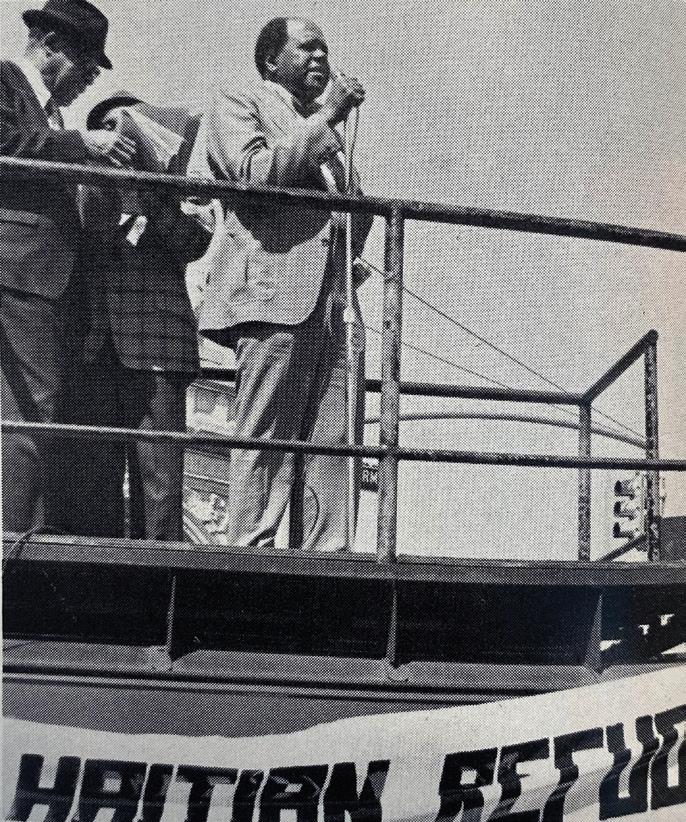
1199 VP, David White, addresses a Brooklyn rally against plans to deport several hundred Haitians living in New York in 1974.
Since its formation, the 1199 Haitian Caucus has rallied members and joined hands with other Haitians to demand justice and fairness in the face of government attacks.
A HISTORY OF
SOLIDARITY
The immigrant founders of 1199 always held high the banner of solidarity. When the Union began organizing hospital workers in the late 1950s, members from the Caribbean and Latin America were at the heart of the campaign. More than 50 years ago, 1199 began actively participating in actions to support Haitian people who had fled their island nation to escape persecution and to make a life for themselves and their families in the US.
On April 27, 1974, 1199 VP David White addressed a Brooklyn, NY, rally condemning plans to deport several hundred Haitians living in New York City who would be subject to torture and even death in Haiti. US government agents were combing the city and stopping anyone suspected of being Haitian. Some 4,000 members of 1199 were of Haitian descent at the time.
White condemned US leaders’ support for the brutal, corrupt Haitian dictatorship of Jean-Claude (“Baby Doc”) Duvalier, who ruled the island nation from 1971 to 1986. He succeeded his father Francois (“Papa Doc”) Duvalier whose murderous rule extended from 1957 to 1971.
During that summer of 1974, 1199 helped organize a support meeting for activists who had fled Haiti. The Union secured the help of lawyers who assisted members in securing political asylum.
In the 1980s, 1199ers again marched with members of the Haitian community and allies to denounce the false claim that Haitians were responsible for the spread of AIDS.
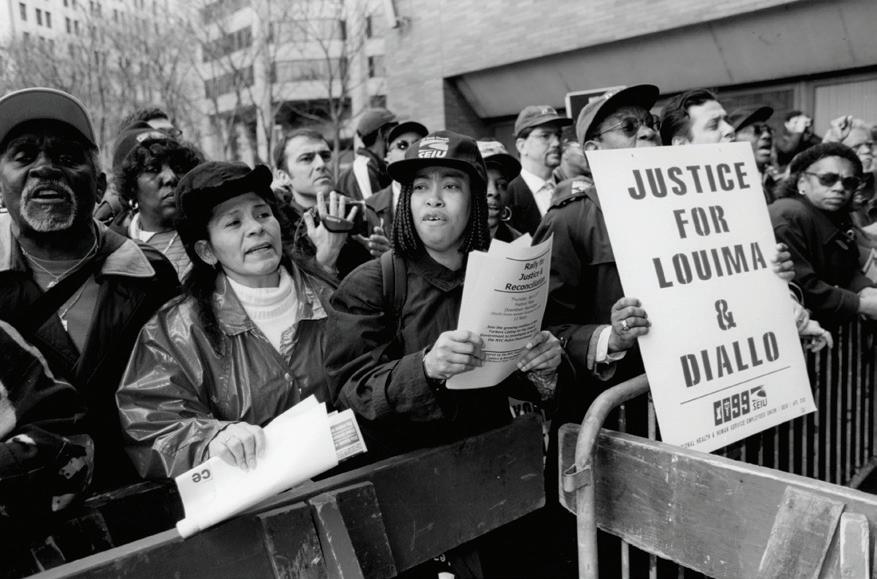
On Aug. 29, 1997, 1199ers were among the 20,000 New Yorkers who rallied near City Hall to protest the Brooklyn police assault and torture of Haitian immigrant Abner Louima three weeks earlier.
“Not all police are bad,” said protester Jocelyne Talury, an 1199 Brooklyn Medical Center coder. “But I have three sons. I don’t want this to happen to them.”
Four police officers were convicted of the assault in a 1999 federal trial. A settlement called for New York City to pay Louima $7.125 million and for the NYC Patrolmen’s Benevolent Association to pay $1.625 million.
After a January 12, 2010 earthquake in Haiti claimed the lives of 220,000 and left 1.6 million homeless, 1199 presented a $1 million check to a representative of the US Fund for UNICEF, the New York based non-profit that supports the United Nations Children’s Fund. The 1199 magazine article that reported the donation was headlined, “We Are All Haitians.”
The article included quotes from members who had lost loved ones and others who had volunteered for recovery efforts.
“A heartless and reckless end to this crucial program would jeopardize the lives of thousands of Haitians in the US.”
–Felaine Deronnette, 1199 VP
At the event, New York Governor David Patterson shed light on the economic stranglehold the Western nations had on Haiti. He traced Haiti’s two centuries of exploitation after it became the first independent, Black-led republic. He noted that two decades after Haiti won its freedom from France in 1804, the French government forced Haiti at gunpoint to pay reparations to the former slave holders and their bankers.
The debt was finally paid off 140 years later, but by borrowing to pay off the loans, Haiti went into further debt, particularly to U.S. and French banks. An analysis by The New York Times determined that Haiti’s payment to its former enslavers amounted to $560 billion in today’s currency. A United Nations agency estimated that had that money been invested domestically, about $20 billion would have been added to Haiti’s economy.
Since its formation, the 1199 Haitian Caucus has rallied members and joined hands with other Haitians to demand justice and fairness for undocumented Haitians. In December of 2010, Haitian 1199ers helped form the 1804 Coalition to address slurs by a local NYC radio station DJ against Haitian women. The station implemented virtually all of the committee’s proposals.
After the 2010 earthquake, Haitian immigrants were granted Temporary Protective Status (TPS) by the Obama administration. The Trump administration sought to end TPS.*
1199 quickly joined the movement to save TPS. Members marched and lobbied throughout 1199 regions, but particularly in New York, Massachusetts and Florida—the states with the largest concentrations of Haitians.
“A heartless and reckless end to this crucial program would jeopardize the lives of thousands of Haitians in the US,” said 1199 VP Felaine Deronnette in Boston in 2017.
In September 2024, 1199 joined the outcry against vicious lies spread by Republican candidates Donald Trump and JD Vance about Haitian immigrants in Springfield, Ohio.
Patrick Gustave, an 1199 Phlebotomist at Maimonides Medical Center in Brooklyn, took part in a rally outside his hospital, saying: “I feel really bad about the way the ex-President spoke about Haitian [people]. I remember at the last election that he went to the Haitian community in Miami to look for votes. But I guess this time around, he doesn’t need us anymore. I want to remind him of something. Haiti in size is a small place, but we are great in history. It was the first republic that was created by slaves to free people. Not only people of color. Everybody. In history we are great and we helped a lot of people. Now, we have come to America to help our families and to help this country.”
*At time of press, President Trump was set to revoke TPS for Haiti, removing the legal status of thousands of 1199 members, many of whom have been settled here for 15 years. There is a legal challenge, which might delay this decision.
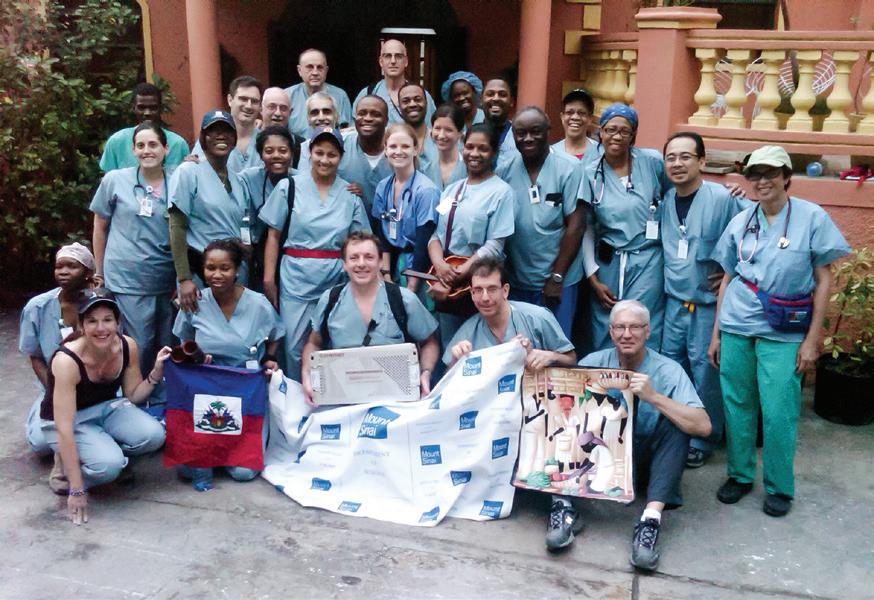
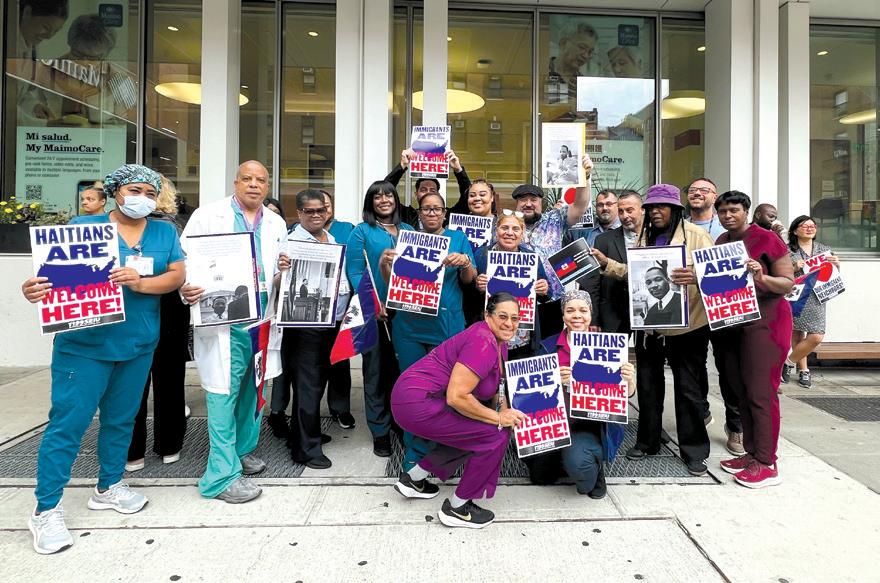
(Top) Members protesting the 1997 torture of Haitian immigrant, Abner Louima, by NYPD officers. (Middle) A delegation of 1199ers on a relief mission to Haiti in the aftermath of the 2010 earthquake. (Bottom) 1199 Phlebotomist Patrick Gustave (second from left) rallies with fellow Maimonides members in support of Haitian immigrants in September 2024.
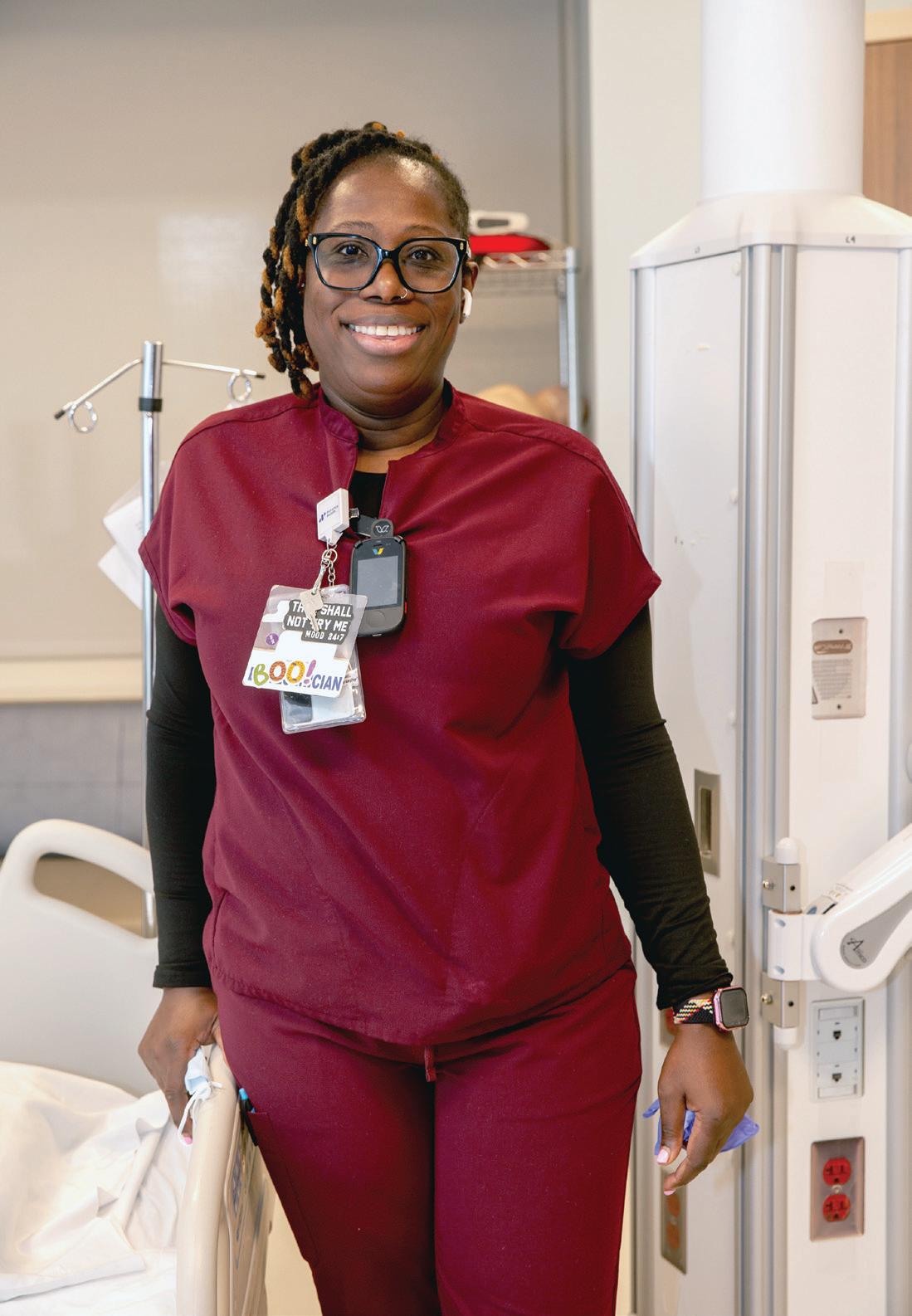
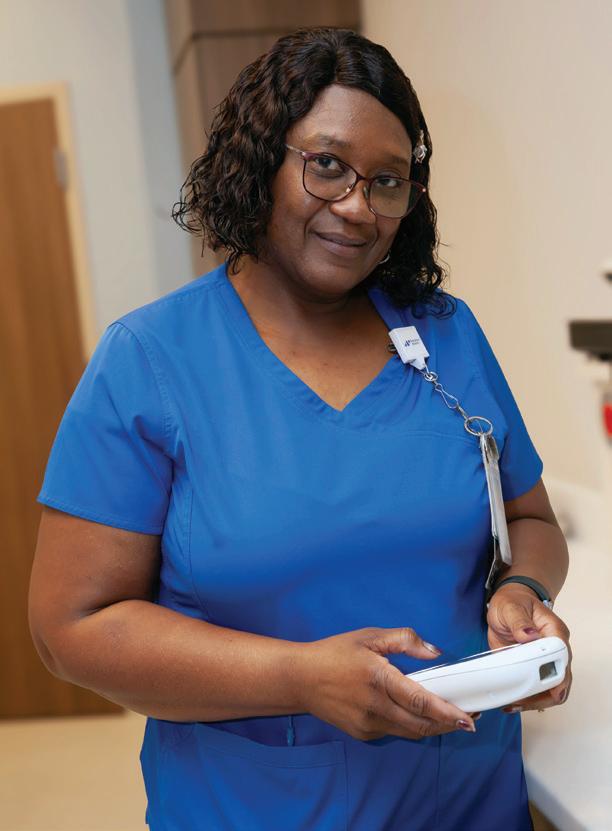
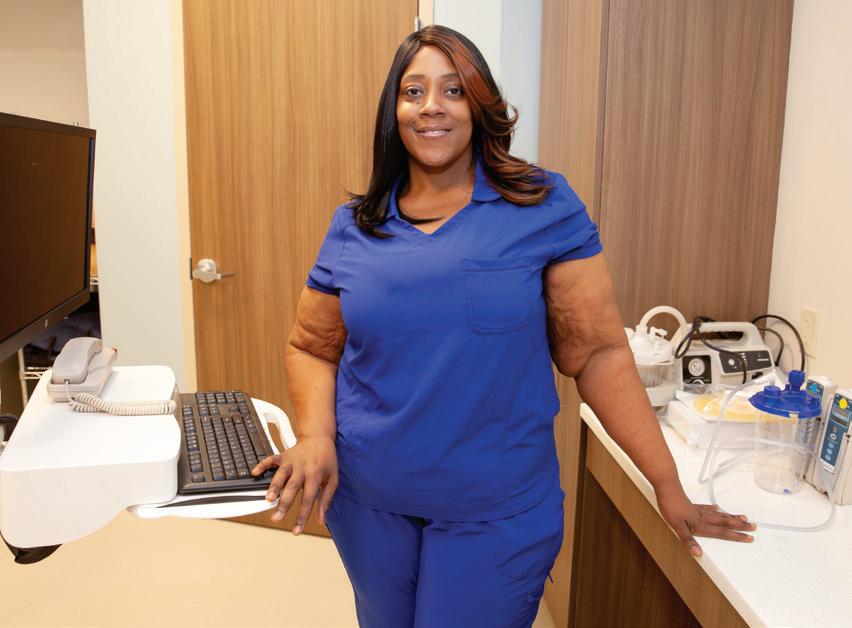
Kenesha Nash, an 1199 Delegate and Senior EKG Technician at Vassar Brothers Medical Center in Poughkeepsie, NY, said: “The most rewarding part of my job is being able to put patients at their ease. I always leave them smiling, even the cranky ones. If your heart is not in it, there’s no sense in doing it. But on the other hand, if you are called to this work, there is no running away from it.”
See page 9.