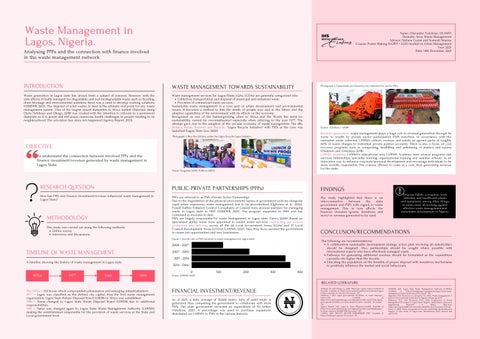
Waste Management in Lagos, Nigeria.
Name: Olasumbo Temitope, OLANIYI Thematic Area: Waste Management Advisor: Stefana Cozan and Somesh Sharma Course: Poster Making (UGPPP / LGFI) module in Urban Management Year: 2021 Date: 14th December, 2021
Analysing PPPs and the connection with finance involved in the waste management network
INTRODUCTION
WASTE MANAGEMENT TOWARDS SUSTAINABILITY
Waste generation in Lagos state has always been a subject of concern. However, with the side effects of badly managed bio-degradable and non-biodegradable waste such as flooding, drain blockage and environmental pollution, there was a need to develop working solutions (LSMEWR, 2021). The disposal of solid wastes to land is the ultimate end-point for any waste management system. One of the largest closed dumpsites in Africa named Olusosun along Ojota (Adebayo and Obogo, 2018) was created with the intention to relocate to a permanent dumpsite as it is posed and still poses numerous health challenges to people residing in its neighbourhood. The relocation has since not happened (Agency Report, 2021).
Waste management services for Lagos (State, LGAs, LCDAs) are generally categorized into: Collection, transportation and disposal of municipal and industrial waste Provision of commercial waste services. Sustainable waste management is a core part of urban development and environmental issues. It becomes a method to link the needs of people now and in the future and the adaptive capabilities of the environment with its effects on the economy. Recognized as one of the fastest-growing cities in Africa and the World, the need for sustainability cannot be overemphasized especially when referring to the year 1977. The attempt gave rise to the adoption of the circular economy of waste management. The 4Rs, Reduce, Reuse, Recover and Recycle. "Lagos Recycle Initiative" with PSPs at the core was launched (Lagos State Gov, 2020)
Photograph 2: Equipments purchased by the statement for use by PSPs.
Photograph 1: Blue Box Inititive under the Lagos Recycle Lagos Initiative
OBJECTIVE To understand the connection between involved PPPs and the finance investment/revenue generated by waste management in Lagos State. Souce: Ecogreen (2019), Politicos (2019)
RESEARCH QUESTION
PUBLIC-PRIVATE PARTNERSHIPS (PPPs)
How has PPPs and Finance investment/revenue influenced waste management in Lagos State?
METHODOLOGY This study was carried out using the following methods: Online survey Interviews and discussions
PPPs are referred to as PSPs (Private Sector Partnership) Due to the degradation of the physical environment, lapses in government policies alongside rapid urban expansion, waste management had to be decentralized (Ogbonna et al., 2002). Powell Duffen Pollution Control Consultants of Canada were pioneer partners for managing waste in Lagos state in 1997 (LSMEWR, 2021). The program expanded in 1999 and has continued to increase to date. PSPs are largely responsible for waste management in Lagos state (Taiwo, 2009). Based on specialized ability, some were appointed to render waste services; contracting out service production and delivery, across all the 20 Local Government Areas (LGAs) and 37 Local Council Development Areas (LCDAs) (LAWMA, 2021). Also, they have assisted the government to create job opportunities and new businesses.
2007 - 2010 2011 - 2014
1970s
1977
1981
2014 - Date
1991
0
100
200
The study highlighted that there is an interconnection between the state government and PSPs with regard to waste management. This in turn affects the finances invested (grants, donations and more) or revenue generated to be used.
Disposal habits, corruption, work attitudes, and insufficient plants and equipment, among other things, in some cases all working against effective waste management and sustainable development in Nigeria.
CONCLUSION/RECOMMENDATIONS The following are recommendations: A collaborative sustainable development strategy action plan involving all stakeholders should be designed. Also, partnerships should be sought where possible with international experts who have effectively managed waste. Pathways for generating additional revenue should be formulated as the expenditure currently sits higher than the income. Educating the population on the benefits of proper disposal with incentives mechanisms to positively influence the market and social behaviours.
2004 - 2007
A timeline showing the history of waste management in Lagos state
Revenue generation: waste management plays a huge role in revenue generation through its waste to wealth by private sector participation (PSP) franchise. In accordance with the estimated waste collected, LAWMA collects revenue and remits an agreed quota of roughly 60% of waste charges to individual private partner accounts. There is also a focus on cost recovery programs such as composting, landfilling and pelletizing of plastics and nylons (Olukanni and Oresanya, 2018). LAWMA Academy: LAWMA's educational arm; LAWMA Academy, uses several programs and services (internships, speciality training, organizational training and summer school) in an innovative way to enhance corporate/personal development and encourage individuals to be more socially responsible. The courses offered to come at a cost. thus generating revenue for the state.
FINDINGS
Figure 1: Growth rate of PSPs involved in waste management in Lagos state
TIMELINE OF WASTE MANAGEMENT
Source: Adediran, I. (2018)
300
400
Souce: LAWMA (2021)
RELATED LITERATURE The 1970s – Oil boom which compounded urbanization and emerging industrialization. 1977 – Lagos was classified as the dirtiest city capital, thus the first waste management organization, Lagos State Refuse Disposal Board (LSRDB) in Africa was established. 1981 – Name changed to Lagos State Waste Disposal Board (LSWDB) due to additional responsibilities. 1991 – Name was changed again to, Lagos State Waste Management Authority (LAWMA) making the establishment responsible for the provision of waste services at the State and Local government level.
FINANCIAL INVESTMENT/REVENUE As of 2021, a daily average of 15,000 metric tons of solid waste is generated, thus compelling the government to collaborate with more PSPs. The state government recorded an expenditure of N3 billion (Adediran, 2021). A percentage was used to purchase equipment distributed via LAWMA to PSPs in the various districts.
Adebayo, M. and Obogo, C., 2018. Olusosun: Lagos orders residents to relocate. Available at: https://www.sunnewsonline.com/olusosun-lagosorders-residents-to-relocate/ [Accessed --21]. Adediran, I. 2021. Lagos govt spends N3 billion on waste disposal – Sanwo-Olu. Available at: https://www.premiumtimesng.com/regional/ssouth-west/477522-lagosgovt-spends-n3-billion-on-waste-disposal-sanwo-olu.html [Accessed -21]. Agency Report. 2021. Lagos to close Olusosun landfill. Available at: https://www.premiumtimesng.com/regional/ssouth-west/494212-lagosto-close-olusosun-landfill.html [Accessed --21]. LAWMA. 2021. PRIVATE SECTOR PARTNERSHIP (PSP). Available at: https://lawma.gov.ng/psp/ [Accessed --21].
LSMEWR. 2021. Lagos State Waste Management Authority (LAWMA). Available at: https://moelagos.gov.ng/agencies/lagos-state-wastemanagement-authority-lawma-2/ [Accessed --21]. Ogbonna, D.N., Ekweozor, I. and Igwe, F.U., 2002. Waste management: A tool for environmental protection in Nigeria. Ambio, pp.55-57. Olukanni, D.O. and Oresanya, O.O., 2018. Progression in Waste Management Processes in Lagos State, Nigeria. International Journal of Engineering Research in Africa, 35pp.11-23. https://doi.org/10.4028/www.scientific.net/JERA.35.11 [Accessed 12-12-21]. Taiwo, A. 2009. Waste management towards sustainable development in Nigeria: A case study of Lagos tate. International NGO Journal, 4(4), pp.173-179.