


“How can I be a better version of myself by Easter?”
Lent can sometimes intimidate with big goals that seem impossible. More attainable — and harder — questions are the sweet spot: What am I clinging to? What am I avoiding? Where do I need to tell myself the hard truth?
This month is Black History Month, a time that calls us to remember clearly. Our country — and our own state — have a long and disgraceful history of abusing people by abusing power. That history is not only behind us. It continues to shape the world we live in, and it asks some things of us: attention, honesty and a willingness to change.
Lent, in its own way, is also about making space to see what we might otherwise ignore. It is a season for looking closely — at ourselves, at our communities and at the ways power moves through everyday life.
I’ve been thinking about this in small, ordinary moments. I’ve been teaching children how to weave at church. We aren’t weaving with yarn. We’re weaving with plarn: plastic grocery bags cut into strips, looped together into a kind of “plastic yarn.” The goal is simple. We turn what would have been trash into sleeping mats for unhoused neighbors.
I assumed the kids would give it a try and quickly get bored. Instead, they could make plarn for hours. They sit in a circle, looping bag pieces together with the kind of focus usually reserved for Lego masterpieces or secret missions. It is, somehow, a huge hit.
And it’s in those moments that I’m reminded: they don’t see me as just
another person in the room. I’m the adult. The teacher. Which means my words land differently than I sometimes realize.
A careless correction can make someone feel small. A thoughtful one can build them up. The imbalance of power may be subtle, but it is real — and it changes the weight of what we say and do.
Lent invites us to notice the dynamics we usually overlook: who holds authority, who is heard, who is dismissed and who is protected.
I can’t claim to know the experience of racism firsthand. But I can acknowledge the reality of power — and ask where I benefit from systems I didn’t create, and where my own habits or assumptions may quietly reinforce imbalance.
So this Lent, I want to practice something concrete. I want to be more observant about power imbalances — in my work, in my conversations and in my church. Not just noticing them, but naming them when they appear and adjusting my behavior accordingly. I want to speak with more care, listen with more intention, and choose responses that build rather than diminish.
Black History Month reminds us what happens when power goes unchecked. Lent invites us to look honestly at how power moves through our own lives. Holding those two together is an opportunity — not for guilt or grand gestures, but for clarity.
My hope is that this season allows us to look into what lies ahead, and into how we live with one another right now, following the example of Jesus, who paid close attention to people and used what power he had to make room for others.
adapted from Discipleship Ministries
In 1945, Doris Akers moved to Los Angeles, where she connected with several influential figures in gospel music. Soon after arriving, she joined the Sallie Martin Singers as a pianist and singer, formed the Akers Singers, and established her own publishing company, Akers Music House. In 1958, Akers formed the Sky Pilot Choir, the first interracial choir in Los Angeles, devoted to African American gospel music.
When she was told that she possessed a “magic” ability to capture the attention of a congregation, Akers dismissed it, saying, “Magic, nothing — it’s just letting go and releasing the Spirit of God.” Many wellknown artists recorded her songs, and she was named Gospel Music Composer of the Year in both 1960 and 1961. In 1987, the National Organization of Black Catholics named their official hymnal Lead Me, Guide Me after her 1953 composition. A second edition of the hymnal appeared in 2012.
Like many gospel songs, “Lead Me, Guide Me” first gained wide attention through recordings. Its refrain recognizes that life is a journey, a familiar theme in hymnody, echoing biblical language such as Psalm 5:8: “Lead me, O Lord, in thy righteousness.”
In the hymn, Jesus is portrayed as a constant companion. The first stanza
acknowledges our need for Christ’s strength during our weakest hour. The second names the forces that attempt to lead us away from the paths of righteousness. The third confesses that without Christ’s guidance, we are lost and unable to see clearly. Each stanza ends with the plea, “Lead me, O Lord, lead me,” flowing naturally into the refrain.
The song’s musical style has been described as “a gospel song set as a lullaby.” Its gentle, rocking rhythm allows singers to linger over the words and the sense of journey they convey. A harmonization by Richard Smallwood, commonly used in hymnals today, captures this feeling.
Akers’ work crossed racial and musical boundaries at a time when gospel music was often divided along those lines. “Lead Me, Guide Me” has been recorded by artists in a wide range of gospel traditions, demonstrating the song’s enduring power and broad appeal.
Doris Akers, sometimes called “Mrs. Gospel Music,” left a lasting legacy through her hundreds of gospel compositions. “Lead Me, Guide Me” remains one of her most beloved contributions, offering a simple and enduring prayer for guidance, faithfulness, and trust along life’s journey.
Read the full article here.
By Judy Horne
This hymn, written by Dan Schutte in 1981 and adapted by Carlton Young in 1988, was written the year I turned 30. It was a pivotal point in my life. I had given birth to two baby girls, endured a divorce, fallen in love with my husband, and my family expanded by three daughters from his former marriage — all in the decade of the ’70s.
Through all of that, I continued to play the piano and organ for church because, well, that’s what I had always done since my early teen years. Looking back now, I realize that I didn’t think much about it at the time; I simply took it all for granted. The very thing I took so for granted grew into an anchor that held me steady for the rest of my life.
I remember playing at Mayfair Heights UMC during the early ’90s. Rev. Michael Fletcher Taylor was delivering a sermon about how it can be “scary” to go to church — how people sitting in pews sometimes receive invitations from God to disrupt their comfortable lives in service to others. He spoke about a very serious prayer that utters, “Use me,” but warned us not to say that prayer lightly, as much may be required. Say it only if we dared. Say it only if we were serious.
As I listened, a question crossed my mind: Just how serious are you about living the
faith? Does it go beyond performance and into service?
I prayed that two-word prayer all the way home that morning. It felt right. I found myself becoming more intentional about how I spent time practicing, selecting, and preparing music for Sunday morning services. This was not music offered just for the sake of singing a tune. No — it was much more than that. Music touches the heart. It goes beyond words and speaks directly to the soul.
“Here I Am” was exactly where I was. “Use me” had become my mantra and remains so today. Through this hymn, Jesus invited me to use the gift God had blessed me with to serve. I know this hymn has awakened a call in others as well, as I have heard their testimonies.
“Here I am, Lord. Is it I, Lord?
I have heard you calling in the night. I will go, Lord, if you lead me.
I will hold your people in my heart.”
This reflection offers a companion meditation for the Lenten season. Judy Horne is the rehearsal and worship accompanist at New Hope UMC in Oklahoma City.
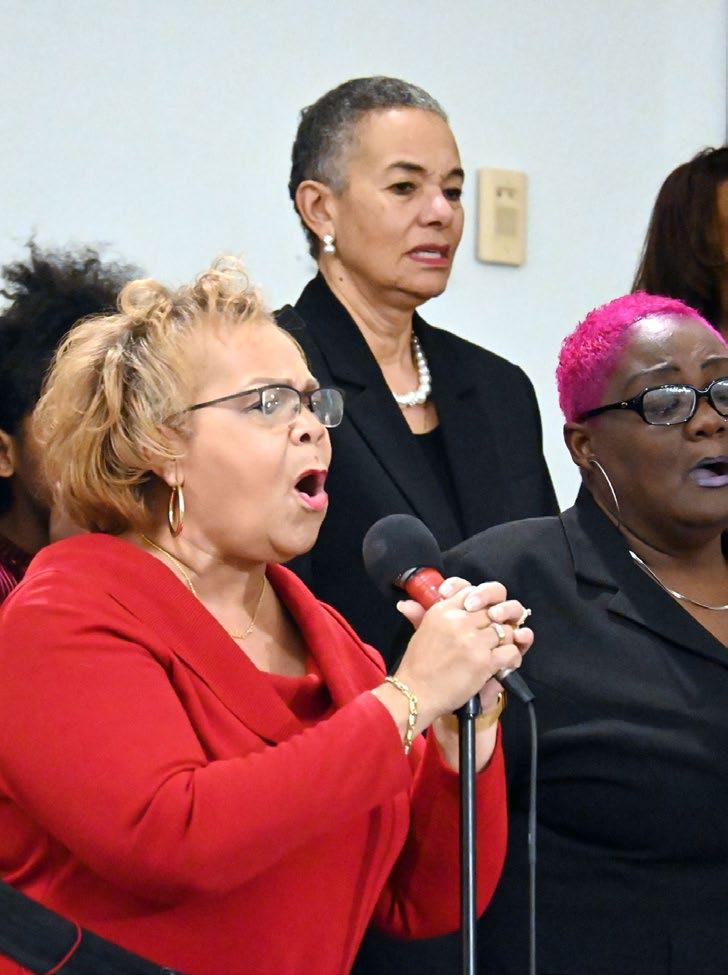
Learn from local leaders about the truths, realities, and hope of Black history in Oklahoma.
by Rev. Gwendolyn Collins-Derrick
February is a time when communities pause to honor the vast contributions of Black ancestors, activists, artists, scholars, and everyday heroes. It is also a moment to reflect on what it means to live out the vision of Dr. Martin Luther King Jr.: the Beloved Community, where justice, love, and mutual care are not abstract ideals but everyday practices.
The Center of Black Faith, Leadership, and Transformation stands as a living embodiment of that vision, especially in its steadfast commitment to lifting people up in ways that empower them to care for
themselves while also offering a sustaining hand to those who need it most. This year’s Black History Month celebration centers on how the center translates King’s dream into tangible acts of service, leadership development, and spiritual nourishment that knit neighbors together in dignity and hope.
Rooted in faith and animated by shared purpose, the center treats leadership as a form of service rather than a position of privilege. Leaders here are not only those who stand at the podium but those who steward relationships, who listen first, and who translate vision into action that lifts others up.
The Beloved Community, in this context, centers dignity, equity, and accessibility, recognizing that when people are equipped to care for themselves and contribute to the common good, the whole community grows stronger. The center’s approach acknowledges that health, education, economic stability, and spiritual well-being are interconnected threads in a single, living fabric. When one thread is strengthened, the entire garment becomes more secure.
A centerpiece of the center’s Black History Month programming is the back-to-school initiative, which embodies the belief that education is a shared responsibility and a shared right. The rallies blend practicality with affirmation: School supplies fill backpacks as hope fills classrooms.
The supply drives are carefully curated to meet the diverse needs of students — from notebooks and pencils to binders and calculators, from folders to art supplies. But the impact runs deeper. Each item is a symbol, a promise that every student is seen, valued, and prepared to participate fully in their education.
Winter apparel further illustrates the center’s practical compassion. In a season where cold can threaten health and disrupt routines, the provision of hats, gloves, and scarves becomes a protective ministry. This

isn’t merely about keeping bodies warm; it’s about preserving dignity in the face of economic stress and systemic pressures.
These clothing gifts also symbolize a broader ethic of stewardship: a community choosing to safeguard its most vulnerable members and to invest in their potential.
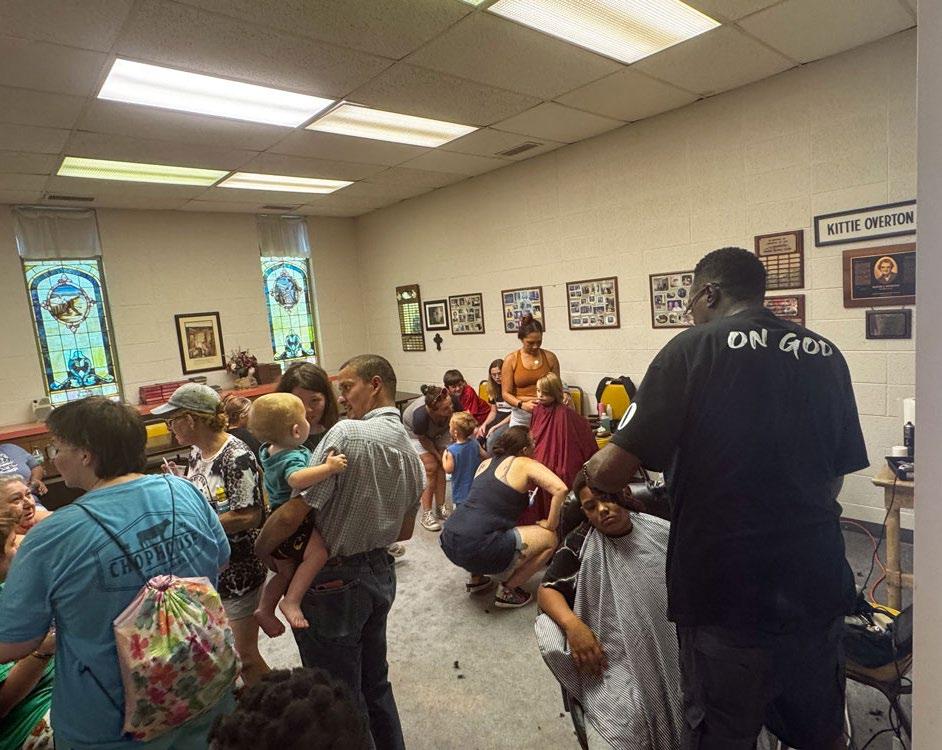
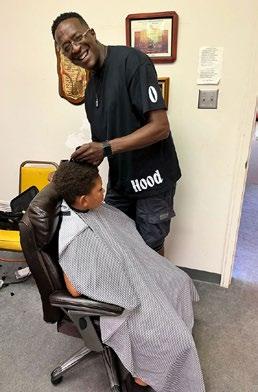
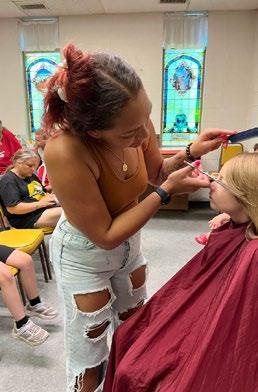
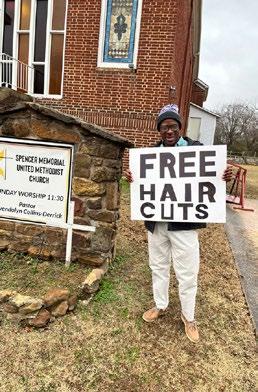
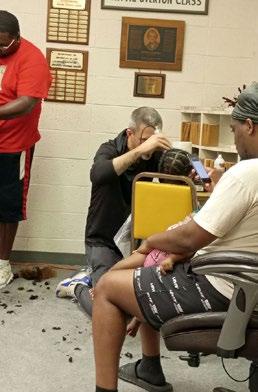
Free haircuts for youth complete the trio of back-to-school offerings with a powerful statement about identity, selfrespect, and confidence. A fresh cut can unlock a youngster’s readiness to participate in class, auditions, sports, and after-school programs with renewed selfassurance.
The center treats grooming as a form of self-expression that reinforces the message: You belong here, your voice matters, and you are prepared to contribute to the community you call home. Volunteers — from barbers to stylists — join the effort not as service providers alone, but as co-learners in building enduring relationships with families.
What makes these efforts resonate with the Beloved Community is more than the tangible items distributed or services rendered; it is the spirit in which they are offered. The center creates spaces
where families encounter one another as neighbors and equals, sharing in triumphs and shouldering one another’s burdens.
February marks a moment to honor Black history, culture, courage, contribution, and the enduring work of justice and transformation envisioned by Dr. King. The Center of Black Faith, Leadership, and Transformation stands at the heart of that recommitment, translating the dream of the Beloved Community into concrete acts of care, leadership development, and spiritual nourishment.
This Black History Month, the center invites the community to see Beloved Community not as a distant ideal but as a daily practice — one that makes room for everyone to give, receive, grow, and belong.
Rev. Gwendolyn Collins-Derrick is the director of the Center for Black Faith & Leadership Transformation and is the vicechair of Black Methodist Church Renewal for the South Central Jurisdiction.

As part of the Oklahoma Conference’s ongoing commitment to beloved community, conference leadership has begun a season of listening and reflection focused on racism, cultural competence, and the work of becoming an anti-racist church.
The Ethnic Local Church Concerns (ELCC) team has developed a set of three reflection questions that have been shared with every Oklahoma Conference board, agency, and committee. Chairs have been asked to guide their groups in discussing the questions together and to submit a summarized response by April. The full set of questions is available here.
The questions invite leaders to reflect on how racism is experienced and witnessed within the life of the conference, what it means to build intercultural competence within the body of Christ, and what courage and preparation are required to create spaces for honest dialogue and faithful action.
Conference Lay Leader Sharri Hiller said the process has already prompted her own learning.
“These questions made me realize there is much I do not know about racism, and I need to learn,” Hiller said. “I don’t know what I don’t know.”
Jacqueline Devereaux, a member of the ELCC team who worked on developing the questions, said the effort is intentionally focused on assessment and discernment.
“The Ethnic Local Church Concerns (ELCC) team has the responsibility to establish priorities in areas that address the concerns
of our ethnic congregations,” Devereaux said. “The present goal is to develop a relevant, functional plan that addresses and begins to dismantle racism in the Oklahoma Conference. The ELCC team felt it was important to assess the current temperature in order to identify resources that address emerging needs. The questions are designed to determine the level of work that is needed and to help in choosing a path that moves us forward in this area.”
Responses will be reviewed and discussed by conference leadership, including ELCC, the Board of Laity, Church and Society, the Local Church Development Ministry Team, and the Cabinet, as leaders discern appropriate next steps. At this stage, the work is focused at the leadership level of the conference, with broader engagement to be determined following review and discussion.
While there is no direct action required of local churches at this time, conference members are encouraged to check in with their church leaders and ensure their conference committees are engaging the questions thoughtfully.
Hiller emphasized the importance of followthrough.
“It will be important for the groups receiving these questions to take them seriously, take time in their meetings to discuss them as a group, and submit a clear summary of their answers for this to work to be successful,” she said. “As conference lay leader, I am pledging to not let this process get started and not be completed. It is important work that I will keep in front of the conference.”
by F. Douglas Powe Jr.
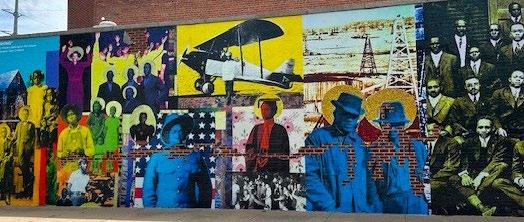
The 100th commemoration of Black History Month takes place this year. Carter G. Woodson organized the first celebration in 1926. For those not familiar with Woodson, he was a historian, author, and journalist who, in 1933, wrote the seminal work The Mis-Education of the Negro. Woodson explores the impact of African Americans being miseducated and therefore not able to flourish in society.
He organized the first Black history celebration seven years before the publishing of his pivotal book, in part to educate African Americans and others on the contributions of Black people to the United States in particular.
Woodson understood that the miseducation of African Americans was an ongoing challenge needing confrontation if transformation was going to happen. The transformation needed was not only directed at the African American community, but the U.S. as a whole. The importance of this need for transformation for the U.S. really struck me when I moved to Tulsa.
Let me explain.
I grew up in a household where knowing history was important and knowing African American history was essential. I learned about Black Wall Street and the Tulsa Race Massacre when I was young, in the mid1970s. Let me be clear: This education did not happen in school, but from African American history books and family members.
When I moved to Tulsa and heard person after person say, “I just learned about the Tulsa Race Massacre a few years ago” (literally meaning around 2021), it was shocking. Shocking not in the sense that I expected it to be taught in school — shocking that most of these individuals grew up in Tulsa and were clueless about what happened in their city. They made it sound like they had not even heard rumors of the tragedy that occurred.
I perceive this as a missed educational opportunity — a missed opportunity to share a dark part of history that we all can learn lessons from so it will not be repeated.
My guess is that because it is a dark part
of our history, ignoring it — or, in my language, choosing a missed educational opportunity — seemed reasonable. No one wants to relive tragic events, and in this case, when considering the annihilation of a community, it is not surprising that we have missed an educational opportunity for decades.
Hindsight is always 20/20, and we cannot alter what came before. We can discuss why being educated about our full history helps us move into a better future. In particular, the church has a role to play in helping us move forward.
We will be entering the season of Lent soon, and because we retrospectively participate in Lent, we always know Easter is coming. The truth is we cannot get to Easter until we experience “Good” Friday, the day Jesus is crucified.
Given that we know the end of the story, it is hard to focus on Jesus’ death. We often see it as a step on the way to celebration without considering the full circumstances and tragedy of the crucifixion.
As Christians, we typically see ourselves as supporters of Jesus who would have protested and spoken out against his execution. We typically do not imagine that we would be a part of the mob yelling, “Crucify him, crucify him” (Luke 23:21).
If we really look in the mirror, or at history honestly, we might think differently. The challenge of going along with the crowd is not a new phenomenon. Once a crowd mentality gets rolling, for good or ill, it can have a life of its own and be hard to stop.
Most of us, if we’re being honest, are afraid of going against the crowd. We do not want to be on the other side for fear of
attack.
As Christians, I believe the reality of “Good” Friday should help us reexamine history with an understanding that we are all capable of being a part of the crowd. We are all capable of yelling, “Crucify him!”
I get this makes us uncomfortable, but if we can reexamine history from this perspective, then hopefully we can see the signs to prevent it from happening again.
If you ever visit the Greenwood Rising Museum in Tulsa, you will see how easy it is to go along with the crowd and how that can eventually lead to a massacre.
As Christians, we have the opportunity to create a better future by fully engaging the reality of “Good” Friday as a means for not repeating history.
One of my favorite lines from a movie is from A Few Good Men, when Col. Jessup (played by Jack Nicholson) says, “You can’t handle the truth!”
Increasingly, I find that line to be accurate in ways I would not have anticipated when I first watched the film. We live in a culture where there is no longer consensus about what is true. The truth is often narrated along political lines.
When truth is politicized, is truth-telling even possible? I believe as Christians that we should be seekers of the truth. For all of us, this may mean that we discover what we want or think may be in opposition to the truth.
Ignoring that something happened will not alter its validity. The real question is, “Are we prepared to handle the truth?”
This is why education is critical. When we engage difficult realities like the Tulsa Race
Massacre, it can be challenging.
One of the lessons we learned from the Truth and Reconciliation Commission in South Africa is that the truth can be cathartic for all involved. While the process of truth and reconciliation work certainly was not perfect, many believe without it South Africa would have been in a much worse place.
It was often hard for those hearing the truth, but at the same time, the country as a whole was educated on the horrors of apartheid. I do not know if they were prepared for the truth. I do know that the truth shared at the commission continues to shape all of us even today.
As Christians, we should seek the truth, even when it’s painful, so we can move into the future differently.
In our Wesleyan tradition, communion is a means of grace. This means that communion is an outward sign of the transforming work God is doing in and through us. For the Wesleys, the belief is we are being transformed to be perfected in love.
When we consider a horrific event like the Tulsa Race Massacre, it seems unfathomable to think of getting to a place where love abides. This is precisely why participation in communion is essential.
The act of taking part in communion is a sign that we trust God’s transforming power to move us closer to that abiding love. This does not mean we get there in our lifetime. This does not mean that the hard work of dealing with the reality of “Good” Friday and truth-telling become steps in a process.
It does mean we commit to participating in
God’s holy work.
We commit to coming to the table, understanding our brokenness and that of the world. We commit to coming to the table, understanding Jesus’ blood was shed. This commitment also means we experience God’s healing in our lives as we participate in sharing God’s healing with others.
Communion is a lived expression of hope for a better future.
One of the things that I love about our Wesleyan tradition is our embodiment of hope. When we participate in communion, we embody the possibility of a different future. This is why we should never let communion become rote.
Communion is a means of grace that moves us toward a new future if we take it seriously.
As we commemorate the 100th celebration of Black History Month, I hope we do so while considering our Christian witness and our Wesleyan heritage.
We do not want to fall into the trap of missed educational opportunities. Instead, we will embrace our Christian and Wesleyan heritage by closely reexamining the “Good” Friday narrative, seeking the truth, and fully embodying our communion liturgy in light of challenging realities like the Tulsa Race Massacre.
Doing these things can lead all of us who are Christian to moving toward a better future.
F. Douglas Powe Jr. is the president of Phillips Theological Seminary and the Muzon Biggs, Jr., Professor of Methodist Studies.
by Rev. Carlos Ramirez
This month, we are preparing to enter a new season in Lent. When I was serving in the local church and Lent would arrive, I often said something like this: “Every single year, we Christians are faced with a choice: Should I intentionally observe Lent, or should I take Lent as just a few Sundays or weeks prior to Easter?”
In other words, we can be cynical and jaded and pay little attention to Lent and its significance. Or we can rededicate ourselves to Christ and take this — the most holy season of the church calendar — seriously. During Lent, we “remember and prepare in recognizing our own journey from sin and death into life and love with Jesus.”
We are called to walk in the footsteps of Jesus in the wilderness, when he was tempted. During Lent, we remember the last moments of Jesus’ life: his triumphal entrance into Jerusalem, turning the tables in the temple, his final meal with his friends, how he was betrayed and abandoned by those same friends, his trial, sentence, and execution.
The same powers that took Jesus to the cross are very much alive today. Powers that, in Jesus’ time, imposed heavy taxation upon the vast majority of the Roman Empire. Powers that threatened people with annihilation by Roman might. Powers that made religious leaders align themselves with Rome in order to maintain power and control over the temple and the religious
life of Judea. Powers that ensured the flow of resources always pointed toward Rome, leaving provinces like Judea with very little.
In this desperate, seemingly hopeless, and harsh context, Jesus spoke of abundance — of banquets, justice, dignity, hope, and peace achieved through love, not violence. Jesus spoke about loving our enemies, forgiveness, and reconciliation.
While the 40 days of Lent are intended to remind us of the 40 days Jesus spent in the wilderness, Lent also reminds us that this season is not just about Jesus being in the desert. Lent reminds us that the wilderness happens when people dehumanize other people. The wilderness happens when the powers of darkness speak only lies and twist reality. The wilderness happens when the powers of darkness attempt to destroy the light: justice, dignity, hope, kindness, truth, forgiveness, reconciliation, and peace — all achieved through loving God and our neighbor.
Because these powers of darkness are filling our streets, our airwaves, and our social media feeds with conflict, distrust, and fear, we Christians do not have the luxury of being cynical or jaded. We do not have the luxury of ignoring Lent.
We cannot ignore Lent when these forces of darkness try to persuade us to fear one another, to treat one another — at best — with contempt and — at worst — with hate. We cannot ignore Lent when these forces
spew so many lies that it becomes difficult to know what is real and what is not, when we begin to doubt our own eyes and ears.
We cannot ignore Lent because ignoring Lent makes us accomplices to these powers. Ignoring Lent is ignoring the suffering, pain, and hatred these powers inflict upon people we are called to love. By ignoring Lent, we turn our eyes away from forces that fabricate reality in order to sentence and execute innocent people.
There is no Easter without Lent. There cannot be a resurrection without the pain and suffering of Jesus on the cross. That pain and suffering were defeated on the third day, but they were not skipped or ignored. The pain and suffering of Jesus — this innocent man — exposed how rotten
these powers were. His death revealed both their reach and their fragility. When forgiveness, truth, hope, and love resist evil, evil crumbles.
Holocaust survivor Yehuda Bauer said it this way: “Thou shalt not be a victim, thou shalt not be a perpetrator, but, above all, thou shalt not be a bystander.”
The wilderness is scary. The wilderness is unpredictable. The wilderness has the power to shake us to our core. Yet Jesus overcame the wilderness. In this hope, I rest: When I face the wilderness, as frightening as it is and as scared as I may be, I know that in Jesus, I will overcome it.
Let us not fear the wilderness. We do not have the luxury to ignore Lent. We cannot be mere bystanders.

by Kathy Leithner
Many years ago, during Holy Week, a colleague and I fasted from food from Maundy Thursday until Easter morning. In fact, we did that for several years. There were some surprises in the experience.
For one thing, it freed up a lot of time — time that could be spent in other ways, which, for a pastor during Holy Week, is valuable. It also freed up money that
could be given away. As it turned out, fasting helped with the keeping of those two other classic Lenten disciplines: prayer and almsgiving.
The first two days were the hardest. I went to the grocery store to get supplies for communion (which I should have done earlier!) and was captivated by all the beautiful fruits and vegetables in the produce section. I felt sad that I wouldn’t be enjoying them anytime soon. Then I considered all the people who do not have access to them regularly at all.

When hunger pangs came, my task was to consider what I’m really hungry for — what deeper desires lay beneath the ordinary biological drives to consume, what longings lie deep within. Some of these were personal, some were for the church, and some were for the world.
I was reminded of this recently when I came across a quote from
the Center for Action and Contemplation, attributed to Barbara C. Harris, an Episcopal bishop and the first woman consecrated a bishop in the Anglican Communion. She asks:
“Are we content to settle for the temporary thirst quenchers of life: the things on which this society places so much value, things that will never slake the thirst of your parched, dry souls? Or do you thirst for righteousness, for peace, for justice, for the liberation of all God’s people?”
These days, I take on a more modified fast during Lent. I also consider fasting from other things that take too much of my attention, diverting it from the people and
“We are grateful and glad.”
projects near at hand. This year, it might be scrolling through feeds. As it turns out, that could free up several hours a week.
We offer many opportunities for spiritual growth through worship, enrichment, and community:
• Vibrant Spiritual Life, diverse worship services, study groups, and prayer opportunities.
• Meaningful Connections, mission and service projects that connect you to the wider community.
• Ecumenical and Inclusive, all faiths and denominations welcome.
• Compassionate Pastoral Care, dedicated chaplains and staff.
• Enriching Experiences that deepen your faith.
Nurture Your Faith at Epworth Villa
Contact us today to inquire about our special discounts for clergy and their spouses.



United Methodists from around the world will gather in Calgary this October for a Council of Bishops leadership event focused on the future of the denomination. The Oklahoma Conference will be represented in person by KC Curry and Rev. Carlos Ramirez.
In the summer of 2025, the Council of Bishops (COB) launched what was termed an historic engagement initiative designed to give every United Methodist a direct voice in shaping the denomination’s future.
The 2026 Council of Bishops Leadership Gathering, “Emboldened by the Spirit: Imagining a Church Yet to Be,” will take place Oct. 20–24, 2026, at Knox United Church in Calgary, Alberta, Canada. The engagement initiative is designed to give every United Methodist a direct voice in shaping the future of The United Methodist Church in advance of the event. Ways to participate can be found at the end of this article.
In addition, active bishops were tasked with nominating persons from their areas to attend in person. Emphasis was placed on younger voices, as well as laity — persons who are engaged with the current life of the church and can envision a new future.
Bishop Laura Merrill has nominated the following individuals to represent her areas of service:
• Oklahoma Conference: KC Curry, Carlos Ramirez
• Oklahoma Indian Missionary
Conference: Jalisa Pearson, Tabatha Austin-Harris
• Arkansas Conference: Michael Robinson, Chad Hornsby
“This gathering is about faithful leadership for such a time as this. We are being called to reimagine the Church — not to preserve what is familiar but to fulfill God’s calling and vision for our future. We will lean into the Spirit’s leading with boldness and humility, centering Christ in all we do, so that the witness of The United Methodist Church might be renewed, relevant, and rooted in justice, love, and hope,” said Bishop Tracy S. Malone, president of the Council of Bishops.
KC Curry is the assistant director of religious life at Oklahoma City University, a member of New Hope UMC in Oklahoma City, and served as a lay delegate to the 2024 Jurisdictional Conference. She has been active in youth and young adult ministry in the conference for a number of years.
Rev. Carlos Ramirez was born and raised in Mexico before coming to the United States to serve in ministry in the Oklahoma Conference. He currently serves as the director of strategy and communication
for the conference and is a multiple-time delegate to General and Jurisdictional conferences. He resides in Oklahoma City with his wife, Rev. Wendi Neal, and their two children. They are active in McFarlin UMC in Norman.
The participants respond
We asked Carlos and KC some questions as they prepare for this historic gathering.
What are you most excited about as you think about this event?
Ramirez: “I think it is the fact that we, as a denomination, are looking forward to the future, past our bitter experiences, and discerning how God is calling us to serve the USA for the foreseeable future.”
Curry: “I remember hearing about the Council of Bishops Leadership Gathering post-General Conference in 2024. I was watching online and never once imagined that my name would be lifted to represent our conference. At the Gathering, we will ‘discuss today’s challenges and begin to co-create the church of tomorrow.’ I am excited to be part of these conversations, and I am deeply humbled to be a small voice in co-creating the church with others from around the world.”
What are your dreams for what the UMC can become?
Curry: “I am already so inspired by the work we are doing as The United Methodist Church. We are among the first
to show up to help and the last to leave after natural disasters through our work with UMCOR. We have built intentional relationships with such important ministries like Lydia Patterson, CJAMM, Circle of Care, and many others, as we join them in doing the work of Christ (we love the Methodist connection!). I love how theologically and politically diverse we are, that we are truly a purple church welcoming all into our doors and hearts. I can only dream that we continue to become bigger and bolder in our calling to be a church that lives into a faith that is alive and active in the world. I urge us to continue to be a church that goes out of our way to speak the truth of God’s love to the world, even if it scares us or makes us uncomfortable. As John Wesley said, ‘There is no holiness but social holiness.’”
Ramirez: “We truly enter a period of discernment to ‘right size’ our denomination. We are not as big as we used to be, yet we still have considerable strength. What is the right size and the right infrastructure for said denomination that will help local congregations flourish? Do not be afraid of making drastic changes to our way of doing things. Nostalgia is not a strategy. We need to move on and be on the best footing possible to face the many challenges we are experiencing: demographic change, social unrest, economic inequality, sustainability, creation care, to name just a few.”
What are you doing to prepare for this event?
Ramirez: “Continue to keep an eye on our demographic trends. Educating myself in new technologies and/or publications that point toward the future. Keep informed about denominational news.”
Curry: “I’m watching the Council of Bishops’ social media pages and seeing what they are feeling most called to speak up on. That helps me to know what is on the minds of our greater denominational body. I’m also keeping up with current events and paying attention to what is pertinent to our world today. As Ask The UMC says, ‘Since the Church’s inception, Methodists have been actively involved in social and political matters in order to build a more peaceful and just world.’ Familiarizing myself with our new vision statement and our updated Social Principles.”
How can the conference pray for and support you?
Curry: “Pray that we are able to hear the Spirit in a way that best reflects the calling that she has for us and our global Church. That we aren’t afraid to boldly go and do the work that Christ has and continues to call us to do.”
Ramirez: “We all need to pray for courage to do what it is necessary to do. To be bold in answering God’s calling. To thank the saints that came before us, looking at our past with reverence and respect, yet honoring said saints by asking God for vision for a new context and a new United Methodist Church. A church that will be different, but just as faithful as ever. Let us pray for said vision and for courage to go where God may lead us.”
While Curry and Ramirez will represent the Oklahoma Conference in Calgary, all United Methodists are invited to participate. Opportunities include completing a short denominational survey about hopes for the future of the church and joining upcoming webinars 9 to 10:30 a.m., Feb. 21 and March 21.
More information about the gathering, the survey, and the webinars is available here.

Lent does not ask us to become different people. It asks us to pay attention to the lives we are already living.
For some, that means letting go of what crowds the schedule or the mind. For others, it means taking on a simple practice that brings structure or grounding. Still others may feel called to listen more closely or to make small adjustments so daily habits better reflect deeply held values.
The four paths on the next two pages are meant to help you choose a Lenten practice that fits your actual life. They are not meant to be completed, compared, or perfected. Each path offers an example of what a faithful, realistic practice might look like — something small enough to sustain, and gentle enough to return to after missed days.
There is no single right choice. The best path is the one you can walk with honesty and grace in this season.
Lent is not about doing more. It is about walking with intention, one day at a time.
The examples offered in the following pages are not meant to be copied exactly. They are included to show what a faithful, realistic practice can look like.
A good Lenten practice:
• fits your actual life
• allows room for grace
• draws you toward love of God and neighbor
If a practice becomes a source of pressure or guilt, it is not doing what it is meant to do. Practices are meant to open space, not close it.
As you consider the four paths, you might ask:
• Which path feels most life-giving right now?
• Which one feels possible in this season?
• Where do I sense invitation rather than obligation?
Choose a path that feels faithful — not impressive.
Whatever path you choose:
• Keep the practice simple
• Allow room for missed days
• Let consistency matter more than intensity
Lent is not about perfection. It is about returning, again and again, to what matters most.
Feel free to print the following two pages and reproduce them for use in your congregation.
This path focuses on release.

It may be right for you if your life feels crowded, loud, or heavy. Letting go is not about deprivation for its own sake.
It is about making space — in your schedule, your habits, or your attention — for what matters most.
A guiding question:
What could I release in order to be more present — to God, to others, or to myself?
Try this:
Choose one hour each evening during Lent when your phone is turned off and placed out of reach — inside a drawer, a bag, or another room. Begin at the same time each day if you can.
During that hour, do nothing productive on purpose. Notice what your mind does. Talk with the people around you. Sit quietly. Sing. Take a walk.

This path focuses on nourishment.
It may be right for you if you are longing for structure, grounding, or renewal.
Taking on is not about adding pressure. It is about choosing a practice that feeds your faith and gives shape to your days.
A guiding question:
What practice might help me notice God more clearly during this season?
Try this:
Set aside five minutes each morning during Lent to read a short prayer or scripture passage before checking email or news.
Sit in the same place each day. Read slowly. Do not try to understand everything.
If you forget or start late one evening, simply begin again the next day. The practice is the release, not the perfection.
“Come to me, all you that are weary and are carrying heavy burdens.”

- Matthew 11:28
When the five minutes are finished, close the book and continue with your day.
If you miss a morning, return the next day without making it up.
“One does not live by bread alone.”

- Matthew 4:4
This path focuses on attention.

It may be right for you if you sense a call to listen more deeply or engage more honestly with the world around you. Turning toward does not require having answers.
It asks only for willingness — to see, to hear, and to learn.
A guiding question:
Where am I being invited to listen, rather than look away?
Try this:
Choose one issue, community, or experience you know you don’t fully understand.
During Lent, commit to listening rather than debating. Read one article a week from a perspective different from your own. Listen to a podcast or personal story without multitasking. Resist the urge to respond or fix. Simply notice what you learn and what feelings surface.

This path focuses on alignment.
It may be right for you if your values feel clear, but your daily habits don’t always reflect them.
Reorienting is about small, faithful adjustments — not life overhauls.
A guiding question:
What small shift could help my life align more closely with what I value?
Try this:
Choose one meal or snack each day during Lent to eat with full attention. Sit down, take a breath, and begin without rushing.
As you eat, avoid multitasking. Put away your phone and allow the meal to be just a meal. Notice flavors, textures, and the people around you. Notice what it feels like to pause.
“Let everyone be quick to listen, slow to speak.”

- James 1:19
This is not about changing what you eat. It is about reorienting an ordinary part of your day toward presence and gratitude. If you forget, simply return at the next meal.
“Where your treasure is, your heart will be also.”

- Matthew 6:21