PROSPERITY OKLAHOMA 2025 SUMMIT
HOSTED BY:
The Future of Work: How Advanced Technology & AI Can Shape Oklahoma’s Opportunities
October 29, 2025 | Oklahoma History Center
11:00 - 11:30 Check in & Lunch Service
11:30 - 11:40 Welcome: Knowledge Creation and Competing on Innovation – SCRF
11:40 - 12:20 Keynote Speaker - Hart Brown, CEO of Future Point of View (FPOV)
12:20 - 12:45 AI Demonstration by Slalom:
Patrick Swain, Sr. Director - Cloud Strategy and Modernization
12:45 - 1:00 Break
1:00 - 1:25 The State of Oklahoma’s Tech Industry
Madeline Mitchell Stacy, Executive in Residence, University of Central Oklahoma College of Business
1:25 - 1:55 Education & Workforce Panel: Oklahoma’s Opportunity for Advancement
Moderator: Tony Heaberlin, Chief Communications & Economic Development Officer, Tulsa Technology Center
Speakers:
Dr. Matt Hulver, Vice President for Research and Partnerships, University of Oklahoma
Anthony Owen, Senior Director of State Government Affairs, Code.org , and President of the Computer Science Advocacy Coalition
Justin Hill, Principal, StateLinx
1:55-2:00 Closing Remarks - Oklahoma Technology Alliance
2:00-3:00 Oklahoma Technology Alliance Networking Event
Featuring an additional AI Demonstration by Garrett Long, Director-Partnerships & Channels, Worlds
THANK YOU TO OUR SPONSORS
SPONSOR
SPONSOR
LUNCH
SILVER
The State Chamber Research Foundation provides Oklahoma’s business community with thorough research and policy, sound data, and solution focused programs to grow Oklahoma’s economy, prosperity and competitiveness.
The State Chamber Research Foundation (SCRF) is a 501(c)(3) research organization that works in partnership with The State Chamber (TSC) to advance and fund public policy research that promotes the future of Oklahoma.
To learn more about SCRF, go to our website: www.statechamberresearch.org or Donate now.
Your support is key to our success and allows us to educate elected leaders about the issues and policies that are critical to a competitive environment. By donating to the Foundation, you are supporting vital programs like these:
Competitiveness Data
Legislative Scorecard
Leadership Exchange Academy
All contributions to The State Chamber Research Foundation are tax deductible, in accordance with the IRS code for 501(c)(3) organizations
The Oklahoma Technology Alliance brings together member companies who are interested in technology-related issues in our state. It’s a group that proactively educates the public and key decision-makers on the economic benefits of becoming a state that actively embraces technology and leads investment in research and development.
We hope that from the Alliance, we can foster a technological environment here in Oklahoma that will encourage retention of companies and recruitment of new companies through discussions, policy work, research, and more.
Oklahoma cannot afford to get left behind. We welcome you and look forward to working together.
LAUNCHING OKLAHOMA INTO THE TECH SPACE
Artificial Intelligence (AI) is shaking things up in nearly every aspect of our world. AI is everywhere and nearly everyone is using it in some way to work faster, smarter and more efficiently. Parents are using it to create schedules and meal plans, employees are using it to streamline outputs, and companies are using it to automate systems and develop and produce products more efficiently. Even children are using it to make custom coloring pages featuring themselves or to bring their drawings to life. Whether we like it or not, we are slowly succumbing to a totally digital age. AI can be helpful, supportive and often provides an easier way of life. But with big reward, often comes risk.
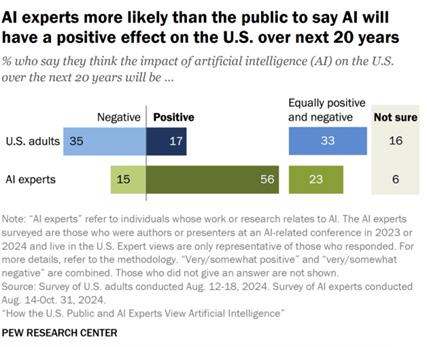
While AI is becoming commonplace, there is still a lot of risk involved and at certain levels. The general population either distrusts or overly trusts its capabilities. The Pew Institute conducted a survey in 2024 of U.S. adults and AI experts and found that 76% of AI experts believed “these technologies will benefit rather than harm them personally.” It showed that less than half (43%) of the public, however, believes AI is more likely to harm them than benefit them. Further, the Pew survey showed “64% of the public thinks AI will lead to fewer jobs over the next 20 years,” while only 39% of experts agreed with that sentiment1 Something the two groups did agree on though is their concern about getting inaccurate information through AI usage: 66% of adults were highly concerned about receiving false information and a whopping 70% of experts!
Therein lies the risk. AI is only as smart as the input it receives. Without the vital component of the human element, it lacks context, emotional intelligence and it has limited capabilities to think beyond what it has been told. It can hallucinate, or make up information, and create bias within systems. We know that AI is a tool that helps us work better, but it is not a replacement for the person who can understand the fuller picture of the work AI is doing. Technology needs a human check.
John Maynard Keynes wrote in his 1930 essay, Economic Possibilities for our Grandchildren,
“We are being afflicted with a new disease of which some readers may not yet have heard the name, but of which they will hear a great deal in the years to come--namely, technological unemployment. This means unemployment due to our discovery of means of economising the use of labour outrunning the pace at which we can find new uses for labour.”
Keynes predicted that in 100 years from his pen, we would all be “afflicted with this new
1
Brittnee Preston Oklahoma Technology Alliance; The Preston Group
disease”. He summed that while it would seek to solve our economic problem; to make us all better off by, well, now, we will still be faced with the ultimate struggle of humans: to subsist2 .
Alternatively, taking a modern-day approach, we could consider the CEO of Google, Sudar Pichai’s, perspective on AI today. Pichai said,
“The future of AI is not about replacing humans, it’s about augmenting human capabilities.”
As one of the leaders in this space, Pichai argues that AI is meant to enhance the human experience, making people more creative and refining human skills in a way we never thought possible. Subsisting anew, if you will. He concludes in this simple statement that AI’s intentions are slated to be collaborative and not a substitute for human work. However, Pichai’s comment does insinuate public resistance, which the Pew Institute clearly detected in the survey mentioned above. This public sentiment also coincides with Keynes theory pointing us to a common thread in both of their comments and the public view: maladjustment.
It is true, technology advancements change things. It transforms how we work and live. However, it is our response to the advancement that matters. We get to dictate how the human experience continues, and the role Oklahoma allows AI and advanced technology to play in our society.
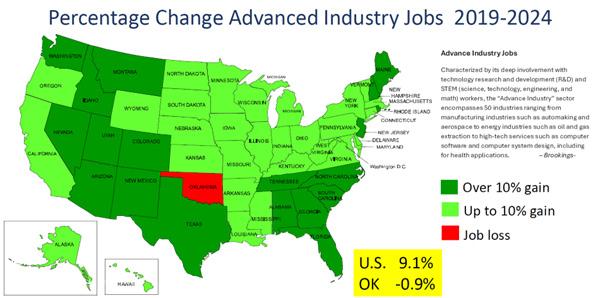
While the state has a healthy economic climate, ranking 1st in the nation for cost of doing business and 20th and 21st respectively for business friendliness and tax competitiveness, Oklahoma ranks at the bottom for education (50th), third grade reading scores (47th), and health outcomes (47th). Still, the state has made major strides in infrastructure investment but the state is slipping in rankings of global investment (50th) and business formation (42nd). Additionally, mostly due to job losses in the oil and gas industry, Oklahoma is the only state to have a loss of jobs in advanced industries between 2018 and 2023. Without earnest changes, the state’s subsistence could be at risk.
Advanced technology is fast-paced and constantly evolving, intending to help us work better, not be better. Fear of technology changing us can lead to stagnation in industry recruitment and job creation. “In a time of rapid change, complacency is often the greatest threat and failing to innovate or adapt as other states are doing will result in Oklahoma becoming less and less economically competitive.”3
2Keynes, John Maynard. Economic Possibilities for our Grandchildren. 3Abernathy, Ted. Economic Leadership. Expect More and Achieve
Oklahoma has all the right ingredients to be competitive on a much larger scale, but the state needs to do better at attracting firms in the technology industry and other advanced industries. Infrastructure is the backbone of economic development. Oklahoma has worked hard to ensure our infrastructure is ready to sustain the state well into the future. With significant investments in the state’s bridge system and 2 lane highways, broadband access and power reliance, the state is positioned statewide to begin to grow advanced industries into rural places. Moreover, Oklahoma is well-positioned to benefit from expanded opportunities with our attractive low taxes, pro-business climate, and fiscal stability.
However, overall, the state has a higher volume of lower-skilled occupations and less advanced manufacturing. Other states have seen success by continuously improving their business climate, equipping and training workers for tech jobs and investing in infrastructure to support emerging and innovative tech. Unfortunately, the six surrounding states have continuously outperformed OK economically in almost every way.
“Over the five-year period (2018-2023), 16.7% of Oklahoma tech industry jobs were lost while all 6 neighboring states experienced tech industry job growth approaching or above the U.S. average of 12.9%.”4 Tech industry growth has been a major economic driver for other states. However, Oklahoma has not yet tapped into this and is losing to other states’ attraction of advanced industry. Due to this, firms in Oklahoma experience a 22% lower volume of technology jobs than the rest of the nation.
Looking at it from yet another angle, we appear to be complacent in almost all technology sectors except for energy tech where the state is outperforming the nation in the concentration of jobs. A recent report on Oklahoma’s competitiveness showed that,
Despite the high rate of job loss from firms and businesses classified as being in the technology sector, a review of people employed in technology occupationsregardless of whether they are within the technology industry or another industry - shows a much more positive picture of employment growth. Between 2018-23, tech workers overall increased by 17.4% in Oklahoma, a rate just slightly below the overall growth of tech occupations nationwide. Oklahoma’s tech occupation
growth was ahead of two neighboring states and not far behind that of all others in the region.5
In other words, Oklahoma has the workforce but has lagged in attracting the firms within the industry. Even though Oklahoma has prioritized jobs in manufacturing, advanced industry, and technology as key industries to recruit, the state can do a better job of focusing on developing technology skills within the workforce and growing the number of these high-skilled industries to create more jobs in the state.
Globalization of the U.S. economy is leading us into new opportunities in entrepreneurship and industrial processes in the United States. Fostering innovation through regulatory prudency will set us up for the future. Many states have seen success through piloting regulatory sandboxes and considering a reduction in the regulatory burden placed on start-up businesses and technology innovations.
Oklahoma must anticipate the next wave of transformative technology in AI and other advanced industries to blast forward in this space. Thinking back to Keynes and Pichai’s caution, let’s be leery of maladaptation and fear of the unknown; and instead, thoughtfully and innovatively embrace the benefit of these opportunities so we can subsist and better compete with surrounding states. This can be seen in the data privacy saga that exists in Oklahoma. For years, state legislators have been considering a data privacy law, which could help provide guardrails and a common framework for companies that are working across state lines, pushing Oklahoma in a globalized future and beginning the steps for better AI understanding and polices.
To sustain the technological growth of key industries, like Oklahoma’s energy and aerospace industries, states have developed clusters of support programs around their most thriving industries. Tax credits and a “return to Oklahoma” incentives are just two ways the state could attract new business and bring back those that have moved away. Identifying targeted growth industries like energy and aerospace that already have a major footprint in the state and expanding our scope to others, such as health and fintech could allow the state to focus on sound policy making to build up these sectors specifically. We are doing well in the energy technology sector, which is OK’s highest concentration of tech jobs; but OK’s second largest industry for technology jobs is IT and it falls 52% behind the national average. Harnessing our attention to our most viable sectors can also help the state to identify needed skill sets within the workforce and align education systems to train workers.
Improving skills through “business informed workforce training programs and improved educational outcomes”6 maximizes work for low-skilled, reskilled and up-and-coming workers. AI and data literacy, paired with training programs for the highest demand skill areas and fastest growing industries will better position the state to be competitive. A population fluent in these skills will move us to work better. Oklahoma’s higher education system is actively trying to bridge the gap for the state in AI and technology workforce training. Many of our institutions have developed programs to supply degrees in the AI sector. There are many business partnerships to provide employers and workers upskill or reskill opportunities at higher ed institutions, career tech centers and even the state’s Grow with Google initiative.
Despite Oklahoma’s struggle to keep up with the nation on attracting advanced industries over the past decade, the state has a firm foundation to launch into the tech space. Oklahoma has set the stage for the technology industry and occupations within it to thrive in the state. Now is the time to gain wealth and bring even more opportunities to our great state. Let’s welcome innovators and forward-thinking industries and move the state into the competitive mix.