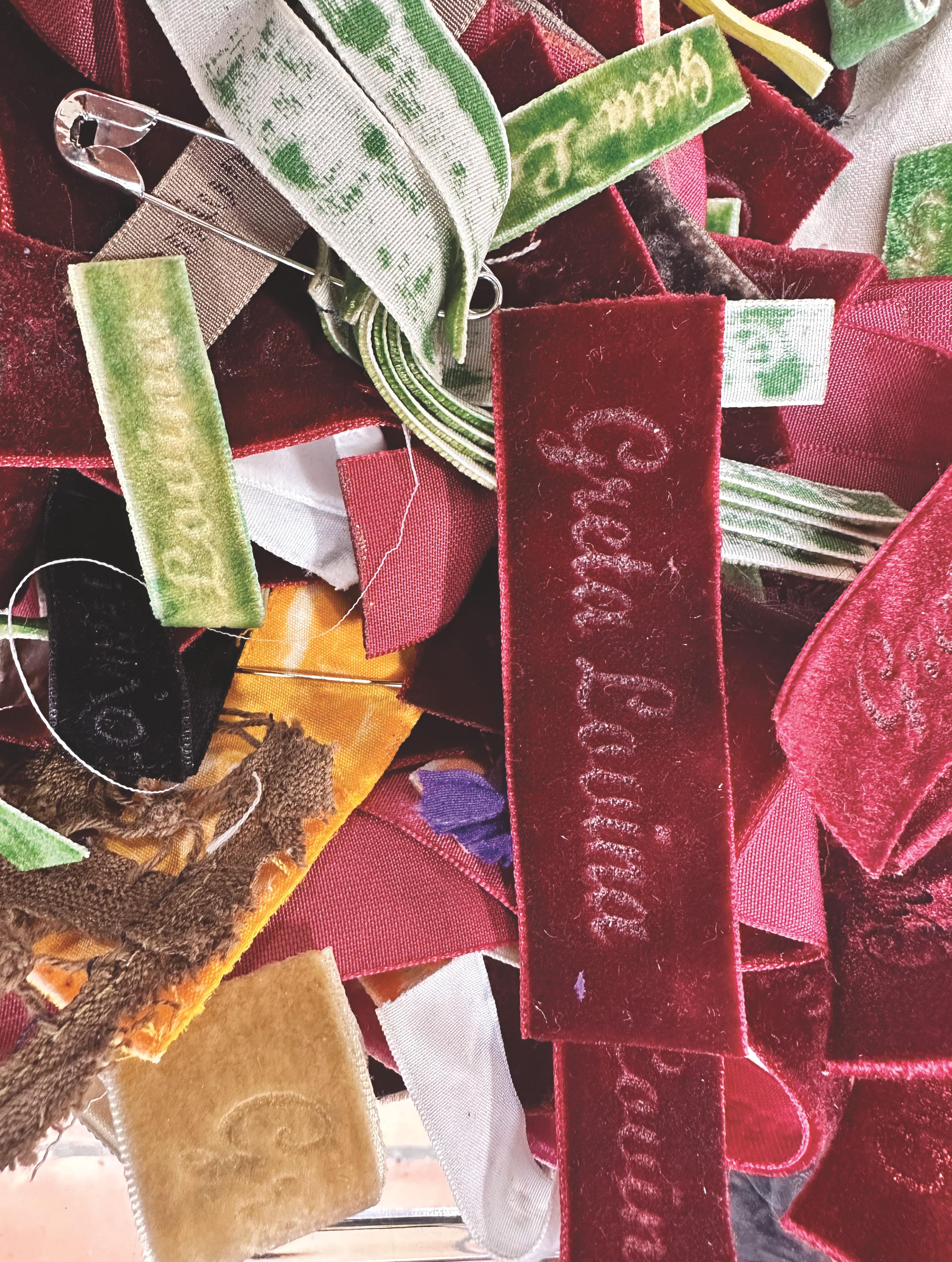
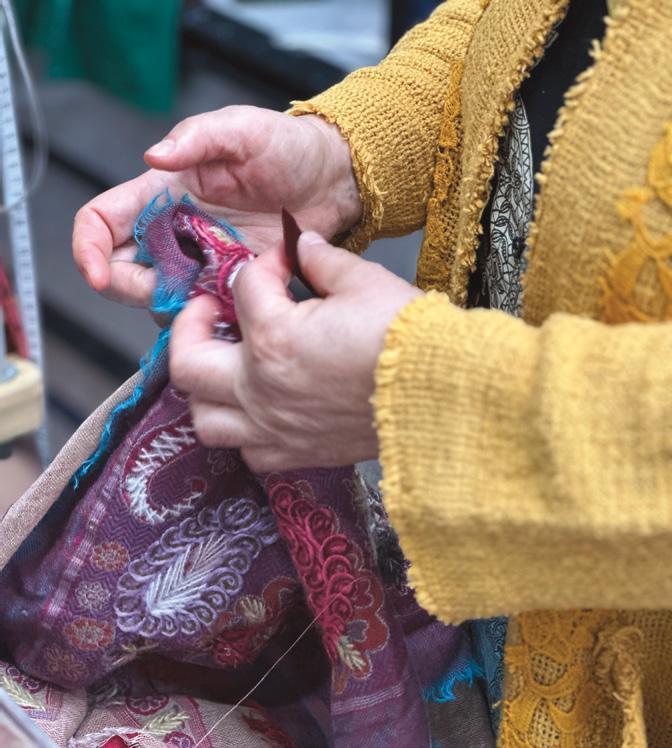
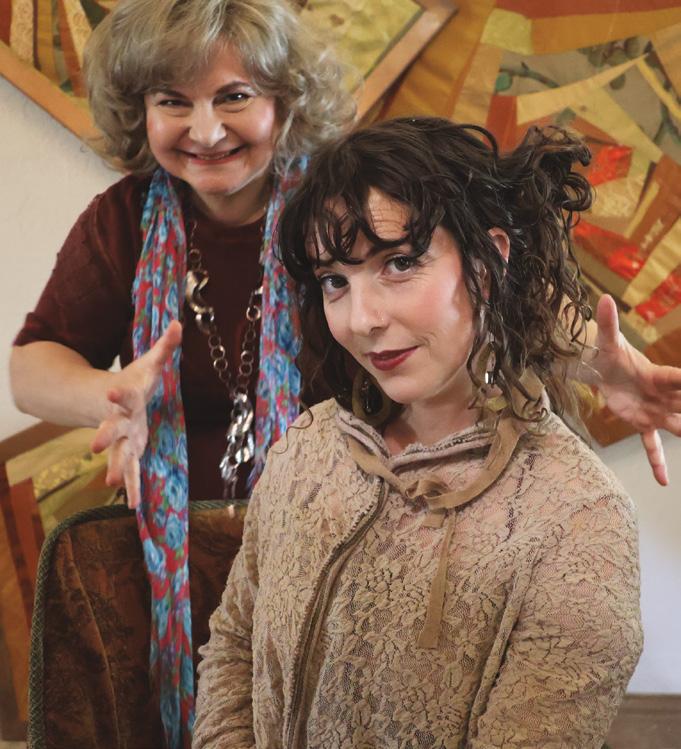
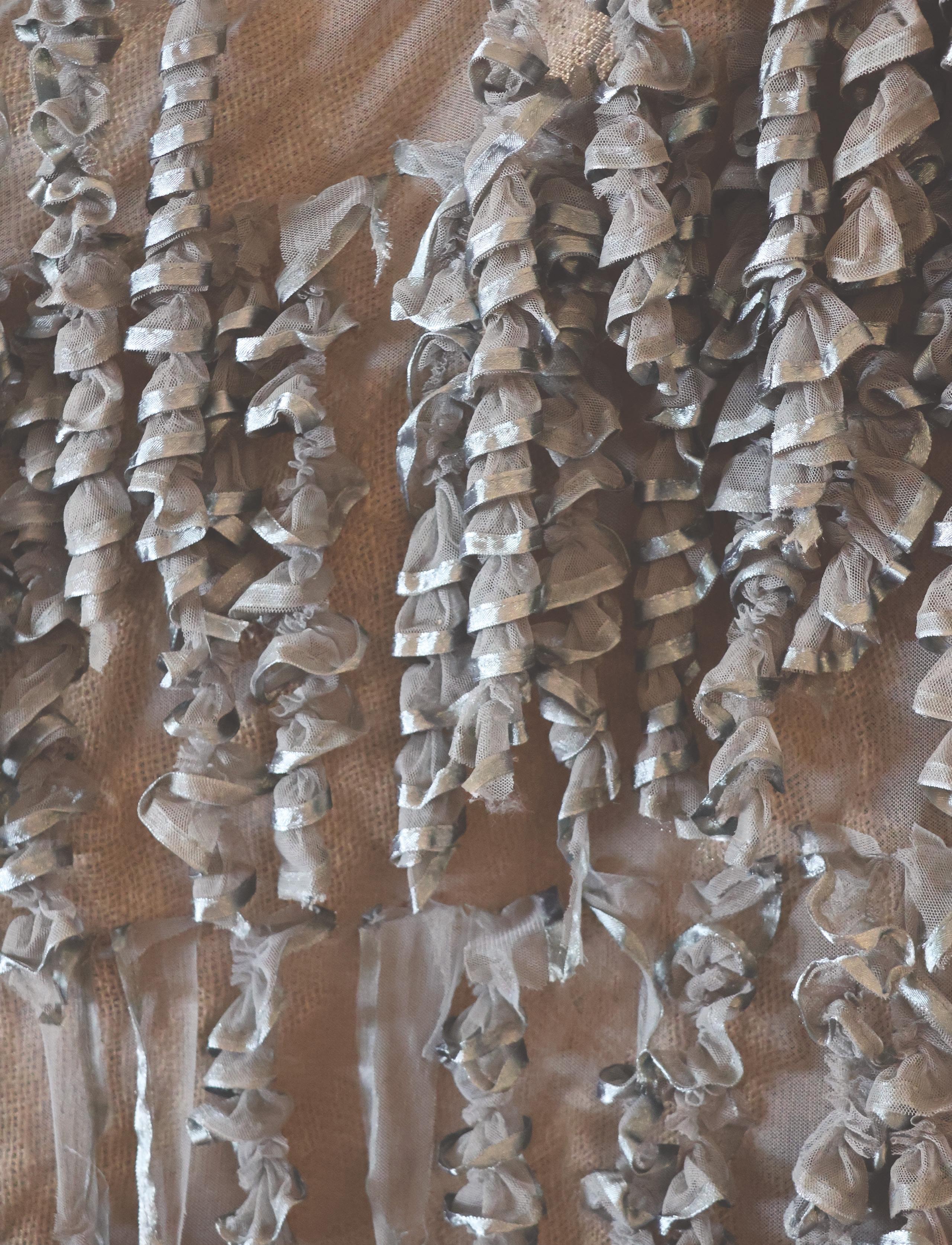
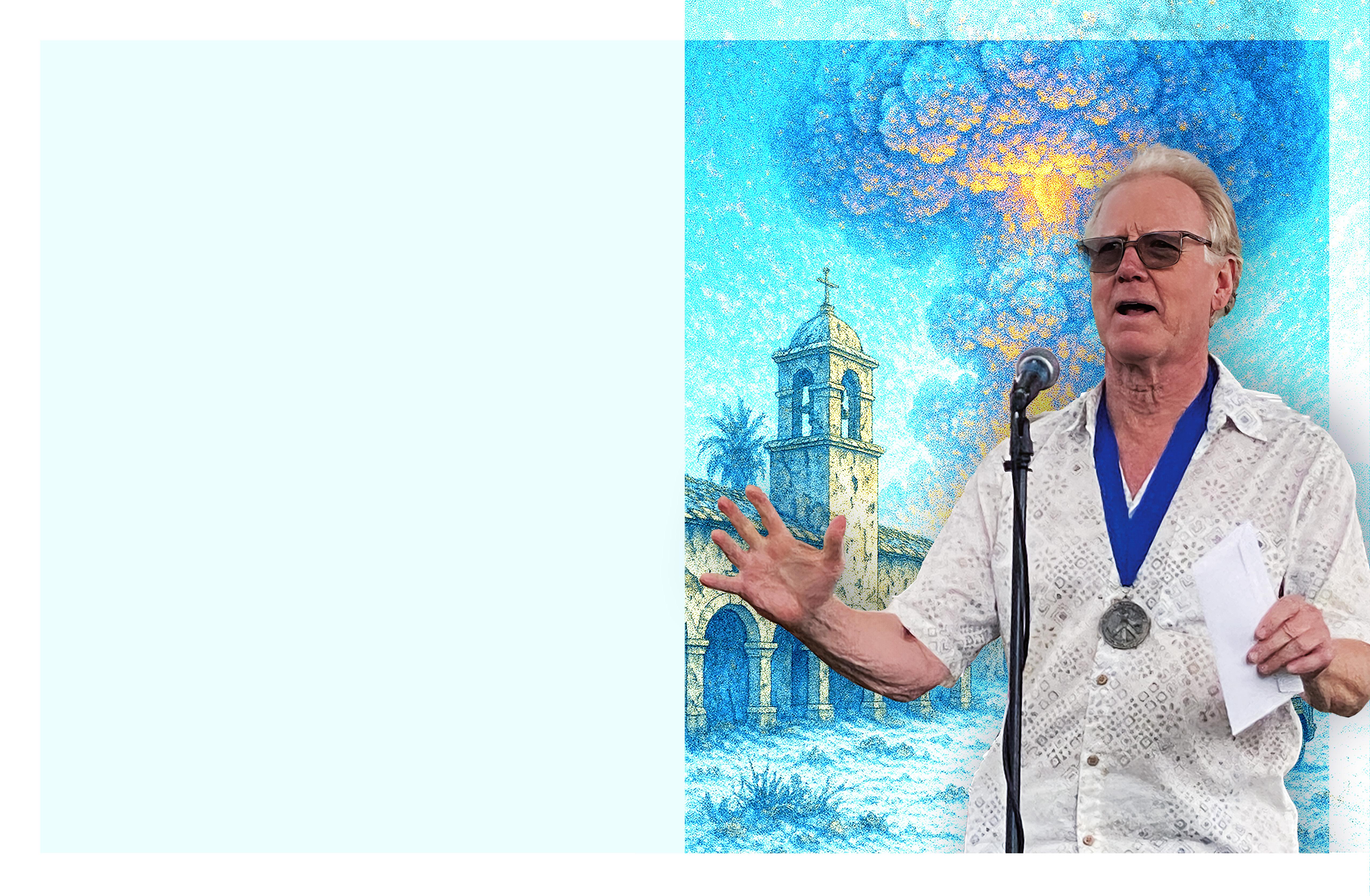
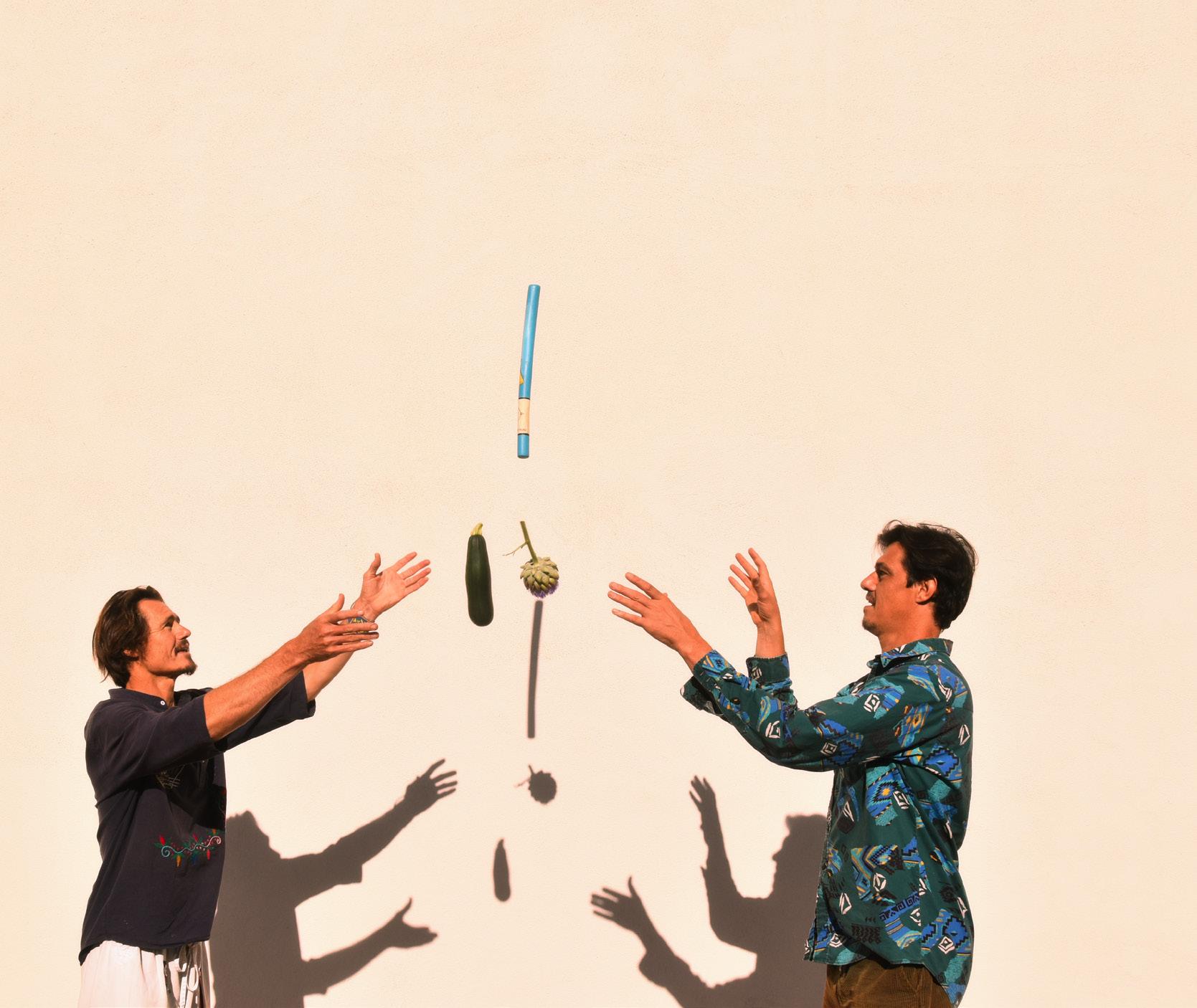
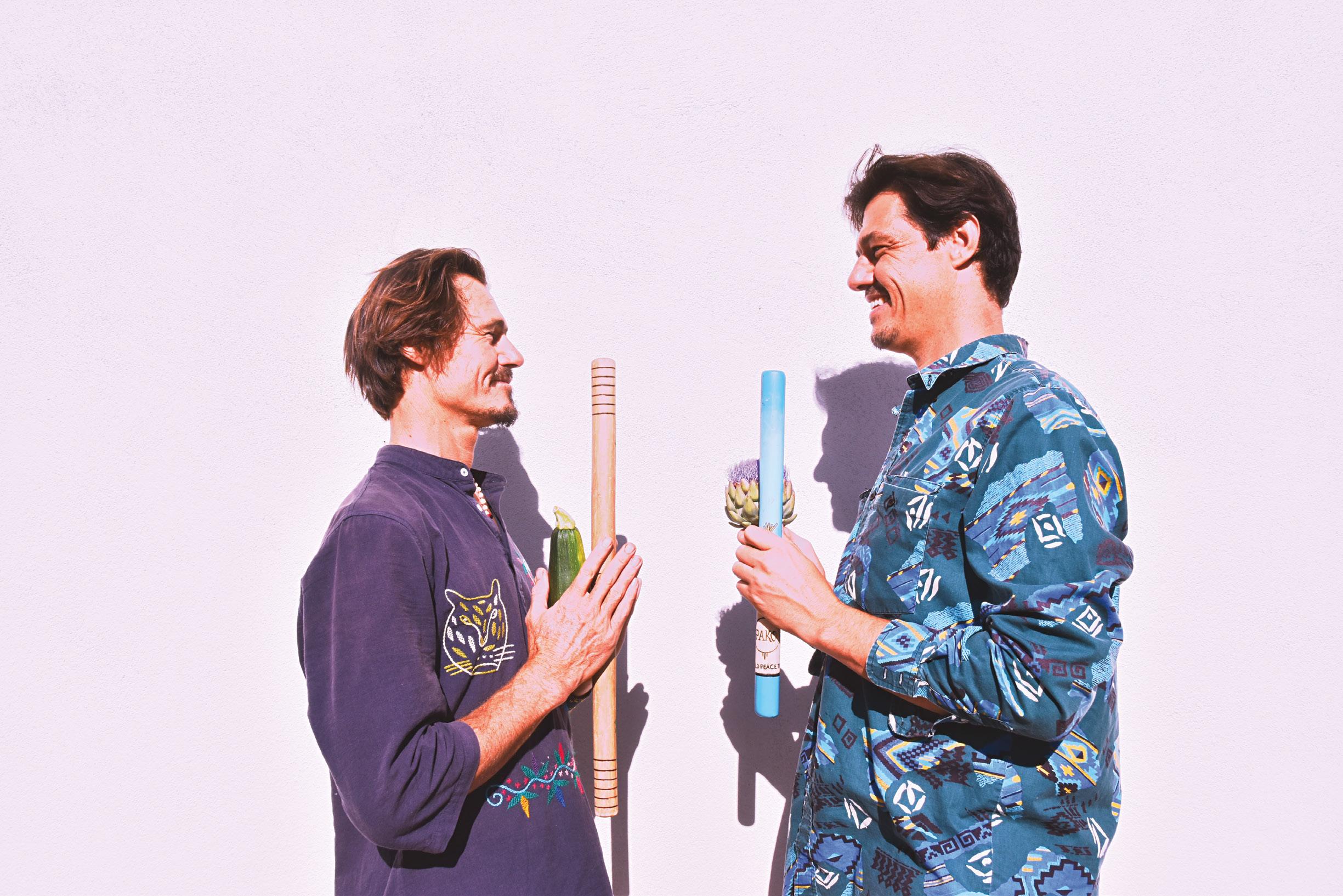
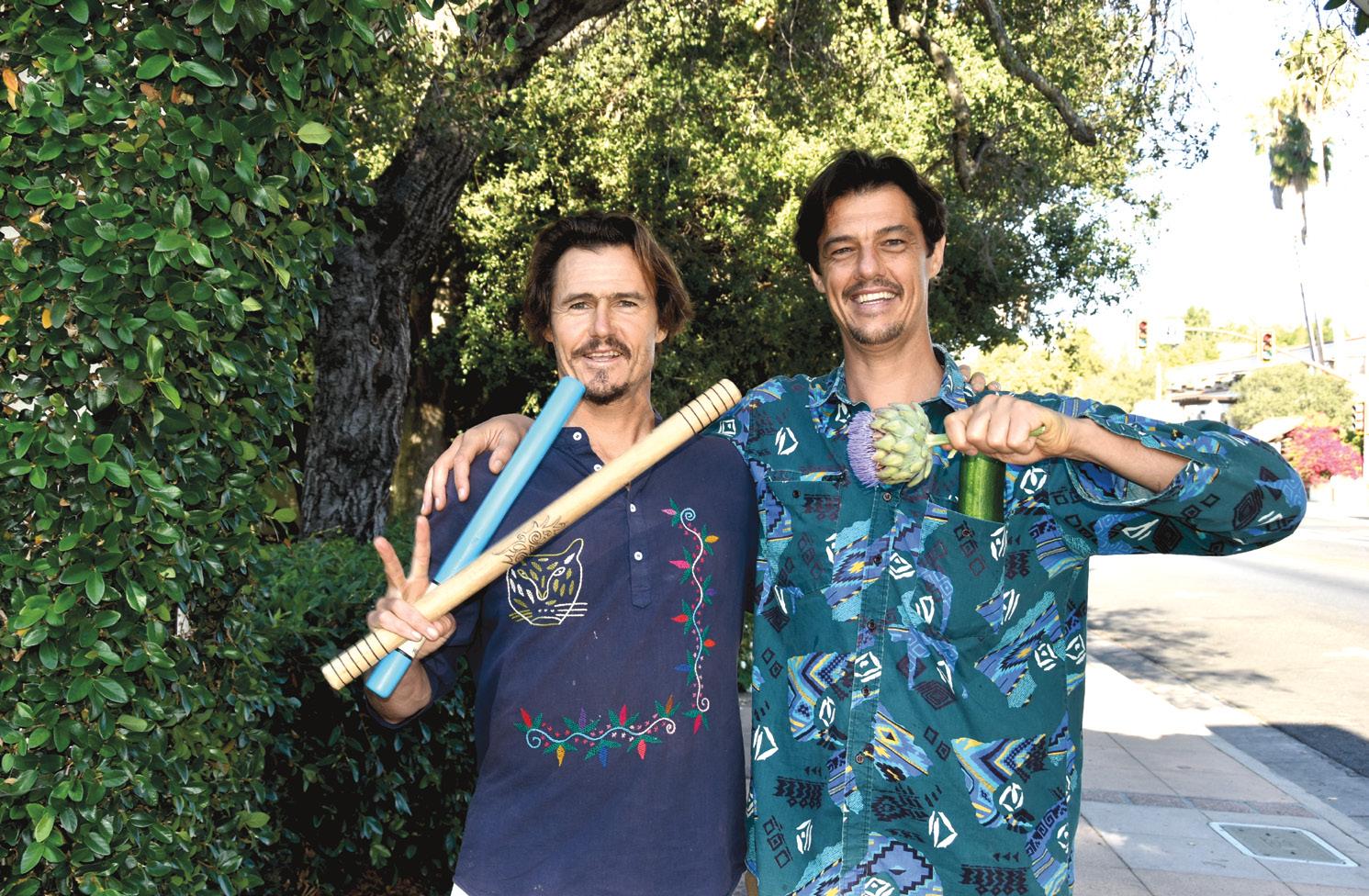
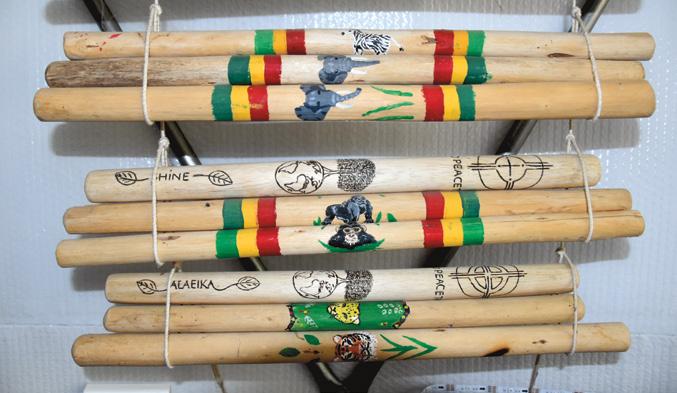
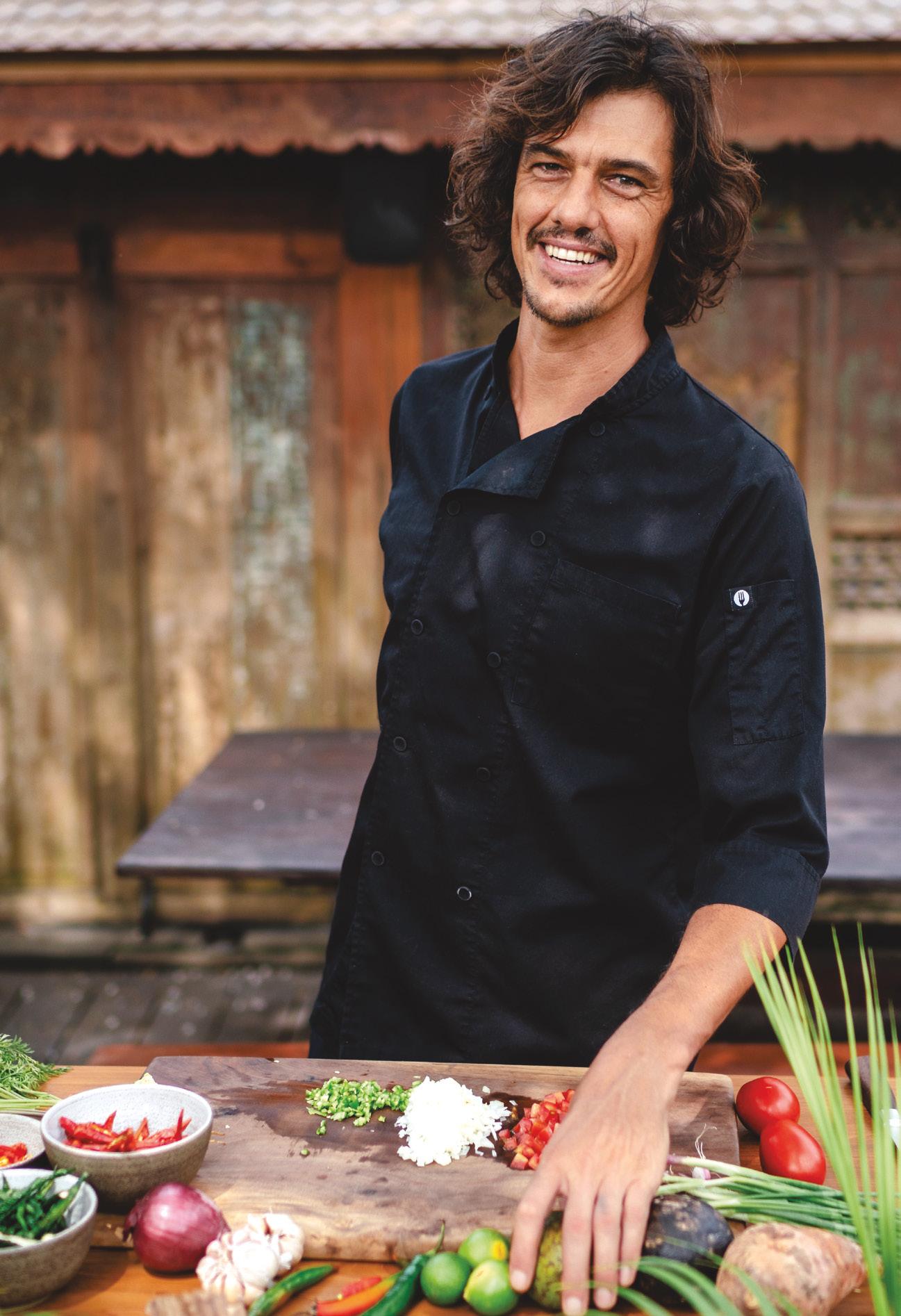
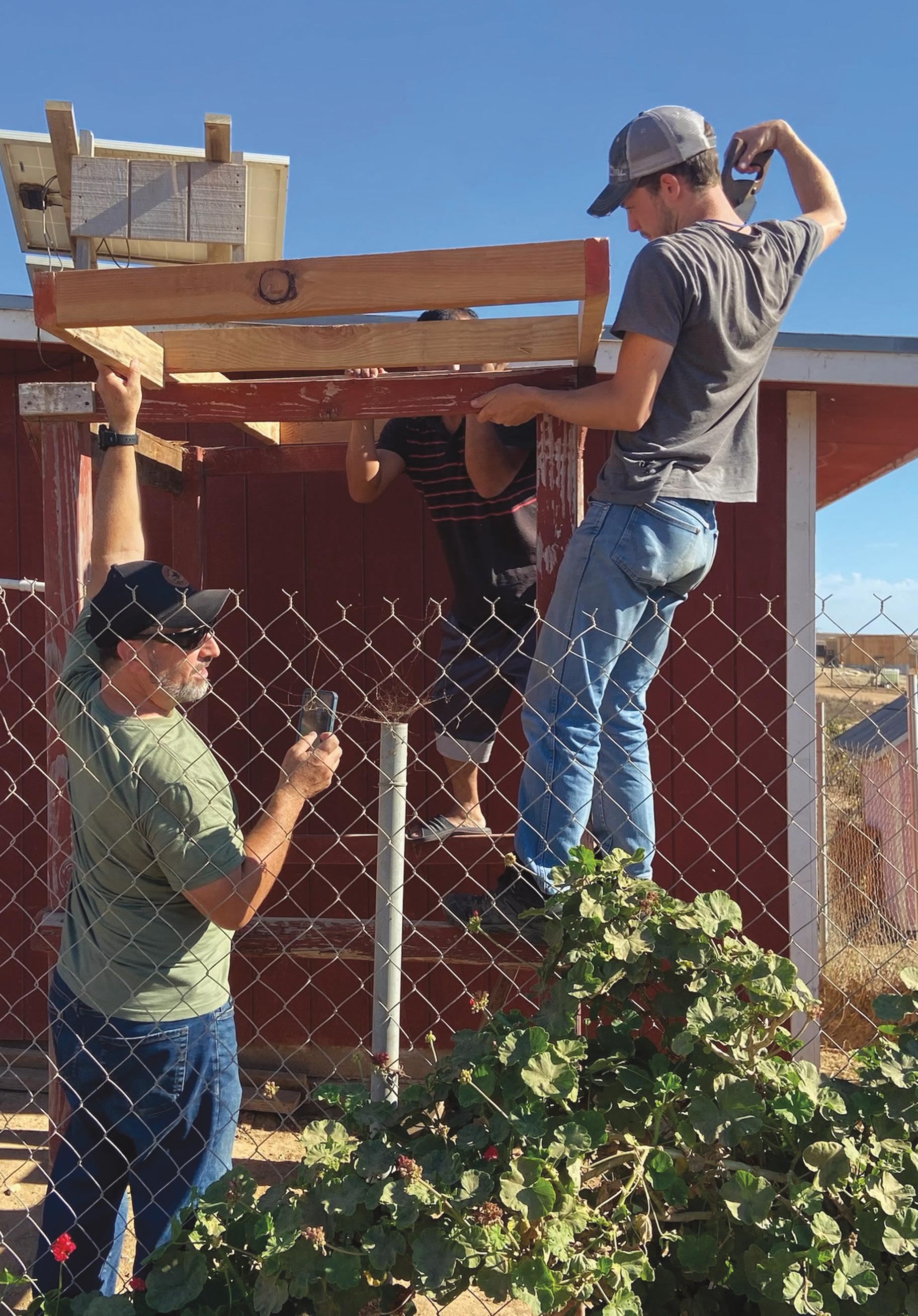
Fiber art as fashion Plaga on the veggies! Dalai Lama's Bodyguard UFOjai goes to Congress
Janet Yang
CORAL
CANYON RANCH
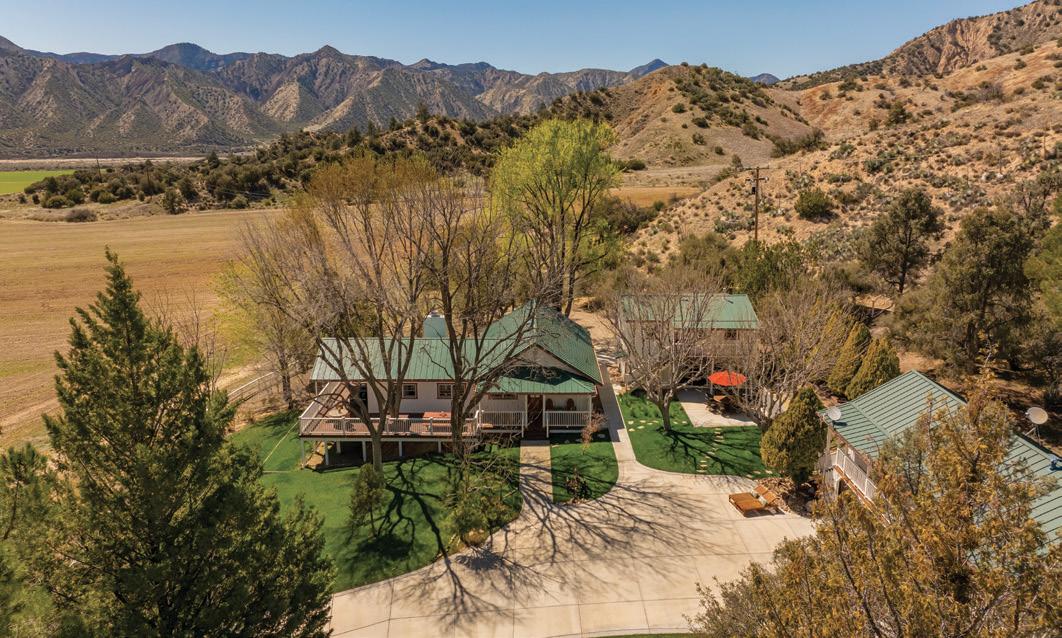
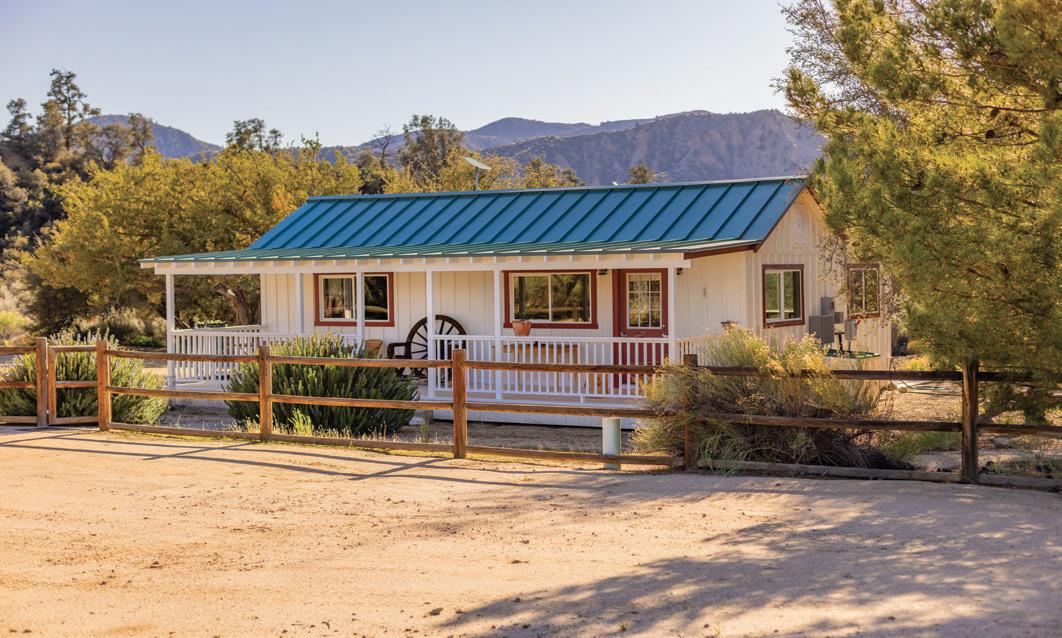
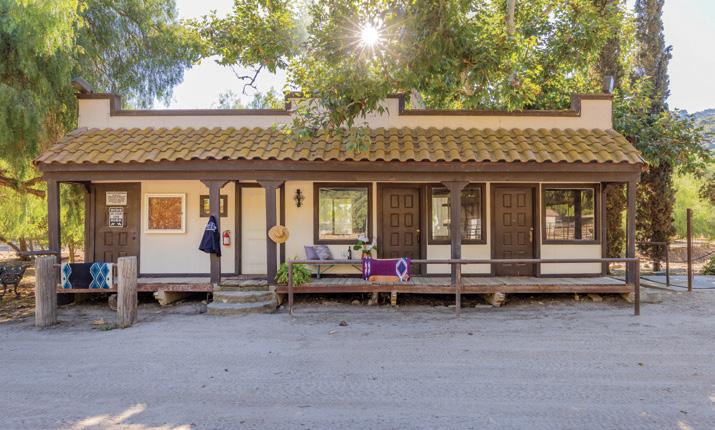
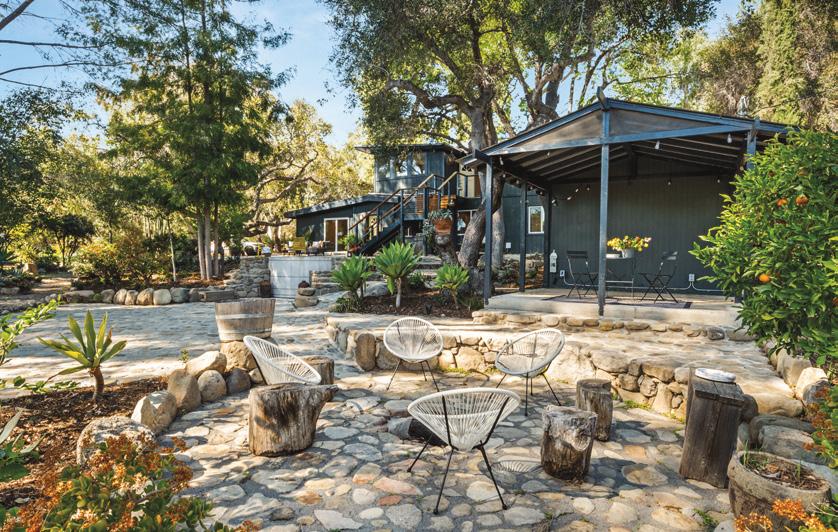
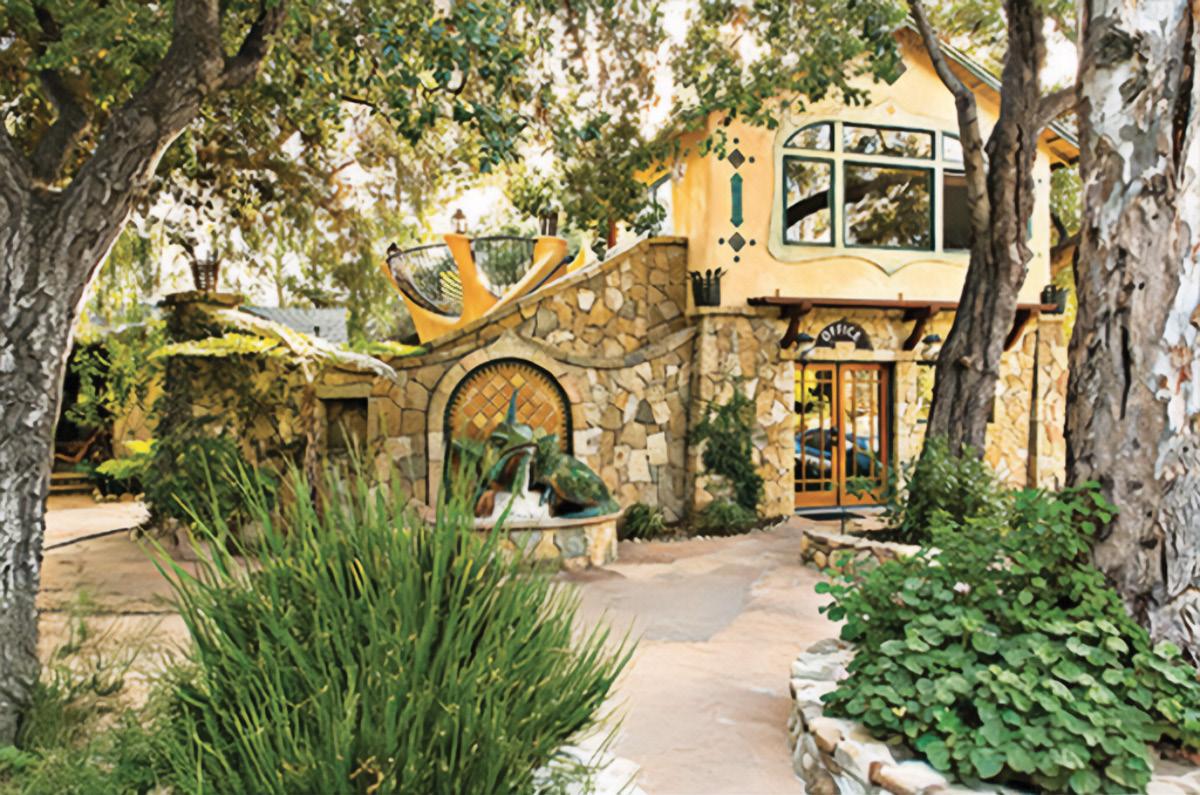
Corral Canyon Ranch - 277+ Acre Ranch in Cuyama Valley with 5 Recently Renovated Houses, Equestrian Facilities, Fenced Pastures, Hay Fields, Riding Trails, Stunning Views Surrounded by Los Padres National Forest. 29443hwy33.com | $4,950,000
ROYAL OAKS
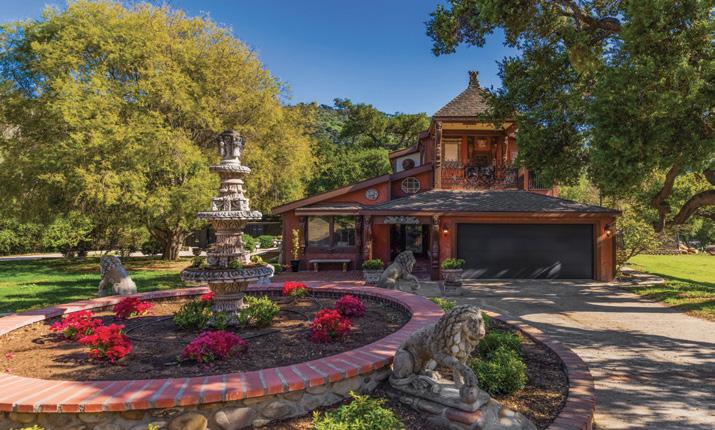
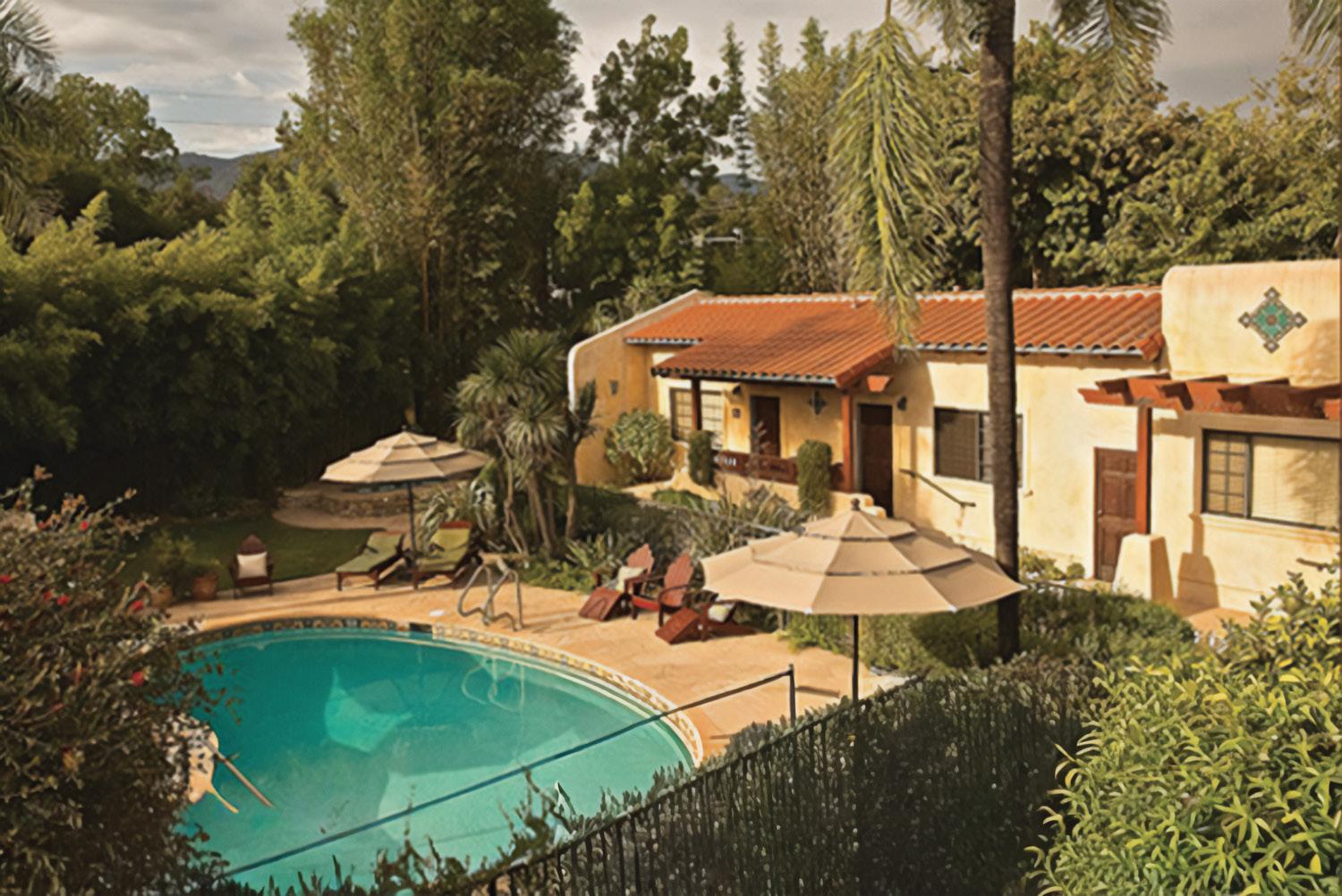
5 Bedrooms, Upscale Finishes Throughout, Media Room, Wine Cellar, Tasting Room, Gym/Massage Room, Pool & Spa, Putting Green, Well, Six-Car Garage, Bocce Court, Views, and So Much More. RoyalOaksRanchOjai.com | Price Upon Request
ROSE VALLEY LAND
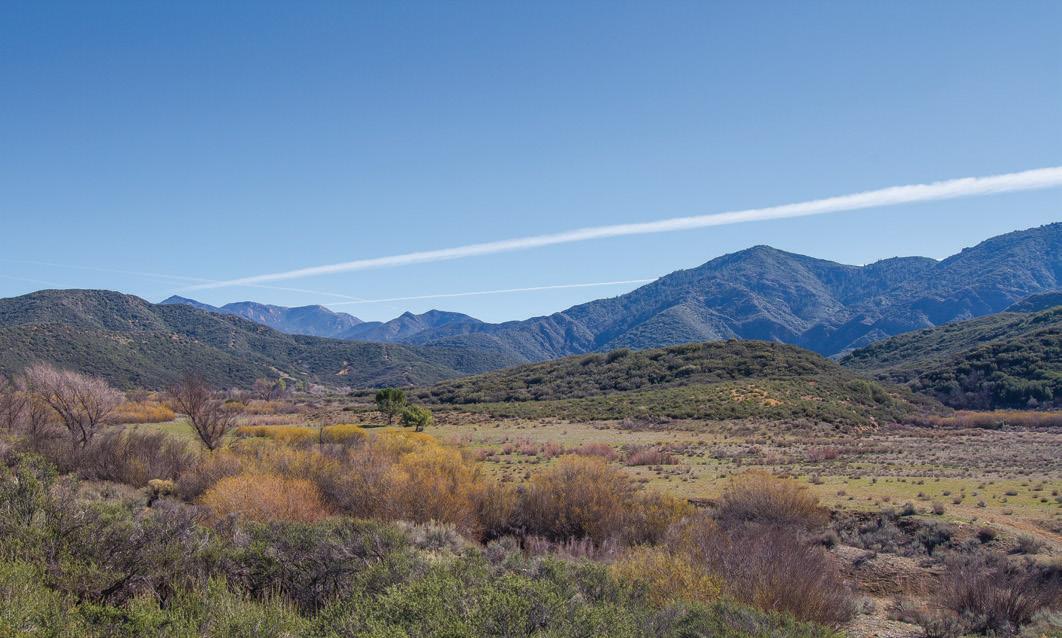
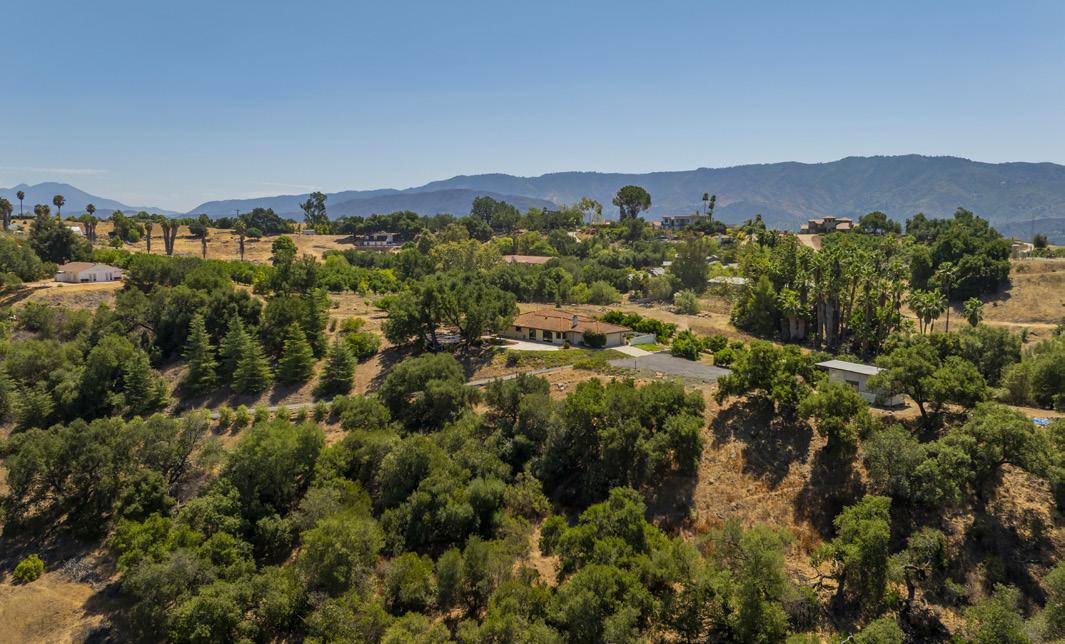
Create an off-grid, country retreat on 40 acres with mountain views, trails, and a natural spring in Rose Valley in the Los Padres National Forest $1,200,000
EAST END LAND
1.25-Acre Lot Bordered by Seasonal Creek with Topa Topa Mountain Views, Paved Road to Property, One Share of Senior Canyon Water, and Room for Horses or Hobbies. $950,000
RANCHO ROYALE
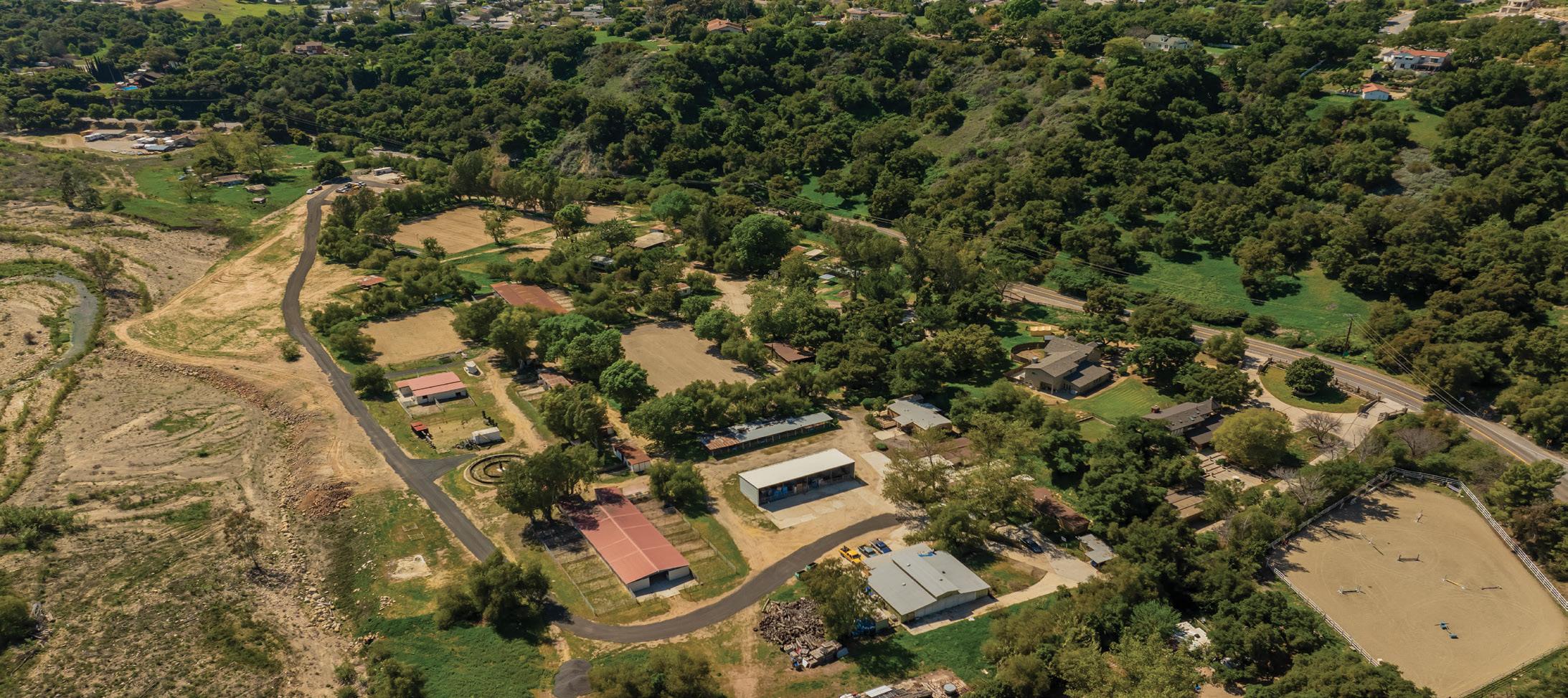
21-Acre Equestrian Estate with Main House + 8 Rentals, 7 Horse Barns, 20 Covered Corrals, 4 Arenas, 2 Round Pens, Hay & Equipment Barns, Panel Walker, Entertainment Barn, Archery Range, Mountain Views & More. RanchoRoyaleOjai.com | $6,500,000
Four-bedroom Oak View home with gas fireplace, wood-burning stove, RV parking, two-car garage, covered patio, large closets, and large family room in walkable neighborhood. $889,000
ALMOND AVENUE
Set along O jai’s coveted Foothill Road, this restored 1929 Tudor Revival estate blends historic charm with modern elegance. A designated Historic Landmark, the proper ty features a 4-bed main house, barn, yoga studio, and enchanting gardens with mountain views. Moments f rom hiking trails, farmers markets, and the O jai Valley Inn, it’s a rare chance to own a piece of O jai histor y.
GABRIELA & ELIAS CESEÑA
3541 THACHER ROAD
Serena Handley
Realtor® | DRE#01994892
805-798-1286
serena@handleyrealestate.com
Thank you, Ojai, for voting for me as one of the best realtors in town! Having been raised in Ojai, I feel a deep connection to this community and the people who call it home. For more than a decade, I’ve had the privilege of helping clients navigate buying and selling here with a calm, grounded, and relationship-driven approach. I’m grateful for the trust this valley places in me and for the chance to help others find their place in it. Follow me on social @serenahandleyrealtor handleyrealestate.com
EDITOR’S NOTE - 24
COVER STORY
After the Oscars with Janet Yang - 28
By Mimi Walker
BIG ISSUES
UFOjai goes to Congress - 52
By Grant Phillips
Dr. Dodge’s prescription for survival - 80
By Kit Stolz
Locals transform lives in Latin America - 104
By Perry Van Houten
ART & CULTURE
The fiber & textile art of Greta Lovina - 46
By Devo Cutler-Rubenstein
Maasai tribe’s maternal blessings - 62
By Karen Lindell
Can you say petroliana? - 72
By Tom Moore
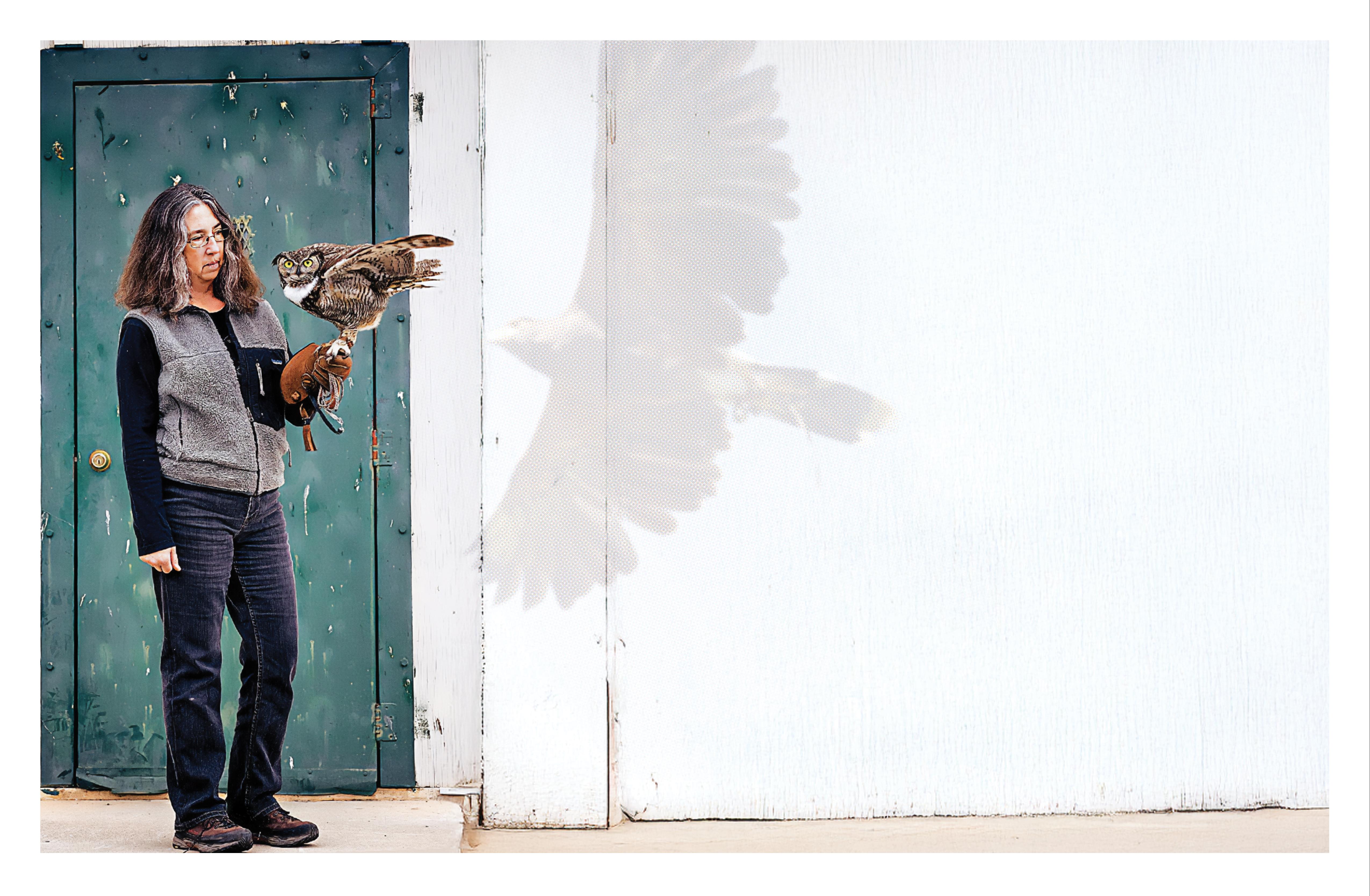
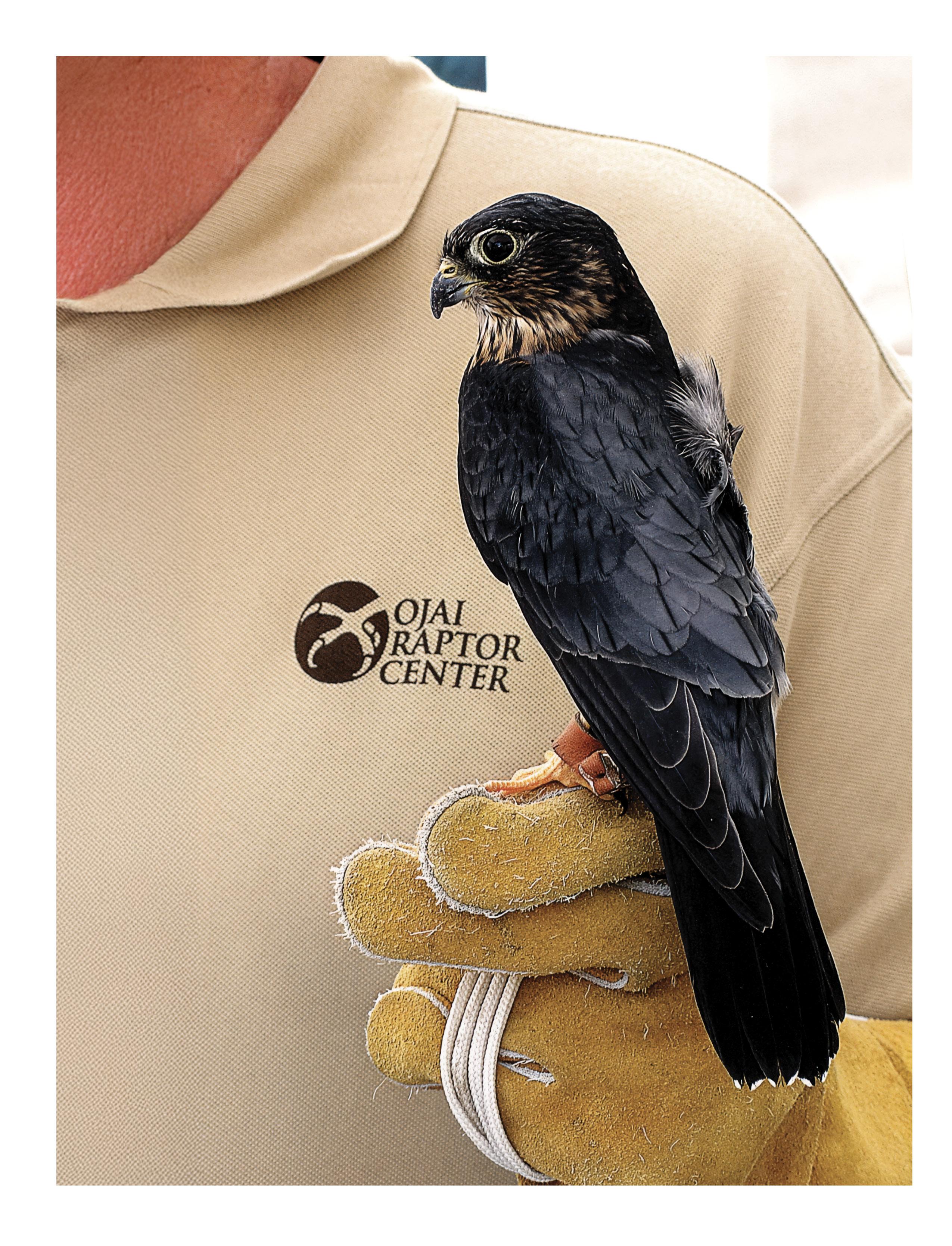
Ojai Raptor Center turns 25 - 98
By Tom Moore
MINDFULNESS
The Dalai Lama’s protector - 38
By Erin LaBelle
The Rilling brothers - 88
By Hannah Little
FOOD & FARM
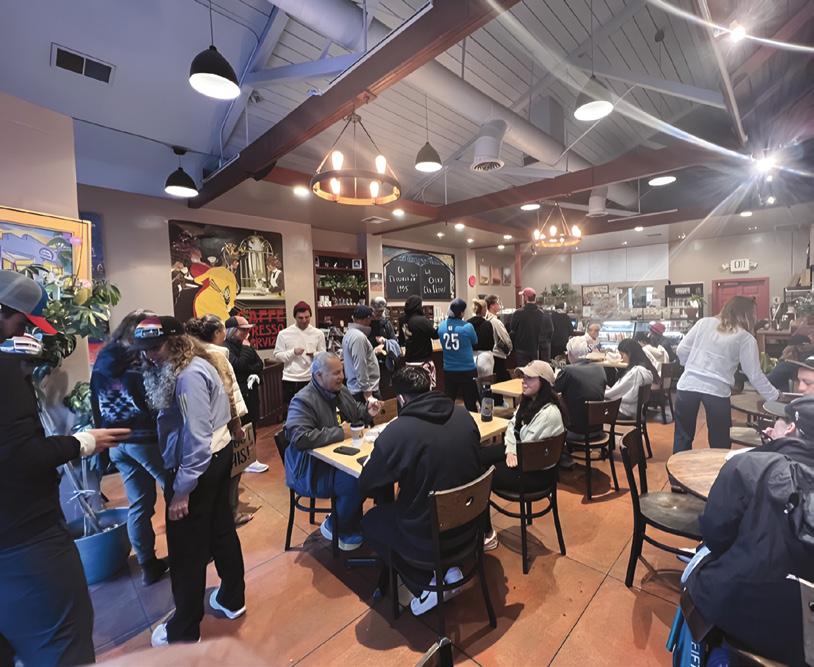
Ojai Coffee Roasters turns 30 - 110
By Mimi Walker
Plaga on the veggies - 114
By Steve Sprinkel
The breakfast club - 118
By Collin McShirley
Pomegranates - 124
By Sharon Palmer
CALENDAR OF EVENTS - 94
december 26 – february 15
of a lady, c. 1500, attributed to bernhard strigel
canvas and paper is a small art museum located in a classic california bungalow a short walk from the arcade. exhibits change every two months. admission is free.
311 n. montgomery street thursday – sunday noon – 5pm canvasandpaper.org
portrait
Editor’s Note: Winter 2025
The world view you get from a low-speed vehicle (LSV) in Ojai might be just about as good as it gets in America these days. How bad can life be when your daily commute or weekend wander is on foot down a shady bike path, or by way of streetlegal golf-cart equivalent? At the very least, it’s an opportunity to immerse oneself in the present.
With the prickle of the cool air of the season brushing my cheek, I make sudden stops to chat with a neighbor or passing visitor, then glide on to work at the Ojai Valley News, enjoy a movie respite at the Ojai Playhouse, stop for groceries at Westridge Market, or visit a non-chain local business. I step easily on and off my LSV, never suffering a hot car, or another door crammed too close to my own … hallelujah, resort living is mine.
And if driving at 25 mph slow behind an LSV in Ojai will raise your blood pressure, try meditation, or avoiding the trip into town altogether, because there is pretty much nowhere anyone needs to get to in a hurry in the city of Ojai.
This Winter 2025/26 is a serious season, and the psychic weight people are carrying is palpable. Our Ojai Magazine writers take up the story gamut of Ojai life from UFOs, nuclear weapons, the Dalai Lama, and humanitarian missions, to fashion, coffee, and farming and more.
During my years in school for the F. M. Alexander Technique, I was taught that life is too serious to be taken seriously. Recently, as the seriousness of our time becomes too great to bear, I imagine that Alexander would have favored a walk to town, a chat with a neighbor, a hug from a friend, or a quiet ride on a low-speed vehicle, and he’d be grateful for the time-out to read this Winter issue of Ojai Magazine.
3BD/2BA • $395,000 A. Stanworth / T. Rooney, LIC# 01262333 / 00599443
805.340.8928 / 805.218.8117
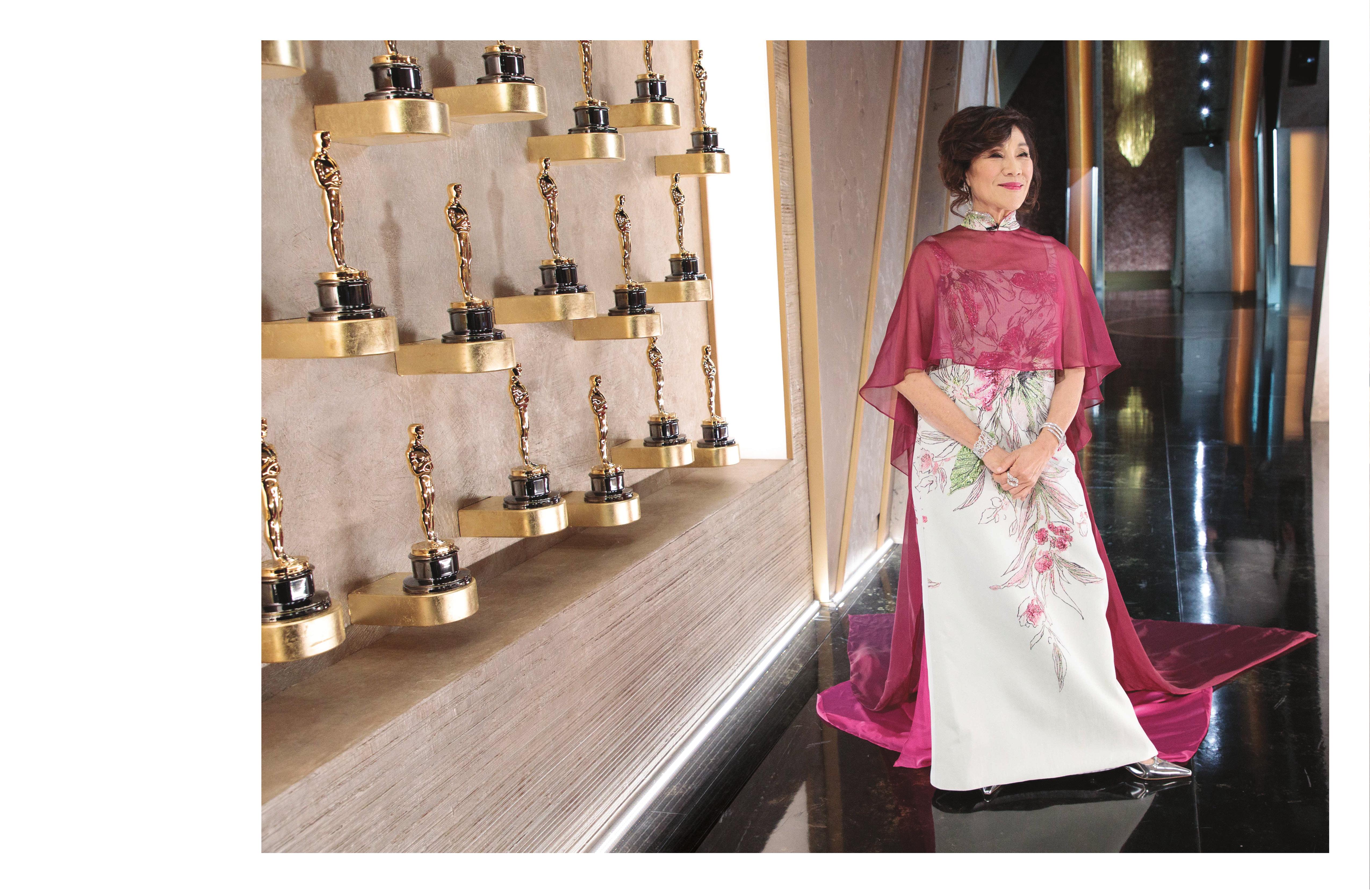
Every movie is a miracle. Every TV show is a miracle,” said Janet Yang, Hollywood producer extraordinaire and erstwhile president of the Academy of Motion Picture Arts and Sciences. The feathers in Yang’s film-producing cap are many and multihued, but just as colorful is Yang’s path to championing film as a cultural bridge-builder across the world. And, like moviemaking itself, life is an uphill journey sprinkled with miracles.
THE FIRST JOURNEY HOME
In the ’40s, Janet’s parents came to the U.S. from China as university students. Her father was from Shanghai and her mother from Hunan, “which is very famous for its spicy food, and also the birthplace of Chairman Mao (Zedong),” Janet shared. Her parents married in America, but once Mao took over China in 1949, they could not return. “Unlike a lot of other Chinese immigrants, they didn’t go through Hong Kong or Taiwan,” Janet said. “They came directly to America under this government program that subsidized their studies abroad. They kind of lived life a little bit in limbo for many years.”
Born in Queens, New York, Janet was the youngest of the couple’s three children. Given the turmoil in China, the family decided to “be an American family” and moved to Long Island when Janet was 5. They were the only Asian family in a white, mostly Jewish neighborhood, Janet said. “That probably had something to do with my desire to give people a sense of belonging, because I didn’t have that growing up,” she confided.
Still, her parents’ grit and tenacity helped carve Janet’s path. Her father found work as an engineer, and her mother worked for the U.N. “They lived through so many changes in China,” Janet said. “My mother’s older sister had bound feet and was in an arranged marriage, was uneducated, and somehow my mother managed to carve out a completely different existence for herself.”
by MIMI WALKER
A f Ter the Osc aRS
Janet Yang stays the course of movie magic
Photo Courtesy of Academy of Motion Pictures Arts and Sciences
The borders around visiting China finally gave way in 1972, when Janet was 15. It changed everything in her world. “I didn’t speak Chinese at the time,” she said. “I met all my dozens of relatives. … And I just was so deeply moved by that trip, because I realized that I almost grew up there. My relatives … I could see the familiarity, but they had a wholly different life. All of it was so intriguing, and I felt kind of embarrassed that I didn’t speak Chinese. Later in college, I decided to study Chinese, and I got so into learning about China that I decided to want to go live there.”
When Janet did move to China in the early ’80s, “I saw movies that were made by, for, and about people that looked like me, and I couldn’t believe it,” she shared, adding, “I just wanted other people to see them, because I wanted them to have the same experience — look at what Chinese people can do.” She returned to the U.S., earned a business degree, and began organizing Chinese film festivals “on the side.”
ENTERING HOLLYWOOD
Soon after her return to the U.S., a theater company in San Francisco hired Janet to help with distribution. “I was basically showing these Chinese films in theaters and museums, universities, art houses, wherever I could,” she said. An executive at Universal Studios soon tapped her to open the market to show and sell American films in China.
In that work, Janet said, “I was still going back and forth to China, and I was now taking American films over. I was choosing from the libraries of several major studios, and I got to bring Gregory Peck over (in person) … to this day, Roman Holiday is a very, very beloved movie in China.”
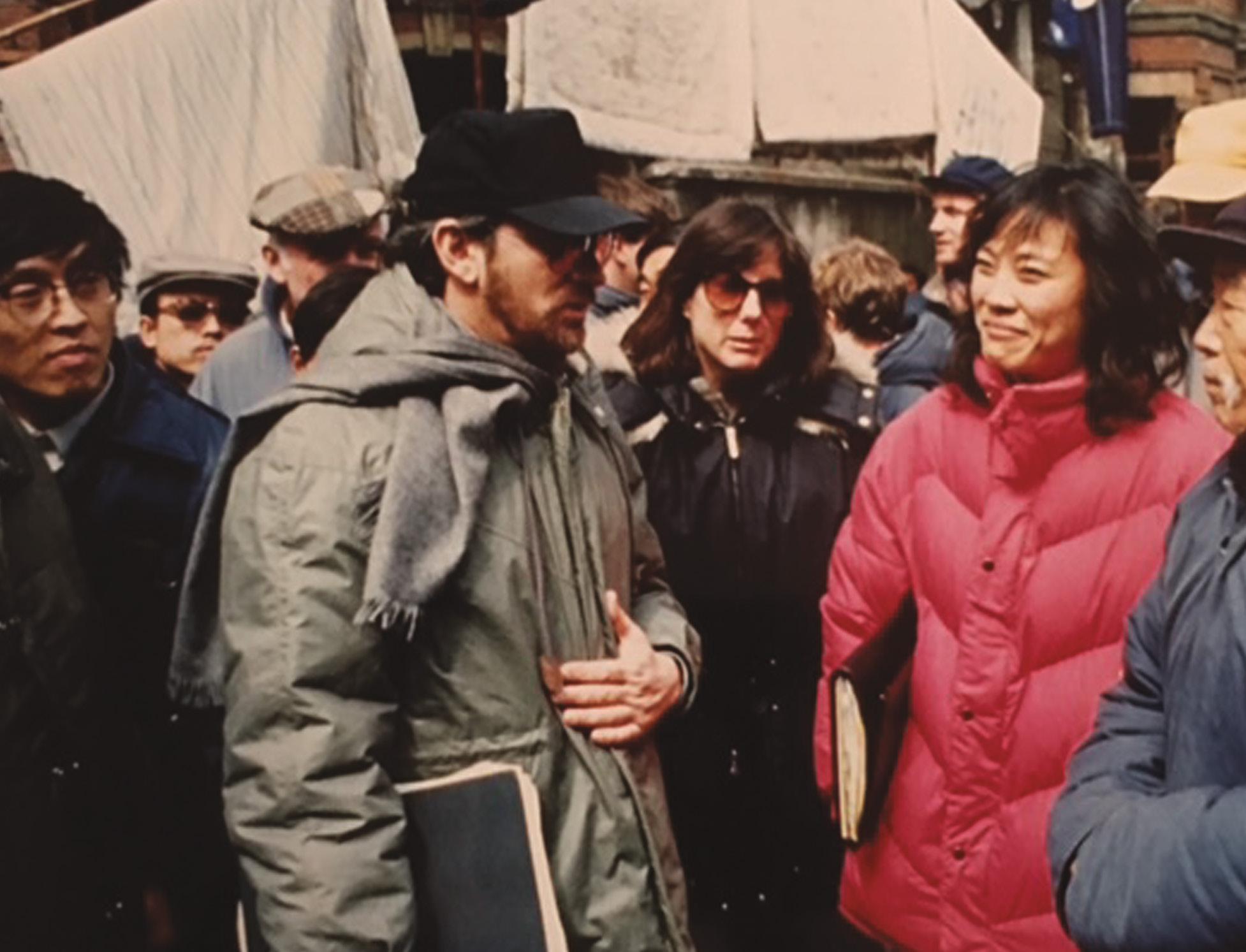
In the mid-’80s, she received a call from Kathleen Kennedy, producer for Steven Spielberg, who told her Spielberg wanted to direct a film in China. Janet became the primary liaison for facilitating production of Empire of the Sun, the 1987 movie debut of then-11-year-old Christian Bale.
“I was there for six, eight, 10 months, maybe, setting it up,” Janet said. “Then Steven arrived. And I was literally riding to and from set with Steven. … I realized, ‘Oh … this is what I want to do.’”
Janet became an executive at Universal after the film wrapped, and also worked with Amblin Entertainment, Spielberg’s film production company. But, she confessed, “I really loved being on set
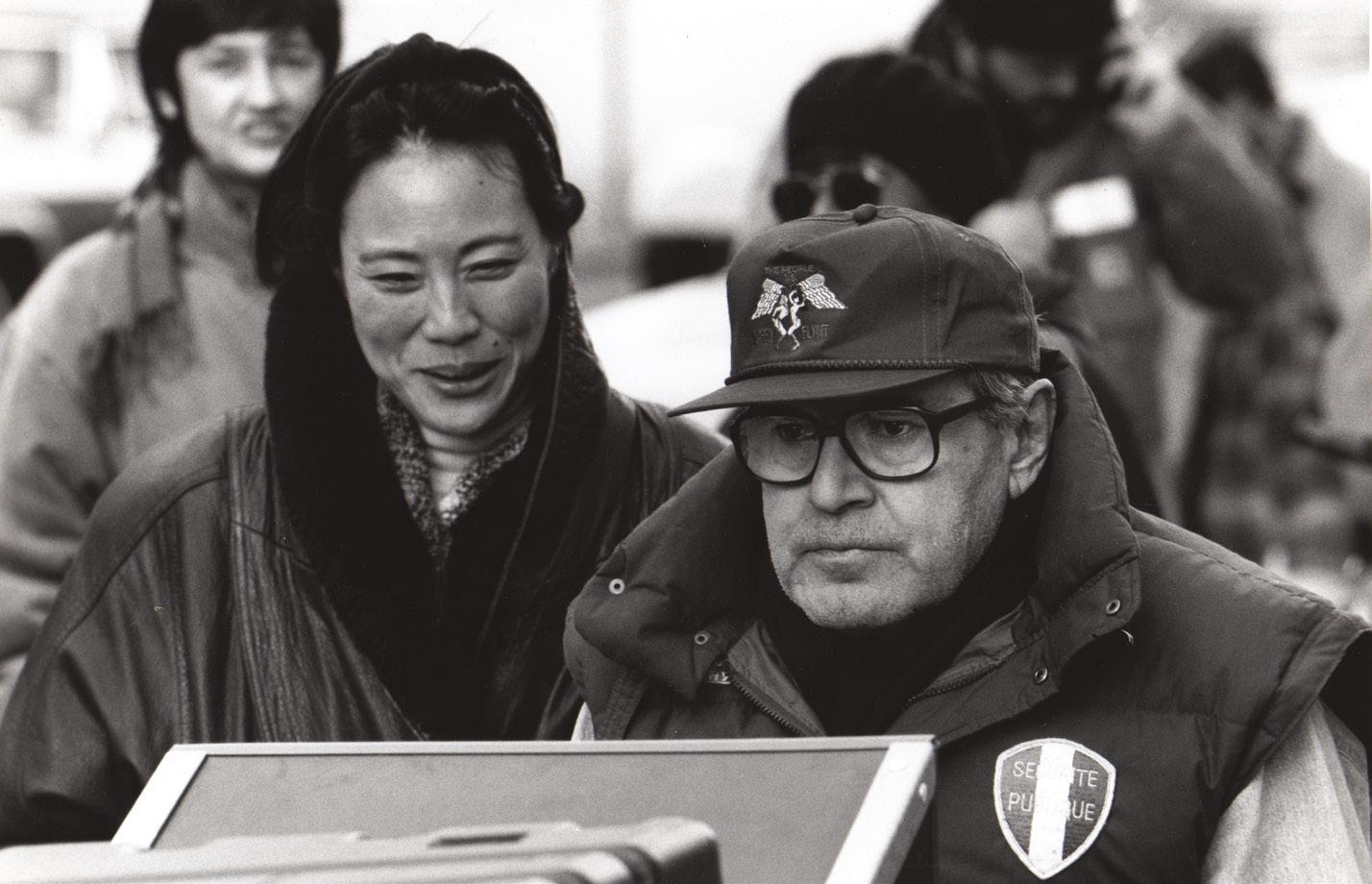
Below: With director Miloš Forman on the set of The People Vs Larry Flynt.
Above: With Steven Spielberg on the set of Empire of the Sun. “I was literally riding to and from set with Steven. … I realized, ‘Oh … this is what I want to do.’”
Photo Courtesy Janet Yang Productions
Photo Courtesy Janet Yang Productions
and being a producer more than an executive.” Another heavy hitter in the filmmaking industry helped lead her back to that path: Oliver Stone.
Janet had met Stone years before through a documentary filmmaker ex-boyfriend. When she was organizing Chinese film festivals, Stone, who had written the script for Year of the Dragon (1985), avidly attended the festivals. Years later, after Stone established his own film production company, Janet revealed: “I did say, ‘Oh, hire me!’ And he miraculously did.”
That company was Ixtlan Productions, named after Carlos Castaneda’s book Journey to Ixtlan: The Lessons of Don Juan. Janet worked alongside Stone for seven years during the ’90s.“ He was directing a movie a year, I was producing a movie a year; it was a very, very busy time,” Janet said.
Before joining Ixtlan, Janet represented Amblin with Kennedy on a trip to New York to scout potential script opportunities from book publishers. Those publishers had “three discrete chapters” of then-first-time novelist Amy Tan’s debut work, The Joy Luck Club, which Janet had the opportunity to read. “They gave me the little manuscript pages, which I read on the plane right back, and I just was so stunned and moved to read something that was so close to my life,” Janet said. She reached out to Tan, “and one
I said, ‘I’ll do everything I can to get this movie made.’
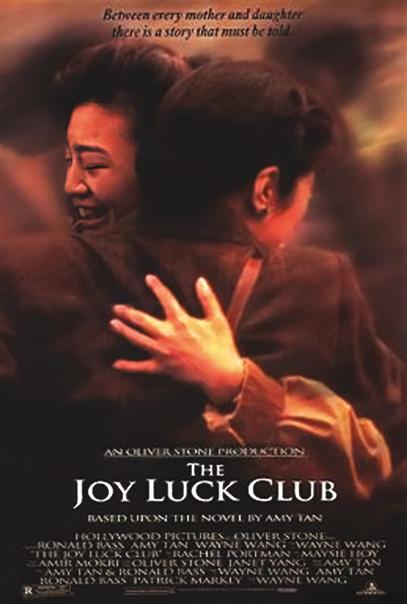
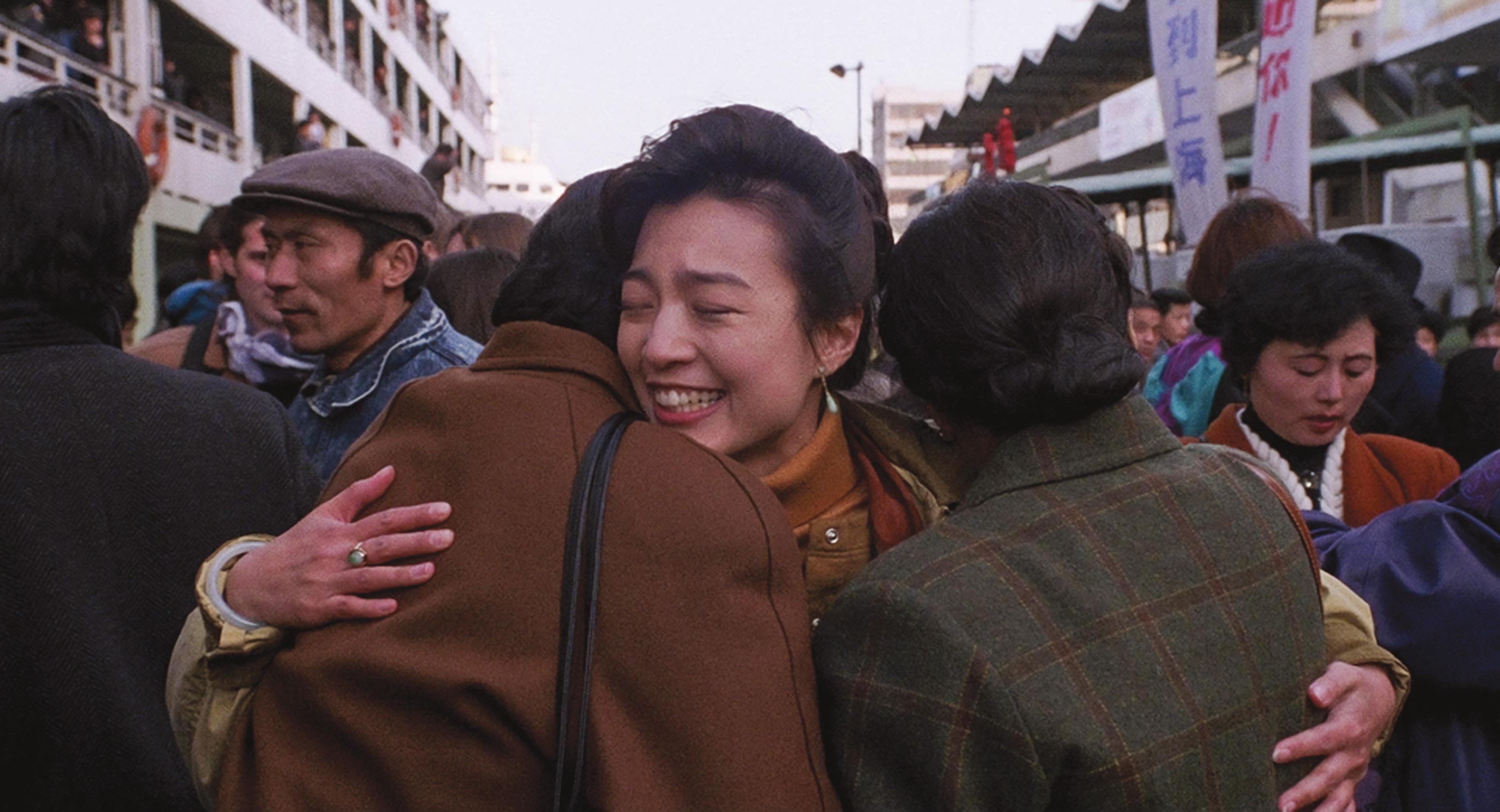
thing led to another. She started sending me pages as she was writing them,” Janet remembered. “I said, ‘I’ll do everything I can to get this movie made.’ And years later, that’s what happened.” Janet and Stone executive-produced The Joy Luck Club in 1993, with director Wayne Wang at the helm. In 2020, the groundbreaking film — one of the first to put Asian and Asian-American mother-daughter dynamics in the mainstream spotlight — was selected for preservation and
induction into the National Film Registry by the Library of Congress.
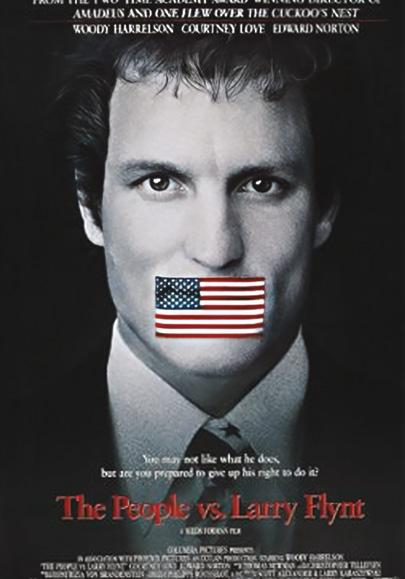
Stone and Yang also produced the edgy, then-controversial biopic The People Vs. Larry Flynt in 1996, which earned Oscar nominations for both lead actor Woody Harrelson and director Miloš Forman, whom Janet called “an extraordinary director. He really had a very relaxed approach. He really trusted his actors.” She recalled his “thick Czech accent” after every take, when he’d say: “Perfect! Now, do it again.”
Yang spoke fondly of the host of talented directors she’s produced for — Jake Kasdan, Predrag “Gaga” Antonijević, and Chen Shi-Zheng, who directed Dark Matter (2007) and Disney High School Musical: China (2010). And, of course, Spielberg and Stone.
“Steven is lovely. He’s got a childlike (curiosity) and still has it. That, to me, is the key to longevity,” Janet shared. “He and Oliver are really different — like, really, really different. I respect them both so much. But Steven just gets excited about things, and you want to join in his excitement. And Oliver has a different way of bringing out great performances in actors … and producing, he challenges you. It’s a different approach, which also can be very effective.”
Below: The Joy Luck Club, which Janet executiveproduced with Oliver Stone
Janet was elected president of Academy of Motion Picture Arts and Sciences in 2022 and served in the role until this year when Lynette Howell Taylor succeeded her. “I started at the same time as the new CEO, Bill Kramer, and we just jived,” Janet said. “We were both very, very aware of the need for a lot of change. … I really wanted to engender more camaraderie. People love having the in-person gatherings that we do, and we have a pretty robust series of educational programs and internships … that are about nurturing new generations of cinema lovers and cinema makers.”
Leading almost 11,000 members who represent a rapidly changing industry has its challenges, Janet said: “People look to the academy because we have such a big brand, and they sometimes want us to make statements, you know, for or against, or to … use the brand to enact change or to galvanize people, be a platform for political views. … Because we’re a 501(c) (3), we’re not allowed to actively do that, but it’s finding the right balance.” She’s concerned as well about “the specter of AI. People [are] very divided about [AI’s] use and abuse, and its effect on the entertainment industry. So while we don’t necessarily take a stance … what I feel like I’ve been good at most of my life — and this, I think, comes from being a minority — is being a good listener and a good observer. Because if you feel like you’re on the outside, you have to kind of lean in closer. … We try to listen very carefully and at least offer a safe space for people to have meaningful conversation. And I think that’s what we’ve started doing much more of, even in the last year or two. … The other issue that’s very much been on our minds, we still insist that movies are screened theatrically before they’re nominated.”
Although leading the Academy is an unpaid, full-time gig, “it was really a privilege to be able to represent the academy and bring some of who I am into the mix,” Janet said. “It’s been a really fulfilling time, because we saw a lot of change. We introduced some new awards, and we really were focused on expanding our membership to more international members, which hadn’t been the case before, just diversifying membership. And it’s been interesting to see how quickly that shows up in (Oscar) nominations.”
OPERATION OJAI
When Janet stayed at the local Pepper Tree Retreat (now Krishnamurti Retreat) several years ago, she thought of Ojai more deeply as a grounding space. “Suddenly, it felt like I was in a home as opposed to a hotel,” she said. “Just the fact that all these spiritual leaders have been
This, maybe, is just my karma, but I’ve experienced both for myself, and in others, the ability to transform people’s lives through works on screen.”
here and have developed schools … it just
infuses a whole way of being, and it’s an antidote to a lot of the rest of the world.”
One Memorial Day weekend a few years ago, during the pandemic, she drove by some houses with her son, who told her he had a feeling she’d end up with the one they both liked. Even though she
wasn’t looking to buy, that’s exactly what happened.
“I’ve said to people, ‘I didn’t know I needed Ojai until I had Ojai,’” Janet said. “I didn’t even know how much grace and balance it would bring into my life. … It is a community of artists, and it just runs on a different vibration. I love that.”
Last July 13 — Janet’s birthday — she was on hand for a postshow Q&A when The Joy Luck Club screened at Ojai Playhouse. “I’m so indebted, as many of us are, to David Berger for pouring his savings into making that theater come alive for all of us,” Janet said. “I’m so happy to do more of anything I can do to contribute to the Ojai community, which is really special.”
Post-Oscars, Janet intends to use her voice more literally in public speaking to continue enacting positive changes for creators.
“I can speak to women’s issues. I can speak to women of color or people of color. I can certainly speak to East/West things. … One of my many messages would be, we have to listen to artists and not just data,” Janet said.
She added: “This, maybe, is just my karma, but I’ve experienced both for myself, and in others, the ability to transform people’s lives through works on screen. I just can’t let go of that mission now.”
For more information, visit janetyang.com.
Arriving at the Beijing International Film Festival in April 2025.
Photo courtesy Beijing International Film Festival
LUXURY HOME
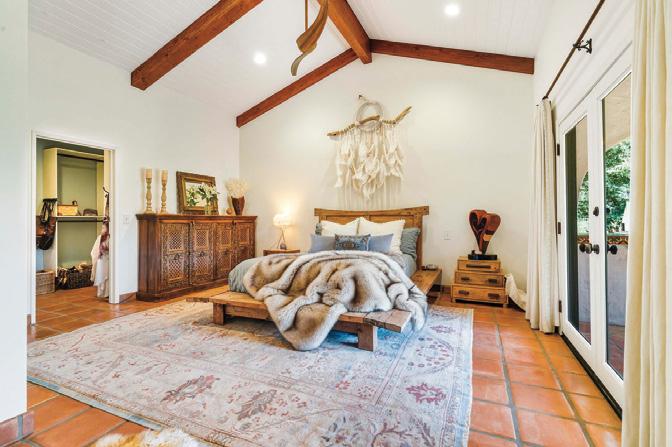
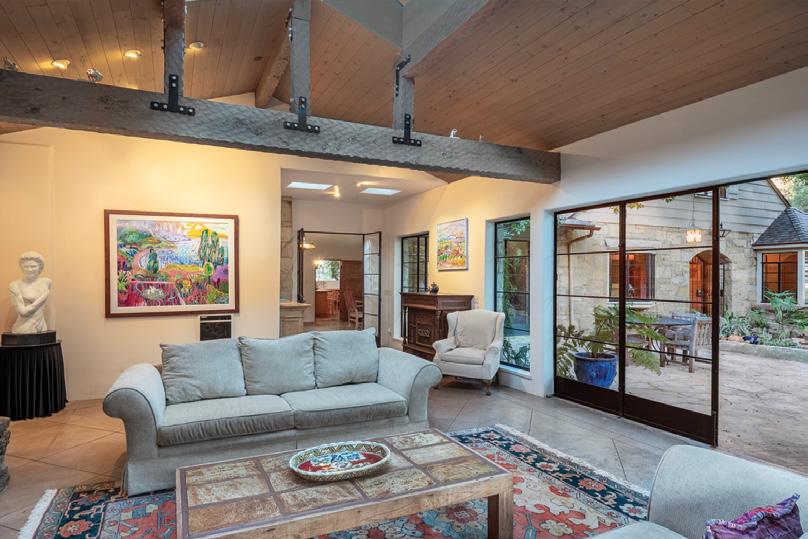
A modern Spanish retreat capturing the essence of Ojai’s hacienda living, offering 3 bedrooms, 3 baths, and two inviting primary suites
Expansive windows and doors create effortless indooroutdoor living, opening to grand patios with breathtaking Topa Topa mountain views
Ideally situated within a quiet, upscale neighborhood offering privacy and minimal traffic, yet just a short stroll from downtown Ojai
Jeri Becker
805 340 2846 jeri esq@NHPCR com #01768956
805 758 0755 rileyavendanoorealtor@gmail com #02052306 Riley Avendaño
“My life is like a roller coaster. I see the Heaven and I see the Hell.”
— Dargyal Jamyang
For years, Ojai resident Dargyal Jamyang (Jamyang) has been approached by prestigious publications, screenwriters and publishing houses for his story, but he wasn’t ready to tell it, until now. The former Tibetan political prisoner is working on his memoir, determined to give voice to the suffering of his homeland and its people. Jamyang’s path has not been easy. A childhood in Chinese-occupied Tibet, almost two years of torture in Chinese prisons, and a healing journey that led to serving as the Dalai Lama’s chief of security fuel him.
“My father always told me we had two missions: to tell the true story and to protect the Tibetan people and land,” he said. “We are Buddhist and believe in karma, but I think people need to know this really happened.” When Jamyang speaks to groups, he acknowledges the sensitivity of the information he is about to share: “Some stories carry a weight that must be understood with the heart.”
Endless vignettes could serve as powerful starting points, but perhaps it makes sense to begin in the mid-1990s at the life-altering moment when Jamyang, then 17, was questioned by Chinese Communist Party border officials. He’d spent a year studying in India and was crossing back into Tibet since his mother was unwell.
“I told them the truth about what I see and believe,” Jamyang said. “I spoke about freedom of speech and freedom of thought. They asked a lot of questions
Da R g Ya L Ja MYa Ng
The true story of the Dalai Lama’s chief of security
by ERIN LABELLE
like, ‘Why did you go to India?’ And I told them I went for freedom and education and choice.”
During the 18-day detainment in Kyirong, the gateway village between Nepal and Tibet, and in the arduous imprisonment that followed, the teen was systematically tortured by Chinese men and Tibetans who worked for them.
CHILDHOOD CURIOSITY
The seed for Jamyang’s activism was planted when he witnessed suffering during his early years in a border village,
and heard his elders tell stories about their lives after China began invading Tibet in 1949.
He listened to his father, grandmother, and others reminisce and keep each other up to date about the atrocities against their people. They spoke of great hardship after Tibetans’ rights, religious freedom, and cultural identity were restricted.
“I heard a lot of true stories when I was young,” Jamyang said. “I was a curious child with a good memory. In 1949, China began its invasion of Tibet. By 1959, our
homeland had fallen. His Holiness the Dalai Lama was forced to flee, leading 80,000 Tibetan refugees into exile in India. There were 6 million Tibetans, and the Chinese killed 1.2 million. My family’s story is but one among the countless tragedies born of that time.”
His grandmother, hoping to protect her young grandson from their harsh reality, kicked Jamyang out at times, but he always found another way to access the conversation.
Jamyang’s father became a monk at age 7 and experienced the CCP’s invasion and brutality firsthand at age 12 or 13.
“They burned an ancient temple and 800 years of history, even the book my father was holding,” Jamyang said. “They dragged him by the legs; the scar is still on his head. His teacher was burned in the monastery.”
After escaping, Jamyang’s father fled to his village, arriving home in time to witness the Chinese army execute his father and three other family members.
“He hid in the mountains for a few years, and my village fought back,” Jamyang said. “The army put them in a camp, including my grandmother, who was the only one who came back. She saw people die, and no one took care of their bodies. They put them in the corner on the wall, and they flipped each body after a while. Never before in Tibetan history had we witnessed such devastation.” Jamyang remembers hearing stories of villagers who attempted to escape on horseback with children and belongings. “They killed the adults when they crossed the Yellow River, and no one took care of the kids and yaks. Kids were crying and their voices slowly disappeared as they drowned,” he said, adding he could share many other equally heart-wrenching anecdotes.
“I also heard about the Dalai Lama,” he said. “My grandmother said he was like the sun. One time, after listening to my elders, I climbed to the top of the mountain and saw an eagle flying. It disappeared on the horizon, and I wanted to go far away to see the world too.”
FIGHTING BACK
In his outrage toward the CCP, Jamyang remembers doing many things during his childhood that weren’t smart. “My family had a lot of land, and the Chinese
Jamyang greets the Dalai Lama on his 90th birthday in Dharamshala, India on July 7, 2025. Photo: Tenzin Choejor.
wanted it,” he said. “Thousands of years it belonged to us. There was a big white stone that was like fragile marble. It was unique, and I was proud of that rock. It looked like a stupa. It was about 30 floors high. I felt it was my spiritual tower. A lot of people visited ‘Empire Rock’ and took pictures. At the top was an eagle’s nest, and morning and afternoon were very special there.
“The Chinese exploded it to make marble tables and floors. This really hurt me. They did a lot of mining too, and used it for bombs. They thought everything was theirs. It took many cars to move the rock, and a truck was stopped in the road. I was looking for an opportunity for revenge, so I put their truck in gear and let it go downhill. It flipped several times.” Chinese men confronted Jamyang before going to his father, and he admitted his intention was revenge, standing up for himself and his people by taking responsibility.
“I ran to my parents, and there was an investigation. My father had to pay, and he thought I was a big troublemaker. He told me these were dangerous people, and he didn’t want me to be a killer. I told him I will never be a killer. I am a warrior and I want revenge. My father was always worried about me, but I am very kind. I would give poor Tibetans my clothes, but I also wanted to protect my country.”
WARRIOR LINEAGE
Although the details of Jamyang’s birth are cloudy, his ancestral lineage is crystal clear. “No one knows exactly when I was born,” said Jamyang, during an interview outdoors at Mandala Restaurant in Ojai on a warm winter day. “My mother cut the umbilical cord with her teeth and tied it with her hair while she took care of the yaks in the mountains alone. She said it was winter and a snowy time, but it snows there for eight months. A teacher picked my birthday. They didn’t know the year, so she picked 1977. We believe birth and death are not important in a person’s life.
“My lineage is a warrior family. My ancestors were like the Japanese samurai. They were protectors for the Dalai Lamas, and they were sent to protect the border. They used swords, bows, and arrows to fight with China many times.”
Jamyang’s drive to protect Tibet grew during his school years. He remembers his father and grandmother arguing about sending him to a Chinese school, but his father won, insisting it was important for his son to learn Mandarin. “My father was the first of Tibetans to go into China with business and come back,” Jamyang said. “He spoke but didn’t write or read Chinese. It was challenging for him to find the toilet. Everyone wanted children to go to school so the new generation could find the toilet.”
Jamyang’s grandmother feared he and his brother would be brainwashed in school. “My brother became a monk at a young age, and I was the only one to go to high school from my village,” he said. “I was sent to a border school in grade 6, and I lived in a dorm. The school was abusive. The teachers didn’t trust you if you were smart. They thought you were cheating. Two times the school did an investigation on me, because I was so good at math. The verbal, mental, and physical abuse made me very strong. My father told me to bite them and he would pay the medical bill. He encouraged me to stand up for myself.
“My mind was always conflicted about who was telling the truth, but as I grew up I realized it was propaganda at school. Chinese communism was the biggest evil. One Tibetan guy in school got diarrhea at midnight. It was very painful, and I ran to the teachers for help. They said it is night, so they didn’t pay attention.”
Jamyang and other middle school students pushed their friend in a cart from school to the hospital, nearly 5 kilometers. “The Chinese nurse and doctors didn’t pay attention,” Jamyang remembered. “He waited three hours to be cared for. I became really mad and hugged their legs and begged them. When he went to the emergency bed, his eyes closed and he stopped breathing. He died in front of me. Little Japanese was his nickname, and he was 11 years old. His father got there 10 minutes after he died.”
The emotional pain coupled with the lack of help from adults caused Jamyang to lose hope in the government.
“We all committed to fight for our friend when we grew up,” he said. “After that I began to climb high mountains more. I was always looking for the eagle and the swallow. My medicine at the time was
to watch the birds, and I always wished I had wings so I could fly far away.”
FINDING FREEDOM
In hindsight, Jamyang can see his trauma led to a spiritual deepening, but during his captivity in seven Chinese prisons, especially when he couldn’t open his eyes, he wasn’t sure how things would turn out. After enduring nearly two years of imprisonment and severe torture that left him weak and close to death, he was sent to an army hospital.
With only 20 days of rest, he escaped through a window and ran as fast as he could. Jamyang didn’t look back and he aimed for the river, because movies had taught him dogs can’t find a trail that ends in water. “I hid by a hill,” he said. “The army was everywhere. Dogs were barking. The whole night I was running. I knew I would make trouble for my family if I went home, and I knew they would think I’d go home or to India, so I went the opposite direction into China instead.”
Constantly outsmarting his captors, he found a job in a Chinese Muslim community where he spoke the language and took on a Muslim name. He spent three weeks working, eating and regaining his strength before making his next bold move.
Tibetan nomads on motorbikes and other strangers showed up at the right time, and Jamyang walked more than many do in a lifetime, eventually reaching Lhasa, the Tibetan capital, close to 3,000 km later.
Jamyang was feeling more courageous, so he went straight to the shop of a fellow political prisoner’s sister, where he was able to hide. He then borrowed another man’s identification card to visit the ex-monk from his village who’d been imprisoned for six years.
“I wanted to bring information to people, so I went to the prison with his wife,” Jamyang said. “It was very dangerous. The guards were listening, so we talked in code. I pretended not to be nervous. A few days after that, I escaped across the Himalayas to India. I was the youngest political prisoner at that time, so I was a small hero. Everyone knew my story.”
Jamyang was exhausted but he wanted revenge, so he gave a list of his abusers’ names — eight Chinese and eight Tibetans who worked for them—to the Dalai Lama asking for his help.
“He told me I have time and my condition is not good. He told me to check into the hospital, and he also told me not to worry because he would look after me. Since I couldn’t stay with him at the monastery, he arranged for me to stay with his younger brother, a military general, and his wife. They gave me love, and I became like family.”
For the next few years, Jamyang shared meals and conversations with the Dalai Lama, his family, and others in their circle. It was a difficult period, but also a time of growth and healing.
“The Dalai Lama told me hatred doesn’t solve the problem — it makes more problems,” Jamyang recalled. “He said killing would be easy, but it will follow you for a lifetime. He believes in 100% unconditional love. Religions and customs are secondary. He doesn’t promote Buddhism; he promotes kindness. First you become kind and then comes religion. First become a good person.”
Jamyang continued to suffer physically and emotionally. He had regular nightmares and constant headaches, and he was easily angered and lived in fight-orflight mode.
“No one knew I was hurting inside, but the Dalai Lama saw this, so his brother
found a Buddhist Master mentor for me,” Jamyang said. “His brother got up each night for tea and talked and walked with me. He saw me and cried with me. He opened my world.”
In his treatment for post-traumatic stress disorder, Jamyang experienced both Western and Tibetan medicine. “Western medicine helped me sleep, but I didn’t want to be addicted and dependent, so I flushed medicine down the toilet,” Jamyang said. “Buddhist meditation and my mentor taught me tolerance, wisdom, and how to release the self. Buddhism saved me; the philosophy shows us [how] to face trauma and feel emotions.”
LIFE OF LOYALTY
Recognizing his young friend’s intelligence, the Dalai Lama invited Jamyang to become his Japanese translator. After a few days spent considering the offer, Jamyang surprised the Tibetan leader with his reply. ‘I told him I would not be his translator. I want to protect you. I want to be your bodyguard.’ When The Dalai Lama said: ‘How can you protect me? You’re such a tiny guy,’ I told him my brains are stronger than Mike Tyson. He laughed and said, ‘OK ‘,” Jamyang said. After four years of physical and
intellectual training, which included a degree in law and Chinese literature in Taiwan, Jamyang served as the chief security officer for the Dalai Lama from 2005 to 2008.
“It’s the highest honor in our culture to protect the Dalai Lama,” Jamyang said. “You protect all human beings by protecting the Dalai Lama. He’s our king and spiritual leader for 700 to 800 years, like the pope. That was my dream.”
In 2008, Jamyang and his family came to the United States for political asylum, first living in Seattle, then Ojai, a place with familiar terrain and where his cousin had settled.
“China has approached me through many channels, trying to persuade me to return home,” he said; “But I have remained firm because I live by two unshakable principles. First, if His Holiness the Dalai Lama cannot return to Tibet, then I will not return either. This is not just a statement; it is a vow. Second, until the day I draw my final breath, I am a Tibetan and American; I will never be Chinese. These are not just words. They are the foundation of who I am, and the path I have chosen to walk with honor, even in exile.”
Jamyang and his wife, Tara, pose for a portrait in an Ojai meadow. Photo supplied.
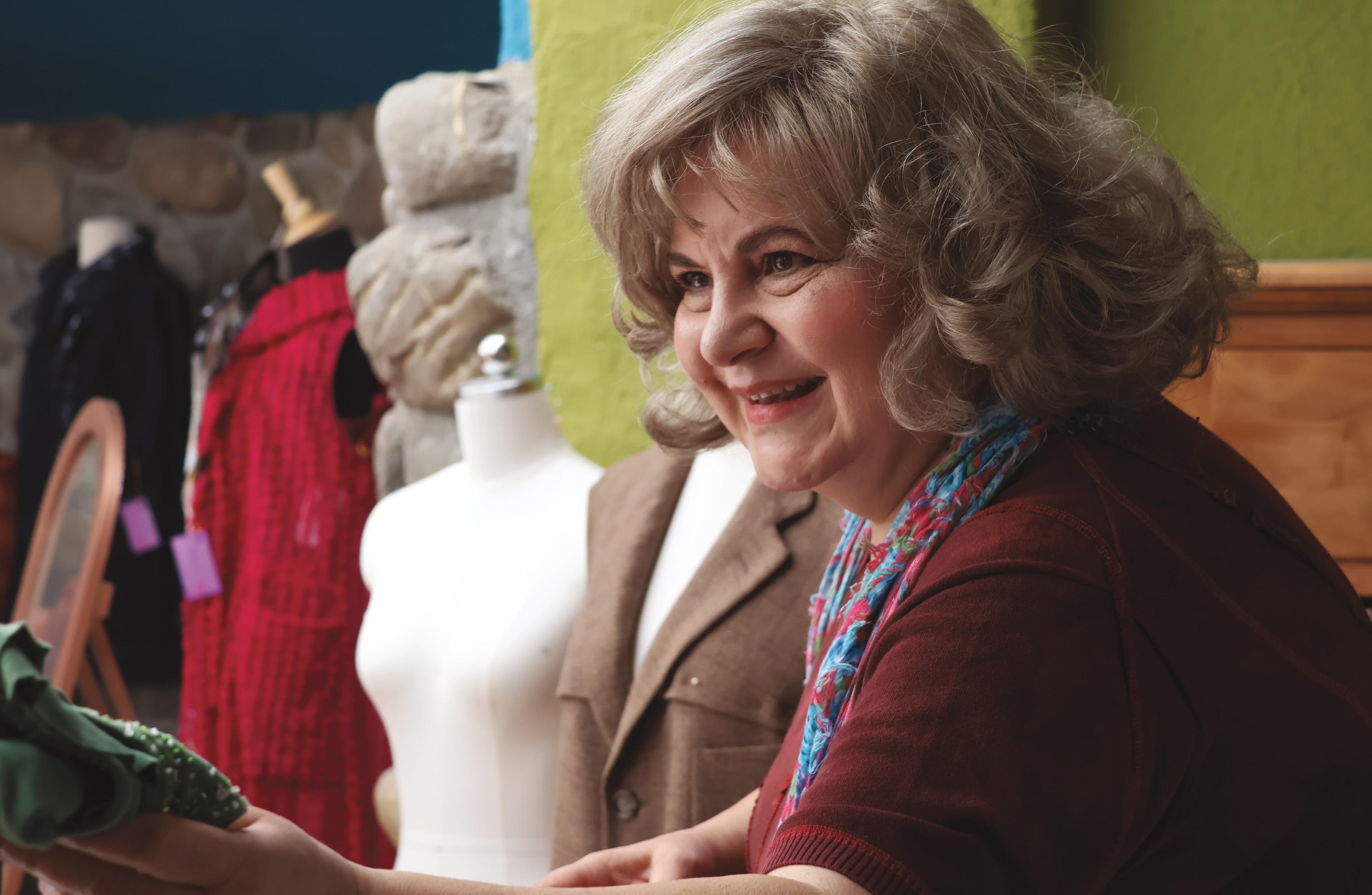
The Fiber & Textile Art of Greta Lovina
Getting YouR Goddess On
story by DEVO CUTLER-RUBENSTEIN
photos by DEVO FOTO ARTS
When I was invited last-minute to attend the Cannes Film Festival, the prestigious event where fashion meets the famous—or in my case almost famous— a friend grabbed me gently by the elbow, insisting: “You must call Greta Lovina. Greta will help you feel like you belong on the red carpet.” My friend, a writer and therapist, understood imposter syndrome. And she was right. Greta helped me style myself so I felt like a true film goddess everywhere I went. The gold, Bridgerton-collar outfit she “built” for me made me feel like I was covered in stardust. Stepping into the shoes she hand-painted, and the dress she lovingly altered to match the coat, I realized something was born that day: Me.
I’d secretly been Athena, waiting to stand at the center of the circle in flowing fabric and radiant color, but I had been too embarrassed to discover, let alone celebrate, my own sense of style.
Greta is blessed with an ability to help clients find their inner Athena. And over time, she has built a world-renowned arts and fashion business based in Ojai.
Greta smiles and laughs warmly as she walks me through her studio, a treasure trove of clothing styles —– from frills and fanciful to structured and tailored. Her workday begins early — at 3 in the morning. Birds have not begun chirping, but a sewing machine whirs in a studio filled with multicolored thread, brocades, and buttons. It’s a bit like Willy Wonka’s candy shop — filled with fantastical colors, yummy textures, and inviting styles.
Every corner vibrates with clothing at different stages of completion.
“I work on about 500 projects at any one time,” says Greta, floating between dresses hung on a rack. She is preparing to ship carefully labeled dresses, coats, and wearable art collars, each packed or nestled in a protective cover. “I know it’s probably an unusual time to wake up,” she says, “but that is my usual schedule. Up before my world gets buzzing with texts and phone calls. After 8 a.m. it’s impossible to get anything creative done.” She explains that by getting up early, she has an extended moment of joy, “to take care of myself. That is when creativity happens.”
“It is a sense of completeness … even stillness. Ironically, it is when fun and imagination get fueled.” Greta says her fashion muse is full of surprises when she stays open to the thought: “I’m here with this day, this time.”
Being present to her art, Greta suggests, can happen only with a healthy relationship to self. That focus on creativity and human development called her to Ojai. After reading a book by J. Krishnamurti, she and her husband wanted to bring their three sons here to attend Krishnamurti’s relationship-centered Oak Grove School. In 1999, they sold their fashion manufacturing business and laid down new roots in Ojai. Greta has continued to develop her art career locally and internationally, collaborating with the Ojai Studio Artists, among others, to showcase her fiber
art and unusual, perhaps unorthodox, wearable art. She also sponsors fashion playdates, fashion shows, and one-on-one consultations.
Lovina’s collection includes wedding dresses and artistic accessories for special meaningful occasions. A former dancer, she also collaborates with dancers and dance therapists. Katie Hendricks, a dance and movement therapist, uses Greta’s visionary approach to clothing as a healing tool. “When women are allowed to wear their truth, move with it in their bodies, it’s enormously transformative,” Hendricks says.
“I do not think I could have done what I am doing anywhere else. Ojai has just the right supportive arts atmosphere. And there is the perception that Ojai, as a community, encourages spirituality and avant-garde approaches to lifestyle and style."
Greta found her home base at Casa De La Luna. The home, which looks like an Italian countryside villa, was formerly a mecca and spa for artists. During the time she’s lived there, Casa De La Luna has become its own enclave, hosting actors, business people, and artists from around the world. They come for fittings and to spend time luxuriating under Greta’s loving, graceful fashion sense. Two movies were filmed recently at the home. “That was fun, and now I have my first on-screen role!” Greta reports gleefully.
I
A love for fashion, she believes, isn’t superficial. “If we take time to relish the moment [and] adorn ourselves — think about what we like to wear — we can usually feel better about ourselves and better about everything. It can be a loving launch to our day.”
For me, at Cannes, Greta’s off-gold, Bridgerton-collar coat was both a loving gesture to myself and a conversation starter. It won me raves, and one paparazzi even stopped me for a photograph.
matching those on the leather she had just finished hand-painting
upcycle a client’s beloved piece of clothing. Greta’s intuitive eye checks in with the client, who often has an idea about retooling an existing garment. By adding trim, a piece of fabric with historic family value, or decorative
Greta hopes her clients “will be uplifted by the design we co-create together.” She is deeply inspired to design for mature or evolving bodies.
“Acknowledging our inherent beauty for each different shape or style can profoundly contribute to our well-being,” she says.
“It is empowering what Greta Lovina does … capturing your essence,” says Maka Moon, an Ojai poet and handpoke tattoo artist. Maka came to Greta for a consultation after becoming a new mother for the second time. “It was delightful,” she chuckles, "and Greta picked out the outfits I knew were truly me.” Maka could not believe Greta intuitively pulled exactly what she had secretly eyed moments before, hanging on the racks in Greta’s colorful on-site store.
Greta says she doesn’t “design to be a fashion designer or to create traditional concepts of fashion. I think of myself as more of an ‘expressive designer.’ True fashion is an expression of you, of your own art form. And you are the canvas, every day to play … in harmony with your own soul.” She credits her Armenian background, and her parents, for introducing her to color in handmade clothes. Although she did not like being different from other kids who wore dark blacks and grays, she came to appreciate and honor color. The influence of a rich culture with elaborate decorative designs and traditional embroidery and textures spoke to her young artist’s mind. “There is a great tradition in Armenian folk art,” she says proudly: “Go to the most remote village — and while they may not have things like toilets or sinks, they have culture, an evolved sense of color and design. Each of us has specific roots, and I hope with my art that I am also an artisan honoring my client’s specific taste, background, budget, and even colors that pop for them uniquely. I am bringing that forward, intentionally.”
pointed to a leather coat stretched out on one of her
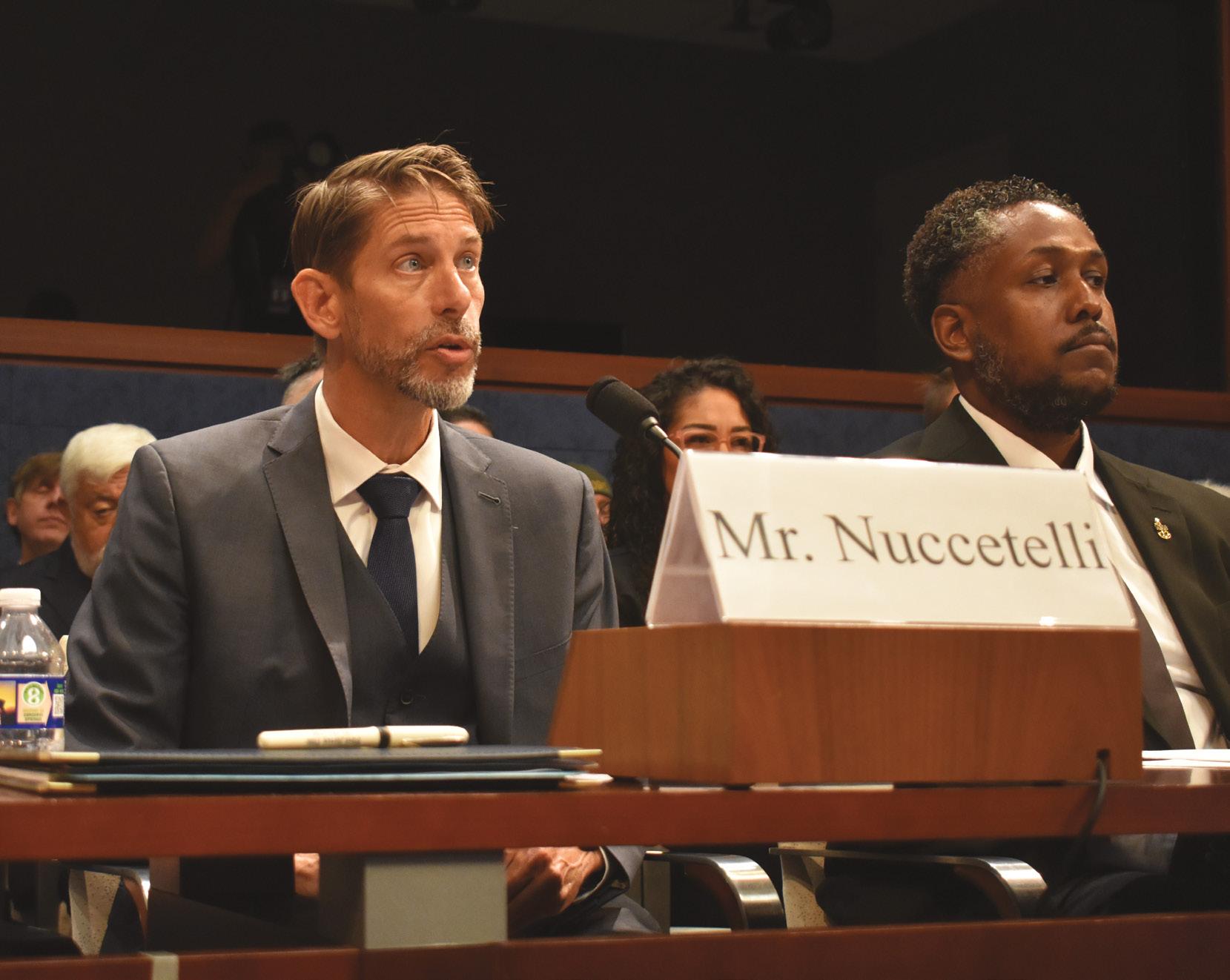
Witnesses raise their hand while taking the oath before testifying in front of Congress on Sept. 9 at the Task Force on the Declassification of Federal Secrets hearing, titled: "Restoring Public Trust Through UAP Transparency and Whistleblower Protection."
Congress is taking UFOs seriously ........
From left: Air Force Veteran Jeffrey Nuccetelli; Navy Chief Alexandro Wiggins; Investigative Journalist George Knapp; U.S. Air Force Veteran Dylan Borland; Joe Spielberger with the Project On Government Oversight.
So is Ojai
THE NIGHT BEFORE: “Holy shit.” “There’s no way.”
“You’re showing this tomorrow?”
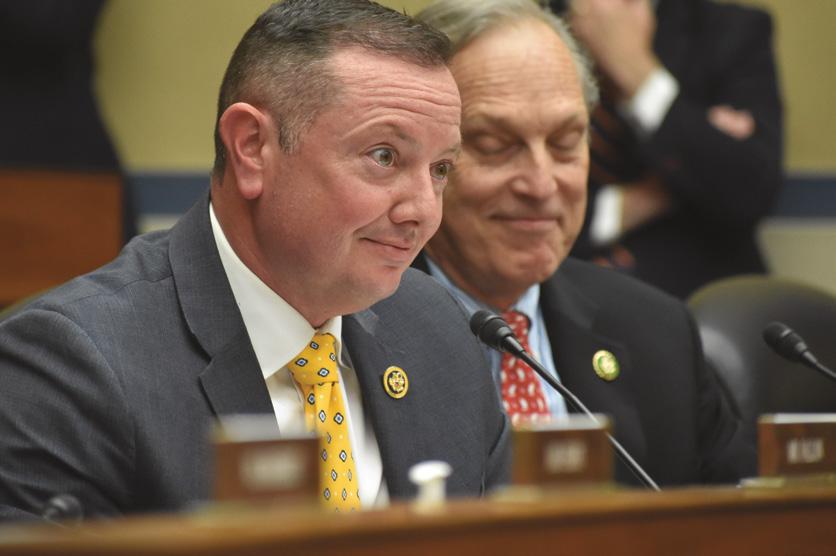
Rep. Eric Burlison (R-Mo.) puts his phone back in his pocket, smiling mischievously.
The video he just showed will rack up millions of views tomorrow and will change perceptions of the world.
It’ll appear as breaking news on ABC, CBS, NBC, Fox News, BBC, Newsweek, and NewsNation websites, among so many other press outlets around the world.
But tonight, no one knows it’s coming but a handful of us — two Air Force veterans, an active-duty Navy chief, a Hollywood fi lmmaker, a journalist, a whistleblower, two members of Congress, and a few others — all sitting around the table at a rooftop restaurant above the Washington Monument, the Jefferson Memorial, the National Mall, and the skyline of the nation’s capital.
The video, fi lmed from a U.S. military MQ-9 drone off the coast of Yemen on Oct. 30, 2024, shows a Hellfi re missile striking an unidentifi ed fl ying object and bouncing off, as three seemingly identical orbs emerge from it, and continue fl ying information. (The video: https://tinyurl.com/424dyers ) Veterans will testify before Congress tomorrow that they are unaware of anything that can split a Hellfi re missile like this, or if they do, they prefer to answer only in a Sensitive Compartmented In formation Facility, or SCIF.
The video will be one of many revelations disclosed to Congress under oath by some of those around the table tonight: Navy Chief Alexandro Wiggins, U.S. Army veterans Jeffrey Nuccetelli and Dylan Borland, and longtime investigative journalist George Knapp.
Others include:
•An unknown craft emerging from the ocean and joining three other unknown “Tic Tac”-shaped objects in the sky.
• A football fi eld-size triangle hovering over Langley Air Force Base with a plasma-like fi eld surrounding it.
• A series of UFO incursions over Vandenberg Air Force Base in the early 2000s while home to the National Missile Defense Project.
• Classifi ed Russian documents alleging a reverse-engineering program, and one
1982 incident where an unknown craft turned on nuclear warheads, making us “a couple of seconds away from World War III,” as Knapp tells it. And the UFOs were responsible for it.
All of this, and more, will be revealed to Congress during its Task Force on the Declassifi cation of Federal Secrets hearing, held Sept. 9 in the U.S. Capitol, and the third Congressional hearing on the UFO topic since July 2023.
(Read the OVN’s hearing coverage: tinyurl.com/yc453edp/mvdhpzez )
THE DAY OF: After exiting the stone tunnels underneath the U.S. Capitol building, a pass is flashed and double doors swing open to a dark room of cherrywood tiered seating.
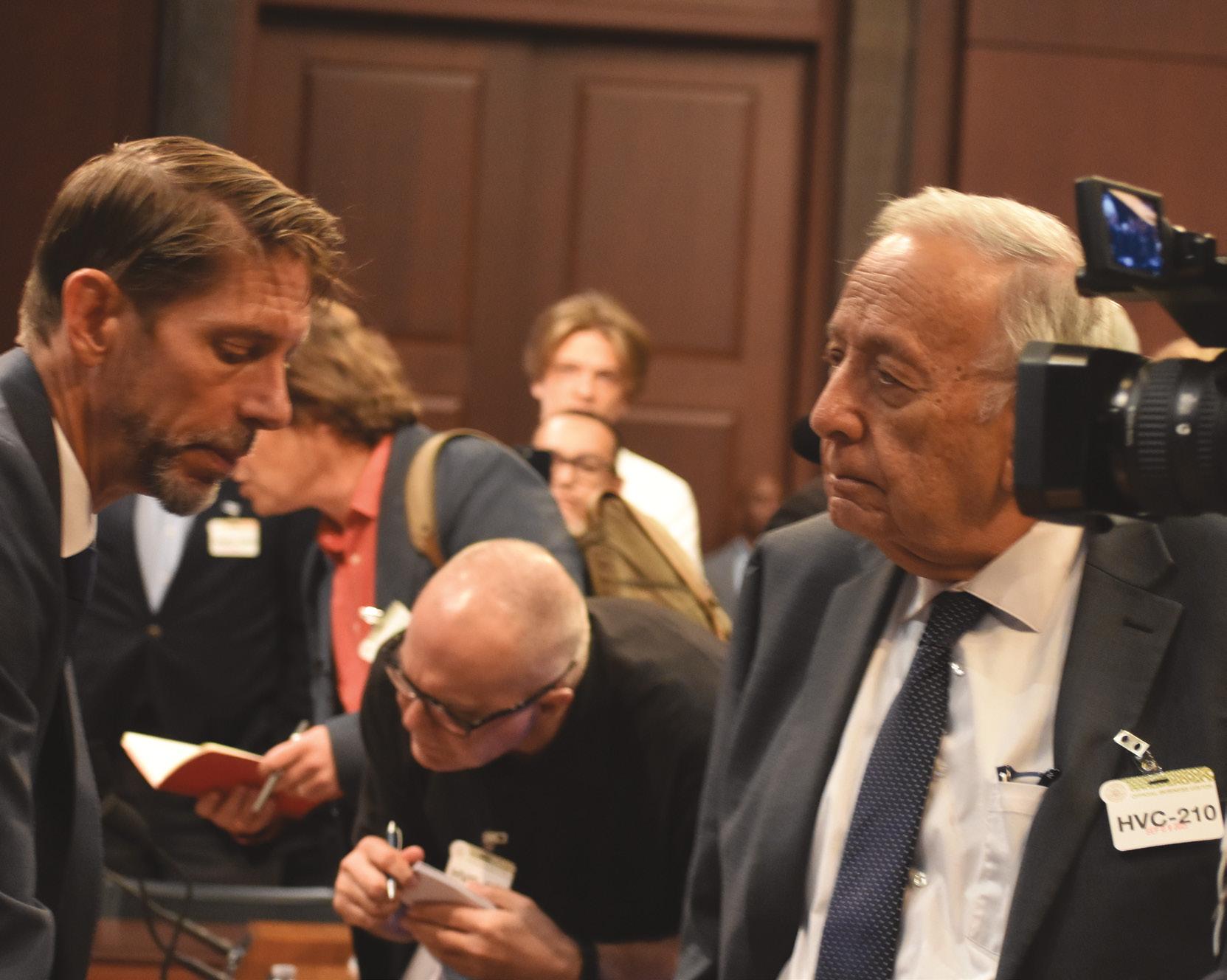
Camera crews enter the well between the witnesses table and the elected leaders holding the executive branch accountable.
“Media is to the right,” a congressional aide shouts. “Who are you with?”
On the left side of the table, seats are reserved for Fox News, NewsNation, and Channel 4; on the right are Defense Scoop, Taiwan Central, and Roll Call. At the center: Ojai Valley News.
The crowd shuffles in and seats are populated with Ojai locals and frequent guests.
Sitting in the back, smiling and whispering to one another, are long-time Ojai residents Robert Salas and his wife, Marilyn. Salas’ UFO and nuclear weapons experience in 1967 has caught the attention of several members of Congress already.
(Read his story: https://tinyurl.com/mvdhpzez )
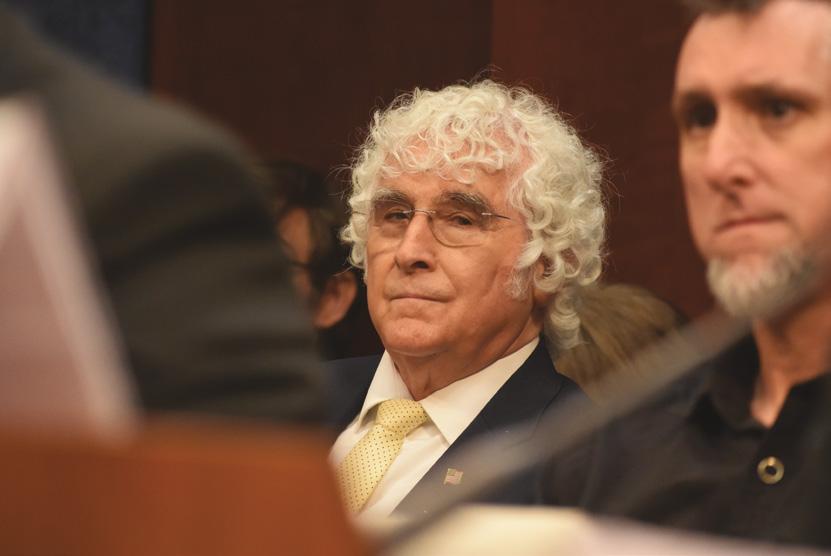
Frequent Ojai guests include Daniel Sheehan, constitutional lawyer of Watergate and Iran-Contra fame, whose iconic bushy white hair is unmissable among the crowd. His continued push for disclosure has earned him a seat next to Ojai visitor and UFO lobbyist Stephen Bassett.
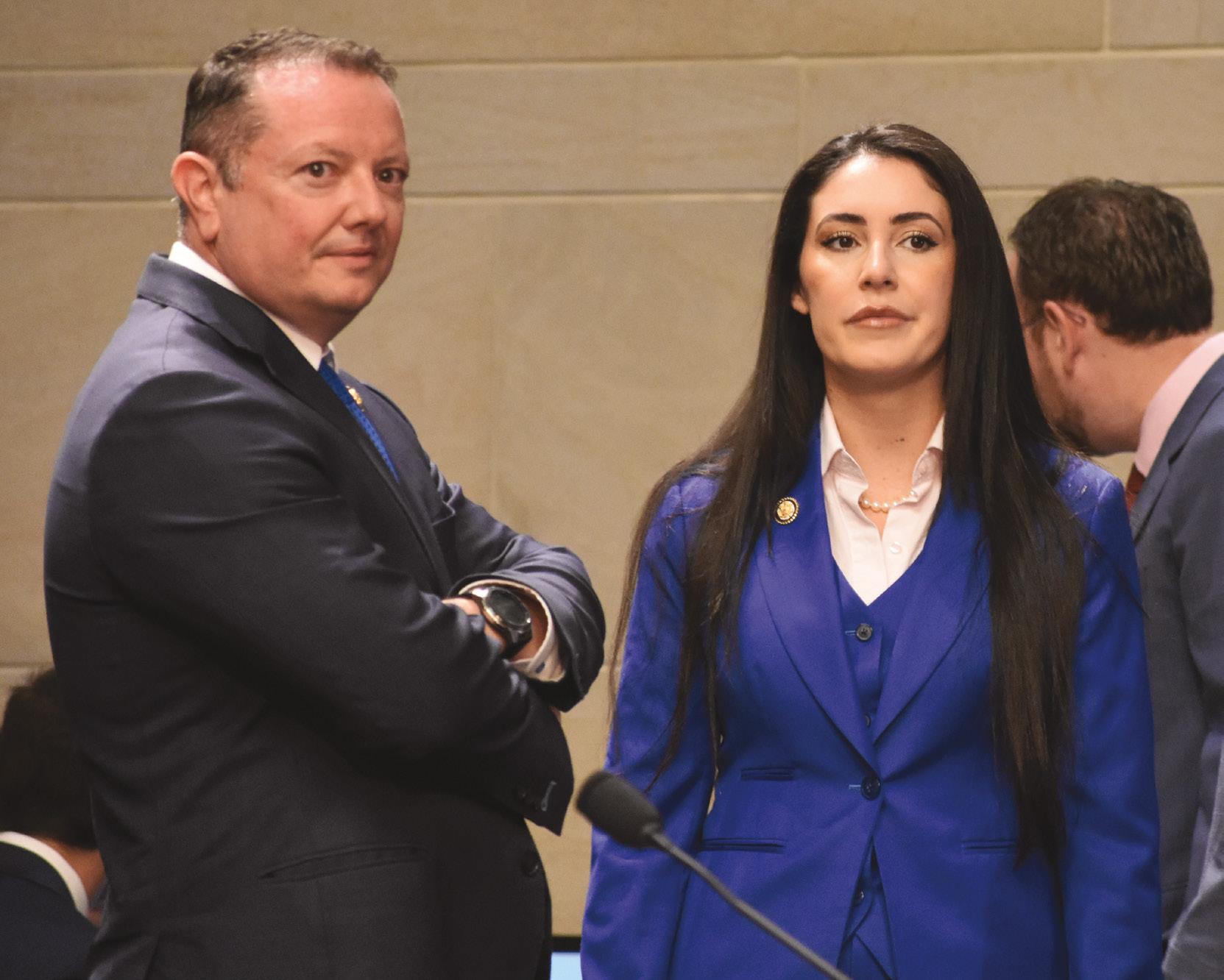
Then, Jeremy Corbell, previous subject of an Ojai Magazine cover story, enters the chamber. His presence commands the room as people seated whisper and point. Corbell, confi dent and focused, leads the witnesses to their table.
(Read his story: tinyurl.com/4ku54tsh)
He takes a seat behind George Knapp, his podcasting partner and mentor, and the foremost investigative journalist on
the UFO topic for several decades and counting.
Knapp appeared at the Ojai Playhouse earlier this year to discuss his work alongside Corbell, and now, Knapp’s career has landed him front and center at the witness table, shifting him from reporter to protagonist in this never-ending saga.
(Watch the Playhouse Conversation: tinyurl.com/38ne2h37)
As the hearing unfolds, an aura of seriousness and excitement descends on everyone in the room, and a new reality sets in: Congress is taking this seriously.
“Growing up, I really never believed in UFOs or any of this stuff, I always thought it was a little kooky,” says U.S. Navy veteran and Rep. Elijah Crane (R-Ariz.). “But after hearing your testimony, from honorable servicemembers, watching videos like my colleague Mr. Burlison just presented, I’ve got to admit, I’ve become a believer. Not that I know where these things come from, or what they really are up to.” Crane’s comments capture the changing attitude of Congress, and serious questions follow: Where are these materials being held? Who are the gatekeepers? Why are whistleblowers being threatened? Where is the money going, and more importantly, where is it coming from? What other countries have these technologies? And have you been exposed to “undeniable confirmation of Non-Human Intelligence?”
All these, and more, are answered thoroughly by the witnesses, naming names and citing sources.
“The narrative has changed,” Rep. Jared Moskowitz (D-Fla.) says. “This is now the second or third committee where we have former military folks with impeccable records, with information, and knowledge.”
No longer is the subject dismissed as fringe, or mentioned in the same breath as tinfoil hats and Winnebagos. It’s being discussed, dissected, and pursued with the same fervor by Congress as waste, fraud, corruption, threats, national security, foreign intelligence, and obstruction investigations that demonstrate the meaning of “checks and balances.”
And a driving force behind this radical change are all the Ojai-familiar faces in the room.
ROBERT SALAS: Robert Salas has a smile that hasn’t aged a day in the 58 years since he was assigned as a
Above: Jeffrey Nuccetelli testifies to incursions involving UAPs above Vandenberg Air Force Base from 2003 to 2005 during the Sept. 9 Congressional Hearing. Right: Rep. Eric Burlison (R-Mo.) speaks during the Nov. 13, 2024 Congressional Hearing held by the U.S. House Committee on Oversight and Accountability, titled "Unidentified Anomalous Phenomena: Exposing the Truth."
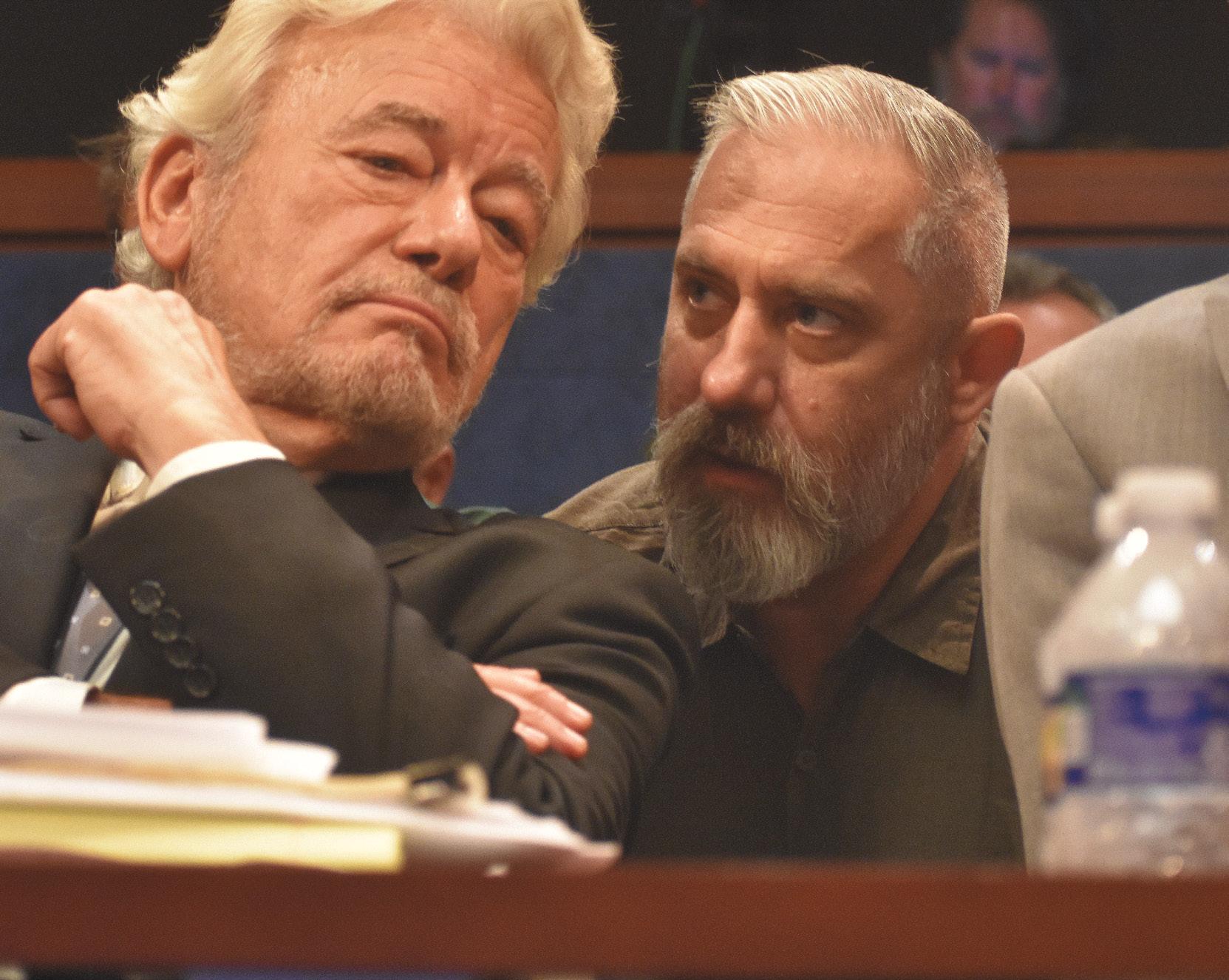
Below: Investigative journalist Jeremy Corbell, right, whispers to George Knapp during the Congressional hearing in Washington, D.C. on Sept. 9. Together, Corbell and Knapp host the WEAPONIZED podcast.
Minuteman I missile launch offi cer at Malmstrom Air Force Base in Montana in 1967.
The retired Air Force captain and Ojai resident, now 84, was underground at Oscar Flight 1 when 10 nuclear missiles were shut down and placed into an “unlaunchable” condition after an incursion involving a bright, red-orange, pulsating UFO.
After the congressional hearing in November 2024, Salas met with hearing Chair Rep. Nancy Mace (R-N.C.) for a closed-door conversation, where he shared his story.
“I find you very credible,” Mace told Salas during the meeting. “I would love to do [a hearing on] ETs and nukes because it’s valid, whether it’s our technology, or something from out of this world, it’s huge.”
by name to Congress.
“People like Bob Salas, who worked at a nuclear ICBM base, who saw UFOs fl ying over the base and these missile silos were taken down, he went to AARO too and was completely disregarded,” Knapp said. “It almost looks like AARO operated as a counterintelligence operation to get people to come in, tell their stories, and then discredit all of them. I can’t imagine that any whistleblower or witness will ever go to AARO again because of what happened under the fi rst director, who’s now long gone, but still seems to act as the spokesperson for that organization.”
Salas told Mace he was interviewed by the All-domain Anomaly Resolution Office, or AARO, a congressionally mandated program designed to collect and analyze UFO data and streamline service members to make disclosures.
But Mace said she was unaware of the meeting, despite AARO’s directive to share information with Congress.
“It’s a big thing that they left out,” Mace said of his story.
After the hearing, Salas approached Knapp, shook his hand, and thanked him for mentioning his name and his story. Salas then left the room quietly, and walked down the hall to Burlison’s offi ce for another closed-door meeting.
“I’ve heard of this story multiple times,” Burlison told Salas in his offi ce. “It’s one of the top stories that people talk about, one of the most important UAP [unidentifi ed anomalous phenomena] events in the history of the United States, probably next to Roswell, and you were there. … Thank you for your courage, and your love for this country.”
“My last question to them, after I gave my presentation, was, ‘Are you going to check with the Air Force to verify any part of my story?’” Salas told Mace of his AARO meeting. “And they said, ‘No.’”
Salas’ experience with AARO became key during the 2025 Congressional hearing, where some of the most credentialed and qualifi ed military witnesses and whistleblowers also testifi ed to being ignored, and worse, retaliated against, by AARO.
“The reports that come in are too often brushed aside, slow-walked, or met with skepticism rather than serious investigation,” Chair Anna Paulina Luna (R-Fla.) said of AARO at the 2025 hearing.
“Recently, the former AARO Director, known as Sean Kirkpatrick, attacked our witness and members on this committee. It should be noted that he is a documented liar, and brings into question what his purpose at AARO really was, if it was not to follow up on investigations and disclose his fi ndings to members of Congress.”
In a moment decades in the making, testifying witness Knapp called out Robert Salas
Salas said other members of Congress are showing interest in his story, including Rep. Tim Burchett (R-Tenn.), who agreed to meet with Salas.
But it’s not just the U.S.; Salas has been invited by more than 15 countries to speak, including at Brazil’s Federal Senate on June 24, 2022, and Mexico’s Chamber of Deputies on Sept. 12, 2023.
The Ojai resident continues to share his story with Congress, and the world, as both take him more seriously than ever.
JEREMY CORBELL: Corbell asks Knapp if he needs anything else before shutting the hotel room door.
Knapp has to fi nish writing his opening statement for Congress tomorrow. An early draft has already leaked online, but it’s still not fi nished, and the deadline’s looming.
“Maybe I’ll come down, have one drink with you fi rst,” Knapp says, smiling, as Corbell’s hair almost catches fi re.
Knapp then laughs, and when Corbell realizes he fell for it, he does too.
The hotel room walls are fi lled with Keith Haring-inspired illustrations of D.C. monuments and key moments in history, along with the phrase: “History Is Made Here.”
Knapp opens the laptop he’s borrowing from Corbell, and continues drafting his statement, one he will keep updating with handwritten notes until he stands to take his oath — a reporter at heart, using every moment until his deadline.
Corbell exits the elevator and takes a seat at the hotel bar, a look of optimistic stress on his face. It’s been a journey to get here, and it all unfolds tomorrow.
Corbell and his work alongside Knapp on the WEAPONIZED podcast has done much of the legwork for Congress already, finding key witnesses to testify and supplying important information.
“I didn’t help set up these hearings so that the government would tell you the truth,” Corbell said after the tumultuous 2024 hearing. “I set up these hearings with Congress to try to get firsthand whistleblowers to the American public.”
But at this hearing a year later, the energy is different, less controlled, less chaotic, more serious, and with new witnesses the world hasn’t heard from yet.
As Corbell puts it, this hearing “was a huge success in that it was an excellent group of people testifying. I nominated a lot of people, got Congress in touch with a lot of people.
“We had solid, solid witnesses, and it was such a cool thing. It was an achievement to have that happen, and a lot of people couldn’t testify publicly, but that’s OK, that’s part of this process and what this hearing was about.”
After the hearing, Knapp spoke about the importance of Corbell’s role, and his work behind the scenes.
“Not to pat you too hard on the back, but you worked with that committee staff for a long time in trying to set this up,” Knapp said of Corbell’s role, speaking on an episode of WEAPONIZED . “You really did a lot of work to try to help them out, and I know, ideally, the world wants hands-on whistleblowers, people who’ve worked on the craft, people who’ve moved the bodies. Yeah, that’s not easy to get, as this committee knows, and they’ve tried, and tried to offer a lot of protections.”
But one local witness who did get to testify, thanks to help from Knapp and Corbell, was Jeffrey Nuccetelli.
JEFFREY NUCCETELLI : Nuccetelli looks like a veteran Leonardo DiCaprio would play in a movie.
He’s tall, handsome, and has a way of talking that exudes confi dence and thoughtfulness, the kind of person you want to call in an emergency, which made him perfect for his role as a military police offi cer at Vandenberg Air Force Base in Santa Barbara County, just a stone’s throw from Ojai.
During his time at the base from 2003 to 2005, while home to the National Missile Defense Project, he responded to five UFO incursions.
“We were conducting launches deemed by the National Reconnaissance Offi ce as the most important in 25 years,” Nuccetelli told Congress. “There’d be 40, 60, 100 people on duty during these encounters,” which he said were “documented, investigated, and reported up the chain of command.”
The fi rst incursion occurred on Oct. 14, 2003, when Boeing contractors reported seeing a glowing red square the size of a football fi eld hovering above two missile-defense sites.
That same night, security guards at a critical launch site reported a “bright, fast-moving” object out over the ocean.
“I heard my friend screaming, ‘It’s coming right at us, it’s coming right for us,’” Nuccetelli said, adding moments later, he heard them say it shot off and was gone.
Five witnesses he spoke with at the time described it as a “massive, triangular craft” that “hovered silently for about 45 seconds at their entry control point” before “shooting away at impossible speed.”
Nuccetelli said the size was described as “much larger than a football fi eld. We’re talking like fl ying buildings.”
A week later, another patrol reported a light moving over the ocean erratically.
“Believing it might be an unannounced aircraft, they declared it an emergency, and an armed response force responded,” Nuccetelli said. “Before the forces could arrive, the object descended, and either landed or hovered on our fl ight line, and then took off, again at impossible speed.”
In 2005, another patrol reported seeing a triangular craft “larger than a C-130,” which is more than 97 feet long with a 132-foot wingspan.
The craft silently fl oated over an
Above: Ojai resident and former United States Air Force Captain Robert Salas, right, speaks with testifying witness and U.S. Air Force Veteran Jeff Nuccetelli after the Congressional hearing on UAPs held at the U.S. Capitol on Sept. 9. Left: Constitutional lawyer and UAP disclosure advocate Daniel Sheehan attends the Sept. 9 congressional hearing.
Below: Rep. Eric Burlison (R-Mo.), left, speaks with Task Force on the Declassification of Federal Secrets Chairwoman Anna Paulina Luna (R-Fla.) prior to the Sept. 9 hearing, "Restoring Public Trust Through UAP Transparency and Whistleblower Protection.”
installation for a few minutes, then went west, disappearing into the night.
Nuccetelli had a personal encounter offsite in 2005 as well while in his back yard with two other police offi cers.
A pulsating light dropped in elevation, would vanish, then reappear in a different location, eventually materializing 200 feet above his house. The sphere of light was roughly 30 feet in diameter, and eventually accelerated into the stars.
After reporting each encounter, Nuccetelli said he noticed a pattern.
“Someone would see a light, they would pay attention to the light, and then the object responds, it performs for you, and then they come down and they investigate you. So it’s almost like they’re curious,” he said. “Maybe it noticed us, after we noticed it.”
Nuccetelli added he had three goals for testifying: to request independent research; end secrecy and over-classifi cation; and protect witnesses.
“These events profoundly changed my life, and the lives of my friends,” he said. “The question is no longer whether these events are real, but whether we have the courage to face them.”
Room and write a recap of the hearing, the painting on the ceiling of an angelic woman representing Human Understanding looks down.
She’s caught mid-act of lifting the veil of ignorance up over her head, and staring straight ahead to unknown and yet-to-bediscovered intellectual progress.
The recap will appear in the Ojai Valley News, and I take a minute to think about the impact this town has had behind the scenes, and the role it’s playing in disclosing one of the most well-kept secrets of human history as the cracks in the dam begin to leak.
As I leave the library inspired, confused, and overwhelmed, a television in the window blasts CNN onto the street. The words “assassination” fl ash across the screen.
A CROWD STOPS AND TURNS:
“Kirk was shot at an event at Utah Valley University earlier today, shortly after noon,” anchor Erin Burnett reports live.
“There was a single shot that rang out. He was shot in the neck, and now the president of the United States, someone Charlie Kirk was close to, is reporting that he has died.”
Like that, the news cycle changes, and what was disclosed at the hearing moves to the back burner as another event unfolds on Earth that commands attention.
THE DAY AFTER: The day after the hearing, news outlets blasted breaking email updates with videos of the Hellfi re missile bouncing off the UFO, as well as other shocking headlines from information shared during the hearing.
News outlets sent requests to the witnesses, and in some cases, their extended family members, trying to secure interviews to learn more.
Congressmembers, including Burchett, were interviewed on the street.
“What if these are entities that are here on this Earth, that have been on this Earth, who knows how long? We think they’re coming in from way out, maybe they did millennia ago, but they’re here, and they're in these deep water areas,” he told one reporter from AskaPol. “When we have naval personnel telling me that we have these sightings, and that there’s these underwater craft they’re chasing, doing hundreds of miles an hour, and the best we’ve got is something that does maybe just under 40 miles an hour, I’ve got a lot of questions about that.”
As I sit under the domed, ornate ceiling of the Library of Congress’s Main Reading
Days later, as the plane approaches Los Angeles International Airport and dusk turns to night, much of what unfolded at the hearing is already forgotten as the world moves on to other news, other stories.
As I stare out the airplane window, down at the city below, warehouses, apartments and city streets appear like galaxies on the ground. Headlights fill the streets like a constant stream of shooting stars forming carpool constellations. Meanwhile, the sky is black, an empty abyss, where you can’t make out a single star.
But as I drive back into Ojai, as the car heads up Highway 33, light pollution fades, and the stars start to emerge.
Maybe that’s why Ojai has played such a key role in this disclosure process: It’s a place where residents and visitors haven’t forgotten to look up, and when they do, they’re both forced to grapple with, and rewarded by, stars that haven’t yet disappeared — a fading remnant, but glowing reminder, that something is out there much larger than ourselves.
RANCHO DEL OSO 12615 KOENIGSTEIN ROAD
Built in 1939 as a resort retreat for Hollywood’s elite, the stone-clad lodge and original guest cabin offer a blend of history, craftsmanship, and natural beauty rarely found today.
Inside, approximately 4,000 sq. ft. of living space features soaring glass doors, a star-view ceiling, hand-cut stone fireplaces, and original 1940s painted details.
Maasai tribe’s maternal blessings
by KAREN LINDELL
R iTUa LS,
BeAd S, &
M i R aCL e S
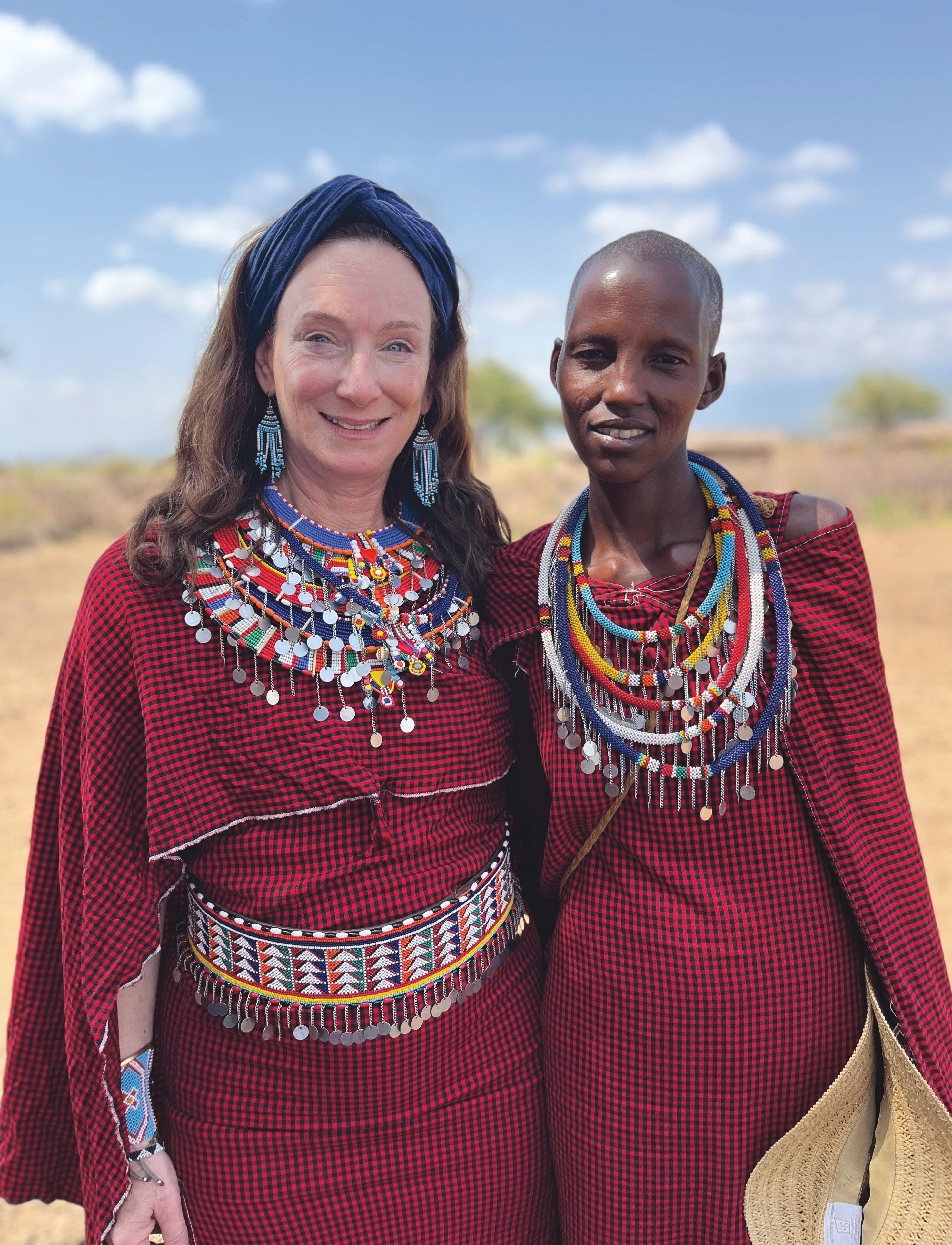
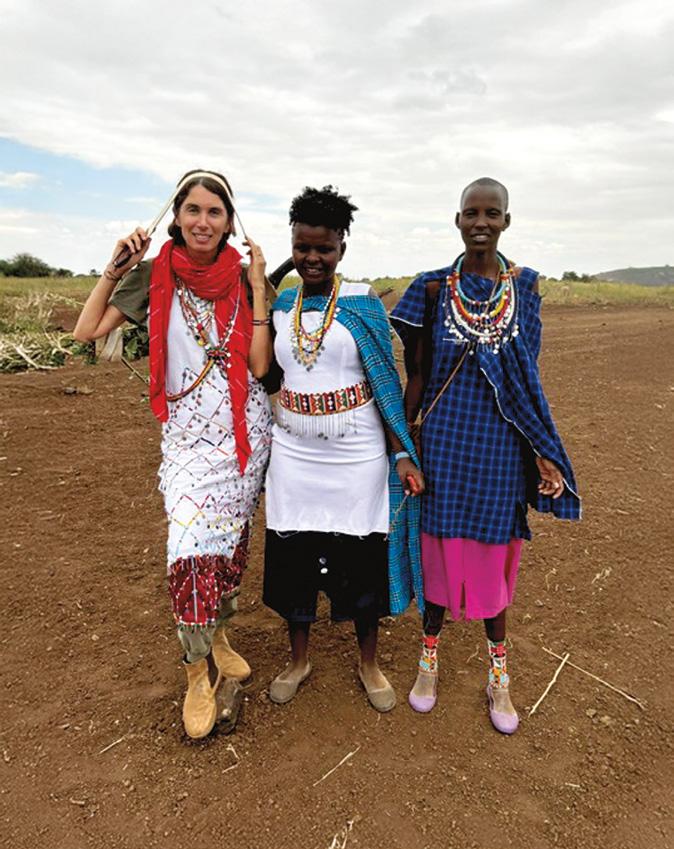
Twelve years ago, in the center of a village near the border of Kenya and Tanzania, Shauna Mistretta sat in a circle with 10 Maasai women. Even though she wore a colorful bead necklace and traditional red shuka (scarf), Mistretta’s bobbed brown hair, pale skin, and white button-down shirt and khaki pants gave away her American-ness. Yet in this moment, none of that mattered. She was a cherished member of their community.
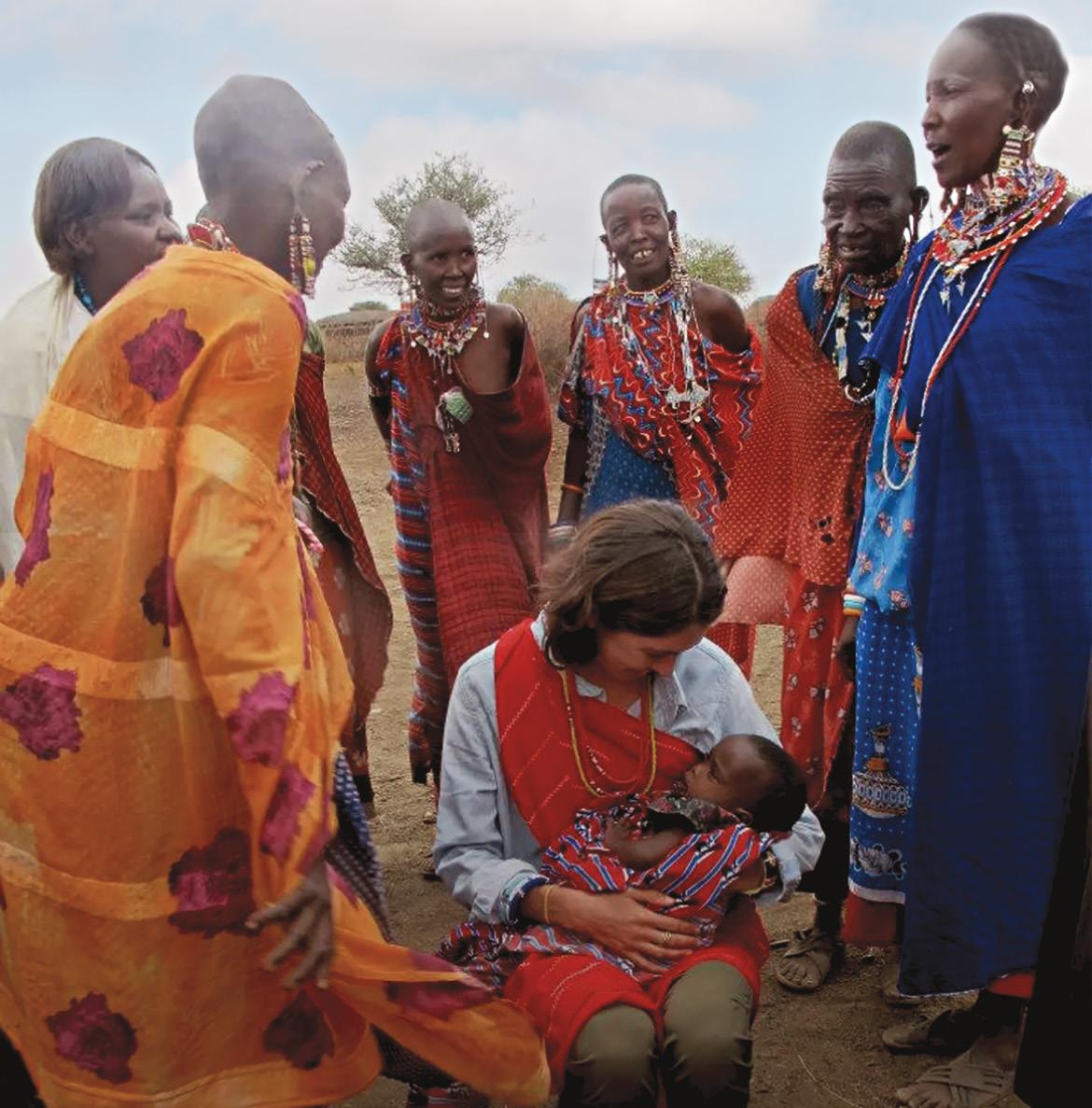
Mistretta shared a deeply personal experience: She was trying to get pregnant, and had endured several miscarriages. After hearing her, the Maasai women wanted to conduct a fertility ritual. They began by telling their own stories about babies they had lost. “It was a deep grief circle of us all sharing the pain,” Mistretta says. The women then placed the youngest baby born in the community into her arms and circled around her, chanting and praying. “I felt the incredible power of the moment and deep gratitude for the space they were holding for me,” Mistretta says.
Left: Bridging worlds through shared experience, Lisa Elliot-Rosas of Ojai and a young Maasai woman from Embaringoi Village gather water together in the Amboseli bush on the annual ReWild Journey.
Photo: Shauna Mistretta
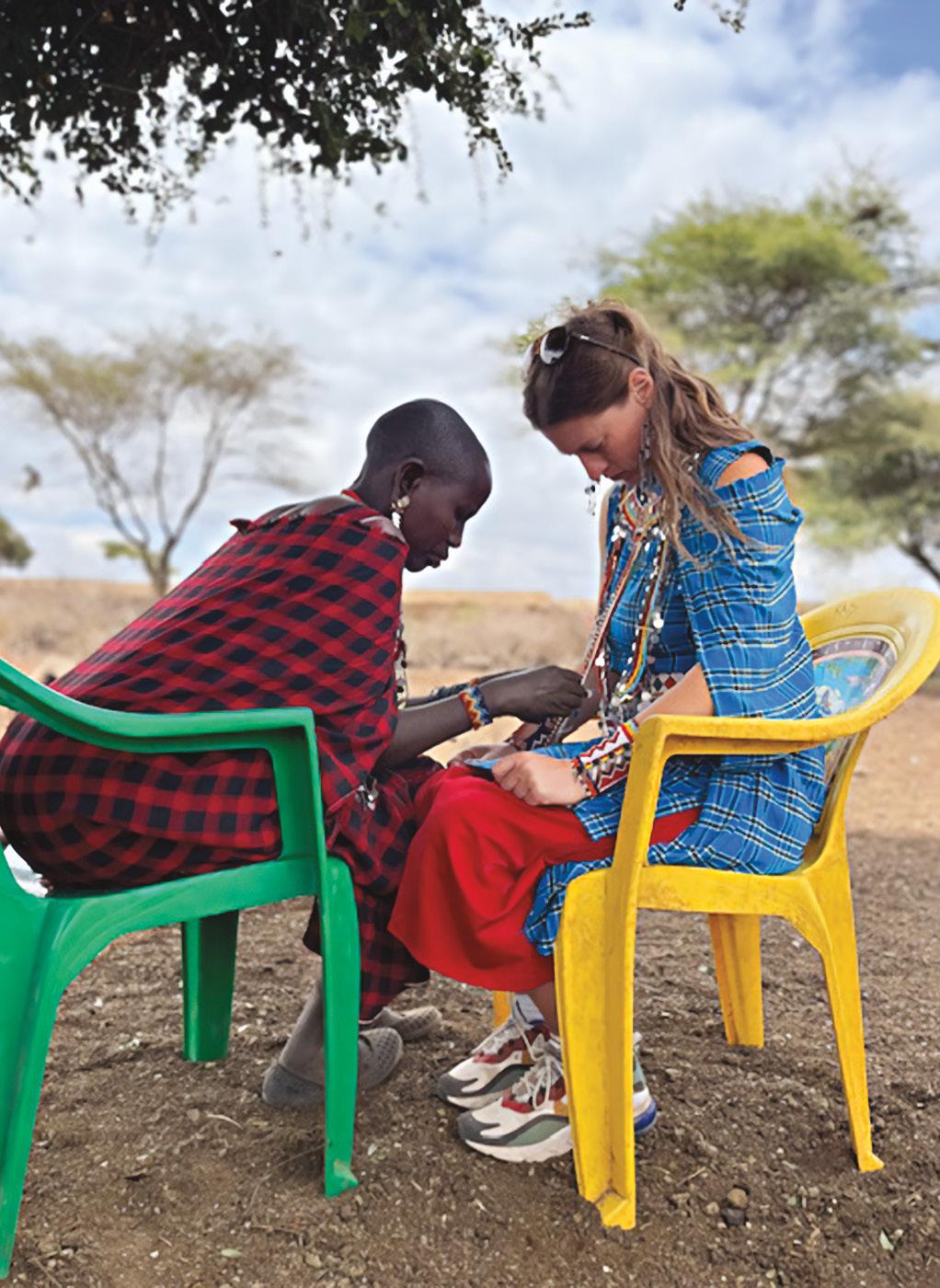
Under the shade of an acacia tree, Meg Lee learns the intricate art of traditional Maasai beadwork from her new Maasai friend.
Photo: Shauna Mistretta
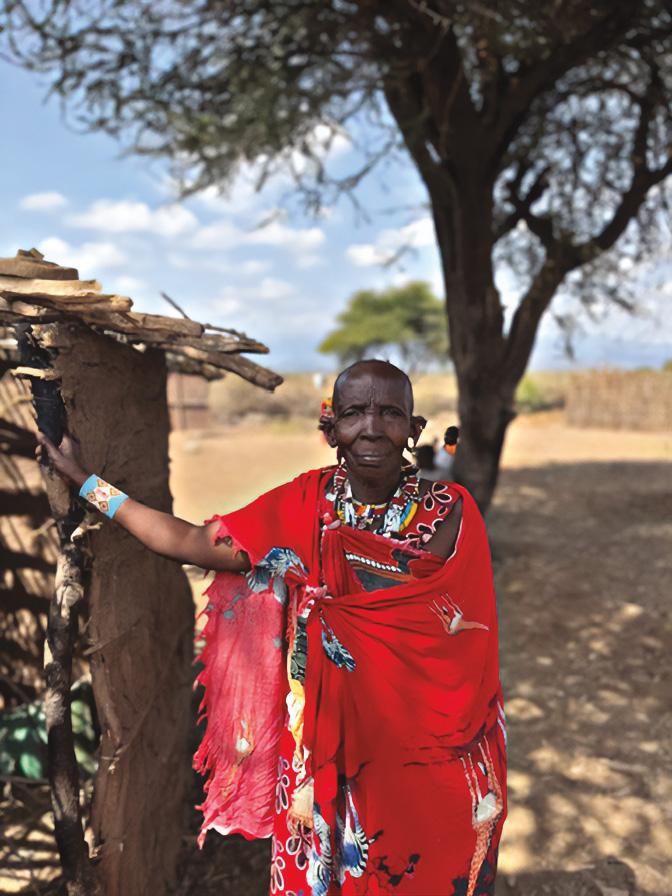
Right: An elder Maasai woman stands for a portrait in front of her traditional Maasai manyatta (home) in Embaringoi Village at the base of Mt. Kilimanjaro.
Photo: Shauna Mistretta
to make a difference and help people.” Returning to Boulder, Mistretta transferred to Buddhist-inspired Naropa University to earn a bachelor’s degree in Eastern religion, and found as many opportunities as she could to volunteer or work with nonprofits in Africa.
Mistretta calls Goodall “a profound inspiration.” In her 20s, she landed a dream internship working with Goodall — a fact she drops quickly and humbly into a conversation, as if it’s one blip on a resume. When probed for more details, she says, “I got to go live with her in
Right: Elder Maasai women from Esiteti and Embaringoi Villages gather in circle around Shauna Mistretta to perform a sacred fertility ritual.
Photo: Gala Gaines
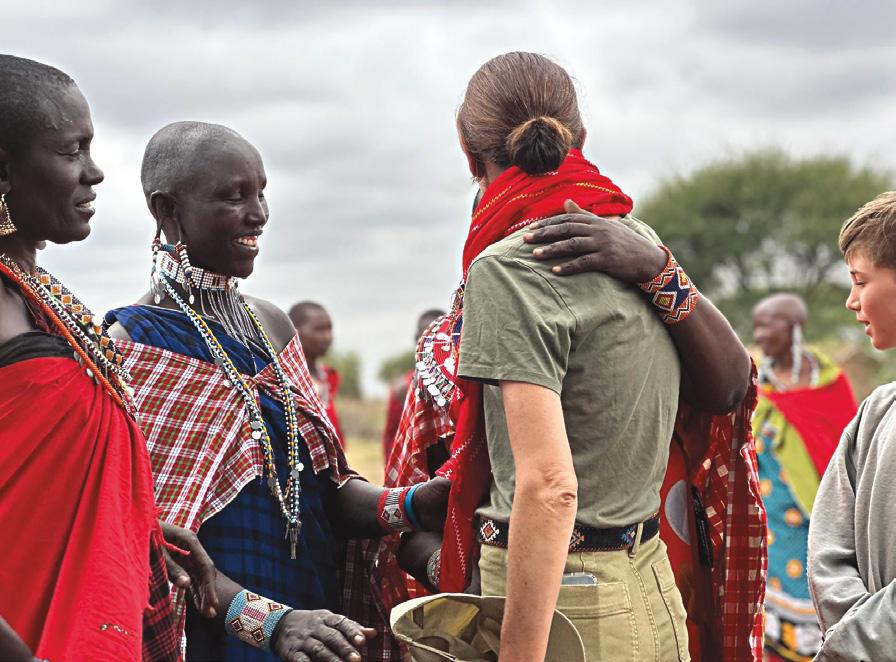
Below: In the embrace of her
“She’s not the friendliest person everyone would think she is, but she’s honest and blunt, and cares so deeply about teaching people that everyone can make a difference in the world, no matter how big or small.”
After college, while living in Santa Barbara, Mistretta was conducting microlending groups for women in Kenya when she got involved with the organization Africa Schools of Kenya. The nonprofit hired her in 2010 to help the Maasai women sell their traditional beadwork internationally.
“My passion has always been in helping women become economically empowered,” Mistretta says. When women earn their own income, she says, “that money goes back to supporting our families, and we get to make decisions from a place of deeper freedom in ourselves.”
She and her husband moved to Ojai 16 years ago. After growing up in a small town in Ohio, she wanted to raise her children in a similar environment.
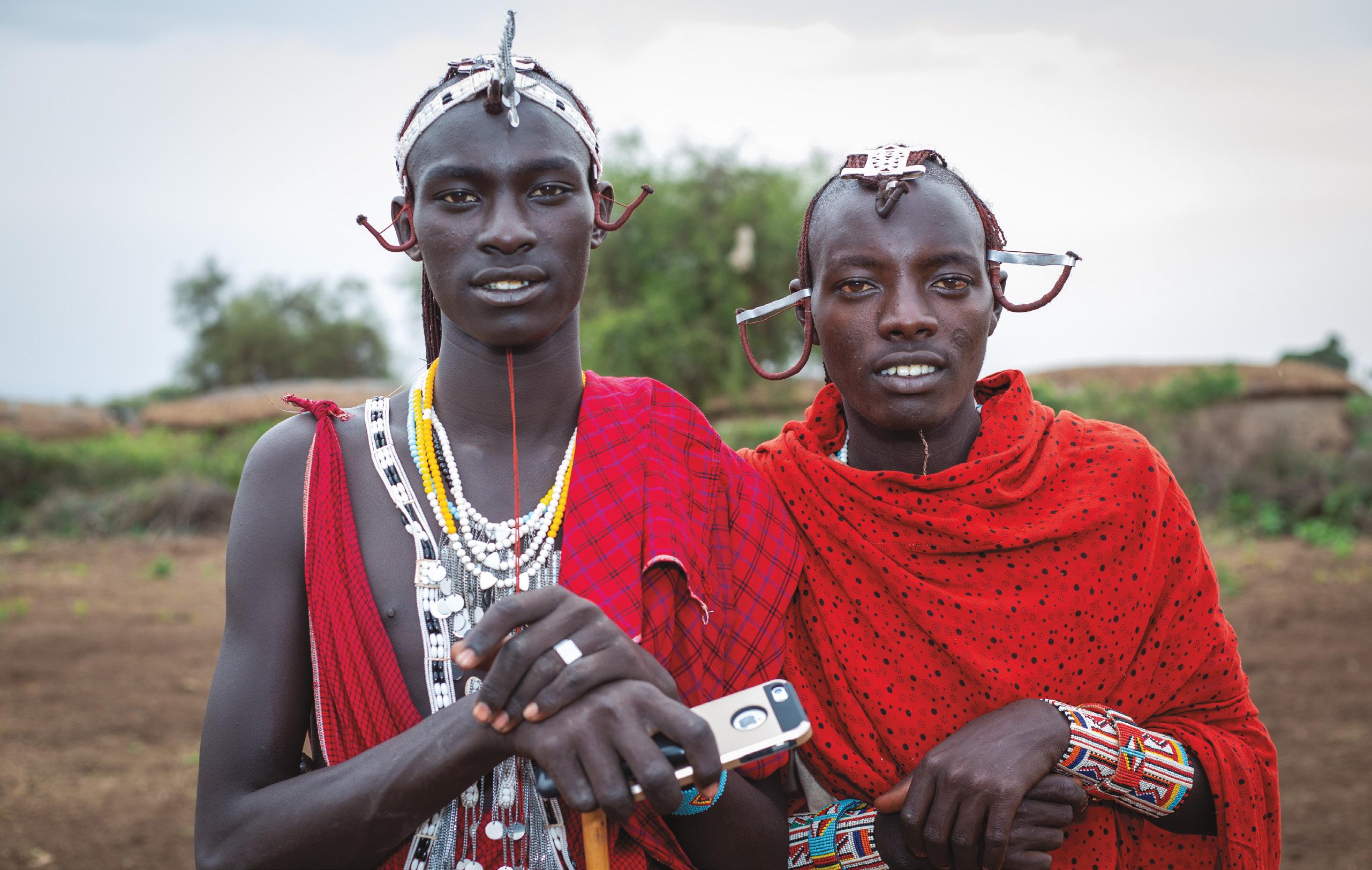
Two Maasai warriors from Esiteti Village stand as living links between past and present.
Photo: Sarah Fretwell
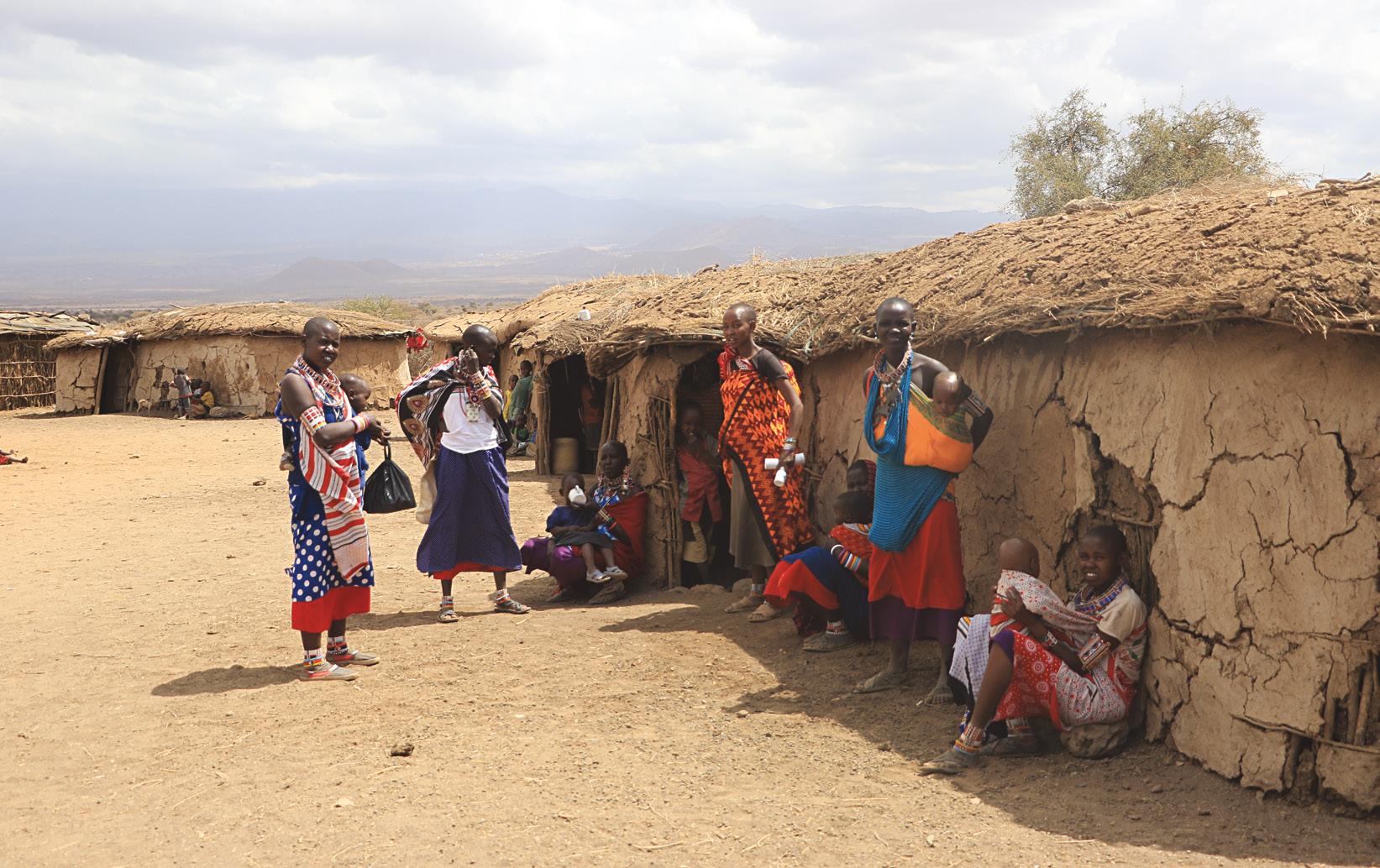
Below: The day unfolds in Embaringoi Village as Maasai women gather outside their manyattas, ready for the essential work ahead, wood, water, children, and the quiet artistry of beading beneath the trees.
Photo: Shauna Mistretta
Below: Maasai children gather in the morning light outside Esiteti Primary School, a project supported by Santa Barbara-based nonprofit Africa Schools of Kenya.
Photo: Mandy Richards
Ojai is yet another village where she truly feels at home. “Ojai is like a tribe for me,” she says. “I feel super connected with my community here, especially mothers and women — the way we raise our kids together. People deeply care, want to make a difference, and they’re finding unique ways to do it.”
Visionary calling
Mistretta’s most recent project, the Institute for Emerging Visionaries, seeks to inspire the humanitarian spirit in up-and-coming generations. The program invites young adults ages 18 to 30 from all over the world to attend a 10-day intensive program on the Big Island of Hawaii, where they live on a regenerative farm and “do a lot of deep-self inquiry work,” Mistretta says. Many of the participants have gone through trauma, and the experience helps them find “the core mission of their soul.” They then learn how to bring their visions to light.
The institute has fostered a global network of about 150 young visionaries who collaborate on projects related to issues including women’s empowerment, regenerative agriculture, and Indigenous rights.
In a world where “as a humanitarian you start to feel overwhelmed,” Mistretta says, these young visionaries “give me the most hope in the world.”
Vanessa Stone, cofounder of the institute, says Mistretta herself is a visionary: “Someone who hears a call, rises up to another way, and is willing to have the courage to actualize that calling. Shauna
makes people’s visions come to life, which is unique.”
ReWilding
Although Mistretta has focused energy recently on the Institute for Emerging Visionaries, her “passion project” is working with the Maasai, and each June she leads a small group on “ReWild” journeys. The trips, she says, are for “people who want to have a real, authentic experience of Africa that connects deeply with the people and the land and also gives back in a sustainable way.” Proceeds from the trips benefit Maasai projects connected to education, healthcare, women’s rights, and environmental sustainability.
The eight-day trip is described as a “full immersion” experience. Participants gather wood and water, build Maasai homes, slaughter a goat, and make bead jewelry, among other activities.
Lisa Elliot, Mistretta’s Ojai neighbor, has traveled with her to Kenya twice. Her first ReWild trip, two years ago, inspired Elliot to join the local Rotary Club, and she has raised funds for the Maasai through the organization.
Being with the Maasai, Elliot says: “I learned how to be in the present, and how much respect there is among the women, grandmothers, teenagers, little ones. They don’t take it for granted.” Elliot describes Mistretta as “heartfelt, sincere, and fully committed” to the Maasai people. “Tears fall when she is speaking to the tribe,” Elliot says.
Mistretta understands that the idea of a white person from the U.S. trying to help
Indigenous people in Kenya might not go over well on a continent that has been harmed by colonialism. She sees herself as a “bridge,” however, rather than someone with a savior complex attempting to impose Western values and ideas.
“I’m never saying, ‘I think you should do this,’” she says. “It’s always: ‘If we’re able to raise money, what do you want to do with it? What are the needs?’ And making sure everyone is present and sharing their opinion.”
James Ole Kamete, who opened a school in Esiteti and works closely with Mistretta, describes her as a “person of people” who is “very willing to help the community.” He admires her willingness to pitch in with all kinds of work: “She participates in making the Maasai traditional houses using cow dung and urine, therefore the moments with Shauna are memorable.”
Slowing down
Mistretta says her most memorable moments with the Maasai are the quiet, daily ones: “The Maasai people have a way of being in deep communion with nature and the rhythms of life, and they’re never rushing.” She’s discovered how to “be present with the light and the animals. There’s a slowness there I’ve experienced nowhere else in the world.”
She’s also grateful to experience a true community. “The children are all raised by a true village, and the women are together all day long,” she says. “So there’s a feeling you’re part of a community all the time.”
Most of the tribal members speak Maa, the Maasai language, or Swahili, the native language of Kenya. When Mistretta is in the village, she uses a Maasai translator. “But honestly, language is not even needed many times, especially with women,” she says. “There’s a lot of laughter, dancing, jumping, and singing. There’s a lot of sitting under a tree and drinking tea, or gathering water together, and having them laugh at me as I struggle to carry it on my neck without breaking my back as the 80-year-old woman next to me is doing it effortlessly. So many moments like that.”
For more information about Mistretta’s ReWild journeys, or information about upcoming local Ojai events where people can buy Maasai beadwork, visit re-wildkenya.com.
Left: Shauna Mistretta and her son Kiran receive a joyful welcome “home” from their Maasai family in Esiteti and Embaringoi. Photo: Mandy Richards
Right: Into the bush, Shauna Mistretta joins her Maasai friends Claire and Catherine on the daily wood-gathering trek, learning the traditional rhythms of women’s daily work firsthand.
Photo: Lisa Elliot-Rosas
1417 FOOTHILL ROAD
Perched on a knoll in an exclusive location, this Modern Ranch Revival boasts dramatic panoramic views. The fully renovated 4 bed, 3 bath home on 1.17 acres features open-concept kitchen and living areas, custom tile work, designer lighting, natural textures and a guest wing with private entry. The home flows from sleek interior spaces to sun-drenched patios and the striking 60-foot lap pool, all oriented to maximize the breathtaking views. $4,250,000
207 SOUTH BLANCHE STREET
Beautifully designed 3 bed, 3 bath Craftsman-style home featuring wood flooring, high ceilings, an open-concept kitchen with custom cabinetry & breakfast bar, a gas fireplace & French doors that open to a private patio. All bedrooms access a private balcony or a shared deck. The primary suite includes a large walk-in closet and an en suite bath with soaking tub, separate shower, and dual vanities. The spacious laundry room is located upstairs for added convenience and the residential elevator provides additional accessibility. $1,695,000
518 SOUTH VENTURA STREET
This 3 bed, 3 bath Contemporary Spanish sits on over half an acre within walking distance to downtown Ojai. Featuring Saltillo tile accents, a wood-burning fireplace, oversized windows, and a deep backyard with room to garden or expand, this home offers both charm and potential. Enjoy Topa Topa Mountain views from a very private yard, plus a detached studio for hobbies. An excellent value for the size, location, and acreage in today’s market. $1,324,000
1195 RANCHO COURT
Tucked away on a private lane, this truly distinctive 4 bed, 4 bath property blends the elegance of Spanish architecture with a hint of Southern hospitality. Featuring a lush courtyard entry, stunning kitchen with an accordion window, living spaces with fireplaces, natural light, & flexible use including a downstairs suite with bath that could serve as a second primary. The acre-plus property has a pool and spa, fire pit, built-in barbecue, multiple patios, a workshop/studio, plus a whimsical treehouse perch. $2,995,000
159 BURNHAM ROAD
Set on an acre with mountain views and mature Oak & Palo Verde trees, this ranch-style 3 bed, 2 bath Oak View home is beautifully maintained and move-in ready. Featuring a light-filled open-concept kitchen with quartz countertops, spacious living and family rooms, and a primary suite with sliding doors opens to a private patio. Both bathrooms have been tastefully updated, and the home showcases built-in bookcases, wood floors, and thoughtful touches throughout. $1,575,000
Can you
say
Petroliana?
Welcome to “Donahueland”
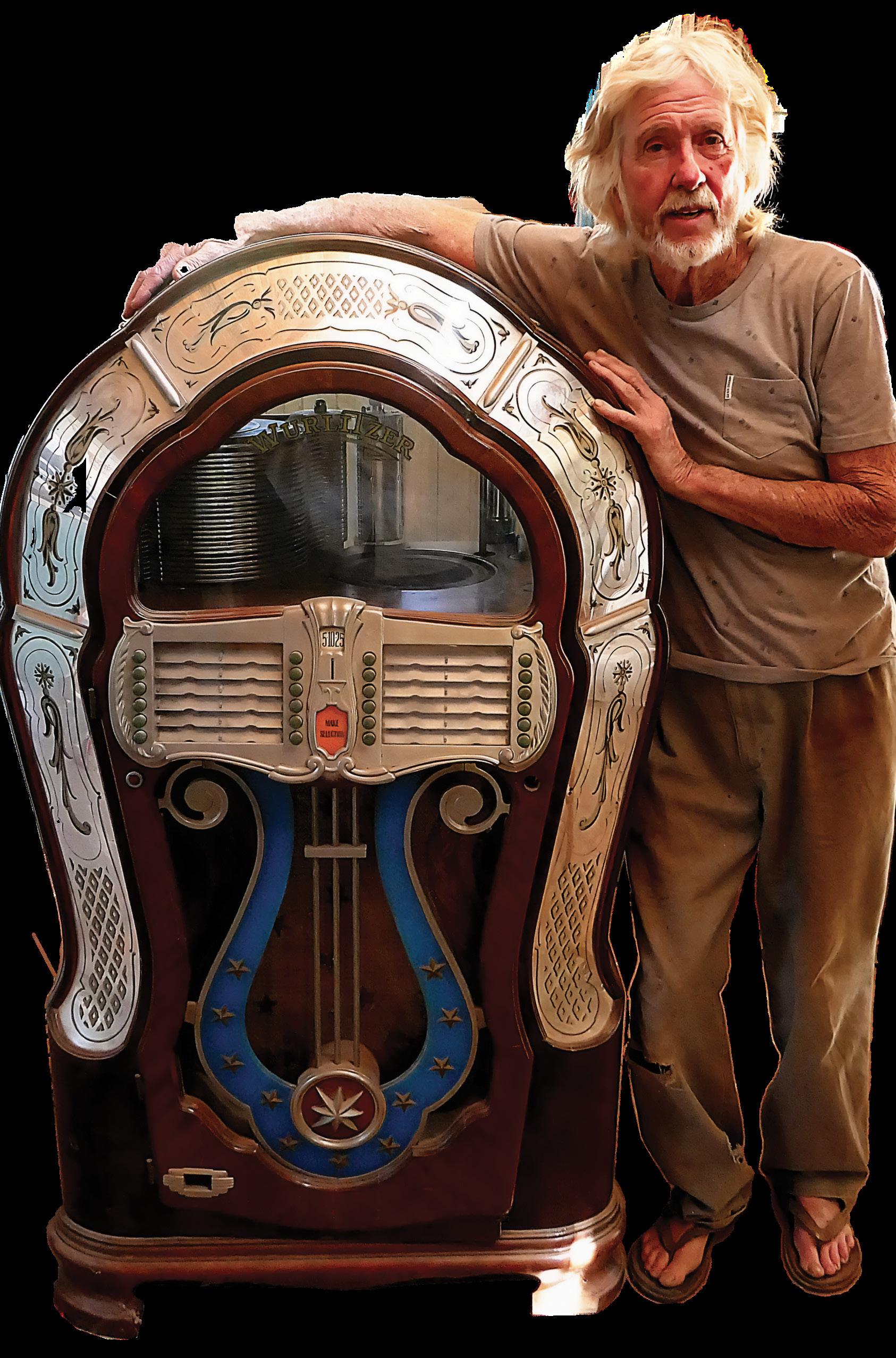
The first jukebox came from a guy on his suburban street. When Tom Donahue, growing up in Burbank, helped a neighbor remove a Seeburg jukebox from his bar, the man ended up giving it to Tom. The neighborly gift was a preview into a life passion for collecting.
Tom went on to study psychology and art history in college, then lived in a barn where several friends set up a sculpture studio, and he began working with clay. With earnings from making ceramics as a craft, he purchased his first home, a large house in Oak View, for $24,500. Tom often passed his time reading trade magazines, which fueled his growing interest in collecting advertising art, but he was also still interested in vintage jukeboxes. His second jukebox was a Model 1015 Wurlitzer he found in St. Louis, which he bought for $2,000. He followed this
Story and photos by TOM MOORE
up with purchases of other jukeboxes, including his personal favorite, a Model 1080 Wurlitzer.
Tom’s acquisition of the 1015 was anything but conventional. Packing up at a swap meet at the Rose Bowl in Pasadena (where he sold his ceramics), he noticed a jukebox in the back of a seller’s pickup truck. He mentioned that he was looking for a jukebox, and the man replied that he knew of a Wurlitzer in Chicago Tom might like. Although dealing with a stranger, Tom agreed to purchase the jukebox sight unseen for $1,000, because he is inclined to make deals based on trust, which usually leads to a positive outcome. Little did Tom know that he would not see this person again for three years. The seller called Tom about once a year to let him know he intended to return to California and complete the
transaction. He kept his promise, bringing the jukebox three years later.
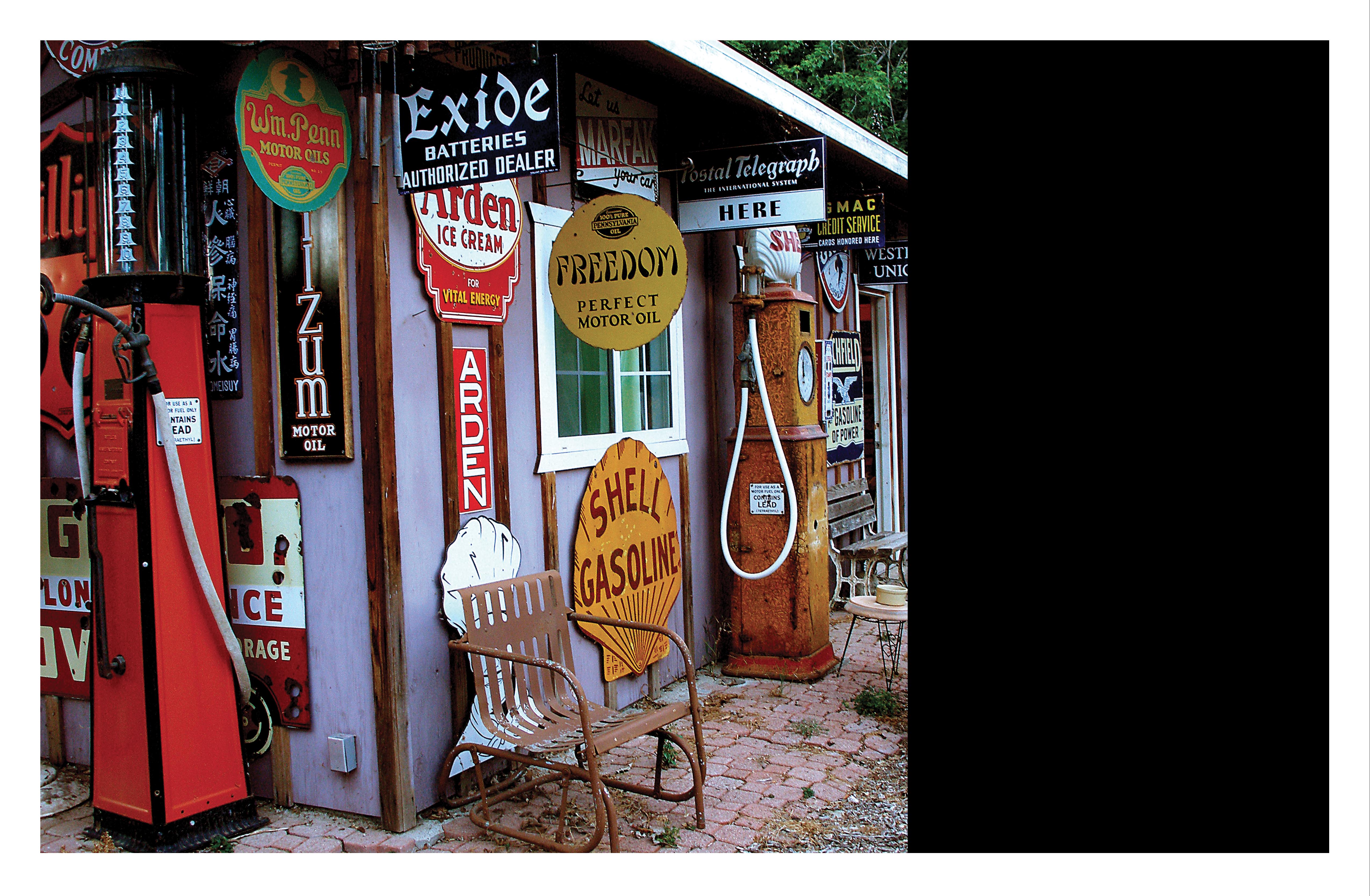
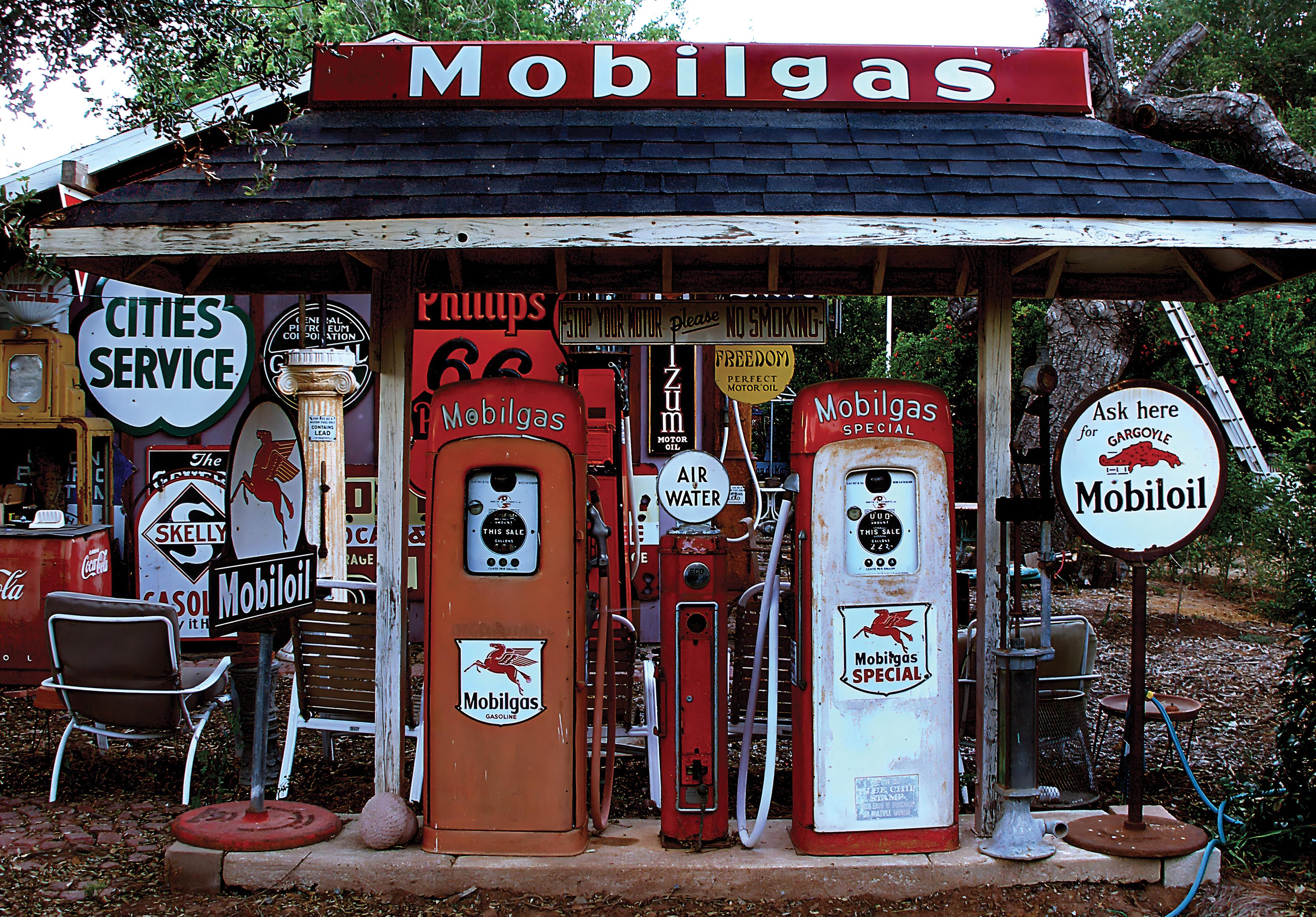
Tom subsequently bought another jukebox in Oklahoma that had a much greater impact on his life. After spending a few weeks on a quest for other collectibles in the area, he found an antique store with an assortment of gas pumps. Thus began Tom’s love of petroliana — collectibles related to gas stations and the petroleum industry.
He pursued this new interest, buying many more gas pumps at swap meets ranging from $15 to $200 — bargain prices based on what the items are worth today. Tom says a gas pump he purchased for $200 around 1965 would probably be worth about $5,000 today. He even paid one man in Woodland $15 for a pump he had been offered free of charge.
As Tom placed more emphasis on petrol items, he took annual trips to Oklahoma, staying and treasure-hunting with a man who started him on this quest.
Tom is a longtime family friend; I remember first meeting him when he was selling at the Ventura Swap Meet. At the time, my brother Dave and his wife, Louise, collectors themselves, had a Wurlitzer 1015 Bubble Tube jukebox in their living room, right next to their barber chair. Dave and Louise took me to visit the home of Tom and his wife, Becky, to see their collections, including vintage gas pumps and brilliant original porcelain and tin signs promoting oil companies and their products.
A small building on the property was dedicated to Becky’s collection of lunchboxes — 350 of them. Adorned with the likenesses of our childhood heroes—TV and movie actors, hosts of kiddie TV shows, athletes, and more — the collection was impressive.
Some years later, the Donahues moved to a larger property in the Ojai Valley capable of containing their burgeoning collection. I wonder if Tom approached his new home following the lead of Pablo Picasso, who reportedly said, “Give me a museum, and I’ll fill it.” Tom’s version, of course, would be, “Show me a bigger yard, and I’ll fill it.”
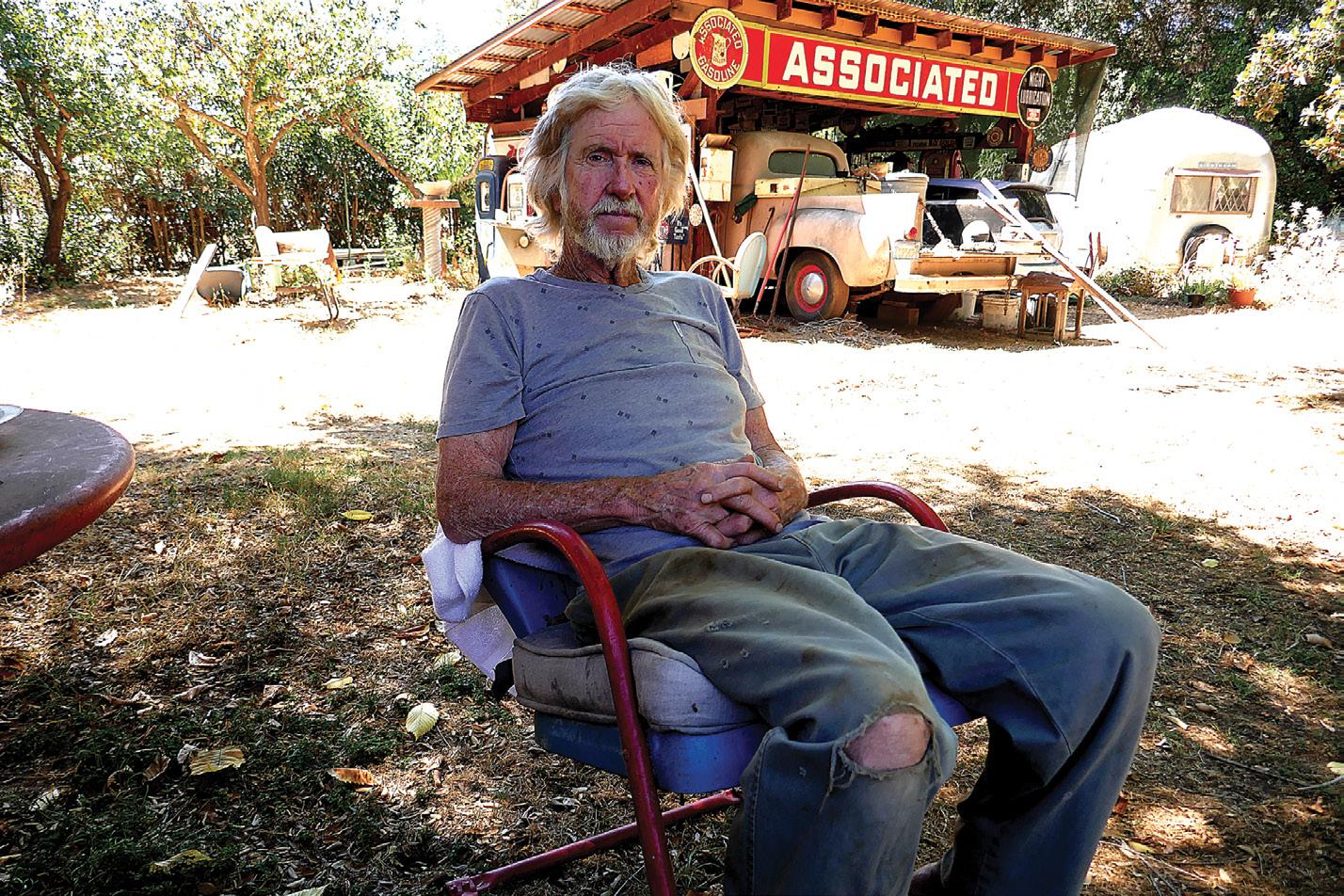
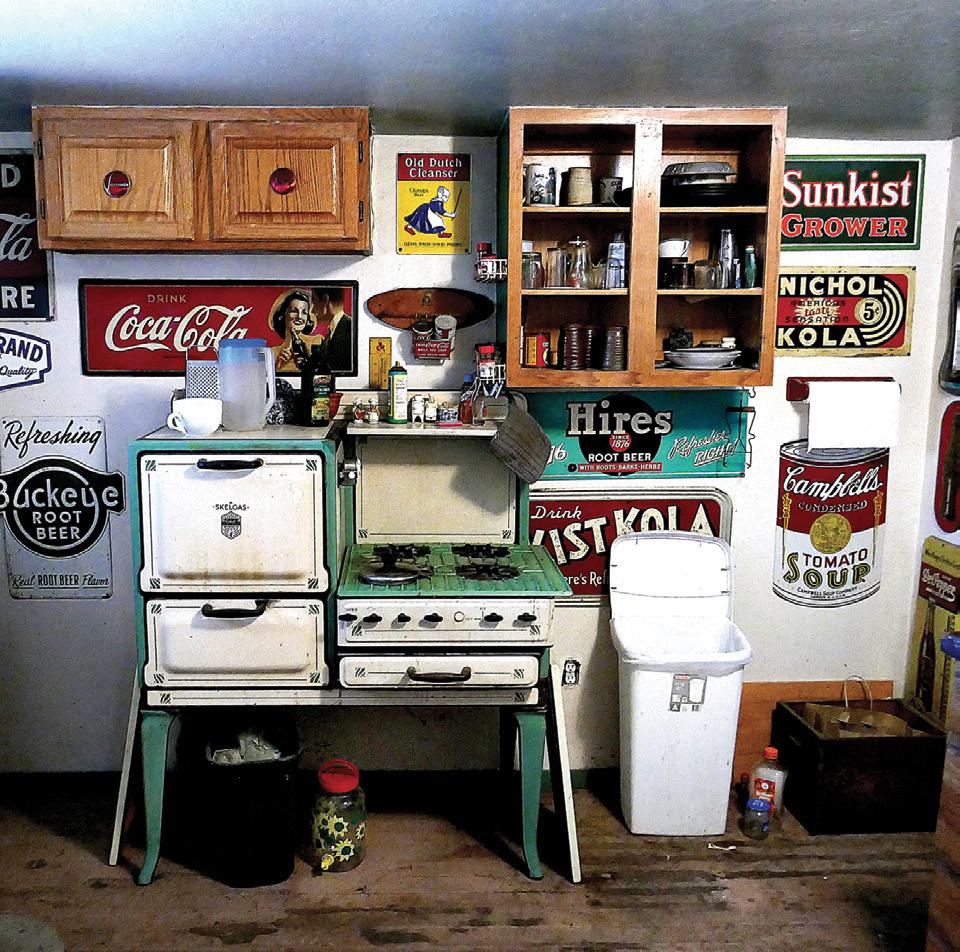
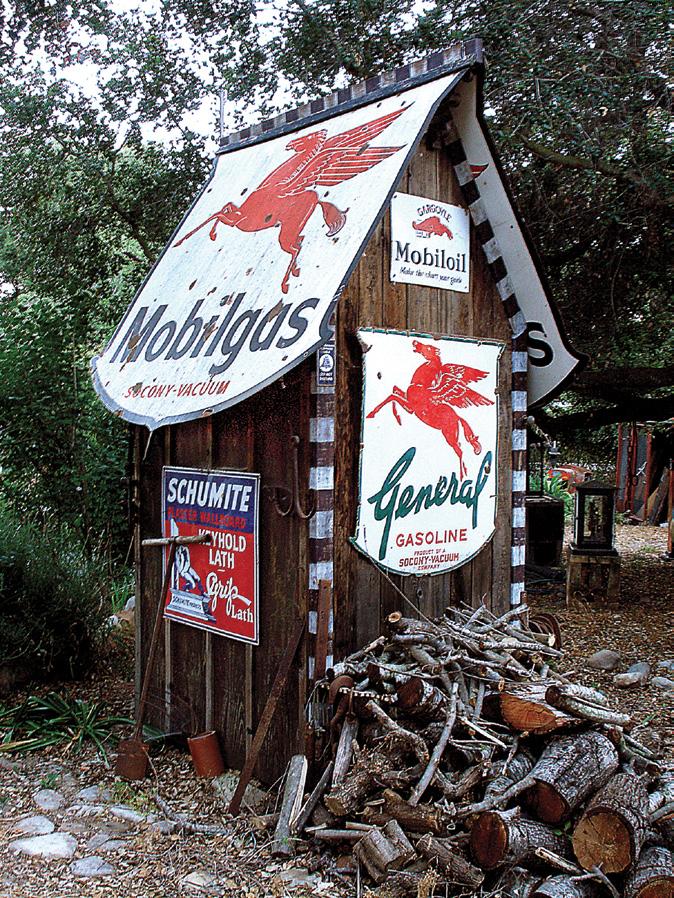
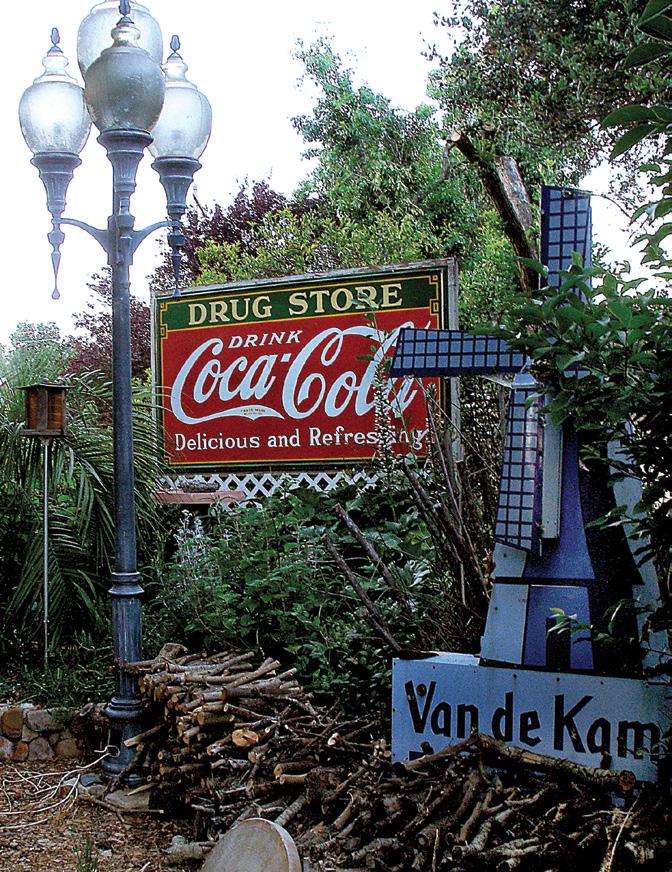
He didn’t just fill it: He created, and continues to create, a brilliant, colorful environment. It’s wildly eclectic, to be sure, but not random. Tom is a student of these
items: The signs represent companies that were of historical significance, and he seeks specific models of gas pumps to fill gaps in his personal collection.
At one time, Tom had more than 100 gas pumps. He has culled that to just over 50 as part of this artful environment his friends have come to call “Donahueland.”
A particularly impressive recent addition to Tom’s collection is a beautiful 1929 Model A Ford Depot Hack, which today we would call a charming old woodie. Tom says he wasn’t looking for a vehicle, but when he saw it, he knew he had to have it.
Donahueland extends to the interior of his home. One of the two houses on his property is filled with signs, antique appliances, a wall of clocks promoting various businesses, and globes that adorned the tops of companies’ gas pumps. Beyond the oil-re-
and a personal favorite of mine: a Van de Kamp’s windmill.
The roofs of Van de Kamp’s bakeries and coffee shops featured large windmills that rotated and were adorned with neon lighting, creating an impressive beacon. Smaller versions served as decorative features on the ground. And who do you suppose has one of these nifty windmills in his yard? Yep, Tom Donahue. He actually had 12 at one time. Not surprisingly, they were attractive to anyone who saw them, and now he has just one.
Tom’s 45-plus years of work on “Donahueland” have created a brilliant visual gift to his Ojai Valley – Mira Monte neighborhood.
weapons is the belief that a war between regional powers — India and Pakistan are often cited as examples — on another continent, although terrible for millions of people there, would not greatly change our lives in the Western hemisphere.
A 2020 study found that a limited exchange of 50 small Hiroshima-grade nuclear weapons from both India and Pakistan would likely kill about 100 million people immediately in the region. But the nuclear mushroom clouds rocketing explosively upward would also put millions of tons of soot in the stratosphere, predictably plunging the earth into darkness and cold — the “nuclear winter.” The report from Columbia University forecast an ecosystem collapse for oceans, with widespread crop failure on land. Two billion people would perish in the resulting famine, expected to last for five to 10 years.
CONVINCING OJAI TO GO ANTI-NUCLEAR
Thirteen years ago, Dodge and his partner, Kristin Jensen Dodge, moved to Ojai from Ventura, where Bob had long been active politically. He knew Ojai was already an International City of Peace, and wanted it to be a nuclear-free zone as well.
“Of course Ojai doesn’t have nuclear weapons and we don’t build nuclear weapons,” Dodge says. “But I went beyond that. I wrote the resolution we brought to the City Council, and I wanted it to be a device, a divestment process.”
In April 2018, the City Council voted unanimously to make Ojai a nuclear-free zone, the first locality in
California to take that step. The resolution requires that the city “refrain from any direct investments in firms that knowingly engage in work related to the production, transportation, storage, processing, use, or disposal of nuclear weapons” or their components.
“One thing I neglected to do during Covid is meet with the city manager every year to go through the vendors to ensure that they are no longer invested in nuclear weapons,” Dodge says. “If
For Brian Berman, what makes Dodge effective as a public speaker and advocate is his grasp of the medical consequences of nuclear war. “Dr. Dodge knows the actual effects of the nuclear bombs of today,” Berman says. “These are not the original nuclear bombs that were dropped on Hiroshima and Nagasaki. These are much, much more damaging.” Berman mentions as an example the
radioactive isotope produced by nuclear fission] had infiltrated mother’s milk, which was going into their babies.”
Dodge makes clear that his opposition to nuclear weapons is a medical necessity.
“As a physician, I am a first responder to a disaster,” he says. “But there is no medical or humanitarian response to a nuclear disaster. The only way to respond
to nuclear war is to prevent it, and the only way to prevent it is to abolish these weapons.”
In 2007, International Physicians for the Prevention of Nuclear War launched a new organization to formally declare nuclear weapons illegal: ICAN, the
International Campaign to Abolish Nuclear Weapons. Working with 121 governments around the world, and building on the success of the international campaign to ban landmines a few years earlier, ICAN brought the Treaty on the Prohibition of Nuclear Weapons before the United Nations Assembly in 2017, which passed 122 to 1. Dodge says: “I felt empowered, but we all knew the United States wasn’t going to sign. None of the ‘nuclear nine’ nations would sign, which we are all well-aware of.”
Dodge, who wanted to find a way to support the treaty in the United States, helped start another organization, Back from the Brink, “to move us away from the brink of nuclear war.”
“After Ojai endorsed the Back from the Brink principles, we took it to Santa Barbara and I presented it to their City Council,” Dodge says. “They passed it. Then Los Angeles, which was the largest city to date, and then [state Sen.] Monique Limon heard one of our presentations in Santa Barbara. She took it to the state level, the State Assembly at that time, and then into the State Senate. And so California became the first bicameral state to declare nuclear weapons illegal, and then it kind of exploded across the nation.”
RETIRING, BUT STILL ACTIVE
Dodge plans to retire in 2026. He has gathered many honors over a long career in medicine and as the co-chair of the largest chapter of the Physicians for Social Responsibility, in Los Angeles. As a backer of ICAN, which won the Nobel Peace Prize in 2017, he has a Nobel plaque to hang on his wall.
But he’s not one to rest. “I’m not a good sitter,” Dodge says.
“He’s got to use up some of that energy,” Kristin Dodge says. “I’ve got a lot of energy, but this guy puts me to shame.”
Dodge, 73, hopes to continue working in medicine by teaching young resident doctors. He also plans to collaborate with young people, such as those in Students for Nuclear Disarmament, and Henry Katz, a young activist from Seattle he admires.
He still attends international nuclear
disarmament conferences, such as the one in fall 2025 in Nagasaki to mark the 80th anniversary of the U.S. dropping atomic bombs on Japan. He also writes and publishes stories on nuclear disarmament for Common Dreams, Counterpunch, and other progressive outlets — but not Facebook. “I just saw on my feed from Bloomberg that Facebook has announced that they’re moving to powering every part of their operation by nuclear power,” he says. “So I wrote my last post on Facebook today. I’ll be transitioning to Bluesky. I have no choice, because now, every like, every share will be another thumbs-up for nuclear war.”
Despite these setbacks, Dodge takes the long view, pointing out that we have greatly reduced the number of nuclear weapons in the world after negotiations between Reagan and Mikhail Gorbachev in the 1980s.
“We’ve gone from 70,000 nukes to 12,241,” Dodge says. “So we know we can take these weapons apart. We also know that detonation of 100 nuclear warheads will kill 2 billion people on the planet.”
Dodge adds that Reagan had a change of heart on nuclear weapons after seeing the 1983 TV movie The Day After that depicted the horrors of a nuclear war. Perhaps another film could awaken us and our leaders to their threat. Dodge says one of today’s most prominent movie directors, Denis Villeneuve, of Arrival and Dune fame, optioned the book Nuclear War: A Scenario, and plans to begin filming soon.
But fundamentally, Dodge believes, it’s up to us — all of us.
“It’s a fallacy to feel that ‘they’ won’t let nuclear war happen, because in a democracy, ‘they’ is us,” he says. “We are all first responders. I always say when I write or speak, that we all have a role to play, even if it’s not a big role. Now that you’ve heard this, you have a responsibility to do something. Maybe you will talk to your neighbor, or to the Rotary Club, or send $5 a month to nuclear disarmament. Because your future and your children’s future is at stake every moment of every day. Other issues — the environment, or saving the whales — they’re all important, but none of that means anything if it’s gone in a nuclear war.”
TThe Rilling brothers have their roots in the same garden, much like their mindfulness teachings.
Evan Rilling’s cooking classes and Shine Rilling’s collaborative movement game, Peace Sticks, implement mindfulness into daily life in different ways. But in both cases, the brothers cultivate awareness that leads to health, confidence, and deeper connection.
“I always say my goal is to help people become more connected to themselves, their community, and the Earth,” Evan said. This message resonates in the opening ceremony, a ritual players engage in before playing Peace Sticks. The ceremony progresses through three key affirmations with corresponding movements and synchronized speaking: inner peace, outer peace, and world peace.
The Rilling brothers spent a great deal of time as children in the abundant backyard garden of their mother, Kathy Nolan. Shine, also a musician, wrote a song, “Mama’s Garden,” that captures their Ojai wonderland as a place of love and grounding, still integral in their lives today. Nolan wasn’t surprised when her sons pursued careers in mindfulness.
“They both came into this world with free spirits,” Nolan said. “They followed their instincts, their hearts, and their gifts that they now share with others.”
The brothers have followed separate paths to their careers, but they’ve collaborated along the way and ended up in the same synchronous place:
teaching mindfulness. Bettina Hubby of Los Angeles is a student of Evan and Shine who learned mindfulness from both brothers at separate times, several years apart. In 2022, Hubby and Shine met at the Aniwa Gathering, a festival in Northern California that celebrates Native American traditions, art, music, and community. There, Hubby learned to play Peace Sticks, in which partners stand opposite one another and throw the sticks back and forth in a rhythmic flow. She returned from the festival with two sticks of her own.
In 2024, Hubby met Evan at a mutual friend’s birthday party in Ojai. After a conversation about his eight-week-long
and photos by HANNAH
LITTLE
Story
Shine Rilling (left) and brother Evan
Transform Your Relationship With Food, she signed up immediately.
It wasn’t until 2025 when Evan visited Hubby’s Los Angeles home to co-create an extravagant six-course dinner and saw her set of Peace Sticks that she realized the connection .
“The fact that they’re brothers just blew my mind,” Hubby said. “I was like, yeah, of course you are, but how magical as well.”
Evan: The mindful cook
Twenty-two years ago, while living together in a “little shack on the beach” and attending college in San Diego, Shine encouraged Evan, who was unsure if he wanted to pursue art or cooking, to start a cooking show. At the time, Shine worked at two fine-dining restaurants and invited chef friends to cook on the show, Evan’s Feast On The Beach.
He has since built a cooking enterprise, The Healthy Home Chef — a name inspired by his time as a private chef for Will Smith’s family, who referred to him as “the healthy chef.” Healthy eating is a big component of Evan’s teachings, but equally important is delicious eating.
“People have this idea that healthy and delicious can’t go together,” Evan said. “As far as shifting mindset, this is a big one I teach.”
freedom and empowerment in the kitchen, Evan explained.
During Evan’s course, no more than 10 to 15 people meet weekly on Zoom to cook a meal together. Students learn that outstanding flavor requires high-quality ingredients. “Eat foods that are as close to nature as possible,” said Evan, who encourages students to source ingredients from local farms or farmers' markets. These concepts were foreign to Hubby.
“I lived in New York for many years, where I would graze off of the delis and the shop corners for food,” Hubby said. “This [course] has been life-changing for me.”
“I was essentially being mentored by these chefs,” Evan said.
He also teaches students to shift from mindlessly following recipes to asking and understanding the “why” and “how” behind actions in the kitchen, such as why certain ingredients pair together, why knife skills dramatically alter flavor, or how the juicy heirloom tomato on their cutting board has the potential to be broiled, roasted, experienced, and enjoyed a dozen different ways.
Taking the time to understand the elements of cooking will lead to creative
Teaching Mindfulness
Hubby began visiting farmers' markets for her produce, and was inspired by the relationships she formed with farmers.
“Seeing what the farmers were excited about, and asking them how they prepared things, connected me to the Earth and to the land,” she said. “It made me appreciate what goes into bringing the food to the table.”
Hubby has adopted another ritual inspired by the course. Before meals, she sits in a moment of gratitude for the food she is about to enjoy.
Shine: The mindful peace game maker Nineteen years ago, on a hike into the old-growth oak forests of Northern California, the Rilling brothers spontaneously picked up two sticks from the trail and began throwing them back and forth. Through this simple exchange, they invented Peace Sticks.
“We found ourselves go into this flow state and the energy just kept building,” Shine said. “By the time we stopped, we were just like, 'Whoa, what was that?'"
Shine has since taught Peace Sticks to thousands of people and facilitated group teachings with local Ojai schools, UC San Diego and UC Santa Barbara, corporate bankers, rehabilitation centers, festivals, professional athletes, and even a United Nations ambassador.
Shine shared an experience about Peace Sticks that particularly moved him. At a Malibu rehabilitation center, Peace Sticks participants, for the first time in months, felt felt free to be playful and present, briefly letting go of the heaviness of their lives.
“Human beings can be so caught in their negative thought loops that they’re never getting that moment of meditation, of just being,” Shine said. “So that was special to hear.”
The game’s easy, straightforward nature allows kids as young as 2 to participate. Peace Sticks does not require equipment, a course or court, or special clothing — and you can even forget your sticks. “It’s universally accessible,” Shine said. “Any person around the world could go find a few sticks and play.”
The Peace Sticks that Shine makes and sells have global roots.. He has traveled to Nicaragua, Indonesia, and the Amazon, working with local communities to craft Peace Sticks decorated with Indigenous art. A stick painted by Shipibo tribe members in the Amazon might end up in
someone’s hands in Los Angeles, sparking curiosity about other cultures and creating unexpected bridges.
“Someone might be holding a stick with symbols from a culture they’ve never encountered, and suddenly we’re talking about it, sharing that energy,” Shine said.
He sells Peace Sticks at the Ojai Community Farmers' Market on Thursdays, where Allen Lane and Dominic Robinson, both 20, learned about the game and were hooked.
“Sticks are always in the back of my car ready to go,” Lane said. Robinson enjoys activating parts of the brain he doesn’t engage during standard workouts. When playing, he’s always thinking about where the next stick will be thrown, which hands will be open, or if two will
be thrown at once. “It’s like a brain activity and it’s physical at the same time,” Robinson said.
Peace Sticks also emphasizes collaboration. “In competitive sports, there’s judgment, comparison, and fear of failure,” Shine said. “But with Peace Sticks, you can't fail. If you drop a stick, you just pick it up and keep going. You’re learning to let go of self-judgment and stay present.”
The Rilling brothers are animated by their desire to give back to the land, the community, and the next generation.
“They are both visionary men who made a big impression on me due to their ability to connect and be present,” Hubby said. “The Rilling brothers are a living example of how to ripple mindfulness into the world.”
Mystical and monastic traditions have long developed inner technologies for transforming human potential. Early Christian monastics described this path as gnostike, while later Sufi mystics called it ma’rifa—a direct, heart-centered knowing of the Divine. Both traditions offer sophisticated psychological maps for navigating shadow, resistance, and inner transformation. This weekend retreat introduces the spiritual psychology of Christian monasticism and Sufi mysticism, placing them in dialogue. Participants are invited to explore the inner path as one of integration, clarity, and awakening. Through gentle guided contemplative practices, the retreat offers a way to directly engage with the heartbased spiritual technologies shared by these two lineages.
THE HOST: David M. Odorisio, PhD, is Chair and Core Faculty in Mythological Studies and Psychology, Religion, and Consciousness at Paci ca Graduate Institute. Editor of Thomas Merton in California and Merton and Hinduism, he co-chairs the Mysticism Unit for the American Academy of Religion and regularly leads talks and retreats on Merton’s life and writings. www.ahomeforsoul.com
Accommodation Available • Two Night Minimum Call 805-646-1139
December
“Annie”
Dec. 5 – Dec. 21
Ojai Art Center Theater
113 S. Montgomery St.
Tickets: ojaiact.org
Camp Arnaz's Winter Wonderland
Weekends: Dec.5-Dec.27
155 Sulphur Mountain Rd.
Holiday horses, food, drink and more.
Tickets: girlscoutsccc.org
Ojai Historical Walking Tours
Dec. 6, 10:30 a.m.
Ojai Valley Museum
130 W. Ojai Ave.
805-640-1390
ojaivalleymuseum.org
Tickets: Adult $10; Family $25.
Learn about Ojai's unique history on a 90-minute tour led by docent Connie Campbell.
Learn about Ojai's unique history on a 90-minute tour led by docent Pat Essick
Women of the Valley: 100 Years of Ojai History
Opening Reception will be on Jan.16.
Jan. 15- April 5
Ojai Valley Museum
130 W. Ojai Ave.
805-640-1390
ojaivalleymuseum.org
"Educating Rita"
Jan. 23 – Feb. 15
Ojai Art Center Theater
113 S. Montgomery St. Tickets: ojaiact.org
Chamber On The Mountain Presents Phillip Levy, Violinist and Tae Yeon Lim, Pianist
Jan. 25, 3 p.m.
Beatrice Wood Center for the Arts
8585 Ojai-Santa Paula Rd. Tickets: beatricewood.com
February
Read the events page in the Ojai Valley News, available in print at news racks and with news sellers. For locations, visit ojaivalleynews.com/site/locations
Gustave Caillebotte canvas and paper, Dec. 26 – Feb. 15.
WINTER '25
Photo: Wikimedia CC
Kim Stroud’s first experience caring for a bird involved a young crow, secured from a pet store after it had been abandoned. She nursed the crow back to health, then released it after two months. However, it had imprinted on Kim, and continued to return to her after its release. Her first encounter with a raptor came when her stepfather, Tom Ridenour, secured a red-tailed hawk to care for from the Santa Barbara animal shelter — this took place before wildlife permits were required to take custody of such a bird.
Kim worked for Patagonia for many years as manager of the prototype department, producing samples of new designs for possible addition to their line of products and using her considerable skills as a seamstress.
Ojai Raptor
While working at Patagonia, she encountered Jerry Thompson, who operated Raptor Rehabilitation and Release in Simi Valley. Jerry took Kim on as a volunteer, caring for birds he provided her. Patagonia supported Kim’s work, allowing her to build a flight cage for 15 great horned owls under her care.
Left: Kim Stroud holds a Great Horned Owl.
Photo: Tim Davis
Below: ORC built the largest flight enclosure in Central and Southern California.
Photo: Courtesy of Ojai Raptor Center
Kim was co-founder of Wildlife Care of Ventura County, working with birds and mammals in 1994. This group of about 10 home-based rehabilitators, gathered through word of mouth, took in 1,500 animals from Ojai and Ventura.
In 2000, Kim broke off from the group and incorporated the Ojai Raptor Center in the backyard of her home on Burnham Road. The center constructed a few sizable cages at that location, along with two flight cages at Patagonia, one on Sulphur Mountain Road, and three more flight cages on other private properties. She housed an impressive collection of birds, from owls and falcons to several hawks and eagles, and Handsome, her turkey vulture.
former county Honor Farm, now the west campus of HELP of Ojai. The site includes a large barn, along with about 4 acres of land.
The center brought the barn up to code to make the transition from breeding pigs to caring for birds, and constructed flight cages, including the largest flight cage in California (230 feet long), plus three 50-feet-long, and two 25-feet-long cages. The flights prepare birds for release by strengthening their flying, and helping them practice catching live prey for food. The center uses 10 enclosed flight spaces to transition birds to the larger flight cages.
Staff wear camouflage, called gilley suits, to avoid the birds imprinting on
Center turns 25
She received Handsome from Kentucky when he was 6 months old. He was already imprinted on humans, which precluded his release into the wild. He is now 21, with a possible life expectancy of 40, and jealously considers Kim as his mate.
The primary mission of the center is to rescue, care for and rehabilitate birds injured in the wild, with the goal of returning them to their natural environment. In some cases, birds sustain injuries that can be treated, but leave them unable to live successfully in the wild. A few of these birds find permanent placement as Education Ambassadors.
In 2010, the center moved to its present home in the
Staff are caring for 125 birds, all slated for release, and six permanently housed ambassador birds. Spring and summer are particularly busy times because the center takes in many nestling and juvenile birds. The fall and winter seasons see migratory birds coming through for care; these include sharp-shinned hawks, merlins, peregrine and prairie falcons, and ferruginous hawks. The center also cares for many nonthriving juveniles.
Medical care is provided in an on-site hospital, complete with its own intensive care unit. Along with a full-time veterinarian, the center’s employees include two nurses (vet-techs) and a hospital manager, six other full-time staff, 87 active volunteers, and two educators.
Under the inspiration and leadership of Kim Stroud
humans when they are young.
Below: 3 Great Horned Owls.
Photo: Courtesy of Ojai Raptor Center
The hospital is a teaching hospital for interns and university veterinary rotations.
From its modest beginnings, the center’s permits from both the U.S. Fish and Wildlife Service and California Department of Fish and Wildlife now include Rehabilitation, Education, Restricted Species for Education, and U.S. Department of Agriculture. From an initial budget of $10,000 a year, the center’s expenses have grown exponentially, including a cost of $7,000 per month for food alone during the baby season.
This year marks the 25th anniversary of this home-grown organization, as well as the retirement of full-time director Stroud, who has shepherded the Ojai Raptor Center from its inception.
Below: Jackie DeSantis, an ORC volunteer with a Turkey vulture
Photo: Perry Van Houten
Josh Arredondo, student and outreach director at Redemption Church in Meiners Oaks, has led mission trips to Pereira, Colombia, the past three summers.
In the remote mountain city of half a million people is an orphanage called The Foundation, started by Rubiela, a former communist guerrilla leader who had taken part in the killing of villagers.
About 30 years ago, she heard a message of hope from evangelist Ramon Babilonia, former pastor for the Spanish congregation at Redemption, and decided to turn her life around. “She looked back and saw all these orphans that she essentially created,” says Arredondo.
Rescuing orphans from off the streets, The Foundation provides a safe home and education for approximately 40 children, average age 7 to 10.
Once a year, after school lets out for the summer, Redemption parishioners make the 3,400-mile journey to Pereira to “encourage and give the orphanage staff a break and provide the orphans with the best week of their lives,” Arredondo says.
bringing games, crafts, and activities for the kids. They taught songs and Bible lessons and simply spent time with the orphans. “One of the more impactful things is just the ministry of presence,” Arredondo says.
The children look forward to the visit all year long, and the experience is transformative for orphans and parishioners alike, according to Arredondo. “The change is palpable,” he says. “The kids are acting different, they’re treating each other kinder, all these different things you hope for.”
Many years ago, parishioners from Redemption built dorms, bunkhouses, and facilities for the orphans. The church
financially supports the orphanage, which operates independently of the Colombian government.
The mission trips to Pereira often take parishioners out of their “comfort zone” a little bit. “It’s not a vacation,” Arredondo says, and there’s something to do for everyone, whether it’s teaching the orphans or swinging a hammer for some carpentry work. “There’s so much great need in the entire world and we all have a certain part to play, and it’s not up to any of us to do every single thing. Your whole outlook toward life changes when you realize what you can do to impact another person. We need to be looking outward at who we can bless and
L ocals transform lives in L atin A merica
Some members of the congregation have made the trip each of the past three years. “They see the value in it, and they’ve built these relationships with these kids who are used to being abandoned,” Arredondo says. One parishioner decided to stay a full year.
In June 2025, a group of 19 Redemption parishioners (six were high school students) spent 10 days at the orphanage,
Pastor David Johnson from Live Oak Christian Fellowship at A Place for the Children Orphanage in September 2025.
transform their lives. That’s where joy is going to come from.”
Redemption collaborates with another Ojai Valley church, The Well, to build homes in Mexico.
In 1999, The Well’s lead pastor, Richie Litonjua, took a group of young people to Mexico to build a home.
Elder Mark Bodycombe went along as a parent chaperone. “I was just deeply affected by the poverty that I saw and the opportunity to make a difference, in the name of Jesus, in a family’s life,” he says.
Soon, Bodycombe was leading one or two trips each year to Tijuana and Ensenada.
On a typical trip, volunteers arrive on Sunday, build one home on Monday and Tuesday, then a second one on Thursday and Friday. On Wednesday, they serve at
by PERRY VAN HOUTEN
every trip, “half of the people that come with me have never done anything like this before,” Bodycombe says. “To watch the transformation in their lives in every way, shape, and form is overwhelming, as far as just reaffirming the joy and purpose of doing what we do. It’s something that becomes part of their DNA of giving back, of loving others, of serving sacrificially as Christians.”
The experience is not just a gateway to spiritual transformation for the volunteers; it also changes the lives of the underserved families who move into the new houses.
an orphanage.
It costs $32,000 to build two homes. The Well holds fundraisers to pay for materials. “We’ve always had more than what we’ve needed every single trip,” says Bodycombe.
Each person pays their own way for lodging, food, and accommodations, and “we all contribute the labor and the love that goes into building these homes,” Bodycombe says. “Every day is full of adventure, full of serving. It’s tiring, but it’s a wonderful tiring at the end of every day.”
Serving as host for the trips is Homes for Hope International, a ministry of Youth With A Mission, which has been building homes in Mexico for more than 30 years. “They’re our partners in accomplishing these wonderful opportunities,” says Bodycombe.
Who goes on these trips? “They’re typically people from faith-based church communities,” Bodycombe says. “They work together, collaboratively, to raise the funds required to buy the materials.”
While some parishioners have made
The Well partners on home-building trips with Redemption and First Baptist Church of Ojai.
Collaborating with other Ojai faithbased groups sends a powerful message, according to Bodycombe. “To be able to join together brings a true sense of unity, of camaraderie, of working together,” he says. “It’s a beautiful thing that benefits the entire valley.”
Above: Young volunteers from Redemption Church with orphans in Pereira, Colombia.
Below: Kids at The Foundation orphanage in Colombia having some fun outdoors.
Left: Volunteers from The Well raise the wall of a new home in Mexico.
The boys dorm at Casa Hogar La Gloria in Tijuana, a ministry of the Augustinians.
Working in unison with other faithbased organizations can work wonders, according to Pastor David Johnson with Live Oak Christian Fellowship in Oak View. “People are moving beyond their denominational walls and working together … helping those, especially, who have great need, like we’ve seen so close to our border,” he says.
As a teen, Johnson explored the Yucatán with his father and learned about the Mayans and other Indigenous peoples. “My heart was captured by the people of Mexico,” he says.
In 2007, he made his first trip to an orphanage in the city of Vicente Guerrero in Baja, Mexico.
The orphanage, called A Place for the Children, was founded in the 1960s by a mission-minded American couple from North Hollywood, Chuck and Charla Pereau.
Johnson has led 12 trips since; the most recent, and the first in seven years due to the pandemic, was in September 2025, with a group of six volunteers.
Making their first mission trip with their father to Vicente Guerrero were son Dresden, 17, and daughter Julia, 15. “This is an opportunity,” Johnson says, “to take the hope and the beauty of what the Pereaus started and put the baton in the next generation’s hands, and show them the foundation that was built and what’s possible going forward.”
Every person on the trip is given a job to do, based on their strengths, backgrounds, and proficiencies, “where they can really serve to the best of their abilities,” Johnson says. “It’s been an amazing experience, learning about the people and being able to actively do something to help improve their lives.”
Some go to work in the nursery, “just holding these babies who have come to the orphanage.” Others help out in the fields, the medical clinic, or the school. “Mostly though, it’s encouraging the children and just giving them a lot of warmth and love,” Johnson says.
From experience, Johnson knows that serving at the orphanage can be life-changing for the volunteers. “It gives them extra sensitivity and compassion for other people,” he says. “It’s really critical, as a central part of our faith, that we take time to live our lives as Jesus did and to care for other people.”
“It’s wonderful to see so many different churches, so many different people, meeting needs in a different way,” says the Rev. Kirk Davis with St. Thomas Aquinas Church in Meiners Oaks.
Since 1975, an orphanage in the La Gloria community of Tijuana, 6 miles south of the border, has been a home for at-risk
Below: A solemn moment at
Above: Pastor David Johnson and his Oaxacan friend, Cornelio, and his family in the Vicente Guerrero area in 2010.
The Foundation orphanage in Pereira, Colombia.
and vulnerable children. “Casa Hogar La Gloria is a ministry of the Augustinians,” Davis says. “It echoes the trajectory of Pope Leo, who went to the missions.” Davis, president of the organization’s board of directors, says the home provides food, shelter, medical care, social development, and Catholic education for the orphaned, abused, neglected, and abandoned children of Tijuana, youth who would fall into the foster care system in the United States. “Mexico doesn’t really have a foster care system, so orphanages still exist,” he says.
Casa Hogar La Gloria has a full-time staff of 20 to care for an average of 30 children, from newborns to the age of 12. The organization has formed
relationships with two other orphanages that specialize in adolescents.
For Davis, the ministry is highly personal. “My father grew up in a Roman Catholic orphanage, so this is very close to my heart. His dad died when he was 4 years old,” he says.
Davis, a regular visitor to the orphanage, says Villanova Preparatory School students fundraise year-round and visit the home once a year. “They’ve established relationships with the kids. When you’re called forth and you have the opportunity to care for someone who’s that profoundly in need, it changes you.”
One young man came to Ojai from Tijuana and attended Villanova as a
boarding student. He graduated in 2020 and returned to Mexico to attend culinary school. “Exactly where he’s working now, I’m not sure,” Davis says, “but I do know he’s engaged.”
What the children need more than anything else is financial support, according to Davis. “We have a staff to pay, we have clothing to buy, we have tuition to pay, we have medical care to provide. Ninety-five percent of your dollar is passed directly through,” he says.
During his visits to Casa Hogar La Gloria, Davis read the “Prayer of the Faithful.” Children would pray for their caregivers, teachers, family, and friends. “And invariably, one of the kids would pray for kids who don’t have a home and don’t have food,” he says. “These were kids who were somehow understanding that they weren’t in a traditional home, but understanding that they had a whole lot more than others do and are grateful for that.”
Big smiles at The Foundation orphanage, where Redemption Church lends a hand every summer.
Left: Pastor David Johnson, at left, helps build a home in September 2025.
by MIMI WALKER
do roast Ethiopian [coffee],” Jones said. “I love that we can provide a cultural smorgasbord of coffees.”
She added: “When we first got this place, it was a shell, and we built it out, made it into a coffeehouse, and then through time, about 18 years ago, we had to blow through the wall, and we decided to make a kitchen so we could provide lunches, salads, and sandwiches, which people have been enjoying all these years.”
All the in-house food is from Jones’ own recipes. In the three decades Ojai Coffee Roasters has been running — even during COVID, “I never, ever, ever closed,” Jones said — the eatery has overcome the most challenges in the company’s trajectory. Jones
operated the shop completely on her own for several weeks at the start of the pandemic in 2020; facing mounting stresses, she made the painful decision to shut the kitchen down. It finally reopened in early 2024.
“I feel so confident in my product and … making people happy and having them enjoy a cup of coffee — it’s so simple,” Jones said. “It’s a treasure. … It’s just the beauty of … the connections that people
make. Meetings come here. People are writing books here, people are doing their bookkeeping here, they’re coming in and reading a book, they’re coming in to meet with friends. … The consistent regulars in the morning have now become like family members around here — and it is a family.”
Jones’ own family footprint is deeply embedded in the shop. She said of her children: “Natalie used to roast for me; she’s my oldest. Olivia used to be in the kitchen for me — she was so good in the kitchen — and Adam was roasting a little bit too, and he designed our website. … They’ve all worked here, every one of them, they’ve washed dishes, they’ve made lattes.And I’ve grown up here, too. I’ve learned a lot from them and from customers.”
and institutions, serving kombucha from Revel and shortbread from Love Shortbread in Ojai, and baked goods and bagels from Santa Barbara and Carpinteria. The Ojai Valley Athletic Club and The Nest also serve Jones’ coffee. Inside Ojai Coffee Roasters is the “Art Wall,” displaying “30 years’ worth of local artists,” Jones said.
Jones has also enjoyed shaping the lives of young people who start their first jobs at Ojai Coffee Roasters. “I mean, one in particular employee, who’s on right now, has been with me almost two years now,” Jones said. “She came as a very young teenager and very shy, very quiet, until I said to her, ‘You’ve got to speak up! … They want to hear their latte’s ready.’ And she’s now a shift lead. … I love the people who work here and it’s a challenge to teach young people, but we’re doing it.”
The expansion of Ojai Coffee Roasters into other homes and businesses is a dream come true for Jones, such as a partnership with Ojai Vons she’s been working on for years.
“They brew my coffee there in the deli. … So you can go there and grab a cup of coffee after 6:00. And it’s great! Also, my beans are for sale there.”
The company’s website, ojaicoffeeroasters.com, serves customers far beyond Ojai, Jones said: “We go everywhere the mail goes in the United States, and we’ve got customers all over the country” who buy bags of Ojai Coffee Roasters houseblend beans and other merch such as mugs, T-shirts, and tank tops. Customers buy from as far away as Texas, Louisiana, Florida, and even Maine.
Ojai Coffee Roasters is also a proud supporter of surrounding local businesses
“So you do the math … over 300, maybe 350 artists have adorned my walls. I donate to a lot of arts education. … I love the Ojai Storytelling Festival. Anything community is really where it’s at for me.” Because the business opened the day after Christmas, the holiday season is extra poignant for Jones and her crew. “The holiday season means, to me, that people are with their families, they’re coming back into town, they’re visiting,” Jones said. “It’s jolly, it’s fun, it’s a lot of love going on. And that’s what we’re about. … Love is in the air.”
This big shiny machine has been roasting every bean for almost 30 years!
Giddy up! Let’s get caffeinated!
Every town should have one!
Where Ojaians meet over a cup or two
PLagA on tH VeggiEs
Spanish can be so straightforward. When a farm is beset by pestilence, we often merely say, “There’s a plague on that red kale.” Translated as “Hay plaga en el kale rojo.” That plaga would be aphids. Earlier this year, Colorado potato beetles were plaguing the eggplant and the ashwagandha, both of which are nightshades — solanacea, specifically. The CPBs really thrashed those Old World nightshades. Up until now I never recognized the absurdity that “night” and “sol,” or the sun, describe the same kind of plant.
I don’t have to explain that the sun never appears at night unless it is reflected by the moon. The common English word for pestilence, “plague,” has roots in Old French. Spanish, however, cleans up the foolish imposition of that merciless “u,” and thus: plaga.
In Spanish, what you see is what you get and what you hear. No charming unpronounced letters, or syllables or forms that look like they should not be pronounced as they are. English is, of course, just as impossible. Imagine pronouncing pronouns is your given assignment. We could go on with this gibberish forever, but I do need to explain the plaga that has prevented us from planting certain crops — namely, all the cruciferans, or brassica. I won’t bore a hole in your afternoon about “brassicas” because the cruciferans are all defined by their cross-shaped flowers. The family carries two names and one finds both still in common usage.
by STEVE SPRINKEL
When a farm is beset by pestilence
The current plaga is bagrada hilaris. The bagrada bugs were a multimillion-dollar plaga over 10 years ago when they first appeared one fall. Now they are back. A true plaga, they literally covered the ground as if sent from heaven to punish wayward sinners. Actually, bagrada originated along the coast of the Indian Ocean and came here hidden in contraband or bamboo furniture. We planted cabbage and broccoli this year and tried to control the bagrada with legally organic poison, but reinforcements flew in overnight and proceeded to again suck life from our autumn plantings.
One looks forward to the dependability of fall-planted napa cabbage and Korean radishes. Error-free stands of turnips, wombok, tatsoi, and bok choy will
I don’t remember what compelled me long ago to open the ground and dare nature.
thrive and fail to flower in the declining daylength of the quarter. Once again, we have battled and mostly lost. I rototilled the Asian cabbages and the arugula. I re-skewed the cauliflower and broccoli to an extent, but imperfectly. They limp along, maimed by the toxic sputum the plaga injects as it sips the lifeforce from the leaves of the plant. The damage done by slurping is one thing. Leaving a poison within the plant, which inhibits further growth, really should improve our sense of remorse for having crossed some impeccable line of Do and Don’t.
This idea of Prevented Planting is a legal term employed by what was once known as the USDA in America, before a South African conman started gutting it on Jan. 21. By 2028 DOGE should be done letting the air out of the tractor tires of this once proud institution, formed during the presidency of Abraham Lincoln. When one is Prevented From Planting, you may collect crop insurance. If you bought crop insurance. But although the program probably exists for horticulture, the premium is prohibitively high for small farmers because an acre of broccoli can gross $15 to $20,000. An acre of soybeans will bag you about a grand, which you can afford to insure. Plainly, a farmer could not afford to insure a tender perishable like lettuce or strawberries. One insures according to value, which is why the policy on your new Range Rover is so pricey.
Now, with cooler weather, the bagrada is declining and we can finally plant radishes and turnips. Yet we do so warily, wanting a freeze to finish them off, but worrying about our late-planted tomatoes, which have no courage for frost. No one told me to do this. Farming is not even fun. I don’t remember what compelled me long ago to open the ground and dare nature. One of the most curious results is that so many people are so proud of me and lay on the celebration of this impersonation of Sisyphus. You remember him, don’t you? He ratted on Zeus for stealing the nymph Aegina. The gods make Sisy roll a boulder uphill but made the peak too steep, and the boulder always rolls back to level gravity. The myth has had a classical influence on culture, describing tasks (such as farming) that are both laborious and futile. That nutshells it pretty well.
Mano Farm, a certified organic produce and seed farm located in Ojai
Photo: Steve Sprinkel
When Lanette Jorgensen packed up her life in San Diego with her daughter, Kennedy, and moved back to Ojai in October 2023, both knew change was ahead. For Lanette, the move was a homecoming. She had grown up in Ojai and nearby Oak View before heading to college two decades earlier. Life in San Diego had been full, but she longed for the sense of belonging she had always felt in the valley, with its mountains, familiar faces, and quiet pace. For Kennedy, just 8 years old, the move was a chance to have space to play and grow, and explore her lifelong love for animals.
They settled into a house in the Golden West neighborhood, complete with a large backyard that helped Lanette fulfill a promise she’d made to Kennedy: Once they were settled, they would get chickens. Not long after they unpacked, Lanette’s boyfriend, Daniel Hart, built a coop in the yard — a sturdy, carefully designed home for their first flock, a group of older hens that needed a new start. The family was smitten, especially Kennedy.
Right away, Kennedy demonstrated a gift for taking care of the birds. She handled them gently, spent hours with them, and seemed to understand what made them feel safe. “We started calling her our little chicken whisperer,” Lanette says with a smile.
When coming up with names for the flock, the family wanted something playful that reflected the joy these animals brought to their lives. “The Breakfast Club” seemed like the perfect fit: The name not only nodded to the eggs their hens would provide, but also suggested a sense of belonging, like a special group with members who mattered. They also began calling their hens VICs, or Very Important Chicks.
By spring, the family decided to raise baby chicks. Kennedy was enchanted with the process, tending to the tiny birds and watching them grow. By summer, the hens were laying more eggs than the family could eat or give away to friends. That abundance sparked an idea.
Kennedy had been saving money with the dream of owning a horse. Instead of buying toys, she tucked away birthday money and earnings from chores, and washed cars and sold fruit from their yard to add to her savings. The eggs,
by COLLIN MCSHIRLEY
heTBreakfast C lub
A family’s journey from chickens to community
Lanette realized, could be the foundation of something bigger, a project that would not only help Kennedy move closer to her dream, but also teach her the value of work and responsibility.
Daniel built a small wooden cart, charming in its simplicity, that the family set up in front of their home. They stocked it with cartons of eggs and named it after the coop. The Breakfast Club was born, this time not just as a playful name but as a farm stand open to neighbors and passersby.
BUILDING A COMMUNITY AROUND A CART
The family decided the cart would operate on the honor system. They kept it open at all hours, and added fresh stock each weekend. At first, they sold a few cartons here and there. Then Lanette shared their story in local online
communities, and within hours the cart was empty. Neighbors lined up to support the venture. The outpouring was so strong, the family added more hens to try to keep up with demand.
For Kennedy, the cart has become more than a place to sell eggs. It is a space where she learns, grows, and takes pride in her efforts. She helps collect the eggs,
cleans the coop on weekends, and restocks the cart. She even started what the family calls “chicken hour” in the evenings, when she gives the hens treats and cuddles each one in turn. The chickens, once shy, now run toward her, proof of the bond she has built.
LESSONS
BEYOND EGGS
Lanette is struck by the lessons her daughter has learned: “The value of money, entrepreneurial skills, and how to budget and save for something she really wants. She’s also experiencing firsthand how hard work pays off.”
The lessons come in small, everyday moments. Counting change at the cart. Deciding how to split her savings between shortterm wants and her horse fund. Watching neighbors cheer her on. And perhaps most important, realizing that her efforts create something others value. For Lanette, no classroom could replicate these lessons.
DREAMS FOR THE FUTURE
At the moment, the cart mainly offers eggs, but the family sees potential for more. Their yard is filled with fruit trees, and when the oranges, lemons, and persimmons ripen, the family will add them to the cart. Kennedy and her friends are eager to sell lemonade during warmer months, and Daniel has planted heirloom vegetables that might be part of the offerings.
The family dreams of expanding their flock, perhaps even adding quails. They imagine offering vegetable starts, herbs, and plants so neighbors can create their
own gardens. “We want The Breakfast Club to be a place where people know they can come for something fresh, local, and grown with care,” Lanette says.
Running The Breakfast Club is not glamorous. It is a steady rhythm of caring for the hens, cleaning their space, checking their health, collecting eggs, and keeping the cart tidy. Yet the work has its own quiet rewards. Watching the hens roam freely in the yard. Seeing Kennedy beam as she restocks the cart. For now, that is enough. The family is content with its little flock of VICs, their cart on Oriole
Street, and the joy of sharing their story. And as Kennedy counts her savings and gives her hens one last treat during chicken hour, she is already proof of the truth her mother hoped she would learn. With patience, kindness, and determination, hard work does pay off.
Pomegranate Avocado Quinoa Bowl
This healthy, hearty grain bowl is the perfect side for any occasion.
Makes 4 servings
Ingredients:
2 cups cooked quinoa, slightly cooled
1 cup pomegranate arils
¼ cup chopped pecans
1 medium avocado, diced
2 cups chopped hearty greens, such as kale, spinach, or endive
2 tablespoons fresh chopped parsley
1 lemon, juiced
1 tablespoon extra-virgin olive oil
1 tablespoon pomegranate molasses (see note)
1 clove garlic, minced
¼ teaspoon black pepper
¼ teaspoon salt
Instructions: 1. Combine quinoa, pomegranate, pecans, avocado, greens, and parsley in a medium bowl.
2. Whisk together lemon juice, extra-virgin olive oil, pomegranate molasses, garlic, black pepper, and salt in a small bowl.
3. Pour the dressing over the bowl and combine well. Serve immediately.
Note: Pomegranate molasses may be purchased at specialty Mediterranean food shops or online. If you can’t find it, substitute half balsamic vinegar and half maple syrup.
Nutrition Information per Serving:
316 calories, 36g carbohydrates
9g fiber, 7g protein, 18 g fat, 2g saturated fat,
8g sugar, 70 mg sodium
Jewel Winter Salad with Orange Vinaigrette
This quick and easy winter salad glows with the color of fresh pomegranate.
Makes 4 servings
Ingredients:
6 cups assorted salad greens
4 radishes, thinly sliced
1 fresh fuyu persimmon, thinly sliced
½ cup pomegranate arils
½ medium orange
1 tablespoon extra-virgin olive oil
Pinch salt and black pepper
Instructions:
1. Add salad greens, sliced radishes, sliced persimmon, and pomegranate arils to a medium salad bowl.
2. Make a dressing by zesting and juicing the orange half and adding it to a small dish, along with olive oil, salt, and pepper. Whisk together.
3. Drizzle vinaigrette over salad and toss gently. Serve immediately.