There's no place like home. Let me find yours.
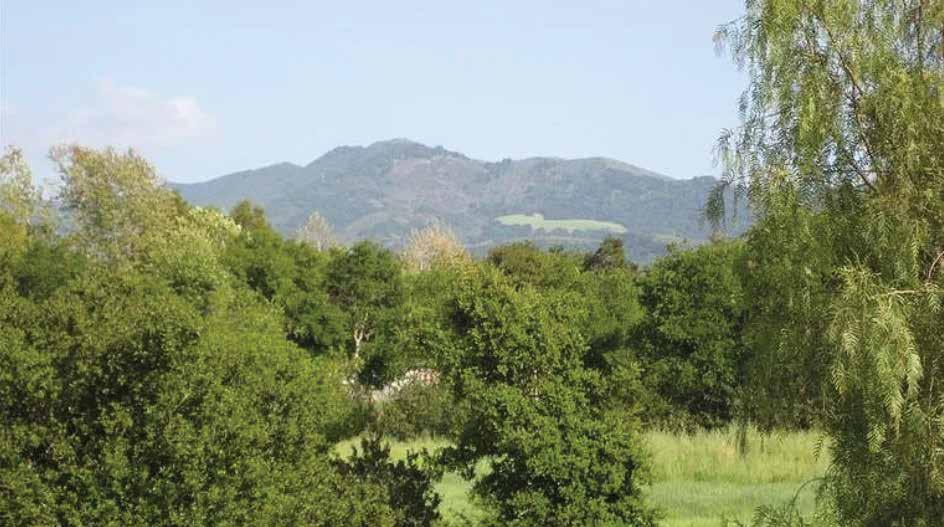
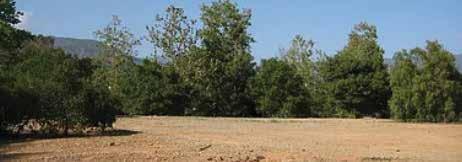
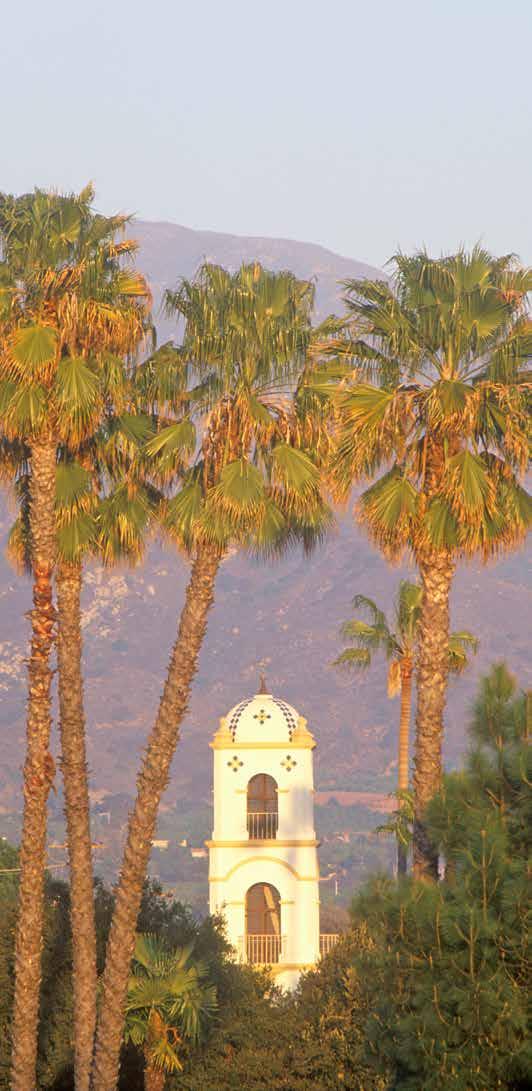
ROOM TO BUILD DREAM HOME
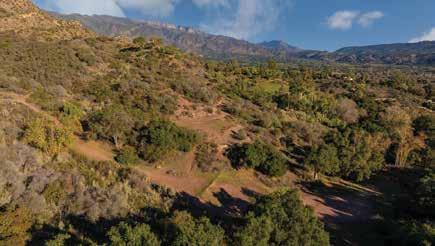
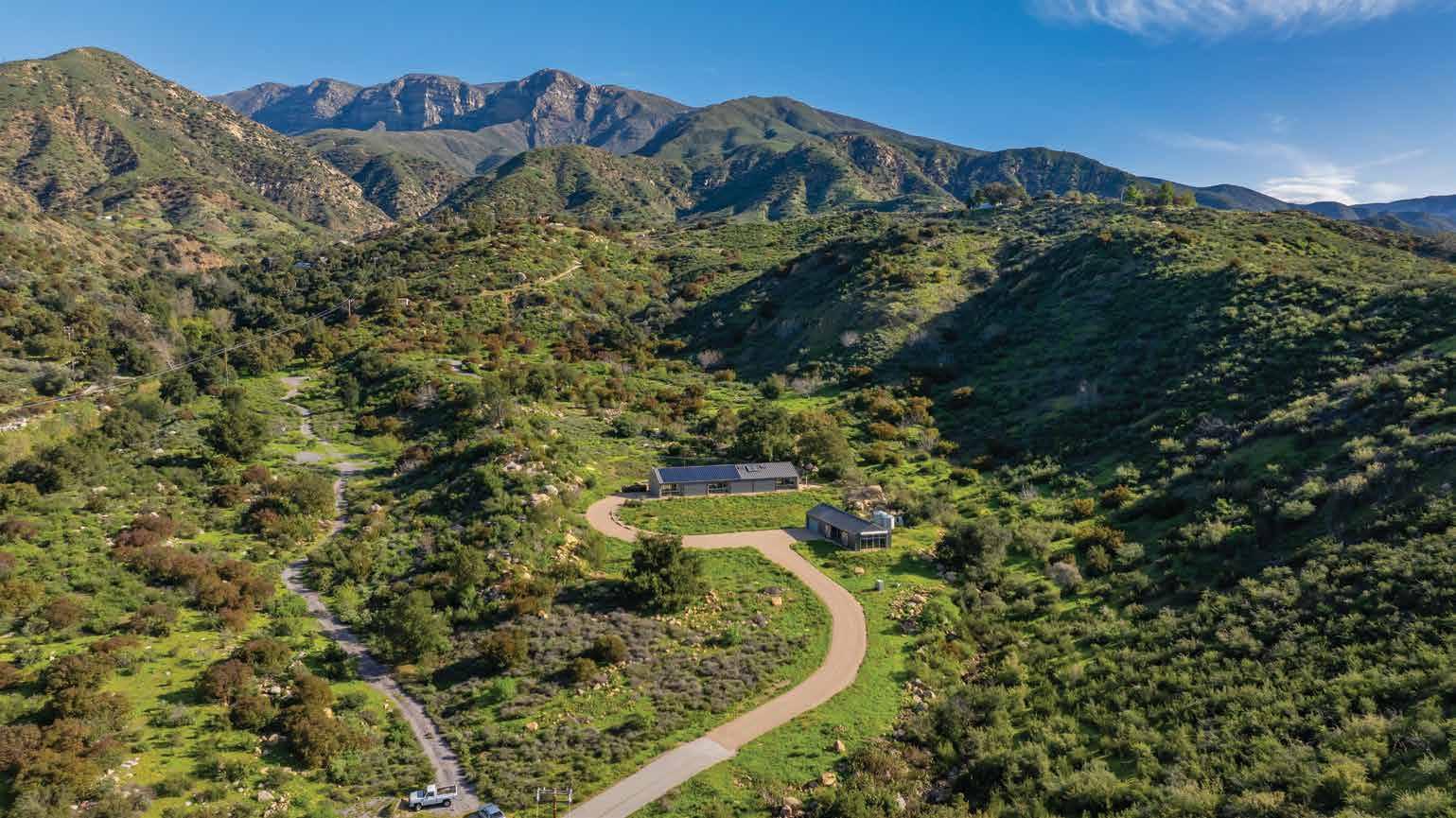
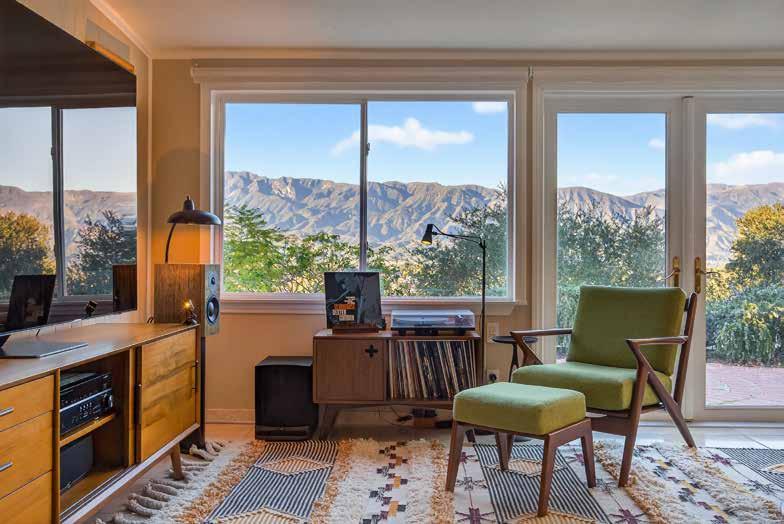
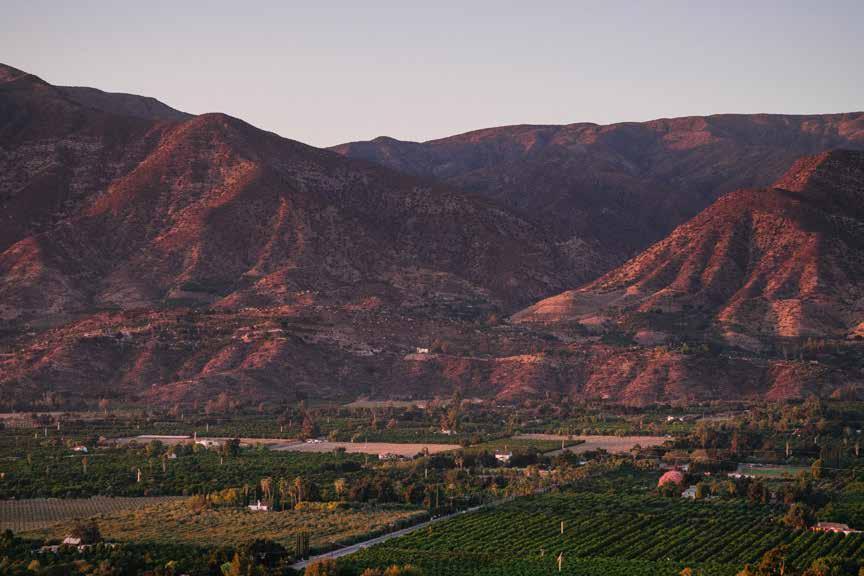
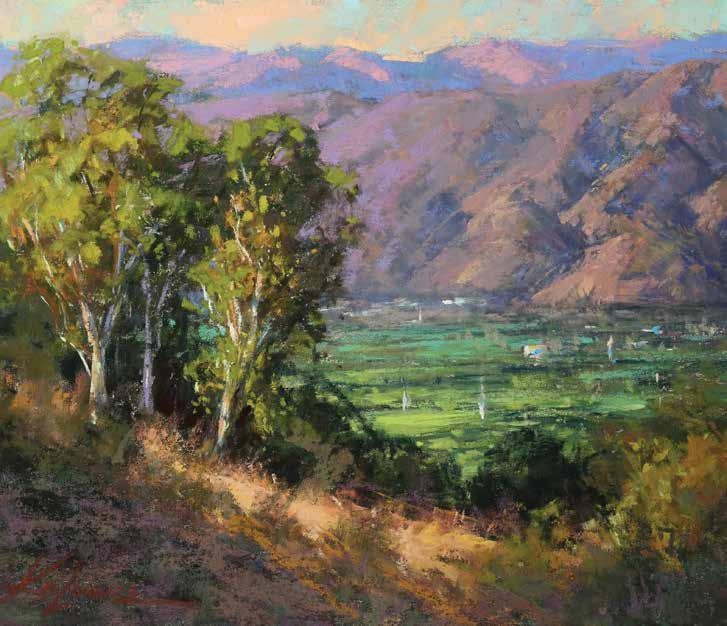
Hidden behind the gates of Rancho Matilija sits a stunning 3-acre lot with magnificent 360 degree mountain views. Surrounded by mature trees and wildlife, this lot offers a beautiful connection to nature while still being conveniently located near all the amenities, recreational parks, hiking trails, Lake Casitas, fishing and all the outdoor adventures you may be looking for as well as easy access to Ventura, LA and Santa Barbara. Don’t miss this opportunity to build your dream home with endless possibilities in this serene and picturesque setting. This gated, private community offers beauty, peace and vision to the person looking for a one-of-akind property.
PROPERTY DETAIL
MOUNTAIN VIEWS
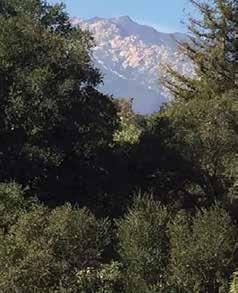


TIMELESS OASIS





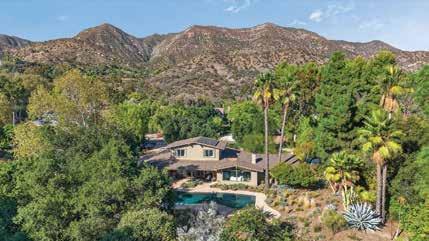
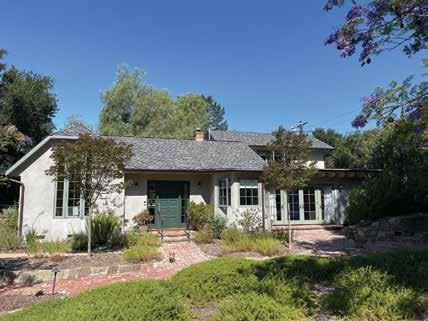
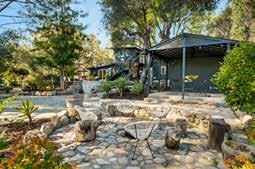
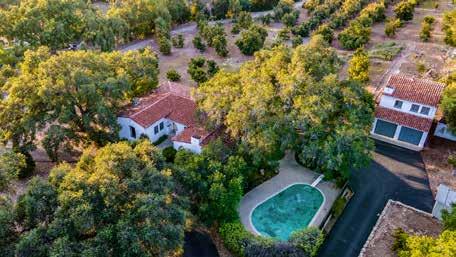
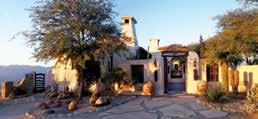
Discover a quiet East End compound offering nearly 5,000 square feet across three private homes. Originally crafted by Mr. Shippee for his family, the main house welcomes you with a walled courtyard, covered veranda, sparkling pool, and lush landscaping. Inside, acacia wood floors, an open cook’s kitchen, and a dramatic double-sided fireplace anchor the living spaces. Three bedrooms with French doors open to the gardens. A 1,400-square-foot guest house adds two bedrooms, a bath, a private courtyard, and a two-car garage — ideal for visitors or extended family. The third home features modern concrete floors, a spacious living room, kitchenette, bedroom, bath, and two secluded patios. The landscaped grounds mix drought-tolerant plantings with fruit trees — apple, citrus, fig, pomegranate — and olive trees lining the drive. A fenced paddock and turnout area make the property horse-friendly. Altogether, this rare compound blends versa-


Thank You Ojai For Voting Us Best of Ojai Four Years in a Row, Gold for Property Management in 2025 & Bronze for Best Real Estate Office!




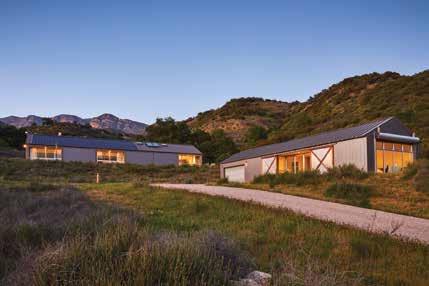
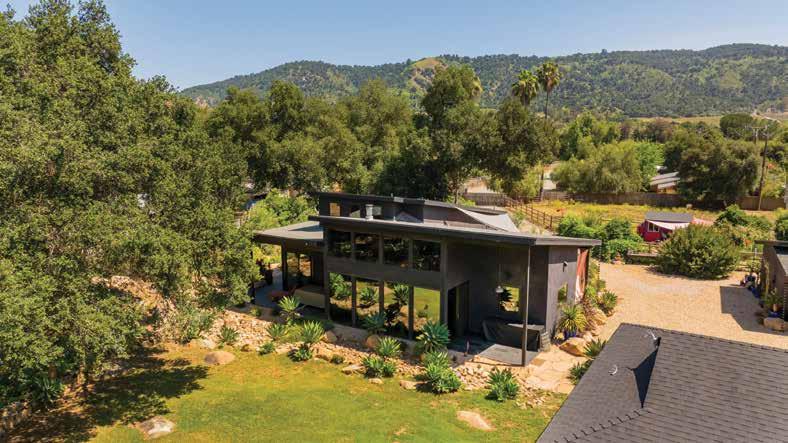
Perched along Ojai’s iconic Foothill Road, this glass-walled architectural sanctuary is defined by light, serenity, and expansive 270° views. Built in 2017 and thoughtfully re-imagined in 2022, the 3,154 ± sqft single-level home pairs minimalist design with seamless indoor-outdoor living. A 1,117 ± sqft pavilion with showcase parking, wellness studio, and sauna—along with additional creative retreats—completes a private compound set on 1.87 ± acres with pool, spa, and unforgettable Pink Moment sunsets.












“A Must See”

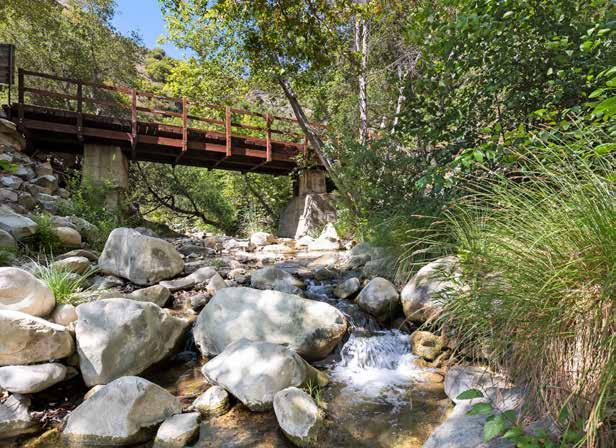

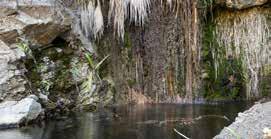

Wheeler Hot Springs Bathe in a Natural Wonder of Your Own
This historic property was the genesis of O jai as a wellness resort town. Since the 1800s, travelers visited Wheeler Hot Springs to ‘take the waters,’ believed to have healing qualities. For decades, the property was a busy resort featuring a lodge, spring-fed hot tubs, and a cold spring-fed swimming pool. Visitors also enjoyed massages and other treatments in cabins peppered around the grounds. There are no structures remaining today, but the abundant natural elements that made this property world famous are still flowing f reely. The present owner has planted numerous redwood trees, which, combined with the palm groves, enhance the spectacular views of the mountains and the peaceful energy that surrounds you. So come experience it all, and create your own Nirvana in O jai.
Call today for an appointment.
Offered at 2,9 999,000.



OJAI QUARTERLY

DRAWN TO THE TRUTH
Shay Mirk & The Rise of Comics as Serious Journalism Story By Kit Stolz

p.38
EN PLEIN OJAI
Museum Centers Ojai’s MystiqueThrough 19 Artists’ Eyes Story By Jennie Prebor
p.19
Editor’s Note
p.20 Contributors
p.21
Ojai Podcasts & 2 Degrees
p.25
Arts Section
p.55
Artists & Galleries
p.69
Yesterday & Today Section
p.79
Hiking Map
p.81
Animal Neighbors
p.87
Healers of Ojai
p.109
Calendar of Events
DEER IN THE STAGELIGHTS
Stalwart Returns to Deer Lodge Stage Story by Ilona Saari
Kim Hoj Heals With Dance For Patients, Herself Story by Robin Gerber
FEATURES & departments
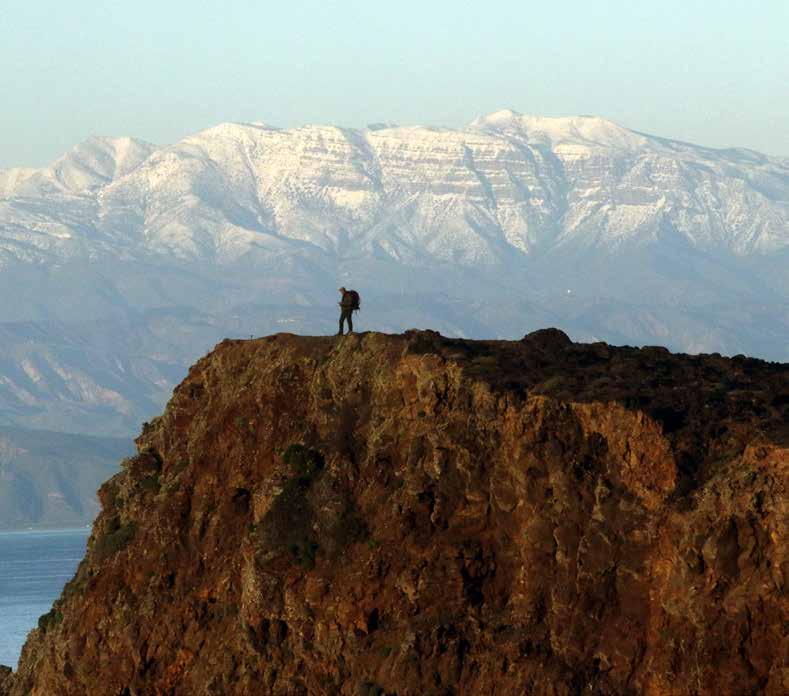
National Park Jewel in Ojai’s Front Yard Story & Photos By Chuck Graham
Reflecting on the Long, Strange Trip Story by Mark Lewis

Riven by Factions!
Story by Sami Zahringer








OJAI QUARTERLY
Living the Ojai Life
SPRING 2026
Editor & Publisher
Bret Bradigan
Director of Publications
Bret Bradigan
Creative Director
Uta Ritke
Ojai Vortex/Hub Administrator
Julia S. Weissman
Contributing Editors
Mark Lewis
Jerry Camarillo Dunn Jr.
Jesse Phelps
Columnists
Chuck Graham
Ilona Saari
Kit Stolz
Sami Zahringer
Interns
Alex Gutierrez
Emilie Harris
Circulation
John Nelson
CONTACT US: Editorial & Advertising, 805.798.0177 editor@ojaiquarterly.com
The contents of the Ojai Quarterly may not be used, reproduced or transmitted in any form or by any means without the written consent of the publisher.
SUBSCRIPTIONS:
To subscribe to the OQ, visit ojaiquarterly.com or write to 1129 Maricopa Highway, B186 Ojai, CA 93023. Subscriptions are $32.95 per year.
You can also e-mail us at editor@ojaiquarterly.com. Please recycle this magazine when you are finished.


Jack La Plante
Realtor® | DRE 02134607
805.640.5571
jack.laplante@sothebysrealty.com jacklaplante.sothebysrealty.com
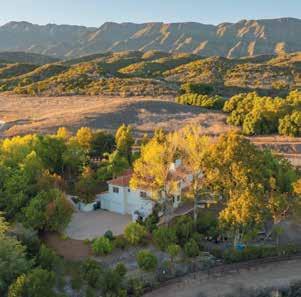
Elegant Mediterranean Estate
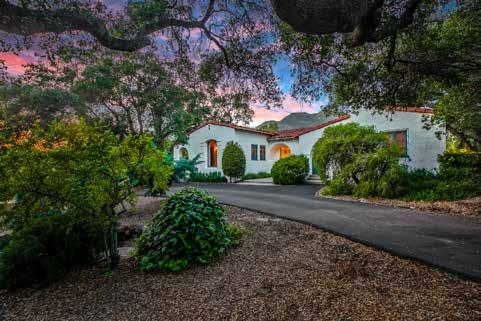
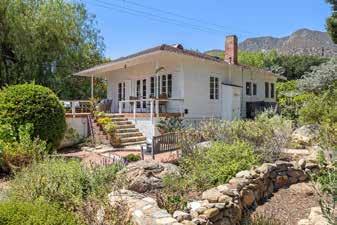
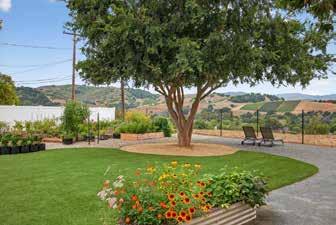
Located in the exclusive gated community of Rancho Matilija, this stunning home captures the serene beauty of Ojai with vistas from every angle. Bordered by the Ojai Land Conservancy and Ventura River, the property offers unmatched privacy and direct access to equestrian and pedestrian trails leading to the Los Padres National Forest and surrounding neighborhood paths. Enjoy sweeping views of the Ojai Valley and the iconic Topa Topa Mountains, the home features five spacious bedrooms and five bathrooms, including a primary suite with stunning views, a luxurious en-suite bathroom, and a large walk-in closet. Designed with comfort and style in mind, the open floor plan includes travertine flooring in the entry and kitchen, solid hardwood in main living areas, and three inviting fireplaces. Set on almost 3 acres with a vast variety of plants and trees including: citrus, palm, and olive trees, the backyard offers a tranquil escape with breathtaking views of Ojai’s famous Pink Moment. offered at $3,495,000


Erik Wilde
Realtor® | DRE 01461074 805.830.3254
erik.wilde@sothebysrealty.com erikwilde.sothebysrealty.com
12986 MACDONALD DRIVE, OJAI, CALIFORNIA




EYES ON OJAI
“You should perform on society the way you would perform surgery on your father.”
— Edmund Burke
More than 60 years ago, the great urbanist Jane Jacobs set fire to a century of bad planning with a deceptively simple idea. Healthy cities, she argued in “The Death and Life of Great American Cities,” are not made safe by walls, patrols, or abstractions. They are made safe by people — by the ordinary, unglamorous miracle of neighbors who know one another well enough to notice. “Eyes on the street,” Jacobs called it: shopkeepers sweeping stoops, parents lingering on corners, passersby who recognize when something is off because they recognize each other.
Jacobs was writing against the logic of isolation — the belief that we are safest sealed in private fortresses, moving anonymously from garage to office to screen. She insisted instead that vitality and safety emerge from contact: from streets that invite us out of our castles and into shared life. It was a moral argument as much as an architectural one. A city, she believed, is not a machine to be optimized, but a choreography of human presence. Jacobs authored one of my favorite quotes: “The greatness of a city can be measured by how difficult it is to park.”
That idea echoes forward just about everywhere you look. A recent New Yorker essay on crime and fear draws on the work of psychologist Daniel Kahneman, particularly his distinction between instinctive System One and deliberate System Two thinking. When we retreat from public life — when streets empty, institutions hollow out, and neighbors become abstractions — System One fills the void. Fear grows where familiarity once lived. Jacobs understood this intuitively: isolation doesn’t merely weaken cities; it distorts our perception of them.
Ojai, of course, is not New York: The Little Orange versus The Big Apple. But the principle holds true. A healthy village — like a healthy city — is one where people are visible to one another in meaningful ways. Where stories circulate. Where creative work, civic memory, and human idiosyncrasy are not hidden behind hedges, but shared. Even celebrated.
That is what this Spring OQ is really about.
It’s there in the revival of the Deer Lodge under new stewardship, and in the return of Russ Brunelli — a local character whose very presence reminds us that places have personalities, and that continuity matters. It’s there in the Ojai Museum’s “Ojai Mystique” show, where 19 local artists slow down long enough to truly see this valley, translating light, land, and weather into acts of attention. Painting en plein air is, at heart, an exercise in looking — really looking — at what is already in front of us.
It’s there in Mark Lewis’s extraordinary profile of Ilona Saari, whose Zelig-like life reminds us that history isn’t something that happens elsewhere; it lives among us, often quietly, waiting to be noticed. It’s there in our journeys outward — to the Channel Islands, to the storied railways of the Harvey Houses — and back again, returning home with a deeper sense of connection to the wider American story.
You’ll find it too in Kim Hoj’s work, where movement becomes medicine and dance becomes a communal act of healing; in Shay Mirk’s fearless comics journalism, which insists that visibility is a form of justice; and in Sami Zahringer’s inspired lunacy, which playfully reminds us that mystery and myth are also ways communities recognize themselves.
Taken together, these stories form their own kind of street life. They put eyes on the valley. They slow us down. They ask us to replace reflexive fear with earned familiarity — to engage System Two, yes, but also to trust the quiet wisdom Jacobs articulated so long ago. We are safer, stronger, and more alive when we are known to one another.
That, finally, is the work of this magazine: to keep the lights on, the doors open, and the conversation going — out in the open, where it belongs.
OQ | C ONTRIBUTORS
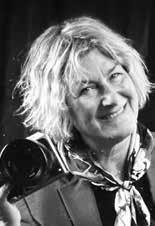
DEVO CUTLER
is a poet, photographer, and recovering exec, Devo mentors artists and writes on healing through art. Her Peabody-nominated doc “Not Afraid to Laugh” celebrates humor’s power.
MARK LEWIS
is a writer and editor based in Ojai. He can be contacted at mark lewis1898@gmail.com.
ROBIN GERBER
is the author of four books and a playwright. Check her out at RobinGerber. com
CHUCK GRAHAM
His work has appeared in Outdoor Photographer, Canoe & Kayak, Trail Runner, Men’s Journal, The Surfer’s Journal and Backpacker.
UTA RITKE
is following the tug of curiosity, shaping clean visuals with a touch of delightful weird. Find her at utaculemanndesign.de and utaculemann.art

RYAN SCHUDE
is a photographer & educator from Oak View. You can find his most recent photos in the book “Also On View: Unique and Unexpected Museums of Greater Los Angeles” by Todd Lerew.
KIT STOLZ
is an award-winning journalist who has written for newspapers, magazines, literary journals, and online sites. He lives in Upper Ojai and blogs at achangeinthewind.com.

ILONA SAARI
is a writer who’s worked in TV/film, rock’n’roll and political press, and as an op-ed columnist, mystery novelist and consultant for HGTV. She blogs for food: mydinnerswithrichard. blogspot.com.
SAMI ZAHRINGER
is an Ojai writer and award-winning breeder of domestic American long-haired children. She has more forcedmeat recipes than you.

Thornton Wilder, author of “Our Town,” considered one of the most important American plays, was a student at The Thacher School in the 1912-13 school year. He was living in Shanghai, China before coming to Thacher, and Ojai was his first experience with small-town life. Though set in Grover’s Corners, New Hampshire, the time frame and even the people and anecdotes in “Our Town” were reminiscent of Wilder’s Ojai experiences.
IN BRIEF: OJAI TALK OF THE TOWN PODCASTS
ACREAGE FOR THE AGES: OVLC GOES BIG
Tom Maloney talks about the Ojai Valley Land Conservancy’s newest acquisition, the 6,500acre Rancho Cañada Larga, which will triple the size of the organization. “It’s really an urban anchor of almost continental scale, because if you think of a black bear or mountain lion ... it’s the terminus of a very significant series of wildlife corridors.” (Ep. 265)
OQ | ojai podcast
JOHN-CLARK LEVIN & THINKING WITH MACHINES
John-Clark Levin is lead researcher for Kurzweil Technologies, among other jobs. The Villanova product said his life was changed by the gift of Kurzweil’s “The Age of Spiritual Machines.” And now he works with the noted futurist, and advises the Vatican on AI, among other institutions. “I basically wake up and guzzle technical papers and research reports, then do research of my own and talk to interesting scientists and write up what I’m doing, and repeat, repeat, repeat.” (Ep. 271)
IN
MEMORIAM: FRIENDS RECALL PETER ‘THE BADGER’ BELLWOOD
A sampling: “He was the Pied Piper. Everybody adored him. He was a fixture and a great character.” — Malcolm McDowell “Peter was the most charming man most of us have ever met. Charm can be defined as showing interest in the other person, letting them know they matter.” — Jerry Dunn “Peter just shows up and he’s a genius, that’s what Peter does.” — Kim Maxwell. (Ep. 248)
MALCOLM MCDOWELL & THE CHAMELEONIC PLEASURES OF TRANSFORMATION
Few actors have careers as long, varied, or restlessly curious as Malcolm McDowell. From his early, era-defining performances to a late-career renaissance that has taken him across film, television, animation, and inde-
pendent projects, he has never settled into comfort or typecasting. McDowell speaks candidly about longevity, humility, and the craft of acting. (As well as local restaurant and film reviews.) “I suppose that I am fairly amazed
BLAME IT ON THE BOSSA NOVA: OJAI VERSION
ONE: Recorded in 1963, “Corcovado” — also known as “Qui et Nights of Quiet Stars” — became one of the defining songs of the bossa nova movement. Sung by Astrud Gilberto, with music by Antônio Carlos Jobim, it offered a hushed, intimate counterpoint to the louder pop and jazz styles of the era. The English-language lyrics open with a line that has floated through American culture for generations: “Quiet nights of quiet stars …”
TWO: Those English lyrics were written by Gene Lees, the highly respected jazz critic, translator, bi-
that I’m still playing, at age 82, really good juicy parts ... the actor has to be a chameleon. You have to go with whatever the director’s mood and method is. It is my job, as it were, to devote myself to the director.” (Ep. 267)
2 of OJAI
SEPARATION
TWO DEGREES BETWEEN


ographer, and lyricist — and for many years, an Ojai resident. Lees was one of the most influential jazz writers of the 20th century, best known for books such as “Singers and the Song” and “Cats of Any Color,” as well as authoritative biographies of Jobim and Oscar Peterson. Living quietly in Ojai, Lees translated more than language — he translated feeling and atmosphere. It’s tempting to imagine that those “quiet nights” were shaped not only by the hills above Rio, but by evenings in the Ojai Valley itself.
GENE LEES (1928-2010)

Dual Enrollment
College credit, High school support

At Besant Hill, dual enrollment lets students take college courses while in high school deepening interests, strengthening transcripts, and building confidence. In a supportive environment where teachers know you well, you’ll grow academically and personally. Go further, sooner.
Now Here



Comprehensive, connected healthcare, right here in Ojai.
Community Memorial Healthcare is a nonprofit, independent health system dedicated to providing the community with convenient, comprehensive care. Our Ojai hospital has been a trusted resource since 1960, offering convenient emergency services, inpatient care, imaging, and laboratory services. We offer expert primary and specialty care in three convenient Health Centers right here in Ojai. We also provide skilled nursing, rehabilitation services, and longterm residential care at our 75-bed Continuing Care Center. Should additional care be needed, you can count on more resources in Ventura, through our specialty Health Centers and our flagship facility, Community Memorial Hospital – Ventura.


Learn more at mycmh.org
Community Memorial Services in Ojai
Hospital
1306 Maricopa Highway
805-948-1401
Health Centers
117 North Pirie Road, Suite E
805-948-6650
1320 Maricopa Highway, Suite D
805-948-6730
1202 Maricopa Highway, Suite A
805-948-2323
Continuing Care Center
1306 Maricopa Highway
805-948-2000

| arts & literature
30 serious comics Local Artist/Journalist Breaks Ground with New Medium By Kit Stolz
38 open air, open eyes
19 Artists Look Deeply Into Light, Land & The Long View
By Jennie Prebor
38
48 The living grain Woodworkers Reveal Balance, Memory & Place By Devorah Cutler-Rubinstein
55 artists & galleries The People, Places That Make Ojai an Arts Destination
















Drawing the Truth
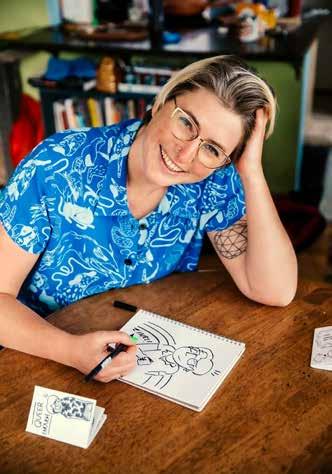
Ojai-raised comics journalist Shay Mirk uses zines, reporting, and community to tell the stories powerful institutions would rather keep off the page. By
Kit Stolz
If you have orbited on this earth more than 40 times around the sun, you may not have heard of — or have hardly seen — “comics journalism, “a form of non-fiction reporting in graphic form.
Or you may have heard of these forms — such as ‘zines — but not really seen them on the page. You might know of Archie and Veronica, but have missed the epochal “Maus,” the graphic novel of the Holocaust by Art Spiegelman. First published in 1986, it is now considered a classic. Perhaps you also overlooked the ground-breaking comics journalism about the Mideast by Joe Sacco, collected as “Palestine,” which won the American Book Award in 1996.
If this is the case, likely you will also not know the work of Sarah Shay Mirk, the author and editor of the stunning nonfiction comic “Guantanamo Voices.” Published in 2020, this is a hard-as-nails factual history as told mostly in quotes from interrogators, lawyers, officers and detainees inside the prison at Guantánamo Bay, illustrated by artists from around the world.
After working as a reporter, cartoonist, writer, and editor for many years, and after having published six books, Mirk appears to be the most ambitious, innovative, and published journalist to have emerged from Ojai this century.
So why don’t more Ojaians know of her or her work?
“I hate telling you this,” Mirk said, to the aging reporter for the OQ. “But that is a generational thing.”
Mirk speaks gently, but with a blunt clarity that shines through the niceties.
“I do run up against this with older readers, people who grew up thinking of comics as newspaper strips,” Mirk adds. “I would say younger audiences, people about my age, 40 or younger, have grown up with more of a culture of nonfiction comics and manga. A lot of people have come to understand that comics can express a wide range of emotions. I think if you talk to younger people, I think you will find they are reading a lot of comics, on apps, on the web, in book stores, and magazines, and there’s just a much broader range of what’s available than when you were a kid.”
Mirk grew up in Ojai and gives the Mirk family and the town’s creative spirits (such as at the Ojai Youth Foundation) plaudits for encouraging creativity. A special shout-out goes to an older brother, Dan Mirk, who got his start in humor writing for The Onion, and has gone on to become a comedy writer and television showrunner.
“I grew up drawing, which is something all kids do, and at some point, a lot of people get told that they’re doing it wrong,” Mirk said. “My brother and I never got that message and just kept drawing. In high school, I published little comics, with photocopying, and in college, I ran a student comics publication.”
FROM ZINE TO BOOK
From the start, Mirk created non-fiction comics, often on touchy subjects such as politics, even when the attention that followed made young Mirk a little uncomfortable.
“When I was in high school, the U.S. invaded Iraq and Afghanistan,” Mirk said. “There was a really small protest (at Nordhoff), of like four people. I wanted to join the protest, but I was too shy. I wanted to like, speak up, but I didn’t want everybody looking at me.”

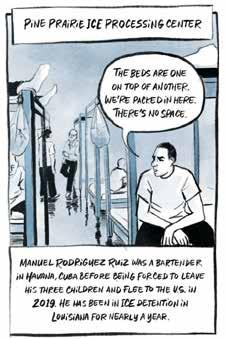
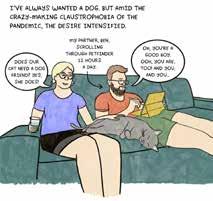
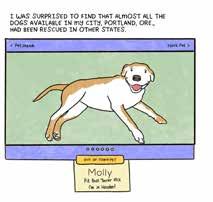
ABOVE: FROM CITY HALLS TO DETENTION CENTERS TO LIVING ROOMS, MIRK’S PANELS TRANSLATE INSTITUTIONAL POWER INTO INTIMATE, HUMAN-SCALE MOMENTS — REPORTING RENDERED IN INK AND UNEASE.
RIGHT: SCENES FROM GUANTÁNAMO VOICES TRACE THE SURREAL CHOREOGRAPHY OF DETENTION — SOLDIERS, DETAINEES, CORRIDORS AND SILENCE — DRAWN FROM TESTIMONY AND FIRST-HAND REPORTING.
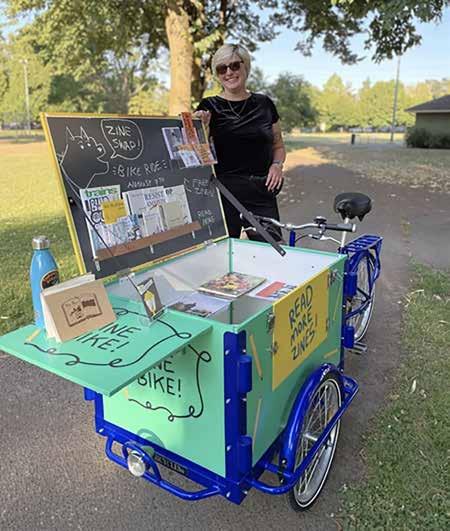
Even now — after becoming a fullfledged reporter, writer, publisher, and instructor at a teaching press she co-founded, Crucial Comix — Mirk continues to create and publish zines, as often as once a day. Mirk even constructed a cart to promote and swap and give zines away at events in Portland.
On a Patreon site, Mirk hosts a “Zine of the Month,” featuring zines from a wide variety of contributors. Many of those contributors, often from far-flung places around the world, got their start using the blank template for zines on Mirk’s site. Although many of Mirk’s zines are personal and often humorous (such as “Why Did I Think I Was Straight?”), others are enormously informative, the product of considerable research and reflection, such as “Get Ready: A Gentle Guide to Emergency Preparedness and Building a Go Bag.”
In this free-to-download zine, Mirk shows readers how to assemble a “go bag” for disasters. However necessary, an individual action such as this is not nearly enough to keep a person safe in a time, Mirk believes, when whole communities face enormous disasters such as the Thomas Fire.
“Because I grew up in Ojai, I’m always worried about fire and flood,” Mirk said. “Now I live in Portland, and I’m always worried about earthquakes. Some friends and I formed a little emergency preparedness group a couple of years ago to make go-bags and meet up once a week, but a lot of our conversations were really about how many Americans have a desire to kind of buy their way out of this problem. What really makes us safer are the social networks we have built — our relationships with our
neighbors and our community. Being able to trust the people around you.”
Trust and the need to find your community — the people who understand you — track like well-worn paths through Mirk’s creative life. At Grinnell College in the Midwest, Mirk found a community supportive of comics and zines, but knew that wasn’t enough. Even before graduating from college, Mirk — who in recent years has come out as non-binary — knew exactly where they wanted to work, at The Stranger, a well-known and feisty weekly in Seattle.
“I had no connections to Seattle, but I wanted to work for an alt weekly, because I wanted to have a voice,” Mirk said. “I didn’t want to work for the AP or television news. I wanted to work where I could be a writer and bring my perspective.”
Mirk admits to harassing The Stranger for the job.
“I’m like … this is where I want to work, you are the people I want to work with, please let me come work for you for free,” was Mirk’s pitch. At The Stranger and later at the Portland Mercury, Mirk worked to develop reporting skills, focusing on City Hall issues and interesting locals. After developing their reporting skills at The Stranger and at the Portland Mercury, also an alt weekly, Mirk worked for several years as an editor and writer at the feminist magazine Bitch, and then as an editor and artist for a prominent comics magazine called The Nib.
BECOMING AN AUTHOR
But it was through a zine community that Mirk stumbled upon what
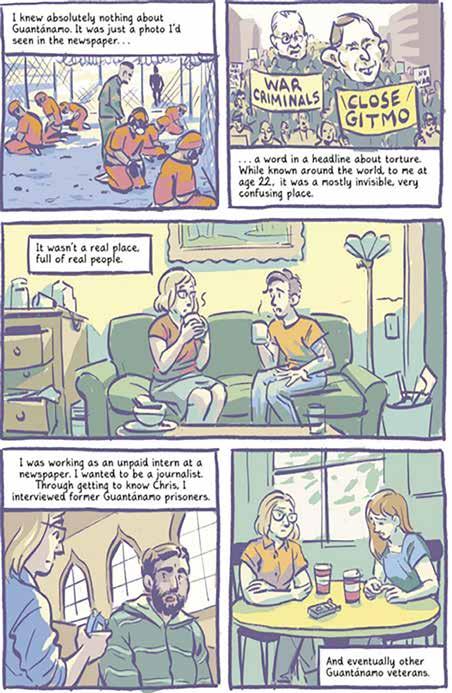

may be her biggest story to date, an international saga. In Portland in 2008, Mirk met a former Michigan National Guard member named Chris Arendt who was working on an anti-war zine about the time Arendt spent as a prison guard at the notorious U.S. base and prison encampment in Guantánamo Bay, Cuba. Mirk and Arendt became friends, and through Arendt’s connections, Mirk began a long-term reporting project on the infamous prison for alleged terrorists and “detainees.”
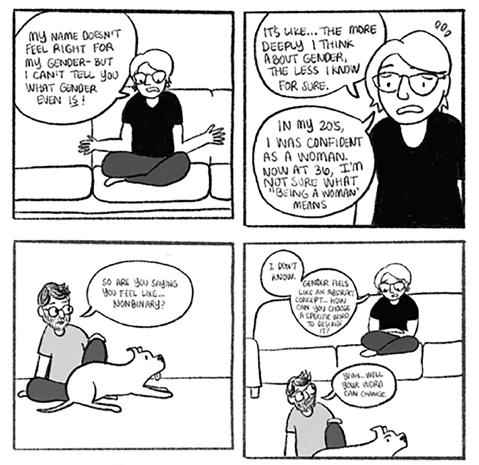
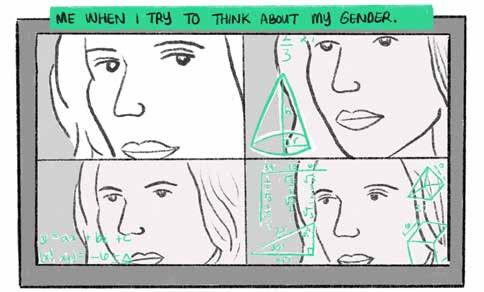
A decade later, In 2019, Mirk applied to go on a rare media tour of the facility. Scenes from that often surrealistic tour became the start and the conclusion of an uncannily beautiful and haunting IN PORTLAND, MIRK’S HANDMADE ZINE CART DOUBLES AS NEWSROOM AND COMMONS — A ROLLING PRESS BUILT FOR SWAPPING STORIES, IDEAS, AND DISSENT. MAKING NONFICTION COMICS, CO-AUTHORED WITH ELERI HARRIS, SERVES AS BOTH MANIFESTO AND MANUAL — A PRACTICAL GUIDE TO TURNING REPORTING INTO PANELS. ABOVE, LOWER LEFT: PERSONAL UNCERTAINTY BECOMES VISUAL LANGUAGE: MIRK’S AUTOBIOGRAPHICAL PANELS EXPLORE GENDER IDENTITY WITH CANDOR, GEOMETRY, AND QUIET HUMOR.
history of the prison they published, titled “Guantánamo Voices.”
It’s an artful but hard-hitting book, edited and largely written by Mirk, and drawn by artists from around the world, employing a gorgeous color scheme characteristic of the tropical sunsets of Guantánamo Bay. It’s a beautiful telling of an ugly story, intended to lure people into looking at the hard truths — drawn largely from testimony — about what happened there, and is happening still.
“Basically everything we’re experiencing now around immigration, mass arrests of people for no reason, detention without end, holding people without trial, racial profiling and deporting people to countries that they’re not from — all that happened with Guantánamo,” Mirk said. “All that happened 20 years ago, and people who raised alarms about it were imprisoned. I feel as if the U.S. government did a really good job of not letting that narrative get out and selling a narrative that this is what we need to do to protect American lives.”
In 2025, Mirk followed up with another collaborative effort, an encyclopedic how-to book called “Making Nonfiction Comics,” working closely with another cartoonist and editor, Eleri Harris from Australia. As with “Guantánamo Voices,” the book serves as both a history of the form and an up-to-date guide, including interviews and panels from nonfiction comic artists from around the world. It features legendary names in the field, such as Joe Sacco, as well as many other less-well-known nonfiction reporters and artists, as for example Susie Cagle of The Guardian.
Along the way, Mirk consciously worked to create a community that will support comic art and reporting in Portland. Social media can be useful, Mirk thinks, for audiences to find comic artists, and for comic artists to find audiences and other
writers, but Mirk has found that outlets such as Instagram can’t be trusted longterm.
“The point of Instagram is to make money for billionaires,” Mirk said. “I think it’s really important for everyone to have a way to publish their work that does not make money for billionaires. A place where you control the platform, and a place where artists can publish work that is political, work that’s about sexuality, that shows human bodies, and where the rules about what can and cannot be published won’t change overnight.”
BECOMING a publisher & instructor
This led in 2014 to Mirk and collaborators launching Crucial Comix, a “teaching press” that publishes zines and comics, while hosting classes on the craft and art of the form.

Community, in Mirk’s experience, offers a kind of freedom that can’t be taken away. In the guide to nonfiction comics, Mirk offers readers an extraordinary level of support and personal transparency, right down to the numbers involved in publishing six books. They included how long it took to write and illustrate each one, the publisher, the number of copies sold, the advance, and whether the project required an agent and a proposal. It’s a look-at-this-you-can-do-it-too book intended to empower nonfiction artists and writers — a manual for a 21st century
form of reporting.
This makes sense to Mirk financially, but it also fits the nature of comics.
“One thing you can do with comics is that an illustration can express a lot of emotion that’s hard to put into words. It can really be playful, like a piece I made about getting diagnosed with a genetic condition that puts me at a higher risk for certain cancers, and debating whether to get my uterus removed or not,” Mirk said. “Real life is never one note. Even in the saddest moments, there’s dark humor or silliness that can come through.”
That mix of tones doesn’t always endure in media. Mirk says that when the billionairebacked media company that had funded The Nib decided after almost a decade to abruptly cut funding, an entire ecosystem of cartoonists, editors, and writers went dark.
“It is frustrating that the people with the money have so little vision, and the rest of us pay the price for it,” Mirk said. “Basically I have learned to trust no institution. I don’t want to try to be a tenured professor at a school. I don’t want a staff job on a magazine. I feel like the bottom can fall out of any industry at any time.”
Mirk argues that creators too often fail to create the creative life they want for themselves.
“I get frustrated when people are wishywashy about the value of their work. It actually makes me angry, because nobody else is going to advocate for you,” Mirk said. “You have to advocate for yourself. And that’s what I do. I feel I have to be kind of ravenous in going after the freedom and ability to do what I want. It’s really difficult to do under capitalism, but that’s what I’ve always pursued, is just the freedom to create what I want.”

a n y m o r e . B u t n o w w e d i s c o v e r e d t h e m a g i c a l t o w n o f O j a i
a n d t h o u g h t t h a t t h i s w o u l d b e t h e p e r f e c t p l a c e f o r T h e
I v y t o r e - o p e n . O u r w i d e r a n g e o f i t e m s i n c l u d e s a n t i q u e s ,
n e e s t a t e j e w e l r y, s t e r l i n g s i l v e r, E u r o p e a n p o r c e l a i n s a n d
p o t t e r y, l i n e n s , a n d e x c e p t i o n a l a n t i q u e f u r n i t u r e f r o m
a r o u n d t h e w o r l d . A s a l w a y s a t T h e I v y, t a b l e t o p
a c c e s s o r i e s a b o u n d i n n e d i s h w a r e , c r y s t a l , a n d s i l v e r t o
n i s h o ff y o u r t a b l e i n s t y l e . C o m e s e e o u r n e w l y
e x p a n d e d s h o w r o o m f e a t u r i n g e x c l u s i v e , v e r y m o d e r n ,
a n d u n u s u a l f u r n i t u r e , a r t , r u g s , a n d a c c e s s o r i e s . I f y o u
n e e d t o n d t h e e l u s i v e " p e r f e c t " g i f t , T h e I v y i n O j a i i s t h e
o n e - s t o p - s h o p f o r a l l y o u r n e e d s
C o m e j o i n u s , a f t e r a l l : ' E v e r y o n e s h o p s a t T h e I v y.' t h e i v y i n c . c o m 8 0 5 . 2 7 2 . 8 9 1 2




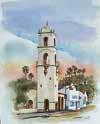

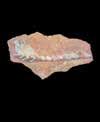
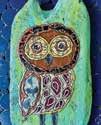

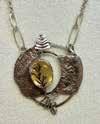



Francie Beaman
Tom Hoerber
Lucia Pasquinelli
Martha Moran
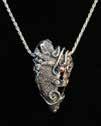
Valerie Sage Townley JEWELRY
Hallie Katz


E Matilija Street – Suite 202 Ojai, CA 93023 devocoaching@gmail.com (310) 498-8619


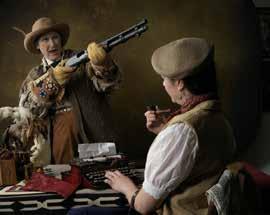
Calamity Jane with Ghost Writer (Recreation)
Nineteen artists respond to Ojai’s seasons, silence, and shifting atmosphere in the return of Ojai Mystique
STORY BY JENNIE PREBOR
LIGHT, LAND &THE LONG VIEW
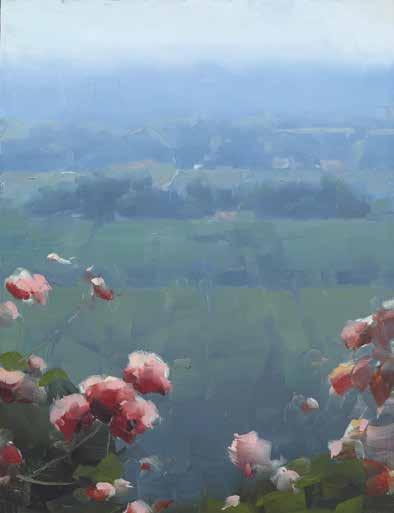
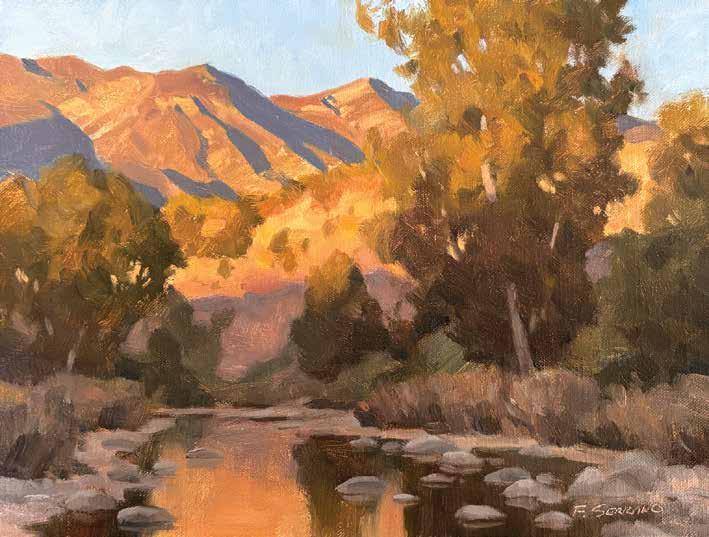
This spring, the Ojai Valley Museum welcomes the return of “Ojai Mystique,” on view from April 17 through August 9, 2026.
First presented in late 2023, the exhibition quickly became one of the Museum’s most beloved offerings — one people lingered with, returned to, and talked about. With this second iteration, the intention is that “Ojai Mystique” offers a recurring moment to pause and look closely at how artists continue to respond to the Valley, its light, its quietly powerful terrain and its singular atmosphere.
DAVE SANTILLANES, “THE OJAI VALLEY,” STUDY, 12X9, OIL

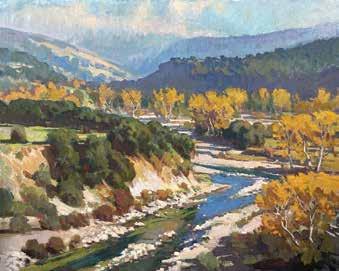
Artists have been coming to Ojai for more than a century, drawn by a particular combination of land, light, and atmosphere that is hard to define and impossible to ignore. Framed by mountains and open skies, the Valley feels at once intimate and expansive. A cloud passes, the wind shifts, the hour changes and suddenly everything looks different. Ojai’s golden hours and pink moments have been written about endlessly, but they remain compelling, especially for painters willing to slow down and really see.
“Ojai Mystique” enters this long lineage with fresh eyes.
While the exhibition centers on paintings of Ojai, it is intentionally invitational, bringing together artists from both within the Valley and well beyond. As with the inaugural exhibition, it is curated by Ojai-based artists Jennifer Moses and Dan Schultz,
JENNIFER MOSES, “SUN GAZING,” 36X44, OIL
RAY ROBERTS, “VENTURA RIVER,” 24X30, OIL
whose deep familiarity with the Valley’s rhythms — its moods, seasons, and surprises — grounds the project.
Each of the 19 invited artists was asked to create two works inspired by time spent in Ojai: a large master painting paired with a smaller companion piece. Seen together, these pairings feel conversational. They allow space for both immediacy and reflection, for bold statements and quieter afterthoughts. It’s a structure that mirrors how artists come to know a place — not in a single encounter, but through repeated looking and gradual understanding. Curator Dan Schultz sees “Ojai Mystique” as a way of documenting the Ojai Valley at this time in history.
“Years from now,” Schultz says, “people may look through our exhibition catalog and see the beauty of this time and place as captured by these artists. The paintings in this exhibition may become important pieces in their bodies of work.”
“As curators, we bring different perspectives to the process, and our ongoing exchange helps shape an exhibition that feels both cohesive and expansive. It is a great pleasure to share these
works with our community,” says Schultz.
The practice of painting directly from nature has deep roots in California, reaching back to the 1850s and flourishing through the 1930s in what many historians describe as the halcyon years of the plein air movement. Artists arriving during and after the Gold Rush encountered a landscape unlike anything they had known; vast, largely undeveloped, and suffused with a luminous, ever-changing light. Working outdoors, they sought to capture fleeting moments such as the movement of clouds, the shifting color of hillsides, the elements that make California feel unmistakably itself.
Over time, this approach produced a voluminous and deeply moving body of work now known as California Impressionism. These paintings were widely exhibited and collected, often purchased by prosperous tourists traveling west from far-flung parts of the country, drawn by California’s promise of beauty, health, and reinvention. Artists gravitated toward places that embodied promise, such as coastal enclaves, foothills and inland valleys
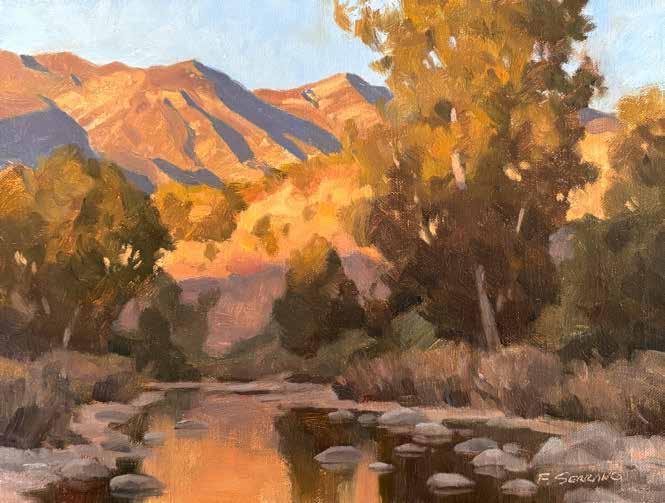
FRANK SERRANO, “SUNSET REFLECTIONS,”9X12, OIL
where nature felt restorative and sublime. Ojai, with its distinctive geography and sense of retreat, naturally became part of this artistic circuit, much as it remains today.
That long period of impressionistic interpretation came to an abrupt halt with the Great Depression, which altered both the economic and psychological climate that had sustained the genre. Patronage declined, tourism slowed, and artistic priorities shifted. By the mid-twentieth century, plein air painting, once central to California’s artistic identity, had fallen out of favor, eclipsed by modernist and abstract movements.
Its revival began quietly in the 1970s, led by scholars and curators who recognized that something essential had been overlooked. Landmark exhibitions such as “LA Painters of the Nineteen Twenties” (Pomona College, 1972) and “California Design in 1910” (Pasadena Center, 1974), helped reposition plein air painting not as nostalgia, but a as foundational chapter in California’s visual history — one worthy of renewed attention.
Ojai’s own history as an artistic destination stretches back to the early twentieth century, when painters such as Edgar Payne, William Wendt, and Elmer and Marion Wachtel traveled to the Valley to work directly from nature. Their paintings helped establish Ojai as a place of creative possibility, celebrated for its dramatic topography and singular light. “Ojai Mystique” acknowledges that legacy, but it is firmly rooted in the present.
“Ojai Mystique” focuses on how artists translate their lived experiences of place into finished work. While some begin by painting directly in the landscape and others work through sketches,
photographs, color notes, written impressions, or reflection, each practice is distinct and guided by memory, intuition, and personal sensibility. What unites the artists is a shared attentiveness to the Valley’s rhythms, light, and emotional presence, as opposed to a common methodology. Each artist’s practice is unique.
Rooted in the values of California’s plein air legacy of direct observation, sensitivity to atmosphere, and respect for the landscape as a living presence — the exhibition embraces a wide range of contemporary approaches. Together, the works form a layered portrait of Ojai that honors history while affirming landscape painting as a vital, evolving form.
The time of the year is a defining element of this edition of “Ojai Mystique.” With roughly 12 months to work, many artists explored the Valley across multiple seasons. For the 2023 exhibition, the artists painted primarily in the spring following an unseasonably wet winter. The 2026 works reflect late summer, fall, and winter — drier palettes, subtler tonal shifts, and quieter moods that reveal a different side of the Valley.
The invitational includes artists John Cosby, Steven Curry, Carolyn Lord, Kim Lordier, Jennifer Moses, Charles Muench, John Nava, Michael Obermeyer, Jesse Powell, Ian Roberts, Ray Roberts, Dave Santillanes, Dan Schultz, Frank Serrano, W. Jason Situ, Alexey Steele, Sarah Vedder, Anne Ward, and Wendy Wirth.
These artists were given maps of the region and freedom to explore. Some returned to familiar sites; others encountered Ojai for the first time. Paintings emerged from across the Valley, from
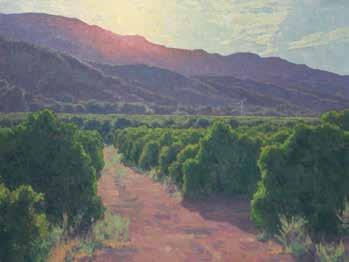
DAN SCHULTZ, “SUNLIT ORCHARDS,” 30X40, OIL
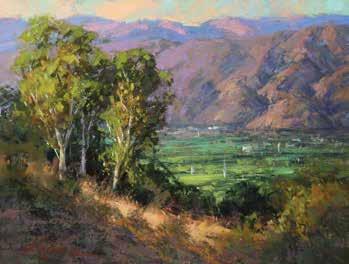
KIM LORDIER, “OJAI AWAKENS,” 9X12, PASTEL
Casitas Springs to Lake Casitas, to the historic downtown, to the East End and Upper Ojai — forming an organic, collective portrait shaped by individual journeys.
Much like the visitors who once carried California landscapes home in the late 19th and early 20th centuries, today’s audiences will encounter Ojai through the eyes of artists who have slowed down and paid attention. Here, the landscape painting tradition isn’t nostalgic. It’s alive.
“Ultimately,” curator Jennifer Moses reflects, “‘Ojai Mystique’ is about relationships — between artists and the landscape, between the paintings themselves, and between the exhibition and its audience. Imagining how visitors will move through the space and connect with the work is what makes the process so meaningful.”
“Ojai Mystique” continues that conversation, inviting today’s artists to engage with the Valley not just as a subject, but as a living part of Ojai’s cultural story. Walking through “Ojai Mystique,” visitors encounter the Valley not as a fixed image, but as a living presence — observed, revisited, and translated though many eyes. These paintings slow time. They ask us to notice how a shadow lengthens, how color thins in winter light, how the land quietly asserts itself. In doing so, the exhibition reminds us that Ojai’s mystique isn’t something inherited or preserved — it’s something continually made, through attention, patience, and the act of looking again.
“Ojai Mystique” is on view at the Ojai Valley Museum from April 17 to August 9, 2026 with related programs and events scheduled throughout the exhibition.
Founded in 1966, the Ojai Valley Museum has served as a steward of the region’s art, history, and cultural life. Housed in the former St. Thomas Aquinas Chapel near the center of town, the Museum presents exhibitions and programs that explore what makes the Valley distinctive — its landscape, its people, and the creative spirit that has shaped both. By placing contemporary exhibitions alongside local history, the Museum creates a space where past and present meet.
EXHIBITION PROGRAMS & EVENTS
See OjaiValleyMuseum.org for further details
TICKETED PREVIEW RECEPTION
Thursday, April 16, 6-8 p.m.
Tickets can be purchased for $50 and include a catalog, hors d’oeuvres, white wine and a walkthough with master framer Chris Kirkegaard.
PUBLIC OPENING RECEPTION
Friday, April 17, 5 - 7 p.m. Free
DOWNTOWN PAINT-OUT
Saturday, April 18, 9 a.m. to Noon. Free
ARTISTS TALK
Exhibition artists share their lives as artists, their work, methodology, style and careers. Saturday, April 18, 1:30 - 3:30 p.m. with Carolyn Lord, Michael Obermeyer, and Wendy Wirth. Suggested Donation
TOWN TALKS
Occasional Sundays, 4:30 - 6 p.m.
April 26 - Ian Roberts and Anne Ward
May 31 - Sarah Vedder
June 28 - Chris Kirkegaard
July 26 - John Nava
$5 Admission / Free to Museum Members
FREE THIRD FRIDAYS
Artist Painting Demonstrations
May 15 - Anne Ward
June 19 - Steven Curry
July 17 - Frank Serrano
All demonstrations are from 5 to 7 p.m.





Ojai • Meiners Oaks • Mira Monte
For just $1.50
ADA, Medicare Card Holders 1/2 Off.
Seniors 65+, Children under 45” tall and all students are FREE riders on the trolley
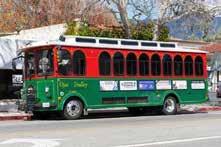
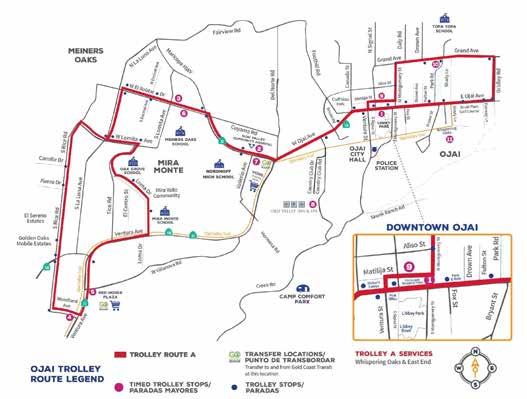
Ojai Trolley Service − Serving the Needs of the Ojai Valley
The Ojai Trolley Service, established in 1989, is owned and operated by the City of Ojai. The Trolley provides daily fixed-route transportation to approximately 9,000 riders per month throughout Ojai, Meiners Oaks and Mira Monte.
The Trolley is a well known feature in the Ojai Valley and, in addition, to the daily fixed -route service, participates in many local events, fund raising activities, community service and educational functions 408 South Signal
Phone





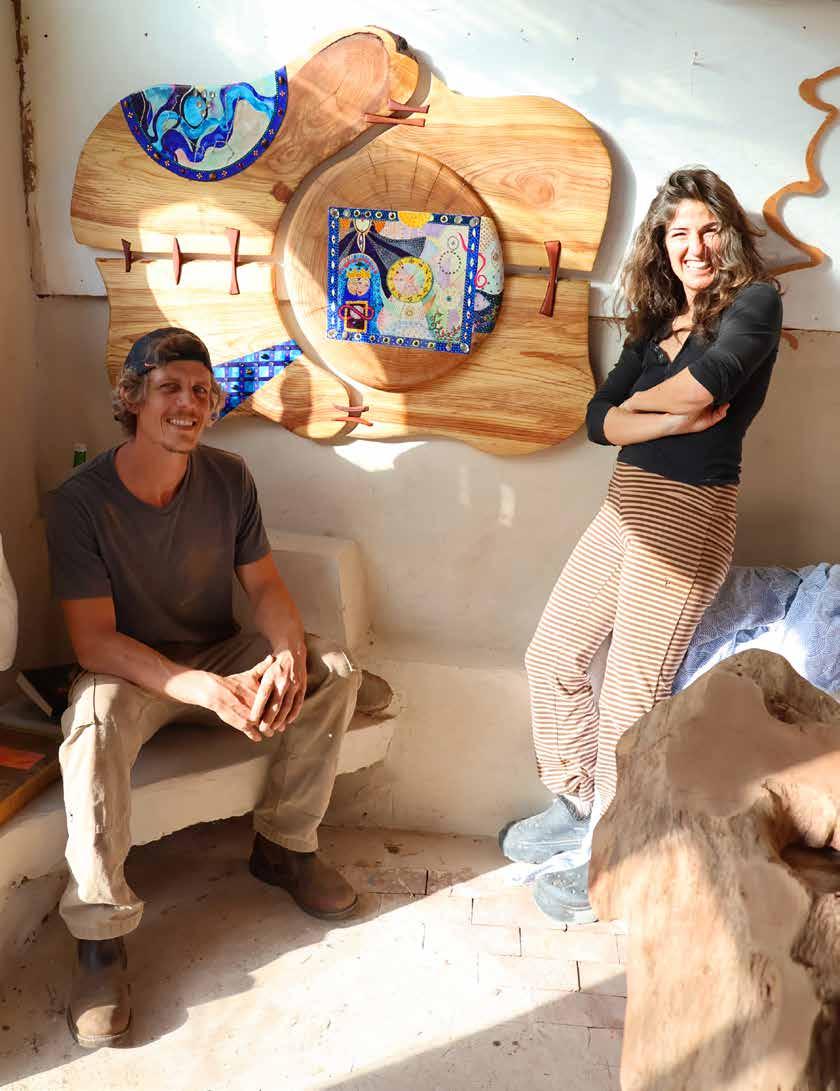
STAND BESIDE THEIR COMMISSIONED COLLABORATION,
BOBBY ANDERSON AND CHRISTINA JUSTIZ ROUSH
“THE STORY”
MAKING THE INVISIBLE

WWoodworking in Ojai
STORY
& PHOTOS BY DEVORAH CUTLER-RUBINSTEIN
ood is everywhere — underfoot as flooring, as tables we gather around, as firewood that warms winter nights. Its presence is so constant that it fades into the background of daily life: functional, dependable, rarely questioned. Even the trees that surround us become quiet utilities, valued more for what they provide than for what they already are.
And yet, wood holds memory. Weather, fire, insects, carved hearts in bark — each leaves a trace of a collaborative existence. Its surface records what it has endured. In the hands of artists, wood can be coaxed back into visibility, transformed from backdrop into lived experience.
Featured in Woodworking Ojai are three artists who do exactly that. Through patience, risk, and collaboration within a deeply interconnected community, they express reverence for material — revealing wood not as a commodity, but as a collaborator: alive with history, balance, and intention.
Listening for Balance: Robert “Bobby” Anderson
“Gravity is one of the tools woodworkers must consider,” says Ojai-based artist Robert “Bobby” Anderson.
Reaching Anderson’s studio means traveling down a dusty Ojai road, past stables and avocado groves, until the land opens into something that feels less like a workspace and more like an off-grid village. Rock walls spiral gently. A
hearth made of local mud and grass anchors the space. Under a simple covered structure, a table saw and hand tools wait quietly, as if listening.
Shelves hold chisels and gouges, vises and clamps. Grocery bags filled with curly wood shavings look as if they’ve been to market. On honed log shelves — bark still attached — sit stools, benches, chairs, and side tables shaped from salvaged wood whose edges remain honest to their origins.
“The wood continues to change,” Anderson explains. “It matures.” As visitors linger, their gaze matures too, adjusting to subtle shifts of shadow and light, texture, and grain.
There is humility in Anderson’s practice. He doesn’t buy wood; he rescues it—fallen trees, fire-scarred trunks, wood cleared for land management. Often he works alongside fellow artist and woodworker Josh Rambo, of Rambo Sawmill, whose industrial-scale milling transforms raw logs into workable slabs. Their collaboration forms an exchange economy: land is cleared, wood is saved, loss reshaped into function and beauty.
“The power it takes to move a tree is staggering,” Anderson says. Nearby machines sit in sheds like quiet beasts, reminders of scale and force. The Ventura Rver bears witness — sometimes participant — as logs are gathered after storms. Along Highway 33, exposed cuts reveal a surprising
spectrum of species and color.
After the Thomas Fire in 2017, Anderson and collaborators began working with fire-scarred wood. “Not everything is burned,” he says. “It’s just another chapter.” Tables, shelves, wall pieces, and benches emerged — objects that honor destruction and renewal.
Before woodworking, Anderson was a documentary filmmaker with a master’s degree in communication from Brooks Institute. Later, as a stone mason, he learned to respect balance in a literal way — watching rivers move boulders that would otherwise require cranes. That respect carried naturally into wood. “Otherwise,” he says with a smile,
“the piece — or you — could fall.” Using mostly hand tools, including Japanese chisels, Anderson never forces his way through a piece. “The wood often speaks to me,” he says. “Sometimes I’ll meditate on a log for months before its shape reveals itself.” Finished benches may sit untouched outdoors, allowing weather and time to complete the conversation.
“There’s beauty in repair and transformation,” he adds, referencing traditions that honor breakage rather than conceal it. For Anderson, wood is not simply material — it is story, balance, and conversation.
Anderson is currently collaborating with artist-sculptor Christine Justiz Roush, whose interdisciplinary work explores the mystical and sensory through archetypal imagery.
“Bobby is an artist of the flow,” she says. “He never forces wood to do what it doesn’t want to do.” Roush, whose work has received significant recognition in New York, brings an intricate, sensual, and explosive engagement to the collaboration.
Together, they are co-creating a body of work that blends Anderson’s materially fluent, contemplative woodworking with Roush’s dynamic visual language — forming a curvaceous rigor shaped
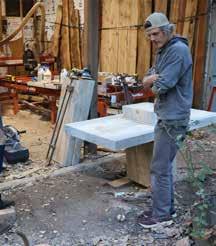
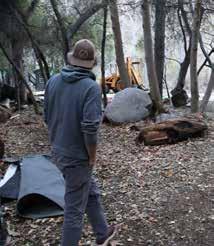
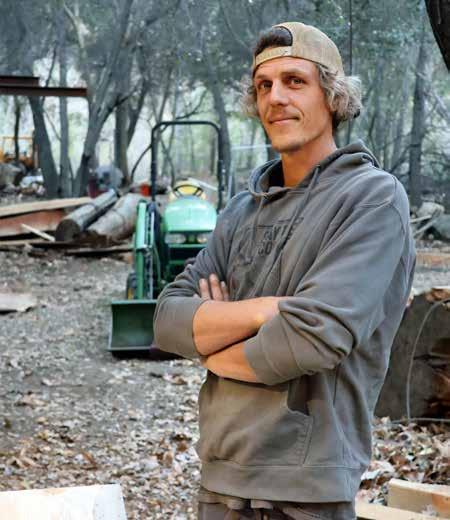
BOBBY ANDERSON OUTSIDE RAMBO SAWMILL
as much by dialogue as by craft. Their collaborative pieces will inaugurate The Village Archive, a new gallery space in Ojai, located in the former Village Pharmacy and anticipated to open in April 2026. The pairing feels emblematic of Ojai itself: processdriven, relational, and attentive to place as a container for spirit and play. Rather than forcing materials into predetermined forms, their shared practice allows wood, time, and conversation to guide what emerges.
“Wood is actually one of the rarest materials in the universe,” Roush says with a wry smile.
Bending Form, Ecology Expands Vision:
Marie McKenzie, originally from Kansas, came to wood through painting. Known primarily as an oil painter, she has traveled widely, photographing rainforests and underwater worlds — especially kelp forests. These moody images are translated into her oil-scape paintings in multi-hued, jazz-like form.
Early on, McKenzie decided that to work honestly, she had to enter the environments she painted. Confronting her fear of swimming, she taught herself to free dive in order
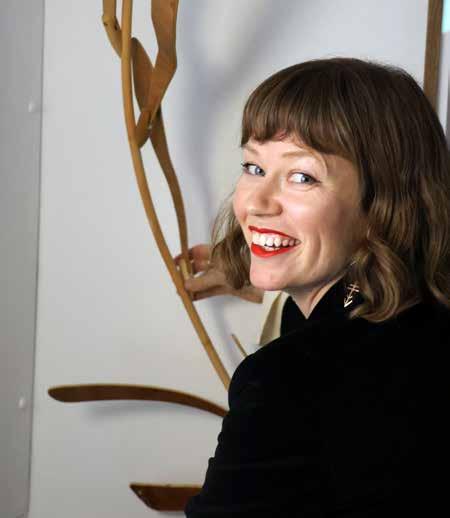
to photograph kelp forests firsthand. “You feel like you’re stepping into another world,” says her mentor Tanya Kovaleski. “Beautiful and haunting.” Drawn to California since childhood, McKenzie used to paint undulating waves of grass. Drawn to meditative dreamscapes, she says, “windswept grasslands resemble ocean waves. Kelp forests have that same energy.”
When she learned how endangered these keystone ecosystems are, she felt compelled to translate kelp forms into wood. Her partnership with ecofoundation SeaTrees grew from that impulse — a call to action rooted in form, making a difference through art.
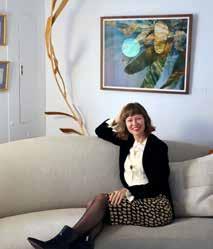
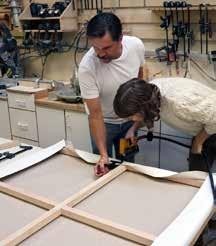
MARIE MCKENZIE DELIGHTS IN HER KELP SCULTURES. ABOVE
RIGHT: MCKENZIE RELAXES BENEATH HER KELP PAINTING.
RIGHT, BOTTOM: MASTER WOODWORKER JACKIE STEWART COLLABORATES WITH MCKENZIE
Her introduction to woodworking began while assisting Kovaleski. “I couldn’t believe how pliable wood could become,” McKenzie recalls. “It’s strong and steady, yet vulnerable — especially to water.” She laughs, describing Kovaleski submerging enormous pieces of wood into a swimming pool to soften and bend them. “I was hooked.”
Today, McKenzie collaborates on large-scale bent-wood “canvases” inspired by Parisian cathedral windows. She transforms the woodhewn stretcher into part of the art, creating immersive environments where painting and structure are
inseparable. Her approach grew organically from her kelp series and her concern over ecological loss. “Nature includes us,” she says quietly. “We exclude it — and look at the cost.”
Her studio doubles as a welcoming gallery. Visitors are invited to sit, have tea, and talk about art, climate, and belonging. Master craftsman
Jackie Stewart helped fabricate molds and bend cathedral-scale forms; his Bryant Street warehouse became an extension of McKenzie’s practice.
Now working at larger scales, McKenzie embraces techniques like steam bending, where only minutes exist to change
form. “You have to be present,” she says. “For yourself, for the material.” Transformation, for McKenzie, is both process and philosophy.
Building the Impossible: Tanya Kovaleski
“Wood is mostly unforgiving,” says Tanya Kovaleski. “It’s alive. You can’t fake your way through it.”
With two successful artist parents and formal training at Yale, Berkeley, and Otis Art Institute, Kovaleski’s artistic lineage spans generations of influence. Her work has been called bold and brave, as her heart’s creativity aligns with curiosity about
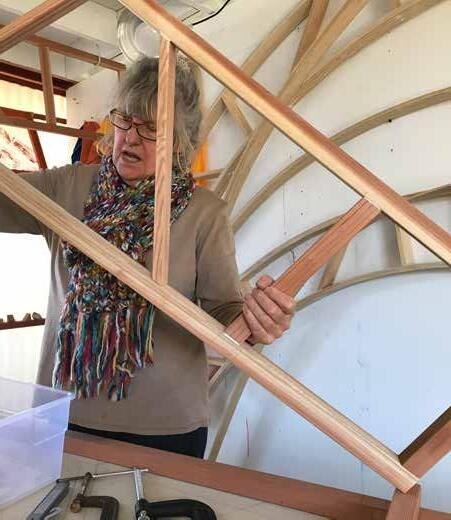
TANYA KOVALESKI STUDIES DANCING LIGHT, MATH AND BALANCE FOR HER SCULPTURE “WORK IN PROGRESS.”
PHOTO BY: MARTHA MORAN
material: paper, wire, rope, stone, and sand creating gallery installations that create a new spatial awareness. Whatever angle you approach her work, there are balanced, parallel, and contrapuntal shapes that seem to defy gravity yet become a home for a spiritual experience for the viewer.
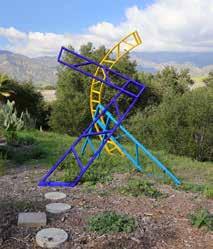
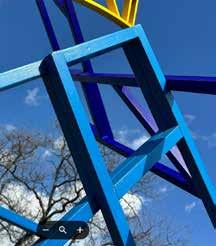
Her recent large-scale wood sculptures — installed outside the Ojai Museum and at the Beatrice Wood Center for the Arts — feel boldly physical and inviting.
Kevin Wallace, founding director of the Beatrice Wood Center for the Arts, a curator for the Los Angeles
County Art Museum, and whose books include “Cutting Edge: Contemporary Wood Art,” says of Kovaleski: “Utilizing line and color, Tanya Kovaleski’s sculptures use wood to paint in three dimensions. Craftsmanship, sharp linear precision, and vibrant pigments build a dynamic expression of form, with the intersections of line creating a geometric tension. The collision of structured design and disparate paths create a sense of energy, whether explored in works for the pedestal or large-scale installations.”
Their titles — “Shall We Dance,” “It’s About Time,” “Walk This Way” — hint
at play. Every inch is meticulously balanced. Placement matters: a sculpture in a meadow might frame grazing horses behind a white fence miles away.
Kovaleski enjoys handling the work herself. “You can’t drink when you’re climbing ladders, that is for sure!” she laughs, recalling early lessons learned in New York. Risk is inherent in monumental work, but she remains undeterred. “I love that I can make it move.” When asked about the audience for her work, she said, “I do it for me. But my hope is others will be inspired and affected.”
And affected we are. Her openness
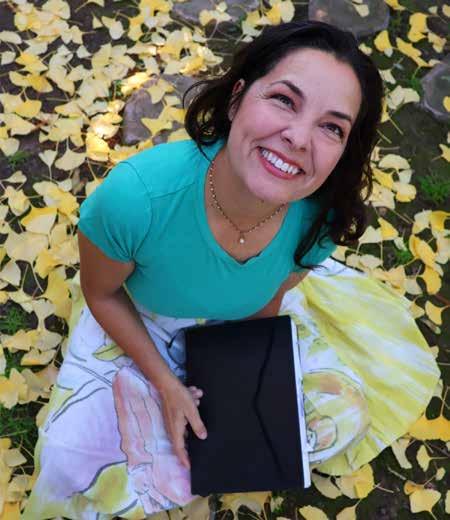
ARTIST & AUTHOR ALICIA MORRIS SOTO BELOW A GINKGO TREE
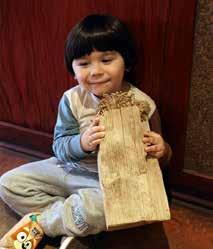
ABOVE RIGHT: FROM PARIS TO OJAI, A TODDLER HOLDS A PIECE OF WOOD FOUND BY THE AUTHOR DURING THE RECONSTRUCTION OF THE LOUVRE
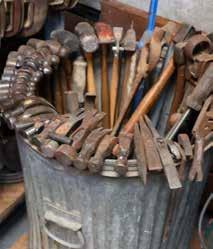
BELOW, RIGHT: A COLLECTION OF VINTAGE HAMMERS AT TY JEFFRIES’ BRYANT STREET STUDIO
— emotional as well as artistic — creates an immediate connection.
“We have to share our feelings,” she says. Art, for Kovaleski, is an invitation — calling us to see our world with fresh eyes and playful observation.
A Community of Wood, A Commitment to Care
Ojai is home to many extraordinary woodworkers — artists who recycle and preserve found materials into sculpture (Ty Jeffries), restore vintage instruments to sing and sparkle (Ray Magee), craft emblematic driftwood forms like “Condor” at El Roblar Hotel (Peter
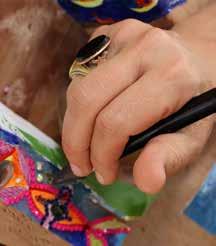
Swart), carve elegant spoons (Jack Gerard and Genevieve Barrere), design custom wood installations for Patagonia (Elaim Byle), or create surprising drama for home furnishings (David Blackburn and Lee Ortega).
This feature focuses on three artists whose practices extend beyond toward gallery and museum presence. What distinguishes Anderson, McKenzie, and Kovaleski is not only mastery of material, but sustained engagement with community, collaboration, and stewardship — working with others and with the land itself.
Making the Invisible Visible
Together, these artists remind us that wood is not merely what we walk on, sit on, or burn.
It is a living archive of fire, water, time, and care.
Anderson listens for what wood wants to become. McKenzie bends form toward awareness and connection. Kovaleski builds spaces we are brave enough to enter.
Each makes visible what is so often overlooked: the labor, the loss, the transformation — and the quiet intelligence of wood itself.
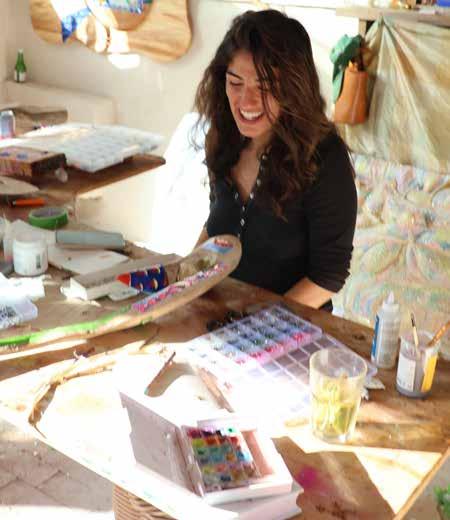
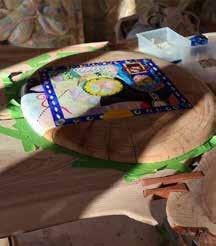
CHRISTINA JUSTIZ ROUSH ATTACHES BEADS, GLASS AND COLOR FRAGMENTS FOR “THE STORY” COLLABORATION


Our Services Include:
Paramedical Skin Revision • Relaxing Spa Facials • Acne Treatments
Clear Skin Program • Age Management Treatment Series • Peels
Airbrush Tanning • Sugaring Hair Removal • Makeup • Infrared Sauna
Unlike traditional facial treatments that focus solely on surface-level improvements, skin revision targets the deeper layers of the skin, addressing the root causes of various skin issues to not only improve the skin’s appearance, but to enhance its biological function, bringing it closer to its youthful, optimal state.
New Client Specials
2 DMK Enzyme Treatments plus a 30 day supply of home care products for $499
$50 o HydraFacial® & Glo2Facial®
50% o any sugaring or airbrush tan service

Perhaps it was potter and “the Mama of Dada” Beatrice Wood’s influence, going back nearly 90 years. Maybe it even goes back further, to the Chumash people’s ingenious and astounding artistry with basketry. It’s clear that Ojai has long been a haven for artists. The natural beauty

FIRESTICK GALLERY
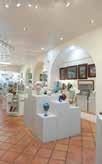
Firestick Pottery provides classes, studio/kiln space and a gallery abundant with fine ceramics. 1804 East Ojai Avenue. Open from 10 am to 6 pm every day. Gallery Open to the Public. FirestickPottery.com 805-272-8760

NUTMEG’S OJAI HOUSE
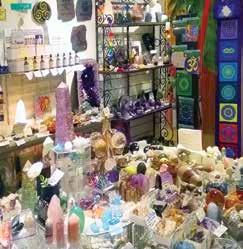
Featuring local artists, including William Prosser and Ted Campos. American-made gifts and cards, crystals, and metaphysical goods. 304 North Montgomery nutmegsojaihouse.com 805-640-1656
OVA ARTS
40+ local artists with unique contemporary fine arts, jewelry and crafts. 238 East Ojai Ave 805-646-5682 Mon 10 a.m. to 5 p.m. Tues-Thurs, 11 a.m. to 5 p.m. Fri 10 a.m. to 8 p.m. Sat-Sun 10 a.m. Third Fridays - 5-7 p.m. with Live Music, Wine & Community OVAArtsgallery.com
JOYCE HUNTINGTON
Intuitive, visionary artist, inspired by her dreams and meditations. It is “all about the Light.” Her work may be seen at Frameworks of Ojai, 236 West Ojai Ave, where she has her studio. 805-6403601
JoyceHuntingtonArt.com
OQ | ARTists & GALLERIES
framed so well by the long arc and lush light of an east-west valley lends itself to artistic pursuits, as does the leisurely pace of life, the sturdy social fabric of a vibrant community and the abundant affection and respect for artists and their acts of creation. Come check it out for yourselves.
CANVAS & PAPER
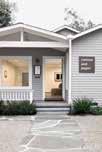
paintings & drawings 20th century & earlier
Thursday – Sunday noon – 5 p.m.
311 North Montgomery Street canvasandpaper.org
KAREN K. LEWIS
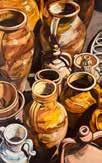
Paintings, prints & drawings. 515 Foothill Road, Ojai. Viewings by appointment. 805-646-8877
KarenKLewisArt.com

POPPIES ART & GIFTS
You haven’t seen Ojai until you visit us!
Local art of all types, unusual gifts, Ojai goods! Open daily 11 a.m. to 5 p.m. 323 Matilija Street
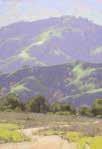
DAN SCHULTZ FINE ART
Plein air landscapes, figures and portraits in oil by nationally-acclaimed artist Dan Schultz. 106 North Signal Street | 805-317-9634
DanSchultzFineArt.com
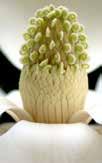
CINDY PITOU BURTON
Photojournalist and editorial photographer, specializing in portraits, western landscapes and travel. 805-646-6263
798-1026 cell
OjaiStudioArtists.org
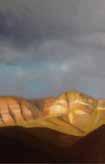
MARC WHITMAN
Original Landscape, Figure & Portrait Paintings in Oil. Ojai Design Center Gallery.
111 W Topa Topa Street. marc@whitman-architect. com. Open weekdays 8 a.m. to 5 p.m.
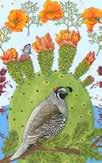
LISA SKYHEART MARSHALL
Original paintings and limited edition prints inspired by plants and flowers, birds and insects.
Open Studio April 11, 10-5. Info at: SkyheartArt.com and OjaiStudioArtists.com

TOM HARDCASTLE
Rich oils and lush pastel paintings from a nationally awarded local artist. 805-895-9642

Ilona Saari



Flavor so loud, its legendary








DEER
IN A SPOTLIGHT
Ojai’s storied roadhouse takes center stage again — this time with live music, elevated comfort food, and a blues revival. By Ilona Saari

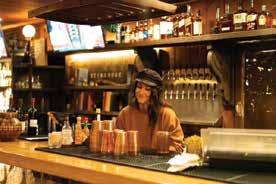
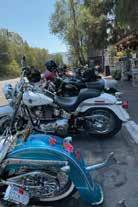
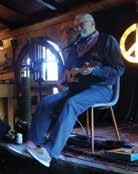
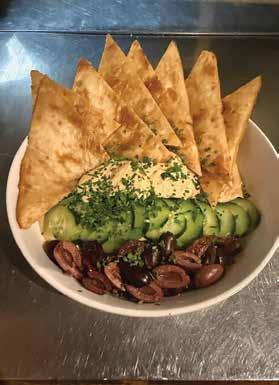


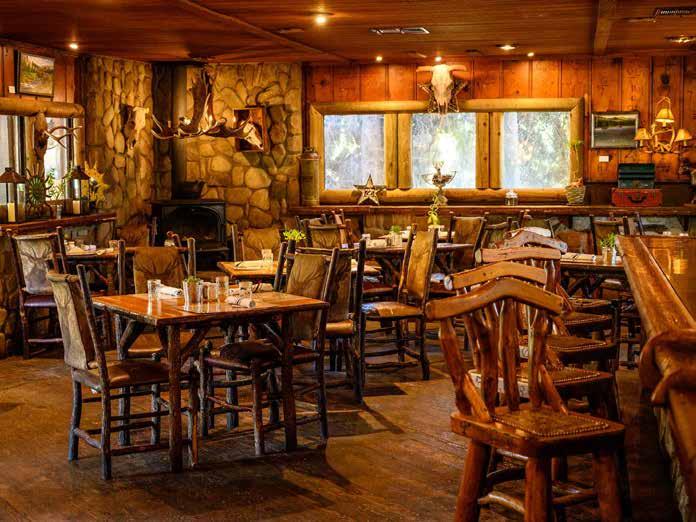
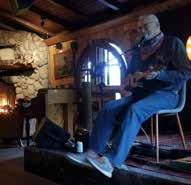
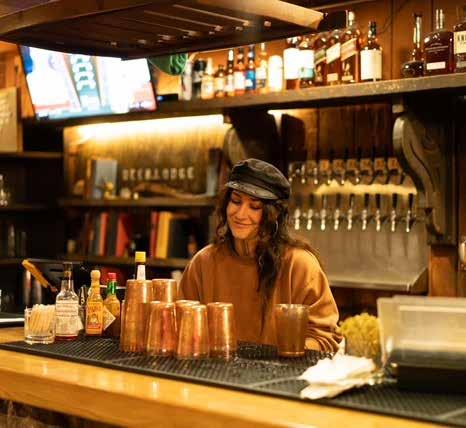
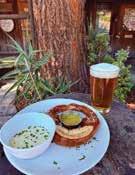
Nearly a century ago — 1932, to be exact — Ojai Valley’s historic Deer Lodge opened as a grocery store and gas station serving locals and wayward travelers alike. Back when Ojai was very much a rancher–farmer–cowboy valley, horses often stood tied to the Lodge’s hitching posts, while Model As and Bs joined the Model Ts parked out front. Before long, the owners began making sandwiches for customers. Over the decades, through a succession of proprietors, the roadhouse grocery gradually evolved into what it is today: an informal, music-forward tavern that feels unmistakably Ojai.
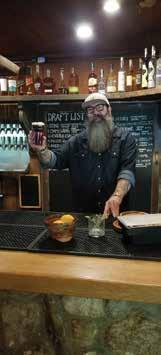
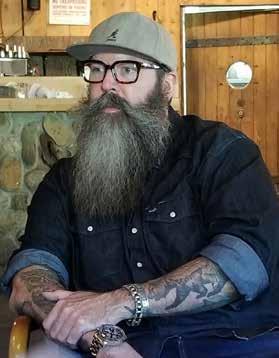
Once again, the Deer Lodge is under new ownership. Taking over the reins is Sean Kelly — rock musician, restaurant consultant, and student of philosophy. A native of a Philadelphia suburb, Kelly studied business at Emory University in Georgia before returning to Pennsylvania to pursue graduate work in philosophy at Villanova. At the time, Wall Street actively recruited traders with philosophical training, drawn to their analytical rigor and ethical frameworks.
A lifelong Deadhead who grew up playing music, Kelly ultimately left academia — and any thoughts of Wall Street — behind to follow his musical ambitions. He traveled the East Coast from Vermont to Florida, singing and playing keyboards and harmonica in a series of bands, including three of his own: original songs with Whirled Blue, and Living Earth and Box of Rain: the latter two Grateful Dead–inspired projects. Between gigs, he bartended, fell hard for the restaurant world — especially brewpubs — and went on to earn certification as an advanced cicerone, the beer world’s version of a sommelier.
Drawing on both his business training and hospitality experience, Kelly later launched his own restaurant consulting firm, Gastropub Concepts, traveling nationwide to help open and shape breweries, pubs, and restaurants.
Music, however, never left the picture. Kelly believes pubs, taverns, and roadhouses thrive when live music is part of their DNA, and the Deer Lodge reflects that philosophy. Wednesdays feature open mic night; Thursdays highlight local
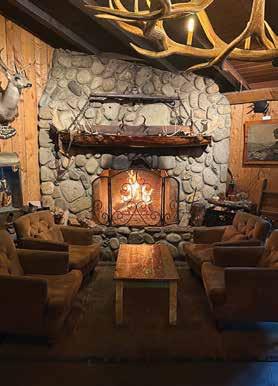
THE LODGE’S TIMBERED DINING ROOM BLENDS ROADHOUSE GRIT WITH RUSTIC WARMTH — STONE HEARTH, ANTLERED RELICS, AND A STAGE NEVER FAR FROM THE NEXT SET
bands; Fridays and Saturdays bring in regional and national acts; and Sundays belong to the blues, led by resident artist Russ Brunelli, with the occasional songwriter showcase mixed in. Booking duties are shared by Kelly and Claire Detuncq, a longtime server and bartender who has guided the Lodge through multiple management eras.
Speaking of the blues, the Deer Lodge marks a powerful return for Brunelli. I first met him while interviewing him for the Taste of Ojai charity website, shortly after he became general manager of the beautifully gardened Ranch House, one of Ojai’s most beloved outdoor dining spots. As a girl
from Queens, I instantly connected with this boy from the Bronx. Russ seems to have bars and taverns in his DNA — his grandparents owned one, and two of his uncles followed suit.
Before arriving in Ojai, Brunelli ran several restaurants and bars, then left New York City with little more than two trash bags of clothes and his guitar to take a general manager position in Chicago. Years later, he returned to Manhattan and opened Brunelli’s, his own Italian restaurant on the East Side. After a successful run, he sold the business and soon found himself back in Chicago, before an opportunity drew him west to
manage the Ranch House.
This city boy who once hiked on cement pavements among a forest of skyscrapers fell in love with pastoral Ojai, with its towering oak trees and dirt hiking trails. At the Ranch House, he became known for legendary happy hour jazz nights, often jamming with musician Jimmy Calire and his sidemen, rocking the house with harmonica riffs and ukulele solos.
Then life intervened. After nearly a decade as general manager, Brunelli was diagnosed with multiple cancers and forced to step away from the restaurant he loved. But he fought
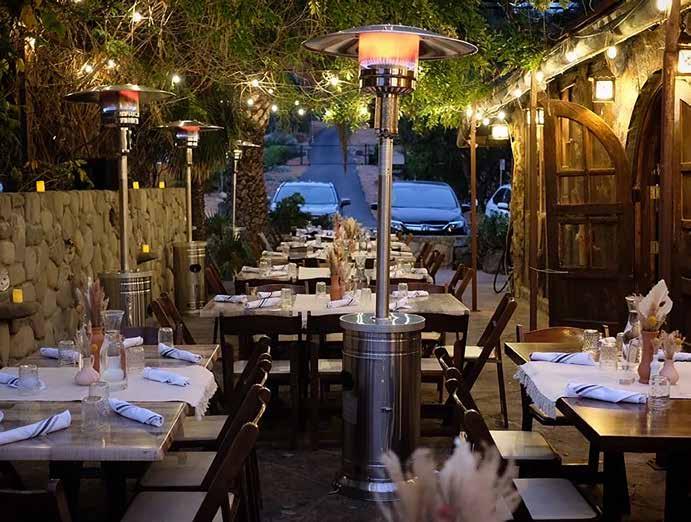
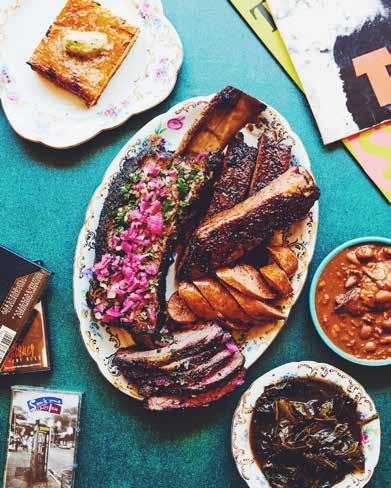
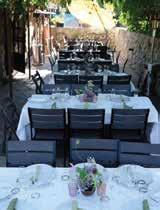
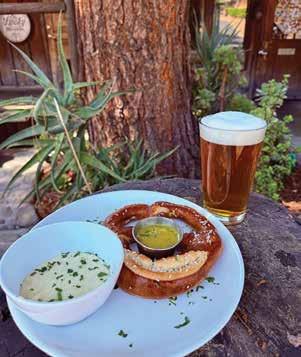
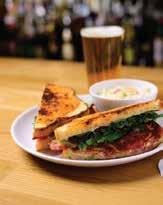
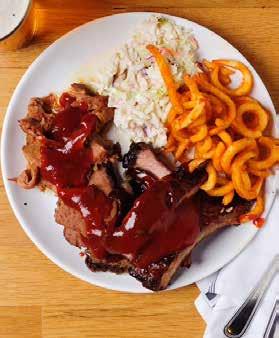
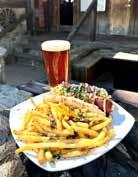
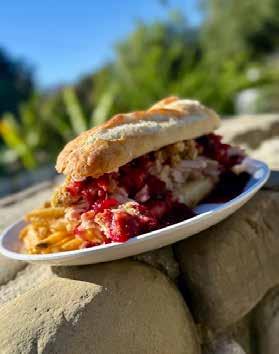
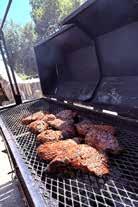
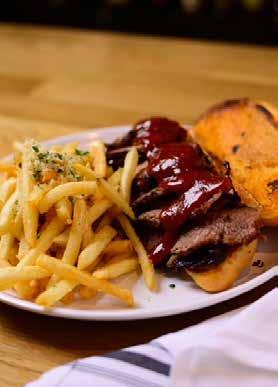
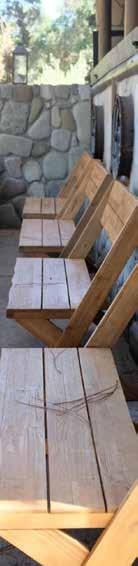
UNDER OAK BRANCHES AND PATIO HEATERS, THE DEER LODGE’S GARDEN COURTYARD CHANNELS ITS RANCH-ERA ROOTS — EQUAL PARTS SUPPER CLUB, HIDEAWAY, AND NEIGHBORHOOD GATHERING GROUND. RIGHT: A SELECTION OF MENU ITEMS, WITH SEAN KELLY, NEW OWNER/MANAGER, SECOND FROM TOP ON THE RIGHT, CENTER IS PICTURED “REVEREND” RUSS BRUNELLI, MARKING HIS RETURN TO THE DEER LODGE STAGE

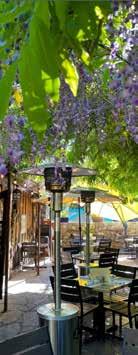
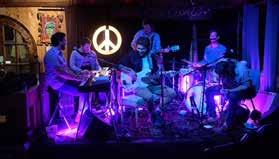
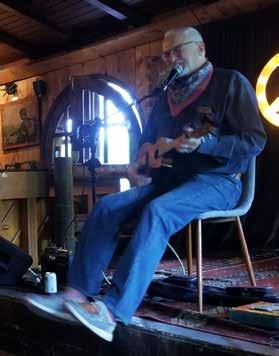




back fiercely. Now in remission, he has returned to the local music and restaurant scene. Known affectionately as “Reverend Russ,” he delivers a blues “sermon” every Sunday afternoon at the Deer Lodge at 1 p.m.
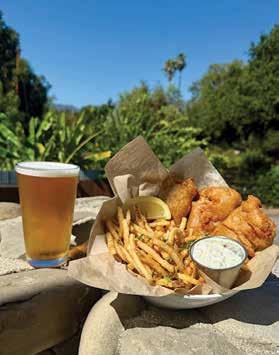
Of course, this is still a roadhouse — tavern, pub, bar, take your pick — and the menu reflects what Kelly calls elevated roadhouse fare. Favorites include barbecue ribs, tri-tip and pulled pork entrées, classic fish and chips, and fried chicken. Bikers, roadies, local gents, and old-timers with canes can dig into a barbecue tri-tip sandwich or a buffalo burger topped with house-made bacon jam—onions and
bacon reduced in chicken stock with a blend of closely guarded spices.
Other standouts include a patty melt, barbecue pulled pork sandwich, triplecheese grilled cheese, a Codzilla Po’ Boy with beer-battered cod, fried Brussels sprouts finished with truffle oil and Parmesan, hearty ground beef chili, and a trio of meat sliders. And yes — there are salads. Good ones. The Lodge offers a harvest salad, a retro Caesar, and a Roadhouse Cobb, all made with local, farm-to-table produce, chicken, and meats.
A trained cicerone’s place wouldn’t be complete without a thoughtfully curated
beer list, and the Deer Lodge delivers, with a wide selection of craft beers, a few wines on tap, additional local wine offerings, and a solid lineup of classic cocktails.
Pull up to the Deer Lodge — park your Harley, horse, SUV, or Prius — and step inside. Chalk up a cue for a little action in the pool room, or sit outside beneath the trees and settle in. Catch the game on one of the TVs in the main dining room, all while live music works its quiet magic, chasing the blues away.
The Deer Lodge also hosts private events. www.deerlodgeojai.com
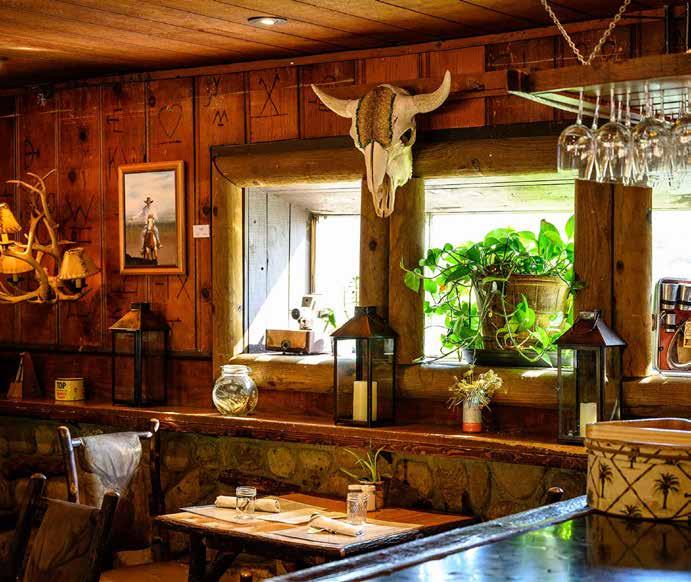
SUNLIGHT THROUGH THE WINDOWS SOFTENS THE LODGE’S RUGGED BONES
A ROADHOUSE BUILT FOR MUSIC, MEMORY, AND SECOND ACTS











NATIVE NATIVE
SATURDAY, APRIL 18 9AM-3PM
Join OVLC for our third annual Rewild Ojai Native Garden Tour, featuring 14 native plant gardens across the Ojai Valley. From formal gardens to wildflower meadows, see what your neighbors are planting and get inspired! Each attendee receives the Rewild Ojai book with a tour map, seasonal gardening tips, and native landscaping designs. Get tickets today at ovlc.org

100
70 harvey & his houses
Setting the Standard of Old West Luxury and Hospitality By Jerry Dunn
100 near, yet far The Channel Islands Offers Majestic Views, Including of Ojai By Chuck Graham
82 movement as medicine
Kim Hoj’s Dance Therapy for Parkinson’s Patients By Robin Gerber
109 calendar of events Tennis, Tomatoes, Music & More!
90 who’s saari now?
Remarkable Career of Ojai Legend By Mark Lewis
110 nocturnal submissions Riven by Factions! By Sami Zahringer
The Southwestern Legacy of Fred Harvey (Who?)
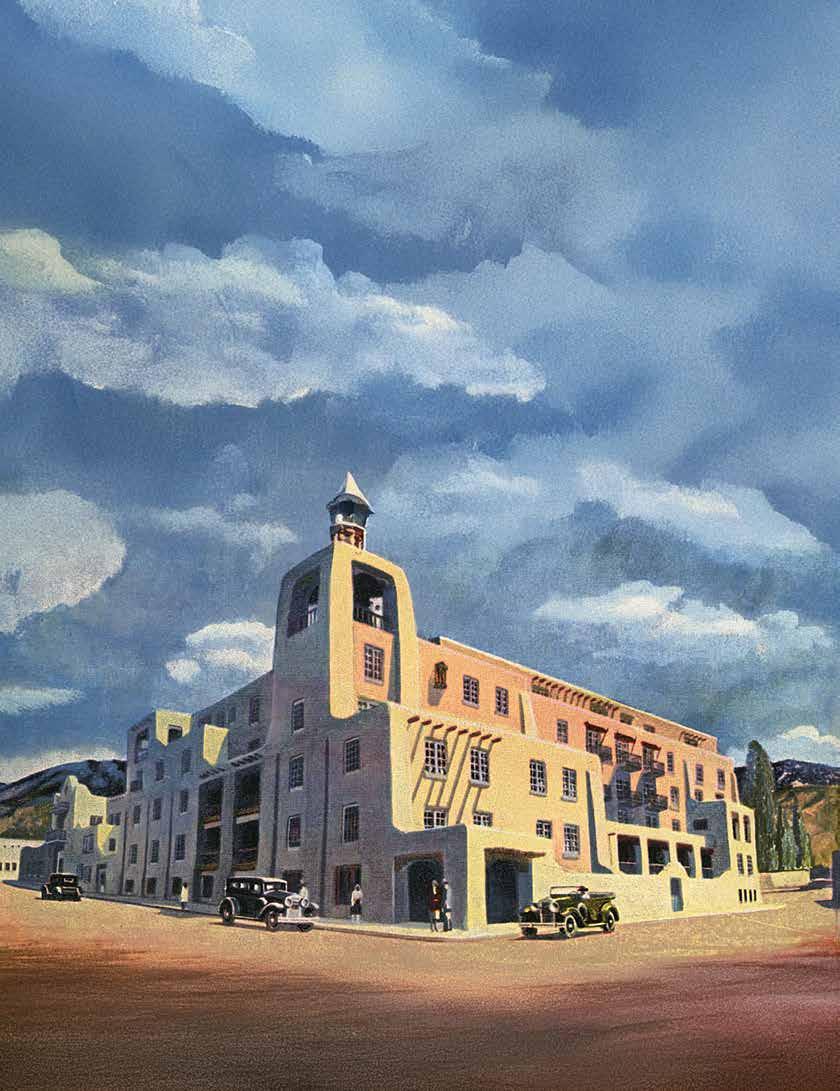
BY JERRY CAMARILLO DUNN, JR.
STARTING IN THE 1920S, FRED HARVEY RAN
SANTA FE’S LA FONDA HOTEL (OPPOSITE) FOR DECADES; ITS FORMER PATIO IS NOW LA PLAZUELA RESTAURANT
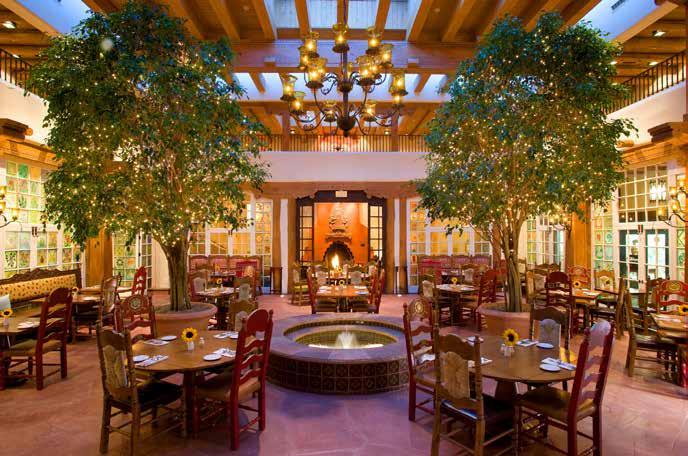
Every year my wife, Merry, and I drive Interstate 40 from Southern California to Santa Fe, New Mexico. Although the route is scenic, the Arizona section is basically just miles and miles of miles and miles. I’m always reminded of a favorite cartoon: An automobile is heading across a dull featureless desert, and a sign by the roadside says:
Your own Tedious ThoughTs nexT 200 Miles
The long drive has one bright spot to relieve the drone of your own tires on blacktop. It lies off the interstate on historic Route 66 in Winslow, Arizona, the desert town where the Eagles famously sang about standing on a corner and being ogled by a girl in a flatbed Ford.
This bright spot is La Posada, a historic railroad hotel that opened in 1930. Pioneering architect Mary Colter designed La Posada (“the resting place”) to resemble the sprawling hacienda of a wealthy Spanish landowner. She surrounded it with gardens and courtyards, and inside were hand-painted roof beams, large fireplaces, and authentic Southwestern décor.
Guests would arrive on the Santa Fe railway, whose tracks ran right behind the hotel. Today, as motorists, Merry and I stop at Las Posada for a break from the highway and a lunch in the hotel’s award-winning Turquoise Room. Our usual order is the Signature Soup, a half-and-half bowl of black beans and cream of corn topped with the restaurant’s initials spelled out in chile cream.
We also savor the hotel’s standing in western history as a rare survivor among the great trackside hotels built by Fred Harvey. In the mid-1800s this English immigrant allied himself with one of America’s largest railroads, the Atchison, Topeka and Santa Fe, to offer gracious lodging and fine cuisine in the middle of nowhere.
After humble beginnings as a dishwasher in New York City, Harvey worked on trains where he personally experienced the culinary affronts that beset travelers at stations along the way. Meals were questionable at best and often served late – deliberately, so that when passengers had paid and sat down to eat, it was already time to get back on board. The staff would then scrape the food off the plates and serve it to the next load of unsuspecting passengers. Travelers joked that when the train pulled out of the station, the

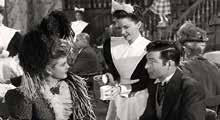

DINERS AT THE LA
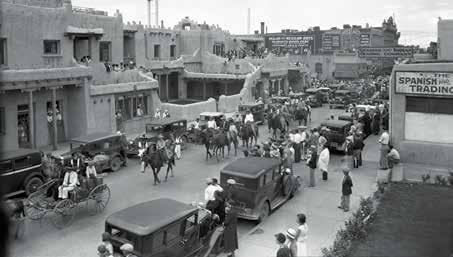
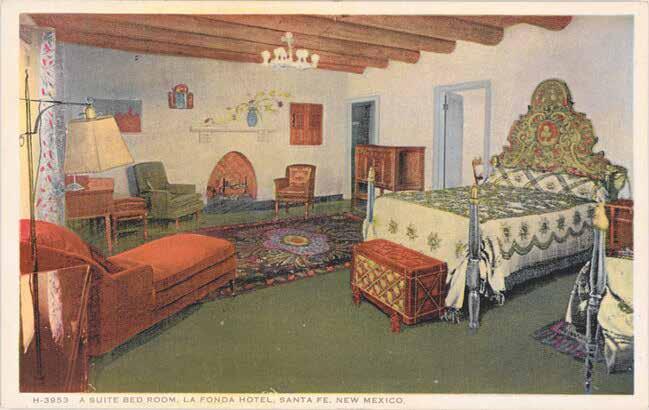
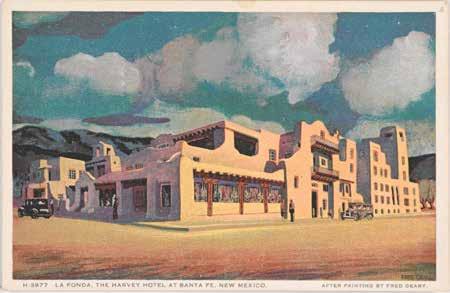
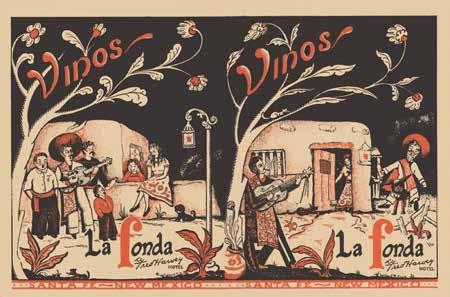
(OPPOSITE) A VINTAGE POSTCARD SHOWS A LA FONDA SUITE WITH FIREPLACE AND SPANISH-STYLE FURNISHINGS. ANOTHER CARD HIGHLIGHTS THE HOTEL’S SOUTHWESTERN/PUEBLO ARCHITECTURE. LA FONDA’S VINTAGE WINE MENU (BOTTOM) IS A VALUABLE COLLECTIBLE TODAY
flies would wire ahead and alert their cousins at the next stop.
Fred Harvey set out to change all that. Determined to serve meals that rivaled the finest restaurants of London and New York, he set his tables with European linen, fine china, and crystal stemware, and introduced impeccable service to rail travel.
Harvey’s first restaurant opened in a renovated fleabag hotel in Florence, Kansas – a town so small that the population doubled when the Santa Fe train pulled in. In 1878 he hired away the English chef from Chicago’s renowned Palmer House to run the kitchen. Fred Harvey “made the desert bloom with vintage claret and quail in aspic,” observed historian Lucius Beebe.
As his business expanded, Harvey would revolutionize hospitality in the West and become the founding father of the American service industry. His company eventually ran 25 hotels and 100 eating houses between Chicago and Los Angeles, creating the first national chains. He was Conrad Hilton before Hilton Hotels and Ray Kroc before McDonald’s. His take-out coffee stands predated Starbucks by nearly a century.
The company’s elevated standards of quality became known as the Fred Harvey Way. To attain them, he learned to innovate from the get-go. In the utterly wild Wild West of those days, violence was common and in 1883, after a midnight brawl between roughneck cowboys and the waiters at the Harvey House in Raton, New Mexico, Harvey took steps. Following the advice of his local manager, he replaced all the male waiters with young women. The change worked so well that he decided to adopt it at all Harvey Houses.
(ABOVE) THE FAMOUS HARVEY GIRLS, BOTH REAL AND AS PORTRAYED ON FILM BY JUDY GARLAND (TOP RIGHT), WERE POPULAR ICONS; THEY SERVED
FONDA HOTEL (CENTER) IN OLD SANTA FE
Newspaper advertisements throughout the Midwest and East Coast sought single young women with “good moral character, attractive and intelligent” to waitress in Harvey eating houses along the railway lines. And so was born a historic innovation: the Harvey Girls. In that era there were no real career options for young women outside of teaching, so thousands of them jumped at the chance for adventure out West. They lived in a supervised situation, usually boarding above the Harvey House where they worked, chaperoned by a dorm mother. To protect their reputations, the girls were under a 10 p.m. curfew . . . so as not to be mistaken for the local prostitutes.
Harvey Girls served passengers from at least three or four trains a day and were trained to work long shifts with a genuine smile. Each was issued a clean, starched dress and apron every morning, and if these got even a small spot, they had to be changed immediately. Daily inspections made sure the girls wore no makeup and put on their girdles and hair nets.
Harvey’s attention to detail and customer service was legendary. Devoted to efficiency, he devised a coffee-cup code to speed up service: One girl would ask for a patron’s beverage preference, then turn his cup handle to a certain position; this cued the server, who could now roam the dining room pouring coffee or tea at top speed.
Numbering 100,000 employees over the years, Harvey Girls made up the nation’s first national corps of independent women who were able to travel and earn their own living. Not surprisingly, some waitresses soon married local men, which prompted Fred Harvey to ask new hires to sign a contract not to wed for six
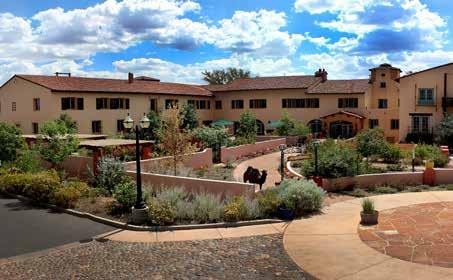

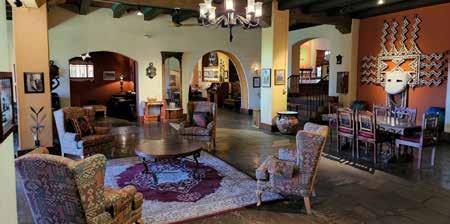
(ABOVE) RED TILE ROOFS AND SPRAWLING GARDENS ESTABLISHED THE CLASSIC STYLE OF LA POSADA, A FORMER FRED HARVEY HOSTELRY IN WINSLOW, ARIZONA. THE RESTORED 1930 HOTEL HAS BEAUTIFULLY UPDATED ITS BEDROOMS AND SITTING AREAS, WHILE STAYING TRUE TO SOUTHWESTERN DESIGN THROUGH THE USE OF WROUGHT IRON, ARCHES, REGIONAL PIECES OF ART, AND A PALETTE OF WARM COLORS THAT CALL TO MIND DESERT SUNSETS AND TURQUOISE JEWELRY
months. In the end some 20,000 Harvey Girls found mates, settled in remote towns, and created families. (As humorist Will Rogers quipped, Fred Harvey “kept the West in food and wives.”) The girls were genuine pioneers, and Harvey felt proud that they civilized the West.
THE CROWN JEWEL of Harvey’s empire was La Posada. Its construction cost $2 million (nearly $40 million in today’s dollars), a budget that allowed chain-smoking perfectionist Mary Colter to fulfill her vision: a romantic hacienda with red tile roofs, shaded colonnades, acres of gardens, and rooms filled with custom furniture and decorative wrought iron. Guests ranged from Hollywood stars to Albert Einstein and the crown prince of Japan.
Sadly, declining rail travel and the rise of the automobile finally put the trackside hotel out of business. By the time entrepreneur Allan Affeldt bought the 80,000-square-foot building and 20 acres of land from the Santa Fe railway in 1997, it had been abandoned for four decades. He and his wife, artist Tina Mion, slowly restored La Posada to mirror its former glory.
In Fred Harvey tradition, the owners partnered with an English chef to offer gourmet dining with Southwestern flair. At the helm of the hotel’s Turquoise Room, John Sharpe garnered two James Beard nominations. Although he retired in 2020, his team stayed on to keep serving travelers unexpectedly fine meals in a little railroad town “in the middle of nowhere.”
Passenger trains still stop behind the hotel twice a day, heading east and west. And Fred Harvey’s legacy – superb food and comfortable lodging along the rail routes of the West – lives on.
FRED HARVEY STOPS
LA POSADA,
Winslow, Arizona (www.laposada. org): Mary Colter considered this hotel her masterpiece. A museum housed in the adjacent 1930 rail depot displays local artwork, the world’s largest Navajo rug, and a 1950 Pullman dome car from the glamorous Santa Fe Super Chief streamliner that once passed through Winslow on its cross-country route.
LA FONDA,
Santa Fe, New Mexico
(www.lafondasantafe.com): For more than forty years, Fred Harvey ran this classic 1922 hotel that resembles a New Mexico Indian pueblo. Overseeing a major expansion, Mary Colter hired artisans from nearby pueblos to craft tiles, textiles, copper and tin lighting fixtures, and other décor in Native American styles. Hotel guests have ranged from Manhattan Project scientists developing the atomic bomb at nearby Los Alamos to musician Stevie Wonder recording an album in Suite 500. The airy La Plazuela restaurant occupies the hotel’s original 1920s patio.
THE CASTANEDA,
Las Vegas, New Mexico
(www.castanedahotel.org): Opened in 1898 as Fred Harvey’s first trackside hotel, with the Santa Fe mainline directly in front, connecting travelers to Chicago and Los Angeles. The Mission Revival hostelry closed fifty years later and slowly crumbled until Allan Affeldt of La Posada restored it in 2019. The hotel, like economically troubled Las Vegas itself, is a work in progress. But both are worth a look for fans of Fred Harvey and western history. (At the hotel in 1899, Teddy Roosevelt staged a reunion of his Rough Riders from the Spanish-American War.)



AT TODAY’S LA FONDA (ABOVE), SOME SUITES INCLUDE WOOD-BURNING FIREPLACES, HAND-PAINTED SPANISH-STYLE FURNITURE, AND OTHER TOUCHES OF SOUTHWEST LUXURY. DECORATED HEADBOARDS ARE A TRADITION GOING BACK TO THE HOTEL’S EARLY DAYS UNDER FRED HARVEY. LA FONDA’S TIMELESS LOOK WAS LARGELY DUE TO HIS DESIGN MAVEN, PIONEERING ARCHITECT MARY COLTER, WHO ADAPTED NATIVE AMERICAN STYLES AND HIRED ARTISANS FROM LOCAL PUEBLOS
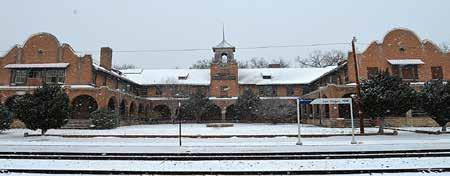
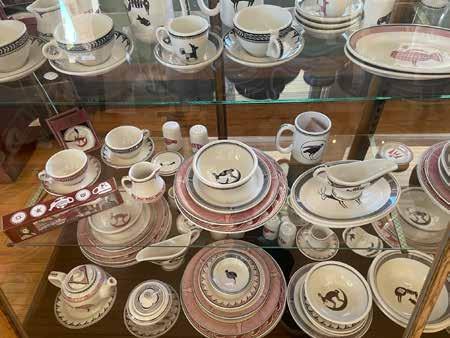
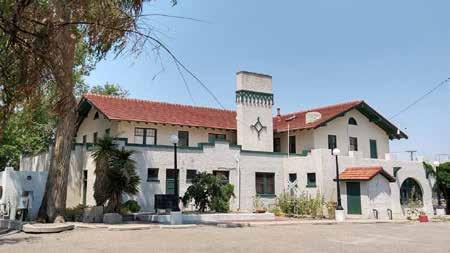
(TOP) THE CASTENADA HOTEL IN LAS VEGAS, NEW MEXICO, SITS BESIDE THE TRACKS NEAR THE STATION WHERE AMTRAK TRAINS STOP TWICE DAILY ON THE LOS ANGELES-CHICAGO RUN. THE FIRST HARVEY HOUSE OF MISSION REVIVAL STYLE, IT BECAME THE PROTOTYPE FOR FUTURE PROPERTIES. HOTEL CROCKERY DISPLAYS CLASSIC HARVEY DESIGNS. (BOTTOM) THE BELEN HARVEY HOUSE MUSEUM WAS FORMERLY ONE OF THE COMPANY’S CHAIN OF 100 EATING HOUSES ALONG THE RAILWAY LINE
FRED HARVEY EXHIBIT,
New Mexico History Museum, Santa Fe
(www.nmhistorymuseum.org): Artifacts include Harvey Girl uniforms and hotel furniture designed by Mary Colter.
BELEN HARVEY HOUSE MUSEUM, Belen, New Mexico (www. (harveyhousemuseum.org): A former Harvey eating house from 1910 now displays company memorabilia and serves travelers at the Whistle Stop Café. For train buffs, the adjacent railyard sees up to 100 trains a day.
FUN FACTS FOR “FREDHEADS”
The Harvey company operated newsstands and bookshops in 80 cities, their orders often influencing national bestseller lists — making Fred Harvey Jeff Bezos before Amazon.
The Santa Fe railroad shipped and stored everything Harvey Houses needed at no charge. Annual supplies for the company’s eateries in 1908 included 17 train cars of oranges, 298,000 pounds of butter, 17,560 cases of eggs, and 155,541 chickens. Harvey served customers larger portions than were standard; a slice of pie would be one quarter of a pie instead of one sixth or one eighth.
A Harvey Girl earned $17.50 a month, plus tips. Her uniform consisted of a long black dress, which was to fall no more than eight inches from the floor, and a full white apron. Harvey Girls became the company’s most recognizable icons and the darlings of the West. A 1946 Technicolor musical titled “The Harvey Girls” starred Judy Garland and won an Academy Award for the song “On the Atchison, Topeka and the Santa Fe.”
Harvey Houses sold Native American crafts, essentially creating the Southwest souvenir market. Vintage examples are displayed at the Smithsonian Institution in Washington, D.C.
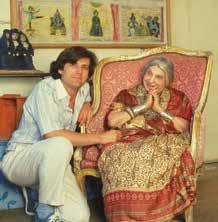

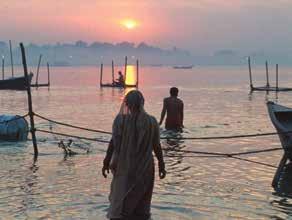
Stephen Huyler’s New Memoir Now Available.
Stephen Huyler has been documenting women’s ephemeral art in India for over half a century. Read his compelling new memoir to discover the underlying stories of these artists he came to know.
Info & Order At www.StephenHuyler.com
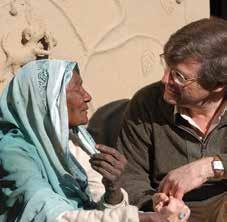
“With an insider’s percipience and an outsider’s appraisal, Huyler tells the story of Indian folk arts and rituals, predominantly stemming from rural women’s worldview. Its soul-stirring anecdotal narrative takes the reader along on his journeys - and once you begin, you cannot leave it halfway.”
Dr. Jyotindra Jain



Oaks - 5 Bedrooms, Upscale Finishes Throughout, Media Room, Wine Cellar, Tasting
Six-Car Garage, Bocce Court, Views, and So Much More RoyalOaksRanchOjai.com
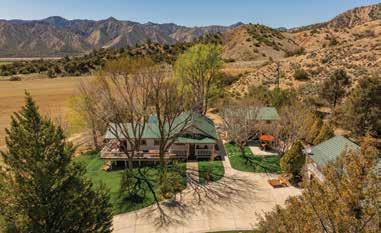
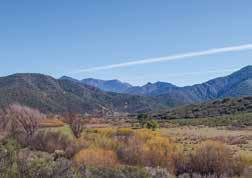
Valley Land - Create an off-grid, country retreat on 40 acres with mountain views, trails, and a natural spring in Rose Valley in the Los Padres National Forest $1,200,000
Gym/Massage
Pool &
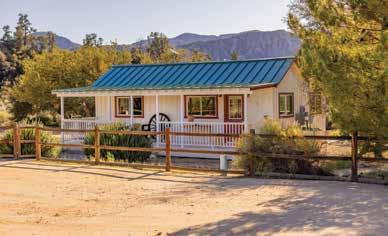
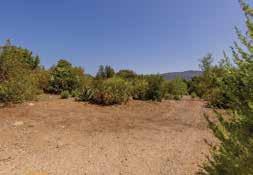

Lot at End of Street in Oak View with Electric Gate, Two-Car Garage, and Utilities on Property Close to Shops, Restaurants, Ojai Valley Trail, and Lake Casitas $525,000
Rose
Royal
Room,
Room,
Spa, Putting Green, Well,
Corral Canyon Ranch - 277+ Acre Ranch in Cuyama Valley with 5 Recently Renovated Houses, Equestrian Facilities, Fenced Pastures, Hay Fields, Riding Trails, Stunning Views Surrounded by Los Padres National Forest.


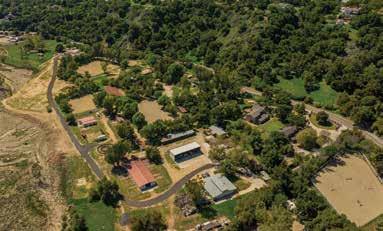
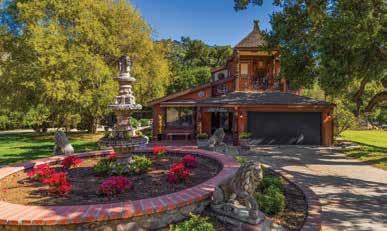
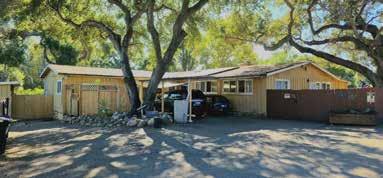

Casa Vista Linda - Set amid serene grounds, this Marc Whitman-designed home blends Old-World charm with modern comfort. Custom fireplaces, walnut finishes, expansive terraces, and resort-style amenities only begin
retreat
1 SHELF ROAD 3.5mi
EASY | Elev. Gain: 200 ft | Overlooks downton Ojai.
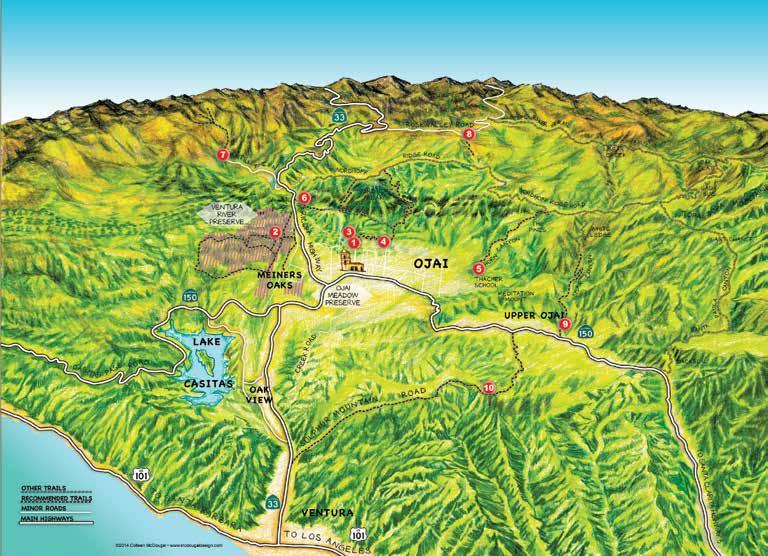
2
RIVER PRESERVE 0-7mi
VARIES | Elev. Gain: ≤ 520 ft Wills-Rice Loop is the longest trail.
5
HORN CANYON 5.5mi
STRENUOUS | Elev. Gain: 1600 ft | Goes to the Pines.
8
ROSE VALLEY 1mi
EASY | Elev. Gain: 100 ft Rose Valley Falls.
3
PRATT TRAIL 8.8mi
STRENUOUS | Elev. Gain: 3300 ft | Goes to Nordhoff Peak.
6
COZY DELL 2.2mi
MODERATE | Elev. Gain: 740 ft | Cozy Dell Creek & Ridge.
9
SISAR CANYON 22mi
STRENUOUS | Elev. Gain: 4800 ft |Topa Topa Bluffs.
4
GRIDLEY TRAIL 6-12mi
MODERATE | 3 mi to Gridley Springs (Elev. Gain: 1200 ft) 6 mi to Nordhoff Peak.
7
MATILIJA CANYON 12mi
MODERATE | Elev. Gain: 1200ft | North Fork.
10
SULPHUR MTN. 22mi
MODERATE | Elev. Gain: 2300 ft | Sulphur Mountain Road.
OQ | ANIMAL NEIGHBORS
TURTLE CONSERVANCY turtleconservancy.org info@turtleconservancy.org.
LOCKWOOD ANIMAL RESCUE CENTER info@lockwoodarc.org phone: 661-220-5505

The Turtle Conservancy, located in Ojai’s East End, is dedicated to protecting threatened turtles and tortoises and their habitats worldwide, and to countering the illegal trade in such animals, which is decimating their numbers. Working with partner organizations, they’ve purchased land and established preserves for endangered turtles in Africa, Asia and Mexico. They’ve established a captive breeding center with the ultimate goal of re-wilding species to their native habitats when it is safe to do so. The Turtle Conservancy depends on donations to fund its programs, and welcomes volunteers to help out with numerous projects at our Ojai facility.
CLOSED SINCE PANDEMIC:
The Lockwood Animal Rescue Center (LARC), founded by Dr. Lorin Lindner and Matt Simmons, offered a therapeutic work environment for returning combat veterans and a “forever home” to wolves, wolfdogs, coyotes, horses, parrots and other animals. Located on a 20-acre facility, they offered both the veterans and animals an opportunity to heal and thrive in a back-to-nature setting. “Though not open to the public, we cater to veterans suffering from trauma, and are welcome to participate in our work therapy program. We offer an immersion program for veterans to stay and participate, and to learn basic skills for caring for animals and self healing,” Dr. Lindner said.
OJAI RAPTOR CENTER
animals@hsvc.org phone: 805-646-6505 or 805-656-5031 ojairaptorcenter@gmail.com phone: 805-649-6884
ORC was founded and is directed by Kimberly Stroud, who started her training at the Raptor Rehabilitation and Release Program in 1992. In 2000 she went on to found Ojai Raptor Center. First and foremost, Ojai Raptor Center is a fully functional and permitted wildlife rehabilitation center, specializing in birds of prey. Every year they take in 500 to 1,000 sick, injured or orphaned birds (including many non-raptor birds, and a small percentage of mammals) with the hopes of rehabilitating them and releasing them back to the wild. Our four-acre campus is comprised of a medical room and hospital, as well as outdoor flights, aviaries and mews. The center also features the largest flight in California.
HUMANE SOCIETY OF VENTURA COUNTY
Nestled in the rolling hills of the Ojai Valley lies a 4.4-acre hidden haven for wayward animals. Founded in 1932, the Humane Society of Ventura County has been serving not just the animals of the Ojai Valley, but all of the animals in Ventura County. Traditionally, an animal shelter is thought of as solely a place for animals to seek refuge until a permanent home can be found. While here at the Humane Society of Ventura County they provide this safe refuge, they also strive to remedy the greater problem of animal overpopulation, abuse and neglect.
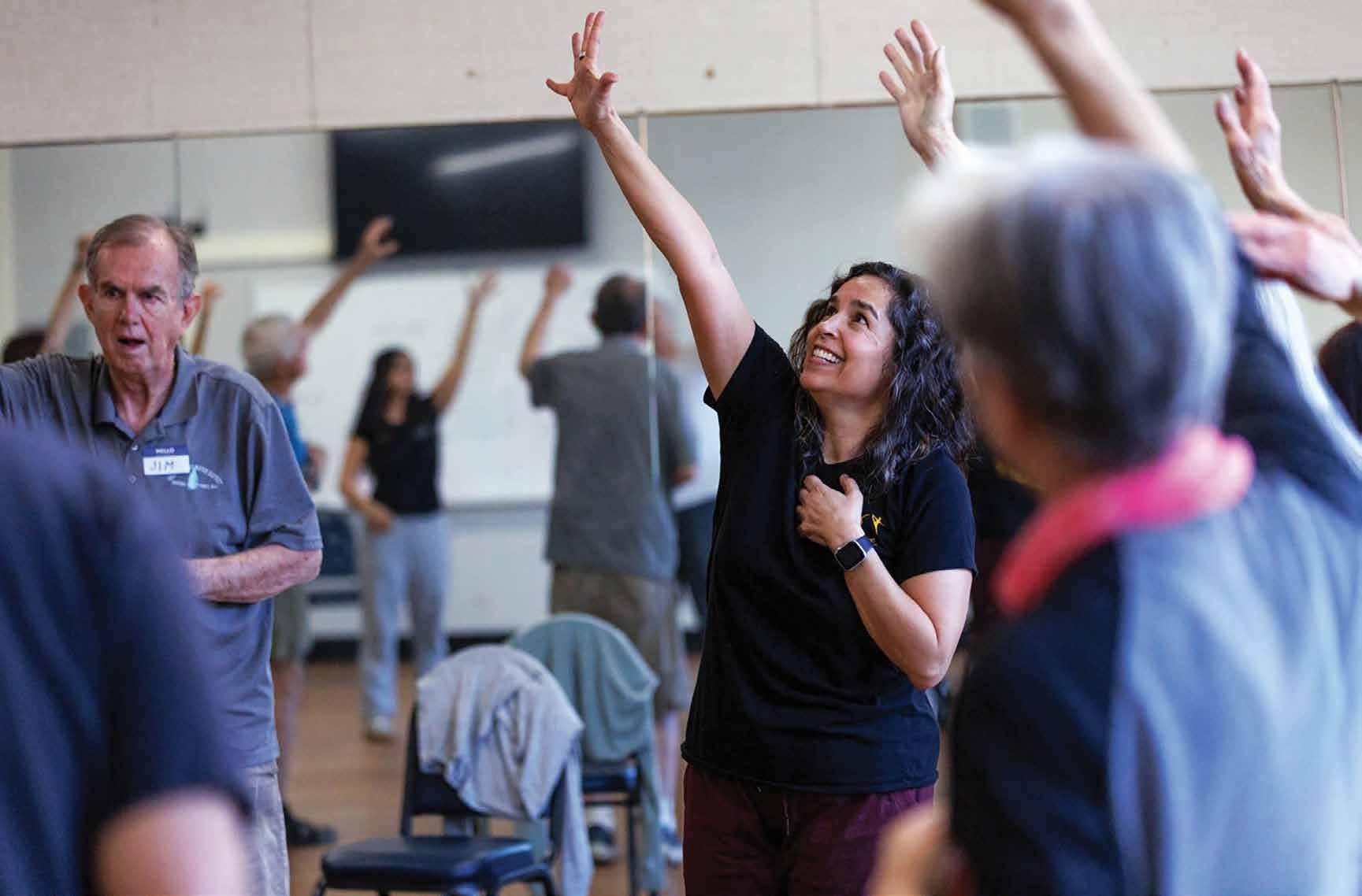
KIM HOJ LEADS A DANCING WITH PARKINSON’S CLASS, DEMONSTRATING THAT DANCING, OF MOVEMENT AS A FORM OF HEALING, IS AVAILABLE TO EVERYONE. PHOTOS BY RYAN SCHUDE
STORY BY ROBIN GERBER
PHOTOS
BY RYAN SCHUDE
Where Movement Becomes Medicine
When Nordhoff dance teacher Kim Hoj was a little girl, adults told her to stay still.
Born with a hole in her heart, Kim spent her early years moving between doctors’ offices and testing rooms. At nursery school, when she was four, teachers parked her quietly in a corner, convinced — incorrectly — that too much movement could trigger a heart attack. Fear settled early, lodging itself not just in her body, but in the way the world handled her. Even after corrective surgery at age
eight repaired her heart, the fear lingered.
The year of Kim’s surgery also marked another rupture: her parents’ bitter divorce. Her younger brother went to live with their mother. Kim moved to the San Fernando Valley with her father, settling just blocks from her grandmother.
Grandma, as Kim called her, changed everything.
“She encouraged my creativity, my dreaminess, my playfulness,” Kim recalls. “I was so shy and withdrawn. I had been held back
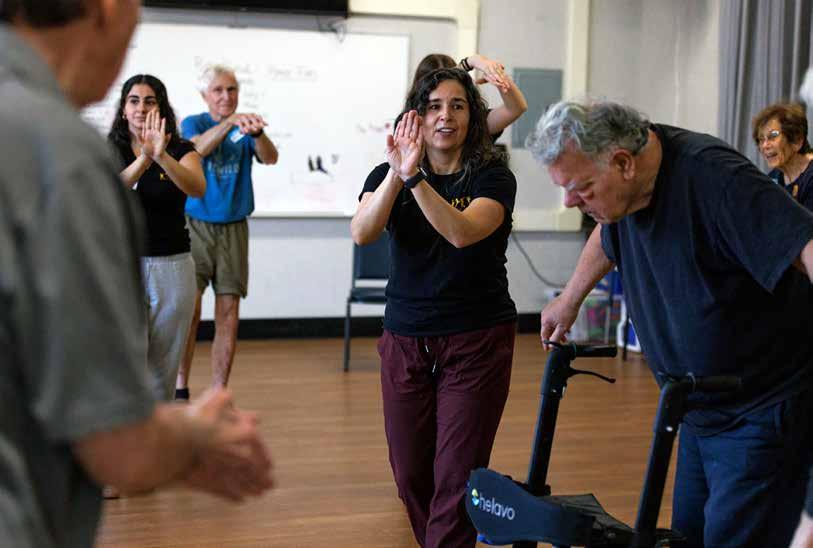
PARTICIPANTS IN THE DANCING WITH PARKINSON’S CLASS MOVE TOGETHER
LEFT
NORDHOFF DANCE STUDENT INTERN ALYSSE ABASI, BILL BROTHERS, FACILITATOR KIM HOJ, TONY RECORDS AND CAROL SALTZMAN
for so long.” Grandma pulled her granddaughter into motion. She dropped vinyl onto the turntable — Barry Manilow, Frank Sinatra — and cleared space in the living room. Kim dug her toes into the off-white shag carpet and let the music carry her.
She gravitated toward anything with a beat: KC and the Sunshine Band, Grease, Saturday Night Fever. “Dancing gave me incredible joy,” Kim says. “It was freedom.”
When Grandma enrolled Kim in ballet class, she had to argue past both doctors and parents, insisting it wasn’t too strenuous. Kim didn’t care. She felt unchained. “Dance set me free,” she says. “Everyone was so afraid for me. I was always protected, handled with kid gloves. Dance was the one place where I didn’t feel fragile.”
School became another refuge. Kim loved learning and loved kids. “School was my safe spot,” she says. “It let me escape the trauma of my family life. I was always trying to understand why people are the way they are.” At UC Santa Barbara, she majored in psychology and sociology, choosing teaching over the three careers her father endorsed — lawyer, doctor, veterinarian.
Dance, however, never let her go. She trained at Linda Radney Dance Studio in Camarillo, joined her high school’s competitive dance drill team, and later danced with the UCSB Gaucho Dancers. In college, she mailed her résumé to every nearby high school, choreographing wherever she could — even coaching the Santa Barbara High School dance team while still student teaching.
Kim married John Hoj, also a teacher. In 1993, they moved to Ojai after both landed jobs at Nordhoff High School. Kim taught psychology and child development and later served as a school counselor, but she kept dancing. In the 1990s, she studied with Madame Lysova in a small studio that once stood where Pixie’s General Store now sits.
In 2004, Nordhoff launched a curricular dance program. Kim stepped in to teach its first class. Twenty students enrolled. Within three years, enrollment tripled. In 2016, the program qualified for Career Technical Education funding. Today, dance stands as Nordhoff’s largest program, serving ninety students.
As the program grew, Kim pushed deeper into the work.
TO RIGHT:
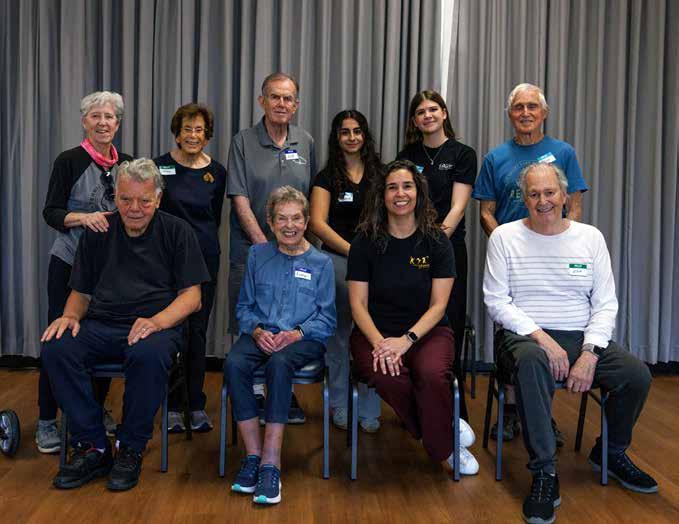

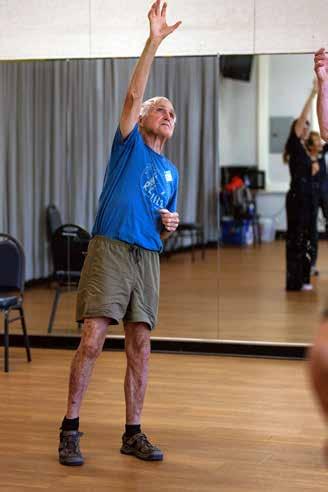
FRONT ROW (LEFT TO RIGHT): TONY RECORDS, EVELYN COURTNEY, KIM HOJ, DON GAIDANO BACK ROW (LEFT TO RIGHT): ROBIN GERBER, CAROL SALTZMAN, JIM KENTOSH, NORDHOFF DANCE STUDENT INTERNS ALYSSE ABASI AND ROSE GOLD CALVIN (NOT PICTURED - MIA COX), BILL BROTHERS
BILL BROTHERS AND JIM KENTOSH
DON GAIDANO
BILL BROTHERS
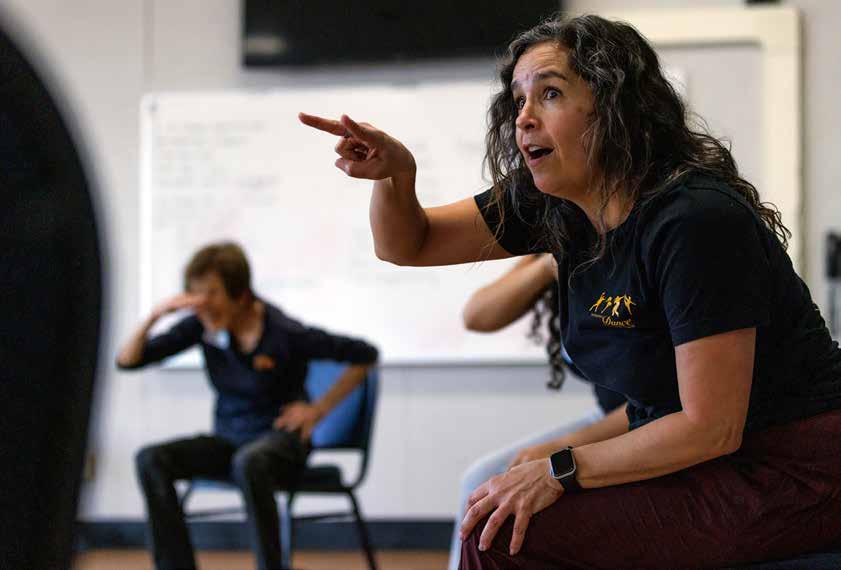
She enrolled in a graduate program in dance movement therapy, determined to merge her lifelong love of dance with her academic grounding in psychology. She immersed herself in the intersection of dance, neuroscience, and mental health. About 15 years ago, she discovered Dance for Parkinson’s, a national program led by Mark Morris Dance Group, through her mentor Pamela Lappen, who runs the Dance for Parkinson’s classes in Las Vegas, Nevada. They are designed for people living with Parkinson’s disease and their caregivers. Kim trained at Berkeley Ballet, learning how movement could restore confidence, connection, and joy.
In January, she led the first class of Ojai’s Dancing with Parkinson’s program, a free offering underwritten by Ojai Unified’s adult education program. “My work in Dance Movement Therapy motivated me to dive into learning more about how to serve the Parkinson’s community and I am so glad that I did.”
Eight dancers and their caregivers — including this writer — gathered at the Matilija campus in a mirrored room with a wood floor worn smooth by years of use. Kim arrived with three senior Nordhoff Dance student interns. They greeted us with easy smiles and guided us into a circle of chairs.
Kim’s intention was simple and expansive: to show that dance is communal, healing, and available to everyone. “I don’t care how old you are,” she told us. “I don’t care what your body looks like. We all benefit when we dance.”
We moved to the music of Otis Redding and Carole King, tracing simple patterns with arms, hands, and legs. Shoes whispered against the floor. Shoulders softened. Smiles appeared. Laughter punctuated the melodies. For a while, tremors eased, selfconsciousness dissolved, and the room filled with rhythm instead of diagnosis.
At the end of class, we stood and held hands, sending a quick squeeze of energy around the circle. Then Kim asked us to turn our palms upward, face the person beside us, and offer a gift — our presence, our attention — by simply saying thank you.
Every face glowed with eagerness as the gesture passed from dancer to dancer, a quiet exchange of trust and gratitude. And in that moment, the circle widened — to include not only the people in the room, but the little girl once told to sit still, whose fierce love of movement had brought us all together.
CAROL SALTZMAN AND KIM HOJ PLAYING WITH THE CONCEPT OF LOOKING AND SEEING
OQ | HEALING ARTS
JACALYN BOOTH
Certified Colon Hydrotherapist
Ojai Digestive Health
With more than 30 years of experience in healing modalities, Jacalyn brings a deep level of caring to the art of colon hydrotherapy. Professional, nurturing, experienced. OjaiDigestiveHealth.com 805-901-3000

DR. NANCY DOREO

LESLIE BOUCHÉ, C.HT.
Cert. Hypnotherapist
Find your calm center. Release negative thinking, emotional reactivity, anxiety, fear and unhelpful behaviors. Improve sleep and comfort. Safe, loving, rapid change. It’s time to feel better! leslie@lesliebouche.com LeslieBouche.com | 805-796-1616

DR. JOHN R. GALASKA
Quintessential Mind-Body Practice. Hypnosis based on Neuroscience, boosted by EEG. Neurofeedback & Biofeedback for anxiety and insecurity. Early childhood issues. Peak performance for Arts & Sports. Strengthen Vegal Tone. Face-to-Face or online.
BeCalmOfOjai.com 805-705-5175

SECURE BEGINNINGS
Pre-birth to 3; pre/post-natal wellbeing; infant/toddler development; parent education/support. SecureBeginnings.org info@securebeginnings.org 805-646-7559
LAURIE EDGCOMB
is a naturopathic doctor and chiropractor specializing in Applied Kinesiology. Modalities include: IV therapy, Homeopathy, Flower Essences, CranialFacial Release, Gentle Manipulation, Acupuncture Meridians, Massage Therapy. DrDoreo.com 805-777-7184 itive heart each session will unlock your inner Vibrant Wellness. VibrantWellnessOjai.com 916.204.9691
Lic. Acupuncturist since 1986, voted best in Ojai! Natural medicine including Microcurrent, nutritional and herbal consultation, Facial



MICHELLE BYRNES
Elemental Nutrition
Nutrition & Wellness counseling focused on anti-aging, detoxification, personalized nutrition, & weight loss. For more information, visit elementalnutritioncoach.com 805-218-8550
LAUREL FELICE, LMT
Offers Swedish, deep tissue, reflexology, reiki, cranialsacral and pre and post natal massage with a reverent and joyous balance of hands and heart. laurelfelice54@gmail.com
805-886-3674
LLOYD MOSS that is right in front of you
• Clarify what truly matters to you
• Break through what’s been holding you back
• Take action with purpose and confidence
JULIE TUMAMAITSTENSLIE
Chumash Elder
Consultant • Storyteller • Spiritual Advisor • Workshops Weddings & Ceremonies
JTumamait@hotmail.com 805-701-6152






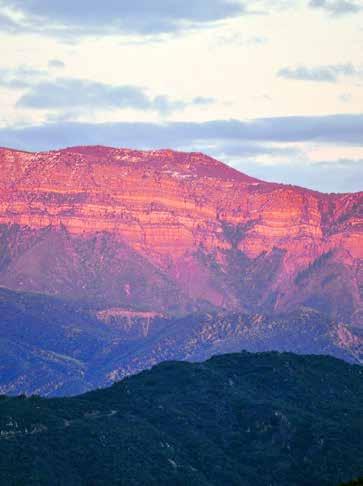
NOW IN PODCAST FORM
With more than 250 hours of conversation, Ojai's podcast, Talk of the Town, has barely scratched the surface of what makes this village, perched on the eastern edge of the Pacific Rim, so rich, diverse and fascinating. Listen in on conversations with legends like Malcolm McDowell and Sergio Aragonés to the people who make Ojai what it is such as Chumash elder Julie Tumamait-Stenslie and assorted newsmakers, writers, filmmakers, fishermen, musicians, rogues & scoundrels.

STORY BY MARK LEWIS
Ojai’s Ilona Saari reflects on her long, strange trip from ‘60s radical and rock’n’roll journalist to today’s mystery novelist.
ILONA, ROCK&ROLL REPORTER, WITH HER JANE FONDA ‘DO
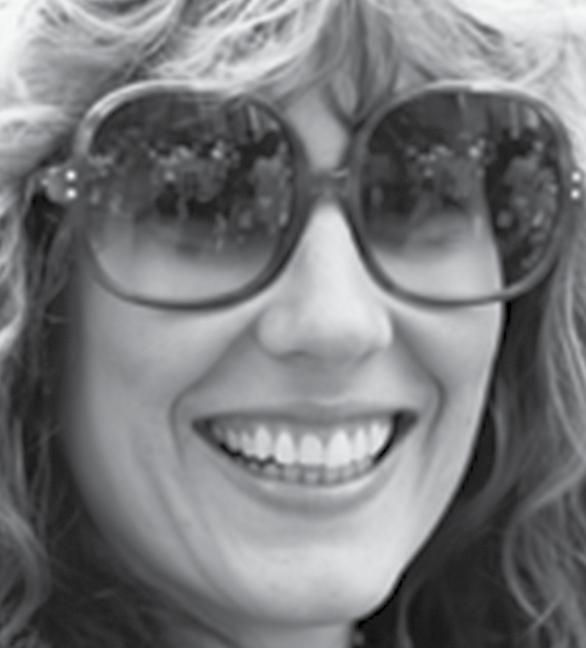
ON SUPER BOWL
Sunday in January 1971, most of the country was glued to the tube watching the Baltimore Colts take on the Dallas Cowboys. Ilona Saari was not watching the game, and she can’t recall whether her husband was watching it. But she remembers how her marriage ended that day.
“He went out for cigarettes,” she says, “and never came back.”

That punctuated the end of an era for Ilona. She was only 26, but her epic 1960s adventures as a radical anti-war protester and a rock’n’roll scene-maker already were over.
Ahead of her was a new start. It would take her to Democratic Party activism, to television writing, and to a happy marriage to her second husband, Richard Camp. It would eventually take her
from New York to L.A. and later to Ojai, where she and Richard now make their home; and to her current career as a writer of mystery novels featuring female protagonists who closely resemble their creator.
They say that if you remember the ‘60s, you weren’t really there. But Ilona was there, and she remembers.
ILONA SAARI
ILONA OVERLOOKING THE EAST RIVER IN NEW YORK CITY, 1970S
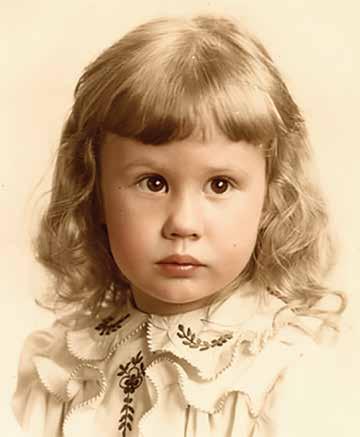
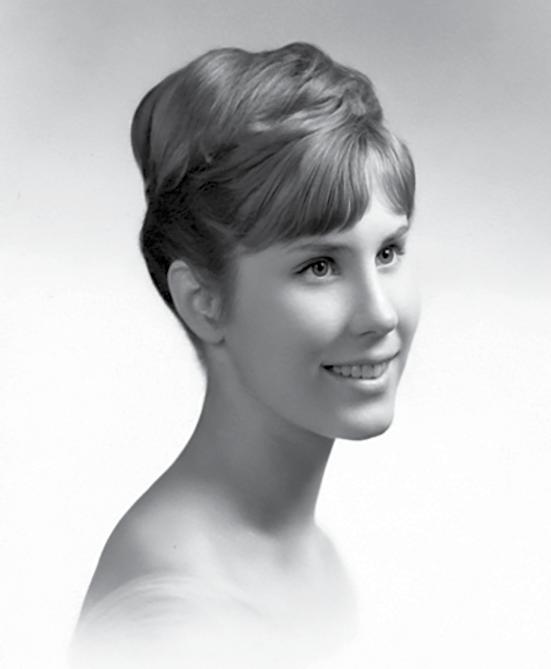
ILONA JOY SAARI
was born in Brooklyn on Aug. 4, 1944. Both her parents were of Finnish descent. When her father, John Saari, got home from the war, he moved his wife, Violet, and their daughter to the Bayside neighborhood in Queens, where Ilona’s brother, Robert, was born in 1949.
Although a part of New York City, Bayside in the ‘50s was much more suburban than urban. And Jones Beach, on the Atlantic shore, was not far away.
“Bayside was a wonderful place to grow up,” Ilona says.
Hers was a fairly typical 1950s childhood, Bayside style: going to the beach, listening to Buddy Holly records, attending Brooklyn Dodgers home games with her father, reading “Nancy Drew Mystery Stories.”
“When I really fell in love with writing was with Nancy Drew,” she says.
John Saari was crushed in 1958 when the Dodgers moved to L.A. He died that same year at 41, felled by a blood clot that stopped his heart. Thirteen-year-old Ilona was devastated.
“I’m 81, and it’s still the defining moment of my entire life,” she says.
Instead of withdrawing into her grief, she distracted herself by becoming a compulsive overachiever. At Bayside High School, she was an honor student and a cheerleader who dated the captain of the basketball team.
She also studied art and dance, becoming so proficient at the latter that at 15, she played hooky from school to audition for the Rockettes. And she was hired! Alas, the gig only lasted a week before her mother got wind of it, and stormed into Radio City Music Hall to reveal that Ilona was underage.
As for art, at 17 Ilona was good enough to be hired to restore a mural on the ceiling of a Brooklyn cathedral. (“My Michelangelo period.”)
“I wanted to be important,” she says. “I wanted to be seen. I was kind of acting my life instead of living it.”
ILONA IN YOUNGER DAYS
ILONA IN HER COLLEGE YEARBOOK, 1964
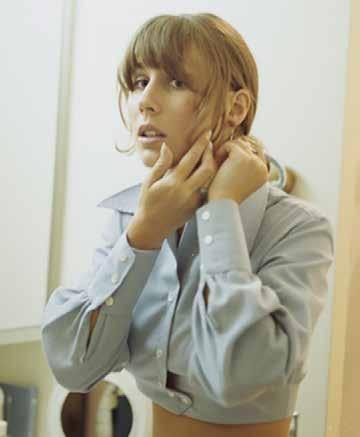
“It was the beginning of a youth revolution. I wanted to make my mark in the real world, not in academia. So, I dropped out to join the revolution.”
“I NEED TO BE IN MANHATTAN,”
Ilona told herself. She lined up a job as a paralegal at a New York law firm. She also began pitching stories to news outlets as a freelance writer, and she dove headfirst into Manhattan’s exuberant Swingin’ Sixties nightlife.
She was a regular at the Factory, Andy Warhol’s art studio and social hub, where she hung out with Warhol’s tragically doomed “superstar” Edie Sedgwick, the queen of that scene.
After graduating from Bayside High in 1962, Ilona went on to Chamberlayne Junior College in Boston. Her major was English Literature, but she also signed up for electives in journalism, typing and stenography.
“I knew I was going to be a reporter, in my mind,” she says.
President Kennedy’s assassination in November 1963 hit her hard. The ‘50s era died and the ‘60s were born sometime between that day and the following February, when the Beatles popped up on “The Ed Sullivan Show. “ Suddenly, rock music was culturally ascendant. So were the psychedelic drugs popularized by Timothy Leary.
“I had heard Leary speak a few times while I was at Chamberlayne,” Ilona says. “His ‘turn on, tune in, drop out’ mantra helped to radicalize me. I was part of the movement of college kids who were disenchanted with government and were grieving the death of JFK.”
After graduating from Chamberlayne in June 1964, she enrolled at Boston University. But she didn’t stay long.
Ilona also gained entry to another high-profile Manhattan nightspot: The Playboy Club, where she hired on as a Bunny to research a freelance article. Her idea was to rebut Gloria Steinem’s famous exposé of the place, which Ilona considered condescending to the female employees. But she didn’t last long as a Bunny.
“On my second night, some guy grabbed me,” she says. “I got pissed off, I threw coffee in his face, and I walked out.”
An early convert to second-wave feminism, Ilona did not tolerate men who got handsy without an invitation. One of her bosses found that out the hard way when he made the mistake of groping her.
“I grabbed his balls and said, ‘How do you like it?’”
“Don’t make waves, Ilona,” her mother told her. The advice fell on deaf ears.
“I was not wild,” Ilona says. “I just basically did what I wanted.”
BY 1968,
the counterculture was in full bloom, and so was Ilona Saari.
ILONA GETTING READY TO PROTEST AT THE 1968 DEMOCRATIC CONVENTION IN CHICAGO
A major catalyst was the Vietnam War. When Abbie Hoffman and Jerry Rubin formed the Youth International Party early that year to protest the war, Ilona signed up.
“I was one of the first Yippies,” she says. “We did protests in Central Park.”
Yippie protests tended toward the theatrical and satirical. But they were serious in their opposition to the war.
“It gave me the kind of political purpose I was looking for,” Ilona says.
Her day job at Epic Records included writing publicity pieces. She also freelanced for various newspapers, writing profiles of rock stars. These musicians were taken very seriously by the new underground press, and by a new magazine called Rolling Stone. A few years earlier, churning out press releases for Epic would have amounted to mere flackery. By 1968, however, rock stars had eclipsed film stars atop the cultural pecking order, and Ilona’s job gave her a perch near the red-hot center of the action.
She began seeing the rising rock’n’roll talent agent Bert Kamerman. His firm was transferring him to Chicago, and he asked her to go with him.
“And I said, ‘I’m not going unless we’re married.’ So we went to City Hall and got married.”
Ilona later concluded that the televised chaos at the convention had turned off many voters and hurt the protesters’ cause. Disillusioned, she drifted away from the Yippies, even as the most radicalized anti-war protesters began embracing violence as a means of achieving peace.
“A couple of people I knew started making bombs, but that was not for me,” she says.
“But I was still writing about rock’n’roll!”
Bert’s job required his presence whenever one of his clients played a Chicago venue. So, when the newly formed supergroup Blind Faith came to town in July 1969 with Eric Clapton and Stevie Winwood, Ilona was there to greet her pal Ginger Baker, the drummer.
“I had already met Eric and Ginger when they were Cream.” she says. Before the concert, Baker approached her with a request: “I need you to tape up my hands.”
And they moved to Chicago just in time for the ’68 Democratic Convention.
That August, some of Ilona’s New York Yippie friends were among the anti-war activists who came to town to protest the war. The entire nation watched on television as Chicago police waded into the anti-war crowd, swinging their billy clubs left and right. Ilona joined her friends in Lincoln Park and was arrested twice, but not physically harmed.
“I got paddy-wagoned twice to nearby police stations, but was never booked,” she says.
“At the time he was doing a lot of drugs, and his hands were shaking,” she explains.
She taped his fingers together so he could hold his drumsticks without dropping them. During the concert he dropped one of them anyway while flailing away at his drum kit. It flew through the air to where Ilona was standing in the wings. Seeing that Clapton already had supplied Baker with a new stick, she kept hers as a souvenir.
“I had that drumstick for years,” she says.
ILONA AT THE 1980 DEMOCRATIC CONVENTION
Three weeks later, Crosby, Stills, Nash & Young came to town to play their first live set ever. The opening act was Joni Mitchell, whom Ilona got to know that day when she was called upon to loan Mitchell a hair dryer.
“Joni and I spent the afternoon laughing and giggling and talking,” she says.
Ilona and Bert moved back to New York that fall, and throughout 1970 she had a ringside seat at the rock’n’roll circus as it passed through Gotham. When the Who performed their rock opera “Tommy” at the Metropolitan Opera House, Ilona and Bert had a VIP box next to one occupied by Warren Beatty and Julie Christie. (They also hobnobbed with Roger Daltrey and Pete Townsend at the after-party.)
But, as with the Yippies, Ilona also was becoming disillusioned with the rock scene. She finally reached a breaking point in November 1970 while attending a Johnny and Edgar Winter concert. Backstage in the green room before the show, she looked around with dismay.
“Every single person there was a heroin addict,” she says. “This was not what I signed up for.”
Things were not going so well with her marriage either. Then came Super Bowl Sunday.
“As a writer, it pissed me off that he left me in such a cliché way, by saying he was going out for a pack of cigarettes,” she says with a smile. “I mean really, couldn’t he have at least said he was leaving to place a bet with a bookie on the game or something?”
Good riddance to Bert. But what now? Radical politics and writing about rock music were in her rearview mirror, professionally speaking. Ahead lay an open road. It would lead her to Hollywood.
To pay the rent, Ilona worked as an oil painter for hire, commissioned to copy the likes of Matisse, Van Gogh, and Picasso. She also served as an utterly unqualified film editor for Shaw Brothers Studios of Hong Kong, re-cutting their kung fu movies for the American market even though she spoke not a word of Chinese. Finally, in 1972, she landed a stable job as an agent in training at Marvin Josephson’s International Famous Agency (IFA).
“And that changed my whole life.”
JOINING IFA MARKED ILONA’S
break with the music business. IFA was mostly concerned with television and films. The agency’s Hollywood expertise literally saved Ilona’s life in July 1975 when a fire broke out in the agency’s offices.
A recent merger had changed the firm’s name to International Creative Management (ICM), with offices occupying the 18th floor of the 33-story Squibb Building in Midtown Manhattan. When the fire broke out, the rest of the building was safely evacuated, but Ilona was among 50 ICM employees trapped in their offices.
“Our whole floor was on fire,” she says.
They holed up in Josephson’s office, shut the doors, and stuffed soaked clothing into the vents to keep out the smoke. But it started coming in anyway. Then the famed super-agent Sam Cohn spoke up. He had packaged the 1974 movie “The Towering Inferno,” so he knew how to save them from the smoke.
“Sam said, “We have to break the windows,’” Ilona said.
This was not easy, but they got it done.
“They bashed out the huge glass windows — an effort that firemen said had saved their lives,” the New York Times reported the next day.
After being rescued, the shaken ICM employees repaired to the nearby Russian Tea Room to celebrate their escape.
“We were there for hours,” Ilona says.
Ilona’s roommate at the time was an agent for TV writers, who encouraged her to write for television. That ambition bore fruit after she moved on from ICM to David Susskind’s TV production company, which then was acquired by Time-Life Films. From a window high up in the Time-Life Building on Sixth Avenue, Ilona could look down on Radio City Music Hall, scene of her abortive career as a Rockette two decades earlier.
The Time-Life Building was also the place where Ilona first encountered Richard Camp, in 1978. They “met cute,” in Hollywood parlance, when Ilona was assigned to vet a report Richard had put together for a TV show called “People.” It was a poignant piece about Greta Garbo, then an elderly recluse in midtown Manhattan.


“It made me cry,” Ilona says.
Impressed, she visited the “People” offices, asking to meet “the woman who wrote the Garbo piece.” Now committed to a TV career, she was looking for a writing partner. As it happens, she posed that question to the “People” head writer, Richard, who explained that he was, ahem, the woman in question. One thing led to another and they became writing partners and then life partners, marrying in 1983.
Meanwhile, Ilona was pursuing a parallel career track in politics. In 1976, she volunteered to serve as a press liaison for the Democratic National Committee during the party’s national convention in Madison Square Garden, which nominated Jimmy Carter for president. Only eight years earlier, Ilona and her fellow Yippies had laid siege to the convention in Chicago. Now she was inside the tent, working for change from within the system.
She volunteered again for the 1980 convention, also held in the Garden, and went on to serve Carter’s re-election campaign as a deputy press secretary for New York State.
“It was a heady time — and my favorite job ever,” she says.
Ilona and Richard moved to L.A. in 1985 to write for TV. She joined the Hollywood Women’s Political Committee, and wrote speeches for the Clinton/Gore campaigns of 1992 and 1996.
She and Richard have no children, but when Ilona tutored underprivileged children at an L.A. elementary school, the couple became particularly close to one girl whom they now consider their unofficial surrogate daughter.
One day in 2007, Ilona picked up an unproduced feature-film script she and Richard had written years earlier. Called “Freeze Frame,” it featured a female videographer in New York who finds herself investigating a senator’s murder. Perhaps guided by her
memories of Nancy Drew, she turned the script into a mystery novel, and a new career was born.
Ilona continued writing mystery novels after she and Richard moved to Ojai in 2013, joining TV colleagues who already had made the move from L.A. Her second novel was “White Gloves & Rob Roys” (2017); her third was “The Wrong Station” (2024). They all feature plucky female protagonists in New York City who put themselves in danger while solving murders.
Currently she’s working on her fourth novel, “Seventh Avenue.” Set in the ‘60s, it’s about showroom models menaced by men who will remind you of the late Jeffrey Epstein. It may not surprise you to learn that Ilona herself was a showroom model on Seventh Avenue in the ‘60s.
She also writes about politics for her Substack page, features for Ojai Monthly, and food-and-drink columns for Ojai Quarterly.
Her husband and some of her friends think she should write a memoir of her ‘60s adventures. And perhaps one day she will. But for now, she is recycling her memories into her mystery novels.
“As I look back on my life from my little corner of the world in Ojai and write my books, I realize I’m still a believer in ‘write what you know,’” she says. “Many of my personal memories have become part of the DNA of my New York City heroines. It’s just me adding in stories about me that I had dined out on most of my adult life because people thought they were interesting, and they became my fun, adventuresome fictional version of a memoir.”
Some of these memories actually precede the ‘60s and go back to her childhood in Queens. After moving to Ojai, Ilona found that she was sharing this small California town with at least four other Bayside High alums from her early ‘60s era. In her life, as in her fiction, Ilona Saari has come full circle.
ILONA AND RICHARD ON THEIR WEDDING DAY IN 1983
ILONA’S BOOKS (ILONAJOYSAARI.COM)

Where Ojai Gets Growing

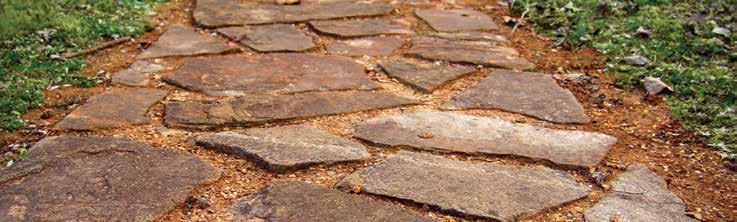
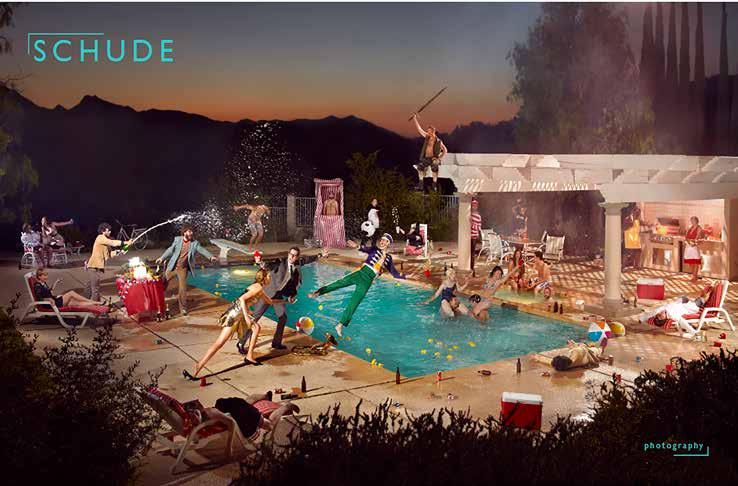

MARC ALT Photographer @marcaltphoto Ojai, CA | marcalt.com



THURSDAY FROM 3-7PM Chaparral Courtyard, 414 E. Ojai Ave., Ojai, CA 93023 Next door to the skatepark ojaicommunityfarmersmarket.com ojaicommunityfm mercadoocfm


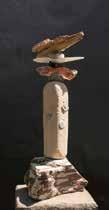









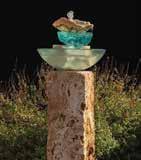




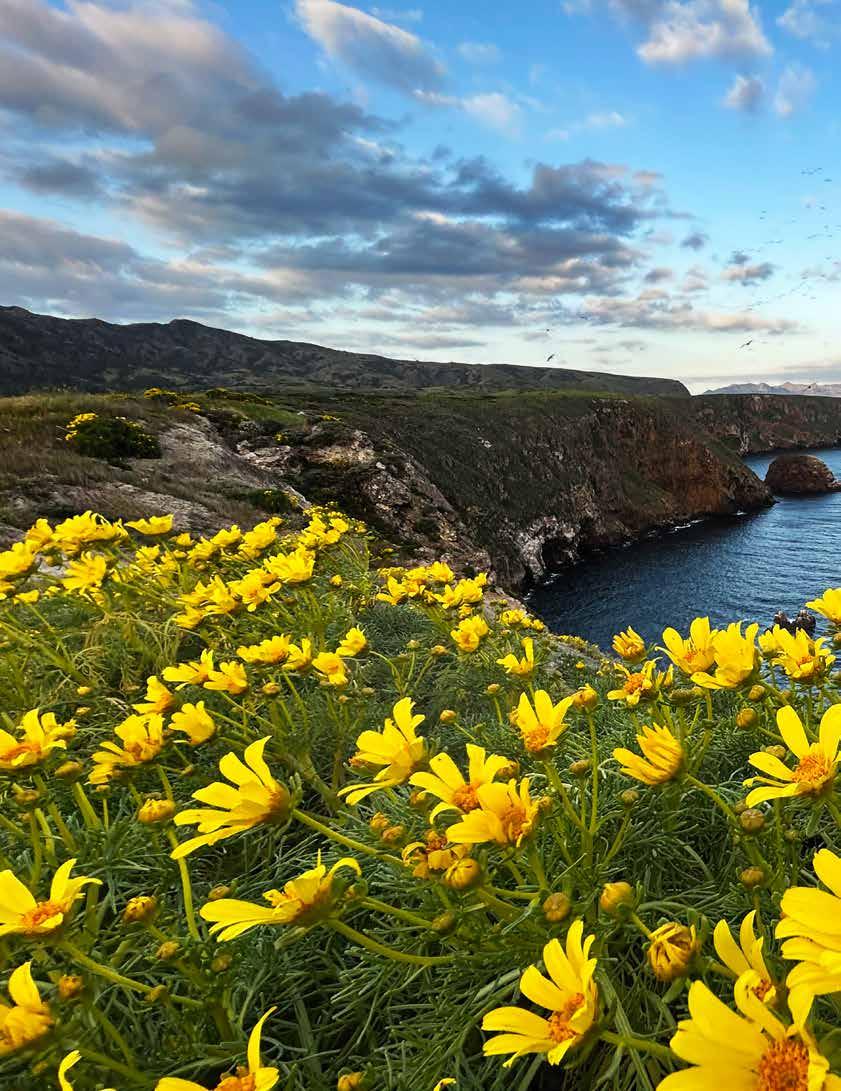
So Close, Yet So Far
STORY & PHOTOS BY CHUCK GRAHAM
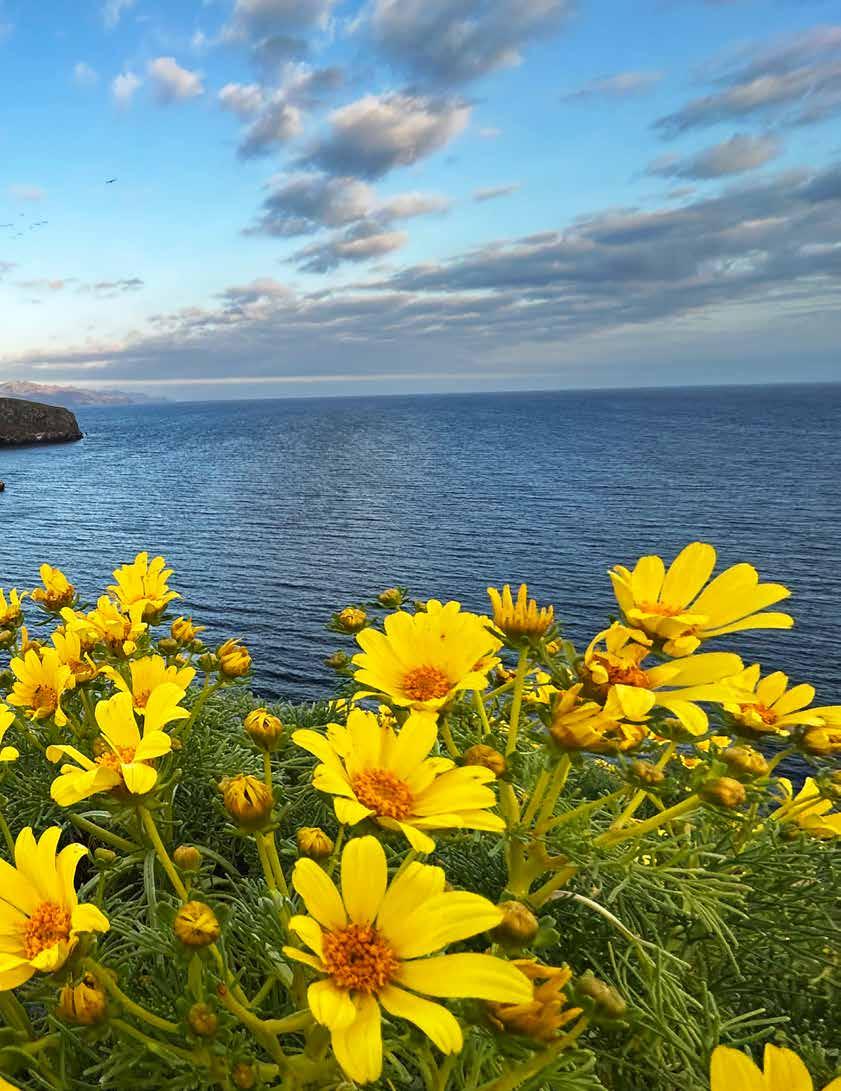
Bald eagles are also directly responsible for
safeguarding the largest land predator on the islands, the tiny and inquisitive island fox, the
smallest fox species in North America.
Island foxes are endemic to the Channel Islands, but with no bald eagles around, non-native golden eagles moved in, lured over from the mainland by 5,000 feral pigs running amok across mountainous Santa Cruz Island. Golden eagles quickly realized that island foxes were much easier to catch than a piglet. I can recall the days when I saw no island foxes at all, just pigs. By the late 1990s island foxes were staring at possible extinction.
Just as those bald eagles were making their return, the rest of this four-pronged effort involved eradicating feral pigs and capturing and releasing 43 golden eagles back to the northeastern region of California. And of course, small populations of island foxes on Santa Cruz, Santa Rosa, and San Miguel Islands were captive bred, for each population is genetically distinct from the other. If a population was lost, it would be gone forever. Like bald eagles, islands foxes are monogamous and mate for life.
While captive breeding took place, biologists had to be careful mixing and matching pairs to avoid inbreeding, and they did a magnificent job. Today, there are over 3,000 foxes on Santa Cruz, over 2,500 on Santa Rosa, and over 300 on San Miguel Island. It’s safe to say, island fox business is booming. Bald eagles don’t prey on foxes, instead favoring fish, seabirds and scavenging marine mammal carcasses.
PADDLING INTO A NATURAL BALANCE
From my kayak, and with many circumnavigations of the islands under my belt, one of my goals has always been to document the recovery of the islands from a ranching era to an era of natural balance. It has been more fulfilling being self-propelled and selfcontained while paddling a kayak across the Santa Barbara Channel, and from island to island.
From my kayak, I’ve seen bald eagles spread their wings and reestablish old territories throughout the Northern Chain. It’s been fulfilling documenting families of bald eagles solidifying their lineages on the islands. Bald eagles are monogamous raptors, mating for life. There’s even documentation of mating pairs of bald eagles displaying a breeding ritual in flight. The male and female come together in the air, locking talons, and then cartwheeling midair, unlocking before hitting the ground.
I’ve kayaked to each island that has populations of island foxes and

BOTTOM: ISLAND FOX PUPS ARE ALWAYS CURIOUS
RIGHT PAGE FROM TOP: PIGEON GUILLEMOT WITH FISH, SCORPION ROCK OFF SANTA CRUZ ISLAND IS AN IMPORTANT SEABIRD SITE, PEREGRINE FALCON REST WITH A FRESH KILL
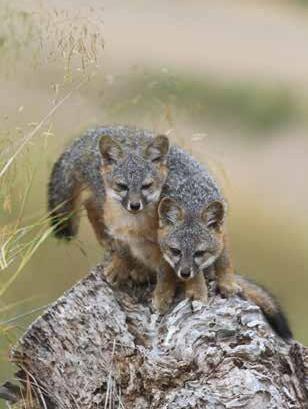
TOP: KAYAK SUNRISE AT CUYLER HARBOR, SAN MIGUEL ISLAND
their captive breeding facilities. As depressing as it was seeing foxes in their captive pens, the biologists did a magnificent job replenishing all the populations. More importantly, following successful captive breeding, I documented the releases of island foxes back into the wild. It’s been amazing paddling up to deserted, cobbled beaches throughout the chain where freshwater streams spill onto the shoreline and seeing cheeky island foxes exploring their island biome without worry.
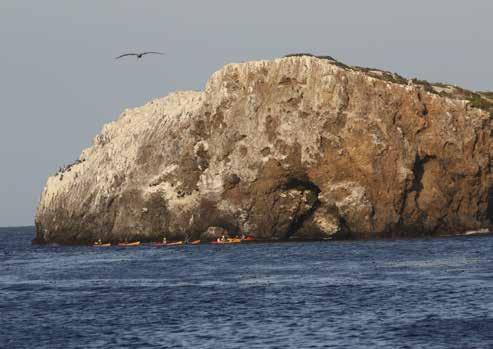
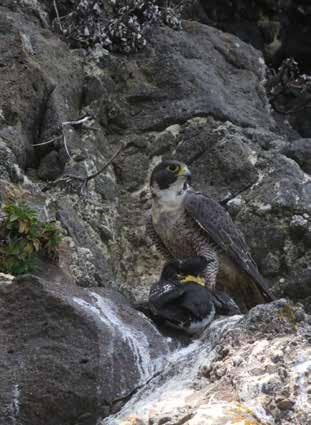
I photographed my first island fox in 1996. It was in a dry creek bed at Smugglers Cove on the southeast end of Santa Cruz Island. Certainly then, I didn’t know they were in trouble. That realization came in August 1997. After paddling to San Miguel Island, I ran up Nidever Canyon to the campground with camping gear. It’s where I met Tim Coonan, the lead biologist for terrestrial mammals on Channel Islands National Park, and Kate Faulkner, chief of natural resources for the park for 25 years, from 1990 to 2015. They were handling a recently trapped island fox. Coonan was fitting it with a radio collar, because they still weren’t sure what was killing all the foxes. Two weeks later they knew. They found the lifeless fox with a golden eagle feather resting beside it.
In 2004, the island fox was added to the Endangered Species List. Fortunately, captive breeding took off, and populations on each island in the Northern Chain soared. By August 2016 the island fox was delisted. It was the swiftest recovery of a terrestrial mammal in the history of the Endangered Species Act. From decline to recovery, I documented the island fox from the species’ lowest ebb to seeing them proliferate throughout all island habitats.
Some of the most enjoyable and rewarding experiences have been when island fox pairs are rearing their pups. Breeding pairs average two pups per litter, but following the El Nino winter of 2023/24, we were seeing three to four pups per litter. It was an exciting time watching pups jostle and chase each other through dense island flora. Whenever their parents showed up to nurse or provide other food sources, it was the affectionate greetings between parents and offspring that stood out. In the late 1990s, there may have been as few as 50 island foxes remaining on Santa Cruz Island. It was as low as 15 foxes each on Santa Rosa and San Miguel Islands. Today, those are distant memories drifting away like persistant fog over the Northern Chain.
HEALING ON ITS OWN
In many ways the island ecosystem needed all the help it could get
from biologists, nonprofits, and the national park, but in other ways once the eradication of non-native animals was removed, many species of flora and fauna healed and returned on their own.
In 2011 common murres, a far-flung seabird species returned all on their own after being absent from San Miguel Island for 100 years.
They specifically bred and nested on Prince Island, a massive crag a quarter mile northeast of Cuyler Harbor on San Miguel Island. Since then, they’ve expanded their nesting grounds, establishing Harris Point on the northwest tip of San Miguel Island with hundreds of nests.
In May 2020, I paddled from Prisoners Harbor on Santa Cruz Island to Prince Island, in the hopes of photographing common murres reestablishing their nesting grounds on those wave-battered cliffs. It took me three days to paddle there. To get an opportunity to photograph them I had to time the surf smashing into the towering pinnacles on the northwest fringe of Prince Island. It was harrowing, to say the least. In between sets of waves, I furiously paddled into the pinnacles and photographed the murres, but it was an uneasy feeling when the water sucked back out, away from the cliffs, a sure sign that swell was approaching. I’d quickly paddle away from Prince Island and then wait for it to calm down again. Still, I love the challenge and the effort of it, reading sea conditions, to be able to get these kinds of shots from my kayak.
ALWAYS WITH MY CAMERA
Along the North Bluff Trail on the southeast end of Santa Cruz Island, I trotted along with a lone island fox at sunset. As the years have mounted, following along with island foxes has become part of my time spent on the islands.
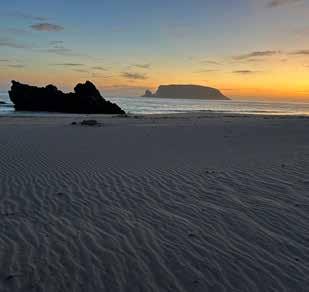
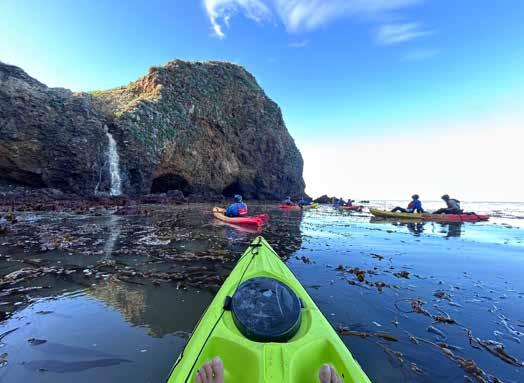
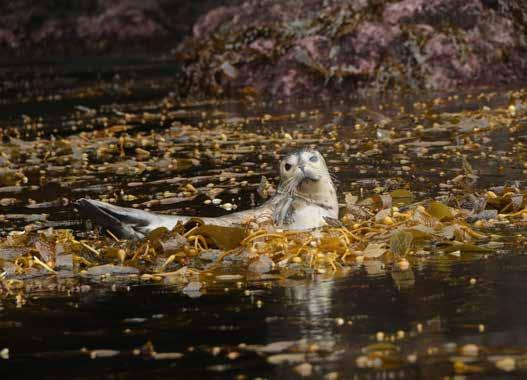
As we loped along, we hit a sharp bend on the trail heading east. West Anacapa Island stood sturdy on the other side of the Anacapa Passage.
Then the muddy track turned northeast, where I stopped pacing with the four-legged cinnamon blur in front of me. Scenic Cavern Point, the shimmering Santa Barbara Channel, and the burly cliffs of the Topatopa Mountains were too stunning to just simply run by. It was
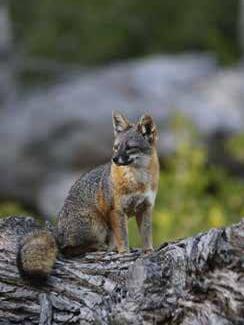
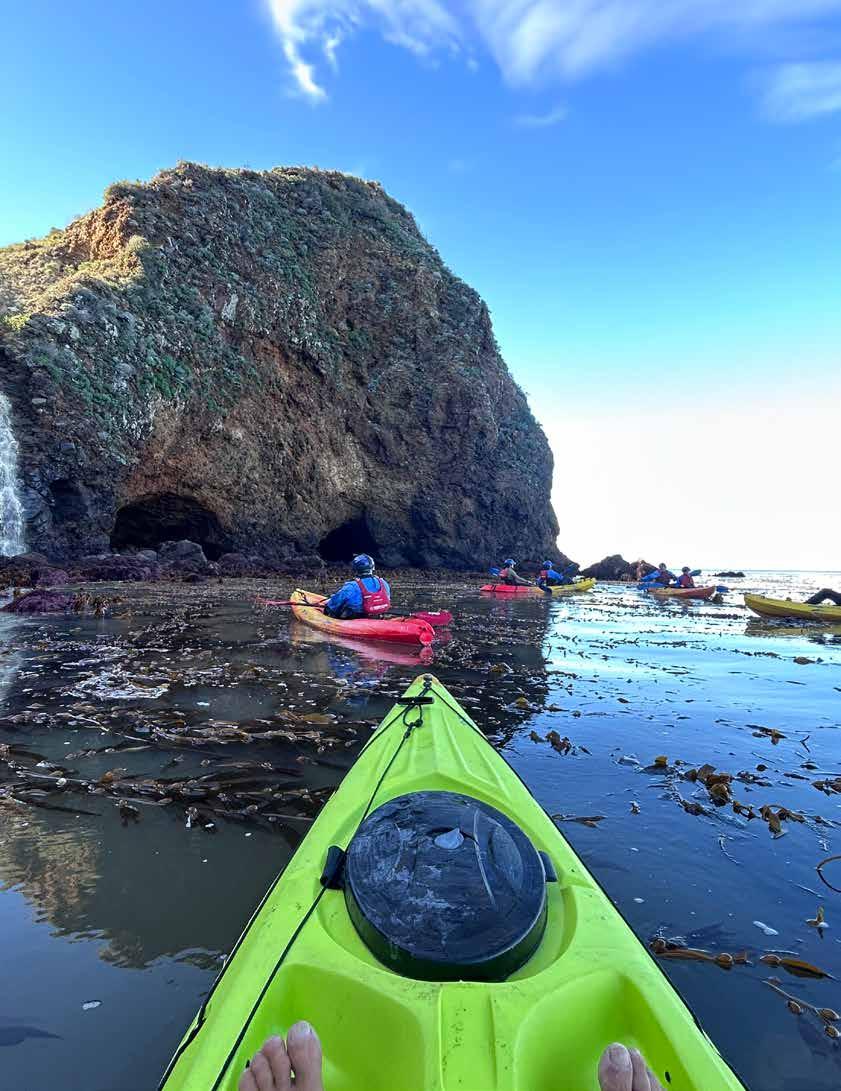
TOP: THE COMBINATION OF FRESH WATER WATERFALL AND THE OCEAN IS SOOTHING TO THE SENSES
OPPOSITE PAGE TOP: CUYLER HABOR SUNRISE WITH PRINCE ISLAND AS THE BACKDROP
MIDDLE: A SPOTTED HARBOR SEAL PUP RAFTING ON A THICK BED OF GIANT BLADDER KELP
BOTTOM: ROUGHLY 3,000 TO 4,000 ISLAND FOXES INHABIT SANTA CRUZ ISLAND
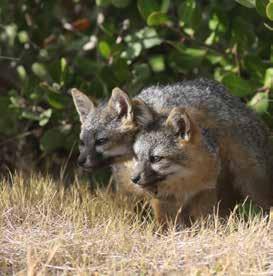
BOTTOM: SUNSET HIKER AT CAVERN POINT ON SANTA CRUZ ISLAND WITH SNOW-COVERED TOPA TOPA MOUNTAINS IN THE BACKGROUND
time to slow down and soak in the moment.
The natural blend of islandscape, seascapes, and mountain topography can be seen on most days throughout the year, but this was different and fleeting. The air was crisp and cool, and the Topa Topas were cloaked in snow, their striated cliffs swept in winter’s glow. I positioned myself on an ancient marine terrace shrouded in lemonade berry, island buckwheat, and island hazardia, and waited.
Perspective was everything when a solitary hiker emerged on top of Cavern Point just as the sun dipped behind Diablo Peak. As a kayaker, the mainland and the coastal range still felt far, but the human element, the hiker pulled the islands and the Topa Topas closer.
And so, here’s to one of the most unique ecosystems in the world, its isolation making it feel far away despite being just 60 miles west of one of the largest metropolises on the planet.
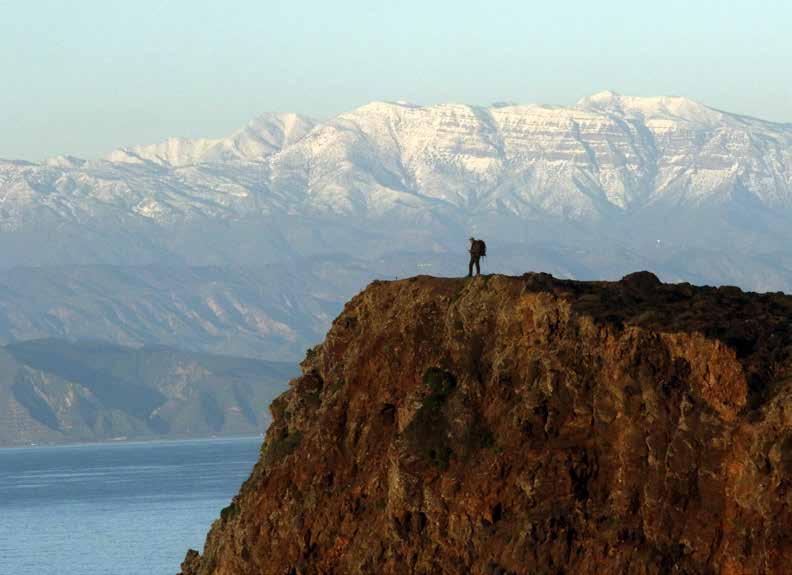
ISLAND FOX PUPS SNUGGLING AND BONDING ON SANTA CRUZ ISLAND
DR. DREW EGGEBRATEN, DDS
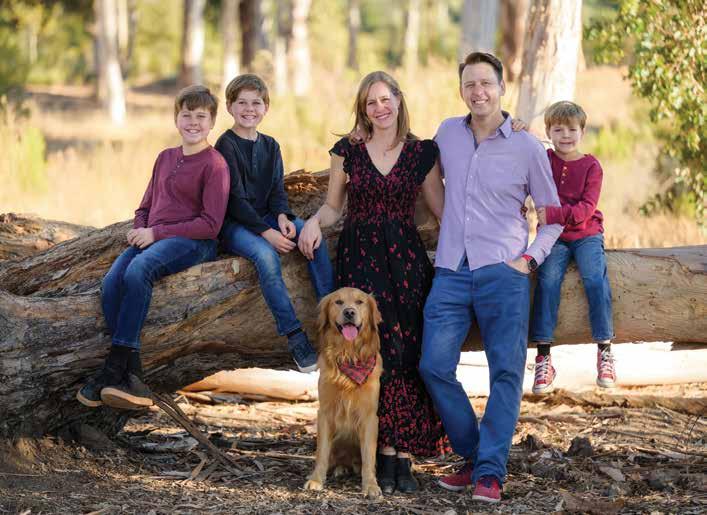
GENERAL & FAMILY DENTISTRY
“We specialize in biomimetic principles. Biomimetic dentistry is the reconstruction of teeth to emulate their esthetic and natural form and function. It is the most conservative approach to treating fractured and decayed teeth — it keeps them strong and seals them from bacterial invasion. By conserving as much tooth structure as possible, we can eliminate the need for many crowns and root canals.”
Dr. Andrew Eggebraten, USC Graduate and his family



OQ | EVENTS CALENDAR
march - april - may


MARCH 29
“Tomatomania!”
Time: 9 a.m. to 5 p.m.
Dates: Monday through Saturday
Location: Wachter’s Hay & Grain, 114 South Montgomery Street
Contact: tomatomania.com
Get expert advice, find rare heirlooms, classic hybrids and all you need for a successful season. Find more than 100 varieties. Tomato restock will happen in May.
Ojai Pixie Month
Locations: Restaurants and shops around town.
Contact: Ojai Chamber of Commerce 805-646-8126
OjaiChamber.org
Look for the pixie stickers on windows of restaurants and shops around town for a selection of Ojai’s very delicious and versatile tangerine. From food to beverages to products, the town celebrates its homegrown fruit.
MAY 16-17
Ojai Community Chorus
Time: 3 p.m. Saturday & Sunday
Location: Ojai Methodist Church 120 Church Road
Contact: 805-640-0468
The Ojai Community Chorus, directed by Connie Woodson, presents its spring concert on Saturday, May 16 at 3 p.m. and Sunday, May 17 at 3 p.m. at the Ojai United Methodist Church, 120 Church
Road. The program is “Still Rockin’!,” featuring music from the 1970s.
MAY 9
Ojai World Dance Festival
Location: Libbey Park and Bowl Times: Day Program 10 a.m. to 5 p.m., Free Evening Production: 7:30-9 p.m., Ticketed
The Ojai World Dance Festival, hosted by Dance Ojai, is a vibrant showcase of multicultural dance, world music, and community connection. Audiences will be taken on a mesmerizing journey through movement and rhythm. Info and tickets at: www.danceojai.org/ojaidancefestival
APRIL 24-28 2026
The 123rd “The Ojai” Ojai Valley Tennis Tournament Times: Varied
Location: Libbey Park & Elsewhere Contact: 805-646-7421 theojai.net
The country’s oldest amateur tournament, dating back to 1896, returns with Division 1 matchups for men and women, championships for California high schools, prizes for professionals and special events. This Ojai tradition involves 600 volunteers, 1,250 players and 112 tennis courts in and around Ojai.
MAY 23-24
Ojai Art Center’s 49th Annual “Art in the Park” Times: 10 a.m. to 5 p.m.
Location: Libbey Park Contact: OjaiArtCenter.org
805-646-0117
Founded in 1977 to give artists a place to sell their work during Memorial Day Weekend.
RECURRING EVENTS
DEC-JANUARY-FEBRUARY
Historical Walking Tours of Ojai Date: Every Saturday Time: 10:30 a.m. to 11:30 a.m.
Location: Ojai Valley Museum 130 West Ojai Avenue Contact: 640-1390
DEC 14, JAN 11, FEB 8
Coffee & Cars
Dates: Second Sundays of the month Times: 8 to 10 a.m.
Location: Westridge Market parking lot Come check out classic and luxury cars from the area’s proudest collectors. Have a chance to learn from the owners about the history and importance of some of the world’s most incredible automobiles.
THURSDAYS
Ojai: Talk of the Town Podcast New episodes come out Thursday mornings through the OjaiHub.com newsletter. Guests have included Malcolm McDowell on the 50th anniversary of “A Clockwork Orange,” and Sergio Aragonés on his 60 years as a cartoonist at Mad Magazine. More than 280 episodes and counting. Sign up at OjaiHub.com for a free newsletter of Ojai events, news, arts and podcasts.
OQ | NOCTURNAL SUBMISSIONS

BY SAMI ZAHRINGER
A Housewife’s Log
OJAI’S


SECRET SOCIETIES (A MODEST PROPOSAL)
Metaphors,
misdemeanors, and the men who guard a well nobody can find.
1992, a crack commando unit was sent to prison by a military court for a crime they didn’t commit. These men promptly escaped from a maximum security prison to the Ojai underground.
Today, still wanted by the government, they survive as soldiers of fortune. If you have a problem, if no one else can help and, if you can find them, maybe you can hire The OK-Team.
Fast forward to the Ojai of 2026 — a town riven by factionalism: men-of-the-cloth brawling for the last free self-checkout station at Von’s; political candidates bribing the Girl Scouts to steal each other’s lawn-signs under the cover of darkness and good turns. Every sort of nefarious skullduggery that members of a small town can think of, and members of small towns are the very best at nefarious skullduggery.
The main fomenters of these schisms are the town’s various Secret Societies: cabals of powerful people intent on manipulating the town to their own ends. One of these percipient citizens is Mrs. Mary Brown, a quiet sort of nondescript woman; the kind of person people halfway assume is put away in a cupboard to stand quietly when not in use. But there’s a glint in her eye, a certain light that winks at folly but focuses like an Archimedes death ray on wickedness. Mary Brown is the sort of steady, good woman upon which this nation was founded. Her only real weakness is a near hysterical crush on Donald Glover.
Mrs. Brown has decided to infiltrate the shadowy, sinister group
known as The Guardians of The Hidden Well. At Westridge noticeboard one day, she noticed an advert for the OK-Team with what appeared to be a still-smoking bullet hole through it. She rang the number. Clandestine meetings with high collars and false noses were had on the pond bench in the meadow. Money changed hands.
The goal: foment division and disquiet within the Guardians of The Hidden Well.
They chose Adam McMann as their infiltrator due to his background in espionage, his degree in Particle Physics and his Masters in Baiting from Morehead State University. But what really set Adam apart was his genial demeanor, which made people think they could get one over on him. (He also had rippling abs and a broad manly chest but that’s just the author’s irrelevant observation. *Cough*) His open, freckled face gave him the air of an innocent iceberg floating into a major shipping lane. In short, people underestimated him. In long, they were wrong.
He took to hanging around the Neff Lounge and golf course: places
where he might cultivate the necessary contacts. Before long he had an introduction to the Guardians.
And so it was, Adam McMann found himself at the oaken door of a vast East End estate, which was answered by a tall, gaunt elderly man with a face that looked like a bit of ceiling from above the reactor in Chernobyl.
‘Enter” he said in tones so sepulchral that way up high in the eaves bats recoiled and hugged their batlets tight.

“Ah welcome, welcome!” came a second voice. Down the magnificent teak staircase advanced, at surprising speed for his size, a rosy-nosed thirty-something man of great volume wearing an open kimono, flipflops, and short shorts wholly inadequate for containment of their contents which were bouncing out breezily for all to see. Adam had seen some horrors in the field, but this was diabolical. Did this man have some sort of condition?
The man with perhaps some sort of condition and a face like a scone that’s been badly savaged by a mustache, introduced himself as Chet Twatt-Whillicker, Secretary Emeritus of the Guardians of The Hidden Well. Adam already knew he was heir to the Yodeling Pickle millions. The current meeting was taking place on his vast East End estate, “Dunthinkin.”
Twatt-Whillicker had dabbled with his millions in vodka, universities, megachurches, horticulture, viticulture, sericulture, pisciculture, and soft porn but nothing had ever stuck. He is, no matter how you look at it, staggeringly stupid, however he has the redeeming quality of being tremendously wealthy and in possession of a fantastically 1980s Revival Gothic mansion with hidden rooms and everything, so the Guild keep him around with a useless title and a made-up ceremonial pin for his cape.
“Come with me to the Dressing Room!,” he said magisterially with a mock bow. “We won’t be initiating you today. This is more like a try-
before-you-buy type deal but it goes without saying that we have a gentleman’s agreement you will never speak of what you hear or see tonight.”
“Hey bro, gentleman’s honor!” said Adam as he was led into a windowless bubinga-clad room. In a trice
Twatt-Whillicker had transformed himself into an eerie-esque robe-clad figure with a Margaret-Thatcher-blue pointy silk hat.
Adam donned the vestments provided and followed Brother T-W through a low door and into a stone-clad cavern lit with candles and containing three or four huddled groups of Brothers, all in robes and pointy hats, and all of whom now turned to stare at Adam. At the far end of the cavern stood an immense wooden figure of a turkey vulture with wings outspread. Its black feathers and shiny raw, red head flickering in the candlelight made it appear like a whisky-soused Free Presbyterian minister of the Old World, summoning hellfire and brimstone on all who displeased its God. In its beak it carried an unfurled scroll upon which were engraved the words “Weaving Spiders Come Not Here.”Adam recognized the line from Shakespeare’s “A Midsummer Night’s Dream.”
“That’s our motto,” said Brother Twatt-Whillicker. “It serves as a warning to leave all outside concerns at the door. See, it’s right here in our founding articles, look!”
Adam peered at a vellum scroll which had clearly been daubed with a tea bag and left with some mice overnight to simulate antiquity.
“You have to read it through a monocle to appreciate it fully.” said Brother Twatt-Whillicker, proffering the desired eyepiece.
“We need to talk about your semi-colons, bro, I mean Brother. Also “whomst’ve” isn’t a word,” said Adam, but in such an affable way nobody heard it as a criticism. Nobody except that is but a tall, thin figure just now entering the room. A man with the very pointiest hat of all: The Grand Archon, real name Lucas Van Achterin. He looked like he’d hatched fully formed from a cobweb-ridden
OQ | NOCTURNAL SUBMISSIONS
armoire. He blinked precisely once a meeting which disconcerted the other Brothers who waited for it in suspense, never knowing when it would happen. If you were to peer inside his soul and carbon-date his personality you would find it was 666 years old and shot through with the carcasses of the venomous insects he’s milked. No-one knew how he made his money exactly but he had a lot of it.
“So, wait, what? Nobody knows where the hidden well is?” wheezed Brother Lance, a small figure drowning in his pointy hat who looked like some sort of man-toddler who had once angered a witch. He was a valuable asset to the Guardians: an accountant with a negotiable way with numbers and contacts at the highest level of city government.
“Well, when you put it like that, um…that’s about the size of it, yes,”said Brother Twatt-Whilliker sheepishly.
“Well, how are we guarding it if we don’t know where it is?” said Adam.
“Look, it’s a metaphor! It’s not a real well, obviously!” smirked Brother Salaishuss
“Brothers, come to order!” he said. When he spoke it was like he was ordering somebody’s execution.
The Brothers formed a circle. Next to The Grand Archon, a man whom Adam’s research identified as Brother Willard Salaishuss insinuated himself by capering possessively around his leader. He was short, hairy, and attentive, like an un-neutered therapy animal. But beware of pity! Behind that obsequious face was a mind like a buzzsaw. If you could lift off the top of his head and peer inside, you would find the key principles of Chaos Theory but no other principles to speak of. In another era he would be a malicious court jester you wouldn’t want to leave with the maids.
The Grand Archon began “Brothers we have gathe…” but was cut short by the cheerful inquisitive tone of Adam.
“Where is this Hidden Well then, guys, I mean brothers, I mean Brothers? Some of the Brothers murmured amongst each other: “That’s a good question actually.” “I’ve never actually seen it, have you?”
“Where IS it?”
“Well, it’s well hidden, isn’t it?” growled Brother Calvin. A big, broken-veined man and a butcher by trade, Brother Calvin specializes in exotic meats that border on the illegal. He sleeps with a picture of a young Mussolini under his pillow and keeps a crowded tank of hamsters so he can watch them eat their young. More murmuring.
“It’s not? Well, what’s that on our stationary heading then and what have I got tattooed on my left buttock?” said Brother Calvin.
“It’s the spirit of the thing, don’t get exercised. You’ll undo your triple bypass” intoned The Grand Archon, icily.
Some of the brothers sniggered unkindly at this. But Brother Calvin was not for turning. That tattoo had smarted.
“Now look here, when I joined up I expected an actual hidden well that we’d actually guard. I thought we had people on that! So what’s that line in the year-end report about $64,000 for ‘Protection.’ Isn’t that for guarding the Hidden Well, I mean, Metaphor?”
“Well if you turn the page on the report you’ll see the other part of that, um particular item ...” squeaked Brother Lance, wafting the report uncertainly.
Brother Lance snatched it, turned the page and read the first word. “You mean ‘Racket’? Protection Racket? I thought that was the bill for the Christmas party at the tennis club! Let me get this straight? If we are running a protection racket why is the money going out, not in?”
“Oh WE’RE not running the protection racket. That’s Ojai’s other sinister secret society, The Keepers of the Forgotten Truth.” giggled Brother Salaishus, capering lewdly around a potted fern. “WE have to pay THEM hahahaha!”
“Those bastards!” roared Brother Calvin.
“Wait what is the Truth they’re keeping?” piped up Adam, stirring the pot. “Oh man, is it a metaphor? It’s a metaphor again isn’t it? There’s no actual Truth is there?”
“Well, there was but it’s Forgotten.” said Brother Calvin frowning. “We always thought that was hilarious but now it turns out we can’t even find our own damn well!”
“Metaphor” corrected Adam.
Brother Calvin pinched the bridge of exasperated, veiny nose “By Sauron’s leftmost eyelash, give me, I beg of you, a freakin break! These secret societies are a joke!”
“No no, they’re not! The ladies secret society, the Celestial Tapestry Circle, do, in fact, have a tapestry!” chirped Brother Lance brightly. “My wife is in it. She comes home three sheets to the wind every Tuesday night. One time she accidentally embroidered herself to another lady. They stumbled in together at 1 a.m. swigging bottles of Chardonnay and singing ‘Put A Ring On It’ by buxom songstress, Beyonce. It took two hours and some careful use of the pinking shears to separate them.”
“By Chthulla’s Sacred Nipple! How many secret societies are there in this town? And how does everyone know about them all?”
A scandalized hush fell across the gathering. Brothers shifted uneasily in their capes.
“Hey! There’s no call for that sort of language …” said Brother Lance, looking even more like a watercolor with extra water than ever.
“Oh what? That’s a sacred nipple too far?” roared Brother Calvin. “I’m beginning to think Chthulla doesn’t even have a sacred nipple! He probably just has a metaphor where his nipple should be!
Brother Adam stood quietly, freckledly, amiably. This was all going just as he’d hoped.
“Anyway, what are we doing about the Keepers of The Forgotten Truth’s protection racket ? I know we are a well-to-do sinister society — God knows we pay enough dues — but this is money down the drain! Money that could be better spent on, I don’t know, keeping undesirables out of town and property prices up.”
Brother Trey, a natural follower-inciter and a man so afraid of open borders that his features huddled together in the centre of his face, emitted a hearty “Yeah!” and soon the other Brothers joined in, making the sort of noise gibbons make when the zookeeper comes
with lunch.
“Order!” boomed The Grand Archon. “All these questions will be answered to your satisfaction next week, but alas the clock, that grand master of us all has declared our time here is over. Now stand to attention for the recessional music.”
“But we’ve only just started …” protested Brother Twatt-Whillicker.
“Enough!” bellowed The Grand Archon.

lesser brother somewhere hissed “Alexa, play Wagner!”
You know when you pick up a kitten by the scruff and it reflexively goes limp? This is the effect Wagner had on the Keepers of the Hidden Well. Except for Brother Salaishuss who reflexively became visibly aroused.
But this had been no ordinary meeting. Not one motion had been passed to continue with the campaign to strangle the idea of affordable housing in its infancy. No progress had been made on the plan to bribe the city council into building a 6-foot high wall around the whole town with ID required for entry and exit. Nobody had been assigned to create inflammatory pseudonymous social media posts, whipping up outrage and rancor in the community. But the seeds of disquiet had been sewn in the Brothers brains and they left the chamber that night with nagging doubts in their breasts.
Only one clear-eyed observer saw what had happened. Further, he saw what would happen to the Guardians if he didn’t eliminate the threat immediately. But he had to act carefully.
“Who are you, Brother Adam” thought The Grand Archon, the needle-like claws of his mind fully engaged. “Whoever you are, you’re smarter than all these other robed clowns put together. Maybe you can be useful to me before I neutralize you.” He needed to do some digging. Metaphorical digging that is. Literal digging would follow, but then he had people on the Guardians’ payroll for that …
To be continued…
A