ConnectED | Winter 2026

Page 1


Winter 2026 Volume 14 Issue 1

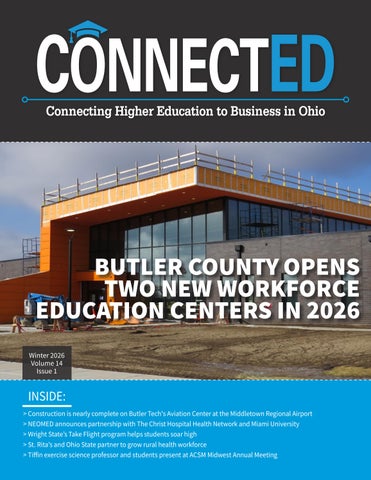
BUTLER COUNTY OPENS

> Construction is nearly complete on Butler Tech's Aviation Center at the Middletown Regional Airport

> NEOMED announces partnership with The Christ Hospital Health Network and Miami University

> Wright State’s Take Flight program helps students soar high

> St. Rita’s and Ohio State partner to grow rural health workforce

> Tiffin exercise science professor and students present at ACSM Midwest Annual Meeting

Photo: Sinclair College

A Message from Chancellor Mike Duffey

We’ve turned to a new year on the calendar, and with it come new partnerships, new opportunities, and new facilities designed to position Ohio’s students for great success.

In this issue of ConnectED, we’ll highlight some of what’s new – in groups of two – at Ohio’s campuses. You’ll learn more about two new education centers at Butler Tech that are designed to meet workforce needs in aviation and manufacturing. There’s news about two partnerships that will bolster Ohio’s healthcare workforce pipeline, plus you’ll hear from two exercise science students who gained new, real-world experience at a recent conference.

Collaborations and facilities may change, but the underlying goal of higher education in Ohio remains the same – to give every citizen the opportunity to reach their fullest potential. No matter the time of year, we are always working to keep our students ConnectED to their version of the American dream.

IN THIS ISSUE:

Butler County opens two new workforce education centers in 2026 Aviation Center, Advanced Manufacturing Hub will welcome students

NEOMED announces partnership with The Christ Hospital Health Network and Miami University

Innovative educational partnership establishes pathways for future generations of physicians to train for a medical career in Ohio

Wright State’s Take Flight program helps students soar high

The program covers up to 18 credit hours of undergraduate tuition each semester for four years

Two new education centers focused on meeting Ohio's workforce needs are opening their doors this year.

Butler Tech is opening its new Aviation Center at the Middletown Regional Airport in late January. The aviation program currently operates out of classroom space at the airport and has about 80 high school juniors and seniors enrolled.

Adam Snoddy, principal of the aviation school, said the center’s opening marks a major step for the program, allowing it to expand and welcome more students.

Butler County opens two new workforce education centers in 2026

"It's giving us a chance to take the physical structure we've got and turn it into a truly dedicated aviation culture where all our students can participate at the same time," Snoddy said.

The center features a classroom for general education, flight simulators, garages, and its own hangar, allowing students to study aviation maintenance, piloting, engineering, airport management, and air traffic control — all in one building — before they graduate high school.

The opening comes as the aviation industry continues to face workforce shortages. During

Original article written by Zack Carreon, 91.7 WVXU
The Advanced Manufacturing Workforce and Innovation Hub
Butler Tech's Aviation Center

the federal government shutdown in 2025, air traffic controllers and TSA officers across the country worked without pay, and airlines canceled or delayed many flights due to staffing shortages. The shutdown, which lasted 43 days, highlighted the industry’s longstanding need for more workers. Snoddy said the growing center is already helping prepare young people for those roles.

"It's unique on the workforce front because we are offering aviation maintenance pathways, while also providing pathways for pilots and drones; we're also developing aviation engineering pathways," he said.

Advanced Manufacturing Hub opens In Hamilton, Butler Tech and Miami University are also welcoming students inside the new Advanced Manufacturing Workforce and Innovation Hub, which opens in January. The hub helps students from both Butler Tech and Miami earn industry credentials and prepare to continue their education in robotics and engineering fields.

Located at the Vora Technology Park, the hub has received millions in local funding to revitalize the underutilized campus and install advanced technology, including massive CNC machines that students are now using to design and build their own parts and machines.

Travis Hunt, principal of Butler Tech’s program at the Advanced Manufacturing Hub, said the facility and its technology are already playing a role in retaining young engineers in Ohio.

The Advanced Manufacturing Workforce and Innovation Hub is a cutting-edge partnership between Miami University and Butler Tech Career Technical Center that aims to develop an educated workforce and will serve as a catalyst for community economic growth.

"With the machines they're working on, they would normally have to go to the state of Washington or maybe farther north to get training," Hunt said. "We envision ourselves being that type of trainer for companies in the region."

Years ago, Hayden Morgan, who grew up in Harrison, was one of the students who had to leave the region to continue his studies. After earning an undergraduate degree from the University of Cincinnati, Morgan went on to Texas A&M and later began a career in the aerospace industry in Seattle. Now, he is a new engineering instructor at the Advanced Manufacturing Hub. He said Butler Tech’s partnership with Miami University, the facility’s tools and the growing number of technology companies in Ohio are already encouraging more students to stay.

"If you would have told me in high school that we’d have access to this technology, I would’ve laughed," Morgan tells said. "Growing up in rural Ohio, these opportunities didn’t exist, and that’s why I left."

Forty-seven high school students are currently enrolled in Butler Tech’s program at the hub, with plans already in place to grow enrollment to more than 200 in the coming years.

PATHWAYS FOR FUTURE GENERATIONS OF PHYSICIANS

NEOMED announces partnership with The Christ Hospital Health Network and Miami University to advance medical education, training, and healthcare access in Ohio

Northeast Ohio Medical University (NEOMED) has announced a groundbreaking, innovative educational partnership with The Christ Hospital Health Network of Cincinnati and Miami University in Oxford that establishes pathways for future generations of physicians to train for a medical career in Ohio.

Ohio is facing a projected shortage of 1,200 primary care doctors over the next decade, according to estimates from the U.S. Department of Health and Human Services.

Together, NEOMED, The Christ Hospital Health Network, and Miami University are addressing today’s critical need for more healthcare professionals to improve the health of Ohioans.

"NEOMED’s partnerships with The Christ Hospital and Miami University represent a pivotal development that will change the landscape of patient care in Ohio by giving our medical students more opportunities to connect with and serve communities across the state,” said NEOMED President John Langell, M.D.

(L-R): The Christ Hospital Health Network President and CEO Debbie Hayes, NEOMED Board Chair Darrell McNair, NEOMED President Dr. John Langell, Chair of The Christ Hospital Health Network Board Amy Hanson, and Miami University President Gregory Crawford gathered in Cincinnati to discuss the healthcare education goals of their collaboration.

NEOMED’s collaboration with The Christ Hospital introduces expanded clinical rotation opportunities across southwest Ohio for the university’s medical students, beginning in July 2026.

Additionally, NEOMED and Miami University will launch an early assurance program for Miami undergraduate students interested in attending NEOMED’s College of Medicine.

“This exciting collaboration allows us to offer our students greater options in regard to advanced healthcare education, which will benefit overall health and wellness in the state of Ohio for years to come,” Miami President Gregory Crawford said. “Our students, faculty, and staff understand the crucial importance of developing future healthcare professionals, and this innovative partnership is an immensely positive step in that direction.”

“We are excited to announce this partnership for medical students in southwest Ohio,” said Debbie Hayes, President & CEO of The Christ Hospital Health Network. “One of the challenges facing healthcare is addressing the need for quality healthcare providers."

"By partnering with NEOMED and Miami University, two well-established organizations, these future physicians will have a place to learn and grow while we keep these talented providers here in the Greater Cincinnati region. This is an investment not just in our medical students but the health of our community for decades into the future.”

Wright State’s Take Flight program helps students soar high

Now in its fourth year, Wright State University’s Take Flight program not only is on course with its original flight plan but also is seeing nothing but blue skies of success.

“Healthy things grow,” said Catherine Hernandez Hogan, assistant vice provost for academic engagement. “Take Flight continues to grow every year.”

Take Flight is a needs-based program for academically qualified high school seniors who will be first-year students at Wright State. The program covers up to 18 credit hours of undergraduate tuition each semester for four years.

The program also provides each student with a personal laptop, a $100 textbook voucher each year, and a dedicated success team consisting of an academic advisor, a peer navigator, and a career consultant.

“We have a whole team cheering them on and helping them get to the finish line,” Hogan said.

The Take Flight Program continues to grow, welcoming 252 new students in fall 2025 — a 58% increase since the program launched in 2022 with 160 students.

“What’s really important is not just the growth, but also how successful these students are,” Hogan said.

In addition, Take Flight students remain at Wright State. Nearly 83% of students who participated in the fall 2024 Take Flight cohort returned for fall 2025, compared to 72.5% of domestic full-time students on the Dayton Campus.

“Now we have data to show that Take Flight works,” she said. “That it is growing and that students are being retained at higher rates than their peers with similar backgrounds. Students are really being successful in this program.”

Hogan said Take Flight aligns with Wright State’s priorities of recruitment, retention, and relationships, while also helping to enhance the regional economy.

Through Take Flight, “we are changing the trajectory for these students, their families, and their friends who are inspired by them,” Hogan said. “This is a transformative program.”

She added, “By increasing access for these students to education, intellectual growth and to meaningful careers, they’re developing the workforce of this region. They’re taking their families and sometimes their communities to a higher quality of life.”

Hogan noted that Wright State was ranked the top public university in Ohio for student experience by the Wall Street Journal for 2026, underscoring the university’s commitment to expanding access to a high-quality education for all students.

“Wright State wants to provide students with high-quality, affordable education,” she said. “Take Flight is a major way Wright State lives out this commitment.”

About the Take Flight students, Hogan concluded, “They’re soaring, they’re taking flight, just like the program says.”

Exercise science Professor and students present at ACSM Midwest Annual Meeting

When Tiffin University exercise science students talk about “learning by doing,” this is what it looks like in real life. In October 2025, Assistant Professor of Exercise Science Dr. Craig W. Berry and Clinical Exercise Physiology graduate students Andrew Combs and Connor Webster traveled to Grand Rapids, Michigan, to attend and present at the Midwest Chapter of the American College of Sports Medicine (ACSM) Annual Meeting. Both Combs and Webster earned their Bachelor of Science in Exercise Science degrees at TU.

ACSM is one of the leading professional organizations in the exercise science and sports medicine field. Its regional and national conferences bring together researchers, clinicians, faculty, and students to share the latest findings on human performance, health, and physical activity. The Midwest Chapter

meeting, held last fall, gave TU students the chance to step into that professional world as presenters, not just observers.

For Dr. Berry and his students, the conference provided an opportunity to share their research, connect with experts, and see how the concepts they study at TU are applied in real-world practice. It was also a first for Tiffin University’s Exercise Science Department, marking the first time TU exercise science students presented research at this event.

Dr. Berry, Combs, and Webster answered questions about why they attended the ACSM Midwest Annual Meeting, what they learned, and how the experience is shaping their goals in exercise science.

Why did you choose this particular conference to attend with students?

Dr. Craig W. Berry: The American College of Sports Medicine (ACSM) is the leading governing body within the exercise science discipline. In addition to the national annual meeting held in the spring, there are regional conferences held each fall. Ohio falls within the Midwest Region defined by the ACSM.

These regional conferences are much more student-oriented and allow a relatively relaxed environment for students to attend a conference without the higher expectations and pressures associated with the national conference, especially if they have not presented at a conference before.

What topics, sessions, or speakers stood out to you the most – and why?

Andrew Combs: My favorite part was getting to be one of the many researchers presenting their projects! The keynote speaker on the first day of the conference was Dr. Douglas Casa. He was representing the Korey Stringer Institute at the University of Connecticut. His presentation was about his years of experience researching and treating Exertional Heat Stroke in professional athletes, military members, and multiple other organizations.

Connor Webster: I felt excited to represent TU at this event. This was the first time that students presented research for TU’s Exercise Science Department, so it was a great privilege to help the department take this big step. I really enjoyed being around peers and professionals from other programs who were interested in the same field as me.

It was a great event to meet new people who shared interests and curiosities in the field. The poster presentation sessions overall stood

out to me the most. It was neat to see what areas of research students chose to present that I would not have thought of investigating myself. This specific exposure reminded me of how broad the exercise science field is and the different routes students can take to pursue a career in this field.

What professional benefits did the conference offer for faculty development and networking?

Dr. Craig W. Berry: The conference schedule is packed with presentations on the latest research, findings, guidelines, and equipment improvements occurring within exercise science, as well as the medical field as a whole. These educational sessions provide the latest information on how the field is moving

Clinical Exercise Physiology master’s student Andrew Combs, preparing to present his research poster.

forward and inform faculty members on how to address these changes in the classroom.

The conference also innately promotes networking through the various social gatherings held throughout the three-day meeting, allowing for collaboration and introduction of students and exposing them to opportunities they may otherwise not been presented with.

Did you participate in any presentations, poster sessions, or networking events?

Andrew Combs: Yes; the first night that we arrived there, we got to do some networking with other professors and students from the region. On day two, I had the opportunity to present my own research poster that we had been working on for the past year. In this poster session, I spoke with many students and professionals in the field of EXS about our research.

Throughout the rest of the conference, I attended multiple oral and poster presentation sessions that covered a variety of different topics. And in addition to that, I was able to meet and talk with some of Dr. Berry’s many graduate school connections at dinner.

Connor Webster: I presented the research study Dr. Berry is conducting at one of the poster sessions. My presentation covered the effects caffeine consumption has on hydration after running a five-kilometer time trial. I had a great time presenting. It was a big push out of my comfort zone, but I was able to have great conversations with other students and professionals who stopped by my poster. This was a great opportunity for me because it challenged my public speaking skills and professionalism.

How did student participation enhance the overall experience?

Dr. Craig W. Berry: I believe that having the

students (Andrew and Connor) attend the conference did several things to improve the overall experience. Namely, sharing our love and passion for science outside the classroom was quite enjoyable. Having both of them present our research findings at the conference was a nice way to get the Tiffin University name and its bachelor’s exercise science program and master’s clinical exercise psychology program some wider recognition around the region.

Both students engaged extensively with students and faculty members from other universities both during and after their presentations, with several asking for details on Tiffin University and its exercise science program.

How did this experience make you feel more prepared for your future career in exercise science?

Andrew Combs: As an aspiring orthopedic surgeon, this conference gave me multiple ideas for new research that I can put together during medical school. In addition to this, I learned multiple new pieces of information from the presenters that will help me be a better practitioner one day.

Finally, getting these firsthand connections with top researchers in the field of EXS provided me with knowledge of what research is still needed to better understand human performance and recovery.

Connor Webster: Overall, I believe this experience boosted my confidence in my own professionalism and readiness for a career in exercise science. I was required to be ready for essentially any question about my topic on hydration, so I needed to be able to pull from material learned in my courses at TU and independent research related to the material I was presenting.

Going into the poster session, I was nervous about how the presentation would go, but I was able to gain confidence in myself after getting through the experience. It also allowed me to gauge how I stand with other prospective students and professionals in this field. I would highly recommend taking advantage of this kind of opportunity to any student who is able to get it.

What specific sessions, research, or discussions were most valuable for Tiffin’s exercise science program?

Dr. Craig W. Berry: The keynote session on the dangers of heat stroke and exhaustion I believe could be quite consequential and could help with our various sports teams that primarily compete outdoors during the hotter times of the year, especially at the beginning of the fall semester (i.e., football, soccer, cross country) and end of the spring semester (baseball, softball, track & field, etc.).

What did you learn about the exercise science field that excites you about your future?

Andrew Combs: I learned that EXS professionals are becoming more and more necessary for implementing proper prevention of all sorts of health conditions. This means that job openings should be on the rise!

Connor Webster: The main thing I learned about the field is that it is still growing in its literature. This excites me because, despite the field being around for so long, there is still much that is unknown or not fully understood. Seeing this, I am motivated to pursue independent research in my career to continue expanding the field.

What did you observe about how the students engaged or grew from this experience?

Dr. Craig W. Berry: I think both Andrew and Connor were very nervous leading up to their presentations on the second day of the conference. However, as they started talking more and more about their research with other students and conference attendees on the first day, you could tell they were getting more confident in their knowledge. I think this conference helped them better understand that there is much more to the field beyond the classroom and that there is always new information coming out to stay on top of in their future careers. The networking they did, I believe, will benefit them the most in the long run.

What advice would you give to other TU students who might want to attend a conference like this?

Andrew Combs: I would tell any TU student who is interested to get involved in research early. I have attended the conference twice now, once as an observer and most recently to present research. I would tell them that the feeling of having your own hard work there for all the other students and professionals to see is a great feeling.

Connor Webster: Do it! Scared, nervous, whatever, just do it. It is a great opportunity to put yourself out there. This is especially beneficial if you are still looking or deciding on what you want to do in the field. There are many professionals from different schools that you have the chance to connect with and learn from.

How does attending conferences like this support our mission of linking knowledge to professional practice? Are there new ideas, collaborations, or opportunities you plan to bring back to campus?

Dr. Craig W. Berry: There is so much more to the field beyond what we can cover in the classroom. I always tell my students that everything they learned in class, every topic covered, every piece of information shared, came from research that was done outside the classroom. That research was then shared at a conference and published in a paper that they can read themselves.

I think attending these conferences is a great way to increase recognition of that fact and see it first-hand. I believe this will better fuel their knowledge and understanding of the field as they move beyond Tiffin into their professional practices and future careers.

I believe that in the future I would like to take larger groups of students to the conference than just a couple at a time. I think the students registered for Research Methods (EXS475) are the primary audience that this would appeal to.

Additionally, throughout the conference, there are tables and booths set up that schools can rent out and hand out information on their programs to any interested passersby. This could be beneficial to our school and program, and could be some nice advertisement opportunities to spread our name out there.

Any memorable moments, lessons learned, funny stories, or highlights from the trip?

Dr. Craig W. Berry: On the final night of the

conference, there was a Jeopardy-style “Quiz Bowl,” where each school could pick three undergraduate students to form a team and represent the school in the competition. The winning school gets its registration for the national conference paid for and earns a spot in the national conference Quiz Bowl. Even though Connor and Andrew were ineligible as graduate students, we still attended and watched (as almost all conference goers did) and had a great time testing our knowledge of exercise science.

I think in the future I would like to take more undergraduate students to the conference and sign them up for this competition. It is a fantastically fun time and provides a great, relaxed environment to socialize with other conference goers.

Andrew Combs: One of my favorite memories from the trip was the exercise science-themed jeopardy that happened on the second night of the conference. All the students gathered in one of the main conference rooms to compete against other schools.

Connor Webster: My favorite memory from the trip was the quiz bowl that was held at the conference. Attending schools can compete against each other in a Jeopardy-style trivia game over exercise science if they have three undergraduate students. While I could not compete, it was a fun, laid-back time that I was able to share with the other student I was with and my professor. I was also able to test my knowledge and really see how well I paid attention in class. It was a great time where each school was competitive but having fun with the event.

St. Rita’s and Ohio State partner to grow rural health workforce

“Build it and they will come,” and they have. The Mercy Health St Rita’s Graduate Medical Education Center is attracting residents from across the country — and keeping many of them in the region.

Program officials say about 30% of their medical residents remain in the area after completing their degree, helping to fill much-needed physician positions that have gone unfilled in recent years. Dr. JJ Sreenan, program director of community medicine for the MD Track at the Ohio State College of Medicine, said the program is expanding health services across the region.

“We've expanded our physician services and family medicine throughout the area", Dr. Sreenan said. "We have several staying here in the hospitalist service, and not just at St. Rita's either. Some of them are at some of the other local hospitals as well.”

Mercy Health Saint Rita’s is the only hospital working in conjunction with the Ohio State College of Medicine to educate students interested in pursuing community and rural health medicine, a field facing persistent staffing shortages nationwide.

Original article written by Stacey Myers Cook, hometownstations.com

A special thank you to all of those who contributed stories and articles:

Butler County opens two new workforce education centers in 2026

Zack Carreon | 91.7 WVXU

NEOMED announces partnership with The Christ Hospital Health Network and Miami University

Seth Bauguess | Senior Director of Communications | Miami University

Tonya Strong-Charles | Chief Marketing Officer | Northeast Ohio Medical University

Wright State’s Take Flight program helps students soar high

Dennis Bova | Wright State University

Tiffin exercise science professor and students present at ACSM Midwest Annual Meeting

Deborah Roszman | Executive Director of Communications & Public Relations | Tiffin University

Dr. Craig W. Berry | Assistant Professor of Exercise Science | Tiffin University

Andrew Combs | Clinical Exercise Physiology graduate student | Tiffin University

Connor Webster | Clinical Exercise Physiology graduate student | Tiffin University

St. Rita’s and Ohio State partner to grow rural health workforce

Stacey Myers Cook | hometownstations.com

Thanks for reading ConnectED. If you have any story suggestions, links to articles of interest, or news releases to share, feel free to send them to Jeff Robinson at jrobinson@highered.ohio.gov.

Photo: Cleveland State University

Turn static files into dynamic content formats.

Create a flipbook
Issuu converts static files into: digital portfolios, online yearbooks, online catalogs, digital photo albums and more. Sign up and create your flipbook.
ConnectED | Winter 2026 by OhioHigherEd - Issuu