DR. CINDY WU DOUBLE BOARD-CERTIFIED PLASTIC SURGEON
WHERE PRECISION MEETS BEAUTY
Together, Dr. Edward Gronet, a board-certified plastic surgeon and Dr. Cindy Wu, a double board-certified plastic surgeon, offer advanced plastic surgery at H/K/B Cosmetic Surgery in Greensboro. Alongside them, experienced Med Spa providers deliver a range of advanced, nonsurgical treatments. Under one trusted name, the practice provides refined treatments that restore balance, enhance natural beauty, and prioritize subtle, polished outcomes.
Robin Jenkins, RN Nurse Injector & Laser Specialist
CINCOMAYO de celebration
TUESDAY, MAY 5 | 5:00 PM – 7:30 PM (FREE AND OPEN TO THE PUBLIC)
We’re celebrating the expansion of our social district with the official opening of Solo Taco.
The Fun: Giant jenga, hula hoops, corn hole and more! Kids pinata at 6:00 pm + adult pinata at 6:30 pm at the Docks.
The Flavors: SoloTaco margaritas and tacos and much more! Beverages and dinner options too from KAU, Grapes & Grains, Incendiary Brewing, Cugino Forno, Peace of Her and Greenlove coffee.
The Culture: Browse an artisan vendor market by GroovyBlu Events around the Stacks or pop in the Mill to tour our art galleries featuring solo exhibits by Will South (1250 Gallery) and Kasia Ozga(Central Gallery @ 1150)
The Vibe: Wear your most colorful outfit and bring your sombreros and maracas to sing and dance to favorite songs by Doobie Brothers, Steely Dan and Toto with Camel City Yacht Club
Arrivals
Solo Exhibit by Kasia Ozga
Solo Exhibit by Will South 1250 Gallery
Cone Exhibit The Fabric of our Memory: Cone Mill Village Museum
May 2026
FEATURES
45 FLOATING Poem by Ross White
46 The Greener Way By Cassie Bustamante
The Downtown Greenway paves the way for pedestrians, pedalers, plant lovers and pollinators
54 A Place Like Home By Ross Howell Jr. Montagnard families and Special Forces veterans preserve a vanishing culture
60 Unsung Heroes? By Billy Ingram
Searching for valiant ancestry at the Battle of Guilford Courthouse
64 Ahoy, Mateys By Maria Johnson
There be a tiki boat plying the waters of Lake Jeanette
73 May Almanac By Ashley Walshe
DEPARTMENTS
13 Chaos Theory By Cassie Bustamante
15 Simple Life By Jim Dodson
18 Sazerac
23 Tea Leaf Astrologer By Zora Stellanova
25 Life’s Funny By Maria Johnson
28 The Omnivorous Reader By Jim Moriarty
31 State of Mind By Tommy Tomlinson
34 Home Grown By Cynthia Adams
36 Tiny Tale By James Celano
39 Birdwatch By Susan Campbell
41 Wandering Billy By Billy Ingram
92 Outings
100 GreenScene
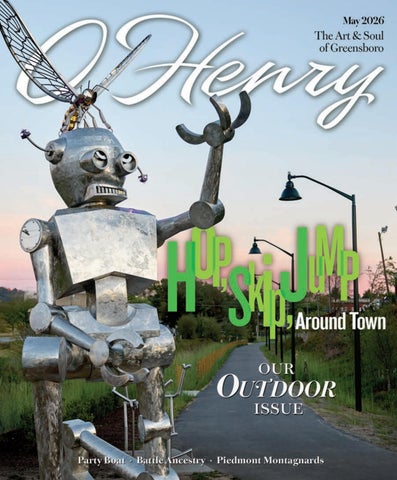
104 O.Henry Ending By Walt Pilcher Cover photograph by Bert VanderVeen
Photograph this page courtesy of the City of Greensboro
COMPASSION, INTEGRITY, EXPERTISE
Volume 16, No. 5
“I have a fancy that every city has a voice.” www.ohenrymag.com
PUBLISHER
David Woronoff david@thepilot.com
Andie Rose, Creative Director andiesouthernpines@gmail.com
James Celano, Ross Howell Jr., Billy Ingram, Jim Moriarty, Gerry O’Neill, Gary Palmer, Walt Pilcher, Stephen E. Smith, Zora Stellanova, Tommy Tomlinson, Ashley Walshe, Amberly Glitz Weber
ADVERTISING SALES
Lisa Allen
336.210.6921 • lisa@ohenrymag.com
Amy Grove
336.456.0827 • amy@ohenrymag.com
Brad Beard, Graphic Designer
Jennifer Bunting, Advertising Coordinator ohenrymag@ohenrymag.com
Henry Hogan, Finance Director 910.693.2497
Darlene Stark, Subscriptions & Circulation Director 910.693.2488
OWNERS
Jack Andrews, Frank Daniels III, David Woronoff
In memoriam Frank Daniels Jr.
Annie McLennon, DDS, Graham E. Farless, DDS, Bill Blaylock, DDS
A LEGACY THAT LIGHTS THE WAY: $13 MILLION FOR A FUTURE BUILT ON LEARNING
FOR MORE THAN 70 YEARS, HARRIET SHAIN EVENSON ’53 kept her Woman’s College student ID close — a lasting reminder of her connection to her alma mater. Now, her extraordinary $13 million Light the Way campaign gift ensures that her fierce belief in the power of education lives on at UNCG. Her final act of generosity will expand the Harriet Shain & Jerome Evenson Endowed Scholarship in Education, establish the Jerome Evenson Distinguished Professorship in Artificial Intelligence in Education, and strengthen Jewish Studies.
And with the naming of the Harriet Shain and Jerome Evenson School of Education Building, her legacy will continue lighting the path for those who aspire to teach, discover, and lead for generations to come.
JUNE
AUGUST & SEPT.
By Cassie Bustama Nte
Long Live . . .
All the magic and body art
My mom wears a black-green, wide-leg jumpsuit, accented with a gold belt. She’s 70, but you’d never know it. Her hazel eyes smile in my direction. It’s a look I’ve seen through many softball games, high school drama productions and even at the birth of my oldest. She’s always cheered me on, and today is no different as I prepare to take the podium to introduce our two authors at our O.Henry Magazine Author Series.
As soon as I see her, I comment on her outfit. “Mom,” I say, “You look fabulous! I almost wore a sleeveless jumpsuit, too, but was afraid the tattoo on my arm would be too aggressive.” Instead, I’d opted for a black dress with sheer long sleeves, the whole thing glimmering with gold stars and my tattoo tucked away.
“Well, it’s one of those you can just wash off, right?” my mom asks.
“Uh, no,” I say. “It’s real. Emmy and I did it together this summer.”
“Oh,” Mom replies, her voice suddenly many octaves higher. I can tell she’s horrified that my 18-year-old daughter and I got inked together.
Mom and I have always bonded over books, passing them back and forth between us. Body art, not so much.
And this isn’t her first rodeo, nor mine. When I decided to get myself a tattoo for my 19th birthday, my mom retorted, “It’s your body, do what you want.”
That, followed by, “But remember, it’s going to be there forever.”
Forever, got it. To the tattoo parlor I went, returning home with a small daisy on my inner right ankle.
A few years later, I added another small-ish tattoo on my lower back — a graphic sun to pay homage to my zodiac sign, Leo. Yes, I fell victim to what was soon dubbed the “tramp stamp,” but, according to TikTok, they’re making a comeback. And, to be honest, I always forget it’s there until someone sees it and mentions it.
Almost 25 years later, when Emmy says to me that she’d like to get a tattoo, I jump on board.
“I want a new one, too! Can I come?” I ask. “What are you thinking?”
We spend the next couple of months deciding on designs. Emmy selects a small paper airplane followed by a trail of
sparkling stars to put on her wrist. I find a design I like, but personalize it a bit to fit me. It’s an open book, a trail of stars, the moon and Saturn escaping its pages. At the very top, I add a four-leaf clover to honor my late business partner and friend who owned Sweet Clover, a vintage home store, with me. And below the book, it reads, “long live all the magic.”
While that quote is a line from my favorite Taylor Swift song, it’s also about writing my stories. May the memories and moments I capture live long after I am gone for my own kids to treasure. Or laugh at. Whichever, as long as it brings them joy.
We schedule an appointment with Taylor (yes, that’s her name!) at Dogwood Ink Tattoo. Emmy’s best friend, Kiah, joins us and in less than 90 minutes, we’re out of there, all with fresh body art on our forearms.
A few weeks later, it dawns on me that I don’t quite know why Emmy went with the paper airplane so I ask her about it.
“Remember when we went to the Eras concert, Mom?”
“Of course,” I say. How could I forget taking my only daughter to Taylor Swift’s epic show.
“Our bonus song was ‘Out of the Woods,’” she says, then quotes the song. “You know, ‘Two paper airplanes flying.’”
Wow, her tattoo is to commemorate a special moment with me? I feel myself choking up, grateful that Emmy and I, like my mom and I have books, have music. And now tattoos that, yes, Mom, will be there forever.
Suddenly, I wish I’d gotten a paper airplane, too.
I look down at my own right wrist, free of designs. Maybe one day. OH
Cassie Bustamante is editor of O.Henry magazine.
Letter to a June Bug
From a Homegrown Ogden Nash
By Jim DoDsoN
My daughter, Maggie, was born in 1989.
That year became known as the “Year of Revolutions,” a turning point in world affairs that witnessed the opening of the Berlin Wall, a Velvet Revolution in Czechoslovakia, and the end of communism in Europe’s eastern bloc. It also saw the end of Apartheid in South Africa, the birth of the World Wide Web and the first commercial internet providers — social revolutions of a different kind.
Mugs, as I called my beautiful baby girl from day one, was born in the aftermath of a huge snowstorm in Maine. We took her home to our cottage on Bailey Island on day two, after her paternal grandparents arrived from North Carolina.
One of my fondest memories is of sliding on my rump down the deep, snowy hill behind our cottage, my bundled-up baby clutched to my chest. When I looked at my daughter’s tiny face, I swear she was almost smiling.
Upon returning home to Carolina, my dad, a veteran newspaperman with a poet’s heart, jotted me a note of gratitude with a bit of whimsical verse attached. He fancied himself, I think, a homegrown Ogden Nash.
Sadly, I can only remember the opening lines of the ditty because I kept it in my office desk forever until it apparently migrated into attic boxes stuffed with half a century of manuscripts, letters and correspondence. Someday, I hope to unearth it. In the meantime, here’s the only bit that I can recall, advice from a happy grandpa:
There’s nothing in this whole wide world / As precious as a baby girl / who someday soon will surely be / A child as happy as can be / Your job, my son, is take her hand . . . at which point my memory fails.
•
When Maggie and husband Nate visited us in the autumn of ’24, she graciously offered to plow through my mountains of archives and work papers, giving me hope that she might find
my dad’s wise, little verse. Instead, she found a pile of letters from my early career that included an unopened one from legendary New Yorker magazine editor William Shawn. He complimented me for an investigative piece on a forgotten African American community I’d written for the Sunday magazine of The Atlanta JournalConstitution, where I was a staff writer. He’d read it while waiting for a plane home to New York from Major League Baseball’s spring training in Florida. He also wondered if I had interest in writing for his magazine.
I laughed at this discovery because my career ambition in those early days was to someday write my way to The New Yorker. My daughter was incredulous. “Dad,” she playfully chided, “how could you have not opened this letter?”
Sheepishly, I explained that I had a habit in those days (and even today) of setting aside important letters to read and properly answer later. “I probably just put it in my cluttered desk and forgot about it,” I theorized. “Crazy, I know.”
But if a dream job at The New Yorker was never to be, I added, perhaps my mistake was a perfect, unanswered prayer.
For, if I’d achieved my ambition to work for The New Yorker, I probably never would have burned out covering crime, politics and racial justice in the so-called New South and fled to a winding trout stream in Vermont, where I soon became the first senior writer of Yankee Magazine, married her mom, built a gorgeous house on a forested hill in Maine, and became the father of two beautiful babies. Moreover, I never would have also found my way home to North Carolina, where I wrote a dozen books and helped start several popular arts-and-culture magazines across my home state that are thriving today.
•
Last May, we were thrilled to learn that Maggie was pregnant with our first grandchild, a baby girl due on Christmas Eve.
June Sinclair Prescott arrived early, born seven days before Christmas Eve, weighing in at a healthy 9.9 pounds. I immediately nicknamed her “June Bug,” because they are said to bring
good luck and my spring garden is always full of them.
Maggie’s mom and my first wife, Alison, flew to Los Angeles first to be with mother and baby as they got better acquainted.
The plan called for “Nana and PopPop,” aka Wendy and Jim, to follow in early January. Unfortunately, a powerful ice storm struck the day before our flight was to depart. A flow of adorable photos and videos of “June Bug” had to suffice. In half of them, she appeared to be smiling and even belly laughing. Like her mama at the same age.
Two weeks later, we tried again. This time on the eve of departure, it snowed 13 inches and thousands of flights up and down the East Coast got cancelled. Including ours.
The day after the big snowstorm — shades of Maggie’s own birthday in 1989 — the sun popped out and I stepped outside to fill the bird feeders and think about my spring garden. An old idea suddenly came to me.
Pushing the snow off my favorite wooden chair, I sat down and jotted a letter in light verse to my new grandchild like the homegrown Ogden Nash who preceded me. I also asked my good friend, artist Harry Blair, to illustrate it.
Dear June Bug,
Someday while you are still a tyke, I’ll take you on a wondrous hike
To see the world from on a hill
Carolina Pines
The Grass Really Is Greener
Experience a community where comfort, elegance, and meaningful connection come together effortlessly. With chef-prepared cuisine, attentive services, and a vibrant social calendar, every detail is designed to help you live confidently, joyfully, and on your own terms, all for one simple monthly price. No hidden costs. No long-term commitments. Just a lifestyle that delivers — experience it for yourself.
And all the places that will fill
Your life ahead with joyful things —
Like winter snows and golden springs.
For nature is the ideal guide
To leafy paths that cannot hide
The glory of a world that’s wide —
With loving souls so full of grace
Who’ll help you find your perfect place
To live the life your heart desires —
With faith — and strength — that never tires.
With my love forever, PopPop
Our third effort to reach Los Angles proved a charm. We took the illustrated verse, lots of cute, new baby clothes and a lovely Swedish bear to finally meet our beautiful new grandchild. All we did for five days was rock, hike, hold, cuddle, feed and play with the June Bug and her mama.
Like her mother, baby June was born at a moment of revolu-
SAZERAC
"A
spirited forum of Gate City food, drink, history, art, events, rumors and eccentrics worthy of our famous namesake"
JOI DE VIVRE
What would Mama do?: The other day, I stood next to my mom and realized we’re the same height. Five feet and four inches. Mama, who once towered over little Joi, now struggles to meet me eye to eye while scolding me about getting my car tags renewed. We’re a lot alike these days — but not when it comes to boring obligations such as car maintenance. If you asked her about me, she’d say, “she’s my mini me,” even though we’re the same height, weight, width and shoe size — there’s not much “mini” left in me.
Growing up, I would follow her everywhere, like a duckling to a duck. To the bathroom so she could braid my hair, the kitchen for some seasoned pretzels and even to the front porch to water her half-dead flowers — my grandma’s green thumb skipped a generation. Nowadays, since we don’t live under the same roof, instead of following her around the house, I try to follow her thought process. “What would Mama do?” enters my head any time I’m stuck in a sticky situation. No, Mama wouldn’t scream in a fit of rage because Nelly, my greedy cat, scarfed down my hamburger when I wasn’t looking — yet again. She would simply make another one — I may have inherited my mother’s looks but I did not gain her patience. One day when I’m older, I hope to be half as wise as her so that I don’t have to search my brain and wonder “what would Mama do?” I can simply just do it.
– Joi Floyd
Window on the Past
An extravagant pageant, lively games and a crown fit for a queen. In 1912, being May Day queen at State Normal and Industrial College (now UNCG) was the highest honor and typically bestowed upon a senior elected by her peers. Only the noblest, bravest warriors were tasked with protecting her court train from the dangers of the freshly cut grass blades.
Unsolicited Advice
When it comes to wordplay, we love figures of speech as much as the next person. “Shoot for the stars” and “go the extra mile” are a couple we keep in our arsenal anytime we need to spice up a conversation. They can be motivational and used to cheer one up when down in the dumps. While some bring good intentions, others can be misunderstood because of their fragmentation. No one likes a half-baked quote shoved down their throat — but we will gladly scarf down a gooey, half-baked cookie. Whether it’s to inspire or just for some good, playful writing, we’d bet our bottom dollar you don’t know the whole shebang. So, if you know someone in a blue funk and they’re in need of some encouraging words, here are some apt idioms you can roll out to bring their spirits up.
Some say “the early bird catches the worm,” which implies that the sooner you chase the opportunity, the better advantage you will have over others. While agreeable, it could be argued that waiting could also be a better bet. The full phrase “ the early bird catches the worm, but the second mouse gets the cheese,” implies that an opportunity could be disguised as bait. Granted, worms and cheese may not be your snack of choice, it’s still a good reminder that the first opportunities could come with higher risks and sometimes second place can put you ahead of the game. So before you chase, stop and assess whether you’re about to be rewarded or about to bite the bait.
If starting a new hobby consists of
finding something you’re interested in, getting really engaged in it and then letting it go then don’t worry about being called a quitter. It takes a lot of courage to start something new, but it takes a lot more courage to quit when something isn’t working out for you. Our bag of idioms tells us that a Jack of all trades is a master of none, though oftentimes better than a master of one . Being a master of none isn’t always bad. It means you possess knowledge across multiple fields. For example, a hotdog expert couldn’t tell you squat about how to make a good burger but, with the extra knowledge you have, you’ll be able to whip up — or
better yet, flip up — something juicy and savory.
As a child you were probably taught to suppress your curiosity and to keep your questions at bay. But, in a world of “follow the leader,” we could use more curious thinkers. Innovators and their inventions all started with a thirst for knowledge. Sure, people say “Curiosity killed the cat,” but the full, often overlooked version of the idiom is “ Curiosity killed the cat, but satisfaction brought it back .” Follow your nose, ask questions and impress your inner child with your inquisitiveness — but use caution, you don’t have eight more lives to spare.
Our 2026 Essay Contest
Sun’s out, pen’s out. It’s time for our annual writing contest and this time we want you to think back on all those “How I spent my summer vacation” assignments of your elementary school youth. Whether it’s about a vacay or a staycay, we want an essay. Tell us about a true tale as remembered by you about a trip to the beach or about the time you took a week off to meditate for hours a day wearing nothing but your socks and a bedsheet. As always, there are ground rules:
• Submit no more than 600 words in conventional form — a PDF, Google document, or a word or pages file works well. Please no secret code that requires a decoder ring. We’ve misplaced said ring. Email entries to cassie@ohenrymag.com.
• One entry per writer.
• Deadline to enter is September 30, 2026.
Top three winners will be contacted via email, awarded a monetary prize and their essay printed in a forthcoming issue of O.Henry.
Art to Heart
For some, disorder and mayhem may stifle their artistic abilities, but, for art historian and artist Will South, chaos serves as a muse for his paintings. “So, it all started with the pandemic,” says South. “Then, next thing you know, the pieces became directly inspired by a lot of the troubles in the world.” After his 2020 retirement from serving as chief curator for the Dayton Art Institute in Ohio, he moved to Greensboro. South saw the pandemonium that resulted from the COVID-19 pandemic and, like many creatives at the time, decided to dust his palette off and paint, which led him to fill canvas after canvas, until he created the collection for his present exhibit, Catastrophic Times: Paintings by Will South. South uses his art to speak for the people who can’t speak for themselves and says that making images is his way of engaging with the world. “Now, we have these other conflicts going around, so I started
the larger issues that arose after — like, he says, the murder of innocent African Americans through police brutality. Though South most recently uses his art to reflect on current events, he has also been known to dig into the past. He is the author of many books, including Henry Ossawa Tanner: Artist in the Lion’s Den, which explains and seeks to correct the myths surrounding 19thcentury artist Henry Ossawa Tanner, who was the first African American artist to reach international acclaim. He hopes that by sharing his own art with the world, it will gently move the needle toward global equality and encourage kindness toward those going through troubled times. “When you see something in life, you cannot unsee it,” South says.
You can find Catastrophic Times: Paintings by Will South in Gallery 1250 at Revolution Mill, on display through June 26, and
TAURUS
(April 20 – May 20)
You’re a glutton for luxury, it’s true. But this month, amid the blur of artisanal cocktails and regenerative facial serums, you’ll ache for something simple: direction. As luck would have it, a Mercury cazimi in Taurus will deliver a moment of crystal clarity on May 14. Combine that with the new moon on May 16 and a slap on the hindquarters from Mars (May 18), and you’ve got yourself a road map. Pack your ahimsa silk pillowcase, sweetheart. Life may be guiding you someplace you never imagined.
Tea leaf “fortunes” for the rest of you:
Gemini (May 21 – June 20)
Three words: guac and chips.
Cancer (June 21 – July 22)
Release the outcome.
Leo (July 23 – August 22)
Beware of shiny objects.
Virgo (August 23 – September 22)
Don’t let the light bulb drive you crazy.
Libra (September 23 – October 22)
Opt for the linen.
Scorpio (October 23 – November 21)
Three o’clock, darling.
Sagittarius (November 22 – December 21)
Retire the busted ones.
Capricorn (December 22 – January 19)
Delete the app.
Aquarius (January 20 – February 18)
Try taking smaller bites.
Pisces (February 19 – March 20)
Leave a paper trail.
Aries (March 21 – April 19)
BYO hot sauce. OH
Zora Stellanova lives in the N.C. mountains with her wolfdogs, Venus and Lilith. Although she prefers divining with loose-leaf pu-erh, she recommends a mugwort and passionflower blend for those seeking wisdom and clarity from dreams.
Featured Listing of the Month
Starmount Neighborhood
Close to Downtown & GAC
Minutes from Golfing, Shopping, & Walking Trails
Backyard Firepit & Outdoor
Dining
Dual Shower Heads in Primary Bathroom
Ping Pong Table AND Nintendo Switch Games
Book your stay today! Scan the QR Code for our local Short Term Rentals:
“The Nola”
CHRIS STANLEY, MBA, AIF®, CRPS Principal
DREW
QW HAPPENINGS & NEWS
• Special Romance Packages and Getaways at O.Henry & Proximity Book online at ohenryhotel.com or proximityhotel.com
• O.Henry LIVE Jazz! Every Thursday from 6-9 PM and Pop-Up Shows from 7-10 PM in the Social Lobby. See the schedule at ohenryhotel.com
• QW Gift Central Overnight Stays and Gift Cards. Visit qwrh.com, ohenryhotel.com, printworksbistro.com, greenvalleygrill.com or lucky32.com
• LIVE Music Every Wednesday at Lucky 32! AM rOdeO (Jessica Mashburn & Evan Olson) 6-9 PM lucky32.com
• Artist-in-Residence Chip Holton at L32! Stop by and see Chip’s retrospective! lucky32.com
• Weddings | Meetings | Retreats | Events | Group Accommodations Learn more ohenryhotel.com or proximityhotel.com
My Two Cents
The changing nature of cool
By maria Joh NsoN
I really wanted those penny loafers.
They were displayed near the oxfords in the children’s shoe store where my mom took us for “good shoes” when I was growing up.
The place smelled like new leather and Sunday school. Stiff and uncomfortable, in both cases.
Which brings us back to the loafers.
I had flat feet, and someone — maybe my mom, maybe a doctor — decided that I needed to wear “orthopedic shoes,” which meant lace-up oxfords with built-in arch support.
They might as well have said, “Shoes that are ugly as all getout, not to mention uncool,” because they were both.
I was around kindergarten age, old enough to have a budding idea of what was considered desirable outside of my family. Orthopedic shoes from Howard Curry Shoes in Lexington, Kentucky, were not on the list.
The only good thing about that store, in my mind, was The Talking Tree.
You don’t know about The Talking Tree?
Well, on the right wall as you walked in, there was a sculpted tree with a human face, like the trees in The Wizard of Oz, only this one was smiling.
Near The Talking Tree, there was a small wooden bridge that you walked over. It was all very storybook-y. The most enchanting thing was that when you walked out with your new shoes, The Talking Tree would call you by name, saying something like, “Enjoy your pretty new shoes, Maria.”
Even in my 5-year-old mind, as I carried out my dorky shoes, I’d be thinking, “Yeah, right.”
Which means I believed in The Talking Tree somewhat, even though I thought it was full of sap.
It took me a few years to figure out that The Talking Tree never called my name on the way in, only on the way out, after my mom had dropped a wad on my supposedly pretty shoes.
I remember the first time The Talking Tree bade me farewell, and I turned and waved at the sales lady who was talking into a microphone at the counter behind me.
Busted.
Never again did I think seriously about owning a pair of real-
deal penny loafers until recently, when I read a glowing review of some “affordable Italian penny loafers,” which is a little like saying an “affordable Italian sports car”.
Something in me was rekindled.
I had to have penny loafers. Not the pricey Italian model, mind you. Rather, a supple (sorry, Bass Weejuns) and reasonably priced version. With actual pennies stuck in the slots because, to go all Honest Abe on you, I’m mourning the penny.
Unless you’ve been living under a Coinstar machine, you probably know that the U.S. penny went out of production last November. I get why. It cost 4 cents to make a 1-cent piece of currency.
But like many people, I have pockets full of memories associated with pennies, which were made with 95 percent copper when I was a kid.
That’s why they weathered to a green patina.
That’s why some people used them to “fix” a glitchy lightbulb or replace a blown fuse. Don’t ask these people for snapshots to document the practices; their photographs likely burned in house fires.
In my own childhood home, one electrical outlet was fried by a child — there were only two of us, and neither will cop to this — who wondered what would happen if you stuck a penny, vertically, into an outlet, as if you were playing the slots in Vegas.
Answer: ZZZZZTTT!!!
I can only surmise that whoever tried this dangerous (in retrospect) stunt was gripping the penny with a pair of rubber-handled pliers, or only one of us would be left with any credible deniability.
A more common practice of the time was putting pennies on railroad tracks, waiting for a train to go by, then marveling that a locomotive weighing more than 100 tons, could flatten a penny into a faceless disc.
Transform your home or office with the elegance and durability of Weeks Hardwood Flooring, the Triad's most trusted name in flooring solutions. Whether you're seeking to enhance the warmth of your living room or upgrade your business space, our expert team is here to guide you every step of the way. Visit our website to explore our wide range of premium flooring options and start your next project with confidence today.
This, too, was treacherous, not only because it brought kids into close proximity with diesel locomotives, but because apparently — and I learned this only recently — a train’s fast-moving wheels can spit out a penny as a deadly projectile. On a lighter, less lethal note, pennies had wholesome uses, too.
We could toss a penny into a public fountain and make a wish.
We could pick up a found penny — something I still do without thinking — for good luck, especially if it were heads-up.
which had two wheat stalks, pictured like parentheses, on the backside.
The proper name was Lincoln wheat pennies. They were made from 1901 to 1958, and my grandmother seemed to think they were valuable post-production.
She was somewhat correct.
Today, a 1933-D (“D” for the Denver mint) wheat penny is worth more than $2.
A 1931-S (“S” for the San Francisco mint) is worth more than $40.
Put that in your loafers and stroll it.
Pennies also became an emblem: a symbol for the least among us that nevertheless held worth, especially when amassed.
This principle was foundational to the most basic form of childhood fundraising: Dump a coffee can full of coins on the floor and get to sorting.
It took forever to assemble a decent
chunk of change in paper wrappers. But it added up. That was the beauty of the penny. It was little, but it mattered. A lot of them mattered a lot.
On May 7, Sanctuary House, a Greensboro nonprofit serving people who experience mental health issues, will hold a weekday lunchtime event called Mile of Pennies.
Why pennies? Because Abe Lincoln, who is pictured on every cent, suffered from depression. He certainly wasn’t the last president to struggle with mental health problems, but he was open about it, referring to his melancholy as his “black dog.”
Plastic cup by plastic cup, event organizers will hand out a mile’s worth of pennies — 84,480 to be exact — and invite people to use the coins to create designs and messages on the steps, pavers, sidewalks and stone walls around the group’s “clubhouse” at 518 N. Elm St.
The goal — other than providing a place for people to be artistic, eat a foodtruck lunch, and enjoy live music — is to get folks talking about mental health; about 1 in 5 people will experience a diagnosable mental health challenge in any given year, according to Terri Jackson, Sanctuary House’s chief philanthropy officer.
She stresses that every person, every conversation and every donation matters.
There’s that idea again: The power of one.
It’s a reassuring message, a different kind of cool, some 60 years after my first crush on penny loafers. Incidentally, my feet aren’t as flat as they used to be, thanks partly to decades of exercise in supportive, lace-up tennis shoes. That’s why I’m willing to spend some shoe leather tracking down the right pair of loafers, size 8 or 8.5, if you happen to trip over a pair.
I can hear the tinny voice of The Talking Tree now.
“Enjoy your pretty shoes, Maria.” I will.
I think I’ve finally grown into them. OH
Maria Johnson is a contributing editor of O.Henry. Email her at ohenrymaria@ gmail.com.
Cass Jewelers has been family owned and operated for over 75 years.
Doubling Down
Finding the familiar in the extraordinary
By Jim moriarty
“If
you don’t tell their story, who will?”
This was the question posed to Christina Baker Kline by Lesley Looper, a cousin and Duke University librarian, about the lives of the renowned “Siamese twins” Chang and Eng Bunker and their wives, Sarah and Adelaide Yates — Kline’s distant relatives.
The short answer is that a lot of people have. The famous brothers, conjoined at the chest, who came to America in 1829 and eventually settled in North Carolina, have been satirized in poetry, made cameo appearances in works by Herman Melville and Mark Twain, been used as a metaphor during the War Between the States, and been the subject — or at least the literary device — of 21st-century musicals, plays and movies. Does the fact that Kline’s genealogical family tree includes them make her imaginings somehow more prescient? Since the twins died 152 years ago, probably not. What is quite clear from the earliest pages of Kline’s The Foursome, due out this month, is that she has taken extraordinary care to imagine her characters less as curiosity and more as men and women in full, portrayed with distinct traits, virtues and flaws, and very much creatures of their age, one of America’s most turbulent times.
Here’s a Wikipedia-worthy primer: Chang and Eng were brought to the United States from Siam (today’s Thailand) by the Scottish merchant Robert Hunter and a sea captain named Abel Coffin, who put them “on tour” in Britain and America. The onagain, off-again business wound up a decade later with the brothers touring on their own with their own staff, becoming wealthy in the process. In July 1839 they made an appearance in Jefferson, North Carolina, and in October of that year, they returned to purchase 150 acres in Wilkes County, where they would meet and marry the Yates sisters. This is where the novel takes over.
When Kline realized that Sarah (Sallie) was not buried in the same resting place as Chang, Eng and her sister, Adelaide, she discovered the voice of her narrator. Sallie is as clear-eyed about herself as she is every other character in the novel. “Addie possessed the self-assurance of the beautiful. She was used to being seen, and it made her bold about being heard,” writes Kline. “I inherited our mother’s round cheeks, her solid bones and small gray eyes, her unruly auburn hair. Addie took after Papa’s family: tall and lean, with dark-fringed lashes and high cheekbones. She shone in contrast to my ordinariness. She was charming while I was shy.”
The vivacious Addie is drawn to Chang, the more dominant brother. “Addie claimed she’d fallen in love with Chang, and maybe she had. She said she felt it deeply. But Addie felt everything deeply,” writes Kline. “Somehow, though I’d voiced my misgivings from the beginning, I’d let the months unspool without taking a firm stand. Now I found myself swept up in my sister’s insistence that marrying the brothers was the right, the only, thing to do.”
Kline doesn’t shy from the physical awkwardness of this union squared, though neither does she dwell on it. The mantra for Sallie is compartmentalization. Don’t think about everything, “only the next thing.”
The sisters’ conversation on their wedding day is portrayed like this:
“Everyone will be staring at us,” I whispered.
“Of course they will. We’re the brides.”
“They’re thinking about — about tonight.”
“Don’t be silly. Nobody’s thinking about that, except maybe you. You’ll be fine. Remember: only the next thing. All right?”
“All right.”
The foursome marries in 1843. After finessing the physical, Kline does an admirable job of portraying these two families through the next 30-plus, turbulent years, through war, peace, the inevitable loss of parents, the birth, and sometimes tragic death, of children and the eventual death of Chang and Eng. In fact, it is this dramatization of the travails of two families that, in a way, normalizes that which is anything but. The couples eventually live in separate houses, one in Surrey County, one in Wilkes County, spending three days at each. “During the three days in the home of the host, the visiting brother will conduct no business and express no opinions. He is to be a silent partner,” declares Chang. Between them the two families would have 21 children who would grow into an assortment of cousins devoted to one another.
Though joined at the chest, the brothers are not the same person. “Eng liked to gamble, his eyes brightening with each new hand. Chang preferred to drink. Neither quite approved of the other’s vice.” Chang could be cruel and moody, Eng the peacemaker. “Eng’s instinct was to ignore or concede, but even he had
his limits. Sometimes, like a cat poked too often, he struck back. More than ever, I saw how tightly the band bound him to his brother. What had once been a tether now felt like a shackle.”
Every time their financial picture darkens, the brothers go back on the road to refill the coffers, but the way they are perceived has changed. What once was a curiosity has given way to ridicule. They eventually hook up with P.T. Barnum, who dislikes the brothers because of their independent streak as much as they detest the famous showman for his exploitation.
Chang and Eng are free men of color who become slaveholders and supporters of the Southern cause. Two sons, one from each family, fight for the Confederacy. “The brothers had learned early on that the world is divided into those with power and those without. Those who own and those who are owned. They’d decided — perhaps from the moment they first felt the weight of coins in their palms — where they stood on that divide.” The families feel the depravations of war and struggle with issues of race. “The shortages deepened. Every stitch of fabric was repurposed, every scrap of food stretched.” Stoneman’s cavalry came. The world changes, the enslaved are enslaved no more. “The hardest part wasn’t learning to do things for ourselves, though that was difficult enough. It was learning to see people we’d spent years looking through. To acknowledge that the women who had wiped our children’s tears had children of their own whose hurts had gone unseen.”
If the world paid attention to Chang and Eng, Kline gives more than equal time to Sallie and Addie and the place of women in the 19th century, dramatized throughout, from unwanted pregnancies at the hands of unscrupulous men; to Eng, the slaveowner taking advantage of the enslaved Grace; to the assured figure of Sallie’s lesbian aunt, Joan. Given all that The Foursome stretches beyond the voy euristic, attempting to paint a fuller picture of two brothers and two sisters, tethered by more than just flesh. OH
Jim Moriarty is the editor of PineStraw and can be reached at jjmpinestraw@gmail.com.
Mammograms Made Easy!
• No doctor’s order needed
• Availability six days a week
• Open late for after work exams
• Three convenient locations
MARY KAY ANDREWS
BOOK RELEASE PARTY! Tuesday, June 2, from 12:00–2:00 p.m. The Colonnade at Revolution Mill
TheGroundHigh
Finding ways to thrive
By tommy tomlinson
Recently we spent a fine Saturday afternoon in Mount Pleasant. I should specify that it was the Mount Pleasant in North Carolina. It turns out there are dozens of Mount Pleasants all over the country, sometimes more than one in the same state. You can see the appeal. Names can be destiny. Name yourself Mount Pleasant and you’re halfway to pleasantness itself.
The “Mount” part is trickier. I grew up near a Mount Pleasant in south Georgia that was as flat as a shuffleboard table. The North Carolina version doesn’t exactly require hiking poles either. Then again, the Piedmont is known for puffing itself up when it comes to height. One of the reasons Charlotte calls its downtown “uptown” is that there’s a slight rise from the edge of the center city to the main intersection of Trade and Tryon streets. You might not even notice if you’re driving. But it is, technically, “up,” so “uptown” it is. And if Mount Pleasant, out on the eastern edge of Cabarrus County, sits on a patch of relative high ground . . . well, a mountain can be a state of mind.
It’s not far from where we live — less than an hour’s drive — but neither my wife, Alix, nor I had spent time there. Our loss. This time we made it there for a literary festival at the Mount Pleasant library, which is bright and clean and beautiful. It doubles as a rec center. Kids were out on the fields playing baseball, and there was a line at a food truck. It was a busy spot in a busy town.
Not all small towns are like that. You’ve probably taken the back roads through some towns where you wonder if you wandered into the zombie apocalypse. Small towns have been hit hard over the last 50 or 60 years by everything from interstate highways to chain stores to the slow death of local manufacturing. Sometimes all you see is a bunch of boarded-up buildings
and a Dollar General. It can make more sense to move, either into the city or out to the country. Sometimes the worst place to be is in between.
But other small towns figure out ways to thrive. Mount Pleasant has a crisp little downtown, old houses in good shape, a distillery housed in an old prison. (They make a bourbon called Conviction.) We met a guy who researches town history, a woman who worked in PR all over the country, and a flock of librarians I would follow into the deep stacks anywhere. Every time we drive through a small town, my wife glances around at the houses and I can see her daydreaming. If Alix likes what she sees, sometimes she’ll say, “What would you think about buying a house and moving somewhere like here?”
She said that about Mount Pleasant. I grew up in a midsized town — about 30,000 people — and got most of my perspective on small towns from watching TV. For the longest time I thought of small towns as being on either end of a wide range. One end was Mayberry, where almost nothing bad ever happened, except when Aunt Bee made pickles. The other end was Cabot Cove, Maine, where somebody got poisoned, stabbed or shot to death every damn week on Murder, She Wrote. (I still can’t believe nobody figured out that Jessica Fletcher was the most prolific serial killer in human history. None of that happened before she got to town!)
Modern life has flattened a lot of the differences between small towns and everywhere else. Streaming services bring the most obscure movies and shows to anyone with Wi-Fi. Worldwide delivery can put pretty much anything you want on your doorstep by tomorrow morning.
A small town might not have a fancy ramen place, but Amazon can send you the ingredients and YouTube can show you the instructions.
The truth, though, is that small towns have never been that different than everywhere else. The settings might be different, but our hearts are the same: We all need to love and be loved, to find pursuits that fulfill us, to grieve when life hands us losses, to reach for something bigger than ourselves.
Those things are true no matter whether you live in a hamlet of 200 or a city of 2 million.
Every person is complicated and so every collection of people is more complicated still. It’s easy to write off a place for thinking or acting a certain way, but remember, that might be a majority, but it’s not a monolith. I’m not sure I could get a two-thirds vote in my own family on any subject except banana pudding. Our love for one another brings us together, but our differences are what makes life interesting.
It took me a long time to learn that you can make your own Mount Pleasant, wherever you are. You can just decide to live on higher ground. You can just decide to be decent to others. You can just decide to make a small town out of your friends and loved ones, even if you live in the middle of the city.
We are not likely to move to the actual Mount Pleasant, even though we enjoyed it. What we hope to do, though, is keep the little bits of it that we brought home with us — the warm feelings, the new friendships, the sense of discovery. I’m sitting here looking at a North Carolina map right now. I’ve been all over this state but there are so many places I still haven’t been. Time to gas up the car. OH
Tommy Tomlinson is the author of two The Elephant in the Room and . He was a longtime columnist for Charlotte Observer and has written Esquire, The Atlantic, ESPN the and many other publications. His online newsletter is called The Writing Shed. He lives in Charlotte with his wife, Alix Felsing.
June 6 • 10am-1pm Senior Resources of Guilford 1401 Benjamin Pkwy, Greensboro
June 13th - 10am-1pm Roy B. Culler Jr., Senior Center 921 Eastchester Dr., Ste 1230, High Point
Riding Lessons
Complete with brakes and pads
By C ynthia a dams
There were two things I deeply envied as a child: having a bike of one’s own and being an adopted child.
The older boy next door had a bike that I mooched frequently. Marshall’s bike was too big for me. I could just manage by standing on the pedals.
Meantime, my best friend, Judy, was living the good life as an adopted, only child. She had a girl’s bike, her own room and more books than she could ever read. She was doted upon but not quite spoiled. On the other hand, I was one of five kiddos — at least four more than our mother had bargained on. Sleepovers with Judy made me envy the luxury of privacy. At my house, somebody would always barge into the bathroom when I was using it. I shared a bed with a sister until I left for college.
Judy’s calm, amazing life made mine look like life in a zoo: noisy, crowded and every secret on public display. She also had Helen, a mother who knew everything worth knowing. A librarian who drove the bookmobile in the summer!
A fantasy took root. Privately, I grew convinced I was switched at birth. All signs pointed to this: Mama was a girly girl. I was a tomboy. She had never been in a fight at school; she scolded me when I arrived home sweaty and bloody-kneed after an incident with the class bully. She adored dolls. I ignored them, though an indifferent Santa brought yet another doll every Christmas.
Mama didn’t like exploring in the woods. She wasn’t into horses. Nor chocolate milk. She didn’t even like Butterfingers!
My life made no sense — unless there had been a mix-up at Union Memorial Hospital.
I probed Mama about the circumstances of my birth constantly. As she had told me since my earliest memory, she labored
hard and long before giving birth. “Did you get to know any of the other mothers?” I asked probingly.
Were there other baby girls born on April 9? Was she awake when they brought me to her the first time?
“You’re mine, alright,” she would say, setting her mouth in a line.
Mama, who had loved something called “dramatic recitation” when she was a schoolgirl, repeated the hard labor story so many times and with such dramatic flair that I believed when I was very young she meant I was born on the night of April . . . as if she had been in the throes of suffering every day and night until my stubborn appearance.
Marshall grudgingly lent me his bike one afternoon. Racing along a dirt path near our houses, I barely avoided a large rock by suddenly screeching to a stop, slamming down on the hard crossbar.
Once home, I realized I was bleeding. Rushing to my mother, I told her about how I’d hurt myself riding a boy’s bike and pleaded to be taken to the hospital. Mom rose up from reading True Romance magazine. She took me to her bathroom, presenting me with large bandages. “But I need to go to the hospital!” I protested.
“No, you don’t,” she replied. “You will be doing this every month from now on.” Then she returned to True Romance. Only weeks later would I realize how short-changed her answer had left me. But that was in the ’60s, when many mothers felt the less adolescents knew about reproduction, the better.
Was I a hemophiliac like the doomed Romanovs?
On the next sleepover at Judy’s house, I confided my puzzling illness.
The lower part of me, I told Judy, was permanently damaged. Prone to sudden bleeding. After my bike injury, Mama had warned me to always carry bandages.
Judy said this didn’t sound right. She wanted to seek answers from her mother.
She returned with Helen, whose face softened as I told her about the incident that had triggered my condition.
Helen took my hand. “It’s not an injury,” she reassured me. “It’s very natural.” She suggested Judy and I get a snack.
A smiling Helen was waiting with intriguing boxes labelled “The Invisible Woman” and “The Invisible Man.”
She pulled the anatomically correct dolls from their boxes and quietly explained reproduction. We both felt the importance of the moment, and she met our few questions with simple, clear answers. Helen used words like menses and did not pander.
I adored her with my whole heart.
However, none of this was especially heartening. The one truth Mama had shared was that my predicament was recurring.
When I returned home from the sleepover, I tested my knowledge with my 15-year-old sister, Sharon, who was six years older. She snorted. “Why are they telling you about the facts of life?” she demanded. “You’re just a snotty-nosed kid.”
I rolled my eyes at her ignorant self, and ran outside in search of Marshall’s bike. But the evening star had popped out over Marshall’s house, so too late to ride to the creek. I turned back; the smell of chicken frying in hot Crisco wafted through the screen door as I plopped unhappily onto the back porch to think.
The unsolved mystery of my birth family continued.
Inside, no question about it, Mama was already cooking dinner for me and my supposed siblings. OH
Cynthia Adams is a contributing editor to O.Henry magazine.
2771 South Church Street, Burlington, NC 27215 336-270-3365 @monkeesofburlington monkeesofburlington.com shop@monkeesofburlington.com
By James Celano
Memorial Day
A flag for the forgotten
Teddy got tired of throwing stones at a tree and called out: “Ya wanna go get some flags?” Without answering, I started through the woods towards the cemetery. It was the Saturday after Memorial Day. Janet said it was going to rain cats and dogs on Sunday. Sisters always say things like that. Teddy and I would have just said it was going to rain a lot. However you said it, the flags were going to get all wet and would probably get thrown out. So why not let us kids have some? After all, people take down Halloween and Christmas decorations, so what’s the difference? That’s the way we saw it, but the caretaker didn’t. The year before, he had ambushed us in his pickup. “What are you boys doing with those flags?”
“We thought it’d be OK to take them now,” I said.
“Yeah, well, it’s not. Put them in the truck.”
Teddy held up a blue flag with a cool insignia, a real prize. “Can I keep this one?”
“Put it in the truck!”
Our Lady of Mercy was a big woman, a little over 60 acres. Freight trains ran just beyond her left side. Grandmom said the trains carried the souls of the dead away. Sometimes in bed at night, I could hear the trains rumbling over the tracks and wondered where all those souls were going. Maybe one way was to heaven and the other way was to hell.
The gate at the south end was locked, but a section of chainlink fence torn away from a post was just wide enough for our skinny bodies to squeeze through. Red, white and blue waved all over the land of free flags. Teddy and I began running all over the
place, snatching up stars-and-stripes and being careful not to step on any graves. No kid needs that kind of bad luck. Neither of us found one of those blue flags with the cool insignia, and, boy, did we ever look. Teddy still simmered a little over the one he lost.
The south end was also where the little kids were buried. Tall trees, growing just outside the fence, shaded small plots on either side of the gate. It was the creepiest part of the cemetery, so we never left without giving it a good going-over. Since the only legitimate way into the cemetery was the north gate, the kids lay at the far end of anyone else’s sympathy. But in our own way, in the way we marveled at their brief life and sudden death, we, at least, mourned them.
One shiny granite slab jumped out.
Gabriela “Gabby” Minelski
Born: February 2, 1960
Died: April 25, 1962
“Hey Teddy, check this out. This little girl just died.”
Except for the new kid’s, the stones looked neglected and sad. It didn’t look like anyone ever visited. No flowers, no flags. But a kid wouldn’t want flowers. Better to leave a toy. But there weren’t any toys either. Someone would probably swipe them. Probably one of us.
Out of nowhere, a picture of Gabby down there in the dark popped into my head, her hair mussed and knotted, and her eyes full of ants. I have a good imagination . . . too good, and sometimes the pictures in my head give me the jeebies.
“Our Angel” was all one stone said, and this:
Born: November 9, 1952
Died: November 12, 1952
“Jeez,” I said, “this kid only lived three days.”
A layer of fuzzy moss that Teddy said looked like green hair covered the top of “Our Angel’s” gravestone, and smack-dab in the middle was a black acorn. That one threw us for a loop. It couldn’t have fallen from a tree without bouncing off and onto the ground. Maybe a squirrel stashed it there for later and forgot about it. He might have spent half the winter wondering, “Now,
where did I leave that acorn?”
I told you I have a good imagination. “Someday that imagination of yours is gonna get you in trouble,” my mother told me, but so far, so good.
Another grave had two names, a boy and a girl, born one day, dead two weeks later. Teddy wondered if they were in the same coffin, or if one was on top of the other. “It would be better if they were in the same coffin,” I said. “Their mom and dad could save some money that way.”
“It’d be better if they were in the same coffin, anyway,” Teddy said. “Then they could play together in heaven.”
It was OK for Teddy to say that, being only 7 years old and all. Of course, if they weren’t baptized, the dead kids couldn’t get into heaven. Limbo was the best they could do. I didn’t like to think about that. It didn’t seem fair. It wasn’t their fault, after all. But, even though limbo wasn’t as good as heaven, it was a heck of a sight better than purgatory or hell.
One small grave lay at the far end, separate from the rest. Henry Liddle — 4 years old. Maybe Henry was one of those quiet kids who preferred his own com pany. A crouching angel with sad eyes and a chipped nose prayed over Henry. The stone was a little cockeyed, as if the angel’s grief had become too big a burden and knocked the whole thing out of kilter. The granite on Henry’s marker was stained with green moss, too.
“Well, I got my flags,” I said, turning my back on little Henry. “I’m getting out ta here.” It was when I reached the hole in the fence that I saw Teddy crouching behind the angel with the chipped nose. “C’mon,” I yelled back, “I don’t want that guy to catch us again.”
On the way home, I asked Teddy how many flags he had.
“Five.”
“I thought you got six, like me?”
“Nah,” he said, “I only took five.” OH
A graduate of the Pennsylvania Academy of Fine Arts, James Celano is currently an artist and writer living in Greensboro. He has published Grant Avenue, a book of short stories, and is currently editing a novel, Venus Rising. Find him at jamescelano.com.
A Fascinating Little Bird
The trickery of the killdeer
By susan CampBell
The killdeer is a small, brown-and-white shorebird that breeds in the Sandhills and Piedmont of North Carolina. The species can be found here year-round in the right habitat — and it need not be all that wet. Widespread in North America, most of the killdeer population lives away from the water’s edge. In fact, for egg laying, the drier the spot, the better. In truth, our sandy soil is not unlike the beaches where one would expect to find a shorebird.
This robin-sized bird gets its name from its call: a loud “kill-deer, kill-deer,” which can be heard day or night. During migration, individuals frequently vocalize on the wing, high in the air. In early spring adults will circle above their territory calling incessantly.
On the ground, killdeer are a challenge to spot. They blend in well with the dark ground, hidden against the mottled surface of a tilled field or a gravel covering. Killdeer employ a “run-andstop” foraging strategy searching for insect prey on the ground. As they run, they may stir up insects, which will be gobbled up as the birds come to a quick halt. Although they live in close proximity to humans, killdeer are quite shy and more likely to run than fly if approached. When alarmed, they frequently use a quick head bob or two, likely a strategy to make the birds appear larger than they are.
During the winter months, flocks of killdeer concentrate in open, insect-rich habitat such as ball fields, golf courses or
harvested croplands. Come spring, pairs will search out drier substrates, preferring sandy or rocky areas for nesting. They may even use flat, gravel rooftops. The female merely scrapes a slight depression where she lays four to six speckled eggs that blend in with the surroundings. She will sit perfectly still on her nest and incubate the eggs for three to four weeks. If disturbed by a potential predator, the female killdeer will employ distraction displays to draw the intruder away from the eggs, going so far as to feign a broken wing. The mother bird will call loudly and with her tail spread — to be as noticeable as possible — limp along dragging a wing on the ground. This “broken wing act” can be very convincing, giving the predator the idea that following the female will result in an easy meal. Once away from the nest, the killdeer will fly off, not returning to the eggs until she is convinced the coast is clear. Should distractions by the adults not be effective, the pair will find a new nesting location and begin again. A very determined nester, killdeer are capable of producing up to three broods in a summer.
When the eggs hatch, it will be a synchronous affair. As soon as they have dried off, the downy, long-legged young will immediately follow their mother away from the nest to a safer, more protected area nearby. They will follow her, being fed and brooded along the way, for several weeks. Once they are fully feathered, the young will have learned not only how to escape danger but how and where to find food.
So, if you hear a “kill-deer” over the next couple of months, stop and look closely. You may be rewarded with a peek into the summer life of this fascinating little bird. OH
Susan Campbell would love to receive your wildlife sightings and photos. She can be contacted by email at susan@ncaves.com.
Hill Street, Lauren Hutton and . . . William Faulkner?
Returning to that dead-end boulevard of youth to unravel an unsolved mystery
By Billy ingram
“A
lot of modeling is how much crap you can take.” —
Lauren Hutton
Watching a recent CBS Sunday Morning segment on “the original supermodel,” Lauren Hutton, and her improbable path from poverty to becoming one of the most successful businesswomen in America triggered a memory buried in the smoldering rubble of my brainpan. I vaguely recalled that, in the 1970s, Hutton visited someone in Greensboro, but for what I didn’t have a clue.
Soon after word spread concerning my curiosity, I heard from an old friend, Jane Vaughan Teer, who invited me to the home she shares with her husband, John. Wouldn’t you know, the Teers reside on Hill Street. There, she related the curious story behind Hutton’s surreptitious visit to the Gate City, which happened at the very height of her phenomenal career.
You may recall my slightly salacious recollections of the twoblock stretch of Hill Street in Latham Park where I grew up, published in O.Henry’s January 2025 issue. (You do collect ’em all, don’tcha?)
My conversation with the Teers began with their curiosity as to exactly where it was that Mrs. Bunn gunned down her hubby before fleeing to Florida with her paramour. And the address where our 80-year-old neighbor sunbathed au naturel. What I didn’t know, that Jane told me about, was the man who shot dead a teen peeping tom still resided across the street when they the Teers moved to Hill Street in 1978 and would randomly speak about it decades later.
The Teers were surprised to learn that the house next door to theirs once belonged to a couple and their two sons — one of the boys let it slip that their parents had filmed themselves making babies then showed it to them by way of explaining the birds and the bees (I’m running out of metaphors, folks). That whisper rapidly went viral, no tweets needed on this street for speedy
promulgation. Soon after, that randy fam relocated. At one point, the Teers mentioned property assessments on Hill Street skyrocketing, a common concern of late. “Don’t worry,” I assured them. “After folks get a gander at this, the city will be forced to reassess.” But I digress. When wisps of 50-year-old reminiscence subsided, discussion turned to my memory’s mystery — why Lauren Hutton ventured to Greensboro.
“I had to give up my bedroom for her,” Jane, 27 at that time, recalls of Hutton’s overnight stay in their home at 2018 Pembroke Dr. that, by her best recollection, took place late summer 1974. “It was supposed to be a very quiet thing, no publicity, but Mama had to have a party . . . of course.” Mama being the indomitable Bee Vaughan, a tentpole presence in my life I equated with the Unsinkable Molly Brown. “Mama told Lauren, ‘We’re going to have a little cocktail party.’ Lauren said she wanted to take a nap first, so she goes back into my room to rest.”
As folks began arriving at the cocktail hour, Jane was enlisted to awaken Ms. Hutton who, remember, was one of New York and Europe’s most sought-after socialites. “Lauren said, ‘This early?!? I don’t guess anywhere else in the world they have cocktail hour at 5 o’clock!’”
Lauren Hutton and Bill “Hoot” Roane
If you weren’t around for the so-called Me Decade, it’s difficult to unpack the impact Hutton, a small-town girl from the South, had on the fashion world globally. In 1973, she signed the first exclusive contract in modeling history and the most lucrative at $250,000 a year for 20 days work (an almost $2 million payday today) as the fresh-scrubbed face of Revlon cosmetics. That was just six years after landing her Vogue cover in 1966 at age 23.
“From the very beginning I wanted to see the world,” Hutton told the Today show in 2016 about why she left the South. “I heard that models made this enormous amount of money, ‘a dollar a minute,’ and I said, ‘I have to do that!’ And everybody laughed.” With a gap in her teeth, a “banana-shaped nose,” standing only 5-foot-7 (in heels), she possessed none of the qualities associated with 1960s glamor gals typified by Elizabeth Taylor’s cat-eyed Cleopatra caricature, Catherine Deneuve’s icy glare or Twiggy’s pixie-like androgyny.
Her preppy-chic visage was splashed across some two dozen major magazine covers by 1974. Hutton’s unspoiled, Gulf Coast-casual resting face best expressed what modern, independent women were thirsty for from fashionistas: allure without artificiality.
Just how glamorous was one of the world’s most photographed fashion icons? “She was regular, just plain folks,” Jane insists. That comes through in the photo reproduced here of Hutton taken alongside Bill “Hoot” Roane, the very fellow she came to town to see.
A longtime companion of Bee Vaughan’s after her husband passed, Hoot (a nickname bestowed in childhood) was blessed with a gift for gab that came in handy as a sales exec for WBIG Radio, popular as any of the station’s onair personalities.
Hutton had come to Greensboro to query Hoot about his adolescent days in Oxford, Mississippi. Back then, Hoot was a close friend of Lawrence Bryan “Cut” Hutton, the father she never knew. “They were in a little gang together,” Jane explains about the pirate-themed crew Hoot
and Cut hung with, their ship a treehouse fort for secreting cigarettes and liquor. “You can count on the fact that, however long [Hutton] was here, Hoot kept her entertained. She heard a lot about her father and about their close friendship with William Faulkner.”
The writer William Faulkner? “They were neighbors,” Jane comments casually. “Hoot used to give talks about him. Not about his writing but about neighborhood things, like Faulkner dating the school librarian.” Faulkner was around 20 years older than those boys. But then, as a youngster, I was friendly with older neighborhood folks, too.
There was a small café in Oxford where, daily, Faulkner sorted through his mail. “Hoot had some kind of a job there,” John Teer recalls. The year was 1939 when Hoot was 22. “One morning Faulkner came in with all these magazines, letters and so forth. One of them was Time magazine with his picture on the cover.” Faulkner didn’t even open the magazine, couldn’t have cared less what they said about him in it, laughingly autographing the mag before handing it over to his pal.
“After Hoot’s father passed away, the family gathered down in Oxford,” John continues. “Somebody came in and said, ‘There’s an old man at the back door. He’s kind of sketchy looking, I don’t know . . .’ Hoot went to look and it was Mr. Faulkner. He’d come over with a fifth of [Four Roses] as a gift.”
It’s reassuring that Lauren Hutton reemerges frequently, her look being timeless. Only Princess Diana, and few others, have similarly embodied Hutton’s rarified air of vulnerable likability. Asked by Harper’s Bazaar in 2023 about regrets, Hutton replied: “I would give anything to meet my father, my real father. I didn’t ever get to meet him.” Whether or not her journey here provided meaningful insight or connection, she can’t say Greensboro didn’t give a Hoot. OH
Billy Ingram’s second book about Greensboro, EYE on GSO, is available wherever books are sold or pulped.
FLOATING
A hawk drifted over as I backstroked through the neighborhood pool. It glided more effortlessly than I’d imagined possible, circling and diving on the breeze without thrash or beat of wing, so I puffed up my chest and floated awhile, wondering if he’d spy me and swoop down to make a meal of my laziness. Maple seeds helicoptered into the depressions between ripples, bobbing expectantly. Drowned, fat caterpillars littered the blue between lanes. There are graveyards where the bones rest less tranquil than that afternoon, but I ripped it into lines, and still I am ripping it into lines, looking for sad, explosive meaning, proof that I skimmed that particular magnificence and didn’t go under.
— Ross White
Ross White is the director of Bull City Press, an independent publisher of poetry, fiction and nonfiction. He is the author of Charm Offensive, winner of the Sexton Prize for Poetry. He teaches creative writing at the University of North Carolina at Chapel Hill and co-hosts The Chapbook, a podcast devoted to tiny, delightful collections.
The Downtown Greenway paves the way for pedestrians, pedalers, plant lovers and pollinators
By Cassie Bustamante • Portrait Photogra Ph By Bert VanderVeen
reensboro’s Downtown Greenway is coming full circle this month. Literally. After a quarter century of planning, meetings, compromises, digging, planting and construction, Trip Brown is thrilled that his exercisefanatic wife, Christine, can finally hike the completed, long-awaited, 4-mile trail that loops around Greensboro’s center city, reflecting that what goes around comes around: “One time, one of our major supporters said, ‘Look, what are you all waiting on? Just put the asphalt down and be done with it.’” But that wasn’t good enough for Brown, who spearheaded the Greenway volunteer committee, and others involved who wanted so much more.
“Well, guess what?” he continues. “The asphalt is almost like a minor part of it. Now you get the beautiful green and all the planting and everything.”
For the board chair of Brown Investment Properties, “everything” ultimately included more than 35 public art installations that explore Greensboro’s culture and history, from textiles to civil rights. Plus, a please-pick-the-fruit orchard, 187 bio retention cells and gabion baskets (more about them later), restored stream beds, and countless features that, together, are a thoughtful invitation to move your body while engaging in a thriving, sustainable ecosystem that squarely puts the “green” in both this
innovative greenway and Greensboro.
I begin my walk around on an early spring day at Greenway’s Meeting Place, one of many public art installations found along the trail. Hints of pink are emerging on early blueberry bush blooms. Nearby, fig and other fruit trees are just starting to come back to life after their winter’s nap. Soon, strawberries will be shooting up from the earth. If, later in the year, you’re out on a stroll and pass by this orchard, you’re welcome to help yourself to the plump, juicy figs beckoning from easy-to-reach branches. “You’ve got to come early though,” says Franklin Bowman, Downtown Greenway’s crew supervisor and one of my guides, “or they’ll be gone.”
“We recommend, you know, save some for others,” chimes in Matt Hicks, the City of Greensboro’s botanical gardens superintendent, who oversees the crews that maintain the city’s four botanical gardens, four municipal cemeteries, landscaped areas of LeBauer and Center City parks, and, of course, the Downtown Greenway. The orchard is just one of many ways the Greenway aims to foster sustainability. I continue walking just a few yards away to High Grove and discover art created from found metal pieces, such as a pulley, and asphalt-milling paths bordered by granite curbing taken from the city’s former guttering system.
Hicks, who graduated with a degree in horticultural science from N.C. State, points out just how rare it is for a city’s downtown to have so much lush green compared to concrete gray. “[The Greenway is] preserving those natural areas that aren't often seen in an urban environment.”
When High Grove is in full bloom come late spring and summer, its pollinators and herbs will be a feast for the senses, lush with greens, reds, pinks, purples and yellows — every color of the rainbow, says Bowman. Take a deep breath in as you
LoFi Park
jog by and you might just catch the scent of rosemary. Perhaps you’ll stop and grab a sprig for that potato salad you’re bringing to your neighbor's cookout.
On the opposite side of the sidewalk, several “rectangular gardens” line Smith Street. What, exactly, are those?
“I’ve been waiting for four years for someone to ask me that,” quips Bowman.
He explains how these shallow, landscaping depressions, aka bioretention cells, work. Each cell is planted with trees and plants and, when storm water rushes in from the street, “Mother Nature takes control,” filtering the water back into the ground and turning contaminated and often polluted storm water into water almost clean enough to drink.
“That’s a big deal,” he adds. “And I hope you put a little thing in your magazine about that because Greensboro should be really proud of that in my opinion.”
In total, there are 187 bioretention cells filtering water for our city’s inhabitants and, according to Downtown Greenway project manager Dabney Sanders, they are “the maintenance crew’s worst nightmare — so high maintenance, but so important environmentally.” Because storm water often carries with it debris, the bio cells often need attention.
Picking up a cup here, a cigarette butt there, Bowman says, “We spend a couple hours, three hours every day, picking up litter.” His small but mighty team consists of three full-timers and two rosters. He side-eyes Hicks, quipping, “I’m hoping my supervisor will give me three more rosters. I want that on record, please.”
Hicks, without missing a beat, says, “We’re looking at actually looking for volunteers.”
Between gardening and trash cleanup, there’s always plenty of work to be found.
Heading south along the Western Branch towards Market Street from Smith, we pass the College Branch Stream, where volunteers often work to keep the water and its surrounding banks clean. Plus, crews have worked doggedly to restore it structurally, returning the water to its natural flow — so flora and fauna in the stream bed aren’t flushed away — and eliminating further erosion. Grasses blow in the cool spring breeze and young, freshly-planted trees will soon mature and offer shade. “There’s been a great blue heron hanging out there,” notes Sanders about her last four visits to the Western Branch. “It’s really neat to see that.”
An art installation nearby, created by UNC alumni Thomas Sayre, pays homage to the stream. Cairn’s Course, as it’s called, was created by using earth cast molds dug into the land adjacent to the stream, forming “stones” that were stacked like cairns often spotted on wooded hiking trails. Terrazzo stepping stones in that area depict the types of aquatic life you might find in the College Branch Stream.
Meeting Place
Bird, Bee & Butterfly Pollinator Garden
Continuing south, the Friendly Avenue underpass becomes more visible. Bowman mentions that he put the bottles up. What bottles? “Wine bottles, and messages in the bottles.”
Sure enough, embedded in the underpass wall are gabion baskets — durable, wire-mesh structures, often filled with rocks and used as retaining walls — housing numerous bottles. Hicks says it was a way for the Greenway to honor donors who gave a certain dollar amount. They “had the opportunity to put a message on a metal tag that went in a wine bottle” and now the bottles collectively front the pass-through. What is it they say? One man’s empty is another man’s art.
“You ever been to Morehead at Five Points?” Bowman asks. Just after crossing Spring Garden is the garden that is Sanders’ personal favorite, according to Bowman, and it’s a bit off the beaten path, full of trees and vegetation. “It makes you think you ought to be somewhere else. Not just a hop, skip to downtown.”
Also along the Morehead stretch, you’ll find the Greenway’s first sustainability-minded project, solar-powered lighting. You might say it was a light bulb moment, turned on by a 2011 Federal Energy Block Grant. “It was the first solar-powered lighting the city had ever done,” says Sanders. Those initial lights were replaced two years ago with new, improved technology and functionality. Now, the lights have a bit of sensitivity to them; while they’re usually pretty dim, as foot traffic approaches, their light brightens.
Not only do solar-powered lights conserve energy, but they do less harm to the animal kingdom as well. The City of Greensboro annually partners with the T. Gilbert Pearson Audubon Society’s “Lights Out for Birds” program in both spring and fall. The initiative requests that residents turn off nonessential lights that can disorient migrating birds. You get the added bonuses of energy conservation and less light pollution.
As the loop wraps around the south side of the city and turns north along Eastern Way, the Greenway’s pollinator garden comes into view. On this early spring day, it’s quiet, green shoots just emerging from hibernation. This garden, planted in Woven Works Park, uses the environmentally-friendly method of sheet mulching, where layers upon layers of leaf mulch and organic material kill unwanted weeds and grasses without damaging soil quality.
Soon, it will be buzzing with activity as bees and butterflies flutter through. “I did see monarchs last year,” notes Bowman. “And that’s a big deal if you keep up with that.” Monarch butterfly populations have been on the decline for several years but, in 2025, experienced a bit of a rebound. “I hope they come back,” he adds.
In the last of the gardens, LoFi park, permaculture gardeners David Mudd and Justin Vettel, who also designed High Grove, once again took a sustainable approach with their planting style and materials. “That’s kind of in their DNA,” says Hicks.
Of course, as it sits right in front of local brewery Joymongers, he quips, “It has become essentially Joymongers’ front yard.” With kids often running amok while nearby parents sip craft beer, the grass they’d originally planted took a beating. But never mind.
Now, it’s all turf and planted beds. Sanders would love to see even more gardens pop up because they’ve really resonated with nearby residents and greenway walkers alike and provided the Downtown Greenway plentiful opportunities for the community to learn and work together. “It's just a real nice way to physically get people engaged with it.”
In fact, on May 4, you can attend a pollinator gardening workshop at Woven Works, perhaps drawing monarchs to your own yard. (This is one of numerous programs the Downtown Greenway offers for free.) Through both visibility and education, Sanders says that she wants the Greenway to serve as an example of what’s possible for the environment. “You don't really see those actual environmental benefits in the short term. It's super long term.”
Finally, you can get a taste of what’s been thoughtfully cultivated over the last 25 years. So, go ahead, venture out and enjoy the fruits of the city’s labor. After all, berry season is near. OH
The Downtown Greenway’s completion will be marked with a grand opening and ribbon-cutting ceremony, including food trucks, games, giveaways and then some, from 11 a.m.–2 p.m., Saturday, May 16, at Cairn’s Course (501 Guilford Ave.).
High Grove
Cairn’s Course
When Action Greensboro, a nonprofit that serves as the city’s primary economic and community development group, was formed in 2001 and Susan Schwartz was named executive director, the Greenway wasn’t even yet on the organization’s radar. “We had five or six areas that we were focused on,” recalls Schwartz, who now serves as executive director of the Cemala Foundation, “and one was Center City revitalization.” (The Cemala Foundation was founded in 1986 by Martha and Ceasar Cone II, former Cone Mills president and chairman, as a means to continue supporting their community long after their own deaths.)
Action Greensboro enlisted Cooper Carry, an Atlanta-based architecture firm “with a focus on connecting people to place,” to come up with a master plan — a grand plan that included the creation of Center City Park and relocating the home base of the city’s minor league baseball team, the Greensboro Grasshoppers, from Yanceyville Street to Bellemeade.
On a visit to Greensboro, former firm principal Richard Flierl toured downtown with city employees, who, Schwartz says, just happened to know about an old, overgrown, hidden underpass and bridge, where a road had once ended. They showed it to Flierl. A seed was planted in his mind and he envisioned what could grow into a connective, biped loop encircling the city’s downtown. Businesses would swarm and the path itself would connect it to hundreds of miles of trail, making Greensboro a central hub.
Flierl left Cooper Carry during the project, but, Schwartz says, “He really did give us a great foundation for how we could be telling Greensboro’s story and, at the same time, adding the public art.”
Still, it took a while for that little seed to germinate. Action Greensboro formed a volunteer committee, spearheaded by Brown Investment Properties board chair Trip Brown. In 2003, Brown, with community leaders Walker Sanders, president of the
Community Foundation of Greater Greensboro, and Skip Moore, then president of the Weaver Foundation, traveled to Norfolk Southern Railroad headquarters in Roanoke. There, they initiated a railroad corridor negotiation that would end up taking 16 years.
Then, in 2004, the Cone Health Foundation pledged $500,000 to fertilize that fledgling seed. Soon, a preliminary design was revealed to the public and the city council adopted it.
Roots firmly taking shape in the ground, the Downtown Greenway brought on Dabney Sanders as its project manager in 2007. She’d previously been working as an Action Greensboro special projects consultant.
“She had this interest in plants and trees . . . and both of us like public art,” recalls Schwartz. “It’s just a little marriage made in heaven.”
In 2008, The Cemala Foundation pledged the Downtown Greenway its first significant gift: $1.5 million. Three more pledges, each at $1 million, rolled in from the Bryan Foundation, the Weaver foundation and the Cone Health Foundation.
Finally, eight years after its inception, that little seed broke ground in 2009.
Of course, all along, organizers knew a nice side effect could be eliminating some automobile emissions as people used it to walk to work. In fact, Brown recalls being interviewed for a local news station when the first phase was just about to open. He touted it to the reporter as “an alternate means of transportation for work.” Lo and behold, a man came walking the path toward the camera crew. “In a couple minutes, he was there,” recalls Brown, “so they went over and asked him what he was doing on the Greenway, and he said, ‘Well, I’m walking to work.’”
Brown lets out a chuckle. “I am still wondering if somebody set that up,” he quips. “It was too perfect.”
But, somewhere in that planning, as Sanders and her team
worked with consultants on the design details, the idea of sustainability blossomed. “It quickly rose to the top as a real opportunity we had here in this very urban environment,” she says.
“We think about that a lot now,” she adds.
“It came on early enough that we could really think about it the whole way through,” says Schwartz.
There’s no doubt that the Downtown Greenway contributed to the center-city momentum that drew new businesses to downtown, especially those adjacent to the Greenway, including The Greenway at Fisher Park and The
Greenway at Stadium Park luxury apartment buildings, Joymongers Brewing and restaurants such as Machete and Sage Mule. Deep Roots Market relocated to its current spot on North Eugene, adjacent to the Greenway. Plans are underway to connect the Greenway to the Atlantic & Yadkin Greenway, with an expected completion by Summer 2029.
But, in the end, the Downtown Greenway grew into something more than anyone could have imagined.
Of course, Sanders quips, “We gotta quit saying it's the end. It’s really the beginning.” OH
DOWNTOWN GREENWAY PARKS
1 Meeting Place
Public Orchard
2 High Grove
3 LoFi Park
4 Woven Works Park
Bird, Bee & Butterfly
Pollinator Garden
PUBLIC ART
1 Energy Abstracts
3 Energy Abstracts
4 Energy Abstracts
5 Modern Love: Celebrating Greensboro’s African American Modernist Architects
6 Energy Abstracts
Ascension
7 Reflection Rocks 1
Reflection Rocks 2
8 Reflection Rocks 3
9 Off We Go
10 Gateway of the Open Book
11 Over.Under.Pass.
12 Energy Abstracts
13 Bridging The Gap
14 May-Bee and the Bot (in the Uncanny Valley)
15 Cairn’s Course
BENCHES
15 Home Sight
16 Daydreamers at Play
17 Vigilance
18 A Monument to Dignity and Respect – DIGNITY
19 A Monument to Dignity and Respect –RESPECT
20 Five Points Bench
21 Inside/Out
22 Backyard Bird Conversations
23 Delphina Station
A Place Like
Montagnard families and Special Forces veterans
preserve a vanishing culture
By ross howell Jr.
Photogra Phs By liz nemeth
The 101-acre land tract off Highlands Drive outside Asheboro is typical of the Carolina Piedmont.
Through the sloping fields and rolling woodlands, Toms Creek meanders, feeding into the Deep River.
But as you follow a winding, gravel road past a couple houses, a picnic area and a meeting house, you arrive in front of a memorial flagpole, an outdoor stage and a brightlypainted “longhouse,” a 6,000-square-foot wooden structure built in the traditional style of the Rade people, a tribe of Montagnards indigenous to Vietnam’s Central Highlands.
This piece of land is anything but typical.
It’s held in trust and administered by Save the Montagnard People, Inc. (STMP), a charitable organization that the late George Clark led as president from 2000 until his passing in 2022. Without his tireless efforts, this place wouldn’t exist.
His widow, Phyllis Clark, a member of the STMP board of directors, has invited me out to meet some of the organization’s leaders.
Yung Buonya worked closely with George for years and was elected STMP president upon his death. Now in his 60s, Yung is retired and lives in Greensboro.
He’s been a very effective advocate for STMP. He’s convinced
donors to provide truckloads of gravel for roads on the property. He’s persuaded others to donate the telephone poles used as pilings for the longhouse as well as the lumber used in its construction.
“I came to North Carolina in 1994 with my wife and two sons,” Yung says. His sister-in-law — half-Montagnard, halfAmerican — acted as the family’s sponsor.
“We were able to leave straight from Vietnam,” Yung says. “We never had to stay in a refugee camp.”
“This is one place on Earth where the Montagnards can bring their children and grandchildren and show them how their ancestors lived,” says Phyllis. “The communists are tearing down all the traditional longhouses in Vietnam.”
“The land is held free and clear, and can never be sold,” she continues. The mortgage was paid off by 94-year-old Richard “Bear” Shorten, who deployed to Vietnam with Special Forces in 1961.
Phyllis muses, then adds, “George raised money to help the Montagnards pretty much until his last breath.”
Why would one man be so dedicated?
In 1967, George, then a 21-year-old from Kansas City, had been deployed to the Central Highlands of Vietnam with the 5th Special Forces Group (Airborne). His job was to recruit and train
Montagnards to fight the North Vietnamese troops streaming south along the Ho Chi Minh trail, which ran right through Montagnard homeland.
While he had excellent training and equipment, George was still a stranger in a strange land.
There was a language barrier, for one thing. Most of the tribes spoke Rade or maybe a little Vietnamese. And he had to learn how to navigate a matrilineal tribal society. Women owned all property, including land, domestic animals and family longhouses raised and framed with enormous, hand-hewn logs.
The transport and construction equipment for this heavy work? Elephants.
Crossbows of unique tribal design were the weapon of choice when Montagnard men hunted the forests for food delicacies such as monkey, python and water buffalo.
But George found the primitive Montagnards to be quick studies and willing soldiers.
“They were so fascinated by jumping out of airplanes,” George
told VFW Magazine in 2019. “They would laugh and laugh after jumping out of a plane.”
Once, in a fierce firefight, Montagnard men shielded George with their bodies so he would not be hit. On another occasion, George jumped from a boat to swim to Montagnards who were pinned down on shore by heavy enemy fire and was wounded in action.
When he returned stateside after three years in the Central Highlands, George could not put the Montagnard people out of his mind.
He knew that the new communist regime would target them after U.S. forces left in 1975.
“When we pulled out of Vietnam,” George explained to VFW Magazine, “those villages were screwed, and we knew it.”
Some Montagnards continued to fight for an independent territory in the Central Highlands. But, as historian Lauren Elizabeth Raper writes, early in the 1980s, thousands laid down their weapons and sought refuge in Thailand, “where they hoped to make contact with the United States and ask for asylum.”
In 1986, a contingent of 209 Montagnards who had made their way to a Thai refugee camp were transferred to North Carolina.
That was the year that George and his buddies in the Special Forces Association and the Special Operations Association — after much jawboning with the U.S. Army John F. Kennedy Special Warfare Center and School at Fort Bragg — put together the framework for what would become STMP.
“The Montagnards were set up in three places — Charlotte, Raleigh and Greensboro,” says Sam Todaro, an STMP director. He completed Special Forces training in 1966 and deployed to Vietnam, where he trained Thai and Laotian elite troops.
“We picked this piece of land in Asheboro because it’s kind of in the middle,” Sam says. “When the Montagnards came, they found vegetation that’s just like what you find in the Central Highlands.”
“Even the dirt’s the same color,” he adds.
Various church groups, non-governmental organizations (NGOs) and individuals pitched in to aid the immigrants. And STMP continued to step up in big ways.
In 2007 George and Sam learned about a desperate situation at a Montagnard refugee camp in Cambodia and made their way to the site — a risky venture, to be sure.
Y Drim Kbuor is 44 years old, works as an electrician in Greensboro and serves as a STMP director. He remembers very, very well the day in 2007 when George and Sam arrived at what was called “Camp 3.”
Drim and his wife, brother and sister-in-law had been transferred to the camp and were there for nearly a year.
“Camp 3 was the last one you went to before you were shipped back to Vietnam and executed,” Phyllis murmurs.
“That was a very hard time,” Drim says. “People were afraid, crying.”
“George and I worked around the clock,” Phyllis says. She emailed furiously on her computer while George phoned congressmen and senators — anyone he thought might assist them.
“We were disappointed by the politicians who wouldn’t help,” Phyllis concludes.
But they were able to get many Montagnard families out of the camp.
“NGOs help the Montagnards find apartments and houses, but after six months, the funding runs out,” Phyllis says. “We’re the long-haul guys. Something happens down the road, we’re the ones who stand up for them.”
STMP helps provide coats, clothing, shoes, housewares — whatever a family might need.
“In fact,” Phyllis continues, “I’ve gone to yard sales and told people, whatever you have left afterward, if you’d like to donate it, we’ll take it, because we know people who can use it.”
George’s determined charity escapades are legendary.
When a worried sponsor called to say a group of new Montagnards refused to come to the doors of their apartments, George harvested chickens from his flock and hung them in sacks on the doorknobs. When he went the second day, the chickens were gone, so he hung sacks of vegetables Phyllis had prepared from their garden. When he returned the third day, “The Montagnards threw open their doors to see what he had brought!” Phyllis recalls, laughing.
Gary Fields is a native of Asheboro who lives nearby. When he served in Special Forces from 1965 to 1968, he was stationed well south of the Central Highlands and had no interaction with the Montagnards.
About 15 years ago, he heard about what George was doing and paid a visit.
“I really enjoyed talking to other vets. So now I help keep the grass cut and clean up the woods,” Gary says. “That longhouse is really impressive, isn’t it?”
Yes, it is. Yung, Drim and I walk down to the longhouse for a closer look.
“That’s how I started working with George,” Sam says. “I was helping with security and I saw this guy going to and from the apartments and thought maybe he was harassing the Montagnards.”
“So I called George out and, when he told me what he was doing, I decided to work with STMP,” Sam adds.
When I ask Craig Colao what brought him to the organization, he grins.
“Sweet potatoes,” he answers.
Craig relates that one day a friend asked him if he thought the Montagnards might like some sweet potatoes.
“What’s a Montagnard?” Craig responded.
His friend, who lives near the STMP property, told Craig about their activities. So Craig gave George a call.
That year he helped George haul two tons of sweet potatoes to distribute to the Montagnards in the area. This went on for a few years, until the farmer who had been donating the potatoes passed away.
“Then I just started fixing up things around here,” Craig says.
Yung and his wife have a third child, a daughter, who was born in the States, but everyone’s grown now — one in Asheboro, one in High Point and one in Greensboro.
“When we came, my sons were young,” Yung says. “They don’t remember.”
He nods his head.
“That’s why keeping this land is very important, to preserve our culture,” he adds.
Yung and Drim have put in countless hours together working on projects. The
most recent one is still in progress — a monument to Montagnard freedom fighters and U.S. Special Forces. A long-term goal is the construction of a cultural center and museum.
Drim has three sons, all born in the States. Two are teenagers.
I ask him what his boys think about this place.
“Oh, they love it,” he says.
“But they have no idea about our customs and how we lived in Vietnam,” Drim adds.
Yung nods at what Drim is saying.
“We have to tell the children our story,” Yung says. “If they don’t know where they come from, they are lost.”
“This land saved me,” Drim whispers. “I will never forget.” OH
On Saturday, May 23, STMP will hold its annual Memorial Day holiday observance. It’s a great time to walk around the property, take a close look at the Rade longhouse and enjoy traditional Montagnard costume, food, music and dance. For more information, go to Save The Montagnard People (STMP) on Facebook.
Ross Howell Jr. is a contributing writer.
Unsung Heroes?
Searching for valiant ancestry at the Battle of Guilford Courthouse
By Billy ingram • illustration By h arry Blair
Looking back on the “Spirit of ’76,” it’s important to consider how, almost five years later, the outcome of the Revolutionary War was ultimately decided following a cataclysmic clash of opposing foes “fighting like demons” in a hail of bullets and thrusting bayonets at the Battle of Guilford Courthouse. This year we recognize our nation’s Semiquincentennial and, while the celebration isn’t bombarding us with the patriotic fervor that accompanied the 1976 Bicentennial two-year bacchanalia of red, white and blue infecting every corner of society, we can take
pride that this region played a seminal role in securing our independence from the King of England.
On a Saturday morning in March 2026, Revolutionary War buffs packed into a theater located inside Guilford Courthouse National Military Park’s visitors center. They’ve gathered for the First Annual Descendants of Battle of Guilford Courthouse Veterans Symposium, where ancestors of that conflagration take to the stage, regaling the audience with examples of their forefathers’ acts of bravery. One speaker, John Forbis, a former mayor
of Greensboro, proudly traces his lineage back to Captain Arthur Forbis of the Carolina Militia, mortally wounded after refusing to relent to the enemy. A stone monument was dedicated to his heroism at the Military Park in 1887. Eric Wilson shares the valorous record of his maternal fourth great grandfather, who fought courageously here as a member of the Virginia militia
Kevin Graham, former president of the Lower Cape Fear chapter of the Sons of the American Revolution, speaks of his ancestor, Zachariah Jacobs, a free-born person of color (indigenous and African American) who also fought gallantly at Guilford and exhibited outstanding combat prowess years earlier at the Battle of Brier Creek and other consequential confrontations. Jacobs was one of an estimated 44 Black men and women who took up arms against British tyranny at Guilford Courthouse.
Yes, oftentimes, wives, with children in tow, followed along after their husbands and furnished crucial behind-the-lines support. Their fortitude under fire can’t easily be dismissed.
A little further into the park, with a massive granite obelisk dedicated in 1910 to Peter Francisco for a backdrop, a ceremony brimming with dignitaries honors the man known alternatively as “Francisco the Giant” and the Revolution’s “One Man Army.”
A 6-foot-6 hulk of a man whose legend is Bunyanesque, almost Asgardian in Yank mythology. He is remembered as a fearsome warlord who swung his mighty 5-foot broadsword (gifted to him by General George Washington, natch), carving his way through walls of human flesh. A movie is in the works where Hollywood will undoubtedly portray Francisco extracting that sword from a stone.
Still, who would want to contest, as Francisco descendant Travis Bowman states succinctly to the assembled on that Saturday, that “250 years later, every American continues to benefit from his sacrifice and we owe a lasting debt of gratitude for the freedom secured through his bravery.”
Honestly, I never found the history behind our nation’s founding to be all that inspiring, nothing more than, at least for
me, pointless memorization of a litany of names and dates that perpetually pushed my snooze button. However, hearing these heartfelt testimonials from proud Americans with such courageous kinfolk piqued my interest.
I’m attending these tributes with my brother Hank and his lovely wife, Hope, she being authentic DAR (Daughters of the American Revolution). Hank has become something of an amateur genealogist lately and I am totally impressed that he has actually uncovered the names of two bloodline associations of our own to the Battle of Guilford Courthouse that I am certain will burnish our family’s long tradition of military service. Fighting on both sides of the Civil War, in both World Wars, up to and including a recently retired Naval officer, many of their formal military portraits as cadets and commanders are hanging prominently around my home. I’m imagining the possibility of being invited to speak at next year’s gathering of patriots.
I spend the remainder of the day at nearby Country Park, where reenactors have pitched neatly packed rows of white linen tents and teepees made from hemp. Throughout the camp, simplyclothed reenactors spend waking hours outside toiling at various tasks then sleeping inside at night. The scent of rice bread baking in a clay oven wafts through the air, served piping hot with marmalade schmears. Campfires billow under boiling caldrons while lines are being cast for catfish. The dedication to period correctness and determination on the part of the participants for recreating life precisely as it was in 1781 is impressive, their time tunneling lasting an entire weekend, as if perfectly content to live out the rest of their lives in the modest manner of their humble ancestors. I shudder to think.
Following an Earth-and-ear shattering battlefield recreation animated by cannon blasts and powder flumes, I return to the 21st century and delve into my relatives’ activity surrounding March 15, 1781, the Battle of Guilford Courthouse. Within minutes, I realize there will be no hereditary accolades, no patriotic prawn or bragging rights; potential speaking engagements are clearly out of the question.
Under orders on that fateful date, Great Grandfather four times over on Dad’s side, 31-year-old Lt. Colonel William Goldston, and some 150 North Carolina militiamen were dispatched on horseback. Traveling from Chatham County toward Guilford Courthouse, they were to deliver critical firepower for Continental forces. Arriving at Holt’s Mill in Orange County, the detachment detected reverberations of cannon fire echoing from their destination some miles ahead. Who knows what went through their heads, but they didn’t run toward the cannons.
In fact, Goldston’s garrison swung into (in)action, pitching tents and camping in place for a few days. Maybe fishing for largemouth bass, bagging a buck or two, who knows, but those fairweather warriors were well away by the time Cornwallis and his ragtag regiment came marching unopposed towards Chatham. No record exists of any resistance or subsequent sabotage on old Grandad’s behalf to impede the Redcoats’ furtherance.
It gets far worse.
Days later on March 23, Cornwallis’ troops trudged into Chatham County for a few days respite at Ramsey’s Mill while
the general retired to the home of Major Mial Scurlock, where my mother’s great-great-great-great granny, Sarah Scurlock, curtsied deeply, practically prostrate, one imagines, welcoming the British Lord to his new temporary headquarters. There, in my ancestors’ home, he most certainly formulated plans for annihilating rebellious rabble after resupplying in Wilmington.
Hardly paragons of American patriotism as I had anticipated, at least where Guilford Courthouse was concerned. In all fairness, Granddad Goldston did distinguish himself in a number of earlier skirmishes and successfully routed Redcoats from Raft Swamp in September of 1781, North Carolina’s last battle of the war. And Scurlock’s namesake, Mial Scurlock, an uncle many times removed (somewhat of a scourge according to recollections), fought and died at the Alamo in 1836. Alongside John Wayne, one supposes. So there’s that.
Perhaps Grandad Goldston and his civilian militia were wise in surmising, with another 20 miles ahead to Guilford Courthouse, they were too late to be of much help. Or not.
Directly after the battle ceased, the rain began and wouldn’t stop for casualties or the mortally wounded. Both forces dispersed, shivering in the cold, damp days of late winter. Granted, small details stayed behind, tasked with burying the 180 or so dead — but could do nothing for the estimated 600 wounded Colonists and British Loyalists alike left littering a war-ravaged, damp and dreary landscape. No bandages, medicines or shelter for those felled by 3/4inch lead musket balls that grew larger passing through the human body before pancaking and spinning, creating gaping exit wounds. A smallpox outbreak vastly worsened conditions. Over the ensuing weeks, huddled haphazardly across the adjacent Hoskins Farmstead for what scant comfort could be extended by overwhelmed and ill-equipped Quakers, everyone watched helplessly as lifelong friends perished in the worst weather conditions possible, lifeless legionaries sinking inexorably into wet, red, Carolina clay.
Not long ago, I found myself waiting for the green at the intersection of New Garden and Battleground. On the southeast corner (the wooded area) rests the restored living quarters of the aforementioned Hoskins Farmstead, precisely where it stood in 1781, overtaken by Lord Cornwallis for choreographing his opening salvos in the Battle of Guilford Courthouse. The clapboard cabin sits alongside a less-traveled but spirituous spur of the Great Wagon Road, where, in 1778, Scotch-Irish Presbyterians Joseph and Hannah Hoskins settled, seeking a peaceful existence away from the horrors of war waging in the north. Just three years later, they’d find themselves in a literal crossfire of clashing cultures, left burdened with an immeasurable number of casualties and scores of corpses being consumed by deforested beasts foraging for food.
Standing on the very patch of land where blood, sweat and torrents of tears watered our tenacious tree of liberty, where war’s inevitable carnage and catastrophic consequences became mournfully necessary for the precarious establishment of our nation, I’m in awe of those fearless men and women of yesteryear who made it possible. Although my ancestors regrettably failed to contribute to this great cause on that fateful day, we salute those who fought, as well as those who sacrificed everything, so that 13 former colonies could emerge as united states. OH
THE LOST BATTLE THAT WON THE WAR
As our nation celebrates 250 years since John Hancock swept his John Hancock across the Declaration of Independence in 1776, what better time to remind ourselves that declaration and realization arrive on different tracks, aspiration and actualization on divergent timetables. The momentary exuberance of ’76 was followed by five years of merciless bloodletting, the Revolutionary War being a civil war pitting neighbor against neighbor, brother against brother. North Carolina, in particular, had one of the highest concentrations of Loyalists who sided with the British. Revolutionaries were a distinct minority here.
For insight into how the war affected the Piedmont region, I turned to Robert Bemis, heritage trades interpretive specialist for the State of North Carolina, an immersive historian with a wealth of local knowledge about the Revolutionary War. Year round, Bemis and his team are deployed to our state’s many historic sites to demonstrate skills — blacksmithing, woodworking, brickmaking — that 17th- through 19th-century settlers mastered for surviving. “I do it all,” he says. “The joke in the family is, Joe takes great photographs, I do everything else.” (Robert’s brother, Joe, is a well-respected wartime history photo-illustrator you may recall reading about in O.Henry.)
The Battle of Guilford Courthouse is the very definition of a pyrrhic victory (for the Brits), a winning battle that can result in losing the war. I asked Robert Bemis if the Revolutionary War was mostly a series of losses for the Colonists that ultimately led to victory? “Sort of. The war was a series of defeats. You can make almost a direct correlation between the American Revolution and the French in the Iberian Peninsula during the Napoleonic Wars.” Goldurn, I’m in the intellectual weeds already . . .
“To put it in modern parlance with a great analogy,” Bemis references Red Dawn, the 1984 Patrick Swayze movie where Russians invade a small Colorado town — now I’m in familiar territory. Wolverines! “Very similar situation, where you have an overwhelming force of much better troops, but they’re fighting on somebody's home territory. It’s a matter of logistics and supply lines.” While the English were well-rooted with bases in major cities, Lt. General Charles Cornwallis’ army, “was 2,100 dudes out in the middle of North Carolina prior to significant roadways. These were professional soldiers, but they're concerned with basic survival. Where am I going to procure food? What do I need to cut down as far as firewood? How am I going to make the brush into shelter?”
On the Colonists’ side, Major General Nathanael Greene’s Continental Army was growing in strength and numbers while circuitously cat-and-mousing Cornwallis across the
state in 1781, finally amassing around a decade old settlement known as Guilford County. “Guilford County had a literal courthouse,” Bemis says, explaining how the battle gained its name. “It was the seat of the county, a fairly small building. Whenever there was any kind of legal issue, [folks] would go to Guilford Courthouse.” Having scouted the area during an earlier stopover, Greene reasoned the untamed, hilly thickets could prove a strategic advantage, provided he could lure Cornwallis in.
On the afternoon of March 15, 1781, the British swept towards Greene’s three-tiered defensive position, spread out over highest ground alongside New Garden Road, where his militia rained volleys of musket fire down on the Redcoats.
“The 23rd Welsh Fusliers,” Bemis remarks about Cornwallis’ superior conscripts attacking an entrenched army twice its size, “these were crème de la crème-quality troops who had been battle tested before. They were excellent fighters.” The first line of militiamen disintegrated quickly, many fleeing back to their homes rather than counter such an onslaught. Redcoats let out cheers advancing, victory seemingly in their white gloved grasp.
The second line of skirmish had gunmen positioned behind the ranks to discourage desertion. They were far more effective. The tide turned decisively for the Continentals after William Washington’s cavalry launched an unanticipated assault from the right flank, fronted by the dreaded Peter Francisco, this being the site of arguably the warrior’s most fabled feat. With one leg bayoneted to a horse, Francisco brought down his fearsome broadsword on an attacker so forcefully, so swiftly, that the Brit got split lengthwise from his crown on down.
When it became apparent that the Patriots would apparently prevail, swarming ever closer to capturing Cornwallis and his officers, the British general did the unthinkable. He wheeled forward heavy artillery cannons loaded with grapeshot, ordering gunners to train their muzzles on the center of the melee where soldiers on both sides were engaged in ferocious close combat. In firing so indiscriminately, Cornwallis slaughtered his own men along with opposing forces, winning the field of battle after two-and-a-half grueling hours but suffering devastating consequences.
British forces never fully recovered from the ruinous butchering wrought upon them on that fateful afternoon at Guilford, leading to Cornwallis surrendering at Yorktown in the fall, less than seven months later. It’s why, 250 years later, the memory of Guilford Courthouse Battleground, the scene where an estimated 80 Patriots died and 185 were wounded, is now a national landmark.
n many a fair-weather evening, as the sun paints the sky around Lake Jeanette with neon pinks and purples, you can make a sport of watching cars on Bass Chapel Road as they slow down on the low-slung bridge near the marina.
Heads swivel as drivers stare at a curious vessel that bobs on the lake’s rippled surface. Red brake lights flash as motorists try to stay in their lanes while making sense of their waterborne fever dreams.
Before they reach the other shore, most passers-by give in to the delirium. They honk. They wave. They smile at the floating fantasy that Jess Washburn and his crew have cobbled together over the past few years.
Built on the frame of a disabled pontoon boat that’s tied to a motorized sister craft, their creation is basically a freshwater tiki bar with sandy-toed touches: torches ablaze; a carnival’s worth of multicolored LED lights; a tin roof; faux potted palms; plastic skeletons in swabby garb; grass-skirt fringes fluttering in the breeze; a glowing, 40-inch flatscreen TV; a mind-the-wake-and-take-your-best-shot dart board; and a seri-
ously tall but not-seriously-plumb bamboo flagpole draped with a couple of Jolly Rogers that threaten absolutely no one.
The overall effect is Gilligan’s Island meets Pirates of the Caribbean meets Cheers.
“After a long day at work, when I’m kinda stressed out, I get out there, and I can immediately relax,” says Captain Washburn. “I know I’m gonna see my friends, and I know I’m gonna get a good laugh.”
When he’s not combing the internet for pirate-adjacent accessories, Washburn works as a salesman for Greensboro-based Morrisette Packaging. He also buys and develops older industrial buildings, and perhaps most important to his nautical dreams, he owns Lake Jeanette itself.
Eight years ago, his company, Lenoir Warehouse Group, bought the 270-acre lake in North Greensboro, along with nearby Buffalo Lake, which covers a meager 105 acres by comparison.
Cone Mills Corp. created both reservoirs — Buffalo in 1922, Jeanette in 1943, according to a state inventory of dams — to pro-
vide water for its White Oak plant, which wove denim for the U.S. military among other customers.
Eventually, Cone sold its holdings to International Textile Group, which decided to shed the private lakes, by then surrounded by pricey homes.
Washburn had lived on Buffalo Lake for eight years. He was afraid an outside investment group might buy and develop what had been his duck-filled backyard.
So the perpetually tanned outdoorsman, who literally looks at life through the aquamarine lenses of his Maui Jim sunglasses, jumped on the urban watering holes.
He already had a pontoon boat docked at Lake Jeanette, where he enjoyed fishing and taking friends on cocktail-hour cruises.
His imagination churned with what could be moored even closer to home.
“I wanted a tiki boat on Buffalo Lake for the longest time,” says Washburn, who was inspired by the tikithemed water taxis that slosh tourists on booze cruises up and down Taylor’s Creek near Beaufort, N.C.
Alas, Washburn’s modest lakefront dock wouldn’t support such a dream on Buffalo Lake.
Lake Jeanette, with its well-concealed marina, was a better fit. But tearing down a perfectly good pontoon boat to make a floating tiki bar did not make sense, even to a repressed pirate.
Five years passed.
Arggg.
Then a friend made Washburn an irresistible offer: Washburn could have the friend’s dilapidated pontoon boat in Virginia if he would make the trip to retrieve it.
Washburn huddled with four friends, who all loved hunting, fishing and spending time on the water.
Rodney Hazel, a real estate agent who had been Washburn’s pal since they were students at Chapel Hill, was gung-ho.
So was Todd McCurry, a textile company executive.
Ditto medical device salesman Ben McAlhany.
The crew towed the junker boat to the Greensboro home of master carpenter Kevin Crowder and turned his backyard into a boatyard.
They commissioned Crowder to create a pirate’s den in the spirit of Peter Pan’s nemesis, Captain Hook, which is to say, a youthful idea of a slightly dangerous good time.
But first, Crowder ripped off the rotting deck and replaced it with inch-thick, marine-grade plywood. He added floats under the frame for stability.
Above deck, he built in a cabin big enough to house a bar with bench seating, plus a small galley where an outboard motor would have been.
As the watercraft took shape, the crew and their mates dragged in building supplies, some donated, some discounted.
Washburn got his hands on some sheet metal for the roof and walls. He wangled some AstroTurf, left over from a Wake Forest University lacrosse field, for the deck.
McCurry rustled up some outdoor fabric for seat cushions.
Hazel donated a large bell that he found in a store in Ocracoke.
Washburn salvaged pine pallets that would become the boat’s shiplap siding and freestanding bar. He also bought a solar-powered generator to provide electricity for the mini-refrigerator-andfreezer that had once occupied his son’s dorm room. He found pre-lit, solar-powered palm trees online.
McAlhany contributed a gas grill in the interest of keeping the crew stoked with hamburgers and fajitas.
“We’d get out there every night and say, ‘This would be cool. Let’s try this.’ People would come by and say, ‘Oh, I’ve got just the thing for you,’ and they’d send a little something,” Washburn says.
The crew briefly considered adding a hot tub to the party barge, but nixed the plan because of the required maintenance.
They hauled the mostly-finished boat to Lake Jeanette in the spring of 2023. The most treacherous part of the voyage was the traffic circle on Bass Chapel Road.
“We had a real old, kind of a sketchy trailer, and it was rocking back and forth. We went about 5 miles an hour. People behind us were not too happy,” Washburn says through a Cheshire Cat grin.
The crew breathed a sigh of relief when the boat reached the marina, eased into the water and stayed on the surface.
“We weren’t real sure it was going to float because we had a lot of weight on it,” Washburn remembers.
The boat gained weight, in the form of decor, as more friends came aboard.
Mic Cardone handed over a deluxe dartboard with its own cabinet.
Mark Ruffin donated an autographed snapshot of Jerry Garcia, the late leader of psychedelic rock band The Grateful Dead. Ruffin’s brother had been an attorney for Garcia.
Kelly Harrill chipped in a wall-mounted TV that streams internet-based shows via cell phone hotspots.
“It was a community effort,” says Washburn.
At night, as bats pin-wheeled over the water, he hung out on the boat and surfed the web, ordering skeletons, string lights, pirate flags and grass skirts.
“Everything is from Amazon,” he says.
These days, crew members — minus McAlhany, who recently moved to South Carolina — take the tiki boat out as often as five nights a week.
They sip adult beverages, puff cigars and watch deer, ducks and a pair of bald eagles that nest along one of the lake’s coves.
They fish for bass, crappie and perch. Washburn is proud that the lake supports a diversity of marine life.
A few years ago, he asked the Coastal Dynamics Design Lab, based at N.C. State, to study the health of Lake Jeanette, which spills over a dam and eventually into Lake Townsend, a source of drinking water for Greensboro.
“They were amazed at how pristine Lake Jeanette was,” he says.
The crew also likes to stargaze, keeping watch for constellations and shooting stars, as well as Starlink, the satellite communication system, which appears as several fast-moving lights in a row.
“It’s really nice at night. It’s beautiful,” McCurry says quietly. Sometimes, the vibe on the boat is philosophical. More often, it’s social.
Crew members gather on board to watch golf, NASCAR and football. In the fall, when it’s nippy, they pull the curtains around the cabin, fire up propane heaters, and toast the night away.“
“The rain sounds good on the roof,” Washburn pipes up.
Side-by-side, the tiki boat and its sister vessel can float a party of 16 passengers. Guests leave their graffiti-like marks, with Sharpies, on the tiki boat’s wooden surfaces:
“Let’s have a painkiller party on the U.S.S. Washburn.”
“Go for the flip. Just do it!!”
“Let’s Have One More!”
A barrel stuffed with pirate costumes stands ready for anyone who wants to harrr it up. When the crew gets rowdy, they open a valve to shoot a water cannon. Another water stream appears to emanate from the pelvis of a skeleton that sits on the cabin roof, his legs dangling over the edge.
“Our kids come home and say, ‘Where was this when I lived at home?’” says Hazel.
Short answer: When the younger kids move out, the older kids take over.
Washburn doesn’t deny there’s a strong current of adolescence running through his 61-year-old veins.
“I grew up building forts and treehouses,” he says, reflecting on his childhood in High Point. “Maybe I have a little immature kid in me.”
His playfulness is a hit with other boaters and with revelers at the lakeside gazebo. They wave the tiki boat over for pics.
“It’s an Instagram moment,” says Hazel, who favors a photoready skipper’s hat when he’s aboard.
Soon, people might have more selfie opps.
Washburn is considering building a second tiki boat for Buffalo Lake if he can get a larger dock.
Also, his crew is agitating for inclusion in the annual Greensboro Christmas parade.
That would require a trailer big enough to get the boat downtown and then pull the craft through the streets.
Then there’s the issue of Santa.
Would he ride with naughty pirates?
And what would he wear?
Black beard?
Blue beard?
White beard?
Washburn ponders.
His imagination scans the horizon for what could be.
“Yeah, a white beard,” he muses. “Maybe we dress him as Hawaiian Santa. We don’t want all the kids crying. No sword. But maybe . . . ”
Chocolate coins wrapped in gold foil? Santa could toss them from a treasure chest.
“Yeah,” Washburn enthuses. “YEAH!”
Ho-ho-harrrrr. OH
Terms and Conditions: $300 off any order of $1198 or more,$200 off any order of $998-$1198 or $100 off any order of $698-$998, on any complete custom closet, garage,or home office unit. Not valid with any other offer. Freeinstallation with any complete unit order of $600 or more. With incoming order, at time of purchase only. For a limited time SPECIAL FINANCING for 18 months *with approved credit* Expires in 90 days. Offer not valid in all regions.
ALMANAC
May
By ashley walshe
Ring of Fire
The ancient Celts celebrated the changing seasons with four cross-quarter festivals: Samhain (Oct 31–Nov. 1), Imbolc (Feb. 1–2), Bealtaine (May 1) and Lughnasadh/Lammas (Aug. 1).
On Bealtaine, a Gaelic May Day festival honoring the fecund soils of the Earth, fire rituals were said to bring purification and fertility to the land, livestock and couples wishing to conceive. According to Scottish author James Napier, dew collected on the first day of May “preserved the skin from wrinkles and freckles, and gave a glow of youth” (Folk Lore: Superstitious Beliefs in the West of Scotland Within This Century, 1879). And how might one collect said droplets? Dew tell.
May is a blessing, a benediction, a rhythmic string of sacred prayers.
May robin, cardinal and wren sing the dawn sky pink and sweet.
May the warmth of sun nourish all that grows.
May hummingbird carry the laughter of one thousand flowers everywhere he goes.
May fox kits emerge from their dens, plump and playful. May the bluebirds hatch, the bluestar bloom, the bullfrogs blast their jug-o-rums.
Let the passion vines blossom with whimsy. Let the wild indigo paint the open woods. Let the last of the dainty bluebells ring out.
Let there be rainfall. Let titmouse bathe in shallow pools of water. Let the earthworms feast on spoiled fruit.
Let go of last season’s sorrow. Let this new day surprise you. Let what is here be enough.
The woody scent of yarrow. The hum of bees. Green leaves in golden light.
Breathe in the bouquet of microbes and wild strawberry. Breathe it out. Now, breathe it in again.
Behold the majesty of magnolia, the bliss of cartwheels, the grace of speckled fawn in soft grass.
May the whippoorwill return, and when he does, may every wild thing taste the sweetness of its own name, chanted one hundred times over.
May the wind keep the secret of each dandelion. May the garden feed body and soul. And, above all, may spring be a hymn of thanks for and from this fertile earth.
If it's drama that you sigh for, plant a garden and you'll get it. You will know the thrill of battle fighting foes that will beset it. If you long for entertainment and for pageantry most glowing, Plant a garden and this summer spend your time with green things growing.
—
Edgar Guest, “Plant a Garden”
Mamas and Moons
The mothers are tending. Bluebird, to her hatchlings. Doe, to her fawn. Racoon, to her litter of kits.
This month, Mother’s Day lands on Sunday, May 10. Honor the ones who tend in the ways that feel true to you — and them.
And while we’re on the topic of feminine glory: May will be graced by two full moons — the full flower moon on May 1, and a blue moon on May 31. OH
Outdoor Living & Recreation
Compassionate Wildlife Removal
NC Zoo
Boxwood Antique Market
Downtown Greenway
Blue Denim Real Estate
Randolph County Tourism Development Authority
Dan River Company
Solo Taco
Greensboro Parks & Recreation
Window Works Studio
Priba Furniture
Jaree Todd/BHHS
Five Star Painting
Grandover Resort
Pepper Moon Catering
Twin Brothers Antiques
Greensboro Beautiful
South 23rd Porch Pops
Shades & Cushions
Create
Custom cushions: Refresh your outdoor furniture with fade-resistant, durable Sunbrella® fabrics in stunning colors and patterns.
Living, Effortless Living, Effortless
Effortless
Indoors & Out Indoors & Out Indoors & Out
As the season settles in, As the season settles in, As the season in, home begins to shift— home begins to shift— home begins to shift— lighter, slower, and open lighter, slower, open lighter, slower, and open to the outdoors. Spaces to the outdoors. Spaces to the outdoors. Spaces extend beyond their walls, extend beyond their walls, extend beyond their walls, creating places to gather creating places to gather creating places to gather and unwind. At Priba, and unwind. At Priba, and unwind. At Priba, curated furniture and curated furniture and curated furniture and décor bring comfort, décor bring comfort, décor bring comfort, style, and intention to style, and intention to style, and intention every space. space. every space. shift— to Priba,
The Jaree Todd Team
Recognition at the highest level reflects exceptional service and client relationships built on trust. The Jaree Todd Team is known for delivering exceptional outcomes through market expertise, innovative marketing, and a hands-on, concierge-style approach. We anticipate needs, solve challenges before they arise, and guide every step with clarity and professionalism.
Experience the difference of working with a team committed to excellence at every level.
CAROL RUSH
336-906-2775
Carol.Rush@BHHSYostandLittle.com
JAREE TODD
336-601-4892
Jaree.Todd@BHHSYostandLittle.com
*Based on total sales volume for 2025
MELANIE SOLES
336-210-1481
Melanie.Soles@BHHSYostandLittle.com
THIS IS DECK SEASON
Longer days, warmer nights, and the kind of evenings you don’t rush through.
Settle in on the deck for fresh cocktails, a thoughtful selection of wine and beer, and handcrafted takes on elevated comfort flavors.
Restaurant | Butcher | Bar Located at Revolution Mill
May 2026 OUTINGS
BLOWIN’ THAT HORN
May 16
MAY 1
RULE THE OYSTER ROAST. 7–11 p.m.
Weekends are for sipping fruity cocktails and slurping juicy oysters. Stretch your shucking hand for the Family Service of the Piedmont’s annual Greensboro Oyster Roast. Groove to live music performed by Chairmen of the Board — the pearls of soul music — and savor the most sophisticated seashells of the sea served by Pepper Moon Catering. All funds raised support critical services and local programs for individuals and families in our community, so grab your chance to make waves. Tickets: $150+. Revolution Mill, 1250 Revolution Mill Drive, Greensboro. Info: fspcares.org/gsooysterroast.
MAY 2
POT IT LIKE IT’S HOT. 11 a.m.–3 p.m.
Forget the music and fireworks — this festival is spinning with clay and ceramics. At Art Alliance of Greensboro’s Open Studio Pottery Festival. Shop handcrafted decorative pieces and enjoy raffles, giveaways and live demonstrations while supporting Art Alliance students. Where else will you have an
FIRIN’ UP HOTDOGS
May 16
opportunity to flex your pottery knowledge amongst potter peers? Or, if you’re new to kiln craft, learn from those with years behind the wheel. And, as if that wasn’t enough, 20% of the proceeds go directly to the organization’s programs. We don’t know about you, but giving back gets us fired up. Free. LaBauer Park, 208 N. Davie St., Greensboro. Info: artalliancegso.org/pottery-sales.
In need of a night out on the town? We’re highlighting some of our picks so you can immerse yourself in the growing and evolving Greensboro arts-and-culture scene. Before attending any event, it’s best to check times, costs, status and location. Although we conscientiously use the most accurate and up-to-date information, the world is subject to change and errors occur!
MAY 4
SANDY SHORES AND SUMMER READING. 4–6 p.m.
A combination of our three favorite things — scrumptious food, fine wine and a good summer read? Don’t mind if we do. Sail into New York Times best-selling author and North Carolina native Kristy
BANJO
FOR THE WIN
May 5, 12 & 19
Woodson Harvey’s beachy book release party of her newest novel, Summer State of Mind. Each ticket includes a wine and dine with a custom-crafted menu, a copy of her book and a novel nerd-out with Harvey and fellow book lovers. Tickets: $50+. Grandover Resort & Spa, 1000 Club Road, Greensboro. Info: ohenrymag. com/o-henry-magazine-author-series.
MAY 5, 12 & 19
BANJO FOR THE WIN. 6:30–8:30 p.m.
Andy Eversole, Creative Greensboro’s GROW artist resident, takes center stage during his seven-week residency. Follow along with him during a series of workshops as he embraces North Carolina and gathers materials for his upcoming documentary, Banjo Earth: North Carolina. Free. Greensboro Cultural Center, 200 N. Davie St., Greensboro. Info: greensboro-nc.gov/ GROW.
First, on May 5, Eversole takes us through the world of documentaries with his Documentary Filmmaking Workshop. He’ll share insights and techniques from his 20 years of experience for those interested in filmmaking — or those who might be camera shy.
Then, on May 12, Eversole shifts gears with his Songwriting Workshop. Discover how to transform your ideas into a polished piece of music as he guides you through the art of crafting meaningful lyrics and memorable songs. Along the way, you might even harmonize with fellow aspiring songwriters.
Lastly, join Eversole at his May 19 Podcasting Workshop, where he’ll cover
A ROMANCE DANCE
May 6 & 7
MAY 11
the essentials of recording, publishing and conducting engaging interviews. Whether you’re exploring a new hobby or sharpening your communication skills, this session offers a fun and practical introduction to finding your voice on the hot mic.
MAY 6 & 7
A ROMANCE DANCE. 7 p.m.
Jump, flip and spin your way to Carolina Theatre, where you’ll enjoy Triad International Ballet’s beloved romantic comedy, Don Quixote. Based on the Miguel de Cervantes’ novel of the same name, this story tells the tale of an eccentric older gentleman whose dream leads him on a heartfelt quest to find the unattainable Dulcinea, whom he’s only seen in his slumbering visions. With its heart-warming story and memorable characters, this adventurous ballet performance will keep you — and the ballerinas on stage — on your toes. Tickets: $34.16+. Carolina Theatre, 310 S. Greene St., Greensboro. Info: carolinatheatre.com/events.
MAY 7
ALL THAT JAZZ. 7:30 p.m.
UNCG’s Spartan Jazz Collective presents an evening of swingin’ good tunes. With a toot of a trumpet and a rat-tat-tat-tat of a drum set, there isn’t a better way to celebrate what would have been Miles Davis’ centennial birthday. Playing nine original arrangements, this jazzy jubilation will be one for the books. Tickets: 16.20+. Carolina Theatre, 310 S Greene St., Greensboro. Info: carolinatheatre.com/events,
A SLAM DUNK DINNER. 7 p.m.
Got sideline spirit? Love chit-chatting with fellow sports fanatics? The Greensboro Sports Council showcases past and present, nationally-prominent sports figures at its Fred Barakat Sports Dinner, honoring the late ACC associate commissioner and former celebrated UConn men’s assistant basketball coach. Enjoy a dinner and reception featuring Fred Whitfield, former president of the Charlotte Hornets, and Tyrone “Muggsy” Bogues, Wake Forest University star player turned Hornets hooper. Whether you’re a stats nerd, a highlight-reel junkie, or just here for the love of the game (and a good meal), this is your chance to talk dunks over dinner and cheer on the next generation of rising sports stars. Tickets: $125+. First Horizon Coliseum, 1921 W Gate City Blvd., Greensboro. Info: greensborosportscouncil.com.
MAY 16
FIRIN’ UP HOTDOGS. 11 a.m. —2 p.m.
A squirt of ketchup, a couple of buns and a fired up ’dog — no Dalmatians required. That’s the recipe for a perfect Saturday lunch with local fire friends. The Greensboro Fire Department celebrates its 100th anniversary with a Central Station Rededication & Hotdog Lunch. They’re swapping hoses for hotdogs — just for the day — and serving up smiles, stories and plenty of red hots. Of course, safety always comes first, so we suggest laying off the spicy relish. Grab a bite, meet your local heroes and help them celebrate a century of keeping things cool — even when the grill is hot.
Free. Central Fire Station, 1514 N. Church St., Greensboro. Info: gffhs.org.
AN EVENING WITH THE LEGEND. 8 p.m.
If you’re in need of an evening filled with stories and songs, accompanied by a piano, of course, then consider this your “Green Light.” Singing, dancing and acting, EGOT-winning legend — no pun intended — John Legend delivers a night of lyrics and laughs. You’re in for a relaxing spring night that is anything but “ordinary.” Tickets: $102.60+. Steven Tanger Center,. 300 N. Elm St., Greensboro. Info: tangercenter.com.
BLOWIN’ THAT HORN. 7:30 p.m.
Spend your evening with the coolest of cats, the Dave Fox Group. You may have heard their tunes from their weekly sessions at the Winston-Salem’s Tate’s Craft Cocktails (now closed) or perhaps you’ve tapped your feet along as one of its members plays jazz weekly at the O.Henry Hotel. Now, with the smooth sound you’ve come to know, they take you through their newest album, “Odell Place.” Swingin’ sticks and a tootin’ saxophone are all they need to blow the roof off of The Crown. Tickets: $23.20+. Carolina
Theatre, 310 S. Greene St., Greensboro. Info: carolinatheatre.com/events.
MAY 17
WHAT THE FOLK! SONGWRITER SESSIONS. 3–5 p.m.
Tune your guitar and vocal chords — you’re not going to want to miss this session. Ashley Virginia, local folk singer and songwriter, plus special guests Rissi Palmer and Revgan, invites you to strum along to original folkinspired tunes. With a welcoming space and a creative community to match it, you’ll want to replace your phone with a guitar and groove to the folkiest of tunes. Each month, Virginia invites new artists to play with her in her songwriter round, so make this a standing date on your calendar. Tickets: $19.05+. Back Table, 816 S. Elm St., Greensboro. Info: ashleyvirginiamusic.com.
MAY 23
GROUNDING FATHERS. 10 a.m.–4 p.m.
Curious to know what plants were used dur-
ing the American Revolution? Take a stroll through High Point Museum’s Historical Park Garden and bask in the sights and scents our Founding Fathers once enjoyed while costumed interpreters teach you about our Colonial plant pride deeply rooted in American history, from how these garden goods were used then to how they’re used today. You’ll walk away with more patriotism and plant knowledge than your green thumb can carry. Clear your calendar — and your at-home garden plot — for the gardens and flowers walk-through. Free. High Point Museum’s Historical Park, 1859 E. Lexington Ave., High Point. Info: www. highpointmuseum.org.
CULTUREWORKS OF ART. 11 a.m.–8 p.m.
A day filled with culture, craft and creativity? Yes please! CultureWorks Festival is a brand-new, full-day festival in the heart of Greensboro’s cultural district. From cuttingedge fashion and curated art shows to an artisan market, you won’t want to spend your Saturday anywhere else as local creatives showcase their talents in a fun, familyfriendly atmosphere. Free. LaBauer Park, 208
N. Davie St., Greensboro. Info: greensboronc.gov/departments/creative-greensboro/ cultureworks.
SPOT-A-FERN. 10 a.m.–noon
Grab your sunhat and hiking shoes! Piedmont Land Conservancy invites you to stroll your way through a fern identification workshop. Still confused on what a fern is? Don’t fret — after this outdoorsy session, you’ll be able to identify any type of fern that may cross your path. Dr. Ken Bridle, PLC conservation advisor, will discuss basic plant structure before leading you into nature’s leaving you with key fern knowledge you can use for your own backyard. Tickets: $30; free for volunteers. Emily Allen Wildflower Preserve, 1466 Old Town Road, WinstonSalem. Info: www.piedmontland.org.
MAY 26
WILL YOU BEE THEIR NEIGHBOR?
5:30–7 p.m.
As the sun comes out and spring warms the Earth, bees are all the buzz. Take your first step into the world of beekeeping and learn
the ins and outs of these hairy, honey-making insects. And who knows? Once you’ve mastered the art of bees, you may want to harness a hive in your very own backyard. A buzzing din and fresh, sweet honey sound fun but only from a safe distance — we’d like to keep the stinging to a minimum. Perhaps
The Ar ts
we’ll add a ventilated beekeeping suit to our spring wardrobe. Free. Woven Works Park, 401 Cumberland St., Greensboro. Info: downtowngreenway.org/events.
MAY 29 & 30
A DILL-LIGHTFUL TOURNAMENT.
Step onto the court and get ready to serve up some fun with pickleball for a purpose. Hirsch Wellness Network, a cancer community resource that provides therapeutic arts and wellness programs, invites you to show off your paddle prowess in its annual Thrivers Cup Pickleball Fundraiser. Raise funds for cancer patients by battling it out on the court. Whether you’re a seasoned player or just here for the dinks, this fundraiser is the perfect mix of friendly competition and feel-good fun. Tickets: $35+. Green Valley Park Swim & Racquet Club, 2815 Rutherford Drive, Greensboro. Info: hirschwellnessnetwork.org. OH
To submit an item for consideration, please email ohenrymagcalendar@gmail.com by the first of the month prior to the month of the event.
“I
GreenScene
Breakthrough T1D’s Merry Mahjong
Greensboro Country Club
Wednesday, December 3, 2025
Photographs by VanderVeen Photographers
Cambre Weller, Kristy Garrison, Kaki Zell
Pearce Landry, Fred & Freddy Ortmann
Danielle Hayes, Brittany Carroll
Ashley Simpson, Wendy Wright, Rachel Percival, Sue Smith, Sarah Kaplan
Freddy & Palmar Ortmann
Katie Thompson, Martha Thompson, Alejandra Thompson, Alejandra Thompson de Jordan
Jena Plate, Daniela Helms, Kim Hayes
Adair Woronoff, Cornelia Morris, Betsy Saye, Gena Smith
Rebecca Pittard, Brittany Carroll
The Plonk-Ortmann Family
Greensboro Symphony Guild
Debutante Ball
Grandover Resort
Sunday, December 28, 2025
Photographs by Members & McCardell Photography
Mary Ann & Allen Gerhard
Suellen Milton, Bill & Donna Richardson
Anne Daniel, Peggy Hamilton
Gigi Renaud
(front, left to right) Sarah Elizabeth Parrish, Cecilia Ruth McDowell, Claire Michelle Braswell, Elizabeth Claire Kluttz, (back, left to right) Cameron Aileen Caviness, Molly Elaine Lovvorn, Rori Faith Rountree, Audrey Ann Wrinkle
Polly Cornelius, Vanessa Skenes
GreenScene
Honoring Downtown
Greenway Project Manager
Dabney Sanders
Joymongers Brewing
Tuesday, March 24, 2026
Photographs by City of Greensboro
Dabney & Walker Sanders
Trip Brown, Matt Hicks, Cathy Levinson, Cecelia Thompson, Dabney Sanders, Laura Lorenz, Barbara Peck, Susan Schwartz
Kathy Manning, Andy Zimmerman
Off We Go
Beth Boulton, Jon Wall, Jim Brady, Ashley Farlow Wall
Dawn Chaney, Natalie Miller, Susan Shumaker Jerry & Susan Schwartz, Christine & Trip Brown, Mac Sims
Bramley Crisco, Cecelia Thompson, Sarah McGuire, Candace Martin, Dabney Sanders, Mary-Helen Kolousek, Nyila Johnson
Susan Schwartz
Cathy Levinson, Dabney Sanders, Rene Lawrence, Laura Lorenz, Chelsea Phipps
The Marshall Muse Gallery Sunday, February 8, 2026
Photographs by Maria Sollecito
Jenny Jones
Robin Waden, Ingrid Wynn
Jasmine Cumber, Paul Davis
Karen Collins, Tracey Marshall
Reese Bell, Payton Earls
Lisa Allen, Adam Becker, Laura Lomax
Melissa Weiss Teena Martin, Eddie Shulga
Alicia Owens, Rose Pryor
Susan Sassman, Lynn Witherspoon
Spice Relief Handling jalapeño pain
By Walt Pilcher
I may not be a cultural cuisine aficionado, but I have a nose for Mexican food.
Smoky scents from carne asada or grilled chicken in citrus and spices. The earthy heat of roasted jalapeños or chipotles. Mildly nutty corn or wheat tortillas. The savory sizzle of refried beans. Rice sautéed with onions and garlic. Zesty cilantro and lime. Stale cerveza (beer). Uniquely familiar aromas. I’ll know I’ve stepped into a taqueria even if there’s no telltale mariachi music. And with good reason.
accompanies my meal and slap it on the flames. Amazingly, the pain stops! ¡Qué sorpresa! The gringo has prevailed!
I do not leave a generous tip.
Return with me now to the summer of 1965, where I am about to experience both a startling cultural trauma and a culinary revelation of world-class magnitude. My new wife, Carol, and I are driving cross-country to California for grad school and work. Late one evening, we stop for dinner in lonesome Wagon Mound, New Mexico, population 695. Not much is there except the iconic butte the town is named for and what appears to be the only restaurant, a Mexican establishment, the name of which, as far as we can tell, is the single word on a neon sign: “EAT.” We are starving.
We place our orders. Carol wisely chooses a cheeseburger, but I must show off my machismo and try something adventurous, a spicy Mexican dish with a baffling name now lost to memory. The food comes and it smells good. As Carol savors the first bite of her burger and I am just about to dig into my mystery meal, I notice the kitchen staff surreptitiously peering out as if to see how the gringo (me) will react to what they have prepared. Undaunted, I fork a mouthful.
¡Madre mía! First my lips burn. Then my tongue does a Mexican “hot” dance. My nose runs. Soon my throat is a tunnel of fire. Gulping my icy Coke does nothing to relieve the pain. I dare not look at the kitchen staff lest they reap satisfaction from their little joke. Quickly, in an almost involuntary reaction as when one claps a protective hand on a fresh wound, I grab the tortilla that
But maybe I should have. It turns out tortillas and other wheat-based foods contain starch and sometimes a bit of fat, both of which can help absorb capsaicin, the compound that causes the burning sensation. A possible contributing factor is that wheat contains traces of humulene and myrcene, terpene compounds that fool the brain into not feeling the topical discomfort. Flour tortillas, bread, dinner rolls, pita and all sorts of grainy foods seem to extinguish the fire. Foods made from hops, like beer and sauces, are richer in the terpenes and potentially have even more of this soothing effect. Science aside, I only know when I touched the tortilla to my lips, the pain went away. Knowing wheat-based foods are an antidote for spice pain has proven quite useful to me and to friends with whom I’ve shared this knowledge during travels worldwide and in the wide range of ethnic eateries here at home.
Whenever I inhale the distinctive aromas of Mexican cuisine, my thoughts return to Wagon Mound and the prank-turnedepiphany that changed my life. How pleasurable eating spicy food has become since that transformative experience. And now I know why beer washes down Mexican so well.
I have not gone back to Wagon Mound other than in my mind. I wonder if the EAT restaurant is still there. Has it become a chain? I have seen other EAT signs in my travels, so maybe.
If it has, I hope the staff is still pranking the gringos. OH
Walt Pilcher and his wife, Carol, have lived in the Greensboro area for 36 years, and two of Walt’s three comedy novels are set here. Another good reason to spend $35 or more on Amazon just to get free shipping.