Ground Control
Conservation Authority overhaul could mean quicker approvals, but does it come with a price?


What’s



Conservation Authority overhaul could mean quicker approvals, but does it come with a price?
What’s
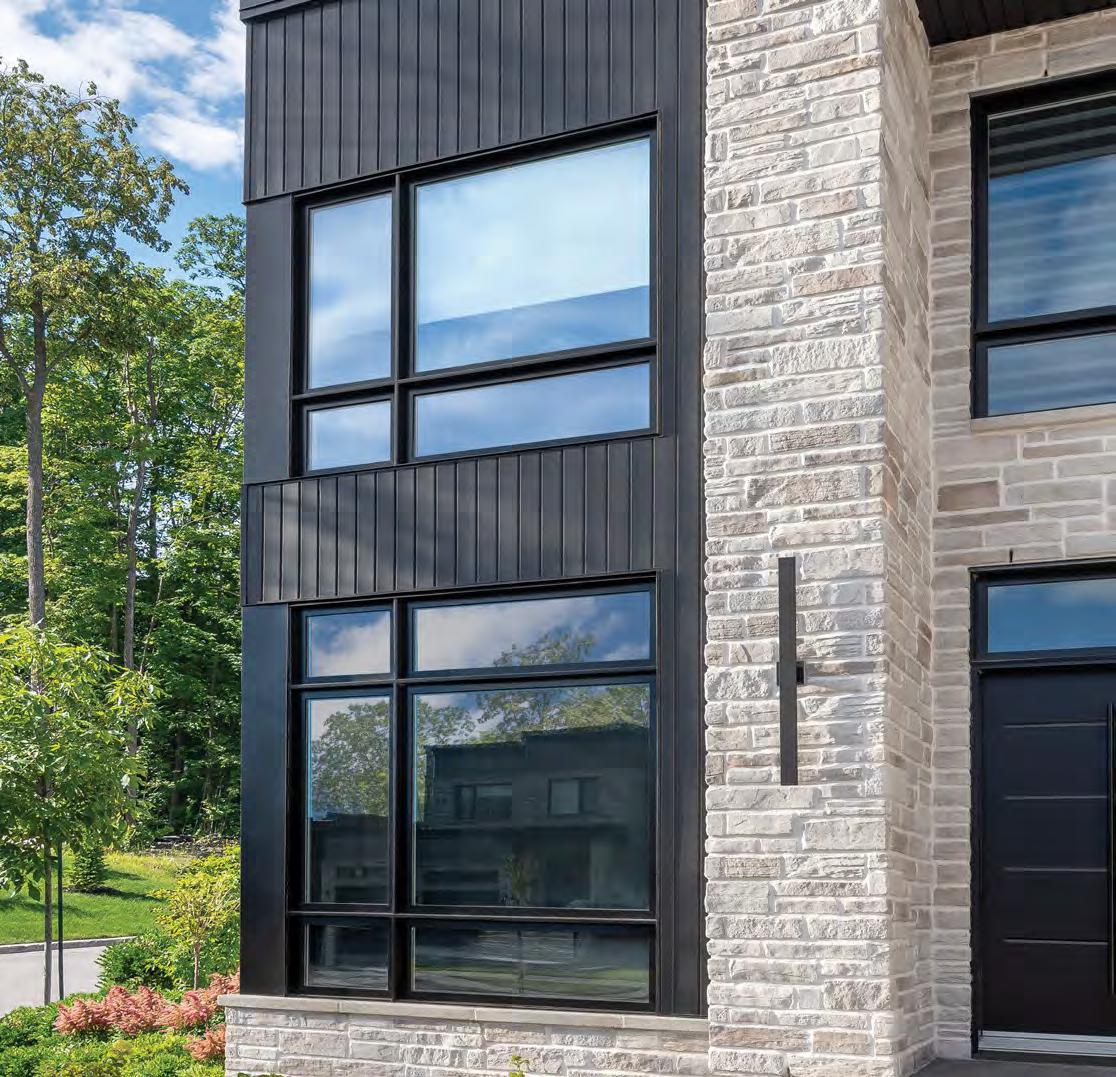
Spring brings light, renewal, and the promise of fresh beginnings. With JELD-WEN’s Canadian-made windows and doors, your home opens up to the season, welcoming brighter days, crisp breezes, and the beauty of nature in full bloom. Designed for Canada’s ever-changing climate, our products offer lasting performance, energy efficiency, and timeless style that help your home feel vibrant and comfortable, inside and out.
Choose JELD-WEN for craftsmanship that lets every season shine, especially this one.
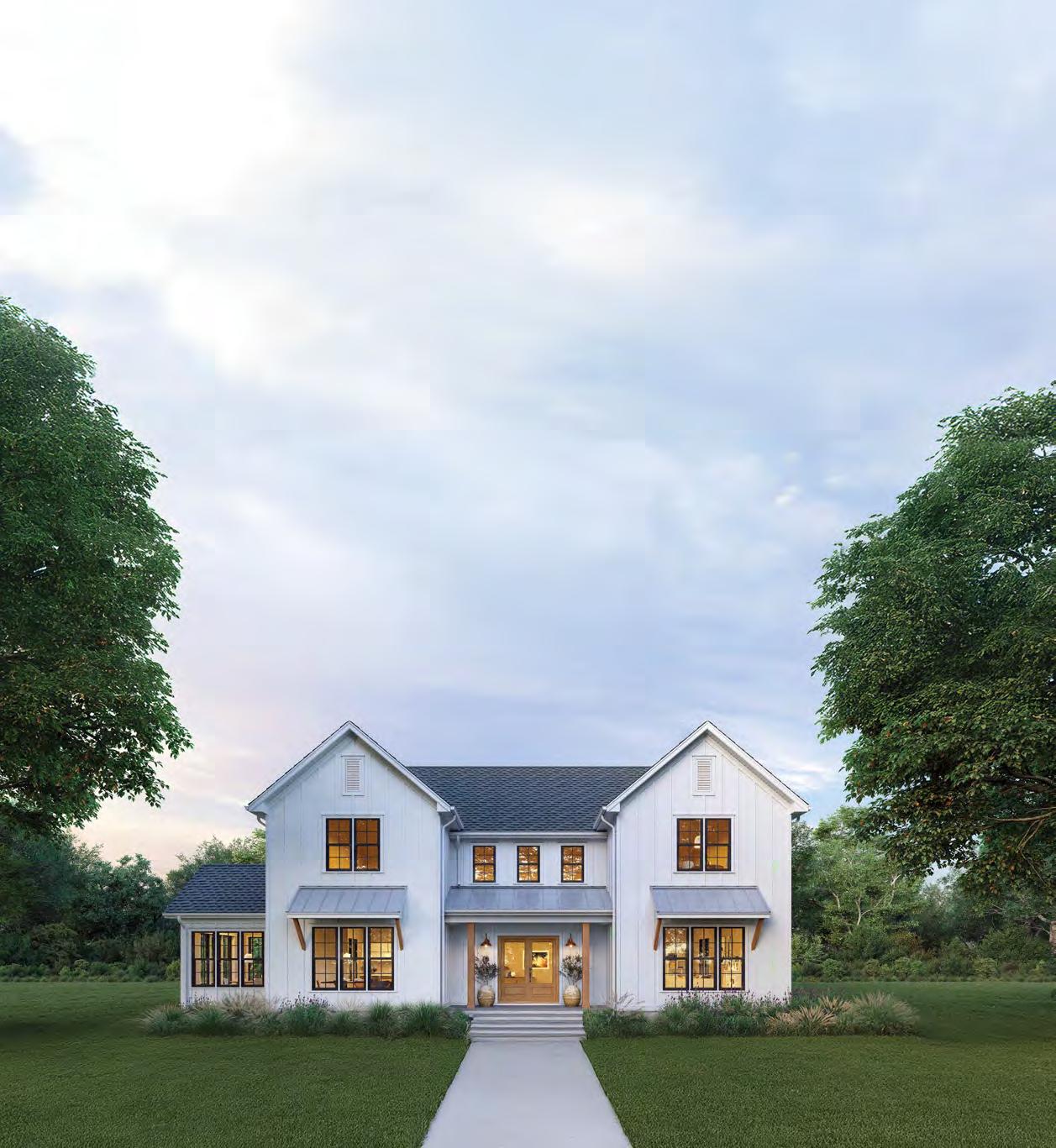

EXPLORE OUR FULL LINE OF CANADIAN MADE ENERGYEFFICIENT WINDOWS AND DOORS AT JELD-WEN.CA


People
Competition for the electrical grid is about to heat up

What Keeps You Up at Night?
Builders share their stresses in a no-holds-barred survey
P38 Uncommon Ground
A consolidated conservation authority map could solve many delays, but create new ones P31

9 Association News
A look at the dramatic impact of lower new-home sales on the economy from policy-driven contractions, building what's next with Futures Faster pilot programs for real-world innovation, and all the reasons you need to join the 2026 Enerquality Building Innovation Forum Awards before spots fill up.
13 Inside Storey
Sorting out strategies for above-grade wall renovations with building science expert Trevor Trainor.
17 Trending
From high-tech ovens and white brick to sleak, black water heaters, here's what’s new in industry products and services.
49 Building Buzz
Global housing challenges mirror Ontario's, an affordable housing blueprint, an AED rules reminder, and the new National Model Codes is out.
54 Chapter Spotlight
13 municipalities means a busy schedule for Chuck McShane and the Niagara Home Builders' Association.

ON THE COVER
Working with Ontario's conservation authorities is about to change. Is it for the better?

EDITOR
Ted McIntyre ted@laureloak.ca
ART DIRECTOR
Ian Sullivan Cant
CONTRIBUTORS
Tracy Hanes
ADVERTISING
Cindy Kaye, ext. 232 cindy@laureloak.ca
PUBLISHER
Sheryl Humphreys, ext. 245 sheryl@laureloak.ca
PRESIDENT
Wayne Narciso
PUBLISHED BY
Laurel Oak Marketing Ltd. laureloak.ca

onhomebuilder.ca





Take a photo of our QR code and sign up for digital updates and news!
Ontario Home Builder is published six times per year (Winter, Spring, Pre-Summer, Summer, Fall, Awards).
Al l r ights reserved. No part of this magazine may be reproduced without the written consent of the publisher. © 2026
For address corrections please email info@laureloak.ca or phone: (905) 333-9432.
Si ngle copy price is $6.00
Subscription Rates: Canada $16.95 + HST per year, Order online at https://www.laureloak.ca/subscribe.
CANADIAN PUBLICATION MAIL AGREEMENT NO. 42011539 ISSN No. 1182-1345




From materials to support, we help you build and improve with
We are more than great products. Through our close collaboration with leading building products manufacturers, we bring you advanced interior and exterior solutions. Get the products, service, and support you need to build client satisfaction, reinforce your reputation, and enjoy tangible jobsite advantages.
• More sustainable solutions built for today and ready for tomorrow
• Transparent pricing to help balance cost and quality
• Comprehensive building material assemblies that simplify building envelope planning
• Streamlined documentation hub where docs and specifications are in one location
• Access to documents and drawings in your preferred format
• Expert guidance every step of the way
• Nationwide accessibility, local convivence with more than 55 years of experience, 22 branches and warehouses strategically located across Canada

The day starts with a plan. Then the job tests it. Weather changes, schedules shift. So you adjust, problem solve, and move forward, because stopping isn’t an option. Your experience and skill will make a difference for years to come. The work depends on you. Choose partners you can count on.
ONTARIO’S HOUSING MARKET is no longer experiencing a typical cyclical slowdown—it is facing a full-scale, policy-driven contraction. Over the past five years, Ontario has recorded the steepest decline in new-home sales in Canada, along with significantly lower housing starts and completions. The data is clear: this is not a temporary dip; it is the result of cumulative policy decisions that have increased costs, constrained supply and undermined market confidence.
The consequences of this breakdown are now reverberating well beyond the residential construction sector. In 2025, new-home sales in Ontario fell to just 14,000 units—a staggering drop from the five-year average of approximately 50,000 annual sales. As a direct result, the province collected $2.4 billion less in provincial sales tax (PST) revenue from new housing than in previous years.
When combined with declining Land Transfer Tax revenues and lower personal income tax receipts due to widespread job losses in the sector, provincial revenues tied to home construction dropped by an estimated $4.4 billion in 2025 alone. Similar losses are projected in the years ahead if current conditions persist.
This should serve as a wake-up call. Housing is not only a social necessity—it is a primary economic engine for Ontario. When the homebuilding industry slows, the impacts ripple through manufacturing, skilled trades, professional services, transportation, retail and municipal finances.
Eliminate the PST on the first $1M of all new home sales and significant renovations in Ontario for at least 3 years.
The employment impacts are already severe. In June 2025, OHBA, drawing on Altus Group research, warned that 40,000 industry jobs were at risk over the next two to three years. CHBA’s recent Housing Market Index confirmed that nearly 20,000 residential construction jobs were lost in 2025 alone. If current market contractions continue, Ontario could see up to 100,000 jobs disappear over the next five years—50,000 direct construction jobs and another 50,000 in related sectors.
These losses are not inevitable—they are the predictable outcome of policies that have layered taxes, fees and regulatory delays onto new housing. Government cannot tax, regulate and fee its way to affordability while expecting supply to grow.
Ontario urgently needs a coordinated strategy focused on restoring project viability. That means reducing the tax burden on new homes, addressing escalating development charges, streamlining approvals, and creating conditions that encourage investment rather than deter it. A PST exemption for all new housing construction and substantial renovations would be a good way to make homes more affordable.
Housing policy is economic policy. If Ontario is serious about protecting jobs, stabilizing revenues and restoring affordability, it must take decisive action now to get homes built again.

Are you one of the builders shaping the future of Ontario's homebuilding industry?
This year, the spotlight is brighter than ever. The 2026 Enerquality EQ Awards called for submissions that reflect the highest standards in homebuilding, the work that sets your organization apart. Whether you’ve built a highperformance home, delivered an outstanding renovation, or launched a breakthrough initiative, this is your moment to capture industry recognition and elevate your brand. A win doesn’t just shine on stage, it becomes a powerful badge of credibility, strengthening every proposal, every conversation and every client relationship that follows.
And for innovators ready to take the stage, The Innovation Gauntlet returns with even more energy. This live, high-impact pitch experience invites bold thinkers to present their most compelling products, technologies or solutions in a fast-paced, Dragons’ Den–style showdown. It’s dramatic. It’s engaging. It’s where big ideas meet big opportunities.
Whether your company entered the EQ Awards, taking the stage to pitch in the Innovation Gauntlet, or attending the Building Innovation Forum event, one thing is certain: the industry will be watching. So ask yourself, ‘Is your next big win waiting here?’
Step forward. Be recognized. Be BIFA26!

Through the OHBA Futures Faster Program, OHBA continues to pilot targeted learning streams that address the realities facing Ontario’s residential construction industry, from housing supply and regulatory complexity to workforce readiness and innovation.
The following specialized streams and micro-credential courses are designed to be practical, applied and immediately relevant, giving members the tools and confidence to navigate a rapidly evolving housing landscape.
Leveraging content from partners like NRCan LEEP and the Institute for Catastrophic Loss Reduction, Trevor Trainor is working with the Futures Faster team to combine climate resilience with energy efficiency and building science to develop an introductory course focused on resiliency. Participants will work collaboratively to identify climate-risk priorities and map them against code requirements, reframing regulations as tools for creating high-performance housing.
The session will be piloted through a collaborative workshop in partnership with Sustainable Buildings Canada, as a kickoff event to the First Nations Housing Conference in Thunder Bay on Feb. 23.
Developed with ReHousing, this new micro-credential addresses a critical industry need: understanding what is realistically feasible on an existing residential lot.
In a short, applied format, participants learn how to interpret zoning permissions, navigate interactive zoning maps, understand key Ontario Building Code thresholds (Part 9 vs. Part 3), and identify viable small-scale housing project types. The focus is on real-world decision-making, not theory. The goal is to inspire greater confidence at the earliest stages of a project, helping builders, renovators and housing professionals reduce risk, avoid costly missteps and identify opportunities more efficiently. As interest in infill, gentle density and smallscale development grows, this credential provides a scalable, practical foundation for the industry.
BBBC-Pro offers a unique opportunity to upskill, build confidence, and accelerate professional growth in the building sector.
The Better Buildings Boot Camp-Pro (BBBC-Pro) stream is a rare opportunity to gain hands-on experience with a high-performance retrofit project while learning directly from leading sustainability and building performance experts. Participants directly apply what they’re learning to a real-world building project, guided by mentors who have designed and delivered high-performance homes and retrofits across Ontario.

Our Better Buildings Boot Camp, led by Sustainable Buildings Canada, paired seasoned mentors/Subject Matter Experts with mentees/industry early career professionals in weekly learning sessions centred on a real-world high-performance retrofit project.
Grounded in the Integrated Design Process (IDP), this six-week learning experience provides early-career professionals with practical exposure and applied knowledge across five core areas of building performance: goal setting, energy modelling, building envelope, mechanical systems and human considerations. Each topic builds on the next to create a comprehensive understanding of an actual high-performance retrofit project. Through guided mentorship and collaborative problem-solving,
Led by the team at Realist.ca, the Multiplex Stream focuses on unlocking small-scale, multi-unit housing opportunities that sit between single-family homes and large developments. Through virtual workshops and a capstone experience, participants gain real-world insight into how multiplex housing can be successfully delivered on existing residential lots.
Working closely with mentors, participants built practical skills and industry connections to support their entry into multiplex investing. The stream covered zoning and building code pathways, investment fundamentals and construction execution, showing how these elements come together on live projects. By reducing early-stage uncertainty and strengthening feasibility decisionmaking, the Multiplex Stream equips builders and developers to respond confidently to growing demand for attainable housing. As municipalities continue to encourage gentle density, this stream prepares industry professionals to lead—rather than react—to change.
In just eight months, OHBA Futures Faster has generated strong momentum, with early outcomes already emerging from participants across the program. OHB
NEED APPLIANCES FOR YOUR PROJECT? DO IT RIGHT WITH ONTARIO’S HOME TEAM.

C OMMERCIAL SALE S
Doing appliances right with a partner in your own backyard has never been easier. Founded in Stoney Creek, Ontario, we’re 100% dedicated to removing the appliance burden from your projects. Our responsive team will be there every step of the way from qualifying your needs, to dealing with your clients, to facilitating a smooth onsite delivery and quickly correcting issues. Do appliances right with Goemans and scan the code to connect with an experienced Commercial Account Manager.
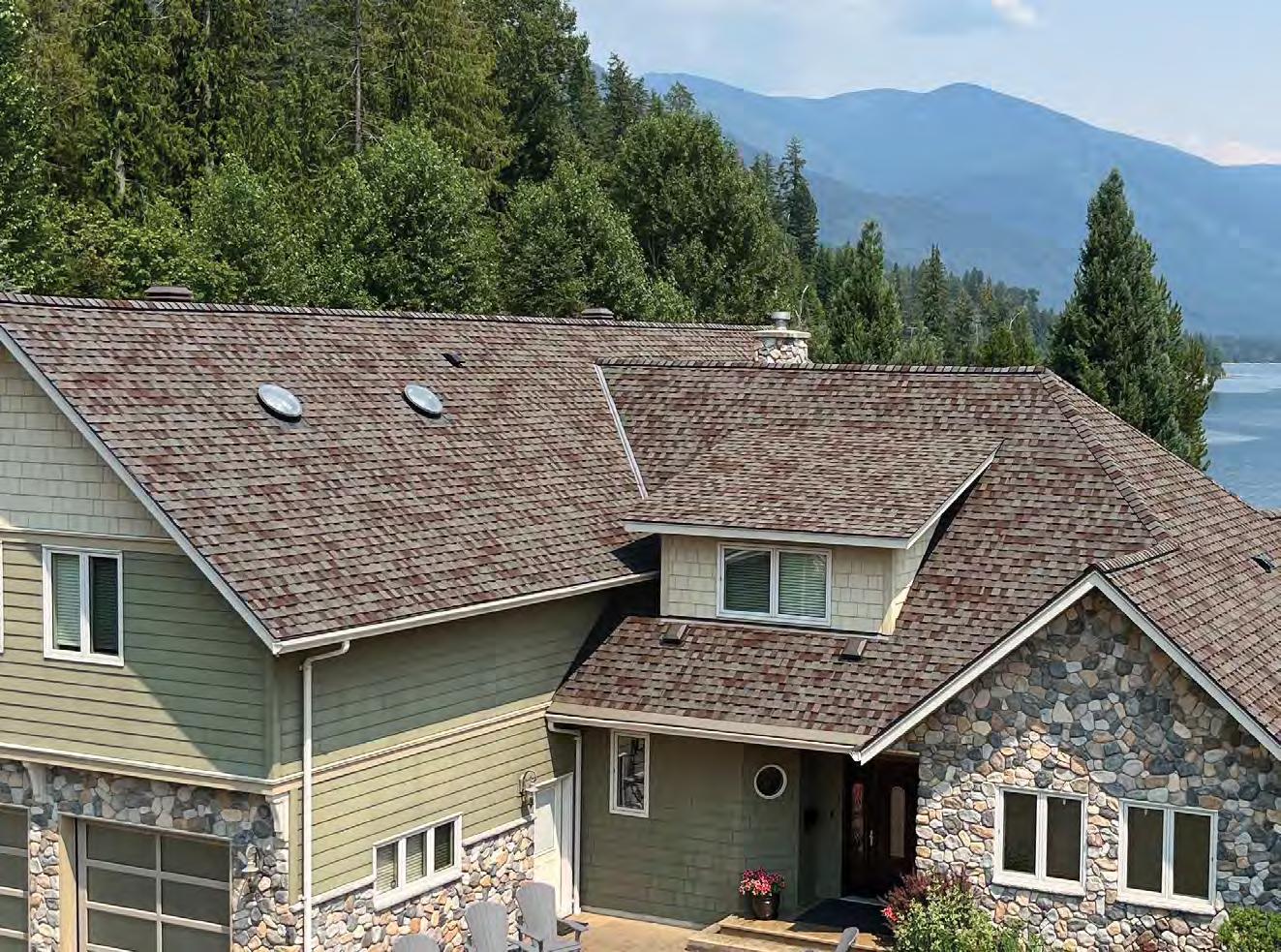


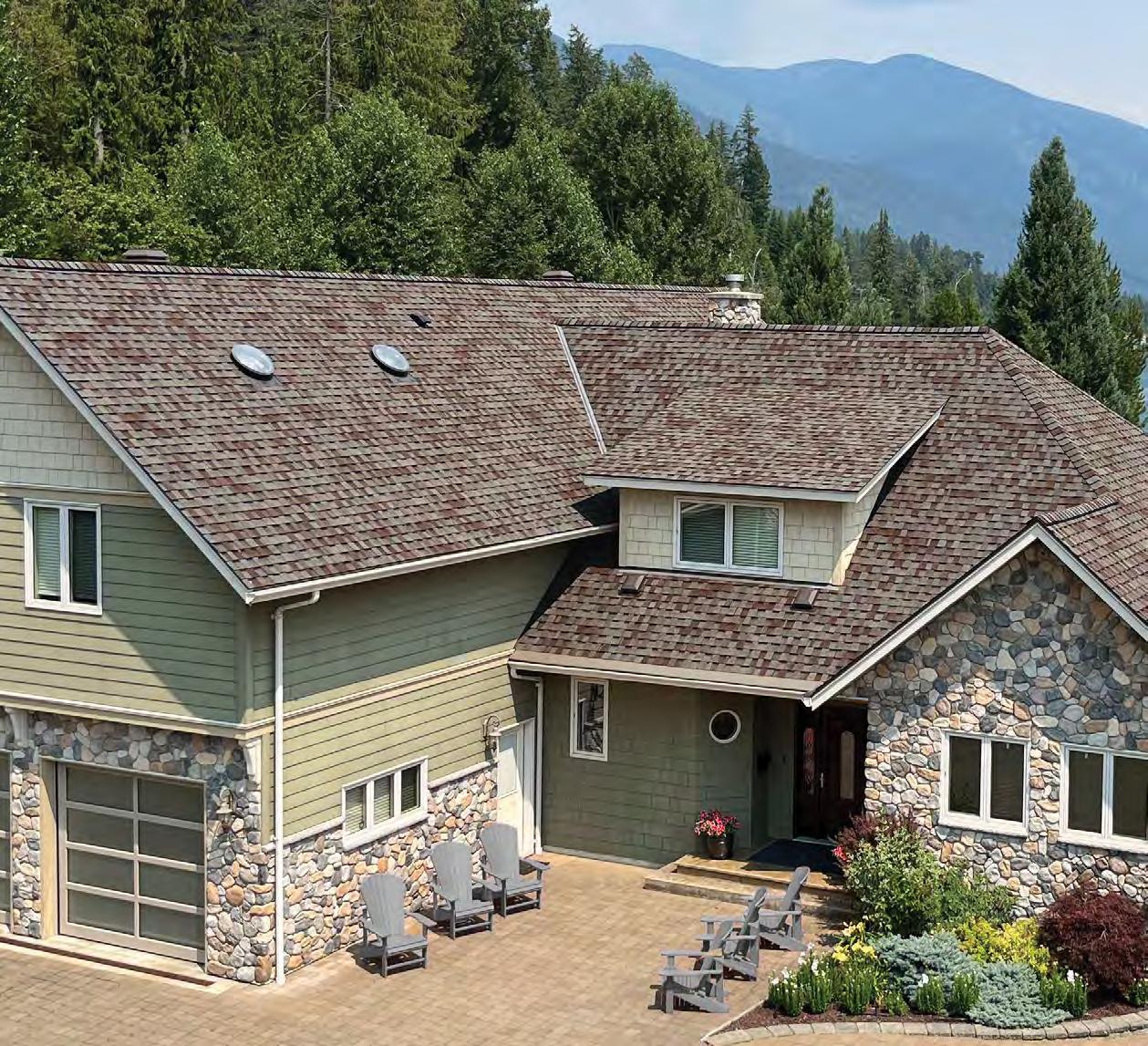







































When trust is on the line, every detail matters. Signature shingles are engineered for durability, performance, and style, even in Canada’s toughest conditions. With proven technology and premium colour blends, you deliver more than a roof — you give your clients peace of mind. Signature. Because peace of mind starts at the top.















By Ted McIntyre with Trevor Trainor
THESE ARE LEAKY TIMES for many Ontario houses, and above-grade walls are often the weak link. Through CHBA’s “Towards Net Zero Renos” initiative, about 350 units in 13 municipalities nationwide have been tracked so far to see what actually works when renovators open up real walls instead of detailing them on paper.
For Stratford-based building scientist Trevor Trainor, President of Bawating Building Science, those questions are personal. He has turned his own home into a test bed for exterior insulation, while advising project teams across the province on above-grade wall retrofits.
OHB: You’ve worked on remote dwellings in Nunavut. What drew you to Ontario net-zero renovations?
TREVOR TRAINOR: “My firm was set up to focus on Indigenous housing in very cold climates, so early on I was


TREVOR TRAINOR PRESIDENT, BAWATING BUILDING SCIENCE
measuring wall and roof performance in the far north. It’s a brutally honest test environment—if a detail is weak, the climate tells you quickly. At the same time, I live in Stratford in an 80-plus-year-old house that looks a lot like older stock across southern Ontario. Over the last two summers, my son and I completed a full exterior insulation retrofit and electrification of the house. Having both the northern research and a live Ontario project under my own roof showed how the same building science principles apply across the province, just with different constraints and costs.”
What’s the opportunity with respect to Ontario’s above-grade walls?
“It’s enormous. Canada has over 9 million detached dwellings; roughly half are more than 60 years old, and about 20% are over 80. A lot of those are in
Ontario, and many have good structure but very weak enclosures. Residential energy is roughly 18% of national greenhouse gas emissions, so improving these walls is low-hanging fruit.
“Another great thing about working on the building enclosure in an energy retrofit is that we have the opportunity to improve other areas of the building, including water control, airtightness and other issues related to the durability of our homes.”
Ontario’s stock runs from double brick to 2×6 framing. How do you sort out wall strategies for all of them?
“Step one is to name the archetype. In Toronto and older cores of Hamilton, Stratford or Ottawa, you’ll see a lot of pre-WWI and immediate post-war load-bearing masonry—double- or triple-wythe brick doing the structural work. Next come post-war 2×4 houses, generally with little or no insulation, and finally 1980s and ’90s 2×6 houses with poly vapour barriers and better batts.
“They all behave differently when you insulate. With load-bearing masonry, you’re changing how the brick handles moisture and freeze/thaw, not just the R-value, which is critical in Ontario’s

Our Contemporary Series clay brick taps into today’s trends with clean lines and less pronounced textures. Its smooth faces and clean edges pull inspiration from modern architecture, combining sleek looks with a full colour palette developed to coordinate with many of our stone veneer products.
climate. With 2×4 and 2×6 homes, the structure is simpler, but you’re working around unknown cavity insulation, leaky air barriers and aging exterior finishes. The principles are consistent, but the assemblies should be tuned to the house you’re standing in.”
For climate zones 5 and 6, what wall performance are you aiming for?
“Under CHBA’s Net Zero Ready framework, in climate zones 5, 6 and 7— which covers most of Ontario south of the Shield—above-grade walls are targeting an effective R-value around 17.5. ‘Effective’ is key; you have to account for thermal bridges through studs, plates and attachment systems, and not just label R-values.
“There are lots of ways to get there. You can upgrade cavity batts and add a modest interior layer, or leave the inside alone and add continuous exterior insulation. For many Ontario 2×4 houses, a practical target is to bring cavities up to about R-14 and add R-6 to R-10 continuous insulation on the outside, depending on the starting point and budget. That gets you to the number and lets you upgrade air- and water-control layers from the exterior.”
Double brick in Toronto and similar markets is always a concern. How do you think about interior versus exterior insulation there?
“First, remember how those walls have been working for a century. A triplewythe brick wall might only be about R-4, but it manages rain by absorbing and safely storing moisture, then drying mostly to the outside. It also relies heavily on interior plaster as an accidental but often very effective air barrier.
“When you insulate, you change both temperature and moisture in that brick. Exterior insulation warms the masonry and, when paired with a new waterresistive barrier, keeps it drier, lowering freeze/thaw risk. Interior insulation tends to make the brick colder for longer and can slow drying if exterior moisture loads haven’t been reduced. In a climate with lots of freeze/thaw cycles, that can push marginal brick over the edge.
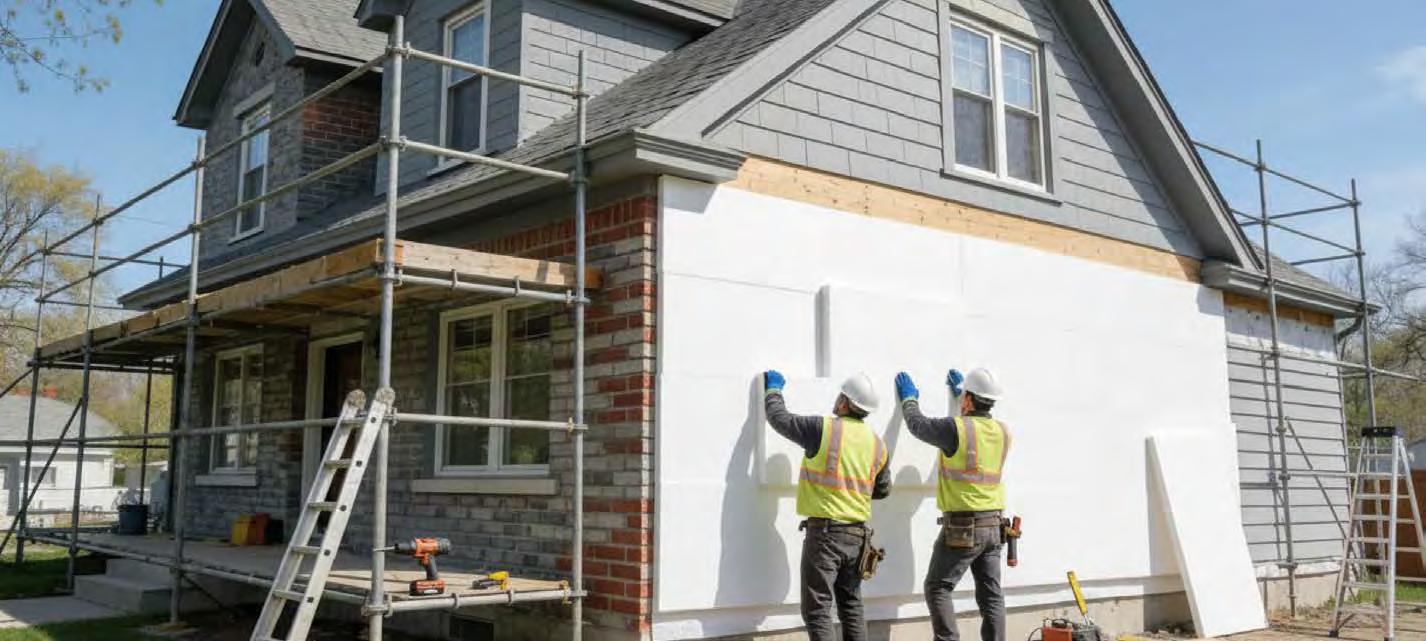
“So where access and heritage rules allow, exterior insulation with overcladding or EIFS (Exterior Insulation and Finish System) is usually the better durability move for double-brick houses. If you’re forced inside, you
need to be very careful about insulation thickness and airtightness, and think through how you’d reverse the assembly if you start seeing damage
What are your go-to strategies for the more typical Ontario 2×4 house?
“For 2×4 walls, things get easier. Many pre-1970 houses have either empty stud cavities or thin, low-performing fibreglass. If we’re working inside and trust the cladding and water details, an option is to strip interior finishes, refill or upgrade the cavity to about R-14, install a new continuous air-vapour barrier, and add a modest interior layer—say R-6—in front of it. That could be mineral wool board, a short service wall or foam board. You meet the effective R-value target and get a clean air barrier, but you lose some floor area and still rely on the existing exterior for water control.
“From the exterior, which is attractive if you’re recladding anyway, you can either top up the cavity and add R-6 to R-10 continuous outboard, or keep the existing R-10 batts and add roughly R-10 outside. That lets you treat housewrap as both an air- and a watercontrol layer, reduces thermal bridging and condensation risk, and leaves interiors intact. The tradeoff is access on tight lots and detailing around overhangs, windows and decks.”






Homeowners don’t ask for R-17.5 walls; they ask for comfort and quiet. How do you translate wall details into benefits they can feel?
“The line that seems to resonate is that ‘your house stops feeling like a series of different climates.’ In our Stratford retrofit, once we had continuous exterior insulation and good airtightness, every room felt similar in temperature, even ones that were chronically cold or drafty.
“Sound is the other big one. When you increase R-values, tighten the air barrier and upgrade windows, the drop in traffic or rail noise is dramatic, whether you’re near a GO line or just a busy road. People pick up on that the moment they walk into a finished project.
“The last piece is resilience. In Ontario shoulder seasons and winters, a well-insulated, airtight wall helps slow indoor temperature swings during outages or equipment failures. That buys homeowners time and peace of mind when something goes wrong.” OHB
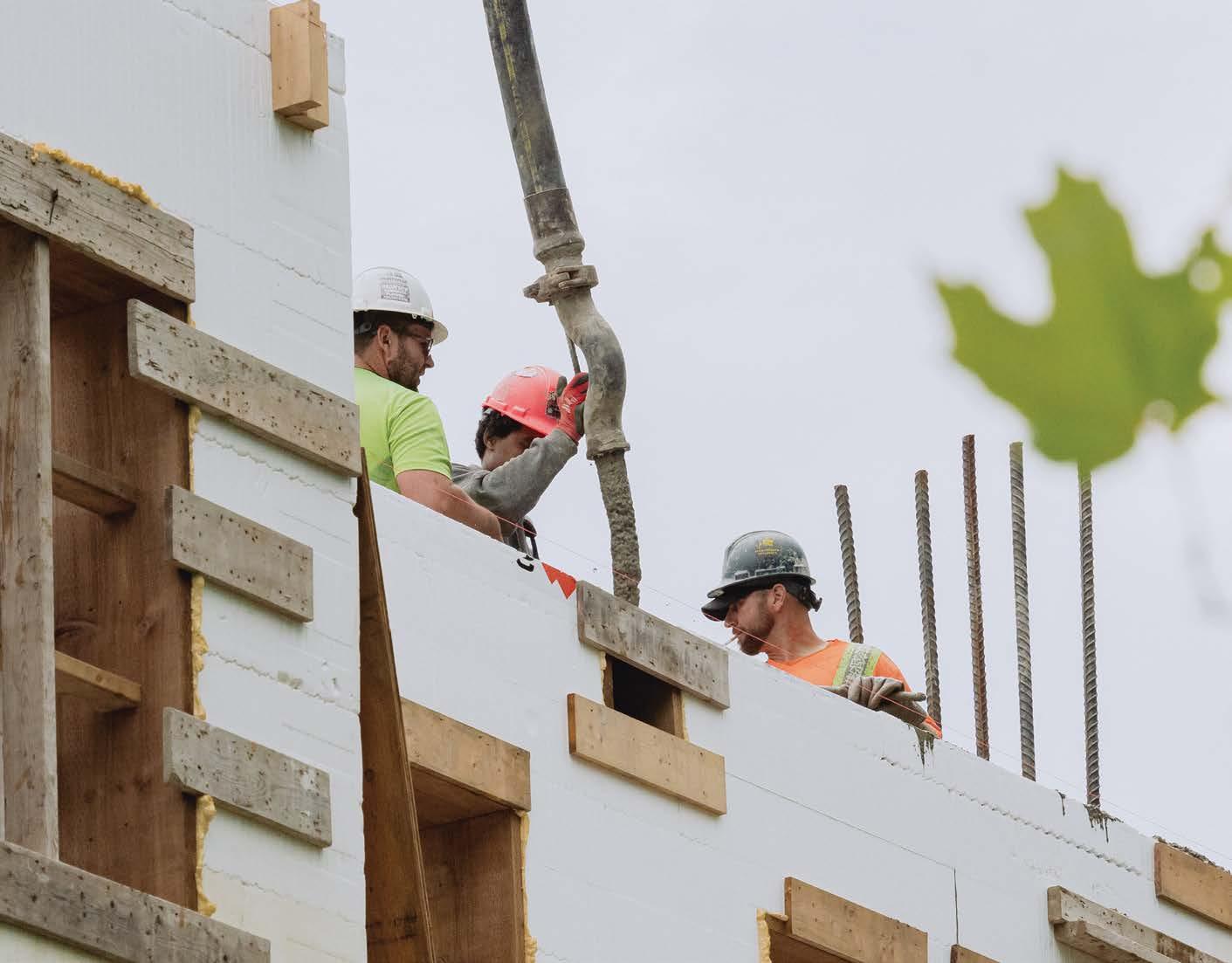
Amvic™ Insulated Concrete Forms (ICF) are a stay-in-place, 5-in-1 concrete forming system incorporating structure, insulation, an air/vapor barrier and a finish attachment to create a cost-effective, resilient and environmentally friendly construction system. Amvic™ ICF is revolutionizing modern construction and changing the way we build for a greener tomorrow.
FormLockTM interlock: Patented interlock with moisture drain system
Quick & easy installation: Reduces waste & increase job site efficiency
Embedded cross-ties: Two diagonal cross ties which virtually eliminate the chance of blow out
No tying required: Built-in rebar holders eliminate tying
Multiple block types:
Including straight, 90° corner, 45° corner, taper top, t-block, brickledge & radius blocks




























Afull-sized,flush-fitting, precision-cookingline of30”ovens P.24

JELD-WEN of Canada’s new JWC8500 Hybrid Window is a stylish, high-performance upgrade to its 8500 series, perfect for residential builds. This vinyl window features a durable aluminum-clad exterior in multiple colours, ideal for Canada’s harsh weather. It offers lowmaintenance reliability, a sleek, low-profile frame, and up to 22% better energy efficiency for any home, 2030rated to meet Canada’s ER of 44. JELD-WEN.COM

Available in April, GE’s new Profile Smart Refrigerator, unveiled ahead of CES 2026, transforms kitchens into intelligent hubs with its Kitchen Assistant features. A built-in barcode scanner adds items to a shareable SmartHQ app list, syncing to Instacart, while FridgeFocus cameras snap realtime crisper drawer views to curb waste and overbuying. An eightinch touchscreen delivers monthly recipes and weather


friendly efficiency, with up to 17.2 SEER2 and 8.5 HSPF2 rat ings. Noticeably quiet at 45 dBA, 53% lighter and 40% smaller than cube units, they fit tight spaces needing just 4” clearance. Handle -23°C to 46°C climates with smart defrost, hot start and R-32 refrigerant for reliable heating/cooling. GOODMANMFG.COM
GEAPPLIANCES.CA
Navien’s new NWP500 Series Heat Pump Water Heater is now shipping across Canada, delivering ultra-quiet, energy-efficient performance with smart wifi connectivity. Featuring a durable stainless steel tank, five operation modes and a sleek matte finish, it’s installer-friendly and Red Dot Design Awardwinning. Available in 50, 65 and 80-gallon models, the NWP500 is built for modern homes and a greener future. NAVIENINC.CA

Hybrid HVAC systems are gaining traction as builders respond to rising energy costs and sustainability demands. Napoleon Hybrid Heating combines a cold-climate heat pump with a gas furnace, automatically selecting the most cost-effective energy source based on real-time conditions. The result: lower homeowner operating costs, reduced emissions and smart-home integration. Offering key differentiators in competitive housing markets with dependable performance year-round. NAPOLEON.COM



























Porter & Charles expands its premium built-in lineup with a new 30” full-size oven designed for modern Canadian homes. Featuring a flush-fit design, pyrolytic selfcleaning, and a built-in meat probe for precision cooking, it delivers both performance and flexibility. The oven is part of a coordinated suite that includes a matching 30” speed oven with air-fry technology, offering builders a refined, project-ready solution.
PORTERANDCHARLES.CA/ BUILDER-SERVICES

DeWalt’s Powershift 12” Cut-Off Saw, which debuted at World of Concrete 2026, is the industry’s most powerful cordless model ever, outpacing gas saws. Slice up to 4.75” deep through concrete, rebar and ductile iron, or make up to 156 #5 rebar cuts or eight linear feet of deep concrete per charge. Ideal for residential foundations, with an electric brake for safety, it is gear-driven with base wheels for precise angles. DEWALT.CA
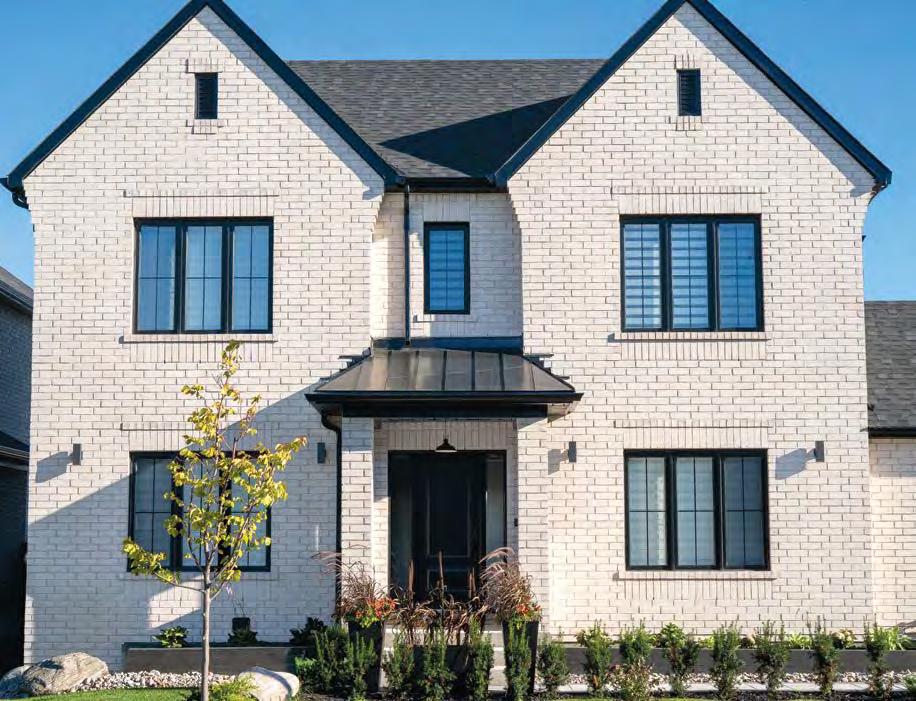
White brick continues to define modern home design with its clean, bright aesthetic and timeless appeal. A standout option is Nordic Matt from the Contemporary Series by Brampton Brick, featuring a velour texture and subtle finish for a refined, contemporary look. Stocked in Premier Plus-sized brick, it’s an ideal choice for achieving understated elegance with lasting impact. BRAMPTONBRICK.COM
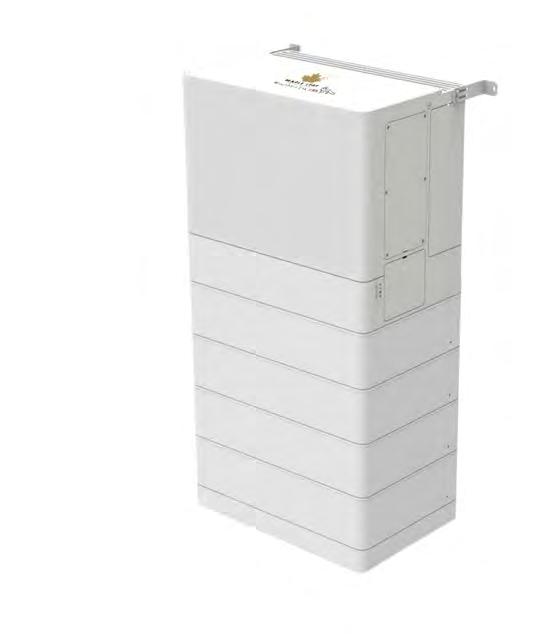
Martino HVAC’S new Fox Energy Storage Systems (ESS) deliver dependable backup power while slashing peak demand charges and energy costs. Homeowners charge at night during low rates and discharge during high daytime peaks, often eliminating the need for traditional gas generators with clean, quiet operation. Backed by trusted local HVAC experts since 1987, ESS integrates seamlessly—no fuel, no emissions and no downtime. MARTINOHVAC.COM
We build Ontario’s most skilled workforce, and they build Ontario.




By Tracy Hanes

In the hush of Ontario’s home building slowdown, grid planners are catching their breath before the electrification surge hits like a perfect storm.
Over the next 25 years, demand for electricity in Ontario is expected to rise 75%. Imagine adding four-and-a-half Toronto-sized cities to the provincial grid, and you get the picture. The industrial sector will be the main driver, with demand expected to increase by about 40% over the next five years. That’s due to factors such as data centres and additional manufacturing in the electric vehicle supply chains. Data centres, which support artificial intelligence, cloud computing and digital services, are highly energy-intensive and at least 16 are seeking to connect to the province’s grid within the next decade, according to the Independent Electricity System Operator (IESO). They are expected to represent 13% of new electricity demand in Ontario by 2035, according to the provincial government’s Energy for Generations report, released in June 2025.
How does the residential construction and renovation industry factor in this ‘powering up’? Can the grid support the coming demand from housing and other industries, especially with climate targets, utility incentives and changing codes anticipated to drive more electrification of new and existing homes?
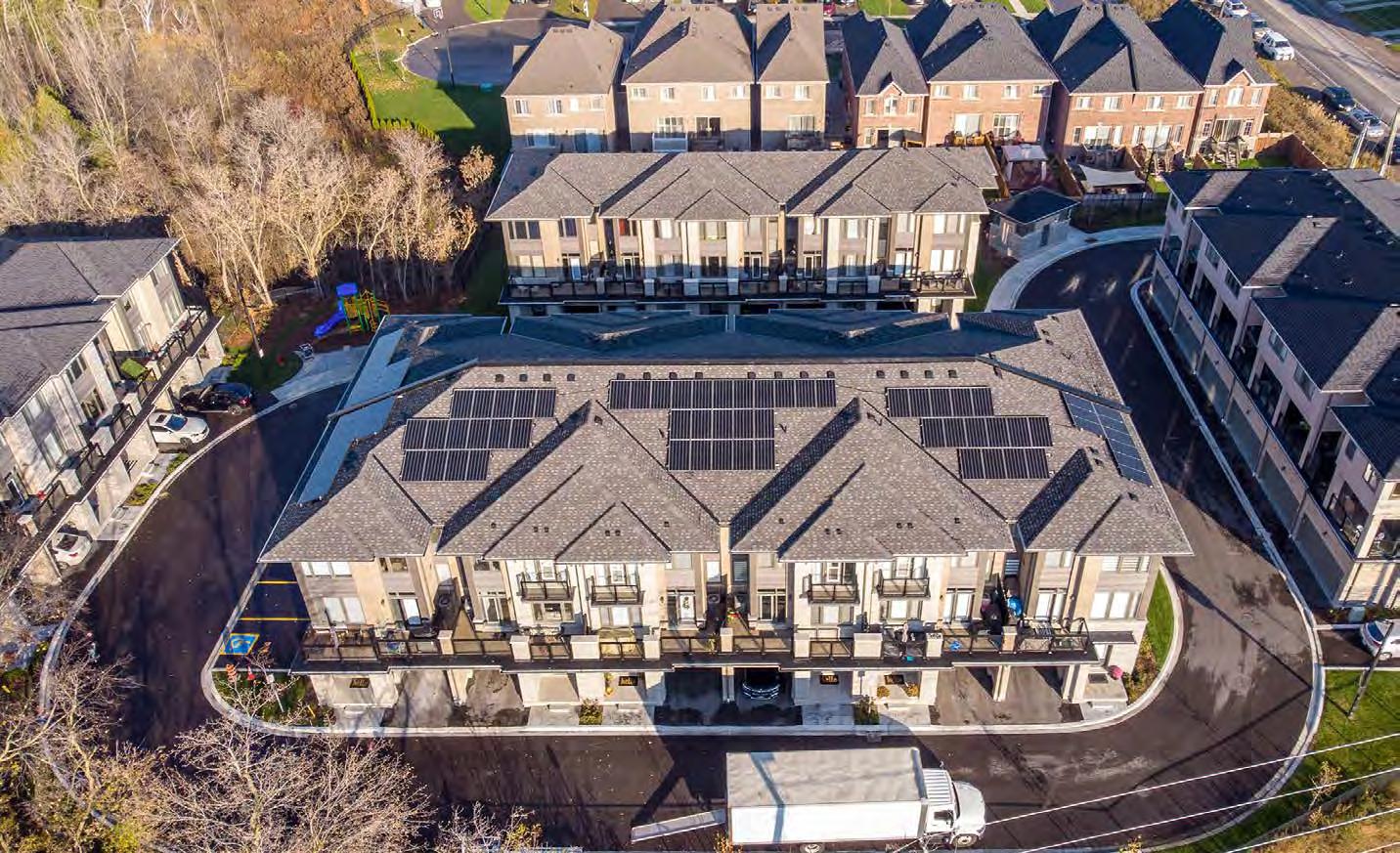
Ontario is expected to add a million more homes by 2035, according to the Canada Mortgage and Housing Corporation. That will account for 9% of the new electricity demand, according to the IESO, which operates the province’s power grid. Lesley Gallinger, president and CEO, says the IESO has enough supply to meet Ontario’s needs through the end of the decade. But it’s accelerating the pace of new electricity infrastructure to support continued growth into the 2030s.
The provincial government and IESO work with sector partners and engage with communities to plan for current and future electricity needs. They believe supply can meet demand. But a C.D. Howe Institute 2024 research report, Mind the Gap: The Impact of Budget Constraints on Ontario’s Net Zero Plans, and some in the housing industry aren’t as confident.
“It depends on where you are building, the infrastructure, and a lot of it will be dependent on utility planning,” says Miyoko Oikawa, Director, Training
and Strategic Initiatives for the Ontario Home Builders’ Association. “It becomes a question of how we are calculating future loads and transformer sizes for communities.”
The Ontario government has introduced a long-term energy plan, including Bill 40 (Protect Ontario by Securing Affordable Energy for Generations Act), to expand transmission, support nuclear and add storage so the grid can handle growth from housing, EVs and data centres. Priority projects include new and upgraded lines serving the GTA, Windsor–Essex and Central Ontario, with Hydro One leading development after public and Indigenous consultation. The plan also continues to treat nuclear as the backbone of supply through reactor refurbishments and new small modular reactors, complemented by large-scale battery storage projects intended to maintain reliability and control costs for ratepayers. Construction started in November on the new Skyview
2 Battery Energy Storage System in Leeds and Grenville, the single largest battery storage procurement in Canadian history. It will provide enough capacity to power nearly 400,000 homes.
These plans hinge on local utilities, as Oikawa notes. Despite new transmission lines and nuclear expansion, power must reach homes via Ontario’s 59 Local Distribution Companies (LDCs). The onus is on them to upgrade infrastructure—investing in substations, transformers, and digital tools..Some utilities have started working together to manage costs by sharing services and jointly purchasing equipment—others may still be working out how to achieve this.
Electricity Distributors Association (EDA) CEO and president Teresa Sarkesian says the IESO’s forecast of a 75% increase in electricity demand by 2050 will be a challenge
for distributors. Based on December 2025 data and an estimated 1-2% annual project growth over the next decade, Sarkesian says about half of all LDC customers will be in areas with capital challenges in 10 years, and 62% within 25 years.
“The EDA recommends policy and structural changes that are flexible and scalable to allow Ontario’s LDCs to access capital,” she says. Such changes are needed to allow LDCs to modernize the grid, and require collaboration with LDC regulators—the Ontario Energy Board (OEB) and the IESO.
The provincial government has a key role in reducing red tape, and one of the main issues is cost allocation around system expansion, Sarkesian adds. This is a significant issue for developers, and the EDA is working with them and the OEB to find an alternative funding approach to fund ing expansion without increasing costs for existing electricity customers.
says the credit for an occupied home would be slightly less, as the model home isn’t used for cooking and people don’t shower there. Despite supplying more energy than it uses, Martins still has to pay for hydro delivery and debt charges for the house. He says utility companies don’t have an efficient system for handling credits for power fed into the grid from homes’ solar systems,

Rick Martins, VP and owner of Huron Creek Developments, is one builder concerned that infrastructure is not keeping up with the move from fossil fuels to electricity if a significant number of homes go full Net Zero (NZ). And a data centre is planned for his area.
Martins has been building Net Zero Ready (NZR) and NZ homes, as “the writing is on the wall, and if you don’t adapt, you become dinosaurs.” His homes use NZR as standard, and he built an NZ model home in Elmvale last year that’s connected to the grid.
“I am worried, because our grid system is old and needs updating, and I don’t think there’s enough money out there,” says Martins, who isn’t ready to embrace full electrification in his homes. Martins was one of the first builders to use a combination natural gas/heat pump system in a stacked townhome project. When hydro rates are high, natural gas can be used for heating, and the system can be switched to the heat pump when rates are lower, as well as for cooling in summer. Martins uses a geothermal system at his own home, with natural gas backup.
His Elmvale model home’s solar array is connected to the grid and has earned a $1,800 hydro credit since it opened a year ago. Martins
and the value isn’t there yet.
According to a 2024 report by climate and energy consultant Heather McDiarmid for the Ontario Clean Air Alliance, the payback period for residential rooftop solar is 25 to 27 years for a 7.5 kW system (based on hydro rates rising 2% per year).
Communities with energy-sharing or district energy are not coming onstream in any big way either, Oikawa


Helsinki has found a way to turn one of the digital world’s biggest headaches into everyday comfort. Deep beneath the Finnish capital, the utility company Helen operates a system of heat pumps that captures waste heat from data centres—those energy-hungry hubs powering our online lives—and feeds it into the city’s district heating network. The result: affordable warmth for thousands of households and a meaningful stride toward carbon neutrality.
In this northern nation of five million people—and three million saunas—heat is part of the culture. So it’s fitting that Finland is redefining what sustainable comfort can look like. Instead of letting server heat escape into the air, Helen collects it, intensifies it through heat pumps, and circulates it to apartments and community buildings through an urban distribution network. Participating data centre operators such as Equinix and Microsoft save on cooling costs and infrastructure investments, while homeowners benefit from lower energy prices.
The impact is measurable. Helen’s data centre partnerships already provide heat for roughly 1,500 homes, with new projects expected to expand that number dramatically. The utility has even lowered its consumer prices twice in two years—proof that sustainability and affordability can coexist.
The promise for communities is equally compelling: less dependence on imported energy, reduced carbon emissions, and resilient heating that taps a local, renewable source—the excess warmth of the digital economy itself.
While Finland’s system relies on an established district heating grid, similar concepts could one day support Canadian communities. The lessons are clear: energy efficiency can grow through collaboration among builders, utilities and technology companies. Helsinki’s example shows that smarter heat management isn’t just an environmental goal—it’s a housing advantage.
notes. S2E’s EVE Park project in London, which will power 2,000 townhomes and apartments with a customdesigned microgrid, is “an innovation sandbox approach” that will facilitate the study of various products and systems that may eventually impact infrastructure. Research partners include the University of Waterloo and the University of Western Ontario, and the study is funded by the Federation of Canadian Municipalities and the Green Municipal Fund.
But Oikawa says concepts such as microgrids or community energy sharing, in which the builder could become a project’s utility, would require policy changes and a shift in the business model. That possibly could be profitable, she says, but not in the current slow market. And it’s difficult to predict which technologies will be available in the near future or what the uptake of
renewable systems will be..
In 2018, Marshall Homes built a 27-townhome microgrid community in Pickering, the first pre-planned smart-energy community in Ontario, in partnership with IESO, Opus One Solutions and Elexicon Energy, and funded in part by the IESO’s Grid Innovation Fund. It has been monitored for research into the benefits of a small, homeowner-shared power source (operated as a condo element). It augments the existing grid supply to reduce homeowners’ hydro bills and provides backup power during outages. Craig Marshall, president of Marshall Homes, says it’s complicated to do a project like this, time-consuming to plan, and improved technology is needed. He has not built micro-grids at any of his other developments.
Marshall also found that electrification isn’t yet possible in some locations. He had hoped to build
Ontario’s net annual energy demand is expected to jump from 157 TWh this year to 262 KWh by 2050. The residential market currently draws about 32% of that total (50.6 TWh). By 2050, however, it will have fallen to 24% of the province’s total demand (63.3 TWh out of 262 TWh). Other primary sectors are expected to increase by much higher percentages, with the transportation sector skyrocketing due to EV demand.
1
Data centres will represent 13% of new electricity demand in Ontario by 2035.
Industrial demand is forecast to grow 23 TWh (58%) by 2035, as new electric vehicle and supply chain facilities are constructed, almost equivalent to adding a city the size of Toronto to the grid.
3
Ontario’s households are expected to grow by 15% (1 million more homes) by 2035, accounting for 6 TWh, or 9%, of new electricity demand.
4
Electric vehicle adoption is expected to significantly reduce economy-wide emissions, but also represents the largest driver of increased electricity demand, accounting for 20 TWh, or 31% of new demand, by 2035.
5
Since May 2023, the IESO added more than 3,600 MW of new capacity to Ontario’s grid, which puts Ontario’s electricity system in a strong reliability position through the rest of this decade, it maintains. But additional supply will be needed in the 2030s and beyond.
6
Thanks to energy-efficiency programs, provincial energy demand is 15% lower today than it would otherwise be.


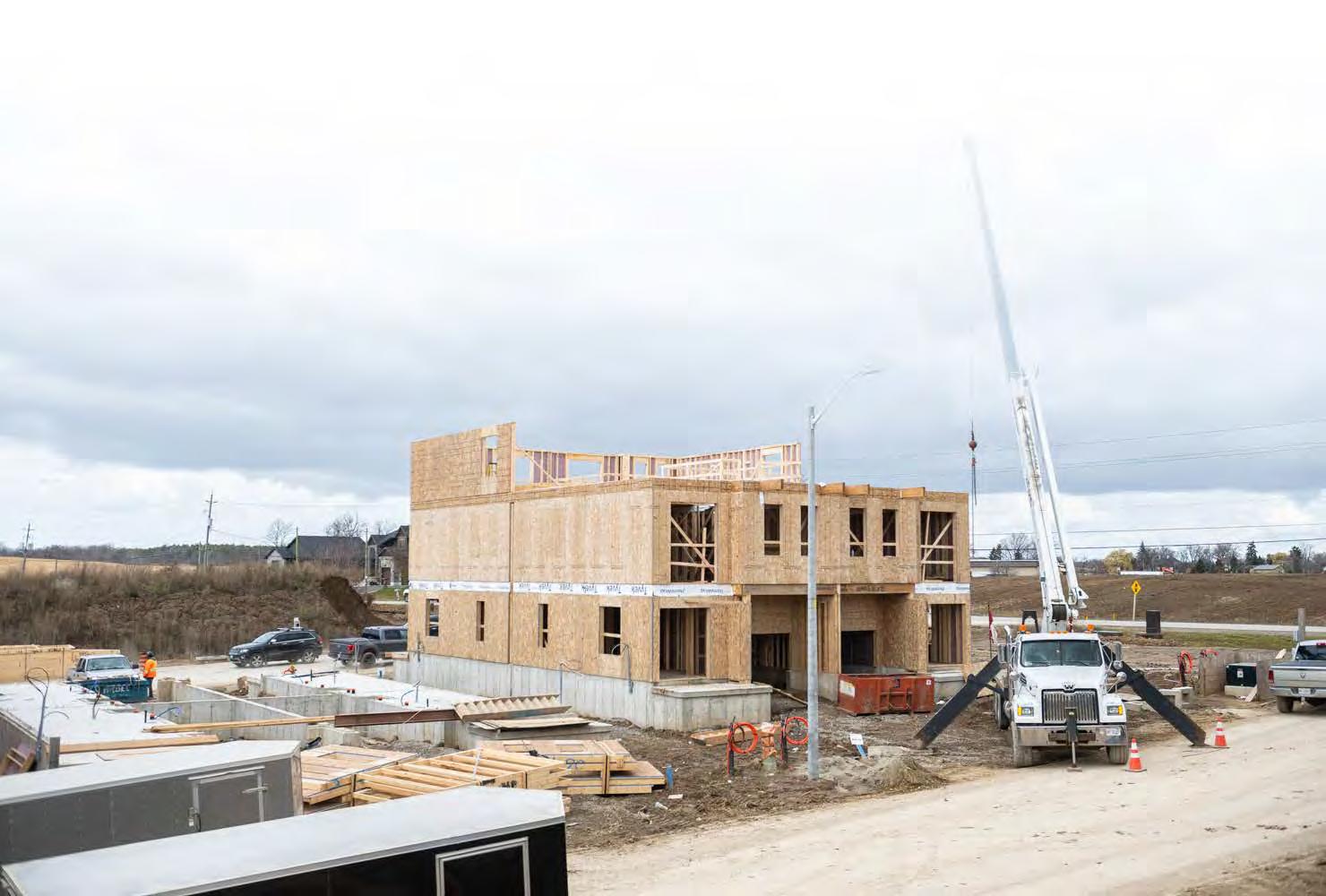

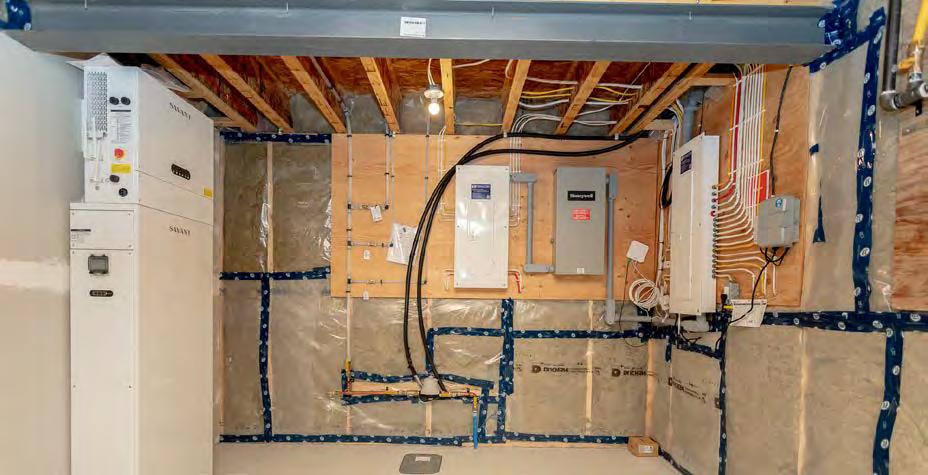
Doug Tarry Homes’ LifeARK model bungalow in St. Thomas, as well as another Tarry model, are being used by Tarry, Volta Research and Miyoko Oikawa of OHBA for research on home loads and sustainable survivability. The model home stores energy collected from solar panels and should be able to run on battery power for five to seven days in the event of a power outage. Their superior envelopes and high-performance windows will maintain interior temperatures for significantly longer than those of Code-built homes.
electrified homes at Port 32 in Bobcaygeon half a dozen years ago, but learned the grid couldn’t handle the demand. He had to use propane heating, as natural gas wasn’t available then, either (though construction on a natural gas line in the town commenced in 2024).
One builder who’s not worried about whether new electrified houses will put pressure on the grid is Doug Tarry of Doug Tarry Homes in St. Thomas.
“We need to be far more concerned with data centres. It’s mind-blowing how much their loads are,” says Tarry. New homes, especially highperformance ones like his company builds, will put far less demand on the grid than older or Code-built houses. His company’s high-performance interior unit townhouses with air-source heat pumps and thermal storage require just 7,000 BTUs for heating and cooling; 1,550 SF homes require 23,000 BTU systems.
Doug Tarry Homes, Volta Research and Oikawa at OHBA are using two LifeARK model homes that Tarry has built for research purposes. Although that provides valuable insight into the homes’ loads, Tarry says it’s more about sustainable survivability. “The long game of the energy study is determining what we need for energy backup in a power outage.”
The homes should be able to run on battery for five to seven days in the event of an outage. While powering up your big-screen TV is a nice
luxury, the batteries are intended for essential services during an outage, such as keeping the lights on, refrigerating food and medicine, and charging phones. The homes’ superior building envelopes and high-performance windows will also maintain interior temperatures and keep occupants comfortable for a significantly longer period than Code-built homes.
“I’m not worried about the grid keeping up with low-load housing,” says Tarry. “Is there still a spot for natural gas? Sure. There’s gas in a lot of neighbourhoods, and it’s not coming out anytime soon. But I am still agnostic about fuel, and we’re advancing on an all-electric product because we have to. When we get into these (low) loads, it’s forcing our hand away from natural gas. We can’t get (small enough) equipment to work in that environment. The only option is air-source heat pumps and thermal storage in water tanks.” Thermal energy storage systems, such as water tanks, act like a battery for heat, capturing excess energy when it’s abundant, and releasing it when needed,” Tarry explains. “I don’t think we’ll ever build with natural gas again.”
Oikawa cautions that this approach might not work in every location. In Tarry’s case, the local utility is supportive of his goals, and he has excellent communication with the utility.
The C. D. Howe Institute’s 2024 Mind the Gap: The Impact of Budget Constraints on Ontario’s Net Zero Plans found that current economic conditions do not favour converting existing natural gas customers to electric heat using conventional technology. Whether it is more financially feasible in the future will depend on whether carbon taxes are applied, improved heat pump efficiency and efficacy, and on the extent of subsidies for switching out existing equipment.
The report warns of a $14.8B annual shortfall for NZ targets ($14.2B available vs. $29B needed), based on taxpayer/residential contributions and EV savings..
When designing policy, the report says budget constraints for clean energy investments need to be considered, and there should be a strong focus on least-cost planning, options for system buildout, and “sober thinking” about the expected pace of heating and transportation electrification.
Oikawa says that, currently, not a large percentage of residential developments are looking to electrify. She says most sites have natural gas, and while the National Building Code is driving electrification, there will also be hybrid solutions along that path, such as the one Martins has employed.
One stumbling block is a lack of financial incentive, as the cost burden is on the builder and, ultimately, the homeowner, Oikawa says. “We have to offset that, and we need to look at all of the different cascading effects of policy. You have to change the Ontario Electrical Safety Code and building codes.”
Oikawa says the 2025 electrical code has just changed to allow the use of certified energy management systems to “throttle” electrical loads. It enables upgrades without requiring service or panel upgrades, allowing homeowners to add modern equipment to their existing service that could support the transition to more electrified homes.
“It has massive implications in the provision of power, but we don’t know how people would take advantage of that,” she says. “Builders aren’t going to move to electrification unless it’s financially feasible and is being driven by clients—especially in an economic downturn.”






Modern

Triple

Aluminum reinforced mullions for larger window configurations








Builders and renovators bare their souls on the economic turmoil, regulatory nightmares and market mayhem robbing them of sleep
Across Ontario’s battered homebuilding sector, economic turbulence, regulatory friction and market instability—at home and abroad—are converging in ways that make planning, pricing and forecasting increasingly difficult. For many builders and renovators, the pressure isn’t tied to one issue, but to a compounding web of red tape, soft demand, labour strain and policy unpredictability.
In January, Ontario Home Builder surveyed builders and renovators province-wide, inviting them to candidly share what is shaping their day-to-day operations and long-term outlook. The response was immediate—and revealing.
Nearly half (49%) of respondents said market uncertainty is what keeps them up most at night, while 26% cited profitability and cash flow challenges.
Even more striking, 81% cited
slower buyer demand and affordability as their most pressing concerns for 2026.
In a wry twist, another participant quipped that their company’s ‘About Us’ page reads, “I lie awake at night, so you don’t have to.” In the context of this survey, it feels less like a slogan and more like a shared industry reality.
The numbers tell part of the story. The voices—all of whom were granted anonymity—tell the rest.
What is your biggest current challenge in managing construction projects?
How are material costs and supply chain issues currently affecting your business?
report that financing and cash flow pressures are a major source of project stress.
How do you expect your sales revenues this year to compare with 2025?
“Trades do not want to hold prices for durations that we require and have been accustomed to.”
“It’s
not significantly worse than previous years, but the cumulative effect
is that building costs are inconsistent with buyer expectations.”
“Revenues this year will probably be about the same as last year, but only about 20% of what they have been for the past couple of decades.”
“Do you hang on to staff or let them go, and then try to rehire when you have some building to do?”
“Tarion
Some final (passionate) thoughts from Ontario’s builders and renovators
“More government involvement simply upends an industry that is already reeling. The focus on modular housing is mostly smoke and mirrors, but it is hailed as a major breakthrough. We deal with more costs and regulations from all levels of government constantly. Fewer regulations to jump through and costs to pass on would be the single largest boost to the industry. Opening up the industry from the strangling controls imposed on it would make massive changes.”
“The worst thing about the market is that government and municipal fees and taxes contribute a third of the price of a new home. They talk about affordability, but they don’t care. People are paying a mortgage on a portion of their home purchase that they shouldn’t be.”
“Homeowners don’t understand the true cost of things. Large corporations like prefab modular home builders advertise pricing with the inclusions in fine print, which misleads clients into understanding the true costs.”
“Renovation needs to become a licensed industry. We have put in some time on this, and it needs to get done.”
“As a builder in a small rural area, we are getting crushed by timelines at the municipalities. The red tape is definitely slowing, if not stopping, growth in Ontario. There needs to be better policies and structured timelines that must be adhered to.”
“Secondary Dwelling Unit regulations are creating pressures.”
“Increased Indigenous involvement in development applications is a challenge.”
“Warranties have become a financial burden driven by inexperienced staff, peer reviews and outside contractors. The consumers threaten us with warranty involvement because they know it gives them leverage.”
“The bars on warrantability, both guidelines and responsibilities of the homeowner, keep moving, or are interpreted differently. “
“
“When is the government going to get out of the way instead of getting into the home building business?”
“The Canadian economy will drive much of the market this year.”
“The current trend of some builders is to continually race to the bottom in terms of pricing. The market is very uncertain, and until there is some certainty on where Canada will be as a whole in the next few years, the buyer market is going to be very light. Yes, pricing is an issue, but who in their right mind would buy a new home with an 18-month delivery if they think their newly purchased house will be worth less when they close? Continually dropping prices to get a few sales, without further concessions from the various levels of government (levies/DCs) whose actions have been one of the largest factors in price increases, is leading the industry to significant financial pain. The three levels of government have to wake up and understand that the building industry is not the golden goose for them to feed off. The effects of our slowing industry are just starting to be felt by the other parts of the economy.”
“Until we get things sorted out with the United States and other trading partners, there’s going to be uncertainty in the market. And do they think they are going to solve the housing crisis with these prefab homes? That’s not the answer, yet no one in the government wants to listen to the builders!”
“An unpredictable market places huge challenges on renovators, as there is increased competition from laid-off or slow home builders, with less renovation work to go around, and that inevitably leads to needing to lay off staff, exacerbating the vicious cycle.”
“Today, there is no shortage of trained and qualified staff for almost any position. But how will that change when the industry gets back to normal or higher than normal housing starts? I expect there to be a labour shortage because we have lost a lot of tradesmen to other industries.”
“As a renovator, we are stressed about making sure we have a steady pipeline of work coming in. Currently, though, we have six months of work in front of us and are fielding lots of inquiries. We’re investing in our marketing to keep that up.”
“It’s time that we work together to cut red tape and really make it work. We are all in this.”
Ontario’s conservation authorities are consolidating. Will it streamline approvals, or make the working relationship even more complicated?
By Ted McIntyre

N THE LATE AFTERNOON of October 15, 1954, Hurricane Hazel barrelled into Toronto and ran headlong into a cold front from the west, creating a perfect storm of unprecedented fury. In roughly eight hours, up to 225 millimetres of rain drenched the city, turning the Humber and Don rivers into raging torrents. The toll was devastating: over 80 lives lost, thousands of homes destroyed, and damages topping $1.3 billion in today’s dollars. Hazel exposed the folly of unchecked development on floodplains—low-lying lands carved up for subdivisions with little thought for watercourses. Out of the tragedy came decisive action: the province amended the 1946 Conservation Authorities Act, empowering a dozen new or strengthened conservation authorities with sweeping powers to protect their respective regions.
Overseeing 95% of its populated areas, Ontario’s conservation authority system is unique in Canada. Elsewhere, sensitive lands are overseen by municipalities or provincial departments, without independent, watershed-focused authorities. But in Ontario, CAs

have the legal power to approve, deny or condition development in floodplains, wetlands and shorelines, creating a regulatory layer beyond municipal and provincial approvals. Given the 36 separate authorities, it’s no surprise that policies, fees and capacities vary widely, producing inconsistent turnaround times that have long frustrated builders. To address this, Schedule 3 of Bill 68, the Plan to Protect Ontario Act (Budget Measures), 2025 (No. 2), is creating a new Ontario Provincial Conservation Agency (OPCA) and reducing the 36 local authorities to seven megaregions, with a single digital permitting platform. Since its creation in 1980, Conservation Ontario has served as the nonprofit voice for the 36 authorities, coordinating policy, programs and advocacy. With amalgamation under Bill 68, the new oversight body, the OPCA, would gain statutory powers to set province-wide standards, enforce compliance and directly oversee the seven regional authorities. The government says the move will cut administrative duplication, free up resources for frontline conservation, and align services with provincial priorities like housing,
economic growth and climate resilience. Its goal is more standardized and faster approvals.
Bill 68 has received Royal Assent, but key elements—including regional boundaries and the provincial agency’s oversight role—are still under consultation through the Environmental Registry. CAs are expected to continue under current governance through the 2026 municipal elections, with the new regional model potentially taking effect January 1, 2027.
The concept of mergers is not new, but they have historically been voluntary, local decisions by municipalities to address watershed-scale challenges like flooding, in contrast to the current provincial push. Toronto and Region CA, for example, merged four authorities in 1957 for unified floodplain management. Conservation Halton
was formed via amalgamation of smaller entities to streamline the region’s efforts, and Conservation Sudbury resulted from merging local groups to enhance northern resource stewardship. Meanwhile, municipalities blocked Nottawasaga Valley CA from combining with Lake Simcoe Region CA due to cost and service concerns.
Conversations on this topic can be rather delicate, as indicated by a veteran cottage country builder who wished to remain anonymous, given sensitive chats of late with local authorities.
“Delays are getting worse and worse,” he says. “Some issues are to be expected, but some are not.”
The latter includes a project where hundreds of hours and $15,000 in studies were wasted after
relying on county mapping, only to have the local CA surprise them with another map that wasn’t publicly available. Or there will be new, seemingly redundant coastal engineering reports required for adjoining properties. “We recently had a $3 million build cancelled because the owners decided, ‘We can’t keep going through this.’
“It’s definitely the most difficult thing I deal with, and it’s reaching a boiling point,” the veteran lakefront builder laments. “CAs have all the authority but none of the responsibility to get back to me in a timely manner. Sometimes I’ve had to drive to their office and wait for somebody to talk to me. I’ve had a local counsellor say the CA delivers a two-week turnaround. But that’s after I’ve been going back and forth for eight to 12 months, because we can’t sign the application until


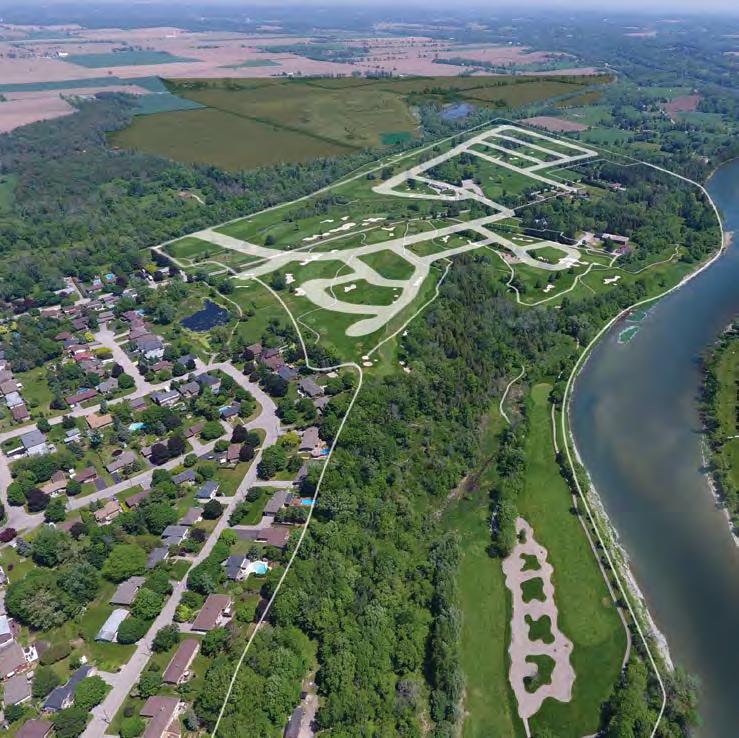
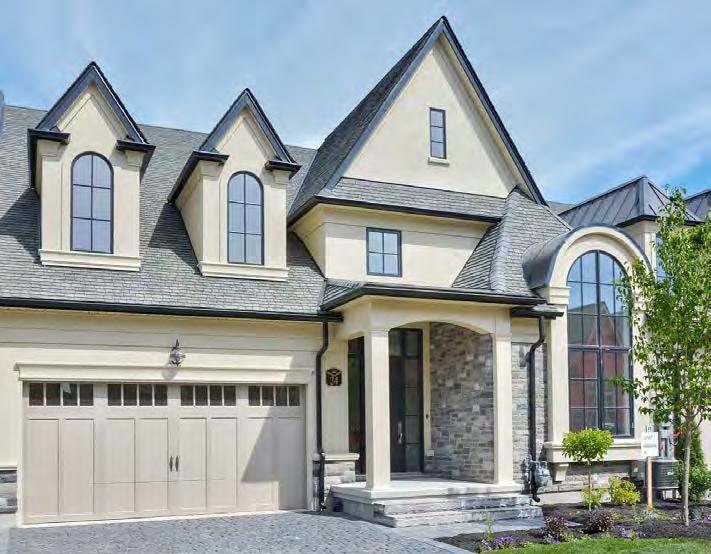
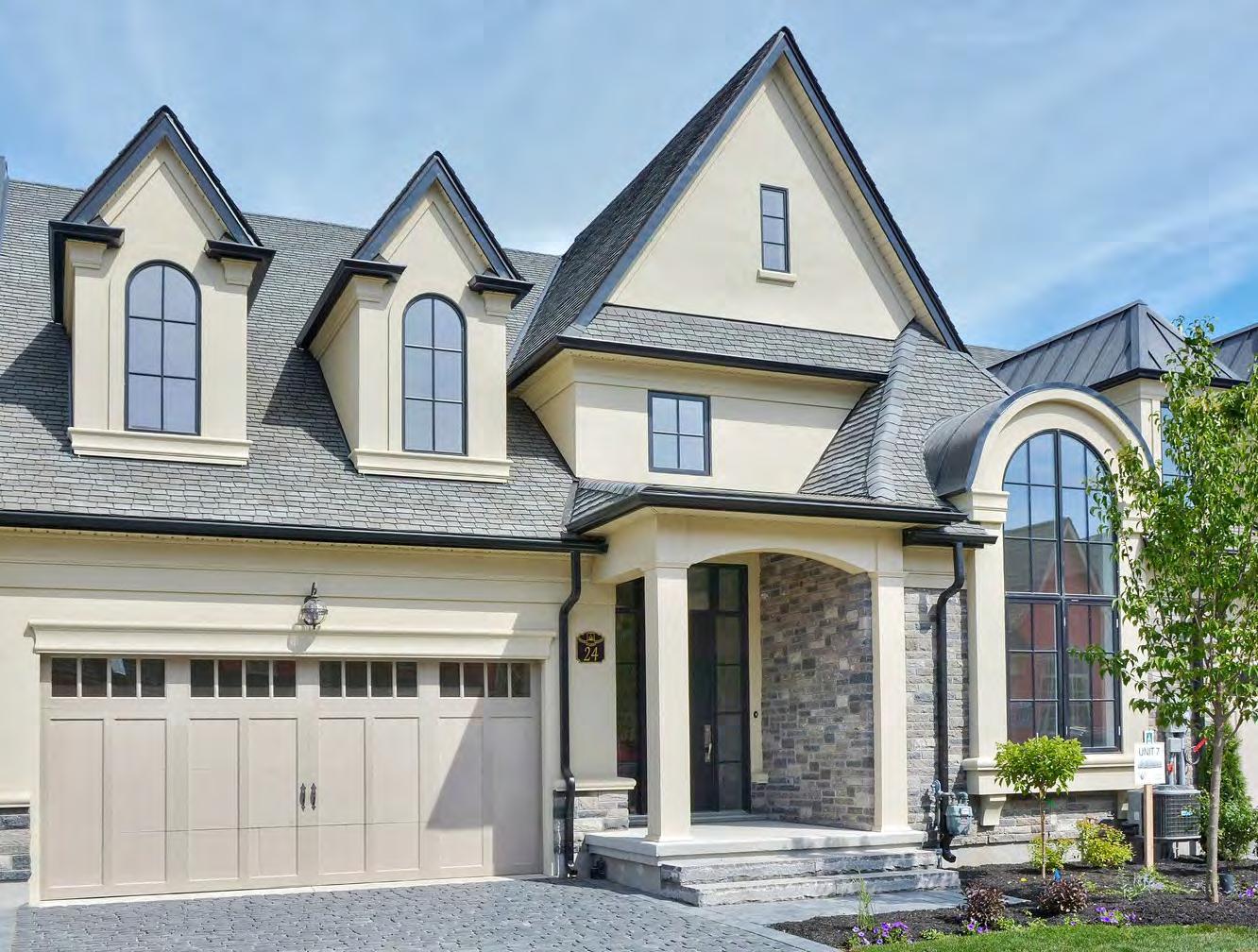
In Ontario’s residential construction landscape, where conservation authorities (CAs) regulate sensitive lands, some builders have turned potential conflicts into triumphs through early collaboration and innovation.
It starts with a simple philosophy, as Lake Simcoe Region Conservation Authority (LSRCA) Chief Administrative Officer Rob Baldwin puts it: “You can fight for minimums, or partner with us for maximum benefits.” Baldwin’s team hosts design charrettes— collaborative workshops—for 75% of large files, bringing developers, municipal staff and CA experts together to map constraints such as creeks and sewers upfront. “We bring in the developers team and host the charrette at the municipal office... then we work through it collectively,” he explains. This pre-emptive approach speeds approvals and sparks ingenuity.
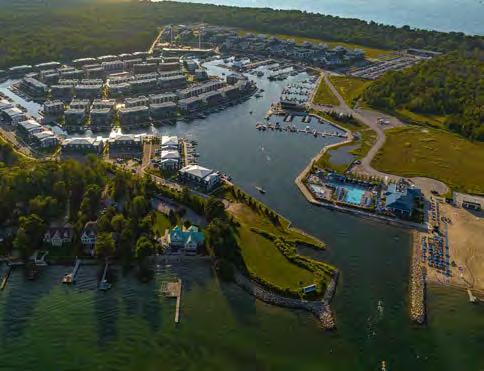
Geranium Corp. pioneered this at Friday Harbour, a 600-acre Innisfil resort that marked LSRCA’s first charrette 25 years ago. Construction began in 2015, blending townhomes, condos, a marina, shops, golf and natural areas. “The LSRCA thought big and outside the box, but within the parameters to protect the watershed and lake,” recalls Cheryl Shindruk, Geranium’s executive V.P. “We were really blessed to have that thought process, and we fully embraced it. As developers, we realized the lake was the lifeblood of the development.” Instead of rigid checklists, Vimal Patel, Geranium’s
V.P. of Land Development, focused on outcomes: “What are we trying to achieve?” For Lake Simcoe, that meant slashing phosphorus via a closed-loop stormwater system— rainwater captured in tanks and pumped to golf ponds for irrigation. They expanded a 1960s marina, enhanced fish habitat, built a “five-star hotel hibernaculum” for snakes, added amphibian tunnels and ponds, and replanted butternuts at 10-to-1 ratios. An adaptive management plan lets LSRCA ecologists monitor progress; when deer damaged trees, Geranium added protective tubes. “This gave the CA an opportunity to say yes,” says Shindruk, “and it’s a win-win, as they stayed engaged and have comfort and confidence in our management.”
Lessons travelled to Midhurst Valley in Springwater, where Geranium partnered with Nottawasaga Valley CA. “We focused on the desired outcome, had an open, transparent conversation, held a charrette, and worked together to meet the objective,” Patel says. They boosted groundwater infiltration, curbed creek phosphorus, and debuted innovative wastewater infrastructure.
Crystal Homes echoes this in Paris with Grand River Conservation Authority (GRCA). Their 170-acre subdivision tackles Gilbert Creek rehab, riverfront refurbishment, a boat launch, expansive park and trail network—despite demanding fish and tree reports. They’ve donated 70 acres of woodlot and waterfront. “It’s our
from
Corp.’s Friday Harbour in Innisfil provided a blueprint for developer partnerships for Lake S i m coe Region Conservation Authority; Crystal Homes and Fernbrook Homes required multiple reports to work through a complicated site with the Grand River Conservation Area in creating Riverside in Paris.
most challenging site, but GRCA did a good job with us and were so cooperative,” says Crystal Homes President Kathy Di Silvestro. “We learned a lot.” Pre-consults proved golden elsewhere, including in Mississauga, where the Credit Valley CA revealed that more than 50% of a proposed high-rise site was protected, thereby avoiding a money pit. Even setbacks have built resilience— like bank swallows nesting in Cambridge topsoil (halting work two years) or seasonal eagle studies at Grand River Woods—where Di Silvestro’s mantra echoes Baldwin’s: “You can fight it, or you can work with it.”
Smaller scales shine too. In Newmarket, at the corner of Bathurst St. and Highway 9, LSRCA worked with Mosaic Homes on a stormwater solution that is completely underground, except for a dry pond. It can handle an extreme weather event, but looks like a park. Brookfield Residential’s 39-unit Winding Trail in Uxbridge wove natural heritage, stormwater and trails beside Wooden Sticks golf course, complete with a bridging sidewalk.
These tales—from charrettes yielding extra lots through low-impact development (LID) to adaptive plans fostering trust— show how partnerships can pay off. Builders gain denser, marketable sites, CAs secure stewardship, and communities thrive.
As Ontario eyes CA amalgamation, preserving this local alchemy remains key.
—Tracy Hanes
we’ve gone through the review process. So when the CA tells counsellors they turn it around in 12 days, I’m like, ‘Are you serious?!’
“I’m not advocating for zero restrictions. I really care about the environment and every client project. But 95% of the time, we’ll end up building what we wanted and where we wanted, but it will have cost an extra $25,000 to $50,000 and a year’s worth of time to do so.”
Few appreciate the kaleidoscope of contradictory rules quite like TD Consulting President Tom deBoer. “Some CAs are more flexible than others. In some cases, there’s give and take, while in others, like Toronto Region, they just don’t want to have a conversation,” says deBoer, whose Lindsay-based firm specializes in land development approvals and project management. “We deal with 10 or 12 (CAs) at any given time. They’re all under the Ontario Conservation Act , yet each one of them has their own philosophy on how they interpret it. I’ve had multiple properties that actually cross boundaries where you have to do one thing on one side of the property, but something else on the other. We’ll have dual designations too. For example, if you get closer to Lake Simcoe Region Conservation Authority, you might be in an area where Kawartha Region is the governing body, but Lake Simcoe overrules them because they’re enforcing the Lake Simcoe Protection Act .”
Conservation authorities are established, financed and overseen by local municipalities under provincial legislation, and that creates problems, contends deBoer. “Some municipalities are generating their own policies to support their mandate—not the actual Act’s mandate. Trent Lakes, for example, has a very small portion of their zone regulated by the Kawartha Region CA. In my experience, they don’t like inviting them into any projects outside of their jurisdiction. The City of Kawartha Lakes shares a portion of three conservation regions—Otonabee, Kawartha and Lake Simcoe—and council decides how much funding each

“Some CAs are more flexible than others. In some cases, there’s give and take, while in others, like Toronto Region, they just don’t want to have a conversation.”
CA receives from their coffers. It’s a very convoluted process. And if you’re underfunded, the quality and quantity of staff deteriorates, and then the whole process just falls apart.”
While he cites the approvals process in many regions as taking “an astronomically long time,” DeBoer is not without sympathy. “It’s usually because of their submissions volume versus funding.”

Ontario Environment Minister Todd McCarthy has repeatedly stated there will be no job losses from the amalgamation—there are an estimated 3,500 employees, some of whom are seasonal—but some management positions, including the 36 CA CAOs, will be “redeployed” or shifted to front-line roles. By that he means shifting administrative and managerial





Ontario is proposing to replace the current 36 conservation authorities with seven regional conservation authorities, aligned broadly with the Great Lakes and major watershed systems.
Lake Erie Regional Conservation Authority
Huron–Superior Regional Conservation Authority
Western Lake Ontario Regional Conservation Authority
Central Lake Ontario Regional Conservation Authority
Eastern Lake Ontario Regional Conservation Authority
St. Lawrence Regional Conservation Authority
Northeastern Ontario Regional Conservation Authority

“The hope is that greater alignment could streamline processes, improve timelines and help move housing forward across the province.”
CA staff, such as their CAOs, into direct service-delivery roles like field inspections, permitting and public-facing operations. McCarthy has emphasized this as a “transformational opportunity” to prioritize on-the-ground impact.
Still, while folding 36 conservation authorities into seven mega-regions is hoped to reduce inconsistencies,
it will invariably create new issues based on the sheer scope of the amended territories. Consider the 3,400-square-km Lake Simcoe Region CA. Under the proposal, it would be amalgamated into the new HuronSuperior Regional Conservation Authority. Encompassing more than 23,000 square kms, it would be bigger than the state of New Jersey,
with watersheds stretching from southeastern Georgian Bay to— no joke —Thunder Bay, more than 900 kms away, as the crow flies.
Conservation Ontario has submitted an eight-page response to the Environmental Registry, representing all 36 member CAs. While supporting the government’s goal of better outcomes, most members oppose consolidation, warning that such oversized jurisdictions could dilute local expertise, strain emergency response, and weaken municipal input. The submission stressed the importance of “pay for say”—ensuring municipalities that fund a CA retain proportional influence over decisions affecting their area. To safeguard local knowledge, it recommended modernizing the current 36 authorities with updated legislation, technology and standards; creating a working group to manage transitions and boundaries; retaining staff and leadership continuity; and maintaining subregional councils and local offices. An alternative model suggested centralizing back-office functions while keeping local boards and subregional structures, supported by digital platforms for expert collaboration—avoiding full mergers unless clearly justified.
“Losing that (local) connection could slow approvals, create confusion and ultimately have the opposite effect of what the government intends,” Nottawasaga Valley CA chair Jonathan Scott told The Narwhal late last year.
Even some builders are leery. “We understand the intent to create greater consistency and efficiency across jurisdictions, particularly as many of our owners work with four or more authorities within their service areas,” notes Brendan Troy, partner of Alair Homes Belleville, in a statement to OHB magazine. “The hope is that greater alignment could streamline processes, improve timelines and help move housing forward across the province, especially if shared resources and capacity allow some regions to process applications more efficiently than in the past. However, there is significant concern that amalgamation may come at the


Our national survey found succession planning ranks among the top concerns for construction leaders — but it’s also an opportunity.

cost of local expertise and responsiveness. Some of our teams do not feel this change will improve the approvals process. Conservation Authorities bring deep understanding of local ecosystems, watershed conditions and site-specific environmental considerations, and that insight is critical to responsible development and environmental stewardship.”
“Large-scale restructuring risks short- to mid-term disruptions, delays and uncertainty amid already strained housing delivery,” Troy continues. “Further, rural builders rely on local contacts for timely guidance, so vast regions could dilute response times and onthe-ground knowledge.
“Ultimately, success will depend on whether the province can preserve regional expertise while improving consistency and efficiency.”
While promising to safeguard staff, the government has made no mention of the future status of the 36 respective CA offices, which concerns deBoer. “If they amalgamate the offices too, how do we access people? Are we going to have to travel much further to visit an office? Are they going to a strictly online platform where it becomes anonymous?” deBoer questions. “I’m not opposed to an increased online process—until it becomes a contentious file. That’s when you need to assign individuals to have a verified meeting.”
As for potential loss of local connections, deBoer is philosophical. “Relationships are meant to be forged upon new changes. It’s no different than when a councillor changes every four years.”
OHBA’s official response to the Ministry of the Environment, Conservation and Parks captures the scale and nuance of the task.
“Feedback received from OHBA members reflects a wide range of perspectives on the proposed consolidation,” the submission notes. Some view it as a path to “improved consistency and efficiency,” while others raise concerns about “governance, accountability, local responsiveness and the potential for unintended consequences.
“We have to figure out how we can maintain what’s working well.”
“There is no single industry position” on whether consolidating into seven regional bodies is appropriate. Members diverged on consolidation but aligned on reform outcomes. A recurring frustration was that “2022 amendments to the Conservation Authorities Act have not been fully implemented,” leaving duplicative permitting in place. Members also emphasized that existing best practices should be “leveraged and scaled rather than disrupted.”
Noting that it welcomes the opportunity to continue working collaboratively with the Province, OHBA also raised oncerns about limited consultation timelines for a proposal of this magnitude. Across member submissions, inconsistency and unpredictability emerged as central issues, with significant variation in technical requirements, guideline interpretation, modelling expectations, and review timelines between conservation authorities.
Drawing on experience with other public sector amalgamations, OHBA urged the Province to demonstrate how consolidation would improve governance beyond modernization; prioritize process and digital reforms; preserve local expertise; avoid disrupting high-performing authorities; recognize regional differences; and expand consultation.
What does Conservation Ontario think the final framework should look like? “We have to figure out how we can maintain what’s working well,” cautions General Manager

Angela Coleman, who agrees that builders need to be part of an advisory committee. “We’ve talked to many in (residential construction) and want to make sure that implementation is going smoothly, and that if there are any transition plans and other pieces required, those pieces are put in place. Builders are trying to figure out how to get all the parts of their complete application through to the final process in a way that maximizes the results for everybody involved. We will work hard and remain really open to having those discussions with the development sector.”
“Standardizing it like the Ontario Building Code and keeping all the offices would make a lot more sense,” suggests deBoer. “Are there varying interpretations of the Building Code? Sure, there are different circumstances based on terrain, ecological values and so forth. It’s no different than if we take an official plan: ‘Here’s the framework—we’re going to be doing these things as it relates to environmental constraints within our boundaries.’ I just know something’s got to change, though, because the system’s broken right now.”
Input from both sides will remain passionate as consultations carry Ontario’s revised conservation authority through to its final form—a stormy confluence of current frustrations and amalgamation fears that may put even Hurricane Hazel to shame. OHB













The OHBA Members Edge program connects our members with exclusive services and offers from trusted industry partners.
Whether you’re looking for innovative products, cost-saving solutions, or new ways to grow your business, the OHBA Members Edge program delivers direct value to all member companies across the province! It’s just one more way your OHBA membership works for you, year-round!


If you have any questions about the benefits available to you, please email membership@ohba.ca














If Ontario’s housing debate feels uniquely urgent, it isn’t. From London to Los Angeles, Copenhagen to Canberra, governments are confronting the same stubborn triad: constrained supply, high borrowing costs and declining construction productivity.
In the U.K., the government has advanced draft guidance tied to its sweeping planning reform agenda, aimed at accelerating housing approvals and enforcing delivery targets on local authorities. The reforms prioritize higher-density development near transit and seek to streamline environmental and infrastructure reviews that have historically slowed projects.
In a statement last month, the U.K.’s Home Builders Federation said it welcomed the renewed focus on delivery but cautioned that infrastructure funding and local political
resistance remain barriers. The parallels with Ontario’s experience under Bill 23 are striking: faster approvals are essential, but they do not automatically translate into shovel-ready homes without servicing capacity and municipal alignment.
Across the European Union, policymakers are increasingly treating productivity—not just planning—as the central bottleneck. In a February briefing, the European Commission announced additional funding streams supporting modular and prefabricated housing as part of its green transition and competitiveness agenda. The initiatives include grants for factory-built housing pilots, crossborder collaboration on industrialized construction systems and workforce retraining tied to digital construction technologies. The emphasis reflects
a sobering reality seen globally: traditional site-built methods have not kept pace with demand, especially amid labour shortages.
Europe’s pivot toward industrialization echoes conversations already underway domestically. Governments are recognizing that zoning reform alone cannot solve a productivity crisis decades in the making.
At the same time, sustainability requirements are intensifying in Scandanavia. The Danish Authority of Social Services and Housing, and Swedish National Board of Housing, Building and Planning have released updated embodied carbon benchmarks for residential buildings, tightening limits and expanding reporting requirements. These frameworks move beyond operational energy performance and place stricter scrutiny on material selection and lifecycle emissions. The trajectory is clear: limits will ratchet down further over the next five years.
While Ontario has not yet imposed similarly stringent embodied carbon caps, the European experience suggests where regulation may head.
South of the border, recent U.S. housing data shows modest rebounds in single-family starts but ongoing weakness in the multifamily sector. Builders continue to cite elevated financing costs, insurance premiums and affordability constraints as headwinds.
Public homebuilders have reported improved buyer traffic but remain cautious on land acquisition and spec building, reflecting uncertainty about rates and demand.
The U.S. experience mirrors Ontario’s balancing act. Even where demand remains strong, cost structures and financing conditions are dictating product mix—often toward

smaller, more attainable homes. Supply challenges are not merely regulatory; they are deeply tied to macroeconomic conditions.
Meanwhile, institutional capital continues to flow into build-to-rent models in the U.S., U.K. and Australia. Recent announcements from major investment funds highlight renewed commitments to single-family rental communities and purpose-built rental developments in high-growth suburban markets.
These partnerships often pair institutional investors with homebuilders to reduce risk exposure during volatile rate environments. In markets where homeownership affordability has deteriorated, rental supply is increasingly viewed as a pressure valve.
Ontario’s growing interest in purpose-built rental incentives and alternative tenure models reflects the same recalibration. When ownership becomes less accessible, rental housing must scale—and governments are adjusting policy accordingly.
Taken together, these developments point to a global convergence around three imperatives: accelerate approvals and enforce housing targets, boost productivity through industrialized construction, and stabilize financing and diversify tenure models.
The housing crisis is indeed global. So too is the experimentation aimed at solving it.
Ontario home builders and contractors stand to gain significant earnings certainty from Bill 60’s amendments to the Construction Act, effective January 1, 2026, according to Morningstar DBRS. These credit-positive changes modernize payment rules across the sector, delivering faster cash flow and reduced borrowing needs—especially vital for smaller firms tackling multiyear residential projects.
Owners must now release the 10% holdback annually, publishing
notices within 14 days of each contract anniversary and specifying payment amounts and dates. No more withholding due to nonpayment notices; funds flow predictably down to subcontractors within 14 days, barring liens. This separates holdback from annual lien expiries, slashing repetitive filings and admin burdens while preserving security.
Streamlined proper invoices include a deeming provision: If owners don’t flag deficiencies within seven days, the prompt payment clock starts. Adjudication expands too: Parties get 90 days post-completion, abandonment or termination to resolve disputes over scope, pricing changes or extensions—not just payments. Termination notices must be published within seven days to ensure clear lien timelines.
Design pros benefit from new lien presumptions for pre-construction work.
Builders must update systems, train staff and review contracts to comply, but the result is a leaner, more predictable framework that boosts profitability.
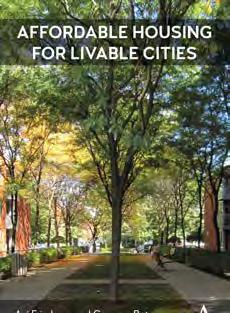
Affordable Housing for Livable Cities, by OHB magazine columnist and McGill University professor Avi Friedman with Genessa Bates, arrives at a pivotal moment for Ontario’s residential construction industry. As Bill 23 reforms intersect with escalating land, labour and financing costs, the book offers builders practical, implementable strategies to address

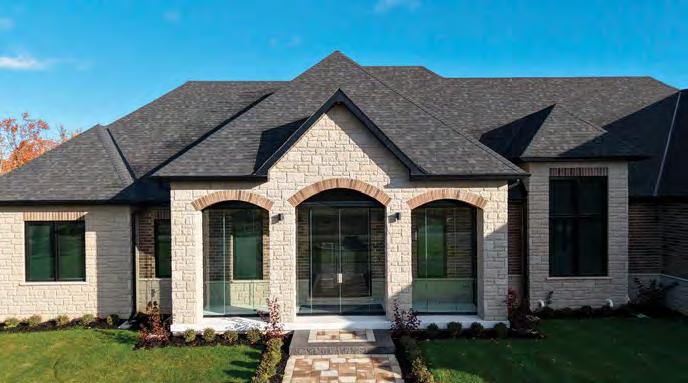
2’s natural stone look pairs seamlessly with Contemporary Series clay brick. Designed to course out with Premier Plus sized brick, it delivers clean lines, smooth transitions, and efficient installation. Both products are available in a wide range of colours to suit modern, traditional, or transitional home designs. Visit BramptonBrick.com to learn more.


housing affordability now.
Published by Anthem Press, the book moves beyond theory to examine the global forces shaping Ontario’s market, including financialization, income inequality, and the shortcomings of the 30% priceto-income benchmark. It then translates these pressures into actionable solutions: prefabrication and mass customization to reduce waste and construction timelines; infill development on brownfield sites to leverage existing infrastructure; and the strategic use of open space as an extension of higher-density living.
Canadian case studies ground the discussion, notably Ottawa’s LeBreton Flats redevelopment, where a 29-hectare remediated site delivers 4,000 units—25% affordable—alongside transit access and significant parkland. Throughout, the authors emphasize proven approaches over speculative experiments, including modular net-zero housing, office-toresidential conversions, and crosssector collaboration with municipalities, financiers and non-profits.
It’s a timely, pragmatic guide to delivering resilient communities without continued greenfield sprawl.
Ontario’s new AED rules for construction sites took effect January 1, mandating defibrillators on projects with 20 or more workers regularly employed and lasting three months or longer. Constructors must install, maintain and ensure access to a Health Canada–licensed AED with accessories like CPR masks and razors.

The Residential Construction Council of Ontario, in partnership with Smart Safety Solutions, has released the AED Policy Development Guide to help employers comply. This 13-step resource starts by verifying project thresholds and conducting a hazard assessment factoring in worker age, physical demands, heat stress and EMS response times. It
guides placement for 1.5-minute retrieval from work areas, signage with heart/lightning symbols, and always having a CPR/AED-trained worker on site during work.
WSIB offers up to $2,500 reimbursement per site from Jan. 1, 2026–July 31, 2027. For more resources, visit The Mikey Network at MIKEYNETWORK.COM/APPLY-FOR-A-MIKEY.
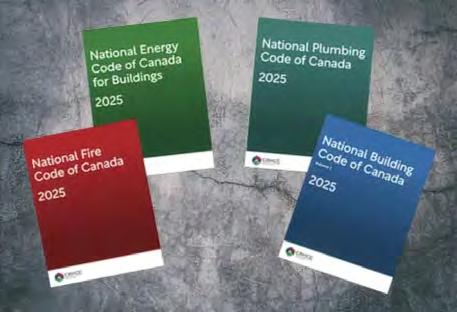
The 2025 edition of Canada’s National Model Codes is now available to download free of charge at NRC.CANADA.CA/CODES-GUIDES . CHBA is urging the federal government to pause adoption of the 2025 National Building Code (NBC)—similar to Australia’s approach—until select sections can be re-evaluated to reduce construction costs and complexity. The updated NBC includes significant technical changes that will impact residential construction practices across the country. Over the past three years, CHBA and OHBA staff and members have dedicated thousands of hours working to ensure new requirements remain practical and cost-effective. While several improvements were achieved, many provisions continue to raise concerns. CHBA has published an overview of the major Part 9 changes, identifying both challenges and potential benefits. Members can access additional Tech Essentials and Technical Backgrounders in CHBA’s Member Knowledge Centre to help navigate these updates. OHB
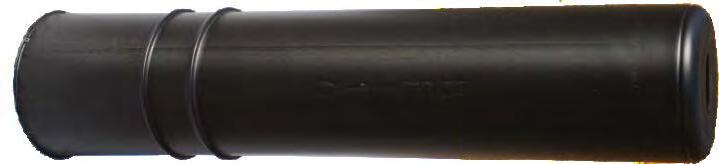
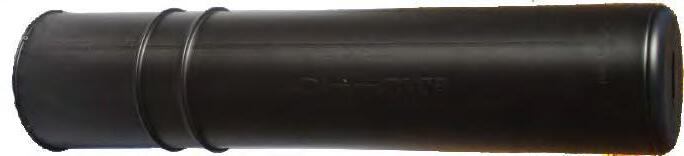


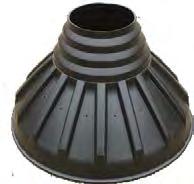







FOUNDED: 1955 MEMBERS: 165
ON NOV. 8, 1955, the Niagara Standard warned of a new minimum wage for carpenters, $2.05, one that Mr. C. Bartlett, the president of the newly minted Niagara Peninsula Home Builders’ Association, contended would raise the price of a home by $500. “It is the greatest crisis to hit the home builder,” and a threat to affordability, Barlett observed. Two decades later, local media noted that homebuilding prospects were down 50% and that the NHBA “determinedly endorsed an official protest” in Ottawa over conditions that were choking supply.
While the struggle seems unending for every OHBA local chapter, it’s a little more complicated than most for Niagara Home Builders’ Association CEO Chuck McShane, whose district includes 13 separate municipalities—each with its own development charges, planning processes and political dynamics.
NHBA’s membership numbers have held strong, despite the economy, dropping four while gaining as many in the past year. And that includes having to occasionally cull a few bad actors from the cast.
McShane is tough enough to make those calls, with a grit forged from neighbourhoods that would leave today’s GPS stammering, “Rerouting...rerouting!”
“I worked hard to get ahead and met a wonderful woman, Tatjana. We’ve built an amazing life together,” he says.
McShane’s background is diverse:
firefighter, business owner, vice-chair of the Niagara Falls Bridge Commission, longtime CEO of the Steve Ludzik Foundation for Parkinson’s disease, four terms as NHBA president, extensive trades advocacy that has earned him an honorary degree from Niagara College, and president of the Niagara PC Riding Association.
His pursuit of politics ended after a failed run for the Niagara MPP seat in 2018, but it proved to be good news for the local building community.
“The NHBA had hired a CEO, but it didn’t work out,” McShane says. “Tony Alfieri, who was NHBA president at the time, said, ‘Listen, if you don’t win, would you consider becoming our CEO?’ I said, ‘Definitely!’”
CEO since 2018, McShane was added to NHBA’s Wall of Fame in December after 45 years in the industry.
His association, a two-time OHBA Chapter of the Year (2018 and 2024), is no less accomplished. NHBA’s Niagara College skills development fund has placed 320+ into construction, with regular support for local hospitals, the Niagara Children’s Centre and the Kristen French Child Advocacy Centre, to name a few. Members such as Mountainview Building Group, Centennial Homes and Silvergate Homes have contributed record donations to services ranging from Pathstone Mental Health to Ronald McDonald House.
On the business side, as with other
regions, “starts are the lowest since the early 2000s,” McShane laments. In his hometown of Niagara-on-the-Lake, newcomers are resales from GTA migrants.
It’s not all bad news. Niagara Falls exceeded its 2024 housing permits target, earning $2.8 million from Ontario’s Building Faster Fund—although numbers are dominated by high-rise rental projects that won’t deliver units for years, McShane indicates.
And so the industry and community work continue, with new NHBA chair Kelly Anderson of Silvergate Homes feeding off the success of past chair Paul Savoia and longtime board support.
Communication with members is another NHBA hallmark, with rapid alerts on everything from Planning Act amendments to building code changes. “We also have quarterly meetings with Tarion, and we were the first to do the large workshop with HCRA, which has since moved across Ontario.”
But he holds special praise for NHBA Executive Officer Alicia DimitrovLawrence. “My work wife—an incredible teammate. She’s phenomenal!”
McShane views his calendar representing those 13 districts: “LPAT hearings, meetings with MPs and MPPs, GST/HST, financing, infrastructure...” It could be titled after Leonardo DiCaprio’s One Battle After Another.
Seventy-one years later, the people may be different, but the headlines feel the same. OHB
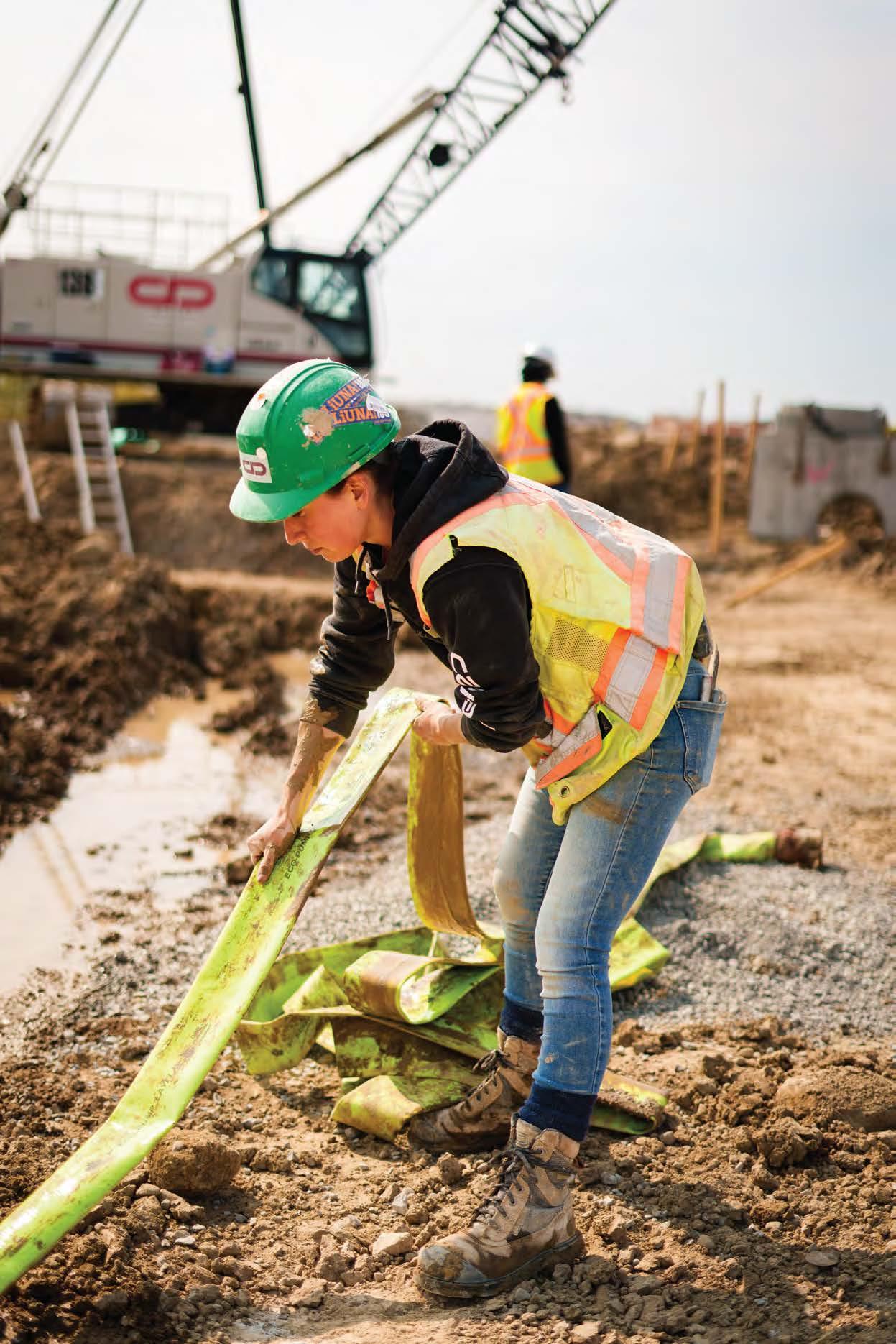



















































The Napoleon® EQ ® Fusion Hybrid Solution combines a cold-climate heat pump, hydronic air handler, and the EQ ® Hub Smart Thermostat into one intelligent system. It automatically selects the most efficient energy source based on conditions and utility rates — reducing energy use, lowering emissions, and keeping homes consistently comfortable year-round.
Designed with contractors in mind, EQ ® Fusion installs faster, fits tighter spaces, and delivers the performance today’s homeowners expect.
Why contractors choose EQ ® Fusion:
Intelligent automatic fuel switching
Cold-climate heating performance
Lower operating costs for homeowners
Reduced gas piping & venting requirements
Compact footprint for tight mechanical rooms
Ideal for retrofits or new construction