SUMMARY
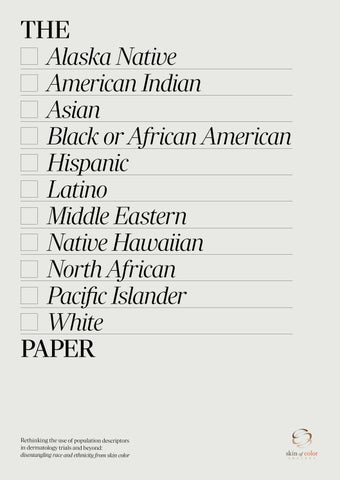
Including skin color as a precise population descriptor could enhance representation significantly. Adopting and integrating more accurate and universally accepted descriptors in clinical practice and research represents a critical and attainable
goal. In summary, while there are challenges and controversies associated with the modification of population descriptors, there is an urgent need for a new paradigm.
ACKNOWLEDGEMENTS
We acknowledge Laura Preece, MSc and Rachel Byrne MSc of Ogilvy Health UK for their editorial assistance.
AUTHOR CONTRIBUTIONS
Made substantial contributions to the conception or design of the work; or the acquisition, analysis, or interpretation of data; or the creation of new software used in the work: VMH, VC, JC, TJ, JT, AJM, YM, NJ, JL, HS. Drafted the work or revised it critically for important intellectual content: VMH, VC, JC, TJ, JT, AJM, YM, NJ, JL, HS. Approved the version to be published: All authors. Agree to be accountable for all aspects of the work in ensuring that questions related to the accuracy or integrity of any part of the work are appropriately investigated and resolved: All authors.
DATA AVAILABILITY
No datasets were generated or analysed during the current study.
DECLARATIONS
Competing interests VMH serves as a consultant for AbbVie, Bristol Myers Squibb, Janssen, Johnson & Johnson, and L’Oréal, receiving honoraria; and serves as an advisory board member for SkinCeuticals, receiving honoraria. JCL serves as a consultant for Google and L’Oréal and an advisory board member for Mattice Biosciences. TJ serves as a principal investigator for UCB; receives research fellow support from Pfizer Inc., via the Skin of Color Grant, and from UCB; and serves as a consultant for Eli Lilly, Novartis, and UCB, receiving honoraria. JT serves as a consultant for Incyte Corporation, receiving honoraria; and receives research grants from Pfizer Inc., and Bristol Myers Squibb (paid to the Trustees of the University of Pennsylvania). AJM has received research grants from Concert, Procter & Gamble, Incyte, Revian; serves as a consultant to Lilly, Janssen, Pfizer, Arcutis, Almirall, AbbVie, CeraVe, Galderma, Bristol Myers Squibb, Sanofi Regeneron, Sun Pharma, UCB, Procter & Gamble, Revian, Johnson &
Johnson, L’Oréal, Leo, receiving honoraria; and has received royalties from Informa/Taylor and Francis, and McGraw Hill. YMM serves as an advisory board member for AbbVie, Bristol Myers Squibb, Boehringer Ingelheim, Fresenius Kabi, Incyte Corporation, Janssen, L’Oréal, Sanofi, Sun Pharma, Novartis, and UCB, receiving honoraria; and serves as a consultant for AbbVie, L’Oréal, and Galderma Laboratories, L.P., receiving honoraria. NGJ serves as an advisory board member for L’Oréal, receiving honoraria. JL has no relevant conflicts of interest to disclose. AFA is a consultant for AbbVie, Allergan, Almirall, Alphyn, Amgen, Apogee, Arcutis, Avita Medical, Bausch health, Beiersdorf, BMS, Canfield, Cara, Castle, Cutera, Dermavant, Eli Lilly, EPI, Galderma, Genentech, Genzyme, Incyte, Janssen, Leo, L’Oréal, Ortho, Pfizer, Sanofi-Regeneron, Swiss American, UCB and VisualDx, a speaker for BMS, J&J, Janssen, Regeneron and Sanofi-Genzyme, receives equipment from Aerolase, grants from AbbVie, Amgen, Arcutis, Castle, Dermavant, Galderma and Leo, and royalties
from Elsevier, Springer, Wiley-Blackwell and Wolters Kluwer Health. SGB has no relevant conflicts of interest to disclose. CMB has no relevant conflicts of interest to disclose. ASB is the inaugural recipient of the Skin of Color Society Career Development Award, as well as the Society for Investigative Dermatology Freinkel Diversity Fellowship Award, and a recipient of the Robert A. Winn Diversity in Clinical Trials Career Development Award (Winn CDA) funded by Bristol Myers Squibb Foundation (BMSF); serves as a consultant for Senté, Inc. and Sonoma Biotherapeutics; and serves as an advisory board member for Novartis, receiving honoraria. SCC has no relevant conflicts of interest to disclose. CBCC has no relevant conflicts of interest to disclose. RD reported stock options from Revea and MDalgorithims, as well as personal fees from Pfizer, Frazier Healthcare Partners, and L’Oréal; and has a patent for 17/937 714 pending. SRD has no relevant conflicts of interest to disclose. CRH is a consultant for Arcutis, Apogee, Avita, Dermavant, Lilly, Janssen, Johnson and Johnson, Kenvue Pfizer, Regeneron, Sanofi, L’Oréal, Nutrafol, and WebMD. Investigator/ Research/Research Development Funding paid to institution: Eli Lilly and Company, CorEvitas, Janssen, Robert A. Winn Diversity in Clinical Trials Award Program established by the Bristol Meyers Squibb Foundation, and recipient of a Skin of Color Society Career Development Award. CAVO has no relevant conflicts of interest to disclose. HS has no relevant conflicts of interest to disclose. SCT is a past employee of Mercer Strategies and was on the board of directors; serves as a consultant to Arcutis Biotherapeutics, Inc, Beiersdorf, Inc., Bristol Myers Squibb, Cara Therapeutics, Dior, and Sanofi, receiving honoraria; serves as a consultant to Armis Biopharma, GloGetter, and Piction Health, receiving stock options; serves as an advisory board member for AbbVie, Avita Medical, Beiersdorf, Inc., Biorez, Inc., Eli Lilly, EPI Health, Evolus, Inc., Galderma Laboratories, L.P., Hugel
America, Inc., Incyte, Johnson & Johnson Consumer Products Company, L’Oréal USA, Medscape/WebMD, Pfizer, Scientis US, UCB, and Vichy Laboratories, receiving honoraria; serves as a speaker for Beiersdorf, Inc, Catalyst Medical Education LLC, LearnSkin, Medscape/WebMD, and MJH LifeSciences; has received royalties from McGraw Hill; is an investigator for Allergan Aesthetics, Concert Pharmaceuticals/ Sun Pharma, Croma-Pharma GmbH, Eli Lilly, and Pfizer, receiving grants and research funding; and serves on the editorial board for Practical Dermatology, Cutis, and Archives in Dermatologic Research, and as a peer-reviewer for British Journal of Dermatology. JSW serves as an advisory board member for Bristol Myers Squibb, Dermavant Sciences, Foamix, Galderma Laboratories, L.P., Incyte Corporation, Novartis, and UCB receiving honoraria; serves as a consultant for Arcutis,Inc., Biofrontera, Cutera, Inc., Leo Pharma Inc, Ortho Dermatologics, and UCB, receiving fees or honoraria; is an investigator for AbbVie, Bausch Health, Biofrontera, Bristol Myers Squibb, Cutera, Inc., Dermavant Sciences, Foamix, Galderma Laboratories, L.P., Leo Pharma, Mindera, Moberg Pharma North America LLC, Novartis, Palvella Therapeutics, and Verrica Pharmaceuticals Inc., receiving grants and research funding; and serves as a speaker for AbbVie, Arcutis, Inc., Galderma Laboratories, L.P., Ortho Dermatologics, Regeneron, and Sanofi Genzyme, receiving honoraria. JY has no relevant conflicts of interest to disclose. VDC serves as a researcher for Avava, Galderma, I Know Skincare, Janssen, Prollenium, Skinbetter Science, Symatese, and Teoxane; serves as a researcher/consultant for AbbVie/ Allergan, Incyte, L’Oréal Aesthetics, and Pfizer; serves as a consultant for Acne Store, Aerolase, Avita Medical, Beiersdorf, Cutera, Dermavant, Juenes Aesthetics, Orthoderm, and SkinCeuticals; serves as a consultant/ speaker for Arcutis; serves as a researcher/consultant/ speaker for Eli Lilly; and has received royalties from UpToDate.
REFERENCES
1. Byeon YJJ, Islamaj R, Yeganova L et al (2021) Evolving use of ancestry, ethnicity, and race in genetics research – a survey spanning seven decades. Am J Hum Genet 108:2215–2223
2. Mauro M, Allen DS, Dauda B, Molina SJ, Neale BM, Lewis ACF (2022) A scoping review of guidelines for the use of race, ethnicity, and ancestry reveals widespread consensus but also points of ongoing disagreement. Am J Hum Genet 109:2110–2125
3. Flanagin A, Frey T, Christiansen SL (2021) Updated guidance on the reporting of race and ethnicity in medical and science journals. JAMA 326:621–627
4. A consensus study report of The National Academies of Sciences, Engineering and Medicine (2023) Using population descriptors in genetics and genomics research: a new framework for an evolving field. National Academies, Washington, DC. h t t p s : / / d o i . o r g / 1 0 . 1 7 2 2 6 / 2 6 9 0 2 )
5. A consensus study report of The National Academies of Sciences (2024) Engineering and medicine. Rethinking race and ethnicity in biomedical research. National Academies, Washington, DC. h t t p s : / / d o i . o r g / 1 0 . 1 7 2 2 6 / 2 7 9 1 3 )
6. Cerdeña JP, Plaisime MV, Tsai J (2020) From racebased to raceconscious medicine: how anti-racist uprisings call Us to act. Lancet 396:1125–1128
7. Vyas DA, Eisenstein LG, Jones DS (2020) Hidden in plain sight – reconsidering the use of race correction in clinical algorithms. N Engl J Med 383:874–882
8. Sadeghi NB, Adamson AS (2024) The problematic legacy of skin-thickness measurement in race-based dermatology research. JAMA Dermatol 160:143–144
9. Hoffman KM, Trawalter S, Axt JR, Oliver MN (2016) Racial bias in pain assessment and treatment recommendations, and false beliefs about biological differences between Blacks and Whites. Proc Natl Acad Sci U S A 113:4296–4301
10. A consensus study report of The National Academies of Sciences, Engineering and Medicine (2022) Improving representation in clinical trials and research: Building research equity for women and underrepresented groups. National Academies, Washington, DC. h t t p s : / / d o i . o r g / 1 0 . 1 7 2 2 6 / 2 6 4 7 9 )
11. Okeke CAV, Perry JD, Simmonds FC et al (2022) Clinical trials and skin of color: the example of hidradenitis suppurativa. Dermatology 238:180–184
12. Jablonski NG (2021) Skin color and race. Am J Phys Anthropol 175:437–447
13. Alaluf S, Heinrich U, Stahl W, Tronnier H, Wiseman S (2002) Dietary carotenoids contribute to normal human skin color and UV photosensitivity. J Nutr 132:399–403
14. Taylor SC (2002) Skin of color: biology, structure, function, and implications for dermatologic disease. J Am Acad Dermatol 46:S41–S62
15. Harvey VM, Alexis A, Okeke CAV et al (2024) Integrating skin color assessments into clinical practice and research: a review of current approaches. J Am Acad Dermatol 91:1189–1198
16. Goon P, Banfield C, Bello O, Levell NJ (2021) Skin cancers in skin types IV–VI: does the Fitzpatrick scale give a false sense of security? Skin Health Dis 1:e40
17. Chan JL, Ehrlich A, Lawrence RC, Moshell AN, Turner ML, Kimball AB (2005) Assessing the role of race in quantitative measures of skin pigmentation and clinical assessments of photosensitivity. J Am Acad Dermatol 52:609–615
18. Ramamoorthy A, Pacanowski MA, Bull J, Zhang L (2015) Racial/ethnic differences in drug disposition and response: review of recently approved drugs. Clin Pharmacol Ther 97:263–273
19. Mineroff J, Nguyen JK, Jagdeo J (2023) Racial and ethnic underrepresentation in dermatology clinical trials. J Am Acad Dermatol 89:293–300
20. Sjoding MW, Dickson RP, Iwashyna TJ, Gay SE, Valley TS (2020) Racial bias in pulse oximetry measurement. N Engl J Med 383:2477–2478
21. Pulse oximeters – premarket notification submissions [510(k)s]: guidance for industry and Food and Drug Administration staff. 1. Byeon YJJ Rockville, MD: Food and Drug Administration, March 4, 2013. (
race/ethnicity: skin color, gender, and the health of young adults in the United States. Popul Res Policy Rev 38:271–299
28. Bissonnette R, Jankicevic J, Saint-Cyr Proulx E, Maari C (2023) Ethnicity, race and skin color: challenges and opportunities for atopic dermatitis clinical trials. J Clin Med 12:3805
29. Borrell LN, Elhawary JR, Fuentes-Afflick E et al (2021) Race and genetic ancestry in medicine – a time for reckoning with racism. N Engl J Med 384:474–480
22. Chen V, Akhtar S, Zheng C, Kumaresan V, Nouri K (2022) Assessment of changes in diversity in dermatology clinical trials between 2010–2015 and 2015–2020: a systematic review. JAMA Dermatol 158:288–292
23. Ng MY, Youssef A, Miner AS et al (2023) Perceptions of data set experts on important characteristics of health data sets ready for machine learning: a qualitative study. JAMA Netw Open 6:e2345892
24. Wen D, Khan SM, Ji Xu A et al (2022) Characteristics of publicly available skin cancer image datasets: a systematic review. Lancet Digit Health 4:e64–e74
25. Kamulegeya L, Bwanika J, Okello M et al (2023) Using artificial intelligence on dermatology conditions in Uganda: a case for diversity in training data sets for machine learning. Afr Health Sci 23:753–763
26. Benčević M, Habijan M, Galić I, Babin D, Pižurica A (2024) Understanding skin color bias in deep learning-based skin lesion segmentation. Comput Methods Programs Biomed 245:108044
27. Perreira KM, Wassink J, Harris KM (2019) Beyond
30. FDA guidance provides new details on diversity action plans required for certain clinical studies Silver Spring, MD: Food and Drug Administration, June 26, 2024. ( h t t p s : / / w w w . f
31. Chung HJ, Jablon K, Dawkins O, Richardson M, Ho JD (2023) The frequency of reporting race, ethnicity, and skin phototypes in dermatology case reports. JAAD Int 12:39–41
PUBLISHER’S NOTE
Springer Nature remains neutral with regard to jurisdictional claims in published maps and institutional affiliations. Springer Nature or its licensor (e.g. a society or other partner) holds exclusive rights to this article under a publishing agreement with the author(s) or other rightsholder(s); author self-archiving of the accepted manuscript version of this article is solely governed by the terms of such publishing agreement and applicable law.
AUTHORS AND AFFILIATIONS
Valerie M. Harvey 1
Jenna C. Lester2
Tarannum Jaleel3
Junko Takeshita4,5
Amy J. McMichael6
Yvette Miller-Monthrope7,8,9
Nina G. Jablonski10
Jade Lewis3
Andrew F. Alexis11
Stafford G. Brown12
Cheryl M. Burgess13
Angel S. Byrd14
Suephy C. Chen3,15
Caryn Cobb15
Roxana Daneshjou16
Seemal R. Desai17,18
Candrice R. Heath19
Chidubem A.V. Okeke20
Hema Sundaram21,22,23
Susan C. Taylor4
Jonathan S. Weiss24,25
Jane Y. Yoo26
Valerie D. Callender14,27
Valerie M. Harvey valerie.harvey@tpmgpc.com
1. Hampton Roads Center for Dermatology, Virginia Beach, VA, USA
2. Department of Dermatology, University of California San Francisco, San Francisco, CA, USA
3. Department of Dermatology, Duke University School of Medicine, Durham, NC, USA
4. Department of Dermatology, Perelman School of Medicine, University of Pennsylvania, Philadelphia, PA, USA
5. Department of Biostatistics, Epidemiology and Informatics, Perelman School of Medicine, University of Pennsylvania, Philadelphia, PA, USA
6. Department of Dermatology, Wake Forest University School of Medicine, Winston Salem, NC, USA
7. Division of Dermatology, Department of Medicine, University of Toronto, Toronto, ON, Canada
8. Division of Dermatology, Women’s College Hospital, University of Toronto, Toronto, ON, Canada
9. Department of Laboratory Medicine, University Health Network, University of Toronto, Toronto, ON, Canada
10. Department of Anthropology, The Pennsylvania State University, University Park, PA, USA
11. Israel Englander Department of Dermatology, Weill Cornell Medical College, New York, NY, USA
12. Division of Dermatology, Washington University, St. Louis, MO, USA
13. Center for Dermatology and Dermatologic Surgery, Washington, D.C. , USA
14. Department of Dermatology, Howard University College of Medicine, Washington, D.C. , USA
15. Mount Auburn Hospital, Harvard Medical School, Cambridge, MA, USA
16. Department of Biomedical Data Science and Dermatology, Stanford School of Medicine, Stanford, CA, USA
17. Department of Dermatology, University of Texas, Southwestern Medical Center, Dallas, TX, USA
18. Innovative Dermatology, Plano, TX, USA
19. Department of Urban Health and Population Science, Center for Urban Bioethics, The Lewis Katz School of Medicine at Temple University, Philadelphia, PA, USA
20. Department of Dermatology, Howard University College of Medicine, Washington, DC, USA
21. Dermatology, Cosmetic & Laser Surgery, Rockville, MD, USA
22. Dermatology, Cosmetic & Laser Surgery, Fairfax, VA, USA
23. Division of Musculoskeletal and Dermatological Sciences, School of Biological Sciences, University of Manchester, Manchester, UK
24. Department of Dermatology, Emory University School of Medicine, Atlanta, GA, USA
25. Georgia Dermatology Partners, Snellville, GA, USA
26. Icahn School of Medicine at Mount Sinai, New York, NY, USA
27. Callender Dermatology & Cosmetic Center, Glenn Dale, MD, USA