
















MOTHER EARTH NEWS EARTH NEWS OCTOBER/NOVEMBER 2023 Printed on recycled paper Issue No. 320 • $5.99 US • Display until Nov. 20, 2023 SURVIVETIPSTO A WINTERICESTORM •PAGE12• TIPS FOR STOCKPILING FEED FOR WINTER MONTHS, P. 20 EASE SYMPTOMS WITH KITCHEN INGREDIENTS, P. 14 Homemade Cold Remedies WHAT TO DO IF ANIMALS EAT RODENTICIDES, P. 44 Protect Pets from Toxins Extend Fall Forage Grow Food with Less Light, P. 34 The History of Medicinal Vinegars, P. 48 Shelter Chickens and Improve Soil, P. 38 How Technology Can Help Food Production P. 28
You



Have The
























Power. We Have The Tool.
DRILL-POWERED CULTIVATOR
The Fusion Drill-Powered Cultivator simply attaches to any cordless drill and creates a powerful and lightweight cultivating tool for your established garden. The Fusion Cultivator was made to mix, aerate and weed garden soil. It’s portable and lightweight! At 6 lb. this unit can be operated by almost anyone in any garden setting. With the option of using the cultivator in two lengths, mixing and aerating soil in garden beds of all sizes has never been easier. You have the power. We have the tool!

• Compatible with most cordless drills




• Full size mode for standard garden plots (51”)
• Shortened mode for raised bed gardens (19”)
• Adjustable cultivating width up to 8”


to
LIMITED WARRANTY

Visit fusiondrillpowered.com for more information
1-Year
Full Size Mode Shortened Mode Compatible with Most Cordless Drills At 6 lb. this unit can be operated by almost anyone 1-YEAR
See #6 on page 68
• Cultivating depth up
5.5” •
Warranty
Defending Diversity
“Why are you so woke?”
I just answered yet another reader who wondered what diverse cultures have to do with homesteading. While many readers thank us for covering all people within “can-do communities” and the long history of farming in all cultures, we also receive complaints. Many complaints wield the word “woke” and accuse us of being “political.” These subjective terms seem to refer to anything or anyone they don’t like. But our goal is to include varied cultures with multiple solutions for self-sufficiency. Further, the topics we publish transcend the politics of the day — no political party or platform has the sole claim on caring for people and the planet.
Since 1970, we’ve included stories on people who start farms, run community gardens, or create food initiatives. Some of those people have shared stories about how they’ve faced roadblocks because of their backgrounds and race. Recently, readers have said, “Just focus on sustainability!” But their experiences are part of their journeys toward sustainability, as is true for all of us.
In Reno, where I lived for 20 years, volunteers with the Reno Gleaning Project pick extra fruit from urban trees so it doesn’t go to waste. They then donate the fruit to hungry people in the community. Many of these recipients use the apples to make pies. The initiative combines urban gardens, waste diversion, food access, and apple pie. Most would consider this the perfect focus for M E N
So, how is this different from an article discussing initiatives that use Black ancestral practices to encourage community gardens in Akron, Ohio, bringing together urban gardens, waste diversion, food access, and culturally relevant foods? (See “Black Foodways,” August/September 2023.)
Issues such as redlining, generational poverty, and food deserts are obstacles within many communities, and a majority of those communities consist of diverse races, religions, and cultural backgrounds. Many people have had their access to land restricted. Indigenous Americans, after the Trail of Tears, were often “gifted” inhospitable tracts of land for reservations, and boarding schools removed whole generations from their culture. After Pearl Harbor, many Japanese Americans lost their land when they were forcibly relocated and incarcerated. And Black Americans, though their enslaved ancestors were forced to work the land, were unable to purchase decent property to continue agriculture among free people.
Though I haven’t had land restricted because of my skin tone, I have many stories about trying to buy a working pickup while female, or of teaching farming skills to my husband so he can teach them to communities that will listen more to him. I stopped shopping at a specific store because its male employees refused to sell me what I knew I needed.

As we cover all communities, we focus on good works and triumphs while providing inspiration so you can also find success. But all triumphs come with trials, and everyone’s stories are different. Experiences aren’t invalid just because we personally didn’t experience them. As a magazine that represents “can-do communities,” we’re in solidarity with everyone who has struggled while seeking self-sufficiency and sustainability, and we honor their stories. We’re dedicated to conserving our planet’s resources while helping you conserve your financial resources, no matter who you are.
May your own story end happily,
CUSTOMER CARE 800-234-3368; CustomerService@OgdenPubs.com


Publisher B U
Director of Circulation & Marketing C O
Director of Newsstand & Production B C
Director of Sales B L


Live Events Manager J W
Director of Information Technology T S


Director of Finance & Accounting R H
Founders J J S
M E N (ISSN -) October/November 2023, Issue No. 320.
M E N is published bimonthly by Ogden Publications, Inc., 1503 SW 42nd St., Topeka, KS 66609-1265. Periodicals Postage Paid at Topeka, KS and additional mailing offices. POSTMASTER: Send address changes to Ogden Publications, Inc., 1503 SW 42nd St., Topeka, KS 66609-1265. For subscription inquiries call 800-234-3368. Outside the U.S. and Canada, call 785-274-4365; fax 785-274-4305.


Subscribers: If the Post Office alerts us that your magazine is undeliverable, we have no further obligation unless we receive a corrected address within two years.
© 2023 Ogden Publications Inc. Printed in the U.S.A.
In accordance with standard industry practice, we may rent, exchange, or sell to third parties mailing address information you provide us when ordering a subscription to our print publication. If you would like to opt out of any data exchange, rental, or sale, you may do so by contacting us via email at CustomerService@OgdenPubs.com. You may also call 800-234-3368 and ask to speak to a customer service operator.

News from MOTHER
68C 100Y 24K Pantone 363C THE ORIGINAL GUIDE TO LIVING WISELY ® ISSUE EDITORS Editorial Director M A Editor at Large O H. W III EDITORIAL TEAM I B • K G L H • R M J M • I R K R • A S C S • J T C T • A T ADVERTISING DIRECTOR B E; BEscalante@OgdenPubs.com ART DIRECTION AND PREPRESS Art Director M T. S WEB AND DIGITAL CONTENT Web Content Manager T O WEB SERVICES TEAM B S • D S • A W DISPLAY ADVERTISING 800-678-5779; AdInfo@OgdenPubs.com CLASSIFIED ADVERTISING 866-848-5416;
NEWSSTAND Newsstand Manager B C
Classifieds@MotherEarthNews.com
14
Fall
COLD-SEASON COMFORTS
Old-Fashioned Cold Remedies That

Work
Herbal wisdom from great-greatgrandparents helps fight pesky colds.
48 Thieves, Apples, and Fire: The Surprising History of Medicinal Vinegars
The tradition of fire cider has deep roots.

52 Country Lore
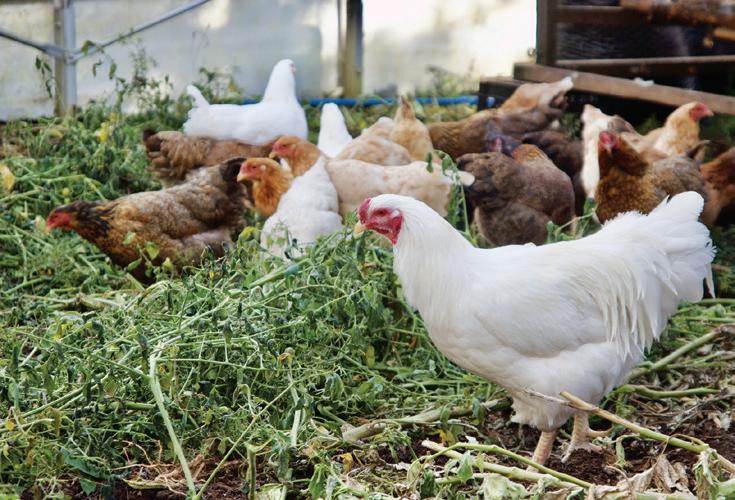
Reader tips on seed-studded paper, keeping chickens in winter, cold frames, mailable gardens, deterring swallows, repurposing armchairs, and more.
58 Gone Off-Grid
Hoss Boyd and Kerena Reese answer questions about energy systems.
61 Ask Our Experts
Expert advice on eggshell colors and encouraging earthworm populations.
80 Photos from the Field Reader-submitted photos.

C over : A dobe S to C k vermont A lm ; C lo C kwi S e from top left : A dobe S to C k /J A me S e ddy ; k A mi m C b ride ; A dobe S to C k / di A nn A; d omin C l A mont A gne ; d A n A b enner 1 News from Mother Defending Diversity 4 Dear Mother Reader letters of inspiration, community, and more. 8 Green Gazette Updates on a Nebraska solar farm, agrivoltaics, dangers from gas stoves, and composting initiatives. 12 Firsthand Reports: Surviving an Ice Storm A New England family shares lessons learned after being caught unprepared in fierce weather. 22 Make Your Own Herbal Finishing Salts Coarse and versatile, herb-infused salts add a flavorful accent to many dishes. 26 DIY Knitted Shopping Bag Knit and shop with this sturdy over-the-shoulder pouch. 28 Outrunning a Bug Apocalypse Can technology provide a way out of the “sixth extinction”? 34 Profiting from Persephone Learn to time fall plantings and harvest food from low-daylight winter gardens. 38 Overwintering Hens Inside a Greenhouse Keep hens healthy while boosting garden productivity. 44 Rodenticide Toxicity in Pets Avoid poisoning by knowing what’s in your pest control.
38 12
graze, stockpile, and interseed to improve livestock feeding resources. Table of Contents October/November 2023
61 20 Extend
Feed and Forage Bale
Stories with this logo are available in audio form at www.MotherEarthNews.com
!























 Purina trademarks are owned by Société des Produits Nestlé S.A.
®
EDITORS’ PICK
Rainfall in Oregon
After publishing Mark S. McNutt’s article about living on solar power in the Pacific Northwest (“Off-Grid Living in Western Oregon,” Firsthand Reports, August/ September 2023), several readers wrote to us to challenge his claims of receiving 100 inches of rainfall a year. We confirmed with weather reports that he didn’t exaggerate. Mark says, “All weather is local. While Oregon averages about 30 inches of rain per year, most of the state is ‘high desert.’ Most people live in the ‘oak savanna’ with 60 inches per year, and I live in the ‘temperate rainforest,’ which pulls in the marine air through prevailing westerly winds. We got 118 inches last year according to the U.S. National Weather Service. I underexaggerated on purpose.”
Define ‘Homestead’







I’ve been asked if I maintain a homestead. I answered no, but now I’m not sure. My thought was a homestead would be an offgrid home where you have to do everything. I live on about 4 acres in the suburbs. I have my own water well, but electricity, cable TV, phone lines, and gas are all available. I garden, but is this a homestead?
 Bruce Darling Via email

That’s a great question! These days, “homestead” means something very different from what it used to. After the Homestead Act of 1862, “homestead” referred specifically to a 160-acre parcel of land that settlers could claim for a small fee and five continuous years of residence. It was their responsibility to develop the land and make it sustainable, and back then, they didn’t have much choice other than to live off-grid and raise their own food. Few true “homesteads” still exist according to that definition.
But this skills movement can be done even in an apartment, where someone can make their own bread, cheese, or clothing. An “urban homestead” can be less than an eighth of an acre of gardens, fruit trees, and small livestock, such as chickens. Many 1-acre and 5-acre homesteads incorporate goats, solar power, greywater, and composting systems. Overall, even Merriam-Webster uses several distinct definitions of ”homestead,” ranging from “the home and adjoining land occupied by a family” to “a tract of land acquired from U.S. public lands by filing a record and living on and cultivating the tract.” To us (a team of homesteaders, in the modern sense), 100% a homesteader.
Response to Mulch Question


In the August/September 2023 issue, a reader asked what mulch substitutions could be used for newspapers.


We use biodegradable, fiber egg cartons torn into pieces. Also, we shred junk mail and any used paper generated from our printer, and when a large garbage bag is full, we put it into the compost bin and spray it with water. Added to it are veggie peelings, used tea bags (minus the strings), and used coffee grounds in biodegradable coffee filters. It’s amazing how quickly it all adds up and decomposes.
Nancy Pyle Grants Pass, Oregon
— MOTHER (CONTINUED ON PAGE 69)
“Modern homesteading,” however, is a whole different concept, and each person defines it in their own way. Simply put, “homesteading” is a back-to-the-land movement that focuses on sustainability and relearning skills our grandparents and great-grandparents used. Most modern “homesteads” aren’t off-grid, but many ambitious folks have developed their off-grid paradises as ways to find their own paths to sustainable living.


Dear MOTHER
MOTHER
“My thought was a homestead would be an off-grid home where you have to do everything. ... I garden, but is this a homestead?”
4 MOTHER EARTH NEWS October/November 2023 ADOBE STOCK/ YULIA ZAVALISHINA
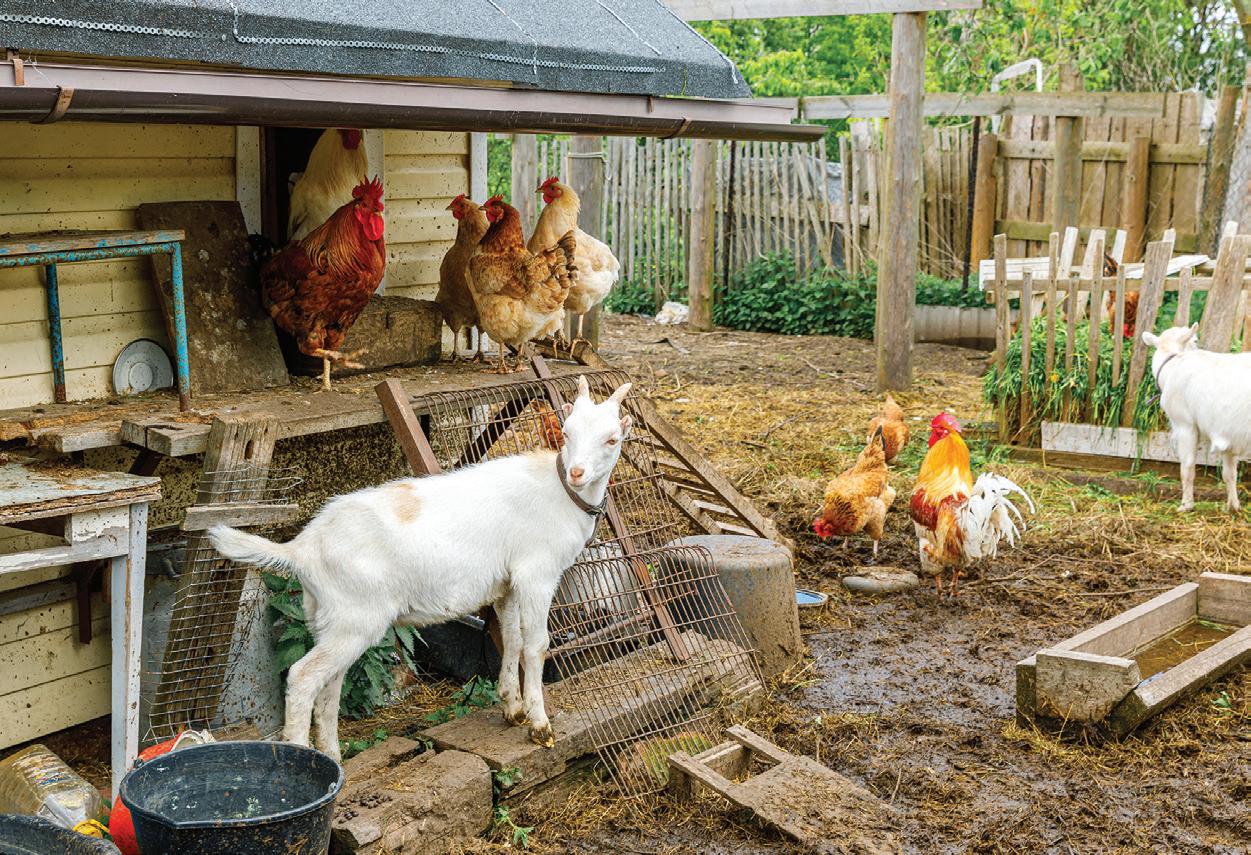
Nurture both of your flocks.












Superior-quality ingredients ensure a superior quality of life. Home Fresh® Poultry Feeds provide your chickens with the most wholesome ingredients that they need to stay healthy, happy and lay more eggs. Giving your chickens the best diet helps your family lead their best lives.




SAVE $5

Copyright © 2023 Kent Nutrition Group. All Rights Reserved. All trademarks owned by Kent Nutrition Group, Inc. and/or its subsidiaries, affiliates or licensors.
See #23 on page 68
Do it Right with
is the LEADER in Leaf Vacs




EASY 1-hand dumping
Tow-Behind
• #1 in vacuum power and capacity
• NEW PRO MAX model holds up to 450 gallons


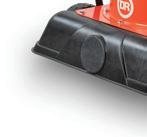

• All models newly redesigned with up to 20% more capacity













Devour Brush
Walk-Behind
• NEW PILOT XT models ll paper leaf bags for curbside pickup

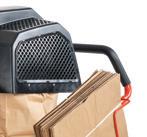
• Collects & mulches up to 50 lbs of leaves








• Includes onboard caddy for extra bags
Piles with a DR ® Chipper Shredder


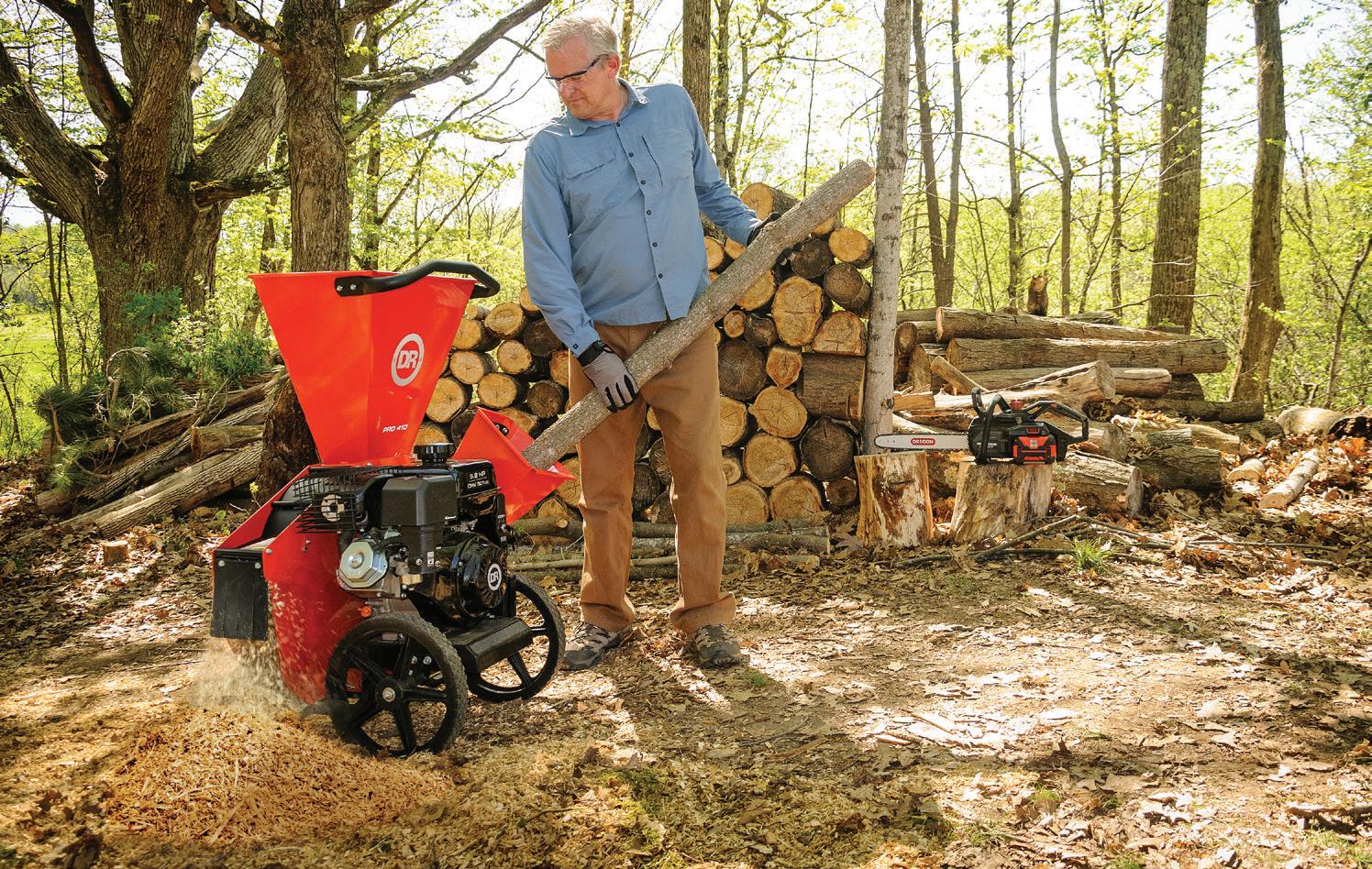

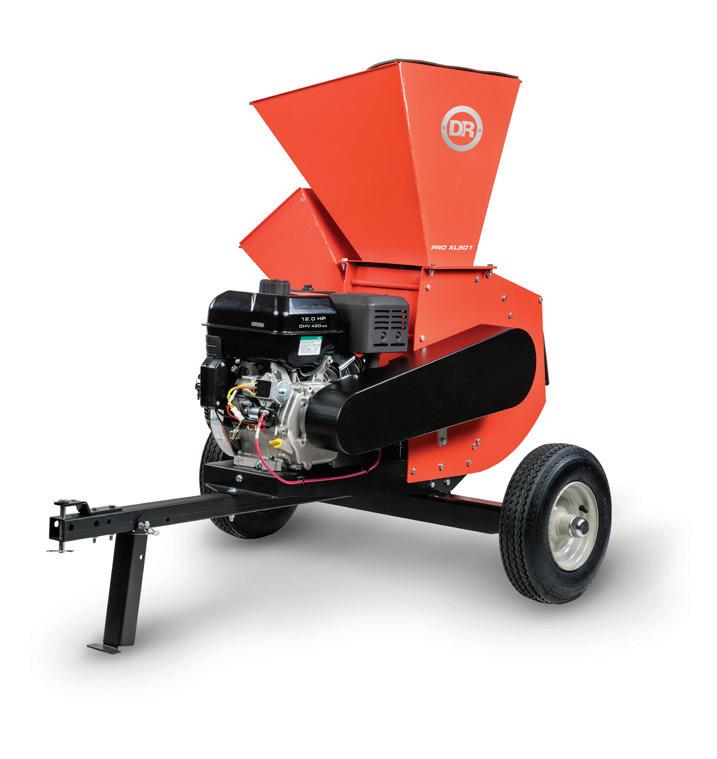

• CHIP & SHRED with power to spare
• BIGGER ENGINES beat the competition
• BUILT USA TOUGH for smooth operation
ENGINEERED AND BUILT Assembled in the USA using domestic and foreign parts.
USA

















GoDRpower.com Toll-Free at 800-456-0516 FREE SHIPPING (orders over $100) Scan to Shop or Request a Catalog NOTHING Stops a DR ® Field & Brush Mower • Up to 2X THE POWER of the competition • CUT 3" BRUSH & tall eld grass with ease • WIDEST SELECTION of deck sizes and features • GO-ANYWHERE power steering and hydrostatic drive options XD30 COMMERCIAL SERIES PLUS Tow-Behind, Commercial, and NEW Electric models This Fall, Till Your Garden Under with a DR ® Rototiller • Till garden leftovers under & enrich your soil for spring planting • Easily churn through the most compacted ground • Full line includes walk-behinds, tow-behinds and cultivators Discover the POWER and PRECISION of a DR ® Trimmer Mower • 5X THE POWER of a handheld trimmer • TRIM precisely without arm fatigue • MOW where a bladed mower can’t • TOUGHEST trimmer cord available DR® Power Equipment Starting at Just $1999 99
Nebraska Solar Farm, 1 Year Later
In June 2022, the city of Norfolk, Nebraska, completed the state’s largest solar farm in partnership with solar developer Sol Systems.

Now, about one year later, the Norfolk SunWise Community Solar program is going strong, according to Steven Rames, public works director and city engineer with the City of Norfolk. Rames says the solar power produced in the 8.5-megawatt facility is not only delivering renewable energy to residents, but also delivering it at about 10% less than the normal retail price of energy from the Nebraska Public Power District (NPPD).
NPPD is a publicly owned utility, and its community solar programs are set up as power purchase agreements (PPA); a private solar developer installs, owns, and operates the solar facility. There’s no upfront cost to the City of Norfolk except the cityowned land the facility operates on. The PPA states NPPD will purchase the energy from the developer at a fixed price for 20 to 30 years and offer participation to Norfolk residents through solar shares. Community members can then purchase and use the energy through these shares without having to install solar panels on their own roofs meaning they don’t have to worry about their cost, placement, or maintenance. One solar-energy share equals about 150 kilowatt-hours (kWh) per month. So, if the average monthly energy consumption for a Norfolk household is 1,050 kWh, it could purchase 10 solar shares at $6.15 per share, per NPPD spokesperson Grant Otten’s calculations.
Though many in the Norfolk community are aware of the availability of solar, Rames says, residents were initially skeptical of seeing returns. So, the City of Norfolk ended up consuming more than 50% of the shares available, which in turn lowered the municipal cost of energy. “[The] lower cost of operation as a
city is seen by the community when our budget each fiscal year is drafted,” Rames adds. “We can use funds that are being saved due to the solar energy for other community needs and projects.” Now, according to Otten, all available shares have continued to be sold out, and there’s an active waiting list for customers to join the program.
The Norfolk solar facility doesn’t only house this solar project. Otten says the facility also includes a Battery Energy Storage System pilot program, funded by a grant from the Nebraska Environmental Trust, to experiment with utilizing batteries on a larger scale. The batteries are charged by the community solar program, then discharged as needed to provide energy. At its inception, the solar facility was also planted with pollinator habitats, but they’re not yet fully established, so beneficial effects are yet to be seen.
Despite this project’s success, many rural communities in Nebraska and beyond face opposition to large-scale solar projects. A solar farm in Scottsbluff, Nebraska, suffered damage from a hail storm in June 2023 and only lasted four years out of its projected 25, leaving behind immense waste that’s difficult to recycle. The large land use and relatively short life span of solar panels has also led many residents to question their long-term worth in their communities. Though the U.S. has seen growth in the renewable-energy industry, total energy consumption has also increased, per the U.S. Energy Information Administration. Renewables such as solar have merely been adding to the total energy available for use, not replacing fossil fuels. In the eyes of some communities, taking environmental action shouldn’t include covering the land with acres of utility lines and solar panels. As Norfolk’s solar program enters Year 2, these challenges are still being unpacked in the larger renewable-energy movement.
Green Gazette By Darby Stipe
C ourtesy of the C ity of N orfolk
An overhead view of Norfolk’s solar farm.
From Food to Fortified Farms
In January 2022, California implemented Senate Bill (SB) 1383 as part of its ShortLived Climate Pollutant Reduction Strategy. SB 1383 requires every jurisdiction (city, county, or special district) in California that provides waste-collection services to also provide a separate organic-waste collection to be composted. All residents are required to either subscribe to the available services or self-haul their organic waste to a composting facility. Since its inception, 70% of California jurisdictions have reported residential organic-waste collection is in place.

Farms and vineyards have been making ample use of the compost coming from cities and other residential areas. To reduce the risk of erosion from storms, farmers have been protecting their

topsoil by planting mustard and other cover crops over a layer of compost. This improves soil quality by boosting micronutrients and developing soil structure. In a press release, Johnnie White, operations manager for Piña Vineyard Management in Oakville, California, says, “It’s huge for us. On these hillsides, we have to grow cover crops to prevent soil erosion that could otherwise end up in the [San Francisco] Bay.” In a mutually beneficial relationship, farmers provide food and other goods, such as wine, to the city, and the city sends back waste in the bioavailable form of compost.
Agrivoltaics: Where Panels Meet Plants

Though it may sound counterintuitive, solar panels experience decreased performance when they get too hot. That’s where agrivoltaics comes in to help. “Agrivoltaics” is a method of farming that uses both solar panels and crops in the same area, leading to increased productivity of the land while cooling the panels at the same time. Vegetation passively cools the panels as it reflects sunlight away from the bare ground, limiting the amount of heat the solar panels are exposed to. A recent study in the journal Applied Energy tested the cooling effects produced from 18 scenarios comprising different crops, panel heights, and levels of ground cover. The study showed a solar panel experienced a temperature decrease of 10 degrees Celsius when soybeans were grown under it and the panel was positioned 4 meters off the ground, compared with leaving the ground bare and positioning the panel 0.5 meters off the ground.
If you’re considering or already have a solar farm, planting crops among the panels has potential to eliminate the 0.5% decrease in productivity solar panels experience for every degree over 25 degrees Celsius. Other ways to use agrivoltaics include combining solar panels with grazing animals, such as sheep, which provide food and fiber while mowing and improving pasture. Because food production and renewable-energy consumption are predicted to surge
over the coming decades, with an estimated 10 billion people living on the planet by mid-century, utilizing land more efficiently will be a valuable way to meet demand while building resilience to rising temperatures.
To learn more about agrivoltaics, check out “The Potential for Agrivoltaics to Enhance Solar Farm Cooling” at www.ScienceDirect. com/science/article/abs/pii/S0306261922017354
www.MotherearthNews.coM 9 Green Gazette
f rom top : p hoto C ourtesy of r e C ology ; A dobe s to C k / jeso N
Practicing agrivoltaics can be a more efficient way to use the land.
Mustard grows as a cover crop over compost at a California vineyard.
What to Do About Gas Stoves

Controversy arose in late 2022 surrounding the use of gas stoves and other appliances after the U.S. Consumer Product Safety Commission announced it was considering tighter regulations around natural-gas stoves. Natural gas is a major fuel source in the U.S., consisting primarily of methane as well as other gases, such as carbon monoxide. Gas stoves are highly prevalent in American life: 76% of restaurants, per the National Restaurant Association, and 37% of U.S. households, according to a Consumer Reports survey, use gas stoves. Professional chefs and home cooks alike have argued that gas allows for tastier food and better presentation and helps keep costs low.
However, nitrogen dioxide (NO2) is a byproduct of burning methane, meaning
small amounts can leak directly into a home when natural gas is used for the stove. Some studies have linked NO2 inhalation with decreased lung function and increased instances of asthma.
The solutions to this issue aren’t so clear-cut. Proper ventilation limits the negative health outcomes associated with gas stoves, but many homes don’t
Composting for the Win!
Though many complex problems contribute to methane pollution, one fix could lead to heaps of improvement: composting. Food waste is the largest organic component of landfills, and a new study from Scientific Reports found composting food waste led to a 38% to 84% reduction in greenhouse gas emissions.
When organic material breaks down anaerobically (without oxygen), bacteria produce an abundance of gasses, such as methane, carbon dioxide, and nitrous oxide. The Environmental Protection Agency says landfills “are the thirdlargest source of human-related methane emissions” in the nation. On the other hand, aerobic (with oxygen) decomposition produces much less greenhouse gas emissions. The Scientific Reports study also noted that turning compost more often and adding water
have any ventilation installed. Another possible source of exposure is gas line leaks, so regular maintenance and checking the lines may limit unnecessary risk. Other gas appliances are already required by law to be automatically vented outdoors, because they burn many times more natural gas than stoves, but all the byproducts of burning natural gas end up outside eventually, where they contribute to air pollution and climate change. Additionally, not everyone has the ability to replace an existing gas stove. More research may be needed to determine the best moves for communities and appliance owners. To start, learn more about reducing NO2 exposure in your home at www.EPA.gov/Indoor-AirQuality-IAQ/Nitrogen-Dioxides-ImpactIndoor-Air-Quality.
more frequently have the potential to reduce composting emissions even more.
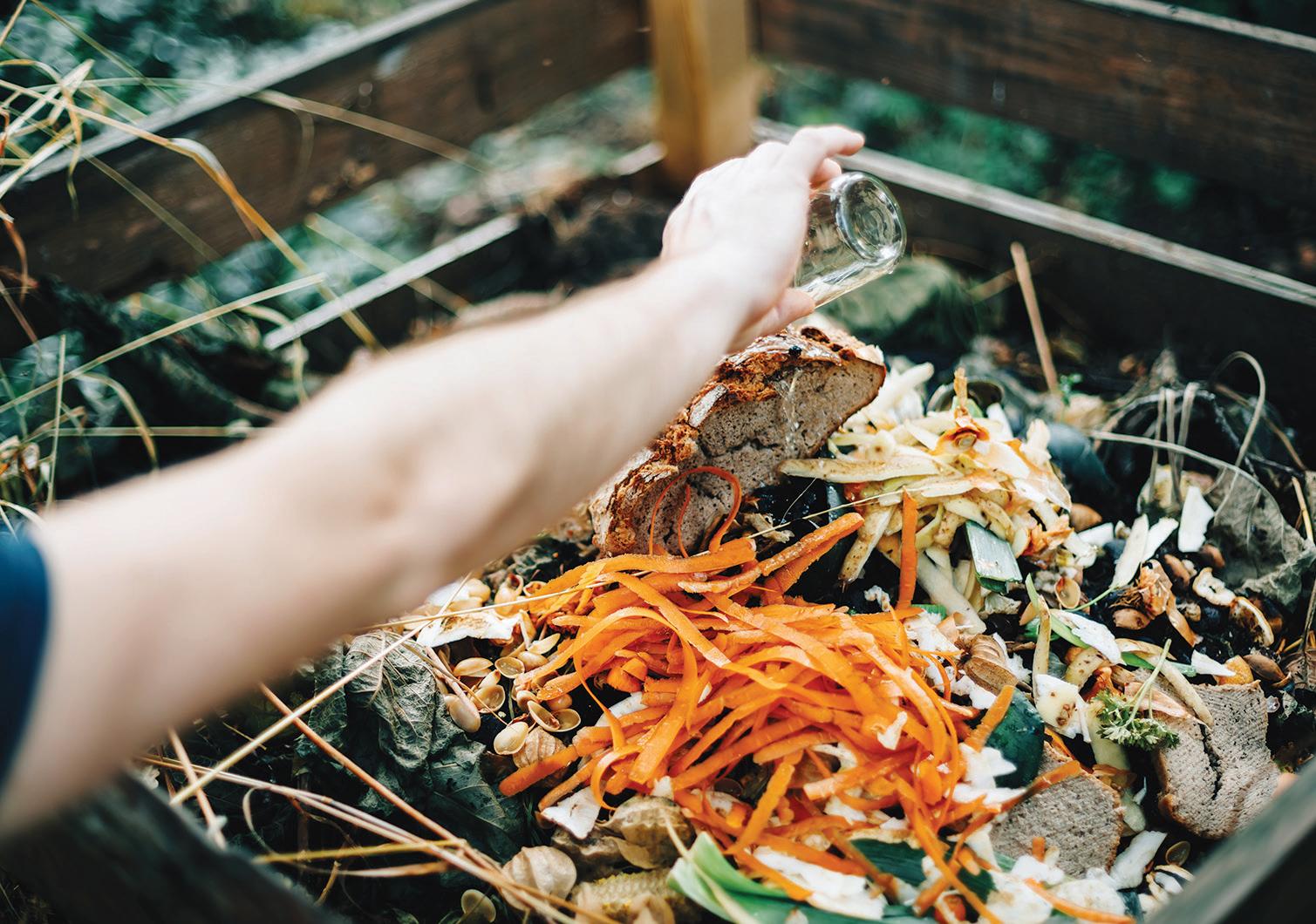
If you don’t have access to curbside pickup for your compost and want to learn more about how to turn your own organic waste into nutrition for the garden, visit www.MotherEarthNews.com/ Organic-Gardening/Compost Here, you’ll find a collection of articles on the benefits of composting and how to get started in your own backyard.
For information on the types of composting bins available and choosing the right one for your situation, visit www.MotherEarthNews.com/Organic-Gardening/CompostBins
To learn more about vermicomposting (composting with worms), listen to our podcast about it, featuring Heather Rinaldi and Joanne Olszewski, on the “mother eArth newS and Friends” podcast at www.MotherEarthNews.com/Podcast/Vermicomposting
F rom top : A dobe S tock d mitry V ere S hch A gin ; A dobe S tock k A y F ochtm A nn Green Gazette 10 MOTHER EARTH NEWS October/November 2023
Gas stove usage is widespread in the United States.
Composting can significantly decrease greenhouse gas emissions.





















See #2 on page 68
Surviving an Ice Storm
2 inches of ice coated everything. I was concerned but not worried. I was a New Englander, and winter comes every year. This bravado could’ve been my undoing.
Isit and write this piece at the end of February 2023. After a mild winter, nature is returning with a fury. Many people have been caught offguard and unprepared.
I’ve been there. Until you experience a winter storm, you have no idea what it’s like. I’m talking snow, ice, and freezing cold; storms that paralyze entire regions.
My wife and I bought our home in New England in the late 1980s. Our goal was to be semi-self-sufficient. The purchase of our home and the birth of our daughter made our budget a bit tight, so we had to put off some purchases, including a generator and the fuel to run it, which would’ve made a big difference during our first major storm during the winter of 1993-1994.
Winters in northern New England can be fierce, but we’ve always made it through. Power outages are normal but rarely last more than a day or two. This storm wasn’t the “usual,” and we were illprepared. Here are the lessons we learned.
Lesson No. 1: Install Alternative Heat
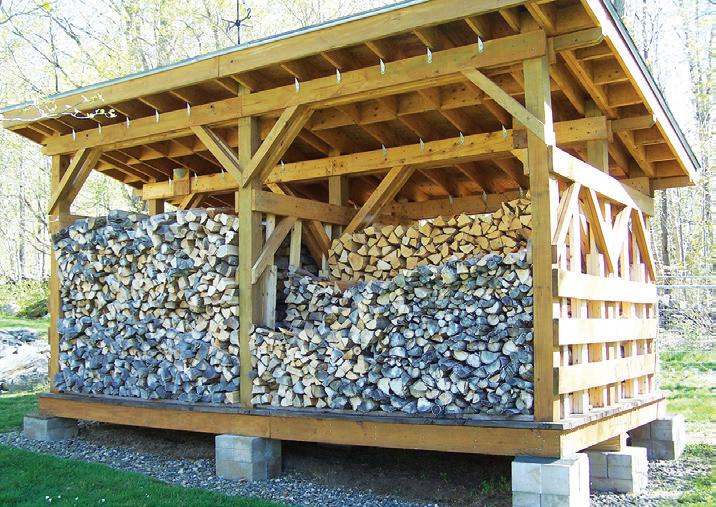
Every home that experiences winters needs a generator and an alternative heating source, such as a woodstove or a pellet stove with a battery backup.
This winter seemed colder than normal. On this particular day, a storm rolled in, first with rain, then freezing rain and sleet. These storms usually turn to snow pretty quickly, and snow is better than ice, but this one didn’t do that. The freezing rain fell all night before it finally turned to snow, but by then, about
Lesson No. 2: Never Let Your Guard Down
Take news reports and warnings seriously. If something doesn’t feel right, it probably isn’t.
After I broke the car free from the ice, I headed to work, listening to radio warnings of bad travel conditions and power outages from ice and downed trees. By the time I arrived, work was canceled because of the storm.
Lesson No. 3: Communication Is Essential
Find out before you head out. Knowing work was canceled could’ve kept me off the road that day. By the time I turned around, the snow came down hard, making a bad situation worse.
The power was out when I got home. This meant no heat. The roads were
Prepare for winter storms before they hit, potentially leaving you without power or road access.

Firsthand Reports
Story and photos by Dana Benner
A New England family shares lessons learned after being caught unprepared in fierce weather.
still passable, so I helped my wife and daughter pack up and drove them to my mother-in-law’s house, which still had power and heat. I then returned home, determined to hold down the fort.
Lesson No. 4: Get Out While You Can
On the third day, the snow finally stopped and the roads were slowly cleared, but we still had no power. At this point, I would’ve been wise to leave. With the roads clear, it was the perfect time to get out. In emergency situations, you should have a few safe places to go. If the opportunity arises to go somewhere safer, take it. Instead of leaving, however, I searched for a generator for the next few days. On the fifth day, I finally found one, and then I found a gas station with power and got some fuel. My biggest concern was what kind of pipe damage I’d find once the furnace got going. I was lucky; none of our water pipes had broken. Some of my neighbors weren’t so lucky. Our power was restored on the sixth day.
After I survived this go-round, I prepared for the next, which came in January of 1998, incapacitating the entire Northeast and southern Canada for about two weeks. But we were ready.
Lesson No. 5: Plan for the Worst
I never wanted to be caught in a situation like this again. Shortly after catching my breath, I made a plan, which included a list of things to do and equipment to obtain, as well as a checklist of tasks to handle every year to prepare for bad times.
It’s one thing to make a plan, and it’s another to put it into play. To work, it has to be achievable, even if only in small steps. Concentrate on tasks that cover the basics of heat, shelter, water, food, and safety.
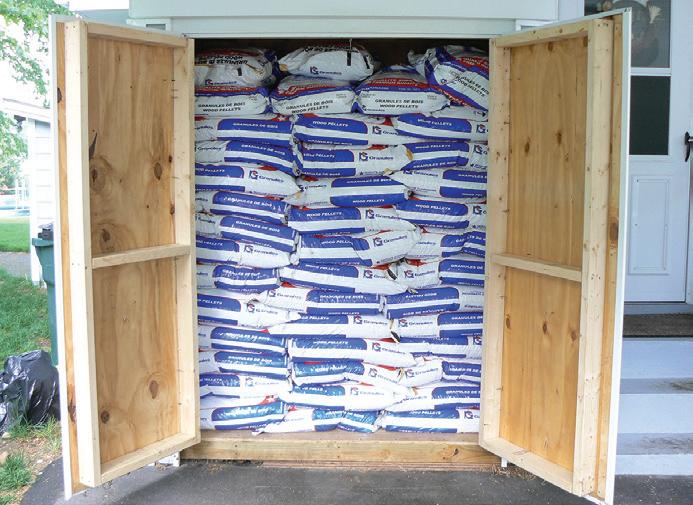
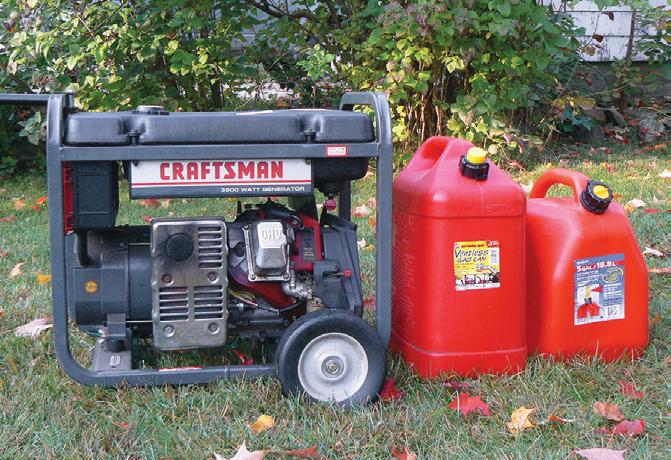
Right off, I secured a second generator that runs on propane and purchased a pellet stove. Two generators that run on different fuels ensure I’ll have enough power to last several days. I also stock up on extra fuel for both generators. I installed the pellet stove with battery backup, and I chose a pellet stove over a woodstove, because pellets burn cleaner and more efficiently.
Next, I prepared our home. I replaced the windows and doors and insulated every pipe that carries water. As money became available, I boosted the insulation in the entire house. Over the years, I’ve acquired solar-powered lights and small solar panels to charge cellphones, batteries, and the like.

Water and food are constant concerns, since you never know how long emergencies will last. I frequently purchase bottled water and canned food just in case and store both on my basement shelves. Just be sure to rotate your stock. Keep nonelectric kitchen tools available to open cans and prepare food. If utilities are down, you’ll need a way to cook the food. I have an assortment of backups, including propane stoves and grills, charcoal grills, and a biofuel stove. (Don’t operate any of these devices indoors because of carbon monoxide danger.) If you have a woodstove, you can simultaneously provide heat and cook.
Safety preparation should always take priority. Keep a good first-aid kit on hand. You’ll also need an operational fire extinguisher, a battery-operated fire alarm, and a battery-operated carbon monoxide detector. Establish communication using cellphones and two-way radios. A good battery-powered or hand-crank weather radio can keep you informed.
You may need to make repairs at some point, so you will need tools. Tree limbs may fall and damage your roof, or a water pipe may freeze and break. Hand tools,
such as saws, wrenches, screwdrivers, axes, and hammers, are essential during outages. Battery-operated tools are useful if you can charge the batteries. You should also have an assortment of screws, nuts, bolts, and pipe clamps.
Lesson No. 6: Prepare Pronto
In my neck of the woods, it gets cold come October. This is the time of year to get your home, your family, and yourself ready. Way too many people wait to prepare until it’s too late, like I did with that first storm.
By October, I’ve already secured my fuel (gas, propane, pellets, oil) and serviced my generators and vehicle (in case we need to get out). I’ve stocked up on extra food and water and alternative ways to cook them. I’ve trimmed tree limbs that could potentially damage the house, shed, or other outlying buildings during a storm, and I’ve made any repairs I previously put off.
We can’t anticipate everything that could go wrong. Mother Nature is a fickle beast, and she’s not above throwing a curveball now and again. But we can prepare as best we can.
Dana Benner has been writing about all aspects of the outdoors and selfsustainability for 35 years, with his work appearing in Grit, Countryside, Backwoods Survival Guide, and others.

www.MotherearthNews.coM 13
Secure alternative energy and fuel sources so you have power and heat when a winter storm strikes.
Old-Fashioned That Work
Cold Remedies
Turn to the herbal wisdom of your great-greatgrandparents when fighting that pesky cold.
Story and photos by Kami McBride
For the past century, many family lines have dismissed old-fashioned remedies as archaic and unnecessary “old wives’ tales.” But, in many cases, these heirloom practices

were passed from generation to generation for good reason. They’re simple, affordable, comforting, and most importantly they work!
Since throwing our great-great-grandparents’ herbal knowledge to the wind, many of us are engaged in relearning the art of home herbal care, digging up old-
fashioned remedies and recipes we find online. You could say we’re now exposed to more information in a couple of years than our forebears were in a lifetime. Over the course of three decades spent teaching the art of home herbalism, I’ve heard an increase in the number of students who say there’s actually too much information out there! With the rise of the internet, a seemingly endless amount of information makes it hard to know where to begin with natural remedies. Let’s start with what’s already in your cupboard!
14 MOTHER EARTH NEWS October/November 2023
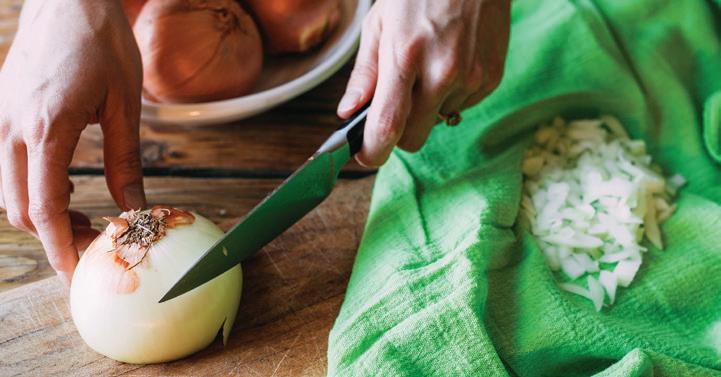
Onion poultices are an allbut-forgotten folk remedy.
In this article, I’ll share five folk remedies that won’t require an extra trip to the grocery store: onion poultice, saltwater gargle, respiratory steam, raw garlic, and hot toddy. The value of these methods is in their simplicity, and they’ve proven tried-and-true through the generations.

Onion Poultice
Onion poultices are an all-but-forgotten folk remedy for clearing congestion in the lungs and sinuses. The advent of modern antibiotics made them seem antiquated for most of the past century, but because of the growing awareness of antibiotic-resistant pathogens, as well as the damage antibiotics can do to the gut microbiome, there’s renewed interest in this use for onions.
Although I’ve never found a scientific study on onion poultices, I’ve heard many stories of young children healing from pneumonia after an onion poultice was applied to their feet, chest, or back. And it wasn’t just “old wives” who did this.
In Remedies and Rituals: Folk Medicine in Norway and the New Land, Kathleen Stokker relays the story of a 7-year-old girl who developed severe pneumonia in both of her lungs in about 1904. A doctor told the family he didn’t know of any professional treatment to cure her, and then clandestinely advised her grandmother to cut up onions, bake them with honey, put the mixture in soft cloths, and apply them to the girl’s chest and back. It was a method he’d learned growing up in Norway but wasn’t allowed to use as an American physician. In the morning, the girl coughed up large amounts of green mucus and began to recover.
In my family, the story from my grandfather is that if even one child let out a single cough, out came the onions. My great-grandmother would make everyone drink hot, stewedonion-mash tea as a preventive. There were just too many siblings and cousins to risk a cough spreading through the whole family.
There are nearly as many ways to make an onion poultice as there are
people who’ve made them. Place a freshly sliced onion in a handkerchief and apply to the chest. Sauté an onion in lard, put it in a muslin bag, and apply the poultice to the bottoms of the feet. Or, as detailed previously, chop an onion and bake it with honey. The following method minimizes the mess by lightly steaming the onion in water.
• 1 large onion
• 1⁄4 cup water
1 Chop or slice the onion.
2 Steam lightly in water until translucent, about 7 minutes, adding more water if necessary.
3 Pour onto a kitchen towel and fold the towel so no onions escape.
4 Allow to cool until it won’t burn or hurt the skin.
5 Apply the poultice to the chest, back, or feet for 20 to 30 minutes.
6 Reapply several times a day as needed until mucus is expelled. With gentle reheating, the same poultice can be used all day.
Saltwater Gargle
My grandfather, John McBride, was a towering Scottish Irish man who gargled with warm saltwater every morning, a wellness ritual he’d learned from his father. Grandpa John had an outsized influence on what became my passion for herbalism, facilitating my first herb walk when I was 8 years old.
I often add a squirt of thyme tincture to my saltwater, but with or without herbs, gargling has become a favorite heritage remedy.
You can gargle every day like my grandfather did, make it a seasonal practice in fall and winter, or do it when you feel a scratch in your throat.
A 2021 report in Osteopathic Family Physician found credibility for saltwater gargling in the prevention and treatment of upper respiratory infections. The researchers didn’t settle on an answer for exactly how saltwater rinses worked, but hypotheses included the possibility that saltwater draws viral particles out of cells and washes them away before they can multiply and overwhelm the immune system. Another hypothesis is that saltwater supplies chloride ions that can be used by immune cells to make hypochlorous acid to fight off infection.
Whatever the reason, I know from 30 years of gargling that it makes a significant difference in my respiratory health.
• 8 ounces water, as warm as possible without burning the mouth or throat
• 1⁄2 teaspoon salt
1 Add salt to warm water.
2 Stir to dissolve.
3 Gargle with half the warm saltwater solution for 5 to 10 seconds and spit out.
4 Repeat until mug is empty.
www.MotherearthNews.coM 15
A saltwater gargle can help deter upper respiratory infections, even if done as needed.
Steam Inhalation
If you have a pot of hot water and a towel, you have everything you need for an effective steam session. Although water itself is enough to create the necessary vapor, as an herb nerd, I love adding aromatic plants to give the experience a boost.

It turns out I’m not alone. A singleblind study of steam inhalation done with and without herbs found that both eased sneezing and congestion from allergies. But those treated to the herbal steam were more satisfied with the results! Aromatic herbs in the mint family sage, peppermint, and thyme are some of my personal favorites for steaming.
I use sage steams to clear out congestion from my sinuses, ears, and chest. They also help ease my son’s reaction to seasonal allergies, although this method isn’t recommended for children under 12 because of the risk of scalding.
Steam inhalation became common practice in Europe during the 19th century and has been used as a folk remedy for the common cold, bronchiolitis, and croup. Moreover, decades of experience have shown me that when I get water boiling and fetch a towel at the very first sign of congestion or a scratchy throat, I’m able to support my innate immunity by moving the mucus out.
• 4 cups water
• 8 tablespoons fresh herbs (or 4 tablespoons dried herbs), such as mint, sage, rosemary, or thyme, optional
1 Put water and herbs (if using) into a medium-sized pot. Cover and bring to a boil.
2 Remove pot from heat and let it sit until cool enough to put your face over.
3 Carry the pot to a table and place it on a pot holder or coaster to protect the table’s surface. Pull up a chair so you can comfortably lean over the pot.
4 Put a towel over your head and carefully lean over the steaming pot. Only do what’s comfortable, and make sure not to get so close that it burns.
5 Take deep, full breaths and enjoy the feeling of the steam traveling through your sinuses and lungs.
Raw Garlic and Honey
Garlic has one of the longest documented histories of any folk remedy. The earliest medical texts from China, Egypt, Greece, India, and Rome expound upon garlic’s medicinal uses: namely, to build good health and stamina. In Sanskrit, garlic means “slayer of monsters.”
Modern studies have helped explain the mechanisms behind this ancient wisdom. Garlic is high in trace minerals, has sulfur-containing compounds, is antimicrobial, and has a history of traditional use in keeping colds at bay. Garlic has been shown to boost the production of white blood cells, strengthening the body’s innate defense against pathogens.
I consider raw garlic my strongest ally in cold and flu defense even more than elderberry, and that’s saying a lot! You’ll want to use garlic to build your body’s natural defenses before getting sick or at the very first sign of illness, such as a lag in energy or a scratchy throat.
For some, raw garlic causes digestive upset. The trick is eating it fresh without burning your stomach. Garlic honey with a little butter is one of my favorite ways to circumvent this problem. Another time-tested solution is keeping a garlic press at the dinner table and adding freshly pressed garlic to your savory meals. For those who really can’t stand the taste, I suggest cutting a clove in half and rubbing it on the bottom of your feet decades of experience has taught me that this also has a strengthening and toning effect on immunity!
16 MOTHER EARTH NEWS October/November 2023
Use sage steams to ease congestion in the sinuses, ears, and chest, as well as seasonal allergies.







Protection wherever you go Get coverage that goes beyond your homeowners’ policy with comprehensive UTV insurance to protect your off-road vehicle, belongings, accessories and more – no matter where you ride. 1-800-PROGRESSIVE / PROGRESSIVE.COM Progressive Casualty Insurance Co. & af liates. Prices vary based on how you buy. Custom accessories coverage included with the purchase of comprehensive and collision coverage. Protection for personal belongings offered with optional Carried Contents coverage. Coverage subject to policy terms and conditions. Quote UTV insurance in as little as 3 minutes See #33 on page 68
• 1 clove garlic
• 1 teaspoon honey
1 Mince the garlic or put it through a garlic press.
2 Mix with the honey.
3 Eat it plain or on buttered toast.
Hot Toddy
Traditionally made with honey, lemon, and whiskey, a hot toddy is one of the most tried-and-true homemade cold remedies. A few generations ago, whiskey’s acceptance as medicine was so widespread that mothers whipped up hot toddies for their children at the first sign of a cold. More broadly, alcohol is considered one of the oldest medicines we know, having been used since antiquity to help reduce pain.

Who hasn’t been up half the night, unable to sleep because they can hardly breathe because of congestion from a cold? A hot toddy shortly before bedtime can help clear the nasal passageways and relax the body, making it easier drift off and get the rest our bodies need to recover.
Of course, alcohol in large amounts is toxic, but an ounce of alcohol in hot water can have a medicinal effect. If you forego the alcohol, for whatever reason, simply use your favorite warm tea in
place of hot water and whiskey; you may want to choose a caffeine-free option to get that much-needed rest.
Honey has been found to ease the symptoms of upper respiratory tract infections, and perhaps there’s a synergistic effect between two or more of the ingredients in a hot toddy.

• 1 cup water
• 11⁄2 ounces whiskey
• 2 teaspoons honey, or to taste
• 1⁄4 of a lemon or 2 teaspoons
lemon juice
• tea of choice (optional)
1 Boil the water and pour into a mug if using tea, prepare and steep as usual and let the water cool to drinking temperature.
2 Add whiskey, honey, and lemon.
3 Stir until the honey dissolves.
4 Drink and go to bed promptly.
Old-Fashioned Remedies from the Kitchen
I hope these stories and recipes inspire you to try an old-fashioned remedy (or a few!) yourself. As my students hear me say time and again, when we return to the Earth’s medicines and the practices passed on by our great-grandparents, we also empower ourselves, taking charge of building good health and living a healing lifestyle. It can all start with ingredients that are in your kitchen right now!
Kami McBride, author of The Herbal Kitchen, has taught herbal medicine since 1988, and has helped thousands of people learn to use common kitchen herbs for everyday ailments. Check out her free herbal recipes at www.KamiMcbride.com
18 MOTHER EARTH NEWS October/November 2023
Try your medicine on toast for a healthful (and tasty) snack or meal.
A hot toddy is more than a winter pick-me-up; it’s a generations-old remedy for a cold, too!
















© 2023 Wood-Mizer LLC *Price subject to change without notice. Live the Wood Life® is a registered trademark. 15 SAWMILL MODELS starting with the LX25 at $4,395* 866.344.1329 woodmizer.com Financing Available! Live the wood life sustainably and get the most out of your natural resources by sawing your own logs into lumber with a Wood-Mizer portable sawmill. Sawing is an easy and fun way to save on the rising cost of lumber. With 15 models, we have the perfect sawmill built just for you. SAW YOUR OWN LOGS INTO LUMBER!
E Q U I P M E N T F O R S U S T A I N A B L E L I V I N G See #42 on page 68
and made by Brad Early of North Carolina.
Extend Fall Feed and Forage
Bale grazing, stockpiling, and interseeding can improve resources for feeding livestock.
By Oscar H. Will III
Managing your pastures and hay meadows can be as daunting as flying a jet at supersonic speeds. And, in both cases, it’s crucial you focus on where you’ll be in a few seconds, days, and months not where you are now. With careful foresight and planning, fall can be one of your more productive grazing periods, depending on moisture and the plant matrix you have at your disposal.
In some locations, it’s common to have a healthy distribution of both warm- and cool-season perennial species that produce quality forage during the entire growing season and that might offer good feed potential through winter. In other areas, your matrices might be warm-season dominant or cool-season dominant. In these situations, strategies
for maximizing grazing days are still possible. Year-round grazing is attainable in some locations under careful management; even reducing your animal days on feed by a week will significantly add to your business’s bottom line. When managed effectively, you’ll improve your soils and productivity in the process. Most of what follows assumes you understand and employ the basic principles of management-intensive grazing, where stock density, grazing duration, and paddock rotation are integral to the program (search for “management-intensive grazing” at https://SustainAgGA. CAES.UGA.edu for more information).
Bale Grazing
During periods of excess pasture growth, preserve some of that bounty for later use by simply baling it as dry hay and dropping the bales where they’re
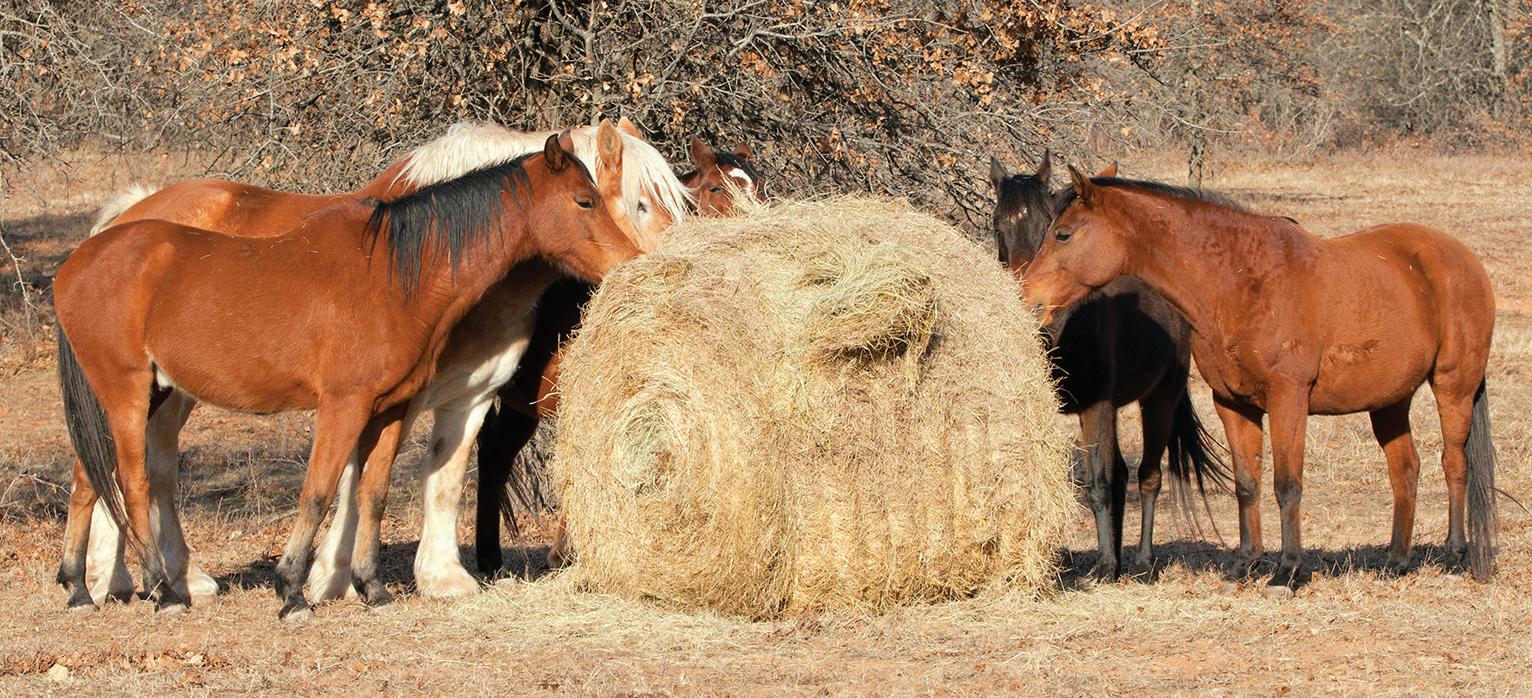
made. For example, if your herd only utilized half of your warm-season pasture, bale the rest while it’s still got good feed value. If you leave that bale in the field, you can use temporary electric fencing to ration out the bales in early fall before the cool season pastures have grown sufficiently. By feeding on the hay where you made it, the animals will return excess nutrients to those fields. Employ this approach for using excess spring forage in your coolseason areas to supply bale grazing for your herd during the “summer slump” in forage growth in areas with predominantly cool-season pasture matrices. You can also use this strategy for feeding hay in winter, depending on your snow loads and the animals’ access to suitable wind protection.
Stockpiling
Rather than cutting and baling excess forage, you can allow paddocks grazed early to grow tall and even go dormant for the purpose of feeding that plant material as “standing hay” in the field. Again, let the animals do the harvesting. But to maximize utilization, limit the herd’s access to the stockpile so the animals don’t trample and waste most of it. You can accomplish this by moving a temporary electric fence in front of the animals that allows access to a fresh patch of the forage at appropriate intervals. Stockpile is less nutritionally dense than vegetative, growing forage, so you might need to supplement with a protein source. Cool-season pastures tend to have higher feed value when stockpiled than warm-season pastures do, so keep that in mind when planning your annual grazing strategy. If your fall pastures are a bit slow in coming on, feeding strips of stockpiled forage will give them additional time to grow. If you have excess stockpile,
20 MOTHER EARTH NEWS October/November 2023
ADOBE STOCK/PIMMIMEMOM
Bale grazing allows livestock to return excess nutrients to the soil.
feed it as standing hay as far into winter as practical.
Interseeding
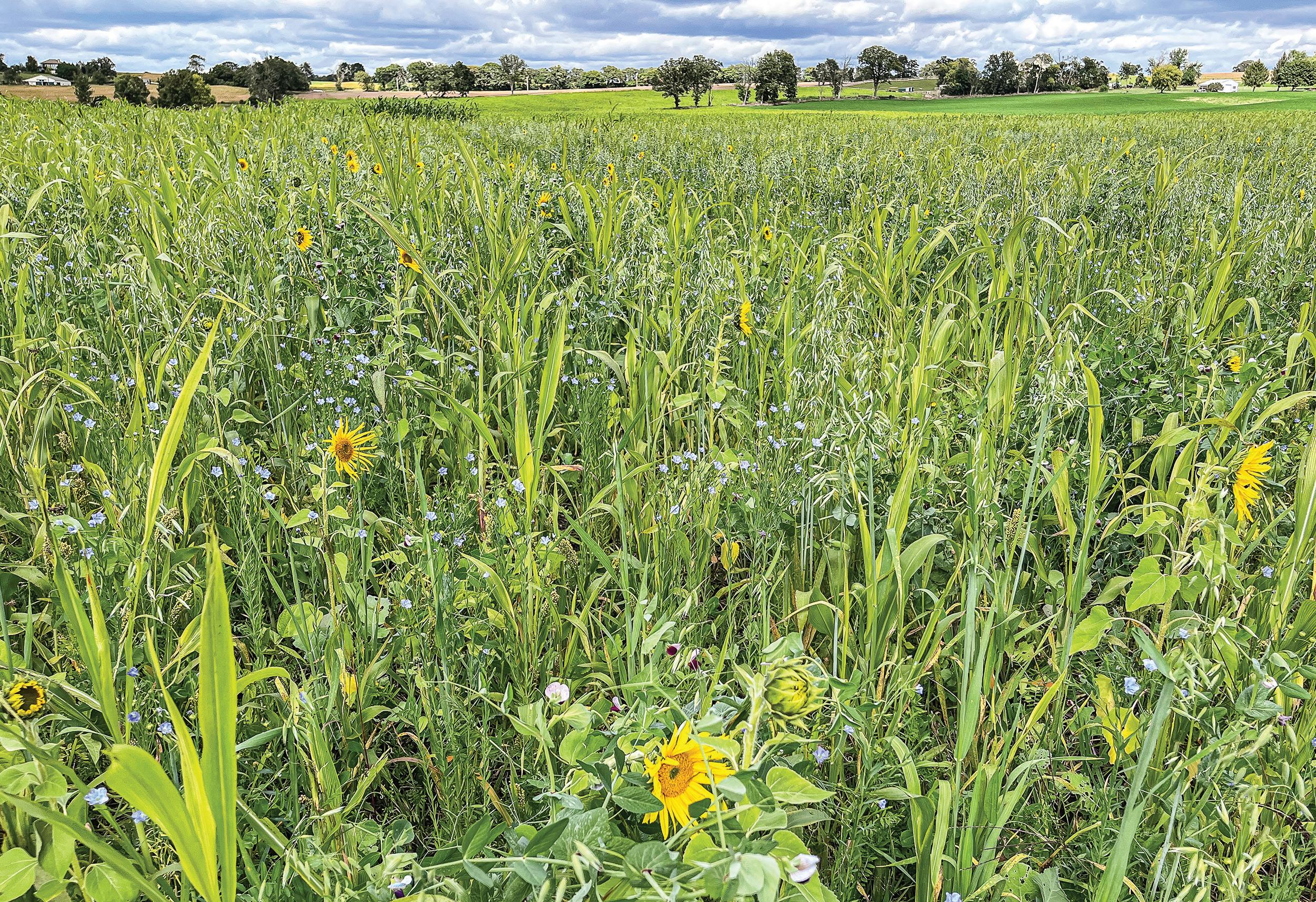
Another strategy for extending your pastures into fall particularly in regions with adequate moisture is to plant annual forage crops into dormant pastures. For example, grazing brassicas drilled into a summer dormant pasture in August (Northern Hemisphere) can provide literally tons of nutrition and forage in 4 to 6 weeks that can extend your fall grazing well into winter. Interseeding can provide benefit in almost any season, depending on the type of pasture. Small grains can be interseeded in warm-season pastures in fall for early spring grazing. If you wish to add other perennial species (such as clovers or alfalfa) to your pastures, add them to the drill at the same time.
Annual Forages
Believe it or not, annual grasses, such as crabgrass, sorghum, and corn, can be
grown in mixed or solid stands and can provide tons of high-quality forage from summer through fall, depending on how you manage it. Feeding is best accomplished by rotating the animals through these paddocks just as you would through perennial pastures. If you manage carefully, you can get some regrowth and more than one pass through the paddock. You can also stockpile these species for late fall and winter grazing, although, with the grain crops, you’ll want to limit access until the animals are adapted to a grain-rich diet to avoid acidosis. Likewise, some sorghum and Sudangrass can be toxic at certain stages of growth, so do your research and exercise care with those species. Alternatively, you can plant any number of annual-forage “cocktails” that will supply excellent nutrition in virtually any season, even winter. The more diverse the mix, the better it will be for your animals, so they can make choices based on their daily needs. Your best bet with forage cocktails or mixes is to consult a forage-
centric seed company for advice on what mixes would support your goals on the upcoming seasons.
Flexibility
When planning your annual grazing model and forage-production strategy, monitor and adapt the plan routinely. Predicting the weather is difficult at best. Maybe you can only stockpile 20 acres of the 40 thanks to the dry spring. Adjust your plan, even if it means selling animals, buying feed, or planting an alternative annual-forage cocktail. If you look after your pastures and keep them healthy, they’ll provide forage for your herds long into the future.
Oscar H. Will III has managed cattle, sheep, and poultry on diverse pastures for several decades with the goal of maximizing plant species diversity and soil health.
www.MotherearthNews.coM 21
This interseeded field of cover crops includes sunflower, Sudangrass, Austrian winter peas, buckwheat, flax, and oats. ADOBE STOCK/MARGARET BURLINGHAM
One salt does not fit all, and these three recipes will introduce you to a range of salt types.

Herbal Finishing Salts Make Your Own
Coarse and versatile, herb-infused salts add a flavorful accent to many dishes.
By Juliet Blankespoor
We live in extraordinary times, with a dazzling array of salts that are smoky, volcanic, or kissed by the subtle flavors of seaweed and minerals. Herb-infused finishing salts are a delightful alchemy between earth and sea, plant and mineral. Herbal salts are surprisingly easy to conjure up and make a nice way to preserve fresh culinary herbs. In early fall, I prepare big
Dusky Desert Finishing Salt
batches of salts from the herbs I harvest before the first frost. If your love language involves homemade gifts, as mine does, you’ll appreciate having a pantry full of finishing salts in pretty little jars ready for birthdays and holiday gift-giving.
Finishing salts get their name from their kitchen use, traditionally added to a dish after it’s prepared. But you needn’t be held back by this convention as long as you understand how salt behaves. Coarser salts, with a larger flake, add a
This pungent blend is especially tasty on poultry and adds variety to goat cheese, baked potatoes, and stuffing. Combine it with olive oil and vinegar to create a flavorful salad dressing, or sprinkle it on a sweet potato, black bean casserole, or burritos. Try it as a garnish on squash bisque or sliced and roasted squash its smokiness slow dances with the sweetness of winter squash. Yield: 1¼ cups.
• 1⁄2 cup (90 grams) coarse Real Salt
• 1⁄2 cup (80 grams) coarse wood-smoked sea salt
• 1⁄2 cup (75 grams) coarse Hawaiian, or black, lava sea salt
• 1⁄2 cup (23 grams) tightly packed fresh rosemary leaves
• ¼ cup (7 grams) tightly packed whole fresh garden sage leaves
• 2 teaspoons minced fresh garlic
• 15 dried juniper berries, mashed with a mortar and pestle or the back of a knife
• 1 teaspoon grated orange zest
• 1⁄4 teaspoon coarsely ground black pepper
gust of crunch and saltiness, but if you add them earlier in the cooking process, the salt dissolves and loses its texture. A finer grain provides more even distribution, for times when you don’t want splashes of saltiness.
Experiment with salt textures, and you’ll be a more dexterous cook. Add herbal salts to marinades and dressings or rub them onto meats and seafood before roasting, grilling, or pan-frying. I enjoy my finishing salts daily on popcorn, eggs, and beans. When I need a quick party trick, I add herbal salts to goat cheese and drizzle in olive oil, resulting in a salty, creamy dip. Herbal salts are so central to the life of my kitchen that they live next to the stove,
Lemon and White Sage Finishing Salt
This salt’s uplifting aroma makes it delightful to prepare. If you haven’t tried white sage (Salvia apiana) as a culinary herb, you’re in for a real treat. White sage is similar to its kissing cousin, garden sage, but with a more intense flavor. White sage is overharvested in the wild, so grow your own or purchase from an organic farmer and substitute with garden sage if needed. Like garden sage, white sage’s pungent, resinous flavor complements fatty foods. Indeed, our taste buds may be speaking for our stomachs in this department, as sage is one of the best culinary herbs for enhancing fat digestion. Try this finishing salt in stuffing, along with black pepper and anise seeds, or add the blend to meatloaf, poultry, or roasted roots. Yield: 1½ cups.
• 11⁄2 cups (420 grams) coarse Real Salt
• Handful (21 grams) whole fresh white sage leaves (Salvia apiana)
• 3 tablespoons grated lemon zest (from about 3 lemons)
www.MotherearthNews.coM 23
OPPOSITE AND PAGE 24: HARPERCOLLINS PUBLISHERS/JULIET BLANKESPOOR
Midnight Nettles Gomasio
Gomasio, or sesame salt, is a traditional Japanese seasoning. Rich in minerals from both the sesame seeds and the nettles, this herbal version adds a splash of ebony color to salads, dressings, and stir-fries, along with a hearty dose of antioxidant anthocyanins. Try it sprinkled on salad, soup, roasted roots, and grilled fish. Don’t confuse black cumin seeds for black sesame seeds they look similar but aren’t interchangeable. If you can’t find black sesame seeds, substitute un-hulled sesame seeds. Yield: about 2 cups.
• 13⁄4 cups black sesame seeds
• 1⁄2 cup (120 grams) coarse Hawaiian, or black lava, sea salt
• 1⁄4 cup (6 grams) dried nettles leaves (Urtica dioica)
Heat a dry skillet over medium heat. When the skillet is warm, add the sesame seeds and toast, stirring frequently, for a few minutes until their aroma fills the room. It’s easy to burn the seeds, so don’t walk away! Turn off the heat, pour the seeds onto a plate, and let them cool. Combine the seeds with the salt and nettles in a food processor and blend. Gomasio doesn’t need to dry; it’s best eaten fresh. Keep it refrigerated and use within 3 to 4 months.
coming out to play at nearly every mealtime. It’s all too easy to overdo it with these salt blends if you treat them like herbal seasoning and add liberal amounts to food. They’re genuinely salty, so go easy at first!
Make Your Own Herbal Finishing Salts
Himalayan pink salt and Real Salt (from Utah) are mined from ancient marine fossil deposits; their rosy hue is derived from a high content of minerals and trace elements. If you’re concerned about microplastics in your sea salt and, yes, sadly, this can be a concern these mountain-mined salts are a good choice. Substitute Himalayan pink salt for Real Salt in the recipes below, if needed.
Use the weight measurements in these recipes instead of volume, because salt density varies depending on its crystal size. Also, pay special attention to the
texture of the salt when you’re shopping, because these recipes call for coarse salt. What you purchase may not always be labeled as “coarse” but should look coarser than table salt.
1 De-stem and finely mince fresh herbs. I recommend using the weight measurements given for the salt in these recipes for greater accuracy, because they call for salts with a variety of crystal sizes. You can also create your own blend, using equal parts fresh herbs to salt by volume. For instance, if you’re making a rosemarythyme salt, add 1 cup total of combined fresh rosemary and thyme leaves to 1 cup of coarse sea salt. If you don’t have fresh herbs on hand, use high-quality dried herbs; simply cut the quantity of herbs called for in half.
2 Blend the ingredients in a food processor or spice blender until the consistency is even. Don’t go overboard. I like
Cultivating and Handcrafting Herbal Remedies
my finishing salts the texture of beach sand rather than table salt. If you don’t have a food processor or spice blender, finely mince your fresh herbs and then combine with the salt.
3 Dry the finishing salts (if you used dried herbs, skip this step). Spread the mixture on a serving tray or rimmed baking sheet and place it in an area with good airflow. I dry my salts on a table or counter underneath a ceiling fan. Depending on the humidity, it may take 2 to 4 days for the salt to dry. If your blend is heavy on fresh herbs and lighter on salt, it’ll take longer to dry. Periodically stir and break apart any clumps. If you need your finishing salts right away or you live in a humid climate, dry herbal salts in a dehydrator. Or, dry them in an oven: Place the mixture on a rimmed baking sheet. Use the lowest heat setting and leave the oven door slightly ajar. Stir every half-hour and break up any clumps. Depending on the recipe, it may take a few hours for the mixture to dry. Let the salt cool before storing. The heat from the oven will evaporate some of the herbs’ essential oils, diminishing the salt’s aroma and flavor. Therefore, if you have the time, the slowdrying, open-air method is preferred.
4 After your blend is thoroughly dry, store in airtight glass containers.
Juliet Blankespoor is the founder of the Chestnut School of Herbal Medicine. She has a degree in botany and over 25 years of experience teaching and writing about herbal medicine, botany, and organic herb cultivation. Connect with her at www.HealingGardenGateway.com
Add to your herbal finishing salt recipes and explore more culinary and medicinal herbs with Juliet Blankespoor’s complete guide, The Healing Garden. Blankespoor covers how to plan your garden, essential information on seed propagation, detailed profiles of must-know plants, 70 recipes for teas, tinctures, oils, salves, syrups, and more. Packed with sumptuous photography, this book appeals to home gardeners wanting to branch out to culinary and medicinal herbs, home cooks interested in natural wellness, and novice and skillful herbalists. Order your copy of The Healing Garden today and use the promotional code FALL20 to receive a 20% discount on the book. This title is available at Store.MotherearthNewS.coM or by calling 800-234-3368. Item #11738. Promotional offer expires on 11/18/23.

24 MOTHER EARTH NEWS October/November 2023
Sleep Apnea Relief








Helps ensure deep, steady breathing throughout the night, improving the efficiency of the lungs and relaxing muscles to address sleep apnea.

Injury Repair

Ankle sprains, bruises, painful elbows and shoulders all need help during repair. Rehab Remedy clears the bruising and keeps the healing process going for as long as you apply it. Get a complete repair naturally.





Some











gets too dry and some gets too oily. Anastasiia SKINny Spray is designed to balance your skin so that it’s moist but not oily. It provides very necessary vitamins and herbs to support healthy tissue development.










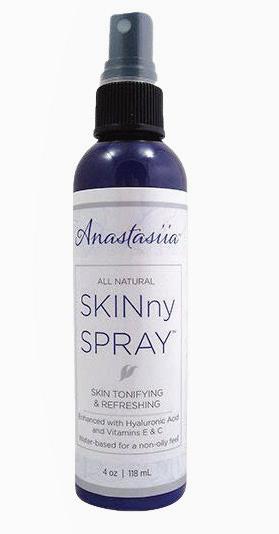
Designed for my family, Shared with yours. • Sleep Apnea • Bruises, Strains, Tissue damage Natural solutions FOR ALL YOUR HEALTH NEEDS Order online at MyNaturesRite.com or call 800-991-7088 Use coupon code HOT20 for 20% OFF ! Anastasiia SKINny Spray Hot Flash Relief
used regularly, Hot Flash Relief has been
to
the
and
of
flashes
symptoms
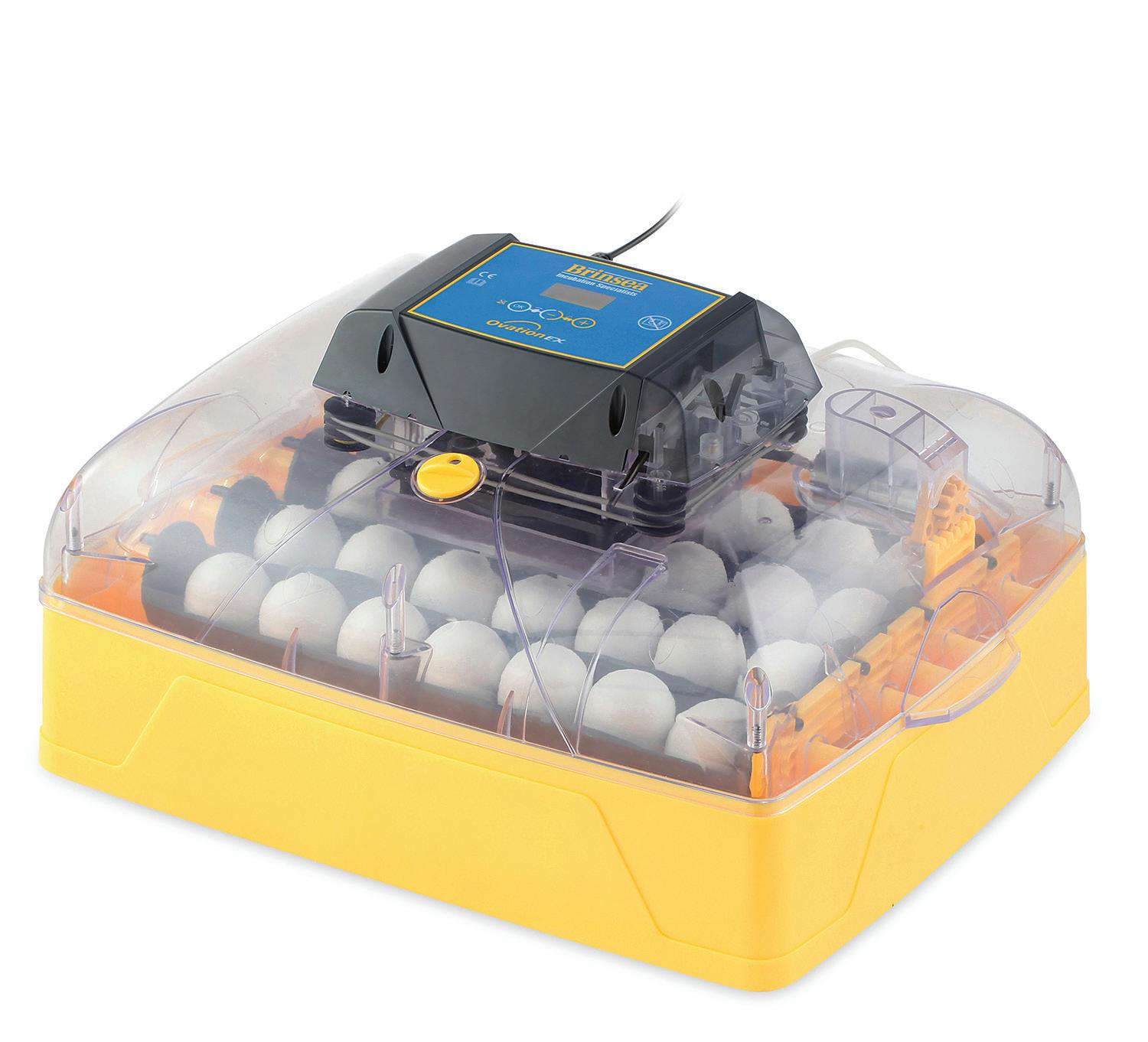
fluctuations. No purchase necessary. A purchase will not increase your chances of winning. Open to legal residents of the continental United States (excluding Hawaii). Entrants must be 18 years of age or older. Sweepstakes begins 09/27/2023 and ends 12/27/2023. See official rules online at www.motherearthnews.com/sweepstakes/brinsea-fall-2023 I Sponsor: Mother Earth News, 1503 SW 42nd St., Topeka, KS 66609. motherearthnews.com/sweepstakes/brinsea-fall-2023 Enter for your chance to win the Brinsea and MOTHER EARTH NEWS Ovation 28 Adv. EX Incubator Giveaway! Convenience and complete control make the Ovation 28 the ideal incubator for any breeder. Moreonline!details $580 total value Enter for a chance to be 1 of 2 winners. SWP_ME02 Brinsea_half.indd 1 6/5/23 8:42 AM See #30 on page 68
skin
When
shown
reduce
occurrence
severity
hot
and other
associated with the hormonal
DIY Knitted Shopping Bag
Knit 2, purl 2, and then shop for years with this sturdy over-the-shoulder pouch.
By Melissa Leapman
Tools and Materials
• Hanks of #4 mediumweight, 100% hemp yarn, each about 3½ ounces and 219 yards
• Circular knitting needle, U.S. size 6 (4 mm), or size needed to obtain gauge, 24 inches in length
• 1 stitch marker
• 2 stitch holders
Gauge
This handmade, reusable bag is a great sustainable choice for hauling produce from the farmers market or your garden. The pictured bag was made with three balls of Java yarn, #106 Desert Rose color, from Universal Yarn, an American company based in North Carolina. You can substitute any medium-weight worsted yarn that’s 100% hemp, linen, or cotton, but be sure to check the gauge first. Not only is hemp yarn sustainable, but it’s also especially durable and strong, which makes it well-suited to shopping bags.
In garter stitch with two strands of yarn held together, 19 stitches and 36 rows = 4 inches, blocked.
In the openwork pattern with one strand of yarn, 18 stitches and 20 rounds = 4 inches, blocked.
Garter stitch worked flat
Row 1: Knit across.
Pattern row: As Row 1.
Garter stitch worked in the round Round 1, right side: Knit (K) around. Round 2: Purl (P) around.
Repeat Rounds 1 and 2 for the pattern.
Openwork pattern (multiple of 2 stitches)
Round 1, right side: *Yarn over, Purl 2 together (P2tog); repeat from the * around.
Round 2: *Yarn over, Knit 2 together (K2tog); repeat from the * around.
Repeat Rounds 1 and 2 for the pattern.
Bottom of Bag
Finished measurements will be 9 inches in diameter and 12 inches in height (not including the straps).
The shopping bag will take about 29 hours to knit. The bottom of the bag is worked flat and seamed. Stitches are picked up along the sides of the circular bottom and worked upward.
To wrap and turn (abbreviated “W&T”), bring the working yarn to the front, slip the next stitch onto the right needle, move the working yarn to the back, slip the stitch from the right needle back onto the left needle, bring the working yarn to the front, and turn.
With 2 strands of yarn held together, cast on 21 stitches.
Begin short rows:
Row 1, right side: K3, W&T.
Row 2: K3, turn.
Row 3: K6, W&T.
Row 4: K6, turn.
Row 5: K9, W&T.
Row 6: K9, turn.
Row 7: K12, W&T.
Row 8: K12, turn.
Row 9: K15, W&T.
Row 10: K15, turn.
Row 11: K18, W&T.
Row 12: K18, turn.
Rows 13 and 14: Knit across.
Repeat all short rows 19 more times.
Bind off.
Sew the cast-on edge to the bind-off edge to form a circle.
Body of Bag
With the right sides facing and 2 strands of yarn held together, pick up and knit 120 stitches around the circular bottom of the bag.
Place a marker for the beginning of the round.
Begin garter stitch in the round, and work even for 11⁄2 inches.
Cut one of the strands of yarn, leaving a 6-inch tail, and begin the openwork pattern with one strand only.
Work even until the piece measures approximately 12 inches from the beginning of the sides of the back.
26 MOTHER EARTH NEWS October/November 2023
Divide for Shoulder Straps
Work the pattern as established across the first 30 stitches and slip them onto a holder. Loosely bind off the next 30 stitches, work the pattern as established across the next 30 stitches, and place them on a holder. Loosely bind off the next 30 stitches.
With the right side of one of the 30-stitch holders facing you, K2tog, K26, K2tog 28 stitches remain. Turn.
Next row, wrong side: K2tog, knit across until 2 stitches remain, ending the row with K2tog 26 stitches remain.
Next row: As last row 24 stitches remain.
Next row, wrong side: Knit across.

Next row: K2tog, knit across until 2 stitches remain, ending the row with K2tog 22 stitches remain.
Repeat the last 2 rows 5 more times 12 stitches remain.
Continue even in garter stitch, knitting every row, until this strap measures about 12 inches from the beginning.
Bind off.
Repeat for the second strap.
Finishing
Sew the bound-off edges of the straps together. Darn in all remaining yarn tails.
Melissa Leapman is an American crochet and knit designer who creates designs for major yarn companies. She’s the author of several bestselling knit and crochet books. This project is excerpted from her latest book, InstaKnits
GALE ZUCKER
Bug ApocalypseOutrunning a

Many scientists call it the “sixth extinction.” Can technology provide a way out?
By Robert Turner
Iremember as a child riding in the truck with my father and counting the bugs that hit the windshield. Bright greens, reds, and yellows splattered like a Jackson Pollock painting. Very few insects hit my windshield today when I drive that same stretch of road. Where have all the bugs gone?
I realize my observation is not scientific proof of a bug apocalypse. I could’ve
conducted a more methodical experiment over the years, recording the species of bugs hitting my windshield after a specific number of miles on the same stretch of road, traveling a designated speed, and so on. My scientist friends might be impressed by my rigorous “bug windshield” experiment, but I’m not certain any journal would publish the findings.
Still, the drop in insect numbers is apparent. A 2014 study of 452 species of
insects found that 45% fewer of them flit across North America than did in the 1960s. Another study showed 81 species of butterflies declining by one-third over the past two decades. Related research suggests 30% fewer birds fly over our heads than did 50 years ago, and given that birds eat bugs, I believe these trends are related. The root causes appear to be many, including changing weather, habitat destruction, and pesticides. None of it bodes well for humans.
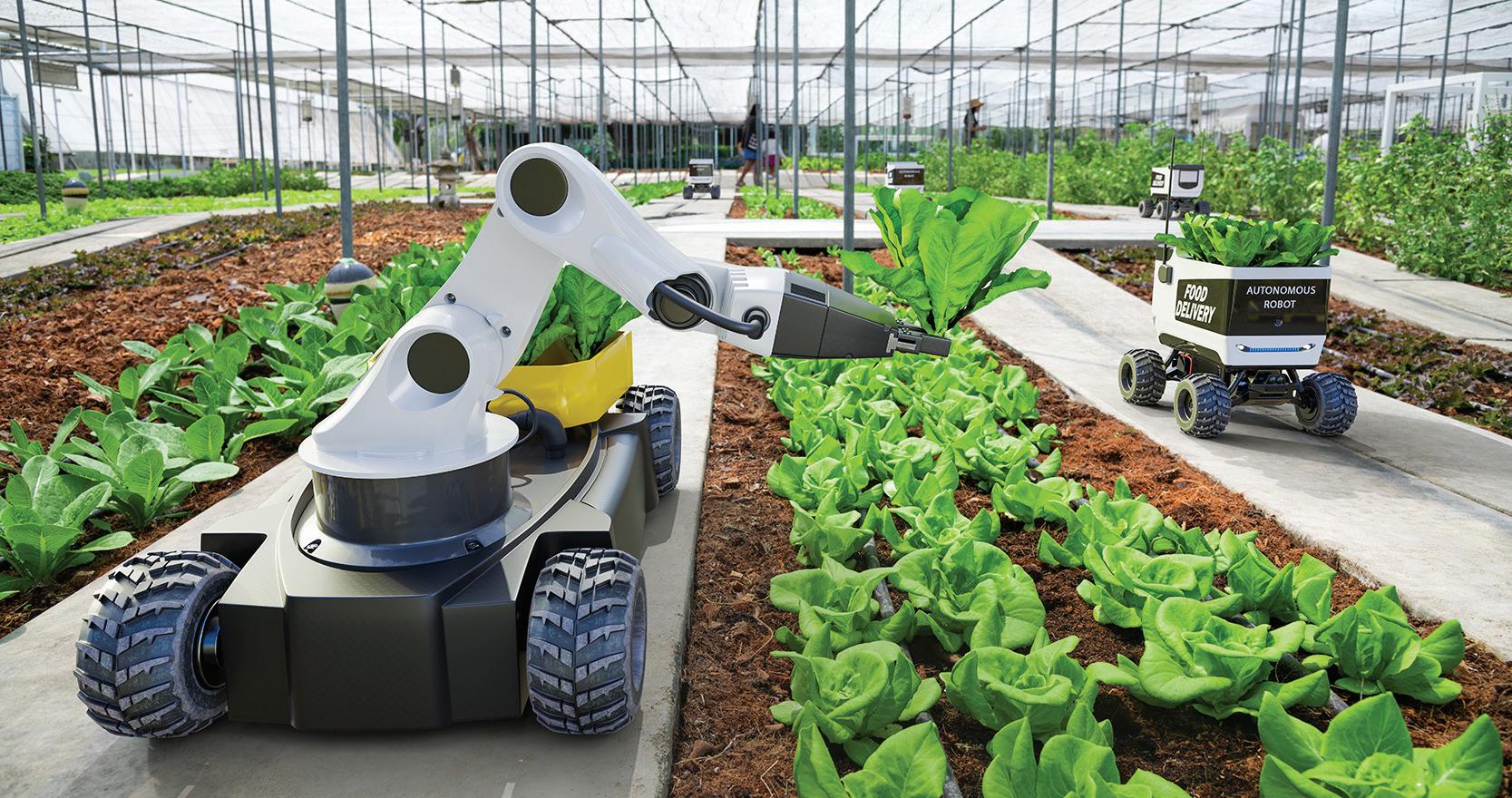
Robo-bugs like this may seem sci-fi, but farm robots are being tested. This article is available online in audio form at MotherEarthNews.com
Problems for Pollinators
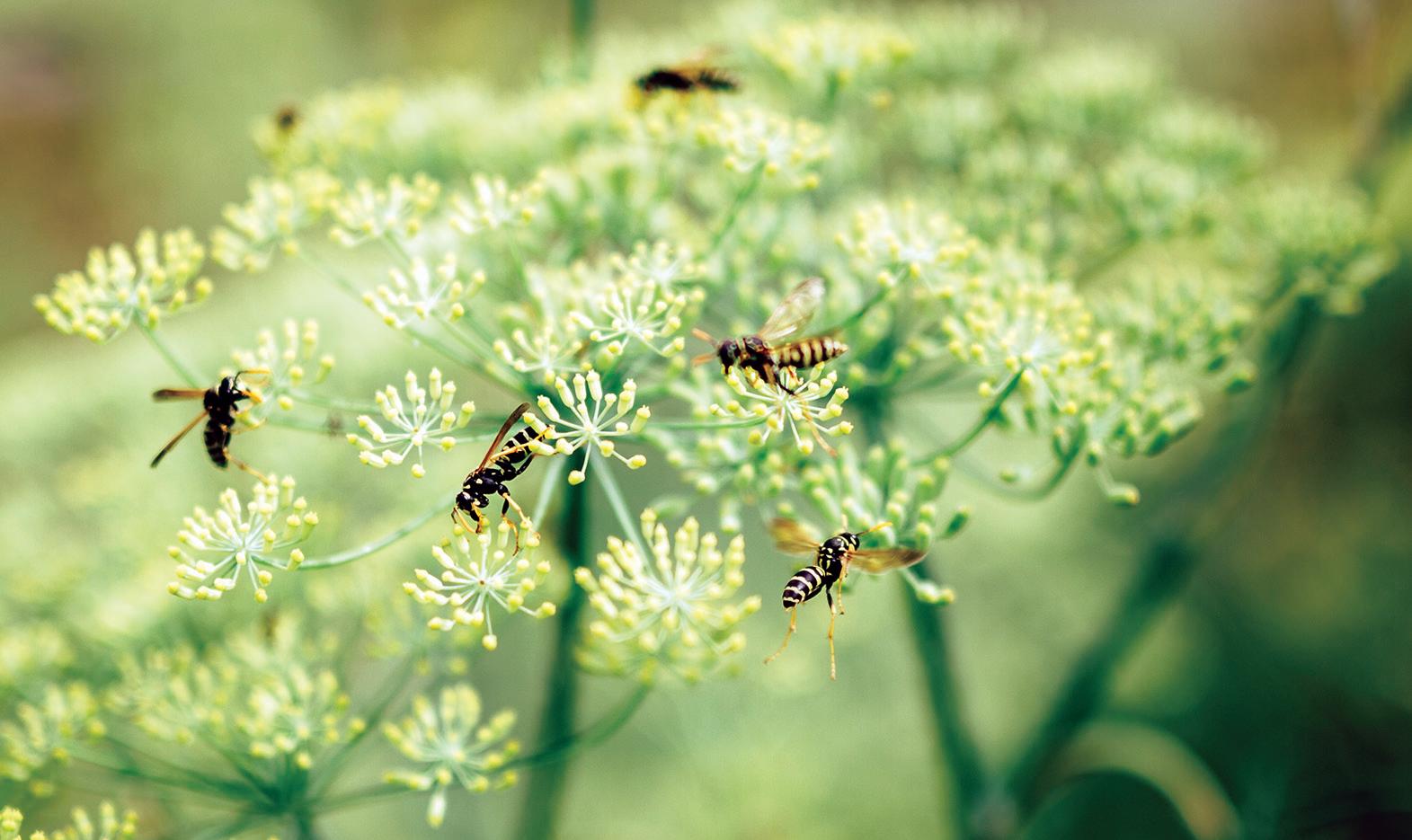

Renowned entomologist E.O. Wilson said that without insects, “the rest of life and humanity with it would mostly disappear from the land and within a few months.” At least one-third of our fruit and vegetable crops depend on bees, syrphid flies, moths, and other pollinators, and yet, we’ve let industrial agriculture in the United States become nearly 50 times more toxic to pollinators over the past 25 years.
Much of America’s farmland toxification during this time frame can be attributed to a newer class of pesticides known as “neonicotinoids.” Starting in the 1990s, pharmaceutical company Bayer pressed farmers to use the chemical imidacloprid to treat corn kernels and other seeds to ward off early season thrips. By 2011, industry doused over 80% of U.S. corn with it, and today, neonicotinoids are among the most widely used insecticides in the world. Mounting evidence shows their proliferation closely corresponds to a sharp decline in pollinators.
More lethal than DDT, neonicotinoids can remain toxic for two and a half years in the environment. They’re considered systemic insecticides, which means plants absorb them and incorporate the toxin into their tissues stems, leaves, and all (in other words, the parts we eat). Because neonicotinoids readily dissolve in water, and plants can only absorb about 5% of what’s sprayed on cropland, the rest contaminates soils and washes into streams, ponds, lakes, and wetlands.
The European Union banned neonicotinoids for field use in 2018. Canada restricted use of most neonicotinoids a year later. In the U.S., they continue to be widely used.
Glyphosate Fears
Big Ag showers the globe with another chemical perhaps even more harmful to humans than it is to insects. Glyphosate, the active ingredient in Roundup, is the most-used herbicide in the world. The World Health Organization has identified it as “probably carcinogenic” to humans, and the Centers for Disease Control and Prevention (CDC) found glyphosate in the urine of 4 out of 5 chil-
www.MotherearthNews.coM 29
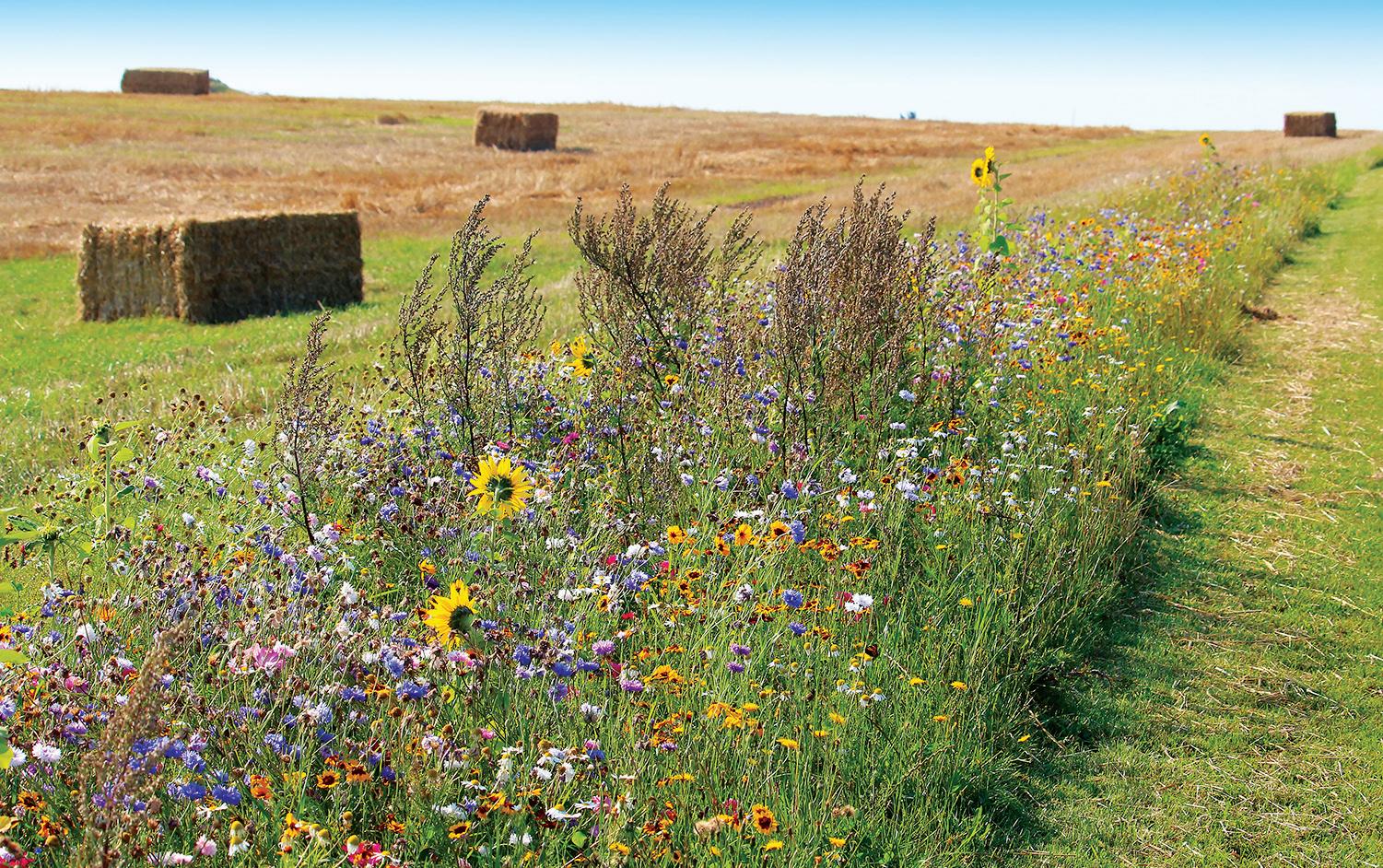
Wildflower strips planted alongside farm fields can reduce pests while improving yields.
Neonicotinoids inflitrate all parts of a sprayed plant, threatening a wide range of insects.
FROM TOP: ADOBE
PAGE 22: ADOBE
Undersung syrphid flies visit 70% of food crops, offering more pollination services than bees.
STOCK/INES PORADA; ADOBE STOCK/ZDENA VENCLIK ; ADOBE STOCK/HUBERT SCHWARZ;
STOCK/ARTISANSAMURAI
dren and adults sampled from across the U.S. Exposure to Roundup has also been linked to an increased risk of Parkinson’s disease, elevated risk for autism, serious neurological diseases, and documented effects on reproduction.
Especially worrying for me is that children in the U.S. are regularly exposed to glyphosate through the foods they eat every day. A series of tests commissioned by the Environmental Working Group found glyphosate in all samples of popular oat-based cereals marketed to children. This is unsurprising, given that it’s been found in nearly every food product tested by the U.S. government, from baby food to beer, and it makes even more sense when you learn Roundup is used as a “desiccant,” sprayed on plants to dry them out in a final step just before they’re harvested and shipped to the grocery store. We’re eating the stuff, and it’s poisoning us.
The good news is that glyphosate is increasingly unpopular with regulators,

who are pushed by consumers to act. Roundup and its knockoff brands are banned in Germany and Mexico, while local governments in Australia, Canada, India, and Europe have either banned them or restricted their use. An outright glyphosate ban has not come to the U.S., despite a vocal and educated movement calling for it. Bayer is also the maker of Roundup and has agreed to settle nearly 100,000 U.S. lawsuits totaling $10.9 billion, all the while denying that its product causes cancer.
Reluctant to wait for a ban, I choose organic foods when possible. A major study published in JAMA Internal Medicine found a significant reduction in cancer risk for thousands of individuals who ate a lot of organic food. Many consumers look for healthier, more nutrient-dense food that has less impact on ecosystems and the climate. Food conglomerates know it’s good business to give us what we want.
Gene Therapy for Crops
AgTech companies are researching plant genetics, enabled by advancements in “CRISPR,” a suite of techniques that make it easier for bioengineers to manipulate DNA and RNA by editing parts of the genome. RNA technology has been used for years to combat viruses and diseases in humans. It was used, for instance, to fight the Zika virus. In this case, scientists modified the DNA of male mosquitoes that transmit the virus so they couldn’t reproduce. The altered mosquitoes transferred infertility back into the general mosquito population, and after a few generations (not a long time in mosquito lifetimes), their numbers collapsed. The technology now shows promise for its potential use against farm pests, as well as for improving crop resistance to heat and drought.
Applying gene-altering technology to pests scares a lot of people, and perhaps for good reason. Are we playing with fire?
Genetic engineering isn’t new, of course. The first genetically modified bacterium was created 50 years ago in 1973; the first genetically engineered mouse in 1974. In 1984, the U.S. Food and Drug Administration (FDA) approved the first genetically modified food, the FLAVR SAVR tomato, though it’s no longer on the market. Today, almost all corn and soybeans are genetically modified. Only a couple of Big Ag companies hold a monopoly on the Roundup-ready varieties sold, and the use of glyphosate has risen exponentially. Each of these corn and soybean plants is almost an exact genetic copy of the plant growing next to it.
Scientists have played with the technology to create such absurdities as ants that don’t smell and coffee beans that contain zero caffeine. (You might ask, “What’s the point?”)
I can certainly see possible benefits to this technology, including creating plants that are resistant to fungus, superbugs, and drought, but I feel we must be wary of the corporate control that often accompanies such technologies. New biologics, or pesticides derived from natural materials, such as bacteria and minerals, offer a promising alternative to chemical pesticides and RNA technology, but there’s still a lot we don’t understand about their abilities.
30 MOTHER EARTH NEWS October/November 2023
Could AI-equipped robots one day alleviate persistent farm labor shortages?
FROM TOP: ADOBE STOCK/RIOPATUCA IMAGES; ADOBE STOCK/KINWUN
Crops are lost to pests at rates similar to the 1950s despite 25 times more pesticides in use.

Robots to the Rescue?
Artificial intelligence (AI) and even lasers could be safer for birds, bees, butterflies, and humans than either chemicals or RNA technology.
If these seem futuristic, know that AI “killer robots” are working in the vegetable fields of California right now. No need to freak out; they’re only killing weeds. At a cost of about $1.2 million, the new “LaserWeeder” built by Carbon Robotics has replaced about 30 workers who had been doing the back-breaking work of pulling weeds at Braga Organic Farms. The LaserWeeder zaps weeds with short bursts from a bank of lasers mounted underneath the machine, using AI to “learn” how to identify up to 40 crops and 80 types of weeds. The robot can even zap weeds too small for a human to grasp, vaporizing tiny sprouts into smoke.

Farm owner Rod Braga told NBC News in an interview this year that the machine will pay for itself in its first year. This is because his is a 2,000-acre organic vegetable farm, and unlike the massive corn and soybean fields of the Midwest, where a farmer with a small crew and a big combine can harvest thousands of acres, diversified vegetable production is labor-intensive. The U.S. has become dependent on produce imported from Central and South America because of cheaper labor costs in those regions. A recent U.S. Department of Agriculture (USDA) report predicted that we’re on track for over three-quarters of fruit and half of vegetables to come from outside the United States in the next four years.
Depending on far-away places for our food introduces risks. The LaserWeeder could resolve organic farmers’ persistent challenge of finding workers on a seasonal basis. If robots on the horizon also help Braga harvest crops, from broccoli to tomatoes, they could ultimately allow the U.S. to improve domestic food security while lowering the amount of harmful chemicals applied to fields.
Of course, Braga Organic Farms can afford the price tag of such a high-tech machine, but I doubt small farms can afford AI-equipped lasers today. As the technology cost curve goes, prices could drop after more companies enter
the space and the tech is adopted by more farmers.
And while technology may save on farm labor, there’s a trade-off: High-tech methods are resource-intensive to create and operate. Low-tech solutions exist for resisting chemical inputs and reducing insect losses, including cover crops, wildflower strips, and natural pesticides.
Overrun with Superbugs
When I drive down my favorite country road these days, my windshield is an ever-sparser canvas with only a few small blotches of color. Just like a Pollock painting, I don’t always know how to interpret the image, but it does make me think about where all this chemical-intensive pest control has gotten us.
In the 1950s, global crop loss due to pests was estimated at around 30%. Today, even after soaking our farmland in chemicals, the USDA estimates global crop loss from pests is still around 30%.
When we make such potent chemicals widespread, we invite pesticide resistance. The peach aphid (Myzus persicae), as one example, has apparently become resistant to more than 75 different chemicals while at the same time adapting to eat more than 50 different plants. We’ve opened the farm gate to a few superbugs.
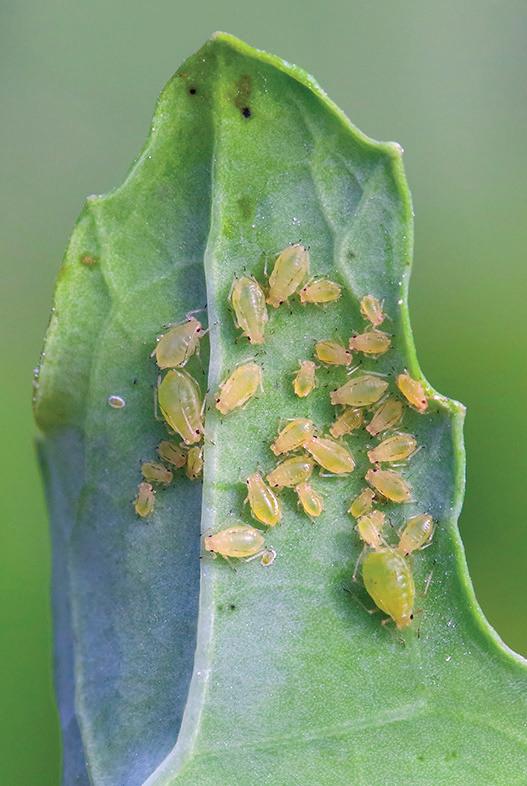
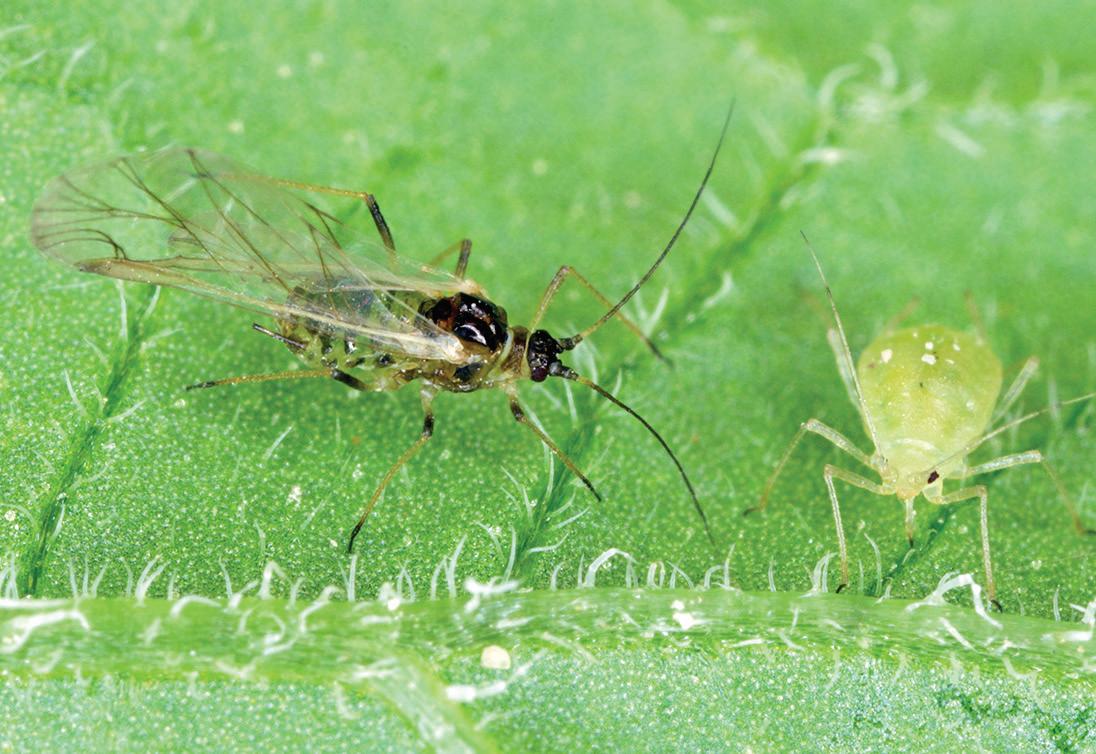
Could a robot one day learn to zap the peach aphid that’s sitting on a plant leaf without harming the plant or the butterfly sitting right next to it? I better keep conducting my experiment and give the question some more thought. Where are my car keys?
Robert Turner is a farmer and science writer residing in western North Carolina. He serves on the board for Organic Growers School and is the author of Lewis Mumford and the Food Fighters: A Food Revolution in America
32 MOTHER EARTH NEWS October/November 2023
Myzus persicae is a pesticide-resistant “superbug” vector for peach, beet, and potato crops.
Startup Carbon Robotics claims its LaserWeeder zaps weeds with 1-millimeter accuracy.
TOP: CARBON ROBOTICS; BOTTOM: TOMASZ (2)










#41 on page 68
See
ProfitingPersephone from
Learn how to harvest food from your garden in winter by timing your plantings before the Greek goddess of spring goes underground.
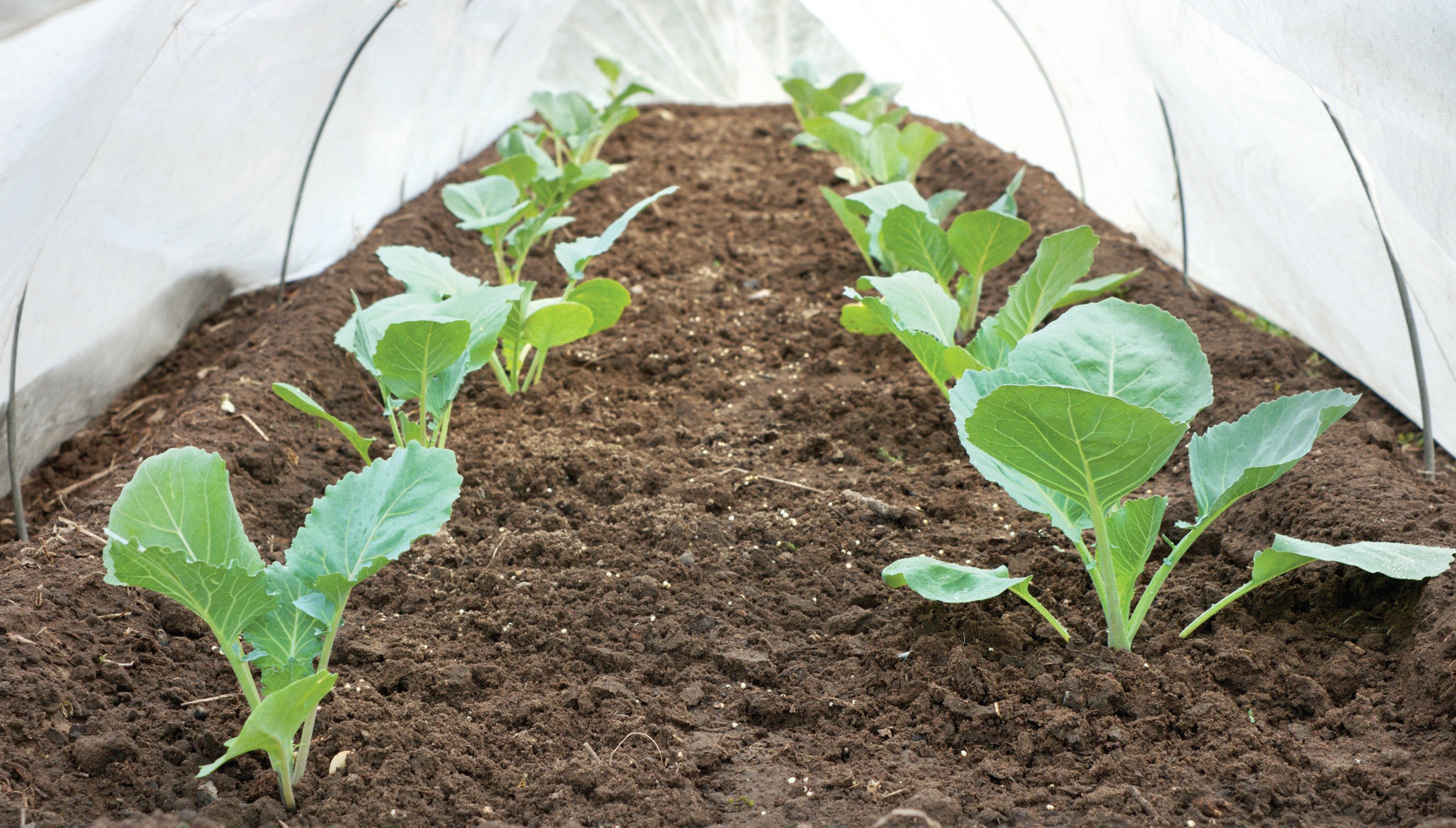 By Patrice Lewis
If you studied Greek mythology, you might remember the story of Persephone. Daughter of Zeus and Demeter (goddess of agriculture and harvest), Persephone was abducted into the underworld by Hades. No crops grew during the period of Demeter’s grief and anger while she desperately searched for her missing daughter. Demeter finally appealed to Zeus for
her daughter’s return. Prompted by hunger among the people, Zeus complied. But Persephone admitted to being tricked by Hades into consuming a few pomegranate seeds. For eating the food of the underworld, she was condemned to reside in that place for a number of months of every year. To this day, Demeter withholds fertility and plant growth while her daughter stays underground hence, the season of winter.
Bringing the Myth into Your Garden
This tale is why gardeners today refer to the “Persephone Period” or “Persephone Days” (terms coined by author and expert winter gardener Eliot Coleman). In the Northern Hemisphere, this period begins in fall when the days grow too short to effectively sustain the growth of most plants. Seed companies know this well, and they send peppy emails in midsummer reminding gardeners, “It’s time for fall planting!”
Contrary to popular belief, not only cold temperatures limit vegetable growth; day length is also a factor. Most plants need at least 10 hours of sunlight per day for active growth. The Persephone Period begins with the last day that has 10 hours
34 MOTHER EARTH NEWS October/November 2023
ADOBE STOCK\SEVER180
of sunlight before the winter solstice. As a rough rule of thumb for gardeners in the Northern Hemisphere, daily sunlight usually drops below 10 hours in mid-November and rises above 10 hours in about the first week of February. Knowing these dates will allow you to plan a winter garden by planting so vegetables will achieve maturity above that 10-hour-per-day threshold. You can generate a daylight/ darkness table for your area on the website of the U.S. Navy’s Astronomical Applications Department, https:// AA.USNO.Navy.mil/data/Dur_OneYear.
Sowing a fall garden can allow gardeners to reap autumn and winter harvests, and it has the added benefit of diminished insect predation. Additionally, you can harvest during the following spring and summer from overwintered plants, such as garlic and winter wheat.
Because both temperature and day length are reduced in fall and winter, crops will need longer to mature than in spring or summer. Below that 10-hours-perday threshold, plant growth nearly stops. Before the Persephone Period begins in your area, crops need to be nearly 100% mature for fall and winter harvesting and at least 75% mature for overwintering. If you’re starting seeds in fall, first check the maturity date on the seed packet, and then count backward to the point of desired maturity to determine when to plant.
When deciding what to plant, look for cultivars marketed as cold-hardy or frost-tolerant. Johnny’s Selected Seeds has categorized types of vegetables for winter

gardens based on successful winter production. The easiest to grow and most productive (Tier 1) include spinach, kale, claytonia, and baby-leaf brassicas. The next easiest (Tier 2) are bok choy, arugula, chicory, cilantro, and broccoli raab. The more challenging (Tier 3) tend to be radishes, carrots, bunching onions, Swiss chard, lettuce, and turnips.
Most vegetables suited to fall gardens need 60 to 90 days from planting to harvest, which means you’ll need to plant them between mid-August and midSeptember for them to mature before the Persephone Period begins. If you plant later, the vegetables won’t have enough time to reach 75% maturity for overwintering or full maturity for harvesting before growth slows dramatically.
Soil temperature can be a factor when sowing a winter garden. Sometimes, the soil is simply too warm for direct-sowing in late summer, such as with lettuce and spinach; these crops do better when started indoors. Late summer can also be quite dry, so make sure your newly planted garden receives sufficient water.

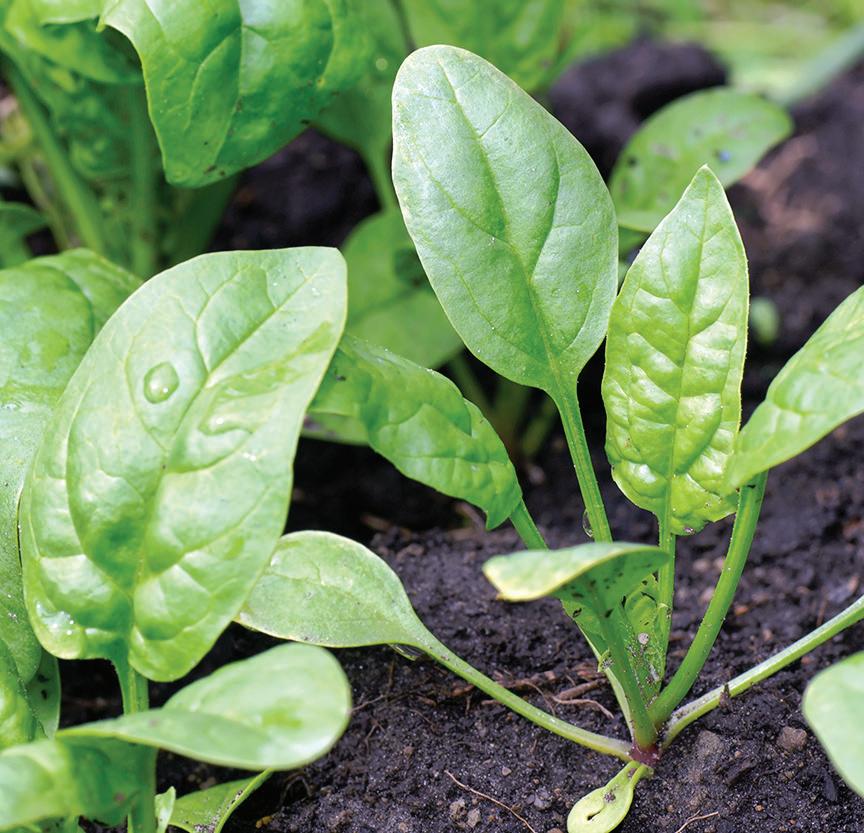
After the crops are established, and when frost threatens, you’ll need to protect them so you can harvest as desired. The protections you put in place will keep the plants alive and fresh, even though they’ve mostly stopped growing. If the plants are close to maturity (75%), then protecting them throughout winter will allow them to spurt to maturity when the Persephone Period ends.
Root crops prefer 4 or more inches of mulch to keep them safe during hard freezes. Aboveground plants will be harmed by heavy mulch, so protect them with a low tunnel or a cold frame when the temperatures fall below freezing. (Low tunnels can increase the interior temperature by more than 20 degrees Fahrenheit.) The heavier the cover, the less light can penetrate and interior temperatures will rise enough on warm, sunny days to damage the plants so vent the cover or frame when the outdoor temperature is above 50 degrees.
To prevent frost damage from occurring, only harvest plants when outdoor temperatures are above freezing.
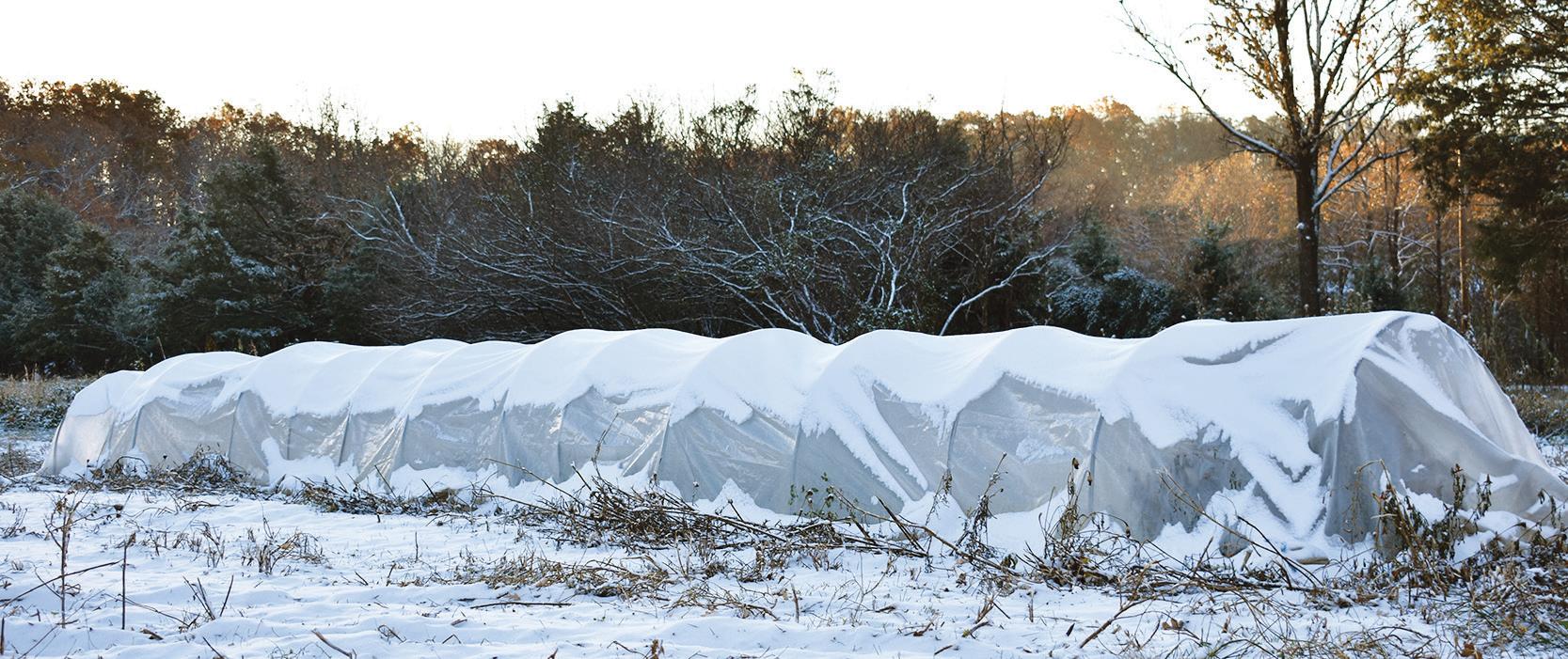
www.MotherearthNews.coM 35
Low tunnels help protect cold-hardy plants from freezing temperatures during the depths of winter.
From left: Spinach, claytonia, and kale are easy-to-grow crops and can be especially productive for fall and winter harvesting.
CLOCKWISE FROM TOP: ADOBE STOCK/BLESSINGS CAPTURED; ADOBE STOCK/SYLVIE BOUCHARD; ADOBE STOCK/LIFEISTICAC; ADOBE STOCK/ELENA_ALEX
North to Alaska
Alaskan gardeners famously grow enormous vegetables: cabbages 3 feet across, cantaloupes that top 65 pounds, and carrots so sweet they taste like they’ve been sprinkled with sugar. Is Demeter working overtime?
Once again, daylight length is the critical factor. Alaskan summer days can see as much as 20 hours of sunlight. This enormous boost of photosynthesis results in more plant material which is why so many veggies grow to enormous size and a sweeter taste. Smart gardeners also use cultivars uniquely suited to their special climate, including a maturity period that fits within the short growing season, often less than 105 days.
Commercial farming in the Matanuska-Susitna Valley began as an experiment in the 1930s. Farm families from northern states (such as Minnesota, Wisconsin, and Michigan) were encouraged to settle on land set aside for agriculture. Although this colonization faced a lack of infrastructure and other problems, the hardy farmers who remained learned that certain vegetables
grew extraordinarily well there and were of superior quality. In fact, Alaska-grown vegetables are so outsize they can seem like caricatures but they’re real.
The Persephone Period applies to Alaskan gardens too. Fall gardening is a race against the cold, and only shortseason, cold-hardy crops sown during July or August will be successful. The Persephone Period begins around midOctober for most Alaskan locations.
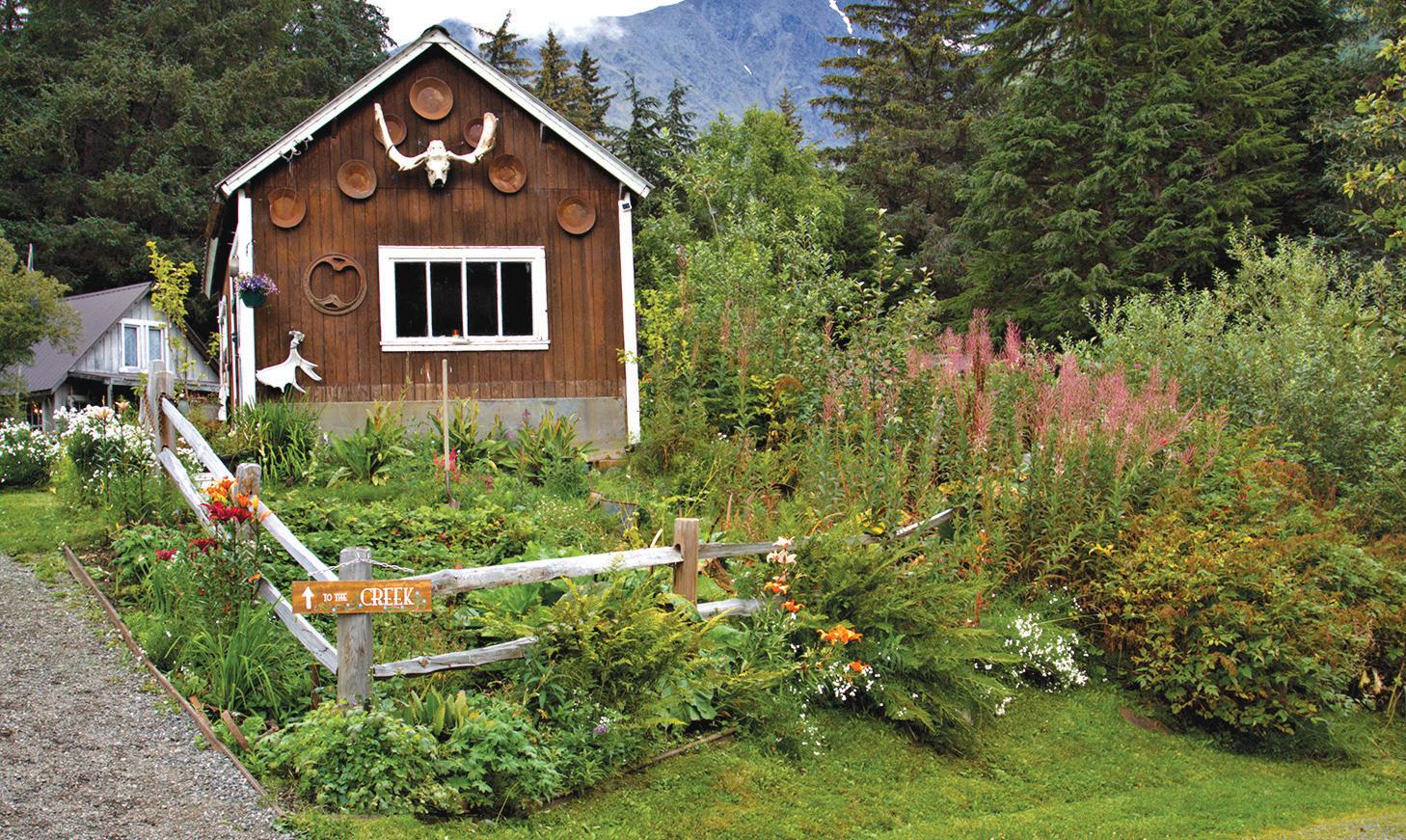
Understanding the Persephone Period is the key to a successful winter garden,
Grow Lights: Pushing Persephone
The Persephone Period can be artificially delayed through the use of grow lights, but their uses are limited.
Bulbs for grow lights differ from regular lightbulbs in a number of ways. Regular lights are designed to illuminate a room, and that’s all. Grow lights (either LED, fluorescent, or high-intensity discharge) produce light in the range of 400 to 700 nanometers the blue and red spectrum, specially geared to plant growth. (Red triggers flowering; blue contributes to photosynthesis.) Grow lights also produce a high wattage, or brightness. Both factors contribute to optimal conditions for plants to convert amino acids into sucrose, along with other chemical processes associated with photosynthesis.
whether you live in Alaska or the Lower 48. You’ll reap the rewards of harvesting fresh produce when the days are short and snow covers the ground.
Patrice Lewis has practiced selfreliance for almost 30 years. She has experience in small-scale dairy production, food preservation, animal husbandry, and more. Follow her at www.Rural-Revolution.com
While grow lights will boost your plant’s growth, they’ll also boost your electrical bill, so this must be factored into the cost of extending your winter garden’s growing season. Grow lights are also more expensive than standard lighting options because of their specialized nature.
It’s possible to push back the onset of the Persephone Period long enough for transplants to achieve maturity in a greenhouse helpful if you planted fall veggies a bit too late in summer. Grow lights can be used all winter for indoor plants, such as herbs or salad greens. And, of course, grow lights will permit you to start indoor or greenhouse seedlings especially early, before the Persephone Period ends.
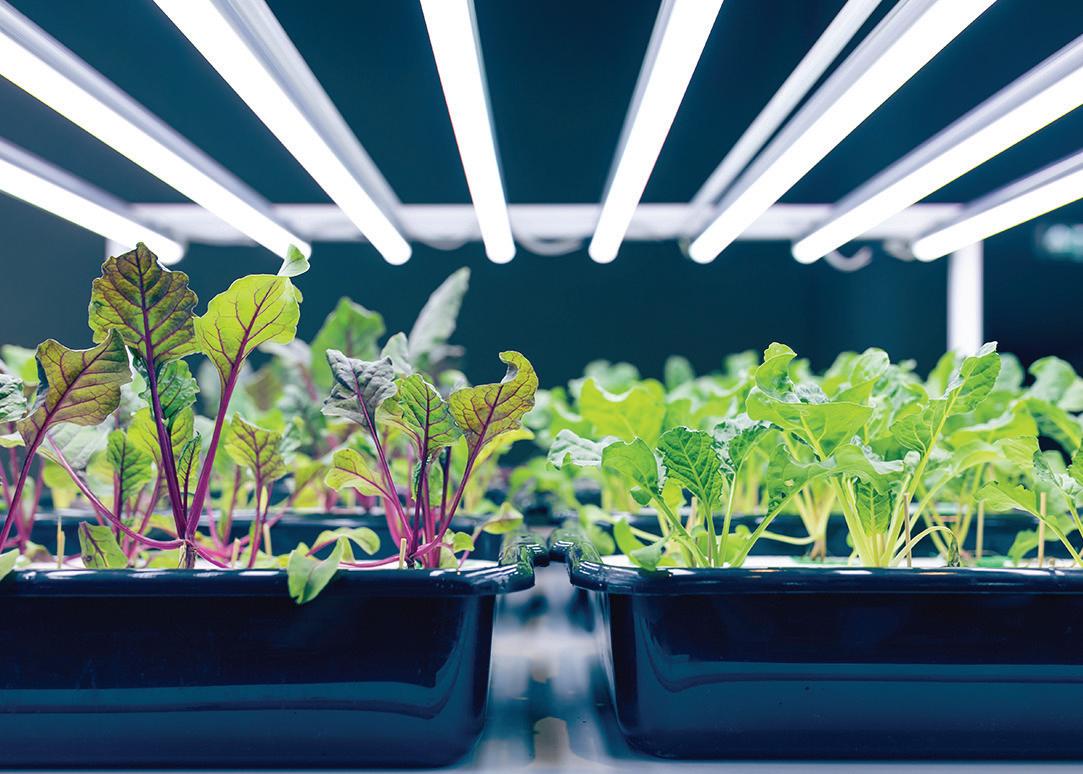
36 MOTHER EARTH NEWS October/November 2023
Alaska gardens are lush because of extra daylight hours during the state’s short growing season.
Grow lights will boost plant growth but increase your energy bill. FROM TOP: ADOBE STOCK/RONM; ADOBE STOCK/QUALITY STOCK ARTS
































What’s all the braying about? Introducing Georgia’s all-new regenerative farm located at the entrance of the Okefenokee National Wildlife Refuge. Bask in generations-old techniques steeped in education and community. Live on, participate in, or just pay a visit to our 705+ acres, you’ll fi nd a place where your soul feels at home. Be Part of Our Journey OkeFarm.com/Welcome Johnnyseeds.com Scan this code to explore our library of recommended crops, planting charts, scheduling guidelines, and more to extend your growing season. Extend Your Growing Season with Johnny’s! Visit Our Winter Growing & Season Extension Library See #22 on page 68 See #39 on page 68
Overwintering Hens Inside a Greenhouse
Story and photos by Dominic Lamontagne
Waste management of pasture-raised animals is generally simple. When your herd is frequently moved around on a vigorous patch of perennial grasses,
manure and urine spread thinly and evenly, making it easy for the ecosystem to absorb them. Unfortunately, in a temperate climate such as ours in Québec, animals that are kept all year long can’t be raised solely on grass.
Handling the waste of animals housed in closed-up buildings is somewhat of a chore. Stalls require daily additions of fresh bedding material, generating copious amounts of litter that’ll eventually need to be moved out and composted. I’ve always found keeping my laying hens penned up inside a small coop all winter long was less than ideal. On top of managing a lot of bedding and litter in a cramped space, it’s hard to keep everything clean and the hens chirpy.
These gloomy days are gone now. Since 2016, my spouse, Amélie, and I have been overwintering our 35 to 50 laying hens inside a sunny greenhouse. We call it the “coop-house.” Nov. 1 each year, our high tunnel becomes our flock’s winter quarters for five months. All winter long, the birds till the carbon-rich leaf mulch spread on the greenhouse’s dirt floor, adding their nitrogen-filled droppings to the mix while also providing us with fresh eggs daily. On April 1, the hens return to pasture, and we prep the garden bed for its May 1 planting. In late fall, after it has borne its fruit, the vegetable plot welcomes back its benefactors.
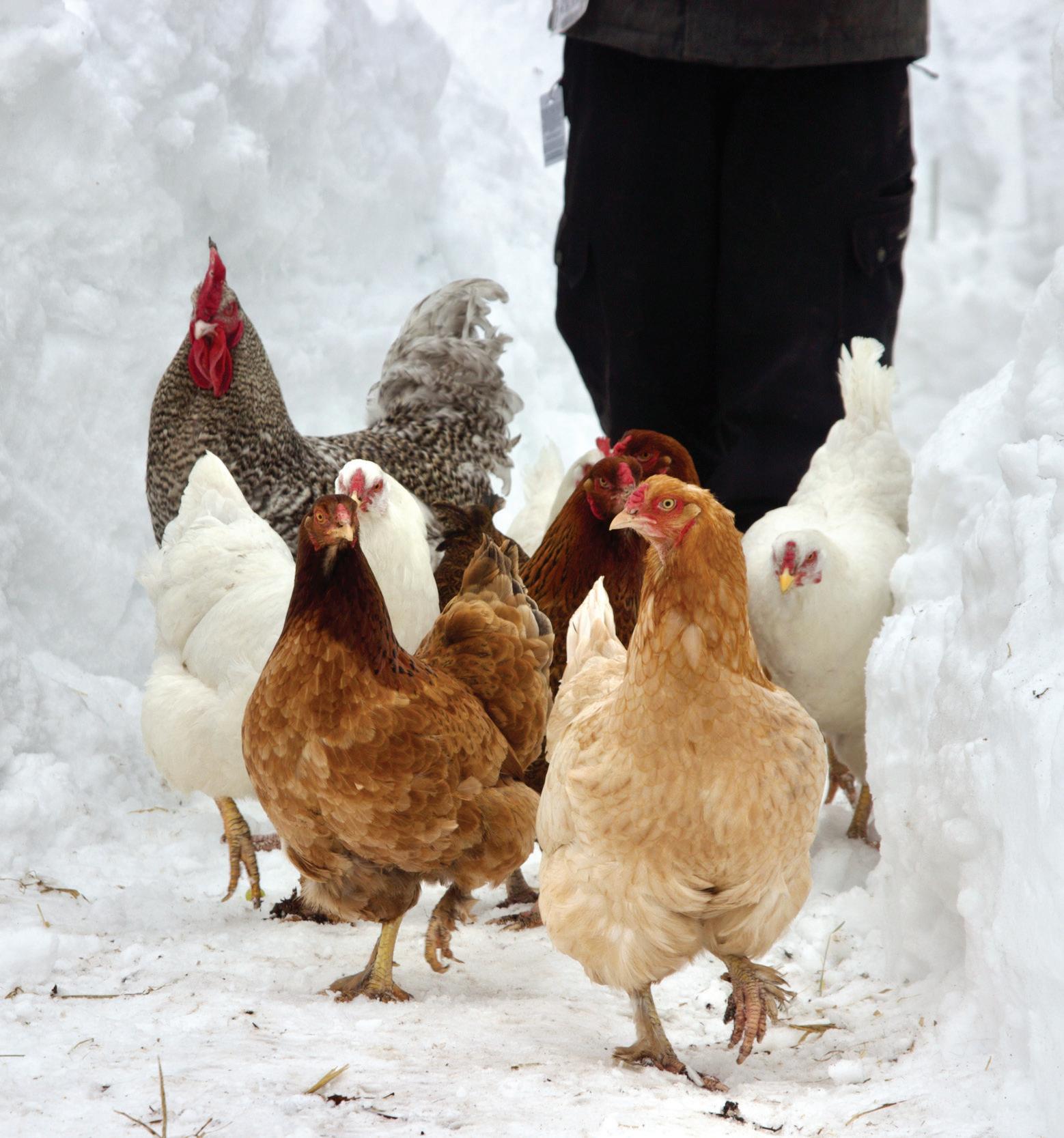
The Greenhouse
Because we wanted to use it yearround, we constructed a heavyduty 32-by-30-foot “high tunnel” greenhouse. Its 960 square feet allow a substantial amount of fruit and
38 MOTHER EARTH NEWS October/November 2023
Keep your hens happy and healthy no matter the season, while also boosting your garden’s productivity.
The author’s hens stay on pasture during warmer months and then overwinter inside a greenhouse.
vegetables to be grown in it each year. Covered with a permanently inflated double layer of 6-mil polyethylene film, our structure stands atop a 27-by-28foot, 18-inch-deep insulated soil bed, with an in-earth hydronic heating system buried at the bottom of it. This system isn’t used to heat the greenhouse during wintertime, but to warm and ready the garden bed for crop production in spring. It’s also used for a few weeks to lengthen our growing season when nights become colder around the end of August. It’s comprised of a tankless water heater, hot-water circulator pumps, and an in-earth probe connected to a digital thermostat. When the soil temperature is below target, the thermostat will activate the pumps, which will circulate a water-glycol mix across 1,000 linear feet of tubing and through the instant water heater that’ll warm the liquid to 140 degrees Fahrenheit.
We wanted our structure to sustain the weight of a substantial amount of snow, though we don’t let snow accumulate on the greenhouse’s roof. Instead, it packs up on its sides and reaches the top of the sidewalls around January,
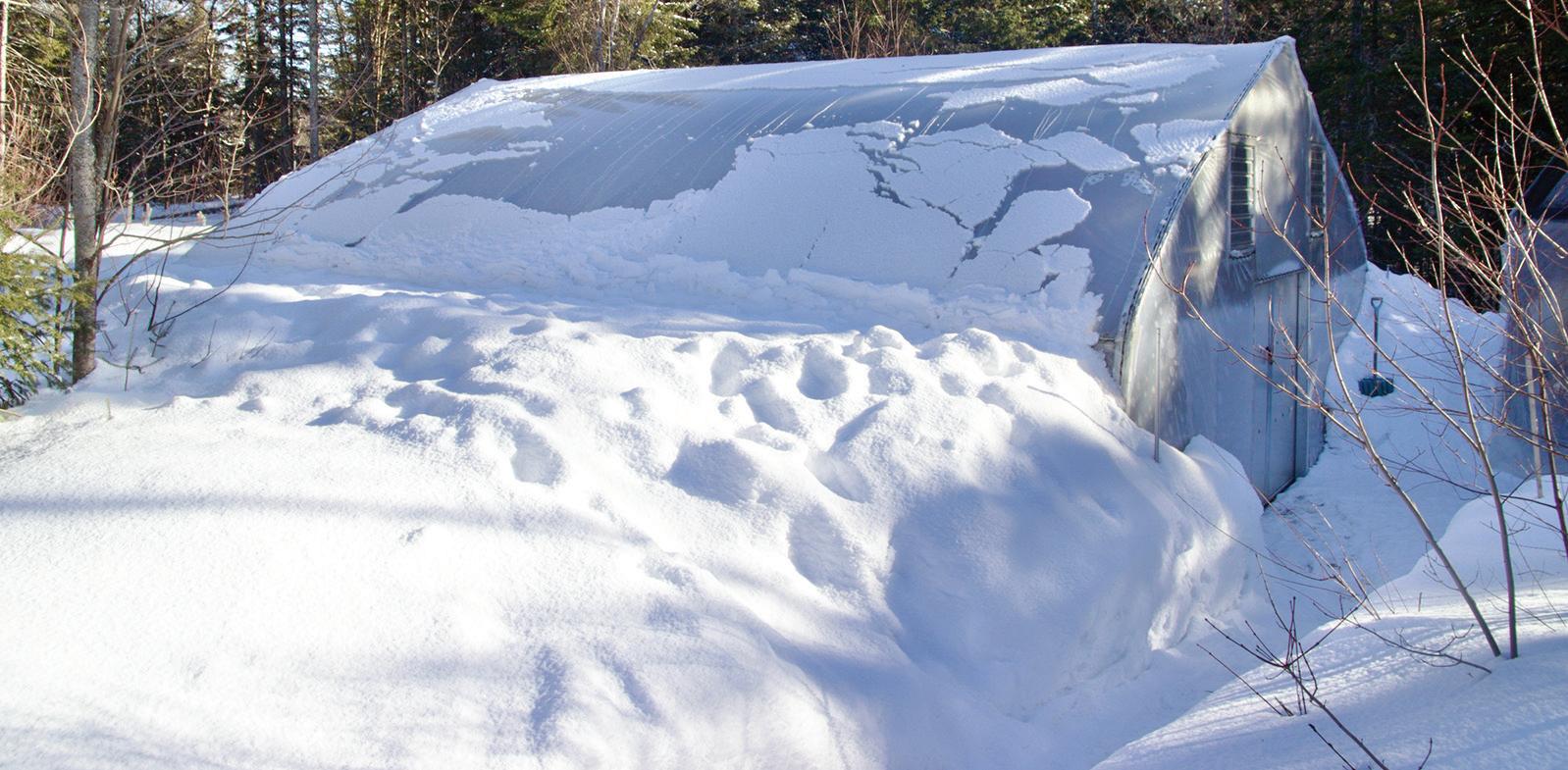
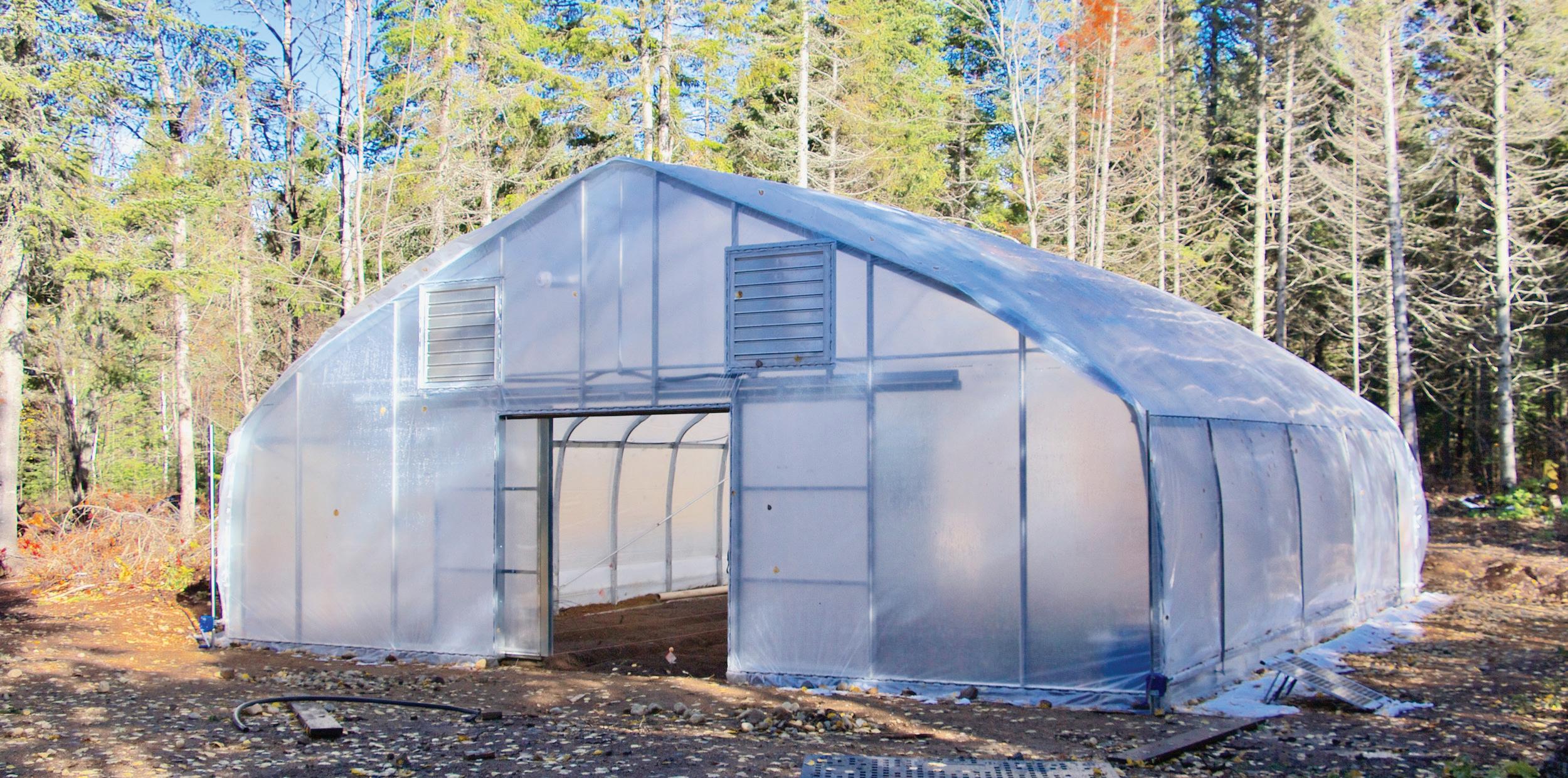


further insulating the structure without damaging the plastic films. The taut plastic film lets in a maximum amount of light while allowing snow to slide down the covering rather than cling to it, and the air trapped between the two layers of film provides extra insulation. The garden bed is protected from frost using 2-inch-thick rigid foam insulation boards. This insulation also traps the heat radiating from the hydronic system when it’s turned on April 1.
Though hens tolerate the cold well, the interior of the greenhouse is always much warmer than the outside temperature. When it’s minus 22 degrees outside, it’s about 0 degrees inside. Cooler
temperatures are normally synonymous with dryer air. Add to this the fact that there’s no wind in the tunnel and that the ground is always above freezing, and you can understand why our hens will roam around the greenhouse, even in the coldest part of winter.
The Full Cycle
Between April 1 and Oct. 31 , we keep our hens contained on pasture using a poultry net. Their 8-by-8-foot mobile coop sits inside this fenced-in area. It resembles a classic, rectangular, bottomless meat-bird chicken tractor with multiple access points, nesting boxes, and roosting bars. While
WWW.MOTHEREARTHNEWS.COM 39
Check out Dominic’s full description of the year-round greenhouse, including a breakdown of materials and measurements so you can build one yourself, at www.MotherEarthNews.com/Overwintering-Hens. READ ON!
Built in 2016, this greenhouse keeps hens safe and insulated during winter.
we move the coop every other day, we move the 160-foot-long portable fence once a week. Meanwhile, inside the greenhouse, our garden is booming.
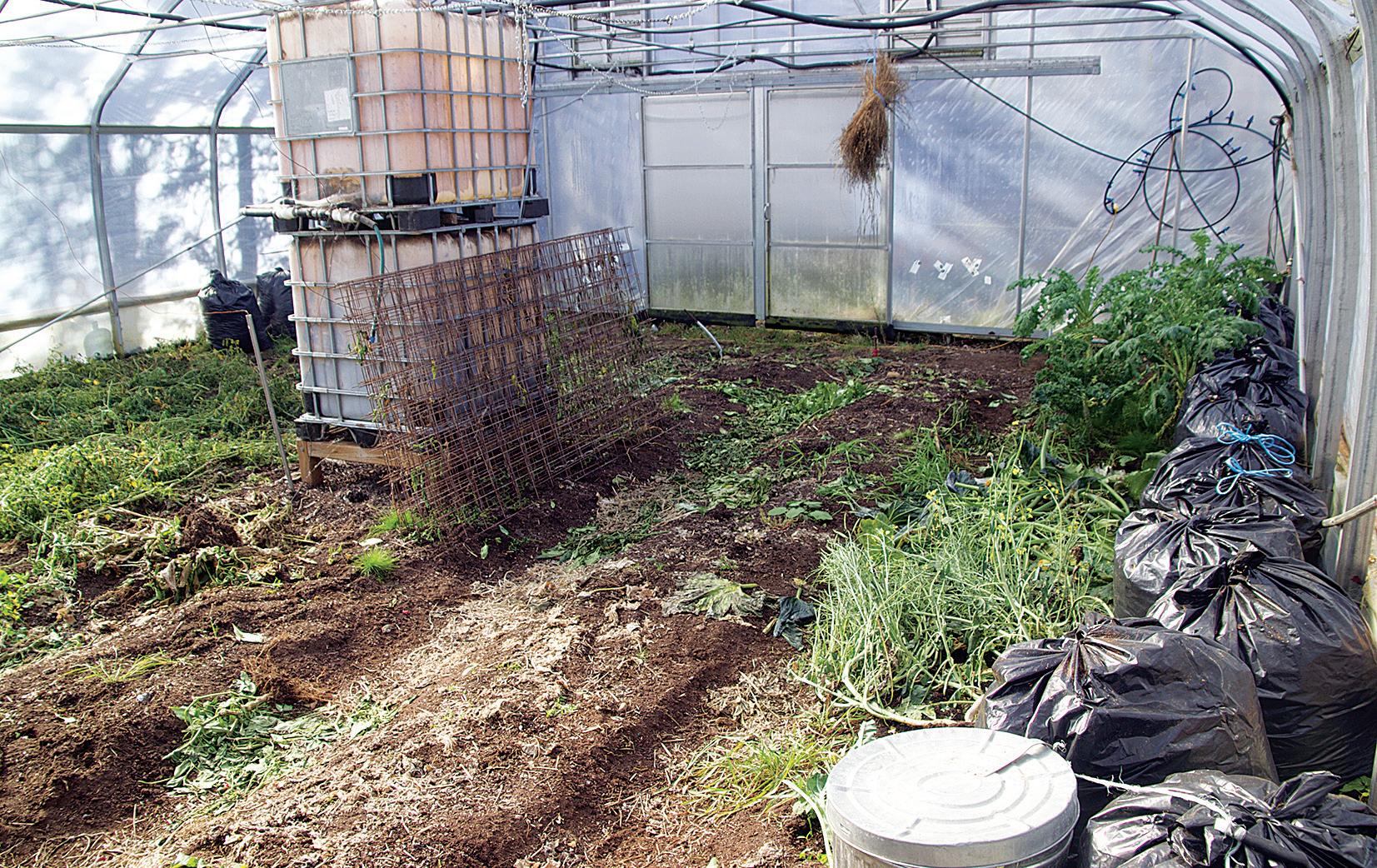
Nov. 1, we turn the greenhouse into a poultry house for the next 20 weeks. We turn off the hydronic system, which kept plants going through the colder fall season, and we bring the mobile coop inside. Then, we situate it atop four 12-inch-high milk crates, which allow a 10-by-10-foot tarp (I use a piece of 6-mil clear vapor barrier cut from a roll) covered with wood chips and choppedup dried leaves to sit under it. The hens have no trouble reaching the structure’s perches to roost. Since the birds will spend about half of their time in this coop, about half of their droppings can be harvested there and moved out of the greenhouse, composted, and used elsewhere as a potent fertilizer. The trick is to add the proper amount of carbon to the mix (more about this on Page 42).
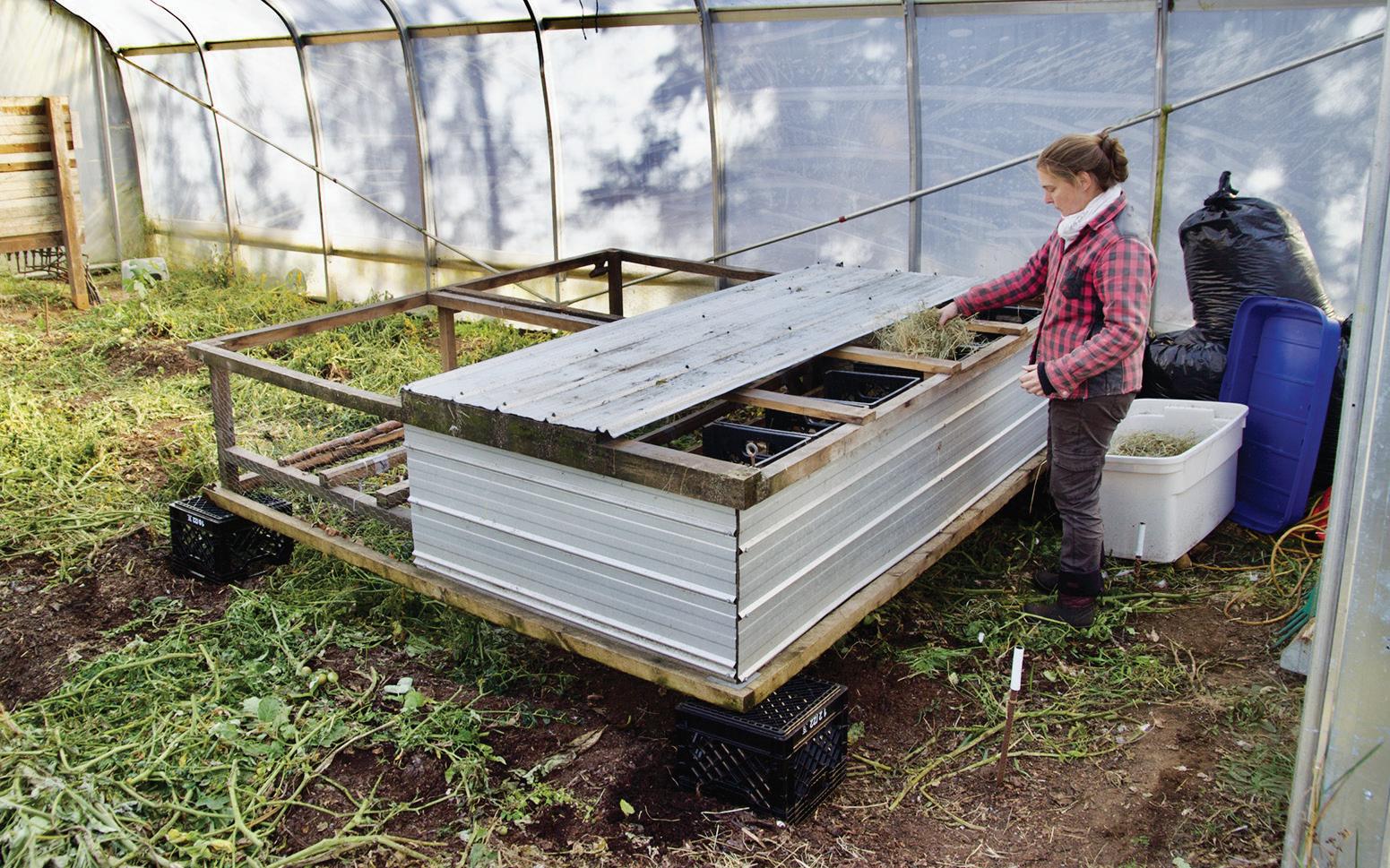
After hanging a heated poultry fountain and two 48-inch reel-top poultry feeders from the greenhouse roof trusses, we guide our flock inside the building. Waiting for them are heaps of freshly cut tomato vines bearing green fruits; long kale stems with lush, leafy tops; and a jumble of verdant, pulledout plants, yellowing cucumbers, and weeds ready for pecking. These plentiful leftovers provide the hens with a thick, edible litter that’ll last them for weeks.
Every Friday morning, the same ritual takes place: I come in, pull out the tarp from under the coop, make a bundle of it, and drag it outside. I always dump it in the same spot, close to the greenhouse, right in the middle of a large tarp, all four corners of which have been staked using 6-foot-long poles so I don’t lose track of the tarp’s perimeter under the snow. In between the additions of fresh litter on this larger tarp, snow will fall on the pile. When spring comes, the alternating layers of snow and litter will mix, wetting the manure heap throughout and kick-starting the composting process. The mound will then shrink and can be transported someplace to sit and compost some more.
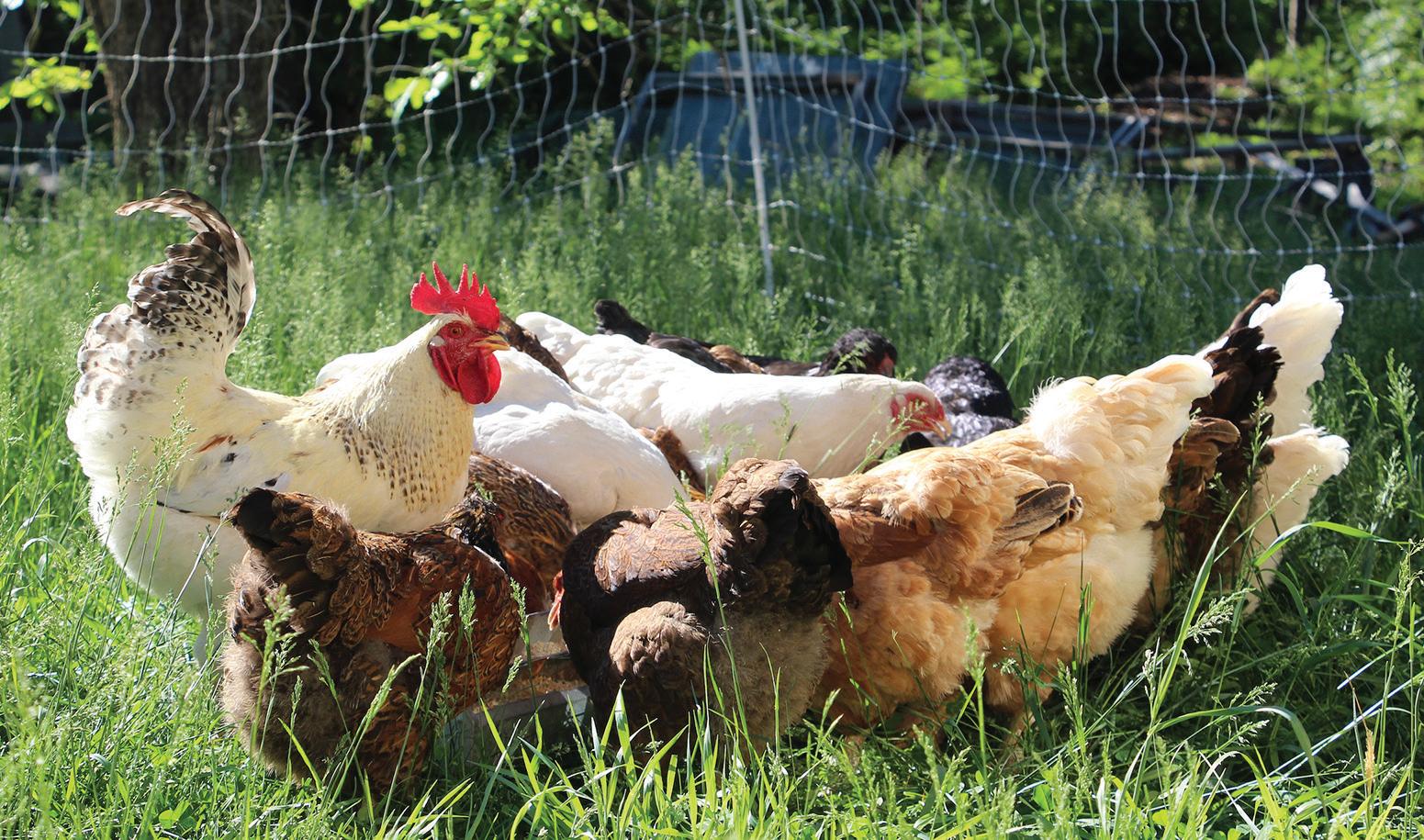
40 MOTHER EARTH NEWS October/November 2023
From April 1 until Oct. 31, the hens stay pastured within a movable, fenced-in area.
Before the hens move in, the greenhouse is prepped, including collected leaves for composting.
The portable coop moves into the greenhouse for winter, along with the hens.
Back inside the greenhouse, I lay my discharged tarp on the ground in front of the coop, cover it back up with wood chips and chopped-up dried leaves, and then pull it back under the coop. Finally, I scatter chopped-up dried leaves all over the greenhouse floor.
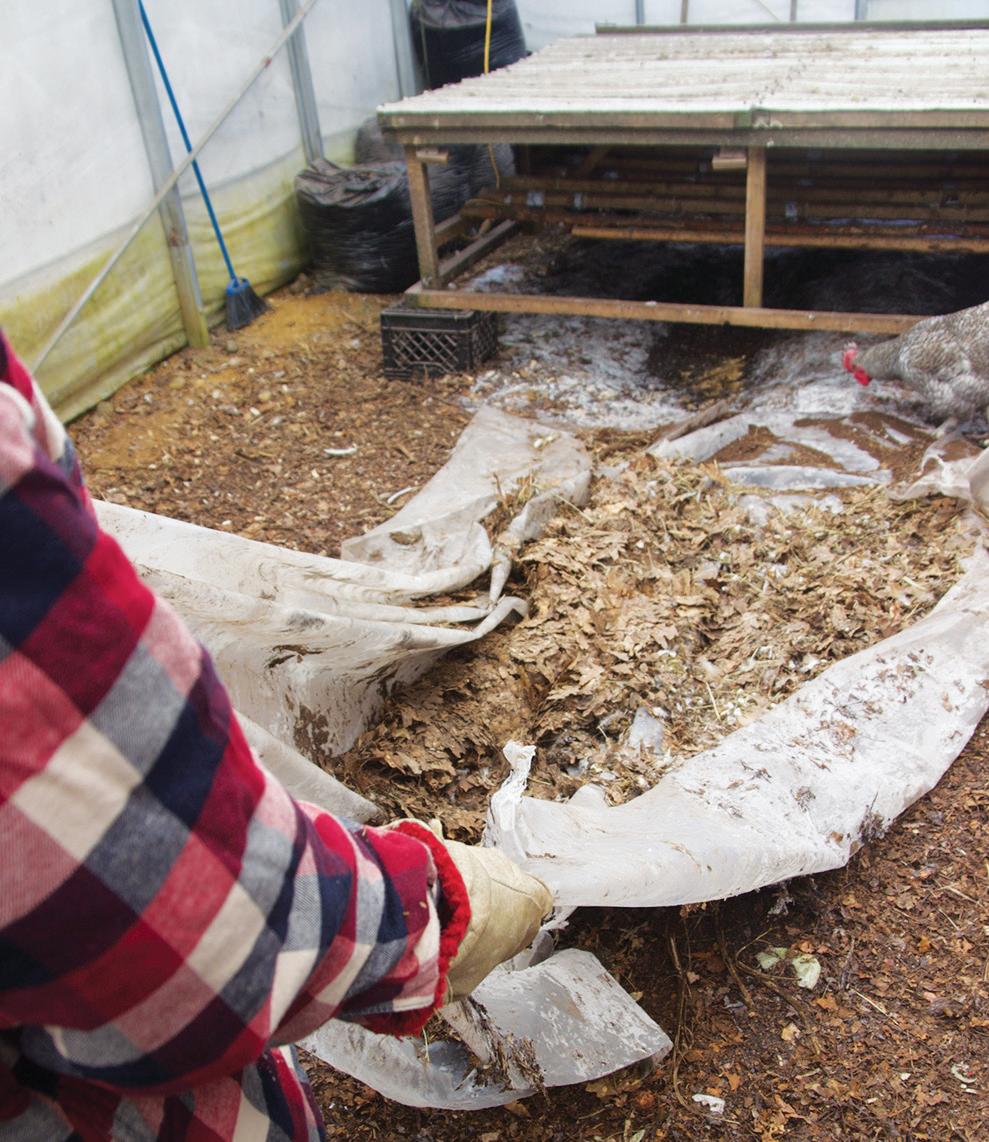
April 1, time to move the hens back out. Depending on how hasty spring has been, the poultry net is either planted in the ground or in the snow. Whichever it is, I set up the fence, coop, feeders, and waterer on a patch of land that I cleared of snow all winter long in preparation for this early spring migration, and the hens return to pasture.
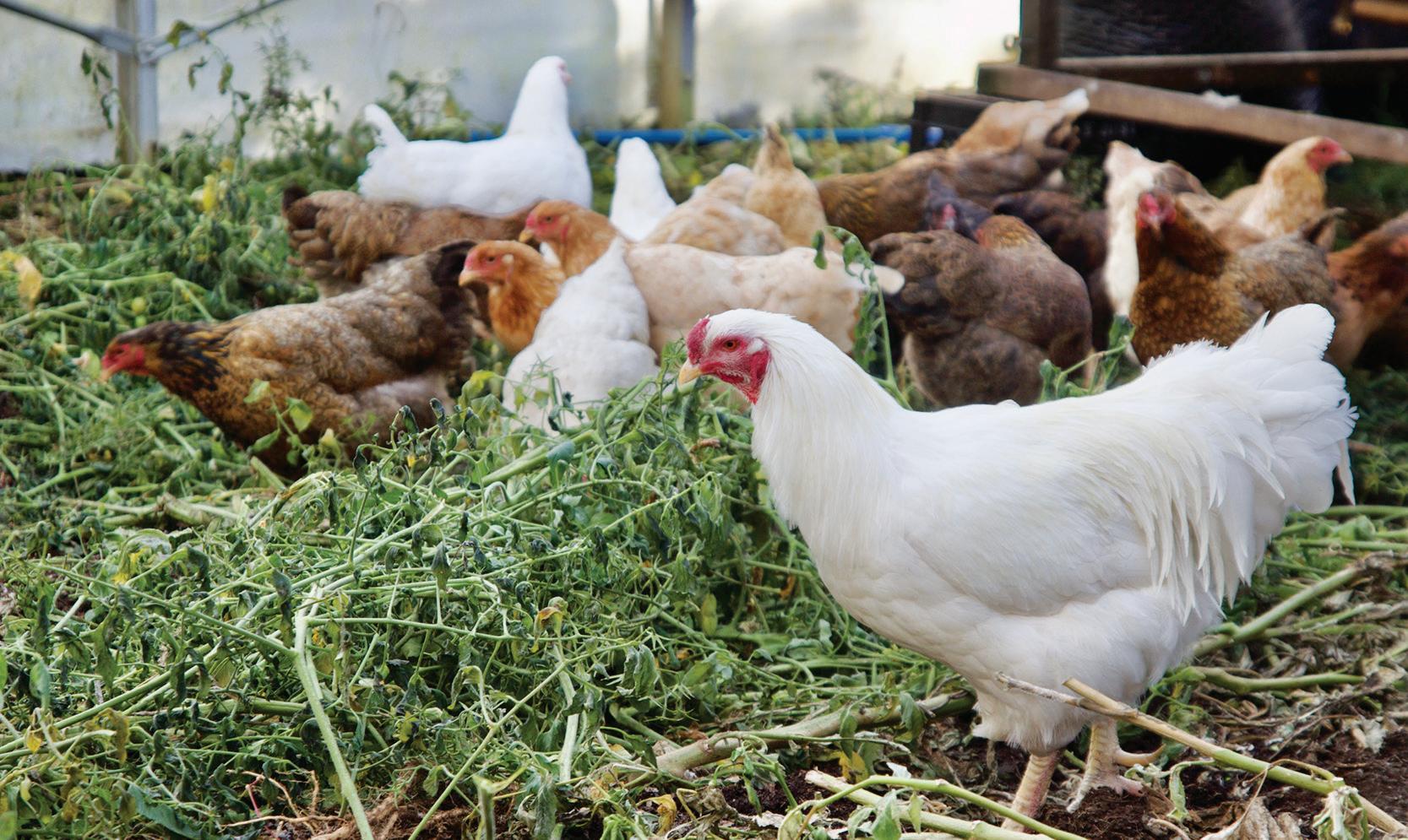
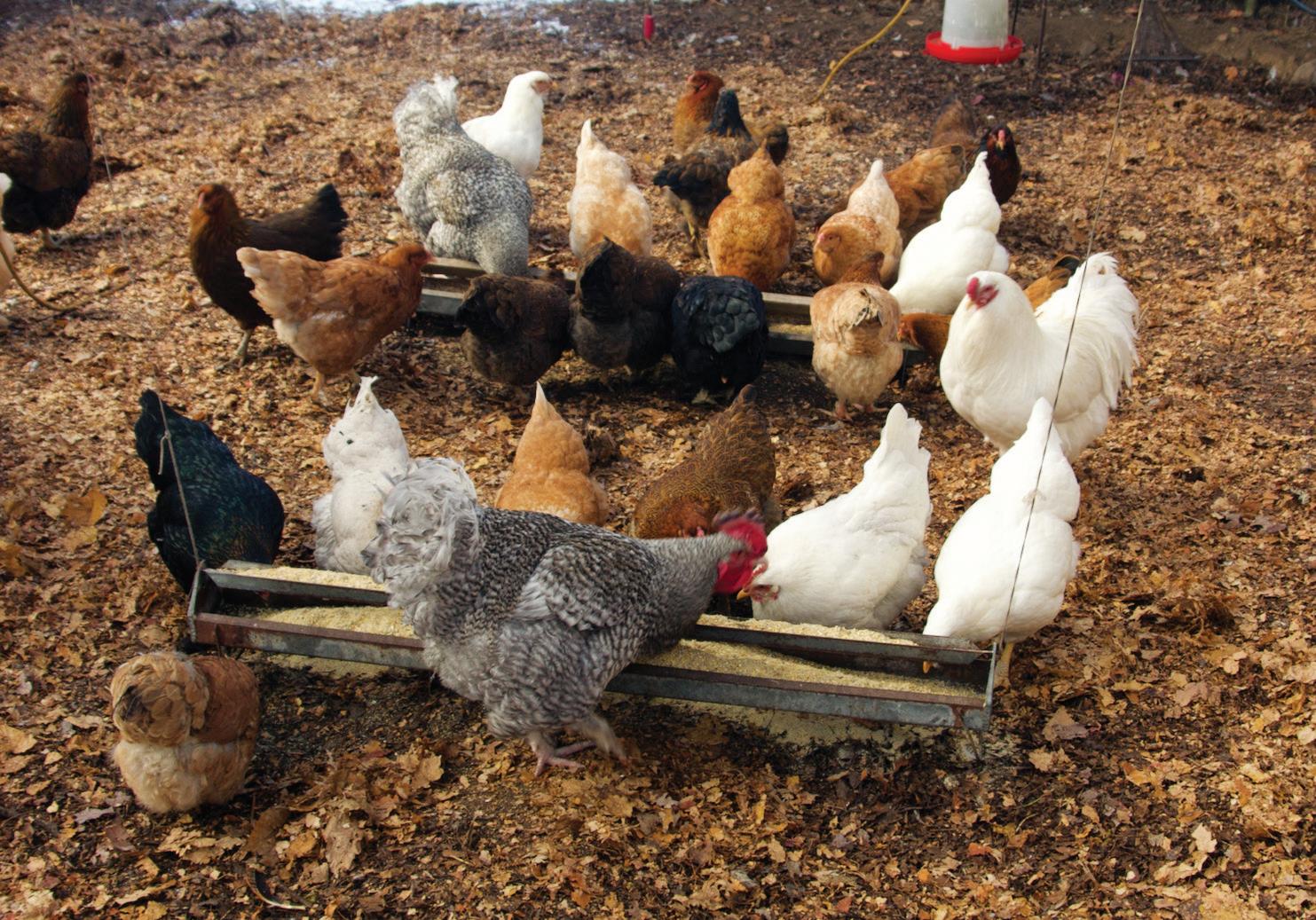
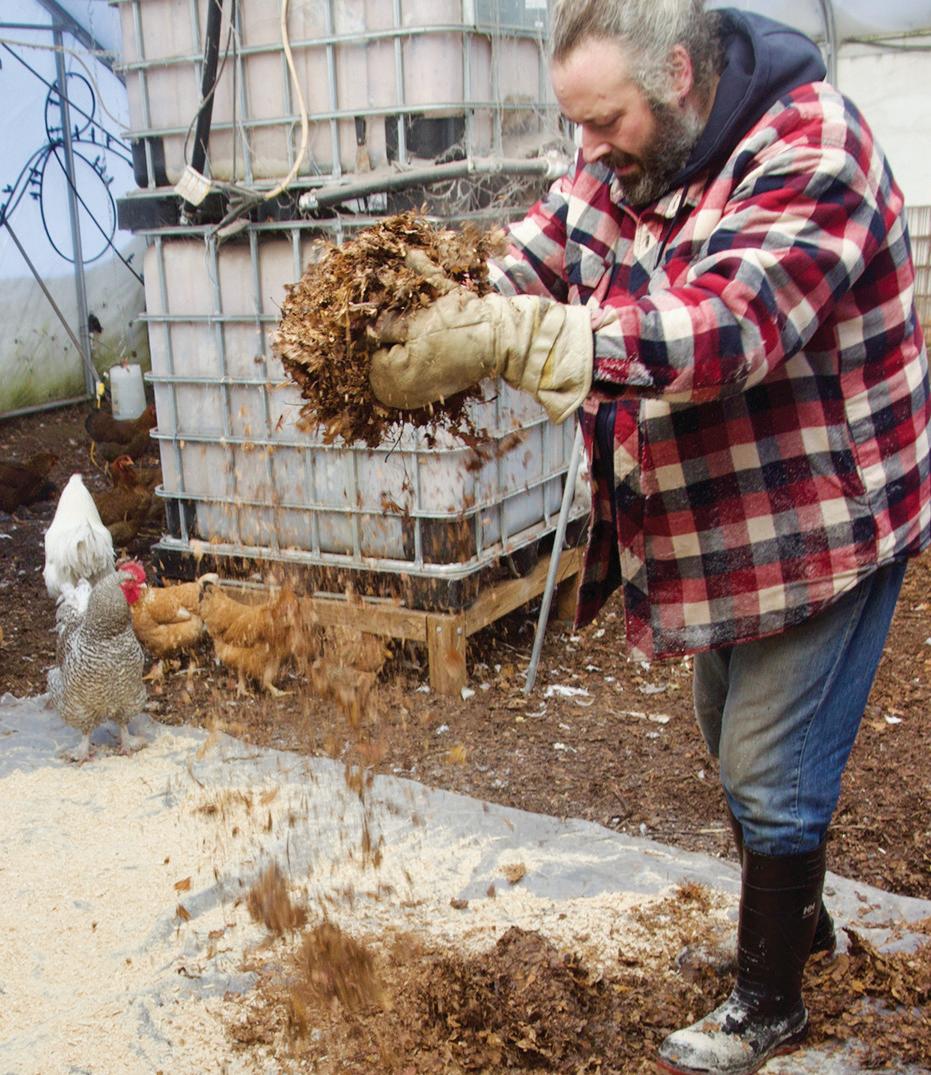
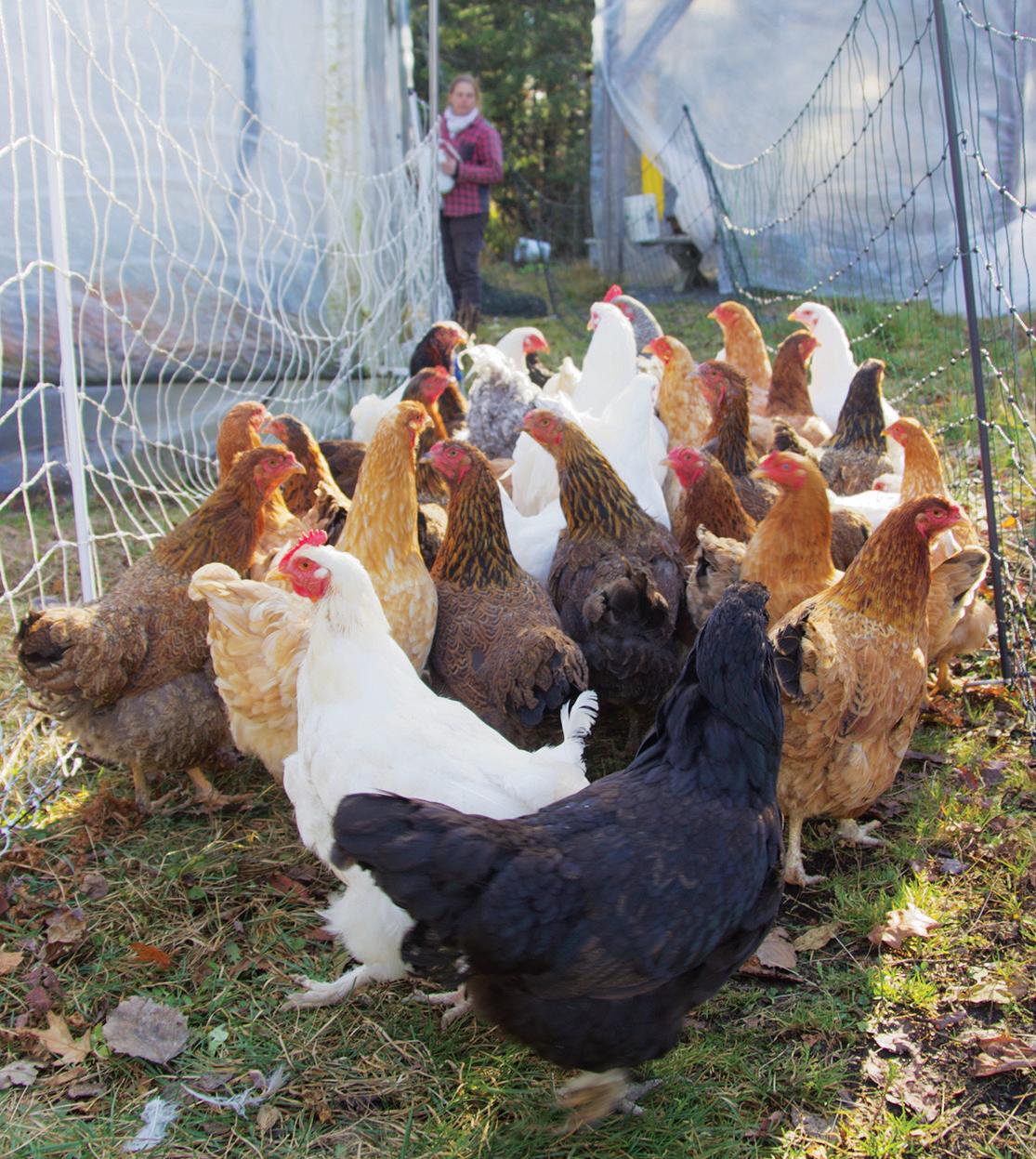
Back in the greenhouse, I turn on the hydronic system and set its temperature controller to 70 degrees. At this point, the controller’s probe, inserted 3 inches deep into the garden bed, indicates a soil temperature of around 40 degrees. The pumps engage, and within 12 hours, the water-glycol mix is circulating in the pipes at around 105 degrees. Within 36 hours, the soil is at temperature. The warmed earth awakens soil life, which in turn jump-starts the decomposition of all the manure and dried leaves accumulated during the past five months.
April 3, I rake the whole area using a broadfork, breaking up the lightly compacted top layer of mulchy litter, loosening and aerating the dirt under it. Earthworms abound, a telltale sign my soil is alive and well. Then, I drench the garden bed using a sprinkler. The rough, chopped-up leaves on the surface of the beds help suppress weeds and retain
www.MotherearthNews.coM 41
Time to move the hens into the greenhouse! Inside, they have plenty of greens to dine on that’ll last them for weeks.
Each week, the dropping-filled tarp under the coop is emptied and covered with fresh leaves.
Inside the greenhouse, the overwintered hens can eat from reel-top poultry feeders.
moisture in the ground, and working with drip irrigation further reduces the amount of weeds we have to deal with.
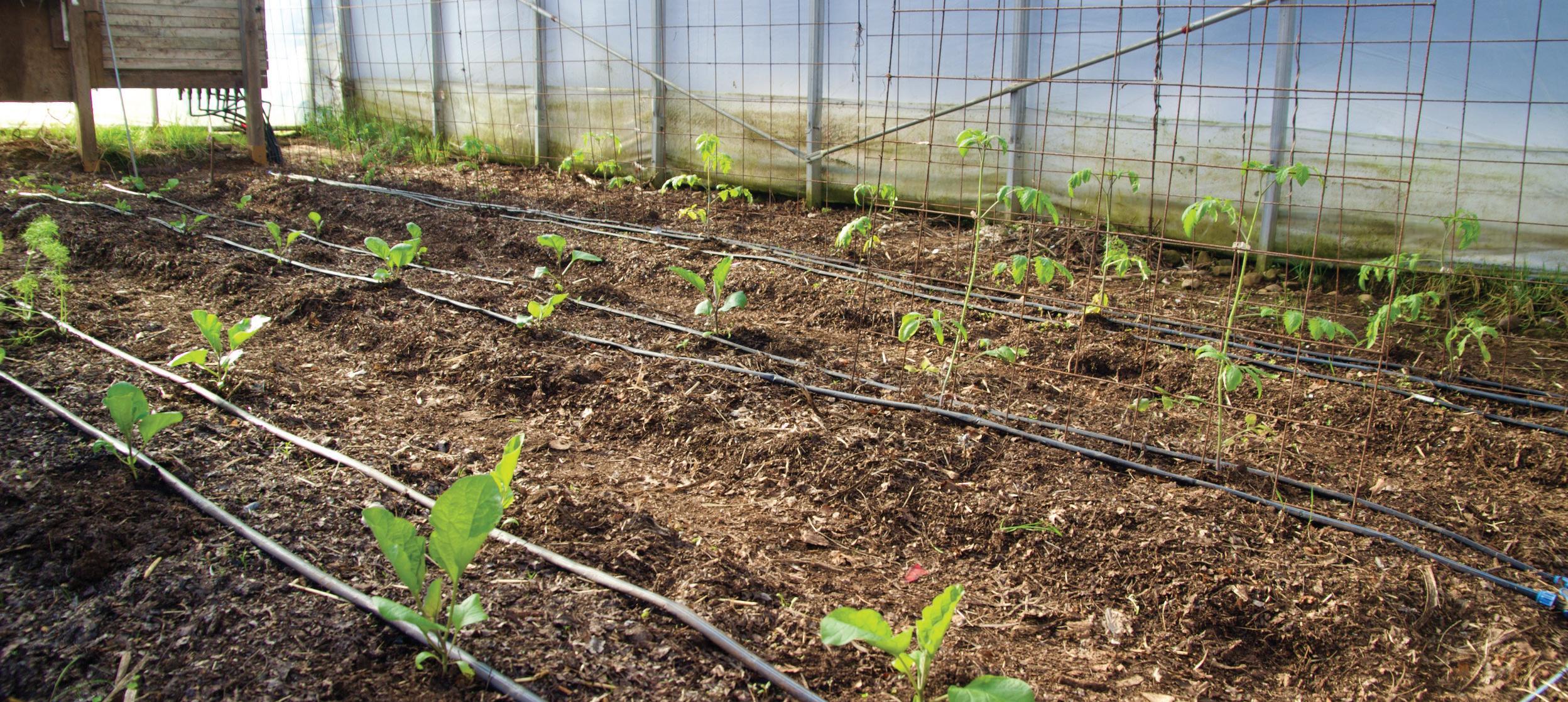
April 5, I make a single pass with a tiny cultivator to break up the crusty,
uneven surface of the plot left by the broadfork. I start from the outer edge of the garden and make my way inward in a spiral path, walking backward and pulling the gasoline-powered appliance
Add Carbon to the Mix
One hen can generate about 300 grams of manure per week. Since hens produce about as much during the day as they do at night, about half of that amount will be dropped on the tarp under the coop and the other half on the garden floor.
I want the hen droppings and chopped-up dried leaves covering the 650 square feet of greenhouse floor outside the coop to compost quickly, so I aim for a rather “aggressive” 21-to-1 ratio of carbon to nitrogen. I only use chopped-up dried leaves as my carbon matter. They’re easy to gather and don’t generate a lot of dust, and I find they decompose much faster than whole leaves, straw, or wood shavings.
On the 100-square-foot tarp lying under the coop, I’m dealing with a high concentration of nitrogen dropped onto a relatively small area. So, I use wood shavings as well as leaves. Because this litter will be composted outside the greenhouse, it doesn’t have to compost as fast. I use a more conventional 25-to-1 carbon-to-nitrogen ratio in this case.
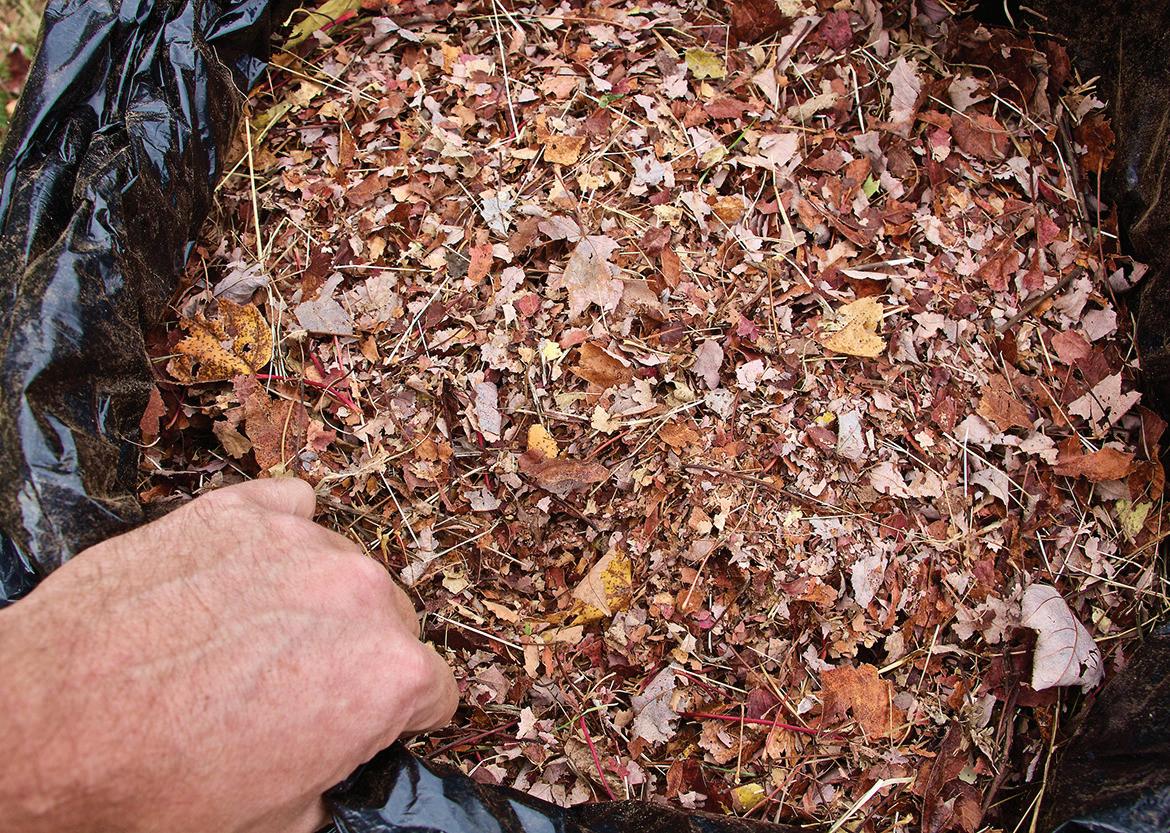
Now, for the final recipe: Conservative carbon content evaluations of mature hen droppings, dried leaves, and fine softwood chips put their carbon content at around 10-to-1, 45-to-1, and 400-to-1,
up and toward me. This way, I’m only working the first few inches of the bed. April 7 , I divide the surface of the garden into six 3-by-25-foot rectangular rows by scraping down five aisles
respectively. In real life, these numbers may vary greatly, but they’re a good starting point.
To achieve my 21-to-1 ratio on the greenhouse floor, I need to add twice the amount of dried leaves than there is manure. Since each hen will drop about 150 grams of manure per week outside the coop, I need to add 300 grams of leaves to the mix in the same interval. For a flock of 35 hens, this means about 10 kilograms of leaves per week. To achieve my 25-to-1 ratio on the covered coop floor, leaves, fine softwood chips, and manure must be present in equal amounts. Since 35 hens will produce about 5 kilograms of droppings per week under the coop, I add 5 kilograms of wood shavings and 5 kilograms of chopped-up dried leaves weekly. In total, I need about 15 kilograms of chopped-up dried leaves and 5 kilograms of shavings per week. Since I overwinter my hens in the greenhouse for 20 weeks, I fill 20 contractor-style cleanup bags with about 15 kilograms of dried leaves each and line the inside walls of the high tunnel with them. You can also use heavy-duty, brown-paper lawn and refuse bags if your leaves are bone-dry; otherwise, the bags’ bottoms will become soggy.
While the hens are pastured in spring, the greenhouse turns back into a garden, complete with a drip-irrigation system.
42 MOTHER EARTH NEWS October/November 2023
A bag full of collected shredded leaves.
between them with a rake and spade. These corridors, 2 feet wide and 6 inches deep, allow us to circulate easily between the garden beds.
May 1 , time to lay down the dripirrigation system, hang trellis for the tomatoes and cucumbers, and transplant plantlets into the warm earth. We also direct-sow seeds of radishes, spinach, and bok choy.
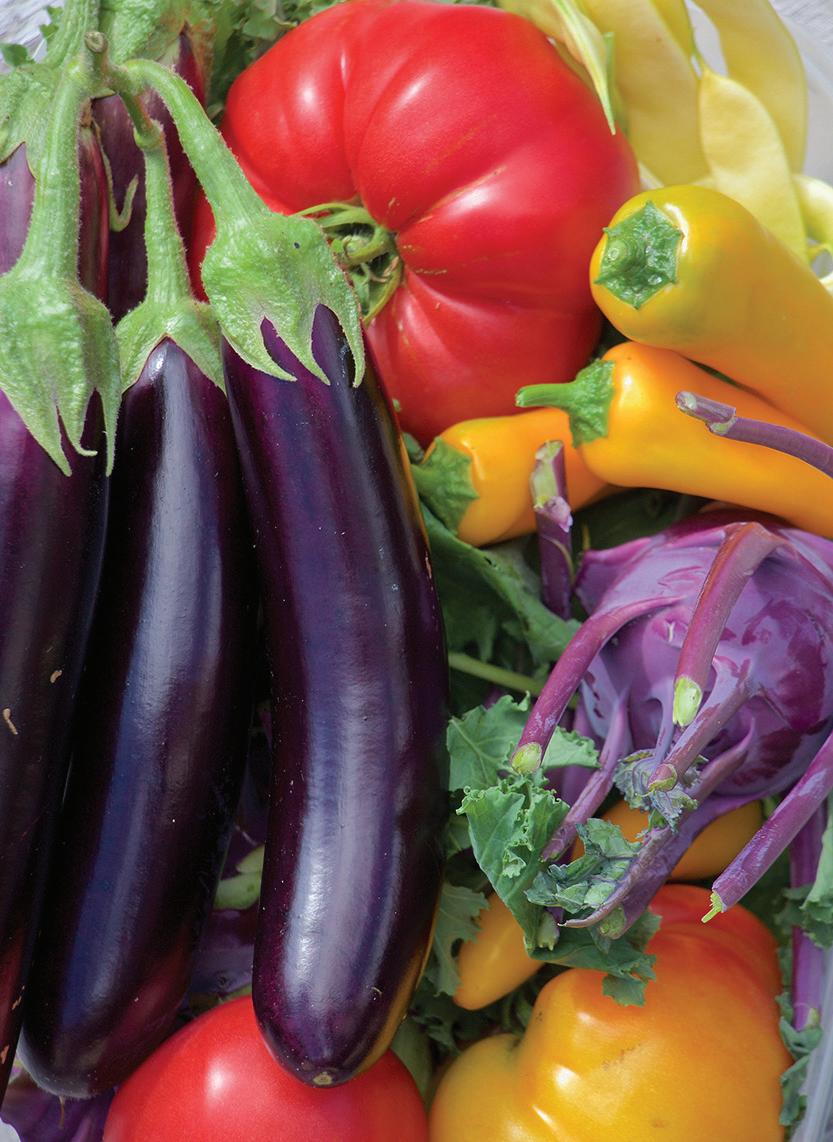
There it is. Seven years into this, without ever having added any soil amendments other than chopped-up leaves and what manure the hens provide, our crop production is as spectacular as ever. One 25-foot row of tomato plants, spaced 3 feet apart, produces 200 pounds of fruit! Moreover, we never need to add topsoil; composted mulch replaces whatever soil is removed by our gardening activities. Our greenhouse provides us with eggs, fruits, vegetables, fertilizer, and topsoil, while providing the hens with shelter and ample room to roam, scratch, and roll and flap around in the dirt.
Dominic Lamontagne lives on a small farmstead in Québec, where he leads homesteading workshops and advocates for small-scale-farming rights. He’s the author of La ferme impossible (The Impossible Farm ), L’artisan fermier (The Artisan Farmer) and La chèvre et le chou (The Goat and the Cabbage).

Have you ever considered keeping goats for their milk, meat, or just as companions and pets, but you’ve heard horror stories of the care required?
We’re here to help! From purchasing to feeding, from breeding to kidding, we o er advice written by seasoned goat owners and veterinarians.

$17.99
| Item #12107







Order today by calling 800-234-3368 or visiting Store.MotherEarthNews.com

Promo code: MMEPANZ2









www.MotherearthNews.coM 43
A haul of greenhouse-grown produce.
See #7 on page 68
8/16/2023 12:34:12 PM
MEN GJ Guide 1.6h.indd 1
Rodenticide Toxicity in Pets
Avoid potential pet poisoning by knowing what’s in your pest control.
By Amelia Eigerman
Rodenticide toxicities pose a significant threat to pets, leading to numerous visits to veterinary emergency rooms. Rodenticides can impact any pet, from a new puppy digging up backyard traps to a family pet finding forgotten bait in the attic, and the toxicities can be difficult to treat and extremely deadly. However, pet owners can take steps to reduce the risk to their furry family.
Rodenticide Toxicity
While some species are resistant to specific poisons (example: guinea pigs
are resistant to bromethalin rodenticides; who knew?), rodenticides are toxic to more than just rodents: Birds and mammals are suseptible. Animals are exposed to rodenticides through direct ingestion of the bait or by consuming animals that have come into contact with the poison.
Rodenticides are designed to be highly palatable, making bait an appealing snack for pets. Many types of poison can cause illness, even at low doses. If your pet finds and ingests any amount of rodenticide, they’re at risk. Most cases of rodenticide toxicity occur when pets eat pure bait they find in traps or storage.
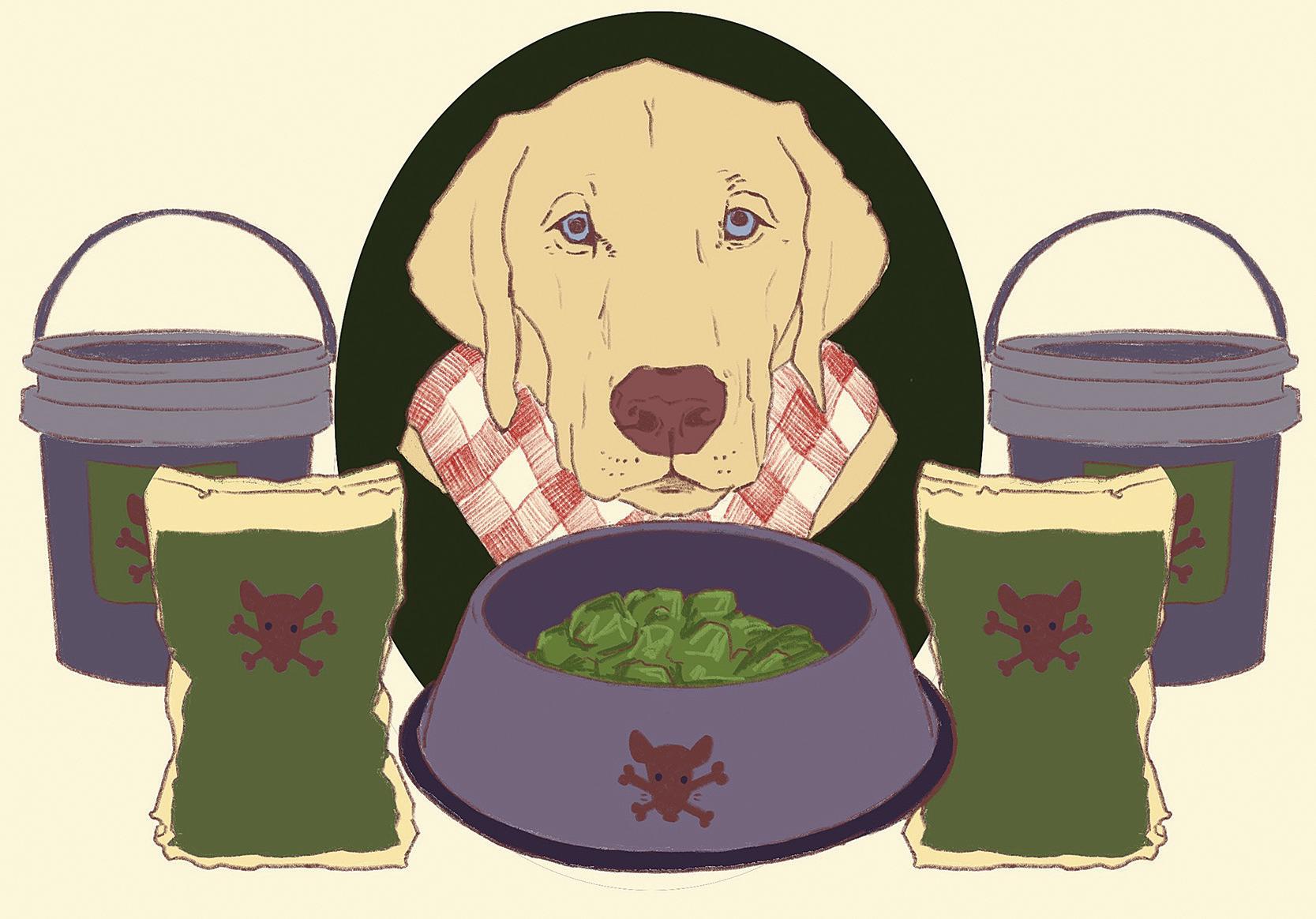
Relay Toxicosis
When animals eat prey that have ingested or died from rodenticide, there’s still some risk of rodenticide toxicity. This is known as “relay toxicosis.” Typically, rodents that died from rodenticide poisoning don’t pose a huge risk when ingested. This is because the rodent has already metabolized much of the poison. However, sometimes pets kill and eat prey that have ingested rodenticide but haven’t died from the toxin. This can be more dangerous for your pet. Err on the side of caution and get your pet checked out if you have any concerns.
Eating one dead, poisoned rodent is unlikely to cause issues; animals that repeatedly prey on rats and mice that have eaten bait can find themselves in trouble. The toxic chemicals can build up over time. This is most often seen in wildlife, such as raptors, but can also be an issue with barn cats and other household pets.
What You Should Know
Many rodenticides are marketed as being safe to use around pets. Unfortunately, this isn’t usually the case. Each family of rodenticides has its own risks and treatment methods.
Anticoagulant rodenticides are some of the most common baits. This class of poisons works by preventing the target’s blood from clotting, causing them to bleed. Anticoagulant toxicities can take days to produce symptoms. This makes it difficult to track down why your pet is sick. Symptoms of anticoagulant ro-
44 MOTHER EARTH NEWS October/November 2023
This article is available online in audio form at MotherEarthNews.com
Rodenticides are dangerous for any mammal not just rodents.
denticide toxicity include bruising, bleeding from the nose or ears, bloody stool, bloody urine, a swollen abdomen, and weakness. Luckily, anticoagulant rodenticides are treatable if the toxicity is diagnosed in time. Vitamin K therapy, repeat bloodwork, and supportive care can prevent illness if the treatment is started soon after your pet eats the bait. But be aware that anticoagulant rodenticides have been shown to build up over time in animals that prey on poisoned rodents and can cause a lot of harm to wildlife via relay toxicosis.
Bromethalin rodenticides are also commonly used to control rodent populations. Bromethalin kills rodents by causing swelling in the brain. This causes neurological symptoms, including tremors, seizures, and death. Symptoms begin rapidly after ingestion, typically within four hours. Often, symptoms can last for days and can even be permanent. Unlike anticoagulant rodenticides, there are no direct treatments. Instead, bromethalin toxicities must be treated supportively. Relay toxicosis is possible but not common with bromethalin rodenticides.
Phosphide rodenticides, including zinc, calcium, and aluminum phosphide, have been on the market for over 100 years. These poisons work by reacting with gastric fluids to produce corrosive gases. Phosphine gases damage the lining of the gut and then move on to damage your pet’s organs, especially the brain, liver, and heart. Phosphide poisoning occurs quickly, with serious symptoms occurring in as few as 15 minutes. If you suspect your pet may have gotten into a phosphide-based rodenticide, be cautious while handling or transporting them. Even secondhand, the gases can cause serious harm to humans when inhaled. It’s possible for relay toxicosis to occur with phosphide rodenticides.
Cholecalciferol rodenticide is the newest addition to the world of rat baits. This class of poisons uses vitamin D3 to kill rodents by disrupting the balance of calcium and phosphorus in the body. By disrupting this balance, cholecalciferol rapidly damages the kidneys, leading to
death. Signs and symptoms can take up to two days to emerge, at which point irreversible damage has already occurred. Cholecalciferol toxicity is also extremely challenging to treat. Rapid decontamination is essential if your pet has been exposed to this poison. Cholecalciferols haven’t been shown to cause acute relay toxicosis, but they can build up in animals’ systems and make them sick if they continue to eat poisoned prey.
Several other poisons can be used to control rodent populations, including strychnine and corn-gluten rodenticides. Remember that no rodenticide is completely safe for your pets or backyard animals. If you’re concerned your animal may have been exposed to rodent bait, contact your veterinarian.
Rodenticide Poisoning
If you know your pet has gotten into rodenticides, act fast. Call your veterinarian or closest emergency animal hospital immediately. Veterinarians are the experts at treating toxicities in pets, and they’ll be able to give you the best advice. You may also be asked to call a poison control hotline. The veterinary toxicologists who work for these hotlines have up-to-date information about dosages and treatments and will work with your veterinarian to provide the best care possible.
The first step to treating rodenticide toxicity is decontamination. This means removing as much of the toxin from your pet as possible. Sometimes your

veterinarian may recommend starting this process at home by attempting to make your pet vomit. Only induce vomiting if your veterinarian has asked you to do so. Risks to inducing vomiting at home include damage to the lungs and choking. Exposure to phosphide rodenticides can be harmful to humans and must be dealt with carefully.
Each rodenticide family requires unique treatments. This means it’s important your veterinarian knows exactly what your pet has gotten into. If you can, bring the packaging or a photo to your vet so they have all the information they need to provide the best care. Rodenticides can look similar but behave differently. If you keep rodenticide around your home or farm, write down what rodenticide you’ve placed and keep track of the quantities. That way, you’ll have as much information as possible in an emergency.
Rat Poison Alternatives
No one wants to end up in the emergency room with a poisoned pet. Reducing or eliminating your use of rodenticides cuts off the problem at the source. Your creatures certainly can’t ingest any poisons if they’re nowhere to be found. Instead of using poisons to control your rodent population, try this three-step method to keep unwanted pests at bay.
Avoid attractants. This means getting rid of or securing anything that might entice rats and mice. In your
www.MotherearthNews.coM 45
Prevention is the best protection for your beloved furry family members.
home, keep food in sealed containers and clean up food waste quickly. This means no dirty dishes in the sink and frequent trips to take the trash out. Outside, keep your compost covered and secure grain sources as best you can. Brush piles and tall grasses can offer shelter to rodents and encourage them to take up residence near your home. Netting or caging your plants can also reduce the rodent presence on your property.
Introduce deterrents. This includes anything that will scare rodents away from your spaces or prevent them from entering. Sealing off cracks and openings to your home or barn can make a huge difference. Other deterrents include lights, sounds, and scents that are unpleasant to rodents. Fake owls are a common deterrent, although their impact can be limited. It doesn’t take most animals long to learn the fake bird can’t actually eat them. Instead, try tools like high-intensity strobe lights, mint oils or plants, whole
cinnamon or clove, or cayenne pepper sprays. You can also opt for nontoxic traps, like snap, CO2, or electric traps, or catch-and-release methods.
Invite predators to your space. While it might sound unwise, it’s truly a logical solution. To reduce your rodent population, invite the natural predators of rodents. Raptor boxes are one of the best ways to facilitate nature’s pest control. Organizations, such as Raptors Are the Solution (RATS) and the Hungry Owl Project, advocate for adding nesting boxes and planting oak trees to attract owls and other birds of prey to your property. In a three-year study of barn owls in California, researchers found that owls had a much lower cost per rodent than rodenticides.
If you must use rodenticides, do so safely. Always follow the safety instructions on the packaging of any baits you buy. Restrict access to traps and to wherever you store extra bait. Remember, these baits are made to

taste and smell delicious, and your pets may find them, even if your traps are concealed. Restrict trap use to interior places that aren’t accessible to your pets or other predators. You can also use a snap trap inside bait boxes to prevent poisoned rodents from exiting the trap and being eaten. Most importantly, keep track of what baits you use and ask your neighbors what they have around. That way, if the worst does occur, you’ll be armed with the best information to protect your pet.
Amelia Eigerman is an emergency room veterinary technician with a passion for science communication. In their time working at multiple emergency hospitals, Amelia has helped treat many dogs suffering from rodenticide toxicity. They hope to help pet owners learn more about how to keep their animals safe and what to do when things go wrong.
46 MOTHER EARTH NEWS October/November 2023
See #12 on page 68



There’s a reason we build campfires outside and not in our living rooms. It’s just a fact, there’s a much safer, cleaner and more comfortable option. When it comes to woodburning heat... we say take it outside. Need another reason to choose Central Boiler? We’ve got 50. CB50REASONS.COM TO HEAT WITH A REASON CENTRAL BOILER OUTDOOR FURNACE # TO HEAT WITH A CENTRAL BOILER 50 REASONS 0017 Outside burning beats inside. Every time. ©2023 Central Boiler ad7909 See #28 on page 68
Thieves, Apples, and Fire: The Surprising History of

Medicinal Vinegars
Legendary Origins
By Julia Skinner
The story of vinegar as medicine is one steeped in mystery, intrigue, thievery, and a whole bevy of herbs and spices too. Vinegar is used as part of traditional medical practices across the world, but one of the most famous remedies, here in the U.S. at least, is fire cider.
Modern herbalists rely on fire cider as a nourishing winter tonic, which helps keep the bugs at bay during cold and flu season. But fire cider is part of a long history going all the way back to the European Middle Ages, and the use of medicinal vinegars has informed iconic flavor pairings, which we still find across European and North American cuisines today.
People have crafted medicinal vinegars for thousands of years and across many continents. For the ancient Greeks and Romans through the early modern period, vinegar was used to balance the four humors, a practice echoed in the foods we eat today.
Vinegar’s sour flavor means it’s classified as hot and dry, and in the spirit of balance would be paired with cold, moist foods (such as pork or fish). This balance of temperature and moisture, using sour and hot
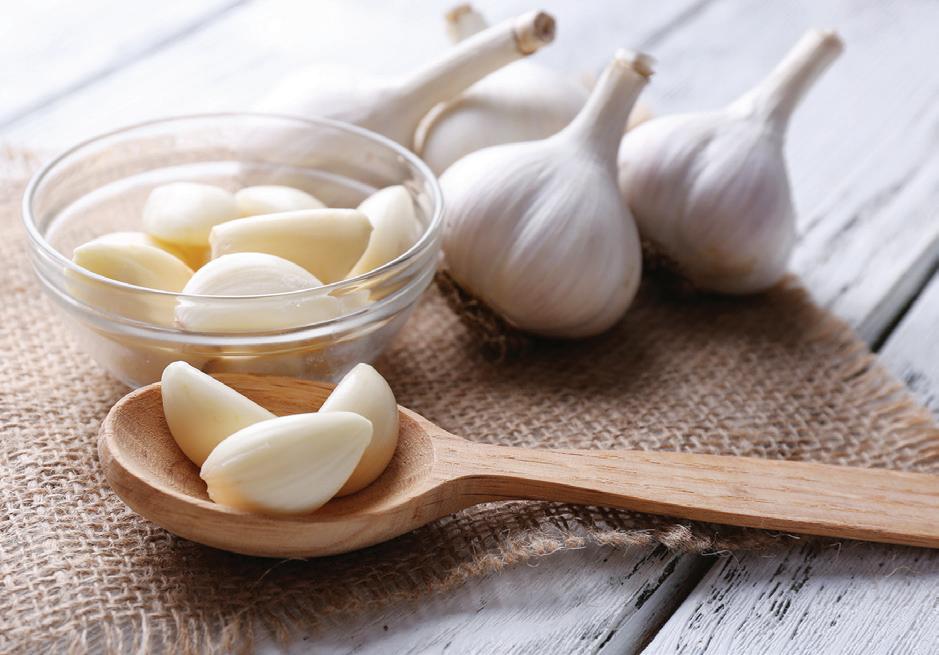
foods, is how we get some of our iconic flavor pairings, such as lemon and fish, or vinegar or mustard and pork.
In some cases, these vinegars were plain, while other times, they were infused with other ingredients. We’ve infused vinegar with all kinds of medicinal plants over the years, from fresh herbs to flowers, spices, hot peppers, and citrus. Sometimes for flavor or for health benefits, and sometimes for both. Each of these ingredients brings its own healing properties, from analgesics to adaptogens and antimicrobials, which add to the healing power of vinegar.
Vinegar, with or without other additions, is used medicinally across many cultures. In many traditional medicinal sys-
48 MOTHER EARTH NEWS October/November 2023
The beloved herbal tradition of fire cider has deep roots.
PAGES 48-49: ADOBE STOCK/SEA WAVE; BOTTOM: ADOBE STOCK/AFRICA STUDIO
Both four thieves vinegar and fire cider use garlic as a staple.
tems, sour flavors are often associated with spring, and vinegar accompanies greens that appear in this season and that our bodies would crave after winter.
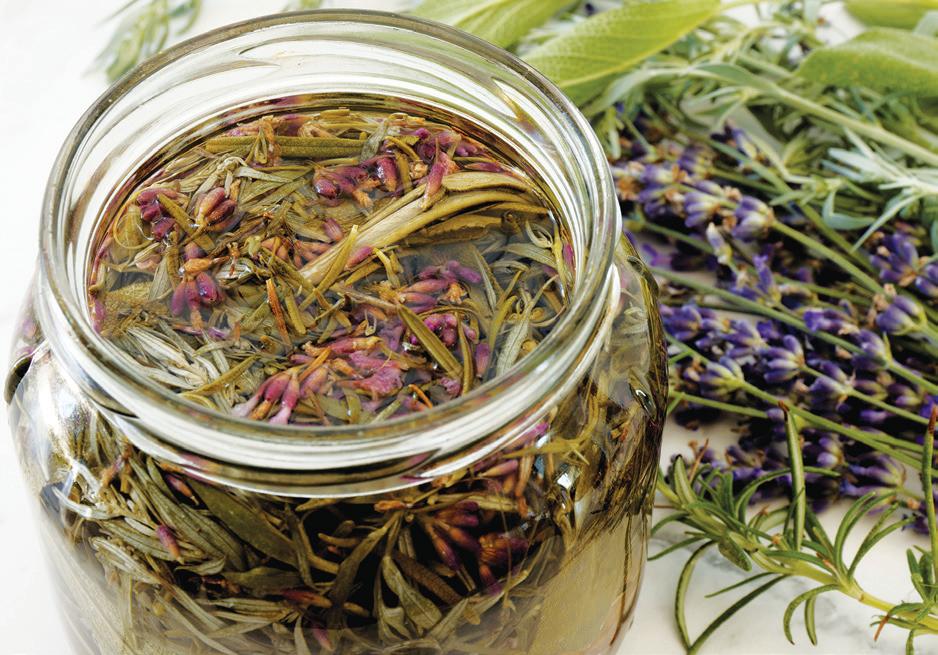
Today, we know infusing greens in vinegar (such as the chickweed vinegar I make each spring) is a powerful way to extract minerals from those greens the very minerals our bodies would need after several months of eating only preserved or dried veggies. In addition to pickling and preserving fruits and vegetables, vinegars offer a shelf-stable way for us to bring minerals into our bodies even when mineral-rich foods aren’t readily available.
Medicinal vinegars, such as fire cider, are antimicrobial
and filled with micronutrients to keep us healthy. Before fire cider was fire cider, it was four thieves vinegar, found an ocean away and almost 1,000 years in the past.

The Four Thieves
One of the most famous medicinal vinegars is four thieves vinegar, which, as legend has it, first emerged in the Middle Ages. During the bubonic plague that ripped through France, a group of thieves ransacked the homes of the ill and dying, but puzzingly never became ill themselves. The reason? They had a magical, medicinal vinegar that kept the plague at bay. The recipe was a closely guarded secret, but once the thieves were captured, they had to exchange the recipe for their lives.
Four thieves vinegar may have consisted of red or white wine vinegar (or cider vinegar) infused with fresh garlic, plus
www.MotherearthNews.coM 49
ADOBE
Medicinal vinegars have a long and rich cultural history.
STOCK/FOTEMA
four herbs: one for each thief. The exact herbs in modern preparations vary (and sometimes spices, such as cloves or cinnamon, are included) but can include tarragon, sage, rosemary, angelica, wormwood, or juniper.
Though said to date back to the Middle Ages, one of the earliest written recipes for four thieves vinegar is quite modern: René-Maurice Gattefossé, sometimes called the “father of aromatherapy,” records one in his 1937 book Aromathérapie; Les Huiles essentielles hormones végétales His recipe includes more than four herbs, though, and he attributes it to an 18thcentury recipe from Marseille that includes 3 pints of white wine vinegar, plus wormwood, meadowsweet, wild marjoram and sage, cloves, Campanula roots, angelica, rosemary, horehound, and camphor, steeped for two weeks before being
strained and pressed. Unlike modern four thieves vinegar, which can be applied topically or used in food, this iteration of the preventive was rubbed on the ears, hands, and temples.
A Fusion of Cultures: Fire Cider
A continent away, another infused vinegar appeared, directly influenced by historic infusions, such as four thieves vinegar. The long-standing practice of infusing vinegar was brought over by colonizers
to the Americas. As with many recipes that travel to a new place, this one was adapted to what was on hand, and there’s no doubt that plants native to this continent (such as hot peppers) would’ve been infused into the vinegars made here, in lieu of plants that weren’t available.
There’s a rich, multicultural history of herbal remedies across the Appalachians and Eastern Seaboard that includes medicinal foods, such as infused vinegar, and draws upon traditions from Europe, Africa, and Indigenous cultures in the Americas.
In the 1970s, Rosemary Gladstar made a modern version of infused vinegar by bringing together a suite of healing botanicals, including alliums, such as garlic and onion, plus hot peppers, spices, herbs, and honey, drawing on her extensive knowledge of herbal medicine traditions. Gladstar bridged the old and the
Fantastic Fire Cider
This recipe is from my book Our Fermented Lives: A History of How Fermented Foods Have Shaped Cultures & Communities
Fire cider relies on unpasteurized vinegar and is typically made with apple cider vinegar. It also commonly emphasizes hot peppers and alliums. Aside from that, the ingredients are extremely flexible and vary from person to person and even batch to batch. This is a great way to use up little bits of vegetable matter, such as onion tops or herb stems from other cooking projects! The goal is to get as much goodness packed into the jar as possible.
I classify my ingredients into three main groups roots, shoots and fruits, and spice and mix and match between them. Fire cider can be enjoyed as a daily tonic by the shot glass or spoonful, or it can be incorporated into recipes, dressings, and marinades in place of apple cider vinegar.
• Roots: Onion, garlic, turmeric, ginger, horseradish, carrot, etc.
• Shoots and fruits: Citrus peel, thyme, rosemary, parsley, wild greens, dried cherries, elderberries, etc.
• Spice: Hot peppers (any variety), cinnamon sticks, star anise, cloves, etc.
• Cider: Unpasteurized apple cider vinegar
• Honey (optional)
1 Slice, cube, or coarsely chop the roots, and cut the hot peppers in halves or quarters.

2 Pack the herbal ingredients tightly into a pint jar, and fill all the way to the neck with vinegar, making sure everything is submerged. Cover with a tightly fitting lid.
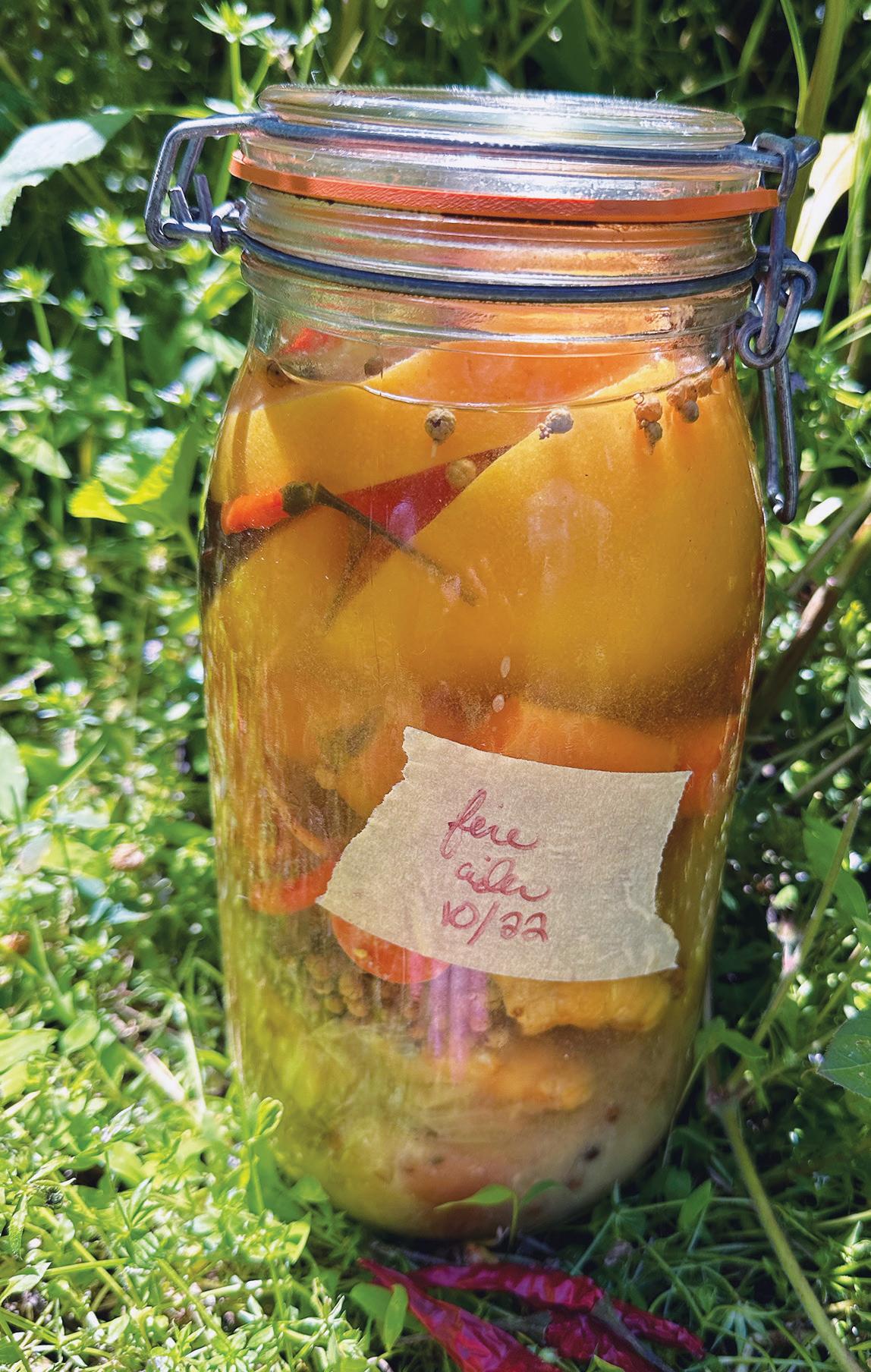
3 Let steep at room temperature for at least 1 month. If bits of herbs and spices float to the top, gently shake the jar each day to redistribute them.
4 Strain the aromatics out. If you want to add honey, stir it in now. Bottle the finished fire cider and store at room temperature; it’ll keep indefinitely.
50 MOTHER EARTH NEWS October/November 2023
Peppers are one of the signature ingredients of fire cider.
TOP: ADOBE STOCK/NATASHA BREEN; BOTTOM: JULIA SKINNER
new, making fire cider with a wide variety of ingredients available to modern people but still firmly rooted within the European herbal medicine traditions that brought us four thieves vinegar.
Fire cider continues to be popular today: I regularly teach fire cider classes online and in person, and fire cider can be found in shops, farmers markets, and online. But this beloved tradition almost became inaccessible: In 2012, a company trademarked the name “fire cider” and sued several herbalists for using “its” product name. Interestingly, another company tried to trademark the
WANT TOMORE?LEARN


name “four thieves vinegar” soon after the lawsuit.

Fortunately, the three well-known herbalists were able to show in court that fire cider is a recipe so widely used and adapted that it can’t be trademarked to an individual company. Fire cider, like four thieves vinegar before it, is a widely beloved and appreciated medicine. And ultimately, no one can “own” either one, just as no one can ever own the process of making or infusing vinegar. Fire cider and four thieves vinegar will continue to nourish and heal our bodies for generations to come.
How Fermented Foods Have Shaped Cultures & Communities
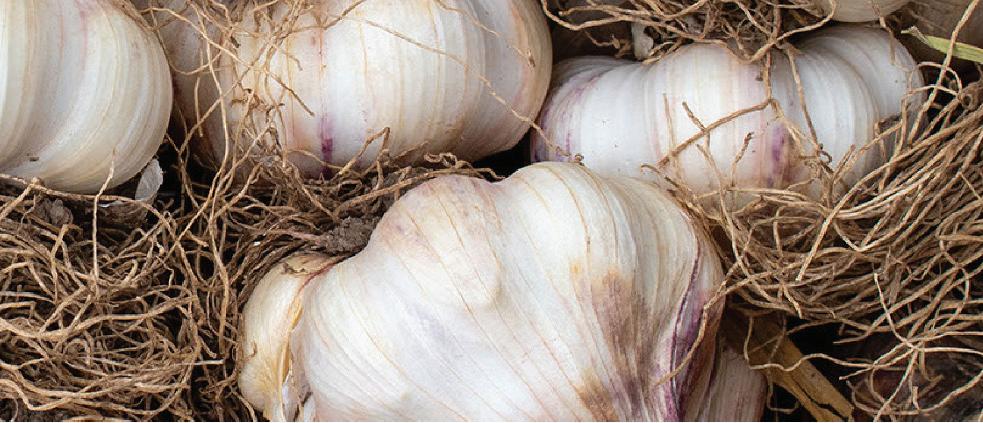

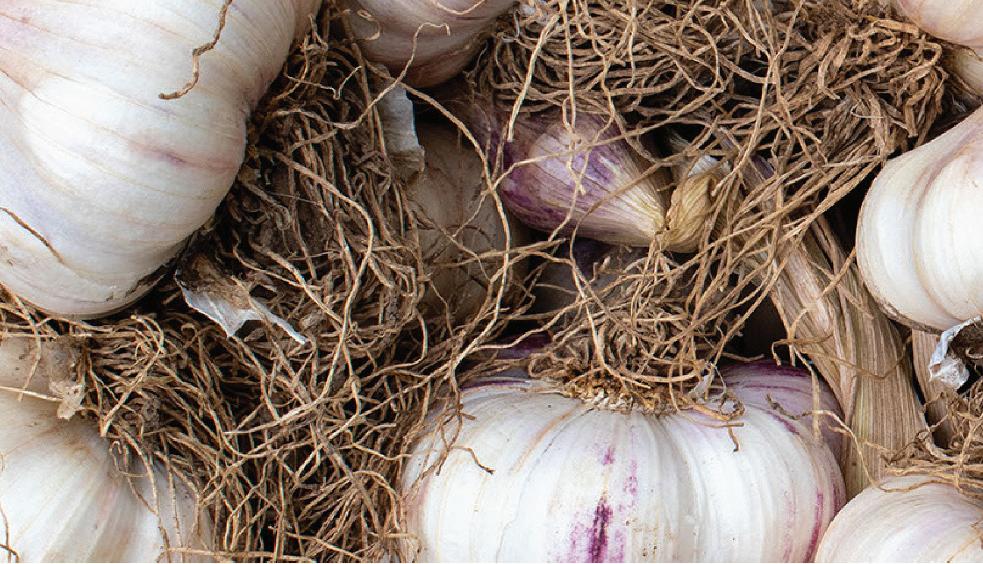
Julia Skinner is the author of Our Fermented Lives: A History of How Fermented Foods have Shaped Cultures & Communities. She’s also the founder of food history and fermentation company Root Kitchens and the author of a weekly food-focused newsletter at RootKitchens.Substack.com. She’s an avid cook, wildcrafter, researcher, and artist, and she splits her time between Atlanta, Georgia, and Cork, Ireland. You can follow her adventures at @BookishJulia and @RootKitchens.
Continue your journey of learning the history of fermented foods with Julia Skinner, and gain access to more historically significant recipes with her book Our Fermented Lives. In this one-of-a-kind text, she explores the fascinating roots of a wide range of fermented foods across the world with a focus on history and culture, from the evolution of the microbiome to food-preservation techniques, distinctive flavor profiles, and the building of community. Order your copy of Our Fermented Lives today and use the promotional code FALL20 to receive a 20% discount on the book. This title is available at Store.MotherEarthNews.com or by calling 800-234-3368. Item #11874. Promotional offer expires on 11/18/23.
See #24 on page 68

WWW.MOTHEREARTHNEWS.COM 51
Plant the Seeds of Friendship
Making your own paper is easy and a great way to recycle materials that might otherwise go to waste. I tear up newspapers, magazines, and used envelopes to produce pulp for my homemade paper. I especially like to use the colorful ads from the local grocery store. Lint from the clothes dryer can also be an interesting addition.
The only specialized equipment that’s needed for papermaking at home is a deckle kit . I bought an inexpensive deckle set online for $9.99. It came with three pieces: a wooden frame, a plastic grid about an inch thick that fits inside the frame, and a fine screen. During papermaking, you’ll pour the liquidy pulp over the screen, and excess water will seep through. The plastic grid supplies support for pressing out additional moisture.
You can also make your own simple frame with four dowels or narrow pieces of wood trim. The size of the device is up to you and depends on whether you want to produce 8-by-10-inch paper, a 4-by-6-inch postcard, or another size entirely.
The first step in the papermaking process is to create pulp. I place the equivalent of four or five sheets of coarsely torn paper into my kitchen blender, and I add water to cover it. My homemade paper is on the thicker side, because I prefer it to have texture, but you can add more water to create a thinner, more delicate paper. I use the blender’s pulse button to control the consistency of pulp. Don’t worry it doesn’t have to be perfect.
I set the deckle apparatus inside a shallow glass dish. Next, I pour the pulp from the blender over the frame and tilt the dish over the sink so the excess water can spill out. Then, I blot away additional moisture with an ordinary kitchen sponge.
After blotting with the sponge, but while the pulp is still wet and inside the apparatus, you can press seeds into the pulp. I use seeds I’ve saved from sunflowers, squash, pumpkins, and all types of peppers, as well as seeds from expired seed packets. I like to mix and match them. For added fun, I create simple designs, using seeds to create a heart, happy face, or peace sign. I once wrote my grandson’s name in seeds.
The next step is to gently lift the screen from the grid and set it on a kitchen towel placed over a hard surface a cutting board works great for this. Cover the new paper with another towel and sop up as much moisture as possible by gently rolling a rolling pin over the top towel. Finally, carefully transfer the new sheet of paper to another towel to dry. Near the end of the two-day drying process, you can stack a few books on top of the paper to prevent the edges from curling.
I gift my homemade, seed-studded paper to neighbors, friends, and family even my mail carrier and librarian. Sometimes, I cut the paper to fit inside a greeting card. The paper is appreciated any way it's given, and the seeds have been sown and grown in a multitude of gardens.
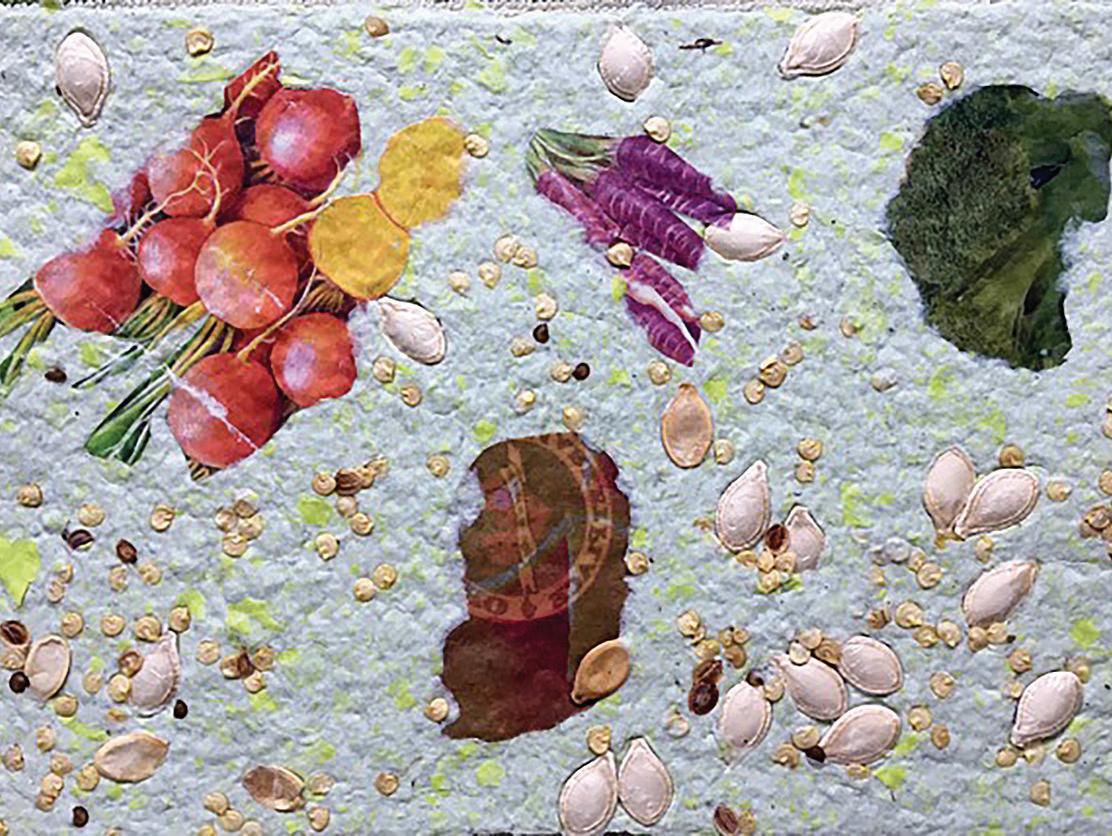

 Sherry Shahan Morro Bay, California
Country Lore Readers’ Tips to Live By S herry S hahan (3)
52 MOTHER EARTH NEWS October/November 2023
Cold Chickens
Western Wisconsin gets cold, but our chickens survive and produce all winter without heat. That's because I read in a 1929 almanac to give chickens vinegar in their water when freezing temperatures set in. So, we add about 1⁄2 cup vinegar per 2 gallons of water. They seem to drink more water, and we believe their blood circulation is improved. (Readers, make sure you give your birds apple cider vinegar with a mother. Mother)
Also, we have a 60-watt lightbulb on a timer, set to come on at 2 a.m. and turn off at 8 a.m. when we have sunlight. We make sure to collect eggs two or three times a day when temps drop to 32 degrees Fahrenheit or below, because eggs will freeze.
Ramona Lahaie Ferryville, Wisconsin
Hanging On to Clips
You can repurpose unwanted or old plastic hangers that are equipped with
A Walk Down Memory Lane
pinch clips for pants and skirts. Just cut off the clips with a wire cutters, scissors, or a hacksaw. Then, use the clips to close bags containing pantry items, such as chips, cereals, and crackers; they can be kept fresh this way.
I love gardening, because I believe it’s an old person’s game. While society worships youth, the garden is one place where years of experience and wisdom pay off in bountiful harvests. But I do admit some garden tasks become more difficult with age (although I still really enjoy the exercise). For me, the hardest thing about gardening today is remembering whether I turned off the hose after watering.
To water my garden, I open the tap on the side of the house and then walk down a path to the backyard. After wandering around for a while looking for the nozzle in the tall grass, I make the rounds of all the beds. Hand-watering gives me some relaxing time in the garden to check for ripe fruit, remove any diseased foliage, and pull a few thousand bindweeds.
Before I thought of the following helpful tip, I’d finish watering, put the hose by a thirsty tree or bush, and head back up the path. By the time I made it to the faucet, I’d often forget and walk right by. A couple of hours later, I’d get a sudden pang of terror in my chest did I close the sillcock? and race out to check. If this happened late at night, I’d startle awake in a cold sweat, wondering if the water was flooding my garden and draining my bank account. No, I reassured myself, I’d checked it earlier. Didn’t I? Was that today? And out I’d go in my pajamas to check again.
Those days of panic and sleep deprivation are behind me now, thanks to a simple habit. I keep a little flowerpot by the hose bib, and whenever I turn on the water, I move the pot into the middle of the path. When I come back up from the garden, I can’t stroll by absentmindedly without tripping over the flower, and this reminds me (and my loyal farm dog, Arlo, pictured) to visit the spigot. I can rest easy now in the certainty that I moved the pot back off the path and turned off the hose. I’m pretty sure I moved it. Didn’t I? I’d better go and check.
John Hershey Littleton, Colorado
Poultry-Proofing Plants

My free-range chickens wreak havoc on my potted plants. To keep them from scratching inside the pots, I turn wire hanging baskets upside down over my pots. Then, I secure the wire baskets in place with at least six wooden skewers so the basket can’t be knocked off. The birds can still peck bugs off the plants through the wire, but they can’t uproot the plants.
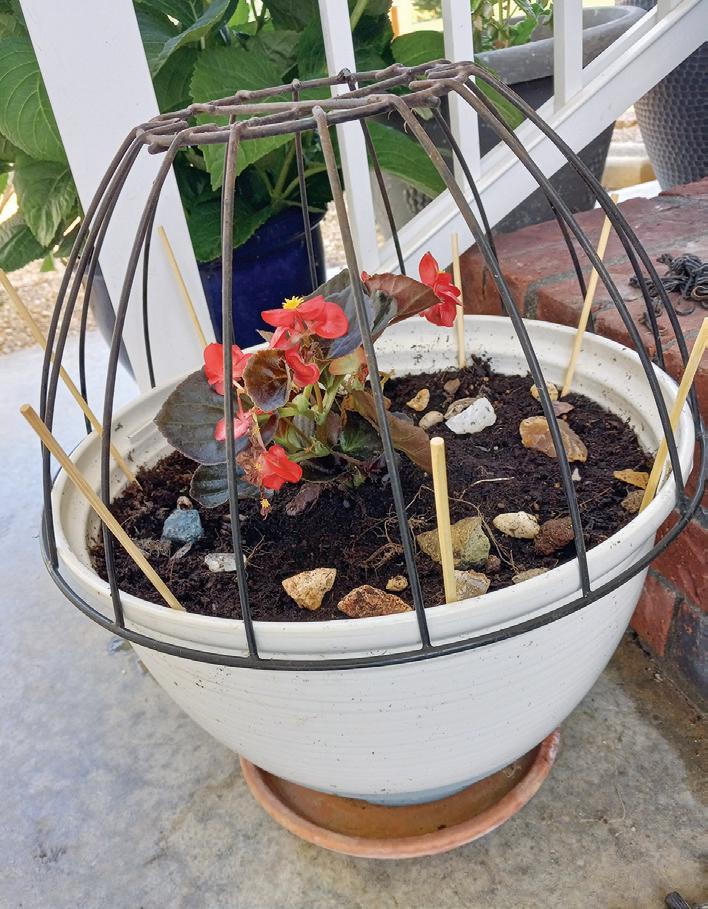
I enjoy putting things in my shed to good use. Nothing goes to waste.
Marsha Rogers Morrison, Tennessee
If you prefer to recycle them, check your town’s rules for plastic hangers, or try donating them to a dry-cleaning company or a thrift shop.
Nanaz Khosrowshahi West Nyack,
New York
www.MotherearthNews.coM 53 Country Lore F rom top : m ar S ha roger S ; J ohn h er S hey
Put a ‘Wring’ on It





As an artist, it just makes sense to me to get as much paint out of my tubes as possible before I throw them away. Long ago, I bought some tube wringers for my paint tubes, and then I realized they had other household uses too. I got another tube wringer to use on toothpaste and lotion tubes. They work great. I recommend the heavy-duty metal tube wringers sold by art supply stores.
Lisa Grossman Lawrence, Kansas
Fall Cleaning for Spring Gardening

Fall cleaning can be easy for your flower and vegetable containers and non-metal gardening tools. First, I let a big storage container fill with rainwater. Then, I stir in a capful of bleach and add the containers and tools. Finally, I dry them in the sun before storing them for the next growing season.
Patti Capalongo
Ithaca, New York
No Tears Here
One day after chopping some green onions for a stir-fry, Mom handed me 3⁄4-inchlong root ends and told me to plant them. They grew! Three years later, we’re still cutting the tops to use on baked potatoes, on top of chili, and in stir-fries.
Our recycled green onions always die back during the coldest part of winter, and then grow again in spring.
Danielle Justus Yellville, Arkansas
As She Sees It
When I take a cap off a can of spray oil, it’s easy for me to overlook it on the kitchen counter, because the cap is clear and I wear bifocals.

So, I’ve learned to put a colorful decorative sticker on top of the cap to make it easy to find the first time I look for it.
Gail Leone Cedar, Michigan

Armed and Fabulous
Here’s my repurposing project for an old, broken armchair. First, I dismantled the chair and set aside the two sides. Then, I cleaned and painted the sides before adding three hooks to the seat rails on each side. This created an interesting way to hang keys, leashes, or hats. I also added at least two D-rings for picture hanging on the backs so the chair sides could be hung level on a wall.
I sold this pair for about $50. No one was willing to pay $1 for the original broken chair at my garage sale.
 Dana Carrera Summerville, South Carolina
Country Lore D ANA C ARRERA
Prepare your home with a practical wood stove that will also beautify your space. For when the power goes out as well as everyday warmth, Lehman’s carries the heating appliances and accessories that will keep you ready for any weather all winter long. Shop anytime at LEHMANS.COM Kidron, OH • 800-438-5346 Be prepared. Not scared. See #25 on page 68
Gardens Through the Mail
I have a cool tip for repurposing cardboard and other types of paper. I’ve been constructing mailable “gardens” for years, using mostly upcycled paper and cardboard destined for the dump, plus a little glue. These ever-blooming gardens make recipients smile, and I hope this idea will make you do the same. Thanks for a tremendous magazine from a constant reader.


 Kenneth Skuse




Heating Up Leftovers


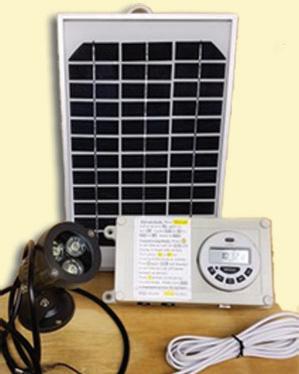

Sometimes I forget to bring in my hummingbird feeders before a hard frost. When that happens and the contents are frozen, I tape a hand warmer or two to the sides of the feeder, and they work like a charm to defrost it!
Victoria Ingham-Grandstaff Albany, Oregon
More About Monarchs
Readers may remember that I wrote about my efforts to raise monarch butterflies by growing milkweed plants (“Meshes Well With Milkweed,” Country Lore, April/May 2023). Since then, I’ve had major problems in my garden with frogs eating my caterpillars, sometimes losing more than a dozen in just a few days. I’ve discovered I can remove the
This Trick Was Swallowed by the Swallows

One day, I noticed a cardboard cutout of a flying owl hanging on a piece of baling twine from the peak of my neighbor’s roof. When I asked about it, he said the swallows kept building their mud nests up under the eaves on that side of the house; he’d tried one of the realistic-looking fake owls, but it only worked for a short time, until the birds noticed it never moved. Tired of constantly trying to hose down the swallows’ mess, he made a cutout from cardboard, colored it with crayons and markers, and hung it up. It’s the only thing that’s ever worked for him; he thinks that's because of the moving shadow it casts on the wall.

 Julie McCarty Yakima, Washington
F ROM TOP : S AMUEL F ELDMAN ; J ULIE M C C ARTY
See #31 on page 68
Via letter New coop lights!
SNOW PUSHERS CLEAR SNOW EASILY!
24-Series for Sub-Compact & Compact tractors up to 50 HP
• Choice of premium rubber or alloy steel cutting edge







•Available in widths of 5’,6’ or 7’
• Robotically welded for consistent quality & strength

• 36-Series also available for skid steer loaders & utility tractors from 50-90 HP


Country Lore
frogs with a shop vacuum and transfer them to a park pond. Works for me.
When I see a monarch caterpillar on the ground, I encourage it to crawl onto a fly swatter so I can move it to a healthy milkweed plant for a fresh meal. Saving one butterfly at a time!
Dominic Grillo Dunedin, Florida
Easy Herbs
Herbs are a delight for the garden, offering both beauty and usefulness. But sometimes you can miss the right time to sow the seeds in early spring. Luckily, I use an easy method to get lots of cheap herb transplants without buying them from a nursery. I buy cut herbs from the grocery store to root, and they become transplants quickly.
To root grocery store herbs, I take a large rectangular plastic bottle and cut it open along one side and at the ends to serve as a lid. I add several inches of potting soil mixed with some perlite or coarse sand.
Then, I take up fresh herb cuttings of my choice and make a new slanted cut on the bottom of the stems. I remove the lower leaves and stick the cuttings into the growing medium. I water them, close the lid, and place the bottle on a sunny windowsill.
I’ve found that most herbs will root in about a month. I check for roots by picking up the bottle and looking at the bottom. When I see white roots through the transparent plastic, I know my cuttings are ready to plant.
Samuel Feldman Brooklyn, New York
We Pay for Top Tips
Do you have handy home, farm, or garden advice? We’ll pay you $25 for each tip we publish, plus another $25 if we use your photos. So, send your niftiest tips to us at Letters@MotherEarthNews.com.
Multitasking Cold Frame
I’ve found another use for my small cold frame in summer, when the plastic covers have been removed. In the hottest season of the year, it becomes the frame for a trellis. You can see how I plant cucumbers on the inside edge, and then string twine from the bottom of the frame to the top and back again, so my cucumber vines can climb up the string. The fruits hang down, making them easy to see and pick. I even planted a cherry tomato in the middle of the bed, and it seems to be doing just fine too!
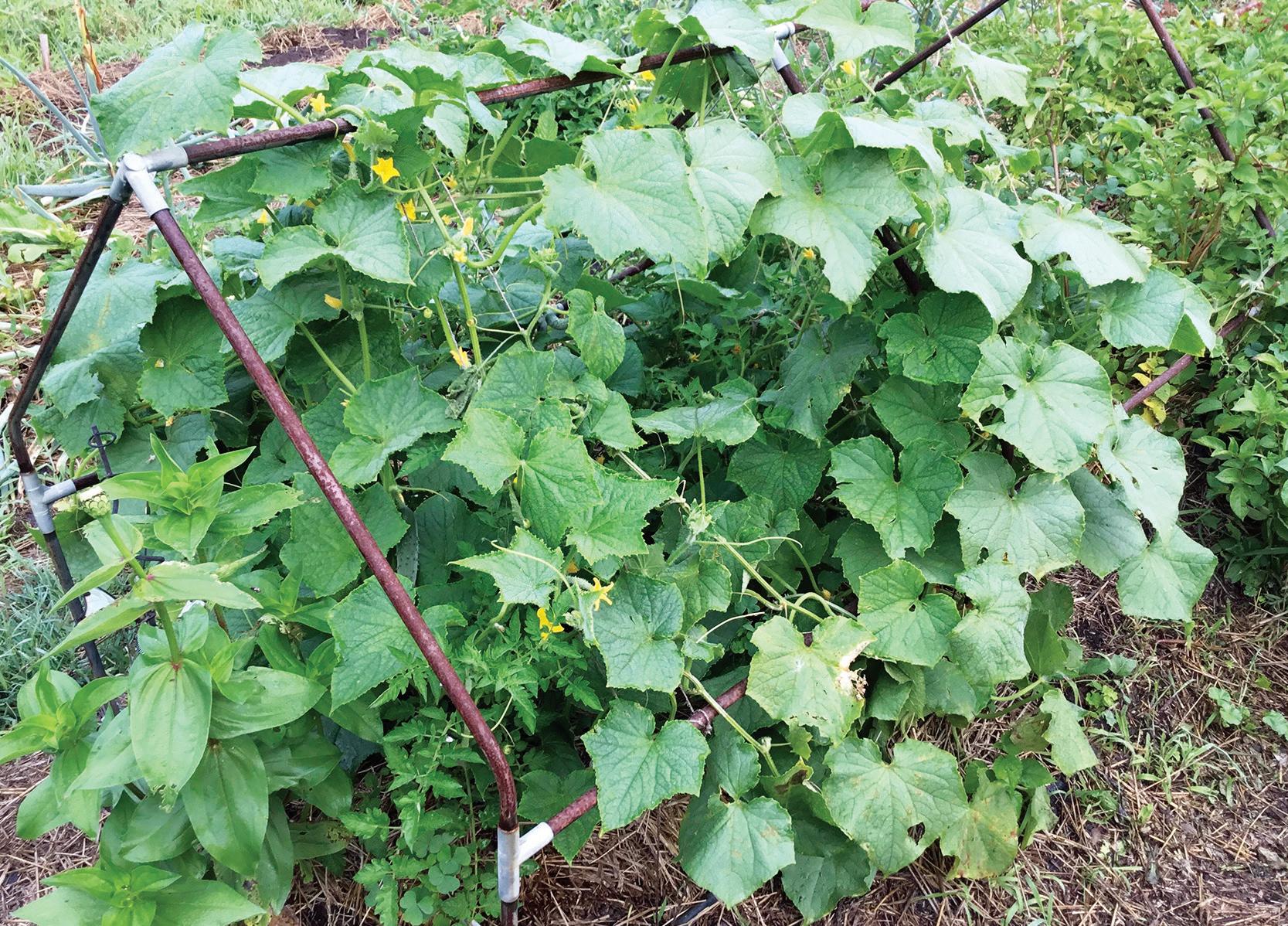 Deanna White Ypsilanti, Michigan
D EANNA W HITE
DESIGNED. ENGINEERED. REMARKABLE VALUE.
Worksaver, Inc. Litchfield, IL Phone: 217.324.5973 WORKSAVER.COM See #43 on page 68














See #29 on page 68 Call toll-free (800) 234-3368 www.MotherEarthNews.com Digital subscriptions now available! Mention code HMEHSDZC Save money and get practical solutions to your everyday needs! Get hands-on, sensible and environmentally responsible information on: organic gardening tapping into renewable energy cutting energy costs green homebuilding constructing do-it-yourself projects self-sufficient living Call toll-free 800-234-3368 or Mention code HMEHSNZA Digital subscriptions now available! www.MotherEarthNews.com Subscribe today! 6 issues + benefits only $20.95! MEN 12-horiz.indd 1 8/17/2023 5:47:31 PM
How Complicated Is Off-Grid, Really?
Welcome to our series answering reader questions and concerns about how to cut the utility company cord. Hoss Boyd is founder, president, and CEO of TeraVolt Energy. Kerena Reese is an independent engineer. They’re recognized solar and energy-storage experts. Learn more about TeraVolt Energy at http://TVNRG.com
My husband and I have lived off-grid since 2012. Regarding your advice on battery backup systems (see “OffGrid, Grid-Tied, and Battery Backup Systems,” Gone Off-Grid, June/July 2023), we’ve discovered you have to make sure your grid-tied system can be islanded* if you want to stay up and running during power outages. That’s because when the grid shuts down, power companies shut everything down to protect their utility line workers. Our neighbors have solar panels and batteries, but they lose power during outages. Off-grid isn’t perfect, and it can get complicated. For example, our generator runs off propane. We built in backups for our backup systems, because we have nothing to fall back on except for what’s on our homestead.
Tory New Hampshire
Thank you for responding to M other earth News’ Gone Off-Grid column. Kerena and I hoped we’d hear about readers’ firsthand experiences. You’ve pointed out two extremely important issues for readers to be aware of: A grid-tied solar photovoltaic system shuts down by design during a power outage, and going off-grid is a huge lifestyle change, but one that can be rewarding.
Your experiences are a wake-up call for anyone planning to go off-grid. And you’re wise to have installed a generator as a backup, which we always recommend as a backup to the backup. If the generator is
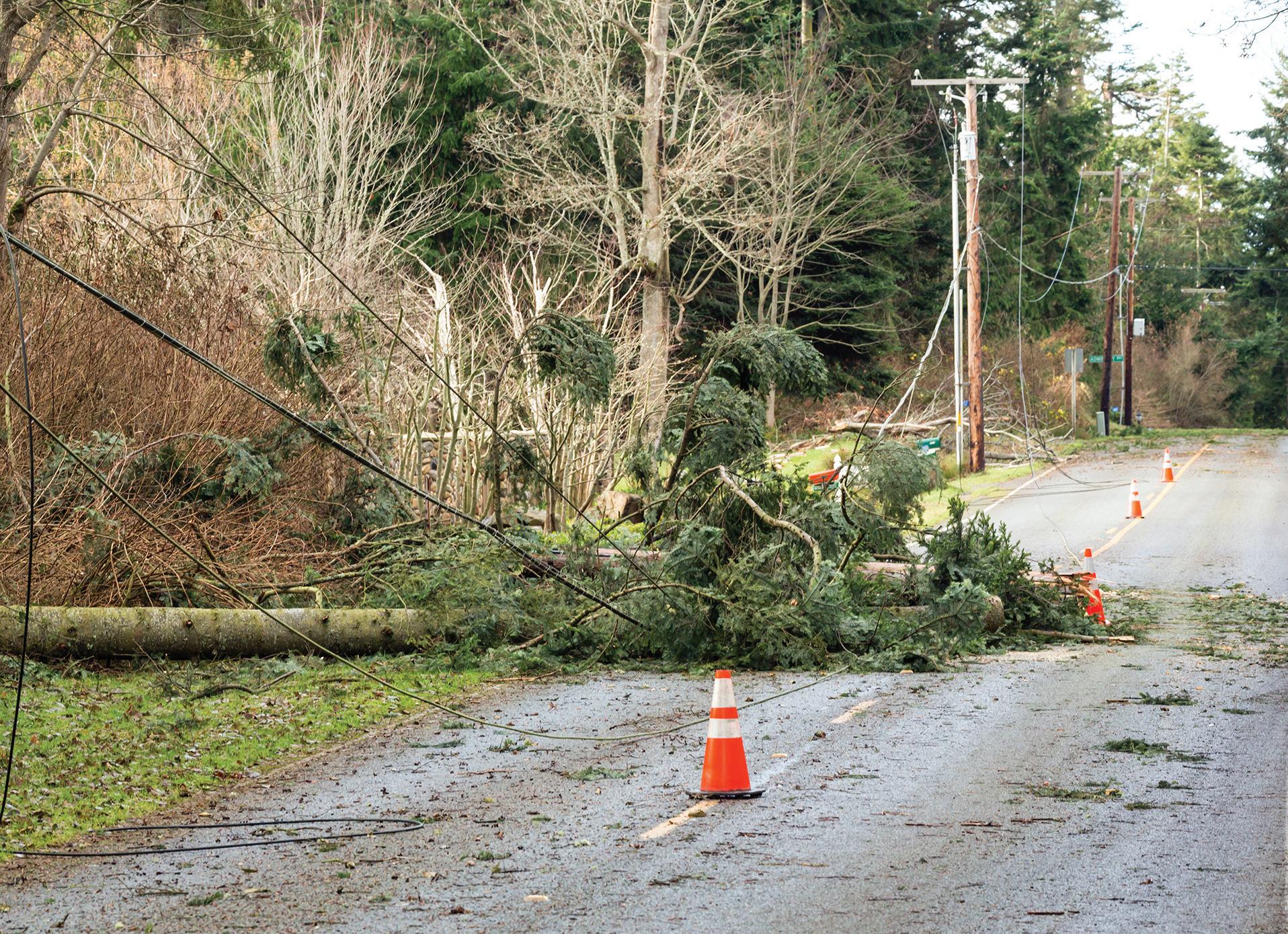
coming on frequently and staying on, it’s a sign the system may need more solar panels and batteries and that means you’ll spend a mint. Your generator should also be rated for continuous duty for prolonged periods of poor sunlight, because it may need to run for long periods of time.
To paraphrase an old cowboy, “There’s a lot they didn’t tell me before I signed on with this outfit!” A number of folks think that way when they first go off-grid. That’s why we’re here to help answer some of those questions.
Hoss Boyd
Tory, I’m so glad you and your husband are living off-grid and continuing to learn through M other e arth N ews . As for the imperfections, they’re a given with any lifestyle you choose. For me, so long as I can say the obstacles and challenges have been worth it, I know I’m in the right place doing the right thing. I hope that’s true
for you and your neighbors too! May you live well.
Kerena Reese
* An energy system capable of islanding can detect a drop in grid-delivered power, causing the system to automatically disconnect from the grid. In island mode, your solar-battery system will continue to produce power even after the grid has failed.
Send Us Your Power-Full Questions
We’ll do our best to answer your questions on energy subjects in upcoming issues. Email them to Letters@ MotherEarthNews.com with “Energy Q&A” in the subject line.
May all your days be filled with sunshine even when it rains!
Gone Off-Grid With Hoss Boyd and Kerena Reese
a dobe s tock /ML h arris 58 MOTHER EARTH NEWS October/November 2023
Grid-tied systems are designed to shut down during a power outage, so be sure to have a backup.




SPECIAL OFFER: 1 @ $20 plus $9.85 (s&h) 3 @ $60 plus $14.15 (s&h) 5 @ $100 plus $18.45 (s&h) 10 @ $175 plus $27.00 (s&h) Yields a bountiful harvest of 10 – 20 gallons of blackberries per plant! To order by phone call 812-254-2654 Thomas E. Doyle “Blackberry Man” • Adapts to patios and small yards • Great for Commercial growers • One Doyle plant yields more than 20 ordinary plants! • Grows from Alaska to Florida – All 50 States & Canada Simple to order! Mail this completed form with method of payment to the address below: I’ve enclosed $__________ for #_____of bushes. Doyle Blackberry Inc. • 1600 Bedford Road • Washington, IN 47501 • Phone 812-254-2654 www.fruitsandberries.com • tomdoyle@fruitsandberries.com All Blackberry plants guaranteed for nineteen months. (last 3 digits on back of card)
Blackberry® LARGE, SWEET, JUICY BERRIES — SO GOOD! Name: Phone: Address: ____________________________________________________________________ City: State: Zip: Preferred Ship Date: _______________________________________________________________ Payment form: ❒ Check ❒ Money Order ❒ Cash ❒ Credit Card ( o a r ) Card #: Cards Expiration Date: ____________ Signature: FREE! Rose Doyle cookbook with order of 5 or more plants Now is your chance to own the Doyle’s Blackberry, discovered by our founder, Thomas “Blackberry Man” Doyle and perfected over the course of his lifetime. Blackberry plants have a 19 month guarantee. Doyles_MEN_DJ23.indd 1 10/18/22 8:42 AM What are your Medicare options? • Decreased costs? • Increased benefits? • Both? Your Medicare plan may have t your needs in the past, but that doesn’t mean it will in the future. At Capper’s Insurance Service , we’re ready to help you access to the best information, products and service possible. Call 800-678-7741 for a free review of your prescription drug bene ts and to discuss your Medicare options. Capper’s Insurance Service is your licensed agent serving the readers of our magazine with protection services since 1932. cappersinsurance.com Medicare Advantage Plans are insured or covered by a Medicare Advantage organization with a Medicare contract and/or a Medicare-approved Part D sponsor. Enrollment in the plan depends on the plan’s contract renewal with Medicare. We do not offer every plan available in your area. Any information we provide is limited to those plans we do offer in your area. Please contact Medicare.gov or 1-800-MEDICARE to get information on all of your options. Availability of benefits and plans varies by carrier and location. Deductibles, copays and coinsurance may apply. Plans purchased after initial enrollment period are subject to eligibility requirements. By contacting us, you will be connected to a licensed insurance professional. We are not affiliated with Medicare or any other government agency. Medicare Annual Enrollment Period Oct. 15 – Dec. 7 Proud Partner of MOTHER EARTH NEWS NEWS See #13 on page 68
World Famous Doyle’s Thornless
THE AIR FRYER BIBLE
THE AIR FRYER BIBLE


Make the most of this hugely popular appliance to create more than 200 amazing dishes. These recipes will save you time, promote heart health, and can even help with weight loss. They’re easy enough for a beginner, and your whole family will love them.
BEST SELLER
BEST SELLER
Make the most of this hugely popular appliance to create more than 200 amazing dishes. These recipes will save you time, promote heart health, and can even help with weight loss. They’re easy enough for a beginner, and your whole family will love them.
#10680 $22.95 Member: $19.95
#10680 $22.95 Member: $19.95
4-TRAY DEHYDRATOR
4-TRAY DEHYDRATOR



Skip the snack aisle at the grocery store and make healthy DIY treats with this 4 tray food dehydrator. The powerful 500 watt base-mounted heater and quiet fan ensure constant airflow for consistent even drying without having to rotate the trays. Featuring four temperature presets, you’ll have wholesome foods you can trust within hours. The 4 stackable trays provide up to 3 square feet of drying space.
Skip the snack aisle at the grocery store and make healthy DIY treats with this 4 tray food dehydrator. The powerful 500 watt base-mounted heater and quiet fan ensure constant airflow for consistent even drying without having to rotate the trays. Featuring four temperature presets, you’ll have wholesome foods you can trust within hours. The 4 stackable trays provide up to 3 square feet of drying space.
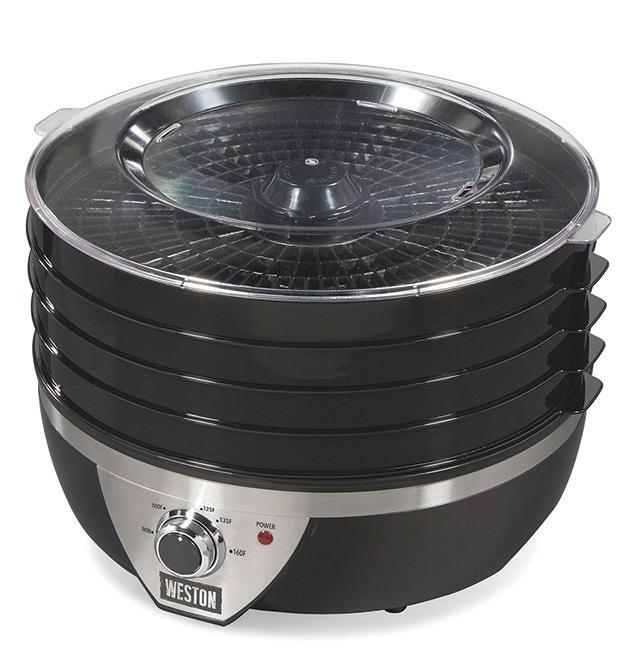
#11807 $69.99 Member: $59.99
#11807 $69.99 Member: $59.99

JERKY EVERYTHING
JERKY EVERYTHING
Jerky Everything encompasses not only a variety of dried meat snacks but also veggie and fruit jerkies. Recipes for meat jerkies make low-calorie, high-protein treats that curb hunger pangs. Recipes for fruit and veggie jerkies make wholesome treats that will help pick you up when your energy is waning.
Jerky Everything encompasses not only a variety of dried meat snacks but also veggie and fruit jerkies. Recipes for meat jerkies make low-calorie, high-protein treats that curb hunger pangs. Recipes for fruit and veggie jerkies make wholesome treats that will help pick you up when your energy is waning.

#7833 $21.95 Member: $18.95
#7833 $21.95 Member: $18.95
ATLAS PASTA MACHINE
ATLAS PASTA MACHINE
3.5 LITER DIGITAL AIR FRYER
3.5 LITER DIGITAL AIR FRYER
Make delicious, crisp food with the Large 3.5 Liter Digital Air Fryer! Cut out the oil and make all of your favorite foods using just air. Cook on manual mode or choose from one of 6 preprogrammed settings for crisp French fries, chicken, seafood, steak, baked goods, and veggies. Dimensions (inches):
Make delicious, crisp food with the Large 3.5 Liter Digital Air Fryer! Cut out the oil and make all of your favorite foods using just air. Cook on manual mode or choose from one of 6 preprogrammed settings for crisp French fries, chicken, seafood, steak, baked goods, and veggies. Dimensions (inches):
12.5 H x 12.5 W x 14.5 D.
12.5 H x 12.5 W x 14.5 D.



#11806 $74.99 Member: $69.99
#11806 $74.99 Member: $69.99


MOTHER EARTH NEWS CAMPFIRE MUG
MOTHER EARTH NEWS CAMPFIRE MUG



Bring the outdoors inside with this 15-ounce Campfire Mug and enjoy a delicious cup of coffee, green tea, or hot chocolate. Made in the style of tin cups, this MOTHER EARTH NEWS mug features a unique speckled finish that will catch the eye of all your guests!
Bring the outdoors inside with this 15-ounce Campfire Mug and enjoy a delicious cup of coffee, green tea, or hot chocolate. Made in the style of tin cups, this MOTHER EARTH NEWS mug features a unique speckled finish that will catch the eye of all your guests!

BEST SELLER
#8610 $8.99 Member: $7.99
#8610 $8.99 Member: $7.99
BEST SELLER
BEST SELLER
BEE NOTECARDS (SET OF 10 OR 25)
BEE NOTECARDS (SET OF 10 OR 25)













Tell your friends and family that you’re thinking of them while showing your support for bees and local art with these Bee Notecards! Madeline Smith hand-painted three different bee portraits in watercolor and MOTHER EARTH NEWS is featuring the prints as cards that you can send to anyone!
Tell your friends and family that you’re thinking of them while showing your support for bees and local art with these Bee Notecards! Madeline Smith hand-painted three different bee portraits in watercolor and MOTHER EARTH NEWS is featuring the prints as cards that you can send to anyone!




#9210/9209 8.99/13.99 Member: 7.99/12.99
#9210/9209 8.99/13.99 Member: 7.99/12.99
The Atlas 150 Pasta Machine is equipped to attach a Pasta Drive motor or any of 12 pasta cutting accessories that are sold separately. Choose from 10 different thickness settings, between a paper-thin 0.6-millimeters to 4.8-millimeters. Made in Italy from chrome-plated steel.
The Atlas 150 Pasta Machine is equipped to attach a Pasta Drive motor or any of 12 pasta cutting accessories that are sold separately. Choose from 10 different thickness settings, between a paper-thin 0.6-millimeters to 4.8-millimeters. Made in Italy from chrome-plated steel.

#11135 $84.95 Member: $79.95
#11135 $84.95 Member: $79.95
MAKING ARTISAN PASTA
MAKING ARTISAN PASTA
Learn how to use the best ingredients and simple, classic techniques to make fresh, homemade pasta in your own kitchen with Making Artisan Pasta. Calling for just the simplest ingredients and a handful of unique kitchen tools, making pasta at home has never been easier, more fun, or more delicious.
Learn how to use the best ingredients and simple, classic techniques to make fresh, homemade pasta in your own kitchen with Making Artisan Pasta. Calling for just the simplest ingredients and a handful of unique kitchen tools, making pasta at home has never been easier, more fun, or more delicious.

#9982 $25.99 Member: $22.99
#9982 $25.99 Member: $22.99






AQUARAIN NATURAL WATER FILTRATION SYSTEM
AQUARAIN NATURAL WATER FILTRATION SYSTEM

















Without any plumbing or pressure attachments, power connections, or chemical pretreatments, the AquaRain Natural Water Filtration System positively removes dangerous living organisms and harmful bacteria from your drinking water using microfiltration. With USA made materials, the Aquarain will be the only water filter you need. Available for shipment to continental U.S. addresses only.
Without any plumbing or pressure attachments, power connections, or chemical pretreatments, the AquaRain Natural Water Filtration System positively removes dangerous living organisms and harmful bacteria from your drinking water using microfiltration. With USA made materials, the Aquarain will be the only water filter you need. Available for shipment to continental U.S. addresses only.
#8761 $359.99 Member: $349.99
#8761 $359.99 Member: $349.99





TO ORDER, CALL TOLL-FREE 800-234-3368 (OUTSIDE U.S.: 785-274-4365) or visit Store.MotherEarthNews.com Mention Promo Code: MMEPANZE • Sale Ends 11/18/2023
BEST SELLER
TO ORDER, CALL TOLL-FREE 800-234-3368 (OUTSIDE U.S.: 785-274-4365) or visit Store.MotherEarthNews.com Mention Promo Code: MMEPANZE • Sale Ends 11/18/2023
What Causes Different Egg Colors?

I’m not sure how to choose between brown and white eggs. Is one more nutritious than the other? What determines egg color?
Choosing Chicken Eggs
The breed of the chicken is what determines the color of the egg. White eggs aren’t bleached. In fact, all eggs start as white inside the chicken. It takes over 24 hours for an egg to fully form within the hen’s reproductive system, and only during the last step of the process does a pigment deposit on the egg to determine its final color. The pigment protoporphyrin is responsible for the brown color, and it’s more or less “painted” on the outside of the white shell late in the shell’s formation. That’s why brown eggs are only brown on the outside of the shell but white on the interior.
In the case of white eggs, no pigment is added at the end, because that particular breed of chicken is genetically programmed to skip that last step. In the case of blue eggs, the pigment oocyanin is deposited on the egg earlier in the process as it travels through the oviduct, and this pigment permeates the eggshell, making the egg blue on
both the exterior and interior. And then there are “olive eggers,” in which brown pigment overlays a blue egg, resulting in a green egg. The darker the brown pigment, the more olive the color of the egg.
Further, the shade of brown eggs will change as the egg-laying season progresses and the chicken ages. Brown eggs will lighten later in the season. As a new layer matures, her eggs will get bigger, but the amount of pigment added at the end of the process will stay the same. Also, the gland produces best after it’s had a seasonal rest. Older hens naturally produce less pigment.
Eggs from different chicken breeds have no major nutritional differences. Their diet determines nutrition; pastured hens often produce the healthiest eggs, because they consume a wide range of foods. Many farmers who raise organic, pastured poultry choose brown layers, especially breeds that do best in the farmer’s location. Because the egg’s nutritional content forms long before the pigment is added, the color of the egg has no bearing on the nutrition found inside.
There’s also a common misconception that if an egg is brown, it must be organic. That’s not the case. Any egg can be organic if the chicken producing it is fed only organic feed
and raised according to the guidelines of the National Organic Program.
So, when deciding whether you want brown or white eggs, the choice is really just a matter of which color you like better. And when picking hens, you can choose your breeds partially based on what color of eggs they lay.
You might not have to look any further than the chicken’s earlobe to know. While this isn’t a perfect predictor, it’s pretty accurate. Red earlobes generally mean the hen will lay brown eggs, whereas white earlobes almost always predict white eggs. And some chickens, like the Araucana breed, have earlobes that are pale-green or blue, and sure enough, their eggs are green or blue. Silkies have blue earlobes but lay cream-colored eggs.
—Kate Johnson
Genetics Determine Duck Egg Color
Ducks of the same breed can lay differently colored eggs, which has to do with genetics and how long the breed has been standardized. While this is also true of chickens, we see this variation less often with chickens, unless they’re hybrids, such as the Starlight Green Egger. Once the chickens are declared as standardized breeds, they should
Ask Our Experts
www.MotherearthNews.coM 61 ADOBE STOCK/DIANNA
lay the same color of egg, though color saturation also has a lot to do with health, age, and how far the chicken is into that year’s egg cycle. Overall, duck breeds are much less standardized.
Once upon a time, all ducks were wild. Birds evolved to lay eggs that camouflaged with their surroundings. Birds laying in dark caves would produce white shells, while eggs laid in the open had pigment. Greener eggs matched riparian areas. Blue robin eggs hid within treetop canopies, and speckled killdeer eggs blended against barren rock.
Wild mallards, the ancestor of almost all domestic ducks except Muscovies, laid light-green eggs. But then breeders came along. Though it’s believed they were first domesticated in Southeast Asia, ducks didn’t become popular in Europe for a while longer. Duck breeding became vogue in the 17th century, about the same time Europeans started breeding chickens for more than just eggs. Europeans liked the
recessive white duck egg color. So, duck egg color corresponds with the breeds’ histories in Europe. But egg color preference varies culture to culture.
John Metzer, of Metzer Farms Hatchery, says, “In Indonesia, they like blue-green eggs, so the Runner ducks have a higher percentage, because, my guess is, they were selected for blue-green color when the Runners were developed in Southeast Asia.” People who are used to white eggs are enthralled by blue-green eggs. Because of this, Metzer doesn’t work to remove the blue-green genes to create breeds that lay all-white shells.
The tendency to lay shells with biliverdin (green shells) and without (white shells) is in the genotype. Green shells (G) are dominant. This means if the hen has a strong (G) gene but the drake doesn’t, her ducklings will most likely also have a strong (G) gene.

But this isn’t always the case. Because they’ve been bred so many times, many duck breeds have both green (G) and white

Where Did My Earthworms Go?


I’m no longer able to find an earthworm in my garden, whereas before, they were innumerable. I use no-till methods, compost, and cover crops, but my worms still went missing. What happened to them?


Earthworms do hibernate, burrowing as much as 6 feet down to escape frozen soil, but if you’re digging in your garden, I’m going to assume it’s not frozen.

Many things can lead to earthworm decline, including ecological degradation, over-tillage, and overuse of chemical fertilizers. But this isn’t the case for most organic gardeners who practice no-till methods.
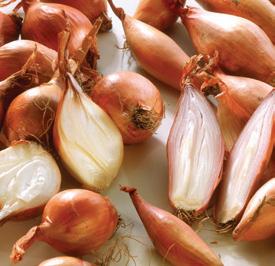


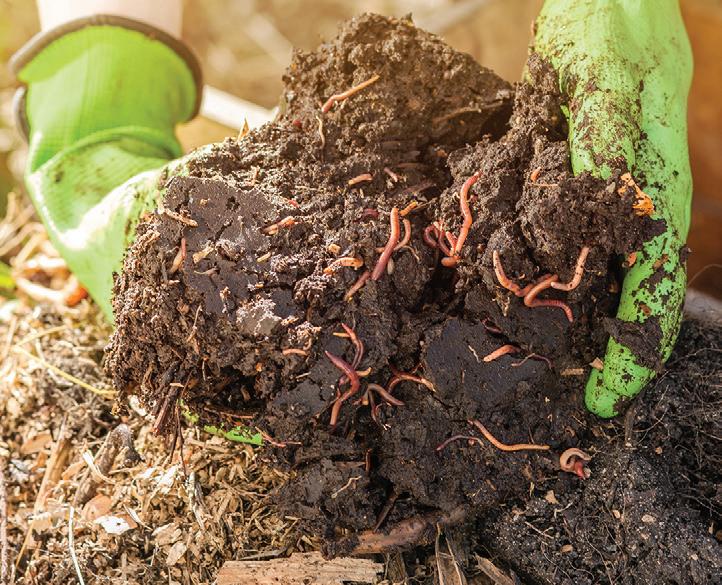
How often do you add compost?
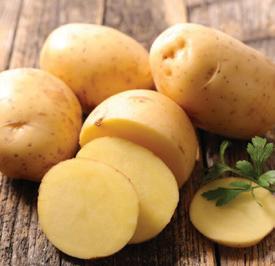


Earthworms are valuable for gardens specifically because they consume this organic material, and their digestive process frees up nutrients so they’re bioavailable to plants. Earthworms also turn the soil and help compost degrade faster so plants can use it sooner. Since you’re probably not doing anything to actively kill the earthworms, they may have left to find food somewhere else.
Several practices, some of which you’re already doing, can protect earthworms and other subterranean life:
Don’t till your garden more than necessary. Rototillers are great for breaking up hard clay and chopping organic material for new beds. But once those beds are established, tiller blades can chop through worms and bring mycorrhizal fungi to the surface, where they die. It can also eliminate air pockets, which keep the soil loose, facilitate decomposition, and allow worms to breathe.

Ask Our Experts 62 MOTHER EARTH NEWS October/November 2023
ADOBE STOCK/MARYANA Turkey Chicken Mini Call or Order Online Made in USA AdorStore.com Automatic Doors for Chickens Guineas, Ducks, Peacocks & Turkeys 832-444-0192 info@adorstore.com www.adorstore.com Rugged Galvanized Steel 1 year warranty Free USA shipping* Free Battery Included Ideal for remote location LED status indicator Mount inside or outside Compatible with wifi Door Locks Shut Built in RedScare *Excluding Turkey Door) I adore my ADOR Seed Garlic Seed Shallots Seed Potatoes Asparagus Crowns Sweet Potato Slips Follow Us On Social Media! Proudly Family Owned & Operated www.FilareeFarm.com - 509-422-6940 See #3 on page 68
(W) genes, some stronger than others. This would be expressed (Gg) for two green genes, (Gw) for a dominant green gene over recessive white, and (Ww) when the duckling received two white genes with no green gene to overrule.
In the end, you can’t guarantee duck egg color, but by concentrating on specific breeds, you can encourage more of the gene. To get a high number of blue eggs, choose ducks that have stronger (G) genetics, such as Metzer’s Black or Chocolate Runners. Keep hens proven to lay blue eggs and breed them to drakes that come from blue eggs. When those ducklings mature and start laying, keep those that lay blue eggs and breed them to other drakes that come from blue eggs.
Eventually, this will dilute the (W) gene so it presents less frequently. Of course, you may think you’ve diluted it for good, when suddenly a prize hen starts laying … and the egg is white. But that’s part of the fun.





 —Marissa Ames
TOUGH Jobs...Made EASY!

Cover your soil. Exposed soil is dying soil. As the sun dehydrates soil, microbes die. Hot, dry soil can’t sustain earthworms either. Lawns, though they don’t have food value for humans, do provide a thick layer of soil protection — and those earthworms come out at night or when it rains. Keep your garden soil covered by applying organic material around crops. In winter, apply straw or leaf litter, which will decompose while protecting subterranean life.
Feed the worms. This can be as simple as leaving roots in the ground after crops die. If you need a clean appearance for a homeowners association, cut crops at soil level so roots remain intact, then chop the upper part to apply as compost. Layer on material from compost piles so the worms can come to the surface and grab a bite. Then, in spring, dig some of that material into the earth so it can decompose at root level.
If you continue to add a substantial compost layer and then practice no-till and mulching methods, your worms should be back soon.

 —Marissa Ames

Clear land & brush for trails, excavate a foundation for your dream home, dig trenches and ponds, demolish old sheds, the list goes on and on! - Out performs 4WD Wheeled Tractors!!!







EASY TO USE! No shifting gears, instant power to forward and reverse.


MADE IN THE USA! Quality craftmanship, by American workers!


SAVE MONEY! Stop paying others to do jobs you could do yourself. Get Your

1-262-599-6363




Mention Promo Code: ME1023


WWW.MOTHEREARTHNEWS.COM 63 Ask Our Experts
FREE Info Kit!
® GetYour FREE InfoKit! Scan with Your Phone’s Camera. > MH85-16.qxp_4.5 x 4.5 7/19/23 3:06 PM Page 1 See #37 on page 68 See #41 on page 68
YOUR NEW FAVORITE CIDER Made Right at Home! k




Tempra® Plus Electric Tankless Water Heaters ensure that the hot water temperature asked for is always delivered regardless of other hot water uses in the house. Ideal shower temperature is always delivered, for as long as desired... with no unexpected cold water “surprises.”







Exclusive Advanced Flow Control™, was invented by and is only available from Stiebel Eltron. Awarded German patent DE 3805441 C2 and others.







Space saving design • No venting required


Can I Revive My Potatoes?

I’m using a cold frame, or “hot box,” for the first time. My soil temperature is great for potatoes, around 58 degrees Fahrenheit. But the air in the box got too hot, and now all the leaves and stalks are brown and slumped. Can they recover, or do I need to wait until next year for a successful potato harvest?
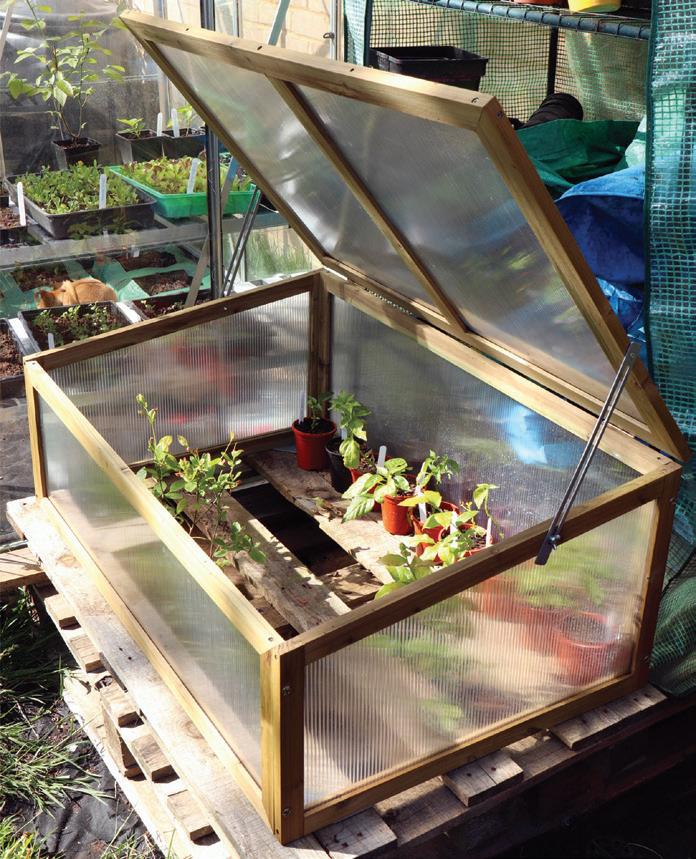
Potatoes are one of the hardiest garden crops I’ve ever grown. Though their tops are heat-sensitive and frost-sensitive, the roots can handle a lot of abuse. They’re also quick to spring back after damage, as long as the damage isn’t systemic (such as blight).
For assurance, dig down until you find a potato near the surface; if it’s solid, not wrinkled or mushy, your potatoes are just fine. Because your soil temperature is great, keep those potatoes in the ground and vent the hot box, since you most likely still have a great root structure. The potatoes will send up more tops and start over. This will delay your time to harvest, but it’ll be quicker than starting all over.
This concept is similar to how gardeners plant potatoes in mid-March, even though their last frost dates are in late May. Frost might bite back the tops, but the roots will still be going strong.
 —Marissa Ames


Ask Our Experts 64 MOTHER EARTH NEWS October/November 2023
ADOBE STOCK/JENNY Enjoy comfort
to get in.
to leave.
beyond endless hot water. Easy
Hard
Engineering & manufacturing excellence since 1924
www.StiebelEltron.us Endless hot water. Always at the set temp. See #36 on page 68 This
$29.95
800.582.8423
thorough, thoughtful book is an empowering guide for every cidermaker, from the beginner to the intermediate cider crafter who wants to expand their skills.
#10149
Order by calling 800-234-3368 or visiting Store.MotherEarthNews.com Promo code: MMEPANZ2. Price does not include shipping and handling. MEN_Big Book of Cidermaking_1.6h.indd 1 8/16/2023 12:41:01 PM
Ventilate raised or ground-level cold frames during warm weather to avoid heat damage.
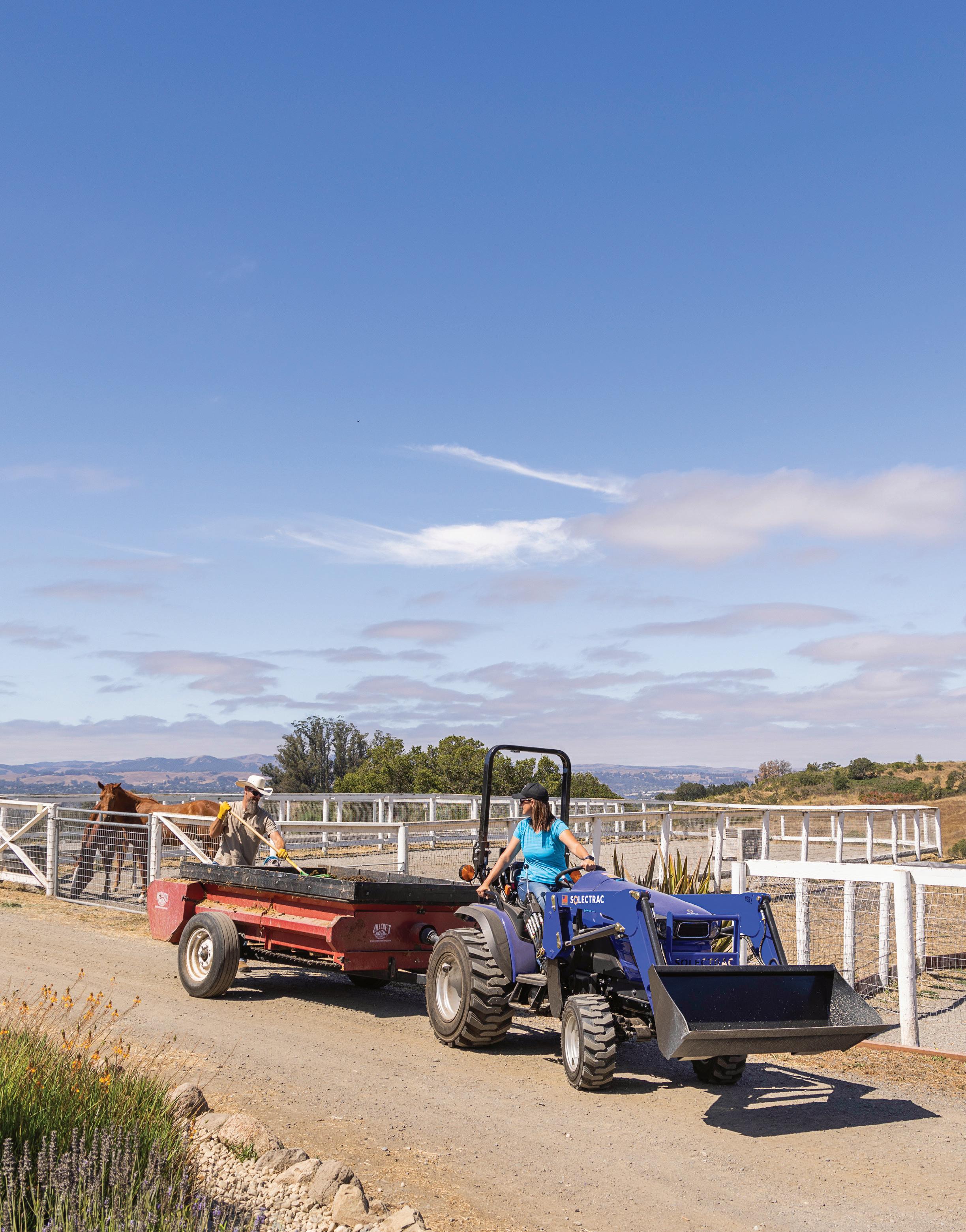
See #35 on page 68
Phone: 570-846-1774



Email: ediemaessoap@gmail.com
Address: 5724 Main Road, Hunlock Creek, Pennsylvania 18621 Web: www.ediemaessoap.com










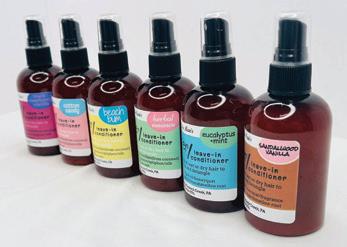


Social:





PERSONAL CARE
more information on these ads see page 68. Handcrafted Products Natural & Organic Cruelty Free Healthy Ingredients Small Business Women Owned
For
Natural SKIN CARE Hydration without being oily Essential vitamins for your skin Support healthy tissue development Order now at www.MyNaturesRite.com or call 800.991.7088 Use coupon code SKINNY25 for 25% off your entire order GIFT GUIDE 1 16 $104 .95 NOW ONLY 12 30 The Original g “Our people love it! Best topical by far!” -Curtis Illig | White Oak Pharmacy, Garner NC For Wholesale Orders and Retail Purchases, Visit Us At GetHempFreeze.com Hemp Freeze® Helps! Life Hurts. Use Code for 15% off your order! "HFME2023" © 2023, Founders Wellness, LLC 18
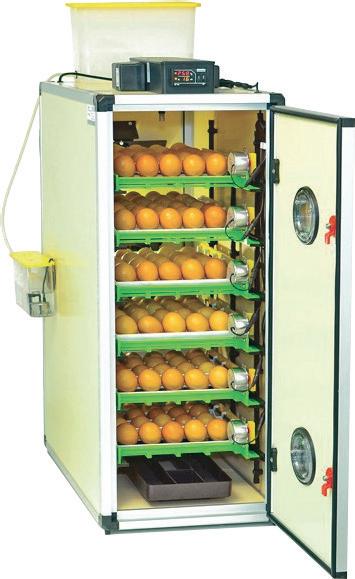

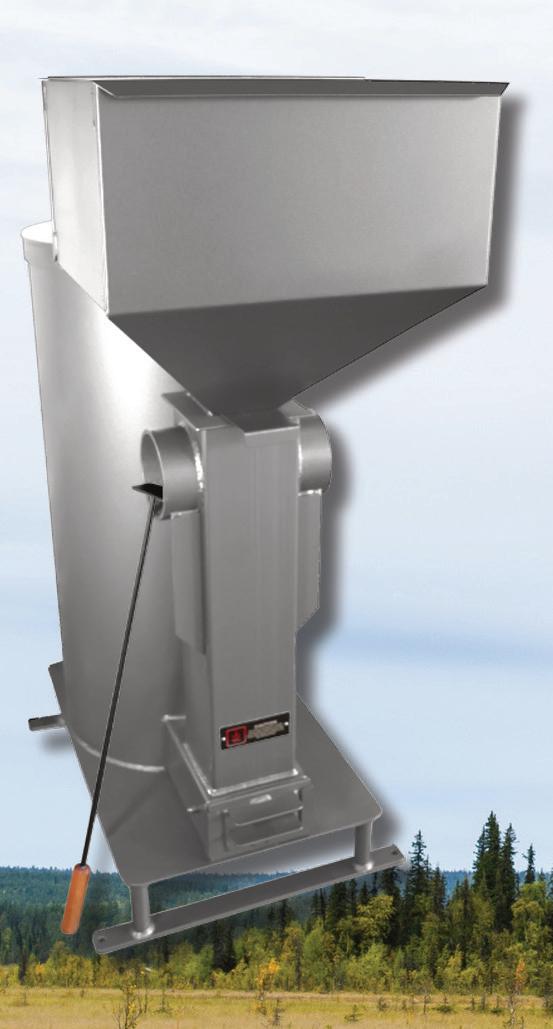


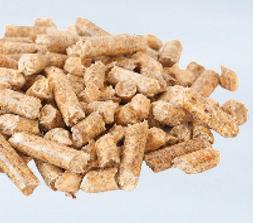
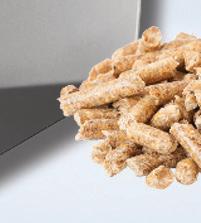









For more information on these ads see page 68. www.RocketHeater.com without the grid. Scan the QR code, visit our website to order www.RocketHeater.com, or Call now for inquiries 573-468-0204 get ready for the cold Pellet Hopper (Optional) Burns Wood Too! Rosies Workwear has been a woman and family-owned business that has been providing women with stylish, efficient and comfortable workwear since 2002. Our clothing and products range from coveralls to overalls for hardworking women in any industry. Use Promo Code MotherEarthNews15 for 15% off your entire order. www.rosiesworkwear.com (One discount per customer, cannot be combined with other discounts, Discount active from Sept 1 – Dec 31, 2023) SUSTAINABLE LIVING WORK WEAR INCUBATORS GIFT GUIDE 26 19 11
Harvest Array is the Online General Store from yesteryear, where we o er unique American-made products from small, family-owned businesses. Whether you are looking for everyday goods, a special gi , or







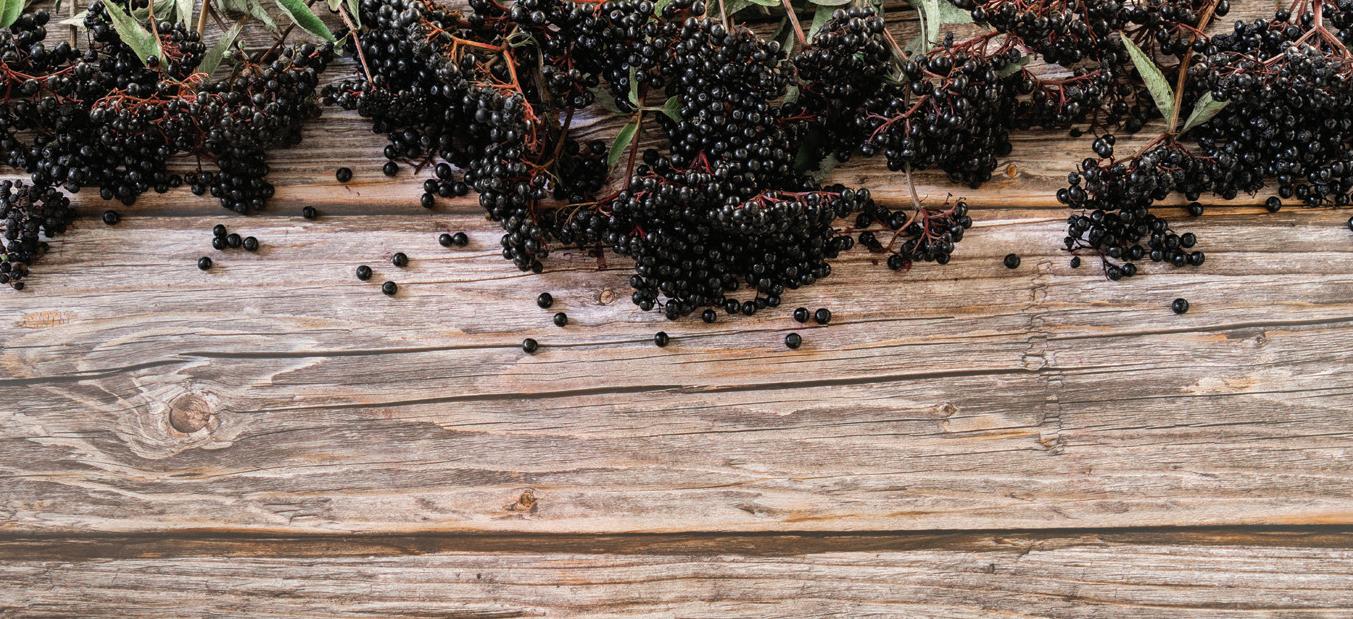


















For more information on these ads see page 68.




AD# ADVERTISER PAGE(S) URL PHONE 1 Appalachian Botanical 66 appalachianbotanical.com 304-956-4015 2 Allivet 11 allivet.com 877-500-9944 3 ALLOGIC, Inc/Adorstore.com 62 www.adorstore.com 832-444-0192 4 American Dexter Cattle Association 73 https://dextercattle.org 844-588-2322 5 Apothecary Inc 74 www.thepowerherbs.com 866-229-3663 6 Ardisam - Fusion IFC https://fusiondrillpowered.com/ 800-345-6007 7 Ardisam - Yardbird 43 www.yardbirdpluckers.com 800-345-6007 8 Ayrstone 74 ayrstone.com 877-297-7092 9 Brew Naturals 68 brewnaturals.com 10 Brinsea Products Inc. 73, 74 https://www.brinsea.com/catalog.aspx 888-667-7009 11 Carmelita Gardens 67 carmelitagardens.com 12 Charcoal House 46, 66 www.charcoalhouse.com 308-665-1566 13 Doyle Blackberry Inc. 59 www.fruitsandberries.com 812-254-2654 14 Dr. Jimz 72 DrJimZ.com 888-394-4454 15 Earth & Turf Attachments 73 www.earthandturfattachments.com 877-800-6625 16 Edie Mae’s Soap & Gift Shop 66 ediemaessoap.com 570-846-1774 17 Elmira Stove Works 70 elmirastoveworks.com 800-295-8498 18 Founder’s Wellness - Hemp Freeze 66 GetHempFreeze.com 19 Hatching Time 67 hatchingtime.com 20 Harvest Array 68, 74 harvestarray.com 814-396-2151 21 John C. Campbell Folk School 69 www.folkschool.org 800-365-5724 22 Johnny’s Selected Seeds 37 www.johnnyseeds.com/new 877-564-6697 AD# ADVERTISER PAGE(S) URL PHONE 23 Kent Nutrition Group 5 https://kentfeeds.com/ 866-647-1212 product-lines/home-fresh/ 24 Keene Organic Garlic 51 keeneorganics.com 608-215-7599 25 Lehmans 54 https://www.lehmans.com/?menews 800-438-5346 26 Liberator Rocket Heater 67 rocketheater.com 873-468-0204 27 MacKissic 73 www.mackissic.com 800-348-1117 28 Mt. Healthy Hatcheries 47 www.mthealthy.com 800-451-5603 29 Musser Forests 57 www.musserforests.com 800-643-8319 30 Nature’s Rite Remedy 25, 76 mynaturesrite.com 800-991-7088 31 Nopec 55 www.chickendoors.com 512-995-0058 32 Premier 1 Supplies 74 premier1supplies.com/pages/catalog 800-282-6631 33 Progressive 17 www.progressive.com 800-PROGRESSIVE 34 Radiantec 72 www.radiantec.com 802-626-5564 35 Solectrac 65 www.solectrac.com 866-219-6750 36 Stiebel Eltron 64 www.stiebel-eltron-usa.com 800-582-8423 37 Struck – Power Solutions for Today 63 https://struckcorp.com/ 262-599-6363 38 Sun-Mar 71 www.sun-mar.com 888-341-0782 39 The Farm at Okefenokee 37 okefarm.com 912-276-0200 40 Waterwise 73 www.waterwise.com/men 800-874-9028 41 Woodland Mills.................33, 63, 70, 72 www.woodlandmills.com 855-476-6455 42 Wood-Mizer 19 www.woodmizer.com 800-553-0182 43 Worksaver 56 www.worksaver.com 217-324-5973 IFC = Inside Front Cover IBC = Inside Back Cover OBC = Outside Back Cover If you have recently requested information using our reader service reply card and have not received a response, please reach out to the advertiser directly at the above link. Free Information from Our Advertisers 68C 100Y 24K Pantone 363C Please visit www.motherearthnews.com/advertiser-directory to connect with our advertisers for further product information 68 MOTHER EARTH NEWS October/November 2023
something to spruce up your home, we’ve got you covered. So, come on in and nd something special at Harvest Array! www.HarvestArray.com What is the Harvest Array General Store? GIFT GUIDE 20
ect
tastes, with tons of tips and techniques. Item #11157
$24.95
&
Promo
MEN 300 best bread machine 1.6h.indd 1 8/16/2023 12:39:38 PM @brewnaturals ENHANCE your recipes EMPOWER your wellness journey EMBRACE your values PRODUCTS Gourmet ELDERBERRY Experience Appalachia’s NATIVE SUPERFRUIT ELEVATE YOUR TABLE with our handcrafted gourmet elderberry syrups, sours, fruit butters & more. BrewNaturals.com 9 FOOD
This collection of wonderful recipes features all the information you need about baking bread using both older and newer bread machine models. You’ll nd everything from traditional favorites to innovative recipes that re
today’s
|
Quick
Healthy Homemade Bread Order today by calling 800-234-3368 or visiting Store.MotherEarthNews.com
code: MMEPANZ2
(CONTINUED FROM PAGE 4)
Jelly Recipes
I enjoyed the article “Wild About Wild Jelly” in the June/July 2023 issue. I’ve been eating elderberry jelly for over 70 years. As a child, I picked berries for my grandmother to make jelly. She mixed the elderberry juice with apple juice, which mellowed the strong flavor of the berries and made a great jelly. My greatgrandmother did the same with chokecherries (eat one fresh off the tree and you’ll rename them “pucker cherries”!); they make a greattasting jelly. I’m including their recipes.
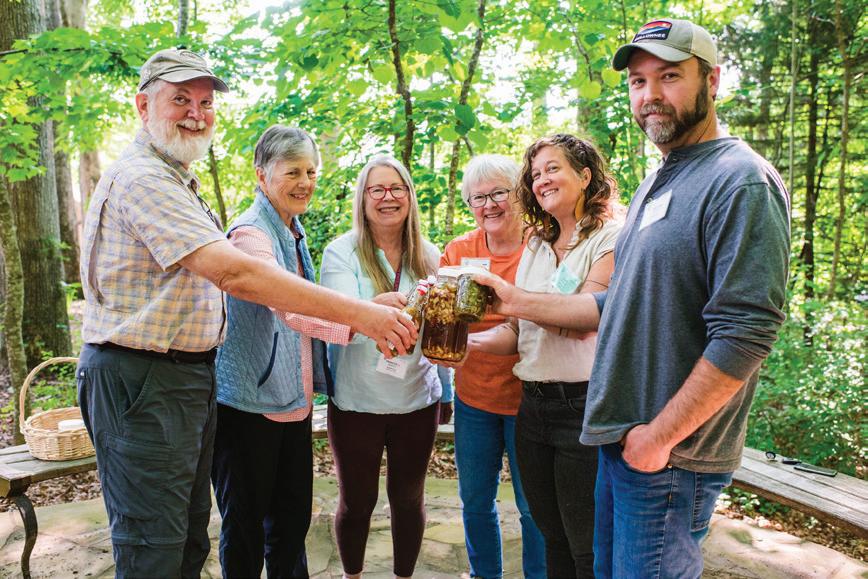


Grandma Nellie’s Elderberry Jelly
• 31⁄2 cups apple juice
• 11⁄2 cups elderberry juice


• 1⁄4 cup lemon juice
• 7 cups sugar
• 1 package Sure-Jell
Follow directions on Sure-Jell package.
Great-Grandma Louise’s Chokecherry Jelly
• 3 cups apple juice
• 3 cups chokecherry juice
• 6 cups sugar
• 1 lemon (juiced)
• 1 package Sure-Jell
Follow directions on Sure-Jell package.
The bushes are blooming right now, and from the looks of them, it’ll be a bumper crop of elderberries this year. I also make an immune-boosting elderberry syrup. The recipes I found online all called for dried elderberries, so I had to improvise. We stayed well last winter, so I think it helped. Enjoy the jelly.
Nature Studies
Dear Mother
Donna Kansas
www.MotherearthNews.coM 69
Persephone”
Learn the secrets of growing abundant plants and vegetables. Explore the fascinating natural world around us. Delve into a “hands-on” subject like beekeeping or mushrooms.
See “Profting from
by Patrice Lewis on page 42.
1-800-FOLK-SCH BRASSTOWN, NORTH CAROLINA folkschool.org/mearthnews Kitchen Medicine In Search of Birds! Bamboo Fly Rod Making An Herb Garden Primer Reinvent Your Garden Reflection in Appalachia Fly Tying & Fishing Edible Greens UPCOMING 2024 CLASSES INCLUDE: See #21 on page 68 Take APPLE CIDER VINEGAR to the next level Order by calling 800-234-3368 or visiting Store.MotherEarthNews.com Promo code: MMEPANZ2 Price does not include shipping and handling. ITEM #9868 $16.99 MEN_FIRE CIDER_1.6V.indd 1 8/16/2023 1:22:11 PM ADOBE STOCK/ TYNZA; RICK FRIDAY
Elderberry Syrup Recipe
• 1⁄2 cup dried elderberries or 1 cup fresh
• 2 teaspoons dried echinacea root
• 2 cups pomegranate or orange juice
• 1 cinnamon stick

• 3 whole cloves
• Rind of 1 lemon or orange
• 1⁄2 cup raw honey
1 Bring all ingredients except honey to a boil. Reduce to medium heat. Simmer until liquid is reduced to half. If elderberries still appear hard or uncooked, simmer another 20 minutes until soft and tender.
2 Strain and let cool 30 minutes. Add honey and stir until well-mixed. Don’t add honey while boiling or very hot. Toss elderberries and spices into the compost.
3 Pour mixture into jars or bottles. Seal with a tight lid and store in refrigerator. Keep up to 3 months.


Full recipe by Veronica Worley at www.MotherEarthNews.com/

The First Issue

This is the first issue (January 1970), and it made me think. Gary Snyder’s article is still true today. The phrases that were written in the front and back of older issues were inspiring to me also. I enjoy every word of every issue.
 Buddy Ruff Via email

Dear MOTHER 70 MOTHER EARTH NEWS October/November 2023
See #41 on page 68
BUDDY
See #17 on page 68
RUFF
Collecting Rainwater


I read the article about galvanized wire (“Is Galvanized Wire Safe?” Ask Our Experts, April/May 2023), and information about lead was discussed. It made me concerned about the steel roofing on our buildings. I want to collect rainwater from there for watering gardens. Is this safe, or would there be lead in that water?
Nora Kami Via email
Collecting water from metal roofing could, in fact, result in metals and other contaminants within your collected water. A study published in ScienceDirect in 2021 measured metals and contaminants leaching from metal roofing over time, and while it doesn’t list lead, we know lead is dangerous and can transport up through plants into your produce.
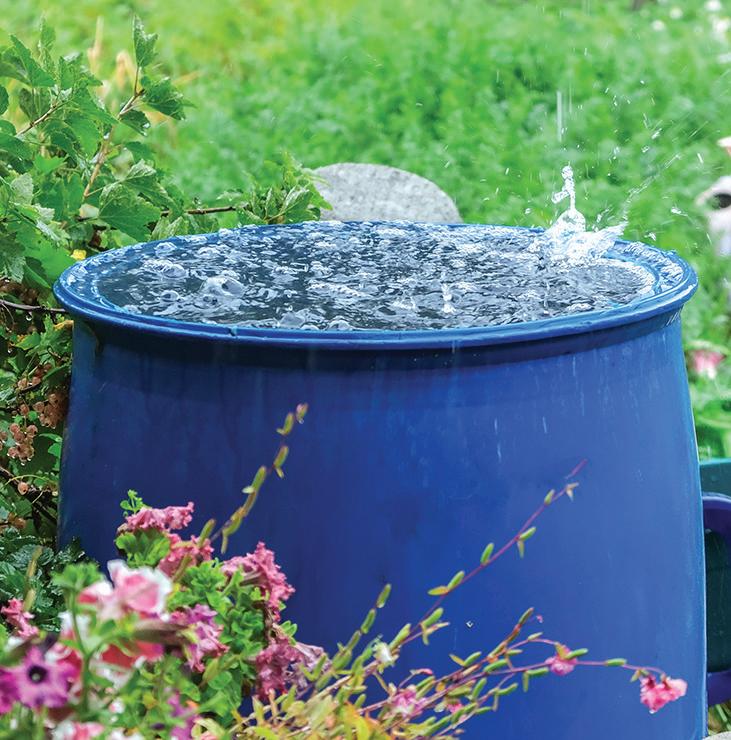
But the good news is that fairly inexpensive products that filter lead are available, and they’re built to attach to household pipes. Therefore, if you construct a rain-collection system that uses these household pipes, you can attach a filter in an accessible area so you can fix or change it as necessary. It’s amazing what fittings you can use for farm and garden projects when you start with food-grade household pipes made from metal or PVC.
For a great article that talks about steps you can take to be sure the filter really is removing lead from your water, go to www. ConsumerReports.org/
Good luck! —


WWW.MOTHEREARTHNEWS.COM 71 Dear MOTHER
PO BOX 1111, LYNDONVILLE, VT 05851 • P: 800-451-7593 • F: 802-626-8045 ©2012 Radiantec, Inc. • Free design assistance and tech support • Free detailed installation manual • Low cost and direct sales Can do This! You YOUR HANDS, YOUR TOOLS, OUR ASSISTANCE. Come to our award winning website and see if radiant is right for you. www.radiantec.com RETROFIT RADIANT INTO YOUR HOME. USE YOUR EXISTING WATER HEATER INSTEAD OF AN EXPENSIVE BOILER. If you can see the underside of the floor, you can install comfortable and efficient radiant heat. See #34 on page 68 See #38 on page 68 ADOBE STOCK/ DETRY26
MOTHER
See #41 on page 68
Cedar Chips and Deer Fencing

I have three-quarters of an acre and put walking trails around the perimeter. I use cedar chips for the trails, which reduced the migrating slugs from the former 30 per night to a mere 3 to 5 per season.

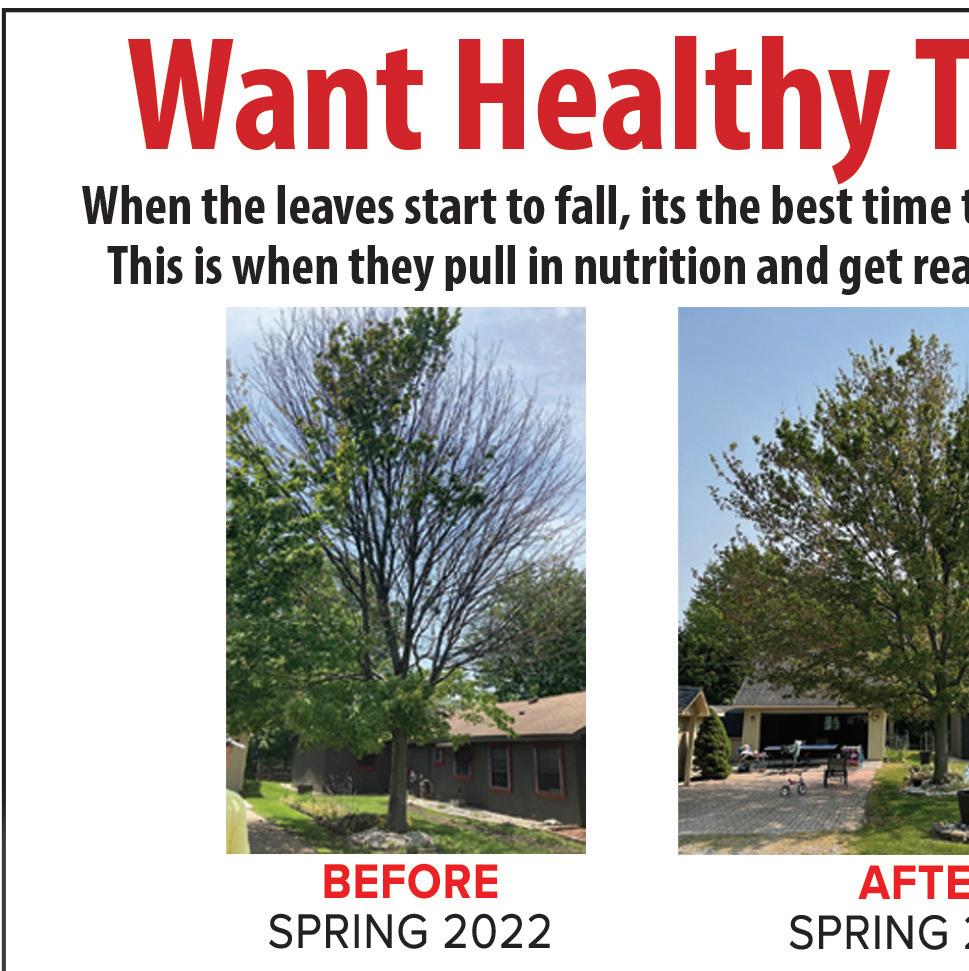
Three times in spring, I apply diatomaceous earth to the base of our trees. This has kept the inchworms away from the maples and reduced worm damage to the cherries.
In the front yard, we have a wooden fence topped with wire, and 3-foot-square, 4-foot-high planter boxes made out of pallets, creating a deterrent for deer. We’ve kept the deer out and managed the slugs, but something still steals all the ‘Italian Prune’ plums a day or two before I go out to harvest them. Even with a tree net, they disappear without a trace; nothing on the ground, no clues. I thought it was raccoons, but after taking more than 14 out to the mountain forests 20 miles away, the problem still exists.
Hope this gives your readers some ideas and perhaps helps with some pests. Thanks for the articles you provide.

 John Jaklich Via email

Write to Us!
Started in 1970 to raise awareness of environmental concerns and to provide information and support for a simpler lifestyle, MOTHER EARTH NEWS has made it this far because of continuous interest from you, the readers. Your dedication to living more sustainable lives has kept this magazine afloat through five decades and an increasingly digital world, and we’d love to hear from you. Send photos of your farm, your garden, and any projects you’ve undertaken over the past five decades to Letters@ MotherEarthNews.com. Or, mail a letter to Dear MOTHER, 1503 SW 42nd St., Topeka, KS 66609. Please send your full name, address, and phone number. We may edit for clarity and length.
See #14 on page 68
Dear MOTHER 72 MOTHER EARTH NEWS October/November 2023













































GENERAL STORE Free Catalog For more information www.brinsea.com or call 1-888-667-7009 Brinsea the world leading incubator manufacturer has a full line of incubators, brooders, egg candlers, starter kits and much more! Color Incubation Specialists Hatching your own chicks is fun, easy reliableandwith Brinsea Ifahencould choose… WWW.MOTHEREARTHNEWS.COM 73 For more information on these ads see page 68. 15 40 27 4 10



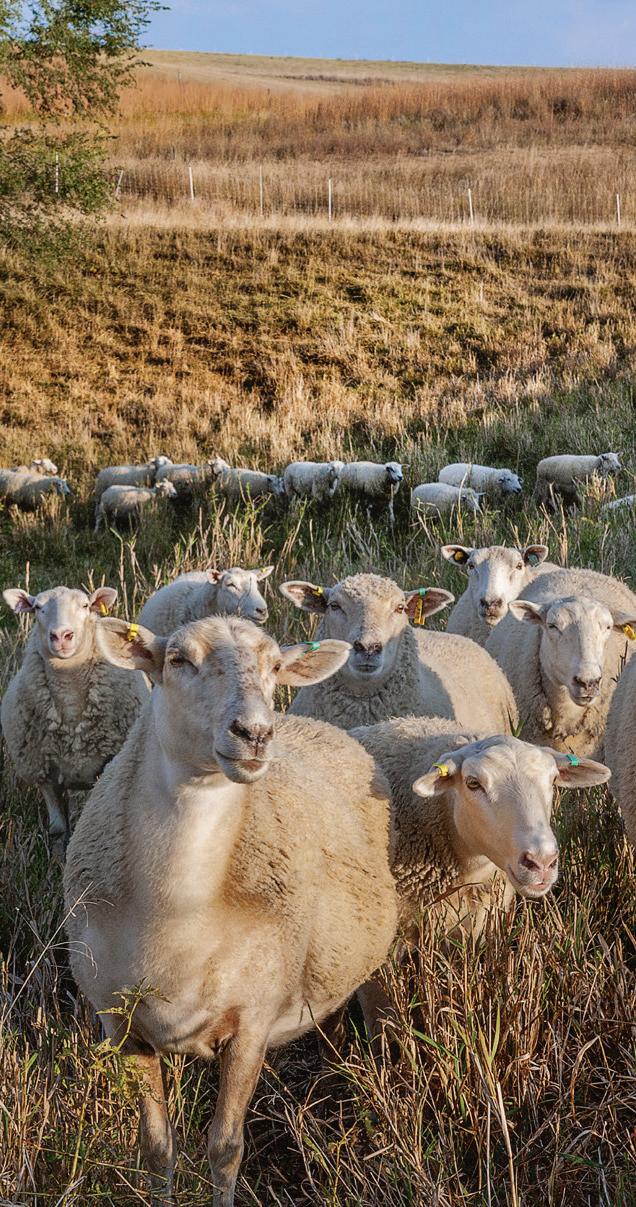














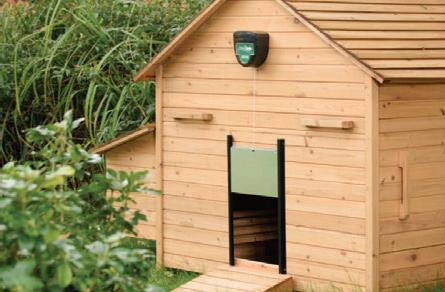


GENERAL STORE 74 MOTHER EARTH NEWS October/November 2023 For more information on these ads see page 68. Foraging! EXTEND GRAZING WITH ELECTRIC NETTING! Premier1Supplies.com 800-282-6631 Harvest Array is the Online General Store from yesteryear, where we o er unique American-made products from small, family-owned businesses. Whether you are looking for everyday goods, a special gi , or something to spruce up your home, we’ve got you covered. So, come on in and nd something special at Harvest Array! www.HarvestArray.com What is the Harvest Array SIGN UP FOR A DISCOUNT CODE www.HarvestArray.com “Contact US” page 5 32 8 20 10
BIOLOGIST’S FRAGRANCE ADDITIVES INCREASE















♥ Elsa (VA) “I have had quite a year using Athena 10:13! Men at work LIKE me very much. I dated one for an entire year. I am now about to be married to a wonderful man. Thanks for your discovery and for bottling it!”


♥ Geoff (TX) 4th order “My wife is much more responsive when I use the 10X. I have not told her that I use it, but her response was really noticeable. Dr. Cutler, thank you!”






GENERAL STORE
more
Providing heirloom fruit trees for your home and farm. www.treesofantiquity.com Trees of Antiquity f i i Tre es o Ant qu t y She’d useWe’Moon! what We’Moon at wemoon.ws! Use code Earth24 for 15% off!
best-selling astrological
with women’s
and art.
the
of
WE’MOON 2024: LUMINATIONS If Mother Earth needed a calendar, She’d useWe’Moon! Datebooks • Cards • Wall Calendars mothertongue@wemoon.ws • 1.877.693.6666 • wemoon.ws IT’S A FREE DOWNLOAD! Soup making brings the warmth and comfort of homemade soupsinto the comfort of your own kitchen. Try all 14 recipes throughout the entire year. FREE GUIDE Guide to Soup Making VISIT: www.motherearthnews.com/free-guides/soup-making/ D nload Today to St t Le ning ATHENA PHEROMONE Works for most, but not all. . Cosmetic products; not aphrodisiacs. No animal testing. NOT SOLD IN STORES. F ree US Shipping Vial of 1/6 oz. added to 2-4 oz. of your fragrance lasts 4 to 6 mos., or use straight Contains human synthesized pheromones. Call (610) 827-2200 – Order online or send to: Athena Institute, Dept MEN, 1211 Braefield Rd. Chester Springs, PA 19425 Please send me__vials of 10:13 for women@$98.50 and/or___ vials of 10X for men @$99.50 for a *total _____ by: ❑ money order, ❑ check ❑ Visa,M/C,Disc.______-_______-_______-_______ Exp._____ CVV:____ Sign:__________________ to: Name______________________________ Address_______________________________ City/State_________________zip__________ Tel:______________ email___________________ (*PA add 6% tax, We ship abroad—See website) MEN athenainstitute.com These cosmetics increase your attractive-
of human
8 books on wellness
50 scientific
For
information on these ads see page 68.
This
moon phase calendar overflows
creative poetry, prose
The Waxing Half Moon: She dwells in
creative balance
equal Shadow and Light, and takes us along the mysterious edge where obstacles meet invention, and visions spark magic.
ness. Created by the co-discoverer
pheromones. Dr. Winnifred Cutler has authored
and
papers.
AFFECTION
for women for men tm unscented fragrance additives PROVEN EFFECTIVE IN 3 SCIENTIFIC STUDIES
FROM OTHERS
ITEM #11737 $14.99 800-234-3368 Store.MotherEarthNews.com Promo code: MMEPANZ2 Little Bee 1.12 MEN.indd 1 8/16/2023 1:08:01 PM
MOTHEREARTHNEWS CLASSIFIEDS



Classified ad information, contact Connie: 866-848-5416; email classifieds@MotherEarthNews.com; fax 785-274-4316
ALTERNATIVE BUILDING
BOOKS / MAGAZINES
EDUCATION
Herbal Education for All. Online and at your own pace. www. heartofherbs.com Learn to care for your family and community naturally. Use coupon EMAIL15 to save 15%.
GARDENING/RELATED PRODUCTS
BUILD UNDERGROUND houses/shelters/greenhouses dirtcheap! Live protected. Slash energy costs. Featured on HDTV. “Radical and innovated“ Mother Earth News 800-328-8790 www.undergroundhousing.com

ALTERNATIVE ENERGY
POLAR G-Class Best Downdraft
OUTDOOR WOOD FURNACE
The industry leader in proven clean burn technology
• All Fire no smoke.
• Combustion efficiency 99.5%
• Burns up to 60% less wood
• 7 industry firsts
• Carbon neutral

• Oldest renewable energy.
• Compatible with off-grid use
PORTAGE and MAIN Best Updraft
CONTACT
Ultimate Outdoor Furnace LLC
Les Radcliffe 507-254-0622
Polar Furnace Factory Rep
Dealer/Agent opportunities
www.ultimateoutdoorfurnace.com
BOOKS / MAGAZINES
The MIDNIGHT CRY has sounded. The angel of REVELATION 14:6 has come. Free literature. 800752-1507; www.ccem1929.com
For information on advertising in the classifieds call 866-848-5416
Experience an engaging and authentic narrative describing Oklahoma life in the early 1900s, the perfect book for anyone interested in old-time living and cultural history. Order Grandma’s Autobiography by Ruby Randall through Amazon. https://a.co/d/0p1wlzf

CRAFTS
Seatweaving Supplies
Chair cane, reed splint, Shaker Tape, fiber & natural rush. Complete line of basketmaking suplies. Waxed linen cord. Royalwood Ltd., 517-MEL Woodville Rd., Mansfield, Ohio 44907. 800-526-1630.
www.RoyalwoodLtd.com
EDUCATION
Do you love to write or wish you could? Scribbly is a gentle and whimsical writing program for women. Each issue is beautifully illustrated with easy-to-follow writing prompts. We mail Scribbly to your home – you’ll love it! 1-month/3-month/6-month subscriptions.

www.kimdukewrites.com/Scribbly
SOON Church/Government uniting, suppressing RELIGIOUS LIBERTY enforcing NATIONAL SUNDAY LAW. Be informed! TBSM, BOX 374, Ellijay, GA 30540 tbsmads@yahoo.com 1-888-211-1715.
GARDENING/RELATED PRODUCTS
LUNATEC Hydration Spray
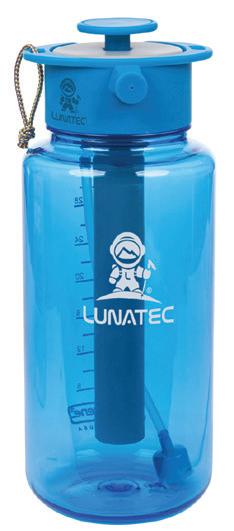
Bottles combine a garden hose, shower, kitchen faucet and water bottle in one. Cool off, clean off and drink. They’re perfect for gardening, camping, sports and more. www.lunatecgear.com
ONE SCYTHE REVOLUTION
Selling Europe’s best scythe blades, adjustable wooden snaths, accessories, and permaculture hand tools. onescytherevolution.com 507-454-4121
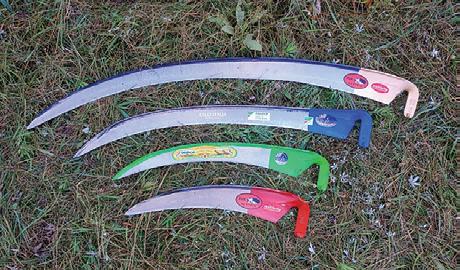
SCYTHESUPPLY.COM European scythes. Mow where your tractor can’t go. Custom-made handles(snaths). 496 Shore Road Perry, Maine 04667 207-853-4750 Free Catalog. www.scythesupply. com, FREE hat with scythe outfit: use code MEN at checkout.
NEPTUNE HARVEST ORGANIC FERTILIZERS: Liquid Fish, Seaweed, Blends, Dry Kelp Meal and Crab Shell also repellents and more. 800-259-4769. FREE CATALOGS. Wholesale/Retail/ Farm. www.neptunesharvest.com
AMAZING GARDEN TOOLS! Broadforks for deep soil prep. Wheel Hoes for fast weeding. We make THE BEST. See videos online: valleyoaktool.com Call 530-342-6188

Every Gardener knows that in order to have a beautiful garden, you must Always Be Weeding. Sometimes our life garden needs weeding, too!
www.alwaysbeweeding.com

GREENHOUSES
Greenhouse Kits, Super Strong Greenhouse Plastic, Containers, Pots and Containers Garden Drip Irrigation, Jiffy Peat Pots, Sprinklers, Greenhouse supplies 866-928-3390.
www.growerssolution.com

76 MOTHER EARTH NEWS October/November 2023
CLASSIFIEDS
FREE
GREENHOUSES
BUILD WITH PVC

HOMESTEADING
Your Product Source for Homesteading, and More! All Farm, Ranch and Dairy Supply! Gift Certificates! (928)583-0254. www.HomesteaderSupply.com
HOUSEHOLD PRODUCTS

MACHINERY/TOOLS/ SUPPLIES
PLANTS, SEEDS, BULBS, ROOTS
-Specialized Fittings-Free Plans -
-Snap Clamps & PVC KitsCirco Innovations, Inc. 877-762-7782

www.circoinnovations.com

HEALTH FOODS
Experience Appalachia’s native superfruit! Elevate your table with our handcrafted gourmet elderberry products. Syrup, sauces, spreads, beverages, and sundries Empower your wellness. Enhance your recipes. Embrace your values.

www.brewnaturals.com ~


(828) 545-4808
HEALTH, HEALTH CARE PRODUCTS

®
vs

Surgical augmentation is needlessly desecrating in light of dramatic, perennial enlargement organically achieved w/unprecedented, holistic proprietary formula. Brochure: 1-800-967-2177 www.BeautyVantage.com

We make hanging Laundry a Breeze! High quality pulley clotheslines crafted in the USA, delivered to your door. 330-403-3010

www.skylineclotheslines.com
LUNATEC Odor-Free Dishcloths and Self-Cleaning Washcloths stay odor-free, dry in minutes, rinse clean and have less bacteria than sponges or cotton cloths. Try them today. www.lunatecgear.com
IRRIGATION & WATER WELLS
FREE SHIPPING on Drip Irrigation Kits for Small or Large Gardens and Hobby Farmers! Growing Accessories, Mulch, Twine and more! Fast Shipping. Free Catalog. www.berryhilldrip.com
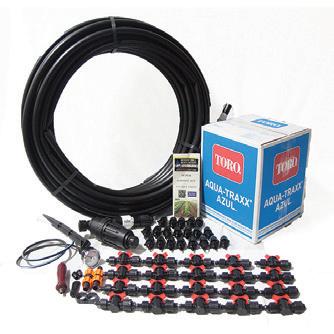
LIVESTOCK
Highland Cattle Registry Heartland Highland Cattle Association & Registry Open Registry for Foundation Highlands For more info and a free information packet 417.345.0575 or text 417.733.3201 heartlandhighlandcattle@gmail.com www.heartlandhighlandcattleassociation.org highlandauction.com hhcaregistry@gmail.com

CROSSCUT SAWS: Saw tools, knives, firewood-cutting, people-powered tools. Catalog $1.00. ($3.00 Canada/ Overseas). Crosscut Saw Company, PO Box 7875, Seneca Falls, NY 13148; 315-568-5755; CrossCutSaw.com


PERSONALS
GREENSINGLES.COM Ready for a meaningful, conscious relationship? Meet someone who loves Mother Earth as much as you! It’s time, you’re next!

Christian Singles Catalog. Personal ads. Photos. Pen pals. Sample $1. Singles, Box 310-MN, Allardt, TN 38504. 931-879-4625. www.nicesingles.com


PLANTS, SEEDS, BULBS, ROOTS

American Elderberry Juice Products and Plants. Farmer Grown & Farmer Owned Right Here In The Midwest. SEE YOU AT THE NEXT FAIR! 573.999.3034.
www.RiverHillsHarvest.com


POULTRY
Hatching your own chicks is fun, easy and affordable with Brinsea Forget Styrofoam incubators andwatch your eggs hatch every time. Quality incubators since 1976 - durable, easy to clean, user friendly digital controls and 3-year warranty. Free color catalog. www.Brinsea.com 1-888-667-7009.
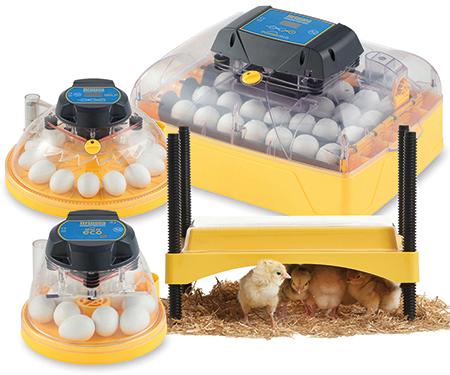
Myers Poultry Farm - FREE CATALOG. Chicks (9 meat varieties), Ducklings, Goslings, Turkeys, Guineas, more. 966 Ragers Hill Road, South Fork, PA 15956; 814539-7026 www.myerspoultry.com
Southern Exposure Seed Exchange
Open-pollinated, Heirloom & Organic Seeds & Garlic selected for flavor and local adaptability. Free Catalog 540-894-9480 www.southernexposure.com

Turtle Tree Biodynamic Seed Initiative Pioneer of seed transparency offering Organic and Heirloom
Open-pollinated Vegetable, Herb and Flower seed. Located in Camphill Village since 1998. Free Catalog:
info@turtletreeseed.org
1(800) 930-7009
www.turtletreeseed.org
FREE COLOR CATALOG 203 varieties shipped to your local post office, chickens, rare breeds, bantams, ducks, geese, turkeys, guineas, pheasants, quail, supplies and videos. Since “1936” Cackle Hatchery PO Box 529, Lebanon, MO 65536, 417-5324581. cacklehatchery.com
Go to www.chickendoors.com for the best automated door on the market or call 512-995-0058.
Aluminum chicken tractors, great for mobile pasture raised chickens. Call 785-289-3807.
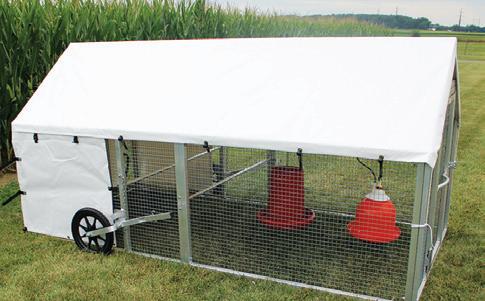
www.naturalgramma.com

WWW.MOTHEREARTHNEWS.COM 77 CLASSIFIEDS Classified ad information, contact Connie: 866-848-5416; email classifieds@MotherEarthNews.com; fax 785-274-4316
POULTRY
Stromberg’s Chicks & Game Birds
Unlimited is your one-stop shop for all things poultry! We carry a full line of incubators, brooders, feeders & waterers, feeds, coops & pen supplies, egg supplies, and processing equipment. Check out our great selection of chicks & birds! Request a free catalog today! 800-720-1134, www.strombergschickens.com
POULTRY
SAWMILLS
DON’T WASTE THOSE LOGS!
Cut lumber, slabs beams. The Alaskan® Chainsaw Mill. Made in the USA. Portable, affordable, accurate. 800-233-6499; www.granberg.com
SEPTIC SOLUTION
The Egg Carton Store Best Prices, selection, high quality. 40 years of egg packaging and marketing expertise! Egg Cartons, Filler Flats, Stamps, Egg Cases, Nesting Boxes, Supplies, Poultry Care, Custom Cartons and Labels. Call for GREAT wholesale/pallet quantity pricing! 866-333-1132. FREE SHIPPING on all cartons and filler flats.
WWW.EGGCARTONSTORE.COM

Keeping your flock safe has never been easier or more reliable. With only one moving part, no mechanical switches and no calibration ChickSafe are the ultimate rugged, fuss-free automatic coop door openers with 3 year warranty.

www.Brinsea.com

1-888-667-7009. CHECK OUT OUR AD IN THE GENERAL STORE!!
TRY THIS BEFORE PUMPING your septic system or replacing your drain field!
Accelerator by Dr. Pooper
Drain Field Cleaner is a revolutionary non-toxic commercial-strength septic treatment that clears organic solids from septic tanks and drain fields. Money-back-guarantee! Order at DoctorPooper.com
SHIPPING CONTAINERS
DAY-OLD BABY CHICKS | FREE SHIPPING Shop McMurray
Hatchery for the highest quality and guaranteed rare and Heritage breed poultry, low minimums, and all the supplies you need to raise your flock. Offering day-old standard and bantam baby chicks, ducks, geese, turkeys, guineas, pheasants, quail, and more! Request a FREE CATALOG at McMurrayHatchery.com or by calling 800.456.3280.

Local Hens Find Good Stuff Grown nearby. Join more than 3,000 other farms and connect directly with consumers by listing your farm. Your FREE farm profile can showcase products with farm photos, your farm story, and google map locations where you sell. Made for ALL farms and food types. WWW.LOCALHENS.COM
REAL ESTATE
NRR Hatchery has been a family owned and operated farm in Northeast Oklahoma since 2013.

1 Day Old Chicks, Hatching Eggs, Fresh Eggs, Mealworms and Farm Goods. Local Pickup and Shipping Available. For more information visit our webiste at www.nrrhatchery.com
Move to Henry County, VA - great land prices for farmers and homesteads. Contact Demetria Clark: Hauser Realty Group. 276-2016393. www.hauserrealtygroup.net Equal Housing Opportunity.
Turn Key 32.5 Acre Organic Home Farm and Business in Tennessee https://www.land.com/ property/1247-Post-Oak-Valley-Road-Rockwood-Tennessee-37854/17546514
plumblosom@hotmail.com
SAWMILLS
BANDSAW SAWMILL KITS
Available Complete or Buy Part/ Build Part. Free brochure. Call 1-541-367-6900 Web: www.linnlumber.com
Shipping Containers for Sale or Rent USA Containers has a BBB A+ rating. Steel shipping containers in lengths of 20 and 40 feet. 100% guaranteed against leaks. Nationwide shipping. Credit cards accepted. Call Irwin at 229-236-1632.
TRACTORS
Blitz two-wheel tractors. Heavy-duty workshorse for your farm/hometsead. Dailey’s Farm & walk Behind Tractors. 931.796.3197www.daileysbcssales.com
$29.95 | Item #11834
With its origins in the back-to-the-land movement of the late 1960s, this landmark book has grown into a comprehensive guide to living a self-sustaining lifestyle. Learn how to live independently in this comprehensive guide, including how to:

• Preserve food
• Plan your garden
• Grow your own food
• Make cheese
• Make skincare products
• Bake bread
• Cook on a wood stove
• Learn beekeeping
• Raise livestock
• Make organic bug spray
• Homemade remedies
• Make fruit leather

• Forage for wild food
• Spin wool into yarn
• Mill your own flour
• Tap a maple tree
• And more!
Ideal Poultry Breeding Farms, Inc. Supplying quality backyard poultry since 1937. www.idealpoultry.com 1-800-243-3257.

Advertise in the next issue of MOTHER EARTH NEWS Call 866-848-5416 or email classifieds@MOTHEREARTHNEWS.com

Order by calling 800-234-3368 or visiting Store.MotherEarthNews.com
Promo code: MMEPANZ2 Price does not include shipping and handling.
78 MOTHER EARTH NEWS October/November 2023 Classified ad information, contact Connie: 866-848-5416; email classifieds@MotherEarthNews.com; fax 785-274-4316 CLASSIFIEDS
MEN EncyclopediaOfCountryLiving filler.indd 1 8/16/2023 12:58:31 PM
Learn Do-It-Yourself Skills to Lower Monthly Bills


Start living a more independent, self-sufficient lifestyle and stop overpaying for basic necessities – it’s easier than you think and we’ll show you how!

The More You Learn at the Fair, the More You Save at Home!

Reduce Your Grocery Bill

From raising poultry to maximizing your organic garden’s yield, kickstart your journey to greater food independence alongside master gardeners and experts in animal husbandry who can help you avoid making expensive mistakes.

Cut Your Energy Costs






You don’t have to spend a fortune to put in place methods that can save you money and keep you safe, comfortable, and ready for anything nature has in store. Here’s a tip if you plan to attend: have some questions ready for a special Off-Grid Energy Q&A.






Turn Your Passion into Profit
From grant-writing to networking, marketing, and beyond, learn what it takes to be successful and how to get started. Will 2023 be the year you unleash your inner entrepreneur and reap the rewards?
Dr. Jan Pol





I’ve spent most of my life making sure animals are healthy, happy, and productive. Doesn’t matter if you’re running a big farm with all sorts of livestock, have a little hobby farm, or you just have a couple of pets, you can learn ways to ensure their optimal nutrition and care for their overall well-being. No matter the size of your operation or budget, there are many tricks and tips that you can use to help your animals thrive.
So, I’m eager for this upcoming MOTHER EARTH NEWS FAIR in West Bend, Wisconsin. I’ll be sharing all kinds of practical wisdom and real-life know-how from my 50+ years in veterinary medicine. If you’ve got a mind to be the best animal caretaker you can be, at home or as a business, well, I’m here to help you hit that bullseye.









I can’t wait to see ya there!

START PLANNING YOUR VISIT TODAY! www.MotherEarthNewsFair.com SEPTEMBER 16-17 WASHINGTON COUNTY FAIR PARK & CONFERENCE CENTER Wisconsin
WITH SPECIAL GUEST
FOR TICKETS & MORE INFO SCAN HERE WITH YOUR SMARTPHONE



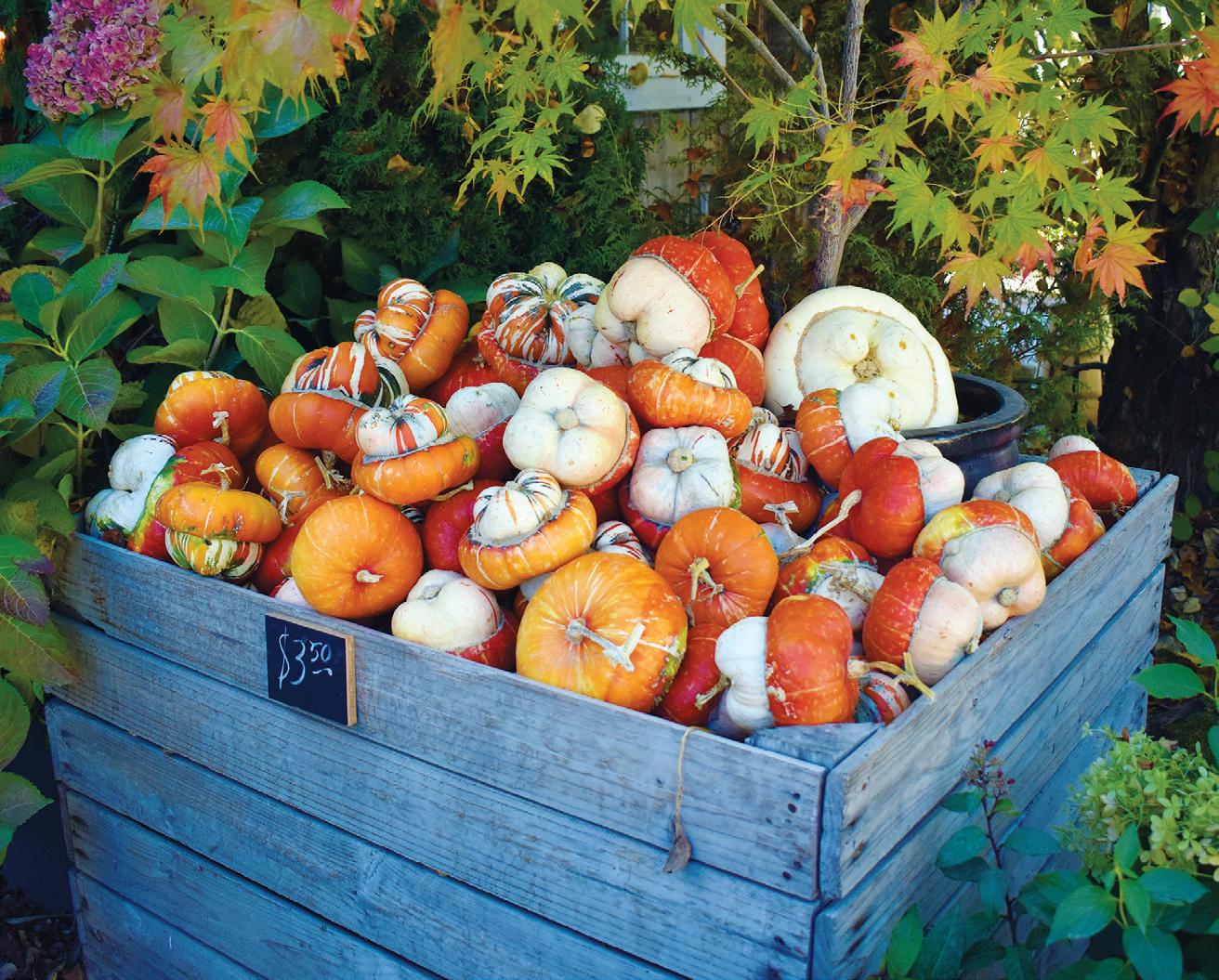
Photos from the Field Share your unique perspective with our community by submitting photos of inviting gardens, nutritious foods, wild animals, and more to the MOTHER EARTH NEWS Photo Group on Flickr (www.Flickr.com/Groups/MotherEarthNewsPhotos/Pool ). We’ll feature our favorites here and online! SHOW US! C LOCKWISE FROM TOP RIGHT : K AREN M OLENAAR T ERRELL ; A G REAT C APTURE (2)
Left: Bright-orange chrysanthemums are ablaze with autumnal colors at a fruit market in Toronto, Ontario. Above: Pumpkins pile high in a bin at Gordon Skagit Farms in Mount Vernon, Washington.
A red-tailed hawk pauses on a tree limb on a fall evening in High Park in Toronto, Ontario.
African SWINE FEVER ARe your PIGS SAFE?
A single case of African swine fever can wipe out an entire herd. People can’t get it, but they can spread it. Learn to spot signs of infection, and protect your pigs from this lethal disease.

www.aphis.usda.gov/ProtectOurPigs







The U.S. Department of Agriculture is an equal opportunity provider, employer, and lender.















you have the will to get more done on your property, Bobcat has the way – with a lineup of compact tractors that works as hard as you do. Bobcat Company is a member of the Doosan Group. Doosan is a global leader in construction, grounds maintenance and material handling equipment, power and water solutions, and engineering that has proudly served customers and communities for more than a century. Bobcat ®, the Bobcat logo and the colors of the Bobcat machine are registered trademarks of Bobcat Company in the United States and various other countries. ©2023 Bobcat Company. All rights reserved. | 1550 BOBCAT.COM
IS POSSIBLE?
If
WHAT WILL YOU DO WHEN ANYTHING