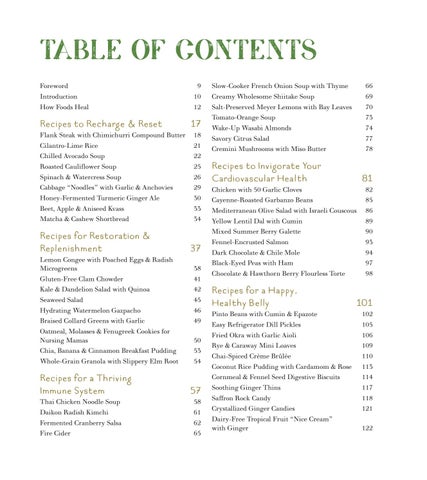
table of contents
Foreword Introduction How Foods Heal
Recipes to Recharge & Reset Flank Steak with Chimichurri Compound Butter Cilantro-Lime Rice Chilled Avocado Soup Roasted Cauliflower Soup Spinach & Watercress Soup Cabbage “Noodles” with Garlic & Anchovies Honey-Fermented Turmeric Ginger Ale Beet, Apple & Aniseed Kvass Matcha & Cashew Shortbread
Recipes for Restoration & Replenishment Lemon Congee with Poached Eggs & Radish
Microgreens Gluten-Free Clam Chowder Kale & Dandelion Salad with Quinoa Seaweed Salad Hydrating Watermelon Gazpacho Braised Collard Greens with Garlic Oatmeal, Molasses & Fenugreek Cookies for
Nursing Mamas Chia, Banana & Cinnamon Breakfast Pudding Whole-Grain Granola with Slippery Elm Root
Recipes for a Thriving
Immune System Thai Chicken Noodle Soup Daikon Radish Kimchi Fermented Cranberry Salsa Fire Cider
9
10
12
17 18
21
22
25
26
29
30
33
34
37
38
41
42
45
46
49
50
53
54
57
58
61
62
65
Slow-Cooker French Onion Soup with Thyme Creamy Wholesome Shiitake Soup Salt-Preserved Meyer Lemons with Bay Leaves Tomato-Orange Soup Wake-Up Wasabi Almonds Savory Citrus Salad Cremini Mushrooms with Miso Butter
Recipes to Invigorate Your Cardiovascular Health Chicken with 50 Garlic Cloves Cayenne-Roasted Garbanzo Beans Mediterranean Olive Salad with Israeli Couscous Yellow Lentil Dal with Cumin Mixed Summer Berry Galette Fennel-Encrusted Salmon Dark Chocolate & Chile Mole Black-Eyed Peas with Ham Chocolate & Hawthorn Berry Flourless Torte
Recipes for a Happy, Healthy Belly Pinto Beans with Cumin & Epazote Easy Refrigerator Dill Pickles Fried Okra with Garlic Aioli Rye & Caraway Mini Loaves Chai-Spiced Crème Brûlée Coconut Rice Pudding with Cardamom & Rose Cornmeal & Fennel Seed Digestive Biscuits Soothing Ginger Thins Saffron Rock Candy Crystallized Ginger Candies Dairy-Free Tropical Fruit “Nice Cream”
with Ginger
66
69
70
73
74
77
78
81 82
85
86
89
90
93
94
97
98
101 102
105
106
109
110
113
114
117
118
121
122
Recipes to Rev Up Your Reproductive System
125
Silky-Smooth Hummus with Homemade Tahini Balancing Duck Liver Pâté Lime & Chile Pumpkin Seeds Oysters on the Half Shell with Mignonette Sauce Rose & Maca Hand-Rolled Truffles Seed Cycling Crackers Zingy Grapefruit & Rose Hip Curd Date-Sweetened Cinnamon Horchata Goji Berry & Strawberry Smoothie Savory Pumpkin-Sage Panna Cotta
126
129
130
133
134
137
138
141
142
145
Lemony Pan-Roasted Asparagus Practical “Paneer” Tikka Masala Poached Eggs with Foolproof Tarragon
Hollandaise
Recipes to Rejuvenate Your Mind & Senses
159
160
163
165
Recipes to Keep Your Skin, Bones & Muscles in Tip-Top Shape 147
Basil Cashew “Cheese” Carrot & Dandelion Flower Soup Blueberry & Spinach Salad with
Lemon–Poppy Seed Vinaigrette Roasted Walnuts with Rosemary Mindful Hot Chocolate with Rhodiola Roasted Broccoli & Cheddar Soup
Lion’s Mane Risotto
Albacore Tuna Cake with Sriracha Aioli
170
173
174
177
178
181
Bone Broth with Bone-Building Herbs Chamomile Posset Green Bean Confit Nettle Egg Noodles Spanakopita Triangles
Resources Acknowledgments About the Author
Index
182
184
185
186
148
151
152
155
156
166
169
FOREWORD
The title of Devon Young’s new book is appropriate, because herbalists do indeed have healing kitchens! Most of us use our kitchens as command central: after we contemplate the many complexities of how to best approach our health and the health of those we love, it’s in our kitchens that we whip up an herbal preparation or design a healthy, wholesome meal. The Herbalist’s Healing Kitchen shows us what it looks like to create foods with intention—the intention to make better, to make well and to support our body’s ability to balance and heal. Devon makes the point that paying attention to your body is key to addressing its needs. She recalls instinctively knowing that the peppermint candies offered at restaurants as an after-dinner sweet were soothing to her stomach, but it was only in hindsight that she made the connection between the consumption of peppermint and the relief she felt. Food can have an immediate or a delayed effect on us, but the point is to take notice. Does a specific food help you feel better, give you more energy, help you think more clearly, make you sleepy or perhaps make you feel anxious? Once we begin to notice the more obvious manifestations of the food we are eating, we can tune in to the more subtle expressions. When we start to listen to our bodies, we gain insights that allow us to choose foods that are right and good for us. I’ve made my way around quite a few kitchens as a caterer, traveler, mother of three and herbalist, and I’ve learned a few culinary tricks here and there. I know how to use a wide variety of ingredients to make healthy, delicious and sometimes even inspiring recipes. But when Devon shares that flavor is the secret language of food, revealing to us the action of that food, I had to stop and think for a moment. Yes, indeed, flavor is the informer advising our taste buds, but also much more importantly, other body systems. The question is, how many of us use that information to our advantage? Understanding flavors such as sour, pungent, bitter, salty and sweet provides us with an entirely new set of tools with which we can guide our culinary and herbal repertoire. The one thing we all can do is to choose what we put into our bodies. We can make good, informed choices, as Devon does in The Herbalist’s Healing Kitchen. Whether we feel the need to recharge and restore, boost our immune system, build cardiovascular health, jump-start our reproductive system or ease a troubled mind, we can design recipes using ideal foods and herbs that fit our particular needs. Your salivary glands may be working overtime as you read through these mouthwatering and original recipes that are both purposeful and delicious! Lemon Congee with Poached Eggs & Radish Microgreens (page 38), Chai-Spiced Crème Brûlée (page 110) and Coconut Rice Pudding with Cardamom & Rose (page 113) are just a few to look forward to. You’re in for a real treat!
—Marlene Adelmann Herbalist and Founder of the Herbal Academy
9
INTRODUCTION
For me . . . it all really started with food. When I was growing up, herbs and spices weren’t used medicinally in our home—but they were most certainly used in our cooking. My father fostered my love of epicurean wonders through his fragrant herb garden and his penchant for watching cooking shows. I learned early on in life how rosemary brings levity to a rich leg of lamb and how the peppery kick of watercress pairs beautifully with citrus and seafood. I observed how the red-and-white mints offered with the check at the end of a restaurant meal could soothe a troubled tummy. I was learning that food is medicine. But I wasn’t listening yet. So quickly we dismiss these valuable lessons. We forget to pay mind to cues the body gives to us. We find ourselves thinking that cures and good health only come with a white coat and a prescription pad, or from shelves of supplements and quick-fix remedies. The more clinical the remedy, the less we relate to it—and the more “effective” it becomes in the collective mind. We seem to be looking for heroic cures, for instant gratification. And that can only come in a bottle, right? Because, how could the living world really give us everything we need? How could plants, animals, fungi and even tiny microbes offer the key to healthful living? How could we each hold the answers to our own wellness? Perhaps it is a quirk of human nature. We often strive for the unattainable and yearn for the exotic. In my work as an herbalist, I see this tendency far too often. People attach themselves to concepts and products, and they place their bets on the latest fads. Everybody is looking for healing in all the wrong places. True healing begins in the most fundamental of origins. It starts in the food that we eat.
10
The Herbalist’s Healing Kitchen
Without proper nourishment, we are building a house on a crumbling foundation. With wholesome, nutritious foods, we fortify our minds and bodies. We build strength. We grow. We perform. We birth. And we heal. There is a complexity in healing that so often gets overlooked. We reach for the “quick fixes,” and we forget how to set the stage for real healing. Healing exists when we are present with each and every choice—and when those choices are made in the interest of good health. We can create recipes that address a multitude of minor and major health complaints. Simply by making informed food decisions, and by using sub-therapeutic levels of traditional medicinal herbs and spices, we can care for ourselves! We aren’t taking gigantic, heroic steps. Rather we are setting ourselves up for true health and healing—the type that lasts. Food and herbs can coax the mind and body back into a healthy, neutral position. They can open our sinuses, ease an upset stomach and fortify our reserves after a long haul. Common herbs, such as black pepper, rosemary and even parsley, have profound medicinal benefits. Simple foods— ones in your home right now—offer nourishment and contain powerful nutrients that promote good health. They can even put a stop to many of our frequent, bodily complaints. When you learn the medicinal potential in your own kitchen, you can create meals that are deeply healing. The Herbalist’s Healing Kitchen is a guide to choosing and preparing the right foods and herbs to support optimal health. You will learn the everyday foods, herbs and spices that can effectively neutralize conditions—from the common cold to a flatlined libido. You will find detoxifying recipes, fortifying recipes, recipes to improve your cardiovascular system, recipes to promote immunity, recipes to encourage digestion, recipes to make you strong and recipes that deliver sexual and reproductive health.
I am going to teach you to identify foods and herbs for their medicinal value and nourishing health benefits. You will come to see your pantry, refrigerator and even the grocery store in a whole new light—one where your daily food choices become customized medicine for your mind and body. You will learn how to identify the major flavor profiles—sour, pungent, bitter, sweet and salty. And you will learn how these flavors influence the healing actions of foods and herbs. With this knowledge, you can venture beyond the many recipes in this book to turn your kitchen into a healing apothecary. Let’s cast aside the notion that healing comes only with a prescription. Healing starts at home, in our kitchens, with food made by our own hands. Let’s discover the kitchen as our source of healing.
11
Ginger is a favored herb, known to herbalists, chefs and regular folks alike. The pungent, spicy rhizome quells nausea and upset stomach caused by pregnancy and motion sickness. Additionally, it relieves the sensation of gas and bloating, making it a favored ingredient in cooking. These crystallized ginger candies are downright festive in their glittering glory. They are easy to make and store well, so keep a supply of these spicy lifesavers on hand!
Crystallized Ginger Candies
Flavor Profile: Pungent, Sweet Makes: About 2 cups (450 g) ½ lb (226 g) fresh ginger root 1 cup (200 g) sugar, plus more for coating
Peel the ginger root. Using a mandolin or a knife, cut the root into ⅛-inch (3-mm) slices for a crunchier candy, or up to ¼ inch (6 mm) for a chewier result. Add the ginger slices to a small saucepan and cover them with water. Bring it to a boil, then reduce the heat to medium-low, cover and simmer for about 30 minutes. After 30 minutes, strain the ginger through a fine-mesh sieve into a small bowl, reserving ¼ cup (60 ml) of the ginger liquid. Return the ginger slices and reserved liquid back to the saucepan. Add the sugar. Bring the mixture to a boil over medium-high heat. Boil until the mixture reads 225°F (107°C) on a candy thermometer. This is referred to as the thread stage in candy-making; a spoon dipped in the syrup should result in long, thin threads dripping from the spoon. Remove the pan from the heat. Pour the mixture through a fine-mesh sieve; reserve the resulting syrup for other uses, such as mixing with sparkling water or club soda for a makeshift ginger ale. Place the ginger slices on a wire rack in a single layer and dry them for 18 to 24 hours. When the ginger is mostly dry, but still slightly sticky, toss them in a bowl of granulated sugar to coat. Place the ginger candies in a serving bowl and keep them dry, or store them in a container with an airtight lid.
Herbalist Tip I like to pick organic ginger with few “knobs” so that I can maximize the size of the resulting candy.
Recipes for a Happy, Healthy Belly
121
Here is a guilt-free dessert that tastes amazing and can even atone for a multitude of dietary sins.
Tropical fruits such as papaya and pineapple contain enzymes that promote vigorous and healthy
digestion, preventing the feelings of bloating after a robust meal. Mango and strawberries add
fiber and regulate proper bowel function. Coconut milk contributes a creamy texture and subtle
tropical flavor. The addition of Crystallized Ginger Candies (page 121) stimulates peristalsis—the
wave-like motions of the stomach wall necessary for good digestion—
and reduces nausea caused by over-indulgence.
Dairy-free and containing no added sugar, this naturally sweet dessert is delightfully fruity on its
own. It is over-the-top delicious with a few crumbled Soothing Ginger Thins (page 117).
Dairy-Free Tropical Fruit “ Nice Cream ” with Ginger
Flavor Profile: Sour, Sweet Serves: 4 to 6 ½ cup (122 g) frozen pineapple chunks ½ cup (90 g) frozen papaya chunks ½ cup (85 g) frozen mango chunks ½ cup (100 g) frozen sliced strawberries ½ cup (120 ml) orange juice or tropical fruit juice blend (100% juice) 1 (13.5-oz [398-ml]) can full-fat unsweetened coconut milk 2 tbsp (30 g) minced Crystallized Ginger Candies (page 121)
122
The Herbalist’s Healing Kitchen
Place the frozen fruit and juice into a food processor or blender. Process them until the fruit is well chopped but still slightly chunky, about 30 seconds. Add the coconut milk and process this until the mixture is well incorporated. Fold in the crystallized ginger by hand. Serve immediately in well-chilled bowls or churn in an ice cream maker according to the appliance directions for better scoop-ability and better storage in the freezer.