ROAD
MAP
56 62
GARY PHELPS
68
10 16 22 26
32
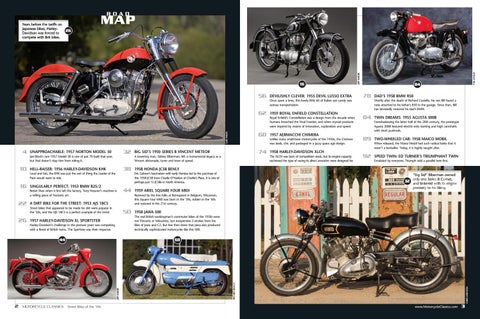
UNAPPROACHABLE: 1957 NORTON MODEL 30 Joe Block’s rare 1957 Model 30 is one of just 70 built that year, but that doesn’t stop him from riding it.
38
HELL-RAISER: 1956 HARLEY-DAVIDSON KHK Loud and fast, the KHK was just the sort of thing the Leader of the Pack would want to ride.
SINGULARLY PERFECT: 1953 BMW R25/2 Better than when it first left the factory, Tony Hessner’s machine is a rolling piece of Teutonic art.
A DIRT BIKE FOR THE STREET: 1953 AJS 18CS Street bikes that appeared to be made for dirt were popular in the ’50s, and the AJS 18CS is a perfect example of the trend.
50
1957 HARLEY-DAVIDSON XL SPORTSTER Harley-Davidson’s challenge in the postwar years was competing with a flood of British twins. The Sportster was their response.
MOTORCYCLE CLASSICS
A towering man, Sidney Biberman, left a monumental legacy as a Vincent aficionado, tuner and lover of speed.
Unlike many small-bore motorcycles of the 1950s, the Chimera was sleek, chic and packaged in a jazzy space age design.
1958 HARLEY-DAVIDSON XLCH The XLCH was born of competition stock, but its engine capacity eschewed the type of racing its direct ancestors were designed for.
DAD’S 1958 BMW R50 Shortly after the death of Richard Costello, his son Bill found a note attached to his father’s R50 in the garage. Since then, Bill has devotedly restored his dad’s BMW.
84
TWIN DREAMS: 1955 AGUSTA 300B
89
TWO-WHEELED CAR: 1958 MAICO MOBIL
92
SPEED TWIN: ED TURNER’S TRIUMPHANT TWIN
Foreshadowing the latter half of the 20th century, the prototype Agusta 300B featured electric-only starting and high camshafts with short pushrods.
When released, the Maico Mobil had such radical looks that it wasn’t a bestseller. Today, it is highly sought after.
Emulated by everyone, Triumph sold a parallel twin first.
1958 HONDA JC58 BENLY Eric Gebow’s fascination with early Hondas led to the purchase of this 1958 JC58 from Charlie O’Hanlon of Charlie’s Place. It is one of perhaps just 15 JC58s in North America.
32
1959 ARIEL SQUARE FOUR MKII Restored by the fine folks at Retrospeed in Belgium, Wisconsin, this Square Four MKII was born in the ’50s, ridden in the ’60s and restored in the 21st century.
1958 JAWA 500 The real British workingman’s commuter bikes of the 1950s were not Vincents or Velocettes, but inexpensive 2-strokes from the likes of Jawa and CZ. But few then knew that Jawa also produced technically sophisticated motorcycles like this 500.
68
JEFF BARGER
44
2
44
74
BIG SID’S 1950 SERIES B VINCENT METEOR
1957 AERMACCHI CHIMERA
78
Street Bikes of the ’50s
www.MotorcycleClassics.com
3
COREY LEVENSON
4
1959 ROYAL ENFIELD CONSTELLATION Royal Enfield’s Constellation was a design from the decade when humans breached the Final Frontier, and when myriad products were inspired by visions of innovation, exploration and speed.
84
RICHARD BACKUS
DEVILISHLY CLEVER: 1955 DEVIL LUSSO EXTRA Once upon a time, this lovely little bit of Italian eye candy was serious transportation.
PHIL AYNSLEY
16
JEFF BARGER
26
1959 ROYAL ENFIELD CONSTELLATION Engine: 693cc air-cooled OHV parallel twin, 70mm x 90mm bore and stroke, 8.5:1 compression ratio, 51hp @ 6,250rpm (claimed) Top speed: 115mph (period test) Carburetion: Single 1-3/16in Amal 10TT9 Transmission: 4-speed w/neutral finder, chain final drive Electrics: 6v, magneto ignition Frame/wheelbase: Single downtube cradle frame/54in (1,372mm) Suspension: Telescopic fork front, dual shocks w/ adjustable preload rear Brakes: 6in (152mm) double-sided SLS drum front, 7in (178mm) SLS drum rear Tires: 3.25 x 19in front, 3.50 x 19in rear Weight (dry): 403lb (183kg) Seat height: 31in (787mm) Fuel capacity/MPG: 5gal (18.9ltr)/51mpg (period test) Price then/now: $828 (1958/U.K.)/$5,000-$9,500
from 6.5:1 to 7.25:1 and bigger valves boosted the Meteor’s output from 36 to 40 horsepower. Magneto ignition and an alternator replaced the DC generator/coil system. And it had a new name: Super Meteor.
Reaching for the stars Competition among the Big Three British makers was heating up in the late 1950s, with BSA and Triumph’s flagship models, the Super Rocket and Tiger 110 making 46 and 42 horsepower, respectively. Norton’s 49 horsepower 650SS was waiting in the wings, as was Triumph’s 46 horsepower Bonneville.
Royal Enfield responded with one more power boost from the 700 engine when the Constellation arrived for the 1958 season. Based on the Super Meteor, compression went from 7.25:1 to 8.5:1, and it had hotter cams, a siamesed exhaust system, and an Amal 10TT9 racing carburetor. Crankshafts were dynamically balanced at the factory to minimize vibration. The engine now produced around 50 horsepower at 6,250rpm, driving the Albion 4-speed gearbox with its extra neutral-finder lever through the “scissor” clutch adapted from the Meteor Minor. The Constellation used the same frame and running gear as the Super Meteor, but replaced the painted
fenders with chrome-plated steel blades. The new 4-1/4 twin. Bore increased 1mm to 71, while the stroke grew 3mm Imperial gallon (5 gallons U.S.) gas tank was also chromed, to 93 for a capacity of 736cc. The Interceptor would remain in and featured a broad top panel finished in “polychromatic production in various forms until Royal Enfield’s final demise burgundy” with gold pinstriping. It looked fast — and it was, around 1970. with a top speed of 115mph according to a 1958 Motor Cycling The final iteration of the Constellation was in 1963. With magazine test. production of the Interceptor in full flow, the Constellation was As the class horsepower leader, repositioned as a sidecar tug, with the the Constellation should have been a Super Meteor-spec 7.25:1 compresgood choice for production racing, but sion 40 horsepower engine, coil ignithe promise was never fully realized. tion, big fenders, steering damper and Constellations were usually the fastrevised “sidecar” fork moving the front est bikes in the field, but frequently axle farther forward. But by that time retired with mechanical issues. The the sidecar market was dead, and the closest RE came to a significant victory Constellation died with it. was in 1958, when Enfield dealer Syd Lawton entered a Constellation in the Tony Cording’s Constellation 500-mile endurance race at Thruxton As Western (and briefly National) circuit with riders Bob McIntyre and Sales Manager for Yamaha for 25 years, Derek Powell. Though they recorded Tony Cording always had motorcycles faster times on the track than the front and center. His first bike at age eventual winners (Mike Hailwood and 15 was a 1939 Matchless-powered OK Dan Shorey on their Triumph 650), Supreme, followed by a 1936 Series A McIntyre and Powell lost time in the Vincent single, “The one I really wish I pits, handing the race to their rivals. still had,” Cording says. For 1960, a pair of 30mm (1-3/16 As a 16-year-old bike nut in Britain in inch) Amal Monobloc carburetors the 1950s, Cording had a top-five wish replaced the racing TT carb. The tight list: Top was a Vincent Black Shadow, fit behind the engine meant no room then a Norton Dominator, followed by for the right-side carburetor’s float a BSA Road Rocket, AJS 650CSR — bowl, so both were fed from a single and a Royal Enfield Constellation. float bowl on the left side. Forward Migrating to Canada at age 24, fampointing “ears” were added to the side ily then took priority until 1975 when panels at the same time. he acquired the first of a number of As was the fashion at the time, the Vincents — a series D Rapide. That Constellation got some body panels was followed by a D Black Shadow and around the rear wheel for 1961 and a Black Prince. Next came a Comet a new, flatter dual seat. But the big basket case that, with help from nownews from Enfield in 1962 was a new Bought as a basket case, Tony Cording is deceased John MacDougal, was turned model with one more stretch for the proud to have his Connie back on the road. into a replica “Grey Flash” racer. His www.MotorcycleClassics.com
65
DAD’S BMW
A very special 1958 R50 receives a very special restoration
L
Story by Greg Williams Photos by Bill Costello and Markus Hartel
Leaning against a wall in a crowded five car garage, surrounded by tools and tool chests, lawn mowers and bits of scrap wood, sat the prized possession of the late Richard Costello, a 1958 BMW R50. A pair of black rubber truck mud flaps placed under the crankcase revealed a dribble of fluid — likely oil slowly weeping past a shrunken seal.
The headlight-mounted odometer showed 60,561 miles, the numbers barely visible through the dusty, grimy glass. It had been 40 years since the old Beemer had been on the road, and more than 35 years since it had last run. Attached to the handlebar of the tired looking R50 was a note, jotted in pencil on a yellowed piece of paper torn from a coil-bound notebook. “Note: Spare parts are tucked away inside Headlamp, tail lamp. Extra tools are in tool kit. I want the bike fixed as well as I know you can do it. R. Costello.” To anyone else, the message would likely have been lost. But Richard’s son, Bill Costello, knew exactly what it meant. “I think he had me in mind when he wrote that,” Bill says. In 1961, Richard Costello was a 23-yearold engineering student attending college in Madison, Wisconsin. He enjoyed the sport of riding, and had owned a couple of used motorcycles, including a little Harley-Davidson 165 Hummer. He was ready to move up, and after pondering his options decided the best machine he could buy for his money was a BMW. Richard purchased a 3-year-old 1958 R50, joining the ranks of the then small but growing fraternity of American motorcyclists dedicated to the European brand. BMWs didn’t leak oil or vibrate incessantly like their British counterparts, and they weren’t heavy, lumbering machines like the ones produced in the U.S. They were unique, solid and well engineered. Perfect for a man like Richard. “If you rode a BMW [back then], you likely wore a suit and tie,” Bill says. “For my dad, the BMW was daily transportation as he rode with his books to colFrom father to son: Richard lege — or he’d wear a tuxedo and go to Costello’s note to Bill. a formal ball.”
78
MOTORCYCLE CLASSICS
Street Bikes of the ’50s