CONTENTS
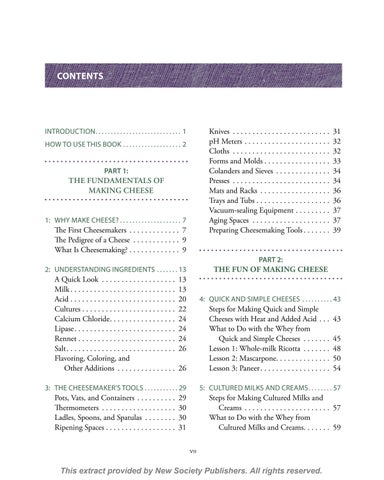
Knives . . . . . . . . . . . . . . . . . . . . . . . . . pH Meters . . . . . . . . . . . . . . . . . . . . . . Cloths . . . . . . . . . . . . . . . . . . . . . . . . . Forms and Molds . . . . . . . . . . . . . . . . . Colanders and Sieves . . . . . . . . . . . . . . Presses . . . . . . . . . . . . . . . . . . . . . . . . . Mats and Racks . . . . . . . . . . . . . . . . . . Trays and Tubs . . . . . . . . . . . . . . . . . . . Vacuum-sealing Equipment . . . . . . . . . Aging Spaces . . . . . . . . . . . . . . . . . . . . Preparing Cheesemaking Tools . . . . . . .
INTRODUCTION. . . . . . . . . . . . . . . . . . . . . . . . . . . . 1 HOW TO USE THIS BOOK . . . . . . . . . . . . . . . . . . . 2
PART 1:
THE FUNDAMENTALS OF MAKING CHEESE
1: WHY MAKE CHEESE? . . . . . . . . . . . . . . . . . . . . 7
The First Cheesemakers . . . . . . . . . . . . . 7 The Pedigree of a Cheese . . . . . . . . . . . . 9 What Is Cheesemaking? . . . . . . . . . . . . . 9
31 32 32 33 34 34 36 36 37 37 39
PART 2:
THE FUN OF MAKING CHEESE
2: UNDERSTANDING INGREDIENTS . . . . . . . 13
A Quick Look . . . . . . . . . . . . . . . . . . . Milk . . . . . . . . . . . . . . . . . . . . . . . . . . . Acid . . . . . . . . . . . . . . . . . . . . . . . . . . . Cultures . . . . . . . . . . . . . . . . . . . . . . . . Calcium Chloride. . . . . . . . . . . . . . . . . Lipase. . . . . . . . . . . . . . . . . . . . . . . . . . Rennet . . . . . . . . . . . . . . . . . . . . . . . . . Salt. . . . . . . . . . . . . . . . . . . . . . . . . . . . Flavoring, Coloring, and Other Additions . . . . . . . . . . . . . . .
13 13 20 22 24 24 24 26
4: QUICK AND SIMPLE CHEESES . . . . . . . . . . 43
Steps for Making Quick and Simple Cheeses with Heat and Added Acid . . . What to Do with the Whey from Quick and Simple Cheeses . . . . . . . Lesson 1: Whole-milk Ricotta . . . . . . . Lesson 2: Mascarpone. . . . . . . . . . . . . . Lesson 3: Paneer . . . . . . . . . . . . . . . . . .
26
3: THE CHEESEMAKER’S TOOLS . . . . . . . . . . . 29
Pots, Vats, and Containers . . . . . . . . . . Thermometers . . . . . . . . . . . . . . . . . . . Ladles, Spoons, and Spatulas . . . . . . . . Ripening Spaces . . . . . . . . . . . . . . . . . .
43 45 48 50 54
5: CULTURED MILKS AND CREAMS. . . . . . . . 57
29 30 30 31
Steps for Making Cultured Milks and Creams . . . . . . . . . . . . . . . . . . . . . . 57 What to Do with the Whey from Cultured Milks and Creams. . . . . . . 59 vii
This extract provided by New Society Publishers. All rights reserved.
viii
Mastering Basic Cheesemaking
Lesson 4: Buttermilk . . . . . . . . . . . . . . Lesson 5: Sour Cream and Crème Fraîche . . . . . . . . . . . . . . . . . Lesson 6: Cultured Butter and Buttermilk. . . . . . . . . . . . . . . . . . . . Bonus Recipe: Ghee . . . . . . . . . . . . . . Lesson 7: Kefir and Kefir Cheese . . . . . Lesson 8: Yogurt and Yogurt Cheese . . .
60 62 64 66 67 69
Lesson 15: Gouda. . . . . . . . . . . . . . . . Lesson 16: Fresh, Squeaky Cheddar Curds and Traditional Cheddar . . . . . Lesson 17: Stirred-curd Cheddar . . . . Lesson 18: Colby . . . . . . . . . . . . . . . . Lesson 19: Parmesan. . . . . . . . . . . . . . Bonus Recipe: Whey Ricotta . . . . .
112 117 121 125 128 131
9: WHAT’S NEXT? . . . . . . . . . . . . . . . . . . . . . . . . 133 6: FRESH AND VERSATILE CHEESES . . . . . . . 73
Steps for Making Fresh and Versatile Cheeses . . . . . . . . . . . . . . . What to Do with the Whey from Fresh and Versatile Cheeses . . . . . . . Lesson 9: Quark, Chèvre, and Fromage Blanc. . . . . . . . . . . . . . . . . Lesson 10: Cream Cheese . . . . . . . . . . . Lesson 11: Curd Cottage Cheese . . . . .
73 75 76 89 82
Keep a Cheese Journal . . . . . . . . . . . . Experiment. . . . . . . . . . . . . . . . . . . . . Advanced Cheesemaking . . . . . . . . . . Cheesemaking as a Business . . . . . . . . Conclusion. . . . . . . . . . . . . . . . . . . . .
133 134 134 134 135
GLOSSARY . . . . . . . . . . . . . . . . . . . . . . . . . . . . . . . 137 RESOURCES . . . . . . . . . . . . . . . . . . . . . . . . . . . . . . 141 BOOKS . . . . . . . . . . . . . . . . . . . . . . . . . . . . . . . . . . . 141
7: RENNET-COAGULATED SEMI-FIRM FRESH CHEESES. . . . . . . . . . . . . . . . . . . . . . . . 85
Steps for Making Rennet-coagulated Fresh Cheeses . . . . . . . . . . . . . . . . . 85 What to Do with the Whey from Rennet-coagulated Fresh Cheeses. . . 91 Lesson 12: Quick Mozzarella . . . . . . . . 92 Bonus Recipe: Burrata . . . . . . . . . . . 94 Lesson 13: Feta. . . . . . . . . . . . . . . . . . . 98 Lesson 14: Farmhouse Cheese . . . . . . 102
MAGAZINES . . . . . . . . . . . . . . . . . . . . . . . . . . . . . 141 MOVIES AND VIDEOS . . . . . . . . . . . . . . . . . . . . 142 SUPPLIES . . . . . . . . . . . . . . . . . . . . . . . . . . . . . . . . 142 ACKNOWLEDGMENTS. . . . . . . . . . . . . . . . . . . . 143 INDEX. . . . . . . . . . . . . . . . . . . . . . . . . . . . . . . . . . . . 145 ABOUT THE AUTHOR . . . . . . . . . . . . . . . . . . . . . 151
8: RENNET-COAGULATED AGED CHEESES . . . . . . . . . . . . . . . . . . . . . . . 107
Steps for Making Rennet-coagulated Aged Cheeses. . . . . . . . . . . . . . . . . 107
This extract provided by New Society Publishers. All rights reserved.
INTRODUCTION
W
especially a food steeped in tradition, mystery, and complexity. Making cheese proved to be such a seductive and satisfying craft that in 2005 my husband and I began building our own farmstead cheese business, Pholia Farm Creamery (the name combines letters from the names of our daughters, Phoebe and Amelia). We relocated to a part of the old family farm where I was raised — twenty-four acres of woodland, mountains, and meadow — in my hometown of Rogue River, Oregon. Those were still the somewhat early days of farmstead cheesemaking, both as a skill and as a vocation. Friends and relatives were either reluctantly supportive or downright skeptical of our new venture. Even the local dairy inspector advised us that we would be better off to bury what little money we had in a tin can in the backyard. Fortunately for us, Americans’ palate for fine artisan cheeses has continued to grow, along with the desire to eat locally and support small farms. My cheeses quickly achieved wide critical acclaim and we have always techincally been sold out. In 2010 my first book The Farmstead Creamery Advisor (recently retitled The SmallScale Cheese Business), was released by Chelsea Green Publishing. My second book Mastering Artisan Cheesemaking followed in 2012, and The Small-Scale Dairy appeared in the spring of 2014 (both also published by Chelsea Green).
hen I began learning how to make cheese late in 2002, there were just two cheesemaking books on the market — I bought both. I had been making yogurt, paneer, and butter since I was a young girl helping my mom in our farm kitchen, but cheese — real sliceable, meltable, grillable cheese — was a mystery to me. My desire to uncover the secrets of this tasty food came not simply from a passion for eating it (that was supplied in excess by my husband and youngest daughter), but from an ingrained mantra of “make and grow your own food — and do not waste.” I knew that my family would have too much milk from our newly acquired, handful-size herd of goats, and I imagined that by turning the excess into a useful variety of products we could strike these items off the weekly grocery list and reduce the waste created by commercial packaging — a win-win. The first batches I made, using Ricki Carroll’s venerable Home Cheese Making (my favorite of those two initial tomes), made me feel as if I had performed magic — the alchemy of transforming humble milk into something entirely new and exciting. The sentiment was sustained and the pride of creation boosted by the passion with which my family and neighbors, who I had gathered for an impromptu cheese party, enjoyed the results. There is nothing quite as gratifying as pleasing others with food, 1
This extract provided by New Society Publishers. All rights reserved.
2
Mastering Basic Cheesemaking
Each of these books is meant to fill a gap in an industry of which I adore being a part. While it isn’t easy to find time to write — now that our daughters have left home, our farm is run by just me, my husband, and when we are lucky, an intern or two — it is something that I find deeply fulfilling and well worth the effort of piecing together snippets of writing time. And I’ve happily found that milking goats and stirring milk in the cheese vat are useful times to ponder such things as chapter outlines and new book ideas. Mastering Artisan Cheesemaking is a rather hefty volume, one meant to address the most complex of cheesemaking topics, and consequently not necessarily the best place for people to begin their cheese journey. Over the years, I have watched as the number of beginning cheesemaking books increased and waited for the perfect introductory guide. Unfortunately, the popularity of a topic does not always guarantee the quality of information available, and it has been with frustration and exasperation that I have reviewed most of these new publications. While I love tackling advanced cheesemaking topics, when I teach beginning cheesemaking, I
feel tremendous pleasure and joy. It reconnects me to my own first enchanting experiences with transforming milk into curd and curd into cheese. In this book I hope to share that magic, reveal its secrets, and guide you through the process in a way that no other book has done. You will be my private student, and I will be your personal trainer. Now let’s get started and make some magic together!
HOW TO USE THIS BOOK The first part of this book contains many details about the history, ingredients, and equipment of cheesemaking. You can read it first, last, or in between the lessons in the second part. I structured the recipes, which I call “lessons,” differently than in any other cheesemaking book. To get the most out of our lessons together, you should do them one at a time and in the order that they appear. If you decide to skip a lesson, you should at least read over it before moving on to the next one. Pay special attention to the Recap section following each recipe where we will compare what we just did with what we have learned so far. By working in this way, we will build knowledge and skills organically.
This extract provided by New Society Publishers. All rights reserved.
This extract provided by New Society Publishers. All rights reserved.
This extract provided by New Society Publishers. All rights reserved.
Part 1:
THE FUNDAMENTALS OF MAKING CHEESE
This extract provided by New Society Publishers. All rights reserved.
Mastering Basic Cheesemaking
6
NOTES ______________________________________________________________________________ ______________________________________________________________________________ ______________________________________________________________________________ ______________________________________________________________________________ ______________________________________________________________________________ ______________________________________________________________________________ ______________________________________________________________________________ ______________________________________________________________________________ ______________________________________________________________________________ ______________________________________________________________________________ ______________________________________________________________________________ ______________________________________________________________________________ ______________________________________________________________________________ ______________________________________________________________________________ ______________________________________________________________________________ ______________________________________________________________________________ ______________________________________________________________________________ ______________________________________________________________________________ ______________________________________________________________________________ ______________________________________________________________________________ ______________________________________________________________________________ ______________________________________________________________________________ ______________________________________________________________________________ ______________________________________________________________________________ ______________________________________________________________________________ ______________________________________________________________________________ ______________________________________________________________________________
This extract provided by New Society Publishers. All rights reserved.
1: WHY MAKE CHEESE?
A
and cooking are involved, rather than what the term implies in today’s convoluted food system.) Fermented grains, barley in particular, preceded fermented milk in terms of discovery and popularity (which is not surprising, really, since beer is still more popular than buttermilk!) Milk fermentation was likely discovered in the same happenstance fashion as beer: by being ignored. The milk of goats, sheep, and cows left to sit in prehistoric Tupperware (earthenware or tightly woven vessels) would have fairly quickly soured, thanks to bacteria naturally collected during milking, on the container and utensils, and in the air, changing the sweet, thin milk into a pleasant, tangy, slightly thick beverage. This transformation of milk also provided a surprise benefit for our primitive ancestors, who had a problem when it came to milk: past early childhood they couldn’t digest milk sugar (lactose) because they lacked lactase, the enzyme necessary to break it down. Many modern humans, too, lack this enzyme. For some, though, the enzyme that our stomachs produce when we are infants continues to be produced into adulthood and beyond. For those that do not make this handy enzyme, fermented dairy products, especially aged cheeses, are much more digestible because the bacteria in them breaks down the milk sugar before they are consumed. The fermentation or souring process also makes milk much more tart than when it comes
t its most fundamental level, cheesemaking is meant to preserve milk. It is a way to feed our families during times of the year when fresh, nourishing milk might not be available. For some of us, it is also a way to make a living. But for many of us, cheese is not made out of necessity, nor because we can make it better than anything commercially available — and certainly not because it is easy. Primarily, we make cheese because we can. We make cheese because it gives us satisfaction. We make cheese because we love cheese. Cheesemaking and milk fermentation can involve very few steps for simple, fresh cheeses or many steps for long-aged cheeses with complex flavor and delicious nuances. Either way, the process is fun, challenging, and fulfilling, and provides a link not only to long cultural traditions and foodways, but also to the earliest of our ancestors.
THE FIRST CHEESEMAKERS Many of the best foods in the world involve some stage of fermentation — the process by which bacteria are allowed to act upon and change the food — including chocolate, coffee, cognac, and, of course, cheese. It is believed that fermented milk and beer were the first “processed” foods made by humans. (By processed, I mean that steps other than simple gathering 7
This extract provided by New Society Publishers. All rights reserved.
8
Mastering Basic Cheesemaking
out of the animal. Where there is tang (not the orange-flavored powdered beverage famously promoted by astronauts in the 1960s), there is acid, and where there is acid, there is preservation. Foods that are high in acid don’t spoil as quickly as those that are low in acid. This also made fermented milk of high value to our forebears. It is believed that the next evolutionary step in cheesemaking, the use of a coagulant to thicken the milk beyond what simple souring could do, also occurred somewhat by accident.
Picture our early farmer friends and the vessels available in which milk could be stored: the tightly woven reed basket, the earthenware pot, and the repurposed digestive tract of a beast. It turns out that the stomach of many young mammals is the natural source for a very powerful milk coagulant — what we cheesemakers call rennet. When such an animal stomach was used as a vessel for fresh milk, the rennet would have curdled and thickened the milk while the milk naturally soured, resulting in solid cheese curds and liquid whey. Broken pieces of ancient
The author and a few of the aged cheeses she makes at Pholia Farm Creamery. CREDIT: BRENTON BURK
This extract provided by New Society Publishers. All rights reserved.
Why Make Cheese?
pottery strainers indicate that cheese curds were being purposefully drained and separated from whey as long as 7,500 years ago. It isn’t too big of a leap to conclude that other means of straining curd also existed — maybe even long before someone figured out how to make a clay colander — but did not survive the ravages of time. No matter what means were used, once humans learned the secrets of making curd, cheesemaking became a part of almost every culture that herded, milked, and butchered animals.
THE PEDIGREE OF A CHEESE Today we have the luxury of buying, eating, and making pretty much any type of cheese we fancy, a privilege unique to our time. We have access to books, recipes, and, even more importantly, technology and supplies. But, it is vital to remember that classic cheese types and varieties evolved due to the innate characteristics and assets of a certain place and time. Cheeses that are heavily salted or stored in salted whey, such as feta, developed in places like Mediterranean Greece, where salt was readily available and other means of preservation, such as cold caves, were not. Delicate surface-ripened French goat’s milk cheeses were the most organic and lovely expression of the qualities inherent in the breeds of goats being milked and the circumstances of location. Enormous wheels of hard, nutty, sweet Swiss types gained their flavor from the grasses and herbs that grow during the high Alpine summer, and their size made it possible to maximize transportation of wheels (on the backs of donkeys) down the mountains when winter grew near. As a cheesemaker, the pedigree of any cheese is something to honor and appreciate. It is also
9
something to keep in mind when you are unable to exactly reproduce your favorite Spanish blue or English cheddar. The qualitiy that a location imparts on cheese (or wine, beer, or coffee beans) is called terroir (tare-WAH). From the breed of cow, goat, or sheep to what those animals ate and the traditions of the cheesemaker, terroir cannot be cloned. It is what we artisan producers count on when sharing our recipes. We know that no matter what, each finely crafted cheese — when made from the milk of animals nurtured on regionally specific foods — will be a unique expression. As you learn to make cheese, it is natural and even helpful, to “copy” classic recipes and styles — or at least to attempt to duplicate them. It helps us learn the steps and gives us a frame of reference for our goal. But also it teaches an equally important lesson: the incredible variety of possible outcomes, even when precise steps are followed. Don’t let this unpredictability be discouraging. It isn’t an exaggeration to say that some of the best cheeses made today came about in good part due to a “mistake” or accidental deviation on the part of the cheesemaker. Maybe one day a century from now, an aspiring cheesemaker will be trying to copy a cheese that you created by happenstance.
WHAT IS CHEESEMAKING? During most of our history as a species, we have not had refrigeration, so foods were either consumed immediately or preserved in some fashion, usually through salting, drying, or souring — or sometimes, as is the case with cheese, all three. Cheese begins with souring, or fermentation. Then it is “dried” through the removal of the whey, salted, and often dried further
This extract provided by New Society Publishers. All rights reserved.
10
Mastering Basic Cheesemaking
through pressing and aging. We’ll go over all of the detailed steps in making different categories of cheese later, but let’s take a quick look at the preservation techniques used in making cheese. A few years ago, if you said the word “fermentation,” you might have gotten some pretty quizzical looks. Other than its usage by avid beer brewers or winemakers, the word was largely consigned to notions of unwanted spoilage. Happily for all of us that love to make and eat great food, fermentation is now quite the
en vogue craft. From kombucha (fermented tea) to kimchi and kraut, fermented products are everywhere. Fermentation is simply the eating of sugars by such microscopic life forms as bacteria and yeasts. The by-products of this microbial feast are acid, alcohol, and gas. Fermentation will occur without any help by humans: a tub of beans left in the back of the fridge or a jar of raw milk left on the counter are all wonderful banquets for wild microbes and will ferment if given time, but not necessarily with tasty results
Clean, raw milk will coagulate naturally when the right native milk flora is present. Commercial cheesemaker, Rona Sullivan of Bonnyclabber Cheese on Sullivan’s Pond Farm in Eastern Virginia, makes her cheeses the old-fashioned way — with no cooking, starter cultures, or rennet. PHOTO BY AND COURTESY OF RONA SULLIVAN
This extract provided by New Society Publishers. All rights reserved.
Why Make Cheese?
(woe to he who opens that inflated tub of old beans and takes a whiff!). But, with a little guidance and intervention, fermentation can produce wonderful, healthy foods. In the case of cheese, fermentation takes place thanks to either naturally occurring (wild) bacteria or added (starter culture) bacteria that consume the milk sugar and create acid. Not all cheeses are fermented (the lessons in chapter 4 have acid added to the milk), but the vast majority are either partially or fully fermented, meaning that almost no milk sugar (food for the bacteria) remains in the cheese. The acid that results from fermentation protects the cheese for longer storage, helps transform the milk into curd, and adds flavor. The drying step of cheesemaking is accomplished by naturally coaxing the water out of the curd through draining (as in the Neolithic sieve we mentioned earlier), in some cases by adding weight to press out the moisture, and then often by allowing the cheese to sit or hang for an extended period of time. Fortuitously, these steps in removing water also concentrate
11
nutrients and flavor; allow for the further breakdown of milk sugar; give time for the proteins in the milk to break down into more easily digested parts; and create a portable, well preserved, and delicious food. Salting is an essential step in cheesemaking. Without salt, cheese is bland. Without salt, cheeses do not lose enough moisture and are easily spoiled. Without salt, cheese is not complete. Bear in mind that there are cheeses with salt, and there are salty cheeses. Those that are traditionally much higher in salt are so because of the traditions involved both in their crafting and in the way they are enjoyed. To sum it up, cheesemaking is many things: It is natural fermentation and the preservation of food; it is science and art; it is a hobby and a profession; and it is a challenge and a pleasure. Whatever your original motivation was for learning to make cheese, a wonderful journey awaits, one that will teach you many things and provide endless hours of satisfaction — and, of course, delicious cheese!
This extract provided by New Society Publishers. All rights reserved.