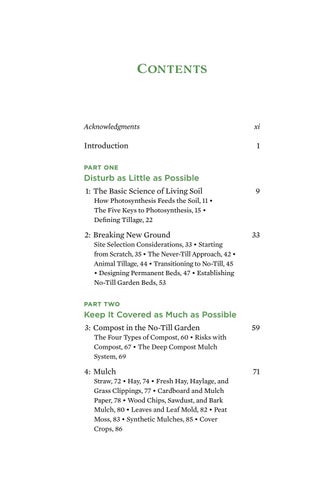
Contents
Acknowledgments xi
Introduction 1 PART ONE
Disturb as Little as Possible 1: The Basic Science of Living Soil
How Photosynthesis Feeds the Soil, 11 • The Five Keys to Photosynthesis, 15 • Defining Tillage, 22
2: Breaking New Ground
Site Selection Considerations, 33 • Starting from Scratch, 35 • The Never-Till Approach, 42 • Animal Tillage, 44 • Transitioning to No-Till, 45 • Designing Permanent Beds, 47 • Establishing No-Till Garden Beds, 53
9
33
PART TWO
Keep It Covered as Much as Possible 3: Compost in the No-Till Garden
59
4: Mulch
71
The Four Types of Compost, 60 • Risks with Compost, 67 • The Deep Compost Mulch System, 69 Straw, 72 • Hay, 74 • Fresh Hay, Haylage, and Grass Clippings, 77 • Cardboard and Mulch Paper, 78 • Wood Chips, Sawdust, and Bark Mulch, 80 • Leaves and Leaf Mold, 82 • Peat Moss, 83 • Synthetic Mulches, 85 • Cover Crops, 86
5: Turning Over Beds
89
6: Path Management
113
Maintaining Soil Health in a Bed Flip, 91 • The Good and Bad of Occultation, 96 • Weed Whacker, Knife, and Scything Bed Flips, 102 • Mowing Methods, 107 • Stirrup and Wheel Hoes, 110 • Solarization, 111 Wood Chips and Other Mulches, 113 • Plastic Mulches, 119 • Living Pathways, 120 • Mulch-in-Place, 125 • No Mulch in Pathways, 127
PART THREE
Keep It Planted as Much as Possible 7: Fertility Management
131
8: Transplanting and Interplanting
165
9: Seven No-Till Crops from Start to Finish
193
Appendix A: Cover Crop Use and Termination Guide
241
Appendix B: Critical Period of Competition and Interplant Pairings
247
Resources and Recommended Reading
255
Measuring and Managing Fertility, 131 • Designing a Fertility Program, 142 • Using Cover Crops for Fertility, 148 • Bed Preparation without Tillage, 159 Growing Healthy Transplants, 165 • Basic Interplanting Strategies, 169 • Advanced Interplanting Strategies, 180 Carrots, 195 • Arugula, 201 • Garlic, 205 • Lettuce, 212 • Sweet Potatoes, 220 • Beets, 226 • Cherry Tomatoes, 230 • Some Thoughts in Closing, 239
Notes 259 Bibliography 265 Index 273
1
11
12
10
2
4
3 5 9
6
8
7
Elements of a No-Till Market Farm. 1. Compost + Wood Chips 2. Animals 3. Interplanting 4. Flowers 5. Hedgerows 6. Tarping 7. Cover crops 8. Living pathways 9. Hay bales 10. Shade cloth 11. Perennials 12. Propagation house
Introduction
C
onfession: I have never actually grown anything in my life. I have never constructed a leaf or imbued a flower with an appealing fragrance to draw in pollinators. I have never sewed roots through soil or traded carbon cocktails with soil microbes in exchange for nutrients. I am just not that cool. In the 11 years I have been farming, all I can claim credit for is making the conditions right (and sometimes, admittedly, very wrong) for food and flowers to grow. If a customer thanks me for growing the food they purchase, I feel like a fraud. I feel as though I couldn’t possibly take that credit. My job—indeed, the job of any grower—is not to grow food but rather to facilitate that growth. Something else entirely does the growing. That “something” is a complex community of living organisms—both macro and micro—that work in conjunction with air, water, sunlight, carbon, and nutrients to grow plants. Humans aren’t the creators here. I repeat: We simply make the conditions right for crops to grow and make food—this is the literal definition of cultivation.
Three Principles to Farm By In this book I blend my experience stewarding living soil with the realities of making a living as a professional grower. The very short version of that knowledge is this: Getting what you need from the soil comes down to first asking the soil what it needs. And it is true no matter where you live. What the soil needs to thrive in humid Florida is largely the same as what it needs in dry Montana. It comes down to three basic principles: 1. Disturb the soil as little as possible. 2. Keep the soil covered as much as possible. 3. Keep the soil planted as much as possible. I first came across these three principles several years ago as a beginning farmer reading about conservation agriculture and soil health. My wife, Hannah, and I were suffering through some crop failures and I sought guidance on what we were doing wrong. The books and articles told me that, 1
The Living Soil Handbook although we could apply sprays and try a variety of techniques to protect crops, the best way to fight plant disease and pest pressure was to nurture soil health. And the best way to do that? Follow those three principles. Unfortunately, the books and articles weren’t overflowing with guidance on how to follow those three principles. The texts used terms such as interplanting and no-till or cover cropping but did not offer much technical detail on how to execute those practices. Somewhat frustrated, we began experimenting on our farm with eliminating mechanical tillage, trialing different mulches, and interplanting multiple crops together in the same bed to see what liked growing together. In 2018, I started The No-Till Market Garden Podcast, and my motive was to help others and myself by having conversations with farmers who were experimenting with low- or no-tillage methods to discover, and then share, what they’d learned. Farmer Jackson Rolett and I started No-Till Growers (www.notillgrowers.com) to aggregate (and create) videos, talks, podcasts, and articles. Later we employed grower Josh Sattin to make detailed technical videos and host a bimonthly live show on YouTube called Growers Live. On that show, Sattin interviewed growers, and anyone could log on and ask those growers specific questions. The goal of all these ventures has been, and is, the same—to answer the question what does the soil need to thrive? Ultimately, through these experiences and many conversations with agronomists, growers, and scientists, I’ve learned about a range of widely applicable technical solutions for keeping the soil as undisturbed, as well covered, and as fully planted as possible. In this book I work to flesh out the details of how to employ those principles not just on a farm like mine, but on any farm. My hope is that anyone, anywhere will be able to use this book as a guide to designing the right system for their context and soil—that is, to put those three principles into practice. That system might wind up looking similar to the shallow compost mulch system Hannah and I use at Rough Draft Farmstead in central Kentucky (USDA Hardiness Zone 6b) as described in chapter two and throughout this book. Or you may find that some or all of our methods won’t work for you. For example, you may not have access to the rich and plentiful compost that we enjoy here in horse country. Furthermore, you might not have the abundant rainfall we do, or the relatively generous number of frostfree days. Environmentally, you might be opposed to the use of plastic silage tarps—and not without reason. To account for that, I’ve set up this book as a choose-your-own-adventure of sorts. And no doubt, an adventure it will be. Before I wrap up these introductory thoughts, however, I want to have an obligatory pause and reflect on two crucial words that show up in each of the three guiding principles: “as possible.” 2
Introduction
Figure 0.1. All of our practices at Rough Draft Farmstead, from mulching to cover cropping to interplanting, are part of our goal to protect and nurture the soil.
Marry. Those. Words. When the practice of no-till is a grower’s primary tool for stewarding the soil, “as possible” must be their mantra. These words are beautifully, even pristinely, the essence of no-till agriculture. They encourage the grower to be reasonable. “Yes,” those words remind us, “pulling carrots disturbs the soil. Raking disturbs soil. Animals disturb soil. It’s okay. Just disturb the soil as little as you possibly can in your context.” Though avoiding soil disturbance as much as possible is important, the enterprise of creating and protecting living soil isn’t beholden to the goal of no disturbance ever. Indeed, I believe each farmer will discover that their path to stewarding living soil evolves as much through dedication to no dogma as it does to no disturbance. As long as you use a given tool to promote soil life and biology, you are advancing toward the goal. This means keeping an open mind about soil practices that can create temporary soil damage, because those practices may ultimately create a more friable soil. Sometimes promoting soil life involves using a disc or tiller to work in composts and amendments, especially when starting a new garden. Other times it includes broadforking a bed to break up compaction, which allows for 3
The Living Soil Handbook better water infiltration and soil respiration that in turn promotes photosynthesis—a central goal for growers, as I explain in chapter one. The genius of the broadfork is that, although it causes some significant disturbance in the moment of use, its action can actually enhance soil conditions. And when a broadfork is used in harmony with the guiding principles of caring for living soil, it’s a tool that eventually renders itself obsolete. There are other good reasons to abstain from dogma, too. For one thing, soil science is ever-evolving, and future discoveries could change our understanding of what helps the soil and what hinders it. For another, some practices that shouldn’t succeed sometimes do, while practices that should succeed sometimes don’t. One example of this dichotomy is interplanting with carrots, which are not a very competitive crop. Most of the time, sowing carrots around other crops doesn’t turn out well for the carrots, and yet, some growers end up with excellent results. Soil biology is profoundly complex and dynamic, and it will take some time to dial in your growing systems and build up your soil’s health. At first, you may have to undertake more disturbance than you’d like or more than you see other growers doing. Don’t worry about all that—focus on what your soil needs in your context and it will thrive.
Figure 0.2. Living pathways between beds of okra: keeping the soil covered and planted as much as possible.
4