QUICK REFERENCE

BEGINNERS GUIDE TO PICKLEBALL
2:15m Duration


HOW TO KEEP SCORE IN PICKLEBALL
3:00m Duration

WHAT IS PICKLEBALL?
Pickleball is a fast-paced game that combines elements of tennis, badminton and table tennis. It’s an extremely popular because it doesn’t require much equipment and it’s easy to learn and play. All you need are paddles, a pickleball and a pickleball court.
Here’s the basic rules of the game:
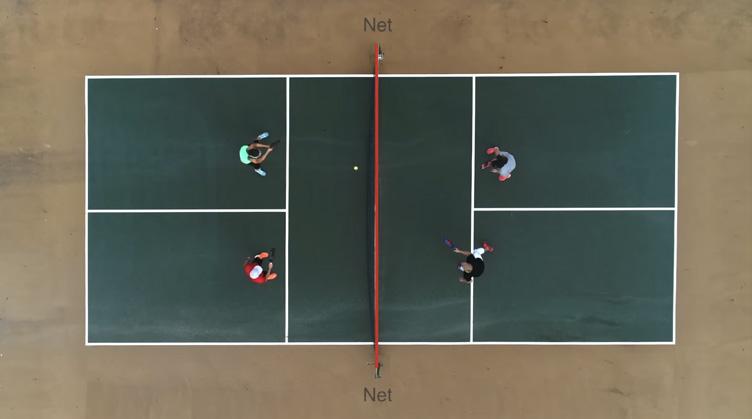
1. The court is similar to a tennis court, though much smaller, and can be used by two or four players.
2. The serve is done behind the service area and the ball must be struck underhand and below the waist. The ball must clear the net and bounce once on the service court diagonal to the server. There are no service faults in Pickleball, like in Tennis. If the ball hits the net and lands in the service box it is play on. If it hits the net and does not land in the box it is the loss of the serve for that server.
3. Ball is in play when it’s served to the opposing team’s service court. The ball is hit back and forth until it goes out of bounds, hits the net or bounces more than once on the court.
4. Scoring happens when the opposing team commits a fault when it’s your serve. Whenever you score a point, start your next serve from behind the other service court. Only the team that is serving can score a point. All games are played to 11 points.
BASELINE
KITCHEN (Non-Volley Zone)
KITCHEN (Non-Volley Zone)
LEFT SERVICE AREA RIGHT SERVICE AREA RIGHT SERVICE AREA
NET
LEFT SERVICE AREA
SERVING
• The game starts with an underhand serve.
• The serve must be hit diagonally across the court, landing in the opponent’s service area.
• The serve must clear the non-volley zone (7 feet from the net) and land in the service court.
• In doubles, the serve always starts from the right-hand court and alternates sides after each point.
• Only one serve attempt is allowed. No lets in Pickleball, it is either in or out.
DOUBLE-BOUNCE RULE
• After the serve, the receiving team must let the ball bounce once before returning it.
• The serving team must also let the return bounce once before playing it.
• After these two bounces, the ball can be volleyed (hit without bouncing) or played off the bounce.
• Players can volley the ball (hit it before it bounces) anywhere on the court except within the non-volley zone (also known as the kitchen).
• Stepping into the non-volley zone and volleying the ball results in a fault.
•
VOLLEYING NON-VOLLEY ZONE (KITCHEN)
• The non-volley zone extends 7 feet from the net on both sides.
• Players cannot volley the ball while standing in or making contact with the non-volley zone.
• Players can enter the non-volley zone to play a ball that has bounced but must exit before volleying.
SCORING
• Points are scored only by the serving team.
• Games are typically played to 11 points, and a team must win by 2 points.
• In doubles, both players on a team get to serve before the serve passes to the opposing team, except at the beginning of the game when only one player on the serving team serves.
FAULTS
• Faults result in the loss of serve or point. Common faults include:
◦ Failing to clear the net.
◦ Hitting the ball out of bounds.
◦ Volleying in the non-volley zone.
◦ Failing to follow the double-bounce rule.
SWITCHING SIDES
• Teams switch sides of the court after every game. In some formats, they may also switch sides when one team reaches 6 points.
WINNING THE GAME
• The game is played to 11 points, and the winner must have at least a 2-point lead. For example, if the score is 10-10, play continues until one team leads by 2 points.
TIPS FOR PLAY
• Strategy: Mix up shots with dinks (soft shots), drives, and lobs to keep your opponent guessing.
• Positioning: Stay alert to your positioning, particularly in doubles. Try to control the center of the court and work with your partner.
• Communication: In doubles, clear communication with your partner is key to avoiding confusion and ensuring effective teamwork.
If you need assistance during your session, please contact our