Magazine of the Corps of Royal Electrical and Mechanical Engineers
In 2020, REME launched the Lifting the Decks initiative, with a focus on the mental wellbeing of serving REME personnel and veterans.
We are in the process of re昀ning Lifting the Decks, increasing accessibility with an added emphasis on reminding our REME Family to speak out about ‘what’s on their mind’ and that, whatever stage in their life, we will always be here to listen to and support them.
If there is something on your mind troubling you, big or small, whatever the cause, we are here to listen and to help. If you wish to get in touch regarding yourself or concern for someone else, please don’t hesitate to contact woym@remecharity.org
Editor: Mrs Sarah Eden + Corporate Communications Officer
RHQ REME, The Prince Philip Barracks, Lyneham, CHIPPENHAM, SN15 4XX
TEXT: should be submitted in MS Word and name saved as per the article. No formatting, columns, power point etc. Articles to be cleared by CO/OC/EME or appropriate REME CoC, or nominated substitute and should be submitted as soon as possible.
PHOTOGRAPHS: MUST be submitted separately, in jpeg format and be at least 500kb preferably 1mb or more. Only photos over 3mb can be considered for the front/back covers and please remember captions.
FILESHARE: websites, such as dropbox are ideal for submitting larger files.
EMAIL: The ONLY email address which should be used is: craftsmaneditor@reme-rhq.org.uk. Not MODnet. Please use the article title not ‘Craftsman Article’ as the email title.
TIMINGS: The latest submission date is the first day of the month prior to publication. This does not guarantee the article will be published in that specific edition.
Births, Engagements, Marriages and Deaths: These will be inserted free to all past and present members of the Corps.
Contents:
The contents of The Craftsman are strictly copyright and all rights are expressly reserved. The views expressed herein do not necessarily reflect the policy and views, official or otherwise, of the Editor, the Corps or the MOD, therefore no responsibility for these will be accepted. Whilst including an advertisement we are not necessarily endorsing the product and as a result, the publisher and its agents do not accept responsibility for any transaction between the reader and the advertiser. Whilst we take all precautions with regard to advertising, readers are advised to take professional advice before entering into any commitments. Letters concerning reproduction, contributions or any other matter should be addressed to the Editor.
General Handling: This publication contains official information and should be treated with discretion.
A year as Chief Aircraft Engineer (Army)
Scribe: Colonel Simon Dutton MEng MA CEng FIET
This guest editorial is being written having been in the role of Chief Aircraft Engineer (Army) for just over one year. It has been a busy year for Joint Aviation Command (JAC) and REME Aviation and this article will reflect on what has been achieved throughout 2025 and what are aiming to achieve in 2026. Before I get into the details, I wanted to take the opportunity to state that I remain amazed at the outputs delivered across all levels of REME Aviation – the sheer determination and will to succeed, despite numerous challenges with tools, spares and deteriorating infrastructure, is a credit to our soldiers.
1 Aviation Brigade: going from strength to strength
JAC, specifically 1 Aviation Brigade (1 Avn Bde), had two significant exercises during 2025. The first major exercise was Ex PINION STORM in May, which saw the deployment of the Bde across northern Europe with activity taking place in Norway, Sweden, Finland and Estonia and included the deployment of 15 Apache AH-64E, 5 Wildcat and an attachment to the Bde of 3 Chinook – the largest Aviation deployment to have taken place in over 20 years. A momentous achievement that marks an early phase in Army modernisation. The second significant exercise was Ex PINION TITAN, a UK-based exercise that validated 7 Battalion as the Brigade Support Group to 1 Avn Bde and also marked 1 Avn Bde’s first full-scale deployment into the field, completing the transition to warfighting readiness across the tactical functions – another significant step on the development of the Bde.
REME Aviation: 2025 a year to remember
In terms of REME Aviation, work has continued at significant pace to reinforce the work of Project TITUS and increase retention in the pinch point trades of Tech Aircraft and Tech Avionics. The Project made some notable achievements throughout 2025. In April, the trial of Skills Based Supplement payments was initiated that introduced a tiered approach to additional remuneration based on the levels of authorisation Technicians and Artificers would be expected to hold; this trial will be in place for two years
to build evidence to potentially support the recommendations included within the HRAFI report.
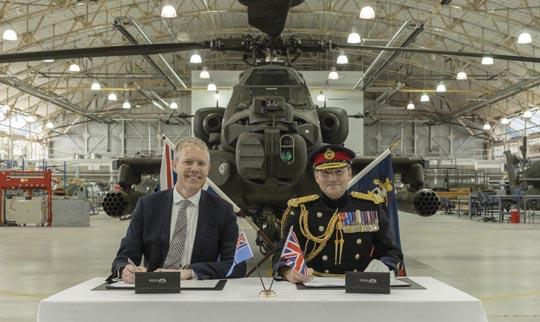
On 13 June 2025, the British Army and Civil Aviation Authority (CAA) signed a Memorandum of Understanding (MoU) to adopt a UK CAA Part 147 training system, creating an accredited pathway for REME Engineers towards a Part 66 civilian licence. This initiative recognises the REME Aviation Technician’s skills, training, experience and professionalism and supports the mantra of ‘train well, serve well, and leave well’. Subsequently, a Steering Group (RN, Army, RAF, CAA, RAeS) led by Director Support Air Command is exploring expansion of accredited pathways across the other Services over the next 12–24 months, considering current, future and retrospective training accreditation.
The signing of the MoU, a strategic milestone for Project TITUS, demonstrates the steadfast commitment of the British Army and CAA to retain alignment of training standards within the two organisations. In addition to formalising the training of new Technicians, it crucially acknowledges the training and experience of all Technicians currently serving with REME Aviation that will enable them to apply for a civilian Aircraft Maintenance License, when leaving the Army (provided they have reached the criteria that will be detailed within Corps Instructions E8). The move towards this accredited pathway for REME Aviation, through changes to training and employment of Technicians is a generational change that will require support at all levels.
Joint Aviation Command: the future is digital
As we embark into 2026, the activity and change within JAC will remain high. The Avn Bde will be spending the bulk of the year inculcating the lessons gathered during 2025 and ensuring they are fully prepared for their involvement in Ex STEADFAST DEFENDER 27 and continuing the journey towards Apache Full Operating Capability. Within the Uncrewed Air System (UAS) Group of JAC, 2026 will see the new UAS system (Eagle) achieve operational readiness within 32 Regt RA and 2026 should see the replacement of Watchkeeper, under Project CORVUS, delivered to 47 Regt RA and the transition to the new capability commence at pace. Additionally, the CAE Team are working closely with the DEEAMS programme to
Col Simon Dutton MEng MA CEng FIET
understand when and how elements of JAC can commence the transition, with the UAS platforms the first units identified within JAC to undertake this transition. To prepare other elements of JAC for this move towards digital asset management and work recording, there is an intent to investigate the ability to adopt electronic certification using the current GOLDesp system – learning the lessons from a trial undertaken by the Royal Navy at RNAS Yeovilton.
What next for REME Aviation?
For REME Aviation, sustaining the changes under Project TITUS will remain the main effort. 2026 will see the graduation of the first Initial Trade Training course following the CAA A license syllabus at the School of Army Aeronautical Engineering (SAAE) and the first Supervisor Course, aligned to CAA Cat B licence modules will commence in February. Work continues to ensure the courseware for the Senior Supervisor Course is developed and ready for implementation in 2028.
In addition to the work to reinforce the retention of Technicians, we have initiated a study to focus on the recruitment of Aviation Artificers and Aircraft Engineering Officers (AEO), where the numbers attending training have been consistently lower than expected for some time. In terms of AEO career management, we are working with Army HQ to create a more balanced structure with increased opportunities at SO3 level. We have secured an exchange appointment with Australia so we can share our engineering knowledge of Apache AH-64E. We have also secured the first place for an AEO on the Flight Test Engineer course, that will qualify for appointments within the Air & Space Warfare Centre conducting Test & Evaluation of new capabilities. As the use of drones across the Army increases, we are looking at how we can provide advice and guidance to support maintenance of drones across the wider Field Army.
Beyond this, the Corps must be prepared to meet the proliferation of UAS of all sizes and the needs of the Army to rapidly innovate in this space. The near-term challenge for REME is how to ensure an appropriate degree of expert ES advice and airworthiness assurance is available to Army commanders. This potentially goes beyond routine maintenance into design, adaptation and use of emerging technologies, and could include upskilling of REME soldiers outside of the current Aviation trades. More broadly, the intent across REME Aviation is to encourage and support the increased professionalisation across all ranks, with professional registration (EngTech, IEng or CEng) in a Professional Engineering Institute a key target to increase.
In conclusion
I remain privileged to have been appointed to the role of Chief Aircraft Engineer (Army) and throughout a busy 2025 and what looks to be a challenging 2026, I aim to make positive changes to improve the outputs of Army Aviation and provide an operationally focussed capability that will support the Army through these turbulent times.
I encourage anyone interested in a role within REME Aviation to reach out and engage with members of the CAE Team or SAAE to discuss what opportunities exist.
CAE Team:
DCAE – Lt Col Paul Isitt
SO2 Plans – Maj Phil Dyer
SO2 Assurance – Maj Les White Trade Champion – WO1 (ASM) Gaz White
SAAE:
CI – Lt Col Josh Lively
OC 650 Sqn LAD – Capt Teah James
(Capt Marc Burchell wef Mar 26)
ASM – WO1 (ASM) Glynn Pirie
Lt Gen Sir David Eastman KBE signing the Memorandum of Understanding with the CAA
A Look at Life: 16 RA Workshop –Engineering Excellence on the Front Line
Scribe: Capt Turner. Photographs courtesy of Clearshot photography
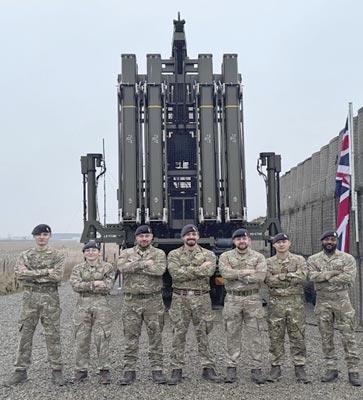
In the dynamic world of Ground Based Air Defence (GBAD), 16 Regiment Royal Artillery (16RA) stands as a beacon of innovation and readiness. As the sole unit in the British Army equipped with the cutting edge Sky Sabre (SkS) system, 16RA faces the unique challenge of being perpetually prepared to deploy at a moment’s notice, from the plains of Poland to the windswept Falkland Islands, and beyond. This commitment demands not only state of the art equipment but also a highly skilled and adaptable team of Royal Electrical and Mechanical Engineers (REME) at its heart.
Here at 16RA, our REME personnel are deeply integrated into the sophisticated SkS system, working tirelessly on its core components: the Network Land Ceptor (NLC) for intercepting threats, the Giraffe Agile Multi Beam (G-AMB) radar for a comprehensive air picture, and the Surface to Air Missile Operation Centre (SAMOC) as the central command hub. We also maintain the unique Land Environment Air Picture Provision (LEAPP) capability, connecting G-AMB with Control Nodes (CN) and Air Picture Trailers (APT) to feed Link 16 tactical data.
On Deployment: From Poland to the South Atlantic
Our commitment to readiness has seen 16RA personnel deployed to various challenging environments. Recently, the Regiment concluded a significant three year deployment in eastern Poland as part of Op STIFFTAIL. Here, our teams played a pivotal role in NATO’s defence strategy, safeguarding Rzeszów Airport, collaborating closely with Polish and US forces to protect aid routes to Ukraine, and strengthening vital international defence relations. This 24-hour operational environment allowed our Engineers to identify strengths, highlight weaknesses, and significantly enhance the lethality of air defence.
Reflecting on the experience, Cpl Watson shared, “Op STIFFTAIL, in my opinion, was one of the best deployments I have been involved with. It was a unique experience, especially in terms of how we operated out on the ground. The NAAFI facilities we had access to, as well as the
OC 16 RA Wksp, Maj A Deacon, plays his part during a serial in ‘War Friday’
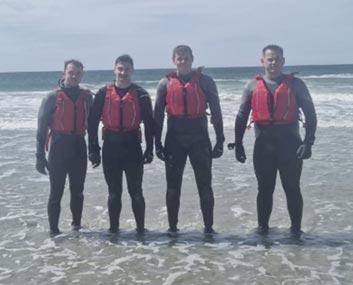
Troops making a splash while deployed to BFSAI
accommodation, were kept to a high standard and made the time away from families and friends more tolerable.”
Beyond the demanding work, our soldiers also embraced the opportunity to experience Polish culture, visiting the Rzeszów mines, Kraków Christmas markets, and local music festivals.
Meanwhile, the Regiment maintains a continuous rotation in the Falkland Islands, providing another unique environment to experiment with and improve the SkS system. Exercises like PHANTOM SABRE allow our REME teams to excel in fault-finding and optimising the equipment’s versatility alongside operators. The Falklands deployment offers its own distinct challenges, as articulated in a recent update from 14 Battery Fitter Section:
“When it comes to operating in challenging environments, few settings rival the harsh and unforgiving conditions of a Falkland Islands winter, particularly in the demanding field of mobile radar systems and GBAD platforms. The combination of extreme weather, remote terrain, and unpredictable supply chains presents a challenge unlike any other for the team. Elements of the Workshop, including REME and RLC personnel, have been deployed as part of 14 Battery’s sixmonth rotation. Their efforts have focused on keeping the critical SkS platform operational, from diagnosing complex faults on the launcher module to addressing persistent issues with the ageing Land Rover fleet. Their tireless work has been essential in ensuring all assets remain mission-ready and able to deploy whenever Commander BFSAI deems it necessary.
troops
One example of this was the recent island wide readiness exercise, which tested the Mount Pleasant Complex’s ability to respond to a wide range of potential threats. The exercise involved all three services working together towards a common goal. For the Battery, the primary focus was on deploying the SkS system to maintain an active aerial picture and ensure a robust GBAD capability. Meanwhile, for the Workshop team, it meant being constantly prepared to deploy to various SkS sites at short notice, both day and night, swiftly diagnosing and resolving any faults to ensure the Battery could successfully achieve its mission.
Alongside their main operational output, the workshop team have certainly made the most of the unique opportunities that being deployed to the Falklands presents. These included a helicopter bid to Volunteer Point, where they soaked up the stunning coastline and enjoyed the incredible wildlife on offer, from Penguins and Elephant Seals to a pod of Orcas. The team also participated in several battlefield tours, an important opportunity to learn about the history of the Falklands while enjoying some fresh air. This was a
welcome change, given the amount of time spent indoors traversing the world’s longest corridor to and from the cookhouse. This is alongside tours of HMS Forth, the Royal Navy ship stationed on the islands, flights aboard the RAF’s A400, and guided visits to the pristine RAF Typhoon hangars. And of course, the team had to give the most southern park
REME and 16 RA personnel increasing their ‘lethality’ during one of the weekly ‘War Friday’ serials
Workshop
on deployment on Op STIFFTAIL in Poland
run a go on a rare Saturday off!”
Quotes from the team highlighting their varying activities and individual highlights:
“During our BFSAI deployment, our small maintenance team tackled challenging tasks with skill and perseverance to maintain the state of the art SkS System. With the right attitude and a motivated team, we ensured equipment availability and upheld a reliable presence across the Falklands. It was a privilege to work with such a dedicated group.” Cpl Hugh-Jones REME Tech “With Winter fast approaching, the RSSB workshop thought it was a good idea to climb Mount Usborne, the highest peak on East Falkland Island. It is an exhilarating adventure that combines breathtaking scenery with a rewarding physical challenge.
Standing at 705 metres, this rugged summit offers panoramic views of the island’s rolling landscapes, shimmering coastlines, and the vast South Atlantic beyond. It’s not just a hike but a chance to embrace camaraderie, test resilience, and enjoy a unique slice of the Falklands’ natural beauty. The journey to the top is peppered with wildlife encounters, from curious Upland Geese to Turkey Vultures, making it as much about the experience as the destination.” – LCpl Dawson REME Tech
“During my deployment with 14 Battery in the Falkland Islands, I had the rare opportunity to visit the Royal Research Ship (RRS) Sir David Attenborough. The ship’s scale and advanced technology, designed for polar exploration and scientific research, were remarkable. Witnessing the facilities supporting climate change and marine life studies in the Southern Ocean was a highlight of my time in the Falklands,” Cpl Adu-Gyamfi REME VM
LCpl Cooper fondly recalled one highlight: “Surfing in the Atlantic Ocean with Dolphins was class! Definitely one of the best moments in my military career.”
Life Back Home: Thorney Island and Beyond
Back in the UK, 16RA balances rigorous training with a vibrant social calendar. Thorney Island, our home on the South coast, proves to be a hidden gem. LCpl Haslam describes it as “a great location. [It] has its own beach on the island and a decent water sports centre that will loan out kit for different sports.” This provides ample opportunity for summer functions, BBQs, and even beach Volleyball.
Our REME personnel are also at the
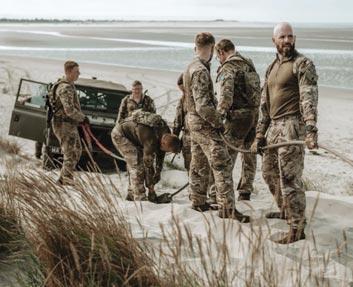
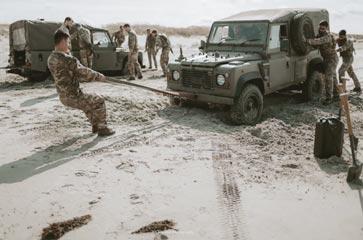
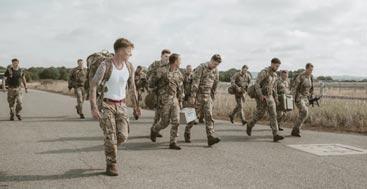
SP carrying kit to the beach while on a Recovery serial during a War Friday
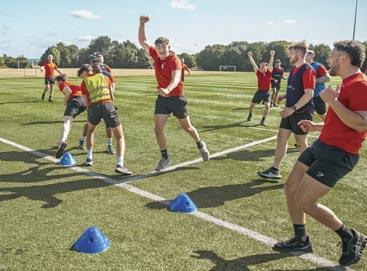
Not Quite! Troops celebrate in the final moments of the game despite the player’s foot clearly not being inside the scoring box!
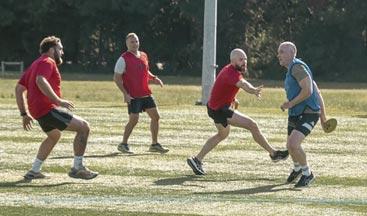
The Corps ASM gracefully dodging the OC Wksp during a game of One Touch with the Corps Colonel looking on in awe
forefront of physical challenges, excelling in events like the Regimental Hyrox competition and the British Army Warrior fitness competition, where we’ve proudly triumphed over the Royal Artillery. However, the constant demands of a high readiness unit can bring their own pressures. LCpl Unsworth noted, “The location is gleaming but sometimes the amount of ‘fastballs’ can impact our work on fleet availability.”
Major Alex Deacon, the Officer Commanding, reflected on the broader challenges: “Balancing the ‘down and in’ with the ‘up and out’ the split between dedicating time and energy to Troops and the workshop vs that spent on optimising SkS system as a contingent warfighting capability.”
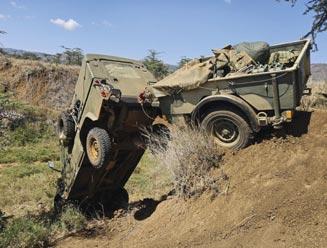
To further enhance regimental lethality, 16RA regularly conducts “War Friday” serials. These intense sessions often involve “green PT,” with the REME Workshop leading the charge. A recent serial saw everyone racing to carry kit to the beach to recover two bogged-in Land Rovers, a true test of strength and teamwork, as captured in the accompanying images.
Wider Horizons: Op LAZURITE and Adventurous Training
The Spirit of Competition: “One Touch”
Beyond formal exercises and physical training, the spirit of innovation extends to our recreational activities. The OC himself devised a unique game called ‘One Touch’, which has become a firm favourite within the Workshop. This engaging game; featuring the Corps Colonel, fosters camaraderie and competitive fun.
‘One Touch’ - The Jarvis Rules: This dynamic game is ideally played with 8-24 participants, with 14-18 being the sweet spot for optimal flow. There are no outer boundaries, allowing for expansive play, and the size and separation of the goal areas are flexible, defined by the number of players.
Possession of the ball is highly contested and can change hands in two key ways:
If a member of the opposing team touches the player with possession.
If a thrown pass goes to the ground (is dropped).
After a turnover, the team that gains possession receives a free restart, with the first pass being “free” and offering a bit of space, although players can also choose to run with the ball immediately.
Kicking the ball is permitted. If a player attempts to catch a kicked ball but drops it, it results in a turnover. However, if no catch is attempted, play continues after the bounce. A strategic advantage is gained by any player who successfully attempts and completes a catch from a kick, as this earns their team a free restart.
A goal is scored when the ball, while connected to an attacking player, enters the designated goal area under control. This can be achieved by an attacking player with possession running into the goal area, or by a “goal-hanging” attacker receiving a pass within the goal area (even if the ball itself is just outside but connected via the outstretched player).
Life at 16RA isn’t confined to traditional REME roles. Some of our personnel have deployed on Op LAZURITE, a truly insightful scheme providing support to refugees from Afghanistan, assisting with their rehoming and acclimatisation to life in the UK. This work offered a profound insight into the societal impact of conflicts.
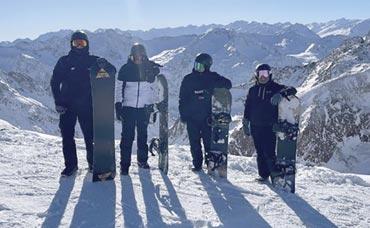
We also embrace Adventurous Training (AT) with gusto! A group recently honed their skills skiing and snowboarding on Ex SUPREME GLACIER in Austria, immersing themselves in Austrian culture amidst stunning mountain scenery. Another remarkable opportunity was Op CANARY UNIQUE, a six-week sailing expedition from Gosport to the Canary Islands, with stops in Portugal, Spain, and France. LCpl Haslam enthusiastically stated, “Sailing from Gosport to the Canary Islands over 6 weeks was one of the best experiences I have had in the Army. I would highly recommend offshore sailing experiences to anyone.” These expeditions not only develop vital skills but also provide incredible, life-enriching experiences.
Troops from 16RA Wksp loving life atop a mountain on Ex SUPREME GLACIER
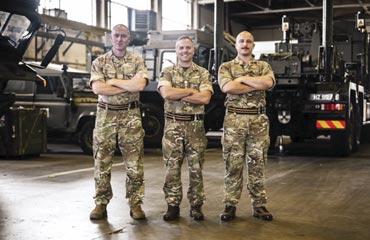
The REME Corps Colonel, ASM, and Adjutant in the Wksp posing for a brief photo opportunity during the busy visit
Pushing the Limits: The Nijmegen Marches
Beyond the usual scope of deployments and adventurous training, some of our soldiers recently took on a formidable challenge: the 107th Nijmegen International Four Day Marches (NM25). Held from 15 - 18 July 2025 in the Netherlands, this event is the largest of its kind globally, attracting a staggering 47,000 civilian participants from 73 nations, alongside 6,000 military personnel from over 30 countries. The British Military Contingent (BMC) invites individuals and teams from across the Services and Cadet Organisations to participate.
The march itself is a true test of endurance, requiring participants to cover approximately 40km (over 100 miles in total) on each of four consecutive days. For male military participants born between 1 January 1976 and 31 December 2006, there’s an added challenge: carrying a mandatory 10kg in British military-style webbing/daysack/Bergens (excluding water, food, or other consumables).
Cfn Swatton, reflecting on his experience, shared: “In my opinion, Nijmegen was one of the best things I have done. Even though the four days of constant walking was very gruelling and took a heavy toll on a lot of people’s feet, the atmosphere that is created by the 1,000,000+ supporting you
as you walk through each town and village is something I will never forget, and I recommend anyone thinking ‘it’s just a walk’ to give it a go.” He added, “The Nijmegen march is a 100+ mile walk over 4 days which was first created in 1904-1908 to improve soldier’s physical conditions. I did it because I had heard about it through people I know and when I got told 16 RA Workshop was entering a team, I jumped at the chance to get on it as all I thought it was ‘just a walk’.”
A Visit from Corps Leadership
In July 2025, 16RA Workshop had the distinct honour of hosting a visit from the REME Corps Colonel (Colonel Iain Wallace ADC OBE), accompanied by the Corps ASM and Corps Adjutant. Their visit began with a challenging Hyrox circuit hosted by 12RA, the other unit on Thorney Island. Following this, they joined 16RA Workshop for a lively game of ‘One Touch’, demonstrating their engagement with the soldiers.
The visit continued with presentations from both 16 and 12 RA REME, outlining their capabilities and the challenges each unit is currently navigating. This provided a valuable platform for open dialogue. Corps leadership then took the time to speak directly with soldiers, gaining a deeper understanding of their lived experiences within the units and seeking ways to improve their well-being. The visit culminated in a welldeserved lunch at the Warrant Officers’ and Sergeants’ Mess. Before departing, the Corps Colonel delivered an insightful brief to all attendees on the state and future direction of the Corps; painting a very positive and promising outlook for REME.
The Road Ahead
So, what’s next for 16RA? Later this year 16RA Workshop will be deploying simultaneously on Op LUMINOUS and to the Falkland Islands, which will provide ample opportunity for our tradespeople to further develop their skills while supporting real-world output.
I asked 16RA Wksp’s AQ: When looking ahead at what 16RA Wksp will be doing, what are you most excited for? AQMS Bent: “Further honing SkS’s Medium-Range Air Defence (MRAD) capability and Land Equipment Air Provision Picture (LEAPP) tactics, mastering cutting-edge radar and data-link systems (Link-16), and demonstrating technical experimentation and skills during key joint exercises with NATO. Deepening ties with 12 RA (G1X radar and Stormer) and 7 Air Defence Group, gearing up to uphold the UK’s GBAD supremacy from Thorney Island as the MIAD Cap Uplift enters the next stage and the Regiment increases equipment from two fighting Batterys’ to four fighting Batteries’ worth of Air Defence equipment. Along with expecting engagements with the newly formed King’s Gurkha Artillery, as interoperability evolves alongside the Regiment’s operational role and ever-increasing public visibility of the UK’s only Medium-Range Air Defence capability.” Just a few things then!
Being part of 16RA means a continuous challenge not just to maintain SkS, but to work hand-in-hand with industry to improve it, adapt with its evolution, and learn from the ground up on this revolutionary equipment. This is an exciting time, taking our tradespeople across the globe. While the future holds new challenges, our team of eager tradespeople stands ready to deploy, develop the kit, and enhance its capability. We are ready and waiting for the next challenge.
Workshop SP posing for a picture while in Nijmegen
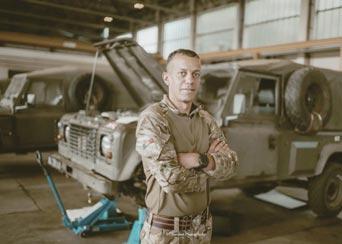
The Wksp AQ, WO2 Jason Bent, posing enthusiastically for his picture to be taken
Forging Strength in the Field: 15 Field Company on EX MILVUS ASSAULT
Scribe: WO1 Boyle
As part of the ‘Soldier First’ phase of 5 Battalion REME’s commitment to CYCLONE/STORM 25, 15 Field Company deployed to Longmoor Training Area to take on Ex MILVUS ASSAULT. This five-day package was designed to sharpen core soldiering skills, build Platoon-level cohesion and ensure the Battalion maintained its ‘Craftsman always’ ethos.
From the initial step-off the exercise demanded grit, focus and adaptability. Longmoor’s rolling ground and dense woodland offered the perfect mix of open killing areas and thick snagging gorse. The terrain slowed movement, obscured visibility and tested command and control at every level. The challenge was heightened by changeable weather, with bright sunshine one moment and sudden showers the next, keeping Platoons on their toes and reinforcing the need for constant situational awareness.
Training intensified with each passing day. Patrols at first light, harbour drills deep into the night, and sectionlevel attacks under pressure all laid the foundation for success. Every serial reinforced the fundamentals of soldiering: shoot, move, communicate, and medicate. By mid-exercise, both Platoons were starting to operate as cohesive teams with good communication rippling down the line, Sections bounding forward with precision, momentum and aggression, underpinned by Commanders making confident decisive calls under pressure.
Morale remained high, even as fatigue set in. The long hours and weight of full kit were met with determination
and good humour. While small victories, by way of welldelivered orders, well-executed reconnaissance patrols with slick harbour area routines and the satisfaction of moving as a single effective unit, kept spirits buoyant. These moments reminded all ranks that soldiering is as much about trust, resilience, and teamwork as it is about tactics.
The final day brought the culmination of the exercise with Deliberate Platoon attacks. Two platoons launched their own assault against a dispersed and well dug-in enemy with further depth positions. Though independent, the attacks ran simultaneously, with both platoons applying the full weight of their training to close with and defeat the enemy. Fire support was precise, manoeuvre was aggressive, and command and control were maintained throughout. Both platoons achieved their objectives with confidence and professionalism, demonstrating just how far they had come over the course of the week.
Ex MILVUS ASSAULT was more than a training progression. It represented a vital step in preparing 5 Battalion REME for its upcoming commitments, reinforcing the Battalion’s ethos that every tradesman must be a soldier first. By mastering the fundamentals under testing conditions, 15 Field Company has ensured that when called upon, it will deliver with the same determination and professionalism displayed on Longmoor’s training grounds.
15 Field Company left Longmoor sharper, stronger, and ready for the challenges that lie ahead.
The Royal Scots Dragoon Guards Light Aid Detachment LAD ventures abroad 2025
ROMANIA LCpl Drummond
On an unexpected sunny day in Scotland, the Royal Scots Dragoon Guards (SCOTS DG) departed Leuchars station to conduct the 1,200km road move to Romania as part of the Allied Reaction Force (ARF) deployment on Ex STEADFAST DART. HQ and B Sqn Fitter Sections were
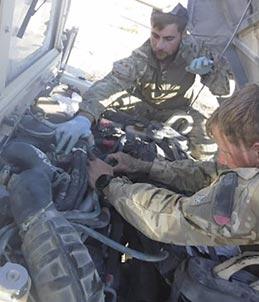
responsible for providing ES whilst the Regt moved from the port in Alexandroupolis, Greece, through Bulgaria and then into Smardan, Romania. The Fitter Sections conducted roadside repairs ensuring vehicles arrived in CSCs for more indepth repairs by 1REME and 2REME. The exercise started and the Regt moved another 120km to Babadag Training Area where CT A-C training was conducted whilst the Fitter Section worked tirelessly and managed to keep an impressive vehicle availability above 90%. A well-earned break in training allowed for a NATO integration day; this included vehicle platform walk around, weapon and equipment demonstration and trading of war stories. After a very successful exercise and demonstration of the ARF’s fast deploy ability, it was time to conduct the 1,200km road move back to Leuchars via the same route. All vehicles arrived back in Leuchars station with no need for recovery, signifying the LAD’s ES capability and high level of repairs.
USA LCpl Jenner
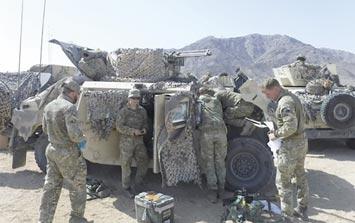
C Sqn Fitters of the SCOTS DG left a very unexpected warm Leuchars in March for an even warmer California on Ex DIAMOND BACK, or so we thought. This was a NATO building exercise working with the US Army 69 Cavalry Regiment to showcase reconnaissance, combat effectiveness and mental resilience in arduous conditions. We arrived at the training area, which was being bombarded by heavy rain turning the
The LAD working on the US HUMVEEs
LCpl Hogg and a Romanian counterpart
The B Squadron “Mutants” Fitter Section
desert into thick mud that resembled the Somme, then an overnight change to the expected 35-to-40-degree heat. Operating in a harsh, quick changing environment placed an increased stress on both British personnel and equipment, but showed us a valuable lesson to be prepared for anything. The exercise was intense, fast moving and incredibly difficult to navigate in the desert with no obvious features to use for map reading. This was all whilst trying to coordinate movement and fire between the British, using American Humvees, and the US troops, who were operating on Abrahams (MBT) and Bradleys (Infantry Fighting Vehicles). Ex DIAMOND BACK was more than just a tactical drill exercise, it was an opportunity to strengthen ties with our allies and to test our strengths in the field combining REME, anti-tank and snipers. This helped build resilience in the most challenging areas (the desert) and quick changing climates.
Finland LCpl Jackson SCOTS DG A Sqn Fitters deployed to Finland for two sub-unit exercises: Exercise MIGHTY ARROW and Exercise KARELIAN SWORD. After arriving in the City of Tampere, the team had a week to acclimatise to the snowy conditions; making the most of Finnish culture with saunas and cold dips in the camp’s lake. The vehicles arrived at Pori Port on 15 April, marking the start of REME taskings; there was thankfully only one breakdown from the port. The LAD was responsible for maintaining a fleet of 30 vehicles including Jackals/Coyotes, Land Rovers, Panthers, and other support vehicles, with a capable team of VMs, Techs, Recovery Mechanic, and all led by SSgt Mayberry.
Before the exercise began, the Squadron enjoyed a day of paintballing, and the LAD visited the German ES team conducting a Boxer engine change, providing an opportunity to learn from allied partners. Exercise MIGHTY ARROW saw SCOTS DG working alongside Finnish, German, Lithuanian, and other allied forces, sharpening green skills and experiencing Finnish rations. The SVR supported multiple recoveries in the soft, wet terrain. After post-exercise admin, the squadron took part in LFTT (Live Firing Tactical Training) to stay current with range requirements which included a 5km Platoon attack supported by AH47. We had an opportunity for a day of horse-riding and a short break, during which the LAD explored Helsinki. The deployment concluded with Exercise Karelian Sword in Vekaranjärvi, involving over 5,000 troops. SCOTS DG played a key role in reconnaissance and
Work in progress
The C Squadron team on Ex DIAMONDBACK, led by SSgt Adamson and Lt Rachel Parker
Fitter Section vehicles
intelligence gathering to support the Finnish forces. The deployment was a resounding success and a memorable experience for all involved.
LAD Homebase Cfn Van Zyl
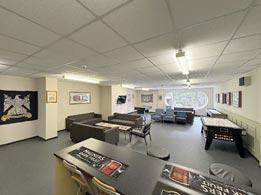
Following completion of several redevelopment sites across Leuchars Station, SCOTS DG LAD moved into a new workplace. The LAD previously had shared workshop floor space but were now fortunate to have the entirety of the building. The office space had a large restroom area that was desperately in need of some work. We moved all the memorabilia from the old building to the new one and after deciding where things should go, the walls were painted, and new panelling was installed to create a 3D feature wall. Frames were mounted on the walls which included Squadron specific photo boards and souvenirs from past exercises and operations. We also procured different games tables; which included a shuffleboard and a table tennis / air hockey table as well as a PlayStation 5. With the addition of a tuck shop and some comfy sofas the restroom became a great space for the whole LAD to enjoy. With it now complete, the restroom was given the name The Foundry in memory of Craftsman Andrew Founds who served with the Royal Scots Dragoon Guards LAD and was K.I.A in 2010.
Recovery serial
Sqn at End Ex
HMTV repair behind Sqn leaguer
EXPLORER: REME Sailing Club AT Expedition April 2025
Scribe - Sgt Phil Cartlidge
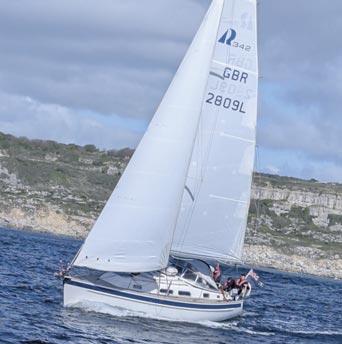
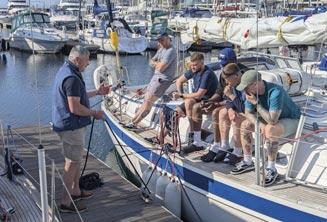
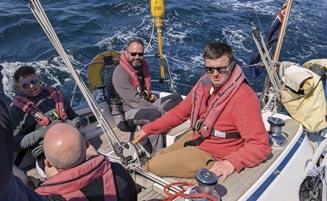
Just after Easter 2025, the REME Sailing Club’s offshore Section ran Ex SEAHORSE EXPLORER. This was an adventure sailing expedition delivered in two one-week legs for serving REME sailors along the South Coast of England using the Corps’ two Hallberg Rassy 342 yachts (CRAFTSMAN and SEAHORSE). Starting at Hornet Services Sailing Club in Gosport (where the yachts are based), the expedition sailed West for seven days to Plymouth. When the boats reached Plymouth, the crews changed before sailing East back to Hornet over the following week.
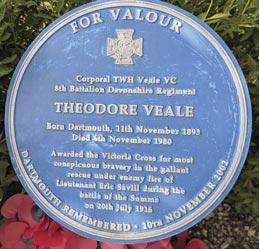
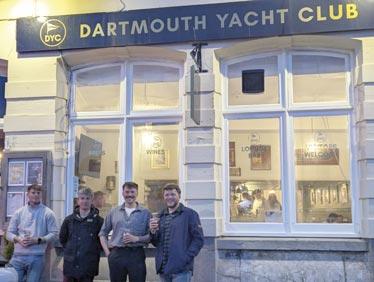
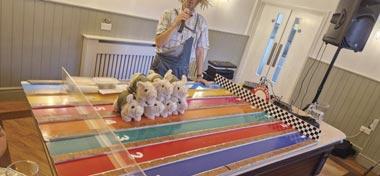
It was a fantastic expedition. All those who took part really enjoyed it. During week one, the weather gods were kind and provided light winds and lots of sun (which was very strange for Apr). Although the weather was good, it meant that there wasn’t always enough wind to sail, and unfortunately the boats had to revert to diesel power. On route, the week one crews stopped at Yarmouth, Weymouth, Dartmouth, Salcombe and Plymouth. The leg between Weymouth and Dartmouth was the best and longest of the week (52 nm). Not only did the crews get to sail through the night and navigate by the stars but they were also accompanied by a pod of Dolphins (which no matter how many times you’ve seen them is always magical). Because of the night sail, the flotilla took a rest day in Dartmouth to enjoy some extra sleep, ice creams, pig racing at Dartmouth Yacht Club and took time to visit a memorial to local VC winner Cpl Theodore Veale (Serving in the Devonshire Regiment he showed conspicuous gallantry when he saved the life of a junior officer at the Battle of the Somme in 1916). On the following day, close to Salcombe the crews took the opportunity to swim off the back of the boats. The swimmers did not realise that despite the warm air temperature, the water temperature was still low, which meant that their swims were mostly limited to jumping in and then climbing straight out again in a matter of seconds.
On the return leg, the boats stopped at
Boat cook out did himself with a cream tea lunch in Salcombe
Craftsman sailing in company with Seahorse
Dartmouth, Weymouth, Poole and Cowes before returning to Gosport. The Skippers worked the second crews just as hard as the first had been. In order to make it past Hurst Gap with a fair tide, the boats left Poole in the dark. However, this did allow the crews to experience sun rise as they crossed Christchurch Bay (another magical experience) while sipping steaming hot mugs of tea. Unlike the first week, the weather gods were not so kind. The boats were buffeted by strong winds; however, the Corps HR 342s are very robust boats which are well cared for by the Corps’ Boatswain. In addition, the crews reefed the sails to cope with the gusts. Some of the crew did not adapt well to life onboard the boats. On the second day of the return leg, several of the crew were made seasick by the rolling waves (and definitely not because of overindulging the night before).
Throughout the expedition, the crew prepared and cooked their meals on board. However, the crew on SEAHORSE nearly caused a riot in Salcombe, Devon. They ate their scones the Cornish way (jam before cream). Fortunately, they were able to eat all of the evidence before the local mob formed with their burning torches and pitchforks to put them right and remind them that they were not in Cornwall!
Ex SEAHORSE EXPLORER was planned by the Rear-Commodore Offshore (Fergus Sullivan) and the Corps Offshore Boatswain (Phil Cartlidge) and was delivered by Phil, Tom White and Stuart Tribelnig. It was designed to be an expedition for qualified REME Sailors to gain sea miles and sail in waters other than the Solent in order to develop towards higher RYA qualifications. Therefore, the priority for crew selection was for non-novices. This objective was partially met; Both Skippers for the first leg were NCOs (Phil Cartlidge and Tom White). However, 12 of the 20 crew were complete novices – of these, three qualified as RYA Competent Crew under the instruction of Stuart Tribelnig. The crew of 20 included 1 Reservist and consisted of 12 JNCOs and Craftsmen, four WOs and SNCOs and four Officers. This shows that sailing in the REME is open to all no matter their rank or experience.
LADs, Wksps and REME Bns thinking about running AT should consider sailing with the REME Sailing Club as the yachts are available at zero cost for REME units for expeditions, training and even away days. We are available to help with qualified Skippers, the planning and have template documents to help with both UAAT and JSATFA risk/safety planning. During the late autumn and winter, we race in local club races at weekends and are always looking for crew to come and join us (a great way for individuals to get some quality days on the water). The yachts are also available
Some of the crew outside the Dartmouth Yacht Club, who kindly invited us for a night of Pig racing
Pig racing in Dartmouth Yacht Club
Memorial to Cpl Theodore Veale VC in his hometown of Dartmouth
for charter by families, privately and by nonREME units.
The REME Sailing Club has four different Sections – offshore, dinghy, kite surfing and wind surfing. It is open to all REME personnel, serving and veteran, regular and reserve and dependants. If you are interested in finding out more about sailing with the REME either email vice.commodore@remesailingclub.com, go to https://www.remesailingclub.com/index.html (search “REME Sailing Club” on your preferred browser) or follow us on Instagram.
In Apr 26, we will be running our Ex SEAHORSE EXPLORER for existing and novice REME sailors. Week one is Mon 6 – Sat 11 Apr 26 and Week two is Mon 13 – Sat 18 Apr 26. If you are interested, please follow the link to the expression of interest.
Stuart Tribelnig covering some of the Competent Crew syllabus
Sunrise over Bournemouth, whilst crossing Christchurch Bay
Crew of Seahorse settled in for the long haul on route to Weymouth
Expression of interest Ex SEAHORSE EXPLORER 26
REME Sailing Club Instagram page
Ex JOEY DOLOMITE: 2 FS Bn AT Expedition
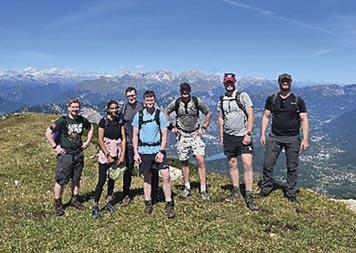
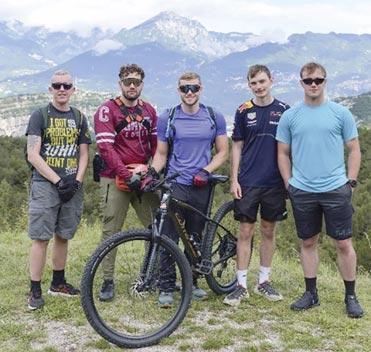
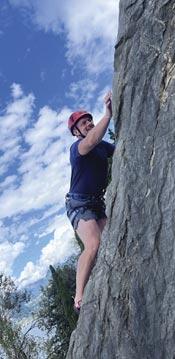
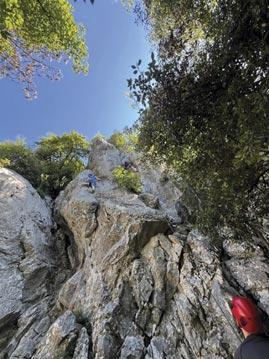
In September 2025, 7 Fd Coy 2 FS Bn REME conducted Ex JOEY DOLOMITE, a weeklong Adventure Training (AT) expedition to the Dolomite Mountain Range, Italy. 18 personnel took advantage of the pleasant climate, local cuisine and great activities. These activities included 5 days of either Mountain Biking, Rock Climbing or mountaineering. Whilst the majority flew to location, a small party drove a combivan containing the climbing equipment and bikes over 2 days; which ironically was the better option as will be explained by the end of this article! The aim of the expedition was to deliver foundation courses in Mountain Biking and
Massive shades are compulsory for the mountain bikers. Cfn Percival did not get the memo
WO2 Thorpe enjoying the fine limestone crags in the region
Scribe: Lt Jonathan Harding
mountaineering in a new environment for many, whilst also enhancing team cohesion.
The base of operations was out of a comfortable Hostel on the shores of Lago di Garda, in the picturesque, however touristy, town of Riva Del Garda. With ample restaurants serving the finest pasta and pizza within short walking distances alongside other recreational establishments. This region of Italy is known for its fine wines but more importantly is renowned as the “birthplace of sport climbing” with many impressive crags whilst boasting abundant mountain bike trails and mountaineering opportunities. This proved to be accurate as the 3 activities were thoroughly enjoyed by all the groups.
Although stormy and wet weather dominated the forecast in the days leading up to the expedition, the weather held throughout the week leading to 25+°C sunshine days permitting swimming in the cool Lago di Garda after sessions to soak weary legs. The mountain bikers always seemed to make it back for just the hottest part of the day! The mountaineers would usually come back in next after spending probably too much time and money at the rifugios (the alpine mountain huts that served all the strudels and spaghetti you could want at over 2,000 metres). It was such a coincidence that a rifugio had been built perfectly at the halfway point of the hike. Meanwhile, for the rock climbers, SSgt Mutch kept them hanging on late into the afternoon, truly making the most of the great conditions. He is a PTI after all.
The mountaineers enjoyed the rifugio to such an extent
The rock climbers on some technical terrain
Is it left or right? Sgt Steele eyeballs which way to go
The Sgt Maj always looking up
they slept over in one during their 2-day expedition. Now, what makes staying in the huts so great is the lack of requirement to carry sleeping bags, tents or food. However, what did not help, was the instructor insisting on hiking the steep route meanwhile ‘Jeep Taxis’, were simply driving their clients up to the rifugio so they remained fresh for the next day’s activity for just 13 Euros. Safe to say, those taxis were used on the way back down.
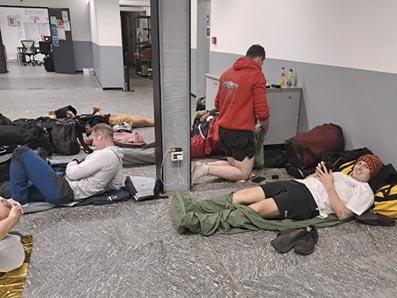
Overall, the 5 days of activity were thoroughly enjoyed by all who participated. As a location to conduct AT, the Italian Dolomites are hard to beat and would be recommended to any future AT organisers reading. As promised, this is where the success ends. It was never going to be easy. On the return journey home, the flyers had a difficult time. Arriving at Milan Malpensa at 0800hrs, this was the day the airline cabin crew decided to strike, it also coincided with the F1 in Milan and hence no hotels were available in the vicinity. This led to a 24-hour overnight stay using bags as pillows and foil blankets as mattresses.
Despite the travel disruption, the expedition was an overall success. 10 personnel achieved foundation AT qualifications, the cohort spent a week in one of the most stunning locations within Europe and unquantifiable volumes of pizza were consumed.
LAND TRAINING DEFICIENCY REPORTS (TDRS)
Drives change
TDRs play a critical role in redefining REME technical training to meet the evolving operational demands of the Field Army.
They establish a structured feedback loop between the Equipment Support Requirements Setting Team — acting on behalf of the Land Warfare Centre — and the Field Army. This ensures that training remains relevant, responsive, and aligned with current and future operational needs.
TDRs help to identify and spotlight:
Capability gaps – critical skills or knowledge that must be added.
Eliminate non-essential training – content that adds no value and should be removed.
If it’s not reported, it won’t be the crème de la cREME of training.
No evidence = No change
Cfn Pickles chuffed he packed his bivi
Ex HARAKA STORM 25/1
Scribe: Lt Armstrong
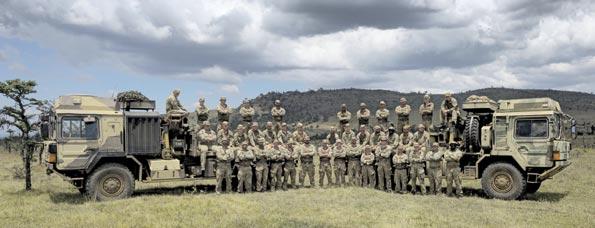
2FS Battalion REME deployed to the British Army Training Unit Kenya (BATUK), the centre of excellence for light role training, for Exercise HARAKA STORM 25/1. 2 REME formed part of the Combat Service Support Group (CSS Gp) in support of the 1st Battalion Welsh Guards Battlegroup (1WG). The CSS Gp was made up of the CSS HQ (Bn HQ, 2 Bn REME), the Equipment Support Company (11 Coy, 2 REME), the Logistical Support Squadron (32 Sqn, 6 RLC) and a Medical Squadron (35 Sqn, 3 MED).
HARAKA CYCLONE
1WG conducted their CYCLONE training on the Central Laikipia Training Area (CLTA) before transitioning to Lolldaiga on the Eastern Laikipia Training Area (ELTA) for Exercise HARAKA STORM. Meanwhile, 11 Company deployed to the Ole Naishu Training Area in Eastern Laikipia for nine days of preparatory training for STORM on Ex VANGUARD KEYS. For many junior soldiers, this was an invaluable opportunity to practise their roles in a tactical environment, with some experiencing their first exercise involving vehicles since Phase 1 training.
The training covered a wide range of essential skills in a short period, including dispersal techniques - critical for survivability on future battlefields due to threats from drones and long-range fires. Dispersal reduces target visibility, a concept effectively demonstrated through drone footage provided by 32 Royal Artillery. Other key areas of focus included establishing ECCPs, camouflaging vehicles, casualty management, CPERs, operating in a CBRN environment, and countering UAS threats. The week concluded with a series of scenarios and a navigation exercise designed to test Platoons and achieve CT Bravo training standards before deploying on STORM. Notably, one FRT was unable to reach a checkpoint due to a pride of lions occupying the area.
The remainder of CYCLONE involved a variety of activities, including ES task requests such as repairing drones, EPLS, and quad bikes. Additional training included driver training, team
Giraffes blocking road
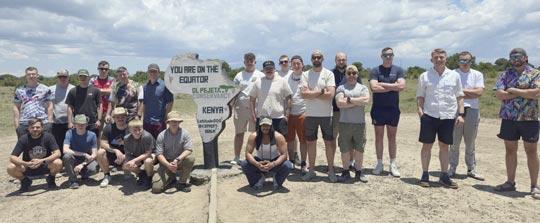
Coy Photo
medic courses, Adventurous Training, and community engagement, with some time even set aside for a safari.
HARAKA STORM
1WG were validated by the 4th Infantry Brigade to CT Foxtrot in preparation for becoming the Army’s CBRN readiness unit. 11 Company’s primary role was the 2nd line repair and recovery of all BG and CSS Gp equipment. The challenging Kenyan terrain, characterised by extreme temperature fluctuations, sudden torrential downpours, and pervasive dust, posed significant threats to equipment availability and mission effectiveness. SVRs and Forward Repair Teams (FRTs) were sent to the A1 echelon and enabled forward repairs, minimising downtime and maintaining operational momentum for 1WG.
Throughout the exercise we had to overcome significant challenges, including difficulties in getting ES Mat and all SVRs developing serious faults. This made recovering non-taskworthy vehicles back from the training area very challenging at the end of the exercise but helped add to the training value provided by the FTX.
Community Engagement
Sgt Ogutu
As a Kenyan serving in the British Army, taking part in the BATUK community engagement at Nyariginu Secondary school was a proud and humbling experience. Spending the day painting classrooms alongside fellow soldiers and students reminded me that service extends beyond our duties and it’s also about giving back. The freshly painted walls brightened the learning environment, and you could see the joy and pride in the students’ faces. For the school, it wasn’t just about new paint; it was about feeling supported and valued by the wider community.
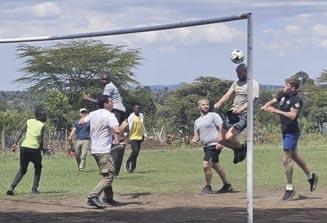
Afterwards, we played Football together in mixed teams of soldiers and students, which brought everyone closer. The laughter, teamwork, and friendly competition showed how sport can connect people beyond backgrounds and ranks. For us in the Army, it was a chance to be seen as more than soldiers, as neighbours and friends. Engagements like this build trust, strengthen relationships, and help the Army feel truly accepted within the community.
Safari
Cfn MacWatt
As a Craftsman deployed on Exercise HARAKA STORM in Kenya, the opportunity to go on safari was an unforgettable experience. After days of hard work taking over the fleet for the Battlegroup and repairing vehicles, the chance to explore the stunning Kenyan landscape was a welcome break.
Seeing wildlife like elephants, giraffes, and lions in their natural habitat was a great experience and a stark contrast to the demanding environment of the exercise. It was
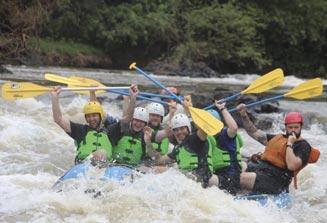
White Water Rafting
Land Rover Recovery Job
Football community Engagement
a rare privilege to witness such beauty and served as a reminder of the unique opportunities that come with serving in the Armed Forces.
Adventurous Training
Cfn Barr
As part of our deployment on Exercise HARAKA STORM, I had the opportunity to take part in Adventurous Training in Kenya, which proved to be a once-in-a-lifetime experience. The activities included Rock Climbing, white-water rafting, Kayaking, and tackling the thrilling duckies on the river. Each activity pushed us out of our comfort zones, building confidence, teamwork, and resilience; skills that are invaluable both on and off the battlefield.
The highlight for me was the Rock Climbing, which tested both physical and mental strength. I was fortunate enough to return later to complete a Rock Climbing Foundation Course, which allowed me to further develop my skills and gain a deeper appreciation for the sport.
The stunning Kenyan landscape provided the perfect backdrop for these challenges, and the experience not only enhanced my personal development but also strengthened the bond within our team. It’s an experience I’ll never forget.
Additive manufacture and drone repair
– LCpl Dickson
Whilst deployed on Ex HARAKA STORM, 2 FS Battalion REME have deployed a Section to focus on both Additive Manufacturing and drone repair whilst in the field. The 2 REME tech section have aided the 1 WG Battlegroup via creating additional equipment for their drones through ADM. Through 3D printing, we have created a take-off and landing pad, to aid in attaching of explosive devices quickly. This can be broken down and packed into a daysack. We have also supported in the fixing of drones and getting them back in the air through specialist drone repair equipment and skills learned from the Edinburgh drone Company whilst posted in Leuchars.
When we next go to war, our success will, in part, depend on our cohesion and esprit de Corps.
Branding and identity are crucial for fostering unity, trust, and recognition; both within an organisation and in public. A strong and consistent military brand reinforces core values such as discipline, honour, and service, creating a sense of pride and belonging among personnel. It also helps to build public confidence and support by projecting
professionalism, reliability, and capability. Clear and cohesive branding ensures that a unit is easily identifiable, whether through uniforms, insignia, or communication materials, which is vital for operational effectiveness and collaboration with others. Furthermore, a well-defined identity can enhance recruitment efforts by appealing to potential candidates who align with the organisation’s values and mission. In essence, branding and identity are not just about appearance but are integral to a unit’s reputation, cohesion, and effectiveness.
153 Coy is the only REME Reserve subunit in Scotland, with personnel living across the country. Our main locations however are our Company Headquarters in East Kilbride and a Platoon centre in Grangemouth.
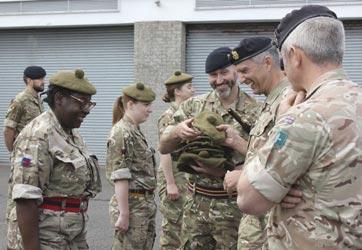
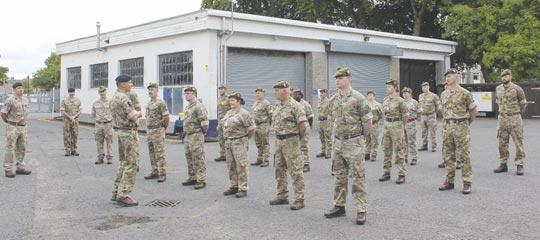
On Sunday 8 June 2025 it was a bonnie day in East Kilbride, just south of Glasgow. This was fortunate as we had been eagerly anticipating the occasion for quite some time. It was on this day that we were to adopt a bespoke REME Tam o’ Shanter as our Company headdress. The 367th meeting of the Army Dress Committee, chaired by Brig Nick Doyle, had approved the wearing of a Tam o’ Shanter for 153 Coy personnel whilst in working dress. This was in recognition and celebration of
Colonel Lex Agathangelou addressing the troops
Cpl Musikewa receiving her ToS from Colonel Lex Agathangelou
the Scottish heritage of the Coy and its personnel.
On the day we were honoured to host the Deputy Corps Colonel, Col Lex Agathangelou; Lt Col Anthony Platt, our Commanding Officer; and WO1 Rob Kelly, our Regimental Sergeant Major. Col Agathangelou met each of the soldiers who were on parade and issued them their new head dress. He then addressed the Coy personnel and congratulated them on the change of such distinction.
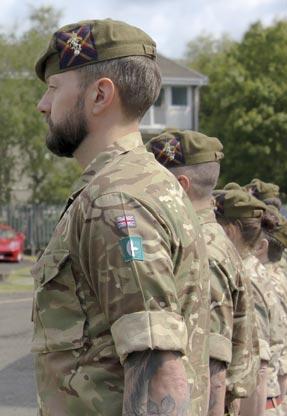
So, if you see a REME soldier or officer during your travels around the Corps, sporting a handsome Tam o’ Shanter, with our Corps tartan behind their cap-badge, then you’ll know they’re a member of 153 Coy, 102 Bn REME.
153 Coy is well established, with several opportunities available to those Regular REME personnel who would like to remain as an active member of the Corps when they transfer to civilian careers in Scotland. If you are keen to know more, please reach out to the author of this article.
The Tam o’ Shanter
The Tam o’ Shanter, a traditional Scottish bonnet, has a rich history rooted in Scottish culture and military heritage. Named after the character in Robert Burns’ 1790 poem of the same name, the Tam o’ Shanter evolved from earlier Scottish bonnets worn as practical headgear by rural communities. In a military context, it became widely adopted by Scottish Regiments in the British Army during the 19th and 20th centuries; replacing the earlier Kilmarnock Bonnet. Its design, featuring a flat crown and a woollen pom-pom (known as a toorie), made it both functional and distinctive. The Tam o’ Shanter is typically made of khaki or other muted colours for field use, while ceremonial versions may include regimental tartans or badges. Today, it remains an iconic symbol of Scottish military identity, worn by units such as the Royal Regiment of Scotland, reflecting both tradition and the enduring link between Scotland’s cultural heritage and its military contributions.
153 Coy proudly adorned with their new Tam o’Shantys
WO2 (CSM) Heath brandishing their new headdress
A Year at 22 Signal Regiment Light Aid Detachment (LAD) REME
Scribe: LCpl Gurung
22nd Signal Regiment LAD REME Mission Statement:
“Support Equipment Capability through the deployment of competent tradesmen providing Equipment Support (ES) to enable 22nd Signal Regiment to deliver an operational effect”.
To achieve this mission, the LAD deploys on various exercises, both domestic and overseas, supporting regimental commitments while fostering the development of our soldiers into competent tradesmen and well-rounded military professionals.
This dual focus on operational support and individual development enables us to embody the REME motto: “Soldier First, Craftsman Always”.
The LAD is not just about keeping equipment operational; it’s also about developing soldiers through diverse and enriching experiences. Soldiers get to take part in sporting events such as the Craftsman Cup, Race the Sun and Exercise SUPREME GLACIER 24, to adventure training which foster leadership, courage, and adaptability in demanding environments.
22 Signal Regiment –Exercises
On August 24, a Fitter Section from the LAD deployed on Ex AVENGER TRIAD 24; a US Army Europe-Africa (USAEUR-AF) led Command Post Exercise (CPX) and Joint Warfighting Assessment (JWA) set in a real-world operational environment, involving Allies and Partner Nations. The LAD, along with 242 Gurkha Signal Squadron and Gurkha ARRC support Battalion (GASB), deployed to Grafenwoehr, Germany. Our primary role was to provide ES for the duration of the exercise, while assisting road moves to and back from Germany. Our role also involved providing assurance checks on platforms deploying on exercise.
While one Fitter Section was away on Ex AVENGER TRIAD 24, three LAD personnel were deployed on Ex TRAIL WALKER 24 (Ex TW) with 248 Gurkha Signal Squadron. Ex TW is an annual charity event that raises funds for the Gurkha Welfare Trust, supporting
Adventure Training
Craftsman Cup
retired Gurkha soldiers and their families in Nepal. The LAD’s key role was to provide ES support to all the Units deployed on exercise.
In Feb 25, two LAD Service Personnel (SP), were attached to the Gurkha ARRC Support Battalion and deployed on Project CONVERGENCE CAPSTONE 5 (PCC5) to the United States. It was a perfect opportunity for one of the personnel to finish his Class 3 to Class 2 book under the supervision and guidance of a Class 1 tradesman in a challenging but controlled environment.
On Apr 25, 22nd Signal Regiment went for a 3-month period on Ex CYCLONE 25. The main aim of Ex CYCLONE 25 was to encourage soldiers to refine their tactical skills and decision-making in more dynamic contexts. This part integrates trade tactical training, modernisation, Special-To-Arms training and validation in a combined arms context.
Ex CYCLONE 25 was delivered in three phases:
Phase 1: Focused on solders personal development, ranging from completion of NVQ assessments to achieving Class 2 tradesman status.
Phase 2: Was called Ex CYCLONE WARRIOR, which was divided into two key sub-phases: Basic Combat Soldier (BCS) and Live Fire Tactical Training (LFTT). LAD personnel practiced essential field drills, like living and operating in field conditions to conducting a Platoon-level attacks. LFTT phase involved soldier executing in pairs fire and manoeuvre to Section level attacks. It offered an opportunity to enhance individual and collective combat skills in a dynamic, high-
pressure setting.
Phase 3: Ex BEACON CYCLONE was the final phase of Ex CYCLONE which took place on the Salisbury Plain training Area (SPTA). Our role as a LAD was to deliver ES support to the entire Regiment. Before the exercise we ensure all vehicles and equipment were fully operational. During the exercise we provided on-the-ground technical support to maintain operational tempo. After the exercise the LAD conducted post-exercise maintenance and inspections. All Fitter Sections were embedded with their respective Squadrons, and this enabled the LAD to tackle and overcome ES issues in real time; ensuring minimal disruption to the Regiment’s activities.
Regimental Battlefield Study
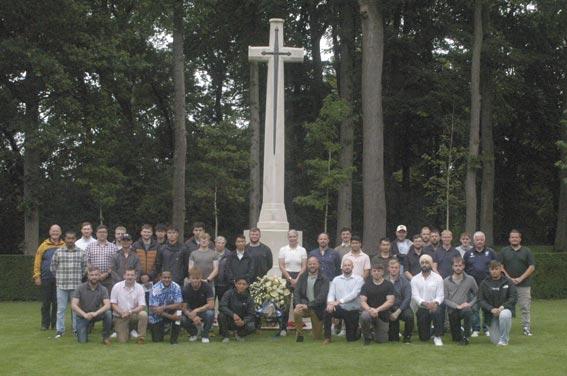
Oosterbeek Cemetery
This exercise and deployment demonstrated LAD’s adaptability and technical proficiency in a demanding training environment, while enforcing the importance of integrated ES in large-scale exercises, and hence, strengthening collaboration between LAD and the wider Regiment.
22 Signal Regiment – Sporting Endeavours and Achievements
By LCpl Cadogan
22 Signal Regiment continues to take immense pride in its commitment to sport, consistently striving for excellence both within the workplace and on the field of play. Over the past year, personnel from across the Regiment have participated in a wide variety of sporting fixtures and
Adventure Training (AT) opportunities, further enhancing physical readiness, morale, and team cohesion.
Among the highlights of the sporting calendar was the Regiment’s participation in the Craftsman Cup, a competitive Football tournament involving both minor and major units across the Army. The team delivered an outstanding performance throughout the competition and successfully reached the final in 2024. Despite a hard-fought match, they were narrowly defeated by 39 Engineer Regiment, Kinloss. This result, while disappointing, was a testament to the team’s dedication, skill, and sportsmanship.
In addition, the Regiment took part in the REME Festival of Sport, competing in multiple disciplines. The Football team once again demonstrated strong form, progressing to the semi-finals of the tournament, while other personnel represented the Regiment in Cricket, exemplifying the
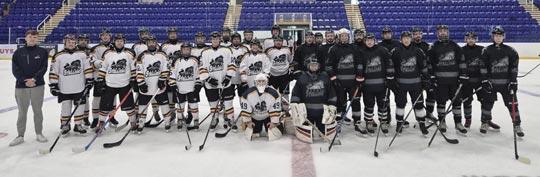
Ice Hockey
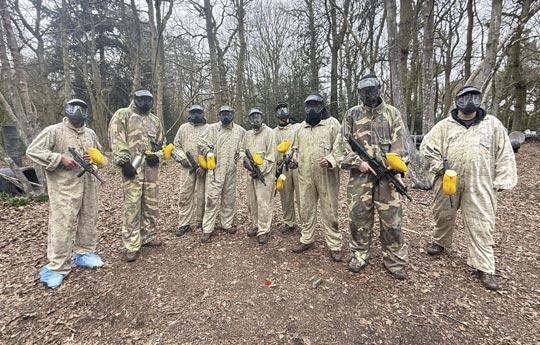
Paintball
breadth of talent within our ranks.
Further afield, in November 2024, six members of the Regiment deployed to Austria on Ex SUPREME GLACIER, a three-week adventurous training package focused on alpine Skiing and Snowboarding. The first two weeks were dedicated to instruction and consolidation; providing an excellent opportunity for those new to the discipline, as well as for others to refresh their skills. The final week culminated in a series of competitive races, with participants proudly representing 22 Signal Regiment. The exercise also provided valuable opportunities for inter-unit engagement and the strengthening of professional relationships across the wider Army.
As we look ahead, the Regiment remains committed to encouraging participation in sport and adventurous training, recognising their vital role in promoting operational effectiveness, resilience, and esprit de corps.
Regimental Battlefield Study: A Journey through History
In a recent Battle-Field Study (BFS), members of the Regiment travelled to France and the Netherlands, visiting several significant sites of the Second World War. This immersive experience not only deepened our understanding of the pivotal battles of 1944 but also fostered stronger team cohesion and reinforced the bonds across the Regiment; particularly with the different Squadrons within 22 Signals Regiment.
Key Locations Visited:
Brécourt Manor (France): Site of a famous American Paratrooper assault during the D-Day landings, where the 101st Airborne executed a successful attack against a German artillery position.
• Utah Beach (France): One of the five beaches of the Normandy landings, where American forces made a successful landing with minimal casualties compared to other beaches.
• Omaha Beach (France): The site of the heaviest fighting during the Normandy landings, where US forces faced fierce
German resistance, resulting in significant casualties.
• Sword Beach (France): The Easternmost of the D-Day landing beaches, where British forces encountered strong resistance but ultimately succeeded in securing the beachhead.
• Pegasus Bridge (France): The location of a daring British glider operation to seize a vital bridge before German forces could demolish it; ensuring the success of the D-Day landings.
• Merville Battery (France): A key German artillery position that posed a threat to the Allied landings on Sword Beach. It was neutralized by British paratroopers during the early hours of D-Day.
• Hartenstein Museum (Netherlands): A museum dedicated to the Battle of Arnhem and the airborne operations that took place in the area, showcasing the bravery and sacrifice of Allied forces.
• Nijmegen Bridge (Netherlands): A critical crossing point during Operation MARKET GARDEN, where intense fighting took place as Allied forces sought to secure the bridge.
• Arnhem Bridge (Netherlands): Another pivotal site of Operation MARKET GARDEN, where British airborne forces were tasked with capturing the bridge but faced overwhelming German resistance.
• Arnhem Woods (Netherlands): The site of fierce combat during the Battle of Arnhem, where the Allied forces, particularly the 1st Airborne Division, fought valiantly but were ultimately forced to withdraw.
The study concluded with a reflective service at Oosterbeek Cemetery, where we paid our respects to the fallen, honouring the sacrifices made by those who fought for freedom.
Throughout the journey, the Regiment not only gained invaluable insights into the history of these significant sites, but the REME also benefited from the opportunity to engage with the Signals Regiment, strengthening inter-regimental relations and promoting a spirit of camaraderie and mutual respect.
PCCC5
8 Parachute Field Company: Ready for Anything, Power Through Ex COBRA WARRIOR 25
EScribe: Lt Morgan Stimson
xercise COBRA WARRIOR 25 was no ordinary training exercise. It was a highintensity, multinational NATO operation that demanded speed, precision, and elite coordination. And Forward 1 Platoon of 8 Parachute Field Company (8Fd) delivered exactly that.
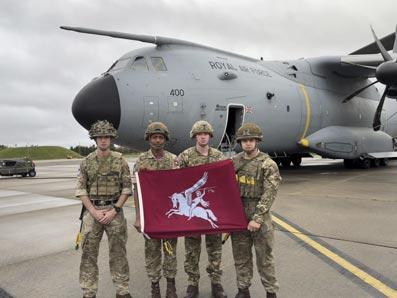
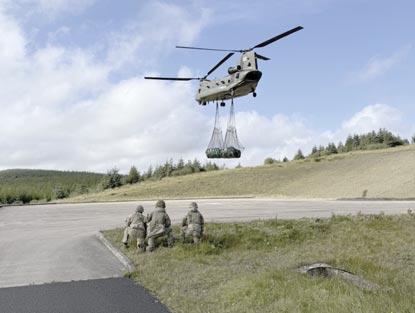
Supporting both a Rapid Air Landing (RAL) and a Helicopter Underslung Load (HUSL), the team worked seamlessly with units across 16 Air Assault Brigade Combat Team (16AABCT), including 13 Air Assault Support Regiment (13AASR) and the 1st Battalion Royal Gurkha Rifles (1RGR). We also integrated directly with the Royal Air Force (RAF) and United States Air Force (USAF); a true showcase of multinational interoperability.
From Barracks to Brize Norton
The mission began with a road move from Merville Barracks to RAF Brize Norton, where 8Fd was immediately called into action to repair a Revised Weapons Mounted Installation Kit (RWMIK) vehicle. Our fast, professional response ensured the deployment stayed on track.
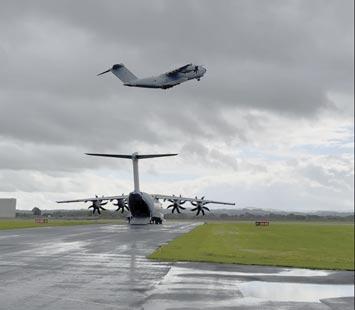
Next came RAL training, where the team got hands-on with the RAF Atlas A400M and USAF MC130 aircraft. For many, it was a firsttime experience - an unforgettable moment of airborne anticipation.
Airborne Assault
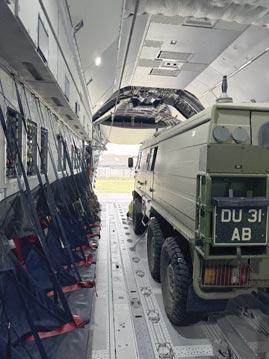
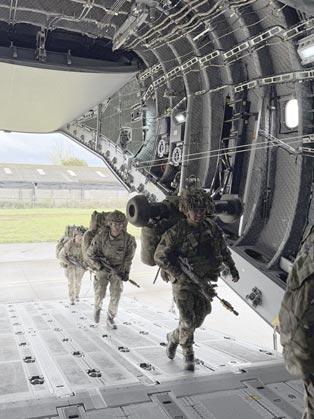
At first light, Forward 1 Platoon returned to the airfield. Our Pinzgauer, designed for air portability, was loaded onto the Atlas A400M and secured by RAF crew. With 1RGR troops aboard, the convoy of NATO aircraft lifted off toward Carlisle Lake District Airport, the day’s target. Despite poor weather, morale stayed high. This was a rare chance to execute a full-scale multinational air assault. Upon arrival, Pathfinder Platoon secured the Drop Zone, followed by the Arrivals Departures Airfield Control Group (ADACG) from 13 AASR and 8Fd driving out of a rolling A400M on the runway. Once the airfield was locked down, 1RGR disembarked and secured the perimeter, allowing NATO aircraft to land safely.
8Fd Members
Helicopters and High Stakes
The next phase took the team to Spadeadam Training Area, where we joined 13AASR for a HUSL operation. RAF Chinook helicopters delivered critical equipment to support the next 1RGR assault.
Once again, we proved our mettle. Another RWMIK needed roadside repair, and we nailed it. Our rapid response kept the operation moving and set the stage for the final road move back to Merville Barracks.
Mission
Accomplished
Cobra Warrior 25 was a resounding success. It proved that 8 Parachute Field Company is not just ready; we’re relentless. Whether repairing vehicles under pressure, coordinating with international forces, or delivering engineering support in the thick of operations, we bring unmatched capability and unwavering resolve. Ready for anything? Absolutely.
Pinzgauer Onboard
1RGR Boarding
HUSL
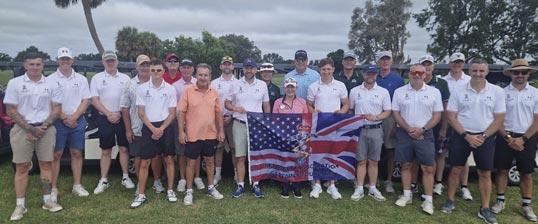
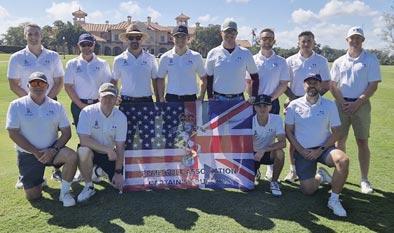
REME Golf Association (RGA) Captains Tour 2025
Scribe: SSgt Shrubsole
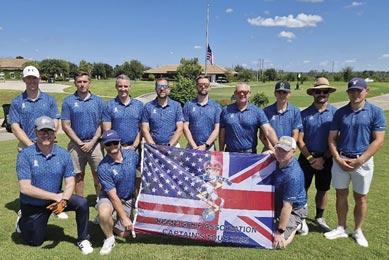
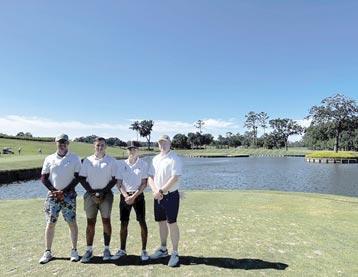
Every year, members of the RGA have the opportunity to attend a Corps Captains Over-Seas Visit (OSV) Tour; 12 individuals are balloted and selected to represent the RGA.
honour to organise an OSV for fellow RGA members. This season we travelled to Orlando, Florida, USA over the period of 07 – 16 Sep 25.
Over the 8 available days, the RGA would play 7 times. This consisted of 5 rounds counting towards the ‘Tour Championship’. A fixture against a representative team from MacDill Airforce Base, Tampa, FL, and an unexpected bucket list round at TPC Sawgrass, home of the PGA Players Championship.
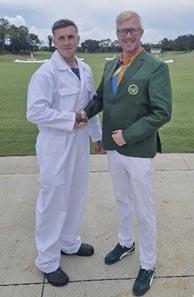
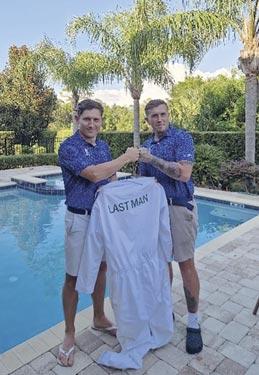
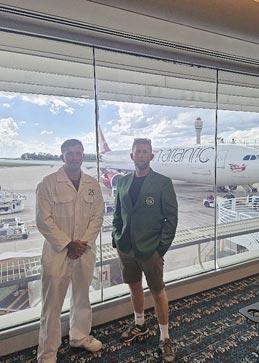
The First Round was played at Southern Dunes and set the tone for the quality of Golf courses we would play. With holes surrounded by water and villas, what seemed like a tough track was dealt with by day one winner Cpl Chris Wade earning the Green Jacket! Sgt James had a tougher time, claiming the first rounds ‘Last Man’ position, accompanied by the Master’s caddy boiler suit.
Sgt James and Cpl Wade after day one
Champions Gate Country Club
This would continue through the 5 championship rounds with each round crowning a new daily champion and Last Man!
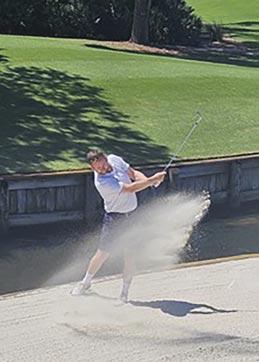
After rounds at Waldorf Astoria, Eagle Creek and Falcons Fire, the final round of the tour championship was played at Champions Gate Country Club. With the overall tour standings being close at either end of the leader board Sgt James held on to his boiler suit finishing last man overall. Maj Wilkinson was crowned
the Tour Champion, with 5 days of consistent Golf and a surge on the last day to win the overall tour by two points.
A Particular highlight of the tour was the fixture organised against a team of service personnel stationed at MacDill Airbase in Tampa, Florida. Played at Bay Palms Golf Club, a course they have on station. A pairs scramble match was played, both pairs taking their best shot against the other! The RGA came out on top
RGA Corps Captain SSgt Shrubsole presenting the overall Tour winner (Maj Wilkinson) and Last man (Sgt James) their prizes
RGA members with a representative team from MacDill Airbase, Tampa, FL
winning the Match 4-2 overall, hopefully setting the tone for the upcoming Ryder Cup!
We were very well hosted and the team from MacDill are after a rematch in the not-so-distant future! Post this, we took to opportunity to explore the Tampa area, enjoying a team meal and spending time in the downtown area before heading to the historic Ybor District.
To cap off an incredible tour, each member got the opportunity to tick off something on their golfing bucket lists. The RGA were fortunate enough to be able to play at TPC Sawgrass stadium course. Host of the Players Championship with
RGA Instagram page QR code
RGA at TPC Sawgrass
SSgt Shrubsole eyeing up his tee shot on 7
The iconic 17th Hole at TPC Sawgrass
the likes of Rory McIlroy, Tiger Woods and Scottie Scheffler all having won this tournament. Now it was the turn for members of the RGA. With it its Iconic 17th island green par 3 being the most famous hole in Golf, the stage was set. Player of the day belonged to Cfn Hills who shot an impressive score and hit a great shot into the 17th!
In closing, the tour was an immense success. Members of the RGA could test themselves on challenging Golf courses while forging team cohesion going forward. A big thank you to the REME Charity and Army Sports Lottery for supporting the OSV. Additionally, a big thank you to our tour sponsor –Radcliffe & Co who provide independent financial advice.
If you would like to keep up to date with the RGA, please give our Instagram page a follow for more tour content and event updates. Additionally, if you are looking to get involved and play in RGA events please contact Samuel.shrubsole100@mod.gov.uk for more information! The RGA is open to all serving and Veteran members of the REME.
Cpl Wade, Sgt James, Cfn Hills and Maj Gallagher on the 17th tee
Maj Wilkinson from the bunker
RGA Captains Tour Sponsor, Radcliffe & Co
Sgt James and Maj Wilkinson on their triumphant return home!
REME Endure24: Pushing Limits for a Cause
Scribe: SSgt Gransden
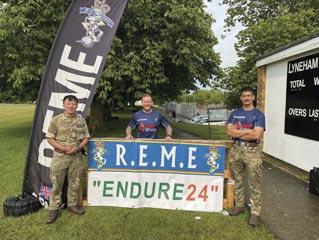
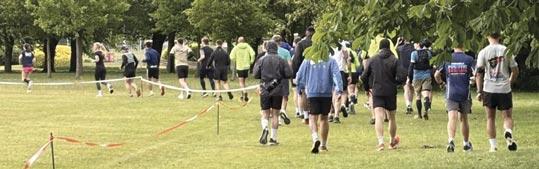
On 6th June 2025, over 80 determined runners from across the Corps gathered for The REME Endure24, a gruelling endurance challenge designed to test both physical stamina and mental resilience. Organised by SSgt Ben Gransden with support from Cpl Bishal G-C and SSgt Jiwan Rai, the event marked the anniversary of the Normandy beach landings - an apt tribute to courage and perseverance. Participants ran 5km every hour on the hour for 24 hours, culminating in a final timed race to crown the winners.
The structure of the event was as demanding as it was symbolic. Each runner faced the relentless rhythm of hourly 5km loops, with no respite through the night. Whether competing solo or in teams, participants had to manage fatigue, nutrition, and motivation across the full 24-hour period. The final
loop - a timed race - added a competitive edge; pushing runners to dig deep after already covering 115km. The atmosphere was electric, with camaraderie and determination driving everyone forward. Support crews and spectators played a vital role, offering encouragement and keeping spirits high throughout the challenge.
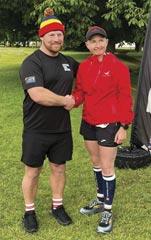
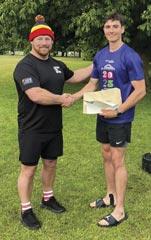
The event raised over £2,000 for Head Up, a charity dedicated to supporting mental health in the military community. Maj Gemma Caswell-Treen of 4 Bn claimed the female title, while LCpl Stanton of 8 Bn took the male win, finishing his final 5km in a blistering 18 minutes after 115km and no sleep. The REME Endure24 not only showcased physical grit but also highlighted the Corps’ unwavering commitment to supporting mental health.
Event photo
REME Endure24 event organisers
(Left) Maj Caswell-Treen Female winner (Right) Cpl Stanton Male Winner
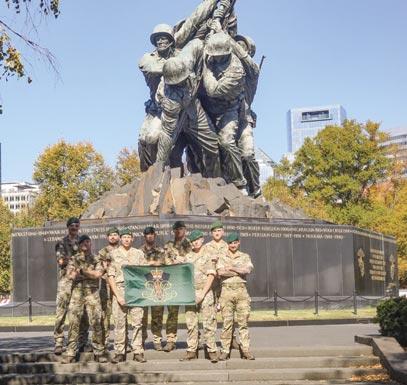
Running with Purpose: Celebrating 50 Years of the USMC Marathon
Scribe: WO1 (ASM) J Payne
A Historic Milestone in Washington, D.C. Exercise SEMPER FI DAGGER
This year marked a significant moment in endurance sports and military tradition, the 50th Anniversary of the United States Marine Corps Marathon. Known affectionately as “The People’s Marathon,” the event drew thousands of runners and supporters to the streets of Washington DC, in a powerful celebration of unity, resilience, and service.
International Participation and Allied Spirit
Among the participants were 10 mixed-rank members of 29 Commando Royal Artillery (29 Cde RA), proudly representing their units and countries. Their presence highlighted the enduring bond between allied militaries and the shared values of discipline, perseverance, and mutual respect. From junior soldiers to senior leadership, the team ran shoulder to shoulder with thousands of others, embodying the spirit of international camaraderie and military pride.
Perfect Conditions and Unforgettable Support
The marathon route offered a scenic and symbolic journey through the heart of the U.S. capital; from the National Mall to Arlington Memorial Bridge. The weather was ideal, crisp autumn air, clear skies, and just enough warmth to keep runners comfortable.
Crowds lined the streets in full force, waving flags, cheering enthusiastically, and offering encouragement that lifted spirits and pushed runners forward. The atmosphere was electric, and the support from spectators was deeply felt by all participants.
Strong Finishes and Team Pride
All ten 29 Cdo RA runners completed the marathon with commendable finish times, demonstrating not only physical endurance but also the strength of their team spirit. Their performance was a testament to their preparation, determination, and the pride they carried in representing their regiment.
Gratitude to Supporting Charities
The 29 team would like to express sincere thanks to the Royal Artillery Charity and the REME Charity for their generous support. Their contributions were instrumental in enabling the team to deploy and take part in this prestigious event. Without their backing, this memorable experience would not have been possible.
A Tribute to Service and Tradition
As the Marine Corps Marathon celebrates its golden jubilee, it continues to stand as more than just a race. It is a living tribute to service, sacrifice, and the enduring human spirit. For those who ran, supported, or simply stood in awe, the 50th anniversary was a reminder that some traditions only grow stronger with time.
Semper Fi.
We Will Remember Them
Scribe: John Sibley
As the branch President I was walking around the hotel dining room saying a thank you and goodbye to all those who attended the Bow Shackle Ball, October 2024. I stopped to chat to Nick Walker, a veteran Recy Mech who I knew whilst serving and he told me about a friend of his, an Artist who was painting the portraits of all the fallen of Afghanistan, his name, Kevin Wills. Nick suggested that it would be marvellous if our trade were to get portraits of our fallen comrades from all recent conflicts and display them as an act of remembrance. This started me thinking.
I put the idea to our committee and was not surprised when they whole heartedly agreed with the plan. So, with the firm backing of the committee I set about making the idea a reality. We knew that we had lost 3 comrades in different conflicts since WW2. LCpl Kevin Bell in Bosnia, Cpl Marc Taylor in Iraq and Cfn Andy Found in Afghanistan. As Andy was killed in Afghanistan Kevin had already painted his portrait and presented to his family. I reached out to find suitable pictures of the others and had a great response. Two pictures were chosen and sent to Kevin, who agreed they were ideal for this project.
and almost time for the Bow Shackle Ball again. Perfect timing as Nick could collect and deliver them to me, which seemed a safer bet than Evri!
Over the next few months Kevin completed the 2 portraits and had a print made of the third. They were framed and made ready to ship. However, it was now September 2025
I’d approached Col REME and asked if he would do us the honour of unveiling the portraits and he was only to pleased to do so. A date was agreed and so it was time to invite the families, I sent invites to them all and they were over the moon with the idea and were also pleased to be invited. I also invited Kevin Wills and Nick Walker as without them this would never have happened.
Much debate around where to hang them ensued but it was finally decided by WO1 (ASM) Dan Martin and I to hang them in the Recovery Training Wing (RTW) at the top of the student staircase. That way all Recovery Mechanics attending courses or visiting Lyneham would have access to them.
As the big day drew ever nearer, we gathered all the stores we were going to need, curtain rail and fittings, curtains, a cord for pulling open the curtains, including a change of direction pully (well we are Recy Mechs after all) and not forgetting all the army of volunteers required for an event of this magnitude.
On the Friday before the unveiling, Ian Macdonald, our trusty photographer and I drove down to Lyneham, picked up our passes and was escorted to the RTW, where we hung the portraits with the individual’s information plate below. Above we hung a banner with a branch logo, poppy and the immortal words “Lest We Forget”. Once we were happy with
The Unveiled Portraits
L to R – Scribe, Kevin Wills, RSM Lord and Col REME
these, we put up the curtain rail, curtains and pull cord. Tested and adjusted, we were very happy that all would be well the next day. We cleaned up after ourselves and after making sure the pull cord would work (again), we retired for the evening.
I met the families and guests in the museum car park at 10.00am on Saturday morning with pre-arranged passes for them all and the Corps HQ minibus. With this and a couple of cars we ferried all the guests to the RTW. Col REME and the 8 Bn RSM, WO1 (RSM) Lord met us there in Service Dress ready to perform their duties. As we gathered on the staircase, I breathed a huge sigh of relieve that I hadn’t invited too many people, but it was still comfortably full! When all were silent, I said a few words and handed over to the Colonel to officially unveil the portraits. He duly obliged and pulled the cord to reveal the portraits for the first time to the assembled crowd. There were some gasps and more than a few tears, but all agreed how wonderful the portraits were and how they captured the individual so brilliantly.
After some time, we adjourned to the Recovery Mechanic memorial wall for the obligatory photographs. After which we retired to the WO and Sgts mess for a brunch and much need cuppa before dispersing via the REME museum.
My heartfelt thanks go to everyone who assisted. The branch committee, especially Chris Zeil and Stuart Martin, along with his good lady Fiona. Branch member and photographer, Ian Macdonald, WO1 (ASM) Dan Martin and his team at the RTW, especially Sgt Regami Thapa. WO1 (RSM) Rob Lord and his Provo team. The staff of the WO & Sgt Mess. Lt Col Toby Stratton-Brown, the highest paid cleaner I’ve ever worked with. Mrs Babs Harris at the REME Charity. Our Artist, Kevin Wills, Col REME, Col Iain Wallace OBE ADC and Honorary branch member. My deepest gratitude goes to all the family members who attended. Today was dedicated to you, but in spirit, you are joined by all Recovery Mechanics, past, present, and future, for eternity. Lest We Forget.
I am sure that there will be many who wanted to attend the opening, but this was for the families. I am very happy to report that the if you wish to see the portraits, they will be part of Winch to the Wall 26. No date has been decided yet, but we plan to run it in
early September. Details and tickets will be advertised on the branch Facebook page and the website at https://recymechbranch.co.uk/ soon. Spaces will be limited so keep your eyes peeled if you would like to attend.
The Taylor Family
The Found family with the Andy Found Trophy
The Bell Family
“With Spanners Descending” REME’s Airborne War
Scribe: Richard Davies, Curator
Recent visitors to The REME Museum may have seen our 2026 temporary exhibition, “With Spanners Descending: REME’s Airborne War”. Taking its title from Craftsman Joe Roberts’ 1996 book about his service with the 1st Airborne Division during World War Two, the display tells the story of the Corps’ support for Britain’s Paratroopers.
Like much else at the beginning of the conflict, the creation of the country’s airborne capability began from a standing start. There were many demands on our limited resources, but Winston Churchill recognised the need to develop some sort of offensive capability as a priority, if only to show the British people the country was capable of fighting back.
Two instructions to his Chief of Staff set the tone. The first, dated 4 June 1940, read, “We should immediately set to work to organise self-contained, thoroughly equipped raiding units. Enterprises must be prepared with specially trained troops of the hunter class who can develop a reign of terror down the enemy coasts… I look to the joint Chiefs of Staff to propose measures for vigorous enterprise and ceaseless offensive against the whole German-occupied coastline, leaving a trail of German corpses behind them.”
The second was written only eighteen days later: “We ought to have a Corps of at least 5,000 parachute troops, including a proportion of Australians, New Zealanders and Canadians… I hear something is being done already to form such a Corps but only, I believe, on a very small scale. Advantage must be taken of the summer to train these forces, who can none the less play their part meanwhile as shock troops in home defence. Pray let me have a note from the War Office on the subject.”
Collectively, these notes led to the creation of Britain’s first Commando groups, one of which was designated as a Paratrooper unit.
The concept of soldiers jumping from aircraft into hostile territory was a relatively new one at this point. The first proposal for such an operation was made in 1917 by Percy Groves who was the Royal Flying Corps’ Chief of Staff and retired from the Army as a Brigadier-General in 1922. He proposed the doctrine of the “Long Arm”, when a mass landing of troops behind enemy lines would target supplies, road and rail hubs and manufacturing centres. This would cause the enemy to commit their reserves or even weaken their front lines as a defensive response, thus giving a frontal assault more chance of success. A similar idea was suggested by Brigadier-General William Mitchell of the US Army a year later, but both came to nothing because of the limitations of aircraft and parachute technology during World War I.
It was not until 1927 that the first co-ordinated airborne exercise took place. A group of Italian Paratroopers jumped from aircraft on 6 November of that year and landed safely in the vicinity of Cinisello Balsamo, near Milan.
The next country to embrace the idea of airborne troops was Russia. Their extensive work in this area was promoted by Marshal Mikhail Tukhachevsky who believed a rapid and unexpected strike at the enemy’s rear by parachutists could lead to victory. This approach culminated in a large-scale exercise that took place near Kiev beginning on 12 September 1935 and lasting five days. It is estimated that approximately 60,000 soldiers were involved with over 1,000 of them jumping from a squadron of Tupolev bombers. They seized bridges across the River Dnepr, 25 miles behind the imaginary front line. Not only men jumped from the aircraft: innovatively, 150 machine guns and 18 light artillery pieces were also dropped into the battle zone.
So confident were the Russians in their Paratroopers, that they invited overseas observers to see the exercise for themselves. The Americans, British and Germans all sent representatives. General Archibald Wavell attended for
Brigadier-General William Mitchell (1879 – 1936)
An image of Marshal Mikhail Tukhachevsky (1893 – 1937), taken in 1936
Britain, and he wrote on his return, “If I had not witnessed the descents I could not have believed such an operation possible.” He does seem to have been undecided on the merits of Paratroopers as a concept however, as he later gave a lecture to his staff that concluded, “I advise you when you go home to forget all about it.”
One nation that did not “forget all about it” was Germany. They took a great deal from their observations of the Russian exercise, and began to develop Paratrooper units of their own. The year of their visit to Russia, 1935, was the same year in which the first German parachute unit was created. It was exactly these troops that saw action as ground soldiers against Polish forces in September 1939, so it was not until April 1940 and the invasions of Denmark and Norway that they were used as Paratroopers. Operation WESERÜBUNG as it was known, saw two firsts in airborne warfare: the first attack carried out by parachute units and also the first opposed attack undertaken by Paratroopers.
Their targets were mainly Norwegian and Danish airfields, all of which were secured for use by the Luftwaffe. These actions were decisive, as they enabled German air power to fight off the forces sent by Britain to themselves occupy these Scandinavian countries. In reality, the British operation had little chance of success as the troops were badly prepared. The hostile Parliamentary reaction to this failure ultimately led to the fall of Neville Chamberlain’s government, and the appointment of Winston Churchill as Prime Minister.
Germany’s advances in this new form of warfare were confirmed in 1940 and 1941 during the invasions of Belgium and Crete. Both Paratroopers and soldiers landed by glider were used extensively in these operations, and although the actions were considered to be successes by senior Nazi commanders, the high casualities sustained during the landings on Crete meant Paratroopers were only ever used as ground forces by Germany for the rest of the War.
Despite the mixed results from the Cretan operation, Britain continued to develop its own airborne units but those working in this area experienced many barriers.
The Royal Air Force (RAF) was very reluctant to commit any of its aircraft and crews to train with these nascent forces, as they felt the RAF’s primary role should be defending the country and also bombing German industry. Perhaps their perspective was best summed up by Air Chief Marshal Sir Arthur Harris in a paper dated 21 October 1942 and written for Churchill’s attention: “It would require the whole of the existing Bomber Command to be taken off operations for a period of four to six weeks... to transport one Brigade for one operation; it would require about 2½ times the strength of the present Bomber Command to do the same for the airborne Division as a whole... The crux of the matter is this – is Bomber Command to continue its offensive action by bombing Germany, or is it to be turned into a training and transport Command for carrying a few thousand airborne troops to some undetermined destination for some vague purpose?”
The Army too, had reservations. Following its defeat on the Continent and
the retreat from Dunkirk, it had to expand, train and rearm as quickly as possible; they considered anything else to be a distraction.
Even those who believed airborne forces had a role to play in the future conduct of the War realised they needed to be used judiciously, so the precious resources committed to their development and training would have a noteworthy impact, and justify their continued expansion. One officer wrote in 1940, “both parachute troops themselves, the aircraft which carry them and the aircraft crews are too valuable to be used up on minor operations not directly connected with an offensive against Germany and Italy... British parachute troops should not be used for anything less important than say the capture of Channel ports, as a preliminary to an invasion of France or in a major offensive against the Italians in North Africa.”
These assessments persuaded Churchill to reduce his demands for the creation of an airborne force. All this changed in 1943 however, when the planning for Operation HUSKY began.
HUSKY, the Allies’ plan for the invasion of Sicily as a prelude to the invasion of mainland Italy, has its origins in the 1943 Casablanca Conference. Here, Winston Churchill met with US President Franklin D. Roosevelt and their respective military staffs to discuss the future conduct of the War and its ultimate aims (the Soviet leader, Joseph Stalin, did not attend as he was focussed on the Battle for Stalingrad).
Churchill was able to convince the Americans that their plan to open a second front in Europe by invading France would lead to significant casualties, and that instead the focus should be on Italy, the country he frequently and famously called “the soft underbelly of Europe.”
Airborne troops were included in the planning for HUSKY from its inception. The idea was for them to land ahead of the main invasion force, and to seize important bridges in two separate locations as well as strategic high ground, and to generally create confusion amongst the defenders. These aims would have been instantly recognised by Groves, Mitchell and Tukhachevsky.
As a result of the decision to include Paratroopers and glider landings in HUSKY, the 1st Airborne Division, which had been created in October 1941, immediately began training for the operation.
The airborne elements of HUSKY, known as LADBROKE and FUSTIAN, achieved their goals but neither landing went as
Prime Minister Winston Churchill and President Franklin D. Roosevelt with their respective Chiefs of Staff at the Casablanca Conference held between 14 and 24 January 1943
These line drawings of the mechanical and electrical repairs trailers were prepared by the REME Workshop in Old
These line drawings of the mechanical and electrical repairs trailers were prepared by the REME Workshop in Old
Dalby
Dalby
A view of the electrical repairs trailer from the towing end. A lamp and drill stand (with drill), appear prominently in this image, as do the wooden and metal collapsible tables (stored horizontally), on which the men would work in the field. Image courtesy of the Airborne Assault Museum, Duxford
planned, with the troops suffering many casualties. Despite this, HUSKY convinced General Dwight D. Eisenhower, the Commanderin-Chief of the Allied forces, of the importance of airborne landings; he wrote in his dispatch following the invasion that, “the outstanding tactical lesson of the [Sicily] campaign was, for me at least, the potentialities of airborne operations.” It was notable that General Bernard Montgomery shared Eisenhower’s opinion.
Such a positive assessment from the man in charge and one of his important subordinates meant there was every likelihood of Paratroopers and glider landings being used more frequently in future actions. In the face of this probability, different branches of the British military increased their efforts to solve the specific technical problems associated with airborne operations. They discovered that, in reality and despite HUSKY, very little progress had been made since Churchill’s memos of 1940. All involved in the creation of these new forces now realised a great deal of research and experimentation was quickly required to ensure airborne landings, whether by parachute or glider, were effective and that the equipment supplied to the men was fit for purpose.
REME was clearly going to have a role to play. In 1951, The War Office published a two-volume history of REME’s history and development. In the second of these, subtitled “Technical”, Brigadier F.R. Bloor wrote, “As a technical Corps with specialist personnel covering every branch of electrical and mechanical engineering, it was inevitable that REME, in addition to its specified role of being responsible for the maintenance and repair of all equipment within the organised limits of the Field Force Establishments, should be called upon to play a part in the design, development, and experimental work consequent upon the everchanging requirements of equipment to meet operational needs.”
By May 1943, the Airborne Forces Development Centre (AFDC) had been created. It was based at Amesbury Abbey between Stonehenge and Bulford Barracks, and an experimental REME workshop of 20 personnel supported them (this was later expanded to 33).
The AFDC’s role was to develop and test equipment peculiar to parachute and glider landings, and to develop tactical glider loads for airborne operations. Techniques were investigated for how best the Horsa, Hamilcar and Hadrian gliders could be loaded. A large amount of work was also done on packing and dropping supplies of military stores.
The efforts of the REME experimental Workshop were as innovative as they were wide-ranging. They modified the container that housed the Paratrooper’s folding bicycle, as well dismantling the 40mm anti-aircraft gun and the 6-pounder anti-tank gun so
This sequence of images shows one of the trailers from the front and rear, and also some of the equipment being tested by REME Craftsmen. Clearly visible in the middle photograph are a lathe, power source, a vice, a drill-stand and a grinder and polisher. Image courtesy of the Airborne Assault Museum, Duxford
they could both be loaded onto gliders. Similar work was undertaken on the Morris 6x4 30 cwt. breakdown vehicle. It proved possible to dismantle the Morris and load it onto two separate gliders, thus ensuring REME Craftsmen deployed in theatre would be able to undertake recovery operations. Ultimately, eleven makes and models of truck were successfully experimented upon in this way, and the work only came to an end with the surrender of Japan in August 1945.
Other branches of REME also contributed. The Corps’ Workshop in Old Dalby, near Melton Mowbray in Leicestershire, designed at least two lightweight airborne workshop trailers, one for mechanical, the other for electrical repairs. Once deployed from a glider they could be towed to where they were needed by jeep.
It is possible there was input from the AFDC during the design process, as it is clear every aspect of the trailers’ form and function was considered. The designers were obviously aware of the restrictions imposed upon the trailers by the need to transport them by glider: they had to be within a certain weight and size so they could be, firstly, accommodated within the glider and secondly, would not prevent the glider from getting into the air. The electrical and mechanical repair work the Craftsmen would undertake using the trailers also had to be accounted for, as that would determine the equipment provided.
The images in this article include the finalised drawings of both trailers, as well as the wide range of equipment with which they were supplied. A group of images, probably taken by an AFDC photographer, show REME Craftsmen testing some of the equipment.
The final group of photographs show one of the trailers chained inside a glider fuselage, exactly as it would be during a flight.
As the Second World War progressed, the landings made by Britain’s airborne troops involved ever greater numbers of men and more sophisticated equipment. The fact that within five years, Britain developed an effective fighting force with no prior experience of this form of warfare at a time when resources were incredibly scarce is an extraordinary achievement. Alongside this, REME had to swiftly learn, understand and adapt to the very specific needs of Paratroopers and glider soldiers. Ultimately, their work and its success were a remarkable testimony to REME’s typical ingenuity when faced with a problem.
The line drawings of the trailers in this article are copied from the original documents in the Museum’s Archives, but the photographs of the AFDC are in the collection of the Airborne Assault Museum in Duxford, Cambridgeshire. The Museum is sincerely grateful to our friends there for their support in producing this article.
I am also indebted to Fiona Seeman of the Museum’s excellent Front of House team for the patient application of her proof-reading skills, and also Abigail Sirrell, Museum Assistant, for her excellent and timely assistance.
This enlarged image shows the range of hand tools accommodated by one of the trailers. A traditional brace and a range of bits can be seen, along with Allen keys, spanners, rope, callipers, additional lamps and two micrometers. Image courtesy of the Airborne
These remarkable images show an electrical repair trailer chained within the fuselage of a glider. This is very likely to be exactly how the trailers were secured while being flown to an operational landing zone. We know that a Horsa glider was set up in the grounds of Amesbury Abbey so that accurate tests could be conducted, so perhaps this is where the photographs were taken. Image courtesy of the Airborne Assault Museum, Duxford
Assault Museum, Duxford
Obituaries
Lance Corporal Harry Devey
Scribe: Mark Devey
Harry Devey passed away on 12th October 2025, aged 92. He served with the Corps between November 1954 – November 1956.
After finishing his Mechanical Engineering apprenticeship, LCpl Harry Devey did his National Service in the Royal Electrical and Mechanical Engineers based in Regents Park Barracks, London maintaining the Staff car fleet.
For LCpl Devey serving in the REME for Queen and country was an honour that he never forgot; always wearing his REME tie, beret and blazer with pride. He was an active member of the local REME Association in Coventry for many years and having his fellow REME friends at the funeral with Standard Bearers and Bugler was an absolute honour that meant so much to him and his family.
We pass on our deepest appreciation and thank you to Dave and fellow colleagues within the REME Coventry branch.
14481409 L/Cpl WL Atkins REME
Scribe: REME South Australian Branch
Bill served from 1945 to 1948 and was the recipient of the War Medal.
He served in Egypt and Italy with the Eighth Army. He said little of his war service but on one occasion he was driven in a truck to a vehicle storage park and was told to take the doors from one truck and change them with another truck. For his efforts he was given ten shillings. He did not know why and never asked, ten bob was ten bob. Back in the UK he had a bicycle and used to ride it to get home to Phyl. He was challenged on one occasion by the RP Sgt for carrying a swagger stick as he walked to his Bike. The offending article was his Bike pump
tucked under his arm.
Bill came to Australia in 1964 and made a new life for himself and Family where he worked for Blackwoods as an earth moving fitter. In 1996 he was a founding member of the South Australian Branch of the REME Association and was the first Treasurer; a roll he filled for many years.
He became the President of the branch at the AGM in 2012 with a unanimous vote. This was a roll which he has filled since and has been a tremendous asset to the Branch and the Corps. His input and support have always been greatly appreciated and will be greatly missed.
Bill was always proud to march on ANZAC Day with Neville, Martin and Nick. The banter as to who was number one son was always a great topic for discussion. But to Bill you were all number one.
Bill, you have had your last parade, worn your Laural Leaf hat badge with pride, not quite a founding member of the Corps but definitely one of the few to make it what it has become today.
Thank you for your Service, your support and most of all for your friendship.
Rest in Peace old Friend.
Death Notices
BATTISCOMBE – WO2 (Retd) Simon Battiscombe died on 2nd January 2026 aged 50 years old. Dates of Service 1992-2022.
Death Notice Requirements
In order to publish a death notice we require the following information: Surname, first name, rank, full date of death, ages and dates of service. An obituary with additional career and life information is welcome. To inform us of the death, please contact Pamela Bailey-Yates, Corps Welfare Assistant, Email: welfare@remecharity.org
London Gazette
06 January 26
REGULAR ARMY
Regular Commissions
Lieutenant Colonel K. F. BADHAM-THORNHILL MBE 553132 retires 26 May 2025 (Belated Entry)
Lieutenant Colonel A. I. EVANS 545948 retires 1 July 2025 (Belated Entry)
Major L. D. UNDERWOOD 30043469 retires 1 June 2025 (Belated Entry)
Regular Commissions (Late Entry)
Major P. M. RAW 25037603 retires 1 July 2025 (Belated Entry)
Intermediate Regular Commissions
Captain N. J. WEAVER 30261802 retires 1 July 2025 (Belated Entry)
Intermediate Regular Commissions (Late Entry)
Captain S. K. CRIBBEN 25097562 retires 1 June 2025 (Belated Entry)
COMMANDS AND STAFF
The undermentioned Lieutenant Colonels to be Colonels 31 December 2025 with seniority 31 December 2025
R. J. BAXTER Corps of Royal Electrical and Mechanical Engineers 545501
B. B. CREED MBE Corps of Royal Electrical and Mechanical Engineers 556344
R. C. J. JAMES Corps of Royal Electrical and Mechanical Engineers 552409
K. J. MILES Corps of Royal Electrical and Mechanical Engineers 552443
13 January 26
REGULAR ARMY
Regular Commissions (Late Entry)
Major C. P. MARSH 24870436 to be Lieutenant Colonel 12 May 2025 (Belated Entry)
Intermediate Regular Commissions (Late Entry)
Warrant Officer Class 1 Jonathan Alan FARISH 25182270 to be Captain 25 August 2025
Warrant Officer Class 1 Simon MEASOR 25191641 to be Captain 25 August 2025
Warrant Officer Class 1 Lee David TIDD 25171543 to be Captain 25 August 2025
Warrant Officer Class 2 Jack OSABUTEY 25227164 to be Captain 25 August 2025
The following have been awarded the Long Service and Good Conduct Medal (Military) with 1 Clasp
SSGT, I. D. CORDING, REME, 25121932
The following have been awarded the 1st Clasp to the Long Service and Good Conduct Medal (Military)
CAPT, M. R. BURCHELL, REME, 25121575
CAPT, M. J. FITZPATRICK, REME, 25122600
SSGT, W. M. RENNIE, REME, 25121840
LCPL, B. SHAHI, REME, 21169197
WO1, J. F. T. WATTERSON, REME, 25125780
The following have been awarded the Long Service and Good Conduct Medal (Military)
SGT, D. M. BEAKHOUSE, REME, 30011493
SSGT, C. B. BLOOMFIELD, REME, 30125667
SGT, B. L. CASH, REME, 30065473
SSGT, J. CLIBERY, REME, 25151950
SGT, K. EASTON, REME, 30081001
SSGT, M. D. EMMINGS, REME, 30130658
SGT, G. GILSON, REME, 30106875
CPL, B. GURUNG, REME, 21171192
LCPL, N. GURUNG, REME, 21171616
SSGT, C. J. HENDERSON, REME, 30136168
SGT, D. T. HUGHES, REME, 25164163
SSGT, M. JACKSON, REME, 30125665
SSGT, J. R. MAHONEY, REME, 30043217
SSGT, C. D. MAYBERRY, REME, 30130655
MAJ, N. P. McENTEE, TD, REME, 532745
WO2, C. C. McKENDRY, REME, 30130659
SGT, D. MORSE, REME, 30125690
CPL, G. A. NUNN, REME, 25135471
SSGT, D. J. ORTON, REME, 30119459
SSGT, L. D. J. SCOTT, REME, 30084870
SSGT, J. K. SOWERSBY, REME, 30013389
SSGT, J. C. TAYLOR, REME, 30139163
SGT, B. J. A. TIFFEN, REME, 30130309
LCPL, D. E. WALTERS, REME, 30131980
WO2, J. D. WELLINGTON, REME, 30126924
13 January 26
REGULAR ARMY
Regular Commissions
Major R. J. CUPPLES 25108267 retires 8 August 2025 Regular Commissions (Late Entry)
Lieutenant Colonel C. K. ORD 24725989 retires 28 July 2025 (Belated Entry) Lieutenant Colonel S. R. L. JOHN MBE 24725945 retires 1 September 2025
Major R. MCMILLEN 25042875 retires 25 July 2025 (Belated Entry)
Intermediate Regular Commissions
Captain J. A. PITTAMS 30247541 retires 19 July 2025 (Belated Entry)
Intermediate Regular Commissions (Late Entry)
Captain P. W. LAUGHLAN 25055731 retires 1 September 2025
Short Service Commissions
Captain O. S. MCGUIGAN 30247305 retires 1 September 2025
27 January 26
REGULAR ARMY
Short Service Commissions
Officer Cadet Peter Stuart Willoughby BAKER 30354784 from The Royal Military Academy Sandhurst to be Second Lieutenant 13 December 2025
Officer Cadet Nathan James BESTWICK 30441772 from The Royal Military Academy Sandhurst to be Second Lieutenant 13 December 2025
Officer Cadet Peter Michael BOYLE 30306985 from The Royal Military Academy Sandhurst to be Second Lieutenant 13 December 2025
Officer Cadet Alistair James CARGILL 30371906 from The Royal Military Academy Sandhurst to be Second Lieutenant 13 December 2025
Officer Cadet Ben Joseph COOKSON 30432924 from The Royal Military Academy Sandhurst to be Second Lieutenant 13 December 2025
Officer Cadet Christopher James CORKILL 30371908 from The Royal Military Academy Sandhurst to be Second Lieutenant 13 December 2025
Officer Cadet Richard James DUNBAR 30328789 from The Royal Military Academy Sandhurst to be Second Lieutenant 13 December 2025
Officer Cadet Samuel Antony Merlin FELTHAM-WHITE 30345145 from The Royal Military Academy Sandhurst to be Second Lieutenant 13 December 2025
Officer Cadet Grace Frances GREEN 30318664 from The Royal Military Academy Sandhurst to be Second Lieutenant 13 December 2025
Officer Cadet James Hardie GREIG 30400048 from The Royal Military Academy Sandhurst to be Second Lieutenant 13 December 2025
Officer Cadet Luke Geoffrey Joseph SEARLE 30270892 from The Royal Military Academy Sandhurst to be Second Lieutenant 13 December 2025
Officer Cadet Toby Aiden SMITH 30434777 from The Royal Military Academy Sandhurst to be Second Lieutenant 13 December 2025
Officer Cadet Toby Oliver WADDINGTON 30378582 from The Royal Military Academy Sandhurst to be Second Lieutenant 13 December 2025
Corps Calendar 2026
More information regarding Corps Mess Functions can found by scanning the QR Code, or by accessing the ‘REME Connect’ website or alternatively email; REMERHQ-0Mailbox@mod.gov.uk for all general enquiries. All dates correct at time of printing, please check your monthly Craftsman magazine for amendments.
Leaving the Regular REME?
Why not join the REME Reserve?
Security Clearance
Holding SC can give you access to higher paid roles with some companies. As a reservist you maintain this accreditation.
Tax-free bounty
On satisfactory completion of your annual training, you receive a tax-free bounty of over £2k!!!
rajaREME.org
Get early access to jobs not advertised to civies through the RAJA jobs website, REME only!
Pension abatement
No pension abatement for Reservists on RSDs. You receive all your pension; your Reserve pay; and contributions to your Reserve pension.
Your financial security
It makes financial sense.
Get an annual tax-free bounty, plus pay, plus pension contributions. Supplement your salary or take the family on holiday.
Your support network
Changing careers is scary.
Shared experience builds bonds and friendships like nothing else, it’s worth keeping hold of for when you need it most.
Your option to return (should you need)
Miss your old life?
It could take you 6-12mths to rejoin but as a Reservist, it’s a simple transfer form.
What’s in it for me?
Sport & AT
Whether you love sailing or skiing, as a reservist you get paid to participate in Regular Army sport and AT events.
Holiday pay
Sounds strange, but Reservists get holiday pay too (1 RSD for every 10 trg days).
Wellbeing
Settled to a new area? Reconnect with old Army friends or meet some new. We all need good people in our lives.
Keep learning
Reservists get access to SLC credits and DLE. Keep growing and learn new skills to support your new career ambitions.
Rail card
Reservists get the Forces Railcard (1/3 off travel)
Pay
Either ¼ (2hrs) ½ (4hrs) ¾ (6hrs) or full (8hrs) Reserve Service Days (RSDs) pay @ rank and includes 5% X Factor
Career progression
As a Reservist, you also get annual appraisals, so career progression is still possible including SSE commissions.
Home to Duty Travel
Get your mileage paid for by the Army to attend all training nights and weekends (up to 50miles@MMA rates)
Rank
Pte-SSgt and 2Lt-Capts can normally transfer and keep their rank. WOs might be asked to revert (dependant on available PIDs).
Mobilised service
Between jobs? That’s ok because you can volunteer to be mobilised for overseas deployments and operations on the same pay and allowances as a Regular.
Only 19 days each year
To qualify for your tax-free bounty, your annual commitment is19 days for your first 3 years (only 27 days afterwards).
Reduced ITRs
To qualify for your tax-free bounty each year, you only complete an SCR, ITR Behaviour’s and no annual camp (first 3 years only).
Scan the QR code to find the REME Reserve Centre closest to your final resettlement location.
Scan the QR code to contact your nearest REME Reserve centre. They can answer your questions and ensure you have all the information you need before applying!
Go for it. You can find vacancies and apply for your transfer via the Digital Transfer App on Defence Gateway.