A GUIDE FOR Patients With Hemophilia A


The development of inhibitors to plasma-derived factor VIII (pdFVIII) or recombinant FVIII (rFVIII) is the most serious complication of therapy for patients with hemophilia.4 Once inhibitors develop, they can significantly impair the effectiveness of FVIII treatment.5
In most cases, inhibitor risk is directly related to the number of exposure days (EDs) during initial treatment with FVIII, often developing in the first 20 EDs.2 These patients, with very little or no exposure to FVIII, are called previously untreated patients, or PUPs.
A recent study in PUPs with severe hemophilia A showed a higher inhibitor incidence with rFVIII products derived from hamster cell-lines when compared to pdFVIII.1*
* Differences in inhibitor rates between pdFVIII and rFVIII were not statistically significant. SIPPET authors suggested this may have been due to the small sample size of the study.

Inhibitor Risk in PUPs Treated With Hamster Cell-line Derived rFVIII
Learnings From the SIPPET Study1
The SIPPET Study (Survey of Inhibitors in Plasma-Product Exposed Toddlers) compared the incidence of inhibitors in PUPs with severe hemophilia A treated with either pdFVIII or rFVIII derived from hamster cell lines.
n Patients were followed for 50 consecutive EDs, or 3 years, or until inhibitor development was confirmed1
n rFVIII products from hamster cell lines had a higher incidence of inhibitor development than pdFVIII products
Experience With NUWIQ®: A Recombinant FVIII Produced in a Human
Cell Line
Low Rate of Inhibitors With NUWIQ in PUPs*6
n The safety and efficacy of NUWIQ® in PUPs with severe hemophilia A was studied in a clinical trial called NuProtect 6
n Treatment duration was 100 EDs or a maximum of 5 years
Final NuProtect results demonstrated a 16.2% absolute incidence of high-titer inhibitors with NUWIQ in PUPs—and a cumulative incidence of high-titer inhibitors of 17.6%.6
*Information from the NuProtect study is presented in parallel to the SIPPET study for context, but please note that these trials were performed under different conditions and with different populations. The observed incidence of inhibitor formation may be influenced by a number of factors including assay methodology, sample handling, timing of sample collection, concomitant medications, and underlying disease.

Results from the SIPPET Study suggest that the choice of FVIII product may affect inhibitor risk.
Indications and Usage
NUWIQ® is a recombinant antihemophilic factor [blood coagulation factor VIII (Factor VIII)] indicated in adults and children with Hemophilia A for on-demand treatment and control of bleeding episodes, perioperative management of bleeding, and for routine prophylaxis to reduce the frequency of bleeding episodes. NUWIQ is not indicated for the treatment of von Willebrand Disease.
Please see accompanying full Prescribing Information.
PUP = previously untreated patient; pdFVIII = plasma-derived factor VIII; rFVIII = recombinant factor VIII; CI = confidence interval; VWF = von Willebrand factor.
SIPPET | Cumulative Incidence of High-Titer Inhibitors (N = 251)
Switching FVIII Products in Hemophilia A
Is There an Increased Risk for Inhibitors in Previously Treated Patients (PTPs)?
Among patients who have been previously treated with FVIII (>150 exposures), the incidence of inhibitors (ie, risk) is only 2 to 3 per 1000 patient-years.9
Little evidence points to an increased risk of inhibitor development with switching between different recombinant FVIII products.9
Results of a survey among healthcare providers revealed that perceptions in clinical practice regarding switching factor products are not based on evidence, but on the fear of developing an inhibitor.9 This reluctance to switch may deny patients living with hemophilia the potential clinical benefits offered by a different FVIII product.10
No Occurrence of Inhibitors in PTPs With NUWIQ®
In NUWIQ Clinical Trials With 135 PTPs, No Subjects Developed Inhibitors7*
n All patients received NUWIQ for ≥50 EDs and ≥6 months with zero occurrence of FVIII inhibitors
n No subjects experienced serious or severe adverse drug reactions
Gouw,
Most studies of switching FVIII products in PTPs have not shown evidence of significant inhibitor development risk.9
Confidence in Switching to NUWIQ8
Inhibitors after switching to NUWIQ ZERO
6.7% switched from both rFVIII and pdFVIII
* In clinical studies with 135 PTPs (74 adults, 3 adolescents, and 58 children), non-neutralizing antibodies without any inhibitor activity were reported in 4 patients (3%). The most frequently occurring adverse reactions (>0.5%) in clinical trials were paresthesia, headache, injection site inflammation, injection site pain, non-neutralizing anti-Factor VIII antibody formation, back pain, vertigo, and dry mouth.
Important Safety Information
The formation of neutralizing antibodies (inhibitors) to Factor VIII can occur following the administration of NUWIQ. Monitor all patients for the development of Factor VIII inhibitors by appropriate clinical observations and laboratory tests. If the plasma Factor VIII level fails to increase as expected, or if bleeding is not controlled after NUWIQ administration, suspect the presence of an inhibitor (neutralizing antibody).
Please see accompanying full Prescribing Information.
NUWIQ® Is Produced Using a Human Cell Line, Not Hamster Cell Lines
NUWIQ Closely Resembles the FVIII Protein the Body Produces Naturally 11,12
n rFVIII products made in hamster cell lines contain trace amounts of animal proteins – The immune system may see animal proteins as foreign and produce antibodies (inhibitors) against them
n NUWIQ contains no additional animal proteins, no chemical modifications, and no fusions with other proteins

Important Safety Information
Contraindications
NUWIQ® is contraindicated in patients who have manifested life-threatening hypersensitivity reactions, including anaphylaxis, to the product or its components.
Warnings and Precautions
Hypersensitivity reactions, including anaphylaxis, are possible with NUWIQ. Early signs of hypersensitivity reactions that can progress to anaphylaxis may include angioedema, chest tightness, dyspnea, wheezing, urticaria, or pruritus. Immediately discontinue administration and initiate appropriate treatment if hypersensitivity reactions occur.
The formation of neutralizing antibodies (inhibitors) to Factor VIII can occur following the administration of NUWIQ. Monitor all patients for the development of Factor VIII inhibitors by appropriate clinical observations and laboratory tests. If the plasma Factor VIII level fails to increase as expected, or if bleeding is not controlled after NUWIQ administration, suspect the presence of an inhibitor (neutralizing antibody).
Adverse Reactions
The most frequently occurring adverse reactions (>0.5%) in clinical trials were paresthesia, headache, injection site inflammation, injection site pain, non-neutralizing anti-Factor VIII antibody formation, back pain, vertigo, and dry mouth.

Important Safety Information
Hypersensitivity reactions, including anaphylaxis, are possible with NUWIQ®. Early signs of hypersensitivity reactions that can progress to anaphylaxis may include angioedema, chest tightness, dyspnea, wheezing, urticaria, or pruritus. Immediately discontinue administration and initiate appropriate treatment if hypersensitivity reactions occur. Please see accompanying full Prescribing Information.
References: 1. Peyvandi F, et al. N Engl J Med. 2016;374(21):2054-2064. 2. van den Berg HM. Thromb J. 2016;14(suppl 1):55-58. 3. Scharrer I, et al. Haemophilia. 1999;5(3):145-54. 4. Iorio A, et al. Blood. 2012;120(4):720-727. 5. CDC Inhibitor Fact Sheet. https://www.cdc.gov/ncbddd/ hemophilia/ documents/inhibitor-fact-sheet.pdf 6. Liesner R, et al. Thromb Haemost. Published online Feb 13, 2021. doi:10.1055/s-0040-1722623. 7. NUWIQ full Prescribing Information. Paramus, NJ: Octapharma USA, Inc.; rev 2020. 8. Data on file. Paramus, NJ: Octapharma USA, Inc; 2015. 9. Matino D, et al. Haemophilia. 2013:1-7. 10. Santagostino E, et al. Eur J Haematol. 2014;94:284 -289. 11. Casademunt E, et al. Eur J Haematol. 2012;89:165-176. 12. Winge S, et al. Protein Expr Purif. 2015;115:165-175.
Please see accompanying full Prescribing Information.
FVIII light chain
FVIII heavy chain
Human glycan
VWF binding site (yellow)
Convenience, Support, Service

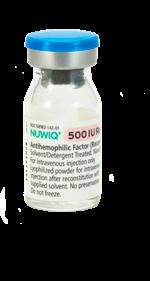
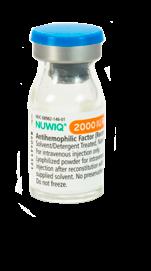
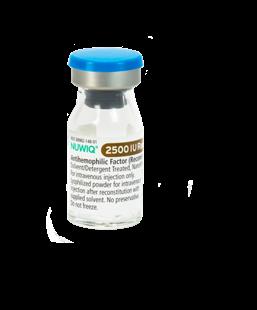
Dosing Flexibility With a Wide Variety of Dosage Strengths
n All NUWIQ® vial sizes are reconstituted with an easy-to-use 2.5 mL prefilled syringe
n Available in the following dosage strength vials




Strength, Support and Community for People Living with Bleeding Disorders
Built around your needs, the program includes resources for patients and caregivers, support services for those navigating care, reliable educational materials, and uplifting community connection.
Factor My Way Assistance
Free trial, co-pay assistance, & real-world insurance know-how for eligible patients.
Factor My Way Events
Join scheduled live and on-demand digital information programs and events.
Factor My Way Connection
Meet experts and join our online support community to help you access resources and build relationships.
Factor My Way Learning
Learn-as-you-go, practical information about bleeding disorders, treatment, and lifestyle management.
Membership in Factor My Way is complimentary and open to anyone in the USA. Join the program at www.factormyway.com, or call 1-855-498-4260.
www.NUWIQUSA.com
Octapharma USA, Inc. 117 W. Century Road Paramus, NJ 07652 Tel: 201-604-1130 Medical Affairs usmedicalaffairs@octapharma.com
For all inquiries relating to drug safety, or to report adverse events, please contact our local Drug Safety Officer: Tel: 201-604-1137 | Cell: 201-772-4546 | Fax: 201-604-1141 or contact the FDA at 1-800-FDA-1088 or www.fda.gov/medwatch.
Please see accompanying full Prescribing Information.
©2021. Octapharma USA Inc. All rights reserved. Date of preparation: 2/2021. NUW-0333-COT