
Winter storm leaves Ocean Pines and Berlin without power for days, causes widespread damage
By Sherrie Clifford ROC Edition Publisher
A powerful winter storm dumped heavy, wet snow across Ocean Pines and brought wind gusts approaching 70 mph, bringing down trees, damaging power lines and leaving residents in both Ocean Pines and Berlin without electricity for days.
Ocean Pines sustained significant structural damage as multiple trees fell directly into homes during the height of the storm. In several neighborhoods, large trees crashed onto roofs while massive limbs tore through siding and in some cases crushed parked vehicles beneath
them. In other areas, trees narrowly missed structures but blocked driveways and roadways.
Snow totals approaching 14 inches in parts of Ocean Pines, coupled with wind gusts nearing 70 mph, created punishing conditions that placed extraordinary strain on mature trees. The dense, heavy snow, whipped by sustained winds led to widespread limb failure, snapped trunks and uprooted trees throughout the community.
The Ocean Pines Parkway showed some of the most dramatic impact. Portions of the main corridor resembled the aftermath of a localized
See WINTER STORM page 2
June primary poised to decide key Worcester County commissioner seats
By Sherrie Clifford ROC Edition Publisher
Campaigns are officially underway for the Worcester County Board of Commissioners following the close of candidate filing, with multiple contested primaries and one open seat shaping the 2026 election cycle.
Races are set across all seven commissioner districts. Several districts will hold primary elections to determine each party’s nominee. In districts where only one party filed candidates, the winner of that party’s primary will likely secure
the seat in November, making the primary especially significant this year.
Maryland’s 2026 statewide primary election is scheduled for Tuesday, June 23, 2026, with early voting available June 11 through June 18. Worcester County commissioner races will appear on that ballot, where candidates in contested primaries will compete for their party’s nomination.
It is important to note that even in districts where only one party filed candidates, the primary does not officially decide the seat. A See COMMISSIONER SEATS page 3


OCEAN PINES • WEST OCEAN CITY • BERLIN MD
ROC Edition • Sherrie Clifford, Publisher Winter storm leaves toppled trees and widespread power outages in its wake.

WINTER STORM
Continued from page 1
wind event, with trees down across travel lanes, limbs scattered along the roadway and heavy branches hanging dangerously from center median trees. Crews worked steadily to clear debris and eliminate overhead hazards to maintain emergency access.
Large portions of Ocean Pines lost power as downed trees damaged distribution lines, leaving much of the community without electricity for days, with isolated areas experiencing even longer outages as crews worked through blocked access points and snow-covered terrain.
As cleanup continues, the Ocean Pines CPI Department is asking residents to report hazardous trees or hanging branches throughout the community.

Crews are actively clearing visible debris, but resident reports help identify dangerous conditions that have possibly not been reached yet. Residents who notice hanging branches on residential properties or extending over roadways are encouraged to call 410-641-7425. Photos of limbs, along with the property address, may be emailed to poristian@oceanpines.org.
In Berlin, the storm triggered a town-wide power outage after a transmission line serving the municipality failed during the height of the storm. The outage left residential, commercial and municipal customers without electricity for an extended period.
Restoration required coordination with the transmission provider before local electric crews could gradually bring circuits back online in stages. Critical infrastructure, including medical facilities and public safety operations, was prioritized as power was restored.
The Maryland National Guard was brought into Berlin to assist

during the outage and snow emergency. Guard members supported municipal efforts by helping secure key areas, assisting with snow removal logistics and enabling utility crews to access equipment in areas where trucks could not safely operate due to heavy snow and softened ground conditions.
Across both communities, the combination of heavy snowfall, sustained wind and saturated ground created widespread strain on trees and above-ground power infrastructure. Even mature, otherwise healthy trees proved vulnerable under the added weight of snow and wind.
Cleanup and restoration efforts remain ongoing as crews continue addressing isolated outages and removing debris from residential streets.
The storm left a lasting mark across Ocean Pines and Berlin, underscoring the vulnerability of coastal communities to severe winter weather and the importance of coordinated emergency response when infrastructure systems are strained.


ROC Edition • Submitted
ROC Edition • Submitted
COMMISSIONER SEATS
Continued from page 1
general election will still be held in November. In rare cases, a certified write-in candidate could appear on the ballot or potentially prevail over a primary winner, depending on state election laws and certification requirements.
Commissioner District 1 will feature a four-way Republican primary in the Southern district. Incumbent Caryn Abbott is seeking re-election and will face Laura Morrison, Shaun Shockley and Wayne Taylor. Because no Democrat filed in District 1, the Republican primary winner will be the only party nominee on the November ballot.
Commissioner District 2 will hold a Democratic primary between incumbent Diana Purnell and Roxie Dennis. No Republican candidate filed in the district, meaning the Democratic nominee will be unopposed by a major-party challenger in the general election. District 2 is structured as a majorityminority district. Purnell is a three-term incumbent and the first Black woman to serve on the county commission.
Commissioner District 3 features incumbent Republican Eric
Fiori, who faces Republican challenger Tim VanVonno in the primary. The winner will advance to the general election.
Commissioner District 4 will see a three-way Republican primary as incumbent Theodore “Ted” Elder seeks re-election against Steve Green and Virgil Shockley.
Commissioner District 5 includes incumbent Republican Chip Bertino, who faces Republican challenger Joe Schanno in the primary. The winner will move on to the general election ballot.
Commissioner District 6 is the only open seat this cycle following the decision by Commissioner Jim Bunting Jr. not to seek re-election. Republican candidates Lou Taylor of Bishopville and Sherrie Clifford of Ocean Pines and owner of the ROC Edition newspaper will compete in the primary to determine who advances to the general election.
Commissioner District 7 features incumbent Republican Joseph Mitrecic, who does not face primary opposition and will advance to the general election ballot.
The Worcester County Board of Commissioners serves as the governing body of county government, overseeing annual operating and capital budgets, land use and planning decisions, public safety

Several contested primaries and one open seat mark a competitive 2026 election cycle for the Worcester County Board of Commissioners.
funding, infrastructure investment and county department oversight. While each commissioner represents a geographic district, all members vote on countywide matters.
With multiple contested primaries and one guaranteed new member due to the open District 6 seat, the June primary is expected to play a significant role in determining the board’s future composition.
Candidates across the county have begun outlining priorities, organizing fundraising efforts and scheduling public appearances as the campaign season progresses.
The June 23 primary will determine party nominees who will appear on the November ballot, setting the stage for the next fouryear term of county leadership.

ROC Edition • Sherrie Clifford, Publisher
Leadership transition announced for Worcester County Veterans Memorial Foundation in Ocean Pines
By Sherrie Clifford ROC Edition Publisher
The Worcester County Veterans Memorial at Ocean Pines Foundation has announced a leadership transition as longtime president Marie Gilmore steps down after more than a decade guiding the organization’s growth, expansion and educational outreach efforts.
Gilmore joined the foundation’s board of directors in 2005 and served in several leadership roles, including secretary and vice president, before being elected president in 2012. After briefly stepping away due to term limits, she returned to the board in 2015 and has served as president since.
During her tenure, the memorial has expanded both physically and programmatically. Additions in recent years include Patriots Pathway, the POW/MIA Chair of Honor, the Battlefield Cross and a gazebo that serves as a focal point for ceremonies and community gatherings. A site refresh currently underway includes new grading, concrete work, landscaping improvements and formal recognition of the United States Space Force. The project is expected to be completed by May 1.
The Worcester County Veterans Memorial at Ocean Pines Foundation, Inc. was formed in 2004 as an all-volunteer nonprofit 501(c) (3) organization funded entirely through donations and fundraising activities. The foundation is responsible for maintaining the memorial and supporting its programs, with
policies and initiatives overseen by its volunteer board of directors.
Each year, the foundation hosts Memorial Day and Veterans Day ceremonies that bring together veterans, civic groups and community members to honor military service and sacrifice.
One of the foundation’s most significant initiatives is its Education and Outreach Program, established in 2006. The program sponsors annual educational field trips to the memorial for all fifth-grade students in Worcester County. The foundation covers all associated costs, including transportation and educational booklets for each student. The annual golf tournament serves as the primary fundraiser supporting the program.
During their visit, students learn about the purpose of the memorial and the stories behind the engraved bricks and pavers honoring local veterans. They receive instruction on flag history and etiquette and are taught how to properly fold the American flag by members of the Stephen Decatur High School NJROTC program.
The Education and Outreach Program has received statewide recognition, earning the Governor’s Service Award for Volunteerism in 2012 and the William Donald Schaefer Helping People Award in 2013.
Gilmore will remain on the foundation’s board of directors, continuing her involvement with the organization she has helped guide for more than 20 years.
Rick Farr of Ocean Pines has



been selected as the foundation’s next president. Farr is a veteran of the United States Air Force, where he served 22 years in support of multiple military operations, including Desert Shield and Desert Storm, Operation Enduring Freedom and Operation Iraqi Freedom. He has served as a member of the foundation’s board of directors and will assume leadership as the organization continues its mission.
Farr also serves as vice president of the Ocean Pines Association Board of Directors and is the Chief Human Resource Officer for the Town of Easton.
The leadership transition comes as the memorial continues to evolve while maintaining its core purpose: honoring the service and sacrifice of veterans and educating future generations about their contributions to the nation and the community.

ROC Edition • Submitted
Worcester County Veterans Memorial at Ocean Pines Foundation president Marie Gilmore steps down, with Rick Farr named as her successor.
Touch of Italy’s Bob Ciprietti begins capital investment in Ocean Pines with Yacht Club bar renovation
By Sherrie Clifford ROC Edition Publisher
The newly renovated Yacht Club bar represents the first completed capital improvement made by Touch of Italy owner Bob Ciprietti within the Ocean Pines venues his company leases and operates.
The project is not a cosmetic refresh. It is a structural redesign intended to improve operational efficiency while enhancing the overall quality of the Yacht Club facility.
The former curved bar configuration has been replaced with a wider, squared layout that expands the service area behind the counter. The increased footprint allows for improved internal workflow and reduces congestion during busier periods without altering the character of the space.
From an infrastructure standpoint, the renovation modernizes key interior elements. A newly constructed coffered ceiling anchors the room, complemented by updated pendant lighting that provides more consistent illumination throughout the bar area. The redesigned countertop increases seating capacity
while introducing a more durable, contemporary finish.
Under its lease agreement with Ocean Pines, Touch of Italy operates the Yacht Club, Clubhouse Bar and Grill and Beach Club venues while providing the association a 6.5% return on all non-alcoholic beverage sales. Within that structure, facility functionality and operational efficiency are directly connected.
The upgrades are built into the facility itself, becoming part of the Yacht Club’s permanent infrastructure and enhancing the amenity for the community long term.
The renovation reflects a measurable investment by the operator into the physical space it serves. By implementing structural improvements within the leased venue, Touch of Italy is contributing capital enhancements that remain with the association.
The Yacht Club serves as a central gathering space within the community, particularly during the spring and summer seasons. Improvements to service layout and interior infrastructure position the venue to operate more efficiently during periods of increased demand while

elevating the overall environment for residents and guests.
The renovated bar area officially opened on Feb. 28, marking the completion of the first structural enhancement undertaken by Touch of Italy within its Ocean Pines venues. The opening provides a visible example of reinvestment into the amenities it serves, with improvements that remain part
of the community’s long-term infrastructure.
As additional renovations move forward at the golf course Clubhouse and other venues, the Yacht Club bar redesign stands as the first completed step in a broader pattern of reinvestment focused on strengthening Ocean Pines’ dining amenities through permanent infrastructure improvements.

ROC Edition • Sherrie Clifford, Publisher
The newly renovated Yacht Club bar introduces a brighter, more modern aesthetic, bringing a refined touch to one of Ocean Pines’ central gathering spaces.


Demolition begins on long-awaited South Side Fire Station in Ocean Pines
By Sherrie Clifford ROC Edition Publisher
Demolition began Feb. 26 at the Ocean Pines Volunteer Fire Department’s South Side Fire Station, marking the first visible step toward construction of a long-planned replacement facility. The project is expected to take approximately 60 weeks to complete once full construction begins.
Heavy equipment arrived early as crews began dismantling the aging structure that has served Ocean Pines for more than four decades. For many residents, the start of demolition signals the transition from years of planning and discussion to active construction.
The existing South Side station was built in 1981, when Ocean Pines was significantly smaller and emergency service demands were more limited. Over time, both the community and the department have grown. Fire apparatus have increased in size, staffing needs have evolved and safety standards have advanced. What once met operational needs gradually became outdated.
Earlier this year, the Ocean Pines Association Board of Directors approved a construction contract for the new facility. The Whayland Company will serve as contractor for the project.
Facility assessments identified space constraints, infrastructure limitations and design deficiencies that no longer aligned with modern fire service expectations. The building lacked adequate room for current equipment, updated living quarters for personnel and accessibility features common in newer public safety facilities.
One significant shortcoming was the lack of a properly designed decontamination area. Modern fire service standards call for dedicated space to isolate and clean gear after structure fires, vehicle fires or hazardous incidents, when carcinogens and other toxic substances can cling to protective equipment. Without separation from living and administrative areas, those contaminants can be brought into common spaces. The new South Side station will include a dedicated decontamination room designed to reduce long-term health risks for volunteer and career firefighters, improve indoor air quality and strengthen overall occupational safety, an
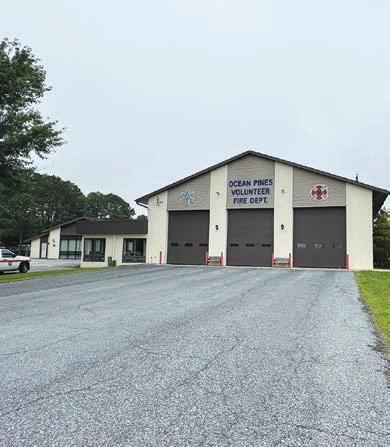


Demolition is underway at the Ocean Pines Volunteer Fire Department’s South Side station, marking the start of construction on a new facility built to meet modern safety and operational standards.
increasingly important component of today’s fire service operations.
Momentum toward replacement gained traction in recent years as Ocean Pines Volunteer Fire Department leadership, the Ocean Pines Association and residents worked through feasibility studies, cost projections and design planning. A community referendum authorized
construction of the new station, reflecting broad support for investing in public safety infrastructure.
In preparation for demolition, fire apparatus and essential equipment were relocated to temporary quarters at the Ocean Pines Public Works facility. Emergency response operations remain fully active during the transition, with coverage maintained
throughout construction.
As demolition continues in the coming weeks, site preparation will follow, clearing the way for foundation work and vertical construction. The visible changes at the site represent the beginning of a major infrastructure investment intended to support first responders and protect residents for decades to come.
ROC Edition • Sherrie Clifford, Publisher
Flower Street Sports Complex site declared a no by Berlin leadership
By Sherrie Clifford ROC Edition Publisher
The proposed regional sports complex near Flower Street, a project advanced by Ocean City officials with Berlin’s cooperation but not as a Berlin-led initiative, has now been formally rejected by Berlin’s mayor and council.
What began as an informational presentation on Feb. 7 at Stephen Decatur High School has since evolved into a clear municipal position against the proposed site. Following strong community opposition expressed during that meeting, Berlin officials have formally requested that the property located west of Stephen Decatur High School and Middle School be removed from consideration.
For many residents in attendance, the presentation felt familiar. Several attendees indicated they had heard similar proposals in prior discussions and believed the project had already been set aside. The reemergence of the proposal prompted immediate reaction from members of the
community who arrived prepared to voice renewed concerns.
Ocean City officials had arranged informational stations throughout the auditorium outlining various components of the proposed facility, including traffic and infrastructure considerations. Many residents expected a structured public comment session and voiced frustration when the meeting opened in a presentation format rather than a question-and-answer forum.
As concerns were raised, the atmosphere in the room intensified. Residents reiterated opposition to the Flower Street location and questioned why the proposal had resurfaced. The format was subsequently adjusted to allow open public comment and direct responses from officials. The discussion at times became contentious as residents pressed for clarity.
In the days following the Feb. 7 meeting, Berlin’s mayor and council considered the concerns raised by residents and weighed the town’s position on the proposed site.
At its Feb. 9 Mayor and Council

Residents attend the Feb. 7 sports complex meeting at Stephen Decatur High School, where significant community opposition was expressed regarding the proposed Flower Street site.
meeting, the council agreed to formally notify Ocean City that the Flower Street property should no longer be considered for the sports complex. The letter to Mayor Rick Meehan cited consistent community opposition and requested that
the site west of Stephen Decatur High School and Middle School be removed from further consideration.
For Berlin’s mayor and council, the conclusion was direct: the Flower Street location is a no.

ROC Edition • Sherrie Clifford, Publisher
Site map of property which Berlin officials have formally requested be removed from consideration as
Considering a run for the Ocean Pines Board of Directors?
Part 2 of a four-part series
By Sherrie Clifford ROC Edition Publisher
After understanding how homeowner association elections are administered, the next question prospective candidates should consider is this: What does campaigning actually involve?
Running for a homeowner association board seat is often described as volunteer service, but campaigning for that seat requires preparation, strategy and personal investment. Unlike public elections, HOA campaigns operate within the rules established by the association’s governing documents and board-adopted policies.
Before filing, candidates should carefully review those campaign rules.
Most HOAs establish guidelines covering yard signs, placement on common property, distribution of printed materials, use of association
communication channels and candidate forums. Some associations limit where signs may be placed or how long they may remain posted. Others prohibit campaign materials in certain common areas. Understanding these parameters in advance helps candidates avoid unintended violations.
Candidates should also clarify whether official association platforms, such as newsletters, websites or email systems, provide equal access for all candidates and what the format and deadlines may be. Equal treatment is essential, but it remains each candidate’s responsibility to comply with submission requirements.
Beyond rules, there are practical considerations.
Campaigning carries costs. Yard signs, printed mailers, graphic design, social media promotion and event participation all require financial resources. Even modest campaigns can involve several

hundred to several thousand dollars, depending on strategy and scale. Because HOA elections typically do not involve campaign finance reporting requirements like public elections, candidates fund their efforts personally unless association policies provide otherwise.
Time investment is equally significant.
Campaigning requires door-todoor outreach, attendance at candidate forums, responding to resident questions and remaining visible within the community throughout the election period. For many candidates, this occurs alongside full-time employment and family responsibilities. Understanding the time commitment before filing helps avoid burnout later in the campaign.
Prospective candidates should also have realistic expectations about voter turnout.
HOA elections often draw lower participation rates than public elections. In smaller voting pools, margins of victory can be narrow. A relatively small number of votes may determine the outcome. This reality underscores the importance of direct engagement with homeowners and consistent communication.
Candidates should also prepare for public scrutiny.
Board service involves fiduciary responsibility and oversight of significant community budgets, amenities and policies. Campaign discussions may include financial decisions, prior board actions or differing visions for the community’s future. While healthy debate strengthens governance, candidates should be prepared for disagreement and, at times, criticism.
Another practical consideration is community dynamics.
In HOA elections, candidates and voters are neighbors. Campaign conversations occur at the mailbox, in parking lots and at community events. Maintaining professionalism throughout the process is essential. Reputations carry forward long after ballots are counted.
It is also wise for candidates to consider what happens after the election, regardless of the outcome. If elected, service begins immediately and requires collaboration with sitting directors, committee members and management. If not elected, candidates continue to live within the same community they campaigned in. Conduct during the campaign

shapes those future interactions.
Finally, candidates should assess their readiness for board service itself.
HOA boards oversee multimillion-dollar budgets, contractual agreements, capital projects and policy decisions that affect every property owner. Campaign messaging should align with a willingness to engage in financial review, committee work and consistent meeting attendance. Running on broad themes is easy; governance requires sustained effort.
Choosing to run for the Ocean Pines Association Board of Directors is a meaningful decision. It involves personal investment, time commitment and public accountability. Reviewing campaign rules, estimating realistic costs and preparing for community engagement ensures that the choice to file is made with clarity and confidence.
COMING NEXT:
Part 3 of this series will examine what board service looks like after the election, including fiduciary duties, financial oversight and expectations once seated.
Editor’s Note: This article is part of an ongoing informational series designed to help residents understand the board of directors election process before candidate filing deadlines.
ROC Edition • Sherrie Clifford, Publisher
Did you know? Even the top of the flagpole has meaning
By Sherrie Clifford ROC Edition Publisher
In many Maryland libraries, courtrooms and community meeting rooms, the American and Maryland flags stand side by side in formal display. Most people notice the bold colors or the placement of the flags. Far fewer notice the ornament at the very top of the pole.
In Maryland, even that detail tells a story.
The ornament is called a finial. On the American flag, it is traditionally an eagle. On the Maryland flag, it is most commonly a spear. In some settings, however, the Maryland flag is topped with a cross bottony, a design drawn directly from the state’s colonial roots.
The American flag, established by the Continental Congress on June 14, 1777, began with 13 stars and 13 stripes representing the original colonies. As new states entered the Union, stars were added, bringing the total to 50 in 1960. Under federal flag code and long-standing custom, the American flag occupies the position of honor when
displayed with other flags. Indoors, it is placed to the observer’s left and should never be smaller than a state flag displayed beside it. The eagle finial, drawn from the Great Seal of the United States, symbolizes national authority and sovereignty and is reserved for the U.S. flag.
Maryland’s flag reflects an even older lineage.
Its design comes from the heraldic arms of George Calvert, the first Lord Baltimore, whose family founded the Maryland colony in 1634. The black and gold quadrants represent the Calvert family. The red and white quadrants represent the Crossland family, inherited through Calvert’s mother, Alicia Crossland.
Prominent within that red and white section is the cross bottony.
A cross bottony is a heraldic cross with trefoil or clover-shaped ends. The rounded tips give the design its name. In medieval heraldry, the trefoil shape symbolized continuity and heritage. In Maryland, it represents family lineage and colonial history rather than religious doctrine. The cross bottony existed in the Crossland coat of arms long
before Maryland became a colony.
Because it is embedded in the state’s official heraldic design, some ceremonial indoor flag sets incorporate a cross bottony finial atop the Maryland flag pole. The topper visually echoes the design within the flag and reinforces Maryland’s distinctive identity.
Context, however, matters.
The eagle finial remains reserved for the American flag when displayed alongside state flags. Placing an eagle atop a Maryland flag pole in a dual display can blur the distinction between national and state symbolism. For that reason, the spear finial remains the most common and widely accepted ornament for state flags in formal government settings.
A cross bottony finial is generally most appropriate in Maryland-focused environments, such as state buildings, historical exhibits or educational displays where the heraldic symbolism is intentionally emphasized. In courtrooms, municipal chambers and other formal venues where uniformity is preferred, spear finials are
typically used.
Placement remains essential. When displayed together indoors on separate poles, the American flag stands to the observer’s left. The Maryland flag stands to the observer’s right.
Orientation of the Maryland flag is equally important. Whether hung vertically or displayed on a pole, the black and gold Calvert design must appear in the upper left quadrant from the viewer’s perspective.
Indoor flags are not decorative accents. They represent national unity, state heritage and continuity of government. From the weighted base to the fringe and the finial above, each element carries purpose.
In Maryland, even the cross at the top of a flagpole traces back to 17th-century heraldry and the founding of the colony itself. These details may go unnoticed by many observers, but they quietly reflect respect for history, order and tradition.
Yes, even the top of the flagpole has meaning.

More light, less sleep: Daylight saving time returns March 8
By Sherrie Clifford ROC Edition Publisher
It’s that time again. In the early hours of Sunday, March 8, 2026, clocks across Maryland will move ahead one hour as daylight saving time begins.
The phrase many people use to remember which direction to turn the clock is simple: “Spring forward, fall back.” In March, we spring forward, losing an hour of sleep but gaining longer evenings filled with daylight.
The shift happens at 2 a.m., when clocks advance to 3 a.m. While most digital devices update automatically, many household clocks still require a manual adjustment.
Daylight saving time has been part of American life for more than a century. The United States first adopted the practice in 1918 during World War I as a way to conserve fuel and reduce the need for artificial lighting. The idea was that extending daylight later into the evening would lower energy use.
The measure was repealed after the war but returned during World War II. In the decades that followed,
states and cities observed time changes inconsistently, creating confusion for railroads, broadcasters and interstate commerce. To bring order, Congress passed the Uniform Time Act in 1966, establishing a standardized schedule nationwide.
Today, daylight saving time begins on the second Sunday in March and ends on the first Sunday in November. Most states observe it, though Hawaii and most of Arizona do not.
For hospitals and healthcare providers, however, the shift is more than symbolic. Medication schedules, treatment intervals and overnight monitoring must be carefully managed during the time change. Electronic medical record systems automatically adjust, but clinical teams must account for the missing hour to ensure medications are administered safely and on time. Doses scheduled during the 2 a.m. hour require special coordination, particularly for critical care patients, infusion therapies and time-sensitive medications. Healthcare staff prepare in advance to prevent disruption and maintain continuity of care throughout the transition.





Supporters of daylight saving time say longer evening daylight benefits local businesses, outdoor recreation and tourism. For communities like Ocean Pines and across Worcester County, extended daylight means more time for evening walks, youth sports practices and waterfront activities as spring approaches.
While debates continue about whether to eliminate the twiceyearly clock change, the ritual remains familiar. Each March, the reminder surfaces: Spring forward.



On Sunday morning, sunrise will arrive later, but sunset will stretch deeper into the evening sky. The extra light at day’s end often feels like the first true sign that winter is fading.
So before heading to bed on Saturday night on March 7, remember the phrase that keeps it simple, “spring forward.” It may cost an hour of sleep, but it brings a little more daylight to enjoy.
Worcester County schools to start Aug. 31, reshaping final week of summer
By Sherrie Clifford ROC Edition Publisher
Worcester County Public Schools will begin the 2026-27 school year on Monday, Aug. 31, marking a significant departure from the longstanding post-Labor Day tradition and effectively reshaping the entire final week of August for families, students and seasonal employers.
Under the adopted calendar, students will attend school Monday, Aug. 31 through Thursday, Sept. 3. Schools will then close Friday, Sept. 4 and Monday, Sept. 7 for the Labor Day holiday.
The result is an unusual opening stretch: four days of instruction followed by a long weekend break, then a return to full scheduling the following week.
More notably, what has historically been the final uninterrupted week of summer vacation will now be a school week.
For a coastal county whose economy is deeply tied to seasonal tourism, the timing carries
implications well beyond the classroom.
Ocean City’s busiest season extends through Labor Day weekend. Many Worcester County high school students work in restaurants, retail shops, amusement venues and hospitality positions during the summer months. Labor Day weekend often represents one of the highest revenue periods of the year.
With school beginning Aug. 31, student workers may face difficult decisions: remain on job schedules during one of the most demanding weekends of the season or shift focus to academic responsibilities.
That change could affect staffing levels for local businesses that traditionally rely on teen employees through the close of summer.
Aquatic operations may face similar scheduling challenges. Many high school students work as certified lifeguards and pool staff through Labor Day, often covering the busiest stretch of the season. With classes beginning Aug. 31, facilities may
need to adjust programming, revise hours or reassess staffing to maintain safety standards during the transition from summer to the academic year.
For families, the shift may disrupt travel plans that have historically centered on late August. Many parents schedule annual vacations during the final full week before Labor Day. With school now beginning Aug. 31, trips planned for that week may conflict with the first days of instruction.
The calendar structure also creates a split start: students return to school for four days, break for the holiday weekend, then resume classes. For some families, that rhythm may feel disjointed.
In Worcester County, where summer tourism shapes employment patterns and family routines, the earlier start carries distinct local ripple effects.
Parents, employers and recreation providers now have several months to prepare for the adjustment. Businesses may need to review staffing
AUGUST
31
plans for the final week of August. Recreation programs may need to evaluate how youth employment overlaps with operating schedules. Families may need to rethink how they structure summer travel.
The first day of school for Worcester County students will be Monday, Aug. 31, 2026. With Friday, Sept. 4 and Monday, Sept. 7 designated as days off, the traditional final week of summer will no longer exist in its familiar form.
For a community built around summer, the shift marks more than a date change. It resets the rhythm of the season.

Route 113 continues to divide Berlin as residents push for safer crossings
By Sherrie Clifford ROC Edition Publisher
A strong turnout at St. Paul United Methodist Church reflected continued community concern over pedestrian safety along U.S. Route 113 as town officials and representatives from the Maryland State Highway Administration provided an update on the ongoing Route 113 safety study.
The project, titled “Bridging the Highway that Divides Berlin,” remains in the feasibility and planning phase. Officials emphasized that no construction has been approved and that any future project would require federal environmental review and additional funding before moving forward.
The study focuses on three primary crossing areas identified as key connection points across Route 113: Old Ocean City Boulevard (MD 346), Bay Street (MD 376) and South Main Street/Germantown Road (MD 818). Each location links residential neighborhoods with schools, parks, downtown Berlin and commercial services.
Near Old Ocean City Boulevard, residents frequently cross Route 113 to access Food Lion, nearby medical offices and other retail establishments west of the highway. Officials said this section carries high traffic volumes with multiple lanes in each direction and complex turning movements that create challenges for pedestrians attempting to cross at grade.
Conceptual options include improved signal timing, high-visibility crosswalks, pedestrian refuge islands in the median and upgraded lighting. A grade-separated crossing, such as a pedestrian overpass or underpass, has also been evaluated at a preliminary level. Early planning estimates indicate that construction of a pedestrian bridge could approach $15 million, depending on design specifications, right-of-way needs and utility relocation. Officials noted that the figure is a preliminary planning estimate and not a finalized project cost.
At Bay Street, which connects established neighborhoods to downtown Berlin, Henry Park and Decatur Park, pedestrian activity remains steady throughout the day and increases during community events and school travel. Officials said turning traffic entering and exiting
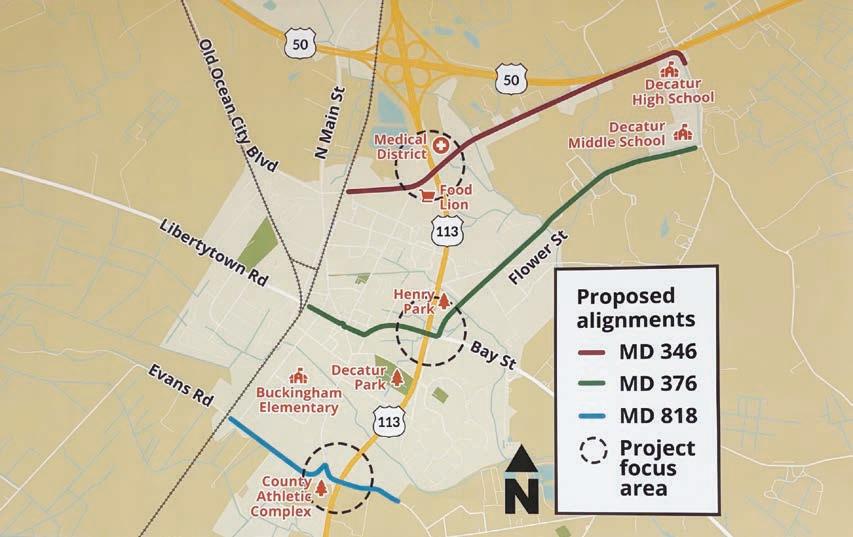
ROC Edition • Town of Berlin, Maryland Site map identifying three Route 113 crossing locations under evaluation as part of Berlin’s feasibility study focused on strengthening pedestrian safety along the corridor.
Route 113 presents operational challenges at this intersection.
Proposed concepts at Bay Street include enhanced crosswalk markings, extended pedestrian signal timing, improved lighting and median refuge areas to allow pedestrians to cross in stages. Some residents expressed support for lower-cost improvements that could be implemented sooner, while others said long-term growth may warrant more substantial infrastructure to separate pedestrians from highway traffic.
The third study area near South Main Street and Germantown Road provides access to Stephen Decatur schools and the planned rail-trail corridor. Officials emphasized that safe routes to school remain a priority. Residents raised concerns about speeding and heavy traffic volumes during peak commuter hours, noting that Route 113 effectively divides sections of the town.
Conceptual improvements under review at this location include signal modifications, upgraded pedestrian warning systems, sidewalk
Throughout the meeting, residents described Route 113 as a physical barrier separating neighborhoods from schools, parks, medical services and commercial centers. Town leaders encouraged continued public input as the study advances and conceptual options are refined.
enhancements and additional traffic-control measures. A grade-separated crossing has also been examined as part of the broader study.
Several residents urged officials to explore potential speed limit adjustments along Route 113 through Berlin. Representatives from the Maryland State Highway Administration said speed limits are determined through formal engineering studies that consider traffic data, roadway design and safety history.
The safety study was originally supported by a $1.2 million award through the U.S. Department of Transportation’s Neighborhood Access and Equity Program, intended to help communities address barriers created by major transportation corridors. Town officials recently confirmed that $950,000 of that funding was rescinded due to federal budget cuts, leaving approximately $250,000 available for continued
planning and engineering analysis.
Officials said the funding reduction limits the scope of work that can be completed at this stage but does not end the study. Any future construction, whether sidewalks, signal upgrades or a pedestrian bridge, would require additional state, federal or local funding.
Throughout the meeting, residents described Route 113 as a physical barrier separating neighborhoods from schools, parks, medical services and commercial centers. Town leaders encouraged continued public input as the study advances and conceptual options are refined.
Despite funding challenges, officials reiterated that the objective remains improving safe connections across Route 113 and ensuring residents can move between both sides of the highway in a manner that reflects both community needs and fiscal realities.
By Sherrie Clifford ROC Edition Publisher
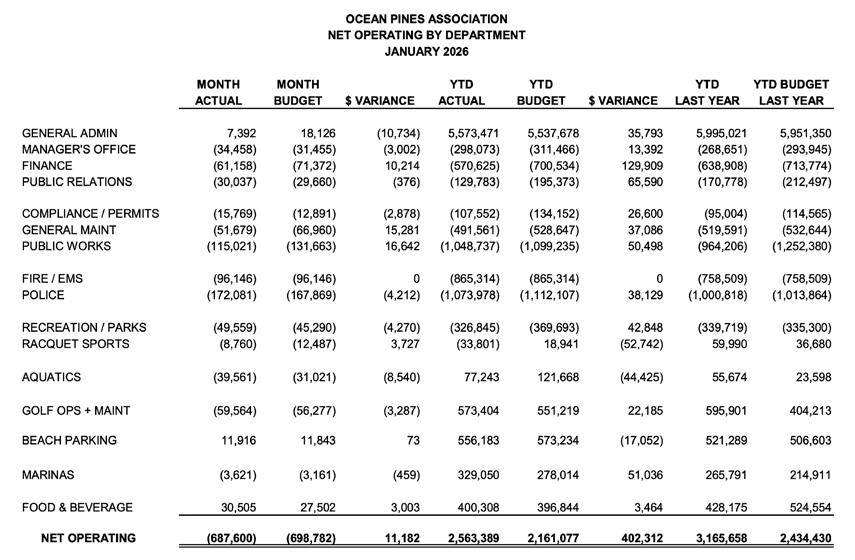
The Ocean Pines Association closed January with a positive operating variance of $11,182 for the month and remains $402,312 ahead of budget year to date.
January financials outperform budget despite seasonal slowdown ROC Ledger ROC Tribute
For January, total net operating results show a loss of $687,600 compared to a budgeted loss of $698,782. In simple terms, the association expected to lose $698,782 in January but instead lost $687,600.
That means the loss was $11,182 smaller than projected.
This is what accountants refer to as “favorable to budget.” It does not mean the association made a profit for the month. It means the loss was less than planned.
Year to date, net operating results total $2,563,389 compared to a budgeted $2,161,077, producing a positive variance of $402,312. That figure reflects overall performance across all departments combined.
UNDERSTANDING “LESS LOSS THAN EXPECTED”
Many Ocean Pines departments operate seasonally and are expected to show losses during the winter months. Golf, aquatics and recreation amenities often incur expenses now in preparation for spring and summer revenue.
When you see numbers in parentheses on the financial report, that means the department is operating at a loss for that period. That is normal in the winter.
What matters is whether that loss is larger or smaller than budgeted.
For example, if the budget anticipated a loss of $100,000 and the actual loss is $90,000, the department still lost money. However, it lost $10,000 less than expected. That $10,000 difference is considered favorable.
That is what is occurring in several departments this month.
DEPARTMENT HIGHLIGHTS
General Administration is $35,793 favorable year to date, meaning expenses have come in lower than budgeted or revenues slightly higher than projected. The Manager’s Office shows a
$13,392 favorable variance for the same reason.
Finance continues to report one of the strongest favorable positions at $129,909 year to date. This reflects performance ahead of budget projections, not necessarily excess profit.
Public Relations is $65,590 favorable year to date, and Compliance, Permits and Inspections is $26,600 favorable. In both cases, actual results are tracking better than the financial plan anticipated.
General Maintenance is operating $37,086 ahead of budget year to date, while Public Works shows a $50,498 favorable variance year to date, including a monthly performance $16,642 better than projected. Favorable results in these departments typically reflect controlled spending relative to budget expectations.
Fire/EMS remains exactly on budget year to date, meaning actual results align almost precisely with projections.
Police reflects a $38,129 favorable year-to-date variance, indicating expenses are running lower than anticipated or revenues
slightly stronger than forecast. Recreation and Parks is $42,848 favorable year to date. Racquet Sports, however, reflects a yearto-date unfavorable variance of $52,742, meaning it has lost more than budgeted at this point in the fiscal cycle.
Aquatics shows a year-to-date unfavorable variance of $44,425. This reflects higher seasonal costs ahead of peak summer revenue months and does not necessarily indicate long-term imbalance.
Golf Operations and Maintenance shows a monthly loss of $59,564, which is typical during winter months when revenue is limited. Year to date, however, golf is $22,185 favorable to budget.
Beach Parking is currently $17,052 under budget year to date, likely reflecting the timing of seasonal revenue.
Marinas reports a $51,036 favorable year-to-date variance, meaning performance is ahead of projections.
Food and Beverage posted a positive monthly operating result of $30,505, exceeding budget by $3,003. Year to date, Food and Beverage is $3,464 favorable,
indicating performance slightly stronger than expected.
BOTTOM LINE
January reflects controlled spending and stable departmental performance during a traditionally slower revenue period.
While several amenities are operating at seasonal losses, those losses are smaller than budgeted in many cases. That difference is what produces the overall favorable variance.
For homeowners, the key takeaway is this: The association is currently performing better than its financial plan projected for this point in the fiscal year.
As spring approaches and seasonal revenues begin to increase, attention will shift to whether that favorable trend continues.
It is important to remember that a favorable variance does not automatically mean profit or surplus cash. It simply means actual results are better than the budget anticipated, whether that is through smaller losses, lower expenses or slightly stronger revenues.
Cash and investments snapshot reflects stable financial position for Ocean Pines
By Sherrie Clifford ROC Edition Publisher
As of Jan. 31, 2026, the Ocean Pines Association reports total cash and investments of $13,087,639, including $12,518,158 held in investment accounts and $569,481 in operating accounts.
From a financial health perspective, this reflects a stable liquidity position supported by a conservative and diversified investment structure.
The association maintains significant balances in insured cash sweep accounts at Taylor Bank and Bank of Ocean City, totaling $3,538,327. Cash sweep programs distribute deposits across multiple participating institutions to ensure that FDIC insurance limits are not exceeded while maintaining ready access to funds. This structure allows the association to preserve liquidity without sacrificing principal protection.
In addition to liquid balances, funds have been allocated into shortterm Treasury bills and certificates of deposit through CDAR programs. The 13-week U.S. Treasury bill maturing in March 2026 provides short-term government-backed security, while the CDAR deposits are structured in staggered maturities extending from February through August 2026.
CDAR programs allow large deposits to be distributed among multiple banks so that no individual institution holds more than $250,000, thereby maintaining FDIC insurance coverage. The footnote accompanying the report confirms that deposits do not exceed that threshold at any single bank.
The maturity schedule reflects a laddering strategy. Rather than placing all funds into a single longterm instrument, the association has spread maturities across several months. This approach provides flexibility, allowing funds to become available at regular intervals. It reduces exposure to interest rate shifts and supports the ability to respond to operational needs, capital projects or unexpected expenses.
The $569,481 held in operating accounts provides immediate liquidity for payroll, vendor payments and routine expenses. When combined with the insured sweep balances, the association appears positioned to meet shortterm obligations without strain.
When viewed alongside the

year-to-date operating variance of $402,312 ahead of budget, the cash and investment balances reinforce the view that Ocean Pines remains financially stable at this stage of the fiscal year.
It is important to distinguish, however, between operating performance and long-term reserve health. The cash and investment figures reflect total balances but do not specify which amounts are designated for reserves, capital projects or restricted purposes. A complete evaluation of long-term financial strength would require review of reserve studies, deferred maintenance projections and scheduled capital expenditures.
Even so, the current structure indicates a focus on principal protection and liquidity rather than aggressive yield generation. That conservative posture is typical for homeowner associations, where safeguarding community funds is generally prioritized over higher-risk investment returns.
With an annual operating budget exceeding $13 million, the total cash and investment position suggests the association maintains resources proportionate to its scale of operations. While not all balances are available for operating use, the overall level of assets reflects sound financial management practices.
As the fiscal year progresses into higher-revenue months, continued monitoring of both operating results and capital spending will provide
a clearer picture of year-end positioning. Seasonal revenue increases from amenities and assessments will further influence cash flow patterns in the months ahead.
Based on the Jan. 31 snapshot, Ocean Pines appears to be in stable
financial condition, supported by adequate liquidity, structured investment management and operational performance trending ahead of budget.

Storm response, capital investments and golf infrastructure lead operational priorities
By Sherrie Clifford ROC Edition Publisher
The Ocean Pines Association general manager’s report this month reflected a combination of storm response coordination, active capital construction and continued infrastructure investment across multiple amenities.
STORM RESPONSE AND STAFFING
Management opened by highlighting the association’s response to the recent winter storm. Public Works staffing levels are currently at their highest in several years and when the severity of the storm became clear, four outside contractors were brought in to supplement in-house crews.
Funding for that additional support was managed through internal budget reallocation.
Branch collection remains ongoing. Homeowners have been asked to consolidate debris into organized piles to improve efficiency. Temporary permit requirements were waived to assist residents addressing stormrelated tree damage.
The response, management said, reflected preparedness and operational flexibility without disruption to core services.
SOUTH SIDE FIRE STATION DEMOLITION
Demolition of the South Side Fire Station began the last week of February and is expected to take approximately two weeks. Weather delays caused minor schedule adjustments, though the project remains on track.
A groundbreaking ceremony is tentatively planned for March 9, with elected officials and fire department leadership expected to attend.
Construction of the new facility is projected at 60 to 65 weeks.
The fire station project remains one of the association’s most significant capital initiatives currently underway.
GOLF COURSE IRRIGATION AND DRAINAGE IMPROVEMENTS
The multiyear irrigation upgrade continues to move toward completion, with final work expected by the end of March, including previously approved emergency components.
Bulkhead replacement work has begun along the 18th fairway irrigation pond. The reconstructed
wall is being built higher to improve water retention and reduce aquifer withdrawals. Dredging operations will follow behind the bulkhead, a sequencing strategy expected to lower overall costs.
Additional drainage piping is also being installed further along the 18th fairway, addressing longstanding water management concerns. Management indicated drainage correction has been central to improving course performance over the past several years.
A separate bulkhead project at Pond 16 was also approved to coincide with contractor mobilization in the area.
The broader objective remains shoreline stabilization, improved irrigation efficiency and long-term sustainability of course conditions.
CAPITAL EQUIPMENT APPROVALS
In addition to infrastructure projects, the board approved several golf course equipment purchases.
A utility tractor was authorized at a cost of $26,477. A New Holland loader was approved for $80,828. A range picker for the driving range was authorized at $24,343 to replace aging equipment described as being in poor condition. Together, the equipment purchases total $131,648 and were identified within the approved capital budget.
Staff noted that replaced equipment is typically auctioned, traded in or scrapped depending on condition and resale value.
IRRIGATION POND B ULKHEAD PROJECTS
Two bulkhead replacement projects were also approved during the meeting.
Irrigation Pond No. 18 bulkhead replacement was authorized at $141,375. A second project at Pond 16 was approved at $75,000. Combined, the bulkhead projects total $216,375.
The majority of these expenditures were included in the adopted capital plan and reflect infrastructure maintenance and asset replacement rather than expansion.
CLUBHOUSE RENOVATION AND PAVILION ENHANCEMENTS
Renovations to reposition the bar area inside the golf course Clubhouse are progressing, though slightly behind the initial timeline due to resource adjustments related
to fire station coordination.
Touch of Italy is ready to proceed with the interior redesign, pending final permitting. Management indicated contingency plans are in place to ensure uninterrupted food and beverage service during construction.
The outdoor pavilion adjacent to the clubhouse is also advancing. In addition to planned kitchen capabilities, management intends to seek approval to add restroom facilities outdoors to improve golfer convenience and speed of play.
When approved, that addition would represent a further infrastructure enhancement to the golf amenity.
YACHT CLUB TIKI KITCHEN AND PATIO SERVICE
Plans continue for the new tiki kitchen at the Yacht Club, designed to better serve the patio and pool areas.
Currently, food service infrastructure is concentrated inside the main building and banquet space. The new kitchen concept aims to improve efficiency, food temperature control and service speed during high-demand periods.
Operational execution remains under the operator’s direction, with structural work coordinated alongside association oversight.
YACHT CLUB BAR RENOVATION
The renovated Yacht Club bar was also highlighted. The former layout has been replaced with a more efficient configuration designed to improve service flow and ease of maintenance. Ceiling upgrades and interior finish improvements were also completed and officially reopened on Feb. 28.
BOTTOM LINE
This month’s general manager report reflects an association operating on multiple fronts, including storm response and debris recovery, major capital construction at the South Side Fire Station, continued golf irrigation and drainage upgrades, equipment replacement and shoreline stabilization and ongoing food and beverage facility enhancements.
Rather than introducing new expansion initiatives, the current emphasis remains on infrastructure reinforcement, operational efficiency and long-term asset preservation across core amenities.
For homeowners tracking association performance, capital execution and adherence to budget will remain central themes as multiple projects advance toward spring completion.

ROC Edition • Ocean Pines Association
The new bulkhead on the 18th fairway irrigation pond is being constructed to strengthen shoreline stability and improve irrigation water management.
Owner of Touch of Italy reflects on first anniversary serving Ocean Pines
By Santino Guido ROC Edition Editor
Nearly a year and a half ago, in late 2024, the Ocean Pines Association put out a request for proposals, inviting qualified vendors to bid on a five-year lease to manage the food and beverage services of its three major venues: the Yacht Club, Beach Club, and Clubhouse Bar and Grille. The regional restaurant group Touch of Italy responded and, despite running against a well-established incumbent, won the contract.
Having now managed operations since March 17, 2025, the operator is nearing its first anniversary of serving the residents and visitors of Ocean Pines.
“Now we’ve seen it for a year, so we’re not going to be surprised at what’s coming,” said Touch of Italy’s owner, Robert Ciprietti, reflecting on the milestone. “Our guests have been wonderful. We’ve built some really nice relationships with people, and we’re happy to help the community there.”
Growing up on Arthur Avenue in the Bronx, a street known as the “real Little Italy,” Ciprietti was by no means unfamiliar with Italian restaurants or, indeed, with running them. In addition to being surrounded on all sides by eateries, his family owned an Italian restaurant in Pennsylvania, one that operated for over 50 years. Clearly, if anyone knew the secret of being successful in this industry, it was Robert Ciprietti.
Despite this upbringing, however, his first career venture was not in the world of owning and running restaurants. Rather, it was in the world of building them. For more than 25 years, Ciprietti was a partner in a construction company, building hundreds of restaurants in the process. Occasionally, it would happen that a person was unable to pay him fully, in which case Ciprietti would be offered a percentage of the business as payment. This gave him his first taste as a restaurateur.
The recession of 2008 then arrived at his doorstep, accompanied by thoughts of getting older. In its wake, he transitioned out of construction and decided to settle down at the beach. Most people in Ciprietti’s shoes would then slip into retirement, enjoying the rest of their days sailing, golfing and all the rest. Ciprietti, however, was not inclined toward such a life.
Bored and observing an absence of local Italian cuisine, he, along
with a few like-minded partners, started the first Touch of Italy in Rehoboth Beach, Del. Back then, it was just a small Italian deli and bakery.
Fast forward to today, Touch of Italy spans across the Delmarva Peninsula, serving coastal communities with their authentic Italian food, neighborhood hospitality and vibrant gathering spaces.
At the center of Touch of Italy’s success is Ciprietti’s management philosophy, a philosophy that relentlessly prioritizes the customer. This mindset is best summarized in how he describes his line of work: According to him, he’s in the hospitality business, not the restaurant business.
“People can open a restaurant, serve food, but you really have to take care of your guests,” said Ciprietti, explaining this philosophy. “Your guests are the most important part of this whole industry. I try to have everybody be treated, when they come into any of our locations, as if they’re coming into my house.”
This notion of prioritizing the customer experience is readily seen in how Touch of Italy services Ocean Pines.
Soon after it was announced that the Italian restaurant group won the five-year lease, a town hall was held in which Ciprietti answered all of the questions that residents had. During this, Ciprietti gave everyone in the room, over 100 people, his personal cellphone number, 914-906-0175, inviting them to call him if they ever have any questions, concerns or suggestions. He continues to ask people to call him with feedback and assures them that it never falls on deaf ears. In fact, many of the suggestions have actually been implemented.
“Some people wanted a particular type of beer, a brand we didn’t carry,” Ciprietti said, giving an example of the feedback he’s received. “Now, we carry it. We put the guy’s name on it on the menu because it made him happy.”
Also at the front of this customerfirst philosophy are several upgrades being implemented at Ocean Pines’ venues by both the association and Touch of Italy.
With investment put forth by each party, there will be an outdoor kitchen added at the Yacht Club near the tiki bar and pool area, with completion expected before Memorial Day, according to Ciprietti. The new kitchen is
intended to remedy an issue observed last year, where it was difficult to efficiently serve customers in the outdoor space. As of publication time, the main interior bar will also have been remodeled. In addition to the Yacht Club upgrades, the Clubhouse will see the construction of a new pavilion and the repositioning of the indoor bar area. Ciprietti also stated that the Beach Club will undergo renovation on the inside and outside.
Beyond renovation and remodeling, Touch of Italy has also introduced several events to the community, such as wine dinners, bourbon dinners, and charity events, among many others. Reflecting on the company’s performance last year, Ciprietti considers this effort to be the thing he’s most proud of.
As the first anniversary approaches, though, the owner’s eyes are not fixed on the past; they’re fixed on the future, on the continued improvement of

the customer experience.
“That’s the priority—to make sure we give a great season for our guests, and we give them some new things to experience. Because life is about experiences.”


ROC Edition • Submitted
OWNER ROBERT CIPRIETTI

ROC Edition’s election coverage standards for 2026 EDITORIAL

As publisher of ROC Edition and a candidate for Worcester County commissioner, it is necessary to clearly define the standards that will guide this publication during the 2026 election cycle.
When journalism and candidacy intersect, transparency and discipline are essential. Readers deserve clarity about how coverage decisions are made and how potential conflicts of interest are addressed.
ROC Edition will operate under principles consistent with established journalistic standards, including guidance reflected in the Society of Professional Journalists Code of Ethics and general conflict-of-interest best practices. These standards emphasize disclosure, fairness and accountability.
All election-related coverage involving the Worcester County commissioner races will include clear disclosure that the publisher of ROC Edition is a candidate in District 6. That information will be plainly stated so readers can evaluate coverage with full awareness of the circumstances.
Campaign activity and news reporting will remain separate. Campaign announcements, fundraising appeals and political messaging will not appear disguised as news content. If candidate statements are published, they will be clearly labeled and presented in equal format and space to all candidates who choose to participate.
Equal access will be provided. All candidates will have the same opportunity to submit biographies, responses to questionnaires and position statements. Word limits, deadlines and publication standards will apply uniformly across districts and parties.
This publication will not endorse a candidate in the District 6 race during this election cycle. Opinion pieces authored by the publisher will be clearly
labeled as commentary and will not be used to promote campaign positions. News coverage will focus on verifiable facts, public records, public meetings and documented campaign activity.
Any paid political advertising will be clearly identified in accordance with Maryland State Board of Elections requirements. Advertising decisions will not influence editorial judgment. News coverage and advertising sales will remain separate functions.
Coverage decisions will be based on relevance and documented developments, not personal involvement. Contested races will be covered proportionally. Incumbents and challengers will be treated equally under consistent reporting standards.
Where heightened review is appropriate, additional editorial oversight or outside contributors may be utilized to preserve neutrality.
ROC Edition was founded to provide factual reporting, financial oversight and community-centered journalism for Ocean Pines, Berlin and surrounding communities throughout Worcester County. That mission does not change because the publisher seeks public office. Maintaining public trust requires clear boundaries and consistent application of ethical standards.
Readers deserve disclosure, fairness and equal treatment of candidates. This statement serves as a public commitment to uphold those principles throughout the election season.
The credibility of this publication depends on it.
Sherrie Clifford Publisher, ROC Edition
The ROC Staff
Sherrie Clifford Publisher/Editor 443-754-7907 sclifford@oceanpinesroc.com
Santino Guido Executive Editor editor@oceanpinesroc.com
Roger Marino Columnist
marino.roger@aol.com
Cindy Hoffman Contributing Writer cynthiamhoffman013@gmail.com
Katie Conforti Advertising Manager 443-235-9502
info@OceanPinesROC.com
Sherrie Clifford, Publisher
Campaigns may divide voters; governing must unite neighbors
In a homeowner association, party affiliation does not appear on the ballot. Neighbors run for board positions to debate budgets, infrastructure, rules and long-term planning. Conversations can be spirited and disagreements real, but they are rarely framed as Democrat versus Republican. The focus stays on practical decisions that affect daily life.
Step into a county election, and the structure changes.
Public office operates within a party system. Primaries determine nominees. Voter rolls are divided by registration. Campaign materials carry political labels. Before a single issue is discussed, the letter beside a candidate’s name can influence perception.
For communities accustomed to nonpartisan local governance, that difference is significant.
At the neighborhood level, relationships are built on shared experiences, volunteering, serving on committees, supporting schools and civic organizations. Political
affiliation may be known, but it is not usually the defining feature of the connection. Responsible budgeting, safe communities and thoughtful growth tend to matter more than national talking points.
Once a public campaign begins, however, party lines become more visible.
What had been background information can move to the foreground. Conversations that once centered on local priorities may shift toward broader political narratives. National rhetoric can seep into local discourse, even when the issues on the table remain roads, public safety and fiscal planning.
Political parties serve a purpose. They organize ideas and provide voters with a general framework. But local governance is often less ideological than it is operational. Budgets must balance. Infrastructure must be maintained. Services must be delivered. Those responsibilities do not neatly align with national debates.
In recent years, the volume of national politics has grown louder. Media cycles, social platforms and campaign messaging have intensified partisan identities. It has become easier to sort people quickly and harder to evaluate individuals on their own merits.
Local leadership requires a different approach.
It requires voters to look beyond labels and consider experience, judgment and temperament. It requires candidates to understand that party affiliation may determine a path to the ballot, but it does not define the scope of the job. Once elected, a commissioner represents all residents of the district regardless of party registration, political philosophy or voting history.
That obligation does not shift after Election Day.
The primary system determines nominees. The general election determines winners. But governance begins the morning after, in the same neighborhoods where people

shop, volunteer and raise families together. The work of representation is not partisan. Roads are maintained for everyone. Public safety serves everyone. Budgets affect everyone.
Healthy communities recognize that disagreement does not require division. Political affiliation does not erase shared interests. Election seasons may introduce sharper contrasts, but they do not have to redefine relationships. Ballots may carry party designations. Districts are made up of residents.
Local government functions best when those elected remember who they serve and why. Campaigns may highlight differences. Governing requires inclusion.
Elections come and go. The responsibility to represent and serve the entire community remains.
Sherrie Clifford Publisher, ROC Edition



On the field of play STANDING Room Only
It is the final play of the first half. Spectators standing, cheering for their home team. Excitement still pumping in their hearts and minds regarding what went on during the past thirty minutes. Suddenly, at the shrilling sound of a whistle, there was movement in unison beneath the onslaught of rain, sleet, snow. Tight formation, strutting to the bold music emanating from horns, drums, woodwinds and a variety of strikable metal objects. No one in attendance could be seen running for cover.
Shoulder to shoulder, the green grassy field was sheltered by an army of colorfully clad male and female musicians led by a formidable brightly garbed commander.
A band of determined performers stretching strong posture, boasting bright facial expressions of a winning confidence flanked on either side by flag-waving scholastic, acrobatic patriots. They were here to perform. And they did just that.
In the dark of the night, rain, snow, sleet and wind, they march in unity. Shoulder to shoulder. Led by a formidable commander, stretching strong athletic posture, bright facial expressions showing confidence, flanked by flag-waving acrobatic patriots.
If you guessed this to be a military exercise you are close to being exact. It’s not military soldiers marching toward victory on land, sea or air. It’s a scholastic group of talented musicians and dancers performing on a local sporting field.
Pride and technical performance denote the keynote of this band of musical performers appearing on a grassy stage before, during and after a scholastic sporting event.
Just as the players on the field before them have performed to artistic talent and artistry, the musicians and athletes showcase their talented performances practiced for hours at their home field.
As a reporter, I covered professional football games and was blessed to partner with a promoter
STANDING Room Only
STANDING Room Only
By Roger Marino
By Roger Marino
By Roger Marino
of collegiate bands that performed on various fields of play. He was a former football athlete who was hired to place entertaining bands on their field of play Saturdays and Sundays during the fall season.
I was drawn into this area of scholastic educational entertainment one Sunday afternoon while working on another project with my friend Ralph. At halftime, when I was setting my sights and dry mouth on the beverage stand down below, he surprised me with this statement: “Look on the field,” he said. “What is the most talent you see?” I pointed to a player who was leaving the field at halftime. “Wrong,” he barked with a smile. “It is the marching halftime band led by that tremendous athlete taking them out onto the field.”
The drum major. He and the band director have more parts to guide. Timing has to be perfect, every beat, every note, every strut. Left, right, forward, then turn on a dime, playing and marching in sync toward the next formation. Marching in unison while mastering the beat of the drum, the music from a variety of instruments. In step.
That 15- to 25-minute routine, pointed out Ralph, is a monumental task for the scholastic mentor to ask of this band of musicians.
Recently, the Stephen Decatur High School band was invited to represent the state of Maryland and perform in the Pearl Harbor Memorial Parade in Honolulu, Hawaii. All they had to do to get there was to raise $130,000, and all 37 students, with 10 chaperones accompanying, would get to fly to Honolulu and perform in the parade commemorating the 84th anniversary of the attack on Pearl Harbor. They raised $125,000 in donations and were off on a trip of a lifetime.
An excited and proud Jimmy McKenzie, Decatur’s marching band director, said their performances were tremendous. For the students, it was a history lesson regarding the infamous Japanese bombing of our
warships in Pearl Harbor on Dec. 7, 1941, signifying the sudden shock for America to enter World War II. And the showcasing of Stephen Decatur’s marching band eighty years later, performing on the same month and day to a host of world dignitaries saluting the end of this tragic war.
Now when I see and hear the drum roll, the sharp sounds from the brass instruments, the woodwinds and chimes, I am drawn to the syncopation of the marchers,
the rhythm of the majorettes, the majesty of the banner-carrier leading the entourage of brightly uniformed musical performers, gliding across a field of manicured grass. It brings a halt to my step, a deep breath to my body and a tear to my eye. And it reminds me that our education system is headed toward the winning goal post. Proud to be an American.

Accepting New Patients


ROC Life
Roger Marino, doing the right thing
By Cindy Hoffman Contributing Writer
Many know Roger Marino as the author of a regular column in the Ocean Pines ROC called “Standing Room Only,” where he shares stories of his family and career experiences, reminisces and provides guidance that can be applied to daily life.
He lives by the mantra, “Doing the right things where we live, work, play and pray,” and encourages others to do the same.
He moved to the Ocean City area in 1988 and was soon hired by the new president of Mountaire. Roger helped build the then-small chicken processing company into four plants, moving it from the 79th ranked chicken company in the country to number four. But that was not all. He also raised the profile of the company as one that cared for its community.
He developed the Mountaire Thanksgiving for Thousands program that eventually led to food distribution by Mountaire for Thanksgiving, Christmas and Easter, enabling a chicken to be “in every pot,” so to speak.
The idea came to him when he learned the local churches could not continue to provide food for the needy in the area. He started a program on his own, reaching out to local businesses and the community for funding. By his second year, Mountaire was funding the program.
He did not stop there, however. He also organized the Mountaire Delmarva Gospel Talent Search in which hundreds of church members participated and thousands attended each year. The company provided $30,000 in prize money for the winners of the contest.
“I felt the need to grow interest, membership and comradery in the Delmarva church community,” Roger said.
He took that commitment to the local stadium with the Mountaire Faith and Family Night scholar athlete award program for outstanding student athletes in Maryland, Delaware and Virginia high schools.

With a career spanning journalism, business and community leadership, Roger Marino has built a life guided by one principle: “Doing the right things where we live, work, play and pray.“
His charity went beyond the organized events. One day, a young girl came to him asking for food. She had been living in her car in the Mountaire parking lot. She told him that she had run away from home because she was being mistreated by an uncle.
“She saved some money for a car and drove as far as she could,” Roger said. He took her to HR and got her a job that day. “She worked the night shift, then the day shift and eventually became a manager. Today, she is married with two children, a home and two cars. Only in America can those kinds of things happen to people. That is why I feel so strongly that if you are doing the right things, somebody is going to be around to help you in this country. Someone will be there for you.”
That someone was Roger for another woman too. A few years back, Roger had a terrible fall in
his driveway and ended up in the hospital with a broken neck and later in a rehab center. A nurse who was caring for him told him that he had helped her and her daughter get on their feet. She too had been sleeping in the Mountaire parking lot when she met Roger. He got her a job at Mountaire, where she worked part time and eventually went to community college to get her nursing degree. And there she was, taking care of the man who took care of her in her time of need.
When Roger was growing up, all he ever wanted to do was be the next Yogi Berra. That all changed when his creative writing teacher assigned the class to write a one page poem to be read before the class. This was during the Korean War, and while Roger does not remember his whole poem, part of it went like this: “A knock at the door, it was a letter, she dropped to
the floor, her only child she would know no more, her only son, killed in the war.”
The teacher began to cry as he read the poem and left the room. When she returned, she explained that her fiance was killed in the war. She asked Roger to stay after class. She told him he had a real talent and talked to him and his parents about getting a scholarship to pursue a career in writing, an opportunity far beyond his family’s financial reach at the time.
That fateful day led him to a career in journalism and broadcast that continues today. He learned every part of the newspaper business as a printing apprentice at the Newark Evening Newspaper. Later, he took a position at a weekly newspaper in Ellicott City, Md., where he wrote, did layout, sold ads and ran the linotype machines. Within
ROC Edition • Cindy Hoffman
Continued from page 24
five years, he had helped grow the business from one to eight weekly newspapers covering local news in the Baltimore-Washington area.
As Roger’s sports hero Yogi Berra once said, “When you come to a crossroads, take it.” And Roger always did.
His myriad career adventures provided him the opportunity to meet and work with many famous people, from sports heroes to civil rights leaders. He was an original member of the Martin Luther King Jr. Holiday Commission, where he met and befriended civil rights activists including Jesse Jackson, Coretta Scott King and Clarence and Juanita Mitchell.
the local businesses. Roger took a leadership role in rebuilding the town, becoming the chair of the Ellicott City Maryland Restoration and Planning Commission, creating the town’s redevelopment plan “New Life for an Old Town.” The town suffered again in 1984, when a fire in a bakery spread and burned many buildings, including his own.
Prior to the fire, his dear friend, Juanita Mitchell, had given Roger numerous items to be framed. As the fire burned, he ran into the building and hauled out all of her pieces in time. She reached out to him and explained that she did not care about the work she left in his charge.
“It was most important for her to know that I was alright. A phone call that I will never forget and lives with me in my prayers today,” Roger said.
Ocean Pines ROC is honored to provide a platform for him to continue to share his words of wisdom on life’s journey through “Standing Room Only.” MARINO
In addition to his reporter life, he opened his own public relations company in historic Ellicott City, working with clients including the Marriott Corporation and Vice President Angew. Then he expanded his business to include a small art supply store and school, four art galleries, custom framing and an interior design business. In 1972, Ellicott City was hit by Hurricane Agnes, which devastated the 200-year-old town and all of
At a news conference with Clarence before the fire, a reporter asked him why he hired Roger, the only white person at the press conference. Clarence responded, “Because he does good work.”
“I never forgot that. Those words are with me today. That is what it’s all about. That’s why, when the building was burning, there was no way I was going to allow those things to be burned. I would go with it,” Roger said.

When
Roger was growing up, all he ever wanted to do was be the next Yogi Berra. That all changed when his creative writing teacher assigned the class to write a one page poem to be read before the class.
Roger managed to weave his love of sports into his career as well. In the late 1960s, he did on-air sports talk promotions with the Baltimore Colts and Orioles. It was during this time that he started a newspaper column called “Standing Room Only” that was widely read throughout the Baltimore area. He had the privilege to cover two world series with the Baltimore Orioles in 1966 and 1970 and promoted the Baltimore Colts in 1970.
During his coverage of the World Championship Baltimore baseball and football clubs, he wrote a poem that was distributed at Memorial Stadium by the thousands. He titled it, “A Parent’s Pep Talk Before the Big Contest”: “Winning is not the most important point in this game and
the game of life, wanting to win is the point, never giving up is the point. Never being satisfied with what you have done is the point. Never letting up is the point. Never letting anyone down is the point. Compete to win, sure. But graciously lose like a champion. Because it’s not the winning that really counts. What really counts is that in your heart, you gave it your best try.”
As Roger winds through the third base in life, he certainly has taken this pep talk to heart and lived his life “doing the right things where he lives, works, plays and prays.”
ROC Edition publishes obituaries as a community service.
Obituaries appearing in ROC Edition are prepared in coordination with Burbage Funeral Home and submitted on behalf of families they serve.
All obituary content is reviewed and written in standard newspaper style. Photographs are welcome.
Ocean City Boat Show 2026 delivers energy, innovation and community connection
By Sherrie Clifford ROC Edition Publisher
The 2026 Ocean City Boat Show filled the Ocean City Convention Center with energy, innovation and nonstop conversation over three busy days, reinforcing the region’s deep-rooted connection to life on the water.
From wall-to-wall center consoles and sleek offshore performance boats to family-friendly pontoons and high-powered personal watercraft, the show floor offered something for every boating enthusiast. Dealers showcased the latest models with upgraded electronics, advanced hull designs and luxury finishes, while attendees climbed aboard to compare layouts and imagine the upcoming season on the bay and ocean.
Large displays from regional marine centers drew steady traffic, and the red-carpet aisles remained full as buyers and browsers moved from exhibit to exhibit. Personal watercraft drew steady attention as well, including eye-catching sport models presented by Bayside Jet Drive, where visitors explored the latest jet ski innovations and performance features designed for both recreation and serious riders.
Beyond the boats, the show highlighted the broader coastal lifestyle. Fishing outfitters, including Coastal Fisherman magazine and Pure Lure Reel Fishing Gear, connected with anglers preparing for spring runs.
Apparel, gear and marine accessories rounded out the experience, giving visitors a one-stop destination for the 2026 boating season.
Community organizations were also present, including the Ocean City-Berlin Optimist Club, which spotlighted its scholarship and youth programs. Adding to the family-friendly atmosphere, local Girl Scouts greeted visitors with colorful displays of their seasonal cookie lineup. Smiles were proudly showcased, reminding attendees that community events like the boat show support more than recreation; they help local youth build confidence, leadership and business skills.
ROC Edition spent the weekend engaging with attendees and exhibitors across the show floor. Discussions centered on life on the water, waterfront communities and the continued growth of local small businesses. The event provided an opportunity to introduce the newspaper to new readers while reconnecting with familiar faces throughout the coastal community.
The Ocean City Boat Show once again proved to be more than an exhibition. It was a gathering place for boaters, anglers, families and businesses all looking ahead to warmer days and time spent on the water.
ROC Edition operates independently and remains committed to covering the people and events that make our coastal community thrive.








ROC Edition photos by Sherrie Clifford, Publisher
The 2026 Ocean City Boat Show offered the local boat-loving community a view of everything from high-performance luxury boats to family-friendly pontoons.